|
|
| Schottische Symphonie / Requiem of Art | |
| Artists | Joseph Beuys & Henning Christiansen |
|---|---|
| Publisher | Edition Schellmann, Munich |
| Publishing date | 1973 |
| Edition | 500 numbered copies |
| Format | 2× Vinyl (LP, Double Album) |
| Dimensions | 31.1 × 31.4 cm |
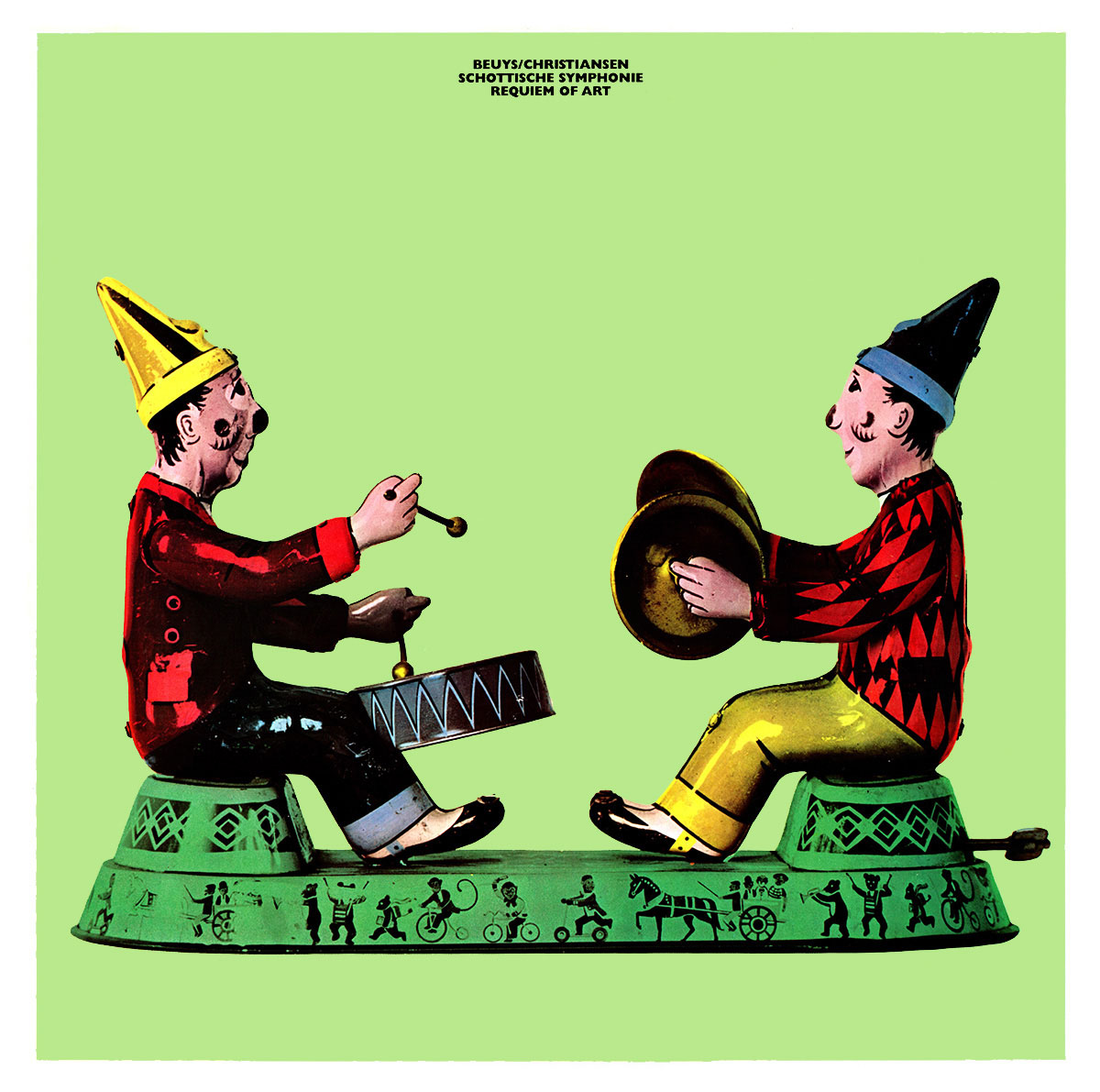
Schottische Symphonie / Requiem of Art a double LP released in 1973 by Edition Schellmann, Munich, documenting two works by Joseph Beuys and Henning Christiansen drawn from their 1970 collaboration Celtic (Kinloch Rannoch) Scottish Symphony at the Edinburgh College of Art. The first LP presents a mono recording of the Schottische Symphonie, the sound component of Beuys’s five-day durational action, captured live on August 21, 1970. The second LP holds Christiansen’s Op. 50: Requiem of Art (Fluxorum Organum II), a stereo tape composition that assembles field recordings made in Jutland the previous summer with organ music sampled from the pair’s earlier action Eurasienstab. Now held in the permanent collection of the Museum of Modern Art, New York,MoMA collection record: Joseph Beuys / Henning Christiansen, Scottish Symphony (Schottische Symphonie) / Requiem of Art, 1973. Accessed 2026-02-18. the double LP is among the rarest artifacts of the Fluxus sound-multiple tradition.
Background
The recordings originate in the summer and autumn of 1970, when the Scottish gallerist and impresario Richard Demarco organized Strategy: Get Arts, an ambitious survey of the Düsseldorf avant-garde staged at the Edinburgh College of Art during the Edinburgh International Festival. Organized in association with the Kunsthalle Düsseldorf, the exhibition brought thirty-five artists from Germany to Scotland, among them Gerhard Richter, Klaus Rinke, Blinky Palermo, and Stefan Wewerka. It was Joseph Beuys, however, who attracted the most attention.Fleming Collection, “Germany Calling! – How Strategy: Get Arts Enlightened Edinburgh.” Accessed 2026-02-18.
Beuys had first visited Demarco in May 1970, traveling to Rannoch Moor and Loch Awe in the Scottish Highlands, landscapes whose austere geology left a deep impression on him. It was on that preliminary trip, walking the high moorland above Kinloch Rannoch, that he began to conceive the action that would become Celtic (Kinloch Rannoch) Scottish Symphony. The title fused the Gaelic name of the landscape with the idea of the symphony as an extended social and sensory score - an action structured in time rather than fixed in a text.
From August 26 to 30, 1970, Beuys performed Celtic (Kinloch Rannoch) Scottish Symphony for five consecutive days at the Edinburgh College of Art, twice daily in four-hour sessions, with Danish Fluxus composer Henning Christiansen providing live sound.Richard Demarco Archive, performance record: Celtic (Kinloch Rannoch) Scottish Symphony, Strategy: Get Arts, August 1970. Accessed 2026-02-18. The action drew several thousand visitors over its run. Edward Lucie-Smith, reviewing the broader Strategy: Get Arts for the Sunday Times, judged that the Demarco–Düsseldorf exhibition made “most English artists look provincial” and “even makes the New York avant-garde look tame.”
The Action: Celtic (Kinloch Rannoch) Scottish Symphony
In performance, Beuys worked with a characteristic vocabulary of materials - felt, fat, copper, blackboards - arranged and rearranged in a durational ritual that refused both theatrical closure and conventional musical notation. Christiansen’s sound contribution was not incidental accompaniment but a constitutive element of the action’s total form, shaped by his long practice of treating the score as an open field rather than a fixed prescription.
The blackboard that Beuys used during the Edinburgh action - the first blackboard to appear in any of his performances - became a recurring presence in subsequent work, as did his developing concern with what he called the “social sculpture,” the idea that all human activity could be understood as a plastic practice extending beyond the conventional art object.
Schottische Symphonie (Side A)
The first LP of the 1973 release documents the sound recorded at Edinburgh College of Art on August 21, 1970, the opening day of the action. The mono recording captures Christiansen’s sonic contribution to the live event: a dense, spare sound-world drawing on his Fluxus practice and his compositional thinking in relation to Beuys’s use of physical gesture and material transformation. The mono format - a deliberate choice, or a technical condition of the recording situation - gives the sound a certain documentary directness, a quality of witness rather than production.
Op. 50: Requiem of Art (Side B)
In the summer of 1969 we made a collective film The Search on the heath in Jutland, Denmark. Henning Christiansen made on site field recordings for the individual scenes with Peter Sakse as sound master. The music was first time used during the performance at the festival Strategy: Gets Art exhibition organised by Richard Demarco at Edinburgh College of Art, on August 21, 1970 with Joseph Beuys and Henning Christiansen. Henning Christiansen sampled the field recording into the organ music from Eurasienstab. He gave this composition subsequently the title Requiem of Art fluxorum organum II Opus 50. That means a requiem over the role of art in the 1960s.
- Ursula Reuter Christiansen, Møn, Denmark, October 20, 2015. Published in the Penultimate Press reissue liner notes, 2016.
The second LP presents the stereo tape realization Christiansen completed in 1973, though its source materials were assembled over several years beginning in 1969. The compositional logic of Requiem of Art is layered: Jutland field recordings made during the filming of The Search, a collective film project, were woven into the fabric of organ music drawn from Eurasienstab (1967), Beuys’s earlier action in which a copper staff was used as a conductor of invisible energies. Christiansen’s sampling - a practice still largely without name or precedent in the early 1970s - is not pastiche but a form of mourning and transmutation. The subtitle Fluxorum Organum II aligns the work with the Fluxus tradition while invoking the medieval organum, in which voices weave against a sustained cantus firmus, here replaced by the drone of the Jutland heath itself.
Ursula Reuter Christiansen, Henning’s partner and collaborator, later described the title as an elegy: a requiem over the role of art in the 1960s. The decade that had produced Fluxus, the happening, the action, the event score - all of these were being reconsidered by the early 1970s, and Christiansen’s composition folds that reconsideration into its very form.
Publication and Editions
The double LP was published in 1973 by Edition Schellmann in Munich as a gatefold sleeve with an integrated twelve-page booklet containing eleven full-page black-and-white photographs documenting the Edinburgh action. The edition was limited to 500 numbered and stamped copies, each bearing an individual number and stamp on the final page of the booklet.Discogs release page: Beuys / Christiansen – Schottische Symphonie / Requiem Of Art, Edition Schellmann, 1973. Accessed 2026-02-18.
A second edition was subsequently published with substantially different cover artwork, appearing in a black-and-white gatefold sleeve with an eight-page booklet including colored graphic scores by Christiansen. This edition was limited to 800 copies, of which 90 plus an unnumbered additional run of signed and numbered copies were incorporated into the portfolio Für Joseph Beuys. A small number of copies from this edition were further distinguished by unique drawings by Christiansen on the inner gatefold, signed and dated but not numbered, with the accompanying booklets similarly signed and dated.
The second LP, Op. 50: Requiem of Art, was reissued independently in 2016 by Penultimate Press (PP20), with the full cooperation of the Henning Christiansen estate. The reissue appeared as a 180-gram LP in a spot-varnished sleeve with a four-page high-gloss booklet containing the complete score, in an edition of 700 copies.
Audio
Reception
Schottische Symphonie / Requiem of Art has remained one of the most sought-after documents in the field of Fluxus and avant-garde sound multiples. The original 1973 pressing regularly commands prices well above $1,000 on the secondary market. Among collectors and scholars of the period, it occupies a position comparable to the major Fluxus editions issued by Edition Block and Multiples, Inc. - a record that is simultaneously a work of art, a historical document, and a distribution object in the Fluxus sense.
The acquisition of the work by the Museum of Modern Art, New York, through the Committee on Prints and Illustrated Books Fund, reflects the extent to which sound multiples of this period have moved from the margins of art history into the permanent collections of major institutions.