|
|
| 3a Bienal Americana de Arte (Primeras Jornadas Americanas de Música Experimental) | |
| Authors | Various Artists |
|---|---|
| Publisher | Industrias Kaiser Argentina / RCA Argentina |
| Publishing date | 1966 |
| Series | JME (Jornadas de Música Experimental) |
| Format | 2× Vinyl LP |
| Duration | 1:25:24 |
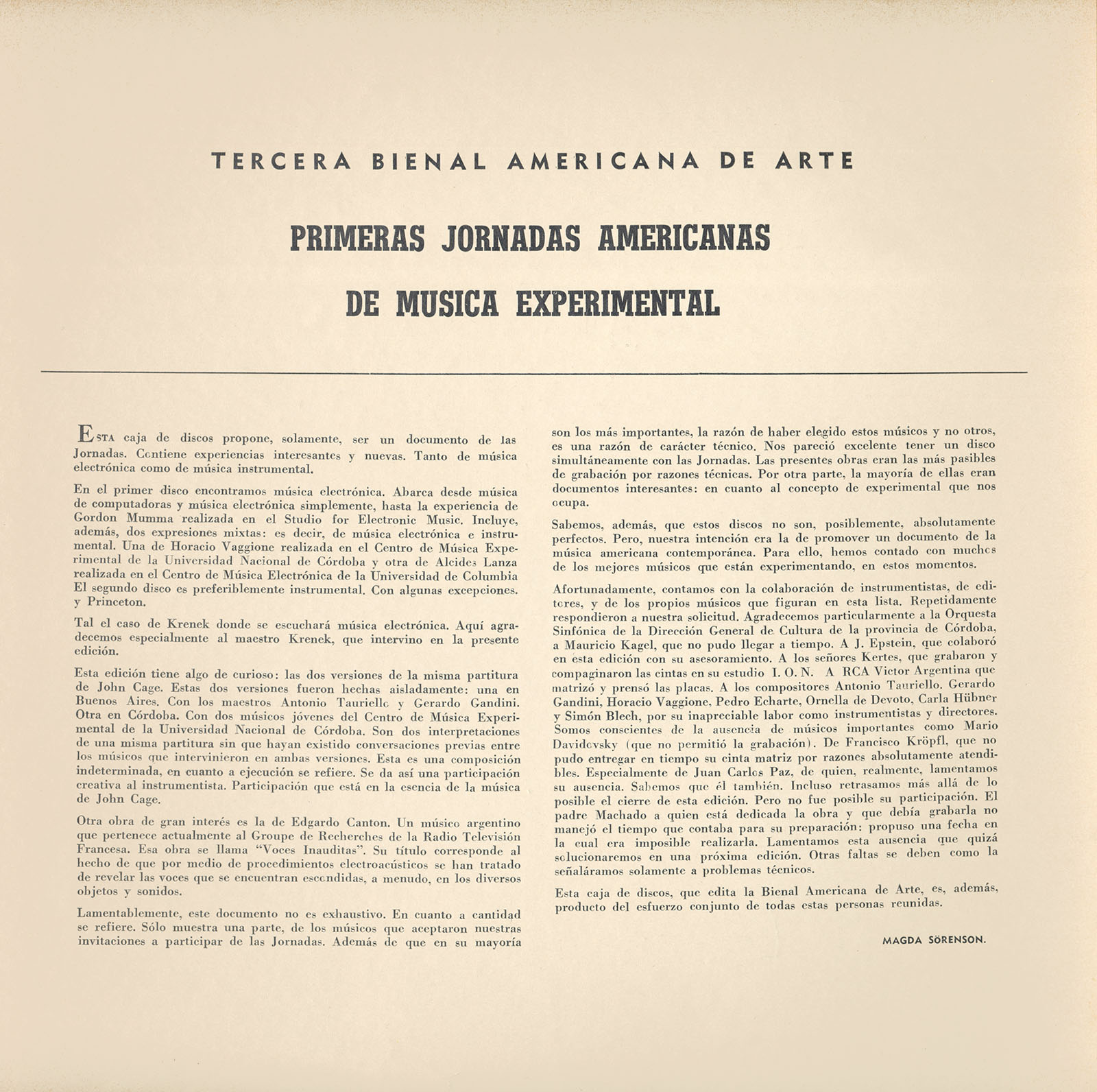
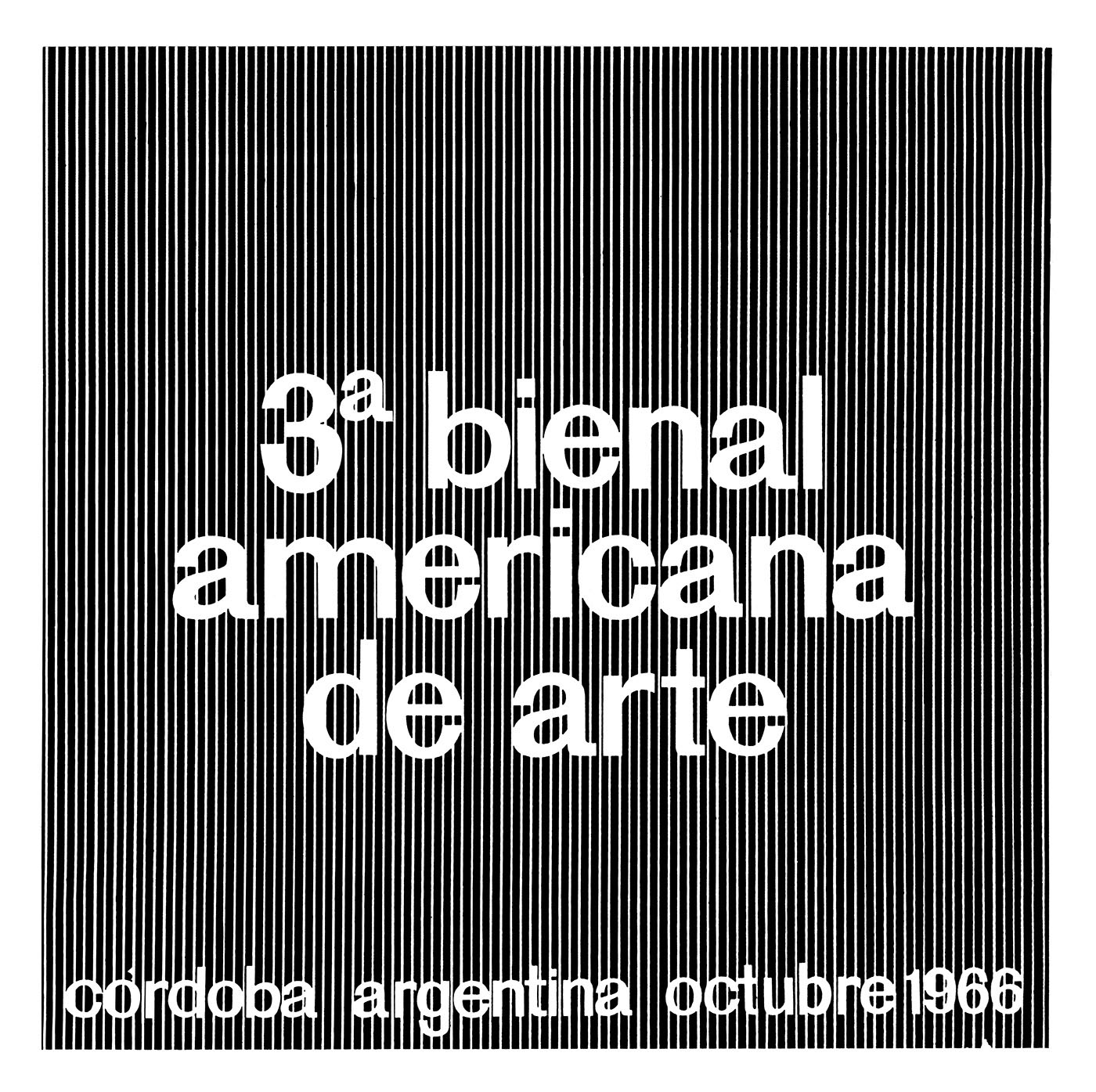
3a Bienal Americana de Arte is a two-disc LP set documenting the experimental music concerts held during the Tercera Bienal Americana de Arte in Córdoba, Argentina in October 1966. Released under the label JME (Jornadas de Música Experimental), the set was pressed and distributed by Industrias Kaiser Argentina in cooperation with RCA Argentina. It presents nearly eighty percent of the music performed across four concert evenings - October 12, 15, 16, and 19, 1966 - which together constituted what the organizers called the first encounter of its kind in the Western Hemisphere dedicated exclusively to experimental and avant-garde music from the Americas. The liner notes were written by Magda Sorensen, the principal patron of the event and wife of the director of Industrias Kaiser in Córdoba. The recordings are not live concert documents but were taped in a studio following the performances.
Background
Córdoba, a city of roughly one million inhabitants situated some 400 miles northwest of Buenos Aires, had by the mid-1960s established itself as a significant cultural center. The Art Biennial of Córdoba - sponsored by the auto manufacturer Industrias Kaiser Argentina and second only to the São Paulo Bienal in its continental prestige - brought together advanced painters from across Latin America every two years. It was the young Argentine composer Horacio Vaggione who conceived the idea of integrating an experimental music program into the Third Biennial, establishing a parallel event independent from yet complementary to the visual arts exhibition. He assembled an electronic music studio at the College of Fine Arts of the University of Córdoba and recruited fellow composers around him, while Sorensen marshaled the institutional support of both Kaiser and local government to realize the concerts.
The music critic Aurelio de la Vega, reviewing the LP for the journal Anuario in 1967, placed the Córdoba encounters within a broader narrative of Latin American musical development. He argued that Argentina, and Buenos Aires in particular, had by this period become one of the most advanced musical centers in the world, a city where composers like Boulez, Penderecki, and Cage were better known than on many North American campuses, and where Alberto Ginastera’s Centro Latinoamericano de Altos Estudios Musicales had produced a generation of composers fluent in the most current international techniques.Aurelio de la Vega, “Avant Garde Music at the American Art Biennial of Cordoba,” Anuario, Vol. 3 (1967), pp. 85–100. The Córdoba group, working somewhat independently of the Buenos Aires scene, drew on the energy that environment had created.
The final program featured works by thirty composers - eighteen from Argentina, ten from the United States, one from Chile, and one from Peru - covering aleatoric, electronic, computer-generated, graphic, and mixed media forms composed between 1953 and 1966. Concerts were offered free of charge and attracted overflow audiences each night. Orchestral works were deliberately excluded in favor of pure tape music, works for tape and instruments, and small chamber ensembles; this restraint, de la Vega noted, was one of the reasons the presentations held together so well artistically.
Esta caja de discos propone, solamente, ser un documento de las Jornadas. Contiene experiencias interesantes y nuevas. Tanto de música electrónica como de música instrumental.
- Magda Sorensen, liner notes, Primeras Jornadas Americanas de Música Experimental (1966)
The LP
The two-disc set was recorded in a studio after the concerts concluded, a circumstance that also explains certain omissions. Larger ensemble works were excluded on grounds of cost; several composers declined recording or were unavailable; and in some cases the works heard at the concerts were substituted with related pieces. These absences are acknowledged in the liner notes, which mention among the unrecorded works Carlos Ferpozzi’s Expansion for eight instruments, Gerardo Gandini’s Mutants I, Antonio Tauriello’s Spaces in Collision, Earle Brown’s Available Forms for eighteen instruments, and Mario Davidovsky’s Electronic Study No. 3 (Hommage à Edgar Varèse), which Davidovsky declined to have recorded. The surviving hour, twenty-five minutes and twenty-four seconds of music nevertheless represent a substantial and coherent document.
Audio
Disc One
Side A
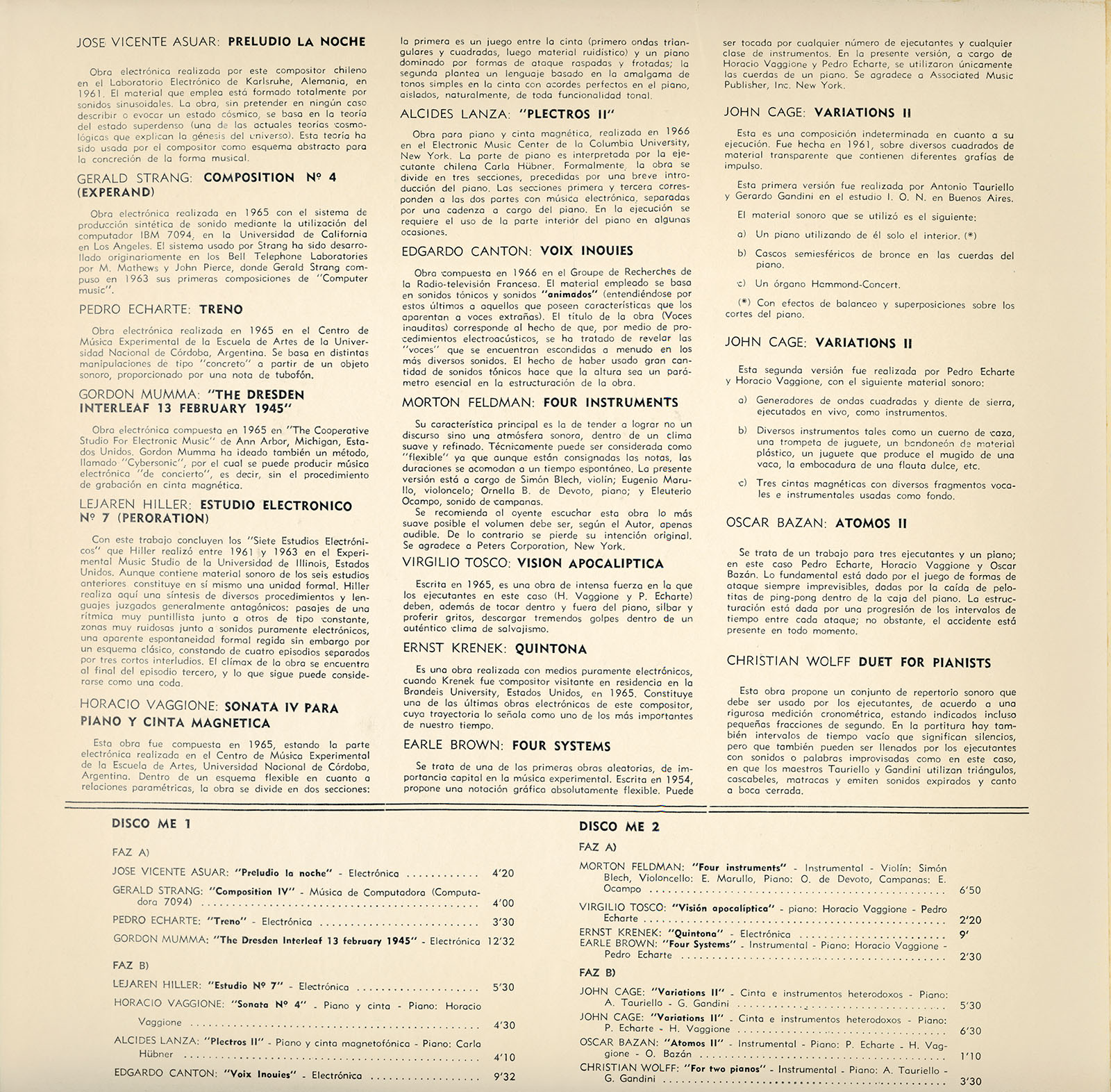
José Vicente Asuar - Preludio la noche (4:20) Composed in 1961 at the Elektronisches Studio of the Musikhochschule Karlsruhe in Germany, this electronic work by the Chilean composer employs exclusively sinusoidal tones as its raw material. The liner notes explain that the work does not attempt to describe or evoke any cosmic state but is grounded in theories of the supersensory - cosmological ideas that Asuar used as an abstract scheme for musical form. De la Vega, writing in 1967, considered it one of the best-known examples of Latin American electronic music, characterizing it as “carefully molded music, quite remote from the ‘anything goes’ prevailing attitudes.”De la Vega, p. 95.
Gerald Strang - Composition No. 4 (Experand) (4:00) Created in 1965 at the University of California, Los Angeles, using the IBM 7094 computer. Strang had spent a summer at Bell Telephone Laboratories and developed music programs around IBM’s 7090 and 7094 systems, working alongside M. Mathews and John Pierce. The liner notes frame it as music produced by a computer synthesis system capable of generating electronic sounds of considerable complexity, operating in a domain where computer music was, at the time, entirely unexplored in Latin America.
Pedro Echarte - Treno (3:30) Composed in 1965 at the Centro de Música Experimental of the Universidad Nacional de Córdoba, this piece belongs to the musique concrète tradition and was built entirely around a single sound object: a tubofón, a type of metal tube instrument. De la Vega describes the work as achieving textural unity through modest means, a limited but genuinely poetic piece from one of the founding members of the Córdoba electronic music community.
Gordon Mumma - The Dresden Interleaf 13 February 1945 (12:32) Composed in 1965 at the Cooperative Studio for Electronic Music in Ann Arbor, Michigan. Mumma, who was by this time part of the Cage–Tudor–Cunningham orbit and had co-founded the ONCE Group in Ann Arbor with Robert Ashley and others, developed his own line of electronic components under what he called a “cybersonic” approach to composition. The work is structured around long fragments that reappear with minor variations, separated by silences of varying duration. The liner notes describe this as an “instant music” method - that is, music generated without the usual procedures of magnetic tape recording. Its title and its twelve-minute duration make it the most overtly theatrical piece on the first disc.
Side B
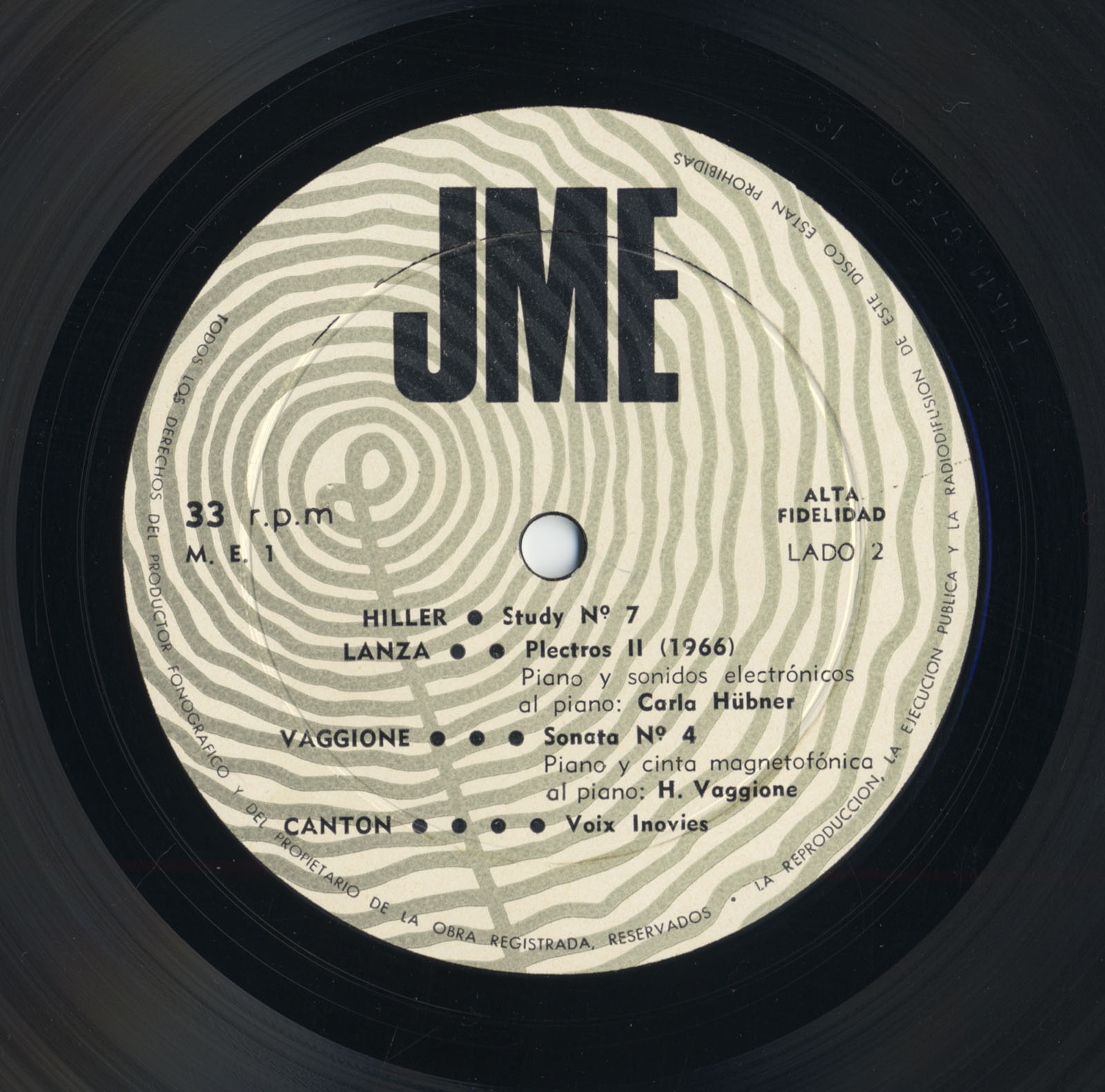
Lejaren Hiller - Estudio Electrónico No. 7 (Peroration) (5:30) The final installment of Hiller’s Seven Electronic Studies, composed between 1961 and 1963 at the Experimental Music Studio of the University of Illinois, which Hiller had largely built himself. The liner notes describe the piece as a synthesis of antagonistic musical languages: pointillistic rhythmic passages alongside long, sustained tones; zones of pure tone alongside dense noise. The structure follows a classical four-episode arch separated by three interludes, the climax arriving at the third episode, followed by a coda. On the LP it appears as a substitution for Hiller’s Suite for Two Pianos and Tape, which was performed at the concerts but not recorded.
Horacio Vaggione - Sonata No. 4 para piano y cinta magnética (4:30) Composed in 1965, with the electronic part realized at the Centro de Música Experimental of the Universidad Nacional de Córdoba. The work, performed here by Vaggione himself at the piano, divides into two main sections. In the liner notes these are described as: a first section organized around noise blocks and various attack types on the piano strings, and a second section in which simple tape tones combine with isolated, tonally pure piano chords. The work operates through variable parametric relations between piano and tape, and between sections of the piano part itself, so that no fixed hierarchy governs the interaction between the two.
Alcides Lanza - Plectros II (4:10) Written in 1966 at the Electronic Music Center of Columbia University, New York, with the piano part performed here by the Chilean pianist Carla Hübner. The liner notes describe the work as divided into three sections preceded by a brief introduction, the first and third corresponding to passages of electronic music separated by a piano cadenza, with the piano used also inside the instrument at points. De la Vega praised this piece among the strongest recordings in the set, noting that Lanza - at that time a young Argentine composer - handled the interaction between piano and tape with particular skill and imagination.De la Vega, p. 97.
Edgardo Canton - Voix Inouies (9:32) Composed in 1966 at the Groupe de Recherches de la Radio-Télévision Française in Paris. Canton, an Argentine composer based in France, built the work from tonal and “animated” sounds - a term the liner notes use for sounds whose character seems to suggest a living presence, voices hidden within material objects and environments. The title, “Unheard Voices,” is explained in the liner notes as referring to the electroacoustic procedure of revealing voices concealed within otherwise familiar sounds. The large number of tonal sounds within the work means that pitch plays a structurally central role.
Disc Two
Side A
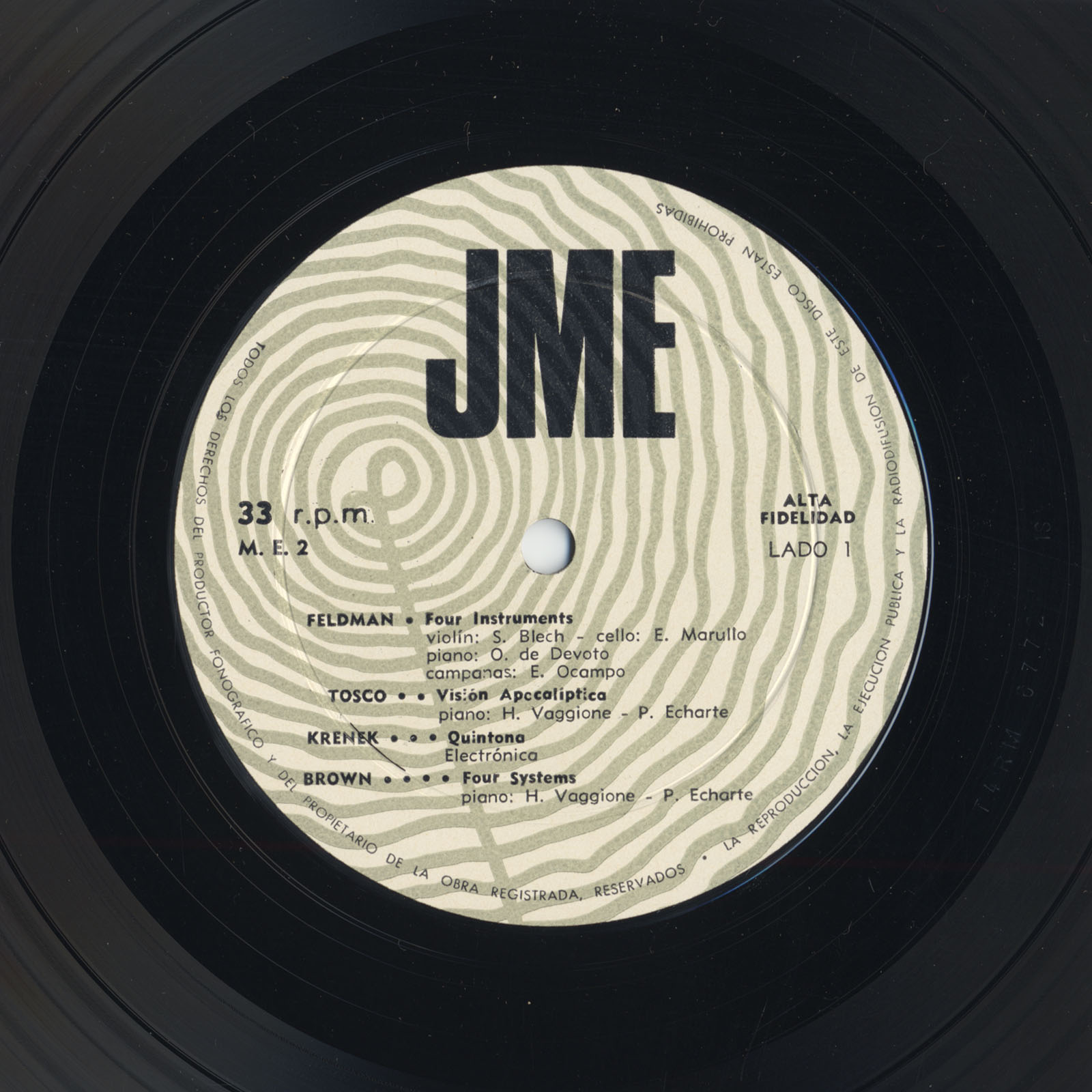
Morton Feldman - Four Instruments (6:50) Performed by Simón Blech (violin), E. Marullo (cello), O. de Devoto (piano), and E. Ocampo (bells). The liner notes describe the work as characterized above all by a sound atmosphere that remains soft and refined throughout - what Feldman described as flexible, in the sense that although the notes are written out, the durations are left to the performers’ instincts. De la Vega wrote of it as exemplifying the erasure of boundaries between sound and color, between musical notation and the graphic elements of painting, though he also observed that this particular kind of ritual presence is difficult to sustain in a recorded medium.De la Vega, p. 98.
Virgilio Tosco - Visión Apocalíptica (2:20) Written in 1965, performed here by Horacio Vaggione and Pedro Echarte at the piano. The liner notes describe the work’s requirements for its performers: beyond playing the instrument, they must also whistle, shout, produce loud percussive sounds against the piano’s casing, and sustain an atmosphere of extreme physical intensity. The score prescribes an authentic climate of savagery. This recording appears as a substitution for Tosco’s Cosmos I (1965) for seventeen strings, which was heard at the concerts but not recorded.
Ernst Krenek - Quintona (9:00) Composed in 1965 while Krenek was in residence at Brandeis University, this purely electronic work was among the last electronic compositions Krenek completed before the period ended. The liner notes note that it constitutes one of the most significant electronic works of the composer’s output. Krenek had worked earlier at the Cologne Radio and subsequently at the San Fernando Valley State College Electronic Music Studio; this piece was realized during a Brandeis residency. The liner notes describe the work as purely electronic in means.
Earle Brown - Four Systems (2:30) Written in 1954, one of the earliest examples of aleatoric music and a landmark in the development of graphic notation. The score does not prescribe the number or type of instruments to be used. In this recording, Vaggione and Echarte perform the work using only the strings of a single piano - an approach entirely consistent with the score’s open instructions. The liner notes describe it as proposing a “completely flexible graphic notation” that may be performed by any number of players on any instruments, making it as much a compositional proposition as a fixed text.
Side B
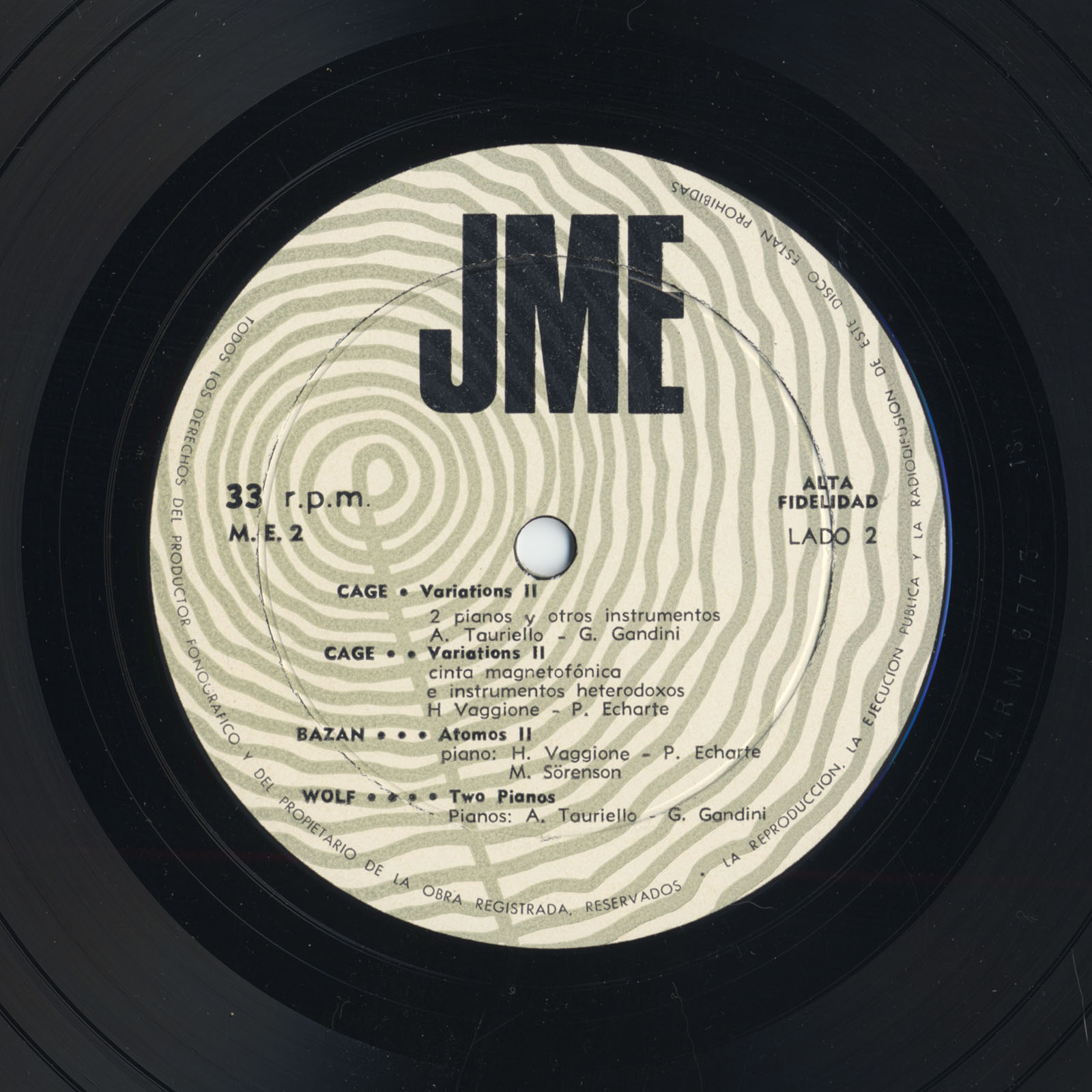
John Cage - Variations II (Version 1) (5:30) Performed by Antonio Tauriello and Gerardo Gandini, realized in Buenos Aires at Studio I.O.N. The piece, composed in 1961 on squares of translucent plastic, leaves all dimensions of execution - form, duration, attack, sound material - entirely to the performers. For this version, the sound materials were the interior of a piano, hemispherical bronze domes rubbed and placed against the strings, and a Hammond Concert organ. The liner notes describe it as a work of indeterminate execution, composed on several squares containing different types of impulse-notation.
John Cage - Variations II (Version 2) (6:30) Performed by Pedro Echarte and Horacio Vaggione, realized in Córdoba. Using the same Cage score, the Córdoba version employed square- and sawtooth-wave generators, a toy hunting horn, a toy trumpet, a plastic bandoneón, a toy that imitates the lowing of a cow, the embouchure of a recorder, and three magnetic tapes with pre-recorded vocal and instrumental fragments. The liner notes record the ensemble materials in detail. The inclusion of both versions on the same record was, as de la Vega noted, a particularly meaningful editorial decision - the total divergence in outcome between the two versions demonstrating the scope of freedom the score grants its interpreters.De la Vega, p. 99.
Oscar Bazán - Atomos II (1:10) A work for three performers and one piano, played here by Pedro Echarte, Horacio Vaggione, and the composer himself. The liner notes describe the piece’s structure as generated by the trajectory of a ping-pong ball bounced inside the piano’s case - the temporal structure of each attack is dictated by the ball’s intervals between successive bounces, each throw made from a different height. The liner notes note that this trajectory is provided by chance while the accident - each individual bounce - is present at all times.
Christian Wolff - Duet for Pianists (3:30) Performed by Antonio Tauriello and Gerardo Gandini. The liner notes describe the work as a piece from an open repertoire, whose execution is governed by precise chronometric measurement rather than conventional notation, with even small fractions of a second indicated. Silent intervals, which may also be filled by the performers with improvised sounds or words, are written into the score with the same care as the sounding ones. Tauriello and Gandini used triangles, rattles, and maracas in the performance, and added expired breath and closed-mouth singing to the sonic texture. The score is published by Associated Music Publishers, New York.
Personnel
Disc One performers: Horacio Vaggione (piano, Sonata No. 4); Carla Hübner (piano, Plectros II)
Disc Two performers: Simón Blech (violin); E. Marullo (cello); O. de Devoto (piano); E. Ocampo (bells) - Four Instruments; Horacio Vaggione and Pedro Echarte (piano, Visión Apocalíptica; Four Systems; Variations II, Version 2; Atomos II); Antonio Tauriello and Gerardo Gandini (piano, Variations II, Version 1; Duet for Pianists); Oscar Bazán (piano, Atomos II)
Reception
Writing in the journal Anuario the following year, de la Vega described the Córdoba encounters as surpassing, in their commitment to presenting entirely uncompromising avant-garde work, any comparable event in the Americas since the Princeton Institute for Advanced Musical Studies concerts of 1959 and 1960. He was not uncritical - he found Canton’s Voix Inouies somewhat flat, Vaggione’s Sonata undermined by an overly simple second section, and Feldman’s Four Instruments unlikely to survive the transition to recorded format. But he considered Lanza’s Plectros II among the finest works on either disc, praised the structural clarity of Hiller’s Peroration, and singled out the decision to include two versions of the Cage Variations as “a very interesting one.”De la Vega, p. 100.
The release itself was characterized by de la Vega as “a valuable historical document” - a cross-section of mid-century experimental music in the Americas assembled with unusual rigor and free of institutional compromise.De la Vega, p. 91.
Tracklisting
Disco ME 1 / Side A
- A1. José Vicente Asuar - Preludio la noche - Electronic (4:20)
- A2. Gerald Strang - Composition No. 4 (Experand) - Computer music, IBM 7094 (4:00)
- A3. Pedro Echarte - Treno - Electronic (3:30)
- A4. Gordon Mumma - The Dresden Interleaf 13 February 1945 - Electronic (12:32)
Disco ME 1 / Side B
- B1. Lejaren Hiller - Estudio Electrónico No. 7 (Peroration) - Electronic (5:30)
- B2. Horacio Vaggione - Sonata No. 4 - Piano and tape; piano: Horacio Vaggione (4:30)
- B3. Alcides Lanza - Plectros II - Piano and tape; piano: Carla Hübner (4:10)
- B4. Edgardo Canton - Voix Inouies - Electronic (9:32)
Disco ME 2 / Side A
- A1. Morton Feldman - Four Instruments - Violin: Simón Blech; cello: E. Marullo; piano: O. de Devoto; bells: E. Ocampo (6:50)
- A2. Virgilio Tosco - Visión Apocalíptica - Piano: Horacio Vaggione, Pedro Echarte (2:20)
- A3. Ernst Krenek - Quintona - Electronic (9:00)
- A4. Earle Brown - Four Systems - Piano: Horacio Vaggione, Pedro Echarte (2:30)
Disco ME 2 / Side B
- B1. John Cage - Variations II (Version 1) - Tape and heterodox instruments; piano: A. Tauriello, G. Gandini (5:30)
- B2. John Cage - Variations II (Version 2) - Tape and heterodox instruments; piano: P. Echarte, H. Vaggione (6:30)
- B3. Oscar Bazán - Atomos II - Piano: P. Echarte, H. Vaggione, O. Bazán (1:10)
- B4. Christian Wolff - Duet for Pianists - Piano: A. Tauriello, G. Gandini (3:30)
Gallery