|
|
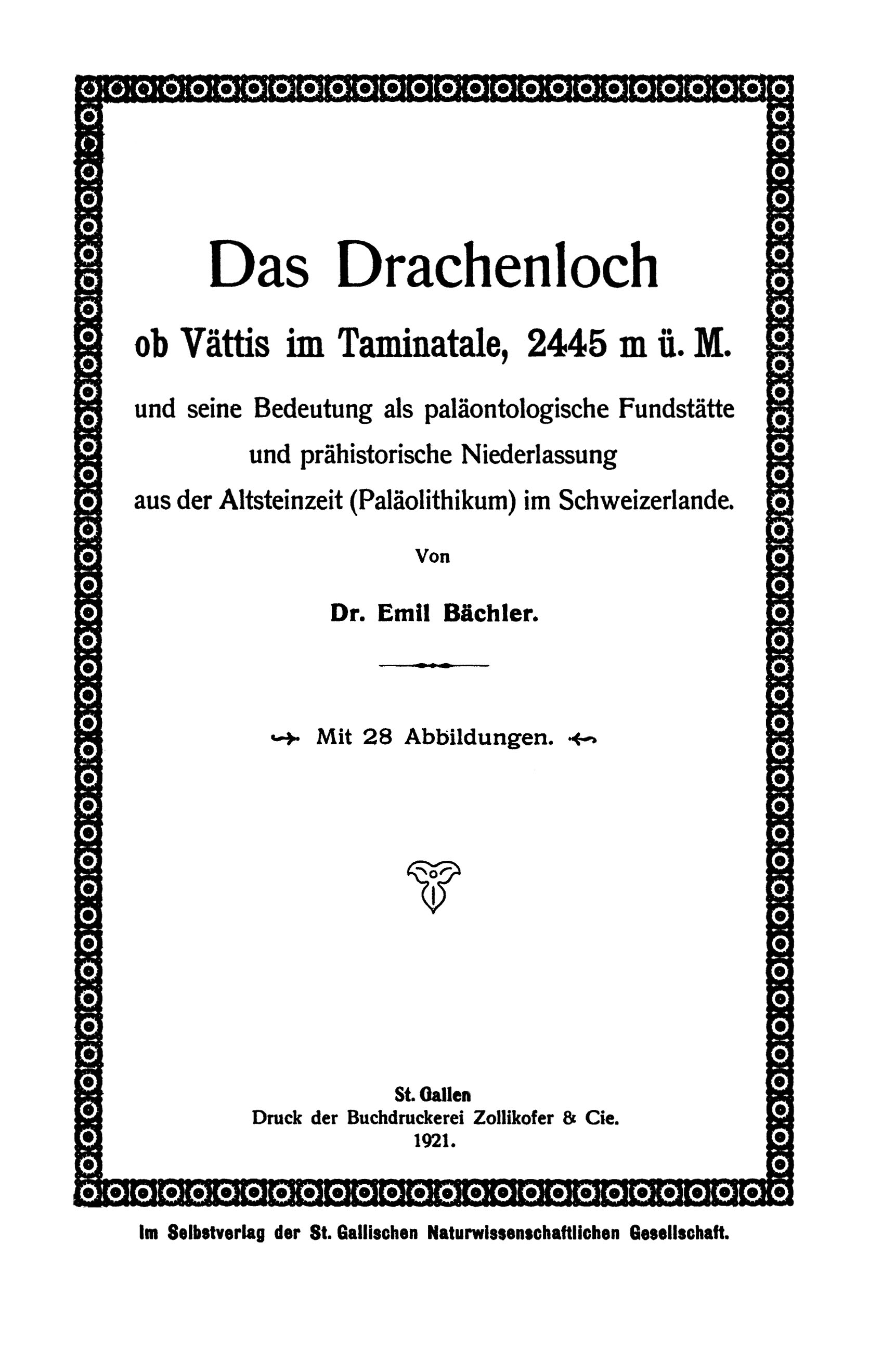
| Das Drachenloch ob Vättis im Taminatale, 2445 m ü. M. | |
| Authors | Dr. Emil Bächler |
|---|---|
| Publisher | St. Gallische Naturwissenschaftliche Gesellschaft |
| Publishing date | 1921 |
| Format | Illustrated monograph, 28 photographs |
The Drachenloch above Vättis in the Tamina Valley (Das Drachenloch ob Vättis im Taminatale) is a 1921 monograph by Swiss naturalist Dr. Emil Bächler documenting the excavation of a prehistoric cave at 2,445 metres above sea level in the canton of St. Gallen, Switzerland, which yielded thousands of cave bear bones and contested evidence for habitation by Palaeolithic man. Published by the St. Gallen Natural Science Society and printed by Zollikofer & Cie., it stands as the first major report on what Bächler argued was the highest-situated Palaeolithic site in Europe — nearly a thousand metres higher than his earlier excavation at the Wildkirchli on the Säntis. The book’s central and most enduring claim — that Neanderthal hunters had arranged cave bear skulls and bones in stone-built enclosures as part of a hunting cult — made the Drachenloch one of the most discussed and disputed archaeological sites of the twentieth century.
Context: Swiss Palaeolithic Research Before 1917
Before Bächler turned his attention to the Drachenloch, Swiss prehistoric research had centred on two post-glacial Magdalenian sites: the Kesslerloch near Thayngen, excavated from 1874, and the Schweizersbild near Schaffhausen, explored from 1891. Both had established the presence of late Palaeolithic hunters on Swiss territory, but represented the youngest phase of the Old Stone Age, associated with reindeer and mammoth. The existence of earlier, Middle Palaeolithic occupation in Switzerland remained disputed on geological grounds: authorities including Gabriel de Mortillet had argued in 1898 that Switzerland’s glaciation had precluded any older human settlement, and Albrecht Penck’s foundational work on the Alps during the Ice Age (1909) similarly contended that Palaeolithic humans never penetrated the alpine forelands during glaciation.
This consensus was overturned in 1904 when Bächler began excavations at the Wildkirchli cave on the Ebenalp above Appenzell, at 1,477 metres — then the highest known Palaeolithic site in Europe. The Wildkirchli yielded Mousterian-type stone tools and the remains of over a thousand cave bears (Ursus spelaeus), demonstrating interglacial human habitation of the Swiss Alps at a time predating the Magdalenian. A comparable site emerged in 1916 at the Grotte de Cotencher in the Neuchâtel Jura, excavated by Auguste Dubois and H. G. Stehlin, which similarly produced Mousterian artefacts alongside cave bear fauna and confirmed that Switzerland had been reached by Middle Palaeolithic hunters. The discovery of the Drachenloch in 1917 extended this picture dramatically upward.
Discovery and Setting
The cave had long been known to the people of Vättis and to alpine visitors. Prof. W. Gröbli had briefly described it in the Jahrbuch of the Swiss Alpine Club in 1889–90, estimating its altitude at around 2,430 metres. Bächler himself had visited the area during botanical fieldwork in the Calfeisen-Tamina valley between 1899 and 1904 and noted the cave’s location in a map of natural monuments he prepared for the 1914 National Exhibition in Bern, designating it a desideratum for future palaeontological investigation. Surface bone fragments seen during a 1903 visit were dismissed at the time as remains of grazing livestock.
The decisive break came on 8 July 1917, when schoolteacher Theophil Nigg of Vättis sent Bächler a box of animal bone fragments recovered from the cave’s second chamber at a depth of about sixty centimetres. Among them was a canine tooth that Bächler immediately identified as that of Ursus spelaeus, the cave bear. Within two days he had alerted Nigg to the site’s scientific significance and set about securing the cooperation of the cantonal government of St. Gallen, the municipal council of Pfäfers, and the local community of Vättis, all of which agreed that the finds should go to the Natural History Museum of the city of St. Gallen. The museum’s owner, the citizens’ community under President W. Gsell, funded the excavations; the community of Vättis supplied free use of a newly built shepherd’s hut on the Gelbberg alp at 2,070 metres as a base camp.
The Drachenloch — Dragon’s Cave — takes its name from the Drachenberg (2,635 m), the mountain in whose eastern rock wall it sits. Bächler devotes considerable space to the etymology of the name, concluding against the interpretation of the Romance word dracca as meaning heavy rain, and favouring instead a derivation from the same root as the German Drache (dragon), citing linguistic parallels from Old High German and Anglo-Saxon. The local dragon legend, recorded in J. Kuoni’s Legends of the Canton of St. Gallen (1903), describes a fierce dragon that inhabited the cave before flying across the Tamina to the Calanda, where it perished in the rock’s interior. Bächler notes the well-established pattern by which cave bear bones found in alpine cavities provided fuel for dragon legends, citing Johann Jakob Wagner’s 1718 observation that bones found at a cave called Ober-Urner-Schwendi, described as dragon remains, were in his judgment bear bones.
The approach to the cave from Vättis (951 m) required two and a half to three hours to the Gelbberg hut and a further hour to the cave, ascending nearly fifteen hundred metres in horizontal distance of barely two kilometres. The research team of four men — Bächler, Nigg, and two local assistants from Vättis — could work only during the summer months of July, August, and September, descending every Saturday and climbing back on Monday mornings with provisions for the week.
Geology and Cave Formation
The Drachenloch owes its extraordinary altitude to the peculiar tectonic history of the Graue Hörner region, which Bächler describes in detail with reference to the work of Albert Heim, K. Tolwinsky, and M. Blumenthal. The cave sits at the boundary of the Glarner Nappe system, in which older Verrucano and Cretaceous rocks have been thrust northward over younger Eocene flysch. The Drachenberg and the adjacent Vättnerkopf are what Blumenthal and Tolwinsky termed parautochthonous klippe — isolated remnants of overthrust Jurassic and Cretaceous limestone resting atop the younger autochthonous basement. Without this geological accident, the mountain would reach only to about 2,300 metres, and no suitable limestone for cave formation would exist at this elevation. The cave itself lies entirely within the lowermost layers of the Seewen limestone of the Drachenberg overthrust, running approximately west-east for a total length of 65–70 metres through six sections, blind at both the front (a single entrance facing east) and the rear.
Bächler identifies it as a seepage-water cave formed by the chemical dissolution of carbonate rock by carbonic acid-bearing water, rather than by an underground river. The absence of horizontal erosion grooves, rolled pebbles, or fluvial deposits supports this reading. The cave shows no significant stalactite formations in its main chambers; the rearmost section (cave VI) contains spherical sinter deposits and calcite crystals. Temperature measurements taken across several summers establish a constant cave temperature of approximately 3.0–3.5°C in the inner chambers, rising to around 6°C in the middle sections, with the entrance chamber fluctuating between near-freezing and exterior temperatures. Permanent ice was found in the debris floor of the first and second chambers during the July excavations of 1918, never having thawed from the previous winter.
Stratigraphy and Excavation Method
The 1921 publication describes the excavations of five seasons (1917–1921), covering somewhat more than half of the find area, with the main archaeological work concentrated in the second and third cave chambers. Bächler describes his methodology in detail, emphasising the importance of careful layer recording against the prevalent tradition of undiscriminating treasure-hunting. Using a main longitudinal axis divided into metre-long sections, with transverse cord lines marking square-metre units, and acetylene lighting of 150 candlepower intensity, the team worked down through the fill to the native cave floor using iron scrapers and wooden instruments in the find layers, reserving pickaxes for the removal of large ceiling-fall blocks.
The excavation profiles in caves II and III revealed six consistent layers through a total depth of approximately 3.5 metres, with the actual find layers reaching about 2 metres:
Layer VI (lowest): A pure white to whitish-grey cave clay, up to 1.8 metres thick, resting directly on the cave rock floor, completely devoid of animal remains. Formed by chemical deposition from seepage water before any human or animal occupation. This clay is conspicuously kaolin-like in structure and dries to a brilliant white.
Layer V: Light brown to reddish-brown, with cave bear bones appearing immediately above the clay surface. The lower portions are moist and compact; bone material is heavily weathered and brittle. The first bone tools of Palaeolithic man appear here.
Layer IV: Light reddish to red-brown, looser in character. Horizontal arrangements of stone slabs were found in this layer, suggesting deliberate flooring to avoid the moisture of layer V beneath. Granular ice was still present at a depth of 1.6 metres in July and August, indicating permafrost conditions. This is one of the two main cultural horizons, with mass accumulations of cave bear bones, stone-built enclosures, and evidence of fire.
Layer III: Red-brown to dark reddish, exceptionally loose and dry, described as sometimes soft enough to crumble by hand. Bone material is in the best state of preservation of any layer. This is the uppermost layer containing Ursus spelaeus (cave bear), meaning that viewed from above, cave bear bones are first encountered here.
Layer II: Grayish to whitish-grey sintery earth, consistently very soft and dry-dusty. The cave bear is entirely absent; its place is taken by Ursus arctos subfossilis, the direct ancestor of the common brown bear. Bone material is flawlessly preserved, often covered in snow-white calcite sinter.
Layer I (uppermost): Blackish mould, 20–25 centimetres thick, containing feces of alpine choughs, voles, and recent rodent and bird bones, along with masses of empty snail shells (Helix arbustorum var. alpicola) deposited by birds.
A striking feature of the Drachenloch profile, contrasting sharply with the Wildkirchli, is the extreme looseness and dryness of the find layers, even down to the deeper horizons. Bächler interprets this as evidence of a drier climate during the period of deposition, and notes that the bones are consequently far better preserved than those from the corresponding Wildkirchli layers.
The Palaeontological Finds
Cave bear remains dominate the prehistoric horizons, constituting 99.5% of bone finds from layers III to V. Bächler estimates that the excavated material to date represents the remains of over 600 individual animals, with the total expected to rise substantially as excavations continued into the rearmost chambers. A complete series of developmental stages is present, from newborn cubs to reproductively mature animals of seven to eight years; old individuals are almost entirely absent, and heavily worn molars or long-used canine teeth — common in the Wildkirchli — do not occur. Bächler interprets the overwhelming predominance of young animals as a diagnostic criterion of human hunting, citing comparisons with cave bear assemblages from Taubach near Weimar (Acheulean-Mousterian), the Schipka cave, and Sirgenstein, where young individuals similarly predominate in contexts with demonstrable human presence.
The cave bear skulls are particularly remarkable for their state of preservation, some retained in the sealed stone enclosures having survived so perfectly that the fine structures of the nasal turbinates remain visible in sagittal section. A skull sawed through its midplane reveals the olfactory apparatus of Ursus spelaeus in complete detail, prompting Bächler to remark on the animal’s pronounced nasal orientation — its nature as a “nose animal” guided primarily by scent.
Also present are Ursus arctos subfossilis, identified on the basis of skull morphology as distinct from the cave bear and as the direct ancestor of the modern brown bear, found in layer III alongside the cave bear and dominating layer II after the cave bear’s disappearance. Wolf (Canis lupus), fox (Canis vulpes), chamois (Antilope rupicapra), ibex (Capra ibex), pine marten (Mustela martes), ermine, marmot, mountain hare, and snow vole (Arvicola nivalis) complete the list of identified species, along with alpine chough and alpine accentor from the bird record. The snow vole, Bächler notes, was itself an active presence during the excavations, tunnelling into the bear bone layers and gnawing finds — acting, as he puts it with evident amusement, as an inadvertent guide to the richest deposits.
Evidence of Human Habitation
Bächler presents six categories of evidence for the prehistoric settlement of the Drachenloch by Palaeolithic hunters.
Distribution and character of the bone finds. All large mammal remains in the prehistoric layers belong to young age stages; coherent skeletons and the remains of old animals are absent; bones are systematically concentrated in the inner cave chambers rather than in the larger, better-lit first chamber. The scatter of splintered material in the central passages, combined with mass accumulations of intact skulls and long bones along the walls, cannot, Bächler argues, be the result of natural cave processes or animal activity.
Intentional bone accumulations and stone enclosures. Along the walls of caves II and III, actual dry-stone walls of horizontally laid Seewen limestone slabs, up to 80 centimetres high, were constructed; behind them, between the wall and the cave rock, skulls and long bones of cave bears were stored in deliberate arrangements, often with skulls stacked facing the same direction with their first and second cervical vertebrae still attached, and flanked by femurs, tibiae, and humeri from different individuals. Near the entrance to cave III, roughly rectangular stone cists covered with large flat slabs were found to contain similar assemblages — in one case, a femur had been inserted through the cheekbone opening of a skull in a position achievable only by rotating the bone as it is pushed through.
Charcoal hearths. On 20 August 1917, an undisturbed fire layer of ash and burned mountain pine charcoal was uncovered in layer IV at a depth of 1.5 metres, measuring approximately 1.4 metres wide and 85–95 centimetres along the cave axis, with small burned bones and limestone fragments embedded in it. A second fireplace, framed by a double layer of limestone slabs and covered by a flat capstone, lay beneath the entrance between caves II and III, also in layer IV. The charcoal structure of mountain pine was confirmed microscopically.
Bone tools. Over eighty rounded and polished bone fragments from large limb bones, showing wear on fracture edges consistent with use as hide-removers or hide-smoothers. Fibula fragments broken with a characteristic oblique “flute beak” fracture, the proximal joint end worn and polished to a working angle of 32–36° identical to those from the Wildkirchli — found stored in orientated groups of up to thirty-one pieces, proximal ends all directed the same way. Pointed bone splinters with polished and ground working surfaces. Hip joint sockets with worn rims, interpreted as hide-scrapers or cups. Bear mandibles broken transversely, suggesting use as chopping tools.
Stone tools. In the absence of the quartzites used by the Wildkirchli inhabitants, the Drachenloch hunter used freshly struck Seewen limestone flakes from the cave walls themselves. Accumulations of shaped limestone shards in point and scraper forms were found in the find layers, always in association with charcoal hearths and bone stores; experiments confirmed that fresh Seewen limestone forms sharp cutting edges capable of cutting meat and dried hide. No edge-retouching notches are present, which Bächler explains by the unlimited local supply: a blunted edge could simply be discarded for a fresh piece.
Hunting trophy cult. The overall interpretation Bächler advances is that the stone enclosures containing skulls and long bones represent a primitive bear cult — a hunting and sacrificial ritual in which the most valued trophies were set aside rather than discarded, the skulls placed in stone-built shrines analogous to those still practised by Caucasian and Siberian bear-hunting peoples in the early twentieth century.
The Bear Cult Controversy
Bächler’s interpretation attracted immediate attention and has remained one of the most debated claims in Palaeolithic archaeology. The case rested on the proposition that the ordered arrangements of skulls and bones, the stone enclosures, and the deliberately inserted femur could not be explained by natural processes, and that they constituted the earliest known evidence of symbolic or religious behaviour in the archaeological record.
The principal critiques developed over the following half-century. The Swiss archaeologist F. E. Koby, writing in 1951, pointed to contradictions between Bächler’s two profile illustrations — the 1921 sketch in this book and a later 1940 version — which agreed neither on the number of skulls shown nor on the structure of the stone chest, calling the legend definitively “crystallised” in successive publications.Bjørn Kurtén, The Cave Bear Story: Life and Death of a Vanished Animal (New York: Columbia University Press, 1976), pp. 82–86. André Leroi-Gourhan, the French prehistorian, dismissed the cave bear cult as archaeology’s “most popular playground for unfounded constructions.”Quoted in Philip G. Chase, “The Cult of the Cave Bear,” Expedition Magazine (University of Pennsylvania), Vol. 29, No. 2 (1987), pp. 4–9.
The most systematic dismantling of the evidence came from Jean-Pierre Jéquier’s 1975 study Le Moustérien Alpin: Révision Critique, which examined each reported case of bear cult evidence in Swiss and Austrian caves and concluded that in no case was the evidence sufficient to prove the existence of such a cult. Two methodological problems were central. First, Bächler had not been continuously present during the excavations; workmen directed the main digging, and the most spectacular finds — including the femur inserted through the skull’s cheekbone — were not observed by Bächler himself. No photographs were taken of the stone chests before they were disturbed by the excavation.Chase, “The Cult of the Cave Bear,” Expedition Magazine, 1987. Second, the processes by which caves fill with sediment and bone were much better understood by the mid-twentieth century than in Bächler’s time. Hydrological processes, the movements of cave bears themselves over many generations making hibernation hollows, and the sorting effects of falling ceiling slabs can account for skull-and-long-bone concentrations without any human intervention.Ian Tattersall, quoted in Prasanna Vishwanathan, “Neanderthals: The Womb of Caves,” Swarajya, March 2017.
By the 1990s, the American paleoanthropologist Ian Tattersall could write that archaeologists were “unanimous that the Drachenloch cave filling can be accounted for by natural processes,” and that the apparent dry-stone walls were most likely single large ceiling blocks that had fallen intact and been misread as coursed masonry. The concentrations of bones, on this reading, resulted from cave bears’ own activity over millennia rather than any human arrangement.
The question has nonetheless remained open in some quarters. Ina Wunn’s 2001 paper “Cave Bear Worship in the Palaeolithic,” published in Cadernos, argued strongly against the cult hypothesis for the Middle Palaeolithic period generally, though other researchers have continued to defend modified versions of it, particularly in relation to sites with better-documented contexts.Ina Wunn, “Cave Bear Worship in the Palaeolithic,” Cadernos, Vol. 26 (2001), pp. 457–463. Timothy Insoll, in Archaeology, Religion, Ritual (2004), described the evidence from Drachenloch as “far from convincing.”Timothy Insoll, Archaeology, Religion, Ritual (London: Routledge, 2004). The related site of Chauvet Cave, where a cave bear skull was found placed on a flat rock in a separate chamber surrounded by bear bones and clay pellets, has revived scholarly interest in the possibility of bear-related ritual behaviour in the Upper Palaeolithic, though this postdates the Mousterian context Bächler proposed for the Drachenloch by many tens of thousands of years.
The Geological Age Question
Bächler dates the Drachenloch settlement to the Riss-Würm interglacial, the ice-free period between the last two major glaciations, by reasoning that the site could not have been accessible during a high glacial and cannot belong to a post-glacial date given the primitive nature of the fauna and tool technology. His evidence for the upper limit of the Rhine glacier’s advance in the Tamina valley — erratic blocks of Grisons rocks reaching to approximately 1,900 metres on the Gelbberg slope, with the highest documented specimen at exactly 1,921 metres — indicates that during high glacial phases the Drachenberg and its cave stood well above the ice as a nunatak, as had the Wildkirchli. The post-glacial option is excluded by the complete absence of any Arctic or steppe fauna (mammoth, reindeer, horse) typical of the Magdalenian, and by the impossibility of connecting the primitive cultural stage with the Aurignacian or any later Palaeolithic horizon.
Bächler himself notes in a footnote that the middle interglacial period (Mindel-Riss) might offer an even better fit, given its longer duration and more favourable conditions, but states that no secure indications of greater age are yet available, and that no facts contradict a Riss-Würm date. He regards any attempt to assign the site to a specific phase of the last interglacial — early, middle, or late — as premature on the 1921 evidence.
Alpine Palaeolithic and Cultural Facies
Among the book’s most original propositions is Bächler’s suggestion, introduced with explicit caution, that the Wildkirchli and Drachenloch finds may represent a distinct “cultural facies” of the Palaeolithic — an alpine variant that cannot be straightforwardly absorbed into the international system of Chellean, Acheulean, Mousterian, Aurignacian, Solutrean, and Magdalenian. The absence of the oil quartzites used at the Wildkirchli and of any retouched stone tool tradition in the Drachenloch, the primitive bone technology, and the specific fauna suggest to him that a small hunting group living in world-remote mountain isolation over many generations would inevitably develop its own expedient practices, independent of developments in the plains. He is careful not to claim the discovery of a new cultural stage — explicitly distancing himself from Otto Hauser’s attempt to subsume the Wildkirchli within a “Micoque-Kösten type” — but invites future alpine cave research to build toward what he calls, tentatively, a “special alpine Palaeolithic.”
This conjecture has not received significant scholarly traction, but it reflects a genuine methodological point: that the classification of Palaeolithic cultures developed primarily from French and German lowland and river-valley sites may fit imperfectly onto the remains of small seasonal hunting parties operating at extreme altitude with locally available raw materials.
Reception and Legacy
The book was published under the auspices of the St. Gallen Natural Science Society, whose president Dr. H. Rehsteiner provided editorial assistance. Funding for the illustrations came from the municipal administrative council of St. Gallen and from Arnold Mettler-Specker. The aerial photographs — among the first ever used in an archaeological publication — were taken by Flying Officer Lieutenant Walter Mittelholzer of Ad-Astra-Aero in Zurich.
The Drachenloch achieved immediate international notice as the highest known Palaeolithic site. Bächler followed the 1921 publication with a more detailed report in 1923 (Das Drachenloch ob Vättis im Taminatale, St. Gallen: Zollikofer und Cie.) and a comprehensive synthesis, Das alpine Paläolithikum der Schweiz, in 1940. The bone cult hypothesis entered the broader literature through Bjørn Kurtén’s accessible account in The Cave Bear Story (1976) and through numerous popular prehistory books. J. M. Coles and E. S. Higgs described the stone cist and inserted femur in The Archaeology of Early Man (1969), while acknowledging the methodological problems with the evidence.J. M. Coles and E. S. Higgs, The Archaeology of Early Man (New York: Frederick A. Praeger, 1969), pp. 286–287.
The site remains associated in the popular imagination with Neanderthal spiritual life, despite the consensus among professional archaeologists that the bear cult hypothesis as articulated by Bächler cannot be sustained on the available evidence. The cave itself is a protected natural monument under Swiss federal and cantonal law, and the finds are held in the Natural History Museum of the city of St. Gallen.
Explore the Book
The Drachenloch above Vättis in the Tamina Valley
Read the book in English and German.
Read the full text →This is a preview only - view fullsize on archive.org