|
|
| Duett Paik/Takis / Klangraum Takis | |
| Artists | Nam June Paik & Takis |
|---|---|
| Publisher | Edition Kölnischer Kunstverein (EKK-1) |
| Publishing date | 1979 |
| Edition | 200 signed copies |
| Format | Vinyl LP, Gatefold |
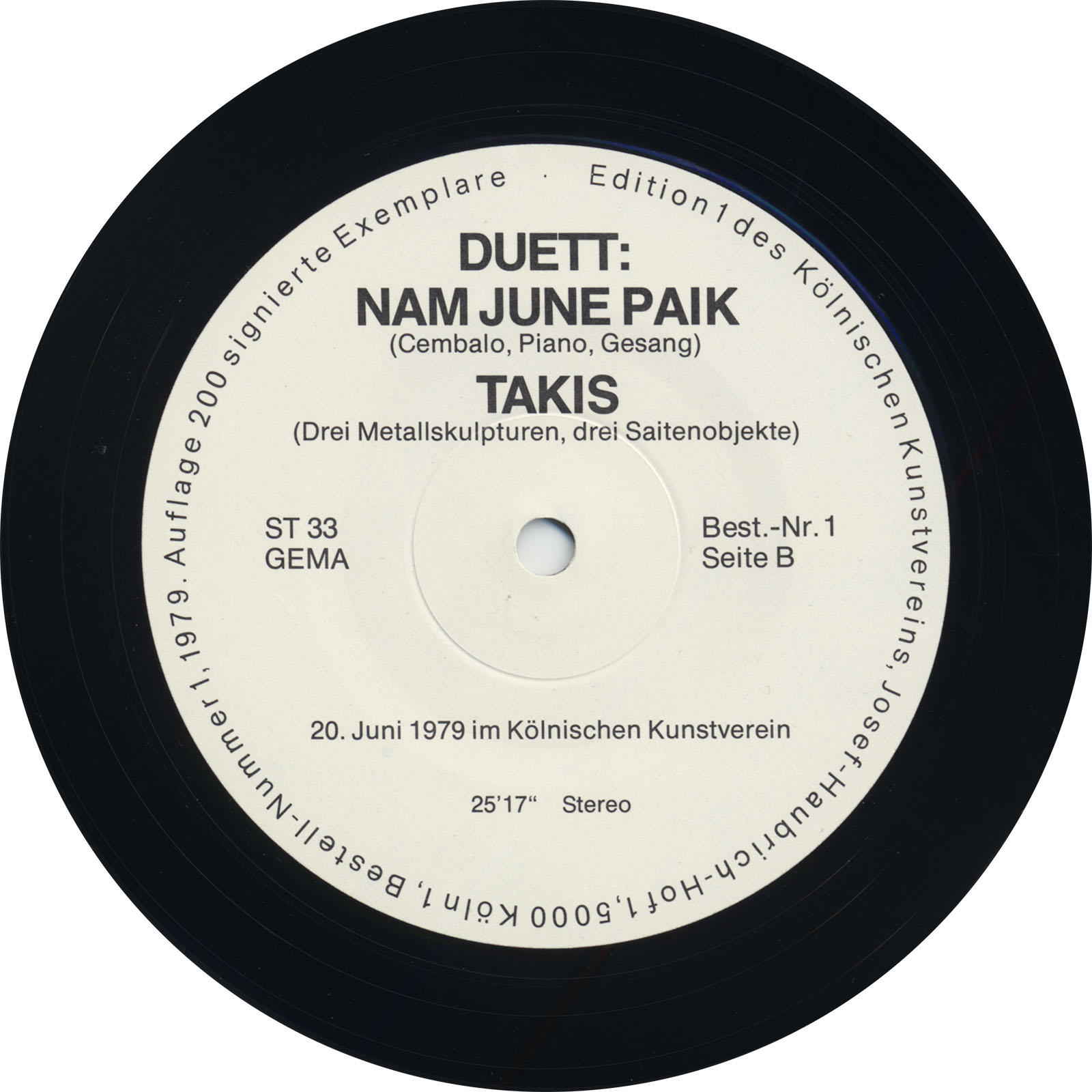
| Duration | Side A: 25:17 / Side B: 26:43 |
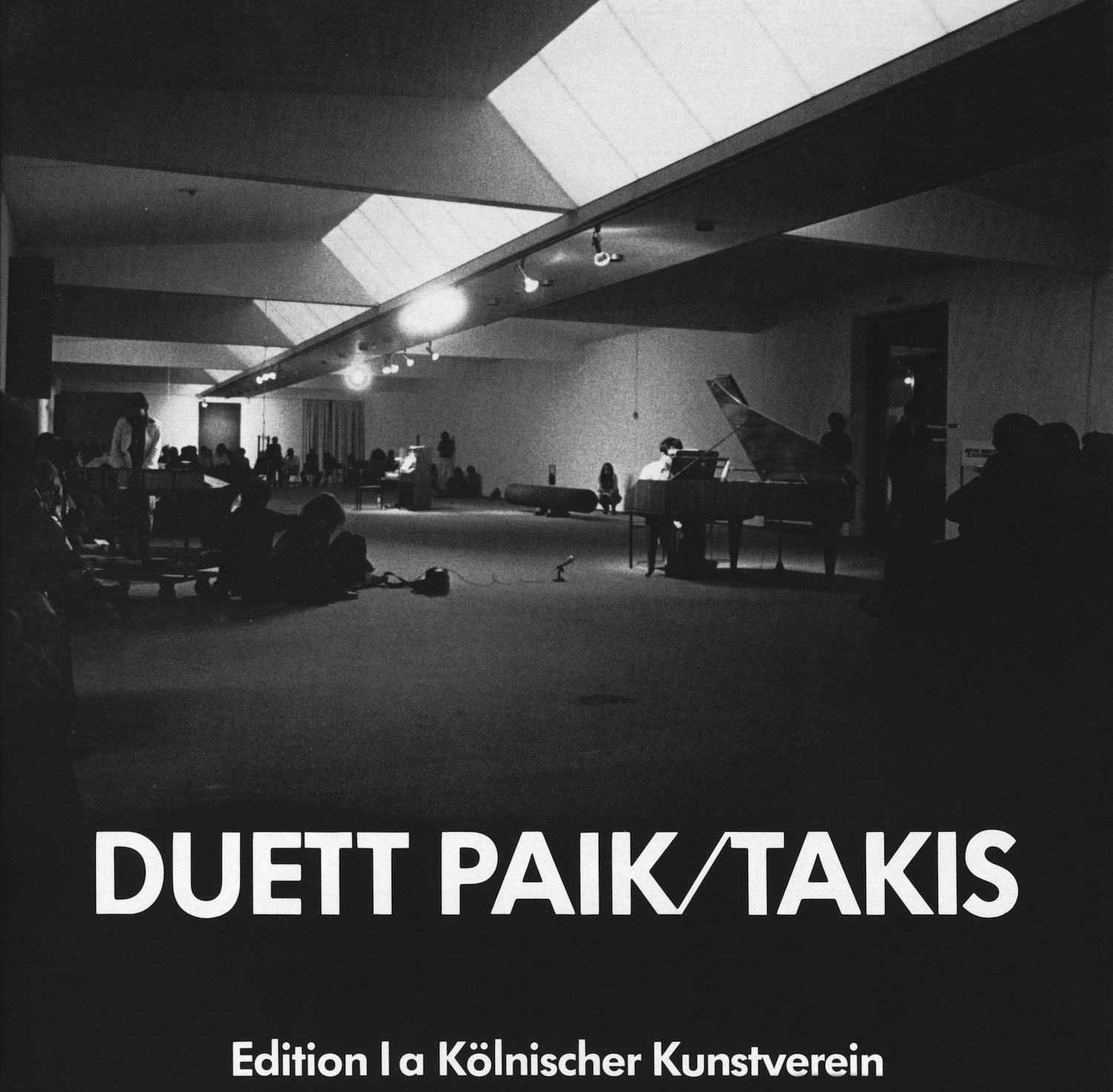
Duett Paik/Takis is a double-sided vinyl LP documenting two live performances staged at the Kölnischer Kunstverein in Cologne in June 1979, featuring Nam June Paik performing on harpsichord, piano, and voice alongside the electromagnetic sculptures of Takis. The record was released as the inaugural edition of the Kölnischer Kunstverein’s own imprint, in a limited pressing of 200 signed and numbered copies. Both performances were recorded on June 20, 1979, by composers Klarenz Barlow and Walter Zimmermann.
Background
The LP emerges from a sustained relationship between Nam June Paik and the Kölnischer Kunstverein under director Wulf Herzogenrath. Herzogenrath had organized Paik’s first European solo exhibition at the institution in 1976, and the Kunstverein became a consistent platform for the artist’s expanding practice through the late 1970s. By 1979, Paik had recently begun a professorship at the Kunstakademie Düsseldorf - a position he would hold from 1979 to 1996 - placing him firmly within the West German art world at precisely the moment this collaboration took shape.
Takis, meanwhile, had been developing his Espace Musical installations across Europe for several years. A major Espace Musical exhibition had been presented at the Musée d’Art Moderne de la Ville de Paris in 1978, and the Cologne presentation the following year continued that trajectory. The Kölnischer Kunstverein exhibition was titled Takis: Klangraum Gestaltung (Takis, Design of Musical Space) - a formulation that positioned Takis’s electromagnetic objects not merely as sculpture but as architectural acoustics, a space defined by sound.
The Artists
Nam June Paik was born in Seoul, Korea in 1932. After training as a classical musician in Japan, he moved to West Germany in 1957 to study music history, where he encountered Karlheinz Stockhausen and John Cage and joined the Fluxus collective. His practice by the late 1970s ranged across video art, television sculpture, performance, and music, informed throughout by the Fluxus conviction that the boundary between art and everyday life was a convention worth dismantling. Cologne held particular significance in Paik’s biography: in a 1960 piano performance there, he played Chopin, threw himself onto the piano, and rushed into the audience.
Takis - born Panayiotis Vassilakis in Athens in 1925 - was a self-taught Greek artist known for his kinetic sculptures. A leading figure in the kinetic art movement of the 1960s, he made sculptures, paintings, performances and sound works incorporating invisible forces as a fourth dimension - especially magnetics, his lifelong subject of study. Marcel Duchamp, who became an admirer, called him the “cheerful ploughman of magnetic fields.” When he eventually returned to Paris in the mid-1970s after a fellowship at MIT, his interest in the cosmos and philosophy, coupled with his skill in transforming scrap metal and employing electromagnetism, resulted in memorable kinetic sound pieces and musical devices.
Side A: Duett Paik/Takis
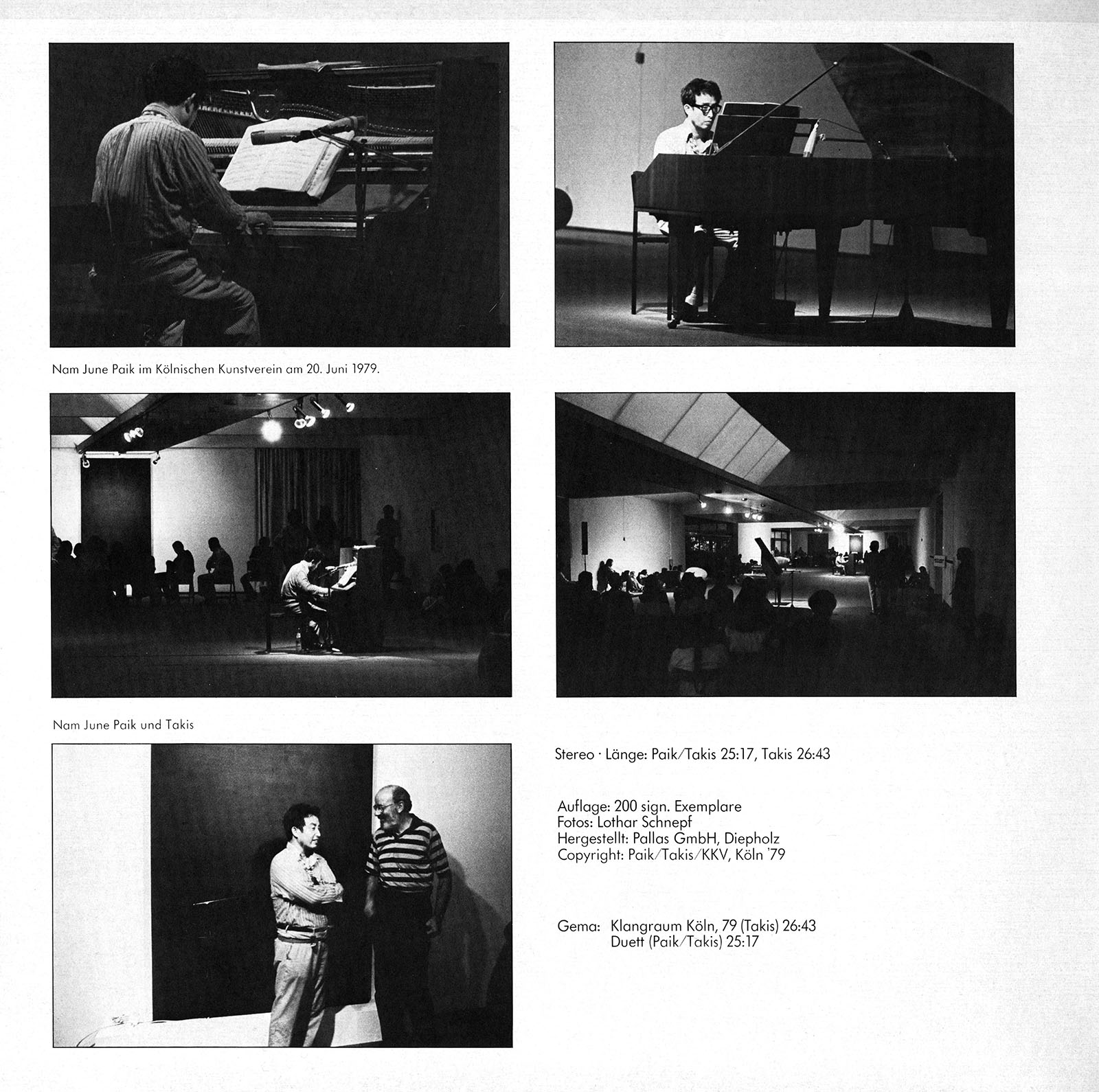
The first side of the record documents the concert Duett Paik/Takis, performed on June 20, 1979. According to the liner notes, Paik - described as “born 1932 in Korea, lives in New York” - performed on harpsichord and piano and sang, following a score that directed the switching on and off of Takis’s objects. The concert was not a conventional musical dialogue but a structured improvisation in which Paik’s live playing interacted with the sonic environment produced by Takis’s sculptures. As one later assessment summarized, Paik improvises on piano and voice while Takis performs on his metal sculptures.
The recordings were made by Klarenz Barlow and Walter Zimmermann, both composers active in Cologne’s experimental music scene at the time. Responsibility for the publication is attributed to Wulf Herzogenrath.
Side B: Klangraum Takis
The second side documents the Klangraum (Sound Space) installation that Takis designed for the Kölnischer Kunstverein. The liner notes state that this Klangraum was designed by Takis - “born 1925 in Athens, lives in Paris” - for the Kunstverein, and was audible and visible there from June 17–20, 1979.
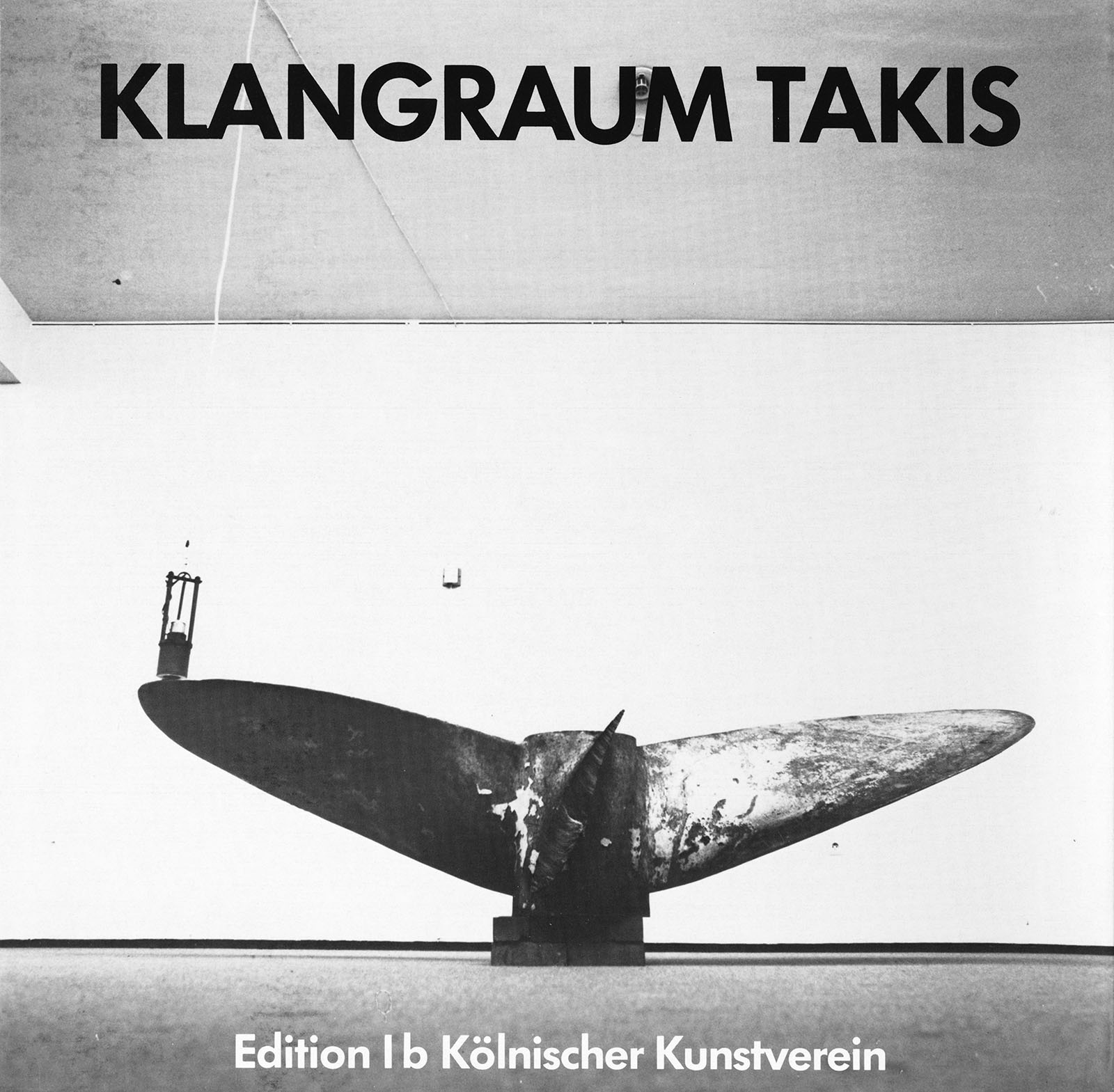
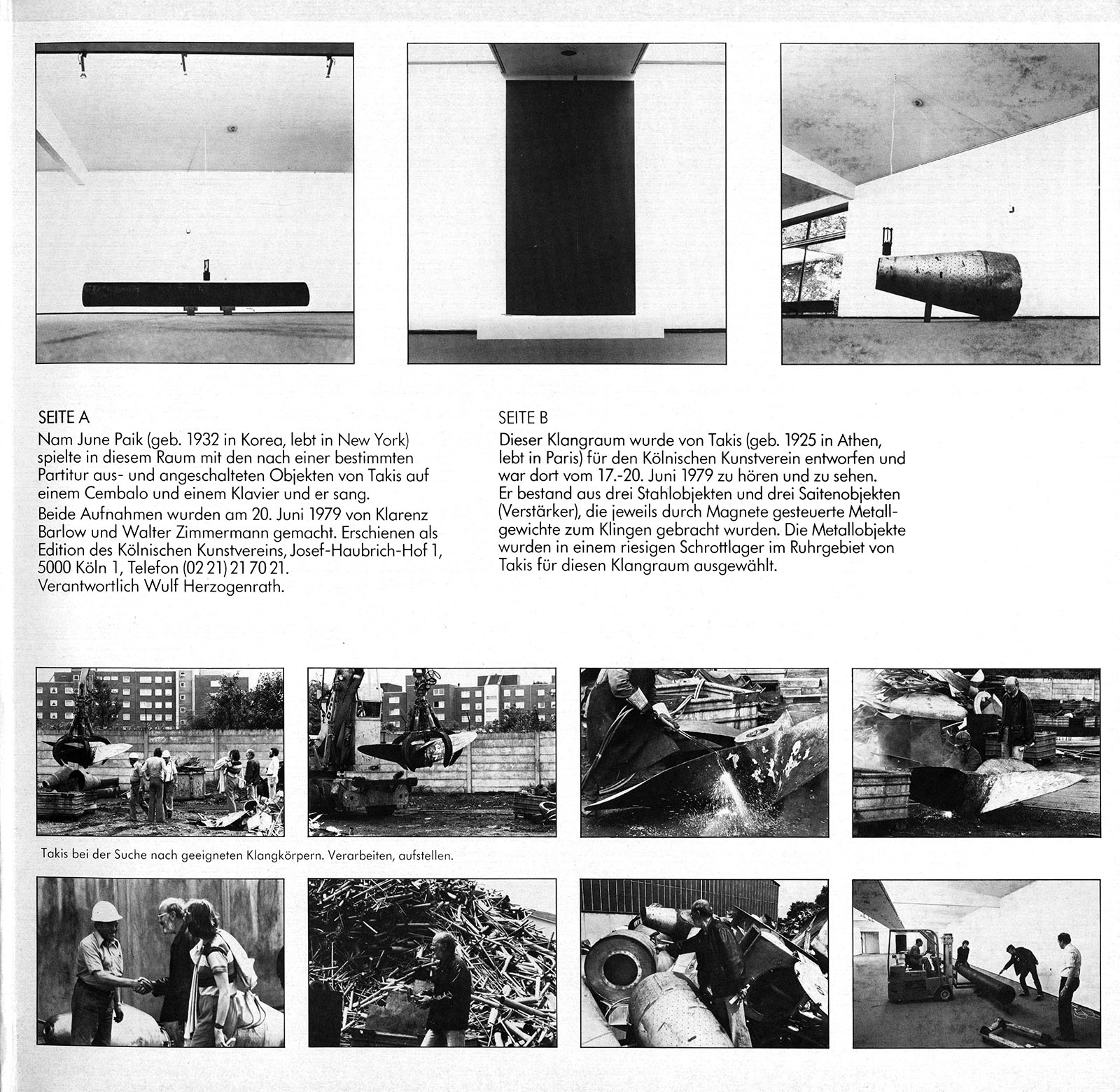
The installation consisted of three steel objects and three string objects fitted with amplifiers, each set into vibration by magnets. The metal objects were selected by Takis from a vast scrapyard in the Ruhr region. The photographs spread across the gatefold interior document this process of selection: Takis is shown at the scrapyard scouting and handling large industrial metal forms before they were transported, processed, and installed.
This kind of material sourcing was characteristic of Takis’s working method throughout the period. Among his many works involving electromechanical devices, often salvaged from army surplus stores and industrial sources, are sculptures that use magnets to animate metallic objects suspended near their surfaces. The Ruhr scrapyard offered an especially abundant supply of heavy industrial debris - the residue of West Germany’s postwar steel industry - which Takis transformed into resonating sculptural instruments. In his Musicals series, magnets pull metal rods against instrumental strings to produce a single note and its reverberations - what Takis called “space sounds”.
The Klangraum extended this logic into an immersive environment: the visitor entered a space defined not by visual spectacle but by the sustained, involuntary sounds emanating from objects whose movement was governed by electromagnetic force.
Audio
Publication
The LP was the first release on the Edition Kölnischer Kunstverein imprint (EKK-1). The second release on the same imprint (EKK-2) was a recording by composer Hans Otte, documenting a staging of his piece On Earth given at the Kunstverein on June 13, 1979 - a week before the Paik/Takis concert. The pressing was manufactured by Pallas GmbH in Diepholz. Photographs were taken by Lothar Schnepf.
The gatefold sleeve contains bilingual liner notes in German and documentation photographs of the Klangraum installation: images of the steel objects suspended in the Kunstverein’s exhibition space, and a sequence of photographs from the Ruhr scrapyard showing Takis in the process of selecting, processing, and transporting the metal forms that would become the sound-producing bodies of the installation.
Reception and Legacy
The recording circulated within specialist networks of sound art and experimental music. It was later reissued: the Duett Paik/Takis recording from 1979 was included in a 2001 compilation of Paik’s musical works spanning 1958 to 1979, previously issued on the limited vinyl edition by the Kölnischer Kunstverein.
The collaboration sits at an intersection that defines much of both artists’ work: Takis’s commitment to revealing the aesthetic dimension of invisible physical forces, and Paik’s lifelong project of destabilizing the boundaries between music, sculpture, and performance. The Takis Foundation’s biographical record lists the 1979 Nam June Paik collaboration among Takis’s distinctive performance partnerships, alongside later works with Charlemagne Palestine, Joëlle Léandre, and others. It remains one of the few documented occasions when the two artists worked directly in the same space, each contributing a different order of materiality - Paik’s trained musicianship and its classical inheritance, Takis’s electromagnetically animated industrial debris - to a shared sonic event.
Track Listing
Side A - Duett Paik/Takis Paik/Takis - 25:17
Side B - Klangraum Takis Takis - 26:43
Credits
- Nam June Paik - harpsichord, piano, voice, composer
- Takis - sculptures, strings, composer
- Recorded June 20, 1979, by Klarenz Barlow and Walter Zimmermann
- Published by Edition Kölnischer Kunstverein, Josef-Haubrich-Hof 1, Cologne
- Responsible: Wulf Herzogenrath
- Photography: Lothar Schnepf
- Manufactured by Pallas GmbH, Diepholz
Gallery