|
|
| Helhesten (Year 1, Booklet 1) | |
| Editor | Robert Dahlmann Olsen |
|---|---|
| Issue date | April 13, 1941 |
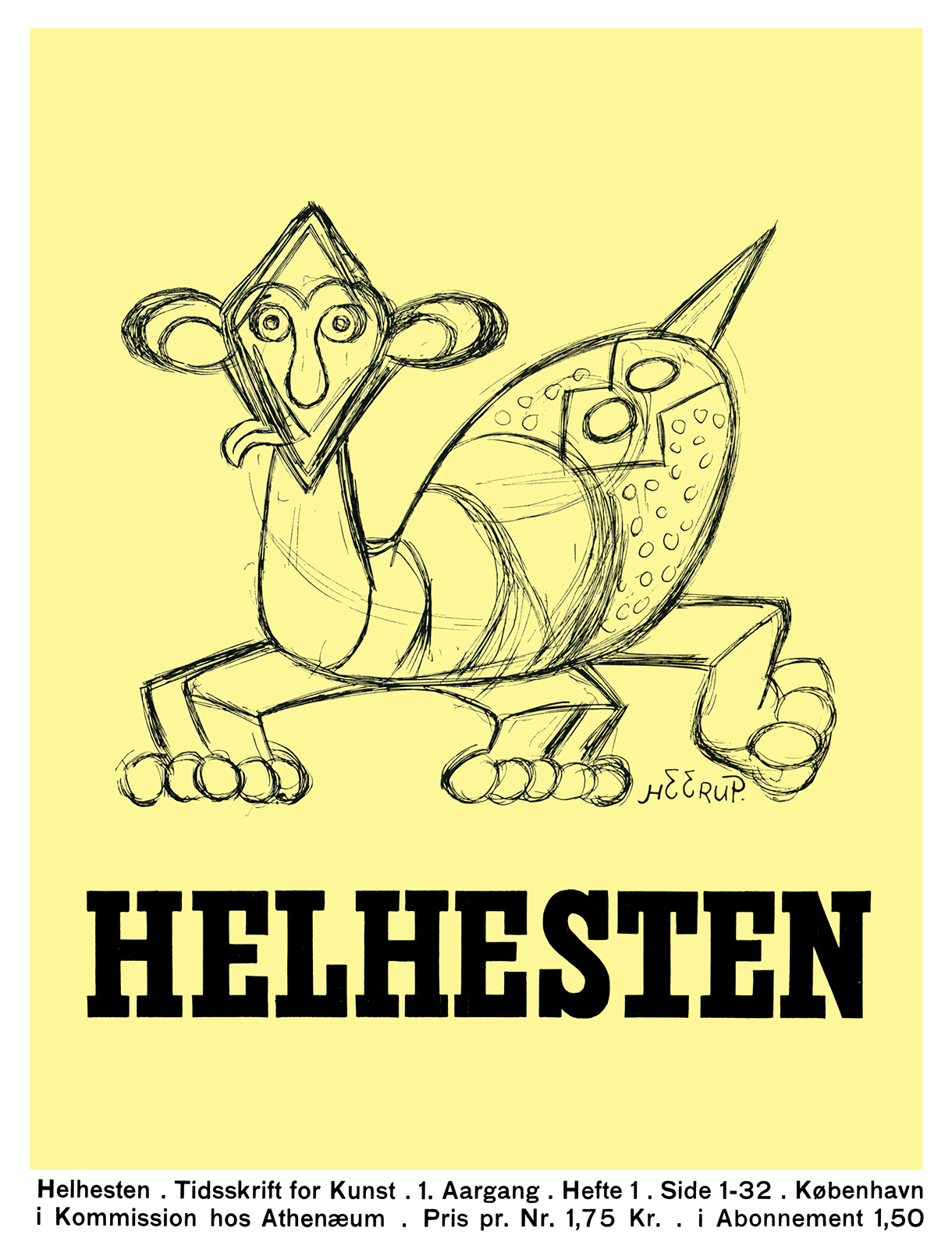
| Cover design | Henry Heerup |
| Followed by | Helhesten (Year 1, Booklet 2) |
Helhesten (Year 1, Booklet 1) is the inaugural issue of the Danish art journal Helhesten, edited by Danish architect Robert Dahlmann Olsen. Published during the German occupation of Denmark, it launched the most significant avant-garde art journal to emerge from occupied Europe during World War II.
This article is part of the Helhesten collection.
Background
Less than a year after Germany invaded Denmark on April 9, 1940, a circle of young artists and intellectuals launched Helhesten as a vehicle for cultural resistance and artistic experimentation. The journal’s first issue appeared in March 1941, reaching more than a thousand Danish homes and offices.
The artists who founded Helhesten-including Asger Jorn (1914–1973), Ejler Bille (1910–2004), Egill Jacobsen (1910–1998), Carl-Henning Pedersen (1913–2007), and Henry Heerup (1907–1993)-had been active in Paris and Germany before the war. Many had studied under Fernand Léger or encountered the work of German Expressionists like Paul Klee and Emil Nolde. As Guy Atkins writes in Jorn in Scandinavia:
It is now generally recognized that the artists of the war years were by far the most talented generation of painters and sculptors that Denmark has ever produced. The war situation drew these men closer together. They could no longer travel abroad and so they had to rely entirely upon each other for mental stimulus and companionship.
The magazine helhesten, which ran from 1941 to 1944, provided a forum for the more talented younger artists. Nearly all of them contributed articles or illustrations to this magazine.
- Guy Atkins, Jorn in Scandinavia 1930-1953
The Name
In bold defiance of the very real presence of their German occupiers, the artists chose as the journal’s ideological symbol the helhest-the three-legged harbinger of death from Nordic mythology and the tales of Hans Christian Andersen and the Brothers Grimm. Egill Jacobsen recalled that Jorn suggested the name specifically to provoke the Germans as “a quite excellent name to flaunt under the noses of the Nazis.”
The choice was a direct provocation of Nazi cultural policy, which sought to appropriate Nordic mythology for its own propaganda. By caricaturing the mythological figure in deliberately “degenerate” depictions, the artists mocked the Nazi abuse of Nordic heritage.
The Founding Manifesto
The first issue contained what would become the group’s founding manifesto: Egill Jacobsen’s essay “Objectivity and Mystery” (Saglighed og mystik). In it, Jacobsen attempted to explain the group’s aesthetic approach:
There are still people who think that all work with mystery is reactionary, this is incorrect. All creative art, on the strength of its living fantasy, moves on the boundary between the known and the unknown, the conscious and the unconscious, of knowledge and mystery. When life is creative and therefore alive, it can never repeat itself but develops its richness in ever new content. Life should not just be thought and measured, it should also be lived. A development towards the unknown occurs in all living art.
- Egill Jacobsen, “Objectivity and Mystery,” Helhesten 1, no. 1 (1941)
The Mission Statement
Inside the first issue, the group declared its mission:
In order to remedy the lack of a Danish art journal that reflects in equal measure the results of contemporary art and meaningful past cultural epochs, a circle of young artists and scientists have taken the initiative to publish the journal Helhesten. …The journal is not narrowly sectarian-based, but represents various points of view, which together should reveal the living life of culture.
- Helhesten 1, no. 1 (1941)
When viewed in light of Denmark’s official policy of deference towards Germany, this emphasis on creative freedom, social belonging, and equality highlights that from the very first issue, Helhesten not only actively transgressed Nazi rule, but also that of the Danish government’s collaboration policy.
Cover Design
Henry Heerup’s simple cover image depicted an ebullient hell-horse that must have looked more like a children’s magazine illustration than an avant-garde art journal. This apparent naïveté was deliberate-the artists understood childlike and fantastical forms as representative of unbridled creativity common to all human beings.
Editorial Context
The journal was edited by architect Robert Dahlmann Olsen (1915–1993), who would later edit the first issue of Cobra in a virtually identical format. Jorn and Olsen were responsible for the practical aspects of production, which-rather unusually for a wartime publication-was printed partially in colour.
The editorial meetings were held in the office of archaeologist P.V. Glob (1911–1985), future director of the National Museum, whose expertise in Nordic prehistory informed the journal’s interest in ancient artifacts and folk art.
Contents and Themes
The first issue established the journal’s distinctive interdisciplinary approach, including essays on art theory, non-Western artefacts, literature, poetry, film, architecture, and photography, alongside profiles of contemporary Danish artists. Articles spanned high and low culture-from prehistoric Scandinavian rock carvings and Japanese theatre to vernacular architecture, contemporary film, and popular art forms like tattoos.
Artists wrote profiles on one another as well as international figures such as Alberto Giacometti and Paul Klee, and translated works-some of the first in Danish-of writers like James Joyce, Franz Kafka, and Arthur Rimbaud. Regardless of the subject, every article questioned hierarchies of power and the cultural products they engendered.
The Helhesten Series
Helhesten was published over nine issues from April 1941 to November 1944 and featured the abstract expressionist art of the Danish avant-garde group of the same name. The journal was illustrated with over fifty original, mostly colour graphic works, and printed in editions of 800. It was affordable to the general public; a full set of all issues cost twelve kroner, or the equivalent of $2.30 in 1944. Artists were not paid for their contributions, and group dues covered printing costs.
Other issues in the series include:
- Helhesten Year 1, Booklet 2 (May 10, 1941) - Cover by Egon Mathiesen
- Helhesten Year 1, Booklet 3 (September 17, 1941) - Cover by Jens Søndergaard
- Helhesten Year 1, Booklet 4 (October 18, 1941) - Cover by Hans Scherfig
- Helhesten Year 1, Booklets 5 & 6 (November 18, 1941) - Cover by Axel Salto
- Helhesten Year 2, Booklet 1 (October 30, 1942) - Cover by Niels Lergaard
- Helhesten Year 2, Booklets 2 & 3 (March 10, 1943) - Cover by Storm Petersen
- Helhesten Year 2, Booklet 4 (December 24, 1943) - Cover by Ejler Bille
- Helhesten Year 2, Booklets 5 & 6 (November 11, 1944) - Cover by Carl-Henning Pedersen
Explore the Book
This is a preview only - view fullsize on archive.org