|
|
| Helhesten (Year 1, Booklet 2) | |
| Editor | Robert Dahlmann Olsen |
|---|---|
| Issue date | May 10, 1941 |
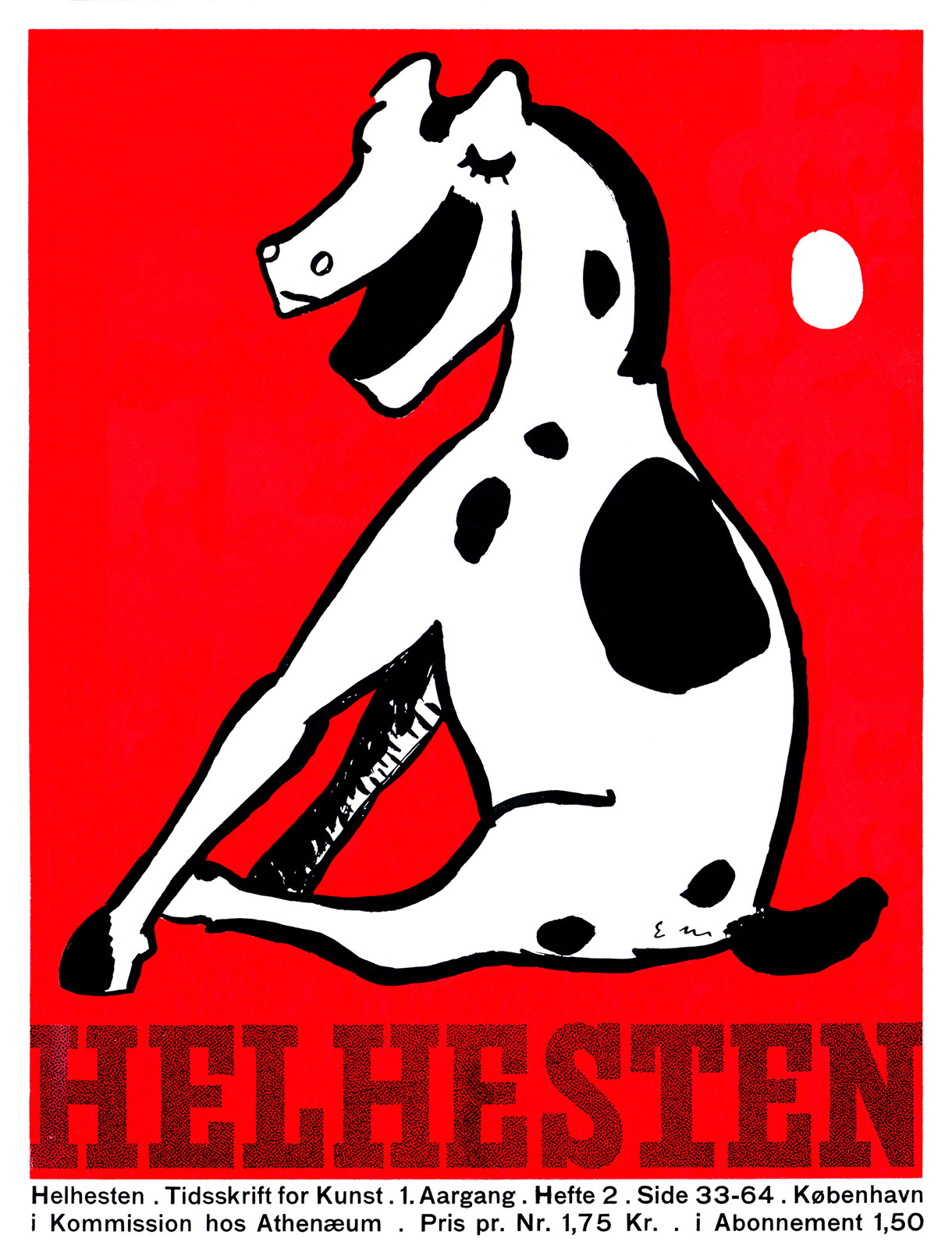
| Cover design | Egon Mathiesen |
| Followed by | Helhesten (Year 1, Booklet 3) |
Helhesten (Year 1, Booklet 2) is the second issue of the Danish art journal Helhesten, edited by Danish architect Robert Dahlmann Olsen. This landmark issue contains Asger Jorn’s influential essay “Intimate Banalities” and was published to coincide with the groundbreaking exhibition “13 Artists in a Tent.”
This article is part of the Helhesten collection.
Background
The second issue of Helhesten appeared less than a month after the inaugural issue and was timed to coincide with “13 Artists in a Tent” (13 Kunstnere i et Telt)-the first truly avant-garde exhibition in Denmark to attempt to merge art and life. The issue contains one of the most important theoretical texts of the Danish avant-garde: Asger Jorn’s essay “Intimate Banalities” (Intime Banaliteter).
“Intimate Banalities”
Jorn’s landmark article theorised the virtues of kitsch and popular culture for contemporary art. Appearing at almost the same moment as Clement Greenberg’s 1939 essay “Avant-Garde and Kitsch”-which maintained that the avant-garde must remain autonomous from everyday life-Jorn argued the exact opposite: that kitsch and the detritus of daily life were essential to contemporary art and its relevance to society as authentic indicators of human creative output.
As Guy Atkins notes in The Crucial Years, Jorn later referred back to this essay in his 1959 Modifications exhibition preface, maintaining that “the greatest artistic masterpieces are completely banal” and speaking with affection of those gilt-framed “lakes in forests” that hang in thousands of homes.
From the essay itself, Jorn writes:
It is typical of those who have lost touch with what is fundamental in art to have also lost the sense of what is banal. By this I do not mean the ability to see banality, an ability which on the contrary develops in a morbid way. I mean the ability to understand the artistic value of banality, its paramount importance for art. There exists a multitude of anonymous banalities whose relevance extends over centuries and which surpass all the ingenious achievements of our so-called great personalities. Upon closer examination, one realises that the merit of these personalities is precisely their ability to grasp banalities.
The grandiose work of art is the perfect banality. And what most banalities lack is not being sufficiently banal-not being infinite in their depth and their logic-resting upon a dead foundation of spiritualism and aesthetics.
- Asger Jorn, “Intimate Banalities,” Helhesten 1, no. 2 (1941)
The essay represented a fundamental break from both academic tradition and the formal concerns of pure abstraction. As the creator page for Jorn notes, the essay “claimed that the future of art was kitsch and praised amateur landscape paintings as ‘the best art today.’”
13 Artists in a Tent
The issue was published to coincide with the Helhesten group’s first major exhibition, which opened in May 1941 in Dyrehaven (Deer Park), a popular recreational destination for working-class Danes north of Copenhagen. The park was also home to Bakken (The Hill), the world’s oldest amusement park.
As Kerry Greaves writes:
The artists strategically chose Dyrehaven…to create a more visible profile with the general public. The exhibition’s striped tent and the works inside openly appropriated the cheap thrills that were on offer at nearby Bakken, the virtues of which were theorized by Jorn in his landmark article “Intimate Banalities” in Helhesten’s second issue, published to coincide with the exhibition.
- Kerry Greaves, War Horses (2015)
The exhibition was a collective enterprise: each exhibitor had a different role in setting up and maintaining the show, with artists offering free tours of the park, taking turns sleeping in the tent to safeguard the artwork, and socialising together.
The choice of the tent itself was inspired by earlier precedents: the 1915 Grønningen exhibition in Copenhagen-an alternative show that took place in a brightly painted temporary wooden shack during World War I-and Le Corbusier’s Pavillon des Temps Nouveaux at the 1937 International Art Exhibition, to which Jorn, as one of Léger’s former students, had contributed with the mural Les Moissons (The Harvest Season).
Guy Atkins records this exhibition in Jorn in Scandinavia:
In 1941 they exhibited as a group in a large marquee at Bellevue near Copenhagen and in 1943 they held a fund-raising exhibition in aid of helhesten at the Pustervig Gallery in Copenhagen.
- Guy Atkins, Jorn in Scandinavia 1930-1953
Cover Design
Egon Mathiesen (1907–1976) designed the cover, presenting the hell-horse as a happy storybook mare in repose-a deliberately naïve image that mocked the Nazi abuse of Nordic myths by caricaturing the mythological figure in a manner that would have been disparaged as “degenerate” in Germany. Mathiesen was both a painter and a writer; he later contributed the essay “What Modern Art Is” (Hvad moderne kunst er) to the journal, in which he argued that “Culture and art never look back, not even in the current acute situation, but always ahead to the future.”
The Helhesten Series
Helhesten was published over nine issues from April 1941 to November 1944. The journal was illustrated with over fifty original, mostly colour graphic works, and printed in editions of 800. It was affordable to the general public; a full set of all issues cost twelve kroner, or the equivalent of $2.30 in 1944.
Other issues in the series include:
- Helhesten Year 1, Booklet 1 (April 13, 1941) - Cover by Henry Heerup
- Helhesten Year 1, Booklet 3 (September 17, 1941) - Cover by Jens Søndergaard
- Helhesten Year 1, Booklet 4 (October 18, 1941) - Cover by Hans Scherfig
- Helhesten Year 1, Booklets 5 & 6 (November 18, 1941) - Cover by Axel Salto
- Helhesten Year 2, Booklet 1 (October 30, 1942) - Cover by Niels Lergaard
- Helhesten Year 2, Booklets 2 & 3 (March 10, 1943) - Cover by Storm Petersen
- Helhesten Year 2, Booklet 4 (December 24, 1943) - Cover by Ejler Bille
- Helhesten Year 2, Booklets 5 & 6 (November 11, 1944) - Cover by Carl-Henning Pedersen
Explore the Book
This is a preview only - view fullsize on archive.org