|
|
| Helhesten (Year 1, Booklet 3) | |
| Editor | Robert Dahlmann Olsen |
|---|---|
| Issue date | September 17, 1941 |
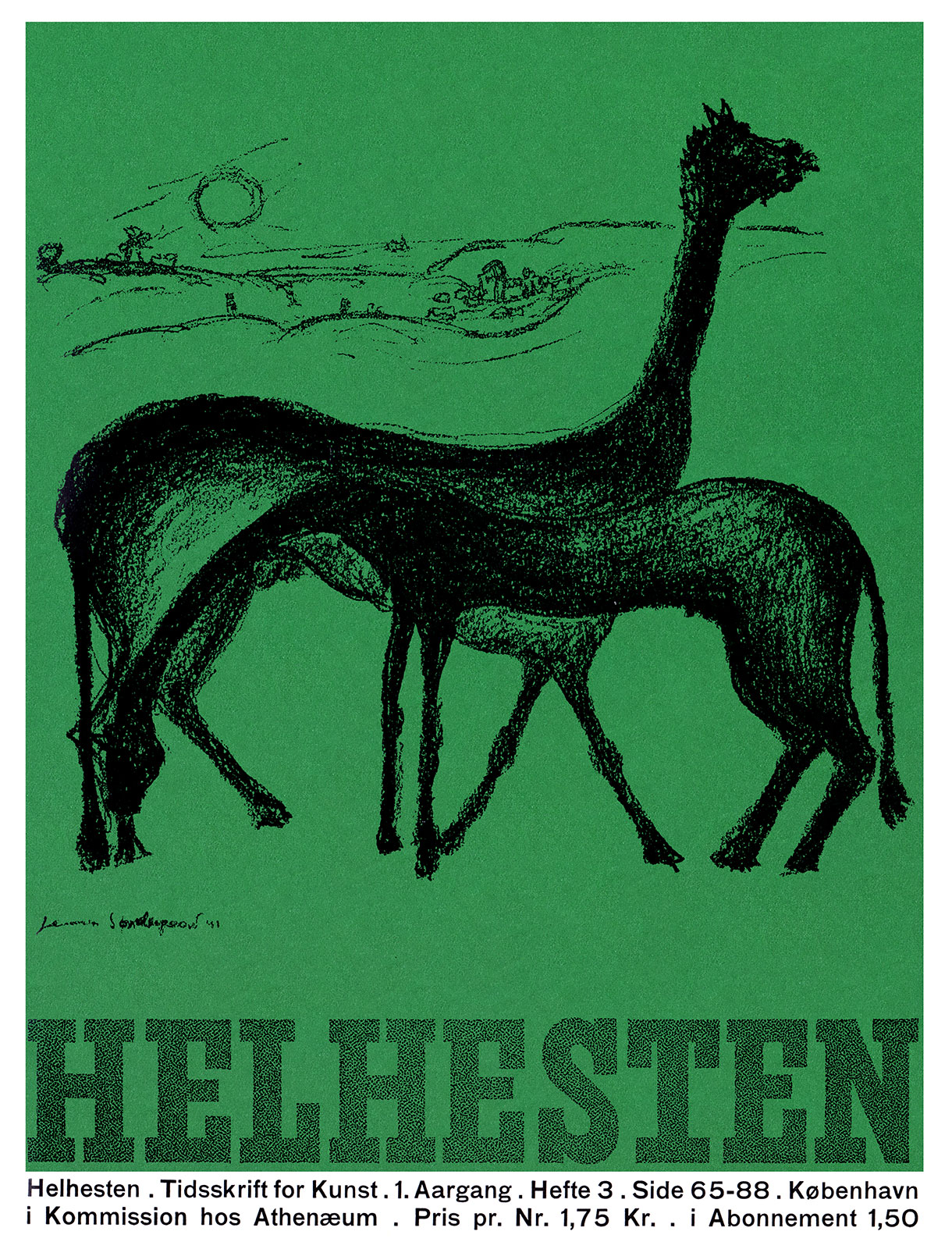
| Cover design | Jens Søndergaard |
| Followed by | Helhesten (Year 1, Booklet 4) |
Helhesten (Year 1, Booklet 3) is the third issue of the Danish art journal Helhesten, edited by Danish architect Robert Dahlmann Olsen. This issue features key theoretical texts including Egill Jacobsen’s introduction to Carl-Henning Pedersen’s work, Niels Lergaard’s essay on myth, and Egon Mathiesen’s “What Modern Art Is.”
This article is part of the Helhesten collection.
Background
The third issue of Helhesten appeared in September 1941, marking the journal’s continued vitality during the first year of German occupation. This issue contained several important theoretical texts that elaborated the group’s aesthetic philosophy, as well as an artist-designed advertisement by Asger Jorn for the Oscar Davidsen Restaurant-demonstrating the journal’s commitment to merging art with everyday commercial life.
Cover Design
Jens Søndergaard (1895–1957) designed the cover for this issue. Søndergaard was a Danish Expressionist painter known for his dramatic landscapes and seascapes, particularly of the west coast of Jutland. His inclusion signalled the journal’s embrace of established Danish Expressionists alongside younger avant-garde artists-a characteristic openness that distinguished Helhesten from more sectarian art movements.
Key Contents
“Introduction to Carl-Henning Pedersen’s Pictures”
Egill Jacobsen contributed an important essay introducing the work of Carl-Henning Pedersen, one of the core Helhesten artists. In the text, Jacobsen articulated the group’s belief in fantasy and imagination as vehicles for universal human connection:
Fantasy and reality will be one.
- Egill Jacobsen, “Introduction to Carl-Henning Pedersen's Pictures,” Helhesten 1, no. 3 (1941)
“The Myth” (Myten)
Niels Lergaard contributed an essay on myth that articulated a distinction between the “myth-believing” (mytetroende) and “myth-creating” (myteskabende) approaches to life. Lergaard argued that the myth-creating imagination was “life’s positivity” upon which one could survive materialistic emptiness, while those who believed blindly in myths would perish with their dogmas:
The myth-believer walks blindly through life believing in a virgin birth, while the myth-creator, through fantasy, momentarily experiences life in its free and primitive rhythm, a life-rhythm that is the undertone of all human sympathies…and therefore the only foundation upon which pacifism can be built.
- Niels Lergaard, “The Myth,” Helhesten 1, no. 3 (1941)
“What Modern Art Is” (Hvad moderne kunst er)
Egon Mathiesen’s essay “What Modern Art Is” appeared in this issue, arguing that culture and art must always look forward, never backward:
Culture and art never look back, not even in the current acute situation, but always ahead to the future. Historical culture cannot disappear; it has already caused sediments to form that will remain with us forever. Defending culture means supporting its living core, which is precisely where the cultural efforts of the past naturally manifest themselves. Tradition rejects adulation, always proving most genuine where art has emancipated itself most forcefully.
- Egon Mathiesen, “What Modern Art Is,” Helhesten 1, no. 3 (1941)
“Idleness Is the Root” (Lediggang er roden)
Jorn contributed a characteristically provocative short text titled “Idleness Is the Root,” punning on the Danish proverb “Idleness is the root of all evil” by declaring instead: “Idleness is the root of all art. Smile at the world, and it will laugh at you.”
Artist-Designed Advertisements
The inside front cover featured an advertisement for the Oscar Davidsen Restaurant, designed by Jorn. According to Robert Dahlmann Olsen’s records, Jorn created this advertisement as part of the journal’s practice of having artists design commercial content-a deliberate blurring of boundaries between fine art and popular culture that was central to the Helhesten philosophy.
“A Sad Announcement” (En sørgelig meddelelse)
The inside back cover featured a satirical piece by Henry Heerup and Asger Jorn, demonstrating the journal’s characteristic use of humour and playfulness even while operating under occupation.
The Helhesten Series
Helhesten was published over nine issues from April 1941 to November 1944. The journal was illustrated with over fifty original, mostly colour graphic works, and printed in editions of 800. It was affordable to the general public; a full set of all issues cost twelve kroner, or the equivalent of $2.30 in 1944.
Other issues in the series include:
- Helhesten Year 1, Booklet 1 (April 13, 1941) - Cover by Henry Heerup
- Helhesten Year 1, Booklet 2 (May 10, 1941) - Cover by Egon Mathiesen
- Helhesten Year 1, Booklet 4 (October 18, 1941) - Cover by Hans Scherfig
- Helhesten Year 1, Booklets 5 & 6 (November 18, 1941) - Cover by Axel Salto
- Helhesten Year 2, Booklet 1 (October 30, 1942) - Cover by Niels Lergaard
- Helhesten Year 2, Booklets 2 & 3 (March 10, 1943) - Cover by Storm Petersen
- Helhesten Year 2, Booklet 4 (December 24, 1943) - Cover by Ejler Bille
- Helhesten Year 2, Booklets 5 & 6 (November 11, 1944) - Cover by Carl-Henning Pedersen
Explore the Book
This is a preview only - view fullsize on archive.org