|
|
| Helhesten (Year 2, Booklet 4) | |
| Editor | Robert Dahlmann Olsen |
|---|---|
| Issue date | December 24, 1943 |
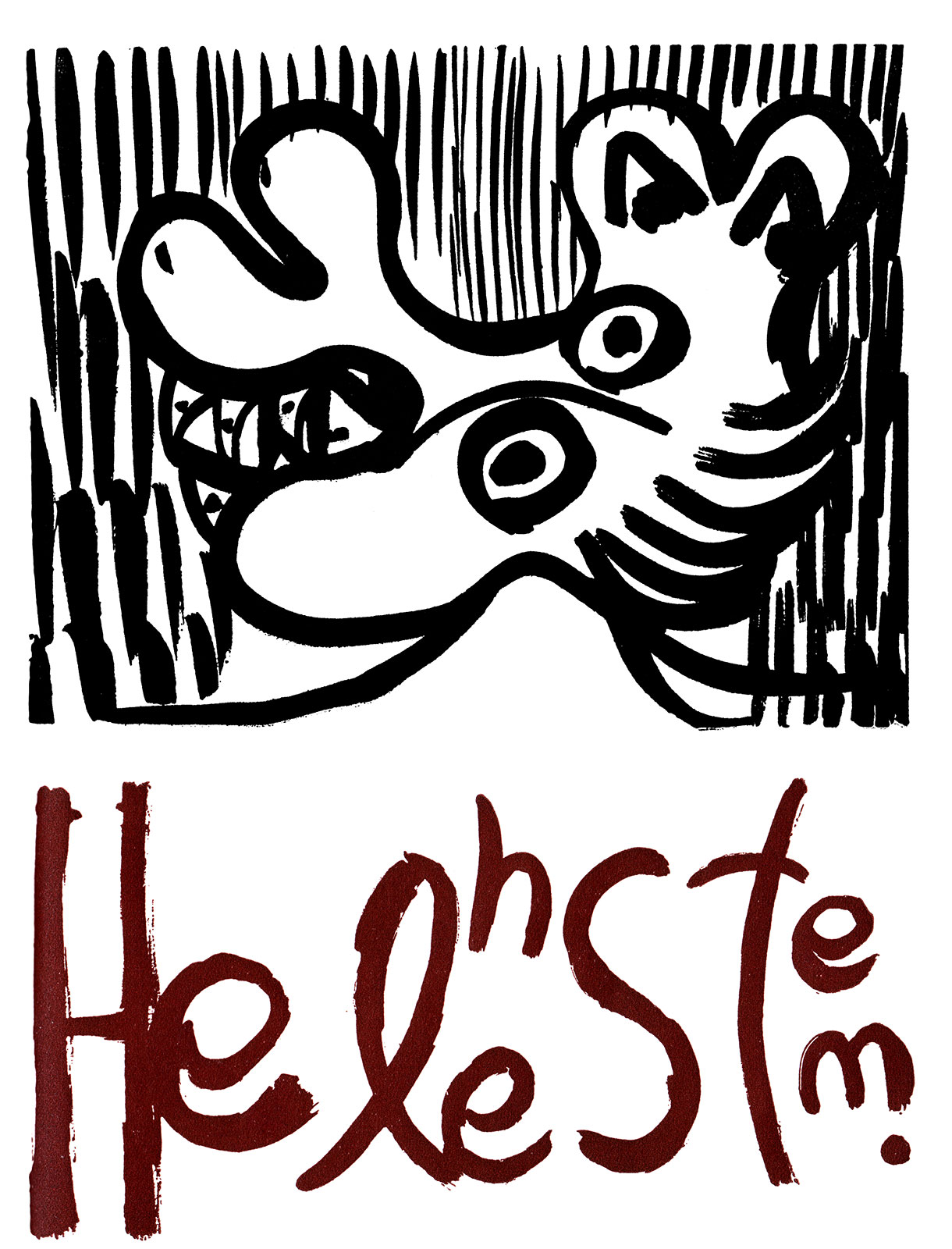
| Cover design | Ejler Bille |
| Followed by | Helhesten (Year 2, Booklets 5 & 6) |
Helhesten (Year 2, Booklet 4) is the fourth issue of the second year of the Danish art journal Helhesten, edited by Danish architect Robert Dahlmann Olsen. Published on Christmas Eve 1943, this issue features Dan Sterup-Hansen’s profile of Henry Heerup, Jorn’s theoretical article on stylistics, and Carl-Henning Pedersen’s influential essay on fantasy art.
This article is part of the Helhesten collection.
Background
Published on Christmas Eve 1943, this issue appeared during an increasingly tense period of the occupation. The August 1943 uprising had marked a turning point in Danish resistance, and the journal continued to serve as a space for cultural dissent through its celebration of creative freedom and humanistic values.
Cover Design
Ejler Bille (1910–2004) designed the cover for this issue. As one of the founding members of the Helhesten group, Bille was a central figure in Danish abstract art. He had studied in Paris before the war and by 1940 had developed a distinctive style characterized by dense conglomerations of colour patches and mask-like forms.
Bille had initially been cautious about the journal’s provocative name. In January 1941, he wrote to Jorn worrying that “there is something anarchistic in the devastation with ‘helhesten’ that I do not think is fitting for Marxists,” and warned against advertising the journal too widely for fear of censorship. Nevertheless, he remained a committed contributor throughout the journal’s existence.
Key Contents
“Henry Heerup” by Dan Sterup-Hansen
Dan Sterup-Hansen contributed a substantial profile of Henry Heerup, one of the most distinctive artists in the Helhesten circle. In the essay, Sterup-Hansen compared Heerup’s working method to that of Hans Christian Andersen:
Heerup stands with his feet firmly on the ground; but from the heart and up over his head he lives in the land of fantasy. Just as H.C. Andersen finds enough reality in a darning needle, a top, and a ball to create a large and nuanced expression of life, so Heerup creates from the stone from the field, the colours from the tube, the tin can, the branch, and the razor blades his reality-strong works, which speak as strongly to us through the way they are made as through what they represent.
- Dan Sterup-Hansen, “Henry Heerup,” Helhesten 2, no. 4 (1943)
“Stylistics” (Stilarter) by Asger Jorn
Jorn contributed a theoretical article on stylistics, continuing his engagement with questions of art history and aesthetic theory. In the essay, he called for a comprehensive style history “based on the development of living life,” critiquing works that failed to engage with the vital dimensions of artistic expression.
“Abstract Art or Fantasy Art-A Painter’s Work” by Carl-Henning Pedersen
Carl-Henning Pedersen’s important essay articulated the group’s preferred term “fantasy art” (fantasikunst) over “abstract art”:
What is common to the artists called “abstract” is that they all work from the free world of fantasy. A better common designation for this kind of art is “fantasy art,” such a word will show the connection to primitive and oriental art and to the free creative play of children. As long as we use the word “abstract,” people think that the artists have invented a new artistic language that one must learn, instead of recognizing that “fantasy art” works from something central in human beings, something that everyone can understand and feel without prior knowledge.
- Carl-Henning Pedersen, “Abstract Art or Fantasy Art,” Helhesten 2, no. 4 (1943)
“Junkman & Junk Model” (Skraldemand & Skraldemodel) by Henry Heerup
Heerup contributed a text elaborating his artistic philosophy of working with discarded materials-“junk art” or skraldekunst-which would become one of his signature approaches.
The Helhesten Series
Helhesten was published over nine issues from April 1941 to November 1944. The journal was illustrated with over fifty original, mostly colour graphic works, and printed in editions of 800. It was affordable to the general public; a full set of all issues cost twelve kroner, or the equivalent of $2.30 in 1944.
Other issues in the series include:
- Helhesten Year 1, Booklet 1 (April 13, 1941) - Cover by Henry Heerup
- Helhesten Year 1, Booklet 2 (May 10, 1941) - Cover by Egon Mathiesen
- Helhesten Year 1, Booklet 3 (September 17, 1941) - Cover by Jens Søndergaard
- Helhesten Year 1, Booklet 4 (October 18, 1941) - Cover by Hans Scherfig
- Helhesten Year 1, Booklets 5 & 6 (November 18, 1941) - Cover by Axel Salto
- Helhesten Year 2, Booklet 1 (October 30, 1942) - Cover by Niels Lergaard
- Helhesten Year 2, Booklets 2 & 3 (March 10, 1943) - Cover by Storm Petersen
- Helhesten Year 2, Booklets 5 & 6 (November 11, 1944) - Cover by Carl-Henning Pedersen
Explore the Book
This is a preview only - view fullsize on archive.org