|
|
| Prince of Space, Musik der Leere | |
| Artists | Yves Klein & Charles Wilp |
|---|---|
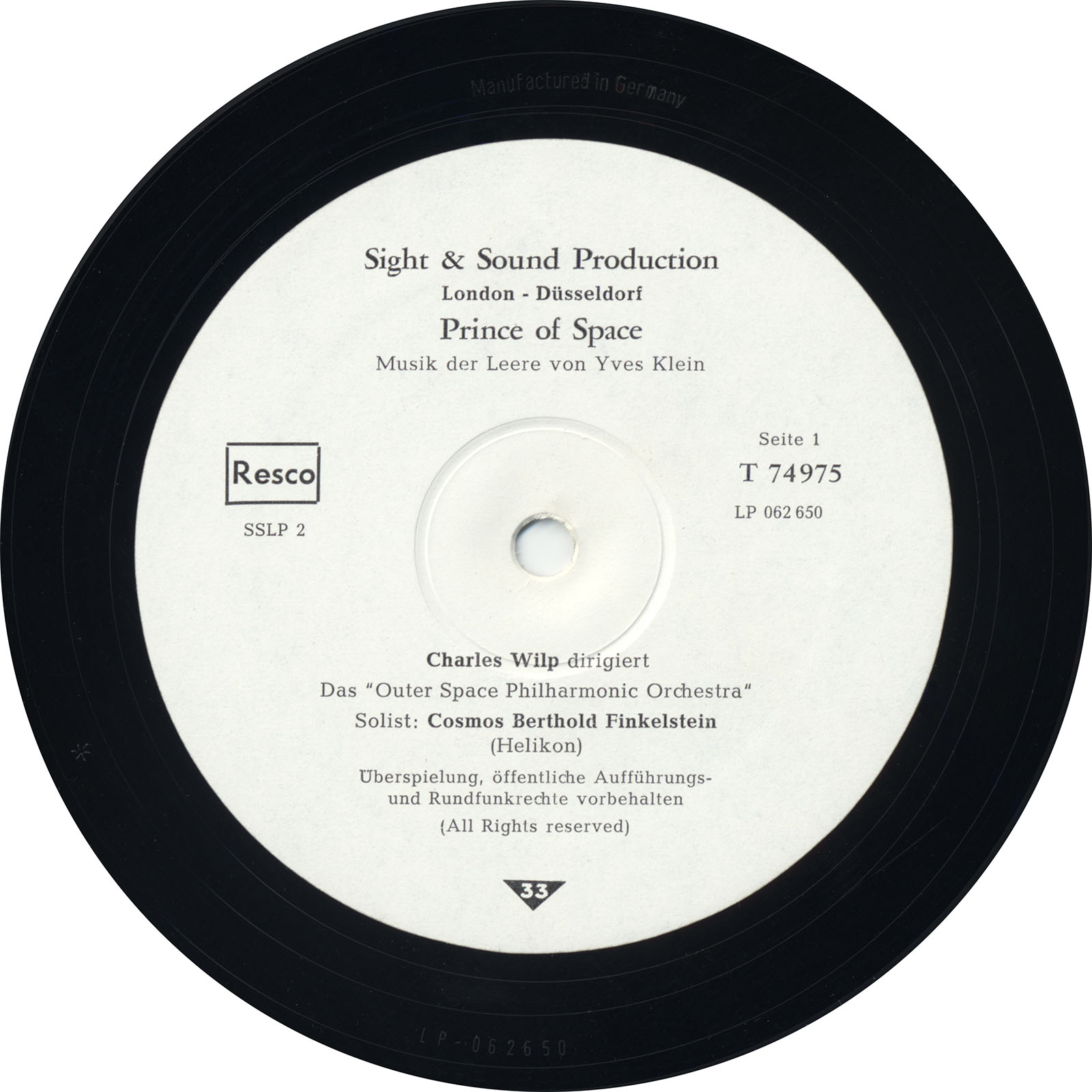
| Publisher | Sight & Sound Productions, London/Düsseldorf - T 174 975 |
| Publishing date | 1965 (originally c. 1959) |
| Format | Vinyl LP |
| Duration | - |
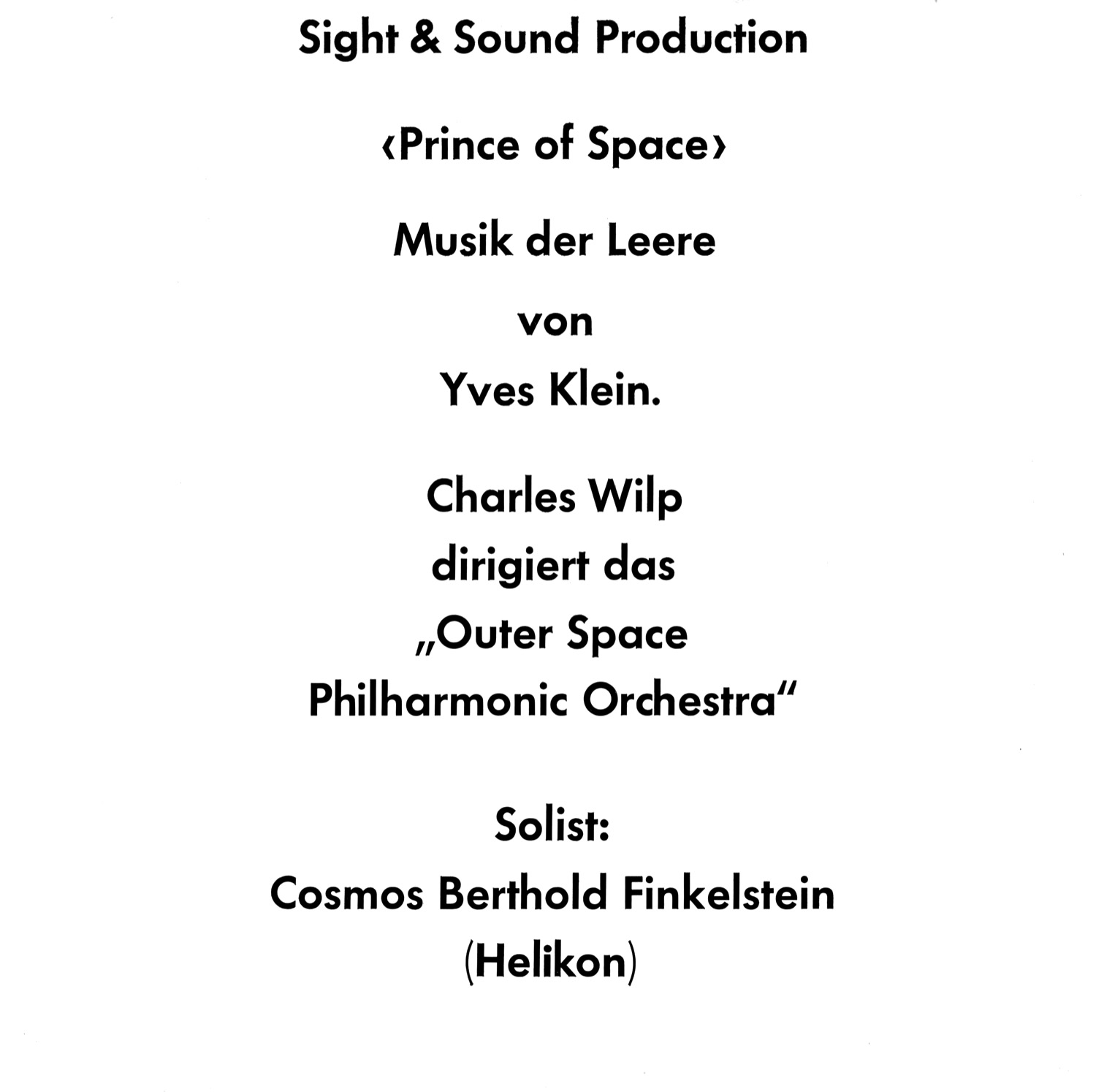
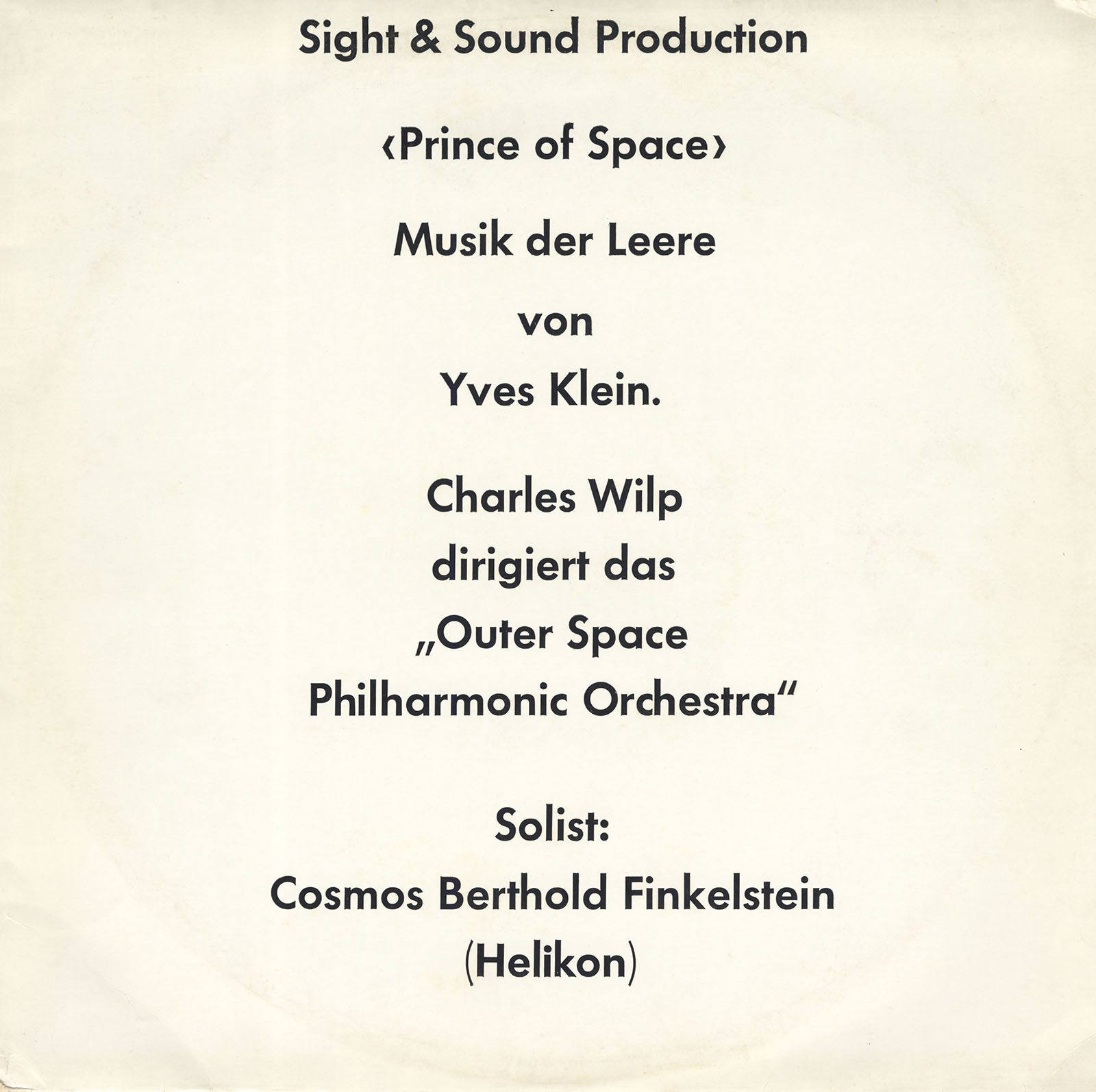
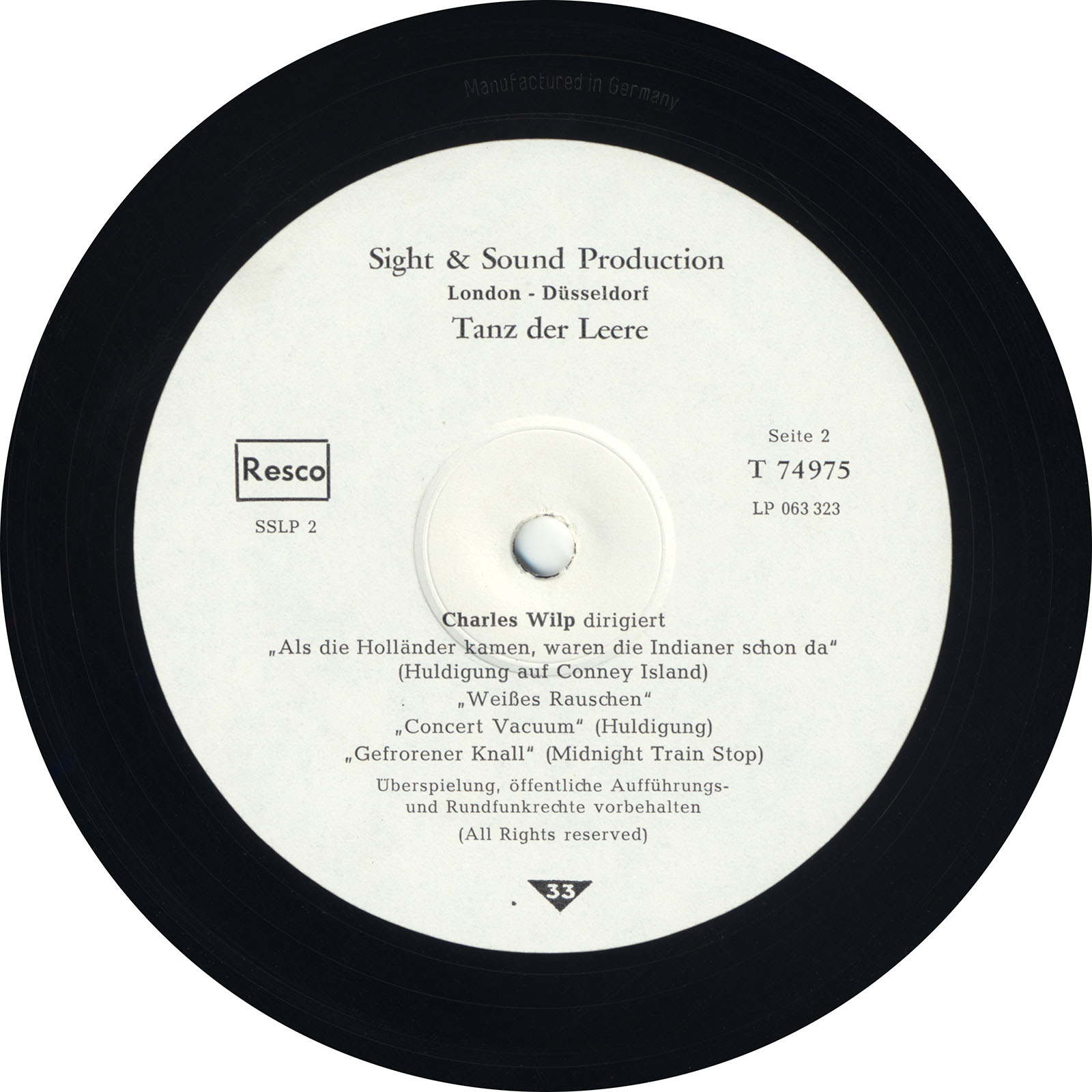
Prince of Space, Musik der Leere a vinyl LP conceived by Yves Klein and produced by Charles Wilp, released by Sight & Sound Productions in Germany. The record contains no music whatsoever - only the crackling of a stylus tracing an empty groove. The title translates as Music of Emptiness, and its silence is its content: a deliberate extension of Yves Klein’s lifelong preoccupation with the immaterial into the domain of recorded sound. The record serves as the official soundtrack to Tanz der Leere (Dance of the Void), a short film by Wilp, and was produced and conducted - notionally, at least - by Wilp in his role as director of the “Outer Space Philharmonic Orchestra.” It was sold at exhibitions or distributed personally by Wilp, sometimes autographed, always dated. A later reissue was released in 2022 by play loud! in an edition of one hundred numbered copies.
The record is held in the permanent collection of the Museum of Modern Art (MoMA), New York, where it is catalogued under both Klein’s and Wilp’s names and dated to its original conception around 1959.1
Background
Charles Paul Wilp (1932–2005) was born in Witten and studied at the Académie de la Grande Chaumière in Paris before completing his education in synaesthesia, journalism, and psychology at the TH Aachen. He studied photography under Man Ray in New York and would go on to become one of the most influential commercial artists working in West Germany - responsible, among much else, for Volkswagen’s long-running “Und läuft… und läuft… und läuft” campaign and the wildly provocative 1968 Afri-Cola advertisements. Throughout this commercial career, he maintained close ties to the Düsseldorf art world and counted among his friends Yves Klein, Andy Warhol, Joseph Beuys, Heinz Mack, and Günther Uecker.2
Yves Klein (1928–1962) was working in Paris during the same years and had established himself as one of the most provocative figures in European postwar art. He was the central figure of Nouveau Réalisme, and his practice ranged across monochrome painting, performance, architecture, and music. His use of International Klein Blue (IKB), a synthetic ultramarine he patented in 1960, brought him international attention; but emptiness - the void, immateriality, the dematerialisation of the art object - was equally fundamental to his thinking. His 1958 exhibition La Vide at the Iris Clert Gallery in Paris presented a completely empty, whitewashed room to viewers, illuminated by barely perceptible neon light. His “Zones of Immaterial Pictorial Sensibility” were sold for gold leaf, which buyers were instructed to throw into the Seine while Klein burned their receipt, leaving both parties with nothing.
Music, for Klein, was inseparable from these concerns. Around 1947–1948, while still a teenager, he conceived what he called the Symphonie Monoton-Silence - a single sustained D major chord, held by orchestra and chorus for twenty minutes, followed immediately by twenty minutes of total silence. He described it as “one unique continuous sound, drawn out and deprived of its beginning and of its end, creating a feeling of vertigo and of aspiration outside of time.”3 The work received its first public performance in 1960, at the Galerie Internationale d’Art Contemporain in Paris, accompanied by three nude models painted in International Klein Blue who left Anthropometry imprints on canvases laid across the stage - an event documented in photographs that became among the most reproduced images in postwar art history.
Klein met Wilp in Düsseldorf in the late 1950s. Wilp documented Klein’s 1961 institutional exhibition at Haus Lange in Krefeld - the first time Klein showed in a German museum - with a series of photographs later exhibited as Blick ins Leere (View into the Void). The show presented completely empty museum rooms: no paintings, no objects, only space. Wilp’s photographs remain a primary visual record of the installation.
The Record
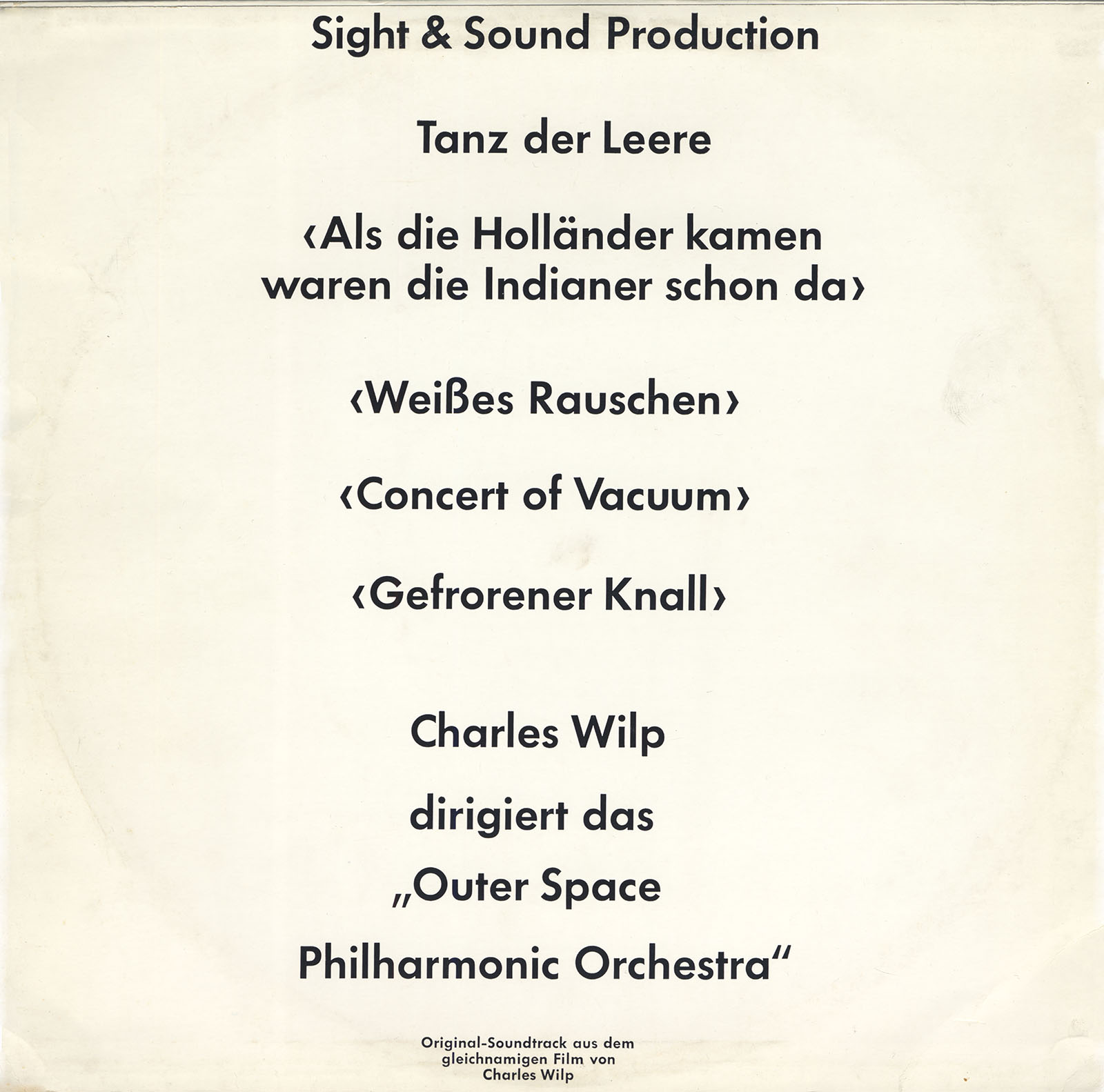
The collaboration arose directly from their shared fixation on emptiness. Wilp’s film Tanz der Leere required a soundtrack, and what could be more fitting than a record that declined to play? The LP is pressed on standard vinyl, bearing full sleeve and label information - “Charles Wilp dirigiert das Outer Space Philharmonic Orchestra / Tanz der Leere: Original-Soundtrack aus dem gleichnamigen Film von Charles Wilp” - but the groove carries no audio signal. When placed on a turntable, the listener hears only the steady crackle of the stylus on bare vinyl: the acoustic residue of the medium itself, stripped of all musical content.4
This is not a silent record in the sense of a blank or ungrooved disc - the groove is physically present, pressed as normal, which produces the needle noise. The crackling becomes, in effect, the content: the irreducible minimum of what a vinyl record can do, the sound of listening to nothing.
Probably one of Charles Wilp’s most unusual projects, “Tanz der Leere” was released at the end of the 1950s, in collaboration with the artist Yves Klein. Instead of a melody, all that can be heard on this record is the scratching of the needle - the emptiness is reminiscent of John Cage’s musical performance “Composition 4’33”.
- play loud! Charles Wilp Archive, liner notes for the 2022 reissue
The relationship to John Cage’s 4’33” (1952) is frequently noted but should be treated carefully. Cage’s piece requires a performer to sit before an instrument and not play it for a specified duration, framing the ambient sounds of the concert hall as the musical content. Klein’s Musik der Leere is a different proposition: it is a manufactured object - a consumer record - that promises music and delivers silence, collapsing the gap between the artwork and the commodity. Klein would have been aware of Cage’s work, but there is little documentary evidence that their approaches were developed in direct dialogue; both were working independently through related ideas about sound, duration, and the negation of content that circulated widely across the postwar avant-garde.5
Audio
‘Prince of Space’
The record’s title embeds a biographical fact. In 1961, Klein formally declared Wilp “Prince of Space” - a gesture at once ceremonial and entirely in keeping with Klein’s practice of creating and selling intangible quantities. Shortly before his death in June 1962, Klein presented Wilp with a symbolic gift of 777⁷⁷⁷ cubic metres of “endless sensitised space,” an immeasurable volume belonging to the same conceptual register as the Zones of Immaterial Pictorial Sensibility he was selling to collectors at the same time.6 The record title commemorates this declaration, folding Klein’s conferral of a cosmic title on his friend into the logic of the object itself: a certificate of ownership over emptiness, pressed into vinyl.
Klein died of a heart attack on 6 June 1962, aged thirty-four. He had suffered the first of three attacks in May of that year, while attending the Cannes Film Festival, reportedly during a screening of the documentary Mondo Cane, in which his Anthropometry performances appeared and were presented in an unflattering light. He did not live to see the formal pressing of the Sight & Sound Productions release, which appeared in 1965.
Publication History
The record exists in more than one version. An early pressing - catalogued by MoMA under the year 1959 - predates the 1965 Sight & Sound Productions release and was almost certainly the original collaboration between Klein and Wilp, conceived and distributed informally around the time of the Tanz der Leere film. The commercial 1965 LP on Sight & Sound Productions (catalogue number T 174 975; also appearing as RESCO SSLP 2) is the version that has circulated most widely in collections and at auction.
At least one variant of the 1965 release includes a B-side: a spoken story with musical accompaniment titled Rotkäppchen ein modernes Märchen (Little Red Riding Hood: A Modern Fairy Tale) by Willibald Quanz. In these copies, the silence occupies only the A-side; the B-side plays normally.7
Copies were not distributed through normal retail channels but were sold at exhibitions or given directly by Wilp - sometimes signed and dated - lending each copy something of the character of an art multiple rather than a standard commercial release. A copy originating from Wilp’s Düsseldorf circle was described at auction as having been “sealed with wax, like old documents,” and bore inscriptions in Klein’s hand on both front and back: “777 777 Prince Of Space 1961.” The record is included in the survey volume Broken Records, which documents significant examples of conceptual and anti-music releases.8
In 2022, play loud! reissued the record in a hand-numbered edition of one hundred copies under their Charles Wilp Archive imprint, with extensive liner notes, original photographs, a postcard, and an eight-page facsimile of a 1974 Wilp exhibition in London connected to Tanz der Leere.
Gallery
References
-
Museum of Modern Art, New York. Yves Klein, Charles Wilp: Prince of Space / Tanz der Leere, 1959. MoMA Collection, object ID 184016. moma.org ↩
-
Wikipedia contributors. “Charles Paul Wilp.” Wikipedia, The Free Encyclopedia. en.wikipedia.org/wiki/Charles_Paul_Wilp ↩
-
Yves Klein. “Overcoming the Problematics of Art,” 1959. Quoted in Soundohm product notes for Symphonie “Monoton-Silence”, Edition Bierammer. soundohm.com ↩
-
Discogs contributor notes. Yves Klein, Charles Wilp – Prince Of Space, Musik Der Leere, release 1741061. discogs.com ↩
-
Daniel J. Wakin. “Yves Klein’s Legacy Is about Much More Than Blue.” Artsy, 2017. artsy.net ↩
-
Jeschke Jádi Auctions Berlin. Lot description for Charles Wilp, 12 Arbeiten in: Blick ins Leere, 1957–1961. invaluable.com ↩
-
Discogs contributor notes. Yves Klein, Charles Wilp, Willibald Quanz – Prince Of Space, Musik Der Leere von Yves Klein / Rotkäppchen ein modernes Märchen, release 12442237. discogs.com ↩
-
Popsike auction listing. Yves Klein / Charles Wilp – Musik der Leere, Silent Record, Autographed Art Object. popsike.com ↩