|
|
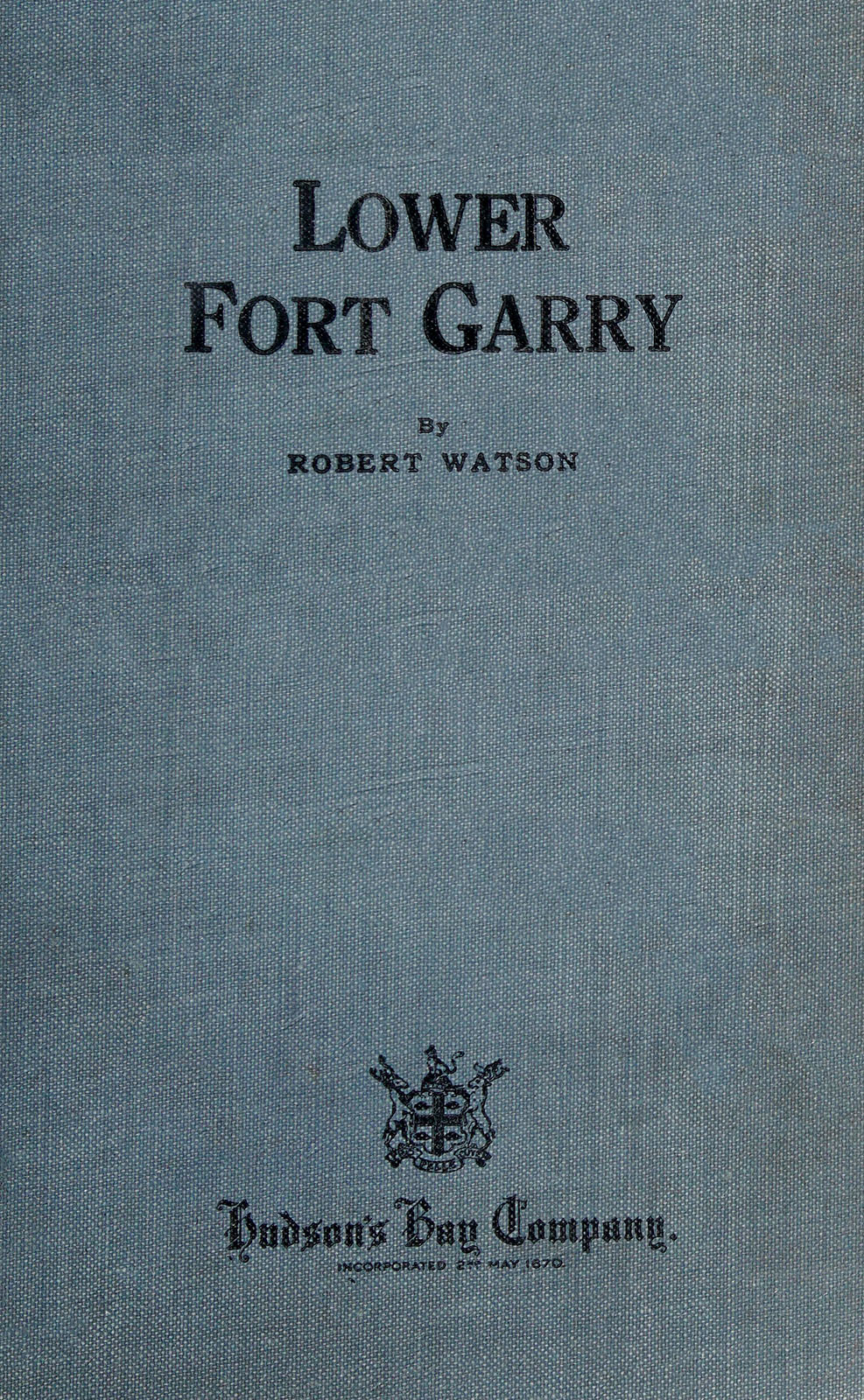
| Lower Fort Garry: A History of the Stone Fort | |
| Authors | Robert Watson |
|---|---|
| Publisher | Hudson's Bay Company |
| Publishing date | 1928 |
| Edition | First Edition |
| Format | Book |
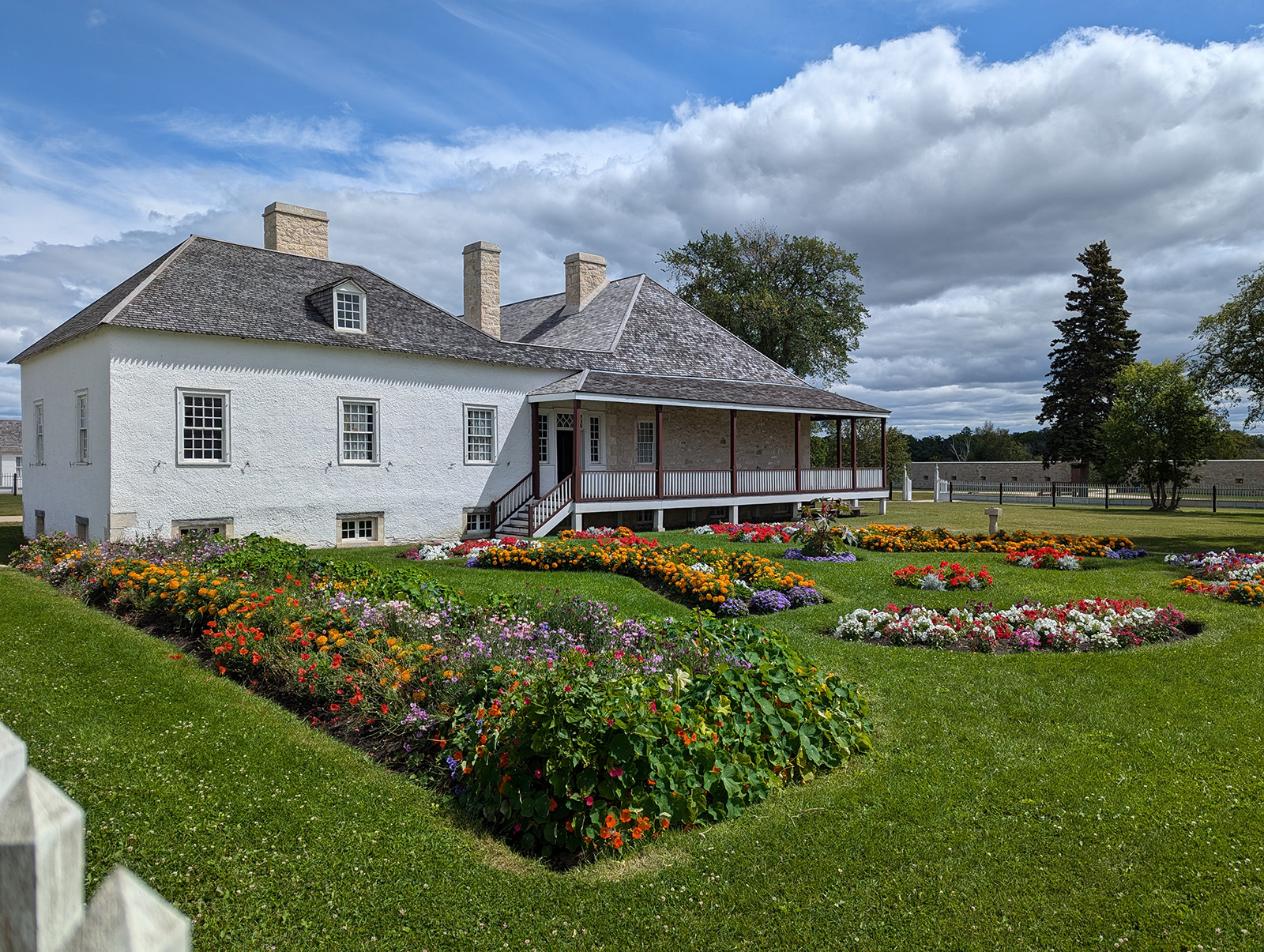
Lower Fort Garry: A History of the Stone Fort is a commemorative local history written by Robert Watson and published in Winnipeg in 1928 by the Hudson’s Bay Company. Appearing nearly one hundred years after the fort’s construction began in 1831, the volume draws on Company archives, correspondence of Sir George Simpson, testimony of surviving eyewitnesses, and a substantial body of earlier published accounts to document the construction, administration, and eventful later history of the only fully intact stone fur trade fort remaining in North America. Watson writes with the dual purpose of preserving institutional memory and providing a popular record of a landmark whose significance he feared was insufficiently appreciated.
Origins and Construction
The decision to build a new stone fort twenty miles north of the confluence of the Red and Assiniboine rivers followed from a series of practical necessities. The original Fort Garry, situated at the Forks in what is now downtown Winnipeg, had been rendered nearly uninhabitable by successive spring floods and was poorly positioned for the decked vessels that navigated between Norway House and the Red River settlements, since those boats could not ascend the St. Andrew’s Rapids. At the Northern Department Council held at York Factory in 1830, the Company resolved to establish a new fort on the west bank of the Red River, at a site above the navigational obstruction and on considerably higher ground.
Construction began in 1831 and was largely complete by 1839, although Watson notes some uncertainty about the precise completion date. The plans are generally attributed to Chief Factor Alexander Christie, twice Governor of Assiniboia, though Watson carefully hedges that attribution with the word “understood.” The walls, built of local limestone quarried near the site, rise to approximately seven and a half feet and extend over two thousand feet in total perimeter, enclosing a quadrangle of roughly four and a half acres. In a letter to the Governor and Committee in London dated 18 July 1831, Governor George Simpson reported that construction had already commenced, that the cost consisted largely of provisions for the workmen rather than wages, and that the labour was performed by supernumeraries and young Company hands, effectively at minimal additional expense.
The stonemason responsible for the walls, bastions, and many of the interior stone buildings was Duncan McRae, a native of Stornoway in the Scottish Hebrides who emigrated in 1837 at the age of twenty-four to enter Company service. His colleague John Clouston, also a Hebridean, worked alongside him. Between them, the two men spent nearly a decade constructing the stone fabric of both Lower Fort Garry and the subsequently rebuilt Upper Fort Garry, and McRae went on to build the stonework of St. John’s Cathedral, Kildonan Church, St. Andrew’s Church (the Rapids Church), and several other enduring landmarks along the Red River.
The Fort as Administrative and Social Centre
For a period in the early 1830s, Lower Fort Garry served as the residence of the Governor of Rupert’s Land and the seat of the annual Council at which officers from across the vast Northern Department convened. Alexander Ross, writing in The Red River Settlement (1856), compared the fort’s footprint to that of St. Paul’s Cathedral in London, and described it as initially intended to be both the Company’s head depot and the seat of government — an ambition ultimately relinquished in favour of Upper Fort Garry at the Forks. The artist Paul Kane, arriving at the Stone Fort on 13 June 1846, found Sir George Simpson and his council assembled there, recording the scene in his Wanderings of an Artist Among the Indians of North America (1859).
Watson draws heavily on Isaac Cowie’s The Company of Adventurers (1913) and the manuscript recollections of Roderick Campbell, published under the improbable title The Father of St. Kilda (1901), for vivid accounts of everyday life within the walls during the 1850s and 1860s. Campbell, who arrived at the fort as an apprentice clerk in 1859, described a lively resident community bound by regular working hours and evening social gatherings at which “old Scottish songs were sung in voices cracked and broken” against the backdrop of the long sub-Arctic winters. His account of the experimental farm established in the vicinity — with its successful crops of wheat, barley, potatoes, and turnips, and its abundance of wild berries and prairie flowers — provides one of the more animated sections of Watson’s compilation.
Military Presence and the Oregon Question
In 1846, with the Oregon boundary dispute threatening open conflict between Britain and the United States, Colonel Crofton arrived at the Stone Fort in command of a wing of the Sixth Foot together with a detachment of artillery and Royal Engineers: 329 men, 18 officers, 17 women, and 19 children, with a nine-pounder cannon. The mission was officially secret, and Watson notes with some amusement that in his testimony before a House of Commons committee in 1857, Colonel Crofton recalled that “beef cost 2d per lb. and there was no want of flour.” A body of British army pensioners followed in 1848, and in 1857 they were replaced by 120 men of the Royal Canadian Rifles, who remained in the district until 1861.
The Riel Rebellion
The most dramatically narrated sections of Watson’s book concern the events of 1869–70. When Louis Riel and his followers took possession of Upper Fort Garry in the autumn of 1869, Lower Fort Garry became the gathering point for loyalists opposed to the provisional government. Watson is careful to distinguish between the facts he considers established and the embellishments that had accumulated in local memory in the intervening decades. He investigates at some length a persistent tradition that Riel rode at midnight to Donald A. Smith’s bedside at the Stone Fort to demand concessions from the Hudson’s Bay Company commissioner — and finds, on the basis of Smith’s own lucid report to the Secretary of State and his account of being woken between two and three o’clock by Riel demanding a written order for official documents, that such a confrontation did occur, though it bore little resemblance to the romantic versions then in circulation.
What is definitively established, Watson writes, is that Riel, Lepine, and O’Donohue led a party on horseback and sleigh to the Lower Fort in search of Dr. John Schultz. The rebels climbed the south wall between the southeast bastion and the saleshop; the halfbreed guard, armed only with flintlocks, fled on their approach. Watson records the testimony of Sheriff Inkster, then a grown man and closely in touch with events, interviewed in September 1926: Riel’s party searched multiple properties, pushed into the Archdeacon’s bedroom, and pulled the bedclothes from him in the belief that Schultz might be hiding there, but their quarry had already escaped to Duluth via a circuitous route through the winter countryside.
Treaty No. 1
The Stone Fort’s most consequential episode in terms of its lasting significance for Canadian history was the negotiation and signing of Treaty No. 1 in the summer of 1871 — the first of the numbered treaties between the Crown and First Nations. Watson devotes a full chapter to this event, reprinting at length the account of Wemyss M. Simpson, the Indian Commissioner, whose report details the eight days of negotiations that began on 25 July 1871 and concluded on 3 August with the signing of the treaty by Anishinaabe (Ojibwe) and Swampy Cree chiefs. Simpson’s narrative describes an initially incomplete gathering — the negotiations could not begin until all bands had arrived — and a prolonged palaver over the scope of the surrender and the material promises attached to it, which were not settled until 3 August, nine days after the first meeting.
Watson also includes the testimony of W. F. Alloway, a Winnipeg banker who had arrived at Fort Garry as a young man with the Wolseley Expedition in 1870 and witnessed the treaty proceedings. Alloway’s account centres on the dramatic episode of Longbones, an Indian imprisoned in the penitentiary for scalping his wife and subsequently escaped, whose presence among the assembled thousands was detected by the Commissioner; only the oratory of James McKay, a distinguished interpreter fluent in Indigenous languages, persuaded the assembled nations to surrender him and allow the treaty to proceed.
The Wolseley Expedition and Later History
The 60th Rifles and associated detachments under Colonel Wolseley reached Lower Fort Garry on the morning of 23 August 1870, the preceding night having been spent on Elk Island. Watson reprints Donald Gunn’s account of the advance down the Red River, and notes that six companies of the 2nd Quebec Battalion wintered at the fort thereafter, living initially in tents outside the walls before moving into the warehouse north of the east gate. During this occupation the Masonic Lodge Lisgar No. 2 was formed at Lower Fort Garry on 20 February 1871, its first masonic picnic taking place at the Stone Fort that June under the chairmanship of Bernard Rogan Ross, a Hudson’s Bay officer and Fellow of the Royal Geographical Society.
The fort’s later decades saw it serve as a federal penitentiary (1870–1877), a women’s asylum, and the first training ground for the newly formed North-West Mounted Police in 1873–74. Watson records that Colonel Robertson Ross’s recommendation in favour of a mobile mounted force wearing red coats — adopted specifically because Indians along the frontier identified British authority with red uniforms, still remembering Crofton’s regiment of 1846 — is the direct reason the RCMP wear scarlet to this day. The Hudson’s Bay Company ceased operations at the fort in 1911; Watson’s account was written when the site had been leased to the Manitoba Motor Country Club and stood, structurally intact, awaiting a more formal mode of preservation.
Sources and Method
The volume’s approach is frankly compilatory. Watson acknowledges in his foreword that the work draws on a network of locally-known sources: Alexander Ross’s The Red River Settlement (1856), Joseph James Hargrave’s Red River (1871), George Bryce’s The Remarkable History of the Hudson’s Bay Company (1900), Alexander Morris’s The Treaties of Canada with the Indians of Manitoba, the North-West Territories and Kee-wa-tin (1880), Donald Gunn’s History of Manitoba (1880), Isaac Cowie’s The Company of Adventurers (1913), W. J. Healy’s Women of Red River (1923), and Roderick Campbell’s The Father of St. Kilda (1901), as well as extracts from the Hudson’s Bay Company Archives in London. He expresses the hope that when the Company’s records are eventually published more fully, the present history will require amplification — a recognition that the documentary record available to him was incomplete.
The book’s peculiar strength lies not in archival discovery but in oral history. Watson conducted interviews with surviving witnesses and their immediate descendants in the mid-1920s, including Sheriff Inkster on Riel’s raid, Alfred Franks and W. J. McLean on the events of 1870, and Mrs. Harriet Goldsmith Cowan — interviewed in her ninety-second year — on the conditions of the Rebellion. These accounts lend the later chapters an immediacy not available to later historians who must rely exclusively on the written record.
Publication Context
The book appeared in 1928, the year in which the Historic Sites and Monuments Board of Canada unveiled a plaque at Lower Fort Garry commemorating the signing of Treaty No. 1 — suggesting that the commemorative impulse of the period was broadly shared. The Hudson’s Bay Company was then celebrating the region’s fur trade heritage in the run-up to its 260th year, and the 1920 anniversary celebrations — at which Indians arrived in birch-bark and war canoes to mark the 250th year — had evidently demonstrated the public appetite for organized commemoration. Copyright is held by the Hudson’s Bay Company, and the book was issued as a first edition in 1928.
Explore the Book
This is a preview only - view fullsize on archive.org
Gallery