|
|
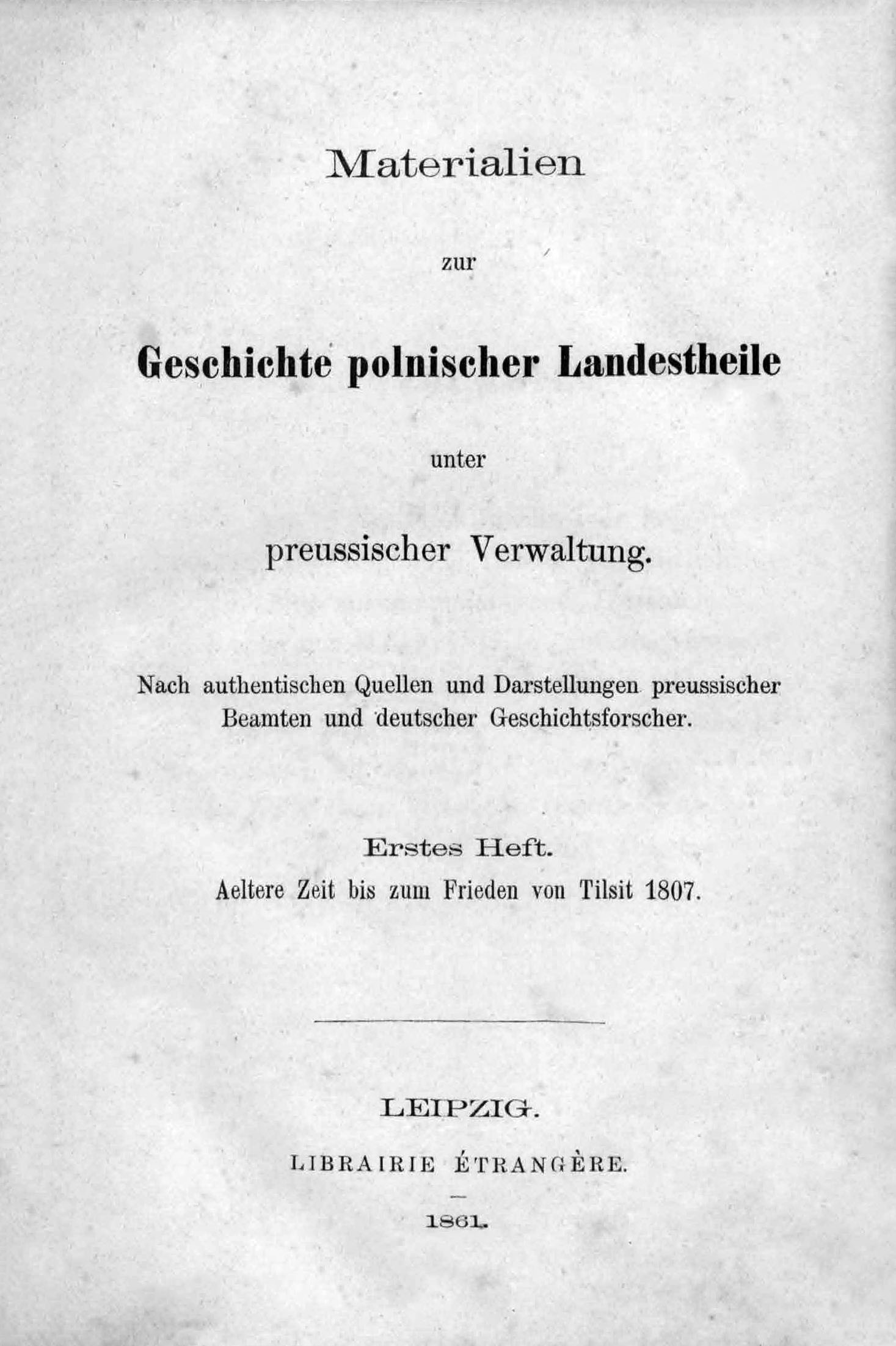
| Materialien zur Geschichte polnischer Landestheile unter preussischer Verwaltung | |
| Read · German Read · English | |
| Authors | Published anonymously |
|---|---|
| Publisher | Librairie Étrangère, Leipzig |
| Publishing date | 1861 |
| Format | First fascicle (Erstes Heft); printed by I. Blumenthal, Berlin |
Materials for the History of Polish Territories under Prussian Administration (Materialien zur Geschichte polnischer Landestheile unter preussischer Verwaltung) is an anonymous polemical collection of historical documents published at Leipzig in 1861, assembled to contest Prussian and German-national claims to the formerly Polish lands of the Grand Duchy of Posen by turning the records, decrees, and private papers of Prussian officials against the administration that produced them. Its documentary centrepiece is the “Black Register,” a suppressed table of confiscated Polish crown and church estates given away as grace-and-favour gifts in the province of South Prussia in the 1790s, compiled by the Prussian whistleblower Hans von Held in a Berlin prison cell.
The book carries no author’s name on its title page and gives its own purpose in a single-sentence preface: it offers “no connected history, but merely materials, single historical facts, for the most part outwardly unconnected, for later treatment,” valuable even as scattered fragments because, in the Latin tag the author places at the end of the sentence, facta loquuntur, the facts speak.1 The subtitle promises that everything is drawn “from authentic sources and accounts by Prussian officials and German historians,” and this is the method the whole work depends on. Rather than argue the Polish case in its own voice, it quotes the Prussian side against itself: royal patents, treaties, cabinet orders, ministerial correspondence, and the private writings of officials who fell out with their own government. A second fascicle was announced as prepared for the press.2
Background and Purpose
The book appeared in 1861 at a point of rising tension between the Prussian state and its Polish subjects in the Province of Posen. The province had been governed as the semi-autonomous Grand Duchy of Posen after 1815, but lost most of its special status following the November Uprising of 1830, and from the 1830s onward Prussian authorities pursued increasingly direct Germanization measures under officials such as Oberpräsident Eduard Heinrich von Flottwell.3 The climate hardened further around 1861: in that year, in a private letter to his sister, Otto von Bismarck, not yet minister-president, wrote of the Poles in terms of extermination, a remark historians cite as a marker of how far anti-Polish feeling had travelled in Prussian conservative circles on the eve of the January Uprising of 1863.4
The Materialien is a direct intervention in this argument. Its immediate target is a claim, advanced in the Frankfurt Parliament of 1848 and repeated in the Prussian Diet, that the western districts of the Grand Duchy of Posen had been “German since time immemorial” and that Prussian rule had brought German honesty, culture, and capital to a neglected land. The Frankfurt deputy Wilhelm Jordan had argued against Polish autonomy on grounds that the very names of the border towns proved their German character; the anonymous author answers, with heavy sarcasm, that those same towns bear Polish names underneath their German ones, that Birnbaum is Międzychód, Meseritz is Międzyrzecz, and Fraustadt is Wschowa, and that by Jordan’s logic Copenhagen or Aix-la-Chapelle could be claimed for anyone who liked the sound of the name.5 A supplement reprints an exchange from the Prussian House of Deputies of 23 May 1861 between the deputy von Bonin, who traced Germanization in Posen back to the thirteenth century, and Dr. von Niegolewski, who replied that his forefathers should not be punished for having “acted nobly” toward German settlers by leaving them their language and law.6
Structure and Contents
The work falls into three large movements, framed by a preface, a table of contents, and an apparatus of 161 numbered notes gathered at the end.
The first movement, on German settlement in the Grand Duchy of Posen from the earliest times to the First Partition of 1772, argues that the Germans who came to Poland before the partitions arrived as refugees rather than conquerors, were received with tolerance, and merged into the Polish nation. The second movement turns to the diplomacy of the partition itself and to a sustained attack on Frederick the Great and Frederick William II, quoting their treaties and letters to expose the distance between their public assurances and their private intentions. The third movement, on the “colonizations” of 1772 to 1806, treats the period the author calls Germanization proper, and divides it into the settlement of the nobility and great landowners (the “Black Register”), of peasants and craftsmen, and of officials and notaries. A section of “addenda” closes the volume.
The Argument Before 1772
The opening chapters build a picture of old Poland as a land of refuge. The author stresses the Statute of Toleration granted by Casimir the Great in 1356 and the equal rights extended to religious dissidents at the Diet of Wilna in 1573, and argues that German Protestants fleeing Silesia, Bohemia, Moravia, and the Thirty Years’ War were welcomed by the Great Polish nobility, given land and privileges, and left free in their language, schools, and worship.7 These settlers, the argument runs, became “Poles of German descent,” in the same way that the French Huguenots settled around Berlin became Prussians, and their descendants therefore had no standing to claim the land for Germany in the nineteenth century.
The book extends the same argument to Poland’s Jews, contrasting at length the persecutions in medieval Germany with what it presents as the comparatively protected legal position of Jews under the old Polish crown.8 The passage is one of several places where the work’s rhetoric turns intemperate, and the reader should be aware that the volume as a whole is a partisan tract of the nationality conflict rather than a measured history. Its translator notes that its judgments and its “harsh invective against Poles, Jews, Germans, and individual officials” have been reproduced faithfully and nothing softened.
Frederick the Great and the First Partition
The central polemic of the volume is directed at Frederick the Great. Under headings such as “Frederick the Great’s Paternal Sentiments toward the Poles” and “Frederick as Solon and Lycurgus among the Polish Barbarians and Iroquois,” the author quotes the king’s own letters to d’Alembert and others, in which he speaks of the Poles with open contempt, and sets these against the paternal language of his patents of possession.9 One chapter carries the accusation that Frederick ordered the Poles of his own newly acquired territory to be secretly incited to insubordination so that he would have a legal pretext to punish them. This is presented as the book’s charge, resting on the sources it assembles, and it belongs to a polemical tradition that later historians have examined critically rather than to settled fact. Alongside the invective, the section reproduces the substantive documents of the partition: extracts from the patent of possession of 13 September 1772, the Treaty of Warsaw of 1773, and the patents and treaties of the Second Partition of 1793, including the patent of possession for South Prussia and the Peace of Grodno.
The Black Register
The documentary heart of the book, and the reason it is still cited by historians of the period, is a table the author calls the “Black Register,” reprinted with a long editor’s introduction. Its full heading describes it as a General-Tableau of the former Polish crown and ecclesiastical estates given away as grace-and-favour gifts (Gratialgüter) in South Prussia during the years 1794 to 1798, while the province was administered by Minister von Hoym, and it states that it was prepared “in Cell No. 6 of the Hausvogtei, the Berlin state prison, in June 1801,” by von Held.10
South Prussia was the province carved out of the Second Partition of 1793, subdivided into the chamber departments of Posen, Kalisch, and Warsaw and administered from Berlin until its cession to the Duchy of Warsaw at Tilsit in 1807.11 Its administration under Minister Karl August von Hoym became the subject of a corruption scandal that produced two of the most notorious clandestine publications of the late Prussian eighteenth century, both the work of Hans von Held (1764–1842), a customs and excise councillor who had served in Posen since 1794.12 Held and his friend Joseph Zerboni di Sposetti, a war and domains councillor, set themselves against Hoym after Zerboni reported that officials had defrauded the state; Zerboni was silenced and imprisoned, and the sentencing of his circle by a royal Machtspruch, without an ordinary trial, provoked a public debate in which Held took a leading part.13
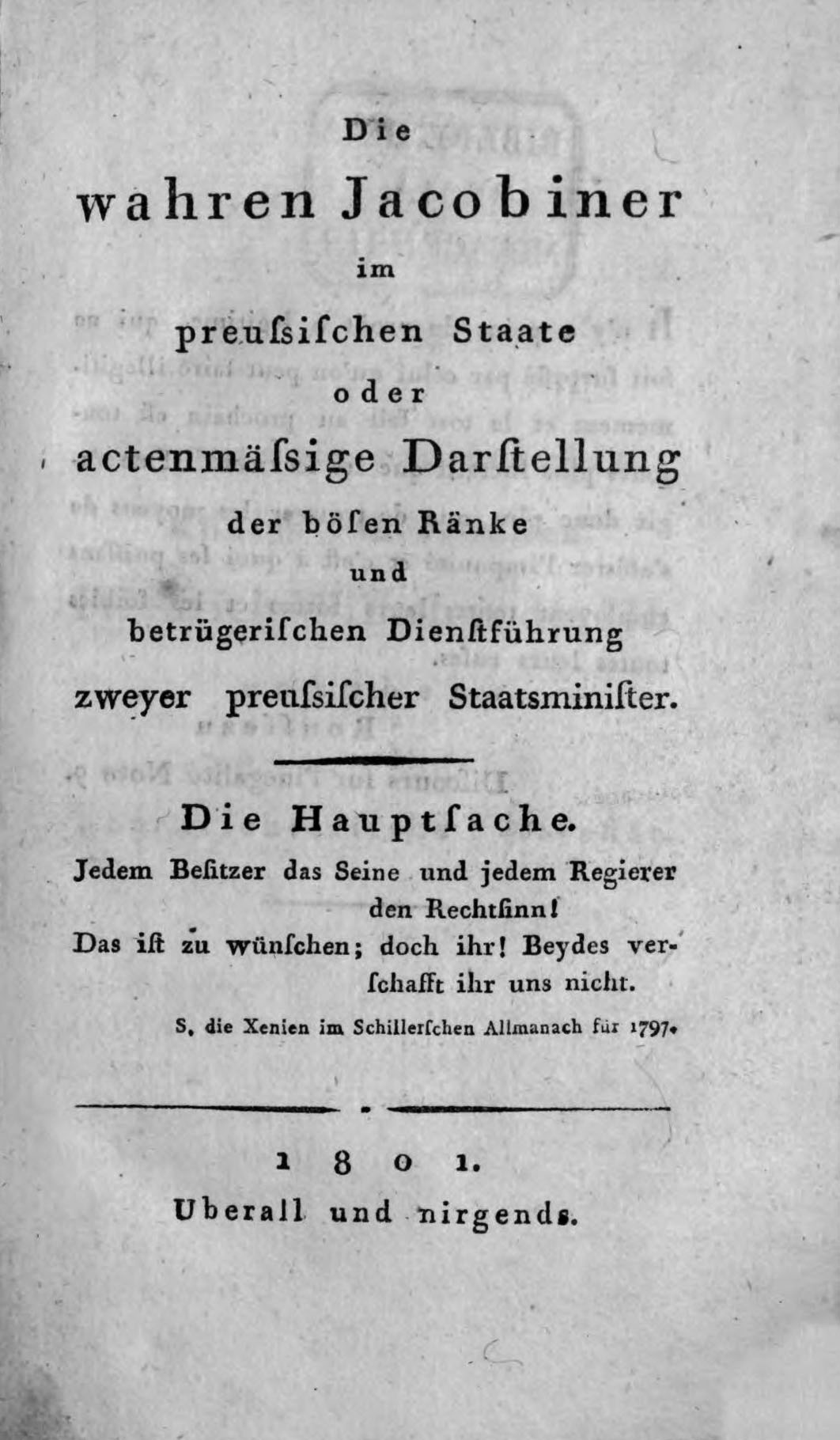
In 1801 Held struck back with a documented account of the affair titled Die wahren Jacobiner im preussischen Staate (The True Jacobins in the Prussian State), which he had printed secretly with the false imprint “Everywhere and Nowhere.” It laid open the disposal of Polish crown estates, above all the leased lordship of Krotoszyn, by the ministers Hoym and Goldbeck.14 Held received twelve author’s copies, which he had bound with black covers and black-stained edges and lettered on the spine “Hoym und Goldbeck,” and from this binding the book became famous, and largely unread, as “the Black Book.” Even Varnhagen von Ense, Held’s biographer, admitted that after more than forty years of hearing about the black book he had never set eyes on a copy or met anyone who had.15 Held was dismissed from office and sentenced to eighteen months’ confinement in a fortress. The “Black Register” was the supporting evidence he compiled for his own written defence, and it was first put into print only in 1807, when Friedrich von Cölln published it in his periodical Neue Feuerbrände zum Brennen und Leuchten.16 The 1861 compilers reprinted it, organized by the chamber departments of Posen, Kalisch, and Warsaw, naming the generals, courtiers, ministers, and princes who received the estates, Hoym himself among them.
The author is careful to establish that Held was no friend of the Poles, and even reprints a section, “Held’s Judgment on the Poles,” in which Held calls them, in crude and sweeping terms, the worst people in Europe.17 The point of including it is precisely that Held’s testimony against the Prussian administration cannot be dismissed as Polish special pleading. This is the volume’s sharpest editorial stroke: it lets a hostile Prussian witness convict the Prussian state.
Bureaucracy and Language
The final chapters treat the incoming German officialdom and the language policy of the new province. The author argues that the decision to conduct all business in German, in a country where the population spoke Polish and few officials were competent in both languages, produced administrative confusion and opened the province to what he describes as a flood of greedy and unqualified placemen.18 Reputable senior officials from the old provinces avoided posts in a region that passed for “a second Siberia,” and those who came, the book contends, were too often the men who could not be employed elsewhere. Here the work draws on the complaints of Prussia’s own administrative writers, and closes with a supplement from Zerboni’s Einige Gedanken über das Bildungsgeschäft in Südpreussen on the absentee speculators he expected to buy up the confiscated lordships.19
Reception and Significance
The Materialien is best understood as a work of advocacy in the Polish national cause, produced at a moment when the German-national reading of the Posen question was gaining ground and when a Polish uprising was two years away. Its rhetoric is combative and at times abusive, and it selects its documents to make a case. Read against the grain, the same material supported the opposite conclusion that German writers were drawing at the time, that centuries of German settlement and Prussian administrative reform had developed a backward borderland, and modern scholarship on the Prussian partition has continued to weigh economic modernization against the costs of foreign rule and Germanization.20
What has given the book a longer life than most polemics is its documentary base. Its reprint of the “Black Register” preserves, in accessible form, a source that was suppressed in its own day and that historians of South Prussia have used since. The Held and Hoym affair at its centre has itself become the subject of sober modern study: the question posed by its 1861 editors, whether the estate grants were corruption or the ordinary exercise of royal favour, is the same question a recent essay by R. Gehrke frames in its title, “Legitimate Mark of Favour or Corruption?”21 Held, once a near-legendary figure of Prussian dissent studied by Varnhagen and by Colmar Grünhagen, has been reassessed in a 2018 collection devoted to him as an enlightened servant of the state caught between Prussia and Poland.22 The anonymous compilers of 1861 turned that material to a partisan end; a reader today can use their volume both as an argument to be weighed and as a convenient archive of documents that are otherwise scattered and rare.
Explore the Book
This is a preview only - view fullsize on archive.org
Gallery
Notes
-
Materialien zur Geschichte polnischer Landestheile unter preussischer Verwaltung. Erstes Heft: Aeltere Zeit bis zum Frieden von Tilsit 1807 (Leipzig: Librairie Étrangère, 1861), preface (“Vorwort”). The volume was printed by I. Blumenthal in Berlin, Adlerstr. 9. ↩
-
The German title page reads “Erstes Heft” and the preface ends “Ein zweites Heft ist zum Drucke vorbereitet” (a second fascicle is prepared for the press). Modern scholarship cites the work as “Heft 1, Leipzig 1861”; see, for example, the bibliography to “Powoływanie landratów w Prusach Południowych (1793–1806),” Przegląd Archiwalno-Historyczny, which lists it among primary sources for the administration of South Prussia. ↩
-
“Province of Posen,” Wikipedia, accessed 8 July 2026, on the loss of the Grand Duchy’s special status after 1830 and the Germanization measures under Oberpräsident Eduard Heinrich von Flottwell. ↩
-
The letter to his sister, in which Bismarck wrote that the Poles should be struck so hard that they despair of their life, is dated 1861 and is quoted in “Province of Posen,” Wikipedia. Bismarck was appointed minister-president of Prussia only in 1862; in 1861 the remark was private correspondence, cited here as evidence of the political climate in which the book appeared. ↩
-
Materialien, pp. 4–5, on the districts of Międzychód/Birnbaum, Międzyrzecz/Meseritz, Babimost/Bomst, and Wschowa/Fraustadt, answering the speech of the Frankfurt deputy Wilhelm Jordan of 24 July 1848 (Stenographischer Bericht über die Verhandlungen der deutschen constituirenden National-Versammlung, p. 1143), cited in the book’s note 2. On Jordan and the 1848 Frankfurt debate over Posen, see “Province of Posen,” Wikipedia. ↩
-
Materialien, “Supplements” (Nachträge) I, reprinting the stenographic proceedings of the Prussian House of Deputies, 55th sitting, 23 May 1861, with the speeches of deputy von Bonin (Genthin) and Dr. von Niegolewski. ↩
-
Materialien, pp. 2–6, on the Statute of Toleration of 1356, the equal rights granted to dissidents at the Diet of Wilna in 1573, and the reception of German Protestants by the Great Polish nobility during the Reformation and the Thirty Years’ War. ↩
-
Materialien, pp. 10–13, contrasting the medieval persecution of Jews in Germany with their legal position under the old Polish crown. The passage is polemical in intent and reflects the argumentative purpose of the book rather than a balanced treatment. ↩
-
Materialien, pp. 43–55, “Friedrichs des Grossen landesväterliche Gesinnung gegen die Polen,” quoting Frederick II’s letters to d’Alembert; and pp. 56 ff., “Friedrich Wilhelms II. Friedens- und Freundschafts-Versicherungen,” juxtaposing the assurances of Frederick William II, including his congratulations on the Polish Constitution of 3 May 1791, with the patents of possession of the Second Partition. ↩
-
Materialien, pp. 105 ff., “Das schwarze Register oder General-Tableau … in den Jahren 1794 bis 1798 … von v. Held,” with the heading stating that it was drawn up in Cell No. 6 of the Hausvogtei in June 1801. ↩
-
“South Prussia,” Wikipedia, accessed 8 July 2026, on the province created from the Second Partition of 1793, its chamber departments of Posen, Kalisch, and Warsaw, and its cession at the Peace of Tilsit in 1807. ↩
-
“Held, Hans von,” Deutsche Biographie, and “ADB:Held, Hans von,” Wikisource, accessed 8 July 2026, for Held’s dates (born 15 November 1764 at Auras near Breslau, died 1842) and his career as Oberakzise- und Zollrat in Posen after the Second Partition. Some antiquarian catalogues give his birth year as 1774 in error. ↩
-
“Held, Hans von,” Deutsche Biographie, on the arrest of Zerboni (1766–1831) and others and the public debate provoked by their sentencing through a royal Machtspruch without an ordinary trial. See also Colmar Grünhagen, Zerboni und Held in ihren Konflikten mit der Staatsgewalt, 1796–1802 (Berlin, 1897). ↩
-
“Held, Hans von,” Deutsche Biographie, and antiquarian descriptions in ZVAB, on Die wahren Jacobiner im preussischen Staate, oder actenmässige Darstellung der bösen Ränke und betrügerischen Dienstführung zweyer preussischer Staatsminister, printed secretly in 1800 with the imprint “Überall und nirgends” and the date 1801, exposing the disposal of crown estates, including Krotoszyn, by the ministers Hoym and Goldbeck. The materials for the book were forwarded to Held in prison under the address of Minister Struensee; see Materialien, note 116, citing Varnhagen, p. 130. ↩
-
Materialien, editor’s introduction to the Black Register, quoting Karl August Varnhagen von Ense, Hans von Held. Ein preußisches Charakterbild (1845), on the notoriety and near-invisibility of the “Black Book,” so called from the black binding and edges Held gave his author’s copies. ↩
-
The Black Register was first printed as “Das schwarze Register oder General-Tableau, sämmtlicher in Süd-Preußen … in den Jahren 1794 bis 1798, als Gratialgüter verschenkten, ehemaligen pohlnischen Kron- und geistlichen Güter,” in Neue Feuerbrände zum Brennen und Leuchten 1/2 (1807), pp. 65–90 (anonymous), edited by Friedrich von Cölln. See “Held, Hans von,” Deutsche Biographie. ↩
-
Materialien, pp. 175–177, “Held’s Judgment on the Poles,” reproducing passages from Held’s unpublished defence in which he disparages the Poles in sweeping terms, included by the compilers to show that their principal witness was hostile to the Polish cause. ↩
-
Materialien, pp. 201–205, “Kolonisationen der Beamten und Notare,” on the decision to make German the sole language of business in South Prussia and its consequences for the quality of the incoming officialdom. ↩
-
Materialien, “Supplements” (Nachträge) II, quoting Joseph Zerboni, Einige Gedanken über das Bildungsgeschäft in Südpreussen (Jena: Frommann, 1800), p. 65 ff., on the absentee nobility and speculators he expected to acquire the confiscated South Prussian estates. ↩
-
On the historiographical debate over the Prussian partition, weighing economic and administrative modernization against Germanization and foreign rule, see the survey “Die Teilungen Polens – Genese der polnischen Moderne,” Institut für Kultur und Geschichte der Deutschen in Nordosteuropa (IKGN), accessed 8 July 2026. ↩
-
R. Gehrke, “Legitimer Gunstbeweis oder Korruption? Bodenpolitik und ‘Güterverschleuderung’ in der neuen preußischen Provinz Südpreußen,” in Joachim Bahlcke and A. Joisten (eds.), Wortgewalten. Hans von Held. Ein aufgeklärter Staatsdiener zwischen Preußen und Polen (Potsdam, 2018), pp. 135 ff., cited in ZVAB catalogue descriptions of Held’s works. ↩
-
Joachim Bahlcke and A. Joisten (eds.), Wortgewalten. Hans von Held. Ein aufgeklärter Staatsdiener zwischen Preußen und Polen (Potsdam, 2018); and earlier, Colmar Grünhagen, Zerboni und Held in ihren Konflikten mit der Staatsgewalt, 1796–1802 (Berlin, 1897), and Karl August Varnhagen von Ense, Hans von Held. Ein preußisches Charakterbild (1845). ↩