|
|
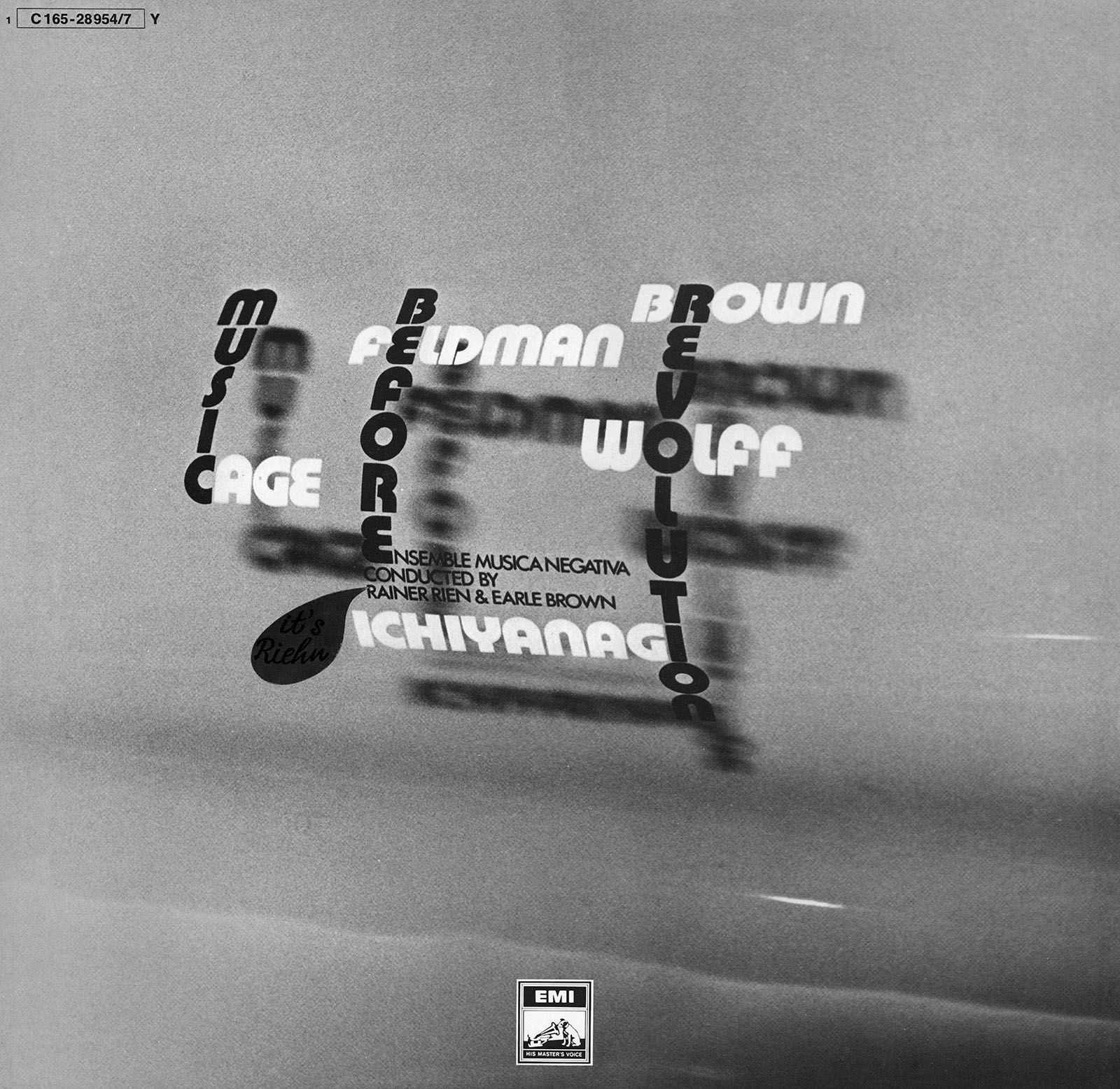
| Music Before Revolution | |
| Authors | Ensemble Musica Negativa |
|---|---|
| Publisher | Odeon (EMI) |
| Publishing date | 1972 |
| Edition | C 165-28964/7 |
| Format | 4 × Vinyl LP, Stereo |
Music Before Revolution is a 1972 quadruple-LP box set released on the Odeon label documenting radical American experimental music from 1939 to 1970, performed by the Ensemble Musica Negativa under conductor Rainer Riehn, with liner notes by critic Heinz-Klaus Metzger and recorded conversations between the composers themselves. Recorded at the Electrola Studios in Cologne, the set is accompanied by two sixteen-page booklets: one containing Heinz-Klaus Metzger’s extended essay “Essay on Prerevolutionary Music” in German and English, and the other a bilingual transcription of the recorded conversations occupying the fourth LP. Those conversations - two long discussions edited down from multi-hour sessions held in New York and Cologne - feature Cage, Wolff, and Hans G Helms on the penultimate side, and Morton Feldman, Earle Brown, and Metzger in discussion on the final one. The set remains among the most substantial documents of the New York School’s music to have been recorded in Europe, and has commanded collector prices well above its original retail value since shortly after its release.
Background
The Ensemble Musica Negativa was founded in 1968 or 1969 - sources differ by a year - by Rainer Riehn and Heinz-Klaus Metzger, following the two men’s meeting at the Darmstädter Ferienkurse in the summer of 1965.Wikipedia gives 1968 as the founding year of Ensemble Musica Negativa; several other sources, including the edition-telemark.de biography and Midheaven, give 1969. The discrepancy may reflect an informal founding versus a formal public debut. The ensemble’s formation was not incidental to the intellectual relationship between its two animating figures. Metzger (6 February 1932 – 25 October 2009), born in Konstanz, had studied piano under Carl Seemann in Freiburg and composition under Max Deutsch in Paris before encountering Adorno, Varèse, Stockhausen, and Nono at Darmstadt.“Heinz-Klaus Metzger,” Wikipedia, accessed February 2026, https://en.wikipedia.org/wiki/Heinz-Klaus_Metzger. By the early 1960s he had emerged as one of the first significant European commentators on Cage, a role that crystallised in the Kölner Manifest of 1960 and in his editorial work for the Palermo journal Collage. He had also been an early champion of Stockhausen before becoming one of his most pointed critics - a trajectory that shaped the ensemble’s specific aesthetic commitments: a commitment to music that was, in Metzger’s phrase, genuinely “liberated” rather than merely formally adventurous.
Riehn (12 November 1941 – 9 June 2015), born in Danzig, had studied music theory in Mainz, Zürich, and Berlin, and composition with Gottfried Michael Koenig at the Instituut voor Sonologie in Utrecht - the same institution where he would later attempt, unsuccessfully, to realise a Fontana Mix recording for the present box set.Rainer Riehn, letter quoted in liner notes, Music Before Revolution (Odeon C 165-28964/7, 1972). On the Utrecht institute: Rainer Riehn biography, edition-telemark.de, https://www.edition-telemark.de/314.09.html. As conductor and organiser of Musica Negativa, Riehn functioned as the practical enabler of programmes whose intellectual framework Metzger largely supplied.
By 1972, the ensemble had already recorded Cage’s Atlas Eclipticalis, Winter Music, and Cartridge Music alongside Dieter Schnebel’s Glossolalie for Avantgarde, and Riehn had released his own electronic composition Chants de Maldoror on Deutsche Grammophon. Music Before Revolution represented a more ambitious undertaking: a comprehensive survey of what Metzger, in his liner notes, called the “crucial handful of composers” for whom David Tudor had acted as “unfailing interpreter, playing for unspeakably stingy fees in every possible locality” during the lean years before these composers became internationally known.
The set was produced by Lieselotte Montes-Baquer and engineered by Johann Nikolaus Matthes and Kurt Lorbach. Matthes, who also performed on the recordings - playing the frequency discs in Imaginary Landscape No. 1 and the phonograph in Credo in Us - was a central technical figure in the sessions.
Metzger’s Essay
The liner note booklet’s centrepiece is Metzger’s “Essay on Prerevolutionary Music,” composed in Venice between February and June 1972. Its title derives from a remark by Feldman, printed as one of two epigraphs: “You can’t be revolutionary before the revolution.” The other epigraph is Cage’s: “I don’t think we should expect one thing to bring about a revolution. We must use everything… and do everything we can. For some people, words will be effective, for some people, even violence will be effective, for some people, music will be effective. We must use everything.”
The essay is a substantial piece of critical writing that refuses easy genre classification: part political philosophy, part close technical analysis, part polemical broadside against the music sociology of both the bourgeois centre and the contemporary left. Metzger’s central argument draws a distinction between art’s inherent political character - which he regards as objectively present regardless of compositional intention - and the instrumentalisation of that character by parties seeking to deploy music as propaganda. The distinction matters because it allows him to defend the apparent political quietism of Cage and Feldman without abandoning a radical politics: “No artistic procedure, however much committed to the principle of l’art pour l’art, can be divorced from the political implications that ultimately characterise all human activity.”
The essay situates the five composers within a tradition of musical anarchism, tracing their debts to Schönberg (who taught Cage during his American exile, and who famously opened his Harmonielehre with the sentence “I have learnt this book from my pupils”), and characterising their relationship to one another not as a school but as a non-school - defined above all by their shared relationship to Tudor as interpreter. Metzger is careful to distinguish the composers’ individual positions: Cage’s “remorselessly cherished rejection of any exertion of power” tends dialectically, he notes, toward the obligatory, while Feldman’s scores, in their precise deployment of the traditional score format to achieve actual asynchrony, enact “a paradigm of the dialectical identification of liberté and égalité.” The essay draws extensively on Adorno - whose friendship with Metzger dated from the 1950 Darmstadt courses - as well as on Walter Benjamin, Marx, and, more unexpectedly, the Talmud.
Metzger’s reading of the Concert for Piano and Orchestra as “the musical model for what is, in the last resort, a politically intended anarchy” was influential in shaping European critical reception of Cage’s work and has been cited in subsequent scholarship as a significant early account of Cage’s political aesthetics.See, for example, the discussion of Metzger’s account in Martin Iddon and Philip Thomas, John Cage’s Concert for Piano and Orchestra (Oxford: Oxford University Press, 2020), referenced in “The Musical Text: Theorizing Openness after Structuralism,” Twentieth-Century Music (Cambridge Core), https://www.cambridge.org/core/journals/twentieth-century-music/article/musical-text-theorizing-openness-after-structuralism.
Heinz-Klaus Metzger
ESSAY ON PREREVOLUTIONARY MUSIC
You can’t be revolutionary before the revolution.
Morton Feldman
I don’t think we should expect one thing to bring about a revolution. We must use everything… and do everything we can. For some people, words will be effective, for some people, even violence will be effective, for some people, music will be effective. We must use everything. John Cage
Just as Orpheus’ protest (in a notorious film) “Le public m’aime” inevitably brings the rejoinder “Il est bien le seul”,1) so too what nowadays is glibly called “Cage and his school” is something that exists only in the wrongly held conviction of the public. Though Cage may well be the most original teacher of composition since the founder of the last school of musico-historical secular significance - namely since Schönberg, who first taught Webern and Berg, then Deutsch and Eisler, and later, exiled in America, where he had been driven in 1933 when the German murder squads started up, also taught Cage — this latter and his younger friends Feldman, Brown, Ichiyanagi and Wolff (who was actually the only one of those named who enjoyed anything like tuition) have never formed ‘a school’. This fact is bound up with Cage’s remorselessly cherished rejection of any “exertion of power”,2) a strictly anarchistic morality involving a conception of personal freedom which, by virtue of its demands, actually has the fatal dialectical tendency of assuming an obligatory character, and thus turning into the opposite of what was intended. Brown once summed up this dilemma in the laconic formula: “Freedom doesn’t necessarily mean that everybody must go his own way”.3) Certainly one can’t regard the marked division into schools which pervades the history of composing as being constituted solely by means of the authoritative handing down of technical procedures and aesthetic attitudes. Even Schönberg, reputedly an unrivalled despot in the classroom, began his Harmonielehre with the memorable sentence: “I have learnt this book from my pupils”.4) However, this sentence appears to inflict a drastically abbreviated secularisation on the Talmudic tradition: Rabbi Akiba, whose name turns up again in the title of a piece by Feldman, has bequeathed a dictum which is at least two dimensions richer, namely that he had learnt much from his teachers, more from his fellow students, and most of all from his pupils. But since the five composers from whose works the Musica Negativa Ensemble have selected and performed a number of representative examples for this album would probably prefer to dismiss the three categories of didactic relationship experienced by the legendary rabbi during his lifetime, one can, exceptionally (in so far as one should bother about defining their musico-historical relationships at all), off er a working definition which obligingly serves as a substitute for the inapplicable concept of a school: we are concerned with that crucial handful of composers - examply countable, in fact, on the fingers of one hand — for whom, while they were still unknown, David Tudor acted as unfailing interpreter, playing for unspeakably stingy fees in every possible locality, obscure venues being easier to come by than manifestly public ones; for many years Tudor was a pianist, previously (and later once again) an organist — nowadays he is primarily an electroacoustician and composer. Light is shed on the state of affairs that brought about the relative unity of this non-school by the short confession with which Cage prefaces his essay “Rhythm etc.”: “The principal characters in the following text are Le Corbusier, architect of beautiful buildings, inventor of the Modulor, and David Tudor, musician, without whom my later music and the musics of Morton Feldman and Christian Wolff, to mention only three, would never have come into being, not because of his virtuosity but because of what, when his skills are put away, he is. This text is not for him but is an homage to him.“ 5)
Criticisms6) have been made of the political anarchism of which Cage makes such a proclamatory profession,7) and to whose essential idea even the most divergent compositional techniques of his colleagues presented here may be related. No artistic procedure, however much committed to the principle of l’art pour I’art, can be divorced from the political implications that ultimately characterise all human activity. “Nothing is harmless any more.”8) Inherently methodologically implemented analyses may confidently seek to decipher them à la rigueur, so long as they don’t shy away from their transcendental consequences, while those investigations which flourish both in bourgeois positivistic music sociology and among not inconsiderable currents in the present-day left, and seek to make the social ‘function’ of the work of art their starting point, i. e. the usages it suffers or is spared, usually fail even to arrive at something cogent concerning the modalities of its reception (or in most cases, lack of reception). Yet what befalls any aesthetic product that registers an inherent intention, whether via the capitalist utilisation process, or by its requisition as the symbol of an opposed or advocated policy, as the alleged expression of one’s own or the enemy class, can be exactly ascertained, quantitatively and qualitatively, merely by assessing the inherent intention of the product itself. At any rate, where an artefact has a precisely circumscribed, practical set purpose e.g. to canvas for goods (or the revolution), supervision of the effect — of the ‘function’ — may well recommend itself to interested parties as an index veri; actually it is an index falsi, namely that of a false society based on exploitation, whose structure extends right down to the anthropological deformation of each single member, and derives from that of the psychological effect-mechanisms to which recourse has been made. To break the hold of the objective conditions — against whose power only those revolutionary attempts which are better organised than the ruling society itself stand any chance – anarchism postulates an emphatic concept of freedom, immediate, ahistorical, and untied to the actual social process, not as a basis from which the strategic principles for its realisation are to be inferred but (utopia being the supreme idea of historical philosophy) one which would be able to gratify the deepest aspirations of mankind: the model for all freedom, however the term is construed by the philosophers, in the sexual one.
If art is not neutral with regard to its ‘function’, for all that it can’t do much to influence it, then the author must insist all the more emphatically on some earlier sentences of his: “Art is neither the production of nutrients, nor a technique of commerce, nor a medicine. Its domain is not responsibility but frivolity. This latter doesn’t even have to coincide with the composer’s subjective conviction, as in Bussotti: it will always be embodied in its objectification as a technical figuration. In one of its aspects it might perhaps be defined as the capacity to turn Debussy’s casual phrase about the duty of music being to “faire plaisir” against the relevant industry. The difference between entertainment music (which nowadays also includes ‘serious’ music, to judge by its function and performance practice) and the avant-garde music raised in protest against it is by no means to be regarded as one of degree. What is imposed on the slaves of the wages system in the way of the perpetuation and reproduction of the wares of labour in their so-called free time, even musically, namely via loudspeakers, goes far beyond the stupor to which the conveyor-belt reduces them during hours. The entertainment doesn’t produce ‘lower’ pleasure, as all those theories which push the concept of ‘level’ to the centre of the description would have one believe, but its denial. One of the texts in Minima Moralia, directly concerned with humanism, declares that pleasure only exists where this society will not tolerate it: a logical condition of frivolity …“ 9)
Cage’s CONCERT FOR PIANO AND ORCHESTRA (1957-1958) is to be understood as the musical model for what is, in the last resort, a politically intended anarchy: if the author knows his music history, this may be the first example in the immeasurable genre of notated ensemble music — i.e. the illiterate stage of collective improvisation — which could be defined as the negation of any kind of controlled playing together. The score is abolished: the work is written down merely in individual parts, independent of one another, among which the piano part is distinguished by a relatively large number of pages in relation to the other parts, namely 63 pages (it is purely on this account, and not because of any ‘soloistic’ privileges, that the work is actually a sort of piano concerto) which the pianist can present freely in any order (and using any amount of their material), as also by a sometimes exorbitant horizontal and vertical density of playing actions.10) In this piano part, Cage has conceived and realised 84 different systems of notation; individually, these spring partly from the methodical use of chance, partly from the inventive fl air of a composer of stupendous graphic imagination, and are directly identified with an equal number of different compositional techniques: in this context, composition per se really means very little more than the physical act of writing, just as if Cage had absorbed Benjamin’s late messianic mysticism.11) On the other hand, the scope of the diverse orchestral parts, all of which were produced by one and the same combination of chance operations, in no case exceeds 16 pages - in most cases there are less; from these the ensemble’s musicians, who are equivalent to the pianist in respect of the licenses granted to them, may translate a self-chosen number into actions, there being no lack of symbols to stimulate the independent invention of new aural phenomena and performance techniques, or even the requisitioning of auxiliary equipment not belonging to their instrument. Here too, the number nought can be selected for each part: the fact that parts can be omitted - all of them if the occasion arises, so that non-performance represents one possible interpretation of the work - is an express condition of its conception, just as, conversely, each part can be performed as a solo, or with others in a chamber music complex of any size and constitution, or finally - if the piano remains unmanned - they can join together in a symphony. If the musicians in a performance for ensemble agree on a common duration, it is advisable for each one to apportion the material he is thinking of using accordingly, i.e. to work out a time-schedule which may then be controlled by means of a stopwatch. If a conductor is involved, he functions as a clock: he doesn’t ‘conduct’, but indicates the passing of time, the circular movements of his arms being read as a rotating second-hand. To this end, he doesn’t follow an imaginary score, no real one being available, but a special part, the conductor’s part, which has no particular features as compared to the others which might end up giving the conductor a privileged position, since it merely contains deviations of conducted time from clock time: the conductor is an erratically functioning clock.12)
Several other works by Cage have the property of being performable at the same time as the Concert for Piano and Orchestra, namely Aria (1958), Solo for Voice I (1958), Fontana Mix (1958-59), Indeterminacy (1959), Solo for Voice II (1960), WBAI (1960), and Song Books (1970).13) Whereas SOLO FOR VOICE I is based on the same techniques as the orchestral parts of the Concert for Piano, albeit extended to the semantic parameter of the polyglot text to be sung, SOLO FOR VOICE II consists as a composition of a multiple graphic material inscribed on five transparencies and one opaque sheet. The super-imposition of the sheets — they don’t have to be congruently overlaid - results in the exact definition of the parameters for one version or a part of one such version, including the phonemes to be enunciated, i.e. the ‘text’ (non-semantic in this case), Cage having provided for two methods, varying in principle (alternative and combinative), of using and reading the material. A superimposition of works such as is offered by the present recording quantitatively multiplies, and at the same time qualitatively diversifies, what was adduced earlier as the fundamental concept in the Concert for Piano and Orchestra itself, namely the addition of mutually independent, ‘autonomous’ human activities, whose very self-reliance, even pointed lack of connection — the doings of each participant are isolated, almost ‘solipsist’ - crystallises into the dialectical model of a collaboration whose realisation seeks to unify freedom and solidarity.
In 1962, when Cage, then 50 years old, finally found a publisher, a special catalogue appeared which, for the first time, permitted a survey of the composer’s life’s work; referring to the announced edition of these opera omnia, Kagel let slip the memorable remark “This is the new Bach-Gesellschaft”.14) In no way did he overestimate the abundance and significance of the Cageian oeuvre. A relatively early epoch in the development of this composer who has ceaselessly transformed his music, and with it, the scope of what can reasonably be called music, is represented in this album by the IMAGINARY LANDSCAPE No. 1 (1939). This utterly remarkable creation, significantly conceived and executed by Cage before the onset of the tape era, is already partly electronic music in its technical conception, the first fulfillment of Varèse’s prophecies in an actual composition. The work is written for testdiscs15) with constant and variable frequencies, a large Chinese cymbal, and selected strings of the piano; not only a completely singular instrumentation per se, but also by virtue of its similarity to the tape music advanced as being so significant around 1950, in that it is realisable only by being fixed on a reproducing mechanism: it can scarcely be cohesively performed by live musicians. Given that in view of the state of technology at the time the work was written, the record was the only suitable mechanism available, this new realisation of the score on a record carries an exceptional seal of authenticity in that it uses the original medium: unlike all those recordings of instrumental and vocal music entrusted to such apparatus, compositions not intended by nature to be heard through loudspeakers, where even the most perfect recording techniques can only, per definitionem, yield their image, this one may even be interchangeable with the original. Formally the composition is characterised an expressively grotesque residue of almost ‘themes’ have been infected with a glacial rigidity, almost as in the nature Varèse’s constructions for wind ensemble with and without percussion: in fact they anticipate what Henry and Schaeffer called “objets sonores” 16) around 1950, those isolated, more or less complicated pieces of acoustic rubble from which they assembled their tape-montages. - Certain traits in Cage’s CREDO IN US (1942) off er a salute to the first striking composer in North American history, Ives. It is well known that in his most significant compositions, Ives achieved bold simultaneous and successive collages of often radically different kinds of music. Cage’s Credo in us, originally done as accompanying music for a dance performance by Merce Cunningham and Jean Erdmann, is ingeniously laid out for 2 muted gongs, 10 tin cans, an electric buzzer, 2 tom-toms, piano, radio and phonograph; referring to the use to be made of the last-named instrument, the composer suggests “some classics”, and on closer consideration proposes Dvorak, Beethoven, Sibelius or Shostakovich: this expressly as part of the list of instruments which prefaces the score. As these divers implements are primarily occupied in producing an unholy din of relentless metre and rhythm, the piano leaping about unrestrainedly from time to time, while the ill-fated ‘classical’ record undergoes every humiliation that one composition can inflict on another, through barbaric control settings and abrupt lowering and raising of the needle — the dynamic and rhythm of the part is exactly notated —17), the result is a work of the most extreme ferocity, and the pleasure any listener unfailingly experiences on hearing it must inevitably be interpreted as a confirmation of his own sadism. Clearly the desecration of a great name — and that is what it boils down to, as is proven by the incommensurately unequal quality of the list of composers nominated by Cage as the potential victims of his musical attentions: all they have in common is their ‘fame’ — is, at bottom, an act of merely Oedipal rebellion, not a revolutionary one, even in inherently musical terms; the ambivalence of the whole undertaking, in the strictly Freudian sense, could not be more clearly betrayed than it is at the score’s final fermata, where the final triumph is given over to the previously murdered ‘classic’. - ROZART MIX (1965) exists in the form of an exchange of letters between Cage and Alvin Lucier (the latter acting on behalf of the Rose Art Museum of Brandeis University, Waltham, Massachusetts, clearly it’s only a small step from Rose Art to Rozart) concerning the planning and preparations for a concert: Cage had neither the time to compose a new piece requiring elaborate drafting, nor a studio to prepare tapes. In this situation he suggested to his correspondents that the students might enjoy ‘splicing parties’, using any taped material (“though I’d like hear a non-pop version some day”, added Cage in his letter of April 2nd, 1965), to cut and join an extensive stock of tape loops of various lengths: the simultaneous playback of samples from this assortment on numerous tape-recorders, continual changings of the loops, no rhythm being prescribed for these actions, and the individual participants’ spontaneous choice of the loop to be played, yielding a chance result, since one can’t tell what acoustic phenomena are recorded on a tape just by looking at it: all this produces the piece.18)
If the hope Cage places in the indeterminacy19) of his composing’s results is evidence of utter trust in the Divine, Feldman, for all the toleration exercised by his scores in respect of the musical spontaneity and sensibility of the interpreters which is such an indispensable part of their realisation, takes pains to ensure that the resulting musical character is unmistakable. This latter is mainly extremely tender and restrained, a permanent excess or what is described in Kolisch’s theory of music as “negative intensity”, transforming the pianissimo miniatures of Webern’s most radical expressionistic “solipsist-anarchistic” period into what Adorno once called the “Gestus des Lauschens”, an attitude of almost eavesdropping passivity in the production of the composition itself, and in its reproduction, if properly carried out20), which actually demands even more attentive listening activity, and leaves the hearer every freedom for this by virtue of its very unobtrusiveness. Yet Feldman’s historical enervation may be regarded as antipodal to Webern’s in all the most significant determinants that distinguish them, almost as its negation: the sheer length of Feldman’s meditations — the quantitative length of music is just as relevant to its historical and socio-philosophical exposition as the format of drawings, paintings and sculptures in the visual arts - takes them an astronomical distance from Webern’s expressionistic ‘instants’, and the serial constructivism which gained decisive ground in Webern’s late output21) — and shows evident cabbalistic traits which the catholic-socialist composer attempted to christianise in purely makeshift from, namely through the verbal content of the texts he chose to set — was never taken up by the Talmudist Feldman. Under these circumstances, the best overall characterisation of Feldman’s music naturally comes from Cage: “I remember now that Feldman spoke of shadows. He said that sounds were not sounds but shadows. They are obviously sounds; that’s why they are shadows. Every something is an echo of nothing. Life goes on very much like a piece by Morton Feldman. (…) The nothing that goes on is what Feldman speaks of when he speaks of being submerged in silence. The acceptance of death is the source of all life. So that listening to this music one takes as a springboard the first sound that comes along; the first something springs us into nothing and out of that nothing arises the next something etc. like an alternating current. Not one sound fears the silence that extinguishes it. And no silence exists that is not pregnant with sound.” 22)
THE STRAITS OF MAGELLAN (1961) for flute, horn, trumpet, electric guitar, harp, piano and double bass uses the technique created by Feldman in the “Intersection” pieces, but given up at a later stage in the metamorphosis of his expressive means; its invention goes back to the period around 1950, and probably has a prior claim to be ranked as the first ‘graphic’ compositional procedure of the entire musical aeon since the neumatic notations and tablatures. The score is based on a field ruled regularly, both vertically and horizontally, in such a manner that square of equal size - ‘boxes’ — result; these being placed above one another, in solo pieces they normally divide the pitch range of each instrument into regions — high, middle and low in the case of the notorious Intersection III (1951) for piano, a solo instrumental composition with the highest density of attacks to date,23) whose performance calls for unparalleled acrobatics —, but in ensemble works such as the one described here they represent the individual parts in the score, which are clearly separated from one another by ‘line-spacings’, while their alignment in the vertical dimension marks the time-units during which the playing actions inscribed in the squares are to be accomplished. The Straits of Magellan, whose perpetually varying density of events constitutes the work’s primary compositional parameter — a ‘statistical’ one, which consistently avoids the ‘pointillist’ fixing of the single elements whose changing frequency distributions go to make up its ‘magnitudes’ - gives the listener the impression of almost perpetual tempo-fluctuations, yet technically it has a constant tempo - “each box = MM 88” — adherence to which is seldom easy for the players, and hair-raising in some passages, even though no specific notes are given - such a supplementary requirement would make the piece as good as unperformable —, merely the number of notes per time unit, and often, of course, more specific qualities such as double- and fl utter-tonguing on the wind, glissandi in defined directions, piano pedalling, immediate repetitions of notes and chords, arpeggios, and various techniques for playing the guitar, harp and double bass; given the pianissimo prescribed throughout, any figurations there might be would be blurred anyway under such technical circumstances; these latter, as the obligatory, immutable premises of this composition, introduce an air of fluidity into the discourse, evoking an idea of “aura”, though one which deviates from the orthodox meaning which has clung to the word since Benjamin. — On the other hand, though FOR FRANZ KLINE (1962) for horn, soprano (the singer emits vocalises, no text, thus almost functions in the ensemble as a true wind instrument), piano, chimes, violin and ‘cello is written in normal score, admittedly without bars, and in black notes without stems and hence without rhythmic connotations, but indicating chromatic pitches, placed with meticulous calligraphy exactly over one another in the individual parts of which the score consists, just as if the instruments had to play precisely in synchronisation — to be “together”, even to produce loud exactly with one another -, the fact is that this notation is by no means to be read and performed like a traditional score. Despite the overwhelming suggestion exercised by the schematic layout of the score, namely that of a metre common to all, a ‘beat’, there is absolutely no temporal connection of any kind between the parts; the participants merely have to commence a performance simultaneously. The score’s optically apparent, strictly pervasive and ostensibly collective ‘beat’ is an ‘inner’ one, however, different for each player, to be chosen by him, a pulsation existing only in the imagination of the individual musician, one he may retard or accelerate without constraint at any time during the performance24): this experimental arrangement can no more be called playing together - even of a minimally controlled kind - than can Cage’s anarchistic ensemble conception, where occasionally there may at least be the partial invention of a stopwatch, or the antichronometric chronometry of a conductor; whereas no time can keep pace with that of Feldmanesque products of the species explained here. In For Franz Kline, even the most “attentive”, “eavesdropping” cooperation of the musicians — which is an absolute desiderum for the shading of each individual sound - won’t lead to their ending together; rather, never having been ‘together’, they will finish in succession, so one will necessarily be confronted by a composition with several successive endings. -25)
Feldman’s recurrent use of the traditional score format in works for ensemble where no synchronicity of events belonging in different parts is intended, of a format whose very structural definition lies in the representation of synchronisation, and thus here effects an optical deception in incomparable fashion, poses a riddle that requires recourse to the Talmud: “And thereby was the greatness of the Holy One, praise be unto him, made known; for a man may mint many coins with the one die, and each one of them is like the other; but the King above the king of kings, the Holy One, praise be unto him, stamps many men with the one die of the first man, and not a single one of them is like the next”.26) Just as Adorno once defined the equality to be constituted by revolutionary means at the condition in which one can be different without fearing, based on the abolition of all those prejudices which can only from the social principium individuationis for such time as it remains - through its thousandfold economic and anthropological intervations - none other than the principle of power in an as yet un-overthrown class-society based on exploitation and alienation, so Feldman, aided by the simple artifice of choosing the old score-format (putting this latter to work compositionally as a constructed equality of unequal parts), drafts a paradigm of the dialectical identification of liberté and égalité — though for the time being, only thought can do anything with it — or, as a practical extreme, the purely musical achievement of a tiny collective of interpreters: “You can’t be revolutionary before the revolution”.27) Utopia — Feldman would say Olamha-Ba; in Marxist language: the abolition of social antagonisms — is sometimes sought in the aesthetic image of Feldman’s music through closely bound action patterns which introduce more fraternité into the actual technique e.g. in BETWEEN CATEGORIES (1969) for two identically constituted instrumental groups (piano, chimes, violin and cello), which play independently of one another, not in terms of aural concurrence, but in those of functional complementarity and reactive consideration; internally, moments of controlled playing together on the basis of a chamber music-like from of agreement are prevalent in both, those of individual extravagance are much less frequent, while the qualitative work-ideas, en détail, are rather unevenly distributed among the participants.
Whereas in choosing works by Cage and Feldman for the present album, the Musica Negativa Ensemble was concerned with confronting products from various periods of the composers’ lives, and thus shedding the clearest possible light on contradictions 28) which must be regarded as those inherent in the object process of musical history itself, in order to present the historical priorities and the expansive technical spectrum of Brown’s work en bloc, yet at the same time concisely, it was necessary to concentrate on a single complex of sheets: the loose-leaf album FOLIO (1952/53) and its appendix FOUR SYSTEMS (1954). The contradictions here - or better: the alternatives — are of a systematic rather than historical nature, but the whole is almost an encyclopaedia, albeit in abbreviated form - of the fundamental possibilities of composition, including those which were only prophetically visible at the time. The gamut of notations which occur in it ranges from the traditional musical script to speculative graphic fantasies whose hermeneuticism can go on being revised till the end of all music, and may be opportunity for new, even abrupter interpretations. On the disc, the individual creations of the Folio-convolution are presented in chronological order of composition, which, through its abundant anticipations and throwbacks, gives the lie to any idea of linear historical ‘development’. The start is formed by the piano piece OCTOBER 1952, which makes use of a certain reservoir of symbols from traditional notation along with its conventional rhythmic values — minim, crotchet, quaver, semiquaver, demisemiquaver, dotting - but with the elimination of any possible metrical connection of their values, and without tempo; between the completely normal written signs, empty manuscript paper gapes in varying spatial measures. The performing indications declare: “The total time-duration of the piece and the implied metrical-time relationships between events are to be determined by the performer. The absence of rests produces an intentional ambiguity and is intended to eliminate the possibility of a metrically rational performance. The performer may move through the space at a constant or variable rate of speed relative to ‘real’ time or to intuitive time.”
It is followed by NOVEMBER 1952 (“Synergy”) for piano/s and/or other musical instruments or sound-producing media, written in ordinary notes with accidentals and conventional rhythmic values, but without rhythmically notated rests, just distances between the individual symbols on a stave of no less than 50 lines (i.e. tenfold), without clefs. The complete performing instructions read: “The frequency range will be relative to that of each instrument performing the work. To be performed in any direction from any point in the defined space for any length of time. Tempo: as fast as possible to a slow as possible… inclusive. Attacks may be interpreted as completely separated by infinite space, collectively in blocks of any shape, or defined exactly within that space. Lines and spaces may be thought of as tracks moving in either direction (horizontally at different and variable speeds) and clef signs may be considered as floating (vertically over the defined space) … this indicates the theoretical possibility of all the attacks occuring at the same instant (and on the same frequency, for any amount of time) or any other expression of simultaneity. The defined space may be thought of as real or illusory, as a whole or in parts. Either space (vertical or horizontal) may expand, contract, or remain as it seems to be here. Vertical space will vary according to the performer’s view of the floating clefs.” Whereas this score, the formal like of which had never existed before (the degree of mobility of its elements, and the connections between these latter which it formulates as its inexhaustible potential, make the most complex of Calder’s mobiles look like children’s toys) shows at least a minimal restraint, in so far as its written notation, taken strictly, only permits the production of ‘notes’ (though the performance can endow them with ‘noisy’ timbres), DECEMBER 1952 for any instruments and/or sound-producing media represents a radicalisation, not only because the evident conceptual tendency of the subject matter now permits every conceivable noise, but because the pluri-dimensional formal combinatorialism takes interpretative freedom beyond all barriers and boundaries, other than those one sets oneself, or those that may be implicit in the available instrumentation and apparatus; nor is it any longer laid down which part of the sheet is top or bottom, front or back: just that it is white and a small part of it covered by scattered black rectangles of varying length and breadth. From the performing instructions: “The composition may be performed in any direction from any point in the defined space for any length of time and may be performed from any of the rotational positions in any sequence. In a performance utilizing only three dimensions as active (vertical, horizontal, and time), the thickness of the event indicates the relative intensity and/or (where applicable instrumentally) clusters. Where all four dimensions are active, the relative thickness and length of events are functions of their conceptual position on a plane perpendicular to the vertical and horizontal plane of the score. In the latter case all the characteristics of sound and their relationships to each other are subject to continual transformation and modification. It is primarily intended that performances be made directly from this graphic ‘implication’ (one for each performer) and that no further preliminary defining of the events, other than an agreement as to total performance time, take place. Further defining of the events is not prohibited however, provided that the imposed determinate-system is implicit in the score and in these notes.”
While at work on the Folio sequence, and in immediate experimental connection with the problems of drafting it, Brown had even conceived a few three-dimensional notation projects: a pertinent linear perspective diagram, obviously the starting point for the composition of December 1952, is reproduced in the album’s Prefatory Note, while a perfectly realisable spherical one remained unexecuted. Just as Varèse in his time was the unerring prognostician of coming soundtechnologies, so Brown must be recognised as the most dependable prophet of the principal innovations in musical notation.29) Admittedly the next two steps in the Folio chronology, the (optionally simultaneous) piano pieces MM-87 and MM-135, essentially turn back to conventional notation, but by virtue of a remark made in passing by the composer, they acquire a decisively different meaning which absolutely upturns the conceptual relationship between notation and performance’ they ‘‘were composed very rapidly and spontaneously and are in that sense performance rather than compositions.” MUSIC FOR ‘‘TRIO FOR DANCERS” June 1953, for piano and/or other instruments, the next and most straight-forward of the sheets in the Folio collection, stems from the dots marked on a stage floor to assist the execution of a piece of choreography, proportionally transcribed onto manuscript paper, where they are transformed into notes. Of all those non-metrical notations whose invention and practical application constitutes the thema probandum of the Folio complex, this is the first which is to be read strictly according to its spatial proportions, and transferred into the matching time-ratios; though the total duration — and the tempo of reading, as its function - is not fixed,30) and only the proportions of the entries are defined as relevant factors, not the cessation of the notes (which doesn’t represent an intoxication with freedom, merely a defect in the newly sought controls), this modest product is historically by no means a quantité négligeable, since it opens a direct passage to the ‘time notation’ consistently developed in the final piece of the Folio collection, which is simply called 1953, and is compulsorily allotted to the piano, as the home port at the end of an Odyssean voyage through adventurous notational alternatives: it marks the return to traditional notation, with the suspicious modification — showing a fundamental change of thinking on musical time and its capacity to be grasped through the ratio — that the durations are no longer represented by symbols, but by graphic lengths. This procedure is as universally applicable as the normal way of writing music, whose limitations it fatally shares31), and was standardised forthwith by Brown, namely through its uniform use in a series of compositions diverging in musical essence. Luckily for the progress of his music, it subsequently led him out of this Ithica to the most diverse and bizarre sirens. — Four Systems, ‘‘for David Tudor on a birthday, Jan. 20, 1954”, forms a sort of bouquet of 4 variations on December 1952.
Even in the bloom of his years of adolescence, Wolff the European — born in France during the flight from the German murders, being as he was the son of Kurt Wolff, the Prague publisher who had discovered Kafka and propagated Karl Kraus - still studying withe Cage, destroyed an American dream, namely that of the inherent anarchy of music, which also makes desultory appearances in Ives’ music: that if one regards the prevalent assumption that there can be ‘‘connections” between notes, phones, sounds, noises, between ‘‘acoustic events” as a whole - and every musical form up to the present day has rested on this assumption, the ‘connections’ being thoroughly hierarchically conceived, since the logical forms of ‘human’ thought reflect the structures of the classsociety instead of criticising them, for which reason they themselves are to be criticised32)-; to resume, that if one has seen through such assumptions as superstition, as the superstructure of an ominous power-structure, servile and apologetic ipso facto, yet likely to remain, it must then be possible to produce a new music which cannot be imposed upon, which raises this height of enlightenment and lack of illusions, not only to the status of its own prerequisite, but to an intrinsic criterion for its apperception. The dream has been hedged about and set apart by protective commentaries, as is proven by Cage himself: ‘‘And in connection with musical continuity, Cowell remarked at the New School before a concert of works by Christian Wolff, Earle Brown, Morton Feldman, and myself, that here were four composers who were getting rid of glue. That is: Where people had felt the necessity to stick sounds together to make a continuity, we four felt the opposite necessity to get rid of the glue so that the sounds would be themselves. Christian Wolff was the first to do this. He wrote some pieces vertically on the page but recommended their being played horizontally left to right, as is conventional. Later he discovered other geometrical means for freeing his music of intentional continuity.”33) Yet Wolff was the first to register and express the crucial experience that whatever compositional steps one takes to destroy musical continuity, after a while a melody comes out of it.34) But musical continuity, produced so inevitably in the face of compositional negation that one would think it had never been in doubt, is none other than the force of prevailing conditions, prostrated into the materials of music, a product of social history which no-one has the power to reshape privately. “The forms of art record the history of mankind more accurately than its documents.“ 35) You can’t be revolutionary before the revolution.
If the author, in seeking to explain the works by Cage, Feldman and Brown recorded in the present album, may have engaged himself partly in the attempt to get at their basic ‘concept’, wherever he thought he recognised the possibility of distilling from them a principle that may have contributed to their creation, and partly in giving at least a summary description of their mechanisms - their ‘functioning’ - or resignedly leaving such descriptive work to the original performance instructions, from which he has quoted. Wolff ’s IN BETWEEN PIECES FOR THREE PLAYERS (1963) permits him at most to mention the conditions which prevent him from writing a serious explanatory passage about it. At no moment is this two-movement work subject to a principle which can plausibly be reduced to a formula, however intricate, that might then give rise to a claim of coherence; on the contrary, it draws its particular import from negation of the principle of being derived from a principle. An insight into ‘what happens’ can only be given in useful form by the composer’s performance instructions (which no formulation by the author can replace), and the extent of these is so imposing as to prohibit their quotation here in extenso, while excerpts shorn of their context would necessarily be incomprehensible. Under these circumstances, a few observations of the most general portent, scarcely touching on the composition’s concretion, may serve to indicate the work’s characteristic ‘penchant’. The fact that the score — which is codified in a special notation developed by Wolff — leaves both the type and number of instruments employed completely open, yet is conceived for 3 players 36), demonstrates in the clearest manner that the object of the composition is not connection between sounds, but between people. In part the written signs designate specific relationships to the actions of one’s fellow players, so that for example a sound event produced by one of the musicians has just as much the status of a notation-symbol for the others as does a written one; thus reading and hearing become equivalent dimensions in a codex whose interpretation is obligatory: what is written on paper in only a part of the notation.-On the other hand, the score of ELECTRIC SPRING 2 (1966-70) for alternating soprano and tenor recorder, electric guitar, electric bass guitar and trombone is the actual writing down of exactly imagined aural results whose sequence yields a logically constructed musical form. The manuscript looks scanty, and one is further intimidated by the fact that the composer hasn’t felt obliged to pay much attention to the objective limits set by the technical possibilities of the individual instruments. If one nevertheless performs the score’s prescriptions accurately, which presupposes a notable predilection for technical absurdities and a certain heroic exertion, one is struck by the abundant palette of remarkable and unfamiliar (often extremely complex) acoustic phenomena which results, and one becomes aware of a stringency in the formal construction which is scarcely any more apparent from mere reading of the score than are the almost perpetually surprising sounds themselves: one of the rare pieces that might lead a scribe to what is for him an unnatural opinion, namely that music is what one can hear.
The fact is, there hasn’t been any ‘music’ since this latter emancipated itself from illiteracy: the score is never music — merely the more or less problematic notation of music -, nor can what is heard as the result of (even successful) interpretative efforts ever be confused with the music itself — it’s always just a matter of performances, and every experienced music critic knows that even the most analytical performance of a composition by a scholarly player who transfers his knowledge faultlessly into technical procedures is bound to give incomparably less reliable information about that work than the score (to say nothing of standard performing practice, which usually caricatures what has been composed in a way that is as unconscious as it is involuntary) -; what scores and performances have in common is the property of seeking, even having, to imply music, since music, lacking a real existence, can actually be no more than implied. One may surmise that one of the deciding motives underlying today’s trends (however divergent its details, both technically and aesthetically) of writing directly on tape instead of on paper, i.e. of composing music directly as sonority, is the impulse to endow musical composition with a physical existence of the kind that has been exclusive to the visual arts ever since human thought began, and whose renunciation has only been sought in the most recent times. One of the elements that constitute Ichiyanagi’s LIFE MUSIC (1964) is a complementary tape heard over loudspeakers - also performable alone, i.e. without the orchestra joining in — which functions throughout as music for the listener while also, under the specific circumstances given in the score, functioning as notation for the musicians; similarly the conductor, whose signs are as mute as the score, forms a notation system of a sort for the sound-producing participants, along with the score, which latter he and they - this concept doesn’t permit the extraction of individual parts - regard as the chief notation. While the tape runs continually — the timing of the whole ceremonial of performance begins with its first note -, the orchestral score divides into 7 sections, distinct in character yet interchangeable ad lib. in order, the writing out of almost each one of which involves a notation and performance instructions of its own; on the other hand, the overall principle of the work is rather summary, this being reduced to the somewhat administrative statement that a limited space of 2 minutes clock time is available for the execution of the orders or suggestions of each section. — New forms of coordinating a cohesive ensemble (as far removed from the traditional formula of regulation by a score as they are from the negation of all connections found in the anarchistic-solipsist performance collectives of Cage’s work since the Concert for Piano and Orchestra, i.e. a negation of negation, if once cares to put it in such Hegelian terms) constitute Ichiyanagi’s preferred field of experimentation in a series of compositions among which SAPPORO (1962) for a conductor and 15 players using any sound producing elements they wish is one of the most exemplary manifestations.37) The conductor and each player first take possession of one of the 16 sheets which comprise the work; the written signs refer partly to characteristics which should be recognisable in the sounds to be produced, including optional indications as well as whole assortment of details from which a choice can be made; the others refer to hearing or optically observing other players’ or the conductor’s actions, thus temporarily making the player involved almost a member of the audience. If the rules of connection to which the sequence of single actions’ characteristics are sometimes subject can’t be carried out - there are prescribed passages from one kind of sign to another — by virtue of the sheet of notations concerned not offering the player the species required, he can exchange his sheet for another player’s or the conductor’s. The playing rules come down to an ideal of egalitarian distribution of the individual production processes and consumption, exemplified by the dynamics of the small group.
Whether such kinds of music as those united in this album could serve the proletariat as a weapon in the class war - something the author would like to see, yet must reject outright as wishful thinking — is one of those apolitical questions which don’t even have the merit of being aesthetically serious. The weapons of the class war are different, and while earlier revolutions may have been accompanied by singing - regressive, even reactionary songs, judged by all criteria of musical progress —, in a new revolutionary strategy singing, even as a trimming, is as antiquated as banners and even the barricades. Of course Cage, asked for his private opinion, doesn’t hesitate to admit music as a possible medium of political agitation: “I don’t think we should expect one thing to bring about a revolution. We must use everything… and do everything we can. For some people, words will be effective, for some people, even violence will be effective, for some people, music will be effective. We must use everything.”38) In such declarations one notes that, as always in Cage’s theoretical writings and perorations, it’s simply a question of “people”, not of classes; the conditions of domination that Cage wants to help overthrow have not been perceived by him personally as economic class domination, even though his later music polemically outlines structural models of classlessness in opposition to precisely this class domination; if it were in fact a matter of ‘people’ (as not a few anarchists imagine, fatally for their own revolutionary perspectives), then music might well be able to exercise a great influence over them. Yet it would be unbecoming to sneer at a composer whose musical objectifications could only be affected in the most unfavourable way by the contingency of his knowledge of other fields in a historical situation where revolutionaries of every hue, in the capitalist metropolis or, like Che, in the Bolivian jungle (and including those who consider themselves the bearers of authentic Leninism) have an unexpectedly empirical approach to the most basic concept in socialist theory: the “population”, which doesn’t want to know about them while they are still having difficulties with the proletariat. In many places they are scarcely any better off than the artists in their tour d’ivoire. Cage propounds the problem: “I must find a way to let people be free without their becoming foolish. So that freedom will make them noble. How will I do this? That is the question. Question or not (that is to say, whether what I will do will answer the situation), my problems have become social rather than musical.” 39) And thus, for example, Feldman’s technique in the “Intersection” pieces does away with the privilege of education as a prerequisite for composition: “Morton Feldman divided pitches into three areas, high, middle, and low, and established a time unit. Writing on graph paper, he simply inscribed numbers of tones to be played at any time within specific periods of time. There are people who say: ‘If music’s that easy to write, I could do it.’ Of course they could, but they don’t.” 40) The same applies to the mode of production of almost all Cages works since Variations I, i.e. since 1958, and thus to Rozart Mix, for example. The fact that most of the works of Cage, Feldman, Brown, Wolff and Ichiyanagi could only be conceived by qualified experts should surprise no-one: it’s not in the power of any composer to accuse society through an individual act of having retained the repressive division of labour. In 1923, Tretyakov wrote: “At the same time the LEF,41) which has set itself the task of serving the revolutionary practice, of realising art as the highest qualification of the methods of productional processing, must be there wherever the conditions of revolutionary reality make such work necessary, however unrepresentative and drab it may externally seem. It will only be sufficiently versatile and sensitive in relation to the progress of the revolutionary process if it is capable in its search of going ahead faster than the forces of the art industry, with their levelling out of revolutionary pressure, can manage to transform its process of consistent advancement into a canonised and readily digestible form.”42) That was written in post-revolutionary times, which Tretyakov regarded as prerevolutionary, in as much as he was still raising expectations. At every moment in history, though, it is valid to say that: “Freedom is … the essence of mankind … Lack of freedom is thus the really fatal danger to mankind… Every time a form of freedom is discarded, freedom itself is discarded …“43)
Venice, February-June 1972
1) (“The public loves me’’ - “No-one else does’’.)
2) Letter from Cage to the author, February 18th 1972.
3) Verbal remark to the author.
4) Arnold Schönberg, Harmonielehre, Vienna 1911, 4th Imp., Vienna, Zürich and London, n.d., preface p.V.
5) John Cage, Rhythm etc., in: module summetry proportion, edited by Gyorgy Kepes, London 1966; p. 194; also in: John Cage, A Year from Monday, Lectures & Writings, London 1968, p. 121.
6) Cf. Wolfgang Harich, Zur Kritik der revolutionären Ungeduld, Basle 1971.
7) “Hearing my thoughts, he asked: Are you a Marxist? Answer: I’m an anarchist, same as you are when you’re telephoning, turning on/off the lights, drinking water.’’ This is immediately defined more precisely: “Private prospect of enlightenment’s no longer sufficient. Not just self- but social-realization.’’ John Cage, Diary: How to improve the World (you will only make matters worse) Continued 1966, in: A Year from Monday, p. 53. 8) Theodor W. Adorno, Ad vocem Hindemith, Eine Dokumentation, IV (1939), in: Impromptus, Zweite Folge neu gedruckter musikalischer Aufsätze, Frankfurt am Main 1968, p. 70.
9) Heinz-Klaus Metzger, Über die Verantwortung des Komponisten, 1961, in: Collage, numero 5 (12), Palermo, settembre 1965, p. 74.
10) In the present recording, the pianist separated the individual structures of the part by considerable timeintervals: “These exactly timed pauses are fundamental to my version. The prototypal character I have striven for in each individual structure can’t realised any other way.’’ Illustrated by an extreme example: “Structure No. 9 (AS, p. 31) consists of a single note (F sharp). It goes without saying that this note is only heard as an entire structure if it clearly separated by pauses from what precedes and follows it.’’ Both quotations from letters.
11) Cf. Walter Benjamin, Theologisch-politisches Fragment, in: Illuminationen, Ausgewählte Schriften, Frankfurt am Main 1961, p. 280-281.
12) In the present recording the conductor only acted as a clock for the orchestra, not the pianist.
13) Originally it was planned that this album should contain Fontana Mix in the electronic version realised by Riehn at the Instituut voor Sonologie van der Rijksuniversiteit te Utrecht in 1971, presented simultaneously (through the use of WBAI) with the recordings offered here of the Concert for Piano and Orchestra, Solo for Voice I and Solo for Voice II. However, acoustic experiments carried out in Riehn’s presence at the Electrola studios in Cologne showed that this kind of multi-layered super-imposition of independent, complex sound processes — quite feasible when the various sound-sources are suitable distributed in a concert hall - would have led on a record to the individual works being unrecognisable over considerable spans of time, almost to entropy, despite modern stereo technique.
14) Verbal remark to the author.
15) Since test-discs with the standardisations available to Cage in Seattle in 1939 are hard to run to ground these days, and couldn’t be supplied, with Cage’s permission the corresponding parts were simulated on a synthesiser.
16) (“Sound objects’’).
17) In the present recording the phonograph part was not performed by a member of the Musica Negativa Ensemble; instead, the artistic supervisor at Electrola assumed responsibility for the shaping of this part.
18) The “splicing party’’ which preceded the present recording was arranged by interested members of the Electrola personnel. At the subsequent performance of the piece, so many members of both the Musica Negativa Ensemble and Electrola took part spontaneously in putting on, taking off and handing round the tape-loops, often taking over from one another, that a list of performers, which was never made in this case, can’t even be reconstructed.
19) In view of the nonsense propagated by music critics by means of a whole repertoire of perverse uses of the term “experimental music’’, it is necessary to give a more exacting definition of this term: “An experimental action is one the outcome of which is not foreseen. Being unforeseen, this action is not concerned with its excuse. Like the land, like the air, it needs none. A performance of a composition which is indeterminate of its performance is necessarily unique. It cannot be repeated. When performed for a second time, the outcome is other than it was. Nothing therefore is accomplished by such a performance, since that performance cannot be grasped as an object in time. A recording of such a work has no more value than a post card; it provides a knowledge of something that happened, whereas the action was a non-knowledge of something that had not yet happened.’’ John Cage, Composition as Process, Indeterminacy, in: Silence, Lectures and Writings, Second M.l.T. Press paperback printing, Cambridge Mass., and London, England, February 1967, p. 39.
20) What Adorno remarked concerning the problems of interpretation in Webern can be transposed without the alteration of a single word to cover those in Feldman: “If one approaches his music impartially like any other, whether to rehearse or to play it, it starts away from ear and hand; it denies itself all immediacy of presentation, and must be played in an aura of that silence which surrounds it, and to which Schönberg testified in the sentence “May this silence sound for them’; otherwise it punishes the prying interpreter with insulting absurdity, or completely escapes him. The exceptional difficulty of playing Webern’s music, which is quite disproportionate to the simplicity of many his pieces, to the sparseness of the notes, arises from the task of having to translate that distance between interpreter and work which is a part of the work itself into precise specifications for the interpretation. At a time of supposedly note-perfect, positivistic-literal interpretation, the capacity for reaction to such imponderables which flowered along with the great romantic works is dying out: Webern’s works re-establish it by their very existence. The extraordinary freedom with which he himself presented his works, endowing the scantiest vestiges of lines with unexpected plausibility, was probably the result of his deep aversion to the literal in music. Only two-dimensional musicality could accuse the way Webern presented his own music of being arbitrary.’’ Theodor W. Adorno, Anton Webern, in: Klangfiguren, Musikalische Schriften I, Berlin and Frankfurt am Main, n.d., p. 166-167. A similar freedom of presentation was shown by Feldman’s contribution as pianist to the present recording of Between Categories. But the central technical problem in interpreting such pieces by Feldman (also a philosophical one, the dichotomy of l’être et le néant in musical terms) lies in the fact that each of its notes, if audible at all, is actually too loud. Feldman draws a utopian consequence from this; “Pensare ad una musica senza strumenti è, ne convengo, un po’ prematuro, un po’ troppo balzachiano. Ma io, per questo, non posso abbandonare tale pensiero’’. (To think of music without instruments is, I admit, a little premature, a little to Balzachian. But I can’t give such thoughts up just because of that.’’) Morton Feldman, Un problema di composizione, in: Il Verri, numero 30, Milano n.d., p. 69
21) “Did you know that in Greek, “nomos” (law) also means “tune’’ (melody)?” Anton Webern, Briefe an Hildegard Jone und Josef Humplik, edited by Josef Polnauer, Vienna, n.d., p. 50.
22) John Cage, Lecture on Something, in: Silence, loc. cit., p. 131-135.
23) A far greater, technically utopian density of events is notated in Feldman’s unpublished and unrealised Intersection for tape. A realisation of this brief work was actually considered for inclusion in the present album by Riehn, at the Instituut voor Sonologie van de Rijksuniversiteit te Utrecht, but it turned out that despite the progress in technology since its composition — naturally he had thought of solving the problem with a computer programme for voltage-controlled studio apparatus — the piece remained intractable. Gottfried Michael Koenig considers its realisation to be a physical impossibility, both now and in the future.
24) When in charge of the rehearsal of his own work (so long as it is the kind of work under discussion here), Feldman advocates extremely sustained individual pulsations. In a way, he says of each sound what Faust, in the memorable version materialised by Goethe, may not say to the instant: “Tarry a while, you are so beautiful”. Feldman says the same about the pauses.
25) The formal idea of the multiple close - simultaneous and successive — has also been convincingly realised in several works by Lutoslawski.
26) Mischna Sanhedrin IV, 5, quoted from Reinhold Meyer, Der Babylonische Talmud, selected, translated and annotated by R. M., Munich 1965.
27) Verbal remark to the author.
28) This has a limited application to Feldman: “To bring things up to date, let me say that I am as ever changing, while Feldman’s music seems more to continue than to change” John Cage, Lecture on Something, introductory remark, in: Silence, loc. cit., p. 128.
29) In his conceptual notion of “good sound”, Brown is actually rather conservative; as interpreter of his own graphics, moreover, he is bound by dubious conventions which are nowhere called for by the notations themselves. The conductor of the Musica Negativa Ensemble had evolved an interpretative concept for Folio together with the author which underlined the implications of each score-sheet, in that only notes without any electrical amplification accur in November 1952, while in December 1952 only noises are produced, leading via contact microphones to a further electro-acoustical manipulation, which is likewise carried out according to the score; finally, in the epilogue to the cycle, i.e. Four Systems, each mixture of notes and noises is left open to the participants, and subjected to electro-acoustical controls based on the score itself. An interpretation of the pieces under discussion along these lines had been planned by the ensemble for the present album, but Brown wasn’t happy about the idea of incorporating electro-acoustic media, even though his performance instructions expressly permit any kind of “sound-producing media”, so the ensemble decided not to use them. On the other hand, the postulate set down in the performance instructions, according to which “no preliminary defining of the events, other than an agreement as to total performance time, take place”, yet “further defining of the events is not prohibited, provided that the imposed determinate system is implicit in the score and in these notes” was decisively infringed by Brown during work on the recordings, in that he suggested very emphatically that the musicians might react to one another, in particular, that they might take up events they heard others produce and develop them further, through there is no such indication, even implicitly, in either the score or the performing instructions; in fact this wish of Brown’s has its roots in his biographical circumstances, in his experience with jazz improvisations and the conventions that govern these latter. Finally a compromise solution was found for the present recordings of November 1952 and December 1952 which was not without its attractions, but technically could only be eff ected by Riehn - who was frankly opposed to the idea of eliciting notes from the musicians like a hypnotist, and depriving them of the freedom the score grants them to interpret the notation independently — going against his original intentions, and doing at least a little conducting in both pieces. He left the interpretation of Four Systems to Brown, whose conducting procedures were essentially along the lines of his later Available Forms pieces. Riehn had orchestrated the Music for “Trio for Five Dancers” so that the few notes of which the piece consists were each assigned an instrument of its own - which only occurs that once —, always choosing exaggerated timbres i.e. the so-called ‘bad registers’ of the instruments, and setting an extraordinarily slow, agonising tempo so as to convincingly realise (with exceptionally appropriate material) the “Aesthetic of the Ugly” which is dealt with by Rosenkranz, and which so readily withstands all attempts at assimilation by the ruling affirmative culture. Brown was so dissatisfied with this that he made an alternative orchestration aimed entirely at ‘good sound’, and conducted it at a fl owing tempo, disregarding the score’s instruction that the hollow notes are to be played “till inaudible”, i.e. till the sound dies away on piano and harp, till the end of a breath on the fl ute, till the end of a bow on strings. Riehn’s idea of suggesting the balletic character of this enigmatic piece by having the notes move about in space as they sound (something permitted by stereo technique) was realised by the recording supervisor at Electrola during the final mixing session. It has been necessary to go into the problems of interpretation thoroughly, since the recording of this complex partly involved the results of revisions which the composer had made to his scores and performance instructions.
30) When this piece is used as ballet music it must match the length of the dance.
31) Obviously “time notation” has advantages with sheets which can also be placed upside down, i.e. in retrograde inversion, but must be able to be played in simple retrograde. One then gets rid of the confusing inversion of traditional symbolic sign-elements. 1953 for piano and the large work for piano 25 pages, which grew out of it the same year, would have been difficult to compose other than in “time notation”.
32) The fact that force of habit is able to bring about and maintain connections between sounds is not disputed: all language depends on it. This doesn’t imply that there are ‘inherent’ connections between sounds.
33) John Cage, History of Experimental Music in The United States, in: Silence, loc. cit., p. 71-72.
34) “We’ve now played the Winter Music quite a number of times. I haven’t kept count. When we first played it, the silences seemed very long and the sound seemed really separated in space, not obstructing one another. In Stockholm however, when we played it at the Opera as an interlude in the dance programme given by Merce Cunningham and Carolyn Brown early one October, I noticed it had become melodic. Christian Wolff prophesied this to me years ago. He said - we were walking along Seventeenth Street talking - he said, ‘No matter what we do it ends by being melodic.’ As far as I am concerned this happened to Webern years ago.” John Cage, How to Pass, Kick, Fall, And Run, in: A Year from Monday, loc. cit., p. 135.
35) Theodor W. Adorno, Philosophie der neuen Musik, Dritte Aufl age, Frankfurt am Main 1966, p. 41.
36) In the present recording each musician plays one instrument: the ensemble chose the instrumentation ‘cello, double bass, and regal for the version performed here.
37) The present recording’s figure of 15 performers incorporates the conductor, who conducted very little, and mainly joined in the playing.
38) Interview with John Cage, in: Dissonanz, Nr. 6, Zürich, September 1970, p. 4.
39) John Cage, How to Pass, Kick, Fall, and Run, loc. cit., p. 136.
40) John Cage, History of Experimental Music in The United States, loc. cit., p. 72.
41) Levyi front iskusstv = Left artistic front (author’s note).
42) Sergei Tretyakov, Lef und Nep. Die Arbeit des Schriftstellers, Aufsätze, Reportagen, Porträts. Herausgegeben von Heiner Boehncke, Hamburg April 1972, p. 23-24.
43) Karl Marx, Debatten über die Pressfreiheit, MEW, Vol. 1, p. 51, 60, 77.
The Conversations
Sides seven and eight of the four-LP set are devoted entirely to recorded speech. The conversations were conducted by Hans G Helms and Heinz-Klaus Metzger with the composers during sessions in New York and Cologne; the tapes were then edited down to fit the available running time - a process the editorial note concedes involved sacrificing “interesting parts” and leaving “some abrupt transitions to new topics.”
Side seven pairs Cage and Wolff in separate conversations with Helms, touching on Cage’s attendance at Suzuki’s Zen lectures at Columbia, his engagement with Maoist China (enthusiastic and frankly admitted to be based on incomplete information), his doubts about the political efficacy of music (“just play any music you like for two people and then talk to them afterwards and see what went on in their heads”), and his long-running ambivalence about whether his current thinking represented progress or confusion compared to the essays collected in Silence. Wolff’s section addresses the bonds and divergences within the loose grouping of Cage, Feldman, Brown, and himself - the “guerrilla band,” as he calls it, held together initially by shared marginality and by the logistical energies of Cage and Tudor, before each composer went his separate way.
Side eight is occupied by a three-way discussion among Feldman, Brown, and Metzger, more contentious in character. Metzger opens by proposing that Feldman’s music - by virtue of its extreme quietness - constitutes an objective negation of the existing world, a reading Feldman resists while conceding something to. The discussion moves through the question of art’s social responsibility, an argument about whether pop and rock music constitute a “fascism of loudness” (Metzger and Feldman broadly in favour of this framing, Brown sceptical), and ultimately to Feldman’s remarkable disclosure - described as something he does not like to address publicly - that he has entertained George Steiner’s view that after the Holocaust there perhaps ought to be no more art. “Those values proved to me nothing,” Feldman says of the German musical tradition. “They have no longer any moral basis.”
The present conversations with John Cage, Christian Wolff, Morton Feldman and Earle Brown are extracts from long discussions which Hans G Helms and Heinz-Klaus Metzger had with the composers in New York and Cologne. We had then the ungrateful task of reducing the thus resultant tapes to normal record length. Interesting parts had to be sacrificed, and some abrupt transitions to new topics couldn’t be avoided.
Cage: That’s Suzuki. At Columbia University I attended his lectures for three years in Zen-Buddism, and these lectures took place late in the afternoon between four and six, and the windows were very often open, when the weather was good. And directly in line with the La Guardia Airport was this room, where Suzuki was speaking, so that, when the airplanes passed over, and they did it intermittently, everything he said was drowned out. You couldn’t hear a word. He never repeated, what he had said, and no one ever asked him to repeat. People were continually going to sleep, and when they woke up, they never asked anyone what had happened.
-
-
-
- +
-
-
Cage: I must say of course, that I know little about China because we have been very badly informed, but what is evident, is, that there was some decades ago this serious problem, and that Mao found a solution, so that the people are not divided as they formerly were, between the rich and the poor; but they are working together to solve the problems, as they see them. Mao thought of the peasant in China as being the basis of the society rather than the factory worker. - Each person is able to do all the things, that any human being can do, but through… through circumstances and so forth, we had often become specialists rather than whole people.
Well, one of the things that Mao had insisted upon for the Chinese, is, that if there is an army, that everyone is in it; if there is agriculture to do, everyone should be able to do it; if the land is to be changed, so that it will not be flooded periodically, everyone in the community goes to work to bring about this change, even those who are old, even those who are young. From a capitalistic point of view, Mao appears to be a dictator and a slave leader, but from another point of view he is the bringing-together of the family. -
Helms: I remember that when we were speaking about this the other day, that you saw some correspondence between that and music, and that and your music in particular.
Cage: Well, I have made a number of changes in my music as the time has passed, and my fi rst change was one which would have been of no interest to Mao whatsoever, I think. Namely, I wished, when I fi rst used chance operations, to make a music in which I would not express my feelings or my ideas, but in which the sounds themselves would change me. They would change in particular my likes and dislikes. I would discover through the use of chance operations, done faithfully and conscientiously, I would discover that things that I had thought I didn’t like, that I actually liked them. So that rather than becoming a more and more refined musician, I would become more and more open to the various possibilities of sounds. This has actually happened, so that my preference as an individual in terms of musical aesthetic experience is not any of my music and not any of the music of any other composer, but rather the sounds and noises of everyday-life.
-
-
-
- +
-
-
Helms: You said something…
Cage: Here we come, excuse me, here we come to another connection with Mao. He would have little interest in complexities of modern music, and were I to go to China, I would, I believe, only be useful to the Chinese as a mushroom hunter. But I might also be useful as a person who could point out the pleasure of environmental sound, which I think is accessible to - well as we say here in the United States - to the man in the street.
And just recently I received a cartoon, a newspaper cartoon from someone I don’t know, showing a person, who appeared to be a symphony-conductor, but instead of conducting a symphony he was simply conducting the sounds of the environment. And this person whom I don’t know, made a little note on the cartoon saying the idea is beginning to get across.
-
-
-
- +
-
-
Cage: Mao’s solutions appear to many people to be political, but I like to think of them as being utilitarian, like Fuller’s. Mao always encouraged a criticism of the government on the part of the individual, including children in China, through the use of the big character posters. I think that much of our imagining that China is a slave state, comes from the translations of Mao’s writings and big character posters into English. Because English is actually a slave language, whereas Chinese language is actually anarchic. Chinese language lacks a syntax in the strict sense that English has it. Where yes and no are very clearly opposites in English, they are not in Chinese. I… certainly… anciently in China, perhaps less so now, one could give consideration to a number of characters for a long time, because diff erent meanings would come from the same characters; whereas in English if you spend a long, time with a single sentence you tend to go to have one idea, rather than to have many.
-
-
-
- +
-
-
Cage: It’s become clearer and clearer to me that when I express any idea, that other ideas which are seemingly contradictory, must also be expressed. Otherwise we have something that is only a half-truth. And it is very apparent to us now, that if we say that it is desirable to be free in the likes and dislikes, that it is also extremely urgent now to be full of likes and dislikes. To just give a single instance: the pollution of our megalopolitan environment with respect to air, water and earth, we grow to dislike this situation intensely.
Helms: Especially if you give a sanitation strike on top of them, like last year.
Cage: Right. But there will be transitions from current pollution to hopefully future, good air, good water, good earth. And at every point in that transition, and even now when the situation is intolerable, the enjoyment of life on the aesthetic level still is constantly open.
-
-
-
- +
-
-
Cage: What are you speaking of?
Helms: We were speaking about this recording, weren’t we?
Cage: Oh yes, you asked me, what use it had, and I said, that I didn’t think it had any use, because though people think they can use records as music, what they have to fi nally understand, is, that they have to use them as records. And music instructs us, I would say, that the uses of things, if they are meaningful, are creative; therefore the only lively thing that will happen with a record, is, if somehow you would use it to make something which it isn’t. If you could for instance make another piece of music with a record, including a record and other sounds of the environment or other musical instruments, that I would find interesting. And in fact one of my pieces has that, the “Credo in us”, uses Dvorak. It could have used any other phonograph record or series of them, but that record itself now which includes a record, needs, in order to become lively, still more things. But unfortunately most people who collect records and use them, use them in quite another way. They use them as a kind of portable museum or a portable concert-hall.
-
-
-
- +
-
-
Cage: So we have nothing in this country, that we can be unashamed of.
Helms: But, when you picture the situation here in the United States, with these big financial and industrial corporations, do you think that a non-violent revolution would be capable of doing away with that?
Cage: I think so. When I say, I think so, you have to realize it is wishful thinking.
-
-
-
- +
-
-
Cage: But the deep involvement of our educational system in our capitalistic system - let us say you go to school not to learn, but in order to get a degree which will permit you to enter into a job, into a business situation, so that the moment you graduate from the college, what it means is, that you no longer have to learn anything. Well, this Illitsch has pointed out, that education is of no value, than that it is continuous through life. And this is, what Fuller has also pointed out, is that we must not graduate, we must go on studying, that this is the proper life. But nowhere in America do you fi nd a… these things understood in a way that is good, except among individuals. And this is why not only I, but now many many more people say that our proper business is revolution.
Helms: How would you think you personally could do something to change the situation?
Cage: Well, I am too old to do much of any good. All I do is speak and write, and we already know that speaking and writing has no influence.
Helms: Has music influence?
Cage: Music less. Just play any music you like for two people and then talk to them afterwards and see what went on in their heads.
Helms: Is this because music lacks semantics?
Cage: It may be that; it may be because people don’t know how to listen, that they have not even thought what music could be, or what it could do to them. If you address the average person, I think, … or going to… oh, I don’t want to say anything about it, but I think, that people can easily go to a concert and come away just as stupid as they were when they went in.
-
-
-
- +
-
-
Cage: What people say about me is, that some of them take me quite seriously as a philosopher, and say that I am really a good philosopher and an amateur musician, and then others who fi nd my thinking rather absurd, say, well he is really not a bad composer but just an amateur philosopher.
Helms: Your philosophical ideas have developed in a certain way and your musical ideas also. Do they have developed parallel? In parallel to each other?
Cage: It is hard for me to say. I think in general I would like to have things become more open, and it may be that at heart I am so closed. I don’t know. With respect to my thinking my philosophy and so forth… if for instance you oblige me to get out Silence and read some passages from it, I fi nd them very good and almost useful for me to read now, therapeutically so, philosophically so. In other words, I rather admire my former thinking in many ways more than my present thinking. That may be because in going on, I have tried to become open, particularly to social problems, and as you know now, society as it is, changed in China and this brings about a situation where my thinking is perhaps more confused than it was when I wrote many of the things in Silence. Much of what I wrote in Silence was the result of studying, or the result of explaining work which I had actually done. In other words, I either knew what I was saying, or I was studying for instance with Suzuki, and his thought of Zen-Budism and so forth was being learned by me.
Now… my confusion comes from the fact that I don’t so much write about my work as I write about just anything that I notice. And I think that many people would agree with me, that what can be noticed now is extraordinarily confusing.
Helms: If you would regard this album as representing a certain part of American musical life, and also as the particular music of a certain generation of composers, - although they are rather diff erent in age, but they came about the world, so to speak, at a particular moment and stayed with it, - what would you say are the differences between those composers involved, that is Cage, Brown, yourself and Morty Feldman? Who at least happened for Europe as one group of composers.
Wolff: It is nice to ask it that way. And so we’re thought of still as a union, and at the moment it seems clear, that we’re very diff erent indeed. Just the experience of it, it seems to me, that you could never confuse a Feldman piece with a Cage piece, if you just listen, use your ears to listen. Well, the diff erences - you just describe three different composers. Really the easiest, in a way, to describe is Feldman, because he has established and followed consistently such a clear line, such a clear world. He has created a world and has stayed in it and has not really changed it very much over the years. It’s a music which is, it’s very - exquisite, and it’s very fine, and it’s very close to the artworld of that period, the abstract expressionist period.
Cage always changes. If you try to characterize his work, that’s the way you would do it, it seems to me, by the fact, that it sets out programmatically to deliberately to move on; and so that you are at opposite poles from the Feldman situation which preserves and develops a kind of quality of feeling or sentiment, where in the Cage it’s not so much feeling, as what you could call intellectual rigour that’s always at work; there’s a kind of hard consistency of mind at work and not of sound and not of a specifi c idea, but of the quality of the ideas. And then of course with the Cage… he has moved out of the musical world. Feldman can be clearly located in the musical tradition, very clearly.
Helms: What actually is it that still keeps you together?
Wolff: When we all started to make our music and join John and meet John, and show each other our music and do concerts of our music together, there was a sense, that we were the only ones, doing music in this general line - and I think in fact we were, just for a few years, at least - and our pieces were programmed together, and the programmes, generally speaking, were brought about by the energies of John. I mean John has been very insistent on bringing music forward and putting on concerts and getting people to play these things and publicizing it and so on, and he is the one who had the most energy of all of us and seemed to know how to do it best, so that for a few years at least, he, together with David Tudor, really created a kind of scene in which this music came forward. And hence people associated us with one another and at the time, I think, the whole orientation of the music as a whole so different from anything else, that, … people tended to merge one figure into another rather indiscriminately, and it took a little while before you could hear clearly that there are very diff erent tendencies at work. And then the other thing, I think Morty has expressed very nicely on various occasions, that what John made possible in a way was simply a feeling that what we were doing was alright, was just possible. And so there was just a sort of mutual support if you like of a so small band, guerrilla band, if you like. This didn’t last very long, it was attracting, you can’t sustain it for very long. But it certainly was there, I think, at the beginning, and it was very exciting, and I think that’s the image that survived over all these years after, you know, we all went our separate ways.
Metzger: Mr. Feldman, most of your music is very soft at a limit of audibility, which means technically in the case of record, at the limit of tapes. I should say your music is… there is a contradiction between your music and the world in which we live. The world is much louder. Would you agree that your music is negative in the sense, that it is a negation of the existing world. That is the meaning of it, … that your particular technique to negate the world is softness?
Feldman: If I may be presumptuous, I could say, that all important things negate the world or are in contradiction to the world. I feel that my music is important. I feel that my music is important to the world. But I fi nd, that various attitudes in the world is making it more possible for my music to exist than, for example, twenty years ago, where the environment seemed totally hostile to the music. My music is quiet but the audiences in the past twenty years have become more quiet.
Metzger: But the environment, the technical environment, it’s another thing than people. You see the world is technique. Am I right when I say, that your music implies the postulate that the world must change, or that it must be changed, that it must be arranged in a manner that it is even acoustically possible to listen to a piece of you?
Feldman: I would like to say yes, but I can’t. Because I don’t write my music in relation to the attitudes of the public.
Metzger: Of course not.
Feldman: I would like…
Metzger: But objectively, independently from your subjective intentions, objectively, your music postulates, that the world must change. I want to come to the concept of revolution. And in that particular case we have even acoustical criteria for that.
Feldman: I think that the world would listen perhaps with more tolerance, if they could grasp any ideas connected with the music. I think that’s part of the impatience of the listener, … is that the music seems to fl oat, doesn’t seem to go in any direction, one doesn’t know how it’s made, there doesn’t seem to be any type of dialectic, going along—side it, explaining it. They are not told how to listen, that is the problem. Most music listens for the public.
Brown: It reminds me a phrase, that someone uses in terms of Gertrude Stein’s writing. It said: her writing left the reader alone with the writing.
Feldman: I have great problems, if not confusion, about what happens to my music after it leaves my home. I don’t know its place in the world. I don’t even know its responsibility in the world. I always thought that the responsibility was, that I wrote it. It wasn’t until this music became somewhat known in the world, that I was told, I had other responsibilities besides writing it. And I have never really discovered what these responsibilities are. Something is expected of me.
Metzger: I don’t know…
Feldman: I don’t know what is expected of me.
Metzger: …whether a composer has really a responsibility, socially speaking. The field of art is not responsibility, but frivolity. Frivolity that means liberty, you know art is not reality. The fi eld of aesthetics is more free. You can make a revolution in art; to make it in the real world, that’s another problem and another responsibility. Art is a thing that means something, it is not a thing that is something. The world has no meaning, it is useless to discuss the meaning of the world, but the meaning of art…
Feldman: That’s why we discuss it so much.
Metzger: …is a possible subject of discussion.
Brown: I think, it’s possible to discuss the meaning of the world, too. It is not possible to expect an answer, but the fact of discussing is its own way of transforming it.
Metzger: Works of art are conceived to be understood, and the world is not conceived to be understood.
Brown: My works of art are not conceived to be understood. I don’t believe in understanding as an absolute.
Feldman: Do you know Lord Byron’s remark: Who will explain the explanation? It’s very good.
Metzger: Mr. Brown, your pieces as we experienced it today in the case of Folio, have a kind of sociology, I should say… they are social models.
Brown: Well, there’s a real social condition that exists between me, as a composer, the score, as a separate thing from me as a composer, and the musicians, who are separate from all previous to, but we are in a sort of ambiguous social relationship to society. It is a different society than the society of a conductor conducting a Mozart symphony; that there is a social situation created. By the way I want to create music, rather than to say the way I want to create music, the way I want music to come into existence through me.
Metzger: But you see, certain notations in Folio are to be read or visualized, and at the same time as you ask the reading of the score, you ask a spontaneity of the musician. That is the…
---
I should say, there is no music that is not political.
Brown: Well, there is no music that can’t be used politically, but the motives behind the creation of that music can be non-political.
Metzger: Of course. But I am speaking of the objective fact of a work of art, which is a political fact, if the composer wants or not.
Feldman: I think works of art become political only in comparison to the social regime that it is under. For example I never thought, that my work was political in America, because I was under the illusion at least, that I was growing up in an open society, not a closed society. I was very aware of that.
Metzger: That’s a terrible illusion.
Feldman: It was an illusion, but where would we be without our illusions. I never felt, for example, that I was remaking society, but I felt that my work demonstrated a kind of intellectual atmosphere of the most formulative, creative part of my life, my early twenties. I was in a society of painters and writers, that were absolutely free, but for another reason, nothing to do with politics. They were free, I was free, because nobody cared. And may be that not caring is the best type of freedom possible, either for society or composer. Nobody cared. My father cared, because he didn’t want me to be a composer, but no one else cared. I gave performances, people really didn’t care. They didn’t have the energy even to hiss or boo, that’s how disinterested they were. And I always felt that that was the best type of environment to be an artist - indifference - I don’t mind indiff erence.
Metzger: Of course. But you see, everything that is done, is always done in a precise historical context. And today we have a dictatorship of loud music. I am speaking of beat, pop, of those phenomenons which fascinate the youth, it is a dictatorship.
Feldman: Are you talking about Stockhausen?
Metzger: Also, yes, because today he is a pop-composer, he is not anymore E-Musik (classical music), he is U-Musik (pop music) today. Twenty years ago he was a very important composer.
Brown: Why do you say that a prevalence of a taste for a certain kind of sound is a dictatorship of that sound?
Metzger: It is a dictatorship of loudness.
Brown: But it’s not enforcing…
Metzger: In beat and pop-music you have always mechanical beat.
Brown: But one doesn’t have…
Metzger: It is like a machine. It’s real machine music.
Brown: But that’s their choice.
Feldman: It’s more than choice, Earle, I feel that there is a fascistic element, for example, in the Rolling Stones…
Metzger: Yes, absolutely…
Brown: An aggressive element.
Metzger: Aggressive and regressive historically. It’s a regression to a state of music so primitive, that it even never existed historically.
Brown: But all music has not regressed through that state, and nobody is forcing us…
Metzger: No, but the new generations are already dominated of it.
Brown: You are a little late. They are already tired of it. There is a whole new scene going on. It’s not this enforced loudness.
Feldman: I don’t agree with you. I feel that Metzger…
Brown: You think it is fascistic - the choice these people make in playing their music loudly - is it any more fascistic than if you play your music softly? You choose that you make your music soft, they choose to make theirs loud. Vive la difference!
Metzger: You would say everybody has the right to have his own taste to like certain things, to dislike other things.
Brown: Well, what do you envision, some organisation which prohibits the performances of such pieces?
Metzger: No, I’m against prohibition, but the insight of people should be developed in a manner that they can judge it.
Brown: But is there not enough of what you might call reasonable music in the world that might be changing the insights of people? In other words; I always used to agree with Varese, Varese would never join polemical sides you know, …
Feldman: Not in public.
Brown: …he said, if you’ve got a diff erent idea then write the music, and that music will have its eff ect and it will change things. Don’t stand around and holler I have been off ended, help! The best thing that you can do is to not put yourself in a polemical position verbally, but just write a better piece of music, if you have got a better idea. Because it is the examples of things, that are better that change people, not forcing them to change.
Feldman: Do you think good things change people or bad things change, people?
Brown: Both change people.
Feldman: Name one good thing.
Brown: Your music!
Feldman: Changed nobody. In fact, Lucas Foss told me not to go to Germany. I’m going to Berlin for a year, he says: Don’t go there. I said: Why not? He said: You’ll have no impact on the culture.
Brown: That’s because Lucas is looking for a huge impact.
Feldman: Do I want to change people? That’s an interesting question. Let’s go back to that question, that’s not a bad question. I think, that if you are happy with something, you don’t want to change it. And I think that we did change things, and I think that you change things, I mean, why didn’t you go to total civilisation, why didn’t you go to total control?
Brown: I tried it, I wasn’t satisfied with it.
Feldman: Why not? That was the main line.
Brown: But who says I’m a main liner? The point is, I had a different idea, I was not satisfied with serial music.
Feldman: Your idea was in the air… a kind like a statistical possibility of all the things that might happen any more…
Brown: But statistics and serialism are absolutely at opposite poles. My music does have a statistical coeffi cient going on, but you know, I wrote serial music and a kind of statistical control of music out of the Schillinger techniques that I studied, but that was before the Folio pieces. Because I did Folio pieces at the same time I was doing those serial pieces, because I was looking for another way…
Metzger: If there is a control in the November piece or in the December piece, this control means only that stupidity in reading it, is forbidden.
Brown: Stupidity in reading it?
Metzger: Yes, it is forbidden to read it in a stupid way, not understand it…
Brown: I mean, I can’t control who buys my score and does it stupidly. I can’t forbid.
Metzger: When he does it stupidly, it’s not the piece. That’s the control.
Brown: Well, so is it mine done stupidly, if they are starting from that point, that graphic score of mine and they do it stupidly, then it’s my piece stupidly.
Metzger: No, it is not your piece any more.
Brown: Well, in one sense you are right, because the graphic pieces November 1952 and December 1952, I have said in program notes over and over again that, what the results are, are not my music, which is not a cop-out of responsibility. It’s to say that I have created a condition. Now this is a new thing in art, in general. What I did in those pieces was to create an environment of potential, graphically and verbally, and that environment of potential has entered into the detriment of the work or not. Just as the potential of a city can be stupidly organized and violated, but that doesn’t mean that the houses are all bad.
Metzger: These pieces are not what they are. They can become, we don’t know what.
Brown: Exactly, yes. That’s what interests me.
Metzger: And in hundred years we can’t imagine what it will be.
Brown: I can stand back and observe that, because those pieces, … I mean the results of those pieces do not belong to me. They never can be my property. The only thing I did, was to create the environment, the conditions under which people can get together and make music. You know, I am not an anti-ego, or the kind of ego which prides itself by being non-egoistic. I think there’s a whole sophistry going on about ego. The other pieces that I do write, 80 or 90 % of the given information of, you know, those pieces, I say unhesitating, those are my pieces in a certain sense, those are my results that come about. But these pieces interest me, because they seem to be some of the first pieces which allow that situation of non-owning, and just because it says December 1952, Earle Brown. In the program notes, graphic score by Earle Brown: what you will hear, is the results of the collaboration between all of the people that do it. If you like it, then you must credit those people, if you dislike it, you have to blame me for having such a dumb idea. Well, it’s the dumb idea, strangely enough that has come into some working these days.
-
-
-
- +
-
-
Feldman: Well, you see, there is a big problem, just talking about practical things, how music is today. And Earle Brown was telling me in London, that he just got back from Zagreb, and the whole panel was, what would be the music of the future. And some young journalist from Copenhagen came to interview me in London, the first thing he said to me: What will be the music of the future? I would like just to talk about abstract things, because those are the things that I think the audience has to get involved with. The trouble with immediate things is, that in immediate things everybody is an expert. But with abstract things, there will be more silences in the questions, more silences in the answers.-
We’ll mix the abstract with the concrete. I think one a priori for example, what is concrete in my musical life, just like in everybody else’s, was our initial education, our initial upbringing and then, how this education affects you. In other words, I had the same education as everyone else. I went to a high school in which I got a very lively musical education. I went to the same concerts with my friends - one friend in particular who is a well-known professor in America - we had exactly the same information, exactly the same background, exactly…
Brown: You see, that’s totally uncharacteristic of my background. I grew up in a very small town with no concerts to go to. I didn’t have any musical education in the high school. I was taught how to play the trumpet and, the musical infl uence I came under were primarily jazz and pop-music at that point. So, you know, that’s not characteristic. You were in New York, I was in Lunenburg, Massachusetts, that’s a hell of a big difference.
-
-
-
- +
-
-
Metzger: For many years now, you are writing these soft pieces. Sometimes I think, they are a kind of mourning epilogue to murdered Jiddishkeit in Europe and dying Jiddishkeit in America, especially in New York. Is there something true about it?
Feldman: It’s not true; but at the same time I think that’s an aspect of my attitude about being a composer that is mourning. Say, for example, the death of art. I mean, remember that I’m a New-Yorker and a New-Yorker doesn’t think about Jiddishkeit. You think about Jiddishkeit if you live with only 5000 other Jews in Frankfurt, so I haven’t got that problem. I mean, I don’t think of myself as Jewish in New York. But I do in a sense mourn something that has to do with, say Schubert leaving me. Also, I really don’t feel that it’s all necessary any more. And so what I tried to bring into my music, are just very few essential things that I need. So I at least keep it going for a little while more. I don’t think this explains anything, does it?
---
The only thing that applies to me as you talk about Jiddishkeit, is the fact that, because I’m Jewish, I do not identify with, say Western civilisation music. In other words; when Bach gives us a diminished fourth, I cannot respond that the diminished fourth means Oh, God. I cannot respond to that diminished fourth as a symbol. Put what my music is mourning, I just don’t know what to say. I said just earlier, that perhaps just mourning… I must say you did bring up something that I particularly don’t want to talk about publicly, but I do talk privately.
To some degree I do believe for example, like with George Steiner, that after Hitler perhaps there should no longer be art. Those thoughts are always in my mind There was a hypocrisy, a delusion to continue, because those values proved to me nothing. They have no longer any moral basis. And what are our morals in music? Our moral in music is 19th century German music, isn’t it? I do think about that, and I do think about the fact, that I want to be the first great composer that is Jewish.
Music on the Record
Audio
John Cage
Four works by Cage occupy the first two LPs. Imaginary Landscape No. 1 (1939), conceived before the tape era and scored for frequency recordings played on turntables, a large Chinese cymbal, and prepared piano strings, is identified by Metzger as “the first fulfilment of Varèse’s prophecies in an actual composition.” Since the frequency test-discs available to Cage in Seattle in 1939 were unobtainable by 1972, the parts were simulated on a synthesiser with Cage’s permission.
Credo in Us (1942) was originally composed as accompaniment to a dance performance by Merce Cunningham and Jean Erdman. The score, calling for two muted gongs, tin cans, electric buzzer, tom-toms, piano, radio, and phonograph playing “some classics” - with Dvořák, Beethoven, Sibelius, or Shostakovich proposed - represents what Metzger calls an act of “Oedipal rebellion” against the canon, complicated by the fact that the score’s final fermata hands the last word back to the “previously murdered ‘classic.’” In the present recording, the phonograph part was shaped not by an ensemble member but by the artistic supervisor at Electrola.
The Concerto for Piano and Orchestra (1957–58), performed simultaneously with Solo for Voice I (1958) and Solo for Voice II (1960), occupies the entire second LP side. The Concerto consists of 63 pages of piano notation using 84 different notational systems, plus independent orchestral parts that may be combined, omitted, or performed solo in any combination; the conductor functions not as a director of ensemble but as an erratically functioning clock, indicating passing time with circular arm movements. Pianist Hermann Danuser separated the individual structures of his part with significant silences, explaining in correspondence quoted by Metzger that “the prototypal character I have striven for in each individual structure can’t be realised any other way.”
Rozart Mix (1965) exists in the form of a correspondence between Cage and Alvin Lucier regarding a proposed concert at Brandeis University’s Rose Art Museum. Cage, lacking the time or studio space for new composition, proposed that students hold “splicing parties,” cutting and joining taped material into loops of various lengths for simultaneous playback on multiple machines. The present recording emerged from a session in which members of both Musica Negativa and Electrola personnel participated spontaneously - no performer list was kept, and none could afterwards be reconstructed.
Earle Brown
The entirety of Brown’s loose-leaf album Folio (1952/53), together with its appendix Four Systems (1954), occupies LP three and part of LP four. The seven sheets of Folio range from October 1952, which retains conventional rhythmic symbols while eliminating metric context, to November 1952 (“Synergy”), scored on a fifty-line staff without clefs and offering performers radical spatial and temporal latitude, to December 1952, where white space and black rectangles of varying dimensions replace conventional notation entirely and the performer may begin at any edge of the page and read in any direction.
The intermediate pieces MM-87 and MM-135, March 1953 are described by Brown as having been “composed very rapidly and spontaneously and are in that sense performance rather than compositions” - an inversion of the usual relationship between notation and act. Music for “Trio for Five Dancers,” June 1953 was derived from marks on a stage floor transferred proportionally to manuscript paper. The final piece, 1953, returns to conventional notation but represents durations by graphic lengths rather than symbolic values, establishing what Brown developed into “time notation.”
Metzger’s notes describe an interpretive dispute during the sessions: the ensemble had planned to use electro-acoustic manipulation for November and December 1952 in accordance with the scores’ explicit permission for “any sound-producing media,” but Brown objected. Brown also pressed the musicians toward mutual reaction and jazz-like collective responsiveness, despite this not being indicated in the performance instructions; Riehn, opposed in principle to directing performers “like a hypnotist,” conducted at least minimally in both pieces as a compromise.
Four Systems (1954), inscribed “for David Tudor on a birthday, Jan. 20, 1954,” is characterised by Metzger as a set of four variations on December 1952. Brown conducted these pieces according to the approach he would later systematise in the Available Forms series.
Christian Wolff
In Between Pieces for Three Players (1963) is scored in Wolff’s own notational system for three performers - in this recording, violoncello, double bass, and regal. The score leaves the specific instruments entirely open, since, as Metzger observes, “the object of the composition is not connection between sounds, but between people.” Written signs refer to relationships with fellow players’ actions, making heard events as much a part of the notation as written ones. Metzger acknowledges that the work resists conventional analytical description: its particular character derives from “negation of the principle of being derived from a principle.”
Electric Spring 2 (1966–70), for alternating soprano and tenor recorder, electric guitar, electric bass guitar, and trombone, presents a contrast: it is a precisely notated piece whose score, while appearing spare, prescribes specific acoustic results whose sequence constitutes “a logically constructed musical form.” Metzger singles it out as “one of the rare pieces that might lead a scribe to what is for him an unnatural opinion, namely that music is what one can hear.”
Morton Feldman
Three Feldman works span LP five. The Straits of Magellan (1961), scored for flute, horn, trumpet, electric guitar, harp, piano, and double bass, employs the “box” notation Feldman developed in the Intersection pieces around 1950 - a grid whose square units indicate time-spans, pitch regions (high, middle, low), and numbers of attacks, without specifying individual pitches. Though the score prescribes a constant tempo of MM 88 per box throughout, the varying density of events produces the impression of continual fluctuation.
For Franz Kline (1962), written for horn, soprano, piano, chimes, violin, and cello, uses conventional score format and notated pitches, but with a radical difference: there is no temporal coordination between parts beyond the simultaneous opening downbeat. Each performer follows an inner pulse of their own choosing, which they may accelerate or retard at will, with the result that the piece always ends in succession rather than together - producing what Metzger calls “a composition with several successive endings.”
Between Categories (1969), for two identically constituted instrumental groups (piano, chimes, violin, and cello), involves Feldman himself as pianist. Metzger interprets it as an essay in fraternal rather than anarchistic collectivity - “moments of controlled playing together on the basis of a chamber music-like form of agreement are prevalent in both” groups, with individual extravagance less frequent.
Toshi Ichiyanagi
The sixth LP contains two works by Ichiyanagi (b. 1933), a Japanese composer who had studied with Cage in New York in the late 1950s and been associated with Fluxus. Sapporo (1962), for a conductor and fifteen players using any sound-producing elements they wish, distributes the sixteen sheets of the score among participants who may also exchange sheets with one another; written signs describe both sonic characteristics and the action of listening to or observing fellow performers, making temporary audience-members of the musicians. Metzger characterises its organising ideal as “an egalitarian distribution of the individual production processes and consumption.”
Life Music (1964) incorporates a tape that plays throughout the performance, functioning simultaneously as music for the audience and - under conditions given in the score - as notation for the musicians. The orchestral score divides into seven sections, distinct in character but interchangeable in order, each given a two-minute time-slot.
Reception and Legacy
The box set was marketed at a price point that placed it beyond casual purchase, and its initial German-market distribution was limited. It has never been officially reissued as a vinyl set, though a CD-R reproduction circulated under the “Proto Creel Pone” label in 2003 significantly widened its audience among collectors of experimental music. Copies of the original box set have sold at Discogs for between $75 and $260, with the set averaging a rating of 4.74 out of 5 from nineteen ratings and appearing on the want lists of over 260 users as of early 2026.Ensemble Musica Negativa, Music Before Revolution, Discogs release page [r872739], https://www.discogs.com/release/872739-Ensemble-Musica-Negativa-Music-Before-Revolution, accessed February 2026.
Metzger and Riehn would go on to found their influential musicological series Musik-Konzepte in 1977, which they co-edited until 2003. In 1987, the two also served as chief dramaturgists at the Oper Frankfurt, where they commissioned John Cage’s Europeras 1 & 2 - a collaboration that would not have been imaginable without the groundwork laid by Music Before Revolution fifteen years earlier.
The 2008 remastering of several of the Cage works (notably Credo in Us and the Concerto for Piano and Orchestra) for the American Classics series indicates the sessions’ enduring technical as well as historical significance.
Track Listing
Side 1
- John Cage: Credo in Us (1942) - Michael Dietz, Burkhard Wissemann (percussion); Christoph Keller (piano); Johann Nikolaus Matthes (phonograph & radio). Conductor: Rainer Riehn.
- John Cage: Imaginary Landscape No. 1 (1939) - Johann Nikolaus Matthes (frequency recordings); Michael Dietz (percussion); Christoph Keller (piano). Conductor: Rainer Riehn.
Side 2
- John Cage: Concerto for Piano and Orchestra (1957–58) / Solo for Voice I / Solo for Voice II [simultaneously performed] - Hermann Danuser (piano); Bell Imhoff (voice I); Doris Sandrock (voice II); Ensemble Musica Negativa. Conductor: Rainer Riehn.
- John Cage: Rozart Mix (1965) - Ensemble Musica Negativa.
Side 3
- Earle Brown: Folio (1952/53): October 1952 (Hermann Danuser, piano); November 1952 (Ensemble Musica Negativa, cond. Rainer Riehn); December 1952 (Ensemble Musica Negativa, cond. Rainer Riehn); MM-87 (Hermann Danuser, piano); MM-135, March 1953 (Hermann Danuser, piano); Music for “Trio for Five Dancers,” June 1953 (Ensemble Musica Negativa, cond. Earle Brown); 1953 (Hermann Danuser, piano).
Side 4
- Earle Brown: Four Systems (1954) - Ensemble Musica Negativa. Conductor: Earle Brown.
- Christian Wolff: In Between Pieces for Three Players (1963) - Gerhard Stäbler (organ/regal); Wilhelm Schulz (violoncello); Timm-Johannes Trappe (double bass).
- Christian Wolff: Electric Spring 2 (1966–70) - Rainer Riehn (recorders); Jörg Trappe (electric guitar); Timm-Johannes Trappe (electric bass guitar); Bernt Laukamp (trombone).
Side 5
- Morton Feldman: For Franz Kline (1962) - Jakob Hefti (horn); Bell Imhoff (soprano); Heinz-Klaus Metzger (piano); Michael Dietz (chimes); Ulf Klausenitzer (violin); Frank Wolff (violoncello).
- Morton Feldman: The Straits of Magellan (1961) - Karlheinz Wiberny (flute); Jakob Hefti (horn); Paul Knill (trumpet); Klaus-Ulrich Dorn (electric guitar); Brigitte Deshais du Portail-Sylvestre (harp); Christoph Keller (piano); Timm-Johannes Trappe (double bass). Conductor: Rainer Riehn.
- Morton Feldman: Between Categories (1969) - Morton Feldman, Christoph Keller (piano); Michael Dietz, Burkhard Wissemann (chimes); Hans-Peter Friedrich, Ulf Klausenitzer (violin); Frank Wolff, Wilhelm Schulz (violoncello).
Side 6
- Toshi Ichiyanagi: Sapporo (1962) - Ensemble Musica Negativa. Conductor: Rainer Riehn.
- Toshi Ichiyanagi: Life Music (1964) - Ensemble Musica Negativa. Conductor: Rainer Riehn.
Side 7
- Conversations with John Cage, Christian Wolff, and Hans G Helms.
Side 8
- Morton Feldman, Earle Brown, and Heinz-Klaus Metzger in Discussion.
Credits
Recording producer: Lieselotte Montes-Baquer. Recording engineers: Johann Nikolaus Matthes and Kurt Lorbach. Liner essay: Heinz-Klaus Metzger. Conversations conducted by Hans G Helms and Heinz-Klaus Metzger.
