|
|
| Scania's Stone Sculpture During the 12th Century | |
| Authors | Erik Cinthio, P. V. Glob, Asger Jorn, Jens August Schade |
|---|---|
| Publisher | Skandinavisk Institut for Sammenlignende Vandalisme |
| Publishing date | 1965 |
| Edition | 120 numbered copies |
Scania’s Stone Sculpture During the 12th Century (Skånes stenskulptur under 1100-talet) is a book on 12th century stone sculpture from the Scania region of southern Sweden by Erik Cinthio, with an introduction by P. V. Glob and notes by Asger Jorn. It was published in 1965 by the Scandinavian Institute of Comparative Vandalism in an edition of 120 numbered copies and designated as Volume I of the Nordic Middle Ages subseries within Jorn’s planned 10,000 Years of Nordic Folk Art.
Background
The book served as a pilot volume for Jorn’s ambitious project to document the visual history of Scandinavian art. As Guy Atkins noted, Jorn published this volume “at his own expense” to demonstrate his conviction that “previous studies of Viking art had failed in one vital respect: the pictures were treated as a minor appendage to the text, whereas Jorn insisted that the images should take precedence over anything that might be written about them.”Guy Atkins and Troels Andersen, Asger Jorn: The Final Years 1965–1973, Borgens Forlag, Copenhagen.
The volume contains 305 large photographs taken by Gérard Franceschi, who accompanied Jorn on his research tours together with Jacqueline de Jong. Atkins described it as “a pilot volume of great beauty, on the stone sculpture of southern Sweden. For this he had used a top-ranking photographer whose camera work he directed, somewhat after the manner of a film director, in order to achieve the best angles and lighting for each subject.”Guy Atkins and Troels Andersen, Asger Jorn: The Final Years 1965–1973, Borgens Forlag, Copenhagen.
As a private edition, the book bore the restriction that it “cannot be sold, reviewed or enter public libraries.”
Scandinavian Institute of Comparative Vandalism
The Scandinavian Institute of Comparative Vandalism (Skandinavisk Institut for Sammenlignende Vandalisme) was an organization created by Asger Jorn, Gérard Franceschi, and several scholars, based in Silkeborg and with satellite offices in Paris and Brussels. The Institute was formed to document the artistic tradition of the Scandinavian region in the Northern migration period through photography, but also to show how this tradition migrated through Europe over time. Jorn employed the term Vandalism both to reference the popular culture of the period (the Vandals were one of the historic Germanic tribes that sacked Rome in 455 A.D.) and to position himself as a rebel, or vandal, who would tell the world about this alternative history to historical art.
Karen Kurczynski explains:
In 1961, Jorn founded the Scandinavian Institute for Comparative Vandalism (SICV) with photographer Gerard Franceschi and archaeologist Peter Vilhelm Glob. The Institute documented by photograph the persistent forms of folk and Viking Age through Medieval art throughout northern Europe, not only Scandinavia, but also the areas reached by the so-called “vandal” cultures, including France, Britain, and Ireland. The institute planned to compile its photographs into a series of publications entitled 10,000 Years of Nordic Folk Art, which would demonstrate the persistence of folk forms and their influence on fine art throughout European history. Though the photographic documentation process was eventually completed by 1965, the institute was only able to complete a few of the projected publications before Jorn’s death, due to lack of funding.
- Karen Kurczynski, Expression as vandalism: Asger Jorn's "Modifications"
In his introduction to the series, archaeologist P. V. Glob wrote:
There is no shortage of major works and smaller essays concerning Nordic prehistoric and medieval art, but often the presentation of this world of images is merely an account of stylistic development, connections with contemporary European art, chronology and technique. Here we wish to take a different path, letting the images speak for themselves, accompanied only by an introduction and by the necessary facts about the depicted artworks.
This path is passable because the artist and the scholar have joined forces. Thus, the artist selects and compiles the internal connections between the images in the group to be treated, gathering these images into a continuous collage, so that they can be seen both individually and in context, while the scholar provides them with the necessary documentation.
- P. V. Glob, Introduction to 10,000 Years of Nordic Folk Art
Concept
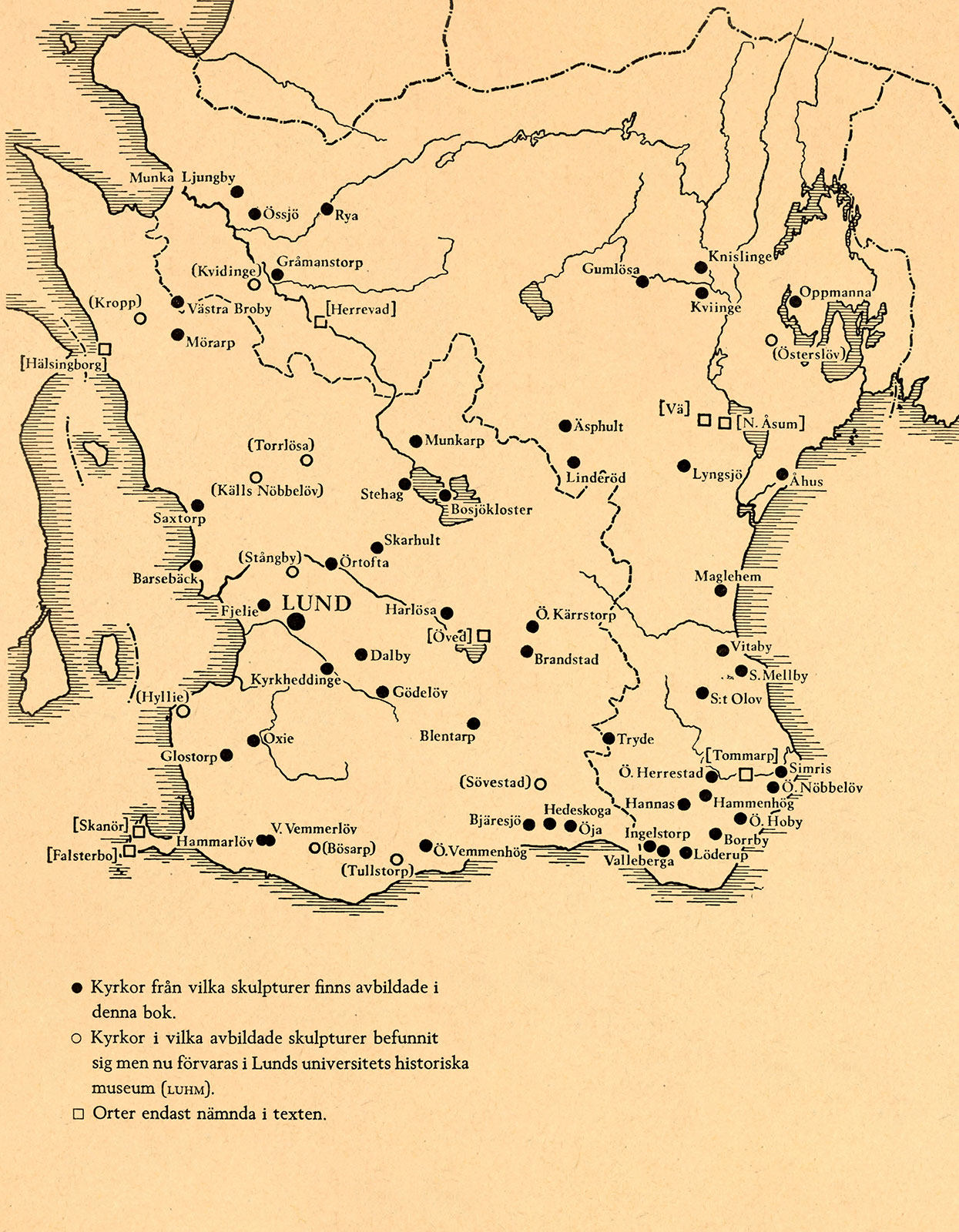
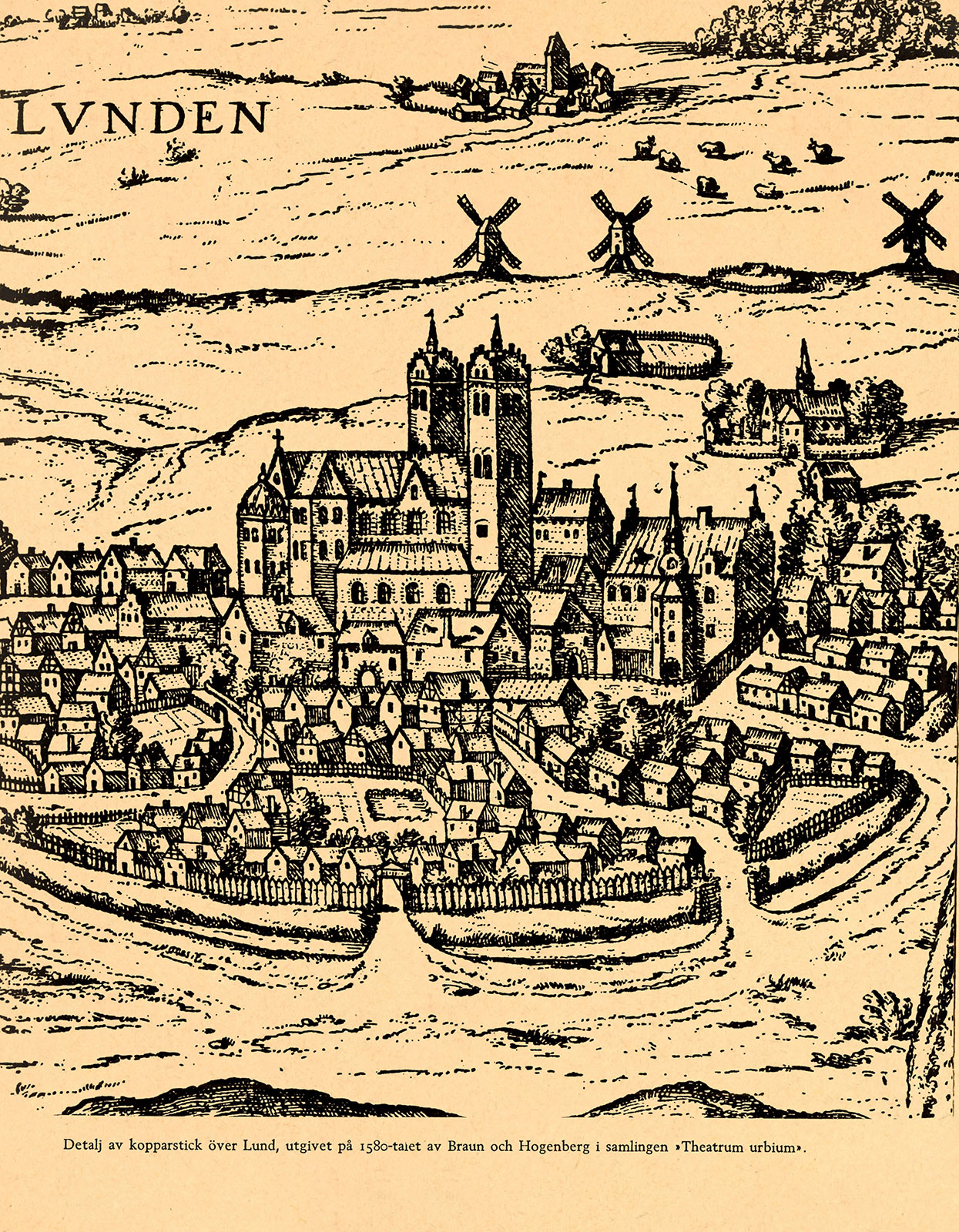
The book examines 12th century stone sculptures and reliefs that are found on and in churches throughout the Skåne region. Cinthio provides detailed analyses of sculptures, their provenance, what they depict, and how they are similar to other works found in other regions. Today, the Skåne region is part of Sweden, but was part of the Kingdom of Denmark until 1658.
Erik Cinthio’s text explores the central role of Lund Cathedral in the development of Scanian stone sculpture:
When the monumental stone sculpture made its entry into Lund Cathedral, there was no counterpart in the Scanian countryside to this continentally inspired Romanesque pictorial art. What there was were the raised stones with their Viking Age world of images, simply carved portal frames on some of the many wooden churches, and possibly some isolated stone relief on the very earliest stone churches… The situation changed radically with the creation of the archiepiscopal church. A world of images and forms previously unknown in monumental form made its entry into the Nordic environment.
- Erik Cinthio, Scania's Stone Sculpture During the 12th Century
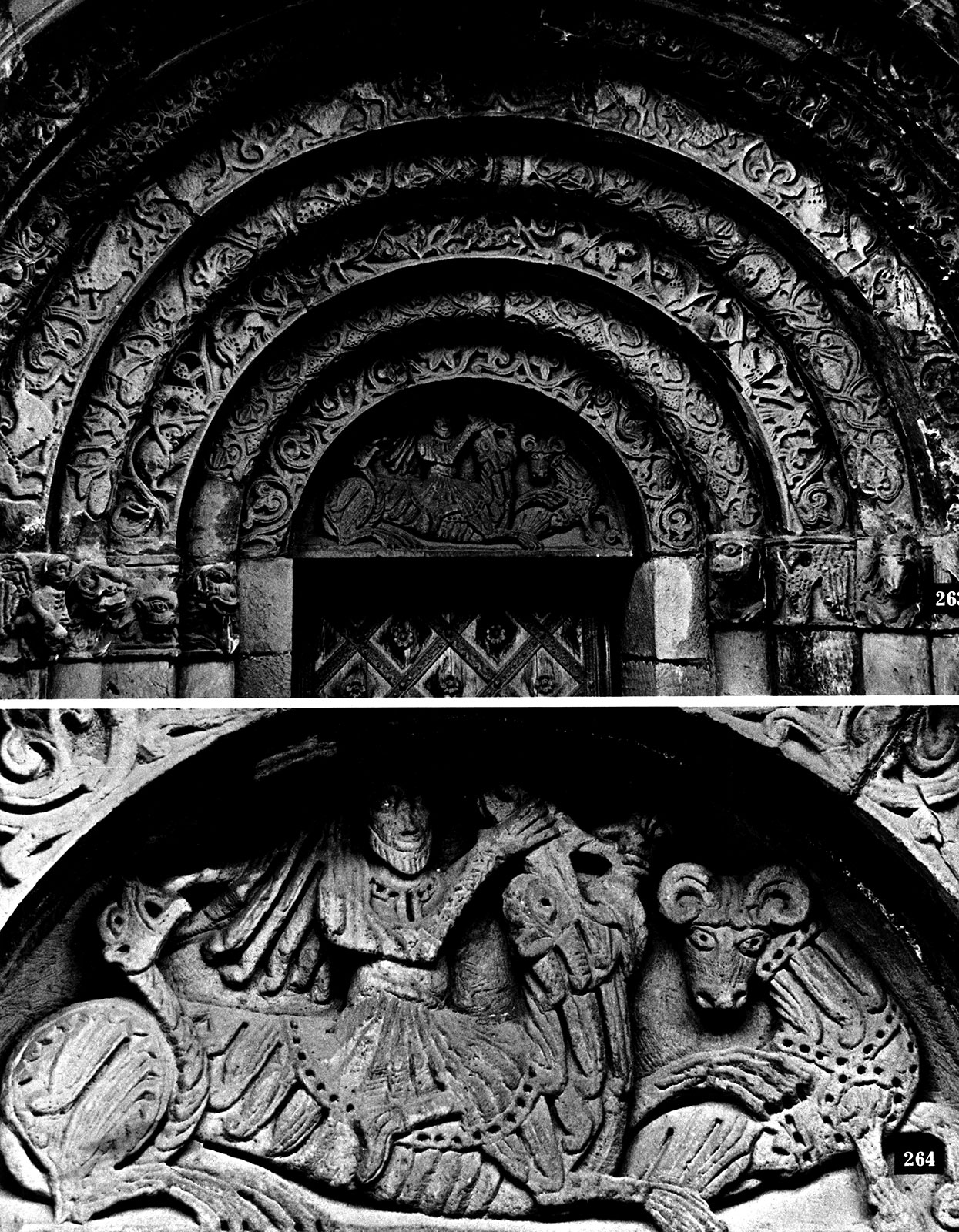
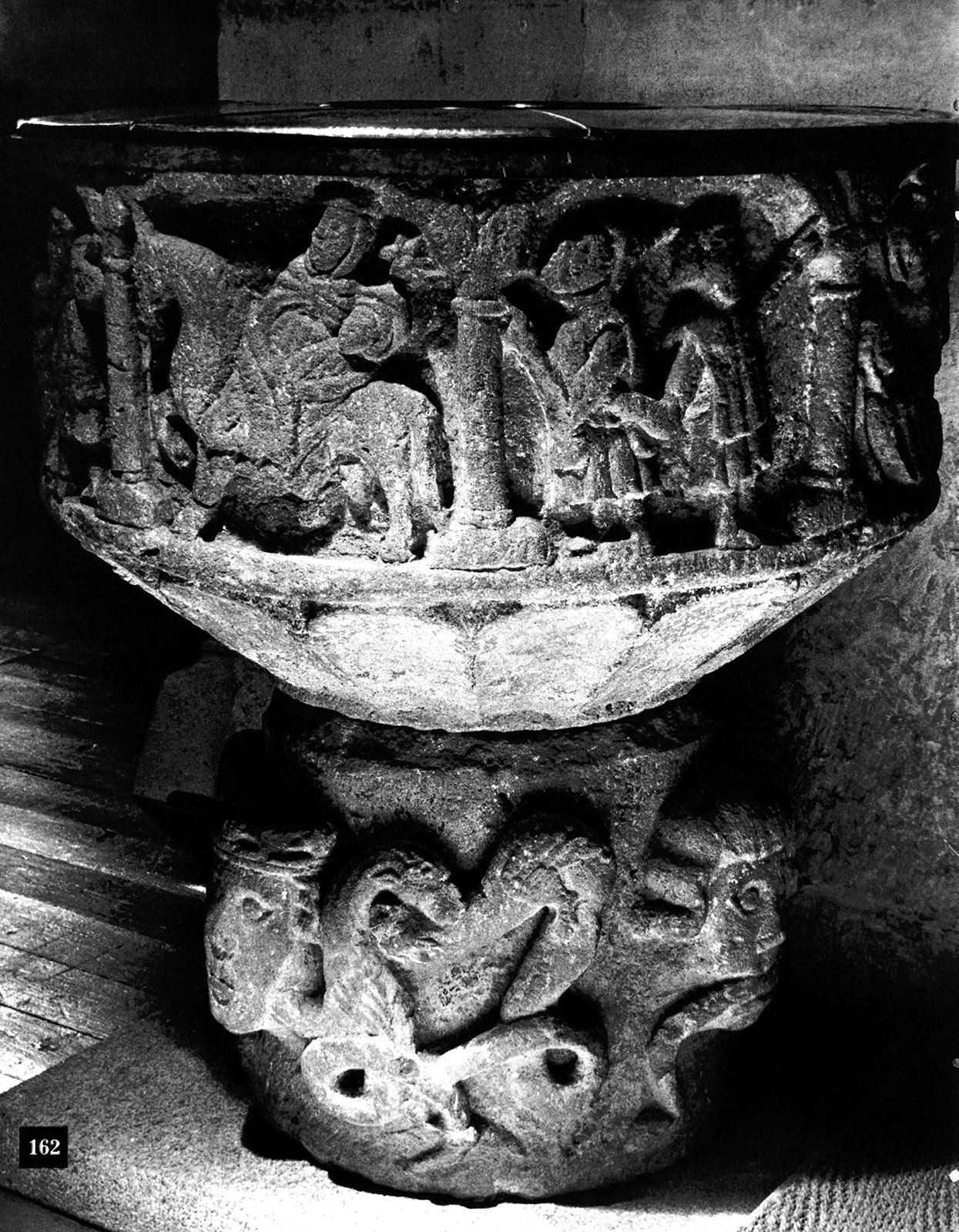
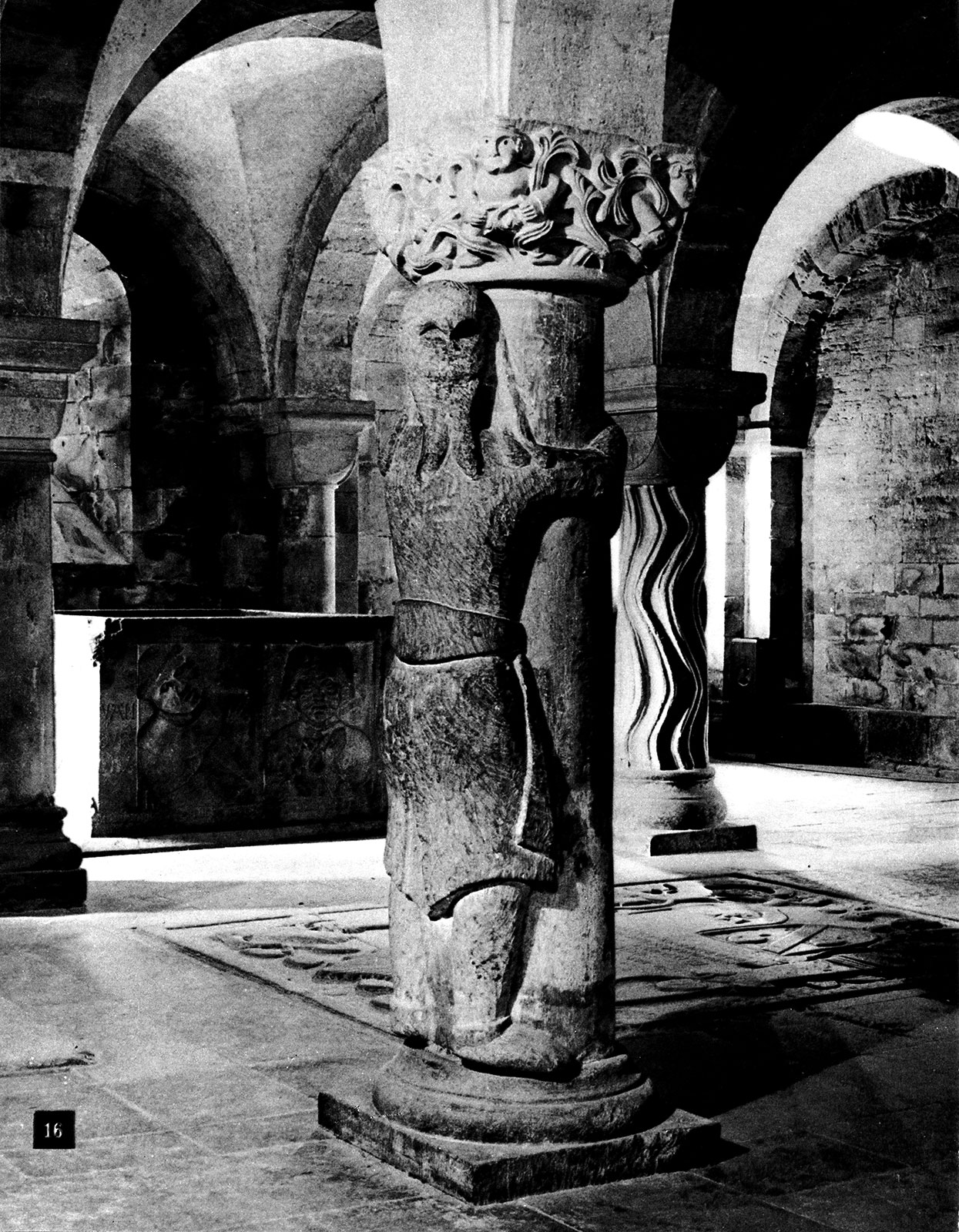
The book documents sculptures from dozens of churches across Skåne, including major works at Lund Cathedral, Dalby Church, Åhus Church, Tryde Church, and many rural parish churches. The sculptures depicted include baptismal fonts, tympanum reliefs, capitals, portal decorations, and freestanding figures.
Contents
The book contains the following sections:
- Introduction by P. V. Glob
- Skåne: The Landscape by Erik Cinthio
- The Stonemasons of Skåne by Erik Cinthio
- Lund Cathedral by Erik Cinthio
- The World of Images: The Function of Meaning by Erik Cinthio
- Poem: Donkey and Angel by Jens August Schade
- Marginal Notes by Asger Jorn
- Image descriptions and bibliography
The book also includes a poem by Jens August Schade that opens:
Oh, how powerful it is,
how overwhelmingly powerful
to see warm and earthly love
carved out in stone, so the air
around could force its way in
where before there were only proud masses of stone.
“Kiss me,” says the one stone
now to the other, “and make me brittle.”
“For a thousand years I have only waited
for you to say that, before I die.”
- Jens August Schade, from Skånes stenskulptur under 1100-talet
Scania's Stone Sculpture During the 12th Century
Read the complete text in Swedish and English.
Read the full text →Explore the Book
Contributors
Erik Cinthio
Erik Cinthio (1921–2018) was a Swedish art historian and archaeologist. He received his doctorate in 1957 with a dissertation on Lund Cathedral during the Romanesque period and was appointed the same year as docent in art history with medieval archaeology at Lund University. In his dissertation, he broke with older tradition by allowing the archaeological remains, the monument, and its artworks to form the starting point for analysis as a means to explain the building’s practical and ideal function as well as its position in historical context. From 1 July 1965-the same year this book was published-Cinthio held the first professorship in medieval archaeology in Scandinavia at Lund University.
Gérard Franceschi
Gérard Franceschi (1915–2001) was a French photographer born in Bordeaux who became one of the world’s foremost specialists in photographing works of art. During his twenty years with the French museum service, he produced numerous acclaimed publications including L’histoire commence à Sumer, Les Etrusques, L’art Gaulois, Auvergne romane, and Poitou romane. His documentation of the sculptor Gislebertus’s work at Autun is considered particularly significant. From 1962–65, he collaborated with Asger Jorn on the planned series on Nordic art, and moved to Scandinavia to take on the artistic direction of the photographic work. Franceschi died on 4 March 2001.
Production
The colophon notes the book’s production details:
- Graphic design: Lars Tempte
- Photographic equipment: Hasselblad
- Image section reproduced and printed in offset by Permild & Rosengreen, Copenhagen
- Text printed in letterpress by Håkan Ohlsson’s Printing House, Lund
- Paper: Matte offset paper 140g (image section) and unglazed white kraft 110g (text) from De Forenede Papirfabrikker, Copenhagen
- Bookbinding: Bogtrykkeriet Selandia, Copenhagen
The 10,000 Years of Nordic Folk Art Series
This volume is part of Jorn’s 10,000 Years of Nordic Folk Art series. Other volumes published in the series include:
- The Bird, the Animal and the Human in Nordic Iron Age Art [Fuglen, Dyret, Mennesket] by Bente Magnus, Gérard Franceschi, and Asger Jorn
- The Golden Images of the North from the Early Middle Ages [Nordens guldbilleder fra den tidlige middelalder] by Poul Grinder Hansen, Gérard Franceschi, and Asger Jorn
- Folk Art in Greenland [Folkekunst i Grønland] by Tinna Møbjerg, Jens Rosing, Gérard Franceschi, and Asger Jorn
- The Stave Churches and Norwegian Medieval Society [Stavkirkerne og norsk middelaldersamfund] by Oddgeir Hoftun, Gérard Franceschi, and Asger Jorn
Gallery