|
|
| Originale | |
| Artists | Karlheinz Stockhausen et al. |
|---|---|
| Publisher | Cyalume & Argonzer, alga047 |
| Publishing date | 2018 (recorded 1964) |
| Edition | 100 copies |
| Format | Vinyl |
| Duration | 29:57 |
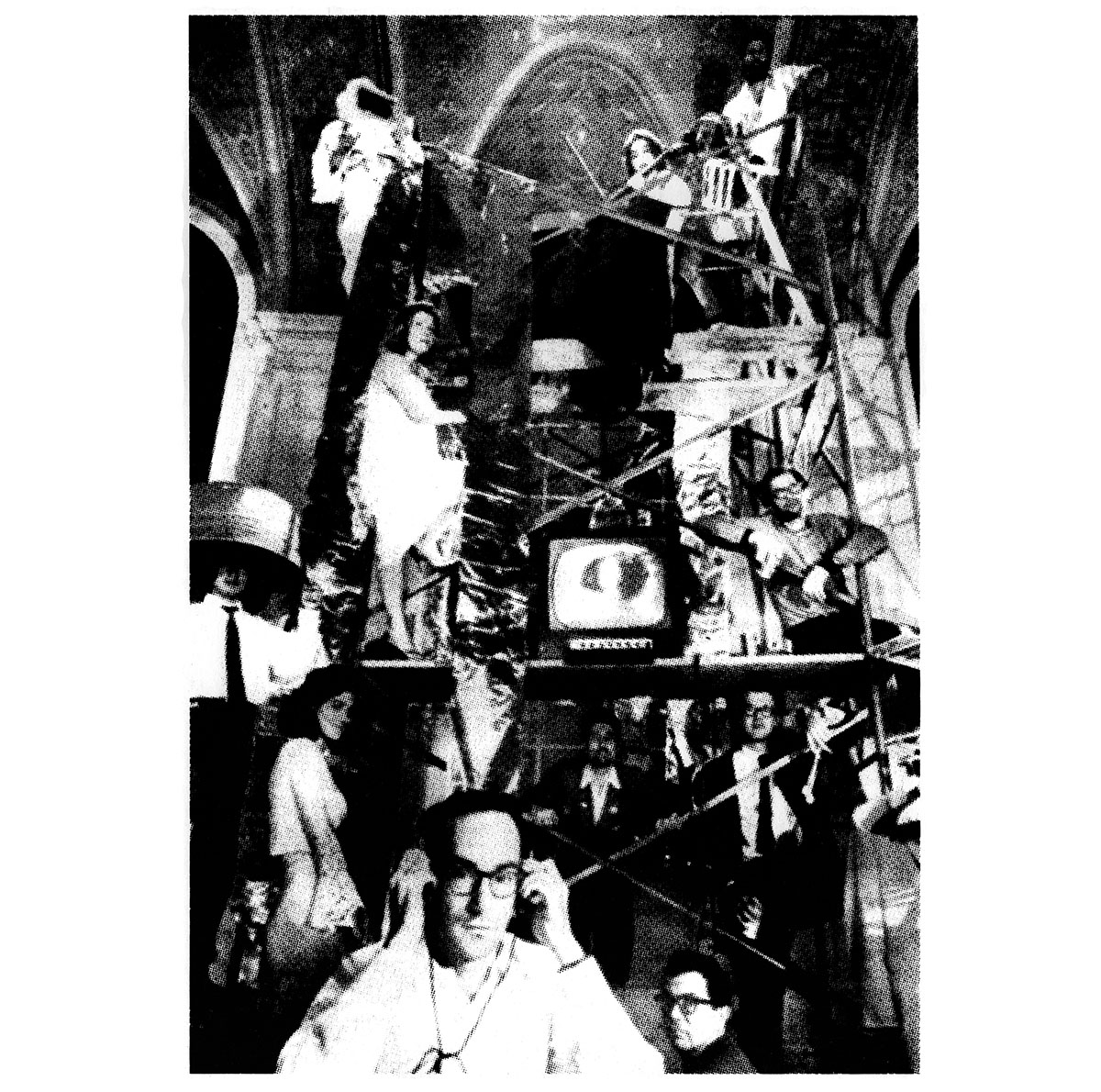
Originale is a recording of the 1964 New York premiere of Karlheinz Stockhausen’s music theatre work of the same name, released on vinyl by Cyalume & Argonzer in 2018. Recorded across five performances at Judson Hall in New York City between September 8 and 13, 1964, as part of the Second Annual New York Festival of the Avant Garde, the document captures one of the most storied events in the history of American avant-garde performance - a happening that drew together poets, painters, filmmakers, and musicians into a single, tightly scored theatrical framework, while simultaneously attracting one of the first organized protests against a European composer on American soil.
Background
Originale (Originals, or “Real People”) is a music theatre work by Karlheinz Stockhausen, catalogued as work number 12⅔, composed in collaboration with artist Mary Bauermeister during a visit to Finland in the summer of 1961. The commission came from Hubertus Durek, manager of the Theater am Dom in Cologne, who asked for a piece in which actors, painters, and “authentic” (originale) people would appear freely in spontaneous actions.“Originale,” Wikipedia. https://en.wikipedia.org/wiki/Originale. Accessed February 2026. The score was written in two weeks in a summer house on Lake Saimaa north of Helsinki, made available through the Finnish architect Alvar Aalto.Ibid.
The work is structured around a live performance of Stockhausen’s earlier electronic composition Kontakte (1960), a four-channel tape piece for electronic sounds with piano and percussion. Into this sonic backdrop, a cast of “real people” - artists, poets, musicians, and other figures from the contemporary scene - are assigned roles corresponding to their actual professions and given time slots within the score during which they are free to perform activities natural to their everyday work. The result is less a drama than a controlled collision: serial compositional rigour providing the frame, while the performers improvise within its constraints.
Originale premiered at the Theater am Dom in Cologne on October 26, 1961, with twelve performances running until November 6. The Cologne cast included David Tudor on piano, Christoph Caskel on percussion, Nam June Paik as action musician, Mary Bauermeister as action paintress, Hans G. Helms as Poet, and the composer’s children Christel and Markus Stockhausen alternating in the role of the Child; Karlheinz Stockhausen himself conducted.LP liner notes, Originale, Cyalume & Argonzer, alga047, 2018. Nearly three years passed before the work was staged again.
The Score
The score of Originale spans 16 pages and describes 18 scenes. The participants in each scene and the actions they are to perform are written above one another in separate boxes, with the beginning and end of each entry indicated by vertical lines within the boxes, the exact timings placed proportionally over the top line. The 18 scenes are grouped into 7 self-sufficient structures (I–VII), which can be performed in any order and either successively or with up to three structures running simultaneously. Stockhausen noted in the programme that a combination of consecutive and simultaneous presentation of all seven structures would come closest to his original conception, and that the acting areas for simultaneous structures could overlap.LP liner notes, Originale, Cyalume & Argonzer, alga047, 2018.
The programme notes from the 1961 Cologne premiere set out the compositional thinking in condensed form:
Self-sufficient moments linked according to their degrees of intensity, duration, density, renewal quotient, sphere of influence, activity, simultaneity, sequence.
Scenic harmony – scenic melody Scenic metre – scenic rhythm Scenic dynamics – scenic agogics Scenic topic – scenic colouring
Criteria for choice: natural – artificial / unambiguous – ambiguous / self-evident – absurd
One turns into another: contrasts are mediated. Black is a degree of white: scale of values of grey.
Things separated in different times and spaces – people, activities, events from daily life (nothing pretends to be ‘as if’, nothing is ‘meant’; everything is composed, everything means itself) – are compressed into one space, into one time: theatre.
- Karlheinz Stockhausen, programme notes for Originale, Theater am Dom, Cologne, 1961
The music underpinning the entire work is Kontakte, scored for electronic sounds, piano, and percussion. In the New York production, the score was supplemented after the 48-minute mark by two tape recordings of Stockhausen’s own voice - his lectures “On Moment Form” and “Invention and Discovery” - alongside recordings drawn from his earlier compositions Zyklus, Gruppen, and Gesang der Jünglinge. From 60’30” to 67’30”, the last seven minutes of Carré were also incorporated.LP liner notes, Originale, Cyalume & Argonzer, alga047, 2018.
The score’s approach to theatrical time was unlike anything in the existing operatic or dramatic tradition. Rather than narrative progression or character development, Originale operates through what Stockhausen called “moment form” - each discrete unit self-sufficient and complete in itself, linked to adjacent moments not by causality but by proportional relationships of intensity, density, and duration. The performers are not playing roles in any conventional sense; they are simply being themselves, within a precisely calibrated temporal architecture.
Explore the Score
This is a preview only - view fullsize on archive.org
The 1964 New York Production
The American premiere was organized jointly by cellist Charlotte Moorman and Mary Bauermeister as the centrepiece of the Second Annual New York Festival of the Avant Garde, a ten-day event running from August 30 to September 13, 1964, at Judson HallThe liner notes included in the 2018 LP release give the year of the New York performances as 1965, which appears to be an error; contemporary sources including the Time magazine review of September 18, 1964, and all subsequent scholarship confirm the performances took place in September 1964., located at 165 West 57th Street directly across from Carnegie Hall.“Originale,” Wikipedia. https://en.wikipedia.org/wiki/Originale. Accessed February 2026. The festival was produced by Moorman and Norman Seaman, and included performances by John Cage, Luciano Berio, Iannis Xenakis, and the world premiere of Stockhausen’s Plus-Minus.Second Annual New York Festival of the Avant Garde, August 30 – September 13, 1964. Between the Covers. https://www.betweenthecovers.com/pages/books/374149. Accessed February 2026. Stockhausen himself entrusted the production entirely to the New York organizers; the stage direction was undertaken by Allan Kaprow, the Happenings pioneer, who assembled and rehearsed a cast drawn from the close circles of the New York avant-garde.Andy Ditzler, “Notes on Stockhausen’s Originale.” http://andyditzler.com/fsm/stockhausen_notes.htm. Accessed February 2026.
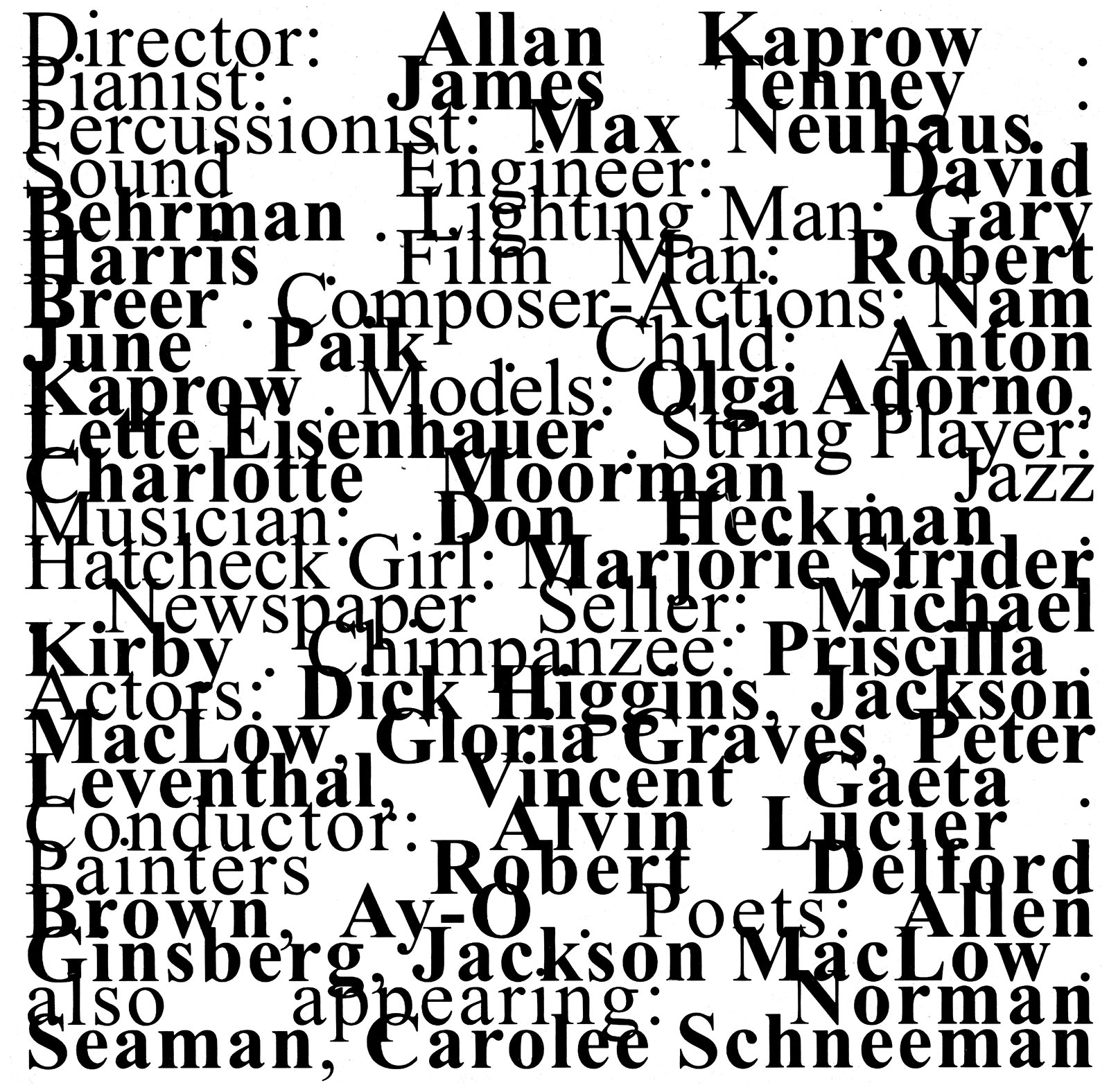
The cast was remarkable in its density of significant figures. Nam June Paik, credited as “action music” and also listed as composer of the actions, performed three of his own pieces within the framework of the score, including Simple (1961), in which he covered himself with shaving cream, flour, and rice before climbing into a tub to wash off, then drinking the water from his own shoe.Andy Ditzler, “Notes on Stockhausen’s Originale.” http://andyditzler.com/fsm/stockhausen_notes.htm. Accessed February 2026. Charlotte Moorman played cello, at one point lying on the floor and at another performing from the balcony. James Tenney was at the piano, Max Neuhaus on percussion (ending one performance stripped down to red leotards), Alvin Lucier conducted, and David Behrman served as sound engineer.LP liner notes, Originale, Cyalume & Argonzer, alga047, 2018. Filmmaker Robert Breer operated as “film man,” screening his short Fist Fight - consisting, according to the Peter Moore Archive, of baby pictures of the cast interspersed with animation - during the performance.Andy Ditzler, “Notes on Stockhausen’s Originale.” http://andyditzler.com/fsm/stockhausen_notes.htm. Accessed February 2026. Lette Eisenhauer and Olga Adorno appeared as models, Michael Kirby as a newspaper vendor, Marjorie Strider as a hatcheck girl, and Anton Kaprow, Allan Kaprow’s son, played the Child.LP liner notes, Originale, Cyalume & Argonzer, alga047, 2018. Actors Dick Higgins, Jackson Mac Low, Gloria Graves, Vincent Gaeta, and Peter Leventhal were also part of the ensemble, alongside jazz saxophonist Don Heckman. Allen Ginsberg took the role of the Poet, and was seen in Peter Moore’s subsequent documentary observing the models, drinking water from Paik’s shoe, and chanting mantras.Andy Ditzler, “Notes on Stockhausen’s Originale.” http://andyditzler.com/fsm/stockhausen_notes.htm. Accessed February 2026. Carolee Schneemann also appeared.
Robert Delford Brown was originally cast as the Painter, but was replaced during the run by Fluxus artist Ay-O following a disputed incident during one of the first performances.“Originale,” Wikipedia. https://en.wikipedia.org/wiki/Originale. Accessed February 2026.
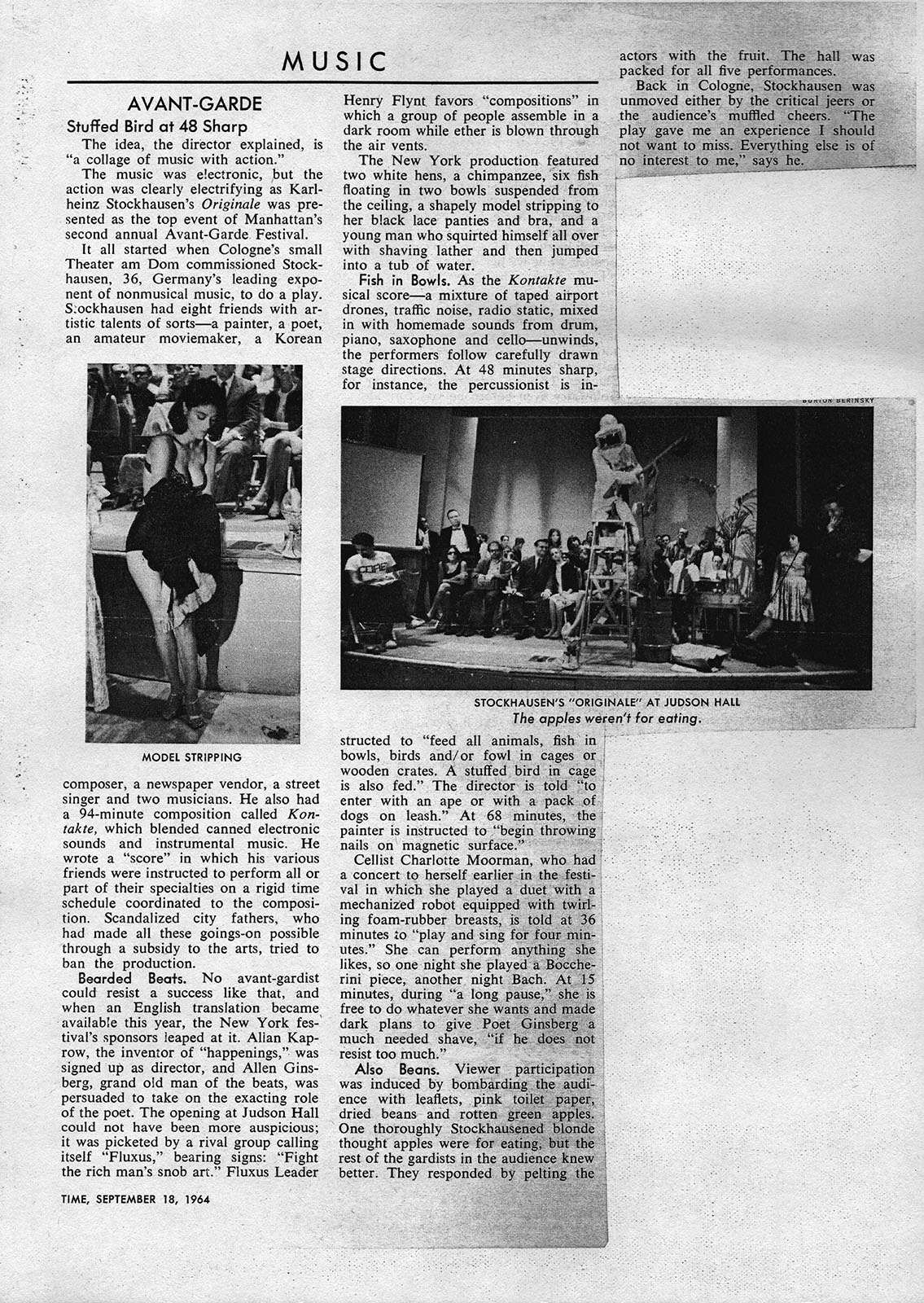
The idea, the director explained, is “a collage of music with action.” The music was electronic, but the action was clearly electrifying as Karlheinz Stockhausen’s Originale was presented as the top event of Manhattan’s second annual Avant-Garde Festival.
- Time magazine, September 18, 1964
The performance made extensive use of a scaffolding constructed on the Judson Hall stage. The score’s rigid timetable coordinated the cast’s various specialities to the ninety-minute duration of Kontakte, with each participant instructed to perform their activity at designated minutes. At 48 minutes, for instance, the percussionist was directed to feed animals - fish in bowls, birds and fowl in cages or wooden crates, with a stuffed bird also fed. At 68 minutes, the painter was to begin throwing nails onto a magnetic surface. Moorman, at 36 minutes, was told to play and sing for four minutes, but was free to choose any repertoire she liked - on one night performing Boccherini, on another Bach.Anon., “Avant-Garde: Stuffed Bird at 48 Sharp,” Time, September 18, 1964, p. 81. Also present onstage was the chimpanzee Priscilla. Viewer participation was induced by bombarding the audience with leaflets, pink toilet paper, dried beans, and rotten green apples.Ibid.
Stuffed Bird at 48 Sharp
The idea, the director explained, is “a collage of music with action.”
The music was electronic, but the action was clearly electrifying as Karlheinz Stockhausen’s Originale was presented as the top event of Manhattan’s second annual Avant-Garde Festival.
It all started when Cologne’s small Theater am Dom commissioned Stockhausen, 36, Germany’s leading exponent of nonmusical music, to do a play. Stockhausen had eight friends with artistic talents of sorts—a painter, a poet, an amateur moviemaker, a Korean composer, a newspaper vendor, a street singer and two musicians. He also had a 94-minute composition called Kontakte, which blended canned electronic sounds and instrumental music. He wrote a “score” in which his various friends were instructed to perform all or part of their specialties on a rigid time schedule coordinated to the composition. Scandalized city fathers, who had made all these goings-on possible through a subsidy to the arts, tried to ban the production.
Bearded Beats. No avant-gardist could resist a success like that, and when an English translation became available this year, the New York festival’s sponsors leaped at it. Allan Kaprow, the inventor of “happenings,” was signed up as director, and Allen Ginsberg, grand old man of the beats, was persuaded to take on the exacting role of the poet. The opening at Judson Hall could not have been more auspicious; it was picketed by a rival group calling itself “Fluxus,” bearing signs: “Fight the rich man’s snob art.” Fluxus Leader Henry Flynt favors “compositions” in which a group of people assemble in a dark room while ether is blown through the air vents.
The New York production featured two white hens, a chimpanzee, six fish floating in two bowls suspended from the ceiling, a shapely model stripping to her black lace panties and bra, and a young man who squirted himself all over with shaving lather and then jumped into a tub of water.
Fish in Bowls. As the Kontakte musical score—a mixture of taped airport drones, traffic noise, radio static, mixed in with homemade sounds from drum, piano, saxophone and cello—unwinds, the performers follow carefully drawn stage directions. At 48 minutes sharp, for instance, the percussionist is instructed to “feed all animals, fish in bowls, birds and/or fowl in cages or wooden crates. A stuffed bird in cage is also fed.” The director is told “to enter with an ape or with a pack of dogs on leash.” At 68 minutes, the painter is instructed to “begin throwing nails on magnetic surface.”
Cellist Charlotte Moorman, who had a concert to herself earlier in the festival in which she played a duet with a mechanized robot equipped with twirling foam-rubber breasts, is told at 36 minutes to “play and sing for four minutes.” She can perform anything she likes, so one night she played a Boccherini piece, another night Bach. At 15 minutes, during “a long pause,” she is free to do whatever she wants and made dark plans to give Poet Ginsberg a much needed shave, “if he does not resist too much.”
Also Beans. Viewer participation was induced by bombarding the audience with leaflets, pink toilet paper, dried beans and rotten green apples. One thoroughly Stockhausened blonde thought apples were for eating, but the rest of the gardists in the audience knew better. They responded by pelting the actors with the fruit. The hall was packed for all five performances.
Back in Cologne, Stockhausen was unmoved either by the critical jeers or the audience’s muffled cheers. “The play gave me an experience I should not want to miss. Everything else is of no interest to me,” says he.
TIME, SEPTEMBER 18, 1964
Protest: Action Against Cultural Imperialism
On the opening night of September 8, 1964, a group of artists calling themselves Action Against Cultural Imperialism picketed outside Judson Hall before the performance. The group included Fluxus founder George Maciunas, Concept Art creator Henry Flynt, filmmaker Tony Conrad, poet Marc Schleifer, and actor/poet Alan Marlowe. Their grievance centred on remarks Stockhausen was reported to have made at Harvard in 1958 that were interpreted as dismissive of jazz and folk music, and on their broader antagonism toward the European avant-garde’s institutional prestige in America. Signs read “Fight the Rich Man’s Snob Art” and “Don’t Let Stockhausen Tell You Folk Art Is Primitive.”“Originale,” Wikipedia. https://en.wikipedia.org/wiki/Originale. Accessed February 2026.
The situation became more complicated by the fact that some of the performers involved in the piece - among them Allen Ginsberg, who enlisted Marc Schleifer’s help and, according to later accounts, effectively extorted his way into the picket line against Flynt’s wishes - were also participating in the night’s performance. The press, predictably, reported the protest as a staged publicity stunt by Stockhausen himself, which the protesters vigorously denied. Maciunas had recruited cast member Robert Delford Brown as a saboteur; Brown’s account disputed that characterization, insisting his interest was simply in creating as outrageous a spectacle as possible.Ibid.
The hall was packed for all five performances. Back in Cologne, Stockhausen was unmoved by the critical reception, positive or negative: “The play gave me an experience I should not want to miss. Everything else is of no interest to me,” he was quoted as saying in Time.Anon., “Avant-Garde: Stuffed Bird at 48 Sharp,” Time, September 18, 1964, p. 81.
2018 LP Release
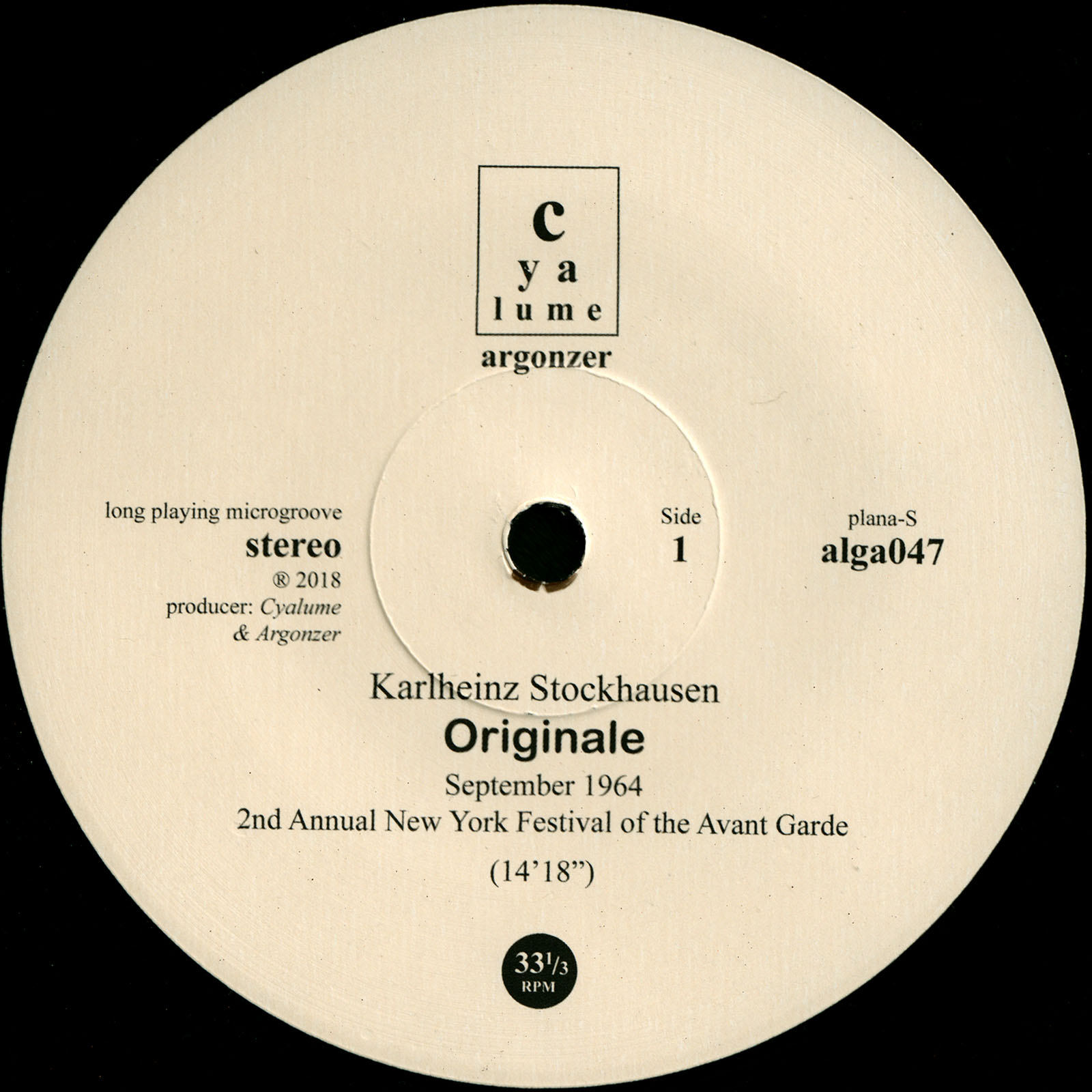
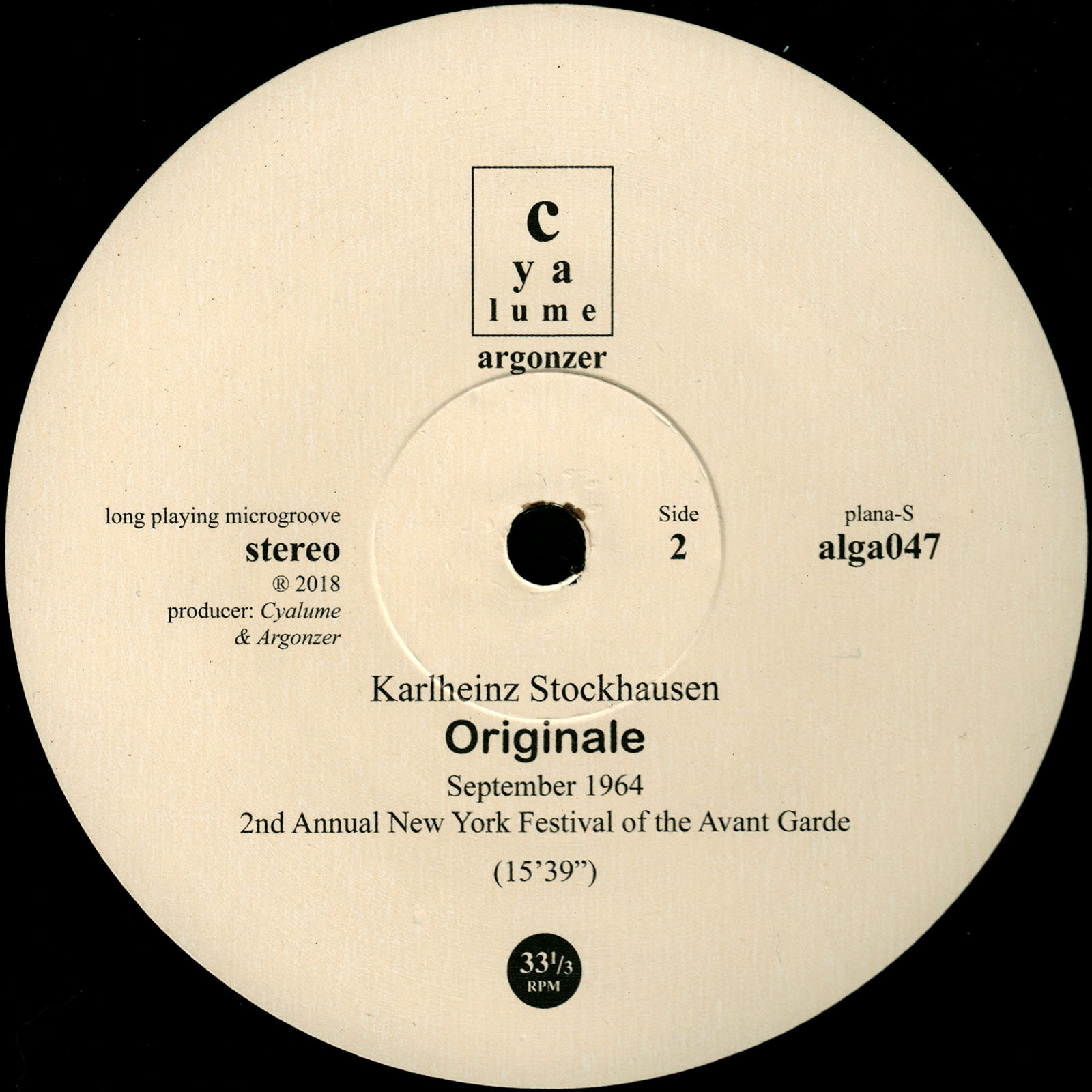
In 2018, Cyalume & Argonzer issued a vinyl LP of the 1964 Judson Hall performances, catalogued as alga047 and released on September 18, 2018 - fifty-four years to the day after the Time magazine review appeared. The edition was limited to 100 copies.Karlheinz Stockhausen, Originale, Cyalume & Argonzer, alga047, 2018. Discogs: https://www.discogs.com/release/12346062. Accessed February 2026. Running at just under thirty minutes, the recording captures the extraordinary cast in action: the electronic wash of Kontakte threading through and around the live performers’ improvisations, Paik’s action pieces, Moorman’s cello, and the accumulated noise of an audience subjected to rotten apples and pamphlets.
The LP credits include Karlheinz Stockhausen as composer, Nam June Paik as composer of actions, Allan Kaprow as director, Alvin Lucier as conductor, David Behrman as sound engineer, Robert Breer as film technician, and the full assembled cast across their respective roles. The label credits read: Charlotte Moorman (cello), James Tenney (piano), Max Neuhaus (percussion), Don Heckman (saxophone), Dick Higgins, Gloria Graves, Jackson Mac Low, Peter Leventhal, and Vincent Gaeta (actors), Ay-O and Robert Delford Brown (painters), Lette Eisenhauer and Olga Adorno (models), Marjorie Strider (hatcheck girl), Michael Kirby (newspaper vendor), Anton Kaprow (child), Norman Seaman and Carolee Schneemann (also appearing), and Priscilla (chimpanzee).Ibid.
Audio
Legacy
The 1964 New York Originale has since achieved legendary status in the history of American avant-garde performance, sitting at the intersection of Happenings, Fluxus, and experimental music. Peter Moore, who photographed extensively at the New York avant-garde scene throughout the 1960s, filmed two of the Judson Hall performances. His footage was edited by his wife Barbara Moore and Susan Brockman, and released in 1994 as Stockhausen’s Originale: Doubletakes, a 30-minute documentary that premiered at the Walker Art Center in Minneapolis in 1996 and received its New York premiere at the Museum of Modern Art in 1997.“Stockhausen’s Originale: Doubletakes,” Electronic Arts Intermix. https://www.eai.org/titles/stockhausen-s-originale-doubletakes. Accessed February 2026. Also: “Stockhausen’s Originale: Doubletakes,” The Film-Makers’ Cooperative. https://film-makerscoop.com/catalogue/peter-moore-stockhausens-originale-doubletakes. Accessed February 2026.
Subsequent performances of Originale have been rare. A 1990 staging in San Francisco directed by Randall Packer was the first West Coast performance and the first revival since 1964. In 2014, the fiftieth anniversary of the New York premiere was marked by a production at The Kitchen, produced and performed by composers Nick Hallett and Zach Layton. The Berlin State Opera mounted a new version in 2015.“Originale,” Wikipedia. https://en.wikipedia.org/wiki/Originale. Accessed February 2026.
Gallery