History of the Parish of Cumbel
Historia dalla pleiv da Cumbel
Sur Felici Maissen
© 1983 Casa editura Desertina, CH-7180 Mustér Cumposiziun, squetsch e litografias Stampa Romontscha Condrau SA, Disentis/Mustér ISBN-Nr. 3-85637-050-1
Preambel
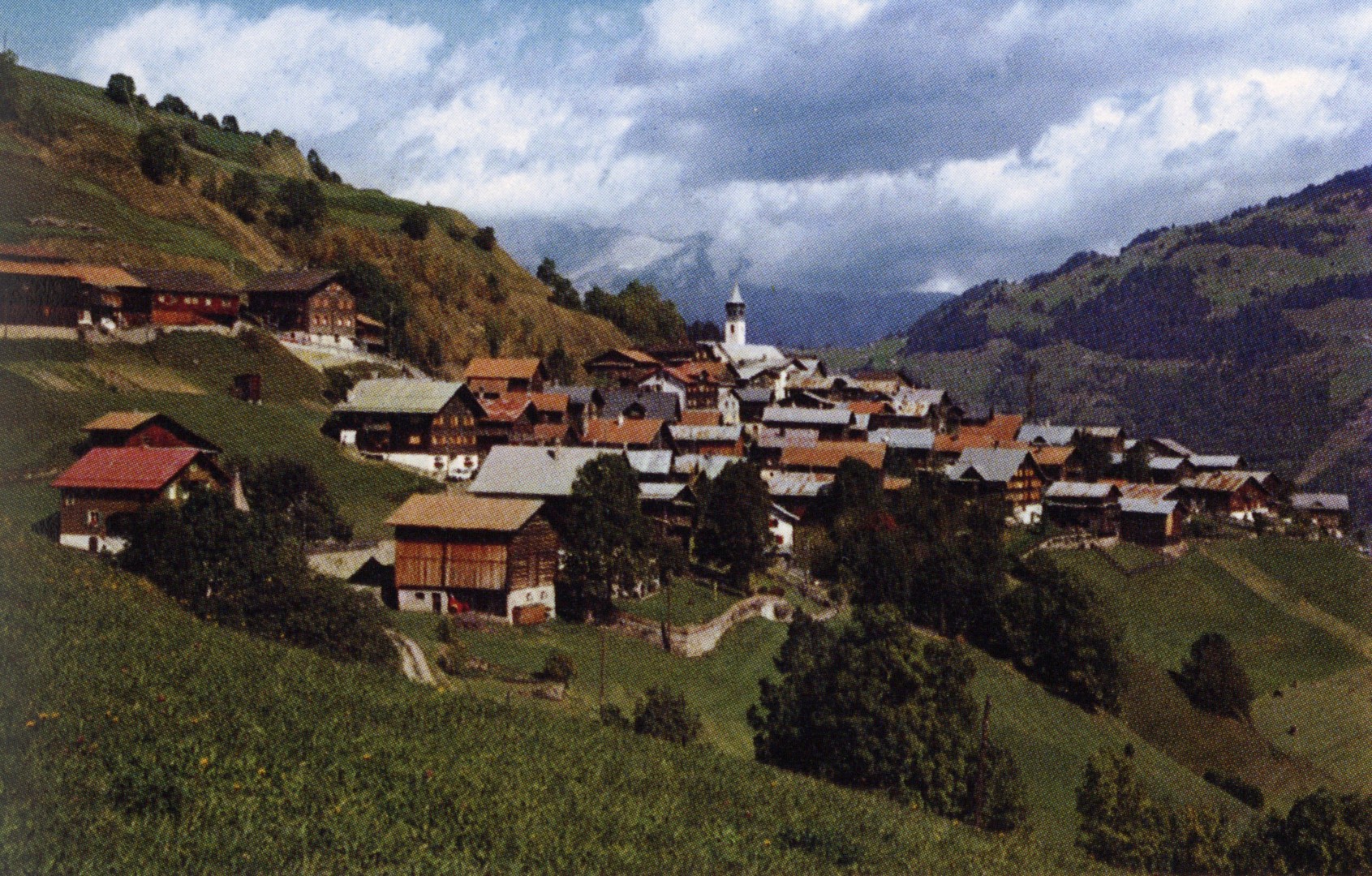
Cumbel ei onz paupers en relasch prehistoric ed era plitost munglus en monuments e documents dalla epoca medievala. Sur Antoni Baselgia ha fatg attents alla sperdita d’archivalias tras ils barschaments dalla casa pervenda dils 1682 e 1952 sco era a caschun dalla partenza dils paders caputschins.1 Tonaton ei il spiendi historic dils davos 400 onns considerabels. Ils cudischs da baselgia, cronicas ed agendas, acts e protocols egl archiv parochial e communal, episcopal e cantunal laien resplender la veta religiusa e quotidiana dalla pleiv e dil vitg, il far e demanar da ses habitonts prus e luvrus en in maletg viv e variont.
Ils cudischs ch’ein vegni studigiai, screts e stampai a Cumbel ein aunc ditg perdetga da cultivaziun religiusa. Buca meins il pulsont cult religius e venerabels usits cultics e profans. Dallas scheinas da quei vitg silla spunda ein sorti numerus umens da fina cultura: mistrals, miedis, scribents e poets ed umens dil stat che han dau tempra alla veta politica e culturala en Surselva. – Surlunder ed aunc bia auter resdan ils fegls suandonts da quest opus.
«Cumbel», il num dil vitg, cumpara els pli vegls documents en pliras fuormas, sco Cumble 8252, Cumeltz3, 1282 Cumbils, 1345 Cumbels, 1396 Cumels, 1527 Gumeltz, 1572 Gumpels, 1585 Gomel4. Tenor Robert Pianta ston ins schar aviert la damonda suenter la derivonza dil num: Schebein el deriva da cumulus, en quei cass «ad cumulos», che vul dir «als tgiembels» ni forsa era dil gallic «cumba» respectiv siu deminutiv cumbula, en siu locativ cumbulae, che fuss ton sco valla, vallatscha.5
Ord il temps prehistoric dat ei pia pauc da far. En ina dallas quater fossas prehistoricas ch’ins ha discuvretg, secattava sulet ina scalgia romana.6 Quei munta pauc e lai tonaton trer certas, plitost malsegiras conclusiuns.
Register dallas fontaunas e dalla litteratura
A. Fontaunas manuscrettas
-
AcC = Archiv communal Cumbel
-
ACC = Archiv cantunal, Cuera
-
AcV = Archiv communal Vella
-
AEC = Archiv episcopal, Cuera
-
AFB = Archiv Federal, Berna
-
Ml = Milaun, copias da Ml
-
AP = Archivio di Propaganda fide, Roma. Copias egl archiv dalla provinzia svizra dils caputschins a Lucerna
-
ApC = Archiv parochial Cumbel
-
b = cudisch da battens en ApC
-
l = cudisch da letgs en ApC
-
m = cudisch da mortoris en ApC
-
vi = cudisch da vischins en ApC
-
-
ApP = Archiv parochial Pleif
B. Fontaunas stampadas e litteratura
-
BM = Bündner Monatsblatt, 1914 ss.
-
Bonari = Valdemiro Bonari, I conventi ed i cappuccini Bresciani, 1891
-
BUB = Bündner Urkundenbuch
-
Clemente = P. Clemente da Brescia, Istoria delle Missioni de Fratti Minori della Provincia di Brescia nella Rezia, Trento, 1702
-
Cronica = Anton Baselgia, Cronica dalla pleiv da Cumbel. Notizias historicas dalla Lumnezia ed en special da Cumbel. Manuscret en ApC
-
Frigg = Albert Frigg, Die Mission der Kapuziner im Unterengadin in der ersten Hälfte des 17. Jahrhunderts, en JHGG 82, 1952
-
HBLS = Historisch-biographisches Lexikon der Schweiz, 7 toms, 1921-1934
-
HS = Helvetia Sacra, red. da Albert Bruckner, 7 toms, 19721980
-
JHGG = Jahresbericht der historisch-antiquarischen Gesellschaft von Graubünden, 1878 ss.
-
KDGR = Erwin Poeschel, Die Kunstdenkmäler, Graubündens, 7 toms, 1937-1948
-
LTK = Lexikon für Theologie und Kirche, 2. ed. 1957-1965, 10 toms
-
Simonet = J.J. Simonet, Die katholischen Weltgeistlichen Graubündens, en JHGG 1919, 1920, 1921. Zitau ord il separat.
-
Willi = Die Kapuziner-Mission im romanischen Teil Graubündens, 1960
-
Autra litteratura ed autras fontaunas ein citadas en siu liug in extenso.
I. Ord il temps medieval
1. Da finis ed alps, cumpras e cunvegnas
Ina pli veglia menziun da Cumbel secatta gia egl urbari imperiai (Reichsurbar) digl onn 825, in urbari che registrescha ed inventarisescha ils beins digl imperi en Rezia. Cheu vegn registrau in bein a Cumbel, in mun, culs plaids: «in villa Cumble mansum». El medem mument menziunescha il medem document era gia ina caplutta da s. Murezi, la quala possedi 60 mesiras funs.7 L’existenza d’in habitadi a Cumbel para ordlunder dad esser dada gia avon endisch tschentaners e miez. Mo cheu eroda la tenda sur Cumbel per pli liung temps.
Entuorn la mesadad dil 13. tschentaner han ils baruns de Belmont acquistau pli gronds possess e dretgs ella Foppa ed en Lumnezia.8 Barun Heinrich de Belmont, frar digl uestg da Cuera, Konrad III. de Belmont (1272-1282) veva schau ereger in altar ella catedrala da Cuera, igl altar da s. Conrad. Cun instrument dils 25 da settember 1282 veva barun Heinrich dotau quei altar cun in siu bein a Cumbel, numnaus a Camadringes (mit seiner Hube im Dorfe Cumbels die zu Camadringes heisst und im Tal Lungnez liegt), «che renda annualmein ina valeta da 24 schillings en graun, caschiel e teila». La collatura digl altar ha el reservau per sesez e ses artavels. Denton eis ei schabegiau che siu frar, il prenci-uestg Conrad III, che sesanflava ual sil viadi al ni dil concil provinzial ch’igl arzuestg da Mainz veva convocau, ei morts nunspetgadamein a Dieburg (c. 10 km orientai da Darmstadt) ils 25 da settember 1282. Nunditgond il liung e stentus viadi ei la bara vegnida transportada a Cuera e satrada avon igl altar che siu frar veva fatg, igl altar da s. Conrad. Il patrunadi da quei altar ei pli tard ius vi sils conts da Sulz-Vaduz e da leu sils conts da Liechtenstein.9 Quei ei stau igl origin da quella grevezia sin quei bein a Cumbel, che ei ida vinavon sut il num «Il tscheins da Cuera» ni «il tscheins alla catedrala.10»
La grevezia feudala sin quei funs ha cuzzau bunamein 500 onns, tochen 1745. Lu eis ella vegnida cumprada ora. Las famiglias che gudevan ils beins pagavan annualmein 74.– renschs tscheins ad onn al benefeci da s. Conrad e quei per part en daner e per part en purment. La pischada vegneva quintada 10 rizers la crena ed il caschiel 5. Ei arriva il temps che tuttas grevezias feudalas han stuiu curdar. 1744 ei vegniu fatg in contract denter ils possessurs a Cumbel d’ina vart ed igl uestg ed il prevost catedral sco collatur dil benefeci da l’autra part. Per Cumbel eran cumissiunai il mistral Gion Rest Arpagaus e Gion Arpagaus che era staus 1741 cumissari a Chiavenna. Sco summa da soluziun ei vegniu quintau 30.– renschs capital sin mintgin dils 74 renschs tscheins, che fa 2220.– renschs. Quei importo ha la delegaziun da Cumbel pagau ora el casti episcopal ils 15 da schaner 1745. Sper ils dus numnai era aunc in tierz, numnadamein mistral Murezi Arpagaus. La retschevida han igl uestg Jos. Benedict von Rost, il prevost Carlo Giuseppe Mengotti ed il beneficiat da s. Conrad, Francesco Antonio Mengotti suttascret.10a
Igl onn 1371, cun la mort dad Ulrich Walter de Belmont veva la Adelheid de Belmont, maridada cun Heinrich II de Montalt, surpriu il relasch dils de Belmont.11 1375 ha ella surdau sco feudum hereditar (Erblehen) ad in cert Johannes da Vanescha la alp Patnaul sin territori da Vrin.12 Cura e co quella alp ei pli tard vegnida els mauns d’ina famiglia de Puoz de Cumbel ei buca sclariu. Mo igl onn 1469 veva Turtè de Puoz, feglia legitima dil Gieri de Puoz e maridada cun in cert Filipp Andrea, vendiu la alp Patnaul cun consentiment da siu um e da siu ugau, als vischins da Semione sper Malvagia ella Val Blegn, pli prezi da 74 risculdis (rheinisch Gulden), culla cundiziun dad astgar ir culs tiers da neiv tochen giu spel flum.13 Ina burgameina da vegn onns pli tard, 1489, di denton che la cumpra dalla alp Patnaul, ch’ils vischins da Semione «vevan fatg cun divers particulars», hagi custau mo 60 risculdis.14 Ei para ch’ins seigi pli tard s’enriclaus da ver vendiu quella alp als Tessinès, pertgei igl onn 1577 han «Hans de Camuns, vegl mistral en Lumnezia ed auters» purtau tgisa avon la dertgira da Lumnezia encunter ils vischins da Semione e fatg valer la cumpra da Patnaul per nunvaleivla, essend ch’igl ugau da Turtè de Puoz hagi vendiu quella senza salidar ed orientar igl «oberkeit» en Lumnezia. Els, ils tgisaders veglien puspei reconquistar l’alp per la summa da vendita e quei tenor il dretg da tratga vertent en Lumnezia. Ils da Semione perencunter han fatg valer, ch’els hagien cumprau quella alp «per en perpeten» ed els hagien gudiu quella alp incontestablamein dapi varga tschien onns. La dertgira ha renconuschiu e confirmau la brev da vendita da 1469.15 Ils opponents han denton tratg l’affera vinavon alla dertgira civila dalla Ligia Grischa a Trun. Cheu ageva in Raghet de Capol e siu advocat landrechter Sebastian de Castelberg en num dalla vischnaunca da Semione encunter capitani Risch de Camuns. Els fan valer che la dertgira da Lumnezia hagi negin dretg da decider en quella caussa. L’autra part, «statalter Martin, sco assistent da capitani Risch da Camuns e siu advocat Johann de Jochberg fan valer, che cura che schischom vegni vendius ord il cumin, hagi mintga burgheis il dretg, da trer quel a sesez». Trun ha decidiu che la sentenzia dalla dertgira da Lumnezia seigi nunvaleivla e che la caussa dueigi vegnir decidida dalla dertgira dalla Foppa.16 Quella ha decidiu en favur da Risch de Camuns, numnadamein ch’el hagi il dretg dad acquistar l’alp. Mo cheu suonda promt, aunc igl october 1578 ina sentenzia definitiva dalla dertgira d’appellaziun da Trun, sut cauligia Cristian Desax, en favur da Semione, che approbescha la brev da cumpra da 1469.17
2. Pli vegls nums da funs e famiglias
Zacontas brevs da marcau ord il temps medieval tardiv ofnieschan a nus entgins dils pli vegls nums da funs e da famiglias cumbelianas.
-
1397, ils 7 da fevrer a Glion. Gion Schmid, burgheis da Glion venda ad Albert d’Andest habitont a Cumbel dus beins a Ruschneras sur il vitg da Luven per 14 marcs curwelschs.18
-
1408, ils 3 da fenadur a Cumbel. Pieder, fegl da Joss Viventz d’Andest permiert venda cun reservar il dretg da cumprar anavos, a siu quinau Albert d’Andest, habitont a «Cumel» en Lumnezia per 15 marcs la mesadad dils ers e praus: «Furella, Funs, Air fos sut il bein de Peisel ad Andest e Lamens, *inters Kosess a Kortintg, Prauscharun e Galinatscha *a Moriessen», dils quals beins l’autra mesadad appartegn alla sora dil vendider e dunna dil cumprader. El venda medemamein igl entir bein da Peisel per 45 marcs curwelschs.19
-
1472, ils 24 d’avrel. Cont Heinrich de Sax-Mesauc, signur a Belmont, surdat ad Ulrich Parli a Gumbels (= Cumbel) dus ers ed in prau a Gampelen, Abigls (forsa plitost a Begls?) ed a Fagew (forsa Fieu?) per feudum hereditari.20
-
1475, ils 29 da november. Cont Heinrich de Sax-Mesauc, signur a Belmont dat sco feudum hereditari a Risch da Stafels, habitont a Riein la tiarza part dalla dieschma gronda a Cumbel.21
-
1475, ils 6 da december. Cont Heinrich de Sax-Mesauc venda a Risch da Stafels a Rigein (= Riein) in tscheins annual dad 11 schillings vaieta daner da dumiec ord la dieschma gronda a Gumels (Cumbel) ch’il cumprader tegn per feudum hereditar, per 330 flurins (Gulden).22 1501, ils 13 da schaner. Ils fargliuns Jan, Martin, Ulrich, Hensli, Risch, Fridly, Anna e Barbara, affons da Jos da Ragatz permiert vendan ad Jan de Puz (Depuoz, De Puoz a Cumbel) lur agen bein a Gumels (Cumbel) per 56 flurins (Landgulden).23
-
1504, ils 23 da december. Clan Pytschen, Jan Caspar, Dorothea, Katharina, las duas davosas cun consentiment da lur ugau Jan Nutt, Jan ed Anna, affons da Jan Giel, cun consentiment da lur tat, ils fargliuns Jan, Jöry, Risch, Nesa, Gretha, cun consentiment da lur bab Valentin da Sagogn, Anna, Menga, Nescha, Hans, fargliuns, cun consentiment da lur bab, Heinrich Walser, vendan a Jan de Potz (De Puoz, Depuoz da Cumbel) tut lur possess artau da lur cusrin Claus Bringatzy, situau a Cumbel: casa, cuort, iert e curtgin ed ers a Dauass gad Party, Buwollongs24, Derider Grestas, Pleunca Tretg, Ru(o)ffna(e)tsch, Vallar (Vallà), Larinns, Magnacogna e Galinetta per 100 flurins (risculdis)25. Zacons da quels nums da funs secattan buca el cudisch da nums retics da R. Planta/A. Schorta (Rätisches Namenbuch) tom I. Els ein stampai cursiv.
II. La separaziun da Pleif
1. Ils paders caputschins vegnan
a) Perigei ual a Cumbel?
La baselgia da Cumbel ei sefatga relativamein fetg baul libra dalla baselgia principala e da vallada da Pleif. Che quei ei reussiu aschi tgunsch ed aschi spert stat senza dubi en relaziun culla Missiun Retica dils caputschins e culla introducziun dils paders caputschins a Cumbel. La Missiun Retica dils caputschins, fundada dalla congregaziun dalla propaganda dalla cardientscha 1621 e guvernada da Roma anora veva per finamira da mantener e cultivar la cardientscha catolica e da supprimer la progressiun dalla reformaziun. Perquei vegnevan ils paders caputschins era mess en emprema lingia els loghens «periclitai» ed exponi alla reformaziun. Il tal post era Cumbel, igl emprem vitg suenter Porclas, alla entrada ella Lumnezia-Sura. En in rapport alla Congregaziun da Propaganda, sur dil stan dalla Missiun Retica digl onn 1662, ha il pader provinzial da Brescia scret, ch’il tierz post da caputschins en Surselva (Mustér, Danis), Cumbel, seigi situaus als cunfins dil cumin dalla Foppa, cun sias biaras vischnauncas protestantas, «administradas da rutinai predicants». Perquei seigi la permanenza dils missiunaris caputschins en quei liug tuttavia necessaria, «per s’opponer al lur perfidia . . .26». Sin quei rapport ha la congregaziun romana constatau il sequent: Il post da Cumbel sa buca vegnir daus si. Il cuntrari, pervia dallas otg pleivs (en Lumnezia) para il liug da basignar dad aunc plirs paders e quei ton pli ch’el schai ella vischinonza da vischnauncas hereticas e da predicants.27 Cun quei rapport va bein a prau era quei ch’il prefect dalla Missiun, P. Cristoforo da Tusculano, ha scret a Roma il medem onn 1662: «Cumbel schai als cunfins dalla Foppa, nua ch’ei dat bia heretics, survi da fetg nauschs predicants (serviti da predicanti pessimi). Perquei han ils caputschins da leu bia controversas cun els e bia da far per confirmar ils catolics. Gest perquei ha igl uestg permiert mess leu ils paders e gest leu ei ina staziun da caputschins tuttavia necessaria.»28 Ils 15 d’uost 1662 communichescha il pader Provinzial a Roma: « . . . ei fuss bien da mantener plirs paders a Cumbel ed a Sevgein ed igl ei oravontut necessari da segirar quels dus hospezis cun ina entrada annuala, sinaquei ch’ils paders hagien da viver . . .»29. D’in auter «raguaglio» da 1681, screts dil viceprefect dalla Missiun, P. Paul d’Agnesogno, alla s. Congregaziun a Roma, intervegnin nus che Cumbel seigi in pign vitg cun ca. 250 habitonts, cunfinaus da treis varts cun protestants mo ina tochen duas uras naven.30 In onn pli tard rapporta il viceprefect sur digl operar da ses dus paders a Cumbel denter auter: «Cheu ein ils dus paders per tener naven la heresia, la quala periclitescha els da duas varts.»31
Talas perdetgas savessan ins allegar aunc pliras. Quellas bastien per: 1. illuminar il span e debat ellas relaziuns confessiunalas dil 17. secul en general e 2. per declarar pertgei ils paders missiunaris ein vegni mess a Cumbel e buca en ina autra pleiv plinanen dalla Lumnezia.
b) Pader Ireneo da Casalmoro
Igl atun 1649 ei Pader Ireneo Bartolinelli da Casalmoro arrivaus a Cumbel. El ei staus in dils pli prominents e capavels missiunaris dalla Missiun Retica da siu temps. Dapi 1623 ch’el ei staus ella Missiun veva el fatg atras dallas manglas e miserias. Quei cunzun ils emprems onns ella Engiadina Bassa, secollocaus ch’el era a Zernez ed ad Ardez, percurrend e missiunond per Pentira val entuorn. 1626 vegn el a Domat, 1628 a Rueun e 1632 vegn el dessignaus sco prefect dalla Missiun. Lu operescha el zacons onns ella Alvra, a Lantsch e Brinzeuls e 1635 a Cazas e puspei a Casti. Il davos eis el staus a Sagogn da 1642-1649. A Cumbel eis el staus tochen 1665, pia 16 onns. Vegls e staunghels ei il venerabel missiunari returnaus 1665 en sia claustra a Brescia per murir leu ils 8 da zercladur 1671 en la vegliadetgna dad 80 onns. Sco prefect dalla missiun eis el staus da 1632-1642. 1645 ha la s. Congregaziun de Propaganda fide surdau igl uffeci d’in prefect dalla Missiun Retica al pader Provinzial da Brescia culla ordra, da numnar ord ils Missiunaris en Rezia sez in viceprefect e da surdar a quel las cumpetenzas ordinarias d’in prefect d’entochen ussa. Quei onn 1645 vegn pia P. Ireneo numnaus viceprefect tochen 1649 ed el funcziunescha puspei sco tal da 1651 tochen 1665, cura ch’el banduna Cumbel.32 Igl uestg de Cuera Johann VI. ha surdau ad el la dignitad ed igl uffeci d’in decan dil capetel sursilvan e sco Bonari manegia levi igl uestg adina esser cumpignaus dad el sin ses viadis da creisma.33
P. Ireneo vegn descrets sco in aspiestel plein fiug e flomma. Cun sia retorica flammegionta e siu exempel ha el duront ses onns da lavur ell’Engiadina Bassa recatolisau ina gronda part dils habitonts sut stentas nundetgas.34
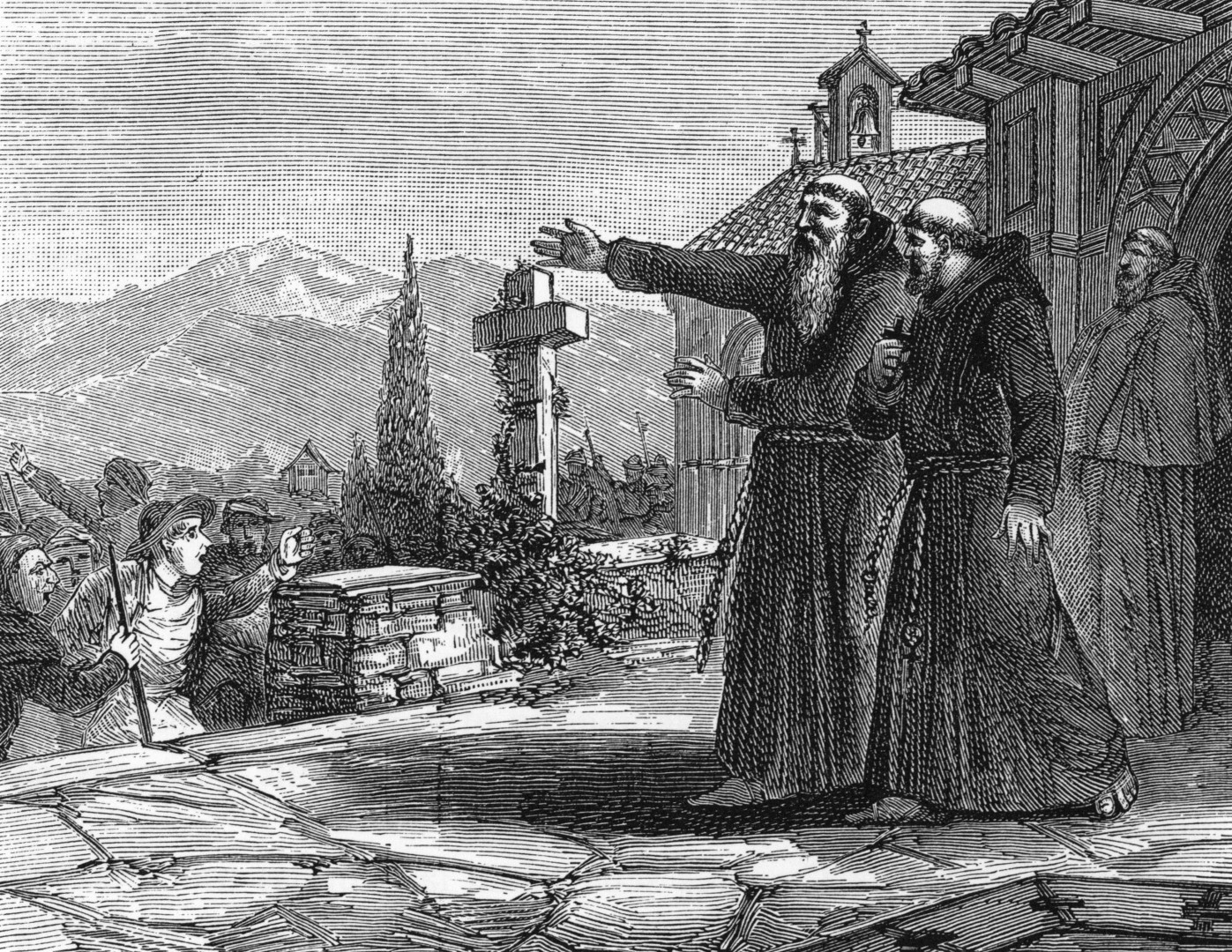
Igl atun 1624 sut de Cœuvres sederschan las truppas franzosas ella Engiadina. Ils predicants, stai scatschai, tuornan anavos e la recatolisaziun dalla val iniziada va en aua. Ils paders brins vegnan malamein persequitai: Tgi sto fugir e tgi vegn scatschaus ord la val.35 Mo il superiur P. Ireneo era per tuts ina petga «ed admoneva ils confrars alla perseveronza» (maletg). Dils onns 1635/36 furiava la muria sil pli ault el Grischun. En in rapport ord da Brescia da 1635, sur dalla pestilenza el Grischun, san ins leger: La munconza d’agid corporal era nuota pli gronds che quella d’agid spiritual. Spiritual seculars eran mo paucs pli en veta. Ils ins eran s’infectai tras contact culs malsauns, auters eran seretratgs per buca pigliar la malsogna. En quella miseria ein ils paders missiunaris vegni en agid. Il prefect P. Ireneo sedistingueva oravontut, savens sesanflond els pli gronds prighels. Inaga hagi in tratg la spada siper el. In’autra ga hagi el survegniu in crap ella vischinonza dil magun, mo senza pitir il minim donn. Els mavan pils vitgs e per las casas visitond ils malsauns dalla muria.36 Il cronist P. Ezechiel da Bagnolo vegn buca unfis da ludar nies P. Ireneo: El dominavi il tudestg ed il romontsch schi bein sco ils indigens. El dismettevi abus ed alzavi la morala lavagada dil pievel, fagevi bials survetschs divins ch’ei eri in deletg pils aunghels. Dallas persecuziuns ella Engiadina seigi el pliras ga staus en prighel da veta. El surportavi tut cun saung freid e seigi restaus cun sia glieud.37 In auter manuscret egl archiv statal da Milaun ch’ei tenius empau legendars paleisa: Las relaziuns moralas e religiusas erien alla arrivada dils paders ella Engiadina horrentas. Ils paders perdegavien dumengias e firaus treis e quater ga a di, mavien tras neivs e ferdaglias, savens gigins per nutrir las olmas fomentadas. Els migliavien beinduras mo iarvas cotgas cun in tee sai. Ad in pamflet da vart protestanta ha P. Ireneo rispundiu cun ina cunterscartira, ch’el hagi denton buca schau stampar. El hagi scret in cudisch da ductrina, ch’el hagi schau stampar a Brescia.38 – Denter ils numerus convertits ch’el ha menau alla cardientscha catolica sesanfla sco in dils pli prominents il predicant Simon Pianta.39 Ils 18 da zercladur 1638 ha quel renunziau solemnamein ella baselgia parochiala da Casti alla confessiun reformada e confessau solemnamein la catolica. P. Ireneo ha priu encunter il confess en preschientscha dil Pader Provinzial che sesanfla casualmein a Casti e da sis ulteriurs caputschins.40 Muort sias numerusas conversiuns ch’el veva instradau vegneva el savens numnaus: Il rempar dalla cardientscha ed il marti dils heretics (il baluardo della fede ed il martello de gli Eretici). – In um da quei format, da tala influenza ed impurtonza ei pia arrivaus in di digl atun 1649 a Cumbel, sco la regia leva, cumpignaus d’in confrar. El era gia empau sils onns cun 59. Ils dus paders han priu albiert en ina casa privata, testamentada alla Missiun ni alla pervenda.41 Quels 16 onns a Cumbel pon esser stai empau pli ruasseivels che dallas tempiastas da pli baul e tuttina pleins lavur e stenta. Cura ch’el hagi bandunau Cumbel 1665 bargevi il pievel, sulet ils predicants giubilavien dad ussa finalmein esser liberai dil marti . . .42
2. La nova pleiv
Ei era ussa alla biala entschatta da spitgar, che Cumbel vegni ussa buca a restar vinavon mo ina fracziun da Pleif. Con lunsch che las preparativas eran fatgas e con grondas las aspectativas dil pievel da Cumbel eran alla arrivada dils paders, tradeschan a nus negins documents. Probabel era la distaccada da Pleif gia stada prevedida e concludida alla biala entschatta denter P. Ireneo ed igl uestg. Quei ei ton pli tgunsch pusseivel, sch’ins risguarda la gronda simpatia ch’il pader gudeva el casti episcopal. Cun document dils 28 da mars 1653 ha prenci-uestg Johann VI. Flugi d’Aspermont decretau la separaziun da Cumbel da la baselgia da vallada da Pleif. La dismembraziun vegn argumentada culla liunga distanza, las schliatas vias, cunzun per transports da baras. Glieud veglia e mendusa restien senza survetsch divin firaus e dumengias, biars mierien senza sacraments e la giuventetgna resti senza instrucziun religiusa. El document da separaziun vegn era exprimiu, ch’ils uestgs diocesans hagien secund il concil da Trient la facultad da fundar novas pleivs ni separar ina baselgia dalla principala sch’il basegns pastoral muort gronda distanza ni difficultus access alla parochiala damondi, sco quei seigi il cass a Cumbel, gie schizun lu, sch’il plevon dalla parochiala mondi buca d’accord. Pli susteniment dil niev plevon a Cumbel seigi d’applicar tuttas entradas ord beins schischonts ed ulezis e dieschmas che mavan tochen ussa a Pleif. Pia la dieschma, ils ulezis sin territori da Cumbel restan a Cumbel. La spina dil malruaus che suonda! La summa da bonificaziun a Pleif ei 300.– flurins. Quella summa sa vegnir pagada en ratas, annualmein 7½ ducats ni 15.– flurins. Era las cuntribuziuns al caluster da Pleif crodan ussa a favur da quel da Cumbel. La pleiv da Cumbel denton ha la obligaziun da procurar pli necessari susteniment dil plevon e dalla baselgia.43
Cun quei era ussa la pleiv da Cumbel eregida legalmein e formalmein; la veglia plonta derasada dalla pleiv da vallada denton veva piars in ferm e saun rom.
3. La giustificaziun
Ella veglia pleiv da s. Vintschegn sesaulza uss in horrent stemprau. Quel sederscha cun vehemenza encunter la separaziun da Cumbel en general ed en special encunter la alienaziun dalla dieschma e dils ulezis. Zatgeinins specialists pli fins train era en dubi, schebein quella separaziun seigi da dretg ecclesiastic anora insumma lubida e valeivla. La dieschma che Cumbel deva alla parochiala da Pleif seigi gnanc stada fundada da glieud da Cumbel, mobein dils conts da Sax-Mesauc. Aschia attestescha in Hans da Marmels da Vella44 en preschientscha dil plevon Jochberg, ch’el hagi deponiu avon ca. in onn en casa da sechelmeister Crest Jori Caduff a Cumbel ina pergameina, ella quala ei stetti scret clar ed expressivamein, ch’ils conts de Sax hagien fundau la dieschma a Cumbel alla pervenda da Pleif. Per quella pretensiun ha Hans de Marmels era dau in attest a scret.45
Encunter tal moviment veva ussa la curia episcopala da Cuera da sedefender. En emprema lingia setractava ei per ella da far valer la cumpetenza giuridica e la legalitad canonica.
Enten il prevost catedral Cristoph Mohr possedeva la curia in versau giurist e canonist, in che temeva nuota igl adversari ed era adina zun uregeivels. Mohr era oravontut um dalla politica ed in incarnau partisan dalla partida franzosa. Entuorn 1665 veva el resignau alla prevostura en favur da siu frar sur Conradin Mohr ed era serendius en Frontscha en survetsch dalla politica da retg Duitg XIV. e dalla partida franzosa en Rezia.46
En in liung e lad tractat giuridic-ecclesiastic ha prevost Mohr mussau ora claramein, ch’igl uestg Johannes Flugi hagi giu il dretg da far quella separaziun.47 Alla entschatta cumprova el eclatantamein il dretg digl uestg diocesan dad alzar ina caplutta ad ina parochiala. Denter ses auturs alleghescha el era il renomau canonist da gliez temps, Johannes Azor.48 Arriguard il secund punct, numnadamein da dismembrar il pievel da Cumbel dalla baselgia principala, hagi igl uestg diocesan il cumplein dretg, e quei «de iure ordinario» tenor las disposiziuns da papa Alexander III., las qualas el citescha exact, ed era «de iure delegato» sco mandatari dalla sedia apostolica. Tenor decret dil Concil da Trient, ses. 21 cap. 4 hagi in uestg diocesan il dretg dad exequir ina dismembraziun, era senza consultar il capetel catedral, perfin da dismembrar dad ina baselgia collegiata. A Pleif denton existi negin collegi, sulet in plevon. Per sias perdetgas alleghescha Mohr, dasper plirs auturs strusch enconuschents era il celeber Abbas49, il renomau Nicolaus Garcias50 e P. Paul Laymann51.
Prevost Mohr constatescha, ch’ei seigi gnanc dubi, ch’igl uestg hagi procediu legalmein e raschuneivlamein tut en uorden. La necessaria distanza da Pleif seigi dada. Savens sappi il plevon da Pleif buca assister als malsauns a Cumbel. Ton sco ins sappi seigien 58 persunas a Cumbel mortas senza ils sacraments. La giuventetgna mondi buca a Pleif a ductrina, resti religiusamein ignoranta e erodi els latschs dalla superstiziun e dil strienem. La populaziun dalla pleiv restonta seigi cun ses ca. 1600 habitonts era suenter la dismembraziun da Cumbel gronda avunda.52
En in tierz capetel entra prevost Mohr silla damonda dalla dieschma. La dieschma sin funs el cirquit da Cumbel che mava a Pleiv hagi igl uestg cun tut dretg e tenor perscripziuns dil concil da Trient saviu consignar alla nova pleiv. Alla pervenda da Pleif restien aunc adina ina entrada annuala da 600.– flurins, in recav che tonschi beinmaneivel pli susteniment da plevon e caplon, ferton che la dieschma a Cumbel relaschi buca pli che 100.– flurins. Ed igl «ius patronatus» a Pleif seigi dil reminent ius dils conts da Belmont vi sin quels de Sax e da quels hagi igl uestg Ortlieb de Brandis cumprau 1483 quei dretg pigl uestgiu.53
Resta la renfatscha, che la vischnaunca da Vella seigi buca vegnida consultada. Quella renviescha nies defensur cun dir che la vischnaunca da Vella hagi tuttavia buca igl «ius patronatus» e representi era buca la pleiv, seigi anzi mo in member da quella. Dil reminent hagi igl uestg fatg paleis savens avunda sia intenziun als da Vella, che hagien mo snariau quella. E la finala hagi plevon Jochberg surschau la fatschenta al beinmaniar digl uestg e cheutras dau siu consentiment. Quei seresulti dar d’ina sia brev dils 4 da settember 1653. Ussa aber seigi il consentiment dil plevon avon e buca la resistenza da quel suenter la dismembraziun decisivs per la valeivladad dalla separaziun. Cun tgei precisiun che canoni Mohr tucca il viv, concludent sias argumentaziuns culs plaids: «Il consentiment ina ga prestau sa buca daventar nunvaleivels tras la rida che suonda. Il plevon ha consentiu, igl ius patronatus auda al cau diocesan e la finala ditgel jeu: Igl uestg ha cun sia dismembraziun agiu materialmein e formalmein endretg e pastoralmein prudent ed aschia ei quella separaziun da mentener sidretg e da defender encunter inescadin cun reservar, sch’ei fa basegns, las censuras dalla Baselgia Romana.»54
4. La resistenza
Ella pleiv da s. Vintschegn va la resistenza denton ad in crescher. Ordavon mavan ils dus ugaus da Pleif, dus umens da peisa, d’emprema garnitura politica da gliez temps en Lumnezia: Landrechter Ulrich de Collenberg da Morissen55 e capitani Melchior de Mont da Vella56. Cun in schinumnau «Memorial» el stil da gliez temps, emprovan els da far valer las raschuns encunter la separaziun da Cumbel: Quella sminueschi las entradas alla baselgia materna. Las dieschmas ed ils ulezis seigien vegni fundai a sias uras «da nobels signurs», da «signori principali» – beinmanegiau ils signurs feudals – en favur dil plevon da Pleif e buca dad auters ed en auters loghens, autruisa sfalsificheschien ins il senn dalla fundaziun. Secundo hagi Cumbel bia meins raschuns da seseparar ch’autras vischnauncas pli allontanadas. E per la tiarza vegnien quellas a suandar igl exempel da Cumbel e la baselgia da s. Vintschegn vegni la finala diltuttafatg isolada e pauperisada. Ils vegnentsuenter dil benefeci da Pleif vegnessien en negina moda a lubir tala separaziun. Ordlunder neschi ussa nuot auter che malaveglias e carplinas ella veglia pleiv. Era pils morts mondien ils usitai suffragis a piarder. La confraternitad dil s. Rusari mondi en nuot. Las entradas dalla caplania e dil caluster tschessien, medemamein era quellas dalla spenda e d’auters fondos, fundai da «nobels signurs» e buca da quels da Cumbel. Buca tup tuna il 5. punct dallas raschuns: La parochiala sco tgau e tgierp duei buca pitir e vegnir privada dil siu pervia d’in soli member denter tons members, vitgs e capluttas, ils quals members seigien medemamein suttaposts alla parochiala ed il bein public mondi avon ch’il bein particular ed en particular viu la veglia antica caplutta da Morissen (cheu encorschan ins la greffla dil «liun da Morissen», landr. Collenberg), la quala ha siu tabernachel cul Sontgissim e vess gia pervia da quei dapli raschuns da seseparar, schegie ch’ella fa buca quei. Che Surcuolm seigi da cuort seseparaus, seigi in auter cass en vesta dalla gronda distanza.57 Dil reminent hagien buca vischins da Cumbel fundau las dieschmas ed ils beins da Pleif el cirquit da Cumbel e tgi che hagi buca semnau dueigi era buca raccoltar. Ils da Cumbel dueigien senezegiar dil benefeci da s. Conrad58 ch’els paghien alla catedrala da Cuera per emplenir si lur benefeci-baselgia e buca spogliar lur baselgia materna. Sco conclusiun da lur «Memorial» han lur auturs procurau per ina scartira suttascretta e sigillada dil capetel clerical e dalla dertgira da Lumnezia culla declaronza, che percass ch’ils paders caputschins duessien vegnir installai a Cumbel, dueigi quei daventar senza disavantatg dallas entradas da Pleif.59
Ils 26 da fenadur 1654 ei Pentira pleiv serimnada ella baselgia parochiala a Pleif per prender ina resoluziun communabla da protesta. Il text talian secloma, en versiun ton sco pusseivel verbala, romontscha:
«Nus, il mistral, il cussegl, ils ugaus e collaturs ensemen culla entira pleif da Pleif en Lumnezia declarein et attestein culla presenta scartira, a scadin, ton ecclesiastic sco secular, da tgei stan, cundiziun e dignitad ch’el seigi, che sil di dad oz, suenter madira consideraziun da tuttas las necessarias circumstanzias e fundaments, sco era dalla sentenzia dada da monsignur illustrissim e reverendissim uestg da Cuera, per la concedida ed ordinada separaziun dalla baselgia da Cumbel da nossa veglia baselgia materna da Pleif, per nies pregiudezi ed en nossa absenza e contumazia, tras la quala dismembraziun la megliera entrada che antruras vegneva pagada ed era da pagar dil pievel da Cumbel, da lur antenats ed antecessurs senza negina opposiziun ni contradicziun e che duei egl avegnir survir alla baselgia separada da Cumbel: Sur da quei renovein ed affirmein nus la gia pli baul prida e fatga resoluziun e deliberaziun e deliberein danovamein cun unanim consens, per cass ch’el dat buca mieds e mesiras da quietar la part cuntraria e che quella vul buca desister da siu malgest e malruschaneivel intent, sche declarein nus danovamein da buca vuler, en negina moda e da negin temps admetter ni conceder ina tala novitad maisudida e mai pretendida per donn e sminuaziun da nossa religiun catolica e dallas vivas raschuns surschadas a nus da nos antecessurs per singular exempel ed instrucziun; mo sco vers catolics suondond igl exempel da nos antenats, essan nus seresolvi alla defensiun e conservaziun dalla libertad acquistada, dallas prerogativas e da nossa religiun e dad impegnar persuenter tut nies saver e puder, nossa veta e honur. — E perquei, en cass che zatgi less mulestar ni pregiudicar nus els menziunai fatgs, en nos privilegis e nossas libertads, sche protestein nus en vigur dalla presenta en tutta megliera e valeivla fuorma che selai far, encunter tuttas spesas, tuts donns e tuttas disgrazias ed encunter tut spender saung e da haver zun negina cuolpa da tut quei e da negin temps, mobein dad attribuir cun raschun la cuolpa als auturs ed adversaris. – Per fei e confirmaziun da tut quei ch’ei cunteniu ella presenta, ha igl aultillustrissim signur Benedetg de Mont, da present mistral, per nossa cumissiun ed en num da nus tuts sigillau e corroborau la presenta cul sigil da nies cumin a Vella el liug da nossa residenza ordinaria, ils 26 da fenadur 1654.»60
Per effectuar enzatgei dapli han ils exponents da Pleif encuretg agid tier il nunzi papal che residiava lu a Lucerna. Mo era la giuvna pleiv da Cumbel ei buca stada lischenta ed ha priu refugi tier la nunziatura, selamentond che Pleif sneghi da renconuscher la dismembraziun fatga digl uestg.61 Sur de Jochberg vegli buca vegnir ora S. Murezi per la fiasta. Quel ha lu survegniu la cunzina da Lucerna da celebrar quella «perdanonza», mondi quella caplutta gie tier alla entira Lumnezia.62 Nunzius Federigo Borromeo63 ha schau clamar representants dad omisduas parts tier el per intercurir e pacificar ils dissidents64.
Suenter ver tedlau omisduas parts ha il nunzi ordinau:
-
La dismembraziun da Cumbel resta en vigur ed il decret digl uestg vegn approbaus plaid per plaid, deno: La dieschma da Cumbel va a Pleif, schiditg sco sur Cristian Jochberg ei leu en uffeci da plevon, pertgei era ils vischins da Cumbel ein separticipai a sia elecziun per veta duronta. Per sia levgera da lavur paga sur Jochberg al niev plevon da Cumbel annualmein 7½ ducats resp. 15.– flurins.
-
Suenter la mort da sur Jochberg (bein era suenter sia event. demissiun) va la dieschma ord ils beins sin intschess da Cumbel en favur dil plevon da Cumbel e quel paga annualmein al plevon da Pleif 7½ ducats, resp. 15.– flurins.65
Cuort suenter ha il nunzi aunc obligau il Pader da Cumbel dad ir cun ses parochians a Pleif sin las fiastas grondas, per mantener empau sidretg las relaziuns culla veglia pleiv. Tgei fiastas vegn buca allegau el document.66
Culla execuziun dalla davosa clausula leva ei buca neu, Ils ugaus da Pleif selamentan siper il nunzi e siper igl uestg, ch’il pader da Cumbel vegni buca en las fiastas, schegie ch’il plevon hagi sbursau ses 15 fl.–, mo pigl avegnir vegni era quel buca a far quei, sche las cundiziuns da l’autra vart vegnien buca tenidas. Mo era il Pader Provinzial da Brescia tegni tut cul pader Ireneo.67 Lu ein ils ugaus da Pleif aunc seviults cun ina brev agl avat da Mustér, Adalbert II., per supplicar quel dad ir per els en caussa tiel nunzi.68 Nunzius Borromeo ha rispundiu als da Pleif en in tun reconciliont ed empermess da perschuader il pader Ireneo da serender ton sco pusseivel allas fiastas a Pleif ed els dueien buca desister da lur part.69
5. La consolidaziun
Cun la mort da sur decan Cristian Jochberg a Pleif 166670 vess tut giu dad ir en uorden tenor la sentenzia borromeana dil settember/october 1655 e secund il document da dismembraziun digl uestg. La dieschma a Cumbel vess giu da restar a Cumbel en favur dil niev plevon. Mo ella veglia pleiv regeva aunc adina la resistenza, carschida tochen sil pli ault grad. Gie ins fageva smanatschas dad en cass da basegns vegnir ora per la dieschma culla forza d’armas.71
En vesta da talas sbarradas ha la pleiv da Cumbel priu refugi tiel niev nunzi papal a Lucerna, Ubaldo Baldeschi.72 Quel ha cuortamein smanatschau, ni schau smanatschar entras la curia episcopala, la excommunicaziun a tuts ils renitents, numnadamein als ugaus da Pleif, landrechter Ulrich de Collenberg ed a Melchior de Mont ed al niev plevon da Pleif, sur Gieli de Mont-Löwenberg73 la suspensiun da siu uffeci. Ils ugaus da Cumbel sevolvan l’autra ga agl uestg ed al nunzi culla supplica da gidar els alla execuziun dils decrets.74
Ina delegaziun da Pleif era denton stada a Lucerna tiel nunzi. Quel ha lu schau clamar omisduas partidas tier el.75 Nunzi Baldeschi ha defendiu andantamein la caussa da Cumbel, ha confirmau danovamein la dismembraziun e declarau en vigur la sentenzia dil nunzi Borromeo digl atun 165576 e supplicau il niev uestg da Cuera, Duri de Mont da Vella, da gie buca dar triev allas malgestas pretensiuns da Pleif, essend ch’ils decrets digl uestg Flugi e dil nunzi Borromeo seigien en vigur77. Per inaga vegnir ad ina fin cullas carplinas, gia varga 15 onns veglias, ha il niev nunzi papal, Acquaviva78, incumbensau il decan catedral da Cuera, dr. Mattias Sgier79, da prender a mauns la caussa. Canoni Sgier era in um da format e da gronda impurtonza. Culla incarica dalla nunziatura ei il decan serendius en Lumnezia – ei era igl atun 1668 –, ei s’orientaus manedlamein el liug sez sur dalla situaziun en tuts detagls, ha citau las partidas, intercuretg ed intermediau.80 Alla diplomazia d’in canoni Sgier eis ei era reussiu dad intermediar la pasch. Cun ina brev dils 6 d’avrel 1669 engrazian «mistral, cussegl e pievel dalla pleiv da s. Vintschegn» al Nunzi Acquaviva e supplicheschan ei da confirmar la cunvegnientscha acquistada tras decan Sgier.81 Sur dil cuntegn dalla cunvegna essan nus deplorablamein buca orientai direct. Mo sco ins vesa ord acts da pli tard, ha Cumbel aunc ditg pagau ina certa part dalla dieschma a Pleif. Surlunder en in ulteriur capetel sutvart.
Sur Cristian Arpagaus da Cumbel, plevon a Lumbrein82, che ha apparentamein susteniu Cumbel els davos cumbats, ha scret alla curia e detg, ch’il pievel da Cumbel seigi leds ed engrazieivels agl uestg per siu sustegn e ventireivels sur dalla nova pleiv. Mo ils attentats encunter quella hagien purtau negin cletg, ni a sur Jochberg ni als ugaus landrechter Collenberg e capitani de Mont. «Sche Dieus ei cun nus, tgi ei lu encunter nus.» Ils adversaris dalla separaziun vesessien aunc oz bugen, sche P. Ireneo bandunassi Cumbel, il qual igl uestg vegli po impedir.83
III. Dil benefeci pervenda
1. Beins funsils
Sco en auters loghens ei era nies benefeci-pervenda vegnius fundaus da generus donaturs ed empau alla ga augmentaus da benefacturs.84 Las scartiras barschadas 1682 vessan podà saviu reiatar enqual caussa. Pèr igl onn 1777 vegnan ils suandonts funs dalla pervenda enumerai:
| 1. Caplauna, tschaveras | 1½ |
| 2. Sur vitg, tschaveras | 1½ |
| 3. Tscharnal, encunter Morissen, tschaveras: | ¾ |
| 4. En Quadras, tschaveras: | ½ |
| 5. Sezlinas, tschaveras | ½ |
| 6. On Vala, tschaveras | ½ |
| 7. Curtgin, tschaveras | ¾ |
| En tut, tschaveras | 6 |
| 8. Summaspezia a s. Murezi, prau magher | |
| In dretg d’alp enta Seglias ed in dretg d’alp enta Selva en Val S. Pieder.85 |
Aunc cuort avon possedeva la pervenda 4 dretgs d’alp a «Radons» ( = Radun, Duin) ils quals ein vegni vendi 1776, ils 10 da mars per 74.– flurins a Gion Antoni Arpagaus «Schlozzer».86
In auter inventari dils funs-pervenda digl onn 1858 presenta ils medems funs e nums sco la sura gliesta da 1777 cun excepziun ch’il prau on Vala mesira quellaga ina entira tschavera. Il bein «Curtgin» localisescha el cun «sut la casa Vieli». Summaspezia ei cheu indicau sco acla cun 4 tschuncheismas fein. Plinavon vegn ussa aunc vitier il bein Bugneida che porta duas tschuncheismas fein. Plinavon ha la pervenda aunc dus orts ed in pign curtin. Quels beins tuts rendan in tscheins annual da 127 flurins e 50 crizers. Da dretgs d’alp ei cheu buca pli raschieni.87
Ils 11 d’avrel 1872 ha la pleiv vendiu cun consentiment digl ordinariat e dil prefect dalla Missiun retica ina buna purziun dils beins-pervenda, numnadamein:
-
Summaspezia, per fr. 1420.– a mistral Francestg Arpagaus.
-
Cuolm Bugneida per fr. 1460.– a Gion Murezi Arpagaus da Mattias.
-
Tscharnal sissum, per fr. 522.– a scarvon Stefan Arpagaus.
-
Quader grond sur baselgia per fr. 798.– a Francestg Murezi Pign Arpagaus.
-
Quader sut per fr. 218.– a scarvon Luzi Elvedi.
-
La Cuetta ordadora per fr. 214.– a scarvon Luzi Elvedi.
-
Capleuna, senza il rieven, per fr. 1077.– a Martin Cavegn.
-
Plutiala, per fr. 400.– a Gion Murezi Arpagaus da Frena.
-
On Vallà, per fr. 709.– a Gion Bistgaun Collenberg.
-
Curtgin dil pader, per fr. 967.– a Luis Elvedi.
-
Stalla e clavau dil hospezi (casa pervenda) per fr. 661.– a scarvon Luzi Elvedi.
Sut la gliesta stat la remarca, che quels bein seigien vendi culla cundiziun, che sche la Missiun, en cunvegnientscha cugl Ordinariat, lessi puspei haver els, seigien ils possessurs obligai da turnar els pli medem prezi.88 Ina autra gliesta dalla medema vendita alleghescha aunc sco nr. 12 in dretg d’alp, cumpraus per fr. 160.– da Gion Giusep Arpagaus. La summa totala ord quei funs munta sin 8609.– fr., che fieran giu in tscheins da 430.– fr.89
Tenor ina calculaziun dil pader Nicolaus digl onn 1880 rendan ils beins pervenda, tratg giu la grevezia da 38 messas fundadas, 365.– fr. Cun il tscheins dalla dieschma sligiada da fr. 200.– e cun il «graun dalla calustria» da 38 fr. e cul gudiment «d’in frust» vegn el sin ina effectiva rendita dalla «vera prebenda» da total fr. 677.–.90
Il graun dalla calustria deriva aunc dil temps ch’ins mava a Pleif a messa. Lu veva il caluster da mirar che la via seigi aviaria e passabla, cunzun igl unviern. Persuenter survegneva el ina curtauna graun per famiglia, dallas meins beinstontas mo ina mesa. Suenter la separaziun ei quei graun ius en favur dil plevon. Da Numnasontga veva quel da proclamar, ch’ils ugaus vegnien damaun pli graun. Il di dallas Olmas mavan lu ils dus ugaus a trer en il graun dalla calustria ed il pader deva ad els ina buna merenda.91
In «status facultatis» da 1897 declara ina facultad schubra dil fondo pervenda da 18 689.– fr.92
2. La pervenda sco institut d’emprest
Ils fondos da pervenda ed era quels dallas spendas ademplevan era ina certa rolla sociala ed economica. Fundai da donaturs ed augmentai cul temps da benefacturs paradavan els beinduras cun considerabels capitals, che vegnevan empristai a privats. Quella pratica era lu beinvegnida e nizeivla, cura ch’ei deva aunc lunsch entuorn negins instituts bancars.93 Per illustraziun da quei fatg savein nus strusch far auter che presentar mo zacons exempels ord diversas periodas ord ils bufatgamein voluminus cudischs da quens, d’emprests e da hipotecas.
Igl onn 1737 muntava la summa totala dil capital pervenda 1044.– fl.93a Quei onn eran ils suandonts debiturs dalla pervenda – remarcablamein quasi tuts d’ordeifer Cumbel.
-
Gion Bistgaun da Peiden fl. 55.–
-
Luregn Basli da Camuns fl. 44.–
-
Andriu Balzer Thomas da Silgin fl. 11.–
-
Crest dil Fravi e meister Peder da Degen fl. 25.–
-
Flurin Peder Bundi fl. 9.–
-
Johannes da Bucarischuna fl. 10.–
-
Gion Tschegn da Morissen fl. 1.7
-
Onna Gudegn fl. 15.–
-
Artavels da Gion Peder da Vignogn fl. 10.–
-
Thomas Collenberg fl. 20.–
-
Weibel Gion Antoni Caduff fl. 68.–
-
Gada Caduff fl. 45.–
-
Gieri Cabalzar da Degen fl. 30.–
-
Crest Candriat da Pitasch fl. 24.–
-
Andreas Caduff fl. 103.–
-
Gion Anz Casanova fl. 9.–
-
Signur sar Tonau fl. 30.–
-
Gion Giusep Cavegn fl. 49.–
-
Sechelmeister Giacum Vieli fl. 27.–
-
Anz Conrad da Surcuolm fl. 60.–
Ulteriurs debiturs, ni era crediturs ein: Wolf Capaul da Morissen, Josef da Vignogn, Weibel Gios da Glion, il fravi da Degen, Gion Antoni Collenberg, sechelmeister Martin da Sevgein, Gion Maria Josef Schuoler, Crest Hercli Arpagaus, Otto Demont, Gion Hercli Casanova, sechelmeister Hasper da Valendau, il ferber da Peiden, Urschla Collenberg, Crest Murezi Caduff, Sievi Arpagaus, Onna Arpagaus, Gieri Derungs da Vella, Giachen Caduff da Morissen, Martin Blumenthal da Vella, meister Andriu Caduff da Peiden, Urschla Gion Sievi da Peiden, Giachen Gion Thomas Collenberg, Hercli Derungs da Sevgein, Balzer Vieli.94
Tenor in register da 1811 vevan ils suandonts fatg empristar daners dalla pervenda:
-
Gion Antoni Blumenthal da Morissen fl. 45.–
-
Crest Caspar Cajo da Rumein fl. 63.–
-
Gieli Cadet da Pitasch fl. 60.–
-
Stefan Vieli da Cumbel fl. 80.–
-
Gion Giusep Cavegn da Surcuolm fl. 160.–
-
Gion Antoni Blumenthal cun la sora fl. 76.–
-
Crest Giusep Collenberg da Cumbel fl. 234.–
-
Raget Collenberg da Cumbel 20.–
-
Murezi Antoni Arpagaus fl. 93.–
-
Gion Giachen Collenberg-Blumenthal da Morissen 84.–
-
Gieri Arpagaus da Cumbel fl. 80.–
-
Giachen Antoni Blumenthal da Vella 103.–
-
Crest Thomas Collenberg da Cumbel fl. 60.–
-
Crest Murezi Arpagaus da Cumbel fl. 50.–
-
Gion Simon Arpagaus da Cumbel fl. 100.– 95
Il cudisch 1.3 digl archiv communal Cumbel cuntegn ils quens sur emprests a privats en grond diember. Ils debiturs «dalla baselgia da S. Stiafen» ein per la gronda part d’autras vischnauncas: Vella, Morissen, Peiden, Camuns, Surcasti, Tersnaus e Val S. Pieder etc. Pèr igl onn 1851 exista ina gliesta da 16 privats che han da dar annualmein alla baselgia parochiala ina mesa, ina ni pliras crenas pieun e che han hipotechisau quellas obligaziuns cun frusts prau ed en in cass schizun cun ina casa.96
Igl onn 1859 empresta la pervenda daners a 12 divers vischins da Cumbel a 5% tscheins cun metter sut frusts: 5 muns dil cuolm de Larmens (Larmas?), frusts a Pleuncas, Quadras sut, Campials, Sut Vitg, Sax, Buglieuls, Lavadinas, Valà stretg, Val Stuorns (Morissen) ed a Frusas.97 – Perfin la vischnaunca daventa debitura «dil capital da 144 francs e 50 centims, il qual capital dariva fr. 68.– per ina messa perpetna, che la vischnaunca ha instituiu pils vischins da Cumbel, morts ella uiara dalla Punt 1799. Dapli 76.50 fr. per rauba dada dils paders alla vischnaunca.»98
Tgi ch’emprestava daners dalla pervenda veva da tschentar ora ina brev d’emprest e da pègn, numnau generalmein «underfan» (= Unterpfand), sco per exempel:
«1774, ils 27 da mars. Ils signurs ugaus dalla pervenda, quei ei Augustin Vieli e Gieri Antoni Arpagaus han dau il capital da fl. 30.– ditgel trenta a 5 procent a Crest Mattias Castelberg da Peiden, il qual metta per underfan in siu funs numnaus Suadeig (= Suadetg) per liber e fri. Las stuschonzas ein la via, Martin Balzer Arpagaus e Giusep Antoni d[a] b[eada] m[emoria] Bundi.»99
In auter exempel:
«1780, ils 9 da schaner, en preschientscha digl signur ugau dalla baselgia Gieri Antoni Arpagaus ei vegniu emprestau a Caspar Gieri Collenberg da Cumbel daners dalla pervenda risculdis 66 e 32 rizers, pils quals igl ei da pagar in tscheins annual da tschun per tschien, metta sut per underfant in frust prau enten La Fravia sco egl urbari. Il proxim tscheins eroda da s. Paul ils 25 da schaner 1781, quei ei 3 risculdis e 18 rizers.» 100
Ils termins da tscheins eran quasi adina la conversiun da s. Paul (25.1), s. Martin (11.11) e s. Andriu (30.11).101 Ils tscheins restavan cun admirabla stabilitad quasi adina el 18. e 19. tschentaner sin 5%. Ins pagava lu ses deivets cun daner, denton era cun rauba, sco igl ei notificau per exempel per 1758:
«1758, ils 8 d’october. II suttascret Luregn Basli da Camuns ha dau pischada da casa, 5 crenas meins quasi in quart, fa 1 fl. e 3½ rizers. Plinavon ina megnucca d’alp, crenas 11¼, fa fl. 1,2. Plinavon 1759 ils 27 da settember, retschiert dil medem ina mignucca cun in tschagrun d’alp, crenas 2072, fa fl. 2,3. Plinavon ils 10 d’october 1759, retschiert dil medem pischada da casa, crenas 9, fa fl. 2,3. Plinavon 1760, ils 8 d’uost retschiert ina crena tschagruncaura, fa 2 rizers. . .»102
Ins pagava sco ins pudeva era cun animals: gaglinas, salvanoris, cauras e nuorsas, era cun biestga gronda ni cun carn. In ha dau «una moggia», (= mugia), in auter ha dau in stierl per fl. 6.–. In tierz ha dau siu tscheins annual cun carn vadi per tons e tons flurins. In cert ha fatg ora lenna pli creditur e l’auter ha dau caltschina, ferton ch’in debitur ha dau «una gallina» ed ina autra ga «un s.h. porco» per 8 flurins.103 Suenter 1860 entscheivan ils emprests dalla pervenda a daventar pli e pli rars e calan lu entuorn 1880 dil tut.
3. La dieschma
La dieschma vegneva dada mo en graun: dumiec, segai e salin. D’auter ei nigliu raschieni. Quella grevezia era denton mo sin certs funs sin territori da Cumbel. Ils beins che eran obligai alla dieschma allas pervendas da Cumbel e da Pleif ein, tenor in rodel, fatgs e corroboraus ufficialmein a Vella ils 8 da settember 1736, en preschientscha dils ugaus (da Cumbel: mistral Gion Arpagaus e sechelmeister Murezi da Caduff) ein ils medems sco quels che cumparan sil rodel da 1816.104 Nus suandein quel cun notificar nua ch’el svariescha da l’auter. Igl ei ils suandonts funs:
-
Ina tschavera prau a S. Murezi, cullas stuschonzas . . . cun in auter frust a S. Murezi, cullas stuschonzas . . .
-
Sumblein, sin tuts mauns, stauscha encunter la pastira etc.
-
Vanal.
-
Campials.
-
Clius.
-
Casialas.
-
Summaspezia cun stuschonzas engiu encunter la via gronda, ensi encunter la Gianerva etc. . .
-
Rusnas.
-
Quei funs dador vischnaunca che stauscha engiu encunter la via gronda cun excepziun d’ina tschavera e mesa da Gion Barclamiu Collenberg. Mesa tschavera ei on Valà, che ei ulezi.
-
Davos Vileins, d’in temps Lischeinas, anò encunter Bual. . . etc.
-
Il funs sur Baselgia, ordador la val, engiu encunter la val. . . etc.
-
Tscharnal dadens il rieven, priu ora ina tschavera engiu encunter la Cuetta.
-
Lamens, mesa tschavera.
-
Sax, 5 tschaveras.
-
Buglieuls, sco era Surteis (Surseifs?), stauscha anen encunter la val Caparli, engiu encunter ils beins da Casialas . . .
-
Tut il funs dador la val da Mulin tochen la val Caparli, engiu encunter Darandun e Surpeiden e sut l’acla da Lavandinas.
-
Plaun Fravgia, engiu encunter la via gronda, anen encunter la val Mulin, ensi encunter il prau dalla Fontauna e pli anora encunter la via da Morissen.
-
Il funs sur la vischnaunca, anora encunter la val Tscharnal.
-
Begls.
-
Survitg.
-
Tut il funs denter il dutg da Dugigliel alla val Mulin sut Via lada, engiu encunter il Bual da Peiden encunter il Crest Marseingia (= Masengia?) ed encunter Plaunca Gargieri.
-
Quei che ei dadens quei frust Val numnaus va dieschma e stauscha encunter il dutg da Dugigliel. . . giu Frusas . . .
-
La 4. tschavera leu Frusas. . . encunter Bosh Grond Quadras . . .
-
Ina tschavera d’èr giu Pardiala . . . anen encunter la Carera.
-
Il funs sur la via gronda, naven dalla val da Mulin tochen il dutg da Cuschnaus, tut dieschma denò ina mesa tschavera.
-
En Quadras Sura ein duas tschaveras libras dalla dieschma (1736 Quadra Cuerta).
-
Cuschnaus va tut alla dieschma, priu ora ina tschavera avon Porta Vedra. – «Quests dudisch davos tocs ein sin territori da Vella ed han da dar la dieschma sco ils auters.»
-
Crestas da Chischials . . . anen encunter Pignius.
-
Pignius (1736 Pinyus) ch’ei sur Cuschnaus . . . anora encunter Vischaillas (1736 Pleunca sper Val).
-
Perdatsch, va dieschma mo ina tschavera.
-
Cresta Colarina, dado il dutg, va dieschma duas tschaveras.
-
A Sendas ha la spenda da Pleif in frust.
-
Ora Pleuns (1736 Erplauns) va dieschma in toc. . .
-
Leu Orplauns, in toc dieschma (maunca 1736).
-
Valetta (mo 1736).
«A Degen el liug ordinari e residenza dil ludeivel Oberkeit de Lumnezia, 1816, ils 22 da fevrer Jos. Derungs, mistral.»105
Igl atun vegneva la dieschma mintgamai rimnada e zavrada. Tenor la davosa regulaziun da 1754 mavan da nov parts tschun al pader da Cumbel, treis al plevon da Pleif ed ina allas schinumnadas «parts». Quei eran certs privats che vevan certs dretgs vidlunder. 1847, ils 2 da fenadur ha la vischnaunca cumprau ora quels dretgs «dallas parts» en favur dalla pervenda pli prezi da 388 fl.– resp. 649.60 francs.106 Ussa mavan duas tiarzas alla pervenda da Cumbel, resp. al pader ed ina tiarza a Pleif.
Per rimnar la dieschma semettevan viaden pli november sis umens sin via: ils dus ugaus ed in gerau da Cumbel, dus da Pleif ed in per «las parts». In siatavel um mava cun ina menadira. En dus dis era la rimnada fatga. Ni ch’ei mavan magari era en 9 dels, 5 da Cumbel, 3 da Pleif ed in per las «parts». Lu fuva la lavur fatga en in di. Mintgin dils umens veva ina curtauna dumiec, quel dil car duas persuenter. Els survegnevan en casa pervenda duas gadas a di merenda cun paun e caschiei e vin dalla vischnaunca. Mo il pader era lu aunc obligaus da dar als dus ugaus cul gerau ina tscheina.107 Mo tgei tscheina feudala! Il pader ha per cletg fatg ina gliesta dallas tratgas che dueien vegnir survidas, tut ni silmeins per part, tenor beinmaniar dil pader:
-
Minestra, salami u schambun.
-
Carri bov cun truffels.
-
Risot cun fortem.
-
Puolpettas ni cotelettas cun meila secca.
-
Tgau vadi (sch’ins ha) cun crut.
-
Cutgnas u buglia cun tschereschas tostas.
-
Barsau cun rieblas e salata da randas.
-
In taglier maccaruns ni taglierins da casa.
-
«Una tartara a bagno Maria.»
-
Ina pulenta en fuorma da tuorta.
-
Paun cun vin, caschiei, fics, meila e caffè cun vinars.108
Igl onn 1876 ha la regenza Grischuna ordinau che tuttas dieschmas stoppien vegnir sligiadas enteifer treis onns. Sinaquei ha la pervenda schau miserar ils funs cun dieschma per calcular il prezi.109 Sils 26 d’october 1879 era la calculaziun dalla dieschma fatga. Ella purtava en dumiec curtaunas 289, segai 51 e salili 13 curtaunas. Il dumiec ei vegnius quintaus 1 fr. per curtauna, il segai 1.50 e la salin 2 fr. per curtauna. La summa totala dalla dieschma muntava cheutras 391.– fr. ed in capital da 7820.– fr. Per Cumbel ei aschia restati 260.66 e per Pleif 133.33 fr.110 Ils 260.66 fr. ein pli tard vegni reduci sin rodund 200.– fr.111 La contribuziun a Pleif seigi, sco P. Nicolaus manegia, adina vegnida considerada da Cumbel per malgesta e seigi mai stada beinvesida.112
1878 ei stau la davosa dieschma. Suenter la dissoluziun da quella, vess era la tscheina als ugaus duiu vegnir sistida, sco il pader prefect veva dil reminent era declarau. Mo tut setrumpaus noda il plevon, P. Nicolaus, en sias «Memorias per mes successurs» igl onn 1879: «Cheu cumpara in di il suprastont, mistral Gion Gieri Arpagaus e supplichescha cun caulds plaids da dar vinavon la tscheina als signurs, per mantener vinavon il ligiom d’amicezia . . . Jeu hai scret al pader prefect e quel ha surschau al beinmaniar . . . ed aschia sun jeu seresolvius da dar vinavon la tscheina, buca ord obligaziun, mobein ord amicezia.»113 E la tscheina va vinavon, survida mintgamai zacu duront il temps da tscheiver.114 Il «menü» da 1886 ei avon maun, in past luculic:
-
Minestra da giuta.
-
Salami cun schambun.
-
Carn cun truffels.
-
Maccaruns e castognas.
-
Fortem cun tschereschas en vin.
-
Petta da pulenta.
-
Caschiei.
-
Caffè.
Bien appetit! Tschenau han siat dels: dus ugaus-baselgia, dus ugaus-pervenda, dus ugaus-spenda ed aunc scarvon Stefan.115
4. La casa pervenda
Sur dil plaz dalla empiema casa pervenda constat nuot cun segirezia. Ins di ch’ella sesanflavi sil sulom dalla hodierna casa da Victor Cabalzar. Tras testament dil possessur era ella vegnida en possess dalla pervenda u Missiun. Cheu vevan ils paders priu albiert igl atun 1649. 1670/71 eis ella vegnida restaurada cun considerabels cuosts. Ella ha survegniu in niev tetg, novas stanzas, escha e fenestras en uorden. Ils paders, P. Paul d’Agnesogno, viceprefect, e P. Francestg da Caino, hagien contribuiu sez in bien ton vidlunder.116 Ils 24 da fevrer 1682 eis ella barschada.117 Plevon era lu P. Patricio da Brescia, da 1677-1684. Tenor in cudisch da quens da P. Bernardino da Concesio (a Cumbel 1704-1709) che ha nudau las expensas ord notizias anfladas, ha il pader plevon Patricio rimnau e surdau pli che 1000.– fl. per baghiar la nova casa pervenda.118 Ei setracta da quella che ei barschada 1952 e che era sil medem plaz sco la hodierna. Dil medem temps, ca. 1684, han ins era baghiau in «clavau dalla pervenda» – bein quel che sesanflava davos la casa. Per quel hagi il pader dau «als lennaris, per aissas e per far mir» 40.– fl. El hagi cumprau in prauet dado la casa per 18.– fl. sco era «il sulom digl iert sper la casa da Gion Caduff119».
Ils 4 d’uost 1952, in di da fina e quieta bialaura, c. las 11.30, serpegian flommas siador dil tetg dil calvau sut casa pervenda da pasterner Murezi Caduff-Casanova. Il baghetg cul clavau da Gion Gieri Arpagaus ual speras crodan en tschendra. Ord casa pervenda, vegnan las caussas da valur, cunzun igl archiv, dustadas. Ils umens eran si pils cuolms a fenar. Sesalzond la fimera tscheugiu caminan els neutier. Umens da Duin eran arrivai aunc avon cun tracturs. Beinspert seformeschan treis lingias da hidrants. Mo il fiug veva gia tschaffau il clavau pervenda, las bargias da lenna e las parts da lenn dalla casa. Ei haveva num spindrar la casa da scola nova e la baselgia. Il Sontgissim veva sur Baselgia transportau en caplutta da Nossadunna, «nua che femnas ed affons fagevan oraziun e rugavan pigl agid da Diu el grev mument». Uorden da baselgia e paramenta vevan ins era dustau. Ina lingia d’aua mava tras la baselgia e siper scala ed atras la porta dil lautget ch’uneva la baselgia culla casa pervenda. «Duas ga vevan las schlondas suten dil tetg-baselgia pigliau fiug, ch’ins ha aunc a temps pudiu stizzar.» Arrivada la squetra a motor da Glion ei il prighel staus surventschius. Il fiug ei serestrenschius sils objects ardents. Dalla casa pervenda ei restau pauc auter ch’ils nius mirs: tetgal, surcombras e la secunda alzada per part ei stai la rapina dil fiug. Mo grazia alla ruasseivladad dil vent ei il vitg restaus preservaus d’ina catastrofa.120
La casa barschada vegn descreta da siu davos cussadent, sur Baselgia, sco suonda: «La casa pervenda fuva senza 1’annexa da lenn da pli tard in respectabel, beinproporziunau edifeci cun per part arviuls massivs e cun imposanta fatschada, denton, davostier bunamein tochen sum el tratsch e la part davos, cuschina etc. tschentada sin piglament. Mo existeva leutier aunc in tschalèr d’arviul da miez oransi, il qual ei cun la casa nova vegnius emplenius cun rumien e miraus si cul mir niev sur casa.» En casa pervenda, «si sur combras ed els corridors sesanflava in bienton rauba veglia: statuas, dus maletgs pli gronds, ils dus altars laterals ord la baselgia da s. Murezi, in candelier grond da veider-cristagl etc., che la segirada ha bonificau cun 1500.– fr. Il mobiliar dil plevon ei per gronda part vegnius spindraus, ferton che bia resti, cudischs e scartiras etc. ein i alla malura tras il fiug ni tras l’aua. Dalla segirada da fiug vein retschiert 30 400.– fr., pils auters objects dalla pervenda 3560.– fr. – Pli plevon ei vegniu dau avdonza en casa da scola ella alzada sura, nua ch’el ei staus treis onns, tochen che la casa nova ei stada finida.»121
Ton per ina casa pervenda nova da crap, sco era per ina da lenn (da Gieri Giusep Arpagaus) ein en buca ton ditg stai plans avon maun, cun calculaziun da cuosts. Ins ei sedecidius per la casa-crap dil giuven architect Carli Elvedi, sia emprema ovra. Ina cumissiun da baghiar vegneva presidiada da pres. Balzer Antoni Arpagaus, che hagi, sco sur Baselgia punctuescha, giu gronds merets en caussa. Ina cumissiun da finanzas sco era ina tala per ina lottaria ha recaltgau ord la lottaria 10 000.– fr.
Ils principals interprendiders da lavur vid la casa ein stai:
-
Miradur Rest Fidel Arpagaus da Cumbel 33 415.– fr.
-
Scrinari Gieri Giusep Arpagaus 9139.– fr.
-
Installatur Gieri Caduff 3531.– fr.
-
Tetgaria Simon Arpagaus, Vella 2359.– fr.
-
Tabliaus frars Alig, Vrin 6101.– fr.
-
Pictur Aluis Casutt, Glion 3354.– fr.
-
Installaziun electrica OES 2053.– fr.
-
Scaldament e piatta Weibel-Plüss, Cuera 5682.– fr.
-
Quei mo ils pli gronds posts. Lavur cumina 10 uras mintga votant. Cuost total dalla casa nova: 74 267.– fr.
Pils pagaments ha la pleiv priu ad emprest 23 000.– fr. dalla Cassa da Raiffeisen locala e 10 000.– fr. dalla Uniun da S. Leci lumneziana. Ils deivets ein stai amortisai avon il termin prevediu da 25 onns, grazia al fond cantunal d’ulivaziun. – Gronds merets per la nova casa pervenda ha il giuven scolast Giusep Vieli, president dalia pleiv, giu, dil qual il cronist sur Baselgia punctuescha, ch’el hagi «adina agiu cun premura e prudientscha». Ugau pervenda era Rest Ant. Arpagaus-Simeon ed ugau baselgia Balzer Antoni Caduff-Arpagaus.
La fiasta dil perdun, ils 2 d’uost 1955, ei la casa vegnida inaugurada e benedida tras decan Anton Schmid en preschientscha da plirs spirituals e dils fideivels «che vegnend en processiun circumdavan urond cun legria la beingartegiada nova casa pervenda». Sur Baselgia concluda siu rapport culs bials plaids:
«Ed ussa vegli il Segner e Bab tutpussent termetter siu aunghel, ch’el defendi, sclareschi, pertgiri e guverni tuts ils augsegners che vegnan ad avdar en quella e tuts quels che van cheu en ed ora.»122
5. Zatgei dallas pagas
Ina interessanta fundaziun ei quella dil custos catedral Rudolf Travers d’Ortenstein alla baselgia da Cumbel ed aunc a 15 autras dil Grischun: Ina messa fundada per siu bab Gion Travers.123 Il capital da fundaziun era 50.– fl. da Cuera, il tscheins mava al pader. La messa era da clamar la dumengia avon e celebrar la mesjamna, venderdis ni sonda dallas quatertempras d’advent.124
Ils salaris als paders selaien buca persequitar atrasatras. Per igl onn 1876 ein las intradas pli pader enumeradas sco suonda:
| Tscheins da capitals | 662.– | (senza ils raps) fr. |
| Il surpli dallas messas fundadas | 70.– | fr. |
| Tscheins dil rodel perpeten e buca perpeten | 77.– | fr. |
| Graun dalla calustria | 42.– | fr. |
| Unfrendas dallas quater fiastas c. | 20.– | fr. |
| Unfrendas dallas fiastas da Nossadunna c. | 20.– | fr. |
| Graun dalla dieschma | 250.– | fr. |
| Gudida dil frust sur casa | 8.– | fr. |
| Tschun messas per jamna | 260.– | fr. |
| Total | 1 409.– | fr. |
Grevezias ord il sura vegnan numnadas: Vin alla giuventetgna per la parada, gentar als ugaus e vin s. Gion.125 Da quei temps eran las pagas als plevons ca. 1000-1200.– fr.
Perencunter era la paga alla fumitgasa dil pader mudesta avunda. Per 1708 noda P. Pietro Maria: «Magreta Gion Thomas da Cumbel duei haver annualmein 8 stera dumiec ed in pèr calzers cun l’obligaziun da survir en casa ed en iert.» E sutvi stat ei: «1710, ils 10 d’october. Il surascret marcau vegn confirmaus da nus P. Bartolomeo e P. Felice.»126 1758 ei Maria Nesa Arpagaus stada «marcadada» per 12 renschs ad onn. 1769, 1771 e 1772 ei la Maria Lita Collenberg vegnida pladida per la medema paga dad 1 fl. il meins. 1808 ei la paga alla paupra fumitgasa aunc adina mo 13.20 ad onn «ed in scussal ed in pèr calzers127». Ei fuss dasperas da saver circa tgei valeta il rensch ni flurin veva lu. Quei selai mai valetar exact, sulettamein ord cumparegliaziuns. Aschia venda P. Ludivic ca. 1772 in salvanori per 16.– fl. e 1775 in tal per 18.– fl.128 1796 valeva ina sauma ris silla fiera da Cuera 48.– fl. e per ina butteglia vin Alicante pagavan ins leu 1 fl. e 30 rizers ed ina butteglia Madera custava schizun 2.– fl.129
Ord ina agenda d’enzatgei avon 1866 intervegnin pressapauc la paga dil caluster: «In prau cun c. 4 tschuncheismas fein, zatgei èrs, ins sa buca positiv. Per cavar fossa 1.70 fr. e dus pauns e duas crenas caschiel. Pli caudon 57 raps. Per scuar e lavar la baselgia, far lischiva e cuntschar quei da mintga di fr. 5.–. Dalla baselgia fr. 6.– sco tscheins d’in frust dalla calustria, vendius schon daditg. Duas gadas ad onn in paun e miez per fiug, zercladur e december, numnaus ‘il paun s. Gion’, ca. 70 fiugs.» In paun = 35 raps.130
IV. La baselgia parochiala
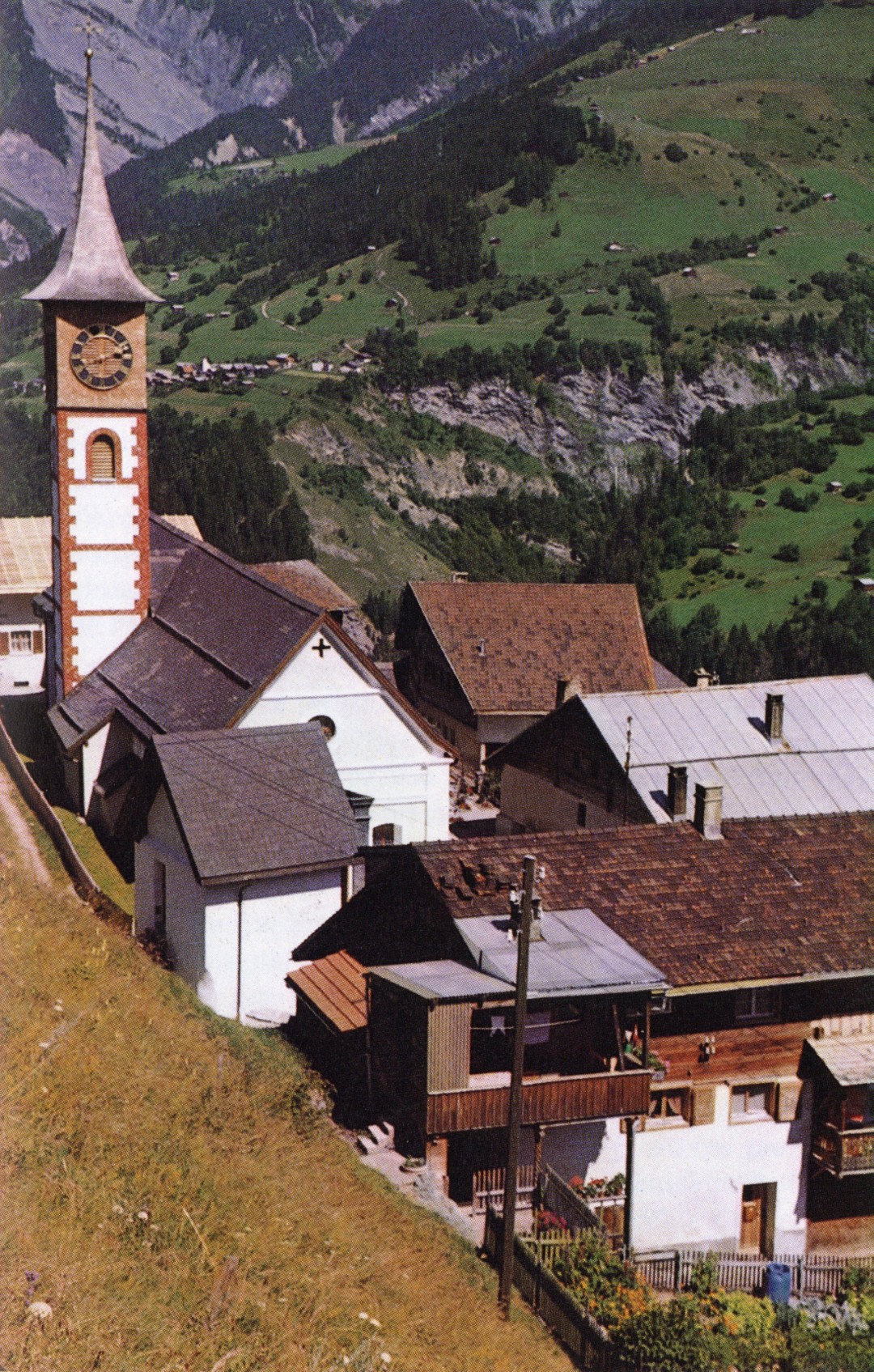
Al cunfin orientai dalla vischnaunca da Cumbel, dador Porclas, sper la via veglia da Lumnezia, sesiemia in englar, numnaus Plaun Baselgia. Speras giu sgarguglia l’aua d’in dutg, numnaus Fontauna digl Aitar. Danunder quels nums? Eis ei stau cheu ina caplutta? Forsa l’emprema sin territori da Cumbel, dalla Lumnezia insumma? Forsa ina Carolinga? Ni schizun ina dil temps premcristian, sco a Grepault/Trun?131 Forsa ch’il temps po aunc fierer glisch en quei stgir dil vargau.
1. Il sanctuari
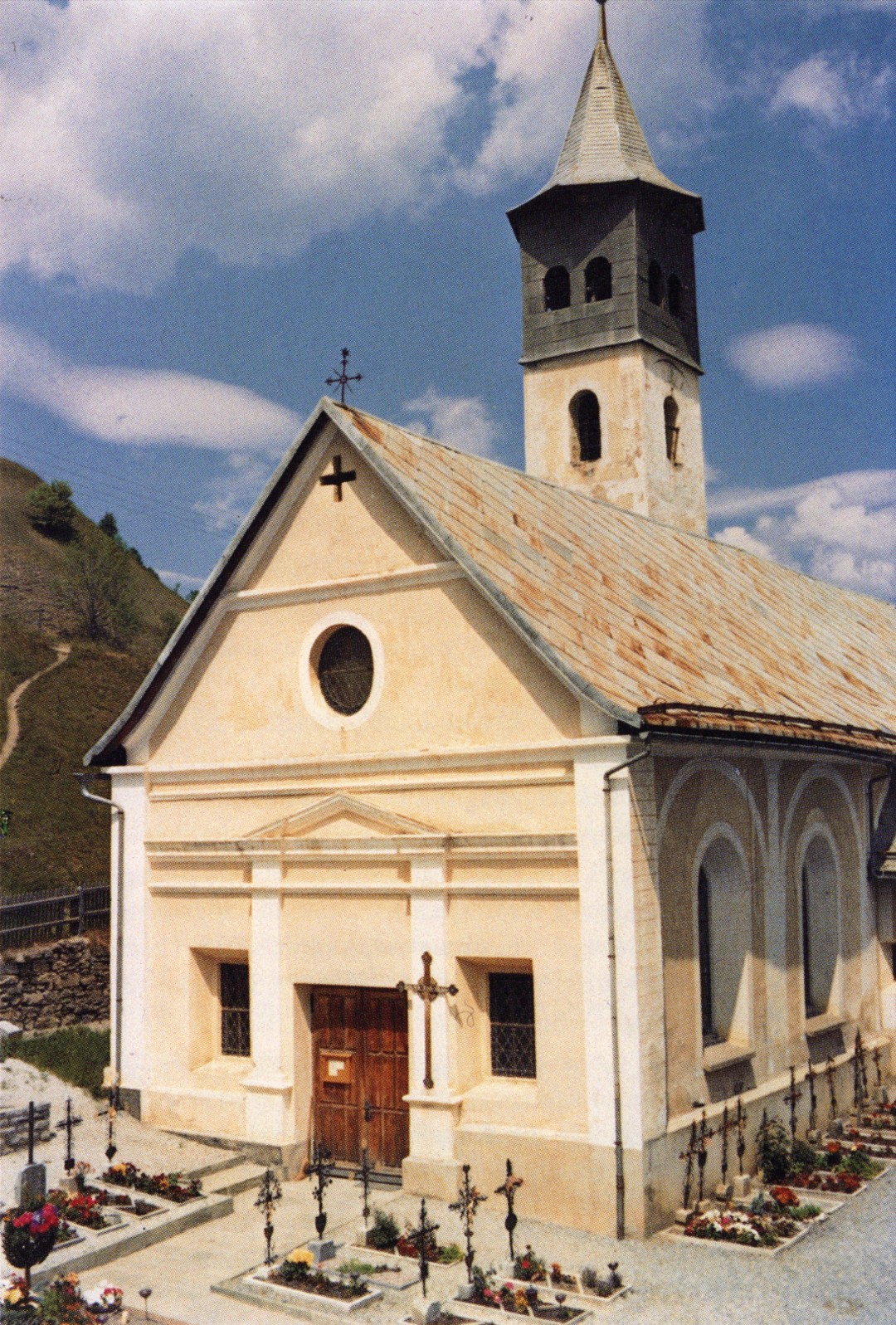
Da nossa baselgia da s. Stiafen vein nus novas plitost tardivas. Bia pli baul vegn ina caplutta da s. Murezi menziunada, gia egl urbari imperiai da ca. 825.132 Ina inscripziun denton: «St. Stephane, ora pro nobis 1597» vid in zenn da Camuns – e Camuns cun Peiden formava cun Cumbel in vischinadi — indichescha, denton era mo indirectamein, il sogn titular da Cumbel.133 Remarcablamein scriva igl emprem pader plevon a Cumbel, P. Ireneo, adina els cudischs da batten leu nua ch’il patrun-baselgia vegn insumma numnaus: «ella baselgia parochiala da S. Murezi e da s. Stiafen.»134 Cun tgei raschun? Cun risguard silla baselgia pli veglia? Risguard sil patrun dalla val? Ni eis ei mo ina predilecziun persunala da P. Ireneo? Gia siti successur e tut ils auters allegheschan adina mo s. Stiafen sco patrun-baselgia da Cumbel.
Dils elements da construcziun dalla hodierna baselgia parochiala selai eruir che la pli veglia part, numnadamein dil clutger naven entochen alla lautga, datescha dalla perioda gotica, dalla fin dil 15. ni entschatta dil 16. tschentaner.135 D’ina aunc pli veglia baselgia ein negins indezis avon maun. La nav originala era pia in bien ton pli cuorta e sesarava giu davontier cun in pign chor gotic. Las picturas cun las letezias da Nossadunna da vart sura e culla battaglia al Mundaun da vart sut pudessan esser fatgas ca. tschien onns pli tard e forsa schizun digl enconuschent pictur e magister Hans Ardüser, che ha enconuschentamein era luvrau en Lumnezia, per exempel vid la caplutta da s. Roc a Vella.136 Ils protocols dalla visitaziun episcopala en Lumnezia da 1623 e 1643, che dattan schiglioc bien sclariment sur da zacontas baselgias137, fan negina menziun da Cumbel.
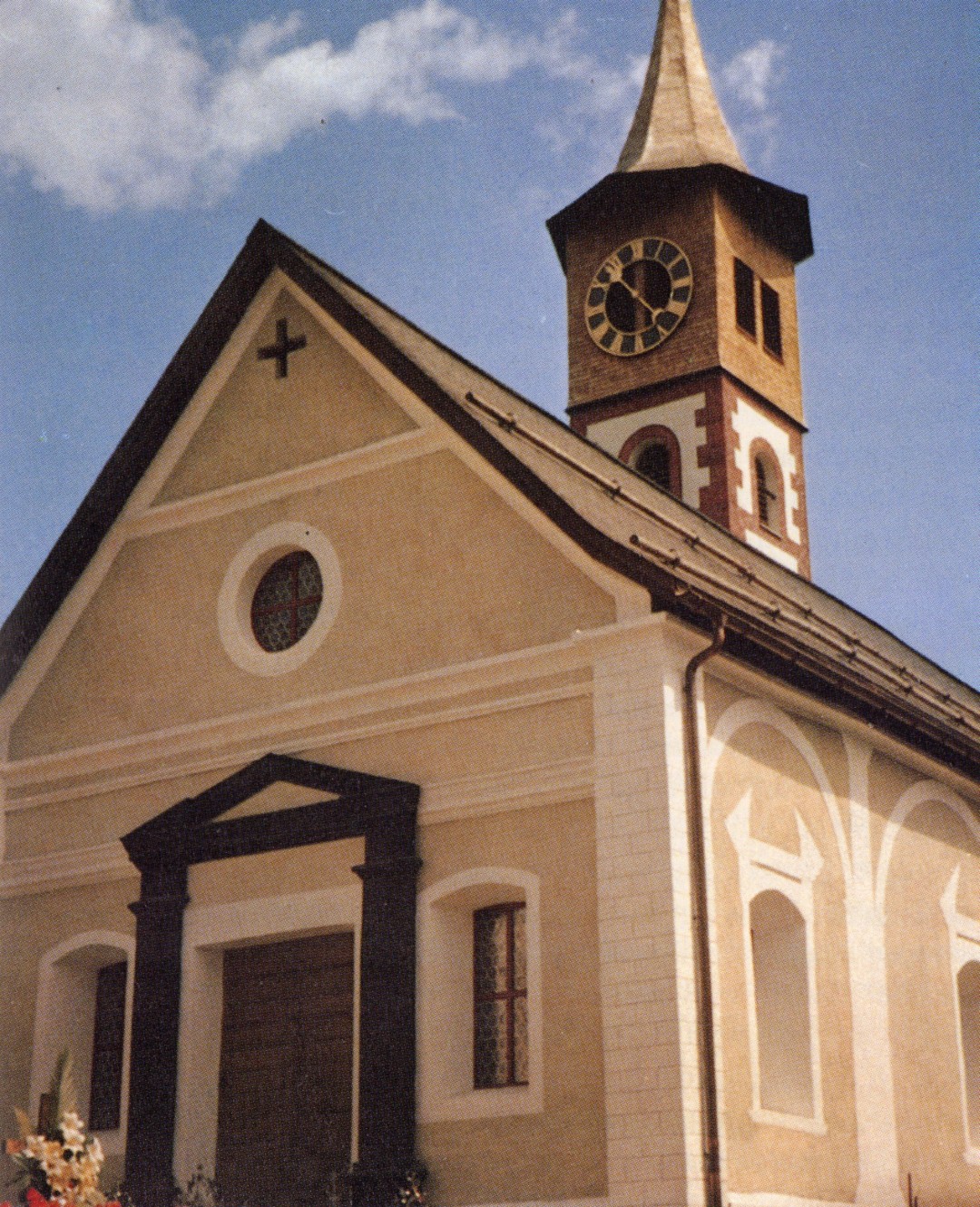
Las ulteriuras parts dalla baselgia, la part dalla lautga e quella dil clutger anen cun il vast chor, il teschamber e secapescha las duas capluttas ella nav, dateschan dalla perioda barocca dalla secunda mesadad dil 17. tschentaner. Mo era la part gotica ei da quei temps vegnida barochisada fermamein, buca mo tras quellas capluttas, era tras las curnischs entuorn ed entuorn si ad ault sut igl arviul e tras las fenestras. Dadora eroda la fassada ad egl, cun sias duas curnischs horizontalas. La specialitad aparti da quella baselgia ein ses sgrafits entuorn ed entuorn igl exteriur. Els ein plitost enramada dallas fenestras. Vid il chor ed il teschamber denton survargan ils sgrafits per in bien ton quella funcziun e daventan atgna decoraziun murala: Ina reha ornamentica cun motivs architectonics, segments d’arviul, fluram e palmas en splendur barocca che tradescha evidentamein igl origin dil sid.
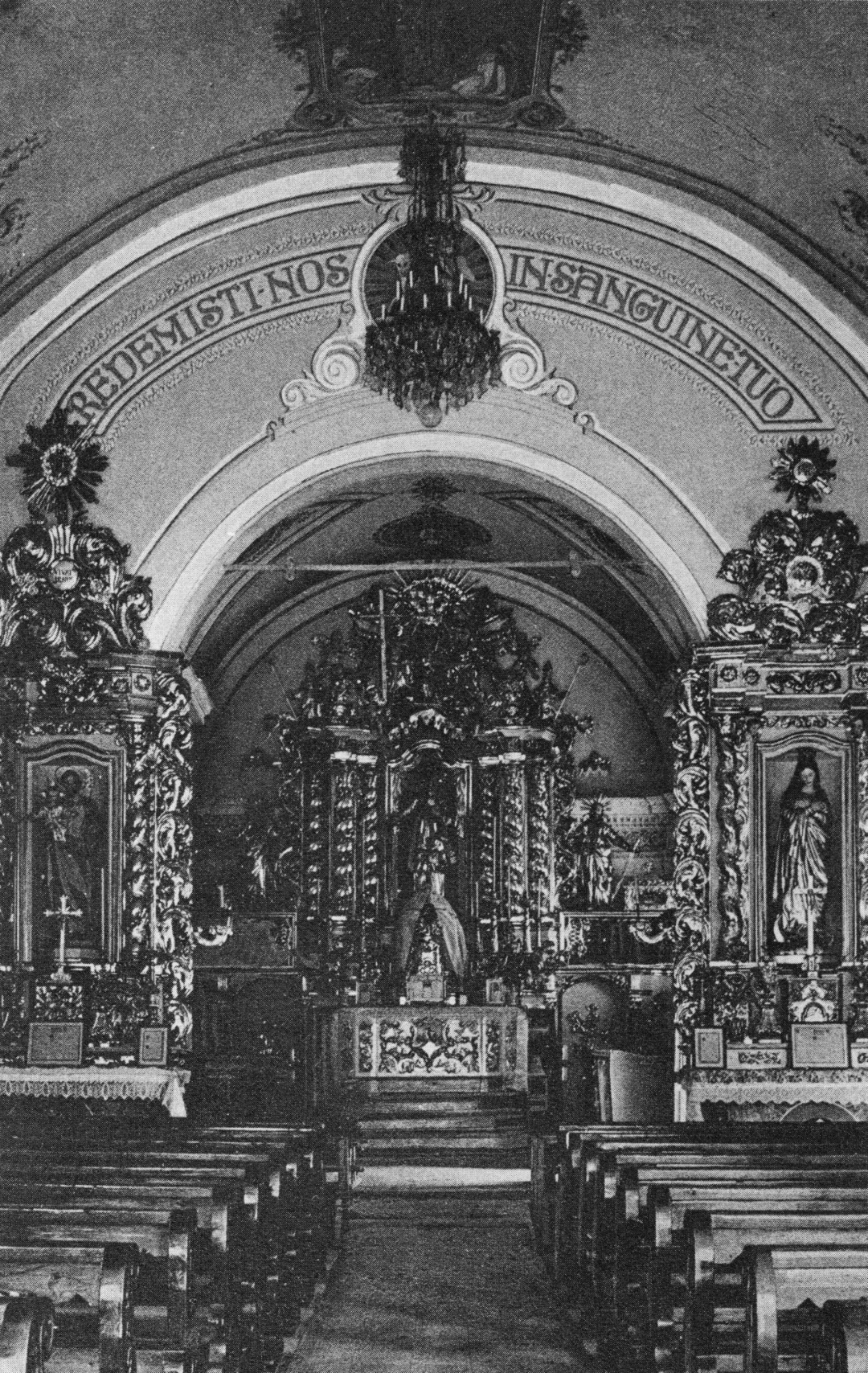
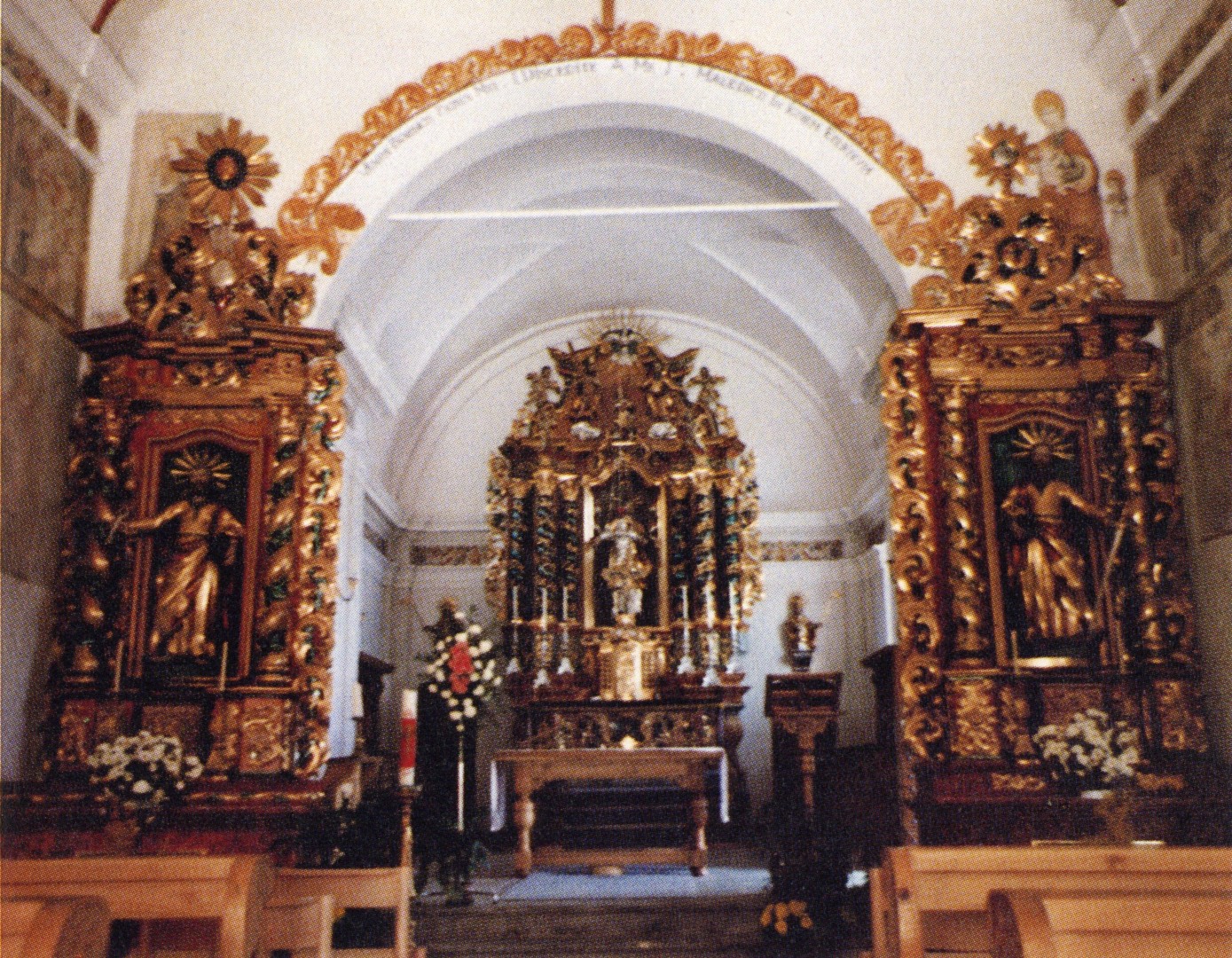
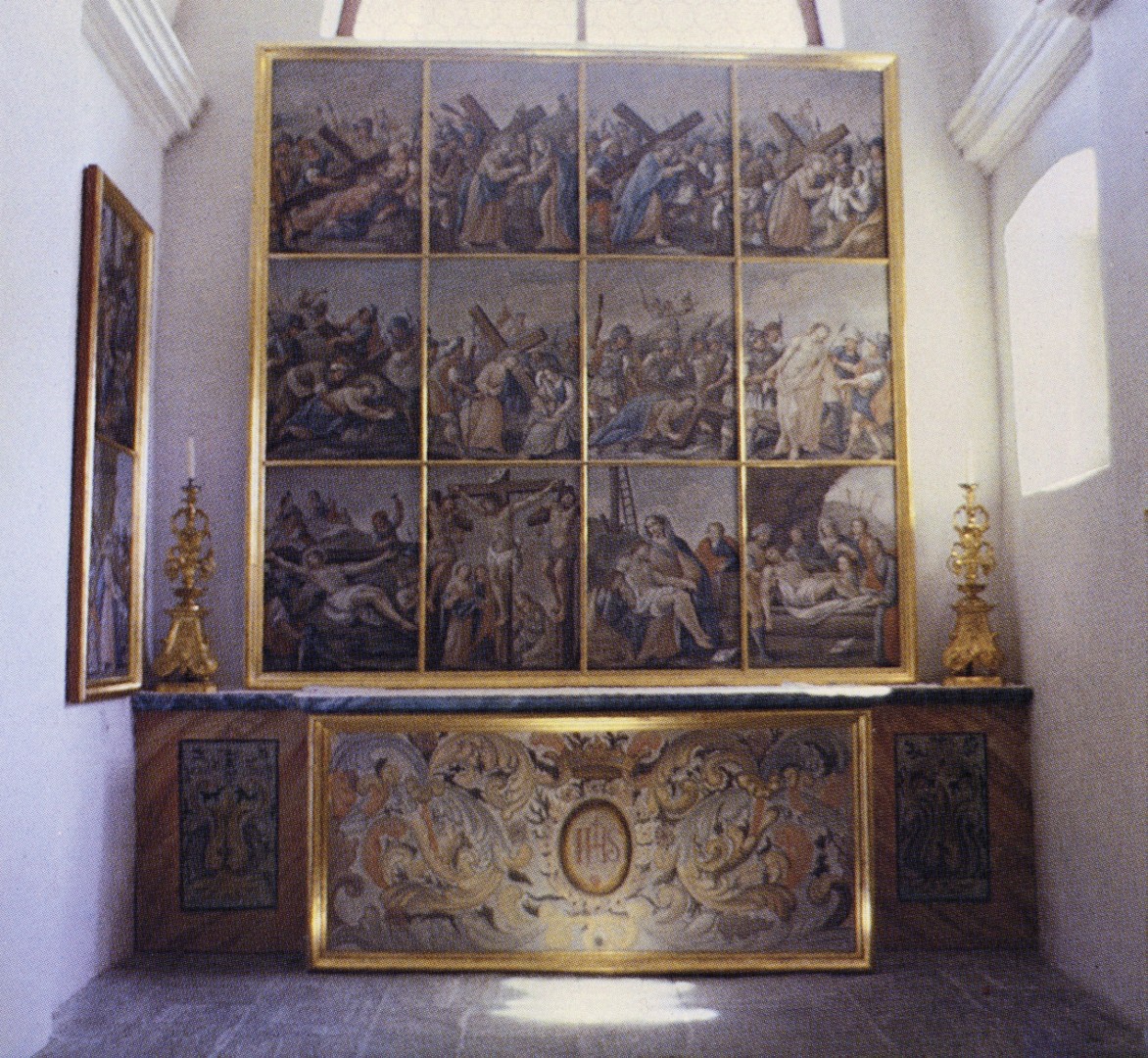
Igl altar grond ei in retabel da pumpa e parada cun sis petgas turnadas cun applicaziun da feglia ellas canals. Suren paradescha l’encorunaziun da Nossadunna cullas treis divinas persunas ed ina bellezia madonna. La gruppa ei enramada dad aunghels, figuras ed ornaments tut che buglia. Ella encarna el center il patrun-baselgia s. Stiafen. In bi antipendi entagliau cun in medagliun cugl affon Jesus enamiez ils docturs – tenor Poeschel eis ei ils quater sogns paders digl occident.138 – Il tabernachel ei in bufatg tempelet cun petgas turnadas, cuvretgs d’in gebel curvau. Igl altar ei ina lavur da Johannes Trubmann, tenor Poeschel da Schleitz ni Schleis el Tirol139 digl onn 1763. Igl artist ha luvrau a Cumbel. El veva cheu habitaziun libra e la lenna da brisch ed 800.– fr. paga.140 – Ils dus altars laterals van in cun l’auter, mintgin cun duas petgas turnadas, enramadas da feglia d’acantus. Els pon esser dil 18. tschentaner; Poeschel datescha 1710-1720.141 Ellas encarnas eran statuas da Nossadunna e s. Giusep novas, da stil oz survargau. Dapi la restauraziun da 1978/79 sepresentan leu s. Pieder e s. Paul, duas stupentas figuras ch’eran avon postadas sigi altar grond e mintgamai el plaz dalla petga amiez allontanada dalla restauraziun dils 1942. Pli baul stevan ellas sin ils reliquiars, dretg e seniester digl altar. – Ella caplutta dretg ein las staziuns dalla via dalla crusch ord la caplutta da s. Murezi, cumponidas ed enramadas en rom communabel, avon la restauraziun 1978/79 en quella fuorma ella caplutta seniester. En quella ei culla davosa restauraziun vegniu neunavon las conturas d’ina encarna e dil maletg da s. Dumeni e da s. Catrina da Siena, tut ussa renovau. – La scantschala da fuorma poligonala da ca. 1690 ei decorada cun ornaments dil rococo d’entuorn 1750.142 Visavi perdegia giud ina consola in sogn uestg, carteivel s. Valentin, apiestel Rezian.143 La figura ei in schenghetg dalla pleiv da Domat, daus tras la mediaziun da sur Gion Martin Pelican, a caschun dalla davosa restauraziun. – Las truccas el chor, cun tabliaus entagliai ed enramai da petgas corinticas, pon derivar carteivlamein dils davos onns dil 17. tschentaner. – La baselgia posseda dil reminent aunc dus bellezia calischs d’argien, in da 1751, schenghetg dils paders caputschins e carteivel era l’auter.144 Il curner ei in edifeci persesez ed originai cun duas alzadas, cun sias otg pintgas encarnas quadratas cun cavazzas e picturas dil purgatieri, Nossadunna, s. Stiafen e s. Murezi. El ei renovaus 1974. – In solemn «Memento mori».
2. Restauraziuns
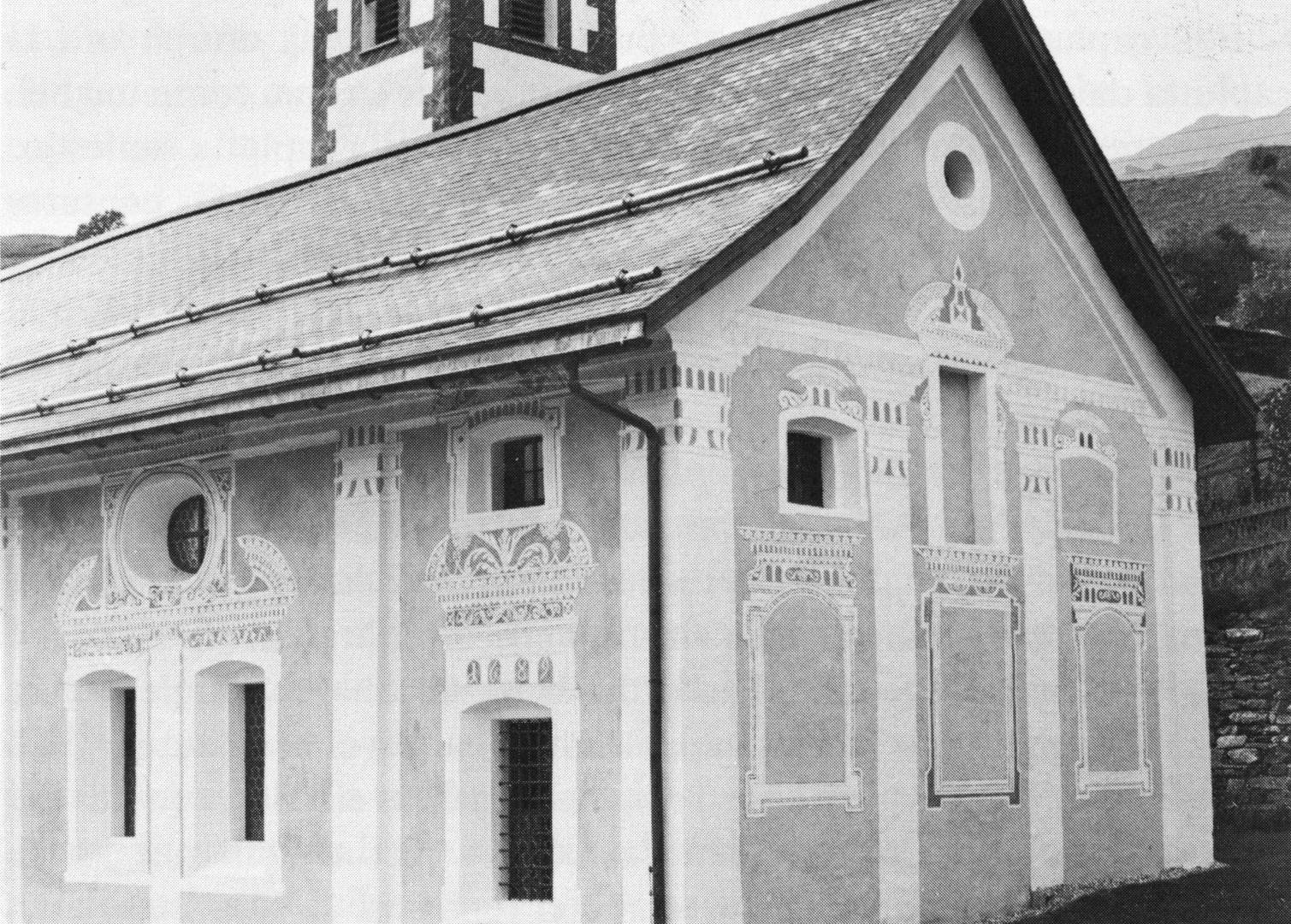
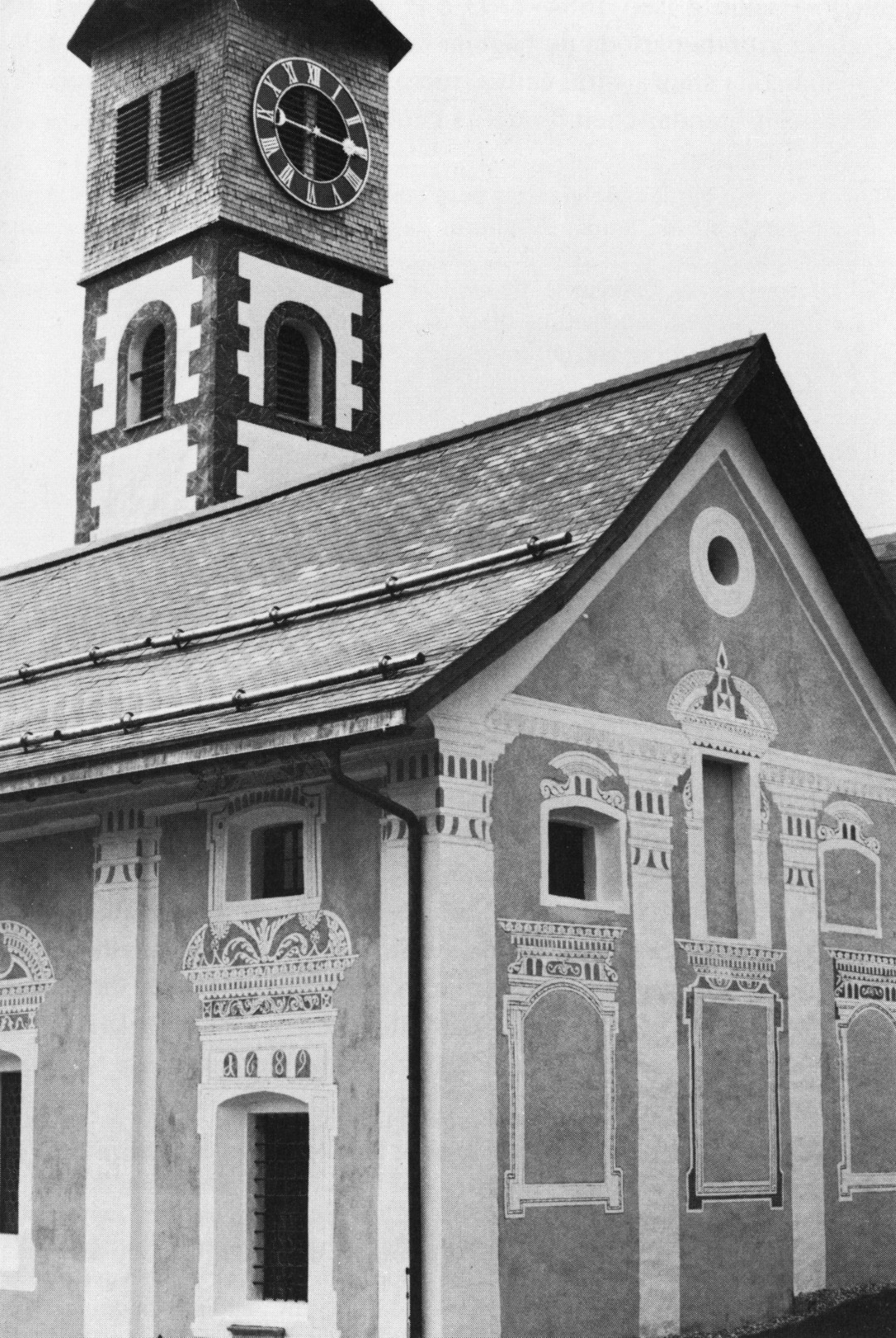
Il cudisch da quen dil P. Bernardino da Concesio (a Cumbel 1704-1709) relata, deplorablamein denton memia pane precis, sur da certas reparaturas ed acquisiziuns, sco lavurs vid il clutger 1670145, prolungaziun dalla baselgia anavos 1673146, il crap dil batten 1674147, maletg ni ina statua da s. Stiafen148, plinavon certas picturas egl intern ed alla fassada 1680149.
Sut P. Basilio d’Iseo 1684-1703 e P. Zaccarias da Salò 1684-1705 eroda la gronda perioda da baghiar cun l’erecziun dil chor niev, dalla sacristia culla stanza sura, cullas truccas e las duas capluttas lateralas. Nus savein suandar cheu il numnau cudisch da quens:
-
1684, cumprau per la baselgia treia pera bials cussins (plumatschs?) da damast cun antipendi ed ina ampia. Migliurau la pervenda cun far far mirs e seifs entuorn igl iert, en tut fl. 76.–
-
Per far il chor niev, lavur e material e sulada da crappa tagliada, senza l’almosna da divers benefacturs, mess da quei dil hospezi: fl. 400.– Mess per far la combra sur la sacristia: fl. 30.–
-
Per scaffas en teschamber, dau fl. 6.–
-
Pli clavau dalla pervenda, ton als meisters sco per lentia ed auter: fl. 40.– Pli tabernachel, senza las almosnas: fl. 80.–
-
Per cumprar da Gion Caduff quei sulom viers damaun sper la casa pervenda: fl. 18.–
-
Per far ils mirs digl iert: fl. 15.–
-
Per las truccas el chor e la vernisch: fl. 130.–
-
Per ils mirs dil santeri: fl. 50.–
-
Per dus candelors digl altar grond e sularar els: fl. 40.–
-
Pli plantschiu en baselgia da plattas tagliadas: fl. 43.–
-
Per ina plauna da brocat: fl. 80.–
El medem register ein aunc plirs posts pli pigns per uorden da baselgia.150 Igl onn 1709 ein las duas capluttas lateralas vegnidas ruttas ora.151 1873 ha la baselgia survegniu fenestras novas.152 1882 han ins fatg in plantschiu da plattas el chor ed el spazi avon ils pass ella nav.153 Il crap cun ina inscripziun latina sut la fenestra dil teschamber ei la memoria fatga dils cumpogns d’in pauper luvrer talian, Cassarmi, morts e satraus cheu. Il text ha il P. Bonaventura dictau.154 1897 ha la radunonza calonda mars concludiu «da far il gang dalla baselgia da cement». Exequiu da Hardegger, Schluein.155
Ei suonda aunc treis renovaziuns parzialas: 1905/07 sut P. Urban, 1942 (sur Cristoffel Fetz) e 1955 da sur Baselgia, tuttas treis alla liunga buca cuntenteivlas. Dalla emprema survegn la lautga in niev pusalau, la scantschala colur alva e melna, las capluttas altars novs da sempla lavur da scrinari, igl arviul maletgs dil Cor da Maria, da s. Francestg e da s. Stiafen, igl artg dil chor in tschut pascal ed il portal e las fenestras odém artg rodund e tier tut ei vegniu destruiu in bien ton dallas picturas d’avon. Da quei temps vevan ins era tschentau ella caplutta dretg sigl altar in grond vut da gep da s. Antoni, ch’ei staus leu tochen 1955. Dil temps da quella restauraziun (1905/07) ni cuort suenter han ins cavau in foss entuorn baselgia per cumbatter la humiditad, denton memia pauc afuns, aschia ch’ei ha buca gidau bia. Vid ils deivets da quella restauraziun ei stau da pagar tochen els 1940.156
1942 ha sur Cristoffel Fetz († 1961) operau vid igl altar grond cun schar sulerar el e cun deplorablamein prender naven da mintga vart las duas petgas amiez e postar en lur plaz s. Pieder e s. Paul, avon dasper il retabel sin ils reliquiars. Las duas portas alla sacristia ein svanidas e remplazzadas d’antipendis da teila. La lavur ha la firma Xaver Stöckli da Stans exequiu. Sur Fetz ha finanziau «sia» restauraziun cun donaziuns privatas.157
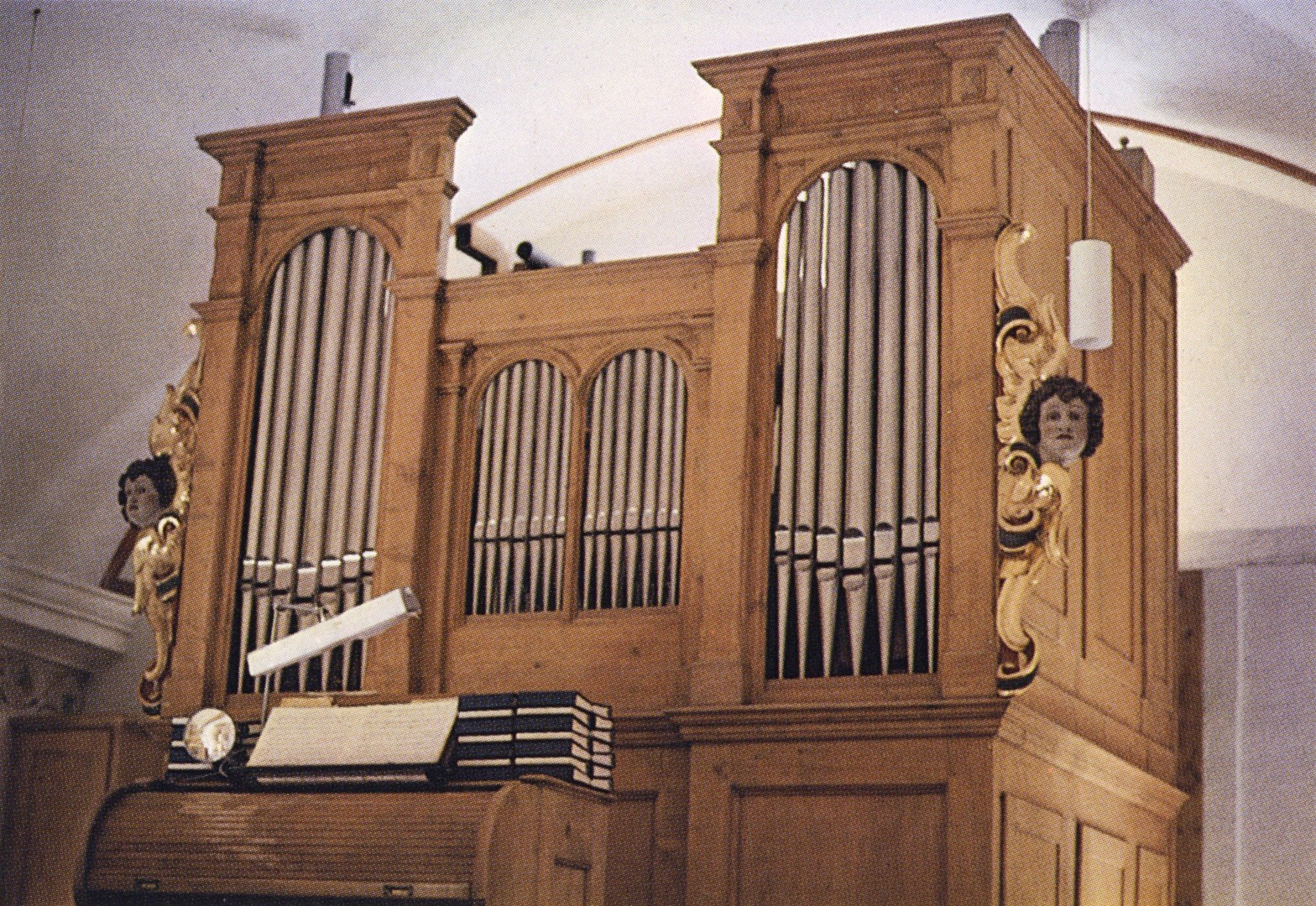
Entuorn 1955 ha sur Lezi Antoni Baselgia (+1965) exequiu ina restauraziun parziala dalla nav cun discuvierer las picturas existentas dallas diesch letezias da Maria, ils maletgs dils apostels, dalla battaglia al Mundaun, cun far ina nova lautga e tschentar ella pli bass, renovar l’orgla, remplazzar ils dus altars els capluts. Quel da vart seniastra survegn las staziuns dalla via dalla crusch encavigliadas en in rom communabel. Las hartas derivan dalla caplutta da s. Murezi. Il caplut da vart dretga vegn emplenius cun in grond confessiunal. Porta e fenestras survegnan puspei lur fuorma rectangulara. Restauraturs: Firma Xaver Stöckli, Stans. Lavurs da lenn: Gieri Giusep Arpagaus, Cumbel. Encunter la humiditad ei vegniu cavau in foss da dus meters profunditad da vart surora e davos giu e renovau il pustament entuorn ed entuorn. – Il cuost total da biabein 30 000.– fr. ha sur Baselgia pagau ord unfrendas e collectas. Pli scaldament surveschan dapi 1958 duas pegnas electricas da «Rapidor», furnidas dalla Firma «Intertherm», Turitg, per 3268.– fr. Elias han surviu mal ni bein tochen 1978.158
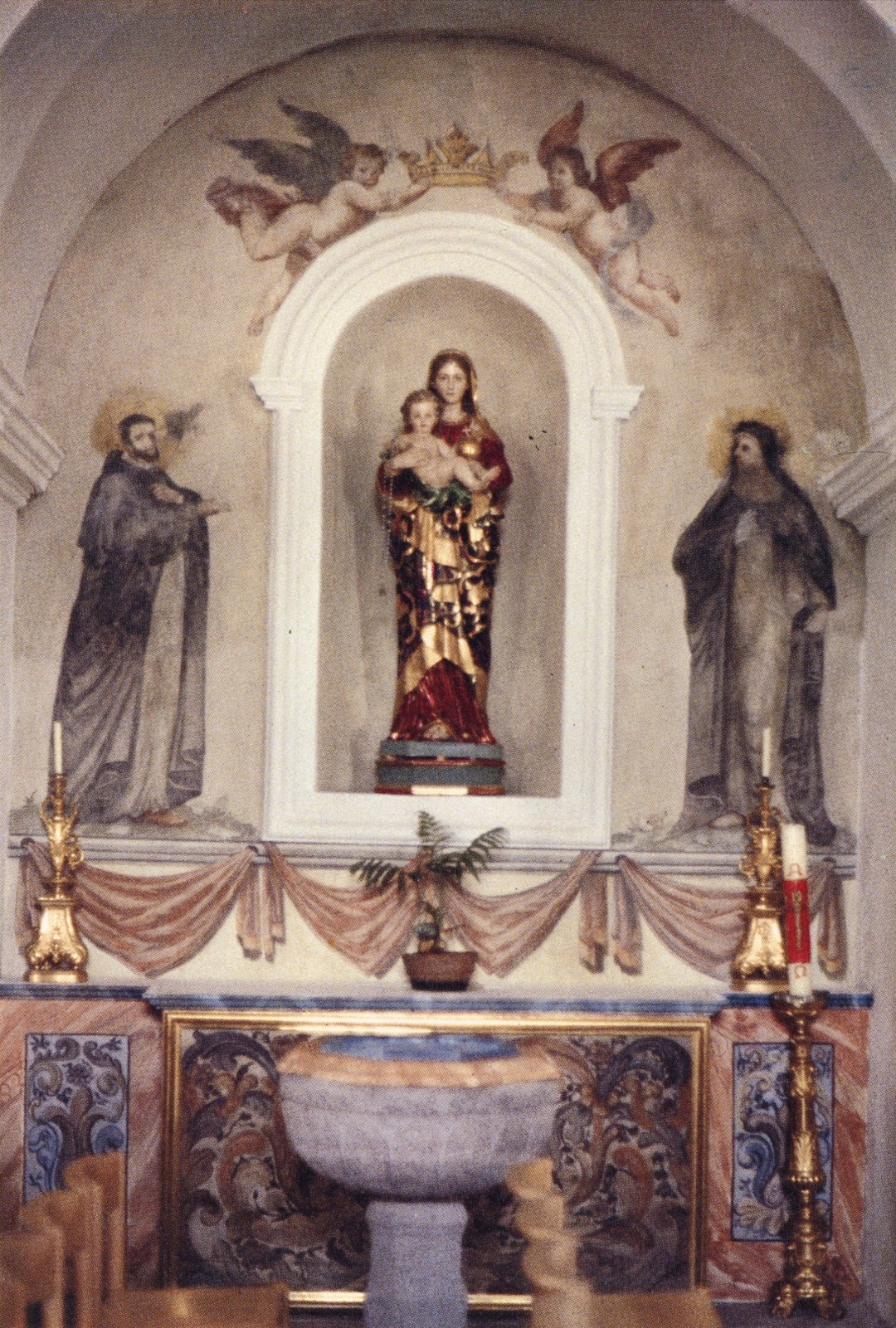
La davosa – ina restauraziun totala ed integrala – ei vegnida exequida 1978/79. La dumengia dils 9 da settember 1979 ei il sanctuari renovau vegnius inauguraus e benedius da sur vicari general Giusep Pelican sco representant digl uestg diocesan impediu.159 L’ovra ei quella ga buca vegnida realisada sut l’egida da pli u meins mo il plevon, mobein vegnida purtada dalla entira pleiv cun sia cumissiun da baghiar en uniun cullas instanzas cantunalas e federalas dalla tgira da monuments, pertscharts ch’ins era, ch’ina tala interpresa vid in edifeci historic sappi vegnir exequida mo aschia, conform alla historia digl art e sias leschas. Las lavurs principalas ein: Il clutger ha survegniu ina nova capellina, in niev vestgiu da sum tochen dem ed ina ura. Igl exteriur dalla baselgia tut renovau culs sgrafits originals. Igl altar grond refatgs a siu origin. Ils altars laterals sbassai per ca. 50 cm, en lur encarnas s. Pieder e s. Paul avon sigi altar grond. Il caplut seniester discuvretgs a siu origin cullas picturas s. Catrina e s. Dumeni e cun Nossadunna dil s. Rusari da 1886. Bauns novs culs capugls veders. Ballustrada dalla lautga nova. En teschamber tut niev cun installaziun d’aua caulda. Nova illuminaziun, niev scaldament electric modern e fenestras novas e dubias. Quei mo il principal. Cuost total: 775 742.– fr. La finanziaziun ei sefatga sco suonda (cefras rodundas):
| 1 | Fondo da baghiar, restauraziun-baselgia en administraziun dagl uffeci parochial (plev. Felici Maissen) il qual includa donnaziuns privatas, collectas en pliras pleivs dalla diocesa, unfrendas en baselgia, missiun interna, in bazar dalla uniun da mummas, lotto cumissiun da baghiar, Testament Giachen Camenisch (9000.– fr.) | 349 000.– fr. |
| 2 | Acziun dalla centrala d’adressas, Lucerna (administrau dil pres. d. pleiv scolast Giusep Vieli) | 136 000.– fr. |
| 3 | Acziun Winterthur. La pleiv dil SS. Cor d’Jesus fa in grond bazar etc. (ord atgna iniziativa), organisau sur suprastonza da pleiv, november 1978, entrau schaner 1979 | 43 000.– fr. |
| 4 | Donaziun privata per l’ura-baselgia (Caduff-Brennwald, Urdorf) | 15 400.– fr. |
| 5 | Donaziun ord il fondo «Fundaziun Winterhalter» (pres. dr. Gieri Vieli, Domat) | 30 000.– fr. |
| 6 | Contribuziun dil Corpus Catholicum | 80 000.– fr. |
| 7 | Contribuziun tgira da monuments cantunala | 40 000.– fr. |
| 8 | Contribuziun vischnaunca politica Cumbel (pil santeri, clutger) | 56 985.– fr. |
| 9 | Contribuziun tgira da monuments federala, Bern, empermess | 91 250.– fr. |
| (comm. dils 11 da nov. 1980, cun l’aggiunta, ch’il pagament sappi succeder, sin fundament digl uorden da prioritad, per igl onn 1985)160 |
En quei mument ei era patertgau da realisar ina orgla nova cun temps e peda. L’ovra ei vegnida exequida sut l’egida da:
-
Cumissiun da baghiar: a. Suprastonza da pleiv: Giusep Vieli, pres., Madalena Cabalzar-Arpagaus, actuara, Luis Caduff, cassier, Francestg Arpagaus, gerau, sur Felici Maissen, plevon e representant dalla curia episcopala. Plinavon: Rest Fidel Arpagaus-Cavegn, Scolast Rest Giachen Caduff, Robert Elvedi-Caduff, Josefina Collenberg-Caduff, Nesa Furger, Valgronda.
-
Planisaziun e projecziun: architect dipi. BSA/SIA Damian M. Widmer, Lucerna-Morissen.
-
Survigilonza dalla lavur: Robert Elvedi, biro d’architectura.
-
Cussegliaziun en caussa tgira da monuments: Dr. A. Wyss e dr. H. Rutishauser, tgira da monuments cantunala. Signur Zindel, survetsch archeologie cantunal. C. de Pianta, expert federal per tgira da monuments. Rev. sur canoni e vicari general Giusep Pelican, representant dalla curia en fatgs d’art sacrai.
-
Restauratur d’art: Jörg Joos, Andeer.161
Ei seigi aunc allegau zacontas acquisiziuns. Ina ura possedeva la baselgia silmeins naven da 1675. El cudisch da quen noda il pader per quei onn: «Ils 25 da matg ei meister Crest vegnius col horologio.»162 Il schaner 1800 ha il plevon P. Tumasch dumandau la curia episcopala per la facultad da benedir las staziuns dalla via dalla crusch. Quellas seigien vegnidas ord l’Italia e pagadas d’in benefactur. Quei hagi dalla davosa battaglia a La Punt (encunter ils Franzos matg 1799) fatg il vut, da schenghiar quellas alla baselgia.163 Ils 19 da mars 1889 benedescha P. Nicolaus, plevon, puspei per la baselgia parochiala 14 staziuns dalla via dalla crusch.164 Mo 20 onns pli tard sto la gronda part da quellas vegnir reparada ni supplementada e P. Urban damonda per la facultad d’ina nova erecziun.165
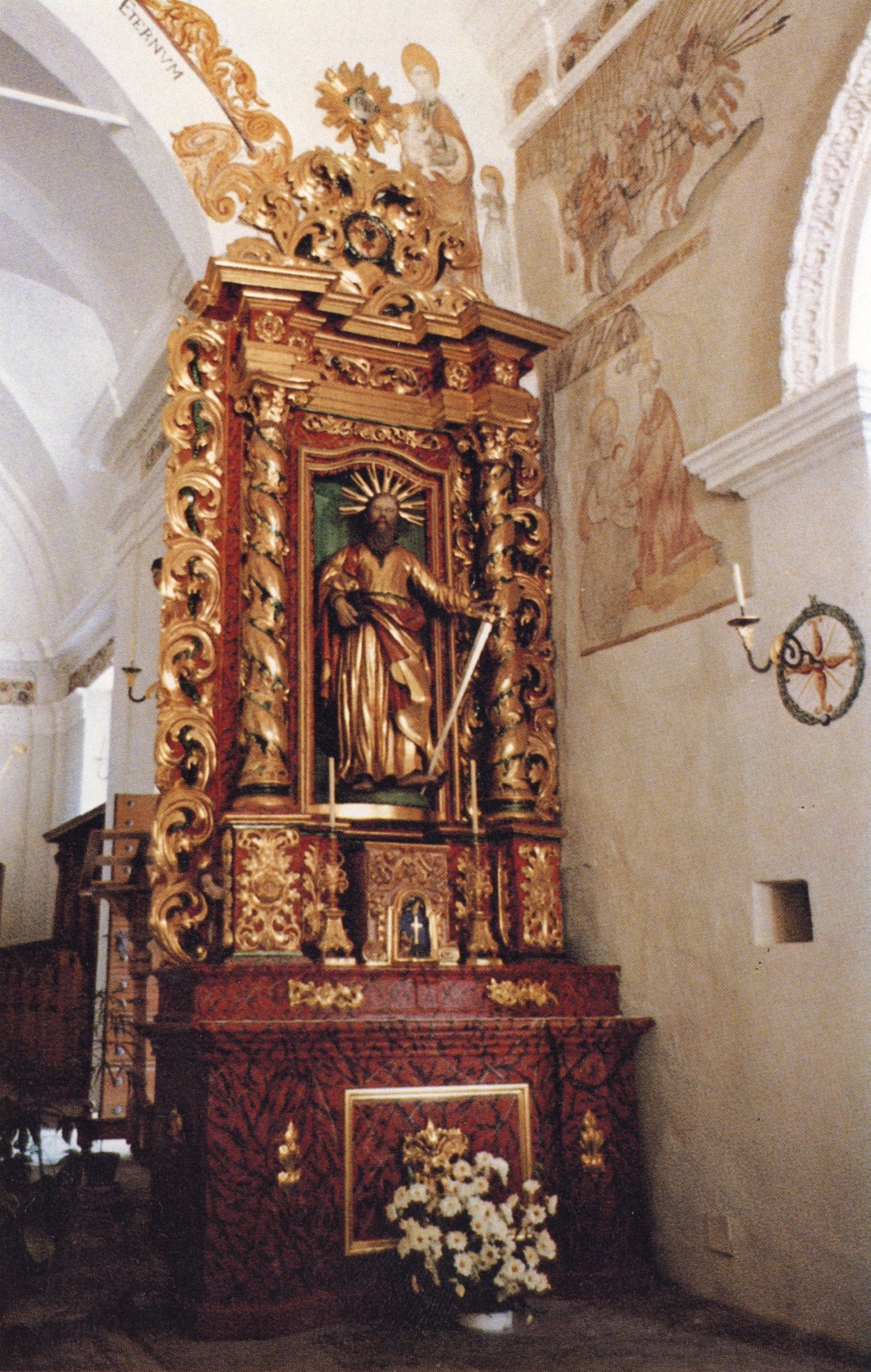
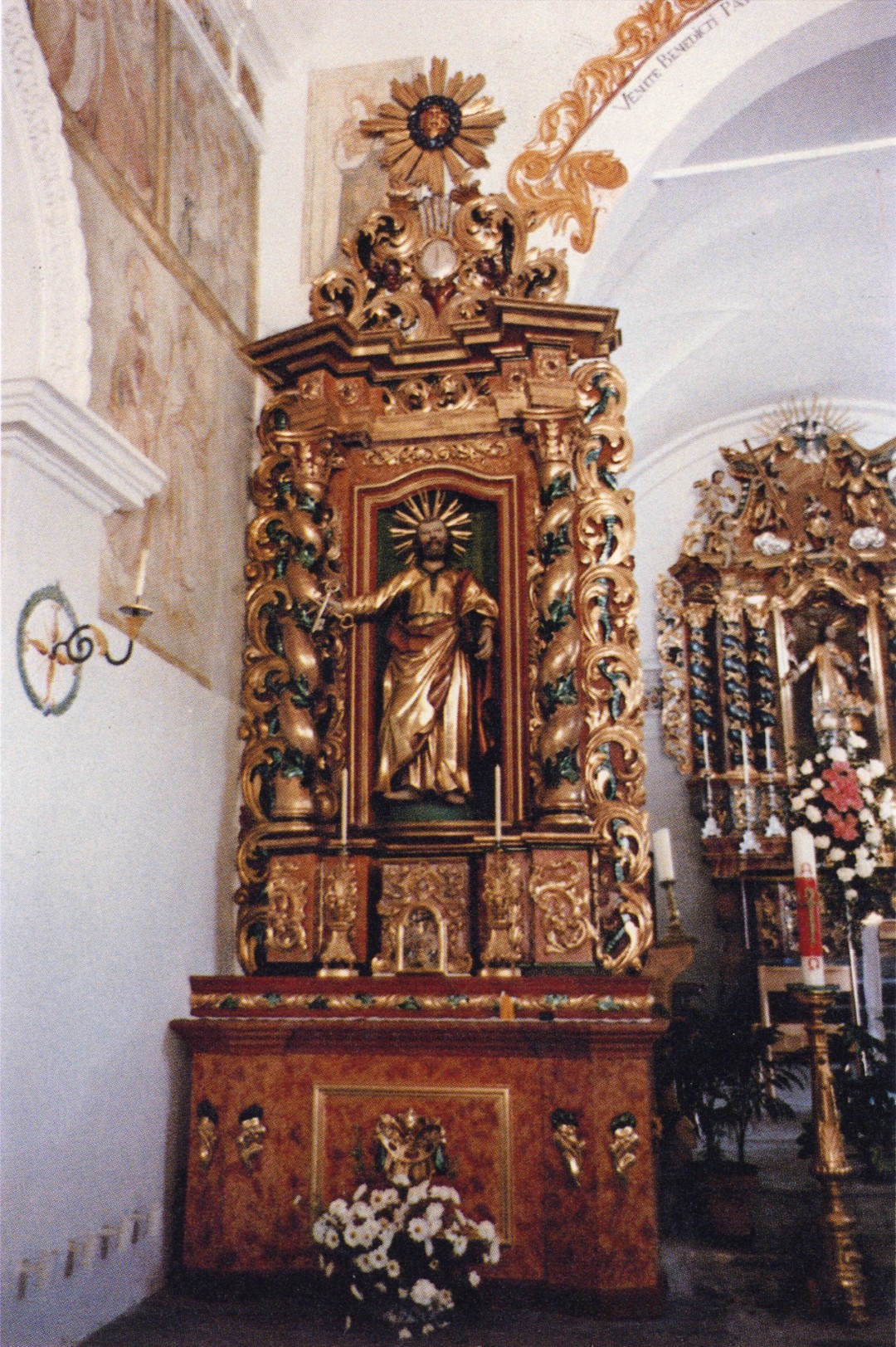
Per la 4. dumengia d’uost 1886 ei ina nova *statua dalla regina dil s. rusari – *la medema ch’ei oz el caplut seniester – vegnida inaugurada e benedida. In grond pievel da fiasta era serimnaus e la sera resunava musica e fiugs artificials ardevan. Il vut veva in giuven Giovanni Gay d’Alessandria, la patria da P. Nicolaus, fatg e veva custau 500.– fr.166
3. Tuchiez ed orgla
L’emprema notizia dils zenns vein ord il cudisch vegl da quens. 1677 ha il pader pagau per in zenn 100 flurins.167 Tenor ina remarca el medem liug ei quei zenn vegnius menaus si da Cuera ed ei seigi da dar als otg umens che han menau el en da Glion 14 mesiras vin.168 – In zenn ei vegnius culaus da Cristian Felix a S. Pieder 1776.168a Ils hodierns zenns ein vegni culai da Grasmayr a S. Pieder (Feidkirch) 1826, il tierz, che era lu disdius, 1829 dil medem culazenns. Il zenn grond, cun in diameter da 124.5 cm porta l’inscripziun: A FULGURE ET TEMPESTATE LIBERA NOS DOMINE JESU CHRISTE e las figuras dalla crucifigaziun, da Nossadunna, s. Stiafen e s. Martin. Il secund ha in diameter da 102.5 cm e l’inscripziun SUB TUUM PRAESIDIUM CONFUGIMUS SANCTA DEI GENITRIX e las figuras dalla crucifigaziun, Nossadunna, s. Giusep e s. Gion Nepomuk.
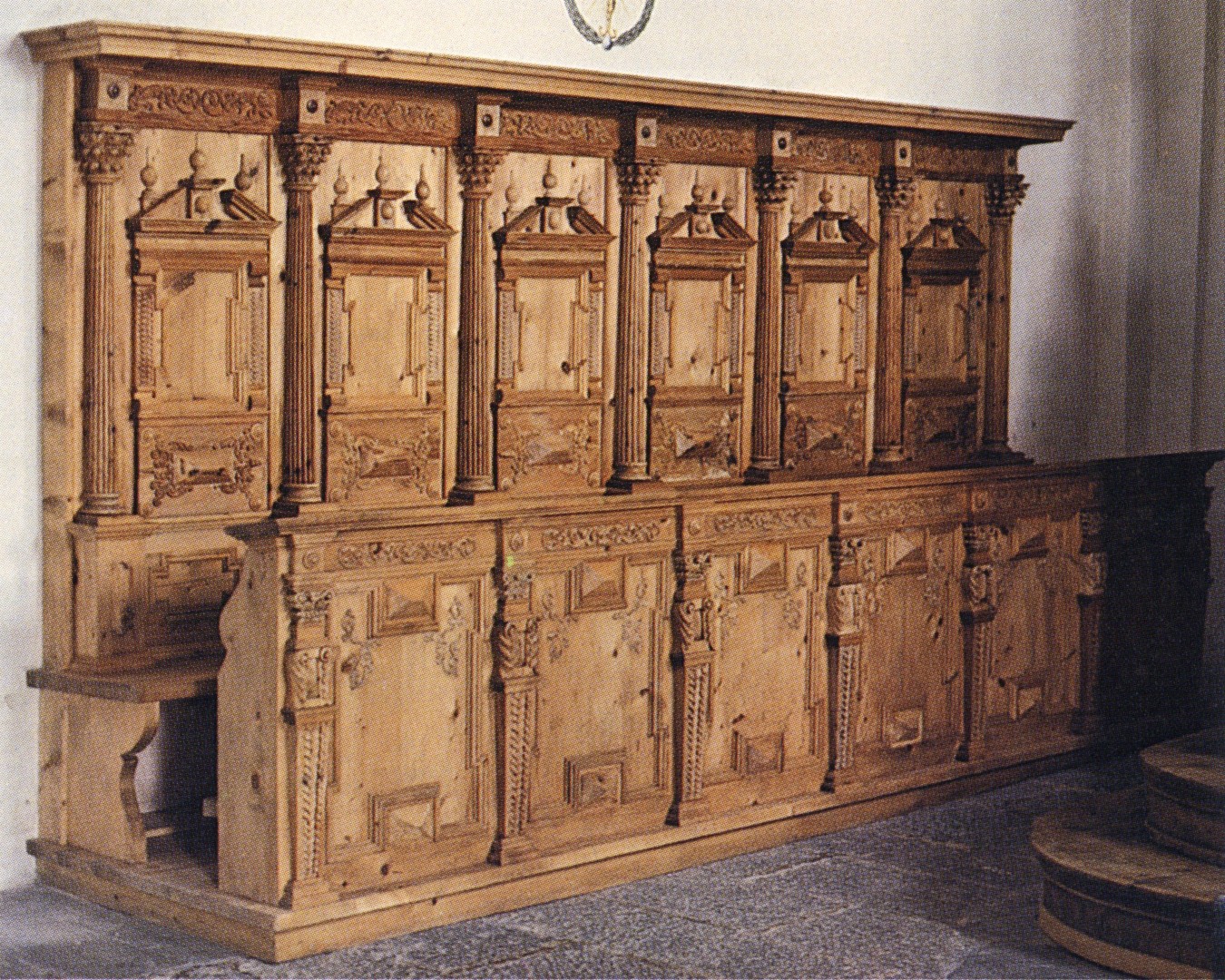
Il tierz da 1829 mesira 91.5 cm e porta l’invocaziun da s. Murezi «patrone noster» (= nies patrun) e la representaziun da Nossadunna, s. Murezi e s. Bernard da Clairvaux. Il pign da 81 cm ei ornaus cun s. Murezi, s. Martin, s. Antoni e culla crucifigaziun.169 Ils zenns ein vegni consecrai ils 12 da december 1826, il tierz ils 28 da fevrer 1829 dil vicari general da S. Pieder, Bernhard Galura.170 Tenor igl «urbario Hospizio» peisa igl emprem 1174 kg ed ei dedicaus a s. Stiafen, il secund 695 kg ed ei quel dalla Immaculata, il tierz da 467 kg ei quel da s. Murezi ed il pign da 262 kg ei il zenn da s. Antoni.171
Orgla. Il giuven miedi dr. Gieri Antoni Vieli (1745-1830) veva silla radunonza da mardis-pastgas 1772 proponiu – tenor sia atgna notizia el cudisch da protocol, da metter neu ina orgla «per contonscher in meglier e pli harmonic cant per honur da Diu e ses sogns». La proposta ha giu success e la vischnaunca ha concludiu da prender 300.– ord il fondo-baselgia. Ins ha fatg ina collecta. Siu bab, Murezi Antoni Vieli, ha dau 100.– fl. e litinent Pieder Antoni Arpagaus 50.– fl. Auters han dau als luvrers la «spisa».172 Pli bia ei buca d’intervegnir.
Igl onn 1902, alla radunonza communala digl 1. d’avrel ei vegniu concludiu da procurar per ina nova orgla e dad arver in fondo persuenter.173 Da calonda mars 1903 dat la cumissiun rapport: Il fondo ha in capital da 388.– fr. ord ina collecta ed ord producziuns da cant dil chor baselgia e da teater.174 La stad 1904 concluda la vischnaunca da far empristar 1000.– fr. dalla banca cantunala.175 — 1955/57 ei l’orgla vegnida midada, cumpletada ed arranschada cun dus manuals tras la firma Willy Buttikofer, Münsingen BE. Collaudaziun la dumengia dalla SS. Trinitad 1957 tras professer Duri Sialm. Cuost 8200.– fr.176
4. Santeri
Tochen 1653 vegnevan tuttas baras transportadas al santeri da Pleif. Mo silla dismembraziun da Pleif vevan ins era gia semtgau a Cumbel il santeri niev. Cun lubientscha digl ordinariat veva P. Ireneo, en preschientscha da sur Cristian Arpagaus da Cumbel, plevon a Lumbrein e da P. Dumeni benediu il niev santeri. Quei vegn ad esser daventau avon ils 28 d’avrel 1653, pertgei quei di ei igl emprem vegnius satraus cheu, numnadamein il baret dil «Gion, fegl dil Gion Blos.»177 – Zatgei lavurs vid il mir santeri ein vegnidas exequidas 1670 e 1684.178
Igl onn 1959 ei il santeri vegnius ingrondius, en cuminonza da vischnaunca e da pleiv, cun ir cul mir da vart sut, schiglioc fetg defects, plinengiu egl iert pervenda. Cun quella caschun ei era Fossa dil carner vegnida satrada.179
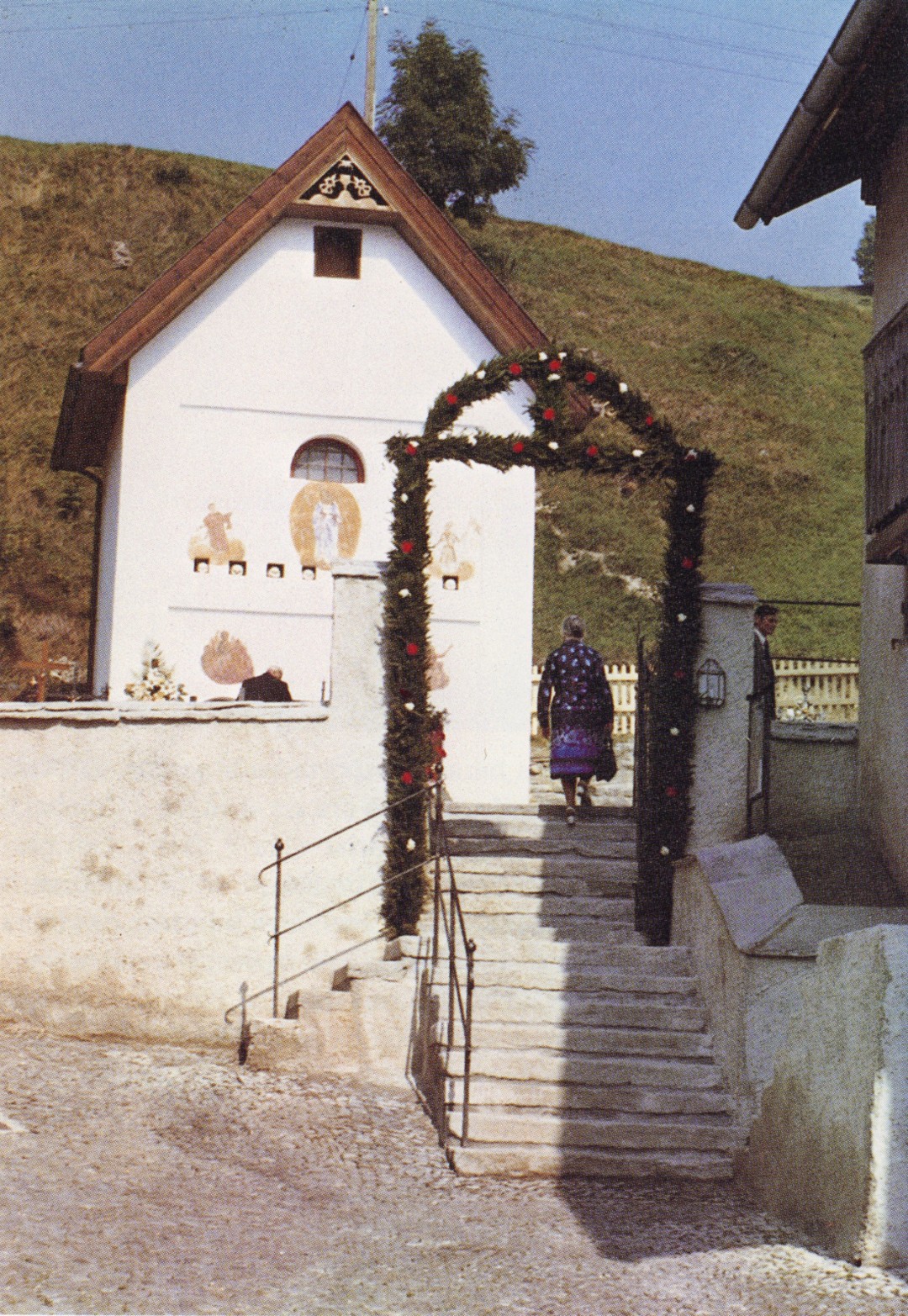
1974 ei il carner vegnius restauraus sut architect Damian Widmer, Lucerna/Morissen, cun in cuost da rodund 40 000.– fr. Cun quella caschun ei il local sut vegnius svidaus ed endrizzaus sco caplutta da morts. Treis umens meriteivels: landrechter dr. Gieri Antoni Vieli 1745-1830, dr. med. e mistral Gieri Vieli 1811-1857 e cuss. guvernativ e naziunal dr. med. Gion Barclamiu Arpagaus 1810-1882 ein vegni undrai cun ina tabla commemorativa, plazzada el pign local. Las tablas dils dus Vieli eran avon maun, quella da dr. Arpagaus ei fatga da niev. Igl entir edifeci stat sut la protecziun dalla tgira da monuments cantunala.180
5. Reliquias
La veneraziun da reliquias dils sogns ha siu fundament ella s. Scartira. «Vegnend igl um miert en cuntact cun Tossa d’Eliseus, eis el puspei daventaus vivs.»181 Gia entras l’umbriva da s. Pieder survegnevan malsauns la sanadad.182 Da s. Paul «prendevan ins sudaris e tschentas e metteva quels sils malsauns e las malsognas tschessavan.»183 – Ils emprems cristifideivels rimnavan cun quitau Fossa dils sogns e tenevan ella en gronda honur. Il cult da reliquias ei da tut temps staus ina part dalla devoziun dils fideivels, seigi ch’ins veneravi reliquias digl emprem uorden (ossa) ni dil secund uorden (parts dalla vestgadira p.ex. ni caussas ch’ils sogns duvravan).184 Dil temps baroc vegn la veneraziun da reliquias en gronda moda. Mintga baselgia sesprova da vegnir en possess da reliquias dils sogns, pli biaras e pli bugen. La medema tendenza cuozza aunc ditg suenter, tochen viaden el 19. tschentaner.185
Per la baselgia da s. Stiafen savein nus tschentar ensemen la suandonta gliesta cronologica, mintgamai tenor las autenticas (certificats d’ina autoritad ecclesiastica, ch’ellas seigien veras).
-
1698, 25 schaner. Casparus, Cardinal de Carpineo, vicari general dil papa, declara autentica la reliquia, in ies da *sontga Celestina, *martra, prius ord il santeri da s. Ciriac.
-
1700, 24 da settember. Autentica dallas reliquias dils corps dils sogns marters Pius e Lucida, ord il santeri da s. Ciriac, surdadas a rev. sur Augustin Vieli. 1702. ils 6 da mars recamonda igl uestg da Cuera, Duri de Federspiel, quellas reliquias alla publica veneraziun.
-
1728, 25 da settember. Autentica dalla sontga ossa da s. Stiafen protomarter, tschentada egl altar dil SS. Num a Cumbel.
-
1730, mars. Henricus Lasso de la Vega, uestg . . . declara autentica la particla dalla s. crusch da Niessegner J.Cr. tschentada en ina cruschetta da cristal e ligiada entuorn cun in fil d’argien e surdada a P. Gianbattista da Chiari caputschin e missiunari en Rezia186, il qual ha mess la cruschetta en in ostensori d’argien per la baselgia da s. Stiafen . . . per la publica veneraziun dils fideivels . . .
-
1730, 8 da fevrer . . . Particla dalla sontga ossa da s. Giuchin, bab da Nossadunna . . . per la publica veneraziun dils fideivels en scadina baselgia ni caplutta . . . dada alla baselgia da s. Stiafen a Cumbel da Stefano Vieli igl onn 1768
-
1764, 28 da matg. Autentica dalla sontga ossa da s. Ubald, *uestg . . .
Autentica dalla sontga ossa da *s. Ludivic, uestg, Per la publica veneraziun dils fideivels. Joannes Antonius de Federspiel, uestg da Cuera -
1767, 24 da mars. Roma, Fr. Nicolaus Angelus Maria Landini. . . attestescha da haver surdau ina particla dalla ossa da *s. Stiafen *protomarter, prida da liug autentic . . . per la publica veneraziun.
-
1782, 26 da matg. Autentica dalla reliquia dalla ossa da *s. Antoni *da Padua en in reliquiar pign d’argien . . . 1784, 16 da fenadur. Surascretta reliquia da s. Antoni sa vegnir exponida alla publica veneraziun, Cuera. Dionis v. Rost, uestg.
-
1819, 4 d’october. Cardinal Patrizi verifichescha la particla dil lenn dalla s. Crusch da Niessegner J.Cr. prida da liug autentic e messa en ina scatletta da cristal. . .
-
1819, 4 d’october. Autentica dallas reliquias, particlas dalla fossa da Nossadunna, dil manti da s. Giusep siu spus, e dalla ossa da s. Giuchin en ina scatletta argentada.
-
1841, 29 da schaner. Autentica d’ina particla dil lenn dalla s. crusch, dalla ossa da s. Prosper, marter, da s. Germana, marter e da s. Mudest, marter.
-
1841, 10 da mars. Fr. Joseph Maria Castellani, uestg . . . autentica da particlas dalla ossa da s. Fidel da Sigmaringen, marter en Rezia.
-
1845, 18 d’october. Autentica per las particlas dalla fossa da Nossadunna e dalla ossa da s. Filomena, purschala e martra. [davos stat:] «Regalau dil P. Angelo Maria da Camino, missiunari apostolic, alla baselgia da Cumbel 1846.»187
-
1853, 6 d’uost. Autentica da particlas dalla ossa da *s. Victoria *purschala e martra, tschentadas en ina scatletta argentada, ovaia.188
Ensemen cun quella reliquia da s. Victoria veva P. Bonaventura aunc procurau per ina «entira s. Victoria» martra ed exponiu ella alla publica veneraziun dils fideivels «ils quals ein concurri en grond diember ad onorar ina tala martra». E sco ins vesa ord ina brev al cancelier episcopal leva il pader exponer s. Victoria sut la meisa d’in altar lateral.189 Il sarcofag da glas culla figura da tschera da s. Victoria era tochen la restauraziun da 1942 dalla vart digl altar grond.190
V. Las capluttas
1. S. Murezi
Murezi era il menader (primicerius) dalla schinumnada «Legiun Thebaica» dalla truppa romana, consistenta ord schuldada cristiana, staziunada el Valleis-sut (Agaunia). El ha suffriu il marteri denter ils 280-300. Circa tschien onns pli tard, entuorn 380, culla erecziun d’ina basilica sur sia fossa a St-Maurice, ha sia veneraziun entschiet e sefar ordeifer. Ordlunder crescha la claustra da leu ed in liug da pelegrinadi e la veneraziun dil sogn popular, promovida da prencis e dinasts, sederasa cun riet lunsch entuorn ellas biaras tiaras europeicas.191
a) La caplutta
Daco la veneraziun da s. Murezi ei vegnida purtada en Lumnezia essan nus ual aschi pauc orientai sco sur digl origin e dil motiv dalla erecziun d’ina caplutta en honur da quei sogn. L’emprema notizia da quella caplutta, ch’existeva pia gia ella emprema mesadad dil novavel tschentaner, vein nus ord igl urbari imperiai dad 825.192 Ella auda als pli vegls sanctuaris dalla vallada. Remarcablamein ei buca il sogn titolar dalla antica baselgia parochiala da Pleif, s. Vintschegn, vegnius tscharnius sco patrun dalla vallada, mobein s. Murezi. El cumpara el sigil dalla dertgira e dil cumin ed ornescha aunc oz l’arma da cumin. En ina brev da perdun dalla parochiala da Pleif dils 1345 vegn la caplutta da s. Murezi allegada, buca ina tala da s. Stiafen.
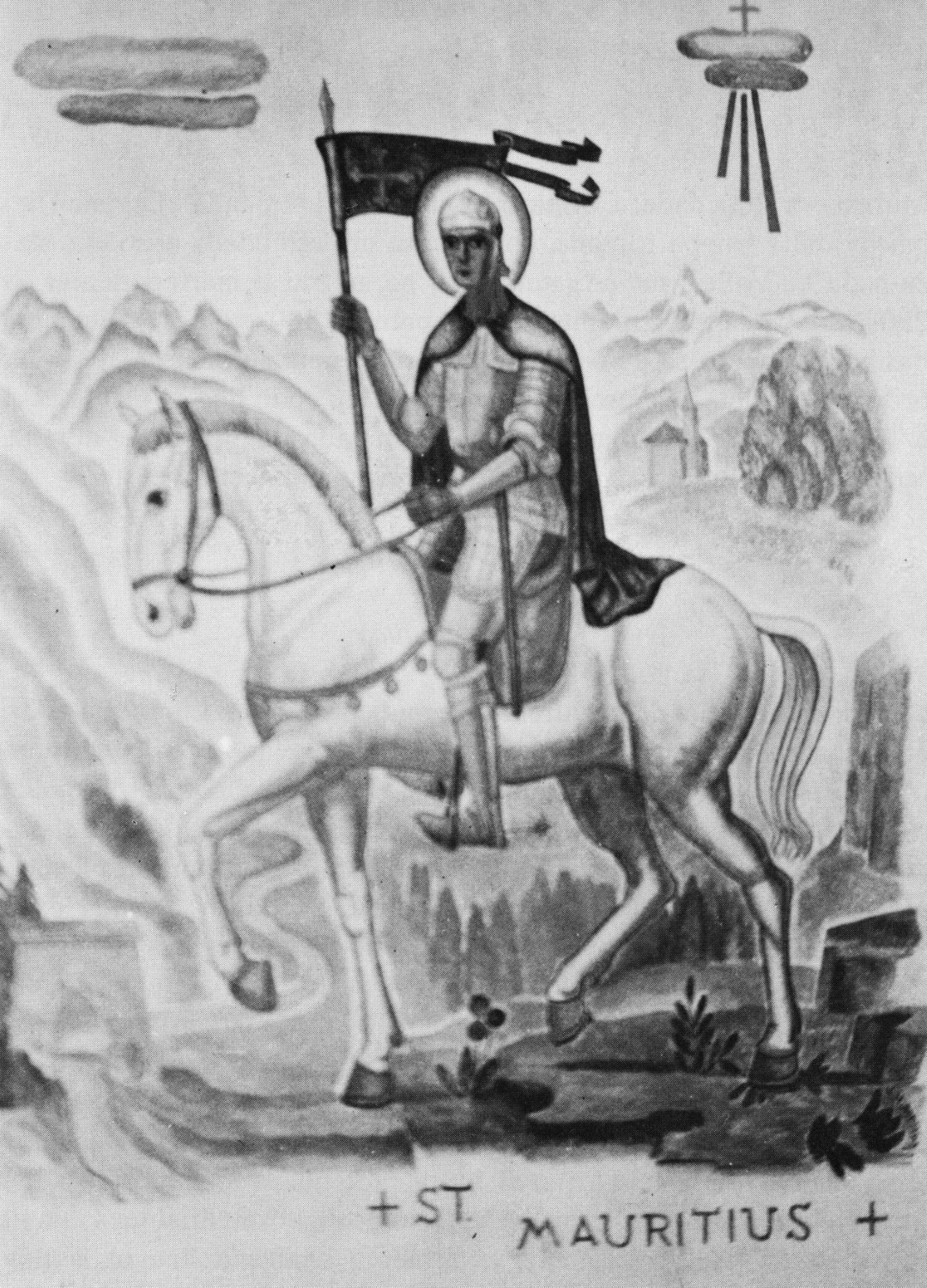
Entuorn ils 1700 era la veglia caplutta daventada scardalida. Ed il niev temps dalla gronda animaziun dil baroc pretendeva in niev edifeci. Ins leva baghegiar pli engiu sper la via, ferton ch’igl ordinariat leva ella sil sulom vegl.193 Gia vevien ins entschiet a baghegiar leugiu, aschia raquenta la détga, mo da notg vegnevi la crappa transportada ensi, leu nua che la caplutta dad oz stat.194 – Sil pli tard 1703 han ins entschiet cul baghiar. P. Bernardino da Concesio, a Cumbel 1704-1709, ha nudau en siu cudisch da quens per igl onn 1703 ina expensa da 282.– fl, vid il baghiar la baselgia da s. Murezi.195 Pèr 1705 ha el nudau il suandont:
«Per finir la erecziun da s. Murezi e pigl arviul e pli clutger, dau da nos daners al meister Giovanni Battista Pedrosso fl. 36.– Per aissas cumpradas a Peiden, per far ils artgs digl arviul, fl. 2.3. Per guotas grondas e pintgas per far il tetg dil clutger fl. 10.– Per la crusch dil clutger. – Per tiara cotschna (terra rossa) per malegiar il clutger. — 1.2 fl. Dau al meister Paul per far il tetg dil clutger da s. Murezi, dil nies: fl. 2.10. Dau al meister Christ da Peiden «per i telari grandi murati vel muro delle fenestre», dil nies 2.8 fl.– Item al fravi da Degen per gavuns per fermar las travs dil clutger 2.10 fl. Per far far ina porta alla baselgia da s. Murezi, guotas e tut fl. 8.2.»196
Plis onns suandonts noda il pader aunc expensas per uorden da baselgia sco suonda:
1707, avrel ils 7. Per far sulada ella baselgia da s. Murezi, cun crappa tagliada, dau al meister per sia lavur fl. 18.7. Per ils dus maletgs dils altars laterals, da s. Giusep e da s. Antoni, dau al meister Giovanni da Glion fl. 48.– ord almosnas e dil nies e per malegiar quels dus maletgs dau al pictur da Camuns en tut fl. 25.–. Per teila stampada per treis antipendis dils altars 3.1 fl.197
Ils 10 d’uost 1710 ei il pictur Giacomo Goliatmetti da Chiavenna secunvegnius cul pader da far il maletg da s. Murezi a cavagl pigl altar grond, per 15 filippis. Il mistral Gieli Arpagaus, ugau dalla caplutta, veva empermess da pagar il maletg. Il fenadur 1711 ei il pictur arrivaus culla harta.198
Il zercladur/fenadur 1716 ha prenci-uestg da Cuera, Duri de Federspiel, consecrau pliras baselgias en Surselva a caschun da sia viseta pastorala e da creisma.199 Ils 30 da zercladur ha el cresmau a Cumbel e consecrau la caplutta da s. Murezi cun treis altars «en honur dalla SS. Trinitad, da Nossadunna e dil SS. Num ed en memoria dil glorius marter da Cristus s. Murezi». Igl altar grond en honur da s. Murezi ha survegniu reliquias dils marters s. Florian, Reparat e Ventura. Al secund, seniester, han ins admess reliquias da s. Clementina e Ventura e dad auters marters, e dedicau el a Nossadunna dallas Dolurs. El tierz en honur da s. Giusep han ins sfundrau reliquias dils marters s. Lucian, Alexander e da s. Ventura. Per quei di ha igl uestg concediti in perdun dad in onn e pigl anniversari mintgamai in tal da 40 dis. Igl anniversari dalla consecraziun ei vegnius fixaus silla emprema dumengia da fenadur.200
Sur il maletg digl altar grond cun s. Murezi a cavagl da Goliatmetti ei aunc in auter maletg da s. Murezi cun ses cumpogns, en cuirass ed armadira, senza signatura e che po datar dalla entschatta dil 17. tschentaner, sco Poeschel manegia, carteivel da Hans Jakob Greutter da Brixen. In auter maletg dil medem maun, cun Nossadunna, s. Stiafen e s. Vintschegn201, ei dalla renovaziun da 1935 vegnius deponius en casa pervenda ed ei barschaus 1952202.
Il zenn pign, 47,5 cm diameter ei culaus da Raghet Matthis 1782, il grond 49 cm, dedicaus a s. Murezi ei culaus 1813 da Josef e Bonifaz Walpen da Reckingen.203 – 1899 ha P. Leonard survegniu sin sia damonda la lubientscha digl uestg Gion Fidel Battaglia d’ereger la via dalla crusch.204
Gia il fenadur 1933 veva sur Const. Theus (1924-33) presentau al cussegl da vischnaunca in pian per la restauraziun, cun in cuost da 4000.– fr. Il cussegl ei d’accord d’exequir.205 Cuort suenter sia entrada ha sur Cristoffel Fetz (1933-42), en cunvegnientscha culla pleiv, schau restaurar parzialmein la caplutta tras la firma Xav. Stöckli, Stans. Ils dus altars laterals ein vegni naven e deponi sil surcombras dalla casa pervenda, per leu ir a piarder per adina dil barschament da 1952: «dus bufatgs altarets cun duas petgas, cruna barocca en colur blaua». El liug dils altars han ins tschentau il vut da Nossadunna da Lourdes e quel da s. Giusep. Las tablas dalla via dalla crusch han ins mess en salv ella casa dasperas. Da leu ein ellas vegnidas 1956 ella baselgia parochiala.206 Simon Albert Arpagaus ha fatg bauns novs, esch, fenestras e scaffa, sco sur Fetz scriva «cun gronda carezia e fetg pauc daner207». 1952, ils 14 d’uost, mo diesch dis suenter il barschament dalla casa pervenda, ei il cametg curdaus el clutger, ha siglentau ina gronda «fuorcla ord il mir d’in cantun da quel, ius tras la preit-mir davos igl altar en e dalla vart seniastra digl altar giu, sfraccau en tocca la passera e siglentau enpaglia bunamein tuts ils veiders dallas fenestras208».
b) Caluster e migiur
Entochen entuorn 1930 habitava il migiur ed el medem temps caluster da s. Murezi ella casa sper baselgia. Ei era il bia ina famiglia plitost basignusa cun plirs affons.209 El regulativ da 1893 stat ei: «La calustria da S. Murezi ei adina vegnida considerada per ina fundaziun en favur da famiglias paupras e duei perquei tier l’elecziun era vegnir risguardau la paupradad.»210 Il caluster/migiur vegneva elegius dalla radunonza communala. Dalla radunonza calonda mars 1860 vegn concludiu: «ch’il caluster da S. Murezi dueigi dacheudenvi vegnir prius si per quater onns e che quel seigi buca elegibels pli, sch’igl ei auters che garegian211».
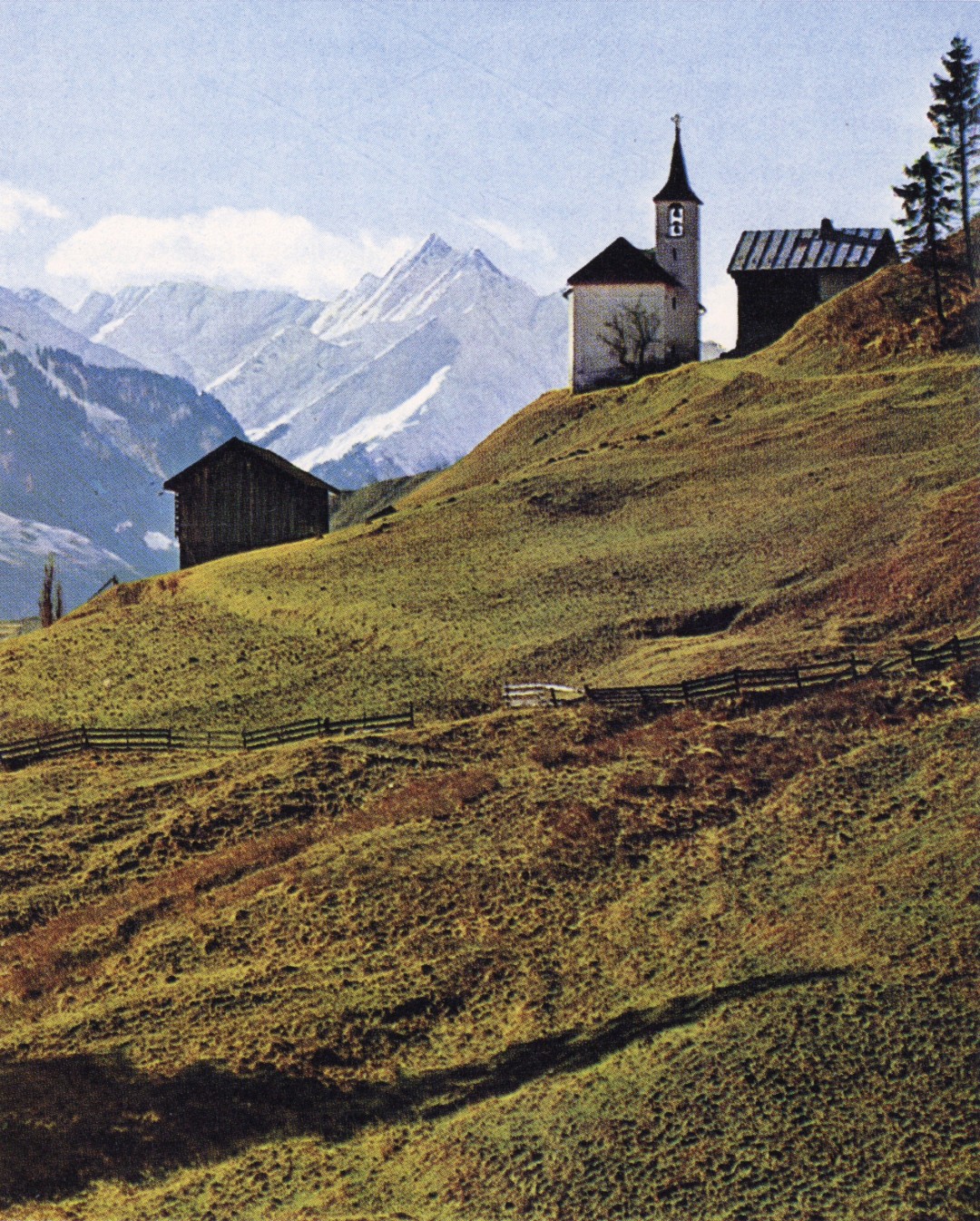
Las obligaziuns dil caluster eran tenor in conclus da 1818 denter auter da «mantener las vias dils maluardaus da Porclas entochen Valgronda, quei s’entelgiescha, quei che in um ed in per bos pon far e quei che ei dapli lavur, ei la vischnaunca obligada da far212». Secund il regulativ da 1893 ha il caluster da tuccar ils zenns treis ga a di e da tuccar ils cuors da bara, encunter ina bonificaziun d’in paun e d’ina crena caschiel. El ha da purtar la crusch «tier tuttas processiuns e funcziuns parochialas213». Plinavon ha el da ver quitau dils baghetgs e da metter annualmein in scatlè schlondas e las lattas per las seifs. 1921 vegn aunc vitier: «Sin igl 1 da november ha el d’admetter il tscheins total agl ugau calustria. Ei il pagament buca pusseivels sin quei termin, sche resta da quel naven il fretg sco segirezia dil tscheins.» Quei onn ei il caluster vegnius elegius per in tscheins da 110.– fr.214 Ei para ch’ins deva bia sil tuccar: «Il caluster da S. Murezi astga buca s’absentar da S. Murezi, sinaquei ch’ei vegni buca negligiu il tuccar d’Ave Maria», vul la lescha communala da 1862.215
Il caluster veva il dretg da gudida dalla casa e dils funs-calustria e pagava in pign tscheins. 1904 per exempel 100.– fr. «sco tochen dacheu216». 1921 ei tenor regulativ «il toc pastira dado baselgia, tochen ora tier il begl ni la via da Bugneida resalvaus al caluster per sia atgna gudida dalla primavera tochen la scargada, aschia che ni las nuorsas ni la biestga da casa astgan pascular sin quei cirquit. La pastira sur via nova e dadens il dutg astga dil caluster vegnir gudida da tut temps.»217
c) Muntada cultica
Il pign sanctuari alla entrada dalla val Lumnezia, cul sogn patrun dalla vallada, veva entochen alla entschatta da nies tschentaner ina remarcabla muntada cultica. Il gliendisdis dallas Rogaziuns vegnevan tut las pleivs dalla entira vallada, deno Val S. Pieder, en processiun a S. Murezi. Il pader da Cumbel veva lu da preparar in bien solver per 12-15 spirituals.218 Ei serimnava in pievelun, vegneva mess ora stans, cumprau e vendiu e fatg fiera e politica. Ei regeva, sco dil reminent era en auters loghens nua che las processiuns serimnavan, da bia disuorden e deva perfin enqual sedada denter buobs e mats dallas differentas vischnauncas.219
Els anno 70 da tschei tschentaner semadira denter il clerus il patratg da far ina migliur. Sur canoni Fontana a Pleif veva fatg in sboz. Tenor quel dueva mintga pleiv far dallas Rogaziuns sia processiun en ina da sias capluttas e mo in da quels treis dis visitar la pleiv vischinonta. Il niev pian ei vegnius suttamess allas pleivs ed acceptaus da tuttas pleivs deno treis. Quei onn 1879 e 1880 ein las processiuns vegnidas fatgas quell’uisa. Denton ei sesalzau ina vehementa opposiziun. Sur Fontana ha scret alla curia denter auter: «Ils ustiers, ils hermers ed ils bueders han buca ruaus ed igl ei da preveder ch’ei fetschien empau disuorden . . . Il capetel ha concludiu unanimamein, culla solia excepziun da Degen, da rugar monsignur uestg, ch’el ordeini autoritativamein da restar tier il niev uorden iniziau.»220
Denter ils opponents sesanflava era igl enconuschent Gion da Farglix (†1894).221 Quel ha il di dallas Rogaziuns 1879 simplamein priu il cafanun dalla caplutta da s. Andriu ed ei semess cun 8-10 da ses adherents en processiun si tras Lumbrein e dalla val ora tochen S. Murezi. Dapertut veva el dau ordras da far tuccar ils zenns cura che la processiun passi tras ils differents vitgs. Daventava quei bue, fageva el mintgaga ir enzatgi dils ses a tuccar. P. Nicolo a Cumbel veva ferdau la puorla e veva fatg serrar la baselgia per ch’ei vegni buca tuccau, ed era fatg serrar la caplutta da s. Murezi. Para che Gion da Farglix hagi era anflau a Cumbel zacons partisans. Quater «rebells» da Cumbel, sco el titulescha els en ina brev alla curia episcopala, hagien aviert la baselgia da s. Stiafen e tuccau duront che la processiun dil Gion da Farglix passavi il vitg e quels hagien era aviert la caplutta da s. Murezi. Cheu hagi il Gion da Farglix fatg in priedi. Tgei ch’el hagi propi detg, sappien ils paucs auditurs buca propi dir, mo probabel hagi el detg pli bia blasfemias che plaids. Ella medema fuorma sco la processiun seigi vegnida, seigi ella turnada anavos. Igl onn suandont, 1879, ha il Gion da Farglix puspei repetiu sia processiun «schismatica». Sin ina supplica dil plevon da Lumbrein, sur Caviezel, da tralaschar quella processiun privata, ha Gion da Farglix rispundiu cun ina brev dils 16 da matg 1879 denter auter: «Avon in onn sundel seresolvius dad ir schi gitg sco Dieus schenghegia a mi la sanadad e fermezia che jeu possel far il viadi, vegnel buca a schar sut da visitar quella veglia caplutta da s, Murezi sin quei gi. Buca aber per far deleit a Pieder ni Paul, sco ei vegn pretendiu. Vaiel aber supplicau negin da tener cumpignia cun mei ed era stuschau naven negin, ed aschia vegnel era a far da cheu naven.» Igl onn suandont, pigl emprem di dallas Rogaziuns ei puspei succediu il medem naven da Farglix e s. Andriu tochen a Valgronda. Il pader da Cumbel figeva spitachels e scriveva traso agl uestg pervia da quella «processione scandalosa e scandalosi eccessi di quel Gion di Farlix e suoi proseliti».
Denton, duront ils onns 1879/80, eis ei vegniu fugau ed intrigau bia encunter il niev uorden. In correspondent lumnezian veva scret alla redacziun dalla Gasetta Romontscha in aschi suarau artechel encunter il niev pian che la redacziun ha buca astgau publicar el e scret enstagl ella proxima numera: «Tenor ina correspondenza lumneziana, par’ei ch’ei seigi en quella vallada tier biars aunc adina malcuntentientscha cul niev uorden dallas processiuns da s. Marc e dallas Rogaziuns . . . mo factum eis ei, ch’igl entir spiritualesser lumnezian era d’accord cun quei niev uorden e che monsignur uestg ha approbau el. .. e perquei cussegliassen nus da seremetter a quella comensurada renovaziun». Denton ei vegni intrigau vinavon. Era la dertgira cirquitala ei s’empatschada dalla caussa. Igl avrel 1880 ei vegniu votau en tuttas vischnauncas cul resultad da 427 vuschs per turnar anavos tiegl uorden vegl e mo 55 per cuntinuar cul niev. Per impedir ils vegls disuordens ha uestg Constantin Rampa ordinau per la Lumnezia «che quels che mondien culla processiun el liug destinau, tuornien ensemblamein anavos culla processiun e che la processiun da scadina pleiv, suenter c. ina ura suenter la messa semetti ladinamein sin via da retuorn222». Era la vischnaunca da Cumbel veva votau ils 6 da mars 1881 unanimamein cun 66 vuschs da turnar «sil pei vegl223». La davosa ga ein quellas processiuns ord tut las pleivs dalla Lumnezia serimnadas a S. Murezi igl onn 1908.224
2. La caplutta da Nossadunna
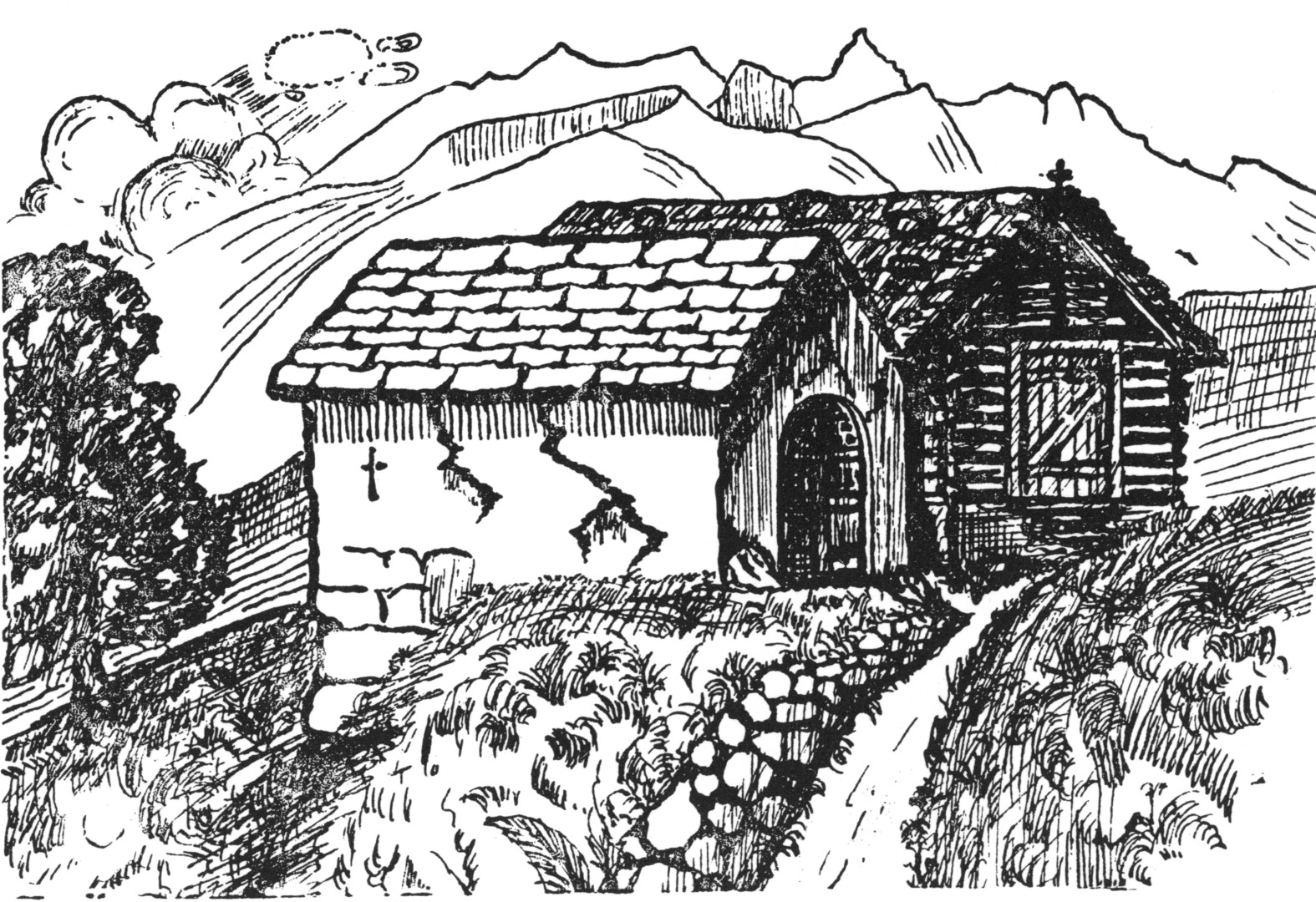
Entochen 1928 steva ina veglia caplutta da Nossadunna dadens il vitg da Cumbel, leu nua che la via veglia traversava la Val-mulin, dadens igl ual, osumsum igl ur dil rieven. Ina cantunada steva gia el liber e veva survegniu enqual cuntscha. Igl edifeci era cuvretgs d’in tetg da grevas plattas e miserava 5 m lunghezia e quasi la medema ladezia. Egl altaret era in maletg da Nossadunna cun s. Andriu e s. Roc e cul fundatur dil maletg ni dalla caplutta, en schanuglias avon Nossadunna. La caplutta mussava largias sfendaglias ella miraglia ed il mument da curdar vegneva pli e pli datier.
Perquei ei la veglia caplutta vegnida spazzada igl onn 1928 per vegnir remplazzada en in plaz pli segir dalla presenta caplutta, ovra exequida sut l’egida dil plevon da lezzas uras, sur Constantin Theus.
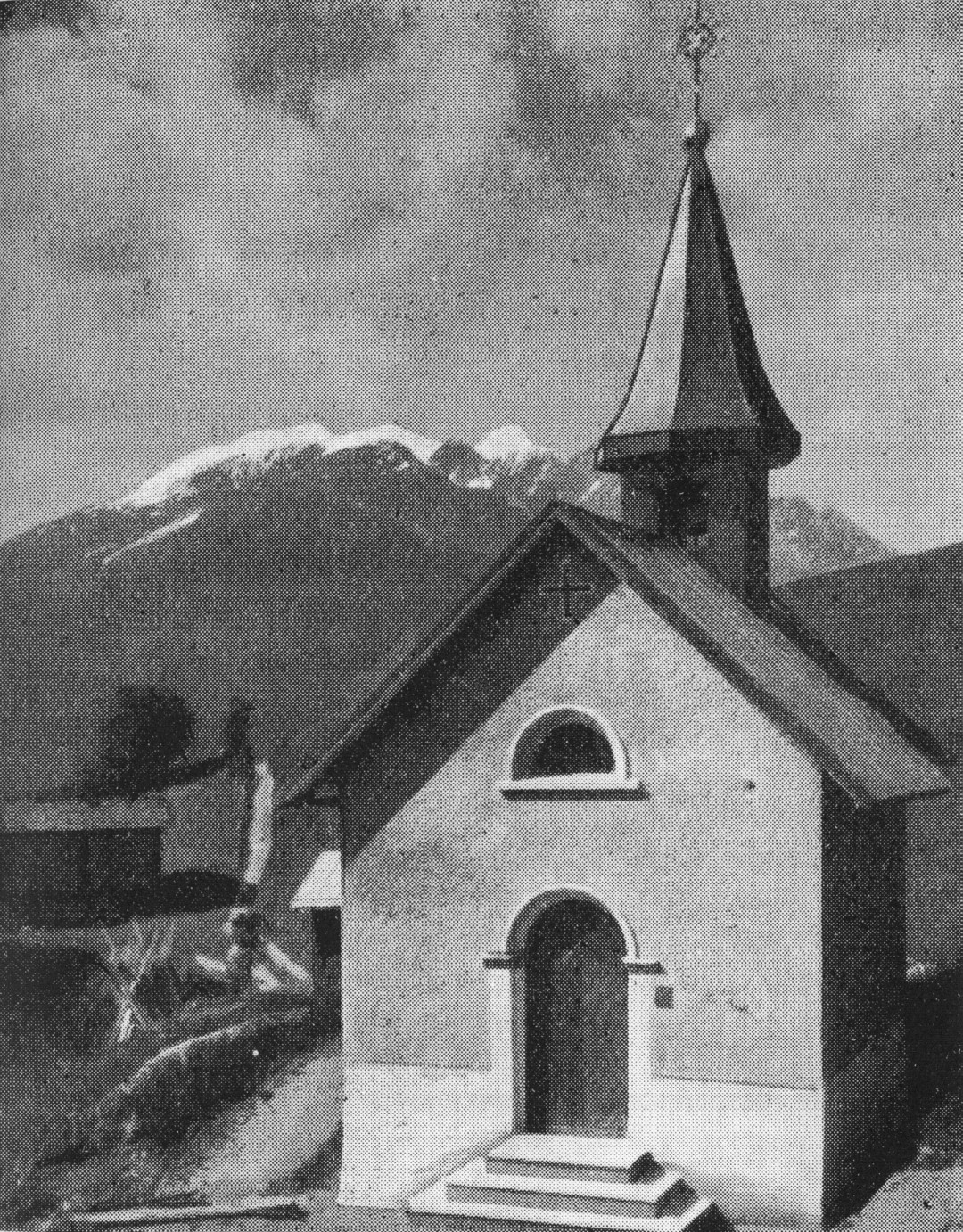
Quel ha cun la medema caschun publicau in cuort tractat, ton sur dalla caplutta veglia, sco sur dall’erecziun dalla nova.225 Igl autur citescha ina scartira da 1789, scretta d’in cert Hercli Antoni Arpagaus.226 En quella vegn il fundatur dalla caplutta, in cert Giachen Antoni Caheni numnaus.227 Quel hagi incaricau ses artavels da mantener ina glisch ella caplutta duront la notg dallas sondas e vigelgias. Quei seigi era vegniu observau. Il fundatur dalla caplutta, Caheni, pastur ella alp da Seglias, surprius dalla madernatscha, hagi fatg il vut a Nossadunna da baghiar quella caplutta en sia honur, sch’ei vegni meglier. Aschia raquenta la detga. Poda ch’ei po star sin ina ni l’autra semeglionta moda. Igl um en schanuglias avon Nossadunna silla harta digl altar indichescha evidentamein in Ex Voto. Il maletg ei ussa ella caplutta nova, dretg vid la preit.
Il zercladur 1928 ha il miradur Giovanni Perolo da Sondrio entschiet culla lavur. Cun quei ch’el veva priu avon da far tut persuls sulets la lavur da miradur ha il baghiar cuzzau quater stendidas stads. Ils 27 da settember 1931 ei la caplutta vegnida benedida dil vicari episcopal sur Cristian Vinzap, plevon a Surcasti. Il zennet ei il zenn pign dil tuchiez vegl da Morissen, ch’era vegnius en possess privat e cedius al sanctuari da Nossadunna. E zun impurtont ed interessant ei quei che sur Theus scriva alla fin da sia lavur:
«El mir dalla fatschada, c. 70 cm sut il cantun dretg dalla mesaglina ein enzacontas copias dallas scartiras dalla caplutta zuppadas, sco era enzacontas notizias sur la vischnaunca da Cumbel. Ils survivents dil giuvenessendi, tochen lu cuozza la garanzia dil miradur, vegnan ad anflar ellas sils mirs curdai.»
Cheu vegn pia era ad esser la sura menziunada scartira da 1789, che spetga silla sballunada dil giuvenessendi.
VI. Spiritualesser
1. Ils paders caputschins, plevons e gidonters
Sur Cristoffel Willi ha ediu 1960 in voluminus cudisch litografati cun ils paders caputschins dalla Missiun Retica sin territori romontsch.228 Nossa gliesta dils paders che han pastorau a Cumbel suonda sias indicaziuns biograficas dalla emprema e secunda part da quella ovra. Ils paders eran endisai dalla claustra anora ad ina veta communabla. Perquei sestentavan els ton sco pusseivel era da mantener quei ella Missiun. Perquei eran els il bia en dus sils singuls posts en casa pervenda, ni magari plirs en pleivs pli grondas cun exposituras. El suandont register alleghein nus tuts ils paders plevons sut enumeraziun currenta cun mintgamai quels paders che han pli ditg ni pli cuort surviu ad els. Beinduras eis ei denton grev dad intervegnir cun segirezia, qual dad els ei propi il plevon. Ils paders fagevan – per sesurvir dils agens plaids da in dad els – sco buns confrars baul in e baul l’auter igl uffeci da plevon, tenor ils basegns e las circumstanzias dalla Missiun.229
-
P. Ireneo da Casalmoro, da 1649-1665.230
Sut el han aunc surviu pli pauc ni pli bia: P. Benedetto da Brescia, *nudaus ei cudisch da mortoris mo inaga: ils 29.11.1653
*P. Zaccarias da Salò, ha battegiau cheu ils 25 da mars 1655. Para dad esser staus cheu mo transitoricamein, per lu turnar 1684 sut P. Basilio per varga 20 onns.
P. Francesco da Caino ei staus a Cumbel sco gidonter e lu plevon silmeins 22 onns, da 1657-1679.231 -
P. Francesco da Bagolino, sco plevon documentaus mo dils 7 da schaner tochen ils 15 da fenadur 1667. Naschius c. 1629, ha operau ella Missiun 1659 a Casti ed ad Alvaschein e 1668 a Brinzeuls ed a Mulins, a Vaz ed a Lantsch.232
-
P. Ambrogio da Fontanella, documentaus a Cumbel mo dil december 1667 tochen december 1668. Sin gidonter era P. Francesco da Caino. Da cheu eis el ius ella missiun da Mulins e Sur tochen 1678 e 1679 a Riom. Suenter 16 onns ella Missiun eis el 1679 serendius en sia provinzia ed ei morts ella claustra da Bergamo 1684.233
-
P. Francesco da Caino, 1669. El sescriva era Francesco da Brescia. Nasch. c. 1619, operau ella Missiun 1658 a Brinzeuls e 1659 a Sevgiein ed il pli ditg sco gidonter a Cumbel, sco sut nr. 1.234
-
P. Paul d’Agnosegno, doc. a Cumbel dils 10 da zercladur 1670 tochen il settember 1671. Cun el gidonter P. Francesco da Caino. Cun P. Paul veva Cumbel in dils principals caputschins en Rezia. Viceprefect. Duront ils grevs embrugls confessiunals el Grischun e cunzun cun lur fueina a Tumegl da 1671-1674, eis el staus a Tumegl, mess leu dil nunzi papal Edoardo Cibo. Da quei temps smanatschavan ils protestants da scatschar ils caputschins dils loghens paritetics ord la tiara.235
-
Marcantonio da Grosio, da 1671-1676. Nasch. c. 1629. Staus ella missiun a Tarasp 1665-1671, e lu zatgei a Casti 1671. Siu gidonter a Cumbel ei aunc adina P. Francesco da Caino, che funcziunescha cheu era duront las vacaturas da plevon.236
-
P. Angelo da Bergamo, 1677, documentaus el cud. da batten mo cuort dils 25 da schaner tochen ils 2 da fevrer 1677 ferton ch’el senumna leutier plevon. Siu gidonter P. Francesco da Caino.237
-
P. Patrizio da Brescia, da 1677-1684. Nasch. c. 1637. 1669 sesanfiava el a Riom sco student dalla teologia, 32 onns vegls ed a Riom documentaus gia 1665-1670, a Brinzeuls 1671, a Lantsch sco gidonter 1672, a Tarasp 1673-1676. Suenter sia partenza da Cumbel 1684 eis el buca d’anflar pli ella Missiun ed ei probabel returnaus ella provinzia. Morts a Tirano 1720. Ses gidonters: il fideivel P. Francesco da Caino tochen ils 4 da settember 1679. In pader cul num Ireneo (buca Ireneo da Casalmoro, morts 1671) 1681/82; P. Tranquillo 1680; P. Pacifico da San Gervasio 1682. P. Ippolito da Scalve 1683.238
-
P. Basilio d’Iseo, da 1684-1703. El ei documentaus a Brinzeuls sco gidonter 1673/74, a Mulins/Sur 1677, Savognin 1682, Riom 1681-1684. Naven da Cumbel va el aunc a Brinzeuls sco plevon 1704-1706 ed ei d’anflar a Camuns 1707. Sco gidonters numna Willi:
P. Zaccarias da Salô da 1684 tochen sia mort ils 27 da fevrer 1705. Igl enconuschent scribent dalla Glisch sil Candelier e d’autras scartiras vegn denton era ad haver funcziunau denteren sco plevon. Pli bia sur dad el sutvart.
P. Bartolomeo da Capreolo 1686/87 e 1702-1704
P. Giuseppe da Pontevico documentaus mo ils 12 da fenadur 1689 P. Bonaventura da Tremosegno, documentaus mo ils 21 da schaner 1691
P. Francesco da Castiglione, doc. mo ils 2 da dec. 1693
P. Giacomo da Scalve, doc. 25 da schaner tochen ils 16 da mars 1698239 -
P. Bernardino da Concesio, da 1704-1709. Avon eis el staus gidonter a Sumvitg da 1696-1704. Lu eis el d’anflar a Camuns sco gidonter 1710-1713, lu sco plevon a Sevgein da 1714-1719, denteren 1716/17 gidau ora ad Alvagniu, da 1720-1729 eis el buca d’anflar ella Missiun ed ei probabel returnaus en sia provinzia per returnar en Rezia 1729-1732 sco plevon a Sevgein. Ses gidonters a Cumbel ein:
P. Crisostomo da Brescia, 1706/07 e
P. Francesco da Sarnico, documentaus mo ils 9 d’october 1708.240 -
P. Bartolomeo d’Iseo, da 1709-1715. El ei staus c. 1733 provinzial da Brescia e lu era prefect dalla Missiun Retica ed ei morts 1742 ad Alvaschein. Ses gidonters a Cumbel ein:
P. Francesco da Samico, doc. mo ils 10 ed ils 17 da zercladur 1710 P. Leone da Bergamo, doc. ils 4 d’oct. 1710 ed ils 25 da schaner 1713
P. Felice da San Felice naven digl october 1710 – october 1715 P. Bernardino da Brescia, doc. mo ils 2 da dec. 1715241 -
P. Viatore da Chiari, ei documentaus el cudisch da batten mo ils 16 da schaner 1716 tochen ils 6 da mars 1716. Avon eis el staus missiunari a Lantsch 1687 ed a Sumvitg da 1691-1696. El ei morts anetgamein cun 65 onns a Cumbel ils 16 da mars 1716 ed ei vegnius satraus en baselgia.242
-
P. Aurelio da Verola, documentaus els cudischs parochials da 1716 tochen ils 4 da fenadur 1726. Staus avon a Sumvitg gidonter da 1707-1715. Cun sia partenza da Cumbel 1726 para el dad esser returnaus en provinzia. El ei morts ils 22 da settember 1730 ella claustra da Bergamo ed ei satraus leu. Ses gidonters a Cumbel ein:
P. Lorenzo da Poschiavo 1716-1719
P. Mattia da Salo 1719/20
P. Bernardino da Concesio da 1721-1730.243 Quel vegn ad haver funcziunau da plevon entochen -
P. Daniele da Bagnolo, ha surpriu la provisura doc. dils 5 d’avrel 1731 – december 1732 e lu gidonter tochen schaner 1733. Naschius 1685, profess cun 18 onns. Vegn lu ella Missiun a Sumvitg e finescha leu ses studis sut la direcziun da P. Onorio da Brescia, lector 1714-1716, gidonter leu 1716-1719. A Savognin 1720, a Camuns 1721/22, Sumvitg 1723, ad Almen plev. 1734-41, a Tumegl 1741-1760. Morts ils 11 da november 1760 a Tumegl, 16 onns viceprefect.243a – P. Daniel ei era sefatgs meriteivels al pievel romontsch catolic e sia litteratura religiusa. El ha scret in cudisch apologetic sut il tetel: «Defensiun della vera cattolica romana cardientscha . . .», stampaus 1746 a Panaduz tras Mattias Maron.
Da quella ovra di prof. dr. Guglielm Gadola, che dapi lu hagi la litteratura religiusa catolica buca giu pli ina ovra che havessi declarau aschi profund e detagliadamein sia cardientscha e sia ductrina.244 In auter cudisch, stampaus a Panaduz 1751 secloma: «Cuorta Dedicaziun, oder Parafrasi digl Offici de Nossa cara donna sontga Maria». Cheutras ha el gidau a mantener ed a promover las devoziuns dallas viaspras, dil cumplet e digl uffeci da Nossadunna e digl uffeci da morts, sco ellas vegnevan aunc avon buca ton ditg cantadas ni uradas en nossas pleivs romontschas.245 -
P. Eugenio da Breno, naven dil december 1732 – settember 1734 e naven dil settember 1738 – matg 1740. El ei staus ella Missiun 1700-1702 a Casti cun Stierva. Naven da Cumbel eis el ius sco plevon a Vaz 1734-1738 ed ad Alvaschein 1740-1742. Entuorn 1715 ni 1716 eis el vegnius clamaus ella Provinzia, nua ch’el ei staus repetidamein guardian e professer dalla teologia. Viceprefect 1733-1742. Morts ad Alvaschein ils 14 da zercladur 1742 cun 71 onns. Ses gidonters ein stai:
P. Daniele da Bagnolo 1732/33
P. Giacinto da Savallo 1739
P. Bonaventura da Paspardo 1739
P. Bartolomeo da Carpenedulo 1739/40
P. Carlantonio da Chiari 1740246 -
Gianbattista da Chiari, documentaus dil december 1734 – zercladur 1736. Avon era el aunc staus silla Missiun a Danis, Sevgein ed a Sumvitg. Siu gidonter ei il suranumnau P. Giacinto da Savallo.247
-
P. Clemente da Brescia, documentaus a Cumbel mo dil november 1736 – settember 1737. Ei setracta digl enconuschent historiograf dalla Missiun Retica. El ha entschiet culla pastoraziun en Rezia 1730 a Casti ed ei lu aunc staus, il bia mo per cuort temps sin divers posts, il davos ad Almen 1750-1754. Morts a Brescia ils 23 da zercladur 1768. Siu gidonter a Cumbel ei il suranumnau P. Giacinto da Savallo.248
-
P. Daniele da Crema, a Cumbel doc. mo per c. in onn 1737/38. El cumpara ella Missiun entuorn 1720 ed operescha en divers loghens mo per cuort temps, il davos sco plevon a Vaz 1738-1756 ed ad Alvaschein 1756/57. Siu gidonter a Cumbel: il suranumnau P. Giacinto da Savallo.249
-
P. Eugenio da Breno, da 1738-1740, per la secunda ga a Cumbel, sco sura nr. 15.250
-
P. Ludovico da Bedizzole, da 1740-1787. Suenter ch’ils biars ein stai a Cumbel mo per cuort temps, vein nus ussa in ch’ei staus cheu 47 onns. Avon eis el staus a Vaz gidonter 1734-36 e sco tal ad Alvagni 1736/37 e plevon ad Alvaschein 1738-40. Morts a Cumbel ils 11 da matg 1787 cun 85 onns, el 66avel onn da siu profess e 53 onns ella Missiun Retica. El ei satraus ella baselgia da s. Stiafen avon igl altar lateral dretg. Ses gidonters ein stai sper il suranumnai Carlantonio da Chiari (nr. 15):
P. Fedele da Palazzole 1744-1750
P. Giacinto da Preseglie 1751
P. Fedele da Monastero (Müstair 1752)
P. Carlo da Luere 1752
P. Prospero da Brescia 1752-1754
P. Carlo Giuseppe d’Almeno 1756-1759 e 1770-1775
P. Ubaldo d’Idro 1760-1770
P. Tomaso da Bergamo 1775 tochen la mort da P. Ludovico, lu siu successur sco plevon. Denteren ein aunc stai gidonters a Cumbel: P. Lorenzo da Clusone 1779
P. Francesco da Ponte 1776
P. Aurelio da Bergamo 1780-1786
P. Gianpietro da Zono matg e zercladur 1783251 -
P. Tomaso da Bergamo 1787-1811. Quei pader ei staus 36 onns a Cumbel, igl emprem naven da 1775 sco gidonter e lu, forsa gia in per onns avon la mort da P. Ludovic, segir denton dapi 1787, sco plevon. Ella Missiun a Mustér 1765-1775. 46 onns ella Missiun. Ei vegnius tuccaus dalla daguota sin scantschala duront il priedi ed ei lu morts suenter 7 meins ils 20 da matg 1811 e satraus en baselgia parochiala avon igl altar lateral seniester. Morts cun 75 onns. Viceprefect da 1794-1807. Tenor l’inscripziun el cudisch da mortoris era el in excellent predicatur.252 Ses gidonters ein:
P. Francesco Maria da Brescia 1787/88
P. Carlo Giuseppe d’Almeno 1788/89
P. Gianmaria d’Alzano 1791/92
P. Lauro da Valtorta 1793/94
P. Pietro da Crema 1795
P. Vito da Romano 1796-1800
P. Atanasio da Brescia 1798
P. Giovanni d’Alzano 1802
P. Gianmaria da Bergamo 1802-1804
P. Felice Maria da Bergamo 1806 e 1810/11. Ei daventaus successur sco plevon da P. Tomaso.
P. Paulo da Rosciate 1807
P. Angelo da Bagnolo 1808/1809
P. Paulo da Brescia 1809
P. Timoteo da Brescia 1810253 -
P. Felice Maria da Bergamo 1811-1833. Naschius c. 1776. Siu num da batten e famiglia: Giovanni Natali. 1803 ella Missiun e finescha cheu ses studis teologics. Gidonter a Mustér 1804, a Camuns 1805, a Mulins e Tinizong 1805-1810. Morts en sia patria ils 30 d’avrel 1860 dad 84 onns. Ses gidonters:
P. Angelo da Demo 1814
P. Stefano da Verola 1816
P. Gianfrancesco da Verola 1819
P. Paolandrea da Bergamo 1822, 1823, 1825, 1829
P. Tomaso da Muscoline 1828254 -
P. Angelo da Moncaglieri da 1833-1839. 1836 eis el vegnius elegius prefect dalla Missiun entras la congregaziun de propaganda fide. Sco tal tochen 1839. Quei onn eis el returnaus en provinzia.255
P. Angelo patertgava social e caritativ e mava entuorn cul patratg da fundar in spital per catolics e reformai. Ei seigi egl entir cantun buca in tal per gidar ils malsauns. Ils 10 da zercladur 1838 ha el scret agl uestg Bossi pli consentiment, denter auter: «Jeu hai plidau cun zacons signurs dalla regenza e sperel da contonscher igl intent.» Igl uost ha il cancelier episcopal Baal rispundiu, che la curia sappi buca dar ina «totala approbaziun». La risposta cunteneva diversas difficultads.256 Sin quei para ei ch’il bien pader hagi dau si siu pian. Siu gidonter ei stau il suranumnau P. Paolandrea da Bergamo 1836-1840.257 -
P. Bonaventura da Garesio 1839-1862. Naschius ils 16 da fenadur 1810, schlatteina Carrava, dalla provinzia da Turin, profess ils 4 d’uost 1826. Ella Missiun 1838, in onn a Vaz e lu 23 onns a Cumbel. 1862 ius malsauns en sia patria e morts leu en sia claustra a Turin igl 1 da schaner 1863 mo cun 53 onns. Ses gidonters a Cumbel :
P. Stanislao da San Leucio 1846
P. Ottavio da Carmagnola 1852/53. Surveva lu a Camuns.
P. Gianmaria da Bione, caplon a Peiden, 1859
P. Benvenuto da Viterbo 1860
P. Luigi da San Stefano 1860-62258 -
P. Bernardo da Serra 1862/63. Naschius ils 15 da mars 1821. Ella Missiun 1860 a Salouf e 1861/62 a Vaz. Suenter eis el aunc dad anflar a Mulins, Vaz ed a Schluein tochen 1869. Siu gidonter a Cumbel: il suranumnau P. Luigi da San Stefano.259
-
P. Felice da Taggia 1863-1871. Naschius ils 15 d’avrel 1811, schlatteina Revelli, dalla provinzia da Roma. Ella Missiun 1840 a Mulins, 1841 Casti, a Vaz, Salouf, Almen, a Bivio ed a Sevgein. Naven da Cumbel 1871 eis el aunc staus a Surava ed a Mulins 1875-1880. Morts a Muhns ils 27 da fevrer 1880 cun 68 onns, 40 onns ella Missiun. Ses gidonters a Cumbel:
P. Calissto d’Arezzo 1871 en absenza dil plevon.
P. Bernardo da Serra 1867260 -
P. Nicolao d’Alessandria 1871-1895. Naschius igl 1 da schaner 1825. Ella Missiun 1851, a Vaz 1852, a Tinizong 1852/53, a Surava 1853-1871, iu a Cumbel per 25 onns. Sia schlatteina era Rossi, derivonts dalla provinzia da Roma. Ses gidonters ein il suranumnau P. Calisto d’Arezzo a Peiden 1871, 1872, 1875, 1876 e 1878, sco era il sura (nr. 24) P. Ottavio da Carmagnola 1888-1892. Plinavon:
P. Innozenzo da Palestrina 1873
P. Antonio da (Badaluzzo?) 1873/74
P. Bernadino Cavallo da Napoli 1876/77
P. Alessandro da Cassine, da Peiden anora 1884
P. Rogerio da? 1886 en absenza dil plevon261 -
P. Leonardo da Troncana 1895-1902. Siu num fuss: Leonardo Troncana, da Ceppina, Lombardia. Naschius 1850, ordinaus 1881, ella Missiun 1885, missiunari a Mulins, Rofna, Alvaschein, Vaz ed ad Almen. Naven da Cumbel eis el aunc staus a Viano ed a Camuns, nua ch’el ei morts ils 28 da fevrer 1921.262
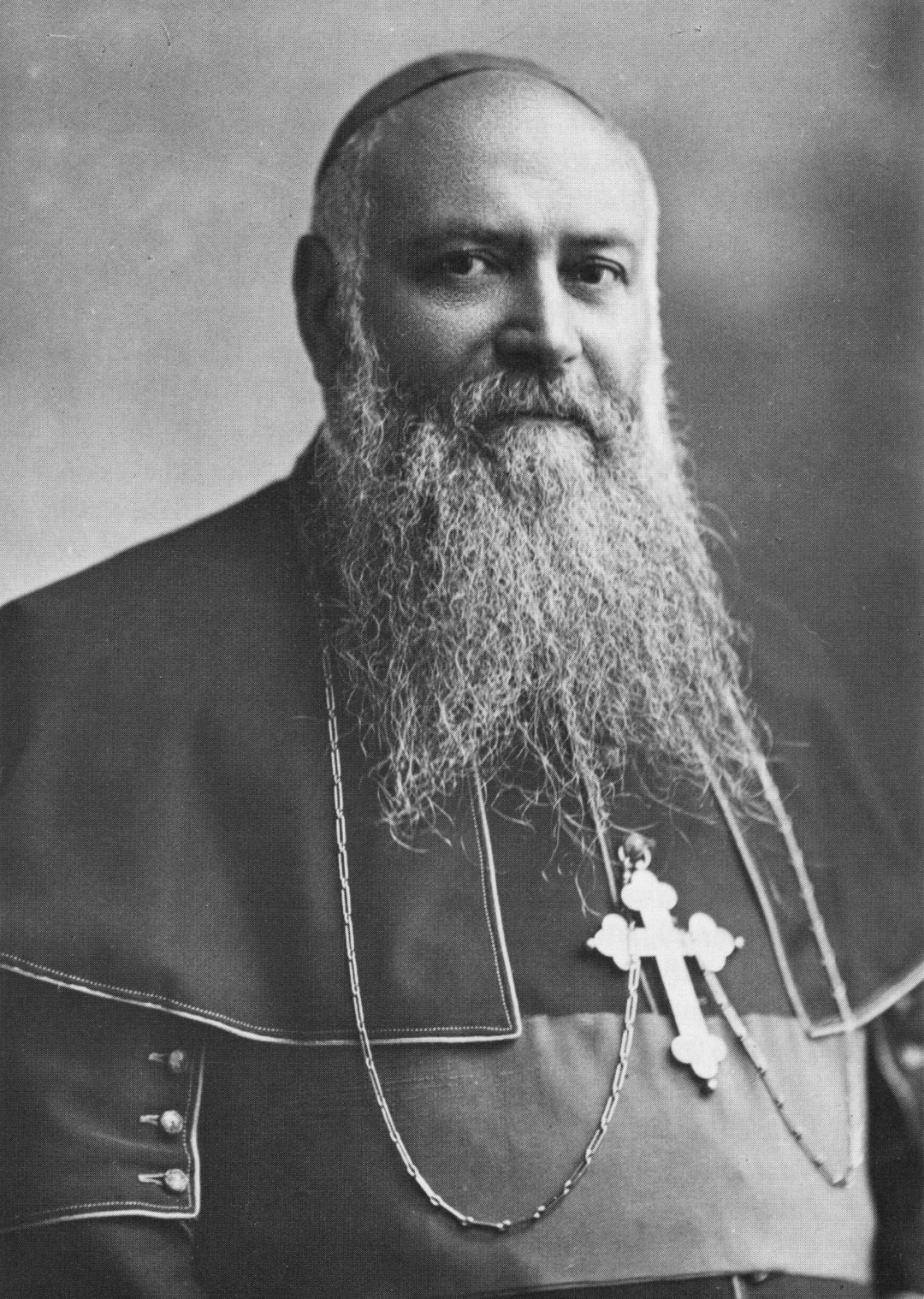
- P. Giovanni da Rieti 1902-1905. Naschius ils 5 d’uost 1867, dalla provinzia da Roma, ordinaus 1890, ella Missiun uost 1892, prefect dalla Missiun 1905-1912. Sia schlatteina: Santini. Ella Missiun a Vaz, Salouf ed a Casti. Naven da Cumbel eis el aunc staus cuort a Casti, Planoiras. 1913-1919 ord la Missiun. Returnaus 1919 vegn el puspei numnaus prefect ed operescha a Savognin ed a Casti. Ils 3 da settember vegn el numnaus uestg titular da Zana. Il settember 1925 banduna el la Missiun. Morts a Roma ils 20 da zercladur 1940.263 Ses gidonters a Cumbel:
P. Fedele da Roma 1902/03
P. Lorenzo da Celeno 1903
P. Giacomo da San Giovanni Rotondo 1904
P. Fedele da Collepardo 1904/05
P. Nazareno da Fabriano 1904
P. Felicissimo da Trevigliano 1905
P. Celestino d’Alazri 1905264
P. Giovanni da Rieti 1867-1940, a Cumbel 1902-05, 1925 uestg titular
P. Urban, plevon a Cumbel 1905-1917
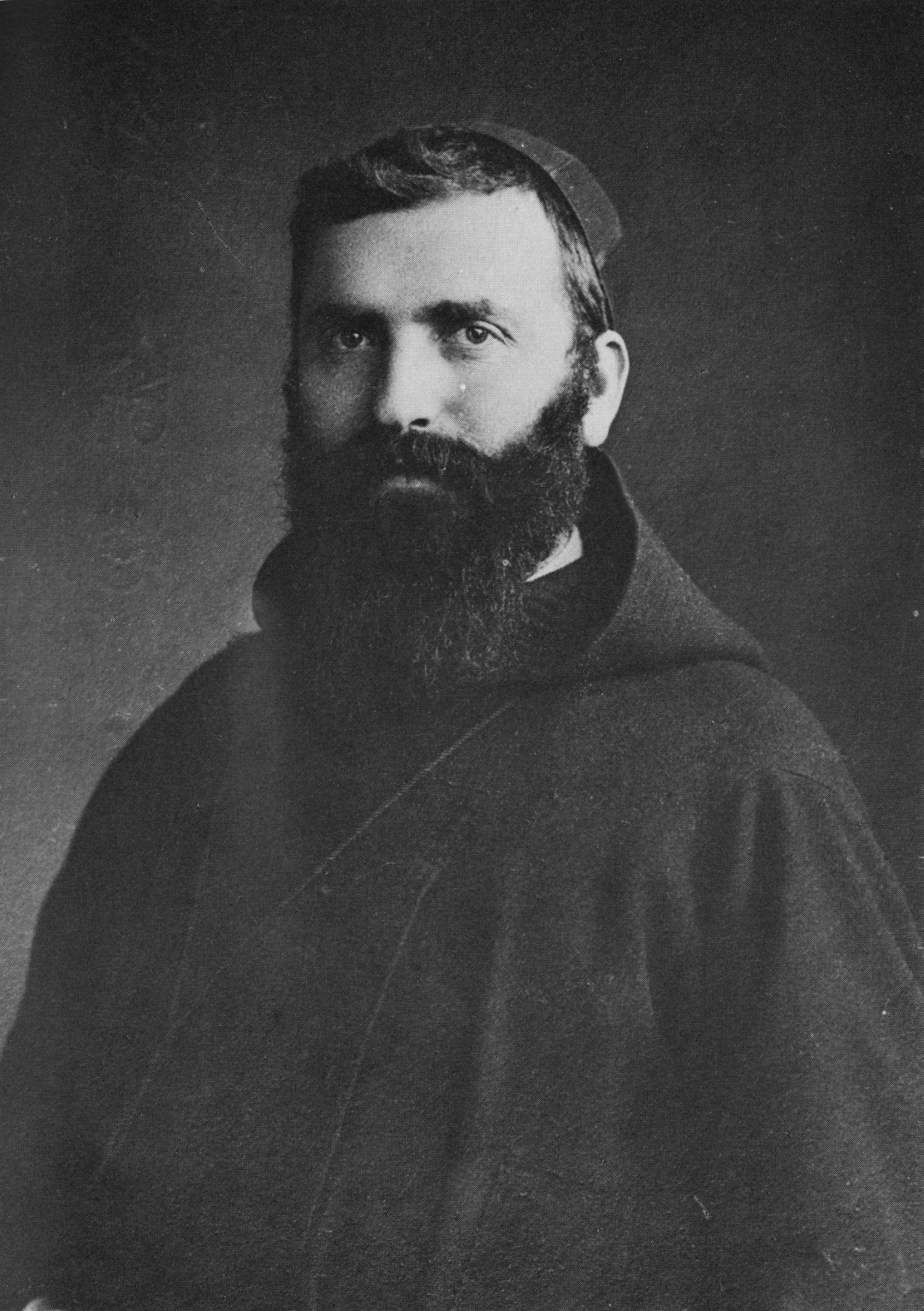
-
P. Urbano da Guarcino 1905-1917. Naschius 1874, schlatteina Menna, dalla provinzia da Roma. Ordinaus 1898. Ella Missiun 1899, empriu romontsch a Casti, gidonter 1903-1905. Naven da Cumbel eis el ius 1917 a Savognin, nua ch’el ha pastorau entochen sia mort ils 4 da schaner 1942. Naven da 1925 tochen sia mort eis el staus superiur dalla Missiun. Ses gidonters a Cumbel ein il suranumnau P. Felicissimo da Trevigliano 1910/11 e
P. Pietro Truscoli da San Rufino 1916
P. Daniele Adamina, da Orsolina, Tessin.265 -
P. Lino da Guarcino 1917-1923. Naschius 1875. Schlatteina Morocco. Ella Missiun 1899. Gidonter a Vaz 1899/1900, ed a Roffna. 1905 banduna el la Missiun. 1915 puspei anavos ed operescha a Lantsch ed ad Alvaschein. 1923 ils 29 da november banduna el Cumbel e la Missiun. Il davos dils paders da Cumbel. Sco gidonter a Cumbel eis el sesurvius denteren dil suranumnau (nr. 29) P. Fedele da Collepardo, da gliez temps plevon a Peiden.266
2. Ils paders van
Cun decret dalla Congregaziun de Propaganda Fide dils 3 da matg 1920 ei la Missiun Retica che ha cuzzau exact 300 onns vegnida sligiada. Da lezzas uras vegnevan 20 pleivs ni filialas pastoradas da paders dalla Missiun. Igl Uorden dils caputschins ha concludiu, en entelgientscha cugl uestg Georgius Schmid, da buca termetter pli paders en Rezia, «denton da schar ad interim vinavon quels che sesanflan dapresent ella Missiun267». Las pleivs dalla Missiun ein vegnidas orientadas tras circulara. Alla radunonza communala da Cumbel dils 30 d’october 1921 vegn discurriu surlunder e la radunonza pren, tenor protocol, suandonta resoluziun: «La vischnaunca seregorda dils gronds merets dalla Missiun e consenta en ina communabla acziun da supplica agl uestgiu per mantener vinavon ils beinmeriteivels paders capuziners. Tala acziun duei demussar la renconuschientscha viers la Missiun, mo duei representar negina protesta visavi autoritads ecclesiasticas . . .»268 Cun contract dils 19 da november 1921 denter igl uestg Georgius Schmid e la direcziun digl Uorden ei vegniu precisau, ch’ils singuls paders sappien restar vinavon sin lur post. Quels posts denton, che vegnan vacants tras la mort d’in pader ni tras voluntari seretrer, dueien da leu naven vegnir remplazzai da spirituals diocesans. Igl uost 1955 ha il davos pader dalla Missiun, P. Daniele Adamina, bandunau sia pleiv da Casti, per seretrer en sia provinzia tessinesa. La pleiv da Casti denton ei tras cunvegna denter la curia episcopala ed il provinzial dil Tessin vegnida confidada alla provinzia tessinesa, culla cundiziun, che silmeins dus paders seigien staziunai leu ei survetsch dalla pastoraziun.269
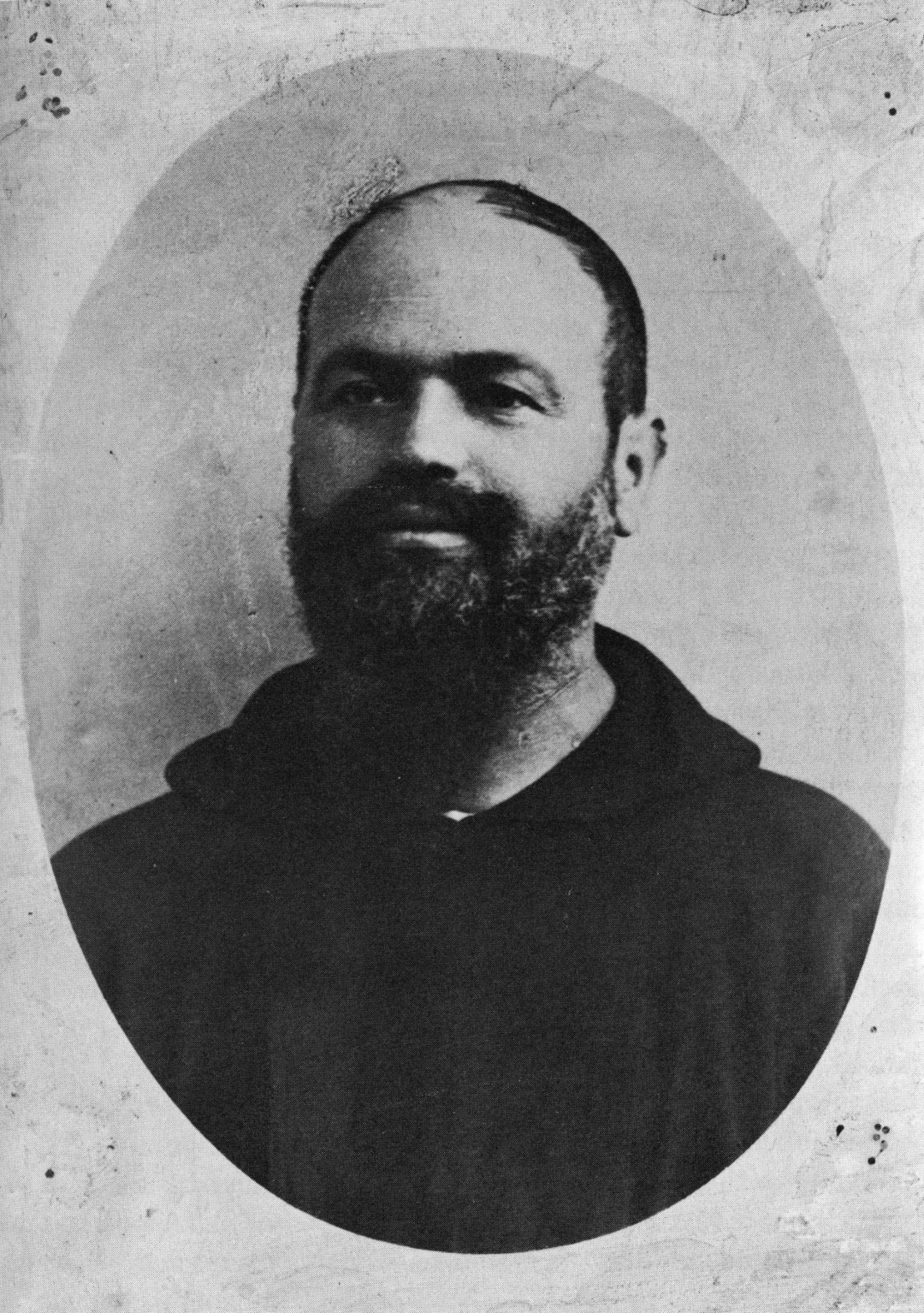
A Cumbel ei P. Linus aunc staus dus onns. Ils 29 d’october 1923 ha il prefect dalla Missiun, P. Giovanni, communicau orda Casti alla pleiv da Cumbel, «ch’il cussegl dalla Missiun Retica hagi en sia sessiun dils 23 d’october designau. P. Linus sco plevon a Mulins e sco siu successur ella pastoraziun da Cumbel hagi el elegiu P. Pieder, tochen dacheu plevon a Mulins270». Tgei ch’igl ei schabegiau denteren savein nus buca, P. Linus ei buca ius a Mulins, mobein ei cun consentiment da ses superiurs seretratgs en claustra. Aschia ha el era buca saviu vegnir remplazzaus da P. Pieder. E la pleiv da Cumbel eroda ussa, tenor cunvegna, al quitau digl uestg da Cuera. Cun bials plaids pren il prefect dalla Missiun cumiau da Cumbel: «Nus denton prendein cheutras cumiau dalla ludeivla pleiv da Cumbel, engraziond cordialmein a quella per tutta carezia ed attaschadad ch’ella ha adina mussau visavi alla Missiun Retica, sco era visavi a ses paders duront ils treis tschentaners da lur pastoraziun leu. Veglien nies glorius bab s. Francestg e nies patrun e confrar s. Fidel remunerar persuenter, tras implorar sur da quella pleiv la pli reha benedicziun dil Segner.»271
Ils parochians bandunai paran dad esser stai empau surstai dalla anetga midada. Il cussegl communal, che crei «che quella midada seigi stgira», concluda da dumandar il pader prefect, «danunder la midada derivi». Cuort suenter era la risposta cheu: «cun satisfacziun alla pleiv, essend che quella hagi ufficialmein giavischau negina midada272». La pleiv erodi alla curia episcopala e vegni buca pli provedida da paders dalla Missiun.273 Ils 29 da november 1923 ei il davos pader brin ius da Porclas ora.
3. Ils plevons spirituals diocesans
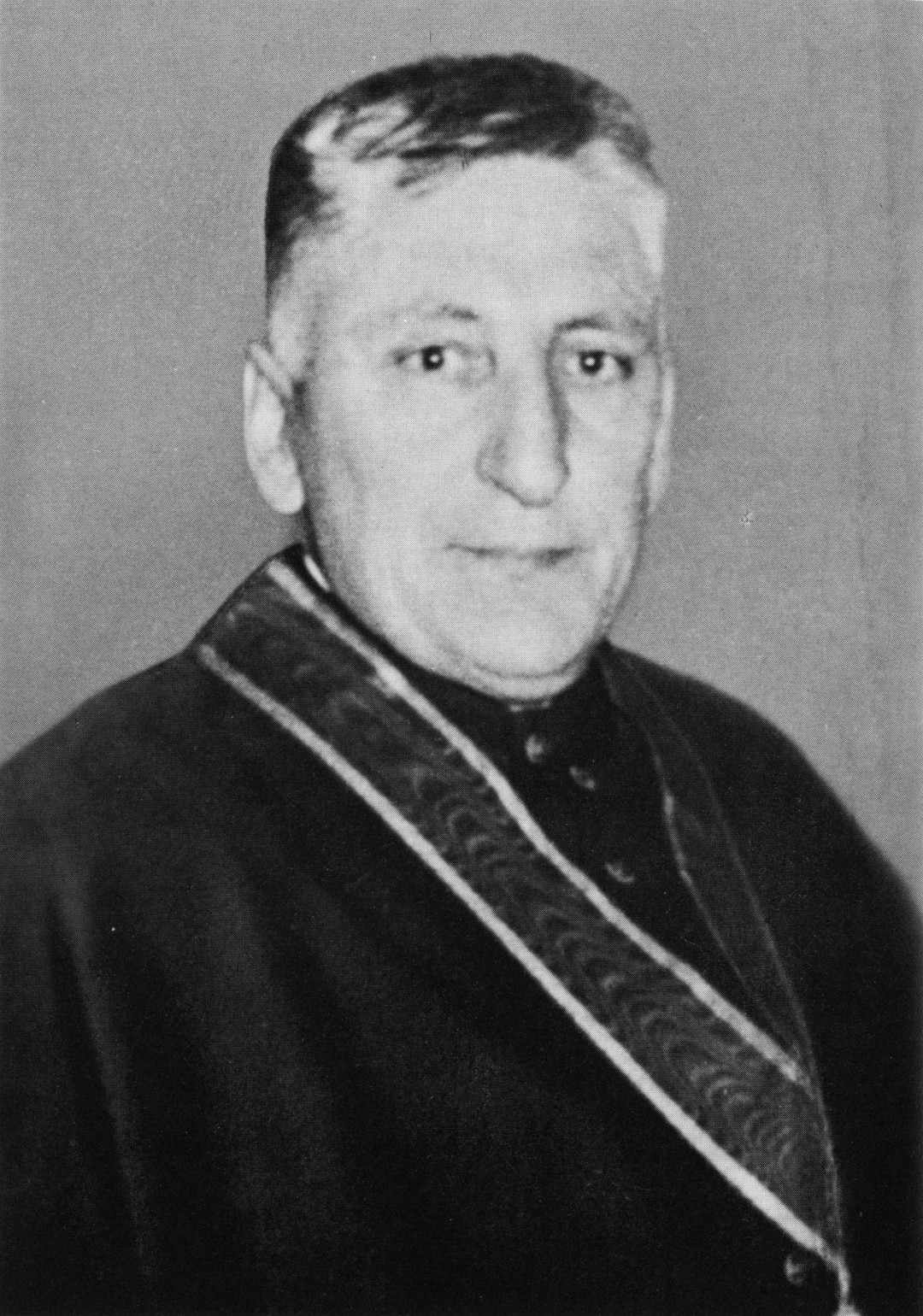
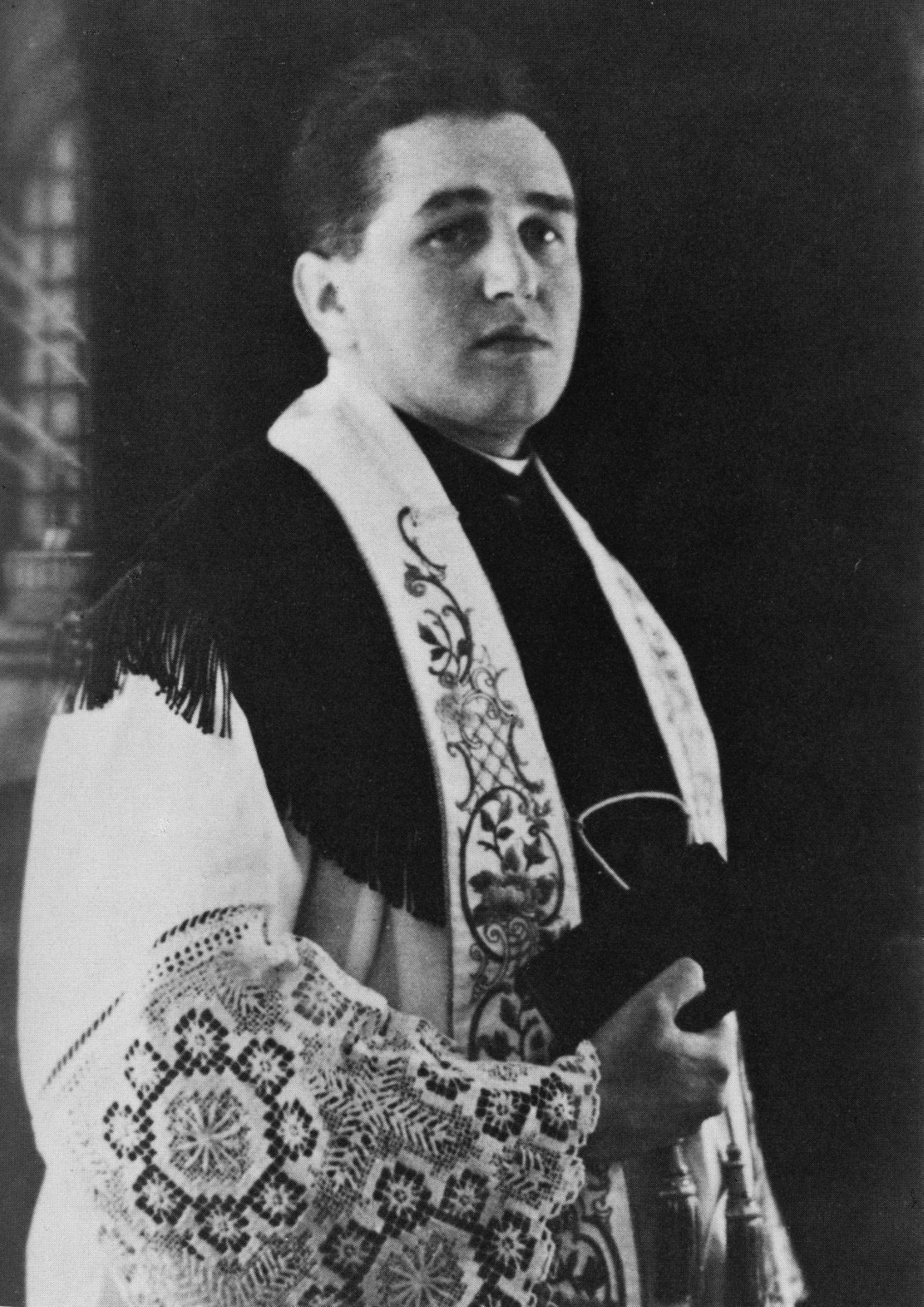
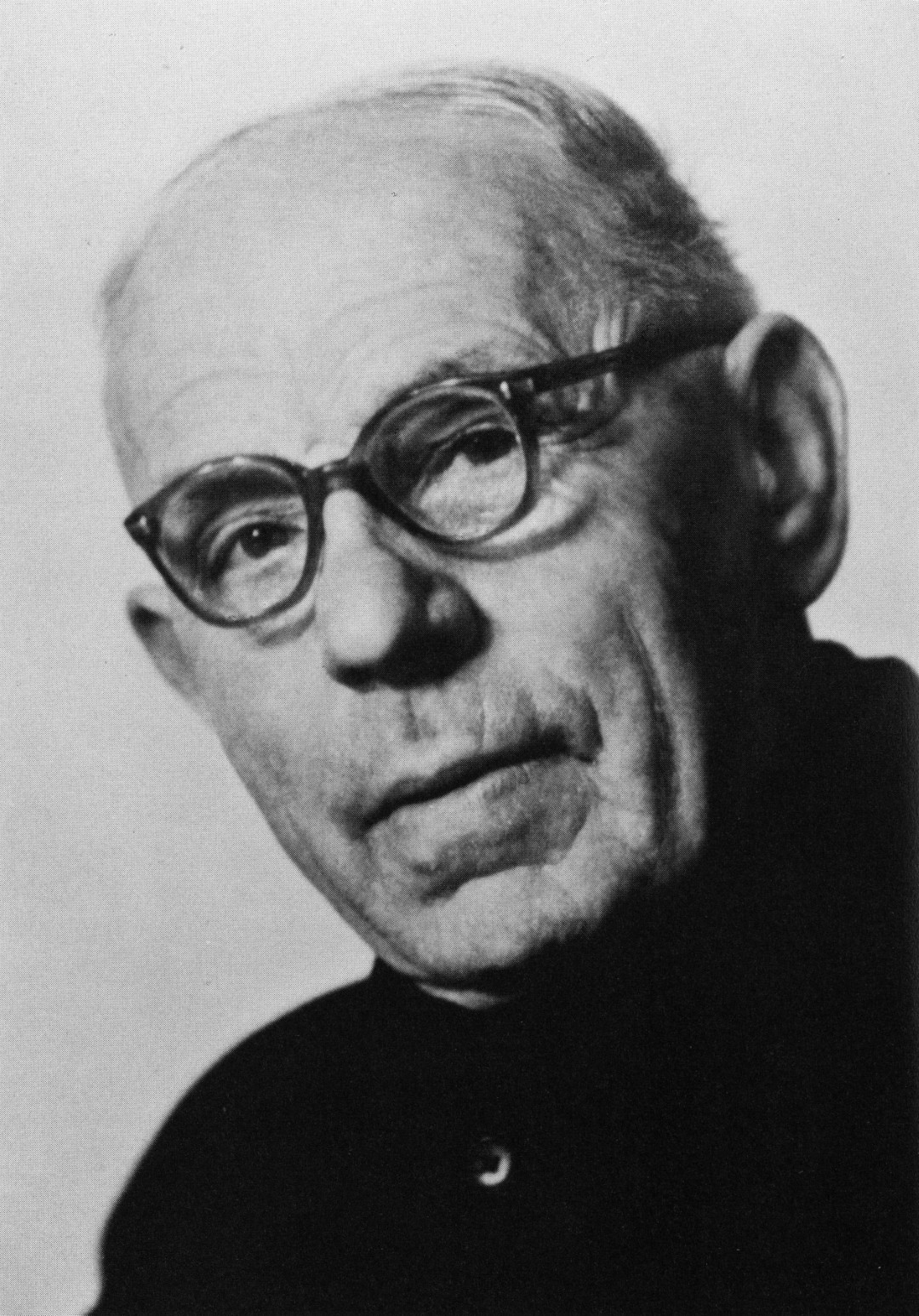
-
Sur Constantin Theus. Naschius ils 11 da fenadur 1897 a Domat. Gimnasi a Mustér ed a Sviz. 1916-1918 teologia al collegi Germanie a Roma, che era duront l’uiara mundiala transferius ad Innsbruck el Canisianum. Conclusiun dalla teologia al seminari da S. Leci a Cuera. Ordinaus a Cuera ils 18 da fenadur 1920. Messa nuviala a Domat ils 25 da fenadur 1920. Vicari ad Altstetten/ Turitg 1921-1924. Plevon a Cumbel 1924-1933, plevon a Vaz 1933-1952, plevon a Trun 1952-1961, plevon ad Alvaschein 1961-1963. Canoni extraresidenzial. Morts ils 28 d’uost 1963 a Cuera el spital dalla Crusch. A Cumbel ei sur Theus seprius en specialmein per las cumpignias da mats. El era preses dalla Ligia da S. Murezi. Siu special meret ei la nova caplutta da Nossadunna. A Vaz eis el era staus igl emprem plevon diocesan suenter ils paders.274
-
Sur Gion Cristoffel Fetz, a Cumbel 1933-1942. Naschius ils 22 da fevrer 1904. Ordinaziun gia cun 23 onns ils 3 da fenadur 1927 e messa nuviala a Domat ils 10 da fenadur 1927. Plevon a Stierva 1928-1933. Naven da Cumbel eis el ius plevon a Tumegl da 1942-1957, lu caplon a Triesen/Liechtenstein 1957-1960. Morts ils 13 da zercladur 1960 el spital dalla Crusch a Cuera e satraus ils 15 da zercladur a Domat. Sur Fetz vegn ludaus sco bien predicatur e zelant pastur. El ha restaurau il chor ed igl altar grond dalla baselgia parochiala. El ha scret ina liunga e lada agenda dalla pleiv, cun bia interessantas remarcas «che fan enconuscher siu caracter onz critic e difficultus275».
-
Sur Leci Antoni Baselgia, a Cumbel 1943-1961. Naschius a Lantsch ils 5 da fevrer 1885. Gimnasi a Mustér ed a Nossadunnaun cun matura 1908. Teologia a Cuera, ordinaziun ils 16 da fenadur 1911. Plevon a Dardin 1912-1917, plevon ad Alvagni 1917-1943. Vicari episcopal dalla Lumnezia 1946-1961, resignat a Lantsch 1961-1965. Morts a Lantsch ils 18 da mars 1965. Ils 16 da fenadur 1961 ha sur Baselgia celebrau cun ses parochians da Cumbel il giubileum sacerdotal dad aur. In premurau e vigilont pastur. Siu special intent fuva «exequir ils decrets da papa Pius X sur la frequenta communiun, in devozius solemn survetsch divin, cunzun la s. messa a norma dil moviment liturgie». Sut sia egida ei la nav dalla baselgia vegnida restaurada. 1944 ha el fundau la congregaziun mariana dallas mattauns.276
-
Sur Alfons Quinter, a Cumbel 1961-1964. Naschius ils 9 da fenadur 1908 egl uclaun da Darvella a Trun, sper la caplutta da s. Giusep. Ordinaus a Cuera igl 1 da fenadur 1934. Messa nuviala a Trun ils 15 da fenadur 1934. Caplon a Segnas 1934-1947, plevon a Schluein 1947-1961, installaus a Cumbel ils 22 d’october 1961. Suenter dus onns e miez da pastoraziun a Cumbel malsauns e morts el spital a Glion ils 30 d’avrel 1964.277
-
Sur Giusep Caviezel, a Cumbel 1964-1968. Naschius a Siat 1914, gimnasi a Mustér ed a Sviz, teologia a S. Leci, Cuera. Ordinaus ils 2 da fenadur 1939, plevon a Pasqual, caplon a Rueras, plevon a Ruschein, spiritual alla pensiun dalla s. Crusch a Tavau, spiritual alla casa da vegls Bodmer a Cuera e dapresent spiritual dalla casa da vegls a Vaduz. Bien predicatur. Denton lubeva la fleivla constituziun da sia gnarva buca da pastorar pli ditg ina pleiv.
-
Dapli 1968, entschatta fenadur, pastorescha igl autur dalla presenta «Historia dalla pleiv da Cumbel», sco era dalla «Historia dalla pleiv da Morissen278» omisduas pleivs da Cumbel e da Morissen. En quei interval ein omisduas baselgias parochialas sco era ils dus carners vegni suttafretgs ad ina restauraziun totala.
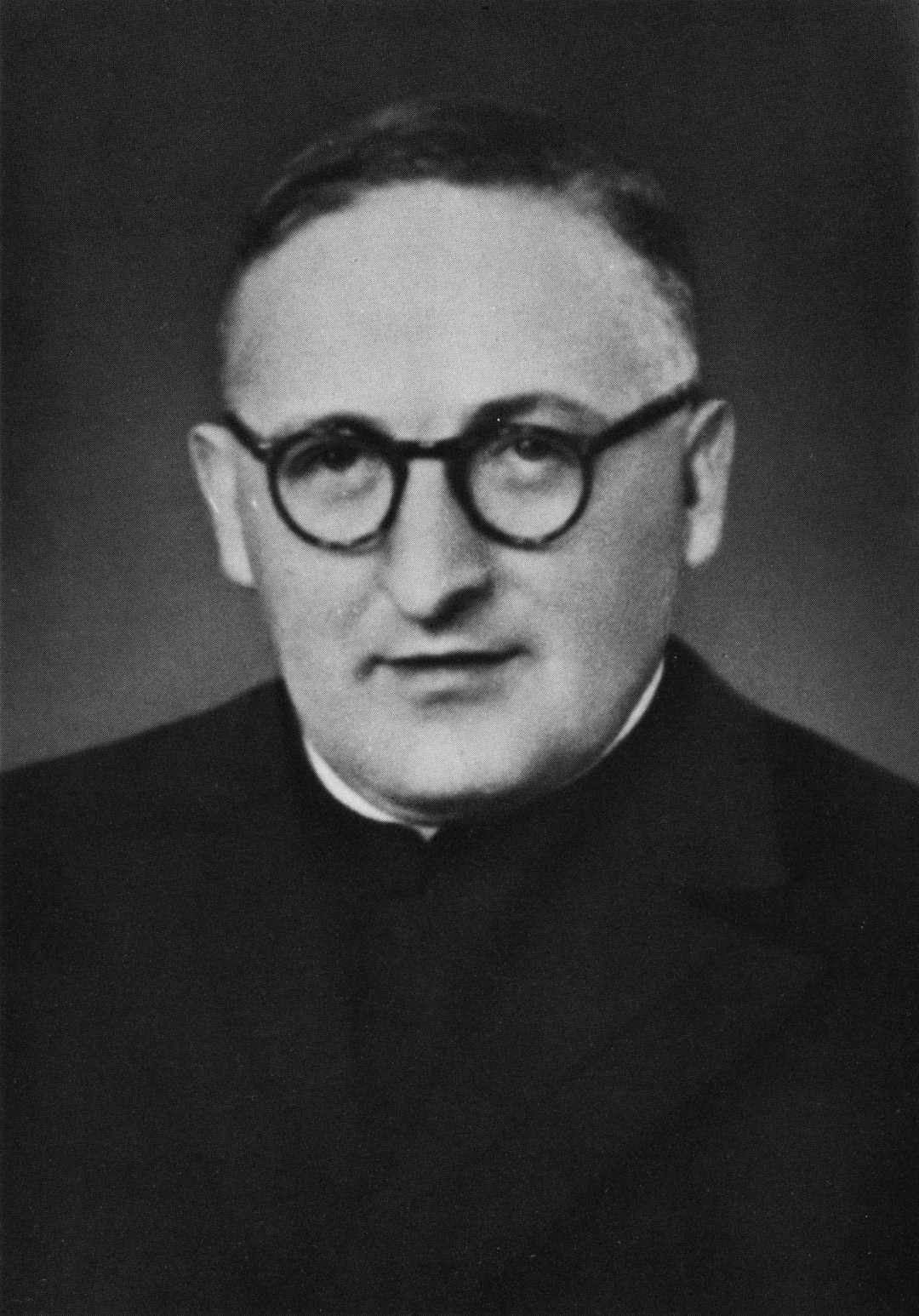
4. Spirituals oriunds da Cumbel
-
Collenberg Barclamiu. 1640-1649 eis el plevon a Razén ed ei morts leu ils 25 da november 1649 e satraus ella baselgia da Panaduz.279
-
Arpagaus Cristian I. Naschius c. 1613, ha studegiau a Lucerna ed a Milaun, ordinaus 1636, plevon a Ruschein 1636. Ils 22 d’avrel 1638 vegn el installaus sco plevon a Lumbrein. Cheu eis el restaus plevon 43 onns tochen sia mort. Vicari episcopal e decan dil capetel Sursilvan. Sut el ei la baselgia parochiala da s. Martin vegnida eregida e consecrada 1649, plinavon la casa-pervenda e la caplutta da s. Bistgaun a Silgin sco era quella da s. Andriu. 1680 eis el vegnius elegius sco sextar catedral, ha denton buca acceptau l’elecziun. Morts a Lumbrein ils 15 d’october 1681.280
-
Arpagaus Cristian II. Naschius c. 1623, ordinaus 1650. Plevon a Cazas 1650-1664, plevon a Surcuolm 1664-1666. Morts ils 12 da zercladur el Bogn da Faveras. El veva studegiau a Ruma al collegi de Propaganda Fide e purtava il tetel da «missiunari da la propagaziun dalla cardientscha281».
-
Arpagaus Martin. Naschius c. 1647, 1666 da 19 onns studigiava el a Dillingen la retorica, ordinaus a Cuera 1673. Plevon a Tumegl 1674-75, plevon a Falera 1678-1694, a Pleif 1694-1718, 1701 secretari dil capetel. Ei seretratgs en claustra da Mustér ed ei morts igl 1 d’avrel 1719 e satraus leu.282
-
Vieli Gion. Naschius c. 1655. Sut ils 24 d’october 1677 eis el inscrets sco student dalla retorica da 22 onns a Dillingen. Baccalaureus dalla teologia. Plevon a Vrin 1682-1684. Morts 1687 sco plevon a Surcasti. Satraus a Cumbel en baselgia avon igl altar dil SS. Num.283
-
Caduff Gion Rest. Naschius a Cumbel ils 2 d’uost 1661, fegl da «Christ Pizen da Cadof» e da sia consorta Lisabet. Morts sco plevon a Siat ils 24 d’october 1707, mo cun 46 onns e satraus ella baselgia parochiala da Siat. Inscrets a Cumbel el cudisch da mortoris sco um da gronda pietusadad e vertit (innocens manibus et mundo corde).284 El veva studegiau a Dillingen, 1685 inscrets leu sco student dalla filosofia. 1700-1707 plevon a Siat. El ha scret il cudisch dad oraziun e devoziun: «Testament dell’olma u kunst de ventireivlameing viver e beadameing morir». Ina ovra da gronda impurtonza per nies pievel e ch’ei vegnida stampada 1705 a Panaduz e suenter aunc pliras ga.285
-
Vieli Augustin. Naschius ils 28 d’uost – il di da s. Augustin, 1662, fegl da Balzer Vieli ni sco el el inscrets el cud. da batten: «ex Balzer Vigeli de Munt» e da Giulia, battegiaus da P. Ireneo. 1681 eis el inscrets sco student dalla humanitas (gimnasi 4. ni 5.cl.) a Dillingen, nua ch’ei ei d’anflar tochen 1686. 1697 ha el doctorau a Dillingen ella teologia. 1690-1696 plevon a Tersnaus, lu plevon a Val S. Pieder tochen 1726. Decan dil capetel Sursilvan. Simonet fa la remarca: «In bien plevon mo in schliet scarvon». Morts ils 9 da matg 1728 e satraus ella baselgia parochiala da Val, «um prudent e devozius286».
-
Arpagaus Anton. Naschius ils 27 da matg 1664 a Cumbel, fegl da scarvon Gion Arpagaus e dad Emerita, battegiaus il medem di da P. Ireneo. 1678, cun 14 onns studegia el «rudimenta» al collegi da Dillingen. (Denter 1677-1686 studegiavan pia quater students da Cumbel al marcau bavares sper il Danubi [nr. 5, 6, 7 e 8.]) 1682 studegia el a Vienna. Caplon a Val 1689 e plevon a Degen 1690-1707. Protonotar apostolic.287 1707 eis el staus cumplicaus en in process ecclesiastic.288
-
Caduff Gieri, dr. teol. Naschius resp. battegiaus ils 24 da schaner 1673, fegl da Gion Rest de Caduff e da sia consorta Frena. El ha studegiau las classas gimnasialas ed alla universitad da Dillingen teologia duront diesch onns da 1693-1703. Fenadur 1699 survegn el il tetel da magister, lu 1702 igl avrel aquista el il licenziat ed il zercladur dil medem onn il doctorat. Ordinaus 1703. Nus anflein el suenter sco caplon a Morissen 1706-1718 e sco plevon a Pleif 1718-1727. Morts a Pleif ils 21 da schaner 1727.289
-
Vieli Giachen. Naschius a Cumbel ils 17 d’october 1676, fegl dad Anton Vieli e da «Gredli». Ordinaus 1700. Da 1705-1708 eis el plevon a Surcuolm. Morts leu ils 26 da fevrer 1718 e satraus ils 28 da fevrer, mo cun 31 onns ella baselgia parochiala a Cumbel avon igl altar dil SS. Num.290
-
Caduff Francestg. Naschius ils 5 da fevrer 1687 e battegiaus da P. Zaccarias da Salò. El ei frar dil suranumnau dr. Gieri Caduff (nr. 9). Curat a Morissen 1718-1727. Quei onn, suenter la mort da siu frar, eis el suandaus quel sco plevon a Pleif duront 22 onns tochen sia mort igl october 1749.291
-
Collenberg Cristian. Naschius ils 20 da zercladur 1690, fegl da Gion Collenberg e da Nesa. Lic. theol. Plevon a Domat 1719-1750. Duront quei spazi ei la gronda baselgia parochiala vegnida baghiada. Plevon a Degen 1750-1756. Canoni extraresidenzial 1735. Morts ils 31 da matg 1756 cun 66 onns. El cudisch da mortoris vegn el caracterisaus sco «bien exempel per spiritual e laics292».
-
Arpagaus Gieri, dr. Naschius ils 14 d’avrel 1693 a Misanenga/ Sursaissa, fegl da mistral Murezi Arpagaus da Cumbel e da Barla n. Alig da Sursaissa. 1712-1715 eis el d’anflar al collegi Helvetic a Milaun. Ordinaus 1717, Dr. theol., caplon a Pleif 1718-1721, plevon a Sursaissa 1721-1726, plevon a Ruschein 1726-1743, la secunda ga plevon a Sursaissa 1743-1749, il davos caplon ad Uors/Lumnezia, nua ch’el ei morts ils 22 d’avrel 1767 e satraus ella baselgia parochiala da Cumbel avon igl altar dil SS. Num. Dr. Gieri Arpagaus ha giu testamentau in capital en favur dils paupers da Cumbel, ch’ei daventaus il tschep dalla schinumnada «spenda pintga» ni «spenda da sur Gieri293».
-
Arpagaus P. Placi OSB. Francestg Antoni, siu num da batten, ei naschius ils 13 d’october 1698 sco fegl dil capitani Gieri Arpagaus e sia consorta Maria a Cumbel. Il bab, capitani Gieri, veva priu part dalla battaglia dils Venezians encunter ils tercs a Morea/ Peloponnes 1687/88. Suenter eis el aunc staus differentas ga mistral e derschader en Lumnezia, Morts 1729. Francestg Antoni ha frequentau la scola claustrala a Mustér, ordinaus 1722, suenter dau scola, prefect dils students, ils davos onns viviu a Postalesio en Valtlina sil bein claustral, staus bia malsauns e morts leu ils 12 da fenadur 1741.294
-
Vieli Gion Barclamiu. Naschius igl 1. da december 1766 a Cumbel, fegl da Gion Simon Vieli e da Maria Barla. 1784/85 eis el documentaus a S. Pieder (Feldkirch) sco student gimnasiast e 1789 al collegi Helvetic a Milaun. Ordinaus 1793. Ha igl emprem gidau ora a Sumvitg 1794 ed ei caplon a Pleif 1795-1800. 1800-1817 eis el curat a Morissen. 1806 ha el obteniu il dretg da battegiar e satrar a Morissen. El era in dils capoacturs per la dismembraziun da Morissen dalla parochiala da Pleif. 1817-1831 plevon a Degen e lu caplon a Pleif tochen sia mort ils 22 da mars 1832.295
-
Vieli Gion Gieri. Naschius a Cumbel ils 15 da december 1808, fegl da Cristian Stiafen Fidel Vieli e da Maria Josefa Monica n. Casaulta da Lumbrein. Ordinaus 1832, plevon a Surcuolm 1834 tochen sia mort ils 22 da fevrer 1854, mo cun 45 onns e satraus ils 24 da fevrer a Surcuolm ella baselgia parochiala avon igl altar dil s. Rusari. Inscrets era el cudisch da mortoris a Cumbel: «El era in carstgaun pietus, devot, migeivel ed affabel, daventaus tut a tuts.»296
-
Arpagaus Balzer Fidel. Naschius a Cumbel ils 21 da schaner 1823, fegl da Cristian Josef Balzer Arpagaus e da Maria Urschla Monica n. Capaul. Gimnasi a Mustér ed al collegi da Friburg e teologia a Cuera. Ordinaus 1849, caplon a Sursaissa 1849-1852, caplon campester 1852, plevon a Siat 1852-1860, plevon a Lumbrein 1860-1873, vicari episcopal, 1866 canoni extraresidenzial. 1873-1884 beneficiat a Nossadunna dalla Glisch Trun. 1885 seretratgs ord motivs da sanadad a Cuera, nua ch’el ei morts ils 19 da november 1896 e satraus a Cumbel ils 21 da november.297
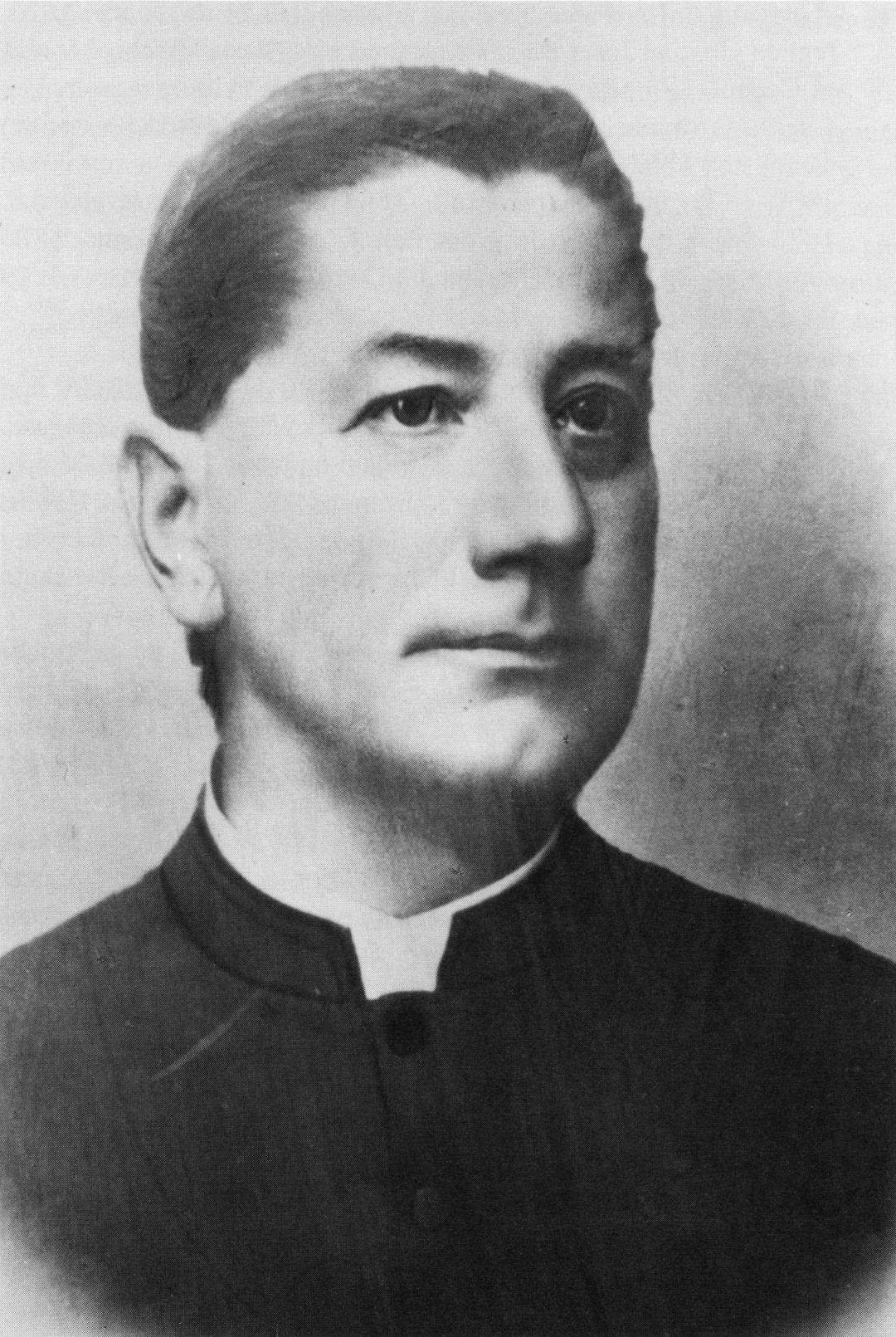
- Caduff Gion Fidel. Naschius a Cumbel ils 6 da fenadur 1838, fegl da Cristian Antoni Caduff e sia consorta Margreta n. Arpagaus, ha studegiau denter auter era al collegi Helvetic a Milaun /Monza filosofia 1861 ed a S. Pieder. Ordinaus 1864, caplon a Rabius 1865-1880, plevon a Ruschein 1880-1906, morts ils 8 d’october e satraus a Ruschein el santeri. Duront sia pastoraziun a Ruschein ei vegniu baghiau alla baselgia.298
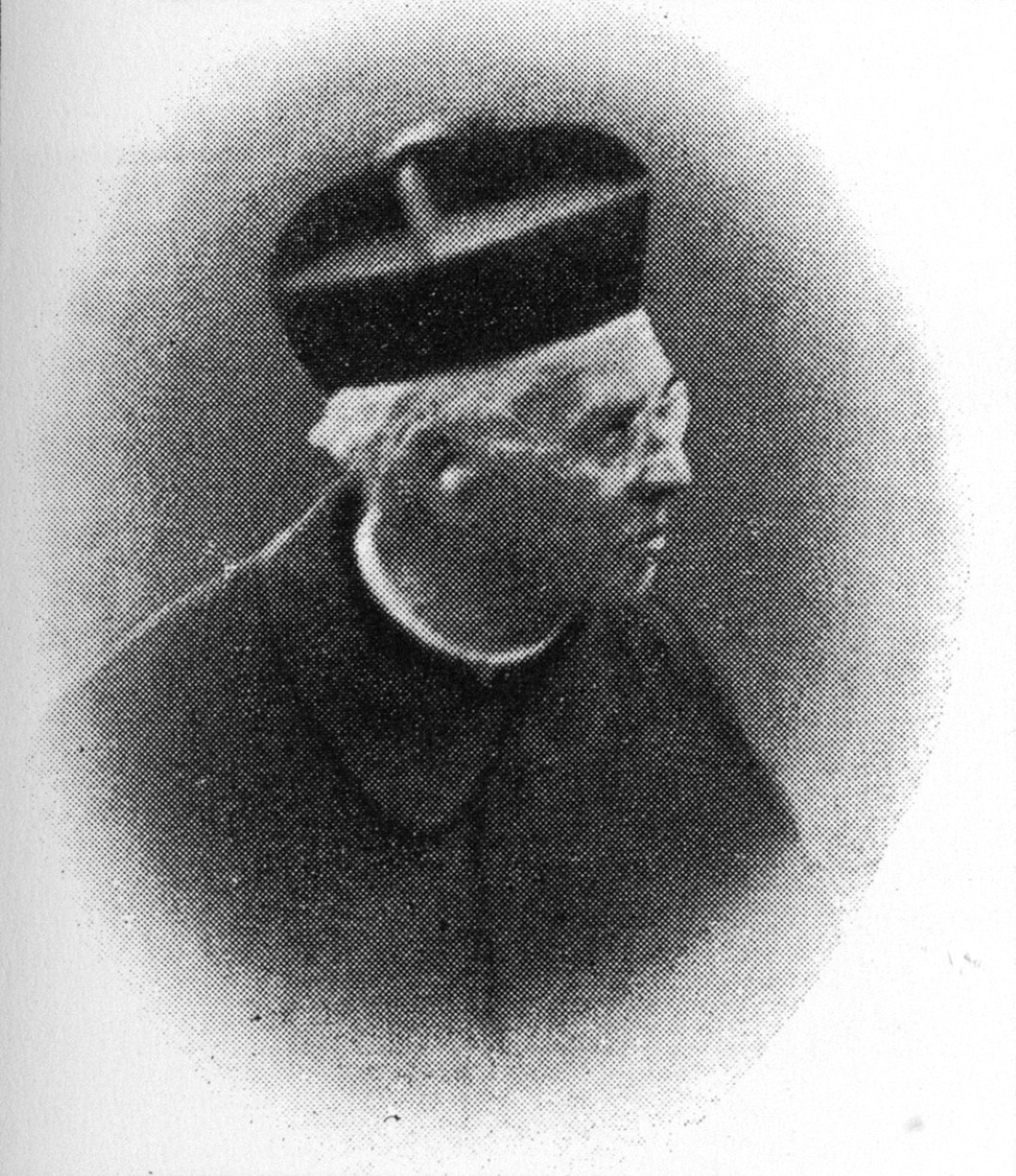
- Elvedi Gion Murezi. Naschius il di da s. Murezi ils 22 da settember 1852, fegl da Gion Gieri Elvedi e da sia consorta Maria Catrina n. Derungs da Surcasti. Ordinaus ils 21 da december 1878, messa nuviala da s. Stiafen a Cumbel, plevon a Surrein 1879-1883, plevon a Surcuolm 1883-1889, plevon a Farrera/Schmitten 1889-1904, catechet a Muri 1904-1906, e caplon a Selva 1906-1935, morts egl institut da s. Gion a Zerzras ils 5 d’uost 1935. Sur Murezi vegn ludaus sco zun eloquent ed oreifer predicatur. Satraus a Cumbel avon porta pintga.299
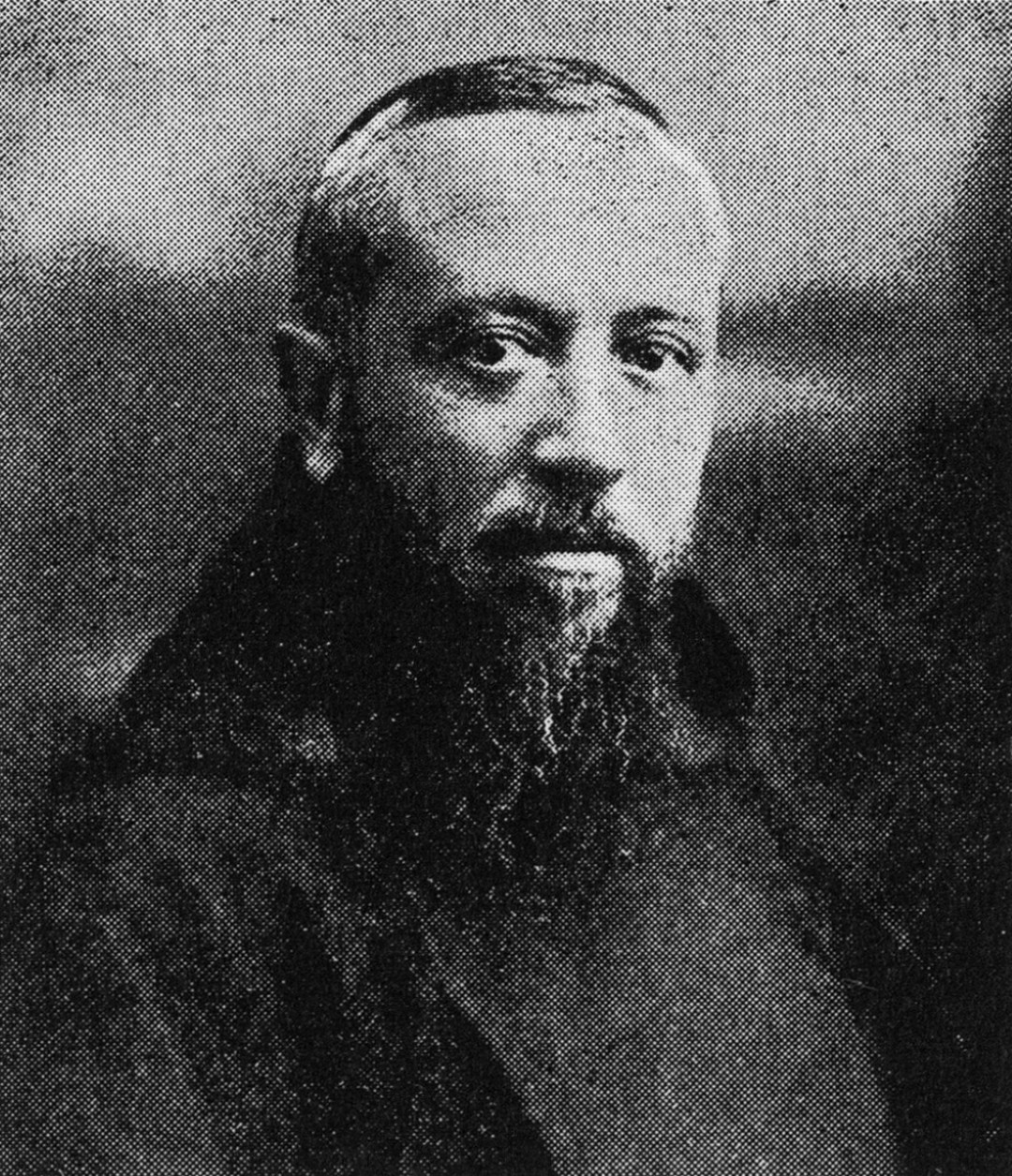
- Elvedi P. Alexander O.C. Naschius a Cumbel ils 3 d’october 1872 e battegiaus sur il num Gion Gieri, fegl da Pieder Antoni Elvedi e da Anna Maria n. Caduff. Profess egl uorden dils caputschins ils 12 da november 1891, ordinaus ils 13 d’avrel 1895. Vegnius ella Missiun Retica 1901. Plevon a Vaz 1901-1907, plevon a Surava 1907-1910, plevon a Tinizong 1910-1943. Morts leu ils 26 da fevrer 1943 dalla daguota. Satraus a Tinizong.300
Era canoni Gieri Vidi, n. 1849 a Razén, plevon a Glion 1893-1917 e morts 1934, e canoni Gieri Antoni Vidi, n. 1874, da Razén, e plevon a Falera, morts 1939 eran burgheis da Cumbel.
VII. Cult religius
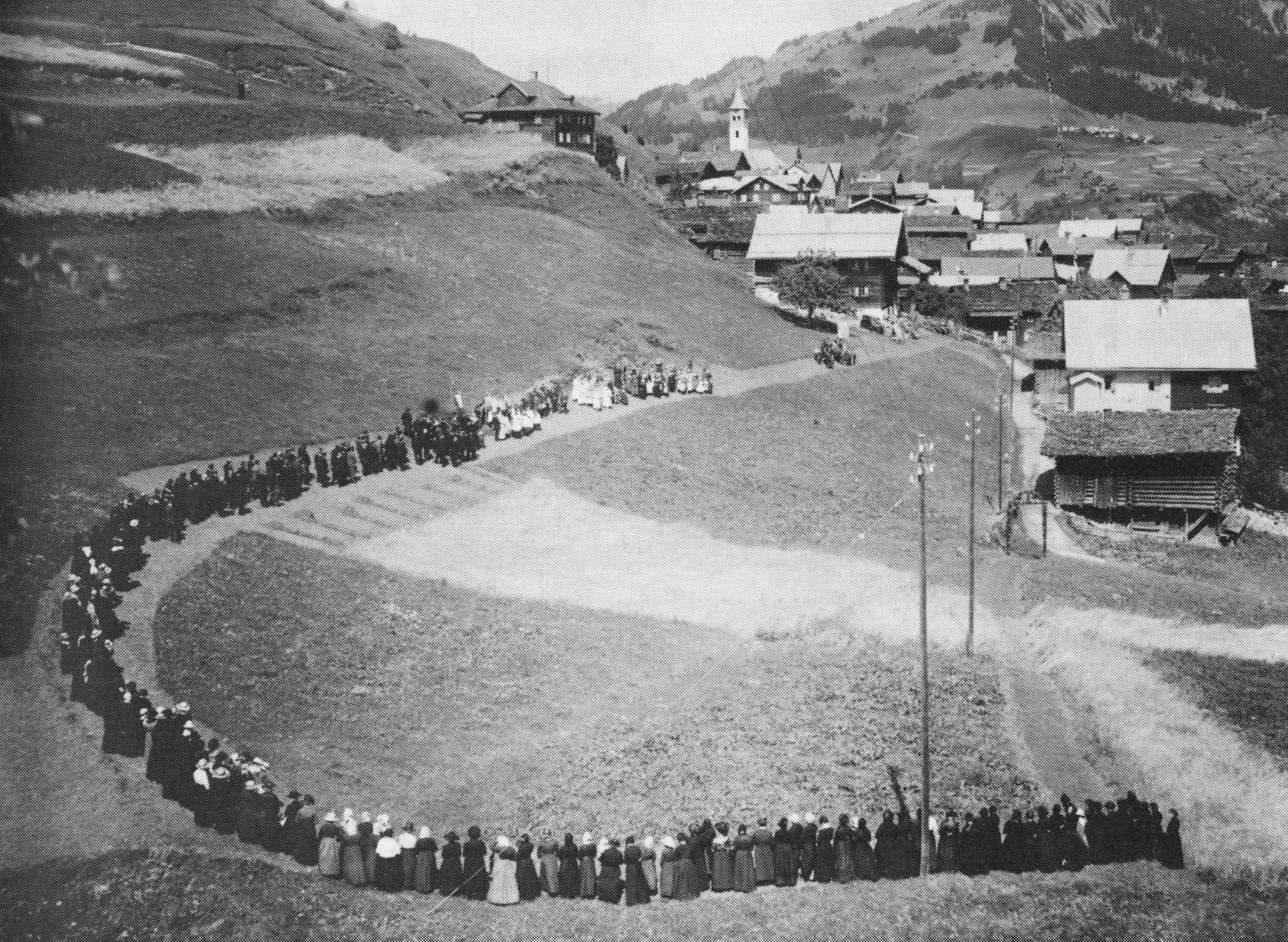
1. La dumengia da nos antenats
Lu era la dumengia propi il di dil Segner. Il di dad oraziun e survetsch divin. Il cult religius occupava la gronda part dil di. E quel entschaveva bien e baul. Ina agenda dil plevon da 1866 retegn: «Mintga dumengia e firau vegn tuccau d’uffeci la damaun allas 6 uras. La glieud concuora a dir igl uffeci, specialmein giuvens e giuvnas. La fin digl uffeci vegn pervergiau ils confessai.»301 Dil temps da P. Urban (1905-1917) vegneva tuccau las 7 ni las 7 e mesa pigl uffeci da Nossadunna. Las 9 e mesa tuccava ei da messa ed il pievel recitava il rusari. Lu suandava messa cantada cun in priedi da silmeins mesa ura. Mintga emprema dumengia dil meins vegneva il rodel dils morts prelegius. Duront ils sis meins dil temps da scola fageva il pader ductrina pli pievel avon viaspras.302 La stad, cura ch’ei era buca ductrina, recitavan ins – tenor agenda da 1872 – avon ch’entscheiver las viaspras, il rusari e la litania da tuts ils sogns e suenter las viaspras cantadas recitavan ins aunc inaga las viaspras da Nossadunna e suenter tut quei suonda aunc mintga emprema, secunda e tiarza dumengia dil meins ina processiun entuorn baselgia, processiuns dallas diversas confraternitads.303
Partenent la ductrina veva gia igl uestg Duri de Federspiel ordinau 1695, ch’ei seigi mintga dumengia, num ord impurtonts motivs, da far ductrina pli pievel, «sinaquei che la giuventetgna vegni instruida ellas verdads necessarias pli salit304». E las ordinaziuns episcopalas digl onn 1760 pretendan che la ductrina vegni fatga e frequentada «diligentamein» e ch’ils «schuolmeisters» da mintga liug assistien a quella e «tegnien ils affons en buna disciplina ed attenziun305». P. Nicolaus (1871-1895) veva fatg l’experientscha, che la ductrina en baselgia seigi la caschun u da vegnir memia tard u dad insumma buca cumparer allas viaspras. Perquei ha el schau vegnir ina dumengia al meins ils giuvens e l’autra las giuvnas en casa pervenda per la ductrina. Leutier seigien ei bugen stai promts.306
Il ruaus dalla dumengia vegneva observaus el 17./18. tschentaner zun rigurusamein. Cheu gudeva la Baselgia igl efficient sustegn dallas autoritads civilas, che obligavan leutier cun lur mandats, statuts ed uordens dils cumins e dallas vischnauncas.307 En siu rapport dalla visitaziun da creisma en Surselva da 1760 selamenta igl uestg Gion Antoni Federspiel sur digl ir cun menadiras e cun sauma las dumengias e ch’ei vegni schiglioc fatg da tuttas lavurs nunlubidas, sco batter faultschs, ir a mulin, pesar rauba, cargar e discargar fein ed auter. Cheutras vegni la dumengia «dishonorada e profanada, da maniera che perfin ils vischins reformai prendien scandel308».
2. Firau sogn
Sper ils firaus cumandai vegnevan ina partida «firaus da devoziun» festivai e leutier vegneva aunc in detg diember da schinumnai «firaus pigns» sco per exempel s. Antieni ils 17 da schaner. Per quei di noda P. Nicolaus en sia agenda 1872: «S. Antieni firau lev ni firau pign, messa las 9, messa bassa benché sul organo cantano la messa con strofe romancie. Suenter l’elevaziun entscheivan ei las viaspras, che vegnan lu finidas suenter messa.»309 Da firau pign ni firau lev era adina messa avon miezdi, las 9 ni las 10 uras. Suenter vegneva luvrau.
Tenor ina agenda da 1866 festivavan ins il suandont diember da firaus levs ni firaus da devoziun:
-
17 da schaner, s. Antieni, messa da tard cun viaspras.
-
22 da schaner, s. Vintschegn, messa da tard cun viaspras.
-
2 da fevrer, Nossadunna da Candeilas, firau «per bon».
-
3 da fevrer, s. Plasch, messa da tard cun viaspras.
-
5 da fevrer, s. Gada, messa da tard cun viaspras.
-
14 da fevrer, s. Valentin, messa da tard cun viaspras.
-
19 da mars, s. Giusep, firau «per bon».
-
25 da mars, Annunziaziun da Maria, messa cantada, priedi, viaspras e cumplet, firau per bon.
-
1 da matg, s. Giachen e Filipp, messa cantada da tard, viaspras allas 13 uras.
-
3 da matg, Anflada dalla s. Crusch, firau.
-
12 da matg, s. Pancrazi, firau da devoziun.
Vigelgia da tschuncheismas, messa da tard.
Gliendisdis-tschuncheismas, messa gronda, priedi, ductrina, viaspras e processiun entuorn baselgia.
Mardis-tschuncheismas, messa gronda, priedi sch ins vul, viaspras. Sontgilcrest, messa gronda, priedi, processiun.
-
13 da zercladur, s. Antoni da Padua, messa cantada, cuort priedi.
-
24 da zercladur, s. Gion Battesta, messa cantada, cuort priedi.
-
26 da zercladur, firau da devoziun, processiun a S. Murezi, priedi.
-
29 da zercladur, s. Pieder e s. Paul, messa cantada, viaspras.
-
2 da fenadur, Visitaziun da Maria, firau da devoziun, processiun a S. Murezi, messa cantada, priedi.
-
11 da fenadur, s. Placi, firau da devoziun, messa cun viaspras.
-
22 da fenadur, s. Maria Madleina, firau da devoziun, messa cun viaspras.
-
25 da fenadur, s. Giachen, firau da devoziun, messa cun viaspras.
-
2 d uost, «Nossadunna dils aunghels», solemnitad, plirs confessurs, perdun s. Francestg, predicatur iester.
-
10 d uost, s. Luregn, messa cun priedi e viaspras Fura usitada.
-
25 d uost, s. Barciamiu, messa gronda cun priedi e viaspras.
-
8 da settember, Naschientscha da Maria, messa gronda cun priedi e viaspras.
-
14 da settember, Alzada dalla s. Crusch, messa cantada cun priedi.
-
21 da settember, s. Mattiu, apiestel, messa gronda cun priedi e viaspras.
-
22 da settember, s. Murezi, a S. Murezi, messa cantada
-
29 da settember, s. Mihèl, messa cantada.
-
4 d’october, s. Francestg d’Assisi, messa cantada cun priedi.
-
28 d’october, s. Tschamun e Giudas, messa cantada e priedi e suenter miezdi viaspras.
-
11 da november, s. Martin, firau da devoziun, messa da baul pervia dalla scola e viaspras.
-
17 da november, s. Flurin, firau da devoziun e tut sco da s. Martin.
-
25 da november, s. Catrina, sco da s. Flurin.
-
30 da november, s. Andriu apiestel, messa gronda cun priedi e viaspras.
-
3 da december, s. Leci, firau, 4 ministrants
-
6 da december, s. Clau, firau, cun viaspras recitadas.
-
8 da december, Immaculata Concepziun, messa gronda cun priedi, 6 ministrants, viaspras.
-
21 da december, s. Tumasch, messa gronda cun priedi e viaspras.
-
25-27 da december, Nadal, s. Stiafen e s. Gion, messa gronda, priedi e viaspras suenter miezdi.
-
28 da december, Innocents Affons, firau da devoziun, messa cun priedi e viaspras suenter miezdi.
-
31 da december, s. Silvester, firau da devoziun, messa da tard etc.310
Cheutier ei aunc da remarcar, che a quella liunga retscha da 46 firaus cumandai, firaus da devoziun e firaus pigns, ein aunc zacons firaus cumandai sco Anceinza, Nossadunna d’Uost e Numnasontga, sco secapescha da sesez gnanc enumerai. E sco da Tschuncheismas, fuva scadin cass era gliendisdis-pastgas e mardis-pastgas firaus da devoziun cun messa gronda, priedi e viaspras. Aschia vegnevan nos antenats sin 51 firaus sper ni cun las 52 dumengias ad onn.
Memia bia dil bien eran scadin cass ils 4 firaus da Nadal. Ed igl ei aschia nuota da sesmarvegliar, sch’ei vegneva avon enqual abus. Ins capescha sche igl uestg Johann Anton de Federspiel ha stuiu admonir la suprastonza da Cumbel, 1760, da dismetter ils «usitai maldeportements e scandalus abus» dalla giuventetgna da leu pli di dil s. patrun-baselgia, s. Stiafen.311
Denton, ils firaus stuevan vegnir observai. Surlunder concluda la radunonza da vischnaunca da calonda mars 1847: « . . . ei ferm stabiliu da metter si ina cruna fallonza per scadin surpassament da lavurs nunlubidas sin firaus cumandai per bon, nunobtenida lubientscha dil signur Farer culs signurs geraus ensemen.»312 D’in sluccament dils firaus levan ins saver nuotzun. Ella lescha communala da 1862 figurescha il paragraf 17 cul suandont: «Ils firaus da devoziun, ch’ein da nos vegls pri si e sanctificai, e suenter dalla proclama dalla dispensa da quels medemamein da nos vivents vegls vischins dumandond els, schebein els veglien salvar ils firaus ni bue, fatg sin quei il vut da salvar. Glieud da mistregn, che han da menar si baghetgs, vegn ei schau liber, dueigien aber duront ils survetschs divins dar si la lavur.»313
Cura ch’igl ei empau pli tard vegniu dispensau da zacons firaus, ha la vischnaunca da calonda mars 1882 concludiu «da far firau avon miezdi ils firaus dispensai, suenter concediu da luvrar», pia da far firau pign.314 1884 decida la vischnaunca «da celebrar ils firaus dils apostels cun messa e viaspras avon miezdi e suenter luvrar», pia era a far firau lev.315 1889 ha la radunonza communala precisau «da far messa ils firaus dils apostels las 7 e suenter luverdi316». Cun quei era il firau lev dils apostels liquidaus.
3. Confraternitads ed uniuns
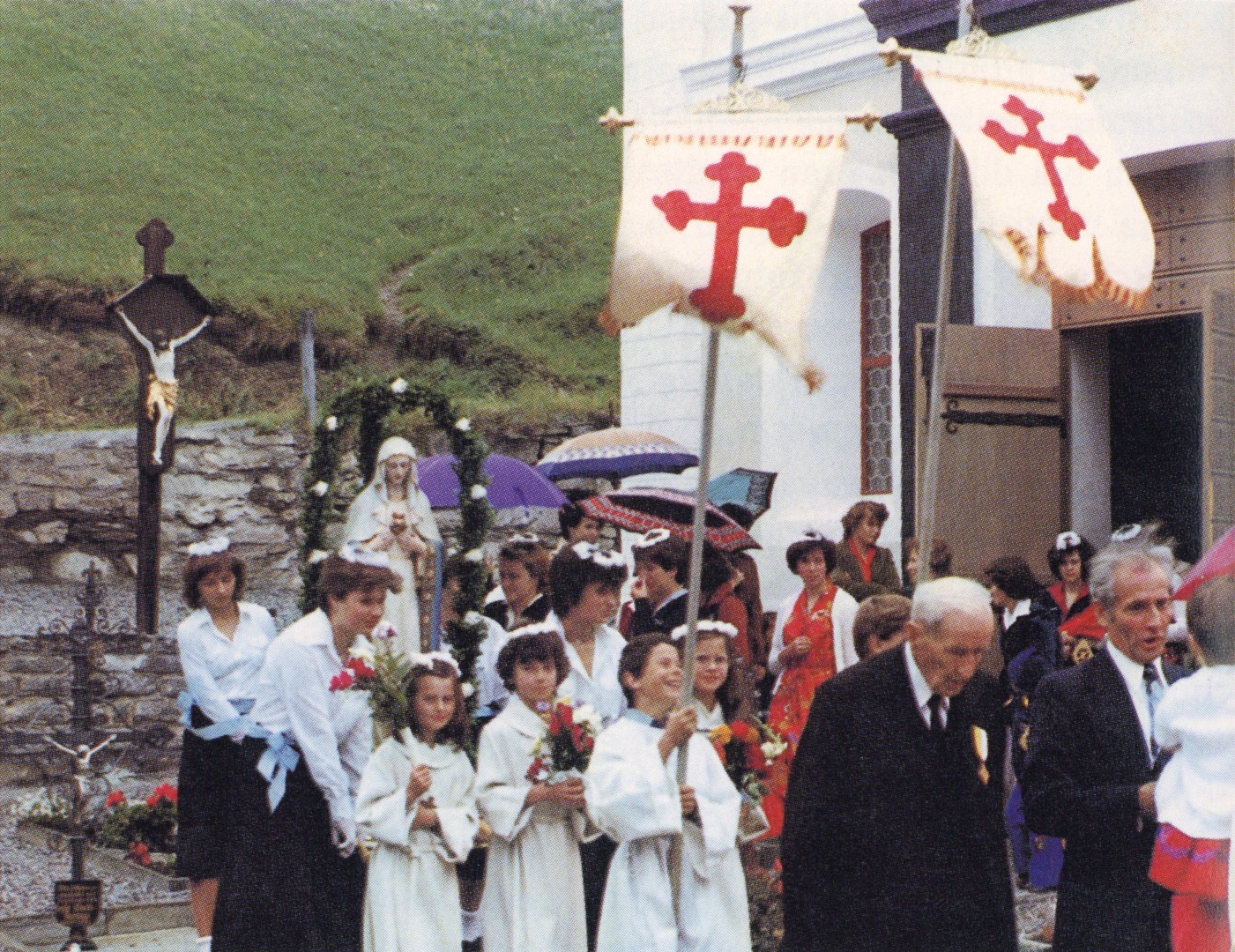
a) Confraternitad dil Sontgissim Num
Quei ei la pli veglia en nossa pleiv. P. Ireneo (1649-1665), igl emprem pader, veva fundau ella canonicamein ils 31 d’uost 1659. Sco altar titular ei vegniu designau il lateral seniester.317 Da Daniev, sco era la secunda dumengia suenter Buania vegneva celebrau «messa gronda cantada» cun 4 ministrants sin quei altar, fatg priedi e suenter viaspras vegneva mintga secunda dumengia dil meins fatg processiun, entuorn baselgia, cantond la litania dil SS. Num.318 Papa Paul V. veva concediu als frars e soras dalla confraternitad numerus perduns, numnadamein in cumplein suenter ver priu penetienzia e pervergiau e silla ura da mort, sco era sil di dalla recepziun. In perdun gudignava era tgi che visitava la baselgia ed urava avon igl altar dalla confraternitad «per la concordia denter ils prencis cristians, per l’extirpaziun dalla heresia e per l’exaltaziun dalla s. Baselgia catolica». Quels treis puncts serepetan da quei temps adina puspei sco intenziuns principalas d’oraziun. In perdun da 100 dis gudignava tgi che admoneva en carezia quels che blasfemavan ni engiravan senza basegns. In tuttavia bien spért da carezia cristiana e da correpziun fraterna plaida ord questa disposiziun sco era ord las suandontas: «In perdun gudogna tgi che cumpogna il Sontgissim cura ch’el vegn purtaus tier in malsaun e sch’el sa buca far quei silmeins ura pli malsaun, medemamein quels che van suenter bara, visetan malsauns, gidan ni dattan albiert a paupers, che fan pasch cun ses inimitgs ni enqueran da far pasch denter adversaris, quels che meinan pucconts alla penetienzia, che muossan la ductrina cristiana, che fan autras ovras da caritad e pietad, mintga ga in perdun da tschien dis.»319
Il cudisch dalla confraternitad cuntegn il num dil pader Ireneo e da plirs auters caputschins che han operau a Cumbel tochen tier P. Urban 1906. Ei suondan numerusas gliestas dils nums dils confrars e dallas consoras tochen igl onn 1921.320
b) La Cumpagnia da Nossadunna Immaculada
Gia in onn suenter la fundaziun dalla emprema confraternitad suonda l’erecziun canonica dalla secunda, 1660, che vegn agregada alla arci-confraternitad da San Lorenzo in Damaso a Roma. En quella Cumpagnia ni confraternitad ein specialmein ils differents paders ch’ein stai a Cumbel entrai e lu numerusas persunas, umens e femnas, era bia spirituals e laics dil contuorn, schizun ord la Foppa, gie schizun da Domat. Las davosas inscripziuns da commembers dateschan dils 1908/1909.321 Sco altar titular han ins tscharniu il lateral da vart dretga. Uestg Gion Antoni de Federspiel ha per cumissiun dil papa muniu quei altar ils 20 da november 1759 cul schinumnau privilegi, quei vul dir, culla celebraziun dalla messa sin quei altar savevan ins gudignar perduns per las olmas.322 Plinavon gudevan ils commembers e las commembras il benefeci da saver gudignar bia perduns, semegliont sco ella suranumnada congregaziun dil SS. Num. Denter auter gudignava in perdun d’in onn tgi che gidava paupras giuvnas, en honur da Nossadunna Immaculada, ch’ellas crodien buca ella pussonza dil nauschaspert e possien conservar lur honestiadad, e lu era tgi che instrueva auters ella ductrina cristiana.323
c) La Cumpagnia dalla ductrina cristiana
Il spiritual Marco Sadis Cusani da Milaun haveva fundau a Roma igl onn 1560 ina uniun da spirituals e da laics per mussar la ductrina. Ordlunder ei naschiu la arciconfraternitad dalla ductrina cristiana cun sedia a Roma e bia secziuns en diversas tiaras.324 Ils caputschins en Rezia han fundau cheu pliras secziuns ni confraternitads da caracter religius e scolastic, l’emprema a Vaz c. 1629. A quella ein lu s’agregadas la confraternitad da Casti 1689 e quella d’Alvagni il medem onn, 1690 s’associeschan alla da Vaz quellas da Savognin, da Riom e da Sumvitg. 1693 suonda Cumbel, 1695 Termin (Trimmis), 1724 Mustér, 1725 Sagogn e 1744 Camuns e 1751 Beiva/Murmarera.325
La Cumpagnia cumpigliava spirituals e laics e cunzun la giuventetgna ed ils affons. La suprema survigilonza veva igl uestg diocesan. Mintga secziun veva plirs ufficials, numnadamein: 1. Il sutpriur, ch’era cau dalla scola en sia vischnaunca. 2. Igl avisatur, che veva dad esser veglionts sur la scola, visitar quella, procurar per disciplina, «tener la sia lancia sin maun» etc. 3. Il cancelier veva da registrar ils scolars e tuts members e menar cudisch e protocol. 4. Dus conservaturs che han da procurar ch’ils scolars e la giuventetgna visetien la scola ed emprendien a casa etc. 5. Dus recordaturs che han da regurdar da retscheiver ils sogns sacraments e dad ir stedi a scola. 6. Dus infirmers che han l’obligaziun da visitar ils scolars malsauns. 7. Dus Schuolmeisters, *scolasts, che han da dar l’instrucziun ellas treis classas dils affons ed ella 4. classa dils carschi. 8. *Il maester, in ni plirs. Quels eran gidonters dils scolasts. Sin mintga otg scolars stueva il scolast ver in tal. 9. Il silenzier veva da ver quitau pli silenzi e bien uorden. El teneva ina torta enta maun.326
Mussau vegneva ei da leger, scriver, memorisar, cantar e sco rom Principal la ductrina cristiana. La scola entschaveva da s. Catrina (25.11) e mava tochen pastgas e cuzzava 3/4 uras a di. Surlunder scriva prof. Gadola denter auter: «Ils luverdis serimnavan scolars e scolaras en ina stiva gronda, nua ch’ei era tschentau si bauns e truccas per liung dallas preits. Enamiez la stiva stevan ils schuolmeisters mintgin cun ina lontschetta enta maun ed observavan co ils maesters e maestras mussavan ad in e scadin, epi examinavan lu els quels, admonevan, ludavan, turziavan . . .»327
A Cumbel ei la confraternitad vegnida fundada igl onn 1693. Il document da fundaziun da quella impurtonta instituziun en lungatg talian secloma en libra translaziun:
«Nus, ils paders caputschins missiunaris apostolics a Cumbel, P. Basilieo d’Iseo e P. Zaccarias da Salò, havein obteniu cugl agid divin la favur e la grazia dalla lubientscha da Monsignur uestg da Cuera d’instituir en nossa baselgia la Cumpignia dalla ductrina cristiana, agregada alla confraternitad da quella da Vaz, conform uorden e camond dalla Bulla dalla arciconfraternitad da Roma e da Sia Sontgadad. A quella cumpagnia vegn dau la entschatta e fatg la publicaziun il di da s. Gion Battesta, il qual di solemn vegn mintg’onn prelegiu il cuntegn dalla Bulla cun ils perduns concedi a tala Cumpagnia. Igl altar grond da s. Stiafen vegn numnaus altar titular. En quella nova cumpagnia sescrivan igl emprem ils ufficials e lu ils confrars e las consoras.»328
Silsuenter suondan ils nums dils 12 ufficiate dalla cumpagnia digl onn 1697, quater onns suenter la fundaziun:
- Sutpriur: Capitani Gieri Arpagaus. 2. Avisatur: weibel Flurin Arpagaus. 3. Cancelier ni scarvon: Sechelmeister Crest Caduff. 4./5. Conservaturs: Plasch Luregn e Martin Caspar Gion Crest Caduff. 6./7. Recordaturs: Martin Aspar Caduff e Franz Aspar Arpagaus.
Infirmers: Sechelmeister Crest Gieri Arpagaus e meister Gion Aspar Caduff. 10./11. Schuolmeisters: Sechelmeister Gieri Caduff e Caspar Crest Mattias Collenberg. 12. Silenzier: Gion Martin Murezi Arpagaus.
Maesters ella ductrina: per igl onn 1701: Gion Crest Caduff, Gion Giusep Cavegn, Francestg Simon Arpagaus, Gion Giachen Arpagaus, Balzer Anz Vieli.
Maestras per 1701: Gada D’Andrea, Onna Gion Crest Caduff, Bologna sechelm. Gieri Caduff, Trina sia sora, Trina mistral Gieri Arpagaus, Maria Barbla mistral Gilli Arpagaus, Mierta mistral Gilli il giuven.329
Per igl onn 1694, in onn suenter la fundaziun dalla cumpagnia dalla ductrina, ein ca. 160 commembers e commembras, bunamein duas tiarzas femnas, s’inscrets ella confraternitad. Il cudisch da commembers cuntegn ite registers periodicamein, cun intervals da plirs onns, e quei tochen igl onn 1894.330 Ei secapescha che la scola dalla confraternitad dil 19. tschentaner veva buca pli il medem pensum sco alla entschatta e che quel seconcentrava mo pli silla ductrina,
d) La confraternitad dil s. Rusari
Il pader dominican tudestg, Jakob Sprenger, priur a Cologna, haveva eregiu ite 8 da settember 1475 ella baselgia claustrala da Cologna la confraternitad dil s. Rusari, che ei lu vegnida approbada e recumandada da papa Sixtus V. ils 30 da matg 1478.331 P. Giovanni Battista da Chiavo veva introduciu a Cumbel quella confraternitad igl onn 1734. Già quei medem onn ein circa 90 dèls, umens e femnas, s’inscrets. Las gliestas da commembers ein menadas vinavon cun interrupziuns tochen 1908 sut P. Urban.332 Mintga emprema dumengia dil meins mava il pader avon igl altar titular, quel da Nossadunna dil s. Rusari ella caplutta seniester per la litania lauretana e per entscheiver la processiun meinsila entuorn baselgia.333 Igl altar da Nossadunna dil s. Rusari era privilegiaus, vul dir unius cun perduns per la mesjamna, gievgia e sonda.334
e) La Cumpagnia da s. Francestg
Ditg avon l’introducziun dil Tierz Uorden existeva a Cumbel ina «Cumpagnia da s. Francestg» eregida probablamein entuorn 1750. Egl archiv parochial sesanfla il cudisch dalla uniun, ord il 18./19. tschentaner, mo senza datum dalla erecziun, cun pli che 300 nums «de quelli che sono scritti nella Compagnia del serafico san Francesco». Las gliestas entscheivan cun 1750 e suondan cun interrupziuns tochen 1890. Denter las obligaziuns dils confrars e dallas consoras vegn allegau: 1. «Portare il piccolo cingolo intorno alla vita con trè nodi.» 2. Urar mintgadi tschun paternos. Plirs perduns vegnan concedi.335
f) La confraternitad digl immaculau Cor da Maria
Ils 2 da december 1836 ha igl arzuestg da Paris, Hiacint Quelen, fundau la arciconfraternitad digl Immaculau Cor da Maria per la conversiun dils nuncartents. La confraternitad ei sederasada spert: Enteifer 14 onns, tochen 1851, ei vegniu eregiu buca meins che 8000 secziuns cun 14 milliuns commembers en pliras tiaras europeicas.336 Ils 10 d’avrel 1845 ha il plevon P. Bonaventura da Garesio (1839-1862) dumandau la Congregaziun de propaganda Fide a Roma per la lubientscha dad ereger ina secziun a Cumbel. In meins pli tard ha el survegniu dil prefect dalla Congregaziun, Cardinal Fransoni, il consentiment. L’arciconfraternitad a Roma hagi negin agen vestgiu pils commembers ed el dueigi era buca introducir in tal. Ils members gaudien ils benefecis spirituals dalla arciconfraternitad.337 La nova confraternitad ha giu grond success. In register ord il temps dalla fundaziun cuntegn buca meins che 214 nums, entschiet cun quel digl uestg Caspar de Cari, il pader Bonaventura, dil P. Ottavio da Camuns e cun pliras schlatteinas d’ordeifer sco per ex.: Montalta, Camenisch, Casaulta, Bundi, Tönz, Albin Nut, Arquisch, Soler, Demont, Henni, Mirer etc. Las gliestas da commembers suondan cun interrupziuns tochen 1959.338 1851 ils 7 d’avrel ei la secziun da Cumbel vegnida agregada alla arciconfraternitad da Nossadunnaun.339 Igl onn 1945 ei il centenari vegnius celebraus cun in triduum sco preparaziun sin la fiasta dil Cor da Maria.340
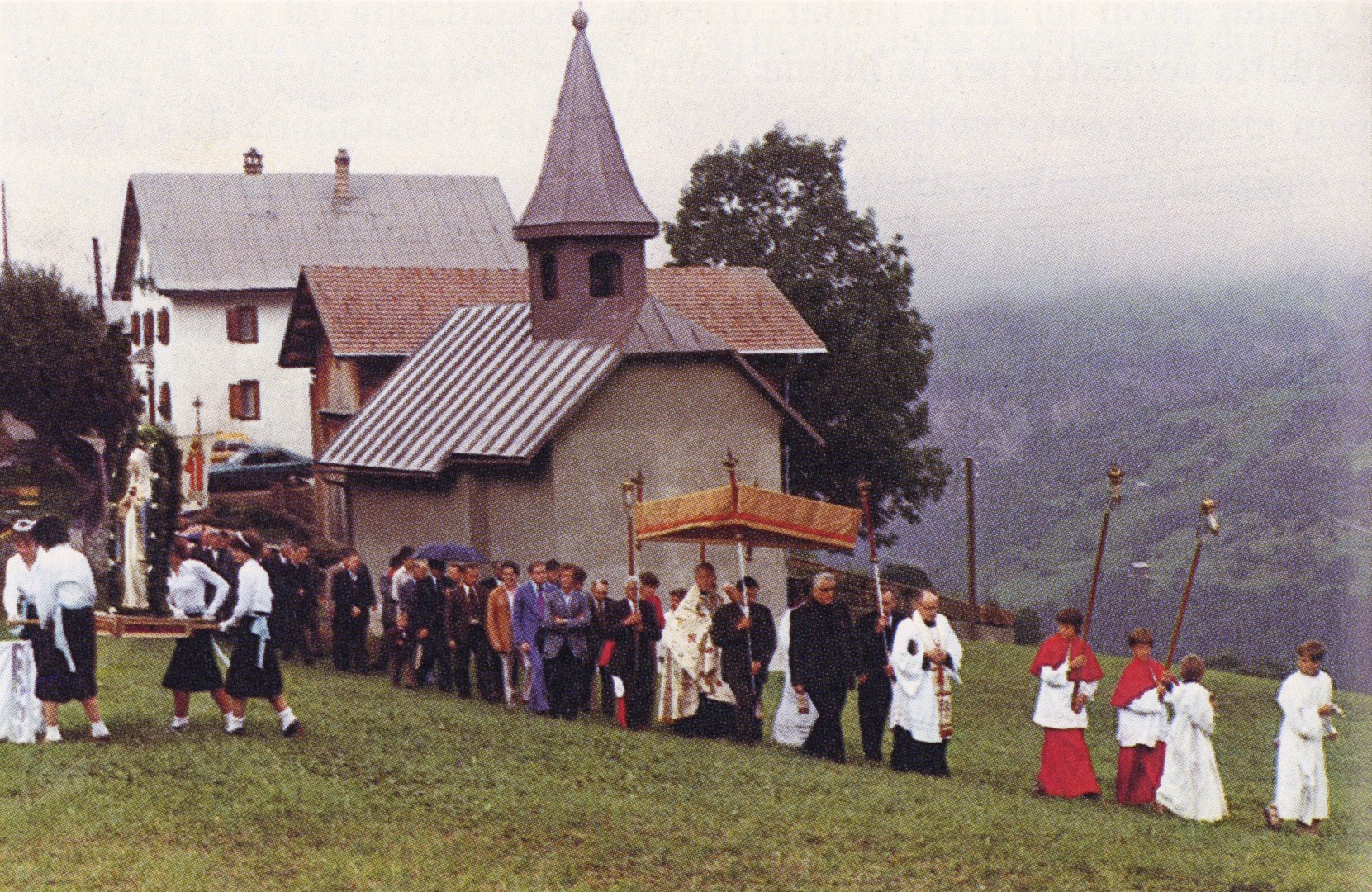
g) Igl apostolat dalla oraziun
Ei setracta buca d’ina atgna confraternitad, anzi d’ina luca uniun associada alla arciconfraternitad dil SS. Cor da Jesus a Roma e fundada ils 8 d’avrel 1861 ed approbada da papa Pius IX 1866. P. Nicolaus veva introduciu igl apostolat a Cumbel ils 15 da december 1873. El ha gudignau members en grond diember. Las gliestas succedan dapi lu cun interrupziuns tochen 1921. Lu nuot pli tochen 1950. Sur Baselgia scriva el cudisch digl apostolat: «Sin instanta recumandaziun da Roma e da Cuera davart il directur diocesan . . . ei igl Apostolat dalla oraziun dapli 1920 emblidaus, vegnius leventaus a nova veta igl onn sogn 1950.» Ei suonda ina gliesta cun 63 nums, il bia feminins.341
h) Il Tierz Uorden da s. Francestg
Ord la «Cumpagnia da s. Francestg» crescha il Tierz Uorden, fundaus 1878 sut l’egida da P. Nicolaus. Ina gliesta ord quei emprem onn 1878 cuntegn 49 nums, 44 commembras e 5 umens.342 Quei ei ina dallas paucas uniuns che ha aunc pudiu surviver ils stempraus freids postconciliars. Oz dumbra il Tierz Uorden aunc adina 25 commembras ed in commember.
i) Igl Uorden dalla s. Famiglia
Sut quei num suonda ina gliesta digl onn 1908 cun 76 famiglias e cun aunc plirs singuls nums.343 Schiglioc eis ei d’anflar neginas autras notizias sur da quei Uorden, che para da ver viviu ina veta plitost scardalida.
k) Uniun dalla sontga Affonza
Ina luca uniun pli susteniment dallas missiuns dils pagauns. Ils commembers s’obligheschan ad ina certa contribuziun annuala allas missiuns. Per ils onns 1874-1882 exista in cudischet cullas gliestas dils commembers che han pagau.344
l) Uniun da mummas
Cun instrument digl 1 d’avrel 1933 ha il vicari general da Cuera, Anton Simeon en num digl uestg, concediu la facultad da fundar a Cumbel ina secziun dalla uniun da mummas, sut il tetel e patrunadi da Nossadunna dallas Dolurs, sco frastga dalla arcisodalitat da Regensburg (Regensburger Erzsodalität christlicher Mütter).345 Era quella uniun ha pudiu semantener tochen oz.
m) Uniun da dunnauns e mattauns catolicas dil Grischun
In onn pli tard, 1934, ei ina secziun da quella uniun cantunala seformada, cun 40 commembras registradas per quei onn.346 En veta aunc oz.
n) Apostolat dils umens
Cun caschun dalla s. missiun sut l’egida da P. Tumasch Häberle OSB dils 25 d’october tochen ils 2 da november 1949, ha in bi diember dad umens e giuvens dau lur num per quei apostolat. Els s’obligheschan d’ir mintga emprema dumengia dil meins a retscheiver ils s. sacraments, num legitimamein impedi.347
o) Congregaziun mariana da giuvnas
Lontschada e fundada da sur Leci Antoni Baselgia ed eregida canonicamein da mons. uestg Caminada ils 30 da november 1944.348
La hodierna uniun da giuventetgna ei ina fusiun dalla antica cumpagnia da mats e dalla uniun da mattauns, cuntschada entuorn 1968/69, senza caracter cultic-religius, malgrad l’associaziun alla schinumnada Ligia da s. Murezi.
Quitordisch confraternitads ni uniuns cultic-religiusas en ina pintga pleiv dattan eloquenta perdetga da viva veta religiusa da tschels onns!
4. Processiuns e devoziuns
Sper las allegadas processiuns meinsilas entuorn baselgia mintga emprema, secunda e tiarza dumengia dil meins, usitadas aunc dil temps da P. Urban, fagevan ins suenter la cargada ad alp tochen la scargada, suenter la messa dalla dumengia mintga ga ina processiun cul Sontgissim entuorn baselgia. Avon baselgia sefermava il til per la benedicziun eucaristica. En baselgia «tantum ergo» ed aunc ina ga la benedicziun.349 Da s. Marc mava la processiun a Degen. En processiun mavan ins secapescha dallas Rogaziuns,’ l’anflada dalla s. Crusch (3.5), da Venderdis sogn e da Sontgilcrest, sco era la fiasta dil Cor da Maria, il Firau las auras (26.6.), la visitaziun da Maria (2.7).350 Da s. Gieri processiunava Cumbel a Degen. Stinadamein seteneva il pievel vid usits religius. Cura che per ex. P. Nicolaus ha exprimiu il giavisch da tralaschar dad ir a Degen da s. Gieri, ha la vischnaunca concludiu da star tiel vegl.351 Lu deva ei aunc processiuns per specials basegns, per exempel per plievgia, tochen enta Vrin, sco ina radunonza da vischnaunca 1921: «Ei vegn concludiu ina processiun a Vrin per urbir ora plievgia.»352 Encunter abus els loghens nua che processiuns vegnevan ensemen353 era gia uestg Gion Anton Federspiel seviults cun sias ordinaziuns da 1760: «Era duei vegnir dismess tut quei che disturba la devoziun dil pievel a caschun da sollemnitads e processiuns, cunzun far fiera e marcadar sper baselgia duront il survetsch divin . . .»354
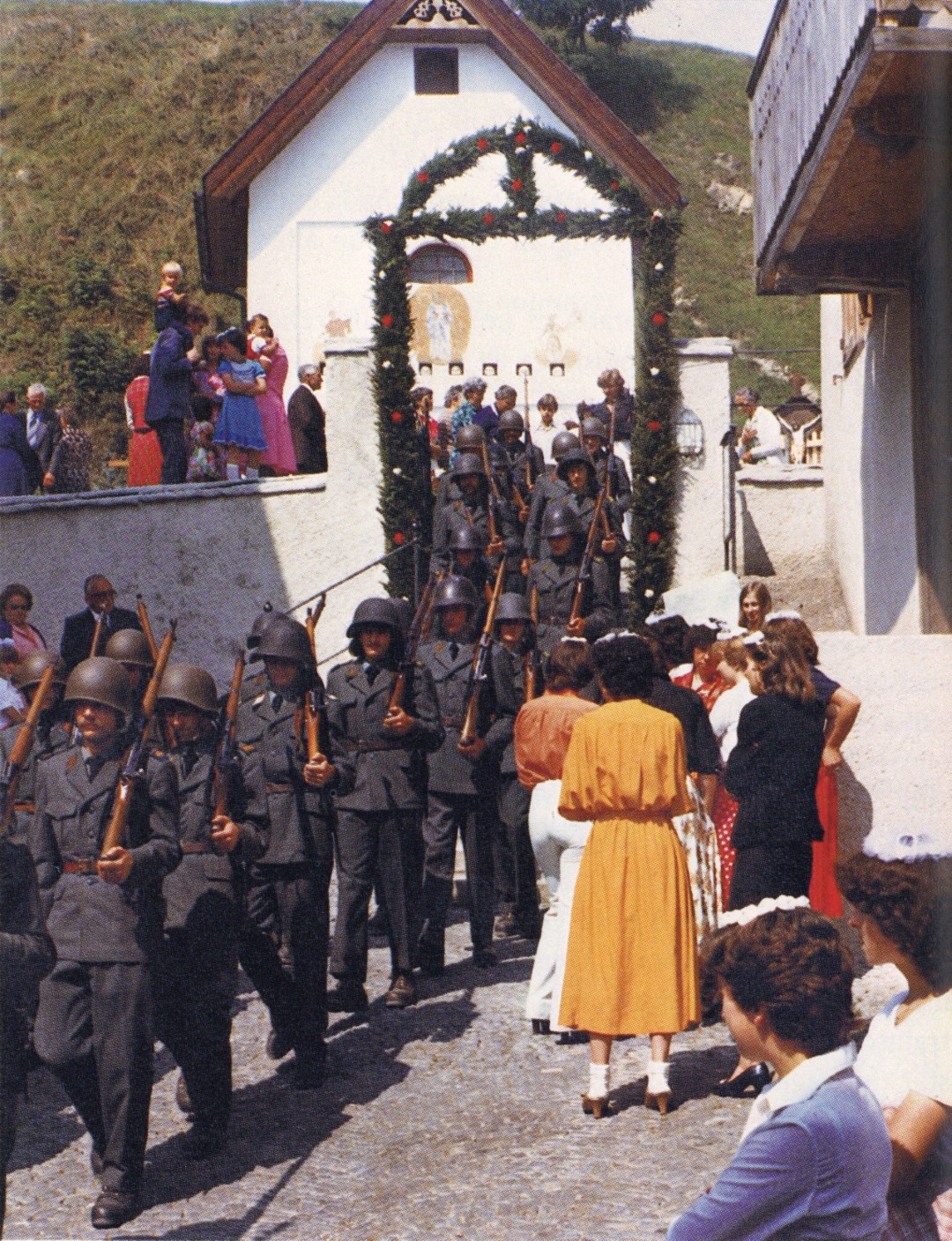
Devoziuns. Da s. Giusep e certs firaus figevan ins tgunsch viaspras suenter messa e suentermiezdi «vegn cantau cumplet. Cumplet cantavan ins mintga sera duront la cureisma cun aunc agiunscher la litania da Nossadunna.355
Dil temps da P. Urban (1905-1917) fagevan ins 4 novennas: Quella dalla Immaculata, da Nadal, da s. Giusep e dil s. Spért.356 La sera avon in tierz ni caudonn cantavan ins, aunc dil temps da sur Fetz (1933-1942), las viaspras da morts.357
5. Missiuns
L’emprema enconuschenta missiun pli pievel ei vegnida fatga 1845 dil P. Bernardino da Ceriano, lu plevon a Sagogn358 e dil giuven spiritual Gion Bistgaun Capaul da Lumbrein, pli tard curat a Morissen (1806-1870)359. Igl onn 1873, digl 1. tochen ils 9 da fevrer han P. Basilio da Morovalle, lu plevon a Vaz, e P. Donato Bergamin, plevon a Salouf, fatg missiun a Cumbel. E P. Nicolaus, plevon, po buca ludar ella avunda: «Ins saveva buca giavischar dapli, concuors immens, confessiuns generalas, e sinceras larmas eran la cruna dalla ovra.» Monsignur uestg veva concediu in perdun da 40 dis a quels che uravan cun rida era mo ina cuorta oraziun avon la crusch dalla missiun fermada vid il mir avon baselgia.360
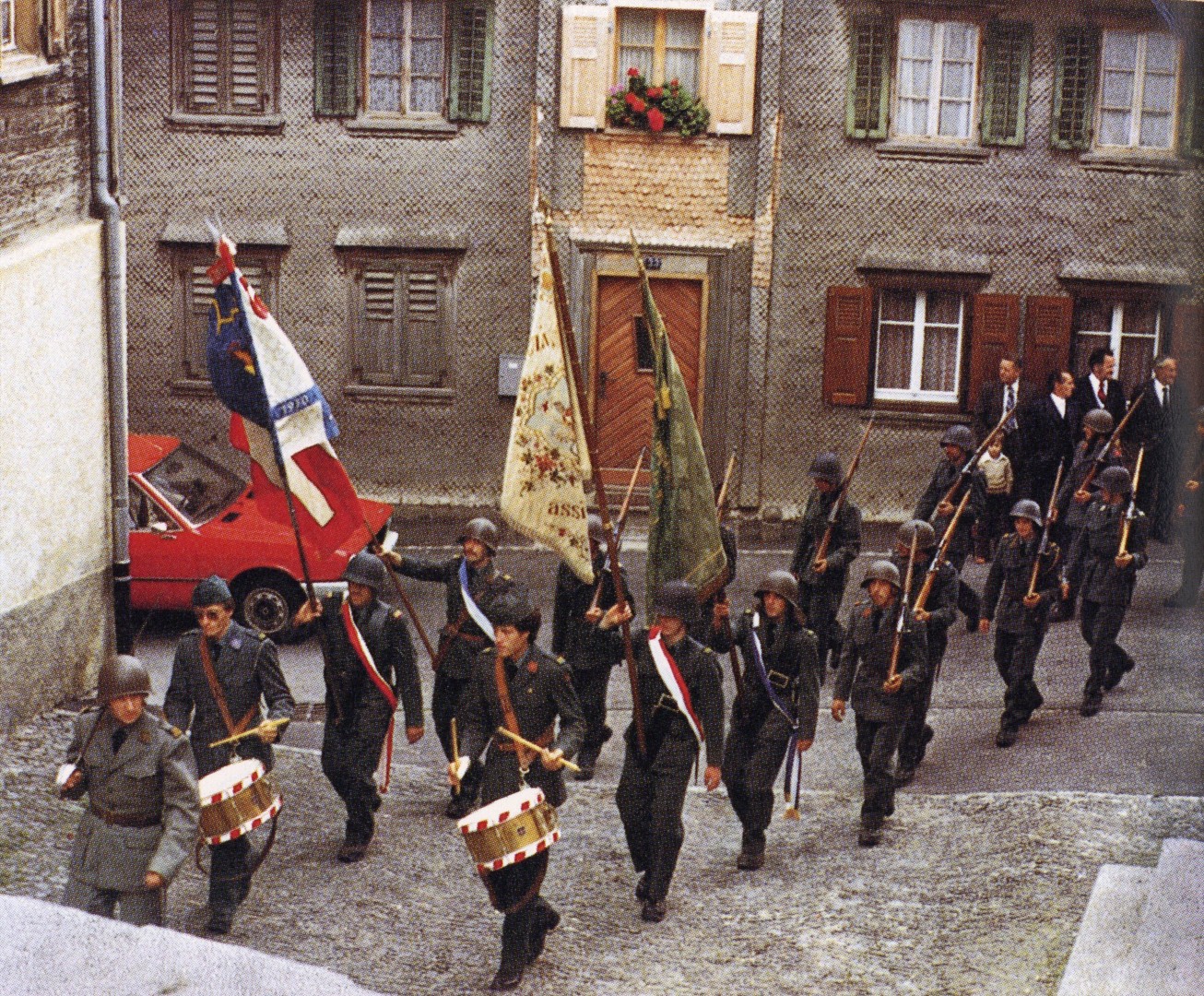
1884, ils 26 da schaner entscheiva ina missiun. Il prefect dalla Missiun Retica P. Antonino Forlano da Badaluzzo (1821-1884)361 e P. Donato Bergamin da Vaz, plevon a Salouf, eran arrivai. Els figevan treis priedis a di, in avon miezdi, in allas 13 ed il tierz la sera. Igl 1. da fevrer la damaun ha P. Antonino fatg messa da baul ed ei lu ius en confessiunal. Suenter c. ina ura eis el curdaus davon giu avon il confessiunal tuccaus dalla daguota. Ins ha purtau el en casa pervenda e fatg clamar en da Glion il docter Riedi.362 La missiun ha P. Donato cuntinuau persuls. P. Antonino ei staus schiraus dil tut dalla vart seniastra, tgiraus en casa pervenda sut l’egida da dr. Riedi e dr. Geronimi.363’ La glieud da Cumbel hagi priu gronda art e part, punctuescha nies cronist. Duront ils treis meins a Cumbel ei il pei seniester vegnius empau meglier, «mo il bratsch ed igl intelletg ein restai sil medem stan». Ils 22 d’avrel ei il pader malsaun vegnius transportaus el spital dalla Crusch a Cuera. Leu eis el staus tochen ils 3 da zercladur per lu vegnir transportaus a Vaz. Leu eis el morts ils 21 da fenadur 1884.364 Pigi interval da 30 onns vein nus ussa neginas novas d’ina missiun. Ulteriuras missiuns han ins fatg:
-
1915, da P. Anton Baselgia da Sumvitg, Gesuit.
-
1927, dils dus frars caputschins, P. Placi e P. Teodosi Deragisch, da Tujetsch.
-
1939, da P. Teodosi Sialm, giesuit, da Segnas.
-
1949, fatga da P. Tumasch Häberle, benedictin da Mustér.
-
1960, fatga dils dus paders caputschins Ehrenbert Kohler e Teofried Benz.
-
1980, dils 9-16 da mars, da P. Ehrenbert Kohler.365
6. Creisma
Las inscripziuns el cudisch parochial da creisma dil 17. tschentaner ein buca cumplettas e quellas dil 18. paran dad esser purtadas en per pli tard. Igl onn 1656 ha prenci-uestg Gion Flugi d’Aspermont VI cresmau a Pleiv in grond diember confirmands da Cumbel, affons ed era carschi. Sper las schlatteinas da Cumbel dad oz cumparan denter ils confirmands aunc: Caglier, Cing (Tschegn), Donau, Peder, de Puoz e Gargieri.
1716, ils 30 da zercladur, a caschun dalla consecraziun dalla caplutta da s. Murezi, ha uestg Duri de Federspiel cresmau a Cumbel 66 confirmands. 1739, ils 20 da zercladur, ei stau creisma a Pleif e uestg Josef Benedikt von Rost ha cresmau 68 confirmands da Cumbel.
1744, ils 13 da settember, ha il medem uestg cresmau a Pleif 71 confirmands da Cumbel. E gia dus onns pli tard, 1746, ils 19 da fenadur, ha il nunzi papal cun residenza a Lucerna, mons. Filippo Acciajouli, cresmau a Cumbel 51 confirmands, denter quels biars d ordeifer: da Degen, Vella, Vignogn, Peiden e da Morissen. Il nunzi veva numnadamein interpriu ina visitaziun persunala da tuts il posts dalla Missiun Retica el decuors dil fenadur da quei onn.366 Per quei intent era el arrivaus a Cumbel.
1772, 1 da settember, ha uestg Gion Antoni de Federspiel cresmau a Pleif 62 confirmands. 1787, ils 9 da settember, uestg Dionis von Rost, cresmau 70. 1804, ils 27 d’uost, uestg Carli Rudolf Buol-Schauenstein, cresmau c. 75. 1807 ha il nunzi papal, Fabritius Scebera, cresmau a Sagogn c. 15 confirmands da Cumbel. Ulteriuras creismas ein stadas: 1819, 27 da schaner (Buoi), e 1832 ils 21 da fenadur (Buoi). Uestg Caspar de Cari ha cresmau a Cumbel il fenadur 1844 ed igl uost 1855 a Pleif. Dus onns avon 1853 veva el gia cresmau a Schluein c. 30 affons da Cumbel, denter auter, sco da gliez temps usitau, era pigns dad in tochen 9 onns. Uestg Franz Nicolaus Fiorentini creisma 1865 il settember, Caspar Willi 1875 il zercladur, Franz Constantin Rampa il fenadur 1884 ed uestg Gion Fidel Battaglia 1890 il matg e 1896 igl avrel e 1902, avrel, 1908 ils 6 da matg. Tuttas creismas ein stadas a Pleif, deno 1716, 1746 e 1807 sco sura allegau. Dacheu naven ei cresmau a Cumbel tras uestg Georgius Schmid 1913, 1918, a Pleif 1923 e 1928. Dapi lu mo pli a Cumbel tras uestg Luregn Mattias Vincenz 1933 e 1937, tras uestg Cristian Caminada 1942, 1947, 1952, 1957, tras uestg Johannes Vonderach 1962, 1967, 1972 1977 e 1982.367
7. Chor-baselgia
In chor-baselgia organisau sco uniun entscheiva apparentamein per cun 1892. Avon era vegniu discurriu da bia els capetels clericals sur dalla reorganisaziun dil cant ecclesiastic. Era il plevon, P. Nicolaus, veva muentau empau. Ina radunonza da vischnaunca dils 23 d’october 1892 ha lu priu il conclus: «dad ereger in chor stabel de cant, el qual vegnan pri si cantadurs habels, senza differenza ch’ei seigien mats ni buc. Per tal chor vegn reservau sin la lautga in agen e sufficient spazi, il qual duei vegnir serraus giu.»368 1909 ha la «societad da cant ecclesiastic», sco il chor senumnava lu, acquistau in niev harmoni e la pleiv ha surpriu 100.– fr. sco dumandau.369 Entuorn 1913 ei la damonda d’in chor mischedau vegnida lontschada. Ins ha dumandau igl uestg Georgius Schmid per la lubientscha. Quel ha snegau quella cun allegar in cert decret papal dils 18 da schaner 1904 sur dalla musica ecclesiastica. Da lezzas uras regeva era empau discordia pervia dil plaz sin lautga.370 Igl onn 1972 ei il chor seconstituius sco chor mischedau. Sco tal ha el cantau en baselgia per l’emprema ga da Nadal 1974.371
VIII. Scolaresser
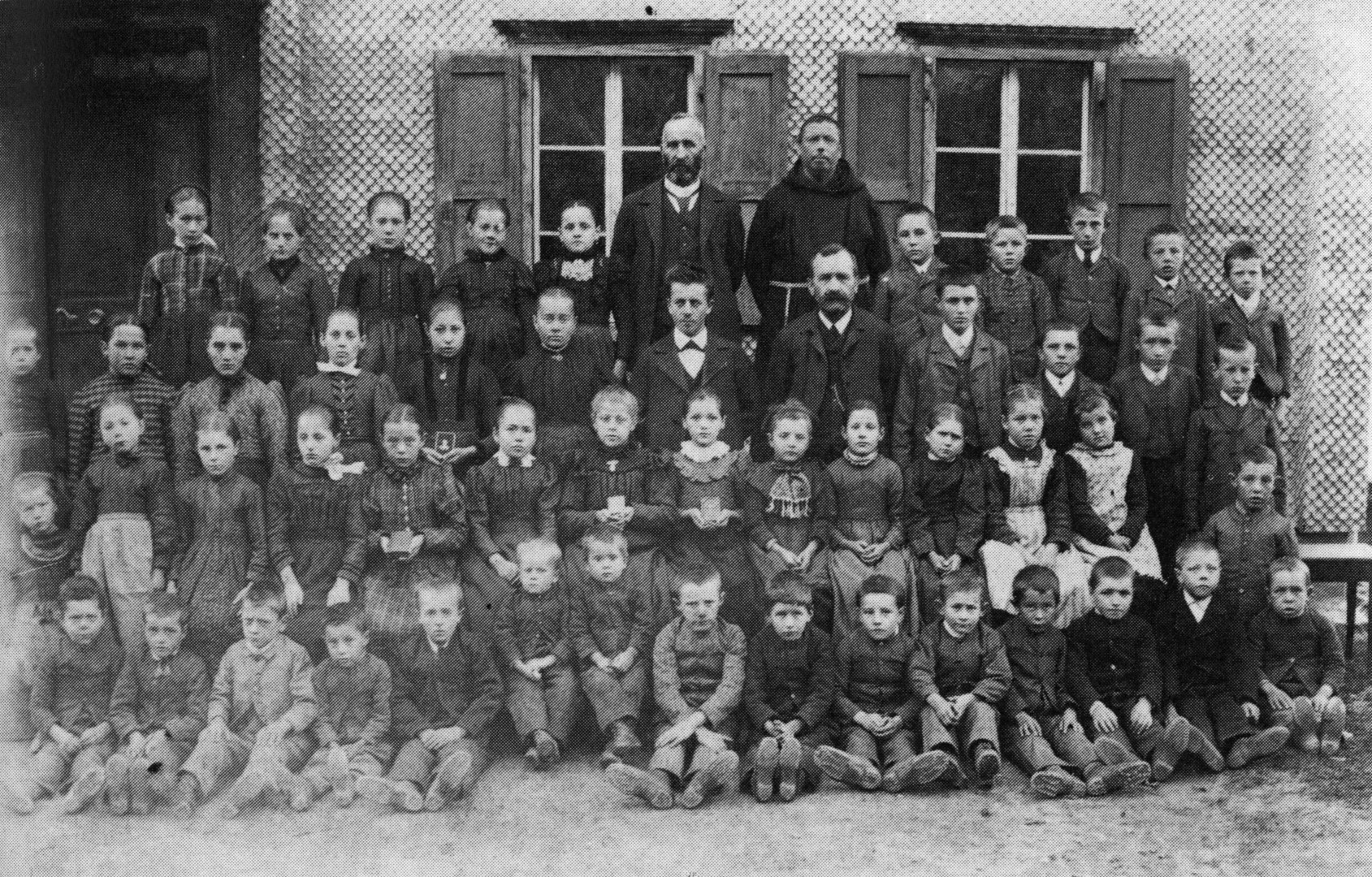
1. La scola
Cuort suenter l’entschatta dil 19. tschentaner ha la scola veglia dils plevons e caplons entschiet a far atras in svilup, che ha menau ella pass per pass naven dalla Baselgia ed els mauns dil stadi, vul dir dalla vischnaunca politica sut l’egida dallas instanzas cantunalas.372 La Baselgia veva cheu, sco era en auters graus, preparau tier beiti pli stadi.
Da quei «temps dalla entschatta» vevan las singulas vischnauncas entschiet ad arver fondos da scola. La scola custava. Tochen ussa vevan ils spiritual dau scola, ins sa dir, ton sco gratuitamein.373 A Cumbel veva la cumpagnia dalla ductrina cristiana funcziunau buca mal.374 La vischnaunca vischina da Morissen veva aviert in fondo scolar 1846.375 1851 ha la vischnaunca da Cumbel concludiu, che scadin che maridi ina femna d’ordeifer vischnaunca, hagi da cuntribuir 20.– fl. al fondo da scola.376 1857 vegn aunc pli: «Bis ei mess si a tuts vischins che maridan 5.– fr. al fondo da scola. 2, Deigien tuts quels che mieran senza descendenza pagar 2 promil al fondo da scola.»377 Quellas determinaziuns ein lu era vegnidas inseradas ella constituziun da vischnaunca da 1862.378 1872 ha la vischnaunca concludiu, lubidamein ni bue, da dar al fondo da scola 200.– fr. ord la spenda.379 Tuttina seduleva la vischnaunca dil buordi finanziai. 1853 rapporta il president da vischnaunca al departament d’educaziun a Cuera che Cumbel possedi in fondo da scola da 1760.– fr. e hagi fatg pliras disposiziuns per augmentar quel e speri en vesta da tals sforzs da survegnir dil cantun ina premia, che vegni concedida en tals cass.380 1855 repeta P. Bonaventura la damonda per in subsidi. La taxa sin femnas jastras che maridien en vischnaunca seigi alzada sin 34.– fr. e mintga affon da scola paghi in daner da scola da 3.– fr. e quei fetschi il frequentar la scola pli odius che emperneivel.381 1877 era la taglia sil scolar alzada sin 3.82 e 1878 gia sin 4.– fr. e 1879 sin 4.30.382 Ultra da quei havevan ils geniturs dils scolars aunc in quitau: Quel da far ora la lenna da scola. Tuttenina ein els vegni unfis ed han, 1883, declarau: «. . . ch’els fetschien buca la lenna quest onn pli scolast resp. per la scola, mobein attribueschien quella grevezia tenor lescha da vischnaunca.» La radunonza da vischnaunca ha lu decidiu: «Il menar neutier la lenna duei la vischnaunca far, il far ora ella dueien quels che han affons da scola surprender.»383 1885 surpren la vischnaunca era quella lavur.384 Mo gia 1889 concluda la vischnaunca: «Il far ora la lenna da scola procuran ils geniturs dils affons per dus onns.»385 – Las damondas per in subsidi cantunal per la scola suondan era suenter regularmein tochen viaden els 1890.386
Tochen egl onn 1891 deva ei mo ina scola, lu duas e puspei mo ina e lu ina tiarza, tenor tala survesta:
| tochen 1891 | 1 scola |
| 1891/92-1903/1904 | 2 scolas |
| 1904/05 | 1 scola |
| 1905/06-1939 | 2 scolas |
| 1939/40-1946 | 3 scolas |
| 1946/47-1953 | 2 scolas |
| 1953/54 | 1 scola |
| 1954/55-1963 | 2 scolas |
| 1963/64 tochen oz (1982) ina scola manuala e 2 scolas primaras. | |
| 1971/72 vegn fusiunau cun Morissen.387 |
1908 ei vegniu dau l’entschatta cun ina schinumnada «scola da perfecziun388». 1909 concluda la vischnaunca «da tener ina scola da repetiziun»389, denton gia dau l’entschatta 1857, culla schinumnada «scola da stad» ni «scola da repetiziun», sco dil reminent era en auters loghens.390 Scolast Gion Giusep Cadieli ha surpriu quei onn la scola da stad per il salari da 2.– fr. a di.391 Il cussegl d’educaziun cantunal ha ludau fetg las stentas dalla vischnaunca da Cumbel pli scolaresser ed en special per la scola da stad.392 1891/92 e suandonts onns han ins fatg scola da repetiziun cun 5 uras ad jamna, treis la gievgia avon miezdi e duas la sonda suentermiezdi.393 El rapport da 1903 ei era il raschieni d’ina «scola supplementara facultativa per mattatschas», che existi dapi zacons onns.394
La scola cuzzava l’entschatta 5 meins, naven dalla entschatta november tochen la fin mars, en tut 22 jamnas, 1867 22 jamnas per 9 onns da scola e 24 jamnas per 8 onns, 1904 ei il cuoz fixaus dil cantun sin 26 jamnas per 9 e 28 jamnas per 8 onns da scola.395
Il cuort temps da scola vegneva lu tenius en rigurusamein. Igl «ir giul Schuob» da siu temps dava als cussegls da scola enqual fastedi. Els vevan da vegliar, che la scola vegni buca scursanida. 1871 ha il cussegl d’educaziun obligau ils inspecturs da scola da tgisar cass nunlubi.396 Da quellas varts ha la suprastonza da vischnaunca survegniu si da Cuera il fenadur 1878 ina brev dil cussegl Pign: «. . . Ord Vossa brev dils . . . vein nus pia intervengiu, che buca meins che 8 affons han survegniu attestats e la lubientscha da bandunar la scola per ir giul Schuob avon che quella fineschi. Sin fundament dil conclus dil cussegl grond dils 30 da zercladur 1871, essas Vus curdai en in castitg da 40.– fr. ils quals ein da pagar alla cassa cantunala enteifer 15 dis. En num dil cussegl Pign: il pres. Fr. Conrad.»397
La scola d’avon tschien onns mava segir suenter la buna devisa da contonscher il pli bia el pli cuort temps. Ins teneva era sin exactadad e disciplina. Per l’avertura dalla scola ils 3 da november 1863, per exempel, ha il president da scola «dau il particular avis, che da quei di naven se laschien buca engartar sin gassa a far termagls, sonder che ils loghens, nua che dueien setener si een numnadamein la casa, la baselgia e la scola398». Il cuort temps da scola vegneva tenius en rigurusamein. Cardava in firau en quella jamna, ni era mo ina sepultura, veva ei da dar negin di liber quella jamna, tenor ordra digl inspectur Giohen Disch.399 Ina buna scolasta sto Ludivina Guetg esser stada, la dunna dil polizist ni «landjager» Gion Antoni Guetg da Savognin. Inspectur Disch ha ludau ella ordvart muort sia disciplina e siu success.400 Dalla viseta da scola dil cussegl da scola dil december 1884 vegn remarcau da sia scola: «Ei sesanflau fetg satisfatgs ton pli progress dils scolars, sco per la buna disciplina tenida en scola, senza retscheiver gnanc la pli pintga lamentaschun ni dalla scolasta ni dils scolars.»401
Igl examen alla fin digl onn da scola vegneva da gliez temps fatgs cun empau solemnitad. In dils scolars fageva in plaid «per engraziament agli scolast402». Ual commuentond ei quei ch’il nudèr rapporta digl examen da 1856: «Ha in scolar fatg in plaid ed engraziau al scolast e tuts scolars, bargend han salidau e bandunau lur carezau scolast» (G.G. Cadieli).403 E sur digl examen da 1858 stat ei scret: «Allura il scolar Crest Tumasch Caduff, cun cuorts aber ton pli bials plaids ha engraziau il scolast en num da tuts ses conscolars dil quitau duvrau en slanzigiar en els la scienzia unida alla vertit.»404 1859 ha igl inspectur da scola P. Martin Andreoli OSB detg alla fin da sia viseta: «La scola da Cumbel ei la pli avanzada el progress.»405
2. La casa da scola
Entochen 1877 han ins fatg scola en ina stanza ni sala dador la casa pervenda annexa a quella, construida 1840 per la scola.406 Ella vaia per l’emprema casa da scola. Suenter che quei local ei staus bandunaus dalla scola, ha P. Bonaventura schau baghiar ora sur la sala pliras combrettas, che survevan als paders a caschun da conferenzas ed exercezis. La vischnaunca veva offeriu tut il material gratuitamein ed il pader ha pagau cun dil siu resp. dalla missiun ils luvrers, en tut 300.– flurins ni 510.– fr.407
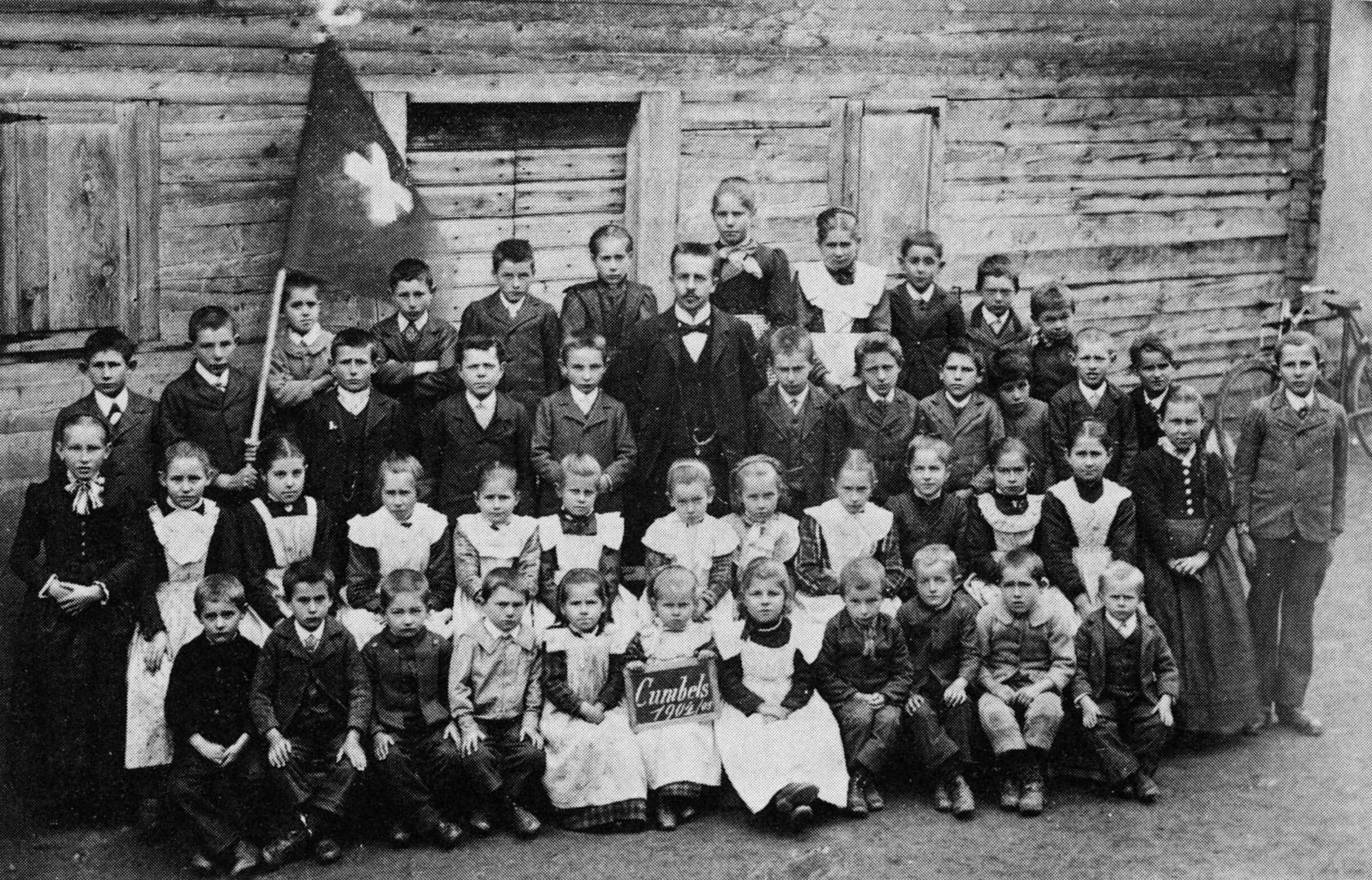
Gia la radunonza da calonda mars 1872 veva concludiu da baghiar ina atgna casa da scola.408 Cun targlinar empau, insista il cussegl d’educaziun 1874 d’interprender l’ovra. Il cussegl da scola rispunda ch’ei seigi sin via.409 1875 vegn in niev impuls d’exequir il pian cun survegnir in adattau sulom. Il protocol dalla radunonza da vischnaunca dils 13 d’avrel relata: «. . . ha il signur cumandant de Mont cun in act da beinvuglientscha enviers la vischnaunca cediu ussa e per adina sia part sulom sil qual il clavau da quellas Rigiet steva en favur dalla vischnaunca, per saver baghiar la casa da scola e quei per cunter-pagament, dil qual igl ei oz plidau nuot.»410 1876 han ins entschiet cul baghiar. Surlunder ha il plevon da lu, P. Nicolaus, schau anavos in rapport, il qual nus suandein:
Il schaner pinau las plontas. Il matg e zercladur han ils meisters dau l’entschatta. Sin quei medem plaz sesanflava ina casa veglia, nauscha, bandunada. La vischnaunca ha cumprau ella per 500.– fr. Miradur Giachen Bachin da Sagogn ha cavau fundament per 750.– fr. Giachen Fidel Cavelti da Sagogn ha fatg il da lenn per 2418.– fr. Ils 9 da fevrer era la casa finida ed ils 11 da fevrer ha ella saviu vegnir prida en possess. Ils cuosts totals, senza la lenna e la lavur cumina importan 3668.– fr.
La fiasta d’inauguraziun ei sespleigada aschia: Alias 12.30 vegn tuccau il zenn pign per rimnar ils scolars ella scola veglia ed el medem temps en casa pervenda il cussegl da scola, igl inspectur da scola, Murezi Blumenthal da Surcasti, ed il cussegl da vischnaunca cun mistral Gion Gieri Arpagaus alla testa. Els serendan «en tutta formalitad» en sala da scola. P. Nicolaus, sco president dil cussegl da scola, declara cun in cuort discuors il motiv da quella rimnada. In scolar fa in cuort plaid ed engrazia alla casa da scola veglia pli survetsch duront 37 onns ed envida en ils scolars da cantar ina canzun. Sinquei seformescha in til, ordavon in buob cun ina pintga bandieretta sgulonta, suandaus da dus buobs che purtavan sin duas astas in bi matg fluras e la carta geografica, suandai dils ulteriurs scolars e dallas scolaras che purtavan «la carta dalla nova mesira metrica». Ussa vegnevan il scolast, ils cussegliers da scola, il plevon cugl inspectur da scola, mats e mattauns, il davos il cussegl da vischnaunca cul mistral, suandai d’in grond pievel. Il til festiv ha priu la via tras il santeri, giu sil plaz dalla posta «e plaun plaun sepostaus avon la porta dalla casa nova da scola ch’era endadens pompusamein parada ed ordadora ornada cun dus bials e bein formai artgs». La porta serrada vegn aviarta, «aber avon che ir en ha il plevon benediu ella solemnamein». Lu ei il til entraus e mintgin ha priu siu plaz. Ei suonda ina canzun dils scolars ed il president da vischnaunca ha prelegiu siu plaid. Il chor mischedau ha cantau ina canzun sut il dirigent scolast Albin. Plirs oraturs han priu il plaid: Igl inspectur, il pader, cussegliers da vischnaunca e da scola ed il davos scolast Albin. Suenter ina canzun dil chor mischedau ha aunc il president da vischnaunca priu il plaid. Per conclusiun dalla fiasta ein ils scolars i sin scola veglia nua ch’il cussegl da scola ha surviu ad els in «cumin biscutin ed in glas vin411».
Suenter 40 onns, 1917/18, ei la casa vegnida renovada ed ingrondida cun baghiar ora la alzada sura, suenter plans d’architect Risch Coray da Lags e cun in cuost dad 11 200.– fr.412
Gia baul els anno 40 tschintschavan ins bia d’ina nova casa da scola. Inspectur e cussegl da scola harriavan. 1945 arriva ina instanza al cussegl da scola cun 21 suttascripziuns da geniturs, che garegiavan ina nova casa da scola. Schegie che las stanzas vegnien scaldadas damaun e sera, stoppien ils affons savens seser cun nul grad freid.413 La caussa era urgenta e madira. Arriguard il plaz e la formaziun dalla casa ha ei denton dau da surmontar bia divergenzas e difficultads. La finala sedecidan ins pli plaz dalla casa veglia. Cun architect Coray da Glion e consulta dad architect cantunal A. Willi ei ins ius alla ovra. La primavera 1947 vegn la casa veglia disfatga. 1947/48 vegn fatg scola en casas privatas. Igl atun 1948 ha igl onn da scola saviu entscheiver ella casa nova. L’inauguraziun ha giu liug ils 30 d’october 1948. Ils cuosts totals muntan sin 154 000.– fr. 1959 ei il plaz scola ella val Caparli vegnius arranschaus.414 Alla fatschada occidentala dalla casa ha il pictur Huber da Pfäffikon malegiau s. Murezi a cavagl.415
3. Ils scolasts
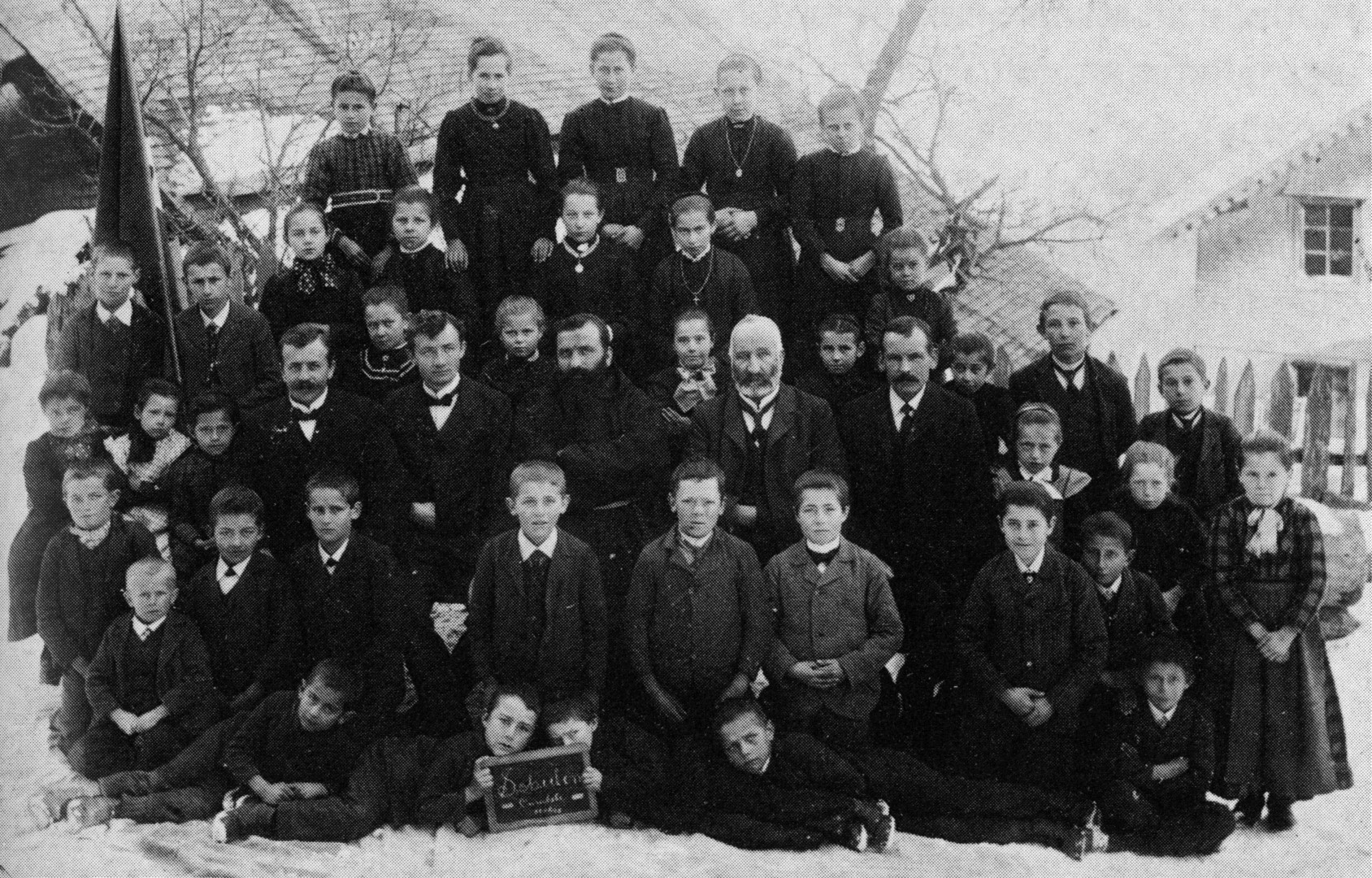
L’elecziun dils scolasts ha fatg atras bia scumiadas. Igl emprem vegnevan els elegi dalla radunonza da vischnaunca. 1879 ha la vischnaunca decidiu da surschar da «pladir il schuolmeister al cussegl da scola416». Mo gia ils 17 da settember 1882 «han ils rep. vischins dad els anora cattau il Schullehrer Giachen Arpagaus da Cumbel, enstagl dil cussegl da scola sco tochen dacheu e quei sut la clara condiziun ch’ils vischins deigien haver la collectura u dretg da cattar il scolast da cheu anavon417». La constituziun da vischnaunca da 1891 fixescha: «L’elecziun dil personal scolastic ei reservada alla radunonza communala; il cussegl da scola ha da prender informaziuns e da portar in pareri alla vischnaunca.»418 1908 vevan ils scolasts a Cumbel pretendiu cun ina petiziun alla vischnaunca, ch’ils scolasts dueigien vegnir elegi tras il cussegl da scola. Il cussegl da scola era buca cuntraris, ha denton pretendiu ch’il cussegl vegni augmentaus da treis sin tschun commembers. La radunonza calonda mars ha decidiu quella augmentaziun e ch’ils scolasts vegnien, tenor uorden cantunal elegi dil cussegl da scola.419 Tonaton, 1954 ha la vischnaunca l’autra ga concludiu cun 50 encunter 5 vuschs dad eleger sezza ils scolasts.420 La lescha da scola cantunala da 1961 fixescha l’elecziun entras in gremi ordeifer la radunonza communala. Per Cumbel ei quel il cussegl da scola cul cussegl communal.
Preziaus sco’l scolast era, sia paga era mai pli gronda che quella dil signun. 1854 «pladiu scolast per 136.– fr». La scola cuzzava lu 5 meins, dalla entschatta november tochen l’entschatta avrel. Pils onns suandonts vein nus talas tarifas per la paga dils scolasts:
| 1855/56 | 187.– fr. |
| 1856/57 | 180.– fr. |
| 1857/58 | 187.– fr. |
| 1858/59 | 200.– fr. |
| 1859/60 | 200.– fr. |
| 1863/64 | 210.– fr. |
| 1867/68 | 300.– fr. |
| 1872/73 | 310.– fr. |
| 1873/74 | 340.– fr. |
| 1874/75 | 360.– fr. |
| 1876/77 | 375.– fr. |
| 1878/79 | 390.– fr. |
Da 1879 tochen 1883 ha scolast Giachen Arpagaus dau scola puspei mo per 340.– fr. ad onn. E scolasta Ludivina Guetg ha dau scola da 1885-1889 era mo per quella paga e duas cargas lenna ad onn, pia tschun onns per 1700.– fr. 1890 surpren scolast Gion Rudolf Collenberg la scola entira cun 51 scolars per la paga da 400.– fr.»421 Era quei ei in maletg dil temps: 1897 ei il giuven scolast Gion Murezi Arpagaus s’annunziaus per la scola superiura, per 340.– fr. Per buca piarder la piazza ei scolast Rud. Collenberg era ius giu dils 400.– sin 340.– fr. paga. Il departement d’educaziun ha denton dau la cunzina da tralaschar da talas «practicas, malvengonzas d’in scolast».422
A Cumbel han ils suandonts scolasts dau scola:
| 1853-1859 | Cadieli Gion Giusep, da Sagogn |
| 1859/60 | Cadieli Gion Fidel, da Sagogn a Zezras |
| 1863-1865 | Arpagaus Giachen Antoni Bonaventura, da Cumbel (nasch. ils 9 da zercladur 1845, fegl da Gion Gieri Arpagaus e da Maria Margretta n. Capaul da S. Martin, patentaus 1863) |
| 1865-1867 | Cadieli Gion Dumeni |
| 1867-1879 | Albin Luregn, da Tersnaus |
| 1879-1884 | Arpagaus Giachen Ant. Bonaventura |
| 1884-1889 | Guetg Ludivina, da Savognin |
| 1889-1891 | Collenberg Gion Rudolf, da Morissen (nasch. ils 5 da mars 1866, fegl da Albert Mattiu Collenberg, patentaus 1888)423 |
| 1891-1899 | (2 scolas) Collenberg Gion Rudolf Arpagaus Giachen Bonaventura |
| 1899-1904 | Arpagaus Giachen Bonaventura |
| Arpagaus Gion Murezi, da Cumbel (n. ils 22 d’avrel 1875, fegl da Gion Murezi Francestg e da M. Margr. n. Blumenthal da Surcasti) | |
| 1904/05 | (1 scola) Arpagaus Gion Murezi |
| 1905-1907 | (2 scolas) Arpagaus Giachen Bonaventura |
| Cavegn Giachen, da Vella, patentaus 1905, la scola sup. | |
| 1907-1909 | Arpagaus Gion Murezi Cavegn Giachen |
| 1909/10 | Arpagaus Gion Murezi |
| Caminada Cristian, da Lumbrein | |
| 1910-1913 | Derungs Anton, da Surcasti, premlitinent, n. 1883 Steinhauser Julius, da Sagogn |
| 1913/14 | Cavelti Gion Mattias, da Sagogn, pat. 1913 Steinhauser Julius |
| 1914/15 | Cavelti Gion Mattias |
| Arpagaus Gion Murezi | |
| 1915-1917 | Arpagaus Gion Murezi |
| Capaul Martin, da Tersnaus, nasch. 1866 | |
| 1917/18 | Cavigielli Heinrich, da Siat, n. 1876 Fontana Lorenz, n. 1893, pat. 1915 |
| 1918-1920 | Casutt Gieri, da Falera, n. 1888, pat. 1908 |
| Fontana Lorenz | |
| 1920/21 | Maissen Aluis, da Trun, n. 1882, pat. 1902 |
| Fontana Lorenz | |
| 1921/22 | Camathias Gion Rest, da Lags, n. 1890, pat. 1911 |
| Fontana Lorenz | |
| 1922-1924 | Caminada Gion Pieder, da Surrin, pat. 1906 Fontana Lorenz |
| 1924-1930 | Arpagaus Gion Murezi, da Cumbel, n. 1875, pat. 1895 |
| Fontana Lorenz | |
| 1930-1937 | Casanova Lorenz, da Cumbel, n. 1905, pat. 1926 |
| Fontana Lorenz | |
| 1937-1939 | Cavelti Cristoffel, da Sagogn, n. 1907, pat. 1928 |
| Vinzens Alfons, da Zignau, n. 1915, pat. 1937 | |
| 1939-1941 | (3 scolas) Cavelti Cristoffel |
| Vinzens Alfons | |
| Casanova Carli, da Cumbel, n. 1912, pat. 1938 | |
| 1941/1946 | Fontana Lorenz Casanova Lorenz Casanova Carli |
| 1946-1953 | (2 scolas) Fontana Lorenz Casanova Lorenz |
| 1953/54 | (1 scola) Casanova Lorenz |
| 1954/55 | (2 scolas) Vieli Giusep Guglielm, da Cumbel, n. ils 14 da fenadur 1926 |
| Caminada Gion Pieder | |
| 1955-1963 | Vieli Giusep |
| Caduff Rest Giachen, da Cumbel, n. ils 5 da november 1927 | |
| 1963-1969 | Vieli Giusep |
| Caduff Rest Giachen (scola manuala) | |
| Caduff Pieder, da Morissen, a Valgronda, n. ils 27 da schaner 1941 | |
| 1969-1971 | Vieli Giusep |
| Caduff Rest Giachen | |
| Collenberg Cristian, da Cumbel, n. ils 2 da matg 1948 | |
| 1971-1974 | Vieli Giusep |
| Caduff Rest Giachen | |
| Capeder Ursulina, da Duin | |
| 1974/75 | Vieli Giusep |
| Caduff Rest Giachen | |
| Collenberg-Caduff Rita | |
| 1975-1980 | Vieli Giusep |
| Caduff Rest Giachen | |
| Casutt Gion Giachen, da Falera424 | |
| 1980/81 | Vieli Giusep Casutt Gion Giachen Bleisch Nadia (scola manuala) |
| 1981/82 | Vieli Giusep Cantieni Balzer, scola manuala, provisoric. Elegius: Armin Caduff da Cumbel, (che finescha ses studis da scolast real) Wälty Barbara, a Domat, scola inf. provisoric. Elegius: Egmund Heisch da Cumbel. |
NB. Quest onn 1981 ha Rest Martin Cabalzar, da Cumbel, acquistau la patenta da scolast secundar e meina dapresent la scola secundara-cirquitala a Vella.
Dallas scolastas da lavur manda han las suandontas pudiu vegnir eruidas:
| 1878-1881 | Caduff Paula |
| 1882-1886 | Elvedi Clara |
| 1886/87 | Arpagaus Maria Mierta, da Cumbel |
| 1890-1896 | Arpagaus Maria Agatha |
| 1898-1902 | Elvedi-Arpagaus Gada |
| 1902/03 | Dunna Margreta Elvedi |
| 1903/04 | Elvedi-Arpagaus Gada |
| 1905-1907 | Elvedi Margreta |
| 1907/08 | Elvedi Gada |
| 1908-1914 | Caduff Clara |
| 1914-1919 | Arpagaus Margreta, da Val gronda |
| 1919/20 | Arpagaus-Collenberg Onna Maria, da Peiden425 |
| 1922-1927 | Arpagaus Anna Maria, da Cumbel |
| 1927-1942 | Arpagaus-Kälin Margreta |
| 1942-1944 | Collenberg Monica Josefa, da Morissen, n. 1920, pat. 1940 |
| 1944-1949 | Caduff Margreta, pat. 1943 |
| 1949/50 | Cabalzar Tresa |
| 1950-1953 | Caduff-Arpagaus Maria Barla |
| 1953-1958 | Collenberg Monica Josefa |
| 1958-1961 | Derungs A.M. |
| 1962-1964 | Blumenthal Maria Ursula |
| 1965-1967 | Derungs U. Mengia |
| 1967-1970 | Montalta Letizia |
| 1971-1973 | Heisch Maria |
| 1973-1975 | Brunold Redempta |
| 1974/75 | Sora Cristina Giossi |
| 1975-1982 | Tannò Rita426 |
IX. Fatgs socials
1. Pauperesser
a) Paupra glieud
Tschels onns deva ei bia paupra glieud tier nus. Da quels, dils quals negin s’empatschava. Cunzun sch’ei eran jasters, sco gliez «Franzos», sco ins numnava el, che ha viviu a Cumbel e contuorn da 20 onns cun ir per l’amurdiu e ch’ins ha lu anflau morts en in faner ella vischinonza dil vitg e satrau ils 11 da november 1772.427 1818, ils 30 da schaner ei ina Anna Maria Collenberg da cheu morta mond per l’almosna ora Luven.428 1835 ei miert a Cumbel in rugadur da Rueun da 72 onns.429 1837 ha il pader puspei satrau ina paupra rugadura jastra che mava a rugar.430 Ils 16 da december 1839 han ins anflau ina femna A.M.C. da Cumbel, ch’era returnada digl ir per l’almosna ordeifer, mesa morta, egl uaul da Cumbel. Ella ei prest suenter morta.431 1841 han ins puspei anflau in pauper mét da 16 onns, Gion Paul C., morts en in clavau sper vitg.432 1899 han ins anflau in cert M.M. C. da Cumbel, che mava a rugar per l’amurdiu, a Scharons en in nuegl.433 — Parlers eran buca propi beinvesi, savevan beinduras veramein esser mulestus ed aschia capeschan ins la disposiziun da vischnaunca calonda mars 1897: «Vegnend la mulestia dils parlers pli e pli gronda e ch’els dattan continua-damein disturbis da di e da notg, sche concluda la vischnaunca da castigiar scadin che loschescha tala glieud en clavaus ni nuegls cun fr. 5.–.»434
b) La spenda
Pli susteniment dils paupers surveva, sco era en auters loghens la schinumnada spenda.435 Quella instituziun ei naschida el ravugl dalla Baselgia ed ei s’enfirmida en quei gremi. El 17. tschentaner prendeva igl uestg, a caschun da sias visetas da creisma, investa dils fondos dalla spenda ed ils ugaus rendevan quen agl uestg.436 Culla spenda vegneva era uniu messas fundadas («perpetnas»). Ins surdava a quei fondo il capital per messas culla obligaziun che la spenda fetschi celebrar quellas annualmein.437 Ils ugaus spenda vegnevan elegi ensemen culs ugaus baselgia e pervenda e culs ulteriurs ufficials da vischnaunca dalla radunonza da vischnaunca, tochen alla separaziun da pleiv e vischnaunca politica.
Plaunaplaun seruschna la spenda denton vi els mauns dalla vischnaunca politica. Gia la lescha communala da 1862 tracta il pauperesser sco caussa dalla vischnaunca politica: «Art. 40. La commissiun pauperila, per ordinari consistenta ord dus commembers, administrescha la facultad dalla spenda e survigilescha che quella vegni buca sminuida. Art. 41. Inaga ad onn, il december, pren ella si il diember dils paupers che crodan tier alla spenda. Quella gliesta duei vegnir approbada dalla suprastonza. Art. 42. Ella fixescha il quantum da spenda che scadin ha d’obtener e zuar tenor siu basegns e sias forzas finanzialas. Art. 43. Ella tegn controlla sur dil priu en e dau ora, seigi daners ni victualias. Ils ugaus train lur paga per breigias ordinarias.»438 1896 considerescha la vischnaunca expressivamein la spenda per siu agen ressort, sco siu protocollist declara: «Essend la spenda in institut totalmein politic e va buca tier ils annuals rapports officials sur il pauperesser, sche cunvegn ei d’incorporar il capital per messas perpetnas al fondo da baselgia. Tgi che vul far donnaziuns e combinar cun quellas l’obligaziun d’ina messa perpetua, duei vegnir entruidaus alla administraziun baselgia ni pervenda.»439 In onn pli tard, 1897, eran 30 messas perpetnas incorporadas alla spenda cun in capital da 2121.– fr. Quel ei, sut ils 11 da november vegnius prius ord il fondo dalla spenda ed incorporaus a quel da messas perpetnas dalla baselgia.440 Mo gia 1875 veva dr. Gion Barclamiu Arpagaus dumandau la regenza a Cuera e buca la curia episcopala da prender in cert importo ord il fondo spenda per certs intends da vischnaunca441, per survegnir ina risposta negativa: ina tala alienaziun «cunterfetschi alla lescha digl 1 da schaner 1849». Cumbel hagi aunc in bien ton paupers ed ei cunvegni buca da smasar il fondo pauperil.442
Entuorn 1890 possedeva la spenda zacons Ulezis: Frust Sut, Frust sura Clius, Crucifix sut via, in frust Crucifix sper via sur vart, in frust Crucifix sissum, treis frusts a Rueun oradem, enamiez ed entadem. Il capital dalla spenda purtava lu in tscheins annual da 722.– fr.443 La spenda possedeva era dretgs d’alp, en Val, a Leis, schaus vi 1883 per 56.– fr. ed a Selva per 42.– fr.444 Cura ch’igl ei 1942 vegniu proponiu sin vischnaunca da vender Leis, «ei vegni pagau bein», ei quei vegniu refusau, cun la remarca, ch’ins «hagi fatg malas fatschentas cun vender alps445».
Denter las obligaziuns dalla spenda s’udeva ei era da dar ora als paupers pieun, frina e sal da Numnasontga, da s. Brida, dallas Rogaziuns e da s. Gion.446 Tenor ina gliesta che va da 1845 tochen 1893, vegneva onn per onn da Venderdis sogn spendiu mintgamai denter 70 e 100 glivras pieun.447
Leu nua che la spenda tunscheva bue e negin era promts da prender in pauper a dunsena, schevan ins ir ils paupers en roda a spisa tier las singulas famiglias e quei «a norma dalla taglia cantunala». 1871 per exempel mavan dus da Cumbel, S. C. ed A. C, a spisa en roda.448 Per haver empau uorden ha la vischnaunca calonda mars 1887 concludiu il suandont:
«Concernent Falimentaziun dils paupers, en special dils frars C., concluda la vischnaunca da far quei tras laschar ir en roda e zuar suenter la norma che sin mintga 2000.– fr. vegn ei teniu in di e tgi che posseda mo 1000.–, mintga autra ga. Scadin burgheis che ha en taglia, ei obligaus da tener ils paupers ni da procurar ch’enzatgi tegni per els e tals che ein buca sedomiciliai cheu, admettan per mintga di ch’els fussen obligai da tener ils paupers ina indemnisaziun da sin mintga 2000.– fr. en cassa da vischnaunca 50.– raps. Il survigilader dils paupers mondi en roda, dapresent Balzer Collenberg, cun ina paga annuala da fr. 10.–.»449
1894 vegn aunc aschuntau: «Tgi che sa per circumstanzias da famiglia buca tener, sto pagar 1 fr. per scadin.»450 Aunc 1903 vegn discurriu sur dil schar ir en roda ils paupers.451 La moda e maniera co ei vegneva schau ir en roda ils paupers illustrescha il meglier il rodel da 1887. Quel ei interessants era perquei ch’el dat in maletg dallas famiglias da Cumbel avon tschien onns e da lur situaziun economica, sco suonda: «Regulativ per ils dus paupers che van en roda. Per mintga 2000.– fr. facultad eis ei da dar in di spisa a scadin da quels dus paupers. Per ils tschiens surpli dils mellis eis ei da contribuir 4 raps per tschien scadin tur. Dau l’entschatta cul Talianer Grond tier Gieri Caduff sper fontauna ils 9 da mars 1887, cul Talianer Pign tier vieua Onna Maria Arpagaus ils 9 da mars 1887.»
| Dis. | ||||
| Contribuents: | Facultad: | I. tur | II. tur: | Importo dils tschiens a 4 raps |
| Vieua Onna Maria Arpagaus | 2 000.– | 1 | 1 | — |
| Elvedi Luis, sen. | 3 300.– | 1 | 2 | 0.48 |
| Collenberg Balzer Antoni | 1 200.– | 0 | 1 | 0.32 |
| Caduff Rest Antoni Grond | 6 900.– | 3 | 3 | 3.72 |
| Arpagaus Balzer Fidel da Stina | 3 000.– | 1 | 2 | — |
| Arpagaus Francestg da Stina | 1 900.– | 0 | 1 | 0.72 |
| Arpagaus Heinrich | 1 800.– | 0 | 0 | 0.64 |
| Arpagaus Johann dr. giurist | 12 000.– | 6 | 6 | __ |
| Arpagaus, scarvon, Stefan | 7 400.– | 2 | 2 | 12.– |
| Arpagaus Luzi Antoni, ustier | 4 600.– | 2 | 2 | 0.96 |
| Arpagaus Gion Barclamiu | 4 600.– | 2 | 2 | 0.96 |
| Frars Blumenthal, Mulin | 2 000.– | 1 | 1 | — |
| Caduff Rest Murezi, fravi | 10 800.– | 5 | 5 | 1.28 |
| Arpagaus Francestg, mistral | 15 500.– | 7 | 8 | 0.8 |
| Arpagaus Gion Murezi | 12 800.– | 5 | 6 | 1.28 |
| Arpagaus Gion Rest | 9 800.– | 6 | 6 | — |
| Arpagaus Balzer, da Gion Flurin | 5 200.– | 2 | 3 | 0.32 |
| Collenberg Gion Bistgaun | 7 700.– | 3 | 4 | 1.12 |
| Caduff Gieri sper fontauna | 2 600.– | 1 | 1 | 0.96 |
| Elvedi Fidel | 6 000.– | 3 | 3 | — |
| Collenberg Gion Luregn | 2 000.– | 1 | 1 | — |
| Arpagaus Giachen Barnaba | 8 900.– | 4 | 4 | 1.44 |
| Caduff Gion Rest, cauvitg | 3 000.– | 1 | 2 | — |
| Caduff Balzer Otto da Toni | 2 600.– | 1 | 1 | 0.96 |
| Caduff Toni | 7 600.– | 3 | 4 | — |
| Arpagaus Gion Murezi da Paula | 1 400.– | 0 | 1 | 0.64 |
| Elvedi Luzi, scarvon | 9 100.– | 4 | 5 | 0.16 |
| Caduff Murezi Giusep | 8 700.– | 4 | 4 | 1.12 |
| Vieli Giachen Balthasar | 13 000.– | 6 | 7 | — |
| Elvedi Josefa | 6 900.– | 3 | 3 | 1.44 |
| Vieli Crest Giusep | 3 000.– | 1 | 2 | — |
| Vieli Crest Gieri | 10 200.– | 5 | 5 | 0.32 |
| Arpagaus Gion Murezi da Franc. | 10 600.– | 5 | 5 | 0.96 |
| Arpagaus Gion Gieri, mistral | 17 300.– | 8 | 9 | 0.48 |
| Caduff Gion Flurin, Caparli | 2 000.– | 1 | 1 | |
| Cavegn Martin | 23 000.– | 11 | 12 | — |
| Cavegn Gion Murezi, Soazza | 11 000.– | 5 | 6 | |
| Arpagaus Rest Gieri | 3 600.– | 1 | 2 | 0.96 |
| Arpagaus Gion Flurin da Rest Mattias | 1 000.– | 0 | 1 | — |
| Arpagaus Giachen Bonaventura | 4 400.– | 2 | 2 | 0.64 |
| Arpagaus Gion Giusep | 14 500.– | 7 | 7 | 0.8 |
| Caduff Gion Giuchin | 7 400.– | 3 | 4 | 0.64 |
| Cabalzar Albert | 5 500.– | 2 | 3 | 0.8 |
| Cabalzar Madonna | 5 500.– | 2 | 3 | 0.8 |
| Caduff Francestg | 6 600.– | 3 | 3 | 0.96 |
| Arpagaus Gieri Antoni | 5 000.– | 2 | 3 | — |
| Collenberg Maria Margreta | 1 300.– | 0 | 1 | 0.48 |
| Collenberg Murezi Antoni, fravi | 2 800.– | 0 | 1 | 0.96 |
| Arpagaus Balzer Fidel | 4 600.– | 2 | 2 | — |
| Collenberg Gieri Antoni, viturin | 1 000.– | 0 | 1 | — |
| Arpagaus Gieri Francestg | 6 400.– | 3 | 3 | 0.8 |
| Arpagaus Onna Catrina | 3 500.– | 1 | 2 | — |
| Caduff, famiglia da Francestg Antoni | 3 000.– | 1 | 2 | — |
| Arpagaus Giosch | 1 800.– | 0 | 1 | 1.28 |
| Elvedi Toni | 2 200.– | 1 | 1 | 0.32 |
| Vieli August | 11 000.– | 5 | 6 | 11.– |
| Arpagaus Sievi | 5 500.– | 2 | 3 | 0.8 |
| Vieli Onna Maria | 1 500.– | 0 | 1 | 0.8 |
| Elvedi Luis, giuven452 | 2 000.– | 1 | 1 | 2.– |
Casa pauperila. 1907 ha la cumissiun da quens fatg la proposta da vender ni da far giu la casa pauperila, ella seigi strusch pli habitabla. La discussiun han ins refretg.453 Calonda mars 1909 concluda: «La casa pauperila duei vegnir scarpada giu. La lenna duvreivla reservada alla vischnaunca, il rest sigi ingant.»454 Ina radunonza dil schaner 1910 constatescha la liquidaziun dalla casa pauperila. Avon la dismessa era ella vegnida schaziada 800.– fr. valeta.455 1921 concluda la vischnaunca dad ingantar era il sulom dalla casa pauperila.456 – Els 1930 ha la vischnaunca cumprau ina autra casa, da 1946 concluda la vischnaunca da renovar ella cun in cuost da 6500.– fr.457
c) La spenda pintga
Sper la spenda existeva a Cumbel aunc dapi 1769 ina schinumnada «spenda pintga», numnada era «spenda privata» ni «spenda da sur Gieri», ina fundaziun da caracter plitost privat. Il spiritual dr. Gieri Arpagaus, da Cumbel e Sursaissa458, ses davos onns caplon ad Uors, veva sut il datum dils 16 d’avrel 1769 ad Uors testamentau ina summa pils paupers, en emprema lingia ord sia parentella, sche quella duessi zacu vegnir en basegns d’agid. Sis dis suenter, ils 22 d’avrel, eis el morts e vegnius satraus a Cumbel en baselgia.459 A ses dus ni treis cusrins a Cumbel ha el surdau l’administraziun. Il capital astgi buca vegnir smasaus. Per saver far diever dil tscheins stoppien ils basignus denton esser sesents en Surselva.460
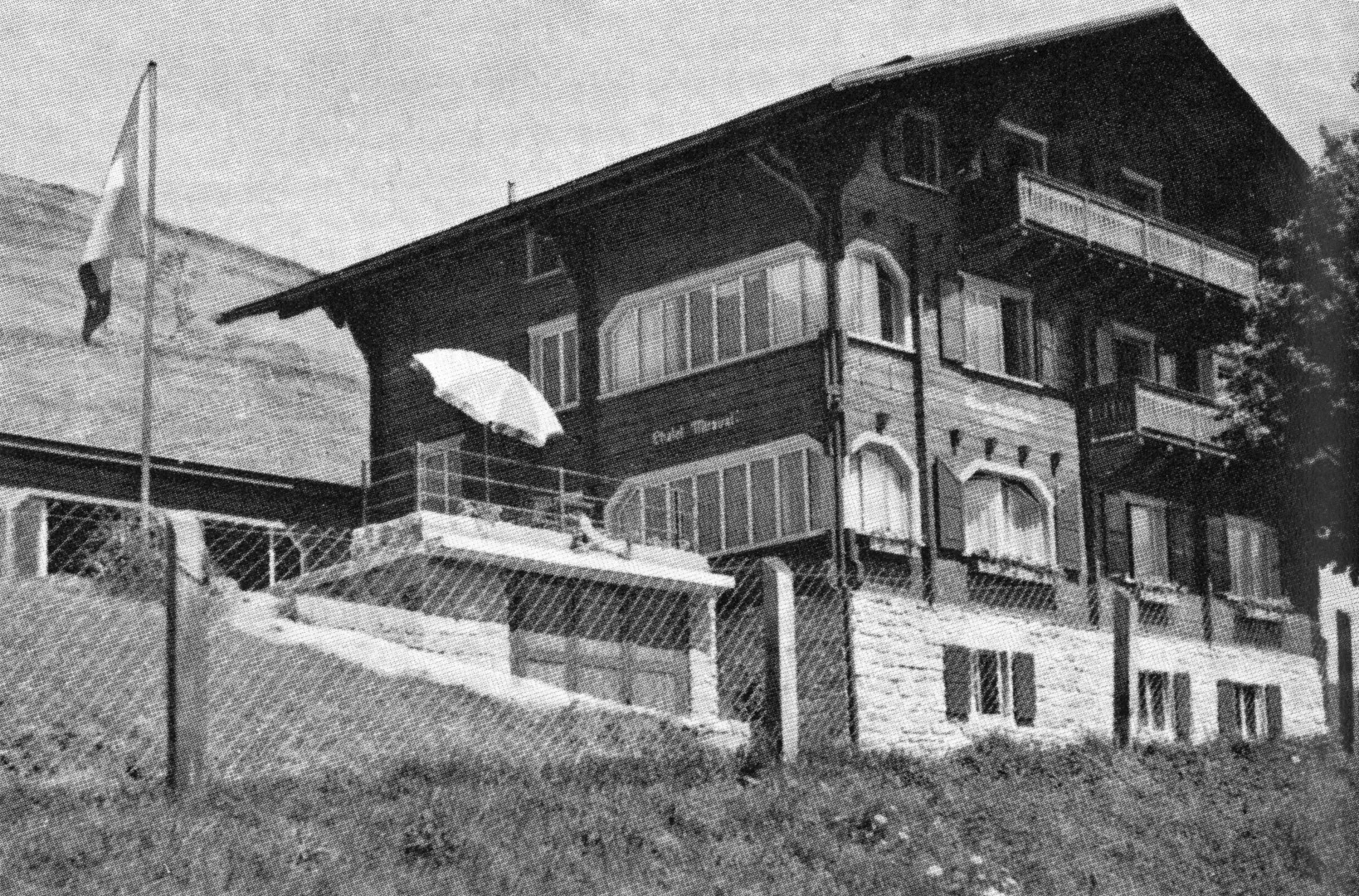
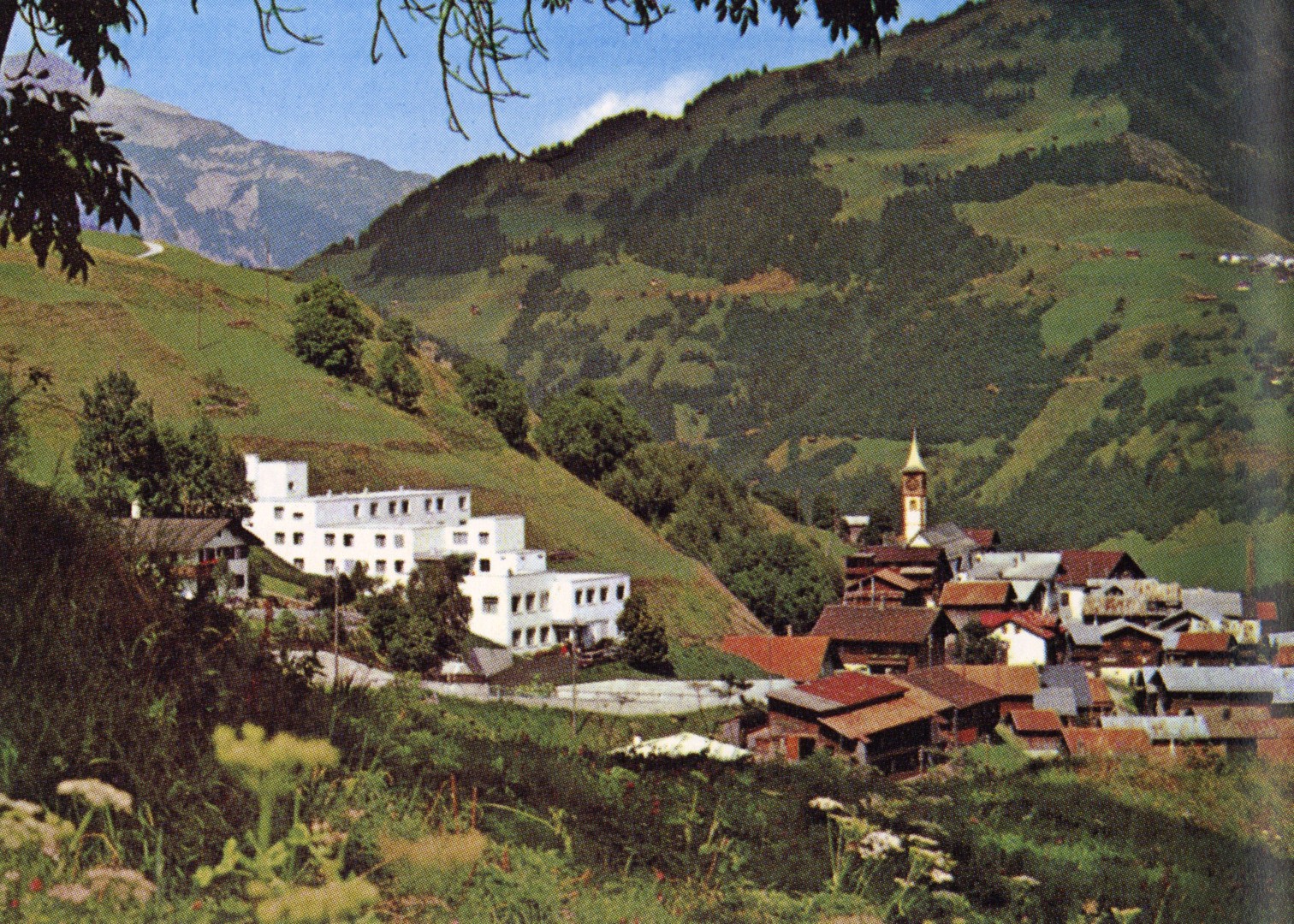
Il capital dalla spenda pintga muntava igl onn 1847 sin 1163.– flurins, 1862 era el 1986.– fr., 1893 2222.– fr. ed igl onn 1904 era il capital carschius sin 2456.– fr. Plinavon veva ella 1½ dretg d’alp a Leis ed in dretg d’alp a Selva.461
Il testamentader veva denton era surschau a ses artavels da quei fondo, da dar ad el «ina autra fuorma», sch’ins vegli buca duvrar il plaid «spenda», mo igl intent dalla fundaziun stoppi vegnir mantenius.
La spenda pintga possedeva pli baul in cudisch da quens cun zacontas interessantas notizias, il qual ei deplorablamein ius a piarder. Il quen vegneva mintgamai serraus da Venderdis sogn. Quei di survegnevan ils paupers en damonda ina almosna, pli baul en rauba e suenter en daner. Administraturs ein stai:
Dr. Gion Barclamiu Arpagaus, †1882. Scolast Giachen Arpagaus, †1920. Gion Giachen Caduff 1920-1938. Balzer Antoni Arpagaus da 1938 tochen sia mort 1977. Duront sia administraziun hagi el gidau en zacons cass cun pigns importos el senn dil testament. Dapi sia mort administrescha siu fegl Rest Gieri Arpagaus-Cabalzar il fatg.462 1939 veva ina radunonza da vischnaunca concludiu «da metter ils dus fondos sut ina administraziun cun tener quen separau463». Mo da calonda mars 1941 ha la vischnaunca lu precisau: «La spenda pintga duei esser ina caussa per sesezza, sco da vegl enneu, concludiu unanim.»464
2. Emigraziun
Tgi enconuscha buca la canzun digl emigrant dad Alfons Tuor: Ti vul la patria bandunar, ti vul egl jester ir . . .! Ei era ualvess il spert d’aventuras che catschava nossa glieud, numerus singuls ed entiras famiglias en tiaras jastras. Ils pli biars eran necessitai da bandunar la stretga patria ed il magher tschespet, seigi ella emigraziun militara sco mercenaris, ni sco emigrants commercials: Marcadonts, mistergners, ustiers e glieud da fatschenta. Biars ein vegni si da tgau e han magari fatg politica gronda en tiara jastra, ferton ch’auters ein stai meins fortunai. In’idea dalla gronda emigraziun ord nies vitg porscha la suandonta gliesta dils nums da quels ch’jeu hai anflau els cudischs parochials. La gliesta sa strusch esser cumpletta. Ualvess ein tuts quels ch’ein morts en tiara jastra vegni annunziai agl uffeci parochial.
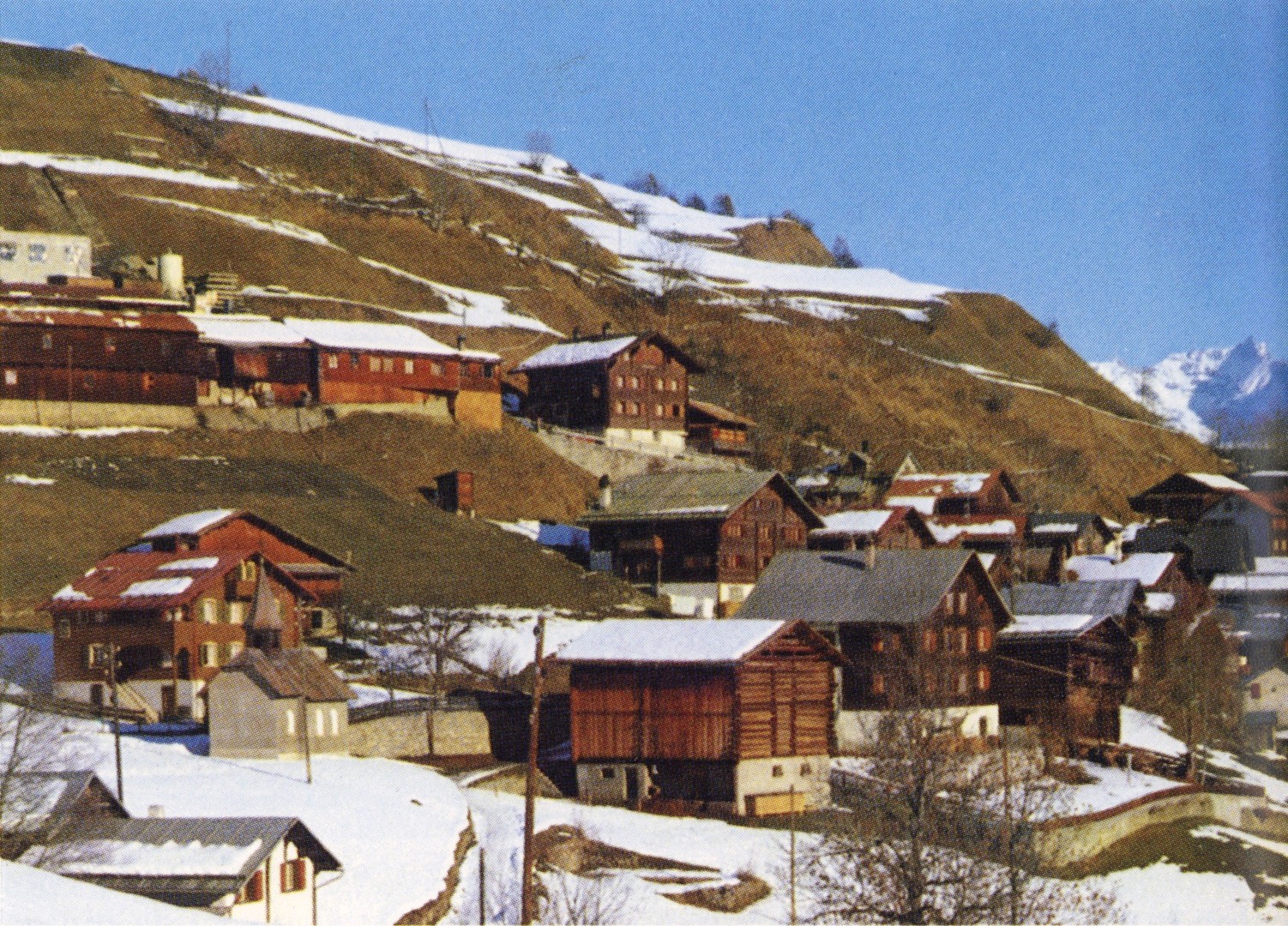
-
1659 Mattias Martin Mattias, morts giul Schuob. m
-
1664 fenadur, ils 17 «Fender» Tieni Arpagaus, morts a Milaun el spital grond, bein disponius, munius culs ss. Sacraments. m
-
1664 26 da zercl. Thomas, fegl da Gion Thomas, morts giul Schuob, cun 19 onns, curdaus ella aua. m
-
1666 14 da zercl. Barclamiu Fridli, morts giul Schuob avon 3 onns. m
-
1670 1 da sett. Cristian, fegl da Balzer Vieli, morts a Roma, prov. cun tuts ss. Sacr. e satraus l’auter di leu el santeri. m
-
1742 13 da schaner Gieli Arpagaus, fegl da mistral Gieri Arpagaus, morts cun 19 onns en Sizilia, prov. culs ss. Sacr. m
-
1743 23 da zercl. Murezi Antoni Arpagaus, morts da 19 onns en Frontscha, m
-
1743 24 da nov. Josef Arpagaus, morts cun 38 onns, el marcau da Barletta reginavel da Neapel, prov. cun tuts ss. Sacr. m
-
1751 7 da zercl. Gion Rest Collenberg, fegl da Tumasch, morts cun 31 onns a Milaun. m
-
1751 21 da fen. Bistgaun Antoni Collenberg, morts cun ca. 24 onns en Frontscha. m
-
1766 4 da fevrer Gieli Vieli, morts a Roma cun 47 onns, ils 4 da december 1765, el spital. m
-
1767 26 d’uost Martin Antoni Arpagaus, morts a Roma el spital dil s. Spért ils 4 da zercladur 1767, cun prest 40 onns. m
-
1767 5 da sett. Rest Murezi Caduff, morts igl uost vargau cun 17 onns en Valtellina, sper Sondrio. m
-
1803 3 da matg Gion Antoni Caduff, morts a Paris el spital dalla Charité, prov. culs ss. Sacraments, cheu messa da bara ils 30 da zercladur. m
-
1806 15 da fevrer Maria Margreta Collenberg, morta en tiara jastra, sco attestescha Clemens Moriz, plevon da Haasenweller. m (Hasenweiler ei in vitg giul Schuob ca. 12 km occidental da Ravensburg)
-
1811 15 da fevrer Cristian Cavegn, morts a Wohonhrechs, prov., ils 6 da schaner. m (probabel Woensrecht en Hollandia)
-
1816 2 d’oct. Luregn Antoni Soler, morts cun 17 onns giul Schuob sin viadi a casa, sper Wangen e satraus leu.
-
1817 27 da dec. Balzer Antoni Arpagaus, morts igl 1 da november a Cadice en Spagna cun 34 onns, prov. m
-
1818 19 da zercl. signur capitani Gion Caspar Fidel Casanova, morts a Clermont en Frontscha, tenor brev da caplon camp. sur Mareischen. - m. (cp. Survetschs jasters)
-
1834 2 da sett. Giachen Antoni Collenberg, maridaus, en survetsch a Milaun, vegnius leu malsauns e vulend returnar a casa, morts a Varese en in spital e satraus leu, ca. 32 onns. m
-
1847 16 da fevrer Gion Rest Bistgaun Collenberg, fegl da Giachen Martin Collenberg, morts a Lyon en Frontscha, ca. 37 onns. b
-
1851 21 d’uost Hercli Antoni Arpagaus, maridaus, morts cun 65 onns en in spital a Milaun. m
-
1853 11 da nov. Rest Murezi Arpagaus, morts ils 9 da november 1852, cun 22 onns el spital a Milaun. m
-
1853 7 da mars Rest Gieri Francestg Arpagaus, morts il matg 1836, da ca. 56 onns en Ostindia, annunziau a nus per sut il sura datum. m
-
1854 10 d’oct. Maria Margreta Arpagaus, morta da 26 onns en piazza a Bergamo. m
-
1856 3 d’uost. Rest Antoni Derungs, domiciliaus a Gallena ella America, morts da 16 onns, provedius, annunziau a nus per brev tras siu tat Rest Gieri Caduff, domiciliaus era leu. m
-
1858 31 da fen. Rest Murezi Caduff, en piazza a Lyon en Frontscha, morts da 23 onns, en spital, suenter amputaziun d’ina comba. - m
-
1861 19/20 d’avrel Stephanus Pacificus Arpagaus, domiciliaus a Montluçon en Frontscha, morts leu da 16 onns tier siu frar. m
-
1862 15 da fen. Gieri Francestg Caduff, morts da 54 onns el spital a New-Orleans. m
-
1863 29 da nov. Anna Maria Caduff-Collenberg da Cumbel, morta da ca. 50 onns a Lecco ella Lombardia. m
-
1867 18/19 d’oct. Murezi Giusep Arpagaus, fegl da mistral Gion Gieri Arpagaus, morts e satraus da 18 onns a Boulogne en Frontscha. m
-
1868 11 d’uost Gieri Murezi Arpagaus, vieu, morts da 62 onns e satraus a London, annunziau per oz ils 15 d’avrel 1869. m
-
1878 1/2 da mars, Gion Giusep Arpagaus, maridaus, morts en Frontscha da ca. 44 onns. m
-
1879 Anna Maria Vieli-Pleurdeau, maridada cun Giachen Balzer Vieli da Cumbel, morta en Frontscha, cheu las funcziuns da bara. m
-
1878 27 da dec. Mariuschla Frena Casanova, feglia da Rest Fidel Casanova, morta ad Arnach, Germania. ApC, cuviarta 9
-
1885 17 da sett. Balzer Vieli, maridaus, fegl da mistral Gieri Antoni Vieli e da Maria Brida n. Caduff da Cumbel, morts da 47 onns, dapi plirs onns en Germania. m
-
1889 31 da fen. Murezi Antoni Caduff, emploiau d’hotel, morts da 55 onns a Liège en Belgia. ApC, cuviarta 9 1893 4/6 d’oct. Murezi Antoni Arpagaus, morts da 40 onns ad Amiens en Frontscha. m
-
1895 2 d’avrel Francestg Antoni Arpagaus, morts da 72 onns e satraus en Frontscha. m
-
1926 29 da fen. Gion Barclamiu Arpagaus, morts da 34 onns a Ryderwood Washington USA. m
-
1959 9/12 da sett. Gion Murezi Arpagaus, naschius a Cumbel ils 25 d’uost 1875, fegl da Gion Barclamiu e Onna Barla Victoria, emigraus da giuven en Frontscha e da leu ella America e cun ca. 72 onns returnaus ella patria, benefactur dalla Baselgia da s. Stiafen. - m
Ord il cudisch da vischins
-
Casanova Rest Giusep, n. 29. d’oct. 1848, ius 1886 ella America
-
Elvedi Giachen Francestg, n. 10 da dec. 1853, maridaus, ius ella America ils 27 da mars 1889
-
Arpagaus Gion Flurin, dil Sievi, n. 26 da schaner 1856, maridaus cun Maria Stina Caduff, partius per l’Italia ils 22 d’avrel 1884
-
Arpagaus Maria Catrina da Hans Gieri, n. 29 da fen. 1831, ida ils 10 d’avrel 1890 a Brescia a star culs parents.
-
Casanova Gion Gieri, n. 15 da zercl. 1836, ius a Paris, returnaus 1886
-
Caduff Balzer Fidel dil Mulin sut, n. 1839 ils 3 da nov., en Frontscha.
-
Caduff Francestg Antoni, n. 27 da schaner 1856, fra caputschin Crispin Caduff a Castellazo Bormida, morts a Tortona ils 29 da matg 1892
-
Derungs Balzer Antoni dil Ferber, n. 28 da matg 1856 e partius per l’America ils 21 da mars 1888
-
Arpagaus Stiafen Antoni da Gion Gieri, n. ils 2 da nov. 1858, en Frontscha.
-
Caduff Murezi Antoni dil Balzer, n. 23 da schaner 1863, ius en Frontscha ils 11 da fen. 1876
-
Arpagaus Gion Murezi dalla vieua, n. 1 da fevrer 1863, ius 1893 ella America
-
Casanova Gion Luregn, n. 21 d’avrel 1865, ius ella America.
-
Caduff Gion Giusep da Rest Giachen, n. 4 da nov. 1865, ius ella America ils 27 da mars 1889
-
Caduff Gion Balun da Weibel Balzerott, n. 9 da nov. 1867, ius ella America ils 12 da mars 1890
-
Caduff Francestg Antoni da Tumasch, n. 6 da mars 1868, ius ella America ils 27 da mars 1889
-
Casanova Mariuschla Castgina dil Rest Antoni, n. 4 da mars 1870, ida ella America ils 29 da mars 1893
-
Arpagaus Maria Catrina, n. a Brescia ils 5 d’uost 1870 Arpagaus Alois, n. en Frontscha ils 11 da november Caduff Gion Bistgaun da Rest Giachen, n. 25 da fevrer 1872, ius en Engheltiara il davos onn da scola 1886/87
-
Elvedi Gion Gieri da Toni, n. 3 d’oct. .1872, ius ella Italia «per farsi religioso Cappuccino» fen. 1886 (= P. Alexander Elvedi) Arpagaus Balzer Otto, n. 12 da mars 1874, ius 1889 en Frontscha Casanova Gion Luregn, da Hasper Giusep, n. 27 da zercl. 1876, ius ella America ils 21 da mars 1888. Casanova Maria Barla, sia sora n. 22 d’uost 1877, ida il medem di cun siu frar ella America. Casanova Mariuschla Clara era ina sora, n. ils 17 da fen. 1885, ida ils 21 da mars (onn maunca, mo carteivel da 3 onns cun ses fargliuns 1888) ella America. Casanova Maria Ursula, da Hasper, n. ils 2 da dec. 1881, ida ella America (probabel era ina sora dils treis sura).
-
Arpagaus Madleina Catrina, da Murezi Antoni, n. ils 10 d’oct. 1887, en Frontscha
-
Arpagaus Giuanna Antonia, da Murezi Antoni, n. 5 da mars 1890, en Frontscha
-
Furger Anna Maria, da Ferdinand, n. igl 1 d’uost 1888, stat a Leiden (ei pli tard vegniu strihau atras)
-
Derungs Gion Rest dad Uors cun sia dunna Anna M. Collenberg da Cumbel, n. 1845, cun 5 affons, ils 27 da mars 1889 ella America.
-
Casanova Gion Gieri Hasper cun sia dunna ella America465
3. En survetschs militars jasters
Numerus da nos giuvens han schau carmalar dalla schulda franzosa, spagnola, hollandesa ni austriaca e han bugnau tratsch jester cun lur saung. Ils nums da nos mercenaris da Cumbel, schilunsch sco els ein vegni annunziai ed inscrets els cudischs da mortoris (m) ein:
| 1653 | 23 da dec. Tsching Gion Tsching (= Tschegn, Vintschegn), morts sco schuldau en Frontscha. |
| 1655 | 8 da zercl. Gallus de Blumenthal, morts en Frontscha, schuldau. |
| 1659 | 15 da mars, Murezi Gion Belun, morts sco schuldau en Schlesia. |
| 1690 | Murezi Cabalzar e Christ Cabalzar, morts ella uiara (buca indicau nua). |
| 1716 | 1 da nov. Collenberg Gieri, morts sco schuldau en Frontscha. |
| 1729 | 23 d’avrel ei morts il mistral Gieri Arpagaus, capitani ella armada Veneziana a che ha battiu e Pelopones encunter ils Tercs.466 |
| 1758 | 14 da fen. Arpagaus Murezi Antoni, capitani, en Frontscha, morts da 43 onns a Pavia, il matg 1758. |
| 1760 | 21 d’oct. Collenberg Gion Rest, morts da 23 onns sco schuldau en Frontscha. |
| 1789 | 16 da dec. Arpagaus Rest Giachen Antoni, morts sco schuldau en Sardinia, provedius. |
| 1812 | october ei curdaus ella battaglia alla Beresina litinent Murezi Antoni Arpagaus-Vieli, n. 8 da november 1784, fegl da mistral Gieri Arpagaus e Maria Monica sia consorta, m, b e ApC, rodel dils morts. |
| 1818 | 19 da zercl. Casanova Gion Caspar Fidel, capitani, morts a Clermont en Frontscha tenor brev da caplon camp. sur Mareischen.467 Tenor ApC rodel dils morts: Oberst Gion Fidel Casanova e cons. Ma. Barla. |
| 1820 | 30 da dec. Arpagaus Balzer Antoni, corporal ella cumpagnia de Salis en Frontscha, morts suenter liunga malsogna, provedius culs ss. Sacraments el spital a Lyon, da 22 onns, provedius da sur Mareischen e satraus leuen. |
| 1821 | fevrer Arpagaus Francestg Antoni, morts sco schuldau ad Antwerpen el spital militar. |
| 1836 | 1 da nov. Arpagaus Gion Rest, fegl da Rest e Maria Arpagaus, morts el spital militar a Neapel, instructer dalla cumpagnia (centuriae instructor). |
| 1849 | Caduff Caspar Antoni, morts ils 31 d’october 1849 el spital militar a Neapel sco schuldau el survetsch dil retg Ferdinand. |
| 1859 | 1 da schaner Arpagaus Murezi, schuldau ellas truppas papalas, morts da 25 onns, provedius. |
X. Las schlatteinas a Cumbel
1. Las schlatteinas sparidas
a) Ord acts
Sper ils nums da schlatteina a Cumbel ruminai els sura capetels I/1 ed I/2:
-
Andest, d’Andest. 1397 Albert d’Andest, 1408 Pieder, Jos Evivenz d’Andest.468
-
Parli. 1472 Ulrich Parli.468
-
Depuoz. 1489 Gieri, Turtè Depuoz (de Poz, de Puoz). 1501 Jan de Puoz.469
-
Ragaz. 1501 fargliuns Jan, Martin, Ulrich. . . affons da Jos de Ragaz.468 (Buca segir sche la schlatteina existeva a Cumbel ni sch’ella mo possedeva leu beins.)
-
Brincazi. 1504 Clau Bringatzy.468 (buca segir . . . sco sura tier Ragaz), anflein nus aunc ord auters acts las schlatteinas: Ziperg, Seily, Bernhard, Sievi, Dausch.
-
Ziperg. 1572, ils 15 da settember, vegn decidiu en ina dispeta pervia dil relasch da Ziperg da «Gumbels».470
-
Seily. 1579, Murezi Matthias, fegl dil permiert Crist Seily venda a Murezi Depuoz siu bein Prau Frawig a Cumbel, per 50.– renschs.471
-
Bernhard. 1580 ils 29 da november, Murezi Bernhardt, sesents a Cumbel472, venda . . .
-
Sievi. Als affons Jeri, Jan e Sievi, affons digl Jan Murezi Sievi in er a Casialas a Cumbel per 5 renschs.472
-
Dausch. 1591 Pieder Jan Peder da Peiden venda a Bastian, fegl da Balzer Dausch a Cumbel la dieschma d’in bein a Pardiala e Frosas (Frusas) a Cumbel.473 – 1600, igl 1. da mars, vendan ils conjugals Jos Sechelmeister ed Elsa n. de Mont a Balzer Jan Dausch da Cumbel «5/4 Gerstenkorns jährlichen Zinses aus dem Meierhof in Gumbels, die Elsa von ihrem Vater geerbt hat um 48 Gulden474».
b) Ord igl anniversari da Pleif
Tenor il tschep vegl dallas messas fundadas a Pleif, screts 1443, existevan a Cumbel, gia avon quei onn 1443, suandontas schlatteinas. Certinas denton selaien buca fixar cun segirezia sco existentas a Cumbel; forsa che lur purtaders mo possedevan beins el cirquit da Cumbel. Quels nums ein signai cun ina steila*.
-
De Kummelz. «Item Heredes Jos de Kummelz tenentur annuatim . . . korn und ain halb Käs us ainem Acker, haisset air sur casa.» (p. 2)
-
De Billoell. «Anniversarium Ulrich de Billoell reliquit pro remedio animae suae et omnium antecessorum suorum ex agri subter (?) domo de Castelberg.
-
De Castelberg. . . . et ille ager vocatur Curtin [sur la casa de Castelberg].
-
De Mont. Iterum reliquit. . . butiri a domo et solamine da Billoell de sura. Iterum reliquit ex Zaccaria de Munt. . . quod datur St. Stefano et Sancto Mauritio.» (p. 7)
-
Degagamengs*. «Anniversarium Alberti Degagamengs et uxoris suae Adelgundis et Ulrici et Pudentiae . . .pro medils animarum earum II caseos et VI . . .prati maiges (?) in Fontana et debent dare isti de Ka Alberti de Kummelz iterum ain usariam (?) Alberti de Andest qui reliquit pro remedio animae suae duos plapardos ex agro suo de Frenetzas et iterim II plapardos ex agro de Vallar [Valla] in Cumelz.» (p. 7 v)
-
Victor*. «Anniversarium Jacobi de domo Victoris et uxor. suae Nesae reliquerunt. . . modicum grani pro remedils animarum suarum et illud Anniversarium . . . ex agro vocato Molendinum Sancti Mauritii ze Cumelz.» (p. 12)
-
Dezagengs*. «Anniversarium Cuonradi Dezagengs et uxoris suae Agnetis, reliquerunt. . . ex agro suo de Plaunka Tretg . . .» (p. 12 v)
-
De Marschaga*. «Anniversarium Hainrici de Marschaga et uxor. suae Lieta, reliquerunt IIII . . . ex domo et solamine de Marschaga, stosset uf an die Gassen, infantes Jos de Kumelz ze Cumelz.» (p. 12 v)
-
De Luven*. «Anniversarium Ainrici de Luffen et uxor. suae Antonie, reliquerunt 1 caseum ex prato de Pulloel sur via an der von Moriessen Berg . . .Jan de Putz [De Puoz] dat ze Cumelz.» (p. 13)
-
Depuoz. «Anniversarium Rudolfi de Putz et uxoris sue Pudentiae, reliquerunt IIII. . . ex domo et solamine et ex orto eorum in Cumelz . . .» (p. 13)
-
Solair, Soler*. «Anniversarium Waltheri de Solair et uxoris suae . . . reliquerunt ex domo et solamine eorum . . .
-
Pedemont*. «Jacobus de Pedemont et uxor (?) de Lumerins dat ze Cumelz.» (p. 13)
-
De Vilengs*. «Anniversarium Margareta de Vilengs reliquit III ex agro de Cruschillas. . . Jos de Kumelz dat ze Kumelz.» (p. 13) «Anniversarium Waltheri fil. praedicti Cunradi de Vilengs et uxor sua Katharina reliquerunt II. . . ex domo et solamine eorum praedictus Albertus dat ze Cumelz.» (p. 13 v)
-
De Cresta*. «Anniversarium Martini de Cresta et uxoris suae Luitgar-de et Waltherus filius eorum et uxor sua Rigentza reliquerunt VIII . . . ex bonis eorum de Nugair . . . Jan de Kumelz dat ze Cumelz.» (p. 13 v)
-
Amelleraus. «Anniversarium Martini Amelleraus et uxoris suae prò nunc et filius eorum Wetzel reliquit III. . . e domo et solamine eorum in Cumelz . . .» (p. 45)
-
Balluet. «Anniversarium Jacobi Balluet et uxoris suae fumiae et Hainrici filius eorum et filia Hainrici de Pedemont, reliquerunt III . . . ex domo et solamine eorum depedemont ze Cumelz.» (p. 45 v)
c) Ord ils cudischs parochials
-
b = ord ils cudischs da batten
-
m = ord ils cudischs da mortoris
-
l = ord ils registers da lètgs
-
r = la schlatteina cumpara suenter aunc repetidamein
-
rr = la schlatteina serepeta suenter aunc fetg savens.
Ils cudischs da batten, mortoris e da lètgs dalla pleiv cuntegnan in grond diember da nums da schlatteinas oz sparidas ni buca pli existentas en vischnaunca. Beinduras ein ias inscripziuns empau munglusas e tscheu e leu para la vera schlatteina da muncar, per ex. 1653 16 avrel Jon Hans b, ni 1656 13 mars Martin Peder b.
Las biaras dallas suandontas schlatteinas cumparan repetidamein e certinas schizun fetg savens. Las singulas schlatteinas vegnan allegadas cheu mo ina ga e quei cun l’emprema inscripziun che sesanfla els cudischs parochials.
| 1650 | 19 schaner | Maria Joannes Seckelmeister Christ de Combels b rr |
| 1650 | 18 fevrer | Ursula Gion Bloschs b r |
| 1650 | 16 zercladur | Maria Catharina Capitanei Casparis *de Monte *b r |
| 1650 | 22 settember | Mauritius filius Mauritii Caglier b r |
| 1651 | 19 avrel | Anna filia Andreae de Clavaniev batt. a Mustér b |
| 1653 | 16 avrel | filius Natus ex Jon Hans b |
| 1653 | 27 avrel | Gion filg dil Gion Blos infans m (NB: Quei affon ei vegnius satraus sco emprem el niev santeri a Cumbel. La schlatteina Blos, Blas, Bloschs, derivont bein da Blasius, Plasch, serepeta en diversas scripziuns aschia: 1666 12 uost Agatha Blas m; 1666 23 avrel Laurentius Plos de Caduff m ; 1703 22 fenadur Andreas Plas m) |
| 1653 | 3 zercladur | Peder Campion, seniculus repentina morte m |
| 1653 | fenadur | Mauritius figl del Galles de Puoz m rr |
| 1653 | 17 uost | Anna nata ex Gion Donao et Cristina de Castris b r |
| 1653 | 21 settember | Cristina nata ex Mauritio Scimone Gilli b |
| 1653 | 26 november | Barla Martin Gilli m |
| 1653 | 8 october | Margreta nata ex Jacobo Andrea de Potz (Depuoz) b rr |
| 1653 | 16 november | Jon Thomas Tsching b |
| 1653 | 23 december | Gion Tsching m (plaida Tschign = Tschegn, = Vintschegn = Vincenzi) |
| 1655 | 8 zercladur | Galles de Plumetal in Gallia miles m. |
| 1686 9 november filia Luci Plohomethal ex Combel b ( = Blumenthal) | ||
| 1655 | 6 settember | Anna filia M. Calier b rr |
| 1655 | 14 november | Gion filius natus ex Gion Gargieri b rr |
| 1655 | 8 december | Maria nata ex Galles Seckelmeister b |
| 1656 | 8 fevrer | Infans del Gieri Simon Pichen m (Pichen = Pitschen = Petschen). |
| 1658 | 7 settember | Balzer filius Crist Pitschen b |
| 1656 | 2 mars | Infans natus ex Martin Peder b |
| 1656 | 17 zercladur | Filia Giovanni Marti b (mo prenums?) |
| 1656 | 21 uost | Filia ex Christ Matthias b (mo prenums?) |
| 1657 | Theresia Martin Mattio m | |
| 1669 26 october Anna Martin Mattio m | ||
| 1657 | 17 zercladur | Mathias Gion Cenet m (Gianet, Janett?) |
| 1658 | 23 avrel | Genigg natus hodie ex Gion Thomasch b (mo prenums?) |
| 1658 | 25 matg | Infans natus ex Balzer de Munt b r (Demont) |
| 1658 | 7 settember | Balzer filius Crist Pitschen b |
| 1659 | 15 mars | Mauritius Gion Belun, miles m |
| 1662 11 mars Mengia filia Jacobi Gion *Bellun *b r | ||
| 1659 | 23 matg | Franciscus natus ex Simone Gion Martin Sievi b |
| 1662 | 20 avrel | Infans natus ex Paulo de Canova b |
| 1662 | 12 november | Julza nata ex Simone Martini b r |
| 1665 | 11 mars | Cristina filia Seckelmeister Gion Giachen de Potz (Depuoz) sive Fontana b (da quei temps, nua che tut leva senobilificar han ins para ei empruau da far ord il puoz ina fontauna, pia Depuoz = Fontana, per ch’ei tuni meglier) |
| 1666 | 3 fenadur | Joannes filius Zing de Cassug b (Zing probabel = Tscheng) |
| 1666 | 14 zercladur | Bartholomäus Fridli obiit in Suevia m |
| 1667 | 18 schaner | Anna filia Joannes de Ca Tieni b (= Cathieni, Cantieni) |
| 1668 | 13 settember | Filia ex Andrea Jacobo Tieni b |
| 1671 | 8 uost | Margreta Cievi vidua m (Cievi = Sievi) |
| 1703 2 zercladur Nicolaus Cievi m | ||
| 1672 | 30 november | Joannes filius Balzer Galles b r (mo prenums?) |
| 1674 | 2 uost | Filius Andreae Clau b rr (serepeta era sco Clavo, Ciano) |
| 1680 | 21 mars | Hercli de Caglia b |
| 1680 | 31 fenadur | Christianus ex Fiorino Gregau b |
| 1680 | 2 december | Christianus Marti Peder b |
| 1684 | 28 october | Filius natus ex Cade et Maria Casanova b |
| 1688 3 schaner Joannes Cudae Paol Ans ex Combels b | ||
| 1688 | 1 november | Filius natus ex Joanne Barlio b ( = Parli ?) |
| 1691 | 21 fenadur | Filius natus . . . Patrini fuerunt Crist Gretli b (Gretli = Krättli ?) et Gada Dardner ambo ex Cumbel b |
| 1705 | 17 november | Jacobus filius Jacobi Facundini ex valle Sancti Jacobi b |
| 1708 | 1 zercladur | Maria Jacobi Sebastiani Scior m (Scior = Tschuor?) |
| 1712 | 28 mars | Filia Gioder duglie Savoiardi b [1723, 1726 e 1728 serepeta la schlatteina scretta Solici ex Sabaudia = Savoia ed era Juliet 1731 1 zercladur Anna uxor Jodoci Solier ex Sabaudia m] |
| 1714 | mars | Maria a Rosegn m |
| 1761 19 december Monica Coray ex Rosegn nata Arpagaus m (Rosegn = Ruschein) | ||
| 1716 | 30 zercladur | Gion Giusep, Cristian e Martin Caduin (register dils cresmai) (Caduin ei forsa Cavegn?) |
| 1719 | 18 fevrer | Josephus Antonius filius Gulielmi Barin ex Monte Sancti Bernardi b r. 1851 11 zercl Joannes Antonius Nazarius Berini . . .Cumbelii habitans negotii causa b. 1762 Gulielmus *Barin, *hic domiciliun habens m |
| 1735 | 28 settember | Filia Joannis Andreae Branchin ex Colich b |
| 1746 | 4 fenadur | Lucia filia Caroli Spaniol ex insula Clavennae b |
| 1748 | 6 uost | Joannes filius Donati Peduz, ex Meregra b |
| 1750 | 30 december | Josephus Armann ex Isola Clavenensi m |
| 1756 | 8 settember | Joannes Maria filius Josephi Puchler ex Meran b |
| 1758 | 17 october | M. filius Sebastiani Mullircheget ex Kirchberg b (segiramein ina scripziun faulsa per forsa Müllschleger ni semegliont) |
| 1773 | 10 settember | Josephus filius Sylvestri Veber ex Mittelberg dioecesis Constantiensis b |
| 1782 | 18 zercladur | Joannes filius Dominici Dig ex Isola vallis sancti Jacobi b |
| 1784 | 1 mars | P. filius Petri Josephi Lombardini ex valle Sancti Jacobi b |
| 1786 | 14 mars | Cr. Antonius filius Antonii Ludovici Schmit ex Disentis b |
| 1788 | 13 october | Filius Jacobi Thomae Leim Albinovae ( = Alavagni) b |
| 1794 | 3 settember | Filia Stephani Kemmerli Molitoris Kamerlin b r (muliner) |
| 1794 | 7 settember | Maria Dorothea Kaflis m (Caflisch) |
| 1797 | 7 october | J.P. filius Joannis Antonii Stoffel ex Valle S. Petri b r |
| 1848 Johann Paul Stoffel maridaus cun Maria Arpagaus 1 r | ||
| 1799 | 22 fenadur | Laur. filius Joann. Cristiani Soler ex Lumbrein b rr |
| 1799 | 15 uost | Filius Josephi Remarena ex valle Maggia b |
| 1801 | 17 fevrer | Filia Joannis Antonii Schwenthammer b r |
| 1801 | 23 uost | Fidel filius Antonii *Luccani *nati Pugiasche (!) b |
| 1804 | 19 mars | Joannes Paulus Brunner ex Alsatia m |
| 1809 | 28 october | Ursula filia Josephi Caviezel b |
| 1811 | 30 schaner | J. filius Antonii Selich, Unterbregensis b |
| 1817 | 23 november | Filia D. Scribae Joann. Josephi de Balzer ex Alvenovo b r |
| 1818 | 22 settember | Filia D. Scribae Joannis Josephi Casaulta b |
| 1819 | 27 uost | Filia Jacobi Heiryngli ex Fallaria b |
| 1824 | 15 fevrer | Filia Joannis Antonii Gambun et Annae Caviezel b r |
| 1841 19 matg Anna Maria Gamboni, fil. Jos. Ant. Gamboni | ||
| 1844 | 18 mars | Sancto Bernardo domic. in Cumbels et Mariae Pizzigaia ex Santo Jacobo b r |
| 1848 | 17 mars | M. Ursula Tornerà digl Ant. Tornerà e Catharina n. Pajarola, ambo ex Sancto Jacobo prope Clavennam b |
| 1856 | 4 avrel | Infans Petri Schuoler de Chistris et Catharinae n. Stoffel domic. in Cumbels |
| 1857 | 12 schaner | Infans Joannis Georgii Wasescha ex Savognin et Elisabeth Wasescha, domic. Cumbelio. |
| 1863 | Johann Wasescha Cumbelii habitans b m | |
| 1859 | 21 settember | Maria Magdalena Damur filia Christiani Rudolphi Damur Curiensis, reformatus acatholicus et Mariae Josephae Vieli domic. Cumbel b r |
| 1866 | 17 november | Mauritius Antonius Maggi filius Emilii Maggi ex Mendrisio et Euphemiae vidua Arpagaus nata Collenberg, domic. Cumbel b |
2. Las schlatteinas existentas
Las schlatteinas oz viventas ella pleiv cumparan els cudischs parochials gia el 17. tschentaner, numnadamein: Caduff, Arpagaus, Casanova, Cabalzar, Vieli, Collenberg e Cavegn. La suandonta successiun di nuot sur dalla vegliadetgna dallas schlatteinas, sulettamein, cura ellas cumparan l’emprema ga els cudischs parochials. Quels entscheivan 1650. Las scursanidas sco egl artechel precedent.
| 1651 | 8 schaner | Filius ex scriba Joannis d’Arpagaus b rr |
| 1653 | 8 october | Balzer ex Crist *Cadoff *b rr |
| 1590 Jeri da Kaduff, cp sura art I/1 | ||
| 1659 | 23 matg | Filius Pauli Casanova b r |
| 1662 | 7 november | Joannes filius Mauritii Gilli de Cabalzar b r |
| 1671 | 9 settember | Patrini fuerunt Stefanus *Vieli *. . . ex Combels b r |
| 1675 | 2 matg | Patrinus Caspar de Collenberg |
| 1698 | 25 schaner | Patrinus Joannes Josef Cavegn ex Combels b r |
| 1811 | 26 fevrer | Filius Christiani Antonii De Runz (Derungs) b r |
| 1823 | 6 november | Lucius Antonius filius Joannis Georgii et Annae Mariae Elvedi b rr |
| 1886 | 12 mars | Monica Catharina Furger, filia Wilhelmi Furger ex Valle Sancti Petri, sed pro nunc Cumbelii incola b r |
| 1902 | 18 november | Maria Ursula Catharina Lechmann, filia Josephi Antonii Lechmann et Ursulae Dominicae nata Arpagaus, domicilium Cumbelii b r |
| 1903 | Infans Josephi Fidelis Albin ex Tersnaus et Mariae Catharinae n. Caduff b r | |
| 1915 | Infans Casparis Antonii Montalta et Mariae Barbarae n. Vieli, domicilium Cumbel b | |
| 1921 | 26 fevrer | Aloisia Elisabeth Heisch, pater Joannes Heisch, mater Aloisia n. Furger b r |
| 1972 | 9 settember | Taddeus Cukanik, da Obrad Cukanik-Arpagaus 1 (oriunds da Jugoslavia, sesents a Cumbel) |
| 1979 | 28 mars | Curdin Capeder, da Silvio Capeder-Caduff b (oriunds da Lumbrein, sesents a Cumbel/Val-gronda) |
3. Zatgei statistica
Ord ils cudischs parochials da creisma dils onns 1658, 1716, 1744, 1772 e 1844 intervegnin nus las schlatteinas dominontas per quels onns. 1658, ils 31 d’uost ha il prenci-uestg Johannes Flugi d’Aspermont cresmau a Pleif in grond diember d’affons ed era carschi. Da Cumbel cumparan las schlatteinas: Arpagaus, Caduff, Vieli, Caglier, Donau, Peder, Cing ( = Tschegn = Vintschegn), Collenberg, Depuoz, Cavegn, Casanova, Gargieri e Balzer.
1716, ils 30 da zercladur ha uestg Duri de Federspiel consecrau la caplutta da S. Murezi e cresmau a Cumbel 66 confirmands cullas schlatteinas: Arpagaus, Caduff, Collenberg, Vieli, Cabalzar, Depuoz, Casanova e Caduin che ei probabel ina scripziun fallida dil pader talian per Cadvegn e Cavegn. Dapli Meister Gioder da Savoia.
1744 ils 3 da settember ha igl uestg Josephus Benedictus von Rost cresmau a Pleiv 71 affons da Cumbel cullas schlatteinas: Caduff, Arpagaus, Collenberg, Vieli, Cabalzar, Cavegn e Casanova.
1772, igl 1. da settember ha igl uestg da Cuera Johann Anton de Federspiel cresmau a Pleif 62 affons da Cumbel, purtaders dallas schlatteinas: Caduff, Arpagaus, Cavegn, Casanova, Vieli, Collenberg e Cabalzar.
1844, ils 22 da fenadur ha igl uestg diocesan Caspar de Cari cresmau a Pleif 71 affons da Cumbel ella vegliadetgna denter 16 dis e 11 onns dallas schlatteinas: Arpagaus, Caduff, Cabalzar, Collenberg, Casanova, Derungs, Elvedi, Cavegn, Derungs e Gamboni (1 affon).475
Buca meins interessanta ei la statistica dallas schlatteinas dad avon tschien onns, digl onn 1884, nudada el cud. parochial da 1856-1875, sut il tel.: Registro di tutti i vicini. Ella vesa ora aschia:
| 1. | Diember total dils vischins vivents da Cumbel, enumerai en quei status fatgs anno 1884, cumpriu a casa ed egl jester, total | 435 olmas |
| 2. | Emigrants vivents egl jester (exteriur) | 36 olmas |
| Egl jester en Svizra | 57 olmas | |
| — | ||
| Total egl jester | 93 olmas | |
| Habitonts a Cumbel | 342 olmas476 |
Quels 435 vischins ni habitonts da Cumbel sereparten sillas schlatteinas:
| Arpagaus | 150 |
| Vieli | 11 |
| Caduff | 101 |
| Stoffel | 10 |
| Elvedi | 53 |
| Ahr | 4 |
| Collenberg | 30 |
| Furger | 4 |
| Derungs | 21 |
| Blumenthal | 3 |
| Casanova | 19 |
| Cabalzar | 3 |
| Cavegn | 18 |
Mo cun ina persuna cumparan aunc las suandontas schlatteinas: Capaul, Capeder, Demont, Alig, Pajarola, Projer, Schlosser, Kleiber, Camenisch, Augustin e Kaelin. Quellas 10 persunas ein forsa mo casualmein e per cuort temps secolocadas en vischnaunca. Per femnas maridadas ei la schiatta digl um dumbrada. Adina ei quei denton buca pusseivel sco per ex. l’inscripziun: Marionna Kleiber, dunna da Gion Tambur.477
4. Elvedi
La schlatteina Elvedi ei oriunda da Kecskemét el Comitat Bacs-Kiskun ella Ungaria. Il marcau ei d’anflar beinmaneivel silla carta ca. 65 km el sid-ost da Budapest. La schlatteina vegneva scretta Oelvedi. A Kecskemét viveva in «pastor» Ambros Oelvedi, ch’ei morts 1770. Dapli ei buca stau d’intervegnir digl archiv statai da quei comitat perquei ch’ils baghetgs d’archiv vegnan restaurai e tut ei serrau.478 Igl emprem Elvedi ch’ei arrivaus a Cumbel avon biabein 180 onns senumnava Josef Antoni. Siu fegl vegl, Gion Gieri, *1800 e morts ils 5 da mars 1883, ha diversas ga raquintau la derivonza dalla famiglia al plevon da Cumbel da lu, al pader Nicolaus d’Alessandria (a Cumbel 1871-1895). Quel ha lu mess quei per scret 1880/81 ed aggiuntau ina declaronza d’autenticitad 1882. Il rapport ha il pader inserau el cudisch da famiglias dalla pleiv.479 Ed jeu saiel buca far da meins che schar suandar cheu la descripziun plaid per plaid, mo cun enqual pintga midada stilistica tscheu e leu:
Fideivla descripziun dalla derivonza dalla schlatteina Elvedi en questa vischnaunca da Cumbel naven da c. igl onn 1795. Tschep: Josef Anton Elvedi. Entuorn 1795, dallas uiaras napoleonicas, dallas qualas biars schuldaus desertavan per salvar la veta, ei cumpariu a Cumbel in cert Josef Anton Elvedi, desertaus dalla milizia prussiana ni Austriaca. El ei naschius ella Ungaria a Cescheme [Kecskemét]. Dil pievel cheu vegneva el numnaus «il Böhmisch». Cun setener si zacons dis en questa vischnaunca ha el cuninga experimentau la gronda particulara beinvuglientscha dil pievel «ultra la cordiala hospitalitad ad el prestada». Aschia eis el seresolvius dad eleger Cumbel per liug da sia permanenza provisorica, silmeins schi ditg sco las uiaras cuozzien. Suenter dus/treis onns ha el maridau ina Maria Urschla Collenberg da Cumbel, Suenter eis el setratgs el «Breslau prussian» per fadigiar empau meglier. Leu ha el giu treis affons. Igl emprem ei Gion Gieri n. 1800, l’auter ei Stefan Martin n. 1 da matg 1802 ed il tierz Maria Anna Lisabet n. ils 24 d’uost 1804. Suenter 6-8 onns en quei liug, eis el, sin giavisch dalla dunna, returnaus a Cumbel cun sia famiglia, c. ils onns 1805/06. Suenter cuort temps, sesanflond el fetg stretg ellas finanzas, eis el seresolvius da far ina cuorsa en sia patria, per visitar ses parents, mo principalmein per mirar da puder tier enzatgei dalla rauba paterna. Quei ha el denton fatg cun grond sterment, per tema da vegnir pigliaus dalla polizia e sittaus giu, sco ei vegn fatg culs deserturs dil temps d’uiara. El ha vuliu ughiar. Avon che semetter sin viadi ha el detg a sia dunna, ch’el speri d’en cuort puspei esser da retuorn a Cumbel. En tutta cass denton, sch’ei duessi capitar enzatgei malsegir – vegnir traplaus dalla polizia, – empermetti el da scriver ni far scriver ad ella ina brev.
Vargadas treis/quater jamnas, senza ch’el cumpari, entschaveva la dunna a temer e «pernei mira», ina dumengia, ch’ei tuccava gest dad ira messa, arriva ina brev alla dunna, provenienta dalla Ungaria. La femna, surprida pir che mai dalla tema ed anguoscha, astga buca rumper si ella per leger avon che ir a messa ; bein aber metta ella quella silla meisa, siara ils treis affons pigns en casa e cun ils egls pleins larmas va ella a messa.
Ils affons, per far termagls, han priu la brev, scarpau ella en maniera tala, che gl’ei stau nunpusseivel, da vegnir sissu in soli plaid da quella brev. — Denton, il Sep Elvedi ei mai turnaus pli ed eis ei buca stau pusseivel da survegnir novas dad el.
La sventireivla mumma ha stuiu far sco ella ha pudiu per setrer vi cun quels treis affons pigns. Il Gion Gieri ei ius «ella tiara dil Zuob». Suenter zacons onns eis el turnaus tier sia mumma, ha fatg in pèr onns il pistur e suenter ha el empriu il mistregn da calgêr. Cul mistregn ha el vuliu entscheiver a vender «enzatgei sco guilas, fil, frisela, guottas da calzers ed autras semigliontas pintgas caussettas». Mo tras sia husliadad, activitad e spargnusadad, ha el pudiu metter ensemen en paucs onns in bufatg interess.
Igl onn 1823 ha el maridau Orina Maria Arpagaus da Cumbel. Els han giu quater affons. Igl onn 1830, ils 13 d’avrel, eis el secumpraus en sco vischin da Cumbel e «d’allura daven ha la schlatteina Elvedi dau sia entschatta a daventar burgheisa da Cumbel».
«Declaraziun dil scribent
La cheu fatga descripziun dils Elvedis, che ha siu origin d’in Sep Antoni Elvedi, ei la precisa raquintaziun fatga persunalmein a bucca digl emprem naschiu Gion Gieri Elvedi in per gadas a mi en questa stiva entuorn 1880/81 e da mei messa per scret.
Cumbel 1882 pader Nicolaus, plevon.»
XI. Centura demografica
1. Carschen e digren dalla populaziun
Per eruir il diember dalla populaziun da nossa pleiv mauncan pli 17. tschentaner scadina dumbraziun e pér 1772 ha il pader dumbrau e reteniu a scret in diember da 256 olmas.480 Las suandontas dumbraziuns: haveva nies vitg:
| 1803 | 360 olmas |
| 1835 | 377 olmas |
| 1850 | 278 olmas481 |
| 1870 | 304 olmas |
| 1880 | 307 olmas |
| 1888 | 331 olmas |
| 1900 | 342 olmas |
| 1910 | 275 olmas |
| 1920 | 280 olmas |
| 1930 | 304 olmas |
| 1941 | 331 olmas |
| 1950 | 298 olmas |
| 1960 | 296 olmas482 |
| 1970 | 291 olmas |
| 1980 | 268 olmas483 |
La sminuaziun da 23 persunas dapi 1970 ei d’attribuir al fatg, che dalla dumbraziun da 1980 ein ils luvrers che lavuran duront l’jamna ordeifer vischnaunca buca dumbrai. Plinavon ei il diember d’affons tschessaus dapi 1970. – A caschun dalla visitaziun dil prefect dalla Missiun Retica da 1858 vegn il diember da habitonts a Cumbel indicaus cun 380, «senza ca. 20 persunas egl jester484». – In «status animarum» da P. Nicolaus da 1884 dat il suandont maletg: Diember total da vischins vivents 435. Da quels ein ordeifer en Svizra 57, egl exteriur 36, habitonts a Cumbel 342.485
Da 1653-1715, pia en 62 onns, ei vegniu battegiau 507 affons486, quei ei biabein 8 ad onn. El medem temps eis ei stau mo 357 baras ni barets, denton senza quintar las «baras pintgas» da ea. 1690 tochen ca. 1730, che ein lu gnanc registradas.487 Quei muntass in grond carschament dalla populaziun, sch’ei vess buca regiu da quei temps tochen viaden en nies tschentaner ina enorma mortalitad dils affons. La suandonta statistica plaida avunda da quella calamitad:
| 1653-1663 | 52 baras grondas e 31 barets |
| 1663-1674 | 49 baras grondas e 26 barets |
| 1675-1680 | 32 baras grondas e 13 barets |
| 1681-1690 | 39 baras grondas e 16 barets |
| 1691-1730 | buca registrau ils barets |
| 1731-1740 | 51 baras grondas e 32 barets |
| 1741-1750 | 40 baras grondas e 51 barets |
| 1751-1760 | 49 baras grondas e 37 barets |
| 1761-1770 | 71 baras grondas e 49 barets |
| 1771-1780 | 55 baras grondas e 48 barets |
| 1781-1790 | 45 baras grondas e 43 barets |
| 1791-1800 | 53 baras grondas e 30 barets |
| 1801-1810 | 48 baras grondas e 27 barets |
| 1811-1820 | 57 baras grondas e 44 barets |
| 1821-1830 | 33 baras grondas e 53 barets |
| 1831-1840 | 55 baras grondas e 23 barets |
| 1841-1850 | 53 baras grondas e 41 barets |
| 1851-1860 | 75 baras grondas e 34 barets |
| 1861-1870 | 52 baras grondas e 41 barets |
| 1881-1890 | 52 baras grondas e 27 barets |
| 1891-1900 | 69 baras grondas e 25 barets |
| 1901-1910 | 65 baras grondas e 17 barets |
| 1911-1920 | 49 baras grondas e 8 barets |
| 1921-1930 | 53 baras grondas e 13 barets |
| 1931-1940 | 41 baras grondas e 12 barets |
| 1941-1950 | 31 baras grondas e 4 barets |
| 1951-1960 | 33 baras grondas e 4 barets |
| 1961-1970 | 32 baras grondas e 3 barets |
| 1971-1977 | 23 baras grondas e 0 barets |
La mortalitad dils affons era stermentusa. Biabein ina tiarza part dils naschi mureva d’affon. Ins prendeva tuts ils affons. Ei deva negina atgna planisaziun da famiglia el senn dad oz. La mortalitad regalava tut. Ed ins seconsolava dad haver in «aunghel» enta parvis. Ina concepziun ch’era il pader exprima cun sia inscripziun d’in baret 1771: «Jer ei in buobet da 4 onns sgulaus el reginavel empermess als petschens.»488
Per consequenza vevan las spinderas l’obligaziun d’esser instruidas pli batten da basegns. Haveva gia igl uestg Duri de Federspiel VII pretendiu en sias «Ordinaziuns» pli viadi da creisma da 1695, «che mintga liug dueigi haver il sufficient diember da spindreras, pietusas, da tema da Diu e bein instruidas dil plevon pli batten da basegns e che quellas dueigien metter giu igl engirament489». Semegliont veva era uestg Gion Antoni de Federspiel ordinau igl onn 1760.490 Sin sias visetas pastoralas e da creisma s’informava igl uestg stediamein suenter l’adequata instrucziun dallas spindreras.491 Malgrad tut fidavan ils plevons buca en tuts cass. Perquei remarca il pader da Cumbel el cudisch da battens 1750, ch’il capetel hagi concludiu ch’ils affons, battegiai dallas spindreras, dueien suenter vegnir battegiai «sut condiziun» en baselgia.492 Sut condiziun vegnevan era lezs affons battegiai dil spiritual, che vegnevan battegiai dalla spindrera, muort prighel da mort, gia avon parturir. Quei capitava beinduras, per exempel treis ga egl onn 1761.493
Entuorn 1910 ha la mortalitad infantila entschiet veseivlamein a tschessar per calar ton sco dil tut els 1970. Quei vaia naturalmein en general e buca mo per la pleiv de Cumbel.
Menziun sto ins era far dalla calamitad dallas piglialauncas. Contas murevan en pigliola senza agid d’in miedi. Perquei retschavevan ellas avon che parturir ils sogns sacraments e supplicavan per la benedicziun dil spiritual.494 Ils cass da mort en pigliola ein buca tuts nudai – mo quels ch’ein inscrets ein stai: 1653, 1655, 1658, 1677, 1722, 1766, 1770, 1779, 1816, 1819, 1823, 1825, 1827, 1839, 1870, 1883.495
2. Vegliadetgna ed autra statistica
Dapi ch’ils cudischs parochials da mortoris cuntegnan era la vegliadetgna dils inscrets, selain ils onns che nos antenats cuntonschevan eruir. Els eran in bien ton pli paucs che ozildi, sco mintgin sa seperschuader cumparegliond las suandontas gliestas, E quei dat aunc pli fetg en egl, sch’ins patratga ch’ei setracta cheu mo dils carschi, dils «communicants» e che ca. ina tiarza dils naschi eran gia morts d’affon tochen 12-14 onns. Elias gliestas suandontas vegn, per far pli sempel, priu mo ils onns cumpleni dil miert. Ils meins crodan naven. En enqual cass inscriva il pader era mo «circa» tons e tons onns.
Decenni 1751-1760.
Onns: 60, 60, 31, 66, 24, 62, 19, 96, 66, 40, 64, 25, 25, 52, 81, 64, 15, 53, 39, 63, 84, 60, 55, 64, 68, 61, 21, 40, 45, 52, 68, 55, 16, 63, 26, 62, 61, 50, 39, 40, 43, 15, 81, 70, 63, 69, 72, 23, 53.
Quellas 49 persunas, naschidas en quei decenni e ch’ein vegnidas sur 15 onns veglias – e quei ei mo ca. duas tiarzas – han contonschiu intragliauter ina vegliadetgna da mo 51½ onns.
Decenni 1791-1800.
Onns: 68, 50, 75, 56, 66, 47, 40, 57, 60, 50, 66, 75, 50, 78, 50, 55, 83, 60, 40, 44, 79, 83, 60, 53, 63, 75, 62, 60, 55, 55, 64, 55, 56, 41, 59, 69, 67, 46, 32, 64, 69, 21, 45, 22, 47, 28, 30, 17, 60, 52, 58, 58.
Media: 55¼ onns.
Decenni 1851-1860.
Onns: 64, 69, 65, 84, 70, 64, 33, 26, 68, 28, 64, 37, 63, 73, 22, 56, 30, 74, 25, 63, 74, 73, 45, 61, 65, 68, 76, 23, 73, 26, 93, 78, 33, 73, 73, 82, 63, 75, 60, 16, 50, 64, 47, 24, 79, 35, 28, 60, 50, 26, 25, 54, 69, 23, 22, 51, 68, 17, 43, 75, 25, 52, 61, 74, 57, 83, 79, 54.
Media: 55¾ onns.
Decenni 1901-1910.
Onns: 40, 60, 79, 69, 80, 53, 79, 80, 29, 86, 77, 63, 64, 66, 62, 70, 46, 77, 87, 87, 46, 80, 82, 94, 80, 71, 74, 68, 20, 23, 84, 58, 59, 74, 24, 66, 74, 69, 69, 77, 45, 27, 73, 41, 67, 57, 71, 59, 75, 69, 72, 72, 24, 84, 61, 61, 56, 63, 33, 19, 56, 84, 30, 13, 24.
Media: 61¼. La vegliadetgna ha entschiet a crescher.
Decenni 1941-1950.
Onns: 85, 56, 65, 61, 78, 87, 23, 70, 73, 73, 52, 90, 50, 72, 62, 61, 80, 69, 51, 70, 72, 61, 23, 46, 46, 77, 82, 74, 30, 53, 73, 61.
Media: 63⅓. La vegliadetgna ei alzada, la mortalitad infantila tschessada.
Ils onns 1971-1977.
Onns: 87, 77, 84, 45, 43, 87, 87, 86, 82, 85, 72, 96, 48, 97, 69, 45, 82, 80, 89, 85, 80, 87, 82.
Media: 77⅙. La vegliadetgna ei alzada fetg, la mortalitad infantila svanida.496
Entuorn 1830 entscheivan ils cudischs parochials da mortoris era ad indicar la malsogna dil moribund, per exempel ein morts ils treis onns 1838-1840 da: Bronchitis 2, Ethisis 1, Pleuritis 5, fleivlezia 3, antronimia 1, disenteria 1, daguota 1, pigliola 1, hidropisis 1.
Las malsognas nudadas dils defuncts da 1901-1910 ein: Phtisis 9, hidropisia 8, vegliadetgna 8, daguota 7, cancer 6, malcostas 5, difteritis 2, tifus 1, «itterizia» 1, «ernia» 1, menigitis 1, mort anetga 1, madernatscha 1, risipola faciala (rosabella) l.497
En tgei vegliadetgna vegnevan nos antenats d’avon tschien onns da maridar? Il bia d’ina vegliadetgna empau pli avanzada che pli tard. Prendein en mira ina statistica da 1840-1875 (v = vieu, vieua):
| spus onns | spusa onns | spus onns | spusa onns | spus onns | spusa onns | spus onns | spusa onns | spus onns | spusa onns | ||||
|---|---|---|---|---|---|---|---|---|---|---|---|---|---|
| 22 | 21 | 28 | 38v | 24 | 29 | 29 | 19 | 28 | 33 | ||||
| 42 | 43v | 40 | 32 | 34 | 30 | 28 | 25 | 28 | 32 | ||||
| 26 | 27 | 26 | 25 | 43 | 25 | 38v | 29 | 28 | 29v | ||||
| 52 | 41v | 52v | 34 | 29 | 29 | 37 | 23 | 25 | 28 | ||||
| 43 | 23 | 28 | 25 | 32 | 24 | 28 | 39 | 33 | 26 | ||||
| 51 | 26 | 42 | 47 | 26 | 26 | 26 | 20 | 29 | 32 | ||||
| 30 | 29 | 37 | 19 | 27 | 28 | 20 | 43 | 33 | 31 | ||||
| 26 | 29 | 25 | 46 | 28 | 31 | 31 | 26 | 27 | 29 | ||||
| 32 | 27 | 35 | 29 | 28 | 21 | 23 | 34 | 38v | 21 | ||||
| 27 | 28 | 38 | 26 | 26 | 22 | 25 | 25 | 30 | 42 | ||||
| 27 | 19 | 27 | 29 | 44v | 30 | 19 | 30 | 30 | 39 | ||||
| 32 | 34 | 23 | 29 | 38 | 28 | 43 | 29 | 26 | 27 | ||||
| 22 | 23 | 27 | 20 | 29 | 27 | 45 | 32 | 40 | 32 | ||||
| 31 | 44 | 29 | 23 | 35 | 25 | 35 | 30 | 28 | 37 | ||||
| 33 | 21 | 37 | 27 | 38 | 52 | 31 | 25 | 39 | 29 | ||||
| 30 | 29 | 46 | 35 | 26 | 30 | 30 | 24 | 61v | 29 | ||||
| 30 | 28 | 45v | 32 | 45v | 24 | 25 | 34 | 48 | 21 |
Statistica da maridaglias :
| 85 umens ein maridai en ina media da | 32⅓ onns |
| 85 femnas ein maridadas en ina media da | 29½ onns |
Da zavrar ils vieus ord la statistica sura dess ei:
| 7 vieus ein puspei maridai en la vegliadetgna da | 44¾ onns |
| per ils ulteriurs 78 umens ei la media | 31¼ onns |
| 4 vieuas ein puspei serentadas ella vegliadetgna da | 40 onns |
| per las ulteriuras spusas resta ei ina media da | 29 onns |
Era la ingeneraziun gioga, cunzun per loghens pli pigns ed isolai, ina rolla. En quels 35 onns, 1840-1875, ein 9 péra maridai en parentella el 2. grad e ca. tonta péra el 3. e 4. grad, naturalmein cun dispensa ecclesiastica. Duront ils 25 onns suandonts, da 1876-1900, ein mo pli dua péra maridai ei 2. grad parentella, denton el 3. e 4. grad zatgei dapli. Per igi interval da 1940-1978 ein mo pli 3 maridaglias el 3. grad parentella registradas.498
Il scrutatur dalla historia culturala dil Grischun, Johann Andreas von Sprecher, pretenda en sia «Historia culturala dallas Treis Ligias el 18. tschentaner», ch’il diember dallas naschientschas illegitimas el Grischun seigi tuttavia minims en cumparegliaziun cun autras tiaras e schizun cun auters cantuns dalla Svizra.499 Quei laud vaia ussa en tut speciala maniera per nies vitg all’entrada dalla Lumnezia. Naven dil mument ch’ils cudischs da batten entscheivan 1653, cattein nus buca ina suletta naschientscha illegitima duront prest tschien onns tochen 1751. E per 1808 suonda ina secunda e 1813 ina tiarza. Auters cass, plitost da persunas jastras ni da dimorants transitoricamein, suondan: 1822, 1842, 1857 (2), 1869, 1879, 1880, 1881 (2), 1884, 1895 (2), 1897 (2), 1901, 1903, 1906 (2), 1909, 1913, 1914, 1915, 1916, 1920 . . .500, relaziuns observadas presapauc en tala proporziun era en auters loghens sursilvans e surmirans.
Confessiunalmein ei Cumbel adina restaus exclusivamein catolics, cun excepziun da tscheu e leu enqual dimorant, plitost per cuort temps. Femnas protestantas che maridavan en Cumbel preferevan da seconverter. Nus anflein silmeins 4 convertitas:
-
1658, ils 4 d’avrel ei in affon da Gion Donau e da Stina, neoconvertita da Castrisch, vegnius battegiaus.
-
1658, ils 13 da settember vegn Maria f. da Durisch Conrau da Rumein e da sia dunna Barla, neoconvertita, battegiada.
-
1815, ils 15 da fenadur, Monica Gabriel da Vuorz, 21 onns, ei vegnida battegiada sut condiziun, suenter haver renunziau la «heresia» avon las necessarias perdetgas ed ha retschiert la s. Communiun en preschientscha dil prevost catedral Rud. de Blumenthal e dil plevon da Pleiv, Giachen Camen sco padrins.
-
1849, ils 24 d’uost, ei Turtè Seeli da Flem, protestanta, seconvertida.501
3. Ils umens d’armas 1799
Ei era dalla uiara dils Franzos 1799. Il Generalissim franzos, Massena, cau dallas armadas d’occupaziun Helvetica, ha fatg il mars l’attacca generala sil Grischun. Ils 7 da mars ein las divisiuns franzosas sederschidas sur nos cunfins: Sur l’Alpsu, sul Lucmagn, dalla Vai dil Rein si e sul Cunelas neu e dil Tessin ed ella Val Mesauc. Resistenza effectiva ha mo la Cadi fatg. Quei cun in emprem bien success. Suenter la victoriusa battaglia sil prau da Cons a Mustér ei la truppa dil sut-general Loison vegnida rebattida e catschada anavos da Tujetsch en e sul Cuoim d’Ursera. Denton eran las truppas franzosas penetradas dil nord e dil sid ella tiara e general Demont (da Vella) era vegnius sul Cunclas a La Punt e dalla Surselva siaden cun siu detaschament. La Cadi ha stuiu capitular ed ils 14 da mars gia era igl entir cantun Grischun occupaus e sut las armas franzosas. Il medem mument ei il Grischun vegnius sut ina regenza da grazia franzosa (Bavier). Quella ha immediat relaschau ina proclama culla ordra che tuts ils umens, habels allas armas, hagien dad immediat deponer tut las armas d’uiara.502 La proclama porta il datum dils 20 da mars 1799 ed en consequenza han ils suandonts umens da Cumbel stuiu dar giu lur armas sco suonda:
-
Mistral Murezi Benedetg Arpagaus, 2 buis («2 guers»)
-
Balzer Fidel Arpagaus, treis buis e duas baionettas
-
Martin Antoni Arpagaus, duas buis ed ina baionetta
-
Scarvon Crest Gieri Arpagaus, ina buis ed ina baionetta
-
Francestg Caspar Collenberg, ina buis ed ina baionetta
-
Giusep Arpagaus, ina buis ed ina baionetta
-
Crest Andriu Arpagaus, ina buis ed «in tegien» (= Degen = spada)
-
Caspar Antoni Cabalzar, treis buis e duas spadas
-
Gion Zamun (= Tschamun) Casanova, ina buis, ina baionetta ed ina spada
-
Gion Simon Vieli, duas buis
-
Gion Giuchin Caduff, treis buis ed ina baionetta
-
Affons da Crest Antoni Arpagaus, treis buis
-
Luzi Antoni Arpagaus, ina buis ed ina baionetta
-
Giachen Antoni Collenberg, duas buis ed ina baionetta
-
Crest Murezi Arpagaus, ina buis ed ina baionetta
-
Benedetg Arpagaus, ina buis ed ina baionetta
-
Balzer Antoni Arpagaus, duas buis ed ina baionetta
-
Sievi Antoni Arpagaus, ina buis ed ina baionetta
-
Murezi Antoni Caduff, duas buis, ina baionetta ed ina spada
-
Hasper Martin Caduff, ina buis ed ina baionetta
-
Scarvon Giachen Arpagaus, ina buis ed ina baionetta
-
Crest Cabalzar, duas buis ed ina baionetta
-
Mistral Francestg Caduff, treis buis ed ina baionetta
-
Benedetg Albert Arpagaus, ina buis
-
Gion Martin Caduff, ina buis ed ina baionetta
-
Affons da Giusep Collenberg, treis buis
-
Mistral Gieri Arpagaus, quater buis ed ina baionetta
-
Hans Antoni Caduff, ina buis ed ina baionetta
-
Giachen Arpagaus, ina buis
-
Murezi Andreia Caduff, ina buis ed ina baionetta
-
Francestg Antoni Arpagaus, ina buis ed ina baionetta
-
Mattias Murezi Arpagaus, ina buis
-
Gieri Francestg Caduff, treis buis e duas baionettas
-
Balzer Antoni Arpagaus, ina buis
-
Murezi Antoni Arpagaus, ina buis ed ina baionetta
-
Crest Gieri Arpagaus, ina buis
-
Stefan Fidel Collenberg, duas buis
-
Hasper Collenberg, ina buis
-
Hans Gieri Casanova, ina buis
-
Murezi Antoni Arpagaus, treis buis
-
Risch Collenberg, duas buis
-
Gion Barclamiu Collenberg, ina buis
-
Marti Hasper Arpagaus, ina buis
-
Albert Antoni Collenberg, ina buis
-
Martin Flurin Cavegn, ina buis ed ina baionetta
-
Hercli Antoni Casanova, ina buis
-
Stefan Vieli, quater buis
-
Crest Mattias Cavegn, ina buis
-
Mistral Fidel Casanova, ina buis, ina baionetta.503
Cumbel veva pia da quei temps silmeins 49 umens habels allas armas. Denteren cumparan quater mistrals.
4. Nums e prenums
a) Prenums
Nus prendein per basa in «status animarum», fatgs da P. Nicolaus 1884. Nies statisticher vegn sil diember da 435 vischins da Cumbel, cumpriu 36 emigrai egl exteriur e 57 sedomicilai ordeifer en Svizra. Da quellas 435 persunas mauncan denton il prenum dad 8 «fegls» ni «feglias da tal e tal». Aschia savein nus s’occupar culs prenums da 427 persunas da Cumbel, che han viviu denter ca. 1800-1884.
1 ) Prenums dad umens
Dils 427 «vischins» eran 206 umens. Quels 206 portan ensemen 399 nums masculins. Dils 206 umens (affons e carschi) portan mo 23 mo in prenum, 173 dus prenums e 10 treis prenums.
L’elecziun dils prenums era avon tschien onns extrem limitada e serestrenscheva principalmein sin ca. in tozzel, numnadamein: Gion, Antoni, Francestg, Murezi, Rest, Balzer, Fidel, Giusep, Giachen, Stefan, Gieri e Flurin. Zatgei auter deva ei mo darar.
Ils pli frequents prenums ein tenor successiun:
| Gion | 67 |
| Giachen | 18 |
| +Johann e Hans | 4 71 |
| Stiafen, Stefan | 15 |
| Antoni, Toni | 70 |
| Gieri | 12 |
| Francestg | 27 |
| Flurin | 9 |
| Murezi | 26 |
| Martin | 6 |
| Cristian, Rest | 26 |
| Luis | 5 |
| Balzer | 23 |
| Luregn | 5 |
| Giusep | 21 |
| Pieder | 5 |
| Fidel | 21 |
Mo 3 ga vegnan avon: Albert, Barclamiu, Gieli, Luzi ed Otto. Mo 2 ga cumparan: Bistgaun, Mattias, Nicolaus, Tschamun e Tumasch. Ina solia ga, quasi mo casualmein, anflan ins denter ils nums da Cumbel da lu: Ambrosi, Andrea, Augustin, Balun, Barnabas, Bonaventura, Carli, Casper ni Hasper, Cesar, Doroteus, Eusebi ni Sievi, Filipp, Ferdinand, Giuchin, Hercli, Jodoc, Justus, Linard, Maria sco Sepmaria.
Observaziuns. Il dar nums da persunas stat en stretg connex culla veneraziun dils sogns.
-
Dils 399 nums virils crodan 141, pia pli che la tiarza part, sin Gion ed Antoni. Els ein cun gronda distanza ils pli preferi prenums. S. Gion evangelist, sco era s. Gion Battesta e s. Antoni vegnan venerai fetg.
-
Ina 2. gruppa da prenums preferi ein: Francestg, che cumpara gia en tiarza retscha cun 27 e che dariva dalla veneraziun da s. Francestg, fundatur digl uorden dils paders caputschins. Sco 4. vegn Murezi en honur dil s. patrun dalla vallada che setegn lunsch avon che Stefan cun 15 gadas e ch’ei per el 10. liug malgrad ch’igl ei il num dil patrun dalla baselgia parochiala. Avon vegnan aunc ils preferi nums: Rest, Balzer, Fidel, Giusep e digl apiestel s. Giachen. S. Gieri ha adina giu ina gronda veneraziun tier nus, sco era s. Flurin, il 2. patrun da nossa diocesa, ferton ch’igl emprem patrun digl uestgiu, s. Lezi, vegn undraus tier nus mo cun treis persunas.
-
Ina tiarza gruppa da nums che cumparan 5-6 ga vegnan dil popular s. Martin, 6 ga, da s. Pieder, 5 ga, e da s. Luregn, 5 ga. Mo era il giuven giesuit s. Aluis, Luis, 5 ga, ha adina giu sia calamita.
-
Il schiglioc schi venerau e popular sogn dalla pestilenza, s. Bistgaun, vegn undraus en nies register mo tras dus purtaders da siu num, ual sco ils dus apostels Mattias e Tschamun. Era il fetg popular s. Clau, Nicolaus, Uclau, sto secuntentar mo cun dus purtaders da siu num. Persuenter viva el vinavon el vegl usit da s. Clau tochen il di dad oz.
2) Prenums feminins
Priu en tut stat ei culs prenums feminins empau sco cun quels dils umens. Dallas 427 persunas da Cumbel, che han viviu denter ca. 1800 tochen 1884 e ch’ein vegnidas dumbradas 1884, ein 221 da schlatteina feminina.
Da quellas 221 persunas portan mo
-
1 prenum: 13
-
2 prenums: 174
-
3 prenums: 32
-
4 Prenums: 2 e quei fa ensemen 465 nums.
Da quellas 221 femnas portan rodund treis quartas il prenum Maria, il bia en uniun cun in secund ni tierz prenum, numnadamein 170. Cun gronda distanza suonda Onna (Anna, Marionna), numnadamein 48 ga.
Ina gruppa da 12 nums cumpara ualti savens: Mengia 30, Catrina 25, Barla 24, Urschla 24, Giuseppa, Seppa, Josefa 18, Margreta 14, Turtè 12, Castgina, Stina 11, Nesa 10, Mierta 8, Lisabet 7 e Giuanna 6 ga. Mo 5 portan il num Frena, Madleina e Victoria. Quater senumnan Fengia e Brida. Mo treis han num Gada e Genoveva. Ei dat mo duas purtadras dil num Appolonia ni Balugna, Clara, Paula, Telgia (= Ottilia) e Veronica. Mo ina suletta ga cumparan ils nums: Angelina, Angela, Augustina, Antonia, Carlina, Cresenzia, Ludovica, Giulia, Frona, Columbina, Giuliana, Settimia, Luisa, Helena e Wilhelmina.504
b) Surnums
Sco era en auters loghens en general, aschia era ei ed ei magari aunc la moda da dar ad ina gronda part dils vischins in surnum enstagl digl agen num e prenum. Il bia eis ei in surnum che vegn neu dils geniturs, ils schinumnai patronims, ni neu dalla clamada, d’ina certa qualitad corporala ni disa. Nus serestrenschin cheu mo sin surnums d’avon tschien onns. Igl ei negins macorts, tut undreivels e bials surnums.
Surnums patronims: Gion Stina, Gieri Francestg dil Crest, Francestg da Rest Marti, Mengia da Gieri Antoni, Giuseppa da Francestg Antoni, Anna dil Crest, Catrina dil cuitg, Balzer Barclamiu Sievi, Onna da Gion Giuchin, Mengia d’Albert, Murezi da Rest Linard, Catrina da Hans Gieri, Stina da Balzerott da Toni, Urschla dil Vegher, Balzer dil Deda (a Brescia), Gieri dalla Turtè, Clau da Marti, Gion Luregn da Hasper Giusep, Mengia da Fidel, Albert da Stefan, Gion da Giachen Francestg, Rest da Flurin, Nesa d’Augustin, Veronica da Victoria, Onna da Paula, Stefan da Balzer da Scrivon, Murezi Frona, Barla dil pot.
Surnums ord il stan ni clamada: Gion Antoni Mulinò, Gion Bistgaun Fravi, Francestg Antoni (Derungs) Ferber, Gion Rest Tambur, Maria Madleina Pistur, Rest Murezi Fravi, Gion Giuchin Fumò, Barla da Weibel, Gion Crest Cuvitg, Mengia Hebamma, Balzerott Weibel, Giachen Scolast, Onna Maria dil Tacteker ( = Dachdecker), Gion (Arpagaus) dil docter, Giachen dil Fravi vegl, Marionna da Gion mistral, Maria da Fidel Calgè, Tina Mulinèra, La Mulinèra, Rest Antoni Resgiader, il Talpinèr, Giachen Wegher.
Surnums derivonts dil liug ni dalla derivonza: Stefan Martin dalla Val, Margreta da Mulin, Gion dil Begl, Mariuschla dalla Val, Mariuschla dil Mulin-sura, Balzer Fidel dil Mulin-sut, Mengia da Gieri dil Begl, Marti dalla Baba da Morissen, Marionna dad Uors, Onna Barla Tudestga, Gion Flurin dil Plaz.
Surnums per differenziar: Rest Antoni Grond, il fravi Vegl, Tschamun Grond, Francestg da Gieri Grond, Balzer da Giachen da Murezi Pign, Francestg da Francestg da Rest Antoni Pign, Francestg Pign, Filomena da Fidel il Vegl, il Talianer Grond, il Talianer Pign.
Surnums neu da qualitads ni mendas: Turtè Paupra, Balzer Fidel Mét era il Mét, Marionna or dallas Mattauns, Madleina Méta, Mattias Ziep.505
XII. Fatgs da vischnaunca
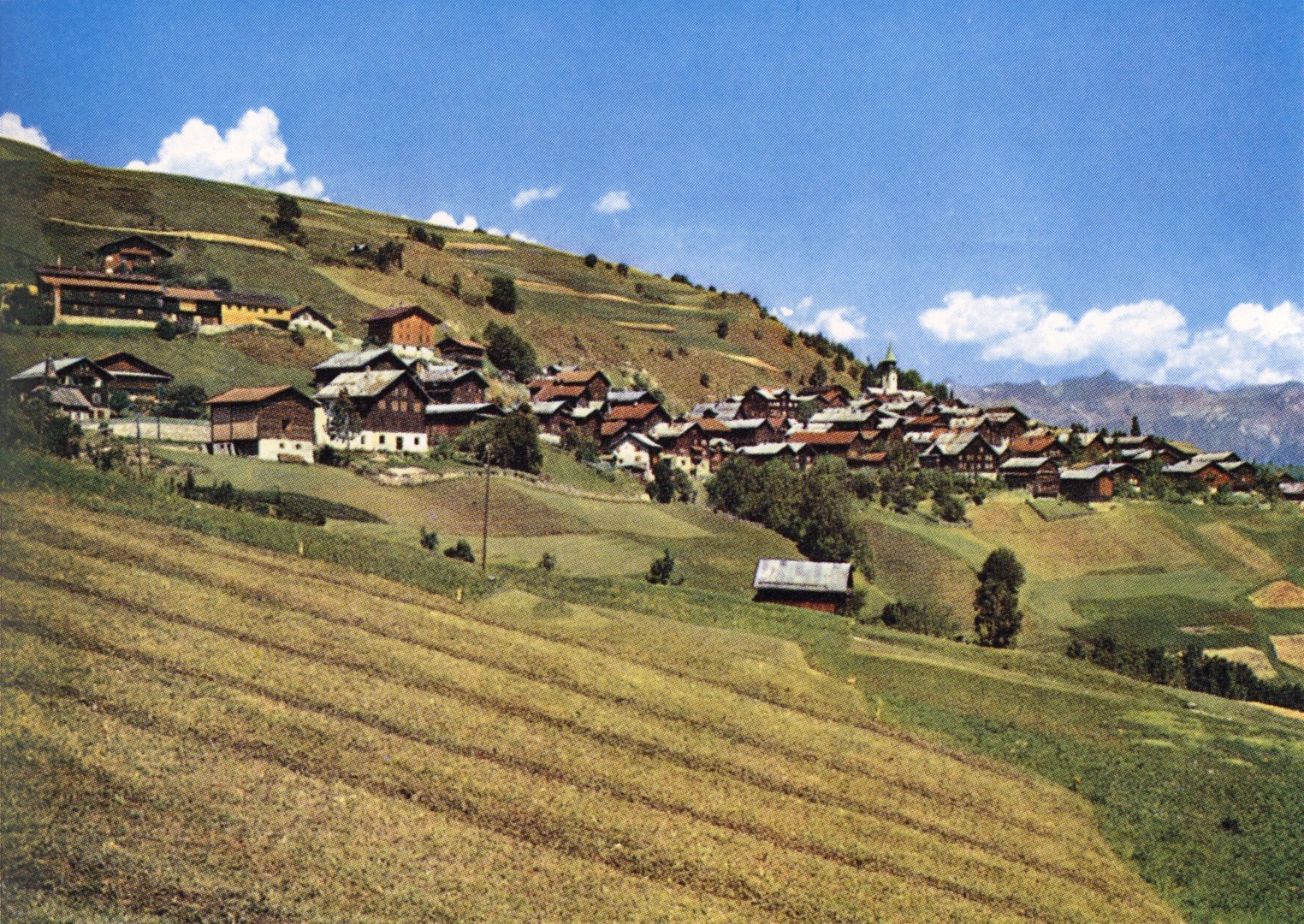
Ei sa buca setractar cheu d’ina historia dalla vischnaunca, che ei gie buca nies tema, anzi da zacons fatgs e tratgs crusch e traviers, plitost ord la veta culturala e folcloristica.
1. Vischnaunca e pleiv
Pleiv e vischnaunca politica vivevan perinamein ensemen. Alla radunonza da vischnaunca vegnevan era tuts fatgs ecclesiastics e las fatschentas religiusas tractadas. Alla radunonza calonda mars 1903 precisescha il president communal en caussa: «Ord motiv che la pleiv catolica da Cumbel ha buca ina speciala organisaziun, essend ils habitonts exclusivamein catolics, sche ein las caussas ecclesiasticas adina vegnidas deliberadas cun caschun da radunonzas communalas sut presidi dalla suprastonza.»506 Las empremas statutas dalla pleiv ch’ein stadas d’anflar dateschan dils 3 da december 1905 ed en siu paragraf 3 secloma ei: «Las radunonzas da pleiv vegnan convocadas e dirigidas dalla suprastonza civila. Encuntercomi vegn l’administraziun surdada als ugaus pervenda, ils quals ein autorisai da representar la pleiv avon autoritads civilas ed ecclesiasticas e da suttascriver tuts acts per la pleiv . . .»507 En quei cass eis ei buca da sesmarvegliar, ch’ei vegneva decretau e decidiu tut sin vischnaunca politica: Cura far messa firaus e luverdis, cura preleger il rodel dils morts, cura e co tuccar ils zenns e cons paternos ei seigi da dir da messa caudonn e sur dallas fossas secapescha. Empau remarcabels ei il conclus da 1880, che ordeina che las fossas dueigien vegnir cavadas pér il di da sepultura e buca gia la sera avon.508 Nuota meins agen tuna il conclus da vischnaunca da 1894 sur digl «ir suenter bara»: «Dis da bara duei mintga caucasa ni in representant da quel cumparer, sut peina dad 1.– fr. sch’el ei buca sufficientamein perstgisaus.»509 Quei obligatori ei vegnius cassaus pér 1906.510 Denton pér 1898 concluda la vischnaunca ina taglia da cultus, «per cumplettar quei che maunca ord ils beins pervenda511». Beinduras denton vegneva era concludiu allas radunonzas da quei che vilentava il pader. Lu era el buca promts da consentir ed u ch’el snegava direct ni ch’el ignorava il conclus.512
La separaziun dalla pleiv dalla vischnaunca politica ei vegnida exequida pér 1949 cun las «Statutas da pleiv» suttascretta aunc dalla suprastonza da vischnaunca ed acceptada il december 1949. Ellas ein idas immediat en vigur e la separaziun era fatga. Da cheu naven salvan las duas cuminonzas lur radunonzas separadamein. Sco presidents dalla pleiv han funcziunau:
| 1949-1954 | scolast Lorenz Casanova |
| 1954-1961 | scolast Giusep Vieli |
| 1961-1967 | Alfons Arpagaus |
| 1967-1975 | Murezi Paulin Arpagaus |
| 1975 | scolast Giusep Vieli |
2. La via da Lumnezia
Ella ei buca vegnida d’in di sin l’auter. Gia 1860 veva il Cussegl grond concediu ina via en Lumnezia. E da gliez temps existeva in project d’ina via naven da Glion suenter il Glogn en encunter Peiden cun bifurcaziun a Cumbel-Vella e Peiden/Bogn-Uors-Val. Cumbel e Vella eran d’accord, ferton che las vischnauncas d’anen sevilavan ed han fatg recuors tochen tier la dertgira Federala. Quella ha anflau il recuors per fundaus.513
Immediat ei il project culla lingia existenta staus sin meisa. La construcziun dalla 3. secziun da quella (1. secziun Glion-Valgronda, 2. Valgronda-Uors), naven da Valgronda a Vella cun 3,117 km, ei vegnida publicada el Fegl Officiai ils 31 d’uost 1872.514 Inschignier Alfons Balzer veva elaborau il pian 1868. Tenor quel dueva la via menar pressapauc suenter la via veglia atras il vitg, pia da bass en. Cheuencunter ein las vischnauncas dad anen puspei serebalzadas. Cunzun Morissen, che temeva che sia via da communicaziun tiel stradun vegni memia liunga.515 Vella, Vignogn e Lumbrein han protestau ferm encunter. La vischnaunca da Cumbel hagi dad ella anò postulau quella lingia. Mo las vischnauncas dalla Lumnezia pretendien l’execuziun dil pian Balzer cun la lingia da suren atras Cumbel, perquei ch’ella seigi pli cuorta e pli biala e corrispundi als basegns ed interess dallas ulteriuras vischnauncas. L’expropriaziun vegni aschia era pli bienmarcau. E buca la vischnaunca da Cumbel, mobein il cumin hagi surpriu l’expropriaziun. La lingia da bass en vegni garegiada da zacons da Cumbel per lur interess e bue pils interess dalla vallada. «La stinadadad» e parzialitad dalla vischnaunca da Cumbel meretti bue ch’ins concedi ad ella «specials privilegis per donn e cuost dallas ulteriuras vischnauncas516».
Per la lingia da bass en ei principalmein dr. Gion Barclamiu Arpagaus seprius en. Brevs e brevs ch’el ha scret al cauinschignier Franz de Salis ed al departement ein aunc avon maun egl archiv cantunal. Ei menass bia memia lunsch d’entrar en tut quei. Ferton che mistral dr. Gion Arpagaus fageva valer, che la lingia dad ault en meini sper il vitg ora enstagl atras il vitg517, scriveva Luzi Elvedi il cuntrari agl inschignier Franz de Salis, encunter ils «scrivems» da dr. Arpagaus e serecumandava cauldamein per la lingia dad ault en.518 En vischnaunca regeva buca unitad en quella damonda. Perquei ha la regenza dumandau la vischnaunca da dar in pareri ufficial, per ina ni l’autra varianta.519 Ils vischins ein sedecidi per la via da bass en cun 45 encunter 10 vuschs.520 Denton era il pian detagliau culla via dad ault en – la existenta – avon maun. Il cumbat va vinavon. La vischnaunca seraduna en caussa aunc inaga ils 8 d’october 1871. E la suprastonza scriva a Cuera: «. . . La gronda majoritad sesanfla tuttavia buca satisfatga culla direcziun ussa signada (dad ault en) da signur insch. Balzer e giavischass che quella vegness tenida pli bass. Stai presents 44 vischins. Da quels giavischassen 34 la direcziun pli bass en vischnaunca e 10 secuntentan culla direcziun stigiada.»521 Mo a Cumbel seregheglia il spért da cuntradicziun. Inschignier Balzer selamenta ch’ils pals da stigiada vegnien scarpai ora e fiers pli lunsch. La regenza ei seviulta alla suprastonza communala ed agl uffeci cirquital cun smanatschar castitgs en cass da resistenza.522
La finala ei tuttina la via dad ault en vegnida decidida, carteivel cun risguard sillas vischnauncas d’anen. Cheutras ha in clavau stuiu vegnir allontanaus e quater auters reduci.523 La sligiaziun ha buca plaschiu a tuts ils vischins. Cunzun figevan ins reproschas pervia dils insufficients access alla e dalla via nova. Inschignier Franz de Salis denton sedosta cun declarar al departement, che la via seigi gest perquei vegnida sbassada en dus loghens per 1-2 meters. Il terren difficil lubeschi negina autra sligiaziun. El seigi seretenius ditg avunda a Cumbel. Negin hagi garegiau zatgei e negin vuliu seconferir cun el.524 In malcuntent ord la suprastonza da Cumbel ha scret alla regenza ina zun originala brev, ch’ei fuss donn da buca publicar silmeins zacons passus ordlunder:
«Aultludeivel Cussegl Pigri,
La risposta, ch’Els, stimatissims signurs han secomplaschiu da dar silla nossa brev dils 28 da zercladur, dat a nus caschun da replicar cun in per plaids.
Avon tut essan nus surpri d’observar, che la risposta ei vegnida dada a signur dr. Arpagaus, cumbein ch’el ha giu scret per cumissiun da nossa vischnaunca. Denton ha quei nuota da muntar . . . Nus vein giu scret alla aulta regenza da procurar ch’ins sappi en nies vitg cumadeivlamein communicar culla via nova, e da vegnir en agid cun in pareri tecnic, en favur dalla correcziun dalla via tras vischnaunca, che nus vein concludiu d’interprender. Quei e buca auter havein nus garegiau. Gie, cura che la via ei stada fatga, da maniera che nus savevan buca co vegnir lien (¾ dil vitg) vein nus empriu d’enconuscher ils misteris. Co vessan nus pudiu prender notizia, nua che ni in ni l’auter inschenier ha priu la peina da salidar nus. Sco ei para ha il capo dil biro stradai negina enconuschientscha dalla tschentamentala obligaziun da salidar las suprastonzas, nua ch’ei setracta da far ina via nova. Per uss capin nus siu secuntener. Sch’ei existess negin camond da quellas varts, sche secapess ei da sesez da sentir ils giavischs dallas suprastonzas. Nus havein buca novas, ch’il conclus dil Cussegl grond dils 10. da fevrer 1855 sei zacuras vegnius cassaus; el el da leger ella collecta da leschas tom I p. 269 cefra 2 letra b. Mai e pli mai han ils inscheniers sedignau da salidar nus, risguard via en Cumbel. In tal secuntener ei buca qualificaus da far buna veglia. Essan nus purs era buca glieud dad aults studis, sche savein nus tonaton, ch’in emploiau dil stat ei cheu per il pievel e buca il pievel per el. .. Ch’ei seigi stau basegns da baghiar la via a Cumbel sin mirs, capin nus bue e negin che passa atras sa quei approbar. Pertgei prender ina direcziun ch’ei schi difficultusa e schi custeivla? Basta, nus lein buca setener si tier caussas irreparablas. Il motiv da nossa presenta brev ei stau quel, da constatar, che nus seigien mai stai ni salidai ni tediai.
Denton havein nus subsequentamein giu caschun da seconferir cugl inschenier Peterelli e vul quel sespruar da corrispunder a nos giavischs. Risguard ils vaus en vischnaunca lai la miraglia strusch tier, da metter neu zatgei plascheivel e cumadeivel. Cavau a funs ei gniu mo en in liug e quei tunel stat en negin rapport cullas communicaziuns lateralas.
Per facilitar ils vaus ei buca vegniu cavau a funs e per quels incomodar ei cuntrari, vegniu alzau. Para ch’ins sappi buca co igl ei vegniu fatg, Ei era buca da far curvien, cura ch’in vegn e va culla electricitad. (!) Nua ch’in ha cavau a funs, ston ins ira cun scalas per vegnir en casa ed en clavau. Dir la verdad stat adina bein. Ch’ei vegni priu giu da maun a privats ei mai stau nies giavisch. En quei risguard essan nus silmeins schi schubers sco autra schenta. Buca per mal, aultstimai signurs, che nus vein puspei teniu si in mument.
Agradieschan concludentamein nos humilissims cumpliments, Th. Arpagaus, supr.»525
Ils 5 da november 1873 ei il toc via Valgronda-Vella vegnius collaudans en preschientscha dils cussegliers guvernativs A. Bezzola e P.A. Soldani, cauinschignier Franz de Salis, inschignier Carli Peterelli sco menader dallas lavurs, mistral Gion Demont, derschader Luzi Elvedi da Cumbel e dils presidents dallas vischnauncas. El vitg da Cumbel han ins giu da far enqual pli pintga migliur arriguard ils access resp. sortidas.526
Culla via nova ha la pervenda da Cumbel piars in toc da siu iert ed era la aua currenta per bugnar, essend che la fontauna ei vegnida translocada plinengiu. Il pader ha survegniu ina pumpa d’aua persuenter. Il donn seigi aunc oz buca vegnius recumpensaus ha el murmignau: «ins ha dau bia plaids, mo negina recumpensa. Pazienzia!»527
Fatga la via vesevan ins gia lu prighels stradals, sco in protocol da 1907 relata: «L’observaziun che viturins e carrotschiers etc. carreschan tras il vitg sin moda prigulusa per affons e glieud veglia: Ei concludiu da relaschar in relativ scamond e tschentar si ina peina da 2-5 fr. Dalla peina survegn il denunziant fr. 1.–.»528
Il tierm che sparta ils cumins dalla Foppa e Lumnezia, avon sper via veglia, ha tenor conclus da 1882 giu da vegnir tschentaus agl ur dalla via nova.529
3. Fatgs forestals ed alpesters
La vischnaunca ei da vegl enneu stada pertscharta da schurmegiar ses uauls: Igl uaul da Fiugs, da Suloms, da Sax sin territori da Camuns, e quel da La Pun, ch’ella possedeva ensemen cun Vella e Morissen, Peiden e Camuns.530
1612 ha il vischinadi declarau ina part digl uaul Suloms per schétga (Bannwald).531 1671 ha il vischinadi puspei decretau, che tgi che secollocheschi ordeifer siu territori, sappi buca guder pli ses dretgs d’uaul. Da l’autra vart, sch’enzatgi acquisti casa e cuort el vischinadi, mo buca ils dretgs d’uaul, dueigi il vischinadi surprender quels dretgs. Plinavon ei vegniu scumandau sut peina d’ina cruna da vender lenna «ord igl uaul dado la val Caparli532». 1705 dat ei puspei novas statutas per impedir ch’ils uauls vegnien alienai cun setrer naven ni tras venditas.533 Ina brev da 1718 declara, tgei parts uaul e cagliom appartegnan allas singulas casadas.534 E pér 1886, cura che igl uffeci cirquital ha dau part alla suprastonza da Cumbel, ch’ins drovi lenna ord igl uaul da Cumbel per baghiar la via da Vella a Vrin, ei la suprastonza sedustada vehement. Igl uaul da Suloms seigi uaul privat e per schurmiar quel, seigi ins ius per lenna ord igl uaul da Sax cun aunc pli gronds cuosts. E per la casa da scola 1876 seigi iu vess da survegnir mo in pign quantum lenna ord igl uaul communal.535 In conclus da 1848 scamonda schizun da sragischar ora cuschas da plontas pinadas per buca caschunar donns vid las plontas.536
Tras sentenzia dalla dertgira districtuala digl 1. da settember 1875 ei igl uaul da Suloms vegnius declaraus per proprietad dalla vischnaunca. Quella ha il dretg dil terren ed ils possessurs da parts uaul han mo il gudiment «da carschientscha en quel». Quei ha formau ina relaziun da servitud egl uaul da Suloms. Denton, igl uorden forestal cantunal dils 30 da zercladur 1877 perscriva en siu paragraf 18, che tuttas servituds d’uaul stoppien vegnir sligiadas. Per quei intent ha il Cussegl Pign numnau cumissiuns districtualas per liquidar quella fatschenta. Per satisfar alla lescha ed anflar in modus da sligiar la servitud a Suloms ha quella cumissiun conferiu 1893 ditg culla suprastonza. La cumissiun ha proponiu da cumprar ora dils privats lur part uaul per in prezi reduciu e far sin «quella moda igl uaul communabels». Ins ei ius in ord l’auter senza resultat.537 In onn pli tard, 1894 il zercladur, suenter pliras conferenzas denter la cumissiun cantunala per sligiaziun da servituds en uauls e representants dalla vischnaunca e dils proprietaris d’uaul a Suloms, eis ei vegniu a suandonta sligiaziun: 1. Ei duei vegnir empruau da surdar successivamein igl uaul da Suloms alla vischnaunca. 2. Tochen tier l’execuziun duei la vischnaunca sestentar da pertgirar ora la plontaziun giuvna dalla pasculaziun.538 Per els onns 1960-70 eis ei, suenter numerusas radunonzas, reussiu alla vischnaunca da cumprar ora ils davos dretgs privats a Suloms.538a In semegliont modus da sligiar la servitud egl uaul de Sax a Camuns ei vegnius cattaus e suttascrets a Peiden/Bogn ils 18 da zercladur 1894. Tenor quel ha Camuns piars il dretg da pasculaziun per proteger aschia la plontaziun.539 Il medem vaia era pigl uaul da La Pun.540 Dil medem temps culla davosa exemziun dils dretgs privats a Suloms, ha la vischnaunca era cediu igl uaul da La Pun alla vischnaunca da Camuns e recumpensau siu uaul cun nova plontaziun.538a
In toc uaul sin territori da Pitasch, Scuntras, ei zacu el 17. tschentaner vegnius tras cumpra en possess da «meister Benedetg e Jon Depuoz» da Cumbel.541
L’alp da nuorsas Muretg sin territori da Duin haveva il vischinadi da Cumbel cumprau 1768 d’in Mihel Walt da Valendau per 650 renschs.542 Mo gia 1771 acquista il fravi Gion Antoni Arpagaus quella alp pli medem prezi sut la cundiziun, che sch’el fetschi ella venal, hagi il vischinadi igl emprem dretg da cumpra.543
Ina scartira da 1709 dat perdetga, ch’il vischinadi da Cumbel possedevi en Val ina alp Padanatsch (Pidanätsch) cun 93½ dretgs.544 Pidanatsch *ei oz prau magher. Secund in document da 1788 han Rest Gieri e Gion Tumasch Arpagaus da Cumbel vendiu quella alp si «Pidanäz» ad in Gion Antoni Furger da Val, per 447.– renschs.545 – Ella alp da *Seglias *ei dils onns 1893, 1898, 1900, 1905 e 1908 vegniu exequi cun subsidi federal bia migliuraziuns cun drenadis, canalisaziuns, urbarisaziuns e vias.546 – L’alp da nuorsas e genetschas a *Patnaul sin territori da Vrin era gia pli baul vegnida els mauns dalla famiglia beinstonta Depuoz da Cumbel.547 Igl onn 1874 ha la vischnaunca da Cumbel cumprau ella per 5250.– fr.548, resp. per 5000.–.549 1895 ei l’alp vegnida migliurada cun subsidi federal.550 1903 vess colonel Cristian Solèr da Vrin offeriu 4000.– fr. per l’alp. La vischnaunca ei buca entrada. A quella caschun han ins reduciu la cargada da genetschas sin 20 tgaus.551 1904 pren col. Solèr a tscheins l’alp per 180.– fr.552 La tinaia ha el cumprau ella.552a 1922 pretenda il colonel era l’extradiziun da tuts acts concernent l’alp, ch’el hagi cumprau.553 L’alp da dretgs Naulsetg ni simplamein Naul ei vegnida drenada 1895, era cun subsidi federal.554 1954, per l’emprema dumengia da fenadur, ei la nova tegia vegnida inaugurada cun ina fiastetta alpestra.555
4. Da quei e da tschei
Il pli vegl protocol.
da vischnaunca aunc existent entscheiva pér cugl onn 1772. Quei onn ha il giuven miedi e prominent politicher da pli tard, dr. Gieri Antoni Vieli, entschiet a protocollar las radunonzas dil vischinadi cun siu «Gemeindeprotokoll oder Verzeichnis der von Zeit zu Zeit gemachten Verordnungen und Merwürdigkeiten der löblichen Nachbarschaft Cumbels556».
Archiv cirquital.
1912 ha la dertgira cirquitala dumandau da deponer igl archiv cirquital «per in diember onns» egl archiv communal. La vischnaunca ha concediu ed ordinau ina reparatura vid il local.557
Uffecis da Valtellina.
Igl ufficial che surprendeva dil cumin in uffeci en Valtellina, stueva mintgamai pagar al cumin ina certa summa alla fin da sia perioda d’uffeci. Il cumin distribueva als singuls vischinadis lur cumpart. Igl onn 1752 per exempel ha il cumin da s. Mihèl (29.9) cediu a mistral Cristian Ulrich Demont da Vella ed a mistral Murezi Arpagaus da Cumbel igl uffeci da castellan da Maiavilla (Landvogt zu Maienfeld), che vegneva occupaus ed administraus alla moda dils uffecis valtlinès, per 1600.– renschs, culla cundiziun da pagar la summa alla fin d’uffeci.558 Aschia ha per exempel Cumbel era survegniu 1773 416 renschs, sia cumpart, pigl uffeci da cumissari a Chiavenna. Quels daners ein lu vegni reparti en vischnaunca sils votants, e quei sillas vuschs da 1771, cura ch’igl uffeci ha entschiet.559
Vendita dalla patria.
In dapresent fetg actual conclus ha la radunonza calonda mars 1824 priu: «Concludiu e decretau unanimamein che negin vischin degig poder vender rauba schischonta, segig funs, prada ni baghetgs a glieud ni cumpraders jasters, ils quals hagien buca in formai Heimatschein ni Anghörigkeitsschein, per che la vischnaunca vegni buca per da quella sort glieud pregiudicada ni en dispeta e quei ei era concludiu da scriver el cudisch da vischnaunca.»560
La revolta da 1794.
Il mars 1794 ei in stemprau politic sesalzaus en Lumnezia, ei sederasaus era en auters cumins dalla Surselva e pli u meins egl entir cantun Grischun. Tschiens e tschiens ein seraspai a Cuera e han pretendiu ina dertgira nauscha sur da certs menaders ed ina refuorma guvernamentala (Standesversammlung 1794).561 Denter ils demonstronts a Cuera sesanflavan era zatgeinins da Cumbel. Tenor in quen ha la cassa da vischnaunca pagau ad els persuenter 31.– renschs.562
L’uiara da Sagogn.
Dil temps dalla prigulusa sullevaziun confessiunala 1702, ella quala era mistral Murezi Arpagaus da Cumbel ha giugau ina certa rolla, veva il vischinadi da Cumbel fatg ina provisiun da 40 buis, plum e puorla.563
Uorden da fiug.
1771 haveva il vischinadi concludiu da cumprar ina «sprezza da fiug», essend ch’il vitg seigi baghiaus aschi in en l’auter e ch’ei seigi cuntinuau prighel da fiug. Denton, pervia da «zacons malcuntents» ei il conclus buca vegnius exequius.564 1838 ha Cumbel cumprau ensemen cun Vella e Morissen ina sprezza.565 1875 ha la vischnaunca cumprau ina sprezza cun dus uders per ella per 2300.– fr.566 — Igl uorden da fiug da 1880 preveda: «Cura ch’ei tucca d’Ave Maria dueigien ils fiugs ellas fueinas, furnaschas da far cuer resti ed autras caussas vegnir stizzai ora, cass cuntrari eroda en ina fallonza da frs. 5.– , la mesadad eroda agl annunziader.»567
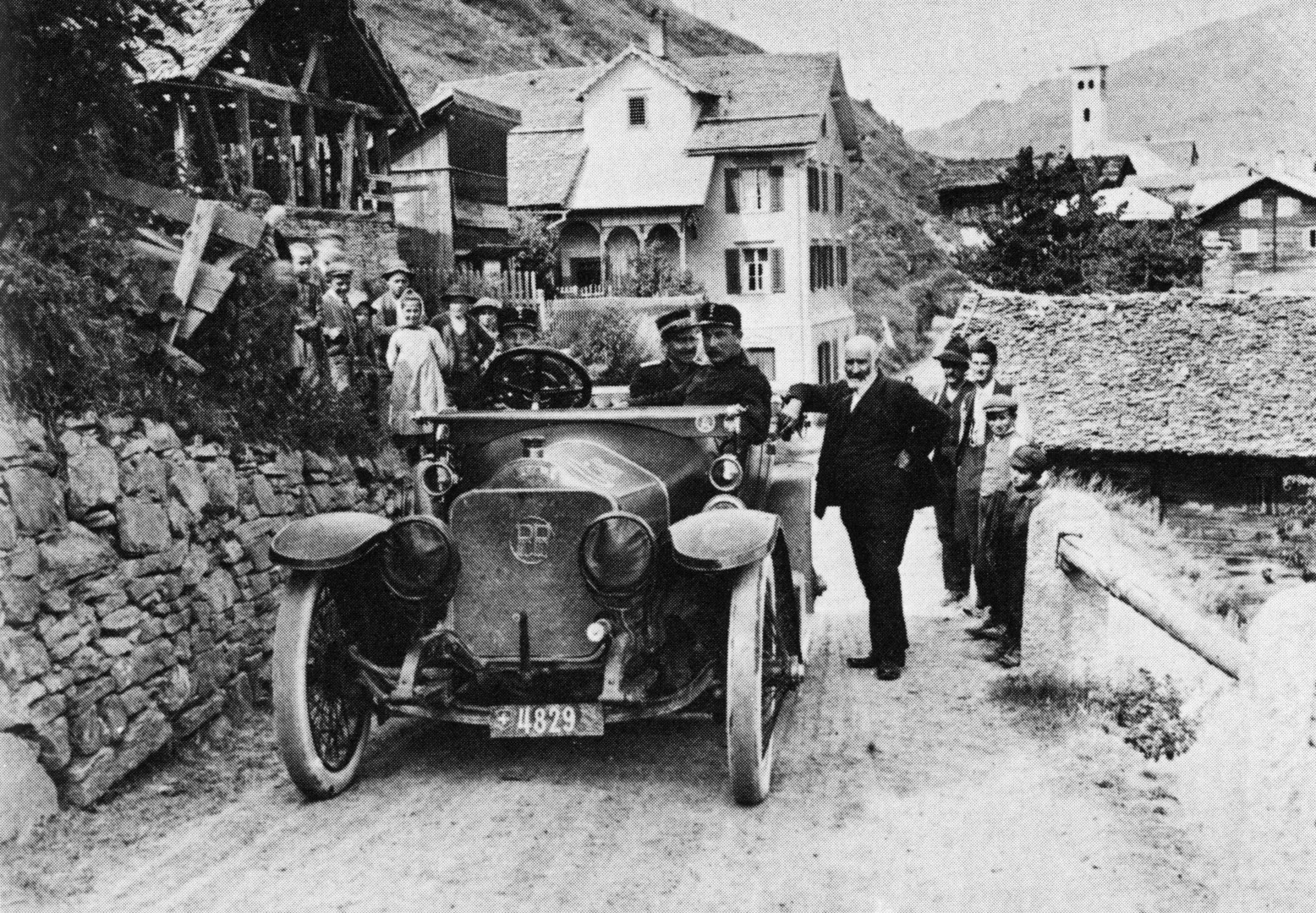
Automobil.
L’aversiun encunter igl automobil ed il cumbat ch’ei ha duvrau per lubir il traffic d’autos el Grischun da 1900-1925 ei enconuschents.568 Era nossa vischnaunca era buca amitga dil niev vehichel. 1916 ha ella concludiu unanimamein da buca sluccar il scamond d’autos.569 L’iniziativa per lubir igl auto silla fiasta centara a Trun 1924 ha Cumbel fiers cun 45 encunter 9 vuschs. Ella suandonta votaziun cantunala dil schaner 1925 han ils vischins fiers igl auto cun 53 encunter 15. Dalia davosa votaziun en caussa, dils 26 da zercladur 1925, che ha concediu il traffic d’autos, veva Cumbel votau cun 47 na e mo 8 gie.570 Aunc era igl auto buca lubius en Lumnezia. D’ina fermada sil plaz ils 9 d’uost 1925 vegn reteniu a protocol: «Il dar liber transit agl auto da persunas tras nossa vallada vegn fiers cun 23 sin 5 vuschs.»571 Dad ina fermada o S. Murezi ils 4 da fenadur 1926 vegn protocollau: «Ei vegn proponiu da s’informar, schebein ins survegni aunc la contribuziun per ils autos. En tal cass revocar la resp. conclusiun da serrar la via als autos. Cass cuntrari duei vegnir procurau per ina guardia, essend che differents autos curseschan senza lubientscha.» L’autra dumengia, ils 11 da fenadur sil plaz: «Cun 25 encunter 2 vuschs vegn concludiu d’arver per igl onn current la via agl auto, essend ch’ei vegn concediu in corrispundent subsidi.»572 Suenter ver dau la lubientscha vegn denton era fixau la «spertadad» maximala da 12 km atras il vitg.573
La viafier en Surselva.
Igl onn 1905 ha il «comité viafieril en Surselva» presentau allas vischnauncas sursilvanas in pugn da recapitulaziun dumandond da quellas la summa da 725 000.– fr. en aczias per la cuntinuaziun dalla viafier Glion-Mustér. La Lumnezia dueva separticipar cun 20 000.– fr. Ina radunonza dallas suprastonzas a Vella ha giavischau ina reducziun sin 15 000.– fr. Quei ei vegniu concediu. Nunditgond quella reducziun ha in sulet representant plidau persuenter, ferton che tuts ils auters ein s’expectorai per refusar il pugn da recapitulaziun sut las suandontas, aunc oz interessantas motivaziuns: «La Lumnezia ha contribuiu per l’emprema etappa La Punt-Glion 60 500.– fr. da total 480 000.– ed ha purtau in dueivel sacrifeci per la lingia principala en Surselva. Vid la cuntinuaziun dalla lingia Glion-Mustér ha la Lumnezia buca mo negins directs interess, mobein disavantatgs, cheutras ch’il traffic e commers en general vegn dirigius tras la Cadi e che era il negozi da biestga po sesviluppar leu pli vivamein ch’en ina vallada senza communicaziun, senza cumadeivladad e spargn da temps pils marcadonts da biestga. Sez l’industria d’jasters sa pitir tras la continuaziun. Ins steva generalmein sut l’impressiun che la Lumnezia vegni isolada e pregiudicada. » Malgrad quei tun pessimistic dalla radunonza a Vella ha la vischnaunca da Cumbel decidiu da separticipar cun aczias per 1000.– fr.574 ferton che las biaras vischnauncas lumnezianas han refusau scadina participaziun. Denton pli tard, ad ina radunonza da delegai dallas vischnauncas lumnezianas a Vella ils 16 da fevrer 1908 ei unanimamein vegniu concludiu da star neu cun 15 000.– fr. sco proponiu «e quei plitost ord solidaritad cun nos convischins, sco era per renconuscher la gronda sacrificontadad demussada vid la lingia Rehanau-Glion dils dalla Cadi che muort ils interess che la Lumnezia pudess ver vid quella lingia575».
Forza electrica.
Igl onn 1918 ei la glisch electrica vegnida. La vischnaunca ha concludiu da schar installar spargnusamein treis «amplas» en baselgia, ina en scola ed ina ella cascharia.576 – 1926 il settember concluda la vischnaunca da cumprar ina maschina da scuder cun tracziun electrica.577
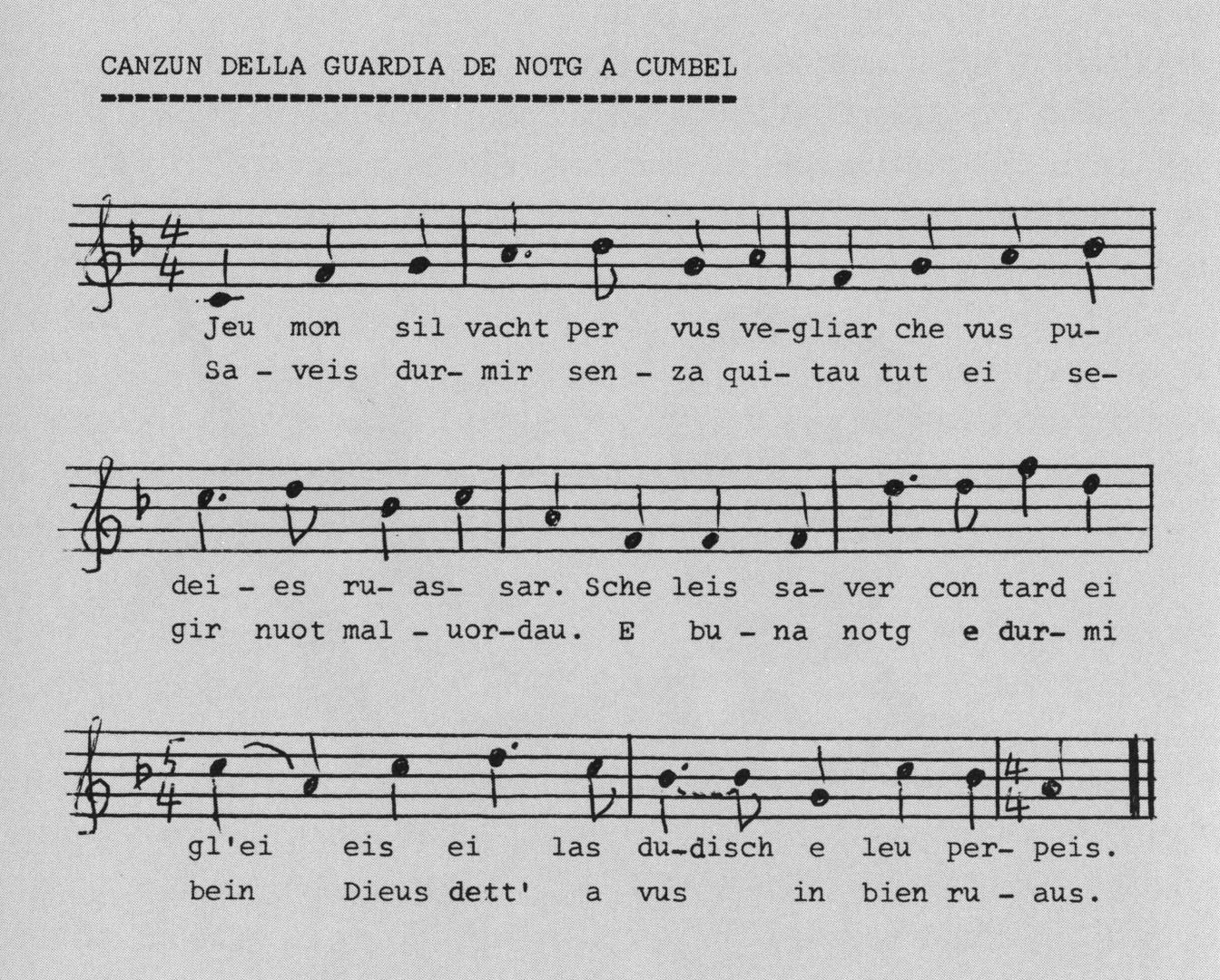
Guardia da notg.
La funcziun d’ina polizia communala exercitavan la guardia da notg ed il salter resp. pindrer. Ina figura simpatica pudeva ella esser, la guardia, che fageva dad uras tardivas ni encunter mesanotg sia runda tras il vitg a cantond sia canzun ni scadanond cun siu zampugn. Tenor lescha communala da 1862 veva ella la suandonta funcziun:
- Dallas 11 naven dueien tuttas caneras e tuts giugs etc. calar si. Surpassaders crodan en ina fallonza da frs. 4.– 2. Vegn in vischin temps da notg d’in u l’auter violaus vid sia casa cun malemperneivladads, sche duei ei ad el, sin siu serrament, vegnir dau feda. 3. Ei glei rigurusamein scumandau da sittar temps da notg, quei ei d’ina Ave Maria a l’autra. 4. Quella survigilonza, sco quella sur il fiug vegn dada alla guardia da notg, che retila sia paga. 5. Tuts castitgs ston immediat vegnir incassai e crodan en cassa communala.578 – Per quella scharscha vegnevan era femnas, plitost sco excepziun, engaschadas, sco per exempel 1891 Giuanna Collenberg.579 Il guardian vegneva per ordinari eiegius da calonda mars per in onn. Sia paga era 1894 80.– fr. ed ina mesa curtauna graun per casada e «tgi che paga taglia aunc 50 raps vitier579a». 1902 han ins buca elegiu guardia da notg, per schar ir igl uffeci en roda «e zuar mintga casada in tur alla ga sut peina da fr. 1.– per cass tralaschonts. Ei vegn dau ils signals entras sufflar il tgiern per quels che san buca cantar . . . era polizia d’ustria ha la guardia da notg da far.»580
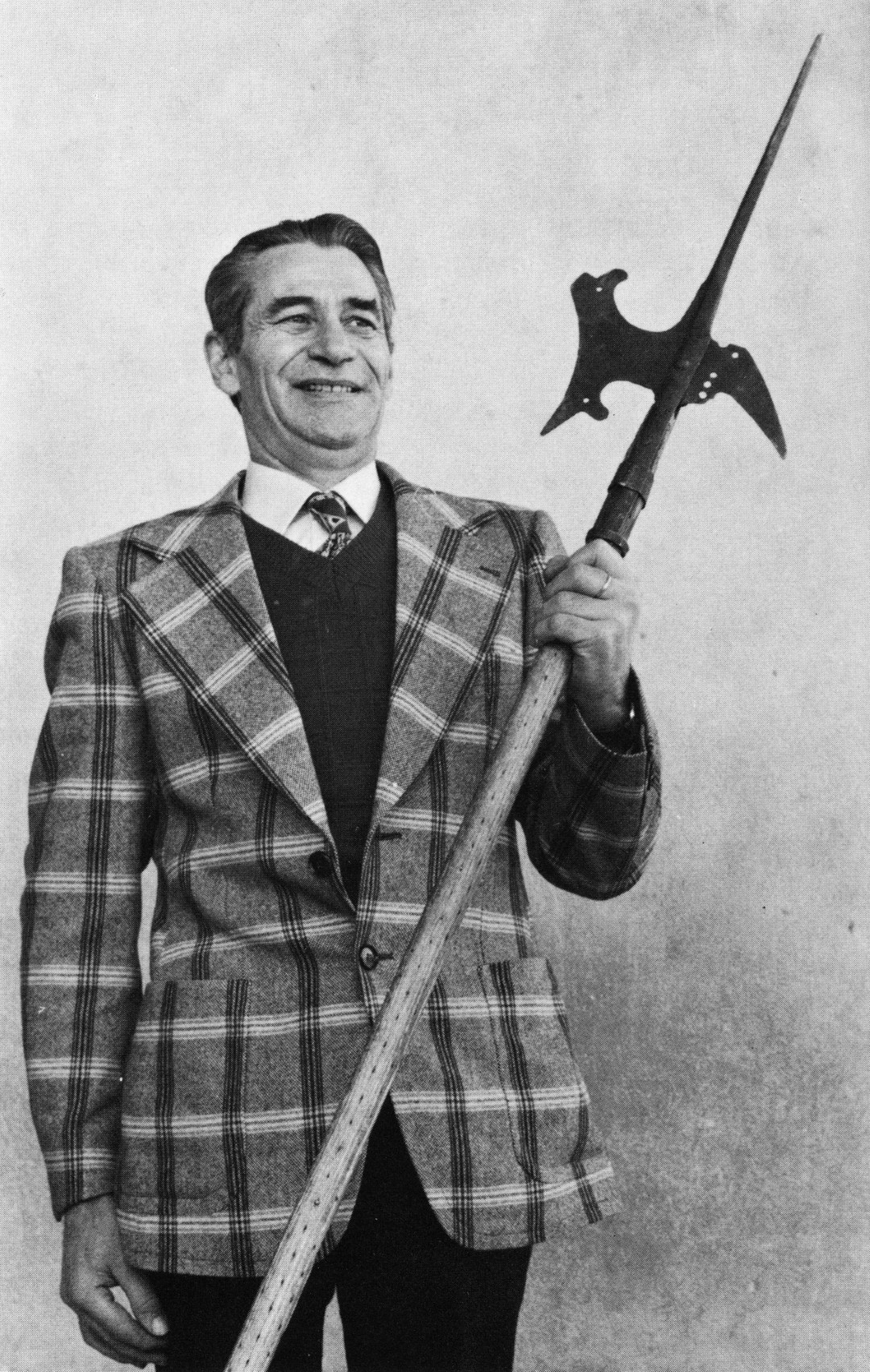
1921 ha la vischnaunca aunc concludiu da tener en usit la guardia cun ir en roda e «scadenar il plètg581». Per 1952, alla radunonza dils 27 d’avrel, ei vegniu concludiu unanimamein da schar curdar la guardia da notg, «denton buca quella d’ustrias582».
Salter e pindrer.
Ina appariziun originala ella veta da nos purs era il pindrar animals d’in auter possessur, traplai sin beins jasters. Il pindrer, che vegneva mintgamai elegius da calonda mars, veva ina certa taxa per scadin animai pindrau e per spindrar. Per regia era quei uffeci unius cun quel dil salter. La lescha communala da 1862 fixescha pli salter: «Il salter ha la obligaziun dalla scumandada naven tochen dar lartg da survigilar ils tiers dalla vischnaunca, sco era tiers jasters. El fa mintgadi di siu tur en ed ord vischnaunca. Ils tiers anflai en donn vegnan serrai en e spindrai immediat. In quart ura suenter ch’ils pisturs ein vegni, ha il salter il dretg da pindrar. Per pagaglia ha el in paun per fiug e la pendradira per scadin tgau sco suonda: tiers manedels 5 raps, biestga 6 raps, tiers casa 5 raps, cavagl 20 raps.»583
Il «regulativ pils beins communals» da 1902 preveda il suandont: « § 24. La cumpetenza ed obligaziun da pindrar ils tiers vegn surdada ad in salter. § 25. La pindraziun daventa en tuts cass nua che tiers van en loghens, els quals la pasculaziun ni il setener si ei scumandau. § 26. Suenter ch’ils pasturs han catschau ils tiers en vischnaunca, ein quels da metter en nuegl immediatamein. Ina ura suenter crodan els en pindraziun, era sch’els sesanflan en vischnaunca. § 27. Il salter retrai ina paga fixa dad in paun per casada e las suandontas taxas: Per tiers da cheu, per ina nuorsa 5 raps, per ina caura 10 raps, per in biestg u salvanori 10 raps, per in cavagl 50 raps. Tiers jasters: Nuorsa, caura, salvanori, biestg 20 raps, cavagl 50 raps.»584 Per quei uffeci savevan era vegnir elegidas salteras ni pindreras, sco per exempel 1879 Nesa Collenberg per pliras periodas.585
Tratga da cauras.
Daferton che la tratga da nuorsas para da haver fluriu, era quella da cauras buca adattada per Cumbel e quei ord munconza da qualificada pastira da cauras e per schurmetg dallas plontaziuns. Per temps para ella da esser vegnida strunglada drasticamein, sco il conclus da calonda mars 1851 tradescha: «Ei fermamein concludiu, che tgi che possedi u tegni s.v. biestga, deigi buca haver il dretg da tener cauras, sondern tgi che hagi, seigi absolutamein obligaus da quellas dismetter; encuntercomi quels che hagien negina biestga, possien u seigi lubiu de tener duas cauras e buca pliras.»586
In benefactur.
Giachen Baltassar Vieli († 1897) ha regalau 1890 alla vischnaunca 400.– fr. ed exprimiu leutier il giavisch che la vischnaunca scumandassi «tras in regulativ legai da tener si gasts e dar bubrondas suenter las 10 uras». La finamira seigi «il beinstar, la pasch, la ruasseivladad e la consolaziun dallas famiglias587». 1892 ha el regalau alla spenda 500.– fr.588
Studis sur da Cumbel.
«Cumbel 1967» ei il tetel d’in cudisch litografau, screts en lavur cumina, d’ina classa da matura dalla scola cantunala da commerci dil marcau da Basilea sut la survigilonza dils professers Ervin Arpagaus, oriunds da Cumbel, e Werner Mory da Riehen.
En numnada lavur ein suandonts temas tractai mintgami d’ina gruppa da scolars e scolaras: Historia dalla Lumnezia, la historia da Cumbel – Tiara e pievel – Scola – Baselgia – Il cumin Lumnezia – La vischnaunca politica – Agronomia – Economia d’alp – Economia forestrala – Turissem – Commerci e mistregn – Flora – Fauna – Geologia – Mesiraziun.
Igl onn 1975 ein ils professers Ervin Arpagaus e Dr. Max Wehrli da Binningen puspei stai duas jamnas a Cumbel cun ina classa da matura dalla gia numnada scola e fatg ina lavur litografada cul tetel «Cumbel 1975». En quella lavur ein temas pli specials vegni tractai: Populaziun dalla muntogna – Agricultura dalla muntogna – Teoria e pratica dalla pianisaziun – Art e cultura – Ulivaziun da finanzas.
Il motiv dad omisduas colonias ei staus da confrontar giuvens e giuvnas dil marcau da Basilea cul pievel e cun problems da muntogna.
XIII. Veta e cultura
1. Fatgs commemorabels
Las valerusas. Heinrich Ludwig Lehmann, in tudestg, ei staus dils onns 70 dil 18. tschentaner scolast privat dalla famiglia Jeckün en Tumliasca. El ha scret denter auter ina historia dil Grischun.589 En quella ha el era rapportau il cumbat dallas valerusas Lumnezianas a Porclas 1352, sco el el enconuschents ella tradiziun.590 E lu cuntinuescha Lehmann: «Aunc oz han quellas Amazonas piars nuot da lur heroissem, pertgei ellas oravontut han animau lur umens alla revoita populara da 1794591 ed endridau quels da scumiar lur uniforma da gardist culla coccarda dils Patriots e dad esser ils emprems da sbassar la luschezia aristocrata.»592 Cura ch’igl autur ha scret quei, saveva la distanza dil temps buca esser gronda, mo denter 1794-1797, aschia che siu rapport meretta dapli cardientscha. Valà quei laud per las valerusas da Lumnezia en general, sche bein era per quellas da Cumbel en special ! –
Dalla milissa grischuna. Igl onn 1809 han ils cumins approbau ina organisaziun militara cantunala, che lubeva als cumins da recrutar e proveder ils schuldaus, ils «milissers».593 Ei para che las singulas vischnauncas vevan era certas libertads, demai che la vischnaunca da Cumbel ha saviu decider 1815 «unanimamein da dar a mintga milisser enstagl dalla mondura e tut, 5.– renschs ord cassa da vischnaunca e quei a proporziun dil temps ch’in ei en milissa594».
Il zenn grond da Lumbrein. 1876, ils 4 da mars, ein ils quater zenns novs da Lumbrein vegni menai atras Cumbel. Ferton ch’ins ha buca fatg pli bia feda dils treis pli pigns, ha il zenn grond anflau tutta attenziun. El, cun ses 3000 kilos, ha il vitturin da Cumbel, Luis Elvedi, menau naven da Cuera tochen Glion. Leu han 60 umens da Lumbrein cargau el sin ina sliusa fatga aposta leutier e tratg el neuaden cun 24 bos. A Cumbel ei il zenn vegnius beneventaus cul tuchiez da ses collegas giud il clutger da s. Stiafen e cun zacontas rumplanadas da murters. Femnas han ornau el cun ghirlandas e flurs ed il pader ei ius vi sil plaz, ha fatg in fulminont plaid e dau l’aua benedida al pievel ed als bos e sinquei ei il til ius vinavon.595
La davosa messa nuviala. Sur Murezi Rivedi ha detg sia messa nuviala da s. Stiafen 1878 — tochen oz la davosa d’in spiritual diocesan a Cumbel. Il di da Nadal, dallas treis suentermiezdi ein il pader cul ceremoniar, sur Bisquolm da Morissen, i cun horem e stola e sut il tuchiez giun casa paterna dil primiziant. Ei seforma in til culla parada dils mats e digl entir pievel rimnau, che serenda en baselgia per las viaspras. Suenter quei survetsch divin vegn surviu en casa pervenda ina tscheina alla parentella spirituala e corporala dil primiziant. Da S. Stiafen han ins puspei retschiert il primiziant avon casa paterna. Ils scolars han cantau leu ina canzun. Lu han ins cumpignau il primiziant cul baldachin en til solemn, culla parada dils mats e culla musica instrumentala da Vella en baselgia. Il priedi ha il plevon, P. Nicolaus, fatg. Il past festiv ei vegnius survius en casa pervenda, gronda avunda per tals intents.596
Societad da musica. Cura ch’ella ei naschida ei buca stau d’eruir, mo probabel denter ils onns 1890-1900. Duront in bien miez tschentaner ha ella sunau sin ses instruments da stuors e delectau il pievel da fiastas religiusas e profanas. La secunda davosa radunonza dalla societad ei stada ils 22 da november 1952. Lu ei inscret nuot pli el cudisch da protocols tochen il rapport dalla davosa radunonza dils 29 da november 1954. Tractanda: Schebein ins vegli cuntinuar culs exercezis ni sligiar la societad. Ei vegn concludiu «da sligiar la societad ord motiv ch’igl ei memia paucs commembers per saver sunar597».
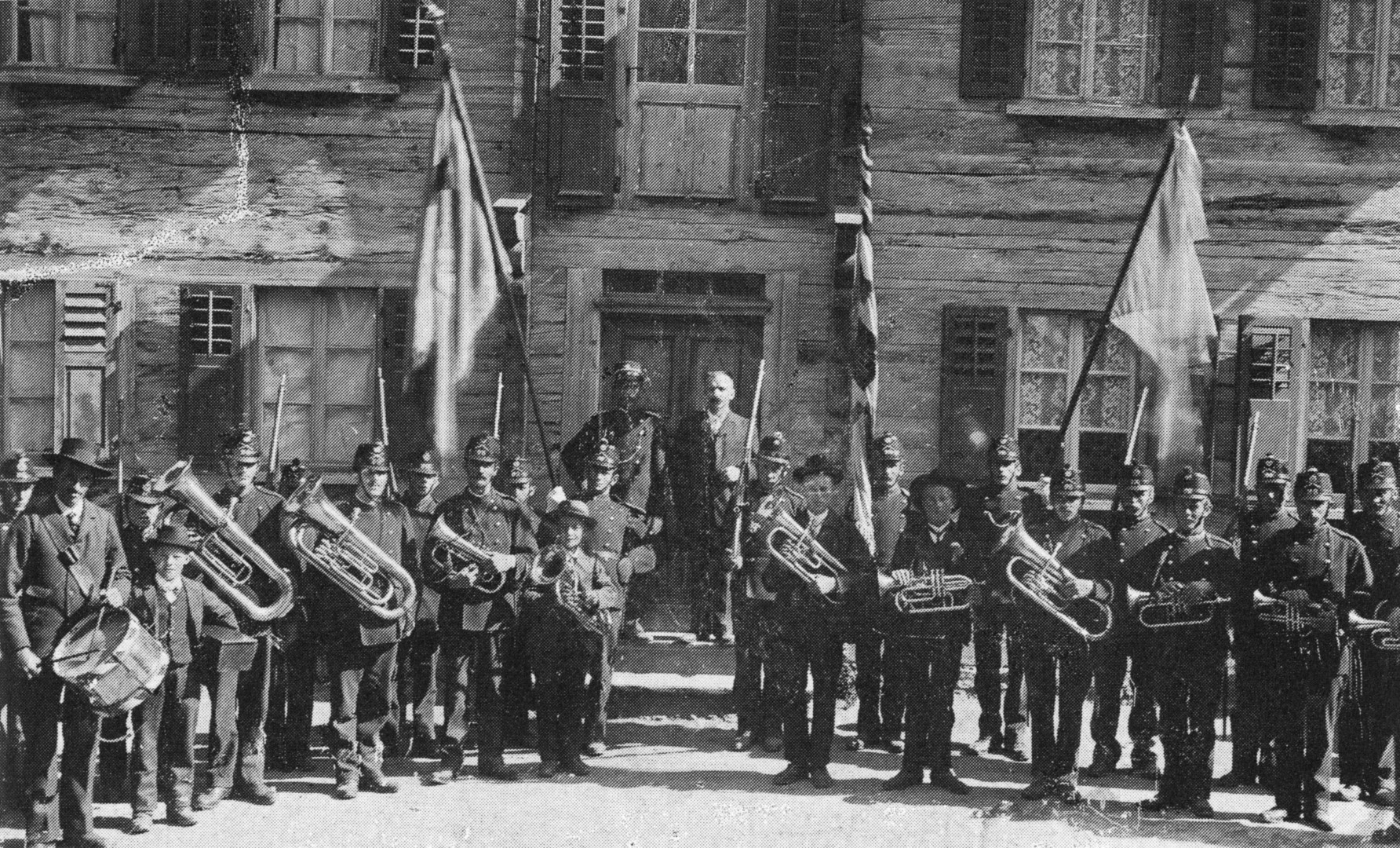
Tschet Giuchin. In fenomen d’in originai era el, il Tschet Giuchin. Tschet ei ina fuorma lumneziana per Rest e Giuchin ei il prenum da siu bab. Naschius ei Rest Murezi Caduff ils 30 da december 1774 a Cumbel sco fegl da Gion Giuchin Caduff e sia dunna Nesa. El ei morts ils 24 da fenadur 1849. P. Bonaventura da Garesio dat cun l’inscripziun da quei mortori perdetga ch’el savevi senza negina scola detg bein tudestg, franzos, latin e talian. El untgevi il contact culs carstgauns e s’abstenevi da tut mal e da tut puccau («vivus semper fugit hominum consortium et abstinuit ab omni malitia et iniquitate598»). Lu vegn ei aunc raquintau in bien ton dil «sogn da Cumbel», da quei ch’ei da piazzar el reginavel dalla detga. El figevi bia oraziun e grondas penetienzias ; el durmevi mo sin aissas. El vevi profetisau: Cura che pézs e pindèls vegnan tochen sissum la pezza, vegn ei dar sgarscheivlas uiaras. La planira da Domat possi buca trer il saung che vegni spons. El tenevi duas vaccas, ch’el schavi adina mugheras. Duront la cureisma stuevien quellas star e scher sil niu crap. Entuorn 1845 hagi el profetisau las uiaras mundialas cun bumbardaders che spidan fiug. Il temps che quellas rumpien ora ha el precisau cun dir ad ina da sia parentella: «Buca tes affons, Nesa, mobein ils affons da tes affons vegnan a far atras enzatgei.» Ina partida buna vegni «schwachiada» ch’ella seigi senza speronza. Lu vegni ina viulta ed ella vegni il davos a victorisar. Tschet hagi era saviu cura ch’el stoppi murir. El cargava sias vaccas enta Seglias. El mavi lu cun quellas mo tochen giul Bogn e schevi: «Mei mias pintgas en num da Diu!» El schavi lu ir quellas persulas ell’alp. E quellas «ein adina arrivadas bein ell’alp599».
2. Usits ed isonzas
Isonzas plitost da tempra religiusa cun excepziun dalla suondonta: Il di da Daniev vegneva la giuventetgna en casapervenda a giavischar al pader in bien niev onn. Igl emprem vegnevan ils giuvens. In dad els figeva in plaid. Il pader rispundeva «adequatamein». Lu deva el ina cartetta e purscheva in glasin vinars a mintgin. Suenter vegnevan las mattauns ed ei serepeteva il medem ceremonial. La finala vegnevan ils affons ed il pader deva ad els ina cartetta e 2-3 raps.600
Da Sontgilcrest, suenter viaspras fageva il capitani da mats avon porta pintga in plaid per la salvia dalla parada dils mats. Il pader rispundeva medemamein cun in cuort plaid ed offereva als mats sis liters vin giun casa da scola.601
La fiasta dil perduri s. Francestg vegneva fatga solemnamein, aunc tochen encunter ils davos vegn onns, dil temps da P. Urban (1905 tochen 1917) aschia: La vigelgia dallas 3 suenter miezdi tuccava ei d’ensemen. Las 4 e mesa entschavevan las confessiuns. Confessurs jasters eran il plevon da Pleif, da Morissen ed il pader da Rumein sco era il confessur e predicatur jester, e tscheu e leu era ils plevons da Vignogn ni da Degen. La damaun da fiasta tuccava ei d’Ave Maria dallas quater e dallas quater e mesa entschavevan ins puspei cun dar e prender penetienzia. Las 5 e mesa era l’emprema e las 7 e mesa la secunda messa marveglia. Sin messa gronda era serimnau in grond pievel ed ils biars spirituals dalla Lumnezia. La dumengia dil Cor da Maria purtavan las giuvnas il vut da s. Victoria e quel da Nossadunna.602
Las Curonta Uras ein vegnidas introducidas per 1930 sin giavisch digl uestg. Ei vegneva exponiu il Sontgissim naven dalla damaun entochen la sera duront treis dis. In predicatur jester fageva dus priedis a di. Mintga di messa gronda, viaspras e rusari cun priedi.603 – Da Venderdis Sogn, la sera suenter la processiun remarcabla cun Niessegner en bara en grondezia naturala, medemamein Nossadunna, vestgida en ner e cun ils buobs che purtavan ils instruments dalla passiun, tons sco pusseivel, naven dalla petga da Pilatus tochen tier il tgiet; suenter che Niessegner era deponius en baselgia bitschava il plevon las plagas da Niessegner e suenter ei igl entir pievel.604
«Dir si la ductrina.» Dil temps da P. Nicolaus (1871-1895) e sin ina moda ni l’autra era pli baul e pli tard, vegneva dumengias e firaus suenter miezdi avon viaspras fatg ductrina pli pievel. Avon ch’entscheiver cun quella denton vevan ils affons da dir si la ductrina, pia rispunder las damondas ch’il pader fageva. Silmeins dus affons per ga vegnevan vidlunder.605 Aunc dil temps da P. Urban (1905-1917) vegneva fatg ductrina pli pievel avon viaspras e quei mintga dumengia temps da scola, cun paucas excepziuns.606
«Tiels sogns sacraments.» L’expressiun ei ton sco svanida. Mo lu, tochen encunter il temps dil Concil Vatican II, muntava quei ir a prender penetienzia e retscheiver la s. Communiun, che vegneva partida ora dumengias e firaus endamaun dallas 5 tochen las 7 ni las 8 uras. En quei interval vegneva era dau penetienzia, ch’ins prendeva intragliauter ca. ina ga il meins. La s. Communiun vegneva repartida duront quei spazi mintga mesa ura. Da messa gronda perencunter vegneva buca repartiu la s. Communiun.607 Ina isonza generala.
Vin da purificaziun, ni vin dalla s. Communiun. Suenter ver retschiert la s. Communiun vegneva purschiu als communicants aua ni era vin.608 Igl ei ord munconza da sufficienta documentaziun grev da precisar il temps ed ils loghens nua ch’igl usit regeva. Denton igl onn 1744 – ei era dil temps da P. Ludivic da Bedizzole (1740-1787), han ils da Cumbel (questi vicini) rugau igl uestg Josef von Rost, a caschun da sia viseta da creisma, ch’el ordeini al pader «che dovesse dare il vino nella communione», ch’el duessi porscher il vin las quater fiastas. Il pader veva denton supplicau il monsignur da buca conceder quei, demai ch’ei seigi cheu mai stau usitau. Igl uestg ha denton anflau per bien da cussegliar al pader da vegnir suenter alla veglia dil pievel, buca ord obligaziun, mobein da libra veglia e «per cortesia609».
Il s. Viatic vegneva purtaus cun gronda solemnitad aunc ditg viaden en nies tschentaner cul caluster ni ministrants cun latiarna e scalin e cul baldachin pign. Sin via s’unevan fideivels en til, urond tochen avon la casa dil malsaun. Ord igl onn 1772 vein nus novas che 12 portacandeilas (candelotti) cumpignavan il Sontgissim. Il pader da Cumbel ha quei onn surdau 50 renschs als ugaus baselgia per «manteniment dils 12 candelots610».
Unfrenda per l’aura. La davosa dumengia da matg ni l’emprema da zercladur fagevan ins ina unfrenda en baselgia, la schinumnada «unfrenda per l’aura», ni «pli carschament dil feld». Il pader veva da far tontas e tontas messas per quei intent.611 S. Gion e Paul, ils 26 da zercladur fagevan ins «firau lev», era per urbir ora favoreivla aura.612
Als altars laterals era ei beinsavens messa, era messa cantada, numnadamein certas fiastas sco s. Num, s. Giusep e Nossadunna etc. P. Nicolaus noda en sia agenda da 1872: La messa ei adina agl altar grond, denton sa il plevon celebrar ella a scadin auter altar, tenor sia disposiziun e devoziun e per satisfar alla pietad d’encual benefactur.613 Nozzas. Avon biabein tschien onns existeva igl usit, ch’ils spusai bitschavan il cudisch dils evangelis alla fin dalla messa e deponevan leu lur unfrenda.614 Anne ditg viaden en nies tschentaner fagevan ins nozzas quasi adina in mardis. Quei sebasescha sin superstiziun. Sur Fetz disapprobescha quella elecziun dils dis en sia agenda e numna ella ina «tuppa moda615».
Tgau cuvretg. Igl ei buca pli che tschien onns che las femnas stuevan cumparer a Cumbel, sco carteivel era en auters loghens, en baselgia cun tgau cuvretg alla moda taliana. P. Nicolaus scriva en sia agenda da 1872: «Mes successurs seigien supplicai da vegliar che las femnas hagien il tgau cuvretg en baselgia. Mes superiurs han cumandau da mantener igl usit leu nua ch’el regi. Leu nua ch’el ei gia svanius, san ins far l’emprova, mo cun buna maniera e sch’ins anfla stinadadad che caschuna mo distubi e grond malengasi, pon ins desister dalla interpresa, mo senza approdar tal abus. Leu nua ch’el ei aunc buca entraus, ha ei num tener la dira e buca schar entscheiver en negina maniera e vegliar sur certas emprovas che vegnan fatgas mintgaton per arrivar plaun plaunet a lur ambizius e peccaminus intent.»616
Sittar. P. Felice da Taggia (1863-1871) leva far calar da sittar murters da Sontgilcrest per impedir disgrazias. El ha denton anflau la pli gronda resistenza tiels mats. Siu successur, P. Nicolaus, ha perquei tolerau il sittar, ha denton giavischau ch’ils giuvens cumparien mintga 4. dumengia dils meins en casa pervenda per dir si la ductrina e las giuvnas la dumengia suenter e «cun quei ein tuts stai zun cuntents ed aschia hai jeu adina practicau cun grond success, specialmein da vart dallas mattauns, che schevan si la ductrina zun nuidis en baselgia (specialmente dalle giovani le quali mal volontieri dicevano la dottrina in chiesa)617».
Bara. Cura ch’ei transpurtavan ina bara tras il vitg, vegneva tuccau ils zenns ed il pader retschaveva ella alla entrada dil vitg e cumpignava ella tochen alla extrada.618 Tenor la lescha communala da 1862 era scadin vischin obligans, sut peina dad 85 raps, dad ir suenter bara.619 Baras pintgas vegnevan satradas suenter messa, il bia senza cant, sco sut Fetz memorescha en sia agenda. Baras grondas vegnevan adina satradas mo avon miezdi en connex cul requiem. La sera avon il tierz ed il caudonn cantavan ins avon rusari las viaspras da morts.620 Santeri. Sur Fetz (1933-42) scriva en sia agenda entuorn ils 1940: «Abus civil ein ils loghens en santeri. Bia fossas vegnan cavadas avon lur temps e biaras stattan per omnia saecula. Paupra glieud sto rugar per fossa. Affons vegnan satrai sil vischi da parents. Abus ecclesiastic eis ei, ch’ils affons innocents han buca lur plaz el santeri. . .»621 A caschun dalla ingrondaziun dil santeri 1959 ei vegniu decidiu da satrar en retscha.622
Pietad pils defuncts. In laud da quellas varts exprima sur Fetz en sia agenda: «Da vegl enneu fan ei cheu bia pils defuncts. Tgi che po fundescha ina messa perpetna. Per quella pintga vischnaunca existan cheu fetg bia messas perpetnas . . . Ils pli biars laien inscriver lur morts el rodel. . . Per mintga defunct recitescha il pievel treis ga igl uffeci da morts ed ura la dumengia suenter la sepultura, suenter viaspras, il rusari grond. Ei van stediamein tier la bara. Mattauns rimnan per defuncts buca maridai almosnas per messas . . . Per mintga bara gronda vegn dau 10.– fr. pieun da bara e 20.– fr. pli rodel. . . Ina atgnadad a Cumbel eis ei, ch’ils parents laien publicar alla fin dil riug en baselgia, ch’ei vegni en casa dil defunct, suenter la messa dil tierz, dau ora l’almosna als paupers. Mo paucs fan diever.»623
3. Malauras e maluras
1885 ei stau ina schitgira stad. Il protocollist da vischnaunca noda: «. . . in onn da gronda schitgira, da maniera che la raccolta da fein, graun e truffels ei totalmein fallida, ei dils cumins da Lumnezia, Foppa e Rueun vegniu teniu radunonzas da delegai dallas vischnauncas per secunvegnir tgei far culs muvels, metter quels a fein en auters cantuns. . .»624
1890 suonda puspei «in schliet onn», Nies actuar communal resda: «Schinavon ch’ins ha muort la neiv, ch’ei vegnida tochen d’aua, stoviu descargar las alps, da maniera ch’ins ha stoviu tener a casa plirs dis ils muvels, ha la vischnaunca concludiu da schar pischentar scadin ses tiers sin la pastira sut. . .» Sco il protocol dils 5 d’october dat perdetga han «muort la cuntinuada bletscha aura e neivs, tuts tiers ellas alps, era las nuorsas, stuiu vegnir descargai gia ils 30 d’uost e buca vegnir cargai pli. . . Denton eis ei iu grondas bovas e squatschs da tiara, uaul sin nies territori, da maniera ch’il passadi sur Prau Dadens las Lieurs ei daventaus nunpracticabels, aschia era a Porclas ed a Sanetsch-Rumiez, lavagau las punts . . .»625
1919 vevan ins gronda munconza da fein. La vischnaunca ha concludiu «da sequestrar tut il fein ch’ei danvonz e quei immediat. . .626».
La zoppina da 1898. Il fenadur dils 1898 ei rut ora ina nauscha zoppina ella alp Naul. Veterinari Blumenthal a Glion communichescha tras carta e president Balzer Arpagaus, che la malsogna sederasi spert, ils tiers seigien da salvar leuèn.627 Luven e Vrin vegnan immediat isolai.628 La suprastonza da Morissen communichescha ils 11 da settember: «Ch’ei seigi rut ora la zoppina denter las muntaneras da casa e silla pastira el medem temps. Ils animale infectai ein serrai giu els cuolms dil matg.»629 Denton era Pentira alp Naul infectada. Sursaissa ha snegau da metter biestga da Naul en ses cuolms.630 El decuors dil settember vegn ina nova da Job suenter l’autra. Camuns communichescha ch’ils animals da casa seigien infectai. Luven annunzia la zoppina sin sia patira da casa.631 Peiden fa il medem.632 En Sursaissa regeva la zoppina gia dalla entschatta da sia erupziun ellas alps Titschal Davon e Titschal Dadens.633 A Cumbel, aschia pretendevan ins, seigi la zoppina vegnida tras ina vacca, catschada ord da Naul. Cheu stuevan ins ussa tener tuts animals en nuegl.634 Il departement veva cumandau alla suprastonza da Cumbel da metter guardias dadens Cumbel encunter las vischnauncas d’anen.635
Dallas diversas correspondenzas e cunzun dalla interrogaziun fatga cul signun da Naul seresulta ei, che la malsogna era rutta ora igl emprem ellas alps da Sursaissa Titschal Davon (Vorderalp) e Titschal Dadens, gia ils 20 da fenadur. Tschancs da Naul eran setratgs vi en quellas alps e vevan runau la zoppina neu Naul.636
Duront igl atun tard para l’epidemia dad esser tschessada. Silmeins audan ins nuot pli dad ella. – Mo ha ella aunc giu ina cua. Ei setracta dalla guardia che Cumbel veva mess als cunfins encunter Vella per camond dalla regenza. Las vischnauncas da Vella, Vignogn, Degen e Lumbrein han snegau da pagar ils 147.– fr. Cumbel ha recurriu al Cussegl Pign. Quel ha consultau las vischnauncas. Lezzas han rispundiu, ch’ellas hagien a sias uras protestau encunter metter guardias, pertgei che quei hagi buca senn. La guardia hagi negligiu schizun siu duer, ella hagi diversas ga priu encunter iauna da vitturins e purtau sezza quella a Cumbel. Ils pursanavels da Naul seigien vegni cun lur atgnas menadiras ord da Naul cul purment. Las numnadas vischnauncas han proponiu da refusar la pretensiun da pagar la guardia. La regenza ha declarau, che Cumbel seigi vegnius obligaus da metter la guardia. Sche quella hagi lu buca fatg sia obligaziun, stoppi vegnir intercuretg dapersei, mo hagi buca d’influenzar la damonda da pagament. Il recuors dalla vischnaunca da Cumbel seigi giustificaus. Las vischnauncas da Vella, Vignogn, Degen e Lumbrein seigien constrenschidas da pagar alla vischnaunca da Cumbel il cuost dalla guardia egl import da 147.– fr.637
XIV. Persunalitads
1. Prominents
a) P. Zaccarias da Salò
Il datum da naschientscha ei buca enconuschents. Siu bab era da Salò ell’Italia, sia mumma da Rendenna el Tirol. 1655 ca. eis el vegnius ella missiun, igl emprem a Cumbel tier P. Ireneo per emprender romontsch. Lu eis el d’anflar a Danis sco gidonter in per onns tochen ca. 1660, lu a Lantsch e Brinzeuls 1661 ed a Tarasp 1662/63. Naven da 1664 tochen 1679 eis el ordeifer la missiun, probabel en ina claustra da sia provinzia pli studi dallas fontaunas da sias ovras litteraras. 1679 tuorna el ella missiun a Riom, a Lantsch 1680-1682 ed a Brinzeuls 1682/83. Igl onn 1684 eis el a Cumbel, nua ch’el resta pli spazi da 21 onns tochen sia mort ils 27 da fevrer 1705. Cheu eis el era satraus en baselgia parochiala. Cheu eis el staus humiliteivlamein gidonter da P. Basilio d’Iseo tochen 1703 e da P. Bernardino da Concesio, occupaus ch’el era sco scribent e litterat.638
Sias ovras. 1. «Cudisch da ductrina», in catechismus, cumparius 1663. 2. «Spieghel da devoziun», in cudisch da varga 700 paginas, cun instrucziuns religiusas, devoziuns ed oraziuns, stampaus a Verona 1665 ed a Bolzano 1676. 3. 1679 cumpara sia gronda ovra: «La lucerna sopra il candeliere accesa.» Quella ovra da rodund 1000 paginas veva el scret avon che vegnir la secunda ga ella missiun.
A Cumbel ha el schau stampar: «Canzuns devoziusas, da cantar en baselgia . . .»,1685. Denter 1685-1687 lai el stampar l’enconuschenta ovra «La Glisch sil candelier envidada», ina ovra en lungatg romontsch, ch’el veva translatau ord sia «Lucerna», partida en dudisch capetels e tscheu e leu empau scursanida.
Igl onn 1695 ha el aunc ediu siu «Cuort compendi dallas reglas per la cumpagnia dalla ductrina cristiana . . .», stampau a Panaduz tier P. Maron, in opus ch’el ha mintga cass scret a Cumbel.
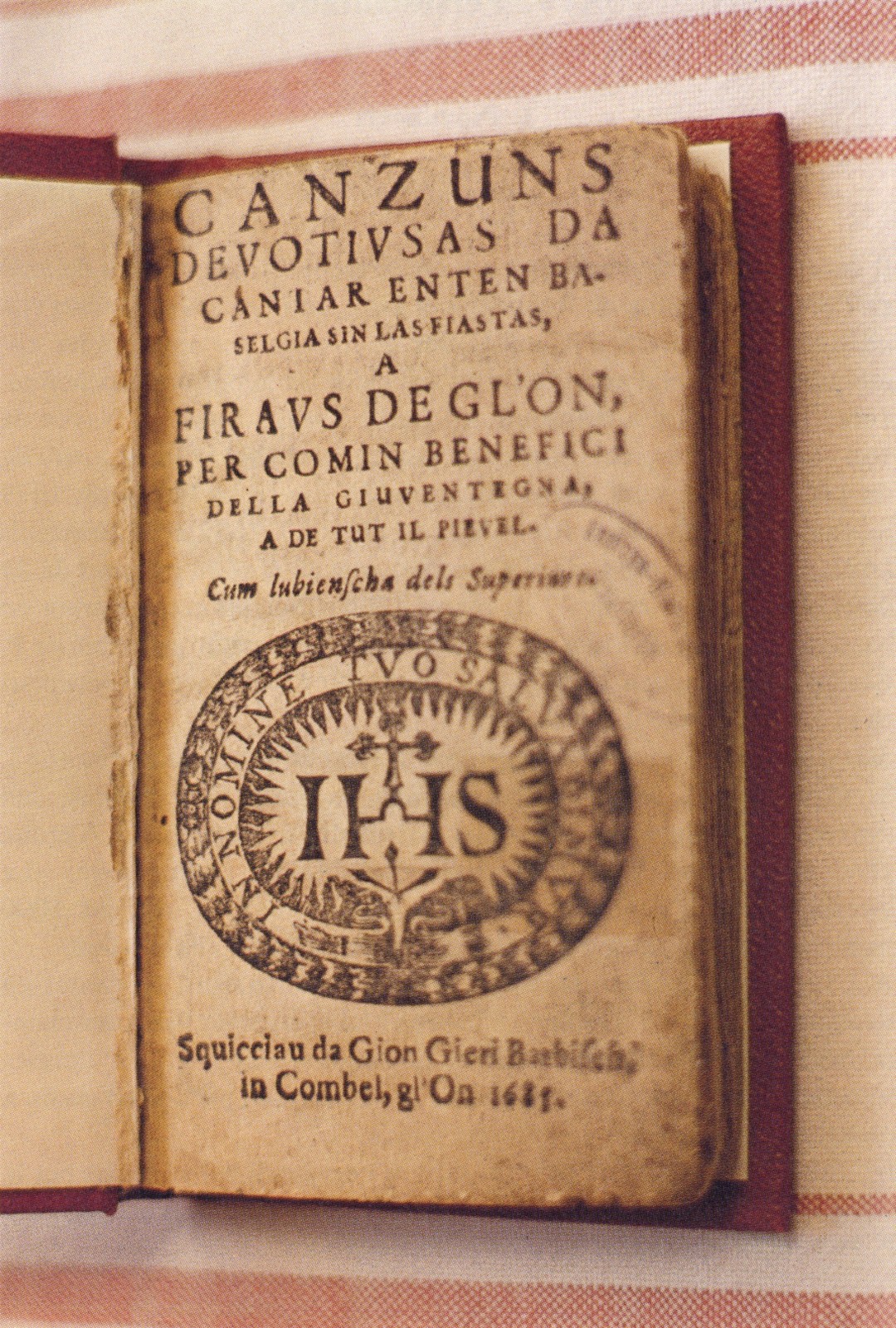
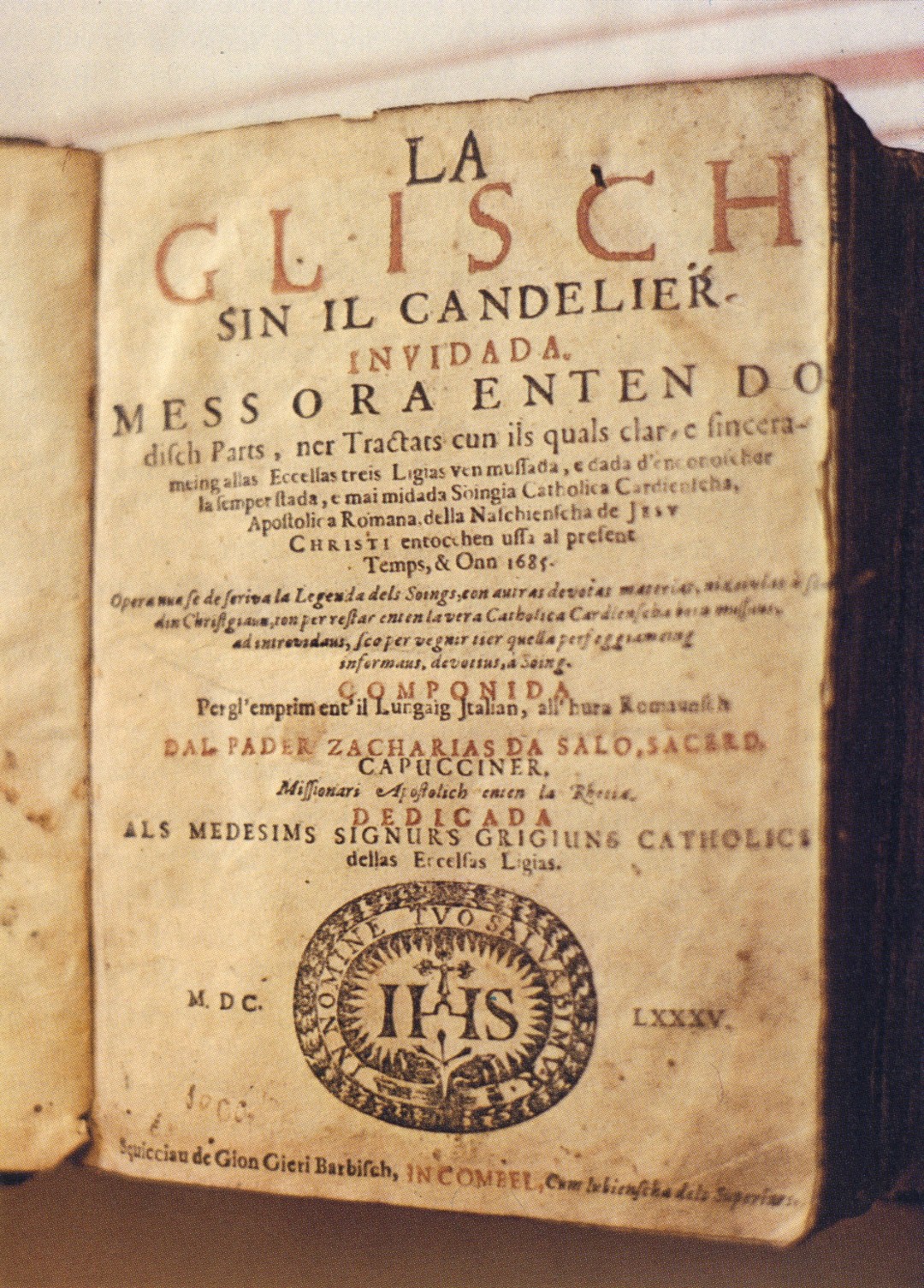
Igl onn 1684 arriva a Cumbel il stampadur ambulont Gion Gieri Barbisch, oriunds da Bludenz el Vorarlberg. El sedrezza en cun sia stampa, carteivel fella gronda nova casa pervenda, pli squetsch dils dus cudischs da P. Zaccarias «Canzuns devoziusas» e «La glisch sil candelier». El veva priu cun el il giuven emprendist Pieder Maron da Panaduz, che ha pli tard sez surpriu da stampar cudischs. La lavur a Cumbel ha cuzzau tochen 1687. Denteren ha Barbisch denton aunc stampau a Luven in cudisch religius protestant, ils «Sogns discuors». Quei onn denton ei Gieri Barbisch morts, mo cun 46 onns. El seigi morts a Cumbel.639 Satraus sa el buca esser cheu, damai ch’il cudisch da mortoris fa negina menziun. P. Zaccarias ei staus in animau propugnatur e defensur dalla cardientscha, culla spedala mira da cumbatter l’infiltraziun protestanta. Ei fuss aunc bia da relatar da quei pietus e luvrus pader caputschin e da ses cudischs, mo stuein nus serestrenscher, demai che nus savein renviar il lectur allas minuziusas publicaziuns surlunder da prof. G. Gadola640 ed als studis scientifics da P. Iso Müller.641
b) Sur Gion Rest Caduff
El ei naschius a Cumbel ils 2 d’uost 1661 sco fegl da «Christ Pizen de Cadoff» ed ei vegnius battegiaus il medem di da P. Francesco da Caino. 1685, cun 24 onns, relativamein tard, sesanfla el al collegi papal da Dillingen en Baviera sco student dalla logica. Auters datums ein — donn – buca enconuschents tochen 1700-1707, dils quals el el plevon a Siat. El sto esser staus in ordvart pietus e fervent spiritual, sco ei seresulta ord siu cudisch ed ord la notizia da quei mortori el cudisch parochial da Cumbel, sut il datum da sia mort prematura; El meretti igl epitaf (inscripziun sepulcrala) «innocens manibus et mundo corde» — da mauns innocents e da pur cor. Morts eis el ils 24 d’october 1707 a Siat, mo cun 46 onns, e satraus leu en baselgia.642
Sur Gion Rest Caduff ha relaschau ina benedida e reha ierta, siu cudisch: «Testamen dell’olma u Kunst da ventireivlameing viver e beadameing morir, cuzun cura che in leva o va a dormir, enten igls sogns uffecis, enten las lavurs, co far la confessiun generala a pervergiar etc. Mess giu enten Romontsch della Ligia Grischa digl S.R. Gion Christ Caduff, spiritual da Siath, cun lubientscha dils superiurs.» Il cudisch ei scadin cass vegnius duvraus fetg fervent. Perdetga ei gie sia 5. ediziun. L’emprema ga eis el cumparius 1705, stampaus da Maron a Panaduz. La 2. ediziun compara 1745 en claustra da Mustér, la 3. ediziun 1755 medemamein. La 4. vegn stampada dad Otto a Cuera 1785. E pèr la 5. ga procura sur Giusep Maria Camenisch el alla stampa 1842.643
Il cuntegn ei repartius sin 11 parts. L’emprema part ei oraziuns per en da tuttas situaziuns e tier numerus sogns, oraziuns per mintga di dalla jamna, perfin ina oraziun «encunter mala glieud». La 2. part ei in entruidament per assister alla s. messa e per «udir ils priedis» tochen per bandunar la baselgia. La 3. part tracta «davart il semaridar» e sur «las obligaziuns che ha in vischinadi», che ha «in che vul unliar» (handliar, marcadar) u prender survetsch, sur dalla veta da cuminonza, sur dalla lavur etc. La 4. part ei oraziuns e pietus suspirs, «alzar il cor tier Diu» enten veser bialas caussas, fretgs, elements, enten ir sper ina baselgia ora, enten dar las uras, cura ch’ei tucca etc. La 5. part ei devoziuns per la dumengia, pigl gliendisdis tiegl aunghel pertgirader, il mardis tier s. Antoni, la mesjamna tiels sogns patruns, la gievgia tiel Sontgissim Sacrament, il venderdis meditaziuns ed oraziuns en memoria dalla passiun da Niessegner, la sonda oraziuns a Nossadunna. La 6. part ei dalla confessiun generala e la 7. part sepervergiar. La 8. part ei dil rosari e numerusas oraziuns en da tuttas pusseivlas situaziuns dalla veta e perfin co «alzar il cor tier Diu cura ch’ins sa buca durmir». Il 9. capetel tracta davart «il testament spiritual». Il 10. ei «Mussaments da confortar malsauns e travagliaus; confessar e pervergiar enten malamort». Il davos tractat ei «Davart igl suenter Pietigott u prender cumiau enten malamort».
Sur da sias fontaunas di el en sia introducziun: «per part tratg ord la s. Scartira, dils sogns Paders u ord auters bials cudischs, per part era fatg da niev co ti duessas survir a Diu sera e damaun, enten lavurs . . . vegni la nunsaventa mort cura ch’ella vegli.» Auturs citescha el darar, denter auter in «Paedagogus cristianus» senza il num da siu autur, lu in P. Benignus Kybler, «Spieghel dellas miraclas»; il cudisch da ductrina da Constanza; lu Francestg da Sales, s. Vincenz Fererri, P. Athanas de Rupe e «Schatzkammer des heiligen Rosenkranzes», senza indicar igl autur. In per ga citescha el era s. Gregori e s. Bernard. Insumma vegn el ad haver fatg diever da numerus auturs dalla mistica e veta spirituala dil temps baroc. Sia concepziun ei trasatras barocca. Ins cumparegli per ex. ses cussegls d’urar: «Cura che ti vul beiber aua; cu ti vesas cumachs (Gemach) cun biara buna rauba da magliar, sei carn, pieun, caschiel, arcuns cun graun, bialas vestgadiras u baghetgs, sei da tgei sort ch’ei vegli, in fuorn cun paun u autras biaras bunas spisas sin in past: Lai vegnir endament, co il misericurdeivel Segner Dieus aunc ozildi nus mantegni e spisgenti mervagliusameing aunc cun biaras e nieblas spisas, sco el ha manteniu e spisgentau il pievel d’Israel cun la Manna. Vess po Dieus che jeu vess spisgentau la mia olma e vestgiu quella cun bialas vertids sco miu malvengonz tgierp vegn oz spisgentaus e vestgius. Tons funds purment, tons vestgius, tons fretgs sco cheu enten quei liug, tontas tschienmelli gadas seigi il misericurdeivel Diu ludaus ed engraziaus e detti il perpeten ruaus allas fideivlas olmas, che han schau davos tut quei che nus gudin, di in paternies ed Ave Maria per las olmas.» Sin tala e semeglionta moda recamonda nies pietus autur da patertgar, meditar ed urar: «Cura che ti vesas en tschalers bia vin, latg u vesas bialas fontaunas, Vals, Reins, lags; cura che ti vesas legreivlas vegnas, bials ers, pumers cargai; cura che ti vesas ina biala rimnada da pievel en baselgia en processiuns etc. ; cura che ti vesas in bi s.h. muvel; cura che ti vesas il tschiel serein, cura ch’ei suffla, cura che ti vesas las neblas, cura ch’ei piova, cura ch’ei neiva, cura ch’ei camegia e tuna, cura ch’il sulegl leva, cura ch’il sulegl va giu; cura che ti stas sper ina pegna caulda, di cun Daniel: Benedicite igni et aestus Domino . . . Less po Dieus che miu cor fuss era schi caulds et envidaus tier Tei o Segner . . .»
Nies bien ascet scriva aunc oz interessantas caussas sur dalla veneraziun dils sogns ed alleghescha ina entira retscha da sogns patruns encunter ils pli divers mals: S. Placi encunter mal il tgau, s. Leci encunter mal ils egls, s. Balugna encunter mal ils dents, s. Andriu encunter mal la bratscha, s. Gada encunter mal il pèz, s, Sievi encunter mal il dies, s. Erasmus encunter la madernatscha (Blinddarm), s. Casimir encunter mal dil crap (Gallensteine) ; encunter mal las combas s. Gotthard, encunter il greufli s. Giusep, encunter la febra s. Tresa, encunter il sturnez s. Genoveva, encunter il dar giu ed ir a frusta s. Venanzi, ch’ei vegnius tratgs a frusta per la greppa, encunter truriadads s. Vilgefortis, la quala urbescha grond confiert en quellas anguoschas, encunter il fiug s. Antieni avat, encunter malaura stemprada s. Gion e Paul, ils quals han urbiu da Diu las clavs da serrar en ed ora las neblas dil tschiel; encunter il tun e mort anetga s. Barla, encunter lavinas s. Paul apiestel, encunter mala glieud s. Benedetg, encunter uiara s. Murezi, encunter la muria s. Bistgaun e s. Roc, encunter mulestias e piarder la biestga s. Gieri, per bein tener casa per tgierp ed olma s. Flurin. S. Crispin ei patrun dils calgers, s. Barclamiu dils gerbers, s. Severus dils tissunz e s. Leo dils fravis; s. Mihèl ei patrun dils hermers, s. Pieder dils miradurs, s. Luregn dils mazlers e s. Otmar dils luvers dil funs, eav. – Quei ei denton mo in zun minim schatg ord il rihezia cuntegn da quei instructiv cudisch da nies bien sur Gion Rest Caduff da Cumbel.
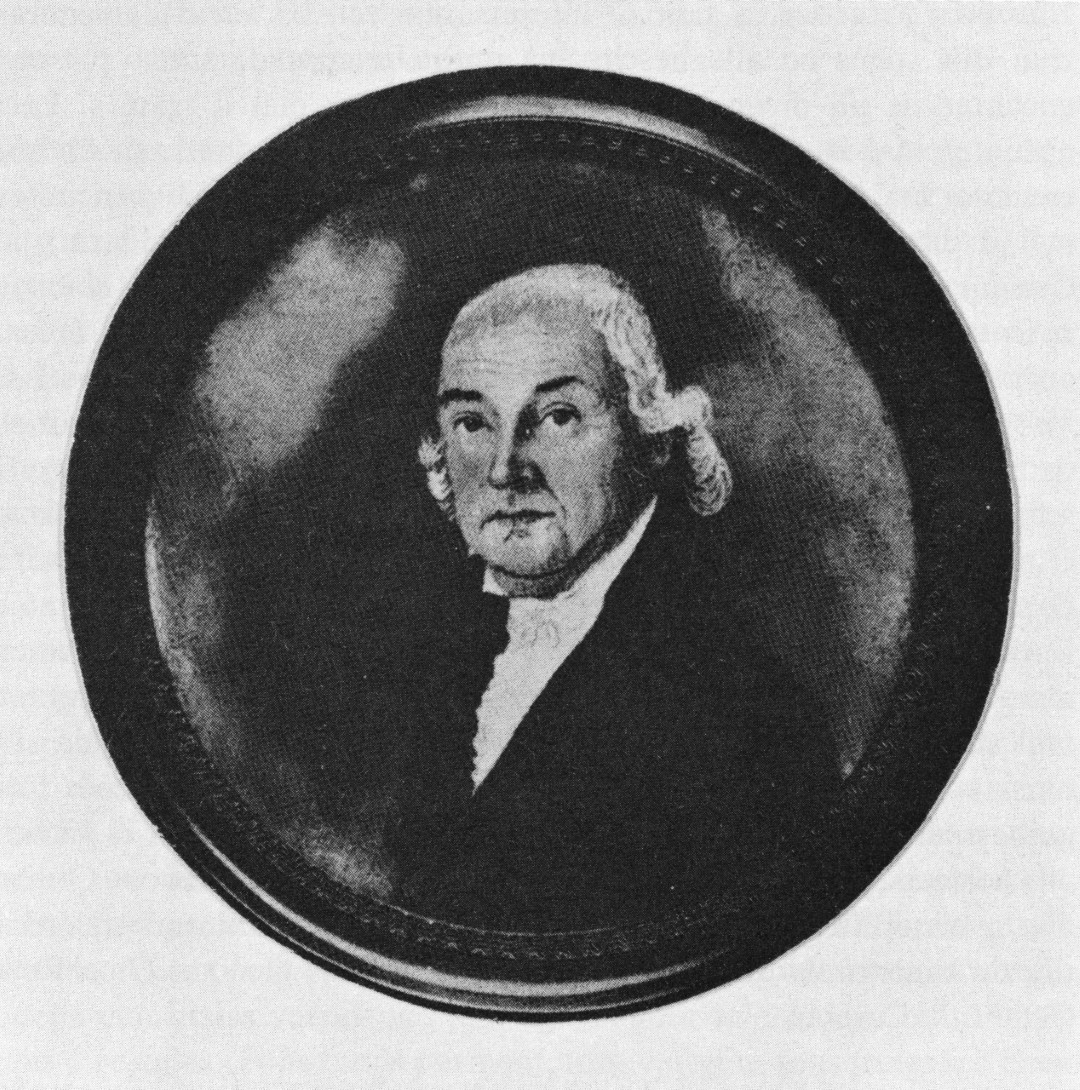
c) Landrechter dr. Gieri Antoni Vieli
Sur dad el savess ins scriver in gries cudisch, denton stuein nus serestrenscher demai ch’ei exista gia ina voluminusa monografia sur digl um, oriunds da Cumbel, daventaus in dils pli prominents umens dil Grischun da siu temps.643a El ei naschius ils 6 d’avrel 1745 a Cumbel, fegl da scarvon, pli tard mistral, Murezi Antoni Vieli. Morts ils 13 d’avrel 1830 a Razén. Ina tabla sepulcrala el carner a Cumbel. El ha fatg ses studis a Milaun ed allas universitads da Strassburg e Vienna e ha doctorau cun 22 onns 1768. Dapi 1770 ha el praticau sco miedi a Cumbel e sco miedi dil bogn da Peiden. 1771 mistral dalla Lumnezia e 1774 president dalla sindicatura en Valtlina. 1777-1791 e 1793-1796 eis el administratur imperiai dil segneradi austriac da Razén. 1797/98 delegau Grischun al congress da pasch a Rastatt. Member dalla regenza provisorica. Culla invasiun dils Austriacs eis el vegnius arrestaus e menaus prischuner ad Innsbruck ed a Graz, returnaus per il schaner 1801. Lu diversas scharschas politicas. 1805 pres. dil Cussegl grond, delegau allas dietas federalas. 1807 e 1816 landrechter dalla Ligia Grischa. 1815 president dalla dertgira d’appellaziun.644 El ei era staus litterarmein activs.645
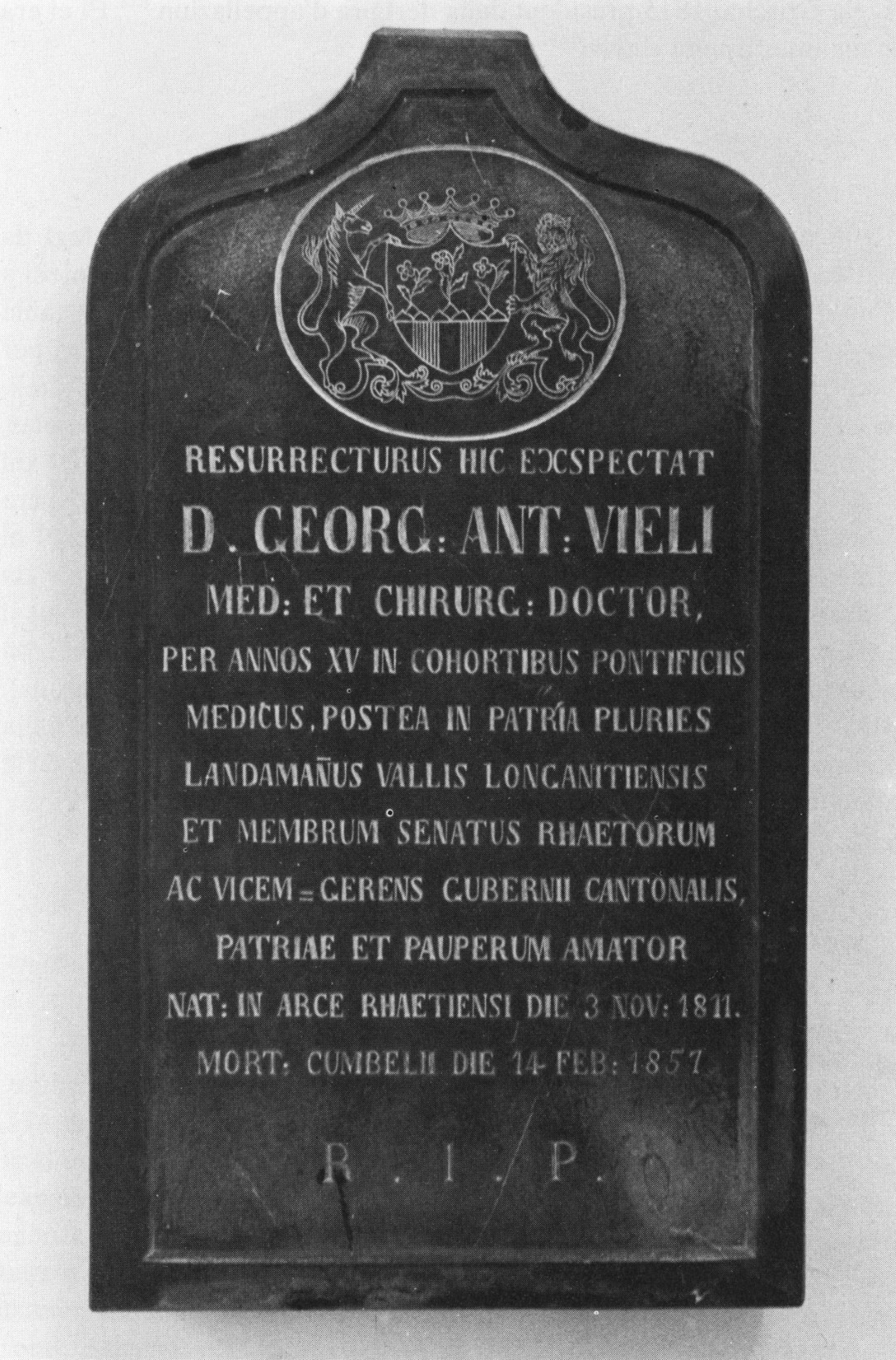
d) Dr. med. Gieri Antoni Vieli
El ei naschius ils 3 da november 1811 el casti da Razén, fegl da Cristian Vieli e da Maria Tresa n. Arpagaus. Morts eis ei sco miedi a Cumbel, ils 14 da fevrer 1857, pia mo cun 46 onns. Ina tabla commemorativa el carner da Cumbel porta en lettras majusclas per latin l’inscripziun: «Cheu spetga la levada signur Gieri Antoni Vieli, miedi e chirurg, docter, duront 15 onns miedi ellas truppas papalas, suenter ella patria pliras ga mistral dalla Lumnezia e member dil Cussegl grond e stattalter guvernativ. In amatur dils paupers.» El era beadi da landrechter Gieri Antoni Vieli. 1824-1827 studiava el al gimnasi catolic da S. Gagl sut il rectorat da Joh. Peter Mirer da Sursaissa. Sco giuven miedi ha el surviu ellas armadas papalas sut il general Caspar Teodosi de Latour. Da 1847 tochen 1857 pratichescha el sco miedi a Cumbel. 1849 eis el member dil cussegl sanitar cantunal, 1847-1852 eis el deputau el Cussegl grond. 1849-1852 mistral dalla Lumnezia. Plirs da ses plaids da cumin ein publicai ellas Annalas da la Societad Retoromontscha, annada 25, 1910.646
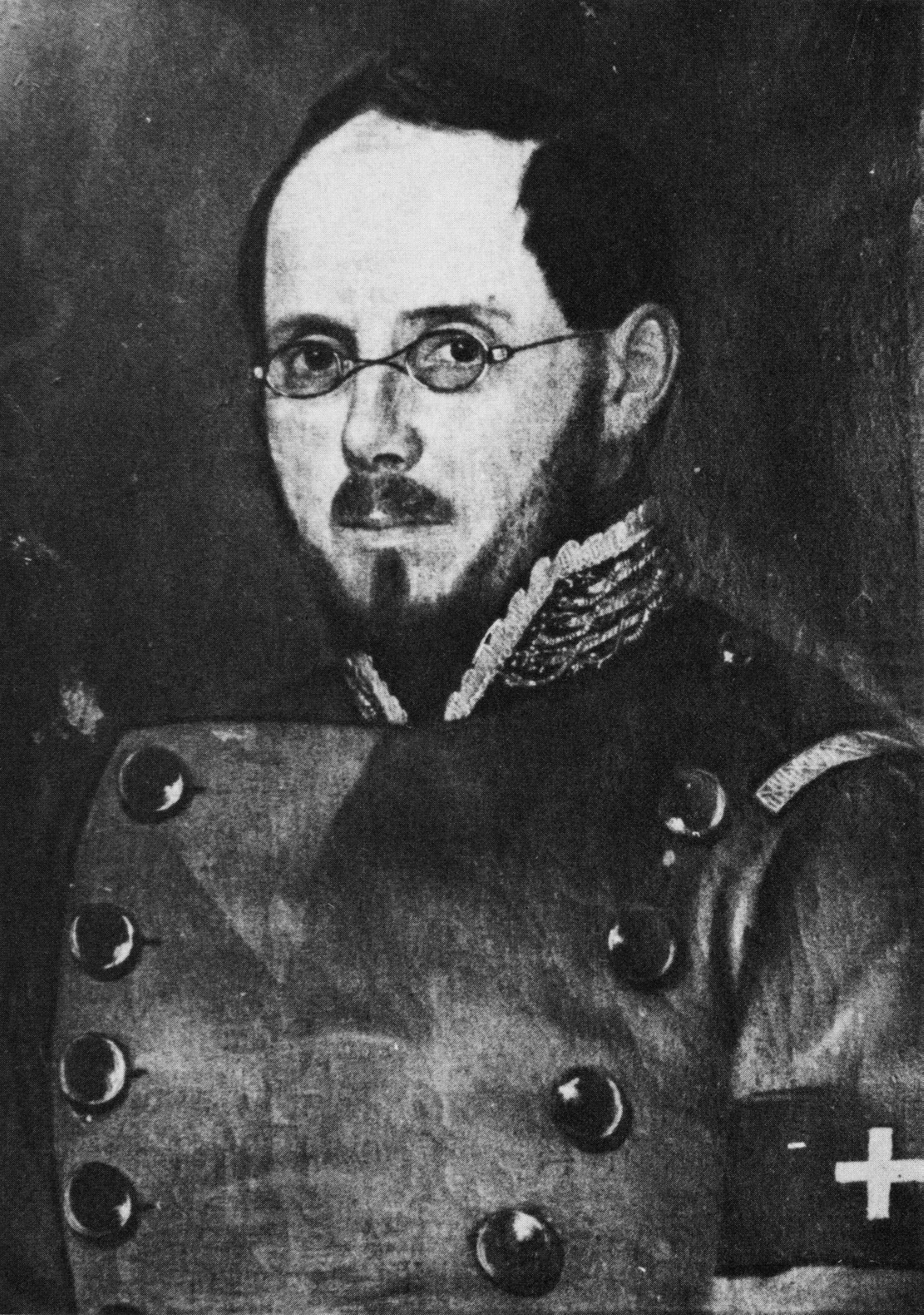
e) Dr. med. Gion Barclamiu Arpagaus
El ei naschius a Cumbel ils 3 d’october 1810 sco fegl da Luzi Antoni Arpagaus e morts ils 3 da fevrer 1882, era a Cumbel e satraus cheu ils 6 da fevrer. El ha retschiert il s. Ieli ed il perdun dils moribunds. Suenter questa notizia el cudisch da mortoris dalla pleiv stat aunc la remarca per latin: «Fuit philologus . . . el el staus in filolog, docter dalla medischina e chirurgia, duas ga deputau el Cussegl naziunal, savens mistral dalla Lumnezia, duas ni treis ga cusseglier dil cantun e quasi adina en in ni l’auter uffeci.» Arpagaus ha studiau 1830-1832 las davosas gimnasialas a Solothurn e 1832-1834 filosofia a Luzern. L’infiltraziun en quels loghens po haver influenzau sia tenuta liberala da pli tard. Lura ha el studiau medischina a Paris ed a Heidelberg. Alla entschatta settember 1838 tschenta el al cussegl sanitar cantunal la damonda da sil pli tard la primavera 1839 vegnir schaus tier agl examen cantunal. Gia ord quella ed autras correspondenzas da quei temps semuossa siu talent litterar.
1855-1877 eis el staus el Cussegl grond per la Lumnezia, cun ina interrupziun 1862-1864. 1848 e 1851 «Bundesstatthalter». Sco tal ha el representau 1852 il cusseglier guvernativ Carlo Ammarca el Cussegl pign. Mistral lumnezian. 1859 e 1865. 1861 cusseglier dils cantuns. Commember dalla cumissiun cantunala (Standeskommission) 1858, 1860, 1861 e 1868. Derschader cantunal 1856/57, Cusseglier guvernativ 1866/67 e 1870/71.
Dr. Arpagaus ha publicau pliras scartiras, ina sur dalla aua gronda da 1868 ed ina sur dil Bogn da Peiden. 1850 ha el ediu il cudisch da spindreras. Lu ha el ediu e redigiu la gasetta «La Ligia Grischa» 1867 tochen 1869, sco era duas annadas dil calender «Il Glogn» 1867 e 1869. 1878 publichescha el «Fablas e novellas». – Dr. Arpagaus meritass era el ina pli liunga expectoraziun, mo nus savein renviar il lectur alla extendida lavur da prof. Guglielm Gadola, publicada el «Glogn», ann. 21, 1947, pag. 75-110.647
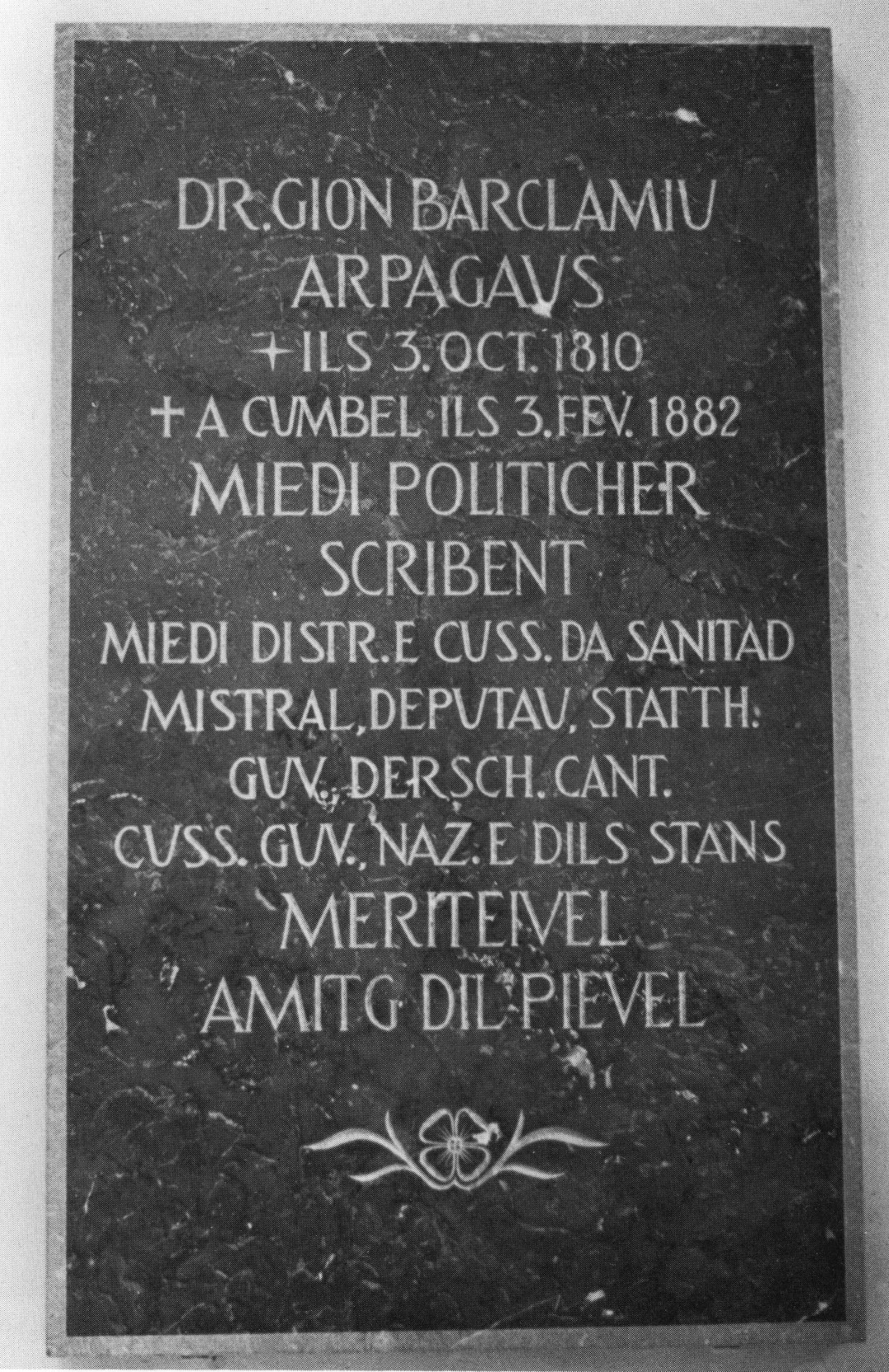
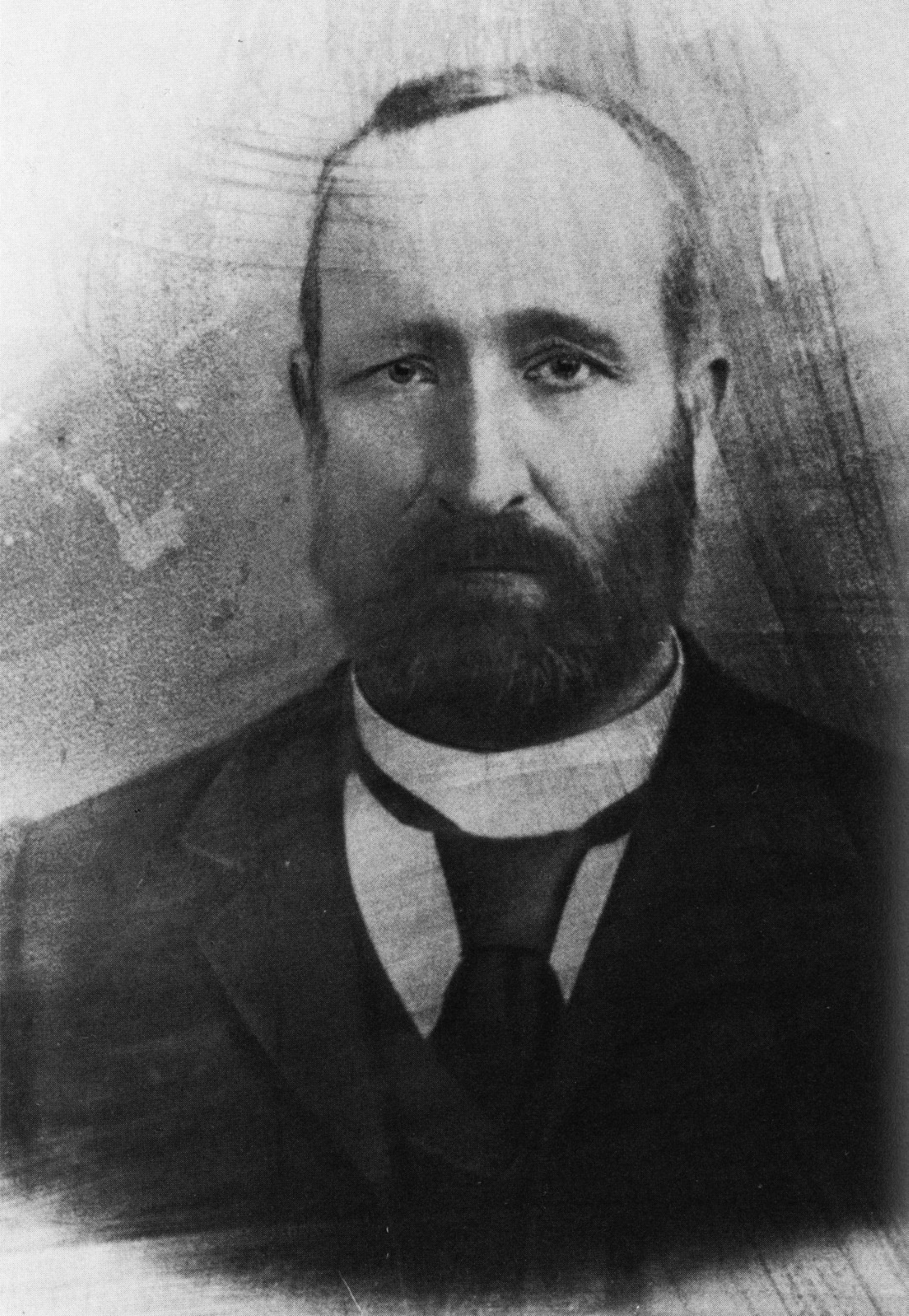
f) President districtual Balzer Arpagaus
Balzer Fidel Arpagaus ei naschius ils 22 d’october 1855 sco fegl da mistral Francestg Antoni Arpagaus e da Maria n. Capaul da S. Martin/ Lumnezia. Morts ils 27 d’uost 1927. El ha studiau da scolast a Rickenbach e ha lu dau scola a Glion biars onns. Leu ha el fatg enconuschientscha cun sia futura consorta Maria Pajarola. La letg ei restada senza affons. Persuenter ha el acceptau in affon gest naschiu da siu frar, Martin Arpagaus, demai che la mumma era morta da pigliola. Balzer Fidel Arpagaus ha administrau quasi tuts ils uffecis da vischnaunca «biars decennis, strusch ch’enzatgei vegneva fatg leu, senza ch’el vess giu la gronda part vidlunder». Decennis ora eis el staus dirigent dil chor ed organist e lu era dirigent dalla «Ligia da Porclas», la antecessura digl actual chor da vallada. 1893 vegn el elegius mistral dalla Lumnezia e silsuenter eis el deputau lumnezian pliras periodas, aschia 1895, 1899 e 1907. President dalla dertgira districtuala. Sur da pres. Balzer ha sur Baselgia schau anavos la memoria: «President Balzer ei staus insumma in um erudit, da pietad, pasch e beneficenza e senn social, prius en pils paupers e basignus, in cussegliader e confident da biars.»648
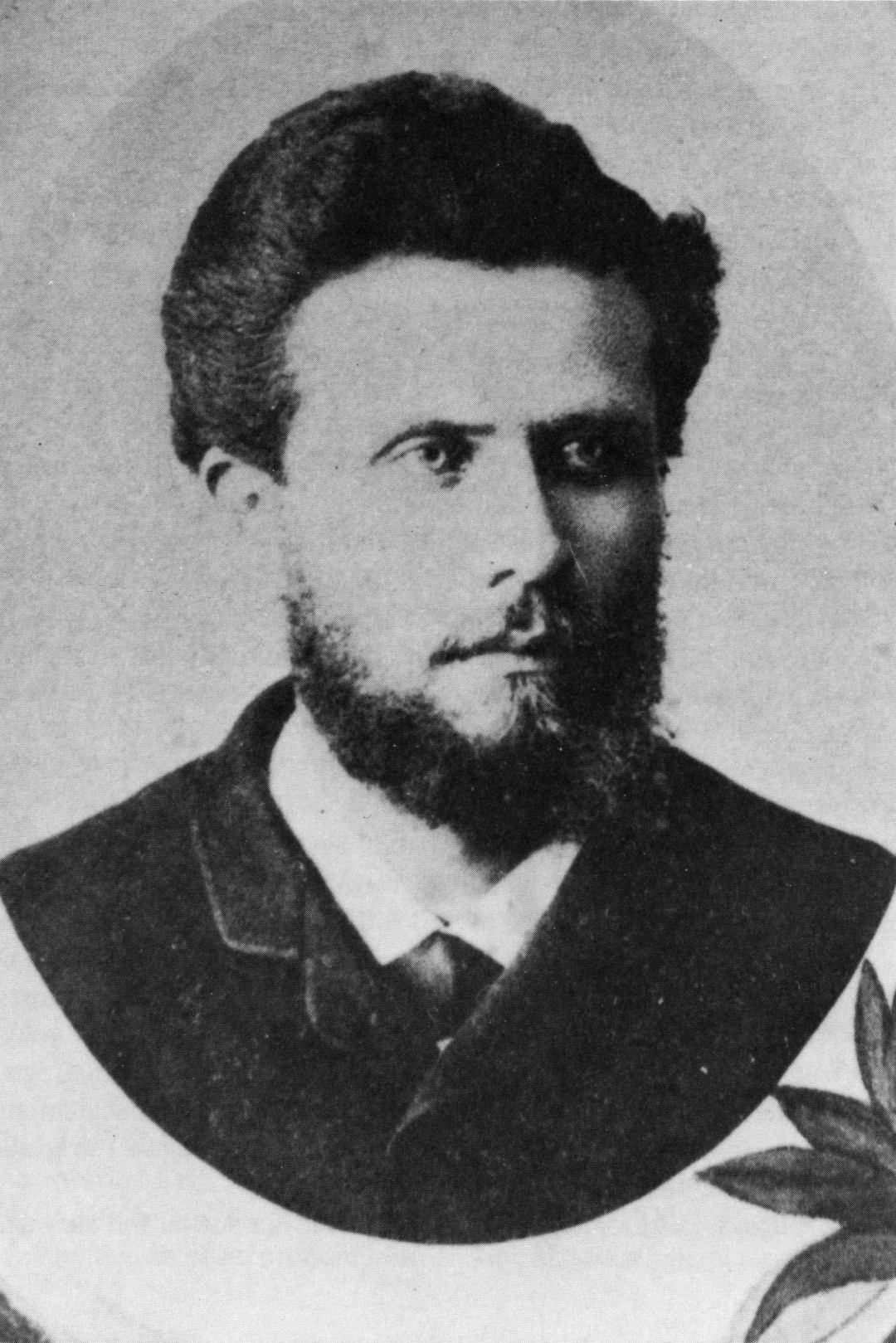
g) Luis Arpagaus
vaia per in talentau scribent popular. Siu tema preferiu ei la veta purila dil temps vargau. A moda captivonta descriva el schabetgs ord il temps da sia affonza a Cumbel. All’entschatta eis el seconcentraus sin la poesia, mettend pli tard pli bia peisa sin la prosa. Sia forza ein ils raquents cuorts cun in lungatg genuin. Entgins ein cunteni el Tschespet 29 (1950) «Per rovens e runtgas». Quei success litterar ha denton era purtau critica malvuglida. Quella trumpada – ensemen cun sia sanadad empau scardalida – han insinuau Aluis Arpagaus da desister da scadina publicaziun, aschia che sias ovras ein stadas duront 3 decennis en truchet. Quei ei donn, pertgei en quei interval ei la structura purila semidada ed ils raquents han piars bia dall’actualitad. Novissimamein ha prof. dr. Pieder Cavigelli repassau igl entir relasch e preparau ina ediziun pli vasta en 4 toms che vegn a cumparer tier la Casa editura Desertina a Mustér.
2. Mistrals, scarvons, bursers e deputai
Cumbel dumbra in surprendent diember da mistrals e d’auters ufficials da cumin. Dapi 1800-1925 ha quei vitg giu ils pli biars mistrals denter tuttas las vischnauncas lumnezianas. Suenter suondan en succesiun Vella, Vignogn, Lumbrein e Surcasti.649 Ellas suandontas gliestas vegnan ils singuls ufficials enumerai cul datum sco els vegnan menziunai ellas fontaunas, suenter 1800 denton cugl onn d’uffeci.
a) Mistrals
-
Arpagaus Barclamiu, † ils 17 da zercladur 1683. m
-
Arpagaus Murezi, el vegn menziunaus sco mistral en ina sentenzia dalla dertgira da Lumnezia ella dispeta confessiunala da Sagogn igl onn 1698.650
-
Arpagaus Gieli I, † ils 21 da schaner 1701. m
-
Arpagaus Gieli II, † ils 22 da schaner 1725 cun 74 onns, pliras ga mistral. m
-
Arpagaus Melchior, † ils 18 d’avrel 1727. m
-
Arpagaus Gieri I, † ils 23 d’avrel 1729, capitani, staus ella battaglia encunter ils Tercs a Peloponnes 1686, en survetsch da Vaniescha. Staus biars onns derschader en Lumnezia e mistral. m.
Naschius ils 18 da schaner 1667, fegl da scarvon Gion Arpagaus e da Mierta sia consorta. b. El era bab da P. Placi Arpagaus, benedictin da Mustér.651 -
Arpagaus Gion Rest, † ils 18 da settember 1746, cun ca. 50 onns. m. Menziunaus cul tetel da mistral era ils 28 da settember 1735 sco padrin. b
-
Arpagaus Murezi, 1746 eis el mistral regent e vegn proponius quei onn per la sindicatura en Valtlina.652 Menziunaus diversas ga els cudischs da batten sco bab e sco padrin.
-
Vieli Murezi Antoni, * 1711, † 1779, bab da landrechter dr. Gieri Antoni (nr. 16). HBLS VII 244.
-
Arpagaus Murezi Benedetg, documentaus ils 15 da settember 1763 cul tetel da mistral sco bab d’in baptizand ed ulteriuras ga. b.
-
Arpagaus Gieri II, *ils 15 da zercladur 1755, fegl da mistral Murezi Arpagaus (nr. 8), b. † ils 17 da matg 1826. m
-
Vieli Stiafen Balzer, † ils 11 da fevrer 1692, m. HBLS VII 244.
-
Vieli Baltasar I, * ils 15 da settember 1674, fegl da Gion Vieli. b. † ils 27 da matg 1741. m. Mistral e bannerherr. HBLS VII 244.
-
Vieli Baltassar II, * ils 23 da november 1738, fegl da Murezi Antoni ed Elisabet. b. † 1793 ils 13 da schaner, m. HBLS VII 244.
-
Vieli Giachen, * ils 16 da schaner 1680, fegl da Stefan Balzer Vieli (nr. 12) e da Maria sia consorta, b. † ils 5 d’avrel 1761. m. Tenor HBLS VII 244 podestat a Plurs, en JHGG 20, 1890, p. 37, eis el buca indicaus.
-
Vieli Gieri Antoni, dr. med., landrechter, 1745-1830. cumpara sut cap. Prominents (nr. 3).
-
Caduff Francestg, * ils 5 d’avrel 1749, fegl da Martin Flurin Caduff ed Elisabet sia consorta. † ils 21 da schaner 1812, cumpara en b 1798 e repetidamein cul tetel da mistral. b, m
-
Casanova Gion Caspar Fidel, capitani, cumpara sut il tetel da mistral en b sco padrin ils 11 da fenadur 1812. Sto esser staus mistral avon 1800. Staus en survetschs franzos ed ha giugau ina rolla duront l’uiara dils franzos 1799/1800.653
-
Arpagaus Balzer Otto, * ils 15 da november 1778, fegl da mistral Gieri II (nr. 11) e da Maria sia consorta, † ils 11 da zercladur 1857. b, m. Litinent ed elegius mistral a Pleif ils 5 da matg 1805.
-
Vieli Gieri Antoni II, * 20 d’uost 1781, fegl da Baltassar Vieli e da Maria Monica, da Vella, sia consorta, b. † ils 15 da matg 1838 ella vegliadetgna da 56 onns. m. Elegius mistral 1807. El cudisch da batten eis el cul prenum Murezi Antoni, el cudisch da mortoris sco Gion Antoni ed ei Gion strihau pli tard cun rispli e scret suravi: Gieri. Litinent. Mistral era 1822.
-
Arpagaus Murezi Melchior, elegius mistral ils 21 da settember 1811 a Pleif. Documentaus sco bab d’in baptizand sut il tetel da mistral en b sut ils 21 da settember 1812.
-
Vieli Otto Anton, elegius mistral ils 21 da settember 1813 a Pleif. El ei fegl da Landrechter dr. Gieri Antoni, * 1789, † 1820, dr. med., miedi campester en Frontscha, HBLS VII 244.
-
Caduff Rest Martin, elegius mistral 1834. Documentaus en b 1832 sco scarvon e 1835 sco mistral.
-
Arpagaus Francestg Antoni, * ils 14 da matg 1808, fegl da Gion Simeon Arpagaus e Maria Mierta, sia consorta. b. † ils 2 da fenadur a Cumbel 1887. m. Elegius mistral 1836. Documentaus pliras ga suenter 1836 sco mistral. b
-
Arpagaus R., elegius mistral 1837. Deplorablamein senza esser scret ora igl entir prenum en BM 1923 p. 369.
-
Arpagaus Gion Gieri, 1843 sin cumin da s. Mattiu (21.9.) a Pleif ein vegni elegi mistral Gion Otto Capaul e Gion Gieri Arpagaus da Cumbel, mintgin per in onn ed era sco deputai al Cussegl grond. BM 1923 p. 370.
-
Vieli Gieri Antoni III, dr. med., mistral 1847, 1849, 1851. Cumpara survart nr. 4.
-
Arpagaus Gion Barclamiu, dr. med., cusseglier naziunal, mistral 1859, 1865. Pli bia sur dad ei survart, prominents nr. 5.
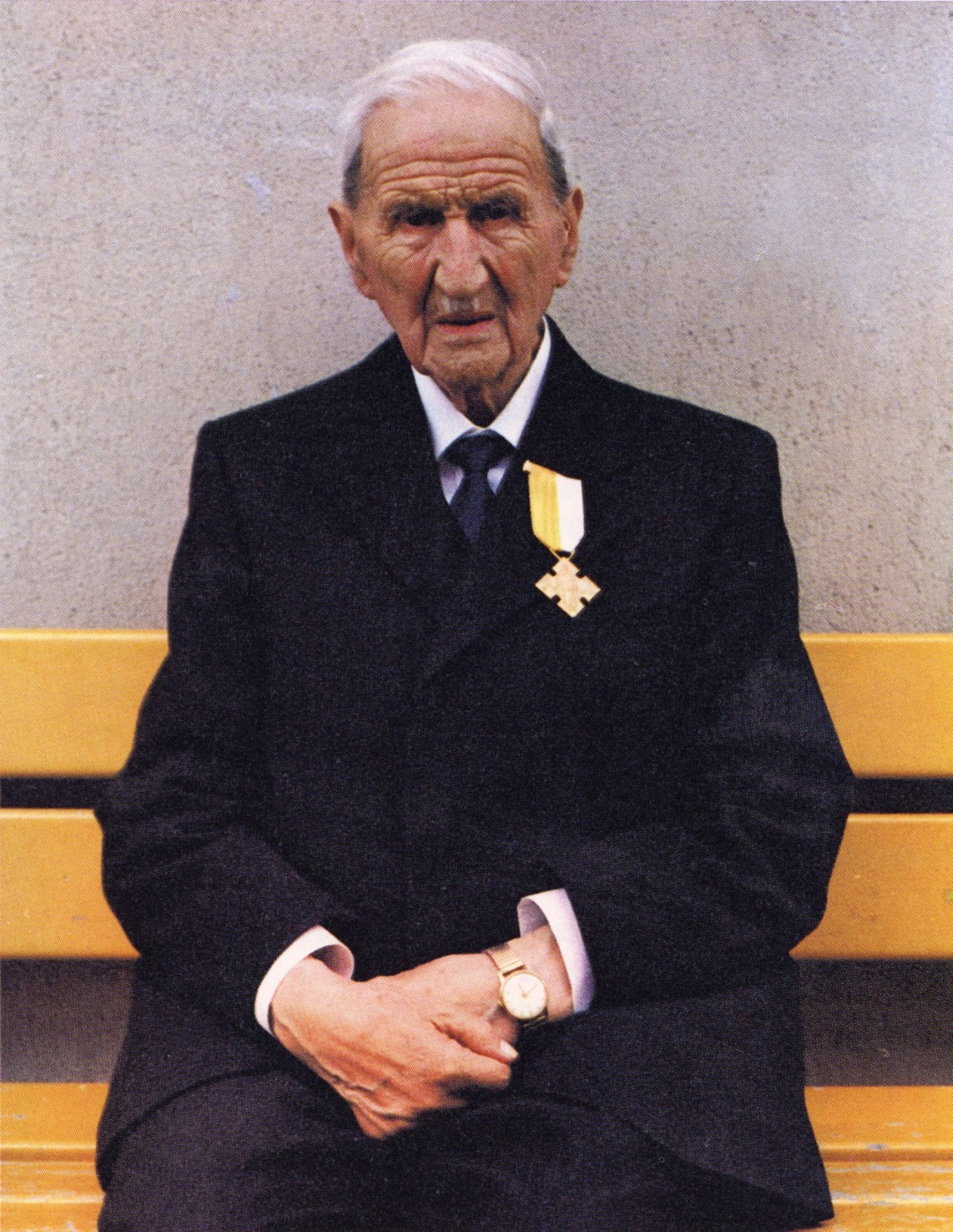
-
Arpagaus Gion, * ils 22 d’avrel 1860, fegl da dr. Gion Barclamiu Arpagaus e sia consorta Anna Maria Barla n. Candrian da Panaduz. Mistral Gion ei elegius mistral a Lumbrein 1887 ed ei morts en uffeci ils 11 da settember 1888 dalla aua gronda enten vuler trer ord l’aua digl ual da Duin siu convischin a Peiden/Bogn, Guglielm Furger, muliner e resgiader. Furger han ins buca anflau pli, ferton che la bara dil mistral Gion ha saviu vegnir satrada a Cumbel ils 18 da settember. b, m
-
Arpagaus Balzer Fidel, mistral 1893. Pli bia sur dad ei survart, prominents nr. 6.654
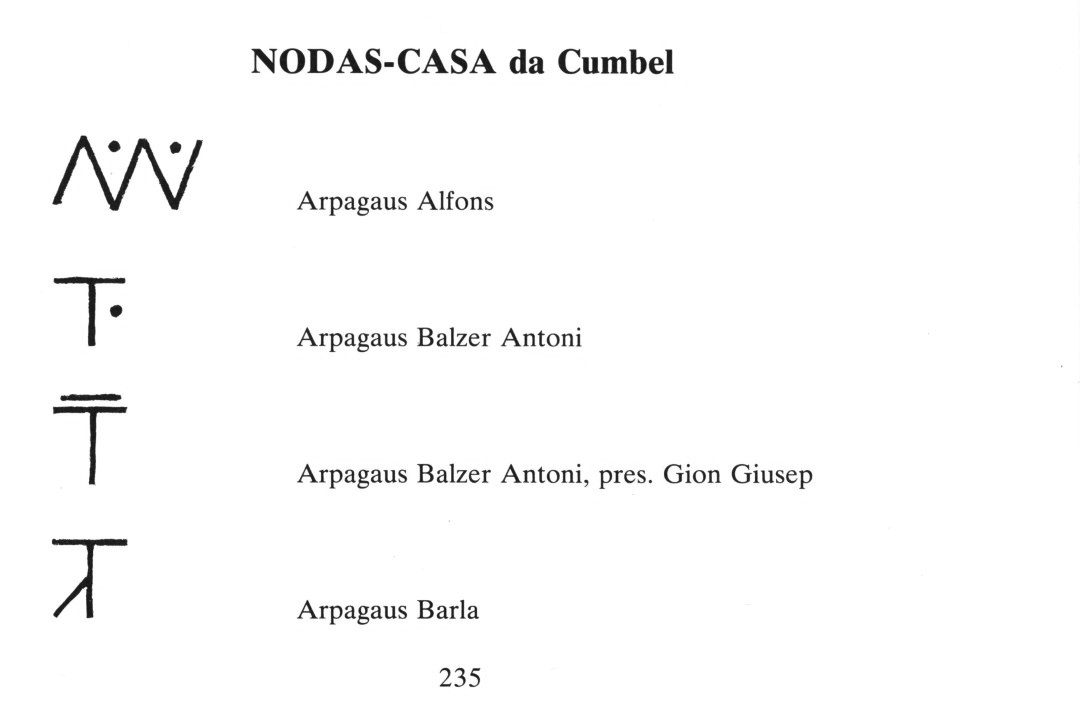
- Elvedi Murezi. Murezi Antoni Giusep ei * ils 17 da settember 1891, fegl da Luis Elvedi e Madalena n. Damur. La mumma ei morta da quella pigliola. Murezi ha absolviu duas classas secundaras alla scola claustrala da Mustér e 3. e 4. mercantila a Sviz cun diplom. Postenent, ustier e dapi 1926 era negoziant a Cumbel. Actuar da vischnaunca, cusseglier da scola, plirs onns era president dil cussegl da scola, cassier e president da vischnaunca. 1920, ils 20 da matg maridaus cun Maria Tresa Jörger da Val, bab da nov affons. Gia cun 18 onns ha el sunau l’orgla e prest suenter elegius organist e dirigent dil chor, dirigent era dil chor da vallada 1938-1945. Da Nadai 1968 ha el retschiert la medaglia papaia d’honur e meret «Bene merenti». 14 onns eis el staus actuar dalla dertgira cirquitala. Deputau el Cussegl grond 1935-1939 e 1941-1947, mistral 1941-1947. Ina liunga ed emplenida veta!
b) Scarvons
Ils sura mistrals han per ordinari era stuiu ir da scala si sco burser e scarvon. Dasper ils biars dilsezs nums cattein nus aunc ils suandonts scarvons:
-
D’Arpagaus Joannes, doc. ils 8 da schaner 1651. b
-
D’Arpagaus Gieli, ils 18 da schaner 1673. b
-
Cabalzar Gieli, 17 d’october 1678. b
-
Arpagaus Mattias, 23 d’october 1720. b
-
Caduff Giuchin Giusep, † ils 27 da schaner 1727. m
-
Caduff Cristian, † ils 3 da november 1730. m
-
Caduff Gieri Francestg, doc. ils 13 da zercladur 1750. b
-
De Arpagaus Rest Gieri, doc. ils 3 da mars 1773. b
-
Arpagaus Gion Giachen, doc. ils 10 da november 1790, b. † 5 da zercladur 1827. m
-
Arpagaus Murezi, 1811. Bünd. Tagbl. 1968/3 (Chr. Foppa)
-
Arpagaus Rest Giusep, doc. ils 25 da fevrer 1814. b
-
Casanova Gion Luregn, doc. ils 15 da november 1828. b
-
Arpagaus Stefan Fidel, doc. ils 17 da schaner 1845. b
-
Arpagaus Josef, 1855, BM 1923 p. 371.
c) Bursers (seckeimeister)
-
Caduff Christ, documentaus ils 8 d’october 1653. b
-
D’Arpagaus Gieri, doc. ils 6 da november 1655. b. † ils 8 da mars 1663. m
-
Depuoz (de Potz) Gion Giachen, doc. ils 11 da mars 1665. b
-
De Caduff Gieri, doc. ils 20 da settember 1668. b. † ils 11 da fevrer 1722. m
-
Arpagaus Gieli, doc. ils 28 da december 1681. b
-
Arpagaus Gion, doc. ils 26 da fevrer 1688. b
-
Vieli Giachen, doc. ils 14 da settember 1709, b. † ils 5 d’avrel 1761. m
-
Caduff Christ, doc. ils 20 d’october 1722. b
-
Arpagaus Francestg, ils 23 d’avrel 1722. b
-
Collenberg Joannes, doc. ils 6 da fenadur 1727, * ils 23 da november 1698, † ils 11 da fenadur 1765. b, m
-
Arpagaus Joannes, doc. ils 6 da fenadur 1727 sco padrin. b
-
Caduff Murezi, doc. 21 d’uost 1736. m
-
Arpagaus Gion, doc. sco padrin ils 30 d’october 1766. b
-
Caduff Francestg Antoni, doc. ils 2 da settember 1813. b
-
Casanova Gion Gieri, doc. sco padrin ils 14 da schaner 1822. b
d) Ils deputai el Cussegl grond 1806-1947
-
Vieli Gieri Antoni, dr. med. landrechter, 1806, 1809, 1811, 1817, 1819, 1825.
-
Arpagaus Gieri, mistral, 1811.
-
Arpagaus Balzer (da Cumbel?) 1813.
-
Arpagaus Murezi, 1817.
-
Vieli Gieri Antoni, litinent, 1821.
-
Arpagaus Gieri, mistral, 1821.
-
Arpagaus Murezi, mistral, 1827.
-
Arpagaus Balzer, 1832, 1833.
-
Caduff Rest Martin, mistral, 1835.
-
Vieli Ludivic, 1836.
-
Arpagaus Josef, capitani, 1847, 1855.
-
Arpagaus Murezi, mistral, 1839.
-
Arpagaus Gion Gieri, mistral, 1843.
-
Vieli Gieri Antoni, dr. med., 1845, 1847, 1848, 1853.
-
Arpagaus Francestg Antoni, capitani, mistral, 1837, 1849.
-
Arpagaus Gion Barclamiu, dr. med., 1855, 1857, 1859, 1860, 1863, 1869.
-
Arpagaus Gion Gieri, mistral, 1861.
-
Arpagaus Balzer Fidel, 1889, 1891, 1895, 1899, 1907.655
-
Elvedi Murezi, 1935-37, 1937-39, 1941-47.656
Notabene: Dalla famiglia Vieli, oriunda da Cumbel e descendents da landrechter dr. Gieri Antoni Vieli, han aunc contonschiu la dignitad da mistral el cumin da Razén: Baltassar Vieli 1786-1845, Ludivic Vieli 1808-1867 e Paul Baltassar Vieli, * 1865, mistral da Razén 1899 tochen 1903.657
XV. Las nodas-casa
Signur Albert Caduff (n. 1922) ad Urdorf/ Turitg ha per instanza digl autur dalla «Historia dalla pleiv da Cumbel» giu la buontad e la premura da rimnar el decuors digl unviern 1981/82 las nodas-casa da scadina casada da Cumbel. Ellas survevan e surveschan per part aunc oz per nudar iseglia, utensils, lenna ed auter uorden e possess. Nus engraziein al rimnader per haver reteniu e perpetnisau quei che vaia actualmein ariguard nodas-casa e savein bien grau ch’el ha cheutras spindrau per adina quei ch’era sin ir a piarder.
NODAS-CASA da Cumbel
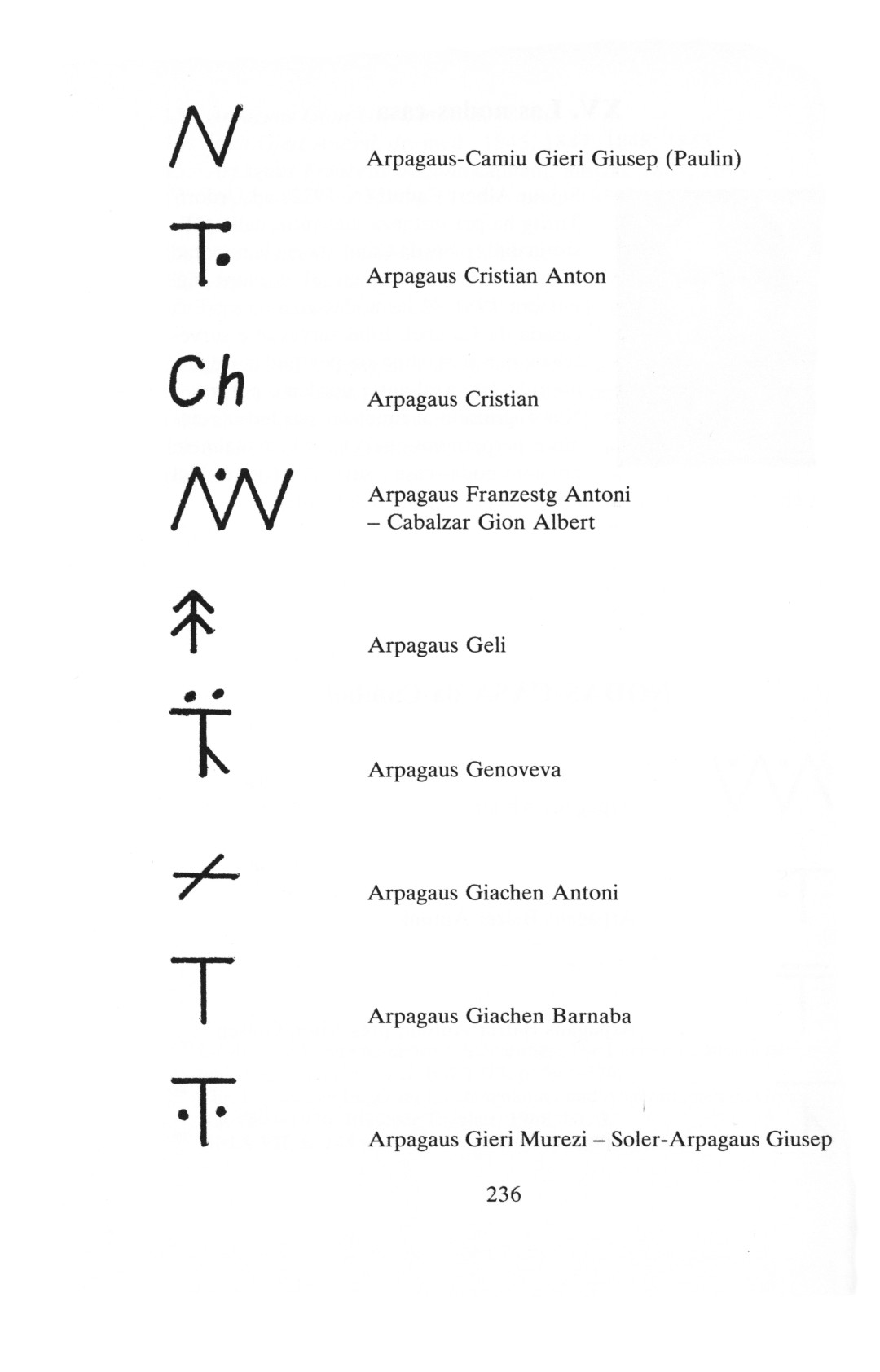
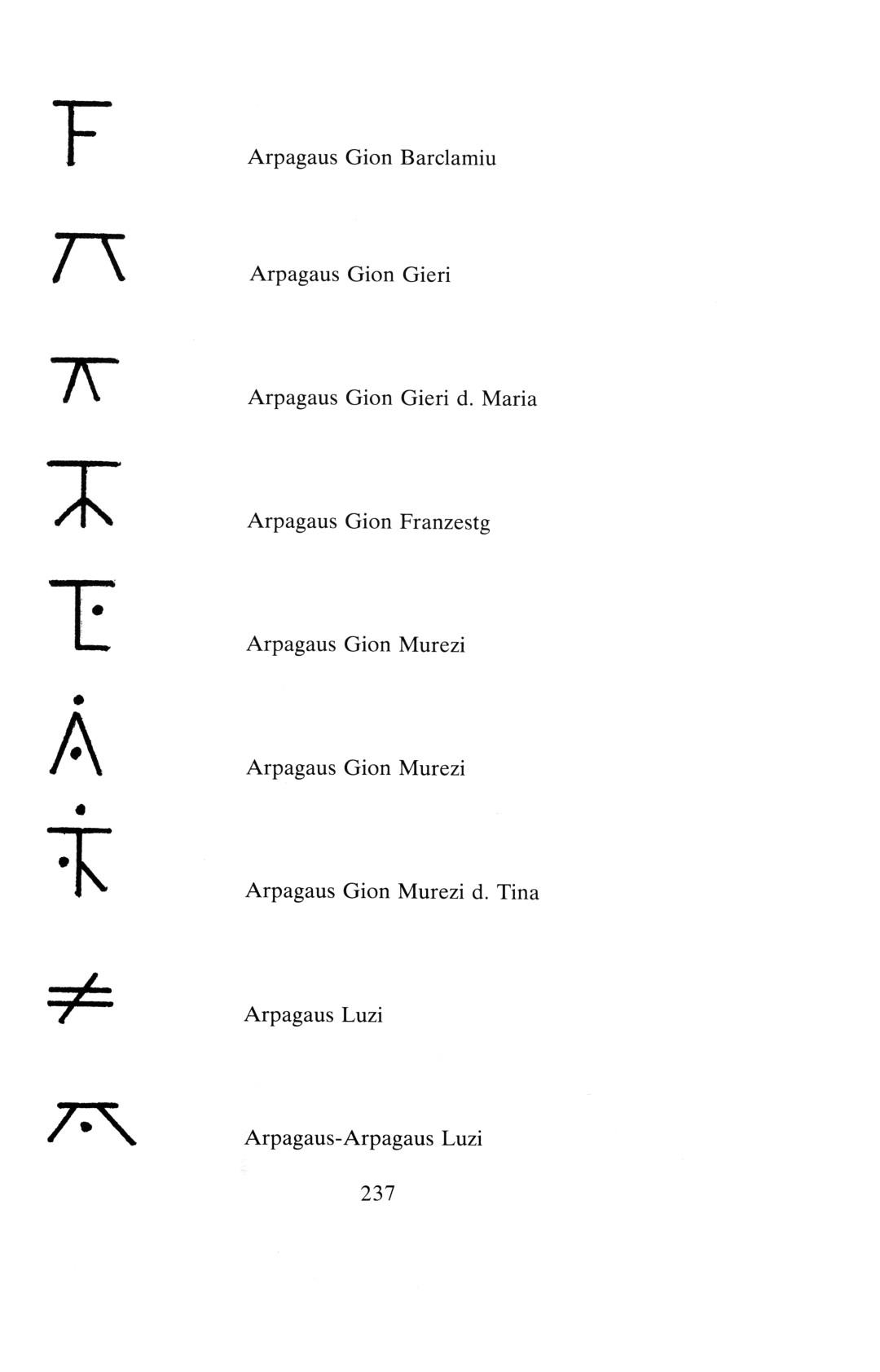
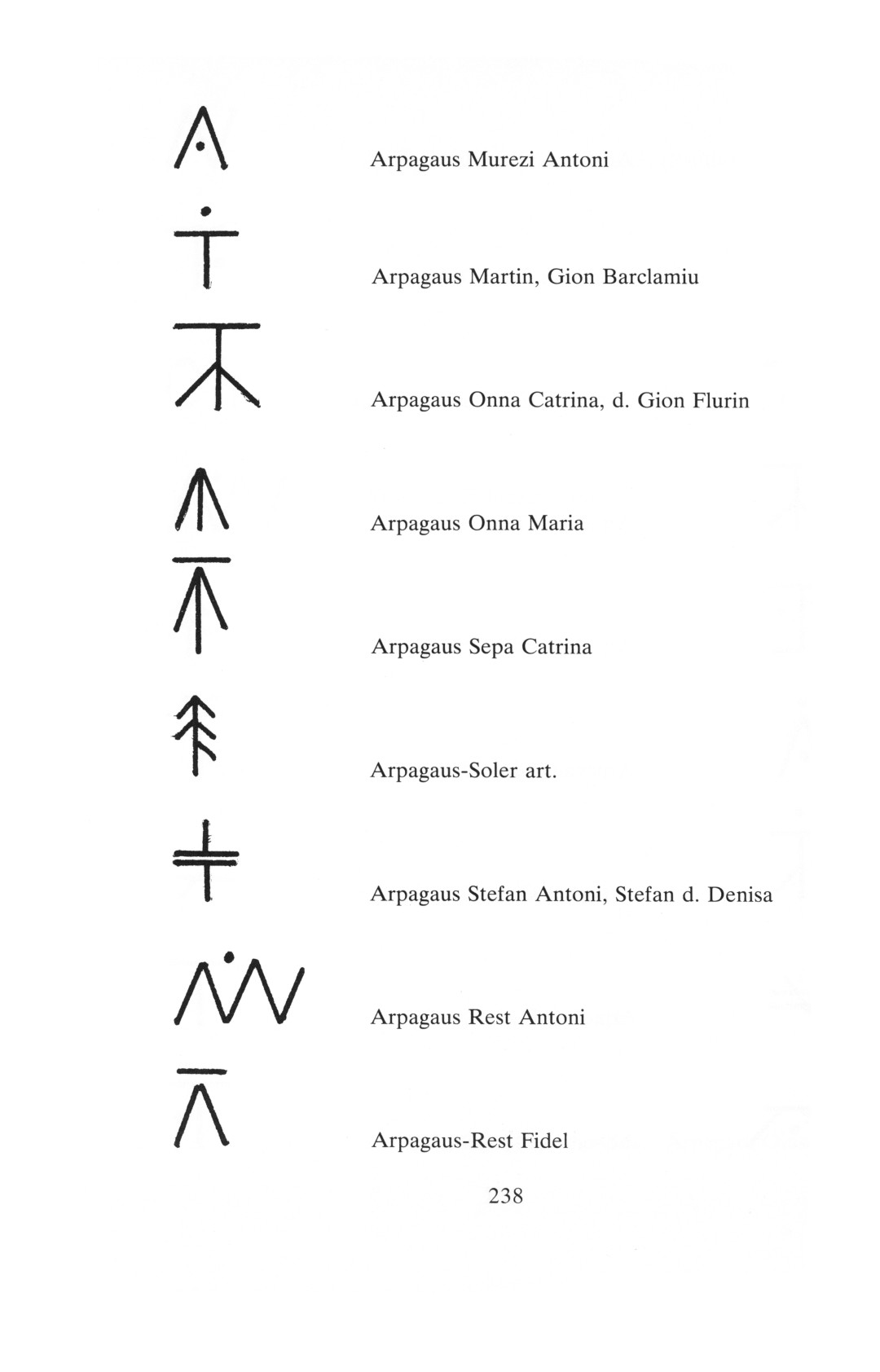
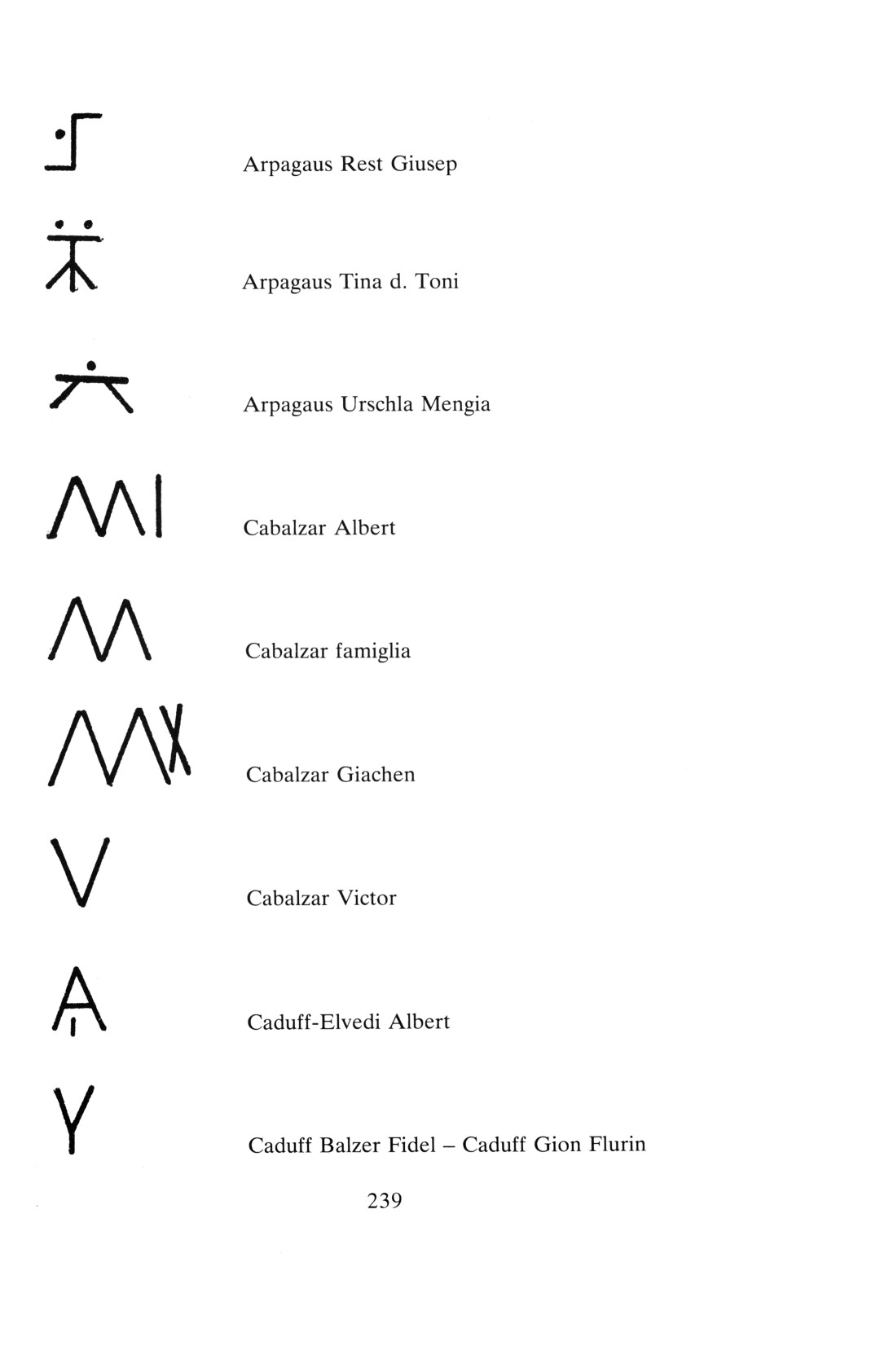
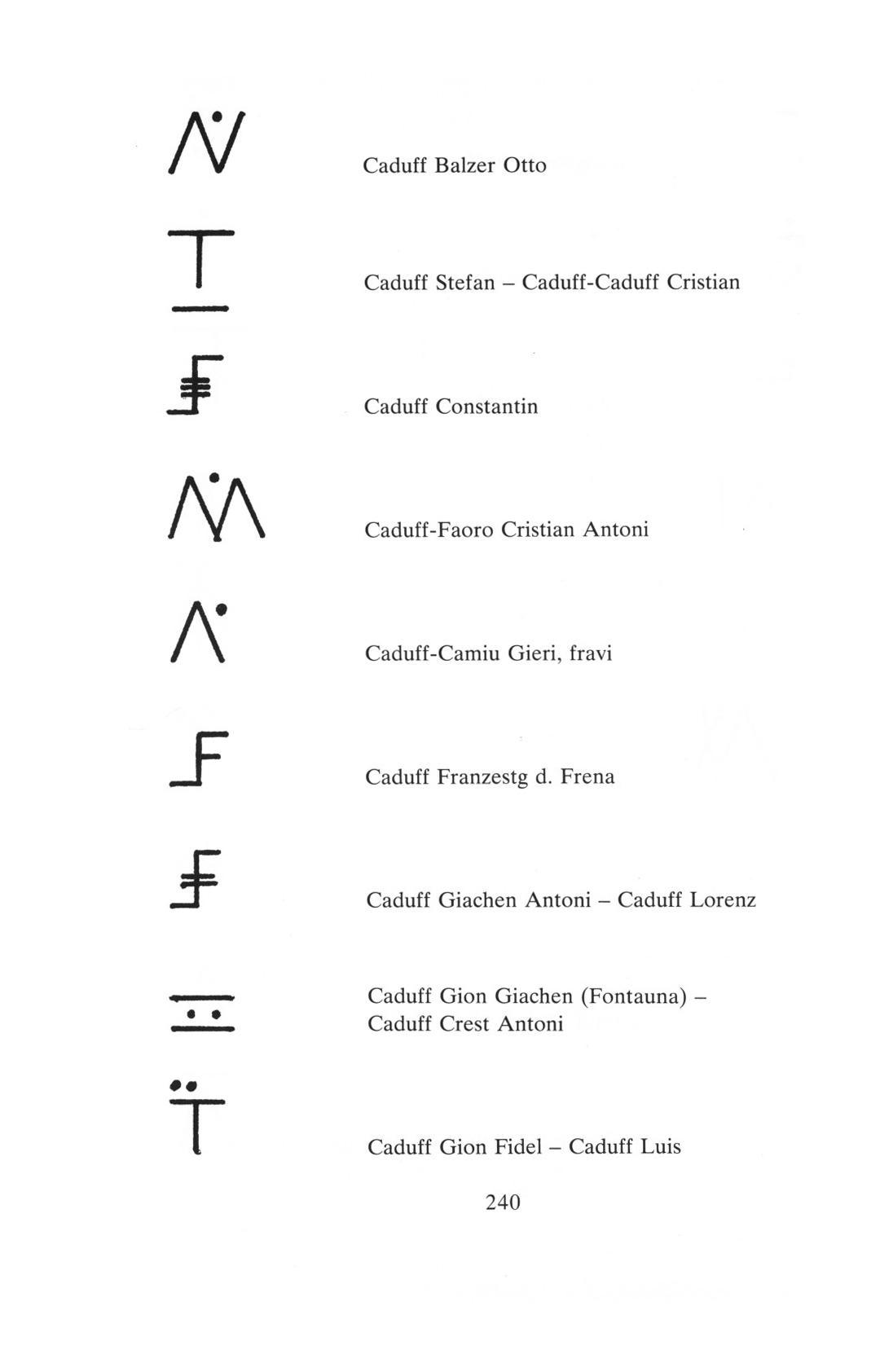
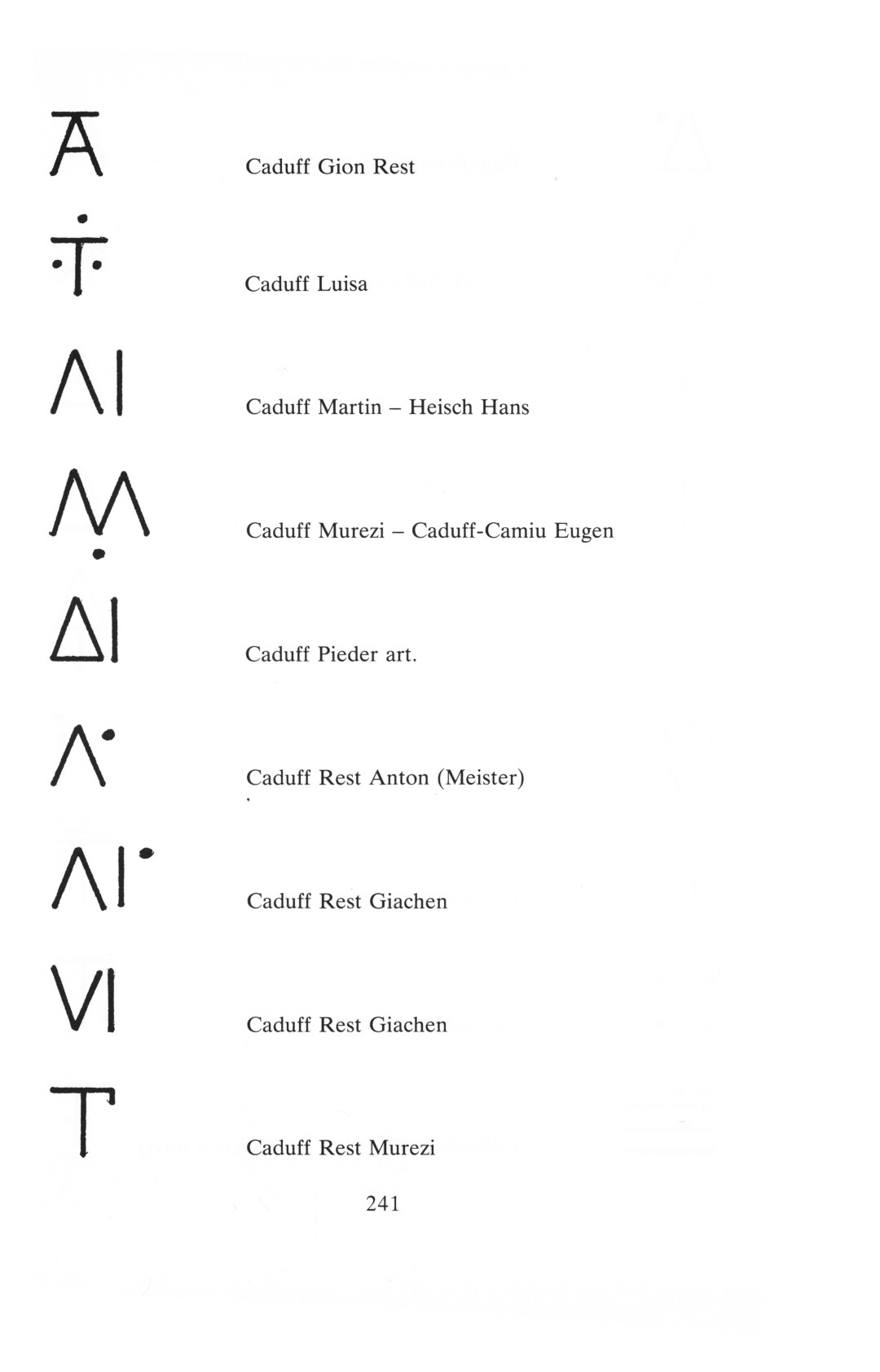
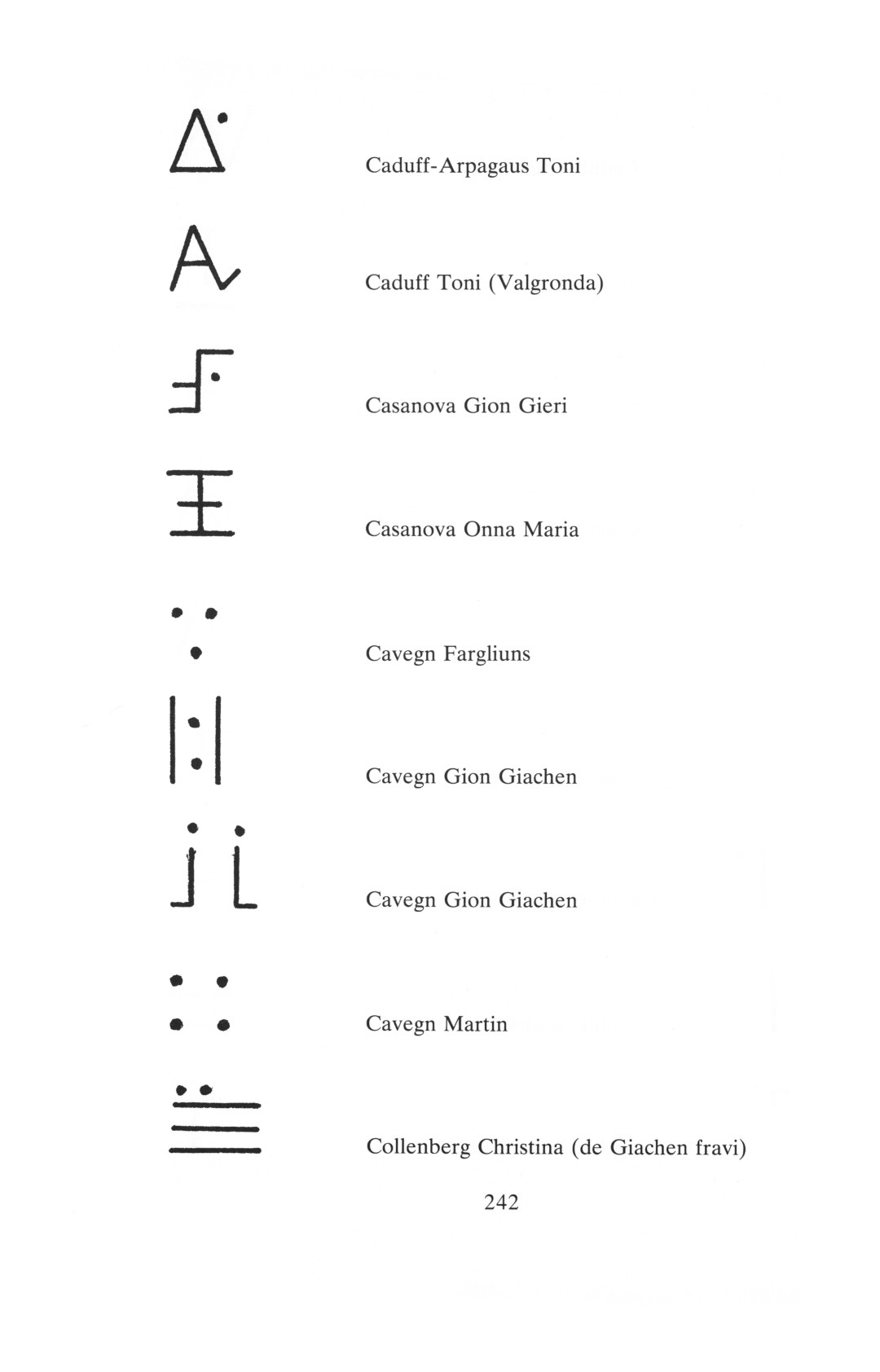
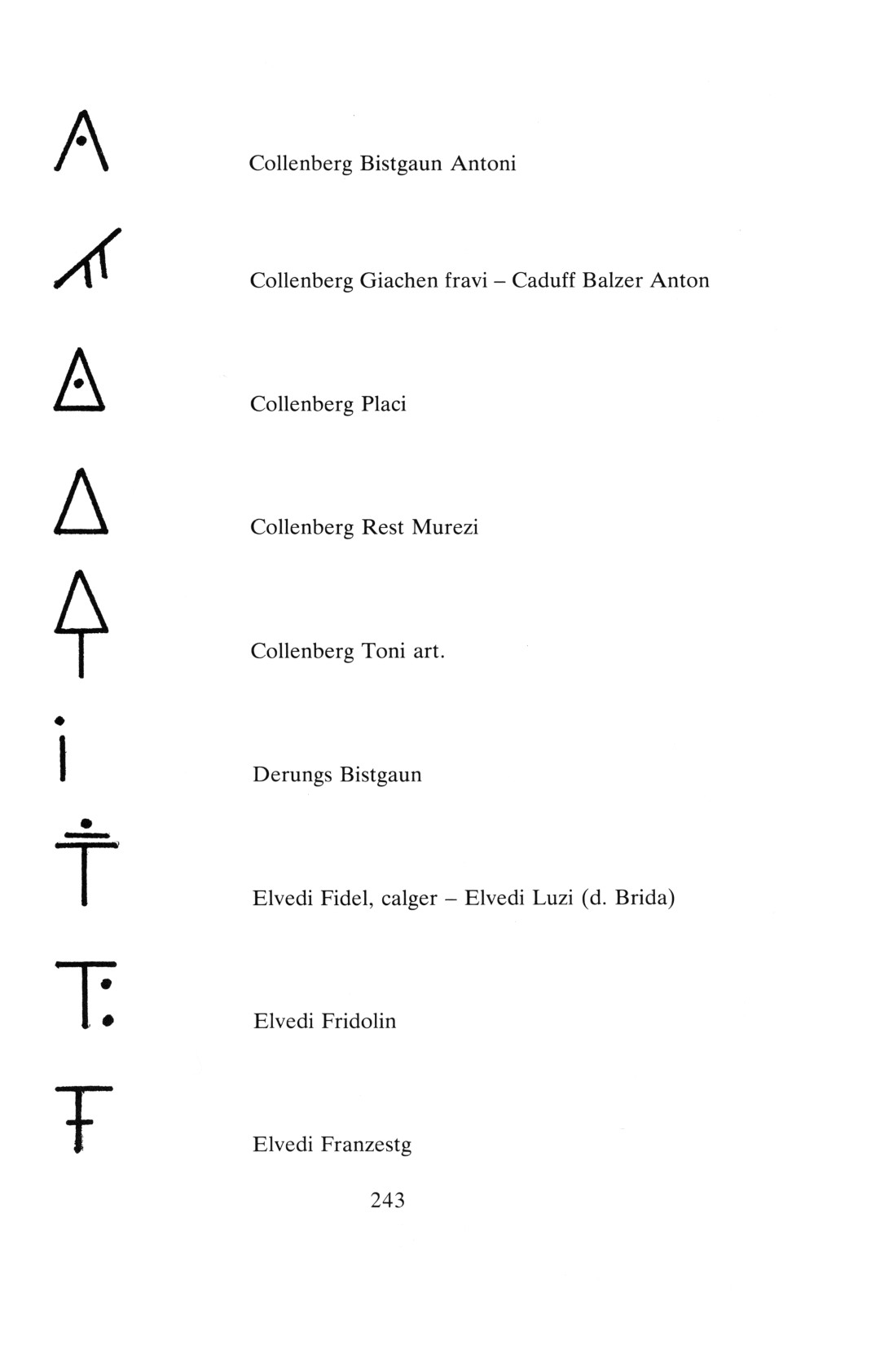
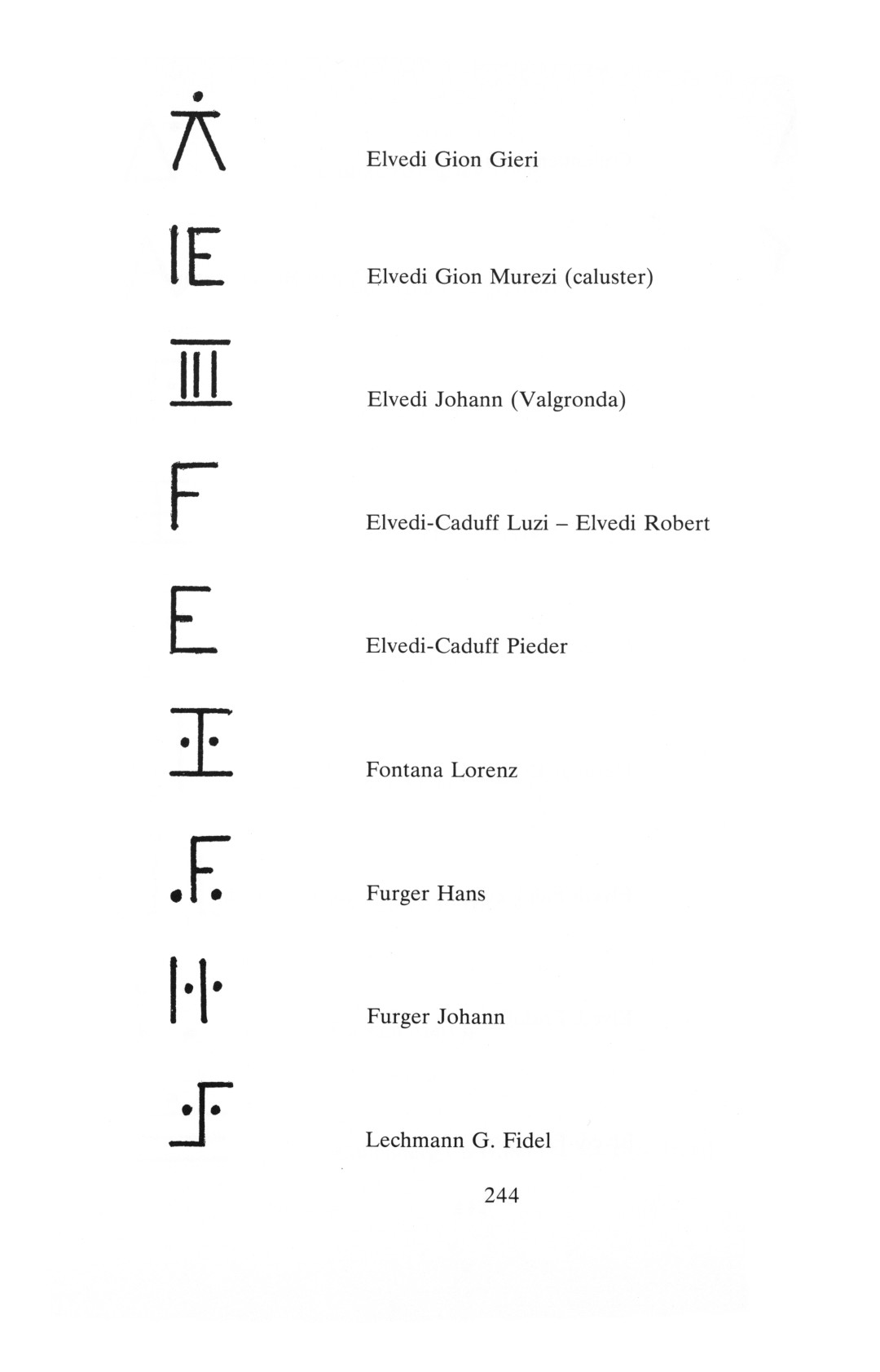
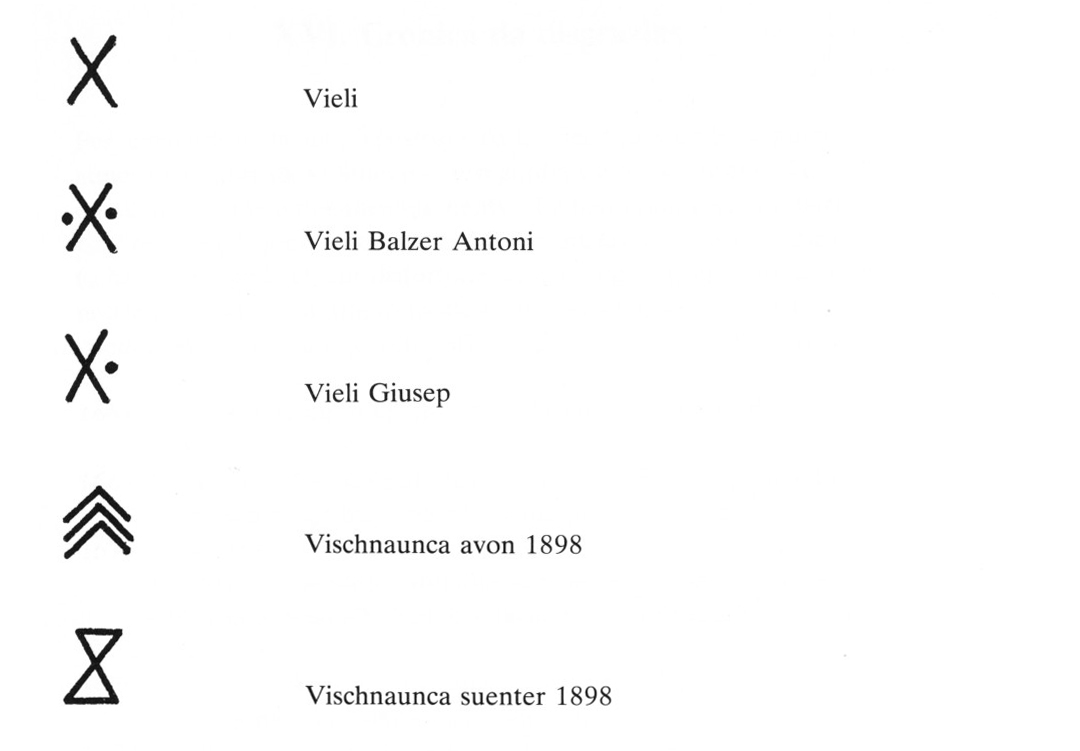
XVI. Cronica da disgrazias
Per conclusiun da mia «Historia dalla pleiv da Cumbel» mond’jeu aunc sin santeri da s. Stiafen e seregordel da tons e tons – da tuts – d’enconuschents e nunenconuschents, che han urau, luvrau e barhau. Lu less jeu en quest liug aunc tschentar ina cruschetta da regurdientscha a tuts quels ch’ein disfortunadamein vegni stratgs ord la cuminonza dils vivs tras in tragic accident mortai, sco quei ch’igl ei nudau el cudisch parochial da mortoris (m).
| 1664 | 26 da zercladur, «Thomas fegl da Gion Thomas» da 19 onns, negaus giul Schuob. | |
|---|---|---|
| 1668 | 5 da zercladur, Caspar, fegl da Gion Mihèl Arpagaus, ca. 35 onns, morts egl uaul, tuccaus d’ina plonta curdonta. | |
| 1675 | 12 da mars, Urschla e Barla Caglier (Calier), feglias da Murezi Caglier, ein vegnidas anfladas scheladas al pass dil Spligia. Ein satradas a Nola ella Val S. Giachen. Cheu in requiem ils 30 da mars. | |
| 1676 | 22 d’avrel, Stefano, 14 onns vegls, dalla Val Calanca, ruclaus ella aua dil flum, satraus el santeri da s. Stiafen. | |
| 1680 | 24 d’uost, Ireneus (schlatteina nunlegibla), curdaus ella aua dil flum e morts. L’auter di anflau la bara sper Sagogn; satraus cheu. | |
| 1694 | 24 da settember, Catrina, feglia da Gion Donau, morta el Rein e satrada cheu. | |
| 1726 | 17 da settember, Arpagaus Simon, ruclaus giud in grep, ca. 61 onns, morts e satraus cheu. | |
| 1740 | 14 da mars, in cert jester (quidam advena) ruclaus alla mort e satraus cheu. | |
| 1743 | 23 da zercladur, Arpagaus Murezi Antoni, ca. 19 onns vegls, negaus en in flum en Frontscha. | |
| 1750 | 19 d’uost, Collenberg Plasch, da 66 onns, curdaus giud ina plonta ed anflaus morts a Summaspestgia. | |
| 1761 | 11 da matg, Caduff Gieri Francestg, da 39 onns, vegnius sut in lenn curdont ol Prau dallas Lieurs e morts ils 13 da matg e satraus ils 14. | |
| 1785 | 20 da fenadur, Arpagaus Gieri Antoni da 7 onns curdaus giud in tetg e morts prest sissu. | |
| 1808 | 25 da matg, Maria Emerita Collenberg, ca. 50 onns, curdada, ella aua, ier anflada ed oz satrada. | |
| 1827 | 28 da schaner, Maria Nesa Arpagaus n. Caduff, da 75 onns barschada digl incendi en casa. | |
| 1828 | 26 da settember ei Onna Barla Arpagaus-Collenberg vegnida satrada, vieua, sturnida d’in crap curdond sin in cuolm sin territori da Morissen. | |
| 1835 | 30 da november, ei Rest Tumasch Collenberg, maridaus, ca. 62 onns vegls, vegnius satraus, anflaus morts avon dus dis sut il carr da trer lenna egl uaul da Cumbel. | |
| 1844 | 15 d’avrel, ei Giachen Antoni Collenberg da 20 onns curdaus ella aua e vegnius menaus naven e mai anflaus. | |
| 1846 | 16 da zercladur, ei Rest Antoni Arpagaus, maridaus, 37 onns vegls, curdaus ella aua sut la punt da Glion e negaus. | |
| 1847 | 22 da november, ei Balzer Antoni Arpagaus, 29 onns, sedisgraziaus e morts cun pinar lenna egl uaul da Tersnaus. | |
| 1847 | 16 da fevrer, Anna Maria Elvedi dalla Val, «ruclada giu dad in bot encunter il Rein, ella Val, buca lunsch naven da sia casa e morta». | |
| 1852 | 29 da matg, ein Giachen Fidel Collenberg, maridaus, 35 onns, e siu frar, Rest Murezi curdai el Glogn sut Pitasch e vegni menai naven. Suenter liungas retschercas han ins anflau Rest Murezi 10 dis pli tard damaneivel da Glion ella aua. La bara ei vegnida satrada ils 8 da zercladur a Cumbel. L’auter han ins mai anflau. | |
| 1853 | 9/14 da matg, Gion Leci Arpagaus, in mat da 30 onns ei vegnius malsauns sin via sul pass da Val S. Pieder vi Valrein e strusch. arrivaus leu eis el morts. | |
| 1853 | 13 da fenadur, Balzer Antoni Arpagaus, in mat da 25 onns, pistur ell’alp Radun, ei, sco ins crei, ruclaus ils 13 e sia bara han ins anflau per ils 24 e satrau ils 26 da fenadur. | |
| 1858 | 8 da fevrer, Gieri Antoni Casanova, mat da 26 onns, ei vegnius anflaus el Rein morts sut la Baselgia da Surcasti. El era ruclaus returnond digl «ir a mattauns». Satraus ils 12 da fevrer. | |
| 1864 | 7 d’october, Mattias Murezi Arpagaus, maridaus, 50 onns, ei curdaus sur in ault grep giu e morts immediat, denton ch’el pinava lenna egl uaul sur Camuns. Satraus cheu ils 9 d’october. | |
| 1875 | 8 d’uost, Gion Martin Arpagaus, maridaus, 50 onns, da Cumbel e per temps ad Andiast, sedisgraziaus enten sittar noda, sco inseret el cudisch da mortoris: «Ad Andiast, ina cucia ha passau ad el tras las costas, denton che pertgirava la noda a quels che tergevan la schiba ina dumengia.» Satraus ils 11 d’uost a Cumbel. | |
| 1876 | 25 da schaner, Sep Antoni Elvedi, maridaus, 46 onns, vegnius sut ina plonta en enten pinar lenna egl uaul. | |
| 1885 | 1 da zercladur, Anna Maria Elvedi, matta da 37 onns, teglia da Stefan Antoni Elvedi e da Maria Anna n. Cavegn da Surcuolm, pietusa e buna, ei ruclada giud in grep, buca lunsch naven da casa ella Val, nua ch’ella fageva teglia per las nuorsas. | |
| 1888 | 11 da settember, Guglielm Furger da Val, domiciliaus a Cumbel, maridaus, curdaus ella aua giul Bogn enten vuler trer ora lenna dalla aua gronda, menaus naven dalla aua, han ins buca anflau el pli. Mistral Gion Arpagaus, 28 onns, ha vuliu spindrar el ed ei sez curdaus ella aua e vegnius anflaus morts giu sper Zezras 8 dis pli tard. In’unfrenda da caritad. El ei fegl da dr. med. Gion Barclamiu, ed era mistral en uffeci. | |
| 1896 | 7 d’uost, Gieri Augustin Fidel Arpagaus, da 53 onns, ei curdaus el flum Albula sper Segl Tumliasca. Ins ha anflau la bara sper Razén. Leu eis el vegnius satraus. | |
| 1898 | 27 da matg, Rest Gieri Arpagaus, in buob da strusch 10 onns, da Balzer Antoni e da Maria Barla n. Alig, ei enten ir a Duin ruclaus giu damaneivel dil Bogn e staus morts suenter 10 minutas. | |
| 1947 | 17 d’avrel, Pieder Antoni Arpagaus, * ils 27 d’avrel 1875, ei curdaus giud in ladretsch e rut il dies, ei aunc staus senza schientscha dus dis ed ei morts, in um luvrus e pacific. | |
| 1949 | 13 da fenadur, Murezi Antoni Arpagaus, in giuven da 30 onns, en survetsch tier in pur a Wadenswil, ei tras disgrazia d’auto morts el spital. | |
| 1952 | 6 da mars, Gion Gieri Cavegn, in buobet da strusch siat onns, * ils 31 da fenadur 1945, da Martin Cavegn e da Wilhelmina n. Furger, ei vegnius sut in auto en ed ei morts, nunspitgadamein suenter paucas uras. | |
| 1970 | 29 da zercladur, Gion Cirill Arpagaus, in buobet da 5 onns e dus meins, * ils 5 da matg 1965, da Rest Gieri Arpagaus e da Maria n. Cabalzar, ei sedisgraziaus mortaimein, termagliont avon casa, smaccaus sut in carr annex curdaus sur el giu. | |
| 1980 | 6 d’october, Gion Gieli Elvedi, in bien e bienvesiu mat da 48 onns, * ils 9 da fenadur 1932, fegl da Luzi Elvedi e da Mengia n. Blumenthal, ei morts immediat en consequenza d’in disgrazia succedida sil plaz da lavur a Vignogn, smaccaus d’ina tschaghegna (crana). |
La canzun da s. Stiafen
En tuttas 7 ediziuns veglias dalla Consolaziun dell’olma devoziusa, en quellas da 1690, 1703, 1731, 1749, 1796, 1831 e da 1856 ei era la canzun da s. Stiafen.658 Quei ei ina enzenna ch’ella vegneva cantada fetg bugen e fetg bia en Surselva ed en Surmir, ton pli ch’ei dat numerusas variantas dalla melodia, gie treis diversas flexiuns mo en Lumnezia, ina da Vella, ina da Lumbrein ed in tiarza da Surrin.659 Cert che la canzun resunava beinsavens ella baselgia da s. Stiafen a Cumbel, cul text sco suonda660:
Deplorablamein han ins a sias uras tralaschau, ni buca giu caschun da recepir la melodia a Cumbel. Nus retenin perquei en quest liug quellas da Vella, Lumbrein e Surrin.661
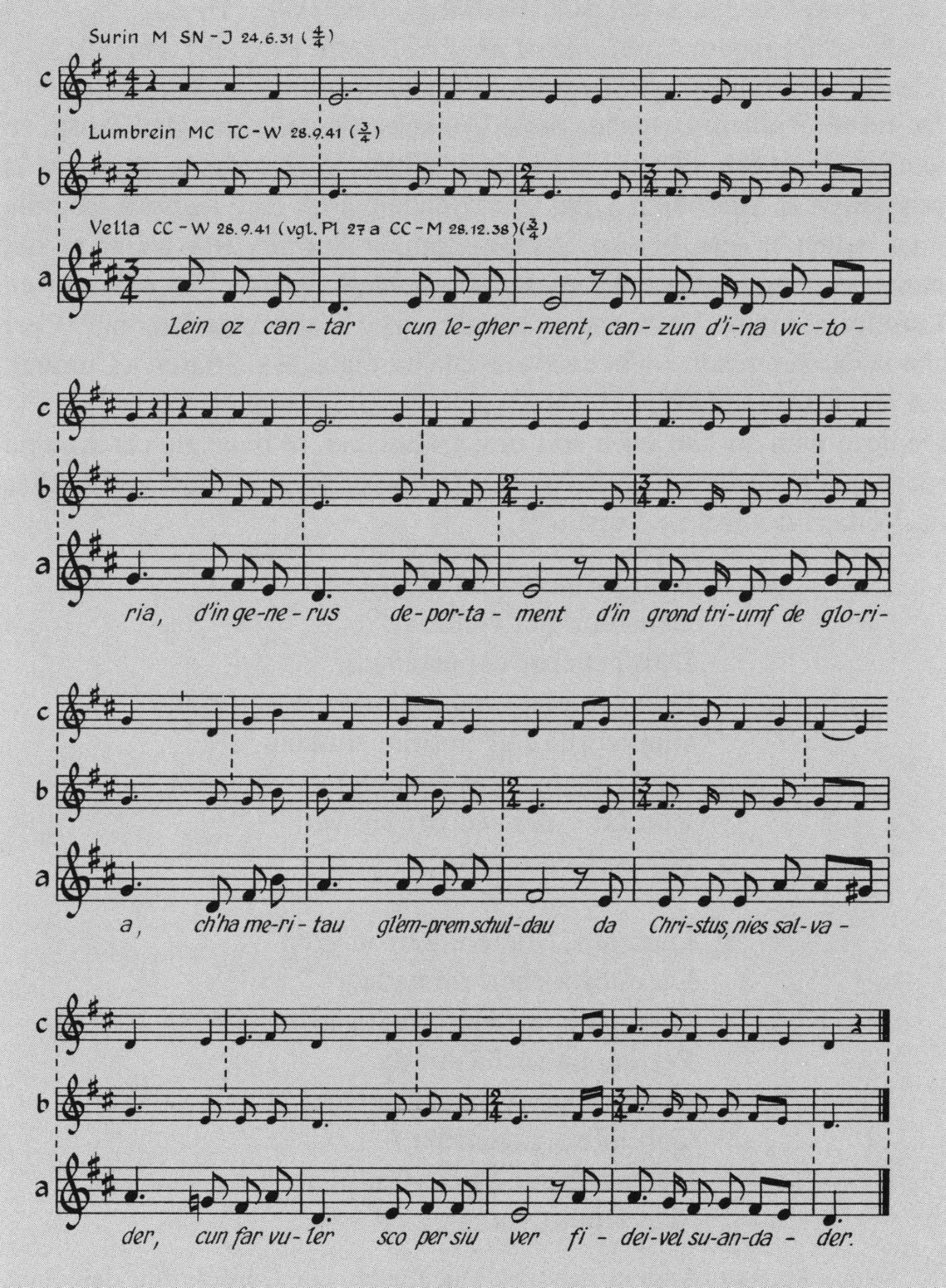
-
Lein oz cantar cun legramen
Canzun d’ina victoria,
D’in generus deportamen,
D’in gron triumpf a gloria,
Cha meritau gl’emprim shuldau
De Christus, nies Salvader,
Cun far voler sco per siu ver
Fideivel suendader. -
Quel ei s. Stiafen, patron gron
Da questa cheu rimnada,
Quel ch’ei als marters ius avon
Per quella rucha strada,
Che per amur da siu signur,
Con taffra gagliardia,
Ha survenciu e bein finiu
Sia carpusa via. -
La sinagoga ha muentau
Dispita da cardientscha
El ha la bucca a tuts stupau
Cun sia aulta sabiencia,
Sh’han quels gidius sco tgauns rabius
Sgrizziau ils dents per gritta,
Ad el stussiau or dil marcau
Per prender gli la vita. -
Scadin cun grond sefestginar
La sia rassa or sdrappa.
Dat quella a Saul per pertgirar
A cuorer tier la crappa;
Saul ils fa cor, els stenden or
Lur braccia hassegiusa
Il tissi lain, la crappa train
Cun forza furiusa. -
Sco ded in aungel glorius
Para la sia faccia,
E quei marteri dolorus,
Cun legramen embraccia;
Engennugiiont, de char rugont
Che Dieus mesiri bucca
Per in puccau a quei shurvau
Triep, ch’el cun crappa tuca. -
Quell’oraziun ha forsa giu
Urbida mervegliusa,
Che Saul ha cau d’in temps udiu
La vush miraculusa,
Che ha faig cordar, mo si levar
Ord in persequitader
In grond doctur a defensur
dil num de nies spindrader. -
Ord ciel aviert ha el lur viu
Che fig il consolava,
A sper il bab il figl de
Diu Che steva a tier mirava,
Co el passass per quei streing pass
Che tier la vita meina,
Cun endirar bugient a dar
La vita en tonta peina. -
Quella visiun ha empleniu
Il martyr de letezia,
Che quella crappa ha gli pariu
La manna de dulciezzia;
En quei confiert ha el siu spirt
Cun soingia comportonza
Recommendau, a Diu tornau
En tutta confidonza. -
O soing patrun ch’eis uss lau si
En vita shi legreivel,
Con bein has mai finiu quei dij
De tia mort crudeivla;
Ha faig nin don, bein itel gron,
Quella greva tempiasta,
Midada bein en bij sarein,
Gie en perpetna fiasta. -
Ils craps che quels giudius han traig
Chan dau dolurs crudeivlas,
Han ina cruna faig
De pedras zun custeivlas,
Ch’en semper dar lau terlisiar
En gloriusa altezzia,
Sco il firmament dil ornament
De steilas ha clarezzia. -
Rogi Diu oz a mintgia dij
Ch’el noss puccaus perduni,
A sco engloria tei lau si
Ciau nus en grazia encruni,
Che silla fin cur nus spartin
Il ciel aviert veseien,
Suenter quei er el con tei
Perpetnameing gudeien. Amen.
Remarcas
1 Cronica Baselgia, p. 49. Era P. Clemente da Brescia deplorescha la sperdita da «fetg bia scartiras da valeta» tras il barschament dalla casa-pervenda da 1682. Clemente p. 427.
2 Egl urbari imperiai, BUB I, 1955, p. 391.
3 AcV, anniversari da Pleif, passim.
4 A. Schorta, Rätisches Namenbuch tom II, 1964, p. 667
5 l.c. p. 122 e 667.
6 KDGR IV, 1942, p. 146.
7 «Ecclesia Sancti Mauricii, in conspectu, de terra habens iugera LX», Urbari imperiai, stampau en BUB I, 1955, p. 391 s.
8 P.C. Pianta, Geschichte von Graubünden, 1892, p. 76 s. – Fr. Pieth, Bündnergeschichte, 1945, p. 58 s.
9 II text latin originai secloma: «. . . et ante ipsum altare ipsum corpus fecerat sepelliri tradendo praedicto altari nomine dotis Coloniam suam in villa Cumbils, dictam de Camadringes in valle Lugenitze.» Liechtensteini-sches Urkundebuch I/1, 1948, p. 131 s. – Necrologium Curicnse p. 96. – Comp. era: J.G. Mayer, Geschichte des Bistums Chur I, 1907, p. 253 e Kaiser-Büchel, Chronik von Liechtenstein, 1923, p. 150. – Igl altar da s. Conrad, ussa altar da s. Giusep el giuv miez dalla nav laterala da miezdi ella catedrala da Cuera, comp. KDGR VII, 1948, p. 100, 121 s.
10 Aschia existeva in anniversari resp. ina messa fundada dils onns 1797 tochen 1813 che vegneva celebrada il zercladur ed era inscreta: Annual per ils perdavons dil tscheins da Cuera». ApC, cudisch da quen 1670, p. 23 ss. – Il caluster da s. Murezi era obligaus (ca. 1838) da dar annualmein «il tscheins alla baselgia catedrala ed in ster pieun ed in scanler schlondas». Dapli vegn ei priu pli manteniment dalla glisch «ord la baselgia catedrala» (fondo). AcC, tom 8.5, nr. 40 (buca paginau). Funs situaus sut il vitg da Cumbel senumna aunc oz «Tscheins da Cuera». Comp. era A. Planta/A. Schorta, Rätisches Namenbuch I, 1939, p. 49.
10a AcC, documents nr. 17 dils 15 da schaner 1745.
11 Tenor Gieri Giusep Montalta, Ils de Montalt en Surselva, en Ischi, ann. 50, 1964, p. 50 s.
12 AcC, pergameina orig. nr. 1, 1 da fevrer 1375.
13 AcC, pergameina nr. 2, 6 da fevrer 1469, orig.
14 AcC, pergameina nr. 3, 29 da fenadur 1489, orig.
15 AcC, pergameina nr. 4, 14 da schaner 1577, orig.
16 AcC, pergameina nr. 5, ils 30 d’avrel 1578, orig.
17 AcC, pergameina nr. 6, ils 8 d’october 1578.
18 Rud. Jenny/El. Meyer-Marthaler, Urkundensammlungen, Bd. III/1, 1975, p. 14 s. Sur da Albert d’Andest a Morissen comp. Annalas dalla Soc. Retoromontscha, ann.91, 1978, p. 120.
19 Rud. Jenny/El. Meyer-Marthaler, o.c. p. 18. Ils nums da funs ch’ein buca el Rat. Namenbuch da Planta/Schorta, ein screts cursiv.
20 Rud. Jenny/El. Meyer-Marthaler, o.c. p. 65.
21 o.c. p. 72.
22 o.c. p. 72.
23 o.c. p. 118.
24 Buwollongs ei forsa Buwalliontz, sco en A. Planta/A. Schorta, Rat. Namenbuch I, p. 49.
25 Sco remarca 20, p. 121.
26 AP, voi. 2, p. 504 s., Relazione delle Missioni. .. 1662.
27 AP, voi. 2, p. 510, tractandas dalla Propaganda Fide, tiel rapport sur dallas missiuns da 1662.
28 «Combels, ai confini della Foppa, dove sono molti heretici serviti da predicanti pessimi e perciò i Padri hann molte controversie contro la loro perfidia e di confirmare gli cattolici e percio da msgr. vescovo defonto fu eretta la chiesa di Combels et ivi e necessarissima la permanenza di Padri.» AP, vol. 2, Breve raguaglio dello stato della Missione dei capuccini nella Rezia, nell’anno 1662.
29 AP, voi. 2, P. Ireneo alla Congreg. de Propaganda, ils 15 d’uost 1662.
30 AP, voi. XXII, Raguaglio dils 2 d’uost 1681.
31 AP, vol. XXII, Raguaglio dils 29 d’avrel 1682.
32 Willi, p. 28, 215.
33 Bonari p. 187.
34 Bonari p. 183-188. Plinavon dat ei ina biografia manuscretta egl AFB MI, Fondo di religione, Cart. 9, Cappuccini. Vita et gesta del P. Ireneo da Casalmoro, 1671.
35 Frigg p. 60-62.
36 Cp la supressiun dils caputschins ella Engiadina Bassa: Frigg p. 64-66, 70, 73 e 78 ss. Dapli sur da P. Ireneo e sia activitad sco prefect: Frigg p. 90 ss.
37 AFB Ml, Fondo dil Religione, Cappuccini, Cart. 9, Memoria del P. Ezechielio da Bagnolo, 1671.
38 Bonari p. 187 s. In tal catechissem ei buca d’anflar ella Bibliografia Retoromontscha da 1938.
39 Simon Pianta, ordinaus 1618, plevon ad Andeer, 1633-1636 a Zernez, 1636-1638 a Filisur e 1638/39 a Praz, ei daventaus catolics 1638 e vegnius sclaus dalla smoda. JHGG 64. 1934, p. 8, Register dils plevons reformai da J.J. Truog.
40 AP, voi. 14, p. 426, P. Ireneo alla Congregaziun da Prop. ils 19 da zercladur 1639.
41 AP, vol. XXII, Raguaglio dils 2 d’uost 1681.
42 AFB MI, Fondo di Religione, Cappucini, Cart. 9, Vita et gesta del P. Ireneo e Cart. 7, Rapport da 1635, senza auter datum ed indicaziun digl autur. Pli bia sur dalia persuna e dalla activitad da P. Ireneo san ins leger tier Clemente, Libro II, plirs capetels sur dad el e sia lavur p. 63 ss. Da Cumbel anora hagi el era extendiu sia activitad els loghens vischinonts, cun perdegar e sco confessur. Clemente p. 426.
43 ApC, cuviarta 2, document da separaziun, perg. orig. cun sigil da tschera digl uestg Johannes Flugi VI. Copias sesanflan en: AEC, mappa Cumbel, tier igl act dils 14 da settember 1655 da nunzi Fe. Borromeo. Plinavon en ApP, mappa B 7 a/1, ed AEC, mappa Pleiv, copia dil doc. da separaziun dils 28 da mars 1653.
44 Sur dils de Marmels a Vella mira Annalas 90, 1977, p. 155 cun genealogia p. 156.
45 II text tud. dalla part principala secloma: « . . .Ich Hans von Marmels . . . in welchem Brief heiter und klar vermeldet, dass namblich die Graffen von Sax die gewohnlichen Zehenten so die von Cumbels der uralten Pfruond zu Pleif zu bezahlen schuldig sind gestiftet, testamentiert und ufgemacht ohne weitern Geding noch vorbehalt. . .» ApP, B 7a/3, datum ils 15 d’avrel 1653.
46 Pli bia sur da Prevost Cristoffel Mohr: BM 1957, p. 387 e 391. BM 1973, p. 246-250 e JHGG 107, 1977, p. 9-15 (F. Maissen, Graubünden 1665/66).
47 AEC, mappa Cumbel 262.2, Factum Tale, dils 14 da fevrer 1654.
48 Azor Johannes, da Lorca en Spagna, giesuit, morts 1607 a Roma, prof. dalla filosofia e dalla teologia, ha cumponiu bia scartiras teologicas ed exegeticas. Bia scartiras ein restadas mo manuscrettas. Da quala ei setracta vegn cheu buca indicau. Wetzer und Weltis Kirchenlexikon, 1882 ss., tom I, p. 1775.
49 Abbas sa esser 1. Abbas antiquus = Petrus de Sampsone, prof. dil dretg can. a Bologna, ca. 1472 en Frontscha, ni 2. Nicolaus de Tudeschis, OSB, arzuestg da Palermo, impurtont canonist, numnaus «Siculus Panormitanus», naschius 1386 a Catanea, staus al Concil da Constanz, Cardinal, morts 1445. Wetzer/Welte o.c. tom 9, p. 340.
50 Garcias Nicolaus, canonist spagnol, entschatta dil 17. tschentaner, dad Avilla, cheu prof. dil dretg. Sia ovra «de beneficiis» restampada pliras ga. Wetzer/Welte o.c. tom 5, p. 97 s.
51 Paul Laymann, giesuit, prof. da filosofia e teologia ad Ingolstadt 16031609 ed a Minca 1609-1625 ed a Dillingen 1625-1632, morts 1635 dalla pestilenza a Constanza. Sia gronda ovra «theologia moralis» en 5 toms ei restada tochen viaden els 1800 igl impurtont cudisch da scola. Ludwig Koch, Jesuitenlexikon, 1934, p. 1083-1085.
52 Quei diember d’habitonts per Vella, Vignogn, Degen, Peiden e Morissen para empau aults en camparegliaziun cun Cumbel mo 250 da gliez temps, mira sura p. 5.
53 Pareglia leutier J.G. Mayer, Geschichte des Bistums Chur, tom 1, 1907, p. 478.
54 Sco remarca 47.
55 Ulrich de Collenberg era landrechter 1643. P.A. Vincenz, Der Graue Bund, cud. festiv 1924, p. 282. Sur da landr. Collenberg era en Annalas 93, 1980, p. 109.
56 Melchior de Mont-Schauenstein, officier en survetschs franzos, castellan episcopal a Farschnò, morts 1661. Sia dunna Margreta n. de Schauenstein ha schau ereger il casti dils de Mont a Vella, che era barschaus, ca. 1666. HBLS V 138.
57 Surcuolm ei separaus 1643. Simonet 103.
58 Pareglia sura p. 2.
59 ApP, B 7a/2.
60 ApP, B 7a/5. Stil e fuorma da quei text sto naturalmein vegnir considerans e taxaus cullas mesiras e fuormas da gliez temps.
61 ApP, B 7a/2, decret dalla nunziatura dils 20 da settember 1655.
62 «. . . essendo capella spetattante in generale a tutta la Lunganezza.» ApP, B 7a/6. Nunziatura ils 21 da settember 1655.
63 HS I/1, 1972, p. 47.
64 AEC, mappa Cumbel, 262.2, copia d’ina brev dil nunzi Borromeo agl uestg da Cuera dils 13 da december 1665.
65 AEC, mappa Pleif 262.2, Relatione della separatione della terra di Combel.. . fatta li 28 di marzo 1653. – ApP, B 7a/l, senza datum, fragment 1655.— Ap, B 7a/3, Cuera ils 24 da settember 1655, sigil dil nunzi e suttascripziun dil secretati. — AEC, mappa Cumbel, 262.2, decret dil nunzi Borromeo dils 14 da settember 1655, copia, pupi. Cheu vegn igl importo ch’il plevon da Pleif ha da pagar a Cumbel indicaus cun 20.– ducats = 40 flurins annual. Pareglia cheutier era la sentenzia dil nunzi Borromeo dils 17 d’october 1655 en Festschrift Oskar Vasella, 1964, p. 274 s.
66 ApP, B 7a/4, nunzius Borromeo al decan Jochberg ils 9 da november 1655.
67 ApP, B 7a/7, mistral ed ugaus a Pleif, ils 19 da zercladur 1656.
68 ApP, B 7a/8, mistral ed ugaus a Pleif, agl avat Adalbert da Mustér, ils 5 da zercladur 1656.
69 ApP, B 7a/11, nunzius Borromeo al mistral ed als ugaus da Pleif, ils 13 da december 1657.
70 Simonet p. 126.
71 AEC, mappa Pleif 262.2, Relazione della separazione . .. senza datum.
72 HS I/1, 1972, p. 48. Federico Ubaldi Baldeschi, nunzius a Lucern 1665-mars 68.
73 Sur Gieli de Mont, plevon a Pleif 1665-1668. Simonet p. 126.
74 AEC, mappa Pleif 262.2, Relazione della separazione .. .
75 AEC, mappa Cumbel, Nunzi Baldeschi agl uestg da Cuera ils 25 da december 1667. – ApP, B 7a/15, citaziun da mintgamai dus representants, Nunzi Baldeschi ils 13 da december 1667 e ApP, B 7a/14, Nunzi Baldeschi ils 10 da november 1667.
76 ApP, B 7a/14, Nunzi Baldeschi ils 10 da november 1667 e B 7a/16, la Nunziatura, ils 13 da december 1667.
77 AEC, mappa Cumbel, la Nunziatura agl ordinariat episcopal da Cuera ils 12 da schaner 1668.
78 Rodolfo Acquaviva di Aragonia, nunzi a Lucerna mars 1668 tochen uost 1670. HS I/1, p. 48.
79 Sur da decan catedral Sgier dat ei negina monografia, persuenter aber biars tractats che s’occupeschan cun el, p. ex. BM 1952 p. 41 ss. e BM 1953, p. 205 ss. Plinavon cumpara el els biars dils numerus tractats sur da Clan Maissen, mira bibliografia en Annalas ann. 92, 1979,p. 46s.
80 ApP, B 7a/18, Nunzius Acquaviva ils 17 da mars 1669.
81 Denter auter scriva la suprastonza da Pleif: « . . .Quel signor Domdecano non ha mancato di fare tutta possibil diligenza in formare il processo di dette differenze et havendo ciò fornito, s’ha impiegato con il suo gran talento in maniera che alla fine tutte sudette differenze con intiera nostra soddisatione restorono sopite et agiustate . . .» ApP, B 7a/19, copia d’ina brev dils 6 d’avrel 1669 ed el medem liug la copia dalla risposta dil nunzius a «mistral ed ugaus a Pleif» dils 13 d’avrel 1669.
82 Sur da sur Cristian Arpagaus da Cumbel 1613-1681 mira Annalas SRR 88, 1975, p. 114.
83 AEC, mappa Cumbel, Cristian Arpagaus, Lumbrein agl ordinariat episco-pal Cuera, ils 10 da schaner 1668.
84 Compareglia la fundaziun dil benefeci pervenda da Morissen en Annalas SRR 90, 1977, p. 15 9-166.
85 ApC, Libro de Conti 1737, p. 1.
86 AcC, documents nr. 24, rodel dalla dieschma 1816.
87 ApC, Urbano Hospizio p. 42. – ApC, carnet «Quesiti fatti nell’anno 1858 dall prefetto delle Missioni», p. 4
88 ApC, «Registro della prebenda e dei Capitali», in carnet, p. 2.
89 ApC, Cudisch da quens B, p. 7 s. e p. 81.
90 ApC, Urbano Hospizio, p. 85.
91 l.c. p. 49.
92 ApC, cuviarta 14, status facultatis 1 da mars 1897.
93 Cumpareglia surlunder sco exempel la pervenda da Morissen en Annalas SRR 90, 1977, p. 153.
93a ApC, Libro de Conti 1737, p. 26.
94 l.c. p. 4-23 e 30-59.
95 l.c. p. 39.
96 AcC, tom 1.4, buca paginau, tiegl onn 1851. Cumpareglia surlunder era il capetel «Tscheins en pieun» dalla pervenda da Morissen, en Annalas SRR 90, 1977, p. 170-172.
97 ApC, Cudisch da hipotecas, p. 1, 9 s, 11 s, 13 s, 21 s, 23 s, 26 s, 32 s, 34 s, 37 s.
98 l.c. p. 35 s.
99 ApC, Libro de Conti 1737, p. 26.
100 l.c. p. 58.
101 l.c. p. 23.
102 l.c. p. 6.
103 l.c. p. 22, 89 e tier ils 8 d’october 1758.
104 AcC, documents nr. 24.
105 ApC, Urbario Hospizio, Fideivla translaziun dil rodel dalla dieschma ch’auda alla pervenda da Cumbel e da Pleif ord il rodel vegl. . . p. 11-21. Ina copia da quei rodel sesanfla era ella agenda P. Urban, p. 1-12.
106 ApC, Urbario Hospizio, p. 23 e 48.
107 l.c. p. 3 e 48 e Cronica Baselgia, p. 72 s.
108 l.c. agl onn 1874 sin in cedel admess.
109 l.c. p. 60.
110 l.c. alla davosa pagina da quei cudisch.
111 l.c. p. 85 ed alla davosa pagina e plinavon ApC, Cudisch da quens B, 81.
112 ApC, Urbano Hospizio, p. 48.
113 l.c. «Memorie per miei successori» da P. Nicolaus.
114 ApC, Urbario Hospizio, p. 49.
115 l.c. agl onn 1886, buca paginau. Tals «menüs» per plirs onns sesanflan el medem liug.
116 ApC, Cudisch da quens A, agl onn 1670, «Spese fatte nella casa della cura».
117 Mira Ischi 33, 1947, p. 17. Denton duei vegnir rectificau cheu, che buca ils caputschins han baghiau quella casa. – Plinavon era ApC, cuviarta 14 cun in cedel culla remarca dil barschament dils 24 da fevrer 1682 sin funda-ment dalla indicaziun da P. Clemente.
118 ApC, Cudischet da quen 1670 sut ils 13 d’october 1683.
119 l.c. p. 13 s. e ApC, Cudisch da quens A, p. 80 e 81 v.
120 ApC, Cronica Baselgia, p. 33 s.
121 Cronica Baselgia, p. 34 s.
122 Cronica Baselgia, p. 36-40.
123 Custos catedral Rudolf de Travers, barun da Razén e da Ramez, custos alla catedrala da Cuera da 1680 tochen sia mort ils 3 da fenadur 1705. El ei fegl da barun Gion de Travers dad Ortenstein 1628-1690, in um reh e pussent, administratur dil segneradi dad Imst el Tirol e suenter dil Segne-radi da Razén. Suenter sia mort ein ses fegls sescagnai fetg per la rauba e pli segneradi da Razén, al qual igl imperatur ha fatg ina fin cun prender a sesez il segneradi 1696 e cun pagar ora als Travers 60 000.– flurins. Cun quels daners era bi far in per messas perpetnas. – JHGG 34, 1904, p. 61. HBLS VII p. 39.
124 Rudolf Jenny, Handschriften aus Privatbesitz, im Staatsarchiv Graubün-den, 1974, p. 343.
125 ApC, Cronica Baselgia, p. 74.
126 ApC, Cudisch da quens A, sut ils 8 d’october 1708 ed ils 18 d’october 1710.
127 ApC, Libro de Conti 1737, p. 92 s.
128 l.c. p. 94 s.
129 N. Mosca, Das Churer Zunftwesen, en JHGG 110, 1980, p. 125 s. – In flurin ei 60 rizers ni crizers.
130 ApC, Urbario Hospizio, p. 42.
131 Ils nums Plaun Baselgia e Fontauna digl altar ein era en Rätisches Namenbuch I, p. 49. Ariguard Grepault cump. KDGR IV, p. 412 culla litteratura leu citada.
132 Mira sura cap. I/1.
133 Cump. KDGR IV, p. 145 s.
134 «In ecclesia parochiali s. Mauritii et s. Stephani», el cudisch da battens, per ex. 1659, 29 da november; 1660, 9 da schaner; 1660, 19 da schaner; 1661, 20 da schaner.
135 Cump. KDGR IV, p. 146.
136 Sur da Hans Ardüser e sia lavur mira Annalas SRR 86, 1973, p. 83 ss.
137 Elaborau da J.J. Simonet, en BM 1916, p. 125 ss.
138 KDGR IV, p. 148.
139 Ni forsa Schleiz en Saxonia, buca dalunsch da Leipzig.
140 Remarcablamein ei quei interessant document buca staus d’anflar egl ApC ni zanua auter.
141 KDGR IV, p. 148
142 KDGR IV, p. 148
143 Sogn Valentin, morts ils 7 da schaner ca. 475, uestg ed apiestel dalla Rezia ed a Passau, satraus ella baselgia Zenoburg Mais sper Meran. Sarcofag a Passau. El Grischun diversas capluttas, plitost spels pass e sils aults. Pli bia: LTK 10, 1965/600
144 Pli bia surlunder, sco era sur custeivla paramenta mira KDGR IV, p. 148 s.
145 ApC, Cudisch da quen 1670, p. 3.
146 «Speso nella fabrica a fare piu lunga la chiesa, dato vino a muratori fl. 8.–» ApC, cudisch da quen 1670, p. 6.
147 «Dato al meister Benedetto per il baptisterio fl. 32.–» ApC, cudisch da quen 1670, p. 6.
148 «Per il quadro di S. Stefano fl. 60.–» ApC, cud. da quen 1670, p. 6.
149 «1680, 24 giugno. Per haver fatto depingere la chiesa in tutto 144.– fl.» «1680,29 giugno. Per haver fatto depingere la fasciata della chiesa f.24.– » ApC, cudisch da quen 1670, p. 10 s.
150 ApC, cudisch da quen 1670, p. 13-15.
151 «1709, 8 ottobre, speso per la capella di s. Antonio et BVM del rosario f. 80.– Speso in pitturare le due capelle f. 48.– Speso per vestire la BVM f. 30.– Speso in due inventriate sopra le due richie delle capelle f. 5.– Speso per 12 candelari di legno f. 12.– Speso in pitturar la tela del sepolcro f. 3.10. Speso in colori per le due capelle. Speso nella statua della Madonna et di S. Antonio f. 52.– Speso in assi per far li vuoiti delle capelle per li tetti delle due capelle f. 24.10.» ApC, cudisch da quen 1670, p. 22 s.
152 ApC, Urbario Hospizio, p. 58.
153 ApC, Urbario Hospizio, p. 84.
154 ApC, Varia, in fegl culla inscripziun: «Inscrizone sepolcrale», senza datum.
155 AcC, tom 1.3 p. 61, 67.
156 ApC, Cronica Baselgia, p. 15 s.
157 l.c. p. 16 s.
158 l.c. p. 17-21. Pli bia sur quella restauraziun el medem liug.
159 Rapport surlunder ella Gasetta Romontscha 1979/73, supplement 1 ed en Bündner Zeitung 1979, dils 15 da settember, p. 7, ed en Neues Bündner Tagbl. 1979/215.
160 Indicaziuns tenor ina gliesta dil pres. d. pleiv, Gius. Vieli, dils 31 da schaner 1980.
161 Sco remarca 160. Pli bia sur la restauraziun 1978/79, plans, calculaziuns e quens etc. sesanflan en ApC, scatla Administraziun da Pleiv.
162 ApC, cudisch da quen A, onn 1675, buca paginau.
163 AEC, mappa Cumbel, P. Tomaso al cancelier Baal ils 20 da schaner 1800. La lubientscha vegn dada. ApC, cuviarta nr. 15.
164 ApC, cuviarta nr. 37.
165 AEC, mappa Cumbel, P. Urban agl Ordinariat igl 1 da mars 1709.
166 ApC, Urbano Hospizio p. 84.
167 ApC, Cudisch da quen 1670, p. 7.
168 ApC, cudisch da quen A, onn 1677, buca paginau. 168a KDGR IV, 150.
169 KDGR IV, 150.
170 ApC, cuviarta nr. 36
171 ApC, Urbario Hospizio, p. 6.
172 AcC, tom 1.1 p. 17 s.
173 AcC, toni 1.3 p. 106 s.
174 AcC, tom 1.3 p. 115.
175 AcC, tom 1.3 p. 133, radunonza comm. dils 11 da settember 1904.
176 ApC, Cronica Baselgia, p. 20.
177 ApC, cudisch da mortoris, 27/28 d’avrel 1653.
178 ApC, cudisch da quen 1670, p. 3 e 14.
179 ApC, Cronica Baselgia. Cheutier remarca sur Baselgia: «Per l’ingronda-ziun dil santeri ei tut special seprius en ed ha meret scolast Giusep Vieli, ilsezs onns president dalla pleiv.»
180 Rapport surlunder ella Casetta Romontscha 1974/31.
181 4 Retgs 13, 21.
182 Acts dils ap. 5, 15.
183 Acts dils ap. 19, 12.
184 Pli bia sur dil cult da reliquias en LTK VIII, 1963, p. 1215-1222.
185 Cump. Annalas SRR 92, 1978, p. 100 s. pertenend las reliquias a Mo-rissen.
186 P. Gianbattista ei staus a Danis 1717 ed aunc en divers auters loghens ed a Cumbel 1734-1736. Willi 200.
187 P. Angelo da Camino 1805-1864, ella missiun Retica dapi 1832, staus a Tumegl, Casti, Vaz, Savognin ed a Sagogn, viceprefect. Willi 163.
188 ApC, cuviarta nr. 30.
189 AEC, mappa Cumbel, P. Bonaventura al cancelier episcopal ils 5 d’uost ed ils 7 da settember 1853. Sontga Victoria ei ina martra dil purschaladi, probabel sut Diocletian 284-305. Il cult dalla sontga ei sefatgs fetg ella Italia. Siu tgierp ei vegnius transportaus 827 a Piceno e 931 ella claustra da Farfa. LTK 10, 1975, p. 774. Tenor il legendari da Cristian Wenzin, 1845, p. 325 s., eis ella marterisada sut Decius 249-251. Celebraziun ils 23 da dec.
190 ApC, Cronica Baselgia, p.16
191 LTK 7, 1962, p. 195.
192 Mira survart, cap. I/1 cun remarca 7.
193 AcC, tom 1.1 p. 12. – KDG IV, p. 151.
194 Raquintau igl uost 1981 agl autur da M. Arpagaus, Cumbel. Ei setracta cheu d’in motiv da detgas fetg derasau, numnadamein sur dil plaz da baghiar ina caplutta, baselgia ni claustra. Semegliont vegn raquintau dalla caplutta da Nossadunna a Cumbel, da Nossadunna dalla Glisch a Trun, da Ziteil e da Faveras. Cump. denter auter Il Glogn 8, 1934, p. 89, e Josef Guntern, Volkserzählungen aus dem Oberwallis, 1978, mira register p. 949.
195 ApC, Cudisch da quens 1670, p. 15.
196 l.c. p. 16-18.
197 l.c. p. 20.
198 ApC, Cudisch da quens A, buca paginau, tiels 10 d’uost 1710 ed ils 14 da fenadur 1711.
199 Joh. Georg Mayer, Geschichte des Bistums Chur, 1914, p. 437.
200 ApC, cuviarta 2, ils 30 da zercladur 1716. Purgameina orig.
201 II maletg ei reproducius en KDG IV, p. 151, fig. 174.
202 ApC, Cronica Baselgia, p. 23.
203 KDG IV, p. 152.
204 ApC, cuviarta 22, brev dils 12 d’october 1899.
205 AcC tom 2.3, radunonza dils 12 da fenadur 1933.
206 Cumpareglia survart, art. IV/I.
207 ApC, Agenda da sur Fetz, p. 33.
208 ApC, Cronica Baselgia, p. 25.
209 l.c. p. 26. – Il davos caluster che habitava leuora ei Bistgaun Collenberg, tochen ca. 1932.
210 AcC, tom 1.7 agl 1. da mars 1893.
211 AcC, tom 1.1 p. 41, conclus da calonda mars 1860, ils 10 d’avrel.
212 AcC, tom 1.1 p. 41, conclus calonda mars, ils 24 da mars 1818.
213 AcC, tom 1.7, igl 1. da mars 1893.
214 AcC, scatta «Administraziun da pleiv», faszichel 22/2.
215 AcC, tom 2.1 p. 27.
216 AcC, tom 1.3 p. 130.
217 AcC, scatla «Administraziun da pleiv», faszichel 22/2.
218 ApC, Cronica Baselgia, p. 25 s.
219 Pli bia surlunder mira igl artechel «Processiuns lumnezianas avon tschien onns», ella Casetta Romontscha 1978, ni. 102, supplement 3.
220 Liug citau.
221 Pli bia sur da Gion da Farglix mira Bündner Tagblatt 1980 nr. 218.
222 II sura ei tut tenor igl artechel: Processiuns lumnezianas . . . sco remarca 219, cun la documentaziun detagliada leu citada.
223 AcC, tom 1.3, ils 6 da mars 1881.
224 Tenor perdetga da sur Gion Casaulta, plevon a Degen, enviers sur Baselgia. ApC, Cronica Baselgia, p. 26.
225 Constantin Theus, La caplutta da Nossadunna Immaculada a Cumbel, en il Glogn 8, 1934, p. 88-92. Il present capetel sereferescha sin questa lavur leu nua ch’ei vegn buca citau auter.
226 Quella scartira da 1789, allegada da sur Theus ei buca stada d’anflar els archivs consultai.
227 Ina schlatteina Caheni cumpara negliu a Cumbel els cudischs parochials ni en auters dossiers digl ApC. Denton ord la collecziun da schlatteinas dil Dicziunari Romontsch Grischun vein nus il suandont: Castrisch: 1485 Conrau Degahenni. 1726 Jakob Cahenj. Lags: 1539 von den Degahanj. Valendau: 1766 Christen Cahenj. Glion 1780 Jon Cahenni. Sagogn: 1501 N. Kahenni. 1809 M.A. Caheni, catolic. Rätisches Namenbuch III.
228 Christoph Willi, Die Kapuziner-Mission im romanischen Teil Graubün-dens mit Einschluss des Puschlav, 1960. I. Stationen. II. Missionare. 246 pag.
229 «. . . ed essendo che ben sovente erano qua due padri e come buoni fratelli faceva or l’uno, or l’altro da parocco secondo i bisogni e le circostanze, percio vi si trova un po di confusione relativamente al tempo della loro permanenza in quest ospizio.» ApC, Elenco dei RR.PP Missionari. . . in Combel. Ina tabla culla gliesta dils paders a Cumbel. Nuncumplet.
230 Pli bia sur da P. Ireneo mira survart cap. II 1b.
231 Willi 28.
232 Willi 29, 192.
233 Willi 29, 160.
234 Willi 29, .192.
235 AP, volum 21, copia ord voi. 433, fol. 189, brev da P. Paul alla Congrega-ziun, senza datum. Sur dalla situaziun dalla Missiun e dallas relaziuns confessiunalas da quei temps sesanflan bia acts e correspondenzas els volums 21, 22 e 34. Arisguard ils embrugls confessiunals 1671-74 era: F. Maissen, Ils embrugls . . ., en Ischi 52, 1966, p. 17-97, spezialm. p. 63-78. - Anton von Castelmur, Landricher Nikolaus Maissen, en JHGG 58, 1929, p. 31 ss.
236 Willi 29, 221.
237 P. Angelo ei schiglioc negliu documentaus ella Missiun e vegn ad esser returnaus ella provinzia suenter cuorta dimora a Cumbel. Willi 29, 162.
238 Willi 29, 227.
239 Willi 29, 170, 241.
240 Willi 29, 172.
241 Willi 29, 148, 170.
242 ApC m, ils 16 da mars 1716. – Willi 29, 239.
243 ApC m, ils 22 da settember 1730. – Willi 29, 168.
243a Willi 30, 181.
244 Igl Ischi 41, 1955, p. 119-129.
245 Pli bia surlunder en Ischi 38, 1952, p. 90-96.
246 Willi 30, 185.
247 Willi 30, 200.
248 Willi 30, 178.
249 Willi 30, 181.
250 Willi 30, 185.
251 Willi 30, 217. Inscripziun dalla mort da P. Ludivic en ApC, m, ils 11 da matg 1787.
252 ApC m, ils 21 da matg 1811. — Willi 30, 236.
253 Willi 30.
254 Willi 31, 188.
255 Willi 31, 150, 163.
256 AEC, mappa Cumbel, P. Angelo agl uestg Georgius Bossi ils 10 da zercladur 1838 e P. Angelo a cancelier Baal ils 20 d’uost 1838.
257 Willi 31.
258 Willi 31, 174.
259 Willi 31, 172.
260 Willi 31, 188.
261 Willi 31, 224.
262 Willi 31, 217.
263 Willi 31, 152 s., 206.
264 Willi 31.
265 Willi 31,238.
266 Willi 32, 217.
267 AcC, scatla: Administraziun da Pleiv, faszichel 22/3, in formular stampati, da Roma, en translaziun romontscha, datum 21 da settember 1921.
268 AcC, tom 1.3, p. 351, radunonza comm. dils 30 d’october 1921.
269 Willi, Introducziun p. HI.
270 AcC, Administraziun da pleiv, P. Giovanni, Casti, alla pleiv da Cumbel, ils 29 d’october 1923.
271 Liug citau, P. Giovanni alla pleiv da Cumbel, ils 26 da november 1923.
272 AcC, tom 2.2, radunonza dils 18 da november e dils 24 da december 1923.
273 AcC, tom 2.2, radunonza digl 1 da december 1923.
274 Carta da morts. Davart ils studis: Geschichtsfreund 125, 1972, p. 59.
275 Carta da morts e ApC, Cronica Baselgia, p. 59 s.
276 Carta da morts e ApC, Cronica Baselgia, p. 60-69.
277 Carta da morts e ApC, Cronica Baselgia, p. 69.
278 Cumparida en Annalas SRR 90, 1977 p. 153 s.; 91, 1978 p. 112 ss.; 92, 1979, p. 63 ss., 93, 1980, p. 69 ss. Exista era en separats, deponi egl archiv communal e parochial Morissen.
279 Simonet 123.
280 Annalas SRR 88, 1975, p. 114.
281 El medem liug.
282 Simonet 59 e KDGR 5, 1943, p. 70.
283 JHGG 90, 1960, p. 109 e ApC, Varia, Register dils spirituals satrai en baselgia, ina harta enramada culs nums.
284 ApC b, ils 2 d’uost 1661 e ApC m, ils 24 d’october 1707.
285 JHGG 90, 1960, p. 111 e Simonet 160.
286 ApC b, ils 28 d’uost 1662 e m, ils 10 da matg 1728. JHGG 90, 1960, p. 110.
287 ApC b, ils 27 da matg 1664. JHGG 90, 1960, p. 109. Simonet 66.
288 El ei vegnius renviaus ord la diocesa. AEC, mappa Pleiv, citaziun dils 30 da zercladur 1707. Pli bia sur dad el: P. Iso Müller, Die Abtei Disentis 1655-1696, 1955, p. 498 s.
289 ApC b, ils 24 da schaner 1673. Annalas SRR 92, 1979, p. 82. JHGG 90, 1960, p. 112 s. Simonet 99.
290 ApC b, ils 17 d’october 1676 e ApC m, ils 26 da fevrer 1708. Simonet 103.
291 ApC b, ils 5 da fevrer 1687. Annalas SRR 92, 1979, p. 82.
292 ApC b, ils 20 da zercladur 1690 e ApC m, ils 31 da matg 1756. Simonet 53, 67.
293 ApC m, ils 23 d’avrel 1769. AcC tom 8.2, cudisch da quens: spenda pintga, alla emprema pagina, buca numerada. Toni Abele, Obersaxer Bürger geistlichen Standes, en JHGG 98, 1968, p. 13-15.
294 ApC b, ils 13 d’october 1698. P. Iso Müller, Die Abtei Disentis 1696-1742, 1960, p. 624-627.
295 Annalas SRR 92, 1979, p. 85.
296 ApC b, ils 15 da december 1808 e ApC m, ils 22/24 da fevrer 1854. Simonet 105.
297 T. Abele, Kapläne in Obersaxen, en JHGG 106, 1976, p. 5, 9. ApC m, ils 19/21. da november 1896.
298 ApC b, ils 6 da fenadur 1838. F. Maissen, Bündner Studenten in Mailand, en JHGG 95, 1965, p. 58. Simonet 143.
299 ApC b, ils 22 da settember 1852, e ApC m, ils 5/8 d’uost 1935, e carta da morts.
300 ApC b, ils 3 d’october 1872, e carta da morts.
301 ApC, Urbano Hospizio, in urbari senza datum, ord il 19. tschentaner, screts avon 1866 sco seresulta ord ina remarca agl ur, fatga d’in auter maun: «Igl onn dad uonn», alla pag. 24.
302 ApC, Agenda P. Urban, p. 4.
303 ApC, Urbano Hospizio, urbario rinnovato 1872, p. 2, 5 s.
304 ApC, cuviarta 42, formular stampau, dils 28 da zercladur 1695.
305 ApC, cuviarta 42, formular stampau, uestg Federspiel, per la visitaziun, 2 da zercladur 1760.
306 ApC, Urbario Hospizio, agenda 1872, p. 27.
307 Cp. F. Maissen, Über Sontagsruhe, Feiertage und Kirchendisziplin im Alten Bünden, en BM 1966/300 ss.
308 Sco remarca 305.
309 ApC, Urbano Hospizio, agenda 1872, p. 20.
310 Sco remarca 301, p. 26-41.
311 Sco remarca 305.
312 AcC, tom 1.1 p 46.
313 AcC, tom 2.1, Statutas e protocol dil cussegl da vischnaunca 1862, p. 5-22, specialmein p. 7.
314 AcC, tom 1.3, radunonza digl 1. da mars 1882.
315 l.c., radunonza digl 1 da mars 1884.
316 l.c., radunonza da calonda mars 1889.
317 ApC, cudisch d’Uniuns, p. 1 s., ApC, tom E, Compagnia del S. Nome di Gesù, p. 1 ss.
318 ApC, Urbario Hospizio, p. 25 s.
319 ApC, cuviarta 38, Indulgenze concesse a fratelli e sorelle della Compagnia del SS. Nome di Gesù, in document senza datum.
320 Sco remarca 317.
321 ApC, tom F, Cudisch dalla Cumpagnia da Nossadunna Immaculata, p. 1 ss.
322 ApC, cuviarta 38.
323 ApC, cuviarta 38, Summa della Constituzione di Clemente Vili.
324 LTK III, 1959, p. 471. Cheutier era: J.J. Simonet, Geschichte der Pfarrei Obervaz, 1921, p. 328.
325 J.J. Simonet o.c., p. 330.
326 G Gadola, Survesta historica dil svilup dalla scola rurala catolica da nossas valladas romontschas, en Gedenkschrift zum 25 jährigen Bestehen des katholischen Schulvereins von Graubünden, 1944, p. 66-122, specialmein p. 92-95.
327 l.c. p. 95.
328 ApC, tom H, Compagnia dalla Dottrina, p. 1., copia dil document da fundaziun.
329 l.c. p. 3-5
330 l.c. p. 5 ss.
331 LTK IX 1964, p. 47 e 987.
332 ApC, tom G, Compagnia del Rosario e di San Francesco, buca paginau, agl onn 1734.
333 ApC, Urbario Hospizio, p. 26.
334 ApC, cuviarta 38.
335 ApC, tom G, Compagnia del Rosario e di S. Francesco, buca paginau.
336 ApC Confraternitad dil Cor da Maria, in formular da format pign, stam-pau: «Entschatta, mira e statuts dalla arciconfraternitad . . .» ed el medem liug brev da P. Lorenz Hecht a P. Bonaventura dils 7 d’avrel 1851.
337 ApC, Liber Magistralis SS. Immaculati Cordis B.V.M. 1845, document originai cun sigil, da Joannes Brunnelli, secretari dalla Congregaziun da Propaganda Fide dils 4 da matg 1845 ed el medem liug, document original digl uestg Caspar de Carl dils 16 d’uost 1845.
338 ApC, Liber Magistralis SS. Immaculati Cordis, buca paginau.
339 ApC, cuviarta, fase. 42, formular stampau dil conclus dalla associaziun, 7 d’avrel 1951.
340 ApC, Cronica Baselgia, p. 62 s.
341 Apc, Liber Magistralis SS. Immaculati Cordis et Apostoiatus Orationis, buca paginau.
342 ApC, tom G, 1878, Terziari di San Francesco.
343 ApC, Cudisch d’Uniuns, p. 351.
344 ApC, Cudisch da cassa A, Uniun da s. Infanzia.
345 ApC, Cudisch d’Uniuns, p. 131 s.
346 ApC, cudisch d’Uniuns, p. 87 s.
347 ApC Cudisch d’Uniuns, p. 262 s.
348 ApC, cuviarta 39, in document stampau, romontsch, donnegiaus dil bar-schament dils 4 d’uost 1952.
349 ApC, Urbano Hospizio p. 31 e ApC agenda P. Urban p. 5.
350 ApC, agenda P. Urban p. 7.
351 AcC, tom 1.3 p. 24.
352 AcC, tom 1.3, p. 351, radunonza dils 3 da fenadur 1921.
353 Davart ils disturbis da talas occasiuns mira igl artechel: «Processiuns lumnezianas avon tschein onns». En Gasetta Romontscha, 1978/102, supplement «Brustgas».
354 Sco remarca 305.
355 ApC, Urbario Hospizio, p. 27.
356 ApC, agenda P. Urban, p. 2 s.
357 ApC, agenda sur Fetz, p. 19.
358 Sur dad el Willi 88, 172.
359 Sur Gion Bistgaun Capaul ei aunc quei onn ius a Lyon ed ei quei onn entochen lu staus occupaus cun sia caplutta a Lumbrein. Sur dad el. Simonet 100 s. ed Annalas SRR 92, 1979, p. 87-89. La notizia sur da quella missiun ha pér P. Nicolaus fatg pli tard en sia agenda 1872, p. 55.
360 ApC, Urbario Hospizio, agenda 1872, p. 55-57. Sur ils dus missiunaris mira Willi 72, 93, 170, 184.
361 Sur P. Antonio, 1863-1871 plevon a Vaz, lu prefect 1871-1884 cun residenza a Vaz, mira Willi 72, 164.
362 Franz Anton Riedi da Sursaissa, * 1841 e † 1892, miedi a Glion, mira Aeskulap in Graubünden, 1870, p. 115.
363 Geronimi Joachim Alois, da San Bernardino Val San Giacomo, impatriaus a Sevgein, * 1839 e † 1897, miedi a Glion 1883-1897 e miedi districtual Glogn 1885-1897. Aeskulap in Graubünden, 1970, p. 116.
364 ApC, Urbario Hospizio, agenda da 1872, p. 89. AcC, tom 1.3, radunonza digl 1. da mars 1884.
365 ApC, Cronica Baselgia, p. 77.
366 Sur da quella visitaziun dil nunzi mira J.G. Mayer, Geschichte des Bistums Chur II, 1914, p. 527.
367 ApC, Liber Confirmatorum.
368 AcC, tom 1.3 p. 24.
369 AcC, tom 1.3 p. 189.
370 AEC, mappa Cumbel, Murezi Elvedi a Uestg Georgius Schmid, ils 7 da zercladur 1913.
371 Communicau dil dirigent scol. Giusep Vieli ils 31-12-1981
372 Ina buna survesta sur da quei svilup dat la lavur da G. Gadola, Survesta historica dil svilup dalla scola rurala catolica da nossas valladas romon-tschas, en Gedenkschrift zum 25 jährigen Bestehen des katholischen Schul-vereins von Graubünden, 1945, p. 66-122, princ. p. 106 ss. Cheutier era: F. Maissen, Historia dalla pleiv da Morissen, en Annalas SRR 93,1980, p. 81-86.
373 Comp. G. Gadola, l.c. p. 107, e F. Maissen, l.c. p. 82 s.
374 Cumpareglia survart art. VII 3 c.
375 Annalas SRR 93, 1980, p. 81.
376 AcC, tom 1.1, p. 52.
377 AcC, tom 1.1, p. 53.
378 AcC tom 2.1, lescha communala per Cumbel 1862, p. 18.
379 AcC, tom 1.3, radunonza comm. dils 2 da matg 1872.
380 ACC, Schulwesen XII 4 b 53, pres. comm. Franz Anton Arpagaus al cussegl d’educaziun, ils 14 da mars 1853.
381 ACC Schulwesen XII 4 b 53, P. Bonaventura al cuss. d’educaziun ils 14 da december 1855.
382 ApC, Cudisch da scola 1853, p. 27, 32
383 AcC, tom 1.3, radunonza dils 5 d’uost 1883.
384 l.c., radunonza dils 3 da mars 1885.
385 l.c. radunonza calonda mars 1889.
386 ACC, Schulwesen XII 4 b 53, Erziehungsrat Chur an Schulbehörde Cumbels ils 5 da zercladur 1857. P. Nicolaus agl inspectur da scola ils 3 da december 1872. B. Arpagaus, pres. comm, ils 24 d’avrel 1891 ed ils 27 da mars 1892.
387 Tenor ils protocols da vischnaunca en AcC e ApC, Cudisch da scola 1853, p. 62 s., 118, 132 e 145.
388 ACC Schulwesen XII 4 b 53, Balzer Arpagaus al departement d’educaziun ils 27 d’october ed ils 10 da november 1910.
389 AcC, tom 1.3 p. 187, radunonza dils 26 da settember 1909.
390 Ariguard las scolas da stad cump. Annalas SRR 93, 1980, p. 84.
391 ApC, Cudisch da scola 1853, p. 22.
392 ApC, cuviarta 14, cussegl d’educaziun a P. Bonaventura ils 5 da zercladur 1857.
393 ApC, Cudisch da scola, p. 66, 100, 110. AcC tom 1.3, radunonza dils 3 da fenadur 1892. La vischnaunca ha concludiu: «da tener la scola da repetiziun e da declarar quella conform al regulativ cantunal obligatorie».
394 ApC, Cudisch da scola 1853, p. 100 s.
395 l.c. p. 66, 116. Cump. era Annalas SRR 93, 1890, p. 81.
396 Annalas SRR 93, p. 86.
397 AcC, scatla 8, fascichel 8/1, il cussegl pign alla suprastonza da Cumbel, ils 23 da fenadur 1878.
398 ApC, Cudisch da scola 1853, p. 22 s.
399 l.c. p. 36.
400 l.c. p. 55.
401 l.c. p. 39.
402 l.c. p. 6.
403 l.c. p. 7.
404 l.c. p. 16.
405 l.c. p. 22.
406 l.c. p. 29 e ApC, Cronica Baselgia, p. 41 v.
407 ApC, Urbano Hospizio p. II. Quei urbari ha P. Bonaventura scret giu dad in urbari pli vegl il matg 1849. Cp. p. 1.
408 AcC, tom 1.3, radunonza dils 2 da matg 1872.
409 ACC, Schulwesen XII 4 b 53, Cussegl da scola Cumbel al cuss. d’educa-ziun Cuera 1874.
410 AcC, tom 1.3, radunonza dils 13 d’avrel 1875.
411 ApC, Cudisch da scola 1853, p. 28-30.
412 ACC Schulwesen XII 4 b 53, architect cantunal P. Lorenz al cussegl pign ils 7 da matg 1917. — AcC, tom 2.1, radunonza dil cussegl comm. dils 21 da matg 1916.
413 ACC Schulwesen XII 4 b 53, brev dils 14 da schaner 1945 al cussegl da scola Cumbel.
414 ApC, Cronica Baselgia, p. 41-44
415 AcC, tom 1.5, p. 136 s.
416 AcC tom 1.3, radunonza digl 1. da matg 1879.
417 l.c., radunonza dils 17 da settember 1882.
418 AcC, tom 1.7, Constituziun da vischnaunca 1891, paragraf 11.
419 AcC, tom 1.3, p. 178. – ApC, Cudisch da scola 1853, p. 125, 128.
420 AcC, tom 1.5 p. 191 s.
421 ApC, Cudisch da scola 1853, p. 1-27, 33, 38, 55.
422 ACC, Schulwesen XII 4 b 53, Cussegl da scola Cumbel al departement d’educaziun ils 5 da fenadur 1897 e departement al cuss. da scola ils 6 da fenadur 1897.
423 Per il register da 1853-1875 ord ApC, Cudisch da scola 1853, p. 33 ss., e per il register da 1875-1891 ord ACC, Lehrerverzeichnis, 304 s.
424 Per la gliesta da 1891-1949 ord ACC CB II, Lehrerverzeichnis, tom 328338, 1252—1272. La gliesta da 1949-1980 ei ord ils registers da scolasts stampai, edi dii departement d’educaziun grischun.
425 Il register tochen 1919 ei ord ApC, Cudisch da scola 1853, p. 33 72.
426 Il register da 1920 tochen 1980 ei ord ACC CB II, torri 328-338 e 12521272, ed ord ils registers da scolasts stampai, edi dil departement, d’educa-ziun grischun, 1949/50 ss.
427 ApC m, 11 da november 1772.
428 ApC m, 30 da schaner 1818.
429 ApC m, 31 da mars 1835.
430 ApC m, 1837, datum maunca.
431 ApC m, 16/18 da december 1839.
432 ApC m, 10/12 d’uost 1841.
433 ApC m, 8/10 da matg 1899.
434 AcC, tom 1.3, p. 86.
435 Cump. per ex. per Morissen, Annalas SRR 93, 1980, p. 98.
436 AEC, mappa 252, Protocols dalla visitaziun episcopala 1658, per Sumvitg p. 23 s., per Trun p. 29, per Lags sut ils 14 da settember 1658, Andiast p. 5 s., Ruschein p. 9, Sevgein p. 11, Sagogn p. 13 s. Protocols dalla visitaziun da 1672, Falera p. 9. Protocols dalla visitaziun 1695, Breil sut ils 8 da fenadur: Igl uestg conceda da prender 40 fl. ord la spenda per la scola.
437 ApC, Libro de Conti 1737, p. 20, in exempel: «Anno 1842 ils 7 da schaner ha Martin Arpagaus anflau per bien, per trost da sia olma, da far in annual quei ei ina messa perpetna cun il riug leutier e quei annual dueigi vegnir mess tier la spenda de Cumbel e che ses artavels seigien obligai da remetter 40.– fl. tenor usit alla spenda, la quala ei tura obligada da far far quei annual e quel ei da far sin s. Tumasch . . .» Ulteriurs annuals fatgs alla spenda: ApC, cudisch da messas perpetnas renov. 1863. Plinavon ApC, cudisch «Registro 1872», p. 203.
438 AcC, tom 2.1 Lescha communala per Cumbel, registrau 1862/63, per commissiun dil cussegl da vischnaunca, da Giachen Arpagaus, p. 5 ss principalmein p. 16.
439 AcC, tom 1.3, p. 53, protocol dils 7 da mars 1896.
440 ApC, Register D, Gliesta dallas messas perpetnas, stadas incorporadas cun la spenda e van cun ils 11 da november 1897 vi silla baselgia, p. 1 s.
441 ACC XIV 4/2, Armenwesen, dr. Joh. Arpagaus al Cussegl pign, ils 24 da matg 1875.
442 l.c., il Cussegl pign alla vischnaunca da Cumbel, ils 23 da zercl. 1875.
443 AcC, tom 8.1 alla davosa pagina.
444 AcC, tom 1.3, ils 15 e 16 d’avrel 1883.
445 AcC, tom 1.5, Protocol da vischnaunca 1941-1954, p. 17.
446 Sco remarca 443.
447 AcC, tom 8.2, p. 116-118.
448 ACC XIV 4/2, Armenwesen, ils geraus Francestg e Gion Gieri Arpagaus, ils 20 d’october 1871.
449 AcC, tom 1.3 calonda mars 1887.
450 AcC, tom 1.3, p. 38.
451 AcC, tom 1.3, p. 125.
452 AcC, scatla 9 Pauperesser, Regulativ 1887.
453 AcC, tom 1.3, p. 159.
454 AcC, tom 1.3, p. 179.
455 AcC, tom 1.3, p. 190.
456 AcC, tom 1.3, p. 338.
457 AcC, tom 1.5, Protocol da vischnaunca 1941-1954, p. 100.
458 Ariguard sur dr. Gieri Arpagaus cump. Toni Abele, Obersaxer Bürger geistlichen Standes, en JHGG 98, 1968, p. 13-15.
459 ApC m, 22 d’avrel 1769 e b 4 da matg 1693.
460 Tenor il text dil testament. II testament en originai e copia sesanfla dapresent tier Rest Gieri Arpagaus-Cabalzar, Cumbel.
461 AcC, tom 8.2, p. 116 e sco nr. 462.
462 Tenor manuscret d’in rapport sur dalla spenda, daus alla radunonza communala ils 21 d’october 1962 da Balzer Antoni Arpagaus, ugau dalla spenda pintga. Il manuscret ei en possess da Rest Gieri Arpagaus, dapre-sent ugau dalla spenda pintga.
463 AcC, tom 1.4, Protocols da vischnaunca 1923-1941, p. 240.
464 l.c. p. 287.
465 ApC, Cudisch parochial 1856-1875, Registro di tutti i vicini di Cumbel fatto 1884, p. 154-163 e 233.
466 Capitani Gieri Arpagaus ei lu turnaus a Cumbel ed ei lu staus derschader e mistral. Pli bia sur dad el: P. Iso Müller, Die Abtei Disentis, 1696-1742 p. 624.
467 Sur Carli Antoni Mareischen, plevon a Domat e caplon d’armada etc. mira Simonet p. 53.
468 Mira sura, il capetel I/2.
469 Mira sura, il capetel I/1.
470 Rudolf Jenny, Landesakten der Drei Blinde, ediziuns digl ACC, tom V/2, 1974 p. 464.
471 Rudolf Jenny/Elisabeth Meyer-Marthaler, Urkundensammlung, tom III/l, 1975, p. 297. Schlatteina Seily (Seeli?) ei cun quei aunc buca segirada per Cumbel. – Prau Fravi ei buca el Rät. Namenbuch.
472 Rud. Jenny/El. Meyer-Marthaler o. c. p. 301 (Sievi buca segir da Cumbel).
473 o.c. p. 319.
474 o.c. p. 334.
475 Ord ils registers da creisma dils cudischs parochials sut il datum correspon-dent indicali el text.
476 Quei diember secumporta cun quel dalla dumbraziun da 1888, cun 331 habitonts. Surlunder comp. Alexander Pfister en Annalas SRR 28, 1914, p. 91.
477 Ord cudisch parochial 1856-1875, Registro di tutti i vicini.
478 Brev dil directur digl archiv dil Comitad Bacs-Kiskun, Kecskemét ils 7 da fenadur 1980 agl archiv cantunal digl Uri ad Altdorf. Copia els mauns digl autur.
479 ApC, Libro delle famiglie, fegl inserau denter las paginas 48/49.
480 ApC b, Status animarum dils 27 d’uost 1772.
481 Per la dumbraziun da 1803, 1835 e 1850 tenor: Alexander Pfister, Sur la carschen e digren dalla populaziun el Grischun, en Annalas SRR 28, 1914, p. 91.
482 Per las dumbraziuns da 1860-1960 tenor «Eidgenössische Volkszahlung vom 1. Dezember 1960», tom II, Graubünden, ediu da «Eidgenössisches statistisches Amt», 1964, p. 43.
483 Per 1970 e 1980 tenor «Publicaziuns dalla canzlia cantunala grischuna» dils 8 da fenadur 1981 el Fegl ufficial.
484 ApC, in carnet titulans: Quaesiti fatti l’anno 1858 dal prefetto della Missione.
485 ApC, cudisch parochial 1856-1875, p. 159.
486 ApC b, ils 31 da schaner 1716.
487 ApC m, igl i. da november 1716.
488 ApC m, ils 25 da settember 1771.
489 ApC, cuviarta 42, Ordinaziuns digl uestg dils 28 da zercladur 1695, stampau.
490 l.c. ils 2 da zercladur 1760, stampau.
491 AEC, mappa 252, Protocol da visitaziuns 1643 ella Lumnezia, per ex. Lumbrein p. 38 e Val p. 52 ed en Surmir: Salouf p. 65 e Vaz p. 87.
492 ApC b, sut ils 6 da settember 1750.
493 ApC b, ils 3 da fenadur ed ils 16 d’october 1761 e 1761 senza datum.
494 AEC, mappa 252, Protocols dalla Visitaziun episcopala 1643, a Lumbrein: «Puerperae ut plurimum confitentur et bendicantur», p. 38.
495 ApC m.
496 Las indicaziuns ein pridas ord ApC m.
497 Ord ApC m, 1838-1840 e 1901-1910.
498 Ord ApC 1, 1838-1910 e 1940-1978.
499 J.A. von Sprecher/Rud. Jenny, Kulturgeschichte der Drei Bünde im 18. Jahrhundert, 1951, p. 287.
500 Ord ApC b, sut ils onns indicai el text.
501 Tuts 4 cass ord ApC b, sut il datum sco el text.
502 Sur la uiara dils Franzos dat ei bia litteratura e muort spazi seigi mo indicau: Fr. Pieth, Bündnergeschichte 1945, p. 320 s, cun la litteratura allegada leu p. 573 sco era: E. Durnwalder, Kleines Repertorium der Bündnergeschichte 1970, p. 75 s.
503 AcC, tom 1.1, buca pag., alla fin dil cudisch, suenter zacontas pag. vitas.
504 Igl entir capetel dils prenums ei tenor ApC, cudisch parochial 1856-1875: «Registro di tutti i vicini».
505 Ils surnums eia pri ord ApC, cudisch parochial 1856-1875, p. 151-165, ed ord ApC, Libro de Conti, agl onn 1838.
506 AcC, tom 1.3, p. 115.
507 AcC, tom 1.7, tiels 3 da december 1905.
508 AcC, tom 1.3, radunonza calonda mars dils 30 da mars 1880.
509 AcC, tom 1.3, p. 39, tiels 7 da mars 1894.
510 l.c., p. 154.
511 l.c., p. 73 e 77.
512 Aschia scriva P. Nicolaus sin in cedel, culaus en sia agenda, quasi sco per memoria per ses successurs: «Dunque si lascia conchiudere quel che vogliono ed il prudente padre parroco non li assecondera certamente in nessuna di coteste loro pazze decisioni e pretensioni. O ci si risponde un assoluto nò o gli si dice che ci si pensera e si cedera e quindi nulla si fa, come ho quasi sempre fatto io». ApC, Urbario Hospizio, sut igl onn 1886.
513 ACC Vr C I 576, 1867, e 578 ils 2 da settember 1867.
514 Amtsblatt des Kantons Graubünden 1872, p. 318.
515 ACC VIII 10 m 15, Strassenwesen, Il Cussegl Pign agl uffeci cirquital dalla Lumnezia, ils 17 d’october 1871. Gion Rudolf Caduff, Morissen, ils 25 d’uost 1871.
516 l.c. Jacob Ulrich Casanova, Lumbrein, al cau-inschenier Fr. v. Salis, ils 12 da settember 1871. Gieri Antoni Lombriser, Vella, a Fr. v. Salis, ils 15 d’uost 1871. J. Jos. Foppa, Vignogn, a Fr. v. Salis, ils 13 da settember 1871.
517 l.c. P. Janett, cuss. guv. ad insch. Fr. v. Salis, ils 13 da settember 1871.
518 l.c. Luzi Elvedi ad insch. Fr. v. Salis, ils 19 da settember 1871.
519 l.c. Cussegl Pign alla vischnaunca da Cumbel, ils 26 da settember 1871.
520 l.c. Inschegnier Fr. v. Salis al Cussegl Pign, ils 19 da settember 1871.
521 l.c. Suprastonza da Cumbel, Frane. Arpagaus, al Cussegl Pign, ils 11 d’october 1871.
522 l.c. Insch. Fr. v. Salis al Cussegl Pign ils 14 d’october 1871 e decisiun dalla regenza, sboz exequiu, dils 17 d’october 1871.
523 I.c. Insch. Fr. v. Salis al Cussegl Pign, ils 21 da schaner 1873.
524 ACC Vr C I 647, Insch. Fr. v. Salis al Cussegl Pign, igl 1 da fenadur 1873.
525 ACC Vr C I 647, Th. Arpagaus suprastont al Cussegl Pign, ils 11 da fenadur 1873.
526 l.c. Protocol dalla collaudaziun dils 5 da november 1873.
527 ApC, Urbano hospizio, p. 63.
528 AcC, tom 1.3, p. 159.
529 AcC, tom 1.3, igl 1 da mars 1882.
530 Quels 4 uauls vegnan menziunai en AcC, tom 1.7 igl 1. da mars 1893 sco uauls da vischnaunca.
531 AcC, Urkunden, doc. digl 1. da mars 1612, copia.
532 AcC, Urkunden, doc. digl 1. da mars 1671, originai, sigillau da Ben. De Mont, statthalter.
533 AcC, Urkunden, doc. digl 1. da mars 1705, orig. – AcC, tom 1.1, p. 1.
534 AcC, tom 1.1, p. 2.
535 ACC, Strassenwesen VIII 10 m 15, Suprastonza da vischnaunca Cumbel al Cussegl Pign dils 2 da schaner 1886.
536 AcC, tom 1.1, p. 48.
537 AcC, tom 1.3, p. 32 s.
538 AcC, tom 1.3, p. 40 s.
538a Communicaziun orala da scoi. Giusep Vieli, ils 11.2.1982.
539 AcC, tom 1.3, p. 40-42.
540 AcC, tom 1.3, p. 43.
541 AcC, Urkunden doc. dils 15 da zercladur 1696, tenor ina copia da 1776.
542 AcC, Urkunden doc. 1768, fiera da s. Margreta a Glion, orig.
543 AcC, tom 1.1, p. 3, 5.
544 AcC, tom 1.1, p. 8.
545 AcC, Urkunden, doc. dils 30 da zercladur 1788, orig.
546 ACC, Verträge Vr C I 944/3, Verpflichtungsschein dils 5 da mars 1893, 11 da fevrer 1898, 11 da mars 1905 e dils 11 da schaner 1908.
547 Mira survart cap. I/1.
548 AcC, tom 1.3, radunonza dils 4 da schaner 1874, buca paginau.
549 l.c. el protocol dils 17 d’october 1876.
550 ACC, Verträge Vr C I 967/6, 14 da schaner 1895.
551 AcC, tom 1.3, p. 124.
552 AcC, tom 1.3, p. 135.
552a Il cuss. comm. ha constatau ils 19 da fevrer 1920 il pagament per l’alp e l’ulivaziun dil conterquen. AcC, tom 2.2, rad. dils 19.2.1920.
553 AcC scatla 17, fascichel 17/12, Cristian Solèr alla suprastonza da Cumbel, ils 11 da december 1922.
554 ACC, Verträge VR C I 972/4, ils 12 d’avrel 1895.
555 ApC, Cronica Baselgia, p. 85.
556 AcC, tom 1.1.
557 AcC, tom 1.3, p. 230.
558 Archiv cirquital lumnezian, Cumbel, tom AA4, tiels 29 da settember 1752, buca paginau, alla tiarza davosa pagina dil cudisch.
559 AcC, tom 1.1, p. 27. Commissari a Chiavenna 1771-1773 ei stau in Christ de Capol. JHGG 20, 1890, p. 38.
560 AcC, tom 1.1, p. 43.
561 Pli bia surlunder: Fr. Pieth, Bündnergeschichte, 1945, p. 305 s, e litteratura leutier p. 572.
562 AcC, tom 1.3, 1794, il davos fegl.
563 AcC, tom 1.1, p. 11. Sur dalla uiara da Sagogn: Zeitschrift für Schweizer Kirchengeschichte, 1972, p. 307 ss.
564 AcC, tom 1.1, p. 6.
565 AcC, tom 1.3, el protocol dils 17 d’october 1876.
566 AcC, tom 1.3, tiels 8 da zercladur 1875.
567 AcC, tom 1.3, radunonza dils 30 da mars 1880.
568 F. Maissen, Der Kampf um das Automobil in Graubünden 1900-1925, 1968.
569 AcC, tom 1.3, p. 264, Cheutier cump. F. Maissen o.c. p. 52.
570 AcC, tom 1.4, p. 20, 22, 30.
571 AcC, tom 1.4, p. 30.
572 AcC, tom 1.4, p. 39.
573 AcC, tom 1.4, p. 60.
574 AcC, tom 1.3, p. 143 s.
575 AcC, tom 1.3, p. .168.
576 AcC, tom 1.3, p. 298.
577 AcC, tom 1.4, p. 41.
578 AcC, tom 2.1, p. 24 s.
579 AcC, tom 1.3, calonda mars 1891. Giuanna Collenberg, elegida per 1892-1894.
579a AcC, tom 1.3, p. 38.
580 AcC, tom 1.3, p. 110, radunonza dils 13 d’avrel 1902.
581 AcC, tom 1.3, p. 345.
582 AcC, tom 1.5, p. 173.
583 AcC, tom 2.1, p. 5 s.
584 AcC, tom 1.7, tiels 3 d’avrel 1902.
585 AcC, tom 1.3, radunonza digl 1 da matg 1879.
586 AcC, tom 1.1, p. 52, radunonza dils 23 d’avrel 1851.
587 AcC, tom 1.3, radunonza dils 3 da mars 1890.
588 AcC, tom 1.3, p. 16.
589 H.L. Lehmann, Die Republik Graubünden, historisch, geogr. und stati-stisch dargestellt, 2 toms, Magdeburg, 1797 e 1799. Sur da H.L. Lehmann cump. HBLS IV 647.
590 Surlunder exista ina lavur critica da P. Godehard Riedi, Die Lugnezerin-nen bei Porclas 1352, en BM 1936, p. 289-301.
591 Sur da quella revolta mira survart, cap. XII/4.
592 H.L. Lehmann, o.c., tom 1, 1797, p. 392.
593 Pli bia sur dalla milissa grischuna mira Fr. Pieth, Bündnergeschichte, 1945, p. 351.
594 AcC tom 1.1, p. 35, calonda mars 1815.
595 ApC Urbano hospizio, agenda 1872, p. 18.
596 l.c. p. 72.
597 Cudisch da protocols dalla societad da musica, 1946, dapresent en possess da dunna Dionisa Arpagaus.
598 ApC b. e m.
599 Arnold Büchli, Mythologische Landeskunde von Graubünden, tom 2, 1966, p. 426, 439. – Il Glogn, ann. 21, 1947, p. 135. – ApC, Cronica Baselgia, p. 81.
600 ApC, Urbano Hospizio, agenda 1872, p. 19.
601 ApC, agenda P. Urban, buca paginau atras, sut «Sontgilcrest».
602 l.c. tier «Perdun s. Francestg».
603 ApC, agenda sur Fetz, p. 32.
604 ApC, agenda sur Fetz, p. 33.
605 «E eziandio ben fatto dare un pocco di Dottrina da dirsi in chiesa ai ragazzi e ragazze, a due per volta e cio una Domenica per l’altra, e cosi prima d’incomminciare la Dottrina al popolo, far dir quel poco di Dottrina a chi tocca . . .» ApC, Urbario Hospizio, Urbario rinnovato 1872, p. 6.
606 ApC, agenda P. Urban, p. 4.
607 Ord atgna experientscha e practica.
608 Per exempel eis ei il discuors dil vin dalla communiun a caschun dalla visitaziun episcopala a Trun 1658. AEC mappa Visitationsprotokolle 1658 Trun, p. 28. – A caschun dalla visitaziun episcopala dils 5 da settember 1643 a Lumbrein vegn constatau la existenza d’in vischi per porscher il vin dalla communium, «adest alius scyphus argenteus satis grandis, ex quo datur ablutio communicantibus», l.c. Lumbrein 1643, p. 52.
609 ApC, Urbario Hospizio, p. 10.
610 ApC, Libro de Conti, p. 27, 29.
611 Documentau per entuorn 1881. ApC, Urbario Hospizio, p. 36.
612 ApC Urbario Hospizio, p. 38.
613 ApC Urbario Hospizio, Urbano rinnovato, 1872, p. 2.
614 ApC, Carnet: Quaesiti fatti l’anno 1858 dal prefetto della Missione, p. 8.
615 ApC, agenda sur Fetz, p. 15.
616 ApC, agenda P. Nicolao, c. 1872, p. 7.
617 ApC, agenda P. Nicolao, p. 8.
618 ApC, agenda P. Urban, p. 8.
619 AcC, tom 2.1, p. 22.
620 ApC, agenda sur Fetz, p. 18 s.
621 l.c. p. 19.
622 Communicaziun orala da signur scolast Giusep Vieti, ils 18 da mais 1982.
623 ApC, agenda sur Fetz, p. 17 s.
624 AcC, tom 1.3, protocol annex, senza datum, tier 1885.
625 l.c. protocol dils 13 da fenadur e dils 5 d’october 1890.
626 AcC, tom 1.3, p. 299.
627 AcC, scatla 17, fascichel 17/13, veterinari Blumenthal, Glion, a pres. Balzer Arpagaus, ils 30 e 31 da fenadur 1898.
628 l.c. Thomas Wetten, Luven, carta postala dils 6 e 28 da settember 1898 e Soler, suprastonza Vrin, carta dils 17 d’uost 1898.
629 l.c. suprastonza Morissen, carta dils 11 da settember 1898.
630 l.c. departement Cuera, telegramm a suprast. Cumbel, senza datum, copia.
631 l.c. suprastonza Camuns, ils 6 da settember e suprast. Luven, ils 2 da settember 1898.
632 l.c. suprast. Peiden, ils 24 d’uost 1898.
633 l.c. suprast. Sursaissa, ils 20, 22 e 30 da fenadur 1898.
634 Denter auter ei il signun da Naul vegnius interrogaus culla damonda: «Pertgei haveis Vus, nunditgond quei avis schau vegnir ora cun ina vacca malsauna?» — l.c. Damondas a Gion Risch Cabalzar da Lumbrein, senza datum.
635 l.c. suprast. Cumbel a suprast. Vella ils 7 ed ils 12 da settember 1898.
636 l.c. damondas a Gion Risch Cabalzar, signun a Naul, senza dat. e l.c. Jos. Vincenz Camenisch, Morissen, alla suprast. Cumbel, ils 22 da fenadur 1898.
637 l.c. Avon il Cussegl Pign, ils 4 da fenadur 1899.
638 Willi, p. 28 s., 241 s.
639 Hermann Strehler/Remo Bornatico, Die Buchdruckerkunst in den Drei Bünden, 1971, p. 83-94, 130. Remo Bornatico, La stampa nei Grigioni, 1976, p. 100, 103. Ischi Semestril nr. 16, 1981, p. 66.
640 G. Gadola, Historia litterara dil sentiment religius en Surselva da messa, en Ischi ann. 33, 1947, p. 15-55 ed Ischi ann 34, 1948, p. 89-125.
641 P. Iso Müller, Zur surselvischen Barockliteratur im Lugnez und in der Cadi 1670-1720, en JHGG 81, 1951, p. 6-10.
642 ApC b, m. — F. Maissen, Bündner Studenten in Dillingen, en JHGG 90, 1960, p. 111 e Simonet p. 160.
643 Bibliografia Retoromontscha 1552-1930, 1938, p. 30.
643a Oskar Alig, Georg Anton Vieli, ein bündnerischer Staatsmann 1745-1830, en JHGG 63, 1933, p. 1-215.
644 Ord Aeskulap in Graubünden, 1970, p. 113.
645 Cump. Bibliografia Retoromontscha 1552-1930, 1938, p. 225.
646 Ord Aeskulap in Graubünden, 1970, p. 112 s.
647 Ord Aeskulap in Graubünden, 1970, p. 111 s. cun las fontaunas e la litteratura sur da dr. Arpagaus, citada en quei liug.
648 ApC, Cronica Baseigia, p. 100.
649 Tenor J.A. Derungs, Die Lugnezer Landammänner und Abgeordneten zum Grossen Rat 1803-1925, en BM 1923, p. 365 ss. e p. 376,
650 Zeitschrift für Schweizer Kirchengeschichte, 1972, p. 316 s. Indicaziun dil liug da derivonza da mistral Murezi maunca, denton ston ins prender ch’el seigi da Cumbel cun gronda probabladad.
651 P. Iso Müller, Die Abtei Disentis 1696-1742, 1960, p. 624.
652 Archiv cirquital lumnezian a Cumbel, tom AA4, cumin da s. Mihèl 1746.
653 Fr. Pieth/P.K. Hager, Pater Placidus a Spescha, 1913, p. 95, 96, 99, 112, 128.
654 Per documentaziun vaia la gliesta da J.A. Derungs en BM 1923, p. 367376, leu nua ch’ei vegn buca citau auter.
655 La gliesta dils deputai ei ord J.A. Derungs,, Die Lugnezer Landammanner und Abgeordneten . . . en BM 1923, p. 367-376.
656 Chr. Foppa, Die Lugnezer Landammanner und Abgeordneten im Grossen Rat 1803-1976, Bündner Tagblatt, 1968, Nr. 3.
657 HBLS VII, S. 244 s.
658 Alfons Maissen/Andrea Schorta, Die Lieder der Consolaziun dell’olma devoziusa, IL Teil, 1945 p. 152 e 267.
659 Alfons Maissen/Werner Wehrle, Die Lieder der Consolaziun dell’olma devoziusa, T. Teil, 1945, p. 191-197.
660 II text dalla canzun ei ord Alfons Maissen/A. Schorta, Die Lieder der Consolaziun . . . II. Teil, 1945, p. 152 s.
661 A. Maissen/W. Wehrle, Die Lieder . . ., tom I/1, 1945, p. 191
History of the Parish of Cumbel
Sur Felici Maissen
© 1983 Casa editura Desertina, CH-7180 Mustér Composition, printing and lithographs Stampa Romontscha Condrau SA, Disentis/Mustér ISBN-Nr. 3-85637-050-1
Preamble
Cumbel is rather poor in prehistoric remains and also quite lacking in monuments and documents from the medieval era. Sur Antoni Baselgia drew attention to the loss of archival materials through the fires of the rectory in 1682 and 1952, as well as on the occasion of the departure of the Capuchin fathers.1 Nevertheless, the historical wealth of the last 400 years is considerable. The church books, chronicles and diaries, acts and protocols in the parish and communal, episcopal and cantonal archives illuminate the religious and daily life of the parish and the village, the doings and dealings of its inhabitants, pious and industrious, in a vivid and varied picture.
The books that have been studied, written and printed at Cumbel are yet further testimony to religious cultivation. No less so the vibrant religious cult and venerable cultic and secular customs. From the ranks of this village on the slope have emerged numerous men of fine culture: mistrals (communal magistrates), physicians, scribes and poets and men of state who have given shape to the political and cultural life in Surselva. – The following pages of this work will shed light on this and much more besides.
«Cumbel», the name of the village, appears in the oldest documents in several forms, such as Cumble 8252, Cumeltz3, 1282 Cumbils, 1345 Cumbels, 1396 Cumels, 1527 Gumeltz, 1572 Gumpels, 1585 Gomel4. According to Robert Pianta, the question of the name’s derivation must be left open: although it may derive from cumulus, in which case «ad cumulos», meaning «at the mounds», or perhaps also from the Gallic «cumba» respectively its diminutive cumbula, in its locative cumbulae, which would mean something like valley, small valley.5
From prehistoric times there is thus little to report. In one of the four prehistoric pits that have been discovered, only a single Roman shard was found.6 That amounts to little and yet allows certain, rather uncertain conclusions to be drawn.
Register of Sources and Literature
A. Manuscript Sources
-
AcC = Communal Archive Cumbel
-
ACC = Cantonal Archive, Cuera
-
AcV = Communal Archive Vella
-
AEC = Episcopal Archive, Cuera
-
AFB = Federal Archive, Bern
-
Ml = Milaun, copies from Ml
-
AP = Archivio di Propaganda fide, Rome. Copies in the archive of the Swiss province of the Capuchins in Lucerne
-
ApC = Parish Archive Cumbel
-
b = book of baptisms in ApC
-
l = book of marriages in ApC
-
m = book of deaths in ApC
-
vi = book of citizens (cudisch da vischins) in ApC
-
-
ApP = Parish Archive Pleif
B. Printed Sources and Literature
-
BM = Bündner Monatsblatt, 1914 ff.
-
Bonari = Valdemiro Bonari, I conventi ed i cappuccini Bresciani, 1891
-
BUB = Bündner Urkundenbuch
-
Clemente = P. Clemente da Brescia, Istoria delle Missioni de Fratti Minori della Provincia di Brescia nella Rezia, Trento, 1702
-
Cronica = Anton Baselgia, Cronica dalla pleiv da Cumbel. Historical accounts from the Lumnezia and in particular from Cumbel. Manuscript in ApC
-
Frigg = Albert Frigg, Die Mission der Kapuziner im Unterengadin in der ersten Hälfte des 17. Jahrhunderts, in JHGG 82, 1952
-
HBLS = Historisch-biographisches Lexikon der Schweiz, 7 vols., 1921-1934
-
HS = Helvetia Sacra, ed. by Albert Bruckner, 7 vols., 19721980
-
JHGG = Jahresbericht der historisch-antiquarischen Gesellschaft von Graubünden, 1878 ff.
-
KDGR = Erwin Poeschel, Die Kunstdenkmäler, Graubündens, 7 vols., 1937-1948
-
LTK = Lexikon für Theologie und Kirche, 2nd ed. 1957-1965, 10 vols.
-
Simonet = J.J. Simonet, Die katholischen Weltgeistlichen Graubündens, in JHGG 1919, 1920, 1921. Cited from the offprint.
-
Willi = Die Kapuziner-Mission im romanischen Teil Graubündens, 1960
-
Other literature and other sources are cited in their place in extenso.
I. From Medieval Times
1. On estates and alps, purchases and agreements
An older mention of Cumbel is already found in the imperial register (Reichsurbar) of the year 825, a register that records and inventories the possessions of the empire in Rhaetia. Here a property in Cumbel, a manse (mun), is recorded with the words: «in villa Cumble mansum». At the same time, the same document already mentions a chapel of St. Murezi, which possessed 60 measures of land.7 The existence of a settlement at Cumbel thus appears to be established already more than eleven centuries ago. But here the curtain falls over Cumbel for a longer time.
Around the middle of the 13th century, the barons de Belmont had acquired larger possessions and rights in the Foppa and in the Lumnezia.8 Baron Heinrich de Belmont, brother of the bishop of Cuera, Konrad III. de Belmont (1272-1282), had already had an altar erected in the cathedral of Cuera, the altar of St. Conrad. By instrument of 25 September 1282, Baron Heinrich had endowed this altar with one of his properties in Cumbel, called a Camadringes (mit seiner Hube im Dorfe Cumbels die zu Camadringes heisst und im Tal Lungnez liegt), «which yields annually a value of 24 shillings in grain, cheese and cloth». The patronage of the altar he reserved for himself and his descendants. Meanwhile it so happened that his brother, the prince-bishop Conrad III, who was at that time on the journey to or from the provincial council that the archbishop of Mainz had convened, died unexpectedly at Dieburg (c. 10 km east of Darmstadt) on 25 September 1282. Despite the long and arduous journey, the coffin was transported to Cuera and buried before the altar that his brother had made, the altar of St. Conrad. The patronage of this altar later passed to the counts of Sulz-Vaduz and from there to the counts of Liechtenstein.9 This was the origin of that feudal charge on the property in Cumbel, which continued under the name «the ground rent of Cuera» or «the ground rent to the cathedral.10»
The feudal charge on this land lasted nearly 500 years, until 1745. Then it was bought out. The families who enjoyed the properties paid annually 74.– Rhenish ground rent per year to the benefice of St. Conrad, and this partly in money and partly in grain. A measure of grain (pischada) was reckoned at 10 Rizer per Krene, and cheese at 5. The time came when all feudal charges had to fall. In 1744 a contract was drawn up between the landowners in Cumbel on one side and the bishop and the cathedral provost as patron of the benefice on the other side. For Cumbel, the mistral Gion Rest Arpagaus and Gion Arpagaus, who had been 1741 commissary in Chiavenna, were commissioned. As the redemption sum, 30.– Rhenish capital was reckoned for each of the 74 Rhenish ground rents, making 2220.– Rhenish. This amount the delegation from Cumbel paid out at the episcopal castle on 15 January 1745. Besides the two named there was also a third, namely mistral Murezi Arpagaus. The receipt was signed by bishop Jos. Benedict von Rost, the provost Carlo Giuseppe Mengotti and the beneficiary of St. Conrad, Francesco Antonio Mengotti.10a
In the year 1371, with the death of Ulrich Walter de Belmont, Adelheid de Belmont, married to Heinrich II de Montalt, had taken over the estate of the de Belmonts.11 In 1375 she granted as hereditary fief (Erblehen) to a certain Johannes da Vanescha the alp Patnaul in the territory of Vrin.12 When and how this alp later came into the hands of a family de Puoz of Cumbel is not clear. But in the year 1469, Turtè de Puoz, legitimate daughter of Gieri de Puoz and married to a certain Filipp Andrea, had sold the alp Patnaul with the consent of her husband and her guardian, to the citizens of Semione near Malvagia in the Val Blegn, for a price of 74 Rhine guilders (rheinisch Gulden), with the condition of being allowed to drive the cattle through the snow down to the river.13 A communal assembly (burgameina) some years later, in 1489, states however that the purchase of the alp Patnaul, which the citizens of Semione «had made with various private individuals», had cost only 60 Rhine guilders.14 It appears that people later regretted having sold this alp to the Ticinesians, because in the year 1577 «Hans de Camuns, former mistral in the Lumnezia and others» brought a charge before the court of the Lumnezia against the citizens of Semione and declared the purchase of Patnaul to be invalid, since the guardian of Turtè de Puoz had sold it without notifying and informing the «oberkeit» (authority) in the Lumnezia. They, the plaintiffs, wished to reconquer the alp for the sale price, in accordance with the right of retraction (dretg da tratga) in force in the Lumnezia. The people of Semione, on the other hand, argued that they had purchased this alp «in perpetuity» and they had enjoyed the alp incontestably for about a hundred years. The court recognized and confirmed the deed of sale of 1469.15 The opponents, however, took the matter further to the civil court of the Grey League at Trun. Here Raghet de Capol and his advocate Landrechter Sebastian de Castelberg acted in the name of the commune of Semione against Capitani Risch de Camuns. They argued that the court of the Lumnezia had no right to decide in this matter. The other party, «Statthalter Martin, as assistant of Capitani Risch da Camuns and his advocate Johann de Jochberg argued that whenever something was sold out of the community, every citizen had the right to reclaim it for himself». Trun decided that the judgment of the court of the Lumnezia was invalid and that the matter should be decided by the court of the Foppa.16 That court decided in favor of Risch de Camuns, namely that he had the right to acquire the alp. But then promptly followed, still in October 1578, a definitive judgment from the court of appeal at Trun, under the presidency (cauligia) of Cristian Desax, in favor of Semione, which approved the deed of purchase of 1469.17
2. Oldest Place Names and Family Names
Several market deeds from the late medieval period reveal to us some of the oldest place names and family names of Cumbel.
-
1397, 7 February at Glion. Gion Schmid, citizen of Glion, sells to Albert d’Andest, resident in Cumbel, two properties at Ruschneras above the village of Luven for 14 Chur marks (marcs curwelschs).18
-
1408, 3 July at Cumbel. Pieder, son of Joss Viventz d’Andest the elder, sells with the reservation of the right to buy back, to his cousin Albert d’Andest, resident at «Cumel» in the Lumnezia, for 15 marks, the half of the fields and meadows: «Furella, Funs, Air fos below the bein de Peisel at Andest and Lamens, inters Kosess at Kortintg, Prauscharun and Galinatscha at Moriessen», of which properties the other half belongs to the sister of the seller and wife of the buyer. He likewise sells the entire property of Peisel for 45 Chur marks.19
-
1472, 24 April. Count Heinrich de Sax-Mesauc, lord at Belmont, grants to Ulrich Parli at Gumbels (= Cumbel) two fields and a meadow at Gampelen, Abigls (perhaps rather a Begls?) and at Fagew (perhaps Fieu?) as hereditary fief.20
-
1475, 29 November. Count Heinrich de Sax-Mesauc, lord at Belmont, grants as hereditary fief to Risch da Stafels, resident in Riein, the third part of the great tithe at Cumbel.21
-
1475, 6 December. Count Heinrich de Sax-Mesauc sells to Risch da Stafels at Rigein (= Riein) an annual ground rent of 11 shillings domestic coin (vaieta daner da dumiec) from the great tithe at Gumels (Cumbel), which the buyer holds as hereditary fief, for 330 florins (Gulden).22 1501, 13 January. The siblings Jan, Martin, Ulrich, Hensli, Risch, Fridly, Anna and Barbara, children of Jos da Ragatz the elder, sell to Jan de Puz (Depuoz, De Puoz at Cumbel) their own property at Gumels (Cumbel) for 56 florins (Landgulden).23
-
1504, 23 December. Clan Pytschen, Jan Caspar, Dorothea, Katharina, the last two with the consent of their guardian Jan Nutt, Jan and Anna, children of Jan Giel, with the consent of their father, the siblings Jan, Jöry, Risch, Nesa, Gretha, with the consent of their father Valentin da Sagogn, Anna, Menga, Nescha, Hans, siblings, with the consent of their father, Heinrich Walser, sell to Jan de Potz (De Puoz, Depuoz of Cumbel) all their property inherited from their cousin Claus Bringatzy, situated in Cumbel: house, courtyard, garden and enclosed garden and fields at Dauass gad Party, Buwollongs24, Derider Grestas, Pleunca Tretg, Ru(o)ffna(e)tsch, Vallar (Vallà), Larinns, Magnacogna and Galinetta for 100 florins (Rhine guilders)25. Some of these place names are not found in the Rhaetian name book by R. Planta/A. Schorta (Rätisches Namenbuch) vol. I. They are printed in italics.
II. The Separation from Pleif
1. The Capuchin Fathers Arrive
a) Why Specifically Cumbel?
The church of Cumbel became relatively quite early free from the principal and valley church of Pleif. That this succeeded so soon and so quickly is without doubt connected with the Rhaetian Mission of the Capuchins and with the introduction of the Capuchin fathers to Cumbel. The Rhaetian Mission of the Capuchins, founded by the Congregation for the Propagation of the Faith in 1621 and governed from Roma, had as its aim to maintain and cultivate the Catholic faith and to suppress the progression of the Reformation. For this reason the Capuchin fathers were also placed primarily in «imperiled» locations exposed to the Reformation. Such a post was Cumbel, the first village after Porclas, at the entrance to the upper Lumnezia. In a report to the Congregation of Propaganda on the state of the Rhaetian Mission from the year 1662, the father provincial of Brescia wrote that the third Capuchin post in Surselva (Mustér, Danis), Cumbel, was situated at the borders of the community of the Foppa, with its many Protestant communes, «administered by cunning preachers». Therefore the permanent presence of the Capuchin missionaries in that place was still necessary, «to oppose their perfidy . . .26». To this report the Roman congregation noted the following: The post at Cumbel cannot be given up. On the contrary, because of the eight parishes (in the Lumnezia) the location appears to need even more fathers, and this all the more as it lies in the vicinity of heretical communes and preachers.27 With this report also agrees well what the prefect of the Mission, P. Cristoforo da Tusculano, wrote to Roma in the same year 1662: «Cumbel lies at the borders of the Foppa, where there are many heretics, served by very wicked preachers (serviti da predicanti pessimi). Therefore the Capuchins there have many controversies with them and much to do to confirm the Catholics. Precisely for this reason the bishop formerly placed the fathers there and precisely there a Capuchin station is still necessary.»28 On 15 August 1662 the father Provincial communicated to Roma: « . . . it would be good to maintain more fathers at Cumbel and at Sevgein and it is above all necessary to secure those two hospices with an annual income, so that the fathers may have something to live on . . .»29. From another «raguaglio» (report) of 1681, written by the vice-prefect of the Mission, P. Paul d’Agnesogno, to the holy Congregation in Roma, we learn that Cumbel was a small village with about 250 inhabitants, bordered on three sides by Protestants only one to two hours away.30 A year later the vice-prefect reports on the work of his two fathers at Cumbel, among other things: «Here the two fathers are stationed to keep heresy at bay, which threatens them from two sides.»31
Such testimonies could be adduced in even greater number. These suffice to: 1. illuminate the tension and debate in the confessional relations of the 17th century in general, and 2. to explain why the missionary fathers were placed at Cumbel and not in any other parish of the Lumnezia.
b) Father Ireneo da Casalmoro
In the autumn of 1649, Father Ireneo Bartolinelli da Casalmoro arrived at Cumbel. He was one of the most prominent and capable missionaries of the Rhaetian Mission of his time. Since 1623, when he had joined the Mission, he had endured all manner of hardships and miseries. This was especially so in the first years in the Engiadina Bassa, where he was stationed at Zernez and at Ardez, traveling and missionizing throughout the valley in all directions. In 1626 he came to Domat, in 1628 to Rueun, and in 1632 he was appointed prefect of the Mission. Then he worked for some years in the Alvra, at Lantsch and Brinzeuls, and in 1635 at Cazas and again at Casti. Most recently he had been at Sagogn from 1642 to 1649. At Cumbel he remained until 1665, thus 16 years. Old and weary, the venerable missionary returned in 1665 to his monastery at Brescia, to die there on 8 June 1671 at the age of 80 years. As prefect of the Mission he had served from 1632 to 1642. In 1645 the holy Congregation de Propaganda fide transferred the office of prefect of the Rhaetian Mission to the father Provincial of Brescia, with the order to appoint from among the missionaries in Rhaetia itself a vice-prefect and to transfer to him the ordinary competencies of a prefect as heretofore. In that year 1645, P. Ireneo was thus appointed vice-prefect until 1649, and he served again as such from 1651 until 1665, when he left Cumbel.32 The bishop of Cuera, Johann VI., conferred upon him the dignity and office of a dean of the Sursilvan chapter, and as Bonari reports, the bishop supposedly always wished to be accompanied by him on his confirmation journeys.33
P. Ireneo is described as an apostle full of fire and flame. With his fiery rhetoric and his example, during his years of work in the Engiadina Bassa he had re-Catholicized a large part of the inhabitants under unspeakable hardships.34
In the autumn of 1624, under de Cœuvres, the French troops spread through the Engiadina. The preachers, having been expelled, returned, and the re-Catholicization of the valley that had begun collapsed. The Capuchin fathers were badly persecuted: some had to flee and some were expelled from the valley.35 But the superior P. Ireneo was a rock for all «and admonished the confreres to perseverance» (illustration). In the years 1635/36 the plague raged at its worst in the Grischun. In a report from Brescia of 1635, on the pestilence in the Grischun, one can read: The lack of bodily aid was nothing greater than that of spiritual aid. Secular clergy were only few still alive. Some had been infected through contact with the sick, others had withdrawn so as not to catch the disease. In this misery the missionary fathers came to help. The prefect P. Ireneo distinguished himself above all, often finding himself in the greatest dangers. On one occasion someone drew a sword over him. On another occasion he received a stone near the stomach, but without suffering the slightest harm. They went through the villages and into the houses visiting the sick of the plague.36 The chronicler P. Ezechiel da Bagnolo never tires of praising our P. Ireneo: He commanded German and Romansh as well as the natives. He eliminated abuses and raised the debased morals of the people, conducted beautiful divine services that were a delight for the angels. From the persecutions in the Engiadina he had reportedly been in mortal danger several times. He bore everything with cold blood and had stayed with his people.37 Another manuscript in the state archive of Milaun, which must be regarded as somewhat legendary, reveals: The moral and religious conditions at the arrival of the fathers in the Engiadina were horrendous. The fathers preached on Sundays and feast days three and four times a day, went through snows and cold, often fasting, to nourish the starving souls. They often ate only boiled herbs with a simple tea. To a pamphlet from the Protestant side, P. Ireneo had responded with a counter-publication, which he had however not had printed. He had written a book of doctrine, which he had had printed in Brescia.38 – Among the numerous converts whom he led to the Catholic faith is found as one of the most prominent the preacher Simon Pianta.39 On 18 June 1638, the latter had solemnly renounced in the parish church of Casti the Reformed confession and solemnly professed the Catholic one. P. Ireneo received his confession in the presence of the father Provincial, who happened to be in Casti, and of six further Capuchins.40 Because of his numerous conversions that he had initiated, he was often called: The bulwark of the faith and the hammer of the heretics (il baluardo della fede ed il martello de gli Eretici). – A man of such caliber, of such influence and importance thus arrived one day in the autumn of 1649 at Cumbel, as a rule, accompanied by a confrere. He was already somewhat advanced in years at 59. The two fathers took lodging in a private house, bequeathed to the Mission or to the rectory.41 Those 16 years at Cumbel may have been somewhat more restful than the storms of earlier, and yet full of work and effort. When he reportedly left Cumbel in 1665, the people wept; only the preachers rejoiced at being finally freed from the hammer . . .42
2. The New Parish
It was now at this fair beginning to be expected that Cumbel would not remain merely a fraction of Pleif any longer. How far the preparations had advanced and how great the expectations of the people of Cumbel were at the arrival of the fathers, no documents reveal to us. Probably the separation from Pleif had already been foreseen and concluded at the very beginning between P. Ireneo and the bishop. This is all the more easily conceivable if one considers the great sympathy that the father enjoyed at the episcopal castle. By document of 28 March 1653, prince-bishop Johann VI. Flugi d’Aspermont decreed the separation of Cumbel from the valley church of Pleif. The dismemberment is argued on the grounds of the long distance, the bad roads, especially for the transport of coffins. Old and infirm people would be left without divine service on feast days and Sundays, many would die without the sacraments, and the youth would remain without religious instruction. In the document of separation it is also expressed that the diocesan bishops have, according to the Council of Trent, the authority to found new parishes or to separate a church from the principal one when pastoral need, due to great distance or difficult access to the parish church, demands it, as is the case at Cumbel, indeed even when the pastor of the principal church does not agree. For the further sustenance of the new pastor at Cumbel, all revenues from existing properties and bequests and tithes that had hitherto gone to Pleif are to be applied. Thus the tithe and the bequests from the territory of Cumbel remain at Cumbel. The thorn of the discord that follows! The compensation sum for Pleif is 300.– florins. This sum may be paid in installments, annually 7½ ducats or 15.– florins. Also the contributions to the sacristan (caluster) of Pleif now fall in favor of that of Cumbel. The parish of Cumbel, however, has the obligation to procure the most necessary sustenance for the pastor and the church.43
With this the parish of Cumbel was now erected legally and formally; but the old plant uprooted from the valley parish had lost a strong and healthy branch.
3. The Justification
In the old parish of St. Vintschegn there now arose a terrible uproar. It directed itself with vehemence against the separation of Cumbel in general and in particular against the alienation of the tithe and the bequests (ulezis). Certain finer specialists even called into question whether such a separation was, from the standpoint of ecclesiastical law, even at all permissible and valid. The tithe that Cumbel gave to the parish church of Pleif had not even been founded by people of Cumbel, but rather by the counts of Sax-Mesauc. Thus Hans da Marmels da Vella44 attests in the presence of pastor Jochberg that about a year earlier he had deposited in the house of treasury master (sechelmeister) Crest Jori Caduff at Cumbel a parchment in which it was written clearly and expressly that the counts de Sax had founded the tithe at Cumbel for the rectory of Pleif. For this claim Hans de Marmels had also given a written attestation.45
Against such a movement the episcopal curia of Cuera now had to defend itself. In the first instance it was a matter for it of asserting the juridical competence and the canonical legality.
In the cathedral provost Cristoph Mohr the curia possessed a versatile jurist and canonist, one who feared no adversary and was always most astute. Mohr was above all a man of politics and an incarnate partisan of the French party. Around 1665 he had resigned the provostship in favor of his brother sur Conradin Mohr and had gone to France in the service of the politics of King Louis XIV and the French party in Rhaetia.46
In a long and extensive juridical-ecclesiastical treatise, provost Mohr demonstrated clearly that bishop Johannes Flugi had had the right to carry out this separation.47 At the outset he proves eclatantly the right of the diocesan bishop to elevate a chapel to a parish church. Among his authorities he cites also the renowned canonist of that time, Johannes Azor.48 Regarding the second point, namely to dismember the people of Cumbel from the principal church, the diocesan bishop had the full right, and this «de iure ordinario» according to the dispositions of Pope Alexander III, which he cites exactly, and also «de iure delegato» as mandatory of the apostolic see. According to the decree of the Council of Trent, session 21, chapter 4, a diocesan bishop had the right to execute a dismemberment, even without consulting the cathedral chapter, even to dismember from a collegiate church. At Pleif, however, there existed no college, only a pastor. For his evidence Mohr cites, besides several scarcely known authors, also the celebrated Abbas49, the renowned Nicolaus Garcias50 and P. Paul Laymann51.
Provost Mohr establishes that there is not even any doubt that the bishop had proceeded legally and reasonably, all in order. The necessary distance from Pleif was given. Often the pastor of Pleif was unable to attend to the sick at Cumbel. As far as was known, 58 persons at Cumbel had died without the sacraments. The youth did not go to Pleif for religious instruction, remained religiously ignorant, and fell into the snares of superstition and sorcery. The population of the remaining parish, with its approximately 1600 inhabitants, was even after the dismemberment of Cumbel large enough.52
In a third chapter, provost Mohr addresses the question of the tithe. The tithe from the lands in the district of Cumbel that had gone to Pleif, the bishop had with full right and according to the prescriptions of the Council of Trent been able to assign to the new parish. The rectory of Pleif still retained an annual income of 600.– florins, a revenue that was amply sufficient for the sustenance of the pastor and chaplain, while the tithe at Cumbel yielded no more than 100.– florins. And the «ius patronatus» at Pleif was in any case the right of the counts of Belmont, passed to those de Sax, and from them bishop Ortlieb de Brandis had purchased this right in 1483 for the bishopric.53
There remains the reproach that the commune of Vella had not been consulted. This our defender dismisses by saying that the commune of Vella did not in any case have the «ius patronatus» and did not represent the parish either, being rather only one member of it. Moreover, the bishop had made known his intention to those of Vella often enough, and they had merely sneered at it. And in the end, pastor Jochberg had entrusted the matter to the bishop’s good management and thereby given his consent. This results clearly from a letter of his of 4 September 1653. Now, however, it is the consent of the pastor before and not his resistance after the dismemberment that is decisive for the validity of the separation. With what precision canon Mohr hits the mark, concluding his arguments with the words: «Consent once given cannot become invalid through the quarrel that follows. The pastor consented, the ius patronatus belongs to the diocesan head, and finally I say: The bishop with his dismemberment acted materially and formally rightly and pastorally prudently, and thus this separation is to be upheld and defended against anyone, reserving, if need be, the censures of the Roman Church.»54
4. The Resistance
In the parish of St. Vintschegn the resistance, however, grew ever greater. At the forefront stood the two churchwardens (ugaus) of Pleif, two men of weight, of the first rank in the politics of the time in the Lumnezia: Landrechter Ulrich de Collenberg da Morissen55 and Capitani Melchior de Mont da Vella56. With a so-called «Memorial» in the style of the time, they endeavor to assert the reasons against the separation of Cumbel: It diminished the revenues of the mother church. The tithes and bequests had been founded in their time «by noble lords», by «signori principali» – meaning the feudal lords – in favor of the pastor of Pleif and not by others and in other places; otherwise one would falsify the meaning of the foundation. Secondly, Cumbel had far fewer reasons to separate than other, more distant communes. And thirdly, those would follow the example of Cumbel and the church of St. Vintschegn would ultimately be entirely isolated and impoverished. The future holders of the benefice at Pleif would in no way permit such a separation. From this nothing would arise but troubles and quarrels in the old parish. Also for the dead, the customary suffrages would be lost. The confraternity of the Holy Rosary would come to nothing. The revenues of the chaplaincy and the sacristan would cease, likewise also those of the alms (spenda) and other funds, founded by «noble lords» and not by those of Cumbel. Not without force sounds the fifth point of the arguments: The parish church as head and body should not suffer and be deprived of what is hers on account of a single member among so many members, villages and chapels, which members are likewise subject to the parish church, and the public good comes before private interest, and in particular given the old ancient chapel of Morissen (here one recognizes the claw of the «lion of Morissen», Landrechter Collenberg), which has its tabernacle with the Blessed Sacrament and would already for that reason have more grounds to separate, although it does not do so. That Surcuolm had recently separated was a different case in view of the great distance.57 Moreover, inhabitants of Cumbel had not founded the tithes and properties of Pleif in the district of Cumbel, and whoever has not sown should also not reap. Those of Cumbel ought to content themselves with the benefice of St. Conrad58 which they pay to the cathedral of Cuera, to fill up their church benefice and not despoil their mother church. As a conclusion to their «Memorial», the authors procured a document signed and sealed by the clerical chapter and by the court of the Lumnezia, with the declaration that in the event the Capuchin fathers were to be installed at Cumbel, this should occur without disadvantage to the revenues of Pleif.59
On 26 July 1654, the entire parish assembled in the parish church at Pleif to adopt a communal resolution of protest. The Italian text reads, in a version as literally as possible, in Romansh:
«We, the mistral, the council, the churchwardens and patrons together with the entire parish of Pleif in the Lumnezia declare and attest by the present document, to each and every one, ecclesiastic as well as secular, of whatever estate, condition and dignity he may be, that on this day, after mature consideration of all necessary circumstances and foundations, as also of the judgment given by the most illustrious and most reverend lord bishop of Cuera, for the conceded and ordered separation of the church of Cumbel from our old mother church of Pleif, to our prejudice and in our absence and contumacy, through which dismemberment the better revenue that was formerly paid and was also to be paid by the people of Cumbel, by their forebears and predecessors without any opposition or contradiction, and that should in the future serve the separated church of Cumbel: On this we renew and affirm the resolution and deliberation already previously taken and made, and we deliberate anew with unanimous consent, that in case there are no means and measures to quiet the opposing party and that it will not desist from its wicked and unreasonable intent, then we declare anew that we do not wish, in any manner and at no time, to admit or concede such an unheard-of and never-before-claimed novelty, to the damage and diminution of our Catholic religion and of the valid reasons bequeathed to us by our predecessors as a singular example and instruction; but as true Catholics following the example of our forebears, we have resolved upon the defense and conservation of the acquired liberty, of the prerogatives and of our religion, and to commit thereto all our knowledge and power, our life and honor. — And therefore, in case anyone should wish to molest or prejudice us in the said matters, in our privileges and our liberties, we protest by virtue of the present in all better and valid form that may be made, against all expenses, all damages and all misfortunes and against all shedding of blood, and of having absolutely no fault in all this and at no time, but rather of rightly attributing the fault to the authors and adversaries. – In faith and confirmation of all that is contained in the present, the most illustrious lord Benedetg de Mont, currently mistral, has by our commission and in the name of all of us sealed and corroborated the present with the seal of our community at Vella, the place of our ordinary residence, on 26 July 1654.»60
To achieve something more, the representatives of Pleif sought aid from the papal nuncio who resided then in Lucerna. But also the young parish of Cumbel had not been idle and had taken refuge with the nunciature, complaining that Pleif refused to recognize the dismemberment made by the bishop.61 Sur de Jochberg did not wish to come out to S. Murezi for the feast. He then received permission from Lucerna to celebrate that «indulgence» (perdanonza), since that chapel belonged to the entire Lumnezia.62 Nuncio Federigo Borromeo63 had representatives of both parties summoned to him to mediate and pacify the dissidents64.
After having heard both parties, the nuncio ordered:
-
The dismemberment of Cumbel remains in force and the decree of the bishop is approved word for word, except: The tithe of Cumbel goes to Pleif as long as sur Cristian Jochberg holds the office of pastor there, because also the citizens of Cumbel had participated in his election for life. For his reduction of workload, sur Jochberg pays to the new pastor of Cumbel annually 7½ ducats, respectively 15.– florins.
-
After the death of sur Jochberg (as well as after his possible resignation), the tithe from the properties in the district of Cumbel goes in favor of the pastor of Cumbel, and he pays annually to the pastor of Pleif 7½ ducats, respectively 15.– florins.65
Shortly afterwards the nuncio additionally obligated the father at Cumbel to go with his parishioners to Pleif on the great feasts, so as to maintain somewhat the relations with the old parish. Which feasts is not specified in the document.66
With the execution of the last clause things did not go well. The churchwardens of Pleif complained to the nuncio and to the bishop that the father of Cumbel did not come to the feasts, even though the pastor had disbursed his 15 fl.–, but in the future he too would not do so if the conditions on the other side were not kept. But also the father Provincial of Brescia stood entirely with father Ireneo.67 Then the churchwardens of Pleif turned further with a letter to the abbot of Mustér, Adalbert II., to supplicate him to intercede on their behalf with the nuncio.68 Nuncio Borromeo replied to those of Pleif in a conciliatory tone and promised to persuade father Ireneo to attend as far as possible the feasts at Pleif, and they should not desist on their part.69
5. The Consolidation
With the death of sur dean Cristian Jochberg at Pleif in 166670, everything should have proceeded in order according to the Borromean judgment of September/October 1655 and according to the dismemberment document of the bishop. The tithe at Cumbel should have remained at Cumbel in favor of the new pastor. But in the old parish the resistance still persisted, grown to the highest degree. Indeed, threats were made to come for the tithe by force of arms if necessary.71
In view of such obstructions, the parish of Cumbel took refuge with the new papal nuncio in Lucerna, Ubaldo Baldeschi.72 He promptly threatened, or had the episcopal curia threaten, excommunication upon all the recalcitrants, namely upon the churchwardens of Pleif, Landrechter Ulrich de Collenberg and Melchior de Mont, and upon the new pastor of Pleif, sur Gieli de Mont-Löwenberg73, the suspension of his office. The churchwardens of Cumbel turned in turn to the bishop and the nuncio with the supplication to help them in the execution of the decrees.74
A delegation from Pleif had meanwhile been to Lucerna to see the nuncio. He then summoned both parties to him.75 Nuncio Baldeschi resolutely defended the cause of Cumbel, confirmed anew the dismemberment and declared in force the judgment of nuncio Borromeo of autumn 165576 and supplicated the new bishop of Cuera, Duri de Mont da Vella, not to give in at all to the unjust claims of Pleif, since the decrees of bishop Flugi and of nuncio Borromeo were in force77. To finally bring an end to the quarrels, already about 15 years old, the new papal nuncio, Acquaviva78, charged the cathedral dean of Cuera, Dr. Mattias Sgier79, to take the matter in hand. Canon Sgier was a man of caliber and great importance. With the commission of the nunciature, the dean traveled to the Lumnezia – it was the autumn of 1668 –, thoroughly informed himself on location about the situation in all its details, summoned the parties, mediated and interceded.80 To the diplomacy of a canon Sgier it also succeeded to broker the peace. By a letter of 6 April 1669, «the mistral, council and people of the parish of St. Vintschegn» thank the nuncio Acquaviva and supplicate him to confirm the agreement obtained through dean Sgier.81 About the content of the agreement we are deplorably not directly informed. But as one can see from later acts, Cumbel continued to pay a certain share of the tithe to Pleif for a long time yet. More on this in a further chapter below.
Sur Cristian Arpagaus da Cumbel, pastor at Lumbrein82, who had apparently supported Cumbel in the last battles, wrote to the curia and said that the people of Cumbel were glad and grateful to the bishop for his support and happy about the new parish. But the attacks against it had brought no good fortune, neither to sur Jochberg nor to the churchwardens Landrechter Collenberg and Capitani de Mont. «If God is with us, who is then against us.» The adversaries of the separation would even today be glad if P. Ireneo were to leave Cumbel, which the bishop may well want to prevent.83
III. Of the Rectory Benefice
1. Real Estate
As in other places, our rectory benefice was also established by generous donors and gradually augmented by benefactors.84 The documents burned in 1682 could have told us a thing or two. For the year 1777, the following rectory lands are enumerated:
| 1. Caplauna, tschaveras (measures of land) | 1½ |
| 2. Sur vitg, tschaveras | 1½ |
| 3. Tscharnal, toward Morissen, tschaveras: | ¾ |
| 4. En Quadras, tschaveras: | ½ |
| 5. Sezlinas, tschaveras | ½ |
| 6. On Vala, tschaveras | ½ |
| 7. Curtgin, tschaveras | ¾ |
| In total, tschaveras | 6 |
| 8. Summaspezia at S. Murezi, lean meadow | |
| An alp right in Seglias and an alp right in Selva in Val S. Pieder.85 |
Just shortly before, the rectory had possessed 4 alp rights at «Radons» (= Radun, Duin), which were sold on 10 March 1776 for 74.– florins to Gion Antoni Arpagaus «Schlozzer».86
Another inventory of the rectory lands from the year 1858 presents the same lands and names as the above list of 1777, with the exception that the meadow on Vala at that time measured a full tschavera. The property «Curtgin» it locates as «below the Vieli house». Summaspezia is here indicated as a field (acla) with 4 tschuncheismas (fifths) of hay. In addition there now comes the property Bugneida, which yields two tschuncheismas of hay. Furthermore the rectory still has two plots (orts) and a small garden. All these properties yield an annual rent of 127 florins and 50 Kreuzer. Of alp rights there is here no longer any mention.87
On 11 April 1872 the parish sold, with the consent of the Ordinariate and of the prefect of the Rhaetian Mission, a good portion of the rectory properties, namely:
-
Summaspezia, for fr. 1420.– to mistral Francestg Arpagaus.
-
Cuolm Bugneida for fr. 1460.– to Gion Murezi Arpagaus da Mattias.
-
Tscharnal upper part, for fr. 522.– to sexton (scarvon) Stefan Arpagaus.
-
Quader grond above the church for fr. 798.– to Francestg Murezi Pign Arpagaus.
-
Quader lower part for fr. 218.– to sexton Luzi Elvedi.
-
La Cuetta outer part for fr. 214.– to sexton Luzi Elvedi.
-
Capleuna, without the stream-bed (rieven), for fr. 1077.– to Martin Cavegn.
-
Plutiala, for fr. 400.– to Gion Murezi Arpagaus da Frena.
-
On Vallà, for fr. 709.– to Gion Bistgaun Collenberg.
-
Curtgin dil pader, for fr. 967.– to Luis Elvedi.
-
Stable and barn of the hospice (rectory house) for fr. 661.– to sexton Luzi Elvedi.
Below the list stands the remark that these properties were sold with the condition that should the Mission, in agreement with the Ordinariate, wish to have them back, the owners would be obligated to return them at the same price.88 Another list of the same sale also cites as no. 12 an alp right, purchased for fr. 160.– by Gion Giusep Arpagaus. The total sum from this fund amounts to 8609.– fr., which yielded a rent of 430.– fr.89
According to a calculation by Father Nicolaus from the year 1880, the rectory properties, after deducting the charge of 38 endowed masses, yield 365.– fr. With the rent from the redeemed tithe of fr. 200.– and with the «grain of the sacristanship» (graun dalla calustria) of 38 fr. and with the enjoyment «of a plot», he arrives at an effective income from the «true prebend» of a total of fr. 677.–.90
The grain of the sacristanship (il graun dalla calustria) derives from the time when people still went to Pleif for mass. Then the sacristan (caluster) had to see to it that the road was open and passable, especially in winter. In return he received one curtauna (measure) of grain per family, from the less well-off only half. After the separation, this grain went in favor of the pastor. On All Saints’ Day (Numnasontga) he had to proclaim that the churchwardens would come the next day for the grain. On All Souls’ Day the two churchwardens then went to collect the grain of the sacristanship, and the father gave them a good meal (merenda).91
A «status facultatis» of 1897 declares a net worth of the rectory fund of 18 689.– fr.92
2. The Rectory as a Lending Institution
The rectory funds and also those of the alms (spendas) also fulfilled a certain social and economic role. Founded by donors and augmented over time by benefactors, they often commanded considerable capital, which was lent to private individuals. This practice was then welcome and useful, when there were still far and wide no banking institutions.93 To illustrate this fact, we can hardly do otherwise than present just a few examples from various periods from the quite voluminous books of accounts, loans and mortgages.
In the year 1737 the total sum of the rectory capital amounted to 1044.– fl.93a That year the following were debtors of the rectory – remarkably, almost all from outside Cumbel.
-
Gion Bistgaun da Peiden fl. 55.–
-
Luregn Basli da Camuns fl. 44.–
-
Andriu Balzer Thomas da Silgin fl. 11.–
-
Crest dil Fravi and meister Peder da Degen fl. 25.–
-
Flurin Peder Bundi fl. 9.–
-
Johannes da Bucarischuna fl. 10.–
-
Gion Tschegn da Morissen fl. 1.7
-
Onna Gudegn fl. 15.–
-
Heirs of Gion Peder da Vignogn fl. 10.–
-
Thomas Collenberg fl. 20.–
-
Weibel Gion Antoni Caduff fl. 68.–
-
Gada Caduff fl. 45.–
-
Gieri Cabalzar da Degen fl. 30.–
-
Crest Candriat da Pitasch fl. 24.–
-
Andreas Caduff fl. 103.–
-
Gion Anz Casanova fl. 9.–
-
Signur sar Tonau fl. 30.–
-
Gion Giusep Cavegn fl. 49.–
-
Sechelmeister Giacum Vieli fl. 27.–
-
Anz Conrad da Surcuolm fl. 60.–
Further debtors, or also creditors, are: Wolf Capaul da Morissen, Josef da Vignogn, Weibel Gios da Glion, the blacksmith (fravi) of Degen, Gion Antoni Collenberg, sechelmeister Martin da Sevgein, Gion Maria Josef Schuoler, Crest Hercli Arpagaus, Otto Demont, Gion Hercli Casanova, sechelmeister Hasper da Valendau, the dyer (ferber) of Peiden, Urschla Collenberg, Crest Murezi Caduff, Sievi Arpagaus, Onna Arpagaus, Gieri Derungs da Vella, Giachen Caduff da Morissen, Martin Blumenthal da Vella, meister Andriu Caduff da Peiden, Urschla Gion Sievi da Peiden, Giachen Gion Thomas Collenberg, Hercli Derungs da Sevgein, Balzer Vieli.94
According to a register of 1811, the following had borrowed money from the rectory:
-
Gion Antoni Blumenthal da Morissen fl. 45.–
-
Crest Caspar Cajo da Rumein fl. 63.–
-
Gieli Cadet da Pitasch fl. 60.–
-
Stefan Vieli da Cumbel fl. 80.–
-
Gion Giusep Cavegn da Surcuolm fl. 160.–
-
Gion Antoni Blumenthal with his sister fl. 76.–
-
Crest Giusep Collenberg da Cumbel fl. 234.–
-
Raget Collenberg da Cumbel 20.–
-
Murezi Antoni Arpagaus fl. 93.–
-
Gion Giachen Collenberg-Blumenthal da Morissen 84.–
-
Gieri Arpagaus da Cumbel fl. 80.–
-
Giachen Antoni Blumenthal da Vella 103.–
-
Crest Thomas Collenberg da Cumbel fl. 60.–
-
Crest Murezi Arpagaus da Cumbel fl. 50.–
-
Gion Simon Arpagaus da Cumbel fl. 100.– 95
The book 1.3 of the communal archive of Cumbel contains the accounts of loans to private individuals in great number. The debtors «of the church of St. Stiafen» are for the most part from other communes: Vella, Morissen, Peiden, Camuns, Surcasti, Tersnaus and Val S. Pieder etc. For the year 1851 there exists a list of 16 private individuals who owe annually to the parish church a half, one or more Krene of grain and who have mortgaged those obligations with plots of meadow and in one case even with a house.96
In the year 1859 the rectory lends money to 12 various citizens of Cumbel at 5% interest, secured by plots: 5 manse fields of the hill of Larmens (Larmas?), plots at Pleuncas, Quadras sut, Campials, Sut Vitg, Sax, Buglieuls, Lavadinas, Valà stretg, Val Stuorns (Morissen) and at Frusas.97 – Even the commune becomes a debtor «of the capital of 144 francs and 50 centimes, which capital derives fr. 68.– for a perpetual mass that the commune has instituted for the citizens of Cumbel who died in the war of the Punt in 1799. Additionally 76.50 fr. for goods given by the fathers to the commune.»98
Whoever borrowed money from the rectory had to produce a letter of loan and pledge, generally called «underfan» (= Unterpfand, collateral), as for example:
«1774, 27 March. The lords churchwardens of the rectory, that is Augustin Vieli and Gieri Antoni Arpagaus, have given the capital of fl. 30.– that is thirty at 5 percent to Crest Mattias Castelberg da Peiden, who puts as collateral (underfan) his land called Suadeig (= Suadetg), free and unencumbered. The boundaries are the road, Martin Balzer Arpagaus and Giusep Antoni of blessed memory (d[a] b[eada] m[emoria]) Bundi.»99
Another example:
«1780, 9 January, in the presence of the lord churchwarden of the church Gieri Antoni Arpagaus, there was lent to Caspar Gieri Collenberg da Cumbel money from the rectory, 66 Rhine guilders and 32 Rizer, for which an annual interest of five percent is to be paid; he puts as collateral a plot of meadow in La Fravia as in the register. The next interest falls due on St. Paul’s (25 January 1781), that is 3 Rhine guilders and 18 Rizer.» 100
The interest payment dates were almost always the conversion of St. Paul (25 January), St. Martin (11 November) and St. Andrew (30 November).101 The interest rates remained with admirable stability almost always in the 18th and 19th centuries at 5%. One paid one’s debts in money, but also in goods, as is noted for example for 1758:
«1758, 8 October. The undersigned Luregn Basli da Camuns has given household grain (pischada da casa), 5 Krene less almost a quarter, making 1 fl. and 3½ Rizer. Additionally one small cheese from the alp (megnucca d’alp), 11¼ Krene, making fl. 1.2. Additionally on 27 September 1759, received from the same one small cheese with a piece of alp cheese (tschagrun d’alp), 20.72 Krene, making fl. 2.3. Additionally on 10 October 1759, received from the same household grain, 9 Krene, making fl. 2.3. Additionally on 8 August 1760, received one Krene of fresh cheese (tschagruncaura), making 2 Rizer . . .»102
One paid as one could, also with animals: hens, turkeys (salvanoris), goats and sheep, also with cattle or with meat. One gave «una moggia» (= mugia, a cow), another gave a young bull for fl. 6.–. A third paid his annual interest with veal for such and such florins. A certain one cut wood for a creditor and another gave lime, while a debtor gave «una gallina» (a hen) and another time «un s.h. porco» (a pig) for 8 florins.103 After 1860 the loans from the rectory began to become more and more rare and ceased around 1880 altogether.
3. The Tithe
The tithe was given only in grain: household grain (dumiec), rye (segai) and oats (salin). Of anything else there is no mention. This charge, however, applied only to certain lands in the territory of Cumbel. The properties that were subject to the tithe payable to the rectories of Cumbel and of Pleif are, according to a register, drawn up and officially corroborated at Vella on 8 September 1736, in the presence of the churchwardens (of Cumbel: mistral Gion Arpagaus and sechelmeister Murezi da Caduff), the same as those that appear on the register of 1816.104 We follow the latter, noting where it varies from the former. The following are the properties:
-
One tschavera of meadow at S. Murezi, with the boundaries . . . with another plot at S. Murezi, with the boundaries . . .
-
Sumblein, on all sides, bordering against the pasture etc.
-
Vanal.
-
Campials.
-
Clius.
-
Casialas.
-
Summaspezia with boundaries down toward the main road, up toward the Gianerva etc. . .
-
Rusnas.
-
The land outside the commune bordering down toward the main road with the exception of a tschavera and a half belonging to Gion Barclamiu Collenberg. Half a tschavera is on Valà, which is a bequest (ulezi).
-
Davos Vileins, formerly Lischeinas, then toward Bual . . . etc.
-
The land above Baselgia, outside the valley, down toward the valley . . . etc.
-
Tscharnal within the stream-bed, excepting one tschavera down toward la Cuetta.
-
Lamens, half a tschavera.
-
Sax, 5 tschaveras.
-
Buglieuls, as also Surteis (Surseifs?), bordering toward the Val Caparli, down toward the properties of Casialas . . .
-
All the land outside the Val da Mulin to the Val Caparli, down toward Darandun and Surpeiden and below the field (acla) of Lavandinas.
-
Plaun Fravgia, down toward the main road, toward the Val Mulin, up toward the meadow of the Fontauna and further out toward the road to Morissen.
-
The land above the commune, outward toward the Val Tscharnal.
-
Begls.
-
Survitg.
-
All the land between the ditch (dutg) of Dugigliel and the Val Mulin below Via lada, down toward the Bual da Peiden toward il Crest Marseingia (= Masengia?) and toward Plaunca Gargieri.
-
What is within that plot called Val is subject to the tithe and borders against the ditch of Dugigliel . . . down Frusas . . .
-
The 4th tschavera there at Frusas . . . toward Bosh Grond Quadras . . .
-
One tschavera of field down at Pardiala . . . toward the Carera.
-
The land above the main road, from the Val da Mulin to the ditch of Cuschnaus, all subject to the tithe except half a tschavera.
-
In Quadras Sura there are two tschaveras free from the tithe (1736: Quadra Cuerta).
-
Cuschnaus is all subject to the tithe, excepting one tschavera before Porta Vedra. – «These last twelve parcels are in the territory of Vella and must give the tithe like the others.»
-
Crestas da Chischials . . . toward Pignius.
-
Pignius (1736: Pinyus), which is above Cuschnaus . . . outward toward Vischaillas (1736: Pleunca sper Val).
-
Perdatsch, subject to the tithe is only one tschavera.
-
Cresta Colarina, by the ditch, subject to the tithe are two tschaveras.
-
At Sendas the alms fund (spenda) of Pleif has a plot.
-
Ora Pleuns (1736: Erplauns), one parcel subject to the tithe . . .
-
There at Orplauns, one parcel subject to the tithe (absent in 1736).
-
Valetta (only 1736).
«At Degen, the ordinary seat and residence of the praiseworthy authority (Oberkeit) of the Lumnezia, 1816, 22 February. Jos. Derungs, mistral.»105
In autumn the tithe was collected and measured each year. According to the last regulation of 1754, of nine parts five went to the father of Cumbel, three to the pastor of Pleif and one to the so-called «parts». These were certain private individuals who had certain rights therein. On 2 July 1847, the commune bought out those rights «of the parts» in favor of the rectory for the price of 388 fl.– respectively 649.60 francs.106 Now two thirds went to the rectory of Cumbel, respectively to the father, and one third to Pleif.
To collect the tithe, in early November six men would set out: the two churchwardens and a sworn assessor (gerau) of Cumbel, two from Pleif and one for «the parts». A seventh man went with a cart. In two days the collection was done. Or else they went in nine men, 5 from Cumbel, 3 from Pleif and one for the «parts». Then the work was done in one day. Each of the men received one curtauna of household grain, the one with the cart received two in return. They received at the rectory house twice a day a meal with bread and cheese and wine from the commune. But the father was then still obligated to give the two churchwardens with the assessor a dinner (tscheina).107 But what a feudal dinner! The father fortunately made a list of the courses that were to be served, all or at least in part, at the father’s discretion:
-
Soup, salami or ham.
-
Beef (carri bov) with potatoes (truffels).
-
Risotto with cheese (fortem).
-
Meatballs (puolpettas) or cutlets with dried apples.
-
Veal head (if available) with sauerkraut.
-
Quinces (cutgnas) or stew (buglia) with dried cherries.
-
Roast with turnips (rieblas) and endive salad (salata da randas).
-
A dish of macaroni or homemade tagliatelle (taglierins da casa).
-
«Una tartara a bagno Maria.»
-
A polenta in the form of a cake.
-
Bread with wine, cheese, figs, apples and coffee with brandy (vinars).108
In the year 1876 the government of the Grischun ordered that all tithes must be redeemed within three years. Accordingly the rectory had the lands subject to tithe surveyed to calculate the price.109 On 26 October 1879 the calculation of the tithe was completed. It yielded in household grain 289 curtaunas, rye 51 and oats 13 curtaunas. The household grain was reckoned at 1 fr. per curtauna, the rye at 1.50 and the oats at 2 fr. per curtauna. The total sum of the tithe thus amounted to 391.– fr. and a capital of 7820.– fr. For Cumbel there thus remained 260.66 and for Pleif 133.33 fr.110 The 260.66 fr. were later reduced to a round 200.– fr.111 The contribution to Pleif was, as P. Nicolaus remarks, always considered by Cumbel to be unjust and was never welcome.112
1878 was the last tithe. After its dissolution, the dinner for the churchwardens should also have been discontinued, as the father prefect had in any case also declared. But quite mistaken, notes the pastor, P. Nicolaus, in his «Memorias per mes successurs» (Memoirs for my successors) in the year 1879: «One day the president (suprastont), mistral Gion Gieri Arpagaus, appears and pleads with warm words to continue giving the dinner to the gentlemen, to maintain the bond of friendship . . . I wrote to the father prefect and he left it to my discretion . . . and so I resolved to continue giving the dinner, not out of obligation, but out of friendship.»113 And the dinner continued, served each year sometime during the carnival season (tscheiver).114 The «menu» of 1886 is at hand, a Lucullan feast:
-
Vegetable soup (minestra da giuta).
-
Salami with ham.
-
Meat with potatoes.
-
Macaroni and chestnuts.
-
Cheese with cherries in wine.
-
A piece of polenta.
-
Cheese.
-
Coffee.
Bon appétit! Seven persons dined: two church wardens, two rectory wardens, two alms wardens and also sexton Stefan.115
4. The Rectory House
About the location of the first rectory house nothing is known with certainty. It is said that it stood on the site of the present house of Victor Cabalzar. Through the will of the owner it had come into the possession of the rectory or Mission. Here the fathers had taken lodging in the autumn of 1649. In 1670/71 it was restored at considerable cost. It received a new roof, new rooms, doors and windows in order. The fathers, P. Paul d’Agnesogno, vice-prefect, and P. Francestg da Caino, reportedly contributed a good deal themselves.116 On 24 February 1682 it burned down.117 The pastor at that time was P. Patricio da Brescia, from 1677 to 1684. According to an account book of P. Bernardino da Concesio (at Cumbel 1704–1709), who noted down the expenses from records found, the father pastor Patricio collected and contributed more than 1000.– fl. for building the new rectory house.118 This refers to the one that burned down in 1952 and that stood on the same site as the present one. From the same period, ca. 1684, a «barn of the rectory» (clavau dalla pervenda) was also built – presumably the one that stood behind the house. For that the father had given «to the woodworkers, for beams and for building the walls» 40.– fl. He had purchased a small meadow beside the house for 18.– fl. as well as «the site of the garden next to the house of Gion Caduff119».
On 4 August 1952, a day of fine and quiet weather, around 11:30, flames snaked up from the roof of the barn below the rectory house of farmer (pasterner) Murezi Caduff-Casanova. The building together with the barn of Gion Gieri Arpagaus right next door collapsed into ashes. From the rectory house the valuables, especially the archive, were rescued. The men were up on the hills haymaking. As the column of smoke rose into view, they hurried over. Men from Duin had arrived even before them with tractors. Soon three lines of hydrants were set up. But the fire had already caught the rectory barn, the woodsheds and the wooden parts of the house. The concern was reportedly to save the new schoolhouse and the church. The Blessed Sacrament had been transported by sur Baselgia to the chapel of Our Lady (Nossadunna), «where women and children were praying and beseeching God’s help in the grave moment». Church furnishings and vestments had also been rescued. A line of water ran through the church and over the stairway and through the door of the passageway (lautget) that connected the church with the rectory house. «Twice the shingles under the church roof caught fire, which could still be extinguished in time.» When the motorized fire brigade from Glion arrived, the danger had been overcome. The fire was restricted to the burning objects. Of the rectory house little remained other than the bare walls: the roof structure, the upper floors and the second story in part had been the prey of the fire. But thanks to the calm of the wind, the village remained preserved from a catastrophe.120
The burned house is described by its last occupant, sur Baselgia, as follows: «The rectory house was, without the later wooden annex, a respectable, well-proportioned building with partly massive arched openings and an imposing façade; however, at the rear, almost all the way up to the upper floor and the back part, kitchen etc., set on piles. But there still existed a half-arched cellar from the old days, which with the new house was filled with rubble and walled up with the new wall above the house.» In the rectory house, «up in the attic and in the corridors there was a good deal of old stuff: statues, two larger paintings, the two lateral altars from the church of S. Murezi, a large crystal glass chandelier etc., which the insurance compensated at 1500.– fr. The pastor’s furniture was for the most part saved, while many remains, books and documents etc. were lost through the fire or through the water. From the fire insurance we received 30 400.– fr., for the other objects of the rectory 3560.– fr. – For the time being the pastor was given lodging in the schoolhouse on the upper floor, where he stayed for three years, until the new house was finished.»121
For a new rectory house both in stone, as well as one in wood (by Gieri Giusep Arpagaus), plans had been available for some time, with cost calculations. The decision was made in favor of the stone house by the young architect Carli Elvedi, his first work. A building commission was presided over by president Balzer Antoni Arpagaus, who reportedly, as sur Baselgia notes, had great merits in the matter. A finance commission as well as one for a lottery collected 10 000.– fr. from the lottery.
The principal contractors for work on the house were:
-
Mason (miradur) Rest Fidel Arpagaus da Cumbel 33 415.– fr.
-
Joiner (scrinari) Gieri Giusep Arpagaus 9139.– fr.
-
Installer Gieri Caduff 3531.– fr.
-
Roofing (tetgaria) Simon Arpagaus, Vella 2359.– fr.
-
Flooring (tabliaus) brothers Alig, Vrin 6101.– fr.
-
Painter (pictur) Aluis Casutt, Glion 3354.– fr.
-
Electrical installation OES 2053.– fr.
-
Heating and stove Weibel-Plüss, Cuera 5682.– fr.
-
These are only the largest items. Communal labor: 10 hours per voting citizen. Total cost of the new house: 74 267.– fr.
For the payments the parish borrowed 23 000.– fr. from the local Raiffeisen Bank and 10 000.– fr. from the Lumnezian Union of St. Leci. The debts were amortized before the foreseen term of 25 years, thanks to the cantonal equalization fund (fond cantunal d’ulivaziun). – Great merits for the new rectory house were those of the young schoolmaster Giusep Vieli, president of the parish, of whom the chronicler sur Baselgia notes that he had «always acted with care and prudence». Rectory warden was Rest Ant. Arpagaus-Simeon and church warden was Balzer Antoni Caduff-Arpagaus.
On the feast of the Pardon (perdun), 2 August 1955, the house was inaugurated and blessed by dean Anton Schmid in the presence of several clergymen and of the faithful «who, coming in procession, joyfully circled the well-built new rectory house, praying». Sur Baselgia concludes his report with the beautiful words:
«And now may the almighty Lord and Father send his angel to defend, enlighten, protect and govern all the pastors who will dwell therein and all those who go in and out of it.»122
5. Something about the Salaries
An interesting endowment is that of the cathedral custos Rudolf Travers d’Ortenstein to the church of Cumbel and to 15 others in the Grischun: A mass endowed for his father Gion Travers.123 The endowment capital was 50.– fl. from Cuera; the interest went to the father. The mass was to be announced the Sunday before and celebrated on the Wednesday, Friday or Saturday of the Ember Days of Advent (quatertempras d’advent).124
The salaries of the fathers cannot be traced continuously. For the year 1876, the revenues for the father are enumerated as follows:
| Interest on capital | 662.– | (without the Rappen) fr. |
| The surplus from endowed masses | 70.– | fr. |
| Interest from the perpetual and non-perpetual register (rodel) | 77.– | fr. |
| Grain of the sacristanship | 42.– | fr. |
| Offerings from the four feasts ca. | 20.– | fr. |
| Offerings from the feasts of Our Lady ca. | 20.– | fr. |
| Grain from the tithe | 250.– | fr. |
| Enjoyment of the plot above the house | 8.– | fr. |
| Five masses per week | 260.– | fr. |
| Total | 1 409.– | fr. |
Charges against the above are named: Wine for the youth for the parade, meal (gentar) for the churchwardens and wine on St. John’s Day (vin s. Gion).125 At that time the salaries for pastors were about 1000–1200.– fr.
On the other hand, the pay for the father’s housekeeper (fumitgasa) was modest enough. For 1708 P. Pietro Maria notes: «Magreta Gion Thomas da Cumbel is to receive annually 8 Ster of household grain and a pair of shoes, with the obligation to serve in the house and in the garden.» And below it states: «1710, 10 October. The above contract is confirmed by us P. Bartolomeo and P. Felice.»126 In 1758 Maria Nesa Arpagaus was «contracted» for 12 Rhenish per year. In 1769, 1771 and 1772 Maria Lita Collenberg was hired for the same pay of 1 fl. per month. In 1808 the pay for the poor housekeeper was still only 13.20 per year «and an apron (scussal) and a pair of shoes127». It would be useful to know approximately what value the Rhenish or florin had then. This can never be determined exactly, only from comparisons. Thus P. Ludivic sold around 1772 a turkey (salvanori) for 16.– fl. and in 1775 one for 18.– fl.128 In 1796 a load (sauma) of rice at the fair of Cuera cost 48.– fl. and for a bottle of Alicante wine one paid there 1 fl. and 30 Rizer, and a bottle of Madeira cost as much as 2.– fl.129
From a diary of sometime before 1866, we learn approximately the pay of the sacristan: «A meadow with ca. 4 tschuncheismas of hay, some fields, one cannot say exactly. For digging a grave 1.70 fr. and two loaves of bread and two Krene of cheese. For the bell-ringer (caudon) 57 Rappen. For sweeping and washing the church, doing laundry and tending to daily things fr. 5.–. From the church fr. 6.– as rent for a plot of the sacristanship, sold long ago. Twice a year a loaf and a half per household, in June and December, called ‘il paun s. Gion’ (St. John’s bread), ca. 70 households.» One loaf = 35 Rappen.130
IV. The Parish Church
At the eastern boundary of the commune of Cumbel, beyond Porclas, beside the old road of the Lumnezia, a plot rises, called Plaun Baselgia. Alongside, the water of a ditch gurgles, called Fontauna digl Aitar (Fountain of the Altar). Whence these names? Was there a chapel here? Perhaps the first on the territory of Cumbel, of the Lumnezia altogether? Perhaps a Carolingian one? Or even one from pre-Christian times, as at Grepault/Trun?131 Perhaps time may yet bring light into this darkness of the past.
1. The Sanctuary
Of our church of St. Stiafen (Stephen) we have rather late reports. Much earlier a chapel of St. Murezi (Maurice) is mentioned, already in the imperial register of ca. 825.132 An inscription, however: «St. Stephane, ora pro nobis 1597» on a bell from Camuns – and Camuns together with Peiden formed a neighborhood with Cumbel — indicates, though also only indirectly, the patron saint of Cumbel.133 Remarkably, the first father pastor at Cumbel, P. Ireneo, always writes in the baptismal registers, there where the church patron is mentioned at all: «in the parish church of S. Murezi and St. Stiafen.»134 For what reason? Out of regard for the older church? Regard for the patron of the valley? Or is it merely a personal predilection of P. Ireneo? Already his successor and all the others always cite only St. Stiafen as the church patron of Cumbel.
From the construction elements of the present parish church it can be ascertained that the oldest part, namely from the bell tower back to the gallery (lautga), dates from the Gothic period, from the end of the 15th or beginning of the 16th century.135 Of an even older church there are no indications at hand. The original nave was thus a good deal shorter and terminated at the front with a small Gothic choir. The paintings with the Joys of Our Lady on the upper side and with the Battle of Mundaun on the lower side could have been made about a hundred years later and perhaps even by the well-known painter and master Hans Ardüser, who is known to have also worked in the Lumnezia, for example on the chapel of St. Roc at Vella.136 The protocols of the episcopal visitation in the Lumnezia of 1623 and 1643, which otherwise provide good information about several churches137, make no mention of Cumbel.
The further parts of the church, the part from the gallery and the bell tower onward with the spacious choir, the sacristy and naturally the two chapels in the nave, date from the Baroque period of the second half of the 17th century. But also the Gothic part was at that time thoroughly Baroquified, not only through those chapels, but also through the cornices all around, up high under the vault and through the windows. From outside the façade catches the eye, with its two horizontal cornices. The distinctive feature of this church is its sgraffiti all around the exterior. They are primarily framing of the windows. At the choir and the sacristy, however, the sgraffiti considerably exceed that function and become an independent mural decoration: A row of ornaments with architectural motifs, vault segments, floral designs and palms in Baroque splendor that evidently betrays a southern origin.
The high altar is a retable of pomp and display with six turned columns with the application of gold leaf in the channels. Above it is crowned by the Coronation of Our Lady with the three divine Persons and a beautiful Madonna. The group is framed by angels, figures and ornaments, all teeming. It enshrines in the center the church patron St. Stiafen. A beautiful carved antependium with a medallion of the Christ Child among the doctors – according to Poeschel it is the four holy Fathers of the West.138 – The tabernacle is a quite imposing small temple with turned columns, covered by a curved gable. The altar is a work by Johannes Trubmann, according to Poeschel from Schleitz or Schleis in the Tirol139, from the year 1763. The artist worked at Cumbel. He had free lodging there and firewood and a pay of 800.– fr.140 – The two lateral altars match one another, each with two turned columns, framed by acanthus leaf. They may be from the 18th century; Poeschel dates them 1710–1720.141 In the niches there were statues of Our Lady and St. Joseph, new, in a style now surpassed. Since the restoration of 1978/79, St. Peter and St. Paul are presented there, two splendid figures that were previously placed beside the high altar, each in the place of the middle column removed during the restoration of 1942. Earlier they stood on the reliquaries, to the right and left of the altar. – In the chapel on the right are the stations of the Way of the Cross from the chapel of S. Murezi, composed and framed in a communal frame, before the restoration of 1978/79 in that form in the left chapel. In the latter, with the last restoration, the contours of a niche and of the paintings of St. Dominic and St. Catherine of Siena were uncovered, now all renewed. – The pulpit (scantschala), of polygonal form, from ca. 1690, is decorated with Rococo ornaments from around 1750.142 Opposite, a holy bishop, presumably St. Valentine, Rhaetian apostle, looks down from a console.143 The figure is a gift from the parish of Domat, given through the mediation of sur Gion Martin Pelican, on the occasion of the last restoration. – The choir stalls (truccas), with carved panels framed by Corinthian columns, may plausibly derive from the last years of the 17th century. – The church moreover possesses two beautiful silver chalices, one from 1751, a gift of the Capuchin fathers, and presumably the other as well.144 The charnel house (curner) is a building in its own right and original, with two stories, with its eight square niches with heads and paintings of Purgatory, Our Lady, St. Stiafen and St. Murezi. It was renovated in 1974. – A solemn «Memento mori».
2. Restorations
The account book of P. Bernardino da Concesio (at Cumbel 1704–1709) reports, deplorably however too little precisely, on certain repairs and acquisitions, such as work on the bell tower 1670145, extension of the church to the rear 1673146, the baptismal font 1674147, a painting or a statue of St. Stiafen148, furthermore certain paintings in the interior and on the façade 1680149.
Under P. Basilio d’Iseo 1684–1703 and P. Zaccarias da Salò 1684–1705 the great building period began with the erection of the new choir, the sacristy with the room above, the choir stalls and the two lateral chapels. We can follow here the aforementioned account book:
-
1684, purchased for the church three pairs of beautiful cushions (plumatschs?) of damask with antependium and a amice. Improved the rectory by having walls and fences (seifs) built around the garden, in all fl. 76.–
-
For making the new choir, labor and material and paving of cut stone, without the alms of various benefactors, put in from the hospice: fl. 400.– Put in for making the room above the sacristy: fl. 30.–
-
For cupboards in the sacristy, given fl. 6.–
-
For the rectory barn, both to the masters and for timber and other things: fl. 40.– For the tabernacle, without the alms: fl. 80.–
-
For purchasing from Gion Caduff that site toward the east next to the rectory house: fl. 18.–
-
For building the walls of the garden: fl. 15.–
-
For the choir stalls and the varnish: fl. 130.–
-
For the walls of the cemetery: fl. 50.–
-
For two candlesticks for the high altar and gilding them: fl. 40.–
-
For paving the church with cut slabs: fl. 43.–
-
For a chasuble (plauna) of brocade: fl. 80.–
In the same register there are still several smaller items for church furnishings.150 In the year 1709 the two lateral chapels were broken open.151 In 1873 the church received new windows.152 In 1882 a pavement of slabs was laid in the choir and in the area before the steps in the nave.153 The stone with a Latin inscription under the window of the sacristy is a memorial made by the companions of a poor Italian laborer, Cassarmi, who died and was buried here. The text was dictated by P. Bonaventura.154 In 1897 the assembly of 1 March resolved «to make the church walkway of cement». Executed by Hardegger, Schluein.155
There followed three more partial renovations: 1905/07 under P. Urban, 1942 (sur Cristoffel Fetz) and 1955 by sur Baselgia, all three in the long run not satisfactory. From the first, the gallery received a new balustrade, the pulpit the colors white and yellow, the chapel altars new ones of simple joinery work, the vault received paintings of the Heart of Mary, St. Francis and St. Stiafen, the arch of the choir a paschal lamb, and the portal and windows received the then-fashionable round arch, and in all this a good deal of the earlier paintings was destroyed. At that time a large plaster votive offering of St. Anthony had also been placed in the right chapel on the altar, which stood there until 1955. At the time of that restoration (1905/07) or shortly after, a ditch was dug around the church to combat the humidity, but too shallow, so that it did not help much. The debts from this restoration had to be paid off until the 1940s.156
In 1942 sur Cristoffel Fetz (†1961) worked on the high altar by having it gilded and by deplorably removing from each side the two middle columns and placing in their stead St. Peter and St. Paul, previously beside the retable on the reliquaries. The two doors to the sacristy disappeared and were replaced by canvas antependia. The work was executed by the firm Xaver Stöckli of Stans. Sur Fetz financed «his» restoration with private donations.157
Around 1955 sur Lezi Antoni Baselgia (†1965) carried out a partial restoration of the nave, uncovering the existing paintings of the Ten Joys of Mary, the images of the apostles, the Battle of Mundaun, making a new gallery and setting it lower, renovating the organ, replacing the two altars in the chapels. The one on the left side received the stations of the Way of the Cross set in a communal frame. The panels derive from the chapel of S. Murezi. The chapel on the right side was fitted with a large confessional. Door and windows received again their rectangular form. Restorers: Firm Xaver Stöckli, Stans. Woodwork: Gieri Giusep Arpagaus, Cumbel. Against the humidity a ditch of two meters’ depth was dug on the upper and rear sides and the foundation was renewed all around. – The total cost of a good 30 000.– fr. was paid by sur Baselgia from offerings and collections. For heating, since 1958 two electric stoves by «Rapidor» served, supplied by the firm «Intertherm», Zurich, for 3268.– fr. They served more or less until 1978.158
The last – a total and integral restoration – was carried out in 1978/79. On Sunday, 9 September 1979, the renovated sanctuary was inaugurated and blessed by sur vicar general Giusep Pelican as representative of the absent diocesan bishop.159 The work was this time not carried out under the aegis of more or less only the pastor, but rather borne by the entire parish with its building commission in union with the cantonal and federal monument preservation authorities, since it was recognized that such an undertaking on a historic building could only be carried out in this way, in accordance with art history and its principles. The principal works are: The bell tower received a new cap, a new coat from top to bottom and a clock. The exterior of the church entirely renewed with the original sgraffiti. The high altar restored to its original state. The lateral altars lowered by about 50 cm, in their niches St. Peter and St. Paul, previously beside the high altar. The left chapel uncovered to its original state with the paintings of St. Catherine and St. Dominic and with Our Lady of the Holy Rosary of 1886. New pews with the old finials. New balustrade for the gallery. The sacristy entirely new with hot water installation. New lighting, new modern electric heating and new double windows. These are only the principal items. Total cost: 775 742.– fr. The financing was as follows (round figures):
| 1 | Building fund, church restoration administered by the parish office (pastor Felici Maissen), which includes private donations, collections in several parishes of the diocese, offerings in church, home mission, a bazaar by the mothers’ union, lottery of the building commission, testament of Giachen Camenisch (9000.– fr.) | 349 000.– fr. |
| 2 | Campaign of the central address bureau, Lucerna (administered by parish president, schoolmaster Giusep Vieli) | 136 000.– fr. |
| 3 | Campaign Winterthur. The parish of the Sacred Heart of Jesus holds a large bazaar etc. (of its own initiative), organized under the parish council, November 1978, received January 1979 | 43 000.– fr. |
| 4 | Private donation for the church clock (Caduff-Brennwald, Urdorf) | 15 400.– fr. |
| 5 | Donation from the fund «Fundaziun Winterhalter» (president dr. Gieri Vieli, Domat) | 30 000.– fr. |
| 6 | Contribution from the Corpus Catholicum | 80 000.– fr. |
| 7 | Contribution from cantonal monument preservation | 40 000.– fr. |
| 8 | Contribution from the political commune of Cumbel (for cemetery, bell tower) | 56 985.– fr. |
| 9 | Contribution from federal monument preservation, Bern, promised | 91 250.– fr. |
| (communicated on 11 November 1980, with the addition that payment could take place, on the basis of the order of priority, in the year 1985)160 |
At that time it was also envisaged to realize a new organ in due course. The work was carried out under the aegis of:
-
Building commission: a. Parish council: Giusep Vieli, president, Madalena Cabalzar-Arpagaus, secretary, Luis Caduff, treasurer, Francestg Arpagaus, assessor (gerau), sur Felici Maissen, pastor and representative of the episcopal curia. Additionally: Rest Fidel Arpagaus-Cavegn, Schoolmaster Rest Giachen Caduff, Robert Elvedi-Caduff, Josefina Collenberg-Caduff, Nesa Furger, Valgronda.
-
Planning and design: architect dipl. BSA/SIA Damian M. Widmer, Lucerna-Morissen.
-
Supervision of works: Robert Elvedi, architecture office.
-
Consultation on monument preservation matters: Dr. A. Wyss and Dr. H. Rutishauser, cantonal monument preservation. Signur Zindel, cantonal archaeology service. C. de Pianta, federal expert for monument preservation. Rev. sur canon and vicar general Giusep Pelican, representative of the curia in matters of sacred art.
-
Art restorer: Jörg Joos, Andeer.161
A few further acquisitions may also be noted. A clock was possessed by the church at least from 1675. In the account book the father notes for that year: «On 25 May master Crest came with the clock.»162 In January 1800 the pastor P. Tumasch asked the episcopal curia for the faculty to bless the stations of the Way of the Cross. These had come from Italy and been paid for by a benefactor. He had, after the last battle at La Punt (against the French, May 1799), made the vow to donate them to the church.163 On 19 March 1889, P. Nicolaus, pastor, blessed again for the parish church 14 stations of the Way of the Cross.164 But 20 years later the greater part of them had to be repaired or supplemented, and P. Urban asked for the faculty for a new erection.165
For the 4th Sunday of August 1886, a new statue of the Queen of the Holy Rosary – the same that is today in the left chapel – was inaugurated and blessed. A large festive crowd had assembled and in the evening music resounded and fireworks burned. The vow had been made by a young Giovanni Gay d’Alessandria, the homeland of P. Nicolaus, and it had cost 500.– fr.166
3. Bells and Organ
The first notice of the bells comes from the old account book. In 1677 the father paid for a bell 100 florins.167 According to a remark in the same place, this bell was brought up from Cuera and fourteen measures of wine were to be given to the eight men who brought it up from Glion.168 – A bell was cast by Cristian Felix at S. Pieder in 1776.168a The present bells were cast by Grasmayr at S. Pieder (Feldkirch) in 1826, the third, which had then cracked, in 1829 by the same bell-founder. The great bell, with a diameter of 124.5 cm, bears the inscription: A FULGURE ET TEMPESTATE LIBERA NOS DOMINE JESU CHRISTE and the figures of the Crucifixion, Our Lady, St. Stiafen and St. Martin. The second has a diameter of 102.5 cm and the inscription SUB TUUM PRAESIDIUM CONFUGIMUS SANCTA DEI GENITRIX and the figures of the Crucifixion, Our Lady, St. Joseph and St. John Nepomuk.
The third, from 1829, measures 91.5 cm and bears the invocation of St. Murezi «patrone noster» (= our patron) and the representation of Our Lady, St. Murezi and St. Bernard of Clairvaux. The small one of 81 cm is adorned with St. Murezi, St. Martin, St. Anthony and the Crucifixion.169 The bells were consecrated on 12 December 1826, the third on 28 February 1829, by the vicar general of S. Pieder, Bernhard Galura.170 According to the «urbario Hospizio», the first weighs 1174 kg and is dedicated to St. Stiafen, the second 695 kg and is that of the Immaculate, the third of 467 kg is that of St. Murezi and the small one of 262 kg is the bell of St. Anthony.171
Organ. The young physician Dr. Gieri Antoni Vieli (1745–1830) had at the assembly of Easter Tuesday 1772 proposed – according to his own note in the protocol book – to install an organ «to achieve a better and more harmonious singing for the honor of God and his saints». The proposal was successful and the commune resolved to take 300.– from the church fund. A collection was held. His father, Murezi Antoni Vieli, gave 100.– fl. and lieutenant Pieder Antoni Arpagaus 50.– fl. Others gave the workers «board» (spisa).172 More than this cannot be ascertained.
In the year 1902, at the communal assembly of 1 April, it was resolved to procure a new organ and to open a fund for it.173 On 1 March 1903 the commission reports: The fund has a capital of 388.– fr. from a collection and from singing performances of the church choir and from theater.174 In the summer of 1904 the commune resolves to borrow 1000.– fr. from the cantonal bank.175 — In 1955/57 the organ was moved, completed and arranged with two manuals by the firm Willy Buttikofer, Münsingen BE. Inspection on the Sunday of the Most Holy Trinity 1957 by Professor Duri Sialm. Cost 8200.– fr.176
4. Cemetery
Until 1653 all coffins were transported to the cemetery at Pleif. But upon the dismemberment from Pleif, the new cemetery at Cumbel had already been prepared. With the permission of the Ordinariate, P. Ireneo, in the presence of sur Cristian Arpagaus da Cumbel, pastor at Lumbrein, and of P. Dumeni, blessed the new cemetery. This must have taken place before 28 April 1653, because on that day the first burial took place here, namely the infant of «Gion, son of Gion Blos.»177 – Some work on the cemetery wall was carried out in 1670 and 1684.178
In the year 1959 the cemetery was enlarged, as a joint effort of the commune and the parish, by extending the wall on the lower side, which was in any case quite defective, further into the rectory garden. On that occasion the charnel pit (Fossa dil carner) was also interred.179
In 1974 the charnel house was restored under architect Damian Widmer, Lucerna/Morissen, at a cost of around 40 000.– fr. On that occasion the lower room was emptied and arranged as a mortuary chapel. Three meritorious men: Landrechter Dr. Gieri Antoni Vieli 1745–1830, Dr. med. and mistral Gieri Vieli 1811–1857 and governmental and national councillor Dr. med. Gion Barclamiu Arpagaus 1810–1882 were honored with a commemorative plaque, placed in the small room. The plaques of the two Vieli were already at hand; that of Dr. Arpagaus was newly made. The entire building is under the protection of the cantonal monument preservation.180
5. Relics
The veneration of relics of the saints has its foundation in Holy Scripture. «When a dead man came in contact with the bones of Elisha, he came back to life.»181 Already through the shadow of St. Peter the sick received healing.182 From St. Paul «they took handkerchiefs and aprons and laid them on the sick, and the diseases departed.»183 – The earliest Christians collected with care the bones of the saints and held them in great honor. The cult of relics has at all times been a part of the devotion of the faithful, whether one venerated relics of the first order (bones) or of the second order (parts of clothing, for example, or things that the saints used).184 In the Baroque period the veneration of relics came into great fashion. Every church sought to come into possession of relics of the saints, as many and as gladly as possible. The same tendency continued long after, until well into the 19th century.185
For the church of St. Stiafen we can compile the following chronological list, in each case according to the authentics (certificates from an ecclesiastical authority that they are genuine).
-
1698, 25 January. Casparus, Cardinal de Carpineo, vicar general of the Pope, declares authentic the relic, a bone of Saint Celestina, martyr, taken from the cemetery of St. Cyriacus.
-
1700, 24 September. Authentic of the relics of the bodies of the holy martyrs Pius and Lucida, from the cemetery of St. Cyriacus, given to rev. sur Augustin Vieli. 1702, 6 March, the bishop of Cuera, Duri de Federspiel, commends those relics to public veneration.
-
1728, 25 September. Authentic of the holy bone of St. Stiafen protomartyr, placed in the altar of the Most Holy Name at Cumbel.
-
1730, March. Henricus Lasso de la Vega, bishop . . . declares authentic the particle of the holy Cross of Our Lord Jesus Christ, placed in a crystal crucifix and bound around with a silver thread and given to P. Gianbattista da Chiari, Capuchin and missionary in Rhaetia186, who placed the crucifix in a silver monstrance for the church of St. Stiafen . . . for the public veneration of the faithful . . .
-
1730, 8 February . . . Particle of the holy bone of St. Joachim, father of Our Lady . . . for the public veneration of the faithful in any church or chapel . . . given to the church of St. Stiafen at Cumbel by Stefano Vieli in the year 1768
-
1764, 28 May. Authentic of the holy bone of St. Ubald, bishop . . .
Authentic of the holy bone of St. Ludivic, bishop. For the public veneration of the faithful. Joannes Antonius de Federspiel, bishop of Cuera -
1767, 24 March. Roma, Fr. Nicolaus Angelus Maria Landini . . . attests to having given a particle of the bone of St. Stiafen protomartyr, taken from an authentic place . . . for public veneration.
-
1782, 26 May. Authentic of the relic of the bone of St. Anthony of Padua in a small silver reliquary . . . 1784, 16 July. The above-mentioned relic of St. Anthony may be exposed for public veneration, Cuera. Dionis v. Rost, bishop.
-
1819, 4 October. Cardinal Patrizi verifies the particle of the wood of the Holy Cross of Our Lord Jesus Christ, taken from an authentic place and placed in a crystal casket . . .
-
1819, 4 October. Authentic of the relics, particles of the tomb of Our Lady, of the mantle of St. Joseph her spouse, and of the bone of St. Joachim in a silver-plated casket.
-
1841, 29 January. Authentic of a particle of the wood of the Holy Cross, of the bone of St. Prosper, martyr, of St. Germana, martyr, and of St. Modestus, martyr.
-
1841, 10 March. Fr. Joseph Maria Castellani, bishop . . . authentic of particles of the bone of St. Fidel of Sigmaringen, martyr in Rhaetia.
-
1845, 18 October. Authentic for the particles of the tomb of Our Lady and of the bone of St. Philomena, virgin and martyr. [on the back it states:] «Donated by P. Angelo Maria da Camino, apostolic missionary, to the church of Cumbel 1846.»187
-
1853, 6 August. Authentic of particles of the bone of St. Victoria, virgin and martyr, placed in a silver-plated, oval casket.188
Together with this relic of St. Victoria, P. Bonaventura had also procured an «entire St. Victoria», martyr, and exposed her for the public veneration of the faithful, «who flocked in great numbers to honor such a martyr». And as can be seen from a letter to the episcopal chancellor, the father wished to expose St. Victoria under the table of a lateral altar.189 The glass sarcophagus with the wax figure of St. Victoria was until the restoration of 1942 on the side of the high altar.190
V. The Chapels
1. S. Murezi
Murezi (Maurice) was the leader (primicerius) of the so-called «Theban Legion» of the Roman army, consisting of Christian soldiers, stationed in the lower Valleis (Agaunia). He suffered martyrdom between the years 280 and 300. About a hundred years later, around 380, with the erection of a basilica over his tomb at St-Maurice, his veneration began and spread far and wide. From there grew the monastery of that place and a pilgrimage site, and the veneration of the popular saint, promoted by princes and dynasts, spread with its roots far and wide into the many European lands.191
a) The Chapel
How the veneration of St. Murezi came to the Lumnezia, we are at present as little informed as about the origin and motive for the erection of a chapel in honor of this saint. The first notice of this chapel, which thus already existed in the first half of the ninth century, we have from the imperial register of 825.192 It belongs to the oldest sanctuaries of the valley. Remarkably, it is not the patron saint of the ancient parish church of Pleif, St. Vintschegn (Vincent), who was chosen as patron of the valley, but St. Murezi. He appears on the seal of the court and of the community and still today adorns the communal coat of arms. In a letter of indulgence of the parish church of Pleif from 1345, the chapel of St. Murezi is mentioned, but not one of St. Stiafen.
Around 1700 the old chapel had become dilapidated. And the new era of the great animation of the Baroque demanded a new building. They wanted to build further down by the road, while the Ordinariate wanted it on the old site.193 They had already begun to build down there, so the legend tells, but by night the stones were transported up, to where the chapel stands today.194 – At the latest in 1703 they began building. P. Bernardino da Concesio, at Cumbel 1704–1709, noted in his account book for the year 1703 an expense of 282.– fl. for building the church of S. Murezi.195 For 1705 he noted the following:
«For finishing the erection of S. Murezi and for the vault and for the bell tower, given of our money to master Giovanni Battista Pedrosso fl. 36.– For beams (aissas) purchased at Peiden, for making the arches of the vault, fl. 2.3. For large and small nails (guotas) for making the roof of the bell tower fl. 10.– For the cross of the bell tower. — For red earth (terra rossa) for painting the bell tower. — 1.2 fl. Given to master Paul for making the roof of the bell tower of S. Murezi, of ours: fl. 2.10. Given to master Christ of Peiden ‘per i telari grandi murati vel muro delle fenestre’ (for the large frames walled or wall of the windows), of ours 2.8 fl.– Item to the blacksmith of Degen for hooks (gavuns) for securing the beams of the bell tower 2.10 fl. For having a door made for the church of S. Murezi, nails and all fl. 8.2.»196
In subsequent years the father still notes expenses for church furnishings as follows:
1707, 7 April. For laying the floor in the church of S. Murezi, with cut stone, given to the master for his work fl. 18.7. For the two paintings of the lateral altars, of St. Joseph and St. Anthony, given to master Giovanni da Glion fl. 48.– from alms and of ours, and for painting those two pictures, given to the painter of Camuns in all fl. 25.–. For printed cloth for three antependia of the altars 3.1 fl.197
On 10 August 1710 the painter Giacomo Goliatmetti da Chiavenna agreed with the father to make the painting of S. Murezi on horseback for the high altar, for 15 filippos. The mistral Gieli Arpagaus, warden of the chapel, had promised to pay for the painting. In July 1711 the painter arrived with the panel.198
In June/July 1716 the prince-bishop of Cuera, Duri de Federspiel, consecrated several churches in Surselva on the occasion of his pastoral visit and confirmation.199 On 30 June he confirmed at Cumbel and consecrated the chapel of S. Murezi with three altars «in honor of the Most Holy Trinity, of Our Lady and of the Most Holy Name and in memory of the glorious martyr of Christ, St. Murezi». The high altar in honor of St. Murezi received relics of the martyrs St. Florian, Reparat and Ventura. In the second, on the left, relics of St. Clementina and Ventura and of other martyrs were deposited, and it was dedicated to Our Lady of Sorrows. In the third, in honor of St. Joseph, relics of the martyrs St. Lucian, Alexander and of St. Ventura were embedded. For that day the bishop granted an indulgence of one year and for the anniversary each time one of 40 days. The anniversary of the consecration was fixed on the first Sunday of July.200
Above the painting of the high altar with S. Murezi on horseback by Goliatmetti there is yet another painting of S. Murezi with his companions, in cuirass and armor, without signature, which may date from the beginning of the 17th century, according to Poeschel presumably by Hans Jakob Greutter of Brixen. Another painting by the same hand, with Our Lady, St. Stiafen and St. Vintschegn201, was from the renovation of 1935 deposited in the rectory house and burned in 1952202.
The small bell, 47.5 cm diameter, was cast by Raghet Matthis in 1782; the large one, 49 cm, dedicated to S. Murezi, was cast in 1813 by Josef and Bonifaz Walpen of Reckingen.203 – In 1899 P. Leonard received, upon his request, the permission of bishop Gion Fidel Battaglia to erect the Way of the Cross.204
Already in July 1933 sur Const. Theus (1924–33) had presented to the communal council a plan for the restoration, at a cost of 4000.– fr. The council agreed to proceed.205 Shortly after his entry, sur Cristoffel Fetz (1933–42), in agreement with the parish, had the chapel partially restored by the firm Xav. Stöckli, Stans. The two lateral altars were removed and deposited in the attic of the rectory house, there to be lost forever in the fire of 1952: «two quite imposing small altars with two columns, Baroque crown in blue color». In place of the altars were set the votive statue of Our Lady of Lourdes and that of St. Joseph. The panels of the Way of the Cross were stored in the neighboring house. From there they came in 1956 to the parish church.206 Simon Albert Arpagaus made new pews, door, windows and cupboard, as sur Fetz writes, «with great devotion and very little money207». In 1952, on 14 August, only ten days after the fire of the rectory house, lightning struck the bell tower, dislodged a large «fork from the wall of one of its corners, went through the rear wall behind the altar and down the left side of the altar, smashed the walkway to pieces and shattered almost all the window panes208».
b) Sacristan and Sexton (Migiur)
Until around 1930 the sexton (migiur) and at the same time sacristan of S. Murezi lived in the house next to the church. It was usually a rather needy family with several children.209 In the regulations of 1893 it states: «The sacristanship of S. Murezi has always been considered a foundation in favor of poor families and therefore poverty should also be taken into account in the election.»210 The sacristan/sexton was elected by the communal assembly. From the assembly of 1 March 1860 it was resolved: «that the sacristan of S. Murezi should henceforth be appointed for four years and that he should not be re-eligible if there are others who desire the position211».
The obligations of the sacristan were, according to a resolution of 1818, among other things to «maintain the roads of the avalanche barriers (maluardaus) from Porclas to Valgronda, that is to say, what one man and a pair of oxen can do, and what is more work, the commune is obligated to do212». According to the regulations of 1893, the sacristan had to ring the bells three times a day and to ring the funeral knells (cuors da bara), in return for a compensation of one loaf of bread and one Krene of cheese. He had to carry the cross «at all processions and parochial functions213». Furthermore, he had to take care of the buildings and to lay annually a course of shingles (schlondas) and the laths for the fences. In 1921 there was additionally: «On 1 November he must deliver the total rent to the chapel warden (ugau calustria). If payment is not possible by that date, from then on the harvest remains as security for the rent.» That year the sacristan was elected for a rent of 110.– fr.214 It appears that much importance was placed on the ringing: «The sacristan of S. Murezi may not absent himself from S. Murezi, so that the ringing of the Angelus (Ave Maria) is not neglected», so the communal law of 1862 stipulates.215
The sacristan had the right of use of the house and of the sacristan’s lands and paid a small rent. In 1904, for example, 100.– fr. «as heretofore216». In 1921, according to the regulations, «the piece of pasture by the church, out to the stream-bed (begl) or the road to Bugneida, is reserved for the sacristan for his own use from spring until the bringing down of the cattle (scargada), so that neither sheep nor domestic livestock may graze in that area. The pasture above the new road and within the ditch may be used by the sacristan at all times.»217
c) Cultic Importance
The small sanctuary at the entrance of the Lumnezia valley, with the patron saint of the valley, had until the beginning of our century a remarkable cultic importance. On the Monday of the Rogation Days all the parishes of the entire valley, except Val S. Pieder, came in procession to S. Murezi. The father of Cumbel had then to prepare a good lunch (solver) for 12–15 clergymen.218 A throng of people assembled, stalls were set up, buying and selling took place, and there was a fair and politics. There prevailed, as moreover also in other places where the processions assembled, much disorder and there were even occasional brawls between lads and girls from the different communes.219
In the 1870s the clergy began to consider making an improvement. Sur canon Fontana at Pleif had drawn up a draft. According to it, each parish should on the Rogation Days make its procession to one of its own chapels and only on one of those three days visit the neighboring parish. The new plan was submitted to the parishes and accepted by all except three. In those years 1879 and 1880 the processions were held in that manner. However, a vehement opposition arose. Sur Fontana wrote to the curia, among other things: «The innkeepers, the shopkeepers and the bakers have not rested and it is to be expected that they will cause some disorder . . . The chapter has unanimously resolved, with the sole exception of Degen, to beseech the lord bishop to authoritatively order that the new order already initiated be maintained.»220
Among the opponents was also the well-known Gion da Farglix (†1894).221 On the day of the Rogations in 1879 he simply took the processional banner (cafanun) from the chapel of St. Andrew and set out with 8 to 10 of his adherents in procession up through Lumbrein and out of the valley to S. Murezi. Everywhere he had given orders to have the bells rung when the procession passed through the various villages. If this was not done, he would each time send someone of his party to ring them. P. Nicolo at Cumbel had bolted the door and had the church locked so that the bells would not be rung, and had also had the chapel of S. Murezi locked. It appears that Gion da Farglix also found some partisans at Cumbel. Four «rebels» of Cumbel, as he titles them in a letter to the episcopal curia, had opened the church of St. Stiafen and rung the bells while the procession of Gion da Farglix passed through the village, and they had also opened the chapel of S. Murezi. There Gion da Farglix delivered a sermon. What he actually said, the few listeners cannot really say, but probably he uttered more blasphemies than words. In the same manner as the procession had come, it returned. The following year, 1879, Gion da Farglix again repeated his «schismatic» procession. To a plea from the pastor of Lumbrein, sur Caviezel, to abandon this private procession, Gion da Farglix replied in a letter of 16 May 1879, among other things: «A year ago I resolved to go as long as God grants me health and firmness that I can make the journey; I shall not desist from visiting that old chapel of S. Murezi on that day. Not, however, to give pleasure to Peter or Paul, as is claimed. I have neither asked anyone to keep me company nor pushed anyone away, and thus I shall also continue to do henceforth.» The following year, on the first day of the Rogations, the same thing happened again from Farglix and St. Andrew’s to Valgronda. The father of Cumbel made scenes and kept writing to the bishop about that «processione scandalosa e scandalosi eccessi di quel Gion di Farlix e suoi proseliti» (scandalous procession and scandalous excesses of that Gion di Farlix and his proselytes).
Meanwhile, during the years 1879/80, there was much agitation and intrigue against the new order. A Lumnezian correspondent had written to the editorial office of the Gasetta Romontscha such an upset article against the new plan that the editorial office did not dare publish it and instead wrote in the next issue: «According to a Lumnezian correspondence, it appears that in that valley there is among many still much discontent with the new order of the processions of St. Mark’s Day and the Rogations . . . but the fact is that the entire Lumnezian clergy was in agreement with this new order and that the lord bishop approved it . . . and therefore we would advise submitting to this measured reform». However, the agitation continued. Even the district court involved itself in the matter. In April 1880 a vote was held in all communes, with the result of 427 votes for returning to the old order and only 55 for continuing with the new. To prevent the old disorders, bishop Constantin Rampa ordered for the Lumnezia «that those who go with the procession to the designated place return together with the procession and that the procession of each parish, after about one hour after the mass, set out promptly on the way back222». Also the commune of Cumbel had voted on 6 March 1881 unanimously with 66 votes to return «to the old footing223». The last time those processions from all the parishes of the Lumnezia assembled at S. Murezi was in the year 1908.224
2. The Chapel of Our Lady (Nossadunna)
Until 1928 there stood an old chapel of Our Lady within the village of Cumbel, where the old road crossed the Val-mulin, within the present course, right at the edge of the stream-bed. One corner already stood unsupported and had received some propping. The building was covered with a roof of heavy slabs and measured 5 m in length and almost the same in width. On the small altar was a painting of Our Lady with St. Andrew and St. Roch and with the founder of the painting or of the chapel, on his knees before Our Lady. The chapel showed wide cracks in the masonry and the moment of collapse came ever closer.
For this reason the old chapel was demolished in the year 1928 to be replaced in a safer location by the present chapel, a work carried out under the aegis of the pastor of that time, sur Constantin Theus.
He published on the same occasion a short treatise, both on the old chapel and on the erection of the new one.225 The author cites a document of 1789, written by a certain Hercli Antoni Arpagaus.226 In it the founder of the chapel, a certain Giachen Antoni Caheni, is named.227 He had charged his descendants to maintain a light in the chapel during the night of Saturdays and vigils. This had also been observed. The founder of the chapel, Caheni, a herdsman in the alp of Seglias, overtaken by a thunderstorm (madernatscha), had made the vow to Our Lady to build this chapel in her honor if things should improve. So the legend tells. It may well rest on one or another similar account. The man on his knees before Our Lady on the altarpiece evidently indicates an ex voto. The painting is now in the new chapel, on the right wall.
In June 1928 the mason Giovanni Perolo da Sondrio began the work. Since he had undertaken to do all the masonry work entirely by himself, the building took four extended summers. On 27 September 1931 the chapel was blessed by the episcopal vicar sur Cristian Vinzap, pastor at Surcasti. The small bell is the small bell from the old set of bells of Morissen, which had come into private possession and was ceded to the sanctuary of Our Lady. And quite important and interesting is what sur Theus writes at the end of his work:
«In the wall of the façade, about 70 cm below the right corner of the window niche (mesaglina), some copies of the documents of the chapel are hidden, as well as some notes about the commune of Cumbel. The survivors of the next generation, until then the mason’s guarantee holds, will find them in the fallen walls.»
Here then will also be the above-mentioned document of 1789, which awaits the collapse of the next generation.
VI. Clergy
1. The Capuchin Fathers, Pastors and Assistants
Sur Cristoffel Willi published in 1960 a voluminous lithographed book on the Capuchin fathers of the Rhaetian Mission on Romansh territory.228 Our list of the fathers who served as pastors at Cumbel follows his biographical notes from the first and second parts of that work. The fathers were accustomed from the monastery onward to a communal life. They therefore strove as much as possible to maintain this also in the Mission. For this reason they were usually two at the individual posts in the rectory house, or even more in larger parishes with branch churches (exposituras). In the following register we cite all the father pastors under sequential numbering with in each case those fathers who served them for longer or shorter periods. Often, however, it is difficult to ascertain with certainty which of them is actually the pastor. The fathers did – to use the very words of one of them – as good confrères now one and now the other the office of pastor, according to the needs and circumstances of the Mission.229
-
P. Ireneo da Casalmoro, from 1649–1665.230
Under him there also served, for shorter or longer periods: P. Benedetto da Brescia, recorded in the death register only once: 29.11.1653
P. Zaccarias da Salò, baptized here on 25 March 1655. Appears to have been here only in passing, to return then in 1684 under P. Basilio for about 20 years.
P. Francesco da Caino was at Cumbel as assistant and then pastor for at least 22 years, from 1657–1679.231 -
P. Francesco da Bagolino, documented as pastor only from 7 January to 15 July 1667. Born ca. 1629, he served in the Mission in 1659 at Casti and at Alvaschein and in 1668 at Brinzeuls and at Mulins, at Vaz and at Lantsch.232
-
P. Ambrogio da Fontanella, documented at Cumbel only from December 1667 to December 1668. His assistant was P. Francesco da Caino. From here he went to the mission at Mulins and Sur until 1678 and in 1679 to Riom. After 16 years in the Mission he returned in 1679 to his province and died in the monastery of Bergamo in 1684.233
-
P. Francesco da Caino, 1669. He also signs himself Francesco da Brescia. Born ca. 1619, he served in the Mission in 1658 at Brinzeuls and in 1659 at Sevgiein and for the longest time as assistant at Cumbel, as under no. 1.234
-
P. Paul d’Agnosegno, documented at Cumbel from 10 June 1670 to September 1671. With him as assistant P. Francesco da Caino. With P. Paul, Cumbel had one of the principal Capuchins in Rhaetia. Vice-prefect. During the grave confessional troubles in Graubünden and especially with their arena at Tumegl from 1671–1674, he was at Tumegl, placed there by the papal nuncio Edoardo Cibo. At that time the Protestants threatened to expel the Capuchins from the paritetic localities out of the country.235
-
Marcantonio da Grosio, from 1671–1676. Born ca. 1629. Served in the mission at Tarasp 1665–1671, and then briefly at Casti 1671. His assistant at Cumbel was still P. Francesco da Caino, who also functioned here during the vacancies of the pastorate.236
-
P. Angelo da Bergamo, 1677, documented in the baptismal register only briefly from 25 January to 2 February 1677, while he calls himself therein pastor. His assistant P. Francesco da Caino.237
-
P. Patrizio da Brescia, from 1677–1684. Born ca. 1637. In 1669 he was at Riom as a student of theology, 32 years old, and documented at Riom already 1665–1670, at Brinzeuls 1671, at Lantsch as assistant 1672, at Tarasp 1673–1676. After his departure from Cumbel in 1684 he is no longer to be found in the Mission and probably returned to his province. Died at Tirano 1720. His assistants: the faithful P. Francesco da Caino until 4 September 1679. A father by the name of Ireneo (not Ireneo da Casalmoro, who died 1671) 1681/82; P. Tranquillo 1680; P. Pacifico da San Gervasio 1682. P. Ippolito da Scalve 1683.238
-
P. Basilio d’Iseo, from 1684–1703. He is documented at Brinzeuls as assistant 1673/74, at Mulins/Sur 1677, Savognin 1682, Riom 1681–1684. From Cumbel he went still to Brinzeuls as pastor 1704–1706 and is to be found at Camuns 1707. As assistants Willi names:
P. Zaccarias da Salò from 1684 until his death on 27 February 1705. The well-known author of the Glisch sil Candelier (Light on the Candlestick) and of other writings must however also have functioned in the meantime as pastor. More about him below.
P. Bartolomeo da Capreolo 1686/87 and 1702–1704
P. Giuseppe da Pontevico documented only on 12 July 1689 P. Bonaventura da Tremosegno, documented only on 21 January 1691
P. Francesco da Castiglione, documented only on 2 December 1693
P. Giacomo da Scalve, documented 25 January to 16 March 1698239 -
P. Bernardino da Concesio, from 1704–1709. Previously he was assistant at Sumvitg from 1696–1704. Then he is to be found at Camuns as assistant 1710–1713, then as pastor at Sevgein from 1714–1719, in between 1716/17 helping out at Alvagni, from 1720–1729 he is not to be found in the Mission and probably returned to his province to return to Rhaetia 1729–1732 as pastor at Sevgein. His assistants at Cumbel are:
P. Crisostomo da Brescia, 1706/07 and
P. Francesco da Sarnico, documented only on 9 October 1708.240 -
P. Bartolomeo d’Iseo, from 1709–1715. He was ca. 1733 provincial of Brescia and then also prefect of the Rhaetian Mission and died in 1742 at Alvaschein. His assistants at Cumbel are:
P. Francesco da Sarnico, documented only on 10 and 17 June 1710 P. Leone da Bergamo, documented 4 October 1710 and 25 January 1713
P. Felice da San Felice from October 1710 – October 1715 P. Bernardino da Brescia, documented only on 2 December 1715241 -
P. Viatore da Chiari, is documented in the baptismal register only from 16 January 1716 to 6 March 1716. Previously he was missionary at Lantsch 1687 and at Sumvitg from 1691–1696. He died suddenly at the age of 65 at Cumbel on 16 March 1716 and was buried in the church.242
-
P. Aurelio da Verola, documented in the parish registers from 1716 to 4 July 1726. Previously at Sumvitg as assistant from 1707–1715. Upon his departure from Cumbel in 1726 he appears to have returned to his province. He died on 22 September 1730 in the monastery of Bergamo and is buried there. His assistants at Cumbel are:
P. Lorenzo da Poschiavo 1716–1719
P. Mattia da Salò 1719/20
P. Bernardino da Concesio from 1721–1730.243 The latter must have functioned as pastor until -
P. Daniele da Bagnolo, who took over the pastorate, documented from 5 April 1731 – December 1732 and then as assistant until January 1733. Born 1685, professed at 18. Came then to the Mission at Sumvitg and finished his studies there under the direction of P. Onorio da Brescia, lector 1714–1716, assistant there 1716–1719. At Savognin 1720, at Camuns 1721/22, Sumvitg 1723, at Almen as pastor 1734–41, at Tumegl 1741–1760. Died 11 November 1760 at Tumegl, 16 years vice-prefect.243a – P. Daniel also rendered meritorious service to the Romansh Catholic people and their religious literature. He wrote an apologetic book under the title: «Defensiun della vera cattolica romana cardientscha . . .» (Defense of the true Roman Catholic faith), printed in 1746 at Panaduz by Mattias Maron.
Of this work Prof. Dr. Guglielm Gadola says that since then Catholic religious literature has not had another work that declared its faith and its doctrine so profoundly and in such detail.244 Another book, printed at Panaduz in 1751, is entitled: «Cuorta Dedicaziun, oder Parafrasi digl Offici de Nossa cara donna sontga Maria» (Short Dedication, or Paraphrase of the Office of Our dear holy lady Mary). Through this he helped to maintain and promote the devotions of vespers, compline and the office of Our Lady and the office of the dead, as they were until not so long ago still sung or prayed in our Romansh parishes.245
-
P. Eugenio da Breno, from December 1732 – September 1734 and from September 1738 – May 1740. He served in the Mission 1700–1702 at Casti with Stierva. From Cumbel he went as pastor to Vaz 1734–1738 and to Alvaschein 1740–1742. Around 1715 or 1716 he was called to the Province, where he was repeatedly guardian and professor of theology. Vice-prefect 1733–1742. Died at Alvaschein on 14 June 1742 at the age of 71. His assistants were:
P. Daniele da Bagnolo 1732/33
P. Giacinto da Savallo 1739
P. Bonaventura da Paspardo 1739
P. Bartolomeo da Carpenedulo 1739/40
P. Carlantonio da Chiari 1740246 -
Gianbattista da Chiari, documented from December 1734 – June 1736. Previously he had also served in the Mission at Danis, Sevgein and at Sumvitg. His assistant was the above-mentioned P. Giacinto da Savallo.247
-
P. Clemente da Brescia, documented at Cumbel only from November 1736 – September 1737. This is the well-known historiographer of the Rhaetian Mission. He began his pastoral work in Rhaetia in 1730 at Casti and then served, mostly only for short periods, at various posts, the last at Almen 1750–1754. Died at Brescia on 23 June 1768. His assistant at Cumbel was the above-mentioned P. Giacinto da Savallo.248
-
P. Daniele da Crema, at Cumbel documented only for about one year, 1737/38. He appears in the Mission around 1720 and served at various places only for short periods, the last as pastor at Vaz 1738–1756 and at Alvaschein 1756/57. His assistant at Cumbel: the above-mentioned P. Giacinto da Savallo.249
-
P. Eugenio da Breno, from 1738–1740, for the second time at Cumbel, as above no. 15.250
-
P. Ludovico da Bedizzole, from 1740–1787. After the many who were at Cumbel only for short periods, we now have one who was there 47 years. Previously he served at Vaz as assistant 1734–36 and as such at Alvagni 1736/37 and as pastor at Alvaschein 1738–40. Died at Cumbel on 11 May 1787 at the age of 85, in the 66th year of his profession and 53 years in the Rhaetian Mission. He is buried in the church of St. Stiafen before the right lateral altar. His assistants were, besides the above-mentioned Carlantonio da Chiari (no. 15):
P. Fedele da Palazzole 1744–1750
P. Giacinto da Preseglie 1751
P. Fedele da Monastero (Müstair 1752)
P. Carlo da Luere 1752
P. Prospero da Brescia 1752–1754
P. Carlo Giuseppe d’Almeno 1756–1759 and 1770–1775
P. Ubaldo d’Idro 1760–1770
P. Tomaso da Bergamo 1775 until the death of P. Ludovico, then his successor as pastor. In between there also served as assistants at Cumbel: P. Lorenzo da Clusone 1779
P. Francesco da Ponte 1776
P. Aurelio da Bergamo 1780–1786
P. Gianpietro da Zono May and June 1783251 -
P. Tomaso da Bergamo 1787–1811. This father was 36 years at Cumbel, the first from 1775 as assistant and then, perhaps already a few years before the death of P. Ludovico, certainly however from 1787, as pastor. In the Mission at Mustér 1765–1775. 46 years in the Mission. He was struck by apoplexy (daguota) on the pulpit during the sermon and then died after 7 months on 20 May 1811 and was buried in the parish church before the left lateral altar. Died at the age of 75. Vice-prefect from 1794–1807. According to the inscription in the death register he was an excellent preacher.252 His assistants were:
P. Francesco Maria da Brescia 1787/88
P. Carlo Giuseppe d’Almeno 1788/89
P. Gianmaria d’Alzano 1791/92
P. Lauro da Valtorta 1793/94
P. Pietro da Crema 1795
P. Vito da Romano 1796–1800
P. Atanasio da Brescia 1798
P. Giovanni d’Alzano 1802
P. Gianmaria da Bergamo 1802–1804
P. Felice Maria da Bergamo 1806 and 1810/11. He became the successor as pastor of P. Tomaso.
P. Paulo da Rosciate 1807
P. Angelo da Bagnolo 1808/1809
P. Paulo da Brescia 1809
P. Timoteo da Brescia 1810253 -
P. Felice Maria da Bergamo 1811–1833. Born ca. 1776. His baptismal name and family: Giovanni Natali. 1803 in the Mission and finished his theological studies there. Assistant at Mustér 1804, at Camuns 1805, at Mulins and Tinizong 1805–1810. Died in his homeland on 30 April 1860 at the age of 84. His assistants:
P. Angelo da Demo 1814
P. Stefano da Verola 1816
P. Gianfrancesco da Verola 1819
P. Paolandrea da Bergamo 1822, 1823, 1825, 1829
P. Tomaso da Muscoline 1828254 -
P. Angelo da Moncaglieri from 1833–1839. In 1836 he was elected prefect of the Mission by the Congregation de Propaganda Fide. As such until 1839. That year he returned to his province.255
P. Angelo thought socially and charitably and went about with the idea of founding a hospital for Catholics and Reformed alike. There was, he said, in the entire canton not a single one for helping the sick. On 10 June 1838 he wrote to bishop Bossi for his consent, among other things: «I have spoken with several gentlemen of the government and I hope to achieve the aim.» In August the episcopal chancellor Baal replied that the curia could not give a «total approval». The reply contained various difficulties.256 Thereupon it appears that the good father abandoned his plan. His assistant was the above-mentioned P. Paolandrea da Bergamo 1836–1840.257 -
P. Bonaventura da Garesio 1839–1862. Born 16 July 1810, family name Carrava, from the province of Turin, professed 4 August 1826. In the Mission 1838, one year at Vaz and then 23 years at Cumbel. Went sick to his homeland in 1862 and died there in his monastery in Turin on 1 January 1863, only 53 years old. His assistants at Cumbel:
P. Stanislao da San Leucio 1846
P. Ottavio da Carmagnola 1852/53. Served then at Camuns.
P. Gianmaria da Bione, chaplain at Peiden, 1859
P. Benvenuto da Viterbo 1860
P. Luigi da San Stefano 1860–62258 -
P. Bernardo da Serra 1862/63. Born 15 March 1821. In the Mission 1860 at Salouf and 1861/62 at Vaz. Afterwards he is still to be found at Mulins, Vaz and at Schluein until 1869. His assistant at Cumbel: the above-mentioned P. Luigi da San Stefano.259
-
P. Felice da Taggia 1863–1871. Born 15 April 1811, family name Revelli, from the province of Rome. In the Mission 1840 at Mulins, 1841 Casti, at Vaz, Salouf, Almen, at Bivio and at Sevgein. From Cumbel in 1871 he still served at Surava and at Mulins 1875–1880. Died at Mulins on 27 February 1880 at the age of 68, 40 years in the Mission. His assistants at Cumbel:
P. Calisto d’Arezzo 1871, in the absence of the pastor.
P. Bernardo da Serra 1867260 -
P. Nicolao d’Alessandria 1871–1895. Born 1 January 1825. In the Mission 1851, at Vaz 1852, at Tinizong 1852/53, at Surava 1853–1871, went to Cumbel for 25 years. His family name was Rossi, from the province of Rome. His assistants were the above-mentioned P. Calisto d’Arezzo at Peiden 1871, 1872, 1875, 1876 and 1878, as well as the above (no. 24) P. Ottavio da Carmagnola 1881–1892. Additionally:
P. Innozenzo da Palestrina 1873
P. Antonio da (Badaluzzo?) 1873/74
P. Bernadino Cavallo da Napoli 1876/77
P. Alessandro da Cassine, from Peiden, 1884
P. Rogerio da? 1886, in the absence of the pastor261 -
P. Leonardo da Troncana 1895–1902. His name was: Leonardo Troncana, from Ceppina, Lombardy. Born 1850, ordained 1881, in the Mission 1885, missionary at Mulins, Rofna, Alvaschein, Vaz and at Almen. From Cumbel he still served at Viano and at Camuns, where he died on 28 February 1921.262
- P. Giovanni da Rieti 1902–1905. Born 5 August 1867, from the province of Rome, ordained 1890, in the Mission August 1892, prefect of the Mission 1905–1912. His family name: Santini. In the Mission at Vaz, Salouf and at Casti. From Cumbel he still served briefly at Casti, Planoiras. 1913–1919 absent from the Mission. Having returned in 1919 he was again appointed prefect and served at Savognin and at Casti. On 3 September he was named titular bishop of Zana. In September 1925 he left the Mission. Died in Rome on 20 June 1940.263 His assistants at Cumbel:
P. Fedele da Roma 1902/03
P. Lorenzo da Celeno 1903
P. Giacomo da San Giovanni Rotondo 1904
P. Fedele da Collepardo 1904/05
P. Nazareno da Fabriano 1904
P. Felicissimo da Trevigliano 1905
P. Celestino d’Alazri 1905264
P. Giovanni da Rieti 1867–1940, at Cumbel 1902–05, 1925 titular bishop
P. Urban, pastor at Cumbel 1905–1917
-
P. Urbano da Guarcino 1905–1917. Born 1874, family name Menna, from the province of Rome. Ordained 1898. In the Mission 1899, learned Romansh at Casti, assistant 1903–1905. From Cumbel he went in 1917 to Savognin, where he served as pastor until his death on 4 January 1942. From 1925 until his death he was superior of the Mission. His assistants at Cumbel were the above-mentioned P. Felicissimo da Trevigliano 1910/11 and
P. Pietro Truscoli da San Rufino 1916
P. Daniele Adamina, from Orselina, Ticino.265 -
P. Lino da Guarcino 1917–1923. Born 1875. Family name Morocco. In the Mission 1899. Assistant at Vaz 1899/1900, and at Rofna. 1905 he left the Mission. 1915 back again and served at Lantsch and at Alvaschein. On 29 November 1923 he left Cumbel and the Mission. The last of the fathers at Cumbel. As assistant at Cumbel he made use in the meantime of the above-mentioned (no. 29) P. Fedele da Collepardo, at that time pastor at Peiden.266
2. The Fathers Depart
By decree of the Congregation de Propaganda Fide of 3 May 1920, the Rhaetian Mission, which had lasted exactly 300 years, was dissolved. At that time 20 parishes or branch churches were being served by fathers of the Mission. The Capuchin Order resolved, in agreement with bishop Georgius Schmid, not to send any more fathers to Rhaetia, «while however leaving ad interim those who are currently in the Mission267». The parishes of the Mission were informed by circular. At the communal assembly of Cumbel on 30 October 1921, the matter was discussed and the assembly adopted, according to the protocol, the following resolution: «The commune recalls the great merits of the Mission and consents to a joint petition to the bishopric for the continued retention of the well-deserving Capuchin fathers. Such action should demonstrate gratitude toward the Mission, but should represent no protest vis-à-vis ecclesiastical authorities . . .»268 By contract of 19 November 1921 between bishop Georgius Schmid and the leadership of the Order it was specified that individual fathers could remain at their posts. Those posts, however, which became vacant through the death of a father or through voluntary retirement, were henceforth to be filled by diocesan clergy. In August 1955 the last father of the Mission, P. Daniele Adamina, left his parish of Casti to retire to his Ticinese province. The parish of Casti, however, was by agreement between the episcopal curia and the Ticinese provincial entrusted to the Ticinese province, on the condition that at least two fathers be stationed there in the service of pastoral care.269
At Cumbel P. Linus remained two more years. On 29 October 1923 the prefect of the Mission, P. Giovanni, communicated from Casti to the parish of Cumbel, «that the council of the Rhaetian Mission had at its session of 23 October designated P. Linus as pastor at Mulins and as his successor in the pastoral care of Cumbel had elected P. Pieder, until now pastor at Mulins270». What transpired in between we do not know; P. Linus did not go to Mulins but rather withdrew with the consent of his superiors into the monastery. Thus he could also not be replaced by P. Pieder. And the parish of Cumbel was now, according to the agreement, in the care of the bishop of Cuera. With fine words the prefect of the Mission took leave of Cumbel: «We therefore take leave of the praiseworthy parish of Cumbel, thanking it cordially for all the devotion and attachment it has always shown toward the Rhaetian Mission, as also toward its fathers during the three centuries of their pastoral care there. May our glorious father St. Francis and our patron and confrère St. Fidel reward it therefor, by imploring upon that parish the richest blessing of the Lord.»271
The abandoned parishioners seem to have been somewhat taken aback by the sudden change. The communal council, which believed «that this change is certain», resolved to ask the father prefect «whence the change derived». Shortly after, the reply was there: «to the satisfaction of the parish, since it had officially requested no change272». The parish was now in the care of the episcopal curia and would no longer be served by fathers of the Mission.273 On 29 November 1923 the last father departed through Porclas.
3. The Diocesan Secular Pastors
- Sur Constantin Theus. Born 11 July 1897 at Domat. Gymnasium at Mustér and at Schwyz. 1916–1918 theology at the Collegium Germanicum in Rome, which during the World War was transferred to Innsbruck at the Canisianum. Conclusion of theology at the seminary of S. Luzi at Cuera. Ordained at Cuera on 18 July 1920. First mass at Domat on 25 July 1920. Vicar at Altstätten/Zurich 1921–1924. Pastor at Cumbel 1924–1933, pastor at Vaz 1933–1952, pastor at Trun 1952–1961, pastor at Alvaschein 1961–1963. Canon extraresidential. Died 28 August 1963 at Cuera in the hospital of the Holy Cross. At Cumbel sur Theus took a special interest in the youth associations. He was president of the Ligia da S. Murezi (League of S. Murezi). His special merit was the new chapel of Our Lady. At Vaz he was also the first diocesan pastor after the fathers.274
- Sur Gion Cristoffel Fetz, at Cumbel 1933–1942. Born 22 February 1904. Ordination already at the age of 23 on 3 July 1927 and first mass at Domat on 10 July 1927. Pastor at Stierva 1928–1933. From Cumbel he went as pastor to Tumegl from 1942–1957, then chaplain at Triesen/Liechtenstein 1957–1960. Died 13 June 1960 in the hospital of the Holy Cross at Cuera and buried on 15 June at Domat. Sur Fetz is praised as a good preacher and zealous pastor. He restored the choir and the high altar of the parish church. He wrote a long and broad agenda of the parish, with many interesting remarks «which reveal his character, at once critical and difficult275».
- Sur Leci Antoni Baselgia, at Cumbel 1943–1961. Born at Lantsch on 5 February 1885. Gymnasium at Mustér and at Einsiedeln with matura 1908. Theology at Cuera, ordination on 16 July 1911. Pastor at Dardin 1912–1917, pastor at Alvagni 1917–1943. Episcopal vicar of the Lumnezia 1946–1961, retired at Lantsch 1961–1965. Died at Lantsch on 18 March 1965. On 16 July 1961 sur Baselgia celebrated with his parishioners of Cumbel the golden sacerdotal jubilee. A solicitous and vigilant pastor. His special aim was «to carry out the decrees of Pope Pius X on frequent communion, a devout and solemn divine service, especially the holy mass in accordance with the liturgical movement». Under his aegis the nave of the church was restored. In 1944 he founded the Marian congregation of the young women.276
-
Sur Alfons Quinter, at Cumbel 1961–1964. Born 9 July 1908 in the hamlet of Darvella at Trun, near the chapel of St. Joseph. Ordained at Cuera on 1 July 1934. First mass at Trun on 15 July 1934. Chaplain at Segnas 1934–1947, pastor at Schluein 1947–1961, installed at Cumbel on 22 October 1961. After two and a half years of pastoral care at Cumbel, taken ill and died in the hospital at Glion on 30 April 1964.277
-
Sur Giusep Caviezel, at Cumbel 1964–1968. Born at Siat 1914, gymnasium at Mustér and at Schwyz, theology at S. Luzi, Cuera. Ordained 2 July 1939, pastor at Pasqual, chaplain at Rueras, pastor at Ruschein, chaplain at the pension of the Holy Cross at Davos, chaplain at the old people’s home Bodmer at Cuera and at present chaplain at the old people’s home at Vaduz. A good preacher. However, the delicate constitution of his health did not permit him to serve a parish for longer.
-
From 1968, beginning of July, the author of the present «Historia dalla pleiv da Cumbel», as also of the «Historia dalla pleiv da Morissen278», serves as pastor of both parishes of Cumbel and Morissen. In this interval both parish churches as well as the two charnel houses have been subjected to a total restoration.
Sur Alfons Quinter 1908–1964
4. Clerics Originating from Cumbel
-
Collenberg Barclamiu. From 1640–1649 he was pastor at Razén and died there on 25 November 1649 and was buried in the church of Panaduz.279
-
Arpagaus Cristian I. Born ca. 1613, studied at Lucerna and at Milan, ordained 1636, pastor at Ruschein 1636. On 22 April 1638 he was installed as pastor at Lumbrein. There he remained pastor 43 years until his death. Episcopal vicar and dean of the Sursilvan chapter. Under him the parish church of St. Martin was erected and consecrated in 1649, furthermore the rectory house and the chapel of S. Bistgaun (Sebastian) at Silgin as well as that of St. Andrew. In 1680 he was elected as cathedral sexton (sextar catedral), but did not accept the election. Died at Lumbrein on 15 October 1681.280
-
Arpagaus Cristian II. Born ca. 1623, ordained 1650. Pastor at Cazas 1650–1664, pastor at Surcuolm 1664–1666. Died on 12 June at the baths of Faveras. He had studied in Rome at the college de Propaganda Fide and bore the title of «missionary of the propagation of the faith281».
-
Arpagaus Martin. Born ca. 1647, in 1666 at the age of 19 he studied rhetoric at Dillingen, ordained at Cuera 1673. Pastor at Tumegl 1674–75, pastor at Falera 1678–1694, at Pleif 1694–1718, 1701 secretary of the chapter. He retired to the monastery at Mustér and died on 1 April 1719 and was buried there.282
-
Vieli Gion. Born ca. 1655. On 24 October 1677 he was enrolled as a student of rhetoric at the age of 22 at Dillingen. Baccalaureus of theology. Pastor at Vrin 1682–1684. Died in 1687 as pastor at Surcasti. Buried at Cumbel in the church before the altar of the Most Holy Name.283
-
Caduff Gion Rest. Born at Cumbel on 2 August 1661, son of «Christ Pizen da Cadof» and his wife Lisabet. Died as pastor at Siat on 24 October 1707, only 46 years old, and buried in the parish church of Siat. Recorded at Cumbel in the death register as a man of great piety and virtue (innocens manibus et mundo corde).284 He had studied at Dillingen, in 1685 enrolled there as a student of philosophy. 1700–1707 pastor at Siat. He wrote the prayer and devotion book: «Testament dell’olma u kunst de ventireivlameing viver e beadameing morir» (Testament of the Soul, or the Art of Dying Happily and Living Blessedly). A work of great importance for our people, which was printed in 1705 at Panaduz and afterwards several more times.285
-
Vieli Augustin. Born on 28 August – the day of St. Augustine – 1662, son of Balzer Vieli, or as he is recorded in the baptismal register: «ex Balzer Vigeli de Munt», and of Giulia, baptized by P. Ireneo. In 1681 he was enrolled as a student of the humanities (gymnasium 4th or 5th class) at Dillingen, where he is to be found until 1686. In 1697 he received his doctorate at Dillingen in theology. 1690–1696 pastor at Tersnaus, then pastor at Val S. Pieder until 1726. Dean of the Sursilvan chapter. Simonet makes the remark: «A good pastor but a poor sexton (scarvon).» Died on 9 May 1728 and buried in the parish church of Val, «a prudent and devout man286».
-
Arpagaus Anton. Born on 27 May 1664 at Cumbel, son of sexton Gion Arpagaus and of Emerita, baptized the same day by P. Ireneo. In 1678, at 14, he studied «rudimenta» at the college of Dillingen. (Between 1677–1686, thus, four students from Cumbel studied at the Bavarian market town on the Danube [nos. 5, 6, 7 and 8.]) In 1682 he studied in Vienna. Chaplain at Val 1689 and pastor at Degen 1690–1707. Apostolic protonotary.287 In 1707 he was implicated in an ecclesiastical trial.288
-
Caduff Gieri, Dr. theol. Born, resp. baptized, on 24 January 1673, son of Gion Rest de Caduff and his wife Frena. He studied the gymnasium classes and at the university of Dillingen theology for ten years from 1693–1703. In July 1699 he obtained the title of magister, then in 1702 first he acquired the licentiate and in June of the same year the doctorate. Ordained 1703. We find him afterwards as chaplain at Morissen 1706–1718 and as pastor at Pleif 1718–1727. Died at Pleif on 21 January 1727.289
-
Vieli Giachen. Born at Cumbel on 17 October 1676, son of Anton Vieli and of «Gredli». Ordained 1700. From 1705–1708 he was pastor at Surcuolm. Died there on 26 February 1718 and buried on 28 February, only 31 years old, in the parish church at Cumbel before the altar of the Most Holy Name.290
-
Caduff Francestg. Born on 5 February 1687 and baptized by P. Zaccarias da Salò. He was a brother of the above-named Dr. Gieri Caduff (no. 9). Curate at Morissen 1718–1727. That year, after the death of his brother, he succeeded him as pastor at Pleif for 22 years until his death in October 1749.291
-
Collenberg Cristian. Born on 20 June 1690, son of Gion Collenberg and of Nesa. Lic. theol. Pastor at Domat 1719–1750. During that period the great parish church was built. Pastor at Degen 1750–1756. Canon extraresidential 1735. Died on 31 May 1756 at the age of 66. In the death register he is characterized as a «good example for clerics and laypeople292».
-
Arpagaus Gieri, Dr. Born on 14 April 1693 at Misanenga/Sursaissa, son of mistral Murezi Arpagaus of Cumbel and of Barla née Alig of Sursaissa. From 1712–1715 he is to be found at the Collegium Helveticum in Milan. Ordained 1717, Dr. theol., chaplain at Pleif 1718–1721, pastor at Sursaissa 1721–1726, pastor at Ruschein 1726–1743, a second time pastor at Sursaissa 1743–1749, the last chaplain at Uors/Lumnezia, where he died on 22 April 1767 and was buried in the parish church of Cumbel before the altar of the Most Holy Name. Dr. Gieri Arpagaus bequeathed by testament a capital in favor of the poor of Cumbel, which became the nucleus of the so-called «spenda pintga» (small alms) or «spenda da sur Gieri» (alms of sur Gieri).293
-
Arpagaus P. Placi OSB. Francestg Antoni, his baptismal name, was born on 13 October 1698 as son of Captain Gieri Arpagaus and his wife Maria at Cumbel. The father, Captain Gieri, had taken part in the battle of the Venetians against the Turks at Morea/Peloponnese 1687/88. Afterwards he also served several times as mistral and judge in the Lumnezia. Died 1729. Francestg Antoni attended the monastic school at Mustér, ordained 1722, then taught school, was prefect of the students, spent his last years living at Postalesio in the Valtellina on the monastic estate, was much ill and died there on 12 July 1741.294
-
Vieli Gion Barclamiu. Born 1 December 1766 at Cumbel, son of Gion Simon Vieli and of Maria Barla. In 1784/85 he is documented at S. Pieder (Feldkirch) as a gymnasium student and in 1789 at the Collegium Helveticum in Milan. Ordained 1793. First assisted at Sumvitg 1794 and was chaplain at Pleif 1795–1800. 1800–1817 curate at Morissen. In 1806 he obtained the right of baptism and burial at Morissen. He was one of the chief actors for the dismemberment of Morissen from the parish of Pleif. 1817–1831 pastor at Degen and then chaplain at Pleif until his death on 22 March 1832.295
-
Vieli Gion Gieri. Born at Cumbel on 15 December 1808, son of Cristian Stiafen Fidel Vieli and of Maria Josefa Monica née Casaulta of Lumbrein. Ordained 1832, pastor at Surcuolm 1834 until his death on 22 February 1854, only 45 years old, and buried on 24 February at Surcuolm in the parish church before the altar of the Holy Rosary. Also recorded in the death register at Cumbel: «He was a pious, devout, gentle and affable man, who had become all things to all people.»296
-
Arpagaus Balzer Fidel. Born at Cumbel on 21 January 1823, son of Cristian Josef Balzer Arpagaus and of Maria Ursula Monica née Capaul. Gymnasium at Mustér and at the college of Fribourg and theology at Cuera. Ordained 1849, chaplain at Sursaissa 1849–1852, military chaplain 1852, pastor at Siat 1852–1860, pastor at Lumbrein 1860–1873, episcopal vicar, 1866 canon extraresidential. 1873–1884 beneficiary at Nossadunna dalla Glisch (Our Lady of the Light), Trun. 1885 retired for health reasons to Cuera, where he died on 19 November 1896 and was buried at Cumbel on 21 November.297
- Caduff Gion Fidel. Born at Cumbel on 6 July 1838, son of Cristian Antoni Caduff and his wife Margreta née Arpagaus, studied among other places also at the Collegium Helveticum in Milan/Monza, philosophy 1861, and at S. Pieder. Ordained 1864, chaplain at Rabius 1865–1880, pastor at Ruschein 1880–1906, died on 8 October and buried at Ruschein in the cemetery. During his pastoral care at Ruschein additions were built to the church.298
- Elvedi Gion Murezi. Born on the day of St. Maurice, 22 September 1852, son of Gion Gieri Elvedi and his wife Maria Catrina née Derungs of Surcasti. Ordained on 21 December 1878, first mass on St. Stephen’s Day at Cumbel, pastor at Surrein 1879–1883, pastor at Surcuolm 1883–1889, pastor at Farrera/Schmitten 1889–1904, catechist at Muri 1904–1906, and chaplain at Selva 1906–1935, died at the institute of S. Gion at Zizers on 5 August 1935. Sur Murezi is praised as a most eloquent and persuasive preacher. Buried at Cumbel before the small door (porta pintga).299
- Elvedi P. Alexander O.C. Born at Cumbel on 3 October 1872 and baptized with the name Gion Gieri, son of Pieder Antoni Elvedi and of Anna Maria née Caduff. Professed in the Capuchin Order on 12 November 1891, ordained on 13 April 1895. Came to the Rhaetian Mission 1901. Pastor at Vaz 1901–1907, pastor at Surava 1907–1910, pastor at Tinizong 1910–1943. Died there on 26 February 1943 of apoplexy (daguota). Buried at Tinizong.300
Also canon Gieri Vidi, born 1849 at Razén, pastor at Glion 1893–1917 and died 1934, and canon Gieri Antoni Vidi, born 1874, of Razén, and pastor at Falera, died 1939, were citizens of Cumbel.
VII. Religious Life
1. The Sunday of Our Forefathers
In those days Sunday was truly the day of the Lord. The day of prayer and divine service. Religious worship occupied the greater part of the day. And it began early and well. An agenda of the pastor from 1866 records: «Every Sunday and holy day the office bell is rung in the morning at 6 o’clock. The people come together to say the office, especially young men and young women. At the end of the office confessions are heard.»301 In the time of P. Urban (1905–1917) the bell was rung at 7 or 7:30 for the office of Our Lady. At 9:30 the bell rang for mass and the people recited the rosary. Then followed sung mass with a sermon of at least half an hour. Every first Sunday of the month the roll of the dead was read out. During the six months of the school period the father gave catechism for the people before vespers.302 In summer, when there was no catechism, they recited — according to the agenda of 1872 — before beginning vespers, the rosary and the litany of all the saints, and after the sung vespers they recited once more the vespers of Our Lady, and after all that there still followed on every first, second and third Sunday of the month a procession around the church, processions of the various confraternities.303
Concerning catechism, already bishop Duri de Federspiel had ordered in 1695 that every Sunday, except for important reasons, catechism was to be given for the people, «so that the youth may be instructed in the truths necessary for salvation304». And the episcopal ordinances of the year 1760 required that catechism be given and attended «diligently» and that the «schoolmasters» of every locality attend it and «keep the children in good discipline and attention305». P. Nicolaus (1871–1895) had had the experience that catechism in church was the cause of arriving either too late or of not appearing at vespers at all. For this reason he had the young men come one Sunday and the young women the next to the rectory house for the catechism. There they were gladly prompt.306
The rest of Sunday was observed in the 17th/18th centuries most rigorously. Here the Church enjoyed the efficient support of the civil authorities, who enforced it with their mandates, statutes and ordinances of the communities and communes.307 In his report of the confirmation visitation in Surselva of 1760, bishop Gion Antoni Federspiel laments about the driving with carts and packhorses on Sundays and that otherwise all sorts of forbidden work was done, such as threshing grain, going to the mill, weighing goods, loading and unloading hay and other things. Thereby Sunday was «dishonored and profaned, so that even the Reformed neighbors took offense308».
2. Holy Days
Besides the obligatory holy days, a number of «devotional holy days» were celebrated, and in addition a considerable number of so-called «minor holy days» (firaus pigns), such as for example St. Anthony on 17 January. For that day P. Nicolaus notes in his agenda of 1872: «S. Antieni, half-holiday or minor holy day, mass at 9, low mass benché sul organo cantano la messa con strofe romancie (although the organ plays the mass with Romansh strophes). After the elevation they begin vespers, which are then finished after mass.»309 On a minor or half-holiday there was always mass before noon, at 9 or 10 o’clock. Afterwards work resumed.
According to an agenda of 1866, the following number of half-holidays or devotional holy days were celebrated:
-
17 January, St. Anthony, late mass with vespers.
-
22 January, St. Vintschegn (Vincent), late mass with vespers.
-
2 February, Our Lady of Candlemas, kept «in full» (firau per bon).
-
3 February, St. Blaise, late mass with vespers.
-
5 February, St. Agatha (Gada), late mass with vespers.
-
14 February, St. Valentine, late mass with vespers.
-
19 March, St. Joseph, kept «in full».
-
25 March, Annunciation of Mary, sung mass, sermon, vespers and compline, kept in full.
-
1 May, Sts. James and Philip, sung late mass, vespers at 1 o’clock.
-
3 May, Finding of the Holy Cross, kept.
-
12 May, St. Pancratius, devotional holy day.
Vigil of Pentecost, late mass.
Whit Monday, high mass, sermon, catechism, vespers and procession around the church.
Whit Tuesday, high mass, sermon if desired, vespers. Corpus Christi (Sontgilcrest), high mass, sermon, procession.
-
13 June, St. Anthony of Padua, sung mass, short sermon.
-
24 June, St. John the Baptist, sung mass, short sermon.
-
26 June, devotional holy day, procession to S. Murezi, sermon.
-
29 June, Sts. Peter and Paul, sung mass, vespers.
-
2 July, Visitation of Mary, devotional holy day, procession to S. Murezi, sung mass, sermon.
-
11 July, St. Placidus (Piaci), devotional holy day, mass with vespers.
-
22 July, St. Mary Magdalene, devotional holy day, mass with vespers.
-
25 July, St. James, devotional holy day, mass with vespers.
-
2 August, «Our Lady of the Angels» (Nossadunna dils aunghels), solemnity, several confessors, indulgence of St. Francis (perdun s. Francestg), visiting preacher.
-
10 August, St. Lawrence (Luregn), mass with sermon and vespers. Customary fair (fura).
-
25 August, St. Bartholomew (Barciamiu), high mass with sermon and vespers.
-
8 September, Nativity of Mary, high mass with sermon and vespers.
-
14 September, Exaltation of the Holy Cross, sung mass with sermon.
-
21 September, St. Matthew, apostle, high mass with sermon and vespers.
-
22 September, St. Murezi, at S. Murezi, sung mass
-
29 September, St. Michael, sung mass.
-
4 October, St. Francis of Assisi, sung mass with sermon.
-
28 October, Sts. Simon and Judas (Tschamun e Giudas), sung mass and sermon and in the afternoon vespers.
-
11 November, St. Martin, devotional holy day, early mass on account of school and vespers.
-
17 November, St. Florin, devotional holy day and all as on St. Martin’s.
-
25 November, St. Catherine, as on St. Florin’s.
-
30 November, St. Andrew, apostle, high mass with sermon and vespers.
-
3 December, St. Luzi (Leci), kept, 4 altar servers
-
6 December, St. Nicholas (Clau), kept, with recited vespers.
-
8 December, Immaculate Conception, high mass with sermon, 6 altar servers, vespers.
-
21 December, St. Thomas, high mass with sermon and vespers.
-
25–27 December, Christmas, St. Stephen and St. John, high mass, sermon and vespers in the afternoon.
-
28 December, Holy Innocents, devotional holy day, mass with sermon and vespers in the afternoon.
-
31 December, St. Sylvester, devotional holy day, late mass etc.310
In addition it should be noted that to this long series of 46 obligatory holy days, devotional holy days and minor holy days, there are still several obligatory holy days such as Ascension, Our Lady of August (Assumption) and All Saints which are of course not even listed. And as at Pentecost, Easter Monday and Easter Tuesday were in any case also devotional holy days with high mass, sermon and vespers. Thus our forefathers came to 51 holy days in addition to or including the 52 Sundays of the year.
Too much of a good thing were in any case the 4 days of Christmas. And it is therefore no wonder if some abuses occurred. One can understand that bishop Johann Anton de Federspiel had to admonish the council of Cumbel, in 1760, to put an end to the «customary misbehavior and scandalous abuses» of the local youth on the feast day of the church patron, St. Stephen.311
However, the holy days had to be observed. On this matter the communal assembly of 1 March 1847 resolved: «. . . it is firmly established to impose a fine of one crown for every transgression of forbidden work on obligatory holy days kept in full, without having obtained the permission of the pastor together with the assessors (geraus).»312 Of a reduction of the holy days they wanted to hear nothing. In the communal law of 1862 paragraph 17 reads as follows: «The devotional holy days, which have been taken up and sanctified by our forebears, and after the proclamation of the dispensation from these, likewise our living elder neighbors being asked whether they wished to keep the holy days or not, having thereupon made the vow to keep them. Persons with building obligations who have to raise buildings are given liberty, but should cease work during the divine services.»313
When somewhat later dispensation was granted from certain holy days, the communal assembly of 1 March 1882 resolved «to keep as half-holidays in the morning the dispensed holy days, and after noon permitted to work», that is to make them minor holy days.314 In 1884 the commune decided «to celebrate the feast days of the apostles with mass and vespers in the morning and to work afterwards», that is also to make them half-holidays.315 In 1889 the communal assembly specified «to say mass on the feast days of the apostles at 7 and then to work316». With that the half-holiday of the apostles was liquidated.
3. Confraternities and Associations
a) Confraternity of the Most Holy Name
This is the oldest in our parish. P. Ireneo (1649–1665), the first father, had canonically founded it on 31 August 1659. As titular altar the left lateral one was designated.317 On New Year’s Day, as also the second Sunday after Epiphany, «sung high mass» was celebrated with 4 altar servers at that altar, a sermon given, and after vespers every second Sunday of the month a procession was held around the church, singing the litany of the Most Holy Name.318 Pope Paul V had granted the brothers and sisters of the confraternity numerous indulgences, namely a plenary one after having done penance and received communion and at the hour of death, as well as on the day of reception. An indulgence was also gained by whoever visited the church and prayed before the altar of the confraternity «for concord among the Christian princes, for the extirpation of heresy and for the exaltation of the holy Catholic Church». These three points recur from that time always again as principal prayer intentions. An indulgence of 100 days was gained by whoever charitably admonished those who blasphemed or swore without need. A truly good spirit of Christian charity and fraternal correction speaks from this provision as also from the following: «An indulgence is gained by whoever accompanies the Blessed Sacrament when it is brought to a sick person, and if he cannot do so, at least prays for the sick person, likewise those who follow a coffin, visit the sick, help or give shelter to the poor, who make peace with their enemies or seek to make peace between adversaries, those who lead sinners to penance, who teach Christian doctrine, who perform other works of charity and piety, each time an indulgence of one hundred days.»319
The book of the confraternity contains the name of father Ireneo and of several other Capuchins who served at Cumbel up to P. Urban 1906. There follow numerous lists of the names of the confrères and the sisters up to the year 1921.320
b) The Company of Our Lady Immaculate
Already one year after the foundation of the first confraternity followed the canonical erection of the second, in 1660, which was aggregated to the archconfraternity of San Lorenzo in Damaso in Rome. In this Company or confraternity especially the various fathers who served at Cumbel enrolled, and then numerous persons, men and women, also many clerics and laypeople from the surrounding area, even from the Foppa (Oberhalbstein), indeed even from Domat. The last enrollments of members date from 1908/1909.321 As titular altar the lateral one on the right side was chosen. Bishop Gion Antoni de Federspiel, by commission of the Pope, endowed that altar on 20 November 1759 with the so-called privilege, that is, through the celebration of mass at that altar one could gain indulgences for the souls of the departed.322 Furthermore the members enjoyed the benefit of being able to gain many indulgences, similar to those of the above-named congregation of the Most Holy Name. Among other things, an indulgence of one year was gained by whoever helped poor young women, in honor of Our Lady Immaculate, so that they would not fall into the power of the Evil One and could preserve their honor, and likewise by whoever instructed others in Christian doctrine.323
c) The Company of Christian Doctrine
The cleric Marco Sadis Cusani of Milan had founded in Rome in the year 1560 a union of clerics and laypeople for teaching the doctrine. From this arose the archconfraternity of Christian doctrine with its seat in Rome and many branches in various countries.324 The Capuchins in Rhaetia founded here several branches or confraternities of a religious and scholastic character, the first at Vaz ca. 1629. To it there then aggregated the confraternity of Casti 1689 and that of Alvagni the same year; in 1690 those of Savognin, Riom and Sumvitg associated themselves with that of Vaz. In 1693 followed Cumbel, 1695 Termin (Trimmis), 1724 Mustér, 1725 Sagogn and 1744 Camuns and 1751 Beiva/Murmarera.325
The Company comprised clerics and laypeople and especially the youth and children. The supreme supervision was held by the diocesan bishop. Every branch had several officials, namely: 1. The sub-prior, who was head of the school in his commune. 2. The adviser (avisatur), who had to be watchful over the school, visit it, ensure discipline, «keep his lance at hand» etc. 3. The chancellor had to register the pupils and all members and to keep book and protocol. 4. Two conservators who had to ensure that the pupils and the youth attended school and studied at home etc. 5. Two recorders (recordaturs) who had to remind of receiving the holy sacraments and of attending school punctually. 6. Two infirmarians who had the obligation of visiting sick pupils. 7. Two schoolmasters (scolasts), who had to give instruction in the three classes of children and in the 4th class of adults. 8. The assistant (maester), one or more. These were helpers of the schoolmasters. For every eight pupils the schoolmaster had to have one such. 9. The silencer (silenzier) had to see to silence and good order. He held a rod in hand.326
What was taught was reading, writing, memorizing, singing, and as the principal framework, Christian doctrine. School began on St. Catherine’s Day (25 November) and lasted until Easter and took 3/4 of an hour per day. On this subject Prof. Gadola writes, among other things: «On Fridays pupils, boys and girls, assembled in a large room where benches and pews had been set up along the walls. In the middle of the room stood the schoolmasters, each with a small lance in hand, and observed how the male and female teachers instructed each and every one, then they examined them, admonished, praised, tweaked . . .»327
At Cumbel the confraternity was founded in the year 1693. The foundation document of this important institution, in the Italian language, reads in free translation:
«We, the Capuchin fathers, apostolic missionaries at Cumbel, P. Basilio d’Iseo and P. Zaccarias da Salò, have obtained with God’s help the favor and grace of the permission of the Lord Bishop of Cuera to institute in our church the Company of Christian Doctrine, aggregated to the confraternity of that of Vaz, in accordance with the order and command of the Bull of the archconfraternity of Rome and of His Holiness. To this Company the beginning is given and the publication made on the day of St. John the Baptist, on which solemn day every year the contents of the Bull are read out with the indulgences granted to this Company. The high altar of St. Stiafen is named as titular altar. In this new Company the officials inscribe themselves first and then the confrères and the sisters.»328
There follow hereupon the names of the 12 officials of the Company for the year 1697, four years after the foundation:
- Sub-prior: Captain Gieri Arpagaus. 2. Adviser: weibel Flurin Arpagaus. 3. Chancellor or sexton (scarvon): Sechelmeister Crest Caduff. 4./5. Conservators: Plasch Luregn and Martin Caspar Gion Crest Caduff. 6./7. Recorders: Martin Aspar Caduff and Franz Aspar Arpagaus.
Infirmarians: Sechelmeister Crest Gieri Arpagaus and meister Gion Aspar Caduff. 10./11. Schoolmasters: Sechelmeister Gieri Caduff and Caspar Crest Mattias Collenberg. 12. Silencer: Gion Martin Murezi Arpagaus.
Teachers of the doctrine: for the year 1701: Gion Crest Caduff, Gion Giusep Cavegn, Francestg Simon Arpagaus, Gion Giachen Arpagaus, Balzer Anz Vieli.
Female teachers for 1701: Gada D’Andrea, Onna Gion Crest Caduff, Bologna sechelm. Gieri Caduff, Trina her sister, Trina mistral Gieri Arpagaus, Maria Barbla mistral Gilli Arpagaus, Mierta mistral Gilli the younger.329
For the year 1694, one year after the foundation of the Company of the Doctrine, about 160 members, nearly two thirds women, enrolled in the confraternity. The membership book contains these registers periodically, at intervals of several years, and this until the year 1894.330 It goes without saying that the school of the confraternity in the 19th century no longer had the same curriculum as at the beginning and that it concentrated increasingly only on the catechism.
d) The Confraternity of the Holy Rosary
The German Dominican father, Jakob Sprenger, prior at Cologne, had erected on 8 September 1475 in the monastery church of Cologne the confraternity of the Holy Rosary, which was then approved and commended by Pope Sixtus V on 30 May 1478.331 P. Giovanni Battista da Chiavo had introduced this confraternity at Cumbel in the year 1734. Already that same year about 90 of them, men and women, enrolled. The membership lists were continued with interruptions until 1908 under P. Urban.332 Every first Sunday of the month the father went before the titular altar, that of Our Lady of the Holy Rosary in the left chapel, for the Lauretan litany and to begin the monthly procession around the church.333 The altar of Our Lady of the Holy Rosary was privileged, that is, endowed with indulgences for Wednesday, Thursday and Saturday.334
e) The Company of St. Francis
Long before the introduction of the Third Order there existed at Cumbel a «Company of St. Francis», erected probably around 1750. In the parish archive is the book of the association, from the 18th/19th century, but without a date of erection, with more than 300 names «de quelli che sono scritti nella Compagnia del serafico san Francesco» (of those who are enrolled in the Company of the seraphic Saint Francis). The lists begin with 1750 and follow with interruptions until 1890. Among the obligations of the confrères and sisters are cited: 1. «Portare il piccolo cingolo intorno alla vita con trè nodi» (To wear the small cord around the waist with three knots). 2. To pray five Our Fathers daily. Several indulgences were granted.335
f) The Confraternity of the Immaculate Heart of Mary
On 2 December 1836 the archbishop of Paris, Hyacinth Quelen, founded the archconfraternity of the Immaculate Heart of Mary for the conversion of unbelievers. The confraternity spread rapidly: Within 14 years, by 1851, no fewer than 8000 branches with 14 million members had been erected in several European countries.336 On 10 April 1845 the pastor P. Bonaventura da Garesio (1839–1862) asked the Congregation de Propaganda Fide in Rome for permission to erect a branch at Cumbel. One month later he received from the prefect of the Congregation, Cardinal Fransoni, the consent. The archconfraternity in Rome had no special vestment for the members and he should also not introduce one. The members enjoyed the spiritual benefits of the archconfraternity.337 The new confraternity had great success. A register from the time of the foundation contains no fewer than 214 names, beginning with that of bishop Caspar de Cari, father Bonaventura, P. Ottavio da Camuns and with several family names from outside such as for example: Montalta, Camenisch, Casaulta, Bundi, Tönz, Albin Nut, Arquisch, Soler, Demont, Henni, Mirer etc. The membership lists follow with interruptions until 1959.338 On 7 April 1851 the Cumbel branch was aggregated to the archconfraternity of Einsiedeln (Nossadunnaun).339 In the year 1945 the centenary was celebrated with a triduum as preparation for the feast of the Heart of Mary.340
g) The Apostolate of Prayer
This was not a confraternity of its own, but rather a loose association affiliated with the archconfraternity of the Most Sacred Heart of Jesus in Rome, founded on 8 April 1861 and approved by Pope Pius IX in 1866. P. Nicolaus had introduced the Apostolate at Cumbel on 15 December 1873. He won members in great numbers. The lists followed from then on with interruptions until 1921. Then nothing more until 1950. Sur Baselgia writes in the book of the Apostolate: «At the urgent recommendation of Rome and of Cuera through the diocesan director . . . the Apostolate of Prayer, forgotten since 1920, was raised to new life in the Holy Year 1950.» There follows a list with 63 names, the majority female.341
h) The Third Order of St. Francis
From the «Company of St. Francis» grew the Third Order, founded in 1878 under the aegis of P. Nicolaus. A list from that first year 1878 contains 49 names, 44 female members and 5 men.342 This is one of the few associations that has been able to survive the chilling post-conciliar winds. Today the Third Order still numbers 25 female members and one male member.
i) The Order of the Holy Family
Under this name there follows a list from the year 1908 with 76 families and with still more individual names.343 Otherwise no other records are to be found about this Order, which appears to have lived a rather feeble existence.
k) Union of the Holy Childhood (Sontga Affonza)
A loose association for the support of the missions to the pagans. The members committed themselves to a certain annual contribution to the missions. For the years 1874–1882 there exists a small book with the lists of the members who had paid.344
l) Union of Mothers
By instrument of 1 April 1933, the vicar general of Cuera, Anton Simeon, in the name of the bishop, granted the faculty to found at Cumbel a branch of the union of mothers, under the title and patronage of Our Lady of Sorrows, as a branch of the archsodality of Regensburg (Regensburger Erzsodalität christlicher Mütter).345 This union too has been able to maintain itself until today.
m) Union of Catholic Women and Young Women of Graubünden
One year later, in 1934, a branch of this cantonal union was formed, with 40 members registered for that year.346 Still alive today.
n) Apostolate of Men
On the occasion of the holy mission under the aegis of P. Tumasch Häberle OSB from 25 October to 2 November 1949, a good number of men and young men gave their names for this Apostolate. They committed themselves to go every first Sunday of the month to receive the holy sacraments, unless legitimately prevented.347
o) Marian Congregation of Young Women
Launched and founded by sur Leci Antoni Baselgia and canonically erected by mons. bishop Caminada on 30 November 1944.348
The present youth association is a fusion of the old company of young men and the union of young women, formed around 1968/69, without a cultic-religious character, despite the affiliation with the so-called Ligia da s. Murezi (League of St. Maurice).
Fourteen confraternities or cultic-religious associations in a small parish give eloquent testimony of the lively religious life of those years!
4. Processions and Devotions
Besides the above-mentioned monthly processions around the church on every first, second and third Sunday of the month, customary still in the time of P. Urban, from the drive up to the alp (cargada) until the bringing down (scargada), after Sunday mass, each time a procession with the Blessed Sacrament was held around the church. Before the church the procession halted for the Eucharistic benediction. In the church the «Tantum ergo» was sung and once more the benediction.349 On St. Mark’s Day the procession went to Degen. In procession they went, of course, on the Rogation Days, the Finding of the Holy Cross (3 May), Good Friday and Corpus Christi, as also on the feast of the Heart of Mary, the Weather Holy Day (Firau las auras, 26 June), the Visitation of Mary (2 July).350 On St. George’s Day Cumbel processed to Degen. The people clung tenaciously to their religious customs. When for example P. Nicolaus expressed the wish to abandon going to Degen on St. George’s Day, the commune resolved to stick to the old way.351 Then there were still processions for special needs, for example for rain, as far as Vrin, as a communal assembly of 1921 records: «It is resolved to hold a procession to Vrin to pray for rain.»352 Against abuses at the places where processions assembled353, already bishop Gion Anton Federspiel had intervened with his ordinances of 1760: «Also there should be abolished everything that disturbs the devotion of the people on the occasion of solemnities and processions, especially holding fairs and trading near the church during the divine service . . .»354
Devotions. On St. Joseph’s Day and certain holy days they held immediately vespers after mass and in the afternoon «compline was sung. Compline was sung every evening during Lent, with the addition of the litany of Our Lady.355
In the time of P. Urban (1905–1917) four novenas were held: That of the Immaculate, of Christmas, of St. Joseph and of the Holy Spirit.356 On the evening before a Third (funeral day) or a Month’s Mind (caudonn) they sang, still in the time of sur Fetz (1933–1942), the vespers of the dead.357
5. Missions
The first known parish mission was held in 1845 by P. Bernardino da Ceriano, then pastor at Sagogn358 and the young cleric Gion Bistgaun Capaul of Lumbrein, later curate at Morissen (1806–1870)359. In the year 1873, from 1 to 9 February, P. Basilio da Morovalle, then pastor at Vaz, and P. Donato Bergamin, pastor at Salouf, held a mission at Cumbel. And P. Nicolaus, pastor, cannot praise it enough: «One could not wish for more — immense attendance, general confessions, and sincere tears were the crown of the work.» The lord bishop had granted an indulgence of 40 days to those who, kneeling, prayed even only a short prayer before the mission cross affixed to the wall in front of the church.360
In 1884, on 26 January, a mission began. The prefect of the Rhaetian Mission P. Antonino Forlano da Badaluzzo (1821–1884)361 and P. Donato Bergamin of Vaz, pastor at Salouf, had arrived. They delivered three sermons a day, one in the morning, one at 1 o’clock and the third in the evening. On 1 February in the morning P. Antonino said early mass and then went into the confessional. After about half an hour he collapsed face down before the confessional, struck by apoplexy (daguota). He was carried to the rectory house and a doctor, Dr. Riedi, was summoned from Glion.362 The mission was continued by P. Donato alone. P. Antonino was completely paralyzed on the left side, cared for in the rectory house under the care of Dr. Riedi and Dr. Geronimi.363 The people of Cumbel took great interest and concern, our chronicler punctually notes. During the three months at Cumbel the left leg improved somewhat, «but the arm and the intellect remained in the same state». On 22 April the sick father was transported to the hospital of the Holy Cross at Cuera. There he remained until 3 June, to then be transported to Vaz. There he died on 21 July 1884.364 For an interval of 30 years we have now no reports of a mission. Further missions were held:
-
1915, by P. Anton Baselgia of Sumvitg, Jesuit.
-
1927, by the two Capuchin brothers, P. Placi and P. Teodosi Deragisch, of Tujetsch.
-
1939, by P. Teodosi Sialm, Jesuit, of Segnas.
-
1949, held by P. Tumasch Häberle, Benedictine of Mustér.
-
1960, held by the two Capuchin fathers Ehrenbert Kohler and Teofried Benz.
-
1980, from 9–16 May, by P. Ehrenbert Kohler.365
6. Confirmation
The entries in the parish confirmation register of the 17th century are not complete and those of the 18th appear to have been entered retroactively. In the year 1656 prince-bishop Gion Flugi d’Aspermont VI confirmed at Pleif a large number of confirmands from Cumbel, children and also adults. Besides the family names of Cumbel found today, the following still appear among the confirmands: Caglier, Cing (Tschegn), Donau, Peder, de Puoz and Gargieri.
On 30 June 1716, on the occasion of the consecration of the chapel of S. Murezi, bishop Duri de Federspiel confirmed at Cumbel 66 confirmands. On 20 June 1739, there was confirmation at Pleif and bishop Josef Benedikt von Rost confirmed 68 confirmands from Cumbel.
On 13 September 1744 the same bishop confirmed at Pleif 71 confirmands from Cumbel. And already two years later, on 19 July 1746, the papal nuncio with residence at Lucerna, mons. Filippo Acciajouli, confirmed at Cumbel 51 confirmands, among whom many from outside: from Degen, Vella, Vignogn, Peiden and from Morissen. The nuncio had namely undertaken a personal visitation of all the posts of the Rhaetian Mission in the course of July of that year.366 For that purpose he had come to Cumbel.
On 1 September 1772 bishop Gion Antoni de Federspiel confirmed at Pleif 62 confirmands. On 9 September 1787 bishop Dionis von Rost confirmed 70. On 27 August 1804 bishop Carli Rudolf Buol-Schauenstein confirmed ca. 75. In 1807 the papal nuncio, Fabritius Scebera, confirmed at Sagogn ca. 15 confirmands from Cumbel. Further confirmations took place: 1819, 27 January (Buol), and 1832, 21 July (Buol). Bishop Caspar de Cari confirmed at Cumbel in July 1844 and in August 1855 at Pleif. Two years before, in 1853, he had already confirmed at Schluein ca. 30 children from Cumbel, among others, as was customary at that time, also small ones from one to nine years old. Bishop Franz Nicolaus Fiorentini confirmed in September 1865, Caspar Willi in June 1875, Franz Constantin Rampa in July 1884 and bishop Gion Fidel Battaglia in May 1890 and April 1896 and 1902, April, 1908 on 6 May. All confirmations were at Pleif, except 1716, 1746 and 1807 as cited above. From then on confirmations took place at Cumbel by bishop Georgius Schmid 1913, 1918, at Pleif 1923 and 1928. Since then only at Cumbel by bishop Luregn Mattias Vincenz 1933 and 1937, by bishop Cristian Caminada 1942, 1947, 1952, 1957, by bishop Johannes Vonderach 1962, 1967, 1972, 1977 and 1982.367
7. Church Choir
A church choir organized as an association apparently began around 1892. Before, there had been much discussion in the clerical chapters about the reorganization of church singing. Also the pastor, P. Nicolaus, had agitated somewhat. A communal assembly of 23 October 1892 then adopted the resolution: «to erect a permanent choir of singing, into which capable singers shall be admitted, without distinction whether they be young men or not. For this choir a suitable and sufficient space shall be reserved on the gallery, which shall be enclosed.»368 In 1909 the «society of church singing», as the choir was then called, acquired a new harmonium and the parish assumed 100.– fr. as requested.369 Around 1913 the question of a mixed choir was raised. They asked bishop Georgius Schmid for permission. He refused it, citing a certain papal decree of 18 January 1904 on church music. At that time there also reigned some discord over the space on the gallery.370 In the year 1972 the choir constituted itself as a mixed choir. As such it sang in church for the first time at Christmas 1974.371
VIII. Education
1. The School
Shortly after the beginning of the 19th century the old school of the pastors and chaplains began to undergo a development that led it step by step away from the Church and into the hands of the state, that is, of the political commune under the aegis of cantonal authorities.372 The Church had here, as in other spheres too, prepared the ground for the state.
In those «times of the beginning» the individual communes had begun to open school funds. School cost money. Until now the clergy had taught school, one can say, practically free of charge.373 At Cumbel the Company of Christian Doctrine had functioned not badly.374 The neighboring commune of Morissen had opened a school fund in 1846.375 In 1851 the commune of Cumbel resolved that anyone who married a woman from outside the commune had to contribute 20.– fl. to the school fund.376 In 1857 there came still more: «First, it is imposed on all neighbors who marry 5.– fr. for the school fund. 2. All those who die without descendants shall pay 2 per mille to the school fund.»377 These provisions were then also incorporated into the communal constitution of 1862.378 In 1872 the commune resolved, willingly or not, to give the school fund 200.– fr. from the alms fund (spenda).379 All the same the commune worried about the financial burden. In 1853 the communal president reported to the department of education at Cuera that Cumbel possessed a school fund of 1760.– fr. and had made several provisions to augment it and hoped in view of such efforts to receive from the canton a premium, which was granted in such cases.380 In 1855 P. Bonaventura repeated the request for a subsidy. The tax on foreign women marrying into the commune had been raised to 34.– fr. and every school child paid a school fee of 3.– fr. and this made attending school more odious than pleasant.381 In 1877 the levy on the pupil was raised to 3.82 and in 1878 already to 4.– fr. and in 1879 to 4.30.382 Beyond this the parents of pupils had yet another duty: that of preparing the school firewood. All the same they grew tired of it and in 1883 declared: «. . . that they would not prepare the firewood this year for the schoolmaster or for the school, but rather attribute that burden according to the communal law.» The communal assembly then decided: «The carting of the wood shall be done by the commune; the preparation of it shall be taken on by those who have school children.»383 In 1885 the commune took over that work too.384 But already in 1889 the commune resolved: «The preparation of the school firewood is provided by the parents of the children for two years.»385 – The requests for a cantonal subsidy for the school followed thereafter regularly until well into the 1890s.386
Until the year 1891 there was only one school, then two and again only one and then a third, according to this overview:
| until 1891 | 1 school |
| 1891/92–1903/1904 | 2 schools |
| 1904/05 | 1 school |
| 1905/06–1939 | 2 schools |
| 1939/40–1946 | 3 schools |
| 1946/47–1953 | 2 schools |
| 1953/54 | 1 school |
| 1954/55–1963 | 2 schools |
| 1963/64 to the present (1982) one manual arts school and 2 primary schools. | |
| 1971/72 merged with Morissen.387 |
In 1908 a start was made with a so-called «advanced school» (scola da perfecziun).388 In 1909 the commune resolved «to hold a repetition school, although a beginning had already been made in 1857, with the so-called «summer school» or «repetition school», as moreover also in other localities.390 Schoolmaster Gion Giusep Cadieli took on that year the summer school for a salary of 2.– fr. per day.391 The cantonal education council highly praised the efforts of the commune of Cumbel for education and especially for the summer school.392 In 1891/92 and following years, repetition school was held with 5 hours per week, three on Thursday morning and two on Saturday afternoon.393 In the report of 1903 there is also mention of a «voluntary supplementary school for girls», which had existed for several years.394
The school lasted at first 5 months, from the beginning of November to the end of March, in all 22 weeks; in 1867, 22 weeks for 9 years of schooling and 24 weeks for 8 years; in 1904 the duration was fixed by the canton at 26 weeks for 9 and 28 weeks for 8 years of schooling.395
The short school term was then rigorously observed. The «going down to the Schwab» (ir giul Schuob — seasonal labor migration to the Swabian lowlands) of its day gave the school councils some trouble. They had to ensure that school was not curtailed. In 1871 the education council obliged the school inspectors to report unauthorized cases.396 On this matter the communal council received from Cuera in July 1878 a letter from the Small Council: «. . . From your letter of . . . we have thus ascertained that no fewer than 8 children received certificates and permission to leave school to go down to the Schwab before it ended. On the basis of the resolution of the Grand Council of 30 June 1871, you have incurred a penalty of 40.– fr. which is to be paid to the cantonal treasury within 15 days. In the name of the Small Council: the president, Fr. Conrad.»397
The school of a hundred and more years ago certainly followed the good maxim of achieving the most in the shortest time. Punctuality and discipline were also insisted upon. For the opening of school on 3 November 1863, for example, the school president «gave the particular notice that from that day on they should not let themselves be caught on the street making mischief, but that the places where they should keep themselves were namely the home, the church and the school398». The short school term was rigorously observed. If a holy day fell in that week, or even only a burial, there was to be no day off that week, by order of inspector Giohen Disch.399 A good schoolmistress Ludivina Guetg must have been, the wife of the policeman or «Landjäger» Gion Antoni Guetg of Savognin. Inspector Disch praised her extraordinarily for her discipline and her success.400 From the school visit of the school council of December 1884 it was remarked of her school: «They found themselves very satisfied, as much for the progress of the pupils as for the good discipline maintained in school, without receiving even the smallest complaint either from the schoolmistress or from the pupils.»401
The examination at the end of the school year was in those days held with some solemnity. One of the pupils gave a speech «in gratitude to the schoolmaster402». Quite moving is what the recorder reports of the examination of 1856: «A pupil gave a speech and thanked the schoolmaster and all pupils, weeping, bade farewell to and left their beloved schoolmaster» (G.G. Cadieli).403 And about the examination of 1858 it is written: «Then the pupil Crest Tumasch Caduff, with short but all the more beautiful words, thanked the schoolmaster in the name of all his fellow pupils for the care employed in instilling in them knowledge united with virtue.»404 In 1859 the school inspector P. Martin Andreoli OSB said at the end of his visit: «The school of Cumbel is the most advanced in progress.»405
2. The Schoolhouse
Until 1877 school was held in a room or hall adjoining the rectory house, built in 1840 for the school.406 It counts as the first schoolhouse. After this room was vacated by the school, P. Bonaventura had several small rooms built above the hall, which served the fathers on the occasion of conferences and exercises. The commune had offered all the material free of charge and the father paid with his own money, resp. from the Mission, the workers, in all 300.– florins or 510.– fr.407
Already the communal assembly of 1 March 1872 had resolved to build a schoolhouse of its own.408 With some delay, the education council in 1874 insisted on undertaking the work. The school council replied that it was underway.409 In 1875 a new impetus came to execute the plan by obtaining a suitable plot. The protocol of the communal assembly of 13 April relates: «. . . the Commandant de Mont, with an act of goodwill toward the commune, has ceded now and forever his portion of land on which the barn of those Rigiet stood, in favor of the commune, so as to be able to build the schoolhouse and this for a counter-payment, of which nothing was discussed today.»410 In 1876 they began building. On this the pastor of that time, P. Nicolaus, left a report, which we follow:
In January the timber was felled. In May and June the masters began. On that same site there stood an old, decrepit, abandoned house. The commune bought it for 500.– fr. The mason Giachen Bachin of Sagogn dug the foundation for 750.– fr. Giachen Fidel Cavelti of Sagogn did the carpentry for 2418.– fr. On 9 February the house was finished and on 11 February it could be taken into possession. The total costs, without the timber and the communal labor, amounted to 3668.– fr.
The inauguration celebration unfolded as follows: At 12:30 the small bell was rung to assemble the pupils in the old school and at the same time at the rectory house the school council, the school inspector Murezi Blumenthal of Surcasti, and the communal council with mistral Gion Gieri Arpagaus at the head. They proceeded «in all formality» to the schoolroom. P. Nicolaus, as president of the school council, declared in a short address the reason for the assembly. A pupil gave a short speech and thanked the old schoolhouse for its service during 37 years and invited the pupils to sing a song. Thereupon a procession formed; in front a boy with a small fluttering flag, followed by two boys who carried on two poles a fine May bouquet and the geographical map, followed by the other pupils and the girl pupils who carried «the chart of the new metric measure». Now came the schoolmaster, the school councillors, the pastor with the school inspector, young men and young women, and last the communal council with the mistral, followed by a large crowd. The festive procession took the path through the cemetery, down to the square of the post office «and slowly took position before the door of the new schoolhouse which inside was pompously decorated and outside adorned with two fine and well-formed arches». The closed door was opened, «but before entering the pastor blessed it solemnly». Then the procession entered and everyone took their place. A song of the pupils followed and the communal president read his speech. The mixed choir sang a song under the direction of schoolmaster Albin. Several speakers took the floor: the inspector, the father, communal and school councillors and last schoolmaster Albin. After a song by the mixed choir the communal president spoke once more. To conclude the celebration the pupils went to the old school where the school council served them a «communal biscuit and a glass of wine411».
After 40 years, in 1917/18, the house was renovated and enlarged by building out the upper story, following plans by architect Risch Coray of Laax (Lags) and at a cost of 11 200.– fr.412
Already soon in the 1940s there was much talk of a new schoolhouse. Inspector and school council urged. In 1945 a petition with 21 signatures from parents arrived at the school council, requesting a new schoolhouse. Even though the rooms were heated morning and evening, the children often had to sit at zero degrees of cold.413 The matter was urgent and ripe. Regarding the site and the design of the house there were, however, many divergences and difficulties to overcome. In the end they decided on the site of the old house. With architect Coray of Glion and consultation with cantonal architect A. Willi they went to work. In the spring of 1947 the old house was demolished. In 1947/48 school was held in private houses. In the autumn of 1948 the school year could begin in the new house. The inauguration took place on 30 October 1948. The total costs amounted to 154 000.– fr. In 1959 the school playground in the Val Caparli was arranged.414 On the western façade of the house the painter Huber of Pfäffikon painted S. Murezi on horseback.415
3. The Schoolmasters
The election of the schoolmasters underwent many changes. At first they were elected by the communal assembly. In 1879 the commune decided to «delegate the appointment of the schoolmaster to the school council416». But already on 17 September 1882 «the resp. neighbors have of themselves chosen the schoolteacher Giachen Arpagaus of Cumbel, instead of the school council as heretofore, and this under the clear condition that the neighbors should have the right of election or the right to choose the schoolmaster henceforth417». The communal constitution of 1891 specifies: «The election of the school personnel is reserved to the communal assembly; the school council has to take information and to bring a recommendation to the commune.»418 In 1908 the schoolmasters at Cumbel had demanded by a petition to the commune that the schoolmasters should be elected by the school council. The school council was not opposed but demanded that the council be augmented from three to five members. The assembly of 1 March decided that augmentation and that the schoolmasters should, according to cantonal regulations, be elected by the school council.419 Nevertheless, in 1954 the commune once again resolved by 50 against 5 votes to elect the schoolmasters itself.420 The cantonal school law of 1961 fixed the election by a body outside the communal assembly. For Cumbel this is the school council together with the communal council.
Precious as the schoolmaster was, his pay was never greater than that of a sacristan (signun). In 1854: «engaged a schoolmaster for 136.– fr.» School then lasted 5 months, from the beginning of November to the beginning of April. For the following years we have these rates for the schoolmasters’ pay:
| 1855/56 | 187.– fr. |
| 1856/57 | 180.– fr. |
| 1857/58 | 187.– fr. |
| 1858/59 | 200.– fr. |
| 1859/60 | 200.– fr. |
| 1863/64 | 210.– fr. |
| 1867/68 | 300.– fr. |
| 1872/73 | 310.– fr. |
| 1873/74 | 340.– fr. |
| 1874/75 | 360.– fr. |
| 1876/77 | 375.– fr. |
| 1878/79 | 390.– fr. |
From 1879 to 1883 schoolmaster Giachen Arpagaus taught school again for only 340.– fr. per year. And schoolmistress Ludivina Guetg taught school from 1885–1889 also for only that pay and two loads of firewood per year, thus five years for 1700.– fr. In 1890 schoolmaster Gion Rudolf Collenberg took on the entire school with 51 pupils for a pay of 400.– fr.»421 This too is an image of the times: In 1897 the young schoolmaster Gion Murezi Arpagaus applied for the upper school, for 340.– fr. So as not to lose his position, schoolmaster Rud. Collenberg also went down from 400.– to 340.– fr. in pay. The department of education, however, gave the advice to refrain from such «practices, unworthy of a schoolmaster».422
At Cumbel the following schoolmasters taught school:
| 1853–1859 | Cadieli Gion Giusep, of Sagogn |
| 1859/60 | Cadieli Gion Fidel, of Sagogn at Zizers |
| 1863–1865 | Arpagaus Giachen Antoni Bonaventura, of Cumbel (born 9 June 1845, son of Gion Gieri Arpagaus and of Maria Margretta née Capaul of S. Martin, certified 1863) |
| 1865–1867 | Cadieli Gion Dumeni |
| 1867–1879 | Albin Luregn, of Tersnaus |
| 1879–1884 | Arpagaus Giachen Ant. Bonaventura |
| 1884–1889 | Guetg Ludivina, of Savognin |
| 1889–1891 | Collenberg Gion Rudolf, of Morissen (born 5 March 1866, son of Albert Mattiu Collenberg, certified 1888)423 |
| 1891–1899 | (2 schools) Collenberg Gion Rudolf Arpagaus Giachen Bonaventura |
| 1899–1904 | Arpagaus Giachen Bonaventura |
| Arpagaus Gion Murezi, of Cumbel (born 22 April 1875, son of Gion Murezi Francestg and of M. Margr. née Blumenthal of Surcasti) | |
| 1904/05 | (1 school) Arpagaus Gion Murezi |
| 1905–1907 | (2 schools) Arpagaus Giachen Bonaventura |
| Cavegn Giachen, of Vella, certified 1905, the upper school | |
| 1907–1909 | Arpagaus Gion Murezi Cavegn Giachen |
| 1909/10 | Arpagaus Gion Murezi |
| Caminada Cristian, of Lumbrein | |
| 1910–1913 | Derungs Anton, of Surcasti, first lieutenant, born 1883 Steinhauser Julius, of Sagogn |
| 1913/14 | Cavelti Gion Mattias, of Sagogn, certified 1913 Steinhauser Julius |
| 1914/15 | Cavelti Gion Mattias |
| Arpagaus Gion Murezi | |
| 1915–1917 | Arpagaus Gion Murezi |
| Capaul Martin, of Tersnaus, born 1866 | |
| 1917/18 | Cavigielli Heinrich, of Siat, born 1876 Fontana Lorenz, born 1893, certified 1915 |
| 1918–1920 | Casutt Gieri, of Falera, born 1888, certified 1908 |
| Fontana Lorenz | |
| 1920/21 | Maissen Aluis, of Trun, born 1882, certified 1902 |
| Fontana Lorenz | |
| 1921/22 | Camathias Gion Rest, of Laax, born 1890, certified 1911 |
| Fontana Lorenz | |
| 1922–1924 | Caminada Gion Pieder, of Surrin, certified 1906 Fontana Lorenz |
| 1924–1930 | Arpagaus Gion Murezi, of Cumbel, born 1875, certified 1895 |
| Fontana Lorenz | |
| 1930–1937 | Casanova Lorenz, of Cumbel, born 1905, certified 1926 |
| Fontana Lorenz | |
| 1937–1939 | Cavelti Cristoffel, of Sagogn, born 1907, certified 1928 |
| Vinzens Alfons, of Zignau, born 1915, certified 1937 | |
| 1939–1941 | (3 schools) Cavelti Cristoffel |
| Vinzens Alfons | |
| Casanova Carli, of Cumbel, born 1912, certified 1938 | |
| 1941/1946 | Fontana Lorenz Casanova Lorenz Casanova Carli |
| 1946–1953 | (2 schools) Fontana Lorenz Casanova Lorenz |
| 1953/54 | (1 school) Casanova Lorenz |
| 1954/55 | (2 schools) Vieli Giusep Guglielm, of Cumbel, born 14 July 1926 |
| Caminada Gion Pieder | |
| 1955–1963 | Vieli Giusep |
| Caduff Rest Giachen, of Cumbel, born 5 November 1927 | |
| 1963–1969 | Vieli Giusep |
| Caduff Rest Giachen (manual arts school) | |
| Caduff Pieder, of Morissen, at Valgronda, born 27 January 1941 | |
| 1969–1971 | Vieli Giusep |
| Caduff Rest Giachen | |
| Collenberg Cristian, of Cumbel, born 2 May 1948 | |
| 1971–1974 | Vieli Giusep |
| Caduff Rest Giachen | |
| Capeder Ursulina, of Duin | |
| 1974/75 | Vieli Giusep |
| Caduff Rest Giachen | |
| Collenberg-Caduff Rita | |
| 1975–1980 | Vieli Giusep |
| Caduff Rest Giachen | |
| Casutt Gion Giachen, of Falera424 | |
| 1980/81 | Vieli Giusep Casutt Gion Giachen Bleisch Nadia (manual arts school) |
| 1981/82 | Vieli Giusep Cantieni Balzer, manual arts school, provisional. Elected: Armin Caduff of Cumbel, (who is finishing his studies as secondary schoolmaster) Wälty Barbara, at Domat, infant school, provisional. Elected: Egmund Heisch of Cumbel. |
NB. This year 1981 Rest Martin Cabalzar, of Cumbel, acquired the secondary schoolmaster’s certificate and currently runs the district secondary school at Vella.
Of the manual arts schoolmistresses (scolastas da lavur manda) the following could be ascertained:
| 1878–1881 | Caduff Paula |
| 1882–1886 | Elvedi Clara |
| 1886/87 | Arpagaus Maria Mierta, of Cumbel |
| 1890–1896 | Arpagaus Maria Agatha |
| 1898–1902 | Elvedi-Arpagaus Gada |
| 1902/03 | Dunna Margreta Elvedi |
| 1903/04 | Elvedi-Arpagaus Gada |
| 1905–1907 | Elvedi Margreta |
| 1907/08 | Elvedi Gada |
| 1908–1914 | Caduff Clara |
| 1914–1919 | Arpagaus Margreta, of Valgronda |
| 1919/20 | Arpagaus-Collenberg Onna Maria, of Peiden425 |
| 1922–1927 | Arpagaus Anna Maria, of Cumbel |
| 1927–1942 | Arpagaus-Kälin Margreta |
| 1942–1944 | Collenberg Monica Josefa, of Morissen, born 1920, certified 1940 |
| 1944–1949 | Caduff Margreta, certified 1943 |
| 1949/50 | Cabalzar Tresa |
| 1950–1953 | Caduff-Arpagaus Maria Barla |
| 1953–1958 | Collenberg Monica Josefa |
| 1958–1961 | Derungs A.M. |
| 1962–1964 | Blumenthal Maria Ursula |
| 1965–1967 | Derungs U. Mengia |
| 1967–1970 | Montalta Letizia |
| 1971–1973 | Heisch Maria |
| 1973–1975 | Brunold Redempta |
| 1974/75 | Sister Cristina Giossi |
| 1975–1982 | Tannò Rita426 |
IX. Social Matters
1. Poor Relief
a) Poor People
In those years there were many poor people among us. Of those, whom nobody cared about. Especially if they were foreigners, like that «Frenchman», as they called him, who had lived at Cumbel and in the surroundings for 20 years by begging and whom they then found dead in a barn in the vicinity of the village and buried on 11 November 1772.427 On 30 January 1818 an Anna Maria Collenberg from here died while going for alms beyond Luven.428 In 1835 a beggar from Rueun died at Cumbel, 72 years old.429 In 1837 the father again buried a poor foreign beggar woman who went begging.430 On 16 December 1839 they found a woman A.M.C. of Cumbel, who had returned from begging outside, half dead, in the forest of Cumbel. She died soon after.431 In 1841 they again found a poor boy of 16, Gion Paul C., dead in a barn near the village.432 In 1899 they found a certain M.M. C. of Cumbel, who went begging, at Scharons in a hayloft.433 — Beggars were not exactly welcome, could often truly be a nuisance, and thus one understands the provision of the communal assembly of 1 March 1897: «Since the nuisance of beggars grows ever greater and they cause continuous disturbances by day and by night, the commune resolves to fine anyone who lodges such people in barns or haylofts 5.– fr.»434
b) The Alms Fund (spenda)
For the support of the poor there existed, as also in other localities, the so-called spenda (alms fund).435 This institution was born in the bosom of the Church and became established within that body. In the 17th century the bishop, on the occasion of his confirmation visits, took stock of the alms fund assets and the wardens (ugaus) rendered account to the bishop.436 With the alms fund there were also united founded masses («perpetual» masses). One handed over to this fund the capital for masses with the obligation that the alms fund have them celebrated annually.437 The alms fund wardens were elected together with the church and benefice wardens and with the other communal officials by the communal assembly, until the separation of parish and political commune.
Gradually, however, the alms fund slipped into the hands of the political commune. Already the communal law of 1862 treats poor relief as a matter of the political commune: «Art. 40. The poor relief commission, ordinarily consisting of two members, administers the assets of the alms fund and ensures that it is not diminished. Art. 41. Once a year, in December, it takes up the number of the poor who are entitled to the alms fund. This list must be approved by the council. Art. 42. It fixes the quantum of alms that each is to receive, according to his needs and his financial resources. Art. 43. It keeps accounts of what is received and disbursed, whether money or victuals. The wardens draw their pay for ordinary expenses.»438 In 1896 the commune expressly regarded the alms fund as its own domain, as its secretary declares: «Since the alms fund is a totally political institution and is not included in the annual official reports on poor relief, it is appropriate to incorporate the capital for perpetual masses into the church fund. Whoever wishes to make donations and combine with them the obligation of a perpetual mass, should be directed to the church or benefice administration.»439 One year later, in 1897, 30 perpetual masses were incorporated in the alms fund with a capital of 2121.– fr. This was, on 11 November, taken from the alms fund and incorporated into the perpetual mass fund of the church.440 But already in 1875 Dr. Gion Barclamiu Arpagaus had petitioned the government at Cuera — and not the episcopal curia — to take a certain sum from the alms fund for certain communal purposes441, only to receive a negative reply: such an alienation «would contravene the law of 1 January 1849». Cumbel still had a good number of poor people and it was not appropriate to reduce the poor relief fund.442
Around 1890 the alms fund possessed several plots of land (Ulezis): Frust Sut, Frust sura Clius, Crucifix sut via, a plot at Crucifix sper via sur vart, a plot at Crucifix sissum, three plots at Rueun oradem, enamiez and entadem. The capital of the alms fund then yielded an annual interest of 722.– fr.443 The alms fund also possessed alpine rights, at Val, at Leis, leased out in 1883 for 56.– fr. and at Selva for 42.– fr.444 When in 1942 it was proposed at the communal assembly to sell Leis, «it will fetch a good price», this was refused with the remark that they «had made bad deals selling alps445».
Among the obligations of the alms fund one also heard of distributing to the poor bread, flour and salt on All Saints’ Day, St. Brigid’s Day, the Rogation Days and St. John’s Day.446 According to a list covering 1845 to 1893, year by year on Good Friday between 70 and 100 pounds of bread were distributed.447
Where the alms fund did not suffice and nobody was prepared to take a pauper to board (dunsena), the poor were sent around in rotation for meals at the individual families and this «in proportion to the cantonal tax assessment». In 1871 for example two from Cumbel, S. C. and A. C., went for meals in rotation.448 To have some order, the communal assembly of 1 March 1887 resolved the following:
«Concerning the alimentation of the poor, in particular the C. brothers, the commune resolves to do this by sending them around in rotation, namely according to the rule that for every 2000.– fr. one is to keep them one day, and whoever possesses only 1000.–, every other turn. Every citizen who is on the tax roll is obliged to keep the poor or to arrange that someone keeps them for him, and those who are not domiciled here shall pay for every day they would be obliged to keep the poor a compensation of, for every 2000.– fr., 50 centimes into the communal treasury. The overseer of the poor going in rotation, at present Balzer Collenberg, with an annual pay of 10.– fr.»449
In 1894 it was added: «Whoever cannot keep them due to family circumstances must pay 1 fr. for each.»450 Still in 1903 there was discussion about sending the poor around in rotation.451 The manner in which the poor were sent around in rotation is best illustrated by the roster of 1887. This is interesting also because it gives a picture of the families of Cumbel a hundred years ago and of their economic situation, as follows: «Regulations for the two paupers who go in rotation. For every 2000.– fr. of assets one is to give one day’s meals to each of these two paupers. For the hundreds in excess of the thousands, 4 centimes per hundred each turn. Begun with the Big Italian (Talianer Grond) at Gieri Caduff sper fontauna on 9 March 1887, with the Small Italian (Talianer Pign) at widow Onna Maria Arpagaus on 9 March 1887.»
| Days | ||||
| Contributors: | Assets: | 1st turn | 2nd turn: | Amount of the hundreds at 4 centimes |
| Widow Onna Maria Arpagaus | 2 000.– | 1 | 1 | — |
| Elvedi Luis, sen. | 3 300.– | 1 | 2 | 0.48 |
| Collenberg Balzer Antoni | 1 200.– | 0 | 1 | 0.32 |
| Caduff Rest Antoni Grond | 6 900.– | 3 | 3 | 3.72 |
| Arpagaus Balzer Fidel da Stina | 3 000.– | 1 | 2 | — |
| Arpagaus Francestg da Stina | 1 900.– | 0 | 1 | 0.72 |
| Arpagaus Heinrich | 1 800.– | 0 | 0 | 0.64 |
| Arpagaus Johann dr. jurist | 12 000.– | 6 | 6 | — |
| Arpagaus, sexton (scarvon), Stefan | 7 400.– | 2 | 2 | 12.– |
| Arpagaus Luzi Antoni, innkeeper (ustier) | 4 600.– | 2 | 2 | 0.96 |
| Arpagaus Gion Barclamiu | 4 600.– | 2 | 2 | 0.96 |
| Brothers Blumenthal, Mill (Mulin) | 2 000.– | 1 | 1 | — |
| Caduff Rest Murezi, smith (fravi) | 10 800.– | 5 | 5 | 1.28 |
| Arpagaus Francestg, mistral | 15 500.– | 7 | 8 | 0.8 |
| Arpagaus Gion Murezi | 12 800.– | 5 | 6 | 1.28 |
| Arpagaus Gion Rest | 9 800.– | 6 | 6 | — |
| Arpagaus Balzer, da Gion Flurin | 5 200.– | 2 | 3 | 0.32 |
| Collenberg Gion Bistgaun | 7 700.– | 3 | 4 | 1.12 |
| Caduff Gieri sper fontauna | 2 600.– | 1 | 1 | 0.96 |
| Elvedi Fidel | 6 000.– | 3 | 3 | — |
| Collenberg Gion Luregn | 2 000.– | 1 | 1 | — |
| Arpagaus Giachen Barnaba | 8 900.– | 4 | 4 | 1.44 |
| Caduff Gion Rest, village head (cauvitg) | 3 000.– | 1 | 2 | — |
| Caduff Balzer Otto da Toni | 2 600.– | 1 | 1 | 0.96 |
| Caduff Toni | 7 600.– | 3 | 4 | — |
| Arpagaus Gion Murezi da Paula | 1 400.– | 0 | 1 | 0.64 |
| Elvedi Luzi, sexton (scarvon) | 9 100.– | 4 | 5 | 0.16 |
| Caduff Murezi Giusep | 8 700.– | 4 | 4 | 1.12 |
| Vieli Giachen Balthasar | 13 000.– | 6 | 7 | — |
| Elvedi Josefa | 6 900.– | 3 | 3 | 1.44 |
| Vieli Crest Giusep | 3 000.– | 1 | 2 | — |
| Vieli Crest Gieri | 10 200.– | 5 | 5 | 0.32 |
| Arpagaus Gion Murezi da Franc. | 10 600.– | 5 | 5 | 0.96 |
| Arpagaus Gion Gieri, mistral | 17 300.– | 8 | 9 | 0.48 |
| Caduff Gion Flurin, Caparli | 2 000.– | 1 | 1 | |
| Cavegn Martin | 23 000.– | 11 | 12 | — |
| Cavegn Gion Murezi, Soazza | 11 000.– | 5 | 6 | |
| Arpagaus Rest Gieri | 3 600.– | 1 | 2 | 0.96 |
| Arpagaus Gion Flurin da Rest Mattias | 1 000.– | 0 | 1 | — |
| Arpagaus Giachen Bonaventura | 4 400.– | 2 | 2 | 0.64 |
| Arpagaus Gion Giusep | 14 500.– | 7 | 7 | 0.8 |
| Caduff Gion Giuchin | 7 400.– | 3 | 4 | 0.64 |
| Cabalzar Albert | 5 500.– | 2 | 3 | 0.8 |
| Cabalzar Madonna | 5 500.– | 2 | 3 | 0.8 |
| Caduff Francestg | 6 600.– | 3 | 3 | 0.96 |
| Arpagaus Gieri Antoni | 5 000.– | 2 | 3 | — |
| Collenberg Maria Margreta | 1 300.– | 0 | 1 | 0.48 |
| Collenberg Murezi Antoni, smith (fravi) | 2 800.– | 0 | 1 | 0.96 |
| Arpagaus Balzer Fidel | 4 600.– | 2 | 2 | — |
| Collenberg Gieri Antoni, coachman (viturin) | 1 000.– | 0 | 1 | — |
| Arpagaus Gieri Francestg | 6 400.– | 3 | 3 | 0.8 |
| Arpagaus Onna Catrina | 3 500.– | 1 | 2 | — |
| Caduff, family of Francestg Antoni | 3 000.– | 1 | 2 | — |
| Arpagaus Giosch | 1 800.– | 0 | 1 | 1.28 |
| Elvedi Toni | 2 200.– | 1 | 1 | 0.32 |
| Vieli August | 11 000.– | 5 | 6 | 11.– |
| Arpagaus Sievi | 5 500.– | 2 | 3 | 0.8 |
| Vieli Onna Maria | 1 500.– | 0 | 1 | 0.8 |
| Elvedi Luis, the younger452 | 2 000.– | 1 | 1 | 2.– |
Poorhouse (casa pauperila). In 1907 the audit commission made the proposal to sell or demolish the poorhouse; it was hardly habitable any more. The discussion was deferred.453 On 1 March 1909 it was resolved: «The poorhouse is to be demolished. The usable timber reserved for the commune, the rest to be auctioned.»454 An assembly of January 1910 noted the liquidation of the poorhouse. Before the demolition it had been appraised at 800.– fr.455 In 1921 the commune resolved to auction also the site of the poorhouse.456 – In the 1930s the commune purchased another house, and in 1946 the commune resolved to renovate it at a cost of 6500.– fr.457
c) The Small Alms Fund (spenda pintga)
Besides the alms fund there existed at Cumbel since 1769 a so-called «spenda pintga» (small alms fund), also called «private alms fund» or «spenda da sur Gieri» (alms fund of sur Gieri), a foundation of a rather private character. The cleric Dr. Gieri Arpagaus, of Cumbel and Sursaissa458, in his last years chaplain at Uors, had under the date of 16 April 1769 at Uors bequeathed by testament a sum for the poor, in the first instance from his kinship, should they ever come into need of help. Six days later, on 22 April, he died and was buried at Cumbel in the church.459 To his two or three cousins at Cumbel he entrusted the administration. The capital must not be diminished. To be able to make use of the interest, however, the needy had to be resident in Surselva.460
The capital of the spenda pintga amounted in the year 1847 to 1163.– florins, in 1862 it was 1986.– fr., in 1893 2222.– fr. and in the year 1904 the capital had grown to 2456.– fr. Additionally it had 1½ alpine rights at Leis and one alpine right at Selva.461
The testator had, however, also left it to his heirs of this fund to give it «another form», if one did not wish to use the word «alms fund», but the purpose of the foundation had to be maintained.
The spenda pintga previously possessed an account book with some interesting notes, which has regrettably been lost. The accounts were closed each time on Good Friday. That day the poor in question received alms, earlier in kind and later in money. Administrators have been:
Dr. Gion Barclamiu Arpagaus, †1882. Schoolmaster Giachen Arpagaus, †1920. Gion Giachen Caduff 1920–1938. Balzer Antoni Arpagaus from 1938 until his death 1977. During his administration he helped in some cases with small amounts in the sense of the testament. Since his death his son Rest Gieri Arpagaus-Cabalzar administers the matter.462 In 1939 a communal assembly had resolved «to place the two funds under one administration while keeping separate accounts463». But on 1 March 1941 the commune then specified: «The spenda pintga is to be a thing in itself, as of old, resolved unanimously.»464
2. Emigration
Who does not know the song of the emigrant by Alfons Tuor: Ti vul la patria bandunar, ti vul egl jester ir . . .! (You wish to leave the homeland, you wish to go abroad . . .!) It was sometimes the spirit of adventure that drove our people, numerous individuals and entire families, to foreign lands. Most were compelled to leave their narrow homeland and its meager turf, whether in military emigration as mercenaries, or as commercial emigrants: merchants, craftsmen, innkeepers and businesspeople. Many rose to prominence and even engaged in high politics in foreign lands, while others were less fortunate. An idea of the great emigration from our village is offered by the following list of names of those I have found in the parish registers. The list can hardly be complete. Not always were all those who died in foreign lands reported to the parish office.
-
1659 Mattias Martin Mattias, died down in Swabia (giul Schuob). death reg. (m)
-
1664 July, the 17th «Fender» Tieni Arpagaus, died in Milan in the great hospital, well disposed, provided with the holy Sacraments. m
-
1664 26 June Thomas, son of Gion Thomas, died down in Swabia, at 19 years, drowned (curdaus ella aua). m
-
1666 14 June Barclamiu Fridli, died down in Swabia 3 years ago. m
-
1670 1 Sept. Cristian, son of Balzer Vieli, died in Rome, provided with all holy Sacraments and buried the next day there in the cemetery. m
-
1742 13 January Gieli Arpagaus, son of mistral Gieri Arpagaus, died at 19 in Sicily, provided with the holy Sacraments. m
-
1743 23 June Murezi Antoni Arpagaus, died at 19 in France. m
-
1743 24 Nov. Josef Arpagaus, died at 38, in the market town of Barletta, Kingdom of Naples, provided with all holy Sacraments. m
-
1751 7 June Gion Rest Collenberg, son of Tumasch, died at 31 in Milan. m
-
1751 21 July Bistgaun Antoni Collenberg, died at ca. 24 in France. m
-
1766 4 February Gieli Vieli, died in Rome at 47, on 4 December 1765, in the hospital. m
-
1767 26 August Martin Antoni Arpagaus, died in Rome in the hospital of the Holy Spirit on 4 June 1767, at nearly 40. m
-
1767 5 Sept. Rest Murezi Caduff, died the past August at 17 in the Valtellina, near Sondrio. m
-
1803 3 May Gion Antoni Caduff, died in Paris in the hospital of the Charité, provided with the holy Sacraments, here requiem mass on 30 June. m
-
1806 15 February Maria Margreta Collenberg, died in foreign lands, as attested by Clemens Moriz, pastor of Haasenweller. m (Hasenweiler is a village down in Swabia ca. 12 km west of Ravensburg)
-
1811 15 February Cristian Cavegn, died at Wohonhrechs, provided, on 6 January. m (probably Woensrecht in Holland)
-
1816 2 Oct. Luregn Antoni Soler, died at 17 down in Swabia on the journey home, near Wangen, and buried there.
-
1817 27 Dec. Balzer Antoni Arpagaus, died on 1 November in Cadiz in Spain at 34, provided. m
-
1818 19 June captain Gion Caspar Fidel Casanova, died at Clermont in France, per letter of military chaplain sur Mareischen. – m. (cf. Foreign military service)
-
1834 2 Sept. Giachen Antoni Collenberg, married, in service in Milan, fell ill there and wishing to return home, died at Varese in a hospital and buried there, ca. 32. m
-
1847 16 February Gion Rest Bistgaun Collenberg, son of Giachen Martin Collenberg, died in Lyon in France, ca. 37. bapt. reg. (b)
-
1851 21 August Hercli Antoni Arpagaus, married, died at 65 in a hospital in Milan. m
-
1853 11 Nov. Rest Murezi Arpagaus, died on 9 November 1852, at 22 in the hospital in Milan. m
-
1853 7 March Rest Gieri Francestg Arpagaus, died in May 1836, at ca. 56 in East India, reported to us under the above date. m
-
1854 10 Oct. Maria Margreta Arpagaus, died at 26 in service in Bergamo. m
-
1856 3 August Rest Antoni Derungs, domiciled at Galena in America, died at 16, provided, reported to us by letter through his grandfather Rest Gieri Caduff, also domiciled there. m
-
1858 31 July Rest Murezi Caduff, in service in Lyon in France, died at 23, in hospital, after amputation of a leg. – m
-
1861 19/20 April Stephanus Pacificus Arpagaus, domiciled at Montluçon in France, died there at 16 at his brother’s. m
-
1862 15 July Gieri Francestg Caduff, died at 54 in the hospital in New Orleans. m
-
1863 29 Nov. Anna Maria Caduff-Collenberg of Cumbel, died at ca. 50 at Lecco in Lombardy. m
-
1867 18/19 Oct. Murezi Giusep Arpagaus, son of mistral Gion Gieri Arpagaus, died and buried at 18 at Boulogne in France. m
-
1868 11 August Gieri Murezi Arpagaus, widower, died at 62 and buried in London, reported as of today 15 April 1869. m
-
1878 1/2 March Gion Giusep Arpagaus, married, died in France at ca. 44. m
-
1879 Anna Maria Vieli-Pleurdeau, married to Giachen Balzer Vieli of Cumbel, died in France, here the funeral rites. m
-
1878 27 Dec. Mariuschla Frena Casanova, daughter of Rest Fidel Casanova, died at Arnach, Germany. parish reg. (ApC), vol. 9.
-
1885 17 Sept. Balzer Vieli, married, son of mistral Gieri Antoni Vieli and of Maria Brida née Caduff of Cumbel, died at 47, for several years in Germany. m
-
1889 31 July Murezi Antoni Caduff, hotel employee, died at 55 at Liège in Belgium. ApC, vol. 9.
-
1893 4/6 Oct. Murezi Antoni Arpagaus, died at 40 at Amiens in France. m
-
1895 2 April Francestg Antoni Arpagaus, died at 72 and buried in France. m
-
1926 29 February Gion Barclamiu Arpagaus, died at 34 at Ryderwood, Washington, USA. m
-
1959 9/12 Sept. Gion Murezi Arpagaus, born at Cumbel on 25 August 1875, son of Gion Barclamiu and Onna Barla Victoria, emigrated as a young man to France and from there to America and at ca. 72 returned to the homeland, benefactor of the Church of St. Stiafen. – m
From the citizens’ register (cudisch da vischins)
-
Casanova Rest Giusep, born 29 Oct. 1848, went 1886 to America
-
Elvedi Giachen Francestg, born 10 Dec. 1853, married, went to America on 27 March 1889
-
Arpagaus Gion Flurin, dil Sievi, born 26 January 1856, married to Maria Stina Caduff, departed for Italy on 22 April 1884
-
Arpagaus Maria Catrina da Hans Gieri, born 29 July 1831, went on 10 April 1890 to Brescia to live with relatives.
-
Casanova Gion Gieri, born 15 June 1836, went to Paris, returned 1886
-
Caduff Balzer Fidel dil Mulin sut, born 1839, 3 Nov., in France.
-
Caduff Francestg Antoni, born 27 January 1856, Capuchin brother Crispin Caduff at Castellazzo Bormida, died at Tortona on 29 May 1892
-
Derungs Balzer Antoni dil Ferber, born 28 May 1856 and departed for America on 21 March 1888
-
Arpagaus Stiafen Antoni da Gion Gieri, born 2 Nov. 1858, in France.
-
Caduff Murezi Antoni dil Balzer, born 23 January 1863, went to France on 11 July 1876
-
Arpagaus Gion Murezi dalla vieua, born 1 February 1863, went 1893 to America
-
Casanova Gion Luregn, born 21 April 1865, went to America.
-
Caduff Gion Giusep da Rest Giachen, born 4 Nov. 1865, went to America on 27 March 1889
-
Caduff Gion Balun da Weibel Balzerott, born 9 Nov. 1867, went to America on 12 March 1890
-
Caduff Francestg Antoni da Tumasch, born 6 March 1868, went to America on 27 March 1889
-
Casanova Mariuschla Castgina dil Rest Antoni, born 4 March 1870, went to America on 29 March 1893
-
Arpagaus Maria Catrina, born in Brescia on 5 August 1870 Arpagaus Alois, born in France on 11 November Caduff Gion Bistgaun da Rest Giachen, born 25 February 1872, went to England in the last school year 1886/87
-
Elvedi Gion Gieri da Toni, born 3 Oct. 1872, went to Italy «per farsi religioso Cappuccino» (to become a Capuchin religious) July 1886 (= P. Alexander Elvedi) Arpagaus Balzer Otto, born 12 March 1874, went 1889 to France Casanova Gion Luregn, da Hasper Giusep, born 27 June 1876, went to America on 21 March 1888. Casanova Maria Barla, his sister, born 22 August 1877, went the same day with her brother to America. Casanova Mariuschla Clara was also a sister, born 17 July 1885, went on 21 March (year missing, but credibly at 3 years of age with her siblings 1888) to America. Casanova Maria Ursula, da Hasper, born 2 Dec. 1881, went to America (probably also a sister of the three above).
-
Arpagaus Madleina Catrina, da Murezi Antoni, born 10 Oct. 1887, in France
-
Arpagaus Giuanna Antonia, da Murezi Antoni, born 5 March 1890, in France
-
Furger Anna Maria, da Ferdinand, born 1 August 1888, resides at Leiden (was later struck through)
-
Derungs Gion Rest dad Uors with his wife Anna M. Collenberg of Cumbel, born 1845, with 5 children, on 27 March 1889 to America.
-
Casanova Gion Gieri Hasper with his wife to America465
3. In Foreign Military Service
Numerous of our young men let themselves be enlisted in the French, Spanish, Dutch or Austrian service and watered foreign soil with their blood. The names of our mercenaries from Cumbel, insofar as they were reported and recorded in the death registers (m), are:
| 1653 | 23 Dec. Tsching Gion Tsching (= Tschegn, Vintschegn), died as a soldier in France. |
| 1655 | 8 June Gallus de Blumenthal, died in France, soldier. |
| 1659 | 15 March, Murezi Gion Belun, died as a soldier in Silesia. |
| 1690 | Murezi Cabalzar and Christ Cabalzar, died in the war (not indicated where). |
| 1716 | 1 Nov. Collenberg Gieri, died as a soldier in France. |
| 1729 | 23 April, died the mistral Gieri Arpagaus, captain in the Venetian army, who had fought on the Peloponnese against the Turks.466 |
| 1758 | 14 July Arpagaus Murezi Antoni, captain, in France, died at 43 at Pavia, May 1758. |
| 1760 | 21 Oct. Collenberg Gion Rest, died at 23 as a soldier in France. |
| 1789 | 16 Dec. Arpagaus Rest Giachen Antoni, died as a soldier in Sardinia, provided (with the sacraments). |
| 1812 | October, fell at the Battle of the Berezina, Lieutenant Murezi Antoni Arpagaus-Vieli, born 8 November 1784, son of mistral Gieri Arpagaus and Maria Monica his wife, death reg., bapt. reg. and parish reg., roll of the dead. |
| 1818 | 19 June Casanova Gion Caspar Fidel, captain, died at Clermont in France per letter of military chaplain sur Mareischen.467 Per parish reg., roll of the dead: Colonel Gion Fidel Casanova and wife Ma. Barla. |
| 1820 | 30 Dec. Arpagaus Balzer Antoni, corporal in the de Salis company in France, died after a long illness, provided with the holy Sacraments, in the hospital at Lyon, at 22, provided by sur Mareischen and buried there. |
| 1821 | February Arpagaus Francestg Antoni, died as a soldier at Antwerp in the military hospital. |
| 1836 | 1 Nov. Arpagaus Gion Rest, son of Rest and Maria Arpagaus, died in the military hospital at Naples, instructor of the company (centuriae instructor). |
| 1849 | Caduff Caspar Antoni, died on 31 October 1849 in the military hospital at Naples as a soldier in the service of King Ferdinand. |
| 1859 | 1 January Arpagaus Murezi, soldier in the papal troops, died at 25, provided. |
X. The Family Names at Cumbel
1. The Vanished Family Names
a) From documents
Besides the family names at Cumbel mentioned in chapters I/1 and I/2 above:
-
Andest, d’Andest. 1397 Albert d’Andest, 1408 Pieder, Jos Evivenz d’Andest.468
-
Parli. 1472 Ulrich Parli.468
-
Depuoz. 1489 Gieri, Turtè Depuoz (de Poz, de Puoz). 1501 Jan de Puoz.469
-
Ragaz. 1501 orphans Jan, Martin, Ulrich. . . children of Jos de Ragaz.468 (Not certain whether the family existed at Cumbel or only possessed property there.)
-
Brincazi. 1504 Clau Bringatzy.468 (not certain . . . as above with Ragaz), we also find from other documents the family names: Ziperg, Seily, Bernhard, Sievi, Dausch.
-
Ziperg. 1572, on 15 September, a dispute over the estate (relasch) of Ziperg of «Gumbels» was decided.470
-
Seily. 1579, Murezi Matthias, son of the late Crist Seily, sells to Murezi Depuoz his property Prau Frawig at Cumbel, for 50.– Rhenish guilders.471 Bernhard. 1580, on 29 November, Murezi Bernhardt, resident at Cumbel472, sells . . .
-
Sievi. To the children Jeri, Jan and Sievi, children of Jan Murezi Sievi, a meadow at Casialas at Cumbel for 5 Rhenish guilders.472
-
Dausch. 1591 Pieder Jan Peder of Peiden sells to Bastian, son of Balzer Dausch at Cumbel, the tithe of a property at Pardiala and Frosas (Frusas) at Cumbel.473 – 1600, on 1 May, the married couple Jos Sechelmeister and Elsa née de Mont sell to Balzer Jan Dausch of Cumbel «5/4 Gerstenkorns jährlichen Zinses aus dem Meierhof in Gumbels, die Elsa von ihrem Vater geerbt hat um 48 Gulden474» (5/4 barley-corns of annual rent from the manor farm at Gumbels, which Elsa inherited from her father, for 48 guilders).
b) From the anniversary register of Pleif
According to the old register of founded masses at Pleif, written in 1443, the following family names existed at Cumbel already before that year 1443. Some, however, cannot be established with certainty as existing at Cumbel; perhaps their bearers only possessed property in the district of Cumbel. Those names are marked with an asterisk*.
-
De Kummelz. «Item Heredes Jos de Kummelz tenentur annuatim . . . korn und ain halb Käs us ainem Acker, haisset air sur casa.» (p. 2)
-
De Billoell. «Anniversarium Ulrich de Billoell reliquit pro remedio animae suae et omnium antecessorum suorum ex agri subter (?) domo de Castelberg.
-
De Castelberg. . . .et ille ager vocatur Curtin [sur la casa de Castelberg].
-
De Mont. Iterum reliquit. . . butiri a domo et solamine da Billoell de sura. Iterum reliquit ex Zaccaria de Munt. . . quod datur St. Stefano et Sancto Mauritio.» (p. 7)
-
Degagamengs*. «Anniversarium Alberti Degagamengs et uxoris suae Adelgundis et Ulrici et Pudentiae . . .pro medils animarum earum II caseos et VI . . .prati maiges (?) in Fontana et debent dare isti de Ka Alberti de Kummelz iterum ain usariam (?) Alberti de Andest qui reliquit pro remedio animae suae duos plapardos ex agro suo de Frenetzas et iterim II plapardos ex agro de Vallar [Valla] in Cumelz.» (p. 7 v)
-
Victor*. «Anniversarium Jacobi de domo Victoris et uxor. suae Nesae reliquerunt. . . modicum grani pro remedils animarum suarum et illud Anniversarium . . . ex agro vocato Molendinum Sancti Mauritii ze Cumelz.» (p. 12)
-
Dezagengs*. «Anniversarium Cuonradi Dezagengs et uxoris suae Agnetis, reliquerunt. . . ex agro suo de Plaunka Tretg . . .» (p. 12 v)
-
De Marschaga*. «Anniversarium Hainrici de Marschaga et uxor. suae Lieta, reliquerunt IIII . . . ex domo et solamine de Marschaga, stosset uf an die Gassen, infantes Jos de Kumelz ze Cumelz.» (p. 12 v)
-
De Luven*. «Anniversarium Ainrici de Luffen et uxor. suae Antonie, reliquerunt 1 caseum ex prato de Pulloel sur via an der von Moriessen Berg . . .Jan de Putz [De Puoz] dat ze Cumelz.» (p. 13)
-
Depuoz. «Anniversarium Rudolfi de Putz et uxoris sue Pudentiae, reliquerunt IIII. . . ex domo et solamine et ex orto eorum in Cumelz . . .» (p. 13)
-
Solair, Soler*. «Anniversarium Waltheri de Solair et uxoris suae . . . reliquerunt ex domo et solamine eorum . . .
-
Pedemont*. «Jacobus de Pedemont et uxor (?) de Lumerins dat ze Cumelz.» (p. 13)
-
De Vilengs*. «Anniversarium Margareta de Vilengs reliquit III ex agro de Cruschillas. . . Jos de Kumelz dat ze Kumelz.» (p. 13) «Anniversarium Waltheri fil. praedicti Cunradi de Vilengs et uxor sua Katharina reliquerunt II. . . ex domo et solamine eorum praedictus Albertus dat ze Cumelz.» (p. 13 v)
-
De Cresta*. «Anniversarium Martini de Cresta et uxoris suae Luitgar-de et Waltherus filius eorum et uxor sua Rigentza reliquerunt VIII . . . ex bonis eorum de Nugair . . . Jan de Kumelz dat ze Cumelz.» (p. 13 v)
-
Amelleraus. «Anniversarium Martini Amelleraus et uxoris suae prò nunc et filius eorum Wetzel reliquit III. . . e domo et solamine eorum in Cumelz . . .» (p. 45)
-
Balluet. «Anniversarium Jacobi Balluet et uxoris suae fumiae et Hainrici filius eorum et filia Hainrici de Pedemont, reliquerunt III . . . ex domo et solamine eorum depedemont ze Cumelz.» (p. 45 v)
c) From the parish registers
-
b = from the baptismal registers
-
m = from the death registers
-
l = from the marriage registers
-
r = the family name appears repeatedly thereafter
-
rr = the family name recurs very frequently thereafter.
The baptismal, death and marriage registers of the parish contain a great number of family names now vanished or no longer existing in the commune. Sometimes the entries are somewhat unclear and here and there the true family name appears to be missing, for example 1653 16 April Jon Hans b, or 1656 13 March Martin Peder b.
The majority of the following family names appear repeatedly and some even very frequently. The individual family names are cited here only once, namely with the first entry found in the parish registers.
| 1650 | 19 January | Maria Joannes Seckelmeister Christ de Combels b rr |
| 1650 | 18 February | Ursula Gion Bloschs b r |
| 1650 | 16 June | Maria Catharina Capitanei Casparis de Monte b r |
| 1650 | 22 September | Mauritius filius Mauritii Caglier b r |
| 1651 | 19 April | Anna filia Andreae de Clavaniev baptized at Mustér b |
| 1653 | 16 April | filius Natus ex Jon Hans b |
| 1653 | 27 April | Gion filg dil Gion Blos infans m (NB: This child was buried as the first in the new cemetery at Cumbel. The family name Blos, Blas, Bloschs, deriving probably from Blasius, Plasch, recurs in various spellings as follows: 1666 12 August Agatha Blas m; 1666 23 April Laurentius Plos de Caduff m; 1703 22 July Andreas Plas m) |
| 1653 | 3 June | Peder Campion, seniculus repentina morte m |
| 1653 | July | Mauritius figl del Galles de Puoz m rr |
| 1653 | 17 August | Anna nata ex Gion Donao et Cristina de Castris b r |
| 1653 | 21 September | Cristina nata ex Mauritio Scimone Gilli b |
| 1653 | 26 November | Barla Martin Gilli m |
| 1653 | 8 October | Margreta nata ex Jacobo Andrea de Potz (Depuoz) b rr |
| 1653 | 16 November | Jon Thomas Tsching b 1653 23 December Gion Tsching m (dialect Tschign = Tschegn = Vintschegn = Vincenzi) |
| 1655 | 8 June | Galles de Plumetal in Gallia miles m. |
| 1686 9 November filia Luci Plohomethal ex Combel b (= Blumenthal) | ||
| 1655 | 6 September | Anna filia M. Calier b rr |
| 1655 | 14 November | Gion filius natus ex Gion Gargieri b rr |
| 1655 | 8 December | Maria nata ex Galles Seckelmeister b |
| 1656 | 8 February | Infans del Gieri Simon Pichen m (Pichen = Pitschen = Petschen). |
| 1658 | 7 September | Balzer filius Crist Pitschen b |
| 1656 | 2 March | Infans natus ex Martin Peder b |
| 1656 | 17 June | Filia Giovanni Marti b (only forenames?) |
| 1656 | 21 August | Filia ex Christ Matthias b (only forenames?) |
| 1657 | Theresia Martin Mattio m | |
| 1669 26 October Anna Martin Mattio m | ||
| 1657 | 17 December | Mathias Gion Cenet m (Gianet, Janett?) |
| 1658 | 23 April | Genigg natus hodie ex Gion Thomasch b (only forenames?) |
| 1658 | 25 May | Infans natus ex Balzer de Munt b r (Demont) |
| 1658 | 7 September | Balzer filius Crist Pitschen b |
| 1659 | 15 March | Mauritius Gion Belun, miles m |
| 1662 11 March Mengia filia Jacobi Gion Bellun b r | ||
| 1659 | 23 May | Franciscus natus ex Simone Gion Martin Sievi b |
| 1662 | 20 April | Infans natus ex Paulo de Canova b |
| 1662 | 12 November | Julza nata ex Simone Martini b r |
| 1665 | 11 March | Cristina filia Seckelmeister Gion Giachen de Potz (Depuoz) sive Fontana b (from this time, when everyone wished to ennoble themselves, they appear to have tried to make from the well (puoz) a fountain (fontauna), i.e. Depuoz = Fontana, because it sounded better) |
| 1666 | 3 July | Joannes filius Zing de Cassug (Zing probably = Tscheng) |
| 1666 | 14 June | Bartholomäus Fridli obiit in Suevia m |
| 1667 | 18 January | Anna filia Joannes de Ca Tieni b (= Cathieni, Cantieni) |
| 1668 | 13 September | Filia ex Andrea Jacobo Tieni b |
| 1671 | 8 August | Margreta Cievi vidua m (Cievi = Sievi) |
| 1703 2 June Nicolaus Cievi m | ||
| 1672 | 30 November | Joannes filius Balzer Galles b r (only forenames?) |
| 1674 | 2 August | Filius Andreae Clau b rr (recurs also as Clavo, Ciano) |
| 1680 | 21 March | Hercli de Caglia b 1680 31 July Christianus ex Fiorino Gregau b |
| 1680 | 2 December | Christianus Marti Peder b |
| 1684 | 28 October | Filius natus ex Cade et Maria Casanova b |
| 1688 | 3 January | Joannes Cudae Paol Ans ex Combels b |
| 1688 | 1 November | Filius natus ex Joanne Barlio b (= Parli?) |
| 1691 | 21 July | Filius natus . . . Patrini fuerunt Crist Gretli b (Gretli = Krättli?) et Gada Dardner ambo ex Cumbel b |
| 1705 | 17 November | Jacobus filius Jacobi Facundini ex valle Sancti Jacobi b |
| 1708 | 1 June | Maria Jacobi Sebastiani Scior m (Scior = Tschuor?) |
| 1712 | 28 March | Filia Gioder duglie Savoiardi b [1723, 1726 and 1728 the family name recurs, written Solici ex Sabaudia = Savoy, and also Juliet 1731 1 December Anna uxor Jodoci Solier ex Sabaudia m] |
| 1714 | March | Maria a Rosegn m |
| 1761 19 December Monica Coray ex Rosegn nata Arpagaus m (Rosegn = Ruschein) | ||
| 1716 | 30 June | Gion Giusep, Cristian and Martin Caduin (confirmation register) (Caduin is perhaps Cavegn?) |
| 1719 | 18 February | Josephus Antonius filius Gulielmi Barin ex Monte Sancti Bernardi b r. 1851 11 June Joannes Antonius Nazarius Berini . . .Cumbelii habitans negotii causa b. 1762 Gulielmus Barin, hic domicilium habens m |
| 1735 | 28 September | Filia Joannis Andreae Branchin ex Colich b |
| 1746 | 4 July | Lucia filia Caroli Spaniol ex insula Clavennae b |
| 1748 | 6 August | Joannes filius Donati Peduz, ex Meregra b |
| 1750 | 30 December | Josephus Armann ex Isola Clavenensi m |
| 1756 | 8 September | Joannes Maria filius Josephi Puchler ex Meran b |
| 1758 | 17 October | M. filius Sebastiani Mullircheget ex Kirchberg b (certainly a faulty entry for perhaps Müllschleger or similar) |
| 1773 | 10 September | Josephus filius Sylvestri Veber ex Mittelberg dioecesis Constantiensis b |
| 1782 | 18 June | Joannes filius Dominici Dig ex Isola vallis sancti Jacobi b |
| 1784 | 1 March | P. filius Petri Josephi Lombardini ex valle Sancti Jacobi b |
| 1786 | 14 March | Cr. Antonius filius Antonii Ludovici Schmit ex Disentis b |
| 1788 | 13 October | Filius Jacobi Thomae Leim Albinovae (= Alvagni) b |
| 1794 | 3 September | Filia Stephani Kemmerli Molitoris Kamerlin b r (miller) |
| 1794 | 7 September | Maria Dorothea Kaflis m (Caflisch) |
| 1797 | 7 October | J.P. filius Joannis Antonii Stoffel ex Valle S. Petri b r |
| 1848 Johann Paul Stoffel married to Maria Arpagaus l r | ||
| 1799 | 22 July | Laur. filius Joann. Cristiani Soler ex Lumbrein b rr |
| 1799 | 15 August | Filius Josephi Remarena ex valle Maggia b |
| 1801 | 17 February | Filia Joannis Antonii Schwenthammer b r |
| 1801 | 23 August | Fidel filius Antonii Luccani nati Pugiasche (!) b |
| 1804 | 19 March | Joannes Paulus Brunner ex Alsatia m |
| 1809 | 28 October | Ursula filia Josephi Caviezel b |
| 1811 | 30 January | J. filius Antonii Selich, Unterbregensis b |
| 1817 | 23 November | Filia D. Scribae Joann. Josephi de Balzer ex Alvenovo b r |
| 1818 | 22 September | Filia D. Scribae Joannis Josephi Casaulta b |
| 1819 | 27 August | Filia Jacobi Heiryngli ex Fallaria b |
| 1824 | 15 February | Filia Joannis Antonii Gambun et Annae Caviezel b r |
| 1841 19 May Anna Maria Gamboni, fil. Jos. Ant. Gamboni | ||
| 1844 | 18 March | Sancto Bernardo domic. in Cumbels et Mariae Pizzigaia ex Santo Jacobo b r |
| 1848 | 17 March | M. Ursula Tornerà digl Ant. Tornerà e Catharina n. Pajarola, ambo ex Sancto Jacobo prope Clavennam b |
| 1856 | 4 April | Infans Petri Schuoler de Chistris et Catharinae n. Stoffel domic. in Cumbels |
| 1857 | 12 January | Infans Joannis Georgii Wasescha ex Savognin et Elisabeth Wasescha, domic. Cumbelio. |
| 1863 | Johann Wasescha Cumbelii habitans b m | |
| 1859 | 21 September | Maria Magdalena Damur filia Christiani Rudolphi Damur Curiensis, reformatus acatholicus et Mariae Josephae Vieli domic. Cumbel b r |
| 1866 | 17 November | Mauritius Antonius Maggi filius Emilii Maggi ex Mendrisio et Euphemiae vidua Arpagaus nata Collenberg, domic. Cumbel b |
2. The Existing Family Names
The family names living today in the parish appear in the parish registers already in the 17th century, namely: Caduff, Arpagaus, Casanova, Cabalzar, Vieli, Collenberg and Cavegn. The following sequence says nothing about the antiquity of the family names, only when they first appear in the parish registers. Those begin in 1650. Abbreviations as in the preceding article.
| 1651 | 8 January | Filius ex scriba Joannis d’Arpagaus b rr |
| 1653 | 8 October | Balzer ex Crist Cadoff b rr |
| 1590 Jeri da Kaduff, cf. above art. I/1 | ||
| 1659 | 23 May | Filius Pauli Casanova b r |
| 1662 | 7 November | Joannes filius Mauritii Gilli de Cabalzar b r |
| 1671 | 9 September | Patrini fuerunt Stefanus Vieli . . . ex Combels b r |
| 1675 | 2 May | Patrinus Caspar de Collenberg |
| 1698 | 25 January | Patrinus Joannes Josef Cavegn ex Combels b r |
| 1811 | 26 February | Filius Christiani Antonii De Runz (Derungs) b r |
| 1823 | 6 November | Lucius Antonius filius Joannis Georgii et Annae Mariae Elvedi b rr |
| 1886 | 12 March | Monica Catharina Furger, filia Wilhelmi Furger ex Valle Sancti Petri, sed pro nunc Cumbelii incola b r |
| 1902 | 18 November | Maria Ursula Catharina Lechmann, filia Josephi Antonii Lechmann et Ursulae Dominicae nata Arpagaus, domicilium Cumbelii b r |
| 1903 | Infans Josephi Fidelis Albin ex Tersnaus et Mariae Catharinae n. Caduff b r | |
| 1915 | Infans Casparis Antonii Montalta et Mariae Barbarae n. Vieli, domicilium Cumbel b | |
| 1921 | 26 February | Aloisia Elisabeth Heisch, pater Joannes Heisch, mater Aloisia n. Furger b r |
| 1972 | 9 September | Taddeus Cukanik, da Obrad Cukanik-Arpagaus 1 (originally from Yugoslavia, resident at Cumbel) |
| 1979 | 28 March | Curdin Capeder, da Silvio Capeder-Caduff b (originally from Lumbrein, resident at Cumbel/Valgronda) |
3. Some Statistics
From the parish confirmation registers of the years 1658, 1716, 1744, 1772 and 1844 we ascertain the dominant family names for those years. On 31 August 1658, prince-bishop Johannes Flugi d’Aspermont confirmed at Pleif a large number of children and also adults. From Cumbel the following family names appear: Arpagaus, Caduff, Vieli, Caglier, Donau, Peder, Cing (= Tschegn = Vintschegn), Collenberg, Depuoz, Cavegn, Casanova, Gargieri and Balzer.
On 30 June 1716 bishop Duri de Federspiel consecrated the chapel of S. Murezi and confirmed at Cumbel 66 confirmands with the family names: Arpagaus, Caduff, Collenberg, Vieli, Cabalzar, Depuoz, Casanova and Caduin, which is probably a misspelling by the Italian father for Cavegn. Additionally Meister Gioder from Savoy.
On 3 September 1744 bishop Josephus Benedictus von Rost confirmed at Pleif 71 children from Cumbel with the family names: Caduff, Arpagaus, Collenberg, Vieli, Cabalzar, Cavegn and Casanova.
On 1 September 1772 the bishop of Cuera Johann Anton de Federspiel confirmed at Pleif 62 children from Cumbel, bearers of the family names: Caduff, Arpagaus, Cavegn, Casanova, Vieli, Collenberg and Cabalzar.
On 22 July 1844 the diocesan bishop Caspar de Cari confirmed at Pleif 71 children from Cumbel between the ages of 16 days and 11 years, of the family names: Arpagaus, Caduff, Cabalzar, Collenberg, Casanova, Derungs, Elvedi, Cavegn, Derungs and Gamboni (1 child).475
No less interesting is the statistics of family names from a hundred years ago, from the year 1884, recorded in the parish register of 1856–1875, under the title: Registro di tutti i vicini (Register of all citizens). It appears as follows:
| 1. | Total number of citizens of Cumbel living, enumerated in this census made anno 1884, including at home and abroad, total | 435 souls |
| 2. | Emigrants living abroad (exterior) | 36 souls |
| Abroad in Switzerland | 57 souls | |
| — | ||
| Total abroad | 93 souls | |
| Inhabitants at Cumbel | 342 souls476 |
These 435 citizens or inhabitants of Cumbel are distributed among the family names:
| Arpagaus | 150 |
| Vieli | 11 |
| Caduff | 101 |
| Stoffel | 10 |
| Elvedi | 53 |
| Ahr | 4 |
| Collenberg | 30 |
| Furger | 4 |
| Derungs | 21 |
| Blumenthal | 3 |
| Casanova | 19 |
| Cabalzar | 3 |
| Cavegn | 18 |
With only one person the following family names still appear: Capaul, Capeder, Demont, Alig, Pajarola, Projer, Schlosser, Kleiber, Camenisch, Augustin and Kaelin. These 10 persons were perhaps only incidentally and briefly settled in the commune. For married women the husband’s family is counted. This is not always possible, however, as for example the entry: Marionna Kleiber, wife of Gion Tambur.477
4. Elvedi
The family name Elvedi originates from Kecskemét in the Comitat Bács-Kiskun in Hungary. The market town is easily found on the map ca. 65 km south-east of Budapest. The family name was written Oelvedi. At Kecskemét there lived a «pastor» Ambros Oelvedi, who died in 1770. Beyond this it was not possible to ascertain anything from the state archive of that comitat because the archive buildings were being restored and everything was closed.478 The first Elvedi who arrived at Cumbel some 180 years ago was called Josef Antoni. His eldest son, Gion Gieri, born 1800 and died on 5 March 1883, recounted several times the origin of the family to the then pastor of Cumbel, father Nicolaus d’Alessandria (at Cumbel 1871–1895). The latter then set this down in writing in 1880/81 and added a declaration of authenticity in 1882. The father inserted the account in the family register of the parish.479 And I cannot do otherwise than let the description follow here word for word, but with a few small stylistic alterations here and there:
Faithful description of the origin of the Elvedi family name in this commune of Cumbel from ca. the year 1795. Progenitor: Josef Anton Elvedi. Around 1795, during the Napoleonic Wars, from which many soldiers deserted to save their lives, there appeared at Cumbel a certain Josef Anton Elvedi, having deserted from the Prussian or Austrian militia. He was born in Hungary at Cescheme [Kecskemét]. By the local people he was called «the Bohemian» (il Böhmisch). By staying some days in this commune he unexpectedly experienced the great particular goodwill of the people «beyond the cordial hospitality extended to him». Thus he resolved to choose Cumbel as the place of his provisional stay, at least as long as the wars should last. After two or three years he married one Maria Ursula Collenberg of Cumbel. Afterwards he moved to «Prussian Breslau» to earn a somewhat better living. There he had three children. The first was Gion Gieri, born 1800, the second Stefan Martin, born 1 May 1802, and the third Maria Anna Lisabet, born 24 August 1804. After 6–8 years in that place, he returned, at his wife’s wish, to Cumbel with his family, ca. 1805/06. After a short time, finding himself very straitened in his finances, he resolved to make a journey to his homeland, to visit his relatives, but principally to try to obtain something of his paternal property. This he did, however, with great alarm, for fear of being seized by the police and imprisoned, as was done with deserters in wartime. He wished to hazard it. Before setting out on his journey he told his wife that he hoped to be back at Cumbel before long. In any event, however, should something unfavorable happen — being caught by the police — he promised to write or have a letter written to her.
After three or four weeks had passed without his appearing, the wife began to fear and «took notice»; one Sunday, when it happened to be just time to go to mass, a letter arrived for the wife, coming from Hungary. The woman, seized more than ever by fear and anguish, dared not break it open to read before going to mass; but she placed it on the table, locked the three small children in the house and with eyes full of tears went to mass.
The children, getting into mischief, took the letter and tore it up in such a manner that it was impossible to make out a single word of that letter. — Yet, Sep Elvedi never returned and it was not possible to obtain any news of him.
The unfortunate mother had to manage as best she could with those three small children. Gion Gieri went «to the land of the Schwab» (ella tiara dil Zuob). After some years he returned to his mother, worked a few years as a baker and then learned the trade of peddler (calgêr). With the trade he wished to begin selling «something such as needles, thread, tinsel, shoelaces and other similar little things». But through his industriousness, activity and thrift, he was able to put together in a few years a tidy sum.
In the year 1823 he married Orina Maria Arpagaus of Cumbel. They had four children. In the year 1830, on 13 April, he bought himself in as a citizen of Cumbel and «from then on the Elvedi family name began to become a citizenry of Cumbel».
«Declaration of the writer
The description of the Elvedis made here, which has its origin in one Sep Antoni Elvedi, is the precise account given personally and orally by the first-born Gion Gieri Elvedi a couple of times to me in this room around 1880/81 and set down in writing by me.
Cumbel 1882, father Nicolaus, pastor.»
XI. Demographic Survey
1. Growth and Decline of the Population
To ascertain the number of the population of our parish, for the 17th century any census is lacking and only in 1772 did the father count and record a number of 256 souls.480 The following censuses show our village had:
| 1803 | 360 souls |
| 1835 | 377 souls |
| 1850 | 278 souls481 |
| 1870 | 304 souls |
| 1880 | 307 souls |
| 1888 | 331 souls |
| 1900 | 342 souls |
| 1910 | 275 souls |
| 1920 | 280 souls |
| 1930 | 304 souls |
| 1941 | 331 souls |
| 1950 | 298 souls |
| 1960 | 296 souls482 |
| 1970 | 291 souls |
| 1980 | 268 souls483 |
The decrease of 23 persons since 1970 is to be attributed to the fact that in the 1980 census those workers who worked during the week outside the commune were not counted. Additionally the number of children has decreased since 1970. – On the occasion of the visitation by the prefect of the Rhaetian Mission in 1858, the number of inhabitants at Cumbel is given as 380, «without ca. 20 persons abroad484». – A «status animarum» by P. Nicolaus from 1884 gives the following picture: Total number of living citizens 435. Of these, outside in Switzerland 57, abroad 36, inhabitants at Cumbel 342.485
From 1653–1715, thus in 62 years, 507 children were baptized486, that is approximately 8 per year. In the same period there were only 357 funerals, however without counting the «small funerals» (baras pintgas — child burials) from ca. 1690 to ca. 1730, which were not even registered.487 This would amount to a great increase of the population, had there not prevailed from that time well into our century an enormous infant mortality. The following statistics speak sufficiently of that calamity:
| 1653–1663 | 52 adult funerals and 31 child burials |
| 1663–1674 | 49 adult funerals and 26 child burials |
| 1675–1680 | 32 adult funerals and 13 child burials |
| 1681–1690 | 39 adult funerals and 16 child burials |
| 1691–1730 | child burials not registered |
| 1731–1740 | 51 adult funerals and 32 child burials |
| 1741–1750 | 40 adult funerals and 51 child burials |
| 1751–1760 | 49 adult funerals and 37 child burials |
| 1761–1770 | 71 adult funerals and 49 child burials |
| 1771–1780 | 55 adult funerals and 48 child burials |
| 1781–1790 | 45 adult funerals and 43 child burials |
| 1791–1800 | 53 adult funerals and 30 child burials |
| 1801–1810 | 48 adult funerals and 27 child burials |
| 1811–1820 | 57 adult funerals and 44 child burials |
| 1821–1830 | 33 adult funerals and 53 child burials |
| 1831–1840 | 55 adult funerals and 23 child burials |
| 1841–1850 | 53 adult funerals and 41 child burials |
| 1851–1860 | 75 adult funerals and 34 child burials |
| 1861–1870 | 52 adult funerals and 41 child burials |
| 1881–1890 | 52 adult funerals and 27 child burials |
| 1891–1900 | 69 adult funerals and 25 child burials |
| 1901–1910 | 65 adult funerals and 17 child burials |
| 1911–1920 | 49 adult funerals and 8 child burials |
| 1921–1930 | 53 adult funerals and 13 child burials |
| 1931–1940 | 41 adult funerals and 12 child burials |
| 1941–1950 | 31 adult funerals and 4 child burials |
| 1951–1960 | 33 adult funerals and 4 child burials |
| 1961–1970 | 32 adult funerals and 3 child burials |
| 1971–1977 | 23 adult funerals and 0 child burials |
The infant mortality was appalling. Approximately a third of those born died in childhood. They accepted all the children. There was no family planning in today’s sense. Mortality regulated everything. And they consoled themselves with having an «angel» in paradise. A conception which the father expressed with his entry for a child burial in 1771: «Yesterday a little boy of 4 years flew away to the kingdom promised to the little ones.»488
As a consequence, the midwives (spinderas) had the obligation to be instructed in emergency baptism. Already bishop Duri de Federspiel VII had demanded in his «Ordinances» on the occasion of confirmation visits from 1695 «that every locality should have a sufficient number of midwives, pious, God-fearing and well instructed by the pastor in emergency baptism and that they should take the oath489». Bishop Gion Antoni de Federspiel had similarly ordained in the year 1760.490 On his pastoral and confirmation visits the bishop constantly inquired after the adequate instruction of the midwives.491 Despite everything, the pastors did not trust in all cases. Therefore the father at Cumbel remarks in the baptismal register of 1750 that the chapter had resolved that children baptized by midwives should afterwards be baptized «conditionally» in church.492 Conditionally by the priest were also baptized those children who had been baptized by the midwife, on account of danger of death, even before delivery. This happened not infrequently, for example three times in the year 1761.493
Around 1910 infant mortality began visibly to cease, declining until it practically disappeared entirely in the 1970s. This applied of course in general and not only for the parish of Cumbel.
Mention must also be made of the calamity of childbearing women (piglialauncas). Many died in childbed without the help of a physician. Therefore they received before giving birth the holy sacraments and besought the blessing of the priest.494 The cases of death in childbirth are not all recorded – but those that are entered were: 1653, 1655, 1658, 1677, 1722, 1766, 1770, 1779, 1816, 1819, 1823, 1825, 1827, 1839, 1870, 1883.495
2. Age and Other Statistics
Since the parish death registers also contain the age of those entered, the years that our forebears attained can be ascertained. They were a good deal fewer than today, as everyone can convince themselves by comparing the following lists. And this is all the more striking if one considers that here it is a matter only of adults, of «communicants», and that ca. a third of those born had already died as children up to 12–14 years. In the following lists, to simplify, only the completed years of the deceased are taken. The months are omitted. In some cases the father also entered only «circa» such and such years.
Decade 1751–1760.
Years: 60, 60, 31, 66, 24, 62, 19, 96, 66, 40, 64, 25, 25, 52, 81, 64, 15, 53, 39, 63, 84, 60, 55, 64, 68, 61, 21, 40, 45, 52, 68, 55, 16, 63, 26, 62, 61, 50, 39, 40, 43, 15, 81, 70, 63, 69, 72, 23, 53.
These 49 persons, born in that decade and who lived past 15 years – and that is only about two thirds – attained on average an age of only 51½ years.
Decade 1791–1800.
Years: 68, 50, 75, 56, 66, 47, 40, 57, 60, 50, 66, 75, 50, 78, 50, 55, 83, 60, 40, 44, 79, 83, 60, 53, 63, 75, 62, 60, 55, 55, 64, 55, 56, 41, 59, 69, 67, 46, 32, 64, 69, 21, 45, 22, 47, 28, 30, 17, 60, 52, 58, 58.
Average: 55¼ years.
Decade 1851–1860.
Years: 64, 69, 65, 84, 70, 64, 33, 26, 68, 28, 64, 37, 63, 73, 22, 56, 30, 74, 25, 63, 74, 73, 45, 61, 65, 68, 76, 23, 73, 26, 93, 78, 33, 73, 73, 82, 63, 75, 60, 16, 50, 64, 47, 24, 79, 35, 28, 60, 50, 26, 25, 54, 69, 23, 22, 51, 68, 17, 43, 75, 25, 52, 61, 74, 57, 83, 79, 54.
Average: 55¾ years.
Decade 1901–1910.
Years: 40, 60, 79, 69, 80, 53, 79, 80, 29, 86, 77, 63, 64, 66, 62, 70, 46, 77, 87, 87, 46, 80, 82, 94, 80, 71, 74, 68, 20, 23, 84, 58, 59, 74, 24, 66, 74, 69, 69, 77, 45, 27, 73, 41, 67, 57, 71, 59, 75, 69, 72, 72, 24, 84, 61, 61, 56, 63, 33, 19, 56, 84, 30, 13, 24.
Average: 61¼. Life expectancy had begun to rise.
Decade 1941–1950.
Years: 85, 56, 65, 61, 78, 87, 23, 70, 73, 73, 52, 90, 50, 72, 62, 61, 80, 69, 51, 70, 72, 61, 23, 46, 46, 77, 82, 74, 30, 53, 73, 61.
Average: 63⅓. Life expectancy had risen, infant mortality ceased.
The years 1971–1977.
Years: 87, 77, 84, 45, 43, 87, 87, 86, 82, 85, 72, 96, 48, 97, 69, 45, 82, 80, 89, 85, 80, 87, 82.
Average: 77⅙. Life expectancy had risen greatly, infant mortality vanished.496
Around 1830 the parish death registers began also to indicate the illness of the dying, for example in the three years 1838–1840 the following died of: Bronchitis 2, Phthisis 1, Pleuritis 5, debility (fleivlezia) 3, antronimia 1, dysentery 1, apoplexy (daguota) 1, childbirth (pigliola) 1, dropsy (hidropisis) 1.
The illnesses recorded for the deceased of 1901–1910 are: Phthisis 9, dropsy 8, old age 8, apoplexy 7, cancer 6, malcostas 5, diphtheria 2, typhus 1, «jaundice» (itterizia) 1, «hernia» (ernia) 1, meningitis 1, sudden death (mort anetga) 1, madernatscha 1, facial erysipelas (rosabella) 1.497
At what age did our forebears of a hundred years ago marry? Mostly at a somewhat more advanced age than later. Let us examine a statistic from 1840–1875 (v = widower, widow):
| groom age | bride age | groom age | bride age | groom age | bride age | groom age | bride age | groom age | bride age | ||||
|---|---|---|---|---|---|---|---|---|---|---|---|---|---|
| 22 | 21 | 28 | 38v | 24 | 29 | 29 | 19 | 28 | 33 | ||||
| 42 | 43v | 40 | 32 | 34 | 30 | 28 | 25 | 28 | 32 | ||||
| 26 | 27 | 26 | 25 | 43 | 25 | 38v | 29 | 28 | 29v | ||||
| 52 | 41v | 52v | 34 | 29 | 29 | 37 | 23 | 25 | 28 | ||||
| 43 | 23 | 28 | 25 | 32 | 24 | 28 | 39 | 33 | 26 | ||||
| 51 | 26 | 42 | 47 | 26 | 26 | 26 | 20 | 29 | 32 | ||||
| 30 | 29 | 37 | 19 | 27 | 28 | 20 | 43 | 33 | 31 | ||||
| 26 | 29 | 25 | 46 | 28 | 31 | 31 | 26 | 27 | 29 | ||||
| 32 | 27 | 35 | 29 | 28 | 21 | 23 | 34 | 38v | 21 | ||||
| 27 | 28 | 38 | 26 | 26 | 22 | 25 | 25 | 30 | 42 | ||||
| 27 | 19 | 27 | 29 | 44v | 30 | 19 | 30 | 30 | 39 | ||||
| 32 | 34 | 23 | 29 | 38 | 28 | 43 | 29 | 26 | 27 | ||||
| 22 | 23 | 27 | 20 | 29 | 27 | 45 | 32 | 40 | 32 | ||||
| 31 | 44 | 29 | 23 | 35 | 25 | 35 | 30 | 28 | 37 | ||||
| 33 | 21 | 37 | 27 | 38 | 52 | 31 | 25 | 39 | 29 | ||||
| 30 | 29 | 46 | 35 | 26 | 30 | 30 | 24 | 61v | 29 | ||||
| 30 | 28 | 45v | 32 | 45v | 24 | 25 | 34 | 48 | 21 |
Marriage statistics:
| 85 men married at an average age of | 32⅓ years |
| 85 women married at an average age of | 29½ years |
Subtracting the widowers from the above statistics yields:
| 7 widowers remarried at an average age of | 44¾ years |
| for the remaining 78 men the average is | 31¼ years |
| 4 widows remarried at an average age of | 40 years |
| for the remaining brides the average is | 29 years |
Also consanguinity (ingeneraziun) plays a role, especially in smaller and isolated localities. In those 35 years, 1840–1875, 9 couples married in the 2nd degree of kinship and about as many in the 3rd and 4th degree, naturally with ecclesiastical dispensation. During the following 25 years, from 1876–1900, only two couples married in the 2nd degree of kinship, but in the 3rd and 4th degree somewhat more. For the interval 1940–1978 only 3 marriages in the 3rd degree of kinship are registered.498
The cultural historian of the Grisons, Johann Andreas von Sprecher, asserts in his «Cultural History of the Three Leagues in the 18th Century» that the number of illegitimate births in the Grisons was still minimal in comparison with other lands and even with other cantons of Switzerland.499 This praise applied in quite special measure to our village at the entrance of the Lumnezia. From the moment the baptismal registers begin in 1653, we find not a single illegitimate birth during nearly a hundred years until 1751. And in 1808 a second follows and in 1813 a third. Other cases, mostly of foreign persons or transient residents, follow: 1822, 1842, 1857 (2), 1869, 1879, 1880, 1881 (2), 1884, 1895 (2), 1897 (2), 1901, 1903, 1906 (2), 1909, 1913, 1914, 1915, 1916, 1920 . . .500, proportions observed to be approximately the same also in other Sursilvan and Surmeiran localities.
Confessionally Cumbel has always remained exclusively Catholic, with the exception of here and there a resident, mostly for a short time. Protestant women who married into Cumbel preferred to convert. We find at least 4 converts:
-
1658, on 4 April, a child of Gion Donau and of Stina, a new convert from Castrisch, was baptized.
-
1658, on 13 September, Maria, daughter of Durisch Conrau of Rumein and of his wife Barla, a new convert, was baptized.
-
1815, on 15 July, Monica Gabriel of Vuorz, 21 years old, was baptized conditionally, after having renounced «heresy» before the necessary witnesses, and received Holy Communion in the presence of cathedral provost Rud. de Blumenthal and the pastor of Pleif, Giachen Camen, as sponsors.
-
1849, on 24 August, Turtè Seeli of Flims (Flem), Protestant, converted.501
3. The Men-at-Arms 1799
It was during the war of the French, 1799. The French generalissimo Masséna, commander-in-chief of the armies of Helvetic occupation, made in March the general attack on the Grisons. On 7 March the French divisions poured across our borders: over the Alpsu, over the Lukmanier, up the Rhine valley, and over the Cunelas, coming from the Ticino and from the Val Mesolcina. Effective resistance was offered only by the Cadi. This with an initial good success. After the victorious battle on the meadow of Cons at Mustér, the troops of sub-general Loison were repulsed and driven back into Tujetsch and over the Oberalp (Cuolm d’Ursera). However, French troops had penetrated from the north and from the south into the country and General Demont (of Vella) had come over the Cunelas to La Punt and from Surselva southward with his detachment. The Cadi had to capitulate and on 14 March already the entire canton of the Grisons was occupied and under French arms. At the same moment the Grisons came under a French puppet government (Bavier). This immediately issued a proclamation with the order that all men capable of bearing arms were to immediately surrender all weapons of war.502 The proclamation bears the date of 20 March 1799 and in consequence the following men of Cumbel had to hand over their arms, as follows:
-
Mistral Murezi Benedetg Arpagaus, 2 rifles (buis) («2 guers»)
-
Balzer Fidel Arpagaus, three rifles and two bayonets
-
Martin Antoni Arpagaus, two rifles and one bayonet
-
Sexton (scarvon) Crest Gieri Arpagaus, one rifle and one bayonet
-
Francestg Caspar Collenberg, one rifle and one bayonet
-
Giusep Arpagaus, one rifle and one bayonet
-
Crest Andriu Arpagaus, one rifle and «in tegien» (= Degen = sword)
-
Caspar Antoni Cabalzar, three rifles and two swords
-
Gion Zamun (= Tschamun) Casanova, one rifle, one bayonet and one sword
-
Gion Simon Vieli, two rifles
-
Gion Giuchin Caduff, three rifles and one bayonet
-
Children of Crest Antoni Arpagaus, three rifles
-
Luzi Antoni Arpagaus, one rifle and one bayonet
-
Giachen Antoni Collenberg, two rifles and one bayonet
-
Crest Murezi Arpagaus, one rifle and one bayonet
-
Benedetg Arpagaus, one rifle and one bayonet
-
Balzer Antoni Arpagaus, two rifles and one bayonet
-
Sievi Antoni Arpagaus, one rifle and one bayonet
-
Murezi Antoni Caduff, two rifles, one bayonet and one sword
-
Hasper Martin Caduff, one rifle and one bayonet
-
Sexton (scarvon) Giachen Arpagaus, one rifle and one bayonet
-
Crest Cabalzar, two rifles and one bayonet
-
Mistral Francestg Caduff, three rifles and one bayonet
-
Benedetg Albert Arpagaus, one rifle
-
Gion Martin Caduff, one rifle and one bayonet
-
Children of Giusep Collenberg, three rifles
-
Mistral Gieri Arpagaus, four rifles and one bayonet
-
Hans Antoni Caduff, one rifle and one bayonet
-
Giachen Arpagaus, one rifle
-
Murezi Andreia Caduff, one rifle and one bayonet
-
Francestg Antoni Arpagaus, one rifle and one bayonet
-
Mattias Murezi Arpagaus, one rifle
-
Gieri Francestg Caduff, three rifles and two bayonets
-
Balzer Antoni Arpagaus, one rifle
-
Murezi Antoni Arpagaus, one rifle and one bayonet
-
Crest Gieri Arpagaus, one rifle
-
Stefan Fidel Collenberg, two rifles
-
Hasper Collenberg, one rifle
-
Hans Gieri Casanova, one rifle
-
Murezi Antoni Arpagaus, three rifles
-
Risch Collenberg, two rifles
-
Gion Barclamiu Collenberg, one rifle
-
Marti Hasper Arpagaus, one rifle
-
Albert Antoni Collenberg, one rifle
-
Martin Flurin Cavegn, one rifle and one bayonet
-
Hercli Antoni Casanova, one rifle
-
Stefan Vieli, four rifles
-
Crest Mattias Cavegn, one rifle
-
Mistral Fidel Casanova, one rifle, one bayonet.503
Cumbel thus had at that time at least 49 men capable of bearing arms. Among them appear four mistrals.
4. Names and Forenames
a) Forenames
We take as a basis a «status animarum» made by P. Nicolaus in 1884. Our statistician arrives at a number of 435 citizens of Cumbel, including 36 who had emigrated abroad and 57 domiciled elsewhere in Switzerland. Of these 435 persons the forename is, however, missing for 8 «sons» or «daughters of such and such». Thus we can occupy ourselves with the forenames of 427 persons of Cumbel who lived between ca. 1800–1884.
1) Male Forenames
Of the 427 «citizens» 206 were men. These 206 bear together 399 masculine names. Of the 206 men (children and adults) only 23 bear only one forename, 173 two forenames and 10 three forenames.
The choice of forenames was a hundred years ago extremely limited and was restricted principally to about a dozen, namely: Gion, Antoni, Francestg, Murezi, Rest, Balzer, Fidel, Giusep, Giachen, Stefan, Gieri and Flurin. Anything else occurred only rarely.
The most frequent forenames in order of frequency:
| Gion | 67 |
| Giachen | 18 |
| Johann and Hans | 4 71 |
| Stiafen, Stefan | 15 |
| Antoni, Toni | 70 |
| Gieri | 12 |
| Francestg | 27 |
| Flurin | 9 |
| Murezi | 26 |
| Martin | 6 |
| Cristian, Rest | 26 |
| Luis | 5 |
| Balzer | 23 |
| Luregn | 5 |
| Giusep | 21 |
| Pieder | 5 |
| Fidel | 21 |
Only 3 times occur: Albert, Barclamiu, Gieli, Luzi and Otto. Only twice appear: Bistgaun, Mattias, Nicolaus, Tschamun and Tumasch. A single time only, quasi only incidentally, one finds among the names of Cumbel of that time: Ambrosi, Andrea, Augustin, Balun, Barnabas, Bonaventura, Carli, Casper or Hasper, Cesar, Doroteus, Eusebi or Sievi, Filipp, Ferdinand, Giuchin, Hercli, Jodoc, Justus, Linard, Maria as Sepmaria.
Observations. The giving of personal names stands in close connection with the veneration of saints.
-
Of the 399 male names 141, thus more than a third, fall on Gion and Antoni. They are by far the most preferred forenames. St. John the Evangelist, as also St. John the Baptist and St. Anthony are greatly venerated.
-
A second group of preferred forenames are: Francestg, which appears already in third place with 27 and which derives from the veneration of St. Francis, founder of the order of the Capuchin fathers. In 4th place comes Murezi in honor of St. Maurice, patron of the valley, who stands far ahead of Stefan with 15 occurrences, in only 10th place despite being the name of the patron of the parish church. Before him still come the preferred names: Rest, Balzer, Fidel, Giusep and the apostle St. Giachen (James). St. Gieri (George) has always enjoyed a great veneration among us, as also St. Flurin, the second patron of our diocese, while the first patron of the bishopric, St. Lezi (Lucius), is honored among us with only three persons.
-
A third group of names appearing 5–6 times comes from the popular St. Martin, 6 times, St. Pieder (Peter), 5 times, and St. Luregn (Laurence), 5 times. But also the young Jesuit St. Aluis (Aloysius), Luis, 5 times, has always had his attraction.
-
The otherwise so venerated and popular plague saint, St. Bistgaun (Sebastian), is honored in our register only through two bearers of his name, just like the two apostles Mattias (Matthias) and Tschamun (Simon). Also the very popular St. Clau, Nicolaus, Uclau, must content himself with only two bearers of his name. On the other hand he lives on in the old custom of St. Nicholas (Clau) to this very day.
2) Female Forenames
Taken all in all, with the female forenames things are somewhat like with those of the men. Of the 427 persons of Cumbel who lived between ca. 1800 and 1884 and who were counted in 1884, 221 are of the female sex.
Of these 221 persons bear only
-
1 forename: 13
-
2 forenames: 174
-
3 forenames: 32
-
4 forenames: 2, making together 465 names.
Of these 221 women roughly three quarters bear the forename Maria, mostly in combination with a second or third forename, namely 170. At a great distance follows Onna (Anna, Marionna), namely 48 times.
A group of 12 names appears quite frequently: Mengia 30, Catrina 25, Barla 24, Urschla 24, Giuseppa, Seppa, Josefa 18, Margreta 14, Turtè 12, Castgina, Stina 11, Nesa 10, Mierta 8, Lisabet 7 and Giuanna 6 times. Only 5 bear the name Frena, Madleina and Victoria. Four are named Fengia and Brida. Only three have the name Gada and Genoveva. There are only two bearers of the name Appolonia or Balugna, Clara, Paula, Telgia (= Ottilia) and Veronica. A single time only appear the names: Angelina, Angela, Augustina, Antonia, Carlina, Cresenzia, Ludovica, Giulia, Frona, Columbina, Giuliana, Settimia, Luisa, Helena and Wilhelmina.504
b) Bynames
As also in other localities in general, so too it was and still is the custom to give a large part of the citizens a byname (surnum) instead of their own name and forename. Mostly it is a byname derived from the parents, the so-called patronyms, or from the occupation, from a certain physical quality or defect. We restrict ourselves here only to bynames from a hundred years ago. There are no insults, all honorable and fine bynames.
Patronymic bynames: Gion Stina, Gieri Francestg dil Crest, Francestg da Rest Marti, Mengia da Gieri Antoni, Giuseppa da Francestg Antoni, Anna dil Crest, Catrina dil cuitg, Balzer Barclamiu Sievi, Onna da Gion Giuchin, Mengia d’Albert, Murezi da Rest Linard, Catrina da Hans Gieri, Stina da Balzerott da Toni, Urschla dil Vegher, Balzer dil Deda (at Brescia), Gieri dalla Turtè, Clau da Marti, Gion Luregn da Hasper Giusep, Mengia da Fidel, Albert da Stefan, Gion da Giachen Francestg, Rest da Flurin, Nesa d’Augustin, Veronica da Victoria, Onna da Paula, Stefan da Balzer da Scrivon, Murezi Frona, Barla dil pot.
Bynames from profession or occupation: Gion Antoni Mulinò (miller), Gion Bistgaun Fravi (smith), Francestg Antoni (Derungs) Ferber (dyer), Gion Rest Tambur (drummer), Maria Madleina Pistur (baker), Rest Murezi Fravi (smith), Gion Giuchin Fumò (chimney sweep), Barla da Weibel (bailiff), Gion Crest Cuvitg (village head), Mengia Hebamma (midwife), Balzerott Weibel (bailiff), Giachen Scolast (schoolmaster), Onna Maria dil Tacteker (= Dachdecker, roofer), Gion (Arpagaus) dil docter, Giachen dil Fravi vegl (old smith), Marionna da Gion mistral, Maria da Fidel Calgè (peddler), Tina Mulinèra (miller woman), La Mulinèra, Rest Antoni Resgiader (sawyer), il Talpinèr (mole catcher), Giachen Wegher (road worker).
Bynames derived from locality or origin: Stefan Martin dalla Val (from the valley), Margreta da Mulin (from the mill), Gion dil Begl (from the balcony), Mariuschla dalla Val, Mariuschla dil Mulin-sura (upper mill), Balzer Fidel dil Mulin-sut (lower mill), Mengia da Gieri dil Begl, Marti dalla Baba da Morissen (from the grandmother at Morissen), Marionna dad Uors (from Uors), Onna Barla Tudestga (the German woman), Gion Flurin dil Plaz (from the square).
Distinguishing bynames: Rest Antoni Grond (the big), il fravi Vegl (the old smith), Tschamun Grond (the big), Francestg da Gieri Grond, Balzer da Giachen da Murezi Pign (the small), Francestg da Francestg da Rest Antoni Pign, Francestg Pign, Filomena da Fidel il Vegl (the old), il Talianer Grond (the big Italian), il Talianer Pign (the small Italian).
Bynames from qualities or defects: Turtè Paupra (poor Turtè), Balzer Fidel Mét also il Mét (the lad), Marionna or dallas Mattauns (Marionna of the young women), Madleina Méta (the lass), Mattias Ziep (lame Mattias).505
XII. Communal Affairs
It cannot be a matter here of a history of the commune, which is not our subject, but rather of some facts and features here and there, more from cultural and folkloristic life.
1. Commune and Parish
Parish and political commune lived alongside each other. At the communal assembly all ecclesiastical matters and religious affairs were also dealt with. At the communal assembly of 1 March 1903 the communal president specified on the matter: «Since the Catholic parish of Cumbel has no special organization, the inhabitants being exclusively Catholic, ecclesiastical affairs have always been deliberated on the occasion of communal assemblies under the presidency of the council.»506 The earliest parish statutes that could be found date from 3 December 1905 and in their paragraph 3 it is stated: «The parish assemblies are convoked and directed by the civil council. In return the administration is entrusted to the benefice wardens (ugaus pervenda), who are authorized to represent the parish before civil and ecclesiastical authorities and to sign all documents for the parish . . .»507 In this case it is not surprising that everything was decreed and decided at the political commune: when to say mass on holy days and weekdays, when to read the roll of the dead, when and how to ring the bells, and it goes without saying how many paternosters to say for the Month’s Mind mass (messa caudonn) and over the graves. Somewhat remarkable is the resolution of 1880, which ordains that graves should be dug only on the day of burial and not already the evening before.508 No less peculiar is the communal resolution of 1894 concerning «following the coffin» (ir suenter bara): «On funeral days every household or a representative of it must appear, under penalty of 1.– fr. if not sufficiently excused.»509 This obligation was annulled only in 1906.510 Yet only in 1898 did the commune resolve a cultus tax, «to supplement what is lacking from the benefice property511». Not infrequently, however, at the assemblies things were also resolved that displeased the father. Then he was not prepared to consent and either he refused directly or he ignored the resolution.512
The separation of the parish from the political commune was executed only in 1949 with the «Parish Statutes» still signed by the communal council and accepted in December 1949. They went immediately into effect and the separation was accomplished. From then on the two communities hold their assemblies separately. As presidents of the parish the following have served:
| 1949–1954 | schoolmaster Lorenz Casanova |
| 1954–1961 | schoolmaster Giusep Vieli |
| 1961–1967 | Alfons Arpagaus |
| 1967–1975 | Murezi Paulin Arpagaus |
| 1975 | schoolmaster Giusep Vieli |
2. The Lumnezia Road
It did not come from one day to the next. Already in 1860 the Grand Council had granted a road into the Lumnezia. And from that time there existed a project for a road from Glion along the Glogn toward Peiden with a bifurcation at Cumbel-Vella and Peiden/Bogn-Uors-Val. Cumbel and Vella were in agreement, while the communes further up objected and lodged an appeal all the way to the Federal Court. That court found the appeal justified.513
Immediately the project with the existing line was on the table. The construction of the 3rd section of it (1st section Glion-Valgronda, 2nd Valgronda-Uors), from Valgronda to Vella at 3.117 km, was published in the Official Gazette on 31 August 1872.514 Engineer Alfons Balzer had elaborated the plan in 1868. According to it the road was to lead approximately along the old road through the village, that is on the lower route. Against this the communes further up again rose up. Especially Morissen, which feared that its connecting road to the main road would be too long.515 Vella, Vignogn and Lumbrein protested vigorously against it. The commune of Cumbel had of itself requested that line. But the communes of the Lumnezia demanded the execution of the Balzer plan with the upper line through Cumbel, because it was shorter and more beautiful and corresponded to the needs and interests of the other communes. Expropriation would thus also be cheaper. And not the commune of Cumbel but rather the district (cumin) had taken on the expropriation. The lower line was desired by some from Cumbel for their own interest and not for the interests of the valley. «The obstinacy» and partiality of the commune of Cumbel did not deserve that one grant it «special privileges at the cost and expense of the other communes516».
For the lower line principally Dr. Gion Barclamiu Arpagaus exerted himself. Letters upon letters that he wrote to chief engineer Franz de Salis and to the department are still at hand in the cantonal archive. It would lead much too far to go into all that. While mistral Dr. Gion Arpagaus argued that the upper line led past the village instead of through it517, Luzi Elvedi wrote the opposite to engineer Franz de Salis, against the «scribblings» (scrivems) of Dr. Arpagaus, and warmly recommended the upper line.518 In the commune there was no unity on this question. Therefore the government asked the commune to give an official opinion, for one or the other variant.519 The citizens decided for the lower route by 45 against 10 votes.520 Yet the detailed plan with the upper route — the existing one — was already at hand. The battle continued. The commune assembled on the matter once more on 8 October 1871. And the council wrote to Cuera: «. . . The great majority still finds itself not satisfied with the direction now staked out (the upper one) by engineer Balzer and would wish that it be kept lower. 44 citizens present. Of these, 34 wished the direction lower through the commune and 10 were satisfied with the staked-out direction.»521 But at Cumbel the spirit of contradiction arose. Engineer Balzer complained that the staking posts were being pulled out and thrown further away. The government addressed itself to the communal council and to the district office with threats of penalties in case of resistance.522
In the end the upper route was decided upon after all, probably in consideration of the communes further up. In consequence one barn had to be removed and four others reduced.523 The solution did not please all the citizens. Particularly they made reproaches on account of the insufficient accesses to and from the new road. Engineer Franz de Salis, however, defended himself by declaring to the department that the road had been lowered in two places precisely for that reason, by 1–2 meters. The difficult terrain allowed no other solution. He had stayed long enough at Cumbel. Nobody had desired anything and nobody wished to confer with him.524 A malcontent from the Cumbel council wrote to the government a quite original letter, of which it would be a pity not to publish at least some passages:
«Highly esteemed Small Council,
The reply which you, most esteemed gentlemen, have been pleased to give to our letter of 28 June, gives us occasion to respond with a few words.
Above all we are surprised to observe that the reply was given to Dr. Arpagaus, although he had written by commission of our commune. Yet that is of no consequence . . . We had written to the high government to see to it that in our village one could comfortably communicate with the new road, and to come to our aid with a technical opinion, in favor of the correction of the road through the commune, which we have resolved to undertake. This and nothing else have we desired. Indeed, when the road was built, in such a manner that we could not get to it (¾ of the village), we endeavored to understand the mysteries. How could we have taken notice, when neither the one nor the other engineer took the trouble to greet us. As it appears, the chief of the road office has no knowledge of the fundamental obligation to greet the councils where it is a matter of building a new road. For now we understand his behavior. If no such regulation existed on that matter, it would go without saying to hear the wishes of the councils. We have no news that the resolution of the Grand Council of 10 February 1855 has ever been annulled; it is to be read in the collection of laws, volume I, p. 269, number 2, letter b. Never have the engineers deigned to greet us with regard to the road at Cumbel. Such behavior is not suited to inspire confidence. Even if we are peasants and not people of higher studies, we know nevertheless that a servant of the state is there for the people and not the people for him. . . That it should have been necessary to build the road at Cumbel on retaining walls, we do not understand and no one who passes through can approve it. Why take a direction that is so difficult and so costly? Enough, we do not wish to dwell on irreparable things. The purpose of our present letter was to ascertain that we were never either greeted or consulted.
However, we have subsequently had occasion to confer with engineer Peterelli and he wishes to try to meet our desires. With regard to the accesses in the commune the terrain hardly permits anything pleasant or convenient to be devised anew. It has been excavated deeply in only one place and that tunnel stands in no relation with the lateral communications.
To facilitate the accesses, it was not excavated deeply, and to inconvenience them, on the contrary, it was raised up. It appears that they do not know how it was done. There was also no need to make curves, since one comes and goes with electricity. (!) Where they have excavated deeply, one must go with ladders to get into one’s house and barn. To tell the truth is always proper. That private property should be taken has never been our wish. In that regard we are at least as clean as other people. No offense, most esteemed gentlemen, that we have detained you a moment again.
Accept in conclusion our most humble compliments, Th. Arpagaus, council.»525
On 5 November 1873 the section Valgronda-Vella was inspected in the presence of government councillors A. Bezzola and P.A. Soldani, chief engineer Franz de Salis, engineer Carli Peterelli as director of the works, mistral Gion Demont, judge Luzi Elvedi of Cumbel and the presidents of the communes. In the village of Cumbel some minor improvement had still to be made with regard to the accesses and exits.526
With the new road the rectory of Cumbel lost a piece of its garden and also the running water for washing, since the fountain had been relocated further down. The father received a water pump in compensation. The damage was still not compensated to this day, he grumbled: «They gave many words, but no compensation. Patience!»527
Once the road was built, traffic dangers were already seen, as a protocol of 1907 relates: «The observation that coachmen and carters etc. drive through the village in a manner dangerous for children and elderly people: It is resolved to issue a relevant prohibition and to impose a fine of 2–5 fr. Of the fine the informer receives 1.– fr.»528
The boundary stone that separates the districts of the Foppa and the Lumnezia, formerly by the old road, was according to a resolution of 1882 to be placed at the edge of the new road.529
3. Forestry and Alpine Matters
The commune has from of old been mindful of protecting its forests: the forest of Fiugs, of Suloms, of Sax on the territory of Camuns, and that of La Pun, which it possessed jointly with Vella and Morissen, Peiden and Camuns.530
In 1612 the neighborhood (vischinadi) declared a part of the forest of Suloms a protected forest (schétga, Bannwald).531 In 1671 the neighborhood again decreed that whoever settled outside its territory could no longer enjoy his forest rights. On the other hand, if someone acquired house and yard in the neighborhood but not the forest rights, the neighborhood should take over those rights. Additionally it was forbidden under penalty of one crown to sell timber «from the forest given the valley of Caparli532». In 1705 new statutes were again issued to prevent forests being alienated through removal or sales.533 A document of 1718 declares what portions of forest and timber (cagliom) belong to the individual households.534 And only in 1886, when the district office informed the Cumbel council that timber was being taken from the Cumbel forest to build the road from Vella to Vrin, the council protested vehemently. The forest of Suloms was private forest and to protect it, they had gone for timber to the forest of Sax at even greater cost. And for the schoolhouse in 1876, one had been able to obtain only a small quantity of timber from the communal forest.535 A resolution of 1848 even forbids tearing off the bark of pine trees so as not to cause damage to them.536
By judgment of the district court of 1 September 1875, the forest of Suloms was declared the property of the commune. The commune held the right to the land and the possessors of forest portions had only the enjoyment «of what grows therein». This constituted a relationship of servitude in the forest of Suloms. However, the cantonal forest ordinance of 30 June 1877 prescribes in its paragraph 18 that all forest servitudes must be resolved. For this purpose the Small Council appointed district commissions to liquidate the matter. To comply with the law and find a way to resolve the servitude at Suloms, this commission conferred at length with the council in 1893. The commission proposed to buy out the private owners of their forest portions at a reduced price and thus «make the forest communal». They went back and forth without result.537 One year later, in June 1894, after several conferences between the cantonal commission for the resolution of forest servitudes and representatives of the commune and of the forest owners at Suloms, the following resolution was reached: 1. An attempt should be made to transfer the Suloms forest gradually to the commune. 2. Until execution, the commune should make efforts to protect the young growth from grazing.538 In the years 1960–70, after numerous assemblies, the commune succeeded in buying out the last private rights at Suloms.538a A similar method of resolving the servitude in the forest of Sax at Camuns was found and signed at Peiden/Bogn on 18 June 1894. According to it Camuns lost the right of pasturage so as to protect the young growth.539 The same applied to the forest of La Pun.540 At the same time as the last extinguishing of private rights at Suloms, the commune also ceded the forest of La Pun to the commune of Camuns and compensated its forest with new planting.538a
A piece of forest on the territory of Pitasch, Scuntras, had at some point in the 17th century come into the possession of «meister Benedetg and Jon Depuoz» of Cumbel through purchase.541
The sheep alp Muretg on the territory of Duin had been purchased by the neighborhood of Cumbel in 1768 from one Mihel Walt of Valendau for 650 Rhenish guilders.542 But already in 1771 the smith Gion Antoni Arpagaus acquired that alp for the same price, under the condition that if he should sell it, the neighborhood would have the right of first purchase.543
A document of 1709 attests that the neighborhood of Cumbel possessed in the Val an alp Padanatsch (Pidanätsch) with 93½ rights.544 Pidanatsch is today poor meadow. According to a document of 1788, Rest Gieri and Gion Tumasch Arpagaus of Cumbel sold that alp Pidanäz to one Gion Antoni Furger of Val, for 447.– Rhenish guilders.545 – On the alp of Seglias, in the years 1893, 1898, 1900, 1905 and 1908, many improvements were carried out with federal subsidy: drainage, canalization, land improvement and roads.546 – The sheep and heifer alp at Patnaul on the territory of Vrin had already earlier come into the hands of the well-to-do Depuoz family of Cumbel.547 In the year 1874 the commune of Cumbel purchased it for 5250.– fr.548, resp. for 5000.–.549 In 1895 the alp was improved with federal subsidy.550 In 1903 Colonel Cristian Solèr of Vrin would have offered 4000.– fr. for the alp. The commune did not accept. On that occasion the drive of heifers was reduced to 20 head.551 In 1904 Col. Solèr leased the alp for 180.– fr.552 The dairy hut he bought.552a In 1922 the colonel also demanded the surrender of all documents concerning the alp, which he said he had purchased.553 The rights alp Naulsetg or simply Naul was drained in 1895, also with federal subsidy.554 In 1954, on the first Sunday of July, the new alpine hut was inaugurated with a small alpine celebration.555
4. This and That
The oldest protocol
of the commune still extant begins only with the year 1772. That year the young physician and later prominent politician, Dr. Gieri Antoni Vieli, began to record the assemblies of the neighborhood with his «Gemeindeprotokoll oder Verzeichnis der von Zeit zu Zeit gemachten Verordnungen und Merkwürdigkeiten der löblichen Nachbarschaft Cumbels» (Communal protocol or register of the ordinances and curiosities made from time to time of the praiseworthy neighborhood of Cumbels).556
District archive.
In 1912 the district court requested to deposit the district archive «for a number of years» in the communal archive. The commune agreed and ordered a repair of the premises.557
Valtellina offices.
The official who took on from the district (cumin) an office in the Valtellina had each time to pay the district a certain sum at the end of his term of office. The district distributed to the individual neighborhoods their share. In the year 1752, for example, the district of S. Mihèl (29 September) ceded to mistral Cristian Ulrich Demont of Vella and to mistral Murezi Arpagaus of Cumbel the office of castellan of Maiavilla (Landvogt zu Maienfeld), which was occupied and administered in the manner of the Valtellina offices, for 1600.– Rhenish guilders, with the condition of paying the sum at the end of office.558 Thus, for example, Cumbel also received in 1773 416 Rhenish guilders, its share, for the office of commissary at Chiavenna. That money was then distributed in the commune among the voters, on the basis of the votes of 1771, when the office had begun.559
Sale of the homeland.
A currently very topical resolution was taken by the assembly of 1 March 1824: «Resolved and decreed unanimously that no citizen shall be able to sell immovable property, be it land, meadow or buildings, to people or buyers from outside, who do not have a formal certificate of domicile (Heimatschein) or certificate of citizenship (Angehörigkeitsschein), so that the commune is not prejudiced by such sort of people nor brought into dispute, and this is also resolved to be written in the communal register.»560
The revolt of 1794.
In March 1794 a political uproar broke out in the Lumnezia, spread also to other districts of Surselva and more or less throughout the entire canton of the Grisons. Hundreds and hundreds gathered at Cuera and demanded a criminal court over certain leaders and a governmental reform (Standesversammlung 1794).561 Among the demonstrators at Cuera there were also some from Cumbel. According to an account the communal treasury paid them 31.– Rhenish guilders in compensation.562
The war of Sagogn.
From the time of the dangerous confessional uprising of 1702, in which also mistral Murezi Arpagaus of Cumbel played a certain role, the neighborhood of Cumbel had made a provision of 40 rifles, lead and powder.563
Fire regulations.
In 1771 the neighborhood had resolved to purchase a «fire engine» (sprezza da fiug), since the village was built so closely together and there was continual danger of fire. However, because of «some malcontents» the resolution was not executed.564 In 1838 Cumbel purchased together with Vella and Morissen a fire engine.565 In 1875 the commune purchased a fire engine with two hoses of its own for 2300.– fr.566 — The fire regulations of 1880 provide: «When the Angelus (Ave Maria) rings, fires in smithies, baking ovens and other things must be extinguished, otherwise a fine of 5.– fr. is incurred, half of which goes to the informer.»567
Automobile.
The aversion to the automobile and the struggle it took to permit automobile traffic in the Grisons from 1900–1925 are well known.568 Our commune too was no friend of the new vehicle. In 1916 it resolved unanimously not to lift the ban on automobiles.569 The initiative to permit the automobile at the centenary celebration at Trun in 1924, Cumbel rejected by 45 against 9 votes. In the subsequent cantonal vote of January 1925 the citizens rejected the automobile by 53 against 15. In the last vote on the matter, of 26 June 1925, which permitted automobile traffic, Cumbel had voted 47 no and only 8 yes.570 Still the automobile was not permitted in the Lumnezia. From a meeting at the village square on 9 August 1925 it is recorded: «Free transit of passenger automobiles through our valley is rejected by 23 to 5 votes.»571 From a meeting at S. Murezi on 4 July 1926 it is recorded: «It is proposed to inquire whether the contribution for automobiles is still obtainable. In that case, revoke the respective resolution to close the road to automobiles. Otherwise a guard should be arranged, since various automobiles are driving without permission.» The following Sunday, 11 July, at the square: «By 25 against 2 votes it is resolved to open the road to the automobile for the current year, since a corresponding subsidy is granted.»572 After having given permission, however, the maximum «speed» of 12 km through the village was also fixed.573
The railway in Surselva.
In the year 1905 the «railway committee in Surselva» presented to the Sursilvan communes a prospectus of recapitulation requesting from them the sum of 725 000.– fr. in shares for the continuation of the railway Glion-Mustér. The Lumnezia was to participate with 20 000.– fr. A meeting of the councils at Vella requested a reduction to 15 000.– fr. This was granted. Notwithstanding that reduction, a single representative spoke in favor, while all the others expressed themselves for refusing the prospectus of recapitulation, under the following, still today interesting, arguments: «The Lumnezia contributed for the first stage La Punt-Glion 60 500.– fr. out of a total of 480 000.– and made a due sacrifice for the main line in Surselva. In the continuation of the line Glion-Mustér the Lumnezia has not merely no direct interest but disadvantages, in that traffic and commerce in general will be directed through the Cadi and that also the cattle trade can develop more vigorously there than in a valley without communication, without convenience and time savings for cattle merchants. Even the tourism industry could suffer from the continuation. One was generally under the impression that the Lumnezia would be isolated and prejudiced.» Despite this pessimistic tone of the meeting at Vella, the commune of Cumbel decided to participate with shares for 1000.– fr.574, while the majority of Lumnezia communes refused any participation. Yet later, at a meeting of delegates of the Lumnezia communes at Vella on 16 February 1908, it was unanimously resolved to come forward with 15 000.– fr. as proposed, «and this rather out of solidarity with our fellow citizens, as also to recognize the great spirit of sacrifice demonstrated in the La Punt-Glion line by those of the Cadi, than for the interests the Lumnezia might have in that line575».
Electric power.
In the year 1918 electric light arrived. The commune resolved to have three «bulbs» (amplas) installed economically in the church, one in the school and one in the dairy.576 – In September 1926 the commune resolved to purchase a threshing machine with electric traction.577
Night watchman.
The function of a communal police was exercised by the night watchman (guardia da notg) and the field warden (salter) resp. impounding officer (pindrer). A sympathetic figure the watchman could be, who in the late hours or toward midnight made his rounds through the village singing his song or sounding his horn (zampugn). According to the communal law of 1862 he had the following function:
- From 11 o’clock on all taverns and all games etc. must cease. Offenders incur a fine of 4.– fr. 2. If a citizen is violated at night-time at his house with misconduct, faith shall be given to him, upon his oath. 3. It is strictly forbidden to wander about at night-time, that is from one Angelus to the other. 4. This surveillance, as also that over fire, is given to the night watchman, who receives his pay. 5. All penalties must be collected immediately and fall to the communal treasury.578 – For this meager post women too were engaged, rather as an exception, as for example in 1891 Giuanna Collenberg.579 The watchman was ordinarily elected on 1 March for one year. His pay in 1894 was 80.– fr. and half a bushel of grain per household and «whoever pays tax another 50 centimes besides579a». In 1902 they did not elect a night watchman, letting the office go in rotation «namely every household one turn at a time, under penalty of 1.– fr. for cases of default. The signals are given by blowing the horn for those who cannot sing . . . the night watchman also has to police the inn.»580
In 1921 the commune still resolved to maintain the watchman custom by going in rotation and «sounding the alarm» (scadenar il plètg).581 In 1952, at the assembly of 27 April, it was unanimously resolved to discontinue the night watchman, «but not the inn patrol582».
Field warden and impounding officer.
An original feature of village life was the impounding (pindrar) of animals belonging to another owner, caught on another’s property. The impounding officer, who was elected each time on 1 March, had a certain fee for each animal impounded and for releasing it. As a rule this office was combined with that of the field warden (salter). The communal law of 1862 specifies for the field warden: «The field warden has the obligation, from the prohibition to the lifting of the ban, to watch over the animals of the commune, as also foreign animals. He makes every day his round in and out of the commune. Animals found causing damage are locked in and impounded immediately. A quarter of an hour after the shepherds have come in, the field warden has the right to impound. For remuneration he has one loaf of bread per household and the impounding fee per head as follows: sheep (tiers manedels) 5 centimes, cattle (biestga) 6 centimes, domestic animals (tiers casa) 5 centimes, horse 20 centimes.»583
The «regulations for communal properties» of 1902 provide the following: «§ 24. The competence and obligation of impounding animals is entrusted to a field warden. § 25. Impounding takes place in all cases where animals go to places where grazing or staying is forbidden. § 26. After the shepherds have driven the animals into the commune, they are to be put in the barn immediately. One hour later they fall under impounding, even if they are in the commune. § 27. The field warden receives a fixed pay of one loaf per household and the following fees: For local animals, for a sheep (nuorsa) 5 centimes, for a goat (caura) 10 centimes, for a head of cattle (biestg) or yearling (salvanori) 10 centimes, for a horse 50 centimes. Foreign animals: sheep, goat, yearling, cattle 20 centimes, horse 50 centimes.»584 For this office women too could be elected as field wardens or impounding officers, as for example in 1879 Nesa Collenberg for several terms.585
Goat-keeping.
While sheep-keeping appears to have flourished, goat-keeping was not suited for Cumbel, owing to the lack of qualified goat pasturage and the threat to plantations. It appears at times to have been drastically curtailed, as the resolution of 1 March 1851 reveals: «It is firmly resolved that whoever possesses or keeps — with respect — cattle, shall not have the right to keep goats, but whoever has them shall be absolutely obliged to dispose of them; on the other hand those who have no cattle may or are permitted to keep two goats and no more.»586
A benefactor.
Giachen Baltassar Vieli (†1897) gave 1890 to the commune 400.– fr. and expressed thereby the wish that the commune should prohibit «by a legal regulation keeping open guests and giving rounds of drinks after 10 o’clock». The aim was «the well-being, peace, tranquility and consolation of families587». In 1892 he gave the alms fund 500.– fr.588
Studies about Cumbel.
«Cumbel 1967» is the title of a lithographed book, written collectively by a graduating class of the cantonal school of commerce of the city of Basel under the supervision of professors Ervin Arpagaus, originally from Cumbel, and Werner Mory of Riehen.
In this work the following topics were treated, each by a group of students: History of the Lumnezia, the history of Cumbel – Land and people – School – Church – The district of Lumnezia – The political commune – Agriculture – Alpine economy – Forestry – Tourism – Commerce and trades – Flora – Fauna – Geology – Surveying.
In the year 1975 professors Ervin Arpagaus and Dr. Max Wehrli of Binningen were again for two weeks at Cumbel with a graduating class from the above-mentioned school and produced a lithographed work with the title «Cumbel 1975». In that work more specialized topics were treated: Mountain population – Mountain agriculture – Theory and practice of planning – Art and culture – Financial management.
The purpose of both study visits was to confront young men and women from the city of Basel with the people and problems of the mountains.
XIII. Life and Culture
1. Memorable Events
The valiant women. Heinrich Ludwig Lehmann, a German, was in the 1770s a private tutor of the Jeckün family in Domleschg. He wrote among other things a history of the Grisons.589 In it he also reported the battle of the valiant Lumnezia women at Porclas in 1352, as it is known in the tradition.590 And then Lehmann continues: «Still today those Amazons have lost nothing of their heroism, for they above all animated their men to the popular revolt of 1794591 and encouraged them to exchange their guard’s uniform for the cockade of the Patriots and to be the first to bring down the aristocratic splendor.»592 When the author wrote this, the distance in time could not be great, only between 1794–1797, so that his report merits all the more credibility. May this praise hold for the valiant women of the Lumnezia in general, as surely also for those of Cumbel in particular! –
From the Grisons militia. In the year 1809 the districts approved a cantonal military organization which permitted the districts to recruit and provide the soldiers, the «militiamen» (milissers).593 It appears that the individual communes had also certain freedoms, since the commune of Cumbel was able to decide in 1815 «unanimously to give to every militiaman, instead of the uniform and everything, 5.– Rhenish guilders from the communal treasury and this in proportion to the time one is in the militia594».
The great bell of Lumbrein. On 4 March 1876 the four new bells of Lumbrein were brought through Cumbel. While not much attention was paid to the three smaller ones, the great bell attracted all interest. It, with its 3000 kilos, had been conveyed by the coachman of Cumbel, Luis Elvedi, from Cuera to Glion. There 60 men of Lumbrein loaded it onto a sledge made specially for the purpose and pulled it up with 24 oxen. At Cumbel the bell was welcomed with the ringing of its colleagues from the belfry of S. Stiafen and with several rounds of mortar fire. Women adorned it with garlands and flowers and the father went out to the square, made a thundering speech and gave the holy water to the people and to the oxen and thereupon the procession continued.595
The last nuptial mass. Sur Murezi Rivedi said his nuptial mass at S. Stiafen in 1878 — to this day the last of a diocesan priest at Cumbel. On Christmas Day, at three in the afternoon, the father with the master of ceremonies, sur Bisquolm of Morissen, went in surplice and stole and with bell-ringing down to the parental home of the first communicant (primiziant). A procession formed with the parade of the young men and the entire assembled people, which made its way to the church for vespers. After that divine service a supper was served at the rectory for the spiritual and bodily relatives of the first communicant. From S. Stiafen they again received the first communicant before the parental house. The pupils sang there a song. Then they accompanied the first communicant under the baldachin in solemn procession, with the parade of the young men and the instrumental music of Vella, into the church. The sermon was given by the pastor, P. Nicolaus. The festive meal was served at the rectory, large enough for such occasions.596
Music society. When it was born could not be ascertained, but probably between the years 1890–1900. For a good half century it played on its brass instruments and delighted the people at religious and secular festivals. The second-to-last assembly of the society was on 22 November 1952. Then nothing more was entered in the minute book until the report of the last assembly on 29 November 1954. Agenda: Whether to continue with rehearsals or dissolve the society. It was resolved «to dissolve the society on the ground that there are too few members to be able to play597».
Tschet Giuchin. A phenomenal original he was, Tschet Giuchin. Tschet is a Lumnezia form of Rest and Giuchin is the forename of his father. Rest Murezi Caduff was born on 30 December 1774 at Cumbel as son of Gion Giuchin Caduff and his wife Nesa. He died on 24 July 1849. P. Bonaventura da Garesio attests with the entry of this death that he knew, without any schooling, quite well German, French, Latin and Italian. He shunned contact with people and abstained from all evil and all sin («vivus semper fugit hominum consortium et abstinuit ab omni malitia et iniquitate598»). Then a good deal more is recounted of the «saint of Cumbel», of what is to be placed in the realm of legend. He prayed much and did great penances; he slept only on boards. He had prophesied: When trousers and pendants reach up to the peak, there will be terrible wars. The plain of Domat cannot absorb the blood that will be spilled. He kept two cows, which he always left lowing. During Lent they had to stand and lie on the bare rock. Around 1845 he is said to have prophesied the world wars with bombers that spit fire. The time when these would break out he specified by saying to one of his relatives: «Not your children, Nesa, but the children of your children will have to go through something.» A good party will be «weakened» so that it will be without hope. Then a turn will come and it will be the last to triumph. Tschet is also said to have known when he would die. He drove his cows up to Seglias. He went with them only as far as below the Bogn and said: «Go, my little ones, in God’s name!» He let them go alone to the alp. And they «always arrived safely at the alp599».
2. Customs and Practices
Customs rather of a religious nature, with the exception of the following: On New Year’s Day (Daniev) the youth came to the rectory to wish the father a good new year. First came the young men. One of them made a speech. The father responded «appropriately». Then he gave a small card and offered a little glass of spirits to each. Then came the young women and the same ceremony was repeated. Finally came the children and the father gave them a small card and 2–3 centimes.600
On Holy Cross Day (Sontgilcrest), after vespers, the captain of the young men made a speech before the small door for the welfare of the parade of the young men. The father likewise responded with a short speech and offered the young men six liters of wine down at the schoolhouse.601
The feast of the patron father St. Francis was celebrated solemnly, still until near the last war years, in the time of P. Urban (1905 to 1917) as follows: On the eve, at three in the afternoon the bells were rung together. At half past four confessions began. Outside confessors were the pastor of Pleif, of Morissen and the father of Rumein as well as the visiting confessor and preacher, and here and there also the pastors of Vignogn or Degen. On the morning of the feast the Angelus rang at four and at half past four one began again with giving and taking penance. At half past five was the first and at half past seven the second early mass. At the solemn high mass a great people was assembled and the many clergy of the Lumnezia. On the Sunday of the Heart of Mary the young women carried the votive image of St. Victoria and that of Our Lady.602
The Forty Hours devotion was introduced in 1930 at the bishop’s request. The Blessed Sacrament was exposed from morning until evening for three days. A visiting preacher gave two sermons a day. Every day solemn high mass, vespers and rosary with sermon.603 – On Good Friday evening, after the remarkable procession with Our Lord in a bier in natural size, likewise Our Lady, dressed in black and with the boys carrying the instruments of the Passion, as many as possible, from the pillar of Pilate to the veil; after Our Lord was deposited in the church, the pastor kissed the wounds of Our Lord and after him the entire people.604
«Reciting the catechism» (Dir si la ductrina). In the time of P. Nicolaus (1871–1895) and in one way or another earlier and later, on Sundays and holy days in the afternoon before vespers, catechism was held for the people. But before beginning with it, the children had to recite the catechism, that is answer the questions the father put. At least two children per turn were called upon.605 Still in the time of P. Urban (1905–1917) catechism for the people was held before vespers and this every Sunday during school time, with few exceptions.606
«To the holy sacraments» (Tiels sogns sacraments). The expression has all but disappeared. But then, until near the time of the Second Vatican Council, it meant to go to confession and receive Holy Communion, which was distributed on Sundays and holy days in the morning from 5 until 7 or 8 o’clock. In that interval confession was also heard, which one took on average about once a month. Holy Communion was distributed during that period every half hour. At the solemn high mass on the other hand Holy Communion was not distributed.607 A general custom.
Wine of purification, or wine of Holy Communion. After having received Holy Communion, water or even wine was offered to the communicants.608 It is, for lack of sufficient documentation, difficult to specify the time and places where the custom prevailed. However, in the year 1744 – it was also in the time of P. Ludivic da Bedizzole (1740–1787) – those of Cumbel (questi vicini) asked bishop Josef von Rost, on the occasion of his confirmation visit, that he order the father «che dovesse dare il vino nella communione» (that he should give the wine at communion), that he should offer the wine on the four feasts. The father had, however, supplicated the monsignor not to grant this, since it had never been the custom here. The bishop nevertheless found it well to counsel the father to comply with the old wish of the people, not out of obligation but of free will and «out of courtesy609».
The holy Viaticum was carried with great solemnity until well into our century, with the sacristan or altar servers with lantern and little bell and with the small baldachin. On the way the faithful joined in procession, praying all the way to the house of the sick person. From the year 1772 we have news that 12 candle bearers (candelotti) accompanied the Blessed Sacrament. The father of Cumbel that year entrusted 50 Rhenish guilders to the church wardens for «maintenance of the 12 candle holders610».
Offering for the weather. On the last Sunday of May or the first of June they made an offering in church, the so-called «offering for the weather» (unfrenda per l’aura), or «for the growth of the field». The father had to say ever so many masses for this intention.611 On SS. John and Paul, 26 June, they held a «light holy day» (firau lev), also to pray for favorable weather.612
At the side altars mass was quite often said, even sung mass, namely on certain feasts such as the Holy Name, St. Joseph and Our Lady etc. P. Nicolaus notes in his agenda of 1872: Mass is always at the high altar, but the pastor can celebrate it at any other altar, according to his disposition and devotion and to satisfy the piety of some benefactor.613 Weddings. About a hundred years ago the custom existed that the newlyweds kissed the book of the Gospels at the end of the mass and deposited their offering there.614 Until well into our century weddings were held almost always on a Tuesday. This is based on superstition. Sur Fetz disapproves of this choice of days in his agenda and calls it a «stupid custom» (tuppa moda).615
Head covering. It is not more than a hundred years ago that the women had to appear at Cumbel, as probably also in other places, in church with their heads covered in the Italian manner. P. Nicolaus writes in his agenda of 1872: «My successors are begged to see to it that women have their heads covered in church. My superiors have ordered that the custom be maintained where it prevails. Where it has already vanished, one can make the attempt, but with good manners, and if one finds obstinacy that causes only disturbances and great vexation, one can desist from the enterprise, but without approving such abuse. Where it has not yet been introduced, one must hold firm and not let it begin in any way and watch over certain attempts that are made from time to time to arrive slowly and gradually at their ambitious and sinful intent.»616
Shooting. P. Felice da Taggia (1863–1871) wished to stop the firing of mortars on Holy Cross Day to prevent accidents. He met, however, with the greatest resistance from the young men. His successor, P. Nicolaus, therefore tolerated the shooting, but wished that the young men appear every 4th Sunday of the months at the rectory to recite the catechism and the young women the following Sunday, and «with this everyone was quite content and thus I always practiced with great success, especially on the part of the young women, who recited the catechism quite reluctantly in church (specialmente dalle giovani le quali mal volontieri dicevano la dottrina in chiesa)617».
Funeral. When a coffin was carried through the village, the bells were rung and the father received it at the entrance of the village and accompanied it to the exit.618 According to the communal law of 1862, every citizen was obliged, under penalty of 85 centimes, to follow the coffin.619 Child burials (baras pintgas) were conducted after mass, mostly without singing, as sur Fetz notes in his agenda. Adult funerals (baras grondas) were always conducted only before noon in connection with the requiem. On the evening before the third and the Month’s Mind (caudonn), the dead vespers were sung before the rosary.620 Cemetery. Sur Fetz (1933–42) writes in his agenda around 1940: «A civil abuse are the plots in the cemetery. Many graves are dug before their time and many stand for all eternity. Poor people must beg for a plot. Children are buried at the wish of the parents. An ecclesiastical abuse it is that innocent children do not have their own place in the cemetery. . .»621 On the occasion of the enlargement of the cemetery in 1959, it was decided to bury in rows.622
Piety for the dead. A word of praise in this regard sur Fetz expresses in his agenda: «From of old they do much here for the dead. Whoever can, founds a perpetual mass. For this small parish there exist here a great many perpetual masses . . . Most people have their dead inscribed in the roll. . . For every deceased person the people recite three times the Office of the Dead, and on the Sunday after the burial, after vespers, the great rosary. They go steadily to the coffin. Young women collect for unmarried deceased alms for masses . . . For every adult funeral 10.– fr. is given for the coffin bearer and 20.– fr. for the prayer roll. . . A peculiarity at Cumbel is that the relatives have it announced at the end of the service in church that people should come to the house of the deceased, after the Mass of the Third, to distribute alms to the poor. Only few make use of it.»623
3. Storms and Misfortunes
In 1885 there was a dry summer. The communal secretary records: «. . . a year of great drought, so that the harvest of hay, grain and potatoes totally failed; delegates’ meetings of the communes of the Lumnezia, Foppa and Rueun were held to agree on what to do with the livestock, to put them out to hay in other cantons. . .»624
In 1890 another «bad year» follows. Our communal secretary reports: «Since on account of the snow, which came up to the water, the alps had to be de-stocked, so that the livestock had to be kept at home for several days, the commune resolved to let each person pasture his animals on the lower pasture. . .» As the protocol of 5 October attests: «on account of the continued wet weather and snows, all animals in the alps, also the sheep, had to be brought down already on 30 August and not driven up again. . . Furthermore great avalanches and landslides of earth and forest occurred on our territory, so that the passage over Prau Dadens las Lieurs became impassable, likewise at Porclas and at Sanetsch-Rumiez; bridges washed away. . .»625
In 1919 there was a great shortage of hay. The commune resolved «to sequester all the hay that is on hand and this immediately. . .626».
The foot-and-mouth disease of 1898. In July 1898 a severe outbreak of foot-and-mouth disease (zoppina) broke out at the alp Naul. Veterinarian Blumenthal at Glion communicated by letter to president Balzer Arpagaus that the disease was spreading quickly and the animals should be saved from there.627 Luven and Vrin were immediately isolated.628 The council of Morissen communicated on 11 September: «That the foot-and-mouth disease had broken out among the farmstead herds and on the pasture at the same time. The infected animals are locked up in the mountain barns.»629 But the stock at alp Naul was also infected. Sursaissa refused to put cattle from Naul in its barns.630 In the course of September one message of Job followed another. Camuns communicated that the farm animals were infected. Luven reported foot-and-mouth disease on its home pasture.631 Peiden did the same.632 In Sursaissa the disease had prevailed since the beginning of its eruption in the alps Titschal Davon and Titschal Dadens.633 At Cumbel, so it was claimed, the disease had come through a cow driven from Naul. Here all animals now had to be kept in the barn.634 The department had ordered the Cumbel council to post guards at Cumbel toward the communes further up.635
From the various correspondence and especially from the interrogation conducted with the dairyman (signun) of Naul it emerged that the disease had first broken out in the alps of Sursaissa, Titschal Davon (Vorderalp) and Titschal Dadens, already on 20 July. Young cattle from Naul had strayed into those alps and brought the disease back to Naul.636
During the late autumn the epidemic appears to have ceased. At least nothing more is heard of it. – But it still had a tail. It concerned the guard that Cumbel had posted at the borders toward Vella by order of the government. The communes of Vella, Vignogn, Degen and Lumbrein refused to pay the 147.– fr. Cumbel appealed to the Small Council. The latter consulted the communes. These replied that they had at the time protested against posting guards because it made no sense. The guard had even neglected his duty; he had several times accepted hay from coachmen and carried it himself to Cumbel. The herdsmen from Naul had come with their own droves from Naul with their cattle. The said communes proposed to refuse the demand for payment of the guard. The government declared that Cumbel had been obliged to post the guard. If the guard had then not done his duty, this must be dealt with separately, but had no bearing on the question of payment. The appeal of the commune of Cumbel was justified. The communes of Vella, Vignogn, Degen and Lumbrein were compelled to pay the commune of Cumbel the cost of the guard in the amount of 147.– fr.637
XIV. Personalities
1. Prominent Figures
a) P. Zaccarias da Salò
The date of birth is not known. His father was from Salò in Italy, his mother from Rendenna in the Tyrol. Ca. 1655 he came to the mission, first to Cumbel to P. Ireneo to learn Romansh. Then he is to be found at Danis as assistant for a few years until ca. 1660, then at Lantsch and Brinzeuls in 1661 and at Tarasp in 1662/63. From 1664 to 1679 he was outside the mission, probably in a monastery of his province studying the sources for his literary works. In 1679 he returned to the mission at Riom, at Lantsch 1680–1682 and at Brinzeuls 1682/83. In the year 1684 he came to Cumbel, where he remained for over 21 years until his death on 27 February 1705. Here he was also buried in the parish church. Here he was humbly assistant to P. Basilio d’Iseo until 1703 and to P. Bernardino da Concesio, occupied as he was as writer and man of letters.638
His works. 1. «Cudisch da ductrina» (Catechism), a catechism, published 1663. 2. «Spieghel da devoziun» (Mirror of Devotion), a book of some 700 pages, with religious instructions, devotions and prayers, printed at Verona 1665 and at Bolzano 1676. 3. In 1679 his great work appeared: «La lucerna sopra il candeliere accesa» (The Lamp upon the Candlestick Lit). This work of some 1000 pages he had written before coming to the mission for the second time.
At Cumbel he had printed: «Canzuns devoziusas, da cantar en baselgia . . .» (Devotional Songs, to Sing in Church), 1685. Between 1685–1687 he had printed the well-known work «La Glisch sil candelier envidada» (The Light on the Candlestick Lit), a work in the Romansh language, which he had translated from his «Lucerna», divided into twelve chapters and here and there somewhat abridged.
In the year 1695 he still published his «Cuort compendi dallas reglas per la cumpagnia dalla ductrina cristiana . . .» (Short Compendium of the Rules for the Company of Christian Doctrine), printed at Panadeuz by P. Maron, a work which he had in any case written at Cumbel.
In the year 1684 the itinerant printer Gion Gieri Barbisch, originally from Bludenz in the Vorarlberg, arrived at Cumbel. He set up with his press, probably in the large new rectory house, expressly for the two books of P. Zaccarias, «Canzuns devoziusas» and «La glisch sil candelier». He had brought with him the young apprentice Pieder Maron of Panaduz, who later himself took up printing books. The work at Cumbel lasted until 1687. In between, Barbisch had also printed at Luven a Protestant religious book, the «Sogns discuors» (Holy Discourses). That year, however, Gieri Barbisch died, at only 46 years. He is said to have died at Cumbel.639 He cannot have been buried here, since the death register makes no mention. P. Zaccarias was an animated champion and defender of the faith, with the special aim of combating Protestant infiltration. There would be much more to relate of this pious and industrious Capuchin father and his books, but we must restrict ourselves, since we can refer the reader to the detailed publications on the subject by Prof. G. Gadola640 and to the scholarly studies of P. Iso Müller.641
b) Sur Gion Rest Caduff
He was born at Cumbel on 2 August 1661 as son of «Christ Pizen de Cadoff» and was baptized the same day by P. Francesco da Caino. In 1685, at 24 years, relatively late, he is found at the Papal College of Dillingen in Bavaria as a student of logic. Other dates are — regrettably — not known until 1700–1707, when he was pastor at Siat. He must have been an extraordinarily pious and fervent clergyman, as emerges from his book and from the notice of his death in the parish register of Cumbel, under the date of his premature death; he merited the epitaph (sepulchral inscription) «innocens manibus et mundo corde» — of innocent hands and pure heart. He died on 24 October 1707 at Siat, at only 46 years, and was buried there in the church.642
Sur Gion Rest Caduff left behind a blessed and rich inheritance, his book: «Testamen dell’olma u Kunst da ventireivlameing viver e beadameing morir, cuzun cura che in leva o va a dormir, enten igls sogns uffecis, enten las lavurs, co far la confessiun generala a pervergiar etc. Mess giu enten Romontsch della Ligia Grischa digl S.R. Gion Christ Caduff, spiritual da Siath, cun lubientscha dils superiurs» (Testament of the Soul, or the Art of Living Happily and Dying Blessedly, especially when one rises or goes to sleep, in the holy offices, in labors, how to make the general confession and prepare oneself etc. Set down in Romansh of the Grey League by the Rev. Gion Christ Caduff, clergyman of Siat, with permission of the superiors). The book was in any case very fervently used. Proof of this is its 5th edition. The first time it appeared in 1705, printed by Maron at Panaduz. The 2nd edition appeared in 1745 at the monastery of Mustér, the 3rd edition in 1755 likewise. The 4th was printed by Otto at Cuera in 1785. And the 5th time sur Giusep Maria Camenisch saw it to press in 1842.643
The contents are divided into 11 parts. The first part is prayers for all sorts of situations and to numerous saints, prayers for every day of the week, even a prayer «against evil people». The 2nd part is an introduction to assisting at holy mass and to «hearing sermons» through to leaving the church. The 3rd part treats «concerning marrying» and the «obligations of a citizen» (vischinadi), of «one who wishes to trade» (handliar, marcadar) or take service, of community life, of labor etc. The 4th part is prayers and pious sighs, «raising the heart to God» on seeing beautiful things, fruits, elements, on passing by a church, on the striking of the hours, when the bells ring etc. The 5th part is devotions for Sunday, for Monday to the guardian angel, Tuesday to St. Anthony, Wednesday to the patron saints, Thursday to the Blessed Sacrament, Friday meditations and prayers in memory of the Passion of Our Lord, Saturday prayers to Our Lady. The 6th part is on general confession and the 7th part on preparing oneself. The 8th part is on the rosary and numerous prayers in all possible situations of life and even how «to raise the heart to God when one cannot sleep». The 9th chapter treats «the spiritual testament». The 10th is «Instructions for comforting the sick and afflicted; confessing and preparing oneself in mortal illness». The last treatise is «Concerning the last rites or taking leave in mortal illness».
Concerning his sources he says in his introduction: «partly drawn from Holy Scripture, from the Holy Fathers or from other fine books, partly also newly composed, how you should serve God morning and evening, in labors . . . let the unexpected death come when it will.» He rarely cites authors; among others a «Paedagogus christianus» without the name of its author, then one P. Benignus Kybler, «Mirror of Miracles»; the catechism of Constance; then Francis de Sales, St. Vincent Ferrer, P. Athanas de Rupe and «Schatzkammer des heiligen Rosenkranzes» (Treasury of the Holy Rosary), without indicating the author. A couple of times he also cites St. Gregory and St. Bernard. In sum, he will have made use of numerous authors of the mysticism and spiritual life of the Baroque period. His conception is thoroughly Baroque. One may compare, for example, his counsels on prayer: «When you wish to drink water; when you see storerooms (Gemach) with much good food to eat, be it meat, bread, cheese, bins with grain, fine clothes or buildings, be they of whatever sort, an oven with bread or other many good dishes at a meal: Let it come to mind, how the merciful Lord God still today maintains and feeds us wonderfully with many and noble foods, as He maintained and fed the people of Israel with the Manna. Would to God that I had fed my soul and clothed it with fine virtues as my unworthy body is today fed and clothed. As many bushels of grain, as many garments, as many fruits as here in this place, so many thousands of times may the merciful God be praised and thanked and give eternal rest to the faithful souls, who have left behind all that we enjoy; say a Paternoster and Ave Maria for the souls.» In such and similar fashion our pious author recommends thinking, meditating and praying: «When you see in cellars much wine, milk or see beautiful fountains, valleys, rivers (Reins), lakes; when you see joyful vineyards, beautiful orchards, laden fruit trees; when you see a fine gathering of people in church, in processions etc.; when you see a fine — with respect — herd of cattle; when you see the serene sky, when the wind blows, when you see the mists, when it rains, when it snows, when there is lightning and thunder, when the sun rises, when the sun sets; when you stand by a warm stove, say with Daniel: Benedicite igni et aestus Domino . . . Would to God that my heart were also as warm and kindled toward Thee, O Lord . . .»
Our good ascetic still writes things of interest today about the veneration of saints and enumerates an entire series of patron saints against the most diverse ills: St. Piaci against headache, St. Leci against eye trouble, St. Balugna (Apollonia) against toothache, St. Andriu against arm trouble, St. Gada (Agatha) against breast trouble, St. Sievi (Eusebius) against back trouble, St. Erasmus against appendicitis (madernatscha), St. Casimir against gallstones (mal dil crap, Gallensteine); against leg trouble St. Gotthard, against the creeps (greufli) St. Joseph, against fever St. Tresa (Theresa), against dizziness (sturnez) St. Genoveva, against falling and going to ruin St. Venantius, who was dragged to ruin by the mane, against sorrows St. Wilgefortis, who obtains great comfort in those anguishes, against fire St. Anthony abbot, against tempestuous weather SS. John and Paul, who obtained from God the keys to lock in and out the mists of the sky; against thunder and sudden death St. Barla (Barbara), against avalanches St. Paul apostle, against evil people St. Benedict, against war St. Murezi (Maurice), against plague St. Bistgaun (Sebastian) and St. Roch, against annoyances and loss of cattle St. Gieri (George), for keeping good house for body and soul St. Flurin. St. Crispin is patron of shoemakers, St. Barclamiu (Bartholomew) of tanners, St. Severus of weavers and St. Leo of smiths; St. Mihèl (Michael) is patron of armorers, St. Pieder (Peter) of surveyors, St. Luregn (Laurence) of butchers and St. Otmar of farm workers (luvers dil funs), etc. – Yet this is only a very small treasure from the rich contents of this instructive book by our good sur Gion Rest Caduff of Cumbel.
c) Landrechter Dr. Gieri Antoni Vieli
Of him one could write a thick book, but we must restrict ourselves since there already exists a voluminous monograph on the man, a native of Cumbel, who became one of the most prominent men of the Grisons of his time.643a He was born on 6 April 1745 at Cumbel, son of sexton, later mistral, Murezi Antoni Vieli. Died 13 April 1830 at Razén. A sepulchral tablet in the charnel house at Cumbel. He completed his studies at Milan and at the universities of Strasbourg and Vienna and obtained his doctorate at 22 years in 1768. From 1770 he practiced as physician at Cumbel and as physician of the baths at Peiden. In 1771 mistral of the Lumnezia and in 1774 president of the syndicate in the Valtellina. 1777–1791 and 1793–1796 he was imperial administrator of the Austrian lordship of Razén. 1797/98 Grisons delegate to the peace congress at Rastatt. Member of the provisional government. With the invasion of the Austrians he was arrested and taken prisoner to Innsbruck and to Graz, returning in January 1801. Then various political offices. 1805 president of the Grand Council, delegate to the federal diets. 1807 and 1816 landrechter of the Grey League. 1815 president of the court of appeal.644 He was also active in literature.645
d) Dr. med. Gieri Antoni Vieli
He was born on 3 November 1811 at the castle of Razén, son of Cristian Vieli and Maria Tresa née Arpagaus. He died as physician at Cumbel, on 14 February 1857, thus at only 46 years. A commemorative tablet in the charnel house at Cumbel bears in capital Latin letters the inscription: «Here awaits the resurrection signor Gieri Antoni Vieli, physician and surgeon, doctor, for 15 years physician in the papal troops, afterwards in the homeland several times mistral of the Lumnezia and member of the Grand Council and government deputy. A lover of the poor.» He was a grandson of landrechter Gieri Antoni Vieli. 1824–1827 he studied at the Catholic gymnasium of St. Gall under the rectorate of Joh. Peter Mirer of Sursaissa. As a young physician he served in the papal armies under General Caspar Teodosi de Latour. From 1847 to 1857 he practiced as physician at Cumbel. In 1849 he was a member of the cantonal health council, 1847–1852 he was a deputy in the Grand Council. 1849–1852 mistral of the Lumnezia. Several of his speeches at the district assembly are published in the Annalas da la Societad Retoromontscha, volume 25, 1910.646
e) Dr. med. Gion Barclamiu Arpagaus
He was born at Cumbel on 3 October 1810 as son of Luzi Antoni Arpagaus and died on 3 February 1882, also at Cumbel, and was buried there on 6 February. He received the holy oil (Extreme Unction) and the pardon of the dying. After this notice in the death register of the parish there follows the remark in Latin: «Fuit philologus . . . he was a philologist, doctor of medicine and surgery, twice deputy in the National Council, often mistral of the Lumnezia, two or three times cantonal councillor and almost always in one or another office.» Arpagaus studied 1830–1832 the last gymnasium years at Solothurn and 1832–1834 philosophy at Lucerne. The infiltration in those places may have influenced his later liberal stance. Then he studied medicine at Paris and at Heidelberg. At the beginning of September 1838 he submitted to the cantonal health council the request to be admitted at the latest in the spring of 1839 to the cantonal examination. Already from that and other correspondence of the time his literary talent is evident.
1855–1877 he was in the Grand Council for the Lumnezia, with an interruption 1862–1864. In 1848 and 1851 «Bundesstatthalter» (federal deputy). As such he represented in 1852 the government councillor Carlo Ammarca in the Small Council. Lumnezia mistral 1859 and 1865. In 1861 councillor of the cantons. Member of the cantonal commission (Standeskommission) 1858, 1860, 1861 and 1868. Cantonal judge 1856/57, government councillor 1866/67 and 1870/71.
Dr. Arpagaus published several writings, one on the great flood of 1868 and one on the Baths of Peiden. In 1850 he edited the midwives’ handbook. Then he edited and directed the newspaper «La Ligia Grischa» 1867 to 1869, as also two annuals of the calendar «Il Glogn» 1867 and 1869. In 1878 he published «Fablas e novellas» (Fables and Stories). – Dr. Arpagaus would also deserve a longer exposition, but we can refer the reader to the extensive study by Prof. Guglielm Gadola, published in «Glogn», vol. 21, 1947, pp. 75–110.647
f) District president Balzer Arpagaus
Balzer Fidel Arpagaus was born on 22 October 1855 as son of mistral Francestg Antoni Arpagaus and Maria née Capaul of S. Martin/Lumnezia. Died 27 August 1927. He studied to be a teacher at Rickenbach and then taught school at Glion for many years. There he made the acquaintance of his future wife Maria Pajarola. The marriage remained without children. Instead he accepted a newborn child of his brother, Martin Arpagaus, since the mother had died in childbirth. Balzer Fidel Arpagaus administered nearly all the communal offices «for many decades, scarcely anything being done there without his having had the major part in it». For decades he was choir director and organist and then also director of the «Ligia da Porclas», the predecessor of the present valley choir. In 1893 he was elected mistral of the Lumnezia and subsequently was Lumnezia deputy for several terms, thus in 1895, 1899 and 1907. President of the district court. Of president Balzer, sur Baselgia left the following reminiscence: «President Balzer was in sum an erudite man, of piety, peace and beneficence and social sense, concerned for the poor and needy, a counselor and confidant of many.»648
g) Luis Arpagaus
is considered a talented popular writer. His preferred subject is the peasant life of times past. In a captivating manner he describes scenes from the time of his childhood at Cumbel. At the beginning he concentrated on poetry, later placing more weight on prose. His strength is the short narrative with a genuine language. Some are contained in the Tschespet 29 (1950) «Per rovens e runtgas» (Through Ravines and Thickets). This literary success, however, also brought unwelcome criticism. That setback — together with his somewhat impaired health — persuaded Luis Arpagaus to desist from any publication, so that his works were for 3 decades in a drawer. This is a pity, because in that interval the peasant structure changed and the narratives lost much of their timeliness. Most recently Prof. Dr. Pieder Cavigelli has reviewed the entire estate and prepared a more extensive edition in 4 volumes which will appear with the Casa editura Desertina publishing house at Mustér.
2. Mistrals, Sextons, Treasurers and Deputies
Cumbel numbers a surprising number of mistrals and other district officials. From 1800–1925 this village had the most mistrals among all the Lumnezia communes. Then follow in succession Vella, Vignogn, Lumbrein and Surcasti.649 In the following lists the individual officials are enumerated with the date as they are mentioned in the sources; after 1800, however, with the year of office.
a) Mistrals
-
Arpagaus Barclamiu, † 17 June 1683. m
-
Arpagaus Murezi, he is mentioned as mistral in a sentence of the Lumnezia court in the confessional dispute of Sagogn in the year 1698.650
-
Arpagaus Gieli I, † 21 January 1701. m
-
Arpagaus Gieli II, † 22 January 1725 at 74 years, several times mistral. m
-
Arpagaus Melchior, † 18 April 1727. m
-
Arpagaus Gieri I, † 23 April 1729, captain, fought in the battle against the Turks at the Peloponnese in 1686, in Venetian service. Was many years judge in the Lumnezia and mistral. m.
Born 18 January 1667, son of sexton Gion Arpagaus and Mierta his wife. b. He was the father of P. Placi Arpagaus, Benedictine of Mustér.651 -
Arpagaus Gion Rest, † 18 September 1746, at ca. 50 years. m. Mentioned with the title of mistral also on 28 September 1735 as godfather. b
-
Arpagaus Murezi, 1746 he is reigning mistral and is proposed that year for the syndicate in the Valtellina.652 Mentioned several times in the baptismal registers as father and as godfather.
-
Vieli Murezi Antoni, born 1711, † 1779, father of landrechter Dr. Gieri Antoni (no. 16). HBLS VII 244.
-
Arpagaus Murezi Benedetg, documented on 15 September 1763 with the title of mistral as father of a baptizand, and further times. b.
-
Arpagaus Gieri II, born 15 June 1755, son of mistral Murezi Arpagaus (no. 8), b. † 17 May 1826. m
-
Vieli Stiafen Balzer, † 11 February 1692, m. HBLS VII 244.
-
Vieli Baltasar I, born 15 September 1674, son of Gion Vieli. b. † 27 May 1741. m. Mistral and banner lord. HBLS VII 244.
-
Vieli Baltassar II, born 23 November 1738, son of Murezi Antoni and Elisabet. b. † 13 January 1793. m. HBLS VII 244.
-
Vieli Giachen, born 16 January 1680, son of Stefan Balzer Vieli (no. 12) and Maria his wife, b. † 5 April 1761. m. According to HBLS VII 244 podestà at Plurs; in JHGG 20, 1890, p. 37, he is not indicated.
-
Vieli Gieri Antoni, Dr. med., landrechter, 1745–1830. Appears under chapter Prominent Figures (no. 3).
-
Caduff Francestg, born 5 April 1749, son of Martin Flurin Caduff and Elisabet his wife. † 21 January 1812, appears in b 1798 and repeatedly with the title of mistral. b, m
-
Casanova Gion Caspar Fidel, captain, appears under the title of mistral in b as godfather on 11 July 1812. Must have been mistral before 1800. Served in French service and played a role during the war of the French 1799/1800.653
-
Arpagaus Balzer Otto, born 15 November 1778, son of mistral Gieri II (no. 11) and Maria his wife, † 11 June 1857. b, m. Lieutenant and elected mistral at Pleif on 5 May 1805.
-
Vieli Gieri Antoni II, born 20 August 1781, son of Baltassar Vieli and Maria Monica of Vella, his wife, b. † 15 May 1838 at the age of 56 years. m. Elected mistral 1807. In the baptismal register he is entered with the forename Murezi Antoni, in the death register as Gion Antoni, with Gion later crossed out with pencil and Gieri written above. Lieutenant. Mistral also 1822.
-
Arpagaus Murezi Melchior, elected mistral 21 September 1811 at Pleif. Documented as father of a baptizand under the title of mistral in b on 21 September 1812.
-
Vieli Otto Anton, elected mistral 21 September 1813 at Pleif. He is the son of Landrechter Dr. Gieri Antoni, born 1789, † 1820, Dr. med., army physician in France, HBLS VII 244.
-
Caduff Rest Martin, elected mistral 1834. Documented in b 1832 as sexton and 1835 as mistral.
-
Arpagaus Francestg Antoni, born 14 May 1808, son of Gion Simeon Arpagaus and Maria Mierta, his wife. b. † 2 July 1887 at Cumbel. m. Elected mistral 1836. Documented several times after 1836 as mistral. b
-
Arpagaus R., elected mistral 1837. Regrettably without the full forename being written out in BM 1923 p. 369.
-
Arpagaus Gion Gieri, 1843 at the district assembly of St. Matthew’s Day (21 September) at Pleif, Gion Otto Capaul and Gion Gieri Arpagaus of Cumbel were elected mistral, each for one year and also as deputies to the Grand Council. BM 1923 p. 370.
-
Vieli Gieri Antoni III, Dr. med., mistral 1847, 1849, 1851. Appears above no. 4.
-
Arpagaus Gion Barclamiu, Dr. med., National Councillor, mistral 1859, 1865. More on him above, Prominent Figures no. 5.
-
Arpagaus Gion, born 22 April 1860, son of Dr. Gion Barclamiu Arpagaus and his wife Anna Maria Barla née Candrian of Panaduz. Mistral Gion was elected mistral at Lumbrein in 1887 and died in office on 11 September 1888 from the great flood, while trying to pull from the water of the ravine of Duin his fellow citizen at Peiden/Bogn, Guglielm Furger, miller and sawyer. Furger was never found, while the body of mistral Gion could be buried at Cumbel on 18 September. b, m
-
Arpagaus Balzer Fidel, mistral 1893. More on him above, Prominent Figures no. 6.654
- Elvedi Murezi. Murezi Antoni Giusep was born 17 September 1891, son of Luis Elvedi and Madalena née Damur. The mother died in that childbirth. Murezi completed two secondary classes at the monastic school of Mustér and 3rd and 4th commercial school at Schwyz with diploma. Postal agent, innkeeper and from 1926 also merchant at Cumbel. Communal secretary, school councillor, for several years also president of the school council, treasurer and president of the commune. On 20 May 1920 married to Maria Tresa Jörger of Val, father of nine children. Already at 18 years he played the organ and was soon after elected organist and choir director, director also of the valley choir 1938–1945. At Christmas 1968 he received the papal medal of honor and merit «Bene merenti». For 14 years he was secretary of the district court. Deputy in the Grand Council 1935–1939 and 1941–1947, mistral 1941–1947. A long and fulfilled life!
b) Sextons
The above mistrals ordinarily also had to rise through the ranks as treasurer and sexton. Besides the many of the same names we find also the following sextons:
-
D’Arpagaus Joannes, doc. 8 January 1651. b
-
D’Arpagaus Gieli, 18 January 1673. b
-
Cabalzar Gieli, 17 October 1678. b
-
Arpagaus Mattias, 23 October 1720. b
-
Caduff Giuchin Giusep, † 27 January 1727. m
-
Caduff Cristian, † 3 November 1730. m
-
Caduff Gieri Francestg, doc. 13 June 1750. b
-
De Arpagaus Rest Gieri, doc. 3 March 1773. b
-
Arpagaus Gion Giachen, doc. 10 November 1790, b. † 5 June 1827. m
-
Arpagaus Murezi, 1811. Bünd. Tagbl. 1968/3 (Chr. Foppa)
-
Arpagaus Rest Giusep, doc. 25 February 1814. b
-
Casanova Gion Luregn, doc. 15 November 1828. b
-
Arpagaus Stefan Fidel, doc. 17 January 1845. b
-
Arpagaus Josef, 1855, BM 1923 p. 371.
c) Treasurers (Seckelmeister)
-
Caduff Christ, documented 8 October 1653. b
-
D’Arpagaus Gieri, doc. 6 November 1655. b. † 8 March 1663. m
-
Depuoz (de Potz) Gion Giachen, doc. 11 March 1665. b
-
De Caduff Gieri, doc. 20 September 1668. b. † 11 February 1722. m
-
Arpagaus Gieli, doc. 28 December 1681. b
-
Arpagaus Gion, doc. 26 February 1688. b
-
Vieli Giachen, doc. 14 September 1709, b. † 5 April 1761. m
-
Caduff Christ, doc. 20 October 1722. b
-
Arpagaus Francestg, 23 April 1722. b
-
Collenberg Joannes, doc. 6 July 1727, born 23 November 1698, † 11 July 1765. b, m
-
Arpagaus Joannes, doc. 6 July 1727 as godfather. b
-
Caduff Murezi, doc. 21 August 1736. m
-
Arpagaus Gion, doc. as godfather 30 October 1766. b
-
Caduff Francestg Antoni, doc. 2 September 1813. b
-
Casanova Gion Gieri, doc. as godfather 14 January 1822. b
d) The Deputies in the Grand Council 1806–1947
-
Vieli Gieri Antoni, Dr. med., landrechter, 1806, 1809, 1811, 1817, 1819, 1825.
-
Arpagaus Gieri, mistral, 1811.
-
Arpagaus Balzer (of Cumbel?) 1813.
-
Arpagaus Murezi, 1817.
-
Vieli Gieri Antoni, lieutenant, 1821.
-
Arpagaus Gieri, mistral, 1821.
-
Arpagaus Murezi, mistral, 1827.
-
Arpagaus Balzer, 1832, 1833.
-
Caduff Rest Martin, mistral, 1835.
-
Vieli Ludivic, 1836.
-
Arpagaus Josef, captain, 1847, 1855.
-
Arpagaus Murezi, mistral, 1839.
-
Arpagaus Gion Gieri, mistral, 1843.
-
Vieli Gieri Antoni, Dr. med., 1845, 1847, 1848, 1853.
-
Arpagaus Francestg Antoni, captain, mistral, 1837, 1849.
-
Arpagaus Gion Barclamiu, Dr. med., 1855, 1857, 1859, 1860, 1863, 1869.
-
Arpagaus Gion Gieri, mistral, 1861.
-
Arpagaus Balzer Fidel, 1889, 1891, 1895, 1899, 1907.655
-
Elvedi Murezi, 1935–37, 1937–39, 1941–47.656
Notabene: From the Vieli family, originally from Cumbel and descendants of Landrechter Dr. Gieri Antoni Vieli, the following also attained the dignity of mistral in the district of Razén: Baltassar Vieli 1786–1845, Ludivic Vieli 1808–1867 and Paul Baltassar Vieli, born 1865, mistral of Razén 1899 to 1903.657
XV. The Household Marks
Signur Albert Caduff (b. 1922) at Urdorf/Zurich had, at the request of the author of the «Historia dalla pleiv da Cumbel», the kindness and care to collect in the course of the winter 1981/82 the household marks (nodas-casa) of every household of Cumbel. They served and in part still serve today to mark hay, implements, timber and other goods and possessions. We thank the collector for having retained and perpetuated what currently applies with regard to household marks and are well aware that he has thereby saved for good what was on its way to being lost.
HOUSEHOLD MARKS of Cumbel
XVI. Chronicle of Misfortunes
In conclusion of my «Historia dalla pleiv da Cumbel» I go once more to the cemetery of S. Stiafen and remember so many and so many — all of them — known and unknown, who have prayed, labored and struggled. Then I would in this place yet set a small cross of remembrance for all those who were unfortunately torn from the community of the living by a tragic fatal accident, as recorded in the parish death register (m).
| 1664 | 26 June, «Thomas son of Gion Thomas» of 19 years, drowned below the Schuob. |
| 1668 | 5 June, Caspar, son of Gion Mihèl Arpagaus, ca. 35 years, died in the forest, struck by a falling tree. |
| 1675 | 12 March, Urschla and Barla Caglier (Calier), daughters of Murezi Caglier, were found frozen at the pass of the Splügen. They are buried at Nola in the Val S. Giachen. Here a requiem on 30 March. |
| 1676 | 22 April, Stefano, 14 years old, from the Val Calanca, tumbled into the water of the river, buried in the cemetery of S. Stiafen. |
| 1680 | 24 August, Ireneus (surname illegible), fallen into the water of the river and died. The next day the body found near Sagogn; buried there. |
| 1694 | 24 September, Catrina, daughter of Gion Donau, died in the Rhine and buried here. |
| 1726 | 17 September, Arpagaus Simon, tumbled down a cliff, ca. 61 years, died and buried here. |
| 1740 | 14 March, a certain stranger (quidam advena) tumbled to his death and buried here. |
| 1743 | 23 June, Arpagaus Murezi Antoni, ca. 19 years old, drowned in a river in France. |
| 1750 | 19 August, Collenberg Plasch, of 66 years, fallen from a tree and found dead at Summaspestgia. |
| 1761 | 11 May, Caduff Gieri Francestg, of 39 years, caught under a falling log at Prau dallas Lieurs and died on 13 May and buried on the 14th. |
| 1785 | 20 July, Arpagaus Gieri Antoni of 7 years fallen from a roof and died soon after. |
| 1808 | 25 May, Maria Emerita Collenberg, ca. 50 years, fallen into the water, yesterday found and today buried. |
| 1827 | 28 January, Maria Nesa Arpagaus née Caduff, of 75 years, burned in the fire in the house. |
| 1828 | 26 September, Onna Barla Arpagaus-Collenberg was buried, widow, struck by a falling rock on a mountain barn on the territory of Morissen. |
| 1835 | 30 November, Rest Tumasch Collenberg, married, ca. 62 years old, was buried, found dead two days before under the timber-hauling cart in the forest of Cumbel. |
| 1844 | 15 April, Giachen Antoni Collenberg of 20 years fallen into the water and carried away and never found. |
| 1846 | 16 June, Rest Antoni Arpagaus, married, 37 years old, fallen into the water below the bridge of Glion and drowned. |
| 1847 | 22 November, Balzer Antoni Arpagaus, 29 years, met with an accident and died while hauling timber in the forest of Tersnaus. |
| 1847 | 16 February, Anna Maria Elvedi of the Val, «tumbled down from a ledge toward the Rhine, in the Val, not far from her house, and died». |
| 1852 | 29 May, Giachen Fidel Collenberg, married, 35 years, and his brother Rest Murezi fell into the Glogn below Pitasch and were carried away. After long searches they found Rest Murezi 10 days later downstream of Glion in the water. The body was buried on 8 June at Cumbel. The other was never found. |
| 1853 | 9/14 May, Gion Leci Arpagaus, a young man of 30 years, fell ill on the way over the pass of Val S. Pieder via Valrein and scarcely arrived there he died. |
| 1853 | 13 July, Balzer Antoni Arpagaus, a young man of 25 years, baker at the alp Radun, is believed to have tumbled on the 13th and his body was found on the 24th and buried on 26 July. |
| 1858 | 8 February, Gieri Antoni Casanova, young man of 26 years, was found dead in the Rhine below the church of Surcasti. He had tumbled while returning from «courting» (ir a mattauns). Buried 12 February. |
| 1864 | 7 October, Mattias Murezi Arpagaus, married, 50 years, fell over a high cliff and died immediately, while hauling timber in the forest above Camuns. Buried here on 9 October. |
| 1875 | 8 August, Gion Martin Arpagaus, married, 50 years, from Cumbel and at the time at Andiast, met with an accident while shooting practice, as entered in the death register: «At Andiast, a bullet passed through his ribs while he was guarding the targets for those who were shooting at the mark on a Sunday.» Buried 11 August at Cumbel. |
| 1876 | 25 January, Sep Antoni Elvedi, married, 46 years, caught under a tree while hauling timber in the forest. |
| 1885 | 1 June, Anna Maria Elvedi, unmarried woman of 37 years, daughter of Stefan Antoni Elvedi and Maria Anna née Cavegn of Surcuolm, pious and good, tumbled down a cliff not far from her house in the Val, where she was looking after the sheep. |
| 1888 | 11 September, Guglielm Furger of Val, domiciled at Cumbel, married, fallen into the water below the Bogn while trying to pull timber from the floodwaters, carried away, he was never found. Mistral Gion Arpagaus, 28 years, tried to rescue him and himself fell into the water and was found dead downstream near Zezras 8 days later. A sacrifice of charity. He was the son of Dr. med. Gion Barclamiu, and was mistral in office. |
| 1896 | 7 August, Gieri Augustin Fidel Arpagaus, of 53 years, fell into the river Albula near Segl in the Domleschg. The body was found near Razén. There he was buried. |
| 1898 | 27 May, Rest Gieri Arpagaus, a boy of scarcely 10 years, son of Balzer Antoni and Maria Barla née Alig, while going to Duin tumbled down below the Bogn and was dead after 10 minutes. |
| 1947 | 17 April, Pieder Antoni Arpagaus, born 27 April 1875, fell down a slope and broke his back, remained unconscious for two days and died, a hardworking and peaceful man. |
| 1949 | 13 July, Murezi Antoni Arpagaus, a young man of 30 years, in service with a farmer at Wadenswil, died in hospital from an automobile accident. |
| 1952 | 6 March, Gion Gieri Cavegn, a little boy of scarcely seven years, born 31 July 1945, son of Martin Cavegn and Wilhelmina née Furger, was run over by an automobile and died, unexpectedly after a few hours. |
| 1970 | 29 June, Gion Cirill Arpagaus, a little boy of 5 years and two months, born 5 May 1965, son of Rest Gieri Arpagaus and Maria née Cabalzar, met with a fatal accident, playing in front of the house, crushed under an attached cart that tipped over onto him. |
| 1980 | 6 October, Gion Gieli Elvedi, a good and well-liked young man of 48 years, born 9 July 1932, son of Luzi Elvedi and Mengia née Blumenthal, died immediately as a result of an accident at the workplace at Vignogn, crushed by a crane (tschaghegna). |
The Song of St. Stephen
In all 7 old editions of the Consolaziun dell’olma devoziusa (Consolation of the Devout Soul), in those of 1690, 1703, 1731, 1749, 1796, 1831 and of 1856, the Song of St. Stephen is also found.658 This is a sign that it was sung very gladly and very often in Surselva and in Surmeir, all the more so as there exist numerous variants of the melody, indeed three different inflections in the Lumnezia alone, one from Vella, one from Lumbrein and a third from Surrin.659 Certainly the song resounded often in the church of S. Stiafen at Cumbel, with the text as follows660:
Regrettably they at the time neglected, or had no occasion, to record the melody at Cumbel. We therefore preserve in this place those of Vella, Lumbrein and Surrin.661
-
Let us today sing with gladness
A song of a victory,
Of a generous deportment,
Of a great triumph of glory,
Which the first soldier of Christ,
Our Savior, merited,
By willing as His true
Faithful follower. -
He is St. Stephen, great patron
Of this assembly here,
He who went before the martyrs
On that rough road,
Who for love of his Lord,
With valiant gallantry,
Overcame and well finished
His arduous way. -
The synagogue had stirred up
A dispute of faith.
He stopped the mouth of all
With his high wisdom.
Then those Jews like rabid dogs
Gnashed their teeth in fury,
Thrust him out of the marketplace
To take his life. -
Each one with great haste
Tears off his garment.
Gives it to Saul to guard,
Runs to seize the stones;
Saul gives them courage, they stretch out
Their hateful arms,
The target they aim at, the stones they hurl
With furious force. -
Like a glorious angel
His face appeared,
And that dolorous martyrdom
He embraced with gladness;
Kneeling, dearly praying
That God not reckon
As a sin to that misguided
Mob, that strikes him with stones. -
That prayer had the power,
Marvelously obtained,
That Saul in time heard
The miraculous voice,
Which made him fall, then rise again
From a persecutor
Into a great doctor and defender
Of the name of our Redeemer. -
Through the open heavens he saw
What greatly consoled him:
Beside the Father, the Son of
God who stood and watched,
How he might pass through that narrow pass
That leads to life,
By enduring willingly and giving
His life in so much pain. -
That vision filled
The martyr with joy,
So that those stones seemed to him
The manna of sweetness;
In that comfort he commended his spirit
With holy composure
To God, and returned
In all confidence. -
O holy patron, now raised on high
In life so joyful,
How well you finished that day
Of your cruel death;
No harm was done, but rather great good,
By that heavy tempest,
Changed well into fair weather,
Yea into perpetual feast. -
The stones that those Jews hurled
Which gave cruel pains,
Have made a crown
Of most precious gems,
Which in eternal splendor there shines
In glorious heights,
As the firmament with the ornament
Of stars has brightness. -
Pray God today and every day
That He forgive our sins,
And as He glorified you on high,
Crown us here below in grace,
That at the end when we depart
We may see the heavens open,
And thereafter with you there
Forever may enjoy them. Amen.
Footnotes
1 Cronica Baselgia, p. 49. Already P. Clemente da Brescia deplores the loss of «fetg bia scartiras da valeta» (very many valuable documents) through the burning of the rectory in 1682. Clemente p. 427.
2 In the imperial register (Reichsurbar), BUB I, 1955, p. 391.
3 AcV, anniversary of Pleif, passim.
4 A. Schorta, Rätisches Namenbuch vol. II, 1964, p. 667
5 l.c. p. 122 and 667.
6 KDGR IV, 1942, p. 146.
7 «Ecclesia Sancti Mauricii, in conspectu, de terra habens iugera LX», imperial register, printed in BUB I, 1955, p. 391 f.
8 P.C. Pianta, Geschichte von Graubünden, 1892, p. 76 f. — Fr. Pieth, Bündnergeschichte, 1945, p. 58 f.
9 The original Latin text reads: «. . . et ante ipsum altare ipsum corpus fecerat sepelliri tradendo praedicto altari nomine dotis Coloniam suam in villa Cumbils, dictam de Camadringes in valle Lugenitze.» Liechtensteinisches Urkundebuch I/1, 1948, p. 131 f. — Necrologium Curiense p. 96. — Cf. also: J.G. Mayer, Geschichte des Bistums Chur I, 1907, p. 253 and Kaiser-Büchel, Chronik von Liechtenstein, 1923, p. 150. — The altar of St. Conrad, now the altar of St. Joseph on the right in the middle of the south lateral nave in the cathedral of Cuera, cf. KDGR VII, 1948, p. 100, 121 f.
10 Thus there existed in the anniversary register resp. an endowed mass from the years 1797 to 1813 that was celebrated in June and was inscribed: «Annual for the ancestors of the Cuera tithe». ApC, account book 1670, p. 23 ff. — The sacristan of St. Murezi was obligated (ca. 1838) to pay annually «the tithe to the cathedral church and one bushel of grain and one bundle of straw». Furthermore, wax is taken for the maintenance of the light «from the cathedral church» (fund). AcC, vol. 8.5, no. 40 (unpaginated). Lands situated below the village of Cumbel are still called today «Tscheins da Cuera» (Cuera Tithe). Cf. also A. Planta/A. Schorta, Rätisches Namenbuch I, 1939, p. 49.
10a AcC, documents no. 17 of 15 January 1745.
11 According to Gieri Giusep Montalta, Ils de Montalt en Surselva, in Ischi, year 50, 1964, p. 50 f.
12 AcC, original parchment no. 1, 1 February 1375.
13 AcC, parchment no. 2, 6 February 1469, orig.
14 AcC, parchment no. 3, 29 July 1489, orig.
15 AcC, parchment no. 4, 14 January 1577, orig.
16 AcC, parchment no. 5, 30 April 1578, orig.
17 AcC, parchment no. 6, 8 October 1578.
18 Rud. Jenny/El. Meyer-Marthaler, Urkundensammlungen, vol. III/1, 1975, p. 14 f. On Albert d’Andest at Morissen cf. Annalas dalla Soc. Retoromontscha, year 91, 1978, p. 120.
19 Rud. Jenny/El. Meyer-Marthaler, o.c. p. 18. The land names that are not in the Rät. Namenbuch by Planta/Schorta are written in italics.
20 Rud. Jenny/El. Meyer-Marthaler, o.c. p. 65.
21 o.c. p. 72.
22 o.c. p. 72.
23 o.c. p. 118.
24 Buwollongs is perhaps Buwalliontz, as in A. Planta/A. Schorta, Rät. Namenbuch I, p. 49.
25 As note 20, p. 121.
26 AP, vol. 2, p. 504 f., Relazione delle Missioni. .. 1662.
27 AP, vol. 2, p. 510, proceedings of the Propaganda Fide, part of the report on the missions of 1662.
28 «Combels, ai confini della Foppa, dove sono molti heretici serviti da predicanti pessimi e perciò i Padri hann molte controversie contro la loro perfidia e di confirmare gli cattolici e percio da msgr. vescovo defonto fu eretta la chiesa di Combels et ivi e necessarissima la permanenza di Padri.» AP, vol. 2, Breve raguaglio dello stato della Missione dei capuccini nella Rezia, nell’anno 1662.
29 AP, vol. 2, P. Ireneo to the Congreg. de Propaganda, 15 August 1662.
30 AP, vol. XXII, Raguaglio of 2 August 1681.
31 AP, vol. XXII, Raguaglio of 29 April 1682.
32 Willi, p. 28, 215.
33 Bonari p. 187.
34 Bonari p. 183-188. Additionally there is a manuscript biography in AFB MI, Fondo di religione, Cart. 9, Cappuccini. Vita et gesta del P. Ireneo da Casalmoro, 1671.
35 Frigg p. 60-62.
36 Cf. the suppression of the Capuchins in the Lower Engadine: Frigg p. 64-66, 70, 73 and 78 ff. Further on P. Ireneo and his activity as prefect: Frigg p. 90 ff.
37 AFB Ml, Fondo dil Religione, Cappuccini, Cart. 9, Memoria del P. Ezechielio da Bagnolo, 1671.
38 Bonari p. 187 f. Such a catechism is not to be found in the Bibliografia Retoromontscha of 1938.
39 Simon Pianta, ordained 1618, pastor at Andeer, 1633-1636 at Zernez, 1636-1638 at Filisur and 1638/39 at Praz, became Catholic in 1638 and was expelled by the synod. JHGG 64. 1934, p. 8, Register of Reformed pastors by J.J. Truog.
40 AP, vol. 14, p. 426, P. Ireneo to the Congregation of Prop. 19 June 1639.
41 AP, vol. XXII, Raguaglio of 2 August 1681.
42 AFB MI, Fondo di Religione, Cappucini, Cart. 9, Vita et gesta del P. Ireneo and Cart. 7, Report of 1635, without further date or indication of the author. More on the person and the activity of P. Ireneo can be read in Clemente, Libro II, several chapters about him and his work p. 63 ff. From Cumbel he also extended his activity to the neighboring localities, with preaching and as confessor. Clemente p. 426.
43 ApC, folder 2, document of separation, orig. parchment with wax seal of Bishop Johannes Flugi VI. Copies are found in: AEC, folder Cumbel, in the act of 14 September 1655 of Nuncio Fe. Borromeo. Additionally in ApP, folder B 7 a/1, and AEC, folder Pleif, copy of the document of separation of 28 March 1653.
44 On the de Marmels at Vella see Annalas 90, 1977, p. 155 with genealogy p. 156.
45 The German text of the principal part reads: « . . .Ich Hans von Marmels . . . in welchem Brief heiter und klar vermeldet, dass namblich die Graffen von Sax die gewohnlichen Zehenten so die von Cumbels der uralten Pfruond zu Pleif zu bezahlen schuldig sind gestiftet, testamentiert und ufgemacht ohne weitern Geding noch vorbehalt. . .» ApP, B 7a/3, dated 15 April 1653.
46 More on Provost Cristoffel Mohr: BM 1957, p. 387 and 391. BM 1973, p. 246-250 and JHGG 107, 1977, p. 9-15 (F. Maissen, Graubünden 1665/66).
47 AEC, folder Cumbel 262.2, Factum Tale, of 14 February 1654.
48 Azor Johannes, from Lorca in Spain, Jesuit, died 1607 in Roma, professor of philosophy and theology, composed many theological and exegetical writings. Many writings remained only in manuscript. Which one is concerned here is not indicated. Wetzer und Weltis Kirchenlexikon, 1882 ff., vol. I, p. 1775.
49 Abbas may be either 1. Abbas antiquus = Petrus de Sampsone, professor of canon law at Bologna, ca. 1472 in France, or 2. Nicolaus de Tudeschis, OSB, archbishop of Palermo, important canonist, called «Siculus Panormitanus», born 1386 at Catanea, present at the Council of Constance, Cardinal, died 1445. Wetzer/Welte o.c. vol. 9, p. 340.
50 Garcias Nicolaus, Spanish canonist, beginning of the 17th century, from Avilla, here professor of law. His work «de beneficiis» reprinted several times. Wetzer/Welte o.c. vol. 5, p. 97 f.
51 Paul Laymann, Jesuit, professor of philosophy and theology at Ingolstadt 1603-1609 and at Munich 1609-1625 and at Dillingen 1625-1632, died 1635 of the plague at Constance. His great work «theologia moralis» in 5 volumes remained until into the 1800s the important textbook. Ludwig Koch, Jesuitenlexikon, 1934, p. 1083-1085.
52 That number of inhabitants for Vella, Vignogn, Degen, Peiden and Morissen seems somewhat high in comparison with Cumbel, only 250 at that time, see above p. 5.
53 Compare on this J.G. Mayer, Geschichte des Bistums Chur, vol. 1, 1907, p. 478.
54 As note 47.
55 Ulrich de Collenberg was landrechter (chief magistrate) in 1643. P.A. Vincenz, Der Graue Bund, festive volume 1924, p. 282. On landrechter Collenberg also in Annalas 93, 1980, p. 109.
56 Melchior de Mont-Schauenstein, officer in French service, episcopal castellan at Farschnò, died 1661. His wife Margreta née de Schauenstein had the castle of the de Mont at Vella, which had burned, rebuilt ca. 1666. HBLS V 138.
57 Surcuolm was separated in 1643. Simonet 103.
58 Compare above p. 2.
59 ApP, B 7a/2.
60 ApP, B 7a/5. The style and form of this text must naturally be considered and judged by the standards and forms of that time.
61 ApP, B 7a/2, decree of the nunciature of 20 September 1655.
62 «. . . essendo capella spetattante in generale a tutta la Lunganezza.» ApP, B 7a/6. Nunciature 21 September 1655.
63 HS I/1, 1972, p. 47.
64 AEC, folder Cumbel, 262.2, copy of a letter from Nuncio Borromeo to the bishop of Cuera of 13 December 1665.
65 AEC, folder Pleif 262.2, Relatione della separatione della terra di Combel.. . fatta li 28 di marzo 1653. — ApP, B 7a/l, without date, fragment 1655. — Ap, B 7a/3, Cuera 24 September 1655, seal of the nuncio and signature of the secretary. — AEC, folder Cumbel, 262.2, decree of Nuncio Borromeo of 14 September 1655, copy, publ. Here the amount that the pastor of Pleif has to pay to Cumbel is indicated as 20.— ducats = 40 florins annually. Compare hereto also the sentence of Nuncio Borromeo of 17 October 1655 in Festschrift Oskar Vasella, 1964, p. 274 f.
66 ApP, B 7a/4, Nuncio Borromeo to Dean Jochberg, 9 November 1655.
67 ApP, B 7a/7, mistral and wardens at Pleif, 19 June 1656.
68 ApP, B 7a/8, mistral and wardens at Pleif, to Abbot Adalbert of Mustér, 5 June 1656.
69 ApP, B 7a/11, Nuncio Borromeo to the mistral and the wardens of Pleif, 13 December 1657.
70 Simonet p. 126.
71 AEC, folder Pleif 262.2, Relazione della separazione . .. without date.
72 HS I/1, 1972, p. 48. Federico Ubaldi Baldeschi, nuncio in Lucerna 1665-March 68.
73 On Gieli de Mont, pastor at Pleif 1665-1668. Simonet p. 126.
74 AEC, folder Pleif 262.2, Relazione della separazione .. .
75 AEC, folder Cumbel, Nuncio Baldeschi to the bishop of Cuera 25 December 1667. — ApP, B 7a/15, citation of two representatives each, Nuncio Baldeschi 13 December 1667 and ApP, B 7a/14, Nuncio Baldeschi 10 November 1667.
76 ApP, B 7a/14, Nuncio Baldeschi 10 November 1667 and B 7a/16, the Nunciature, 13 December 1667.
77 AEC, folder Cumbel, the Nunciature to the episcopal ordinariat of Cuera 12 January 1668.
78 Rodolfo Acquaviva di Aragonia, nuncio in Lucerna March 1668 to August 1670. HS I/1, p. 48.
79 On cathedral dean Sgier there is no monograph, but rather many treatises that deal with him, e.g. BM 1952 p. 41 ff. and BM 1953, p. 205 ff. Additionally he appears in the many of the numerous treatises on Clan Maissen, see bibliography in Annalas year 92, 1979, p. 46 f.
80 ApP, B 7a/18, Nuncio Acquaviva 17 March 1669.
81 Among other things the parish council of Pleif writes: « . . .Quel signor Domdecano non ha mancato di fare tutta possibil diligenza in formare il processo di dette differenze et havendo ciò fornito, s’ha impiegato con il suo gran talento in maniera che alla fine tutte sudette differenze con intiera nostra soddisatione restorono sopite et agiustate . . .» ApP, B 7a/19, copy of a letter of 6 April 1669 and in the same place the copy of the reply of the nuncio to «mistral and wardens at Pleif» of 13 April 1669.
82 On sur Cristian Arpagaus of Cumbel 1613-1681 see Annalas SRR 88, 1975, p. 114.
83 AEC, folder Cumbel, Cristian Arpagaus, Lumbrein to the episcopal ordinariat Cuera, 10 January 1668.
84 Compare the foundation of the benefice of the rectory of Morissen in Annalas SRR 90, 1977, p. 159-166.
85 ApC, Libro de Conti 1737, p. 1.
86 AcC, documents no. 24, tithe roll 1816.
87 ApC, Urbano Hospizio p. 42. — ApC, booklet «Quesiti fatti nell’anno 1858 dall prefetto delle Missioni», p. 4
88 ApC, «Registro della prebenda e dei Capitali», in a booklet, p. 2.
89 ApC, Account book B, p. 7 f. and p. 81.
90 ApC, Urbano Hospizio, p. 85.
91 l.c. p. 49.
92 ApC, folder 14, status facultatis 1 March 1897.
93 Compare on this as an example the rectory of Morissen in Annalas SRR 90, 1977, p. 153.
93a ApC, Libro de Conti 1737, p. 26.
94 l.c. p. 4-23 and 30-59.
95 l.c. p. 39.
96 AcC, vol. 1.4, unpaginated, at the year 1851. Compare on this also the chapter «Tscheins en pieun» (Tithe in grain) from the rectory of Morissen, in Annalas SRR 90, 1977, p. 170-172.
97 ApC, Mortgage book, p. 1, 9 f, 11 f, 13 f, 21 f, 23 f, 26 f, 32 f, 34 f, 37 f.
98 l.c. p. 35 f.
99 ApC, Libro de Conti 1737, p. 26.
100 l.c. p. 58.
101 l.c. p. 23.
102 l.c. p. 6.
103 l.c. p. 22, 89 and at 8 October 1758.
104 AcC, documents no. 24.
105 ApC, Urbario Hospizio, Faithful translation of the tithe roll that pertains to the rectory of Cumbel and of Pleif from the old roll. . . p. 11-21. A copy of this roll is also found in the agenda of P. Urban, p. 1-12.
106 ApC, Urbario Hospizio, p. 23 and 48.
107 l.c. p. 3 and 48 and Cronica Baselgia, p. 72 f.
108 l.c. at the year 1874 on a loose slip.
109 l.c. p. 60.
110 l.c. on the last page of this book.
111 l.c. p. 85 and on the last page and additionally ApC, Account book B, 81.
112 ApC, Urbano Hospizio, p. 48.
113 l.c. «Memorie per miei successori» by P. Nicolaus.
114 ApC, Urbario Hospizio, p. 49.
115 l.c. at the year 1886, unpaginated. Such «menus» for several years are found in the same place.
116 ApC, Account book A, at the year 1670, «Spese fatte nella casa della cura».
117 See Ischi 33, 1947, p. 17. However it should be rectified here that it was not the Capuchins who built that house. — Additionally also ApC, folder 14 with a slip noting the fire of 24 February 1682 on the basis of the indication by P. Clemente.
118 ApC, Small account book 1670 under 13 October 1683.
119 l.c. p. 13 f. and ApC, Account book A, p. 80 and 81 v.
120 ApC, Cronica Baselgia, p. 33 f.
121 Cronica Baselgia, p. 34 f.
122 Cronica Baselgia, p. 36-40.
123 Cathedral custos Rudolf de Travers, baron of Razén and of Ramez, custos at the cathedral of Cuera from 1680 until his death on 3 July 1705. He is the son of Baron Gion de Travers of Ortenstein 1628-1690, a rich and powerful man, administrator of the lordship of Imst in the Tyrol and later of the lordship of Razén. After his death his sons quarreled greatly over the property and the lordship of Razén, to which the emperor put an end by taking the lordship himself in 1696 and paying out 60 000.— florins to the Travers. With that money it was fitting to establish a number of perpetual masses. — JHGG 34, 1904, p. 61. HBLS VII p. 39.
124 Rudolf Jenny, Handschriften aus Privatbesitz, im Staatsarchiv Graubünden, 1974, p. 343.
125 ApC, Cronica Baselgia, p. 74.
126 ApC, Account book A, under 8 October 1708 and 18 October 1710.
127 ApC, Libro de Conti 1737, p. 92 f.
128 l.c. p. 94 f.
129 N. Mosca, Das Churer Zunftwesen, in JHGG 110, 1980, p. 125 f. — One florin is 60 Rappen or Kreuzer.
130 ApC, Urbario Hospizio, p. 42.
131 The names Plaun Baselgia and Fontauna digl altar are also in Rätisches Namenbuch I, p. 49. Regarding Grepault cf. KDGR IV, p. 412 with the literature cited there.
132 See above ch. I/1.
133 Cf. KDGR IV, p. 145 f.
134 «In ecclesia parochiali s. Mauritii et s. Stephani», in the baptismal register, e.g. 1659, 29 November; 1660, 9 January; 1660, 19 January; 1661, 20 January.
135 Cf. KDGR IV, p. 146.
136 On Hans Ardüser and his work see Annalas SRR 86, 1973, p. 83 ff.
137 Elaborated by J.J. Simonet, in BM 1916, p. 125 ff.
138 KDGR IV, p. 148.
139 Or perhaps Schleiz in Saxony, not far from Leipzig.
140 Remarkably, this interesting document was not to be found in the ApC nor anywhere else.
141 KDGR IV, p. 148
142 KDGR IV, p. 148
143 St. Valentin, died 7 January ca. 475, bishop and apostle of Rhaetia and at Passau, buried in the church of Zenoburg Mais near Meran. Sarcophagus at Passau. In Graubünden various chapels, mostly near passes and on heights. More: LTK 10, 1965/600
144 More on this, as also on valuable paraments see KDGR IV, p. 148 f.
145 ApC, Account book 1670, p. 3.
146 «Speso nella fabrica a fare piu lunga la chiesa, dato vino a muratori fl. 8.—» ApC, account book 1670, p. 6.
147 «Dato al meister Benedetto per il baptisterio fl. 32.—» ApC, account book 1670, p. 6.
148 «Per il quadro di S. Stefano fl. 60.—» ApC, account book 1670, p. 6.
149 «1680, 24 giugno. Per haver fatto depingere la chiesa in tutto 144.— fl.» «1680,29 giugno. Per haver fatto depingere la fasciata della chiesa f.24.— » ApC, account book 1670, p. 10 f.
150 ApC, account book 1670, p. 13-15.
151 «1709, 8 ottobre, speso per la capella di s. Antonio et BVM del rosario f. 80.— Speso in pitturare le due capelle f. 48.— Speso per vestire la BVM f. 30.— Speso in due inventriate sopra le due richie delle capelle f. 5.— Speso per 12 candelari di legno f. 12.— Speso in pitturar la tela del sepolcro f. 3.10. Speso in colori per le due capelle. Speso nella statua della Madonna et di S. Antonio f. 52.— Speso in assi per far li vuoiti delle capelle per li tetti delle due capelle f. 24.10.» ApC, account book 1670, p. 22 f.
152 ApC, Urbario Hospizio, p. 58.
153 ApC, Urbario Hospizio, p. 84.
154 ApC, Varia, a sheet with the inscription: «Inscrizone sepolcrale», without date.
155 AcC, vol. 1.3 p. 61, 67.
156 ApC, Cronica Baselgia, p. 15 f.
157 l.c. p. 16 f.
158 l.c. p. 17-21. More on that restoration in the same place.
159 Report on this in the Gasetta Romontscha 1979/73, supplement 1 and in Bündner Zeitung 1979, of 15 September, p. 7, and in Neues Bündner Tagbl. 1979/215.
160 Indications according to a list by the parish president, Gius. Vieli, of 31 January 1980.
161 As note 160. More on the restoration 1978/79, plans, calculations and accounts etc. are found in ApC, box Church Administration (Administraziun da Pleiv).
162 ApC, account book A, year 1675, unpaginated.
163 AEC, folder Cumbel, P. Tomaso to Chancellor Baal 20 January 1800. The permission is granted. ApC, folder no. 15.
164 ApC, folder no. 37.
165 AEC, folder Cumbel, P. Urban to the Ordinariat 1 March 1709.
166 ApC, Urbano Hospizio p. 84.
167 ApC, Account book 1670, p. 7.
168 ApC, account book A, year 1677, unpaginated. 168a KDGR IV, 150.
169 KDGR IV, 150.
170 ApC, folder no. 36
171 ApC, Urbario Hospizio, p. 6.
172 AcC, vol. 1.1 p. 17 f.
173 AcC, vol. 1.3 p. 106 f.
174 AcC, vol. 1.3 p. 115.
175 AcC, vol. 1.3 p. 133, communal assembly of 11 September 1904.
176 ApC, Cronica Baselgia, p. 20.
177 ApC, book of deaths, 27/28 April 1653.
178 ApC, account book 1670, p. 3 and 14.
179 ApC, Cronica Baselgia. Here a note on Baselgia: «For the enlargement of the cemetery, schoolmaster Giusep Vieli, for six years president of the parish, took special initiative and has earned particular merit.»
180 Report on this in the Gasetta Romontscha 1974/31.
181 4 Kings 13, 21.
182 Acts of the Apostles 5, 15.
183 Acts of the Apostles 19, 12.
184 More on the cult of relics in LTK VIII, 1963, p. 1215-1222.
185 Cf. Annalas SRR 92, 1978, p. 100 f. concerning the relics at Morissen.
186 P. Gianbattista was at Danis in 1717 and also at various other places and at Cumbel 1734-1736. Willi 200.
187 P. Angelo da Camino 1805-1864, in the Rhaetian mission since 1832, stationed at Tumegl, Casti, Vaz, Savognin and at Sagogn, vice-prefect. Willi 163.
188 ApC, folder no. 30.
189 AEC, folder Cumbel, P. Bonaventura to the episcopal chancellor 5 August and 7 September 1853. St. Victoria is a martyr of early Christianity, probably under Diocletian 284-305. The cult of the saint developed greatly in Italy. Her body was transported in 827 to Piceno and in 931 to the monastery of Farfa. LTK 10, 1975, p. 774. According to the legendarium of Cristian Wenzin, 1845, p. 325 f., she was martyred under Decius 249-251. Feast day 23 December.
190 ApC, Cronica Baselgia, p.16
191 LTK 7, 1962, p. 195.
192 See above, ch. I/1 with note 7.
193 AcC, vol. 1.1 p. 12. — KDG IV, p. 151.
194 Told in August 1981 to the author by M. Arpagaus, Cumbel. It concerns here a very widespread legend motif, namely about the place for building a chapel, church or monastery. Similar accounts are told of the chapel of Our Lady at Cumbel, of Our Lady of the Light at Trun, of Ziteil and of Faveras. Cf. among others Il Glogn 8, 1934, p. 89, and Josef Guntern, Volkserzählungen aus dem Oberwallis, 1978, see index p. 949.
195 ApC, Account book 1670, p. 15.
196 l.c. p. 16-18.
197 l.c. p. 20.
198 ApC, Account book A, unpaginated, at 10 August 1710 and 14 July 1711.
199 Joh. Georg Mayer, Geschichte des Bistums Chur, 1914, p. 437.
200 ApC, folder 2, 30 June 1716. Orig. parchment.
201 The painting is reproduced in KDG IV, p. 151, fig. 174.
202 ApC, Cronica Baselgia, p. 23.
203 KDG IV, p. 152.
204 ApC, folder 22, letter of 12 October 1899.
205 AcC vol. 2.3, assembly of 12 July 1933.
206 Compare above, art. IV/I.
207 ApC, Agenda of sur Fetz, p. 33.
208 ApC, Cronica Baselgia, p. 25.
209 l.c. p. 26. — The last sacristan who lived there was Bistgaun Collenberg, until ca. 1932.
210 AcC, vol. 1.7 at 1 March 1893.
211 AcC, vol. 1.1 p. 41, resolution of Kalends of March 1860, 10 April.
212 AcC, vol. 1.1 p. 41, resolution Kalends of March, 24 March 1818.
213 AcC, vol. 1.7, 1 March 1893.
214 AcC, box «Administraziun da pleiv» (Parish Administration), fascicle 22/2.
215 AcC, vol. 2.1 p. 27.
216 AcC, vol. 1.3 p. 130.
217 AcC, box «Administraziun da pleiv» (Parish Administration), fascicle 22/2.
218 ApC, Cronica Baselgia, p. 25 f.
219 More on this see the article «Processiuns lumnezianas avon tschien onns» (Lumnezia processions a hundred years ago), in the Gasetta Romontscha 1978, no. 102, supplement 3.
220 Place cited.
221 More on Gion da Farglix see Bündner Tagblatt 1980 no. 218.
222 The above is entirely according to the article: Processiuns lumnezianas . . . as note 219, with the detailed documentation cited there.
223 AcC, vol. 1.3, 6 March 1881.
224 According to the testimony of sur Gion Casaulta, pastor at Degen, toward sur Baselgia. ApC, Cronica Baselgia, p. 26.
225 Constantin Theus, La caplutta da Nossadunna Immaculada a Cumbel (The Chapel of Our Lady Immaculate at Cumbel), in il Glogn 8, 1934, p. 88-92. The present chapter refers to this work where nothing else is cited.
226 That document of 1789, cited by sur Theus, was not to be found in the archives consulted.
227 A family name Caheni appears nowhere in Cumbel in the parish registers nor in other dossiers of the ApC. However from the collection of family names of the Dicziunari Romontsch Grischun we have the following: Castrisch: 1485 Conrau Degahenni. 1726 Jakob Cahenj. Lags: 1539 von den Degahanj. Valendau: 1766 Christen Cahenj. Glion 1780 Jon Cahenni. Sagogn: 1501 N. Kahenni. 1809 M.A. Caheni, Catholic. Rätisches Namenbuch III.
228 Christoph Willi, Die Kapuziner-Mission im romanischen Teil Graubündens mit Einschluss des Puschlav, 1960. I. Stationen. II. Missionare. 246 pp.
229 «. . . ed essendo che ben sovente erano qua due padri e come buoni fratelli faceva or l’uno, or l’altro da parocco secondo i bisogni e le circostanze, percio vi si trova un po di confusione relativamente al tempo della loro permanenza in quest ospizio.» ApC, Elenco dei RR.PP Missionari. . . in Combel. A table with the list of fathers at Cumbel. Incomplete.
230 More on P. Ireneo see above ch. II 1b.
231 Willi 28.
232 Willi 29, 192.
233 Willi 29, 160.
234 Willi 29, 192.
235 AP, volume 21, copy from vol. 433, fol. 189, letter of P. Paul to the Congregation, without date. On the situation of the Mission and the confessional relations of that time many acts and correspondences are found in volumes 21, 22 and 34. Regarding the confessional troubles 1671-74 also: F. Maissen, Ils embrugls . . ., in Ischi 52, 1966, p. 17-97, especially p. 63-78. - Anton von Castelmur, Landricher Nikolaus Maissen, in JHGG 58, 1929, p. 31 ff.
236 Willi 29, 221.
237 P. Angelo is otherwise not documented in the Mission and must have returned to the province after a short stay at Cumbel. Willi 29, 162.
238 Willi 29, 227.
239 Willi 29, 170, 241.
240 Willi 29, 172.
241 Willi 29, 148, 170.
242 ApC m, 16 March 1716. — Willi 29, 239.
243 ApC m, 22 September 1730. — Willi 29, 168.
243a Willi 30, 181.
244 Igl Ischi 41, 1955, p. 119-129.
245 More on this in Ischi 38, 1952, p. 90-96.
246 Willi 30, 185.
247 Willi 30, 200.
248 Willi 30, 178.
249 Willi 30, 181.
250 Willi 30, 185.
251 Willi 30, 217. Entry of the death of P. Ludivic in ApC, m, 11 May 1787.
252 ApC m, 21 May 1811. — Willi 30, 236.
253 Willi 30.
254 Willi 31, 188.
255 Willi 31, 150, 163.
256 AEC, folder Cumbel, P. Angelo to Bishop Georgius Bossi 10 June 1838 and P. Angelo to Chancellor Baal 20 August 1838.
257 Willi 31.
258 Willi 31, 174.
259 Willi 31, 172.
260 Willi 31, 188.
261 Willi 31, 224.
262 Willi 31, 217.
263 Willi 31, 152 f., 206.
264 Willi 31.
265 Willi 31, 238.
266 Willi 32, 217.
267 AcC, box: Administraziun da Pleiv (Parish Administration), fascicle 22/3, a printed form, from Roma, in Romansh translation, dated 21 September 1921.
268 AcC, vol. 1.3, p. 351, communal assembly of 30 October 1921.
269 Willi, Introduction p. III.
270 AcC, Administraziun da pleiv (Parish Administration), P. Giovanni, Casti, to the parish of Cumbel, 29 October 1923.
271 Place cited, P. Giovanni to the parish of Cumbel, 26 November 1923.
272 AcC, vol. 2.2, assembly of 18 November and 24 December 1923.
273 AcC, vol. 2.2, assembly of 1 December 1923.
274 Death notice. Regarding his studies: Geschichtsfreund 125, 1972, p. 59.
275 Death notice and ApC, Cronica Baselgia, p. 59 f.
276 Death notice and ApC, Cronica Baselgia, p. 60-69.
277 Death notice and ApC, Cronica Baselgia, p. 69.
278 Published in Annalas SRR 90, 1977 p. 153 f.; 91, 1978 p. 112 ff.; 92, 1979, p. 63 ff., 93, 1980, p. 69 ff. Also exists in offprints, deposited in the communal and parish archive of Morissen.
279 Simonet 123.
280 Annalas SRR 88, 1975, p. 114.
281 In the same place.
282 Simonet 59 and KDGR 5, 1943, p. 70.
283 JHGG 90, 1960, p. 109 and ApC, Varia, Register of the clergy buried in the church, a framed card with the names.
284 ApC b, 2 August 1661 and ApC m, 24 October 1707.
285 JHGG 90, 1960, p. 111 and Simonet 160.
286 ApC b, 28 August 1662 and m, 10 May 1728. JHGG 90, 1960, p. 110.
287 ApC b, 27 May 1664. JHGG 90, 1960, p. 109. Simonet 66.
288 He was expelled from the diocese. AEC, folder Pleif, citation of 30 June 1707. More on him: P. Iso Müller, Die Abtei Disentis 1655-1696, 1955, p. 498 f.
289 ApC b, 24 January 1673. Annalas SRR 92, 1979, p. 82. JHGG 90, 1960, p. 112 f. Simonet 99.
290 ApC b, 17 October 1676 and ApC m, 26 February 1708. Simonet 103.
291 ApC b, 5 February 1687. Annalas SRR 92, 1979, p. 82.
292 ApC b, 20 June 1690 and ApC m, 31 May 1756. Simonet 53, 67.
293 ApC m, 23 April 1769. AcC vol. 8.2, account book: small alms fund (spenda pintga), on the first page, unnumbered. Toni Abele, Obersaxer Bürger geistlichen Standes, in JHGG 98, 1968, p. 13-15.
294 ApC b, 13 October 1698. P. Iso Müller, Die Abtei Disentis 1696-1742, 1960, p. 624-627.
295 Annalas SRR 92, 1979, p. 85.
296 ApC b, 15 December 1808 and ApC m, 22/24 February 1854. Simonet 105.
297 T. Abele, Kapläne in Obersaxen, in JHGG 106, 1976, p. 5, 9. ApC m, 19/21 November 1896.
298 ApC b, 6 July 1838. F. Maissen, Bündner Studenten in Mailand, in JHGG 95, 1965, p. 58. Simonet 143.
299 ApC b, 22 September 1852, and ApC m, 5/8 August 1935, and death notice.
300 ApC b, 3 October 1872, and death notice.
301 ApC, Urbano Hospizio, a register without date, from the 19th century, written before 1866 as results from a note in the margin, made by another hand: «Igl onn dad uonn» (The year before last), at p. 24.
302 ApC, Agenda P. Urban, p. 4.
303 ApC, Urbano Hospizio, urbario rinnovato 1872, p. 2, 5 f.
304 ApC, folder 42, printed form, of 28 June 1695.
305 ApC, folder 42, printed form, Bishop Federspiel, for the visitation, 2 June 1760.
306 ApC, Urbario Hospizio, agenda 1872, p. 27.
307 Cf. F. Maissen, Über Sontagsruhe, Feiertage und Kirchendisziplin im Alten Bünden, in BM 1966/300 ff.
308 As note 305.
309 ApC, Urbano Hospizio, agenda 1872, p. 20.
310 As note 301, p. 26-41.
311 As note 305.
312 AcC, vol. 1.1 p. 46.
313 AcC, vol. 2.1, Statutes and protocol of the communal council 1862, p. 5-22, especially p. 7.
314 AcC, vol. 1.3, assembly of 1 March 1882.
315 l.c., assembly of 1 March 1884.
316 l.c., assembly of Kalends of March 1889.
317 ApC, Book of Confraternities (Cudisch d’Uniuns), p. 1 f., ApC, vol. E, Compagnia del S. Nome di Gesù, p. 1 ff.
318 ApC, Urbario Hospizio, p. 25 f.
319 ApC, folder 38, Indulgenze concesse a fratelli e sorelle della Compagnia del SS. Nome di Gesù, in a document without date.
320 As note 317.
321 ApC, vol. F, Book of the Confraternity of Our Lady Immaculate (Cudisch dalla Cumpagnia da Nossadunna Immaculata), p. 1 ff.
322 ApC, folder 38.
323 ApC, folder 38, Summa della Constituzione di Clemente VIII.
324 LTK III, 1959, p. 471. Here also: J.J. Simonet, Geschichte der Pfarrei Obervaz, 1921, p. 328.
325 J.J. Simonet o.c., p. 330.
326 G. Gadola, Survesta historica dil svilup dalla scola rurala catolica da nossas valladas romontschas (Historical overview of the development of the rural Catholic school in our Romansh valleys), in Gedenkschrift zum 25 jährigen Bestehen des katholischen Schulvereins von Graubünden, 1944, p. 66-122, especially p. 92-95.
327 l.c. p. 95.
328 ApC, vol. H, Compagnia dalla Dottrina, p. 1., copy of the foundation document.
329 l.c. p. 3-5
330 l.c. p. 5 ff.
331 LTK IX 1964, p. 47 and 987.
332 ApC, vol. G, Compagnia del Rosario e di San Francesco, unpaginated, at the year 1734.
333 ApC, Urbario Hospizio, p. 26.
334 ApC, folder 38.
335 ApC, vol. G, Compagnia del Rosario e di S. Francesco, unpaginated.
336 ApC Confraternity of the Heart of Mary (Confraternitad dil Cor da Maria), a small-format printed form: «Entschatta, mira e statuts dalla arciconfraternitad . . .» (Beginning, purpose and statutes of the archconfraternity . . .) and in the same place letter of P. Lorenz Hecht to P. Bonaventura of 7 April 1851.
337 ApC, Liber Magistralis SS. Immaculati Cordis B.V.M. 1845, original document with seal, from Joannes Brunnelli, secretary of the Congregation of Propaganda Fide of 4 May 1845 and in the same place, original document of Bishop Caspar de Carl of 16 August 1845.
338 ApC, Liber Magistralis SS. Immaculati Cordis, unpaginated.
339 ApC, folder, fasc. 42, printed form of the resolution of the association, 7 April 1951.
340 ApC, Cronica Baselgia, p. 62 f.
341 ApC, Liber Magistralis SS. Immaculati Cordis et Apostolatus Orationis, unpaginated.
342 ApC, vol. G, 1878, Terziari di San Francesco.
343 ApC, Book of Confraternities (Cudisch d’Uniuns), p. 351.
344 ApC, Account book A, Confraternity of the Holy Childhood (Uniun da s. Infanzia).
345 ApC, Book of Confraternities (Cudisch d’Uniuns), p. 131 f.
346 ApC, Book of Confraternities (Cudisch d’Uniuns), p. 87 f.
347 ApC, Book of Confraternities (Cudisch d’Uniuns), p. 262 f.
348 ApC, folder 39, a printed document, in Romansh, damaged by the fire of 4 August 1952.
349 ApC, Urbano Hospizio p. 31 and ApC agenda P. Urban p. 5.
350 ApC, agenda P. Urban p. 7.
351 AcC, vol. 1.3 p. 24.
352 AcC, vol. 1.3, p. 351, assembly of 3 July 1921.
353 Regarding the disturbances at such occasions see the article: «Processiuns lumnezianas avon tschein onns» (Lumnezia processions a hundred years ago). In Gasetta Romontscha, 1978/102, supplement «Brustgas».
354 As note 305.
355 ApC, Urbario Hospizio, p. 27.
356 ApC, agenda P. Urban, p. 2 f.
357 ApC, agenda sur Fetz, p. 19.
358 On him Willi 88, 172.
359 Sur Gion Bistgaun Capaul had that year still gone to Lyon and had until then been occupied with his chapel at Lumbrein. On him: Simonet 100 f. and Annalas SRR 92, 1979, p. 87-89. The account of that mission was only later recorded by P. Nicolaus in his agenda 1872, p. 55.
360 ApC, Urbario Hospizio, agenda 1872, p. 55-57. On the two missionaries see Willi 72, 93, 170, 184.
361 On P. Antonio, 1863-1871 pastor at Vaz, then prefect 1871-1884 with residence at Vaz, see Willi 72, 164.
362 Franz Anton Riedi of Sursaissa, * 1841 and † 1892, physician at Glion, see Aeskulap in Graubünden, 1870, p. 115.
363 Geronimi Joachim Alois, from San Bernardino Val San Giacomo, naturalized at Sevgein, * 1839 and † 1897, physician at Glion 1883-1897 and district physician Glogn 1885-1897. Aeskulap in Graubünden, 1970, p. 116.
364 ApC, Urbario Hospizio, agenda of 1872, p. 89. AcC, vol. 1.3, assembly of 1 March 1884.
365 ApC, Cronica Baselgia, p. 77.
366 On that visitation of the nuncio see J.G. Mayer, Geschichte des Bistums Chur II, 1914, p. 527.
367 ApC, Liber Confirmatorum.
368 AcC, vol. 1.3 p. 24.
369 AcC, vol. 1.3 p. 189.
370 AEC, folder Cumbel, Murezi Elvedi to Bishop Georgius Schmid, 7 June 1913.
371 Communicated by the school director Giusep Vieli on 31-12-1981.
372 A good overview on this development is given by the work of G. Gadola, Survesta historica dil svilup dalla scola rurala catolica da nossas valladas romontschas (Historical overview of the development of the rural Catholic school in our Romansh valleys), in Gedenkschrift zum 25 jährigen Bestehen des katholischen Schulvereins von Graubünden, 1945, p. 66-122, principally p. 106 ff. Here also: F. Maissen, Historia dalla pleiv da Morissen (History of the parish of Morissen), in Annalas SRR 93, 1980, p. 81-86.
373 Cf. G. Gadola, l.c. p. 107, and F. Maissen, l.c. p. 82 f.
374 Compare above art. VII 3 c.
375 Annalas SRR 93, 1980, p. 81.
376 AcC, vol. 1.1, p. 52.
377 AcC, vol. 1.1, p. 53.
378 AcC vol. 2.1, communal law for Cumbel 1862, p. 18.
379 AcC, vol. 1.3, communal assembly of 2 May 1872.
380 ACC, Schulwesen XII 4 b 53, communal president Franz Anton Arpagaus to the council of education, 14 March 1853.
381 ACC Schulwesen XII 4 b 53, P. Bonaventura to the council of education 14 December 1855.
382 ApC, School book (Cudisch da scola) 1853, p. 27, 32
383 AcC, vol. 1.3, assembly of 5 August 1883.
384 l.c., assembly of 3 March 1885.
385 l.c. assembly Kalends of March 1889.
386 ACC, Schulwesen XII 4 b 53, Erziehungsrat Chur an Schulbehörde Cumbels 5 June 1857. P. Nicolaus to the school inspector 3 December 1872. B. Arpagaus, communal president, 24 April 1891 and 27 March 1892.
387 According to the communal protocols in AcC and ApC, School book 1853, p. 62 f., 118, 132 and 145.
388 ACC Schulwesen XII 4 b 53, Balzer Arpagaus to the department of education 27 October and 10 November 1910.
389 AcC, vol. 1.3 p. 187, assembly of 26 September 1909.
390 Regarding the summer schools cf. Annalas SRR 93, 1980, p. 84.
391 ApC, School book 1853, p. 22.
392 ApC, folder 14, council of education to P. Bonaventura 5 June 1857.
393 ApC, School book, p. 66, 100, 110. AcC vol. 1.3, assembly of 3 July 1892. The commune resolved: «to hold the continuation school and to declare it obligatory in conformity with the cantonal regulation».
394 ApC, School book 1853, p. 100 f.
395 l.c. p. 66, 116. Cf. also Annalas SRR 93, 1890, p. 81.
396 Annalas SRR 93, p. 86.
397 AcC, box 8, fascicle 8/1, the small council (cussegl pign) to the parish council of Cumbel, 23 July 1878.
398 ApC, School book 1853, p. 22 f.
399 l.c. p. 36.
400 l.c. p. 55.
401 l.c. p. 39.
402 l.c. p. 6.
403 l.c. p. 7.
404 l.c. p. 16.
405 l.c. p. 22.
406 l.c. p. 29 and ApC, Cronica Baselgia, p. 41 v.
407 ApC, Urbano Hospizio p. II. This register was copied down by P. Bonaventura from an older register in May 1849. Cf. p. 1.
408 AcC, vol. 1.3, assembly of 2 May 1872.
409 ACC, Schulwesen XII 4 b 53, School council of Cumbel to the council of education Cuera 1874.
410 AcC, vol. 1.3, assembly of 13 April 1875.
411 ApC, School book 1853, p. 28-30.
412 ACC Schulwesen XII 4 b 53, cantonal architect P. Lorenz to the small council 7 May 1917. — AcC, vol. 2.1, assembly of the communal council of 21 May 1916.
413 ACC Schulwesen XII 4 b 53, letter of 14 January 1945 to the school council of Cumbel.
414 ApC, Cronica Baselgia, p. 41-44
415 AcC, vol. 1.5, p. 136 f.
416 AcC vol. 1.3, assembly of 1 May 1879.
417 l.c., assembly of 17 September 1882.
418 AcC, vol. 1.7, Communal constitution 1891, paragraph 11.
419 AcC, vol. 1.3, p. 178. — ApC, School book 1853, p. 125, 128.
420 AcC, vol. 1.5 p. 191 f.
421 ApC, School book 1853, p. 1-27, 33, 38, 55. 422 ACC, Schulwesen XII 4 b 53, School council of Cumbel to the department of education 5 July 1897 and department to the school council 6 July 1897.
423 For the register of 1853-1875 from ApC, School book 1853, p. 33 ff., and for the register of 1875-1891 from ACC, Lehrerverzeichnis, 304 f.
424 For the list of 1891-1949 from ACC CB II, Lehrerverzeichnis, vol. 328-338, 1252–1272. The list of 1949-1980 is from the printed registers of schoolmasters, published by the department of education of Graubünden.
425 The register up to 1919 is from ApC, School book 1853, p. 33-72.
426 The register from 1920 to 1980 is from ACC CB II, vol. 328-338 and 1252-1272, and from the printed registers of schoolmasters, published by the department of education of Graubünden, 1949/50 ff.
427 ApC m, 11 November 1772.
428 ApC m, 30 January 1818.
429 ApC m, 31 March 1835.
430 ApC m, 1837, date missing.
431 ApC m, 16/18 December 1839.
432 ApC m, 10/12 August 1841.
433 ApC m, 8/10 May 1899.
434 AcC, vol. 1.3, p. 86.
435 Cf. for example for Morissen, Annalas SRR 93, 1980, p. 98.
436 AEC, folder 252, Protocols of the episcopal visitation 1658, for Sumvitg p. 23 f., for Trun p. 29, for Lags under 14 September 1658, Andiast p. 5 f., Ruschein p. 9, Sevgein p. 11, Sagogn p. 13 f. Protocols of the visitation of 1672, Falera p. 9. Protocols of the visitation 1695, Breil under 8 July: The bishop permits taking 40 fl. from the alms fund for the school.
437 ApC, Libro de Conti 1737, p. 20, an example: «Anno 1842 ils 7 da schaner ha Martin Arpagaus anflau per bien, per trost da sia olma, da far in annual quei ei ina messa perpetna cun il riug leutier e quei annual dueigi vegnir mess tier la spenda de Cumbel e che ses artavels seigien obligai da remetter 40.— fl. tenor usit alla spenda, la quala ei tura obligada da far far quei annual e quel ei da far sin s. Tumasch . . .» (In the year 1842 on 7 January Martin Arpagaus found it good, for the comfort of his soul, to establish an anniversary, that is a perpetual mass with the ringing of the bells, and this anniversary should be assigned to the alms fund of Cumbel and his heirs shall be obligated to remit 40.— fl. according to custom to the fund, which is then obligated to have this anniversary celebrated, and it is to be done on St. Thomas’s . . .) Further anniversaries made to the fund: ApC, book of perpetual masses renewed 1863. Additionally ApC, book «Registro 1872», p. 203.
438 AcC, vol. 2.1 Communal law for Cumbel, registered 1862/63, by commission of the communal council, by Giachen Arpagaus, p. 5 ff. principally p. 16.
439 AcC, vol. 1.3, p. 53, protocol of 7 March 1896.
440 ApC, Register D, List of the perpetual masses that were incorporated with the alms fund and from 11 November 1897 pass to the church, p. 1 f.
441 ACC XIV 4/2, Armenwesen, dr. Joh. Arpagaus to the Small Council (Cussegl Pign), 24 May 1875.
442 l.c., the Small Council to the commune of Cumbel, 23 June 1875.
443 AcC, vol. 8.1 on the last page.
444 AcC, vol. 1.3, 15 and 16 April 1883.
445 AcC, vol. 1.5, Communal protocol 1941-1954, p. 17.
446 As note 443.
447 AcC, vol. 8.2, p. 116-118.
448 ACC XIV 4/2, Armenwesen, the administrators Francestg and Gion Gieri Arpagaus, 20 October 1871.
449 AcC, vol. 1.3 Kalends of March 1887.
450 AcC, vol. 1.3, p. 38.
451 AcC, vol. 1.3, p. 125.
452 AcC, box 9 Poor relief (Pauperesser), Regulation 1887.
453 AcC, vol. 1.3, p. 159.
454 AcC, vol. 1.3, p. 179.
455 AcC, vol. 1.3, p. 190.
456 AcC, vol. 1.3, p. 338.
457 AcC, vol. 1.5, Communal protocol 1941-1954, p. 100.
458 Regarding Dr. Gieri Arpagaus cf. Toni Abele, Obersaxer Bürger geistlichen Standes, in JHGG 98, 1968, p. 13-15.
459 ApC m, 22 April 1769 and b 4 May 1693.
460 According to the text of the testament. The testament in original and copy is presently in the possession of Rest Gieri Arpagaus-Cabalzar, Cumbel.
461 AcC, vol. 8.2, p. 116 and as no. 462.
462 According to the manuscript of a report on the alms fund, given at the communal assembly of 21 October 1962 by Balzer Antoni Arpagaus, warden of the small alms fund. The manuscript is in the possession of Rest Gieri Arpagaus, presently warden of the small alms fund.
463 AcC, vol. 1.4, Communal protocols 1923-1941, p. 240.
464 l.c. p. 287.
465 ApC, Parish book (Cudisch parochial) 1856-1875, Registro di tutti i vicini di Cumbel fatto 1884, p. 154-163 and 233.
466 Captain Gieri Arpagaus then returned to Cumbel and was there judge and mistral. More on him: P. Iso Müller, Die Abtei Disentis, 1696-1742 p. 624.
467 On Carli Antoni Mareischen, pastor at Domat and army chaplain etc. see Simonet p. 53.
468 See above, chapter I/2.
469 See above, chapter I/1.
470 Rudolf Jenny, Landesakten der Drei Bünde, editions of the ACC, vol. V/2, 1974 p. 464.
471 Rudolf Jenny/Elisabeth Meyer-Marthaler, Urkundensammlung, vol. III/l, 1975, p. 297. The family name Seily (Seeli?) is not yet confirmed for Cumbel by this. — Prau Fravi is not in the Rät. Namenbuch.
472 Rud. Jenny/El. Meyer-Marthaler o. c. p. 301 (Sievi not certainly from Cumbel).
473 o.c. p. 319.
474 o.c. p. 334.
475 From the confirmation registers of the parish books under the corresponding date indicated in the text.
476 That number corresponds with that of the census of 1888, with 331 inhabitants. On this cf. Alexander Pfister in Annalas SRR 28, 1914, p. 91.
477 From parish book 1856-1875, Registro di tutti i vicini.
478 Letter of the director of the archive of the County Bacs-Kiskun, Kecskemét of 7 July 1980 to the cantonal archive of Uri at Altdorf. Copy in the hands of the author.
479 ApC, Libro delle famiglie, sheet inserted between pages 48/49.
480 ApC b, Status animarum of 27 August 1772.
481 For the census of 1803, 1835 and 1850 according to: Alexander Pfister, Sur la carschen e digren dalla populaziun el Grischun (On the growth and decline of the population in Graubünden), in Annalas SRR 28, 1914, p. 91.
482 For the censuses of 1860-1960 according to «Eidgenössische Volkszählung vom 1. Dezember 1960», vol. II, Graubünden, published by «Eidgenössisches statistisches Amt», 1964, p. 43.
483 For 1970 and 1980 according to «Publications of the Graubünden cantonal chancellery» of 8 July 1981 in the Official Gazette.
484 ApC, a booklet titled: Quaesiti fatti l’anno 1858 dal prefetto della Missione.
485 ApC, parish book 1856-1875, p. 159.
486 ApC b, 31 January 1716.
487 ApC m, 1 November 1716.
488 ApC m, 25 September 1771.
489 ApC, folder 42, Ordinances of the bishop of 28 June 1695, printed.
490 l.c. 2 June 1760, printed.
491 AEC, folder 252, Protocol of visitations 1643 in the Lumnezia, e.g. Lumbrein p. 38 and Val p. 52 and in Surmir: Salouf p. 65 and Vaz p. 87.
492 ApC b, under 6 September 1750.
493 ApC b, 3 July and 16 October 1761 and 1761 without date.
494 AEC, folder 252, Protocols of the Episcopal Visitation 1643, at Lumbrein: «Puerperae ut plurimum confitentur et bendicantur», p. 38.
495 ApC m.
496 The indications are taken from ApC m.
497 From ApC m, 1838-1840 and 1901-1910.
498 From ApC l, 1838-1910 and 1940-1978.
499 J.A. von Sprecher/Rud. Jenny, Kulturgeschichte der Drei Bünde im 18. Jahrhundert, 1951, p. 287.
500 From ApC b, under the years indicated in the text.
501 All 4 cases from ApC b, under the date as in the text.
502 On the war of the French there is much literature and for reasons of space only the following is indicated: Fr. Pieth, Bündnergeschichte 1945, p. 320 f., with the literature cited there p. 573, as also: E. Durnwalder, Kleines Repertorium der Bündnergeschichte 1970, p. 75 f.
503 AcC, vol. 1.1, unpaginated, at the end of the book, after several blank pages.
504 The entire chapter on first names is according to ApC, parish book 1856-1875: «Registro di tutti i vicini».
505 The surnames are taken from ApC, parish book 1856-1875, p. 151-165, and from ApC, Libro de Conti, at the year 1838.
506 AcC, vol. 1.3, p. 115.
507 AcC, vol. 1.7, at 3 December 1905.
508 AcC, vol. 1.3, assembly of Kalends of March of 30 March 1880.
509 AcC, vol. 1.3, p. 39, at 7 March 1894.
510 l.c., p. 154.
511 l.c., p. 73 and 77.
512 Thus P. Nicolaus writes on a slip, glued into his agenda, almost as a memorandum for his successors: «Dunque si lascia conchiudere quel che vogliono ed il prudente padre parroco non li assecondera certamente in nessuna di coteste loro pazze decisioni e pretensioni. O ci si risponde un assoluto nò o gli si dice che ci si pensera e si cedera e quindi nulla si fa, come ho quasi sempre fatto io». ApC, Urbario Hospizio, under the year 1886.
513 ACC Vr C I 576, 1867, and 578 of 2 September 1867.
514 Amtsblatt des Kantons Graubünden 1872, p. 318.
515 ACC VIII 10 m 15, Strassenwesen, The Small Council to the district office of the Lumnezia, 17 October 1871. Gion Rudolf Caduff, Morissen, 25 August 1871.
516 l.c. Jacob Ulrich Casanova, Lumbrein, to chief engineer Fr. v. Salis, 12 September 1871. Gieri Antoni Lombriser, Vella, to Fr. v. Salis, 15 August 1871. J. Jos. Foppa, Vignogn, to Fr. v. Salis, 13 September 1871.
517 l.c. P. Janett, government councillor to engineer Fr. v. Salis, 13 September 1871.
518 l.c. Luzi Elvedi to engineer Fr. v. Salis, 19 September 1871.
519 l.c. Small Council to the commune of Cumbel, 26 September 1871.
520 l.c. Engineer Fr. v. Salis to the Small Council, 19 September 1871.
521 l.c. Parish council of Cumbel, Franc. Arpagaus, to the Small Council, 11 October 1871.
522 l.c. Engineer Fr. v. Salis to the Small Council 14 October 1871 and decision of the government, executed draft, of 17 October 1871.
523 l.c. Engineer Fr. v. Salis to the Small Council, 21 January 1873.
524 ACC Vr C I 647, Engineer Fr. v. Salis to the Small Council, 1 July 1873.
525 ACC Vr C I 647, Th. Arpagaus, council president, to the Small Council, 11 July 1873.
526 l.c. Protocol of the inspection (collaudation) of 5 November 1873.
527 ApC, Urbano hospizio, p. 63.
528 AcC, vol. 1.3, p. 159.
529 AcC, vol. 1.3, 1 March 1882.
530 Those 4 forests are mentioned in AcC, vol. 1.7 at 1 March 1893 as communal forests.
531 AcC, Urkunden, document of 1 March 1612, copy.
532 AcC, Urkunden, document of 1 March 1671, original, sealed by Ben. De Mont, lieutenant governor (statthalter).
533 AcC, Urkunden, document of 1 March 1705, orig. — AcC, vol. 1.1, p. 1.
534 AcC, vol. 1.1, p. 2.
535 ACC, Strassenwesen VIII 10 m 15, Parish council of Cumbel to the Small Council 2 January 1886.
536 AcC, vol. 1.1, p. 48.
537 AcC, vol. 1.3, p. 32 f.
538 AcC, vol. 1.3, p. 40 f.
538a Oral communication from schoolmaster Giusep Vieli, 11.2.1982.
539 AcC, vol. 1.3, p. 40-42.
540 AcC, vol. 1.3, p. 43.
541 AcC, Urkunden document of 15 June 1696, according to a copy of 1776.
542 AcC, Urkunden document 1768, fair of St. Margreta at Glion, orig.
543 AcC, vol. 1.1, p. 3, 5.
544 AcC, vol. 1.1, p. 8.
545 AcC, Urkunden, document of 30 June 1788, orig.
546 ACC, Verträge Vr C I 944/3, Verpflichtungsschein of 5 March 1893, 11 February 1898, 11 March 1905 and 11 January 1908.
547 See above ch. I/1.
548 AcC, vol. 1.3, assembly of 4 January 1874, unpaginated.
549 l.c. in the protocol of 17 October 1876.
550 ACC, Verträge Vr C I 967/6, 14 January 1895.
551 AcC, vol. 1.3, p. 124.
552 AcC, vol. 1.3, p. 135.
552a The communal council confirmed on 19 February 1920 the payment for the alp and the settlement of the counter-account. AcC, vol. 2.2, assembly of 19.2.1920.
553 AcC box 17, fascicle 17/12, Cristian Solèr to the parish council of Cumbel, 11 December 1922.
554 ACC, Verträge VR C I 972/4, 12 April 1895.
555 ApC, Cronica Baselgia, p. 85.
556 AcC, vol. 1.1.
557 AcC, vol. 1.3, p. 230.
558 Lumnezia district archive, Cumbel, vol. AA4, at 29 September 1752, unpaginated, on the third to last page of the book.
559 AcC, vol. 1.1, p. 27. Commissary in Chiavenna 1771-1773 was a Christ de Capol. JHGG 20, 1890, p. 38.
560 AcC, vol. 1.1, p. 43.
561 More on this: Fr. Pieth, Bündnergeschichte, 1945, p. 305 f., and literature therein p. 572.
562 AcC, vol. 1.3, 1794, the last sheet.
563 AcC, vol. 1.1, p. 11. On the war of Sagogn: Zeitschrift für Schweizer Kirchengeschichte, 1972, p. 307 ff.
564 AcC, vol. 1.1, p. 6.
565 AcC, vol. 1.3, in the protocol of 17 October 1876.
566 AcC, vol. 1.3, at 8 June 1875.
567 AcC, vol. 1.3, assembly of 30 March 1880.
568 F. Maissen, Der Kampf um das Automobil in Graubünden 1900-1925, 1968.
569 AcC, vol. 1.3, p. 264. Here cf. F. Maissen o.c. p. 52.
570 AcC, vol. 1.4, p. 20, 22, 30.
571 AcC, vol. 1.4, p. 30.
572 AcC, vol. 1.4, p. 39.
573 AcC, vol. 1.4, p. 60.
574 AcC, vol. 1.3, p. 143 f.
575 AcC, vol. 1.3, p. 168.
576 AcC, vol. 1.3, p. 298.
577 AcC, vol. 1.4, p. 41.
578 AcC, vol. 2.1, p. 24 f.
579 AcC, vol. 1.3, Kalends of March 1891. Giuanna Collenberg, elected for 1892-1894.
579a AcC, vol. 1.3, p. 38.
580 AcC, vol. 1.3, p. 110, assembly of 13 April 1902.
581 AcC, vol. 1.3, p. 345.
582 AcC, vol. 1.5, p. 173.
583 AcC, vol. 2.1, p. 5 f.
584 AcC, vol. 1.7, at 3 April 1902.
585 AcC, vol. 1.3, assembly of 1 May 1879.
586 AcC, vol. 1.1, p. 52, assembly of 23 April 1851.
587 AcC, vol. 1.3, assembly of 3 March 1890.
588 AcC, vol. 1.3, p. 16.
589 H.L. Lehmann, Die Republik Graubünden, historisch, geogr. und statistisch dargestellt, 2 vols., Magdeburg, 1797 and 1799. On H.L. Lehmann cf. HBLS IV 647.
590 On this there exists a critical study by P. Godehard Riedi, Die Lugnezerinnen bei Porclas 1352, in BM 1936, p. 289-301.
591 On that revolt see above, ch. XII/4.
592 H.L. Lehmann, o.c., vol. 1, 1797, p. 392.
593 More on the Graubünden militia see Fr. Pieth, Bündnergeschichte, 1945, p. 351.
594 AcC vol. 1.1, p. 35, Kalends of March 1815.
595 ApC Urbano hospizio, agenda 1872, p. 18.
596 l.c. p. 72.
597 Protocol book of the music society, 1946, presently in the possession of Mrs. Dionisa Arpagaus.
598 ApC b. and m.
599 Arnold Büchli, Mythologische Landeskunde von Graubünden, vol. 2, 1966, p. 426, 439. — Il Glogn, year 21, 1947, p. 135. — ApC, Cronica Baselgia, p. 81.
600 ApC, Urbano Hospizio, agenda 1872, p. 19.
601 ApC, agenda P. Urban, unpaginated at the back, under «Sontgilcrest».
602 l.c. at «Perdun s. Francestg» (Pardon of St. Francis).
603 ApC, agenda sur Fetz, p. 32.
604 ApC, agenda sur Fetz, p. 33.
605 «E eziandio ben fatto dare un pocco di Dottrina da dirsi in chiesa ai ragazzi e ragazze, a due per volta e cio una Domenica per l’altra, e cosi prima d’incomminciare la Dottrina al popolo, far dir quel poco di Dottrina a chi tocca . . .» ApC, Urbario Hospizio, Urbario rinnovato 1872, p. 6.
606 ApC, agenda P. Urban, p. 4.
607 From personal experience and practice.
608 For example there is the matter of the communion wine on the occasion of the episcopal visitation at Trun 1658. AEC folder Visitationsprotokolle 1658 Trun, p. 28. — On the occasion of the episcopal visitation of 5 September 1643 at Lumbrein the existence of a vessel for serving the communion wine is confirmed, «adest alius scyphus argenteus satis grandis, ex quo datur ablutio communicantibus», l.c. Lumbrein 1643, p. 52.
609 ApC, Urbario Hospizio, p. 10.
610 ApC, Libro de Conti, p. 27, 29.
611 Documented for around 1881. ApC, Urbario Hospizio, p. 36.
612 ApC Urbario Hospizio, p. 38.
613 ApC Urbario Hospizio, Urbano rinnovato, 1872, p. 2.
614 ApC, Carnet: Quaesiti fatti l’anno 1858 dal prefetto della Missione, p. 8.
615 ApC, agenda sur Fetz, p. 15.
616 ApC, agenda P. Nicolao, c. 1872, p. 7.
617 ApC, agenda P. Nicolao, p. 8.
618 ApC, agenda P. Urban, p. 8.
619 AcC, vol. 2.1, p. 22.
620 ApC, agenda sur Fetz, p. 18 f.
621 l.c. p. 19.
622 Oral communication from Mr. schoolmaster Giusep Vieti, 18 May 1982.
623 ApC, agenda sur Fetz, p. 17 f.
624 AcC, vol. 1.3, annex protocol, without date, at 1885.
625 l.c. protocol of 13 July and 5 October 1890.
626 AcC, vol. 1.3, p. 299.
627 AcC, box 17, fascicle 17/13, veterinarian Blumenthal, Glion, to president Balzer Arpagaus, 30 and 31 July 1898.
628 l.c. Thomas Wetten, Luven, postcard of 6 and 28 September 1898 and Soler, parish council Vrin, letter of 17 August 1898.
629 l.c. parish council Morissen, letter of 11 September 1898.
630 l.c. department Cuera, telegram to parish council Cumbel, without date, copy.
631 l.c. parish council Camuns, 6 September and parish council Luven, 2 September 1898.
632 l.c. parish council Peiden, 24 August 1898.
633 l.c. parish council Sursaissa, 20, 22 and 30 July 1898.
634 Among other things the herdsman (signun) of Naul was interrogated with the question: «Why did you, without reporting this, let a sick cow come out?» — l.c. Questions to Gion Risch Cabalzar of Lumbrein, without date.
635 l.c. parish council Cumbel to parish council Vella 7 and 12 September 1898.
636 l.c. questions to Gion Risch Cabalzar, herdsman at Naul, without date, and l.c. Jos. Vincenz Camenisch, Morissen, to the parish council of Cumbel, 22 July 1898.
637 l.c. Before the Small Council, 4 July 1899.
638 Willi, p. 28 f., 241 f.
639 Hermann Strehler/Remo Bornatico, Die Buchdruckerkunst in den Drei Bünden, 1971, p. 83-94, 130. Remo Bornatico, La stampa nei Grigioni, 1976, p. 100, 103. Ischi Semestril no. 16, 1981, p. 66.
640 G. Gadola, Historia litterara dil sentiment religius en Surselva da messa (Literary history of the religious sentiment in Upper Surselva), in Ischi year 33, 1947, p. 15-55 and Ischi year 34, 1948, p. 89-125.
641 P. Iso Müller, Zur surselvischen Barockliteratur im Lugnez und in der Cadi 1670-1720, in JHGG 81, 1951, p. 6-10.
642 ApC b, m. — F. Maissen, Bündner Studenten in Dillingen, in JHGG 90, 1960, p. 111 and Simonet p. 160.
643 Bibliografia Retoromontscha 1552-1930, 1938, p. 30.
643a Oskar Alig, Georg Anton Vieli, ein bündnerischer Staatsmann 1745-1830, in JHGG 63, 1933, p. 1-215.
644 From Aeskulap in Graubünden, 1970, p. 113.
645 Cf. Bibliografia Retoromontscha 1552-1930, 1938, p. 225.
646 From Aeskulap in Graubünden, 1970, p. 112 f.
647 From Aeskulap in Graubünden, 1970, p. 111 f. with the sources and the literature on Dr. Arpagaus, cited in that place.
648 ApC, Cronica Baselgia, p. 100.
649 According to J.A. Derungs, Die Lugnezer Landammänner und Abgeordneten zum Grossen Rat 1803-1925, in BM 1923, p. 365 ff. and p. 376.
650 Zeitschrift für Schweizer Kirchengeschichte, 1972, p. 316 f. Indication of the place of origin of mistral Murezi is lacking; however one must assume that he is from Cumbel with great probability.
651 P. Iso Müller, Die Abtei Disentis 1696-1742, 1960, p. 624.
652 Lumnezia district archive at Cumbel, vol. AA4, communal assembly of St. Michael 1746.
653 Fr. Pieth/P.K. Hager, Pater Placidus a Spescha, 1913, p. 95, 96, 99, 112, 128.
654 For documentation see the list of J.A. Derungs in BM 1923, p. 367-376, where nothing else is cited.
655 The list of deputies is from J.A. Derungs, Die Lugnezer Landammänner und Abgeordneten . . . in BM 1923, p. 367-376.
656 Chr. Foppa, Die Lugnezer Landammänner und Abgeordneten im Grossen Rat 1803-1976, Bündner Tagblatt, 1968, No. 3.
657 HBLS VII, p. 244 f.
658 Alfons Maissen/Andrea Schorta, Die Lieder der Consolaziun dell’olma devoziusa, Part II, 1945 p. 152 and 267.
659 Alfons Maissen/Werner Wehrle, Die Lieder der Consolaziun dell’olma devoziusa, Part I, 1945, p. 191-197.
660 The text of the song is from Alfons Maissen/A. Schorta, Die Lieder der Consolaziun . . . Part II, 1945, p. 152 f.
661 A. Maissen/W. Wehrle, Die Lieder . . ., vol. I/1, 1945, p. 191