The Bird, the Animal and the Human in Nordic Iron Age Art
Fuglen, dyret og mennesket i nordisk jernalderkunst
TEKST: BENTE MAGNUS
FOTO: GÉRARD FRANCESCHI
KOMPOSISJION: ASGER JORN
10000 ÅRS NORDISK FOLKEKUNST
BORGENS FORLAG
NORDISK JERNALDER BIND 2
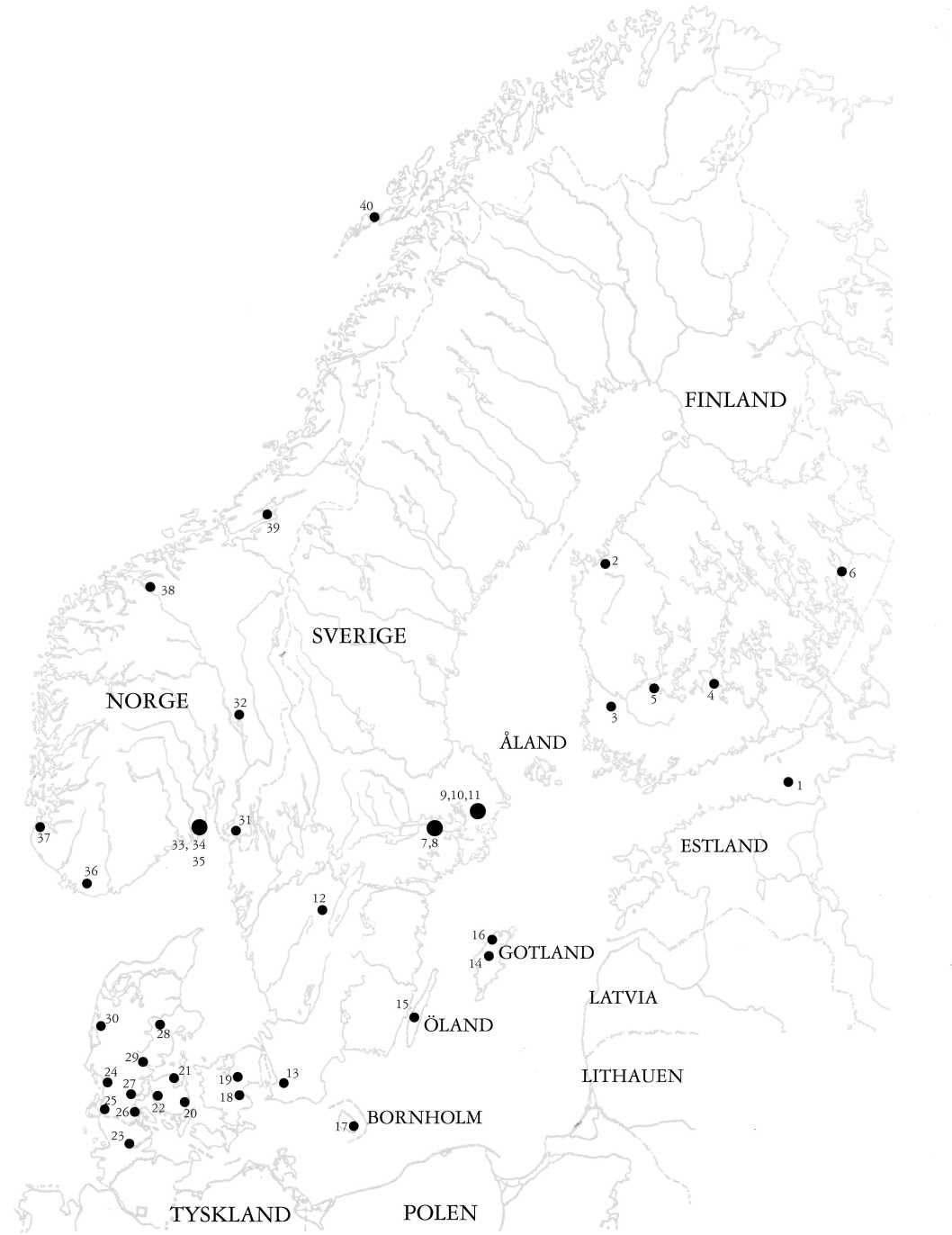
• Lokaliteter som ligger nær hverandre
Utvalgte lokalitetsnavn:
- Tytårsaari, Russland
- Gulldynt, Voyri
- Kjuloholm, Köyliö
- Papinsaari, Kuhmoinen
- Kirmukarmu, Vesilahti
- Joensuu, Halliko
- Helgo, Uppland
- Birka, Uppland
- Gamla Uppsala, Uppland
- Vendel, Uppland
- Valsgårde, Uppland
- Ålleberg, Västergötland
- Uppåkra, Skåne
- Kållunge, Gotland
- Torslunda, Oland
- Stora Ihre, Gotland
- Sorte Muld, Bornholm
- Himlingøje, Sjælland
- Lejre, Sjælland
- Gudme, Fyn
- Vimose, Fyn
- Søllested, Fyn
- Hedeby, Schleswig, Tyskland
- Ribe, Jylland
- Gallehus, Jylland
- Nydam, Jylland
- Ejsbøl, Jylland
- Mammen, Jylland
- Jelling, Jylland
- Dej bjerg, Jylland
- Tune, Østfold
- Åker, Hedmark
- Oseberg, Vestfold
- Borre, Vestfold
- Kaupang, Vestfold
- Snartemi, Vest-Agder
- Gausel, Stavanger
- Åk, Romsda
- Hol, Nord-Trøndelag
- Borg, Lofoten.
##FUGLEN, DYRET OG MENNESKET I NORDISK JERNALDERKUNST
Bente Magnus
Fuglen, dyret og mennesket
I sagnet om Sigurd Fåvnesbane finnes en berømt scene der Sigurd på oppfordring av smeden Regin steker den drepte ormen Fåvnes hjerte mens Regin tar seg en lur. Da Sigurd tar på hjertet for å kjenne om det er ferdigstekt, brenner han seg på fingeren og stikker den i munnen. Da forstår han plutselig hva fuglene som kvitrer i treet sier,- han forstår fuglenes språk, og får vite at Regin har planlagt å drepe ham.
Troen på at fuglene så alt og kunne forutsi menneskenes skjebne går tilbake til de eldste indiske skriftlige kildene og er et gjennomgående trekk i folkeeventyr. ”Hvis bare menneskene visste hva vi vet”, sier fuglene. Denne fuglenes kunnskap forsøkte både romere og germanere å skaffe seg via orakler. Tacitus forteller i sin bok om germanerne fra 98 e.Kr. (kapitel 10):”Også i Germania kjennes den meget utbredte skikk å søke varsler av fuglenes kvitring og flukt.” Hvilke fugler som ble ansett for å kunne gi orakelvarsler varierte. Men visse karakteristika var viktige sammen eller alene: Fuglens størrelse, dens farge(r), dens styrke, dens sjeldenhet, dens bevegelser, sangens/lydens variasjon og sangens styrke. Det spilte også stor rolle hvor lyden av fuglen kom fra, dvs om fuglen var skjult eller om den satt på en viktig bygning eller i et viktig tre lett synlig samt i hvilken himmelretning man først så den. En god del av dette henger fremdeles igjen som ”gammel overtro”, som f.eks. at de store uglene som kattugle og hubro varsler død, at det er viktig fra hvilken side man ser den første linerlen om våren og at gjøkens koko på forsommeren er forbundet med erotikk. Noen store fugler som sangsvaner og traner, og mindre fugler som viper, heilo og svaler kom årlig med lyset og våren til Norden. Når de dro igjen om høsten tok de med seg lyset og varmen og overlot menneskene til mørkets og kuldens krefter.
Visse dyr og fugler i jernalderen hadde menneskene et eget forhold til. Disse var gjenstand for beundring, respekt og frykt, og de utgjør hovedmotiver i kunsten. Den kristne forestillingen om at menneskene var dyrenes herre, ettersom Gud kun hadde skapt menneskene i sitt bilde, fantes ikke. Odin kunne skape seg om til hvilket dyr eller hvilken fugl han ønsket, og visse mennesker ble også ansett for å ha den evnen. På grunnlag av de norrøne sagaene og innskrifter på vikingtidens runestener vet vi hvilke ville dyr og fugler som i særlig grad ble brukt som mannsnavn i yngre jernalder,- Ulv, Bjørn, Orm, Hauk, Ørn, Ravn. I eldre jernalder, derimot, er de navnene vi kjenner fra runeinnskrifter dels dannet etter andre prinsipper. Her møter vi Lægæst, HagustaldaR, Wagnija og Nithijo, men også WiduhundaR som betyr skogshund og vel kan være en poetisk omskrivning for ulv, samt Stridsulv, Sverdulf og Hærulv som på bautastenene er skrevet HaÞuwulafR, HaeruwulafiR og HariwulafR. De teriofore navnene, dvs de som inneholder et dyrenavn, viser til hvilke dyr og fugler man mente hadde spesielle egenskaper som intelligens, styrke, utholdenhet, sluhet, klokskap. Med en dyrebetegnelse som fornavn mente man at dyrets eller fuglens egenskaper ble overført til mannen. Enkelte forskere har villet se de viktigste gudene bak denne typen mannsnavn fordi det åpenbart er en sammenheng mellom teriofore navn, germanske trosforestillinger og de dyr som er avbildet på gjenstander og billedstener. La oss se nærmere på disse dyre- / mannsnavnene.
Ravnen ble ansett for å være den beste orakelfuglen. Den er mest intelligent av alle fugler og kan tilpasse seg de mest ulike omgivelser og situasjoner. Dens svarte, glinsende fjærdrakt og mørke nebb skiller den ut fra andre kråkefugler. I Edda-kvadene omtales ravnen oftere enn noen annen fugl som likspiser på slagfeltet. Hvis ravnen blir tatt fra redet som liten er den lett å temme og kan læres opp til å artikulere ord. Germanernes viktigste guddom, Odin, hadde to ravner, Hugin og Munin, sinn og minne, som hver dag dro utover verden og hentet inn opplysninger til sin herre. Ravnene er således et bilde på Odins mentale evner. I Bibelens skapelsesberetning er ravnen den første fugl som Noah sender ut fra arken for å speide over jorden og gi Noah opplysninger om forholdene etter syndfloden.
Ørnen, den største av alle de nordiske rovfuglene var et symbol for Odin, og ett av hans navn var den ørnehodete. Ørnen svevet i stor høyde og med sitt skarpe syn hadde den oversikt over hva som skjedde langt nede under den akkurat som Odin når han satt i sitt høysete, Hlidskjalf, og så utover verden. Ørnen har kraftig nebb og store klør som gjør den i stand til å slå ned på et relativt stort bytte som lam og kidd. Ørnen er også evangelisten Johannes attributtdyr og var i det kristne romerriket, fra keiser Theodosius Is regjeringstid, et tegn på omvendelse til kristendommen.
De mindre rovfuglene ble kalt haukr (høk), og man hadde ingen spesiell betegnelse for falk. Begge var jaktfugler for aristokratiet i den nye jaktform som foregikk til hest og kom til Norden etter folkevandringstiden. Høk og falk er raske og dyktige jegere, og en jaktfalk kunne til og med ta opp kampen med en så stor fugl som en trane. I båtgravene fra Vendel og Valsgårde i Uppland fra yngre jernalder er flere av krigerne utstyrt med en hel oppsetning av rovfugler i tillegg til hunder og hest.
Ulven er lett, rask og smidig og jager i flokk. Dens hyl skaper frykt selv hos moderne mennesker. En ulveflokk som har nedlagt et stort bytte fråtser i kjøtt og blod til det nesten ikke finnes en hårdott tilbake. Guden Odin hadde to ulver, Freki og Geri, dvs den grådige. Disse lot han ete av de døde kroppene på slagfeltet. I sagaen om Egil Skallagrimsson fortelles i innledningen at Egils farfar het Ulv Bjalvesson. Om ham ble det sagt at han var en mektig mann og en god gårdsbestyrer. Han kunne gi gode råd om alt fordi han var en meget klok mann. Men når det led mot kvelden ble han folkesky, så det var få som kunne få ham i tale. Han ble søvnig; folk sa og at han var hamram, dvs. at han kunne skifte ham (skikkelse). Han ble kalt Kveldulv. Ettersom hans navn var Ulv, var det en ulvs skikkelse som hans frisjel antok mens kroppen tilsynelatende lå og sov om kvelden.
Bjørnen derimot, holder seg mest for seg selv unntagen en binne som har unger. Hos samene har bjørnen vært den fremste i dyreverden, og bjørnejakten har alltid vært sterkt ritualisert. Bjørnen opplevdes som et helt spesielt dyr. Den er sålegjenger, dvs går på hele foten som et menneske, den kan klatre i trær, reise seg og gå på to ben som et menneske og går i hi om høsten. Da forsvinner den, men med våren kommer den tilbake, og i tilfellet det er en hunbjørn har hun med seg en eller to unger. Men det som har ført til at bjørnen har hatt en slik fremskutt stilling i myter og senere folketro, er at en flådd bjørnkropp likner et menneskes og at selv skjelettet har likheter med et menneskes. Derfra er det ikke langt til forestillinger om at bjørnen er et omskapt menneske. Bjørnen har ti manns styrke og tolv manns vett, heter det i et gammelt ordtak, og fremstående kvinner og menn i jernalderen ble begravet eller kremert liggende på en bjørnefell med klørne bevart. Hodet, derimot, er aldri med.
Visse elitekrigere i yngre jernalder ble kalt berserkir og ulfhednar. Berserkr betyr enten bjørnekjortel eller brynjeløs, ulfhednir betyr kledt i ulveskinn. Trolig ved hjelp av noe slags rusmiddel forsatte krigerne seg i en ekstatisk tilstand av blindt raseri før en kamp og ble derved helt ufølsomme for smerte og fare. Denne kraften, sier Snorre Sturluson i Ynglingesagaen, fikk de fra Odin, hvis germanske navn Wotan betyr den rasende:” …hans egne menn gikk brynjeløse og var gale som hunder og ulver, de bet i skjoldene, var sterke som bjørner eller stuter; de drepte alle mennesker, og hverken ild eller jérn bet på dem. Det kalles berserkrgang.”
Ormen var en av Odins hjelpeånder og kunne sendes på oppdrag til underjorden. Den skifter skinn, forsvinner inn i hulninger i jorden og er borte om vinteren. I Snorre Sturlusons Skaldskaparmal forteller han myten om opphavet til diktekunsten. Jotnen Suttung hadde skaffet seg skaldemjøden som fantes i tre kar og satt sin datter Gunnlod til å vokte dem inne i fjellet. Odin lurte en annen jotun til å borre et hull i fjellveggen. Så skapte han seg om til en orm og krøp inn til Gunnlod, og ved hjelp av elskov stjal han mjøden fra henne. Derfor var han også skaldekunstens guddom.
Svin eller galte var det likevel ingen som het på tross av at villsvinet spilte en rolle i mytologien og som totemdyr. Det henger muligens sammen med at villsvinet forlengst var utryddet i hele Skandinavia i yngre jernalder, og at villsvinjakt derfor var noe som bare et fåtall nordiske menn hadde deltatt i kanskje hos frender i nåværende Baltikum eller Polen. Motivet, som ikke forekommer ofte i Skandinavia, kan derfor være overtatt fra kontinentale germanere.
Villsvinene er både sterke, raske og farlige i tillegg til at de får store kull unger og dermed blir symbol på fruktbarhet. Bortsett fra fenomenet svinefylking der krigerne stiller opp i V- form som et grisetryne og som knyttes til Odin, var villsvinet knyttet til vanegudene Frøya og Frøy. Frøya var både fruktbarhets- og dødsgudinne og delte de falne på slagmarken med Odin. I kvadet Hyndluljod fortelles at når Frøya ville skaffe sin yndling Ottar den enfoldige en forkledning, skapte hun ham om til et svin, Hildisvin, dvs. kampsvin. Da fikk han villsvinets styrke, raskhet og ureddhet. På krigerens hjelm i Vendel grav XIV er det fremstilt en prosesjon av krigere der én bærer en villsvinmaske med store huggtenner. I et depotfunn fra Öland med bronsematriser for fremstilling av billedblikk til hjelmer viser en av matrisene to hjelmbærende krigere med villsvin på hjelmkammen (Bind 1, 50-51). Guden Frøys svin het Gullinborsti og var skapt av dvergene. Det kunne fare over land og hav både i dagslys og i mørket for busten lyste som gull, noe som kanskje kan henge sammen med at villsvinene er nattdyr. I Odins Valhall fantes galten Særimner som vel må regnes som en vanlig gris. Den ble slaktet og kokt hver kveld, når Odin hadde vekket de falne krigerne til live igjen etter dagens kamptrening. Særimner var like hel dagen etter og kunne fortæres i all evighet. Odin hadde evnen til å vekke opp mennesker og dyr fra de døde. Gudinnen Frøya ble kalt syr, sugge, av visse skalder på 900-tallet, og Olav Haraldsson, den senere Olav den helliges stefar, Sigurd, som var småkonge på Ringerike, hadde tilnavnet Syr. Her er det også den vanlige domestiserte grisen som må være grunnlaget for tilnavnet. Om dette var så nedsettende som vi oppfatter det i dag, er uvisst.
Hesten var det eneste av de domestiserte dyrene som ble regnet for å stå mellom gudene og menneskene og som derfor hadde en helt egen status. Tacitus forteller: ”Men særegent for germanerne er at de også tar varsler og forutanelser fra hester. Hester av dette slaget ales opp på felles bekostning og holdes i de før nevnte hellige skoger og lunder; de er helt hvite og blir aldri vanhelliget ved å brukes til vanlig arbeid. De spennes for en hellig vogn, og stammens prest eller konge eller høvding følger dem og gir akt på hvordan de knegger og pruster. Og intet varsel blir mottatt med større tiltro, ikke bare av menigmann, men også av de høyættete og prestene. Prestene betrakter nemlig seg selv bare som gudenes tjenere, mens hestene etter deres mening er gudenes fortrolige.” At guden Balders hest snublet og skadet foten var f.eks. et varsel om Balders død. Hesteoffer var det mest sakrale av alle offer til guden Frøy, og offermåltidet på kokt hestekjøtt det aller viktigste. I folkevandringstiden ble det vanlig å gravlegge rytterkrigere, høvdinger og konger sammen med sine hester. Frankernes første konge, merovingeren Childeric, død 482 e.Kr. ble begravet i en enorm gravhaug i Tournai i Belgia. Minst 21 hester ble slaktet og begravet i tre store groper plassert omkring haugen. Tolv hester fikk sette livet til og følge Osebergdronningen på hennes siste ferd i sitt skip i Vestfold, Norge i 834 e. Kr. Hestene hadde mange roller i samfunnets toppsjikt, og de var et tegn på makt og rikdom. Deres rolle som orakeldyr som stod mellom guder og mennesker har sikkert spilt stor rolle når de ble drept og lagt i graven. Det hendte også at hestene fikk egne graver, og den tidligste som hittil er kjent i Norden ble funnet på et gravfelt fra 3. årh. i Udby på Sjælland. Odins hest, Sleipner, var en sjamansk skapning hvis navn betyr ”den glidende”, dvs den som går mellom verdnene. Den var grå, hadde åtte ben og på dens tenner var det innlagt runer.
Følge og frisjel
Etter norrøn sjeletro ble hvert menneske født med en slags skyggeskikkelse i form av et dyr, en fylgja, følge, som gikk foran hele livet. Den fungerte som menneskets alter ego, en ytre sjel som mennesket hadde i tillegg til kroppssjelen og som levde og døde sammen med mennesket sitt. Et menneske kunne se sin dyrefølge i drømme, og det var da et varsel om at han eller hun snart skulle dø. Så man derimot andre menneskers følge i drømme, var det et tegn på at noe kom til å hende. Det er trolig at forestillingene om følgen henger sammen med etterbyrden, men sammenhengen mellom denne og følgen i dyreskikkelse er uklar. Troen på at mennesket hadde en kropp som herberget en frisjel var grunnlaget for sjamanismen der Odin var den ypperste utøver. Ved hjelp av ekstase eller trance kunne en sjaman eller volve spalte kroppen og sjelen og sende sjelen ut på oppdrag for å løse et stort problem eller en krise. Kroppen lå da igjen som om den sov eller var død og sjelløs. Frisjelen ble forvandlet til et dyr eller en fugl, til sjamanens hjelpeånder. Odin forvandlet seg til de dyr og mennesker han hadde behov for i sin evige søken etter kunnskap, og som vist ovenfor, kan de mest vanlige mannsnavnene i yngre jernalder knyttes til Odin.
Dyr som motiv
Kunsten som skaptes i løpet av jernalderens siste 6-700 år gjorde bruk av motiver som nettopp henspiller på transformasjon/ forvandling fra menneske til dyr, fra dyr til menneske og Odins rolle som den fremste sjaman og største trollmann, men også som krigeraristokratiets fremste guddom. De få menneskefigurene som av og til synes mellom dyrefigurene forestiller sannsynligvis Odin selv eller noen av hans hjelpere. Karakteristisk for kunsten er at alle flater på de ornamenterte gjenstandene fylles av dyre- og fuglefigurer som sjelden går an å henføre til noen bestemt art. Typisk er det også at hver eneste avslutning på remmer, spenner, fibler og beslag avsluttes med en maske, et dyrehode eller et rovfuglhode. Kunststilene forandrer seg gjennom hele jernalderen fra omkring 450-1100 e.Kr. og kalles dyrestiler eller dyreornamentikk fordi firbente dyrefigurer sett i profil er hovedmotivet. Stilene er knyttet til samfunnets toppsjikt som bruker dem aktivt både politisk og som et ledd i en symbolsk og ideologisk kommunikasjon.
Egentlig inngår dyremotiv blant germanske hersker- og krigersymboler langt tidligere, men da med klar innflytelse fra provinsialromersk kunsthåndverk. På sølvbegrene fra en av de sjællandske Himlingøje-gravene fra første halvdel av 3. årh finnes f.eks. en frise i presset, forgylt sølvblikk under munningsranden (Bok 1, 11-13), jfr. tegning. Frisene er ikke helt identiske men inneholder det samme motivet, nemlig hukende, profilsette krigere som holder et romersk ringknappsverd. Krigerne har hjelm og synes å holde øye med en rekke dyr og fugler i et landskap. Scenene utspiller seg fra venstre mot høyre. Vi kjenner igjen en hest med innbøyde forben og en stor rund knopp under bakparten. Foran hesten står to mindre fugler som nærmest ser ut som ender, deretter en stor fugl med lang hals, krumt nebb og kraftige klør - den eneste som kikker bakover. På det ene begeret finnes dessuten to mannsmasker med lang bart. De er plassert slik at den ene virker som et speilbilde av den andre. Deretter følger en bukk eller gemse, nok en hest og en kriger. Den siste hesten (?) er fremstilt i profil med fire ben i motsetning til de øvrige som bare vises med to ben. Betyr det at den hadde åtte ben? Ingen av dyrene kan derimot klassifiseres som rovdyr, men den store fuglen kan være en stor rovfugl.


Her finnes en “tegneserie” som må vurderes i forhold til gravens øvrige innhold. Graven, der sølvbegrene inngikk som en viktig del, var en av flere som ble funnet ved grusgraving i 1828 og hvis sammenheng ikke er helt klar. I analogi med andre graver som inneholdt sølvbegre av samme type, var den gravlagte en mann, hvis øvrige gravutstyr bestod av romerske glass og bronsekar. Han har tilhørt det kongelige dynasti som i løpet av omtrent tre generasjoner frem til midten av 3 årh. behersket Sjælland, Fyn og kanskje Skåne. Selvom han ikke ble begravet med våpen, er det sannsynlig at han var både kriger og hærfører. Det er teoretisk mulig at han kan ha deltatt sammen med germanske frender i datidens store kriger mellom romere og germanere, markomannerkrigene i Bøhmen. Både sølvbegrenes friser og den store fingerringen med ravnehoder fra Himlingøje tyder på at det allerede omkring 250 e.Kr. har eksistert en ikonografisk sammenheng mellom visse dyr, visse fugler og krigere i det germanske samfunnets toppsjikt, men det kan ikke kalles dyrestil.
De som tapte kampen
De store våpenofferfunnene fra Nydam mose, Vimose, Illerup ådal og Ejsbøl mose illustrerer tilkomsten av dyreornamentikken mellom fra 3. årh. og ut 5. årh. Det var en tid preget av plyndring og strider. De som klarte å komme seg til makten gjorde dette ved hjelp av veltrenete krigere som de hadde i sitt brød og et stort nettverk av familie, slekt og mektige personer som var knyttet til dem ved giftermål, fosterskap og som gissler. Nettverket kunne strekke seg over store deler av det ikkeromerske Europa. Gull var en viktig ingrediens i det å skaffe seg makt og lojale tilhengere, og halsarm- og fingerringer av gull var viktige lojalitetsgaver. En romersk gullring med signet som forestiller guden Bonus eventus var naturligvis en statusmarkør på samme måte som ravnehoderingene, men viser til bærerens kontinentale kontakter. Tyngre, germanske gullringer kun med stempelornamentikk har vært helt essensielle i samfunn der den eksklusive gaven var et middel som småkonger og høvdinger benyttet for å knytte til seg andre mennesker, det være seg profesjonelle krigere eller alliansepartnere av alle slag. Våpenofferfunnene har vist at hærene allerede omkring år 200 e. Kr. var profesjonelt oppbygget. Hierarkiet fremgår tydelig av såvel bruken av edelmetaller som av antallet våpentyper og utstyr. Krigerne med sine ledere har vært samlet fra store områder, og et krigstog må ha vært nøye planlagt i lang tid på forhånd. Hver offiser ledet antagelig sin kontingent av krigere. Lederne var ryttere, kledt standsmessig i fargerike klær som viste deres rang og gjorde dem vel synlige under kampens gang. De bar praktsverd med romerske klinger, og det røde skjoldet hadde bule av sølv med forgylte detaljer og med beslag i form av mannsmasker av de samme edle metaller. Armringer og fingerringer var av gull, og hestene var utstyrt med seletøy av forgylt bronse. Dette var representanter for den skandinaviske eliten, og mer eller mindre likeartet var det germanske krigeraristokratiet utstyrt på kontinentet.
I år 375 brøt hunnerne, et mongolsk rytterfolk uventet inn i forholdet mellom romere og germanere ved sitt overfall på goterne som bodde ved Svartehavet. I de neste 75 år klarte hunnerne å tilskanse seg makt og herredømme over flere germanerfolk i Europa og nådde langt vestover. Sagnene om deres konge Atilla og hunnernes annerledes krigskultur ble til myter som levde videre i mange hundre år i germanske skaldekvad. Hunnernes påvirkning på germanernes trosforestillinger og ritualer, kunst og krigerkultur er lite kjent. De oppfattes som en parentes i Europas historie i folkevandringstiden og anses kun å ha tilført germanerne ørnen som symbol og bruken av blodrøde granater innfattet i gull. Men det er tankevekkende, at på den tiden de lider sitt endelige nederlag og ”raderes ut” av historien ved slaget ved Nedaoelven i år 454 skapes den første dyrestilen i Skandinavia.
Ejsbøl offermose ved Haderslev i Sønder-Jylland har vært et sakralt område gjennom de første 500 årene e.Kr. Hvor mange ganger det har foregått kamper mellom inntrengere og regionale hærstyrker i denne delen av Jylland vet vi ikke, men hittil har det store moseområdet vist seg å skjule våpen og utstyr fra flere offringer. Under utgravninger i mosen mellom 1955 og 1964 kom det for dagen utrustning fra en nedkjempet hærstyrke på omkring 200 mann fra ca. år 300 e.Kr. Våpen og utstyr var som vanlig i krigsbyttefunnene, hakket, vridd, bøyd og banket i stykker før det ble ofret til en guddom ved å kaste bitene ut i vannet. Sør for denne nedlegningen fant man en yngre konsentrasjon av eksklusive og spesielt utvalgte våpen. Tre sverd med støpte, timeglassformete grep og sverdskjeder med beslag av forgylt sølv, og dertil tre remspenner av forgylt sølv. Til disse fyrstelige utstyrte sverdsettene hører sannsynligvis minst åtte sverd til med enklere utstyr. Praktsverdene med sitt utstyr er nedlagt i tidlig folkevandringstid, i tidlig 5. årh. e.Kr. og er blant de seneste danske våpenofferfunnene. Ornamentikken på beltespennene med sine beslagplater viser en helt annen oppfatning av dyremotivet enn ravnehoderingen og sølvbegeret fra Himlingøje og den lille dyrespennen med hinden med halvmånehorn og hennes lille kalv. Borte er pressblikk og den forsiktige bruken av stempler; nå gjelder dypt relieff med skarpe rygger og bruk av niello for å fremheve visse detaljer. Alle tenkelige endestykker avsluttes med et dyrehode i profil eller en face. Øynene er sirkelrunde og står gjerne ut. På den relativt lille flaten som beltespennen fra Ejsbøl utgjør er det presset inn ikke mindre enn seks dyrehoder. Alle tomrom er utfylt, selv inne i kjeften på de profilsette dyrehodene ses et lite dyrehode. Hodene er plastiske, og det er tydelig at figurene forestiller dyr, nærmest fabeldyr. Selve beslagplaten er inndelt i geometriske felter fylt med spiralornamentikk i skarpt relieff, det som kalles karveskurdsornamentikk og som egentlig er en treskjærerteknikk. Den viser en tydelig arv fra provinsialromersk ornamentikk særlig slik den arter seg på beltespenner på provinsialromerske militærbelter fra samme tid. Rovfuglhodene på hekten og maljen er med sine skrå øyne og skarpe, krumme nebb noe helt annet enn ravnehoderingens rovfuglhoder. Men det finnes et slektskap, nemlig selve motivet.
Vi er inne i folkevandringstiden der rovdyret og rovfuglen utgjør hovedmotivene i kunsten. Mellom 400 og 450 opptar de stadig mer plass på store draktspenner, våpen og belteutstyr. I Sösdalstilen arbeider gullsmedene med en todimensjonell flatestil i sølv der forsiktig bruk av stempelornamentikk, veksling mellom forgylte og ikke-forgylte partier og ganske naturalistiske dyrehoder er karakteristisk. Flatene er i ro, og noe behov for å utnytte tomme flater foreligger ikke. Annerledes er det med Nydamstilen, oppkalt etter det første våpenofferfunnet fra Nydam mose ca. 6 km nordvest for Sønderborg. Også Nydamstilen finnes på sverdutstyr, beslag til praktbelter og bandolærer og relieffspenner, alt av sølv og støpt i former av brent leire. Flåten utnyttes til bristepunktet, og det dype relieffet lar lyset spille og skape skygger. Her finnes flere dyrefigurer, som gjerne klatrer på utsiden av spennene og rovfugler sett i profil samt ett og annet menneske. Men kvinnegravene viser at ikke bare høvdingen/hærlederen står sterkt i folkevandringstidens dyr-/menneskeforestillinger. Kvinnenes store draktspenner, relieffspennene, er eksempler på gullsmedenes ypperste kunstverk. Selv blant de tidlige smykkesettene finnes den gåtefulle dyreornamentikken.
Husfruen på Hol
Det begynte desverre med nok en versjon av den gamle historien: En bonde skulle fjerne en ”steinrøys” som lå ved låvebroen og kom raskt ned på en gravkiste av store heller, 4 m lang og 80 cm bred. Den var fylt med jord og ble godt gjennomrotet. Derved fant man et antall gjenstander som tilhørte en av de mest spennende kvinnegraver fra tidlig folkevandringstid fra Midt - Norge. Kvinnen var blitt utstyrt med skrin, leirkar og tekstilredskaper og var stedt til hvile i en drakt som krevde flere fibler av sølv. Den har vært holdt sammen i livet av et 2 cm bredt lærbelte med beltering av bronse. Ringen er omgitt av fem hester i gjennombrutt arbeid og selve rembeslaget har form som en mannsmaske. I beltet hang hennes nøkler i en nøkkelring og to kniver hvorav en med sølvholk. Blant hennes mange mindre draktspenner finnes to S-formete av forgylt sølv med profilsette dyrehoder. En unik, nærmest likearmet bøylespenne av forgylt sølv som avsluttes med et dyrehode en face i hver ende, har kanskje sittet lavt på brystet og gitt peploskjolen en rynkeeffekt. Bøylen mellom spennens to deler har både stempelornamentikk og en klassisk meanderbord i dypt relieff. På begge sider av bøylen finnes ett sett rovfuglhoder med sterkt krumme nebb, derunder et menneskehode i profil og en arm med en hånd og sprikende tommel og derunder et dyrehode i profil med lang, ormeaktig kropp. Det finnes en usynlig midtlinje gjennom hele spennen fra den ene spissen til den andre, og motivene er omtrent de samme på begge sider av denne midtlinjen.
Motivet med en menneskefigur mellom rovdyr går igjen på den store relieffspennen, også den av forgylt sølv og helt unik. Hodeplaten har sølvknopper som er satt fast på en liten list av sølv. Ornamentikken består av en rekke havhestliknende dyr med stripet kropp og et spisst hode med runde øyne som kikker bakover. Innenfor disse finnes en rad firsidige felter med firkantete knotter og deretter et spiralornament, begge i dypt relieff. Selve spennefoten er vinklet som et tak (takfotspenne) og har øverst det samme spiralornamentet som på spennens overdel. Men det interessante er bildene som er tegnet naturalistisk. På høyre halvdel ses øverst en sammenkrøpet (eller hukende) menneskefigur, en mann i profil med armen bøyd og 55 og hånden med sprikende tommel foran ansiktet. Han er tegnet med stempler og er barhodet. Klesdrakten består av bukser og tunika med belte. Under ham finnes et profilsett dyr med kort, bredt hode og åpen kjeft. Dyret synes å gripe tak i mannen med bena. Bak ryggen på dyret kryper nok et profilsett dyr. På venstre halvdel kryper tre dyrefigurer; den øverste med smalt, langt hode som synes å bite etter et kort, kraftig dyr med åpen kjeft og skarpe tenner. Nedenfor ligger et dyr med hodet opp mot midtdyrets rygg og en kropp som er ormeaktig men 56 med bakben. Dyrene er tydelig karakterisen og skal åpenbart forestille forskjellige figurer i et slags drama der den hukende mannen spiller hovedrollen. På den likearmete spennen fantes to menneskefigurer med hånden opp og sprikende tommel omgitt av rovfugler og ville dyr. Hva forestiller bildene? Mest sannsynlig handler det om guden Odin, og kanskje i en sammenheng der han slåss mot og overvinner dødsrikenes demoner.
Holkvinnens spenneoppsetning samt nøkler og veveredskaper viser at hun har vært en husfrue, en kvinne med makt og myndighet innenfor gården. Slike mektige kvinner har det, etter gravfunnene å dømme, vært mange av langs den lange norskekysten fra Vestfold til Nord-Trøndelag i folkevandringstiden. Deres nøkler symboliserer deres ansvar for husholdet og tekstilredskapene ansvaret for produksjonen av tekstiler og klær til alle. Men også skjebnegudinnene, nornene, vevet menneskenes liv fra fødsel til død slik at livsmønstret var klarlagt når barnet ble født. Sammen med spennenes ornamentikk som kretser om Odin og hans roller som sjaman, antyder tekstilredskapene at kvinnene hadde spesielle egenskaper til å ”se” inn i fremtiden og har dermed spilt en vesentlig rolle i ritualene knyttet til seid. Denne egenskapen påpeker allerede Tacitus (kap.8 i Germania) at germanske kvinner hadde. Derfor ble de rådspurt, og mennene ga akt på rådene. Flere kjente romere knyttet til seg en germansk seerske, en sibylle. I Ynglingasagaens kapitel 7 skriver Snorre Sturluson: ”Odin behersket den kunst som det følger den største makt med, og han utøvet den selv, det er seid. Derfor kunne han vite folks skjebne, og det som ennå ikke hadde hendt, han kunne gi folk død eller ulykke eller vanhelse, han kunne ta vett eller kraft fra folk, og han kunne gi det til andre. Men denne trollskapen følger det så mye umandig med, at mannfolk ikke kan drive med den uten skam, og derfor lærte de gydjene den.” En gydje var en kvinnelig kultleder.
Dyrestil
Omtrent halweis gjennom 5. årh. skapes i Syd-Skandinavia en egen kunststil der dyrefigurer står i sentrum. Den får sitt sterkeste uttrykk på de store relieffspennene av forgylt sølv eller bronse som ble båret av spesielle høyættete kvinner med viktige roller som husfrue og kultleder. Dyreornamentikken på disse praktspennene som er det ypperste som folkevandringstidens gullsmeder produserte, fikk også stor betydning for germanske folk i Europa i deres søken etter identitet og fast forankring i en ny verden etter vestromerrikets fall i 476. Denne første dyrestilen kalles Stil I og har vært viktig for hele Skandinavias bondebefolkning. Den mistet sin betydning først omkring midten av 6. årh. Nydamstilen, dens forgjenger, er bl.a. karakterisisert ved border bygget på klassiske motiver slik som spiraler i forskjellige sammensetninger, meandere og eggstaver. Dyr og menneskefigurer er fremstilt sammenhengende og i stor grad naturalistiske. I Nydamstilen er hver gjenstand nærmest unik, og stilen synes å ha hørt til i samfunnets toppsjikt. I Stil I løses figurene opp ved at deres enkelte deler fremheves med konturer. Hver del lever sitt eget liv og anvendes ofte uten noen sammenheng med resten. Det naturalistiske erstattes av forkortninger, stilisering og abstraksjon. Ikke uten rett er Stil I sammenliknet med kubistene og Picassos kunst. Stil I brøt tvert med romerske prinsipper for ornamental kunst, nemlig en naturalistisk fremstilling av motivene.
Mesterverk
På Galsted-spennen finnes fremdeles det klassiske motivet med et menneske mellom to dyr i bakgrunnen. Men dyrene har ingen rot i virkeligheten,- de er symboler. Hvert lem er omgitt av en dobbelt kontur, kroppen er et bredt bånd og hodet er forenklet ved at øyenbrynsbuen er forstørret og forlenget. Hva forestiller de to knelende dyrefigurene med den åpne kjeften som synes å sluke mannshodet? Siden de står på kne, er det mest sannsynlig at de er mannens tjenere, og at deres åpne kjefter heller antyder at de forteller ham noe enn at de er i ferd med å sluke ham. Mannshodet har stirrende, utstående øyne og halvåpen munn. Sannsynligvis er dette en fremstilling av guden Odin i trance omgitt av to av sine hjelpeånder som hvisker ham det de har sett på sin ferd dit de ble sendt. Galstedspennen ble funnet i en mose sammen med en gullbrakteat som viser en mann i ekstatisk bevegelse. Motivet tolkes som Odin i trance i kamp med demoner.
Relieffspennen fra Gummersmark på Sjælland er også et mosefunn der 8 gullbrakteater og 10 perler inngår. Spennen er av sølv og formmessig er den en typisk planfotspenne inndelt i tre deler - hodeplate, bøyle og fot. Dens ornamentikk inneholder alle trekk i den tidlige dyrestilen. En relativ høy og bred list med siksakmønster i niello deler fotens bilder i en indre og en ytre sone. Listen overgår øverst i to profilsette dyrehoder med spisse ører, spissovale øyne og åpen kjeft. Nederst avsluttes listen i en dyremaske med utstående, runde øyne og store, runde nesebor. Det indre billedfeltet er oppbygd med horisontale felter. Øverst finnes en liten figur med store runde øyne og en utbrettet kropp. Feltet under inneholder en sammenkrøpet menneskefigur med hjelm og hendene knyttet bakpå ryggen. Neste felt viser to dyremasker en face. De spisse ørene 35 ligger utenfor listen og mellom dem finnes en sirkelrund figur lik et stort øye. Maskene har skrå øyne og tydelige nesebor under to tverrstreker. Tvers over maskene løper en list med siksakbord. Rett under maskene ses en rovfugl sett ovenfra. Kroppen er brettet ut og bena ligger langs siden. Halefjærene er markert med loddrette lister. På utsiden av listen nederst på hver side av masken finnes en profilsett dyrefigur med spisse ører og lang, opprullet tunge. Øverst på foten på hver side av bøylen finnes en nokså naturalistisk dyrefigur, nærmest lik en hund.
Spennens hodeplate er rektangulær og har en krans av geometriske figurer ytterst. Figurene - en likebent trekant med en sirkel på toppen, finnes også på andre relieffspenner samt på vestnorsk, asbestblandet keramikk fra denne tiden og på goterkongen Theoderiks mausoleum i Ravenna, Italia. Det er altså et utbredt symbol, men hva betyr det? Mellom trekantene i hvert hjørne ses en maske og midt på langsiden en stor mannsmaske som viser en åpen munn med mange tenner. Snur man spennen, blir masken til en dyremaske og hører sammen med den utbrettete dyrefiguren uten hode som ligger i feltet nedenfor delt i to ved en bred list. Det utbrettete dyret blir igjen til en stor maske med skrå øyne og en åpen, leende munn. På hver side nederst på hodeplaten finnes et rektangulært felt med to menneskefigurer. Begge har hjelm og blikket vendt opp. De bærer tunika med bred bord nederst, og den høyre figurens benstilling synes å antyde at han utfører en slags dans. Slektskapet med de senere gullgubbene er åpenbar. Relieffspennen fra Gummersmark er et mesterverk som må være nedlagt i mosen sammen med et collier av gullbrakteater og glassperler som en votivgave til en guddom. Det er igjen den mektige husfruen vi aner, og hennes spesielle smykker som viser til hennes rolle som leder av kultiske handlinger. De vestnorske kvinnene av hennes dignitet ble begravet med sine “insignier”, men ellers i Skandinavia ble de åpenbart nedlagt som votivgave ofte i en mose, kanskje i forbindelse med kvinnens død.
Gummersmarkspennens motiver viser til myter som er tapt for oss. Men de synes å handle om guden Odin og hans evne til forvandling. Noe som ser ut som en mannsmaske, blir til en dyremaske og en del av et stort, utbrettet dyr. I Ynglingasagaen sier Snorre dette om Odin: ”Odin skiftet ofte ham [skikkelse]; da lå kroppen som død eller sovende, men selv var han fugl eller firbent dyr, fisk eller orm og for på et øyeblikk til fjerne land, i ærend for seg selv og for andre…” Odin var den største sjaman og trollmann og kunne overskride alle grenser: mellom levende og døde, mellom mann og kvinne, mellom dyr og menneske.
Dyre- eller menneskemasker, rovfugler og dyrefigurer er hovedmotivene på relieffspennene. Et annet karakteristisk trekk er at fremstillingen er delt, dvs at en midtakse deler relieffspennenes ornamentikk i to symmetriske deler slik at billedflaten blir brettet ut. Men det finnes alltid elementer av asymmetri som har en betydning, som f.eks. de to krigerne på Gummersmarkspennen. Holder man over halvdelen av en maske en face som alltid er delt med en lang neserygg, blir hver halvdel et dyr- eller rovfuglhode i profil. Alt er som det ser ut til og samtidig er det noe annet.
Det gåtefulle ved relieffspennenes ornamentikk blir enda mer akksentuert senere i folkevandringstiden. Figurene blir mer oppløste, og ofte representerer et lem eller et hode en hel figur. Det finnes menneskeheder med dyrekropp og vise versa. Selve budskapet som ligger i spennenes ikonografi blir sterkere kodet, og det er vanskelig å finne frem til et samlet motiv. Men det har vært viktig å vise øyne. De finnes overalt og må ha med seende å gjøre - visse kvinners evne til ”å se” inn i fremtiden. På den store relieffspennen fra Lundbjers i Lummelunda på Gotland finnes det 42, 43, 47 en maske som avslutter foten og en maske på hver side av bøylen. De har skrå, farlige øyne. Rovfuglhoder med skarpe nebb og skrå øyne ligger etter hverandre langs ytterkanten og inne i det 45 trekantete innerfeltet der en trekantet, rød granat utgjør midtpunktet. Granater finnes også på hodeplaten som noe slags hvile 44 for blikket i en ellers helt uforståelig ornamentikk.
Relieffspennen fra Overnhornbæk er et mosefunn som også 48 inneholdt gullbrakteater og glassperler. Spennen er ødelagt før den ble nedlagt i mosen ved at nedre del av foten med den avsluttende masken er brukket av. Masken kan ha fungert som amulett i andre sammenhenger. Dyrefigurene rundt hodeplaten er gjennombrutte og båndformete, og de to firkantete prydknappene er omgitt av hver sin spiralranke. En liknende ranke finnes på sverdhjaltet fra Snartemo i Vest-Agder, der knappen er voktet av to dyrefigurer i rundskulptur med rovfuglnebb. Snartemosverdet er et av de få gravfunne praktsverd som kjennes fra Skandinavias folkevandringstid. I mosenes våpenoffer er de derimot tallrike. Et slikt sverd gikk ofte i arv, og mange har hatt navn. De var utstyrt med ornamentikk og figurscener i Stil I men ikke av den gåtefulle sorten som kvinnenes relieffspenner.
De store relieffspennene er mesterverk av metallhåndverk i forgylt sølv eller bronse. Kunstnerne som skapte spennene var trollmenn og deres verk fylt av magi. Det kultiske aspekt av relieffspennene forsterkes ved at enkelte har en runeinnskrift på baksiden, og på en av dem står: Jeg Vi risser inn runer for Vivja, kjæresten. Vi eller ve betyr et hellig sted, et sted der spesielt utvalgte mennesker fikk kontakt med gudene og der forfulgte kunne finne beskyttelse.
En ny tid
Omkring miden av 6. årh. endrer kunsten så sterkt karakter at det må henge sammen med dyptgående endringer i samfunnet. Den kryptiske og hemmelighetsfulle Stil I fyller åpenbart ingen funksjon lenger i Skandinavia; de storstilte offernedleggelsene i mosene av krigsbytte og gull samt de mektige kvinnenes relieffspenner og gullbrakteater opphører. Gårder og gravfelt fraflyttes i Nordens randområder, og tyngdepunktet i Skandinavia flytter seg fra Nordsjøen mot Østersjøen. Blant de mange germanske stammene som gikk sammen i større enheter på kontinentet fylte den første germanske dyrestilen, Stil I, fremdeles og i lang tid fremover en viktig funksjon i en kaotisk og usikker tid. Blant angelsaksere i England, hos langobarder, gotere, gepider, alemannere var deres nydannete kongeriker truet av de frankiske merovingernes utvidelse av sitt territorium. For selvom de fleste av de kontinentale germanerne var blitt kristne, hadde kongeslektene et behov for å skaffe seg legitimitet og en historie som etablerte forbindelsen til en fjern fortid. Litt etter litt hadde de frankiske merovingerne innlemmet burgundernes, allemannernes, thyringernes, bayernes, rhinfrankernes og delvis saksernes kongerike i frankerriket. Av de selvstendige germanske kongerikene som oppstod etter vestromerrikets fall fantes omkring år 600 bare vestgoternes i Syd-Frankrike og på den iberiske halvøy og langobardernes i Nord- og Midt- Italia. Samtidig ekspanderte det bysantiske keiserdømmet fra Lille-Asia over Balkan til deler av Italia og Spania. Avarer og slaver utvidet sine områder ved Donau og nordvestover mot Østersjøen.
En ny ornamentikk oppstår bygget på dyr og rovfugler som motiver og med båndfletning som sammenbindende prinsipp. Stilen kalles Stil II og anvendes fra midten av 6 til slutten av 8 årh. over hele det germanske Europa, men minst hos frankerne. Samtidig er de merovingiske frankerne de ledende i Europa. Deres konge Klodvig går ca. år 500 over til den katolske kristendommen og ikke til arianismen som de fleste andre germanerne, noe som senere skulle vise seg å være et klokt valg i forhold til pavestolen i Roma. Flere tusen krigere i Klodvigs hird lot seg døpe. De store hærene bestod av menn fra mange forskjellige stammer, også fra skandinaviske. De hadde felles livsstil på grunnlag av en felles ideologi der heltedyrkelse og krigerens rolle og liv etter døden spilte en sentral rolle. Forestillingene om Odins Valhall ble erstattet med en kristen ideologi når krigerne ble døpt. Merovingerne og andre kongelige slekter synes å ha begravet sine medlemmer med full personlig utrustning i nyoppførte kirker. Adelen fulgte etter og utstyrte sine graver i store trekister eller kammere av tre med smykker av edelmetaller, fullt oppsett av våpen, hesteutstyr og bordserviser med glasspokaler og rikt utsmykkete drikkehorn. Dette på tross av at de var kristne. Det arkeologiske materialet fra merovingertidens Europa er svært rikholdig på grunn av gravskikken, og inneholder gjenstander ornert i Stil II. Påvirkningen fra det merovingiske riket på alle germanske kongedømmer og småkongedømmer i Skandinavia har vært sterk.
Det rådet lenge usikkerhet om hvor den nye kunststilen oppstod og hvordan den spredte seg så raskt. Langobarderne i Italia fikk lenge æren av å ha skapt Stil II som en utvikling av folkevandringstidens dyrestil og middelhavsområdets båndfletningsmotiver. Men etterhvert er man kommet frem til at stilskiftet må være skjedd først i Skandinavia, enten i Danmark eller i det svenske Målarområdet. Begge regioner hadde både politiske, religiøse og økonomiske forutsetninger og sterke kongeslekter med kontakter til både det frankiske og det angelsaksiske.
På grunnlag av det arkeologiske materialet synes det å ha utkrystallisert seg tre tidlige nordiske riker i denne tiden, som på dansk kalles yngre germansk jernalder, på svensk vendeltid og i Norge og Finland merovingertid, nemlig Danmark med Skåne, Småland, Oland og Blekinge, Målarområdet med sentrum i Gamla Uppsala og Gotland. Områdene er å oppfatte som tidlige kongedømmer, der militære operasjoner under sterke ledere stadig forandret deres størrelse. Folkevandringstidens mange stammebaserte høvdingdømmer ble i løpet av folkevandringstiden og den tidlige delen av merovingertiden erstattet av større territorier med godser der produksjonen av fødevarer, jern, tekstiler etc. var basert på overskudd. Kongene hadde sine edssvorne “bestyrere” som tok seg av tributtinnsamling etc. i hver region. Jordbruket ble lagt om fra en ekstensiv utnyttelse av marken til en intensiv med sterkere bruk av gjødsel. Det som kan kalles utmarksområder ble utnyttet i stadig sterkere grad. At omleggingen har vært preget av vold, er det ingen tvil om. Krigerelitens medlemmer var de reelle makthaverne. Allerede omkring 520 finnes det skriftlige opplysninger om at danenes konge Hygelak overfalt frankerne ved Rhinmunningen, og om herulenes vandring fra Jylland til Gotaland. Daner og svear var ingen stammebetegnelser i denne tiden men betegnelser på sammenslutninger av flere gamle stammer under én herskerslekt av svear eller daner. Kampen om ressurser og territorier har vært brutal og langvarig over hele det europeiske kontinentet, og de nye makthaverne har demonstrert sin makt med bl.a den nye dyrestilen på våpen og kvinnesmykker. Under bysantinsk påvirkning hadde frankerne gjort verotterie cloisonné med blodrøde, spaltete granater i gullceller med vaflet bunn til en eksklusiv kunst som raskt spredte seg i Norden. Sverdknapper, draktspenner, beslag og detaljer på remspenner var gjenstander som ble prydet med cloisonné i intrikate mønstre. Det var dessuten begrensete mengder av gull i omløp, og derfor fikk gaver av gull med granater stor symbolsk betydning i herskernes evige kamp for å beholde makten over ressurser og mennesker.
Krigeraristokratiet
Det nye samfunnet kan betegnes som krigersk i motsetning til århundrene tidligere der den militære organisasjon var basert på de ulike stammene. Det krigerske samfunn var basert på en hird der lederen hadde nærmest uinnskrenket makt og der våpenutstyret ble masseprodusert og var likt på kontinentet og i Skandinavia. Et krigersk samfunn var kanskje ikke mer voldelig enn tidligere, men det var så velorganisert og velutstyrt militært sett, at det ikke uten videre ble angrepet.
Gravskikken i Norden var gjennomgående basert på kremasjon av den døde der ilden har fortært det meste, og antallet graver fra 7. årh. i Norden er relativt lavt. Mengden av løsfunn fra merovingertiden har derimot økt lavineartet etter at metalldetektorene kom inn i bildet, og de mange smykkegjenstandene som er funnet gir bl.a. et bilde av hvordan dyreornamentikken ble brukt. På Bornholm gir rikt utstyrte våpengraver i kammer med hest etter frankisk innflytelse et bilde av den nye eliten. Men vil vi vite hvordan den frankisk pregete skandinaviske krigereliten tok seg ut i datidens Norden, er det de uppsvenske båtgravfeltene vi må vende oss til. Her viser også gravfeltene at krigernes ledere var ryttere. De paraderte sittende i dekorerte sadler på sine hester hvis seletøy var utstyrt med beslag av forgylt bronse med ornamentikk i Stil II. På hodet bar de prakthjelm, og våpenutstyret bestod av sverd, lanse, pil og bue og skjold.
De fire gravfeltene Tuna (i Alsike), Ulltuna, Valsgårde og Vendel var anlagt langs den sjøveien som gikk fra Mälaren inn i Fyrisåen og videre nordvestover på Vendelåen. Havnivået var flere meter høyere enn i dag, og Mälaren var en vik av Østersjøen. Mange elver var viktige trafikkleder for båter i sommerhalvåret og for trafikk med slede og ski i vinterhalvåret. Derfor virker det så selvklart at de hjelmkledte krigerne (og de som ikke hadde hjelm) ble gravlagt i en klinkbygget båt omgitt av sine ridehester. Flere av hestene var dessuten utstyrt med isbrodder for ferd på isbelagte elver og sjøer. Samtlige gravfelt har vært benyttet gjennom mange generasjoner fra eldre jernalder til middelalderen. Gravskikken omfattet både brenning og jordfesting, men krigergravene som dekker perioden fra ca. 550-800 er alle ubrente. Det var 14 graver i Vendel, men det har sikkert vært flere, og de lå tett sammen syd for kirken. Syv graver var båtgraver, og båtene varierte fra syv til ti meter i lengde. Fire av gravene inneholdt en prakthjelm eller rester av en slik. Ettersom både gravfeltene i Ulltuna og Tuna hadde vært utsatt for ødeleggelse var det et hell at gravfeltet i Valsgårde, bare 3 km nord for Gamla Uppsala, var inntakt og kunne totalundersøkes av arkeologer. Som i Vendel hadde gravfeltet vært anvendt gjennom mange hundre år; fire båtgraver dekker omtrent tidsrommet 650-750 og 11 er fra vikingtiden. Ornamentikken på båtgravenes praktgjenstander danner grunnlaget for en oppdeling av Stil II i flere kronologiske grupper fra A til E.
Grav 6 i Valsgårde representerer et slags gjennomsnitt av båtgravene. Den inneholdt en 10 meter lang båt av gran og hadde plass til fire eller fem par roere. Akterut i båten var den døde krigeren blitt lagt på dunfylte puter og madrass. På sin venstre side hadde han to sverd og et huggsverd samt to pokaler av glass fra Rhinområdet, og på sin høyre side nok et huggsverd. Alt var så blitt dekket med flere lag tepper og matter av bjørkenever, muligens et slags telt eller baldakin. To skjold stod støttet mot babord reling og ett på styrbord side. Et stykke fra den dødes føtter lå to hodetøy til hester med beslag og bissel og to bunter med piler, en verktøykiste og diverse tyngre jernredskap. På bunnen av båten mot forstavnen lå hjelmen. I en rekke skrått over båten lå to belter med beslag, en spydspiss, en skål av glass, et spillebrett av tre med spillebrikker, et bandolær. I forstavnen lå diverse kokeutstyr av jern samt proviant i form av skinker etc. Inne i båten lå en hest og tre hunder og utenfor nok en hest og en okse.
Mennene i båtgravene var ikke utstyrt med smykker av edelmetaller eller granater i cloisonné, og alle de dekorerte beslagene er av forgylt bronse. To av hjelmene og to av sverdene har riktignok innlegg av granater, men arm- eller halsringer av gull forekommer ikke. Hjelmene er de mest iøynefallende av våpenutstyret. De er såkalte nordiske kamhjelmer laget av jernbånd og jernplater. De har en karakteristisk kam over issen enten i form av et ornert bånd med dyreornamentikk eller som en høy kam som ender i et dyrehode foran og bak. Hjelmene er prydet med bilder i pressblikk med en rekke motiver der krigere i prosesjon, rytterkrigere i kamp, våpendansere og dyretemmere er de vanligste motivene. Ørnen og villsvinet finnes på hjelmenes kam og signalerer krigerens kampvilje og mot samtidig som disse dyrene er knyttet til Odin og Frøy. Den mest forseggjorte av de nordiske hjelmene ble funnet i den angliske kongen Raedwalds grav i Sutton Hoo i England fra tidlig 7. årh., og den viser med all tydelighet at hjelmen helst har vært et rang- og verdighetstegn. De frankiske kongenes hirdledere fikk sine hjelmer av kongen som tegn på sin rang, og hjelmene bar kristne symboler. Kanskje kan derfor billedprogrammene på de nordiske kamhjelmene med sitt hedenske innhold tolkes som en reaksjon på det kristne budskapet. Hjelmene ble holdt høyt i ære, og de fleste må etter slitasjen å dømme ha vært ganske gamle da de kom i graven, dvs at de gikk i arv sammen med rangen som leder av kongens hird. Hjelmene ble derfor ikke plassert nær den døde, men foran ham i bunnen av båten.
De svenske båtgravene representerer en periode da kongeslekten med basis i Gamla Uppsala var sterkt innfluert av frankerne. Sveakongene selv ble kremert og begravet i enorme gravhauger, men hirden ble etter frankisk skikk gravlagt ubrent med sitt parade- og kamputstyr på egne gravplasser. Hirdlederne, som selv har vært av høy rang, har svoret troskapsed til kongen og har som pant på dette forhold fått en prestisjefylt gave, gjerne et ringsverd. Krigerne i hirden hadde krig som sitt métier. De hadde en bestemt livsstil og trenet seg i kamp fra de som ganske unge gutter ble opptatt i fellesskapet; deres ritualer var i første rekke knyttet til Odin, den store krigsguden. Det gammelengelske heltediktet om Beowulf handler nettopp om livet i kongens store hall, om store farer som den gode helten overvinner og om hans død og begravelse. Beowulf betyr bie-ulv, med andre ord: bjørn. Bjørnen var kanskje heltens følgedyr, og hans bjørne-jeg var så sterk og uredd at han kunne drepe udyret Grendel og hans farlige mor.
Dronningen i hallen
Noen vil kanskje tenke at disse krigerne må ha hatt mødre, søstre, koner og friller og undre seg over om de finnes med i det arkeologiske materialet fra helt- og krigertiden. Husfruene med sine nøkler og seende evner fantes nok fortsatt, men deres rolle hadde muligens endret seg. På den annen side var branngravskikken som appellerer svakere til forskerne, fremherskende. I Beowulf-diktet finnes det en kvinne, danenes dronning Wealtheow, som gir et bilde av den mektigste husfruens rolle når krigerne sitter benket i kong Hrodgars hall Heorot:
”So the laughter started, the din got louder, and the crowd was happy. Wealtheow came in, Hrothgar’s queen, observing the courtesies.
Adorned in her gold, she graciously saluted the men in the hall, then handed the cup first to Hrothgar, their homelands guardian, urging him to drink deep and enjoy it, because he was dear to them. And he drank it down like the warlord he was, with festive cheers ” (Oversettelse Seamus Heaney).
Inne i hallen ved de rituelle gjestebudene der bloting til gudene fant sted, spilte husfruen rollen som seremonileder. I eposet gir hun kongen først å drikke, fremhever ham som god og gavmild og rekker deretter hver og en av gjestene og sist Beowulf pokalen med mjød. Hennes rolle var naturligvis også å styre husholdet, se til at det fantes nok av mat og drikke til gjestebudene og ta hånd om det gjestene hadde med seg som gaver. Men hun ga også kongen råd om gaver til gjester såvel som til krigere og om rangordningen av krigerne på langbenkene når det var gjestebud. Den som hadde lavest status satt nede ved døren der det trakk verst.
Mye av det arkeologiske materialet fra denne tiden er nettopp kvinnesmykker. Dyrespenner i form av en hest er uvanlig, men ormer kveilet i 8-tall og S-formete ormer med et hode i hver ende har vært vanlige. De små gotlandske ryggknappspennene har alltid kraftige rovfuglhoder nederst på foten. Den ørn som finnes som prydbeslag på skjoldbrettene i Valsgårde grav 7 og i kongegraven fra Sutton Hoo finnes som draktspenner for kvinner særlig i Mälarområdet. Derved knyttes hirdens symboler også til kvinnene idet ørnen er et symbol for Odin. Det finnes en beltespenne av bronse funnet på Sjælland der et mannshode en face flankeres på hver side av tre profilsette hoder,- ørn, villsvin og ulv og det samme motivet finnes på et skjoldhåndtak i Valsgårde grav 7. Dette tre-dyrs-tegnet er sjeldent i Norden, men vanlig på kontinentet. Det kan symbolisere Odin og hans sjamanistiske hjelpeånder, men det kan også være skapt under innflytelse av kristendommens treenighet eller tidlig kristne fremstillinger av Kristus omgitt av dyresymbolene for tre av evangelistene Johannes, Markus og Lukas: ørnen, løven og oksen.
Stil Ils dyrefigurer kan ha hatt en apotropeisk dvs ondtavergende virkning når de finnes på kvinnesmykker men har samtidig vist hvilket samfunnssjikt kvinnene tilhørte. De har også gitt andre signaler til omgivelsene som er beslektet med folkevandringstidens relieffspenner. De elegant svungne dyrefigurene i jevn rytme gir inntrykk av en annen og mer kontrollert estetikk enn tidligere. Men hva slags dyr som inngår i motivene er nesten umulig å avsløre. Det synes som om ulveliknende dyr og ørner med kraftige, krumme nebb etterhvert viker plassen for mer hesteliknende dyr. Hestens rolle både som sakralt dyr og som en viktig faktor i strid og som fremkomstmiddel for samfunnets elitesjikt øker markant mellom 6. og 8. årh.
Storgods og protobyer
De samfunnsmessige endringene i 6.-7. årh. fremgår også av de arkeologiske strukturene i landskapet,- landsbyer og storgårder. Gudme-området på Øst-Fyn med sin handels-og håndverksplass Lundeborg hadde sin storhetstid mellom 4. og 6. årh., men det fortsatte som storgods frem til middelalderen. Sorte-Muld-området på Bornholm, derimot, hadde sin storhetstid mellom 6. og 8. årh. Uppåkra nær Lund i Skåne mellom 5-10 årh., mens Helgö i Mälaren synes å ha vært Nordens største metallhåndverksområde mellom 4. og 6. årh. Dets sakrale betydning, derimot, avtok ikke før i vikingtiden. Denne typen boplasser kan man kanskje kalle storgodser med kultiske sentrumsfunksjoner. Slike gods har neppe hatt inntekter fra egen gårdsdrift, men fra andre gårder som hadde et avhengighetsforhold til godseieren/småkongen og hans familie, og fra innsamling av tributt i form av diverse jordbruks-eller jaktprodukter, håndverksprodukter og prestisjevarer men også av gaver. Flere slike gods etableres etter folkevandringstiden som f.eks. Tissø med et rikt arkeologisk materiale fra 7.-10. årh. og Lejre med materiale som dekker det samme tidsrommet, begge på Sjælland. I løpet av 8.-9. årh. synes det å inntre en endring fra et system basert på tributt til et godssystem basert på egen gårdsdrift i Syd-Skandinavia sannsynligvis i forbindelse med samtidige endringer i politiske maktrelasjoner. Storgodsene, som ikke har vært mange, har hatt store hallbygninger og en krets av mindre gårder knyttet til hovedgården. I slike enorme hallbygninger har fyrsten samlet sine allierte, frender, venner og krigere til storstilte kultiske gjestebud. Der fikk gudene sine offer og fyrsten hyllning av skalden mens den søte mjøden og det dampende hestekjøttet fikk krigerne til å love mangt et fremtidig storverk. Storgods viser at det allerede i 8. årh. i Norden finnes et jordeiende aristokrati som øker sin makt fordi kongens makt ikke er sterk nok. En rekke mindre handels-eller markedsplasser anlegges i denne tiden antakelig av storgodseierne. Først i allianse med kirken og dens nedarvete strukturer kunne kongemakten styrkes og legge grunnlag for rikskongedømmene.
I 8. årh. anlegges de første byene, eller kanskje helst protobyene, i Skandinavia, nemlig Ribe i Vest-Jylland, Hedeby i Schleswig, Åhus i Skåne, Birka på Björkö i Mälaren og Skiringsal i Vestfold. De anlegges trolig på kongelig mark og karakteriseres av en felles plan med smale markteiger som ligger parallelt opp fra stranden. På hver teig ble det satt opp en bod eller oppført et hus for en håndverker,- en perlemaker, en bronsestøper, en kammaker, en veverske. Det er uklart om bebyggelsen var helårlig i den første tiden eller om den var basert på virksomhet bare i sommerhalvåret.
På kontinentet ble den siste av de langhårete merovingerne i 751 etterfulgt av Pepin den lille som ble kronet til konge over frankerne med pavens velsignelse, den første av det arnulfiske eller karolingiske dynasti. Hans sønner Karl og Karloman samregjerte i tre år, men fra 771-814 regjerte Karl den store, Carolus Magnus alene. Han allierte seg med romerkirken, og ble med pavens velsignelse kronet til keiser i Peterskirken i Roma første juledag år 800. Under det karolingiske rikets største utbredelse og blomstringstid var innflytelsen på de skandinaviske områdene ulike sterk. Fra bispesetet i Hamburg sendtes det ut misjonærer, først til Friesland og senere til Norden for å omvende menneskene til den rette tro. Det var kongene og aristokratiet som først måtte vinnes for kristendommen, deretter ville resten av folket følge etter. Om kristningsforsøkene i Hedeby og Birka finnes det en skriftlige samtidig kilde, biskop Rimberts biografi over sin forgjenger og læremester Ansgar, som gir glimt av de frankiske misjonærenes liv blant ”de ville” skandinaverne.
Skipet
Nordens befolkning i jernalderen bodde langs kysten, ved seilbare elver og større innsjøer, og båtbygging må tidlig ha blitt en profesjon der det fantes godt med skog. Merkelig nok ser det ut til at man i Norden har hatt en felles båtbyggingstradisjon med klinkbygde skrog. Regionale forskjeller har sikkert eksistert, men de er vanskelige å skille ut i det sparsomme, arkeologiske materialet. Frem til vikingtiden ble skipene rodd.
Det 23 m lange roskipet fra Nydam mose fra 5. årh. er et godt eksempel. Først omkring 800 e.Kr. har vi et håndfast bevis for at det ble det bygget skip med en ordentlig kjøl som er forutsetningen for at fartøyet skal kunne bære en mast med seil, nemlig Osebergskipet. Men på gotlandske billedsteiner fra 6. og 7. årh. finnes det seilførende skip, og på billedsteiner fra 8. årh. ses skip med mast og seil og komplisert takellasje. Dessuten finnes det en lang runeinnskrift fra tidlig 7. årh. fra Eggja i Sogn som omtaler både keiper (åretoller) og mast. Her foreligger altså en motsetning mellom det arkeologiske materialet og dokumenter i bilder og skrift.
En unik, liten draktspenne fra Lillevang på Bornholm viser et vikingskip med skjold festet ved relingen og med mast. Øverst i masten finnes en dyremaske en face,- et lite bamseliknende fjes. Skipets forstevn avsluttes med et rovfuglhode med krum hals. Akterstevnen avsluttes på samme måte med et profilsett dyrehode.
Dyrehodene i skipets stevner skulle forsterke inntrykket av det dyre- eller fuglelike ved skipet. Kong Olav Tryggvasons skip het f.eks. Ormen Lange, og vi må tenke oss at forstevnen var prydet med et ormhode og akterstevnen med en opprullet ormekropp. Osebergdronningens skip var bygget omkring år 800, og skipets forstavn har et grinende hode som kanskje skulle skremme landvettene, åndene som beskyttet et landområde. I den islandske Landnámabok står det at, den islandske loven fra før landet ble kristent i 999 hadde en bestemmelse om at man ikke måtte seile mot land med gapende hoder og oppsperrete kjefter slik at landvettene ble skremt. Vikingskipene hadde malte detaljer, og skjoldene langs relingen kunne være en broket samling eller ha samme farge og dekor. På de gotlandske billedstenene er vikingskipenes seil stripete eller rutete, noe som muligens ikke har rot i virkeligheten. Men i mastetoppen eller forut har i alle fall de sene vikingskipene hatt blanke fløyer av bronse med rasleblikk eller fargerike bånd festet i små huller langs fløyens ytterkant. Det finnes en meget berømt illustrasjon gjort med kniv på en knortekjepp fra Bryggen i Bergen av en vikingskipsflåte med dyrehoder eller fløyer i forstevnen (jfr. tegning s. 38).
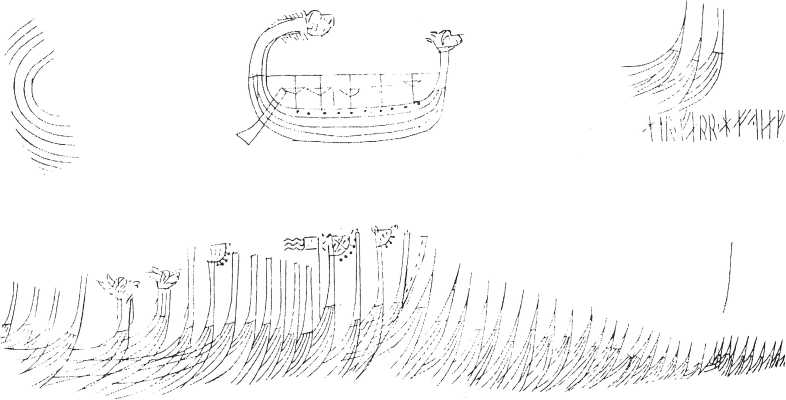
Slike fløyer må ha vært ganske vanlige i vikingtiden ettersom de også ble støpt i miniatyrutgaver i bronse. Vender man på 112 bildet av minityrfløyen fra Rangsby i Saltvik sn. på Åland blir fløyformen tydelig, og det lille bamseaktige fjeset viser klart slektskap med Lillevangspennens mastehode. De hører til et gripedyr i såkalt Borrestil, oppkalt etter noen forgylte bronsebeslag fra den store skipsgraven på Borre i Vestfold fra ca. 900. Miniatyrfløyer av denne typen er kjent fra tre funnsteder, Åland, Birka i Mälaren og Menzlin i Ostvorpommern, mens en yngre type med et dyrehode ytterst foreligger fra så vidt forskjellige lokaliteter som Novosjolkt nær Smolensk i Russland, Bandlunde på Gotland og Lovö i Mälaren. To forvitrete miniatyrfløyer fra en skadet branngrav i Dalarna i Sverige bringer antallet opp i åtte, noe som tyder på at det er en sjelden, liten gjenstand. Hvordan den har vært anvendt er usikkert. Jan Peder Lamm har foreslått at de har stått på små skipsmodeller som prominente mennesker i vikingtiden hadde i sine haller! De store skipsfløyene fra sen vikingtid, som ble kalt veðrviti, finnes det faktisk tre velbevarte eksemplarer av fordi de endte sine dager som vindfløy på kirker. Det er Soderala kirke i Hålsingland, Heggen kirke i Buskerud og Kållunge kirke på 180-182, 193 Gotland, der fløyen satt på kirkespiret helt til 1930. En eldre tegning viser at fløyene opprinnelig ikke var plassert på kirkespiret som værhaner men at de stod skrått på selve kirkemønet som på langskipene. Forbindelsen mellom skip og kirke i middelalderen er at leidangskipenes seil og utstyr ble oppbevart på kirkeloftene, og det er vel helst de store leidangskipene med sine fløyer som er ”avbildet” på knortekjeppen fra Bryggen i Bergen.
Gripedyret
Vikingtidens kunst er variert og på mange måter annerledes enn i de foregående hundreårene bortsett fra at dyremotivet står sterkt. Flere kunststiler opptrer samtidig, og det er tydelig at den andre halvdelen av 700-tallet representerer en fornyelsesperiode med eksperimentering med nye former og fremstillinger. De smale, båndformete dyrefigurene i symmetrisk oppbyggete, kontrollerte billedstrukturer som karakteriserer den siste av Vendelstilene, Stil D, brytes i Vest- og Sydvest- Skandinavia av en slags blandingsstil (Stil F). Noen har kalt den ”misjonsstil” fordi den er preget av kontinentale kunsttradisjoner tilknyttet anglo-kontinental stil og henger sammen med den sterke misjonsvirksomheten som fant sted fra annen halvdel av 700-tallet til første halvdel av 800-tallet. I 826 kom f. eks. den første misjonæren, benediktinermunken Ansgar til Hedeby, og tre år senere tar han seg med stor møye og stort besvær til Birka i Mälaren. Det finnes også en Stil III/E som særlig forekommer på Gotland i slutten av vendeltid og fortsetter å utføres i tidlig vikingtid på store, barokke ryggknappspenner der hver del er støpt som en hul eske. Eskenes overside er prydet med innfattete granater, gullblikk og høye knopper. Mange av ryggknappspennene er mesterverk prydet med dyreornamentikk og forgylling på alle flater.
Et nytt motiv av en helt annen karakter kommer til - det livlige gripedyret. Det har fått sitt navn fordi dets fire føtter griper tak i omgivelsene enten de består av en ramme, et annet dyr eller sine egne lemmer. Dets hode er fremstilt en face med store, stirrende øyne og ofte med hårtofs. Det hender at det griper tak i sine egne munnviker så tennene blottes. Gripedyret innleder vikingtiden der kunsten endrer karakter under innflytelse av kristne, orientalske og irske motiver i metallkunst og bokmaleri. Plantemotiver som akanthus og vinranker med fugler og dyr formidles til nordiske metallhåndverkere via vikingenes herjinger i kirker og klostre der store kunstskatter ble røvet, men også via frankiske og angelsaksiske misjonærer som brakte med seg sine liturgiske bøker og gjenstander. Gaveutveksling mellom nordiske konger og høvdinger i politisk hensikt førte også til at nye og egenartete kunstgjenstander kom inn i miljøer der de ble kopiert og gitt en annen funksjon. Et av de klassiske eksemplene er den treflikete spennen, et kvinnesmykke til å holde sammen en kappe eller kåpe på brystet. Opprinnelig var den treflikete spennen en remfordeler til et frankisk sverdoppheng og var dekorert med planteornamentikk. Men vikingtidens våpenføre menn bar sverdet i beltet uten bandolær og forærte sine kvinner den frankiske remfordeleren omgjort til hengesmykke eller spenne. Raskt ble formen opptatt av smykkesmedene og utstyrt med nordisk ornamentikk, noe den egnet seg vel til.
De tre tidligste stilgrupper i vikingtiden kalles Broa, Berdal og Borre etter funnsteder for viktige funn, og gruppene er utskilt på grunnlag av dyremotivenes formmessige forandringer. Men på en og samme gjenstand kan flere stiler være representert, noe som viser at de overlapper hverandre i tid. Gripedyret utviklet seg etterhvert til en liten bamseliknende skapelse, ”Borredyret”, og tre slike gripedyr er et vanlig motiv på de treflikete spennene. Gripedyrmotivet ble veldig populært, og nordboerne tok det med seg til de Britiske øyer, der det i de senere år er kommet mange gode eksempler takket være metalldetektorene. To norske funn viser at gripedyrmotivet også kunne friste den hendige til rundskulptur. Figurene, to bjørner (?) som holder i hverandre og et fantasidyr med blottete tenner er laget av jet, et amorft stenkull som bare finnes i England og som var populært til smykker, særlig armringer. Hvor gripedyret ble til og hva som var inspirasjonen til et så awikende dyremotiv, er ikke klarlagt. Men at det er et fremmedelement i nordisk kunst er alle enige om, og muligens kommer inspirasjonen fra England eller fra såkalt anglo-kontinental stil - misjonærstilen. I sin tidlige form er gripedyret sterkt asymmetrisk og ses ofte på nøkler, der det synes å turne inne i nøkkelhodet, men også på ovale draktspenner. I den senere Borrestilen blir gripedyret temmet. Det får bamseliknende hode med ører og en kropp som er ordnet symmetrisk om en ryggrad/midtakse. Men hva symboliserer gripedyret? Ingen vet, men dets apotropeiske betydning burde være sikker.
Kvinner skaper klær, menn støper smykker
Kvinnedrakten i vikingtiden var ganske stereotyp, men dens faste smykkeinventar ga gullsmedene muligheter for å briljere i de skiftende ornamentstilene. Innerst bar kvinnen en lang serk av lin som kunne være plissert og ble lukket i halsen med en liten, rund spenne. Derover bar hun en selekjole og ytterst en kappe eller kåpe. Til festdrakten, som hun var ikledt for sin siste reise, hørte det ikke belte. Men til hverdags kan hun ha hatt et tekstilt belte til kniv og nøkler slik som folkevandringstidens husfruer. Selekjolens seler bestod av to løkker av stoff, to lange som gikk fra ryggen over skuldrene og to korte på forsiden. Løkkene ble festet sammen ved hjelp av en oval, skålformet spenne av bronse på hver side av brystet, og det er særlig disse spennene som ble utstyrt med rik ornamentikk. Den ovale spennen skapes allerede i 8. årh. og minner om et sammenkrøpet urtidsdyr, en slags trilobitt, sett ovenfra. Men den typiske ovale draktspennen ble tydeligvis skapt av en kunsthåndverker i Ribe i slutten av 8. årh. og kalles Berdalspenne etter et funnsted i Vest-Norge. Derfor ble den tidlige vikingtidens dyrestil med gripedyr tidligere kalt Berdalstil. Utover i vikingtiden ble de ovale spennene serieprodusert i stadig større og bredere utgaver og dessuten utstyrt med en brem nederst. Nihundreårenes serier av ovale spenner har dobbelt skall,- et glatt, forgylt underskall og et overskall i gjennombrutt mønster inndelt i felter ved hjelp av listverk. Listene ble dekorert enten med hvitmetall og niello eller med pålagte, flettete sølvsnorer. Der listene krysser hverandre, satte gullsmedene gjennombrutte knapper av forgylt sølv eller bronse så hele overflaten ga et levende, plastisk inntrykk. Den samme plastisiteten preger også de gotlandske dåseformete spennene og enkelte likearmete spenner. Mellom de ovale spennene hang kvinnene rader av fargerike perler av glass, rav, karneol og små amuletter av sølv. I yngre vikingtid var det vanlig med en ring festet til bremmen der en kniv, en nøkkel eller annet kunne festes. Da vikingtidens kvinnedrakt gikk av mote i 10.-11. årh. i Skandinavia, skapte de finske og baltiske smykkesmedene en smalere, spissoval variant med egen ornamentikk.
De gotlandske kvinnene bar en liknende drakt med selekjole men uten ovale spenner. Her var de erstattet med relativt små, dyrehodeformete spenner av bronse. Hodene ser ut som en blanding av bjørn og svin med tydelig tryne og små, runde ører. Det er ikke antydning til øyne. På baksiden finnes en bunnplate til feste for nål og nåleskjede. Forsiden av spennene er delt inn i felter ved hjelp av listverk og dekket av dyreornamentikk eller bare prikker. Mellom dyrehodespennene hengte kvinnene flere kjeder av bronseringer festet til kjedeplater formet som masker. Slike gikk av moten i yngre vikingtid, men bronsekjeder festet til runde eller spissovale draktspenner levde videre som en viktig del av den finske kvinnedrakten i sen vikingtid og tidlig middelalder. Typisk for Gotland er hengesmykker i form av fiskehoder i bronse som ble tredd ved siden av hverandre i lange kjeder og festet til de dyrehodeformete spennene. Ved vikingtidens slutt hendte det at man festet sammen to og to fiskehoder ved hjelp av nitter og gjorde dem om til en draktspenne med nål på baksiden. De runde, dåseformete spennene som holdt sammen ytterplagget foran var også noe helt eget for Gotland. I resten av Norden brukte kvinnene i tidlig vikingtid en likearmet spenne eller en trefliket spenne og senere runde, gjennombrutte spenner med fremstilling av en profilsett rovfugl eller formet som en dyrefigur sett ovenfra. Kvinnedrakten med parspenner synes å ha vært forbundet med en kvinnerolle som ikke var mulig etter at kristendommen fikk fotfeste i Skandinavia. Dyreornamentikken på draktens ovale og andre spenner hang trolig sammen med de ritualer som kvinnene stod for og som hørte til de nedarvete trosforestillingene der seid var en viktig del.
Vikingtidens våpenføre mann bar få smykker. En ringspenne eller en ringnål av sølv eller bronse til å feste kappen over skulderen var det viktigste. En liten spenne lukket tunikaen i halsen, og livremmen kunne være utstyrt med remspenne og beslag av bronse. Sverdet i sin dekorerte sverdskjede var mannens fremste statusobjekt. Var klingen mønstersmidd og knapp og hjalter prydet med ornamentikk i edelmetaller eller kobber, ga det et tydeligere budskap om mannens status enn noe smykke. De store ringnålene av sølv er meget sjeldne i gravfunn, men dessto vanligere i sølvdepotetene fra vikingtiden både i Norden og på De britiske øyer. Der bar menn ringspennen med nålen opp, og den antok etterhvert en slik lengde at den ble farlig for omgivelsene.
Jellingestenen
De sene kunststilene i vikingtiden er knyttet til typiske aristokratiske miljøer og har navn etter funnstedet for de mest karakteristiske objektene, Jelling, Mammen, Ringerike og Urnes. I de tre sistnevnte er motivene hovedsakelig store, klart tegnete firbente dyr og store fugler. Jellingestenens store, løveliknende dyr i kamp med slangen er ikke tegnet i Jellingestil men i Mammenstil. Opprinnelsen til motivet det store dyret har man søkt i kontinental og angelsaksisk kunst, men uten å løse problemet. Både fornnordiske og kristne myter kan ligge til grunn for fremstillingen og avspeiler den overgangstiden kunststilene er blitt til i.
”Kong Harald bød gjøre denne kuml etter Gorm sin far og etter Thyra sin mor. Den Harald som for seg vant hele Danmark og Norge og gjorde danene kristne.” Dette er den 2,4 m høye Jellingestenens korte og pregnante budskap i runer. Dertil kommer fremstillingen av Kristus som den seirende herskeren bundet av ormliknende båndslyng på den ene av stenens billedsider med teksten ”og gjorde danene kristne” under. Det store firbente dyret med ormen finnes på den andre billedsiden. Kong Harald Blåtann stod med ett ben i den gamle verden med sine trosforestillinger og med et i den nye verden med kristendommen. Det avspeiles i hele komposisjonen av dette dynastiske anlegget med de to kjempemessige haugene, med kong Gorms minnesten over sin hustru Thyra, Harald Blåtanns monument og kirken. Haugene ble undersøkt i 1820 og 1941. Den nordre inneholdt en plyndret kammergrav og den andre viste seg ikke å være noen gravhaug. Begge er bygget over en 170m lang skipssetning. Under 1100-tallskirken, som ligger mellom haugene fant man i slutten av 1970-årene sporene etter tre eldre kirker, hvorav den eldste antagelig er den som kongen lot bygge da han ca. 960 gikk over til kristendommen. I kirken fant man en kammergrav med restene etter to personer som vel er Thyra og Gorms jordiske rester og som sønnen Harald flyttet til en kristen grav etter sin egen omvendelse. I Nordhøjen ble det bl.a. funnet et stort vokslys og et ørlite sølvbeger på fot, delvis forgylt og med en dekor som har gitt navn til tidens kunststil, Jellingestilen. På 186 Jellingebegeret, som antakelig er en kristen reisekalk, ses to båndformete dyrefigurer med løftet forben på hver side av en kurvliknende figur med to vifteformete akanthusblader.
Jellingestilen, som i sin tidlige fase er todimensjonell og flatedekkende, har som hovedmotiv et båndformet, profilsett dyr i S-form med hale. Det har hode med stort øye, åpen munn med lang tunge og av og til en huggtann. Fra hodet går det ofte ut en nakketofs, og kroppen er tverrstripet eller/og perlet. Slektskapet med Stil III er tydelig, og det er mulig at stilen er oppstått i det skandinaviske miljø i York. Ettersom denne dyrestilen også er belagt i skipsgraven fra Gokstad i Vestfold, har man ved hjelp av dendrokronologi kunnet datere Jellingestilens tid mellom slutten av 9. årh. og midten av 10 årh. Den har tydeligvis hatt en tilknytning til kongelige kretser og til aristokratiet.
Mammen
Bjerringhøj, en relativt liten gravhaug i Mammen sør for Viborg ble plyndret i 1868. Den dekket over et kammer 3m x l,9m med vegger av stående, tiløksete eikeplanker og 6 takbærende stolper. I en plankekiste lå en mann og antagelig en kvinne i praktfulle klær med broderier og gullinnvirkete bånd. Gravgodset som gikk an å rekonstruere, bestod av en jernøks helt dekket av ornamentikk innlagt i sølv, minst ti paljetter av gullblikk fastsydd på drakten, tekstilrester samt to armbånd av tekstil. Dessuten fantes pelsrester av murmeldyr, en udekorert jernøks, to trespann, en bronsekjele, spillebrett (?) og et 3,7 kg stort vokslys. Begravelsen har foregått i år 970/971, da Danmark offisielt var kristnet, men bortsett fra vokslyset viser graven ingen spesielt kristne trekk. Den praktfulle øksen har en profilsett fuglefigur på den ene siden av bladet og et stilisert tre på den andre. Treet kan tolkes både som asken Yggdrasil og som det kristne Livets tre, og fuglen som både hanen Gullenkamme som galer for å varsle æsene om at verdens undergang, Ragnarok er nær eller som Fugl Fønix, et kristent symbol for Kristus og oppstandelsen. Det er sannsynlig at paret i Bjerringhøj hørte til Harald Blåtanns krets.
På kjøretøyet skal storfolk kjennes
I et grustak i nærheten av Mammen kirke ble det i 1871 funnet et håndverksdepot inntullet i linstoff. Det inneholdt pressblikk med menneskemasker, en bronsepatrise til et rektangulært beslag, et låsebeslag av bronseblikk, fragmenter av minst to bronsekar samt ornamenterte kant- og endebeslag til to høvrer (mankestoler) av tre. Beslagene er av forgylt bronse og fylt til bristningspunktet av båndformete dyrefigurer, ormer og en liten kvinnefigur med en plante i hånden (Bind 1, 39), alt i Jellingestil med innslag av Mammenstil. Endebeslagene er formet som plastiske dyrehoder med åpen kjeft, omslynget av ormer og med en plastisk dyrefigur i den åpne kjeften.
Prakthøvrer som disse fra Mammen kjennes bare fra Danmark - fra Elstrup på Als, Møllemosegård ved Nybølle på Fyn og de aller fornemste - et par fra en plyndret gravhaug i Søllested på Fyn. De henger sammen med vogner, veier og et samfunnssjikt som stod over vanlig folk og lot seg frakte ved spesielle anledninger. Det finnes firhjulte vogner i Jylland fra førromersk jernalder, bl.a. de elegante vognene fra Dejbjerg præstegårdsmose sørøst for Ringkøbing. Men det er vel usikkert om de ble brukt i verdslig øyemed. Tacitus forteller i sin bok om germanerne fra år 98 e.Kr. om den germanske gudinnen Nerthus hvis bilde om våren ble fraktet rundt i en vogn trukket av kyr. Men for de danske sene vikingtids vognene har hesten vært trekkdyret. Hest og vogn har ikke vært så uvanlig som prakthøvrene antyder, men ellers i Skandinavia har høvrene har vært enklere. De har vært av tre, men øverst har det sittet et ornamentert bronsebeslag med plass til en tømme i hvert sitt hull. I skipsgraven fra Oseberg i Vestfold fantes en vogn med rike utskjæringer. Vognen består av en løs vognkasse på et hjulstell av massive hjul med korte eiker inn mot hjulnavet. Denne vognen kan ikke svinge, men bare rulle rett frem ved hjelp av to trekkdyr og har således neppe vært et vanlig kjøretøy. Til Osebergkvinnens utstyr hører også et langt billedteppe, en revle med fremstillinger av bl.a. kultiske opptog med såvel overdekkete vogner trukket av hester som vogner med passasjerer. Fire dyrehodestolper av tre med rik utsmykning i karveskurd bør trekkes frem i denne sammenhengen. De er både form- og motivmessig beslektet med endebeslagene på de danske prakthøvrene og har som dem sikkert vært knyttet til bestemte ritualer der opptog med vogn inngikk. Vogner trukket av hester er fremstilt på en av de gotlandske gravkistene, slike som bare ble benyttet til kvinner. Såvel gravfunn som litterære henvisninger gir inntrykk av at den fornemme kvinnens fremkomstmiddel i vikingtiden var den hestforspente vognen mens mannen red. Men at hest og vogn ble brukt i helt bestemte sammenhenger gir også Søllestedhøvrene bud om.
En høvre (fornnordisk hyfri) ble lagt på hestens rygg rett bak manken og fungerte som holder for tømmene. Ved hjelp av en bringerem og en bukgjord bar den tyngden av selen og vogndragene. De to høvrene fra Søllested har vært til en vogn trukket av to hester. De er 36,5 cm lange, halvrunde med flat underside. I hver ende sitter et dyrehode av forgylt bronse med runde, stirrende øyne, store, runde ører og en åpen kjeft full 208 av tenner. Hver eneste del av høvrens overflate er fylt med dyreornamentikk både som flatedekor og som rundskulptur, og det er brukt niello, innlegning med blått glass og sølvblikk for å fremheve detaljer. Høvrens langsider er dekorert med mannsmasker som holder seg fast i barten med små hender, og høvrens kam er dekket av forgylte bronsebeslag med rik ornamentikk av profilsette dyrefigurer og rovfugler. Kammen krones av et buet overstykke med et gjennombrutt ornament nærmest i rundskulptur. Dets sentrale del har ett hull for begge tømmene, og dype slitespor viser at det har gått to tømmer gjennom hver av høvrene. Over tømmehullet ses et buet parti der to små figurer, åpenbart en mann og en kvinne sitter vendt mot hverandre. De minner om gullgubber. Fremstillingen på hver side synes å være illustrasjoner til en beretning om verdens undergang der drakeliknende fantasidyr og slanger med rovfuglhode biter og hakker. Høvrenes samlete ornamentikk utgjør åpenbart et billedprogram der det buete midtpartiet er sentralt. Det er tolket som en hall der to av gudene sitter. Noen har villet se Frøya og Odin som skuer utover verden fra Odins høysete. Andre følger den norske forskeren Gro Steinsland som har tolket gullgubbene med par, og mener at bildet symboliserer hieros gamos,- foreningen av en mannlig guddom og en jotunkvinne i et hellig bryllup. Det kan være knyttet til myten om Frøy og Gerd, som det berettes om i Eddadiktet Skirnismál, eller til en myte om Odin og Skade som Øyvind Skaldespiller nevner i sitt dikt Håløygjatal. Guden blir i en slik sammenheng en arketyp for den mektige og potente fyrsten og jotunkvinnen representerer det landområdet som fyrsten skal innta. Ser man på Søllestedhøvrene ut fra et slik tolkning, kan de ha fungert i en rituell brudeferd. Slitasjen fra tømmene kan tyde på at brudeferden har vært gjentatt mange ganger, kanskje som et ledd i årstidsriter. De kjempende rovdyrene, slangene og rovfuglene bringer tankene til kaos og undergang. Ved det hellige bryllup overvinnes undergangskreftene og jorden bli på nytt fruktbar. Høvrene er kommet i graven i siste halvdel av 10 årh. i et aristokratisk miljø som må ha vært knyttet til det kristne kongesetet i Jelling. De gamle trosforestillingene og ritualene gikk kanskje i graven med høvrene.
De siste dyrestilene
Ringerikestilen (ca. 975-1050) hører også med til fremveksten av det danske Nordsjøveldet og er beslektet med både Jellingestilen og Mammenstilen. Også her handler det om store, heraldiske løvedyr, fugler og ormer. Ormenes kropper danner løkker, og utfra disse vokser det planter og ranker. Et godt eksempel er vindfløjene fra de store vikingskipene. Den siste av vikingetidens dyrestiler er Urnesstilen oppkalt etter nordportalen på Urnes stavkirke i Sogn. Her møter vi en myk og smidig fremstilling av et langbent dyr som “kjemper” med en orm. Urnesstilen kalles også for runestensstilen fordi den er så godt representert på de mange svenske runestenene som ble reist i tiden fra ca. 1050-1150. Den ble populær også på de Britiske øyer, og hovedmotivet med det langbente dyret og ormen finnes på et stort antall draktspenner av sølv. På Gotland, der skikken med å gravlegge mennesker fullt påkledt med smykker og mindre eiendeler varte flere generasjoner lengre enn ellers i Skandinavia, finnes et rikt utvalg av gjenstander ornamentert i Urnesstil. Spesielt er det at man på baksiden av dåseformete praktspenner finner de 8-tall formete ormslyngene. Den delen av spennen vendte inn mot kvinnens kropp, og det ligger derfor nær å anta at ormene har hatt en spesiell, kanskje apotropeisk funksjon.
Jernalderens menneskers hadde et nært forhold til dyret og fuglen som meningsbærende motiver i kunsten. Mellom den urytmiske Stil I med sine oppstykkete figurer til Urnesstilens graciøse linjer ligger mer enn 600 år. Motivene var knyttet til trosforestillinger og ritualer som langsomt endret seg under påvirkning fra konge- og fyrsteslektene på kontinentet. Motstanden mot kristent tankegods synes å ha vært sterkest i folkevandringstiden og i vikingtiden, men kristne myter og motiver kom likevel inn etterhvert. Vikingenes angrep på klostre og kirker i Vest-Europa kan også ses som et angrep på kristendommen med sitt annerledes syn på menneskene. Ætten var jernaldermenneskenes sentrum i tilværelsen. Bare som et medlem av en ætt var de mennesker. Ved hjelp av fejde, hevn og bøter ble konflikter mellom ættene ordnet, og ved hjelp av sjamanistiske ritualer forsøkte den seidkyndige kvinne eller mann å få kontakt med gudene og se inn i fremtiden. Trosforestillingene om menneskets alter ego i form av et dyr, om frisjelen som kunne sendes avsted på oppdrag i skikkelse av en fugl, et stort dyr eller en orm og om menneskets onde hug i form av ulver påvirket deres liv i alle dets avskygninger og var grunnlaget for deres kunst .
Stridsulv, Sverdulvs ættling
ristet disse runer
til minne om Hærulv.
Stridsulv satte (rune)staver tre: kveg, kveg, kveg.
Mektige runers hemmelighet
gjemte jeg her kraftfulle runer.
Den som bryter dette minnesmerket
skal evig plages av ergi.
Svikefull død skal ramme ham.
Jeg spår fordervelse.
Innskrifter fra 7 årh. på tre runestener fra Blekinge: Istaby, Gummarp og Bjørketorp. Oversettelse R.B.F. Jansson 1984.
Forkortelser
NM: Nationalmuséet, København.
HAM: Haderslev Museum.
KM: Finlands Nationalmuseum, Helsingfors.
SHM: Statens Historiska Museum, Stockholm.
GF: Gotlands Fornsal, Visby.
UMF: Universitetets Museum för nordiska fornsaker, Uppsala.
VGDE: Valsgärde.
C: Universtitetets Kulturhistoriske Muséer, Oldsaksamlingen, Oslo.
B: Bergen Museum, Universitetet i Bergen.
S: Arkeologisk Museum i Stavanger.
T: Vitenskapsmuséet, Universitetet i Trondheim.
Kronologisk liste
Førromersk jernalder: ca., 500 f.Kr. - Kr. f.
Eldre romertid: ca. Kr.f. - ca. 200 e.Kr.
Yngre romertid: ca. 200 e.Kr. - 400 e. Kr.
Folkevandringstid/ Ældre germanertid: ca. 400 e.Kr. - ca. 550 e.Kr.
Merovingertid/ Vendeltid/ Yngre germanertid: ca. 550 e.Kr. - ca. 800 e.Kr.
Vikingtid: ca. 800 e.Kr. - 1050 e.Kr.
Til bildene
-
Armring av sølv. Diam. 8 cm. Enkeltfunn. Orupgård, Idestrup s., Falster Sdr. h., Maribo amt. NM Dnf 14/48.
-
Vridd gullhalsring med pæreformet lås. Vekt 14,25 g. Depotfunn. 3. årh. e.Kr. Erikstrup, Østofte s., Fuglse h., Maribo amt. NM 19250. (Ytterst) Vridd halsring av gull. Vekt 99 g. Enkeltfunn sammen med deler av skjelett. Førromersk jernalder. Lavindsgårdsmose, Rønninge s., Åsum h., Odense amt. NM Dnf 4/47.
-
Fingerring av gull med innfattet romersk gemme av blått glass. Mannsgrav. 3. årh. e.Kr. Hågerup, Brahetrolleborg s., Sallinge h., Svendborg amt. NM C 23248-59.
-
Ormhode- ev. ravnehodefingerring av gull. H. 4,2 cm., indre diam. 2 cm. Vekt 26,2 g. Mannsgrav. 3. årh. e.Kr. Himlingøje, Himlingøje s., Bjæverskov h., Præstø amt. NM C 29979.
-
Remfordeler av bronse. L. på hvert ledd ca. 8,5 cm. Enkeltfunn. Bregentved, Osted s., Voldborg h., Københavns amt. NM C 7696.
-
Armring av gull. 3. årh. e. Kr. Depotfunn. Burs, Kållunge sn., Gotland. GF C 9991-
-
Halsring av gull. 23 x 31 cm, vekt 317 g. Votivfunn. 4-5. årh. e. Kr. Hellested s., Stevns h., Præstø amt. NM C 6487.
-
Draktnål av bronse. Enkeltfunn. Førromersk jernalder. Rørkjær mose, Vindum s., Middelsom herred., Viborg amt. NM C 3932. Om nålen til venstre foreligger ingen opplysninger.
-
Dyreformet spenne av bronse. 4. årh. Gravfunn. Kvassheim, Hå, Rogaland. B 5301c.
-
Vektlodd av messing i form av en gjeitebukk. L. 3,4 cm. Middelalder. Lid ytre, Aurland k., Sogn & Fjordane. B 7979.
-
Liten bukk av bronse. L. 2,6 cm, H.3,2 cm. Middelalder. Høyland, Hå k., Rogaland. B 6256.
-
Beslag av forgylt sølv i form av en dyremaske. Dobbeltgrav. 6. årh. Øvsthus, Kvinnherad k., Hordaland. B 3731i.
-
Plateformet fibula av bronse. Enkeltfunn. Førromersk jernalder. Skjoldemosen, Nr. Alslev s., Falster Nr., Maribo amt. NM C 18553. Til høyre: Platenål av bronse. Funnsted ukjent. Førromersk jernalder. NM C 21357.
-
T-formete fibler. Førromersk jernalder. Grav 25. Mellersta gravfältet. Vallhagar, Fröjel sn., Gotland. GF u.nummer.
-
Detalj av foregående. Fiblens nåleholder har form som et langt svinetryne.
-
Draktspenne av gull med granater i cloissonné. I midtfeltet et kors. Mellom fire langhalsete rovfuglhoder titter det frem fire masker hvorav to har bart. L. 5,6 cm. Vekt 36,4 g. Enkeltfunn. 6. årh. e. Kr. Reinstrup, Sorø. NM Dnf 4/18.
-
Til venstre: Hengesmykke av gull med slipte granater. Inne i smykket finnes tre rør, trolig til duftstoffer. Romersk arbeide. Depotfunn. ca. 400 e.Kr. Hesselager Fredskov, Hesselager s., Gudme h., Svendborg amt. NM Dnf 2/50. Til høyre: Toleddet armring av gullblikk med motstående dyrehoder. Trolig fra Svartehavsområdet. 4. årh. Depotfunn i mose. Tebbestrup, Galten s., Randers amt. NM C 18889.
-
Beslag av forgylt sølvblikk på sverdskjede. Gravfunn. 4. årh. Rømme, Orkanger k., Sør-Trøndelag. T 15339.
-
Sverd av jern med over- og underhjalt av forgylt sølv og knapp i cloisonné med glass. Enkeltfunn fra en sjø. 675-725 e.Kr. Bildsø, Slagelse. NM u.nummer,
-
Fugleformet knapp av bronse med innlagte detaljer i sølv og med stempelornamentikk. Trolig til en stav. L. ca.12 cm. Enkeltfunn. 5. årh. e. Kr. Grenåegnen. NM C 6416.
-
Beltebeslag av bronse med ildslagningsstein av kvartsitt. Detalj. Gravfunn. 5-6. årh. e.Kr. Hove, Vik, Sogn & Fjordane. B 561.
-
Beltebeslag (?) av bronse med ring. Enkeltfunn. Uviss datering. Klim, Thisted. NM C 12277.
-
Korsformet fibel av bronse med innlagte detaljer i sølv. Detalj av foten. Gravfunn. 5. årh. e. Kr. Staurnes, Giske, Møre & Romsdal. B 719.
-
S-formet spenne av forgylt sølv med stempelornamentikk og detaljer innlagt med niello. Gravfunn. 5. årh. e. Kr. Hol, Inderøy, Nord-Trøndelag. T 9827.
-
Nedre del av relieffspenne av forgylt sølv. Gravfunn. 5. årh. e.Kr. Møllebakken, Gudhjem s., Bornholm. Samme bilde som 201. NM C 6.
-
Detalj av toleddet beltespenne av forgylt sølv med innlegg av niello. Våpenofferfunn. 5. årh. e.Kr. Ejsbøl mose, Haderslev. HAM E 9733 og 9864.
-
Kringleformet beslag av forgylt sølv med rovfuglhoder. Br. 4 cm. Våpenofferfunn. 5. årh. Ejsbøl mose, Haderslev. HAM E 7724 og E 9287.
-
Utsnitt av toleddet beltespenne av forgylt sølv innlagt med niello. 5. årh. Våpenofferfunn. Ejsbøl mose, Haderslev. HAM E 9413. Jfr. 29.
-
Som foregående. Hele beltespennen. Legg merke til de seks dyrehodene på selve spennedelen.
-
Remspenne av bronse med mannsmaske omgitt av rovfugl, villsvin, ulv. Hel bredde 8,5 cm. 6-7. årh. Uten opplysninger. Sjælland. NM C 5480.
-
Doppsko av forgylt sølv til sverdskjede. 5. årh. Våpenofferfunn. Ejsbøl mose, Haderslev. HAM E 8941.
-
Relieffspenne av sølv (detalj). Den er brukket av i oldtiden og den opprinnelige formen er uviss. Full lengde 8,5 cm. Depotfunn. 5. årh. Galsted, Agerskov s., Nr. Rangstrup h., Haderslev amt. NM DCCXXXVIII.
-
Relieffspenne av forgylt sølv med niello. Stil I. Votiv/depotfunn. 5. årh. e.Kr. Gummersmark, Bjæverskov s. og h., Præstø amt. NM C 12524.
-
Som foregående. Detalj.
-
Som foregående. Detalj. Under de vannrett liggende dyremaskene finnes en stor stupende fuglefigur sett ovenfra.
-
Relieffspenne av sølv. Detalj av foten med to profilsette rovfuglhoder og tre dyremasker nedenfor. Stil I. L. 12,3 cm. Ukjent sted. Danmark. NM C 21405.
-
Foten av samme relieffspenne som 33. To profilsette dyrefigurer med spisst øre og lang tunge på hver side av en maske en face. NM C 12524.
-
Relieffspenne av forgylt sølv med niello. Spiralornamentikk i karveskurd, meander og løpende hund i dypt relieff på knottene. Havuhyrer kryper langs fotens og hodeplatens utside. Nydamstil. Enkeltfunn. 5. årh. e.Kr. Skjerne, Gunslev s., Falster Nr. h., Maribo amt. NM C 2217.
-
Relieffspenne av sølv. Hele spennen. NM C 21405. Jfr. 36.
-
Detaljer fra Gummersmarkspennens hodeplate. Jfr. 33.
-
Relieffspenne av forgylt bronse. Detalj. 5-6. årh. e.Kr. Högbro, Roma, Gotland. GF C 1763.
-
Relieffspenne av forgylt bronse med innlagte granater. L.15,4 cm. Løsfunn. 5-6. årh. e. Kr. Lundbjers, Lummelunda, Gotland. GF C 7182.
-
Detalj av foregående. På hver side av bøylen finns en maske.
-
Detalj av foregående spennes hodeplate.
-
Detalj av foregående spennes fot.
-
Øverst: Relieffspenne av forgylt sølv med niello. Detalj av hodeplaten med dyp karveskurdsornamentikk. Gravfunn. Møllebakken (II), Østerlarsker, Bornholm. NM C 33. Relieffspenne av forgylt sølv med niello, stempelornamentikk og karveskurdsornamentikk. Detalj av spesiell hodeplate med to profilsette rovfuglhoder og tre rovfuglhoder sett ovenfra. Jfr. fingerringen 4. Gravfunn. 4-5. årh. Møllebakken (I), Østerlarsker, Bornholm. NM C 32.
-
Som 42. Fotens avslutning med maske. Legg merke til ytterlistene med profilsette rovfuglhoder.
-
Relieffspenne av forgylt sølv med niello og gjennombrutt innramming av hodeplaten. Votivfunn i mose med gullbrakteater og glassperler. Over-Hornbæk, Hornbæk s., Sdr. Lyng h., Viborg amt. NM C 9614.
-
Til venstre: Liten relieffspenne av forgylt sølv med niello, stempelornamentikk og karveskurdsornamentikk som avsluttes med en dyremaske. Melsted (I), Bornholm. NM C 2944. Liten relieffspenne av forgylt sølv som avsluttes med en rovfuglmaske med bredt nebb. Stempelornamentikk og spiraler i karveskurd. Melsted (III), Bornholm. NM C 34.
-
Fotdelen av 46 nederst. Fire langhalsete fuglehoder omkring et midtornament. Sml. fig. 16. Spennen avsluttes med et fuglehode med runde øyne sett ovenfra. Full lengde 16,4 cm. NM C 32.
-
Detalj av hodeplaten på spennen 48. Båndformete, gjennombrutte dyrefigurer samt en spiralranke rundt et firkantet midtfelt.
-
Flat ring av bronse med pånittete dyrefigurer av sølv. Diam. 9 cm. Løsfunn. Jernalder. Horsens. NM C 25569.
-
Relieffspenne av forgylt sølv. Gravfunn. 5. årh. Hol, Inderøy, Nord-Trøndelag. T 9822.
-
Tveegget gullgrepsverd. Detalj av overhjaltet i forgylt sølv med rankeornamentikk og knapp. 6. årh. e.Kr. Grav V, Snartemo, Hægebostad, Vest-Agder. C 26001.
-
Detalj av fotens høyre side på relieffspennen 53.
-
Detalj av fotens venstre side på relieffspennen 53.
-
Likearmet draktspenne av bronse med knapp. På den øvre halvdelen ses to hestefigurer med føttene mot hverandre, og på den nedre to dyrefigurer med nakketofs plassert på samme måte. L. 10,1 cm. Votiv/depotfunn. 5. årh. e. Kr. Holmgård, Skals s., Rinds h., Viborg amt. NM J. nr. 6, Mus. nr. 36.
-
Baksiden av knappen på sverdet 19. To båndformete dyrekropper hvis lår og bakben danner en maske. Stil II. NM u. nummer.
-
Beslag av forgylt bronse fra relikvieskrin. Irsk arbeid. 7,5 x 7,5 x 7,5 cm. Innsendt fra Norge. (Fra Nationalmuseets komparative samling). NM 624.
-
Likearmet spenne av forgylt sølv med niello. Gravfunn. 5. årh. e.Kr. Hol, Inderøy, Nord-Trøndelag, jfr. 53, 55, 56, 62. T 9823.
-
Remendebeslag av forgylt sølv. L. 5,5 cm. Våpenofferfunn. 5. årh. e. Kr. Ejsbøl mose, Haderslev. HAM E 8956.
-
Den andre halvdelen av 60.
-
Draktspenne av bronse i form av en rovfugl. Vendeltid. Silte sn., Gotland. GF C 9017.
-
Draktspenne av forsølvet bronse. 7. årh. e. Kr. Jelling s., Tørrild h., Vejle amt. NM C 22253.
-
Hesteformet platespenne av bronse. Løsfunn. 7. årh. e.Kr. Veggerslevmose, Veggerslev s., Djurs Nr. h., Randers amt. NM C 6592.
-
Smykkeplate av forgylt bronse. Profilsett rovfugl med slange i nebbet. Løsfunn. Yngre germanertid. Kobbeå, Østerlars, Bornholm. NM C 5955.
-
Plateformet draktspenne av forsølvet bronse. Løsfunn. Vikingtid. Borritsøe toft, Viborg amt. NM MMCXCVII.
-
Ryggknappspenne av bronse med belegg av hvitmetall. Vendeltid. L. 11 cm. Ukjent sted. Gotland. GF Dep 482.
-
Hank på trekar i form av rovfuglhode. 6 årh. e. Kr. Votivfunn. Vimose, Odense. NM 24452.
-
Ryggknappspenne av forgylt bronse. 7. årh. Bornholm (?). NM u. nummer.
-
S-formet draktspenne av bronse. Vendeltid. Tingstäde sn. Gotland. GF C 9180.
-
Slangespenne av bronse med rester av vaflet gullblikk og to av fire innfattete granater. Gravfunn. 7. årh. Barshalder, Grötlingbo sn., Gotland. GF C 8498.
-
Slangespenne av bronse. 7. årh. Ukjent sted. Gotland. GF A 1643.
-
Rund, gjennombrutt skive av bronse. 8. årh. Ukjent sted. Gotland. GF A 2069.
-
Krigerhjelm. Detalj av hjelmkammen, tinningbeskyttelsen og de dekorerte prydplatene i forgylt bronse. Grav 5 i klinkbygget båt. 7. årh. Valsgärde, Uppland. UMF Vgde 5:10.
-
Fingerring av gull med dyrehoder. Jysk type. Vekt 71,6 g, Diam. 2,0 cm. 2. årh. e.Kr. Løsfunn 1882. Tjørring, Tjørring s., Hammerum h., Ringkøbing amt. NM C 5873.
-
Flettet kjede av sølv med dyrehode i filigran. Depotfunn. Ca. 950 e. Kr. Terslev, Terslev s., Ringsted h., Sorø amt. NM Dnf 40/11.
-
Dyrefigur av sølv. Depotfunn. Sen vikingtid. Hemänge, Ethelhem, Gotland. GF C 8914.
-
Hengesmykke av bronse i form av en orm. L. 4,5 cm. Vikingtid. Uten funnopplysninger. NM C 21101.
-
Beltespenne av forgylt sølv med ornamenter i niello. Detalj. Våpenofferfunn. 5. årh. Ejsbøl mose, Haderslev. HAM E 9773.
-
Seletøybeslag av forgylt bronse. Vendeltid. Grav 6. Valsgårde, Uppland. UMF Vgde 6:310.
-
Tveegget sverd med hjalter og knapp av forgylt bronse. Vendeltid. Grav 6. Valsgårde, Uppland. UMF Vgde 6:207.
-
Beslag av forgylt bronse til seletøy. Detalj av 81. UMF Vgde 6: 313.
-
Beslag av forgylt bronse til seletøy. Detalj av 81. UMF Vgde 6:346.
-
Sverdskjedebeslag (detalj) av forgylt bronse til enegget sverd. Vendeltid. Grav 6. Valsgårde, Uppland. UMF Vgde 6:140.
-
Detalj av remkors til hodetøy 81. UMF Vgde 6:347.
-
Som foregående. Jfr. 81.
-
Beslag (detalj) fra seletøyet 81.
-
Remkors til seletøy 81.
-
Beslag til seletøy 81.
-
Ryggknappspenne av forgylt bronse (detalj) av gotlandsk type. 8-9. årh. e. Kr. Storhaugen, Hetland prestegård, Rogaland. B 488.
-
Sverdskjedebeslag av forgylt bronse, jfr. 85. Vendeltid. Grav 6. Valsgärde, Uppland. UMF Vgde 6:140.
-
Beslag av forgylt bronse til sverdskjede. UMF Vgde 6:140b. Jfr. foregående.
-
Ryggknappspenne av forgylt bronse (detalj). Gotlandsk type. Ukjent funnsted. Nationalmuséets vikingsamling. NM u.nummer.
-
Beslag av forgylt bronse (detalj). Fra seletøy 81. UMF Vgde 6:312.
-
Som foregående.
-
Skipsformet draktspenne av bronse. L. 5,9 cm. Gravfunn. Vikingtid. Lillevang, Gudhjem s., Bornholm. NM C 2894.
-
Oval dyrespenne av bronse. Gravfunn. 8. årh. Torvskjådammen, Brønnøysund, Nordland. T 14049 IIIa.
-
Brystsmykke av forgylt bronse med innlagte granater. Gravfunn. Yngre germanertid. Lousgård, Bornholm. u.nummer.
-
Maske av forgylt bronse med øynene innlagt med glassfluss. H. 3,4 cm. Vikingtid. Gravfunn. Berg, Buskerud, Norge. Nationalmuséets komparative samling. NM CMXXXI.
-
Dyreformet spenne av bronse med paralleller på Bornholm. Gravfunn. 8 årh. Mattas, Söderby, Lemland sn., Finland. KM 5179:2.
-
Gjennombrutt, rund draktspenne av bronse i form av en fugl. Diam. 6 cm. Gravfunn. Vikingtid. Arnestad, Gloppen, Sogn & Fjordane. B 7653b.
-
Del av ringnål av bronse i Borrestil. Vikingtid. SHM.
-
Stavknapp av bronse i form av en mann med treringet halskrage lik trefiguren fra Rude Eskildsrup. Enkeltfunn fra gravhaug. L. 6,2 cm. 5-6. årh. Søholt, Maribo. NM CMX.
-
Maske (detalj) på ringspenne av bronse, belagt med sølv og gull. Løsfunn. Vikingtid. Helnæs, Båg h., Odense amt. NM u. nummer.
-
Toalettsaker: øreskje og neglerenser. Depotfunn. Ca. 950 e.Kr. Terslev, Terslev s., Ringsted h., Sorø amt. NM Dnf 40/11.
-
Oval spenne med tynt skall. L. 9 cm. 8-9. årh. Ukjent funnsted. Trøndelagsfylkene (?).T 1945.
-
Plateformet draktspenne av bronse. Enkeltfunn. 15,6 x 7,9 cm. Lyngby Torp, Hjørring. NM C 8970.
-
Trefliket draktspenne av forgylt bronse. Tverrmål 6,5 cm. Gravfunn. Vikingtid. Føllenslev s., Skippinge h., Holbæk amt. NM C 4628.
-
Ryggknappspenne av forgylt bronse (detalj). 8. årh. Melhus, Overhalla, Nord-Trøndelag. T 6574.
-
Rektangulært beslag av bronse. 8. årh. Hämeenlinna, Hattelmala, Finland. KM 8615:9.
-
Miniatyrfane av bronse i Borrestil. L. 5,2 cm. 9. årh. Rangsby, Saltvik sn., Åland. KM 4284:13.
-
Remspenne av bronse. Vikingtid. Gotland. GF C 4853.
-
Beltespenne av bronse i Stil I. 6. årh. Gravfunn. Gulldynt, Vöyri sn., Finland. KM 8515.
-
Rovfuglhode av bronse. Hovinsaari, Räisälä, Finland. KM 2298.154.
-
Smykkekjede med fem lenker og to dyrehodeformete kjedeholdere. Grav 479A. Vikingtid. Stora Ihre, Hellvi sn., Gotland. GF C 10221:135.
-
Detalj av foregående snudd. Dyrehodet blir da en maske.
-
5 skrinnøkler. Løsfunn. Vikingtid. Danmark. (øverst til høyre) Skrinnøkkel av bronse med gripedyr. NM 22256. (nederst til venstre) Skrinnøkkel av bronse med gjennombrutt skaft. NM 7253.
-
Ringnål av bronse i Borrestil. Nålen mangler. Vikingtid. SHM.
-
Ringspenne av bronse. Diam. 3 cm. Løsfunn. Vikingtid. Dragør, Tårnby s., Sokkelund h., København amt. NM u. nummer.
-
To skrinnøkler av bronse med gripedyr. Gravfunn. Vikingtid. Mindresunde, Stryn, Sogn & Fjordane. B 4505.
-
Trefliket spenne av bronse i Borrestil. Gravfunn. Vikingtid. Tryti, Vik, Sogn & Fjordane. B 9643.
-
Ringnål av bronse. Vikingtid. Spissøy nedre, Bømlo k., Hordaland. B 11377.
-
Undersiden av dåseformet spenne av bronse. Detalj. Vikingtid. Sigdes, Rone sn., Gotland. GF C 2939.
-
Liten skulptur av jet. Funnet på stranden. Vikingtid. Tresfjorden, Vestnes k., Møre & Romsdal. B 290.
-
Oval spenne med dobbelt skall av forgylt bronse med knopper i form av menneskehoder. Løsfunn. Vikingtid. Ågerup, Merløse h., Holbæk amt. NM C 22178.
-
Toppstykke av bronse (del) til en høvre (mankestol). Vikingtid. Rovalds, Eskelhem sn., Gotland. GF C 2360.
-
Sølvkjede med endedupper i form av dyrehoder. Depotfunn. Vikingtid. Mandemerke, Magleby s., Mønbo h., Præstø amt. NM C 1784.
-
Gjennombrutt overskall til en oval spenne av forgylt bronse med lister av flettete sølvtråder. Vikingtid. Danmark. NM uidentifisert.
-
Dyrehodeformet draktspenne av bronse med gripedyr. Grav 498. Vikingtid. Stora Ihre, Hellvi sn., Gotland. GF C 9322:296.
-
Dyrehodeformet draktspenne av bronse. Gotland. SHM.
-
Trefliket draktspenne av bronse med firbente dyr sett ovenfra. Vikingtid. Tingelstad, Oppland, Norge.(Nationalmuseets komparative samling) NM C 6257.
-
Oval spenne av bronse med gripedyr (detalj). Enkeltfunn. Vikingtid. Lisbjerg Skov. Lisbjerg s., V. Lisbjerg h., Århus amt. NM C 11331.
-
Overskallet (detalj) av dobbeltskallet oval spenne av bronse med fuglefigurer. Vikingtid. Danmark. NM uidentifisert.
-
Detalj av 133. Gripedyr med nakketofs og godt grep om sin egen hals.
-
Fingerring av gull, 23 karat. Vekt 70,3 g. Løsfunn. 6. årh. Muligens langobardisk. Ryslinge, Sjælland. NM C 8796.
-
Oval spenne av bronse med gripedyr. Enkeltfunn. Vikingtid. Høm s., Ringsted h., Sorø amt. NM C 7743.
-
Oval spenne av bronse. (detalj). Sverige. SHM uidentifisert.
-
Oval draktspenne av bronse. Borrestil. Vikingtid. Renålen, Ålen s., Holtålen, Sør-Trøndelag. T 14170.
-
Liten skulptur av et gripedyr i jet. Vikingtid. Voll nedre, Lærdal k., Sogn & Fjordane. B 6275d.
-
Draktspenne av sølv. Gravfunn. Vikingtid. Gausel, Stavanger k., Rogaland. B 4233.
-
Overskallet av oval spenne av bronse. Vikingtid. Bredvoll, Åfjorden, Sør-Trøndelag. T 1280.
-
Enkelskallet oval spenne av bronse. Vikingtid. Bakken av Fevåg, Stjørn s., Bjugn p., Sør-Trøndelag. T 13033a.
-
Oval praktspenne av forgylt bronse, med gripedyr. Vikingtid. Nær Kjelstad, Horg, Sør-Trøndelag. T 862b.
-
Oval dyrespenne fra samme funn som 98. T 14049a.
-
Sverdknapp av jern med mannsmaske. Vikingtid. Vigdal, Buvik, Sør-Trøndelag. T 67.
-
Toppstykke av bronse til mankestol. Båtgrav. Vikingtid. Fosnes, Fosnes, Nord-Trøndelag. T 15115c.
-
Trefliket smykke av forgylt sølv med planteornamentikk. Br. 6,5 cm. Karolingisk arbeid. Gravfunn. Vikingtid. Huseby, Skaun, Sør-Trøndelag. T 8526c.
-
Rektangulær platespenne av forgylt bronse. Løsfunn. 7. årh. Arnestad, Gloppen, Sogn & Fjordane. B 10058.
-
Dåseformet spenne av forgylt bronse med detaljer i sølv. Vikingtid. Stora Ihre, grav 222c. Hellvi sn., Gotland. GF C 9322:186.
-
Som foregående. Hele spennen.
-
Som foregående. Detalj.
-
Som foregående. Detalj.
-
Dåseformet spenne av forgylt bronse med pålagte snodde sølvtråder. Diam. 8,6 cm. Vikingtid. Pilgårds, Boge sn., Gotland. GF C 10052.
-
Draktspenne av bronse med detaljer i hvitmetall. L. 6,5 cm. Vikingtid. Gunilde, Sande sn., Gotland. GF C 6187.
-
Spenne laget av to fiskehodeformete hengesmykker av bronse. Vikingtid. Gotland. GF C 3516.
-
Ringspenne av sølv. Nålen mangler. Vikingtid. Gotland. GF uidentifisert.
-
Ringspenne av sølv. Vikingtid. Gotland. GF uidentifisert.
-
Ringnål av sølv. Vekt 123,6 g. Nålens lengde 19,3 cm. Depotfunn. Vikingtid. Klints, Gothem sn., Gotland. GF C 9347.
-
Tungeformet hengesmykke av bronse. Grav 215. Ihre, Hellvi sn., Gotland. SHM 22917.
-
Ringspenne av bronse, trolig baltisk. Diam. 5,5 cm. Vikingtid. Ukjent funnsted, Gotland. GF Dep 753.
-
Ringspenne av sølv med mangekantete endeknopper. Vikingtid. Gotland. GF uidentifisert.
-
Tungeformet hengesmykke av bronse, belagt med sølv (detalj). Vikingtid. Norrlanda sn. Gotland. GF C 534.
-
Dåseformet spenne. Detalj av sidestolpe. Stånga sn., Gotland. GF A 1524.
-
Dåseformet spenne av bronse med belegg av sølv og gull. Detalj av undersidens dekor. Västergärde, Sundre sn., Gotland. GF C 6346.
-
Silformet hengesmykke. Gotland. GF A 3740.
-
Vindfløy av bronse (detalj). Ringerikestil. Sen vikingtid. Källunge kyrka, Gotland. GF Dep 1429. Jfr. 180-182.
-
Bisselbeslag av forgylt bronse. 3,9 cm. 7. årh. Botes, Ethelhem sn., Gotland. GF C 10217. Jfr. 170.
-
Nøkkel av jern. Detalj av 171.
-
Detalj av 168.
-
Nøkkel av jern med dyrehode. L. 16,7 cm. Vikingtid. Båticke, Anga sn., Gotland. GF C 5119.
-
Detalj av 173.
-
Remfordeler av bronse. Vikingtid. Ukjent funnsted, muligens Sanda sn., Gotland. GF dep C 690.
-
Remfordeler av bronse. Detalj. Vikingtid. Ukjent funnsted, Gotland. GF Dep C 683.
-
Dåseformet spenne av bronse med belegg av sølv. Stånga sn., Gotland. GF A 1524. Jfr. 164.
-
Arm- eller halsring av sølv. Detalj. Depotfunn. Karls, Tingstede sn., Gotland. GF C 10396.
-
Hengesmykke av bronse. Baltisk type. Vikingtid. Visby, Gotland. GF C 7647.
-
Fuglefigur av forgylt sølv. Depotfunn. 11 årh. e.Kr. Græsli, Tydal, Selbu, Sør-Trøndelag. T 2042.
-
Kvadratisk rembeslag med dyrefigurer i tidlig Stil II. 6. årh. Ukjent funnsted. Danmark. NM u.nummer.
-
Vindfløy av bronse. Den andre siden av 167. Källunge kyrka. Gotland.
-
Detalj av foregående.
-
Som foregående. Fløyens andre side der 167 er et utsnitt.
-
Oval spenne av bronse med plastisk ornamentikk. Detalj. Løsfunn. Vikingtid. Holbæk amt. NM C 325.
-
Dyreformet spenne av bronse med innlegg av rød glassfluss. Gravfunn. Vikingtid. Lousgård, grav 10, Østerlarsker s., Østre h., Bornholm amt. NM C 5607.
-
Dyrehodeformet endeknopp av bronse med forgylling, belegg av hvitmetall og niello. Fra høvre (mankestol) av tre. L. ca. 8 cm. Vikingtid. Depotfunn 1871. Mammen, Mammen s., Middelsom h., Viborg amt. NM C 1063.
-
Beger av sølv, muligens en reisekalk, delvis forgylt og med ornamentikk i Jellingestil. H. 4,3 cm. ca. 950 e.Kr. Nordhaugen i Jelling, Tørrild h., Vejle amt. NM CCCLXXII.
-
Dyrehodeformet endeknopp av bronse til mankestol. Jellinge- \/Mammenstil. Br. 6 cm. Vikingtid. Uten funnopplysninger. Danmark. NM C 5254.
-
Smøygestol av bronse med forgylling. Gravfunn. 7. årh. Lousgård, grav 10. Østerlars s., Østre h., Bornholms amt. NM C 5625.
-
Øks av jern med ornamentikk i form av en stor profilsett fugl innlagt med sølvtråd. Mammenstil. L.17,5 cm. Gravfunn. Sen vikingtid. Bjerringhøj, Mammen s., Middelsom h., Viborg amt. NM C 133.
-
Som foregående, men den andre siden med planteornament - et stilisert tre.
-
Beger av sølv. Detalj. Trolig gravfunn. Vikingtid. Lejre. Allerslev s., Volborg h., Københavns amt. NM C 11373.
-
Randbeslag av forgylt bronse ornert i Ringerikestil til drikkehorn. Trolig gravfunn. Sen vikingtid. Bispetorv, Århus. NM C 9487.
-
Vindfløy av bronse med motivet løve i kamp med slange utført i Ringerikestil. Kållunge kyrka, Gotland. GF Dep 1429. Jfr.167, 180-182.
-
Rundt, hvelvet hengesmykke av gull med ornamenter i filigran. Depotfunn. Vikingtid. Hoen, Øvre Eiker, Buskerud. C 719-51.
-
Spillebrikke av hvalknokkel. Detalj. Vikingtid. Kastager Strand, Utterslev s., Lolland Nr.h., Maribo amt. NM C 5408.
-
Arbeide i elfenben,”skandinavisk”, fotografert på et museum i Leon, San Isidoro, Spania. SP 27-1-11A4.
-
Hengesmykke av gull. Diam. 1,7 cm. 6 årh. Tangevej, Ribe. NM C 3215.
-
Kronehalsring av bronse. Førromersk jernalder. Ingen funnopplysninger. Danmark. NM u. nummer.
-
I forgrunnen: Spiralarmring av bronse. Førromersk jernalder. Hatting mark. Hatting s., og h., Hatting amt. NM C 10186. I bakgrunnen: Spiralarmring av bronse. Førromersk jernalder. Ingen opplysninger. NM.
-
Plateformet draktspenne av bronse. L. 7,4 cm. Lousgård, grav 8, Østerlarsker s., Østre h., Bornholm amt. NM C 5632.
-
Foten av relieffspenne av forgylt sølv med innlegg av niello. Gravfunn. 5. årh. Møllebakken, Gudhjem s., Bornholm. Det samme bildet som 25 bare snudd 180 grader. NM C 6.
-
Som 108.
-
Sverdknapp av sølv. Løsfunn. Vikingtid. Kalundborg eller Holbækegnen. NM C 3118.
-
Platespenne av bronse. 8 årh. Gravfunn. Lousgård. Østerlarsker s., Østre h., Bornholm. NM C 5907.
-
Beslag av forgylt bronse på høvre (mankestol) av tre. Detalj. Full bredde ca. 45 cm. Gravfunn. Sen vikingtid. Søllested, Båg h., Odense amt. NM C 25581.
-
Svanefigur av bronse fra mankestol. Votiv-/depotfunn. Vikingtid. Skællebæk, Tystrup, Holbæk amt. NM C 9821.
-
Beslag av forgylt bronse i form av rovfugl. Som 205.
-
Dyrehodeformet endeknopp av forgylt bronse. Som 205.
-
Toppbeslag av forgylt bronse. Som 205.
-
Dyrehodeformet endeknopp av forgylt bronse til høvre (mankestol). Vikingtid. Møllemosegård, Hillerslev s., Sallinge h., Svendborg amt. NM C 3894.
-
Beslag av forgylt bronse til høvre (mankestol). Detalj. Som 205.
-
Trefliket spenne av bronse med ornamenter i Borrestil. Danmark. NM uidentifisert.
-
Remendebeslag av sølv med planteornamentikk. Vikingtid. Als, Sønderjylland. NM C 14201.
-
Remendebeslag av sølv med planteornamentikk. L.12,5 cm. Vikingtid. Ukjent funnsted. Danmark. NM u.nummer.
-
Baksiden av 213 med kors og latinsk innskrift.
-
Remendebeslag av sølv med planteornamentikk. Enkeltfunn. Vikingtid. Nr. Vedby, Falster. NM D 744.
-
Alsengemme. Blått glass. Vikingtid. V. Nebel, Brusk h., Vejle amt. NM C 23662.
Litteratur i utvalg
Andersson, K. 1995: Romartida guldsmide i Norden. III. Aun 21. Uppsala.
Andrén, A. et al.(red) 2004: Ordning mot kaos. Studier av förkristen kosmologi. Nordic Academie Press. Lund.
Christensen, A.E., Ingstad, A.S., Myhre, B. 1992: Osebergdronningens grav. Schibsted forlag. Oslo.
Egilssoga. Oversatt av L. Heggstad. Det norske samlaget 1978. Oslo
Hedeager, L. 2004: Dyr og andre mennesker - mennesker og andre dyr. Dyreornamentikkens transcendentale realitet. I: Andrén, A. et al.(red) Ordning mot kaos. Studier av nordisk förkristen kosmologi. Nordic Academic Press. Lund. 219-252.
Holtsmark, A.1990: Norrøn mytologi. 2 utg. Det norske samlaget. Oslo
Iversen, M. 1991 (red). Mammen. Grav, kunst og samfund i vikingetid. Jysk Arkæologisk Selskabs Skrifter XXVIII. Århus.
Jansson, R.B.F. 1984: Runinskrifter i Sverige. 3 opplag. AWE/ Geber. Stockholm.
Jørgensen, L. & Petersen, P.V. 1998: Guld, magt og tro. Danske guldskatte fra oldtid og middelalder. Nationalmuseet. Thanning & Appel. København.
Klæsøe, I.S. 2002: Hvordan de blev til. Vikingetidens stilgrupper fra Broa til Urnes. I: Nielsen, K.H. Nordeuropeisk dyrestil 400-1100 e.Kr. Hikuin 29, s. 75-104.
Kristoffersen, S. 2000: Sverd og spenne. Dyreornamentikk og sosial kontekst. Høyskoleforlaget. Kristiansand S.
Lund Hansen, U. et al. 1995: Himlingøje - Seeland - Europa. Det Kongelige Oldskriftselskab. København.
Kulturhistorisk leksikon for Nordisk Middelalder. 1956-1978.
Lamm, J.P. & Nordstrom, H-Å. 1983: Vendel Period Studies. Statens Historiska Museum. Studies 2. Stockholm.
ditto 2003: Vindflöjlar. Ålandsk Odling. 61 årgangen. Mariehamn. 129-143.
Mortensen, P. & Rasmussen, B.M. (red) 1991: Fra Stamme til Stat i Danmark. 2. Jysk Arkæologisk Selskabs Skrifter XXIII:2. Århus.
Nielsen, K.H. 1998: Animal Style - A Symbol of Might and Myth. Acta Archaeologica, Vol.69. København, 1-52.
ditto 1999: Ulvekrigeren. Dyresymbolik på våbenutstyr fra 6.-7. århundrede. I: Høiris, O. et al. (red) Menneskelivets mangfoldighed. Moesgaard.
Nordeuropæisk dyrestil. Karen Høilund Nielsen (red) Hikuin 29. Forlaget Hikuin, Moesgaard. 2002.
Nåsman, U. 1991: Mammen 1871. Ett vikingatida depåfynd. I: Iversen, M. (red) Mammen. Grav, kunst og samfund i vikingetid. Jysk Arkæologisk Selskabs Skrifter XXVIII. Århus. 217-260.
Price, N.S. 2002. The Viking Way. Religion and War in Late Iron Age Scandinavia. AUN 31. Uppsala.
Steinsland, Gro 1991: Det hellige bryllup og norrøn kongeideologi. Solum forlag.
Steuer, H. 1987: Helm und Ringschwert / Prunkbewaffnung und Rangabzeichen germanischer Krieger. Eine Ubersicht. Studien zur Sachsenforschung 6. Hildesheim. 189-236.
Sturluson, S. 1968: Kongesagaer. Oversatt av A. Holtsmark & D.A. Seip. Gyldendal norsk forlag.
Tacitus, C. 1968: Agricola og Germania. Overs. av Trygve Width. H. Aschehoug & CO. (W. Nygaard). Oslo.
Vikingtidens ABC. 1995. Orrling, C. (red.). Statens Historiska Museum. Stockholm.
Wilson, D.M. 1995: Vikingatidens konst. Bokförlaget Signum. Lund.
BENTE MAGNUS
Bente Magnus er født i 1939 i Oslo og tilbragte sin studietid i Oslo, Athen og Bergen, der hun tok sin magistergrad i nordisk arkeologi med klassisk gresk språk og klassisk arkeologi som bifag. Et års tid var hun ved Stavanger Museums arkeologiske avdeling, men i nesten 20 år var hun ansatt ved Universitetet i Bergen, Historisk Museum, der hun arbeidet med såvel fornminnevern og forskning som formidling. Hun var i flere år aktiv i Fortidsminnesmerkeforeningen, i Norske Kunst- og Kulturhistoriske Museers landsforbund og i ICOM, International Council of Museums. Etter en kort tid hos Riksantikvaren i Oslo flyttet hun til Stockholm der hun har fortsatt sin virksomhet innen forskning og formidling, denne gang som freelancer. Den sene jernalderen, og især folkevandringstiden er den del av arkeologien som ligger henne varmest på hjertet, og hun har publisert en monografi, en del av et bind om Norges forhistorie samt et stort antall artikler både i nasjonale og internasjonale tidsskrifter.
GÉRARD FRANCESCHI
Gérard Franceschi blev født i Bordeaux 1915. Han var en af verdens få fremtrædende specialister i fotografering af kunstværker. Gennem de tyve år han var ansat i det franske museumsvæsen, berigede han os med en række af kunstlitteraturens smukkeste arbejder: L’histoire commence á Sumer - Les Etrusques - L’art Gaulois - Auvergne romane - Poitou romane m. fl. Men værket om skulptøren Gislebertus, sådan som vi kender det i Franceschis gengivelse af arbejdet i Autun, overgår alt andet i betydning. Franceschi følte og levede sig mere ind i kunstværket end selve fotograferingen, som blot blev det middel han i sin ungdom var lykkelig for at finde for at udtrykke og fastholde kunstens væsen, fremmanet gennem et følsomt temperament. Fra 1962-65 samarbejdede han med Asger Jorn på dennes projekt for en bogserie på 32 bind om Nordens kunst i oldtid og middelalder. Gérard Franceschi døde den 4. marts 2001.
FUGLEN, DYRET OG MENNESKET
I NORDISK JERNALDERKUNST
BLEV PLANLAGT AF ASGER JORN I 1964-65.
HAN TILRETTELAGDE BILLEDERNE OG DERES INDDELING
I TO VERSIONER.
FUGLEN, DYRET OG MENNESKET
ER UDGIVET AF BORGENS FORLAG,
VALBYGAARDSVEJ 33, DK-2500 VALBY
I SAMARBEJDE MED SILKEBORG KUNSTMUSEUM 2005.
TOVE NYHOLM HAR SAMMENFATTET
ASGER JORNS VERSIONER AF BILLEDOPSÆTNINGEN.
BOGEN ER TRYKT HOS ABILDGAARD GRAFISK A/S
PÅ NOPACOTE MAT
OG ER INDBUNDET BOGBINDERIET CHR. HENRIKSEN.
BINDENE OM NORDISK JERNALDERKUNST
I SERIEN 10000 ÅRS NORDISK FOLKEKUNST
UDGIVES MED STØTTE FRA
AUGUSTINUSFONDEN
NY CARLSBERGFONDET
TIDLIGERE UDKOM
SKÅNES STENSKULPTUR UNDER 1100-TALLET
AF ERIK CINTHIO, GÉRARD FRANCESCHI OG ASGER JORN
NORDENS GYLDNE BILLEDER
FRA ÆLDRE MIDDELALDER
AF POUL GRINDER HANSEN, GÉRARD FRANCESCHI OG
ASGER JORN
FOLKEKUNST I GRØNLAND
AF TINNA MØBJERG, JENS ROSING, GÉRARD FRANCESCHI OG ASGER JORN
STAVKIRKENE OG DET NORSKE MIDDELALDERSAMFUNDET
AF ODDGEIR HOFTUN, GÉRARD FRANCESCHI OG ASGER JORN
ISBN: 87-21-02601-7
The Bird, the Animal and the Human in Nordic Iron Age Art
TEXT: BENTE MAGNUS
PHOTO: GÉRARD FRANCESCHI
COMPOSITION: ASGER JORN
10,000 YEARS OF NORDIC FOLK ART
BORGENS FORLAG
NORDIC IRON AGE VOLUME 2
• Localities situated near each other
Selected locality names:
- Tytårsaari, Russland
- Gulldynt, Voyri
- Kjuloholm, Köyliö
- Papinsaari, Kuhmoinen
- Kirmukarmu, Vesilahti
- Joensuu, Halliko
- Helgö, Uppland
- Birka, Uppland
- Gamla Uppsala, Uppland
- Vendel, Uppland
- Valsgärde, Uppland
- Ålleberg, Västergötland
- Uppåkra, Skåne
- Kållunge, Gotland
- Torslunda, Öland
- Stora Ihre, Gotland
- Sorte Muld, Bornholm
- Himlingøje, Sjælland
- Lejre, Sjælland
- Gudme, Fyn
- Vimose, Fyn
- Søllested, Fyn
- Hedeby, Schleswig, Tyskland
- Ribe, Jylland
- Gallehus, Jylland
- Nydam, Jylland
- Ejsbøl, Jylland
- Mammen, Jylland
- Jelling, Jylland
- Dejbjerg, Jylland
- Tune, Østfold
- Åker, Hedmark
- Oseberg, Vestfold
- Borre, Vestfold
- Kaupang, Vestfold
- Snartemo, Vest-Agder
- Gausel, Stavanger
- Åk, Romsdal
- Hol, Nord-Trøndelag
- Borg, Lofoten.
THE BIRD, THE ANIMAL AND THE HUMAN IN NORDIC IRON AGE ART
Bente Magnus
The Bird, the Animal and the Human
In the legend of Sigurd Fåvnesbane there is a famous scene where Sigurd, at the request of the smith Regin, roasts the heart of the slain serpent Fåvne while Regin takes a nap. When Sigurd touches the heart to feel if it is fully roasted, he burns his finger and puts it in his mouth. He then suddenly understands what the birds chirping in the tree are saying—he understands the language of birds, and learns that Regin has planned to kill him.
The belief that birds saw everything and could predict human fate goes back to the oldest Indian written sources and is a recurring theme in folk tales. “If only humans knew what we know,” say the birds. Both Romans and Germanic peoples tried to obtain this knowledge of birds through oracles. Tacitus relates in his book about the Germanic peoples from 98 AD (chapter 10): “Also in Germania the very widespread custom of seeking omens from the chirping and flight of birds is known.” Which birds were considered capable of giving oracle omens varied. But certain characteristics were important, either together or alone: The bird’s size, its colour(s), its strength, its rarity, its movements, the variation of its song/sound and the strength of its song. It also mattered greatly where the sound of the bird came from, i.e., whether the bird was hidden or whether it sat on an important building or in an important tree, easily visible, and in which direction one first saw it. A good deal of this still persists as “old superstition,” such as the belief that large owls like the tawny owl and eagle owl herald death, that it matters from which side one sees the first wagtail in spring, and that the cuckoo’s call in early summer is associated with eroticism. Some large birds like whooper swans and cranes, and smaller birds like lapwings, golden plovers and swallows came annually with the light and spring to the North. When they departed again in autumn, they took with them the light and warmth and left humans to the forces of darkness and cold.
Humans in the Iron Age had a special relationship with certain animals and birds. These were objects of admiration, respect and fear, and they constitute the main motifs in art. The Christian notion that humans were the masters of animals, since God had created only humans in His image, did not exist. Odin could transform himself into any animal or bird he wished, and certain humans were also considered to have this ability. Based on the Old Norse sagas and inscriptions on Viking Age runestones, we know which wild animals and birds were particularly used as men’s names in the later Iron Age—Ulv (Wolf), Bjørn (Bear), Orm (Serpent), Hauk (Hawk), Ørn (Eagle), Ravn (Raven). In the earlier Iron Age, however, the names we know from runic inscriptions are partly formed according to other principles. Here we encounter Lægæst, HagustaldaR, Wagnija and Nithijo, but also WiduhundaR which means “forest hound” and may well be a poetic paraphrase for wolf, as well as Stridsulv (Battle-Wolf), Sverdulv (Sword-Wolf) and Hærulv (Army-Wolf), which on the memorial stones are written HaÞuwulafR, HaeruwulafiR and HariwulafR. The theophoric names, i.e., those containing an animal name, indicate which animals and birds were believed to have special qualities such as intelligence, strength, endurance, cunning, wisdom. With an animal designation as a first name, it was thought that the animal’s or bird’s qualities would be transferred to the man. Some scholars have wanted to see the most important gods behind this type of men’s names because there is evidently a connection between theophoric names, Germanic beliefs and the animals depicted on objects and picture stones. Let us look more closely at these animal/men’s names.
The raven was considered the best oracle bird. It is the most intelligent of all birds and can adapt to the most varied environments and situations. Its black, glossy plumage and dark beak distinguish it from other corvids. In the Eddic poems the raven is mentioned more often than any other bird as a corpse-eater on the battlefield. If the raven is taken from the nest when young, it is easy to tame and can be taught to articulate words. The most important deity of the Germanic peoples, Odin, had two ravens, Hugin and Munin, thought and memory, which each day flew out over the world and gathered information for their master. The ravens are thus an image of Odin’s mental faculties. In the Bible’s creation account, the raven is the first bird that Noah sends out from the ark to scout over the earth and give Noah information about conditions after the flood.
The eagle, the largest of all Nordic birds of prey, was a symbol of Odin, and one of his names was the eagle-headed. The eagle soared at great heights and with its sharp vision had an overview of what happened far below it, just as Odin when he sat on his high seat, Hlidskjalf, and looked out over the world. The eagle has a powerful beak and large talons that enable it to strike down relatively large prey such as lambs and kids. The eagle is also the attribute animal of the evangelist John and was, in the Christian Roman Empire from the reign of Emperor Theodosius I, a sign of conversion to Christianity.
The smaller birds of prey were called haukr (hawk), and there was no special designation for falcon. Both were hunting birds for the aristocracy in the new form of hunting that took place on horseback and came to the North after the Migration Period. Hawk and falcon are fast and skilled hunters, and a hunting falcon could even take on combat with a bird as large as a crane. In the boat graves from Vendel and Valsgärde in Uppland from the later Iron Age, several of the warriors are equipped with a complete set of birds of prey in addition to dogs and horses.
The wolf is light, fast and agile and hunts in packs. Its howl creates fear even in modern humans. A wolf pack that has brought down large prey gorges on meat and blood until hardly a scrap of fur remains. The god Odin had two wolves, Freki and Geri, i.e., the greedy one. He let them eat from the dead bodies on the battlefield. In the saga of Egil Skallagrimsson, it is told in the introduction that Egil’s grandfather was named Ulv Bjalvesson. It was said of him that he was a powerful man and a good estate manager. He could give good advice about everything because he was a very wise man. But as evening approached, he became antisocial, so that few could get him to talk. He became drowsy; people said that he was hamram, i.e., that he could change his form (shape). He was called Kveldulv (Evening-Wolf). Since his name was Ulv (Wolf), it was a wolf’s form that his free-soul assumed while his body apparently lay sleeping in the evening.
The bear, on the other hand, mostly keeps to itself except for a she-bear with cubs. Among the Sámi, the bear has been the foremost in the animal world, and bear hunting has always been highly ritualized. The bear was perceived as a very special animal. It walks on the soles of its feet, i.e., walks on the whole foot like a human, it can climb trees, rise up and walk on two legs like a human and goes into hibernation in autumn. Then it disappears, but with spring it returns, and in the case of a female bear, she has with her one or two cubs. But what has caused the bear to have such a prominent position in myths and later folk belief is that a flayed bear carcass resembles a human’s and that even the skeleton has similarities with a human’s. From there it is not far to notions that the bear is a transformed human. The bear has the strength of ten men and the wit of twelve men, says an old proverb, and prominent women and men in the Iron Age were buried or cremated lying on a bearskin with the claws preserved. The head, however, is never included.
Certain elite warriors in the later Iron Age were called berserkir and ulfhednar. Berserkr means either bear-shirt or without armour, ulfhednir means clad in wolfskin. Probably with the help of some kind of intoxicant, the warriors put themselves into an ecstatic state of blind rage before battle and thereby became completely insensitive to pain and danger. This power, says Snorri Sturluson in Ynglinga saga, they received from Odin, whose Germanic name Wotan means the raging one: “…his own men went without armour and were mad like dogs and wolves, they bit their shields, were strong as bears or bulls; they killed all people, and neither fire nor iron bit them. This is called berserkrgang.”
The serpent was one of Odin’s helper spirits and could be sent on missions to the underworld. It sheds its skin, disappears into cavities in the earth and is gone during winter. In Snorri Sturluson’s Skáldskaparmál he tells the myth about the origin of the art of poetry. The giant Suttung had obtained the mead of poetry, which was kept in three vessels, and set his daughter Gunnlod to guard them inside the mountain. Odin tricked another giant into boring a hole in the mountain wall. Then he transformed himself into a serpent and crawled in to Gunnlod, and through lovemaking stole the mead from her. Therefore he was also the god of the art of poetry.
Yet no one was named after the pig or boar despite the fact that the wild boar played a role in mythology and as a totem animal. This may be connected to the fact that the wild boar had long been extinct throughout Scandinavia in the later Iron Age, and that wild boar hunting was therefore something that only a few Nordic men had participated in, perhaps among kinsmen in present-day Baltic states or Poland. The motif, which does not occur often in Scandinavia, may therefore have been adopted from continental Germanic peoples.
Wild boars are both strong, fast and dangerous in addition to having large litters of young and thus becoming a symbol of fertility. Apart from the phenomenon of the swine-array (svinefylking) where warriors line up in a V-shape like a pig’s snout and which is connected to Odin, the wild boar was associated with the Vanir gods Freyja and Freyr. Freyja was both a goddess of fertility and death and shared the fallen on the battlefield with Odin. In the poem Hyndluljóð it is told that when Freyja wanted to give her favourite Ottar the Simple a disguise, she transformed him into a pig, Hildisvíni, i.e., battle-pig. Then he gained the wild boar’s strength, speed and fearlessness. On the warrior’s helmet in Vendel grave XIV, a procession of warriors is depicted where one wears a wild boar mask with large tusks. In a hoard find from Öland with bronze matrices for producing image plates for helmets, one of the matrices shows two helmet-wearing warriors with wild boars on the helmet crest (Volume 1, 50-51). The god Freyr’s pig was named Gullinborsti and was created by the dwarves. It could travel over land and sea both in daylight and in darkness because its bristles shone like gold, which perhaps may be connected to the fact that wild boars are nocturnal animals. In Odin’s Valhalla there was the boar Sæhrímnir, which must be counted as an ordinary pig. It was slaughtered and cooked every evening when Odin had awakened the fallen warriors back to life after the day’s combat training. Sæhrímnir was just as whole the next day and could be consumed for all eternity. Odin had the ability to resurrect humans and animals from the dead. The goddess Freyja was called sýr, sow, by certain skalds in the 900s, and Olav Haraldsson, the later Saint Olav’s stepfather Sigurd, who was a petty king in Ringerike, had the byname Sýr. Here it is also the ordinary domesticated pig that must be the basis for the byname. Whether this was as derogatory as we perceive it today is uncertain.
The horse was the only one of the domesticated animals that was considered to stand between the gods and humans and therefore had an entirely unique status. Tacitus relates: “But peculiar to the Germanic peoples is that they also take omens and prophecies from horses. Horses of this kind are raised at common expense and kept in the aforementioned sacred groves and woods; they are entirely white and are never defiled by being used for ordinary work. They are harnessed to a sacred wagon, and the tribe’s priest or king or chieftain follows them and observes how they neigh and snort. And no omen is received with greater trust, not only by common people, but also by the high-born and the priests. For the priests consider themselves merely servants of the gods, while the horses in their opinion are the gods’ confidants.” That the god Baldr’s horse stumbled and injured its foot was, for example, an omen of Baldr’s death. Horse sacrifice was the most sacred of all sacrifices to the god Freyr, and the sacrificial meal of boiled horse meat the most important of all. In the Migration Period it became common to bury mounted warriors, chieftains and kings together with their horses. The first king of the Franks, the Merovingian Childeric, who died 482 AD, was buried in an enormous burial mound in Tournai in Belgium. At least 21 horses were slaughtered and buried in three large pits placed around the mound. Twelve horses were killed and accompanied the Oseberg queen on her last journey in her ship in Vestfold, Norway in 834 AD. Horses had many roles in the upper echelons of society, and they were a sign of power and wealth. Their role as oracle animals standing between gods and humans surely played a great part when they were killed and placed in the grave. It also happened that horses received their own graves, and the earliest known in the North so far was found in a burial ground from the 3rd century in Udby on Sjælland. Odin’s horse, Sleipnir, was a shamanic creation whose name means “the gliding one,” i.e., the one that moves between worlds. It was grey, had eight legs and on its teeth runes were inlaid.
Fylgja and Free-Soul
According to Old Norse belief about the soul, each human was born with a kind of shadow figure in the form of an animal, a fylgja (follower), which went before them throughout life. It functioned as the human’s alter ego, an external soul that the human had in addition to the body-soul and which lived and died together with its human. A human could see their animal follower in dreams, and this was then a portent that he or she would soon die. If, however, one saw other people’s followers in dreams, it was a sign that something was going to happen. It is likely that the beliefs about the follower are connected with the afterbirth, but the connection between this and the follower in animal form is unclear. The belief that humans had a body that housed a free-soul was the foundation for shamanism, where Odin was the supreme practitioner. Through ecstasy or trance, a shaman or völva could split body and soul and send the soul out on a mission to solve a great problem or crisis. The body then remained as if it were sleeping or dead and soulless. The free-soul was transformed into an animal or bird, into the shaman’s helper spirits. Odin transformed himself into the animals and humans he needed in his eternal search for knowledge, and as shown above, the most common men’s names in the later Iron Age can be connected to Odin.
Animals as Motif
The art that was created during the last 6-700 years of the Iron Age made use of motifs that precisely allude to transformation/metamorphosis from human to animal, from animal to human and Odin’s role as the foremost shaman and greatest magician, but also as the warrior aristocracy’s foremost deity. The few human figures that occasionally appear among the animal figures probably represent Odin himself or some of his helpers. Characteristic of the art is that all surfaces on the ornamented objects are filled with animal and bird figures that can rarely be attributed to any particular species. It is also typical that every single termination on straps, buckles, fibulae and mounts ends with a mask, an animal head or a bird of prey head. The art styles change throughout the Iron Age from around 450-1100 AD and are called animal styles or animal ornamentation because four-legged animal figures seen in profile are the main motif. The styles are associated with the upper echelons of society who actively use them both politically and as part of a symbolic and ideological communication.
In fact, animal motifs are included among Germanic ruler and warrior symbols much earlier, but then with clear influence from provincial Roman craftsmanship. On the silver beakers from one of the Sjælland Himlingøje graves from the first half of the 3rd century, for example, there is a frieze in pressed, gilded silver sheet below the rim edge (Book 1, 11-13), cf. drawing. The friezes are not entirely identical but contain the same motif, namely crouching, profile warriors holding a Roman ring-pommel sword. The warriors wear helmets and seem to be watching a series of animals and birds in a landscape. The scenes unfold from left to right. We recognize a horse with bent forelegs and a large round knob under the hindquarters. In front of the horse stand two smaller birds that almost look like ducks, then a large bird with a long neck, curved beak and powerful talons—the only one looking backward. On one beaker there are also two male masks with long moustaches. They are placed so that one appears as a mirror image of the other. Then follows a goat or chamois, another horse and a warrior. The last horse (?) is depicted in profile with four legs in contrast to the others which are only shown with two legs. Does that mean it had eight legs? None of the animals, however, can be classified as predators, but the large bird may be a large bird of prey.
Here is a “comic strip” that must be evaluated in relation to the grave’s other contents. The grave, in which the silver beakers were included as an important part, was one of several found during gravel digging in 1828 whose context is not entirely clear. By analogy with other graves that contained silver beakers of the same type, the buried person was a man, whose other grave goods consisted of Roman glass and bronze vessels. He belonged to the royal dynasty which over the course of about three generations until the middle of the 3rd century dominated Sjælland, Fyn and perhaps Skåne. Although he was not buried with weapons, it is likely that he was both a warrior and military leader. It is theoretically possible that he may have participated alongside Germanic kinsmen in the great wars of that time between Romans and Germanic peoples, the Marcomannic Wars in Bohemia. Both the friezes of the silver beakers and the large finger ring with raven heads from Himlingøje suggest that already around 250 AD there existed an iconographic connection between certain animals, certain birds and warriors in the upper echelons of Germanic society, but this cannot be called animal style.
Those Who Lost the Battle
The great weapon offering finds from Nydam bog, Vimose, Illerup ådal and Ejsbøl bog illustrate the emergence of animal ornamentation from the 3rd century through the 5th century. It was a time marked by plundering and conflicts. Those who managed to gain power did so with the help of well-trained warriors whom they had in their service and a large network of family, kinship and powerful persons who were connected to them through marriage, fosterage and as hostages. The network could extend over large parts of non-Roman Europe. Gold was an important ingredient in acquiring power and loyal followers, and neck, arm and finger rings of gold were important loyalty gifts. A Roman gold ring with a signet depicting the god Bonus Eventus was naturally a status marker in the same way as the raven-head rings, but points to the wearer’s continental contacts. Heavier, Germanic gold rings only with stamp ornamentation have been entirely essential in societies where the exclusive gift was a means that petty kings and chieftains used to bind other people to them, whether professional warriors or alliance partners of all kinds. The weapon offering finds have shown that the armies were already professionally organized around 200 AD. The hierarchy is clearly evident in both the use of precious metals and the number of weapon types and equipment. The warriors with their leaders were gathered from large areas, and a military campaign must have been carefully planned well in advance. Each officer probably led his contingent of warriors. The leaders were mounted, dressed appropriately in colourful clothes that showed their rank and made them clearly visible during the course of battle. They carried splendid swords with Roman blades, and the red shield had a boss of silver with gilded details and with mounts in the form of male masks of the same precious metals. Arm rings and finger rings were of gold, and the horses were equipped with harnesses of gilded bronze. These were representatives of the Scandinavian elite, and the Germanic warrior aristocracy on the continent was equipped more or less similarly.
In the year 375, the Huns, a Mongol equestrian people, unexpectedly broke into the relationship between Romans and Germanic peoples with their attack on the Goths who lived by the Black Sea. In the next 75 years the Huns managed to appropriate power and dominion over several Germanic peoples in Europe and reached far westward. The legends about their king Attila and the Huns’ different war culture became myths that lived on for many hundreds of years in Germanic skaldic poems. The Huns’ influence on the Germanic peoples’ beliefs and rituals, art and warrior culture is little known. They are perceived as a parenthesis in Europe’s history during the Migration Period and are considered only to have contributed to the Germanic peoples the eagle as a symbol and the use of blood-red garnets set in gold. But it is thought-provoking that at the time they suffered their final defeat and were “erased” from history at the Battle of the Nedao River in the year 454, the first animal style was created in Scandinavia.
Ejsbøl offering bog near Haderslev in Sønderjylland has been a sacral area throughout the first 500 years AD. How many times battles occurred between invaders and regional military forces in this part of Jylland we do not know, but so far the large bog area has been shown to conceal weapons and equipment from several offerings. During excavations in the bog between 1955 and 1964, equipment from a defeated military force of around 200 men from ca. 300 AD came to light. Weapons and equipment were, as usual in war booty finds, hacked, twisted, bent and beaten to pieces before being sacrificed to a deity by throwing the pieces into the water. South of this deposit, a younger concentration of exclusive and specially selected weapons was found. Three swords with cast, hourglass-shaped grips and scabbards with mounts of gilded silver, and in addition three belt buckles of gilded silver. To these princely equipped sword sets probably belong at least eight more swords with simpler equipment. The splendid swords with their equipment were deposited in the early Migration Period, in the early 5th century AD and are among the latest Danish weapon offering finds. The ornamentation on the belt buckles with their mount plates shows a completely different conception of the animal motif than the raven-head ring and silver beaker from Himlingøje and the small animal brooch with the doe with crescent-moon horns and her little calf. Gone is the pressed sheet metal and the cautious use of stamps; now deep relief with sharp ridges and the use of niello to highlight certain details applies. All conceivable end pieces terminate with an animal head in profile or en face. The eyes are circular and often protrude. On the relatively small surface that the belt buckle from Ejsbøl constitutes, no fewer than six animal heads are pressed in. All empty spaces are filled, even inside the jaws of the profile animal heads a small animal head can be seen. The heads are plastic, and it is clear that the figures represent animals, almost fabulous animals. The mount plate itself is divided into geometric fields filled with spiral ornamentation in sharp relief, what is called chip-carving ornamentation and which is actually a wood-carving technique. It shows a clear legacy from provincial Roman ornamentation, particularly as it appears on belt buckles on provincial Roman military belts from the same period. The bird of prey heads on the hook and loop are with their slanted eyes and sharp, curved beaks something quite different from the raven-head ring’s bird of prey heads. But there is a kinship, namely the motif itself.
We are in the Migration Period where the predator and the bird of prey constitute the main motifs in art. Between 400 and 450 they occupy increasingly more space on large dress brooches, weapons and belt equipment. In the Sösdala style, the goldsmiths work with a two-dimensional flat style in silver where cautious use of stamp ornamentation, alternation between gilded and non-gilded areas and quite naturalistic animal heads is characteristic. The surfaces are at rest, and there is no need to exploit empty spaces. Different is the Nydam style, named after the first weapon offering find from Nydam bog ca. 6 km northwest of Sønderborg. The Nydam style is also found on sword equipment, mounts for splendid belts and bandoliers and relief brooches, all of silver and cast in moulds of fired clay. The surface is exploited to bursting point, and the deep relief lets light play and create shadows. Here are several animal figures, which often climb on the outside of the brooches, and birds of prey seen in profile as well as the occasional human. But the women’s graves show that not only the chieftain/military leader stands strong in the Migration Period’s animal/human beliefs. The women’s large dress brooches, the relief brooches, are examples of the goldsmiths’ finest works of art. Even among the early jewellery sets, the enigmatic animal ornamentation is found.
The Mistress of Hol
Unfortunately, it began with yet another version of the old story: A farmer wanted to remove a “cairn” that lay by the barn bridge and quickly came down to a burial cist of large stone slabs, 4 m long and 80 cm wide. It was filled with earth and was thoroughly disturbed. In this way a number of objects were found that belonged to one of the most exciting women’s graves from the early Migration Period from Mid-Norway. The woman had been equipped with a casket, clay vessels and textile implements and was laid to rest in a costume that required several silver fibulae. It had been held together at the waist by a 2 cm wide leather belt with a bronze belt ring. The ring is surrounded by five horses in openwork and the strap mount itself is shaped like a male mask. From her belt hung her keys on a key ring and two knives, one of which had a silver ferrule. Among her many smaller dress brooches are two S-shaped ones of gilded silver with profile animal heads. A unique, almost equal-armed bow brooch of gilded silver that terminates with an animal head en face at each end may have sat low on the chest and given the peplos gown a gathered effect. The bow between the brooch’s two parts has both stamp ornamentation and a classical meander border in deep relief. On both sides of the bow there is a set of bird of prey heads with strongly curved beaks, below that a human head in profile and an arm with a hand and spread thumb and below that an animal head in profile with a long, serpent-like body. There is an invisible central axis through the entire brooch from one tip to the other, and the motifs are approximately the same on both sides of this central axis.
The motif of a human figure between predators recurs on the large relief brooch, also of gilded silver and completely unique. The headplate has silver knobs attached to a small strip of silver. The ornamentation consists of a row of seahorse-like animals with striped bodies and pointed heads with round eyes looking backward. Inside these is a row of quadrilateral fields with square knobs and then a spiral ornament, both in deep relief. The brooch foot itself is angled like a roof (gabled-foot brooch) and has at the top the same spiral ornament as on the brooch’s upper part. But the interesting part is the images that are drawn naturalistically. On the right half, at the top, a crouched (or squatting) human figure is seen, a man in profile with his arm bent and his hand with spread thumb in front of his face. He is drawn with stamps and is bareheaded. The costume consists of trousers and a tunic with a belt. Below him is a profile animal with a short, broad head and open jaws. The animal seems to grip the man with its legs. Behind the back of the animal, yet another profile animal crawls. On the left half, three animal figures crawl; the uppermost with a narrow, long head that seems to bite at a short, powerful animal with open jaws and sharp teeth. Below lies an animal with its head up toward the middle animal’s back and a body that is serpent-like but with hind legs. The animals are clearly characterized and are obviously meant to represent different figures in a kind of drama where the crouching man plays the main role. On the equal-armed brooch there were two human figures with hand up and spread thumb surrounded by birds of prey and wild animals. What do the images represent? Most likely it concerns the god Odin, and perhaps in a context where he fights against and overcomes the demons of the realm of death.
The Hol woman’s brooch set as well as keys and weaving implements show that she was a mistress of the house, a woman with power and authority within the farm. According to the grave finds, there have been many such powerful women along the long Norwegian coast from Vestfold to Nord-Trøndelag in the Migration Period. Their keys symbolize their responsibility for the household and the textile implements the responsibility for the production of textiles and clothes for everyone. But the fate goddesses, the Norns, also wove humans’ lives from birth to death so that the life pattern was determined when the child was born. Together with the brooches’ ornamentation that revolves around Odin and his roles as shaman, the textile implements suggest that the women had special abilities to “see” into the future and have thus played an essential role in the rituals connected with seid. This ability is already pointed out by Tacitus (chapter 8 in Germania) as something Germanic women possessed. Therefore they were consulted, and the men heeded their advice. Several well-known Romans attached themselves to a Germanic seeress, a sibyl. In Ynglinga saga chapter 7, Snorri Sturluson writes: “Odin mastered the art that is accompanied by the greatest power, and he practised it himself, that is seid. Therefore he could know people’s fates, and that which had not yet happened; he could give people death or misfortune or illness, he could take wit or strength from people, and he could give it to others. But with this sorcery follows so much unmanliness that menfolk cannot practise it without shame, and therefore the gyðjur were taught it.” A gyðja was a female cult leader.
Animal Style
Approximately halfway through the 5th century, a distinct art style is created in southern Scandinavia where animal figures are central. It finds its strongest expression on the large relief brooches of gilded silver or bronze that were worn by special high-born women with important roles as mistress and cult leader. The animal ornamentation on these splendid brooches, which are the finest that the Migration Period goldsmiths produced, also became of great importance for Germanic peoples in Europe in their search for identity and firm grounding in a new world after the fall of the Western Roman Empire in 476. This first animal style is called Style I and has been important for all of Scandinavia’s peasant population. It did not lose its significance until around the middle of the 6th century. The Nydam style, its predecessor, is characterized among other things by borders built on classical motifs such as spirals in various compositions, meanders and egg-and-dart. Animals and human figures are depicted coherently and to a large degree naturalistically. In the Nydam style, each object is almost unique, and the style seems to have belonged to the upper echelons of society. In Style I the figures are dissolved by their individual parts being emphasized with contours. Each part lives its own life and is often used without any connection to the rest. The naturalistic is replaced by abbreviations, stylization and abstraction. Not without reason has Style I been compared to the Cubists and Picasso’s art. Style I broke sharply with Roman principles for ornamental art, namely a naturalistic representation of motifs.
Masterpiece
On the Galsted brooch, the classical motif of a human between two animals still exists in the background. But the animals have no root in reality—they are symbols. Each limb is surrounded by a double contour, the body is a broad band and the head is simplified by the eyebrow arch being enlarged and extended. What do the two kneeling animal figures with the open jaws that seem to be swallowing the man’s head represent? Since they are kneeling, it is most likely that they are the man’s servants, and that their open jaws rather suggest that they are telling him something than that they are in the process of swallowing him. The man’s head has staring, protruding eyes and a half-open mouth. This is probably a representation of the god Odin in trance surrounded by two of his helper spirits who whisper to him what they have seen on their journey to where they were sent. The Galsted brooch was found in a bog together with a gold bracteate showing a man in ecstatic movement. The motif is interpreted as Odin in trance in combat with demons.
The relief brooch from Gummersmark on Sjælland is also a bog find in which 8 gold bracteates and 10 beads are included. The brooch is of silver and in form is a typical flat-footed brooch divided into three parts—headplate, bow and foot. Its ornamentation contains all features of the early animal style. A relatively high and wide strip with zigzag pattern in niello divides the foot’s images into an inner and an outer zone. The strip transitions at the top into two profile animal heads with pointed ears, pointed-oval eyes and open jaws. At the bottom the strip terminates in an animal mask with protruding, round eyes and large, round nostrils. The inner image field is built up with horizontal fields. At the top is a small figure with large round eyes and a spread-out body. The field below contains a crouched human figure with a helmet and hands clasped behind the back. The next field shows two animal masks en face. The pointed ears lie outside the strip and between them is a circular figure like a large eye. The masks have slanting eyes and distinct nostrils below two horizontal lines. Across the masks runs a strip with zigzag border. Right below the masks is seen a bird of prey viewed from above. The body is spread out and the legs lie along the sides. The tail feathers are marked with vertical strips. On the outside of the strip at the bottom on each side of the mask is a profile animal figure with pointed ears and a long, curled tongue. At the top of the foot on each side of the bow is a fairly naturalistic animal figure, almost like a dog.
The brooch’s headplate is rectangular and has a border of geometric figures on the outermost edge. The figures—an isosceles triangle with a circle on top—are also found on other relief brooches as well as on western Norwegian, asbestos-tempered ceramics from this period and on the Ostrogothic king Theoderic’s mausoleum in Ravenna, Italy. It is thus a widespread symbol, but what does it mean? Between the triangles in each corner is seen a mask and in the middle of the long side a large male mask showing an open mouth with many teeth. If one turns the brooch, the mask becomes an animal mask and belongs together with the spread-out animal figure without a head that lies in the field below, divided in two by a broad strip. The spread-out animal becomes in turn a large mask with slanting eyes and an open, laughing mouth. On each side at the bottom of the headplate is a rectangular field with two human figures. Both have helmets and their gaze turned upward. They wear tunics with a broad border at the bottom, and the right figure’s leg position seems to suggest that he is performing a kind of dance. The kinship with the later gold foil figures is obvious. The relief brooch from Gummersmark is a masterpiece that must have been deposited in the bog together with a necklace of gold bracteates and glass beads as a votive offering to a deity. It is again the powerful mistress we sense, and her special jewellery that points to her role as leader of cultic activities. The western Norwegian women of her rank were buried with their “insignia,” but elsewhere in Scandinavia they were apparently deposited as votive offerings, often in a bog, perhaps in connection with the woman’s death.
The Gummersmark brooch’s motifs point to myths that are lost to us. But they seem to concern the god Odin and his ability to transform. What looks like a male mask becomes an animal mask and part of a large, spread-out animal. In Ynglinga saga Snorri says this about Odin: “Odin often changed form [shape]; then his body lay as if dead or sleeping, but he himself was a bird or four-legged animal, fish or serpent and went in an instant to distant lands, on errands for himself and for others…” Odin was the greatest shaman and magician and could transgress all boundaries: between the living and the dead, between man and woman, between animal and human.
Animal or human masks, birds of prey and animal figures are the main motifs on the relief brooches. Another characteristic feature is that the representation is divided, i.e., a central axis divides the relief brooches’ ornamentation into two symmetrical parts so that the image surface is spread out. But there are always elements of asymmetry that have a meaning, such as the two warriors on the Gummersmark brooch. If one covers half of an en face mask that is always divided with a long ridge of the nose, each half becomes an animal or bird of prey head in profile. Everything is as it appears to be and at the same time it is something else.
The enigmatic quality of the relief brooches’ ornamentation becomes even more accentuated later in the Migration Period. The figures become more dissolved, and often a limb or a head represents a whole figure. There are human heads with animal bodies and vice versa. The message that lies in the brooches’ iconography becomes more strongly encoded, and it is difficult to find a unified motif. But it has been important to show eyes. They are found everywhere and must have to do with seeing—certain women’s ability to “see” into the future. On the large relief brooch from Lundbjers in Lummelunda on Gotland there is a mask that terminates the foot and a mask on each side of the bow. They have slanting, dangerous eyes. Bird of prey heads with sharp beaks and slanting eyes lie one after another along the outer edge and inside the triangular inner field where a triangular, red garnet constitutes the centre point. Garnets are also found on the headplate as a kind of resting place for the gaze in an otherwise completely incomprehensible ornamentation.
The relief brooch from Øvernhornbæk is a bog find that also contained gold bracteates and glass beads. The brooch is damaged before it was deposited in the bog in that the lower part of the foot with the terminating mask is broken off. The mask may have functioned as an amulet in other contexts. The animal figures around the headplate are openwork and band-shaped, and the two square decorative knobs are each surrounded by a spiral tendril. A similar tendril is found on the sword hilt from Snartemo in Vest-Agder, where the knob is guarded by two animal figures in the round with bird of prey beaks. The Snartemo sword is one of the few grave-found splendid swords known from Scandinavia’s Migration Period. In the bogs’ weapon offerings, however, they are numerous. Such a sword often passed down as an heirloom, and many had names. They were equipped with ornamentation and figure scenes in Style I but not of the enigmatic kind that the women’s relief brooches had.
The large relief brooches are masterpieces of metalwork in gilded silver or bronze. The artists who created the brooches were magicians and their works filled with magic. The cultic aspect of the relief brooches is reinforced by the fact that some have a runic inscription on the back, and on one of them stands: I, Vi, carve runes for Vivja, the beloved. Vi or ve means a sacred place, a place where specially chosen people gained contact with the gods and where the persecuted could find protection.
A New Era
Around the middle of the 6th century, art changes so strongly in character that it must be connected with profound changes in society. The cryptic and secretive Style I evidently no longer fulfils any function in Scandinavia; the grand-scale bog offerings of war booty and gold as well as the powerful women’s relief brooches and gold bracteates cease. Farms and burial grounds are abandoned in the peripheral areas of the North, and the centre of gravity in Scandinavia shifts from the North Sea toward the Baltic Sea. Among the many Germanic tribes that came together in larger units on the continent, the first Germanic animal style, Style I, still fulfilled an important function for a long time in a chaotic and uncertain time. Among Anglo-Saxons in England, among Lombards, Goths, Gepids, Alemanni, their newly formed kingdoms were threatened by the Frankish Merovingians’ expansion of their territory. For although most of the continental Germanic peoples had become Christians, the royal lineages had a need to acquire legitimacy and a history that established the connection to a distant past. Little by little the Frankish Merovingians had incorporated the kingdoms of the Burgundians, Alemanni, Thuringians, Bavarians, Rhine Franks and partly the Saxons into the Frankish realm. Of the independent Germanic kingdoms that arose after the fall of the Western Roman Empire, around the year 600 only those of the Visigoths in southern France and on the Iberian Peninsula and the Lombards in northern and central Italy remained. At the same time, the Byzantine Empire expanded from Asia Minor over the Balkans to parts of Italy and Spain. Avars and Slavs expanded their territories along the Danube and northwestward toward the Baltic Sea.
A new ornamentation arises built on animals and birds of prey as motifs and with interlace as the unifying principle. The style is called Style II and is used from the middle of the 6th to the end of the 8th century throughout the entire Germanic Europe, but least among the Franks. At the same time, the Merovingian Franks are the leaders in Europe. Their king Clovis converts to Catholic Christianity around the year 500 and not to Arianism like most other Germanic peoples, which would later prove to be a wise choice in relation to the papal see in Rome. Several thousand warriors in Clovis’s retinue had themselves baptized. The great armies consisted of men from many different tribes, including Scandinavian ones. They had a common lifestyle based on a common ideology where hero worship and the warrior’s role and life after death played a central role. The ideas about Odin’s Valhalla were replaced with a Christian ideology when the warriors were baptized. The Merovingians and other royal lineages seem to have buried their members with full personal equipment in newly built churches. The nobility followed suit and equipped their graves in large wooden chests or chambers with jewellery of precious metals, a full set of weapons, horse equipment and tableware with glass goblets and richly decorated drinking horns. This despite the fact that they were Christians. The archaeological material from Merovingian-era Europe is very rich due to the burial custom, and contains objects ornamented in Style II. The influence from the Merovingian realm on all Germanic kingdoms and petty kingdoms in Scandinavia has been strong.
For a long time there was uncertainty about where the new art style originated and how it spread so quickly. The Lombards in Italy were long given credit for having created Style II as a development of the Migration Period animal style and the Mediterranean region’s interlace motifs. But gradually one has come to the conclusion that the style shift must have happened first in Scandinavia, either in Denmark or in the Swedish Mälaren region. Both regions had political, religious and economic prerequisites and strong royal lineages with contacts to both the Frankish and the Anglo-Saxon.
Based on the archaeological material, three early Nordic kingdoms seem to have crystallized in this period, which in Danish is called the Later Germanic Iron Age, in Swedish the Vendel Period and in Norway and Finland the Merovingian Period, namely Denmark with Skåne, Småland, Öland and Blekinge, the Mälaren region with its centre in Gamla Uppsala, and Gotland. The areas are to be understood as early kingdoms, where military operations under strong leaders constantly changed their size. The Migration Period’s many tribe-based chieftainships were during the Migration Period and the early part of the Merovingian Period replaced by larger territories with estates where the production of food, iron, textiles etc. was based on surplus. The kings had their sworn “stewards” who took care of tribute collection etc. in each region. Agriculture was reorganized from an extensive use of the land to an intensive one with greater use of fertilizer. What can be called outfield areas were exploited to an ever greater degree. That the reorganization was marked by violence is beyond doubt. The members of the warrior elite were the actual power holders. Already around 520 there is written information that the king of the Danes, Hygelac, attacked the Franks at the mouth of the Rhine, and about the Heruli’s migration from Jylland to Götaland. Danes and Svear were not tribal designations at this time but designations for confederations of several old tribes under one ruling lineage of Svear or Danes. The struggle for resources and territories was brutal and prolonged throughout the European continent, and the new power holders demonstrated their power with, among other things, the new animal style on weapons and women’s jewellery. Under Byzantine influence, the Franks had made verotterie cloisonné with blood-red, faceted garnets in gold cells with waffled backing into an exclusive art that quickly spread in the North. Sword pommels, dress brooches, mounts and details on belt buckles were objects that were adorned with cloisonné in intricate patterns. Moreover, there were limited quantities of gold in circulation, and therefore gifts of gold with garnets had great symbolic significance in the rulers’ eternal struggle to retain power over resources and people.
The Warrior Aristocracy
The new society can be characterized as martial in contrast to the centuries earlier where military organization was based on the various tribes. The martial society was based on a retinue where the leader had almost unlimited power and where weapon equipment was mass-produced and was the same on the continent and in Scandinavia. A martial society was perhaps not more violent than before, but it was so well-organized and well-equipped militarily that it could not be easily attacked.
The burial custom in the North was generally based on cremation of the deceased where the fire consumed most things, and the number of graves from the 7th century in the North is relatively low. The quantity of stray finds from the Merovingian Period has, however, increased enormously after metal detectors came into the picture, and the many jewellery objects that have been found give, among other things, a picture of how animal ornamentation was used. On Bornholm, richly equipped weapon graves in chambers with horses after Frankish influence give a picture of the new elite. But if we want to know how the Frankish-influenced Scandinavian warrior elite appeared in the North of that time, it is to the Uppsvensk boat burial grounds we must turn. Here the burial grounds also show that the warriors’ leaders were mounted. They paraded sitting in decorated saddles on their horses whose harnesses were equipped with mounts of gilded bronze with ornamentation in Style II. On their heads they wore splendid helmets, and the weapon equipment consisted of swords, lances, bows and arrows and shields.
The four burial grounds Tuna (in Alsike), Ulltuna, Valsgärde and Vendel were established along the waterway that went from Mälaren into the Fyrisån and further northwestward on the Vendelån. The sea level was several metres higher than today, and Mälaren was an inlet of the Baltic Sea. Many rivers were important traffic routes for boats in the summer half of the year and for traffic with sleds and skis in the winter half of the year. Therefore it seems so self-evident that the helmeted warriors (and those who did not have helmets) were buried in a clinker-built boat surrounded by their riding horses. Several of the horses were also equipped with ice-crampons for travel on ice-covered rivers and lakes. All burial grounds were used through many generations from the early Iron Age to the Middle Ages. The burial custom included both cremation and inhumation, but the warrior graves covering the period from ca. 550-800 are all unburned. There were 14 graves in Vendel, but there have certainly been more, and they lay close together south of the church. Seven graves were boat graves, and the boats varied from seven to ten metres in length. Four of the graves contained a splendid helmet or remains of one. Since both the burial grounds in Ulltuna and Tuna had been subject to destruction, it was fortunate that the burial ground in Valsgärde, only 3 km north of Gamla Uppsala, was intact and could be fully investigated by archaeologists. As in Vendel, the burial ground had been used for many hundreds of years; four boat graves cover approximately the period 650-750 and 11 are from the Viking Age. The ornamentation on the boat graves’ splendid objects forms the basis for a division of Style II into several chronological groups from A to E.
Grave 6 in Valsgärde represents a kind of average of the boat graves. It contained a 10-metre-long boat of spruce and had room for four or five pairs of rowers. Aft in the boat the dead warrior had been placed on down-filled pillows and mattresses. On his left side he had two swords and a cleaver as well as two glass goblets from the Rhine region, and on his right side yet another cleaver. Everything was then covered with several layers of blankets and mats of birch bark, possibly a kind of tent or canopy. Two shields stood supported against the port railing and one on the starboard side. A bit from the deceased’s feet lay two bridles for horses with mounts and bits and two bundles of arrows, a tool chest and various heavier iron implements. On the bottom of the boat toward the bow lay the helmet. In a row diagonally across the boat lay two belts with mounts, a spearhead, a glass bowl, a wooden game board with game pieces, a bandolier. In the bow lay various cooking equipment of iron as well as provisions in the form of hams etc. Inside the boat lay a horse and three dogs and outside another horse and an ox.
The men in the boat graves were not equipped with jewellery of precious metals or garnets in cloisonné, and all the decorated mounts are of gilded bronze. Two of the helmets and two of the swords do have inlays of garnets, but arm or neck rings of gold do not occur. The helmets are the most eye-catching of the weapon equipment. They are so-called Nordic crested helmets made of iron bands and iron plates. They have a characteristic crest over the crown either in the form of an ornamented band with animal ornamentation or as a high crest ending in an animal head at front and back. The helmets are decorated with images in pressed sheet metal with a range of motifs where warriors in procession, mounted warriors in combat, weapon dancers and animal tamers are the most common motifs. The eagle and the wild boar are found on the helmets’ crests and signal the warrior’s fighting spirit and courage while these animals are also connected to Odin and Freyr. The most elaborate of the Nordic helmets was found in the Anglian king Rædwald’s grave at Sutton Hoo in England from the early 7th century, and it shows with all clarity that the helmet was preferably a sign of rank and dignity. The Frankish kings’ retinue leaders received their helmets from the king as a sign of their rank, and the helmets bore Christian symbols. Perhaps therefore the image programmes on the Nordic crested helmets with their pagan content can be interpreted as a reaction to the Christian message. The helmets were held in high honour, and most, judging by the wear, must have been quite old when they came into the grave, i.e., they were passed down as heirlooms together with the rank of leader of the king’s retinue. The helmets were therefore not placed near the deceased, but in front of him at the bottom of the boat.
The Swedish boat graves represent a period when the royal lineage based in Gamla Uppsala was strongly influenced by the Franks. The Svea kings themselves were cremated and buried in enormous burial mounds, but the retinue was according to Frankish custom buried unburned with their parade and combat equipment in their own burial grounds. The retinue leaders, who themselves were of high rank, swore an oath of loyalty to the king and received as a pledge of this relationship a prestigious gift, often a ring-sword. The warriors in the retinue had war as their métier. They had a certain lifestyle and trained for combat from when, as quite young boys, they were admitted into the fellowship; their rituals were primarily connected to Odin, the great war god. The Old English heroic poem about Beowulf deals precisely with life in the king’s great hall, about great dangers that the good hero overcomes and about his death and burial. Beowulf means bee-wolf, in other words: bear. The bear was perhaps the hero’s follower animal, and his bear-self was so strong and fearless that he could kill the monster Grendel and his dangerous mother.
The Queen in the Hall
Some may perhaps think that these warriors must have had mothers, sisters, wives and concubines and wonder whether they are present in the archaeological material from the age of heroes and warriors. The mistresses with their keys and abilities to see surely still existed, but their role had possibly changed. On the other hand, the cremation burial custom, which appeals less strongly to researchers, was predominant. In the Beowulf poem there is a woman, the queen of the Danes Wealtheow, who gives a picture of the most powerful mistress’s role when the warriors are seated on the benches in King Hrothgar’s hall Heorot:
“So the laughter started, the din got louder, and the crowd was happy. Wealtheow came in, Hrothgar’s queen, observing the courtesies.
Adorned in her gold, she graciously saluted the men in the hall, then handed the cup first to Hrothgar, their homelands guardian, urging him to drink deep and enjoy it, because he was dear to them. And he drank it down like the warlord he was, with festive cheers” (Translation Seamus Heaney).
Inside the hall at the ritual feasts where sacrifice to the gods took place, the mistress played the role of ceremony leader. In the epic she gives the king to drink first, praises him as good and generous and then passes the goblet with mead to each of the guests and last to Beowulf. Her role was naturally also to manage the household, to see that there was enough food and drink for the feasts and to take care of what the guests brought as gifts. But she also gave the king advice about gifts to guests as well as to warriors and about the ranking of warriors on the long benches when there was a feast. The one with the lowest status sat down by the door where the draught was worst.
Much of the archaeological material from this period is precisely women’s jewellery. Animal brooches in the form of a horse are unusual, but serpents coiled in figure-eights and S-shaped serpents with a head at each end have been common. The small Gotlandic relief button brooches always have powerful bird of prey heads at the bottom of the foot. The eagle that exists as decorative mounts on the shield boards in Valsgärde grave 7 and in the royal grave from Sutton Hoo exists as dress brooches for women especially in the Mälaren area. Thereby the symbols of the retinue are also connected to women since the eagle is a symbol for Odin. There is a bronze belt buckle found on Sjælland where a male head en face is flanked on each side by three profile heads—eagle, wild boar and wolf—and the same motif is found on a shield handle in Valsgärde grave 7. This three-animal sign is rare in the North, but common on the continent. It may symbolize Odin and his shamanic helper spirits, but it may also have been created under the influence of Christianity’s trinity or early Christian representations of Christ surrounded by the animal symbols of three of the evangelists John, Mark and Luke: the eagle, the lion and the ox.
Style II’s animal figures may have had an apotropaic, i.e., evil-averting, effect when found on women’s jewellery but have at the same time shown which social stratum the women belonged to. They have also given other signals to the surroundings that are related to the Migration Period relief brooches. The elegantly curved animal figures in even rhythm give the impression of a different and more controlled aesthetic than before. But what kind of animals are included in the motifs is almost impossible to reveal. It seems as if wolf-like animals and eagles with powerful, curved beaks gradually give way to more horse-like animals. The horse’s role both as a sacred animal and as an important factor in battle and as a means of transport for the elite stratum of society increases markedly between the 6th and 8th centuries.
Large Estates and Proto-Towns
The social changes in the 6th-7th centuries are also evident in the archaeological structures in the landscape—villages and large farms. The Gudme area on eastern Fyn with its trading and craft site Lundeborg had its heyday between the 4th and 6th centuries, but it continued as a large estate until the Middle Ages. The Sorte Muld area on Bornholm, on the other hand, had its heyday between the 6th and 8th centuries. Uppåkra near Lund in Skåne between the 5th-10th centuries, while Helgö in Mälaren seems to have been the North’s largest metalworking area between the 4th and 6th centuries. Its sacral significance, however, did not decline until the Viking Age. This type of settlement can perhaps be called large estates with cultic centre functions. Such estates probably did not have income from their own farming, but from other farms that had a dependent relationship to the estate owner/petty king and his family, and from collection of tribute in the form of various agricultural or hunting products, craft products and prestige goods but also gifts. Several such estates were established after the Migration Period such as Tissø with a rich archaeological material from the 7th-10th centuries and Lejre with material covering the same period, both on Sjælland. During the 8th-9th centuries a change seems to occur from a system based on tribute to an estate system based on one’s own farming in southern Scandinavia, probably in connection with simultaneous changes in political power relations. The large estates, which were not many, had large hall buildings and a circle of smaller farms connected to the main farm. In such enormous hall buildings the prince gathered his allies, kinsmen, friends and warriors for grand cultic feasts. There the gods received their sacrifices and the prince tribute from the skald while the sweet mead and the steaming horse meat got the warriors to promise many a future great deed. Large estates show that already in the 8th century in the North there is a landowning aristocracy that increases its power because the king’s power is not strong enough. A number of smaller trading or market places are established at this time, probably by the large estate owners. Only in alliance with the church and its inherited structures could royal power be strengthened and lay the foundation for the national kingdoms.
In the 8th century the first towns, or perhaps rather proto-towns, are established in Scandinavia, namely Ribe in western Jylland, Hedeby in Schleswig, Åhus in Skåne, Birka on Björkö in Mälaren and Skiringsal in Vestfold. They are probably established on royal land and are characterized by a common plan with narrow market plots running parallel up from the beach. On each plot a booth was set up or a house erected for a craftsman—a bead maker, a bronze caster, a comb maker, a weaver. It is unclear whether the settlement was year-round in the first period or whether it was based on activity only in the summer half of the year.
On the continent, the last of the long-haired Merovingians was in 751 succeeded by Pepin the Short, who was crowned king of the Franks with the pope’s blessing, the first of the Arnulfing or Carolingian dynasty. His sons Charles and Carloman co-ruled for three years, but from 771-814 Charles the Great, Carolus Magnus, ruled alone. He allied himself with the Roman church, and was crowned emperor in St. Peter’s Basilica in Rome on Christmas Day 800 with the pope’s blessing. During the Carolingian realm’s greatest extent and flourishing period, the influence on the Scandinavian areas was unequally strong. From the episcopal see in Hamburg, missionaries were sent out, first to Friesland and later to the North to convert people to the true faith. It was the kings and aristocracy who first had to be won for Christianity, then the rest of the people would follow. About the Christianization attempts in Hedeby and Birka there exists a written contemporary source, Bishop Rimbert’s biography of his predecessor and teacher Ansgar, which gives glimpses of the Frankish missionaries’ life among “the wild” Scandinavians.
The Ship
The population of the North in the Iron Age lived along the coast, by navigable rivers and larger lakes, and boat building must early have become a profession where there was plenty of forest. Remarkably, it appears that in the North there was a common boat-building tradition with clinker-built hulls. Regional differences certainly existed, but they are difficult to distinguish in the sparse archaeological material. Until the Viking Age, ships were rowed.
The 23-metre-long rowing ship from Nydam bog from the 5th century is a good example. Not until around 800 AD do we have tangible evidence that ships were built with a proper keel, which is the prerequisite for the vessel to be able to carry a mast with sail, namely the Oseberg ship. But on Gotlandic picture stones from the 6th and 7th centuries there are ships carrying sails, and on picture stones from the 8th century ships with masts and sails and complicated rigging are seen. Moreover, there is a long runic inscription from the early 7th century from Eggja in Sogn that mentions both rowlocks and mast. Here, then, there is a contradiction between the archaeological material and documents in images and writing.
A unique, small dress brooch from Lillevang on Bornholm shows a Viking ship with shields fastened at the gunwale and with a mast. At the top of the mast is an animal mask en face—a small bear-like face. The ship’s prow terminates with a bird of prey head with curved neck. The stern terminates in the same way with a profile animal head.
The animal heads in the ship’s stems were meant to reinforce the impression of the animal- or bird-like quality of the ship. King Olav Tryggvason’s ship was named, for example, Ormen Lange (The Long Serpent), and we must imagine that the prow was adorned with a serpent head and the stern with a coiled serpent body. The Oseberg queen’s ship was built around the year 800, and the ship’s prow has a grimacing head that perhaps was meant to frighten the land spirits, the spirits that protected a land area. In the Icelandic Landnámabók it says that the Icelandic law from before the land became Christian in 999 had a provision that one must not sail toward land with gaping heads and open jaws so that the land spirits were frightened. The Viking ships had painted details, and the shields along the gunwale could be a motley collection or have the same colour and decoration. On the Gotlandic picture stones the Viking ships’ sails are striped or checked, which possibly had no basis in reality. But at the masthead or at the bow, at least the late Viking ships had shiny weathervanes of bronze with rattling plates or colourful ribbons fastened in small holes along the vane’s outer edge. There is a very famous illustration made with a knife on a knotty stick from Bryggen in Bergen of a Viking ship fleet with animal heads or vanes at the prow (cf. drawing p. 38).
Such vanes must have been quite common in the Viking Age since they were also cast in miniature versions in bronze. If one turns the image of the miniature vane from Rangsby in Saltvik parish on Åland, the vane shape becomes clear, and the small bear-like face shows a clear kinship with the Lillevang brooch’s masthead. They belong to a gripping beast in so-called Borre style, named after some gilded bronze mounts from the large ship burial at Borre in Vestfold from ca. 900. Miniature vanes of this type are known from three find sites, Åland, Birka in Mälaren and Menzlin in Ostvorpommern, while a younger type with an animal head at the outer end exists from such varied localities as Novosjolki near Smolensk in Russia, Bandlunde on Gotland and Lovö in Mälaren. Two weathered miniature vanes from a damaged cremation grave in Dalarna in Sweden bring the number up to eight, which suggests that it is a rare, small object. How it was used is uncertain. Jan Peder Lamm has suggested that they stood on small ship models that prominent people in the Viking Age had in their halls! Of the large ship vanes from the late Viking Age, which were called veðrviti, there are actually three well-preserved examples because they ended their days as weathervanes on churches. These are Söderala church in Hälsingland, Heggen church in Buskerud and Kållunge church on Gotland, where the vane sat on the church spire until 1930. An older drawing shows that the vanes were originally not placed on the church spire as weather cocks but that they stood at an angle on the church ridge itself as on the longships. The connection between ships and churches in the Middle Ages is that the naval levy ships’ sails and equipment were stored in church lofts, and it is probably the large naval levy ships with their vanes that are “depicted” on the knotty stick from Bryggen in Bergen.
The Gripping Beast
Viking Age art is varied and in many ways different from the preceding centuries except that the animal motif remains strong. Several art styles appear simultaneously, and it is clear that the second half of the 700s represents a period of renewal with experimentation with new forms and representations. The narrow, band-shaped animal figures in symmetrically constructed, controlled image structures that characterize the last of the Vendel styles, Style D, are broken in western and southwestern Scandinavia by a kind of mixed style (Style F). Some have called it “missionary style” because it is influenced by continental art traditions connected to Anglo-continental style and is associated with the strong missionary activity that took place from the second half of the 700s to the first half of the 800s. In 826, for example, the first missionary, the Benedictine monk Ansgar, came to Hedeby, and three years later he made his way with great effort and difficulty to Birka in Mälaren. There is also a Style III/E that particularly occurs on Gotland at the end of the Vendel Period and continues to be produced in the early Viking Age on large, baroque relief button brooches where each part is cast as a hollow box. The boxes’ upper surfaces are adorned with set garnets, gold sheet and high knobs. Many of the relief button brooches are masterpieces decorated with animal ornamentation and gilding on all surfaces.
A new motif of a completely different character arrives—the lively gripping beast. It has received its name because its four feet grip its surroundings whether they consist of a frame, another animal or its own limbs. Its head is depicted en face with large, staring eyes and often with a tuft of hair. It sometimes grips its own mouth corners so that the teeth are bared. The gripping beast introduces the Viking Age where art changes character under the influence of Christian, Oriental and Irish motifs in metalwork and book illumination. Plant motifs such as acanthus and vine scrolls with birds and animals are conveyed to Nordic metalworkers via the Vikings’ raids on churches and monasteries where great art treasures were plundered, but also via Frankish and Anglo-Saxon missionaries who brought with them their liturgical books and objects. Gift exchange between Nordic kings and chieftains for political purposes also led to new and distinctive art objects coming into environments where they were copied and given a different function. One of the classic examples is the trefoil brooch, a women’s ornament for holding together a cape or cloak at the chest. Originally the trefoil brooch was a strap distributor for a Frankish sword suspension and was decorated with plant ornamentation. But Viking Age weapon-bearing men carried the sword in the belt without a bandolier and gave their women the Frankish strap distributor converted into a pendant or brooch. The form was quickly adopted by jewellery smiths and equipped with Nordic ornamentation, something it was well suited for.
The three earliest style groups in the Viking Age are called Broa, Berdal and Borre after find sites for important finds, and the groups are distinguished on the basis of the animal motifs’ formal changes. But on one and the same object several styles can be represented, which shows that they overlap each other in time. The gripping beast gradually developed into a small teddy bear-like creature, “the Borre animal,” and three such gripping beasts are a common motif on the trefoil brooches. The gripping beast motif became very popular, and the Norsemen took it with them to the British Isles, where in recent years many good examples have emerged thanks to metal detectors. Two Norwegian finds show that the gripping beast motif could also tempt the handy into sculpture in the round. The figures, two bears (?) holding each other and a fantasy animal with bared teeth, are made of jet, an amorphous coal that is only found in England and was popular for jewellery, especially arm rings. Where the gripping beast originated and what the inspiration for such a deviant animal motif was has not been clarified. But that it is a foreign element in Nordic art everyone agrees, and possibly the inspiration comes from England or from so-called Anglo-continental style—the missionary style. In its early form the gripping beast is strongly asymmetrical and is often seen on keys, where it seems to tumble inside the key head, but also on oval dress brooches. In the later Borre style the gripping beast is tamed. It gets a teddy bear-like head with ears and a body that is arranged symmetrically about a spine/central axis. But what does the gripping beast symbolize? No one knows, but its apotropaic significance should be certain.
Women Create Clothes, Men Cast Jewellery
Women’s dress in the Viking Age was quite stereotypical, but its fixed jewellery inventory gave goldsmiths opportunities to excel in the changing ornamental styles. Innermost the woman wore a long shift of linen that could be pleated and was closed at the neck with a small, round brooch. Over this she wore a pinafore dress and outermost a cape or cloak. The festive dress, which she was clad in for her last journey, did not include a belt. But in everyday life she may have had a textile belt for a knife and keys just like the Migration Period mistresses. The pinafore dress’s straps consisted of two loops of fabric, two long ones going from the back over the shoulders and two short ones on the front. The loops were fastened together with an oval, bowl-shaped bronze brooch on each side of the chest, and it is especially these brooches that were equipped with rich ornamentation. The oval brooch is already created in the 8th century and resembles a curled-up primordial animal, a kind of trilobite, seen from above. But the typical oval dress brooch was evidently created by a craftsman in Ribe at the end of the 8th century and is called a Berdal brooch after a find site in western Norway. Therefore the early Viking Age animal style with gripping beasts was previously called the Berdal style. Throughout the Viking Age the oval brooches were mass-produced in increasingly larger and wider versions and also equipped with a rim at the bottom. The series of oval brooches from the 900s have double shells—a smooth, gilded lower shell and an upper shell in openwork pattern divided into fields by means of ridges. The ridges were decorated either with white metal and niello or with applied, braided silver cords. Where the ridges crossed each other, the goldsmiths placed openwork knobs of gilded silver or bronze so that the entire surface gave a lively, plastic impression. The same plasticity also characterizes the Gotlandic box-shaped brooches and certain equal-armed brooches. Between the oval brooches the women hung rows of colourful beads of glass, amber, carnelian and small amulets of silver. In the later Viking Age it was common with a ring fastened to the rim where a knife, a key or other items could be attached. When Viking Age women’s dress went out of fashion in the 10th-11th centuries in Scandinavia, the Finnish and Baltic jewellery smiths created a narrower, pointed-oval variant with its own ornamentation.
The Gotlandic women wore a similar dress with a pinafore but without oval brooches. Here they were replaced by relatively small, animal-head-shaped bronze brooches. The heads look like a mixture of bear and pig with distinct snout and small, round ears. There is no indication of eyes. On the back is a bottom plate for attaching a pin and pin catch. The front of the brooches is divided into fields by means of ridges and covered with animal ornamentation or just dots. Between the animal-head brooches the women hung several chains of bronze rings fastened to chain plates shaped like masks. Such went out of fashion in the later Viking Age, but bronze chains fastened to round or pointed-oval dress brooches lived on as an important part of Finnish women’s dress in the late Viking Age and early Middle Ages. Typical for Gotland are pendants in the form of fish heads in bronze that were strung next to each other in long chains and fastened to the animal-head-shaped brooches. At the end of the Viking Age it happened that two fish heads were fastened together by means of rivets and made into a dress brooch with a pin on the back. The round, box-shaped brooches that held together the outer garment in front were also something entirely unique to Gotland. In the rest of the North, women in the early Viking Age used an equal-armed brooch or a trefoil brooch and later round, openwork brooches with a representation of a profile bird of prey or shaped like an animal figure seen from above. Women’s dress with paired brooches seems to have been connected with a female role that was not possible after Christianity gained a foothold in Scandinavia. The animal ornamentation on the dress’s oval and other brooches was probably connected with the rituals that women were responsible for and that belonged to the inherited beliefs where seid was an important part.
Viking Age weapon-bearing men wore few ornaments. A ring brooch or ring pin of silver or bronze to fasten the cloak over the shoulder was the most important. A small brooch closed the tunic at the neck, and the waist belt could be equipped with a belt buckle and mounts of bronze. The sword in its decorated scabbard was the man’s foremost status object. If the blade was pattern-welded and pommel and guards adorned with ornamentation in precious metals or copper, it gave a clearer message about the man’s status than any ornament. The large ring pins of silver are very rare in grave finds, but all the more common in the silver hoards from the Viking Age both in the North and in the British Isles. There men wore the ring brooch with the pin up, and it gradually assumed such a length that it became dangerous to those around.
The Jelling Stone
The late art styles of the Viking Age are connected to typically aristocratic environments and are named after the find site for the most characteristic objects, Jelling, Mammen, Ringerike and Urnes. In the three latter, the motifs are mainly large, clearly drawn four-legged animals and large birds. The Jelling stone’s large, lion-like animal in combat with the serpent is not drawn in the Jelling style but in the Mammen style. The origin of the motif of the great animal has been sought in continental and Anglo-Saxon art, but without solving the problem. Both Old Norse and Christian myths may underlie the representation and reflect the transitional period in which the art styles emerged.
“King Harald commanded this monument to be made in memory of Gorm his father and Thyra his mother. The Harald who won for himself all Denmark and Norway and made the Danes Christian.” This is the 2.4-metre-high Jelling stone’s short and pregnant message in runes. In addition comes the representation of Christ as the victorious ruler bound by serpent-like interlace on one of the stone’s image sides with the text “and made the Danes Christian” below. The large four-legged animal with the serpent is found on the other image side. King Harald Bluetooth stood with one leg in the old world with its beliefs and with one in the new world with Christianity. This is reflected in the entire composition of this dynastic complex with the two enormous mounds, with King Gorm’s memorial stone for his wife Thyra, Harald Bluetooth’s monument and the church. The mounds were investigated in 1820 and 1941. The northern one contained a plundered chamber grave and the other turned out not to be a burial mound. Both are built over a 170-metre-long ship setting. Under the 12th-century church, which lies between the mounds, the traces of three older churches were found at the end of the 1970s, of which the oldest is probably the one the king had built when he converted to Christianity around 960. In the church a chamber grave was found with the remains of two persons who are probably the earthly remains of Thyra and Gorm and whom their son Harald moved to a Christian grave after his own conversion. In Nordhøjen, among other things, a large wax candle and a tiny silver goblet on a foot were found, partly gilded and with a decoration that has given its name to the period’s art style, the Jelling style. On the Jelling cup, which is probably a Christian travelling chalice, two band-shaped animal figures with raised forelegs are seen on each side of a basket-like figure with two fan-shaped acanthus leaves.
The Jelling style, which in its early phase is two-dimensional and surface-covering, has as its main motif a band-shaped, profile animal in S-form with a tail. It has a head with a large eye, open mouth with long tongue and sometimes a fang. From the head often extends a nape tuft, and the body is cross-striped and/or beaded. The kinship with Style III is clear, and it is possible that the style originated in the Scandinavian milieu in York. Since this animal style is also attested in the ship burial from Gokstad in Vestfold, one has been able to date the Jelling style’s period using dendrochronology to between the end of the 9th century and the middle of the 10th century. It has evidently had a connection to royal circles and to the aristocracy.
Mammen
Bjerringhøj, a relatively small burial mound in Mammen south of Viborg, was plundered in 1868. It covered a chamber 3 m x 1.9 m with walls of standing, axe-hewn oak planks and 6 roof-bearing posts. In a plank coffin lay a man and probably a woman in splendid clothes with embroidery and gold-woven bands. The grave goods that could be reconstructed consisted of an iron axe entirely covered with ornamentation inlaid in silver, at least ten spangles of gold foil sewn onto the clothing, textile remains as well as two textile armbands. In addition there were fur remains of marmot, an undecorated iron axe, two wooden buckets, a bronze cauldron, a game board (?) and a 3.7 kg large wax candle. The burial took place in the year 970/971, when Denmark was officially Christianized, but apart from the wax candle the grave shows no particularly Christian features. The splendid axe has a profile bird figure on one side of the blade and a stylized tree on the other. The tree can be interpreted both as the ash tree Yggdrasil and as the Christian Tree of Life, and the bird as both the rooster Gullinkambi that crows to warn the Æsir that the destruction of the world, Ragnarök, is near or as the Phoenix, a Christian symbol for Christ and the resurrection. It is likely that the couple in Bjerringhøj belonged to Harald Bluetooth’s circle.
The Great Shall Be Known by Their Vehicle
In a gravel pit near Mammen church, a craftsman’s hoard wrapped in linen cloth was found in 1871. It contained pressed sheet metal with human masks, a bronze patrix for a rectangular mount, a lock mount of bronze sheet, fragments of at least two bronze vessels as well as ornamented edge and end mounts for two mane-poles (mankestoler) of wood. The mounts are of gilded bronze and filled to bursting point with band-shaped animal figures, serpents and a small female figure with a plant in her hand (Volume 1, 39), all in the Jelling style with elements of the Mammen style. The end mounts are shaped as plastic animal heads with open jaws, entwined by serpents and with a plastic animal figure in the open jaws.
Splendid mane-poles like these from Mammen are known only from Denmark—from Elstrup on Als, Møllemosegård near Nybølle on Fyn and the most distinguished of all—a pair from a plundered burial mound in Søllested on Fyn. They are connected with wagons, roads and a social stratum that stood above ordinary people and had themselves transported on special occasions. There are four-wheeled wagons in Jylland from the Pre-Roman Iron Age, including the elegant wagons from Dejbjerg præstegårdsmose southeast of Ringkøbing. But it is uncertain whether they were used for secular purposes. Tacitus tells in his book about the Germanic peoples from 98 AD about the Germanic goddess Nerthus whose image in spring was transported around in a wagon drawn by cows. But for the Danish late Viking Age wagons, the horse was the draught animal. Horse and wagon were not as uncommon as the splendid mane-poles suggest, but elsewhere in Scandinavia the mane-poles were simpler. They were of wood, but at the top sat an ornamented bronze mount with room for a rein in each of its holes. In the ship burial from Oseberg in Vestfold there was a wagon with rich carvings. The wagon consists of a loose wagon body on a wheel assembly of solid wheels with short spokes into the wheel hub. This wagon cannot turn, but can only roll straight ahead with the help of two draught animals and has thus probably not been an ordinary vehicle. The Oseberg woman’s equipment also includes a long picture tapestry, a rail with representations of, among other things, cultic processions with both covered wagons drawn by horses and wagons with passengers. Four animal-head posts of wood with rich decoration in chip-carving should be mentioned in this context. They are both in form and motif related to the end mounts on the Danish splendid mane-poles and, like them, were surely connected to particular rituals involving processions with wagons. Wagons drawn by horses are depicted on one of the Gotlandic burial cists, such as were used only for women. Both grave finds and literary references give the impression that the noble woman’s means of transport in the Viking Age was the horse-drawn wagon while the man rode. But that horse and wagon were used in very specific contexts is also indicated by the Søllested mane-poles.
A mane-pole (Old Norse hyfri) was placed on the horse’s back just behind the mane and functioned as a holder for the reins. With the help of a breast strap and a belly band, it bore the weight of the harness and the wagon shafts. The two mane-poles from Søllested belonged to a wagon drawn by two horses. They are 36.5 cm long, semicircular with a flat underside. At each end sits an animal head of gilded bronze with round, staring eyes, large, round ears and an open jaw full of teeth. Every single part of the mane-pole’s surface is filled with animal ornamentation both as flat decoration and as sculpture in the round, and niello, inlay with blue glass and silver foil have been used to highlight details. The mane-pole’s long sides are decorated with male masks holding onto their moustaches with small hands, and the mane-pole’s comb is covered with gilded bronze mounts with rich ornamentation of profile animal figures and birds of prey. The comb is crowned by a curved top piece with an openwork ornament almost in the round. Its central part has one hole for both reins, and deep wear marks show that two reins passed through each of the mane-poles. Above the rein hole is seen a curved section where two small figures, evidently a man and a woman, sit facing each other. They are reminiscent of gold foil figures. The representation on each side seems to be illustrations of a narrative about the destruction of the world where dragon-like fantasy animals and serpents with bird of prey heads bite and peck. The mane-poles’ combined ornamentation evidently constitutes an image programme where the curved middle section is central. It has been interpreted as a hall where two of the gods sit. Some have wanted to see Freyja and Odin looking out over the world from Odin’s high seat. Others follow the Norwegian scholar Gro Steinsland who has interpreted the gold foil figures with couples, and believe that the image symbolizes hieros gamos—the union of a male deity and a giantess in a sacred marriage. It may be connected to the myth of Freyr and Gerd, which is told in the Eddic poem Skírnismál, or to a myth about Odin and Skadi that the skald Eyvindr Skáldaspillir mentions in his poem Háleygjatal. The god becomes in such a context an archetype for the mighty and potent prince and the giantess represents the land area that the prince is to take possession of. If one looks at the Søllested mane-poles from such an interpretation, they may have functioned in a ritual bridal procession. The wear from the reins may indicate that the bridal procession was repeated many times, perhaps as part of seasonal rites. The battling predators, serpents and birds of prey bring thoughts to chaos and destruction. Through the sacred marriage the forces of destruction are overcome and the earth becomes fertile again. The mane-poles came into the grave in the second half of the 10th century in an aristocratic milieu that must have been connected to the Christian royal seat at Jelling. The old beliefs and rituals perhaps went into the grave with the mane-poles.
The Last Animal Styles
The Ringerike style (ca. 975-1050) also belongs to the emergence of the Danish North Sea Empire and is related to both the Jelling style and the Mammen style. Here too it concerns large, heraldic lion animals, birds and serpents. The serpents’ bodies form loops, and from these plants and tendrils grow. A good example is the weathervanes from the great Viking ships. The last of the Viking Age animal styles is the Urnes style, named after the north portal of Urnes stave church in Sogn. Here we encounter a soft and supple representation of a long-legged animal that “fights” with a serpent. The Urnes style is also called the runestone style because it is so well represented on the many Swedish runestones that were raised in the period from ca. 1050-1150. It became popular also in the British Isles, and the main motif with the long-legged animal and the serpent is found on a large number of silver dress brooches. On Gotland, where the custom of burying people fully dressed with jewellery and smaller possessions lasted several generations longer than elsewhere in Scandinavia, there is a rich selection of objects ornamented in the Urnes style. It is notable that on the back of box-shaped splendid brooches one finds the figure-eight-shaped serpent interlaces. That part of the brooch faced toward the woman’s body, and it therefore seems reasonable to assume that the serpents had a special, perhaps apotropaic function.
Iron Age people had a close relationship with the animal and the bird as meaning-bearing motifs in art. Between the arrhythmic Style I with its fragmented figures and the Urnes style’s graceful lines lie more than 600 years. The motifs were connected to beliefs and rituals that slowly changed under influence from the royal and princely lineages on the continent. Resistance to Christian thought seems to have been strongest in the Migration Period and in the Viking Age, but Christian myths and motifs came in gradually nonetheless. The Vikings’ attacks on monasteries and churches in Western Europe can also be seen as an attack on Christianity with its different view of humans. The kin group was the centre of Iron Age people’s existence. Only as a member of a kin group were they human. Through feud, revenge and compensation, conflicts between kin groups were settled, and through shamanistic rituals the seid-skilled woman or man attempted to make contact with the gods and see into the future. The beliefs about the human’s alter ego in the form of an animal, about the free-soul that could be sent off on missions in the shape of a bird, a large animal or a serpent, and about the human’s evil intent in the form of wolves influenced their lives in all its aspects and was the foundation for their art.
Battle-Wolf, Sword-Wolf’s descendant
carved these runes
in memory of Army-Wolf.
Battle-Wolf set (rune)staves three: cattle, cattle, cattle.
The secret of mighty runes
I hid here
powerful runes.
He who breaks this memorial
shall be eternally plagued by ergi.
Treacherous death shall strike him.
I prophesy destruction.
Inscriptions from the 7th century on three runestones from Blekinge: Istaby, Gummarp and Bjørketorp. Translation R.B.F. Jansson 1984.
Abbreviations
NM: Nationalmuseet, København.
HAM: Haderslev Museum.
KM: Finlands Nationalmuseum, Helsingfors.
SHM: Statens Historiska Museum, Stockholm.
GF: Gotlands Fornsal, Visby.
UMF: Universitetets Museum för nordiska fornsaker, Uppsala.
VGDE: Valsgärde.
C: Universitetets Kulturhistoriske Museer, Oldsaksamlingen, Oslo.
B: Bergen Museum, Universitetet i Bergen.
S: Arkeologisk Museum i Stavanger.
T: Vitenskapsmuseet, Universitetet i Trondheim.
Chronological List
Pre-Roman Iron Age: ca. 500 BC – Birth of Christ
Early Roman Period: ca. Birth of Christ – ca. 200 AD
Late Roman Period: ca. 200 AD – 400 AD
Migration Period/Early Germanic Iron Age: ca. 400 AD – ca. 550 AD
Merovingian Period/Vendel Period/Late Germanic Iron Age: ca. 550 AD – ca. 800 AD
Viking Age: ca. 800 AD – 1050 AD
To the Images
-
Arm ring of silver. Diam. 8 cm. Single find. Orupgård, Idestrup s., Falster Sdr. h., Maribo amt. NM Dnf 14/48.
-
Twisted gold neck ring with pear-shaped clasp. Weight 14.25 g. Hoard find. 3rd century AD. Erikstrup, Østofte s., Fuglse h., Maribo amt. NM 19250. (Outermost) Twisted neck ring of gold. Weight 99 g. Single find together with parts of skeleton. Pre-Roman Iron Age. Lavindsgårdsmose, Rønninge s., Åsum h., Odense amt. NM Dnf 4/47.
-
Finger ring of gold with set Roman gemstone of blue glass. Male grave. 3rd century AD. Hågerup, Brahetrolleborg s., Sallinge h., Svendborg amt. NM C 23248-59.
-
Serpent-head or raven-head finger ring of gold. H. 4.2 cm, inner diam. 2 cm. Weight 26.2 g. Male grave. 3rd century AD. Himlingøje, Himlingøje s., Bjæverskov h., Præstø amt. NM C 29979.
-
Strap distributor of bronze. L. of each link ca. 8.5 cm. Single find. Bregentved, Osted s., Voldborg h., Københavns amt. NM C 7696.
-
Arm ring of gold. 3rd century AD. Hoard find. Burs, Kållunge sn., Gotland. GF C 9991-
-
Neck ring of gold. 23 x 31 cm, weight 317 g. Votive find. 4th-5th century AD. Hellested s., Stevns h., Præstø amt. NM C 6487.
-
Dress pin of bronze. Single find. Pre-Roman Iron Age. Rørkjær mose, Vindum s., Middelsom herred., Viborg amt. NM C 3932. No information available about the pin on the left.
-
Animal-shaped brooch of bronze. 4th century. Grave find. Kvassheim, Hå, Rogaland. B 5301c.
-
Weight of brass in the form of a billy goat. L. 3.4 cm. Middle Ages. Lid ytre, Aurland k., Sogn & Fjordane. B 7979.
-
Small billy goat of bronze. L. 2.6 cm, H. 3.2 cm. Middle Ages. Høyland, Hå k., Rogaland. B 6256.
-
Mount of gilded silver in the form of an animal mask. Double grave. 6th century. Øvsthus, Kvinnherad k., Hordaland. B 3731i.
-
Plate-shaped fibula of bronze. Single find. Pre-Roman Iron Age. Skjoldemosen, Nr. Alslev s., Falster Nr., Maribo amt. NM C 18553. To the right: Plate pin of bronze. Find site unknown. Pre-Roman Iron Age. NM C 21357.
-
T-shaped fibulae. Pre-Roman Iron Age. Grave 25. Mellersta gravfältet. Vallhagar, Fröjel sn., Gotland. GF without number.
-
Detail of the preceding. The fibula’s pin catch has the form of a long pig’s snout.
-
Dress brooch of gold with garnets in cloisonné. In the central field a cross. Between four long-necked bird of prey heads, four masks peek out, of which two have moustaches. L. 5.6 cm. Weight 36.4 g. Single find. 6th century AD. Reinstrup, Sorø. NM Dnf 4/18.
-
To the left: Pendant of gold with polished garnets. Inside the ornament are three tubes, probably for fragrances. Roman work. Hoard find. ca. 400 AD. Hesselager Fredskov, Hesselager s., Gudme h., Svendborg amt. NM Dnf 2/50. To the right: Two-part arm ring of gold sheet with opposing animal heads. Probably from the Black Sea region. 4th century. Hoard find in bog. Tebbestrup, Galten s., Randers amt. NM C 18889.
-
Mount of gilded silver sheet on sword scabbard. Grave find. 4th century. Rømme, Orkanger k., Sør-Trøndelag. T 15339.
-
Sword of iron with upper and lower guards of gilded silver and pommel in cloisonné with glass. Single find from a lake. 675-725 AD. Bildsø, Slagelse. NM without number.
-
Bird-shaped knob of bronze with inlaid details in silver and with stamp ornamentation. Probably for a staff. L. ca. 12 cm. Single find. 5th century AD. Grenå area. NM C 6416.
-
Belt mount of bronze with fire-striking stone of quartzite. Detail. Grave find. 5th-6th century AD. Hove, Vik, Sogn & Fjordane. B 561.
-
Belt mount (?) of bronze with ring. Single find. Uncertain dating. Klim, Thisted. NM C 12277.
-
Cruciform fibula of bronze with inlaid details in silver. Detail of the foot. Grave find. 5th century AD. Staurnes, Giske, Møre & Romsdal. B 719.
-
S-shaped brooch of gilded silver with stamp ornamentation and details inlaid with niello. Grave find. 5th century AD. Hol, Inderøy, Nord-Trøndelag. T 9827.
-
Lower part of relief brooch of gilded silver. Grave find. 5th century AD. Møllebakken, Gudhjem s., Bornholm. Same image as 201. NM C 6.
-
Detail of two-part belt buckle of gilded silver with inlay of niello. Weapon offering find. 5th century AD. Ejsbøl mose, Haderslev. HAM E 9733 and 9864.
-
Pretzel-shaped mount of gilded silver with bird of prey heads. W. 4 cm. Weapon offering find. 5th century. Ejsbøl mose, Haderslev. HAM E 7724 and E 9287.
-
Section of two-part belt buckle of gilded silver inlaid with niello. 5th century. Weapon offering find. Ejsbøl mose, Haderslev. HAM E 9413. Cf. 29.
-
As the preceding. The entire belt buckle. Note the six animal heads on the buckle part itself.
-
Strap buckle of bronze with male mask surrounded by bird of prey, wild boar, wolf. Full width 8.5 cm. 6th-7th century. Without information. Sjælland. NM C 5480.
-
Scabbard chape of gilded silver for sword scabbard. 5th century. Weapon offering find. Ejsbøl mose, Haderslev. HAM E 8941.
-
Relief brooch of silver (detail). It was broken in antiquity and the original form is uncertain. Full length 8.5 cm. Hoard find. 5th century. Galsted, Agerskov s., Nr. Rangstrup h., Haderslev amt. NM DCCXXXVIII.
-
Relief brooch of gilded silver with niello. Style I. Votive/hoard find. 5th century AD. Gummersmark, Bjæverskov s. and h., Præstø amt. NM C 12524.
-
As the preceding. Detail.
-
As the preceding. Detail. Below the horizontally positioned animal masks is a large diving bird figure seen from above.
-
Relief brooch of silver. Detail of the foot with two profile bird of prey heads and three animal masks below. Style I. L. 12.3 cm. Unknown location. Denmark. NM C 21405.
-
The foot of the same relief brooch as 33. Two profile animal figures with pointed ears and long tongues on each side of an en face mask. NM C 12524.
-
Relief brooch of gilded silver with niello. Spiral ornamentation in chip-carving, meander and running dog in deep relief on the knobs. Sea monsters crawl along the outside of the foot and headplate. Nydam style. Single find. 5th century AD. Skjerne, Gunslev s., Falster Nr. h., Maribo amt. NM C 2217.
-
Relief brooch of silver. The entire brooch. NM C 21405. Cf. 36.
-
Details from the Gummersmark brooch’s headplate. Cf. 33.
-
Relief brooch of gilded bronze. Detail. 5th-6th century AD. Högbro, Roma, Gotland. GF C 1763.
-
Relief brooch of gilded bronze with inlaid garnets. L. 15.4 cm. Stray find. 5th-6th century AD. Lundbjers, Lummelunda, Gotland. GF C 7182.
-
Detail of the preceding. On each side of the bow there is a mask.
-
Detail of the preceding brooch’s headplate.
-
Detail of the preceding brooch’s foot.
-
At top: Relief brooch of gilded silver with niello. Detail of the headplate with deep chip-carving ornamentation. Grave find. Møllebakken (II), Østerlarsker, Bornholm. NM C 33. Relief brooch of gilded silver with niello, stamp ornamentation and chip-carving ornamentation. Detail of special headplate with two profile bird of prey heads and three bird of prey heads seen from above. Cf. the finger ring 4. Grave find. 4th-5th century. Møllebakken (I), Østerlarsker, Bornholm. NM C 32.
-
As 42. The foot’s termination with mask. Note the outer strips with profile bird of prey heads.
-
Relief brooch of gilded silver with niello and openwork framing of the headplate. Votive find in bog with gold bracteates and glass beads. Over-Hornbæk, Hornbæk s., Sdr. Lyng h., Viborg amt. NM C 9614.
-
To the left: Small relief brooch of gilded silver with niello, stamp ornamentation and chip-carving ornamentation terminating with an animal mask. Melsted (I), Bornholm. NM C 2944. Small relief brooch of gilded silver terminating with a bird of prey mask with broad beak. Stamp ornamentation and spirals in chip-carving. Melsted (III), Bornholm. NM C 34.
-
The foot part of 46 below. Four long-necked bird heads around a central ornament. Cf. fig. 16. The brooch terminates with a bird head with round eyes seen from above. Full length 16.4 cm. NM C 32.
-
Detail of the headplate of brooch 48. Band-shaped, openwork animal figures as well as a spiral tendril around a square central field.
-
Flat ring of bronze with riveted-on animal figures of silver. Diam. 9 cm. Stray find. Iron Age. Horsens. NM C 25569.
-
Relief brooch of gilded silver. Grave find. 5th century. Hol, Inderøy, Nord-Trøndelag. T 9822.
-
Double-edged gold-hilted sword. Detail of the upper guard in gilded silver with tendril ornamentation and pommel. 6th century AD. Grave V, Snartemo, Hægebostad, Vest-Agder. C 26001.
-
Detail of the right side of the foot on relief brooch 53.
-
Detail of the left side of the foot on relief brooch 53.
-
Equal-armed dress brooch of bronze with knob. On the upper half two horse figures with feet toward each other are seen, and on the lower two animal figures with nape tufts positioned in the same way. L. 10.1 cm. Votive/hoard find. 5th century AD. Holmgård, Skals s., Rinds h., Viborg amt. NM J. nr. 6, Mus. nr. 36.
-
The back of the pommel on sword 19. Two band-shaped animal bodies whose thighs and hind legs form a mask. Style II. NM without number.
-
Mount of gilded bronze from reliquary shrine. Irish work. 7.5 x 7.5 x 7.5 cm. Submitted from Norway. (From the National Museum’s comparative collection). NM 624.
-
Equal-armed brooch of gilded silver with niello. Grave find. 5th century AD. Hol, Inderøy, Nord-Trøndelag, cf. 53, 55, 56, 62. T 9823.
-
Strap end mount of gilded silver. L. 5.5 cm. Weapon offering find. 5th century AD. Ejsbøl mose, Haderslev. HAM E 8956.
-
The other half of 60.
-
Dress brooch of bronze in the form of a bird of prey. Vendel Period. Silte sn., Gotland. GF C 9017.
-
Dress brooch of silvered bronze. 7th century AD. Jelling s., Tørrild h., Vejle amt. NM C 22253.
-
Horse-shaped plate brooch of bronze. Stray find. 7th century AD. Veggerslevmose, Veggerslev s., Djurs Nr. h., Randers amt. NM C 6592.
-
Ornament plate of gilded bronze. Profile bird of prey with serpent in its beak. Stray find. Late Germanic Iron Age. Kobbeå, Østerlars, Bornholm. NM C 5955.
-
Plate-shaped dress brooch of silvered bronze. Stray find. Viking Age. Borritsøe toft, Viborg amt. NM MMCXCVII.
-
Relief button brooch of bronze with coating of white metal. Vendel Period. L. 11 cm. Unknown location. Gotland. GF Dep 482.
-
Handle on wooden vessel in the form of a bird of prey head. 6th century AD. Votive find. Vimose, Odense. NM 24452.
-
Relief button brooch of gilded bronze. 7th century. Bornholm (?). NM without number.
-
S-shaped dress brooch of bronze. Vendel Period. Tingstäde sn. Gotland. GF C 9180.
-
Serpent brooch of bronze with remains of waffled gold sheet and two of four set garnets. Grave find. 7th century. Barshalder, Grötlingbo sn., Gotland. GF C 8498.
-
Serpent brooch of bronze. 7th century. Unknown location. Gotland. GF A 1643.
-
Round, openwork disc of bronze. 8th century. Unknown location. Gotland. GF A 2069.
-
Warrior helmet. Detail of the helmet crest, temple guard and the decorated ornamental plates in gilded bronze. Grave 5 in clinker-built boat. 7th century. Valsgärde, Uppland. UMF Vgde 5:10.
-
Finger ring of gold with animal heads. Jutlandic type. Weight 71.6 g, Diam. 2.0 cm. 2nd century AD. Stray find 1882. Tjørring, Tjørring s., Hammerum h., Ringkøbing amt. NM C 5873.
-
Braided chain of silver with animal head in filigree. Hoard find. Ca. 950 AD. Terslev, Terslev s., Ringsted h., Sorø amt. NM Dnf 40/11.
-
Animal figure of silver. Hoard find. Late Viking Age. Hemänge, Ethelhem, Gotland. GF C 8914.
-
Pendant of bronze in the form of a serpent. L. 4.5 cm. Viking Age. Without find information. NM C 21101.
-
Belt buckle of gilded silver with ornaments in niello. Detail. Weapon offering find. 5th century. Ejsbøl mose, Haderslev. HAM E 9773.
-
Harness mount of gilded bronze. Vendel Period. Grave 6. Valsgärde, Uppland. UMF Vgde 6:310.
-
Double-edged sword with guards and pommel of gilded bronze. Vendel Period. Grave 6. Valsgärde, Uppland. UMF Vgde 6:207.
-
Mount of gilded bronze for harness. Detail of 81. UMF Vgde 6: 313.
-
Mount of gilded bronze for harness. Detail of 81. UMF Vgde 6:346.
-
Scabbard mount (detail) of gilded bronze for single-edged sword. Vendel Period. Grave 6. Valsgärde, Uppland. UMF Vgde 6:140.
-
Detail of strap cross for bridle 81. UMF Vgde 6:347.
-
As the preceding. Cf. 81.
-
Mount (detail) from harness 81.
-
Strap cross for harness 81.
-
Mount for harness 81.
-
Relief button brooch of gilded bronze (detail) of Gotlandic type. 8th-9th century AD. Storhaugen, Hetland prestegård, Rogaland. B 488.
-
Scabbard mount of gilded bronze, cf. 85. Vendel Period. Grave 6. Valsgärde, Uppland. UMF Vgde 6:140.
-
Mount of gilded bronze for sword scabbard. UMF Vgde 6:140b. Cf. the preceding.
-
Relief button brooch of gilded bronze (detail). Gotlandic type. Unknown find site. The National Museum’s Viking collection. NM without number.
-
Mount of gilded bronze (detail). From harness 81. UMF Vgde 6:312.
-
As the preceding.
-
Ship-shaped dress brooch of bronze. L. 5.9 cm. Grave find. Viking Age. Lillevang, Gudhjem s., Bornholm. NM C 2894.
-
Oval animal brooch of bronze. Grave find. 8th century. Torvskjådammen, Brønnøysund, Nordland. T 14049 IIIa.
-
Breast ornament of gilded bronze with inlaid garnets. Grave find. Late Germanic Iron Age. Lousgård, Bornholm. without number.
-
Mask of gilded bronze with eyes inlaid with glass paste. H. 3.4 cm. Viking Age. Grave find. Berg, Buskerud, Norway. The National Museum’s comparative collection. NM CMXXXI.
-
Animal-shaped brooch of bronze with parallels on Bornholm. Grave find. 8th century. Mattas, Söderby, Lemland sn., Finland. KM 5179:2.
-
Openwork, round dress brooch of bronze in the form of a bird. Diam. 6 cm. Grave find. Viking Age. Arnestad, Gloppen, Sogn & Fjordane. B 7653b.
-
Part of ring pin of bronze in Borre style. Viking Age. SHM.
-
Staff knob of bronze in the form of a man with three-ringed neck collar like the wooden figure from Rude Eskildsrup. Single find from burial mound. L. 6.2 cm. 5th-6th century. Søholt, Maribo. NM CMX.
-
Mask (detail) on ring brooch of bronze, coated with silver and gold. Stray find. Viking Age. Helnæs, Båg h., Odense amt. NM without number.
-
Toiletries: ear spoon and nail cleaner. Hoard find. Ca. 950 AD. Terslev, Terslev s., Ringsted h., Sorø amt. NM Dnf 40/11.
-
Oval brooch with thin shell. L. 9 cm. 8th-9th century. Unknown find site. Trøndelag counties (?). T 1945.
-
Plate-shaped dress brooch of bronze. Single find. 15.6 x 7.9 cm. Lyngby Torp, Hjørring. NM C 8970.
-
Trefoil dress brooch of gilded bronze. Cross-measurement 6.5 cm. Grave find. Viking Age. Føllenslev s., Skippinge h., Holbæk amt. NM C 4628.
-
Relief button brooch of gilded bronze (detail). 8th century. Melhus, Overhalla, Nord-Trøndelag. T 6574.
-
Rectangular mount of bronze. 8th century. Hämeenlinna, Hattelmala, Finland. KM 8615:9.
-
Miniature vane of bronze in Borre style. L. 5.2 cm. 9th century. Rangsby, Saltvik sn., Åland. KM 4284:13.
-
Strap buckle of bronze. Viking Age. Gotland. GF C 4853.
-
Belt buckle of bronze in Style I. 6th century. Grave find. Gulldynt, Vöyri sn., Finland. KM 8515.
-
Bird of prey head of bronze. Hovinsaari, Räisälä, Finland. KM 2298.154.
-
Ornament chain with five links and two animal-head-shaped chain holders. Grave 479A. Viking Age. Stora Ihre, Hellvi sn., Gotland. GF C 10221:135.
-
Detail of the preceding turned. The animal head then becomes a mask.
-
5 casket keys. Stray finds. Viking Age. Denmark. (top right) Casket key of bronze with gripping beast. NM 22256. (bottom left) Casket key of bronze with openwork shaft. NM 7253.
-
Ring pin of bronze in Borre style. The pin is missing. Viking Age. SHM.
-
Ring brooch of bronze. Diam. 3 cm. Stray find. Viking Age. Dragør, Tårnby s., Sokkelund h., København amt. NM without number.
-
Two casket keys of bronze with gripping beasts. Grave find. Viking Age. Mindresunde, Stryn, Sogn & Fjordane. B 4505.
-
Trefoil brooch of bronze in Borre style. Grave find. Viking Age. Tryti, Vik, Sogn & Fjordane. B 9643.
-
Ring pin of bronze. Viking Age. Spissøy nedre, Bømlo k., Hordaland. B 11377.
-
Underside of box-shaped brooch of bronze. Detail. Viking Age. Sigdes, Rone sn., Gotland. GF C 2939.
-
Small sculpture of jet. Found on the beach. Viking Age. Tresfjorden, Vestnes k., Møre & Romsdal. B 290.
-
Oval brooch with double shell of gilded bronze with knobs in the form of human heads. Stray find. Viking Age. Ågerup, Merløse h., Holbæk amt. NM C 22178.
-
Top piece of bronze (part) for a mane-pole (mankestol). Viking Age. Rovalds, Eskelhem sn., Gotland. GF C 2360.
-
Silver chain with end caps in the form of animal heads. Hoard find. Viking Age. Mandemerke, Magleby s., Mønbo h., Præstø amt. NM C 1784.
-
Openwork upper shell for an oval brooch of gilded bronze with strips of braided silver wires. Viking Age. Denmark. NM unidentified.
-
Animal-head-shaped dress brooch of bronze with gripping beast. Grave 498. Viking Age. Stora Ihre, Hellvi sn., Gotland. GF C 9322:296.
-
Animal-head-shaped dress brooch of bronze. Gotland. SHM.
-
Trefoil dress brooch of bronze with four-legged animals seen from above. Viking Age. Tingelstad, Oppland, Norway. (The National Museum’s comparative collection) NM C 6257.
-
Oval brooch of bronze with gripping beast (detail). Single find. Viking Age. Lisbjerg Skov. Lisbjerg s., V. Lisbjerg h., Århus amt. NM C 11331.
-
The upper shell (detail) of double-shelled oval brooch of bronze with bird figures. Viking Age. Denmark. NM unidentified.
-
Detail of 133. Gripping beast with nape tuft and good grip on its own neck.
-
Finger ring of gold, 23 carat. Weight 70.3 g. Stray find. 6th century. Possibly Lombardic. Ryslinge, Sjælland. NM C 8796.
-
Oval brooch of bronze with gripping beast. Single find. Viking Age. Høm s., Ringsted h., Sorø amt. NM C 7743.
-
Oval brooch of bronze. (detail). Sweden. SHM unidentified.
-
Oval dress brooch of bronze. Borre style. Viking Age. Renålen, Ålen s., Holtålen, Sør-Trøndelag. T 14170.
-
Small sculpture of a gripping beast in jet. Viking Age. Voll nedre, Lærdal k., Sogn & Fjordane. B 6275d.
-
Dress brooch of silver. Grave find. Viking Age. Gausel, Stavanger k., Rogaland. B 4233.
-
Upper shell of oval brooch of bronze. Viking Age. Bredvoll, Åfjorden, Sør-Trøndelag. T 1280.
-
Single-shelled oval brooch of bronze. Viking Age. Bakken av Fevåg, Stjørn s., Bjugn p., Sør-Trøndelag. T 13033a.
-
Oval splendid brooch of gilded bronze, with gripping beast. Viking Age. Near Kjelstad, Horg, Sør-Trøndelag. T 862b.
-
Oval animal brooch from the same find as 98. T 14049a.
-
Sword pommel of iron with male mask. Viking Age. Vigdal, Buvik, Sør-Trøndelag. T 67.
-
Top piece of bronze for mane-pole. Boat grave. Viking Age. Fosnes, Fosnes, Nord-Trøndelag. T 15115c.
-
Trefoil ornament of gilded silver with plant ornamentation. W. 6.5 cm. Carolingian work. Grave find. Viking Age. Huseby, Skaun, Sør-Trøndelag. T 8526c.
-
Rectangular plate brooch of gilded bronze. Stray find. 7th century. Arnestad, Gloppen, Sogn & Fjordane. B 10058.
-
Box-shaped brooch of gilded bronze with details in silver. Viking Age. Stora Ihre, grave 222c. Hellvi sn., Gotland. GF C 9322:186.
-
As the preceding. The entire brooch.
-
As the preceding. Detail.
-
As the preceding. Detail.
-
Box-shaped brooch of gilded bronze with applied twisted silver wires. Diam. 8.6 cm. Viking Age. Pilgårds, Boge sn., Gotland. GF C 10052.
-
Dress brooch of bronze with details in white metal. L. 6.5 cm. Viking Age. Gunilde, Sanda sn., Gotland. GF C 6187.
-
Brooch made of two fish-head-shaped pendants of bronze. Viking Age. Gotland. GF C 3516.
-
Ring brooch of silver. The pin is missing. Viking Age. Gotland. GF unidentified.
-
Ring brooch of silver. Viking Age. Gotland. GF unidentified.
-
Ring pin of silver. Weight 123.6 g. Pin length 19.3 cm. Hoard find. Viking Age. Klints, Gothem sn., Gotland. GF C 9347.
-
Tongue-shaped pendant of bronze. Grave 215. Ihre, Hellvi sn., Gotland. SHM 22917.
-
Ring brooch of bronze, probably Baltic. Diam. 5.5 cm. Viking Age. Unknown find site, Gotland. GF Dep 753.
-
Ring brooch of silver with multi-faceted end knobs. Viking Age. Gotland. GF unidentified.
-
Tongue-shaped pendant of bronze, coated with silver (detail). Viking Age. Norrlanda sn. Gotland. GF C 534.
-
Box-shaped brooch. Detail of side post. Stånga sn., Gotland. GF A 1524.
-
Box-shaped brooch of bronze with coating of silver and gold. Detail of the underside’s decoration. Västergärde, Sundre sn., Gotland. GF C 6346.
-
Sieve-shaped pendant. Gotland. GF A 3740.
-
Weathervane of bronze (detail). Ringerike style. Late Viking Age. Källunge kyrka, Gotland. GF Dep 1429. Cf. 180-182.
-
Bit mount of gilded bronze. 3.9 cm. 7th century. Botes, Ethelhem sn., Gotland. GF C 10217. Cf. 170.
-
Key of iron. Detail of 171.
-
Detail of 168.
-
Key of iron with animal head. L. 16.7 cm. Viking Age. Båticke, Anga sn., Gotland. GF C 5119.
-
Detail of 173.
-
Strap distributor of bronze. Viking Age. Unknown find site, possibly Sanda sn., Gotland. GF dep C 690.
-
Strap distributor of bronze. Detail. Viking Age. Unknown find site, Gotland. GF Dep C 683.
-
Box-shaped brooch of bronze with coating of silver. Stånga sn., Gotland. GF A 1524. Cf. 164.
-
Arm or neck ring of silver. Detail. Hoard find. Karls, Tingstede sn., Gotland. GF C 10396.
-
Pendant of bronze. Baltic type. Viking Age. Visby, Gotland. GF C 7647.
-
Bird figure of gilded silver. Hoard find. 11th century AD. Græsli, Tydal, Selbu, Sør-Trøndelag. T 2042.
-
Square strap mount with animal figures in early Style II. 6th century. Unknown find site. Denmark. NM without number.
-
Weathervane of bronze. The other side of 167. Källunge kyrka. Gotland.
-
Detail of the preceding.
-
As the preceding. The vane’s other side of which 167 is a section.
-
Oval brooch of bronze with plastic ornamentation. Detail. Stray find. Viking Age. Holbæk amt. NM C 325.
-
Animal-shaped brooch of bronze with inlay of red glass paste. Grave find. Viking Age. Lousgård, grave 10, Østerlarsker s., Østre h., Bornholm amt. NM C 5607.
-
Animal-head-shaped end knob of bronze with gilding, coating of white metal and niello. From mane-pole (mankestol) of wood. L. ca. 8 cm. Viking Age. Hoard find 1871. Mammen, Mammen s., Middelsom h., Viborg amt. NM C 1063.
-
Beaker of silver, possibly a travelling chalice, partly gilded and with ornamentation in Jelling style. H. 4.3 cm. ca. 950 AD. Nordhaugen in Jelling, Tørrild h., Vejle amt. NM CCCLXXII.
-
Animal-head-shaped end knob of bronze for mane-pole. Jelling/Mammen style. W. 6 cm. Viking Age. Without find information. Denmark. NM C 5254.
-
Smoothing board of bronze with gilding. Grave find. 7th century. Lousgård, grave 10. Østerlars s., Østre h., Bornholms amt. NM C 5625.
-
Axe of iron with ornamentation in the form of a large profile bird inlaid with silver wire. Mammen style. L. 17.5 cm. Grave find. Late Viking Age. Bjerringhøj, Mammen s., Middelsom h., Viborg amt. NM C 133.
-
As the preceding, but the other side with plant ornament—a stylized tree.
-
Beaker of silver. Detail. Probably grave find. Viking Age. Lejre. Allerslev s., Volborg h., Københavns amt. NM C 11373.
-
Rim mount of gilded bronze ornamented in Ringerike style for drinking horn. Probably grave find. Late Viking Age. Bispetorv, Århus. NM C 9487.
-
Weathervane of bronze with the motif lion in combat with serpent executed in Ringerike style. Kållunge kyrka, Gotland. GF Dep 1429. Cf. 167, 180-182.
-
Round, domed pendant of gold with ornaments in filigree. Hoard find. Viking Age. Hoen, Øvre Eiker, Buskerud. C 719-51.
-
Game piece of whale bone. Detail. Viking Age. Kastager Strand, Utterslev s., Lolland Nr.h., Maribo amt. NM C 5408.
-
Work in ivory, “Scandinavian,” photographed at a museum in León, San Isidoro, Spain. SP 27-1-11A4.
-
Pendant of gold. Diam. 1.7 cm. 6th century. Tangevej, Ribe. NM C 3215.
-
Crown neck ring of bronze. Pre-Roman Iron Age. No find information. Denmark. NM without number.
-
In the foreground: Spiral arm ring of bronze. Pre-Roman Iron Age. Hatting mark. Hatting s., and h., Hatting amt. NM C 10186. In the background: Spiral arm ring of bronze. Pre-Roman Iron Age. No information. NM.
-
Plate-shaped dress brooch of bronze. L. 7.4 cm. Lousgård, grave 8, Østerlarsker s., Østre h., Bornholm amt. NM C 5632.
-
The foot of relief brooch of gilded silver with inlay of niello. Grave find. 5th century. Møllebakken, Gudhjem s., Bornholm. The same image as 25 only turned 180 degrees. NM C 6.
-
As 108.
-
Sword pommel of silver. Stray find. Viking Age. Kalundborg or Holbæk area. NM C 3118.
-
Plate brooch of bronze. 8th century. Grave find. Lousgård. Østerlarsker s., Østre h., Bornholm. NM C 5907.
-
Mount of gilded bronze on mane-pole (mankestol) of wood. Detail. Full width ca. 45 cm. Grave find. Late Viking Age. Søllested, Båg h., Odense amt. NM C 25581.
-
Swan figure of bronze from mane-pole. Votive/hoard find. Viking Age. Skællebæk, Tystrup, Holbæk amt. NM C 9821.
-
Mount of gilded bronze in the form of a bird of prey. As 205.
-
Animal-head-shaped end knob of gilded bronze. As 205.
-
Top mount of gilded bronze. As 205.
-
Animal-head-shaped end knob of gilded bronze for mane-pole (mankestol). Viking Age. Møllemosegård, Hillerslev s., Sallinge h., Svendborg amt. NM C 3894.
-
Mount of gilded bronze for mane-pole (mankestol). Detail. As 205.
-
Trefoil brooch of bronze with ornaments in Borre style. Denmark. NM unidentified.
-
Strap end mount of silver with plant ornamentation. Viking Age. Als, Sønderjylland. NM C 14201.
-
Strap end mount of silver with plant ornamentation. L. 12.5 cm. Viking Age. Unknown find site. Denmark. NM without number.
-
The back of 213 with cross and Latin inscription.
-
Strap end mount of silver with plant ornamentation. Single find. Viking Age. Nr. Vedby, Falster. NM D 744.
-
Alsen gemstone. Blue glass. Viking Age. V. Nebel, Brusk h., Vejle amt. NM C 23662.
Selected Bibliography
Andersson, K. 1995: Romartida guldsmide i Norden. III. Aun 21. Uppsala.
Andrén, A. et al.(ed.) 2004: Ordning mot kaos. Studier av förkristen kosmologi. Nordic Academic Press. Lund.
Christensen, A.E., Ingstad, A.S., Myhre, B. 1992: Osebergdronningens grav. Schibsted forlag. Oslo.
Egilssoga. Translated by L. Heggstad. Det norske samlaget 1978. Oslo
Hedeager, L. 2004: Dyr og andre mennesker - mennesker og andre dyr. Dyreornamentikkens transcendentale realitet. In: Andrén, A. et al.(ed.) Ordning mot kaos. Studier av nordisk förkristen kosmologi. Nordic Academic Press. Lund. 219-252.
Holtsmark, A.1990: Norrøn mytologi. 2nd ed. Det norske samlaget. Oslo
Iversen, M. 1991 (ed.). Mammen. Grav, kunst og samfund i vikingetid. Jysk Arkæologisk Selskabs Skrifter XXVIII. Århus.
Jansson, R.B.F. 1984: Runinskrifter i Sverige. 3rd printing. AWE/ Geber. Stockholm.
Jørgensen, L. & Petersen, P.V. 1998: Guld, magt og tro. Danske guldskatte fra oldtid og middelalder. Nationalmuseet. Thanning & Appel. København.
Klæsøe, I.S. 2002: Hvordan de blev til. Vikingetidens stilgrupper fra Broa til Urnes. In: Nielsen, K.H. Nordeuropeisk dyrestil 400-1100 e.Kr. Hikuin 29, p. 75-104.
Kristoffersen, S. 2000: Sverd og spenne. Dyreornamentikk og sosial kontekst. Høyskoleforlaget. Kristiansand S.
Lund Hansen, U. et al. 1995: Himlingøje - Seeland - Europa. Det Kongelige Oldskriftselskab. København.
Kulturhistorisk leksikon for Nordisk Middelalder. 1956-1978.
Lamm, J.P. & Nordström, H-Å. 1983: Vendel Period Studies. Statens Historiska Museum. Studies 2. Stockholm.
ditto 2003: Vindflöjlar. Ålandsk Odling. 61st year. Mariehamn. 129-143.
Mortensen, P. & Rasmussen, B.M. (ed.) 1991: Fra Stamme til Stat i Danmark. 2. Jysk Arkæologisk Selskabs Skrifter XXIII:2. Århus.
Nielsen, K.H. 1998: Animal Style - A Symbol of Might and Myth. Acta Archaeologica, Vol.69. København, 1-52.
ditto 1999: Ulvekrigeren. Dyresymbolik på våbenutstyr fra 6.-7. århundrede. In: Høiris, O. et al. (ed.) Menneskelivets mangfoldighed. Moesgaard.
Nordeuropæisk dyrestil. Karen Høilund Nielsen (ed.) Hikuin 29. Forlaget Hikuin, Moesgaard. 2002.
Nåsman, U. 1991: Mammen 1871. Ett vikingatida depåfynd. In: Iversen, M. (ed.) Mammen. Grav, kunst og samfund i vikingetid. Jysk Arkæologisk Selskabs Skrifter XXVIII. Århus. 217-260.
Price, N.S. 2002. The Viking Way. Religion and War in Late Iron Age Scandinavia. AUN 31. Uppsala.
Steinsland, Gro 1991: Det hellige bryllup og norrøn kongeideologi. Solum forlag.
Steuer, H. 1987: Helm und Ringschwert / Prunkbewaffnung und Rangabzeichen germanischer Krieger. Eine Übersicht. Studien zur Sachsenforschung 6. Hildesheim. 189-236.
Sturluson, S. 1968: Kongesagaer. Translated by A. Holtsmark & D.A. Seip. Gyldendal norsk forlag.
Tacitus, C. 1968: Agricola og Germania. Trans. by Trygve Width. H. Aschehoug & CO. (W. Nygaard). Oslo.
Vikingtidens ABC. 1995. Orrling, C. (ed.). Statens Historiska Museum. Stockholm.
Wilson, D.M. 1995: Vikingatidens konst. Bokförlaget Signum. Lund.
BENTE MAGNUS
Bente Magnus was born in 1939 in Oslo and spent her student years in Oslo, Athens and Bergen, where she took her master’s degree in Nordic archaeology with Classical Greek language and Classical archaeology as minor subjects. For about a year she was at Stavanger Museum’s archaeological department, but for nearly 20 years she was employed at the University of Bergen, Historical Museum, where she worked with cultural heritage management, research and public outreach. For several years she was active in the Society for the Preservation of Norwegian Ancient Monuments, in the National Association of Norwegian Art and Cultural History Museums and in ICOM, International Council of Museums. After a short time with the Directorate for Cultural Heritage in Oslo, she moved to Stockholm where she has continued her work in research and public outreach, this time as a freelancer. The late Iron Age, and especially the Migration Period, is the part of archaeology closest to her heart, and she has published a monograph, part of a volume on Norway’s prehistory as well as a large number of articles in both national and international journals.
GÉRARD FRANCESCHI
Gérard Franceschi was born in Bordeaux in 1915. He was one of the world’s few prominent specialists in photographing works of art. Through the twenty years he was employed in the French museum service, he enriched us with a number of art literature’s most beautiful works: L’histoire commence à Sumer - Les Etrusques - L’art Gaulois - Auvergne romane - Poitou romane and others. But the work on the sculptor Gislebertus, as we know it in Franceschi’s rendering of the work in Autun, surpasses everything else in significance. Franceschi felt and lived himself more into the artwork than the photography itself, which merely became the medium he was fortunate to find in his youth to express and capture the essence of art, evoked through a sensitive temperament. From 1962-65 he collaborated with Asger Jorn on his project for a book series of 32 volumes on Nordic art in antiquity and the Middle Ages. Gérard Franceschi died on 4 March 2001.
THE BIRD, THE ANIMAL AND THE HUMAN
IN NORDIC IRON AGE ART
WAS PLANNED BY ASGER JORN IN 1964-65.
HE ARRANGED THE IMAGES AND THEIR DIVISION
IN TWO VERSIONS.
THE BIRD, THE ANIMAL AND THE HUMAN
IS PUBLISHED BY BORGENS FORLAG,
VALBYGAARDSVEJ 33, DK-2500 VALBY
IN COLLABORATION WITH SILKEBORG KUNSTMUSEUM 2005.
TOVE NYHOLM HAS COMPILED
ASGER JORN’S VERSIONS OF THE IMAGE LAYOUT.
THE BOOK IS PRINTED BY ABILDGAARD GRAFISK A/S
ON NOPACOTE MAT
AND IS BOUND BY BOGBINDERIET CHR. HENRIKSEN.
THE VOLUMES ON NORDIC IRON AGE ART
IN THE SERIES 10,000 YEARS OF NORDIC FOLK ART
ARE PUBLISHED WITH SUPPORT FROM
AUGUSTINUSFONDEN
NY CARLSBERGFONDET
PREVIOUSLY PUBLISHED
SKÅNE’S STONE SCULPTURE DURING THE 12TH CENTURY
BY ERIK CINTHIO, GÉRARD FRANCESCHI AND ASGER JORN
THE GOLDEN IMAGES OF THE NORTH
FROM THE EARLY MIDDLE AGES
BY POUL GRINDER HANSEN, GÉRARD FRANCESCHI AND
ASGER JORN
FOLK ART IN GREENLAND
BY TINNA MØBJERG, JENS ROSING, GÉRARD FRANCESCHI AND ASGER JORN
THE STAVE CHURCHES AND NORWEGIAN MEDIEVAL SOCIETY
BY ODDGEIR HOFTUN, GÉRARD FRANCESCHI AND ASGER JORN
ISBN: 87-21-02601-7