Scania's Stone Sculpture During the 12th Century
10000 ÅRS NORDISK FOLKKONST
Det saknas inte större verk och mindre uppsatser rörande den nordiska forntida- och medeltida konsten, men ofta är framställningen av denna bildvärld endast en redogörelse för stilutveckling, sammanhang med samtida europeisk konst, kronologi och teknik. Här vill man gå en annan väg, låta bilderna tala för sig själva, endast åtföljda av en introduktion och av de nödvändiga fakta om de avbildade konstverken.
Denna väg är framkomlig, därför att konstnären och vetenskapsmannen har slagit följe. Således utväljer och sammanställer konstnären bildernas inbördes sammanhang i den grupp, som skall behandlas, samlar ihop dessa bilder till ett fortlöpande collage, så att de kan ses både var för sig och i ett sammanhang, medan vetenskapsmannen tillför dem en nödvändig dokumentation.
En sådan förbindelse har redan skapats för ett kvarts sekel sedan, då en krets av unga konstnärer och vetenskapsmän gav ut tidskriften »Helhesten«, i vilken de sökte visa samspelet mellan bildkonsten och det övriga kulturlivet, bl.a. arkeologi och etnografi.
Ur detta samarbete uppstod — liksom på ett träd — en klyka, vars två grenar var konst och vetenskap, planterade i fruktbar jord och med lövverk från gemensam rot.
För de flesta av »Helhästarna« fick detta stor betydelse, och detta fortsattes genom personliga kontakter till idag, långt utöver tidskriftens två framgångsrika årgångar, vilka nu hör till konsthistoriens största sällsyntheter.
Det är egendomligt att tänka sig, att den mest särpräglade nordiska konsten inte finns på konstmuseerna, utan på kulturhistoriska museer och ute i landskapen som monument.
Det är kanske därför den hitintills inte varit tillräckligt erkänd och värderad.
Men det är denna konst, som detta verks många band skall bringa till allmän kännedom, och inte endast till de nordiska folken, utan till hela världen, därför att denna konsts universella betydelse är självklar.
P.V. GLOB
NORDISK MEDELTID
BAND I
Skånes stenskulptur under 1100-talet
TEXT: ERIK CINTHIO
FOTO: GERARD FRANCESCHI
KOMPOSITION: ASGER JORN
10000 ÅRS NORDISK FOLKKONST
PRIVATUPPLAGA
© ASGER JORN 1965
DE FOTOGRAFISKA REPRODUKTIONSRÄTTIGHETERNA
TILLHÖR SKANDINAVISK INSTITUT FOR
SAMMENLIGNENDE VANDALISME, SILKEBORG
PRIVATUPPLAGA
KAN INTE FÖRSÄLJAS, RECENSERAS ELLER
INGA I OFFENTLIGA BIBLIOTEK
DENNA BOK
ÄR ÖVERLÄMNAD TILL
Universitets biblioteket København fra Asger Jorn. 2-7-65
JENS AUGUST SCHADE
Ih, hvor er det stærkt,
hvor er det overvældende stærkt
at se varm og jordisk kærlighed
hugget ud i sten, saa luften
udenom kunne trænge sig ind
hvor der før kun var stolte stenmasser.
»Kys mig« siger den ene sten nu til den anden »og gør mig skør.«
»Jeg har i tusinde år kun ventet
på at Du sagde det, før jeg dør.
Den der har skabt os i dette digt
har nu fortalt, vi har levet før.«
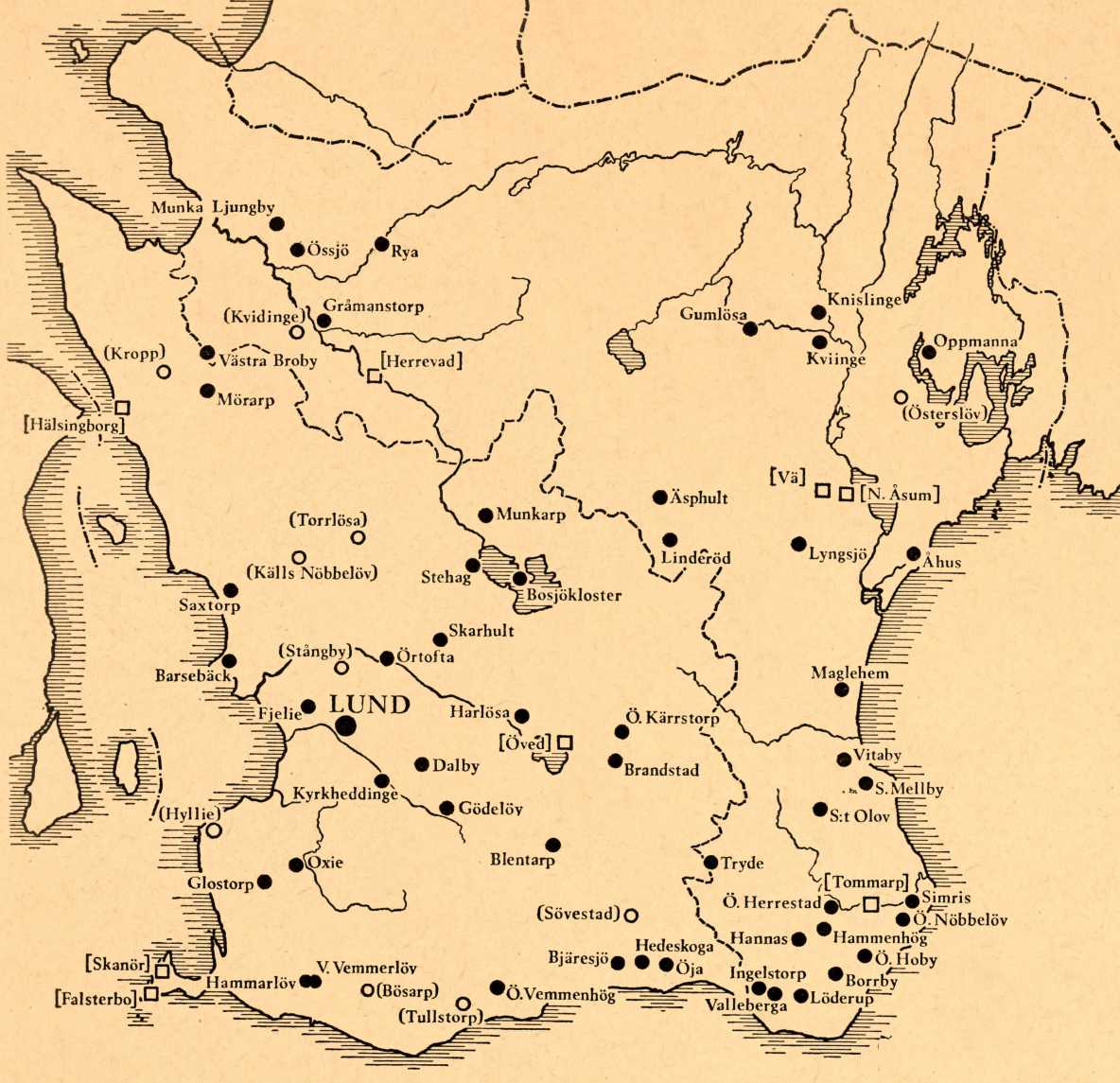
● Kyrkor från vilka skulpturer finns avbildade i denna bok.
○ Kyrkor i vilka avbildade skulpturer befunnit sig men nu förvaras i Lunds universitets historiska museum (LUHM).
□ Orter endast nämnda i texten.
SKÅNE
Under århundradena närmast efter Kristi födelse började romarna så smått lära känna de äventyrliga länderna vid oceanens norra rand. Bland de stora öar man här fick kontakt med har särskilt en med namnet Scandia, på grund av sin bördighet och hemvist för betydande folkstammar, gjort ett starkt intryck på resenärerna, geografernas och historieskrivarnas sagesmän. Att Scandia i verkligheten ej var en ö utan en halvö hade man ännu inte klart för sig. Det råder numera inget tvivel om, att det Scandia man i första hand mötte var det nuvarande Skåne. Men namnet Scandia eller Scandinavia, som det ibland skrevs, blev för romarna efterhand en beteckning på hela den skandinaviska halvön, en beteckning som sedan föll i glömska men återupptogs i ny tid och kom att omfatta även Danmark. Redan tusen år före vår historiska tid kom alltså den dåtida kulturvärldens uppfattning om Skåne att förläna landskapet en sådan ställning att det fick ge sitt namn åt hela den skandinaviska Norden.
Landskapet och den historiska miljön
Än i dag intager Skåne i flera avseenden en särställning bland övriga skandinaviska landsdelar. Som den sydligaste utlöparen av den skandinaviska halvön och en gammal dansk landsdel utgör det ett viktigt förbindelseled mellan kontinenten och den höga Norden. Landskapet äger den bördiga jorden, de stora skogarna, de böljande slätterna och de markanta klippiga bergåsarna. Men Skåne äger framför allt havet. På tre sidor är det omflutet av vatten, och det största avståndet från den ena kusten till den andra uppgår ej till mer än 100 km. Det omgivande havet är ej brett och har alltid varit far bart. Det har ej varit en skiljelinje utan en förbindelseled öppen åt öster, väster och söder. Den verkliga gränsen går mot norr i de stora och i gammal tid svårforcerade skogarna mot Småland och Sverige.
Skånes naturliga rikedom som alltid varit en källa till landskapets välstånd, har gjort det eftertraktat för angränsande riken. Det milda klimatet och den goda jorden har gynnat ett jordbruk, vars företrädare från stenåldern och fram till vår tid varit bärare av den skånska kulturen. Havet har givit rikligt med fisk, som i synnerhet under medeltiden med det stora sillfisket blev en betydande europeisk handelsvara.
Från gammal tid äger skåningen en viss särprägel, som hänger samman med landskapets natur och allmänna förutsättningar. Det är än i dag något paradoxalt i det skånska kynnet en påtaglig öppenhet för omvärlden parad med eftertänksamhet ibland misstänksamhet mot det främmande. Skåningen är villig att i största möjliga mån tillgodogöra sig utifrån kommande impulser, men på ett sådant sätt att den egna traditionen ej går förlorad. Helt i överensstämmelse härmed följer, att hans tal ofta är mångtydigt och kan än i dag förbrylla uppsvensken.
Genom dessa märkliga förutsättningar hos en landsdel, som skämtsamt kallas för ett eget rike, har traditionsyttringarna aldrig varit stöpta i en form. Det varierande landskapet med sina skilda livsformer gör att Skåne ej kan fattas eller beskrivas på ett entydigt sätt. Landskapets egenhet ligger just i paradoxerna, vartill kommer en viss form av ambivalens hos skåningen. Han kan när han vill, men han kan också låta saker bero, när ej livet hotas, en pardoxal förening av energi och lättja. Andligen utgör denna grundinställning en förutsättning för ett aktivt handlande och formens gestaltande ur begrundan.
Att den föreliggande bildsamlingen har hämtats enbart från detta landskap har blivit en naturlig följd av den trots mångfalden samlade karaktär, som Skåne besitter. Man finner de från en svunnen epok bevarade monumenten så tätt, att man ofta inte behöver förflytta sig mer än några kilometer för att komma från det ena till det andra. Till vissa delar skiljer sig detta monumentbestånd från vad som återfinnes inom andra delar av Norden, men i sin helhetskaraktär ger det från ett centralt och begränsat område en synnerligen representativ bild av den romanska nordiska stenskulpturen. I tid omspänner den presenterade skulpturen endast något mer än hundra år, från omkring 1100 till ett stycke in på 1200-talet.
Vikingatiden och den äldsta medeltiden ägde förvisso en inhemsk monumental stenkonst, men dess helhetskaraktär och funktion var väsensskild från den romanska kyrkokonstens. Dennas stenskulptur utgick från helt nya förutsättningar. Den var bunden till kyrkorna och formellt legitimerad genom sin anknytning till de föreställningar, som hörde den kristna kyrkan till. Detta förhållande utesluter emellertid ej, att mycket gick i arv. Bilderna tillkom nämligen under en tid då den kristna föreställningsvärlden ännu var relativt ny i Norden. Samtidigt torde för den enskilda människan och hennes syn på tingen och bilden omställningen från gammalt till nytt ej ha varit alltför stor. Hon levde fortfarande i en handgriplig kontakt med verkligheten i vilken även bilden utgjorde ett påtagligt gestaltande. Men denna verklighet var ej i första hand inskränkt till det mätbara i identitet med den naturliga formen. Den var en spegling av det ogripbara och en upplevelse av hennes eget liv i och som uttryck för den kontrast- fyllda kombinationen av krass realism och övernaturligt beroende.
Skåne var under medeltiden det viktigaste landskapet bland de östdanska provinserna. Redan tidigt efter det danska rikets tillblivelse under 8oo-och 900-talen insåg konungarna vikten av att kunna dominera landskapet. Ett stycke in på 1000-talet grundlade Knut den Store staden Lund. Detta skedde av ekonomiskt politiska skäl för att här kunna draga nytta av handeln och kontrollera de viktigaste vägförbindelserna i anslutning till en av landskapets största marknadsplatser. Ett myntverk växte fram i staden och en rad hantverkare och handelsmän samlades där. Det var under en tid då större delen av Skånes befolkning ännu måste ha varit hednisk. Så småningom började kristendomen få fotfäste i landskapet i synnerhet i Lund, där man får antaga att konungen redan tidigt låtit uppföra en träkyrka. De missionärer och biskopar, som då verkade i landskapet, kom till största delen från England, den västligaste delen av kung Knuts nordsjövälde.
Man kan nog räkna med att Knuts intresse för Skåne och Lund kan ha dikterats av hans planer på att göra landskapet till ett centralområde för det hela Norden omfattande välde, som han strävade efter att foga till sitt dansk-engelska rike. Planerna blev emellertid aldrig tillfullo förverkligade, icke minst på grund av den kompromiss i fråga om den danska kyrkans lydställning under Hamburg-Bremen, som blev resultatet av Knuts sammanträffande med påven och den tyske kejsaren, Konrad II, vid hans besök i Rom 1027. Kungens första initiativ kan dock ha haft grundläggande betydelse för en fortsatt utveckling av Skånes ställning som en så maktpolitisk stödjepunkt i den danska rikspolitiken, främst så länge konungarnas och kyrkans strävanden gick hand i hand.
Redan Knut den Stores fader, Sven Tveskägg, hade lagt grunden till skånska godsförvärv, vilka i synnerhet Knuts syster Estrid vidareutvecklade och kan ha tagit sin tillflykt till. Här kan hennes son, Sven Estridsen, också tänkas ha vistats vissa perioder inte blott under sin ungdom utan även sedan han blivit konung. Som sådan återupptog han den tidigare kampen om den danska kyrkans frigörelse från det tyska ärkepiskopatet. När Sven Estridsen inrättade två biskopssäten i Skåne 1060, kom det ena, i Lund, att besättas av en engelsman i överensstämmelse med de allmänna strävandena. Det andra biskopssätet, i Dalby strax intill Lund, besattes däremot med en tysk, Egino, som emellertid efter sex år flyttade till Lund, sedan den förste biskopen där dött.
Biskopssätet i Dalby nedlades och den påbörjade stenkyrkan har sannolikt inte fullbordats förrän efteråt. Resterna av den äldsta byggnaden, den första kända stenkyrkan i Skåne, förbryllar något med tanke på initiativtagaren Sven Estridsens politiska intentioner. Den kärva men av religiöst-maktpolitisk karaktär präglade pelarbasilikan var av tysk typ med idémässiga förutsättningar i den ottonska byggnadskonsten. Stod den som ett uttryck för kungens eftergift åt det Hamburg-Bremenska ärkestiftet eller representerade den en synlig manifestation av Svens höghetssträvanden gentemot den tyske kejsaren och den tyska kyrkan understruket genom användandet av motståndarens egna maktsymboler? Med tanke på kungens fortsatta omtanke om kyrkan, även sedan den mist sin biskop och blivit kanikkyrka, synes det senare alternativet vara det troligaste.
Enligt Adam av Bremen skulle Skåne redan på 1070-talet ha haft omkring 300 kyrkor. Huruvida detta antal är riktigt eller blott ett resultat av sagesmännens önskan att imponera är omöjligt att avgöra — Adam var i Danmark men sannolikt ej i Skåne. De kyrkor som fanns torde emellertid alla ha varit uppförda i trä. Men efter de två biskopskyrkornas tillkomst har sannolikt även andra stenkyrkor efterhand börjat uppföras. Varken från den äldsta kyrkan i Dalby eller den endast arkeologiskt kända första biskopskyrkan i Lund har bevarats någon bildskulptur.
Ordet Lund har för många blivit liktydigt med dess domkyrka. När denna under 1100-talets förra hälft utan någon konkurrens reste sig över allt vad staden i övrigt kunde bjuda av bebyggelse, måste namnet än mer ha inneburit ett begrepp för kyrkobyggnaden och vad den representerade. Det torde knappast ha varit självklart, att Nordens kyrkliga centrum skulle förläggas till Lund. Staden synes visserligen ha utvecklats gynnsamt, sedan den på 1020-talet grundlagts av Knut den Store, men den låg trots allt i periferien av det danska riket. Redan kung Knut synes emellertid ha fäst stort avseende vid sin nyskapelse, som främst i sin latinska form namnmässigt lätt kunde förväxlas med konungens största stad i den västra delen av hans välde, nämligen London. Bland de många platser där Knut lät sätta igång den första inhemska danska myntpräglingen har Lund intagit den utan jämförelse främsta platsen. Ej heller de följande konungarna lät produktionen sjunka vid stadens myntverk, som sannolikt legat i nära anslutning till kungsgården.
Om Lund sålunda synes ha varit stadd i en kraftig ekonomisk utveckling under större delen av 1000-talet, har staden emellertid inte i kyrkligt hänseende under denna tid kunnat hävda sig gentemot vissa östdanska städer. Någon egen biskop fick Skåne inte förrän 1060, och när Knut den Stores syster Estrid omkring 1030 byggde en stenkyrka i Roskilde, vilken senare ombyggdes till en större av biskop Svend på 1070-talet, hade man i Lund fortfarande blott stavkyrkor att tillgå. Förhållandena ändrades återigen på kungligt initiativ. På 1080-talet lät Knut II, sedermera den Helige, bygga sig en stenkyrka helgad åt S:t Laurentius. Den påbörjades sannolikt som kunglig gårdskyrka, men kungen överlät den åt biskopen och det domkapitel, som kunde komma till stånd genom hans generösa donationer till kyrkan.
Gynnade av påvestolens motsatsställning till de tyska kejsarna lyckades det slutligen konung Erik Ejegod och lundabisko- pen Ascer att med gemensamma ansträngningar lösgöra den danska kyrkan från Hamburg-Bremens överhöghet. Detta skedde under de allra första åren av 1100-talet, och 1104 kunde Ascer beklädas med palliet. Han blev därmed inte blott ärkebiskop i Danmark utan även primas över hela Norden. Det är med stor sannolikhet bland annat på grund av denna redan från början eftersträvade institutionella värdighet och den därmed ernådda maktställningen som ärkebiskopssätet förlades till Lund i Skåne, den del av Danmark som hade det mest centrala läget med hänsyn till kontakterna med och kontrollen av den skandinaviska halvön. Det var i kyrkligt maktpolitiskt hänseende samma drag, som Knut den Store i allmänpolitiskt syfte hade gjort knappa hundra år tidigare, när staden Lund grundades. När Saxo Grammaticus i slutet av seklet skulle motivera varför Lund valdes som ärkesäte anförde han bl.a., att »från angränsande områden kommer man med lätthet dit. Vägarna är många till lands och till vatten».
Ärkebiskop Ascer härstammade från en av de danska stormannaät- ter av bondesläkt, ur vilka såväl konungar som biskopar rekryterades. De kärva dragen hos dessa män får en monumental återspegling i de tidigaste delarna av Lunds domkyrka, för vilken de första impulserna hämtats från traditionellt västeuropeiskt håll. Det mäktiga kryptrummets äldsta delar är i sig självt skulpturalt gestaltande, bilden saknas, de konkreta symbolgestaltningarna är som i sanktuariets kolonner ännu blott ornamentalt uttryckta.
Med den betydelse som Lund fick genom ärkesätets inrättande kom Skånes historia i något mer än hundra år, d.v.s. just den tid som det här presenterade bildmaterialet omspänner, att i stora stycken bli dess biskopars. På väsentliga punkter känner vi denna historia genom det skrivna källmaterialet. Men även tingen, och till dessa hör den skulpturala världen, är en form av källmaterial för kunskapen om den enskilda människans uppfattning av sin tillvaro. Innan vi försöker utläsa något härav, skall dock en del av den mera gripbara situationen tecknas.
År 1137 efterträddes Ascer på ärkebiskopstronen av Eskil. Han synes ha varit en man av helt annat slag än sin föregångare. Eskil var visserligen brorson till denne, men i motsats till Ascer, som i huvudsak hade varit inriktad mot det maritima Västeuropa, hade Eskil en synnerligen livlig kontakt med det kontinentala Europa. Med Bernhard av Clairvaux var han nära vän, och när Eskil efter ett i många stycken dramatiskt liv på 1170-talet avsäger sig sin ärkebiskopsvärdighet reser han till Clairvaux, där han 1182 ändar sitt liv. Den politiska historien i Danmark under Eskils tid var synnerligen förvirrad på grund av de ständiga stridigheterna mellan växlande tronpretendenter med sinsemellan nära släktskap. Kyrkans förhållande till kungamakten hade tidigare varit gott. Eskil var europé även i det avseendet att han som person kom att taga del i tidens stora tvister mellan stat och kyrka. I sina visserligen försiktiga men dock försök att även i Danmark hävda kyrkans oberoende ställning blev han gång på gång inblandad i de politiska stridigheterna kring kungarna.
Men till trots av de oroliga tiderna utvecklades genom Eskils personliga initiativ en ny och fruktbar kulturpolitik, som lade grunden till icke minst ett Skåne i den europeiska gemenskapen. Domkyrkan fullbordades i ett nytt byggnadsskede, som förde med sig en rik skulptural utsmyckning, och 1145 kunde högaltaret invigas. För utbredandet av kristendomens kulturella frukter spelade klosterväsendet i dess olika former kanske den mest framträdande rollen. Som klosterstiftare har Eskil icke kunnat överträffas av någon annan dansk biskop. Före hans tid fanns i Skåne blott ett benediktinkloster i Lund och det i början av 1100-talet av augustinerkorherrarna övertagna Dalby. I självklar överensstämmelse med sin vänskap till Frankrike och Bernhard av Clairvaux införde ärkebiskopen cistercienserna i landet och det första klostret grundades 1144 i Herrevad i Skåne. Det blev emellertid en annan orden, som Eskil främst i Skåne kom att gynna, nämligen premonstratenserna. Ej mindre än fyra kloster av denna orden lät han växa fram, i Tommarp, Öved, Lund och Vä. Det hade säkerligen stor betydelse, att premonstratenserna liksom cistercienserna vid sidan om sin andliga verksamhet också hade en praktisk inriktning, men därtill kom för premonstraten- serklostrens vidkommande att de kunde placeras i en stad. Så blev fallet icke blott i Lund utan även i Tommarp och Vä. Kännetecknande för denna ordens kloster var även att de lydde direkt under biskopen, vilket kan ha haft en alldeles speciell betydelse med tanke på att Eskil placerade dem på några av de ekonomiskt sett mest strategiska platserna i landskapet, d.v.s. i anslutning till de städer, där även kungamakten hade intressen att försvara i sin kontroll över det ekonomiska livet.
Med ärkebiskop Eskil kom Lund och Skåne i direkt förbindelse med den franska kulturen. Det skedde icke blott genom Eskils personliga relationer och resor till Frankrike utan också genom de nygrundade ordnar, som utgick därifrån. Den en gång upprättade kontakten fortsatte under de följande biskoparna, och de franska kulturinflytelserna blev vid sidan av det äldre arvet av väsentlig betydelse för det sena 1100-talets intellektuella blomst- ring.
Lundastiftets fyra första och mest betydande ärkebiskopar var sinsemellan ganska olika typer med var och en sina framträdande drag. Ascer synes ha varit den trygge och utan åthävor kraftfulle man, som med sin person förmedlade det gamla arvet till den inbrytande nya tiden. Eskil var den store kyrklige nydanaren med de vida förbindelserna. Hans efterträdare från 1179, Absalon, var i första hand politiker såväl på det kyrkliga planet som icke minst på det allmänpolitiska. I motsats till Eskil stod han i direkt vänskapligt förhållande till kungamakten, som genom kung Valdemar I hade stabiliserats redan i slutet av Eskils biskopstid.
Som minister hos konungen sysslade Absalon tidvis i högre grad med rikets politik och militära fälttåg mot venderna i Östersjön än med kyrkans angelägenheter. Det är från hans tid, de skånska problemen börjar framträda mera konkret. Tillkomsten av en lång rad betydande institutioner i Skåne såsom ärkesätet, klosterstiftelserna och även städernas utveckling, hade självfallet betytt en stor tillgång för landskapet. Men initiativtagarna hade kanske inte alltid blott landskapets bästa för ögonen. I själva institutionerna som sådana låg en framträdande möjlighet till makt och behärskning av ett synnerligen åtråvärt landskap.
Av alla de män, vilka vi känner till namnet, och som hittills på ett mera framträdande sätt hade varit verksamma inom Skåne, var ingen född skåning. De härstammade antingen från Jylland eller, vilket i synnerhet under Absalons och kung Valdemars tid var fallet, från Själland. Under Absalons tid kom också en skånsk animositet gentemot det själlandska styret direkt till uttryck. Det skedde i samband med en sammandrabbning mellan å ena sidan ärkebiskopens och konungens folk och å den andra de skånska bönderna i början av 1180-talet. Anledningarna härtill var flera. Man kan från skånsk sida skymta ett missnöje med de ständiga ledungsutskrivningarna för vendertågen, vidare knotade man över biskopstionden och Absalons krav på prästernas celibat. Samtliga ting hade haft aktualitet redan under Eskils tid, men han hade gått försiktigt fram och för övrigt ej heller haft stöd av en stark kungamakt. De nya och bryskt ställda kraven fick de skånska stormännen och bönderna att resa sig. Dessa skånska storbönder synes ha varit av delvis annat slag än de västdanska. De hade ännu inte nått samma ryktbarhet och framträdande ställning inom den danska rikspolitiken som t.ex. de själländska Hvideättlingarna. De skånska storbönderna torde i betydligt längre tid ha levat kvar i senvikingatida traditioner och värnat sin egen lokala frihet. Tillgångarna från de runt om i landskapet utplanterade internationella kulturinstitutionerna hade de däremot med sund beräkning tillgodogjort sig, var och en inom sitt område. Ett sådant, visserligen hypotetiskt men dock sannolikt läge, kan vara en av förklaringarna till den sällsynta på en gång jämnt utspridda men samtidigt till karaktären differentierade kulturmanifestation, av vilken epokens skulptur är en del.
De skånska bönderna fick till det yttre se sig besegrade, men de blev aldrig kuvade. De själländska herrarna kunde dock fortsätta att i landskapet uppföra nya kyrkor och med tillhörande bilder berika provinsen och samtidigt också manifestera sina anspråk. När mordet på Thomas Becket endast ett tjugotal år efter det att det ägt rum framställdes på en skånsk dopfunt, är det sannolikt ej blott helgonet som sådant som förhärligas utan även biskopen med de rättmätiga kraven. Eftersom dopfunten befinner sig i en kyrka, Lyngsjö, som i flera avseenden synes vara uppförd av en man i den själländska släkt till vilken ärkebiskopen hörde, synes Absalons medvetenhet ligga i öppen dager. Hans medverkan till ett annat kyrkobygge i samma trakt, N. Åsum, har dokumenterats på gammalt vis med en runsten rest vid kyrkan.
Visserligen fick skåningarna handgripligen känna på Absalons regemente, och visserligen var han i första hand rikspolitiker, men som sådan lyckades han under konungarna Valdemar I och dennes son Knut VI åstadkomma ett fruktbart samarbete mellan kyrkan och staten, ett samarbete som genom ärkestiftet i längden även kom Skåne till godo. Icke blott ärkebiskopen och de enskilda stormännen utan även bönderna i sockengemenskapen synes under denna tid ha bedrivit en mycket livlig kyrkobyggnadsverk- samhet, d.v.s. ett ersättande av de gamla träkyrkorna med stenkyrkor, vilket tyder på att landskapet under denna period gynnats av en växande ekonomisk utveckling. Den direkta andliga odlingen hade emellertid ej missgynnats av Absalon, även om han inte fortsatte sin företrädares intensiva klosterstiftande. Ett betydande kloster grundlade Absalon dock i Skåne, nämligen benediktiner- nunneklostret i Bosjö. För övrigt åstadkom han en reformering och uniformering av den danska kyrkan.
När Absalon dog 1201 efterträddes han av Andreas Sunesen. Denne den siste i raden av lundastiftets fyra första och stora ärkebiskopar har gått till historien som den lärdaste av de fyra. Grunden hade han lagt under studier i Paris, Bologna och Oxford. För att bibringa de blivande präster, som fick sin utbildning i Lund, något av de kunskaper, som kunde inhämtas vid de utländska universiteten, författade han en stor lärodikt på hexameter. Med skapelseberättelsen som kontrapunktiskt motiv skildrades och kommenterades i denna den kristna frälsningshistorien. Andreas Sunesens juridiska bildning, inhämtad i Bologna, blev till stort gagn i en viktig omredigering och kommentar till skånelagen, genom vilken vi får en konkret bild av den skånske bondens liv.
Under slutskedet av Andreas Sunesens ärkepiskopat kom en ny klosterorden till Skåne. Redan 1223 uppläts plats för dominikaner- na i Lund, varifrån de sedan spred sig till andra städer. Införandet av skilda klosterordnar kan under dessa tider ses som ett slags spegling av de expanderande kulturinflytelserna och de genom den samhälleliga utvecklingen uppkomna behoven. Tiggarmunkarnas ankomst står här som slutet på den epok, som vi ägnar vårt intresse. Deras närvaro betydde, att man hade nått fram till ett utvecklat stadsväsende. Grunden härför var i Skåne lagd redan 200 år tidigare med Lund, som senare under 1000-talet följdes av andra inlandsstäder som Tommarp och Vä samt Hälsingborg vid sundets smalaste del. Under 1100-talets ekonomiskt-politiska förhållanden började nya kuststäder växa fram och få betydelse ej blott för landskapets inre handel utan även för den yttre.
Bland dessa kom Skanör och Falsterbo, belägna på ett näs längst ut åt sydväst, att intaga en speciell ställning, till en början och huvudsakligen ej som direkta stadsbildningar, eftersom livet här var relativt säsongbetonat, utan som stor internationell marknadsplats i den viktiga handeln med sill. Under ett par månader årligen samlades här handelsmän för att mottaga den längs skånekusten så riktligt förekommande varan i utbyte mot egna produkter. Bland de köpenskapsidkande utlänningarna kom från slutet av 1100-talet tyskarna från det nybildade Hansaförbundet att bli i majoritet. Tyska impulser påverkade också i icke ringa grad utvecklingen mot det organiserade stadsväsende, som blev karakteristiskt för högmedeltiden, och som i Skåne tog sin början under förra hälften av 1200-talet.
Med vad dessa städer och deras borgerskap kom att representera infördes något nytt i samhällslivet vid sidan om det gamla bondesamhället. Men allt detta hade förberetts under det föregående seklet, som just genom att vara en nydaningsperiod, stadd i ständig utveckling, i alla avseenden kom att både ekonomiskt och kulturellt bli en av Skånes främsta storhetstider. I grunden hade utvecklingen burits upp av det gamla bondesamhället, som trots starka inflytelser från kontinenten aldrig utvecklades till ett feodalsamhälle. De fria bönderna hade känt sig av samma ätt som herrarna, och frihetsmedvetandet, som en gång kanske yttrat sig i självsvåld, hade under kristna institutioners inflytande fått en ny inriktning och ett nytt ansvar.
I sitt förhållande till verkligheten och de ting och bilder, som speglade denna, torde detta samhälles människor haft en mera ohämmad och mindre formalt bunden inställning än vad som skulle följa i det kommande mera borgerliga samhället. Beroendet av tingen, ej av markens växt i den sig rytmiskt förändrande naturen, kom för borgaren så småningom att medföra, att han föredrog att se sig själv och sin omgivning avbildad enligt den verklighetsbild, som var entydigt gripbar. Den föregående expansiva tidsåldern band vanligtvis ej föreställningarna av den sinnliga verkligheten i en accepterad eller given form. Därigenom kunde i dess bildkonst den aktuella föreställningsvärlden infångas i en skiftande mångfald, som speglar såväl djup andlighet som naiv rättframhet.
Det var inom och i anslutning till kyrkan som huvudparten av den monumentala bildkonsten tillkom under hela medeltiden. Detta är i synnerhet giltigt för den äldre delen av epoken, som också är aktuell i detta sammanhang. Den förbindande länk med en äldre och förkristen tradition, som kan och bör ha funnits i t.ex. skulpterade delar av de gamla träkyrkorna, har för Skånes vidkommande på ett undantag när gått helt till spillo. Det blir alltså med de nya stenkyrkobyggena, som den skulpterade bilden framträder. De utan jämförelse flesta av dessa kyrkor uppfördes i Skåne under 1100-talet och är än i dag bevarade i hundratal.
Att vid denna tid uppföra en stenkyrka torde ha varit ganska kostsamt. Det bör heller icke råda något tvivel om, att de första och även i fortsättningen viktigaste initiativen utgick från de stormän, som satt inne med de ekonomiska möjligheterna. Dessa betraktade sig då som i någon mån ägare av själva kyrkobyggnaden men samtidigt också som patronus och försvarade av densamma. Denna byggnadens ägorättsliga ställning manifesterades ofta genom de kraftiga västtorn som lika mycket var symbolen för makt som praktiska byggnadsdelar, i vilka bl.a. patronus särskilda loge inrymdes. Men vi kan också av själva byggnadernas utformning konstatera, att även församlingens bönder redan tidigt själva började uppföra sina kyrkor. Kyrkobyggandet såväl som den skulpturala utsmyckning gynnades i väsentlig grad av att Skåne äger en rik naturlig tillgång på ädelt stenmaterial i de redan från 1000-talet utnyttjade sand- och kalkstensbrotten. Det är nästan uteslutande i detta material, främst sandsten, som de presenterade skulpturerna är utförda.
Stenmästarna
Vilka mästarna till Skånes många stenskulpturer var eller var de kom från har vi inga direkta uppgifter om. Att de ledande skulptörerna vid domkyrkan hämtats från Sydeuropa, sannolikt Italien, bör det ej råda något tvivel om. Men därför finns det ingen an- anledning att tro, att de stenmästare, som berikat landskyrkorna, annat än i undantagsfall skulle ha hämtats från främmande land. Här såväl som i andra delar av Europa var huvudparten av skulptörerna under i varje fall den tidigare delen av medeltiden anonyma. Det finns emellertid alltid undantag, och så var också fallet bland de skånska stenmästarna. På tympanonfältet över ingången till Ö. Herrestads kyrka kan man ännu tydligt läsa orden: »Carl stenmester skar thenna sten.» Man har allmänt antagit, att denne Carl stenmästare skulpterade inte blott den sten, på vilken inskriften återfinns utan även portalomfattningen som helhet. Utifrån den kring portalen förekommande skulpturala ornamen- tiken har man sedan sammanställt en lång rad skulpturer i framför allt sydöstra Skåne men också i landskapets mellersta delar, skulpturer som ansetts utförda av denne Carl. Även om inte allt som tillskrivits Carl kan anses vara utfört av honom, har vi dock genom signaturen ett vittnesbörd om en stenmästare av säkerligen nordisk och väl skånsk härkomst. Att han fått fästa sitt namn vid ett av verken tyder kanske på, att han haft en lokal berömmelse och åtnjutit ett anseende, som förmodligen inte alltid kom ens den skickligaste konstnär eller hantverkare till del under denna tid.
Carl stenmästares signatur har återfunnits endast en gång, men det fanns ungefär vid samma tid under 1100-talets senare del också en annan skånsk skulptör, som signerat en hel rad dopfuntar. På kuppans kant har han med runor ristat: »Mårten (Martin) gjorde mig.« Många av de dopfuntar, som med hjälp av signaturen eller på stilistisk väg kan hänföras till honom, har kuppan oftast blott ornamentalt skulpterad, men den vilar i många fall på för Mårten karakteristiska lejonfigurer. Att runorna kommit till användning i inskriften är i och för sig ingen ovanlighet. Det var genom hela medeltiden i många fall den skrivkunnige lekmannens normala skrift i första hand för kortare meddelanden eller anrop. Detta utesluter dock ej, att runorna samtidigt av tradition kan ha tillagts en viss magisk betydelse. När Lunds domkyrkas restaura- tor, Adam van Duren, så sent som i början av 1500-talet inleder en av sina många i domkyrkan inhuggna inskrifter med orden »Gud hjälp», är dessa två ord men endast de utförda i runor.
Mårtens signatur på dopfuntarna kan ha varit av samma betydelse som Carls signatur, men det torde ej vara osannolikt, att han kanske i främsta rummet med de magiska runornas hjälp velat fästa en åkallan vid det icke minst för denna tid viktiga sakramentala funktionsobjekt, som dopfunten utgjorde. Det är i sammanhanget icke heller oväsentligt, att det genom formuleringen är föremålet, funten, som talar. Stenmästaren kan ha lagt något av sin själ i verket, för att det inför kommande släkten i förbindelse med dopets sakrament skulle minna om honom.
Den tredje i raden av till namnet kända skånska stenmästare hette Tove. Han har liksom i förbigående smugit in sitt namn bland de texter, som beledsagar framställningarna på dopfunten i Gumlösa. Hans arbeten bör ha utförts under i huvudsak 1190- talet. Därmed är också vår kunskap slut rörande namnen på skånska stenmästare från romansk tid. De har var och en låtit sina namn framstå på olika sätt, kanske av skilda bevekelsegrunder. Ett har de emellertid gemensamt, nämligen de nordiska namnen, som klart utsäger, att det nu var landets egna konstnärer, som flitigast hjälpte till att med sina skulpturer icke blott pryda utan även ge en symbolisk mening åt landskapets sockenkyrkor. Vid en genomgång av bilderna finner läsaren snart, att de flesta återger dopfuntar eller detaljer därav. Denna till synes kvantitativa övervikt för en bestämd föremålsgrupp är inte tillfällig. På den skånska landsbygden manifesteras den rikaste och i flera avseenden mest intressanta tidigmedeltida stenkonsten i första hand på funtarna. Det lär väl icke heller finnas något land i Europa där inom ett bestämt område en sådan myckenhet av romanska dopfuntar bevarats som i Skåne och på Gotland.
Vi kan konstatera, att det funnits verkstäder, som producerat en lång rad likartade funtar, men väl så påtagligt är trots detta mångfalden av de skiftande typer, som man stöter på. De skvallrar om en obunden verksamhet med skiftande impulser, samtidigt som de är i besittning av en påfallande originalitet i förhållande till beståndet från det övriga Europa. Denna originalitet yppar sig inte blott i formerna utan även i den mångskiftande och rika bildvärld, som vi möter på dem.
Ur konsthistorisk synpunkt har man klarlagt vad som avses med begreppet romansk stil. Det råder inget tvivel om att den här presenterade skånska stenskulpturen tillhör denna stilgrupp. Den skiljer sig emellertid samtidigt från mycket av den bildkonst, som från samma epok återfinnes på annat håll och är därigenom lätt igenkännlig om den påträffas exporterad utanför Skånes egna gränser. Paradoxalt nog är det emellertid ej ett gemensamt skånskt stildrag, som gör det starkaste intrycket, utan de påtagliga stilistiska skillnaderna mellan de olika skånska stenmästarna och verkstäderna. Det är i denna mångfald, som den konstnärliga rikedomen ligger. Det är anmärkningsvärt i hur hög grad den enskilde mästaren här självständigt och naturligt har funnit sig tillrätta med både ämne och form, medan man på andra håll då och då kan finna hur denna konst kan ha fått en viss stereotyp prägel. Om den skånska romanska stenskulpturen uppvisar ett eget ansikte är det främst i denna variationsrikedom, som ger den dess säregna plats inom epokens europeiska konst. Tekniken och icke minst hantverksskickligheten spelade en stor roll för den medeltida konstutövningen, den ligger också som grund för en rad av de här presenterade arbetena, men det är dock genomgående främst konstnären bakom verken, som fått dem att tala till oss. Den aktuella mottagligheten härav kan i någon mån ha sin grund i vår tids personlighetspräglade konstuppfattning, men endast som inledningen till en bekantskap; ytterst och med större giltighet är det ödmjukheten bakom skapandet, som får upplevelsen av bilderna att bli verklighet.
Stenskulpturen har av naturliga skäl i motsats till konstföremål av förgängligare material haft större möjlighet att bli bevarade till våra dagar. Detta hindrar emellertid ej, att vad vi i dag ännu kan beundra och njuta av endast är en del av vad som en gång funnits. Under själva medeltiden synes man i stor utsträckning ha tagit tillvara äldre skulpturer i samband med ombyggnader av de partier i vilka bilderna ursprungligen varit placerade. De har insatts i ett senare murverk, kanske mist sin ursprungliga symboliska funktion men möjligen fått en ny sådan, men framför allt torde de ha uppskattats som bild. Vad reformationen i Norden innebar för bildkonsten i kyrkorna vet vi ännu ej tillräckligt om. Den torde för gemene man emellertid ej ha varit en alltför stor omställning i förhållandet till tingen och bilden. På något undantag när förskonades också Skåne från det bildstormande, som gick så härjande fram på vissa håll över Europa. Mera ödesdigert för de medeltida kyrkorna och deras inventarier blev 1700-talet och en stor del av 1800-talet. Under sistnämnda århundrade blev välståndet och rikedomen i vissa bygder en direkt anledning till medeltidskyrkornas förstörelse i samband med att man byggde nya och större kyrkor. Många skulpturer förskingrades under denna tid, dopfuntar användes till blomsterkrukor i trädgårdar, andra skulpturer försvann helt, men en del blev liggande på undanskymda ställen. Därifrån hämtades de i början av detta sekel, när en ny förståelse och ett nytt intresse började vakna för de gamla klenoderna. Vad som då hopsamlades från förstörda kyrkor i Skåne bevaras i dag i Lunds universitets historiska museum. I dag är ej blott de skulpturer som bevaras på museet utan allt som finns i anslutning till de ännu levande gamla kyrkorna skyddat genom fornminne slagen.
BILDVÄRLDEN
Den moderna människans attityd gentemot konst skulle med all säkerhet ha varit den medeltida betraktaren helt främmande. Därmed inte sagt att det vi kallar en estetisk upplevelse i och för sig kan ha varit utesluten. Men den har av medeltidsmänniskan ej medvetet uppfattats som ett isolerat egenvärde. Konstens värde var å ena sidan förknippat med den art av hantverksskicklighet med vilken verket var utfört och å den andra sidan med graden av levandegörande och den förmåga till upplevelse, som bilden kunde väcka. Den estetiska normen har under sådana omständigheter ej någon formal karaktär utan ingår som ett led i verkets gestaltande av det uttryck, som skulle vara ett levandegörande av människans situation i nuet och i evigheten.
Huvudparten av den romanska stenkonst som vi här finner skall därför i första hand upplevas som mer eller mindre talande uttryck för den dåtida människans förhållning till och uppfattning av den omedelbara verklighet i vilken hon levde. Vi kommer att möta en på en gång mångtydig och rakt på sak utförd berättarkonst i skiftande former, ibland obunden och naivt omedelbar och ibland tuktad och ansträngt sirlig i sin strävan att vara det dock existerande modet till lags. Samtidigt måste vi vara medvetna om att ingenting tillkom blott på lek, ingenting utfördes för sin egen skull eller som utlopp enbart för stenhuggarens vilja att manifestera ett formande. Även det enkla och naiva hade för dåtiden en mening, som i sin omedelbarhet talar även till oss och därigenom utgör bevis för anspråkslöshetens möjligheter att finna och gestalta ett uttryck för känsla och upplevelse. Låt oss försöka, i den mån vi kan göra oss fria från normativa form- och uttryckmönster, att till en början betrakta bilden sådan den i sig själv framträder för att alltjämt förmedla den verklighetsupplevelse, som hade giltighet då men existentiellt även nu.
Hos människogestalten möter vi ofta ett drag av sorgmodigt allvar. Som ett slags manande grunddrag kommer detta i första hand till uttryck genom Kristusbilden. Detta allvar kan i den kraftigt stiliserade formen kännas som en genomträngande höghet eller som en något trumpen stränghet. Vi fångas av denna skulpturens direkta talan till oss främst genom de bilder i vilka Kristus tronar och med ögonen fixerar åskådaren. I framställningar av dopet däremot är Kristus visserligen frontalt riktad mot oss men är samtidigt på ett egendomligt sätt passiv gentemot åskådaren och även den handling som försiggår, eftersom det är handlingen som helhet som har betydelse. Ett märkligt undantag finner vi i en dopscen, i vilken Johannes döparen för ett ögonblick glömsk av sitt heliga värv förvånat stirrar på betraktaren ej blitt vädjande utan med en ohämmad nyfikenhet, som även smittat av sig på Kristus. Han har därigenom brutit sin isolering gentemot betraktaren, ej för att mana honom till sig utan för att förundras över hans närvaro. Som förutsättning för denna vår tolkning av scenen ligger med all säkerhet ingen medvetenhet hos den stenmästare, som utfört bilden. Det torde snarare vara det enkla och mänskligt omedelbara i hans uppfattning av händelsen, som får oss att uppleva denna verkan. På samma dopfunt förekommer en framställning av de heliga tre konungarna, vilka på samma sätt synes vara mera intresserade av oss än av det barn de skrider fram för att hylla.
Kontakten mellan å ena sidan gestalten eller scenen och å den andra åskådaren har sålunda åstadkommits med olika uttrycksmedel men är för det mesta påtagligt för handen. När en person vill rikta vår uppmärksamhet på sig eller det han vill säga, sker det oftast genom en gest eller medelst de stort uppspärrade ögonen, som inte vill låta oss undkomma. Men vi finner också exempel på att en intim kontakt kan åstadkommas genom en nästan lättsinnig outgrundlighet avspeglad i ansiktsdragen.
Motsatserna finner vi även i de berättande scenernas handling. En värdig och avmätt högtidlighet möter oss främst i nya testamentets passionsscener men också i lovprisningsscenerna i anslutning till Jesu födelsehistoria, men i själva födelsescenerna blir åskådaren genast mer engagerad. Den betänksamme Josef inbjuder oss under stilla begrundan att taga del av undret i grottan, om ej lika vanvördigt närgående som åsnan och oxen så med den iver och glädje, som präglar herdarna och deras djur.
Direkt in på människorna har vissa stenmästare gått i sin skildring av syndafallet och dess följder. Här möter man den direkta identifikationen mellan åskådare och bildgestalt, utan tvekan en påtaglig upplevelse för den medeltida betraktaren men med adress även till oss, om vi är känsliga nog att uppfatta det. Med en illa dold beräkning mottager Eva frukten av ormen, och Adam sätter tänderna i den med ett hämningslöst nästan djuriskt begär. När paret sedan brukar jorden utanför paradisets trädgård, blickar den trumpne Adam oförstående och frågande på Eva, som med ett halvt vulgärt flin synes vara belåten med den nya situationen. På en annan dopfunt visar hon sig mera sedlig, där hon något uttråkad men stolt sitter med sin slända. Adam däremot är helt nedtyngd inte blott av det snickrande han håller på med utan främst av den bedrövelse, som hans ångerköpta min ger uttryck för.
Kroppen i och för sig har den romanske stenmästaren ej haft något intresse för. När skillnaden mellan de nakna Adam och Eva skall framställas är det ej genom könet utan medelst hårets längd. Klädedräkten kan däremot ofta vara omsorgsfullt utförd, eftersom den i de flesta fall karakteriserar personerna och beträffande statisterna utgöres av tidens egna dräkter, antingen händelserna utspelats för över tusen år sedan, utan bundenhet till tiden, eller i nära anslutning till stenmästarens egen tid. På detta sätt upplevde betraktaren de utspelade händelserna som aktuella och påtagligt närvarande. Men klädedräkten kan också vara fritt gestaltad och genom sin ornamentala form ge ett bestämt ackord som grund för den känslostämning, som gestalten eller scenen avser att avspegla. När den gamle Simeon i templet får se och röra vid Jesusbarnet, präglas figurerna som helhet av en stilla värdighet, men den rörelse, som händelsen uppväcker, kan påtagligt följas i de schematiskt tecknade mjuka vågrörelser, vilka utgående från Marias mantel och över Jesusbarnets svepning blir till en virvel över Simeons vänstra sida. En högtidlighet, ett förvandlande av gestalterna till värdighetstecken för den handling de utför åstadkommer å andra sidan de stora och summariskt skulpterade mantlar, i vilka de tre heliga konungarna är framställda på en dopfunt. På den följande bilden med samma motiv kan man lägga märke till hur skulptörerna vid slutet av epoken med en påträngande vilja till saklig realism och samtidigt en djupare relief i stället åstadkommit en naiv identifiering — det upphöjt allmängiltiga är borta.
Tillsammans med klädedräkten utgör ofta de därunder blott tänkta eller anade kropparna ett rytmiskt ornament för att gestalta en rörelse som hos de tre Mariorna vid Kristi grav. För att framhäva den varma samhörighetskänslan mellan Maria och Elisabeth vid deras möte har skulptören låtit kropparna förenas i en stor form. Här kan vi också se vad som händer när den skulpturala naturalismen ökas, genom avståndet mellan figurerna kan känslogestaltningen iakttagas, men i den tidigare reliefens ut- tryckskonst kännes den.
De par, som på dopfunten i Tryde omfamnar varandra, låter oss förnimma sin samhörighet genom ytterligare ett medel, gesten, som är en av tidens viktigaste uttrycksbärare. De långa och smala armarna, som utförts utan ringaste anspråk på anatomisk sanning, slingrar sig kring gestalterna, binder dem till varandra, samtidigt som händerna endast antyder en öm gest. I arm- och handrörelsernas överdimensionering ligger ofta det dramatiska händelseförloppet samlat. Så är fallet i det händernas samspel, som i en framställning av Adams skapelse betecknar själva skeendet. Gesten kan också vara av rent attributiv karaktär. I en naiv form upplever vi hur en ängel, som satts att vakta porten till det himmelska Jerusalem, med barnslig iver håller fram sin nyckel med en påtagligt förlängd arm.
Det som hos människogestalterna i första hand appelerar till åskådaren är huvudet, oftast förstorat men i sig samlande hela den kraft, som gestalten skall ge uttryck för, vare sig denna kraft är av aktiv karaktär eller fylld av begrundan och allvar. Med ett visst ackompanjemang av händernas gester ligger scenens uttryckskraft i den fig. 217 avbildade nattvardsscenen samlad i ansiktena. Även i den starka stiliseringen förnimmes de skilda karaktärerna och de varierande känslostämningar, som behärskar de agerande. Här liksom i de flesta andra människoskildringarna är det ögonen som mest intensivt förmedlar kontakten såväl mellan de inom bilden agerande gestalterna som mellan dessa och åskådaren. Det sistnämnda gäller även i de fall den formella förenklingen har drivits till sin spets.
Än intensivare träder uttryckskraften i det mänskliga ansiktet oss till mötes, när det isolerat och friskulpterat skjuter fram ur portalernas kapitälräcka eller dopfuntarnas baser. Oftast rör det sig då knappast om en människa längre, även om bilden har fått låna hennes gestalt. Vi står istället inför ett konkret förkroppsligande av de demoner, som satt sig i besittning av människan, och som genom den klart uttalade illsinnigheten i de ilskna ögonen, de gnisslande tänderna och den framskjutna hakan avses skola avvärja det onda, de själv förkroppsligar.
Tygellösheten väller ur den utspärrade käften på den personifierade lasten, liksom den sinnliga vällusten kommer Luxorias ansikte att svälla, när hon diar ormarna. De personifierade lasterna tyglas ej formellt, de förtäres av sin egen lastbarhet. De obestämbara demoner däremot, som i ett obevakat ögonblick kan smyga sig på oss, hålles ofta fast av armar, som drar i ansiktets mustascher, det tvinnade rep, som folktron såg som en magisk fjättra. I formellt hänseende är avståndet ej så stort mellan den avgudabild, som en gång på kyrkans mur har avvärjt de onda anslagen från sina hedniska gelikar, och den fromme biskop, som mottagit folket vid ingången till samma kyrka. Men genom den rustika kraften i det mellan axlarna neddragna ansiktet i det ena fallet och den resliga värdigheten i biskopsansiktet i det andra är det dock representanter för två skilda världar, som möter oss. För den samtida betraktaren var dessa båda världar synnerligen verkliga och på en gång närvarande, inte blott sida vid sida utan i- bland också i en och samma gestalt. När människan fått låna sin hamn åt demonen eller djävulen, då växte hennes öron ut som horn.
Men det var främst i odjurens eller fabeldjurens gestalt, som det onda trädde åskådaren till mötes. En tro på djävulskapet bakom tingen torde ha kunnat få en påtaglig konkretisering i mötet med den väldiga käft, som hotfullt sträcker sig mot betraktaren, samtidigt som den slingrande och framåtpiskande stjärten på det ondskefulla monstret ger eftertryck åt den lömska avsikten att sluka en vacklande själ. Djävulen i egen person, när han skall hjälpa Simon Magus att hoppa från tornet, ser i jämförelse med de gestalter han bemäktigat sig nästan löjligt menlös ut. En grotesk figur gör han som fängslad och besegrad, men när han i lejonets eller odjurets gestalt mellan sina väldiga käkar krossar det menlösa lammet eller med ormar som medhjälpare är i färd med att sluka en människa sker det i den kraftfulla skulpturala formen med en sådan intensitet, att han därigenom binder och avvänder sin egen makt men samtidigt utgör ett varningstecken för betraktaren. Med en sneglande blick på sitt hjälplösa offer får han åskådaren att uppleva händelsen inte blott som en engångsföreteelse utan som något som sker nu.
Men inte ens alla odjur behöver vara ondskans bärare. Främst lejonet kan också representera motsatsen, och framför allt får det med sin kraftfulla gestalt förkroppsliga styrkan, när det bär de kolonner på vilka kyrkan vilar. Tränger gruvligheten på oss från de djur, som för människan var okända och farliga, möter vi desto större charm och nästan älsklighet i framställningen av de djur, som människan omgav sig med och som var hennes vänner. I detta avseende intager hästen som den dåtida människans vid många tillfällen oumbärlige tjänare den främsta platsen. De tre vise männen kommer ridande till Betlehem på sina ståtliga fuxar, och när den heliga familjen flydde till Egypten, kunde den nordiske stenmästar- en ej tänka sig att det skulle ha skett på en åsna utan placerade Maria och barnet på en praktfull häst, som värdigt och säkert för dem bort från Herodes mordiska anslag. Den nära samhörigheten mellan hästen och hans herre skildras med för tiden helt ovanlig, nästan lyrisk inlevelse. Bakom den knäböjande Eustachius intager hans häst en elegant följsamhet i sin rörelse, som kommer en att direkt konfronteras med dåtidens synbarligen starka bundenhet till sitt oumbärliga djur. Medkänslan kan i den friare skulpturen taga sig uttryck i en nästan sammansvetsad form mellan ryttare och häst.
Liksom när det gäller hästen är det många gånger påtagligt med vilken noggrannhet tingen är skildrade. Det sker också i nära anslutning till samtidens förhållande. Förekommer ett skepp ansluter det sig med sina djurhuvudsförsedda stävar nära till den inhemska traditionens vikingaskepp. Den händelse skeppet skildrar eller den symboliska funktion det besitter blir på detta sätt mera omedelbart närvarande. Detsamma gäller de tidstypiska dräkterna av både vardagligt, krigiskt, konungsligt eller liturgiskt snitt. De enskilda föremål, som direkt utsäger något om situationens betydelse har man klart framhävt. Sedan Adam och Eva drivits ur paradiset och tvingats till hårt arbete, har Adam fått börja svänga den tunga timmermansyxan och Eva tvinna ullen med sin slända, sysselsättningar med vilka betraktaren var helt förtrogen, och som kom honom eller henne att identifiera sin egen situation med de äldsta förfädernas. Men redskapet har förtydligats även för att stå som tecken för handlingar av mindre vardagligt slag, för handlingar av ingripande betydelse i den kristna frälsningshistorien. Med det lyftade svärdet utsäger kung Herodes sin befallning om barnamordet i Betlehem. Det rep, med vilket Kristus fängslad föres inför Pilatus, framträder med större skärpa och naturtrohet än de agerande gestalternas kroppar. Hammaren och spiket i handen på mannen vid Kristi kors tjänstgör i första hand ej i en konkret handling, Kristus är redan spikad vid korset, ja han är redan död, Longinus har just träffats av det från Kristi sidosår utstrålande vattnet och blodet, hammaren och spiken hålles av en människa vilken som helst, som alltjämt medverkar till Kristi fastnaglande vid korset.
I allt har den romanska stenkonst vi här står inför en mening och betydelse utöver den sakliga skildringen. Själva ornamentiken är icke blott eller kanske ens i första hand prydande utan gestaltar symboliskt översinnliga begrepp. Palmetterna och vinrankorna på dopfuntarnas kuppor erinrar om det livgivande vattnet. Den slutna ringkedjan från ett korskrank är bilden av evigheten i vilken allt är länkat och med vilken livet i palmettens form är förbundet. För säkerhets skull pekar en helig man med en manande gest på den abstrakta bilden samtidigt som hans rakt på oss riktade ögon suger vår uppmärksamhet till sig.
Allt vad den romanske stenskulptören har skildrat har en i vidaste bemärkelse religiös förankring. Förmågan att uppleva den kristendom, som ej hade varit bofast i området mycket mer än hundra år, som en till nuet och tingen bunden verklighet, har sannolikt ej inneburit alltför stora svårigheter för de människor, vilkas ej alltför avlägsna förfäder under hednisk tid stod i ett ofta påtagligt förhållande till de makter de trodde sig se och uppleva i naturen och dess ordningar. Nu hade förtecknen ändrats och den väsentliga inriktningen i människans strävan hade blivit en annan. Men den upplevda kraften av både det godas och det ondas konkreta närvaro var lika kännbar. Vi har sett hur man i enskildheter genom bilden har kunnat ställas i direkt konfrontation med de heliga eller djävulska tingen. I scenerna som helhet var identifikationen ej lika stark, deras syfte var påvisande, berättande, fastställande, men konstnären har ej objektivt frigjort sig från vad han skildrar. I enskildheterna upplever man detta. Med en religiös motivering i sitt bildval har stenmästaren sällan framställt aktuella handlingar. Någon enstaka gång har det skett, som i den dopscen, som förekommer på en funt. Men scenens handling är rent liturgisk och den är direkt bunden till det föremål, som används. Men med scenens närvaro knytes de vid dopet deltagande på ett direkt sätt till den sakramentala handlingen.
Bland bibliska framställningar är det i första hand Adams och Evas historia, framför allt deras arbete, som kan ha haft en identi- fikatorisk verkan på åskådaren. Eljest är det främst de icke bibliska scenerna, som kan ha appelerat till betraktaren och hans egen situation. Icke minst kan detta vara fallet om de lärande scenerna dessutom synas ha anknytning till gamla nordiska värderingar. Uppfattningen av det mer eller mindre ärofulla sättet att dö kan möjligen avspeglas i en svårtolkad scen. På kuppan till en dopfunt finner man på ömse sidor om ett skepp två dödsscener. På den högra sidan en man, som dör djältedöden, martyrdöden, och vars själ av en ängel föres till himlen, på den vänstra sidan en man som synes dö den i den fornnordiska uppfattningen vekliga döden i »sotsäng». Stolpen med vädurshuvudet bakom sängen skvallrar också om att hans själ i form av en liten naken människa inte som i förra fallet föres mot höjden utan till ett nedre dödsrike. En allvarstyngd sorgmodighet präglar de medagerande personerna, men främst den lilla bedrövade själen, som med huvudet på sned vädjar till åskådaren att betänka sitt liv. Tematiskt syftar säkerligen scenerna direkt på bestämda motiv, som för oss har gått förlorade, och som kanske för dåtidens betraktare också var okänt. Men det som händer hade genom sin gruppering i relation till övriga mera klara symboliska framställningar på funten en påtaglig anknytning till en gängse föreställningsvärld.
Gör alla dessa bilder än i dag ett starkt intryck på oss genom att aktivera vår känsla och inbillningskraft, hur mycket intensivare skall de då ej ha verkat på samtidens människor. I deras torftiga vardagsmiljö måste stenskulpturen redan i sig själv ha varit något enormt, och därtill kom att den tjänstgjorde som ett materiellt förkroppsligande av vad många i dag vill kalla idéer och makter, men som medeltidsmänniskan upplevde som verklighet.
Betydelsefunktionen
Det torde vara naturligt, att dopet varit av fundamental betydelse i människornas religiösa uppfattning under en tid, då kristendomen var relativt ung, och då kampen med de hedniska makterna ännu var levande. Häri ser vi förklaringen till att en så rik konstnärlig aktivitet kommit till uttryck i prydandet av de många dopfuntarna med deras skiftande och intensivt engagerande bildvärld. Vi kan svårligen komma ifrån, att många av de hiskliga djuren på funtarnas baser representerar ondskans makter, även om andra funtar på motsvarande ställen kan ha smyckats med himmelska representanter. Den fauna och det liv, som här utvecklar sig för våra blickar, är i många stycken svåra att tyda, och många gestalter kommer kanske att för all framtid ruva på sina hemligheter.
På funtarnas kuppa möter vi till synes mera lättbegripliga framställningar. De är i de flesta fall förståeliga i sina enskildheter, men vi vill veta vad de innerst avser att gestalta.
Alla de scener, som skildrar Jesu dop i floden Jordan, utgör en lättförklarlig framställning av dophandlingens historiska prototyp. I Bjäresjö kyrka möter man däremot en bild av dopet, som går helt utöver den historiska skildringen. Jesus sitter i en kalk- formad dopfunt och håller i sin högra hand ett kors. På hans högra sida står Johannes döparen och på hans vänstra jungfru Maria, som håller något som bör tydas som ett långt vaxljus. Här skildras inte enbart dopet utan även korsdöden och med ljuset, påsknatts- liturgiens tecken, uppståndelsen till det himmelska paradis, som sammanfattas i rosetten ovanför Kristi huvud. Här gäller det ej i första hand att erinra sig en biblisk händelse utan att begrunda ett mysterium — att vi genom dopet skall dö för att återuppstå med Kristus.
Ständigt ställs vi inför denna koncentrerade symbolik i betraktandet av de äldsta medeltida bilderna. Klart och uttrycksfullt rullas skärtorsdagsnattens händelser upp för våra blickar på funten i Löderup, men när skildringen kommer fram till händelsernas kulmen ser vi en bild, som inte längre är berättande i positiv bemärkelse utan som i sig samlat upp en betydelse utöver tid och rum. Korset svävar över Golgata, det bäres i rundlarna av de gestalter, som på en gång representerar de fyra evangelisterna och deras vittnesbörd samt de fyra väsenden, som skall synas tillsammans med Kristus vid hans återkomst. Den enskilda människans delaktighet med Kristus representeras av Longinus, som sedan han med sin lans stuckit upp Kristi sida, träffats av det utströmmande blodet och vattnet — dopets vatten.
På få platser och under få tider har konstnärerna i en omedelbar och värdig form så lyckats återge sin tro på en mystisk samhörighet, formad av den konkreta berättelsen, existentiellt förnummen i den sakramentala samhörigheten och stående under det tecken, som också skall bilda dopets slutliga fullbordan, Kristi återkomst i sitt majestät över den för honom redan beredda tronen.
Den tronande Kristus är ett huvudmotiv, som återfinnes på en rad funtar och visar dopsymbolikens inordning i ett eskatolo- giskt sammanhang. Detta är ett typiskt drag i den äldre medeltidens sakramentala symbolik, vilken ofta låter delar i frälsnings- läran ställas i relation till den omfattande helhet, som bildmässigt gestaltas av Kristi slutliga återkomst. Den möjlighet till uppståndelse, som den döpte kan bli delaktig av vid detta tillfälle, kan vi kanske finna uttryckt genom den person, som på basen till fun- ten i Saxtorp lyfter sina händer mot den Kristusbild, som sannolikt ursprungligen funnits ovanför, men som genom kuppans vrid- ning kommit på annan plats.
Lika vanligt som det är att inom de äldre funtgrupperna finna rikligt med inslag av ofta svårtydbara symboliska framställningar, lika ofta möter man bland de yngre funtarna en till synes enhetligare och mera lättförståelig bildvärld. Detta innebär för visso ej, att bilderna, om de ej är direkta framställningar av dopet, skulle sakna en symbolisk anknytning till detsamma. De ofta förekommande fortlöpande framställningarna ur Jesu födelsehistoria är ett exempel härpå. Säkerligen har bilderna haft till uppgift att vara en direkt erinran om julens mysterier, men deras intima samband med dopfunten bör i första hand ses mot bakgrunden av uppfattningen om dopet som en pånyttfödelse. Denna den enskilda människans pånyttfödelse sker genom delaktighet i Kristus, och på ett enkelt och handgripligt sätt har denna delaktighet med bildens hjälp kunnat förbindas med Jesu egen födelse. På samma sätt kan vi kanske finna den dubbla uppgiften hos de bilder som framställer scener ur skapelseberättelsen. Tidigare har talats om hur inte minst dessa kanske genom sin formala karaktär, genom identifikationen bör ha kunnat åstadkomma en påtaglig kontakt mellan åskådaren och sig själva. Men ytterst borde då denna kontakt leda till ett medvetande om att skapelsen här står som en symbolisk hänsyftning på den skapelse till nytt liv, som dopet verkar.
Men det är icke blott de med figurernas hjälp berättande fun- tarna, som gestaltar de symboliska tankegångar, vilka hänger samman med dopets sakrament. Även de enbart ornamentalt smyckade torde kunna beläggas med sådana hänsyftningar. Palmetter och rosetter har säkerligen kommit till inte enbart för att pryda kupporna. Deras betydelse av det himmelska paradiset har kanske genom konventionen efterhand fallit i glömska, men säkert ursprungligen varit medveten. Ja, kanske det fyrekrade hjul, som vi finner på en funt, är en direkt hänsyftning på de fyra paradisfloderna, vilka i dopsymboliken är direkt förknippade med dopvattnet. I många fall får kanske också de på baserna förekommande fyra djur- eller människohuvudena tydas i denna riktning. Att den skulpturala bildvärlden på funtarnas baser ej alltid gestaltat den besegrade ondskan framgår klart av figurer, vilka är entydiga representanter för framträdande personer i det himmelska paradiset. Vi finner Abraham med de saliga i sitt sköte, Maria som den främsta förebedjerskan inför det barn hon håller i sitt knä samt apostlarna Petrus och Paulus.
Det är emelletid inte blott den teologisk-symboliska djupsinnigheten, som kommer till uttryck i bildvärlden. En kontakt med de mänskliga villkoren kan vi möjligen se upprättad genom de manifesterande framställningarna av delvis »propagandistisk» karaktär. Helgonlegenden i Tryde har möjligen en sådan uppgift i religiöst avseende, mordet på Thomas Becket dessutom med en politisk baktanke samt den under en viss period ofta förekommande framställningen av Petrus i Kristi omedelbara närhet med en religiöst-politisk hänsyftning.
Av denna sällsamma rikedom på motiv och skiftande uttrycks- gestaltning i anslutning till en enda föremålstyp, funten, får vi en antydan om den dåtida uppfattningen om dopet som något oerhört väsentligt. Inte blott med den grundläggande betydelse det har i konventionell kristen uppfattning utan därutöver även som en rent materialiserad sakramental akt, genom vilken hela personen inte endast i andlig utan även i kroppslig bemärkelse blev förenad med Kristus, den nye härskaren, vilken även konungen ägnade sin hyllning och tillbedjan, när honom så lyste.
Kyrkobyggnaden var enligt medeltida uppfattning ej blott en gudstjänstlokal utan en Guds boning, som därigenom blev en symbol för det himmelska Jerusalem. Till detta är Kristus porten, och följaktligen kunde ingången till kyrkan också hänsyfta på Kristus. Det kunde i olika former ske direkt eller med hänvisning till skilda trosföreställningar, som skulle väcka den inträdande till medvetande om ett ställningstagande i kampen för det goda. Det är av denna anledning, som den tidigaste arkitekturskulpturen i första hand utbildas i och kring portalen.
Kring portalerna till många av de kontinentala stora kyrkobyg- gena finner man ofta hela den symboliska dialektiken uttryckt på ett många gånger elegant men ibland nästan kyligt intellektuellt sätt. Men var finner man de centrala kristna mysterierna koncentrerat framställda med sådan enkelhet och omedelbart människonära iver som i tympanonfältet över portalen till den lilla tidigmedeltida kyrkan i Linderöd, i det mellersta Skånes skogstrakter. Mot ett rörligt och till vissa delar kaotiskt myller framträder Kristus som den krönte konungen. Han härskar från det kors, som han står framför. Han är porten, men just på grund av allt det, som utspelar sig kring honom. I det vänstra hörnet finner vi födelsen och i det högra den besegrade satan, besegrad genom korset, från vilket Kristus här uppstår och återkommer för att på den yttersta dagen skilja det onda från det goda. Inför denna eskatologiska vision står betraktaren inför hoppet om att få befinna sig på Kristi högra sida tillsammans med bl. a. den biskop, som återuppstånden frambär sitt lov med den gest, som i mässan ledsagar praefationens lovprisning.
I de flesta fall har tympanonfältet ståtat med en framställning av Kristus mellan apostlafurstarna, Kristus som Agnus Dei eller representerad av sin gammaltestamentliga prototyp Simson, eller också finner man symboliska djurbilder, vilka ej längre synas ha den direkta syftning på portalens betydelse, som ovan anförts. När två gripar på ett tympanon i Gråmanstorp sträcker sig mot ett i mitten stående träd, kan det vara själen, som längtar efter frukterna från livets träd. Över den motsatta portalen i söder har två stora djur med ett koppel bundits vid trädets stam, och från djurens munnar utgår växtrankor. Här har de blivit delaktiga av det livgivande trädet, som från att ursprungligen ha stått i Edens lustgård blivit Kristi kors för att slutligen symbolisera Kristus själv. Denna positiva tydning är ej lika lätt att tillämpa på de vanligen förekommande motiven med det stora lejonet, som slukar ett djur eller en människa. Är det ondskan, som varnar den inträdande, eller är det Kristus i lejonets gestalt, som besegrar satan? Frågan får stå obesvarad, liksom i de fall där ett lejon från en portalomfattning bär ett människohuvud mellan sina öppnade käftar. Är det djävulen, som slukar en människa med hull och hår, eller är det dödsriket, som till uppståndelse och dom återbördar en själ?
LUNDS DOMKYRKA
Den medeltida ärkebiskopskyrkan i Lund var icke blott vid sin tillkomst utan är alltjämt den främsta romanska kyrkobyggnaden i Norden och därtill med internationell betydelse. Det omkring 1104 inrättade nya ärkestiftet utgjorde förutsättningen för dess tillkomst. Den vidgade liturgiska funktionen ställde ökade krav på en större kyrka, men byggnaden skulle också som ett synligt tecken hävda och manifestera den nya ställning, som biskopssätet skulle komma att intaga. Uppförandet av den nya ärkebiskopskyrkan synes genast ha satts igång. Vi känner ganska väl hur arbetet framskred genom den lyckliga omständigheten, att det till vår tid bevarats ett samtida kalendarium, ingående i handskriften Necrologium Lundense, i vilket införts anteckningar om de äldsta altarinvigningarna. År 1123 invigdes sålunda högaltaret i kryptan till Johannes döparens, alla patriarkers och profeters ära. Det magnifika kryptrummet under högkyrkans sanktuarium, kor och transept var inte därmed i sin helhet färdigt. Det blev det först i och med invigningen av altaret i det södra sidokapellet. Detta skedde 1131, och i omnämnandet härav säges dessutom, att relikerna från den gamla kyrkan överfördes till det nya kryptaltaret. Detta innebar, att Knut den Heliges kyrka fått stå kvar på den plats där den nya ärkebiskopskyr- kans långhus skulle resas, tills dess att kryptan kunde tagas i bruk som en fullständig kyrkolokal.
Genom en dödsnotis i Necrologiet känner vi också namnet på den byggmästare, som ledde arbetet på kyrkans planläggning och tidigaste uppförande. Han hette Donatus och benämnes på en gång både arkitekt och byggnadsledare, två titlar som sammantagna skvallrar om, att mannen varit i besittning av en icke ringa kompetens. Den del av kyrkan, som planlagts och rests under hans ledning, kännetecknas av en enkel men kraftfull och harmonisk arkitektur. Någon skulptural utsmyckning kom endast undantagsvis till stånd under detta skede, från vilket ännu främst kryptan men också den västligaste delen av långhuset kvarstår. De nedre delarna av tornpartiet, som sannolikt uppförts vid samma tid, revs olyckligtvis helt ner till grunden under 1800-talet då de nuvarande tornen tillkom. Självfallet fanns ingen inhemsk tradition för uppförande att ett byggnadsverk av denna storleksordning, utan impulserna hämtades utifrån. De synes ha kommit från områdena kring Engelska kanalen, de trakter med vilka Danmark traditionellt stått i förbindelse genom sina normandiska fränder.
Sedan den en gång så ståtliga katedralen i den moderna miljön mist något av den tidigare mera klart framträdande resningen, är det bortsett från kryptan inte i första hand arkitekturen från detta första byggnadsskede som i dag förlänar domkyrkan dess särprägel och mycket av dess berömmelse. Det har i stor utsträckning i stället blivit den rika skulpturvärld, som visserligen något decimerad men dock rikligt företrädd möter ens blickar på de flesta ställen inne i kyrkan och kring de medeltida ingångarna. Dessa skulpturer gör Lunds domkyrka till ett enastående monument i norra Europa, ett monument över de romanska stenmästarnas hantverksskicklighet, över en fantasi att symboliskt gestalta övernaturliga närvaroformer och över en internationalism, som i kyrkans hägn icke hämmades av några geografiska avstånd.
Under 1130-talet kan det nya skede i kyrkans byggnadshistoria tänkas ha inletts, under vilket arkitekturen kom att prydas med denna skulptur av närmast italienskt ursprung. Det var under samma årtionde som Donatus dog men också ärkebiskop Ascer.
Trots de bittra maktpolitiska stridigheterna fortsattes dock under efterträdaren Eskil arbetet på domkyrkan. Den äldre planen förändrades inte men vissa modifieringar gjordes i kyrkans resning. Den väsentligaste förändringen blev dock den nu på alla viktiga platser i byggnaden framträdande skulpturen. Den 1 september 1145 kunde så ärkebiskop Eskil inviga högkyrkan och dess altare till jungfru Marias och den helige Laurentii ära. I de båda sidokapellens altartitlar kom kyrkans skyddspatroner att som flankerande drabanter få de båda diakonhelgonen Vincentius och Stefanus, vilka i sin tur assisterades av var sitt krigarhelgon, Vincentius av den engelske Albanus och Stefanus av moren Mauritius, samtliga genom sina reliker närvarande i det södra respektive norra altaret. Denna genomtänkta representation var ett reellt uttryck för kyrkans centrala roll som Nordens viktigaste prästkyrka, karakteriserad genom diakonämbetet och skyddad av de heliga stridsmännen, och samtliga slutande sig till den heliga Jungfrun.
Som byggnad var domkyrkan ej färdig i och med invigningen av högaltaret 1145, ett av de ovannämnda sidoaltarna, det i norr invigdes för övrigt först följande år. Färdigställandet av långhusets östligaste del, den plats på vilken den äldre kyrkan från 1000- talet stått kvar ännu 1131, torde ej ha ägt rum förrän under slutet av 1100-talet. Men under årtiondena närmast före och efter århundradets mitt har säkerligen huvudparten av den skulpturala utsmyckningen tillkommit och absidexteriören fullbordats. Även om en hel del skulpturer måste anses ha gått förlorade under tidernas lopp, finns dock det mesta kvar från denna tid. De flesta befinner sig på sina ursprungligen avsedda platser såsom bilderna kring de bevarade portalerna och kapitälen i långhuset, men mycket har också fått byta plats. Hit hör t. ex. de förnämliga lejon- och serafskulpturena i det norra transeptet samt de i domkyrko- museet befintliga relieferna. Var dessa ursprungligen befunnit sig kan vara svårt att avgöra, men det är möjligt att de avsetts för det inre av kyrkan och markerat ingången till det allra heligaste, till sanktuariet. Det är också möjligt, att det redan var ärkebiskopen Absalon som lät flytta över dem till deras nuvarande platser i samband med en reformering av domkyrkan, som han vidtog 1187. Detta skulle innebära, att bilderna hängt samman med en liturgi, som man då frångick men samtidigt så uppsakttade deras uttrycks- värde, att de fick göra en ny tjänst i kyrkan. Det är kanske ingen tillfällighet, att de då fick sin plats i det kyrkorum, som synbarligen tjänat som ärkebiskopens speciella kapell.
Förståelsen för kyrkans romanska skulptur har i stora stycken varit levande under större delen av medeltiden, sannolikt inte så mycket beroende på en estetisk värdering av densamma som en viss form av förmåga till identifiering av de begrepp, som den gestaltar. I och med att igenkännandet uteblir slappnar emellertid också intresset och omvårdnaden av bilderna. Redan under senmedeltiden torde sålunda ornament och skulpturer, som suttit i vägen för nödvändiga byggnadsförändringar, saklöst ha undanskaffats. Någon aktiv förstörelse kan det emellertid knappast ha varit fråga om. Man skulle kunna tänka sig att, i analogi med vad som inträffade på vissa håll på kontinenten, en sådan ödeläg- gelse skulle ha skett i och med reformationen. Domkyrkan förskonades lyckligtvis härifrån, men gick dock en flerhundraårig förfallsperiod till mötes. Vanvården kan dock icke betecknas som en förstörelse, utan får närmast betraktas som ett resultat av byggnadens ändrade funktion. Från att ha varit Nordens mest framträdande biskops- och kanikkyrka i förbindelse med den europeiska kyrkogemenskapen förändrades den till framför allt en församlingskyrka i en nationalstat utan alltför livliga kontakter med europeiskt kyrkoliv. Under sådana omständigheter upphörde vissa delar av kyrkorummet att fungera, delar, som från början varit av framträdande liturgisk betydelse, bildmässigt konkretiserad genom skulpturen. Denna fick då i bästa fall ett kuriositetsvärde, som avskräckande minnen från en övertroisk tid.
Sedan Skåne och Lund 1658 blivit svenskt kom staden och kyrkan att bli än mer isolerade från omvärlder och mot slutet av 1700-talet kom oförståndet att taga sig aktivt uttryck. Man började behugga vissa av figurerna och hade ett allvarligt förslag om hela absidens nedrivande. Lyckligtvis stoppades huggerierna och rivningen förhindrades i sista stund. Under 1800-talet genomgick kyrkan två stora och mycket genomgripande restaureringar. De skedde delvis i en anda av ett nyvaknat romantiskt sinne för me- deltidskonsten. Detta innebar icke i och för sig en förståelse av dess specifika karaktär, men bidrog dock till en uppskattning, som lade grunden till ett fortsatt studium. När kyrkan i dag åter står nyrestaurerad, tror vi oss samtidigt hysa en större och verkligare uppskattning av skulpturens konstnärliga värden samt ana något litet av dess dolda betydelse.
I sin nordiska miljö fascinerar domkyrkoskulpturen betraktaren. Till stora delar är den en främmande fågel här, men man upptäcker snart hur den på grund av en förvandling under tillkomstårtiondena kring 1100-talets mitt rymmer mycket av allmängiltighet men också antydningar om lokal ursprunglighet. Ser man skulpturerna sammantagna, så som man kan betrakta dem i bilderna, upptäcker man än mer de rika skiftningarna, och att någonting händer. Det är inte i första hand fråga om ett stilistiskt skeende utan om en rörelse utanför tid och rum, en gestaltning av de inre spänningar, som alstrat bilden och betingat dess samhörighet med byggnade.
I verkligheten är det svårt att ens bli varse den lilla relief med Adam och Eva, som i ett bågfält sitter över norra sidoskeppspor- talen. Men på den här återgivna bilden ser vi vad som händer. De summariska »klippdockorna« berättar själva om det ögonblick, då de pålade sig och oss de mänskliga villkoren. Eva äter av frukten och räcker utan entusiasm en bit åt Adam, som med en klapp på magen synes att redan ha känt den bitterljuva sötman; eller har han blivit varse sin nakenhet, som han med handen försöker dölja. Det är betecknande, att det är den undskyllande och kvinnan anklagande Adam, som vänder sig mot åskådaren, medan Eva vänder sig bort från honom. Allting händer på en gång och i samma rörelser hos två gestalter, som ej är statiska utan befinner sig i både vila och rörelse. Adams huvud och överkropp är fixerade i sin frontalitet, men med benen springer han. Figurerna rör sig inte i ett rum eller mot ett mål, de svävar, ja nästan simmar i den bakgrund till vilken de är bundna, och som utgör deras existenssfär i evigheten. Skildringen är allmängiltig genom att vara naivt levande och fri från stilistiskt eller tektoniskt normerade betingelser.
Denna obundenhet och frihet gentemot de i yttre bemärkelse ordnande principerna är ett undantag bland figurskulpturerna i domkyrkan. Ur ett arkitektoniskt sammanhang växer den plastiska människobilden fram. Som atlanter tjänstgör de kraftfulla gestalterna i södra sidoskeppet som bärare av den tyngd, som en av valvens gördelbågar pålägger dem. De ersätter det korintiska kapitälets voluter men har övervunnit den abstrakta tek- toniska formen genom sin gestaltmässighet och den grad av aktivitet, som de ger uttryck åt genom att stödja sig mot en nedre krans av akantusblad, den enda kvarvarande resten av det antika växtkapitälet.
Denna skulptur sitter ännu på sin ursprungliga plats och tager ännu del i den helhetsfunktion, som den från början avsetts för. Så är tyvärr ej fallet med bilden av den tronande Kristus och en ärkeängel, vilka förvaras i domkyrkomuseet. Vilken plats de och ännu en men nu försvunnen ärkeängel ursprungligen innehaft i kyrkan är icke helt visst. Okunnigheten härom försvårar också den omedelbara tydningen av gestalterna, icke tydningen av vad de föreställer men av deras betydelsemässiga funktion. Helhetsverkan har gått förlorad. Men ännu stiger Kristusgestalten fram som plastisk verkliggörelse ur bakgrundens evighetssfär. I den inkarnerade Gudens gestalt har människobilden lösgjort sig ur den ytmässiga skuggvärld i vilken Adam och Eva levde, befriat sig från det tektoniska tvång, som betingade de båda atlanternas exis- stens i sidoskeppskapitälet, och tagit kroppslig gestalt för att i samma mån frammana de heliga gestalter, som omgett den. De existerande färgfragmenten ger en antydan om den lyskraft, som en gång utgått från gestalten. Då har också ögonen varit levande och förlänat den i formen vilande gestalten full aktivitet, icke den fysiska rörelsens aktivitet utan den andliga verkningskraftens, gränslös i den evighetens dimension ur vilken bilden även som formskapelse stiger.
Samma paradoxala förening av andlig rörelse och upphöjd vila präglar de serafer, som sannolikt en gång omgett Kristus och ärkeänglarna. Genom de täckande vingarna äger de en slutenhet i sig själva, en slutenhet som motsvarar deras funktion i den himmelska härskaran närmast kring tronen, endast där ständigt närvarande och prisande men icke som Kristus och hans ärkeänglar närvarande och ingripande i världen. Vi finner inte blott en kontrast i denna högtidliga vila kontra den flammande rörelse av ren andlighet, som vingarna ibland kan förmedla, utan också en paradox i den omständigheten att dessa väsenden utan kontakt med tid och rum till synes framträder i mera påtaglig plastisk gestalt än de reliefbundna gestalterna. Denna mer eller mindre rundskulpturala karaktär har emellertid hos den romanska skulpturen en märklig förmåga att isolera figurerna, att låta dem icke blott rörel- semassigt utan aven ideellt bli statiska i sin egen slutenhet. Ej så med reliefbilden, vilken hämtar sin formella och ideella existensbetingelse i den bakgrund av aktiv evighetssfär, som också förmedlas till åskådaren. I anslutning till Kristusbilden och ärkeängeln förnimmes den religiöst gripbara kraft ur vilken själva gestalterna stiger, och som de är en förkroppsling av. Men bakgrunds- sfären kan också vara hemlighetsfull och ogripbar, en hemvist för makter och potentiella krafter, existerande i sig själva såväl som i åskådaren. En förkroppsling härav finner man i vederlags- frisen vid den norra nedgången till kryptan. Lejon, drakar och ormar uppgår i varandra, de omvandlas i skiftande gestalter medan de omslingrar varandra, träder i okontrollerbara rörelser fram ur den mörka bakgrunden, tager plastisk gripbar gestalt och återvänder in i det dunkel ur vilket de kommit.
Vad som verkligen avsetts med den magnifika skulpturensem- bel, som vi finner över norra kapellet, vet vi ej, men ett studium av bilddetaljernas relationsförhållanden låter oss ana ett inre sammanhang. Under den tronande keruben har människan och djuren inträtt i världen. Det ängsliga människoparet famnar varandra tafatt men beskyddande, och vid deras fötter vakar två lejon som djurens representanter. De små gestalterna har getts gripbar plastisk form i rummet. De är till som påtagliga skulpturala enheter. De är också till i världen, men liksom den fria romanska skulpturen är sluten i sig själv är människoparet och deras djur isolerade i det nu, som är deras existens i världen. Denna momentana närvarogörelse är emellertid inte slutgiltig. Över och kring den fria skulpturgruppen välver sig en båge med en bred reliefbård, i vilken den naturliga skapelsen har gått mot sin fullbordan. I den konstfullt flätade rankan, från vilken liljepalmetter, blad och livgivande druvklasar utgår, är insatta och som vävda i ett mönster fyrfotadjur, fåglar och en liten människa. De föreställer icke längre de jordiska gestalter, vilkas bild de lånat utan de saliga själarna i det himmelska paradiset. De platta gestalterna rör sig i ett genombrutet flätverk i vilket slingornas rytmiska upprepning av möte och återvändande ger intryck av ständigt liv. Gestalterna och växtrankorna synes ej häftade vid den dunkla bakgrunden utan snarast vila i densamma, men också stiga ur den och hämta sin existens ur det varierande dunkelljus, som förvandlar den taktila bakgrunden till en sfär av andlig dimension.
Dessa bilder liksom Kristus och änglagestalterna har en gång befunnit sig i nära anslutning till kyrkorummets centrala del, kring och inför högaltaret. Liksom vissa delar av liturgien på denna plats varit en sakramental närvarogörelse, har bilderna utgjort symboliska gestaltningar av det översinnligas existensformer. Framställningarna kring den inre kärna, som altaret bildat, har varit präglade av rofylldhet och högtidlighet. Rör vi oss väster ut i kyrkan försvinner ej den skulpturala bildvärlden, men den får en annan karaktär. Vi har redan sett hur vid norra kryptnedgången de entydiga djurformerna kan förvandlas till zoomorfa blandgestalter av rent fantasimässig art. Rörligheten hos dessa figurer liksom hos dem, som förekommer på sidoskeppskapitälen, är icke lugn och värdig utan dramatisk och spänningsfylld. Denna tendens stegras i de yttre omfattningarna till de båda sidoskeppsportalerna. Båg- rankorna äger ej samma lugna rytm, som i det inre; rankor, blad och djur rör sig i vågor eller ryckiga rörelser, som får hela den övre portalomfattningen att sjuda. Djuren vandrar ej stillsamt bland druvklasarna utan vrider sig, rusar mot varandra eller biter sig fast i rankorna. Det kan i denna våldsamhet ej vara fråga om samma innebörd som i den breda bågbården i det inre av kyrkan. Den fullbordan, som där är åsyftad, finns visserligen antydd i portalarkivolterna, men den hägrar ännu, och vad vi upplever är just ansträgningrna att nå fram till den värld, som dock måste existera som grund för bilden. De reella och ondskefulla makter, som försöker hindra människan på denna hennes väg har också tagit gripbar gestalt i kragbandskapitälens demongestalter. Här uppenbarar sig djävulen och hans anhang i skulptural påtaglig form och i skiftande gestalter; de grodliknande lejonen blänger ondskefullt på den, som skall gå in genom porten, eller reser sig manen kring det rasande huvudet; änglarna, som kommer ridande på odjur, är ej Guds änglar utan djävulens. I kapitälen som bär den portalöppningen omgivande ädikulan, är människan själv inbegripen i kamp med odjuren.
Denna infernaliska värld, som står mellan människan och hennes förverkligande av sig själv i den i arkivolterna antydda sfären, motverkas radikalt och besegras slutligen av de krafter, som verkar i tympanonfältens framställningar. Dessa konkreta och mera entydiga bilder utgör också huvudmotiven i portalernas bildmässiga utsmyckning. Symboliskt framställer de båda Kristus, fast i skilda former och i skilda faser av det frälsningsverk, genom vilket han leder människan oskadd genom porten till det eviga livet. I norra portalen ser man visserligen Simson som räddar lammet ur lejonets gap, men Simson så väl som skeendet är blott en bild för Kristus och hans frälsningsverk, redan förebådat i gamla testamentet. I den södra portalen talar nya testamentet, och frälsningsverket är redan fullbordat. För dem som skulle räddas ur lejonets gap har Kristus låtit sig själv offras, och som Guds lamm, Agnus Dei, intager han med den lyftade korsstaven som tecken på segern den centrala platsen i bågfältet. De omgivande evangelistsymbo- lerna står som förkunnare av det skedda men också som vittnesbörd om händelsens giltighet ut över tid och rum.
Utan att förmoda en avsikt eller ens en medvetenhet hos de skulptörer som utfört relieferna, kan vi i dessa båda tympanon- bilder liksom i tidigare nämnda reliefer uppleva en korrespondens mellan den skulpturala formen och dess innehåll. Den kraft och rörelse som Simsonbilden uttrycksmässigt vill förmedla är ej av fysisk natur. Med oberörd nonchalans bänder han utan ansträngning upp lejonets gap, och de utfladdrande hårflätorna kontrasterar mot lejonets vilande ställning. Simsons ledigt upprätta gestalt ger i stället uttryck för den andliga kraft, mot vilken lammet söker sig, och lejonets djurhuvudförsedda svans förgäves går till anfall. I södra portalens tympanon befinner sig Agnus Dei och evangelistsymbolerna i sig själva i vila, men genom att de är inskrivna i de rundlar, som bildas av den allt omslutande vinran- kan, är de delaktiga av och medagerande i den livgivande andliga kraft och rörelse, som ytterst leder sitt ursprung ur centralbildens betydelse. Trots sin karaktär av symbolisk Kristusframställning är den konkreta bilden av Simson en historisk berättelse i biblisk bemärkelse, hämtad ur ett givet tidsrum. Den påtagligt plastiska formen hos gestalterna framhäver, som vi i andra sammanhang sett, denna bild- och betydelsemässiga isolering. En motsatt tendens gör sig gällande i det andra tympanonfältet, där den ytmässiga reliefen som ett genombrutet nätmönster finns till genom bakgrunden och i korrespondens med denna gestaltar en mysterie- bild, sprungen ur verkligheten, en närvarogörelse av det övernaturliga utan beroende av tid eller rum.
De reliefernas olika grad av skiktning, som så verkningsfullt bidrager till den romanska skulpturens betydelsegestaltning, får i Lunds domkyrka ett rent arkitektoniskt uttryck i absidens yttre artikulering. Den höga sockeln, som omsluter den innanför liggande kryptan, tillhör den fasta murkroppen. Men utanpå denna och från sockeln reser sig i stigande rytm tre arkadvåningar, vilka hela tiden står i ett bestämt förhållande till den bakomliggande muren, samtidigt som de förlänar arkitekturen en successiv resning och befrielse ur materien. Den nedre våningsarkaden består av pilastrar och halvkolonner som bärare av dubbelbågar. Båda leden är fast slutna till den bakomliggande muren och ger trots sin befrielse ur den massiva sockeln ett intryck av belastning. Från denna tyngd har den följande arkadvåningen befriats genom att de murbundna pilastrarna ersatts av fria kolonner mellan vilkas kapitäl välver sig endast en spänstigt uppåtsträvande båge. Den delvisa befrielse ur murkroppen, som skett i denna våning, blir fullständig i det översta arkadgalleriet med sina tättställda kolonnetter i en fri rymd framför den inre muren.
I denna resning och frigörelse av rent arkitektonisk art men med en skulptural verkan deltager även de i arkadernas kapitäl och kragstenar ingående skulpturerna. Kragstenens funktion är att stödja och bära, det är också det de båda bockarna gör, som resta mot varandra och med de bakåtkastade huvudena med sina horn synes taga emot trycket från den utgående dubbelbågen. I den andra våningens kapitäl gör människor och på bakbenen resta fyrfotadjur samma tjänst som tektoniskt bärande element i ka- pitälets hörn. Det från det antika tänkandet ärvda arkitektoniska system, som ytterst legat till grund för hela den stränga uppbyggnaden, har även skulpturalt lämnat spår efter sig i sådana detaljer som akantusbladen på kapitälens nederdel samt kymatie- och tandsnittsorneringen av kapitälens täckplattor; men detta arv och dessa formbetingelser har endast varit ett medel för en genuin nygestaltning i romansk anda.
Har då denna utsökta genomföring av arkitektoniskt-skulptu- ral artikulering av en byggnadsdel varit av enbart estetisk betydelse? Det har vi svårt att föreställa oss. Absiden omsluter platsen för det ursprungliga högaltaret och manifesterar sålunda utåt denna centralpunkt kring vilken kyrkan är uppförd och utifrån vilken den är motiverad. Altaret är icke blott ett nattvardsbord, det var också Kristi grav och framför allt platsen för uppståndelsens återupplevande genom mässans sakramentala innebörd. En av de reliker, som 1123 nedlades i kryptans högaltare, ansågs härstamma från Kristi grav; det är kring denna, som den massiva sockeln sluter sig för att i nivå med den övre kyrkans golvplan och det därpå befintliga egentliga högaltaret övergå i de arkader, som lyfter sig i en allt högre och friare resning som ett direkt ackompanjemang till uppståndelsens mysterium och andens frigörelse ur materien.
I symbolisk bemärkelse är absiden också en efterbildning av rotundan kring Kristi grav i Jerusalem, Anastasis, platsen för den ursprungliga uppståndelsen, vars memorialbyggnad såsom betydelsebärare förmedlat den andliga verklighet för vilken den byggts. Efterbildningen i Lund är således ej en kopia i vår bemärkelse, men genom traditionen kan det vara idéinnehållet som efterliknats; den konstnärliga formen däremot är genuin och tillkommen efter tidens och platsens speciella betingelser. I sistnämnda avseende är det icke mindre anmärkningsvärt, att denna i utkanten av det dåtida kristna Europa tillkomna absid bland sina gelikar i sydligare länder står som en av de skönaste skapelserna med hänseende till såväl formkvalitet som betydelsemässig uttryckskraft.
När den monumentala stenskulpturen gjorde sitt inträde i Lunds domkyrka, fanns på den skånska landsbygden ingen motsvarighet till denna kontinentalt inspirerade romanska bildkonst. Vad som fanns var de resta stenarna med sin vikingatida bildvärld, enkelt snidade portalomfattningar vid en del av de många träkyrkorna samt möjligen någon enstaka stenrelief på de allra tidigaste stenkyrkorna. Dessa senare reliefer torde till sin stilistiska form ännu ha varit starkt inspirerade av den äldre traditionens stilmönster. Situationen förändrades radikalt genom ärke- biskopskyrkans tillkomst. En tidigare i monumentalform okänd bild- och formvärld gjorde sitt intåg i den nordiska miljön. Här utvecklades den emellertid inte efter de linjer den skulle ha följt i sin ursprungsmiljö utan blev på sin nya plats i stället ett berikande incitament till skulptural verksamhet, som spriddes över landskapet och även ut över dess gränser. I denna process samverkade från andra håll inströmmande impulser med inhemsk tradition. Även inom ramen för domkyrkan kan man på vissa ställen skönja hur denna senare i form av t. ex. komplicerade djurslingor med typiskt nordiska djurhuvudsavslutningar har berikat de inlånade formerna mot nytt skulpturalt liv.
Den lundensiska skulpturens inverkan på landsbygdens har utom i ett par undantagsfall inte varit direkt. Förebildande har den varit för tillkomsten av t. ex. friskulpterade lejonfigurer, men det är ej tal om några slaviska kopior. Det lundensiska lejonet äger något av en »naturalistisk« spänst och oberördhet inför sin bärande funktion. Från Tryde kyrka bevaras ett lejon, som haft samma funktion. Det har emellertid vuxit samman med basen till den kolonn, som det burit, till ett kraftfyllt block av i sig själv skulptural verkan.
Även om huvudparten av landsbygdens romanska stenskulptur i sin mångfald och variation haft ingen eller ringa direktkontakt med den lundensiska formvärlden, är det därmed ej sagt, att domkyrkan inte skulle haft betydelse för dess tillkomst. Skulpturen i de skånska lantkyrkorna skulle säkerligen inte ha uppvisat en sådan mångfasetterad rikedom, om ej domkyrkan funnits som impulsgivande faktor, och det är som sådan den spelat den största rollen för den skånska bildkonsten i övrigt.
Vid domkyrkobygget har som skulptörer verkat icke blott införskaffade främlingar utan efter hand med stor sannolikhet även inhemsk arbetskraft. På detta sätt blev byggnadshyttan en verklig smältdegel för den rika skulpturala utveckling, som 1100talets Skåne uppvisade. Vi skulle kunna tänka oss, att en sådan skånsk stenmästare stått för utförandet av t. ex. den påbörjade men aldrig slutförda relief, som man finner vid ingången till norra transeptkapellet. Den får utgöra slutvinjett till denna resonerande text. I den fortsättning på figurerna, som man anar utanför bildytan, ligger en antydan om alla de skulpturer, som finns, men som icke kunnat rymmas inom bokens ram. Den endast konturtecknade skissen i nedre högra hörnet ger en bild av karaktären i denna text. Och i de båda sammankopplade djuren, som den romanske stenmästaren aldrig fick tillfälle att fullborda, ser vi en hänsyftning på det fortskridande skapande, som inte blott var stenmästarens uppgift utan också är vår, i det vi med aktiverat medvetande på nytt och med skiftande aspekter upplever den bildvärld, som lämnats oss från det århundrade, som för Skånes vidkommande varit dess i andlig bemärkelse rikaste och mest vitala.
Lunde Kyrkje i Skåne
ho er tekte med Gull
Benedik skal inki Livid njöte
um den var tri gångar full.
Arolilja!
Kvi söve du så lengi?
Norsk folkevise BENEDIK og ÄROLILJA
eft. M. B. Landstad
TILL BILDERNA
LUHM = Lunds universitets historiska museum
I
Rya kyrkoruin
Korets östgavel, stödd av en halvrund murpelare. På 1870-talet övergavs den medeltida kyrkan, som snart förvandlades till en ruin. - 1200-talets första hälft.
2
Hammarlövs kyrka
Det runda västtornet. Liknande torn finns fortfarande kvar även vid kyrkorna i Hammarlunda, Blentarp och Bollerup. - Slutet av 1100-talet.
3
Hannas kyrka
Vapenhus och kyrkans västparti. - Kyrkan från slutet av 1100-talet, vapenhuset från senare medeltid.
4
Bosjöklosters kyrka
Under medeltiden benediktinernunneklostrets kyrka. Bosjökloster stiftades under ärkebiskop Absalons tid av en man vid namn Thord som ett av de sista herreklostren i Skåne. Det efter reformationen rivna eller helt ombyggda klostret grundades på en dåtida ö i Ringsjön, i hjärtat av Skåne. - Kyrkan från 1100- talet, tornet från 1800-talet.
5
Bosjökloster kyrkas kyrkogård
Gravstenar från klostertiden, delvis återanvända. De runda gavlarna har stått vid gravens huvud- och fotända och mellan sig haft en liggande häll, som ännu existerar i något exemplar. Denna gravmarkering har förekommit på en rad kyrkogårdar kring Ringsjön. - Från medeltidens förra del.
6
ÅHUS KYRKA
Sydportalen. Under ärkebiskopsborgens hägn har den dåtida stadskyrkans huvudportal smyckats efter mönster från i östersjöområdet härskande senromanska stilideal. - Mitten av 1200-talet.
7
ÅHUS KYRKA
Detalj från sydportalen; kungahuvud. De på kronan ristade runorna kan möjligen tydas till »belsebub«.
8
Östra Kärrstorps kyrka
Dopfunten, detalj på basen. - 1200-talets början.
9
Lunds domkyrka
Manshuvud vid ingången till norra sakristian, (nu dolt av korstolorna). 1100-talets förra hälft.
10
Sankt Olofs kyrka
Järnbeslagen dörr till södra ingången, i fonden en valvpelare. Den heltäckande jämbeklädnaden på den senare medeltidens kyrkdörrar hade ej blott en dekorativ funktion utan tjänade även som ett förstärkt skydd mot våldsmässigt inträngande i kyrkorummet. - 1300-talet.
11
Torrlösa kyrka (LUHM) Järnbeslagen dörr. - 1200-talet.
12
Kyrkheddinge kyrka
Överdelen av ett gravmonument. Ärkeängeln Mikael nedkämpar den drake, som ej är synlig på bilden. - 1100-talets senare hälft.
13
Lunds domkyrkas krypta
Gravsten över biskop Herman av Slesvig, död omkr. 1146. Utsatt för många oblida öden fick Herman sluta sina dagar som biskop i Slesvig. Dessförinnan hade han i Rom på 1130-talet medverkat till att det för en kort tid nedlagda lundensiska ärkesätet återupprättades. Denna insats har berättigat honom till ett sista vilorum i ärkebiskopskyrkan - dock ej under den plats på vilken stenen i dag befinner sig.
14
Lunds domkyrkas krypta
Södra korsarmen. - 1120-talet.
15
Lunds domkyrkas krypta
Bildkolonn vid södra nedgången. Symboliken är gåtfull, men figurerna måste ses i samband med den på nästa bild avbildade kolonnen. - 1100-talets andra fjärdedel.
16
Lunds domkyrkas krypta
»Finn-kolonnen« vid norra nedgången. Folkfantasien har i senare tider i denna gestalt sett bilden av en jätte, Finn, som skulle ha byggt kyrkan men i vredesmod över att ha blivit lurad på sin lön rusat ner i kryptan för att kullstörta sitt verk. Uppdragsgivaren, den helige Laurentius, har då riktat sin blick mot honom, och Finn förvandlades till sten. - Skulptören däremot har sannolikt med Simsons gestalt velat personifiera den upprätthållande styrkan. - 1100-talets andra fjärdedel.
17
Lunds domkyrkas krypta
Sanktuariet sett mot väster. Sarkofagen mellan kolonnerna är utförd av Adam van Duren för den siste ärkebiskopen, Birger Gunnarsen, som dog 1518. - Kryptrummet från 1110-talet.
18
Lunds domkyrkas krypta
Övre delen av »Finn-kolonnen«. Skulpturens ursprungliga yta är bortmejslad sannolikt på 1770-talet (Jmf. fig. 16 och 20).
19
Lunds domkyrkas krypta
Bildkolonnen vid södra nedgången (Jmf. fig. 15).
20
Lunds domkyrkas krypta
Detalj av »Finn-kolonnen« med Simsons hand.
21
Gråmanstorps kyrka
Detalj av dopfuntsbasen. Simson och filisteerna? - 1100-talets mitt.
22
Gråmanstorps kyrka
Detalj från dopfuntsbasen. Lejonet håller fast en siren.
23
Gråmanstorps kyrka
Dopfunten. - 1100-talets mitt.
24
Gråmanstorps kyrka
Detalj från dopfuntsbasen, tre icke identifierade gestalter (Jmf. föregående figur).
25
Kvidinge kyrka (LUHM)
Manshuvud från obekant plats på kyrkan. - Slutet av 1100-talet.
26-27
ÖSTRA HOBY KYRKA
Dopfunten; icke identifierade scener från bildsviten på kuppans sida. - 1100-talets senare hälft.
28
Simris kyrka
Dopfunten. Manshuvud på basen. - 1100-talets senare hälft.
29
Brandstads kyrka
Dopfunten. Manshuvud på basen. - 1100-talets senare hälft.
30
Simris kyrka
Detalj av dopfuntsbasen. - 1100-talets senare hälft.
31
Kropp kyrka (LUHM)
Detalj av dopfuntskuppan. Till vänster ärkeängeln Mikael som drakdödare. - 1100-talets mitt.
32
ÖSTRA HOBY KYRKA
Detalj av dopfuntsbasen. Själavägningen med ärkeängeln Mikaels och djävulens kamp om de döda. - 1100-talets senare hälft.
33
Simris kyrka
Detalj av dopfuntsbasen. Simson besegrar lejonet. - 1100-talets senare hälft.
34
Brandstads kyrka
Detalj av dopfuntsbasen. Ärkeängeln Mikael som själavägare. - 1100-talets senare hälft.
35
Dalby kyrka
Tympanon över västingången. Simson besegrar lejonet. 1100-talets mitt.
36
Stångby kyrka (LUHM)
Tympanonfält. Lejonet, djävulen slukar en människa. 1100-talets senare hälft.
37
Brandstads kyrka
Detalj av dopfuntsbasen (Jmf. fig. 34).
38
Valleberga kyrka (lapidariet)
Skulpterat bågfält, möjligen från ett korskrank (Jmf. fig. 60). - 1100-talets mitt.
39-41
Kropp kyrka (LUHM)
Detaljer från dopfunten. Två av hörnfigurerna föreställer Paulus (39) och en präst (40). På en av sidorna framställs en dopscen (41) (Jmf. fig. 31 och 124). - 1100-talets mitt.
42
Ingelstorps kyrka (LUHM)
Mannshuvud. - 1100-talets senare hälft.
43
Ingelstorps kyrka (LUHM)
Biskopsfigur från en portalomfattning. - 1100-talets senare hälft.
44
SöVESTADS KYRKA (LUHM)
Detalj av dopfuntskuppa. - 1100-talets senare hälft.
45
Ingelstorps kyrka (LUHM)
Fabeldjur. - 1100-talets senare hälft.
46
Torrlösa kyrka (LUHM)
Dopfuntskuppa. - 1100-talets senare hälft.
47
Hammenhögs kyrka
Detalj av dopfuntsbasen. Agnus Dei (Guds Lamm) samt de saliga i Abrahams sköte (Abrahams huvud ej ursprungligt). - 1100-talets senare del.
48
Hannas kyrka
Detalj av dopfuntsbasen. De saliga i Abrahams sköte. - 1100-talets senare del.
49
ÖSTRA HOBY KYRKA
Detalj av dopfuntskuppan. En ängel bär fram två konungars och en biskops själar inför Kristus (Jmf. fig. 242). - 1100-talets senare hälft.
50
Gumlösa kyrka
Detalj av dopfuntskuppan, som signerats av stenmästaren Tove. Josef med tre duvor och ett vaxljus i framställningen av Jesu frambärande i templet (Jmf. fortsättningen av scenen fig. 196). - 1190-talet.
51
ÖJA KYRKA
Detalj av dopfuntskuppan. Akantusbladet, som växer ur djurets mun, kan vara en symbol för det livgivande dopvattnet. - 1100-talets senare del.
52
VaLLEBERGA KYRKA
Detalj av dopfuntskuppan. I anslutning till en framställning av Petrus’ och Paulus’ historia (jmf. fig. 217-218) ses här Simon Magus med djävulens hjälp störta sig ner från ett torn (hans sorgliga ändalykt kan beskådas i fig. 214). - 1100-talets senare hälft.
53
Källs-Nöbbelövs kyrka (LUHM)
Ena hälften av ett tympanonfält. Ärkeängeln Mikael besegrar draken (jmf. fig. 170). - Slutet av 1100-talet.
54
Linderöds kyrka
Västportalen. - 1100-talets slut.
55-57
Linderöds kyrka
Tympanonfältet och detaljer därav. Kring den korsfäste Kristus, som samtidigt är Kristus återkommande vid yttersta domen, finns på hans högra sida födelsen, en jublande herde, en biskop och de döda som uppstår vid yttersta domen. På Kristi vänstra sida (57) ses helvetet med den fängslade djävulen, som drager med sig sitt anhang. - 1100-talets slut.
58
Munkarps kyrka
Dopfunt. - 1100-talets senare hälft.
59
Fjelie kyrka
Detalj från dopfuntskuppan. Djävulen frestar Kristus (jmf. fig. 208) att förvandla stenar till bröd. - 1100-talets senare hälft.
60
Valleberga kyrka (lapidariet)
Bågfält från möjligen ett korskrank (jmf. fig. 38). - 1100-talets mitt.
61
Hyllie kyrka (LUHM)
Dopfuntskuppa. - 1100-talets senare hälft.
62
Barsebäcks kyrka
Dopfunt. - 1100-talets senare hälft.
63
ÄSPHULTS KYRKA
Dopfunt. - 1100-talets senare hälft.
64
Vitaby kyrka
Västtornet med senmedeltida strävpelare. - 1100-talets senare hälft.
65
Dalby kyrka
Vapenhuset framför södra sidoskeppsingången. Uppfört under 1200-talet med användande av äldre kapitälskulpturer i fasadartikuleringen.
66.
Dalby kyrka
Interiör av förhallen över vilken tornet vilar. Rummet ursprungligen uppfört vid noo-talets mitt, den skulpterade kolonnen från slutet av 1100-talet.
67
Dalby kyrka
Förhallen. Detalj av den skulpterade kolonnen med ett av de båda kolonnskaften bärande lejonen. - Slutet av 1100-talet.
68
ÖJA KYRKA
Dopfuntskuppa. - 1100-talets senare hälft.
69
Gödelövs kyrka
Dopfuntskuppa (ursprungligen från Ö. Tunhems kyrka i Västergötland). - 1100-talet.
70
Gödelövs kyrka
Detalj av dopfuntskuppan fig. 69.
71
ÅHUS KYRKA
Lejonskulptur sekundärt placerad på vapenhusets sydfasad. - Omkring 1200.
72
Gödelövs kyrka
Detalj av dofuntskuppan fig. 69.
73
Österlövs kyrka (LUHM)
Dopfuntsbas. - Slutet av 1100-talet.
74
Lund, okänd kyrka (LUHM)
Kapitäl. - Slutet av 1100-talet.
75
Bjäresjö kyrka
Detalj av dopfuntsbasen. - Slutet av 1100-talet.
76-77
östra Herrestads kyrka
Kapitäl i triumfbågen. Daniel i lejongropen i nordisk omtolkning. Lejonen har ersatts av drakar och ormar. - 1100-talets senare hälft.
78
Bösarps kyrka (LUHM)
Kapitälskulptur. - 1100-talets senare hälft.
79
ÅHUS KYRKA
Kapitäl i sydportalen. Konung angripen av ormar. - 1200-talets början.
80-81
Knislinge kyrka
Detaljer från dopfuntsbasen. - 1200-talets början.
82
ÖRTOFTA KYRKA
Detalj av dopfuntsbasen. Dopfunten signerad av Mårten stenmästare. - 1100-talets senare hälft.
83-84
Kvidinge kyrka (LUHM)
Detalj och helhetsbild av portallejon, som slukar eller utspyr en människa. - 1100-talets senare hälft.
85
Tryde kyrka
Detalj från dopfuntskuppans undersida. Varg som överfaller en gris (jmf. fig. 87). - 1100-talets senare hälft.
86
Gödeslövs kyrka
Dopfuntskuppan (jmf. fig. 69, 70, 72). - 1100-talet.
87
Tryde kyrka
Detalj från dopfuntskuppans undersida. Lejon som överfaller en hind (jmf. fig. 85). - 1100-talets senare hälft.
88
Gråmanstorps kyrka
Tympanon i nordportalen. Bevingade lejon som symboler för det goda sträcker sig efter livsträdets frukter. - 1100-talets mitt.
89
Skarhults kyrka
Tympanon i sydportalen. - 1100-talets senare hälft.
90
Harlösa kyrka
Detalj av dopfuntsbasen. - 1100-talets senare hälft.
91
ÖSTRA NÖBBELÖVS KYRKA
Detalj av dopfuntsbasen. - 1100-talets senare hälft.
92
Borrby kyrka
Detalj av dopfuntsbasen. - 1200-talets början.
93-94
Löderups kyrka
Två av dopfuntsbasens fyra skulpturer. - 1100-talets senare hälft.
95
OXIE KYRKA
Kapitälskulptur i sydportalen. Lejon överfaller en vädur. - 1100-talets senare hälft.
96
Västra Vemmerlövs kyrka
Detalj av dopfuntskuppan. - 1100-talets senare hälft.
97
Gumlösa kyrka
Skulptur på dopfuntsbasen. Funten signerad av Tove stenmästare. - Slutet av 1100-talet.
98
Maglehems kyrka
Dopfunten. - Omkring 1200.
99
Kvidinge kyrka (LUHM)
Detalj av tympanonfält. Agnus Dei (Guds Lamm) överfalles eller vaktas av ett lejon. - 1100-talets senare hälft.
100
Ingelstorps kyrka
Dopfuntsbasen. - Omkring 1200.
101-103
Glostorps kyrka
Detaljer av dopfuntskuppan. Kentaurer i strid med lejon. - 1100-talets senare hälft.
104
Blentarps kyrka
Detalj av dopfuntsbasen. - 1100-talets senare hälft.
105
Glostorps kyrka
Detalj av dopfuntskuppan. Vindruvsätande lejon (jmf. fig. 101-103). - 1100-talets senare hälft.
106-107
OXIE KYRKA
Detaljer av dopfuntskuppan. - 1100-talets senare hälft.
108
Dalby kyrka
Lejonhuvud på dopfuntsbasen. - 1100-talets mitt.
109-110
ÅHUS KYRKA
Manshuvuden i sydportalen. - 1200-talets mitt.
111
OXIE KYRKA
Hörnfigur på dopfuntsbasen. - 1100-talets senare hälft.
112
Tullstorps kyrka (LUHM)
Hörnfigur på dopfuntsbasen. - 1100-talets senare hälft.
113
ÅHUS KYRKA
Manshuvud i sydportalen. - 1200-talets mitt.
114-115
Lyngsjö kyrka
Skulpturer på dopfuntsbasen. Mannen kan möjligen föreställa Ira (vreden) och kvinnan, som diar ormarna, Luxuria (otukten). - Omkring 1200.
116
ÅHUS KYRKA
Kapitäl i sydportalen. - 1200-talets mitt.
117
ÖSTRA HOBY KYRKA
Detalj av dopfuntsbasen. - 1100-talets senare hälft.
118
Lunds domkyrka
Skulptur vid norra nedgången till kryptan. - 1100-talets mitt.
119
Lunds domkyrka
Ofullbordad relief vid ingången till nordöstra transeptkapellet. - Omkring 1140.
120
Gråmanstorps kyrka
Detalj av tympanonfält i sydportalen. - 1100-talets mitt.
121
Fjelie kyrka
Detalj av dopfuntskuppan. - 1100-talets senare hälft.
122
Löderups kyrka
Detalj från dopfuntskuppans undersida. En bysantinsk Hetimasiframställning, den beredda tronen med korset, hyllas av Adam och Eva, som frambär sol och måne. - 1100-talets senare hälft.
123
ÖSTRA HOBY KYRKA
Detalj av dopfuntsbasen. - 1100-talets senare hälft.
124
Kropp kyrka (LUHM)
Detalj av dopfuntskuppan. Kristi gisslande. - 1100-talets mitt.
125
Munka-Ljungby kyrka
Detalj av dopfuntskuppan. Marie bebådelse. - 1100-talets senare del.
126
ÖSSJÖ KYRKA
Detalj av dopfuntskuppan. - 1100-talets mitt.
127
Munka-Ljungby kyrka
Dopfunten. Petrus och ängel. - 1100-talets senare del.
128
Dalby kyrka
Ryttare på tornets sydfasad. - 1100-talets senare hälft.
129
Dalby kyrka
Detalj av dopfuntskuppan. - 1100-talets mitt.
130
Hedeskoga kyrka
Parti av sydportalen. - 1100-talets senare hälft.
131
Lunds domkyrka (domkyrkomuseet)
Palmettfris samt bågsten med kunskapens träd. - 1100-talets första hälft.
132
Källs-Nöbbelövs kyrka (LUHM)
Skulpturfragment från den rivna kyrkan. Abels offer. - 1100-talets senare del.
133
Lunds domkyrka (domkyrkomuseet)
Skulpturfragment från en bågfris. - 1100-talets förra hälft.
134
ÅHUS KYRKA
Kapitäl i sydportalen. - Omkring 1200.
135
Lund (domkyrkomuseetJ
Fragmentariskt tympanonfält från okänd byggnad. Falkenerare. - 1100-talets senare hälft.
136-138
Östra Kärrstorps kyrka
Detaljer av dopfuntskuppan på vilken är framställt scener ur Eustachiuslegen- den. - 1100-talets senare hälft.
139
ÖJA KYRKA
Detalj av dopfuntskuppan. - 1100-talets senare hälft.
140-143
ÖSTRA NöBBELÖVS KYRKA
Detaljer från dopfuntskuppans undersida. Evangelistsymbolerna, Matteus, Markus, Johannes och Lukas. - 1100-talets senare hälft.
144
Valleberga kyrka
Skulptur på dopfuntens bas. - 1100-talets senare hälft.
145-148
Tryde kyrka
Detaljer av de fyra par, som omger dopfuntskuppan. - Omkring 1160.
149
Hammenhögs kyrka
Detalj av dopfuntskuppan. Marias och Elisabets möte. - 1100-talets senare hälft.
150
ÖRTOFTA KYRKA
Skulptur på dopfuntsbasen. Älskande par. - 1100-talets senare hälft.
151
Hannas kyrka
Detalj av dopfuntskuppan. Marias och Elisabets möte. - Slutet av 1100-talet.
152
Oppmanna kyrka
Detalj av dopfuntskuppan. Marias och Elisabets möte. - Omkring 1200.
153-158
Saxtorps kyrka
Dopfunten (158). Detaljerna från kuppan föreställer Marias och Elisabets möte (153), Maria vid bebådelsen (154), ärkeängeln Mikael (155), ärkeängeln Gabriel i bebådelsen (156) samt Kristus (157). - 1100-talets mitt.
159
Bjeresjö kyrka
Dopfunten (detaljer av kuppans scener fig. 185 och 207). - Slutet av 1100-talet.
160
Tryde kyrka
Dopfunten (detaljer fig. 85, 87, 145-48, 238-40). - Omkring 1160.
161
Löderups kyrka
Dopfunten (detaljer fig. 93-4, 122, 171, 193, 219-22, 224-25, 227-29, 231-34, 244-45). - 1100-talets senare hälft.
162
Knislinge kyrka
Dopfunten (detaljer fig. 80-81, 192, 202, 205). - 1200-talets början.
163-169
ÖSTRA VEMMENHÖGS KYRKA
Detaljer från dopfuntskuppan. Evas skapelse (163), syndafallet (164-5), Kristus skapar Eva (166), Kristus skapar Adam (167), Adams skapelse (168) och Adam och Eva arbetar (169). - 1100-talets senare hälft.
170
Källs-Nöbbelövs kyrka (LUHM)
Detalj av tympanonfält. Isaks offer (jmf. fig. 53). - Slutet av 1100-talet.
171
Löderups kyrka
Detalj av dopfuntskuppans undersida. Skeppet kan på en gång tänkas ingå i en scenisk berättelse och vara en symbol för såväl dödsfärden som dopet; det befinner sig rakt under korsfästelseframställningen fig. 222. - 1100-talets senare hälft.
172
östra Kärrstorps kyrka
Detalj av dopfuntskuppan. Scen ur Eustachiuslegenden (jmf. fig. 136-38). - 1200-tales början.
173-176
ÖSTRA NöBBELÖVS KYRKA
Scener på dopfuntskuppan. Adams och Evas arbete efter syndafallet (173-75), Kristus undervisar möjligen Nikodemus om att en människa måste bliva född av vatten och ande; en bild för dopet (176). - 1100-talets senare hälft.
177
Hannas kyrka
Detalj av dopfuntskuppan. Bebådelsen. - Slutet av 1100-talet.
178
Kviinge kyrka
Detalj av dopfuntskuppan. Marias och Elisabets möte. - 1200-talets början.
179-180
Oppmanna kyrka
Detaljer från dopfuntskuppan. Herdarna i Betlehem. - Omkring 1200.
181
Kviinge kyrka
Detalj av dopfuntskuppan. Herdarna i Betlehem. - 1200-talets början.
181
Södra mellby kyrka
Detalj av dopfuntskuppan. Herdarna i Betlehem och deras djur. - Omkring 1200.
183-184
Simris kyrka
Detaljer av dopfuntskuppans undersida. Jesu födelse (183) och en ängel talar till Josef, bakom honom en av herdarna (184). - 1100-talets senare hälft.
185
Bjäresjö kyrka
Detalj av dopfuntskuppan. Den betänksamme Josef vid Jesu födelse (jmf. fig. 159). - Slutet av 1100-talet.
186
Oppmanna kyrka
Detalj av dopfuntskuppan. Jesu födelse. - Omkring 1200.
187-189
Hammenhögs kyrka
Detaljer från dopfuntskuppan. Jesu födelse (187), de vise männen vänder hem från Betlehem (188) och de tre vise männen får under sömnen besök av en ängel (189). - 1100-talets senare hälft.
190
Hannas kyrka
Skulptur på dopfuntsbasen. Jungfru Maria och Jesusbarnet. - Slutet av 1100-talet.
191
Hammenhögs kyrka
Detalj av dopfuntskuppan. De tre vise männen frambär sin hyllning. - 1100-talets senare hälft.
192
Knislinge kyrka
Detalj av dopfuntskuppan. De tre vise männen. - 1200-talets början.
193
Löderups kyrka
Skulptur på dopfuntsbasen. Jungfru Maria med Jesusbarnet. - 1100-talets senare hälft.
194-196
Gumlösa kyrka
Detaljer av dopfuntskuppan. En av de vise männen (194), Jungfru Maria och Jesusbarnet mottager hans hyllning (195) och Jesus frambäres i templet (196). - 1100-talets senare hälft.
197
Valleberga kyrka
Detalj från dopfuntskuppans undersida. Ur Petrus’ historia berättas hur kejsar Nero tillrättavisar en av sina konkubiner samt låter halshugga två personer, som lyssnat till apostelns förkunnelse. - 1100-talets senare hälft.
198
Simris kyrka
Detalj från dopfuntskuppans undersida. Herodes och barnamordet i Betlehem. - 1100-talets senare hälft.
199-200
Södra Mellby kyrka
Detaljer från dopfuntskuppan. En ängel uppmanar Josef att fly från Betlehem (199) samt herde och bebådelseängel (200). - Omkring 1200.
201
Östra Kärrstorps kyrka
Detalj från dopfuntskuppan. Flykten till Egypten. - 1200-talets början.
202
Knislinge kyrka
Detalj av dopfuntskuppan. Flykten till Egypten. - 1200-talets början.
203
Hannas kyrka
Detalj av dopfuntskuppan. Flykten till Egypten. - Slutet av 1100-talet.
204
Simris kyrka
Detalj av dopfuntskuppan. Jungfru Maria med Jesusbarnet. - 1100-talets senare hälft.
205
Knislinge kyrka
Detalj av dopfuntskuppan. Jesu dop. - 1200-talets början.
206
ÖSTRA VEMMENHÖGS KYRKA
Detalj av dopfuntskuppan. Jesu dop. - 1100-talets senare hälft.
207
Bjäresjö kyrka
Detalj av dopfuntskuppan. Jesu dop. - 1100-talets senare hälft.
208
Fjelie kyrka
Detalj av dopfuntskuppan. Jesus avvisar djävulens frestelse (jmf. fig. 59). - 1100-talets senare hälft.
209-210
Dalby kyrka
Detaljer från dopfuntskuppan. Jesu dop. - 1100-talets mitt.
211
Simris kyrka
Detalj av dopfuntskuppan. Jesu dop. - 1100-talets senare hälft.
212
Lyngsjö kyrka
Detalj av dopsfuntskuppan. Jesu dop. - 1200-talets början.
213
Fjelie kyrka
Detalj av dopfuntskuppan. Jesu dop. - 1100-talets senare hälft.
214
Valleberga kyrka
Detalj av dopfuntskuppan. Paulus halshugges samt Simon Magus störtar från tornet (jmf. fig. 52). - 1100-talets senare hälft.
215-2l6
Simris kyrka
Detaljer av dopfuntskuppan. Kristus räcker brödet åt Judas vid nattvarden (215) samt Kristus tvår en av apostlarnas fötter (216). - 1100-talets senare hälft.
217-2l8
Valleberga kyrka
Detaljer från dopfuntskuppan. Inför kejsar Nero uppväcker apostlarna Petrus och Paulus en död. - 1100-talets senare hälft.
219-222
Löderups kyrka
Detaljer från dopfuntskuppan. Kristus inför Pilatus (219), Judas förråder Kristus (220) samt korsfästelsen (221-22). - 1100-talets senare hälft.
223
ÖSTRA NöBBELÖVS KYRKA
Detalj av dopfuntskuppan. Kristus skapar Adam. - 1100-talets senare hälft.
224-225
Löderups kyrka
Detaljer av dopfuntskuppan. De tre Mariorna vid Kristi grav (224) samt en ängel förkunnar Kristi uppståndelse för Maria (225). - 1100-talets senare hälft.
226
ÖSTRA HOBY KYRKA
Detalj av dopfuntskuppan. Icke identifierad kvinna. - 1100-talets senare hälft.
Löderups kyrka
Detaljer av dopfuntskuppan. Judas som hängt sig samt Kristus inför Pilatus (227-28), Kristus uppstår och nedstiger i dödsriket för att befria bl. a. Adam och Eva ur dödsriket (229). - 1100-talets senare hälft.
230
Lyngsjö kyrka
Detalj av dopfuntskuppan. Aposteln Tomas sticker sitt finger i den uppståndne Kristus’ sidosår. Tomas är här närvarande för att sannolikt vara förespråkare för sin namne Thomas Becket, vars martyrdöd också är framställd på funten (fig. 235-36). - 1200-talets början.
231-234
Löderups kyrka
Detaljer av dopfuntskuppans undersida. En man som dör i strid och vars själ föres till himlen av en ängel, möjligen Olaf den helige (231-32) samt två svårtydda scener, möjligen en stilla och neslig död (233-34); de båda scenerna omrama det på fig. 171 avbildade skeppet. - 1100-talets senare hälft.
235-237
Lyngsjö kyrka
Detaljer av dopfuntskuppan. Thomas Becket mördas i Canterburykatedralen (235-36), konung Henrik uttalar för en riddare sitt misshag med ärkebiskopen (237). - 1200-talets början.
238-240
Tryde kyrka
Detaljer av dopfuntskuppan. Möjligen scener ur Stanislauslegenden. - 1160-talet.
241
Mörarps kyrka
Detalj från dopfuntskuppan. Kristus i majestät samt Maria. - 1100-talets mitt.
242
ÖSTRA HOBY KYRKA
Detalj av dopfuntskuppan. Majestas Domini. - 1100-talets senare hälft.
243
Dalby kyrka eller kloster (LUHM)
Detalj av kapitäl med den heligförklarade kejsar Henrik II av Tyskland. - 1200-talets förra hälft.
244-245
Löderups kyrka
Detaljer av dopfuntskuppan. Majestas Domini samt ängel som håller mandor- lan. - 1100-talets senare hälft.
246
Munka-Ljungby kyrka
Dopfuntskuppan. Majestas Domini. - 1100-talets senare hälft.
247-248
Rya kyrka
Detaljer av dopfuntskuppan. Majestas Domini omgiven av Maria och Petrus. - 1100-talets senare hälft.
249
Mörarps kyrka
Detalj från dopfuntskuppan. - 1100-talets senare hälft.
250
ÖSSJÖ KYRKA
Detalj av dopfuntskuppan. - 1100-talets senare hälft.
251-255
Västra Broby kyrka
Detaljer av dopfuntskuppan. Det himmelska Jerusalem vaktat av änglar samt en orant. - 1100-talets senare hälft.
256-257
Dalby kyrka eller kloster (LUHM) Kapitäl. - 1200-talets förra del.
Lund
258
Domkyrkans absid.
259
Försättsbild till »Liber vitae of the New Minster« i Winchester (British Museum, MS. Stowe 944). Knut den Store och hans gemål skänker ett guldkors, som de placerar på altaret i the New Minster. - Omkring 1020.
260
Relief över norra sidoskeppsingången till domkyrkan. - 1100-talets förra hälft.
261
Ett av Knut den Stores lundamynt, tillverkat efter engelska förebilder. - 1018-1035.
262
Domkyrkans absid. - 1140-talet.
263
Omfattningen till norra sidoskeppsingången. - 1150-talet.
264
Tympanonfältet över norra sidoskeppsingången. Simson besegrar lejonet.
265
Detalj från norra sidoskeppsportalen.
266
Tympanonfältet över södra sidoskeppsportalen. Agnus Dei (Guds Lamm) omgivet av de fyra evangelistsymbolerna. - Omkring 1140.
267
Omfattningen till den södra sidoskeppsportalen. - Omkring 1140.
268
Detalj från södra sidoskeppsportalen.
269-271
Detaljer från norra sidoskeppsportalen.
272
Skulpterad vederlagsfris vid norra nedgången till kryptan. - Omkring 1160.
273
Lejon vid södra sidoskeppsportalen.
274
Norra transeptarmen sedd mot öster. Den framför kapellet placerade ädikulan med tillhörande skulpturer sekundärt insatt på denna plats, möjligen omkring 1190. Den kan tidigare ha ingått i ett lektorium framför sanktuariet. - Kapellet invigt 1146. Skulpturerna från 1140-talet.
275
Detalj av den på föregående bild synliga mittgruppen under bågen.
276
Ett av lejonen under den fig. 274 avbildade ädikulan.
277
Norra transeptets västra vägg. Lejonburen seraf; möjligen avsedd för ett ursprungligt lektorium och sekundärt placerad på denna plats omkring 1190, den kan därvid tänkas ha ingått i omramningen till en biskopsstol. - 1140-talet.
278
Detalj från föregående bild.
279
Detalj av serafen under den östra ädikulan i norra transeptet (jmf. fig. 274). - 1140-talet.
280-281
Grip och lejon i bågomfattningen till den inre norra sidoskeppsportalen. - 1150-talet.
282
Den inre omfattningen till norra sidoskeppsportalen (jmf. föregående bild). - 1150-talet.
283
Lejon sannolikt sekundärt placerat i bågöppningen mellan södra sidoskeppet och södra transeptet. - Omkring 1150.
284-285
Vederlagsskulpturer vid norra nedgången till kryptan (jmf. fig. 272). - Omkring 1160.
286-288
Kristusbild och ärkeängel, vilka ursprungligen kan ha suttit i ett första lektorium (Domkyrkomuseet). - Omkring 1150.
289
Tympanonfält, nu insatt över den norra ingången till de nya tornen, ursprungligen placerat över en numera försvunnen mindre portal till norra sidoskeppet. - 1140-talet.
290
Tympanonfält, nu insatt över den södra ingången till de nya tornen.
Har ursprungligen suttit i Helgeandskyrkan i staden. - 1100-talets senare hälft.
291
Ärkeängel över södra nedgången till kryptan.
292
Tryde kyrka [LUHM]
Kolonnbärande lejon från portalomfattning. - Omkring 1160.
293
Kapitäl i södra sidoskeppet. - 1140-talet.
294
Detalj av bågomfattningen till norra sidoskeppsportalen (jmf. fig. 263). - 1150-talet.
295-296
Detaljer av bågen i den östra ädikulan i norra transeptet (jmf. fig. 274). - 1140-talet.
297-298
Skulpturer i en rundbågsfris över norra sidoskeppsportalen. - 1150-talet.
299-300
Kapitäl i absidexteriörens andra våning. - 1140-talet.
301-302
Kragstensskulpturer i absidexteriörens första våning. - 1140-talet.
303
Kapitäl i ädikulan i norra transeptets västra vägg (jmf. fig. 277). - 1140-talet.
304
Kapitäl i södra sidoskeppet. - 1140-talet.
305
Skulpturdetalj från omfattningen till fönstret i norra transeptkapellet. - 1140-talet.
ORTSREGISTER
Befinner sig den avbildade skulpturen i Lunds universitets historiska museum återfinnes den i registret under såväl detta som den kyrka från vilken den härstammar.
Barsebäck 62, s. 42
Bjäresjö 75, 159, 185, 207, s. 37, 39, 45 f.
Blentarp 104
Borrby 92
Bosjökloster 4-5
Brandstad 29, 34, 37, s. 40
Bösarp 78
Dalby 35, 65-67, 108, 128-129, 209-210,
243, 256-257, s. 36, 41, 49
Fjelie 59, 121, 208, 213, s. 45
Glostorp 101-103, 105
Gråmanstorp 21-24, 88, 120, s. 49
Gumlösa 50, 97, 194-196, s. 32, 37 f., 41
Gödelöv 69-70, 72, 86
Hammenhög 47, 149, 187-189, 191, s. 37 f., 41
Hammarlöv 2
Hannas 3, 48, 151, 177, 190, 203, s. 39, 41, 47
Harlösa 90
Hedeskoga 130
Hyllie 61, s. 42
Ingelstorp 42-43, 45, 100, s. 40
Knislinge 80-81, 162, 192, 202, 205, s. 36 f., 4b 46
Kropp 31, 39-41, 124, s. 39, 43
Kvidinge 25, 83-84, 99, s. 49
Kviinge 178, 181, s. 37
Kyrkheddinge 12
Källs-Nöbbelöv 53, 132, 170
Linderöd 54-57, s. 41, 48
Lund
Domkyrkan 9, 13-20, 118-119, 131, 133, 258, 260, 262-291, 293-305, s. 23, 51-64
Domkyrkomuseet 131, 133, 135, 286-288
Lunds universitets historiska museum 11, 25, 31 36, 39-41 44, 45-46, 53, 61, 73-74, 78, 83-84, 99, 102, 124, 132, 170, 243, 256-257, 292, s. 39 f., 42 f., 49, 64
Lyngsjö 114-115, 212, 230, 235-237, s. 27, 38, 40, 42, 45, 47
Löderup 93-94, 122, 161, 171, 193, 219-222, 224-225, 227-229, 231-234, 244-245, s. 36, 38 f., 41-46
Maglehem 98
Munka Ljungby 125, 127, 246, s. 36, 39, 46
Munkarp 58, s. 47
Mörarp 241, 249, s. 36
Oppmanna 152, 179-180, 186, s. 37, 39, 42
Oxie 95, 106-107, 111, s. 48
Rya 1, 247-248, s. 48
Sankt Olof 10
Saxtorp 153-158, s. 39, 46
Simris 28, 30, 33, 183-184, 198, 204, 211, 215-216, s. 36 f., 40, 46
Skarhult 89, s. 49
Stångby 36, s. 49
Södra Mellby 182, 199-200, s. 37
Sövestad 44
Torrlösa 11, 46
Tryde 85, 87, 145-148, 160, 238-240, 292, s. 37, 39, 42, 47, 64
Tullstorp 102, s. 40
Valleberga 38, 52, 60, 144, 197, 214, 217-218, s. 37, 39 ff., 42 f.
Vitaby 64, s. 30
Västra Broby 251-255, s. 39
Västra Vemmerlöv 96
Åhus 6-7, 71, 79, 109-110, 113, 116, 134, s. 39 f.
Äsphult 63, s. 47
Öja 51, 68, 139
Örtofta 82, 150, s. 31
össjö 126, 250
Österslöv 73
Östra Herrestad 76-77
Östra Hoby 26-27, 32, 49, 117, 123, 226, 242, s. 46
Östra Kärrstorp 8, 136-138, 172, 201, s. 39, 41 f.
Östra Nöbbelöv 91, 140-143, 173-176, 223, s. 38, 42
Östra Vemmenhög 163-169, 206, s. 37 ff., 47
LITTERATUR
Andersson, I., Skånes historia till Saxo och skånelagen, 1947.
Anderson, W., Romanesque Sculpture in south Sweden, Art Studies 6, 1928.
Anderson, W., Lund et Moissac, Gazette des Beaux-Arts, 1929.
Blomqvist, R., Lunds historia. Medeltiden, 1951.
Brunius, C. G., Skånes konsthistoria för medeltiden, 1850.
Brunius, C. G., Nordens äldsta metropolitankyrka eller historisk och arkitektonisk beskrifning om Lunds domkyrka, 1854.
Cinthio, E., Lunds domkyrka under romansk tid, 1957.
Cinthio, E., Der Dom zu Lund in romanischer Zeit, Arte lombarda, VI 2, 1962.
Roosval, J., Die Steinmeister Gotlands, 1918.
Rydbeck, M., Skånes stenmästare före 1200, 1936.
Rydbeck, O., Lunds domkyrkas byggnadshistoria, 1923.
Tynell, L., Skånes medeltida dopfuntar, 1913-1921.
Wrangel, E., La Cathédrale de Lund et l’influence italienne au XIIe siècle, Atti del X Congresso intemazionale di Storia dell’Arte in Roma, 1922.
Wrangel, E., Lunds domkyrkas konsthistoria, 1923.
RANDANMÆRKNINGER AF ASGER JORN
God kunst er altid national.
National kunst er altid dårlig
Harald Giersing
Ligesom rammerne om de gamle civilisationer idag nedbrydes for at give plads for en verdenskultur, sker det samme inden for kunsten. Fra den ensidige beskæftigelse med den europæiske kunst og det europæiske kunstsyn har det, man kalder den moderne kunstudvikling, åbnet for et universelt kunstsyn, der stiler mod en verdenskunst og det i den grad, at man kunne ønske at forlænge Giersings tankegang og konstatere, at god kunst altid er universel, men universel kunst altid er dårlig. Med det sidste menes den kosmopolitisme, der bevidst installerer sig som værende universel.
Var den nordiske kunst i hele sit væsen europæisk, da vilde denne serie kunstbøger forlængst været udgivet. Men nu er forholdet det, at den ejer et dobbeltvæsen, der både er europæisk og ikke europæisk. Vanskeligheden ligger i at klargøre dens forhold til på den ene side det europæiske og på den anden side det universelle i dens væsen. Valgte man det europæiske kunstsyn som værdimåler, da ville denne kunst blot fremtræde som en underordnet periferisk afart af en kunstudvikling, hvis centrum begynder i middelhavsområdet. Dette er uden held forsøgt. Men valgte man det modsatte, og hævdede en helt isoleret og absolut uafhængig nordisk kunstudvikling, da ville denne igen i bedste fald reduceres til en fattig præsentation, og i værste fald være et gennemført bedrageri. Vi må forblive i spændingsforholdet mellem det universelle, det nordiske og det europæiske gennem hele vor beskrivelse, og det er denne vanskelige kunst, jeg håber med held at kunne praktisere dette værk igennem ud fra håbet om herigennem at give et nyt tilskud til verdenskunsten.
Vil man søge at nå frem til en sidste afgørende sondring af objektet for ens undersøgelse, da er det først nødvendigt at besidde en række instrumenter, der er istand til at arbejde med den skarpeste præcision. Ordene er de instrumenter, hvormed man beskriver. For at virke præcise må ordene dække en eentydig mening, det man kalder et begreb. Af hensyn til muligheden for et godt resultat er vi altså nødt til at klare visse for vort arbejde fundamentale begreber, hvor disse tages i deres mest tilspidsede betydning.
Det kunstsyn, vi har arvet fra den latinsk-europæiske kulturkreds, og som indtil for et hundrede år siden var eneherskende, er som dennes syn på politiske, sociale og kulturelle fænomener opbygget med den litterære historisme som udgangspunkt. Klassisk historieskrivning i strengeste forstand, og dette gælder også kunsthistorien, baserer sine undersøgelser på de samtidige optegnelser af historiske begivenheder, i forhold til hvilke stoffet forklares. Herved bindes stoffet ikke blot til bestemte begivenheder, men forklares også ud fra de steder og tidspunkter, under de synsvinkler ud fra hvilke den samtidige historieskrivning har fundet sted. Indtil Saxo Grammaticus skrev sin danske historie, typisk nok på latin, er det kun grækerne og romerne, der har skrevet historien, også om Skandinavien.
Lægger man dette stof til grundlag for en nordisk kunsthistorie, da tager den sig ud som en provinsiel og betydningsløs afart af syd-øst-europæiske og orientalske kunststrømninger uden aktiv indflydelse på den almindelige kunstudvikling i Europa. Men selve provinsialismens begreb har overhovedet ingen mening, om man ikke er enige om, at det væsentlige i kunsten på ethvert tidspunkt foregår i bestemte udstrålingscentrer. At sådanne udstrålingscentrer faktisk eksisterer, og kan danne grundlag for en sammenhængende forklaring af kunstudviklinger, forhindrer ikke, at andre beskrivelsemåder er mulige og frugtbare.
Ingen kunde tænke sig at kalde sydhavsøernes kunst for provinsiel. Skal dette ord have en præcis mening, da må det dække en periferisk virksomhed som del i en centraliseret økonomisk, teknisk og social enhed, af en statsdannelse som den romerske. Modsætningen er her klar mellem den provinsial-romerske kunst og den nordiske i folkevandringstiden.
I forrige århundrede genoptog man som modtræk mod teorien om provinsialismen i den europæiske enhed, nationalismen også som kunstnerisk værdimål. Med nationalstaten nåede man dog blot til at bornere modsætningen mellem hovedstad og provins til en modsætning inden for de nationale rammer. Det er typisk for Norden, at de mest universelt indstillede kunstnere og forfattere i denne periode i højere og højere grad stod i opposition til hoved- stæderne. Det er i denne åndelige hjemstavnsbevægelse, som forkaster modsætningen mellem det nationale og det europæiske, at dette arbejde har sit rigt gennemarbejdede fundament.
Den klassiske historieskrivning må give op, hvor der ikke er litterære kilder, i forhold til hvilke den kan udfolde sit emne. Da så godt som hele det område, vi her tager op, i strengeste forstand er ahistorisk, er det nødvendigt at behandle det ud fra helt andre principper, metoder og struktureringer. I løbet af de sidste hundrede år har disse samlet sig i den videnskab, man kalder arkæologien. Den litterære historieskrivning forklarer fortidsminderne ud fra de skrevne kilder. Arkæologien skriver sin historie direkte ud fra konklusioner over selve fortidsmindernes egen indre sammenhæng, og følger på den måde det omvendte samspil. Historieskrivning er en mellemting mellem kunst og videnskab. Det kan arkæologien ikke tillade sig at være. På den anden side forbliver arkæologien hypotetisk i sine kombinationer af fænomenerne, hvor den litterære historie tillader sig at påstå og slå fast, ganske vist som udtryk for de interesser, der ligger bag ønsket om at bevare beretningen om en bestemt begivenhed set med bestemte øjne. Er de arkæologiske forskere enige om et funds ægthed, om dette da står i modstrid mod skrevne beretninger, da regnes disse sidste for usande eller fordrejede, idet genstanden ikke ejer samme mulighed for at lyve som ordet.
Hændelser og begivenheder er den litterære histories knudepunkter. Men disse kan aldrig få nogen klar arkæologisk mening. Den arkæologiske forskning kan præcisere tid, sted og art, men er i sig selv et begivenhedsløst skyggeland. Den tilfældige tilknytning til den litterære historieskrivning placerer Nordens kunst i et ejendommelige halvlys, hvor fragmenter hist og her dukker frem, og forøvrigt overlader iagttageren til at fantasere sig til resten. Dette er betingelserne, hvorunder disse bøger nødvendigvis må samles.
Det sammenhæng, som arkæologien kan fremdrage, er baseret på studiet af de mest normale typers udvikling, altså af gentagelsernes ensartethed og variation. Ved hjælp af dette materiale kan den kronologiske orden i tiden såvel som de geografiske bevægelser i rummet beskrives og samles til stratigrafiske helhedsbilleder. Hvor en genstand ikke kan indføjes i et traditionelt forløb, må den stemples som et arkæologisk fremmedlegeme, indtil man har fundet frem til det sammenhæng, hvori den naturligt passer.
Nu er der blot det uheldige, at den kunstneriske oplevelse, som må være formålet med offentliggørelsen af kunstbøger, kun kan have en meget begrænset interesse for arkæologiens hovedemne, ja i kraft af at den kunstneriske oplevelse netop ligger i mødet med det enestående og det overordentlige, direkte kan blive distraheret af arkæologiske hovedemne i dets forhold til det normale og typiske. Dette bevirker, at arkæologerne, der skriver disse kunstbøger er tvungne til at placere sig uden for deres centrale emneområde for at give os netop de oplysninger vi af rent kunstneriske grunde her har brug for.
Hvor arkæologen sammenstiller sit stof, er det for at vinde og klarlægge erkendelsen af en dybere historisk sammenhæng. Dette kan naturligtvis ikke være formålet med kunstbøger, der må søge at fremhæve den enkelte genstands specielle kunstneriske værdi og væsen i sig selv.
Når jeg med en vis sindsro tør stille dette overordentlige krav til nordiske arkæologer, da er det i stolthed over viden om, at der allerede eksisterer en så omfattende arkæologisk litteratur gennemarbejdet af de nordiske forskere på vort område, at det overalt er muligt for dem også at tilfredsstille trangen til en viden, som ikke direkte er bundet til den umiddelbare arkæologiske metodologi.
I stedet for at opfinde en indbildt kunsthistorie af litterært anstrøg har vi da forsøgt at fremstille et opdelt samarbejde mellem en rent kunstnerisk tilnærmelse til stoffet gennem poesi, billedvalg og opsætning, og en rent videnskabeligt begrundet tekst for at opnå Synthesen gennem dette samarbejde.
De traditionsbundne gentagelser, man som regel kalder kultur, bliver til ulidelig tomhed og ensformig rutine, om de ikke modvirkes gennem kunstens foranderlige rigdom. Dette indre modsætningsforhold mellem kunst og kultur danner den latente spænding i det stof, vi her har for os. Denne spænding ophævedes i den græsk-romerske kulturkreds, der udformede grundlaget for de moderne industribyers civilisation ved at opløse forbindelsen mellem den praktiske produktions standardiserede stereotypi og det herigennem isolerede kunstværk. Ud fra denne bestræbelse udformedes den dertil svarende klassiske æstetik, der ser og beskriver kunstværket i »splendid isolation» som et uafhængigt formelt hele. Også denne æstetik er uanvendelig som målestok for den nordiske kunst, hvor kunsten er absorberet i en social, praktisk og menneskelig funktionalitet, som en slags åndelig akkompagnement til livet. Opgaven at isolere det enkelte kunstværk fra det typologiske, det traditionelle og det funktionelle kan derfor her aldrig blive absolut, om billedet skal være sandfærdigt.
Industrialismens gennembrud i begyndelsen af forrige århundrede blev frem- hjulpet gennem den klassiske æstetik, der i stigende grad har isoleret kunstens verden fra den praktiske og tekniske udvikling. Men det forekommer mig, at denne udvikling idag er nået til en så høj grad af fuldkommenhed, at man begynder at kunne værdsætte kunstformer med en mere intim livstilknytning, uden at man derved behøver at risikere et angreb på kunstens selvstændighed. En problemstilling, der opstiller den ene eller den anden af disse kunstformer som den højeste eller den laveste synes idag ret uanvendelig. Den svarer på spørgsmål, der er lige så absurde som problemet, hvorvidt en time er mere værd end en meter. I stedet for det traditionelle værdihierarki, som på dette område opstår ved en ret overfladisk forenkling, der ikke gavner hverken kunsten eller den kunstneriske oplevelse, ville det være berigende, om man målte kunsten med de mål, hvormed den har målt sig selv.
Når det er den arkæologiske metode, der følges op i denne række bøger, er det altså ikke på grund af en speciel sympati for traditionalismen i kunsten, men ud fra en rent saglig erkendelse af at den er det eneste videnskabelige fundament, der kan lægges for en udforskning af denne mer eller mindre ahistoriske kunst. Når den nordiske kunstudvikling i den grad egner sig til en forklaring gennem arkæologisk typologisering, at det er den nordiske forskning, der har opbygget de første grundelementer i denne videnskab, da skyldes det først og fremmest, at Skandinavien aldrig har haft en provinsiel stilling i forhold til fremmede stormagter, og heller aldrig siden stenalderen er blevet underlagt indvandrende folk, som kunne danne nye og mere komplexe sociale forandringer.
Dette skyldes igen, at det er et nyt og ugæstfrit land, der først dukkede op af indlandsisen for ti tusinde år siden, og derfor må opfattes som det yngste land med det ældste folk i Europa. Lige så megen ravage Skandinaverne efter sigende skal have lavet i andre landes historiske forløb, lige så stillestående og begivenhedsløst i forhold til de store omvæltninger andetsteds, synes livet at være forløbet i dette barske klima, hvorfra en strøm af mennesker bredte sig i den grad, at Tacitus omtalte det som en menneskelig livmoder. Det er dette barbariske syn på Nordboerne, vi gennem dette værk vil søge at ændre.
Netop den nære forbindelse mellem kunst og kultur har i Norden frembragt, hvad man kan kalde en køj kunstnerisk kultur, en stor værdsættelse af kunst, hvad man kan se af de mange kunstgenstande af mindre format, der fra udlandet er blevet bragt hjem af farende folk i forhistorisk tid, og hvorimellem endog en kinesisk buddhafigur har fundet sin plads. På samme måde må man forklare de overvældende mængder af hjemlige kunstneriske minder, der er blevet bevaret og beskyttet i Skandinavien, og hvoraf de i denne serie gengivne blot er en del. Lige så let som man kan undervurdere den kunstneriske kultur, lige så let er det dog på den anden side at overvurdere den, som man i særlig grad er tlbøjelig til i Skandinavien og i de Forenede Stater, for den kunstneriske kultur vedkommer overhovedet ikke den skabende kunstner, ej heller den kunstneriske skabelsesproces. Den er udelukkende en opdyrkning i kræsenheden i den kunstneriske nydelse, af kravene til kunsten, men er ufrugtbar ja kan være direkte fjendtlig over for enhver kunstnerisk fornyelse. Den kunstneriske kultur i Norden finder derfor vanskeligt sit udtryk i selve den kunstneriske skabelsesproces i Norden. Folkesagnet om kunstnertrolden Fin har sin oprindelse i den oldnordiske mythologi og udtrykker en typisk situation i den nordiske kunstudvikling. Om dette er en virkelig mangel eller en fordel skal lades usagt. Den store indsats, som de nordeuropæiske forskere og samlere har ydet i fremdragelsen af middelhavslandenes kunst er i hvert fald et uhyre positivt resultat af denne kærlighed til kunst.
Hvad enten den kunstteoretiske historisme er formalistisk som i Lionello Venturis principper eller symbolistisk som i Irwin Panofskys ikonologi, ender den desværre altid i et angreb på samtidens kunst, fordi denne undlader at svare til de værdinormer historismen finder i fortiden og af mange opfattes som evigt gyldige. Nogle kalder dem objektive.
Det forekommer mig at være en logisk slutning, at en kunstopfattelse der er nødt til systematisk at frakende sin samtids kunst en værdi for at kunne gøre sig gældende, herved nødvendigvis afslører en fejlvurdering eller begrænsning, som også må træffe det materiale, der gennem teorien vurderes højest.
En fremadskridende udvikling af det nordiske kunstsyn, som det vil afsløre sig efterhånden som denne serie bøger foreligger, vil om mit håb ikke kommer til skamme, være istand til at udfylde det hul i den kunstneriske beskrivelse som disse to fremragende teoretikere har været tvunget til at lade stå tomt for hver for sig at kunne forme deres disciplin inden for rammen af en sammenhængende logik. Som udgangspunkt for en sådan tredie kunstindstilling komplementær til disse, agter jeg at benytte den danske kunsthistoriker Julius Langes betragtninger. Jeg håber gennem dette tilskud til kunstteorien at nå til en teoretisk bekræftelse også af den fri kunstneriske udfoldelse idag og ud i fremtiden, og at nå til en konkretisering af de bestræbelser, hvorigennem Whistler i sin tid frugtbargjorde den moderne kunstudvikling.
Der skete et brud i kunstudviklingen, da vi nåede til det fænomen, man som regel betegner som den moderne kunst, og som først helt og fuldt brød igennem med Whistler og impressionisterne. Ud fra overbevisningen om, at kunsten har sit formål i sig selv, og i intet andet end sig selv, frigjordes herved kunsten som en selvstændig virksomhed fra sin tjenende sociale, politiske, historiske, videnskabelige og tekniske funktion.
I denne udvikling har man hidtil lagt hele vægten på frigørelsen af kunstværket som selvstændigt objekt eller på kunstneren som uafhængig personlighed. Men det forekommer mig, at begge disse frigørelser blot medfører kunstens og kunstnerens isolation og stigende bekæmpelse, hvor en tom leg med formel teknik eller individdets tragiske skæbne bliver kunstens eneste indhold, om ikke en tredie side af denne frigørelse bliver understreget. Men dette kræver, at man forstår at skelne mellem det, man kalder formålet og det, der er endemålet. Er kunsten sit eget endemål, da kan den aldrig have et formål at stræbe efter, ikke engang sig selv. Men har kunsten intet formål i sig selv, forhindrer dette ikke, at mange ukunstneriske virksomheder søger sit formål i kunsten.
Siger man, at kunsten ikke blot har sit endemål i sig selv, men til sidst er al menneskelig virksomheds endemål men ikke dets formål, da udtrykker man blot den beviselige kendsgerning, der er udtrykt i ordene Ars longa, vita brevis. Om kunsten bliver livets formål reduceres selve livets mening til forberedelsen af et udødeligt mindesmærke. Opfatter man derimod i overensstemmelse med Johannes Holbek kunsten som livsform, da rummer kunsten i sig selv et livskrav, da bliver kunsten det der tales om i »Den Højes tale« eftermælet, der aldrig dør. Er altså kunstværket efter nordisk opfattelse en livsform, da er det samtidigt en form, der først afslører sin sandhed i det øjeblik, den har opslugt det liv, der har skabt den, hvad der altså forhindrer muligheden for at værdsætte en kunstnerisk udvikling indtil det øjeblik denne er standset og fuldbyrdet. Ingen steder i verden kender man vel i den grad en sådan respektfuld og absolut neutralt afventende holdning over for den kunstneriske process som i Norden. Derfor får den, hvad enten det drejer sig om en gave nedsænket i mosens mørke eller frembåret på høj som i de ældste tider eller skabt i moderne omgivelser, præg af en uigenkaldelig offerhandling, hvorfor intet regnskab kan aflægges, af en meningsløs overraskelse, hvortil vi ikke har andet udtryk end det, man kalder nådens gave, der på sin tunge og klodsede måde udtrykker det, man i sydlandsk lethed kan forene i begrebet gratie. Det skal være tre af dem. De to kender vi allerede. Det er den tredie vi nu er begyndt at jagte.
ERIK CINTHIO
Docent Erik Cinthio är född 1921. Han disputerade 1957 på en avhandling om Lunds domkyrka under romansk tid och utnämndes samma år till docent i konsthistoria med medeltidsarkeologi vid Lunds universitet. I sin avhandling bröt han delvis mot en äldre tradition då det gäller undersökningar av liknande slag: De arkeologiska lämningarna, monumentet och dess konstverk fick bilda utgångspunkten för en förutsättningslös analys som medel till en förklaring av byggnadens både praktiska och ideella funktion samt dess ställning i det historiska sammanhanget.
Under de senaste tio åren har Cinthio bl. a. arbetat på utformandet av de nya metodiska riktlinjerna för en historisk arkeologi. Han har därvid kring sig samlat en grupp unga vetenskapsmän, som arbetat med arkeologiska problem rörande medeltiden, och som tagit upp hans syn på forskningen. Från den 1 juli 1965 kommer Cinthio att bekläda en preceptur i medeltidsarkeologi vid Lunds universitet, den första lärostolen i detta ämne i Skandinavien.
GERARD FRANCESCHI
Gerard Franceschi, som är född i Bordeaux 1915, hör till världens få framträdande specialister på fotografering av konstverk. Under de tjugo år han var anställd inom det franska museiväsendet berikade han oss med en rad av konstlitteraturens vackraste arbeten: L’histoire commence a Sumer - Les Etrusques - L’art Gaulois - Auvergne romane - Poitou romane med flera. Men verket om skulptören Gislebertus, såsom vi känner det i Franceschis återgivning av arbetet i Autun, överträffar i betydelse allt annat. Franceschi känner och lever sig mera in i konstverket än själva fotograferandet, som blott blev det medel han i sin ungdom var lycklig att finna för att uttrycka och fasthålla konstens väsen, frammanat genom ett känsligt temperament. Tillsammans med den mångåriga erfarenhet, som åstadkommer kringsyn och mening i det han sysselsätter sig med, ser vi här förklaringen till det intensiva liv, som möter i hans återgivningar. Franceschi har flyttat till Skandinavien för att i det fotografiska arbetet påtaga sig den konstnärliga ledningen av detta bokverk.
SKÅNES STENSKULPTUR UNDER 1100-TALET
ÄR UTGIVEN AV ASGER JORN
OCH TRYCKT I 120 NUMRERADE EXEMPLAR
GRAFISK FORMGIVNING LARS TEMPTE
FOTOGRAFISK UTRUSTNING FRÅN HASSELBLAD
BILDDELEN ÄR REPRODUCERAD OCH TRYCKT I OFFSET AV
PERMILD & ROSENGREEN, KÖPENHAMN
RESTEN AV BOKEN ÄR TRYCKT I BOKTRYCK AV
HÅKAN OHLSSONS BOKTRYCKERI, LUND
PAPPERET I BILDDELEN ÄR MATT OFFSETPAPPER 140 G
OCH TILL TEXTEN UGLITTET HVIDT KARDUS 110 G
FRÅN DE FORENEDE PAPIRFABRIKKER, KÖPENHAMN
BOKBINDERIARBETET ÄR UTFÖRT AV
BOGTRYKKERIET SELANDIA, KÖPENHAMN
DETTA ÄR NUMMER 53
Uttrycket för det verkligt psykologiska, för de inre impulserna, har ett djupare intresse än det mer utvärtes ceremoniella teckenspråket.
Ett är det politiska, ett annat det konstnärliga. Ett är namnet, ett annat är figuren.
Teorien har inget intresse av att studera annat än det som väller fram ur en frisk och äkta känsla. Den vinner ingenting ut av att studera det som blott är en tillämpning av dess egna regler.
JULIUS LANGE
10,000 YEARS OF NORDIC FOLK ART
There is no shortage of major works and smaller essays concerning Nordic prehistoric and medieval art, but often the presentation of this world of images is merely an account of stylistic development, connections with contemporary European art, chronology and technique. Here we wish to take a different path, letting the images speak for themselves, accompanied only by an introduction and by the necessary facts about the depicted artworks.
This path is passable because the artist and the scholar have joined forces. Thus, the artist selects and compiles the internal connections between the images in the group to be treated, gathering these images into a continuous collage, so that they can be seen both individually and in context, while the scholar provides them with the necessary documentation.
Such a connection was already created a quarter of a century ago, when a circle of young artists and scholars published the journal “Helhesten,” in which they sought to demonstrate the interplay between the visual arts and other aspects of cultural life, including archaeology and ethnography.
From this collaboration arose—as on a tree—a fork, whose two branches were art and science, planted in fertile soil and with foliage from a common root.
For most of the “Helhesten” contributors this had great significance, and this continued through personal contacts to the present day, far beyond the journal’s two successful years, which now belong to the greatest rarities of art history.
It is remarkable to think that the most distinctive Nordic art is not found in art museums, but in cultural history museums and out in the landscapes as monuments.
Perhaps that is why it has not hitherto been sufficiently recognized and valued.
But it is this art that the many volumes of this work shall bring to general awareness, and not only to the Nordic peoples, but to the whole world, because the universal significance of this art is self-evident.
P.V. GLOB
NORDIC MIDDLE AGES
VOLUME I
Scania’s Stone Sculpture During the 12th Century
TEXT: ERIK CINTHIO
PHOTO: GERARD FRANCESCHI
COMPOSITION: ASGER JORN
10,000 YEARS OF NORDIC FOLK ART
PRIVATE EDITION
© ASGER JORN 1965
THE PHOTOGRAPHIC REPRODUCTION RIGHTS
BELONG TO SKANDINAVISK INSTITUT FOR
COMPARATIVE VANDALISM, SILKEBORG
PRIVATE EDITION
CANNOT BE SOLD, REVIEWED OR
ENTER PUBLIC LIBRARIES
THIS BOOK
IS PRESENTED TO
Copenhagen University Library from Asger Jorn. 2-7-65
JENS AUGUST SCHADE
Oh, how powerful it is,
how overwhelmingly powerful
to see warm and earthly love
carved out in stone, so the air
around could force its way in
where before there were only proud masses of stone.
“Kiss me,” says the one stone
now to the other, “and make me brittle.”
“For a thousand years I have only waited
for you to say that, before I die.
He who has created us in this poem
has now told us we have lived before.”
● Churches from which sculptures are depicted in this book.
○ Churches in which depicted sculptures were formerly located but are now kept in Lund University Historical Museum (LUHM).
□ Places mentioned only in the text.
SKÅNE
During the centuries immediately following the birth of Christ, the Romans began little by little to learn about the adventurous lands at the northern edge of the ocean. Among the great islands they came into contact with here, one in particular, named Scandia, made a strong impression on travellers, the informants of geographers and historians, due to its fertility and as the homeland of significant peoples. That Scandia was in reality not an island but a peninsula was something they had not yet understood clearly. There is now no doubt that the Scandia they first encountered was present-day Skåne. But the name Scandia or Scandinavia, as it was sometimes written, gradually became for the Romans a designation for the entire Scandinavian peninsula, a designation that later fell into oblivion but was revived in modern times and came to encompass Denmark as well. Already a thousand years before our historical era, the contemporary cultural world’s perception of Skåne thus conferred upon the province such a position that it gave its name to the entire Scandinavian North.
The landscape and the historical environment
Even today, Skåne occupies a special position in several respects among other Scandinavian provinces. As the southernmost extension of the Scandinavian peninsula and an old Danish province, it constitutes an important link between the continent and the far North. The province possesses the fertile soil, the great forests, the rolling plains, and the distinctive rocky mountain ridges. But above all, Skåne possesses the sea. On three sides it is surrounded by water, and the greatest distance from one coast to the other amounts to no more than 100 km. The surrounding sea is not broad and has always been navigable. It has not been a dividing line but a connecting route open to the east, west, and south. The real boundary runs to the north in the great forests, difficult to traverse in ancient times, toward Småland and Sweden.
Skåne’s natural wealth, which has always been a source of the province’s prosperity, has made it coveted by neighbouring realms. The mild climate and the good soil have favoured an agriculture whose practitioners from the Stone Age to our time have been bearers of Scanian culture. The sea has provided abundant fish, which especially during the Middle Ages with the great herring fishery became a significant European trade commodity.
From ancient times the Scanian possesses a certain distinctive character, which is connected with the province’s nature and general conditions. Even today there is something paradoxical in the Scanian temperament—a palpable openness to the outside world paired with thoughtfulness, sometimes suspicion toward the foreign. The Scanian is willing to make use of incoming impulses to the greatest possible extent, but in such a way that his own tradition is not lost. Entirely in accordance with this follows that his speech is often ambiguous and can still today confuse the central Swede (uppsvensken).
Through these remarkable conditions in a province that is jokingly called a realm of its own, the expressions of tradition have never been cast in a single mould. The varied landscape with its different ways of life means that Skåne cannot be grasped or described in an unambiguous way. The province’s peculiarity lies precisely in the paradoxes, to which is added a certain form of ambivalence in the Scanian. He can when he wants to, but he can also let things be, when life is not threatened, a paradoxical union of energy and indolence. Spiritually, this fundamental attitude constitutes a prerequisite for active action and the shaping of form from contemplation.
That the present collection of images has been drawn solely from this province has become a natural consequence of the unified character that Skåne possesses despite its diversity. One finds the monuments preserved from a bygone epoch so densely that one often need not travel more than a few kilometres to get from one to another. In certain respects this stock of monuments differs from what is found in other parts of the North, but in its overall character it provides from a central and limited area a particularly representative picture of Romanesque Nordic stone sculpture. In time, the presented sculpture spans only somewhat more than a hundred years, from around 1100 to some way into the 13th century.
The Viking Age and the earliest Middle Ages certainly possessed an indigenous monumental stone art, but its overall character and function was fundamentally different from that of Romanesque church art. The stone sculpture of the latter proceeded from entirely new premises. It was bound to the churches and formally legitimized through its connection to the beliefs that belonged to the Christian Church. This circumstance does not, however, exclude that much was inherited. The images came into being during a time when the Christian world of ideas was still relatively new in the North. At the same time, for the individual person and their view of things and images, the transition from old to new may not have been too great. They still lived in a tangible contact with reality in which the image also constituted a palpable shaping. But this reality was not primarily restricted to the measurable in identity with the natural form. It was a reflection of the intangible and an experience of their own life in and as an expression of the contrast-filled combination of crude realism and supernatural dependence.
Skåne was during the Middle Ages the most important province among the eastern Danish territories. Already early after the Danish realm’s formation during the 800s and 900s, the kings recognized the importance of being able to dominate the province. Some way into the 1000s, Canute the Great founded the town of Lund. This happened for economic-political reasons in order to benefit from trade here and to control the most important road connections in connection with one of the province’s largest marketplaces. A mint grew up in the town and a number of craftsmen and merchants gathered there. This was during a time when the greater part of Skåne’s population must still have been pagan. Gradually Christianity began to gain a foothold in the province, especially in Lund, where one may assume that the king had already early had a wooden church built. The missionaries and bishops who were then active in the province came for the most part from England, the westernmost part of King Canute’s North Sea empire.
One can probably assume that Canute’s interest in Skåne and Lund may have been dictated by his plans to make the province a central area for the realm encompassing all the North, which he strove to add to his Danish-English kingdom. The plans were, however, never fully realized, not least due to the compromise regarding the Danish Church’s subordination to Hamburg-Bremen, which was the result of Canute’s meeting with the Pope and the German Emperor, Conrad II, during his visit to Rome in 1027. The king’s first initiatives may nonetheless have been of fundamental importance for the continued development of Skåne’s position as such a power-political strongpoint in Danish national politics, primarily so long as the aspirations of the kings and the Church went hand in hand.
Already Canute the Great’s father, Sweyn Forkbeard, had laid the foundation for Scanian estate acquisitions, which particularly Canute’s sister Estrid developed further and may have taken refuge in. Here her son, Sweyn Estridsen, can also be imagined to have stayed during certain periods, not only during his youth but also after he had become king. As such he resumed the earlier struggle for the Danish Church’s liberation from the German archbishopric. When Sweyn Estridsen established two episcopal sees in Skåne in 1060, one of them, in Lund, came to be occupied by an Englishman in accordance with the general aspirations. The other episcopal see, in Dalby just next to Lund, was however occupied by a German, Egino, who nevertheless after six years moved to Lund, after the first bishop there had died.
The episcopal see in Dalby was discontinued and the begun stone church was probably not completed until afterwards. The remains of the oldest building, the first known stone church in Skåne, are somewhat puzzling considering the initiator Sweyn Estridsen’s political intentions. The austere but religiously-politically charged pillar basilica was of German type with conceptual prerequisites in Ottonian architecture. Did it stand as an expression of the king’s concession to the Hamburg-Bremen archbishopric, or did it represent a visible manifestation of Sweyn’s aspirations to supremacy against the German emperor and the German Church, underscored by the use of the opponent’s own symbols of power? Considering the king’s continued care for the church, even after it had lost its bishop and become a collegiate church, the latter alternative seems the more likely.
According to Adam of Bremen, Skåne should already in the 1070s have had around 300 churches. Whether this number is correct or merely a result of the informants’ desire to impress is impossible to determine—Adam was in Denmark but probably not in Skåne. The churches that existed must, however, all have been built of wood. But after the two episcopal churches came into being, other stone churches probably gradually began to be erected as well. Neither from the oldest church in Dalby nor from the first episcopal church in Lund, known only through archaeology, has any figural sculpture been preserved.
The word Lund has for many become synonymous with its cathedral. When this during the first half of the 12th century rose without any competition over everything else the town could offer in the way of buildings, the name must have even more signified a concept for the church building and what it represented. It was hardly self-evident that the ecclesiastical centre of the North should be placed in Lund. The town does seem to have developed favourably after it was founded in the 1020s by Canute the Great, but it was after all on the periphery of the Danish realm. Already King Canute seems, however, to have attached great importance to his new creation, which especially in its Latin form could easily be confused nominally with the king’s largest city in the western part of his realm, namely London. Among the many places where Canute had the first domestic Danish coin minting started, Lund has occupied the foremost place by far. Nor did the succeeding kings let production decline at the town’s mint, which was probably located in close connection to the royal manor.
If Lund thus seems to have been in a vigorous economic development during the greater part of the 1000s, the town could not, however, in ecclesiastical respects during this time assert itself against certain eastern Danish towns. Skåne did not get its own bishop until 1060, and when Canute the Great’s sister Estrid around 1030 built a stone church in Roskilde, which was later rebuilt into a larger one by Bishop Svend in the 1070s, in Lund one still had only stave churches available. The conditions changed again on royal initiative. In the 1080s Canute II, later the Holy, had a stone church built for himself dedicated to St. Laurentius. It was probably begun as a royal manor church, but the king transferred it to the bishop and the cathedral chapter that could come into being through his generous donations to the church.
Favoured by the Papal See’s opposition to the German emperors, King Erik Ejegod and the Lund bishop Ascer finally succeeded through joint efforts in freeing the Danish Church from the supremacy of Hamburg-Bremen. This happened during the very first years of the 12th century, and in 1104 Ascer could be invested with the pallium. He thereby became not only archbishop in Denmark but also primate over the entire North. It is with great probability partly due to this institutional dignity strived for from the beginning and the thereby achieved position of power that the archiepiscopal see was placed in Lund in Skåne, the part of Denmark that had the most central location with regard to contacts with and control of the Scandinavian peninsula. In terms of ecclesiastical power politics it was the same move that Canute the Great had made for general political purposes barely a hundred years earlier, when the town of Lund was founded. When Saxo Grammaticus at the end of the century was to justify why Lund was chosen as the archiepiscopal see, he stated among other things that “from neighbouring areas one comes easily there. The roads are many by land and by water.”
Archbishop Ascer came from one of the Danish magnate families of peasant stock from which both kings and bishops were recruited. The austere features of these men receive a monumental reflection in the earliest parts of Lund Cathedral, for which the first impulses were drawn from traditionally Western European quarters. The mighty crypt’s oldest parts are in themselves sculpturally shaping, the image is absent, the concrete symbolic formations are, as in the sanctuary’s columns, still only ornamentally expressed.
With the significance that Lund gained through the establishment of the archiepiscopal see, Skåne’s history for somewhat more than a hundred years, i.e., precisely the time that the image material presented here spans, came in large part to be that of its bishops. On essential points we know this history through the written source material. But also things, and among these belongs the sculptural world, are a form of source material for knowledge of the individual person’s perception of their existence. Before we try to read something from this, however, a portion of the more tangible situation shall be sketched.
In 1137 Ascer was succeeded on the archiepiscopal throne by Eskil. He seems to have been a man of an entirely different kind than his predecessor. Eskil was indeed the nephew of the latter, but in contrast to Ascer, who had mainly been oriented toward the maritime Western Europe, Eskil had an exceptionally lively contact with continental Europe. With Bernard of Clairvaux he was a close friend, and when Eskil after a life dramatic in many respects in the 1170s renounces his archiepiscopal dignity, he travels to Clairvaux, where in 1182 he ends his life. The political history in Denmark during Eskil’s time was extremely confused due to the constant conflicts between changing claimants to the throne with close kinship to one another. The Church’s relationship to royal power had previously been good. Eskil was a European also in the respect that as a person he came to take part in the era’s great disputes between state and church. In his admittedly cautious but nonetheless attempts to assert the Church’s independent position also in Denmark, he was time and again drawn into the political conflicts surrounding the kings.
But despite the troubled times, through Eskil’s personal initiative a new and fruitful cultural policy developed, which laid the foundation for not least a Skåne in the European community. The cathedral was completed in a new building phase, which brought with it a rich sculptural decoration, and in 1145 the high altar could be consecrated. For the spreading of Christianity’s cultural fruits, monasticism in its various forms played perhaps the most prominent role. As a monastery founder, Eskil could not be surpassed by any other Danish bishop. Before his time there existed in Skåne only one Benedictine monastery in Lund and the Dalby taken over by the Augustinian canons at the beginning of the 12th century. In self-evident accordance with his friendship with France and Bernard of Clairvaux, the archbishop introduced the Cistercians into the country, and the first monastery was founded in 1144 in Herrevad in Skåne. It was, however, another order that Eskil came to favour primarily in Skåne, namely the Premonstratensians. No fewer than four monasteries of this order he allowed to grow up, in Tommarp, Öved, Lund and Vä. It must certainly have been of great importance that the Premonstratensians, like the Cistercians, alongside their spiritual activities also had a practical orientation, but in addition for the Premonstratensian monasteries came the fact that they could be placed in a town. This became the case not only in Lund but also in Tommarp and Vä. Characteristic of this order’s monasteries was also that they were directly under the bishop, which may have had a quite special significance considering that Eskil placed them at some of the economically most strategic places in the province, i.e., in connection with the towns where royal power also had interests to defend in its control over economic life.
With Archbishop Eskil, Lund and Skåne came into direct connection with French culture. This happened not only through Eskil’s personal relations and travels to France but also through the newly founded orders that originated from there. The once established contact continued under the following bishops, and the French cultural influences became alongside the older heritage of essential importance for the late 12th century’s intellectual flourishing.
The archdiocese of Lund’s four first and most significant archbishops were quite different types from one another, each with their own prominent features. Ascer seems to have been the secure and without pretense powerful man, who with his person conveyed the old heritage to the incoming new era. Eskil was the great ecclesiastical innovator with the wide connections. His successor from 1179, Absalon, was primarily a politician both on the ecclesiastical plane and not least on the general political one. In contrast to Eskil, he stood in a directly friendly relationship to royal power, which through King Valdemar I had been stabilized already at the end of Eskil’s episcopate.
As minister to the king, Absalon was at times more occupied with the realm’s politics and military campaigns against the Wends in the Baltic than with the Church’s affairs. It is from his time that the Scanian problems begin to emerge more concretely. The establishment of a long series of significant institutions in Skåne such as the archiepiscopal see, the monastery foundations, and also the development of towns had naturally meant a great asset for the province. But the initiators may not always have had only the province’s best interests in mind. In the institutions themselves as such lay a prominent possibility for power and domination of a highly desirable province.
Of all the men we know by name and who had hitherto been active in a more prominent way within Skåne, none was a native Scanian. They came either from Jutland or, which was especially the case during Absalon’s and King Valdemar’s time, from Zealand. During Absalon’s time, a Scanian animosity toward Zealandic rule also came directly to expression. This happened in connection with a clash between on the one side the archbishop’s and the king’s men and on the other the Scanian peasants at the beginning of the 1180s. The reasons for this were several. From the Scanian side one can glimpse a dissatisfaction with the constant conscriptions for the campaigns against the Wends, furthermore there was grumbling over the bishop’s tithe and Absalon’s demand for priestly celibacy. All these matters had had relevance already during Eskil’s time, but he had proceeded cautiously and moreover not had the support of a strong royal power. The new and brusquely presented demands caused the Scanian magnates and peasants to rise up. These Scanian large peasants seem to have been of a partly different kind than the western Danish ones. They had not yet achieved the same renown and prominent position within Danish national politics as, for example, the Zealandic Hvide kinsmen. The Scanian large peasants probably lived much longer in late Viking Age traditions and defended their own local freedom. The assets from the internationally oriented cultural institutions planted throughout the province they had, however, with sound calculation availed themselves of, each within their own area. Such a situation, admittedly hypothetical but nonetheless probable, can be one of the explanations for the rare cultural manifestation, at once evenly distributed and at the same time differentiated in character, of which the epoch’s sculpture is a part.
The Scanian peasants were outwardly defeated, but they were never subjugated. The Zealandic lords could, however, continue to erect new churches in the province and with associated images enrich the region and at the same time also manifest their claims. When the murder of Thomas Becket only some twenty years after it had taken place was depicted on a Scanian baptismal font, it is probably not only the saint as such who is glorified but also the bishop with the rightful claims. Since the baptismal font is in a church, Lyngsjö, which in several respects appears to have been erected by a man in the Zealandic family to which the archbishop belonged, Absalon’s awareness seems to be in plain view. His involvement in another church building in the same area, N. Åsum, has been documented in the old way with a runestone erected at the church.
Admittedly the Scanians had to feel the grip of Absalon’s regime firsthand, and admittedly he was primarily a national politician, but as such he succeeded during the kings Valdemar I and his son Canute VI in achieving a fruitful cooperation between the Church and the state, a cooperation which through the archbishopric in the long run also benefited Skåne. Not only the archbishop and the individual magnates but also the peasants in the parish community appear during this time to have conducted a very lively church-building activity, i.e., a replacement of the old wooden churches with stone churches, which indicates that the province during this period was favoured by a growing economic development. The direct spiritual cultivation had, however, not been disfavoured by Absalon, even though he did not continue his predecessor’s intensive monastery founding. One significant monastery Absalon did, however, found in Skåne, namely the Benedictine nunnery in Bosjö. Furthermore, he brought about a reformation and uniformization of the Danish Church.
When Absalon died in 1201, he was succeeded by Andreas Sunesen. This last in the line of the archdiocese of Lund’s four first and great archbishops has gone down in history as the most learned of the four. He had laid the foundation during studies in Paris, Bologna, and Oxford. In order to impart to the future priests who received their education in Lund some of the knowledge that could be acquired at the foreign universities, he composed a great didactic poem in hexameter. With the creation story as a contrapuntal motif, the Christian salvation history was described and commented upon in this. Andreas Sunesen’s juridical education, acquired in Bologna, became of great benefit in an important revision and commentary to the Scanian law, through which we get a concrete picture of the Scanian peasant’s life.
During the final phase of Andreas Sunesen’s archiepiscopate, a new monastic order came to Skåne. Already in 1223 a place was provided for the Dominicans in Lund, from where they then spread to other towns. The introduction of different monastic orders can during these times be seen as a kind of reflection of the expanding cultural influences and the needs arising from societal development. The arrival of the mendicant friars stands here as the end of the epoch to which we devote our interest. Their presence meant that a developed urban society had been reached. The foundation for this was in Skåne laid already 200 years earlier with Lund, which was later during the 1000s followed by other inland towns such as Tommarp and Vä and Hälsingborg at the narrowest part of the sound. Under the economic-political conditions of the 12th century, new coastal towns began to grow and gain importance not only for the province’s internal trade but also for the external.
Among these, Skanör and Falsterbo, located on a peninsula farthest out to the southwest, came to occupy a special position, at first and mainly not as direct urban formations, since life here was relatively seasonal, but as a great international marketplace in the important herring trade. For a couple of months annually, merchants gathered here to receive the commodity so abundantly found along the Scanian coast in exchange for their own products. Among the trading foreigners, from the end of the 12th century the Germans from the newly formed Hanseatic League came to be in the majority. German influences also affected to no small degree the development toward the organized urban society that became characteristic of the High Middle Ages, and which in Skåne began during the first half of the 13th century.
With what these towns and their bourgeoisie came to represent, something new was introduced into social life alongside the old peasant society. But all this had been prepared during the preceding century, which precisely by being a period of renewal, in constant development, came in all respects to become both economically and culturally one of Skåne’s foremost golden ages. Fundamentally, the development had been carried by the old peasant society, which despite strong influences from the continent never developed into a feudal society. The free peasants had felt themselves to be of the same stock as the lords, and the consciousness of freedom, which once perhaps had expressed itself in licence, had under the influence of Christian institutions received a new direction and a new responsibility.
In their relationship to reality and the things and images that reflected it, the people of this society probably had a more uninhibited and less formally bound attitude than what would follow in the coming more bourgeois society. Dependence on things, not on the growth of the land in the rhythmically changing nature, came for the burgher gradually to mean that he preferred to see himself and his surroundings depicted according to the image of reality that was unambiguously graspable. The preceding expansive age did not usually bind the representations of sensible reality in an accepted or given form. Thereby in its pictorial art the contemporary world of ideas could be captured in a shifting multiplicity, which reflects both deep spirituality and naive directness.
It was within and in connection with the Church that the main part of monumental pictorial art came into being throughout the Middle Ages. This is especially valid for the older part of the epoch, which is also relevant in this context. The connecting link with an older and pre-Christian tradition, which may and should have existed in, for example, carved parts of the old wooden churches, has for Skåne’s part been entirely lost with one exception. It is thus with the new stone church buildings that the carved image emerges. The by far most of these churches were erected in Skåne during the 12th century and are still today preserved in the hundreds.
To erect a stone church at this time was probably quite costly. There should also be no doubt that the first and also in the future the most important initiatives came from the magnates who possessed the economic means. These then regarded themselves as in some measure owners of the church building itself but at the same time also as patronus and defenders of it. This ownership status of the building was often manifested through the powerful west towers, which were as much symbols of power as practical building elements, in which, among other things, the patronus’s special gallery was accommodated. But we can also from the buildings’ design establish that the parish peasants themselves early began to erect their own churches. Church building as well as sculptural decoration was significantly favoured by the fact that Skåne possesses a rich natural supply of noble stone material in the sandstone and limestone quarries already exploited from the 1000s. It is almost exclusively in this material, primarily sandstone, that the presented sculptures are executed.
The stone masters
Who the masters of Skåne’s many stone sculptures were or where they came from, we have no direct information about. That the leading sculptors at the cathedral were brought from Southern Europe, probably Italy, there should be no doubt about. But therefore there is no reason to believe that the stone masters who enriched the rural churches, except in exceptional cases, would have been brought from foreign lands. Here as in other parts of Europe the main part of the sculptors during at least the earlier part of the Middle Ages were anonymous. There are, however, always exceptions, and so was also the case among the Scanian stone masters. On the tympanum field over the entrance to Ö. Herrestad church one can still clearly read the words: “Carl stenmester skar thenna sten” (Carl the stone master carved this stone). It has been generally assumed that this Carl stone master sculpted not only the stone on which the inscription is found but also the portal frame as a whole. Based on the sculptural ornamentation found around the portal, a long series of sculptures, primarily in southeastern Skåne but also in the province’s central parts, have been attributed to this Carl. Even if not everything attributed to Carl can be considered to have been executed by him, we have through the signature a testimony to a stone master of certainly Nordic and probably Scanian origin. That he was allowed to affix his name to one of his works perhaps suggests that he had a local fame and enjoyed a reputation that presumably did not always come to even the most skilled artist or craftsman during this time.
Carl stone master’s signature has been found only once, but there was at approximately the same time during the latter half of the 12th century also another Scanian sculptor who signed a whole series of baptismal fonts. On the rim of the bowl he has carved in runes: “Mårten (Martin) gjorde mig” (Mårten made me). Many of the baptismal fonts that can be attributed to him with the help of the signature or by stylistic means have the bowl most often only ornamentally sculpted, but it rests in many cases on lion figures characteristic of Mårten. That runes were used in the inscription is in itself not unusual. Throughout the Middle Ages it was in many cases the literate layman’s normal script, primarily for shorter messages or invocations. This does not, however, exclude that the runes at the same time by tradition may have been attributed a certain magical significance. When Lund Cathedral’s restorer, Adam van Duren, as late as at the beginning of the 16th century begins one of his many inscriptions carved in the cathedral with the words “Gud hjälp” (God help), these two words but only they are executed in runes.
Mårten’s signature on the baptismal fonts may have had the same significance as Carl’s signature, but it is probably not unlikely that he perhaps primarily with the help of the magical runes wanted to affix an invocation to the not least for this time important sacramental functional object that the baptismal font constituted. It is in this context also not insignificant that through the formulation it is the object, the font, that speaks. The stone master may have put something of his soul into the work, so that it before coming generations in connection with the sacrament of baptism would remind of him.
The third in the line of known by name Scanian stone masters was called Tove. He has, as if in passing, slipped his name in among the texts that accompany the depictions on the baptismal font in Gumlösa. His works should have been executed during mainly the 1190s. With that, our knowledge of the names of Scanian stone masters from Romanesque times is also exhausted. They have each let their names appear in different ways, perhaps from different motives. They have, however, one thing in common, namely the Nordic names, which clearly state that it was now the country’s own artists who most diligently helped to not only decorate but also give a symbolic meaning to the province’s parish churches with their sculptures. In a review of the images the reader soon finds that most reproduce baptismal fonts or details thereof. This seemingly quantitative predominance for a certain object group is not accidental. In the Scanian countryside the richest and in several respects most interesting early medieval stone art is manifested primarily on the fonts. There is probably also no country in Europe where within a specific area such a multitude of Romanesque baptismal fonts has been preserved as in Skåne and on Gotland.
We can establish that there were workshops that produced a long series of similar fonts, but just as evident despite this is the diversity of the shifting types one encounters. They speak of an unfettered activity with shifting impulses, while at the same time being in possession of a striking originality in relation to the stock from the rest of Europe. This originality reveals itself not only in the forms but also in the diverse and rich world of images we encounter on them.
From an art historical viewpoint, what is meant by the concept of Romanesque style has been clarified. There is no doubt that the Scanian stone sculpture presented here belongs to this stylistic group. It differs, however, at the same time from much of the pictorial art that from the same epoch is found elsewhere and is thereby easily recognizable if it is encountered exported outside Skåne’s own borders. Paradoxically enough, it is, however, not a common Scanian stylistic feature that makes the strongest impression, but the palpable stylistic differences between the various Scanian stone masters and workshops. It is in this diversity that the artistic richness lies. It is remarkable to what degree the individual master here independently and naturally has found his bearings with both subject and form, while elsewhere one can now and then find how this art can have acquired a certain stereotypical stamp. If the Scanian Romanesque stone sculpture displays its own face, it is primarily in this richness of variation that gives it its peculiar place within the epoch’s European art. The technique and not least the craftsmanship played a great role in the medieval practice of art, it also lies as the foundation for a number of the works presented here, but it is nevertheless throughout primarily the artist behind the works who has made them speak to us. The current receptivity to this may to some extent have its basis in our era’s personality-oriented conception of art, but only as the introduction to an acquaintance; ultimately and with greater validity it is the humility behind the creation that makes the experience of the images become reality.
Stone sculpture has for natural reasons, in contrast to art objects of more perishable material, had a greater possibility of being preserved to our days. This does not, however, prevent that what we today can still admire and enjoy is only a part of what once existed. During the Middle Ages itself, one seems to a large extent to have preserved older sculptures in connection with rebuildings of the parts in which the images had originally been placed. They have been inserted into later masonry, perhaps lost their original symbolic function but possibly received a new one, but above all they must have been appreciated as image. What the Reformation in the North meant for the pictorial art in the churches we do not yet know enough about. For the common man, however, it probably was not too great an adjustment in the relationship to things and the image. With one exception, Skåne was also spared from the iconoclasm that went so destructively across certain parts of Europe. More fateful for the medieval churches and their furnishings became the 18th century and a large part of the 19th century. During the latter century, prosperity and wealth in certain districts became a direct cause of the destruction of medieval churches in connection with the building of new and larger churches. Many sculptures were dispersed during this time, baptismal fonts were used as flower pots in gardens, other sculptures disappeared entirely, but some were left lying in secluded places. From there they were retrieved at the beginning of this century, when a new understanding and a new interest began to awaken for the old treasures. What was then collected from destroyed churches in Skåne is today preserved in Lund University Historical Museum. Today not only the sculptures preserved at the museum but everything that exists in connection with the still living old churches is protected through the cultural heritage law.
THE WORLD OF IMAGES
The modern person’s attitude toward art would surely have been entirely foreign to the medieval viewer. This is not to say that what we call an aesthetic experience could not in itself have been excluded. But it has not been consciously perceived by the medieval person as an isolated intrinsic value. Art’s value was on the one hand connected with the kind of craftsmanship with which the work was executed and on the other hand with the degree of vivification and the capacity for experience that the image could evoke. The aesthetic norm has under such circumstances not a formal character but is part of the work’s shaping of the expression that was to be a vivification of the person’s situation in the present and in eternity.
The main part of the Romanesque stone art that we find here shall therefore primarily be experienced as more or less eloquent expressions of the contemporary person’s relation to and perception of the immediate reality in which they lived. We will encounter a narrative art at once ambiguous and straightforward in varying forms, sometimes unfettered and naively immediate and sometimes disciplined and laboriously ornate in its striving to please the existing fashion. At the same time we must be aware that nothing came into being merely in play, nothing was executed for its own sake or as an outlet merely for the stonecutter’s will to manifest a forming. Even the simple and naive had for contemporary people a meaning, which in its immediacy also speaks to us and thereby constitutes evidence of unpretentiousness’s possibilities of finding and shaping an expression for feeling and experience. Let us try, to the extent we can free ourselves from normative form and expression patterns, to at first regard the image as it in itself appears in order to still convey the experience of reality that had validity then but existentially also now.
In the human figure we often encounter a trait of melancholy seriousness. As a kind of admonishing basic trait, this comes to expression primarily through the image of Christ. This seriousness can in the strongly stylized form feel like a penetrating loftiness or like a somewhat sullen severity. We are captivated by this sculpture’s direct address to us primarily through the images in which Christ is enthroned and with his eyes fixes the viewer. In depictions of the baptism, on the other hand, Christ is certainly frontally directed toward us but is at the same time in a peculiar way passive toward the viewer and also the action that is taking place, since it is the action as a whole that has significance. A remarkable exception we find in a baptism scene in which John the Baptist for a moment, forgetful of his holy task, stares astonished at the viewer, not merely appealingly but with an uninhibited curiosity that has also infected Christ. He has thereby broken his isolation toward the viewer, not to summon him but to wonder at his presence. As a prerequisite for this our interpretation of the scene there certainly lies no consciousness on the part of the stone master who executed the image. It is rather the simple and humanly immediate in his perception of the event that makes us experience this effect. On the same baptismal font there is a depiction of the three holy kings, who in the same way seem to be more interested in us than in the child they are advancing to pay homage to.
The contact between on the one hand the figure or scene and on the other the viewer has thus been achieved with different means of expression but is in most cases palpably present. When a person wants to direct our attention to themselves or what they want to say, it most often happens through a gesture or by means of the widely opened eyes that do not want to let us escape. But we also find examples of how an intimate contact can be achieved through an almost frivolous inscrutability reflected in the facial features.
The contrasts we also find in the narrative scenes’ action. A dignified and measured solemnity meets us primarily in the New Testament’s Passion scenes but also in the praise scenes in connection with Jesus’s birth history, but in the actual birth scenes the viewer immediately becomes more engaged. The pensive Joseph invites us in quiet contemplation to take part in the miracle in the grotto, if not as irreverently intrusively as the donkey and the ox, then with the eagerness and joy that characterize the shepherds and their animals.
Directly into people’s lives certain stone masters have gone in their depiction of the Fall and its consequences. Here one encounters the direct identification between viewer and pictorial figure, without doubt a palpable experience for the medieval viewer but with an address also to us, if we are sensitive enough to perceive it. With an ill-concealed calculation Eve receives the fruit from the serpent, and Adam sinks his teeth into it with an uninhibited, almost bestial desire. When the couple then works the earth outside the garden of paradise, the sullen Adam looks uncomprehending and questioning at Eve, who with a half vulgar grin seems to be content with the new situation. On another baptismal font she shows herself more modest, where she sits somewhat bored but proud with her spindle. Adam, on the other hand, is entirely weighed down not only by the carpentry work he is engaged in but primarily by the sorrow that his remorse-bought expression conveys.
The body in and of itself the Romanesque stone master had no interest in. When the difference between the naked Adam and Eve is to be depicted, it is not through the sex but by means of the length of the hair. The costume, however, can often be carefully executed, since it in most cases characterizes the persons and regarding the extras consists of the era’s own garments, whether the events took place over a thousand years ago, without ties to time, or in close connection with the stone master’s own time. In this way the viewer experienced the depicted events as current and palpably present. But the costume can also be freely shaped and through its ornamental form give a certain chord as the basis for the emotional mood that the figure or scene is intended to reflect. When old Simeon in the temple gets to see and touch the infant Jesus, the figures as a whole are characterized by a quiet dignity, but the movement that the event arouses can palpably be followed in the schematically drawn soft wave movements, which starting from Mary’s cloak and over the infant Jesus’s swaddling clothes become a swirl over Simeon’s left side. A solemnity, a transformation of the figures into symbols of dignity for the action they perform is achieved on the other hand by the large and summarily sculpted cloaks in which the three holy kings are depicted on a baptismal font. In the following image with the same motif one can notice how the sculptors at the end of the epoch with an intrusive will toward objective realism and at the same time a deeper relief instead achieved a naive identification—the sublimely universal is gone.
Together with the costume, the bodies beneath, only thought or sensed, often constitute a rhythmic ornament to shape a movement as with the three Marys at Christ’s tomb. To emphasize the warm sense of belonging between Mary and Elisabeth at their meeting, the sculptor has let the bodies unite in a large form. Here we can also see what happens when the sculptural naturalism increases; through the distance between the figures the emotional shaping can be observed, but in the earlier relief’s art of expression it is felt.
The couples who on the baptismal font in Tryde embrace each other let us perceive their belonging through yet another means, the gesture, which is one of the era’s most important bearers of expression. The long and slender arms, which were executed without the slightest pretension to anatomical truth, wind around the figures, bind them to each other, while the hands only suggest a tender gesture. In the overdimensioning of the arm and hand movements the dramatic course of events often lies gathered. So is the case in the interplay of hands which in a depiction of the creation of Adam signifies the actual happening. The gesture can also be of a purely attributive character. In a naive form we experience how an angel, set to guard the gate to the heavenly Jerusalem, with childlike eagerness holds forth his key with a palpably elongated arm.
What in the human figures primarily appeals to the viewer is the head, often enlarged but gathering in itself all the power that the figure is to express, whether this power is of an active character or filled with contemplation and seriousness. With a certain accompaniment of the hands’ gestures, the scene’s expressive power in the depicted Last Supper scene lies gathered in the faces. Even in the strong stylization the different characters and the varying emotional moods that control the actors are perceived. Here as in most other human depictions it is the eyes that most intensively convey the contact both between the figures acting within the image and between these and the viewer. The latter is true even in the cases where the formal simplification has been driven to its extreme.
Even more intensively the expressive power in the human face meets us when it isolated and freestanding projects from the portals’ capital rows or the baptismal fonts’ bases. Most often it is then hardly a human being anymore, even though the image has borrowed their form. We instead stand before a concrete embodiment of the demons that have taken possession of the human being, and which through the clearly stated malice in the angry eyes, the gnashing teeth, and the protruding chin are intended to ward off the evil they themselves embody.
Licentiousness wells from the gaping jaw of the personified vice, just as sensual voluptuousness makes Luxuria’s face swell as she suckles the serpents. The personified vices are not formally restrained, they are consumed by their own depravity. The indeterminate demons, on the other hand, who in an unguarded moment can creep up on us, are often held fast by arms that pull at the face’s moustaches, the twisted rope that folk belief saw as a magical fetter. In formal terms the distance is not so great between the idol that once on the church’s wall warded off evil attacks from its pagan fellows, and the pious bishop who received the people at the entrance to the same church. But through the rustic power in the face pressed down between the shoulders in the one case and the stately dignity in the bishop’s face in the other, it is nevertheless representatives of two different worlds that meet us. For the contemporary viewer these two worlds were extremely real and at once present, not only side by side but sometimes also in one and the same figure. When the human being had lent their form to the demon or the devil, then their ears grew out like horns.
But it was primarily in the form of monsters or fabulous beasts that evil confronted the viewer. A belief in the devilry behind things could probably have achieved a palpable concretization in the encounter with the enormous jaw that threateningly stretches toward the viewer, while at the same time the coiling and forward-whipping tail of the malevolent monster gives emphasis to the devious intention to devour a wavering soul. The devil in person, when he is to help Simon Magus jump from the tower, looks almost ridiculously harmless in comparison with the figures he has taken possession of. A grotesque figure he makes as imprisoned and defeated, but when he in the form of the lion or the monster between his enormous jaws crushes the harmless lamb or with serpents as helpers is in the process of devouring a human being, it happens in the powerful sculptural form with such intensity that he thereby binds and averts his own power but at the same time constitutes a warning sign for the viewer. With a sideways glance at his helpless victim, he makes the viewer experience the event not merely as a one-time occurrence but as something that happens now.
But not even all monsters need be bearers of evil. The lion especially can also represent the opposite, and above all with its powerful figure it gets to embody strength when it carries the columns on which the church rests. If the horror presses upon us from the animals that were unknown and dangerous to humans, we encounter all the more charm and almost lovableness in the depiction of the animals that humans surrounded themselves with and that were their friends. In this respect the horse, as the contemporary person’s indispensable servant on many occasions, occupies the foremost place. The three wise men come riding to Bethlehem on their stately chestnuts, and when the holy family fled to Egypt, the Nordic stone master could not imagine that it would have been on a donkey but placed Mary and the child on a magnificent horse, which worthily and safely carries them away from Herod’s murderous designs. The close belonging between the horse and its master is depicted with a for the time quite unusual, almost lyrical empathy. Behind the kneeling Eustachius his horse assumes an elegant compliance in its movement, which makes one directly confronted with the contemporary’s apparently strong attachment to their indispensable animal. The sympathy can in the freer sculpture take expression in an almost welded together form between rider and horse.
As with the horse, it is many times palpable with what precision things are depicted. It also happens in close connection with contemporary conditions. If a ship appears, it conforms with its animal-headed stems closely to the indigenous tradition’s Viking ship. The event the ship depicts or the symbolic function it possesses thereby becomes more immediately present. The same applies to the period-typical garments of both everyday, military, royal, or liturgical cut. The individual objects that directly state something about the situation’s significance have been clearly emphasized. After Adam and Eve were driven from paradise and forced to hard labour, Adam has had to start swinging the heavy carpenter’s axe and Eve spin the wool with her spindle, occupations with which the viewer was completely familiar, and which made him or her identify their own situation with that of the oldest ancestors. But the tool has been emphasized also to stand as a sign for actions of a less everyday kind, for actions of decisive significance in the Christian salvation history. With the raised sword King Herod utters his command for the massacre of the innocents in Bethlehem. The rope with which Christ, bound, is led before Pilate appears with greater sharpness and verisimilitude than the acting figures’ bodies. The hammer and the nail in the hand of the man at Christ’s cross serve primarily not in a concrete action; Christ is already nailed to the cross, indeed he is already dead, Longinus has just been struck by the water and blood radiating from Christ’s side wound, the hammer and nail are held by a human being like any other, who still participates in Christ’s nailing to the cross.
In everything the Romanesque stone art we stand before here has a meaning and significance beyond the objective depiction. The ornamentation itself is not only or perhaps not even primarily decorative but shapes symbolically supernatural concepts. The palmettes and vine tendrils on the baptismal fonts’ bowls recall the life-giving water. The closed ring chain from a chancel screen is the image of eternity in which everything is linked and with which life in the form of the palmette is connected. For safety’s sake a holy man points with an admonishing gesture at the abstract image while at the same time his eyes directed straight at us draw our attention to him.
Everything that the Romanesque stone sculptor has depicted has a religious anchoring in the broadest sense. The ability to experience the Christianity that had not been established in the area for much more than a hundred years as a reality bound to the present and to things probably did not involve too great difficulties for the people whose not too distant ancestors in pagan times stood in an often palpable relationship to the powers they believed they saw and experienced in nature and its orders. Now the signs had changed and the essential direction of human striving had become different. But the experienced force of both good and evil’s concrete presence was just as tangible. We have seen how in details one could through the image be placed in direct confrontation with the holy or diabolical things. In the scenes as a whole the identification was not as strong, their purpose was demonstrating, narrating, establishing, but the artist has not objectively freed himself from what he depicts. In the details one experiences this. With a religious motivation in his choice of images, the stone master has seldom depicted current actions. On some rare occasion it has happened, as in the baptism scene that appears on a font. But the scene’s action is purely liturgical and it is directly bound to the object that is used. But with the scene’s presence, those participating at the baptism are tied in a direct way to the sacramental act.
Among biblical depictions it is primarily the story of Adam and Eve, especially their work, that may have had an identificatory effect on the viewer. Otherwise it is primarily the non-biblical scenes that may have appealed to the viewer and their own situation. Not least this may be the case if the instructive scenes moreover seem to have a connection to old Nordic values. The perception of the more or less honourable way of dying can possibly be reflected in a difficult-to-interpret scene. On the bowl of a baptismal font one finds on either side of a ship two death scenes. On the right side a man who dies the hero’s death, the martyr’s death, and whose soul is carried to heaven by an angel, on the left side a man who seems to die the death considered ignoble in the Old Norse conception in a “sickbed” (sotsäng). The post with the ram’s head behind the bed also reveals that his soul in the form of a small naked human is not, as in the former case, carried upward but to a lower realm of the dead. A gravity-laden melancholy characterizes the co-actors, but primarily the little sorrowful soul, who with head tilted appeals to the viewer to consider their life. Thematically the scenes certainly refer directly to specific motifs that have been lost to us, and that perhaps for the contemporary viewer were also unknown. But what happens had through its grouping in relation to other clearer symbolic depictions on the font a palpable connection to a prevailing world of ideas.
If all these images still make a strong impression on us by activating our feeling and imagination, how much more intensely shall they not then have affected contemporary people. In their meagre everyday environment, the stone sculpture must in itself have been something enormous, and in addition came that it served as a material embodiment of what many today want to call ideas and powers, but which medieval people experienced as reality.
The significance function
It is probably natural that baptism was of fundamental importance in people’s religious understanding during a time when Christianity was relatively young, and when the struggle with the pagan powers was still alive. Herein we see the explanation for why such rich artistic activity came to expression in the decoration of the many baptismal fonts with their shifting and intensely engaging world of images. We can hardly escape that many of the horrifying animals on the fonts’ bases represent the powers of evil, even if other fonts in corresponding places may have been decorated with heavenly representatives. The fauna and the life that here develops before our eyes is in many respects difficult to interpret, and many figures will perhaps for all time brood over their secrets.
On the fonts’ bowls we encounter seemingly more easily comprehensible depictions. They are in most cases understandable in their details, but we want to know what they innermost intend to shape.
All the scenes that depict Jesus’s baptism in the River Jordan constitute an easily explained depiction of the baptismal act’s historical prototype. In Bjäresjö church one encounters instead an image of baptism that goes entirely beyond the historical depiction. Jesus sits in a chalice-shaped baptismal font and holds in his right hand a cross. On his right side stands John the Baptist and on his left the Virgin Mary, who holds something that should be interpreted as a long wax candle. Here is depicted not only baptism but also death on the cross and with the candle, the Easter night liturgy’s sign, resurrection to the heavenly paradise, which is summarized in the rosette above Christ’s head. Here it is not primarily a matter of recalling a biblical event but of contemplating a mystery—that we through baptism shall die in order to rise again with Christ.
Constantly we are placed before this concentrated symbolism in contemplating the oldest medieval images. Clearly and expressively the events of Maundy Thursday night are rolled out before our eyes on the font in Löderup, but when the depiction comes to the culmination of events we see an image that is no longer narrative in a positive sense but which has gathered in itself a significance beyond time and space. The cross hovers over Golgotha, it is borne in the roundels by the figures that at once represent the four evangelists and their testimony and the four beings that shall be seen together with Christ at his return. The individual person’s participation with Christ is represented by Longinus, who after he with his lance pierced Christ’s side was struck by the streaming blood and water—the water of baptism.
In few places and during few times have artists in an immediate and dignified form so succeeded in rendering their faith in a mystical belonging, formed by the concrete narrative, existentially perceived in the sacramental belonging and standing under the sign that shall also form the final completion of baptism, Christ’s return in his majesty over the throne already prepared for him.
The enthroned Christ is a main motif that is found on a number of fonts and shows the baptismal symbolism’s incorporation into an eschatological context. This is a typical feature in the older Middle Ages’ sacramental symbolism, which often lets parts of the doctrine of salvation be placed in relation to the comprehensive whole that is pictorially shaped by Christ’s final return. The possibility of resurrection that the baptized can partake of at this occasion we can perhaps find expressed through the person who on the base of the font in Saxtorp lifts his hands toward the image of Christ that probably originally was found above, but which through the bowl’s rotation has come to a different place.
As common as it is to find within the older font groups abundant elements of often difficult-to-interpret symbolic depictions, just as often one encounters among the younger fonts a seemingly more unified and more easily understandable world of images. This certainly does not mean that the images, if they are not direct depictions of baptism, would lack a symbolic connection to it. The often occurring continuous depictions from Jesus’s birth history are an example of this. Surely the images have had the task of being a direct reminder of the mysteries of Christmas, but their intimate connection with the baptismal font should primarily be seen against the background of the understanding of baptism as a rebirth. This rebirth of the individual person happens through participation in Christ, and in a simple and tangible way this participation has with the help of the image been able to be connected with Jesus’s own birth. In the same way we can perhaps find the double task in the images that depict scenes from the creation story. Earlier it was mentioned how not least these perhaps through their formal character, through the identification, should have been able to bring about a palpable contact between the viewer and themselves. But ultimately this contact should then lead to an awareness that creation here stands as a symbolic reference to the creation to new life that baptism effects.
But it is not only the fonts narrating with the help of figures that shape the symbolic trains of thought that are connected with the sacrament of baptism. Also those decorated only ornamentally can probably be documented with such references. Palmettes and rosettes have surely come into being not only to decorate the bowls. Their significance as the heavenly paradise has perhaps through convention gradually fallen into oblivion, but was certainly originally conscious. Indeed, perhaps the four-spoked wheel that we find on a font is a direct reference to the four rivers of paradise, which in baptismal symbolism are directly connected with the baptismal water. In many cases perhaps also the four animal or human heads occurring on the bases are to be interpreted in this direction. That the sculptural world of images on the fonts’ bases has not always shaped the defeated evil is clearly apparent from figures that are unambiguous representatives of prominent persons in the heavenly paradise. We find Abraham with the blessed in his bosom, Mary as the foremost intercessor before the child she holds in her lap, and the apostles Peter and Paul.
It is, however, not only the theological-symbolic profundity that comes to expression in the world of images. A contact with the human condition we can possibly see established through the manifesting depictions of partly “propagandistic” character. The saint’s legend in Tryde possibly has such a task in a religious respect, the murder of Thomas Becket furthermore with a political ulterior motive, and the during a certain period often occurring depiction of Peter in Christ’s immediate proximity with a religious-political reference.
From this remarkable richness of motifs and shifting expression-shaping in connection with a single type of object, the font, we get an indication of the contemporary understanding of baptism as something enormously essential. Not only with the fundamental significance it has in conventional Christian understanding but beyond that also as a purely materialized sacramental act, through which the whole person not only in a spiritual but also in a bodily sense became united with Christ, the new ruler, to whom also the king devoted his homage and adoration, when it so pleased him.
The church building was according to medieval understanding not merely a place of worship but a dwelling of God, which thereby became a symbol of the heavenly Jerusalem. To this Christ is the gate, and consequently the entrance to the church could also refer to Christ. It could in various forms happen directly or with reference to various beliefs that were to awaken the one entering to an awareness of taking a stand in the struggle for the good. It is for this reason that the earliest architectural sculpture is primarily developed in and around the portal.
Around the portals of many of the continental great church buildings one often finds the entire symbolic dialectic expressed in a many times elegant but sometimes almost coolly intellectual way. But where does one find the central Christian mysteries concentratedly depicted with such simplicity and immediately human-near eagerness as in the tympanum field over the portal of the little early medieval church in Linderöd, in the forest tracts of central Skåne. Against a moving and partly chaotic throng, Christ appears as the crowned king. He rules from the cross before which he stands. He is the gate, but precisely because of all that takes place around him. In the left corner we find the birth and in the right the defeated Satan, defeated through the cross, from which Christ here rises and returns to on the last day separate the evil from the good. Before this eschatological vision the viewer stands before the hope of being on Christ’s right side together with, among others, the bishop who, risen again, offers his praise with the gesture that in the mass accompanies the preface’s praise.
In most cases the tympanum field has displayed a depiction of Christ between the princes of the apostles, Christ as Agnus Dei or represented by his Old Testament prototype Samson, or else one finds symbolic animal images, which no longer seem to have the direct reference to the portal’s significance mentioned above. When two griffins on a tympanum in Gråmanstorp reach toward a tree standing in the middle, it can be the soul that longs for the fruits from the tree of life. Over the opposite portal in the south, two large animals have with a leash been bound to the tree’s trunk, and from the animals’ mouths issue plant tendrils. Here they have become partakers of the life-giving tree, which from originally standing in the Garden of Eden became Christ’s cross to finally symbolize Christ himself. This positive interpretation is not as easy to apply to the commonly occurring motifs with the large lion that devours an animal or a human being. Is it evil that warns the one entering, or is it Christ in the lion’s form that defeats Satan? The question must remain unanswered, as in the cases where a lion from a portal frame carries a human head between its opened jaws. Is it the devil who devours a human being body and soul, or is it the realm of the dead that for resurrection and judgment returns a soul?
LUND CATHEDRAL
The medieval archiepiscopal church in Lund was not only at its creation but is still the foremost Romanesque church building in the North and of international significance as well. The archiepiscopal see established around 1104 constituted the prerequisite for its creation. The expanded liturgical function placed increased demands on a larger church, but the building was also to assert and manifest as a visible sign the new position that the episcopal see would come to occupy. The construction of the new archiepiscopal church seems to have been started immediately. We know fairly well how the work progressed through the fortunate circumstance that a contemporary calendar, included in the manuscript Necrologium Lundense, has been preserved to our time, in which notes have been made about the oldest altar consecrations. In 1123 thus the high altar in the crypt was consecrated to the honour of John the Baptist, all patriarchs and prophets. The magnificent crypt space beneath the upper church’s sanctuary, choir, and transept was not thereby in its entirety finished. It became so only with the consecration of the altar in the south side chapel. This happened in 1131, and in the mention of this it is moreover said that the relics from the old church were transferred to the new crypt altar. This meant that Canute the Holy’s church had been allowed to remain standing in the place where the new archiepiscopal church’s nave was to be raised, until the crypt could be taken into use as a complete church space.
Through a death notice in the Necrology we also know the name of the master builder who led the work on the church’s planning and earliest construction. He was called Donatus and is termed at once both architect and construction manager, two titles which taken together reveal that the man was in possession of no small competence. The part of the church that was planned and raised under his direction is characterized by a simple but powerful and harmonious architecture. Sculptural decoration occurred only exceptionally during this phase, from which still primarily the crypt but also the westernmost part of the nave remains. The lower parts of the tower section, which were probably erected at the same time, were unfortunately torn down entirely to the foundation during the 19th century when the present towers came into being. Naturally there was no indigenous tradition for the construction of a building of this magnitude, but the impulses were drawn from outside. They seem to have come from the areas around the English Channel, the regions with which Denmark had traditionally been in contact through its Norman kinsmen.
After the once so stately cathedral in the modern environment has lost something of its earlier more clearly prominent elevation, it is, apart from the crypt, not primarily the architecture from this first building phase that today gives the cathedral its distinctive character and much of its fame. It has instead to a large extent become the rich sculptural world, which admittedly somewhat decimated but nonetheless abundantly represented meets one’s gaze in most places inside the church and around the medieval entrances. These sculptures make Lund Cathedral a unique monument in northern Europe, a monument to the Romanesque stone masters’ craftsmanship, to an imagination to symbolically shape supernatural forms of presence, and to an internationalism that under the church’s protection was not hindered by any geographical distances.
During the 1130s the new phase in the church’s building history can be thought to have begun, during which the architecture came to be adorned with this sculpture of closest to Italian origin. It was during the same decade that Donatus died but also Archbishop Ascer.
Despite the bitter power-political conflicts, the work on the cathedral nevertheless continued under the successor Eskil. The older plan was not changed but certain modifications were made in the church’s elevation. The most essential change, however, became the sculpture now appearing in all important places in the building. On 1 September 1145 Archbishop Eskil could thus consecrate the upper church and its altar to the honour of the Virgin Mary and Saint Laurentius. In the two side chapels’ altar titles, the church’s patron saints came as flanking attendants to have the two deacon saints Vincentius and Stephanus, who in turn were assisted by one warrior saint each, Vincentius by the English Albanus and Stephanus by the Moor Mauritius, all through their relics present in the southern and northern altars respectively. This well-thought-out representation was a real expression of the church’s central role as the North’s most important priestly church, characterized through the deacon’s office and protected by the holy warriors, and all gathering around the Holy Virgin.
As a building, the cathedral was not finished with the consecration of the high altar in 1145; one of the above-mentioned side altars, the one in the north, was moreover not consecrated until the following year. The completion of the nave’s easternmost part, the place on which the older church from the 1000s had still stood in 1131, probably did not take place until the end of the 12th century. But during the decades immediately before and after the middle of the century, the main part of the sculptural decoration was surely created and the apse exterior completed. Even if quite a few sculptures must be considered to have been lost over time, most from this period remains. Most are in their originally intended places such as the images around the preserved portals and the capitals in the nave, but much has also had to change place. Here belong, for example, the distinguished lion and seraph sculptures in the north transept as well as the reliefs now in the cathedral museum. Where these were originally located can be difficult to determine, but it is possible that they were intended for the interior of the church and marked the entrance to the most holy, to the sanctuary. It is also possible that it was already Archbishop Absalon who had them moved to their present places in the north transept in connection with a reformation of the cathedral that he undertook in 1187. This would mean that the images were connected with a liturgy that was then abandoned but at the same time their expressive value was so appreciated that they were allowed to perform a new service in the church. It is perhaps no coincidence that they then received their place in the church space that evidently served as the archbishop’s special chapel.
The appreciation for the church’s Romanesque sculpture has in large part been alive during the greater part of the Middle Ages, probably not so much due to an aesthetic evaluation of it as a certain form of ability to identify the concepts it shapes. Once the recognition ceases, however, interest and care for the images also slackens. Already during the late Middle Ages, ornaments and sculptures that were in the way of necessary building modifications were thus probably removed without concern. There can, however, hardly have been any question of active destruction. One could imagine that, in analogy with what happened in certain places on the continent, such devastation would have occurred with the Reformation. The cathedral was fortunately spared from this but nevertheless went to meet a several-hundred-year period of decline. The neglect cannot, however, be termed a destruction but should rather be regarded as a result of the building’s changed function. From having been the North’s most prominent episcopal and collegiate church in connection with the European church community, it changed to primarily a parish church in a nation-state without too lively contacts with European church life. Under such circumstances certain parts of the church space ceased to function, parts that had from the beginning been of prominent liturgical significance, pictorially concretized through the sculpture. This then at best acquired a curiosity value, as deterrent memories from a superstitious time.
After Skåne and Lund in 1658 became Swedish, the town and the church came to be even more isolated from the surrounding world, and toward the end of the 18th century the lack of understanding came to take active expression. One began to chip away at certain of the figures and had a serious proposal for the entire apse’s demolition. Fortunately the chipping was stopped and the demolition was prevented at the last moment. During the 19th century the church underwent two major and very thorough restorations. They occurred partly in a spirit of a newly awakened romantic feeling for medieval art. This did not in itself mean an understanding of its specific character but nevertheless contributed to an appreciation that laid the foundation for continued study. When the church today again stands newly restored, we believe ourselves at the same time to harbour a greater and more real appreciation of the sculpture’s artistic values and to sense something small of its hidden significance.
In its Nordic environment the cathedral sculpture fascinates the viewer. In large part it is a strange bird here, but one soon discovers how it, due to a transformation during the decades of its creation around the middle of the 12th century, contains much of universality but also hints of local originality. If one sees the sculptures taken together, as one can view them in the images, one discovers even more the rich nuances, and that something happens. It is not primarily a matter of a stylistic occurrence but of a movement outside time and space, a shaping of the inner tensions that generated the image and conditioned its belonging with the building.
In reality it is difficult to even become aware of the small relief with Adam and Eve, which in a tympanum field sits over the north aisle portal. But in the image reproduced here we see what happens. The summary “paper dolls” themselves tell about the moment when they imposed upon themselves and us the human conditions. Eve eats of the fruit and without enthusiasm reaches a piece to Adam, who with a pat on his stomach seems to have already felt the bittersweet sweetness; or has he become aware of his nakedness, which he with his hand tries to hide. It is characteristic that it is the excusing and woman-accusing Adam who turns toward the viewer, while Eve turns away from him. Everything happens at once and in the same movements of two figures who are not static but find themselves in both rest and movement. Adam’s head and upper body are fixed in their frontality, but with his legs he runs. The figures do not move in a space or toward a goal, they float, indeed almost swim in the background to which they are bound, and which constitutes their sphere of existence in eternity. The depiction is universal by being naively alive and free from stylistically or tectonically normated conditions.
This unfetteredness and freedom toward the outwardly ordering principles is an exception among the figural sculptures in the cathedral. From an architectural context the plastic human image grows forth. As atlantes the powerful figures in the south aisle serve as bearers of the weight that one of the vault’s transverse arches imposes on them. They replace the Corinthian capital’s volutes but have overcome the abstract tectonic form through their figurality and the degree of activity they give expression to by supporting themselves against a lower wreath of acanthus leaves, the only remaining remnant of the antique plant capital.
This sculpture still sits in its original place and still takes part in the overall function for which it was originally intended. Unfortunately this is not the case with the image of the enthroned Christ and an archangel, which are kept in the cathedral museum. What place they and yet another but now vanished archangel originally occupied in the church is not entirely certain. The ignorance of this also makes the immediate interpretation of the figures more difficult, not the interpretation of what they represent but of their significance-related function. The overall effect has been lost. But still the Christ figure steps forth as a plastic realization from the background’s eternity sphere. In the incarnate God’s form the human image has freed itself from the surface-bound shadow world in which Adam and Eve lived, freed itself from the tectonic constraint that conditioned the two atlantes’ existence in the aisle capital, and taken bodily form in order to equally summon forth the holy figures that surrounded it. The existing colour fragments give an indication of the radiance that once emanated from the figure. Then the eyes too have been alive and lent the figure resting in form full activity, not the physical movement’s activity but the spiritual efficacy’s, limitless in the dimension of eternity from which the image also as form-creation rises.
The same paradoxical union of spiritual movement and exalted rest characterizes the seraphs that probably once surrounded Christ and the archangels. Through the covering wings they possess a self-containedness, a self-containedness that corresponds to their function in the heavenly host closest around the throne, only there constantly present and praising but not, like Christ and his archangels, present and intervening in the world. We find not only a contrast in this solemn rest versus the flaming movement of pure spirituality that the wings can sometimes convey, but also a paradox in the circumstance that these beings without contact with time and space seemingly appear in more palpably plastic form than the relief-bound figures. This more or less fully sculptural character has, however, in Romanesque sculpture a remarkable ability to isolate the figures, to let them not only motionally but also ideally become static in their own self-containedness. Not so with the relief image, which derives its formal and ideal condition of existence from the background of active eternity sphere, which is also conveyed to the viewer. In connection with the Christ image and the archangel, one perceives the religiously graspable force from which the figures themselves rise, and which they are an embodiment of. But the background sphere can also be mysterious and ungraspable, a dwelling place for powers and potential forces, existing in themselves as well as in the viewer. An embodiment of this one finds in the springer frieze at the northern descent to the crypt. Lions, dragons, and serpents merge into each other, they transform into shifting forms while they intertwine, step in uncontrollable movements forth from the dark background, take plastically graspable form and return into the obscurity from which they came.
What was really intended with the magnificent sculpture ensemble that we find above the north chapel we do not know, but a study of the image details’ relational conditions lets us sense an inner coherence. Under the enthroned cherub, humans and animals have entered the world. The anxious human couple embrace each other awkwardly but protectively, and at their feet two lions watch as representatives of the animals. The small figures have been given graspable plastic form in space. They exist as palpable sculptural units. They also exist in the world, but just as the free Romanesque sculpture is self-contained, the human couple and their animals are isolated in the now that is their existence in the world. This momentary making-present is, however, not final. Over and around the free sculpture group arches a bow with a broad relief band, in which the natural creation has gone toward its completion. In the artfully plaited tendril, from which lily-palmettes, leaves, and life-giving grape clusters issue, are inserted and as woven in a pattern four-footed animals, birds, and a small human. They no longer represent the earthly figures whose image they have borrowed but the blessed souls in the heavenly paradise. The flat figures move in a pierced interlace in which the tendrils’ rhythmic repetition of meeting and returning gives the impression of constant life. The figures and the plant tendrils do not seem attached to the dark background but rather rest in it, but also rise from it and derive their existence from the varying dim light that transforms the tactile background into a sphere of spiritual dimension.
These images like Christ and the angel figures were once located in close connection with the church space’s central part, around and before the high altar. Just as certain parts of the liturgy in this place were a sacramental making-present, the images constituted symbolic shapings of the supersensible’s forms of existence. The depictions around the inner core that the altar formed were characterized by peacefulness and solemnity. If we move westward in the church, the sculptural world of images does not disappear, but it takes on a different character. We have already seen how at the northern crypt descent the unambiguous animal forms can be transformed into zoomorphic composite figures of a purely fantastic kind. The mobility of these figures as well as those that appear on the aisle capitals is not calm and dignified but dramatic and tension-filled. This tendency is intensified in the outer frames of the two aisle portals. The arch tendrils do not possess the same calm rhythm as in the interior; tendrils, leaves, and animals move in waves or jerky movements that make the entire upper portal frame seethe. The animals do not walk calmly among the grape clusters but twist, rush toward each other, or bite fast onto the tendrils. In this violence it cannot be a matter of the same meaning as in the broad arch band in the interior of the church. The completion that is there intended is admittedly suggested in the portal archivolts, but it still beckons, and what we experience is precisely the efforts to reach the world that nevertheless must exist as the basis for the image. The real and malevolent powers that try to hinder humans on this their way have also taken graspable form in the corbel capitals’ demon figures. Here the devil and his retinue reveal themselves in sculpturally palpable form and in shifting forms; the frog-like lions glare malevolently at the one who is to go in through the gate, or the mane rises around the raging head; the angels that come riding on monsters are not God’s angels but the devil’s. In the capitals that bear the aedicula surrounding the portal opening, the human being themselves is involved in combat with the monsters.
This infernal world, which stands between the human being and their realization of themselves in the sphere suggested in the archivolts, is radically counteracted and finally defeated by the forces that act in the tympanum fields’ depictions. These concrete and more unambiguous images also constitute the main motifs in the portals’ pictorial decoration. Symbolically they both depict Christ, though in different forms and in different phases of the redemptive work through which he leads humans unharmed through the gate to eternal life. In the north portal one sees admittedly Samson who saves the lamb from the lion’s jaws, but Samson as well as the event are merely an image for Christ and his redemptive work, already foreshadowed in the Old Testament. In the south portal the New Testament speaks, and the redemptive work is already completed. For those who were to be saved from the lion’s jaws, Christ has let himself be sacrificed, and as God’s lamb, Agnus Dei, he occupies with the raised cross-staff as a sign of victory the central place in the tympanum field. The surrounding evangelist symbols stand as proclaimers of what has happened but also as testimony to the event’s validity beyond time and space.
Without supposing an intention or even a consciousness on the part of the sculptors who executed the reliefs, we can in these two tympanum images as in previously mentioned reliefs experience a correspondence between the sculptural form and its content. The force and movement that the Samson image expressively wants to convey is not of a physical nature. With undisturbed nonchalance he pries open without effort the lion’s jaws, and the fluttering hair braids contrast with the lion’s resting position. Samson’s casually upright figure instead gives expression to the spiritual force toward which the lamb seeks, and the lion’s animal-headed tail attacks in vain. In the south portal’s tympanum, Agnus Dei and the evangelist symbols are in themselves at rest, but by being inscribed in the roundels formed by the all-embracing vine tendril, they are partakers of and co-actors in the life-giving spiritual force and movement that ultimately derives its origin from the central image’s significance. Despite its character as a symbolic Christ depiction, the concrete image of Samson is a historical narrative in the biblical sense, drawn from a given time and space. The palpably plastic form of the figures emphasizes, as we have seen in other contexts, this pictorial and significance-related isolation. An opposite tendency makes itself felt in the other tympanum field, where the surface-bound relief as a pierced net pattern exists through the background and in correspondence with it shapes a mystery image, sprung from reality, a making-present of the supernatural without dependence on time or space.
The reliefs’ different degrees of layering, which so effectively contributes to Romanesque sculpture’s significance-shaping, receives in Lund Cathedral a purely architectural expression in the apse’s exterior articulation. The high plinth that encloses the crypt located within belongs to the solid wall body. But on top of this and from the plinth rise in ascending rhythm three arcade storeys, which constantly stand in a definite relation to the wall behind, while at the same time they lend the architecture a successive elevation and liberation from matter. The lower storey arcade consists of pilasters and half-columns as bearers of double arches. Both elements are firmly enclosed to the wall behind and give despite their liberation from the massive plinth an impression of load. From this weight the following arcade storey has been liberated by the wall-bound pilasters being replaced by free columns between whose capitals arches only one springily upward-striving arch. The partial liberation from the wall body that has occurred in this storey becomes complete in the uppermost arcade gallery with its closely placed colonnettes in a free space before the inner wall.
In this elevation and liberation of a purely architectural kind but with a sculptural effect, the sculptures incorporated in the arcades’ capitals and corbels also participate. The corbel’s function is to support and bear, it is also what the two goats do, which reared against each other and with their backward-thrown heads with their horns seem to receive the pressure from the issuing double arch. In the second storey’s capitals, humans and four-footed animals reared on their hind legs perform the same service as tectonically bearing elements in the capital’s corner. The architectural system inherited from antique thought, which has ultimately been the foundation for the whole strict construction, has also sculpturally left traces in such details as the acanthus leaves on the capitals’ lower part and the cymatium and dentil ornamentation of the capitals’ cover plates; but this heritage and these formal conditions have only been a means for a genuine new creation in the Romanesque spirit.
Has then this exquisite execution of architectural-sculptural articulation of a building part been of purely aesthetic significance? This we find difficult to imagine. The apse encloses the place for the original high altar and thus manifests outwardly this central point around which the church is built and from which it is motivated. The altar is not merely a communion table, it was also Christ’s tomb and above all the place for the resurrection’s re-experiencing through the mass’s sacramental meaning. One of the relics deposited in the crypt’s high altar in 1123 was believed to originate from Christ’s tomb; it is around this that the massive plinth closes to at the level of the upper church’s floor plan and the actual high altar located on it pass into the arcades that lift themselves in an ever higher and freer elevation as a direct accompaniment to the resurrection’s mystery and the spirit’s liberation from matter.
In a symbolic sense the apse is also an imitation of the rotunda around Christ’s tomb in Jerusalem, the Anastasis, the place for the original resurrection, whose memorial building as a bearer of significance has conveyed the spiritual reality for which it was built. The imitation in Lund is thus not a copy in our sense, but through tradition it can be the idea-content that was imitated; the artistic form, on the other hand, is genuine and created according to the time’s and place’s special conditions. In the latter respect it is no less remarkable that this apse, created on the outskirts of the then Christian Europe, stands among its peers in more southerly lands as one of the most beautiful creations with regard to both formal quality and significance-related expressive power.
When the monumental stone sculpture made its entry into Lund Cathedral, there was no counterpart in the Scanian countryside to this continentally inspired Romanesque pictorial art. What there was were the raised stones with their Viking Age world of images, simply carved portal frames on some of the many wooden churches, and possibly some isolated stone relief on the very earliest stone churches. These latter reliefs were probably in their stylistic form still strongly inspired by the older tradition’s stylistic patterns. The situation changed radically with the creation of the archiepiscopal church. A world of images and forms previously unknown in monumental form made its entry into the Nordic environment. Here it did not, however, develop along the lines it would have followed in its environment of origin but became in its new place instead an enriching incitement to sculptural activity, which spread across the province and also beyond its borders. In this process, impulses streaming in from other quarters cooperated with indigenous tradition. Even within the framework of the cathedral one can in certain places discern how the latter in the form of, for example, complicated animal interlaces with typically Nordic animal-head terminals has enriched the borrowed forms toward new sculptural life.
The Lund sculpture’s influence on the countryside has, with a couple of exceptions, not been direct. As a model it has been for the creation of, for example, freestanding lion figures, but there is no question of any slavish copies. The Lund lion possesses something of a “naturalistic” springiness and unconcern regarding its bearing function. From Tryde church a lion is preserved that has had the same function. It has, however, grown together with the base of the column it has carried into a powerful block of in itself sculptural effect.
Even though the main part of the countryside’s Romanesque stone sculpture in its diversity and variation has had no or little direct contact with the Lund formal world, this is not to say that the cathedral would not have had significance for its creation. The sculpture in the Scanian rural churches would certainly not have displayed such a multifaceted richness if the cathedral had not existed as an impulse-giving factor, and it is as such that it has played the greatest role for Scanian pictorial art in general.
At the cathedral construction, sculptors have worked not only brought-in foreigners but in due course with great probability also indigenous labour. In this way the building lodge became a true melting pot for the rich sculptural development that 12th-century Skåne displayed. We could imagine that such a Scanian stone master was responsible for the execution of, for example, the begun but never completed relief that one finds at the entrance to the north transept chapel. It may serve as a concluding vignette to this discursive text. In the continuation of the figures that one senses outside the image surface lies a suggestion of all the sculptures that exist but that could not fit within the book’s frame. The only contour-drawn sketch in the lower right corner gives a picture of the character in this text. And in the two connected animals that the Romanesque stone master never had the opportunity to complete, we see a reference to the progressing creation that was not only the stone master’s task but is also ours, as we with activated consciousness anew and with shifting aspects experience the world of images that has been left to us from the century that for Skåne’s part has been its in a spiritual sense richest and most vital.
Lund Cathedral in Skåne,
it is roofed with gold.
Bendik shall not enjoy his life
even if it were three times full.
Årolilja!
Why do you sleep so long?
[Translator’s Note: This is a stanza from the traditional Scandinavian ballad Bendik og Årolilja (Bendik and Årolilja), a tragic medieval love story akin to Romeo and Juliet. The ballad tells of the forbidden love between the knight Bendik and the king’s daughter Årolilja, which ends in their deaths. The refrain “Årolilja! Why do you sleep so long?” recurs throughout the ballad, taking on increasingly poignant meaning as the tragedy unfolds. The text here is in an older Norwegian dialect form (Nynorsk/Landsmål tradition).]
Norwegian folk ballad BENEDIK og ÄROLILJA
after M. B. Landstad
TO THE IMAGES
LUHM = Lund University Historical Museum
1
Rya church ruin
The choir’s east gable, supported by a semicircular wall pier. In the 1870s the medieval church was abandoned and soon transformed into a ruin. - First half of the 13th century.
2
Hammarlöv church
The round west tower. Similar towers still remain at the churches in Hammarlunda, Blentarp, and Bollerup. - End of the 12th century.
3
Hannas church
Porch and the church’s west section. - The church from the end of the 12th century, the porch from the later Middle Ages.
4
Bosjökloster church
During the Middle Ages the Benedictine nunnery’s church. Bosjökloster was founded during Archbishop Absalon’s time by a man named Thord as one of the last manor monasteries in Skåne. The monastery, demolished or completely rebuilt after the Reformation, was founded on a then island in Ringsjön, in the heart of Skåne. - The church from the 12th century, the tower from the 19th century.
5
Bosjökloster church’s churchyard
Gravestones from the monastery period, partly reused. The round gables have stood at the grave’s head and foot and between them had a recumbent slab, which still exists in some examples. This grave marking has occurred in a number of churchyards around Ringsjön. - From the early part of the Middle Ages.
6
ÅHUS CHURCH
The south portal. Under the protection of the archiepiscopal castle, the then town church’s main portal has been decorated following the models of late Romanesque stylistic ideals prevailing in the Baltic region. - Middle of the 13th century.
7
ÅHUS CHURCH
Detail from the south portal; king’s head. The runes carved on the crown can possibly be interpreted as “belsebub” (Beelzebub).
8
Östra Kärrstorp church
The baptismal font, detail on the base. - Beginning of the 13th century.
9
Lund Cathedral
Man’s head at the entrance to the north sacristy (now hidden by the choir stalls). First half of the 12th century.
10
Saint Olof’s church
The iron-clad door to the south entrance, in the background a vault pier. The comprehensive iron cladding on the later Middle Ages’ church doors had not only a decorative function but also served as reinforced protection against violent entry into the church space. - The 14th century.
11
Torrlösa church (LUHM) Iron-clad door. - The 13th century.
12
Kyrkheddinge church
The upper part of a funerary monument. The archangel Michael defeats the dragon, which is not visible in the image. - Latter half of the 12th century.
13
Lund Cathedral crypt
Gravestone over Bishop Herman of Schleswig, died circa 1146. Exposed to many unkind fates, Herman ended his days as bishop in Schleswig. Before that he had in Rome in the 1130s contributed to the restoration of the Lund archiepiscopal see, which for a short time had been discontinued. This contribution has entitled him to a final resting place in the archiepiscopal church—though not beneath the place where the stone is located today.
14
Lund Cathedral crypt
The south transept arm. - The 1120s.
15
Lund Cathedral crypt
Figured column at the south descent. The symbolism is enigmatic, but the figures must be seen in connection with the column depicted in the next image. - The second quarter of the 12th century.
16
Lund Cathedral crypt
“The Finn column” at the north descent. Folk fantasy has in later times seen in this figure the image of a giant, Finn, who was supposed to have built the church but in a fit of rage over having been cheated of his wages rushed down into the crypt to overthrow his work. The patron, Saint Laurentius, then directed his gaze at him, and Finn was turned to stone. - The sculptor, however, has probably with the figure of Samson wanted to personify the sustaining strength. - The second quarter of the 12th century.
17
Lund Cathedral crypt
The sanctuary seen toward the west. The sarcophagus between the columns was executed by Adam van Duren for the last archbishop, Birger Gunnarsen, who died in 1518. - The crypt space from the 1110s.
18
Lund Cathedral crypt
Upper part of “the Finn column.” The sculpture’s original surface was chiselled away probably in the 1770s (Cf. fig. 16 and 20).
19
Lund Cathedral crypt
The figured column at the south descent (Cf. fig. 15).
20
Lund Cathedral crypt
Detail of “the Finn column” with Samson’s hand.
21
Gråmanstorp church
Detail of the baptismal font base. Samson and the Philistines? - Middle of the 12th century.
22
Gråmanstorp church
Detail from the baptismal font base. The lion holds fast a siren.
23
Gråmanstorp church
The baptismal font. - Middle of the 12th century.
24
Gråmanstorp church
Detail from the baptismal font base, three unidentified figures (Cf. preceding figure).
25
Kvidinge church (LUHM)
Man’s head from an unknown location on the church. - End of the 12th century.
26-27
ÖSTRA HOBY CHURCH
The baptismal font; unidentified scenes from the image sequence on the bowl’s side. - Latter half of the 12th century.
28
Simris church
The baptismal font. Man’s head on the base. - Latter half of the 12th century.
29
Brandstad church
The baptismal font. Man’s head on the base. - Latter half of the 12th century.
30
Simris church
Detail of the baptismal font base. - Latter half of the 12th century.
31
Kropp church (LUHM)
Detail of the baptismal font bowl. To the left the archangel Michael as dragon slayer. - Middle of the 12th century.
32
ÖSTRA HOBY CHURCH
Detail of the baptismal font base. The weighing of souls with the archangel Michael’s and the devil’s struggle for the dead. - Latter half of the 12th century.
33
Simris church
Detail of the baptismal font base. Samson defeats the lion. - Latter half of the 12th century.
34
Brandstad church
Detail of the baptismal font base. The archangel Michael as weigher of souls. - Latter half of the 12th century.
35
Dalby church
Tympanum over the west entrance. Samson defeats the lion. Middle of the 12th century.
36
Stångby church (LUHM)
Tympanum field. The lion, the devil devours a human being. Latter half of the 12th century.
37
Brandstad church
Detail of the baptismal font base (Cf. fig. 34).
38
Valleberga church (the lapidarium)
Sculpted arch field, possibly from a chancel screen (Cf. fig. 60). - Middle of the 12th century.
39-41
Kropp church (LUHM)
Details from the baptismal font. Two of the corner figures depict Paul (39) and a priest (40). On one of the sides a baptism scene is depicted (41) (Cf. fig. 31 and 124). - Middle of the 12th century.
42
Ingelstorp church (LUHM)
Man’s head. - Latter half of the 12th century.
43
Ingelstorp church (LUHM)
Bishop figure from a portal frame. - Latter half of the 12th century.
44
SÖVESTAD CHURCH (LUHM)
Detail of the baptismal font bowl. - Latter half of the 12th century.
45
Ingelstorp church (LUHM)
Fabulous beast. - Latter half of the 12th century.
46
Torrlösa church (LUHM)
Baptismal font bowl. - Latter half of the 12th century.
47
Hammenhög church
Detail of the baptismal font base. Agnus Dei (Lamb of God) and the blessed in Abraham’s bosom (Abraham’s head not original). - Latter part of the 12th century.
48
Hannas church
Detail of the baptismal font base. The blessed in Abraham’s bosom. - Latter part of the 12th century.
49
ÖSTRA HOBY CHURCH
Detail of the baptismal font bowl. An angel presents the souls of two kings and a bishop before Christ (Cf. fig. 242). - Later half of the 12th century.
50
Gumlösa Church
Detail of the baptismal font bowl, which has been signed by the stonemason Tove. Joseph with three doves and a wax candle in the depiction of the Presentation of Jesus in the Temple (Cf. the continuation of the scene fig. 196). - The 1190s.
51
ÖJA CHURCH
Detail of the baptismal font bowl. The acanthus leaf, which grows from the animal’s mouth, may be a symbol of the life-giving baptismal water. - Later part of the 12th century.
52
VALLEBERGA CHURCH
Detail of the baptismal font bowl. In connection with a depiction of the history of Peter and Paul (cf. fig. 217-218), here Simon Magus is seen, with the devil’s help, hurling himself down from a tower (his tragic end can be viewed in fig. 214). - Later half of the 12th century.
53
Källs-Nöbbelöv Church (LUHM)
One half of a tympanum field. The Archangel Michael defeats the dragon (cf. fig. 170). - End of the 12th century.
54
Linderöd Church
The west portal. - End of the 12th century.
55-57
Linderöd Church
The tympanum field and details thereof. Around the crucified Christ, who is simultaneously Christ returning at the Last Judgment, there are on his right side the Nativity, a jubilant shepherd, a bishop, and the dead who rise at the Last Judgment. On Christ’s left side (57) hell is seen with the imprisoned devil, who drags along his followers. - End of the 12th century.
58
Munkarp Church
Baptismal font. - Later half of the 12th century.
59
Fjelie Church
Detail from the baptismal font bowl. The devil tempts Christ (cf. fig. 208) to turn stones into bread. - Later half of the 12th century.
60
Valleberga Church (lapidarium)
Arch field from possibly a choir screen (cf. fig. 38). - Mid-12th century.
61
Hyllie Church (LUHM)
Baptismal font bowl. - Later half of the 12th century.
62
Barsebäck Church
Baptismal font. - Later half of the 12th century.
63
ÄSPHULT CHURCH
Baptismal font. - Later half of the 12th century.
64
Vitaby Church
The west tower with late medieval buttresses. - Later half of the 12th century.
65
Dalby Church
The porch in front of the south aisle entrance. Erected during the 13th century using older capital sculptures in the facade articulation.
66.
Dalby Church
Interior of the entrance hall over which the tower rests. The room originally built in the mid-11th century, the sculpted column from the end of the 12th century.
67
Dalby Church
The entrance hall. Detail of the sculpted column with one of the lions bearing both column shafts. - End of the 12th century.
68
ÖJA CHURCH
Baptismal font bowl. - Later half of the 12th century.
69
Gödelöv Church
Baptismal font bowl (originally from Ö. Tunhem Church in Västergötland). - 12th century.
70
Gödelöv Church
Detail of the baptismal font bowl fig. 69.
71
ÅHUS CHURCH
Lion sculpture secondarily placed on the south facade of the porch. - Around 1200.
72
Gödelöv Church
Detail of the baptismal font bowl fig. 69.
73
Österlöv Church (LUHM)
Baptismal font base. - End of the 12th century.
74
Lund, unknown church (LUHM)
Capital. - End of the 12th century.
75
Bjäresjö Church
Detail of the baptismal font base. - End of the 12th century.
76-77
Östra Herrestad Church
Capital in the triumphal arch. Daniel in the lions’ den in a Nordic reinterpretation. The lions have been replaced by dragons and snakes. - Later half of the 12th century.
78
Bösarp Church (LUHM)
Capital sculpture. - Later half of the 12th century.
79
ÅHUS CHURCH
Capital in the south portal. King attacked by snakes. - Beginning of the 13th century.
80-81
Knislinge Church
Details from the baptismal font base. - Beginning of the 13th century.
82
ÖRTOFTA CHURCH
Detail of the baptismal font base. The baptismal font signed by Mårten the stonemason. - Later half of the 12th century.
83-84
Kvidinge Church (LUHM)
Detail and full image of a portal lion, which swallows or spews out a human. - Later half of the 12th century.
85
Tryde Church
Detail from the underside of the baptismal font bowl. Wolf attacking a pig (cf. fig. 87). - Later half of the 12th century.
86
Gödelöv Church
The baptismal font bowl (cf. fig. 69, 70, 72). - 12th century.
87
Tryde Church
Detail from the underside of the baptismal font bowl. Lion attacking a hind (cf. fig. 85). - Later half of the 12th century.
88
Gråmanstorp Church
Tympanum in the north portal. Winged lions as symbols of good reach for the fruits of the Tree of Life. - Mid-12th century.
89
Skarhult Church
Tympanum in the south portal. - Later half of the 12th century.
90
Harlösa Church
Detail of the baptismal font base. - Later half of the 12th century.
91
ÖSTRA NÖBBELÖV CHURCH
Detail of the baptismal font base. - Later half of the 12th century.
92
Borrby Church
Detail of the baptismal font base. - Beginning of the 13th century.
93-94
Löderup Church
Two of the baptismal font base’s four sculptures. - Later half of the 12th century.
95
OXIE CHURCH
Capital sculpture in the south portal. Lion attacks a ram. - Later half of the 12th century.
96
Västra Vemmerlöv Church
Detail of the baptismal font bowl. - Later half of the 12th century.
97
Gumlösa Church
Sculpture on the baptismal font base. The font signed by Tove the stonemason. - End of the 12th century.
98
Maglehem Church
The baptismal font. - Around 1200.
99
Kvidinge Church (LUHM)
Detail of the tympanum field. Agnus Dei (Lamb of God) attacked or guarded by a lion. - Later half of the 12th century.
100
Ingelstorp Church
The baptismal font base. - Around 1200.
101-103
Glostorp Church
Details of the baptismal font bowl. Centaurs in battle with lions. - Later half of the 12th century.
104
Blentarp Church
Detail of the baptismal font base. - Later half of the 12th century.
105
Glostorp Church
Detail of the baptismal font bowl. Grape-eating lion (cf. fig. 101-103). - Later half of the 12th century.
106-107
OXIE CHURCH
Details of the baptismal font bowl. - Later half of the 12th century.
108
Dalby Church
Lion head on the baptismal font base. - Mid-12th century.
109-110
ÅHUS CHURCH
Male heads in the south portal. - Mid-13th century.
111
OXIE CHURCH
Corner figure on the baptismal font base. - Later half of the 12th century.
112
Tullstorp Church (LUHM)
Corner figure on the baptismal font base. - Later half of the 12th century.
113
ÅHUS CHURCH
Male head in the south portal. - Mid-13th century.
114-115
Lyngsjö Church
Sculptures on the baptismal font base. The man may possibly represent Ira (Wrath) and the woman, who nurses the snakes, Luxuria (Unchastity). - Around 1200.
116
ÅHUS CHURCH
Capital in the south portal. - Mid-13th century.
117
ÖSTRA HOBY CHURCH
Detail of the baptismal font base. - Later half of the 12th century.
118
Lund Cathedral
Sculpture at the north descent to the crypt. - Mid-12th century.
119
Lund Cathedral
Unfinished relief at the entrance to the northeastern transept chapel. - Around 1140.
120
Gråmanstorp Church
Detail of the tympanum field in the south portal. - Mid-12th century.
121
Fjelie Church
Detail of the baptismal font bowl. - Later half of the 12th century.
122
Löderup Church
Detail from the underside of the baptismal font bowl. A Byzantine Hetimasia representation, the prepared throne with the cross, is honored by Adam and Eve, who present the sun and moon. - Later half of the 12th century.
123
ÖSTRA HOBY CHURCH
Detail of the baptismal font base. - Later half of the 12th century.
124
Kropp Church (LUHM)
Detail of the baptismal font bowl. The flagellation of Christ. - Mid-12th century.
125
Munka-Ljungby Church
Detail of the baptismal font bowl. The Annunciation to Mary. - Later part of the 12th century.
126
ÖSSJÖ CHURCH
Detail of the baptismal font bowl. - Mid-12th century.
127
Munka-Ljungby Church
The baptismal font. Peter and angel. - Later part of the 12th century.
128
Dalby Church
Horseman on the south facade of the tower. - Later half of the 12th century.
129
Dalby Church
Detail of the baptismal font bowl. - Mid-12th century.
130
Hedeskoga Church
Section of the south portal. - Later half of the 12th century.
131
Lund Cathedral (Cathedral Museum)
Palmette frieze and arch stone with the Tree of Knowledge. - First half of the 12th century.
132
Källs-Nöbbelöv Church (LUHM)
Sculpture fragment from the demolished church. Abel’s sacrifice. - Later part of the 12th century.
133
Lund Cathedral (Cathedral Museum)
Sculpture fragment from an arch frieze. - First half of the 12th century.
134
ÅHUS CHURCH
Capital in the south portal. - Around 1200.
135
Lund (Cathedral Museum)
Fragmentary tympanum field from an unknown building. Falconer. - Later half of the 12th century.
136-138
Östra Kärrstorp Church
Details of the baptismal font bowl on which scenes from the Eustace legend are depicted. - Later half of the 12th century.
139
ÖJA CHURCH
Detail of the baptismal font bowl. - Later half of the 12th century.
140-143
ÖSTRA NÖBBELÖV CHURCH
Details from the underside of the baptismal font bowl. The Evangelist symbols: Matthew, Mark, John, and Luke. - Later half of the 12th century.
144
Valleberga Church
Sculpture on the base of the baptismal font. - Later half of the 12th century.
145-148
Tryde Church
Details of the four pairs that surround the baptismal font bowl. - Around 1160.
149
Hammenhög Church
Detail of the baptismal font bowl. The meeting of Mary and Elizabeth. - Later half of the 12th century.
150
ÖRTOFTA CHURCH
Sculpture on the baptismal font base. Loving couple. - Later half of the 12th century.
151
Hannas Church
Detail of the baptismal font bowl. The meeting of Mary and Elizabeth. - End of the 12th century.
152
Oppmanna Church
Detail of the baptismal font bowl. The meeting of Mary and Elizabeth. - Around 1200.
153-158
Saxtorp Church
The baptismal font (158). The details from the bowl depict the meeting of Mary and Elizabeth (153), Mary at the Annunciation (154), the Archangel Michael (155), the Archangel Gabriel in the Annunciation (156), and Christ (157). - Mid-12th century.
159
Bjäresjö Church
The baptismal font (details of the bowl’s scenes fig. 185 and 207). - End of the 12th century.
160
Tryde Church
The baptismal font (details fig. 85, 87, 145-48, 238-40). - Around 1160.
161
Löderup Church
The baptismal font (details fig. 93-4, 122, 171, 193, 219-22, 224-25, 227-29, 231-34, 244-45). - Later half of the 12th century.
162
Knislinge Church
The baptismal font (details fig. 80-81, 192, 202, 205). - Beginning of the 13th century.
163-169
ÖSTRA VEMMENHÖG CHURCH
Details from the baptismal font bowl. The creation of Eve (163), the Fall (164-5), Christ creates Eve (166), Christ creates Adam (167), the creation of Adam (168), and Adam and Eve work (169). - Later half of the 12th century.
170
Källs-Nöbbelöv Church (LUHM)
Detail of the tympanum field. The sacrifice of Isaac (cf. fig. 53). - End of the 12th century.
171
Löderup Church
Detail from the underside of the baptismal font bowl. The ship can simultaneously be thought to be part of a scenic narrative and be a symbol of both the death voyage and baptism; it is located directly beneath the crucifixion depiction fig. 222. - Later half of the 12th century.
172
Östra Kärrstorp Church
Detail of the baptismal font bowl. Scene from the Eustace legend (cf. fig. 136-38). - Beginning of the 13th century.
173-176
ÖSTRA NÖBBELÖV CHURCH
Scenes on the baptismal font bowl. Adam and Eve’s labor after the Fall (173-75), Christ possibly instructs Nicodemus that a person must be born of water and spirit; an image for baptism (176). - Later half of the 12th century.
177
Hannas Church
Detail of the baptismal font bowl. The Annunciation. - End of the 12th century.
178
Kviinge Church
Detail of the baptismal font bowl. The meeting of Mary and Elizabeth. - Beginning of the 13th century.
179-180
Oppmanna Church
Details from the baptismal font bowl. The shepherds in Bethlehem. - Around 1200.
181
Kviinge Church
Detail of the baptismal font bowl. The shepherds in Bethlehem. - Beginning of the 13th century.
182
Södra Mellby Church
Detail of the baptismal font bowl. The shepherds in Bethlehem and their animals. - Around 1200.
183-184
Simris Church
Details from the underside of the baptismal font bowl. The birth of Jesus (183) and an angel speaks to Joseph, behind him one of the shepherds (184). - Later half of the 12th century.
185
Bjäresjö Church
Detail of the baptismal font bowl. The pensive Joseph at the birth of Jesus (cf. fig. 159). - End of the 12th century.
186
Oppmanna Church
Detail of the baptismal font bowl. The birth of Jesus. - Around 1200.
187-189
Hammenhög Church
Details from the baptismal font bowl. The birth of Jesus (187), the Magi return home from Bethlehem (188), and the three Magi are visited by an angel during their sleep (189). - Later half of the 12th century.
190
Hannas Church
Sculpture on the baptismal font base. The Virgin Mary and the infant Jesus. - End of the 12th century.
191
Hammenhög Church
Detail of the baptismal font bowl. The three Magi present their homage. - Later half of the 12th century.
192
Knislinge Church
Detail of the baptismal font bowl. The three Magi. - Beginning of the 13th century.
193
Löderup Church
Sculpture on the baptismal font base. The Virgin Mary with the infant Jesus. - Later half of the 12th century.
194-196
Gumlösa Church
Details of the baptismal font bowl. One of the Magi (194), the Virgin Mary and the infant Jesus receive his homage (195), and Jesus is presented in the Temple (196). - Later half of the 12th century.
197
Valleberga Church
Detail from the underside of the baptismal font bowl. From the history of Peter is told how Emperor Nero reprimands one of his concubines and has two persons beheaded who listened to the apostle’s preaching. - Later half of the 12th century.
198
Simris Church
Detail from the underside of the baptismal font bowl. Herod and the Massacre of the Innocents in Bethlehem. - Later half of the 12th century.
199-200
Södra Mellby Church
Details from the baptismal font bowl. An angel urges Joseph to flee from Bethlehem (199) and shepherd and annunciation angel (200). - Around 1200.
201
Östra Kärrstorp Church
Detail from the baptismal font bowl. The Flight to Egypt. - Beginning of the 13th century.
202
Knislinge Church
Detail of the baptismal font bowl. The Flight to Egypt. - Beginning of the 13th century.
203
Hannas Church
Detail of the baptismal font bowl. The Flight to Egypt. - End of the 12th century.
204
Simris Church
Detail of the baptismal font bowl. The Virgin Mary with the infant Jesus. - Later half of the 12th century.
205
Knislinge Church
Detail of the baptismal font bowl. The Baptism of Jesus. - Beginning of the 13th century.
206
ÖSTRA VEMMENHÖG CHURCH
Detail of the baptismal font bowl. The Baptism of Jesus. - Later half of the 12th century.
207
Bjäresjö Church
Detail of the baptismal font bowl. The Baptism of Jesus. - Later half of the 12th century.
208
Fjelie Church
Detail of the baptismal font bowl. Jesus rejects the devil’s temptation (cf. fig. 59). - Later half of the 12th century.
209-210
Dalby Church
Details from the baptismal font bowl. The Baptism of Jesus. - Mid-12th century.
211
Simris Church
Detail of the baptismal font bowl. The Baptism of Jesus. - Later half of the 12th century.
212
Lyngsjö Church
Detail of the baptismal font bowl. The Baptism of Jesus. - Beginning of the 13th century.
213
Fjelie Church
Detail of the baptismal font bowl. The Baptism of Jesus. - Later half of the 12th century.
214
Valleberga Church
Detail of the baptismal font bowl. Paul is beheaded and Simon Magus falls from the tower (cf. fig. 52). - Later half of the 12th century.
215-216
Simris Church
Details of the baptismal font bowl. Christ hands the bread to Judas at the Last Supper (215) and Christ washes one of the apostles’ feet (216). - Later half of the 12th century.
217-218
Valleberga Church
Details from the baptismal font bowl. Before Emperor Nero, the apostles Peter and Paul resurrect a dead person. - Later half of the 12th century.
219-222
Löderup Church
Details from the baptismal font bowl. Christ before Pilate (219), Judas betrays Christ (220), and the Crucifixion (221-22). - Later half of the 12th century.
223
ÖSTRA NÖBBELÖV CHURCH
Detail of the baptismal font bowl. Christ creates Adam. - Later half of the 12th century.
224-225
Löderup Church
Details of the baptismal font bowl. The three Marys at Christ’s tomb (224) and an angel proclaims Christ’s resurrection to Mary (225). - Later half of the 12th century.
226
ÖSTRA HOBY CHURCH
Detail of the baptismal font bowl. Unidentified woman. - Later half of the 12th century.
Löderup Church
Details of the baptismal font bowl. Judas who has hanged himself and Christ before Pilate (227-28), Christ rises and descends into the realm of the dead to free Adam and Eve among others from the realm of the dead (229). - Later half of the 12th century.
230
Lyngsjö Church
Detail of the baptismal font bowl. The apostle Thomas puts his finger in the risen Christ’s side wound. Thomas is present here to likely be an advocate for his namesake Thomas Becket, whose martyrdom is also depicted on the font (fig. 235-36). - Beginning of the 13th century.
231-234
Löderup Church
Details from the underside of the baptismal font bowl. A man who dies in battle and whose soul is carried to heaven by an angel, possibly Olaf the Holy (231-32) and two difficult-to-interpret scenes, possibly a quiet and shameful death (233-34); the two scenes frame the ship depicted in fig. 171. - Later half of the 12th century.
235-237
Lyngsjö Church
Details of the baptismal font bowl. Thomas Becket is murdered in Canterbury Cathedral (235-36), King Henry expresses to a knight his displeasure with the archbishop (237). - Beginning of the 13th century.
238-240
Tryde Church
Details of the baptismal font bowl. Possibly scenes from the Stanislaus legend. - The 1160s.
241
Mörarp Church
Detail from the baptismal font bowl. Christ in Majesty and Mary. - Mid-12th century.
242
ÖSTRA HOBY CHURCH
Detail of the baptismal font bowl. Majestas Domini. - Later half of the 12th century.
243
Dalby Church or Monastery (LUHM)
Detail of a capital with the canonized Emperor Henry II of Germany. - First half of the 13th century.
244-245
Löderup Church
Details of the baptismal font bowl. Majestas Domini and an angel holding the mandorla. - Later half of the 12th century.
246
Munka-Ljungby Church
The baptismal font bowl. Majestas Domini. - Later half of the 12th century.
247-248
Rya Church
Details of the baptismal font bowl. Majestas Domini surrounded by Mary and Peter. - Later half of the 12th century.
249
Mörarp Church
Detail from the baptismal font bowl. - Later half of the 12th century.
250
ÖSSJÖ CHURCH
Detail of the baptismal font bowl. - Later half of the 12th century.
251-255
Västra Broby Church
Details of the baptismal font bowl. The Heavenly Jerusalem guarded by angels and an orant. - Later half of the 12th century.
256-257
Dalby Church or Monastery (LUHM) Capital. - First part of the 13th century.
Lund
258
The Cathedral apse.
259
Frontispiece to “Liber vitae of the New Minster” in Winchester (British Museum, MS. Stowe 944). Canute the Great and his consort donate a golden cross, which they place on the altar in the New Minster. - Around 1020.
260
Relief above the north aisle entrance to the cathedral. - First half of the 12th century.
261
One of Canute the Great’s Lund coins, made after English models. - 1018-1035.
262
The Cathedral apse. - The 1140s.
263
The frame of the north aisle entrance. - The 1150s.
264
The tympanum field above the north aisle entrance. Samson defeats the lion.
265
Detail from the north aisle portal.
266
The tympanum field above the south aisle portal. Agnus Dei (Lamb of God) surrounded by the four Evangelist symbols. - Around 1140.
267
The frame of the south aisle portal. - Around 1140.
268
Detail from the south aisle portal.
269-271
Details from the north aisle portal.
272
Sculpted springer frieze at the north descent to the crypt. - Around 1160.
273
Lion at the south aisle portal.
274
North transept arm seen toward the east. The aedicula placed in front of the chapel with associated sculptures secondarily inserted in this place, possibly around 1190. It may earlier have been part of a lectionary in front of the sanctuary. - The chapel consecrated 1146. The sculptures from the 1140s.
275
Detail of the central group visible in the previous image under the arch.
276
One of the lions under the aedicula depicted in fig. 274.
277
The western wall of the north transept. Lion-bearing seraph; possibly intended for an original lectionary and secondarily placed in this location around 1190, it may then be thought to have been part of the framing for a bishop’s throne. - The 1140s.
278
Detail from the previous image.
279
Detail of the seraph under the eastern aedicula in the north transept (cf. fig. 274). - The 1140s.
280-281
Griffin and lion in the arch frame of the inner north aisle portal. - The 1150s.
282
The inner frame of the north aisle portal (cf. previous image). - The 1150s.
283
Lion probably secondarily placed in the arch opening between the south aisle and the south transept. - Around 1150.
284-285
Springer sculptures at the north descent to the crypt (cf. fig. 272). - Around 1160.
286-288
Christ figure and archangel, which may originally have been placed in a first lectionary (Cathedral Museum). - Around 1150.
289
Tympanum field, now inserted above the north entrance to the new towers, originally placed above a now-vanished smaller portal to the north aisle. - The 1140s.
290
Tympanum field, now inserted above the south entrance to the new towers.
Originally placed in the Church of the Holy Spirit in the city. - Later half of the 12th century.
291
Archangel above the south descent to the crypt.
292
Tryde Church (LUHM)
Column-bearing lion from a portal frame. - Around 1160.
293
Capital in the south aisle. - The 1140s.
294
Detail of the arch frame of the north aisle portal (cf. fig. 263). - The 1150s.
295-296
Details of the arch in the eastern aedicula in the north transept (cf. fig. 274). - The 1140s.
297-298
Sculptures in a round arch frieze above the north aisle portal. - The 1150s.
299-300
Capitals in the second story of the apse exterior. - The 1140s.
301-302
Corbel sculptures in the first story of the apse exterior. - The 1140s.
303
Capital in the aedicula in the western wall of the north transept (cf. fig. 277). - The 1140s.
304
Capital in the south aisle. - The 1140s.
305
Sculptural detail from the frame of the window in the north transept chapel. - The 1140s.
PLACE INDEX
If the depicted sculpture is in the Lund University Historical Museum, it can be found in the index under both this and the church from which it originates.
Barsebäck 62, p. 42
Bjäresjö 75, 159, 185, 207, pp. 37, 39, 45 f.
Blentarp 104
Borrby 92
Bosjökloster 4-5
Brandstad 29, 34, 37, p. 40
Bösarp 78
Dalby 35, 65-67, 108, 128-129, 209-210,
243, 256-257, pp. 36, 41, 49
Fjelie 59, 121, 208, 213, p. 45
Glostorp 101-103, 105
Gråmanstorp 21-24, 88, 120, p. 49
Gumlösa 50, 97, 194-196, pp. 32, 37 f., 41
Gödelöv 69-70, 72, 86
Hammenhög 47, 149, 187-189, 191, pp. 37 f., 41
Hammarlöv 2
Hannas 3, 48, 151, 177, 190, 203, pp. 39, 41, 47
Harlösa 90
Hedeskoga 130
Hyllie 61, p. 42
Ingelstorp 42-43, 45, 100, p. 40
Knislinge 80-81, 162, 192, 202, 205, pp. 36 f., 46
Kropp 31, 39-41, 124, pp. 39, 43
Kvidinge 25, 83-84, 99, p. 49
Kviinge 178, 181, p. 37
Kyrkheddinge 12
Källs-Nöbbelöv 53, 132, 170
Linderöd 54-57, pp. 41, 48
Lund
Cathedral 9, 13-20, 118-119, 131, 133, 258, 260, 262-291, 293-305, pp. 23, 51-64
Cathedral Museum 131, 133, 135, 286-288
Lund University Historical Museum 11, 25, 31 36, 39-41 44, 45-46, 53, 61, 73-74, 78, 83-84, 99, 102, 124, 132, 170, 243, 256-257, 292, pp. 39 f., 42 f., 49, 64
Lyngsjö 114-115, 212, 230, 235-237, pp. 27, 38, 40, 42, 45, 47
Löderup 93-94, 122, 161, 171, 193, 219-222, 224-225, 227-229, 231-234, 244-245, pp. 36, 38 f., 41-46
Maglehem 98
Munka Ljungby 125, 127, 246, pp. 36, 39, 46
Munkarp 58, p. 47
Mörarp 241, 249, p. 36
Oppmanna 152, 179-180, 186, pp. 37, 39, 42
Oxie 95, 106-107, 111, p. 48
Rya 1, 247-248, p. 48
Sankt Olof 10
Saxtorp 153-158, pp. 39, 46
Simris 28, 30, 33, 183-184, 198, 204, 211, 215-216, pp. 36 f., 40, 46
Skarhult 89, p. 49
Stångby 36, p. 49
Södra Mellby 182, 199-200, p. 37
Sövestad 44
Torrlösa 11, 46
Tryde 85, 87, 145-148, 160, 238-240, 292, pp. 37, 39, 42, 47, 64
Tullstorp 102, p. 40
Valleberga 38, 52, 60, 144, 197, 214, 217-218, pp. 37, 39 ff., 42 f.
Vitaby 64, p. 30
Västra Broby 251-255, p. 39
Västra Vemmerlöv 96
Åhus 6-7, 71, 79, 109-110, 113, 116, 134, pp. 39 f.
Äsphult 63, p. 47
Öja 51, 68, 139
Örtofta 82, 150, p. 31
Össjö 126, 250
Österlöv 73
Östra Herrestad 76-77
Östra Hoby 26-27, 32, 49, 117, 123, 226, 242, p. 46
Östra Kärrstorp 8, 136-138, 172, 201, pp. 39, 41 f.
Östra Nöbbelöv 91, 140-143, 173-176, 223, pp. 38, 42
Östra Vemmenhög 163-169, 206, pp. 37 ff., 47
BIBLIOGRAPHY
Andersson, I., Skånes historia till Saxo och skånelagen, 1947.
Anderson, W., Romanesque Sculpture in south Sweden, Art Studies 6, 1928.
Anderson, W., Lund et Moissac, Gazette des Beaux-Arts, 1929.
Blomqvist, R., Lunds historia. Medeltiden, 1951.
Brunius, C. G., Skånes konsthistoria för medeltiden, 1850.
Brunius, C. G., Nordens äldsta metropolitankyrka eller historisk och arkitektonisk beskrifning om Lunds domkyrka, 1854.
Cinthio, E., Lunds domkyrka under romansk tid, 1957.
Cinthio, E., Der Dom zu Lund in romanischer Zeit, Arte lombarda, VI 2, 1962.
Roosval, J., Die Steinmeister Gotlands, 1918.
Rydbeck, M., Skånes stenmästare före 1200, 1936.
Rydbeck, O., Lunds domkyrkas byggnadshistoria, 1923.
Tynell, L., Skånes medeltida dopfuntar, 1913-1921.
Wrangel, E., La Cathédrale de Lund et l’influence italienne au XIIe siècle, Atti del X Congresso internazionale di Storia dell’Arte in Roma, 1922.
Wrangel, E., Lunds domkyrkas konsthistoria, 1923.
MARGINAL NOTES BY ASGER JORN
Good art is always national.
National art is always bad.
Harald Giersing
Just as the frameworks of the old civilizations are today being broken down to make room for a world culture, the same is happening within art. From the one-sided preoccupation with European art and the European view of art, what is called modern art development has opened up a universal view of art that aims toward a world art, and to such a degree that one could wish to extend Giersing’s line of thought and state that good art is always universal, but universal art is always bad. By the latter is meant the cosmopolitanism that consciously installs itself as being universal.
If Nordic art were entirely European in its essence, this series of art books would long ago have been published. But now the situation is that it possesses a dual nature that is both European and not European. The difficulty lies in clarifying its relationship on the one hand to the European and on the other hand to the universal in its essence. If one chose the European view of art as a standard of value, this art would merely appear as a subordinate peripheral variant of an art development whose center begins in the Mediterranean region. This has been attempted without success. But if one chose the opposite and claimed an entirely isolated and absolutely independent Nordic art development, this would again at best be reduced to a poor presentation, and at worst be a thorough deception. We must remain in the tension between the universal, the Nordic, and the European throughout our description, and it is this difficult art that I hope to successfully practice throughout this work, based on the hope of thereby making a new contribution to world art.
If one seeks to arrive at a final decisive distinction of the object of one’s investigation, it is first necessary to possess a series of instruments capable of working with the sharpest precision. Words are the instruments with which one describes. To be precise, words must cover a univocal meaning, what is called a concept. For the sake of a good result, we are thus forced to clarify certain concepts fundamental to our work, where these are taken in their most pointed meaning.
The view of art that we have inherited from the Latin-European cultural sphere, and which until a hundred years ago was the sole ruler, is, like its view of political, social, and cultural phenomena, constructed with literary historicism as its starting point. Classical historiography in the strictest sense, and this also applies to art history, bases its investigations on contemporary records of historical events, in relation to which the material is explained. Hereby the material is not only tied to specific events but is also explained from the places and times, from the perspectives from which contemporary historiography has taken place. Until Saxo Grammaticus wrote his Danish history, typically in Latin, it is only the Greeks and Romans who have written history, including about Scandinavia.
If one uses this material as the basis for a Nordic art history, it appears as a provincial and insignificant variant of south-east European and Oriental art currents without active influence on the general art development in Europe. But the very concept of provincialism has no meaning at all unless one agrees that the essential thing in art at any given time takes place in specific centers of radiation. That such centers of radiation actually exist and can form the basis for a coherent explanation of art developments does not prevent other modes of description from being possible and fruitful.
No one could think of calling the art of the South Sea Islands provincial. If this word is to have a precise meaning, it must cover a peripheral activity as part of a centralized economic, technical, and social entity, of a state formation such as the Roman one. The contrast here is clear between the provincial-Roman art and the Nordic art during the Migration Period.
In the last century, as a countermeasure against the theory of provincialism in the European unity, nationalism was revived as an artistic standard of value as well. With the nation-state, however, one merely limited the contrast between capital and province to a contrast within national frameworks. It is typical of the North that the most universally minded artists and writers in this period increasingly stood in opposition to the capitals. It is in this spiritual homeland movement, which rejects the contrast between the national and the European, that this work has its richly worked-through foundation.
Classical historiography must give up where there are no literary sources in relation to which it can develop its subject. Since almost the entire area we are dealing with here is, in the strictest sense, ahistorical, it is necessary to treat it according to completely different principles, methods, and structures. Over the past hundred years, these have been gathered in the science called archaeology. Literary historiography explains the relics of the past from written sources. Archaeology writes its history directly from conclusions about the inner coherence of the relics themselves, and thus follows the reverse interplay. Historiography is something between art and science. Archaeology cannot afford to be that. On the other hand, archaeology remains hypothetical in its combinations of phenomena, where literary history allows itself to assert and establish facts, admittedly as an expression of the interests behind the wish to preserve the account of a specific event seen with specific eyes. If archaeological researchers agree on the authenticity of a find, if this then contradicts written accounts, the latter are considered untrue or distorted, since the object does not possess the same ability to lie as the word.
Events and occurrences are the nodal points of literary history. But these can never have any clear archaeological meaning. Archaeological research can specify time, place, and type, but is in itself an eventless shadowland. The accidental connection to literary historiography places Nordic art in a peculiar half-light, where fragments emerge here and there, and otherwise leaves the observer to fantasize about the rest. These are the conditions under which these books must necessarily be assembled.
There is unfortunately just this unfortunate circumstance, that the artistic experience, which must be the purpose of publishing art books, can only have a very limited interest for archaeology’s main subject, indeed, by virtue of the fact that the artistic experience lies precisely in the encounter with the unique and the exceptional, it can directly be distracted by archaeology’s main subject in its relation to the normal and typical. This means that the archaeologists who write these art books are forced to place themselves outside their central subject area in order to give us precisely the information we need here for purely artistic reasons.
Where the archaeologist compiles his material, it is in order to gain and clarify the understanding of a deeper historical connection. This naturally cannot be the purpose of art books, which must seek to emphasize the individual object’s special artistic value and essence in itself.
When I with a certain peace of mind dare to make this extraordinary demand of Nordic archaeologists, it is in pride over the knowledge that there already exists such a comprehensive archaeological literature worked through by the Nordic researchers in our area, that it is everywhere possible for them also to satisfy the desire for a knowledge that is not directly bound to the immediate archaeological methodology.
Instead of inventing an imaginary art history of literary tinge, we have thus attempted to present a divided collaboration between a purely artistic approach to the material through poetry, image selection, and layout, and a purely scientifically based text to achieve the Synthesis through this collaboration.
The tradition-bound repetitions that are usually called culture become unbearable emptiness and monotonous routine if they are not counteracted by art’s changeable richness. This inner tension between art and culture forms the latent tension in the material we have before us here. This tension was dissolved in the Greco-Roman cultural sphere, which formed the foundation for the modern industrial cities’ civilization by dissolving the connection between practical production’s standardized stereotypy and the thereby isolated artwork. From this effort, the corresponding classical aesthetics was developed, which sees and describes the artwork in “splendid isolation” as an independent formal whole. This aesthetics too is inapplicable as a standard for Nordic art, where art is absorbed in a social, practical, and human functionality, as a kind of spiritual accompaniment to life. The task of isolating the individual artwork from the typological, the traditional, and the functional can therefore never become absolute here, if the picture is to be truthful.
The breakthrough of industrialism at the beginning of the last century was aided by the classical aesthetics, which increasingly has isolated the world of art from practical and technical development. But it seems to me that this development today has reached such a high degree of perfection that one is beginning to be able to appreciate art forms with a more intimate connection to life, without thereby needing to risk an attack on art’s independence. A problem formulation that sets up one or the other of these art forms as the highest or the lowest seems quite inapplicable today. It answers questions that are as absurd as the problem of whether an hour is worth more than a meter. Instead of the traditional value hierarchy, which in this area arises from a rather superficial simplification that benefits neither art nor the artistic experience, it would be enriching if one measured art by the standards with which it has measured itself.
When it is the archaeological method that is followed in this series of books, it is thus not because of a special sympathy for traditionalism in art, but from a purely objective recognition that it is the only scientific foundation that can be laid for an exploration of this more or less ahistorical art. When Nordic artistic development is so suited to an explanation through archaeological typology that it is Nordic research that has built up the first basic elements of this science, it is first and foremost because Scandinavia has never had a provincial position in relation to foreign great powers, and has also never since the Stone Age been subjected to immigrating peoples who could create new and more complex social changes.
This is again because it is a new and inhospitable land that only emerged from the inland ice ten thousand years ago, and therefore must be regarded as the youngest land with the oldest people in Europe. As much ravage as the Scandinavians are reported to have caused in other countries’ historical course, just as static and eventless in relation to the great upheavals elsewhere, life seems to have proceeded in this harsh climate, from which a stream of people spread to such a degree that Tacitus referred to it as a human womb. It is this barbaric view of the Northerners that we through this work will seek to change.
Precisely the close connection between art and culture has in the North produced what one can call a high artistic culture, a great appreciation of art, which can be seen from the many art objects of smaller format that have been brought home from abroad by traveling people in prehistoric times, and among which even a Chinese Buddha figure has found its place. In the same way, one must explain the overwhelming quantities of domestic artistic monuments that have been preserved and protected in Scandinavia, and of which those reproduced in this series are only a part. Just as easily as one can underestimate the artistic culture, it is however on the other hand just as easy to overestimate it, as one is particularly inclined to do in Scandinavia and in the United States, for the artistic culture does not concern the creative artist at all, nor the artistic creative process. It is exclusively a cultivation of fastidiousness in artistic enjoyment, of demands on art, but is barren, yes can be directly hostile to any artistic renewal. The artistic culture in the North therefore has difficulty finding its expression in the artistic creative process itself in the North. The folk tale about the artist troll Finn has its origin in Old Norse mythology and expresses a typical situation in Nordic artistic development. Whether this is a real deficiency or an advantage shall be left unsaid. The great contribution that the Northern European researchers and collectors have made in bringing forth the art of the Mediterranean countries is in any case an enormously positive result of this love of art.
Whether the art-theoretical historicism is formalistic as in Lionello Venturi’s principles or symbolistic as in Erwin Panofsky’s iconology, it unfortunately always ends in an attack on contemporary art, because it fails to correspond to the value norms that historicism finds in the past and which by many are perceived as eternally valid. Some call them objective.
It seems to me to be a logical conclusion that an understanding of art that is forced systematically to deny its contemporary art a value in order to assert itself, thereby necessarily reveals a misjudgment or limitation that must also affect the material that through the theory is valued highest.
A progressive development of the Nordic view of art, as it will reveal itself as this series of books appears, will, if my hope is not put to shame, be able to fill the gap in the artistic description that these two excellent theorists have been forced to leave empty in order each to form their discipline within the framework of a coherent logic. As a starting point for such a third art attitude complementary to these, I intend to use the Danish art historian Julius Lange’s observations. I hope through this contribution to art theory to arrive at a theoretical confirmation also of free artistic expression today and into the future, and to arrive at a concretization of the efforts through which Whistler in his time fertilized modern artistic development.
There was a break in artistic development when we reached the phenomenon usually referred to as modern art, which first fully broke through with Whistler and the Impressionists. From the conviction that art has its purpose in itself, and in nothing other than itself, art was thereby freed as an independent activity from its serving social, political, historical, scientific, and technical function.
In this development, the whole emphasis has hitherto been placed on the liberation of the artwork as an independent object or on the artist as an independent personality. But it seems to me that both these liberations merely lead to the isolation and increasing opposition of art and the artist, where an empty play with formal technique or the individual’s tragic fate becomes art’s only content, if a third aspect of this liberation is not emphasized. But this requires that one understands the distinction between what is called the purpose and what is the end goal. If art is its own end goal, then it can never have a purpose to strive for, not even itself. But if art has no purpose in itself, this does not prevent many non-artistic activities from seeking their purpose in art.
If one says that art not only has its end goal in itself, but ultimately is the end goal of all human activity but not its purpose, then one merely expresses the demonstrable fact expressed in the words Ars longa, vita brevis. If art becomes life’s purpose, the meaning of life itself is reduced to the preparation of an immortal monument. If, on the other hand, one in accordance with Johannes Holbek understands art as a life form, then art contains in itself a claim to life, then art becomes what is spoken of in “The High One’s Speech,” the afterfame that never dies. If thus the artwork according to Nordic conception is a life form, then it is at the same time a form that only reveals its truth at the moment it has absorbed the life that created it, which thus prevents the possibility of appreciating an artistic development until the moment it has stopped and been completed. Nowhere in the world does one probably know such a respectful and absolutely neutrally waiting attitude toward the artistic process as in the North. Therefore it receives, whether it concerns a gift sunk in the bog’s darkness or brought forth on a mound as in the oldest times or created in modern surroundings, the character of an irrevocable sacrificial act, for which no account can be rendered, of a meaningless surprise, for which we have no other expression than what is called the gift of grace, which in its heavy and clumsy way expresses what in southern lightness can be united in the concept of grace. There shall be three of them. We already know the two. It is the third we have now begun to hunt.
ERIK CINTHIO
Docent Erik Cinthio was born in 1921. He received his doctorate in 1957 with a dissertation on Lund Cathedral during the Romanesque period and was appointed the same year as docent in art history with medieval archaeology at Lund University. In his dissertation, he partly broke with an older tradition when it comes to investigations of a similar kind: The archaeological remains, the monument and its artworks were allowed to form the starting point for an unprejudiced analysis as a means to an explanation of the building’s both practical and ideal function as well as its position in the historical context.
During the past ten years, Cinthio has, among other things, worked on the development of the new methodological guidelines for a historical archaeology. He has thereby gathered around him a group of young scientists who have worked with archaeological problems concerning the Middle Ages, and who have adopted his view of research. From 1 July 1965, Cinthio will hold a preceptorship in medieval archaeology at Lund University, the first professorship in this subject in Scandinavia.
GERARD FRANCESCHI
Gerard Franceschi, who was born in Bordeaux in 1915, is one of the world’s few prominent specialists in the photography of artworks. During the twenty years he was employed in the French museum service, he enriched us with a series of art literature’s most beautiful works: L’histoire commence à Sumer - Les Etrusques - L’art Gaulois - Auvergne romane - Poitou romane, and more. But the work on the sculptor Gislebertus, as we know it in Franceschi’s reproduction of the work in Autun, surpasses in importance everything else. Franceschi knows and empathizes with the artwork more than the photography itself, which was merely the means he was fortunate to find in his youth to express and capture the essence of art, evoked through a sensitive temperament. Together with the many years of experience that produces circumspection and meaning in what he occupies himself with, we see here the explanation for the intense life that meets us in his reproductions. Franceschi has moved to Scandinavia to take on the artistic direction of this book work in the photographic work.
SKÅNE’S STONE SCULPTURE DURING THE 12TH CENTURY
IS PUBLISHED BY ASGER JORN
AND PRINTED IN 120 NUMBERED COPIES
GRAPHIC DESIGN LARS TEMPTE
PHOTOGRAPHIC EQUIPMENT FROM HASSELBLAD
THE IMAGE SECTION IS REPRODUCED AND PRINTED IN OFFSET BY
PERMILD & ROSENGREEN, COPENHAGEN
THE REST OF THE BOOK IS PRINTED IN LETTERPRESS BY
HÅKAN OHLSSON’S PRINTING HOUSE, LUND
THE PAPER IN THE IMAGE SECTION IS MATTE OFFSET PAPER 140 G
AND FOR THE TEXT UNGLAZED WHITE KRAFT 110 G
FROM DE FORENEDE PAPIRFABRIKKER, COPENHAGEN
THE BOOKBINDING WORK IS PERFORMED BY
BOGTRYKKERIET SELANDIA, COPENHAGEN
THIS IS NUMBER 53
The expression for the truly psychological, for the inner impulses, has a deeper interest than the more outwardly ceremonial sign language.
One thing is the political, another the artistic. One thing is the name, another is the figure.
Theory has no interest in studying anything other than what springs from a fresh and genuine feeling. It gains nothing from studying what is merely an application of its own rules.
JULIUS LANGE