|
|
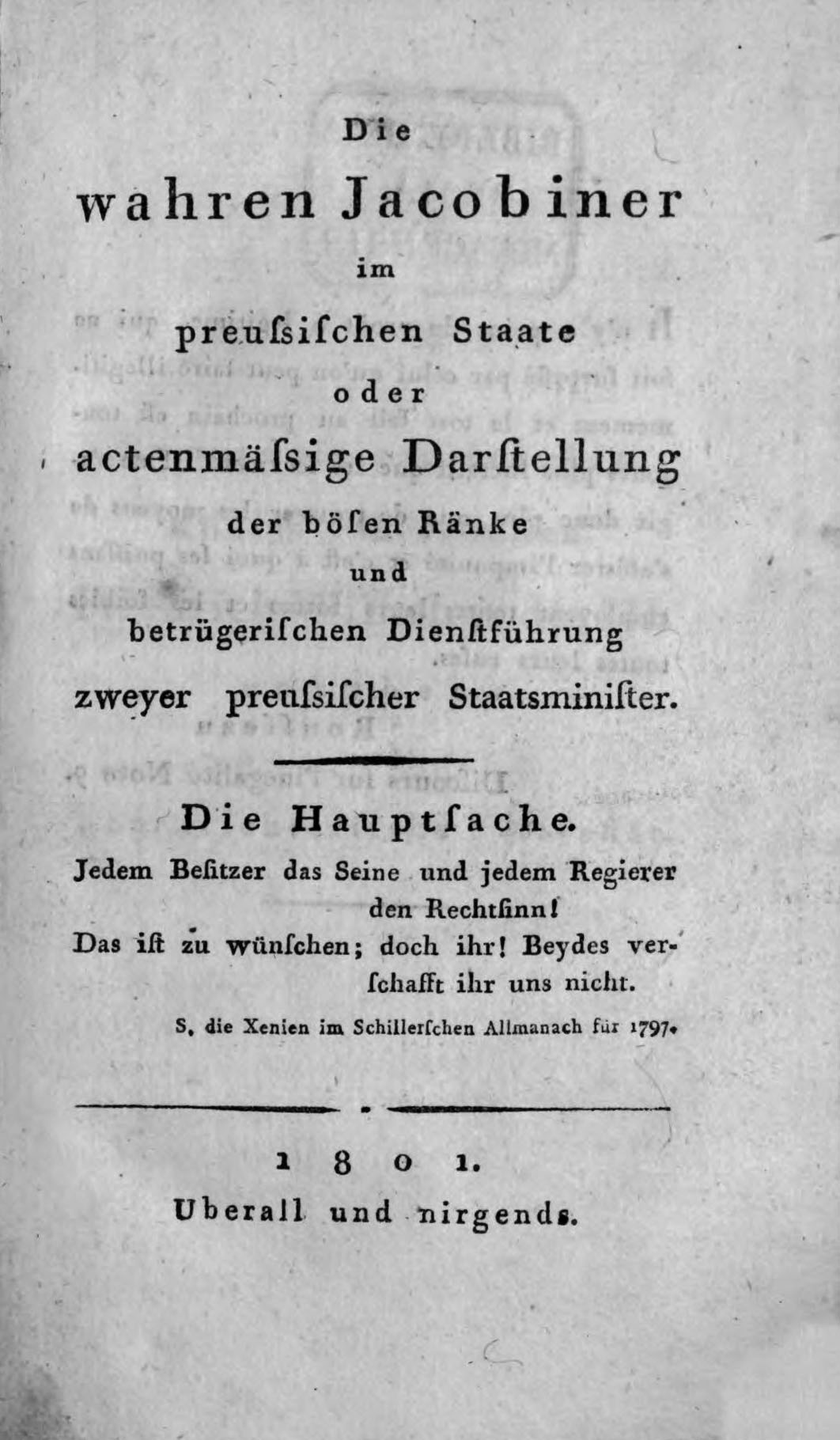
| Die wahren Jacobiner im preussischen Staate oder actenmässige Darstellung der bösen Ränke und betrügerischen Dienstführung zweyer preussischer Staatsminister | |
| Read · Deutsch Read · English | |
| Authors | Hans von Held (published anonymously) |
|---|---|
| Publisher | "Überall und nirgends" [Berlin: Frölich] |
| Publishing date | 1801 |
| Format | 256 pp. |
The True Jacobins in the Prussian State, or - A Documentary Account of the Wicked Intrigues and Fraudulent Conduct in Office of Two Prussian Ministers of State (Die wahren Jacobiner im preussischen Staate oder actenmässige Darstellung der bösen Ränke und betrügerischen Dienstführung zweyer preussischer Staatsminister) is is an anonymous political dossier published in 1801 with the false imprint “Everywhere and nowhere,” compiled by the Prussian excise official Hans von Held. Across 256 pages it reprints thirty-three official documents from the archives of South Prussia and Silesia, connected by unsigned editorial notes, in order to accuse the Silesian provincial minister Karl Georg von Hoym and the Grand Chancellor Heinrich Julius von Goldbeck of protecting a favourite, destroying a domain lessee, and lying to their king. Held bound twelve copies in black and sent them to the court, and the book has been known ever since as the Schwarzes Buch, the black book.
The book carries no author’s name. Its title page gives only the year, the mock place of printing, and a couplet from the Xenien in Schiller’s almanac for 1797 wishing possessors their property and rulers a sense of justice, and observing that neither is forthcoming.1 Behind it stood Hans von Held (1764-1842), an excise and customs councillor who had watched the disposal of confiscated Polish crown and church estates from a desk in Posen, had tried and failed to raise the matter through official channels, and had been transferred to Brandenburg an der Havel as a punishment for putting his complaints into a birthday poem for the king.2
The author
Held was born at Auras near Breslau, the son of an impoverished former officer, and studied law and state economy at Frankfurt an der Oder, Halle, and Helmstedt between 1784 and 1787, moving between universities because of his involvement in student secret societies. With Ignaz Aurelius Feßler and Joseph von Zerboni di Sposetti he was among the founders of the Bund der Evergeten, the “doers of good.” He entered Prussian service in 1788 as secretary to the Lower Silesian excise and customs directorate at Glogau and Küstrin, was received into the Küstrin masonic lodge in 1791, and in 1793, immediately after the Second Partition of Poland, was posted to Posen and promoted to Ober-Akzise- und Zollrat.2
That posting placed him beside the machinery the book describes. Estates that had fallen to Prussia were assessed low and passed to speculators and to well-placed officials, and Held put the resulting loss to the state in the millions. His contemporaries describe him as an industrious and scrupulously correct official who wrote occasional verse on the side. In 1797 he had a poem printed for the birthday of Frederick William II which asked that the rogues who cheat the state and coil like snakes about the throne receive their wages. He seems to have expected the provocation to open a hearing. It produced a reprimand and a transfer instead.2
Zerboni had meanwhile tried the direct route, reporting abuses in his own district to his superiors, and was imprisoned for it. When his papers were seized they revealed the plans of the Evergeten, and the members of the order were pursued as Prussian Jacobins on the suspicion that they intended a revolution on the French model.2 Zerboni served fortress detention at Magdeburg, was released under the amnesty at Frederick William III’s accession, and in 1800 published his own volume of documents, which earned him a fresh six-month sentence.3
The title
Held’s title turns that accusation round. If Jacobinism means the subversion of the state, then the men subverting Prussia are not the reforming officials in the fortresses but the ministers who dispose of crown property among their friends. The two named on the spines of the black copies were Karl Georg Heinrich Graf von Hoym (1739-1807), who had governed Silesia for two decades and who in 1794 received the administration of the newly formed province of South Prussia as well, and Heinrich Julius von Goldbeck (1733-1818), Grand Chancellor from 1795.4
The Krotoszyn case
The documents assemble a single affair, told in strict order of date. Frederick the Great had appointed Minister von Görne to head the Seehandlung, the maritime and salt trading company, and Görne used the money passing through his hands to buy large estates in Poland, among them the lordship of Krotoszyn on the Silesian border. He was arrested in January 1782 and his property sequestrated to cover the deficit, which made Krotoszyn a possession of the Seehandlung, administered through the War and Domains Chamber at Breslau. The book opens with the cabinet order of 26 January 1782 by which the king instructed Hoym to take the Görne estates into possession and draw as much money from them as possible.5
Local administration fell to a former huntsman named Triebenfeld, who had served Görne privately and stayed on. Krotoszyn lay under Polish sovereignty but in Prussian possession, and Held’s introduction describes how Triebenfeld exploited the ambiguity, sheltering behind Polish law or Prussian arrangements as suited him, a Pole to the Prussians and a Prussian to the Poles. He grew rich on contraband across the Silesian border, acquired a patent of nobility and a title, and became the indispensable man of the minister at Breslau.
In 1791 the Privy Finance Councillor von Struensee, then head of the Seehandlung, judged that a lease would yield more than an administration, and pushed through the leasing of the lordship to the Ober-Amtmann Johann George Früson for 30,100 reichsthalers a year against the roughly 17,000 to 18,000 the Chamber had been crediting. Triebenfeld kept his residence in the castle and his charge of the forests, which were not included in the lease. What follows in the documents is the record of his campaign to make the lease unliveable: the contract withheld for six months, the lease treasury sealed by ministerial order, timber owed to the brewery and distillery not delivered, denunciations lodged with the Polish War and Police Commission at Kalisch, and finally the bribing of manorial families to abscond so that Früson could be charged with oppressing his subjects and driving them out. Früson’s own witnesses were rejected as accomplices. In August 1792 he signed a composition renouncing the lease and every claim arising from it, submitting himself to Hoym as sole arbiter.
Great Poland became Prussian in the spring of 1793, and Krotoszyn with it. Früson’s son, a justice commissioner at Posen, brought suit before the newly established Regierung there against the Seehandlung for reinstatement, and the case became the thing Hoym could not afford. A memorial from the Breslau Chamber restated the affair as the story of a bad lessee who had been lawfully evicted by courts he had himself acknowledged and who had signed a valid renunciation. On 12 July 1795, within days of taking office, Goldbeck ordered the Regierung to dismiss the suit as frivolous and lay the files aside, without calling for the court’s opinion and without reading what Früson had alleged. Held’s note on this rescript is the sharpest in the book: a Regierung with five and a half thousand suits pending is not fatigued by one more, and the maxim that the other side must be heard exists for a reason.6
Früson petitioned the new king directly. Frederick William III ordered the case reopened on 17 December 1798, then, a week later, after Goldbeck had called in the files and reported on them, issued the cabinet order of 24 December 1798 which stopped the suit against the Seehandlung, against Hoym, and against the Breslau Chamber, leaving Früson his recourse only against Triebenfeld and the war councillor Neumann. That order is the hinge of Held’s argument, and he says of it that reason stands still before it.
The end of the affair was settled out of the records, and Held narrates it himself. Hoym negotiated privately with the Früson family, who agreed to accept the quashing and to leave Triebenfeld and Neumann alone in return for compensation. The compensation came from the state. The Ober-Amtmann Galinsky, who held the lease of the great Silesian domain office of Brieg and had been promised it as redress for losses on an earlier lease, was reported to the king as incapable, removed in June 1799, and barred from any further lease. Brieg went to Früson, aged sixty-five, for twelve years at 29,000 reichsthalers, a sum below both the valuation and Galinsky’s rent. Held sets the loss to the Silesian domains treasury at 40,800 reichsthalers and reproduces Hoym’s later letters of consolation to Galinsky beside the flat refusals Galinsky received from the cabinet, and the two answers from the Breslau Oberamtsregierung informing him that no suit against the minister was admissible at all.
The construction of the book
Held never appears as author. The book opens with a preface “To the Readers” in which a traveller, resting at the inn at Krotoszyn and idly wondering what a biography of a certain minister might look like, watches a morose stranger drive off ahead of him and finds a black leather portfolio in the wheel-track. Inside is a finished manuscript, evidently written for print, which the finder passes on to the public as he found it. The framing device is not meant to convince anyone. It converts the compiler into an editor, and the twenty-one editorial notes are signed “A. d. H.,” the abbreviation for the editor’s note.7
The apparatus is arranged for verification rather than for effect. A slip of paper said to have lain at the bottom of the portfolio names the two case files in the archive of the Regierung at Posen, with their titles and their opening dates of 4 January 1794 and 22 December 1797, against which the pieces may be checked for falsification. The preface states plainly that the omissions are of papers concerning the shells and not the kernel, and challenges Hoym and Goldbeck to produce a refutation, on the understanding that silence will be read as authenticity. The dedication to Frederick William III asks him to spend half an hour on the book before permitting its sale to be forbidden, and names Arnim, Struensee, Menke, and Hoff as honest men he might consult.
Struensee is the one senior figure the notes treat with respect, described as the Prussian statesman who most deserves the regard of his contemporaries and of posterity, and shown throughout as willing to help Früson but unable to. Antiquarian descriptions of the book have long held that Held was Struensee’s protégé and that the minister paid for the printing, though the claim does not appear in the standard biographical accounts.8
The Rousseau epigraph, from the ninth note to the Discours sur l’inégalité, sets out the premise the documents are meant to prove: that no honest gain matches what can be got dishonestly, and that the powerful spend all their strength and the weak all their cunning on securing impunity. Held’s closing paragraph makes the corresponding claim for his own procedure.
Though custom may have granted to the evil principle in this world, as it were, the right always to strike the first blow, yet to the good principle there has at least remained the right of self-defence; and if it is permitted to do evil publicly, then it must also be permitted to point publicly with the finger at that same evil.
- Hans von Held, Die wahren Jacobiner im preussischen Staate, 1801
The last page carries the single heading “Hope” and a second couplet from Schiller’s almanac, on honour returning to the martyr late and twofold.
Printing and consequences
Held had the book printed secretly in 1800 and dated 1801. The imprint “Überall und nirgends” concealed a Berlin press, identified in library catalogues as Frölich.9 As his author’s fee he took twelve copies, had them bound in black with the edges blackened as well, and had the names of Hoym and Goldbeck stamped in gold on the spines. Those copies went to the king and to figures in the government while the rest of the run was to be sold through the trade. Because earlier attempts at an investigation had been absorbed by the bureaucracy, Held was counting on publicity to force one. Most of the edition was recovered from the booksellers, but the copies distributed by his friends produced the scandal he wanted, and the unwieldy title was soon dropped in favour of das Schwarze Buch, even though the majority of surviving copies wear the ordinary light paper boards and leather spine of the period.2
The censors identified him quickly. After long interrogations Held was imprisoned and sentenced to eighteen months in the fortress at Kolberg for insulting the ministers Hoym and Goldbeck, and lost his office.10 He returned to Berlin in 1803, was pushed out again in 1806 for anonymous writings against Napoleon, and got no further employment until 1812, when he was given the post of salt factor in Berlin. He held it until 1842, when, at seventy-seven, after 3,000 thalers went missing from the salt treasury in his charge, he shot himself. He was buried at the Invalidenfriedhof; the grave is gone.2
The practice the book attacked continued. Triebenfeld was given eight estates between 1795 and 1798, assessed at 51,000 thalers, for his help in arranging and executing such grants. In 1801 and 1802, while Held sat in Kolberg, he sold them for 750,000 thalers together. Held’s own annual salary as an official had been 900 thalers, though land prices rose steeply after 1800 and account for part of the margin.2
Assessment
The book has been read in two ways since, and both readings are defensible on the evidence it prints.
Colmar Grünhagen went back to the files at the end of the nineteenth century and argued that the most important of the transactions Held attacked need not have been criminal when seen from another angle, while accepting that the allocation practice was not always proper.11 The Neue Deutsche Biographie locates the root of the charges brought by dissatisfied officials like Zerboni and Held in what Ingeborg Bussenius called Hoym’s overstretched departmental patriotism: he governed South Prussia from Breslau and consistently subordinated the new province’s economic interests to the welfare of Silesia, which had become the first duty of his life.4 On that account Krotoszyn is a case of a minister protecting his own province, his own subordinates, and his own record, which is not the same offence Held charges.
Held’s own procedure cuts both ways. The documents are the strength of the book, and he invites their verification with dates and file titles. The notes around them are polemic, and they do not pretend otherwise: Görne is a dunderhead, Hoym a satrap and a windbag, Goldbeck’s son a lout. The register extends to the Polish parties, whom a note dismisses as silly and drunken and easily managed with wine and money, which is worth registering in a book that presents itself as a defence of law against power. Held’s target throughout is the servants rather than the throne. The king is deceived, never complicit, and the argument depends on that separation holding.
What survived is partly the vocabulary. The German Schwarzbuch, a compiled dossier of documented abuses, traces back to Held’s twelve black copies, and the form he improvised in 1800, the annotated collection of official papers published to force an inquiry that no institution would open, has been used steadily since.12 Recent scholarship has moved him away from the role of the isolated whistleblower and towards the networks of late Enlightenment journalism between Posen, Berlin, and Altona in which he worked.13
Explore the Book
This is a preview only - view fullsize on archive.org
Gallery
Notes
-
The couplet is from the Xenien in Schiller’s Musen-Almanach für das Jahr 1797. Held cites it on the title page as “S. die Xenien im Schillerschen Allmanach für 1797” and returns to the same source for the couplet under the closing heading “Hoffnung.” ↩
-
“Hans von Held,” Wikipedia (German), accessed 15 July 2026, drawing on Rolf Straubel, Biographisches Handbuch der preußischen Verwaltungs- und Justizbeamten 1740–1806/15 (Munich: K. G. Saur, 2009), pp. 400f., and Hermann Markgraf, “Held, Hans von,” in Allgemeine Deutsche Biographie 50 (Leipzig: Duncker & Humblot, 1905), pp. 159–161. The birthday poem for Frederick William II reads in part: “Allen Buben ihren Lohn, / Die den Staat betrügen, / Und aus Raubsucht, um den Thron / sich wie Schlangen schmiegen.” ↩ ↩2 ↩3 ↩4 ↩5 ↩6 ↩7
-
“Joseph von Zerboni di Sposetti,” Wikipedia (German), accessed 15 July 2026. Zerboni’s Actenstücke zur Verurtheilung des Staatsverbrechens des Kriegs- und Domänenraths Zerboni und seiner Freunde (1800) reprinted his letter of 12 October 1796 to Hoym and brought him a further six months’ fortress detention in 1801. ↩
-
Stephan Skalweit, “Hoym, Karl Georg Heinrich Graf von,” in Neue Deutsche Biographie 9 (1972), citing Ingeborg Christiane Bussenius, Die preußische Verwaltung in Süd- und Neuostpreußen (1960); see also Hermann Fechner, “Hoym, Karl George Heinrich von,” in Allgemeine Deutsche Biographie 13 (Leipzig: Duncker & Humblot, 1881), pp. 219–225. Hoym held the direction of South Prussia from 24 September 1794 to 22 April 1798. ↩ ↩2
-
Die wahren Jacobiner im preussischen Staate (1801), pp. 21–25, cabinet order of Frederick the Great to Hoym, Potsdam, 26 January 1782, countersigned Schulenburg. The background of the Görne affair is given in Held’s introduction, pp. 9–20. ↩
-
Die wahren Jacobiner, pp. 122–128, rescript of the Grand Chancellor von Goldbeck to the Regierung at Posen, Berlin, 12 July 1795, with the editor’s note on pp. 127–128. ↩
-
The signature appears twenty-one times in the text. The German Wikipedia article gives the abbreviation as “A. v. H.”; the copy transcribed here reads “A. d. H.” throughout, that is, Anmerkung des Herausgebers. ↩
-
See for example the antiquarian description in the ZVAB listing of the 1801 edition, which states that Held was a favourite of Minister Struensee and that the book was printed at Struensee’s expense. Neither the Neue Deutsche Biographie nor the Allgemeine Deutsche Biographie mentions the financing. Held’s admiring note on Struensee is at Die wahren Jacobiner, p. 27n. ↩
-
National Library of Australia catalogue record for the 1801 edition, which gives the imprint as “Überall und nirgends ; [Berlin : Frölich]”; see also the HathiTrust catalogue record 008886929. ↩
-
Anna Joisten, “Vor den Richterstuhl der Zeitgenossen und der öffentlichen Meynung.” Der Fall des preußischen Staatsdieners und Spätaufklärers Hans von Held (Vienna: Böhlau, 2023), ISBN 978-3-412-52742-6, introduction, on the sentence of fortress detention and removal from office. ↩
-
Colmar Grünhagen, Zerboni und Held in ihren Konflikten mit der Staatsgewalt 1796–1802 (Berlin: Vahlen, 1897). ↩
-
On the black binding and the currency of the name, see the account in the Kulturfalter feature on Held, which notes that the volume became known as the “Schwarzes Buch” and prompted later collections of documented abuses published in the same form. ↩
-
Joachim Bahlcke and Anna Joisten, eds., Wortgewalten. Hans von Held – Ein aufgeklärter Staatsdiener zwischen Preußen und Polen (Potsdam: Deutsches Kulturforum östliches Europa, 2018), ISBN 978-3-936168-81-5; Iwan-Michelangelo D’Aprile, “Die letzten Aufklärer. Politischer Journalismus in Berlin um 1800,” in Ursula Goldenbaum and Alexander Košenina, eds., Berliner Aufklärung, vol. 4 (2011), pp. 179–206. ↩