Deutsch · English
The True Jacobins in the Prussian State, or - A Documentary Account of the Wicked Intrigues and Fraudulent Conduct in Office of Two Prussian Ministers of State
is an anonymous political dossier published in 1801 with the false imprint "Everywhere and nowhere," compiled by the Prussian excise official Hans von Held. Across 256 pages it reprints thirty-three official documents from the archives of South Prussia and Silesia, connected by unsigned editorial notes, in order to accuse the Silesian provincial minister Karl Georg von Hoym and the Grand Chancellor Heinrich Julius von Goldbeck of protecting a favourite, destroying a domain lessee, and lying to their king. Held bound twelve copies in black and sent them to the court, and the book has been known ever since as the Schwarzes Buch, the black book.
Read the article Begin reading ↓
Scanned, transcribed, and translated with machine assistance under a fixed protocol, then reviewed by hand. The original language is the authority. Editorial method
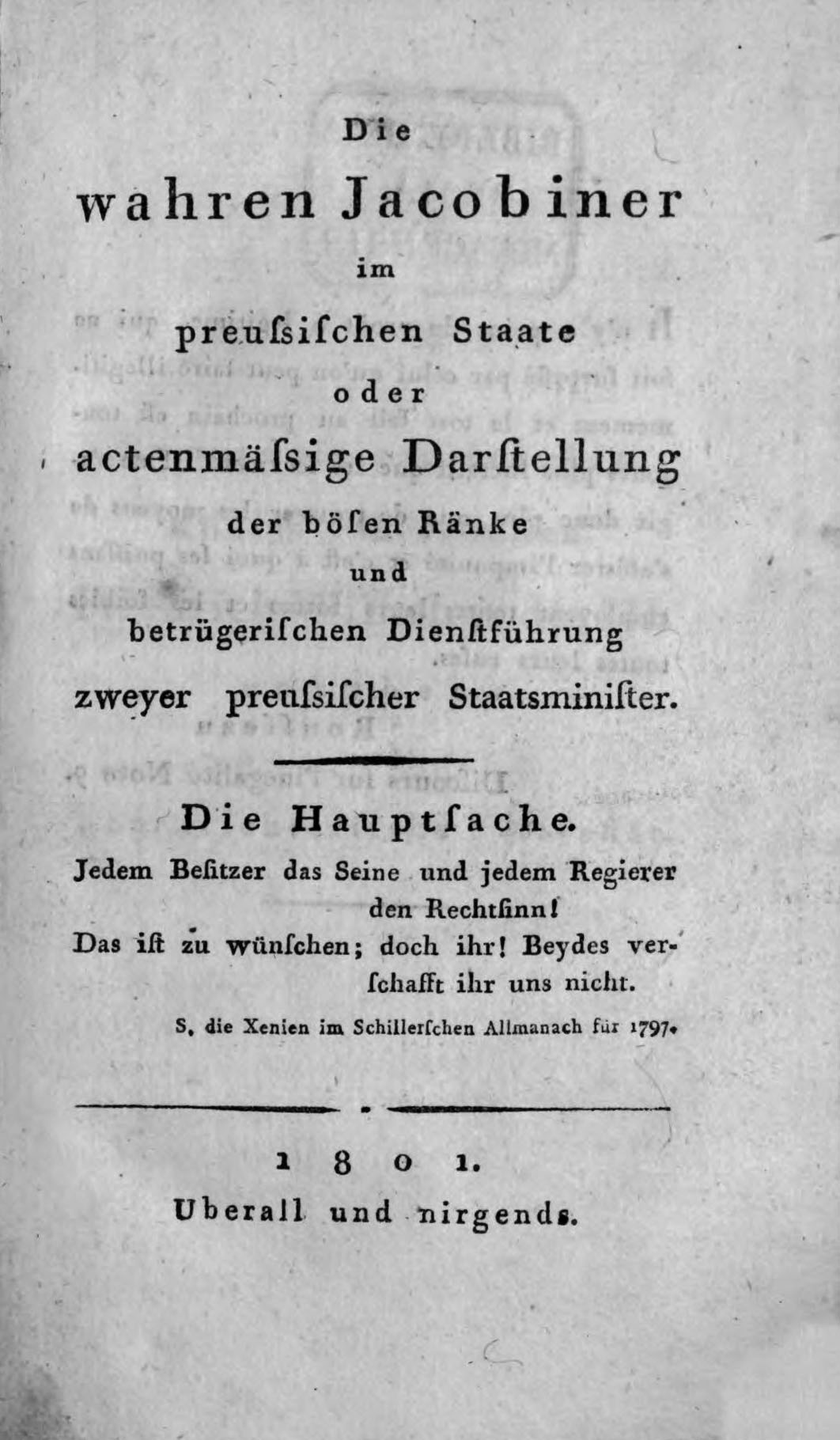
Die wahren Jacobiner im preussischen Staate oder actenmässige Darstellung der bösen Ränke und betrügerischen Dienstführung zweyer preussischer Staatsminister.
Die Hauptsache.
Jedem Besitzer das Seine und jedem Regierer den Rechtsinn!
Das ist zu wünschen; doch ihr! Beydes verschafft ihr uns nicht.
S. die Xenien im Schillerschen Allmanach für 1797.
1801.
Uberall und nirgends.
[p. unnumbered]
Il n’y a point de profit si legitime, qui ne soit surpassè par celui qu’on peut faire illegitimement et le tort fait au prochain est toujours plus lucratif que les services. Il ne s’agit donc plus que de trouver les moyens de s’assurer l’impunité et c’est à quoi les puissans employent toutes leurs forces et les foibles toutes leurs ruses.
Rousseau
Discours sur l’inegalité Note 9.
[p. unnumbered]
An des jetztregierenden Königs von Preussen Friedrich Wilhelms des III. erhabene und oberstrichterliche Majestät.
[p. unnumbered]
Allerdurchlauchtigster, Erhabenster Monarch, Verehrtester und redlichster Oberherr im Staate!
Bevor Sie gestatten, dass der Verkauf dieses Buch im Einlande verboten werde, widmen Sie ihm nur eine einzige einsame halbe Stunde, um es Selbst durchzulesen. Denn sein Inhalt ist wahrlich wichtig. Dann urtheilen Sie auch Selbst. Bloss Ihr Urtheil erachten alle diejenigen für competent, die in Ihnen nicht nur den ersten, sondern auch den redlichsten Mann im Staate sehen, und die Ihr erhabenes Amt und Ihre Person viel zu aufrichtig verehren, als dass sie gegen Beyde, das verbrecherische und elende Spiel einer ängstlichen und listigen Cabale versuchen könnten. Sie stehn zu hoch, Sie stehn ganz unabhängig im Heiligthume der Gerechtigkeit, als dass partheyische Rücksichten
[p. unnumbered]
auf Personen im Innern des Staates, die doch immer nur Ihre Diener und Unterthanen sind, Ihr Urtheil bestimmen könnten. Allenfalls können Sie ja einige andre ehrliche Leute, einen Arnim, Struensee, Menke, Hoff etc. um ihre Meynungen befragen.
Aber eigentlich, — dass Ihr eigenes freyes und gerechtes Urtheil das Schicksal dieser Blätter entscheide, darum bitten ehrerbietigst und allergehorsamst
Jahr 1801
die Redlichsten Ihrer Diener und treusten Ihrer Unterthanen.
[p. 1]
An die Leser.
Auf meiner letzten Reise im Sommer dieses Jahres 1800, von Bresslau — Wohin? kann den Lesern gleichgültig seyn — führte mein Weg mich, durch das hart an der schlesischen Grenze 12 Meilen östlich von Bresslau gelegne Südpreussische Städtchen Krotosczyn. Ich liess meine Pferde im dortigen Wirthshause futtern, setzte mich auf einen Balken vor der Hausthür und dachte eben darüber nach, welch ein Buch wohl entstehn möchte, wenn die
[p. 2]
Biographie eines gewissen, im preussischen Staate immer noch gar stattlich figurirenden und manövrirenden Ministers geschrieben würde, als noch ein andrer Fremder in einer Kibitke anlangte. Der Mann sah sehr mürrisch, blass und mistrauisch aus, kam auch nicht von seinem Fuhrwerke herab, sondern blieb darinn liegen, und las in einem Buche. Meine Bemühungen ihm Rede an zu gewinnen, waren fruchtlos. Indess fügte sichs, dass wir fast zugleich, er voran und ich hinterher, auf demselben Wege abfuhren. Seine Pferde waren etwas rascher als die meinigen, und so verlohr ich ihn nach einer Weile, in den stillen dichten Krotoscyner Waldungen aus dem Gesichte. Von ohngefehr beugte ich mich aus meinem Wagen, um meine Pfeife auszublasen und sah neben dem Geleise, gerade, wo der Mann gefahren war, eine schwarzlederne Mappe liegen, die ich mir reichen liess. Natürlicherweise vermuthete ich, dass sie dem Unbekannten aus seinem Wagen entfallen sey, und eilte ihn einzuhohlen. Aber
[p. 3]
alle Mühe war vergebens, ich sah ihn nicht wieder.
Die Neugier, gern gesteh ich von mir diesen Trieb, machte, dass ich endlich die ohnehin nicht verschlossene, sondern nur zugeknöpfte Mappe öfnete, und siehe da — ich fand darinn das völlig fertige sehr reinlich geschriebene Manuscript, welches ich, da es nach der Einleitung und den Anmerkungen zu urtheilen offenbar für den Druck bestimmt war, hiemit der leselustigen Welt, zur Erbauung mittheile. Lange habe ich mit mir selbst gestritten, ob ichs sollte oder nicht; zuletzt hat doch die Ueberzeugung die Oberhand behalten, dass es für den Gewinn und Sieg der Wahrheit und Tugend immer gut sey, solche characterisirende Schandthaten, zumahl actenmässig, vor den Richterstuhl der Zeitgenossen und der öffentlichen Meynung zu bringen. Ich gebe mithin meinen Fund genau so, wie er in meine Hände gekommen ist; der mürrische Unbekannte wird, hoffe ich, deshalb
[p. 4]
nicht auf mich zürnen. Der Umstand, dass dieses Manuscript so unerwartet den Betrachtungen entsprach, die ich von Bresslau mitgenommen und vor dem Krotosczyner Wirthshause sitzend, fortgesetzt hatte, schien mir ein Wink des Schicksals zu seyn, das was es mir zuwarf, weiter zu befördern.
Wenn ich nicht irre, sind über den in Rede stehenden Fall, hier alle wesentlichsten Actenstücke geliefert, so dass nichts fehlt, was zu seiner Geschichte und Entwickelung gehört. Was zwischen Hoym und Goldbeck heimlich deswegen correspondirt worden ist, haben die Herren wahrscheinlich verbrannt. Doch könnte es seyn, dass bey dem Justiz-Commissarius Früson in Posen noch mancher schriftliche Original-Belag dieser Schurkereyen versteckt wäre, den der Besitzer vielleicht nur darum zurückhält, weil seine Erfahrungen ihm Muth und Vaterlandsliebe benommen haben. Zur Darstellung der Hauptsache reichen diese Blätter immittelst völlig hin. Die Leser mögen
[p. 5]
übrigens selbst urtheilen. Ihnen darinn vorgreifen, wäre in Hinsicht der Redlichen, Beleidigung, in Hinsicht der Schurken, ohnehin vergebne Mühe. Beyden hat der Sammler wenigstens die Langeweile erspart, indem er alle unnütze Papiere, die bloss die Schaalen und nicht den Kern betrafen, weggelassen hat.
Eines Zettels darf ich zu erwähnen nicht vergessen, der in dem Boden der Mappe lag und von einer andern Hand geschrieben zu seyn schien, als diejenige war, von der die Anmerkungen herrühren. Er lautete so:
„Sollten diese Piecen verfälscht und sollte dies zu beweisen oder eine Widerlegung derselben möglich seyn, so könnte dies nur durch Vergleichung mit denjenigen im Archiv der Posenschen Regierung liegenden beyden Acten geschehen, welche folgende Titel führen:
[p. 6]
Acta primae Instantiae
“Der Regierung in Posen, in Sachen des Ober-Amtmann Früson auf Schlawiz in Schlesien, wider die Seehandlungs- Societät in Berlin, wegen Wiedereinsetzung in die Pacht der Herrschaft Krotosczyn. Angefangen den 4. Januar 1794.” Und
Acta primae Instantiae
“Der Regierung in Posen in Sachen des Amtmann Früson wider die Seehandlungs- Societät in Berlin und Kriegs- und Domainen-Cammer in Bresslau, wegen Entsetzung aus der Pacht von Krotosczyn. Angefangen den 22. December 1797.”
Ob nun solche Acten wirklich existiren und ob aus ihnen gegen die hier gelieferten Verhandlungen, eine Widerlegung zu entnehmen oder ein Beweis der Verfälschung zu führen seyn möchte, werden die Herren v. Hoym
[p. 7]
und v. Goldbeck wohl am besten wissen. Das Publicum erwartet jenes, dafern die genannten Herren ihre Ehre zu retten noch einige Lust fühlen sollten, oder aber es wird, dafern gar keine Widerlegung erscheint, an die Aechtheit dieser Verhandlungen glauben, und sie so lange empor halten vor dem Throne eines Königs, der nur dann einen Fehlschluss macht, wenn seine ersten Staatsdiener ihn belügen, eines Königs, der den einzigen Fehler hat, dass er noch nicht streng1 genug für die jetzigen lasterhaften Zeiten ist, vor dem Throne Friedrich Wilhelms des dritten, der im vorliegenden Fall unglaublich dreist und schändlich betrogen wurde, bis Er endlich wird aufmerksam
[p. 8]
werden und schliessen: Diejenigen, die einen so schlechten Streich ausführen konnten, sind mehrerer ähnlichen fähig. Berlin im November 1800, im Anfange des 4. Regierungsjahres Friedrich Wilhelms des dritten.
[p. 9]
Einleitung.
Die See- und Salzhandlungs-Societät in Berlin, hat von jeher viel Verkehr mit denjenigen Gegenden gehabt, die ehemahls: Pohlen, hiessen. An die Spitze dieses Instituts, stellte Friedrich der Grosse, der in der Wahl der Personen nicht immer eben so glüklich war als in der Beurtheilung der Sachen, einst den bekannten Minister von Görne. Dieser Ehrenmann gerieth demnach durch die Natur der ihm übertragenen Geschäfte in
[p. 10]
allerley Zusammenhang mit Pohlen und bald auch auf den Gedanken, dort grosse Ländereyen für sich zu kaufen; ja, man sagte, er habe das Project gehabt, selbst König von Pohlen zu werden und jene grossen Ankäufe hätten nur das Mittel seyn sollen, diesen Zweck zu erreichen. Ist etwas an der Sache gewesen — und fast ist es glaublich, da dieser Schwachkopf von den einfältigsten Schmeichlern umringt war, die je um einen Minister standen — so wird das Project wenigstens sehr lächerlich, wenn man die höchst-widerliche und carricaturmässige Figur des Görne, mit Scepter, Crone, Talar und Säbel der Polacken sich zusammen denkt. Doch — ein solches Volk hätte einen solchen König verdient. Stanislaus Poniatowsky war um kein Haar besser als Görne.
Wie dem auch sey, genug! Görne kaufte die ansehnliche weitläuftige Herrschaft Krotoschyn in Gross-Pohlen an der schlesischen Grenze, gegenüber Bresslau. Er verwendete dazu beträchtliche baare Summen aus den ihm
[p. 11]
anvertrauten Königl. Cassen. Dies wurde gemerkt und darum ward Görne im Anfang des Jahres 1782, zufolge eines Cabinets-Befehls Friedrichs des Grossen, von dem damahligen Gouverneur in Berlin, General Ramin, auf eine mit vielen comischen Nebenumständen verbundene Art, in seinem Pallaste unter den Linden, arretirt und einige Wochen später, nach Spandau gebracht. Dort hat er mehrere Jahre gesessen, bis der verstorbene König Friedrich Wilhelm der zweyte, ihm seine Freyheit wieder gab. Jetzt lebt er zwischen Brandenburg und Potsdam auf dem Lande.
Nach seiner oberwehnten Arretirung lies Friedrich der Grosse, sein Vermögen in Beschlag nehmen, um daraus die Cassendefecte zu ersetzen. Solchergestalt wurde die im damahligen Gross-Pohlen belegene Herrschaft Krotoschyn ein Eigenthum der Seehandlungs-Societät in Berlin, die die Einkünfte durch die Cammer in Bresslau bezog. Die Bresslauische Cammer liess ihrerseits, die Herrschaft während der ersten neun Jahre nach Görnes Fall,
[p. 12]
von einem gewissen Triebenfeld, den sie als einen in Privatdiensten des Görne gestandenen Jäger, Holzschreiber oder Förster dort vorgefunden hatte, administriren, und berechnete der Seehandlungs-Societät jährlich etwa 17 bis 18000 Reichsthaler, bis im Jahre 1791, der damahlige Geheime-Finanz-Rath v. Struensee die Verpachtung der Herrschaft an den Amtmann Früson, welcher 30100 Reichsthaler jährlich zu geben sich anheischig machte, für einträglicher hielt, sie zur Sprache brachte und durchsetzte.
Bis zum Jahre 1782 brauchte Görne häufig einen Kriegsrath Bernhardi in Berlin, zur Wahrnehmung seiner Wirthschaft in Krotoschyn und schickte den alten einfältigen Mann oft dahin. Bernhardi wohnte endlich, um die Zeit, da Görne arretirt wurde, in Krotoschyn mit seiner zahlreichen Familie und blieb auch nachher noch eine Weile dort. Der Förster Triebenfeld heyrathete, unter Umständen die jedes moralische Gefühl empören, hierauf bald eine Tochter des Bernhardi (seine
[p. 13]
jetzige noch immer unglückliche Frau) wider ihren Willen, und dann war sein erstes Geschäft, dass er seinen Schwiegervater vertrieb und, wie schon erwähnt ist, zur alleinigen Administration gelangte.
Von diesem Standpunkt aus begegnete der Genius oder vielmehr der Dämon des Triebenfeld, dem des Ministers Hoym in Bresslau und sofort stifteten beyde Höllengeister zwischen ihren beyderseitigen Schützlingen, die noch bis diesen Tag nicht nur bestehende, sondern durch die gemeinschaftliche Schande aufs engste geknüpfte Freundschaft. Triebenfeld begann zu gedeihen, er trieb schür öffentlich einen Contrebande-Handel mit englischem Steinguth, Ungarwein u. s. w, aus Krotoschyn nach dem nahen Schlesien und nach dessen Hauptstadt. Er wurde reich, wichtig und bekam Freunde. Seine Kühnheit und prompte Bereitwilligkeit zu jedem Geschäft, welches andern Gaunern vom gemeinen Schlage etwa noch Bedenken kostet, erwarben ihm in Kurzen das Interesse und die ganze Liebe des schlesischen Satrapen.
[p. 14]
Hoym brauchte, besonders nach dem Ableben des grossen Friedrichs, einen zu allem Bösen vorzüglich aufgelegten und entschlossenen Handlanger, und darum war ihm der vormahls unbekannte Triebenfeld herzlich willkommen, den er zur Belohnung seiner Verdienste und zur Aufmunterung sich deren noch mehrere zu erwerben, hiernächst kurz hintereinander mit einem Adelsdiplom, einem Titel, einer Forstuniform und einem Stiftscreutze decorirte. Krotoschyn wurde das Depot aller Ministerial-Laster, die man in Bresslau verbergen wollte und bey nächtlichen rohen Bachanalien im Schlosse zu Krotoschyn hörte man Banditen-Kehlen die Gesundheit brüllen: Vivat Brüderchen Hoym!!!
Was war in dem Zwitterländchen Krotoschyn nicht alles zu machen? In diesem Winkel, um den keine Obrigkeit sich gehörig bekümmerte, in dieser Insel zwischen zwey Reichen, wo Triebenfeld gleichsam König war, so dass man ihn mit Sancho auf seiner Semmel-Würstchens-Insel hätte vergleichen können,
[p. 15]
wenn Sancho nicht unendliche moralische Vorzüge vor Triebenfeld besäse? Freylich stand Krotoschyn, dem Nahmen nach unter pohlnischer Landeshoheit, das heist, unter der elendesten und verworrensten in ganz Europa, aber es war doch in preussischem Besiz, der etwas mehr bedeutete, als blosser Dominial-Besiz. Wie man wollte, konnte man es als ein Stückchen von Pohlen oder auch als ein Stückchen von Schlesien betrachten. Triebenfeld benutzte trefflich diesen doppelten Character. Je nachdem es dem saubern Herrn Administrator vortheilhaft oder schädlich war, schützte er sich, bald mit preussischen bald mit pohlnischen Gesetzen, oder schob beyde von sich. Bald zog er die Grenzlinie, die Pohlen und Schlesien trennte, sehr scharf, bald erklärte er sie wieder für eine Chimäre. Bald drohete er mit preussischen Einrichtungen, bald sprach er wieder mit grosser Salbung von den Vorrechten der Republick Pohlen. Den Preussen war er ein Pohle, den Pohlen ein Preusse.
Kein Wunder war es demnach, dass er
[p. 16]
gewaltig scheel dazu sah, als diese Herrlichkeit ein Ende nehmen und Krotoschyn im Jahre 1791 an den Amtmann Früson verpachtet werden sollte. Dem Minister Hoym kam diese Veränderung aus tausenderley Ursachen ohnehin schon an sich, ungelegen und er liess sie nur darum geschehen, weil er in ihrem Entstehen, sie nicht gleich mit schicklichen Vorwänden zu hintertreiben vermochte. Darinn wurden hinfolglich beyde, Hoym und Triebenfeld ohne viele Umstände einig, dass das beste Mittel die Pacht wiederum in die bisherige Administration zu verwandeln, darin bestehe, dem Früson auf alle mögliche Art das Leben in Krotoschyn so sauer zu machen, dass er sich bewogen fände, von da bald wieder ab zu ziehn. Hoym gab seine Einwilligung, und versprach den Rücken frey zu halten, Triebenfeld übernahm die Ausführung. Letztere war um so leichter, da Triebenfeld als Ober-Aufseher der weitläuftigen Forsten, die dem Früson nicht mit verpachtet waren, im Schlosse zu Krotoschyn wohnen
[p. 17]
blieb und Früson ihm sein Gehalt zahlen und ein grosses Deputat an Naturalien geben musste, welche Verhältnisse, wie billig auch Früson immer verfahren mochte, doch eine Menge Veranlassungen zu Zank und Neckereyen darboten, die Triebenfeld benutzen konnte und benutzte.
Die hier dem Publicum vorgelegte Sammlung von Actenstücken enthält nun eigentlich die Geschichte der Schicanen und Gewaltthätigkeiten, die, von Triebenfeld eingeleitet und angestiftet, den Amtmann Früson auch wirklich sehr bald wieder aus Krotoschyn vertrieben. Man sieht daraus mit Schrecken und Ekel, wie leicht ein gewissenloser Minister den Schaden eines Privatmannes decretirt, wenn es darauf ankömmt, einem andern Minister gefällig zu seyn, oder ihn aus Verlegenheit zu ziehn; wie wenig Ueberwindung
[p. 18]
und List, Männern dieses Gepräges und Ranges ein sonnenklarer Betrug kostet und wie sans façon sie nicht nur mit Staats-Einkünften und Privatwohl umspringen, sondern sogar dem Landesherrn ins Angesicht lügen, wenn Angst und ausbrechende Schande sie antreiben, ihre alten Niederträchtigkeiten mit neuen zu bedecken. Dass übrigens während der Regierung des verstorbenen Königs vieles möglich war, was eigentlich nie und nirgend möglich seyn sollte, darinn hat man nach gerade sich gefunden, aber — wer kann jemahls sein Erstaunen darüber mäsigen, dass unter Friedrich Wilhelms des dritten Regierung, ein Cabinetsbefehl wie der vom 24. December 1798, am Ende dieser Acten, ergehen könnte? Wer diese Blätter nur mit einiger Aufmerksamkeit ganz durchliefet, muss mit drückender Klarheit fühlen, welcher mannigfaltigen Critik
[p. 19]
der Wahrheit, der Logik, ja des blossen nüchternen gesunden Menschenverstandes, jener Cabinetsbefehl von der ersten bis zur letzten Zeile ausgesetzt ist. Welcher Vermuthung soll man Raum geben? Welche irgend erträgliche Erklärung soll man machen? Die Vernunft steht still. Schmerzlich, höchst schmerzlich ist es, hiebei an den für bieder und edel geltenden und zugleich als guter Jurist bekannten, Geheimen Cabinets-Rath Beyme und ihn sich in der peinlichen Nothwendigkeit zu denken, solche Cabinetsbescheide angeben und abgehn lassen zu müssen. Ist das Cabinet nicht die allerletzte Instanz für acht Millionen Menschen, die in Fällen gekränkter Gerechtigkeit dahin ihre hoffnungsvollen Blicke richten, ihre Zuflucht nehmen sollen? Darf der Regent, die Foderung, gerecht zu seyn, unerfüllt lassen? Und — ein solcher Cabinetsbescheid ! ! ! —
[p. 20]
Dass Triebenfeld in den nachfolgenden Verhandlungen überall hinter den Coulissen steht, darf den Lesern wohl nicht erst bemerklich gemacht werden. Man erinnert sie daher nur noch daran, als an einen wichtigen Wendepunkt dieser Geschichte es sich immer gegenwärtig seyn zu lassen, dass Grosspohlen und folglich auch Krotoschyn im Frühjahr 1793 unter preussische Landeshoheit kamen.
[p. 21]
Friedrich der Grosse an den Staatsminister von Hoym in Bresslau.
Mein lieber Etats-Minister von Hoym. Da der bisherige Chef der See- und Salz-Handlungs-Compagnie, von Görne, der Kasse gedachter Compagnie, wie ich Euch schon gesagt habe, ansehnliche Summen schuldig ist, und ich also mich und die Kasse so gut als möglich aus dessen Vermögen bezahlt machen muss, so habe ich resolvirt, seine in Pohlen erkaufte Güther, so fort in Besitz nehmen,
[p. 22]
und deren Revenües zu Verminderung des von Görneschen Defects, sequestriren und einziehen zu lassen, bis sich etwa zum Verkauf der Güther selbst Gelegenheit findet. Weil aber diese Güther von Berlin sehr weit entfernt liegen, und die Administration von da aus nicht zu übersehen sein würde, dagegen aber deren Entfernung von Bresslau gar nicht beträchtlich ist, so gebe ich Euch hiermit auf, ohne allen Zeitverlust einen Rath, von der dortigen Krieges- und Domainen-Cammer, welcher von der Oeconomie hinlängliche Wissenschaft und Erfahrung hat, mit einigen tüchtigen Unterbedienten nach Pohlen abgehen, und durch selbigen sämmtliche dort belegene Güther des von Görne, namentlich die Herrschaft Krotoszyn2 und Rosdarczewo, auch die Herrschaft
[p. 23]
Polajewo, in Besitz nehmen und sequestriren zu lassen. Und damit diese Besitznehmung ohne alle Schwierigkeit und Weitläuftigkeit statt haben könne, soll der von Görne selbst seine auf den Güthern habende Bediente anweisen, sich solcher nicht zu widersetzen, welche Anweisung mein Grosskanzler von Carmer besorgen und Euch zuschicken wird. Sobald nun der Commissarius an Ort und Stelle kommt, muss er die Wirthschafts-Administration, welche bisher auf eine so verschwenderische Art geführt worden, dass von den Revenüs kaum etwas übrig bleiben können, nach richtigen öconomischen Principiis auf das menageuseste einrichten, überhaupt aus den Güthern soviel Geld als immer möglich ist, ziehen, und insonderheit auf den Holzverkauf bedacht sein, und darüber mit meiner Haupt-Nutz-Holz-Administration, sobald er sich nur einigermassen von dem Zustande der Sachen informirt hat, correspondiren, wobey ich Euch bekannt mache, dass zwar gedachte Administration schon einen grossen Theil des Holzes
[p. 24]
aus der Herrschaft Krotoszyn erkauft hat, dass aber noch sehr viel Holz übrig bleibt, welches um Geld zu schaffen, Fuss für Fuss weggehauen3 und nach und nach, wie es möglich und thunlich, versilbert werden muss. Hiernächst muss der Commissarius auch darauf bedacht sein, die Güther auf Trinitatis vortheilhaft zu verpachten, weil sich wohl sobald kein Käufer finden wird. Alles Geld, so er einnimmt, muss er nebst der Administrations-Rechnung der Bresslauer Krieges- und Domainen-Cammer, welche die Aufsicht über die Administration führen, und sie dirigiren soll, übersenden, und diese kann das Geld an meine Banque zu Bresslau gegen Quittung abgeben,
[p. 25]
die Quittung aber statt baaren Geldes an die Seehandlungs-Compagnie-Casse nach Berlin auf Abschlag des von Görnschen Defects übermachen, weshalb nur wegen desjenigen, was sonst hierbey noch näher zu überlegen sein möchte, Ihr mit meinem Etats-Ministre Freyherrn von Schulenburg, welchem ich die Ober-Aufsicht über die See- und Salz-Handlungs-Compagnie übertragen, zu correspondiren, und alles nöthige hiernach fördersamst gehörig zu besorgen habt. Ich bin Euer wohl affectionirter König.
Potsdam den 26. Januar 1782.
Schulenburg.
[p. 26]
Der Bresslausche Geheimerath v. Hoym, Vetter des Ministers v. Hoym, an den Ober-Amtmann Früson.
Wohlgebohrner Herr,
Hochzuehrender Herr Oberamtmann!
Da ich bey der Empfehlung und den guten Zeugnissen, welche die Königl. Cammer Euer Wohlgeb. gegeben hat, nicht ohne Grund vermuthe, dass man von Seiten der Seehandlung auf Euer Wohlgeb. bey der Krotoschiner Pacht
[p. 27]
reflectiren möchte, so ersuche ich Dieselben mir durch Ueberbringer dieses wissen zu lassen, ob Sie das Oblatum des Matthiae mit 30100 Thaler geben oder vielleicht noch gar etwas zulegen wollen, da ich alsdenn die Sache von hier aus gleich bey dem Herrn Geheimen-Finanz-Rath v. Struensee 4 einleiten will.
Am liebsten würde es mir seyn, wenn sich Eure Wohlgeb. selbst hieher bemühen wollten, da wir denn manches mündlich deshalb verabreden könnten. Ich bleibe bis zum siebenten hier.
[p. 28]
In Erwartung Euer Wohlgebohren hier zu sehn,5 habe ich die Ehre mit besonderer Hochachtung zu seyn
Euer Wohlgebohrn
Rothland
den 3. Juli 1791.
gehorsamer Diener
v. Hoym.
[p. 29]
[p. 30]
Der Minister von Struensee in Berlin an den Kriegsrath von Triebenfeld(6) in Krotoschyn.
Der Oberamtmann Früson hat sich bey seiner Anwesenheit hier in Berlin beschwert, dass Sie ihm bey dem Betrieb seiner Pachtung viele
[p. 31]
Hindernisse in den Weg legten. Ich habe diese Beschwerde der Breslauschen Kriegs- und Domainen-Cammer communicirt, um selbige zu untersuchen, und die entstandenen Missverständnisse
[p. 32]
zu schlichten, und allen künftigen Collisionen vorzubauen; ich mache Ihnen dabey zugleich bemerklich, dass Sie sich durchaus in die Oeconomie der Herrschaft Krotoszyn nicht zu mischen, sondern selbige lediglich der Bresslauschen Krieges- und Domainen-Cammer zu überlassen, auch
[p. 33]
sich überhaupt vorzusehen haben, dass Sie dem Früson keine Veranlassung zu Beschwerden geben, vielmehr mit demselben in Ruhe und Eintracht leben.
Berlin den 26. Januar 1792.
Struensee.
[p. 34]
Der von dem Triebenfeld und Neumann dem Früson abgezwungene Vergleich, die Pachtung von Krotoschin wieder aufzugeben.
Endesunterschriebener Ober-Amtmann Johann George Früson urkundet und bekennet hierdurch,7 dass er sich die von der Kalischer
[p. 35]
Krieges- und Polizey-Commission gegen ihm diktirten Exmission aus der Pacht der Krotoszyner Güter, nochmahls unterwirft, die Pacht gänzlich aufgegeben habe, und in Betreff aller Forderungen, welche aus dieser Pacht und Rückgabe derselben entstehen könnten, der Entscheidung des Herrn Ministre Grafen von Hoym qua super Arbiter! sich gänzlich unterwirft, ohne dagegen die mindeste weitere Ansprüche, im Wege Rechtens es sey in welchem Foro es wolle zu formiren, insbesondere aber, damit alle rechtliche Schritte in den pohlnischen Gerichten von nun an gänzlich aufhören mögen, erklaret er sich, dass er von allen fernern Prozessen, und besonders von der am 11. cur. bey der Civil-Commission anhängig gemachten Beschwerde völlig absteht, und die auf das Memorial ergangene
[p. 36]
Citation, auf welche der Herr von Husarzewski, der Herr Krieges- und Forst-Rath von Triebenfeld, er und die Stadt Krotoszyn den 25. huj. mensis vor derselben erscheinen soll, als ungültig erkläre. — Auch annulliret derselbe die dem Hrn. v. Trembinski am 25. Juli ertheilte Vollmacht dergestalt, dass sie von nun an als nicht geschehen anzusehen ist. Endlich versprechen der Herr Krieges- und Forst-Rath von Triebenfeld, desgleichen der Herr Gottlieb Hermann als regierender Burgermeister, der Hr. Rudolph von Gurowski und der Hr. Thomas Chmileck als Rathmänner, dass sie von nun an gemeinschaftlich von allen intendirten Prozessen abstehen, alle Manifestationes, und Citationes sie mögen gemacht worden seyn, wo sie wollen, zurücknehmen, und sich überhaupt darüber wechseltig quittiren auch keine neue Prozesse mehr formiren wollen. Der Krieges- und Forst-Rath v. Triebenfeld verspricht überdiess, dass er Quittungen über die Aufhebung der zwischen dem Herrn Grenzrichter,
[p. 37]
den Hrn. v. Zablocki, v. Kordaszowski und Hrn. Ober-Amtmann Früson und seinem Sohne schwebenden, und aller noch zu erhebenden Prozessen verschaffen und deren Niederschlagung besorgen werde. Diese Complanation, welche ein Theil wie der andere gültig erklärt, und allen rechtlichen Ausflüchten, die dagegen gemacht werden könnten, sie heissen wie sie wollen, ausdrücklich entsaget, ist in zwey gleichlautenden Exemplaren in pohlnisch und deutscher Sprache abgefasst worden und soll zu mehrerer Sicherheit sogleich in hiesigen Stadt-Acten roborirt und inferiret werden. Geschehen Krotoszyn den 13. August 1792. Johann George Früson. Friedrich August Triebenfeld. J. G. Hermann, Bürgermeister. Joseph Gurowski Vice-Burmistzer. Thomas Chmelki. Stanislaus Kostasowski. Friedrich Wilhelm Neumann8 als Zeuge. Joseph Joachim v. Koszielski als Zeuge.
[p. 38]
[p. 39]
Der Bresslausche Regierungs Referend. Früson an den Minister von Struensee in Berlin.
Hochwohlgebohrner etc.
Unterm 28. Juli hatte mein Vater der Ober-Amtmann Früson die Gnade Ew. Excellenz von der unterm 15. ej. M. an ihn erlassenen Verfügung des Herrn Ministre Grafen von Hoym, in Betreff der zu verfügenden Exmission, und von des Kriegs-Raths Triebenfeld intermistischen Uebertragung der Mitaufsicht der Wirthschafts-Angelegenheiten,
[p. 40]
Nachricht zu ertheilen, und zugleich um Ausfertigung eines Attests zum Behuf der Legitimation seines hiesigen Besitzstandes unterthänigst zu suppliciren.
Die von Ew. Excellenz schon unterm 30. Juli decretirte Beantwortung und zugleich verfügte Ausfertigung des gedachten Zeugnisses, ist, Gott weiss, durch welchen Auffenthalt erst unterm 15. dieses Monaths hier eingegangen, und hat deshalb bis jetzo auch kein Gebrauch davon gemacht werden können.
Ich wage es nicht, Ew. Excellenz durch das Detail aller der Chicanen und ehrlosen Anstiftungen, wodurch mein Vater selbst Thätlichkeiten exponirt worden ist, gegenwärtig zu behelligen, vielleicht habe ich unter kurzem die Gnade, Höchstdenenselben in Angelegenheiten des Letztern persönlich aufwarten zu dürfen, und behalte mir alsdenn mit Höchstdero Genehmigung zu einem mündlichen Vortrag vor, was ich gegenwärtig, ohne allen Nutzen der Feder anvertrauen müsste. Das Wesentliche, wovon ich Ew. Excellenz gegenwärtig
[p. 41]
im Namen meines Vaters, welcher aus Chagrin krank darniederliegt, Nachricht zu geben habe, betrifft dessen, aller Protestation ohngeachtet, erfolgte Exmission. Wie man hierbei gebaret hat, werden Ew. Excellenz aus nachstehenden Factis, die ich der strengsten Wahrheit gemäss vortragen werde, zu entnehmen geruhen.
Der Herr Hofgerichts-Rath von Husarzewski9 aus Bromberg fand sich ein, und eröffnete meinem Vater, dass er von Sr. Excellenz des Herrn Ministre Grafen von Hoym den unangenehmen Auftrag habe, auf den Grund eines Decrets der Pohlnischen Krieges und Policey-Commission, dessen Exmission vorzunehmen, dass er übrigens aber ausser Stande sey, dieses Decret, welches blos der
[p. 42]
Herr Ministre in Händen habe, zu seiner Legitimation zu produciren. Natürlich musste meinen Vater dieser Antrag um so mehr befremden, da ihm von Seiten des gedachten Judicii selbst nichts davon bekannt gemacht worden, und ihm die Existence einer solchen Verfügung daher noch immer unwahr geschienen hatte. Der Herr Hofgerichts-Rath beschied sich indessen von selbst, in dieser Angelegenheit eher nichts vorzunehmen, bis er sich unter Zuziehung eines Commissarii von Seiten der Bresslauschen Cammer hinlänglich würde legitimiren können. Derselbe reifste daher in Begleitung des Kriegs-Rath Triebenfeld nach Bresslau, und nach wenigen Tagen kam er nebst einem gewissen Cammer-Assessor Neumann an, welcher letzterer sich durch Production eines vom Herrn Ministre Grafen von Hoym Excellenz ganz allein unterzeichneten Commissorii zu dem vorhabenden Exmissions-Geschäft legitimirte, und ohne Zuziehung meines Vaters, welcher dagegen protestirte, seine Operation ohne Anstand anfing
[p. 43]
und fortsetzte. Ich kann hierbey nicht unbemerkt lassen, dass dergleichen Geschäfte in der Regel wohl keinem Assessor, sondern einem Rathe aus der Mitte des Collegii pflegen übertragen zu werden, dass auch dergleichen Commissoria nicht blos vom Chef des Collegii, sondern unter Ausfertigung einiger der Mitglieder selbst pflegen vollzogen zu werden.
Die Veranlassung zu diesem Auftrage, wage ich jedoch nicht zu beurtheilen. — Nachdem nun gedachter Hr. Commissarius Neumann auch das Original-Exmissions-Decret der Kalischer Krieges- und Polizey-Commission producirte, und daraus hervor ging, dass die Austretung einiger Unterthanen, welche bereits sämmtlich wieder gekommen sind, hierzu Veranlassung gegeben hatten, so säumte ich nicht unter Zuziehung eines pohlnischen Sachverwalters diejenigen Rechts-Mittel zu interponiren, welche sachfälligen Partheien, so wie in Preuss. Staaten zur Remedur gravirender Verfügungen frey stehen; ohne jedoch erst nöthig zu haben, auf die Entscheidung einer
[p. 44]
höhern Instanz provociren zu dürfen, bewilligte man mir bey demselben Judicio eine neue Recherche derjenigen Beschuldigungen, welche man in Absicht der emigrirten Unterthanen meinem Vater zur Last legte, und erliess zu dem Ende an das Krotoszyner Gubernium den Befehl nicht nur selbst in Termino praefixo zu erscheinen, sondern auch zum Behuf einer nehmlichen Untersuchung alle die ausgetretenen und nunmehro revertirten Personen ad locum Judicii zu sistiren. Die Gährung, welche dieses Decret bey der sämmtlichen Exmissions-Commission, excl. des Herrn Hof-Gerichts-Raths v. Hufarzewski, welcher gleich den folgenden Tag und noch vor Anfang der Exmittirung abreiste, veranlasst hatte, verursachte, dass der Herr Commissar. sein Exmissions-Geschäft für unterbrochen hielt, und eben im Begriff war wieder abzugehen, als es dem Kriegs-Rath Triebenfeld einfiel, einen Vergleich zu projectiren, welcher im Wege der Güte oder Gewalt zu stande kommen sollte; man legte meinem Vater
[p. 45]
anfänglich in pohlnischer Sprache ein Concept zur Unterschrift vor, dessen Inhalt er nicht einmal verstehen konnte.
Bey seiner Weigerung übersetzte man daher solches endlich ins Deutsche und es ergaben sich daraus ohngefähr folgende Vergleichs-Propositionen.
Erstens. Sollte mein Vater die einem gewissen Trembinski zu Besorgung seiner rechtlichen Angelegenheiten, ertheilte Vollmacht cassiren.
Zweitens. Der zuletzt von der Krieges- und Polizey-Commission in Kalisch per Decretum verfügten Untersuchung renunciren.
Drittens. Seiner Pacht, und allen gegen verpachtenden Theil zu formirenden Ansprüchen völlig entsagen.
Viertens. Sich in Absicht seiner Entschädigungen lediglich der Gnade des Herrn Ministre von Hoym submittiren. Gegentheils wollte sich der Herr Kriegs-Rath Triebenfeld verbindlich machen, alle gegen meinen Vater obschwebende Prozesse gänzlich zu coupiren,
[p. 46]
und die Aufhebung derselben zu bewirken. Wie und auf welche Art der etc. Triebenfeld letztere bewirken wollte, da er doch keine Veranlassung dazu will gegeben haben, und alle diese Angelegenheiten officielle fiscalische Sachen betreffen, über diesen Umstand hat sich derselbe in weiter keine Erklärung einlassen wollen. Ich lasse solche auch dahin gestellt sein, und bemerke nur, dass nach Verlauf einiger Stunden, welche sich mein Vater als Bedenkzeit erbeten hatte, sich ein ganzer Schwarm grösstentheils besoffener Bürger im Hofe rottirte, hierauf ins Schloss und nach dem Zimmer des Kriegs-Rath Triebenfeld zudrang, der Unterpächter von Sokolnitzki ein bekanntlich wüster und roher Pohle nebst seinen Leuten, und andere dem etc. Triebenfeld zu Dienst stehende pohlnische Edelleute, die er durch versprochene Verpachtungen in sein Interesse zu ziehen weiss, alles dies war um den Triebenfeld versammelt und erwartete die Ankunft meines Vaters, welchen man hinauf nöthigte. Ohne
[p. 47]
weiter zu fragen, legte man ihm hierauf den Vergleich zur Unterschrift vor, unter Furcht und Drohungen bestürmte man ihn, alle Ausgänge waren besetzt, und selbst der Commissarius Neumann versicherte meinen Vater, dass er ihn vor Thätlichkeiten nicht würde schützen können, wenn er auf seiner Weigerung bestehen wollte. Unter diesen Umständen ergriff letzterer die Feder, unterzeichnete einen erpressten Vertrag, und von diesem Augenblick an, beruhigte man nicht nur die zuvor durch den Trunk hierzu vorbereiteten Bürger, sondern entliess dieselben so wie meinen Vater nach ihren Wohnungen. Das Urteil über ein solches Gebähren darf ich Ew. Excellenz eigenem Gefühl überlassen.
Meine vorzüglichste Sorge ist nunmehro so schleunig wie möglich für die Entfernung meines Vaters mit seiner übrigen Familie zu sorgen, eher darf ich es nicht wagen, bey der hiesigen Obrigkeit wirksam zu sein, ohne mich vielleicht unangenehmen Thätlichkeiten zu exponiren. Gegenwärtig hat man ihn zu einer
[p. 48]
Berechnung aufgefordert, und er hat sich dies, um ein vorläufiges Liquidum zu constituiren, gefallen lassen. Indess bedarf es wohl nur sehr mittelmässiger Kenntnisse von öconomischen Verhältnissen um einzusehen, dass bey einer so wichtigen Entreprise, wenn ein Landwirth seinen Plan auf 9 Jahre anlegt, und schon nach Ablauf des ersten abgehen muss, er bey einem mittelmässigen Vermögen, wie hier der Fall ist, seinen Verlust leicht nicht übersehen kann.
Ich glaube in dieser Rücksicht bey der von Ew. Excellenz durchaus anerkannten Dexterität keinen Widerspruch erwarten zu dürfen, und hoffe keine Fehlbitte zu thun, wenn ichs wage, Ew. Excellenz gnädigen Beystandes gewärtig zu sein. Ich empfehle mich Ew. Excellenz gnädigem Wohlwollen, und verharre im tiefsten Respect
Euer Excellenz
gehorsamster Diener
Früson jun.
Referendarius.
Krotoszyn
den 16. August 1792.
[p. 49]
Der Minister von Struensee an den Referendarius Früson, damals auf der Reise in Berlin.
Dem Herrn Referendarius Früson, kann ich auf das als Mandatarius des Ober-Amtmann Früson unterm 4. d. M. eingereichte Schreiben im allgemeinen nur dasjenige wiederholen, was ich dem Ober-Amtmann Früson bereits mehreremalen gesagt habe, dass nehmlich die Bewirthschaftung der Krotoszyner Güther von des Königes Majestät ganz der Bresslauschen Cammer überlassen worden ist, es daher auch lediglich und allein die Sache der Cammer ist, wie sie die Bewirthschaftung zu
[p. 50]
führen, und ob sie den Ober-Amtmann Früson beizubehalten oder nicht zu behalten für besser hält. Ich kann daher denjenigen Vergleich, den der Ober-Amtmann Früson am 13. August d. J. mit dem etc. Triebenfeld geschlossen hat, weder billigen noch misbilligen. Weder der etc. Triebenfeld noch die Cammer zu Bresslau hat zu diesem Vergleich von mir, oder von der General-Direction der Seehandlungs-Societät einen Auftrag erhalten, ja es ist hier nicht einmal bekannt geworden, dass der etc. Früson gegen die von den pohlnischen Gerichten am 15. Juni d. J. verfügte Exmission ein neues Gehör gefunden hat. Hat der etc. Früson unterlassen, sich bey diesem ihm neuerlich verstatteten Gehör zu rechtfertigen, und ist dagegen den Vergleich vom 13. August d. J. eingegangen; so hat er sich dieses sein eigenes Factum selbst zu imputiren. Kann er hingegen behaupten, dass er durch den Triebenfeld durch Gewalt, Furcht, oder Drohungen zu diesem Vergleich
[p. 51]
inducirt worden ist, so muss er solches mit dem Triebenfeld ausmachen, die Nullität des Vergleichs gegen diesen bey der Behörde bewirken, und die Sache wieder in den Zustand bringen, in welchem sie sich vor der Zeit des Vergleichs befunden hat. Genug der Triebenfeld ist von hieraus weder überhaupt, noch weniger specialiter zu dem quästionirten Vergleich bevollmächtiget worden, im Gegentheil gehet aus der abschriftlich anliegenden dem Triebenfeld unterm 26. Jan. a. c. gegebenen Weisung hervor, dass demselben alle Einmischung in die Oeconomie der Herrschaft Krotoszyn von hier aus, ausdrücklich untersagt worden ist; wovon, so wie von gegenwärtiger Resolution allenfalls den nöthigen Gebrauch zu machen, ich dem Herrn Früson10 lediglich überlasse.
Berlin den 5. September 1792.
Struensee.
[p. 52]
[p. 53]
Der Ober-Amtmann Früson an die Regierung in Posen, welche sogleich bey der im Jahre 1793 erfolgten Besitznehmung von Süd-Preussen, in dieser Stadt etablirt ward.
Allerdurchlauchtigster etc.
Klage-Anmeldung des Königl. Ober-Amtmann Früson auf Slawitz in Schlesien bey der Regierung in Posen.
Contra
Die Seehandlungs-Societät zu Berlin qua Dominium der Herrschaft Krotoszyn Kalischen Districts.
Posen den 28. December 1793.
Ich finde mich veranlasst der gegenwärtigen Klage, welche eigentlich blos meine Reimmission
[p. 54]
in den Pachtbesitz der zur Herrschaft Krotoszyn gehörigen Güter zum Gegenstande hat, eine Geschichts-Erzählung zu prämittiren, welche ich erforderlichen Falls durch Beläge justificiren kann, und die sowohl an sich, als auch in Rücksicht der dabey interessirenden Personen einige Aufmerksamkeit verdienen dürfte. —
Ich pachtete nehmlich im Jahre 1791 von der Societät der Seehandlung in Berlin die zur Herrschaft Krotoschin gehörigen Güter, deren Administration bis dahin unter Direction der Bresslauschen Krieges- und Domainen-Cammer, einem gewissen Titular Krieges-Rath Triebenfeld war übertragen worden, auf 9 Jahre für ein jährliches Pacht-Quantum von 30100 Rthlr. Diese Verpachtung schien indess dem Herrn Ministre Grafen von Hoym noch mehr aber dem etc. Triebenfeld inconvenable zu sein; denn ohnerachtet die Güter mir schon naturaliter waren tradirt worden, beliebte es dem Erstern sich dennoch mit dem Juden Lipmann Meyer zu Bresslau schriftlich in anderweitige
[p. 55]
Tractaten wegen dieser Verpachtung einzulassen, und zur Aufhebung meiner bereits angetretenen General-Pacht wurden folgende Versuche gemacht. Die Bresslausche Cammer verweigerte mir nehmlich zuförderst die Extradition des Pacht-Contracts,11 welchen des Herrn Ministre von Struensee Excellenz als Chef der Societät in Berlin vollzogen, und letzterer zugefertigt hatte, um denselben
[p. 56]
an mich zu verabfolgen. Hiernächst ward durch Vermittelung des etc. Triebenfeld bey der Krieges- und Polizey-Commission zu Kalisch denuncirt, als ob ich mich mit Gewalt in Besitz der Güter gesetzt habe, und ausser Stande sey, mich durch einen Kontrakt legitimiren zu können. Die zur Herrschaft gehörigen Dorfschaften wiegelte Triebenfeld überdiess auf, ihre Dienste nicht mehr wie zeithero geschehen zu prästiren. — Das kontractmässig festgesetzte Holz zur Brauerey, Brenn- und Podaschsiederey liess derselbe, (da er über die Forsten zu disponiren hatte) nicht verabfolgen, und zuletzt beliebte es dem Herrn Ministre von Hoym sogar durch ein Mandat an den dortigen Renntmeister meine General-Pacht-Casse unter dem Vorwande eigenmächtiger Weise zu sperren, „weil mir die Disposition über die Revenüen der Güter eher nicht zugestanden werden könne, bis ich mich durch ein Attest der pohlnischen Gerichte würde legitimirt haben,“
dass ich nach pohlnischer Landesverfassung
[p. 57]
zur Generalpacht der Güter für meine Person qualificirt sey.
Ob ich nun zwar zu der Zeit schon einige Monathe im Besitz der Güther war und bey Abschliessung des Pacht-Contracts hieran niemals gedacht worden, so wollte sich der Herr Ministre von Hoym dennoch aller Vorstellungen ohngeachtet nicht dazu verstehen, die Sperrung meiner General-Pacht-Casse wieder auf zu heben, so wenig als weder von demselben, noch auch von der Bresslauschen Kammer in Absicht der aus obgedachten Veranlassungen wider den Triebenfeld erhobenen Beschwerden zweckmässige Verfügungen erlassen wurden. Durch wiederholte Verwendung des Herrn Ministre von Struensee Excellenz ward endlich nach Verlauf von 6 Monathen eine vidimirte Abschrift des Pacht-Contracts von der Bresslauschen Cammer an mich verabfolgt, während der Zeit aber hatte man zur Verringerung meines Ansehens als General-Pächter, und um mir das Zutrauen meiner Unterthanen zu entziehen, im Publico ausgestreuet, dass
[p. 58]
ich keinen Contract habe, auch nicht erhalten würde, da die noch bis dahin bloss auf Tractaten beruhende Pachtung nie zu Stande kommen würde, und als endlich der Contract wirklich erfolgte, gab man denselben beim Publico für eine blosse Punctation aus. Da indess alle diese und noch weit mehr dergleichen zeither versuchte Chicanen den Haupt-Entzweck verfehlten, mich zum freywilligen Abstande von der Pacht zu bewegen, so wurden auf Anstiften des Triebenfeld verschiedene Familien der Unterthanen, durch Bestechungen aufgewiegelt ausser Landes zu gehen; bey der Krieges- und Polizey-Commission zu Kalisch aber denuncirte man, als ob ich die Unterthanen so bedrückt, und gemisshandelt hätte, dass dieselben zur Emigration wären bewogen worden. Ich verantwortete mich bei Gericht, dass ich keine der ausgetretenen Personen kenne, und mich auf das Zeugniss aller meiner Wirthschafts-Officianten berufen könne, welche, da dieselben Gelegenheit hätten mich bey meinem wirthschaftlichen Gebahren zu beobachten, bekunden
[p. 59]
würden, dass ich nie eine dieser Personen durch eine Miene beleidigt oder um einen Groschen verkürzt habe. Diese Zeugen verwarf man jedoch aus dem Grunde, weil sie als Mitgehülfen der angeblichen Bedrückungen wären angezeigt worden, und ohne sich nun weiter auf einen Beweis einzulassen, condemnirte man mich zur Erlegung einer Geld-Strafe von 400 fl. pohlnisch, nebst der Auflage die ausgetretenen Unterthanen wieder herbey zu schaffen. Von ohngefähr glückte mir das Letztere auf folgende Art. Die ausgetretenen Unterthanen schweiften in den schlesischen Grenz-Oertern umher und berührten einst das Gebiet eines pohlnischen Cavaliers Namens von Domsky, welchem die Anstiftungen des Triebenfeld durch den Ruf bereits waren bekannt worden. Aus eigenem Antrieb ward derselbe hierauf bewogen, diese Leute durch seine Forst-Bedienten aufgreifen und an mich abliefern zu lassen. Soviel Vergnügen mir diese unerwartete Erscheinung auch machte, so glaubte ich dennoch mit aller Vorsicht dabey
[p. 60]
zu Werke gehen zu müssen, liess daher die Leute vorläufig in Verwahrung bringen, und übergab hierauf den Schlüssel des Gefängnisses sogleich einem gewissen von Koschutzki (welcher, wie ich glaube, auch bis jetzt noch das Amt eines Justitiarii der Herrschaft Krotoszyn verwaltet) mit dem Beyfügen, dass da ich mit der Landes-Verfassung noch unbekannt sey, ich die fernere Massregeln und Verfügungen im Betreff dieser Leute lediglich und allein ihm hiermit überlassen wolle.
Der Erfolg davon (welchen ich übrigens bei etwas reiferer Ueberlegung von diesem Menschen hätte erwarten können) war der, dass am folgenden Tage die inhaftirten Personen alle wieder fort waren, nachdem man sie aller Wahrscheinlichkeit nach aufs neue zum Entlaufen beredet hatte. Die Sache blieb indess einige Zeit in der Lage, bis wider alles Erwarten, der Herr Ministre von Hoym die Bekanntmachung an mich gelangen liess:
dass da die Krieges- und Polizey-Commission zu Kalisch per Decretum meine
[p. 61]
Exmission verfügt habe, und diesem Decreto genügt werden müsse, ich mich dazu bereit zu halten habe, da unter kurzem von der Bresslauschen Cammer eine Commission nach Krotoszyn zur Vollziehung dieses Geschäfts abgehen würde.
Alles vorhergegangene musste mich dazu bestimmen, diese Verfügung eben so zu beurtheilen, wie es das ganze Benehmen des Ministre von Hoym in den Augen eines jeden Mannes von Character verdiente; ich hielt daher das angebliche Decret für eine Erdichtung; um so mehr, da mir von Seiten des Gerichts, der Krieges- und Polizey-Commission zu Kalisch gar nichts davon war bekannt gemacht worden. Ich schrieb daher dem Herrn Ministre zur Antwort, dass ich gegen die Verfügung einer Exmissions-Commission protestire, da mir nicht bewusst sey, weshalb obgedachtes Judicium, welches übrigens auch bey dieser Sache ganz incompetent sey, zu diesem Decrete ohne mich weiter zu hören, hätte veranlasst werden können, ich müsste daher die Existenz
[p. 62]
einer solchen Verfügung bezweifeln, und wenn dieselbe wider Erwarten dennoch vorhanden sein sollte, so würde ich dabey nie acquiesciren, sondern die Remedur derselben zu bewirken suchen.
Der Herr Ministre reflectirte hierauf jedoch gar nicht, sondern nach Verlauf einiger Tage kam ein gewisser Cammer-Assessor Neumann, nunmehriger Krieges- und Domainen-Rath bey der hiesigen Cammer, zu Krotoszyn an, und producirte ein von dem Herrn Ministre von Hoym allein vollzognes Commissorium und war der Meinung, dass alle die ihm gemachten Remonstrationen seinen Auftrag nicht aufheben könnten, vielmehr ging derselbe auch ohne Zuziehung meiner damit zu Werke, nahm meinen Wirthschafts-Officianten die Vieh- und Getreide-Bestände, Wirthschafts-Utensilien und dergleichen förmlich ab, und entband die Unterthanen ihres bey der Natural-Tradition mir stipulirten Gehorsams. Zur Rechtfertigung seiner Unternehmungen producirte derselbe auch das mir vom
[p. 63]
Herrn Ministre von Hoym vorläufig bekannt gemachte Decret, nach dessen Inhalt die obenerwähnte Austretung der Unterthanen als Ursache und Veranlassung dieser Exmissions-Verfügung angegeben wurde.
Weisslich hatte man mir solches bis jetzt verschwiegen, weil voraus zu sehen war, dass wenn ich diesen Entscheidungsgrund eher in Erfahrung brächte, ich die Remedur des pohlnischen Decrets leicht eher bewirken könnte, als die Vollziehung desselben beendigt werden möchte; denn noch ehe der Herr Commissarius Neumann zu Krotoszyn anlangte, waren die emigrirten Unterthanen, welchen das Herumtreiben zu lange währte, bereits freiwillig auf ihre Possessionen zurückgekehrt, verrichteten ihre Dienste, und ich enthielt mich geflissentlich dieselben ihrer Emigration wegen zur Verantwortung zu ziehen, weil ich beforgte, dass sie aus Furcht der Strafe noch einmahl davon laufen möchten. Nachdem mir aber bekannt worden war, dass die Austretung derselben zur Ursache meiner Exmission dienen
[p. 64]
sollte, zeigte ich der Krieges- und Polizey-Commission zu Kalisch die Rückkehr der Unterthanen an, bat um Remedur der gegen mich verfügten Exmission und trug zugleich darauf an, den Bewegungsgrund zu recherchiren, wodurch diese Leute zur Austretung waren bewogen worden. Diesem Antrage gemäss bewilligte man sogleich eine neue Recherche, und noch ehe der damahlige Assessor Neumann sein Exmissions-Geschäft beendiget hatte, ward demselben die Verfügung des Gerichts behändigt, mit der Auflage, dass sowohl Triebenfeld, als auch die ausgetretenen Unterthanen sich auf einen bestimmten Tag zur diesfälligen Untersuchung sistiren sollten.
Dieser Vorfall schien die Operation des Herrn etc. Neumann zwar zu unterbrechen, das fruchtbare Genie des etc. Triebenfeld aber in Verbindung mit der unglaublichsten Effronterie desselben, wusste die Sache bald so zu tourniren, dass weder eine Untersuchung, noch sonst etwas nachtheiliges gegen den Plan desselben konnte vorgenommen werden. Auf
[p. 65]
Anstiften desselben wurden nehmlich eine grosse Anzahl Bürger in einem Schenkhause versammlet,12 diese liess er durch seine Helfer überreden: der Früson habe die ganze Bürgerschaft cittiren lassen, und sie würden einen Prozess haben, der sie alle an den Bettelstab bringen würde, und auf keine andere Weise könnten sie der Sache entgehen, es sey denn, dass sie mich nöthigten durch einen Vergleich diesem Prozesse und zugleich meiner ganzen Pacht zu entsagen.
Einige derselben, besonders, welche etwas deutsch verstanden, wollten sich davon nicht sogleich überzeugen, kamen zu mir und fragten
[p. 66]
mich, was ich denn eigentlich von der Bürgerschaft verlangte, und warum ich sie hätte citiren lassen? So sehr mich auch dieses befremdete, so konnte ich dennoch den darunter verborgenen Plan nicht argwöhnen, sondern sagte den Leuten ganz kurz, dass es mir nicht eingefallen wäre, die Bürgerschaft zu verklagen, und wahrscheinlich würde diese ihnen hinterbrachte Unwahrheit aus einem Irrthum herrühren, da ich eigentlich nur den etc. Triebenfeld und die entlaufen gewesene Unterthanen hätte vorladen lassen. Hierauf schienen dieselben auch ganz beruhigt zu sein, und gingen weg; kurz darauf aber folgte ihnen eine Menge von mehr als 40 zum Theil trunkner Bürger und pohlnischer Edelleute, welche sich sämmtlich auf die Stube des Triebenfeld begaben. Letzterer liess mich hierauf durch einen Bedienten ersuchen, ihn auf eine kurze Zeit zu besuchen, welches ich denn auch ohne etwas Widerwärtiges zu besorgen annahm. Bey meinem Eintritt in der Wohnstube desselben ward mir hierauf unter Zuziehung
[p. 67]
des Kriegesrath Neumann eröfnet, dass die gegenwärtig anwesende Bürgerschaft der Stadt Krotoszyn von mir verlange, dass ich mich darzu verstehen möchte, ein durch den etc. Neumann auf Art eines Vergleichs bereits entworfenes Abkommen zu unterzeichnen.
Dieses war ohngefähr folgenden Inhalts:
Erstens. Sollte ich der von der Krieges-und Polizey-Commission in Kalisch verfügten Untersuchung wegen Austretung der Unterthanen entsagen.
Zweitens. Sollte ich die meinem pohlnischen Sach-Verwalter einem gewissen von Trembinski ertheilte Vollmacht cassiren.
Drittens. Musste ich meiner General-Pacht und allen daraus herzuleitenden Ansprüchen und Forderungen renunciren und
Viertens. Mich in Absicht meiner Entschädigung lediglich der Gnade des Herrn Ministre von Hoym submittiren.
[p. 68]
Die Infamität, womit man gegen mich umging, erschien mir nach dieser Bekanntmachung im hellsten Lichte, und ich war im Begriff ohne mich weiter in Tractaten einzulassen, mich aus dem Zimmer zu entfernen, als zwei Helfers-Helfer des Triebenfeld mich beim Arm fassten und davon abhielten. Hierauf erklärte ich ganz kürzlich, dass ich mich gutwillig nie dazu verstehen würde, jenes Abkommen zu unterschreiben und verlangte zugleich, dass man mir verstatten möchte, mich auf meine Stube zu begeben. Dies liess man nun zwar geschehen, alle Anwesende aber folgten mir auf dem Fusse nach, und in der untern Etage des Schlosses, welche ich bewohnte, fand ich bereits beide Hauptthüren gesperrt, und sogar von aussen waren alle Fenster und Eingänge mit Wachen besetzt, vier Kerls mit Knitteln versehen folgten mir in meine Wohnstube, stellten sich an die Stubenthür, und äusserten, dass sie blos abwarten wollten, ob ich in Güte unterschreiben würde oder nicht. Jeder meiner Bedienten entfernte
[p. 69]
und verbarg sich aus Furcht gemisshandelt zu werden, und selbst der zu der Zeit in meiner Stube befindliche Hofmeister meiner Kinder, verliess mich aus gleicher Besorgniss. Endlich fand auch der Herr etc. Neumann sich ein, brachte mir seinen entworfenen Vergleich, und äusserte dabey mit grosser Aengstlichkeit, dass er selbst seines Lebens nicht mehr sicher sey, und mich vor Misshandlungen nicht weiter schützen könne, wenn ich mich noch ferner weigern wollte, in Güte zu unterschreiben. Ich suspendire mein Urtheil über dieses Benehmen eines Mannes, welcher gegenwärtig bis zur Rathswürde bey einem Landes-Collegio gelangt ist, und bemerke nur, dass da ich mich unter solchen Umständen in Händen befand, wo für mich alles zu erwarten war, ich aufs höchste gebracht zu sein glaubte, jenes Abkommen daher unterschrieb, auf den Grund desselben vollends exmittirt wurde, und mit Verlust des ansehnlichsten Theils meines Vermögens den Pachtbesitz der Herrschaft Krodoszyn verlassen muste.
[p. 70]
Alles was ich zur Conservation meiner Rechte thun konnte war, dass ich die im Original hierbey liegende Recognition des Gerichtsamts zu Freyhahn13 wegen geschehener Protestation gegen die Gültigkeit des obgedachten Abkommens extrahirte, und dem Herrn Ministre von Struensee als Chef der Societät qua Verpächter den ganzen Vorfall vom 13. August 1792 bekannt machte, denselben auch um seinen Beistand requirirte, als wozu sich derselbe nach Inhalt des §. 5. des Pacht-Contracts ausdrücklich verbindlich gemacht hat. Es ist leicht abzusehen, wie wenig für denselben dazu erforderlich war, meinem gerechten Verlangen zu willfahren, dennoch aber gehet aus nachfolgendem hervor, dass jener
[p. 71]
Verbindlichkeit von Seiten des verpachtenden Theils ganz und gar nicht genügt worden ist, dass man mich meinem Schicksal vielmehr überlassen hat, dass ich dagegen nunmehr aber befugt zu sein glaube, meine Reimmission in den Besitzstand der Güther Krotoszyn, so wie die mir in separato vor zu behaltende Entschädigung, in Ermangelung zeither vergeblich gesuchter gütlichen Vereinbarung im Wege Rechtens lediglich und allein gegen die Societät der Seehandlung zu Berlin nachzusuchen, wogegen derselben unbenommen sein kann, ihren Regress contra quemcunque geltend zu machen.
Ich begründe mich zu dem Ende:
Erstens. Vorzüglich in der bezogenen Stelle des Pacht-Contracts.
Zweitens. Gehet aus meinem Anschreiben an Sr. Excellenz des Herrn Ministre von Struensee d. d. Krotoszyn den 16. August 1792 noch deutlicher aber aus dem P. M. d. d. Berlin den 16. September
[p. 72]
ej. a., welches mein Sohn Sr. Excellenz in Berlin selbst überreicht hat, hervor, dass ich nicht unterlassen habe, den Herrn Ministre v. Struensee von der damahligen Lage der Sache zu informiren, und mir seinen Beistand zu erbitten, so wie
Drittens, aus der Beantwortung desselben vom 5., 7. und 12. September 1792 zu entnehmen ist, dass verpachtender Theil sich der Sache gar nicht annehmen, sondern mich lediglich an den Herrn Ministre von Hoym oder an die Bresslausche Cammer verweisen wollte. Sogar hab ich aller angewandten Bemühungen ohngeachtet nach Maassgabe aller der exhibirten Beylagen nicht einmal die bestimmte Erklärung erhalten können, ob und in wie fern die Societät das Abkommen vom 13. Augst genehmigen oder verwerfen wollen, da dieselbe doch nach Inhalt aller bezogenen Antwortschreiben des Hrn. Ministre v. Struensee
[p. 73]
Excellenz weder dem Triebenfeld noch sonst jemanden zu Abschliessung desselben einen Auftrag gemacht hat. Und wenn sich endlich die Societät in allen ihren Schreiben auf den Grundsatz zu stützen vermeinet; „weil des Königes „Majestät die Bewirthschaftung der Güther ehemahls der Bresslauschen Cammer übertragen haben soll,” so ist diese Behauptung eines Theils niemalen durch etwas bescheiniget worden, überdies aber auch um deshalb auf jeden Fall ganz unerheblich, weil
Erstens, durch die Verpachtung der Herrschaft, eo ipso die Bewirthschaftung derselben von Seiten der Bresslauschen Cammer cessirte,
Zweitens, der Pacht-Contract nicht mit der Bresslauschen Cammer, sondern ganz allein mit der Societät geschlossen und vollzogen worden, so wie auch
Drittens, in dem ganzen Contract nicht mit
[p. 74]
einer Silbe der Bresslauschen Cammer gedacht wird, und
Viertens, ich selbst mich niemals in dieses Geschäft würde eingelassen haben, wenn ich die nachherige Einmischung der Cammer und resp. des Herrn Ministre von Hoym in meine Pacht-Angelegenheit hätte voraussehen können, oder zuvor davon unterrichtet worden wäre.
Jener Grundsatz kann daher die Beklagte Societät von ihrer Vertretung so wenig liberiren, als es mir unbenommen bleiben muss, meine Ansprüche in Absicht der Reimmission auf den Grund meines Pacht-Contracts gegenwärtig gegen sie geltend zu machen.
Sollte die Societät endlich auch wider Erwarten sich selbst auf das Abkommen vom 13. August 1792 berufen, und eine Aufhebung meines Pacht-Contracts daraus herleiten wollen, so glaube ich zwar, dass in Rücksicht der schon an und für sich vorhandenen Nullität des mehr erwähnten Abkommens (da dasselbe
[p. 75]
von ganz unbefugten Contrahenten geschlossen worden) darauf gar nicht zu reflectiren sein dürfte, schlimmstens Falls aber würde ich auch bereit sein, das dabey vorgefallene widerrechtliche und gewaltsame Gebahren, wodurch ich zur Unterschrift offenbar gezwungen worden bin, vollständig zu beweisen.
Sollten Ewr. Königl. Majestät, endlich auch nöthig erachten, dieses oder mehrere der in der prämittirten Geschichtserzählung allegirte Thatsachen und deren Recherche dem Fiscus zu übertragen, so bin ich eben so bereit, letztern wegen Suppeditirung der erforderlichen Beweismittel zu assistiren, als ich übrigens dennoch weiter kein Verlangen trage, mich gegenwärtig förmlich in der Qualität eines Denuncianten zu geriren.
Uebrigens habe ich meiner gegenwärtigen Klage nichts weiter beyzufügen, bitte daher allerunterthänigst
solche der beklagten Seehandlungs-Societät zu Berlin mediante requisitione Eines Hochlöbl. Cammer-Gerichts zu Berlin
[p. 76]
zu communiciren und Terminum instructionis sofort allergnädigst anzuberaumen; instructa Causa aber die beklagte Seehandlungs-Societät dahin zu verurtheilen, dass dieselbe meiner Reimmission in den Pacht-Besitz der zur Herrschaft Krotoszyn gehörigen Güther, nicht nur zu bewilligen, sondern solche auch bey Ewr. Königs Majestät hiesiger Regierung selbst nachzusuchen verbunden, übrigens aber auch gehalten sey, sämmtliche verursachte Kosten allein zu tragen.
Meinen Mandatarium legitimire ich durch die demselben vorlängst ertheilte General-Vollmacht und ersterbe in tieffster Treu
Ewr. Königl. Majestät
allerunterthänigster
der Oberamtmann Früson
p. Früson jun.14
[p. 77]
[p. 78]
Protocoll auf der Regierung in Posen.
Actum Posen den 12. Februar 1794.
In Sachen des Oberamtmann Früson zu Slawiz bei Oppeln Kläger, wider die Königl. Seehandlungs-Societät zu Berlin Beklagten, stehet heut Terminus zur Aufnahme der Klage an, in welchem für den Kläger der Justiz-Commissarius Früson in Person erschien, und sich ratione legitimationis auf die bereits ad Acta übergebene Vollmacht bezog, zur Sache selbst aber die angemeldete Klage, wie folgt, zu Protocoll gab. Es hat der klägerische Oberamtmann Johann George Früson mein Vater, mit der Königl. Seehandlungs-
[p. 79]
Societät zu Berlin über die derselben zugehörige in hiesiger Provinz belegene Herrschaft Krotoszyn, nebst Zubehör unterm 4. September und 2. Decbr. 1791 einen Contract geschlossen, zufolge dessen ihm die gedachte Herrschaft vom 1sten Juli 1791. an, auf 9 Jahre für ein jährliches Pacht-Quantum von 30100 Rthlr. in Pacht überlassen wurde.
Dieserhalb beziehe ich mich auf den Pacht-Contract selbst, welcher der Klage-Anmeldung in Copia vidimata bereits beigefügt worden.
Die quästionirte Herrschaft ist auch, wie das unterm 3. und 8. Septbr. 1791. aufgenommene Traditions-Protocoll, welches ich sub 73 überreiche, mit mehreren ergiebt, meinem Vater naturaliter tradirt worden. Er hat sie aber demohngeachtet nur wenige Monathe besessen.
Ein gewisser Forstrath v. Triebenfeld nehmlich, welchem ehedem die Administration der Herrschaft Krotoszyn übertragen war, hat sich
[p. 80]
beikommen lassen, mehrere der herrschaftlichen Unterthanen zur Entweichung von ihren Höfen zu disponiren, demnächst aber meinen Vater eines unwirthschaftlichen Benehmens und der Bedrückung der Pacht-Unterthanen zu beschuldigen und demselben die vorbemeldete Entweichung der Unterthanen zur Last zu legen. Dies veranlasste eine von der vormahligen pohlnischen Civil- und Polizey-Commission zu Kalisch, wider meinen Vater eröfnete Untersuchung, die sich damit endigte, dass die Commission, durch ein ferirtes Decret die Exmission meines Vaters aus der Krotoszyner Pacht verordnete.
Des Endes wurde ihm auch von dem Etats-Ministre Grafen von Hoym bekannt gemacht, dass er sich zum Abzuge von der Pacht bereit zu halten habe, indem zur Realisirung der erkannten Exmission eine von der Cammer zu Bresslau hierzu ernannte Commission in Krotoszyn sich einfinden werde.
Hiebey bemerke ich [nur nachträglich, dass meinem Vater nicht genau bekannt ist,
[p. 81]
ist, quo jure der Etats-Ministre Graf von Hoym und die Bresslausche Cammer sich in diese Pacht-Angelegenheiten gemischt haben.
Die erwähnte Commission traf auch bald zu Krotoszyn ein, und machte mit dem in Commissis habenden Exmissions-Geschäft durch Revision und Abnahme der Bestände etc. den Anfang, producirte auch das dabey zum Grunde liegende vorerwähnte Decret der Civil- und Polizey-Commission zu Kalisch, welches meinem Vater bis dahin noch nicht zu Gesicht gekommen war. Da sich daraus ergab, dass die Entweichung der Unterthanen zur Ursache der Exmission quaestionis angenommen worden, mein Vater aber hieran gar keinen Theil hatte, so that er dieserhalb bey der Civil-Commission zu Kalisch Gegenvorstellung, und bat um eine neue Untersuchung, welche auch verfügt wurde. Ehe es indessen hierzu kam, wurde mein Vater durch wiederholte Gewaltthätigkeiten und Drohungen von Seiten
[p. 82]
der Krotoszyner Unterthanen, mehrerer mit zugezogen gewesener pohlnischen Edelleute, besonders aber des Forst-Raths Triebenfeld, endlich gezwungen, aus mehreren Punkten bestehende schriftliche Erklärung d. d. Krotoszyn den 13. August 1792 mittelst Unterschrift zu vollziehen, worinn er
1) der anderweitig bey der Civil-Commission extrahirten Untersuchung entsagte
2) eine auf den von Trembinski ausgestellte Vollmacht zurücknahm, und
3) denen aus der Pacht habenden Rechten und der Pacht selbst renuncirte etc. Diesem zufolge musste auch mein Vater, die in Pacht habende Herrschaft Krotoszyn dem ernannten Commissario wirklich überlassen, ohne deshalb entschädiget zu werden.
Dieses Vortrages wegen beziehe ich mich auf die der Klage beigefügte Erklärung meines Vaters vom 13. August 1792 und
[p. 83]
bemerke nur noch, dass ich mir die Angabe der übrigen Beweismittel um so mehr reservire, da die dazu gehörige Facta zu weitläuftig sind, und keinen unmittelbaren Einfluss auf die Sache selbst haben.
Wegen dieses unzulässigen Benehmens und wegen der meinem Vater abgedrungnen Abtretung der Herrschaft Krotoszyn, hat derselbe sogleich bey den Gerichten zu Freyhahn in Schlesien eine Protestation eingelegt,
wie die deshalb ertheilte ad Acta befindliche Recognition mit mehreren darthut,
zugleich aber bei dem Chef der Seehandlung dem Etatsministre von Struensee wiederholentlich Vorstellung gethan, und dringend um die Wiedereinsetzung in die Krotoszyner Pacht gebeten, jedoch weiter keine Vorbescheidung erhalten, als dass er sich mit den diesfälligen Gesuchen an die Krieges- und Domainen-Cammer
[p. 84]
zu Bresslau zu wenden habe, weil derselben von des Königes Majestät die Bewirthschaftung der Krotoszyner Güter übertragen worden. Hiezu hält sich jedoch mein Vater nicht schuldig, weil er nicht mit der bemeldeten Cammer, sondern mit der Seehandlungs-Societät den quästionirten Pacht-Contract eingegangen ist, mithin auch diese ihm wegen der aus dem Pacht-Contract habenden Befugnisse gerecht werden müsse, nicht zu gedenken, dass in dessen §. 5. ausdrücklich versehen worden,
dass Verpächter den Pächter bey dem ungestöhrten Besitz und Genuss der ihm angeschlagenen Realitäten schützen, auch demselben von den einmal angewiesenen und veranschlagten Stücken nichts ohne Vergütigung abgenommen werden solle.
Mein Vater siehet sich vielmehr genöthiget, da die bisher versuchte gütliche Regulirung der Sache den erwünschten Erfolg nicht gehabt, wider die Seehandlungs-Societät auf
[p. 85]
Wiedereinsetzung in den Pacht-Besitz der Herrschaft Krotoszyn klagbar zu werden, und dahin anzutragen,
die Königl. Seehandlungs-Societät für schuldig zu erkennen, in Gefolge des Pacht-Contracts vom 2. September und 4. December 1791 ihm die Herrschaft Krotoszyn Behufs der eingeräumten Pacht-Nutzung zu extradiren, und ihm des Ende vacuam possessionem zu gewähren, übrigens aber ihn wegen der zeither entbehrten Nutzungen Competentia in separato vorzubehalten, auch sie in sämmtliche Kosten zu verurtheilen.
Schliesslich bemerke ich, dass das Forum der Bekl. um deswillen um so mehr begründet seyn werde;
da 1) das Forum Contractus hier eintritt, und
2) im §. 38 et 39 des Contracts ausdrücklich bestimmt worden, dass bei allen aus
[p. 86]
dem Contract entstehenden Streitigkeiten die pohlnischen Grod-Gerichte oder das in deren Stelle tretende Judicium pro foro competente zu achten.
praet. rath. et subsc.
Früson v. Schmettau.
Mandatus Regierungsrath des Klägers qua Deputatus.
[p. 87]
Die Seehandlungs-Societät in Berlin an die Regierung in Posen.
Einer Königl. hochlöblichen Regierung zu Posen ist es gefällig gewesen, auf die von dem Oberamtmann Früson gegen die Königl. Preussische Seehandlungs-Societät alldort angestellte Klage, letztere durch Requisition des hiesigen Königl. Cammer-Gerichts zu einem auf den 10. April a. c. angesetzten Instructionstermin, per modum rescripti zu citiren. Die Seehandlungs-Societät ist aber eine moralische Person, an welche dergleichen Citationes
[p. 88]
nicht gerichtet werden können; sondern alle dieselben angehende Sachen, werden wie der Berlinsche Adress-Kalender bezeichnet, an uns und alsdann nicht per Rescriptum, sondern per requisitionem der General-Direction adressirt; welches selbst der Königl. Staats-Rath und die übrigen Landes-Collegia thun, und wohin wir in künftigen Fällen, die dortige Canzeley anzuweisen, Dieselben hierdurch ersuchen; wo es sodann auch keiner Requisition des Cammer-Gerichts bedürfen wird. Bey der Sache selbst müssen wir bemerken, dass als der vormalige Etats-Ministre von Görne, Anfangs des Jahres 1782 arrestirt, und über sein Vermögen der Concurs eröfnet worden war, des höchstseligen Königl. Majestät, zwar so wohl für Allerhöchst Dero eigne als auch für die Forderungen der Seehandlungs-Societät an den etc. von Görne, von den dortigen Krotoszyner und Rosdarczewer Güthern, Besitz nehmen liessen, die Sequestration, Administration und Verpachtung dieser Güther, aber Dero Staats-Ministre in Schlesien Herrn
[p. 89]
Grafen von Hoym Excellenz und der Krieges- und Domainen-Cammer zu Bresslau Allerhöchst selbst auftrugen, wie solches die abschriftlich anliegende Cabinets-Ordre vom 26. Januar 1782 des mehreren besagt.
Dem gemäss haben auch des Herrn etc. von Hoym Excellenz und gedachte Cammer, diese Güther bis jetzt verwaltet; und solche für die Seehandlung an den etc. Früson verpachtet gehabt, dergestalt, dass selbige nicht auf Vollmacht der Seehandlungs-Societät, sondern auf Allerhöchsten, nach wie vor bestehenden Königl. Special-Befehl, diese Güther bis auf diese Stunde administriren, und die Seehandlungs-Societät Inhalts gedachter Cabinets-Ordre damit nichts weiter zu thun hat, als die aus diesen Güthern, aus der Cammer-Administration eingehende Revenüs zu empfangen.
Glaubt also der etc. Früson, dass ihm mit der Exmission aus der Pacht dieser Güther Unrecht geschehen, so muss er deshalb diejenigen in Anspruch nehmen, welche ihn exmittirt
[p. 90]
haben. Und dies um so mehr, als wie selbst seine Klage bezeugt, wir auch nicht mit dem geringsten unmittelbaren Facto bey seiner Exmission concurrirt, noch irgend jemand dazu bevollmächtiget haben, mittelbar aber dabei concurrirend wohl ohnmöglich erachtet werden können, da wie gesagt, die nach wie vor und bis auf diese Stunde administrirende Cammer von uns dazu keine Vollmacht erhalten hat, folglich wir auch auf keinem Falle für deren, und noch weniger für die Facta des damals competenten Pohlnischen Gerichtshofes, auf dessen richterliche Verfügung die Exmission geschehen ist, haften können.
Dies fällt aus der abschriftlich anliegenden Cabinets-Ordre, und selbst aus der in der Klage des etc. Früson zugestandenen Verfügung des damals competenten Pohlnischen Gerichtshofes, sofort und so deutlich in die Augen, dass wir uns also auch, auf keinen Fall mit dem etc. Früson in einen Prozess einlassen können, diese Lage der Sache, weil der Termin zur Instruction so ungewöhnlich kurz
[p. 91]
angesezt worden ist, dass die Citation erst den 24. dieses, hier eingegangen ist, nur kürzlich hierdurch haben bemerken, und Eine hochlöbliche Regierung hierdurch dienstergebenst ersuchen wollen, den etc. Früson anzuweisen, im Fall er seine Klage fortzusetzen gemeint sein sollte, entweder die pohlnische Gerichte, welche ohne unser Zuthun seine Exmission verfügt haben, oder diejenige Personen, welche angeblich mit Gewalt, ohne unser Zuthun in ihn gedrungen haben, sich die Exmission gefallen zu lassen, oder die Krieges- und Domainen-Cammer zu Bresslau, welche gleichfalls ohne unser Zuthun die Verfügung der pohlnischen Gerichte, auf den Grund der ihr von des Königes Majestät anbefohlenen Administration dieser Güther exequirt hat, sich aber gewiss dagegen zu verantworten wissen wird, in Anspruch zu nehmen.
Berlin den 27. März 1794.
General-Direction der Seehandlungs-Societät.
Utrecht, Treplin, Nöldichen, Labaye.
[p. 92]
Die Seehandlungs-Societät in Berlin an den Ober-Fiscal und Stadtgerichts-Director Herrn Mosqua als ihren zu diesem Prozess Bevollmächtigten in Posen.
In dem Verhältniss, in welchem das Institut der Seehandlungs-Societät mit dem Könige stehet, verliehrt das was die Seehandlungs-Societät verliehrt, der König, dies konnte die dortige Regierung auch schon aus den Worten
[p. 93]
im Eingange der Cabinets-Ordre vom 26. Januari 1782. mich und die Casse so gut als möglich bezahlt zu machen etc. entnehmen: Und so ergiebt sich von selbst, dass wir mit der geschehenen litis denunciation nicht die Absicht haben können, für uns und den König etwas aus den Bresslauschen Königlichen Cassen fordern zu wollen; sondern wenn der Fall eines Regresses eintreten sollte: so verfolgen wir solchen gegen des Herrn Etats-Ministre Grafen von Hoym Excellenz und die Bresslausche Krieges- und Domainen-Cammer pro personis, als denen die Administration der Güther von dem höchstseeligen König anvertrauet worden.
Wie aber diese unter sich zu haften verbunden sein möchten, solches müssen wir ihnen unter sich überlassen, und können wir um so weniger ein Mitglied der Cammer nahmhaft machen; als zwar der höchstseelige König, in der erhaltenen Cabinets-Ordre sagt, dass die Cammer die Administration dirigiren
[p. 94]
soll. Die Cabinets-Ordre aber ist selbst an den Herrn Etats-Ministre von Hoym ergangen, welcher das weitere darauf verfügt, demnächst aber auch, wie der Früson in seiner Klage sagt, die Exmission durch die Cammer veranstaltet hat, und so von den litis denunciaten unter sich das Verhältniss eines jeden zu dieser Sache, nur allein bestimmt werden kann, und derselben nähere Erklärung um so mehr abzuwarten sein wird, als alles was wir in der Sache erhalten haben, nomine des Herrn etc. von Hoym und nomine collectivo der Cammer uns zugekommen ist. Auf Ew. Wohlgebohren Schreiben vom 29. Decbr. a. pr. weitern Inhalts, behalten wir uns die Antwort Ihnen nächstens zukommen zu lassen, vor.
Berlin den 10. Januar 1795.
General-Direction der Seehandlungs-Societät.
Utrecht. Treplin. Nöldichen. Labaye.
[p. 95]
Die Regierung in Posen an den Minister v. Hoym in Bresslau.
An Unsern wirklichen Geheimen Staats-Krieges- und dirigirenden Finanz-Ministre Grafen von Hoym.
Unsern etc. Aus der abschriftlich anliegenden von dem Ober-Fiscal Mosqua zur Rechtssache des Oberamtmann Früson wider die Seehandlungs-Societät eingereichten Vorstellung, imgleichen aus dem Protocoll vom 18. Decbr. a. pr. werdet Ihr sehen, dass Euch, in vorgenannter
[p. 96]
bei Unserer Regierung schwebenden Rechtssache Lis denunciret worden. Um Euch nun von der Lage dieser Sache zuvörderst eine vollständige Uebersicht zu verschaffen, communiciren wir Euch hierbey:
1) Das Klage-Protocoll vom 12. Febr. 1794. nebst dessen Beilagen,
2) Die Beilagen der Klage-Anmeldung,
3) das Protocoll vom 18. December 1794 und dessen Beylagen,
4) das Protocoll vom 18. ejusdem die Litis Denunciation betreffend.
Und da Wir zur Beantwortung der Klage bereits Terminum auf den 14. März vor Unserem hiesigen Regierungs-Rath von Schmettau Vormittags um 9 Uhr anberaumt haben; so befehlen wir, als Litis Denunciaten Euch binnen 14 Tagen und längstens in dem obgedachten Termin zu erklären, ob Ihr den Grund des von dem Litis Denuncianten gegen Euch vorbehaltenen Regresses für bekannt annehmen, und wenn er den Prozess verliehren sollte, ihm das Object desselben zu
[p. 97]
prästiren Euch schuldig erkennen wollt, und zweitens, ob Ihr denselben bey Verhandlung der Hauptsache assistiren wollet, im letztern Falle müsset Ihr im gedachten Termin entweder persönlich oder durch einen mit legaler Vollmacht und ausführlicher Information versehenen Mandatarium auf Unserer hiesigen Regierung erscheinen, und die vorschriftsmässige Verhandlung der Sache auch die Eröfnung angemessener Vergleichs-Vorschläge gewärtigen.
Falls Ihr dieser Anweisung doch nicht Folge leisten und Euch gar nicht melden solltet; so habt Ihr zu gewärtigen, dass die in dem Hauptprozesse rechtskräftig ergehende Erkenntnisse gegen Euch dergestalt gültig sein werden, dass Ihr bei dem hiernächst an Euch etwa zu nehmenden Regress, mit keinen Gründen, Allegaten oder Einwendungen, welche auf die streitig gewesene Hauptsache Beziehung haben, weiter gehört werden könnet. Uebrigens setzen wir voraus, dass Ihr eine Abschrift des Pacht-Contracts vom 4. Septbr.
[p. 98]
1791 besitzet, da Euch derselbe wegen dessen Weitläuftigkeit nicht mit communicirt worden. Im gegenseitigen Falle soll Euch indessen auf Eure deshalbige Anzeige eine Abschrift davon mitgetheilt werden.
Gegeben Posen den 23. Januar 1795.
v. Steudener.
(Präsident.)
[p. 99]
Die Regierung in Posen an die Regierung in Bresslau.
Einer Königl. hochlöblichen Ober-Amts-Regierung übersenden wir anliegend eine an den Staats-Ministre Grafen von Hoym Excellenz erlassene Verordnung in originali et copia, nach welcher ihm in Sachen des Ober-Amtmann Früson, wider die Seehandlungs-Societät Lis denuncirt worden, mit dem ergebensten Ersuchen ersteres demselben zu insinuiren, letztere aber mit dem Documento insinuationis versehen bald gefälligst an uns
[p. 100]
zurücksenden zu lassen, die wir zu allen gegenseitigen rechtlichen Diensten so willig als bereit sind.
Posen den 23. Januar 95.
Königl. Südpreuss. Regierung.
v. Steudener.
[p. 101]
Unterthänigstes Pro Memoria des Canzleidieners Runge in Bresslau an die Regierung in Bresslau.
Nach der gestern erfolgten Zurückkunft des Königl. Etats-Krieges-und dirigirenden Minister Herrn Grafen von Hoym Excellenz von Glogau, wollte ich den mir pro December c. M. aufgetragenen Befehl vom 10ten dieses die von der Posner Regierung anhero gesandte Citation an hochgedachte Excellenz insinuiren. Nachdem gleich gedachte Excellenz die Abschrift der Citation gelesen, stellten mir
[p. 102]
Dieselben die ganze Sache selbst wieder zurück, mit der Bedeutung, die hiesige Oberamts-Regierung möchte nur die Sache wieder nach Posen remittiren, weil dieselben niemals in dieser Sache was annehmen würden, sondern sie würden an den König schreiben. Ich überreiche demnach die Citation nebst Abschrift und Beylagen, und submittire unterthänigst weiterer Verfügung.
Berlin den 17. Februar 1795.
R u n g e.
[p. 103]
Der Minister v. Hoym in Bresslau an die Regierung in Bresslau.
Einer Königl. Oberamts-Regierung ist es gefällig gewesen, mir heute ein Decret zu meinem Befremden von der Königl. Posenschen Regierung insinuiren zu lassen, welches ich, nachdem ich aus der beiliegenden Abschrift ersehen, dass ich von einem Menschen: Früson genannt, in öffentlichen Angelegenheiten in gerichtlichen Anspruch genommen worden, nicht angenommen, sondern selbiges dem Ueberbringer zurück gegeben habe.
[p. 104]
Einer hochlöblichen Oberamts-Regierung ermangele ich nicht, solches hierdurch zu vermelden, mit ergebenstem Ersuchen der Königl. Posenschen Regierung solches unter Remittirung erwähnten Decrets gefälligst bekannt zu machen, und derselben dabei zu erkennen zu geben, dass, wenn jemand dem Könige, oder mir, in Sr. Majestät Namen litem denunciren wollte, sie dieserhalb in gehörigen Terminis an mich schreiben möchte, da denn in dergleichen Fällen ein fiscalischer Bedienter bestellt wird, welcher die jura fisci gehörig wahrnimmt, und auf die Litis Denunciation die weitern Anträge macht.
Bresslau den 17. Februar 1795.
Hoym.
[p. 105]
Die Regierung in Bresslau an die Regierung in Posen.
Auf Einer Königl. hochlöbl. Südpreuss. Regierung, in Sachen des Ober-Amtmanns Früson wider die Seehandlungs-Societät sub dato den 23. Mensis praet. et recepto den 9. hujus anhero erlassenes Geehrtes, sind wir zwar sogleich bereit gewesen, die an des Königl. wirklichen Geheimen und dirigirenden Etats- und Krieges-Minister Herrn von Hoym Excellenz erlassene Verordnung, insinuiren zu lassen, Seiner Excellenz haben aber,
[p. 106]
wie eine hochlöbliche Südpreuss. Regierung aus dem copeylich hier anliegenden Schreiben, und dem Original pro Memoria des Canzleydieners Runge mit mehreren zu ersehen belieben wird, die Annahme verweigert. Wie nun Eine Königliche hochlöbliche Südpreuss. Regierung aus dem accludirten Schreiben zugleich die Gründe der verweigerten Annahme mit mehreren entnehmen wird: so sehen Wir uns auch gemüssiget, derselben, da wir uns die verlangte Insinuation zu bewirken ausser Stande befinden, die uns communicirten Insinuanda hierbei ergebenst zu remittiren.
Bresslau den 20. Februar 1795.
Königl. Preuss. Bresslausche Ober-Amts-Regierung.
v. Seidlitz. v. Schlechtendahl.
(Präsident.)
[p. 107]
Der Justitzminister v. Dankelmann in Bresslau an die Regierung in Posen.
Friedrich Wilhelm etc.
Unsern etc. Wir ertheilen Euch auf Euren Bericht vom 12. d. M. wegen der von der Seehandlungs-Societät in Sachen Ihrer, wider den Oberamtmann Früson, Unserm Etats-Minister Grafen von Hoym geschehenen Litis Denunciation, und von diesem geweigerten Annahme der diesfälligen Citation hierdurch in Gnaden zur Resolution, dass, da es bei Litis Denunciationen, bloss darauf
[p. 108]
ankommt, dass dem Litis Denunciato auf eine zuverläsige Art die Nachricht von dem, dem Litis Denuncianten intendirt wordenen Prozess und des letztern auf ihm geschehenen Abberufung zu kommen, eo effectu, damit bei künftig nachzusuchendem Regress der Litis Denunciat die Ausflucht der ihm nicht geschehenen Litis Denunciation nicht vorbringen könne, in dem gegenwärtigen Falle aber, aus der Euch, von der hiesigen Oberamts-Regierung communicirten Erklärung des Etats-Ministers Grafen von Hoym hervorgehet, dass ihm Eure Citation zugekommen, und er deren Inhalt vollständig wisse, Wir solchergestalt nicht einsehen, dass Euch in Ansehung desselben etwas weiteres zu verfügen obliege, wenn er gleich die Citation in originali anzunehmen sich geweigert hat. Das einzige, was Ihr noch zum Ueberfluss thun könntet, wäre, wenn Ihr der hiesigen Oberamts-Regierung, mit Bezug auf die eben angeführten Gründe, bekannt machtet, dass Ihr Euch bei der zu Euren Acten gekommenen
[p. 109]
Versicherung, dass dem Grafen von Hoym der Inhalt Eurer Verfügung bekannt geworden, in dieser Litis Denunciations-Sache begnügen, und ihm überlassen müsstet, in der Sache weiter zu thun, was er zu seinem Interesse am deutlichsten glaubte, der Oberamts-Regierung aber anheim stellet, ihn hiervon zu benachrichtigen. Sind Euch etc.
Gegeben Bresslau den 19. März 1795.
Auf Sr. Königl. Majestät allergnädigsten Special-Befehl.
v. Danckelmann.
[p. 110]
Der Posensche Justitz-Commissarius Früson an die Regierung in Posen.
Allerdurchlauchtigster etc.
Ad Causam.
Des Ober-Amtmann Früson.
Contra.
Die Seehandlungs-Societät zu Berlin. Der Justitz-Commissarius Früson berichtet allerunterthänigst ad Decretum vom 16. d. M.
Posen den 19. März 1795.
Ew. Königl. Majestät, geruhen mir allergnädigst per Decretum vom 14. dieses M. eine
[p. 111]
Vorstellung des Ober-Fiscal Mosqua zu communiciren, worinn derselbe Namens der Seehandlungs-Societät anzeigt, dass Sr. Königl. Majestät Allerhöchst selbst, durch die in einem blossen Extract übergebene Cabinets-Order vom 4. März c. verfügt haben sollen,
dass die Herrschaft Krotoszyn von dem Etats-Minister Graf von Hoym Excellenz als Südpreuss. Domaine übernommen und die Revenues davon auf den Domainen-Etat gebracht werden sollen.
Die Seehandlungs-Societät will von dieser Allerhöchsten Verfügung gegenwärtig zu meinem Nachtheil Gebrauch machen, hält sich daher für berechtigt mir die Pachtung der Güther Krotoszyn als Object des vorliegenden Rechtsstreits gänzlich zu verweigern, sich selbst aber auch auf die Weise meinen gerechten Ansprüchen entziehen zu können; dieses moyen scheint indessen nicht so ganz überdacht zu seyn — weil ich mir eben dadurch einen Weg bahnen dürfte, den ganzen Hergang des bei der Sache zum Grunde liegenden Verfahrens
[p. 112]
Sr. Königl. Majestät allerhöchsten Person bekannt werden zu lassen. Es bedarf nehmlich kaum erwähnt zu werden, dass Sr. Königl. Majestät durch keine unmittelbare Verfügung wissentlich, dem geringsten Unterthanen in Absicht seiner Gerechtsame zu nahe treten wollen; im vorliegenden Falle steht daher ein gleiches zu erwarten, und es ist schon in dieser Rücksicht einleuchtend, dass die oben gedachte allerhöchste Cabinets-Verfügung ohne Vorbewusst der zur Sache concernirenden Umstände ist erlassen worden, dass man Seiner Königl. Majestät Allerhöchsten Person dieselben vielmehr verschwiegen, und solchergestalt Allerhöchst dieselben zu jenem Cabinets-Befehle durch einen unredlichen Vortrag veranlasst haben dürfte.
Ich halte mich daher für berechtigt, dieser Cabinetsorder vom 4. März d. J. Exceptionem Obreptionis zu opponiren, und provocire zum Erweise meiner diesfälligen Behauptung auf das Zeugniss und die Vernehmung Sr. Königl. Majestät Allerhöchsten Person.
[p. 113]
Da übrigens die Seehandlungs-Societät jenen Einwand als exceptionem litis finitae betrachtet, ich auch nur in dem Falle, dass wider alles Erwarten Sr. Königl. Majestät die mehrgedachte allerhöchste Cabinets-Ordre oder Verfügung zur Kränkung meiner Gerechtsame bestätigen dürften, der gegen die Seehandlung erhobenen Reimmissions-Klage renunciren würde, so geruhen Ew. Königl. Majestät meinem obigen Antrage
sofort allergnädigst zu deferiren, und die Vernehmung Sr. Königl. Majestät Allerhöchsten Person durch Requisition der competenten Behörde zu bewirken.
Für welche Gnade ich in tiefster Treue ersterbe
Ewr. Königl. Majestät
allerunterthänigster
Früson
Justitz-Commissarius.
[p. 114]
Die Regierung in Posen an den Justitz-Commissarius Früson daselbst, in Antwort auf dessen Antrag vom 19. März 1795.
Dicatur dem Früson per Copiam Decreti, sein unschicklicher und dem gesetzlichen Laufe eines Rechtstreites unangemessener Antrag finde nicht Statt, vielmehr habe er sich binnen 8 Tagen bestimmt darüber zu erklären, ob er dem gegenwärtigen Prozesse renunciren wolle. Posen den 25. März 1795.
[p. 115]
Hierauf antwortete Früson unterm 9ten April 1795. der Regierung in Posen, dass er der Fortsetzung des Prozesses insistire und sich von der Unschicklichkeit seines Antrages vom 19. März gar nicht überzeugen könne.
[p. 116]
Der Minister von Hoym damals auf der Reise in Posen, an die Regierung in Posen.
Die Vorladung, welche Eine Königl. hochlöbliche Regierung in Sachen des Früson wider die Seehandlungs-Societät, sowohl an mich als an die Mitglieder der Bresslauer Krieges- und Domainen-Cammer erlassen hat, ohne dass ein Grund beigebracht worden, der diesen persönlichen Angriff aus bloss officiellen Handlungen beschönigte, ist so befremdend, dass ich genöthiget bin, Sr. Majestät des Königes Verhaltungsbefehle darüber unmittelbar einzuziehen. Ich ermangele daher nicht
[p. 117]
dieselben hiervon vorläufig zu benachrichtigen, und dass in dem angesetzten Termin vom 27. d. M. weder eine Verhandlung der Sache vor sich gehen, noch derselben auf irgend eine Weise präjudicirlich seyn kann.
Posen den 8. Juni 1795.
Hoym.
[p. 118]
Die Regierung in Posen an des Königl. Preuss. Geheimen Staats-Finanz- und dirigirenden Ministers Hrn. Grafen v. Hoym, Excellenz allhier.
Auf des Königl. Preuss. Geheimen Staats-Finanz- und dirigirenden Ministers Herrn Grafen von Hoym Excellenz zur Sache Früson contra die Seehandlungs-Societät zu Berlin an uns erlassenes Schreiben vom 8. et praes. den 9. hujus ermangeln wir nicht hiermit ergebenst zu erwiedern, dass die Litis Denunciation und Sr. Excellenz Vorladung auf ausdrückliches Verlangen der Beklagten Seehandlungs-Societät dessen Grund oder Ungrund wir Behufs der Vorladung nicht zu untersuchen
[p. 119]
haben, nach Vorschrift der Gesetze und insbesondere der Vorschrift der Prozess-Ordnung Tit. 12. verfüget werden müssen, nachdem die Seehandlung sich ausdrücklich erklärt, dass sie die Litis Denunciation gegen Sr. Excellenz und die Königl. hochlöbl. Cammer zu Bresslau nicht in officio und als Vorsteher Königlicher Cassen, sondern qua Privatus verfolgen wolle, wie solches aus der Erklärung derselben vom 10. Januar c. näher hervor gehet, wovon wir Sr. Excellenz eine Abschrift beizulegen uns die Ehre geben. 15
Hieraus werden Sr. Excellenz ersehen, dass wir weit entfernt gewesen sind, uns durch die Verfügung dieser Litis Denunciation etwas anzumassen, was nicht mit den strengsten Vorschriften der Gesetze bestehet.
Posen den 11. Juni 1795.
Königl. Südpreuss. Regierung.
v. Steudener.
[p. 120]
[p. 121]
[p. 122]
Der Grosskanzler v. Goldbeck in Berlin, an die Regierung in Posen.
Friedrich Wilhelm König etc.
Unsern etc. Aus dem abschriftlich beiliegenden Pro Memoria ersehet ihr des mehrern, was von Seiten Unsrer Bresslau. Kriegs- und Domainen-Cammer wegen Niederschlagung des, von dem O. A. Früson gegen die Seehandlungs-Societät angestellten Prozesses, worin der Cammer Lis denuncirt worden, allhier vorgestellt und gebeten wird. Da der in dem pro Memoria vorgetragene Hergang der Sache
[p. 123]
überall mit öffentlichen und vollkommen glaubwürdigen in forma probante producirten Urkunden unterstützt ist: so mögen Wir Euch nicht bergen, dass darnach gar nicht abzusehen stehet, wie diese Klage des etc. Früson dergestellt für substantiirt angenommen werden könne, dass darauf ein förmliches und processual. Verfahren statt fände.
Dem etc. Früson ist es bei Einschreitung der Pacht bekannt gewesen, dass die Seehandlungs-Societät zwar Pfand-Besitzer und vielmehr, vermöge der von Goerneschen Cession, Eigenthümer der verpachteten Herrschaft sey, dass aber die Administration derselben von Unsrer Allerhöchsten Person der Bresslau. Kr.- und Dom.-Cammer aufgetragen worden, und dass also, wenn gleich der Contract, in Rücksicht auf die damaligen Verhältnisse, im Namen der Societät abgeschlossen ist, dennoch die etc. Cammer es sey, welche bei der Sache die Person des eigentlichen Verpächters repräsentire. Es ist mithin eine blosse auf Cavillation
[p. 124]
hinauslaufende Wendung, wenn der Kläger, die Seehandlungs-Societät aus dem Fundament in Anspruch nehmen will, weil die etc. Cammer als ein Tertius ihm des Genusses der gepachteten Sache entsezt habe. Vielmehr ist es klar, dass der etc. Früson alles was die etc. Cammer seinem Anspruche opponiren kann, auch zum Besten der Seehandlungs-Societat wider sich gelten lassen muss.
Nun hat die Cammer bey seiner Exmission nicht nur nach den Decreten eines Gerichts gehandelt, welches der etc. Früson selbst als Competent ausdrücklich anerkannt hatte, sondern der Früson hat auch gegen die Cammer in seiner Exmission zu wiederhohltenmalen ad Protocollum vom 6. August 1792. und in den Revers vom 13. ejusd. gewilligt und sich aller Ansprüche im Wege Rechtens, es sey in welchem Foro es wolle, feierlich begeben. Den Einwand des Zwanges, welchen er diesen wiederhohlten und feierlichen Erklärungen entgegen setzen will, hat er in seiner Klage mit gar keinen factis specialibus
[p. 125]
unterstützt, es ist aber bekannten Rechtens, dass blosse allgemeine Allegationen des Doli, des Zwanges, der Gewalt etc. gar keine Rücksicht verdienen.
Wäre auch wirklich ein Zwang vorgefallen, so würde derselbe nicht widerrechtlich gewesen sein, da die etc. Cammer ihre Verfügungen auf die Decrete der damals competenten pohlnischen Gerichte gründete, und also die Drohung, sich ihres Rechts gesetzmässig bedienen zu wollen, für einen solchen Zwang, der die Gültigkeit einer Willens-Erklärung vitirt, nicht angesehen werden könnte.
Aber es lässt sich auch nach der Natur und Lage der Sache ein solcher Zwang, dem der ect. Früson nicht hätte resistiren können, gar nicht gedenken. Eine Präpotenz bey der damaligen pohlnischen Regierung hatte er weder von Seiten der Cammer, noch der Seehandl.-Societät zu besorgen, und da beide Behörden in Anspruch ihrer hiesigen Verhältnisse, der hiesigen Landes-Hoheit, und den hiesigen Gesetzen unterworfen waren, so konnte ihn nichts
[p. 126]
hindern, den Schutz dieser Gesetze gegen solche Zudringlichkeiten derselben zu imploriren, wozu er während der langen Dauer des Rückgewährs-Geschäftes eben so gut Zeit und Gelegenheit gehabt haben würde, als er dergleichen zur Einlegung der unzulässigen und wirkungslosen Protestation in Freyhahn gefunden hat. Auch ist der etc. Früson von der Unstatthaftigkeit dieses seines Vorgebens selbst dergestalt überzeugt gewesen, dass er sich dieses Klage-Grundes ad Protocoll vom 18. Decembr. v. J. wiederum begeben hat.
Da nun nach klarer Vorschrift des Corp. Jur. Fridr. Part. I. Titt. III. §. 12. et Titt. IV. §. 5. und der damit übereinstimmenden allgm. Ger. Ord. Titt. V. §. 12. Titt. 17 §. 7. eine Klage nicht zugelassen werden soll, wenn das vorgetragene Factum den Anspruch nach den Gesetzen gar nicht begründet, oder weil ein dem Kläger entgegen stehender Einwand, dessen Richtigkeit er nicht läugnen kann, sein ganzes Recht aufhebt; wir aber, unsere Collegia und Behörden, bey der Ausübung
[p. 127]
ihres Amts eben so wenig als unsre übrige Unterthanen, mit offenbar frivolen16 und ungegründeten Prozessen fatigiren lassen wollen; so befehlen Wir Euch hiermit in Gnaden etc. Früson mit seiner unstatthaften Klage per Decretum abzuweisen, und Acta reponiren zu lassen, Sind Euch mit Gnaden gewogen. Gegeben Berlin den 12. Juli 1795.
Auf Sr. Königl. Majestät allergnädigsten Special-Befehl.
v. Goldbeck.
[p. 128]
[p. 129]
Memorial über die unbefugte Klage des Obr. Amtm. Früson wegen der Zurückgabe der Herrschaft Krotoczyn.
Der Ober-Amtmann Früson, welcher das Ober-Schlesische Amt Oppeln in Pacht gehabt, und dabey durch Bedrückung der Unterthanen allgemeine Unzufriedenheit und Unruhe erregt hatte, both im Jahr 1791 bey der hiesigen Licitation zur Verpachtung der Herrschaft Krotoczyn 30100 Rthlr. jährlicher Pacht für dieselbe.
Die Bresslauer Cammer machte sämmtliche Gebothe der Seehandlungs-Societät bekannt, und diese beschloss aus eigener Bewegung,
[p. 130]
ohngeachtet der Früson nicht Meistbietender war, ihm die Pacht zu überlassen, und ersuchte die etc. Cammer den Contract mit ihm abzuschliessen.
Schon bey diesem Abschluss entstanden Differenzien, die nur nach langen Unterhandlungen in so weit gehoben wurden, dass die Sechandlungs-Societät und der Früson den Contract zwar vollzogen, letzterer aber sich dabey noch Bedingungen, die bey der Licitation nicht waren gemacht worden, vorbehielt, und ohnerachtet der Früson in die Pacht hätte immittirt weiden müssen, um nicht die Bewirthschaftung und Revenüen der Herrschaft von 1791⁄2 in Gefahr zu setzen: so konnte er doch erst im Mai 1792 dahin gebracht werden, von seinen unbefugten Reservationen abzustehen, und ihm der Contract ausgehändigt werden. Bekanntlich lag Krotoczyn damals unter pohlnischer Hoheit, die Seehandlung musste daher in der Person des Hofgerichts-Raths von Hazarzewski zu Bromberg einen besitzfähigen Namensträger zum Besitz dieser Herrschaft
[p. 131]
halten, welchem die Erhaltung ihrer Gerechtsame übertragen war.
Dieser hatte berichtet, dass es zur Sicherheit der Verpächter nach pohln. Gesetzen nothwendig sey, dass der Pächter den Pacht-Contract in den dortigen Gerichten oblatiren und corroboriren lasse, und die Cammer mussste daher dem Früson bey Einhändigungen der beglaubten Ausfertigung des Contracts in der Verfügung vom 14. Mai 1792 diese Bedingung machen, welche die Gültigkeit des Contracts bis dahin aufschiebt, und welche nie von ihm erfüllt worden. Vielmehr hatte Früson bereits mehrere Klagen der Unterthanen und Bürger, wie auch des pohln. Fisci bey den dortigen Gerichten gegen sich veranlasst, worauf die anliegenden von ihm selbst zu den Acten eingereichten Resolutionen vom 4. und 18. Mai 1792 erfolgten, nach dem Früson sich laut anliegender Recognition vom 18. ejusd. nochmals den dortigen Gerichten ausdrücklich unterworfen hatte. Im Verfolg obiger Verhandlungen erkannten die dortigen Gerichte
[p. 132]
unterm 15. Juni 1792 auf die Exmission des Früson, und die Seehandlung erklärte auf die an sie geschehene Aufforderung in der Beilage vom 6. Juli, dass sie für die Handlungen des Früson keine Vertretung auf sich nehme, sondern der Cammer die weitere Einleitung der Sache überlasse. Die etc. Cammer, welcher von Sr. Majestät die Administration dieser Herrschaft unter Direction des Schlesischen Finanz-Ministers übertragen war, konnte in fremder Jurisdiction selbst gerichtliche Untersuchungen und Entscheidungen nicht veranlassen, sie musste sich denen der dortigen Gerichte wie jedes andre Dominium unterwerfen.
Es wurde daher der Hofger.-Rath v. Hazarzewski als Repräsentant des Dominii und Sachkundiger der pohln. Verfassung mit seinem Gutachten über die weitere Einleitung der Sache vernommen, und da dies in dem anliegenden Protocoll vom 2. Aug. 1792 dahin ausfiel, dass die Entscheidung über die Exmission des Früson rechtskräftig, die Pacht durch einen Commissarius der Cammer zurück zu
[p. 133]
nehmen sey, und Früson deshalb keine Entschädigungs-Forderung habe, so musste diese Commission veranlasst werden. Bey Eröfnung dieser Commission erklärte in anliegendem Protocolle v. 6. Aug. 1792, Früson, dass er den gesetzlichen Verfügungen der Kalischer Commission wegen seiner Exmission allerdings genügen müsste, welche Erklärung von ihm eigenhändig vor dem Cammer-Commissarius und dem Krotoszyner Justitiarius unterschrieben wurde. Es wurde daher zur Rückgewehr geschritten, alle dabey vorkommende Berechnungen wurden gütlich ausgeglichen, alle darüber verhandelte Protocolle sind von dem Früson in Gegenwart des Commissarii und Justitiarii unterschrieben, worüber zum Ausweiss des Schluss-Rückgewehrs-Protocolle v. 20. Aug. 1792 die General-Berechnung über das Inventarium und die Nachweisung über die rückständige Pacht beiliegen.
Denach diesem Abschluss bleibenden Rückstand hat auch Früson wirklich bezahlt, und die ganze Pacht auf- und zurückgegeben, nachdem
[p. 134]
er noch vorher unterm 13. Aug. 1792 gerichtlich wiederholt, sich dazu schuldig bekannt, und allen weitern Anforderungen entsagt hatte, wie der gerichtlich bestätigte anliegende Revers besagt.
Nach dieser vorausgeschickten kurzen, mit Urkunden belegten Geschichts-Erzählung bedarf es keiner Ausführung weiter, dass Früson unmöglich wegen seiner Commission aus der Pacht, einen Anspruch zu machen befugt sein kann, und da die Gesetze gebieten, dergleichen ganz offenbar ungegründete Klagen sofort zurück zu weisen: so ist nicht abzusehen, wie nach anliegendem Schreiben des Etats-Ministre v. Struensee, dessen wiederholte Anträge darauf sowohl bey der Regierung zu Posen, als bey dem Etats-Ministre Frhn. v. Danckelmann keinen Eingang gefunden haben. Da man aber nach der anliegenden Original-Citation und deren Beilagen darauf besteht, die Sechandlungs-Societät und dadurch mittelbar das Schlesische Finanz-Departement und die Bresslausche etc. Cammer
[p. 135]
in einen weitläuftigen Chicanen-Prozess zu verwickeln, so ist es eben so nothwendig als leicht, die Widerrechtlichkeit dieses Verfahrens auseinander zu setzen, und in der Citation beiliegende Früsonsche Klage zu widerlegen. In diesem Klage-Protocoll gestehet Früson selbst, dass die pohln. Gerichte seine Exmission aus der Pacht erkannt haben, und dass erst in Gefolge dieser Entscheidung die Zurücknahme der Pacht von Seiten des Schlesischen Finanz-Departements veranlasst ist.
Er affectirt zwar hierbey nicht wissen zu wollen, mit welchem Rechte diese Verfügung von gedachtem Departement und der Bresslausche Cammer ressortirt habe.
Allein dies verdient offenbar keine Rücksicht, da Sr. Majestät diesem durch Cabinets-Ordre diese Administration von Krotoczyn übertragen hatten, da er aus diesem Grunde die Pacht auch durch die Cammer erhielt, und in der sub E. von ihm selbst beigebrachten Resolution vom 5. Septbr. 1792 der Etats-Ministre
[p. 136]
von Struensee ihm dieses wiederholentlich bekannt gemacht.
Es waren aber zu der Exmission die dringendsten Ursachen; die durch Früson rege gemachte allgemeine Unzufriedenheit der Unterthanen, der Bürger, des Adels und der Gerichte, liessen nach der bekannten pohln. Verfassung nicht allein unzählige Kosten und Prozesse, sondern Aufstand, Selbsthülfe und Verwüstungen, besonders in den damaligen unruhigen Zeiten befürchten. Die etc. Cammer hätte daher ihrer Pflicht entgegen gehandelt, wenn sie nicht der, von den pohln. Gerichten erkannten Exmission, Folge geleistet hätte.
Früson gestehet ferner in seiner Klage, dass er die Renunciation vom 13. Aug. 1792 ausgestellt, und darinn allen Ansprüchen entsagt habe, und bringt sie sub C. selbst abschriftlich bey; er will zwar durch die Furcht vor den Krotoszyner Unterthanen, den pohln. Edelleuten, und dem Forst-Rath v. Triebenfeld dazu gezwungen sein; allein so wenig die Seehandlung als die Cammer gehen die angeblichen
[p. 137]
Handlungen dieser Personen etwas an, den Commissarius der letztern, Assessor Neumann beschuldigt er nicht einmal einer Drohung oder Gewalt, und doch hatte Früson schon gegen diesen in dem oben Nro. 10. beigebrachten Protocoll vom 6. August die Verbindlichkeit zur Räumung der Pacht anerkannt, und solche schon zum Theil erfüllt, und wie leer und ungegründet überhaupt das Vorgeben sey, beweiset das Protocoll vom 18. Decbr. 1794, welches der Citation beiliegt, wo Früson den Klagegrund des behaupteten Zwanges fallen lässt, und dem Beweise entsagt; um so unzweifelhafter ist die Verbindlichkeit dieser gerichtlichen Renunciation, deren Ungültigkeit auf jedem Fall die Gerichte, vor welchen sie aufgenommen und bestätigt ward, allein zu vertreten hätten, da die Parthei, welche an den behaupteten Illegalitäten unschuldig war, durch den Transact immer gedeckt bliebe. Dies ganze Anführen des Zwanges bey dem Vergleiche ist aber auch offenbare Unwahrheit, da er gesteht, dass
[p. 138]
die Gerichte auf seine Exmission erkannt hatten.
Da er die Verbindlichkeit zum Abzuge gegen den Commissarius Neumann vor dem Justitiarius anerkannte, da er die Rückgewehr wirklich leistete, über die Berechnungen dabey sich ausglich, und dasjenige, was er darnach rückständig blieb, zahlte, (welches alles aber mit beglaubten Urkunden belegt ist) so ist ganz offenbar, dass die Protestation sub D., welche der Referendarius, jetzige Justitz-Commissarius Früson den 20. August 1792 bey dem Gericht zu Freyhahn einlegte, blos Unwahrheiten enthielt, und eine boshafte Chicane war, über welche Früson damals schon heimlich brütete, und sie vorzubereiten suchte, indess sein Vater durch gütliche Regulirung der Rückgewehr ein vortheilhaftes Liquidum an super Inventarium und Remission erschlich. Indess fühlt er selbst, dass diese heimliche einseitige Protestation weder etwas beweisen, noch an der Gültigkeit der frühern Verhandlungen ändern kann, und daher sucht
[p. 139]
er denn mit Entsagung des aus dem vorgeblichen Zwange hergenommenen Klage-Grundes, um den Vergleich darum für ungültig zu erklären.
Weil die Seehandlung ihn nie angenommen habe. Doch verdient dies kaum eine Widerlegung. Des Königs Majestät hatten durch die Cabinets-Ordre v. 26. Januar 1792 der Bresl. Cammer die Verwaltung der Herrschaft aufgetragen, durch diese hatte Früson sie gepachtet, und tradirt erhalten, in der Resolution sub C., welche der Klage beiliegt, sagt der Etats-Ministre von Struensee dem Früson, dass die Fortsetzung oder Aufhebung der Pacht lediglich der Cammer überlassen sey, und es ist daher klarer Unsinn, wenn er behauptet, dass es diesen Verhandlungen, die mit dem Commissarius der Cammer geschehen und durch die Rückgewehr gleich vollstreckt wurden, an der nöthigen Acceptation des andern Theils fehle.
Hiernach ist also völlig klar, dass die Exmission des Früson ohne Zuthun der Seehandlung
[p. 140]
und der Cammer vor einem Gerichte erkannt ist, dessen Competenz er wiederholt anerkannt hat, dass er auch diese Entscheidung wiederholt für rechtskräftig anerkannt, dass er in einem gerichtlichen Vergleich allen weitern Ansprüchen entsagt hat.
Wenn er nun diesem allem entgegen, jetzt wider die Seehandlung auf Wiedereinsetzung in die Pacht klagt, so tritt der Umstand hinzu, dass dies unmöglich ist, weil die Herrschaft Krotoczyn von der Seehandlungs-Societät Sr. Majestät dem Könige verkauft, und als eine Domaine völlig abgetreten ist. Die Seehandlung besitzt solche nicht mehr, und die Bresl. etc. Cammer hat keine weitre Administration derselben.
Indessen bedarf es dieses Grundes nicht, da Früson schon allein wegen der ihm entgegen stehenden, von ihm selbst als rechtskräftig erkannten gerichtlichen Entscheidung und des gerichtlichen Vergleichs der nach den
[p. 141]
Gesetzen einem rechtskräftigen Urtheil gleich zu achten ist, abgewiesen werden muss.
Bey dieser vorhandenen rechtskräftigen Entscheidung ist daher auch mit völliger Zuversicht darauf anzutragen:
dass diese Abweisung des Früson nach Vorschrift der Gesetze durch ein blosses Decret geschehe; dass weder der Seehandlungs-Societät noch den Litis Denunciaten zugemuthet werde, sich wegen eines so offenbaren chicanösen Anspruchs durch alle Instanzen führen zu lassen. Dass so zugleich die auffallend gravirliche Wendung, welche man der Sache gegen die Litis Denunciaten gegeben hat, gehoben werde.
N. B. Bey dieser Sophisterey findet sich keine Unterschrift, vermuthlich weil niemand seinen Namen dazu hat hergeben wollen. Das Datum fehlt ebenfalls.
A. d. H.
[p. 142]
Früson an den Grosskanzler v. Goldbeck.
Allerdurchlauchtigster etc.
Der Ober-Amtmann Früson auf Slawitz in Schlesien, berichtet allerunterthänigst ad Rescriptum vom 12. Juli 1795 die Abweisung seiner Klage wider die Seehandlung betreffend.
Den 21. September 1795.
Als Unterthan des Staats muss ich mich von selbst bescheiden, dass mein Urtheil über das Benehmen eines Landes-Collegii, wenn ich
[p. 143]
dadurch gefährdet bin, nur allein dem richterlichen Ermessen anheim gestellt bleiben muss. Das Memorial der Bresslauschen Krieges- und Domänen-Cammer, auf dessen Veranlassung Ew. Königl. Majestät die Zurückweisung meiner Klage wider die Seehandlungs-Societät per Decret. verfügt haben, ist mit dem Vortrage solcher Thatsachen angefüllt, welche zum Theil der Wahrheit gar nicht entsprechen, theils aber auch durch nachfolgende Begebenheiten, deren darinn nicht gedacht wird, in ein anderes Licht gestellt werden.
Die in dem gedachten Memorial vorangeschickte Bemerkung, als ob ich bey der Pacht des Dom.-Amts Oppeln durch Bedrückung der Unterthanen allgemeine Unruh und Unzufriedenheit erregt hätte, gehört besonders zu ersteren; denn aus dem copeylich beygefügten Anschreiben des Geheimden-Raths von Hoym d. d. Rothland den 3. Juli 1791, so wie nach Inhalt des Anschreibens Sr. Excellenz des Herrn Ministre von Struensee vom 30. Juli 1792 geht hervor, dass ich die Ueberlassung
[p. 144]
der Krotoszyner Pacht, nur den Empfehlungen und guten Zeugnissen eben dieser Behörde zu verdanken hatte, welche mich gegenwärtig eines vormals so schlechten Benehmens beschuldigt, dass wenn es wahr seyn möchte, ihre nachmalige Empfehlungen und guten Zeugnisse mit der Glaubwürdigkeit derselben, sehr in Collision gerathen dürften.
Gleiche Bewandniss hat es in Absicht der von der Kr.- und Dom.-Cammer beigefügten Bemerkung, dass die Societät mir aus eigener Bewegung die Pacht überlassen habe; denn sowohl aus dem vorhergesagten, als auch aus dem Schreiben des Herrn Ministre von Struensee vom 23. Mai 1791 erhellet deutlich, dass es hierbey nur auf das Gutachten der Bresslauschen Cammer ankam, und nur dieses konnte die Societät bestimmen, mir die Pacht zu überlassen, selbst ohngeachtet ich nicht Meistbietender war.
Die bei, oder vielmehr nach Abschliessung des Pacht-Contracts entstandne Differenzien betrafen:
Erstens.
[p. 145]
Erstens. Die Aufhebung der Administration.
Zweitens. Die Räumung des Schlosses, welches von dem zeitherigen Administrator Triebenfeld war bewohnt worden. Beides sind Umstände, deren Behebung sich bei einer General-Pacht in jedem andern Falle von selbst angiebt und keinen Weiterungen unterworfen seyn kann; im Pacht-Contract selbst war dessen auch gar nicht gedacht worden, mithin war ich berechtigt und hatte es zugleich sehr Ursache darauf zu bestehen; es waren diese Umstände daher auch nicht als Bedingungen zu betrachten, welche ich mir nach Vollziehung des Contracts machen wollte, sondern solche, die von Seiten der Verpächter ohne Befugniss noch nachträglich gemacht wurden.
Nicht genug an dem, dass ich mir dies alles am Ende gefallen liess; die Bresl. Cammer wusste aber auch bald eine neue Erfindung geltend zu machen, welche aus der Vorbescheidung d. d. Bresslau den 14. Mai 1792
[p. 146]
zu entnehmen ist. Hier machte man mir noch die Bedingung, dass ich ein Attest der polnischen Gerichts-Höfe herbeyschaffen sollte; nach welchem ich als ein der polnischen Landes-Verfassung angemessener Pächter agnoscirt würde, und zwar sollte der mir damals zugleich in Cop. zugefertigte Pacht-Contract eher keine Kraft und Gültigkeit haben, bis solches bewirkt seyn würde. Ich hielt es kaum der Mühe werth, diese seltne Verfügung eines Landes-Collegii zu berücksichtigen, zumal ich die Güther damals beynahe schon ein ganzes Jahr für meine Rechnung administrirt hatte; bald darauf aber folgte eine noch auffallendere Verfügung, vermöge welcher meine General-Pacht-Casse willkührlich und eigenmächtiger Weise gesperrt wurde. Meine Pacht-Gelder hatte ich zeither gehörig entrichtet, und da mir keine andere Veranlassung dafür denkbar zu seyn schien, so verwendete ich mich schriftlich an Sr. Excel. den Herrn Etats Ministre
[p. 147]
Grafen v. Hoym mit der Bitte: dass mir die, ohne Grund verschränkte Disposition über mein Eigenthum wiederum verstattet werden möchte.
Nach der Vorbescheidung vom 22. Mai 1792. ward ich jedoch aus dem Grunde abschläglich beschieden; weil jener Reservation bei Aushändigung des Pacht-Contracts von mir noch nicht war genügt worden.
Bei den polnischen Gerichten hatte man Klagen angezettelt, als ob die Seehandlung meine Exmission selbst verlangte, weil ich vieles Unheil gestiftet hätte und zum Besitz der Herrschaft nicht legitimirt wäre.
Man beredete die Unterthanen ihre Dienste nicht wie zeither geschehen, zu prästiren, und am Ende wurden eine Anzahl dieser Leute dazu persuadirt auf eine Zeitlang ihre Besitzungen zu verlassen; bey den pohlnischen Gerichten aber denuncirte man wider mich, dass dieselben wegen der von mir erlittenen Misshandlungen zur Emigration wären genöthigt worden. Alle diese sonderbaren Ereignisse deren
[p. 148]
ich hier noch eine Menge bemerkbar machen könnte, stellten mein künftiges Schicksal, bei dieser Pacht mir lebhaft genug vor Augen; indess war mir in einem fremden Lande, unter lauter Cabalen und Chicanen nichts weiter übrig, als das Ende zu erwarten, welches durch die schleunigsten Verfügungen des Herrn Ministre Grafen von Hoym, wie ich weiterhin alleruntherthänigst vortragen will, denn auch bald genug erfolgte.
Ich reaffumire hier den Leitfaden des in dem Memorial der Bressl. Cammer enthaltenen Vortrags, da wo gesagt wird, dass „ich verpflichtet war den Pacht-Contract nach pohl. Gerichts-Gebrauch oblatiren und corroboriren zu lassen“. Ich will es dahin gestellt seyn lassen, ob es mir, oder nicht vielmehr dem verpachtenden Theile oblag, für die Oblatirung des Contracts zu sorgen; indess habe ich mehrmalen um diessfällige Verfügungen gebeten, wie aus den Bescheidungen vom 26. Juni 1792 zu entnehmen ist, man versagte mir solches aber unter dem nichts bedeutenden
[p. 149]
Vorwande; dass ich der Bedingung zuförderst genügen müste, welche mir nach Inhalt des oben allegirten Bescheides vom 14. Mai 1792 war auferlegt worden. Dieser höchst zwecklosen Auflage glaubte ich aber auch dadurch schon genügt zu haben, weil ich vorlängst pohlnische Decrete eingesandt hatte, nach welchen ich von den pohlnischen Gerichten selbst, als General-Pächter war anerkannt worden, und wie konnte man willkührlich die Verbindlichkeit des Contracts bis zur Erfüllung derselben suspendiren, da weder bey Abschliessung des Contracts noch auch bey der vorhergehenden Licitation, dessen jemals war gedacht worden, auch nicht füglich dieses sonderbaren Umstandes gedacht werden konnte, da notorisch der gemeinste Mann in Pohlen, Pachten übernehmen kann, ohne dass es einer besondern qualification dazu bedarf? Wie könnte ich endlich auch die Oblatirung des Contracts selbst bewirken, da mir auf vieles Sollicitiren erst unterm 14. Mai 1792 eine blosse Cop
[p. 150]
desselben zugefertigt wurde, nach pohl. Gerichts-Gebrauch zu dem Ende aber jederzeit das Original erforderlich ist.
Hiernächst wird in dem Memorial Ew. Königl. Majestät Kr.- und Dom.-Cammer zu Bresslau der Klagen gedacht, welche die Krotoczyner Unterthanen angeblich wider mich erhoben hatten.
Aus den beygebrachten Verfügungen vom 4. und 18. Mai 1792 geht nun hervor, dass die wider mich angezettelte Beschwerden vorzüglich die schon oben gedachte Auswanderung verschiedener Unterthanen betrafen. Man beschuldigte mich, dass diese Leute wegen meiner Bedrückung derselben, zum Entlaufen wären genöthigt worden. Specielle Facta hat man dabey nicht angezeigt, auch nicht anzeigen können, ich berief mich daher zum Erweise des Gegentheils auf das Zeugniss meiner Wirthschafts-Officianten, welche Gelegenheit hatten, mich bey meinem ökonomischen Verfahren zu beobachten; diese Zeugen verwarf das Gericht aber aus dem Grunde, weil
[p. 151]
dieselben als Mitgehülfen der Bedrückungen der Unterthanen waren angezeigt worden. Das Erkenntniss fiel demnach dahin aus: dass ich die ausgetretenen Unterthanen innerhalb 4 Wochen wieder herbeyschaffen sollte.
Diese Leute trieben sich auf den Grenz-Dörfern von Schlesien umher, wollten sich aber nirgends anfäsig machen, ohngeachtet denenselben besonders auf den Güthern des Grafen v. Malczhahn die besten Bedingungen angeboten wurden. Meine Bemühungen derselben wieder habhaft zu werden, waren auch vergeblich, bis die herumziehende und von ihren Anstiftern ordentlich verpflegte Gesellschaft, einst das Terrain der Güther eines pohl. Edelmanns Namens von Domsky durchstreifte. Diesem Manne waren alle die vorgetragene Begebenheiten schon bekannt, derselbe nahm daher auch keinen Anstand, durch seine Forst-Bedienten die Leute anzuhalten und an mich abliefern zu lassen. Nach Ankunft derselben liess ich für
[p. 152]
ihre Aufbewahrung in einem schicklichen Behältniss sorgen und war der Meinung dieselben den folgenden Tag nach Kalisch zur Untersuchung bringen zu lassen. Den Schlüssel zum Gefängniss übergab ich übrigens aus Sorgfalt, einem gewissen v. Koczuzki, welcher sich als Justitiarius der Güther gerirte und überliess demselben den fernern Betrieb der Sache. Indess hatte ich mich durch diese Vorsicht schlecht prospicirt, denn die Leute waren in der Nacht ihres Arrests entlassen und aufs neue zum Entlaufen beredet worden. Ich konnte solchergestalt der Verfügung des pohl. Gerichts wegen Herbeyschaffung der Leute nicht weiter Genüge leisten, vielmehr blieb die Sache in dieser Lage, bis wider alles Erwarten Sr. Excel. der Herr Ministre Graf v. Hoym mir unterm 14. Juli 1792 bekannt machte:
Dass da die Kr.- und Polizey-Commission zu Kalisch meine Exmission decretirt habe und diesem Decrete genügt werden müsste, zur Vollziehung desselben unter
[p. 153]
kurzem das nöthige durch eine Commission verfügt werden solle.
Weder von einem dergleichen Decrete noch auch von der Veranlassung dazu, war mir etwas bekannt und ich konnte selbst nicht ahnen, dass man die Austretung der Unterthanen dazu gebraucht haben könnte, da gar keine anderweitige Verfügung oder Commination an mich von Seiten des Gerichts war erlassen worden. Uebrigens meldete ich damals Sr. Excellenz dem Herrn Etats-Ministre Grafen v. Hoym.
Dass ich dem angeblichen Exmissions-Decrete kein Genüge leisten und mich zur freywilligen Rückgewehr der Güther auf keine Weise verstehen würde.
Dem ohngeachtet meldete sich nach Verlauf einiger Tage der damalige Cammer-Assessor Neumann gegenwärtiger Krieges- und Domainen-Rath zu Bresslau, producirte ein Commissorium des Herrn Etats-Ministre Grafen v. Hoym Excel. zur Vollziehung des
[p. 154]
Exmissions-Geschäfts, und machte mir zugleich den Inhalt des pohl. Decrets bekannt, nach welchem wegen der mehrgedachten Auswanderung jener Unterthanen, auf meine Exmission war angetragen worden.
Keine Vorstellung war zureichend, den etc. Neumann zu bestimmen, die Vollziehung seines Auftrags wenigstens auf so lange zu suspendiren, bis die Remedur des pohl. Decrets von mir nachgesucht werden könnte; vielmehr ging derselbe ohne weitere Zuziehung meiner, sogleich damit zu Werke, die Vieh- und Getreide-Bestände, Wirthschafts-Utensilien etc. in Beschlag zu nehmen, entband die Unterthanen ihres stipulirten Gehorsams gegen mich, konnte dennoch aber mit allen diesen Geschäften nicht so bald zu Stande kommen, als ich die Remedur des Exmissions-Decrets bey demselben Gericht, von welchen dasselbe war ferirt worden, bewirkt hatte. Hierbey muss ich fördersamst aller unterthänigst bemerken, dass alle die zum Entlaufen beredete Unterthanen, des Herumlaufens
[p. 155]
müde, bereits freiwillig nach ihren Besitzungen revertirt waren. Diesen Umstand zeigte ich unterm 11. August 1792 bei den wider die Exmissions-Verfügung erhobnen Beschwerden dem Gerichte17 zugleich an, und dasselbe verfügte sowohl eine neue Untersuchung als auch per Decretum vom 11. August 1792 den Administrations-Officianten aufgegeben ward, die entwichenen und zurückgekehrten Unterthanen zur Untersuchung derjenigen Ursachen zu sistiren, durch welche dieselben zur Entweichung waren veranlasst worden.
Die angebliche Rechts-Kraft des Exmissions-Decrets ward solchergestalt aufgehoben; dieser Umstand wird Ew. Königl. Majestät in
[p. 156]
dem Memorial der Bressl. Cammer jedoch weislich verschwiegen, und man ist dreist genug die widerrechtlich vollzogne Exmission dem allen ohngeachtet, durch das Vorgeben einer rechtskräftigen Entscheidung des pohl. Gerichts zu beschönigen.
Was das bey Eröfnung der Exmissions-Commission von mir unterschriebne Protocoll vom 6. August 1792 betrift: so hat der concipient desselben zwar eine Erklärung für mich hingeschrieben, die ich bey ruhigem Gemüths-Zustande, zu unterzeichnen würde Bedenken getragen haben, allein auch daraus kann zu meinem Nachtheil nichts erhebliches gefolgert werden. Denn wenn meine Erklärung auch dahin ausfiel, dass ich den Verfügungen der Cammer und des pohl. Gerichts genügen müsste, so war meine diesfällige Aeusserung der Zeit, wo ich dies sagte, ganz angemessen, ich konnte damals, wo mir das Exmissions-Decret zum erstenmal vor Augen kam, weder wissen, ob die Remedur desselben zu bewirken stehen dürfte, noch auch, ob selbst in diesem
[p. 157]
Falle, der Commissarius Camerere sich darnach achten würde. Was blieb mir daher weiter übrig, als vor der Hand alles über mich ergehen zu lassen, was in Gemäsheit alles dessen, was schon voran gegangen war, noch zu erwarten stand. Ob ich übrigens jenen Verfügungen auch mit freyem Willen genügen wollte, diess möchte meinen Gegnern schwer ankommen erweislich zu machen, und ich beziehe mich zum Erweise des Gegentheils hiebey nur auf die dem Herrn Ministre Grafen von Hoym Excel. wenig Tage vorher zugesandte Erklärung vom 18. Juli 1792.
In Rücksicht der inmittelst emanirten Verfügung des pohl. Gerichts vom 11. August, trug die Exmissions-Commission hierauf zwar Bedenken, mit ihren Operationen weiter zu verfahren, indess schmiedete man sogleich einen neuen Plan, dessen Ausführung bey der damaligen Landes-Verfassung weiter keinen Schwürigkeiten unterlag, und in Rücksicht meiner damaligen Verhältnisse, wo ich jede
[p. 158]
noch so unerhörte Unternehmung wider mich mächtig genug unterstützt sah, sehr erleichtert wurde.
Eine nahmhafte Anzahl Bürger und anderes Gesindel versammlete man zu dem Ende in einem Schenk-Haus zu Krotoczyn; diese liess man durch einige Subaltern-Officianten der Administration überreden, dass die ganze dasige Bürgerschaft von mir nach Kalisch zitirt worden sey, und ich würde sie in einen Prozess verwickeln, der ihre ganze Nahrung hemmen und sie alle zuletzt an den Bettelstab bringen würde: diesem Unglück könnte nun auf keine andere Art vorgebeugt werden, als nur dadurch, wenn sie mich nöthigten, durch einen Vergleich, sowohl diesem Prozesse als auch meiner ganzen Pacht zu entsagen.
Einige derselben besonders, welche etwas deutsch verstanden und mich kannten, kamen daher zu mir und fragten, was ich denn eigentlich von der Bürgerschaft verlangte, und warum ich sie hätte citiren lassen? So sehr mich auch diese Anfrage befremden musste,
[p. 159]
so konnte ich dennoch den darunter verborgenen Plan nicht argwöhnen, sagte daher den Leuten nur; dass ich nie daran gedacht hätte die Bürgerschaft zu verklagen, und wahrscheinlich würde diese ihnen hinterbrachte Unwahrheit durch einen Irrthum herrühren, da eigendlich nur der etc. Triebenfeld und die entlaufen gewesnen Unterthanen zur Untersuchung gezogen würden. Hierauf gingen dieselben auch ganz beruhigt fort, bald darauf aber folgte ihnen ein Schwarm von mehr als 49 zum Theil trunkener Bürgern und pohlnischer Edellente, diese begaben sich sämmtlich auf die Stube des Kr.-Rath v. Triebenfeld, und letzterer liess mich ersuchen auf eine kurze Zeit bey ihm anzutreten. Ich war gutmüthig genug dieser Einladung zu folgen, bey meinem Eintritt in die Wohnstube aber eröfnete mir Triebenfeld unter Zuziehung des Commissarii Neumann:
Dass die gegenwärtig anwesende Bürgerschaft von mir verlange, dass ein durch den etc. Neumann in der Art
[p. 160]
eines Vergleichs bereits entworfenes Abkommen von mir unterschrieben würde. Die Bresslausche Cammer hat dasselbe unter dem Namen eines Reverses Ew. Königl. Majestät bereits exhibirt; zur nähern Uebersicht füge ich demnach alleruntenhänigst eine Abschrift davon bey. Ohne mich hierauf weiter in Tractaten einzulassen, wollte ich mich sogleich aus dem Zimmer entfernen, als 2 anwesende Pohlen mich beym Arm fassten und davon abhielten. Hierauf erklärte ich, dass ich mich gutwillig nie dazu verstehen würde, den Vergleich zu unterzeichnen und verlangte zugleich nochmals, dass mir verstattet werden möchte, mich auf meine Stube zu begeben. Nach vielem Tumult, Beschimpfungen und Lärm der anwesenden Pohlen, liess man dies endlich zwar geschehen, die Versammlung folgte mir aber auf dem Fusse nach, und in der untern Etage des Schlosses, welche ich bewöhnte, fand ich bereits beyde Haus-Thüren gesperrt, und sogar von aussen waren alle Fenster und Eingänge mit Wachen besetzt. Vier Kerls mit
[p. 161]
Knitteln versehen folgten mir in meine Wohnstube, stellten sich an den Ausgang und äusserten, dass sie blos erwarten wollten, ob ich in Güthe unterschreiben würde? Jeder meiner Bedienten und Hausgenossen entfernte und verbarg sich, aus Furcht gemishandelt zu werden. Endlich fand auch Hr. Commissarius Neumann sich ein, brachte mir seinen entworfenen Vergleich, und äusserte mit grosser Aengstlichkeit dabey, dass er selbst seines Lebens nicht mehr sicher sey und mich vor Mishandlungen nicht weiter schützen könne, wenn ich mich noch ferner weigern wollte in Güte zu unterzeichnen.
Ich war solchergestalt aufs äusserste gebracht, unterzeichnete daher jenes Abkommen auf dessen Grund eigentlich die Exmission vollendet, ich aber genöthigt wurde mit Verlust des ansehnlichsten Theils meines Vermögens den Pacht-Besitz der Herrschaft Krotoczyn zu verlassen.
Die Gründe, welche die Bresslausche Kr.- und Dom.-Cammer in ihrem Memorial für
[p. 162]
die Abweisung meiner Klage per Decretum anführt, erledigen sich solchergestalt grösstentheils von selbst; denn, wenn es nicht mit der Wahrheit übereinkommt, dass meine Exmission auf den Grund eines die Rechtskraft beschrittnen pohln. Decrets ist vollzogen worden, so stand der Cammer auch keine Befugniss zu, sich weiter darauf einzulassen, noch weniger aber solche auf den Grund eines Abkommens zu unternehmen, dessen Vollzieher nicht die mindeste Befugniss hatten, gegen vorhergegangene Dispositions der Seehandlungs-Societät durch Verträge, anderweitige Verfügungen zu treffen.
Wie konnte überhaupt aber auch die Bresslausche Krieges- und Domainen-Cammer, die in gewisser Rücksicht selbst als Parthey anzusehen war, sich zum Executor eines pohln. Decrets (selbst wenn es dabey sein Bewenden gehabt hätte) aufwerfen, da nach Maasgabe meines Pacht-Contracts §. 38 und 39 nur allein die pohln. Gerichte in Absicht aller Pacht-Streitigkeiten als das Competente forum
[p. 163]
waren angenommen worden, die Vollziehung der rechtlichen Entscheidungen, bekanntlich aber nur für den erkennenden Richter gehört. Die Bresl. Cammer will sich dadurch für berechtigt gehalten wissen, weil Ew. Königl. Majestät von einer Reihe von Jahren derselben die Administration der Güther übertragen hatten. Diese Administration so wenig überhaupt dieselbe vernünftigerweise auf diesen Fall bezogen werden kann, musste aber nothwendig auch durch die nachfolgende Verpachtung wegfallen, da Pacht und Administration ohnmöglich beysammen bestehen, noch gedacht werden können. Die Cammer hatte sich selbst nach Inhalt der Beilage N ro. 2. mit der Societät dahin geeinigt:
dass die Güther fernerhin lieber verpachtet, als administrirt werden sollten, und konnte daher, (nachdem die Pacht wirklich zu Stande kam) sich auf den Grund der ihr ehemals übertragnen Administration weiter gar keine Anmassungen erlauben.
Wie hätte ich daher bey Einschreitung
[p. 164]
meiner Pacht auch nur ahnen können, dass eigentlich die Cammer es sey, welche bey der Sache als Verpächter anzusehen war.
Ew. Königl. Majestät scheinen nach Inhalt der allerhöchsten Verfügung vom 12. Juli d. J. Höchstselbst dafür zu halten, dass mir dieser Umstand wohl bekannt gewesen sey. —
Die Briefe des Herrn Ministre v. Struensee Excel. und des Geheimden Raths v. Hoym Nro. 1 et 3. der Beylagen, die der Pacht selbst vorangehende Vorbescheidungen der Bressl. Cammer vom 12. Mai 1791 und 20. Juli a. ej. enthalten jedoch das gerade Gegentheil, da nach dem Inhalt aller dieser Verfügungen jederzeit mir nur die Seehandlungs-Societät als Verpächter ist bekannt gemacht worden, die Cammer sich aber stets nur als Geschäftsträger derselben gerirt hat. Nie würde ich mich auch entschlossen haben, diese Entreprise zu machen, wenn mir von den nachherigen Einmischungen vorher etwas bekannt gewesen wäre.
Es findet sich daher auch wohl kein Anstoss
[p. 165]
bey meinem Klage-Grunde, wenn ich die Societät als meinen Verpächter aus dem Fundament in Anspruch nehme, weil die etc. Cammer als ein Tertius, mich des Genusses der gepachteten Sache entsetzt hat, die Societät aber nach Festsetzung des Pacht-Contracts sich in diesem Falle zur Gewährleistung verbindlich gemacht hat. Die Facta specialia, welche ich Ew. Königl. Majestät in Absicht des behaupteten Zwanges bey Vollziehung des angeblichen Vergleichs vom 13. August 1792 hierdurch allerunterthänigst vorgetragen habe, sind in der bey hiesiger Regierung von mir überreichten Klageschrift eben so vollständig enthalten. Wenn jedoch die Regierung dieses Libell den Bekl. aus bewegenden Gründen vielleicht nicht communicirt haben dürfte, so ist der mögliche Fall vorhanden, dass Ew. Königl. Majestät nach Inhalt der allerhöchsten Verfügung vom 12. Juli c. die Vermuthung statt finden liessen, als ob jene facta specialia von mir gar nicht wären angezeigt worden.
Wenn Allerhöchstdieselben aber nach dem
[p. 166]
alleruntherthänigsten vorgetragenen Thatbestande zu ermessen geruhen wollen, welcher unabsehbaren Weitläuftigkeit die Instruction der Sache unterworfen seyn dürfte, wenn durch Abhörung einer Menge Zeugen der zuerst von mir intendirte Klage-Grund des Zwangs eruirt werden sollte; so dürfte der Umstand gerechtfertigt seyn, wenn ich mich jenes Einwandes vor dieser Instanz begeben habe, und durch anderweitige Gründe meine Gerechtsame zu vertheidigen suche. Der inducirte Vergleich kann nehmlich schon in der Hinsicht von gar keiner rechtlichen Wirkung seyn, weil keine legitime Befugniss der contrahirenden Theile, zur Vollziehung dieses Vertrags vorhanden war und keinem derselben die mindeste Disposition über den Gegenstand desselben zustehen konnte.
Selbst von Seiten der verpachtenden Societät ist auch derselbe zu keiner Zeit ratihabirt und angenommen worden, ich selbst aber will und kann nicht daran gebunden seyn, mithin muss alle Wirkung desselben von selbst
[p. 167]
wegfallen. Ueberdies hab ich das vorangehende Benehmen der Bresslauschen Cammer mit den zur Rechtfertigung meines Vortrags erforderlichen Belägen dargestellt. Gerechtigkeit und billige Vermuthungen hieraus werden dem erkennenden Richter Bestimmung genug geben müssen, die Sache der Wahrheit gemäss zu entscheiden. Kein Vorwurf wird mich treffen können, dass ich durch Verschweigung solcher Umstände, welche die Lage der Sache ändern, meinen Vortrag zu bemänteln gesucht habe.
Wenn ich übrigens auch nachgewiesen habe, dass die angeblich rechtskräftige Entscheidung des pohln. Gerichts, durch die beigebrachte spätere Verfügung desselben ist aufgehoben worden, mithin meiner Klage kein Einwand entgegen steht, welcher wie Ew. Königl. Majestät nach dem unrichtigen Vortrage der Bressl. Cammer dafür gehalten haben, mein ganzes Recht aufheben könnte, fo darf ich von dem gerechten Ermessen Ew. Königl. Majestät erwarten, dass mir als Bürger im Staat rechtliches Gehör verstattet seyn darf.
[p. 168]
Geruhen Ew. Königl. Majestät, demnach allergnädigst der hiesigen Regierung die Fortsetzung der Instruction meines Recht-Streits wider die Seehandlungs-Societät und deren litis Denunciaten nach Lage der bisherigen Verhandlungen, aufzugeben.
Für welche Gnade ich in tiefster Treue ersterbe
Ewr. Königl. Majestät
allerunterthänigster
Früson.
[p. 169]
Der Grosskanzler v. Goldbeck an Früson.
Sr. Königl. Majestät von Preussen etc. Unser etc. lassen dem Ober-Amtmann Früson auf seine wider die Seehandlungs-Societät unterm 21. v. M. eingereichte Vorstellung hierdurch bescheiden, dass an der Resolution vom 12. Juli c. nichts geändert werden kann. Supplicant muss noch jetzt einräumen, dass er ad Protocollum vom 13. August 1794 [sic] sich der Abgabe der Pacht unterworfen und allen deshalb im Wege Rechtens zu machenden Ansprüchen entsagt habe.
[p. 170]
Es ist also hier eine klare und von ihm in facto nicht widersprochene Exception vorhanden, wodurch die Klage gänzlich aufgehoben wird.
Supplicant erklärt auch jetzt noch von der Replica vis et metus die er dem obigen Abkommen vermeintlich entgegensetzen könne, keinen Gebrauch machen zu wollen. Es würde daher überflüssig seyn, ihm über die Unstatthaftigkeit einer solchen Erwiederung, wenn auch alle von ihm angeführten Umstände in facto richtig wären, noch umständlicher zu belehren.
Die Bresslausche Cammer ist von Sr. Königl. Majestät authorisirt gewesen, die Administration der Krotoczyner Güther und folglich auch die dahin einschlagende Pachtungs-Angelegenheiten zu besorgen. In der Qualität hat sie vollkommen Fug gehabt, durch Vollstreckung der pohlnischen Decrete den sonst ihrer Administration bevorstehenden Nachtheil abzuwenden, und mit dem Supplicanten darüber zu transigiren. Dieser von ihm geschlossene
[p. 171]
Transact kommt also auch der Seehandlungs-Societät (für deren Geschäftsträger Supplicant die Cammer selbst anerkennet) ohne Zweifel zu statten; und sie kann den diesfalligen Einwand so gut wie die Cammer der Klage entgegensetzen.
Es muss also dabey sein Verbleiben behalten, dass so wenig die eine als die andere fiscalische Station mit einem solchen offenbar frivolen Prozesse beunruhigt werden kann.
Berlin den 17. October 1795.
Auf Sr. Königl. Majestät etc. Special-Befehl.
v. Goldbeck.
Nach diesem Bescheid blieb nichts anders übrig, als bessere Zeiten und eine gerechtere Regierung abzuwarten, der nicht nur Früson, sondern auch noch andre von Hoym und Goldbeck unglücklich gemachte Männer, in der Person des edlen Kronprinzen damals sehnsuchtsvoll entgegen sahen.
A. d. H.
[p. 172]
Der Justitz-Commissarius Früson in Posen an Seine Majestät den König Friedrich Wilhelm III. in Berlin, bald nach Antritt seiner Regierung.
Allerdurchlauchtigster
Grossmächtigster König!
Allergnädigster König und Herr!
Ich unterstehe mich Ew. Königl. Majestät bey Höchstdero überhäuften Regierungs-Geschäften durch einen Vortrag zu unterbrechen, welcher
[p. 173]
dennoch aber sowohl an sich, als auch in Hinsicht der dabey interessirenden Personen vielleicht selbst in den Augen Sr. Majestät einige Aufmerksamkeit verdienen dürfte.
Mein Vater hatte nehmlich im Jahre 1791 von der Seehandlungs-Societät zu Berlin die Herrschaft Krotoszyn auf 9 Jahre in General-Pacht übernommen, welche bis dahin von dem Kriegs-Rath von Triebenfeld unter Direction der Bresslauschen Cammer für Rechnung der Seehandlung war administrirt worden. Die Ursachen, weshalb die See-Handlung diese Verpachtung ihrem Interesse angemessner fand, als die bisherige Administration gehören nicht für meine Beurtheilung, und nur soviel darf ich alleruntethänigst bemerken, dass jene Verpachtung so wenig dem Herrn Etats-Ministre Grafen von Hoym als dem etc. von Triebenfeld zu conveniren schien; denn nach Verlauf von ein und ein halb Jahr der Pacht-Besitz-Zeit meines Vaters, ward derselbe durch eine höchst eigenmächtige und widerrechtliche Verfügung des Herrn Etats-Ministre Grafen
[p. 174]
von Hoym selbst ohne Bewilligung der Seehandlungs-Societät mit Verlust eines ansehnlichen Theils seines Vermögens aus dem Pacht-Besitz der Herrschaft Krotoszyn vertrieben, und die Administration dieser Güther, ward unter mir unbekannten Bedingungen von dem etc. von Triebenfeld fortgesetzt,18 nach
[p. 175]
einiger Zeit aber von letzterm einem gewissen Starossen v. Gajewsky, welcher dieselben noch gegenwärtig besitzt, übertragen. In dem zwischen meinem Vater und der Seehandlungs-Societät
[p. 176]
errichteten Pacht-Contract war übrigens die Bestimmung enthalten, nach welcher die Societät sich verpflichtet hatte, ihm den ruhigen Besitz und Genuss der verpachteten
[p. 177]
Güther zu garantiren, und demselben gegen die Eingriffe und Stöhrungen eines jeden Dritten zu schützen. Auf den Grund dieser Festsetzung des Pacht-Contracts nahm derselbe daher die Seehandlung bey Ew. Königl. Majestät Regierung zu Posen qua forum Contractus in rechtlichen Anspruch, und verlangte in den ihm widerrechtlich entzogenen Besitz jener Güther wieder eingesetzt, und wegen des aus jener Entsetzung erlittenen Nachtheils entschädigt zu werden. Letztere behauptete dagegen, dass da sie zu seiner Vertreibung nichts beygetragen hätte, mein Vater sich deshalb lediglich an den Herrn Ministre Grafen v. Hoym oder
[p. 178]
an diejenigen zu halten hätte, welche die Exmission desselben bewirkt oder veranlasst hätten.
Die Seehandlung verwendete sich deshalb auch unterm 8. Septembr. 1794 an den damals dirigirenden Herrn Etats-Ministre v. Dankelmann und verlangte, dass ich mit meiner Klage gar nicht erst gehört, sondern sofort per Decretum damit abgewiesen werden möchte. Dieselbe ward jedoch von gedachtem Herrn Ministre beschieden: dass aus dem eigenen Vortrage der Societät zu entnehmen sey, wie meinem Vater in vorliegendem Falle rechtliches Gehör nicht versagt werden könne, vielmehr die Societät sich nicht werde entziehen können, auf seine Klage zu antworten, und die Entscheidung derselben dem richterlichen Erkenntniss anheim zu stellen.
Die Untersuchung des bereits entamirten Prozesses ward hierauf von der Regierung zu Posen fortgesetzt, und hierbey fand sich die Societät der Seehandlung bewogen, sowohl dem Herrn Ministre Grafen v. Hoym als auch der Bresslauschen Cammer zur Begründung
[p. 179]
des gegen dieselben zu nehmenden Regresses litem zu denunciren. Ersterer ward daher zu Wahrnehmung seiner Gerechtsame vorgeladen, zeigte aber, unter zum Theil sehr beleidigenden Ausdrücken der Regierung an, dass er sich auf die Sache gar nicht einlassen, sondern sich deshalb an des hochseeligen Königes Majestät verwenden würde. Bald darauf ward der Herr Ministre von Dankelmann entlassen, und das erste Rescript, welches der nach ihm und bis jetzt in Süd-Preussen dirigirende Justitz-Ministre und Gross-Canzler Herr von Goldbeck unterm 12. Juli 1795 an die hiesige Regierung ergehen liess, bestimmte auf Veranlassung einer einseitigen Vorstellung den Herrn Etats-Ministre Grafen v. Hoym die gänzliche Niederschlagung jenes Prozesses, und solchergestalt ist meinem Vater alles rechtliche Gehör bis auf den heutigen Tag versagt worden.
Ich bin es zu sehr überzeugt, dass Ew. Königl. Majestät das erste Grund-Gesetz einer
[p. 180]
gebildeten Staats-Verfassung selbst heilig und höchstdero Willen gemäss ist, dass jedem ihrer Unterthanen ohne Ansehn der Person rechtliches Gehör und Gerechtigkeit wiederfahren soll; und wenn der Erste Justitz-Ministre der Preuss. Staaten dagegen handelt, so habe ich als Unterthan die gerechteste Ursache vor den Thron Ew. Majestät deshalb Beschwerde zu führen. Dürfte die von meinem Vater erhobene Klage so unstatthaft gewesen seyn, dass dieselbe nach den Vorschriften der Gesetze gar keiner Untersuchung gewürdigt werden konnte, gewiss würde das Collegium der hiesigen Regierung solche sogleich zurückgewiesen, uns keine kostspielige Verfügungen darauf veranlasst haben, und eben so gewiss würde auch der Herr Minister v. Dankelmann schon auf das ähnliche Gesuch der Seehandlung die gebetene Abweisung der Klage verfügt haben.
Ich suchte indess Herrn Gross-Canzler v. Goldbeck, durch einen umständlichen Vortrag der gerechten Ansprüche meines Vaters,
[p. 181]
und durch eine gründliche Widerlegung der von dem Herrn Ministre von Hoym in seiner Vorstellung aufgeführten Thatsachen, von der höchst ungerechten Niederschlagung jenes Prozesses zu überzeugen, allein auch hierauf erhielt ich zum Bescheide, dass es dabey unabänderlich bewenden müsse. Mir blieb daher nichts übrig, als so lange zu schweigen, bis ich es gegenwärtig erst wagen darf, im Vertrauen auf die von jedem ihrer Unterthanen anerkannte Huld und Gerechtigkeits-Liebe Ew. Majestät mein gegenwärtiges Vorstellen Höchstdenenselben allerunterthänigst zuzueignen. Ich unterstehe mich demselben zugleich diejenigen Beläge beyzufügen, auf welche ich theils in meiner gegenwärtigen Vorstellung, als auch in dem an des Herrn Gross-Canzler v. Goldbeck Exell. erstatteten Berichte, Bezug genommen habe. Wenn ich Ew. Majestät anmuthen könnte, jene Beläge nur mit flüchtigem Auge zu durchgehen, so würden allerhöchst dieselben daraus Thatsachen entnehmen, welche von Staats-Dienern
[p. 182]
einer Preuss. Regierung kaum möglich gedacht werden können. Die Beweise davon liegen jedoch grösstentheils zu Tage und Kindespflichten gebieten mir, die meinem Vater damals zugefügte Misshandlungen zu rügen, da es ihm selbst bey seinem herannahenden Alter an Kräften und Kenntniss dazu fehlt.
Geruhen daher Ew. Königl. Majestät allergnädigst
der Regierung zu Posen die Fortsetzung der Untersuchung des von meinem Vater, wider die See-Handlungs-Societät zu Berlin verhängten Prozesses allerhöchst unmittelbar anzubefehlen, derselben zugleich aber auch die Beschleunigung dieses Prozesses huldreichst aufzugeben.
Ich ersterbe in tiefster Ehrfurcht und Treue
Posen den 6. December 1797.
Ew. Königl. Majestät
allerunterthänigster
Früson.
Justitz-Commissarius.
[p. 183]
Friedrich Wilhelm der III. an den Justitzkommissarius Früson in Posen.
Sr. Königlichen Majestät von Preussen etc. haben bey denen in der Vorstellung des Justitz-Commissarius Früson vom 6. d. angeführten Umständen, keinen Anstand genommen, dem Justitz-Departement aufzugeben, dass dasselbe die Regierung zu Posen, zur Wiederaufnahme desjenigen Prozesses authorisire, welchen der Vater des Supplicanten im Jahr 1794 wegen seiner angeblich unrechtmäsigen Exmission aus der Pacht von Krotoszin, zum Schaden-Ersatz angestellet gehabt; und lassen solches dem etc. Früson zur Resolution hiedurch bekannt machen.
Berlin den 17. December 1797.
Friedrich Wilhelm.
[p. 184]
Der Grosskanzler von Goldbeck in Berlin an die Regierung in Posen.
Von Gottes Gnaden Friedrich Wilhelm König von Preussen etc. Unsern gnädigen Gruss zuvor, Wohlgebohrner, veste und hochgelahrte Räthe; liebe Getreue. Da Unsere Allerhöchste Person auf Instanz des Justitz-Commissarii Früson die Fortsetzung des von dem Ober-Amtmann Früson gegen die Seehandlungs-Societät und die Bresslauische Kriegs- und Domainen-Cammer im Jahre 1795 angestellten Prozesses durch eine unterm 17. hujus
[p. 185]
anhero ergangene Cabinets-Ordre nachgegeben hat; so befehlen Wir Euch hiedurch in Gnaden, wenn der etc. Früson wegen Reassumirung dieses Prozesses sich melden wird, das Erforderliche deshalb rechtlich zu verfügen, und die Sache möglichst zu beschleunigen. Das ist Unser Wille. Sind Euch mit Gnaden gewogen. Gegeben Berlin den 19. December 1797.
Auf Sr. Königl. Majestät allergnädigsten Special-Befehl.
Goldbek.
[p. 186]
Der Oberamtmann Früson durch seinen Sohn den Justitz-Commissarius Früson in Posen, an die Regierung in Posen.
Allerdurchlauchtigster Grossmächtigster König, Allergnädigster König und Herr!
Posen den 16. Februar 1798.
Erneuerter Klagebericht des Oberamtmann Früson, an die Regierung in Posen,
entgegen
die Seehandlungs-Societät zu Berlin und deren litis Denunciaten wegen zu fordernder Entschädigung aus der Pacht von Krotoszyn.
Ich habe in meiner Klage-Anmeldung vom 28. December 1793 bereits angezeigt, wie ich
[p. 187]
zur General-Pacht der Herrschaft Krotoszyn im Jahre 1791 gelangt bin, auch habe ich schon damals bemerkt, welche Mittel theils der Etats-Ministre Graf Hoym theils der Krieges-Rath v. Triebenfeld, mittel- und unmittelbar anwandten, mich auf die wiederrechtlichste Art aus dem Pacht-Besitz jener Güther zu vertreiben, und wie endlich die verpachtende Seehandlungs-Societät der, §. 5. des mit derselben errichteten Pacht-Contracts, stipulirten Verbindlichkeit zuwider, mich bey dem Besitz und Genuss der mir verpachteten Realitäten nicht nur gar nicht geschätzt, sondern sowohl meine Vertreibung als auch alle vorangehende und dahin abzweckende Unternehmungen gegen mich, ruhig hat geschehen lassen.
Der Vortrag alles dessen ist damals aber, theils nur ganz generel, zum theil aber auch ohne Angabe und Suppeditirung der erforderlichen Beweise geschehen, so wie denn auch noch mancherley Facta, ohngeachtet dieselben mit zum wesentlichen der Sache gerechnet werden können, gänzlich von mir sind übergangen
[p. 188]
worden. Wegen des durch die bisherige Niederschlagung des Prozesses für mich entstandenen Zeit-Verlusts, finde ich mich endlich auch bewogen, den auf Wiedereinsetzung in den Pacht-Besitz der Herrschaft Krotoszyn vorhin gerichteten Gegenstand meiner Klage, blos auf eine Entschädigung, für die mir widerrechtlich entzogene Benutzung der mir verpachteten Realitäten, abändernd zu richten; das alles veranlasst mich daher, den ganzen Vortrag meines Klage-Berichts vom 28. December 1793 unter mancherley Zusätzen und Abänderungen zu erneuern, und bemerke ich hiernach folgendes: Aus meinem gegenwartigen Vortrag wird weiterhin genugsam erhellen und bewiesen werden, dass dem Ministre Grafen von Hoym und dem damaligen Administrator jener Güther, dem Kriegs-Rath von Triebenfeld daran gelegen war, die Verpachtung der Güther, durch meine Vertreibung aus dem Pacht-Besitz derselben rückgängig zu machen.
Anfänglich wurden zu dem Ende Chicanen
[p. 189]
versucht, und da diese nicht zum Zweck führten; brauchte man offenbare Gewalt. Ich rechne zu den Erstern noch folgende Begebenheiten.
Bald nachdem ich die Güther übernommen hatte, meldete mir Triebenfeld,
dass der bisherige Schloss-Bräuer mir nicht dienen möchte!
Eine natürliche Folge war also, mir einen neuen zu miethen. Diess geschah denn auch, und nachdem ich demselben die sonst gewöhnliche Brauer-Wohnung hatte anweisen lassen, bemerkte ich bald nachher, dass Maurer und Zimmerleute im Brauhause beschäftigt waren. Ich begab mich dahin und finde:
Erstens. Dass die Communication durchs Haus nach der Vorder-Thüre durch Aufführung einer Queer-Wand gesperrt ist.
Zweitens. Dass die Communication der ganzen Brauerey selbst, mit dem Malz-Hause vermauert, und eben dadurch auch der Zusammenhang der Wohnung des Brauers mit dem Brau- und Malz-Hause
[p. 190]
dergestalt abgeschnitten war, dass wenn der Brauer seine Geschäfte besorgen sollte, solches schlechterdings nicht anders geschehen konnte, als wenn derselbe durch die Hinterthüre einen Umweg um die ganze Brauerey machte, um nach dem fordern Eingang des Hauses zu gelangen.
Ich fragte hierauf den dasigen Bau-Inspector von Bertrand, wer diese absurde Anordnung in meiner Brauerey getroffen habe? und derselbe erwiederte, dass solches auf Allerhöchste Ordre geschehen sey.
Der Beweis dieses Facti wird übrigens aus der Vernehmung des Bau-Inspectors und jetzigen Forst-Raths von Bertrand zu Krotoszyn erhellen.
Noch mehr suchte man mir die Benutzung der vorzüglichsten Branchen dasiger Oekonomie dadurch zu beschränken, und zuletzt ganz unmöglich zu machen, dass Triebenfeld qua Disponent über die Forsten, das
[p. 191]
zur Brauerey und Brennerey contractmässig stipulirte Klafterholz so wenig als das zum Wirthschafts-Bedarf erforderliche Schirrholz verabfolgen liess, überdiess aber auch die Unterthanen aufwiegelte, mir ihre Dienste zu verweigern. Ich beweise dieses:
a) Durch den Rapport meines damaligen Amtmann Hertzog vom 8. Januar 1792.
b) Durch den Bericht meines Wirthschafts-Inspector Rosteiski vom 13. Januar 1792.
c) Durch die officielle Anzeige des Amtmann Schwartz vom 28. Januar 1792.
d) Durch das Attest des Brandtweinschreibers Weigelt vom 11. März 1792.
e) Durch die Wirthschafts-Rapporte des Amtmann Hertzog vom 11. März und 22. April 1792.
Hierauf war Brau- und Brennerey gänzlich außer Activität gesetzt; ich führte deshalb dringende Beschwerden, welche aber ohne Antwort und Erfolg blieben. —
Ich hatte während der Zeit schon mehrmalen wegen Verabfolgung meines Pacht-Contracts
[p. 192]
sowohl bey dem Herrn Ministre von Struensee, als auch bey der Bresslauschen Cammer Ansuchung gethan, indess erhielt ich von erstem den Bescheid, dass dieser Contract der Cammer zur Extradition desselben an mich sey verabfolgt worden, letztere aber antwortete mir mehrmalen gar nicht, bis ich endlich unterm 26. Juni 1792 zur Resolution erhielt:
dass mir unbenommen sey, mich deshalb an Sr. Excellenz den Herrn Ministre Grafen von Hoym zu verwenden.
Durch diese verzögerte Herausgabe meines Pacht-Contracts suchte man wiederum eine neue Chicane zu begründen, welche dahinauslief; dass bey den pohln. Gerichts-Höfen gegen mich denuncirt wurde, als ob ich mich mit Gewalt in den Besitz der Güther gesetzt hätte, und daher auch ausser Stande sey, mich durch einen Contract zu legitimiren. Sogar brachte man im Namen der Seehandlungs-Societät unterm 13. Juli 1792 noch eine ähnliche Anklage wider mich zum Vor-schein, nach welcher ich überdiess wegen der
[p. 193]
aus den Güthern percipirten Revenüen Rechnung legen sollte.
Diese Umstände machten nun die Herbeyschaffung meines Contracts zur dringendsten Nothwendigkeit, eben deshalb aber schien mir derselbe vorenthalten zu werden. Diess bewog mich nochmals dem Ministre von Struensee einen umständlichen Bericht zu erstatten, nach Bresslau aber begab ich mich persönlich, um die Herausgabe meines Contracts zu bewirken.
Dem Ministre Grafen von Hoym ward durch den Krieges- und Domainen-Rath von Wägern beym Vortrage meines Gesuchs deshalb Vorstellung gemacht, derselbe erhielt aber zur Antwort:
Meinetwegen mag der Mensch hier liegen, wie lange er will, den Contract soll er doch nicht bekommen! —
Ich berufe mich zum Erweise dessen, auf das Zeugniss des gedachten von Wägern. Endlich schickte mir die Cammer eine vidimirte Abschrift des Contracts, wobey mir aber wiederum die sonderbare Bedingung eröfnet wurde:
[p. 194]
dass dieser Contract eher keine Kraft und Gültigkeit haben sollte, als bis ich von den pohln. Gerichts-Höfen als ein der dasigen Landes-Verfassung angemessner Pächter agnoscirt würde.
Inzwischen hatte man bey denen pohln. Gerichten wiederum eine neue Beschuldigung wider mich angebracht, welche darin bestand:
dass ich mich falscher Maasse bediente. Hierzu suchte man aus nachfolgendem Umstande Veranlassung zu nehmen.
Die Republik Pohlen hatte nehmlich ein Jahr zuvor, ehe ich meine Pacht antrat, eine Abänderung der Maasse verfügt. Bey der Herrschaft war dies nicht so streng befolgt worden, und bey der Uebergabe wurden mir daher einige Maasse tradirt, welche in Gemässheit jener Verordnung wirklich nicht richtig waren. Indess war mir von dem allen damals noch nichts bekannt worden, und meine Leute bedienten sich dieser alten Maasse, zu meinem effectiven Nachtheil, denn es fand sich nachher,
[p. 195]
dass sie grösser waren als dieselben eigentlich seyn sollten. Dies nahm man also zum Vorwand jener Denunciation, und ich ward zur Erlegung einer Geldstrafe von 200 pohlnischen Gulden verurtheilt.
Mittlerweile war denn auch die schon in Gewaltthätigkeit ausartende Verfügung des Ministre Grafen von Hoym vom 26. April 1792 erfolgt, nach welcher derselbe,
durch die eigenmächtig von ihm verfügte Beschlagnahme, der in meiner Rent-Casse befindlichen Gelder sich meines Eigenthums bemächtigte, die in meinem Brodt stehende Wirthschafts-Officianten aber meinen Anordnungen und Diensten entzog und mich solchergestalt schon damals der Benutzung aller mir verpachteten Realitäten so weit destituirte, dass es meiner nachfolgenden Exmission schon nicht weiter bedurft hätte.
Ich versuchte es nun zwar, die Remedur jener Verfügung sowohl bey dem Etats-Ministre von Struensee, als auch bey dem Ministre
[p. 196]
Grafen von Hoym auf das dringendste zu bewirken.
Von ersterm weiss ich mich indessen gar keiner Antwort zu erinnern, letzterer aber gab mir zum Bescheide, dass ich die Revenüen der Herrschaft als mein Eigenthum noch nicht betrachten könne, weil ich der, bey Aushändigung des Pacht-Contracts gemachten und Litt. C. bemerkten Reservation noch nicht genügt hätte. Ich schickte dem Ministre hierauf pohln. Verfügungen und Decrete ein, nach welchen die pohln. Gerichte mich wirklich als General-Pächter der Herrschaft Krotoszyn agnoscirt hatten, und glaubte hiernach jener sonderbaren Verfügung abzuhelfen, allein auch dieses war ohne Erfolg, ich erhielt weder eine Antwort noch meine Gelder zurück.
Hierauf kam endlich die Vorbescheidung des Etats-Ministre Grafen von Hoym vom 12. Juli 1792, nach welcher mir derselbe bekannt machte, dass die Krieges- und Polizey-Commission zu Kalisch meine Exmission aus der Pacht von Krotoszyn verfügt habe, und
[p. 197]
dass solchemnach dieses Geschäft durch eine Cammer-Commission aus Bresslau kürzlich vollzogen werden sollte. Mir war zu der Zeit weder von einer dergleichen Verfügung jenes Gerichts, und eben so wenig von einer Veranlassung dazu, etwas bekannt worden. Diess alles brachte ich auch alsdenn erst in Erfahrung, als der zu meiner Vertreibung denominirte Bresslauische Cammer-Commissarius etc. Neumann, gegenwärtiger Krieges- und Domainen-Rath zu Bresslau mit diesem Auftrage nach Krotoszyn kam; derselbe producirte mir jene Exmissions-Verfügung des Polizey-Gerichts zu Kalisch, woraus ich zugleich entnehmen konnte, dass die Auswanderung einiger Unterthanen bey jener Verfügung zum Vorwande genommen wurde, indem man vorgab, dass diese Leute durch meine Bedrückungen zur Emigration wären genöthiget worden. Hierbey muss ich nun noch ein merkwürdiges Factum erzählen, welches den wesentlichsten Einfluss zur Sache hat.
Man hatte nehmlich bey jenem Gericht
[p. 198]
unter andern gegen mich denuncirt, dass verschiedene Unterthanen, wegen der ihnen durch mich und meine Leute zugefügten Bedrückungen emigrirt wären; und ich erhielt deshalb eine vom 16. April 1792 datirte Citation ad term. den 4. Mai a. ej. nach Calisch.
An diesem Tage erfolgte indess nur die Abhörung der von denen Delatoren vorgeschlagenen Zeugen, welche bekundet hatten: dass die Austretung der in der Resolution vom 18. aufgeführten Unterthanen, erst am 20. 21. 27. und 30. April erfolgt war: die nach Ausweis der Beylage 18 schon vor dem 16. April deshalb angebrachte Denunciation, war daher weit früher geschehen, ehe noch das denuncirte Factum existirte, und meine Vermuthung, dass die Leute blos durch Bestechung und Aufwiegeley zum Entlaufen waren beredet worden, war daher nicht ungegründet und bestätigte sich, durch Beweiss, wie aus nachstehendem erhellet.
Das Resultat der ganzen Untersuchung war nehmlich, Inhalts der Beylage Nro. 19, dass
[p. 199]
ich die ausgetretenen Unterthanen binnen 4 Wochen wiederum herbeyschaffen sollte. Ich bemühete mich dahero derselben wiederum habhaft zu werden, und dies gelang mir auf folgende Art:
Jene Leute trieben sich auf den Grenz-Orten in der Nachbarschaft von Krotoszyn umher, und kamen einstmalen auf das Guth Kamarzewo, welches einem gewissen von Domsky gehört.
Diesem war jene Anstiftung schon durch den Ruf bekannt worden, und derselbe fand sich daher bewogen, diese Emigranten durch seine Förster und Domestiquen anhalten zu lassen. Sie entschuldigten sich selbst, dass man sie zum Weggehen beredet hätte, und dass sie dafür während ihrer Abwesenheit wären unterhalten worden.
Der von Dombsky liess hierauf die Leute an mich abliefern und ich provocire zum Beweise dieses Facti, 1) auf Vernehmung desselben, 2) seines Jägers Andreas und 3) des Oeconomen Sliwinsky, sämmtlich zu Kunarzewo
[p. 200]
bey Krotoszyn. Nachdem nun die vorgedachten Leute bey mir waren eingebracht worden, sorgte ich vorläufig für deren Aufbewahrung in einem schicklichen Behältniss und übergab den Schlüssel davon einem gewissen v. Koszicki, welcher sich damals als Justitiarius auf den Güthern gerirte und dermalen zu Gross-Schunkawe bey Freihahn domicilirt; indess hatte man die Leute noch in derselben Nacht ohne mein Vorwissen auf freien Fuss gestellt und aufs neue zum Entlaufen beredet, welches durch Abhörung des gedachten von Koszicki bewiesen werden kann. Nun war ich zwar ausser Stande, diese Unterthanen bis zu der Inhalts der N. 19 festgesetzten Bestimmung des Gerichts wieder herbey zu schaffen, indess erhielt ich auch keine fernere Aufforderung dazu, bis mir der zu meiner Exmission verordnete Commissarius Neumann das von der ganz incompetenten Behörde der Kriegs- und Polizey-Commission zu Kalisch ferirte Decret vorzeigte, woraus ich erst entnahm, dass die erzählte Austretung der Unterthanen zur
[p. 201]
Ursache der verfügten Exmission war vorgegeben worden.
Bis dahin hatte man mir solches aber weisslich verschwiegen, da wohl abzusehen war, dass wenn mir solches eher bekannt würde, die Remedur der Exmissions-Verfügung leicht eher als die Vollstreckung derselben von mir bewirkt werden könne.
Allein auch letzteres glückte mir noch, denn wenn ich fördersamst noch allerunterthänigst bemerken will, dass alle die entlaufenen Unterthanen, des Herumtreibens müde, bereits freywillig auf ihre Besitzungen zurückgekehrt waren, so hatte ich nunmehr die Mittel in Händen, mich durch Vernehmung derselben von allen diesfälligen Anklagen und Beschuldigungen zu reinigen. Unterm 7. August 1792 überreichte ich daher jener Kriegs- und Polizey-Commission ein Memorial, worinn ich um Aufhebung der Exmissions-Verfügung bat, und zugleich eine anderweitige Untersuchung verlangte: ich erhielt hierauf auch schon unterm 11. m. ej. die Verfügung, nach welcher
[p. 202]
Triebenfeld nebst dem ganzen Krotoszyner-Gubernio zur Verantwortung, und die entlaufen gewesenen Unterthanen sich zur Abhörung sistiren sollten. Durch diese Verfügung wurden nun zwar die Operationen des Exmissions-Commissarii etc. Neumann unterbrochen; und da solchem nach, alle die bis jetzt vorgetragenen Chicanen am Ende dennoch nicht zum Zweck zu führen schienen, so musste ein neuer Plan geschmiedet werden, dessen Ausführung bey der damaligen pohlnischen Landes-Verfassung auch keiner sonderlichen Schwierigkeit unterlag und in Rücksicht meiner damaligen Verhältnisse, wo ich jede noch so unerhörte Unternehmung wider mich, mächtig genug unterstützt sah, sehr erleichtert wurde.
Man versammlete nehmlich eine nahmhafte Anzahl pohlnischer Bürger und anderes Gesindel in der Wohnung des Haltermanns Dobrowolski zu Krotoszyn. Diesen liess man Brandtwein geben, und sie durch einige Subalternofficianten der Forst-Administration überreden, dass die ganze dasige Bürgerschaft von
[p. 203]
mir nach Kalisch citirt worden sey, und ich würde sie in einen Prozess verwickeln der ihre ganze Nahrung hemmen, und sie alle zuletzt an den Bettelstab bringen würde. Diesem Unglück könnte nun auf keine andere Art vorgebeugt werden, als wenn sie mich nöthigten, durch einen Vergleich, sowohl diesem Prozesse als auch meiner ganzen Pacht zu entsagen.
Zum Beweise dieses Facti provocire ich auf Vernehmung folgender Zeugen und zwar
Erstens. Des Haltermann Dobrowolski zu Krotoszyn.
Zweitens. Des ehemaligen Burgermeister Herrmann daselbst.
Drittens. Des Vice-Burgermeister Rudolph Girwoski.
Viertens. Des Bürgers Thomas Chmielik.
Fünftens. Des Schmidts, Bartel.
Sechstens. Des Schuhmacher Hago.
Siebentens. Des Riemer Ulrich.
Achtens. Des Kürschners Opelinski.
[p. 204]
Neuntens. Des Schuhmacher Gunsorek, sämmtlich zu Krotoszyn.
Verschiedne der gedachtermassen versammleten Personen, besonders die etwas deutsch verstanden und mich kannten, wollten sich von jenen Vorspiegelungen nicht sogleich überzeugen, und dies veranlasste dieselben bey mir anzufragen, was ich denn eigentlich von der Bürgerschaft verlangte, und warum ich sie hätte citiren lassen?
So sehr mich nun zwar diese Anfragen befremden mussten, so konnte ich dennoch den darunter verborgenen Plan nicht argwöhnen, sagte daher den Leuten, dass ich nie daran gedacht hätte, die Bürgerschaft zu verklagen, und wahrscheinlich würde diese ihnen hinterbrachte Unwahrheit durch einen Irrthum entstanden seyn, da eigentlich nur Triebenfeld und die entlaufen gewesenen Unterthanen zur Untersuchung gezogen würden.
Hierauf gingen dieselben auch ganz beruhigt fort, bald darauf aber folgte ihnen ein
[p. 205]
Schwarm von mehr als 40, zum Theil trunkner Bürger und pohlnischer Edelleute.
Diese begaben sich sämmtlich auf die Stube des etc. Triebenfeld und letzterer liess mich ersuchen, auf eine kurze Zeit bey ihm anzutreten. Ich war gutmüthig genug dieser Einladung zu folgen, bey meinem Eintritt in das Zimmer desselben aber fand ich die obgedachte Versammlung, und Triebenfeld eröfnete mir unter Zuziehung des etc. Neumann:
dass die gegenwärtig anwesende Bürgerschaft von mir verlange, dass ein, in der Art eines Vergleichs, durch den etc. Neumann bereits entworfenes Abkommen, von mir unterschrieben würde.
Ohne mich hierauf weiter in Tractaten einzulassen, wollte ich mich sogleich aus dem Zimmer entfernen, als zwei anwesende Pohlen mich beim Arme fassten und davon abhielten.
Hierauf erklärte ich, wie ich mich gutwillig nie dazu verstehen würde, den Vergleich
[p. 206]
zu unterzeichnen; der zugleich anwesende Paul von Sokolnicki fasste mich aber an der Brust, und äusserte dabey in gebrochenem Deutsch:
Was? in Pohlen seyn! nicht unterschreiben wollen!
Diese Behandlung machte mich desto verlegner, und ich bat, dass mir verstattet würde, mich auf mein Zimmer zu begeben.
Nach vielem Tumult, Beschimpfungen und Drohungen der anwesenden Pohlen liess man dies endlich zwar geschehen, die ganze Versammlung folgte mir aber auf dem Fusse nach, und in der untern Etage des Schlosses, welche ich bewohnte, wurden alle Thüren und Ausgänge mit Wachen besetzt. Vier Kerls mit Knitteln versehen, folgten mir in meine Wohnstube, stellten sich an den Ausgang und äusserten, dass sie bloss erwarten wollten, ob ich in Güte unterschreiben würde.
Jeder meiner Hausbedienten entfernte und verbarg sich, aus Furcht, gemisshandelt zu werden. —
[p. 207]
So weit können die zuletzt genannten neun Zeugen dieses Factum ebenfalls bekunden, ausser diesen aber provocire ich auf Vernehmung.
Erstens. Des Cammer-Calculator Lachmund zu Breslau.
Zweitens. Des Krieges- und Domainen-Rath Neumann zu Bresslau, welcher jedoch nur informationis causa zu vernehmen seyn würde.
Drittens. Des von Koczicki zu Schunkawe bey Freyhahn.
Viertens. Der verehlichten Amtmann Kerner auf der Starostey bey Meseritz.
Fünftens. Der Jäger Kupka zu Löwen in Schlesien.
Endlich fand auch der etc. Neumann sich auf meiner Stube ein, brachte mir seinen entworfenen Vergleich zur Unterschrift und äusserte dabey mit grosser Aengstlichkeit, dass er selbst seines Lebens nicht mehr sicher sey und mich vor Misshandlungen nicht weiter schützen könne, wenn
[p. 208]
ich mich ferner weigern wollte zu unterzeichnen.
Hierdurch und bey dem Wehklagen meiner anwesenden Kinder ward ich aufs äusserste gebracht, unterschrieb daher jenes Abkommen, auf dessen Grund eigentlich meine Exmission vollendet, ich aber genöthiget würde, mit Verlust des ansehnlichsten Theils meines Vermögens, den Pachtbesitz der Herrschaft Krotoszyn zu verlassen.
Zum Beweise des zuletzt gerügten Facti provocire ich übrigens auf Vernehmung des vorhin genannten
Lachmund,
Neumann
und v. Koszicki,
wie auch des oben vorgeschlagenen
Herrmann,
Girwoski
und Chmielik,
auch wird der Amtmann Kerner auf der Starostey Meseritz über diese Facta Auskunft geben, und noch speciel bekunden können,
[p. 209]
dass der Paul von Sokolmiki gleich darauf, als man jene Unterschrift von mir erpresst hatte, zu ihm auf die Stube gekommen und gesagt habe:
jetzt gieb mir eine Pfeife Taback, die wird nach dem Stück Arbeit schmecken, es hielt verteufelt hart! er hat aber doch unterschreiben müssen.
Alles, was ich hiernach zur Conservation meiner Rechte wesentlich thun konnte, beruht darin, dass ich die im Original Lit. B. ad ante Acta übergebene Recognition des Gerichts-Amts zu Freyhahn, wegen geschehener Protestation gegen die Gültigkeit des obgedachten Vergleichs extrahirte, und dem Minister von Struensee als Chef der verpachtenden Seehandlungs-Societät den Vorfall vom 13. August 1792 bekannt machte, denselben zugleich auch um seinen Schutz und Beystand requirirte, als wozu derselbe sich nach Inhalt §. 5. des bereits ad ante Acta übergebenen Pacht-Contracts ausdrücklich verpflichtet hat! die sub lit. a. b. c. d. e. f. copl. beigefügten
[p. 210]
Anschreiben beweisen, dass diess ausser dem noch sehr oft und dringend bey allen Ereignissen geschehen ist, wo ich bey Benutzung der mir verpachteten Realitäten turbirt wurde, oder wo mir solche auch gänzlich entzogen worden ist. Eben so viel Antwortschreiben des Ministers von Struensee, welche ich sub lit. A. B. C. D. F. G. in Orig. exhibire, weisen aber auch nach, dass dieselben nichts als leere Vertröstungen, Verweisungen an die Cammer etc. enthalten, dass aber auf alle meine Bitten, Vorschläge und Erinnerungen, soviel wie nichts zu meiner Beschützung geschehen ist, dass man mich vielmehr meinem Schicksal überlassen hat, und schon damit zufrieden zu seyn schien, wenn ich bey dem allen nur meine Pachtgelder richtig abführte. Letzteres ist zwar geschehen und ich habe solchemnach meinerseits die mir obliegende Hauptverbindlichkeit des Contracts als Pächter erfüllt.
Niemand wird aber auch bestreiten wollen, dass der ruhige Besitz und Genuss der
[p. 211]
verpachteten Sache die Hauptverbindlichkeit des Verpächters ausmacht, welche derselbe seinem Pächter zu leisten und zu vertreten hat, dies beruht so ganz in der Natur eines Pacht-Vertrags, dass es nicht einmal einer speciellen Bestimmung deshalb bedarf, sondern sich vielmehr von selbst verstehen muss. Indess hat die verpachtende Seehandlung sich nach §. 5. des Contracts hierzu noch ausdrücklich verpflichtet; diese Verbindlichkeit lag ihm daher neun Jahre hindurch ob, als so lange die Dauer des Contracts bestimmt ist. Sie hat mir indess den Besitz und Genuss der verpachteten Realitäten nur bis zum 30. April 1792 gewährt, als zu welcher Zeit ich durch das Ministerial-Rescript des Ministre Grafen von Hoym vom 6. M. ej. dessen schon destituirt worden bin; sie hat mich vor dieser Zeit meinem Schicksal überlassen, nach jenem Zeitpunkte aber auch meinem Gesuch, mir den Pacht-Besitz wieder zu verschaffen, kein Gehör geben wollen. Die Verbindlichkeit derselben mich für die mir entzogene Benutzung
[p. 212]
der vorgedachten Realitäten zu entschädigen, ist daher die natürliche und gesetzlich begründete Folge, jener nicht erfüllten Hauptverbindlichkeit des Contracts, theils beruhet dieselbe aber auch auf der ausdrücklich §. 5. enthaltenen Festsetzung desselben, wo gesagt wird:
dass mir nichts von den verpachteten Realitäten ohne Vergütigung abgenommen werden soll.
Zwar will die Societät dagegen einwenden, dass sie selbst zu meiner Vertreibung aus dem Pacht-Besitz nichts beigetragen habe; wenn es aber wahr ist, dass sich dieselbe ohne Vorbehalt verbindlich machte, mir den Besitz und Genuss der verpachteten Güther 9 Jahre lang zu gewähren, so war es ihre Sache auch dafür zu sorgen, dass kein Dritter mir diesen Besitz und Genuss entziehen dürfte; hat sie dies aber unterlassen, und hat dieselbe sogar nichts unternommen, um mich gegen die Eingriffe und Anmassungen dieses Dritten zu schützen, oder doch wenigstens zu vertheidigen,
[p. 213]
so handelte dieselbe ihrer contractmäsigen Verbindlichkeit durch Unterlassung zuwider, und bleibt mir daher principaliter verhaftet, ohngeachtet ich gern nachgeben will, dass sie ihren Regress contra quemcumque geltend zu machen berechtigt seyn kann.
Vielleicht dürfte dieselbe mir ferner noch einwenden wollen, dass es nicht in ihrer Macht gestanden, oder dass sie sich gefürchtet habe, mich gegen diesen Dritten in Schutz zu nehmen, oder zu vertheidigen. Wenn dies aber auch der Fall gewesen wäre, so musste die Societät doch nothwendig schon vor Einschreibung der Pacht wissen, dass dieser Tertius die Macht hatte oder sonst sich erlauben durfte, ihre Verpachtung auf irgend eine Art wieder aufzuheben, sie hätte sich solcher daher gar nicht erst anmassen sollen und würde sich mithin selbst beizumessen haben, wenn ihr durch eine dergleichen unbefugte Anmassung Nachtheil erwächst. Ist sie hingegen von
[p. 214]
einer Befugniss des Dritten nicht überzeugt gewesen, so standen derselben Mittel und Weg genug offen, den Anmassungen desselben Einhalt zu thun; ich selbst konnte hingegen dawider nicht wirksam werden, denn mir waren selbst durch die Bestimmungen des Contracts in diesem Falle die Hände gebunden, weil besage meines Pacht-Contracts §. 38. seqq. alle die Pacht angehende Streitigkeiten zur Decision der pohl. Gerichte gehörten, bey welchen ich aber den Minister Grafen von Hoym so wenig als die Bresslauer Cammer belangen konnte.
Ich will endlich noch zur vorläufigen Begegnung der mir von Beklagten entgegen zu stellenden Einwendungen der Anzeige gedenken, welche dieselben unterm 27. März 1794 ad ante Acta überreicht haben, und von welcher ich zur kürzern Uebersicht eine Abschrift beifüge.
In dieser Vorstellung ist der einzige Einwand enthalten, welchen die Bekl. damals
[p. 215]
meiner Klage auf Remission entgegen gestellt haben.
Die Beklagte Societät will nehmlich hiernach das ganze Verpachtungs-Geschäft ihrerseits desavouiren und giebt vor, dass sie von jeher mit diesen Güthern und in specie mit Verpachtung derselben, bis aufs Geld nehmen, nichts zu thun gehabt habe; dass vielmehr die Cammer es sey, welche diese Verpachtung an mich so wie meine Exmission unternommen habe, und dass ich mich daher nicht an die Societät, sondern an letztere zu regressiren berechtiget seyn könne.
Was nun die Verpachtung angehet, und dass solche nicht, wie man behaupten will, von der Bresslauer Cammer, sondern principaliter von der Societät geschehen ist, dies beweise ich:
a) durch das Anschreiben des Ministre von Struensee d. d. Elbing den 23. Mai 1791, wo mir derselbe meldete, dass die Cammer zur Verpachtung den Auftrag erhalten habe; dass die Pacht-Propositiones
[p. 216]
eines gewissen Bausemer für die Societät vortheilhafter wären, als die meinigen, und dass die Cammer über die fernern Pacht-Propositiones der Seehandlung gutachtlich berichten soll.
b) Zeigte mir unterm 12. Mai 1791 die Bresslauer Cammer an, dass meine Pachtofferten wegen Krotoszyn von der Seehandlung nicht wären angenommen worden, weil ein anderer mehr geboten habe.
c) Meldete mir der Geheime Rath v. Hoym unterm 3. Juli 1791 wie er vermuthen könne, dass man von Seiten der Seehandlung bey Verpachtung von Krotoszyn auf mich reflectiren würde, weil mich die Cammer empfohlen habe.
d) Macht mir die Cammer unterm 20. Juli bekannt:
dass die Direction der Seehandlung erklärt habe, mir die General-Pacht zu überlassen, und dass ich nach Breslau kommen solle, um den Pacht-Contract mit mir zu entwerfen.
[p. 217]
und endlich beweisst auch die von der Societät allein erfolgte Vollziehung des Pacht-Contracts, so wie der ganze Inhalt desselben, dass die vorangegangene Tractaten, so wie die Verpachtung selbst nur von der Societät erfolgt sind, dass bey dem allen auch die Bresslausche Cammer nicht qua Verpachter, sondern nur bloss als Geschäftsträger der Societät concurrirt hat.
Nach diesem stringenten Beweise des Gegentheils jener Behauptung, muss daher die darauf gegründete Folgerung der Beklagten von selbst hinwegfallen, und beziehe ich mich hierbey nochmahl auf die oben vorgetragene Gründe, weshalb mir nicht die Cammer, sondern die Societät wegen der entzognen Benutzung der verpachteten Realitäten, principaliter verhaftet bleiben muss.
Was endlich noch die von den Litis Denunciaten in Assistenz der Beklagten gegen meine Klage vorzubringende Einwendungen betrifft, so wird die Societät davon zu ihrer Vertheidigung
[p. 218]
keinen sonderlichen Gebrauch machen können.
Denn wenn diese Exceptiones hauptsächlich auf eine Rechtfertigung meiner Exmission hinauslaufen dürften, die Societät aber schon oft und vielfältig erklärt hat, dass sie diese Exmission weder genehmigen wolle, noch irgend jemanden dazu einen Auftrag gemacht habe, so kann dieselbe auch eine Rechtfertigung dieser Handlung ohnmöglich zu ihrer eigenen Vertheidigung anwenden, da solches eine offenbare Ratihabition jenes Facti begründen, und solchemnach die Seehandlung des gegen ihre Litis Denunciaten zu nehmenden Regresses offenbar verlustig gehen würde; übrigens will ich den Beklagten hierbey nur so viel zu erkennen geben, dass es mir gleichviel gelten wird, ob sie jener Rechtfertigung der Litis denunciatischen Seehandlung beitreten, oder zu ihrer eigenen Vertheidigung davon keinen Gebrauch machen wollen.
Denn erstern Falls würde der Beweiss vom Gegentheil der Litis denunciatischen Einwendungen,
[p. 219]
in so fern sie, wie zu erwarten steht, auf das Behaupten einer Gültigkeit des sogenannten Vergleichs vom 13. August 1792 etc. hinauslaufen, auch gegen die beklagte Societät gelten müssen.
Letztern Falls aber würde ich nur so viel gewinnen, dass eine weitläuftige Beweisaufnahme gar nicht erst erforderlich werden dürfte, indem solche meines Dafürhaltens überhaupt nur, über solche Behauptungen der Litis Denunciaten statt finden kann, welche zur Vertheidigung der Beklagten oder Litis Denuncianten abzielen, und von letztern dafür anerkannt und angenommen werden. Die Beklagten werden sich daher über diesen Umstand besonders zu erklären haben, da die Nothwendigkeit der oben von mir angegebenen Zeit und kostspieligen Beweisaufnahme lediglich davon abhängen möchte. In Hinsicht dessen will ich endlich nur noch bemerken, dass jene Beweisaufnahme auch schon um deshalb sehr füglich bey Seite gesetzt werden kann, weil noch andere Ursachen vorwalten, weshalb die
[p. 220]
Unverbindlichkeit der Scriptur vom 13. August 1792 rechtlich behauptet werden kann, ohne dass es erst eines Beweises der dagegen von mir opponirten Exception vis et metus bedürfen möchte.
Der inducirte Vergleich kann nehmlich schon in der Hinsicht von gar keiner rechtlichen Wirkung und Gültigkeit seyn, weil keine legitime Befugniss der contrahirenden Theile zur Vollziehung desselben vorhanden war. Hierbey muss nehmlich die natürliche Frage entstehen:
Erstens. Mit wem dieser Vertrag errichtet worden ist?
Zweitens. Wem ich mich dadurch verbindlich gemacht habe?
Ad 1. beweiset die Unterschrift desselben, dass v. Triebenfeld, zweitens der Bürgermeister Herrmann, drittens der Vice-Bürgermeister Girwoski und viertens der pohln. Bürger Thomas Chmelik sich zu Contrahenten aufwarfen, der damalige Exmiss.-Commis. etc. Neumann aber nur für nöthig
[p. 221]
fand, sich als Zeuge zu unterschreiben. Niemand durfte nun wohl die Behauptung wagen, dass einem einzigen der genannten Personen, eine Disposition über die mir verpachteten Güther zustand, und die Frage ad 2 beantwortet sich daher in so weit von selbst, dass ich mich denenselben zur Aufgabe meiner Pacht selbst im Fall ich es hätte thun wollen, ohne Consens meiner Verpächter gar nicht verpflichten konnte. Dieser Consens ist aber nie erfolgt, jenes Abkommen hat die verpachtende Societät zu keiner Zeit ratihabiren und annehmen wollen, mithin ist dasselbe eo ipso schon aller rechtlichen Wirkung respectu der Aufgabe meiner General-Pacht destituirt, und es wird solchemnach jener kostspieligen Beweisaufnahme gar nicht bedürfen, weshalb ich dennoch aber lediglich auf richterliches Ermessen submittire.
Ein zweiter Einwand, welchen in Specie der Litis Denunciat der Beklagten Etats-Ministre Graf Hoym durch Rechtfertigung meiner Exmission dieser Klage entgegen stellt,
[p. 222]
beruht auf der Vollziehung des Exmissions-Protocolls vom 6. Aug. 1792. In Absicht dieser Verhandlung stehet nun fördersamst generaliter zu bemerken:
dass dieselbe unterm 6. Aug. mithin fünf Tage früher ist aufgenommen worden, ehe ich durch das Decret der Kr.- und Polizey-Commission vom 11. August die Remedur des darinn bezogenen und dieser Verhandlung zum Grunde gelegten Exmissions-Decrets bewirken konnte.
Aus diesem Umstande glaube ich nun rechtlich folgern zu können, dass nachdem ich jene Remedur bewirkt hatte, auch alle Wirkungen dieser Verhandlung so lange wenigstens suspendirt werden mussten, bis entweder durch ferneres Erkenntniss des Gerichts oder aliunde rechtlich feststand, dass es bey der decretirten Exmission sein Bewenden habe.
Die Beklagten und litis Denunciaten, werden jedoch weder eines noch das andere rechtlich darthun können. Denn ein ferneres
[p. 223]
Exmissions-Decret ist nicht erfolgt, und wenn dieselben sich zu dem Ende auf die Scriptur vom 13. Aug. berufen dürften, so ist die Unverbindlichkeit derselben, wie ich glaube, schon zureichend von mir dargethan worden. Die in jenes Protocoll vom etc. Neumann hingeschriebene Erklärung,
dass ich den gesetzlichen Verfügungen, der Cammer und jenes Decrets der Polizey-Commission allerdings gnügen müste —
ist daher so nichts bedeutend, dass dieselbe das Gewicht nicht wohl vertragen dürfte, womit die litis Denunciaten sich darauf stützen wollen. Ueberdiess wurde mir damals in demselben Augenblicke, wo man diese Erklärung hinschrieb (wenn ich mich des Ausdrucks bedienen darf) das Messer schon an die Kehle gesetzt; denn Publication und Execution des pohln. Decrets wurden uno Actu vollzogen, und was blieb mir daher wohl übrig, als vor der Hand alles über mich ergehen zu lassen,
[p. 224]
zu dessen Abwendung ich noch kein erlaubtes Mittel in Händen hatte. Hier könnte ich noch viele abentheuerliche Begebenheiten erzählen, die auch nach der erfolgten Exmission vorfielen, wo man mich zur Nachtzeit einsperrte und meine Pferde verschloss, am Tage mich gar bewachen liess etc. — Indess ist diese merkwürdige Periode meines Lebens bereits vorüber, und meine Klage glaube ich durch diesen umständlichen Vortrag zureichend begründet zu haben. Dass übrigens dieselbe gegenwärtig nicht meine Reimmission, sondern die Entschädigung zum Gegenstande haben soll, welche ich von der Seehandlungs-Societät als meinem Verpächter auf den Grund der bezogenen Festsetzung des Pacht-Contracts deshalb zu fördern berechtigt bin, weil mir dieselbe den auf 9 Jahre stipulirten Besitz und Genuss der verpachteten Realitäten durch 8 Jahre nicht gewährt hat, dies alles ist bereits oben von mir ausführlich bemerkt worden. Wenn dieselbe jedoch ihre diesfällige Verbindlichkeit überhaupt läugnet, und in keiner
[p. 225]
Art verpflichtet zu sein glaubt, mir für die entzogene Benutzung der verpachteten Güther gerecht zu werden, so muss ich mich zwar von selbst bescheiden, dass fördersamst über die von mir behauptete Entschädigungs-Verbindlichkeit der Beklagten rechtlich erkannt werde, behalte mir demnächst aber vor, diese meine Entschädigung für den Fall, dass ich in Absicht des vorliegenden Rechtsstreits ein obsiegliches Urthel erstreite, gegen die Beklagten zu liquidiren und geltend zu machen. Ich trage demnach alleruntertänigst darauf an:
Term. Instructionis sofort allergnädig anzuberaumen, cognita causa aber die Beklagte Seehandlungs-Societät zu verurtheilen, mich, für die mir, nach Ablauf des ersten Pacht-Jahres der Herrschaft Krotoszyn widerrechtlich entzogne und für die nachfolgenden 8 Pacht-Jahre nicht gewährte Pachtnutzung dieser Güther zu entschädigen, und sammtliche
[p. 226]
Kosten dieses Prozesses allein zu tragen, und respect zu erstatten.
Ich ersterbe in tiefster Treue
Ew. Königl. Majestät
allerunterthänigster
der Oberamtmann Früson
p. J. C. Früson.
Nun wurde während der neun Monate vom März bis in den November 1798, über die erneuerte Litis-Denunciation der Seehandlungs-Societät gegen den Minister von Hoym, der die Insinuation derselben bey so bewandten Umständen sich diesmal gefallen lassen musste, über das eigentliche Forum, über die endliche Ansetzung verschiedener Termine vor der Regierung in Posen, zwischen der Posenschen und Bresslauischen Regierung, dem Cammergericht in Berlin und dem Mandatarius der Seehandlungs-Societät, Namens Rothe in Posen, den sie mittlerweise statt des ihr vormals dort bedient gewesenen Mosqua angenommen und bevollmächtigt hatte, eine sehr weitläuftige Correspondenz geführt, welche
[p. 227]
jedoch als ganz unwesentlich für den Leser, hier nicht geliefert wird. Genug, die Lage der Sache war im November 1798 dahin gediehen, dass es eben zum Spruch kommen sollte, als ohne alle rechtliche Veranlassung, da die Angst und Verlegenheit des Hoym und Goldbeck vermuthlich aufs höchste gestiegen waren, das nachstehende Rescript des Grosskanzlers Goldbeck bey der Regierung in Posen eintraf, wodurch der Fortgang des Processes abermals gehemmt wurde.
A. d. H.
[p. 228]
Der Grosskanzler v. Goldbeck in Berlin an die Regierung in Posen.
Von Gottes Gnaden Friedrich Wilhelm König von Preussen etc. Unsern gnädigen Gruss und geneigten Willen zuvor: Hochwohlgebohrner, Wohlgebohrne, Veste und hochgelahrte Räthe: besonders lieber und liebe Getreue! Wir finden uns veranlasst, die über die Klage des Amtmann Früson, wegen seiner Exmission aus der Herrschaft Krotoszyn verhandelten Acten allhier einzusehen, und
[p. 229]
befehlen Euch daher hierdurch allergnädigst, diese Acten unverzüglich mit der nächsten Post vollständig an Unsern Gross-Canzler einzusenden. Das ist Unser gnädiger Wille. Sind Euch mit Gnaden und geneigtem Willen wohl beygethan. Gegeben Berlin den 27. November 1798.
Auf Sr. Königl. Majestät allergnädigsten Special-Befehl.
Goldbeck.
Die Posensche Regierung schickte demnach schleunigst sämmtliche Acten an den Grosskanzler Goldbeck ab. Welcher Gebrauch davon in Berlin bey dem jungen mit Geschäften überhäuften Könige gemacht worden, lehrt nachstehender Cabinets-Befehl.
A. d. H.
[p. 230]
Friedrich Wilhelm III. an den Grosskanzler v. Goldbeck.
Mein lieber Grosskanzler von Goldbeck. Aus den hierbey zurückkommenden, von Euch auf meinen Befehl eingesandten Acten, über die Klage, welche der Amtmann Früson wegen der Herrschaft Krotoszyn gegen die Seehandlung angestellt hat, habe ich ersehen, dass es damit ganz anders zusammenhängt, als der Früson in seiner Immediat-Eingabe vom 6. December v. J. vorgestellt hat. Er ist nehmlich nicht durch eine widerrechtliche Verfügung des Etats-Ministre Grafen v. Hoym, sondern auf Requisition der damaligen vom Suppl. selbst für competent anerkannten Polnischen
[p. 231] Gerichte, die ihn wegen erwiesener Bedrückung der Unterthanen, der Disposition über die Güther für verlustig erkannt hatten und auf seine Entfernung aus denselben bestanden, aus der Pachtung gesetzt worden, nachdem er selbst anerkannt hatte, dass er diesen gesetzl. Verfügungen genügen müsse. Er hat sich überdem aller Entschädigungs-Forderungen durch einen förmlich ausgestellten Revers begeben. Unter diesen Umständen habt Ihr mit vollkommnem Rechte unterm 12. Juli 1795 die Posner Regierung angewiesen, die gegen die Seehandlungs-Compagnie dieser Exmission wegen angestellte Entschädigungs-Klage abzuweisen. Dies musste um so mehr geschehen, als, wenn die Klage ihren Fortgang hatte, die Etats-Ministres Graf v. Hoym und v. Struensee, nebst sämmtl. Mitgliedern der Breslauer Cammer dadurch genöthigt worden wären, sich über ihre Amtsverwaltung, vor einer ganz fremden Behörde zu verantworten, da sie doch mit wenigstens eben so vielem Rechte
[p. 232]
als der geringste Unterthan den Schutz der Gesetze gegen muthwillige Klagen reclamiren konnten. Der Früson behauptet zwar, dass der Kriegs-Rath v. Triebenfeld jenes Decret der polnischen Gerichte durch unerlaubte Mittel bewirkt habe, und dass eben derselbe und der Kriegesrath Neumann ihn mit List und Drohungen, sowohl zur Räumung der Pachtung, als zur Ausstellung der Verzichtsurkunde, vermocht hätten; aber wenn auch diese bis jetzt noch mit nichts wahrscheinlich gemachten Behauptungen gegründet seyn sollten, so würde er dadurch nur zur Klage gegen diese beyde Personen berechtiget werden. Hierüber will ich demselben das rechtl. Gehör nicht versagen, aber auch nur hierauf muss die unterm 17. December v. J. von mir befohlne Wiederaufnahme der Klage angewendet, die Klage gegen die Seehandlungs-Compagnie, gegen den Etats-Ministre Grafen v. Hoym und gegen die Bresslauer-Cammer aber, Eurer Verfügung vom 12. Juli 1795 gemäss sofort sistirt werden.
[p. 233]
In Gemässheit dessen überlässt Euch die weitere Verfügung Euer wohl affectionirter König.
Berlin den 24. December 1798.
Friedrich Wilhelm.
[p. 234]
Das Justitz-Ministerium an die Regierung in Posen.
Von Gottes Gnaden Friedrich Wilhelm König von Preussen etc. Unsern gnädigen Gruss und geneigten Willen zuvor. Hochwohlgebohrner, Veste und Hochgelahrte Räthe; besonders lieber und liebe Getreue! Nachdem Unsere höchste Person durch Einsicht der von Euch hierneben zurückerfolgenden 3. Vol. Act. die Klage des Amtmann Früson wegen seiner Exmission aus der Pachtung der Herrschaft Krotoszyn betreffend,
[p. 235]
von Bewandniss dieser Sache genaue Kenntniss genommen, so haben Wir Unsere fernere Willensmeinung darüber vermittelst der copeylich angeschlossenen an Unsern Grosskanzler erlassenen Cabinets-Ordre vom 24. d. zu eröffnen geruhet. Die dadurch getroffene Verfügung habt Ihr nunmehro sämmtlichen Interessenten bekannt zu machen, Euch solche zur genauesten Richtschnur dienen zu lassen, auch derselben gemäss die sonst nöthige Verfügungen zu treffen. Sind Euch mit Gnaden und geneigtem Willen wohl beigethan.
Berlin den 31. December 1798.
Auf Sr. Königl. Majestät allergnädigsten Special-Befehl.
Reck. Goldbeck. Thulemeier. Massow.
[p. 236]
So schändlich frech wurde Friedrich Wilhelm der Dritte, sogar von dem ersten und obersten Wächter der Gesetze im Staate, hintergangen, Er der von allen jetztlebenden Königen ganz gewiss den besten Willen besitzt. Jeder Commentar ist überflüssig, die Sache schreyt laut genug für sich selbst.
Ueber das eigentliche Ende derselben sind keine Acten verhandelt; der Abschluss ist ganz in der Stille geschehen und darum ist vonnöthen ihn in der Kürze zu erzählen.
Hoym merkte, es sey diesmal nicht zum Spassen und ahnte einen scandalösen Ausgang. Er leitete demnach schon im October 1798 freundliche Unterhandlungen mit der Früsonschen Familie wegen Entschädigung ein, so dass er die fernere Erhitzung der Gemüther im Fortgange des Prozesses, der beynahe am Ziel war, milderte; auf der andern Seite
[p. 237]
musste seyn Gehülfe der Grosskanzler, zur Rettung der äussern Ehre, die Acten einfodern und den jetzigen König zu einer neuen obwohl im Cabinette nur halb vollzogenen Niederschlagung des Prozesses bereden, wodurch, als Hoym sie beym Lichte besah, er noch lange nicht genug in salvo kam; denn des gerechten Königs guter Genius lies, wie die Leser werden bemerkt haben, den Früsons immer noch den Regress gegen Neumann und Triebenfeld offen, welche Hoym auf keinen Fall konnte stecken lassen, da sie unter seiner Autorität damals agirt hatten. Die Früsons, so vieles Kummers und Quälens seit Jahren müde, versprechen unterdess mittelst einer zwischen Hoym und ihnen heimlich geschlossenen Convention, jener gaukelhaften Niederschlagung des Prozesses aus dem Königl. Cabinette, von der man sie vorher unterrichtete, nichts entgegen zu setzen, auch den Neumann und Triebenfeld in Ruhe zu lassen, in sofern Früson senior von Hoym für seine vielen Leiden und Verluste reelle Entschädigung
[p. 238]
erhielte, und so kam denn endlich der Frieden zu Stande.
In Schlesien ist ein treffliches grosses Königliches Domainen-Burg-Amt Brieg, neben der bekannten Stadt und Festung gleiches Nahmens. Dieses, dessen Pachtanschlag auf 32400 Reichsthaler gestellt war, hatte seit zwei Jahren, der jetzt in Sophienthal bey Köben in Niederschlesien lebende Amtmann Galinsky als Pächter in Pacht. Hoym vertrieb aus dieser Pacht den Galinsky und verlieh das Amt Brieg dem Früson auf 12 Jahre, gegen eine jährliche Pachtsumme von 29000 Rthlr. Das schlesische Domainen-Aerarium musste demnach mit einem Verlust von Vierzigtausend achthundert Reichsthalern, die dummen und schlechten Streiche büssen, die Hoym und Triebenfeld in Krotoschin begangen hatten, und Früson wurde, nicht aus Hoyms Seckel, sondern auf Kosten des Staats entschädigt. Wiederum zwey Niederträchtigkeiten auf einmahl, eine gegen den König, die andre
[p. 239]
gegen Galinsky. Früson senior starb im Februar des jetztlaufenden Jahres 1800. Sein Schwiegersohn Reinhard bekam auf die noch übrige lange Reihe der Pachtjahre Hoyms Bestätigung und zahlte unter Hoyms Beyräthigkeit, und baarer Hülfe, die nehmlich ebenfalls aus Königlichen Cassen vorgeschossen wurde, seinem Schwager, dem Justitz-Commissarius Früson in Posen, der in diesem Kampfe sich so ritterlich gehalten hatte, acht und zwanzigtausend Reichsthaler baar heraus, so dass auch dieser abgefunden und für immer beruhigt ward.
Es wird hoffentlich den Lesern interessant seyn, die Art näher zu erfahren, wie Hoym dieses ganze kaum glaubliche Manöver ausführte. Hier ist sie und zwar actenmässig.
Der Ober-Amtmann Galinsky hatte im Jahre 1790 das Domainen-Amt Rothschloss in Schlesien auf sechs Jahre unter der Bedingung gepachtet, dass die verpachtende Bresslauische Cammer, die in Verfall gerathne Deich-Wirthschaft
[p. 240]
sogleich auf Königl. Kosten in Ordnung bringen sollte. Diese eingegangene Bedingung erfüllte aber die Cammer, wegen der bey ihr herrschenden groben Geschäfts-Confusion, nicht. Deshalb erlitt Galinsky beträchtlichen Schaden. Dieser Schaden wurde im sechsten also im letzten Pachtjahre ausgemittelt, richtig befunden und dem Galinsky von Hoym und der Cammer, am Ende mündlich schriftlich versprochen, dass er zur Entschädigung, die Vorhand bey der im Jahre 1797 neu bevorstehenden Verpachtung des Domainen-Burg-Amtes Brieg auf den Grund eines leidlichen Anschlags haben solle. Der Anschlag von Brieg war auf 32400 Reichsthaler gestellt und dem Objecte angemessen.
Bey der Licitation von Brieg entstand jedoch neue Confusion. Es wurden schlechte nicht Cautionsfähige und thörichte Licitanten zugelassen und die trieben den Galinsky bis auf 37100 Rthlr., welche Summe den Anschlag um 4700 Rthlr. überstieg.
Inzwischen übernahm Galinsky dennoch diese
[p. 241]
Pacht von Brieg, als Meistbietender. Er konnte aber nicht dabey und zwar um so weniger bestehn, da die bresslauische Cammer abermahls mehrere Hauptbedingungen nicht hielt, die sie dem Galinsky versprochen hatte.
Deshalb bat Galinsky, nachdem er zwey Jahre in dieser Pacht gesessen hatte, beym Könige ummittelbar um Erlass. Der König befahl eine Untersuchung und da fand sich bey dieser Untersuchung am 8. April 1789 [sic], dass wirklich nur das Anschlagsquantum von 32400 Rthlr. heraus zu wirthschaften möglich sey.
Gerade jetzt trat nun unglücklicherweise für Galinsky bey dem Minister Grafen von Hoym die Nothwendigkeit ein, den Früson wegen der an ihm verübten schändlichen Exmittirung aus der Pacht von Krotoschin, zu entschädigen. Diese Nothwendigkeit war nach Lage der Umstände dringender als die Entschädigung des Galinsky wegen Rothschloss. Das Amt Brieg bot eine bequeme Gelegenheit dar, den Früson zu beruhigen. Galinsky
[p. 242]
musste mithin in Hoyms Seele und auf der Pachtung von Brieg dem Früson Platz machen. Es kam nur noch darauf an, nun wieder den Galinsky schleunigst aus Brieg fort zu schaffen. Hoym berichtete demnach an den König, in aller Geschwindigkeit und um sich, wie er immer thut, für den Augenblick Luft zu machen, Galinsky sey zu allen Pachtungen unfähig, erlog Allerley von übler Führung des Galinsky und so kam es denn, dass der König befahl, Galinsky solle Brieg nicht behalten, auch hinführo von allen ferneren Pachtungen ausgeschlossen werden.
Vergebens erbot Galinsky sich, die anschlagsmässige Pachtsumme der 32400 Rthlr. jährlich gern zu geben. Die Pachtung von Brieg wurde ihm als einem Unfähigen, im Juni 1799 abgenommen und bey der neu verfügten Licitation, diesesmahl dem Mindestbietenden Früson, einem alten Manne von 65 Jahren auf 12 Jahre, gegen, nach der öffentlichen Licitation sich selbst gemachte, auffallend milde Bedingungen, die von den öffentlich
[p. 243]
bekannt gemachten und von denen die der Galinsky zwey Jahre vorher noch ausser der damahls übertriebenen Pachtsumme hatte eingehen müssen, völlig abweichen, für 29000 Reichsthaler jährlich überlassen. Diese Summe ist minus gegen den Anschlag 3400 Rthlr., und gegen die vorige Galinskysche Pacht 8100 Rthlr.
Welch ein ekelhaftes Gemisch von seichter verworrener Dienstführung und Charakterlosigkeit, von Verlegenheiten und Entschädigungen des einen durch den Schaden des Andern, von Vor- und Rückschritten und frechen Lügen!
Galinsky wurde, wie schon eine Menge Andrer durch Hoym es geworden ist, auf diese Weise ein armer Mann, denn er hatte sein Vermögen bey diesen bösen Pachtungen in allerley Meliorationen, Bauten etc. verzettelt und bekam nichts ersetzt.
Es scheint jedoch als wäre diese Betrachtung hinterher und nachdem nur erst der Scandal
[p. 244]
mit dem Früson überstanden war, dem Hoym aufs Herz gefallen, denn nach Verlauf weniger Monathe, erliess er folgende mit seiner vorherigen Schilderung des Galinsky beym Könige übel sich reimende Trostepistel an den Galinsky:
„Es ist mir lieb, dass sich der Ober-Amtmann Galinsky nach seiner Anzeige vom 29. v. Monaths von der Beschaffenheit des Amtes Proskau an Ort und Stelle gehörig unterrichtet hat. Inzwischen muss es bey der Separation der beyden Aemter Proskau und Chrzelitz verbleiben.“
„Es wird nun darauf ankommen, die Aufhebung des allerhöchsten Königl. Verbots, den etc. Galinsky zu keiner Pacht zu admittiren zu bewirken.“
„Ich werde dabey dem etc. Galinsky nach Möglichkeit das Wort reden und überhaupt mit allem guten Willen die Hand dazu bieten, um denselben aus seinem Labyrinthe heraus und zu einem bessern Schicksal
[p. 245]
„zu verhelfen: Nur muss derselbe auch durch Vorsicht und Mäsigung das Seinige dazu beytragen. Breslau den 1. November 1799.“
v. Hoym.
An den Oberamtmann Galinski zu Sophienthal.
„Wenn der Ober-Amtmann Galinsky nach seiner Vorstellung vom gestrigen dato Anstand nimmt, auf die Pacht von Chrzeliz mittelst Licitation zu entriren, so kann ich demselben auf eine andere Weise nicht behülflich seyn. Meine Absicht war, dass sich derselbe den Zustand dieses Amtes genau bekannt machen und sodann sich bey der Licitation diesen Kenntnissen gemäss geriren sollte. Ich würde demnächst mich bey des Königs Majestät um Aufhebung des Verbotes, den Galinsky zu einer Pacht zu admittiren verwendet haben.“
„Die Unterhandlung mit den Früsonschen
[p. 246]
Erben, (Früson war nehmlich immittelst gestorben und Hoym hatte nunmehr sogar wieder die Pacht von Brieg dem Galinsky angeboten) ist eine Privat-Sache, zwischen den Interessenten. Könnte der Galinsky sich mit den Erben darüber einigen, so werde ich mich wegen seiner Admittirung zwar ebenfalls bey Seiner Majestät verwenden, eine Geld-Unterstützung kann aber derselbe auf keinen Fall zu dieser Entreprise erhalten. Dyhrrnfurth den 11. Mai 1800.”
v. Hoym.
An den Oberamtmann Galinsky
zu Sophienthal.
Doch, eitel Schwindeleyen und Palliativkuren! Denn die Einigung des Galinsky mit den Früsonschen Erben hintertrieb Hoym selbst und die Verwendung beym Könige wegen Admittirung zu andern Pachtungen unterblieb. Die Bescheide, die Galinsky vom Könige erhielt, lauten wörtlich:
[p. 247]
“Seine Majestät von Preussen, ertheilen dem Galinsky auf dessen Vorstellung vom 28. v. M. zur Resolution: dass die erbetene Heruntersetzung der Briegschen Amts-Pacht so wenig statt haben, als er wegen seiner ehemahligen üblen Führung zu einer anderweitigen Pachtung admit-tirt werden kann. Berlin den 6. Januar 1800.”
Friedrich Wilhelm.
“Seine Majestät von Preussen haben ein-mahl den Entschluss gefasst, dass der etc. Galinsky keine Domainen-Pachtung erhalten soll und begnügen sich daher, ihm solches auf seine Eingabe vom 23. v. M. deren Anlagen hiebey sämmtlich zurück erfolgen, nochmals zu erkennen zu geben. Charlottenburg den 12. Juni 1800.”
Friedrich Wilhelm.
Als hierauf der Galinsky nochmals im Cabinet mit einer Vorstellung sub dato Sophienthal
[p. 248]
den 8. Juli 1800 einkam, seine Verarmung anzeigte, um eine Untersuchungs-Commission und nicht um Gnade, sondern nur um Gerechtigkeit fussfällig bat, erhielt er seine Eingabe zurück. Auf derselben stand:
zurück zu geben, da Supplicant ein für allemahl beschieden ist. Charlottenburg den 12. Juli 1800.
(Ohne Unterschrift.)
Galinsky klagte nunmehr förmlich gerichtlich gegen Hoym bey der Bresslauschen Ober-Amts-Regierung; die von dieser Instanz ihm ertheilten beiden Antworten sind viel zu merkwürdig, als dass sie hier weggelassen werden können:
„Von Gottes Gnaden etc. Auf dasjenige was ihr unterm 29. dieses Monats wegen einer wider Unsern Etats-Minister Grafen von Hoym anzustellenden Klage allhier vorstellig gemacht habt, lassen Wir euch hiermit zur Resolution ertheilen, dass dieser Prozess nicht zur Cognition unsrer hiesigen Ober-Amts-
[p. 249]
“Regierung gehört, da sich solcher aus Thatsachen originirt, welche das Officium des Verklagten betreffen, und dass ihr daher mit der angemeldeten Klage nicht bey Unsrer hiesigen Ober-Amts-Regierung gehört werden könnt. Sind Euch mit Gnaden gewogen. Gegeben Bresslau den 31. Juli 1800.”
Königl. Preuss. Ober-Amts-Regierung in Bresslau.
v. Schlechtenthal. G. v. Haugwiz.
An den Oberamtmann Galinsky.
“Von Gottes Gnaden etc. Auf Eure wegen Nahmhaftmachung des competenten Gerichtsstandes Unsers Etats-Kriegs- und dirigirenden Ministers Grafen von Hoym anhero gemachte Anfrage vom 18. M. pr. lassen Wir Euch hiemit zur Resolution ertheilen, dass nach einer
[p. 250]
„bey Unserm Justitz-Departement zu Ber-lin extrahirten Vorbescheidung, aus den von euch wider oben erwähnten Un-sern Etats-Minister Grafen von Hoym angezeigten Thatsachen, offenbar gar keine Klage statt findet. Wo-nach ihr euch zu achten. Sind euch mit Gnaden gewogen. Gegeben Bress-lau den 30. September 1800.”
Königl. Pr. Ober-Amts-Regierung.
An den etc. Galinsky.
Armer Galinsky! Possierlich wie Scherasmin frägst du: Wie ist so einem bey zu kommen? gegen den, nach Goldbecks Erklärung, offenbar gar keine Klage statt findet? So einem Hexenmeister der mit seltenem Glükke die schwarze Kunst practisirt, immer seine Infamien fremden Händen unter zu schieben und seine Verantwortlichkeit zu vertheilen, um seine Vertheidiger zu vermehren? So einem gegen alles natürliche Ehr- und Pflichtgefühl
[p. 251]
sich dreist empörenden unabhängigen Pascha für den, er mache, was er wolle, kein Gesetz, kein Richter, kein Zuchtmeister zu existiren scheint? Im grässigen Schauder über solche Vorgänge, mag der davon zurückprallende Entdecker, sich kreuzigen und seegnen und immerhin rufen: Alle guten Geister loben Gott den Herrn! Der Unhold weicht dennoch nicht von hinnen.
Und er wird nicht weichen, er bleibt! Dieser stümperhafte und aus Stümperey boshaft gewordene Minister Hoym. Ihr alle, die ihr seinen Versprechungen trautet, und betrogen wurdet, ihr alle, die ihr durch seine Schuld in Kummer und Thränen versenkt und für immer rettungslos abgefertigt seyd und ihr, noch jetzt mit seinen heillos verworrenen, bald hinter läppischer Menschenfreundlichkeit, bald hinter spanischer Grandezza versteckten Schwindeleyen, zu kämpfen habt, endlich ihr guten, sanften, arbeitsamen, bey jeder Gelegenheit von eurem Landvogt cujonirten Schlesier! Hofft nicht eher auf eine Befreyung von diesem
[p. 252]
mächtigen Saalbader, als bis der Tod ihn den Teufeln überliefern und indem nur er euch von ihm befreyen, euch zugleich an ihm rächen wird. Im Cabinette zu Potsdam und Berlin hat man, obgleich man dort den flachen Bösewicht recht gut kennt und ihn, trotz seiner vielen von ihm daselbst gewonnenen Anhänger, schon mehrmahle während Friedrich Wilhelms des Dritten Regierung recht derb ausgefilzt hat, nun ein für allemahl das System angenommen, ihn zu toleriren und bis an sein Lebensende beizubehalten, weil man glaubt, es sey besser, ihn selbst, den freylich jetzt auch heiss Geängstigten, dasjenige in der Stille wieder gut machen zu lassen, was er seit Jahren verdorben hat, als ihn nieder zu werfen und einer vielleicht kostspieligen Commission aufzutragen, dass sie den Schleyer von seinen Missethaten abziehe. Es sind jetzt sparsame Zeiten und Unterstützungen gegen staatsräuberische Minister, zumahl wenn sie endlos werden zu wollen scheinen, erfordern grosse Ausgaben und der Entschluss, sie zu
[p. 253]
befehlen, wird um so schwerer, je mehr zu befürchten ist, dass ihre dann laut werdende Resultate, die Nothwendigkeit herbeyführen möchten, eine Menge Vergütigungen an Nothleidende zu leisten, die im Nahmen des unschuldigen Regenten, um das Ihrige gebracht wurden. Wohin aber ein solches die Achtung und Liebe des Volks auflösende System führen dürfte, welches immer nur Pflaster auf Pflaster legt, ohne den Eiter aus der Wunde zu schaffen, das wird die nahe Zukunft lehren. Jeder brave Patriot wünscht inzwischen, dass Nemesis nicht sich nahe um solche Staatskrankheiten zu heilen, und befolgt, trotz aller Schicanen, die herrliche männliche Ermahnung die nach Tacitus Erzählung, Thrasea mit schon geöfneten Adern, dem seinem Sterben zusehenden Quästor sagte: In ea tempora nati sumus, quibus firmare animum expediat constantibus exemplis.
Ganz leise ist davon gesprochen worden, der jetzige König wisse von jenem geringeren Pacht-Ertrage des Dom. Burg-Amtes Brieg,
[p. 254]
habe ihn bewilligt und Hoym habe sich durch desfalsige Cabinets-Bestimmungen und Bescheide gesichert. Aber wie wäre es möglich, dass irgend ein Regent wissentlich, dem Staate 40800 Reichsthaler baares Geld könnte rauben lassen, bloss damit die Schande eines schlechten und dem Regenten selbst auf alle Weise schadenden Ministers, in der Stille zugedeckt und er, wie man es nennt, conservirt werde? Bedurfte es einer Entschädigung für die Früsonsche Familie, so musste Hoym sie an diese, die er um Triebenfelds willen beeinträchtiget hatte, aus seinem eigenen Vermögen geben und ganz sicher hätte Friedrich Wilhelm der Dritte eben so geschlossen und so entschieden, wenn er wirklich zu einer klaren Einsicht in dieser Sache gelangt wäre.
Das war das Ende dieser famösen und verwickelten Geschichte, die beynahe alle darin verflochtene Partheyen mit Schande überhäuft hat und die das beklagenswerthe Loos der Könige auch in unsern Tagen, dicht um uns her, beweiset. — Und warum geschah, woher entstand
[p. 255]
das alles? — Weil der seelenmürbe und gehaltlose Hoym, dessen innere Schlechtheit und Unfähigkeit, erst nach dem Todestage des grossen Friedrichs gewissermaassen zum langverhaltenen Ausbruche kam und entdeckt wurde, den Willen und Eigennutz des ihn überflügelnden Triebenfeld erfüllen musste und Goldbeck seinerseits späterhin den Hoym darum aus diesem stinkenden Handel zog, weil Hoym dafür sorgte, dass dem Sohne des Goldbeck, einem elenden läppischen völlig verdienstlosen Bengel, die herrlichen eine Meile von Calisch gelegenen Güther, Russow, Dykallow und Klokinie geschenkt wurden, die der Baron von Seld, bald nach der Schenkung, dem Goldbeck junior für zwei und sechzig tausend Reichthaler abgekauft hat. So leidet ein Staat auf allen Seiten unter den tugendlosen Gaunerhänden egoistischer und schlechter Verweser und diese in ihrer ganzen Nacktheit darzustellen, hat jeder ihrer Mitbürger die natürliche Befugnis. Mag auch das Herkommen, dem bösen Princip in dieser Welt, gleichsam
[p. 256]
das Recht, immer den ersten Schlag zu thun, eingeräumt haben, so ist dem guten Princip doch wenigstens das Recht zur Nothwehr übrig geblieben und ist es erlaubt das Böse öffentlich zu thun, so muss es auch erlaubt seyn, auf dasselbe öffentlich mit Fingern zu zeigen.
Geschrieben im Jahre 1800.
Hoffnung.
Allen habt ihr die Ehre genommen, die gegen euch zeugten,
aber dem Märtyrer kehrt späte sie doppelt zurück.
Schillers Allmanach für 1797.
-
In wie manchem ächtpatriotischen Herzen, mag nicht jetzt oft, beym Anblick unsers guten Königs, der derbe Wunsch jenes Grobschmids im thüringer Walde zu Landgraf Ludwigs des Eisernen Zeiten, aufsteigen: O Landgraf werde hart! etc. etc. Siehe Stollbergs Romanzen. ↩
-
Stadt und Herrschaft Krotosczyn liegen im ehemahligen Grosspohlen jetzigen Süd-Preussen hart an der schlesischen Grenze ohngefähr 12 deutsche Meilen östlich von Bresslau. A. d. H. ↩
-
Der grosse Friedrich wusste freylich, indem er diesen unöconomischen Befehl erliess, nicht bestimmt voraus, dass schon eilf Jahre nachher, die Herrschaft Krotoszyn unter preussische Landeshoheit und Staatswirthschaft kommen würde. A. d. H. ↩
-
Jetziger Minister, und von allen der mahligen preussischen Staatsmännern ohnstreitig derjenige, der als Geschäftsmann und Denker die meiste Achtung der Mit- und Nachwelt verdient. Er stand bereits als Geheimer-Finanz-Rath an der Spitze der Seehandlungs-Societät. A. d. H. ↩
-
Der Geheime-Rath von Hoym, der diese Sache bearbeitete und wohl voraussah, dass die Seehandlungs-Societät, ihre Absicht, die Herrschaft Krotoszyn der bisherigen uneingeschränkten Triebenfeldschen Administration zu entreissen und sie einer einträglichern Verpachtung zu übergeben durchsetzen, und dass der solide Oberamtmann Früson letztere von der Seehandlungs-Societät erhalten würde, streicht in diesem Schreiben blos den Fuchsschwanz. Schon vorher hatte er mit dem noch lebenden Prediger Matthiae zu Zduny im damaligen Grosspohlen jetzigen Süd-Preussen das Abkommen getroffen, dass wenn dieser die Pachtung von Krotoszyn, auf die er ebenfalls geboten hatte, bekäme, er ihm jährlich tausend Thaler baar geben und seine Küche in Bresslau mit allerley Victualien versorgen solle. Rothland ist ein schlesisches Dorf, wo gedachter Geheimer-Rath v. Hoym damals, wer weis übrigens jetzt, warum, sich aufhielt. Seinen Posten hatte er bey der Bresslauschen Cammer. Jetzt ist er Präsident der Cammer in Warschau. A. d. H. ↩
-
Der Kriegs- und Forstrath von Triebenfeld, der, Gott weis wie, von der Bresslauschen Cammer ressortirt, aber theils in seinen eigenen, theils in andrer Leute schmutzigen Geschäften immer abwesend und auf Reisen ist, ist der Haupt-Favorit des Minister von Hoym und durch des letzteren Vorschub vom verstorbenen Könige Friedrich Wilhelm dem II. nicht nur geadelt, sondern auch späterhin mit einer solchen Menge südpreussischer Güter beschenkt worden, dass ihr Werth nach gerichtlicher Taxe über sieben mahl hundert tausend Thaler beträgt. Von Hause aus ist er ein Jägerbursche und ohne alle eigentliche Cultur, roh, grob und kek. Als der Ober-Amtmann Früson die Herrschaft Krotoszyn pachtete, wurden die sehr ansehnlichen Forsten nicht mit an ihn verpachtet, diese blieben vielmehr unter der besondern Administration des Triebenfeld als Ober-Forst-Aufsehers und deshalb behielt Triebenfeld eine freye Wohnung im Schlosse zu Krotoszyn, in welchem Früson als General-Pächter natürlicherweise ebenfalls wohnte. Beyde mussten daher bald, schon dieser häuslichen Nähe wegen miteinander in Streit, und zwar um so mehr gerathen, da Triebenfeld sogleich beym Anfange der Früsonschen Pacht über dem Plane brütete, den Früson nicht nur wieder zu delogiren, sondern vielmehr gänzlich aus der Pacht zu vertreiben, damit er selbst, wie endlich auch geschah, die Administration wieder bekäme. War es von der andern Seite dem etc. Früson zu verdenken, wenn er seinen nicht nur höchstbeschwerlichen, sondern wahrhaft teuflischen Widersacher gern los seyn, und die alleinige Disposition über das Schloss haben wollte, wie sie ihm als General-Pächter zukam? A. d. H. ↩
-
Dieses saubere Stück Arbeit ist zugleich ein Beweis, welch ein Stylist Triebenfeld ist, denn er ist der Verfasser. A. d. H. ↩
-
Dieser Neumann war ehemals Assessor bey der Bresslauschen Cammer, wurde nachher im Jahre 1793 da Südpreussen preussisch ward, Kriegs- und Domainen-Rath bey der Cammer in Posen, und steht jetzt in eben der Qualität wieder bey der Cammer in Bresslau in der Sphäre seines hohen Gönners und Freundes des Minister von Hoym. A. d. H. ↩
-
Jetzt Regierungsrath in Calisch. Bey der vorliegenden Sache hat er sich, wo nicht auch schlecht, doch sehr schwach und furchtsam benommen. A. d. H. ↩
-
Früson, Vater und Sohn, schwiegen hierauf still, bis für sie im folgenden Jahre, da Grosspohlen und folglich auch Krotoszyn unter preussische Hoheit fielen, eine anscheinlich mehrere Möglichkeit eintrat, das erlittene Unrecht zu rügen. Diese Möglichkeit benutzten sie durch die nachstehende gerichtliche Klage. Die inzwischen vorgekommene Correspondenz zwischen dem Früson und den Ministern von Hoym und von Struensee, ist hier theils, weil sie zu weitläuftig, theils ganz unwesentlich ist, auch gar keinen Erfolg hatte, weggelassen, um den Leser nicht zu ermüden. Struensee hätte gern geholfen, aber er durfte und konnte nicht, und blieb als Menschenkenner bey der einfachen Ansicht der Sache stehen, deren Richtigkeit der Ausgang bewährt hat. A. d. H. ↩
-
Den Pachtcontract, welcher von Früson sub dato Krotoszyn den 4. September 1791 und vom Minister Struensee sub dato Berlin den 2. December desselben Jahres unterzeichnet ist, hat man seiner grossen Länge und Weitschweifigkeit wegen, hier weggelassen. Das Wesentliche desselben, insofern es auf den vorliegenden Fall Bezug hat, ist in diesen Actenstücken überall richtig und deutlich allegirt und die Allegata sind von der Gegenparthey nirgend und niemahls widersprochen. A. d. H. ↩
-
Diese frechen und dummen Machinationen des Triebenfeld werden weiter hin noch umständlicher beschrieben. Sie waren unter so läppischen, versoffenen und eigennützigen Menschen als die Pohlen im Durchschnitt sind, mit etwas Wein, Brandtwein und Geld allerdings sehr leicht zu bewirken. A. d. H. ↩
-
Freyhahn ist ein kleines Städtchen in Schlesien. Es gehört einem Grafen von Zedlitz, und liegt hart an der vormahls pohlnischen jetzt südpreussischen Grenze gegenüber Krotoszyn. A. d. H. ↩
-
Früson junior hatte sein Referendariat in Bresslau aufgegeben, war mit dem Justizminister Dankelmann im Frühjahr 1793 nach Posen gegangen, war dort geblieben und Justiz-Commissarius geworden. Er befindet sich jetzt in Person in recht guten Umständen und betrachtet diesen Kampf als ein Spiel, das die Welt mit ihm und er reciproce mit ihr getrieben hat. A. d. H. ↩
-
Um diese Zeit wurde der bisherige und noch diese Stunde ganz wohl sich befindende schlesische Justitz-Minister von Dankelmann in Bresslau, unter dessen Oberaufsicht die Einrichtung des Justitzwesens in Südpreussen seit der Acquisition, mithin seit zwei Jahren stand und der dieses mühsame Geschäft mit dem rühmlichsten Eifer verrichtete, durch eine Estafette aus Berlin, die ihn gerade in Posen traf, seiner Dienste plötzlich entlassen; und da der bisherige Gross-Canzler von Carmer wegen wirklicher Altersschwäche ebenfalls um diese Zeit seine Stelle quittirte, so gelangte der berlinische Cammer-Gerichts-Präsident von Goldbeck, obgleich er in mehr als einer Hinsicht, wohl die wenigsten Ansprüche darauf hatte, zur Würde des Grosskanzleramtes, die er noch jetzt zur grossen Verwunderung des auswärtigen und einheimischen Publicums bekleidet. Wahrlich, ein eigenes und sehr verdächtiges Zusammentreffen, auffallender Umstände! Es scheint fast, als hätte man, um den Minister von Hoym aus der in Rede stehenden Verlegenheit zu ziehen, einen durch seine Rechtschaffenheit beschwerlichen Mann entfernen wollen, und als hätte Dankelmann sich Feinde zugezogen und sich unangenehm gemacht, weil er, um den Gang dieses Früsonschen Prozesses aufrecht zu erhalten, einigemal sein Ansehn angewandt hatte; denn im natürlichen Laufe der Dinge, hätte er, sowohl nach seinem Range, als vielmehr nach seinen Verdiensten, dem Carmer succediren müssen. Seit dem Tage, da jene Estafette ankam, die ihm zugleich die Nachricht von der Erhebung des Goldbeck mitbrachte, lebt der Exminister von Dankelmann in philosophischer Abgezogenheit auf seinem Gute Peterwiz vier Meilen von Bresslau und studirt die alten Classiker. Die Engländer geben ihrem Grosskanzler den schönen Namen: Bewahrer des Gewissens des Königs. Wessen der preussische Staat zu dem neuen Bewahrer des Gewissens seiner Könige sich zu versehen hatte, lehrt folgendes Rescript, welches Goldbeck baldigst und in den ersten Tagen seines erhabenen Grosskanzleramtes an die Regierung in Posen abgehen liess. A. d. H. ↩
-
Wie konnte Goldbeck diesen Prozess niederschlagen, ohne wenigstens vorher das Gutachten der Posenschen Regierung über das Memorial der breslauschen Cammer einzufodern und sogar ohne sich selbst von demjenigen actenmässig zu unterrichten, was Früson denn eigentlich seinerseits vorgebracht hatte und ihm dem Goldbeck bisher unbekannt geblieben war? Es heisst ja doch: Audiatur et altera pars. Und war Früsons Klage wirklich so frivol als sie hier genannt wird bedurfte es dann einer gewaltsamen Niederschlagung derselben, da in diesem Falle, sie, wenn sie dem gewöhnlichen rechtlichen Gange überlassen wurde, ohnstreitig schon vor der Posenschen Regierung für Früson verlohren gehen musste? Oder war etwa die ganze Posensche Regierung so unmündig oder so schlecht, dass sie Frivolitäten von sehr ernsthaften Dingen nicht hätte unterscheiden können oder nicht wollen, so dass es des Grosskanzlers als eines Deus ex machina bedurfte, um sie darüber zu belehren? Vom Fatigiren konnte die Rede vernünftigerweise nicht seyn, denn eine Regierung vor der sechstehalbtausend Prozesse schweben, wird durch einen mehr oder weniger nicht fatigirt. A. d. H. ↩
-
Nehmlich der Krieges- und Polizey-Commission in Kalisch. Man sieht hieraus, welche Verwirrung, wenn nichts Schlimmeres, bey dem pohl. Gerichts-Behörden herrschte und wie leicht in derselben Sache, eine Sentenz pro et contra von ihnen zu erhalten war. A. d. H. ↩
-
Diese Administrirung der Herrschaft Krotoschin setzte, nach der Vertreibung des Früson aus der Pacht im August 1792, der Triebenfeld jedoch nicht lange, fort. Von vielen Zerstreuungen, Reisen und Geschäften, (die welches wohl zu merken ist, nicht Dienstgeschäfte waren) bey der damals im Jahre 1793 bald eintretenden Occupation von Süd-Preussen umhergeworfen, sah er ein, dass seine beständige Abwesenheit von Krotoschin seinem Beutel schaden müsse. Er gab also einem gewissen Starosten Gajewsky, (Besitzer des südpreussischen Städchens Storchnest, und, ein bis sein Unstern ihn mit Triebenfeld zusammen führte, reicher aber einfältiger Mann,) die Herrschaft Krotoschin auf 10 Jahr in eine Art von Afterpacht, mit der Bedingung, dass Gajewsky ihm jährlich 5000 Thaler von dem zu machenden Profit abgeben solle. Gajewsky ging den Handel ein. Bald nachher überredete Triebenfeld den Gajewsky unter allerhand vorgespiegelten Vortheilen, dass dieser ihm die fünftausend Thaler zehnmal, mithin funfzigtausend Thaler voraus bezahlte; Gajewsky hatte aber nicht so viel bahres Geld, und nun schoss es Hoym dem Gajewsky aus einer der grossen schlesischen Cassen vor, damit dieser den Triebenfeld bezahlen konnte, dagegen verpfändete Gajewsky sein ganzes Vermögen, die Herrschaft Storchnest und Starostey Powidz der Casse die das Darlehn in Bresslau hergab. Inzwischen trat der Fall ein, dass Hoym durch den ersten unter Dankelmanns Aufsicht geführten Früsonschen Prozess, bevor Goldbek denselben im Juli 1795 niederschlagen konnte, schon im Anfange des Jahres 1795 so geängstigt wurde, dass er, als das beste Hülfsmittel, allen Früsonschen Prätensionen für immer einen Riegel vorzuschieben, von Fridrich Wilhelm dem II. einen Cabinets-Befehl unterm 4. März 1795 auswirkte, zufolge dessen die Seehandlungs-Societät von Trinitatis 1795 an die Herrschaft Krotoschin für eine Million Thaler an das süd-preussische Domainen-Aerarium verkaufen musste. Krotoschin wurde also eine süd-preussische Domaine und nun sah Gajewsky sich genöthiget, zu Trinitatis 1795 ohngefehr eben so wie 3 Jahre vorher Früson, aus Krotoschin zu wandern. Demohngeachtet zählte Triebenfeld den erhaltenen Vorschuss nicht an Gajewsky zurück, Hoym aber deckte die Casse mit dem Gajewskyschen Vermögen und auf diese Weise ward aus dem Gajewsky ein armer Mann, der als ein lebendiges Denkmal der Schwäche und Schlechtheit des Hoym, in Süd-Preussen umhergeht und jedem der ihn nur hören will, seine lamentable Geschichte erzählt. Wer die Wahrheit dieser gleichsam nur so nebenher begangenen Büberey bestreiten und die vielen darum wissenden Zeugen bey den Cammern in Posen und Bresslau widerlegen kann, ey! der trete doch auf. A. d. H. ↩
The True Jacobins in the Prussian State, or: A Documentary Account of the Wicked Intrigues and Fraudulent Conduct in Office of Two Prussian Ministers of State.
The Heart of the Matter.
To every possessor his own, and to every ruler a sense of justice!
That is to be wished; but you! Neither of the two do you procure us.
See the Xenien in Schiller’s Almanac for 1797.
1801.
Everywhere and nowhere.
[p. unnumbered]
There is no gain so legitimate but that it is surpassed by what one can make illegitimately, and the wrong done to one’s neighbour is always more lucrative than services rendered. It is therefore only a question of finding the means to secure impunity, and it is to this that the powerful devote all their strength and the weak all their cunning.
Rousseau
Discours sur l’inégalité, Note 9.
[p. unnumbered]
To the Exalted and Supreme Judicial Majesty of the Now-Reigning King of Prussia, Frederick William III.
[p. unnumbered]
Most Serene, Most Exalted Monarch, Most Revered and most upright Sovereign Lord in the State!
Before you permit the sale of this book to be forbidden within the country, devote to it but a single solitary half-hour to read it through Yourself. For its content is truly important. Then judge for Yourself as well. Your judgment alone do all those hold to be competent who see in You not only the first but also the most upright man in the State, and who revere Your exalted office and Your person far too sincerely to be capable of attempting, against both, the criminal and wretched game of an anxious and cunning cabal. You stand too high, You stand wholly independent in the sanctuary of justice, for partisan considerations
[p. unnumbered]
toward persons within the State, who after all are always only Your servants and subjects, to be able to determine Your judgment. If need be, You may indeed inquire of a few other honest men — an Arnim, Struensee, Menke, Hoff, etc. — as to their opinions.
But properly speaking — that Your own free and just judgment should decide the fate of these pages, this is the most respectful and most humble prayer of
Year 1801
the most upright of Your servants and most faithful of Your subjects.
[p. 1]
To the Readers.
On my last journey in the summer of this year 1800, from Breslau — Whither? may be a matter of indifference to the readers — my road led me through the little South Prussian town of Krotoszyn, situated hard on the Silesian border, 12 German miles east of Breslau. I had my horses fed at the inn there, sat down on a beam before the house door, and was just musing on what sort of book might come into being if the
[p. 2]
biography were written of a certain Minister who still figures and manoeuvres most imposingly in the Prussian State, when yet another stranger arrived in a kibitka. The man looked very morose, pale, and mistrustful; nor did he descend from his conveyance, but remained lying within it, reading in a book. My efforts to draw him into conversation were fruitless. Meanwhile it so happened that we set off almost at the same time, he ahead and I behind, upon the same road. His horses were somewhat quicker than mine, and so after a while I lost sight of him in the still, dense woods of Krotoszyn. By chance I leaned out of my carriage to blow out my pipe and saw, beside the wheel-track, precisely where the man had driven, a black leather portfolio lying, which I had handed up to me. Naturally I supposed that it had fallen from the stranger’s carriage, and I hastened to overtake him. But
[p. 3]
all effort was in vain; I never saw him again.
Curiosity — I gladly confess this impulse in myself — at last made me open the portfolio, which was in any case not locked but only buttoned shut, and behold — I found within it the wholly finished, very neatly written manuscript which, since to judge by the introduction and the notes it was plainly intended for print, I herewith impart to the reading-eager world, for its edification. Long did I struggle with myself whether I ought to do so or not; in the end, however, the conviction gained the upper hand that, for the gain and victory of truth and virtue, it is always good to bring such characterizing infamies — especially when documented from the records — before the judgment seat of contemporaries and of public opinion. I therefore give my find exactly as it came into my hands; the morose stranger will not, I hope, on that account
[p. 4]
be angry with me. The circumstance that this manuscript so unexpectedly corresponded to the reflections which I had brought with me from Breslau and had continued to pursue while sitting before the inn at Krotoszyn seemed to me a hint from fate, to convey further what it had cast to me.
If I am not mistaken, all the most essential documents concerning the case in question are here supplied, so that nothing is wanting that belongs to its history and development. Whatever was secretly corresponded between v. Hoym and v. Goldbeck on the matter, the gentlemen have probably burned. Yet it might be that with the justice commissioner Früson in Posen many a written original voucher of these knaveries still lies hidden, which the possessor perhaps withholds only because his experiences have robbed him of courage and love of country. For the presentation of the heart of the matter these pages meanwhile fully suffice. The readers may
[p. 5]
for the rest judge for themselves. To anticipate them in this would, with regard to the honest, be an insult; with regard to the knaves, labour lost in any case. To both the compiler has at least spared the tedium, in that he has omitted all useless papers which concerned merely the shells and not the kernel.
I must not forget to mention a slip of paper which lay in the bottom of the portfolio and appeared to be written in a different hand than the one from which the notes proceed. It ran thus:
“Should these pieces be falsified, and should this be capable of proof, or a refutation of them be possible, this could only be done by comparison with those two files lying in the archive of the Regierung at Posen which bear the following titles:
[p. 6]
Acta primae Instantiae
“Of the Regierung at Posen, in the matter of the Ober-Amtmann Früson of Slawitz in Silesia, against the Seehandlung at Berlin, concerning reinstatement in the lease of the lordship of Krotoszyn. Begun 4 January 1794.” And
Acta primae Instantiae
“Of the Regierung at Posen in the matter of the Amtmann Früson against the Maritime and Salt Trading Society at Berlin and the War and Domains Chamber at Breslau, concerning the ejection from the lease of Krotoszyn. Begun 22 December 1797.”
Now whether such records really exist, and whether from them a refutation of the proceedings here delivered might be drawn, or a proof of falsification carried out, the gentlemen v. Hoym
[p. 7]
and v. Goldbeck will surely know best. The public expects the former, in case the said gentlemen should still feel some desire to save their honour; or else, if no refutation whatever appears, it will believe in the authenticity of these proceedings, and will so long hold them up before the throne of a King who makes a false conclusion only when his first servants of state lie to him — a King whose only fault is that he is not yet stern1 enough for these vice-ridden times — before the throne of Frederick William III, who in the present case was deceived with incredible insolence and shamefulness, until at last He shall become
[p. 8]
attentive and conclude: Those who were capable of carrying out so base a trick are capable of several like it. Berlin, in November 1800, at the beginning of the 4th year of the reign of Frederick William III.
[p. 9]
Introduction.
The Maritime and Salt Trading Society (the Seehandlung) in Berlin has from of old had much commerce with those regions which were formerly called: Poland. At the head of this institution Frederick the Great — who in the choice of persons was not always quite so fortunate as in the judgement of affairs — once placed the well-known Minister von Görne. This man of honour accordingly came, through the nature of the business entrusted to him, into
[p. 10]
all manner of connection with Poland, and soon also upon the idea of buying great landed properties there for himself; indeed, it was said he had entertained the project of becoming King of Poland himself, and that those great purchases were to have been merely the means of attaining this end. If there was anything in the matter — and it is almost credible, since this dunderhead was surrounded by the silliest flatterers that ever stood about a minister — then the project becomes at the least highly ridiculous, when one pictures to oneself the utterly repulsive caricature of a figure that was Görne, together with the sceptre, crown, robe, and sabre of the Polacks. And yet — such a people would have deserved such a king. Stanislaus Poniatowski was not a hair better than Görne.
However that may be, enough! Görne bought the considerable and extensive lordship of Krotoszyn in Great Poland on the Silesian border, opposite Breslau. He employed for the purpose substantial ready sums from the royal
[p. 11]
treasuries entrusted to him. This was noticed, and therefore Görne, at the beginning of the year 1782, pursuant to a cabinet order of Frederick the Great, was arrested by the then Governor in Berlin, General Ramin, in a manner attended by many comical incidental circumstances, in his palace Unter den Linden, and some weeks later was brought to Spandau. There he sat for several years, until the late King Frederick William II gave him back his freedom. He now lives in the country between Brandenburg and Potsdam.
After his above-mentioned arrest Frederick the Great had his property placed under seizure, in order to make good the treasury deficits therefrom. In this manner the lordship of Krotoszyn, lying in what was then Great Poland, became a property of the Seehandlung in Berlin, which drew the revenues through the Chamber at Breslau. The Breslau Chamber for its part had the lordship administered, during the first nine years after Görne’s fall,
[p. 12]
by a certain Triebenfeld, whom it had found there as a huntsman, timber-clerk, or forester who had stood in the private service of Görne, and it credited the Seehandlung with some 17 to 18,000 reichsthalers yearly, until in the year 1791 the then Privy Finance Councillor v. Struensee held the leasing of the lordship to the Amtmann Früson, who engaged to give 30,100 reichsthalers yearly, to be more profitable, brought it forward, and carried it through.
Until the year 1782 Görne frequently employed a War Councillor Bernhardi in Berlin for the oversight of his husbandry at Krotoszyn, and often sent the simple old man thither. Bernhardi at last, about the time when Görne was arrested, was living at Krotoszyn with his numerous family, and remained there a while afterwards as well. The forester Triebenfeld thereupon soon married — under circumstances that revolt every moral feeling — a daughter of Bernhardi (his
[p. 13]
present, still ever unhappy wife) against her will, and then his first business was to drive out his father-in-law and, as has already been mentioned, to attain to the sole administration.
From this vantage point the genius, or rather the demon, of Triebenfeld met that of the Minister Hoym in Breslau, and forthwith both hell-spirits founded between their respective protégés that friendship which not only subsists to this day but is knit all the closer by their common disgrace. Triebenfeld began to prosper; he carried on, well-nigh openly, a contraband trade in English stoneware, Hungarian wine, and so forth, out of Krotoszyn into neighbouring Silesia and its capital. He became rich, important, and acquired friends. His boldness and prompt readiness for any piece of business which would still cost other rogues of the common stamp some scruple, won him in short order the interest and the whole affection of the Silesian satrap.
[p. 14]
Hoym needed, especially after the decease of the great Frederick, a henchman eminently disposed and resolved to every evil, and therefore the formerly unknown Triebenfeld was heartily welcome to him; whom, in reward of his services and for encouragement to acquire yet more of them, he thereupon decorated in quick succession with a patent of nobility, a title, a forester’s uniform, and a collegiate cross. Krotoszyn became the depot of all the ministerial vices that were to be hidden away from Breslau, and at coarse nocturnal bacchanals in the castle at Krotoszyn one could hear bandit throats bellowing the toast: Long live little brother Hoym!!!
What was there not to be done in the hybrid little land of Krotoszyn? In this corner, about which no authority properly troubled itself, in this island between two realms, where Triebenfeld was king, as it were — so that one might have compared him with Sancho on his island of bread-rolls and sausages,
[p. 15]
did Sancho not possess infinite moral advantages over Triebenfeld? True, Krotoszyn stood, in name, under Polish sovereignty — that is to say, under the most wretched and confused sovereignty in all Europe — but it was nevertheless in Prussian possession, which meant something more than mere seigneurial possession. As one pleased, one could regard it as a little piece of Poland or else as a little piece of Silesia. Triebenfeld made excellent use of this double character. According as it was advantageous or harmful to the precious Herr Administrator, he sheltered himself now behind Prussian, now behind Polish laws, or pushed both away from him. Now he drew the boundary line dividing Poland from Silesia with great sharpness; now he declared it once more a chimera. Now he threatened with Prussian arrangements; now again he spoke with great unction of the prerogatives of the Republic of Poland. To the Prussians he was a Pole, to the Poles a Prussian.
It was accordingly no wonder that he
[p. 16]
looked upon it with mighty ill favour when this splendour was to come to an end and Krotoszyn was to be leased to the Amtmann Früson in the year 1791. To the Minister v. Hoym this change was, for a thousand reasons, inconvenient in itself in any case, and he suffered it to happen only because, at its inception, he was unable at once to thwart it with becoming pretexts. Consequently, both Hoym and Triebenfeld agreed without much ado that the best means of turning the lease once more into the former administration consisted in making life in Krotoszyn so bitter for Früson in every possible way that he would find himself moved to withdraw from there again before long. Hoym gave his consent, and promised to cover his back; Triebenfeld undertook the execution. The latter was all the easier since Triebenfeld, as Chief Overseer of the extensive forests, which were not included in Früson’s lease, remained resident in the castle at Krotoszyn,
[p. 17]
and Früson had to pay him his salary and give him a large deputat in kind — relations which, however fairly Früson might always conduct himself, nevertheless afforded a multitude of occasions for quarrel and vexation, which Triebenfeld could use and did use.
The collection of documents here laid before the public contains, then, properly the history of the chicaneries and acts of violence which, introduced and instigated by Triebenfeld, did indeed very soon drive the Amtmann Früson out of Krotoszyn again. From it one sees, with horror and disgust, how easily an unscrupulous minister decrees the injury of a private man when it comes to obliging another minister, or extricating him from an embarrassment; how little self-conquest
[p. 18]
and cunning a sun-clear fraud costs men of this stamp and rank, and how sans façon they not only play fast and loose with state revenues and private welfare, but even lie to the face of their sovereign when fear and breaking shame drive them to cover their old base acts with new ones. That during the reign of the late King much was possible which properly never and nowhere ought to be possible — to that one has by and by become resigned; but — who can ever moderate his astonishment that under the reign of Frederick William III a cabinet order such as that of 24 December 1798, at the end of these records, could issue? Whoever runs through these pages entire with even a little attention must feel, with oppressive clarity, to what manifold criticism
[p. 19]
of truth, of logic, indeed of plain sober common sense, that cabinet order is exposed from the first line to the last. What conjecture is one to give room to? What in any way tolerable explanation is one to make? Reason stands still. It is painful, most painful, in this connection to think of the Privy Cabinet Councillor Beyme, who passes for upright and noble and is at the same time known as a good jurist, and to picture him in the distressing necessity of having to draw up and dispatch such cabinet resolutions. Is not the cabinet the very last instance for eight million men who, in cases of wounded justice, are to direct their hopeful glances thither, are to take their refuge there? May the sovereign leave the demand to be just unfulfilled? And — such a cabinet resolution!!! —
[p. 20]
That Triebenfeld stands throughout behind the scenes in the transactions that follow need hardly first be pointed out to the readers. They are therefore only reminded further to keep it always present to themselves, as an important turning point of this history, that Great Poland, and consequently Krotoszyn too, came under Prussian sovereignty in the spring of 1793.
[p. 21]
Frederick the Great to the Minister of State von Hoym in Breslau.
My dear Minister of State von Hoym. Since the hitherto Chief of the Maritime and Salt Trading Company, von Görne, is indebted to the treasury of the said Company, as I have already told you, in considerable sums, and I must therefore recover payment for myself and the treasury as far as possible out of his estate, I have accordingly resolved to have his estates purchased in Poland taken into possession forthwith,
[p. 22]
and their revenues sequestrated and collected toward the reduction of the von Görne deficit, until perhaps an opportunity may arise for the sale of the estates themselves. But since these estates lie very far distant from Berlin, and the administration could not be overseen from there, whereas their distance from Breslau is by no means considerable, I hereby charge you, without any loss of time, to send off to Poland a councillor of the War and Domains Chamber there, one who has sufficient knowledge and experience of estate management, together with some capable subordinate servants, and through him to have all the estates of von Görne situated there taken into possession and sequestrated, namely the lordship of Krotoszyn2 and Rosdarczewo, and also the lordship of
[p. 23]
Polajewo. And in order that this taking of possession may proceed without any difficulty or prolixity, von Görne himself shall instruct the servants he keeps upon the estates not to resist it, which instruction my Grand Chancellor von Carmer will procure and forward to you. As soon, then, as the commissioner arrives on the spot, he must arrange the estate administration — which has hitherto been conducted in so wasteful a manner that scarcely anything could be left over from the revenues — according to sound economic principles in the most thrifty way; in general he is to draw as much money as ever possible from the estates, and in particular to attend to the sale of timber, and to correspond thereon with my Principal Utility-Timber Administration as soon as he has to some degree informed himself of the state of affairs; whereby I make known to you that, although the said Administration has already purchased a large part of the timber
[p. 24]
from the lordship of Krotoszyn, yet a very great deal of timber still remains, which, in order to raise money, must be cut down foot by foot3 and gradually, as it is possible and feasible, converted into cash. Next, the commissioner must also be intent upon leasing out the estates advantageously by Trinity, since no buyer is likely to be found so soon. All the money he takes in he must, together with the administration account, remit to the Breslau War and Domains Chamber, which shall have oversight of the administration and shall direct it; and this Chamber may deliver the money to my Bank at Breslau against a receipt,
[p. 25]
but the receipt, instead of ready money, is to be transmitted to the treasury of the Seehandlung at Berlin, on account of the von Görne deficit; wherefore, only as regards that which may in this matter require closer consideration, you have to correspond with my Minister of State Baron von Schulenburg, to whom I have entrusted the supreme oversight of the Maritime and Salt Trading Company, and thereafter to see to all that is needful with the utmost dispatch. I am your well-affectioned King.
Potsdam, 26 January 1782.
Schulenburg.
[p. 26]
The Breslau Privy Councillor v. Hoym, cousin of the Minister v. Hoym, to the Ober-Amtmann Früson.
Well-born Sir,
most honoured Herr Ober-Amtmann!
Since, in view of the recommendation and the good testimonials which the Royal Chamber has given Your Honour, I presume not without reason that on the part of the Seehandlung Your Honour may be considered for the Krotoszyn lease,
[p. 27]
I request you to let me know by the bearer of this whether you will offer the oblatum of Matthiae at 30,100 thalers, or perhaps even add something more, since I then intend at once to set the matter in motion here with the Privy Finance Councillor v. Struensee 4.
It would be most agreeable to me if Your Honour would take the trouble to come here yourself, since we could then arrange many things verbally on that account. I shall remain here until the seventh.
[p. 28]
In expectation of seeing Your Honour here,5 I have the honour to be, with especial respect,
Your Honour’s
Rothland
3 July 1791.
obedient servant
v. Hoym.
[p. 29]
[p. 30]
The Minister von Struensee in Berlin to the War Councillor von Triebenfeld(6) in Krotoszyn.
The Ober-Amtmann Früson, during his presence here in Berlin, has complained that in the conduct of his lease you have placed many
[p. 31]
obstacles in his way. I have communicated this complaint to the Breslau War and Domains Chamber, so that it may investigate the same, settle the misunderstandings that have arisen,
[p. 32]
and forestall all future collisions; I herewith at the same time make you aware that you are on no account to meddle in the economy of the lordship of Krotoszyn, but are to leave the same entirely to the Breslau War and Domains Chamber, and
[p. 33]
are in general to take care that you give the said Früson no occasion for complaints, but rather live with him in peace and concord.
Berlin, 26 January 1792.
Struensee.
[p. 34]
The Composition Wrung from Früson by von Triebenfeld and Neumann, Whereby He Was to Relinquish the Lease of Krotoszyn Once More.
The undersigned Ober-Amtmann (senior domain lessee) Johann George Früson hereby attests and acknowledges,7 that he once again submits to the eviction from the lease of the Krotoszyn estates dictated against him by the Kalisch
[p. 35]
War and Police Commission, that he has wholly relinquished the lease, and that with respect to all claims which might arise out of this lease and the surrender thereof, he submits himself entirely to the decision of the Minister Count von Hoym qua super Arbiter!, without forming against it the least further claim by way of law, in whatever forum it might be; but in particular, in order that all legal proceedings in the Polish courts may from now on wholly cease, he declares that he entirely desists from all further lawsuits, and especially from the complaint lodged on the 11th of this month with the Civil Commission, and that he declares invalid the
[p. 36]
citation issued upon the memorial, upon which the said Herr von Husarzewski, the War and Forest Councillor von Triebenfeld, he himself, and the town of Krotoszyn are to appear before the same on the 25th of this month. — Likewise he annuls the power of attorney granted to Herr v. Trembinski on 25 July, in such wise that it is henceforth to be regarded as never having been given. Finally the War and Forest Councillor von Triebenfeld promises, and likewise Herr Gottlieb Hermann as governing Bürgermeister, Herr Rudolph von Gurowski and Herr Thomas Chmielik as councilmen, that they will from now on jointly desist from all intended lawsuits, withdraw all manifestations and citations, wherever they may have been made, and altogether give mutual acquittance to one another concerning the matter, and will form no new lawsuits any more. The War and Forest Councillor v. Triebenfeld promises moreover that he will procure receipts concerning the annulment of the lawsuits pending between the Herr Border-Judge,
[p. 37]
Herr v. Zablocki, v. Kordaszowski, and Herr Ober-Amtmann Früson and his son, and of all lawsuits yet to be raised, and will see to the quashing of the same. This composition (Complanation), which the one party as well as the other declares valid, and to which they expressly renounce all legal evasions that might be made against it, be they called what they may, has been drawn up in two identical copies in the Polish and German languages, and, for greater security, shall at once be corroborated and entered into the local town records. Done at Krotoszyn, 13 August 1792. Johann George Früson. Friedrich August Triebenfeld. J. G. Hermann, Bürgermeister. Joseph Gurowski Vice-Bürgermeister. Thomas Chmielik. Stanislaus Kostasowski. Friedrich Wilhelm Neumann8 as witness. Joseph Joachim v. Koszielski as witness.
[p. 38]
[p. 39]
Früson, Referendary of the Breslau Regierung, to Minister von Struensee in Berlin.
High-well-born Sir, etc.
Under the date of 28 July, my father the Ober-Amtmann Früson had the honour to give Your Excellency notice of the ordinance issued to him under the 15th of the same month by the Minister Count von Hoym, concerning the ejectment to be ordered, and of War Councillor Triebenfeld’s interim transfer of the joint supervision of the estate affairs,
[p. 40]
and at the same time most humbly to petition for the issue of an attestation for the purpose of legitimating his present possession here.
The reply already decreed by Your Excellency under the 30th of July, together with the ordered issue of the said certificate, arrived here — God knows through what delay — only under the 15th of this month, and for that reason no use could be made of it until now.
I do not venture to trouble Your Excellency at present with the detail of all the chicaneries and dishonourable instigations whereby my father has been exposed even to physical assaults; perhaps I may shortly have the grace to be permitted to wait upon His Most Exalted Person in person in matters concerning the latter, and I reserve for that occasion, with His Most Exalted approval, for an oral report, what I should now have to entrust to the pen without any use. The essential matter of which I have at present to give Your Excellency
[p. 41]
notice in the name of my father — who lies ill from chagrin — concerns the ejectment carried out against him notwithstanding all protestation. How they conducted themselves in this, Your Excellency will deign to gather from the following facts, which I shall set forth in strictest accordance with the truth.
The Hofgericht Councillor von Husarzewski9 from Bromberg presented himself and disclosed to my father that he had the disagreeable commission from His Excellency the Minister Count von Hoym to carry out his ejectment on the ground of a decree of the Polish War and Police Commission, but that he was otherwise unable to produce this decree — which the Minister alone
[p. 42]
held in his hands — for his legitimation. Naturally this proposal could not but astonish my father all the more, since nothing of it had been made known to him on the part of the said tribunal itself, and the existence of such an ordinance had therefore still seemed to him untrue. The Hofgericht Councillor, however, of his own accord resolved to undertake nothing in this matter until he could sufficiently legitimate himself with the assistance of a commissioner on the part of the Breslau Chamber. He therefore travelled to Breslau in the company of War Councillor Triebenfeld, and after a few days he arrived together with a certain Chamber Assessor Neumann, the latter of whom legitimated himself for the intended ejectment business by producing a commission signed entirely and solely by His Excellency the Minister Count von Hoym, and without the assistance of my father — who protested against it — began his operation without hesitation
[p. 43]
and continued it. I cannot here leave unremarked that business of this kind is, as a rule, not entrusted to any assessor but to a councillor from among the members of the college, and that commissions of this kind are, moreover, usually executed not merely by the head of the college but with the countersignature of some of the members themselves.
I do not, however, venture to judge the occasion of this commission. — Now, after the said Commissioner Neumann had also produced the original ejectment decree of the Kalisch War and Police Commission, and it emerged therefrom that the departure of some subjects — who have by now all returned — had given occasion for it, I did not delay, with the assistance of a Polish agent, to interpose those legal remedies which are open to losing parties, as in the Prussian States, for the redress of aggravating ordinances; without, however, even having need first to appeal to the decision of a
[p. 44]
higher instance, I was granted, before the same tribunal, a new inquiry into those accusations which had been laid to my father’s charge with respect to the emigrated subjects, and to that end an order was issued to the Krotoszyn estate administration (Gubernium) not only to appear in person in Termino praefixo, but also, for the purpose of that same investigation, to produce ad locum Judicii all the persons who had departed and had by now returned. The ferment which this decree had caused among the whole ejectment commission — excepting the Hofgericht Councillor v. Husarzewski, who departed the very next day and even before the beginning of the ejectment — caused the Commissioner to regard his ejectment business as interrupted, and he was just on the point of departing again when it occurred to War Councillor Triebenfeld to project a settlement, which was to be brought about by the way of amity or of force; they laid before my father
[p. 45]
at first, in the Polish language, a draft for his signature, whose content he could not even understand.
Upon his refusal, they therefore at last translated it into German, and from it there emerged approximately the following settlement propositions.
First. My father was to cancel the power of attorney granted to a certain Trembinski for the management of his legal affairs.
Second. To renounce the investigation lastly ordered per Decretum by the War and Police Commission at Kalisch.
Third. To renounce entirely his lease and all claims to be formed against the leasing party.
Fourth. With respect to his indemnifications, to submit himself solely to the grace of the Minister von Hoym. In return, War Councillor Triebenfeld undertook to cut off entirely all lawsuits pending against my father,
[p. 46]
and to bring about their cancellation. As to how and in what manner the said Triebenfeld intended to effect the latter — since he claims to have given no occasion for them, and all these matters concern official fiscal business — on this point he would not enter into any further explanation. I leave the matter unresolved as well, and merely note that, after the lapse of some hours which my father had requested as time for reflection, a whole swarm of townsfolk, for the most part drunk, gathered in the courtyard, then pressed into the castle and toward the room of War Councillor Triebenfeld; the sub-lessee of Sokolnicki, a notoriously wild and coarse Pole, together with his people, and other Polish noblemen at the service of the said Triebenfeld, whom he knows how to draw into his interest through promised leases — all of this was assembled around Triebenfeld and awaited the arrival of my father, whom they compelled to come up. Without
[p. 47]
further inquiry, the composition was thereupon laid before him for signature; amid fear and threats they besieged him, all the exits were occupied, and even the commissioner Neumann assured my father that he would not be able to protect him from acts of violence if he insisted on his refusal. Under these circumstances the latter seized the pen, signed an extorted contract, and from that moment on they not only calmed the townsfolk who had beforehand been prepared for this through drink, but dismissed them, as well as my father, to their dwellings. The judgment upon such conduct I may leave to Your Excellency’s own feeling.
My foremost concern is now to see to the removal of my father with the rest of his family as swiftly as possible; sooner than that I dare not venture to be active with the local authority, without perhaps exposing myself to unpleasant acts of violence. At present he has been called upon to render an
[p. 48]
accounting, and he has submitted to this in order to establish a preliminary liquidum. Yet it surely requires only very middling knowledge of economic conditions to perceive that in an undertaking so considerable, when a farmer lays out his plan for 9 years and must already depart after the lapse of the first, he, being of middling fortune as is here the case, cannot easily overlook his loss.
In this respect I believe I may not expect any contradiction, given the dexterity Your Excellency is universally acknowledged to possess, and I hope not to make a vain request when I venture to look for Your Excellency’s gracious assistance. I commend myself to Your Excellency’s gracious good will, and remain in deepest respect
Your Excellency’s
most obedient servant
Früson jun.
Referendary.
Krotoszyn
16 August 1792.
[p. 49]
Minister von Struensee to the Referendary Früson, then travelling in Berlin.
To the Herr Referendary Früson, in reply to the letter submitted on the 4th of this month as mandatary of the Ober-Amtmann Früson, I can in general only repeat what I have already told the Ober-Amtmann Früson several times, namely that the management of the Krotoszyn estates has been left entirely to the Breslau Chamber by His Majesty the King, and that it is therefore solely and exclusively the affair of the Chamber how it is to conduct that management, and whether it thinks it better to retain the Ober-Amtmann Früson or not to retain him.
[p. 50]
I can therefore neither approve nor disapprove of that agreement which the Ober-Amtmann Früson concluded on 13 August of this year with the said Triebenfeld. Neither the said Triebenfeld nor the Chamber at Breslau received any commission for this agreement from me or from the General Direction of the Seehandlung; indeed, it has not even become known here that the said Früson obtained a fresh hearing against the exmission ordered by the Polish courts on 15 June of this year. If the said Früson has failed to justify himself at this hearing recently granted to him, and has instead entered into the agreement of 13 August of this year, then he has only his own act to impute to himself. If, on the other hand, he can maintain that he was induced to this agreement by Triebenfeld through force, fear, or threats,
[p. 51]
then he must settle that matter with Triebenfeld, obtain from the authorities a declaration of the nullity of the agreement against him, and restore the matter to the condition in which it stood before the time of the agreement. In short, Triebenfeld was authorized from here neither generally, still less specialiter, to the questioned agreement; on the contrary, it appears from the instruction given to Triebenfeld on 26 January of this year, appended here in copy, that all interference in the economy of the lordship of Krotoszyn was expressly forbidden to him from here; of which, as also of the present resolution, I leave it entirely to Herr Früson10 to make such use as may be necessary.
Berlin, 5 September 1792.
Struensee.
[p. 52]
[p. 53]
The Ober-Amtmann Früson to the Regierung at Posen, which was established in that city immediately upon the taking of possession of South Prussia in the year 1793.
Most Serene etc.
Notice of Suit of the Royal Ober-Amtmann Früson of Slawitz in Silesia before the Regierung at Posen.
Contra
The Seehandlung at Berlin qua Dominium of the lordship of Krotoszyn in the district of Kalisch.
Posen, 28 December 1793.
I find myself moved to prefix to the present suit — which properly has as its object merely my reinstatement
[p. 54]
into the leasehold possession of the estates belonging to the lordship of Krotoszyn — a narrative of the history of the matter, which I can, if required, justify by documentary proofs, and which, both in itself and in regard to the persons therein concerned, may deserve some attention. —
That is to say, in the year 1791 I leased from the Seehandlung at Berlin the estates belonging to the lordship of Krotoszyn — whose administration had until then been entrusted, under the direction of the Breslau War and Domains Chamber, to a certain titular War Councillor Triebenfeld — for 9 years, at an annual rental sum of 30,100 reichsthalers. This lease, however, appeared to be inconvenable to the Minister Count von Hoym, and still more to the said Triebenfeld; for although the estates had already been physically handed over to me, it pleased the former nonetheless to enter into written correspondence with the Jew Lipmann Meyer at Breslau concerning other
[p. 55]
negotiations regarding this lease, and to annul my general lease, already entered upon, the following attempts were made. First, that is, the Breslau Chamber refused me the delivery of the lease contract,11 which His Excellency the Minister von Struensee, as head of the Society at Berlin, had executed and forwarded to the former, in order to have it
[p. 56]
conveyed to me. Next, through the mediation of the said Triebenfeld, a denunciation was lodged with the War and Police Commission at Kalisch, to the effect that I had taken possession of the estates by force and was unable to legitimate myself by a contract. Furthermore, Triebenfeld incited the villages belonging to the lordship no longer to render their services as had hitherto been done. — The timber contractually stipulated for the brewery, the distillery, and the potash-boiling he (since he had the disposal of the forests) refused to deliver, and finally it even pleased the Minister von Hoym, by a mandate to the revenue officer there, to seal off my general-lease treasury in high-handed fashion, on the pretext “that the disposal over the revenues of the estates could not be granted to me before I had legitimated myself by an attestation of the Polish courts,”
that under the Polish constitution of the land
[p. 57]
I was in my own person qualified for the general lease of the estates.
Although at that time I had already been in possession of the estates for some months, and although at the conclusion of the lease contract this had never been thought of, the Minister von Hoym nonetheless, notwithstanding all remonstrances, would not consent to lift the sealing of my general-lease treasury; nor were any appropriate ordinances issued, either by him or by the Breslau Chamber, in respect of the complaints raised against Triebenfeld on the aforementioned occasions. Through the repeated intercession of His Excellency the Minister von Struensee, at length, after the lapse of 6 months, an authenticated copy of the lease contract was delivered to me by the Breslau Chamber; during that time, however, in order to diminish my standing as general lessee and to withdraw from me the confidence of my subjects, it had been spread abroad among the public that
[p. 58]
I had no contract, nor would I obtain one, since the leasing, which until then rested merely upon negotiations, would never come about; and when at length the contract really followed, it was given out among the public as a mere memorandum of points. Since, however, all these and still many more such chicaneries attempted hitherto failed of their chief purpose — to move me to a voluntary relinquishment of the lease — at the instigation of Triebenfeld various families of the subjects were incited by bribery to leave the country; and before the War and Police Commission at Kalisch it was denounced that I had so oppressed and maltreated the subjects that they had been driven to emigration. I answered before the court that I knew none of the persons who had departed, and could appeal to the testimony of all my estate officials, who, since they had the opportunity to observe me in my economic conduct, would attest
[p. 59]
that I had never offended any of these persons by so much as a look, nor shortchanged them by a single groschen. These witnesses, however, were rejected on the ground that they had been named as accomplices in the alleged oppressions; and without entering further into any proof, I was condemned to pay a fine of 400 Polish florins, together with the imposition of bringing back the departed subjects. By chance the latter succeeded for me in the following manner. The departed subjects roamed about in the Silesian border-places and once touched upon the territory of a Polish cavalier named von Domsky, to whom the instigations of Triebenfeld had already become known by report. Of his own accord he was thereupon moved to have these people seized by his forest servants and delivered up to me. As much pleasure as this unexpected turn afforded me, I nonetheless believed I must proceed with all caution in the matter,
[p. 60]
and therefore had the people provisionally taken into custody, and thereupon at once handed the key of the prison to a certain von Koszicki (who, as I believe, still to this day administers the office of justiciary of the lordship of Krotoszyn), with the addition that, since I was still unacquainted with the constitution of the land, I would herewith leave the further measures and dispositions concerning these people wholly and solely to him.
The result of this (which, moreover, I might have expected from this man had I reflected somewhat more maturely) was that on the following day the detained persons were all gone again, having in all probability been persuaded anew to abscond. The matter nevertheless remained in this posture for some time, until, against all expectation, the Minister von Hoym caused the following notification to reach me:
that since the War and Police Commission at Kalisch had ordered my
[p. 61]
exmission per Decretum, and this decree must be satisfied, I was to hold myself in readiness for it, as a commission would shortly set out from the Breslau Chamber to Krotoszyn to carry out this business.
Everything that had gone before was bound to determine me to judge this ordinance exactly as the whole conduct of the Minister von Hoym deserved in the eyes of every man of character; I therefore held the alleged decree to be a fabrication, all the more so since nothing whatever had been made known to me of it on the part of the court, the War and Police Commission at Kalisch. I accordingly wrote to the Minister in reply that I protested against the ordinance of an exmission commission, since I was not aware for what reason the aforesaid judicium, which moreover was wholly incompetent in this matter, could have been prompted to issue this decree without hearing me further; I must therefore doubt the existence
[p. 62]
of such an ordinance, and should the same, against expectation, nevertheless exist, I would never acquiesce in it, but would seek to bring about its redress.
The Minister, however, took no notice whatever of this, but after the lapse of a few days a certain Chamber Assessor Neumann, now War and Domains Councillor at the Chamber here, arrived at Krotoszyn, and produced a commission executed by the Minister von Hoym alone, and was of the opinion that all the remonstrations made to him could not annul his charge; rather, he proceeded with it even without calling me in, formally took from my estate officials the stocks of cattle and grain, the estate utensils, and the like, and released the subjects from the obedience stipulated to me at the delivery in kind. To justify his undertakings he also produced the decree that had provisionally been made known to me by the
[p. 63]
Minister von Hoym, according to whose contents the above-mentioned withdrawal of the subjects was stated as the cause and occasion of this exmission ordinance.
They had wisely concealed this from me until now, because it was to be foreseen that if I learned of this ground of decision sooner, I could easily bring about the redress of the Polish decree before its execution might be completed; for even before the commissioner Neumann arrived at Krotoszyn, the emigrated subjects, to whom the roaming about had lasted too long, had already voluntarily returned to their possessions, were performing their services, and I deliberately refrained from calling them to account for their emigration, because I feared that out of fear of punishment they might run off once more. But after it had become known to me that their withdrawal was to serve as the ground of my exmission,
[p. 64]
I reported the return of the subjects to the War and Police Commission at Kalisch, requested redress of the exmission ordered against me, and at the same time moved that inquiry be made into the motive by which these people had been induced to withdraw. In accordance with this motion, a new inquiry was at once granted, and even before the then Assessor Neumann had completed his exmission business, the court’s ordinance was delivered to him, with the injunction that both Triebenfeld and the withdrawn subjects should present themselves on an appointed day for the investigation in this matter.
This incident seemed indeed to interrupt the operation of the said Neumann, but the fertile genius of the said Triebenfeld, in conjunction with his most incredible effrontery, soon knew how to turn the matter in such a way that neither an investigation nor anything else prejudicial to his plan could be undertaken. At
[p. 65]
his instigation, namely, a great number of townsmen were assembled in a tavern,12 and these he had persuaded through his accomplices: that Früson had had the whole citizenry summoned, and they would have a lawsuit that would reduce them all to beggary, and in no other way could they escape the affair, unless they compelled me by a settlement to renounce this lawsuit and at the same time my whole lease.
Some of them, especially those who understood a little German, would not be convinced of this at once, came to me, and asked
[p. 66]
me what I actually wanted of the citizenry, and why I had had them summoned. However much this astonished me, I could nevertheless not suspect the plan concealed beneath it, but told the people quite briefly that it had not occurred to me to sue the citizenry, and that this untruth conveyed to them probably arose from an error, since I had actually only had the said Triebenfeld and the subjects who had run off summoned. Hereupon they too seemed quite reassured, and went away; but shortly afterwards there followed them a crowd of more than 40 townsmen and Polish noblemen, some of them drunk, who all betook themselves to Triebenfeld’s room. The latter thereupon had me requested through a servant to visit him for a short time, which I accepted without apprehending anything untoward. Upon my entry into his living room, it was thereupon disclosed to me, with
[p. 67]
the War Councillor Neumann called in, that the citizenry of the town of Krotoszyn now present demanded of me that I should consent to sign an agreement already drawn up by the said Neumann in the manner of a settlement.
This was of approximately the following content:
First. I was to renounce the investigation ordered by the War and Police Commission at Kalisch concerning the withdrawal of the subjects.
Secondly. I was to cancel the power of attorney granted to my Polish agent, a certain von Trembinski.
Thirdly, I had to renounce my general lease and all claims and demands to be derived from it, and
Fourthly, to submit myself, with regard to my compensation, solely to the mercy of the Minister von Hoym.
[p. 68]
The infamy with which I was being treated appeared to me after this announcement in the clearest light, and I was about to withdraw from the room without entering into any further negotiations, when two accomplices of Triebenfeld seized me by the arm and prevented me. Thereupon I declared quite briefly that I would never willingly consent to sign that agreement, and demanded at the same time that I be permitted to retire to my room. This was indeed allowed to happen, but all those present followed at my heels, and in the lower storey of the castle, which I occupied, I found both main doors already locked, and even from outside all the windows and entrances were manned with guards; four fellows equipped with cudgels followed me into my living room, stationed themselves at the door, and stated that they merely wished to wait and see whether I would sign in good will or not. Every one of my servants withdrew
[p. 69]
and hid himself for fear of being maltreated, and even the tutor of my children, who was in my room at the time, left me out of the same apprehension. At length the said Neumann also appeared, brought me the settlement he had drafted, and remarked thereupon, with great anxiety, that he himself was no longer sure of his life and could no longer protect me from maltreatment if I persisted in refusing to sign in good will. I suspend my judgement upon this conduct of a man who has at present risen to the rank of councillor at a provincial college, and only remark that, since under such circumstances I found myself in hands where I had everything to expect, I believed myself brought to the utmost extremity, and therefore signed that agreement, was on the strength of it completely ejected, and, with the loss of the most considerable part of my fortune, was forced to abandon the leasehold possession of the lordship of Krotoszyn.
[p. 70]
All that I could do to preserve my rights was to extract the recognition of the court office at Freyhahn13, enclosed herewith in the original, concerning the protest made against the validity of the aforesaid agreement, and to make known the whole occurrence of 13 August 1792 to the Minister von Struensee as head of the Society qua lessor, and also to request his assistance, to which he expressly bound himself under the terms of § 5 of the lease contract. It is easy to see how little was required of him to comply with my just demand; yet it appears from the following that that
[p. 71]
obligation was not in the least satisfied on the part of the leasing party, that I was rather left to my fate, but that I now believe myself entitled, in the absence of the amicable settlement hitherto vainly sought, to seek by legal means my reinstatement in possession of the estates of Krotoszyn, as well as the compensation to be reserved for me in separato, solely and exclusively against the Seehandlung Society at Berlin, without prejudice to its right to assert its recourse contra quemcunque.
To this end I ground myself:
Firstly. Chiefly on the cited passage of the lease contract.
Secondly. It appears from my letter to His Excellency the Minister von Struensee, dated Krotoszyn, 16 August 1792, but still more clearly from the pro memoria, dated Berlin, 16 September
[p. 72]
of the same year, which my son himself presented to His Excellency at Berlin, that I did not fail to inform the Minister von Struensee of the then situation of the matter, and to request his assistance, just as
Thirdly, it is to be gathered from his reply of the 5th, 7th, and 12th of September 1792 that the leasing party would not take up the matter at all, but wished merely to refer me to the Minister von Hoym or to the Breslau Chamber. Indeed, despite all the efforts I applied, I could not even, according to the tenor of all the exhibits submitted, obtain the definite declaration whether and how far the Society would approve or reject the agreement of 13 August, since, according to the tenor of all the cited letters of reply of His Excellency the Minister von Struensee,
[p. 73]
it had given neither Triebenfeld nor anyone else any commission to conclude it. And if the Society finally supposes it may rely on the principle “because His Majesty the King is said formerly to have entrusted the management of the estates to the Breslau Chamber,” this assertion has, on the one hand, never been attested by anything, and moreover is in any case wholly immaterial, because,
Firstly, by the leasing of the lordship, the management thereof on the part of the Breslau Chamber eo ipso ceased;
Secondly, the lease contract was concluded and executed not with the Breslau Chamber, but solely with the Society; just as also,
Thirdly, in the entire contract not
[p. 74]
a syllable is said of the Breslau Chamber, and
Fourthly, I myself would never have entered into this business had I been able to foresee the subsequent interference of the Chamber and, as the case may be, of the Minister von Hoym in my lease affair, or had I been informed of it beforehand.
That principle can therefore no more liberate the defendant Society from its liability than it must remain open to me to assert my claims for reinstatement, on the strength of my lease contract, against it at present.
Should the Society finally, contrary to expectation, itself also invoke the agreement of 13 August 1792, and seek to derive from it an annulment of my lease contract, I do indeed believe that, in view of the nullity of the said agreement already existing in and of itself (since it
[p. 75]
by wholly unauthorized contracting parties) it ought not to be given any consideration at all, yet at worst I would also be prepared to prove fully the unlawful and violent conduct that occurred in the matter, whereby I was manifestly coerced into signing.
Should Your Royal Majesty finally also deem it necessary to refer this or several of the facts alleged in the foregoing historical account, together with their investigation, to the fisc, I am equally prepared to assist the latter in the furnishing of the requisite means of proof, as I nevertheless otherwise carry no further desire to present myself formally at present in the quality of a denunciant.
For the rest, I have nothing further to add to my present suit, and therefore most humbly request
that it be communicated to the defendant Seehandlung at Berlin mediante requisitione of a most laudable Kammergericht at Berlin
[p. 76]
and that a Terminus instructionis be most graciously appointed forthwith; but that, the causa being instructed, the defendant Seehandlung be sentenced to the effect that it be bound not only to grant my restitution into the leasehold possession of the estates belonging to the lordship of Krotoszyn, but also itself to apply for the same to Your Royal Majesty’s Regierung here, and that it be moreover held to bear alone all the costs occasioned.
My mandatary I legitimate by the general power of attorney long since conferred upon him, and I remain unto death in deepest fidelity
Your Royal Majesty’s
most humble
the Ober-Amtmann Früson
p. Früson jun.14
[p. 77]
[p. 78]
Protocol before the Regierung at Posen.
Enacted at Posen, 12 February 1794.
In the matter of the Ober-Amtmann Früson at Slawitz near Oppeln, plaintiff, against the Royal Seehandlung at Berlin, defendant, this day stands the term for the recording of the suit, at which there appeared for the plaintiff the justice commissioner Früson in person, who, ratione legitimationis, referred to the power of attorney already handed in ad Acta, and as to the substance of the matter gave the announced suit to protocol as follows. The plaintiff Ober-Amtmann Johann George Früson, my father, concluded with the Royal Seahandlung
[p. 79]
at Berlin, concerning the lordship of Krotoszyn together with appurtenances, belonging to the same and situated in the present province, a contract dated 4 September and 2 December 1791, by virtue of which the said lordship was leased to him from 1 July 1791, for 9 years, at an annual rental sum of 30,100 reichsthalers.
In this regard I refer to the lease contract itself, which was already appended in copia vidimata (attested copy) to the announcement of the suit.
The lordship in question was also, as the deed of delivery recorded on 3 and 8 September 1791, which I submit under no. 73, shows among other things, delivered to my father naturaliter. Nevertheless he possessed it only a few months.
A certain Forest Councillor v. Triebenfeld, namely, to whom the administration of the lordship of Krotoszyn had formerly been entrusted, took it upon himself
[p. 80]
to induce several of the manorial subjects to abscond from their farms, but thereupon to accuse my father of unhusbandly conduct and of oppression of the leasehold subjects, and to lay the aforementioned absconding of the subjects to his charge. This gave occasion to an investigation opened against my father by the former Polish Civil and Police Commission at Kalisch, which ended with the Commission, by a hastily passed decree, ordering the exmission of my father from the Krotoszyn lease.
To this end it was made known to him by the Minister of State Count von Hoym that he was to hold himself ready to depart from the lease, since, for the realization of the adjudged exmission, a commission appointed thereto by the Chamber at Breslau would present itself at Krotoszyn.
Here I remark (only supplementarily), that it is not precisely known to my father,
[p. 81]
by what right the Minister of State Count von Hoym and the Breslau Chamber have meddled in these lease affairs.
The said commission also soon arrived at Krotoszyn, and made a beginning with the exmission business entrusted to it in commissis, by revision and taking over of the stocks, etc., and also produced the aforementioned decree of the Civil and Police Commission at Kalisch, lying at the base thereof, which up to that point had not yet come under my father’s eyes. Since it appeared therefrom that the absconding of the subjects had been taken as the cause of the exmission quaestionis, but my father had no part whatever therein, he therefore made a counter-representation to the Civil Commission at Kalisch, and requested a new investigation, which was also ordered. Before it came to this, however, my father was, through repeated acts of violence and threats on the part
[p. 82]
of the Krotoszyn subjects, of several Polish noblemen who had been drawn in, but especially of the Forest Councillor Triebenfeld, at last compelled to execute by signature a written declaration consisting of several points, dated Krotoszyn, 13 August 1792, in which he
1) renounced the investigation otherwise extracted before the Civil Commission,
2) withdrew a power of attorney issued to von Trembinski, and
3) renounced the rights held from the lease and the lease itself, etc. In consequence of this, my father was also obliged actually to surrender the leased lordship of Krotoszyn to the appointed commissioner, without being indemnified therefor.
On account of this presentation I refer to the declaration of my father of 13 August 1792 appended to the suit, and
[p. 83]
remark only further that I reserve to myself the statement of the remaining means of proof all the more, since the facta pertaining thereto are too prolix, and have no immediate bearing upon the matter itself.
On account of this inadmissible conduct, and on account of the surrender of the lordship of Krotoszyn extorted from my father, the same immediately lodged a protestation before the courts at Freyhahn in Silesia,
as the recognition granted in that regard, to be found ad Acta, shows among other things,
but at the same time repeatedly made representation to the Chief of the Seehandlung, the Minister of State von Struensee, and urgently requested reinstatement into the Krotoszyn lease, yet obtained no further preliminary ruling than that he was to address the requests in this matter to the War and Domains Chamber
[p. 84]
at Breslau, because the management of the Krotoszyn estates had been entrusted to the same by His Majesty the King. My father, however, does not hold himself bound to this, because he entered into the lease contract in question not with the said Chamber, but with the Seehandlung, and consequently the latter must also do him justice with respect to the privileges held under the lease contract, not to mention that in its § 5 it was expressly provided,
that the lessor shall protect the lessee in the undisturbed possession and enjoyment of the realities valued to him, and that nothing shall be taken from him, without compensation, of the parcels once assigned and valued.
My father sees himself rather compelled, since the amicable regulation of the matter attempted hitherto has not had the desired success, to bring suit against the Seehandlung for
[p. 85]
reinstatement into the leasehold possession of the lordship of Krotoszyn, and to move to the following effect,
that the Royal Seehandlung be adjudged bound, in pursuance of the lease contract of 2 September and 4 December 1791, to hand over to him the lordship of Krotoszyn for the purpose of the granted leasehold enjoyment, and to grant him to that end vacuam possessionem, but for the rest to reserve to him competentia in separato on account of the enjoyments hitherto foregone, and also to condemn her in all the costs.
Finally I remark that the forum of the defendant will be founded all the more;
since 1) the forum contractus applies here, and
2) in §§ 38 and 39 of the contract it was expressly stipulated that in all disputes arising from
[p. 86]
the contract the Polish Grod courts (castle courts), or the Judicium taking their place, are to be regarded pro foro competente.
praet. rath. et subsc.
Früson v. Schmettau.
Mandatus Government Councillor of the plaintiff qua Deputatus.
[p. 87]
The Seehandlung of Berlin to the Regierung at Posen.
It has pleased a Royal and most laudable Regierung at Posen, upon the suit brought there by the Ober-Amtmann Früson against the Royal Prussian Seehandlung, to summon the latter, per modum rescripti, through requisition of the local Royal Kammergericht, to an instruction term appointed for 10 April of this year. The Seehandlung, however, is a moral person, to whom citations of this kind
[p. 88]
cannot be directed; rather, all matters concerning it are, as the Berlin Address-Calendar indicates, addressed to us, and then not per rescriptum but per requisitionem of the General Direction; which even the Royal Council of State and the remaining provincial colleges do, and to which we hereby request you, in future cases, to instruct the chancery there; where then no requisition of the Kammergericht will be needed either. As to the matter itself, we must observe that, when the former Minister of State von Görne was arrested at the beginning of the year 1782, and bankruptcy proceedings were opened over his estate, His Majesty the King of most blessed memory did indeed cause possession to be taken of the Krotoszyn and Rosdarczewo estates there — both for His Majesty’s own claims and for the claims of the Seehandlung upon the said von Görne — but the sequestration, administration, and leasing of these estates His Majesty most exaltedly entrusted to His Minister of State in Silesia, His Excellency
[p. 89]
Count von Hoym, and to the War and Domains Chamber at Breslau, as the cabinet order of 26 January 1782, herewith enclosed in copy, sets forth in greater detail.
Accordingly, His Excellency the said von Hoym and the said Chamber have administered these estates down to the present; and had leased them on behalf of the Seehandlung to the said Früson, in such wise that they administer these estates, to this very hour, not upon any authority of the Seehandlung, but upon the most exalted Royal special command still subsisting as before, and the Seehandlung, by the tenor of the said cabinet order, has nothing further to do with them than to receive the revenues accruing from these estates out of the Chamber’s administration.
If, then, the said Früson believes that a wrong has been done him by his dislodgment from the lease of these estates, he must for that reason lay his claim against those who dislodged
[p. 90]
him. And this the more so, as — as his own suit itself attests — we neither concurred by the slightest immediate act in his dislodgment, nor did we authorize anyone to do so; and to be regarded as concurring in it mediately is surely impossible, since, as has been said, the Chamber, which administers as before and to this very hour, received no authority from us for the purpose, and consequently we can in no case be held liable for its acts, and still less for the acts of the then competent Polish tribunal, upon whose judicial ordinance the dislodgment was carried out.
This is at once so plainly and clearly evident from the cabinet order enclosed in copy, and indeed from the ordinance of the then competent Polish tribunal conceded in the suit of the said Früson, that we therefore also can in no case enter into a lawsuit with the said Früson; and this state of the matter — because the term for instruction has been appointed so unusually short
[p. 91]
that the citation only reached us here on the 24th of this month — we wished only briefly hereby to point out, and hereby to request a most laudable Regierung, with dutiful deference, to instruct the said Früson, in case he should intend to pursue his suit, to lay his claim either against the Polish courts, which without any part on our side ordained his dislodgment, or against those persons who allegedly, by force and without any part on our side, pressed him to submit to the dislodgment, or against the War and Domains Chamber at Breslau, which likewise without any part on our side executed the ordinance of the Polish courts on the ground of the administration of these estates commanded to it by His Majesty the King, but will certainly know how to answer for itself against it.
Berlin, 27 March 1794.
General - Direction of the Seehandlung.
Utrecht, Treplin, Nöldichen, Labaye.
[p. 92]
The Seehandlung at Berlin to the Senior Fiscal and City-Court Director Herr Mosqua, as its plenipotentiary for this suit at Posen.
In the relation in which the institution of the Seehandlung stands with the King, what the Seehandlung loses, the King loses; and this the Regierung there could already have gathered from the words
[p. 93]
at the opening of the cabinet order of 26 January 1782, to make me and the treasury as fully paid as possible, etc.: And thus it follows of itself that with the litis-denunciation we have made we cannot have the intention of wishing to demand anything for ourselves and the King from the Breslau Royal treasuries; but rather, should the case of a recourse arise, we shall pursue such recourse against His Excellency the Minister of State Count von Hoym and the Breslau War and Domains Chamber pro personis, as those to whom the administration of the estates was entrusted by the late King of most blessed memory.
But how these may be bound to be liable among themselves, this we must leave to them among themselves, and we are all the less able to name a member of the Chamber; since the late King of most blessed memory, in the cabinet order received, does indeed say that the Chamber is to direct the administration
[p. 94]
. The cabinet order, however, was itself addressed to the Minister of State von Hoym, who issued the further directions upon it, and thereafter also, as the said Früson says in his suit, arranged the eviction through the Chamber; and so the relation of each to this matter can be determined only by the litis-denunciates among themselves, and their closer declaration is all the more to be awaited, since everything we have received in the matter has come to us in the name of the said von Hoym and in the collective name (nomine collectivo) of the Chamber. As to the further content of Your Honour’s letter of 29 December of last year, we reserve to ourselves the reply, to be sent to you shortly.
Berlin, 10 January 1795.
General Direction of the Seehandlung.
Utrecht. Treplin. Nöldichen. Labaye.
[p. 95]
The Regierung at Posen to Minister v. Hoym at Breslau.
To Our Actual Privy Minister of State and War and Directing Finance Minister Count von Hoym.
Our etc. From the representation appended herewith in copy, submitted by the Senior Fiscal Mosqua in the legal case of the Ober-Amtmann Früson against the Seehandlung, and likewise from the protocol of 18 December of last year, you will see that in the aforesaid
[p. 96]
legal case pending before Our Regierung a litis denunciatio has been served upon you. In order first of all to procure you a complete overview of the state of this matter, we hereby communicate to you:
1) The plaint-protocol of 12 February 1794, together with its enclosures,
2) The enclosures of the notification of suit,
3) the protocol of 18 December 1794 and its enclosures,
4) the protocol of the 18th of the same month concerning the litis-denunciation.
And since We have already appointed a term for the answering of the plaint on 14 March before Our local Government Councillor von Schmettau at 9 o’clock in the forenoon; We therefore command you, as litis-denunciate, to declare within 14 days and at the latest at the aforementioned term, whether you will acknowledge as established the ground of the recourse reserved against you by the litis-denunciant, and, should he lose the suit, whether you will recognize yourself bound to make good to him the object thereof,
[p. 97]
and secondly, whether you will assist him in the conduct of the principal matter; in the latter case you must appear at the aforementioned term either in person or through a mandatary furnished with legal power of attorney and detailed information at Our local Regierung, and await the conduct of the matter as prescribed, and also the opening of appropriate proposals of composition.
Should you nevertheless fail to comply with this instruction and not present yourself at all, you have to expect that the judgments passing into legal force in the principal suit will be valid against you in such wise that, in the recourse subsequently to be taken against you, you can no longer be heard with any grounds, allegations, or objections that have reference to the principal matter which was in dispute. For the rest, we presume that you possess a copy of the lease-contract of 4 September
[p. 98]
1791, since, on account of its prolixity, it was not communicated to you as well. In the contrary case, however, a copy thereof shall be imparted to you upon your notification to that effect.
Given at Posen, 23 January 1795.
v. Steudener.
(President.)
[p. 99]
The Regierung at Posen to the Regierung at Breslau.
To a Royally most laudable Oberamtsregierung we transmit herewith an ordinance issued to His Excellency the Minister of State Count von Hoym, in originali et copia, by which, in the matter of the Ober-Amtmann Früson, a litis denunciatio has been served against him regarding the Seehandlung, with the most humble request to have the former insinuated to him, but the latter, furnished with the documentum insinuationis, kindly and soon
[p. 100]
returned to us, we being as willing as ready in all mutual lawful services.
Posen, 23 January 95.
Royal South Prussian Regierung.
v. Steudener.
[p. 101]
Most Humble Pro Memoria of the Chancery-Servant Runge in Breslau to the Regierung in Breslau.
Upon the return yesterday of His Excellency the Royal Minister of State and War and Directing Minister, Count von Hoym, from Glogau, I wished, in accordance with the command laid upon me for the month of December of this year, dated the 10th of this month, to serve upon His said Excellency the citation sent hither by the Regierung at Posen. As soon as His said Excellency had read the copy of the citation, He handed
[p. 102]
the whole matter back to me again, with the intimation that the local Oberamtsregierung might simply remit the matter back to Posen, since He would never accept anything in this affair, but would rather write to the King. I therefore submit the citation together with the copy and enclosures, and most humbly submit myself for further disposition.
Berlin, 17 February 1795.
R u n g e.
[p. 103]
Minister v. Hoym in Breslau to the Regierung in Breslau.
It has pleased a Royal Oberamtsregierung to have served upon me today, to my astonishment, a decree from the Royal Regierung at Posen, which — after I had seen from the enclosed copy that I had been made subject to legal claim in public matters by a person named Früson — I did not accept, but returned to the bearer.
[p. 104]
I do not fail hereby to report this to a most laudable Oberamtsregierung, with the most humble request that it kindly make the same known to the Royal Regierung at Posen, under remission of the said decree, and thereby give it to understand that, if anyone should wish to serve a litis denunciation upon the King, or upon me in His Majesty’s name, it may write to me in the proper terminis concerning the matter, since in such cases a fiscal servant is appointed who duly attends to the jura fisci and, upon the litis denunciation, makes the further motions.
Breslau, 17 February 1795.
Hoym.
[p. 105]
The Regierung at Breslau to the Regierung at Posen.
Upon the esteemed letter issued to us by a Royal and highly commendable South Prussian Regierung, in the matter of the Ober-Amtmann Früson against the Seehandlung, dated the 23rd of last month and received on the 9th of this month, we were indeed at once prepared to have the ordinance issued to His Excellency the Royal Actual Privy and Directing Minister of State and War, Herr von Hoym, served upon him; His Excellency, however,
[p. 106]
as a highly commendable South Prussian Regierung will be pleased to gather in more detail from the letter here enclosed in copy and from the original pro memoria of the chancery servant Runge, has refused acceptance. Since a Royal and highly commendable South Prussian Regierung will likewise gather in more detail from the enclosed letter the grounds of the refused acceptance, we find ourselves obliged — being unable to effect the requested service — most respectfully to remit herewith to the same the insinuanda communicated to us.
Breslau, 20 February 1795.
Royal Prussian Breslau Oberamtsregierung.
v. Seidlitz. v. Schlechtendahl.
(President.)
[p. 107]
The Minister of Justice v. Dankelmann at Breslau to the Regierung at Posen.
Frederick William etc.
Our etc. Upon your report of the 12th of this month, concerning the litis-denunciation made by the Seehandlung in its cause against the Ober-Amtmann Früson to Our Minister of State Count von Hoym, and concerning the latter’s refusal to accept the citation issued in this matter, We hereby graciously grant you the following resolution: that, since in litis-denunciations the sole point
[p. 108]
at issue is that the litis-denunciate should in a reliable manner receive notice of the suit intended by the litis-denunciant and of the latter’s summoning of him therein, eo effectu, so that, in the event of a recourse to be sought hereafter, the litis-denunciate may not put forward the evasion that no litis-denunciation was made to him; but since in the present case it appears from the declaration of the Minister of State Count von Hoym, communicated to you by the local Oberamtsregierung, that your citation did reach him, and that he is fully aware of its contents, We accordingly do not see that anything further is incumbent upon you to ordain with respect to him, even though he has refused to accept the citation in originali. The only thing you might yet do, out of superfluity, would be to make known to the local Oberamtsregierung, with reference to the grounds just adduced, that you must rest content, in this litis-denunciation matter, with the
[p. 109]
assurance that has come into your files, namely that the contents of your ordinance have become known to Count von Hoym, and that you must leave it to him to proceed further in the matter as he might most clearly deem to be in his interest, while leaving it to the Oberamtsregierung to notify him of this. We remain etc.
Given at Breslau, 19 March 1795.
By His Royal Majesty’s most gracious special command.
v. Dankelmann.
[p. 110]
The Posen Justice Commissioner Früson to the Regierung at Posen.
Most Serene etc.
Ad Causam.
Of the Ober-Amtmann Früson.
Contra.
The Seehandlung at Berlin. The justice commissioner Früson reports most humbly ad Decretum of the 16th of this month.
Posen, 19 March 1795.
Your Royal Majesty was pleased most graciously to communicate to me, per Decretum of the 14th of this month, a
[p. 111]
representation of the Senior Fiscal Mosqua, in which the latter, in the name of the Seehandlung, gives notice that His Royal Majesty in person is said to have ordained, by the cabinet order of 4 March of this year handed over in a mere extract,
that the lordship of Krotoszyn should be taken over by His Excellency the Minister of State Count von Hoym as a South Prussian domain, and the revenues thereof brought onto the domains budget.
The Seehandlung now wishes to make use of this most exalted ordinance to my detriment, and accordingly holds itself entitled wholly to refuse me the lease of the estates of Krotoszyn as the object of the present suit, while itself being able in this manner to withdraw from my just claims; this moyen, however, does not seem to have been so thoroughly considered — for by this very means I may open myself a path to bring the whole course of the proceedings underlying the matter
[p. 112]
to the knowledge of His Royal Majesty’s most exalted person. For it scarcely needs to be mentioned that His Royal Majesty would not, by any immediate ordinance, knowingly wish to encroach upon the rights of the least of his subjects; in the present case, therefore, the same is to be expected, and it is on this account already evident that the above-mentioned most exalted cabinet ordinance was issued without prior knowledge of the circumstances pertaining to the matter, that these were rather concealed from His Royal Majesty’s most exalted person, and that His Majesty was in such wise moved to that cabinet order by a dishonest presentation.
I therefore hold myself entitled to oppose to this cabinet order of 4 March of this year an Exceptionem Obreptionis, and, in proof of my assertion in this respect, I appeal to the testimony and the examination of His Royal Majesty’s most exalted person.
[p. 113]
Since, moreover, the Seehandlung regards that objection as an exceptio litis finitae, and since I too would renounce the action of reinstatement brought against the Seehandlung only in the event that, against all expectation, His Royal Majesty should confirm the said most exalted cabinet order or ordinance to the injury of my rights, may it please Your Royal Majesty
forthwith most graciously to defer to my above motion, and to effect the examination of His Royal Majesty’s most exalted person by requisition of the competent authority.
For which grace I remain unto death in deepest fidelity
Your Royal Majesty’s
most humble
Früson
justice commissioner.
[p. 114]
The Regierung at Posen to the Justice Commissioner Früson there, in reply to his motion of 19 March 1795.
Let Früson be informed per copiam decreti that his unseemly motion, unsuited to the lawful course of a legal dispute, cannot be admitted; rather, he is to declare himself definitely within 8 days as to whether he wishes to renounce the present suit. Posen, 25 March 1795.
[p. 115]
Upon this Früson replied to the Regierung at Posen, under date of 9 April 1795, that he insisted upon the continuation of the suit and could by no means convince himself of the unseemliness of his motion of 19 March.
[p. 116]
The Minister von Hoym, then travelling in Posen, to the Regierung at Posen.
The summons which a Royal and most laudable Regierung has issued in the matter of Früson against the Seehandlung, both to me and to the members of the Breslau War and Domains Chamber, without any ground having been adduced that would palliate this personal attack founded on merely official acts, is so extraordinary that I am compelled to obtain directly the instructions of His Majesty the King in the matter. I therefore do not fail
[p. 117]
to notify you of this in advance, and that at the appointed term of the 27th of this month neither can any proceeding in the matter take place, nor can it be prejudiced in any way.
Posen, 8 June 1795.
Hoym.
[p. 118]
The Regierung at Posen to His Excellency Count v. Hoym, Royal Prussian Privy Minister of State, Finance, and Directing Minister, here present.
In reply to the letter addressed to us by His Excellency Count von Hoym, Royal Prussian Privy Minister of State, Finance, and Directing Minister, in the matter of Früson against the Seehandlung at Berlin, dated the 8th and presented the 9th of this month, we do not fail most respectfully to answer herewith that the litis-denunciation and His Excellency’s summons — issued upon the express demand of the defendant Seehandlung, whose grounds or want of grounds we have no duty to examine for the purpose of the summons —
[p. 119]
had to be ordered in accordance with the prescription of the laws, and in particular the prescription of the Code of Procedure, Title 12, since the Seehandlung expressly declared that it wished to pursue the litis-denunciation against His Excellency and the Royal, highly praiseworthy Chamber at Breslau not in its office and as administrator of the royal treasuries, but qua Privatus, as appears more fully from its declaration of the 10th of January of this year, a copy of which we have the honour to enclose for His Excellency. 15
From this His Excellency will perceive that we were far from arrogating to ourselves, by the ordinance of this litis-denunciation, anything not consistent with the strictest prescriptions of the laws.
Posen, 11 June 1795.
Royal South-Prussian Regierung.
v. Steudener.
[p. 120]
[p. 121]
[p. 122]
The Grand Chancellor v. Goldbeck in Berlin, to the Regierung at Posen.
Frederick William, King, etc.
Our etc. From the Pro Memoria appended hereto in copy, you will learn in fuller detail what has been presented and requested here on the part of Our Breslau War and Domains Chamber concerning the quashing of the suit brought by Ober-Amtmann Früson against the Seehandlung, in which the Chamber was made the object of a litis denunciation. Since the course of the matter set forth in the pro memoria
[p. 123]
is throughout supported by public and fully credible instruments produced in forma probante, We do not conceal from you that from all this it is in no way to be seen how this suit of the said Früson could, so constituted, be admitted as substantiated to the point that a formal and processual proceeding should take place upon it.
The said Früson was aware, upon entering into the lease, that the Seehandlung was indeed the pledge-holder and, moreover, by virtue of the v. Görne cession, the owner of the leased lordship; but also that the administration thereof had been entrusted by Our Most Exalted Person to the Breslau War and Domains Chamber, and that therefore, even though the contract was concluded, in view of the circumstances then prevailing, in the name of the Society, it was nonetheless the said Chamber which represented in the matter the person of the actual lessor. It is accordingly a mere twist amounting to cavillation
[p. 124]
when the plaintiff wishes to proceed against the Seehandlung upon the footing that the said Chamber, as a Tertius, had dispossessed him of the enjoyment of the leased thing. On the contrary, it is clear that the said Früson must allow everything that the said Chamber can oppose to his claim to be held against himself likewise for the benefit of the Seehandlung.
Now the Chamber, in his eviction, not only acted in accordance with the decrees of a court which the said Früson had himself expressly acknowledged as competent, but Früson also, at his eviction, repeatedly consented against the Chamber ad Protocollum of 6 August 1792, and in the Revers of the 13th of the same, and solemnly renounced all claims by way of law, in whatever forum it might be. The objection of coercion, which he wishes to set against these repeated and solemn declarations, he has in his suit supported with no facta specialia
[p. 125]
whatever; but it is well-known law that mere general allegations of dolus, of coercion, of force, etc., merit no consideration at all.
And even if a coercion had in fact occurred, it would not have been unlawful, since the said Chamber grounded its ordinances upon the decrees of the then-competent Polish courts, and thus the threat of intending to make lawful use of one’s right could not be regarded as such a coercion as vitiates the validity of a declaration of will.
But according to the nature and situation of the matter, such a coercion, to which the said Früson could not have resisted, is not to be conceived of at all. A preponderant power under the then-existing Polish government he had to fear neither on the part of the Chamber nor of the Seehandlung; and since both authorities, in respect of their local relations, were subject to the local sovereignty and the local laws, nothing could
[p. 126]
have hindered him from imploring the protection of these laws against such importunities of theirs — for which, during the long duration of the restitution business, he would have had time and opportunity just as good as he found for lodging the inadmissible and ineffective protestation at Freyhahn. Moreover, the said Früson was himself so convinced of the inadmissibility of this pretence of his that he again renounced this ground of complaint ad Protocoll of 18 December of last year.
Since now, according to the clear prescription of the Corp. Jur. Fridr. Part I, Tit. III, § 12, et Tit. IV, § 5, and the General Court Ordinance in accord therewith, Tit. V, § 12, Tit. 17, § 7, a suit is not to be admitted where the fact set forth in no way grounds the claim according to the laws, or where an objection standing against the plaintiff, the correctness of which he cannot deny, annuls his entire right; and since We are as unwilling to allow Ourselves, Our colleges, and authorities, in the exercise
[p. 127]
of their office, to be fatigued with manifestly frivolous16 and unfounded lawsuits as We are Our other subjects; We therefore hereby command you in grace to dismiss the said Früson with his inadmissible suit per Decretum, and to have the acts laid aside. We remain graciously inclined toward you. Given at Berlin, 12 July 1795.
By His Royal Majesty’s most gracious special command.
v. Goldbeck.
[p. 128]
[p. 129]
Memorial concerning the unwarranted Suit of the Ober-Amtmann Früson for the Return of the Lordship of Krotoszyn.
The Ober-Amtmann Früson, who had held the Upper-Silesian office of Oppeln on lease, and had in the process, by oppression of the subjects, provoked general discontent and unrest, bid in the year 1791 at the local auction for the leasing of the lordship of Krotoszyn 30,100 reichsthalers in annual rent for the same.
The Breslau Chamber made all the bids known to the Seehandlung, and the latter resolved of its own motion,
[p. 130]
notwithstanding that the said Früson was not the highest bidder, to grant him the lease, and requested the said Chamber to conclude the contract with him.
Already at this conclusion differences arose, which were only after long negotiations so far removed that the Seehandlung and the said Früson did indeed execute the contract, but the latter in doing so still reserved for himself conditions which had not been made at the auction; and although Früson ought to have been placed in possession of the lease, so as not to endanger the management and revenues of the lordship for 1791/2, he could nonetheless only be brought in May 1792 to desist from his unwarranted reservations, and the contract be handed over to him. As is well known, Krotoszyn lay at that time under Polish sovereignty; the Seehandlung had therefore to maintain, in the person of the Hofgericht Councillor von Husarzewski at Bromberg, a possession-capable nominal holder for the possession of this lordship,
[p. 131]
to whom was entrusted the preservation of its rights.
He had reported that, for the security of the lessors, it was necessary under Polish law that the lessee should have the lease-contract offered and corroborated in the courts there, and the Chamber had therefore, upon the handing-over of the certified engrossment of the contract, to impose this condition upon Früson in the ordinance of 14 May 1792 — a condition which suspends the validity of the contract until then, and which was never fulfilled by him. Rather, Früson had already occasioned several suits by the subjects and burghers, as also by the Polish fisc, against himself before the courts there, whereupon the enclosed resolutions of 4 and 18 May 1792, submitted to the records by himself, followed, after Früson had, according to the enclosed recognition of the 18th of the same, once again expressly submitted himself to the courts there. In the further course of the above proceedings the courts there adjudged,
[p. 132]
under 15 June 1792, the ejection of Früson, and the Seehandlung declared, upon the summons made to it, in the enclosure of 6 July, that it took upon itself no representation for the actions of Früson, but left the further conduct of the matter to the Chamber. The said Chamber, to which the administration of this lordship had been entrusted by His Majesty under the direction of the Silesian Finance Minister, could not itself, in a foreign jurisdiction, occasion judicial investigations and decisions; it had to submit itself to those of the courts there, like any other lordship.
The Hofgericht Councillor v. Husarzewski, as representative of the lordship and expert in the Polish constitution, was therefore heard with his opinion on the further conduct of the matter; and since this, in the enclosed protocol of 2 August 1792, turned out to the effect that the decision on the ejection of Früson was legally binding, that the lease was to be taken back
[p. 133]
by a commissioner of the Chamber, and that Früson had on that account no claim to compensation, this commission had to be occasioned. At the opening of this commission, Früson declared, in the enclosed protocol of 6 August 1792, that he must indeed comply with the lawful ordinances of the Kalisch Commission concerning his ejection — which declaration was signed by him in his own hand before the Chamber Commissioner and the Krotoszyn justiciary. The restoration of possession was therefore proceeded with; all the computations occurring in the process were amicably settled; all the protocols negotiated thereupon are signed by Früson in the presence of the commissioner and the justiciary; concerning which, in proof of the concluding restoration-of-possession protocol of 20 August 1792, the general computation of the inventory and the statement of the outstanding rent are enclosed.
The arrears remaining after this settlement Früson has in fact also paid, and has surrendered and returned the whole lease, after
[p. 134]
he had previously, under 13 August 1792, judicially repeated, acknowledged himself liable thereto, and renounced all further claims, as the judicially confirmed enclosed Revers states.
After this brief narration of the facts, set forth in advance and supported by documents, no further exposition is needed to show that Früson cannot possibly be entitled to make any claim on account of his removal from the lease; and since the laws command that suits so wholly manifestly groundless be at once rejected, it is not to be foreseen how, according to the enclosed letter of the Minister of State v. Struensee, whose repeated motions to that effect have found admission neither with the Regierung at Posen nor with the Minister of State Baron v. Dankelmann. But since, according to the enclosed original citation and its appendices, they persist in involving the Seehandlung, and thereby indirectly the Silesian Finance Department and the Breslau
[p. 135]
Chamber, in a protracted chicanery-suit, it is as necessary as it is easy to set forth the illegality of this procedure, and to refute the Früson suit enclosed with the citation. In this plaint-protocol Früson himself confesses that the Polish courts adjudged his ejection from the lease, and that only in consequence of this decision was the taking-back of the lease occasioned on the part of the Silesian Finance Department.
He here affects, to be sure, not to wish to know by what right this ordinance issued from the said Department and the Breslau Chamber.
But this manifestly deserves no consideration, since His Majesty had, by cabinet order, entrusted to it this administration of Krotoszyn; since it was for this reason that he received the lease also through the Chamber; and since, in the resolution of 5 September 1792 adduced by himself under E., the Minister of State
[p. 136]
von Struensee repeatedly made this known to him.
But there were the most pressing reasons for the eviction; the general dissatisfaction of the subjects, the burghers, the nobility, and the courts, stirred up by Früson, gave cause to fear — under the well-known Polish constitution — not only countless costs and lawsuits, but insurrection, self-help, and devastation, especially in the then turbulent times. The said Chamber would therefore have acted contrary to its duty had it not given effect to the eviction decreed by the Polish courts.
Früson further admits in his suit that he issued the renunciation of 13 August 1792, and therein renounced all claims, and he himself submits it in copy under C.; he would indeed have it that he was forced into this by fear of the Krotoszyn subjects, the Polish noblemen, and the Forest Councillor v. Triebenfeld; but neither the Seehandlung nor the Chamber is in any way concerned with the alleged
[p. 137]
acts of these persons; the commissioner of the latter, Assessor Neumann, he does not even accuse of any threat or force, and yet Früson had already, in the protocol of 6 August submitted above under No. 10, acknowledged toward him the obligation to vacate the lease, and had already in part fulfilled it; and how empty and groundless the whole allegation is, is proved by the protocol of 18 December 1794, which is attached to the citation, where Früson drops the ground of complaint of the asserted coercion, and renounces the proof of it; all the more indubitable is the binding force of this judicial renunciation, whose invalidity in any case the courts, before which it was recorded and confirmed, would alone have to answer for, since the party which was innocent of the asserted illegalities would always remain covered by the transaction. This whole invocation of coercion in the settlement is, moreover, plainly untrue, since he admits that
[p. 138]
the courts had decreed his eviction.
Since he acknowledged the obligation to withdraw toward the commissioner Neumann before the justiciary, since he actually rendered the restitution, settled the accounts thereupon, and paid what he still remained in arrears (all of which, however, is documented by authenticated instruments), it is quite manifest that the protestation under D., which the referendary, now justice commissioner Früson, lodged on 20 August 1792 with the court at Freyhahn, contained mere untruths, and was a malicious chicanery, over which Früson was even then secretly brooding, and which he sought to prepare, while his father, through an amicable settlement of the restitution, filched an advantageous liquid sum on the super-inventory and remission. Yet he himself feels that this secret one-sided protestation can neither prove anything, nor alter the validity of the earlier proceedings, and therefore he seeks
[p. 139]
now, by renouncing the ground of complaint drawn from the alleged coercion, to have the settlement declared invalid on the following ground.
Namely, that the Seehandlung never accepted him. Yet this scarcely deserves a refutation. His Majesty the King had, by the cabinet order of 26 January 1792, entrusted the administration of the lordship to the Breslau Chamber; through this Chamber Früson had leased it and received it by delivery; in the resolution under C., which is attached to the suit, the Minister of State von Struensee tells Früson that the continuation or cancellation of the lease is left entirely to the Chamber, and it is therefore plain nonsense when he asserts that these proceedings, which took place with the commissioner of the Chamber and were at once executed by the restitution, lack the necessary acceptance of the other party.
According to this it is thus wholly clear that the eviction of Früson was decreed, without any doing of the Seehandlung
[p. 140]
or of the Chamber, before a court whose competence he has repeatedly acknowledged; that he has also repeatedly acknowledged this decision as legally valid; and that in a judicial settlement he has renounced all further claims.
If he now, contrary to all this, sues the Seehandlung for reinstatement in the lease, there is the added circumstance that this is impossible, because the lordship of Krotoszyn has been sold by the Seehandlung to His Majesty the King, and wholly ceded as a domain. The Seehandlung no longer possesses it, and the Breslau, etc., Chamber has no further administration of it.
Yet this ground is not needed, since Früson must be dismissed on account of the judicial decision standing against him — recognized by himself as legally valid — and of the judicial settlement, which under the
[p. 141]
laws is to be regarded as equal to a legally valid judgment, on this alone.
Given this existing legally valid decision, it is therefore to be moved, with complete confidence:
that this dismissal of Früson take place, according to the prescription of the laws, by a mere decree; that neither the Seehandlung nor the litis-denunciates be expected to be dragged through all instances on account of so manifestly chicanous a claim. That thereby, at the same time, the strikingly injurious turn that has been given to the matter against the litis-denunciates be removed.
N. B. To this sophistry no signature is to be found, presumably because no one was willing to lend his name to it. The date is likewise missing.
— Ed.
[p. 142]
Früson to the Grand Chancellor v. Goldbeck.
Most Serene etc.
The Ober-Amtmann Früson of Slawitz in Silesia reports most humbly ad rescriptum of 12 July 1795 concerning the dismissal of his suit against the Seehandlung.
21 September 1795.
As a subject of the State I must of course content myself that my judgment upon the conduct of a provincial college, when I am
[p. 143]
thereby endangered, must be left solely to judicial discretion. The Memorial of the Breslau War and Domains Chamber, upon whose instigation Your Royal Majesty by decree ordered the dismissal of my suit against the Seehandlung Society, is filled with the presentation of such facts as in part do not correspond to the truth at all, and in part are also placed in a different light by subsequent events which are not mentioned therein.
The remark placed at the head of the said Memorial, as though I had, in leasing the domain office of Oppeln, aroused general unrest and dissatisfaction by oppressing the subjects, belongs particularly to the former; for from the copy of the letter of the Privy Councillor von Hoym, dated Rothland, 3 July 1791, enclosed herewith, as well as from the content of the letter of His Excellency Herr Minister von Struensee of 30 July 1792, it emerges that I owed the transfer
[p. 144]
of the Krotoszyn lease solely to the recommendations and good testimonials of this very authority, which now accuses me of a formerly so bad conduct that, were it true, its later recommendations and good testimonials might come into serious collision with their own credibility.
The same holds with respect to the remark appended by the War and Domains Chamber, that the Society had transferred the lease to me of its own accord; for both from what has been said above and from the letter of Herr Minister von Struensee of 23 May 1791 it clearly appears that everything here depended solely upon the opinion of the Breslau Chamber, and only this could determine the Society to transfer the lease to me, even notwithstanding that I was not the highest bidder.
The differences that arose upon, or rather after, the conclusion of the lease contract concerned:
First.
[p. 145]
First. The abolition of the administration.
Second. The vacating of the castle, which had been inhabited by the previous administrator Triebenfeld. Both are circumstances whose resolution, in the case of a general lease, follows of itself in every other case and can be subject to no complications; in the lease contract itself no mention had been made of them at all, and therefore I was entitled, and had at the same time very good reason, to insist upon them; these circumstances were accordingly not to be regarded as conditions which I wished to impose after the execution of the contract, but rather such as were made subsequently, without authority, on the part of the lessors.
Not content with the fact that I put up with all this in the end; the Breslau Chamber soon knew how to assert a new invention as well, which is to be gathered from the preliminary ruling dated Breslau, 14 May 1792.
[p. 146]
Here I was further made the condition that I should procure an attestation from the Polish courts of justice, according to which I would be acknowledged as a lessee conforming to the Polish provincial constitution, and indeed the lease contract, which at the same time was then furnished to me in copy, was to have no force or validity until this should have been effected. I scarcely held it worth the trouble to take account of this rare ordinance of a provincial college, especially since I had by then administered the estates for my own account for nearly a whole year; but soon thereafter followed a still more striking ordinance, by virtue of which my general lease treasury was arbitrarily and high-handedly sequestered. I had duly paid my lease monies up to then, and since no other occasion for this seemed conceivable to me, I applied in writing to His Excellency Herr Minister of State
[p. 147]
Count von Hoym with the request that the disposal over my property, obstructed without cause, might again be granted to me.
By the preliminary ruling of 22 May 1792, however, I was refused, on the ground that that reservation had not yet been satisfied by me upon the handing over of the lease contract.
At the Polish courts complaints had been instigated, as though the Seehandlung itself demanded my eviction, because I had caused much mischief and was not legitimated to possession of the lordship.
The subjects were persuaded not to render their services as had hitherto been done, and in the end a number of these people were persuaded to leave their holdings for a time; but at the Polish courts it was denounced against me that these people had been compelled to emigrate on account of the mistreatment they had suffered from me. All these singular events, of which
[p. 148]
I could here make note of a great many more, presented my future fate in this lease vividly enough before my eyes; meanwhile, in a foreign land, amid nothing but cabals and chicaneries, nothing further remained to me than to await the end, which, through the most expeditious ordinances of Herr Minister Count von Hoym, as I shall further set forth most humbly, then also followed soon enough.
I here resume the thread of the presentation contained in the Memorial of the Breslau Chamber, at the point where it is said that “I was obliged to have the lease contract oblated and corroborated according to Polish court usage.” I will leave it undecided whether it fell to me, or rather not to the leasing party, to see to the oblation of the contract; meanwhile I have several times requested ordinances to that effect, as is to be gathered from the rulings of 26 June 1792, but this was denied me under the insignificant
[p. 149]
pretext; that I must first satisfy the condition which, according to the tenor of the above-cited ruling of 14 May 1792, had been imposed upon me. But this most pointless imposition I believed I had already satisfied as well, precisely because I had long since submitted Polish decrees according to which I had been recognized by the Polish courts themselves as general lessee; and how could one arbitrarily suspend the binding force of the contract until its fulfilment, when neither at the conclusion of the contract nor at the preceding auction had this ever been contemplated, nor could this singular circumstance properly have been contemplated, since notoriously the meanest man in Poland can take up leases without any special qualification being required for it? And finally, how could I even bring about the oblation of the contract itself, when, after much solicitation, only under the date of 14 May 1792 a mere copy
[p. 150]
of it was furnished to me, whereas according to Polish judicial usage the original is at all times required for that purpose.
Next, in the memorial of Your Royal Majesty’s War and Domains Chamber at Breslau, mention is made of the complaints which the Krotoszyn subjects had allegedly raised against me.
From the produced ordinances of 4 and 18 May 1792 it now emerges that the grievances hatched against me chiefly concerned the emigration of various subjects already mentioned above. I was accused of these people having been driven to flee on account of my oppression of them. Specific facts were not therein set forth, nor could any be set forth; I therefore appealed, to prove the contrary, to the testimony of my estate officials, who had opportunity to observe me in my economic conduct; but the court rejected these witnesses on the ground that
[p. 151]
they had been denounced as accessories to the oppression of the subjects. The judgment accordingly turned out thus: that I was to bring back the departed subjects within four weeks.
These people were roaming about in the border villages of Silesia, but would settle nowhere, notwithstanding that the best conditions were offered them, particularly on the estates of Count v. Malczhahn. My efforts to get hold of them again were likewise in vain, until the roving company, duly maintained by its instigators, one day traversed the terrain of the estates of a Polish nobleman named von Domsky. To this man all the events set forth were already known; he therefore took no hesitation in having the people detained by his forest servants and delivered up to me. Upon their arrival I saw to it that they were
[p. 152]
kept in a suitable place of confinement, and was of the opinion of having them brought the following day to Kalisch for investigation. The key to the prison, moreover, I handed out of prudence to a certain v. Koczicki, who conducted himself as justiciary of the estates, and left to him the further pursuit of the matter. However, by this precaution I had ill provided for myself, for during the night the people were released from their arrest and once again persuaded to flee. I could thus no longer satisfy the ordinance of the Polish court concerning the bringing back of the people; rather the matter remained in this state, until, against all expectation, His Excellency the Minister Count v. Hoym made known to me, under the date of 14 July 1792:
That since the War and Police Commission at Kalisch had decreed my expulsion, and this decree had to be satisfied, the necessary steps for its execution should shortly be
[p. 153]
ordered by a commission.
Neither of any such decree nor of the occasion for it was anything known to me, and I myself could not even suspect that the departure of the subjects might have been used for it, since no other ordinance or commination whatever had been issued to me on the part of the court. For the rest, I reported at that time to His Excellency the Minister of State Count v. Hoym:
That I would not satisfy the alleged decree of expulsion and would in no way consent to the voluntary restitution of the estates.
Notwithstanding this, after the lapse of some days, the then Chamber Assessor Neumann, present War and Domains Councillor at Breslau, presented himself, produced a commission from His Excellency the Minister of State Count v. Hoym for the execution of the
[p. 154]
business of expulsion, and at the same time made known to me the tenor of the Polish decree, according to which, on account of the oft-mentioned emigration of those subjects, my expulsion had been moved for.
No representation was sufficient to induce the said Neumann to suspend the execution of his commission at least for so long as until the remedy of the Polish decree could be sought by me; rather, without further consultation with me, he at once set about it, taking into attachment the stocks of cattle and grain, the estate utensils, etc., released the subjects from their stipulated obedience toward me, yet could not, with all these transactions, come to completion so soon as I had effected the remedy of the decree of expulsion at the same court by which it had been rendered. Here I must most humbly remark first of all, that all the subjects persuaded to flee, weary of the roaming about,
[p. 155]
had already voluntarily reverted to their possessions. This circumstance I at the same time indicated to the court17 under the date of 11 August 1792 in the grievances raised against the expulsion ordinance, and the court ordered both a new investigation and also, per decretum of 11 August 1792, that the administration officials be charged to produce the fled and returned subjects for the investigation of those causes by which they had been induced to flee.
The alleged legal force of the decree of expulsion was thus annulled; this circumstance will, to Your Royal Majesty, in
[p. 156]
in the Memorial of the Breslau Chamber, however, wisely kept silent, and one is bold enough, notwithstanding all this, to gloss over the unlawfully executed exmission by pretending a legally binding decision of the Polish court.
As concerns the protocol of 6 August 1792 signed by me upon the opening of the Exmission Commission: the person who drafted it did indeed write down a declaration on my behalf which, in a calm state of mind, I should have hesitated to sign; yet from this too nothing of significance can be inferred to my disadvantage. For even if my declaration did amount to my having to comply with the orders of the Chamber and of the Polish court, my utterance in this matter was wholly appropriate to the time when I said it; at that moment, when the exmission decree first came before my eyes, I could neither know whether its redress could be effected, nor whether, even in this
[p. 157]
case, the Commissarius Camerere would abide by it. What further remained to me, therefore, but for the present to let everything pass over me that, in conformity with all that had already gone before, was still to be expected. Whether, moreover, I was willing to comply with those orders of my own free will — that my opponents would find it hard to prove; and to prove the contrary I here refer merely to the declaration of 18 July 1792 sent to His Excellency the Minister Count von Hoym a few days before.
With regard to the order of the Polish court issued in the meantime, dated 11 August, the Exmission Commission did indeed hesitate to proceed further with its operations; meanwhile, however, a new plan was at once forged, the execution of which under the then constitution of the country was subject to no further difficulties, and, in view of my circumstances at the time — when I saw every
[p. 158]
undertaking against me, however unheard-of, mightily enough supported — was greatly facilitated.
To this end a considerable number of burghers and other rabble was assembled in a tavern at Krotoszyn; these were induced by a few subaltern officials of the administration to believe that the entire burgher body there had been summoned by me to Kalisch, and that I would embroil them in a lawsuit which would obstruct their whole livelihood and in the end reduce them all to beggary: this misfortune, they were told, could be forestalled in no other way than by compelling me, through a composition, to renounce both this lawsuit and my whole lease.
Some of them in particular, who understood a little German and knew me, therefore came to me and asked what I actually wanted of the burgher body, and why I had had them summoned. However much this inquiry must have surprised me,
[p. 159]
I could nevertheless not suspect the plan concealed behind it, and so I only told the people that I had never thought of bringing suit against the burgher body, and that this untruth conveyed to them probably arose from an error, since in fact only the said Triebenfeld and the subjects who had absconded were being drawn into the investigation. Thereupon they went off quite reassured; but soon afterwards a swarm of more than 49 partly drunken burghers and Polish nobles followed them, all of whom betook themselves to the room of the War Councillor von Triebenfeld, and the latter had me requested to step in to him for a short while. I was good-natured enough to follow this invitation, but upon my entering the living-room Triebenfeld, with the Commissarius Neumann called in, opened to me:
That the burgher body now present demanded of me that a settlement already drafted by the said Neumann in the manner
[p. 160]
of a composition be signed by me. The Breslau Chamber has already exhibited the same to Your Royal Majesty under the name of a deed of renunciation (Revers); for closer review I therefore most humbly append a copy of it. Without engaging further in negotiations upon this, I wanted to leave the room at once, when 2 Poles present seized me by the arm and prevented me. Thereupon I declared that I would never willingly consent to sign the composition, and at the same time demanded once more that I be permitted to betake myself to my room. After much tumult, insults, and clamour from the Poles present, this was at last indeed allowed to happen; but the assembly followed me at my heels, and in the lower storey of the castle, which I inhabited, I found both house-doors already locked, and even from outside all the windows and entrances were manned with guards. Four fellows provided with
[p. 161]
cudgels followed me into my living-room, positioned themselves at the exit, and declared that they merely wished to await whether I would sign amicably. Every one of my servants and household members withdrew and hid themselves, out of fear of being maltreated. At last Herr Commissarius Neumann too appeared, brought me his drafted composition, and remarked thereupon with great anxiety that he himself was no longer safe of his life and could no longer protect me from maltreatment if I still further wished to refuse to sign amicably.
I was thus brought to the utmost extremity, and therefore signed that settlement, on the basis of which the exmission was actually completed, while I was compelled, with the loss of the most considerable part of my property, to leave the leasehold possession of the lordship of Krotoszyn.
The grounds which the Breslau War and Domains Chamber in its Memorial adduces for
[p. 162]
the dismissal of my suit per Decretum thus for the most part dispose of themselves; for, if it does not accord with the truth that my exmission was executed on the basis of a Polish decree that had entered into legal force, then the Chamber had no authority to enter further into it, still less to undertake such on the basis of a settlement whose executors had not the slightest authority to make, through contracts, other arrangements contrary to prior dispositions of the Seehandlung.
But how, moreover, could the Breslau War and Domains Chamber, which in a certain respect was itself to be regarded as a party, set itself up as the executor of a Polish decree (even if the matter had rested there), when, according to §§ 38 and 39 of my lease contract, the Polish courts alone had been accepted as the competent forum
[p. 163]
with respect to all disputes over the lease — the execution of legal decisions, as is well known, belonging only to the adjudicating judge. The Breslau Chamber would have itself held entitled thereto because Your Royal Majesty had, some years earlier, entrusted to it the administration of the estates. This administration — however little it can reasonably be applied to the present case at all — necessarily also lapsed through the subsequent leasing, since lease and administration cannot possibly coexist, nor even be conceived together. The Chamber had itself, according to the content of Appendix No. 2, come to an agreement with the Society to the effect:
that the estates should henceforth rather be leased than administered, and could therefore (once the lease had actually come into being) permit itself no further pretensions whatever on the ground of the administration formerly entrusted to it.
How, therefore, upon entering upon
[p. 164]
my lease, could I have even suspected that it was in fact the Chamber which in this affair was to be regarded as the lessor.
Your Royal Majesty appears, according to the content of the All-Highest ordinance of 12 July of this year, to hold in person that this circumstance was well known to me. —
The letters of His Excellency Minister v. Struensee and of Privy Councillor v. Hoym, Nos. 1 and 3 of the appendices, which contain the preliminary rulings of the Breslau Chamber preceding the lease itself, of 12 May 1791 and 20 July of the same year, however contain the exact opposite, since according to the content of all these ordinances it was at all times only the Seehandlung that was made known to me as lessor, while the Chamber has always conducted itself only as its agent. Nor would I ever have resolved to undertake this enterprise, had I known anything beforehand of the subsequent interferences.
There is therefore also surely no offence
[p. 165]
in my ground of complaint, when I proceed against the Society fundamentally as my lessor, because the said Chamber, as a tertius, has dispossessed me of the enjoyment of the leased property, while the Society, upon the settlement of the lease contract, made itself bound to warranty in this case. The facta specialia which I have hereby most humbly laid before Your Royal Majesty with respect to the alleged coercion in the execution of the supposed agreement of 13 August 1792 are contained just as completely in the plaint submitted by me to the Regierung here. If, however, the Regierung may perhaps, for moving reasons, not have communicated this libel to the defendants, then the possible case arises that Your Royal Majesty, according to the content of the All-Highest ordinance of 12 July of this year, entertained the presumption as though those facta specialia had not been indicated by me at all.
But if His Majesty in person will graciously deign to judge, from the
[p. 166]
most humbly submitted statement of facts, to what unforeseeable protractedness the instruction of the affair would be subject, if the ground of complaint of coercion first intended by me were to be elicited by the examination of a multitude of witnesses; then the circumstance may be justified, that I have relinquished that objection before this instance, and seek to defend my rights on other grounds. The adduced agreement can, namely, already in this respect be of no legal effect whatever, because no legitimate authority of the contracting parties existed for the execution of this contract, and to none of them could the least right of disposition over its subject-matter appertain.
Even on the part of the leasing Society it has never at any time been ratified and accepted; but I myself will not and cannot be bound by it, and consequently all its effect must of itself
[p. 167]
fall away. Besides, I have set forth the antecedent conduct of the Breslau Chamber with the vouchers required for the justification of my submission. Justice and equitable presumptions arising therefrom will have to give the adjudicating judge determination enough to decide the matter in accordance with truth. No reproach will be able to strike me, that by suppressing such circumstances as alter the state of the affair I have sought to cloak my submission.
If, moreover, I have also demonstrated that the allegedly res-judicata decision of the Polish court has been annulled by the later ordinance of the same court brought forward, and consequently that no objection stands against my complaint which — as Your Royal Majesty held, according to the incorrect submission of the Breslau Chamber — could annul my whole right, then I may expect from the just discernment of Your Royal Majesty that legal hearing may be granted to me as a citizen in the State.
[p. 168]
May Your Royal Majesty accordingly deign most graciously to enjoin upon the Regierung here the continuation of the instruction of my lawsuit against the Seehandlung and its litis-denunciates, according to the state of the proceedings hitherto.
For which grace I remain unto death in deepest fidelity
Your Royal Majesty’s
most humble
Früson.
[p. 169]
The Grand Chancellor v. Goldbeck to Früson.
His Royal Majesty of Prussia etc. Our etc. hereby give the Ober-Amtmann Früson to understand, upon the representation he submitted against the Seehandlung on the 21st of last month, that nothing can be altered in the resolution of 12 July of this year. The supplicant must even now concede that, ad protocollum of 13 August 1794 [sic, 1792], he submitted himself to the surrender of the lease and renounced all claims to be advanced on that account by way of law.
[p. 170]
There is thus a clear exception here, one not contradicted by him in fact, whereby the suit is entirely annulled.
The supplicant even now declares that he does not wish to make any use of the Replica vis et metus which he supposes he might set up against the above agreement. It would therefore be superfluous to instruct him at any greater length concerning the inadmissibility of such a reply, even if all the circumstances he adduces were correct in fact.
The Breslau Chamber was authorized by His Royal Majesty to conduct the administration of the Krotoszyn estates and consequently also the leasing matters pertaining thereto. In that capacity it was fully entitled, by executing the Polish decrees, to avert the detriment otherwise threatening its administration, and to compound with the supplicant thereupon. This
[p. 171]
transaction concluded by him therefore doubtless also enures to the benefit of the Seehandlung (whose agent the supplicant himself acknowledges the Chamber to be); and it can set up the objection in question against the suit just as well as the Chamber.
It must therefore remain the case that neither the one nor the other fiscal station can be troubled with such a manifestly frivolous lawsuit.
Berlin, 17 October 1795.
By His Royal Majesty’s etc. special command.
v. Goldbeck.
After this ruling nothing remained but to await better times and a juster government, to which not only Früson but also other men made unhappy by Hoym and Goldbeck then looked forward longingly in the person of the noble Crown Prince.
— Ed.
[p. 172]
The Justice Commissioner Früson at Posen to His Majesty the King Frederick William III at Berlin, soon after his accession to the throne.
Most Serene
Most Mighty King!
Most Gracious King and Lord!
I make bold to interrupt Your Royal Majesty amid His most heavily burdened affairs of government with a representation which
[p. 173]
may nonetheless, both in itself and in view of the persons concerned in it, perhaps deserve some attention even in the eyes of His Majesty.
For my father had, in the year 1791, taken over from the Seehandlung at Berlin the lordship of Krotoszyn on a nine-year general lease, which until then had been administered by War Councillor von Triebenfeld under the direction of the Breslau Chamber for the account of the Seehandlung. The reasons why the Seehandlung found this leasing more suited to its interest than the previous administration are not for me to judge, and I may only most humbly observe that this leasing seemed to suit neither the Minister of State Count von Hoym nor the said von Triebenfeld; for after one and a half years of my father’s tenure of the lease, he was, through a most arbitrary and unlawful ordinance of the Minister of State Count
[p. 174]
von Hoym himself, without the consent of the Seehandlung, driven from the leasehold possession of the lordship of Krotoszyn with the loss of a considerable part of his fortune, and the administration of these estates was continued, under conditions unknown to me, by the said von Triebenfeld,18 but after
[p. 175]
some time was transferred by the latter to a certain starosta von Gajewsky, who possesses them still at present. In the lease contract established between my father and the Seehandlung
[p. 176]
there was, moreover, contained the stipulation by which the Society had bound itself to guarantee him the quiet possession and enjoyment of the leased
[p. 177]
estates, and to protect him against the encroachments and disturbances of any third party. On the ground of this stipulation of the lease contract he therefore brought suit against the Seehandlung before Your Royal Majesty’s Regierung at Posen qua forum contractus, and demanded to be reinstated in the possession of those estates unlawfully taken from him, and to be compensated for the injury suffered from that dispossession. The latter contended, on the other hand, that since it had contributed nothing to his eviction, my father must for that reason hold solely to the Minister Count von Hoym or
[p. 178]
to those who had effected or occasioned his ejection.
For that reason the Seehandlung, on 8 September 1794, applied to the then Directing Minister of State von Dankelmann and demanded that I should not even be heard with my suit, but should at once be dismissed from it per decretum. The said Minister, however, ruled: that it was to be gathered from the Society’s own representation that legal hearing could not be denied to my father in the present case, but rather that the Society would not be able to escape answering his suit and leaving the decision thereof to judicial cognizance.
The investigation of the already commenced lawsuit was thereupon continued by the Regierung at Posen, and in the course of it the Seehandlung found itself moved to denounce the suit both to the Minister Count von Hoym and to the Breslau Chamber, in order to establish
[p. 179]
the recourse to be taken against them. The former was accordingly summoned to safeguard his rights, but he notified the Regierung, in expressions that were in part very offensive, that he would not engage in the matter at all, but would apply on that account to His late Majesty the King. Soon thereafter the Minister von Dankelmann was dismissed, and the first rescript which his successor, the Minister of Justice and Grand Chancellor Herr von Goldbeck, directing until now in South Prussia, issued to the local Regierung on 12 July 1795, ordered, on the occasion of a one-sided representation by the Minister of State Count von Hoym, the complete quashing of that lawsuit; and in such manner all legal hearing has been denied to my father to the present day.
I am too well convinced that Your Royal Majesty holds sacred the first fundamental law of a
[p. 180]
civilized constitution of the state, and that it accords with His will, that legal hearing and justice shall be dealt to every one of His subjects without respect of person; and when the First Minister of Justice of the Prussian States acts against this, then I, as a subject, have the most just cause to lay a complaint on that account before the throne of Your Majesty. If the suit brought by my father had been so inadmissible that, according to the prescriptions of the laws, it could not be deemed worthy of any investigation, the college of the local Regierung would certainly have dismissed it at once, and would not have occasioned us any costly ordinances upon it; and just as certainly the Minister von Dankelmann would already, upon the similar application of the Seehandlung, have ordered the requested dismissal of the suit.
Meanwhile I sought to move the Grand Chancellor von Goldbeck, through a detailed representation of my father’s just claims,
[p. 181]
and by a thorough refutation of the facts adduced by the Minister von Hoym in his representation, to convince him of the most unjust quashing of that lawsuit; yet in this too I received as answer that the matter must remain irrevocably as it stood. Nothing therefore remained for me but to keep silence until, at present, I may first venture, in reliance upon the grace and love of justice acknowledged by every one of Your Majesty’s subjects, most humbly to dedicate my present representation to Your Most Exalted Majesty. I take the liberty at the same time of appending to it those documents to which I have referred, partly in my present representation and partly in the report submitted to His Excellency the Grand Chancellor von Goldbeck. Could I but presume to ask Your Majesty to pass over those documents with a fleeting eye, His Majesty would gather from them facts such as can scarcely be thought possible of servants of state
[p. 182]
in a Prussian government. The proofs thereof, however, lie for the most part open to the day, and filial duties command me to censure the maltreatment then inflicted upon my father, since he himself, with his advancing age, lacks the strength and knowledge to do so.
May it therefore please Your Royal Majesty most graciously
to command the Regierung at Posen, by His Majesty’s most exalted immediate order, to continue the investigation of the lawsuit brought by my father against the Seehandlung at Berlin, and at the same time most graciously to enjoin upon it the expediting of this lawsuit.
I remain unto death in deepest reverence and fidelity
Posen, 6 December 1797.
Your Royal Majesty’s
most humble
Früson.
Justice Commissioner.
[p. 183]
Frederick William III to the Justice Commissioner Früson at Posen.
His Royal Majesty of Prussia etc. has, in view of the circumstances set forth in the representation of the Justice Commissioner Früson of the 6th of this month, taken no exception to charging the Department of Justice that it authorize the Regierung at Posen to reopen that lawsuit which the father of the supplicant had brought in the year 1794 for compensation of damages on account of his allegedly unlawful ejection from the lease of Krotoszyn; and this is hereby made known to the said Früson by way of resolution.
Berlin, 17 December 1797.
Frederick William.
[p. 184]
The Grand Chancellor von Goldbeck at Berlin to the Regierung at Posen.
By the Grace of God Frederick William, King of Prussia, etc. Our gracious greeting first, Well-born, trusty, and highly learned Councillors; beloved faithful. Whereas Our Most Exalted Person, upon the petition of the justice commissioner Früson, has, by a cabinet order issued hither under the 17th of this month, granted the continuation of the suit brought in the year 1795 by the Ober-Amtmann Früson against the Seehandlung and the Breslau War and Domains Chamber;
[p. 185]
We therefore hereby graciously command you, when the said Früson shall present himself concerning the reassumption of this suit, to make the requisite lawful disposition therein, and to expedite the matter as much as possible. That is Our will. We remain graciously inclined toward you. Given at Berlin, 19 December 1797.
By His Royal Majesty’s most gracious special command.
v. Goldbeck.
[p. 186]
The Ober-Amtmann Früson, through his son the Justice Commissioner Früson in Posen, to the Regierung at Posen.
Most Serene and Most Mighty King, Most Gracious King and Lord!
Posen, 16 February 1798.
Renewed report of complaint of the Ober-Amtmann Früson, to the Regierung at Posen,
against
the Seehandlung at Berlin and its litis-denunciates, concerning compensation to be claimed arising out of the lease of Krotoszyn.
In my notice of complaint of 28 December 1793 I have already reported how I
[p. 187]
came to the general lease of the lordship of Krotoszyn in the year 1791; and I remarked already at that time by what means, partly the Minister of State Count Hoym, partly the War Councillor v. Triebenfeld, mediately and immediately employed, to drive me in the most unlawful manner out of the leasehold possession of those estates, and how finally the Seehandlung as lessor, contrary to the obligation stipulated in §. 5 of the lease-contract concluded with it, not only did not protect me at all in the possession and enjoyment of the realities leased to me, but calmly allowed both my expulsion and all the preceding undertakings against me directed to that end to take place.
The statement of all this was, however, made at that time partly only quite generally, and partly also without the giving and furnishing of the requisite proofs; and likewise sundry facts, notwithstanding that they may be reckoned among the essentials of the matter, were entirely passed over by me
[p. 188]
as well. On account of the loss of time arising for me through the quashing of the lawsuit hitherto, I find myself finally moved also to redirect the object of my complaint, previously aimed at reinstatement into the leasehold possession of the lordship of Krotoszyn, so that it now aims merely at a compensation for the enjoyment of the realities leased to me, of which I was unlawfully deprived; all of which therefore prompts me to renew the entire statement of my report of complaint of 28 December 1793 under sundry additions and alterations, and I accordingly note the following: From my present statement it will hereafter sufficiently appear and be proved that it was of concern to the Minister Count von Hoym and to the then administrator of those estates, the War Councillor von Triebenfeld, to reverse the leasing-out of the estates by my expulsion from the leasehold possession thereof.
Initially, to that end, chicaneries
[p. 189]
were attempted, and when these did not lead to the object, open violence was employed. I reckon among the former still the following occurrences.
Soon after I had taken over the estates, Triebenfeld informed me,
that the hitherto castle-brewer did not wish to serve me!
A natural consequence, then, was for me to hire a new one. This indeed came to pass, and after I had had the customary brewer’s dwelling assigned to him, I soon afterwards noticed that masons and carpenters were at work in the brewhouse. I betook myself thither and find:
First. That the passage through the house to the front door is blocked by the erection of a cross-wall.
Second. That the connection of the whole brewery itself with the malt-house was walled up, and thereby also the connection of the brewer’s dwelling with the brew-house and malt-house
[p. 190]
was cut off in such a manner that if the brewer was to attend to his business, this could absolutely not be done otherwise than if he made, through the back door, a detour around the whole brewery in order to reach the front entrance of the house.
I thereupon asked the Building Inspector von Bertrand there who had made this absurd arrangement in my brewery? and he replied that this had been done by All-Highest order.
The proof of this fact will, moreover, appear from the examination of the Building Inspector and present Forest Councillor von Bertrand at Krotoszyn.
Still further, they sought to restrict, and finally to render wholly impossible, my exploitation of the most valuable branches of the economy there, in that Triebenfeld, qua disposer over the forests, allowed
[p. 191]
neither the cord-wood stipulated by contract for the brewery and distillery, nor the timber-wood required for the estate’s needs, to be delivered, and moreover also incited the subjects to refuse me their services. I prove this:
a) By the report of my then Amtmann Hertzog of 8 January 1792.
b) By the report of my estate inspector Rosteiski of 13 January 1792.
c) By the official notice of the Amtmann Schwartz of 28 January 1792.
d) By the attestation of the brandy-clerk Weigelt of 11 March 1792.
e) By the estate reports of the Amtmann Hertzog of 11 March and 22 April 1792.
Thereupon brewery and distillery were set entirely out of activity; I therefore lodged urgent complaints, which, however, remained without answer and without result. —
During this time I had already several times made application concerning the delivery of my lease-contract,
[p. 192]
both to the Minister von Struensee and to the Breslau Chamber; from the former, however, I received the reply that this contract had been delivered to the Chamber for its extradition to me, while the latter several times gave me no answer at all, until at length, under date of 26 June 1792, I received as resolution:
that it was open to me to apply for that purpose to His Excellency the Minister Count von Hoym.
By this delayed surrender of my lease-contract they again sought to establish a new chicanery, which came down to this: that at the Polish courts of justice a denunciation was made against me, as though I had set myself into possession of the estates by force, and were therefore also not in a position to legitimate myself by a contract. They even, in the name of the Seehandlung, under date of 13 July 1792 brought forth yet another similar accusation against me, according to which I was moreover to render account for the
[p. 193]
revenues received from the estates.
These circumstances now made the procurement of my contract into the most pressing necessity, but for that very reason it seemed to me that it was being withheld. This moved me once more to render to the Minister von Struensee a circumstantial report, while to Breslau I betook myself in person in order to bring about the surrender of my contract.
The Minister Count von Hoym was accordingly presented with a remonstrance on the matter by the War and Domains Councillor von Wägern when my petition was laid before him; but he received in reply:
For all I care the fellow may lie about here as long as he likes — the contract he shall not have! —
For proof of this I appeal to the testimony of the said von Wägern. At length the Chamber sent me an attested copy of the contract, but with it the peculiar condition was once again disclosed to me:
[p. 194]
that this contract should have no force or validity until I had been recognized by the Polish courts of justice as a lessee conformable to the constitution of that land.
Meanwhile, at the Polish courts a fresh accusation had once again been lodged against me, which consisted in this:
that I made use of false measures. For this they sought a pretext in the following circumstance.
For the Republic of Poland had, one year before I entered upon my lease, ordered a change of measures. On the lordship this had not been so strictly observed, and at the handover several measures were therefore delivered over to me which, in conformity with that ordinance, were in fact not correct. Meanwhile none of all this had yet become known to me at the time, and my people made use of these old measures, to my effective disadvantage, for it was afterwards found
[p. 195]
that they were larger than they ought properly to have been. This, then, they took as the pretext for that denunciation, and I was sentenced to pay a fine of 200 Polish guilders.
In the meantime there had also followed the ordinance of the Minister Count von Hoym of 26 April 1792, already degenerating into an act of violence, by which he,
through the seizure — arbitrarily ordered by him — of the monies held in my rent office (Rent-Casse), took possession of my property, but withdrew the estate officials in my employ (in my bread, as the phrase was) from my orders and service, and in this manner already at that time so far deprived me of the use of all the real properties leased to me that my subsequent eviction would scarcely have been needed any longer.
I did indeed now attempt to obtain redress of that ordinance most urgently, both from the Minister of State von Struensee and from the Minister
[p. 196]
Count von Hoym.
Of the former, however, I can recall no answer whatsoever; but the latter gave me for reply that I could not yet regard the revenues of the lordship as my property, because I had not yet satisfied the reservation made upon the delivery of the lease-contract and noted under Litt. C. I thereupon sent the Minister Polish ordinances and decrees, according to which the Polish courts had in fact recognized me as general lessee of the lordship of Krotoszyn, and believed thereby to have remedied that peculiar ordinance; but this too was without success — I received neither an answer nor my monies back.
Thereupon at length came the preliminary ruling of the Minister of State Count von Hoym of 12 July 1792, by which he made known to me that the War and Police Commission at Kalisch had ordered my eviction from the lease of Krotoszyn, and
[p. 197]
that accordingly this business was shortly to be carried out by a Chamber Commission from Breslau. At that time nothing had become known to me either of any such ordinance of that court, nor any the more of an occasion for it. All this I first came to learn only when the Breslau Chamber Commissioner, the said Neumann, present War and Domains Councillor at Breslau, appointed for my expulsion, came to Krotoszyn with this commission; he produced to me that eviction ordinance of the Police Court at Kalisch, from which I could at the same time gather that the emigration of some subjects had been taken as the pretext for that ordinance, in that it was alleged that these people had been forced to emigrate by my oppressions. Here I must now relate a further remarkable fact, which has the most essential bearing on the matter.
For at that court
[p. 198]
they had, among other things, denounced me on the ground that various subjects had emigrated on account of the oppressions inflicted upon them by me and my people; and I received on this account a citation dated 16 April 1792, summoning me ad terminum the 4th of May of the same year to Kalisch.
On that day, however, there followed only the examination of the witnesses proposed by the informers, who had attested: that the departure of the subjects listed in the resolution of the 18th had taken place only on the 20th, 21st, 27th, and 30th of April; the denunciation lodged on that account already before the 16th of April, as appears from Enclosure 18, had therefore taken place far earlier, even before the denounced fact existed, and my conjecture that the people had merely been talked into running away by bribery and incitement was therefore not unfounded, and was confirmed by proof, as appears from the following.
For the result of the whole investigation was, according to the contents of Enclosure No. 19, that
[p. 199]
I should within 4 weeks bring back the subjects who had departed. I therefore took pains to get hold of them again, and this I succeeded in doing in the following manner:
Those people were roaming about in the border places in the neighbourhood of Krotoszyn, and came on one occasion to the estate of Kamarzewo, which belongs to a certain von Domsky.
To him that instigation had already become known by report, and he therefore found himself moved to have these emigrants detained by his foresters and domestics. They themselves excused themselves, saying that they had been talked into going away, and that in return they had been maintained during their absence.
Von Domsky thereupon had the people delivered up to me, and I call for proof of this fact upon 1) the examination of the same, 2) of his huntsman Andreas, and 3) of the steward Sliwinsky, all at Kunarzewo
[p. 200]
near Krotoszyn. After the aforesaid people had been brought in to me, I provided in the meantime for their keeping in a suitable place of confinement and handed over the key thereof to a certain v. Koszicki, who at that time acted as justiciary on the estates and now resides at Gross-Schunkawe near Freyhahn; nevertheless, that very same night the people were set at liberty without my knowledge and once more persuaded to run away, which can be proved by the examination of the said von Koszicki. Now I was indeed unable to bring these subjects back again before the determination of the court set down in the contents of No. 19; in the meantime, however, I received no further demand to do so, until the Commissioner Neumann, appointed for my exmission, produced to me the decree issued by the wholly incompetent authority of the War and Police Commission at Kalisch, from which I first learned that the described departure of the subjects had been alleged as the
[p. 201]
cause of the exmission ordered.
Until then, however, this had been prudently concealed from me, since it was readily to be foreseen that if it became known to me sooner, the remedy against the exmission ordinance could easily be procured by me before its execution.
Yet even the latter I still succeeded in achieving, for if I may most humbly note here at once that all the subjects who had run away, weary of vagabonding about, had already returned voluntarily to their holdings, I now had the means in hand to clear myself of all the accusations and charges made in this regard by their examination. On 7 August 1792, therefore, I presented to that War and Police Commission a memorial, in which I asked for the rescinding of the exmission ordinance, and at the same time demanded a fresh investigation: whereupon, as early as the 11th of the same month, I received the ordinance according to which
[p. 202]
Triebenfeld, together with the whole Krotoszyn estate administration (Gubernium), was to answer for himself, and the subjects who had run away were to present themselves for examination. By this ordinance, indeed, the operations of the exmission commissioner, the said Neumann, were interrupted; and since accordingly all the chicaneries hitherto set forth seemed after all not likely to lead to their end, a new plan had to be forged, whose execution, under the then Polish constitution of the land, was likewise subject to no particular difficulty, and, in view of my circumstances at that time — when I saw every enterprise against me, however unheard of, powerfully enough supported — was very much facilitated.
For a considerable number of Polish townsmen and other rabble were assembled in the dwelling of the herdsman Dobrowolski at Krotoszyn. These were given brandy and, through some subaltern officials of the forest administration, were persuaded that the entire townsfolk of that place had been
[p. 203]
summoned to Kalisch by me, and that I would embroil them in a lawsuit that would cripple their whole livelihood and in the end reduce them all to beggary. This misfortune, they were told, could now be forestalled in no other way than by their compelling me, through a settlement, to renounce both this lawsuit and my whole lease.
In proof of this fact I call for the examination of the following witnesses, namely
First. The herdsman Dobrowolski at Krotoszyn.
Second. The former Bürgermeister Herrmann of the same place.
Third. The Vice-Bürgermeister Rudolph Girwoski.
Fourth. The townsman Thomas Chmielik.
Fifth. The smith Bartel.
Sixth. The shoemaker Hago.
Seventh. The saddler Ulrich.
Eighth. The furrier Opelinski.
[p. 204]
Ninth. The shoemaker Gunsorek, all at Krotoszyn.
Several of the persons assembled in the manner described, especially those who understood some German and knew me, would not let themselves be convinced at once of those pretences, and this led them to inquire of me what it was I actually wanted from the townsfolk, and why I had had them summoned?
However much these inquiries were bound to astonish me, I nevertheless could not suspect the plan concealed behind them, and therefore told the people that I had never thought of suing the townsfolk, and that this untruth conveyed to them had probably arisen through an error, since in fact only Triebenfeld and the subjects who had run away were being drawn into the investigation.
Upon this they departed quite reassured, but soon afterward there followed them a
[p. 205]
swarm of more than 40 townsmen and Polish noblemen, in part drunk.
These all betook themselves to the chamber of the said Triebenfeld, and the latter had me requested to step in with him for a short while. I was good-natured enough to follow this invitation, but on my entry into his room I found the aforesaid assembly, and Triebenfeld, with the participation of the said Neumann, disclosed to me:
that the townsfolk now present demanded of me that an agreement, in the manner of a settlement, already drafted by the said Neumann, should be signed by me.
Without entering into any further negotiations upon this, I wished to leave the room at once, when two Poles present seized me by the arm and held me back.
Upon this I declared that I would never willingly consent to sign the settlement;
[p. 206]
but Paul von Sokolnicki, likewise present, grasped me by the breast and thereupon expressed, in broken German:
What? be in Poland! not want to sign!
This treatment made me all the more embarrassed, and I asked that I be permitted to withdraw to my room.
After much tumult, insults, and threats from the Poles present, this was at last indeed allowed, but the whole assembly followed me at my heels, and in the lower storey of the castle, which I inhabited, all the doors and exits were manned with guards. Four fellows, provided with cudgels, followed me into my living-room, stationed themselves at the exit, and expressed that they only wished to wait and see whether I would sign of my own accord.
Every one of my household servants withdrew and hid himself, for fear of being maltreated. —
[p. 207]
To that extent the nine witnesses last named can likewise attest this fact; but beyond these I call for the examination of the following.
First. The Chamber Calculator Lachmund at Breslau.
Second. The War and Domains Councillor Neumann at Breslau, who, however, would be examined only informationis causa (for information’s sake).
Third. The von Koczicki at Schunkawe near Freyhahn.
Fourth. The wife of Amtmann Kerner on the starosty near Meseritz.
Fifth. The huntsman Kupka at Löwen in Silesia.
At last the said Neumann too appeared in my room, brought me his drafted composition for signature, and remarked thereupon, with great anxiety, that he himself was no longer safe of his own life and could protect me no further from maltreatment, if
[p. 208]
I persisted in refusing to sign.
By this, and amid the wailing of my children who were present, I was driven to the utmost, and therefore signed that agreement, upon the ground of which my eviction was in fact completed, while I was compelled, with the loss of the most considerable part of my fortune, to relinquish the leasehold possession of the lordship of Krotoszyn.
In proof of the fact last complained of I call, moreover, for the examination of the aforenamed
Lachmund,
Neumann
and v. Koszicki,
as also of the above-proposed
Herrmann,
Girwoski
and Chmielik,
and Amtmann Kerner on the starosty of Meseritz will also give information concerning these facts, and will be able still more specifically to attest,
[p. 209]
that Paul von Sokolnicki, immediately after that signature had been extorted from me, came to him in his room and said:
now give me a pipe of tobacco — it will taste good after that piece of work; it was devilish hard going! but sign he had to.
All that I could thereafter do in any essential way for the conservation of my rights consisted in this: that I extracted the recognition of the judicial office at Freyhahn, submitted in the original as Lit. B. ad ante Acta, concerning the protestation made against the validity of the aforesaid composition, and made known to the Minister von Struensee, as head of the leasing Seehandlung, the occurrence of 13 August 1792, at the same time requesting of him his protection and assistance, to which he has expressly bound himself according to the content of §. 5 of the lease contract already submitted ad ante Acta! The cover-letters appended in copy under lit. a. b. c. d. e. f.
[p. 210]
prove that this was moreover done very often and urgently besides, on every occasion when I was disturbed in the enjoyment of the properties leased to me, or when they were also wholly withdrawn from me. But just as many letters of reply from the Minister von Struensee, which I exhibit in the original under lit. A. B. C. D. F. G., also demonstrate that these contain nothing but empty reassurances, references to the Chamber, etc., but that upon all my requests, proposals, and reminders, as good as nothing was done for my protection; that rather I was left to my fate, and that they seemed already content if, through all of this, I only duly rendered up my lease payments. The latter has indeed been done, and I have accordingly for my part fulfilled the principal obligation of the contract incumbent upon me as lessee.
But no one will wish to dispute that the quiet possession and enjoyment of the
[p. 211]
leased thing constitutes the principal obligation of the lessor, which he has to render and to warrant to his lessee; this lies so entirely in the nature of a lease contract that it does not even require a special stipulation to that end, but must rather be understood of itself. Nevertheless the leasing Seehandlung has, according to §. 5 of the contract, further expressly bound itself thereto; this obligation therefore lay upon it throughout nine years, as being the term for which the duration of the contract is fixed. It has, however, granted me the possession and enjoyment of the leased properties only until 30 April 1792, at which time I was already deprived thereof by the ministerial rescript of the Minister Count von Hoym of the 6th of the same month; it left me to my fate before that time, but after that point it also would give no hearing to my petition to procure me the leasehold possession again. The obligation of the same to indemnify me for the withdrawn use
[p. 212]
of the aforesaid properties is therefore the natural and legally founded consequence of that unfulfilled principal obligation of the contract; but it also rests in part upon the stipulation expressly contained in §. 5 of the same, where it is said:
that nothing of the leased properties shall be taken from me without compensation.
The Society will indeed wish to object to this that it itself contributed nothing to my expulsion from the leasehold possession; but if it is true that it bound itself without reservation to grant me the possession and enjoyment of the leased estates for 9 years, then it was its business also to see to it that no third party might withdraw this possession and enjoyment from me; but if it has omitted to do this, and if the same has undertaken nothing whatever to protect me against the encroachments and presumptions of this third party, or at least to defend me,
[p. 213]
then the same acted contrary to its contractual obligation by omission, and therefore remains principaliter liable to me, notwithstanding that I am willing to concede that it may be entitled to assert its recourse contra quemcumque (against whomsoever).
Perhaps the same might further wish to object to me that it did not lie within its power, or that it was afraid, to take me under its protection against this third party, or to defend me. But even if this had been the case, the Society must nevertheless necessarily have known already, before the entering-in of the lease, that this tertius (third party) had the power, or otherwise might allow itself, to annul its leasing again in some way; it therefore ought not to have presumed to make it at all, and would consequently have to attribute to itself if disadvantage should accrue to it through such an unwarranted presumption. If, on the other hand, it is
[p. 214]
convinced of a right on the part of the third party, then means and ways enough stood open to her to put a stop to his encroachments; I, by contrast, could not act effectively against it, for my own hands were tied by the provisions of the contract in this case, because, according to §. 38. seqq. of my lease contract, all disputes touching the lease belonged to the decision of the Polish courts, before which, however, I could sue neither the Minister Count von Hoym nor the Breslau Chamber.
Finally, in preliminary rebuttal of the objections to be raised against me by the defendants, I will also make mention of the notice which they submitted ad ante Acta on 27 March 1794, and of which, for a briefer overview, I append a copy.
This representation contains the sole objection which the defendants at that time
[p. 215]
set against my suit for remission.
The defendant Society, namely, wishes according to this to disavow on its part the whole leasing transaction, and pretends that it never had anything to do with these estates, and in specie with the leasing of them, apart from taking the money; that it was rather the Chamber which undertook this leasing to me as well as my ejectment, and that I could therefore not be entitled to seek recourse against the Society, but against the latter.
Now as to the leasing, and that it was not done, as they wish to maintain, by the Breslau Chamber, but principaliter by the Society, this I prove:
a) by the written notice of the Minister von Struensee, dated Elbing, 23 May 1791, in which he informed me that the Chamber had received the commission for the leasing; that the lease propositions
[p. 216]
of a certain Bausemer were more advantageous for the Society than mine, and that the Chamber was to report its opinion on the further lease propositions to the Seehandlung.
b) On 12 May 1791 the Breslau Chamber notified me that my lease offers regarding Krotoszyn had not been accepted by the Seehandlung, because another had bid higher.
c) The Privy Councillor v. Hoym informed me on 3 July 1791 that he could presume that the Seehandlung would consider me in leasing Krotoszyn, because the Chamber had recommended me.
d) On 20 July the Chamber made known to me:
that the Direction of the Seehandlung had declared it would grant me the general lease, and that I should come to Breslau in order to have the lease contract drawn up with me.
[p. 217]
and finally, the execution of the lease contract by the Society alone, as well as the entire content of it, also proves that the preceding negotiations, as well as the leasing itself, proceeded only from the Society, and that in all this the Breslau Chamber concurred not qua lessor, but merely as agent of the Society.
After this stringent proof of the contrary of that assertion, the defendants’ inference founded upon it must therefore fall away of itself, and I refer here once more to the grounds presented above, for which the Chamber must not, but the Society principaliter must remain liable to me on account of the withdrawn use of the leased properties.
As, finally, to the objections to be brought forward against my suit by the litis-denunciates in assistance of the defendant, the Society will be able to make
[p. 218]
no particular use of these for its defence.
For if these exceptiones should chiefly amount to a justification of my ejectment, but the Society has already often and repeatedly declared that it neither wishes to approve this ejectment nor has given anyone a commission for it, then it likewise cannot possibly employ a justification of this act for its own defence, since such a thing would establish a manifest ratihabition of that fact, and consequently the Seehandlung would manifestly forfeit the recourse to be taken against its litis-denunciates; for the rest, I will here only give the defendants so much to understand, that it will be all one to me whether they accede to that justification of the litis-denunciate Seehandlung, or wish to make no use of it for their own defence.
For in the former case the proof of the contrary of the litis-denunciate objections,
[p. 219]
in so far as they, as is to be expected, amount to the assertion of a validity of the so-called settlement of 13 August 1792 etc., must also hold good against the defendant Society.
But in the latter case I would gain only so much, that an extensive taking of evidence would not become necessary at all, since in my view such can in general take place only concerning such assertions of the litis-denunciates as aim at the defence of the defendants or litis-denunciants, and are acknowledged and accepted as such by the latter. The defendants will therefore have to declare themselves particularly on this circumstance, since the necessity of the time-consuming and costly taking of evidence indicated by me above might depend solely upon it. In view of which I will finally only remark further, that that taking of evidence can also very properly be set aside for this reason too, because still other causes prevail, on account of which the
[p. 220]
non-obligatory character of the instrument of 13 August 1792 can be legally asserted, without there being any need first for a proof of the exception vis et metus opposed by me against it.
The adduced settlement, namely, can in this respect already be of no legal effect and validity whatsoever, because no legitimate authority of the contracting parties for its execution was present. Here, namely, the natural question must arise:
First. With whom this contract was concluded?
Second. To whom I made myself bound thereby?
Ad 1. the signature of it proves that v. Triebenfeld, second the Bürgermeister Herrmann, third the Vice-Bürgermeister Girwoski, and fourth the Polish citizen Thomas Chmielik set themselves up as contractants, but the then Ejectment-Commissioner etc. Neumann only found it necessary
[p. 221]
found it necessary to sign only as a witness. No one, then, could well venture the assertion that a right of disposition over the estates leased to me belonged to any single one of the persons named; and the question ad 2 thus answers itself of its own accord, in so far as I could not, even in the case that I had wished to do so, bind myself to them for the surrender of my lease without the consent of my lessors. But this consent was never given; the leasing Society at no time chose to ratify and accept that agreement, and consequently the same is eo ipso already destitute of all legal effect in respect of the surrender of my general lease; and thus that costly taking of evidence will not be needed at all, upon which point, however, I submit myself entirely to the judgment of the court.
A second objection, which in particular the litis-denunciate of the defendants, Minister of State Count v. Hoym, raises against this suit by justifying my ejectment,
[p. 222]
rests upon the execution of the ejectment protocol of 6 August 1792. With regard to this proceeding it stands first of all to be remarked generaliter:
that the same was drawn up on 6 August, and thus five days earlier, before I could, through the decree of the War and Police Commission of 11 August, effect the remedy of the ejectment decree referred to therein and laid at the foundation of this proceeding.
From this circumstance I believe I may lawfully conclude that, after I had effected that remedy, all effects of this proceeding likewise had at least to be suspended, until it were legally established either through a further finding of the court or aliunde that the decreed ejectment was to stand.
The defendants and litis-denunciates, however, will be able to demonstrate neither the one nor the other in law. For a further
[p. 223]
ejectment decree did not follow; and if they should be permitted for that end to invoke the instrument of 13 August, then the non-binding character of the same has, I believe, already been sufficiently demonstrated by me. The declaration written into that protocol by the said Neumann,
that I must indeed comply with the lawful ordinances of the Chamber and of that decree of the Police Commission —
is therefore so insignificant that it could scarcely bear the weight with which the litis-denunciates would rest upon it. Moreover, at that time, in the very moment when this declaration was being written down, the knife was already at my throat (if I may use the expression); for publication and execution of the Polish decree were carried out uno actu, and what then remained to me but for the present to let everything pass over me,
[p. 224]
for the averting of which I had as yet no permitted means in hand. Here I could relate many more extraordinary occurrences which took place even after the ejectment had followed, when I was locked up by night and my horses shut away, and by day even set under guard, etc. — Yet this remarkable period of my life is already past, and I believe I have sufficiently established my suit through this detailed account. That, moreover, the same at present is to have as its object not my reinstatement but the compensation which I am entitled to demand of the Seehandlung as my lessor on the ground of the cited stipulation of the lease contract, because the same did not grant me the possession and enjoyment of the leased properties stipulated for 9 years throughout 8 years — all this has already been set forth in detail by me above. If, however, the same denies its obligation in this matter altogether, and believes itself in no
[p. 225]
manner bound to give me satisfaction for the withdrawn use of the leased estates, then I must indeed of my own accord be content that first of all there be a legal finding upon the obligation to compensate which I have asserted against the defendants; but I reserve to myself thereafter, in the case that I should obtain a victorious judgment with regard to the present legal dispute, to liquidate and assert this my compensation against the defendants. I therefore most humbly move:
that a terminus instructionis be most graciously appointed forthwith, but that, cognita causa, the defendant Seehandlung be condemned to compensate me for the leasehold use of these estates unlawfully withdrawn from me after the expiry of the first lease-year of the lordship of Krotoszyn and not granted for the following 8 lease-years, and to bear alone all
[p. 226]
the costs of this suit, and, as the case may be, to refund them.
I remain unto death in deepest fidelity
Your Royal Majesty’s
most humble
the Ober-Amtmann Früson
p. J. C. Früson.
Now, during the nine months from March to November 1798, a very extensive correspondence was conducted concerning the renewed litis-denunciation of the Seehandlung against the Minister von Hoym — who this time, in the circumstances that had arisen, had to submit to the insinuation of the same — concerning the proper forum, concerning the final appointment of various terms before the Regierung at Posen, between the Regierung at Posen and that at Breslau, the Kammergericht at Berlin, and the mandatary of the Seehandlung, named Rothe at Posen, whom it had in the meantime taken on and empowered in place of Mosqua, who had formerly served it there; which
[p. 227]
correspondence, however, being entirely inessential for the reader, is not furnished here. Enough: by November 1798 the state of the matter had advanced so far that it was just about to come to judgment, when — without any legal occasion, since the anxiety and embarrassment of Hoym and Goldbeck had presumably risen to their highest pitch — the following rescript of the Grand Chancellor v. Goldbeck arrived at the Regierung in Posen, whereby the progress of the process was once more obstructed.
— Ed.
[p. 228]
The Grand Chancellor v. Goldbeck in Berlin to the Regierung at Posen.
By the Grace of God Frederick William, King of Prussia, etc. Our gracious greeting and favourable will first: High-well-born, Well-born, trusty, and highly learned Councillors: especially beloved faithful! We find occasion to inspect here the records taken in the matter of the suit of the Amtmann Früson concerning his eviction from the lordship of Krotoszyn, and
[p. 229]
therefore hereby most graciously command you to send these records in full without delay by the next post to Our Grand Chancellor. That is Our gracious will. We remain well disposed toward you in grace and favourable will. Given at Berlin, 27 November 1798.
By His Royal Majesty’s most gracious special command.
Goldbeck.
The Posen Regierung accordingly dispatched all the records with all speed to the Grand Chancellor Goldbeck. What use was made of them in Berlin by the young King, who was overwhelmed with business, is shown by the following cabinet order.
— Ed.
[p. 230]
Frederick William III to the Grand Chancellor von Goldbeck.
My dear Grand Chancellor von Goldbeck. From the records herewith returned, submitted by you at My command, concerning the suit which the Amtmann Früson has brought against the Seehandlung on account of the lordship of Krotoszyn, I have seen that the matter hangs together quite otherwise than the said Früson represented in his immediate petition of 6 December of last year. He was not, namely, removed from the lease through an unlawful ordinance of the Minister of State Count v. Hoym, but upon the requisition of the then Polish
[p. 231] courts, which the petitioner himself had acknowledged as competent, and which had declared him, on account of proven oppression of the subjects, to have forfeited the disposition over the estates and insisted on his removal from them, after he himself had acknowledged that he must comply with these lawful ordinances. He has moreover renounced all claims to compensation by a formally executed deed of renunciation (Revers). Under these circumstances you, with perfect right, on 12 July 1795 directed the Regierung at Posen to dismiss the suit for compensation brought against the Seehandlung Company on account of this ousting. This had all the more to happen, since, if the suit had gone forward, the Ministers of State Count v. Hoym and v. Struensee, together with all the members of the Breslau Chamber, would thereby have been compelled to answer for their conduct in office before an entirely foreign authority, whereas they could with at least as much right
[p. 232]
as the meanest subject reclaim the protection of the laws against wanton suits. The said Früson does indeed maintain that the War Councillor v. Triebenfeld procured that decree of the Polish courts by impermissible means, and that this same man and the War Councillor Neumann prevailed upon him, by cunning and threats, both to vacate the lease and to execute the deed of renunciation; but even if these assertions, hitherto rendered probable by nothing, should be well founded, he would thereby only be entitled to bring suit against these two persons. On this head I will not deny him the legal hearing, but the reopening of the suit which I ordered on 17 December of last year must also be applied to this alone, while the suit against the Seehandlung Company, against the Minister of State Count v. Hoym, and against the Breslau Chamber must, in conformity with your ordinance of 12 July 1795, be stayed forthwith.
[p. 233]
In accordance with which I leave the further disposition to you, your well-affectioned King.
Berlin, 24 December 1798.
Frederick William.
[p. 234]
The Ministry of Justice to the Regierung at Posen.
By the Grace of God Frederick William, King of Prussia, etc. Our gracious greeting and favourable will first. High-well-born, trusty, and highly learned Councillors; especially beloved faithful! After Our Most Exalted Person, by perusal of the 3 vols. of records herewith returned to you, concerning the suit of the Amtmann Früson respecting his ejectment from the lease of the lordship of Krotoszyn,
[p. 235]
took precise cognizance of the circumstances of this matter, We have been pleased to make known Our further intention thereon by means of the cabinet order of the 24th of this month, addressed to Our Grand Chancellor and enclosed in copy. The disposition thereby made you are now to make known to all the interested parties, to let it serve you as the most precise guideline, and, in conformity therewith, to make the further necessary dispositions. We remain well disposed toward you in grace and favourable will.
Berlin, 31 December 1798.
By His Royal Majesty’s most gracious special command.
Reck. Goldbeck. Thulemeier. Massow.
[p. 236]
Thus shamefully and impudently was Frederick William the Third deceived, even by the first and highest guardian of the laws in the state — He who of all kings now living most certainly possesses the best will. Every commentary is superfluous; the matter cries out loudly enough for itself.
Concerning its actual end no records were transacted; the conclusion took place entirely in silence, and it is therefore needful to relate it in brief.
Hoym perceived that this time it was no laughing matter and sensed a scandalous outcome. Accordingly, already in October 1798 he entered into friendly negotiations with the Früson family regarding compensation, so that he softened the further inflaming of tempers in the progress of the lawsuit, which was almost at its goal; on the other side
[p. 237]
his accomplice the Grand Chancellor, for the salvation of outward honour, had to call in the records and persuade the present King to a new quashing of the lawsuit, though only half executed in the cabinet, whereby — as Hoym examined it by daylight — he was by no means yet sufficiently in salvo; for the good genius of the just King, as the readers will have observed, still left the Früsons their recourse against Neumann and Triebenfeld open, whom Hoym could in no case leave in the lurch, since they had at that time acted under his authority. The Früsons, weary of so much grief and torment over the years, meanwhile promise, by means of a convention secretly concluded between Hoym and them, to set nothing in opposition to that conjuring-trick of a quashing of the lawsuit out of the Royal Cabinet, of which they were informed beforehand, and also to leave Neumann and Triebenfeld in peace, insofar as Früson senior should receive from Hoym real compensation for his many sufferings and losses;
[p. 238]
and so at last peace was brought about.
In Silesia there is an excellent great Royal domain castle-office of Brieg, beside the well-known town and fortress of the same name. This, whose rental valuation was set at 32,400 reichsthalers, had for two years been held in lease by the Amtmann Galinsky, now living at Sophienthal near Köben in Lower Silesia. Hoym drove Galinsky out of this lease and conferred the office of Brieg upon Früson for 12 years, against an annual lease-sum of 29,000 Rthlr. The Silesian domains treasury thus had to atone, with a loss of forty thousand eight hundred reichsthalers, for the stupid and wicked tricks that Hoym and Triebenfeld had committed at Krotoszyn, and Früson was compensated not out of Hoym’s purse, but at the expense of the state. Again two base acts at one stroke, one against the King, the other
[p. 239]
against Galinsky. Früson senior died in February of the present year 1800. His son-in-law Reinhard obtained Hoym’s confirmation for the long remaining series of lease-years, and, with Hoym’s counsel and cash assistance — which was likewise advanced from Royal coffers — paid out to his brother-in-law, the justice commissioner Früson at Posen, who had borne himself so chivalrously in this struggle, twenty-eight thousand reichsthalers in cash, so that this man too was settled with and forever set at rest.
It will, it is hoped, be interesting to the readers to learn more nearly the manner in which Hoym carried out this whole scarcely credible manoeuvre. Here it is, and indeed documented from the records.
The Ober-Amtmann Galinsky had in the year 1790 leased the domain office of Rothschloss in Silesia for six years, on the condition that the leasing Breslau Chamber should at once put in order, at Royal expense, the dyke-management that had fallen into decay,
[p. 240]
But this undertaken condition the Chamber did not fulfil, on account of the gross confusion of business prevailing there. On this account Galinsky suffered considerable damage. This damage was ascertained in the sixth, that is, the last lease-year, found correct, and promised to Galinsky by Hoym and the Chamber, in the end orally and in writing, that as compensation he should have the preference at the new lease of the domain castle-office of Brieg, then impending in the year 1797, on the basis of a tolerable valuation. The valuation of Brieg was set at 32,400 reichsthalers and appropriate to the object.
At the auction of Brieg, however, new confusion arose. Poor bidders, not capable of furnishing security, and foolish ones, were admitted, and these drove Galinsky up to 37,100 Rthlr., which sum exceeded the valuation by 4,700 Rthlr.
Meanwhile Galinsky nonetheless took over this
[p. 241]
lease of Brieg, as highest bidder. But he could not subsist under it, and the less so since the Breslau Chamber once again did not hold to several principal conditions which it had promised Galinsky.
On this account Galinsky, after he had sat in this lease for two years, petitioned the King directly for release. The King ordered an investigation, and at this investigation on 8 April 1789 [sic, 1799] it was found that in truth only the valuation quantity of 32,400 Rthlr. was possible to work out.
Just now, unfortunately for Galinsky, the necessity arose for the Minister Count von Hoym to indemnify Früson for the shameful eviction inflicted upon him from the lease of Krotoszyn. This necessity was, given the state of affairs, more pressing than the indemnification of Galinsky on account of Rothschloss. The office of Brieg offered a convenient opportunity to appease Früson. Galinsky
[p. 242]
therefore had to make way for Früson in Hoym’s mind and on the lease of Brieg. It was now only a matter of getting Galinsky out of Brieg again as quickly as possible. Hoym accordingly reported to the King, with all haste and in order, as he always does, to give himself air for the moment, that Galinsky was incapable of managing any lease, invented all manner of things about Galinsky’s bad conduct, and thus it came about that the King ordered that Galinsky should not keep Brieg and should henceforth be excluded from all further leases.
In vain did Galinsky offer gladly to pay the annual rental valuation sum of 32,400 reichsthalers. The lease of Brieg was taken from him as from an incapable man, in June 1799, and at the newly ordered auction it was this time made over to the lowest bidder Früson, an old man of 65 years, for 12 years, on strikingly mild terms — drawn up by himself after the public auction — which
[p. 243]
deviate entirely from those publicly announced and from those which Galinsky, two years earlier, had been obliged to accept over and above the then exaggerated rental sum, for 29,000 reichsthalers annually. This sum is less by 3,400 reichsthalers than the valuation, and by 8,100 reichsthalers than the former Galinsky lease.
What a disgusting mixture of shallow, muddled conduct of office and lack of character, of embarrassments and indemnifications of the one through the harm done to the other, of advances and retreats and impudent lies!
Galinsky, like a host of others already through Hoym, became in this way a poor man, for he had frittered away his fortune in these evil leases on all manner of improvements, buildings, etc., and received nothing in reimbursement.
It seems, however, as though this reflection struck Hoym’s heart afterwards, and only once the scandal
[p. 244]
with Früson had been got through, for after the lapse of a few months he issued the following epistle of consolation to Galinsky, which chimes ill with his earlier depiction of Galinsky to the King:
“I am glad that the Ober-Amtmann Galinsky has, according to his report of the 29th of last month, duly informed himself on the spot of the condition of the office of Proskau. In the meantime, the separation of the two offices of Proskau and Chrzelitz must stand.”
“It will now be a matter of bringing about the lifting of the All-Highest Royal prohibition against admitting the said Galinsky to any lease.”
“In this I shall put in a word for the said Galinsky so far as possible, and in general lend a hand with all good will to help him out of his labyrinth and to a better fate:
[p. 245]
“only he too must contribute his part through caution and moderation. Breslau, 1 November 1799.”
v. Hoym.
To the Ober-Amtmann Galinsky at Sophienthal.
“If the Ober-Amtmann Galinsky, according to his representation of yesterday’s date, hesitates to enter upon the lease of Chrzelitz by way of auction, then I cannot be of assistance to him in any other way. My intention was that he should acquaint himself precisely with the condition of this office and then conduct himself at the auction in accordance with this knowledge. I would thereupon have applied to His Majesty the King for the lifting of the prohibition against admitting Galinsky to a lease.”
“The negotiation with the Früson
[p. 246]
heirs, (for Früson had in the meantime died, and Hoym had now actually offered the lease of Brieg to Galinsky once more) is a private matter, between the interested parties. If Galinsky could come to an agreement with the heirs about it, then I shall likewise put in a word with His Majesty concerning his admission, but he can under no circumstances obtain any monetary support for this enterprise. Dyhrrnfurth, 11 May 1800.”
v. Hoym.
To the Ober-Amtmann Galinsky
at Sophienthal.
Yet, sheer swindles and palliative cures! For Hoym himself frustrated Galinsky’s agreement with the Früson heirs, and the intercession with the King concerning admission to other leases was left undone. The decisions which Galinsky received from the King run, word for word:
[p. 247]
“His Majesty of Prussia grants the said Galinsky, upon his representation of the 28th of last month, this resolution: that the requested reduction of the Brieg office-lease can no more take place than he can, on account of his former bad conduct, be admitted to any other lease. Berlin, 6 January 1800.”
Frederick William.
“His Majesty of Prussia has once and for all taken the resolution that the said Galinsky shall receive no domain lease, and is therefore content to make this known to him once more, upon his petition of the 23rd of last month, the enclosures of which are all herewith returned. Charlottenburg, 12 June 1800.”
Frederick William.
When thereupon Galinsky came in once more at the cabinet with a representation dated Sophienthal,
[p. 248]
8 July 1800, reporting his impoverishment and begging on his knees for a commission of inquiry and not for mercy, but only for justice, he received his petition back. Upon it stood:
to be returned, since the supplicant has been answered once and for all. Charlottenburg, 12 July 1800.
(Without signature.)
Galinsky now brought a formal suit at law against Hoym before the Breslau Oberamtsregierung; the two answers given him by this court are far too remarkable to be omitted here:
“By the Grace of God, etc. Upon that which you laid before Us here under the 29th of this month concerning a suit to be brought against Our Minister of State Count von Hoym, We hereby grant you this resolution: that this suit does not belong to the cognizance of Our Oberamtsregierung here
[p. 249]
“Regierung, since it originates from facts which concern the Office of the accused; and that you therefore cannot be heard with the announced suit before Our Oberamtsregierung here. We remain graciously inclined toward you. Given at Breslau, 31 July 1800.”
Royal Prussian Oberamtsregierung at Breslau.
v. Schlechtenthal. G. v. Haugwiz.
To the Ober-Amtmann Galinsky.
“By the Grace of God, etc. Upon your inquiry made to Us of the 18th of last month, concerning the naming of the competent forum of Our Minister of State and War and Directing Minister Count von Hoym, We hereby grant you as Our resolution that, according to a
[p. 250]
“preliminary ruling obtained from Our Department of Justice at Ber-lin, from the facts alleged by you against Our above-mentioned Minister of State Count von Hoym, plainly no suit whatever is admissible. Wherefore you are to govern yourself accordingly. We remain graciously inclined toward you. Given at Bress-lau, 30 September 1800.”
Royal Prussian Oberamtsregierung.
To the said Galinsky.
Poor Galinsky! Drolly, like Scherasmin, you ask: How is one to get at such a man? — against whom, by Goldbeck’s declaration, plainly no suit whatever is admissible? At such a warlock who practises the black art with rare luck, forever slipping his infamies into other men’s hands and dividing up his accountability, so as to multiply his defenders? At such an independent Pasha, brazenly revolting against all natural feeling of honour and duty,
[p. 251]
for whom — do what he will — no law, no judge, no taskmaster seems to exist? In dreadful horror at such proceedings, the discoverer, recoiling from them, may cross and bless himself and cry out as much as he likes: All good spirits praise the Lord God! The fiend nevertheless departs not hence.
And he will not depart, he remains! This bungling Minister Hoym, grown malicious out of his very bungling. All of you who trusted his promises, and were deceived; all of you who through his fault have been plunged into grief and tears and dispatched forever without hope of rescue; and you who even now have to struggle with his hopelessly tangled swindles, hidden now behind a silly philanthropy, now behind a Spanish grandezza; and finally you good, gentle, industrious Silesians, browbeaten at every turn by your Landvogt (provincial governor)! Do not hope for deliverance from this
[p. 252]
mighty windbag (Saalbader) any sooner than when death shall deliver him over to the devils, and, in freeing you from him, shall at the same time avenge you upon him. In the Cabinet at Potsdam and Berlin — although the shallow villain is very well known there, and although, despite the many adherents he has won for himself in that place, he has already several times during the reign of Frederick William III been very roundly dressed down — they have now, once and for all, adopted the system of tolerating him and keeping him on to the end of his life; for it is believed better to let the man himself, now sorely frightened as he is, quietly set right again what he has spoiled over the years, than to bring him down and to charge some perhaps costly commission with drawing the veil from his misdeeds. These are frugal times, and interventions against state-robbing ministers, especially when they seem inclined to become endless, require great expenditure; and the resolve to
[p. 253]
order them becomes the harder, the more it is to be feared that their then loudly proclaimed results might bring on the necessity of granting a host of indemnities to the sufferers who, in the name of the innocent sovereign, were deprived of what was theirs. But where such a system — one that dissolves the respect and love of the people, that ever lays plaster upon plaster without ever drawing the pus from the wound — is likely to lead, the near future will teach. Every worthy patriot meanwhile wishes that Nemesis may not draw near to cure such maladies of state, and, despite all chicaneries, follows the splendid, manly admonition which, according to Tacitus’s account, Thrasea, his veins already opened, spoke to the quaestor who was watching him die: In ea tempora nati sumus, quibus firmare animum expediat constantibus exemplis. (We are born into times in which it is expedient to steel the mind with examples of constancy.)
Very quietly it has been said that the present King knows of that lower rental yield of the domain castle-office of Brieg,
[p. 254]
that he sanctioned it, and that Hoym has secured himself by cabinet determinations and rulings to that effect. But how could it be possible that any sovereign should knowingly allow the state to be robbed of 40,800 reichsthalers in ready money, merely so that the disgrace of a bad minister — one who harms the sovereign himself in every way — might be quietly covered up and he, as the phrase goes, preserved? If an indemnity were needed for the Früson family, then Hoym was bound to give it to them — the family he had prejudiced for Triebenfeld’s sake — out of his own fortune; and quite surely Frederick William III would have concluded and decided just so, had he really attained a clear insight into this matter.
Such was the end of this famous and tangled affair, which has heaped disgrace upon nearly all the parties entangled in it, and which proves the lamentable lot of kings in our own days too, close about us. — And why did it happen, whence arose
[p. 255]
all this happen? — Because the soul-worn and hollow Hoym, whose inner baseness and incapacity came, in a manner of speaking, to their long-pent-up eruption and were discovered only after the day of the great Frederick’s death, was obliged to serve the will and self-interest of Triebenfeld, who outmatched him; and because Goldbeck, for his part, later pulled Hoym out of this stinking affair for the reason that Hoym had seen to it that the son of Goldbeck, a wretched, foolish, wholly undeserving lout, was made a present of the splendid estates of Russow, Dykallow, and Klokinie, lying one mile from Kalisch — estates which the Baron von Seld, soon after the gift, bought from Goldbeck junior for sixty-two thousand reichsthalers. Thus does a state suffer on every side under the virtueless swindler’s hands of egoistic and wicked administrators, and to portray these in all their nakedness is the natural right of every one of their fellow citizens. Though custom may have granted to the evil principle in this world, as it were,
[p. 256]
the right always to strike the first blow, yet to the good principle there has at least remained the right of self-defence; and if it is permitted to do evil publicly, then it must also be permitted to point publicly with the finger at that same evil.
Written in the year 1800.
Hope.
From all who bore witness against you, you have taken their honour,
but to the martyr it returns, late and twofold.
Schiller’s Almanac for 1797.
Footnotes
-
In how many a truly patriotic heart may there not now often arise, at the sight of our good King, the blunt wish of that blacksmith in the Thuringian Forest in the days of Landgrave Louis the Iron: O Landgrave, grow hard! etc. etc. See Stolberg’s Romances. ↩
-
The town and lordship of Krotoszyn lie in the former Great Poland, now South Prussia, hard on the Silesian border, about 12 German miles east of Breslau. — Ed. ↩
-
Frederick the Great, of course, when he issued this uneconomical command, did not know with certainty in advance that already eleven years later the lordship of Krotoszyn would come under Prussian sovereignty and state administration. — Ed. ↩
-
The present Minister, and unquestionably the one among all the Prussian statesmen of that time who as a man of affairs and as a thinker deserves the greatest respect of his contemporaries and of posterity. He already stood as Privy Finance Councillor at the head of the Seehandlung. — Ed. ↩
-
The Privy Councillor von Hoym, who handled this affair and clearly foresaw that the Seehandlung would carry through its intention of wresting the lordship of Krotoszyn from the hitherto unrestricted Triebenfeld administration and handing it over to a more lucrative lease, and that the solid Ober-Amtmann Früson would obtain the latter from the Seehandlung, in this letter is merely currying favour. Already beforehand he had made an arrangement with the still-living preacher Matthiae at Zduny, in the then Great Poland, now South Prussia, that if the latter obtained the lease of Krotoszyn, on which he too had bid, he was to give him a thousand thalers cash annually and to supply his kitchen in Breslau with all manner of victuals. Rothland is a Silesian village where the said Privy Councillor v. Hoym was staying at the time — who knows now, moreover, why. His post he held at the Breslau Chamber. Now he is President of the Chamber at Warsaw. — Ed. ↩
-
The War and Forest Councillor von Triebenfeld, who, God knows how, comes under the jurisdiction of the Breslau Chamber, but is always absent and travelling, partly on his own and partly on other people’s dirty business, is the chief favourite of the Minister von Hoym, and through the latter’s advancement was by the late King Frederick William II not only ennobled but also later presented with such a quantity of South Prussian estates that their value by judicial assessment amounts to over seven hundred thousand thalers. By origin he is a huntsman’s lad, and without any real culture — coarse, crude, and brash. When the Ober-Amtmann Früson leased the lordship of Krotoszyn, the very considerable forests were not leased along with it to him; these rather remained under the special administration of Triebenfeld as Chief Forest Overseer, and for that reason Triebenfeld retained a free residence in the castle at Krotoszyn, in which Früson as general lessee naturally also resided. The two therefore soon fell into conflict with one another, if only on account of this domestic proximity, and all the more so because Triebenfeld, at the very beginning of the Früson lease, was brooding over the plan not only of dislodging Früson again, but rather of driving him out of the lease entirely, so that he himself might, as in the end also happened, obtain the administration back. Was it, on the other side, to be held against the said Früson if he wished to be rid of his not merely most burdensome but truly devilish adversary, and to have sole disposition over the castle, as belonged to him as general lessee? — Ed. ↩
-
This clean piece of work is at the same time a proof of what a stylist Triebenfeld is, for he is the author. — Ed. ↩
-
This Neumann was formerly Assessor at the Breslau Chamber, then in the year 1793, when South Prussia became Prussian, became War and Domains Councillor at the Chamber in Posen, and now stands again in that same capacity at the Chamber in Breslau, in the sphere of his high patron and friend the Minister von Hoym. — Ed. ↩
-
Now Government Councillor at Kalisch. In the present affair he conducted himself, if not indeed badly, then at least very weakly and timidly. — Ed. ↩
-
Früson, father and son, thereupon kept silent, until in the following year, when Great Poland and consequently Krotoszyn too fell under Prussian sovereignty, an apparently greater possibility of reproving the wrong they had suffered arose for them. This possibility they used through the ensuing judicial suit. The correspondence that meanwhile occurred between Früson and the Ministers von Hoym and von Struensee is here omitted, partly because it is too prolix, partly because it is wholly unessential and also had no success whatever, so as not to weary the reader. Struensee would gladly have helped, but he neither dared nor could, and, as a judge of men, remained by the simple view of the matter, the correctness of which the outcome has proven. — Ed. ↩
-
The lease contract, which is signed by Früson dated Krotoszyn 4 September 1791 and by the Minister Struensee dated Berlin 2 December of the same year, has here, on account of its great length and diffuseness, been omitted. The essential part of it, insofar as it bears on the present case, is everywhere correctly and clearly alleged in these documents, and the allegations have nowhere and never been contradicted by the opposing party. — Ed. ↩
-
These impudent and stupid machinations of Triebenfeld are described still more circumstantially further on. Among such silly, drunken, and self-serving people as the Poles on average are, they were of course very easy to bring about with a little wine, brandy, and money. — Ed. ↩
-
Freyhahn is a small little town in Silesia. It belongs to a Count von Zedlitz, and lies hard on the formerly Polish, now South Prussian border, opposite Krotoszyn. — Ed. ↩
-
Früson junior had given up his referendaryship in Breslau, had gone with the Minister of Justice Dankelmann to Posen in the spring of 1793, had remained there and become justice commissioner. He now finds himself in person in quite good circumstances, and regards this struggle as a game that the world has played with him and he reciprocally with it. — Ed. ↩
-
About this time the hitherto — and to this very hour perfectly well — Silesian Minister of Justice von Dankelmann at Breslau, under whose supervision the organization of the judicial system in South Prussia had stood since the acquisition, and thus for two years, and who discharged this laborious business with the most praiseworthy zeal, was suddenly dismissed from his offices by a courier from Berlin that reached him just at Posen; and since the hitherto Grand Chancellor von Carmer, on account of genuine infirmity of age, likewise quit his post about this time, the Berlin Kammergericht President von Goldbeck — although in more than one respect he had assuredly the least claim to it — attained the dignity of the Grand Chancellorship, which he still holds even now, to the great astonishment of both the foreign and the domestic public. Truly, a peculiar and very suspicious concurrence of striking circumstances! It seems almost as though, in order to draw the Minister von Hoym out of the embarrassment in question, one had wished to remove a man burdensome through his uprightness, and as though Dankelmann had drawn enemies upon himself and made himself disagreeable because, to keep up the course of this Früson lawsuit, he had several times exerted his authority; for in the natural course of things he must, both by his rank and still more by his merits, have succeeded Carmer. Since the day that courier arrived, which brought him at the same time the news of Goldbeck’s elevation, the ex-Minister von Dankelmann has lived in philosophical seclusion on his estate Peterwiz, four miles from Breslau, and studies the ancient classics. The English give their Grand Chancellor the fine name: Keeper of the King’s Conscience. What the Prussian state had to expect of the new Keeper of the Conscience of its Kings is taught by the following rescript, which Goldbeck let go off to the Regierung at Posen as speedily as possible and in the very first days of his exalted Grand Chancellorship. — Ed. ↩
-
How could Goldbeck quash this lawsuit without at least first calling for the opinion of the Regierung at Posen upon the memorial of the Breslau Chamber, and even without informing himself from the records of what Früson had actually brought forward on his side, which had hitherto remained unknown to him, Goldbeck? For surely the maxim holds: Audiatur et altera pars. And was Früson’s suit really so frivolous as it is here called — did it then require a violent quashing, since in that case, if it had been left to the ordinary course of law, it must indisputably already have been lost for Früson before the Regierung at Posen? Or was the whole Regierung at Posen perhaps so incompetent or so bad that it could not, or would not, distinguish frivolities from very serious matters, so that the Grand Chancellor was needed as a Deus ex machina to instruct it on the point? Of fatigue there could reasonably be no question, for a Regierung before which five and a half thousand lawsuits are pending is not fatigued by one more or less. — Ed. ↩
-
Namely to the War and Police Commission at Kalisch. One sees from this what confusion, if nothing worse, prevailed among the Polish judicial authorities, and how easily in the same matter a sentence pro et contra was to be obtained from them. — Ed. ↩
-
This administration of the lordship of Krotoszyn was continued by the said Triebenfeld, after the expulsion of Früson from the lease in August 1792 — not for long, however. Tossed about by many diversions, journeys, and affairs (which, be it well noted, were not official business) amid the occupation of South Prussia that soon set in at that time in the year 1793, he came to see that his constant absence from Krotoszyn must damage his purse. He therefore gave the lordship of Krotoszyn to a certain starosta Gajewsky (owner of the South Prussian little town of Storchnest, and — until his ill star brought him together with Triebenfeld — a rich but simple man) for 10 years in a kind of sub-lease, on the condition that Gajewsky should hand over to him yearly 5,000 thalers of the profit to be made. Gajewsky entered into the bargain. Soon afterward Triebenfeld persuaded Gajewsky, under all manner of dangled advantages, to pay him the five thousand thalers ten times over, and thus fifty thousand thalers in advance; but Gajewsky did not have so much ready money, and now Hoym advanced it to Gajewsky out of one of the great Silesian treasuries, so that the latter could pay Triebenfeld, whereupon Gajewsky pledged his entire fortune, the lordship of Storchnest and the starosty of Powidz, to the treasury that furnished the loan at Breslau. Meanwhile the case arose that Hoym, through the first Früson lawsuit conducted under Dankelmann’s supervision, before Goldbeck could quash it in July 1795, was already so alarmed at the beginning of the year 1795 that, as the best means of forever bolting the door against all Früson’s pretensions, he obtained from Frederick William II a cabinet order dated 4 March 1795, pursuant to which the Seehandlung had, from Trinity 1795, to sell the lordship of Krotoszyn for one million thalers to the South Prussian domains treasury. Krotoszyn thus became a South Prussian domain, and now Gajewsky saw himself compelled, at Trinity 1795, to migrate out of Krotoszyn much as Früson had done 3 years before. Notwithstanding this, Triebenfeld did not pay back the advance he had received to Gajewsky, while Hoym covered the treasury with Gajewsky’s fortune, and in this way Gajewsky was made a poor man, who goes about in South Prussia as a living monument to Hoym’s weakness and wickedness and tells his lamentable story to everyone who will but hear him. Whoever can dispute the truth of this piece of knavery, committed as it were merely in passing, and can refute the many witnesses who know of it at the Chambers in Posen and Breslau — why, let him step forward! — Ed. ↩