|
|
| Asger Jorn's Aarhus Mural | |
| Authors | Guy Atkins (editor), Erik Nyholm (essay), Dominique Darbois (photography) |
|---|---|
| Publisher | Westerham Press Limited |
| Publishing date | 1964 |
| Edition | 750 numbered copies |
| Dimensions | Oblong 8vo |
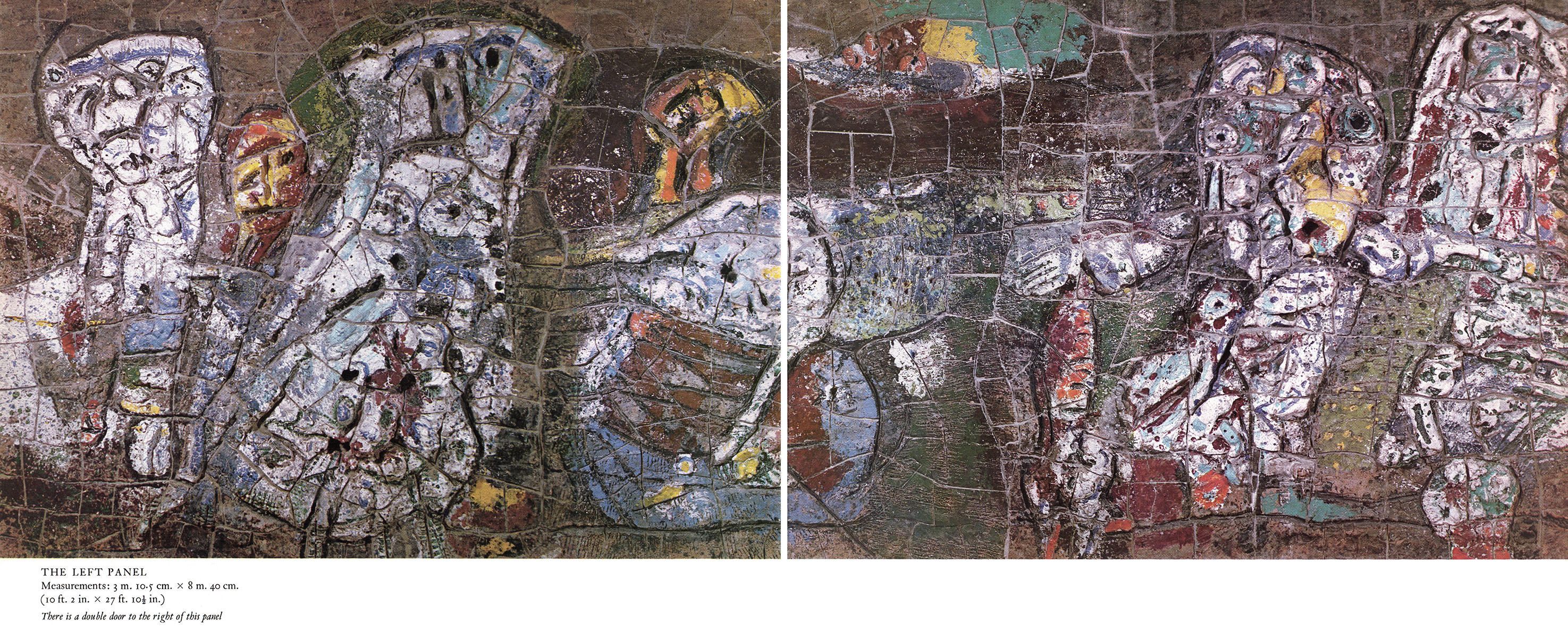
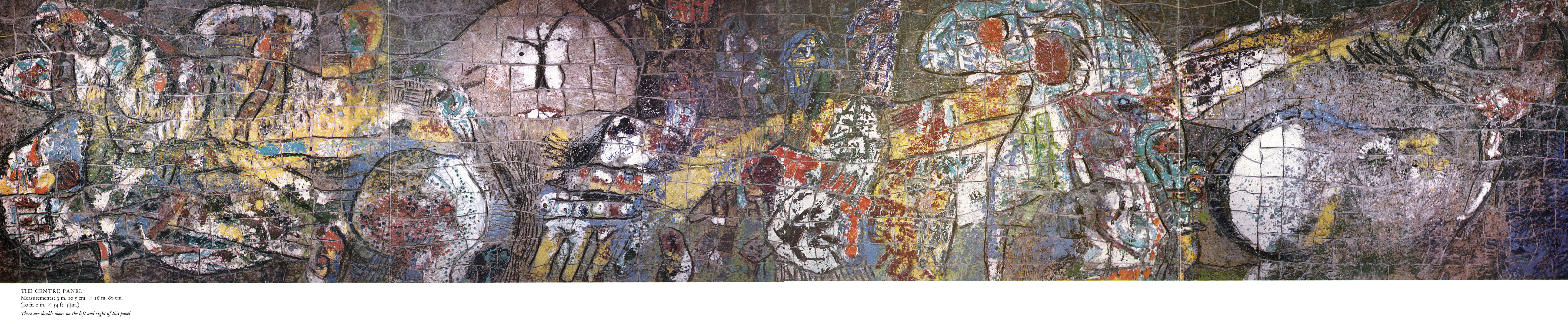
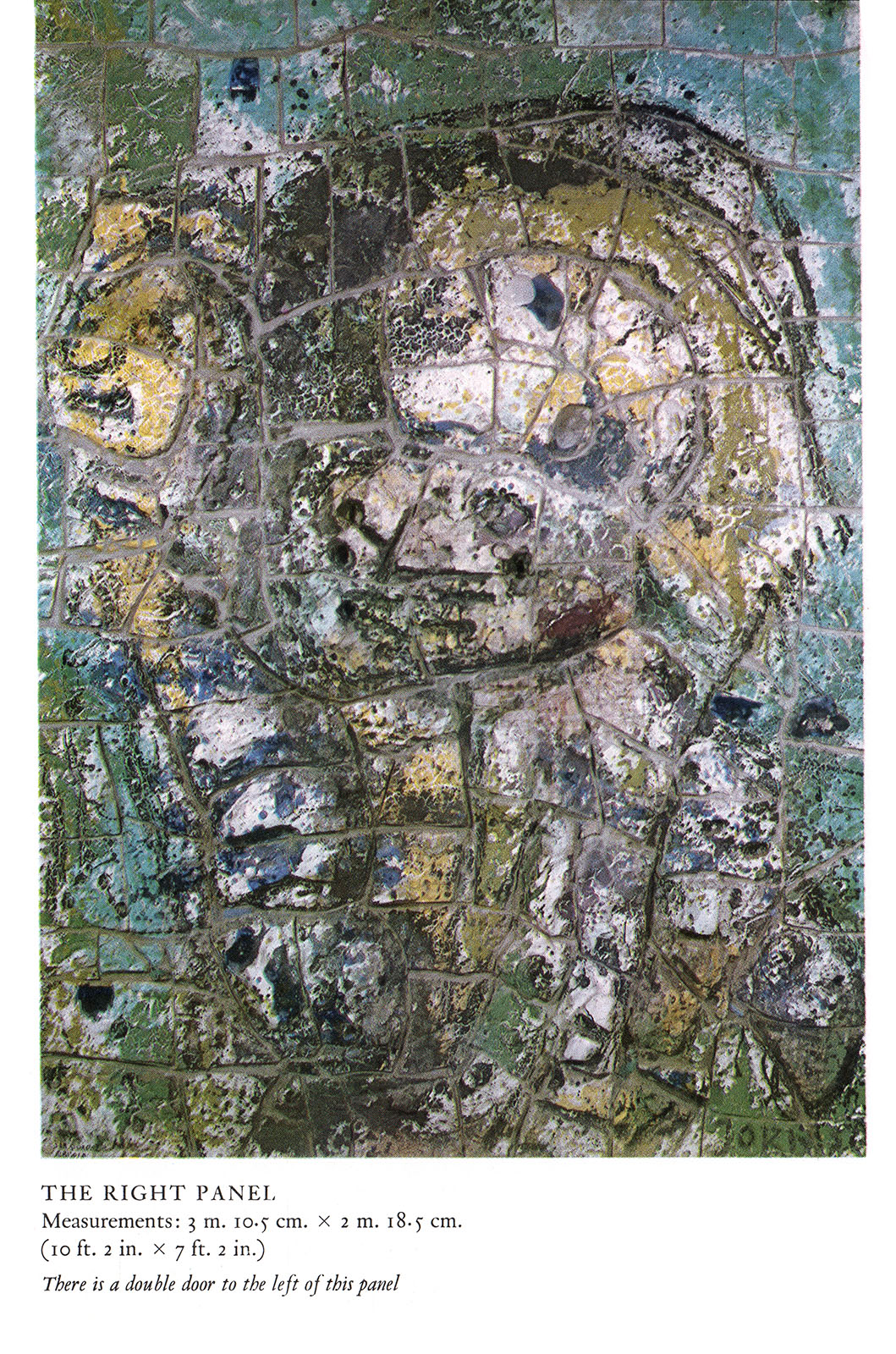
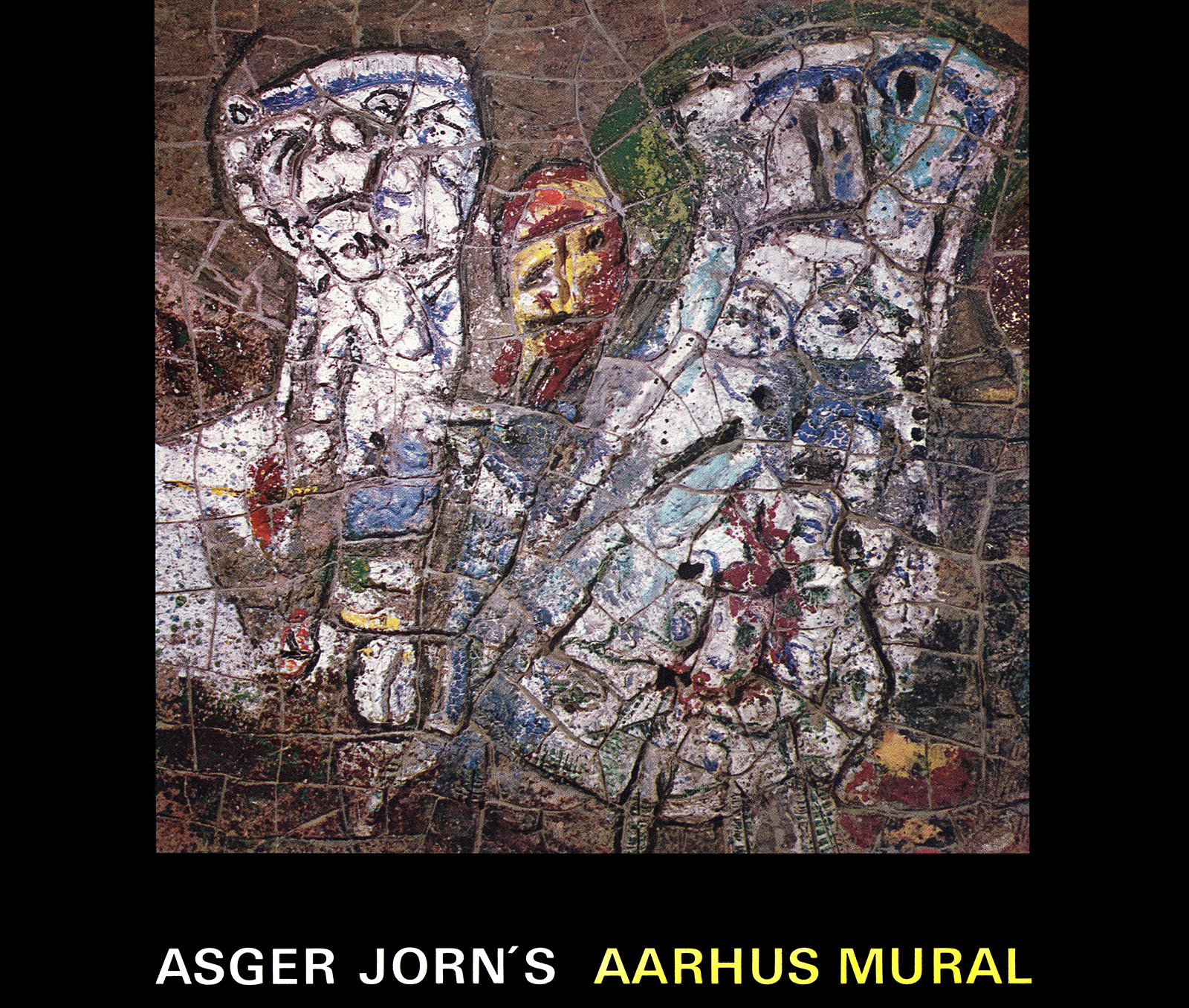
Asger Jorn’s Aarhus Mural is a limited-edition booklet documenting Asger Jorn’s monumental ceramic relief at Aarhus State Gymnasium in Denmark, edited by Guy Atkins with an introduction by Erik Nyholm and photography by Dominique Darbois. Published on the occasion of Jorn’s fiftieth birthday on 3 March 1964, the booklet was sponsored by a small group of the artist’s friends in England, France, Germany, and Italy with the aim of making the ceramic relief better known outside Denmark.
Background
The booklet emerged from Guy Atkins’s deep involvement with documenting Jorn’s artistic career. By 1964, Atkins had already begun work on what would become his monumental five-volume catalogue raisonné of Jorn’s paintings, having met the artist when Jorn first visited London in 1956. The relationship between Atkins and Jorn had developed into a close friendship, cemented by their famous lunch at the Coupole in Paris in 1961 when Atkins spontaneously offered to catalogue all of Jorn’s early paintings.
This smaller publication on the Aarhus mural served a specific documentary purpose. As Atkins explained in his editor’s note, while several illustrated articles about the relief had appeared in Danish periodicals, these had limited circulation outside Denmark. A fundamental challenge was that the mural proved almost impossible to photograph satisfactorily. Stretching 101 feet in length including two intervening double doors, with one end partly obstructed by a large conservatory, the work defied conventional photographic documentation.
Dominique Darbois is the first photographer who has managed to overcome the inherent difficulties of the environment.
- Guy Atkins, Editor's Note
The booklet’s design reflected these practical constraints. Rather than attempting to present the three panels as a continuous sequence, Atkins chose to reproduce each panel on separate pages. This allowed readers to study the work in greater detail and made the pages easier to handle, though it meant sacrificing an overall view of the complete composition.
The Mural’s History
The centerpiece of the booklet is Erik Nyholm’s detailed essay on the mural’s creation. Nyholm, a ceramist from Funder near Silkeborg, had been instrumental in Jorn’s ceramic education and was uniquely positioned to document the technical and artistic achievement.
The commission had been fraught with delays and uncertainty. First discussed as early as 1954, the idea of including a ceramic mural in the Aarhus State Gymnasium building plans met with immediate difficulties when Jorn met with architects Arne Gravers and Johan Richter in January 1955. The two sides held fundamentally different views on combining architecture and decoration, yet decided to proceed despite their differences. The school building was completed by August 1958, but it was not until December 1957 that the Danish Arts Foundation even invited Jorn to submit sketches, and November 1958 before they formally commissioned the work.
It is characteristic of Jorn that in a working period of four months he completed the project which others had been debating for four years.
- Erik Nyholm, Introduction
Creation in Albisola
Jorn chose Albisola, the Italian Riviera ceramics center, as the location for creating the relief. He had first gone there in 1954 and had become the pivot for experiments in ceramics with an international group including Matta, Lucio Fontana, Enrico Baj, Karel Appel, and Corneille. The town’s ceramic traditions dated back to the Saracens, and Jorn found in the Italian craftsmen’s skill and experimental spirit the necessary support for his ambitious project.
Working with the San Giorgio factory, Jorn began during the early summer of 1959. The relief had to be made in three sections to accommodate two doors in the wall at the school. The overall dimensions of the ceramic panels measured approximately 3 meters in height by 27 meters in length.
Nyholm’s account of the actual creation process reads like an epic of physical labor and artistic improvisation. On a June morning at four o’clock, the first tons of clay were rolled from the factory onto a wooden floor in the open air. Jorn began before sunrise, working with a team of helpers from five in the morning until shortly before midday each day.
The clay was heaped up, flattened, stamped firm and cut up. Images began to rise over an area of more than eight cubic metres of clay, amounting to about one tenth of the whole relief. Some images were erased, others emerged, until every centimetre had been worked over. The clay masses were brutally or tenderly pressed, scraped, cut and kneaded from a thickness of 15 cm. to over 60 cm. where the figures burst forth. Coloured pieces of glass were pressed into small secret pockets, scooter tracks ran over the flat surfaces, and so the work progressed while the day was still young.
- Erik Nyholm, Introduction
In eleven days, Jorn molded more than twelve tons of clay into about twelve hundred individual pieces ready for their first firing. He did not work sequentially from one end to the other, but treated the relief as if it were a huge picture, fighting across the whole ground simultaneously. The entire relief lived in his mind as a unified vision, allowing him to improvise with extraordinary freedom while maintaining structural continuity.
The glazing process proved equally demanding. Between firings, Jorn applied fresh glazes and engobes to emphasize the relief’s dramatic character. By mid-September 1959, the completed work lay shimmering on the ground behind Ceramiche San Giorgio, drawing tourists and townspeople for evening viewings of what they called “Il più grande pannello in ceramica nel mondo” - the largest ceramic panel in the world.
Installation in Aarhus
The relief reached Aarhus in early October 1959. Jorn characteristically ensured proper care for his Italian collaborators, shipping alongside the eight tons of ceramic fragments dozens of cases of spaghetti and macaroni and pounds of Parmesan cheese for maestro Salino, ceramicist Pastorino, and mason Spotorno who would help mount the work in Denmark.
Jorn was not risking Danish gravy on these men.
- Erik Nyholm, Introduction
The twelve hundred pieces were laid out in their proper order in front of the long bare wall of the school. Danish masons worked alongside the Italians, embedding iron supports in the wall and mixing mortar from calcium, sand, and cement. The ceramic was mounted from the floor upwards, with joints between fragments deliberately indented to form a living accompaniment to the drama taking shape along the wall.
By the end of October 1959, all three sections were complete. The smallest section to the right of the entrance bears the inscription “san giorgio albisola - jorn 59.” The Arts Foundation presented the relief to the school at a ceremony on 5 November 1959.
Now it hangs in the autumn darkness of the north. Only a summer’s work, yet a life’s work. It was created in the south, but inspired by the north. A myth of Jutland!
Once more one walks along it and lets one’s hand follow the moving surface, the rough and the polished. It breathes a great humanity. It speaks for itself.
- Erik Nyholm, Introduction
Dominique Darbois’s Photography
The booklet’s photographic documentation represents a significant achievement in itself. Dominique Darbois, a French photojournalist and resistance fighter, brought considerable experience to the challenge of photographing Jorn’s mural. By 1964, she was already well known for her “Children of the World” photographic book series published by Fernand Nathan, which documented children from diverse cultures around the globe.
Darbois’s ability to overcome the inherent difficulties of the environment - the extreme length of the work, the obstructed views, the challenging lighting conditions - made her the first photographer to successfully capture the mural’s essence. Her photographs include three color illustrations showing the complete panels, allowing viewers to study the ceramic relief’s dramatic surface textures and color relationships in unprecedented detail.
Musical Response
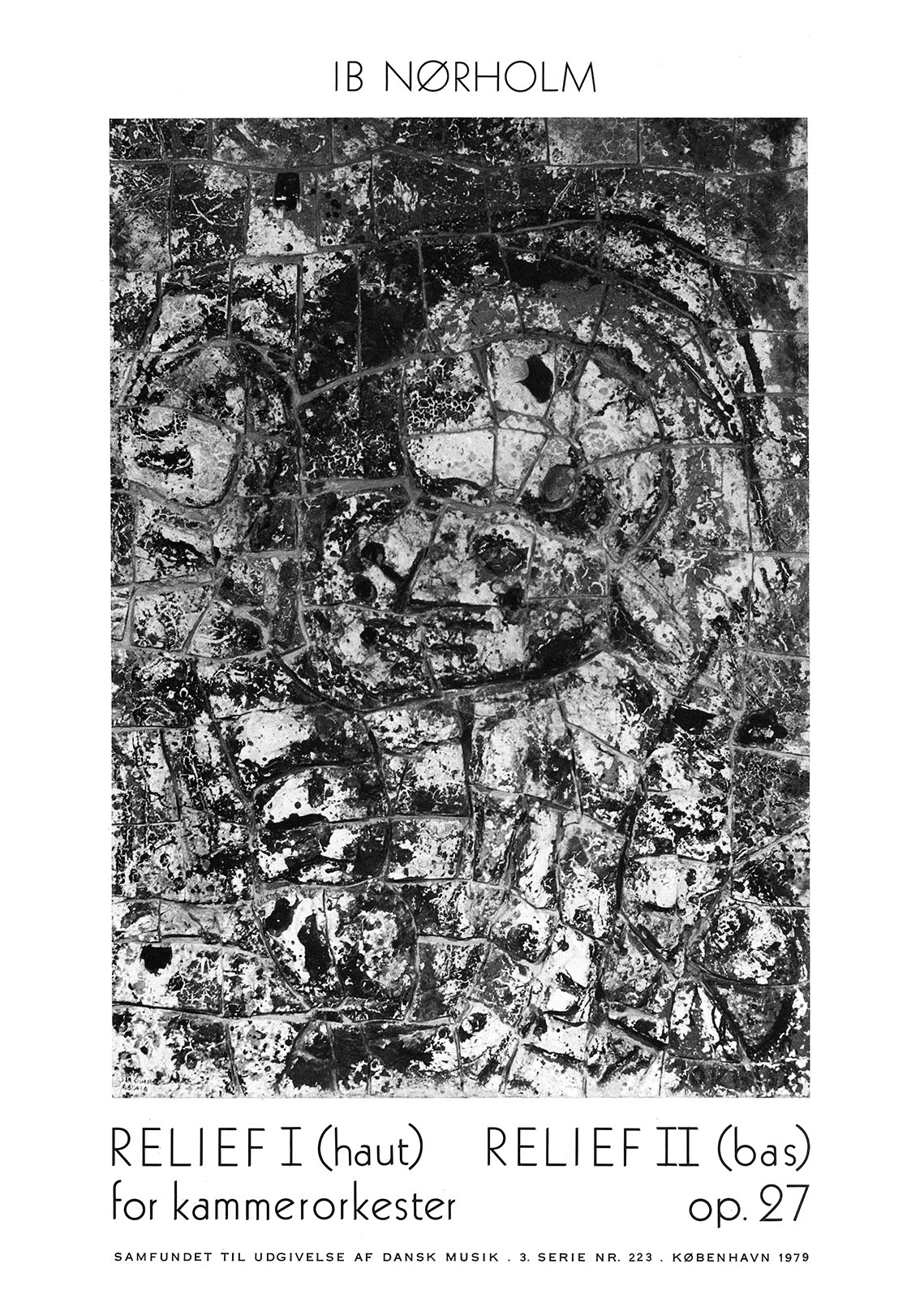
The booklet includes a note on Ib Nørholm’s composition Relief I-II, opus 27, which was directly inspired by Jorn’s ceramic wall. Nørholm, then a thirty-three-year-old Danish composer, created two contrasting movements in response to the mural. Relief I (haut) was tightly scored and took four months to compose, lasting about seven minutes in performance. Relief II (bas) was composed in a single evening and lasts about six minutes, providing for improvisatory performance through what Nørholm called “Aktivität” - sections requiring the players to improvise.
The work was commissioned for and first performed by the Städtisches Kammerorchester (Municipal Chamber Orchestra) in Dortmund, Germany, on 20 May 1963, conducted by Lavard Friisholm from Copenhagen. The performance was recorded and broadcast on Danish radio in the series “Music of our time” on 12 June 1963.
Instrumentation and Structure
The composition calls for twenty-three players divided into three sections: wind instruments (flute doubling piccolo, clarinet doubling bass clarinet, trumpet, and trombone), strings (four first violins, four second violins, four violas, two cellos, and double bass), and an extensive percussion section managed by four players.
The percussion requirements reflect Nørholm’s experimental approach and create what the booklet describes as “a related world of sound” to Jorn’s mural. The first percussionist handles marimba, tam-tams both small and large, five temple blocks, maracas, and two suspended cymbals. The second plays vibraphone and seven antique cymbals (crotales). The third manages bass drum, two tom-toms, four bongos, two snare drums, and five cowbells. The pianist also serves as the fourth percussionist, playing South American gourd, two triangles, and using mallets to strike the metal frame of the piano to produce three different tone colors.
This unconventional instrumentation - combining traditional orchestral instruments with exotic percussion and extended piano techniques - mirrors Jorn’s revolutionary approach to ceramics, where he combined traditional glazes with unorthodox materials like colored glass pressed into clay pockets and scooter tracks rolled across surfaces.
Performance Practice
The two movements present contrasting compositional philosophies. Relief I employs traditional metric notation throughout, with precisely defined rhythms and pitches. The progression from systematic serialism in Relief I to the graphic notation and improvisatory freedom of Relief II creates a musical parallel to the tension between control and spontaneity visible in Jorn’s ceramic relief.
Relief II alternates between sections with defined metric structure and units of free, undefined rhythm. The “bar lines” separating the rhythmically undefined units serve only to illustrate structural progression rather than mark temporal boundaries. Each improvisatory unit should last between five and eight seconds according to the conductor’s discretion, with duration varying from unit to unit.
The conductor indicates the cessation of one unit and the beginning of the next with an upbeat or downbeat, while also providing guidance on the number, density, and character of the musical structures and entries. This role parallels Jorn’s own function during the creation of the mural, where he maintained the overall vision while allowing for moment-to-moment improvisation.
The score’s instructions emphasize that the piece “appeals to the improvisatory co-creation of the performers,” particularly in sections marked “Aktivität.” However, each musician must fit their improvisatory contributions into the existing sound and structure, choosing register, dynamics, and articulation so that their playing takes on “the character of a shading” within the overall sonic texture. This collaborative improvisation within a unified framework directly reflects Jorn’s working method, where individual spontaneous gestures coalesced into a coherent monumental composition.
The visual impact of the page of the score has a chance affinity with the rhythmical character of the mural.
- Erik Nyholm on Nørholm's composition
The score’s cover featured a detail from Jorn’s ceramic relief, making explicit the connection between visual and sonic textures. As Erik Nyholm noted, the graphic appearance of Nørholm’s score - particularly the sections with free notation in Relief II - bears a visual resemblance to the rhythmic, textured surface of Jorn’s ceramic panels.
Nørholm went on to become one of Denmark’s most significant postwar composers, alongside Per Nørgård and Pelle Gudmundsen-Holmgreen. His exploration of graphic scores and experimental techniques in the early 1960s, exemplified by Relief II, positioned him at the forefront of Danish contemporary music. The composition stands as a unique example of musical ekphrasis - a sonic response that captures not just the visual appearance but the working method and aesthetic philosophy behind Jorn’s monumental achievement.
Explore the Musical Score
This is a preview only - view fullsize on archive.org
Bibliography
The booklet concludes with a bibliography documenting the limited Danish-language publications about the mural that had appeared up to 1964. These included articles in dansk kunsthåndværk, KUNST, arkitektur, and SIGNUM, as well as a reference to Guy Atkins’s short monograph Asger Jorn in Methuen’s Art in Progress series, published in the same year.
The bibliography reveals the extent to which serious documentation of Jorn’s ceramic achievement had been confined to Danish periodicals with limited international circulation - precisely the gap this booklet aimed to address.
Edition and Publication
The booklet was printed by Westerham Press Limited in Westerham, Kent, England, in an edition of 750 numbered copies. Each copy bears a number indicating its place in the edition, making it a relatively scarce document of this important work. The publication represents an early example of what would become Guy Atkins’s lifelong commitment to documenting Jorn’s artistic output, a project that would culminate in the five-volume catalogue raisonné published between 1968 and 2006.
Explore the Book
This is a preview only - view fullsize on archive.org
Related Works
This booklet forms part of Guy Atkins’s larger project of documenting Asger Jorn’s artistic career. Erik Nyholm’s essay on the mural’s history was later reprinted with additions and changes in the second volume of Atkins’s catalogue raisonné, Asger Jorn: The Crucial Years 1954-1964 (1977). That volume includes a full chapter on Jorn’s ceramics with extensive discussion of the Aarhus mural as his greatest achievement in the medium.
The Aarhus mural stands alongside Jorn’s later ceramic relief at Randers from 1970 as the artist’s major contributions to monumental ceramic art. Both works demonstrate what Erik Nyholm identified as Jorn’s revolutionary approach to ceramics - combining glazed and unglazed slips with colored glazes, pressing colored glass into the clay, and improvising on a monumental scale with complete technical mastery.
Gallery