|
|
| Neue Feuerbrände | |
| Read · Deutsch Read · English | |
| Authors | Friedrich von Cölln |
|---|---|
| Publisher | Peter Hammer (fictitious imprint) |
| Publishing date | 1807 |
| Series | Erster Band, Erstes bis drittes Heft |
| Format | Three parts in one volume, separately paginated, with one copperplate |
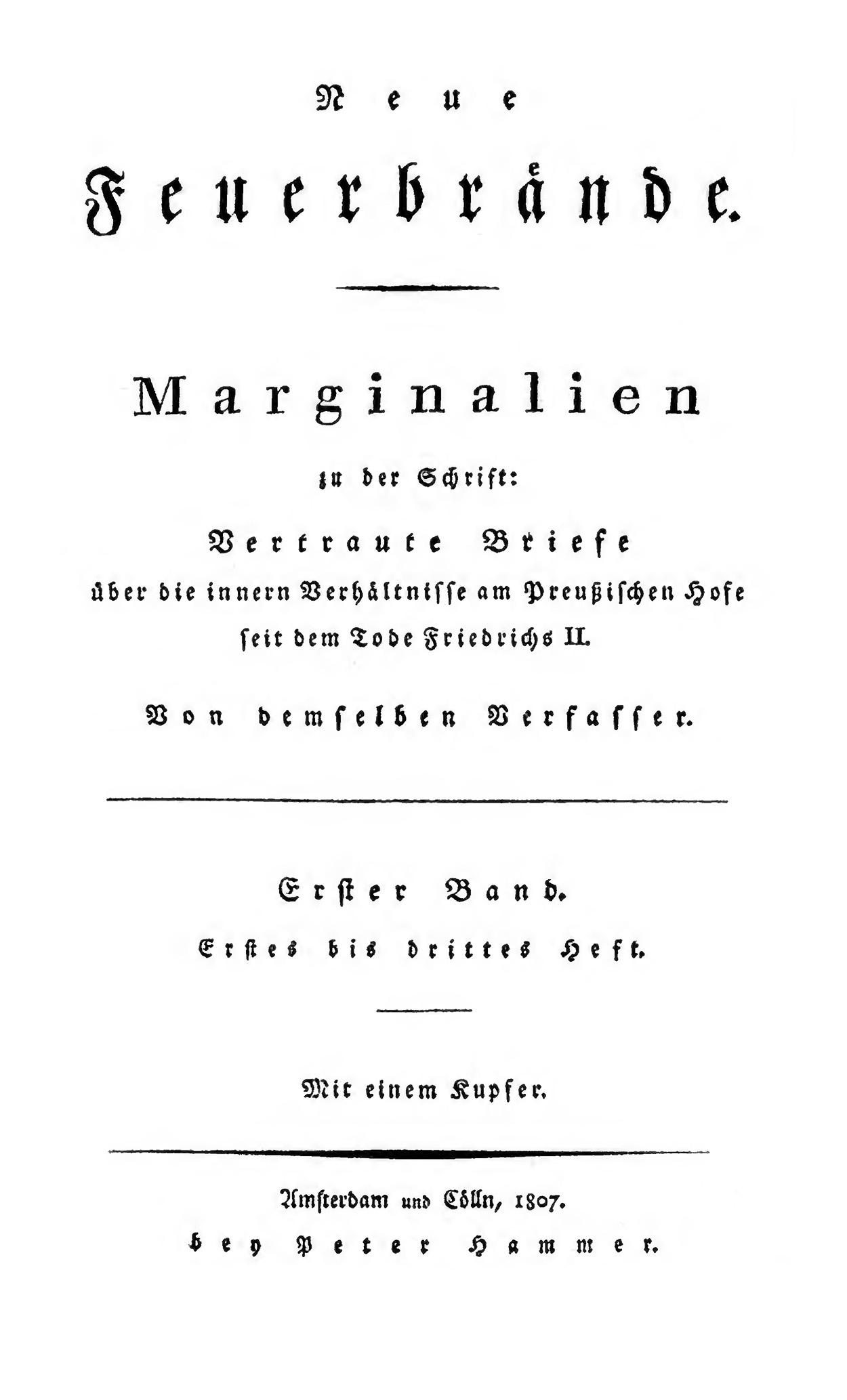
New Firebrands - Marginalia on the Tract - Confidential Letters on the Internal Affairs of the Prussian Court since the Death of Frederick II (Neue Feuerbrände) is the first collected volume of a political journal issued anonymously in 1807 by the Prussian official Friedrich von Cölln, gathering the first three of the eighteen instalments that eventually appeared under a false Amsterdam and Cologne imprint. Written in the months after the destruction of the Prussian army at Jena and Auerstedt, the three parts combine eyewitness correspondence, polemical essays on the army and the state, fiscal argument, reportage from occupied Berlin, and a register naming the officials who had received confiscated Polish estates.
The full title runs Neue Feuerbrände: Marginalien zu der Schrift: Vertraute Briefe über die innern Verhältnisse am Preußischen Hofe seit dem Tode Friedrichs II (New Firebrands: Marginalia to the Tract: Confidential Letters on the Internal Affairs of the Prussian Court since the Death of Frederick II). The half-title of each instalment describes the publication more plainly as “a journal in occasional issues,” edited by the author of the Confidential Letters. Neither name appears anywhere in the volume. Both were written by Friedrich von Cölln, a serving Prussian war and domains councillor who had spent the years before 1806 inside the administration he was now dismantling in print.1
The Author
Friedrich von Cölln (1766–1820) was born in the county of Lippe-Detmold, studied at Marburg, Halle, and Jena, and entered Prussian service in 1790 at Minden. After the second partition of Poland he was called to Posen as a war councillor in 1793, administered the two royal offices of Pollagewo and Obernik from 1797 for six years, moved to Lower Silesia as a tax councillor, and in 1805 was appointed war and domains councillor in Berlin. The Berlin posting gave him what the Allgemeine Deutsche Biographie calls his acquaintance with the Prussian state machinery, the higher bureaucracy, and scholarly and military circles. After Jena he hurried to Silesia to lay a plan for the province’s defence before the King, failed to obtain a hearing, and withdrew to Schmiedeberg, where he began setting down his accumulated service experience as the Vertraute Briefe.1
That work grew to six volumes, went through several printings within a short time, and subjected the condition of Prussia, the state administration, the nobility, and the military to what the same source describes as unsparing criticism. The New Firebrands began as its marginalia and quickly became a periodical in its own right, running to eighteen parts across 1807 and 1808.2
Cölln was not a revolutionary. He wrote as an economist and a career official who thought the Frederician state had been mismanaged by the men who inherited it, and the reforms he wanted were administrative rather than constitutional. His other titles from these years include Reflexionen über den preußischen Staat (1804), Schlesien wie es ist (1805), and Gedanken über die Aufhebung der Erbunterthänigkeit in Schlesien (1808), a pamphlet on abolishing hereditary subjection in Silesia.2
Peter Hammer of Amsterdam and Cologne
The title page carries the line “Amsterdam und Cölln, 1807. bey Peter Hammer.” No such publisher existed. Peter Hammer, the German form of Pierre Marteau, was a fictitious imprint devised around 1660, attributed to the Leiden printer Jan Elzevir, and adopted for two centuries by printers of politically or theologically contentious work who preferred not to be identified. Its use had become almost a badge: a reader who saw the name knew the book was contraband before opening it, and knew equally well that no one was going to find Herr Hammer in Cologne. Brockhaus was still reaching for the German form in the nineteenth century when issuing books likely to offend the Prussian censor.3
There is a further joke in Cölln’s choice, since Cölln is both the old spelling of Cologne and the author’s own name. The place of publication and the author’s identity are printed on the title page together, and neither is legible without the other.
Bibliographies place the actual printing with Heinrich Gräff at Leipzig, who from the fifteenth instalment abandoned the pretence and substituted the mock imprint “K. K. Französischer Censur.” The parts appeared in illustrated red wrappers, each differently designed and described inside the issue, with copperplates that included one hand-coloured plate by E. T. A. Hoffmann in the twelfth part, showing two officers of the Polish Legion. Hoffmann was living in Berlin in severe poverty in 1807 and took the illustration work gratefully. The antiquarian trade, following Hayn and Gotendorf, has long catalogued the run as a widely read journal rich in contributions to the chronique scandaleuse.4 Volume one, the present book, contains the first three parts and a single copperplate belonging to the third.
The First Part
The volume opens with two letters from Jena describing the battlefield of 14 October, written by a correspondent to a friend he had known in the district twenty years before. The device allows Cölln to set the catastrophe in a landscape of remembered walks and rides, and the letters keep returning to it: the roadside ditch into which the friend had once tumbled from a blind horse, on the night they first saw Die Entführung aus dem Serail at Weimar, was filled with the dead on the fourteenth.
The letters state the argument the rest of the volume elaborates. The Prussian army was physically magnificent and intellectually dead. It was, the correspondent writes, the most perfect machine of its kind, the most consummate product of nature and art, the result of the old system of war, and it perished because no spirit animated the body. The Duke of Brunswick had the command and produced neither plan nor disposition; between Hohenlohe’s army and the King’s there was a gap of several hours, so that Napoleon, who at Austerlitz had needed to break the enemy’s centre, here found none to break.
Four essays follow. “On the Now-General Debasement of the Prussian Military” traces the rise and fall of the army’s standing among the other estates from the Great Elector to the present, and opens by objecting to the public contempt then being poured on officers: whether or not the disparagement rests on solid grounds, Cölln writes, it is at all events exaggerated, and one does many an individual an injustice by condemning the whole. “The Annexation of Great Poland Was Prussia’s Ruin” argues that Frederick II had taken West Prussia deliberately and calculatedly, treating the remainder of Poland as a colony that supplied grain, wool, hides, and timber cheaply because a Prussian Vistula gave Prussia a monopoly on the demand, and that his successors had thrown the calculation away by swallowing the territory whole.5 The third essay is a technical piece of political economy, answering the physiocrats’ claim that in an agricultural country every tax ultimately falls on the landowner. Cölln’s reply is a labour theory of value: the earth yields nothing of worth until labour has been spent on it, the plough and the mill and the oven and the ship are all instruments that labour has made productive, and it is labour rather than land that carries taxation.
The longest item, “Prussia’s Impending Ruin after the Battle of Auerstädt,” is dated 24 October 1806, ten days after the battle, and disclaims both patriotism and animus at the outset:
I am no Prussian; I am driven neither by personal interest nor by animosity. I wish merely to lay my view of the present political events before the public for its examination. I wish to offend no one, least of all the truly and morally good, but unfortunate Frederick William III. and his excellent consort, the crown of all wives.
- Neue Feuerbrände, first part, p. 38
The claim is literally true, in that Cölln was born outside Prussia, and it is also a disguise. The essay goes on to argue that the age of animating ideas is over, that neither freedom nor religion nor love of country moves Europeans any longer, and that peoples are now governed by strong spirits used as instruments: Frederick, Napoleon.
The part closes with a document rather than an argument. Carl Friedrich Benkowitz’s “History of the Attack, the Blockade, and the Surrender of Glogau” is a diary of the fortress town from 21 October to 7 November 1806, entered day by day as the garrison filled the churches and cloisters with hay and grain and the streets choked with refugees. Benkowitz (1764–1807) was a Silesian man of letters whose Die Jubelfeier der Hölle, oder Faust der jüngere (1801) is counted among the notable German Faust adaptations; he died at Glogau the year his account appeared. He published the same material separately at Leipzig, with Gräff, as the first two instalments of Kriegs-Scenen seit dem 10ten October 1806.6 Cölln later noted that everything in the first part except the Benkowitz piece was his own.
The Second Part
The second part opens with correspondence from Weimar and observations on the Polish campaign, then poses the question “What Determines the Invincibility of an Army?” and answers it from Pelopidas, Leuctra, Pyrrhus, Alexander, Caesar, and Gustavus Adolphus: the genius of the commander, the skill of his generals, and the martial temper of the mass. “Reflections of a Prussian Patriot on the Past, the Present, and the Future” divides Prussian history into a dawn under the Great Elector, a noon under Frederick II, and an evening thereafter, and treats Frederick I, whom the author would rather name the Vain, as the first symptom of the decline.
Between these comes the sharpest piece of construction in the volume, titled “Proof of How Greatly Circumstances Influence Opinions and Utterances - and Nothing More.” It consists of nothing but extracts from a Berlin newspaper, arranged in an order that is not chronological, and no commentary is offered beyond the title. Der Telegraph was Berlin’s first daily paper, licensed by the Prussian authorities as a patriotic organ and edited by Karl Julius Lange, whose actual name was Simson Alexander David. Its first issue appeared on 17 October 1806, the day the news of Jena and Auerstedt reached the capital, and within days it had swung to the line of the French occupiers, becoming for the rest of the occupation the most quoted German-language mouthpiece Napoleon had.7 Cölln reprints No. 1 of 17 October, announcing that the North has awakened and that the first blow struck by Prussia’s brave men will make the enemy feel it; then No. 9 of 28 October, regretting that the King had lent his ear to the seductive words of an imprudent princess; then No. 2 of 18 October, on civic duty and the subject’s obligation to credit the government with wisdom; then No. 13 of 1 November, in which a true Prussian observes that the King had ceased to be himself and that young men and women had meddled in the direction of affairs; and finally No. 34 of 22 November, a dialogue in the realm of the dead in which Frederick the Great tells Prince Louis Ferdinand to withdraw himself, unworthy of my name, and asks Bonaparte to forgive the weakness of a King surrounded by seducers. The five extracts span five weeks and Napoleon’s entry into Berlin at the end of October. The editorial method is the whole of the argument.
The part ends with an account of a walk taken through Berlin on a Sunday in April 1807, under occupation. The narrator passes a column of very young French conscripts crossing the Wilhelmsplatz beneath the statue of General Seydlitz, and imagines the stone commander asking whether these are the sons of the men he beat at Rossbach. He overhears two burghers on a bench, one a master weaver ruined first by the collapse of royal support for the manufactories and then by the war, who has had foreign troops billeted on him, has paid barracks money, and goes hungry with his wife and three children; the narrator reaches into his pocket for him and finds it empty. He notes that merchants are discussing the French requisition of the Russian potash stored in the city, that the Poor Relief Board has nearly dissolved, and that for more than a year Berlin has been burying thirty to forty more people each week than it baptises.
The Black Register
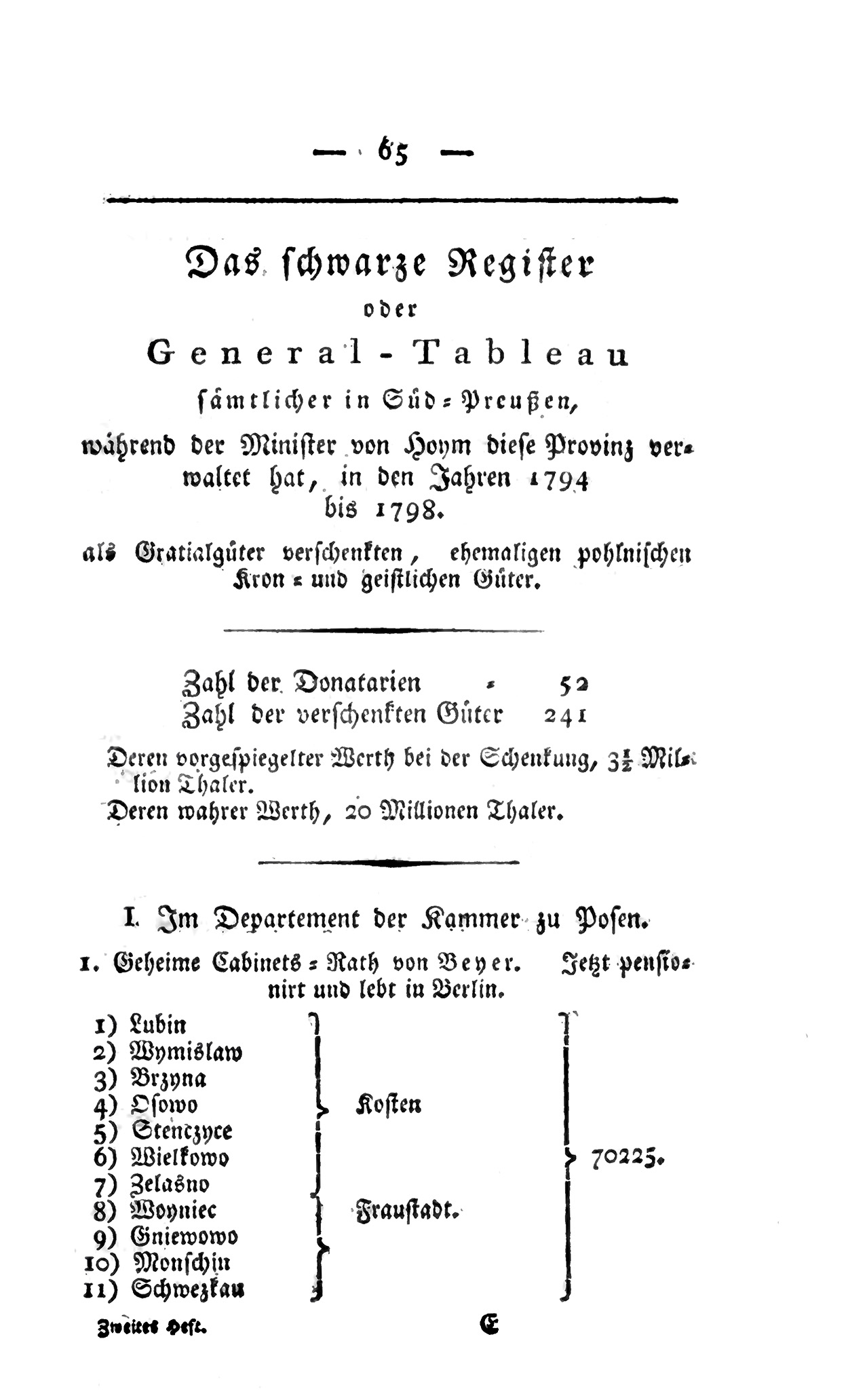
The second part also contains the item that made the volume notorious, and that its editor spent the third part disowning. “The Black Register, or General Table of all the former Polish Crown and ecclesiastical estates in South Prussia which, during the time Minister von Hoym administered this province, in the years 1794 to 1798, were bestowed as grace-and-favour estates” occupies pages 65 to 90. It is a table rather than an essay. Fifty-two donatories are named, holding 241 estates between them; their declared value at the time of donation is given as three and a half million thalers, and their true value as twenty million. The entries are arranged by chamber department, Posen, Kalisch, and Warsaw, and each lists the villages received, the district they lie in, the sum they were valued at, and a note that generally supplies the date of the deed of donation and an estimate of what the property is actually worth. Under the first name, the pensioned privy cabinet councillor von Beyer, eleven estates assessed at 70,225 thalers are reckoned to yield at least 8,000 thalers a year and to be worth 100,000. The deed, dated Berlin, 14 January 1797 and signed by Hoym and Rech, describes the grant as a token of Our most gracious satisfaction with long years of faithful and upright service, and the register adds that nearly all of them read thus.
The province in question had been created out of the second partition in 1793 and was administered directly by Karl Georg Heinrich von Hoym, the minister for Silesia, rather than through the General Directory in Berlin. Hoym’s conduct there drew the heaviest charges of his career: the Allgemeine Deutsche Biographie states that he had the royal starosties confiscated, valued at very low prices, and sold to the speculators, adventurers, and favourites who came streaming in, who immediately resold them at enormous profit.8 Those accusations had been pressed since the 1790s by the official Hans von Held, whose Die wahren Jakobiner im preußischen Staate (1801) became known as the Black Book from the binding he chose for some copies, and who was stripped of office and sentenced to eighteen months in the fortress at Kolberg for it.9
The Black Register is Held’s work. It is listed among his writings, published anonymously, in the Neue Deutsche Biographie, and Cölln, without naming him, told his readers that the public would easily recognise the author by the title, the form, and the tendency. The register is written by a man returning to a case he had already been imprisoned for making.
Its notes carry the animus this implies. Major-General von Zastrow’s eight estates near Posen, valued in the deed at 87,650 thalers, are said to be worth at least 200,000 and to have been in part confiscations from Count Wybicki, “well known in the revolutionary history of Poland, who now lives with Kosciusko in Paris.” The description was accurate as far as it went. Józef Wybicki had joined the Kościuszko rising, emigrated after its collapse, and helped raise the Polish Legions in Italy, for whom he wrote in July 1797 the Mazurek Dąbrowskiego, now the Polish national anthem. By the time the register was printed the description was out of date in a way that mattered: in November 1806 Wybicki had returned to Greater Poland with Dąbrowski and issued the proclamation calling Poles to arms against the Prussians.10
Cölln’s disavowal is printed in the third part, and it is not an apology for the substance:
I now find in this Part the black register, and I feel called upon hereby to declare that this register mingles truth and falsehood together, and bears the stamp of animosity and vulgarity. It abuses and slanders, whereby no one lends any support to truth and justice. The author has not named himself; the manuscript was sent to the publisher of the New Firebrands through a third hand, but the public will easily recognize him by the title, by the form, and by the tendency. Let him answer for his handiwork.
- Neue Feuerbrände, third part, p. 130
He explains that he had been away on a two-month journey, that the second part was assembled and printed without his seeing it, and that only the treatise on page 118 of that part is his. He objects to the timing rather than the facts, on the ground that the state might now reclaim grants that had passed into third hands, ruining families who had bought in good faith, and he declines to join an attack on Hoym, who was old, out of office, and in fact died at Dyhernfurth in October 1807. The publisher then adds a note confirming the sequence, and quoting Cölln’s letter of warning, which arrived after the part had gone out into all the world.
What follows is stranger and more revealing than either. Held wrote privately to Cölln; Cölln printed the letter in fragments in the third part, interleaved with his replies, under the heading “Reply to an Anonymous Letter from the Author of the Black Register.” The registrar complains that publication has done him no favour, that he holds it ignoble to affront an unfortunate government, that his table was printed from an incomplete manuscript with confusions in it, and that Cölln has stolen his judgements and plays the panegyrist of Hoym. Cölln answers each line in turn, notes that fragments from another man’s trial records have reached the editorial office in a hand extraordinarily like the letter-writer’s, declines to use them, and closes the exchange with a statement of method that is as close as the volume comes to a principle:
I have nothing to do with persons, everything to do with matters: the most upright man can carry out the most ruinous projects, believing them to be good.
- Neue Feuerbrände, third part, p. 139
The claim sits awkwardly in a volume that names the officials of the Glogau chamber who issued their rescripts in Napoleon’s name, and Cölln half concedes as much: if the author in the second part has now and then departed from this rule, he writes, he is now sorry for it. The register was not retracted, only orphaned.
The Third Part
The third part opens with an explanation of the title engraving, a piece of gallows humour from the Confidential Letters. The commandant of Schweidnitz, hurrying to Dresden after the capitulation, stops at an inn on the market square at Jauer and finds his windows smashed by the townspeople. He remarks to the innkeeper that the man must have many enemies in the town. Begging your pardon, Commandant, the innkeeper replies: the honour was on your side.
The bulk of the part is a long essay on the Anglo-French war, its causes and its possible end; a narrative of the retreat and capture of Bila’s corps; and a section called “Devotion to Duty,” which names Silesian officials who transferred their loyalties to the occupiers with unseemly speed, among them a chamber referendary whom the French honoured in confidence with the title notre vilain Chambellan. A page of anecdotes closes the volume before the apologia and the register dispute.
Tendency
Reviewers had asked what the journal was for, and whether it was well done to expose the faults of one’s own constitution in the middle of a war. Cölln answered them in the third part, in the essay “On the Tendency of the Tract: Confidential Letters etc. and of the Journal: New Firebrands.” His answer is a rule about timing:
So long as a state, weak within, still overawes its neighbours from without by its dazzling appearance, so long is it the patriot’s duty not to expose its weaknesses; he may then work quietly, advise, warn — help where he can.
- Neue Feuerbrände, third part, p. 124
Whoever steps forward before then, he argues, sacrifices to his own vanity and betrays the state’s weakness to the enemy; he cites Bülow’s published campaign of 1805 as the example. But when the state lies shattered, when officials enrich themselves on the enemy’s requisitions and the educated public swears fidelity to the occupier, then it is time for a voice to cry out in the wilderness. To the reviewers’ complaint that the Letters gave light without warmth, he replies that they should step outside among the people, where all warming is at an end. He anticipates prison, and says he will name himself to the King and hold out his neck.
The passage also states his position on Frederick William III, against the charge that the journal flattered the King in order to make his weakness more conspicuous. The King, Cölln writes, is a good, moral man, has sound common sense, and accomplishes what he is able to accomplish; to say more would be to be a lickspittle, and by saying this much he seeks to preserve the nation’s confidence in him rather than take it away.
Afterwards
Cölln’s expectation of trouble was accurate, though the first arrest came from the wrong direction. The French detained him for his work on the Berlin Hausfreund. Released, he went to Silesia to resume his old office, refused to acknowledge the stipulation the French demanded, withdrew to Austria, and returned after Tilsit to justify his conduct during the war. Reappointed a tax councillor at Glogau, he was arrested in 1808 on the order of the Prussian government and taken to Glatz in January 1809, facing charges of defaming the government in the Confidential Letters at a time of general suffering and of treason for printing financial intelligence in them. He escaped the proceedings by fleeing to Austria again. Through Hardenberg’s mediation, a cabinet order of 6 February 1811 quashed the case.11 He died at Berlin in 1820. South Prussia, whose estates the Black Register enumerated, had ceased to exist in 1807, when Tilsit turned it into the core of the Duchy of Warsaw.12
The verdicts in the volume are those of a partisan writing within weeks of the events, and they should be read as such. Cölln’s account of 1806 is essentially a story of nerve and intelligence failing at the top, and it suited the reform party and the later national myth well enough to be absorbed into both. Later scholarship has been more divided. The picture of the pre-1806 army as an ossified relic commanded by septuagenarians derives in large part from the collapse itself and has been challenged by historians who point to its performance in the 1790s and to reformist argument circulating well before Jena; and the historiography of 1806 as a whole, long organised around the defeat and the uprising that followed, has been substantially revised since the bicentenary.13 What the volume documents beyond dispute is what an informed insider believed, and was prepared to print without his name, in the winter and spring after the battle.
Explore the Book
This is a preview only - view fullsize on archive.org
Gallery
Notes
-
Julius Großmann, “Cölln, Friedrich v.,” in Allgemeine Deutsche Biographie, vol. 4 (1876), pp. 411–412; online edition at Deutsche Biographie, accessed 15 July 2026. ↩ ↩2
-
Großmann, “Cölln,” ADB 4, pp. 411–412, which lists the six volumes of the Vertraute Briefe (Amsterdam and Cologne, 1807) and notes that the book went through several editions in a short time. The bibliography appended to the article also lists the Intelligenzblatt zu den Neuen Feuerbränden (1808) and the later journal Fackeln: Journal in zwanglosen Heften (1811). The serial run of the Neue Feuerbrände through 1807–1808 is recorded in the JPortal catalogue of the Thüringer Universitäts- und Landesbibliothek Jena. ↩ ↩2
-
“Pierre Marteau,” Wikipedia, accessed 15 July 2026; King’s College London, “The use of a fictitious imprint,” King’s Collections exhibitions; Deutsche Nationalbibliothek, Mediengeschichte, “Pierre Marteau (Peter Hammer).” The CERL Thesaurus (cnp01469270) treats the name as a pseudonym applied only to imprints whose true publisher has not been established. ↩
-
Collation and provenance notes from Antiquariat J. Voerster (Stuttgart), describing the complete run of eighteen parts with seven copperplates, listed on ZVAB, accessed 15 July 2026. The description cites Hayn-Gotendorf for the chronique scandaleuse characterisation, Schottenloher p. 352, and Kat. Halle 2116, and identifies the twelfth part as containing Hoffmann’s coloured plate of two officers of the Polish Legion. ↩
-
On the province’s administration and economy see Adelheid Simsch, Die Wirtschaftspolitik des preußischen Staates in der Provinz Südpreußen 1793–1806 (Berlin: Duncker & Humblot, 1983). ↩
-
“Karl Friedrich Benkowitz,” Wikipedia (German), accessed 15 July 2026. The separate publication is Kriegs-Scenen seit dem 10ten October 1806, 1. und 2. Heft (Leipzig: Gräff, 1807), pp. 1–64 and 65–134. ↩
-
“Der Telegraph (Tageszeitung),” Wikipedia (German), accessed 15 July 2026, which dates the paper from 17 October 1806 to 3 December 1808 and describes Lange’s turn to the French line within days of the first issue. ↩
-
“Hoym, Karl Georg Heinrich Graf von,” Allgemeine Deutsche Biographie, digital text at Wikisource and Deutsche Biographie, accessed 15 July 2026, on the confiscation and sale of the starosties; “Karl Georg von Hoym,” Wikipedia (German), accessed 15 July 2026, which connects Hoym’s South Prussian administration to Held’s Black Book and gives his death at Dyhernfurth on 26 October 1807. ↩
-
“Held, Hans von,” Neue Deutsche Biographie-online, accessed 15 July 2026, which lists among his writings: “Das schwarze Register oder General-Tableau, sämmtlicher in Süd-Preußen, während der Minister von Hoym diese Provinz verwaltet hat, in den Jahren 1794 bis 1798, als Gratialgüter verschenkten, ehemaligen pohlnischen Kron- und geistlichen Güter,” in Neue Feuerbrände zum Brennen und Leuchten 1/2 (1807), pp. 65–90, anonymous. See also Markgraf, “Held, Hans,” ADB 50 (1905), pp. 159–161, on the Evergetenbund, the Zerboni affair, and the Black Book prosecution. ↩
-
“Wybicki, Josef (1747–1822),” napoleon.org, accessed 15 July 2026; “Poland Is Not Yet Lost,” Wikipedia, accessed 15 July 2026. The proclamation calling the Poles to arms was issued with Dąbrowski on 3 November 1806. ↩
-
Großmann, “Cölln,” ADB 4, p. 412. ↩
-
“Provinz Südpreußen,” Wikipedia (German), accessed 15 July 2026. ↩
-
Ethan K. Soefje, “Testing the Narrative of Prussian Decline: 1778–1806” (M.A. thesis, University of North Texas, 2020), and “Prussian Reformist Sentiment Before 1806,” Age of Revolutions, 17 March 2025, published among the 2024 Selected Papers of the Consortium on the Revolutionary Era; Katherine Aaslestad and Karen Hagemann, “1806 and Its Aftermath: Revisiting the Period of the Napoleonic Wars in German Central European Historiography,” Central European History 39, no. 4 (2006), pp. 547–579. ↩