Deutsch · English
New Firebrands - Marginalia on the Tract - Confidential Letters on the Internal Affairs of the Prussian Court since the Death of Frederick II
is the first collected volume of a political journal issued anonymously in 1807 by the Prussian official Friedrich von Cölln, gathering the first three of the eighteen instalments that eventually appeared under a false Amsterdam and Cologne imprint. Written in the months after the destruction of the Prussian army at Jena and Auerstedt, the three parts combine eyewitness correspondence, polemical essays on the army and the state, fiscal argument, reportage from occupied Berlin, and a register naming the officials who had received confiscated Polish estates.
Read the article Begin reading ↓
Scanned, transcribed, and translated with machine assistance under a fixed protocol, then reviewed by hand. The original language is the authority. Editorial method
[p. unnumbered]
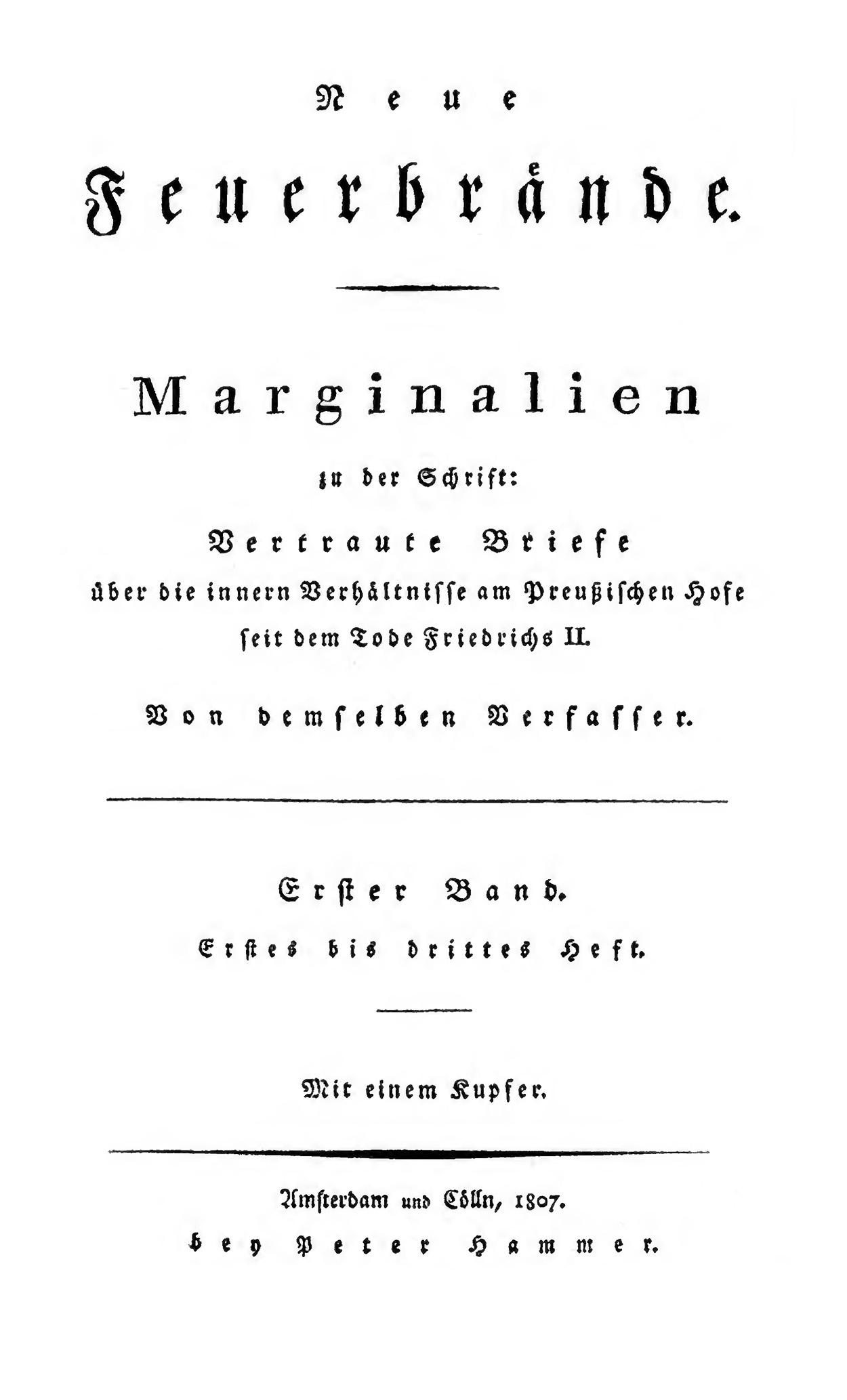
Neue Feuerbrände.
Marginalien zu der Schrift: Vertraute Briefe über die innern Verhältnisse am Preußischen Hofe seit dem Tode Friedrichs II.
Von demselben Verfasser.
Erster Band. Erstes bis drittes Heft.
Mit einem Kupfer.
Amsterdam und Cölln, 1807.
bey Peter Hammer.
[p. unnumbered]
Neue Feuerbrände.
Herausgegeben von dem Verfasser der vertrauten Briefe über die innern Verhältnisse am Preußischen Hofe seit dem Tode Friedrichs II.
Ein Journal in zwanglosen Heften.
Erstes Heft.
Amsterdam und Cölln, 1807.
bey Peter Hammer.
[p. unnumbered]
Inhalt.
| Abschnitt | Seite |
|---|---|
| Correspondenz. Schreiben aus Jena | 1 |
| — Fortsetzung | 8 |
| Ueber die jetzt allgemeine Herabwürdigung des preußischen Militairs | 14 |
| Groß-Pohlens Besitznahme war der Untergang Preußens | 21 |
| Ist es wahr, daß in dem Lande, in welchem vorzüglich das landwirthschaftliche Gewerbe getrieben wird, jede Art von Abgaben die Grundeigenthümer treffe? | 25 |
[p. IV]
| Abschnitt | Seite |
|---|---|
| Preußens naher Verfall nach der Schlacht bey Auerstädt, geschrieben am 24ten October 1806 | 38 |
| Geschichte des Angriffs, der Blockirung und Uebergabe von Glogau, von Carl Friedrich Benkowitz | 89 |
[p. 1]
Correspondenz
Schreiben aus Jena.
Schon längst wollte ich Deinen Brief, der mich überraschte, indem er mich an unsere fröhlichen Jugendjahre erinnerte, beantworten und Dir meine Ansicht von der großen Weltbegebenheit mittheilen, die hier unter unsern Augen am 14ten October vorging, wenn ich nicht so sehr beschäftigt gewesen wäre, meine häuslichen Angelegenheiten wieder in Ordnung zu bringen, die nicht wenig gelitten haben.
Ja, lieber Freund, unsere friedlichen Thäler, wo wir vor 20 Jahren so ruhig Hand in Hand spazieren gingen, und nicht träumten, was jetzt hier entschieden worden ist, waren mit Kriegern angefüllt, deren viele hier begraben liegen; unsere Rebenhügel hallten fürchterlich den Kanonendonner wieder, der diesmal nicht, wie in jener Zeit, das Signal einer allgemeinen, durch die Weinlese veranlaßten Freude war.
Alle Dir wohl bekannten Oerter: Ziegenhayn, Lichtenhayn, Zwetzen, Dorndorf, Appolde, Rötschau,
[p. 2]
das Rauch- und Mühlthal, besonders aber Weimar, von wo wir so manche Nacht so fröhlich nach Hause ritten, waren der Sitz des Schreckens. Erinnerst Du Dich noch wohl Deines Unfalls:
Wie Du, ohne es zu wissen, ein stockblindes Pferd rittest, mit dem Du in den Chausseegraben stürztest, da wir zum ersten Male Belmonte und Constanze in Weimar gesehen hatten?
Dieser nämliche Graben war am 14ten October mit Todten angefüllt. Vor dem 10ten October glaubten wir hier in Jena nicht an die Möglichkeit, daß eine preußische Armee, wie diese, je geschlagen werden könne.
Schöner war nie eine Armee. Es schien, als wenn der preußische Staat den Kern, die Blüthen seiner Gesammtheit an kräftigen Männern bey uns gesammelt hätte, um damit die Welt zu bezwingen. Mehr physische Kraft hat nie eine Armee in sich gefaßt, so lange Krieg geführt worden ist. Die vollendetste Maschine dieser Art, das vollkommenste Produkt der Natur und Kunst, das Resultat des alten Kriegssystems sollte unter unsern Augen in unsern Thälern untergehen, weil kein Geist diesen Körper belebte. Ja, Freund, das war der Grund alles Unglücks!
Ich bin überzeugt, daß, wenn nur einer von den jüngern preußischen Officieren commandirte, der die neue Form und den Geist des Zeitalters aufgefaßt, und Napoleon einigermaßen begriffen hätte, derselbe mit dieser
[p. 3]
Armee Wunder gethan, vielleicht geschlagen, aber nie von der Elbe abgeschnitten worden wäre. Der Herzog von Braunschweig war der Anführer, der König von Preußen, sich selbst nicht vertrauend, hatte ihm das Commando übergeben; von ihm sollte alles ausgehen, es ging aber nichts von ihm aus, als Verwirrung, weder Plan, noch Disposition; Irrthum war an allen Ecken, Mißverständnisse und widersprechende Befehle. Ja die Armee hatte eigentlich gar keine Stellung, es fehlte ihr ein Centrum: denn zwischen der Hohenlohschen und Königlichen Armee war eine Lücke von einigen Stunden. Bey Austerlitz mußte Napoleon das Centrum des Feindes durchbrechen, um zu siegen; das hatte er hier gar nicht nöthig, denn es war keines vorhanden.
Der unwissendste Laye in der Strategie, der es wußte, daß die französische Armee vom 5ten October an unaufhörlich in langen Reihen aus Franken am rechten Saalufer sich auf Sachsen warf, ihr Auge stets auf die Elbe gerichtet, mußte über die ruhig in Cantonirung bleibende, in einem verwirrten Haufen am linken Saalufer lahm gelegte preußische Armee mitleidig lächeln, die ihre Subsistenzbasis, ihre Magazine, am rechten Saalufer in Naumburg, Merseburg und Halle deshalb niedergelegt zu haben schien, damit der Feind auf seinem Marsch nach der Elbe Lebensmittel fände. Schon war das Tauenziensche Corps geschlagen, das zweyte des Prinzen Louis vernichtet, ohne daß die furchtbare preußische Armee entweder
[p. 4]
die französischen im Marsch begriffenen Colonnen angegriffen und durchschnitten hätte, um sie zu vernichten, oder doch die Elbe zu erreichen und das Mutterland zu decken. Ja man dachte nicht einmal daran, das Wirtembergsche, 20000 Mann starke, Corps in Eilmärschen nach Naumburg anrücken zu lassen, um diesen Paß und die Defileen von Kösen zu besetzen. Das Corps marschirte ohne Zweck hin und her, von Küstrin nach Berlin, wo man acht Tage lang weilte und im Theater Kriegslieder sang, dem politischen Zinngießer zusah, und den Capuziner in Wallensteins Lager anstaunte, der jedes Militair persiflirt. Von Berlin ging es nach Magdeburg, von hier nach Halle, um gerade zur rechten Zeit dem Feinde in die Hände zu fallen, statt daß von Berlin der nächste Weg nach Naumburg über Wittenberg geht.
Der Herzog von Braunschweig ließ durch Nichts von dem Wahn sich befreyen: Napoleon werde am Mayn eine defensive Stellung nehmen, hier den Angriff abwarten, besonders da vor dem November die französischen Truppen nicht beysammen seyn würden.
Diese Idee hatten ihm die Minister Gr. Haugwitz und Luchesini beygebracht, welche dem permanenten großen Kriegsrath beywohnten, der vom Anfange des Octobers bis zum Tage, wo die Armee geschlagen und
[p. 5]
aufgelöset wurde, unaufhörlich delibrirte, conferirte, protokollirte, aber nichts decidirte1.
Napoleon und eine Defensive! Sollte man einen Feldherrn und Kabinetsminister nicht gleich zu Hause geschickt haben, der diese Idee nur laut werden lassen konnte?
Endlich war dem Herzog doch die Ueberzeugung geworden: er sey von der Elbe abgeschnitten. Noch konnte er die Armee retten. Er mußte den Saum der Saalgebirge und Kösen besetzen und hier den Angriff erwarten, Naumburg aber zu nehmen suchen, und dem Herzog von Würtemberg entgegenschicken, um in Eilmärschen dem Feinde in den Rücken zu fallen. Man ergriff aber nun die kleinlichste Maaßregel von der Welt:
Man wollte über die Unstruth zurück und so der Elbe sich nähern; man zog sich also hinter die Saalgebirge und besetzte die Pässe nur schwach, das Rauchthal aber gar nicht. In Dorndorf standen z. B. 2 Grenadier-Compagnien von Collin und 40 Pferde.
In der Nacht vom 13ten bemerkten wir in Jena die Emsigkeit der Franzosen, die Höhen zu ersteigen und sich auf dem Sattel des Gebirges auszubreiten; wir dachten aber in unserm Sinn:
“Ihr werdet schon ankommen!”
Indem wir voraussetzten, daß hier alles von Preußen besetzt, und mit Kanonen gespickt sey.
[p. 6]
Wie erstaunten wir aber am 14ten zu hören:
daß die Franzosen ohne Widerstand das Gebirge erstiegen, sich hier ausgedehnt, Batterien errichtet und die Feinde angegriffen hätten.
Diese kühne Idee des Kaisers ward bey der Nacht und am Morgen unter dem Schutze eines starken Nebels ausgeführt, ehe die Hohenloh’sche Armee ihren Aufmarsch vollbracht hatte; diesen sollten zwey schlesische Kavallerie-Regimenter decken. Sie waren aber beym ersten Anlauf geworfen, und übertritten eine Batterie, welche, um sich zu retten, unter Freund und Feind feuern mußte.
Hohenloh retirirte sogleich, indem, wie man sagt, er vorausgesetzt habe: er sey in der linken Flanke umgangen, und vom Holzendorffschen Corps, welches solche decken sollte, abgeschnitten worden.
Das Rüchelsche Corps kam ihm von Weimar aus im Geschwindschritte zu Hülfe. Hohenloh verlangte, Rüchel sollte seinen Rückzug decken, dieser aber commandirte, ohne darauf viel zu achten:
“Augen links! Marsch!”
Nach einigem glücklichen Erfolg fiel der General, und nun lief alles, was laufen konnte; besonders war die Kavallerie am schnellsten auf der Flucht, und es schien gerade so, als wenn der König sie blos deshalb beritten gemacht hätte, um recht schnell davon zu kommen, und alles in Unordnung zu bringen; denn dieß war ganz der Fall.
[p. 7]
Gesetzt, es wäre noch ein Mann von Kopf und Herz aufgestanden, und hätte in dieß Chaos wieder Ordnung und Einheit bringen wollen, es wäre ihm nicht geglückt: denn er wurde von der in Masse fliehenden Kavallerie überritten.
Es wäre möglich (ob zwar unwahrscheinlich) gewesen, daß Rüchel die Franzosen wieder in die Thäler der Saale hinabgeworfen hätte, wenn er nicht fiel; gewiß aber (da er mehr Praktiker und entschlossener wie Hohenloh ist) hätte er an seiner Stelle angegriffen, und nicht wegen einer bloßen Supposition den Rückmarsch angetreten. Wenn alles auf dem Spiele steht, muß man alles daran wagen. So viel von der Schlacht bey Jena.
v. **n.
[p. 8]
Schreiben aus Jena. Fortsetzung.
Der Kanonendonner hatte sich gelegt, die Schlacht war für die Franzosen entschieden. Für Preußen war sie nachtheiliger in ihren Folgen, als in dem Verlust selbst, den die Armee bey Auerstädt und Jena erlitten hatte. Man kann dreist behaupten:
Daß in jedem Menschen die Todesfurcht, zwar bey einem mehr wie bey dem andern, aber doch immer in einem gewissen Grade, vorhanden ist. Fragt man, was es sey, was den Menschen antreibt, dem Tode entgegen zu gehen und in der Gefahr auszuharren? so kann man mit Gewißheit antworten: daß dieß kein Drang des Gemüths, sondern ein vom Verstande erzwungenes Pflicht- und Ehrgefühl sey. Der Mensch erkämpft aber in sich leichter den Sieg der Vernunft über das Gemüth, wenn ein größerer Antheil von Hoffnung in ihm ist: die Todesgefahr sey für ihn nicht so groß, er würde eher am Leben bleiben, als fallen. Daher sehen wir diejenigen Truppen, die öfter hinter einander siegten, kühner in den Kampf gehen, als diejenigen, welche stets geschlagen wurden. Wir sehen die Menschen an die Todesgefahr sich gewöhnen,
[p. 9]
und den Veteran gleichgültiger das Schlachtfeld betreten wie den Neuling. Hat endlich jemand Jahre lang im Kriege mitgekämpft, so geht er zuletzt zur Schlacht wie zum Tanz, indem er denkt: du bist immer gut davon gekommen, warum nicht auch heute? Kommt nun noch irgend ein Interesse dazu, welches den Soldaten antreibt, brav zu seyn: als das der Ehre, der Selbstvertheidigung und des Eigenthums, der Beute und der Gefahr des Rückzugs, so ist der Soldat gebildet, um als Maschine seine Schuldigkeit zu thun.
Wenn ich unter diesen Betrachtungen die französischen und preußischen Heere gegen einander übersah, so war mir der Sieg der erstern gar nicht zweifelhaft.
Da stand auf der einen Seite ein einziger Feldherr, der allein die Hunderttausende lenkte und bewegte, in der Vollendung des Mannes. Zehn Jahre lang hat er fast ununterbrochen mit den Truppen aller gebildeten Völker gekämpft; alle ihre Eigenheiten, ihre verschiedenen Arten, den Krieg zu führen, waren ihm bekannt geworden. Als ein geschickter Theoretiker ergriff er den Commandostab, eine zehnjährige Praxis vollendete den Feldherrn. Er vermochte der Armee zu übertragen, was er durch Erfahrung an seinen Feinden in der Kunst geschätzt gelernt hatte und seinen Truppen abging. Er kannte genau den Charakter seiner Soldaten, und was ihn für seine Zwecke brauchbar machte. Der Sieg war stets sein treuer Gefährte. Dreyßig gewonnene Schlachten machen gleichgültig
[p. 10]
gegen jede Gefahr. Die unter seinem Commando fechtende Armee hatte unter ihm nie eine Schlacht verloren, das größte Vertrauen knüpfte sie an ihren Führer. Das Ehrgefühl, welches in jedem Franzosen, als Soldat aber doppelt, vorhanden ist, kam hinzu, einen neuen Feind zu besiegen, dessen Heer man vor noch nicht langer Zeit unüberwindlich nannte, und welches vor 14 Jahren Frankreich in seiner Hauptstadt zu besiegen glaubte. Den gemeinsten französischen Soldaten exaltirte der Gedanke, in der preußischen Residenz seine Fahnen aufzupflanzen.
Endlich war in diesem Heere die Kunst, den Krieg zu führen, im höchsten Grade vorhanden.
Auf der andern Seite standen die Preußen, in denen nur noch der Abglanz einer alten Form glänzte, die längst theils verworfen, theils verbessert und durch die neuesten Erfahrungen völlig verändert war. An ihrer Spitze commandirte ein Areopagus, mit sich selbst im Widerspruch, und der Feldherr, der den mehresten Einfluß hatte, war ein Greis, der, ohne die neue Kriegskunst zu kennen und sie begriffen zu haben, ganz an seiner ihm blos bekannten alten verjährten Manier hing, und dadurch mit allen jüngern Generalen, die das Neue kannten und einführen wollten, in die erklärteste Opposition trat.
Die Truppen selbst, ohne je zum größten Theil eine Schlacht mitgemacht zu haben, hatten deshalb weder Selbstvertrauen noch Glauben an ihren Führer, den sie wenig kannten, recht eigentlich seine Mittelmäßigkeit bemerkten,
[p. 11]
da so oft widersprechende Befehle ertheilt wurden, und sie, ohne geschlagen zu seyn, in der fruchtbarsten Gegenden Mangel, Hunger und Durst litten, da der Krieg noch nicht angegangen war.
Was bisher die preußische Armee besonders zusammengehalten hatte, das militairische Point d’honneur (im adelichen Officiercorps von Friedrich als eine, aus dem ehemaligen Geiste der Chevallerie ergriffene, und so gut benutzte Idee) war eine ziemlich veraltete Formel geworden, wofür man fast so wenig gab, als für die Cavalierparole des heutigen Adels. Denn so wie diese jetzt so gemein geworden ist, daß man keinen Heller mehr darauf leiht, statt daß das Ehrenwort eines alten deutschen Ritters so viel galt, wie ein Eid und eine Hypothek; eben so sehr ist das: Auf Ehre! verschrieen, weil unsere Officiere damit in allen Schenken, Tabagieen und auf den Wachen um sich warfen.
Im Gefolge dieser Reflexionen war mir der Sieg über die Preußen, wie schon gesagt ist, nicht mehr zweifelhaft. Wie sie aber diese erste Hauptschlacht verloren hatten, da konnte ich mir auch eben so leicht die gänzliche Erschlaffung aller preußischen Tapferkeit im General wie im Gemeinen leicht erklären, und es war gar nichts Auffallendes, daß sie jetzt die Roßbacher Fluchtscenen erneuerten, die sie so oft den Franzosen vorgeworfen haben. Merkwürdig war es mir aber: daß in den Preußen hier
[p. 12]
und da im Einzelnen der alte Geist wieder erschien, wie im siebenjährigen Kriege in den Franzosen.
In dem Junker, der bey Halle lieber in der Saale ertrank, als seine Fahne verlieren wollte, erschien das wahre ächte militairische Point d’honneur, so wie es Friedrichs Schaaren im Allgemeinen belebte; und in dem französischen Grenadier, der bey Roßbach mit drey Preußen kämpfte, und Friedrich, der ihn fragte: ob er unüberwindlich sey? antwortete: ja, Sire, wenn Sie mich commandirten, lebte noch der Geist des Türenne.
Doch Du willst lieber die Tagesgeschichte als philosophische Bemerkungen von mir hören.
In Weimar war bey Hofe alles geflohen, und nur die Herzoginn geblieben. Der Kaiser Napoleon wurde von ihr empfangen, logirte in dem Schloß, und wie sie vor ihm mit der Anrede erschien:
Ich wünsche, Sire, daß Sie in meiner Wohnung alles gefunden haben, was Ihnen nach so vieler Anstrengung Erholung gewähren könnte, und ich bin bereit, alles zu leisten, was ich, und das Land nach Ihrem Verlangen für die französische Armee aufbringen sollen; erwiderte der Kaiser:
Warum hat der Herzog, Ihr Mann, gegen mich die Waffen ergriffen?
Die Herzoginn antwortet:
Ew. Majestät wissen: Mein Mann war während des Friedens preußischer General; sollte er im Kriege seinen
[p. 13]
Posten verlassen? Ich und seine Unterthanen hegten zwar diesen Wunsch: Soll ich, sprach der Herzog, alle militairischen auf die Ehre begründeten Gesetze mit Füßen treten, und mich und mein Geschlecht dadurch schänden?
Er hatte Recht, Madam, entgegnete Napoleon, aber jetzt hat er seine Pflicht gethan, nun komme er zurück, und ich schenke dem Lande den Frieden.
Der Herzog kam, und es wurde ihm und uns der Friede.
v. **n.
[p. 14]
Ueber die jetzt allgemeine Herabwürdigung des preußischen Militairs.
Sollte wohl der Verlust der Schlachten an der Saale, und die schnelle Uebergabe der Hauptvesten des Landes allein die Verachtung hervorgebracht haben, welche jetzt das Publikum ungescheut laut und öffentlich dem Militair bezeigt? Ich glaube nicht.
Es mag übrigens diese Zurücksetzung eines ganzen Standes auf Gründen beruhen oder nicht, so wird sie doch auf alle Weise übertrieben, und man thut manchem Individuo unrecht, indem man das Ganze verwirft. Ich glaube, es kann nicht uninteressant seyn, sich zurück zu erinnern, wie das Uebergewicht des Militairs über die übrigen Stände im Preußischen nach und nach entstanden ist.
Unter Georg Wilhelm im dreyßigjährigen Kriege unterhielt der Staat etwa 4000 Mann Soldaten. Ihre Thaten sind bekannt, man würdigte sie damals grade so, wie im siebenjährigen Kriege die Reichstruppen. Der große Churfürst legte seinen feurigen großen Geist in diesen Körper, und das Militair, davon belebt, kämpfte jetzt (die nämliche Brandenburgische Armee, von welcher man
[p. 15]
kurz vorher nicht gewußt hatte, ob sie existirte oder nicht) gegen die ersten europäischen Truppen damaliger Zeit und zwar mit Erfolg — gegen die Schweden. Ja, der Churfürst wagte es, sich einem Türenne und seiner Armee gegenüber zu stellen.
Damals verdankte der preußische Staat schon sein Aufblühen seinem Militair, und wenn auch dies seinen ganzen Werth durch seinen Anführer erhalten hatte, so wurde doch der Beyfall des Publikums auch der Schöpfung zu Theil, die von dem Fürsten ausgegangen war, dessen Andenken man in Berlin durch eine Statue ehrte.
Unter Friedrich I. verlohr sich diese Achtung für den Soldatenstand wieder, da dieser Fürst keine Neigung für ihn zeigte, und mehr für einen glänzenden Hof, für Pracht und Dekorationen des erst erworbenen Königsthrons, als für den Krieg Sinn hatte, deshalb auch ziemlich gleichgültig zusah, wie Karl XII. die Welt in Erstaunen setzte, und den Welteroberer zu spielen anfing.
Wie wenig das Militair damals galt, das beweisen die häufigen Rangordnungen, die erlassen wurden, worin dieser Stand zurückgesetzt, und der Feldmarschall dem Kammerherrn nachstehen mußte.
Bekanntlich war Friedrich Wilhelms I. Charakter ganz dem seines Vaters entgegengesetzt; es war daher nicht auffallend, daß er ein anderes System annahm. Frugalität trat an die Stelle der Verschwendung, glänzende Hoffêten mußten dem Tobackskollegium weichen,
[p. 16]
das Civil dem Militair. Der Fähndrich sah den Kammerherrn, den man zu entbehren gelernt hatte, nicht mehr über die Schulter an, und ein Potsdamscher Grenadier von 12 Zoll stand im ersten Gliede der Höflinge. Um diese Zeit erlaubte sich der Soldatenstand alles, im Inn- und Auslande; er war völlig gesetzlos, und wer einen großen Soldaten beleidigte, der griff den König selbst an. Was Friedrich Wilhelm nur in der Form schätzte, das wußte Leopold von Dessau für den Zweck auszubilden; denn der Krieg blieb diesem Heere unter seiner Führung nicht fremd, und der Held des angehenden Jahrhunderts, Carl XII., mußte in Stralsund selbst der preußischen Tapferkeit weichen.
Mit den größten Ansprüchen fiel diese in jener Zeit bis zur höchsten Vollkommenheit geformte Maschine in Friedrichs Hände.
Für ihn war sie nicht blos in der Form vorhanden, er wußte sie besser, wie einer seiner Vorfahren, zu ihrem Zweck zu gebrauchen. Welche neue Schöpfung durch seinen Geist in der Armee erschien, was durch sie geleistet wurde, in welcher Vollkommenheit er sie seinem Nachfolger übergab, das brauche ich nicht erst zu wiederholen, wir haben es alle gesehen: daß seit dem siebenjährigen Kriege das Gefühl ihres Werths die Armee belebte, daß der Officierstand sich weit über alle Stände erhaben dachte; daß Friedrich diese Idee nicht schwächte, um den Reiz für das Militair zu erhalten, daß der reichste Edelmann,
[p. 17]
der deutsche Fürst selbst es für eine Ehre hielt, in dieser Armee zu dienen; daß im Auslande selbst, wo ein preußischer Officier erschien, dies Prädicat Respect einflößte; daß man in einer preußischen Uniform in der ganzen Welt unangefochten blieb; daß besonders das zweyte Geschlecht diesen Götzen anbetete, und die Tochter eines Millionairs sich selig pries, wenn sie mit einem preußischen Fähndrich das Ehebette besteigen konnte; daß der Officier kühn in jeder Gesellschaft der Ersten des Landes eintrat, wo der Civilist, ängstlich und verlegen, in tiefster Devotion erschien; daß endlich der Officier jede Beleidigung eines Bürgers sogleich mit dem Tode bestrafte, und Versuche dieser Art wenig geahndet wurden, das alles ist bekannt genug.
Wenn unsre Regenten dieses Emporragen des Militairs über die übrigen Stände gern sahen, wenn sie es begünstigten, hegten und pflegten, wenn sie sich selbst an die Spitze stellten, wenn ein König von Preußen nie anders als in der Militair-Uniform erschien, so lag dies ganz im Systeme der Regierung:
Denn das Militair war für Preußen ganz eigentlich die Stütze des Staats. Nur in diesem Stande lebte der Adel in seinem Geiste, in dem alten Rittersinn, fort; ohne diesen wäre er längst verschollen.
Daß diese dem Militair verstatteten Vorzüge auf den Mittelstand drückten, daß dieser sich dadurch gekränkt fühlte, daß besonders das Civile es übel empfand, dem
[p. 18]
Militair stets nachstehen zu müssen, da es doch auch Verdienste um den Staat zu haben glaubte, war sehr natürlich; daher suchte sich der Bürgerstand so gern vom Soldatenstande zu eximiren, in welchem er für sich keine Beförderung, keine ehrenvolle Auszeichnung sah, und wo für ihn nur die durch den Corporalstock erzwungene Last des Dienstes vorhanden war. Daher waren stets Streitigkeiten zwischen den Militair- und Civilbehörden; und wo diese den erstern zum Verdruß nur etwas einleiten konnten, thaten sie es nicht gern?
Deshalb machte die französische Revolution solchen Eindruck auf unsern Mittelstand, da sie den Adel vernichtete, im Militair nach Verdienst beförderte, und durch Nationalgarden Siege über das Militair erfocht.
Da seht Ihrs, Großsprecher! hieß es allgemein, daß der Bürger, den ihr mit dem Namen Philister beehrt, auch Schlachten gewinnen kann, und daß ihr nichts über ihn erlangen konntet!
Der Rheinkrieg erhielt noch einigermaßen den Ruf des Militairs aufrecht, wie aber in Pohlen einzelne Gefechte so wenig ehrenvoll für das preußische Heer redeten, wie man die Belagerung Warschau’s schmerzvoll aufheben mußte, da sank die bisherige Achtung für diesen Stand. Jemehr nun das Ansehn im Publiko fiel, welches der Officierstand 50 Jahr behauptet hatte; wie das Schuldenmachen bei ihm einriß; wie er häufig durch Verheyrathung mit dem Bürgerstande sich zu familiarisiren
[p. 19]
anfing; wie er hin und wieder aufhörte, eine glänzende Rolle zu spielen, und in seiner Blöße da stand; desto mehr wollte er mit Gewalt den alten Anspruch geltend machen; er brüsquirte, bramarbasirte und radotirte, wo es nur möglich war; man verlachte ihn im Stillen, ging ihm aus dem Wege, schloß ihn von der Gesellschaft aus, wo es füglich geschehen konnte, und suchte sich ganz von ihm los zu machen.
Das Militair fing an diesen Mangel an Achtung zu fühlen, es bemerkte wohl, daß es um sein Uebergewicht geschehen sey, wenn es sich nicht durch einen Krieg von neuem hebe; daher die allgemeine Begierde in der Armee sich mit den Franzosen zu messen. Es war der Todeskampf, den das Militair, um seine alten Rechte zu vertheidigen, an der Saale begann, und der so unglücklich ablief.
Nun ist auch sein Ansehen so lange dahin, bis dereinst ein zweyter Friedrich erscheint, und aus dem Soldaten wieder die erste Stütze des Staats macht.
Wenn nun das so lange gefürchtete Militair vernichtet da liegt, soll man sich darüber wundern, wenn die lange verhaltene Wuth des Mittelstandes und Civils darüber losbricht, und den Werth, den dies Militair hatte, durchaus verworfen wird, die Verläumdung so geschäftig ist, selbst einzelne Züge, die von Tapferkeit zeugen, zu vergiften?
Edel ist dies nicht, aber ganz gewöhnlich!
[p. 20]
Mag nun das Militair beschaffen gewesen seyn, wie es will, mögen die Officiere zum größten Theil vorlaut, anmaßend, großsprecherisch und unwissend in ihrem Fach gewesen seyn, so ist es für mich doch eine Wahrheit, daß diese Armee, wie sie war, ganz anders operirt haben würde, wenn ein anderer Feldherr, als der Herzog von Braunschweig, an ihrer Spitze stand.
So wie Leopold von Dessau der erste preußische General unter den Königen war, so wird man den Herzog den Letzten nennen. Jener erschuf eine preußische Armee, dieser vernichtete sie. Gern will ich zugeben, daß er es nicht aus Vorsatz that; er sollte aber in seinem Alter, seine Schwäche fühlend, so weise gewesen seyn, ein so großes Spiel nicht mehr zu wagen und kindisch zu endigen.
Unbegreiflich wahr ist es: daß das preußische Militair wahrscheinlich für immer sein Uebergewicht verloren hat, da eine Idee, wenn sie einmal vernichtet ist, nie wieder hergestellt werden kann.
Was wird aber künftig die Lücke ausfüllen? Welche Tendenz wird künftig der preußische Staat haben, den man bisher militairisch nannte? Wird er Ackerbau treiben oder ein Handelsstaat genannt werden? Wird ihn nicht die Rolle vorgezeichnet werden, die er künftig durchzuführen hat? Das alles aufzuklären, muß man der folgenden Zeit überlassen.
v. **n.
[p. 21]
Groß-Pohlens Besitznahme war der Untergang Preußens.
Diese Behauptung muß bewiesen werden.
Friedrich II. der die von dem großen Churfürsten begründete, von Friedrich I. dekorirte, von Friedrich Wilhelm I. eingerichtete preußische Staatsmaschine nicht nur vollendete, sondern sogar durch Schlesiens Eroberung von einer mittelmäßigen zu einer Macht vom ersten Range empor hob, acquirirte Westpreußen, und projektirte die erste Theilung Pohlens, um Rußland zufrieden zu stellen, einen Krieg dieses Reichs mit Oestreich, und den Untergang der hohen Pforte zu hindern, wie er selbst in seinen hinterlassenen Werken erzählt. Man hat ihm dies in neueren Zeiten vorgeworfen, weil dadurch zuerst das System des Gleichgewichts unter den europäischen Staaten angetastet worden sey. Dies war aber keinesweges der Fall.
Friedrich kannte zu gut das Princip des russischen Cabinets, sich nach dem Süden auszudehnen, welches von Peter I. aufgestellt, und von allen seinen Nachfolgern adoptirt, von der Kaiserin Catharina aber zum Theil ausgeführt worden ist.
[p. 22]
Lange schon wären die Türken aus Europa vertrieben, die Dardanellen frey, wenn England nicht den Arm des russischen Riesen aufgehalten hätte, der die Thore zur Vereinigung des schwarzen und mittelländischen Meeres geöffnet, und einen lebendigen Tauschhandel zwischen den Handelsplätzen beyder Meere bewirkt haben würde.
Preußen konnte nicht gleichgültig bei der Vergrößerung des russischen Reichs auf diesem Punkte seyn, und ein Stück von Pohlen war besser dazu geeignet, den Drang der russischen Kaiserin nach Vergrößerung zu befriedigen, wie Griechenland. Dies konnte um so eher geschehen, als Preußen dadurch außerordentlich gewann; daß es seinen Provinzen ein Arrondissement gab, welches sie vorher nicht hatten; daß es in den Besitz des Ausflusses der Weichsel kam, wodurch es den rohen Producten-Handel Pohlens ganz in seine Gewalt brachte.
Pohlen wurde dadurch in eine Colonie für die angrenzenden preußischen Staaten verwandelt, und so wie Martinique dem Mutterlande Caffee liefern mußte, so erhielt Preußen Getraide, Wolle, Vieh, Häute, Talg, Holz ic. aus Pohlen zu den wohlfeilsten Preisen, da Preußen bei der Sperrung der Weichsel die Nachfrage allein hervorbrachte.
Friedrich, der seine Staatswirthschaft nicht auf Physiokratische, sondern Colbertsche Grundsätze begründete, und militairische sowohl wie Land-Getraide-Magazine anlegte, wodurch er die Preise dirigirte, und die
[p. 23]
Armeen wohlfeil verpflegte, erhielt aus Pohlen hinreichendes Getraide und rohen Stoff zur Verarbeitung für seine Fabriken. Hätten ihn diese Vortheile nicht abgehalten, so hätte er gewiß 1772 schon für die gänzliche Auflösung des pohlnischen Reichs gestimmt; und wer würde die drey Mächte abgehalten haben, 1772 auszuführen, was sie 20 Jahr später vollendeten?
Friedrich berechnete aber sehr wohl:
Daß der National-Reichthum Pohlens, und der Antheil, den er für sich davon als Regent in Anspruch zu nehmen vermochte, nur dem Aufwande gleich seyn könne, welchen die Souverainität ihm über dieses incultivirte Land aufbürden würde; indem er zugleich den Vortheil verlor, solches als eine Colonie für seine Staaten gebrauchen, und von der darin herrschenden auf Gesetzlosigkeit begründeten Unordnung profitiren zu können.
Deshalb würde Friedrich nie die völlige Theilung Pohlens zugegeben haben, zu der sein Nachfolger sich unbesonnener Weise hinreißen ließ.
Was hat er dadurch gewonnen? Ein Land, das von Edelleuten in kleine Theilchen aufgelöst ist, worin das Volk als lebendiges Ackerinstrument vegetirt, wie der Ochse an der Krippe gefüttert, und zur Arbeit mit dem Kantschuh angetrieben wird! Ein Land, worin jeder Kunstfleiß und jeder Drang zur Entwickelung verscheucht ist.
[p. 24]
Er hat Soldaten gewonnen, die in jedem Kriege mit Rußland oder Frankreich ihre Fahnen verlassen, und Unterthanen, die alsdann den von ihnen erzwungenen Huldigungseid brechen, und in Masse aufstehen werden.
Genähert hat sich Preußen den Grenzen Rußlands und Oestreichs, ohne sie besetzen zu können; verloren hat es alle Vortheile, die ihm die Sperrung der Weichsel brachte. Vernichtet sind seit diesem Augenblick seine Fabriken, mit ihnen die Städte und der dritte Stand; vertheuert sind die Producte ersterer Nothwendigkeit, kostbarer also wurde die Unterhaltung der Armee. Nichts hat also Preußen gewonnen, als einen leeren Raum, den zu beleben ihm der Athem fehlt.
Pohlen ist also das Grab Preußens, und um dies noch mehr zu versinnlichen, will ich die Einnahme von diesen neuacquirirten Provinzen beyfügen.
| Südpreußens Einnahme 1800 | 2582541 Thlr. |
| Ausgabe inclusive des Militairs | 2903553 — |
| Minus gegen die Einnahme | 321012 Thlr. |
| Neu-Ostpreußens Einnahme 1796 | 1,059483 Thlr. |
| Ausgabe inclusive des Militairs | 1,005851 — |
| Plus | 53632 Thlr. |
Seit dieser Periode mögen die Revenüen um so viel gestiegen seyn, daß das Minus gedeckt ist.
[p. 25]
Ist es wahr, daß in dem Lande, in welchem vorzüglich das landwirthschaftliche Gewerbe getrieben wird, jede Art von Abgaben die Grundeigenthümer treffe?
Die Vertheidiger des ökonomischen Systems gründen ihre Meynung auf den Grundsatz, daß die Erde alles producire. Wenn man damit sagen will, daß der Mensch alles dasjenige, worauf er seine Arbeit verwandt, von der Erde ziehe, so ist dieß eine reine Wahrheit; behauptet man aber, daß die Erde alles, was einen Werth hat, producire, so ist dieß — falsch.
Alles dasjenige, was die Erde herbeyschafft, und worauf der Mensch noch keine Arbeit verwandt hat, hat keinen Werth; es kann also kein Gegenstand der Auflage seyn.
Die Arbeit producirt alles das, was unter den Menschen einen Werth hat, und folglich eine Abgabe zu errichten fähig ist. Unter den gebildeten Nationen liefert die Erde keine freywilligen Produkte mehr; die Arbeit bedeckt, wie in einer rauhen Gegend der Schnee, die ganze Oberfläche der Erde mit Produkten.
[p. 26]
Die Erde ist ein Werkzeug, dessen sich die Arbeit bedient; sie muß hier, wie alle übrigen Werkzeuge, die die Industrie der Menschen erfindet, betrachtet werden.
Der Arbeiter bedient sich der Erde, um die ersten nahrhaften Bestandtheile, oder den Urstoff des Wachsthums in Korn umzuwandeln, so wie der Müller sich der Mahlmühle zur Umschaffung des Korns in Mehl, und der Bäcker sich des Backofens zur Verwandlung des Mehls in Brod bedienen. Die Mühle und der Backofen sind Quellen des Einkommens, wie die urbargemachte Erde, welche das Getraide hervorgebracht hat. Diese drey Quellen wurden durch eine Anhäufung von überflüssiger Arbeit gebildet, oder erworben, und sind durch eine andere überflüssige Arbeit einträglich gemacht worden; es verhält sich eben so mit allen Quellen des Einkommens.
Als ein weiteres Beyspiel denke ich mir eine Kutsche von Pferden gezogen, ein Fahrzeug von dem Strome eines Flusses fortgerissen, und ein Schiff mit vollen Segeln streichend. Dieß sind ebenfalls Quellen des Einkommens, welche die Wirkung, die sie hervorbringen, lediglich der Arbeit der Menschen verdanken, obgleich die physische Wirkung des Transports blos durch die Pferde, der Lauf blos durch den Fluß und die Bewegung durch den Wind veranlaßt wurden; denn wenn man sich z. B. die Arbeit, welche nach und nach auf das Schiff verwendet worden ist, um daraus ein großes Transportschiff zu machen, und alle zur Schifffahrt und zum Schiffbau nothwendigen
[p. 27]
Kenntnisse hinwegdenkt; so wird, statt eines Schiffes, nichts anderes übrig bleiben, als in Waldungen gepflanzte Bäume, und der Wind wird ohne alle Bestimmung und Wirkung auf dem Meere wehen und stürmen; dieß ist nun das Resultat einer jeden Arbeit, welche sich mit der Arbeit der Matrosen, durch welche die Bewegung des Schiffes geschieht, vereinigt und anhäuft.
Eben so verhält es sich mit der Arbeit des Pferdes und anderer physischen Wesen, welche an der Stelle des Menschen zu arbeiten scheinen. Der Arbeiter oder Tagelöhner, welcher auf seinem Rücken eine Bürde nach Hause trägt, verrichtet eine natürliche Arbeit, und derjenige, welcher die Bürde einem Pferde auflegt, eine künstliche Arbeit, deren ursprünglicher Werth den Werth des Lastträgers um so mehr übertrifft, als die Wirkung des Transports durch ein Pferd die desselben durch einen Lastträger überwiegt.
Die Arbeit bringt demnach Alles hervor, und dasjenige, was durch die Arbeit der Menschen jedes physische Wesen zu Stande bringt, ist das Produkt der künstlichen Arbeit des Menschen.
Die Erde schaffet, im Zustande der Cultur, alle Produkte hervor; jedoch sind diese, wenn es gleich scheint, als seyen sie aus dem Grund und Boden unmittelbar hervorgewachsen, immer ein Werk der Industrie des Menschen.
Man mag übrigens den Ursprung der irdischen Produkte betrachten, wie man will, die Erde ist, nach der gegenwärtigen
[p. 28]
Lage der Dinge, eine Quelle des Einkommens, welche, wie alle übrigen, lediglich durch Capitalien oder durch überflüssige Arbeit gewonnen wird; folglich sind alle ihre Produkte das Resultat einer Anhäufung von Arbeit, wie die Produkte aller andern Quellen des Einkommens, und unterliegt, wie diese, den nämlichen Gesetzen des Gleichgewichts; es liegt also kein Grund vorhanden, zu behaupten, daß die Auflagen lediglich und ganz allein die Produkte der Erde treffen.
So urtheilt Canard, Professor der Mathematik in Paris.
Im Preußischen ist nur der kleinste Theil der Abgaben auf den Ertrag des Grund und Bodens gelegt, der größte Theil derselben fällt auf die Consumtion. Wie die Grundsteuern bey uns nach und nach entstanden sind, hat Herr von Beguelin und andere deutlich gezeigt.
Der Staatschef verlangte; die Stände gewährten auf Kosten eines Dritten; daher die große Ungleichheit in der Repartition. Wenn man den Ursprung der Grundsteuern und deren allmähligen Steigerung aufsucht, so trifft man stets auf die Hauptprinzipe der Feudalität und bemerkt die Grenzen der Souverainität und Territorialhoheit.
Der größte Aufwand, den der Staat nach der Einführung stehender Heere machen mußte, war für den Krieg nothwendig. Die Vasallen, die ehemals mit ihren Hintersassen die Kriegsdienste persönlich verrichteten, stellten
[p. 29]
in neuen Zeiten nur diese, und ließen sie auch durch die Steuern den Sold aufbringen. Sich selbst eximirten sie sowohl für ihre Person, als wegen ihrer Vorwerke, vom Dienst und von der Steuerzahlung. Deshalb ging aber auch der Adel seit diesem Augenblick, da er nur auf öffentliche Kosten existirte, in seinem Luxus unter, und wurde im Preußischen, seitdem Friedrich ihm die Officierstellen im Militair ausschließend einräumte, dadurch noch in etwas gehalten.
Da, wo neuerlich durch Eroberung Provinzen acquirirt wurden, legte man dem Adel auch Steuern auf (wie in Schlesien, Süd-, West- und Neuostpreußen); jedoch immer in einem geringern Maaßstabe wie den übrigen Ständen.
Man versuchte es allenthalben, wo Grundsteuern eingeführt wurden, den reinen Ertrag auszumitteln, von welchem der Staat Antheile verlangte. Wenn es nun überhaupt sehr schwer ist, den reinen Ertrag eines Grundstücks auszumitteln, so war es auch bey dieser Untersuchung stets der Fall, indem man die Güte des Grundes und Bodens zum Maaßstabe nahm. Es ist aber nicht der Grund und Boden, der den Ertrag im größern und geringern Grade giebt, sondern wenn auch die Quantität desselben darauf einwirkt, so sind doch besonders zwey Dinge vorhanden, von denen er abhängt (mag er fett oder mager seyn): von der Bearbeitung und von den Localverhältnissen. Hat der Boden einen faulen unverständigen
[p. 30]
Arbeiter; erhöhen Localverhältnisse den Werth seiner Erzeugnisse, oder nicht, durch die häufigere Nachfrage, (als in der Nähe eines Flusses oder einer Stadt), so steigt oder fällt der Ertrag. Ist der Boden freyes Eigenthum dessen, der ihn bearbeitet, oder ein Besitz eines pohlnischen Leibeigenen, so hat dies einen wesentlichen Einfluß auf seine Erzeugnisse.
Ohne die hinzugekommene Bearbeitung hat der Grund und Boden keinen Werth, er treibt nur Produkte hervor, die selbst der roheste Barbar verschmäht.
Bei jeder Steuereinrichtung soll man auf den Zweck sehen, wofür man die Abgabe bezahlt, oder einen Theil des Ertrags abgiebt. Dies geschieht offenbar für den Schutz, den der Besitzer genießt, einen Theil des Ertrags seiner Arbeit in Ruhe genießen zu können.
Da aber die bisherige Besteuerungsart sich lediglich nach der Productionsfähigkeit des Bodens gerichtet hat, ohne auf die Arbeitsfähigkeit des Besitzers zu sehen, da man den abhängigen mehr wie den freyen herangezogen hat, den Bauer mehr wie den Adel, so war wohl diese Besteuerungsart die ungerechteste, die es geben konnte.
Man hätte gerade ein umgekehrtes Verhältniß beobachten, und den freyen großen Guthsbesitzer höher wie den kleinen eingeschränkten besteuern sollen, da jener tausend Vortheile genoß, die dieser nicht hat. Jener kann eine vortheilhafte Nachfrage abwarten, statt daß dieser gezwungen ist, heute zu dreschen und Morgen sein Getraide
[p. 31]
auf den Markt zu fahren, um dafür sonst nöthige Bedürfnisse einzutauschen.
Man hat einen Fehler begangen, indem man denjenigen, der einen kleineren Theil seines Ertrags in Sicherheit bringen wollte, für den Schutz sehr viel, den aber, der einen größern, durch den Staatsverein beschützt, sich sehr wenig bezahlen ließ, da seine persönlichen Dienste, die er ehemals umsonst leistete, wegfielen.
Billig war am Ursprunge des Feudal-Systems der edle Ritter frey von Abgaben, der mit seinem Leben und mit großer Tapferkeit für den Staat stritt, statt daß die Kriegsdienste des Leibeigenen wenig bedeuteten. Jetzt muß aber der Bauer allein gezwungener Weise in den Krieg gehen und auch größtentheils die Grundabgaben bezahlen. Ganz fehlerhaft ist es: daß man selbst da, wo man in neueren Zeiten neue Cataster machte, wie in Schlesien und Westpreußen, die Contribution in Gelde festsetzte, statt sie in Naturalien leisten zu lassen, wodurch die Staats-Revenüen mit dem Zeitalter fortgeschritten wären. Man bedachte gar nicht, daß das Geld den Augenblick nachher, wo ich es ausgegeben habe, schon einen andern Werth hat, der Werth der Naturalien bleibt aber ewig in sich der nämliche, und ändert sich nur, wenn er mit Gelde verglichen wird.
Daher ist es denn gekommen, daß, da der Staat eine unendliche Menge von Bedürfnissen an Naturalien für die Armee hat, solche nach dem falschen Maaßstabe,
[p. 32]
den das Cataster angiebt, von den Grundbesitzern gegen eine Geldvergütigung eingezogen worden, deren Besteurung aus den Getraidepreisen älterer Zeiten hergenommen wird.
Auf alle Fälle könnte ohne neue Ertragsausmittelung jetzt ein gerechterer Contributionsfuß eingeführt werden.
Eine neue Ertragsausmittelung würde, wie immer, große Beschwerden, Präparationen, Durchstechereyen, und bei dem Mangel aller Moralität im Civilstande keine auf Gleichheit begründete Resultate zu Tage fördern.
Man könnte daher den ausgemittelten catastrirten Ertrag einer jeden Provinz, so wie das von derselben festgestellte Quantum aller Abgaben, die man unter den Begriff von Grundsteuern verstehen kann, von neuem feststellen, dagegen aber einen für alle Classen gleichen Divisor festsetzen, die geistlichen Güter zu Domainen erklären, und den auf gleiche Weise repartirten Grundsteuer-Beytrag in Natura einziehen.
Wenn Schlesien z. B. 1,704,932 Thlr. Grundsteuer zahlt, und man 1743 den Roggenpreiß zu 1 Thaler den Breslauer Scheffel angenommen hätte, so könnte der König jetzt 1,704,932 Scheffel Roggen verlangen, und nach diesem Maaßstabe ein Quantum Roggen, Hafer, Heu und Stroh sich liefern lassen. Er würde im Stande seyn, dadurch die Armee zu verpflegen, Land- und Kriegsmagazine zu füllen, und die jetzt so ungleich drückende
[p. 33]
Last der Naturallieferung, des Vorspanns u. a. aufzuheben. Er würde keinen Ausfall gegen das jetzige Contributionsgeld-Quantum, sondern noch ein Plus haben, und die lächerliche Bezahlung dieser Natural-Bedürfnisse wegfallen, die nur überflüßige Schreiberey und Geldversendung hervorbringt. Freylich würde der Divisor für alle Stände, Domainen, Kämmereyen, Probsteyen und Bauergüter egalisirt werden müssen. Das Land würde im Allgemeinen gar nichts verlieren, denn jeder wüßte bestimmt, was er jährlich zu liefern hätte, statt daß jetzt diese Lieferung willkührlich ist, und dabey noch eine Menge Unterschleife und Chikanen vorkommen.
Wollte man sagen, die adlichen Güter würden zu sehr herangezogen, und dabey nur der jetzige Besitzer verlieren, die Credit-Systeme irretirt werden, so ist daran etwas Wahres; man bedenke aber: daß die adlichen Güther doch jährlich zu neuen Lasten herangezogen werden, wie neuerlich zur Brodverpflegung des Militairs, und daß es keine Ungerechtigkeit ist, was 100 Jahr ungerecht war, im hundert und ersten Jahr auszugleichen. Lange genug haben die kleinen Güther für die großen bezahlen müssen, lange genug hat der Adel die Vortheile seines Standes genossen, ohne seine adlichen Verbindlichkeiten, wie seine braven Vorfahren zu erfüllen. Die Welt ist jetzt aufgeklärt, und der dritte Stand gebildet genug, um mit Gewalt auf eine gleiche Vertheilung der Abgaben hinzuwirken.
[p. 34]
Es kann nicht länger so dauern, oder das ganze Eigenthum wird verletzt.
Krug sagt in seinem Buche über den N. R. 2ten Theil S. 538. “Zwischen den Grundsteuern und den Circulationssteuern stehen die Personalsteuern in der Mitte; sie haben vor den Consumtions- und Gewerbesteuern manchen Vorzug, aber sie scheinen überall noch weniger Beyfall zu finden, als jene. Bei dem Namen Kopfgeld erschrickt mancher, der täglich Consumtions- und Gewerbesteuer bezahlt, ohne es zu wissen, und es würde gewiß nicht mit Zufriedenheit der Steuerpflichtigen geschehen, wenn der Staat die Cirkulationssteuern in eine Kopfsteuer verwandeln wollte, obgleich nicht zu leugnen ist, daß sie nach gerechtern und billigern Grundsätzen angelegt, und mit beträchtlich weniger Kosten erhoben werden kann, als die Consumtions- und Gewerbesteuer.
Der Widerwille gegen diesen Tausch beruhet auf einem Vorurtheile, welches leichter aufzudecken als auszurotten ist, und der Name Kopfgeld oder Kopfsteuer führt die so abschreckende Nebenidee bei sich: daß ein Mensch darum eine Abgabe an den Staat bezahlen müsse, weil er einen Kopf hat; ob nun gleich die Consumtionssteuer mit größerem Rechte (als jene eine Kopfsteuer) eine Magensteuer genannt werden könnte, welche man deswegen geben muß, weil man einen Magen hat, so ist es doch meines Wissens noch
[p. 35]
keiner Regierung eingefallen, eine Abgabe unter diesem Namen einzuführen; und daß Namen und Worte in sehr vielen Dingen, und so auch in der Steuerverfassung, einen großen Eindruck auf die nicht denkende Menge machen, lehrt die tägliche Erfahrung.”
Ich glaube aber, man zahlt die Steuern dem Staate dafür: daß man die Früchte der Kopf- und Händearbeit in Ruhe und Sicherheit genießen könne. Diesen Genuß bestimmt der Geschmack und der Magen in der Quantität und Qualität durch die Consumtion, welche daher der beste Maaßstab der Portion des Beytrags ist, die das Individuum für den Schutz der Genußmittel zu bezahlen hat.
Eine Kopfsteuer, die jeden Kopf auf gleiche Weise trifft, er gehöre einen Krug oder einen Canard, ist so ungerecht, wie eine Grundsteuer, deren Maaßstab nicht die Producte, sondern der Grund und Boden selbst ist, von welchem man einen Morgen Gartenerde einem Morgen Flugsande gleich setzte. Soll diese Kopfsteuer aber nach Qualität der Stände, der großen Guthsbesitzer (Adel) und der kleinen (Bauern), so wie des Bürgerstandes repartirt werden, so hört sie auf, eine Kopfsteuer zu seyn, und wird eine Vermögenssteuer, wobey man aber eine falsche Voraussetzung hegt; denn es giebt auch armen Adel und reiche Bürger.
[p. 36]
Sollte diese Abgabe einigermaßen auf Gleichheit begründet seyn, so müssen die Köpfe, so wie der Grund und Boden classificirt, und nach der Productionsfähigkeit besteuert werden. Sie würden dann den Anspruch an der Production bezahlen.
Daß das nicht möglich, und daß es besser ist, das Producirte und dessen Genuß zu besteuern, ist einleuchtend, indem jeder Genießende selbst den Beytrag bestimmt, den er dem Staate zu zahlen hat.
Ein eben so unrichtiger Satz, den Schmalz und Krug aufstellen, ist:
Nur die rohen Erzeugnisse haben einen Werth, die Producte des Kunstfleißes enthalten Nichts. Indem der Fabrikant sein Manufakt abliefert, hat er schon sein Arbeitslohn consumirt, und dem National-Einkommen wächst dadurch nichts hinzu, u. s. w.
Der eichene Klotz also, zum Lehnstuhl für Herrn Schmalz verarbeitet, in welchem er jene Theorien so sinnreich erfunden hat, ist für ihn von größerm Werthe wie dieser?
Man kann diese Sätze eben so gut auf den Ackerbau anwenden, und wenn dem Grund und Boden nicht menschlicher Verstand, und die Hände des Arbeiters hinzukommen, so ist er für das National-Einkommen ein todtes Kapital.
[p. 37]
Indem der eigentliche Bearbeiter dieses Grund und Bodens (Tagelöhner, Knechte ic.) ihm seine Früchte entlockt, hat er schon seinen Antheil eben so consumirt, wie der Tuchmacher, wenn sein Gewebe fertig ist. Jener fährt den Ueberschuß in die Scheunen des Guthsbesitzers, dieser trägt ihn auf die Packkammer des Unternehmers.
v. **n.
[p. 38]
Preußens naher Verfall nach der Schlacht bey Auerstädt.
Geschrieben am 24sten October 1806.2
Ohne Prophet zu seyn, kann man leicht voraus sagen, welche Folgen die Schlacht bey Auerstädt für Preußen — für ganz Europa haben wird. Eben so leicht war es vorher zu sagen: daß eine preußische Armee (so brav, wie sie auch seyn mochte) nicht der französischen Tapferkeit, sondern dem großen Geiste, der die französische Armee in allen ihren Individuen wie ein elektrischer Funke durchströmt, unterliegen werde.
Ich bin kein Preuße, mich treibt weder Persönlichkeit, noch Animosität. Ich will blos meine Ansicht der jetzigen politischen Begebenheiten dem Publico zur Prüfung vorlegen. Ich will niemand beleidigen, am wenigsten den wahrhaft moralisch-guten, aber unglücklichen Friedrich Wilhelm III. und seine vortreffliche Gemahlinn, die Krone aller Ehefrauen.
[p. 39]
Ich habe nicht die Absicht, in diesen Blättern die Personen, welche Preußens Angelegenheiten seit 1792 leiteten, zu tadeln, — zu beschimpfen; es fällt mir nicht ein, Frankreichs bisher befolgtes System herabzuwürdigen, sondern blos zu zeigen: wie auf der einen Seite Preußen seine jetzige Crisis herbeyführte; was der Kaiser der Franzosen in Europa beabsichtigt, und wie Preußen vielleicht noch mit Erfolg seiner nahen Auflösung entgegen arbeiten könnte.
Fern sey von mir jede poetische Ansicht dieses großen Gegenstandes; fern bleibe mir jede Declamation über Vaterlandsliebe und Patriotismus. Alle diese Tiraden, welche selten dem Verstande, öfterer dem Gemüthe entströmen, und auf der Furcht zu beruhen pflegen: daß wir unsern gewohnten Zustand vielleicht mit einem unbehaglicheren vertauschen müssen (wenn uns der reißende Strom einer ganz Europa drohenden Revolution ergreift), verhallen, so bald sie gelesen sind. Jene allgemeine Idee, welche ehemals vorhanden war, andere von gleicher Art zu bekämpfen, ist nicht mehr vorhanden. Eine neue alle ergreifende Idee ins Daseyn zu rufen, um durch ihre Hülfe den Feind zu besiegen, ist unmöglich. Denn nur ein Drang ist in Allen: Genußliebe! diese erfordert Ruhe, haßt den Krieg, fürchtet den Tod und erzeugt Poltrons.
Damals, wie Persien eine Million Sclaven über Griechenland ausbreitete, da widerstand ihren Angriffen das mächtige, alle Griechen belebende Gefühl einer auf
[p. 40]
Gesetzen begründeten Freyheit. Es waren dadurch seit vielen Jahren sowohl helle Köpfe als kräftige Gemüther entstanden, deren sehr wenige Tausenden roher ungebildeter Perser leicht widerstehen konnten. Wie die Römer die Welt unterjochten, scheiterten ihre Pläne im nördlichen Deutschland, weil hier rohe kräftige Menschennaturen ganz im Naturstande ein hohes Gefühl von natürlicher Freyheit sich angeeignet hatten, welches sie alle belebte.
Carl V. konnte Deutschland nicht unterjochen, weil der Protestantismus alle Gemüther exaltirte, welche sich Luthers neuer Lehre hingegeben hatten.
Im dreyßigjährigen Kriege focht eine Idee gegen die andere; die katholische Religion schuf den Geist der Ligue, die evangelische den der Protestanten.
Jetzt, da weder Freyheitsgefühl, noch Religion, noch Vaterlandsliebe die Europäer beseelt, der Freyheitsenthusiasm in Frankreich nur vorübergehend war, und nur das Geld der angebetete Götze ist, jetzt werden die Völker nur durch starke Geister regiert und gezügelt, als Instrumente verbraucht. Friedrich! Napoleon! —
Friedrich legte ein Prinzip der Politik zum Grunde. Es war das vom Gleichgewicht der Macht unter den europäischen Staaten. Dadurch wurde der Religionsfanatismus verdrängt, und Friedrich II. war es, der diese Idee hegte und pflegte, und eine lange Reihe von
[p. 41]
Jahren hindurch die europäischen Staaten in ihren Schranken hielt.
Schlachten wurden nicht mehr durch die exaltirten Gemüther der Soldaten gewonnen, sondern statt aller sonst allein nur nöthigen persönlichen Bravour wurde nun das Kriegführen zu einer Kunst erhoben und umgeschaffen; deshalb weil Europa durch Friedrichs Heere so viele Siege erfechten sah, hielt man ihn für den größten Meister in dieser Kunst, und seine Armee für die auf das beste und künstlichste zusammengesetzte Maschine, welche man zu dem Zweck des Kriegführens nur gebrauchen konnte. Friedrich starb. Noch kurze Zeit lebte sein Geist und die von ihm geschaffene Idee in dem von ihm gebildeten Minister Hertzberg fort; mit seinem Tode ging aber auch sie zu Grunde, und von diesem Augenblick an hatte Preußen kein richtiges politisches System mehr, sondern alles arbeitete daran, das von einigen hinter einander folgenden Regenten aufgeführte preußische Staatsgebäude nicht absichtlich, sondern aus irrigen Prinzipien zu Grunde zu richten.
Unter allen europäischen Staaten stand Preußen um das Jahr 1792 auf der höchsten Spitze seiner Macht.
Frankreich litt an den Folgen einer schlechten Staatsverfassung, die mehrere Jahrhunderte lang diesen Staat fast gänzlich zu Grunde gerichtet hatte. Es hatte kein Geld, und also keine Armee. An der Spitze der Regierung stand ein schwacher Mann, ohne Genie, ohne Talente.
[p. 42]
Holland, dieser für Preußen so wichtige Staat, war 1787 in seinen Händen; es durfte den Willen nur äußern, mit einer Armee von 30000 Mann die Rechte des Statthalters aufrecht erhalten zu wollen, so war keine Macht in Europa, die es hindern durfte. Oestreich und Rußland mit den Türken im Streite, im Innern theils durch Geldmangel und Factionen zerrissen, theils schlecht regiert, waren geschwächt, und man mußte sogar den König von Schweden vor den Thoren von Petersburg erwarten.
England konnte durch keine Armee auf dem Continent Befehle dictiren; nur Preußen war dieß Loos beschieden. Statt im Jahr 1792 durch einen raschen Feldzug sich Böhmens zu bemächtigen, einen preußischen Prinzen auf den Thron von Pohlen zu setzen, und dadurch der Constitution vom 3ten May desselben Jahrs Consistenz zu geben; statt sich durch die pohlnische Nation eine Vormauer gegen die Russen zu bauen, ging Preußen die bekannte Convention von Reichenbach ein (der erste Beweis eines falschen Systems). Man legte durch diesen Vertrag zu dem zu Pillnitz geschlossenen den Grund. Man löste ein Reich auf, welches, verschwunden aus der Reihe der Staaten, drey Mächte einander näherte, die, nach den Grundsätzen des Gleichgewichtssystems, sich von einander entfernen mußten.
Preußen labte sich durch diese Acquisition nicht nur den Haß von ganz Europa auf, sondern statt mit der
[p. 43]
pohlnischen Nation sich zu verbinden und zu identificiren, legte man sich ein Volk unter dem Titel von Unterthanen an die Seiten, welches in jedem Kriege, den Preußen unglücklich führt, in seinem Rücken wiederholte Insurrectionen erregen und sich endlich wieder losreißen wird. Preußen erklärte durch diesen Schritt öffentlich: daß es die ihm von Friedrich vorgezeichnete Bahn verlassen wolle; daß es fernerhin nicht für die Aufrechthaltung des Gleichgewichts fechten, sondern an der Zerstörung dieses Prinzips arbeiten wolle; daß es kein Völkerrecht achte, und gegebene Garantieen nach Gefallen aufhebe.
Auf seinen Einfluß gestützt, begannen die Pohlen ihre Revolution, und Preußen war diejenige Macht, welche den Theilungsplan gut hieß und daran Theil nahm.
Ueberdieß war Pohlens Theilung zum größten Nachtheil Preußens, sowohl in politischer, als militairisch-finanzistischer Hinsicht, unternommen.
Statt daß Preußen vorher nur eine kleine Defensionslinie gegen Rußland ziehen durfte, erweiterte es diese von Bielsk nach Chenzstochau auf eine unförmliche Weise, und, indem es das Cracausche dem Hause Oestreich überließ, öffnete es dieser Macht das Herz seiner schönsten Provinz (Schlesien).
Pohlen hatte keine Debouchees an der Ostsee, es konnte seine Produkte nicht ausführen, sobald Preußen die Weichsel schloß. Friedrich benutzte diese geographische Lage zur Versorgung seiner unfruchtbaren Provinzen
[p. 44]
mit wohlfeilen Lebensmitteln, füllte dadurch seine militairischen und Landmagazine, und verschaffte den Fabrikanten in Schlesien und in den Marken einen Ueberfluß roher Producte, durch deren Veredlung sie ansehnlich gewannen.
Kaum war Südpreußen mit dem Mutterlande vereinigt, als diese Maaßregel aufhörte, und Pohlen (sonst die Kornkammer für Preußen) es für England wurde, mit welchem man die Concurrenz auf den Kornmärkten an der Ostsee nicht aushalten konnte, und daher den Flor inländischer Fabriken mit jedem Jahre abnehmen sah.
Man vermehrte durch Pohlens Besitz nur die Etatsausgaben, keineswegs die Einnahmen. Ganz andere Vortheile gewährte Pohlen als selbstständiger Staat durch Alianz und Verschwisterung. Ein treuer Anhänger Preußens, würde es in einem Kriege mit Rußland und Oestreich dazu gedient haben, Oestreichs Provinzen im Rücken zu bedrohen, und die Besitznahme Ostpreußens durch die Russen unmöglich zu machen, so lang es nicht selbst besiegt war.
In einem Kriege mit Frankreich würde Pohlen die Subsistenzbasis der preußischen Truppen durch Getraide und Vieh ausgemacht, die Armeen durch brave Hülfstruppen verstärkt, und mit junger freywilliger Mannschaft rekrutirt haben. Mit Preußen vereinigt, ist es ein falscher Freund, der immer gefährlicher ist, wie ein erklärter Feind.
[p. 45]
Noch schädlicher, wie die Theilung Pohlens, war aber der Pillnitzer Vertrag, nach welchem man den französischen Staat auflösen wollte. Was konnte man im glücklichsten Fall wohl dabey gewinnen? Oestreich würde dann Italien sich unterworfen, Elsaß und Lothringen mit seinen Vorländern vereinigt haben. Wo lagen aber die Provinzen, welche Preußen zweckmäßig in sich aufnehmen konnte?
Dieß Unternehmen war so unpolitisch als gefährlich.
Die französische Nation war deshalb, daß ihre Regierung wegen ihrer eigenthümlichen Schlechtigkeit gefallen und ein Opfer der Nation geworden war, noch nicht um ihre Gesammtkraft gebracht. In Frankreich konnte man nicht so verfahren, wie in Pohlen. Von zwey Seiten durch das Meer, gegen Spanien durch die Pyräneen geschützt, stellte es den alliirten drey Reihen Vestungen entgegen, und gebahr eine Nationalkraft, die, durch den damaligen Freyheitsschwindel3 exaltirt, in ihm einen gewaltigen Stützpunkt erhält, welcher als allgemeine Idee sich Allen mitgetheilt hatte.
Pohlen war durch die drey großen Mächte eingepfercht, hatte weder Vestungen, noch eine verhältnißmäßige Armee; nur der Adel war hier für die neue Ordnung der Dinge eingenommen (keineswegs die rohe
[p. 46]
Masse), oder vielmehr, dieser war es ganz gleich, wer regierte.
Sobald eine Idee, die sich einem ganzen Volke mitgetheilt hat (wie der Freyheitsschwindel der Franzosen), Widerstand findet, so wirkt sie, dadurch gereitzt, noch weit heftiger auf die Gemüther; so geschah es auch in Frankreich: der Rückzug im Jahr 1792 und so viele folgende unglückliche Feldzüge sind die Beweise davon.
Hätte man das Feuer der mitbenannten Phantasie der Franzosen für Freyheit und Gleichheit austoben lassen, es würde im Innern eine Zeitlang gewüthet, und dann bald durch einen Heros ausgelöscht seyn, den die Revolution erzeugt hätte. Da das Gegentheil erfolgte, so setzte es die benachbarten Staaten mit in Brand, und brachte Oestreich und Preußen an den Rand des Abgrundes.
Das größte Unglück, welches durch den Krieg mit Frankreich für Preußen herbeygeführt wurde, war die Habsucht Englands, und, indem dieser Staat sich für die Alliirten und gegen Frankreich erklärte, richtete er beyde, und zwar besonders Preußen, zu Grunde.
Frankreich, durch den Krieg auf dem festen Lande beschäftigt und erschüttert, konnte nicht auch auf dem Meere mit Anstrengung widerstehen, um so weniger, als seine Seemacht vorher schon der englischen untergeordnet war.
[p. 47]
Es verlor also seine Handlung und seine Colonien durch die Vernichtung seiner Flotten; es verlor jeden Antheil an der Herrschaft auf dem Meere, trat aus der Handelsconcurrenz heraus, und erleichterte England die Erreichung seines Ziels, der Weltherrschaft, durch die alleinige Besitznehmung des Oceans. Holland war damals noch im Stande, einigermaßen das Gleichgewicht auf dem Meere zu erhalten; indem es aber auch ohne Noth, ganz wider sein natürliches Interesse, Frankreich den Krieg erklärte, wurde sein Antheil an dem Continent die Beute der Franzosen, seine Seemacht die der Engländer. Mit ihr fiel sein Handel, und seine Marine wurde England zu Theil.
Hatte Preußen einmal Parthie gegen Frankreich genommen, so mußte es auch im Bunde mit Oestreich ausharren und mit Consequenz das große Spiel zu Ende bringen. Es war aber unpolitisch, wenn die preußischen Heere nach dem Rückzuge über den Rhein 1794 ruhig im Osnabrückschen sich lagerten und mit der größten Gleichgültigkeit zusahen, wie Püchegrü Holland eroberte.
Konnte es je einen Zeitpunkt geben, Preußens Macht zweckmäßig zu vergrößern, so war es dieser, wo es seine Armee schnell in Holland einrücken lassen und diesen Staat unter Bedingungen mit sich vereinigen mußte. Diese Bedingungen wären keine andern gewesen, als daß diese Republik durchaus ihre alte Constitution, den Erbstatthalter an der Spitze, behalten; dagegen aber Preußen das
[p. 48]
Schutz- und Besatzungsrecht zugestehen und seiner Armee von 30 — 40000 Mann Unterhalt und Sold geben mußte.
Nimmer würde Püchegrü diesen Staat dann erobert haben; England verlor den Vorwand, sich den holländischen Handel und seine Colonien anzueignen; Preußen aber erhielt dann unermeßlichen Vortheil, daß der fünfte Theil seiner Armee bezahlt wurde; daß es durch den Besitz dieses Staats Frankreichs Seiten bedrohte, seine Macht an den Rhein fesselte, dadurch seine westphälischen Provinzen schützte und es hinderte: daß die Franzosen es sich je einfallen lassen konnten, in das Herz der preußischen Monarchie zu dringen, ehe sie nicht Holland erobert hatten.
Statt dessen aber ließ Preußen es ruhig geschehen, daß Frankreich Holland wegnahm; es wurden seine westphälischen Provinzen den Franzosen Preis gegeben, und die jenseitigen am Rhein fielen bald durch den unglücklichen Baseler Frieden in fremde Hände.
Die Fehler, welche Preußen seit dem Baseler Frieden gemacht hat, sind so gewaltig groß, daß das Trauerspiel bey Auerstädt eine nothwendige Folge davon seyn mußte. Indem man einen unbesonnenen Krieg angefangen und so nachtheilig beendigt hatte, nahm man das Neutralitätssystem an, gleichsam als wenn man einen isolirten Staat Europa’s ausgemacht hätte, und so viele Nationalkraft besäße, daß man jeden benachbarten Staat,
[p. 49]
er möge sich vergrößern oder nicht, unter allen Umständen die Spitze biethen könne.
Frankreich dehnte nun seine Gewalt bald über Belgien und Italien aus; seine Heere durcheilten weite Strecken benachbarter Staaten, und brachten ihre Siege vor die Thore von Wien; nichts konnte Preußen aus seinem Schlaf erwecken. Gleichwie der Besitzer eines hölzernen Hauses in einer Stadt, die rund um ihn her in Flammen steht, ruhig dieser Illumination zusieht, ohne seine Feuerlöschinstrumente in Thätigkeit zu setzen, und nur immer die abgebrannten Baustellen in Besitz zu nehmen trachtet. Eben so war Preußens Politik von 1795 an beschaffen. Wäre dieser Staat 1796 mit 200000 Mann plötzlich auf den Schauplatz getreten und der Jourdanschen Armee in den Rücken gefallen, hätte eine Diversion in Holland und Belgien gemacht, so konnte der für Oestreich so nachtheilige Frieden zu Campo formio nie zu Stande kommen.
War er aber einmal geschlossen, und wollte Oestreich vom neuen für Englands Interesse mehr, wie für das seinige das Schwerdt ziehen, so mußte dieß Preußen hindern, und dadurch England zum Frieden zu nöthigen suchen. Keine Parten nehmend, ließ aber Preußen die günstige Periode, sich in Hollands Besitz zu setzen, abermals vorübergehen; denn wenn entweder die französische Parten ergriffen worden wäre, wie Frankreich 1799 am Rande des Abgrundes war, in so fern Massena bey
[p. 50]
Zürch nicht noch einmal es rettete, so würde man wahrscheinlich Preußen französischer Seits Holland eingeräumt haben. Ergriff man die Partey der Alliirten, so war nichts leichter, als durch eine Diversion in Holland sich in den Besitz dieses Landes zu setzen, und alsdann den Frieden zu dictiren. Man benutzte aber weder das Unglück, noch das Glück der Franzosen zu seinem Vortheil.
Man ließ es ruhig geschehen, daß Oestreich eine Provinz nach der andern verlor, daß endlich ein Heros, unter allen der größte, zuerst Frankreich durch die Schlacht bey Marengo von seinen Feinden rettete, die Vendee zur Ruhe brachte, dann die Schweitz und Italien unter seinen Schutz nahm, Spanien, so wie Holland, beherrschte, der Regierung durch seine Wahl zum Kaiser eine Einheit gab, wie sie vor ihm nie gehabt hatte.
Endlich kam der Friede von Lüneville und Amiens zu Stande, und man hätte glauben sollen, daß nun Europa einige Zeit von der Plage des Krieges befreyt bleiben dürfte. England, der Tyrann des Oceans, noch nicht mit den Vortheilen zufrieden, welche ihm sein Handelsdespotism gewährte, griff unter nichtigen Vorwänden von neuem zu den Waffen, damit Frankreich nicht St. Domingo erobern möchte, und nun ließ es Preußen ruhig geschehen, daß Hannover von den Franzosen besetzt und als Feindes Land behandelt wurde. Mitten in das Herz der alten preußischen Provinzen ließ man den Feind eindringen, ohne ihm ein mobiles Heer
[p. 51]
entgegenzustellen, ohne Magdeburg in Befestigungsstand zu setzen. Sorglos gab man sich Frankreich hin. Gott weiß, worauf man ohne Garantie baute! Die Streitkräfte, welche Hannover gewährte, und die stets zum Gebrauch für Preußen bereit lagen, wurden für dasselbe mit einem Schlage vernichtet, und man ließ sie ruhig über den Rhein gehen.
Der neue zwischen Frankreich und England ausgebrochene Krieg schien für beyde Staaten höchst verderblich zu werden. Der Kaiser der Franzosen war im Begriff, oder strebte doch nach dem großen Ziele, England durch eine Landung zu vernichten, seinen Handelsdespotism zu zerstören, und diesem Reiche den Platz unter den Staaten anzuweisen, der ihm gebührt: als die Mächte des festen Landes ihn von neuem durch einen Krieg davon abzogen, der in zwey Monathen beendigt war, und Oestreich von neuem um die schönsten Provinzen brachte. Die Russen, zu weit von ihrer Basis und ihrem Vaterlande entfernt, konnten nicht allein auf dem Kriegsschauplatz stehen bleiben; sie gingen wieder nach Hause.
Napoleon behielt aber seine Armee im deutschen Reiche stehen, und knüpfte das Interesse Bayerns, Wirtembergs und anderer Fürsten an das seinige. Warum ließ man nicht England allein den Kampf beendigen, den es nicht für die gerechte Sache, sondern für ein Handelssystem führt, was doch endlich zusammenstürzen muß? Gesetzt, durch eine Landung wäre der Nationalbankerut
[p. 52]
in England, und dadurch das Fundament der englischen (auf der Nationalschuld beruhenden) Größe vernichtet werden, was wäre es denn für ein Unglück weiter für uns gewesen? Man sagt: dann hätte Frankreich freyes Spiel gehabt, alles zu unterjochen! Ich antworte: darin wird ihm jetzt bis an die Weichsel schwerlich Jemand mehr hinderlich seyn; denn über die Weichsel dehnt sich Rußlandsoperationslinie nicht aus. Dadurch, daß Oestreich Englands Insinuationen Gehör gab, zog es Napoleons Heere stets in seine Provinzen hinab; ja es war stets so, als wenn man ihn, der immer nach Indien — und aus Europa hinausstrebt, am Mantel festgehalten hätte. Wollte man dann aber mit Gewalt Napoleon den Lorbeer entreißen, so konnte man ihn, unterdeß er die Landung versuchte, Diversionen machen. Englands Fall bringt Concurrenz in den Handel und stellt das Gleichgewicht der Seemächte wieder her. Es falle! Wir werden dann nicht mehr und nicht weniger von Frankreich zu leiden haben, wie jetzt.
In dem letztern Feldzuge 1805 spielte Preußen abermals die unpolitischeste Rolle von der Welt. Wollte es (was weiß ich warum?) sein Interesse nicht an das von Frankreich knüpfen, so hätte es doch mit den Waffen in der Hand entweder Rußland und Oestreich vom Kriege abhalten, oder ihre Partey mit Energie nach dem Durchmarsch durch Anspach ergreifen sollen. Zweckmäßiger und vom glücklichsten Erfolge für Preußen wäre es aber gewesen,
[p. 53]
wenn es Düroc’s Vorschläge annahm, und sich unter der Bedingung der Besitznahme Hollands zum Alliirten Frankreichs erklärte.
Was that aber diese Macht? Man ließ die Truppen an die nördlichen Provinzen marschieren, man besetzte die Länder, deren Neutralität man respectirt wissen wollte, nicht, und wie nun ein Corps von Franzosen sie nur berührte, ließ man die Truppen hundert Meilen weit zurückkommen, um im Bayreutschen und in Sachsen Winterquartiere zu beziehen. Man ließ Russen, Engländer und Schweden nach Hause gehen, man ließ die Oestreicher ruhig schlagen, ihnen ihre Provinzen abtreten, und, ohne darauf zu sehen, daß die ganze französische Armee noch im Herzen von Deutschland verweilte, demobilisirte man das preußische zum Schutz des nördlichen Deutschlands aufgestellte Heer.
Wollte man den französischen Einfluß vom deutschen Boden entfernen, wollte man die verletzte Neutralität rächen, so mußte man im October gleich die westphälische Inspection, mit den Hessen vereint, in Eilmärschen nach Holland schicken, welches von Truppen entblößt war; hier mußten auf der Seeseite Russen, Engländer und Schweden landen, und so die Flanken und den Rücken der französischen Armee in Bayern bedroht werden. Sobald die ganze Armee nachher ankam, konnte man gerade auf Würzburg marschieren, und so Napoleons Kräfte schwächen, der bey Brün beschäftigt war.
[p. 54]
Man ließ sich aber mit dem Besitz Hannovers genügen, nachdem die Franzosen die Blüthen des Nationalreichthums dieses Landes abgepflückt hatten. Dadurch zog man sich die Wegnahme der Schiffe durch die Engländer, und einen Theaterkrieg mit Schweden zu, der weiter nichts der Welt documentirte, als daß Preußen keinen Willen habe. Man trat alle Provinzen, und sogar den letzten festen Punkt am Rhein (Wesel) dagegen ab, auf welches gelehnt, die Preußen in Holland mit Erfolg zu siegen hoffen durften. Wie mußte aber Europa erstaunen, wenn Preußen jetzt (1806) auf einmal die Waffen ergreift, sich allein Frankreich widersetzt und seine Armee schlachtfertig aufstellt.
Ist wohl ein einziger Grund zu diesem Kriege vorhanden gewesen, der nicht schon 1805 da war? War es aber politisch-richtig, daß Preußen Frankreich 1806 den Krieg erklären mußte, so war es 1805 noch weit zuträglicher, da die Heere der andern Mächte unter den Waffen standen. Im vorigen Jahre waren die Russen in Hannover und in Schlesien, jetzt werden sie erst erwartet. Voriges Jahr konnte Napoleon den Preußen nicht 50000 Mann entgegenstellen, jetzt den größten Theil seiner Macht: Voriges Jahr würde man Preußen als den Beschirmer der deutschen Reichsverfassung ausposaunt haben, jetzt lacht sich ein jeder ins Fäustchen, daß eine Macht, die immer im Trüben zu fischen schien, auf die Finger geklopft ist.
[p. 55]
Doch ich habe ja das preußische Manifest vor mir liegen, welches den Krieg rechtfertigen soll. Es scheint nur ein Bekenntniß aller Fehler, die man 10 Jahr lang begangen hat, zu seyn. Es heißt darin:
„Da die Franzosen seit 15 Jahren kein festes System in der Politik gehabt hätten, so hätte man von einem Napoleon erwarten können, wie er den Staat sich untergeordnet habe, er werde consequenter handeln, mit ihm würde man mit Sicherheit unterhandeln können: die französische Politik sey aber immer dieselbe geblieben, eine unersättliche Ehrsucht habe sie immer ausgezeichnet.“
Warum hat denn das preußische Cabinet den Baseler Frieden geschlossen? Warum hat es nicht früher die Waffen ergriffen, um zu hindern, daß die französischen Machthaber nicht die benachbarten Staaten unterjochten? Warum hat man denn das Feuer um sich greifen lassen und erst dann zum Kriege sich veranlaßt gesehen, wie es nicht mehr zu löschen war?
Der Frieden ist, zur Unzeit erhalten, gefährlicher, wie ein unglücklicher Krieg.
Wahr ist es, daß Frankreich alles angewendet hat, sich durch den Krieg auf dem festen Lande für die durch England verlorne Seemacht zu entschädigen. Die Zurückwirkung traf freylich immer den Continent; wollte Preußen sich davon befreyen, so mußte es den Riesen in der Kindheit erwürgen, und ihn nicht zum Manne heranreifen lassen.
[p. 56]
Von der Gerechtigkeit kann hier so wenig, wie von der Schulmoral die Rede seyn, besonders seitdem einmal das Gleichgewicht gestört war. Napoleon wird gewiß, so wie wir alle, fühlen, daß mehr Ruhm dabey zu gewinnen ist, das Innere zur Entwickelung zu bringen, als ohne Zweck den Welteroberer zu spielen. Er wurde aber durch die Nothwendigkeit gedrängt, auf Siege auszugehen, um die Continentalmächte zu hindern, ihn nicht weiter in seinen Plänen auf die andern Welttheile aufzuhalten. Friedrich II. hörte nur dann zu schlagen auf, wie Schlesiens Besitz ihm gesichert war, welchen er zur Entwicklung des preußischen Staats für nöthig hielt. Napoleon wird so lange Krieg führen, bis er Englands Einfluß auf den Continent vernichtet hat4. Es heißt weiter:
„Nicht eine dieser Bedrückungen konnte Preußen fremd seyn, verschiedene darunter hingen genau mit seinem wesentlichsten Interesse zusammen; und überdieß war die Weisheit des Systems, welches die sämmtlichen Staaten von Europa als Glieder einer und derselben Familie betrachtet, sie alle zur Vertheidigung eines Jeden aufruft, und in der unmäßigen Vergrößerung des einen die Gefahr für alle übrigen ahndet, durch die Erfahrung hinlänglich bestätiget worden.“
[p. 57]
Wie kann Preußen hier das alte System des Gleichgewichts als Veranlassung zum Kriege mit Frankreich 1806 anführen?
Hat Preußen sich durch dieß Prinzip leiten lassen, wie es Pohlen theilen, Holland erobern, Hannover besetzen, Oestreich zu Grunde richten, den König von Sardinien und Neapel absetzen ließ? Wenn es an der Auflösung Deutschlands durch Acquisitionen Theil nahm?
„Es wäre überflüssig, alles aufzuzählen, was Napoleon Preußen alles verdankt, u. s. w. Das Andenken daran existirt für Napoleon nicht mehr.“
Es wäre besser gewesen, man hätte dieß nicht erst angeführt.
Die Dankbarkeit ist Sache des Gemüths, nicht des Verstandes. Staaten und ihre Chefs, als solche, müssen sich durch kein Gefühl verleiten lassen, am wenigsten in der Politik. Wie konnte das preußische Cabinet sich je einbilden, daß Napoleon aus persönlicher Dankbarkeit irgend etwas für Preußen thun würde? Die preußischen Machthaber hätten doch Friedrichs Werke lesen und daraus entnehmen sollen, welche Gründe er anführt, weshalb er die französische Allianz 1742 verließ, und wie er zeigt: daß in der Politik die Moral am unrechten Orte sey. Man ist dankbar, so lange das Staatsinteresse es duldet; man hält Verträge gerade nur so lange, als sie Vortheile gewähren.
[p. 58]
„So hatte mehrere Jahre lang der merkwürdigste Streit zwischen der Mäßigung, die alles verzieh, und der Redlichkeit, die dem gegebenen Worte bis ans Ende treu bleibt, von einer Seite; dem Mißbrauche der Gewalt, dem Trotze auf verführerisches Glück, und der Gewohnheit, nur mit diesen zu rechnen, von der andern Seite fortgedauert.“
Das heißt mit andern Worten, Preußen übte die kleinere, Napoleon die große Moral aus. Mit solchen Gründen streitet man nicht in der Politik. Wäre dieß wirklich so gewesen, so würde dadurch nichts weiter bewiesen worden seyn, als daß Preußen sich schlecht auf seinen Vortheil verstanden hätte.
Gewiß ist es aber doch, daß Preußen die neuen Acquisitionen in Deutschland Frankreichs Politik verdankt, und daß es, wenn es auf die Idee Napoleons: Englands Einfluß vom Continent zu entfernen, hätte eingehen wollen (welches für seine Staatsrevenüen vortheilhaft gewesen wäre), der Norden Deutschlands seiner Herrschaft unterworfen wäre.
„Preußen stand allein auf dem Kampfplatz (nach der Schlacht bey Austerlitz). Es mußte seine Politik auf die Gränzen seiner Kräfte beschränken, und anstatt, wie es sein Wille gewesen war, das Interesse von ganz Europa zu umfassen, seine eigene Sicherheit und die seiner Nachbaren zu seiner ersten Richtschnur nehmen.“
[p. 59]
Preußen trat dennoch ab. Steht es aber jetzt, 1806, nicht auch allein auf dem Kampfplatz? Mußte es mit Frankreich brechen? War denn die Lage der Dinge selbst nach der Schlacht bey Austerlitz nicht mehr zu seinem Vortheil, wie jetzt? Warum ließ es denn 1805 zuerst seine Truppen gegen Rußland marschieren? Der unbedeutende Durchmarsch französischer Truppen durch das Anspachsche konnte, von einer freundschaftlichen Macht unternommen, unmöglich Veranlassung seyn, einen Krieg anzufangen.
Die in dem Manifest erhobene Klage über die Nichthaltung des Preßburger Friedens, und der neuen Anforderung Frankreichs, Hannover nicht provisorisch, sondern für immer zu besetzen, den Engländern die Häfen zu verschließen u. s. w. sind wohl dadurch allein beantwortet: daß Cattaro von den Russen besetzt worden war. Warum, kann man fragen, machte Preußen seine Armee demobil, so lange die französischen Truppen in Deutschland waren?
Es ist gewiß, daß Napoleons ernster Wille, Englands merkantilischen Universaleinfluß von Europa zu entfernen, das Glück dieses Welttheils bezweckt. Er wendet alles an, diesen Willen auszuführen, Krieg und Friedenstractate, Allianzen, Gewalt und List, Freundschaftsversicherungen und Drohungen, gleich viel! Das Wie muß hierbey gleichgültig seyn, und die Moral kommt dabey in keinen Betracht. Derjenige Staat, der sich dieser
[p. 60]
Idee hingiebt, kann für Frankreichs Angriff sicher seyn; und dieß wäre bey Preußen der Fall gewesen. Seit 10 Jahren schwankt aber das preußische Cabinet zwischen Wollen und Nichtwollen, ergreift nie mit Festigkeit eine Partey, und ist nur darin consequent gewesen, nie einen festen Willen zu zeigen.
Das, was nun noch weiter in dem Manifest an- und ausgeführt wird, von einer Zurückgabe Hannovers, von einer Garantie wegen Schwedisch-Pommern, (sey es wahr oder nicht) darüber will ich weiter nichts sagen, als daß Frankreich unter jenen Bedingungen mit England und Rußland Frieden schließen wollen, der für Europa Sicherheit und Ruhe herbeygeführt haben würde, wenn auch Preußen deshalb Aufopferungen machen müssen.
Mir scheint so viel gewiß: daß Napoleon ohne Rücksicht auf Personen und auf das, was die Moral lehren möchte, durchaus nur für die Sache, und lediglich gegen Englands Universaldespotism streitet; Friedrich Wilhelm III. aber, ohne das wahre Interesse seines Staats in Hinsicht auf England aufgefaßt zu haben, weniger als Staatschef, ganz als Privatmann an Persönlichkeit und der Moral hängend, gegen jenen festen Willen kämpft, und, wenn er siegte, Preußen dem langsam tödtenden Einfluß Englands hingeben würde5.
[p. 61]
Wollte aber Preußen gegen den so oft erklärten Willen Napoleons mit Erfolg kämpfen und sich Englands Einfluß hingeben, warum hat denn dieser Staat, ohne Beziehung auf politische Gründe, sich nicht besser bey einer zehnjährigen Ruhe zu diesem Kampfe vorbereitet?6
Dieß bedarf einer Auseinandersetzung, und der Verlust der Schlacht bey Auerstädt geht auch hieraus hervor.
Schon im Eingange habe ich gesagt, daß keine allgemeine Idee mehr die Nationen gegen einander antreibt, daß man weder um der Religion willen, oder aus Freyheitsgefühl, oder durch den Geist der Chevalerie Schlachten gewinnt. Die seit vielen Jahren allgemein angenommene Idee von Aufrechthaltung des Gleichgewichts unter den Staaten ist durch die letztern Kriege vernichtet; der Freyheitsschwindel, der in Frankreich ehemals wirkte, kann in Preußen nicht Statt finden. Wodurch erhält man den Sieg? Durch die Kunst, durch die Organisation und
[p. 62]
Führung der Truppen, durch die Nationalkraft, den Krieg lange auszuhalten, durch die geographische Lage der kämpfenden Staaten, durch ihre natürlichen oder künstlichen Befestigungen, durch Concentricität in der Anführung. Der persönliche Muth der Truppen, ihre Kampflust, ihre Ausdauer, ist freylich ein Accidentale, aber jenes sind die Hauptursachen vom Gewinn oder Verlust der Schlachten. Mehr ist der rationelle Muth in den Anführern, als der physische in den Individuen. Ich glaube, daß der Pommer, Märker und Preuße den Franzosen im Faustkampf überwinden würde; aber was nutzt eine solche körperliche Kraft gegen ein wohl angebrachtes Artilleriefeuer?
In der Organisation der Armee, als Maschine betrachtet, haben jetzt die Franzosen den Vorzug.
Das Kriegführen ist eine Kunst. Wir wollen suchen, ob die Preußen seit der Schlacht bey Torgau darin vorgerückt sind.
Die preußische Armee gewann vor 66 Jahren bey Mollwitz gegen alte brave an den Krieg gewöhnte östreichische Truppen eine Schlacht, weil sie sich der eisernen Ladstöcke bediente, und den Gleichtritt angenommen hatte; das lehrt die Geschichte. Wahrscheinlich hätte sie die Schlacht verloren, wenn die östreichische Armee ein concentrirtes Artilleriefeuer, durch Kavallerie bedient, auf diese enggeschlossenen dünnen preußischen Linien geschleudert und sie so durchbrochen hätte. Dieß konnte man damals aber nicht. Friedrich II. brachte nun die Kunst,
[p. 63]
eine Armee als Maschine, aus unzähligen Einzelheiten bestehend, als ein einziges Ganze zu drehen, zu wenden, entwickeln, quadriren, vorwärts und rückwärts sich bewegen zu lassen, zur höchsten Vollendung, und so lange seine Gegner auf diese Idee eingingen, und diese Maschine als das höchste Kunstwerk für den Krieg betrachteten, da blieb der Sieg dem preußischen Heere getreu. Wie aber im Sturm der französischen Revolution die Nation in Masse aufstand, die Masse in unregelmäßige Haufen jene nach alter Art rangirten Armeen bekämpfte, zuerst aufgerollt und vernichtet, endlich aber gleich einem Bienenschwarme, der sich immer verneuert, nicht mehr aufgehalten werden konnte, da ergab sich aus dieser neuen Manier, den Krieg zu führen, bald eine andere Ansicht, die den Geist des neuen Kriegssystems zur Welt brachte, den Bülow und Bärenhorst theoretisch dargestellt haben. Durch diesen Geist, den die französischen Heere sich allein aneigneten, schlugen sie alle ihre Feinde, und wurden unüberwindlich.
Seit dem Frieden von 1795 versah es nun Preußen darin, daß es sein altes Kriegssystem ganz und gar beybehielt, daß die alten Feldherren ihre Manier, die sie mechanisch erlernt hatten, für unfehlbar hielten, und über alles Neue, was in dieser Kunst Theorie und Praxis an die Hand gaben, hohnlächelten.
Mancher junge Officier (und das nur selten) studierte das neue Kriegssystem, da aber das Alter die Beförderung
[p. 64]
bestimmte, so kam er nicht an den Platz, wohin er gehörte, und seine Worte verhallten im Winde. Er wurde nicht gehört, ja wohl gar als ein Neuerer verfolgt, verschrieen und entfernt.
Das neue Kriegssystem erfordert durchaus unterrichtete Soldaten und Männer, die es wissenschaftlich betreiben; es erfordert angestrengte Thätigkeit im Frieden und im Kriege. In den französischen Armeen, wo keine Exemtionen, keine Privilegien gelten, wo nur der Soldat, der die Wissenschaft inne hat, avancirt, da war seit 15 Jahren die Intelligenz zu Hause.
In den preußischen Armeen gelten erbliche Vorzüge; der gemeine Soldat ist nur als Theil einer Maschine anzusehen, auf dessen moralische Bildung und Kenntniß nichts ankommt. Physisch steht er da, physisch wird er behandelt; er soll ein Instrument und nichts weiter seyn, keine Aussicht zur Verbesserung seines Zustandes, durch Beförderung, haben; nothdürftig seinen Unterhalt bekommen, auch wohl als Spielzeug und als Puppe dienen, der man Kleider bald so, bald anders geformt, anzieht, nur wenn er seine nach Tempos vorgeschriebenen taktischen Bewegungen nicht regelmäßig macht, durch den Stock dazu angetrieben werden. Wenigen von diesen Helden liegt etwas daran, ob sie siegen oder davon laufen; oft aber treibt sie Raubbegier in den Kampf, und die Aussicht zum nahen Frieden, wenn die Schlacht gewonnen würde; noch öfter hält sie aber eine coercitive Gewalt
[p. 65]
in ihrem Rücken ab, den Kampfplatz zu verlassen. Phlegmatisch, faul und verdrossen macht noch überdieß einen Theil des preußischen Heers das Klima, die gewohnte Erziehung, Nahrung, Lebensart, Unterthanen-Nexus und dergleichen.
Was wirkt dagegen nicht alles auf den französischen Soldaten, um im Kampfe zu siegen! Da alle Hindernisse aufgeräumt sind, die höchste Stuffe zu erklimmen, und Beyspiele existiren, daß selbst aus der geringsten Klasse Mancher zum Feldherrn sich schnell empor schwang: so hat jeder Soldat ein weites Feld für seinen Ruhm, für seine Beförderung, für sein zeitliches Glück; nur metaphysische Reizmittel braucht sein General, um ihn zur Schuldigkeit zu wecken; die physischen, der Stock, Spießruthen u. a. sind ihm unbekannt.
Ist er invalid; so versorgt ihn der Staat, ist er geblieben, so bleiben seine Nachgelassenen nicht dem Schicksal preis gegeben.
Der Officierstand in der preußischen Armee war nach dem alten Kriegssystem nur ein Zwischenpunkt in der Maschine; da er daher mehr Instrument als geistiger Theil in derselben war, so kam für den Zweck wenig darauf an, ob er Intelligenz und moralische Bildung hatte; wußte er das Reglement genau zu handhaben, hatte er den mechanischen Dienst inne, so war er, was er seyn sollte. Um ihn auf seinem Posten fest zu halten, knüpfte Friedrich noch die allgemeine Idee des so genannten militairischen
[p. 66]
Point d’honneur an diesen Stand, und ein vollkommener Officier war derjenige, der den Dienst kannte und auf Ehre hielt.
In neuern Zeiten fühlten die jungen Officiere wohl das Mangelhafte dieses militairischen Charakters; sie bildeten sich zwar für die Welt mehr aus, sie verstanden wohl, sich geschmackvoll zu kleiden, eine Damengesellschaft zu unterhalten, liebten Romanenleserey, besuchten das Theater und critisirten es, spielten auch wohl mit (Liebhabertheater); aber in der Regel war ihnen die ganze neue Kriegskunst und ihre Hülfswissenschaften fremd. Sie vernachläßigten das Alte, fanden es lästig, schwerfällig, uninteressant, lächerlich, thaten ihren Dienst mit Verdruß, raisonnirten über ihre Vorgesetzten, bekrittelten ihre Ordres, und befleißigten sich der Insubordination; aber auf der andern Seite bekümmerten sie sich eben so wenig darum, ob die Kriegswissenschaft Fortschritte gemacht hatte.
Für den alten Dienst verzogen, für den neuen nicht geschickt, waren sie weit unbrauchbarer, als sie es in dem französischen Heere seyn konnten. Dabey aber waren sie eitel, arrogant und prahlend; ihre Federbüsche schienen dem Himmel trotzen zu wollen; ihr martialisches Säbelgeklinge und Sporen-Geklirre meldete von weitem schon einen Sohn des Mars an, der aber nur in seiner Phantasie bis jetzt den Feind geschlagen hatte. Die Staabsofficiere, die ihre Jugendjahre eben so, wie die Subalternen,
[p. 67]
zugebracht, ihre Zeit mit Müßiggehen und im physischen Genuß verlebt hatten, zeigten noch weniger Lust, etwas zu lernen; sie waren mehr Staatsbürger, als Soldaten; nahmen sich ein Weibchen, baueten sich ein Haus, kauften sich an, und außer dem Rapport und der Wachtparade lebten sie nur ihrer Familie; die Revüen, die oft nur nach Jahren erfolgten, waren mehr einer Plaisirreise, als einer Kriegsübung ähnlich.
Nur im schwach besetzten Generalstabe, im Genie- und Artillerie-Corps und in den Cadetten-Häusern, in einigen Generalen und ihren Adjutanten war die Wissenschaft und die Kunst nicht unbekannt7.
Es ist nicht zu zweifeln, daß das Officiercorps mit vielem guten Willen (noch ganz vom militairischen Ehrgefühl durchdrungen) nach Auerstädt hingeeilt ist, um zu siegen, oder einen ehrenvollen Tod zu sterben, aber weiter war es auch nichts: und dieß war nicht genug, denn von jeher siegte die Wissenschaft in diesen Fällen über rohe Naturanlagen, und wo auf der einen Seite der Verstand, auf der andern nur Leidenschaft streitet, da ist der Sieg nicht zweifelhaft.
So waren die Einzelnheiten der Armee beschaffen, die bey Auerstädt focht; wie war diese selbst monstruirt?
[p. 68]
Die preußische Armee, aus Infanterie, Kavallerie und Artillerie bestehend, verließ sich bisher, und auch bey Auerstädt, auf ihre geschlossenen Reihen, einer langen dünnen Linie von Infanterie, gedeckt durch Kavallerie an den Seiten, mit Artillerie untermischt, en Ordre de bataille aufmarschiert. Napoleon geht mit einem folardschen Keil von leichter Artillerie, durch Kavallerie maskirt, ins Centrum, bricht die Linie, und die Preußen sind à la Austerlitz geschlagen. Die Infanterie, an taktische Uebungen gewöhnt, ist es nicht so an Eilmärsche und Strapazen; ich schweige vom Dienst der Ausländer, vom Alter der Soldaten, von unzweckmäßiger Bekleidung, von schlechter Verpflegung durch Commissariate, von überflüssiger Bagage und tausend andern, so oft schon hin und wieder gerügten, Dingen, und sage nur noch von der Anführung, daß sie in diesem Feldzuge nicht weniger unzweckmäßig war. Napoleon ist noch in Paris und feyert Feste im Lager bey Mendon; hier paradirten noch die Garden, als die preußischen Truppen schon in Sachsen standen.
Man zieht sich langsam zusammen, vertrödelt die Zeit mit Unterhandlungen, und macht doch Bedingungen, die man von Napoleons Charakter und bisheriger Handlungsweise nicht erfüllt zu sehen sich schmeicheln darf. Dieß dauert so lange, bis die französische Armee, concentrirt, heranrückt. Statt eines einzigen Feldherrn commandirt ein Areopagus die Armee; der König, Braunschweig,
[p. 69]
Möllendorf, Rüchel und andere, statt daß die französischen Heere mit Blitzesschnelle ausführen, was die große Einheit an ihrer Spitze befiehlt.
Man lagert sich in dem coupirten Terrain bey Jena, Butstädt und Auerstädt, man hat schlechte Nachrichten, wird dagegen verrathen, und läßt sich tourniren; man wird endlich gesprengt und geschlagen, und hat keine Reserve. Diese, statt von Küstrin aus über Torgau die Elbe zu passiren, muß den Weg über Berlin und Magdeburg nach Naumburg nehmen, geht blind auf den ihr weit an Kraft überlegenen siegreichen Feind ein, und muß die Elbe preis geben.
So weit gehen die Nachrichten. Wahrscheinlich ist es in diesem Augenblick, daß die geschlagene Armee zwischen Magdeburg und Halberstadt eine feste Position faßt und die Elbe hier coupirt; daß der König auf der andern Seite der Oder bey Küstrin die ostpreußischen Truppen sammelt und die Russen erwartet; daß die Franzosen Sachsen von der Alianz trennen und Berlin mit einem Streifzug beehren; daß der Frieden entweder unterhandelt und Preußen Frankreichs Einfluß hingegeben wird, oder daß der König sich Alexandern hingiebt, und durch Ausdauer den Staat zu erhalten sucht. Was Berlin und den Zwischenraum von der Elbe und Oder anlangt, so können die Franzosen nicht füglich Berlin behaupten, wenn sie nicht Magdeburg und die Elbe, Küstrin, Glogau und die Oder beherrschen.
[p. 70]
Der märkische Sand kann nicht einmal die Residenz, geschweige denn noch eine Armee unterhalten; die Franzosen bringen nicht mit, was sie brauchen; sie müssen es finden, wohin sie kommen.
Berlin hat seine Zufuhr von der Elbe und Oder, sind diese abgeschnitten, so hört alle Subsistenz für die Einwohner und eine Armee auf.
Es wäre daher wohl sehr weise gewesen, wenn man Berlin vor einer Streifpartey durch die Vertheidigung der Havel von Potsdam nach Spandau, der Nutte und Spree, welche Moore und Moräste bilden, geschützt hätte. An so etwas aber dachte man nicht in Berlin, und wie es geschah, war es zu spät. Vor der Schlacht radotirte man, sang Kriegslieder und war voll von übertriebenen Hoffnungen. Nach der Schlacht eilte man die Flucht, und ließ den Muth eben so schnell sinken, als man vorher trotzig gewesen war.
Daß die Franzosen Schlesien weiter, wie die gerade Operationslinie von Dresden bis nach Pohlen geht, erobern sollten, glaube ich wegen Oestreich nicht, weil dieser Staat sonst in Böhmen und Mähren gänzlich eingeschlossen werden würde. Fragt man:
wie Preußen seit dem Frieden von Amiens hätte handeln sollen?
so habe ich schon oben erklärt, daß Preußen mit Frankreich gleiches Interesse gegen England hat. Es ist aber etwas anders, frey, ohne Zwang sein wahres Staatsinteresse befördern
[p. 71]
zu können, als vom Nachbar dazu gezwungen werden müssen, wie der Fall jetzt eintreten möchte. Wahrlich, man erschwert Napoleon den Weg zum Ziele, England vom Continent von Stuffe zu Stuffe abzuschneiden; nur durch Kanonen, nicht durch Rath, kann er den verkehrten Willen der Continentalmächte bezwingen, die der Insel anhängen, die jetzt schon einen merkantilischen Universaleinfluß ausübt, indem man der Idee sich entgegensträubt, Napoleon wolle Europa erobern.
Preußen hat seit dem Augenblick, da es den Engländern die Concurrenz auf den Getraidemärkten an der Ostsee verstattete, wie es die Häfen an der Küste von Emden bis Memel den englischen Colonial- und Fabrikwaaren nicht verschloß, die ganze Tendenz des Staatsvereins verloren, den Friedrich II. schuf.
Es ist hier nicht der Ort, die unsinnigen Lehren der Physiokraten zu bestreiten, und gegen das in unsern Tagen gepredigte Agriculturystem zu kämpfen; wollte man aber einmal einen richtigen Abschluß machen und den Saldo ziehen, was die ostseeischen Häfen für ihr verkauftes Getraide von England erhalten haben, so würde man bald finden, daß sie alle Jahre, nach Abzug des Werths der erhaltenen Colonialwaaren, im Verlust stehen. Durch diese Communication mit England ist Preußen alle Jahre ärmer geworden; die rohen Producte sind ohne Maaß und Ziel in die Höhe getrieben, der schlesische Activhandel ist mit der Fabrik zu Grunde gerichtet, die
[p. 72]
Armee zu unterhalten ist mit jedem Jahre kostbarer geworden, und das Land ist durch Naturallieferungen erbarmungslos belastet.
Preußen sollte daher, wie England den Frieden von Amiens brach und Frankreich keine Concurrenz am Colonialhandel verstatten wollte, die Eroberung Domingo’s vereitelte, dieser Macht sofort den Krieg erklären, Hannover und die ganze Küste nebst den Hansestädten wegnehmen, sich in den Besitz von Mecklenburg und Schwedisch-Pommern setzen, alle Häfen verschließen, Sachsen und die Reichsstadt Frankfurt zwingen, alle englische Fabrikwaaren zu confisciren, und als überwiegende Macht alle Reichsstände im Norden Deutschlands unter seinen Einfluß setzen.
Sobald Oestreich Miene machte, Frankreich den Krieg zu erklären, sollte es Böhmen wegzunehmen suchen, und Rußland durch eine Armee am Bug in Respect erhalten.
Preußen konnte nicht besser in die Pläne Napoleons eingehen; dieß that es ohne französischen Einfluß, als selbstständiger Staat, der sein wahres Interesse nicht verkennt, und nicht an Persönlichkeiten klebt.
Napoleon hätte dann freye Hände gehabt, seinen frühern Plan, einer Landung in England, durchzusetzen, um diesen Seiltänzer, der mit der Balanzierstange bald in Indien, bald in Europa, auf einem einzigen Ruhepunkt schwebend, zur Last des Continents hin und her
[p. 73]
schwankt, aus dem Gleichgewicht zu werfen. Konnte Preußen dann die Besitzergreifung Hollands durch Convention mit Frankreich durchsetzen, so stand es so fest, wie ein Staat in Europa.
Wollte Frankreich hierauf nicht eingehen, so mußte Preußen aus Wesel ein zweytes Mainz machen, Münster und Lippstadt zu Vestungen erheben, an der Weser Hameln und Nürnberg stark besetzen, Minden von neuem befestigen und von Hannöverisch-Minden bis Bremen Defensionslinien anlegen. Magdeburg mußte in einen furchtbaren Vertheidigungsstand gesetzt werden. An der Havel waren die Brauersberge bey Potsdam zu befestigen; Spandau war haltbarer zu machen. Die Havel mit der Spree konnte man durch die Nutte in Verbindung setzen; die hier liegenden Moräste waren unzugänglich zu machen. In Thüringen mußte man Erfurt zu einer Vestung machen. Sachsen wäre zu zwingen gewesen, das Lager bey Pirna noch mehr durch Kunst zu befestigen, wie es die Natur schon gethan hat. Hinter der Elbe bey Dessau, Torgau und Wittenberg waren feste Positionen zu nehmen. Zur Deckung Schlesiens hätte man am Bober Brückenköpfe errichten, auf den Bergen hinter Sagan feste Linien anlegen sollen. Glogau mußte aber noch fester gemacht werden, wie es jetzt ist.
Gegen Rußland ist die Defensionslinie zu groß: Auf alle Fälle mußte aber Warschau eine Vestung werden.
[p. 74]
Da Südpreußen und Neuostpreußen in jedem Kriege (er werde gegen Frankreich oder Rußland geführt) wegen einer neuen Insurrection zu fürchten ist, so mußte man die Pohlen auf folgende Art zu gewinnen suchen.
Der König mußte in Warschau einen Reichstag eröffnen, und hier den Ständen Folgendes vortragen:
“Es hat meinem Herzen wehe gethan, wie Preußens Scepter noch nicht in meinen Händen war, daß mein Vater, verführt durch sein Cabinetsministerium, statt Pohlen zu einem selbstständigen Reiche durch die von den Ständen 1792 gemachte Reichsconstitution zu erheben, auf die Pläne Rußlands einging, das Reich theilen half, und einen ansehnlichen Theil desselben seinem Staate einverleibte, die alten Rechte der Stände vernichtete, der Geistlichkeit die Güther nahm, und die Starosteyen, welche ehemahls den verdientesten in der Nation verliehen wurden, einzog.
Getreue Stände! ich kann die Verhältnisse, welche vor dem Jahre 1792 statt fanden, nicht mehr herbeyführen, es stehet nicht in meiner Macht, das mächtige Pohlen wieder herzustellen, Rußland und Oestreich zu zwingen, seine Acquisitionen wieder herauszugeben.
Um aber Euch, soviel in meinen Kräften steht, dem Zustande zu nähern, den ihr selbst durch die Constitution von 1792 herbey führen wolltet, will ich unter Eurem Rath und Eurer Einwirkung Euch folgende neue
[p. 75]
Verfassung geben: Einer der ersten unter Euch ist mein Blutsverwandter und getreuer Bruder, der Fürst Radzynwill; er soll künftig Euer Vicekönig seyn, und in Warschau residiren. Er soll hier einen Hof halten, so glänzend als es die dazu auszuwerfenden Revenüen des Landes verstatten. Es umgebe ihn ein Senat, der durch die ersten und weisesten unter Euch besetzt sey. Ihr möcht mir die edelsten Männer unter Euch dazu vorschlagen, und wenn künftig ein Mitglied ausscheidet, so verstatte ich Euch das Wahl- und Präsentationsrecht dreyer Candidaten, aus welchen ich einen, nach dem Vorschlage des Vicekönigs, approbiren werde.
Es sey die erste Pflicht dieses Senats, Eure alten auf Sitten und Gewohnheiten begründeten Civilgesetze zu sammeln, und daraus ein Provinzialgesetzbuch zu verfertigen; das preußische Landrecht soll nur in subsidium gelten.
Dieser Senat, dessen immerwährender Präsident der Vicekönig sey, repräsentire die erste Behörde der Provinz, so daß meinem Generaldirectorio in Berlin so wenig als der übrigen obersten Behörden hieselbst irgend einige Rechte über denselben zuständen, wovon ich jedoch mein oberstes Tribunal ausnehme, welches auch dann noch die letzte Instanz in Justizsachen ausmachen soll.
Die Provinzial-Landesbehörden die Justiz- und Finanzcollegien, Land- und Steuerräthe, Magistrate
[p. 76]
und Dorfgerichte bleiben in dem Wirkungskreise, worin sie sich jetzt befinden. Jedoch steht dem Senat ihre Besetzung allein zu; nur behalte ich mir die der Präsidentenstellen vor.
Euch sey es verstattet, eine eigene Armee zu unterhalten, zu deren Stärke die Canton-Rollen und die Einnahme-Etats der Landesrevenüen den Maaßstab abgeben werden. Sie werden nach pohlnischer Art bekleidet, und ich überlasse Euch deren Eintheilung, und die Besetzung der Officierstellen nach dem Verdienst. Zum Kronfeldherrn erwähle ich aber den Mann, dem ihr einst so vieles Zutrauen geschenkt, den edelmüthigen Kosciusko. Von ihm soll lediglich und allein die Besetzung der Subalternenstellen bey der Armee abhängen; die der Staabsofficiere behalte ich mir unter seinem Vorschlag bevor. Er wohne in Warschau und formire ein eigenes Kriegscollegium, dessen Präsident er seyn soll; mit dieser Stelle soll aber eine Domäne, die einen Ertrag von 20000 Thlr jetzt gewährt, für immer verbunden bleiben.
Der Erzbischoff von Gnesen soll Primas regni seyn, in Warschau residiren, und hier die oberste Gerichtsstelle quo ad eclesiastica ausmachen; was aber die evangelische Geistlichkeit anlangt, so wird sie ihr Forum da behalten, wo es sich jetzt befindet; ein Mitglied des Senats sey aber ihr Vorgesetzter in der letzten Instanz.
[p. 77]
Es versteht sich übrigens von selbst, daß der Kronfeldherr und der Primas regni stets Mitglieder des Senats sind.
Was die Geistlichkeit beyder Professionen anlangt, so sollen zwar sämmtliche geistliche Güther als Domänen bestehen bleiben, dagegen soll aber ihr Gehalt nach Verhältniß erhöht werden. Zu einem unter Euch zu errichtenden Pfandcreditsystem will ich zur Realisation der Pfandbriefe einen eisernen Fonds von einer Million Thlr. etabliren und Euch die Organisation dieses Instituts allein überlassen.
Eure Abgaben, so wie sie jetzt sind, sollen von mir nie erhöhet werden; Euch überlasse ich deren gleichmäßigere Vertheilung. Sie seyen aber selbst, die von den Domänen eingeschlossen, zur Aufrechthaltung der neuen Verfassung bestimmt, und verlange ich davon nicht das geringste zu meiner Disposition.
Dagegen erwarte ich von Euch, statt aller bisherigen unregelmäßigen Natural-Getraidelieferung, alle Jahre ein zu bestimmendes Aversionalquantum an Früchten, welche ihr in die Magazine zu Graudenz, Glogau, Küstrin und Breslau abzuliefern habt. Ich erwarte von Euch in jedem Kriege, den ich zu führen genöthigt bin, die Stellung Eurer Armee und deren Unterhaltung.”
Obwohl unter diesen Bedingungen die Pohlen je an Insurrection denken möchten? Ich glaube nein! Ob wohl der König und das Mutterland bey diesen Bedingungen
[p. 78]
verlieren oder gewinnen möchten? Ich glaube das Letztere! Jetzt ist für Preußen die Souverainität über Pohlen eine Last, dann wäre sie mit großen Vortheilen verknüpft; dies wird mir jeder zugestehen, der einmal die Etats dieser pohlnischen acquirirten Provinz angesehen hat.
Die Pohlen sind brave Leute, für den Krieg geschaffen. Da sie ein selbstständiges Volk ausmachen, so lieben sie ihre Nationalität; jeder Regent, dem sie in die Hände fallen, muß diese schonen. Preußen hat dies nicht gethan, darum hassen sie die jetzige Regierung. Würde man so mit ihnen verfahren, wie ich oben dargestellt habe, so würden sie schnell ihre Meinung ändern, sie würden dem preußischen Hause so zugethan werden, wie sie ihm jetzt abhold sind.
Eine Hauptmaaßregel, die Preußen zur Aufrechthaltung seiner Selbstständigkeit ergreifen mußte, war das Aufgeboth des Volks in Masse, oder die Organisation einer Reservearmee, auf dem Fall des Krieges. Die Regierung hat zwar etwas ähnliches durch die intendirte Einführung der Landmiliz bewirken wollen, darüber sind aber nur seit einem Jahre Acten auf Acten gehäuft, aber die Sache selbst ist nicht ausgeführt worden.
Hob man blos diejenige junge Mannschaft dazu aus, die schon in den Canton-Rollen aufgeführt steht, ohne auf Zolle und Striche Rücksicht zu nehmen, gab ihr die im Lande, besonders im Zeughause zu Berlin (jetzt für die Franzosen) gehäuften Gewehre, ließ sie ein wenig durch
[p. 79]
alte pensionirte Officiere exerciren, hob alle Enrollements-Exemtionen auf, zog auch den jungen Adel dazu mit heran; und beförderte zu den Officiren die Verdientesten, ohne Unterschied des Standes, benutzte zu dieser Miliz die Schützencompagnien in den Städten, und recrutirte aus dieser Truppenmasse die Armee, so konnte man Reservearmeen aus dieser Miliz aufstellen, die Vestungen besetzen, und durch die 3ten Bataillons die Armeen verstärken.
Welch ein Terrain hat nicht der Feind zu bekämpfen, der jetzt, wie Napoleon, auf den Mittelpunkt der preußischen Staaten eindringt?
Wir wollen uns einmal die Lage der Dinge denken wie sie jetzt ist, und voraus setzen: die Reservearmee wäre organisirt, wie würde sie wirken?
Napoleon hat die Hauptarmee bey Auerstädt geschlagen, sie wurde von der Elbe diesseits Dessau abgeschnitten, nahm in unordentlichen Haufen ihren Rückzug nach Magdeburg, das im Hannöverschen nicht geschlagene Blüchersche Corps zieht sie an sich, und sammelt die vom Prinzen v. Würtenberg bey Halle zur Schlachtbank geführten Armee-Ueberreste. Der König ist aber mit 40000 Mann im Marsch nach Küstrin, andere 80000 Russen kommen über Kalisch nach Schlesien.
Unter diesen Umständen wird Napoleon aus der Mitte Sachsens, und auf dieses reiche Land gestützt, drey Operationslinien bilden.
[p. 80]
Eine geht links auf Magdeburg, die zweite über Torgau im Centro auf Küstrin, die dritte durch die Lausitz nach Glogau.
Es kommt alles darauf an, wer von den Streitenden zuerst die Oder gewinnt.
Wäre nun eine Reservearmee organisirt, so würde man Glogau und Küstrin stärker besetzen können, man hätte nach Schlesien hin alle Brücken über die Neiße, Quals, Tschirne und Bober verbrannt, die Wälder in der Herrschaft Priebus wären voll von Truppen der Reservearmee, die sich das ganze Riesengebirge entlang bis unter die Kanonen von Schweidniz erstreckte, und die Gebürge in der Ober-Lausitz umfaßte.
Welche Armee würde dann wohl Glogau belagern können.
Einen andern Theil der Reservearmee hätte man hinter der Elbe postirt, die Brücken bey Torgau, Wittenberg und Dessau verbrannt, eben so sämmtliche Brücken über die Havel und Spree.
Den 3ten Theil konnte man in Niedersachsen und Westphalen aufstellen und dadurch, in Verbindung mit gelandeten Engländern oder Russen, Holland bedrohen. Die Masse der Reservearmee, welche in den Ländern jenseits der Oder sich befand, mußte unaufhörlich die Armee complettiren und Reservecorps bilden.
Der Operationsplan, den Preußen zu diesem Feldzuge entwarf, war (das zeigen die Folgen) viel zu kühn,
[p. 81]
mit zu viel Selbstvertrauen entworfen; man wollte mit drey Corps auf Anspach, Würzburg und Mayntz hinwirken, vergaß aber, sich den Rücken zu decken, entfernte sich zu weit von der Elbe, deckte Schlesien und Südpreußen durch — Nichts.
Man sollte Reservecorps an der Elbe und am Bober zurücklassen, eine Defensionsstellung bey Erfurt nehmen, das Erzgebirge und das Lager bey Pirna besetzen, und die Hauptmacht in Westphalen gegen Wesel und Holland operiren lassen.
Was ist jetzt zu thun, wie kann Preußen sich noch retten?
Es wird nur mit dem Ruin seines Wohlstandes kaum dem völligen Untergange entgehen.
Das Interesse des Staats hängt ohne Widerrede an Frankreich; wir müssen dem nachtheiligen Einfluß Englands entrissen werden, wenn wir nicht in Armuth versinken sollen.
Jetzt sind wir hingegeben dem Einfluß von England, von Frankreich, von Rußland; ein jeder dieser Staaten wird Preußen als Stufe, als Fußschemmel wechselsweise brauchen, um, darauf tretend, mit seinem Feinde zu kämpfen.
An England hängen alle große Guthsbesitzer und handelnde Städte in den Ländern jenseits der Oder, da sie ihren Waizen dahin theuer verkaufen. An England hängt der Erbadel mit seinen Vorzügen, und in so fern das
[p. 82]
Militair aus diesem Adel besteht, ist es dem englischen System gleichfalls zugethan, da man von Napoleon den Umsturz des Feudalism erwartet, und daß das Militair nach französischer Art metamorphosirt werden könne.
An Frankreich hängt der größte Theil der gebildeten Bürgerlichen, wenn sie es sich auch nicht merken lassen, bedingungsweise; wenn besonders die Officianten ihre Posten behalten, wenn, außer einer Revolution zu ihrem Vortheil, die innere Staatsverfassung erhalten wird.
Sie hoffen in der Zukunft Beförderung nach Verdienst im Civil und Militair, und nicht nach der Geburt. Sie hoffen das Ziel zu erreichen, welches der Feudalismus ihnen bisher entzog.
An Rußland knüpft das königliche Ehepaar persönliche Freundschaft für den Kaiser Alexander. Friedrich Wilhelm III., durchaus rechtlich und reinsittlich, die Prinzipe einer Politik nicht fassend, die nicht auf der Moral beruht, auf die Ehre des preußischen Hauses, des alten ehrwürdigen Namens der Hohenzollern festhaltend, wirft sich dem edelmüthigen Alexander in die Arme, von dem er Wiederherstellung seines zerrissenen Reichs erwartet. Er wird jetzt ohne England und Rußland keinen Frieden schließen.
So fest, wie er an dem Neutralitätssystem, an diesem Verderben Preußens, hing, eben so wird er jetzt mit Ausdauer am Kriege hangen, bis auch die letzte Hoffnung vernichtet ist.
[p. 83]
Gewiß! wenn Preußen sich vom englischen Einfluß jetzt losmachen könnte, wenn es Frankreich mit seiner ganzen Macht sich gegen diesen verderblichen Einfluß hingeben, Rußland mit dazu bewegen wollte, so würde Napoleon sogleich auf jede Abtretung und Vernichtung des preußischen Staats Verzicht leisten. Wer kann, wer darf dieß jetzt dem Könige vorschlagen? Also Krieg ist die Loosung, und selbst im glücklichsten Fall, wenn wir siegreich bis an den Rhein die Franzosen zurücktrieben, würde uns dadurch nicht geholfen seyn; denn mit doppelter Kraft dringt dann Napoleon von neuem seinem Ziele entgegen.
England kann nicht Frieden machen, es kämpft um seine Existenz; diese ruht auf dem Universalhandelsdespotism, dieser auf der Marine, und diese auf dem National-Credit. Alles dieses hält sich wechselseitig, und kann nicht bestehen, wenn eins oder das andere zu Grunde geht; der Continent bezahlt die Zinsen der englischen Nationalschuld; wer diese auslöscht, der schenkt uns auch die Zinsen.
Die Länder, welche jetzt unter Napoleons Einfluß stehen, wenn sie auch hart mitgenommen werden, sind doch weit glücklicher, als wir, die wir unglückseligerweise auf dem Punkte leben, wo das Schicksal Europa’s entschieden werden soll.
Napoleon der Große (wer könnte ihm dieß Prädicat absprechen) wird aber gewiß, das traue ich seiner Weisheit zu, die Länder und Provinzen, die er erobert
[p. 84]
und metamorphosirt, in ihrer innern Organisation nicht auflösen; dieß könnte nur Aufruhr und Unzufriedenheit veranlassen.
Rußland führt Krieg gegen sich selbst; sicher vor dem französischen Einfluß jenseits der Weichsel sollte es jetzt, Oestreich und Preußen mit eingeschlossen, auf der Freyheit des Meers bestehen. Richtig hatte Paul diese Idee aufgefaßt.
Wir wollen also ruhig unser Schicksal erwarten. Sollte Frankreich bis an die Weichsel sein Föderativsystem durchführen, so läßt sich die Ausführung der Idee als möglich denken:
daß wir künftig, vor allen Gräueln des Kriegs bewahrt, eine auf das Prinzip des Rechts begründete Politik erhalten werden, zu dessen Handhabung Frankreich das Schwerdt in der Hand hält.
Bisher fand man nur eine auf das Recht begründete Politik (das sogenannte Völkerrecht) in den Büchern. Kein Staat befolgte es; warum? weil keine executive Gewalt da war, solches in Anwendung zu bringen. Unter obiger Voraussetzung würde Napoleon keinesweges der Tyrann, sondern der Richter über alle Staaten Europa’s, von Lissabon bis an die Weichsel, seyn.
Dieser Plan scheint eines Napoleons würdig, und man sage, was man wolle, er kann nichts anders, am
[p. 85]
wenigsten vorübergehende Eroberungen, machen und zwecklose Siege erfechten wollen.
Was mich wundert, ist:
daß der französische Kaiser diesen Plan der Welt nicht geradezu bekannt macht, er würde dadurch die öffentliche Meynung für sich gewinnen.
Ich glaube, daß Napoleon jetzt mehr die Ausdauer des Königs von Preußen, als eine verlorene Schlacht in ihren Folgen, zu fürchten hat, und daß er Preußen, einen billigen Frieden früher gewähren möchte, als die Russen ankommen.
Seine Operationslinien werden bis an die Weichsel doch zu lang, um hier die Russen zu schlagen; die Basis wird zu schmal, indem Oestreich im Rücken nicht zu trauen ist. Eben so wenig ist er hinter sich vor Landungen aus der Nordsee sicher.
Die französische Armee folgt auf dem jetzigen Kriegsschauplatz nicht dem Laufe der Flüsse, wie an der Donau, sondern die Elbe, die Havel, die Spree, die Oder, die Warte, die Netze sind zu überschreiten, um an der Weichsel zu kämpfen. In Schlesien sind starke Vestungen einzunehmen, Magdeburg, Küstrin und Stettin sind zu erobern, und was das gefährlichste ist: die Provinzen, welche hier das Heer durchzieht, gewähren nicht so viele Armeebedürfnisse zum Unterhalt und Fortkommen, wie Bayern und Schwaben.
[p. 86]
Das Volk ist zur Insurrection geneigt; es darf nur durch einen Feuerkopf geweckt und gereizt werden, so steht es, im Rücken der Franzosen auf, und, hemmt jeden Rückzug.
Napoleon sollte Preußen den Frieden geben, indem er alle Provinzen bis an die Weser und Bayreuth forderte; dagegen Mecklenburg, Braunschweig, die Anhaltschen Fürstenthümer, die Hansestädte und Schwedisch-Pommern dem preußischen Staate einverleibte, eine Alianz gegen England schlösse, wornach die Häfen von Emden bis Memel den Engländern geschlossen würden.
Rußland würde über den Bug zurückgedrängt, und das Kriegstheater, wenn es keinen Frieden machen wollte, nach Dalmatien verlegt, da Frankreich kein schlechteres Terrain dazu wählen kann, als die Ufer der Oder und Weichsel.
Nachschrift.
Zu retten wäre Preußen vielleicht noch, wenn Napoleon, der Kaiser der Franzosen, sich in Pohlen überzeugte, daß die Wiederherstellung des ehemaligen pohlnischen Reichs dem Zweck nicht entsprechen wird, den er hierbey beabsichtigen möchte. Napoleon sagte zu den Pohlen: Ich werde sehen, ob ihr es werth seyd, eine Nation genannt werden zu können.
Daß sie es werth sind, will ich nicht leugnen, daß aber die Verhältnisse des Unterthans zu dem Grundherrn,
[p. 87]
der geringe Grad der Cultur, des Bodens, der Mangel an Industrie, an wohlhabenden Städten, kurz, an allem kräftigen Mittelstande in diesem Lande, hier nie eine Opposition gegen Rußland bilden wird, die es abhalten könnte, Frankreichs Plane entgegenzuwirken, wie bisher; das, glaub ich, wird einem jeden einleuchten, wer Pohlen kennt, und sich genau von seiner innern Verfassung unterrichtet hat.
Nur durch Preußen kann diese kräftige Opposition für die Folge gebildet werden, wenn dieser Staat seine bisherige bürgerliche Verfassung behält, ihm ein besseres Arrondissement verschafft wird, und neue organische Gesetze die Regierungsverfassung auf das Prinzip der Einheit begründen, kein Antagonismus weiter zwischen den Adjutanten, der Kabinetsinstanz und dem Ministerio existirt, alle collegialischen weitläufigen Conferenzen in allen solchen Angelegenheiten vermieden werden, wo nur ein Kopf entscheiden soll. Wenn man die Abgaben an Grund- und Consumtionssteuer mehr auf Gleichheit begründet, dem Adel keine Privilegien verstattet, keinen Unterschied mehr unter den Soldaten macht, den ein bürgerlicher oder ein adelicher Schoß gebar; kurz, wenn man alle die Mißbräuche entfernt, die unsere von Friedrich II. geschaffene, von Friedrich Wilhelm II. aufgelösete und von Friedrich Wilhelm III. nicht ganz auf die organischen Grundprinzipe zurückgeführte Verfassung verunstalten.
[p. 88]
Sollte nicht Frankreich mit Rußland ein verwandtes Interesse dadurch haben, daß es die Dardanellen öffnete, sie vom Peststoff befreyete, und einen Tauschhandel zwischen Marseille und Odessa bewirkte? Sollte England dadurch nicht eher zum Frieden vermocht werden, als durch eine Wiederherstellung des pohlnischen Reichs?
[p. 89]
Geschichte des Angriffs, der Blockirung und Uebergabe von Glogau, von Carl Friedrich Benkowitz.
Der Krieg war im Beginnen. Schon wälzten sich dunkle Gerüchte von den Schauplätzen desselben daher, gleich Schneebällen, die von einem Gebirge langsam herabrollen, und entweder zerstieben, oder ein emporgethürmtes Denkmal zurücklassen. Unter diesen Gerüchten war eins außerordentlich. Lange vor dem 10ten October, schon den 3ten d. M., erscholl die allgemeine Sage, der Prinz Louis sey geblieben, und diese Sage pflanzte sich ununterbrochen fort, bis endlich den 14ten jenes unglücklichen Monats die traurige Bestätigung eintraf.
Hatte die Fama eine prophetische Kraft, oder ließ die Gegenwart schon auf die Zukunft schließen? Hatte der Feind den vortheilhaftesten Angriffspunkt schon bestimmt, und sah man voraus, daß der heldenmüthige Prinz sich aufopfern würde, oder verkündigte der Zufall diesen Schlag voraus? Wer mag dies entscheiden? Genug, wir wußten den Tod des beweinten Prinzen früher, als er eintrat, und vielleicht geschah dies an mehrern Orten.
[p. 90]
Die Scene seines Todes ward so rührend erzählt, daß jeder Fühlende bewegt ward. Ach, es war das erste große Opfer, das der beginnende Krieg verschlang, ein Opfer aus dem Heldenstamm Friedrichs II. Vermöchte ich doch seiner Asche ein würdiges Denkmal zu setzen!
Niemals hat den erhabenen Mann mein Auge gesehen,
Aber es weinet ihm nach. Denn von dem, der sein Angesicht schaute,
Tönt dem Entschlafenen nur die melodische Stimme des Ruhmes.
Königlich war des Leibes Gestalt, noch schöner die Seele,
Liebend und hold sein Thun, und sanft die Rede des Mundes.
Wohlthun war sein heilig Geschäft, und Milde die Wonne
Seines Herzens. Vermochte so viel erhabene Tugend
Nicht vor des Todes Pfeile zu schützen den kämpfenden Jüngling?
Nein! Es wollte fallen der Held, und er fiel in der Feldschlacht.
Als er fliehen die Seinigen sah, und siegen die Feinde,
Stürzt er sich unaufhaltsam ins Blut, und sank, und der Staub trank
Königlich Blut, trank Blut von dem Heldenstamme des Thrones,
Auf dem Friedrich saß. Er flocht sich sterbend den Lorbeer.
Siehe, nun liegt der blutige Held entseelt vor dem Altar,
Um ihn ist die trauernde Schaar der Seinen versammlet,
Welche des Feindes gewaltiger Arm umschlang. Sie umjammern
Seinen Sarg; es fließt die Thräne der Krieger; sie küssen
Die erblichene Hand, und schneiden die blutige Locke
Von dem Haupt des entschlafenen Herrn zum bleibenden Denkmal.
Auf, erwachet ihr Künstler, und bildet die heilige Scene
Durch des Gemähldes Spiel, durch der Kunst nachahmende Schöpfung.
Siehe, so lange der Name des großen Friedrichs genannt wird,
Wird von Ludwig auch die Sage des Todes erschallen.
Lange würden ihm unsere Thränen geflossen seyn, aber die Wirbel des Unglücks, die uns so eilend trafen, rissen das Vaterland von Schmerz zu Schmerz fort, und kaum war eine Thräne getrocknet, so ward die andere ausgepreßt.
[p. 91]
Das Gerücht erzählte: die ganze Schaar, die mit dem Prinzen war, sey aufgerieben worden, der Feind habe die Kette unsrer Armee gesprengt, und nahe sich Leipzig. Um uns über die traurige Nachricht zu trösten, verbreitete sich zugleich das Gerücht: die durchgebrochenen feindlichen Corps wären abgeschnitten, und würden zu Gefangenen gemacht werden.
Von jetzt an drängten sich die Nachrichten, daß der Feind in Sachsen eindringe. Kaufleute kehrten von der Leipziger Messe zurück, und erzählten von der Ankunft der Franzosen, von Brandschatzungen, vom Flüchten der Meßleute. Mitten unter diesen beunruhigenden Nachrichten erscholl die Sage von einem großen Siege, den die Preußen erfochten, und den zwölf Trompeter in Berlin verkündigt hätten.
Da der Sieg in der Schlacht bei Auerstädt sich anfangs auf die Seite der Preußen zu neigen schien, so ward dadurch wahrscheinlich diese Sage veranlaßt, denn die Fama ist unglaublich schnell. Virgil giebt ihr nur hundert Augen, und hundert Ohren, und hundert Zungen, aber sie hat auch hundert Flügel.
Um uns vollkommen irre zu machen, folgte bald darauf die Ahndung von einem Waffenstillstande, oder einem Frieden zwischen Frankreich und Sachsen. Das grüne Gewölbe, welches auf vielen Wagen nach Breslau gebracht werden sollte, erhielt plötzlich bei Bunzlau Order, Halt zu machen, und kehrte nach Dresden zurück.
[p. 92]
Wohin deutete dies? Es ließ zwei Erklärungen zu: einen Sieg der Preußen und Sachsen, der das Flüchten der Kostbarkeiten unnöthig machte, oder eine Uebereinkunft der Franzosen und Sachsen, wodurch sie auch in Dresden sicher waren.
Wir müheten uns, das erste zu glauben, aber die zersprengte Kette der preußischen Armee, der Durchbruch der Feinde bei Hof, Schlaitz, Gera, Zeitz, bis Naumburg, predigte uns das Gegentheil.
Mit bangen, wechselnden Erwartungen sahen wir der Zukunft entgegen, und widersprechende Gerüchte durchkreutzten sich unaufhörlich. So kam der 20ste October heran, und mit ihm begann uns ein entscheidendes Licht zu leuchten. Wir fanden in der Berliner Zeitung gleich im Anfang die Worte:
Berlin, den 21ten October.
„Laut vorläufig eingegangenen Nachrichten hat die Armee des Königs am 14ten dieses bei Auerstädt eine Schlacht verloren; die nähern Umstände sind noch nicht bekannt, doch weiß man, daß Seine Majestät der König und dessen Brüder, Königliche Hoheiten, am Leben und nicht verwundet sind.“
Es ist unglaublich, was diese wenigen Worte für einen Eindruck machten. Alles ward bestürzt, in Aller Angesicht las man Erschrockenheit. Man wollte zweifeln, man hätte gezweifelt, aber man müheteten sich unsonst, Gründe des Zweifels zu erfinden. Keiner andern Zeitung
[p. 93]
wäre diese Nachricht geglaubt worden; aber es war die Berliner Zeitung, welche sprach.
Daß die Schlacht ganz unbedingt als verloren angegeben war, daß wir von unserm König nichts wußten als er sey am Leben und unverwundet, dies hatte etwas Fürchterliches, und schlug unsern Muth tief nieder.
Nicht lange, so liefen Privatnachrichten über die Schlacht aus Berlin ein, und sie lauteten schrecklich. Zwanzigtausend Preußen, hieß es, wären auf dem Schlachtfelde geblieben, eben so viel gefangen genommen, und den Rest der Armee habe der General-Feld-Marschall von Möllendorf gesammelt, um ihn nach Erfurt zu führen. Das meiste sey zerstreut.
Diese Nachrichten waren erschütternd und betäubend.
Wer Freunde oder Anverwandte in der Armee hatte, dem spiegelte die Einbildungskraft in traurigen Bildern vor, wie sie unter der ungeheuren Anzahl verwundet, erstarrt und hülflos liegen geblieben, und vielleicht langsam verschmachtet wären, vielleicht verstümmelt und ohne Pflege auf den kalten Steinen in den Kirchen lägen.
Wie quälend war dies! wie zerrissen diese Gedanken das Herz des Fühlenden! Wie viel zahllose Thränen wurden in dieser Zeit von den Vätern, den Müttern, den Bräuten, den Brüdern, den Schwestern derer, die in der Schlacht gekämpft hatten, geweint!
[p. 94]
Immer trauriger und trauriger lauteten die mündlichen Nachrichten, und die Tage wurden nun in unserer Vestung so wichtig, daß jeder einen eigenen Abschnitt verdient.
Dienstag, den 21ten October.
An diesem Tage traf ein Befehl bei dem hiesigen Commandanten, dem General von der Marwitz, ein, die Vestung mobil zu machen, sie verpallisadiren zu lassen, und überhaupt in Vertheidigungsstand zu setzen. Um sie mit den nothwendigsten Lebensmitteln zu versorgen, erhielt er eine Anweisung auf 10000 Thlr.
Glogau ist eine Stadt, die bei einem nur geringen Umfange eine Anzahl von 10- bis 11000 Einwohnern hat. Sie ist also zu jeder Zeit belebt, und die Straßen sind etwa in dem Grade mit Menschen bedeckt, wie die volkreichsten Straßen in der Friedrichsstadt zu Berlin.
Das Leben auf den Straßen vermehrte sich von jetzt an mit jedem Tage, und schon heute wurden Bauern aus den umliegenden Dörfern aufgeboten, um in den Vestungswerken zu arbeiten, und die Artilleristen setzten ihre Geschäfte mit verdoppeltem Eifer fort.
Mittwoch, den 22ten October.
Wir hatten heute das seltsame Schauspiel, daß nicht allein die Aufgebotenen in den Werken arbeiteten, sondern auch Freiwillige. Unter diesen sah man Bürger, Juden, die Schüler aus dem Jesuiter-Collegio, und selber Officianten. Wie leicht war dies Opfer! Wie gern würde
[p. 95]
man sich die Hände blutig arbeiten, wenn dadurch das Wohl des Vaterlands gewinnen könnte!
Die Arbeit der Freiwilligen und Aufgebotenen bestand jetzt in nichts anderm, als Gräben zum Einsetzen der Pallisaden in den Werken zu machen. Besonders geschah dies auf der Fußbank hinter dem Glacis. Hier sollten Pallisaden um die ganze Vestung gepflanzt werden.
Außer diesen Arbeiten ward eine Menge Mehl in Tonnen ins Jesuiter-Collegium gebracht, und die Soldaten erhielten scharfe Patronen. Nur acht Tage waren erst seit der Schlacht bei Auerstädt, zwölf Tage erst seit dem Beginnen des Krieges verflossen, und schon mußten wir in dem entfernten Glogau die Vorboten davon empfinden?
Donnerstag den 23ten October.
Ehe ich in meiner Erzählung fortfahre, muß ich eine kurze Beschreibung von Glogau voranschicken, um mich verständlicher zu machen.
Diese Stadt gehört zu denen von mittlerer Größe, und hat, wie schon gesagt wurde, 10- bis 11000 Einwohner. Sie ist freundlich gebaut, und hat meistens massive Häuser. Der Ring oder der Marktplatz ist der schönste und geräumigste Theil von Glogau.
Es besteht eigentlich aus zwey Städten: aus der Stadt selbst, und dem Dom. Zwischen der Stadt und dem Dom fließt unweit der Stadtmauer die Oder,
[p. 96]
über welche eine lange Brücke führt, und beide Städte mit einander verbindet. Es sind hier drey Thore: gegen Osten das breslausche, gegen Westen das preußische, und gegen Norden das Oderthor. Aus dem breslauschen Thor führen die Straßen über Lüben, Parchwitz, Neumarkt nach Breslau. Ferner nach Liegnitz, Jauer, Schweidnitz, so wie nach Bunzlau, Haynau, Löwenberg, Goldberg. Aus dem preußischen Thor fährt man über Beuthen, Grünberg, Crossen und Frankfurt nach Berlin. Außerdem nach Neustädtel, Sprottau, Sagan an die sächsische Gränze. Das Oderthor führt nach Südpreußen, und zwar über Fraustadt und Lissa nach Posen, so wie über Rawitz und Zduny nach Kalisch.
Die beiden größten Gebäude in der Stadt sind das Königliche Schloß, und das Jesuiter-Collegium. In dem Schloß, das an der Nordseite der Stadt nach dem Dom zu liegt, sind die Zimmer für die Kammer und Oberamtsregierung; in dem Jesuiter-Collegio wohnen ohngefähr 7 Jesuiter-Professoren mit ihren Schülern. Es ist sehr massiv gebaut, und hat gewölbte Gänge und Zimmer. Nach diesen Gebäuden folgt das Commödienhaus, worin unten die Fleischbänke, in der Mitte der Redoutensaal, und oben die Bühne ist. Es liegt am Markt, und vor demselben ist der Paradeplatz.
Was die Kirchen betrifft, so giebt es eine evangelische Stadt- und eine Garnison-Kirche in Glogau, aber mehrere katholische: die Pfarrkirche, die Jesuiter-Francißcaner-
[p. 97]
Dominikaner-Kirche, so wie den Dom und die Kirche des Jungfernstifts. Endlich ist auch eine reformirte Kirche vorhanden.
Außerdem sind mehrere große Magazin-Gebäude erbaut, besonders an der Ost- und Süd-Seite der Stadt, so wie auf dem Dom.
In Absicht der Befestigung würde Glogau, wenn man sechs Rang-Ordnungen von Vestungen annähme, und etwa Königstein, Silberberg, Magdeburg, Glatz in den ersten Rang setzte, Glogau den dritten Rang einnehmen. Es ist gegen Osten und Süden vollkommen regelmäßig befestigt, gegen Norden aber und zum Theil gegen Westen von der Oder und mehreren Armen derselben gedeckt, so daß man von dieser Seite eine Menge Brücken passiren muß, ehe man in die Stadt selbst kömmt.
Außer den Werken, welche die Circumvallationslinie der Befestigung bilden, hat es gegen Osten eine Sternschanze, gegen Norden jenseits der Oder eine andere Schanze, die Wasser-Redoute genannt, und am Ende der Dom-Vorstadt bei der letzten Brücke noch eine kleine Brückenschanze. Kanonen, Bomben, Kugeln, so wie Pulver, sind hinlänglich vorhanden.
Nach dieser kleinen Beschreibung wird man das, was in dem Lauf der Belagerungsgeschichte von der Lage der Stadt vorkommen sollte, besser verstehen können.
[p. 98]
Der 23ste October war sehr thätig in Glogau. Das preußische Thor, von welcher Seite man den Feind erwartete, wurde gesperrt, und gänzlich verpallisadirt, daß weder Wagen noch Fußgänger mehr herein konnten.
Schon am 22ten Oct. hatte der Landrath des Glogauschen Kreises den Befehl erhalten, 600 Arbeiter mit Schaufeln aus dem Kreise seiner Inspection zu stellen, um in den Vestungswerken zu arbeiten. Diese trafen ein, und ein großer Theil davon zog durch die Stadt, um sich in den Werken unter ihren Aufsehern zu vertheilen.
In der Stadt waren die Arbeiter eben so thätig; den ganzen Tag hindurch wurden Kanonen auf die Wälle gebracht und auf die Lavetten gelegt. Um die Annäherung irgend einer feindlichen Streifpartei bemerken zu können, wurden Pikets in einiger Entfernung von der Stadt ausgestellt, und einige Dragoner, die wir in der Stadt hatten, mußten Patrouille auf die nahen Dörfer reiten. Damit auch in der Stadt kein liederliches Gesindel sich sammeln könne, so wurde scharfe Visitation in den Häusern gehalten, unterdeß die Thore geschlossen waren, und die Aufgegriffenen entweder fortgeschafft, oder zur Arbeit angestellt wurden.
Die Eile, mit welcher man die Vestung in Vertheidigungsstand zu setzen suchte, war so groß, daß die Arbeit in den Schanzen auch in der Nacht vom 23sten bis zum 24sten Oct. fortgesetzt wurde.
[p. 99]
Freitag, den 24sten October.
Heute begannen sich Spuren zu zeigen, daß die Landleute sich nicht mehr sicher in ihren Dörfern hielten. Eine große Menge Betten, Kasten mit Kleidungsstücken, und anderes Geräthe wurden auf Wagen in die Stadt gebracht. Wer keine Wagen hatte, trug seine Habseligkeiten herein, und suchte sie unterzubringen. Bei der Verschließung des preußischen Thores wurde das Gedränge am breslauer Thor äußerst stark, und der Weg war oft gesperrt. Durch zu große Eile wurde Verzögerung bewirkt.
Uebrigens kreutzten sich jetzt die Estaffetten von allen Seiten, und unaufhörlich bei Tag und Nacht kamen welche an. Ihr Blasen nahm einen traurigen Ton an, weil sie gewöhnlich nur traurige Nachrichten brachten.
Sonnabend, den 25sten October.
Wir hatten heute einen sehr traurigen Anblick. Die Gräben unserer Vestung sind trocken, und in dem Hauptgraben sind unter den Brücken vor dem breslauer und preußischen Thore einige bedeutend große Gärten angelegt, so daß man, wenn man über die Brücken kömmt, an beiden Seiten 20 bis 25 Fuß tief in einen Garten hinunterschaut. Die Bäume und Hecken derselben erhoben sich mit ihren Zweigen bis an die Brücke, und das Ganze gewährte einen freundlichen Anblick. Die schönen Fruchtbäume und Hecken wurden heute abgehauen, und sanken vor den Augen einer großen Menge
[p. 100]
Zuschauer nieder. Es war ein sehr trauriges Schauspiel. Was mindestens ein Vierteljahrhundert zum Entstehen brauchte, ward jetzt in wenigen Stunden vernichtet. Zugleich drängte sich das Vorgefühl der immer näher kommenden Gefahr auf, weil solche Aufopferungen gemacht wurden, und man erblickte kein einziges fröhliches Gesicht.
Man beklagte die schönen Obstbäume, und die allgemeine Stimme war, daß das Umhauen derselben, da es in wenigen Stunden geschehen war, noch hätte verschoben werden können. Und welcher Nutzen erwuchs der Vestung daraus? Im Hauptgraben konnte der Feind keine Batterie anlegen, und wenn er einmal hier war, so ließ sich von den Bäumen weder viel Nachtheil noch Vortheil erwarten.
Am 23sten October ward der Befehl zur Pallisadirung der Vestung erlassen, und heute wurden die ersten Pallisaden angefahren. Eine Anzahl von 38000 Stück gewöhnlicher Pallisaden, 10 rheinländische Fuß lang, und 10 Zoll stark, so wie 7400 Stück Tambour-Pallisaden, 15 rheinländische Fuß lang, und 12 Zoll stark, war dazu erforderlich; zur Anfahrung derselben aber bedurfte es 5000 vierspännige Fuhren, die aus den nächsten Kreisen geleistet wurden. Der Wald des Fürsten von Carolath und der Stadtforst wurden bestimmt, die Stämme dazu zu liefern.
[p. 101]
Abends um halb 8 Uhr traf eine Estaffette vom König aus Küstrin ein, welche die Nachricht an die Kammer brachte, daß der General-Lieutenant von Reinhart zum Vice-Gouverneur der Vestung ernannt worden sey, daß das dritte Bataillon des Regiments von Zastrow in Glogau einrücken würde, und daß alle Vorkehrungen getroffen werden sollten, die Vestung gegen einen feindlichen Angriff zu sichern.
Das Einrücken von Truppen in Glogau war vorzüglich nothwendig, denn es befand sich in dieser Vestung nichts, als das dritte Bataillon des Regiments vacant von Grevenitz, und das dritte Bataillon des Regiments von Tschepe aus Fraustadt, nebst einer Invaliden-Compagnie aus Neustädtel.
Sonntag, den 26sten October.
Ohngeachtet des Feyertages wurden die Arbeiten in den Werken fortgesetzt, und eine Menge Pallisaden aufgerichtet. Auch sah man eine Menge derselben aus den Forsten anfahren, die zwischen den Werken abgeladen wurden. Die Artilleristen setzten ebenfalls ihre Geschäfte fort, und der Sonntag ließ sich nicht mehr von dem Wochentage unterscheiden.
Da die Anzahl der Zimmerleute in Glogau nicht hinreichte, um die nothwendigen Arbeiten an der Vestung zu bestreiten, so waren die Zimmerleute aus den nächsten Städten und Kreisen von der Kammer auf Anregung des Commandanten requirirt worden. Diese
[p. 102]
erschienen nun, und der Ingenieur de Place, der Hauptmann Moritz, wies sie zu ihren Geschäften an. Sie hatten besonders die in den Wäldern noch nicht zugespitzten Pallisaden zu bearbeiten, die Flügel zu den neu angebrachten Thoren zwischen den Wällen zu verfertigen, und zuletzt auch die Brücken abzureißen.
Zu Verpallisadirung und Armirung der Vestung war eine Summe von 6000 Thlr. angewiesen worden, über welche das Gouvernement disponirte.
Montag, Dienstag, Mittwoch und Donnerstag, den 27sten, 28sten, 29sten und 30sten October.
So nothwendig es war, die Vestung eilend in Vertheidigungsstand zu setzen, eben so sehr bedurfte es der eilenden Verproviantirung derselben, und bereits unterm 21sten October waren von dem in Schlesien dirigirenden Staatsminister, Grafen v. Hoym, die nöthigen Verfügungen zu diesem Behuf an das Gouvernement und an die Kammer erlassen, auch eine Summe von 10000 Thl. dazu angewiesen worden.
Die Landräthe hatten also zu Herbeischaffung der Bedürfnisse die nöthigen Befehle erhalten, und die Lieferungen begannen nun von allen Seiten einzutreffen. Da eine bedeutende Menge Lebensmittel und Fourage dazu gehört, um eine Vestung, wie Glogau, zu verproviantiren, so war das Gedränge in den Thoren von Menschen, Wagen und Pferden unbeschreiblich. Ich hatte Gelegenheit, in meiner Wohnung, welche dicht am
[p. 103]
breslauschen Thore liegt, alles genau zu beobachten, und der Anblick hatte nichts Erfreuliches; im Gegentheil war er oft empörend. Die Bauern und Knechte, welche die Lieferungen brachten, wurden von der Wache und andern Aufsehern auf das ärgste gemißhandelt, und das traf den Schuldigen und Unschuldigen. Wenn eine Stockung entstand, so wurde auf Menschen und Pferde so unbarmherzig zugeschlagen, daß ich oft vom Fenster zurücktreten mußte, um nicht Zeuge von den Grausamkeiten zu seyn.
Eine sorgsamere und weisere Leitung der Wagen hätte alle diese Mißhandlungen unnöthig gemacht; denn durch Stockschläge, durch Stöße und Verwünschungen, wird keine Verwickelung von Wagen und Pferden gehoben. Im Gegentheil geriethen die Bauern und Knechte in eine solche Angst, daß sie weniger noch sich zu helfen wußten.
Die Stimmung der Menschen übrigens in Glogau war Niedergeschlagenheit. Die frühern Nachrichten von der Armee, die drohenden Anstalten, und die Ungewißheit über unser künftiges Schicksal, machten auch den Fröhlichen traurig. In wenig Tagen war eine große Veränderung in den Meinungen vorgegangen, und diese begann sich allmählig immer lauter zu äußern.
Es ist so leicht, Krieg zu wünschen, wenn man selbst nichts dabey wagt, wenn man das entfernte Schauspiel der Schlachten und der wichtigen Staatsereignisse genießen, oder einen Privathaß gegen eine fremde Macht
[p. 104]
befriedigen will. Aber wie ändern sich die Wünsche, wie ändert sich die Sprache, wenn die Gefahr näher kömmt, wenn wir selbst an dem Theil nehmen sollen, was wir so laut begehrten! Diejenigen, die den Anfang der Feindseligkeiten gar nicht abwarten konnten, die, welche zitterten, daß der Friede noch vor dem Beginn der Schlachten zu Stande kommen möchte, die recht nach Blutvergießen dursteten, diese wollten von dem eignen Blut auch nicht einen Tropfen hergeben, geriethen bei weitem in die größte Angst, als sie nur einen Theil von dem erfahren sollten, was sie Millionen andern gewünscht hatten, und lernten nun plötzlich ein Wort aussprechen, das ihnen vorher ein Greuel gewesen war, das Wort: Friede.
Das ist sehr kleinlich! Aber es giebt viel Kleinliches in der Welt, und es äußerte sich noch auf mancherley Art. Die Schimpfreden gegen feindliche Mächte verstummten, man begann von großen Talenten zu reden, von edlen Zügen zu erzählen, man begann zu äußern, daß doch wohl — Genug!
Diese Schaamröthe kann meine Wange nicht bedecken, und über die Inconsequenz anderer bin ich nicht zum Richter gesetzt. Nur die Wahrheit kann nicht oft genug wiederholt werden, daß durch Schimpfen, Schmähen, Herabwürdigen des Feindes, Trotzen auf zukünftige Siege und dergleichen Ausbrüche der Leidenschaft, keine Vaterlandsliebe an den Tag gelegt wird, sondern daß
[p. 105]
blinde Wuth in seinen Folgen dem Vaterlandshaß ähnlich ist, wovon wir leider die schrecklichen Beweise vor Augen haben.
Muß Napoleon erst vor den Thoren seyn, ehe man seine Größe anerkennt? Wußte man nicht schon, als Er in Paris Anstalten zu den Siegesfesten machte, daß noch nie ein einsichtsvollerer und größerer Feldherr gelebt hat, als Er? Mußte Er erst die neue für uns so schreckliche Probe davon ablegen?
Es scheint Generale in der preußischen Armee gegeben zu haben, welche den Wahn hatten, als sey mit der Taktik des siebenjährigen Krieges noch jetzt, und zwar gegen Napoleon, auszureichen. Es scheint Obristen gegeben zu haben, welche glaubten, man könne schon Krieg führen, wenn man ein Regiment einen halben Tag unter mancherley pedantischen Uebungen auf dem Exerzierplatz herumzuhetzen, und eine alte Lection aufsagen zu lassen verstände. Es gab Hauptleute, welche es für etwas Wesentliches im Dienst hielten, ihre Soldaten in den Mauern der Stadt einzusperren, ihre Freiheit auf das möglichste zu beschränken, durch Gassenlaufen und Stockprügel sie in Ordnung zu erhalten, kurz, sie im Frieden so zu behandeln, daß sie vollkommen unbrauchbar im Kriege werden mußten.
Wenn dies keine leeren Behauptungen sind, wenn es dergleichen Befehlshaber in der Armee gab, sollte
[p. 106]
sich dadurch nicht etwas von dem schrecklichen Räthsel lösen, das uns aufgegeben worden ist?
In diesen Tagen liefen die Nachrichten ein, daß die Baiern durch Sachsen gegen Schlesien vorrückten. Man beschrieb sie ungestümer und drückender in ihren Forderungen, als die Franzosen, und dies war kein Trost für uns. Die Franzosen, hieß es, wären in Frankfurt. Von unserer Armee erhielten wir dagegen gar keine Nachricht; dies war für den, der Anverwandte und Freunde dabei hatte, äußerst quälend. Die Ungewißheit ist das Fürchterlichste, weil ihre Leiden kein Ziel haben, weil der Fürchtende das Schrecklichste immer noch erwarten muß, weil Hoffnung immer zurückkehrt, und also keine Fassung über das Unglück statt findet.
Ich schrieb nach Berlin, um Nachrichten zu erhalten, aber die Briefe kamen zurück; die Communication zwischen Schlesien und der Hauptstadt war aufgehoben. Eben so blieben die Zeitungen aus, und wir waren nun von der übrigen Welt beinahe schon abgeschnitten. Man wünschte, es ganz zu seyn, man wünschte, sich in einem Winkel der Erde verbergen zu können, wo man nichts mehr sähe, nichts mehr hörte, nicht mehr von den traurigen Gerüchten gepeiniget würde.
Freitag, den 31sten October.
Es begannen sich Nachrichten zu verbreiten, daß die Franzosen in den Oertern zwey Meilen von Glogau
[p. 107]
schon angekündigt würden; die Baiern aber, sagte man, hätten in Dresden Ordre bekommen, Halt zu machen. Ueberhaupt wurde viel von einem Waffenstillstande gesprochen, und dieser war den Wünschen Aller, mit sehr wenigen Ausnahmen, gemäß; denn dadurch allein, schien es, könnten die reißenden Fortschritte des Feindes aufgehalten werden.
Es kamen heute Artilleristen aus Breslau zu Wagen hier an, weil Glogau lange nicht hinlänglich damit versehen war.
Statt der 600 Bauern, die bis jetzt in den Werken gearbeitet hatten, wurden von dem angekommenen Gouverneur von Reinhart 1000 Arbeiter verlangt, und diese beschäftigten sich vorzüglich mit Pflanzung der Pallisaden.
Wir erfuhren, daß die Brücke über der Oder in Frankfurt abgebrochen wäre, und in unserer Gegend würden die Oderkähne auf die rechte Seite des Flusses geführt, die Prahme versenkt, und die Brücken über die kleinern Flüsse abgebrochen, um das Vordringen des Feindes aufzuhalten.
Sonnabend, d. 1. November 1806.
Es kam jetzt ein ungeheurer Vorrath von Heu, Stroh und Getraide an, womit die Kirchen und Klöster angefüllt wurden. Das Getümmel in der Stadt, das Gedränge in den Straßen, besonders an den Thoren und
[p. 108]
in der Gegend der Magazine, war unbeschreiblich. Die Stimme und das Geräusch des Krieges erscholl, ehe er noch auf unsern Fluren erschienen war.
Auch begannen sich die Spuren von der schrecklichen Schlacht bei Jena und Auerstädt noch auf andere Art zu zeigen. Eine Menge Flüchtlinge, einzeln und truppweise, kamen von der großen Armee an. Sie waren zum Theil blessirt, zum Theil gesund, mit und ohne Waffen. Einige hatten Gewehr und Tornister, andere beides nicht.
Wie wenn ein fürchterlicher Orcan unter eine Heerde fährt, ihr den Hirten und die schützenden Hunde raubt, und sie unter Donnerschlägen und Blitzen auseinander scheucht, wie dann die unglücklichen Thiere hülflos in den Gefilden herumirren, und den Hirten suchen, so waren unsre verlassenen Krieger nach dieser greulichen Schlacht.
Ich sprach mit allen, die ich erblickte, denn man kannte die Zurückkehrenden gleich. Ich durstete nach Nachrichten von der Schlacht, von den Gebliebenen, von dem Zustande der Armee. Aber dieser Durst ward nicht gestillt. Was ich erfuhr, war wenig, und mit Dunkel umhüllt. Was konnten Menschen, die keine Uebersicht von dem Ganzen hatten, für Aufklärung geben? Nur ihr eigenes Schicksal konnten sie erzählen: wenn sie ins Feuer kamen, wie lange sie darin blieben, was sie vor der Schlacht, was sie nachher erduldeten.
[p. 109]
Viele von ihnen waren gefangen gewesen, und hatten sich selber ranzionirt. Diese erzählten schreckliche Dinge von dem Hunger, den sie, eingesperrt in Kirchen, in Klöstern, in Ställen, hatten erdulden müssen.
Ist dies die Menschlichkeit der Franzosen? Oder konnten sie keine Menschlichkeit üben, wenn sie auch wollten? Sie hatten die Magazine der Preußen in Händen, war es nicht möglich, die Truppen mit ihrem eignen Brode zu sättigen? Das wollte ihr großer Kaiser gewiß. Sie haben sich über den Hunger und über jede Mißhandlung, die sie ihre Gefangenen erdulden ließen, vor den Augen der Welt zu rechtfertigen, und nur die Unmöglichkeit, sie anders zu behandeln, kann den Flecken der Grausamkeit von ihnen abwaschen.
O, die braven Preußen haben das Elend, das sie traf, nicht verdient. Sie haben die Schlacht verloren, sie sind zu Gefangenen gemacht, sie sind geflohen. Aber wer wagt es, mich anzutasten, wenn ich sie dennoch brav und tapfer nenne? Floß nicht das Blut der Preußen in Strömen? Dauerte nicht die Schlacht einen ganzen schrecklichen Tag? Focht nicht die Armee des Königs, nachdem sie schon umgangen war, und nach dem Verlust der Magazine von der Seite angegriffen ward? Hatte nicht schon der Mangel in ihren Eingeweiden gewütet, als sie aufs Schlachtfeld trat? Und hat sie dennoch nicht mit Löwenmuth gefochten? Lagen nicht 20000 Preußen auf dem Schlachtfelde blutend,
[p. 110]
sterbend, verstümmelt? Nicht eben so viel Feinde, nicht mehr noch? Entschied nicht Uebermacht der Zahl, nicht der unendliche Siegesblick, nicht das übermenschliche kriegerische Talent Napoleons?
Wenn alle diese Fragen sich mit Ja beantworten ließen, sollte dann nicht kühn die Behauptung aufgestellt werden können, daß die Preußen verdienten, den Sieg zu erkämpfen, ohne ihn erkämpft zu haben? Sollte man nicht hinzufügen dürfen, daß sie ihn gegen alle Völker der Erde würden erkämpft haben, nur gegen Napoleon nicht?
Die Gerechtigkeitsliebe wird erwachen, sie wird auch bei dem Feinde erwachen, und muß erwachen, denn sein eigner Ruhm heischt dies. Es ist ehrenvoller, einen tapfern, schwer zu besiegenden Feind zu überwinden, als einen feigen, unkriegerischen, bei dem ersten Angriff fliehenden. Die öffentlichen Blätter werden aufhören, nur das aufzustellen, was zur Schmach der Preußen gereichen könnte; sie werden auch das verkünden, was ihren Ruhm predigt, und der große Kaiser wird es dulden; denn was könnte Er gewinnen, wenn der preußische Muth befleckt würde, wenn das Volk Friedrichs II. seinen Ruhm verlöre?
Der heiligen Wahrheit nur sey jedes Opfer geweiht, das die Schriftsteller der Nation jetzt aufstellen: denn sie legen es am Altar des Vaterlands nieder; und
[p. 111]
wehe dem Elenden, der sie zum Nachtheil seiner Nation verunstalten könnte!
Wir wollen das Unglück, das unser Vaterland traf, nicht verbergen, nicht bemänteln, wir wollen den unsterblichen Ruhm dessen, der an der Saale, an der Elbe und an der Ostsee der Sieger war, nicht schmälern; aber Er sey gerecht gegen das preußische Volk, gegen ihr Heer, Er vergönne uns, zu sammeln, was zu dessen Ruhm gereicht; Er lasse eine edle Nation, ein tapfres Heer nicht zu tief herabwürdigen, und gebiete nur der heiligen Wahrheit, zu reden. Wenn der große Kaiser sich selber kennt, so muß Er fühlen, daß die Schande nicht groß sey, von Ihm besiegt zu werden.
Wer einen Tropfen preußisches Blut in seinen Adern hat, wer auch unter den Feinden den Namen Preußen mit Achtung zu nennen gewohnt ist, der stelle es öffentlich auf, was den Preußen zum Ruhm gereicht, was das Unglück, besiegt zu seyn, mildern kann, und was ohne ihre Erniedrigung ihr schreckliches Schicksal herbeiführte. Er stelle es auf, wo er vermag; und wer es in diesen Blättern thun will, dem sollen sie offen seyn. Mit dankbarer Freude soll jede schmucklose Wahrheit, die dem unglücklichen Vaterlande Ehre bringt, jede Prüfung, aus welchen Quellen ein so schnelles Verderben über dasselbe kam, aufgenommen werden.
Das Kriegsschiff erster Größe kann, wie die kleinere Fregatte, vom wütenden Sturm auf dem Meer
[p. 112]
umhergetrieben werden, kann Schiffbruch leiden, und nur wenig an das sichere Gestade gerettet werden; und dennoch kann der Steuermann seine Pflicht gethan haben; die Schiffer können dennoch erfahrne und muthige Seefahrer seyn.
Ob dies Gleichniß ganz auf das preußische Heer paßt? Ich wage nicht, dies zu entscheiden. Noch hängt der Himmel zu dunkel über die Gefilde der Schlacht hinab, um hell hindurch zu schauen; aber das wenigstens kann als heilige Wahrheit aufgestellt werden, daß unser Monarch mit dem höchsten Muth und unter der größten Gefahr focht, daß mehrere unserer Feldherren ihre Truppen mit Muth und Weisheit führten, und daß das tapfere preußische Heer, wenn es von einer größern Anzahl seiner Befehlshaber gut geführt worden wäre, Wunder verrichtet haben würde.
Ich wende meinen Blick von denen ab, die in diesem wichtigen Zeitpunkte, verlassen von ihrem Kopf oder ihrem Muth, ihre Pflicht nicht thaten, und das Vaterland in diese Tiefe versinken ließen. Vielleicht wurden auch sie in dem unaufhaltsamen Strom mit fortgerissen, und die Zukunft wird ihre Thaten hell genug beleuchten. Wer gerecht ist, der wird fühlen, daß das Unglück des preußischen Heers mehr eine Folge des übermenschlichen Kriegstalents Napoleons, als der Muthlosigkeit desselben ist.
Ich kehre zu meiner Erzählung zurück.
[p. 113]
Andere von den zurückkehrenden Preußen waren nicht gefangen gewesen, sondern hatten sich in der allgemeinen Verwirrung mit geflüchtet, waren herumgeirrt, um die Armee zu erreichen, und kamen endlich nach den Städten ihrer Garnison zurück. Alle stimmten darin überein, daß die Schlacht und das Blutvergießen bei Jena gräßlich gewesen, daß die Kartätschen und Kugeln dicht wie Schneeflocken herumgeflogen wären, und daß mehr Franzosen noch, wie Preußen, auf dem Schlachtfelde gelegen hätten8.
Die Rückkehrenden wurden, obwohl sie von verschiedenen Regimentern waren, unter die Besatzung von Glogau aufgenommen, und dies war höchst nothwendig; denn noch lange hatte diese Vestung nicht die hinlängliche Mannschaft zu einer festen und kräftigen Vertheidigung.
Sonntag, den 2ten November.
Es kamen heute einige hundert Recruten hier an, die dem Könige nach Graudenz zugeführt werden sollten; aber leider erhielten wir zugleich die traurige Nachricht, daß dies nicht mehr möglich sey, weil die
[p. 114]
Passage schon von dem Feinde abgeschnitten wäre. Die Ausgehobenen wurden auf die nahen Dörfer vertheilt, und ich habe weiter nichts von ihnen erfahren. Sie sind wahrscheinlich, als der Feind anrückte, zu ihrem Heerde zurückgekehrt.
Montag, den 3ten November.
Heute kam die traurige Nachricht von der Capitulation des Fürsten von Hohenlohe bei Prenzlow an. Die Gemüther waren schon von den frühern Nachrichten zerrissen, und diese neue Wunde drang sehr tief ein. Der Fürst von Hohenlohe und der General von Rüchel, hieß es, wären gefangen. Wie sollte man es fassen, wie es glauben?
Die Erzählungen lauteten noch dunkel von der Begebenheit, aber das sagte man, daß das Corps des Fürsten unglaublich viel ausgestanden habe, daß es ohne Brod, ohne Fourage gewesen sey, und sich endlich durch Lähmung aller Kräfte habe ergeben müssen. Kann der Menschenfreund zürnen, daß es geschah? Nur beweinen läßt sich das Schicksal der unglücklichen, rastlos verfolgten Armee. Ein höheres Geschick scheint ihren Ruin beschlossen zu haben.
Wir trösteten uns mit der Hoffnung, daß die Uebergabe des Corps eins von den vielen sich wälzenden Gerüchten sey; aber bald verschwand auch der letzte tröstende Zweifel, denn es kamen Augenzeugen von dem
[p. 115]
Treffen an, die weit mehr erzählten, als man vernehmen wollte.
Zugleich kam die Nachricht, daß der Feind bis Wartenberg und Neusalz streife, und daß er gedroht habe, die Dörfer einzuäschern, wo man Signalstangen anzünden würde; denn dies sollte geschehen, um uns eilend vom Anrücken des Feindes Nachricht zu geben.
Die Bürger in Glogau erhielten heute Befehl, Wasser auf die Böden zu bringen, und es ließ sich überhaupt aus mehrern Anzeigen schließen, daß die Gefahr näher rücke. Die Brücke am Breslauer Thor wurde abgerissen, und die Soldaten hatten den Hauptwall stark besetzt. Diese Besetzung sah fürchterlich außerhalb der Vestung aus, denn man erblickte bloß die Köpfe der Soldaten, wie sie sammt der Spitze des Gewehrs über die Brustwehr hervorragten. Der Mahler, der etwas gräßlich Pittoreskes von kriegerischen Darstellungen entwerfen wollte, müßte diese Köpfe mit Gewehrspitzen mahlen.
Um die äußerst schwache Besatzung zu vermehren, rückte heute das Bataillon von Zastrow aus Posen hier ein.
Dienstag, den 4ten November.
Einige Bauern von denen, die zu den Arbeiten in den Werken bestimmt waren, hatten heute ihre Beschäftigung
[p. 116]
auf dem Hauptwall, wo sie das Abschüssige der Brustwehr abstachen, damit die Soldaten näher herantreten, und bequemer darüber hinweg feuern könnten.
Es liefen unaufhörlich Nachrichten ein, daß kleine Streifcorps in den Städten umher brandschatzten: in Neusalz, Neustädtel, Grünberg, Wartenberg u. s. w. Sie näherten sich also schon der Vestung bis auf einige Meilen. Auch konnte nun keine Nachricht mehr eingezogen werden, ob eine Armee vorrücke, und wie stark sie sey.
Mittwoch, den 5. November.
Um etwas zu erfahren, und um die Streifcorps zu recognosciren und anzugreifen, wurden heute Patrouillen von der wenigen Mannschaft, die wir an Reutern und Husaren hatten, ausgeschickt; sie trafen keinen Feind, wohl aber ein liederliches Gesindel, das die kriegerischen Umstände benutzte, um auf dem Lande zu rauben und zu plündern. Von diesem zigeunerartigen Volk wurden Gefangene eingebracht.
Donnerstag, d. 6ten November.
Wir erhielten von dem gefangenen zurückkehrenden General Pelet die Nachricht, daß der Frieden unterhandelt würde, und daß ein Parlementair mit annehmlichen Friedensbedingungen vom Kaiser zum König nach Graudenz gegangen sey. Es waren jetzt nur noch
[p. 117]
höchst wenige übrig, die den Frieden nicht wollten, und die fast allgemeine Stimmung, die jene Nachricht hervorbrachte, war Freude. Der Wunsch nach Krieg hatte sich nie so allgemein geäußert, als jetzt der Wunsch nach Frieden. In wenigen Wochen war eine Veränderung in den Meinungen vorgegangen, die Demosthenes und Cicero, und Fox mit allen Gründen gegen das Traurige, das Ungewisse und Gefährliche des Kriegs, nicht hätten hervorbringen können. Der Glaube daran mußte ihnen in die Hand gegeben werden.
Aber man bilde sich ja nicht ein, daß nun die Lust zum Kriege überhaupt in ihnen erstickt gewesen wäre. Nichts weniger! Der rechte Zeitpunkt zum Kriege war nach ihrer Meinung nur nicht getroffen. Gegen Ende des Jahrs 1805 hätte der König von Preußen ihn beginnen sollen — dann, dann hätten sie alle ihre Feinde zum Schemel ihrer Füße gesehen!
Es giebt Menschen, die ihr Leben lassen, nicht für das Vaterland, nicht für die Ehre des Königs, nicht für die Ehre der Nation, nein, um Recht zu behalten. Wäre der Krieg noch einmal verschoben worden, wäre er gegen das Ende des Jahres 1807 ausgebrochen, und wäre sodann erfolgt, was jetzt geschah, so hätten sie laut geschrieen: der October 1806 wäre der günstige Zeitpunkt des Krieges gewesen. Sie haben ihn ja auch jetzt, noch vor wenigen Wochen, durch ihr lautes Seufzen nach dem Anfang der Feindseligkeiten dafür erklärt. Daß
[p. 118]
sie sich also in dem günstigsten Zeitpunkt zum Kriege irren können, muß ihnen ihre veränderte Meinung vor und nach dem October 1806 laut predigen.
Wäre der Krieg am Ende des Jahrs 1805 aufgelodert, und wäre sodann ein Unglück über den preußischen Staat gekommen, so hätte man wahrscheinlich mit geringem Scharfsinn einen frühern günstigern Zeitpunkt aufgefunden; denn es ist ein sehr weites Feld, das Feld der Vergangenheit, wenn man Vermuthungen macht, was unter gewissen Umständen geschehen seyn würde.
Aber diejenigen, die sich auf diesem Felde herumtummeln, mögen wenigstens einige Punkte mit etwas Kälte erwägen: daß der König höher stand, wie sie alle, um den politischen Horizont zu überschauen; daß er mit weisen Räthen umgeben war, welche die Ursachen zum Kriege und Frieden tief erwägen konnten; daß vor dem französischen Durchmarsch durch Anspach die Neutralität Preußens fast allgemein gebilligt ward; daß nach demselben, wo die französische Armee in vollem Laufe des Sieges war, die günstige Angriffszeit sich höchst schwierig finden ließ; daß die preußische Armee während der Begebenheiten in Ulm zu entfernt war, um wirken zu können; daß nach der Schlacht bei Austerlitz der Friede mit Oestreich und der Rückmarsch der Russen in einem Augenblick zu Stande kam, und preußen
[p. 119]
allein auf dem Kampfplatz geblieben wäre; daß Napoleon nicht in einem Jahr seine Kriegskunst gelernt hat, sondern schon 1805 der größte Feldherr war; daß die Preußen dagegen in einem Jahr nicht alles verlernen konnten, und daß, wenn ihre Armee im Jahr 1806 in einem so kurzen Zeitraum beinahe gänzlich vernichtet ist, man unmöglich annehmen kann, sie würde 1805 Wunder gethan haben; daß Frankreich schon damals mit allen Kräften Europa’s ausgerüstet war, und endlich eine Armee von sechszehnjähriger Kriegserfahrung hatte.
Wenn sie diese Punkte ohne Leidenschaft erwägen, so sollte man denken, es würde auch dem wüthendsten Schreier schwer werden, an einen glücklichen Krieg im Jahr 1805 zu glauben. Ueberhaupt sollten die mittelmäßigen und schlechten Köpfe bei wichtigen Staatsangelegenheiten schweigen, mindestens nicht laut schreien; denn durch das allgemeine Geschrei der Enrage’s ist diesmal ein großes Unglück über den preußischen Staat gekommen, und dies wird in jedem Staat geschehen, wo ihre Stimme durchdringt.
Es ist die Frage aufgeworfen worden, was Friedrich II. unter den kritischen Umständen in Europa würde gethan haben? Dieser Monarch konnte nur große politische Ansichten haben, er konnte nur an einer Unbesiegbarkeit des preußischen Staats arbeiten, und
[p. 120]
sein höchstes Augenmerk, mit Beyseitsetzung aller Nebenrücksichten, mußte darauf gerichtet seyn.
Was würde er, um seinen Zweck zu erreichen, gethan haben? Ich wage, den kühnen Gedanken auszusprechen:
Friedrich II. hätte sich mit Napoleon verbunden, um mit ihm die Welt zu beherrschen, um einen ewigen Frieden mit ihm zu stiften, da beide die Abscheulichkeit des Krieges kannten und empfanden.
Ich frage jeden, den nicht Privatleidenschaft beherrscht, der nur die Größe seines Staats vor Augen hat, ob ein preußischer Patriot einen erhabnern Gedanken fassen kann?
Verbindet sich nicht der vermögende Kaufmann mit einem andern vermögenden, um in alle vier Weltheile wirken zu können?
Friedrich II. sagte einst zu Daun sehr fein: Setzen Sie sich neben mich. Ich sehe Sie weit lieber an meiner Seite, als gegen mir über. Würde er es nicht zu Napoleon gesagt haben? Was würden wir dann seyn, und was sind wir nun?
Ich kehre von diesen großen Ansichten auf das kleine Gesilde zurück, das mir während der merkwürdigen Begebenheiten dieses Krieges angewiesen war.
[p. 121]
Freitag, den 7ten November.
Es wurde am Morgen der Befehl ertheilt, daß alle Gewehre der Bürger aufs Rathhaus geliefert werden sollten. Wahrscheinlich fürchtete man sich, zwei bewaffnete Gewalten in der Stadt zu lassen. Die Ablieferung geschah, und sehr schöne Gewehre von der Schützengilde wurden in ein Magazin vereinigt. Uebrigens war alles sicher, und wir hatten uns schon an die häufigen Nachrichten von streifenden Partheien gewöhnt. Aber weit plötzlicher, als wir erwarteten, begann das einzutreten, was wir seit dem 30sten October von weitem daherkommen sahen.
Es war Nachmittag um drey Uhr, als ich einen Auflauf auf der Straße aus meinem Fenster bemerkte. Bald darauf kamen einige Bauern durch das Thor gesprengt, eilten zum Commandanten, und berichteten, daß Franzosen im Anmarsch wären. Die Menschen auf den Straßen begannen zu laufen, die Wagen zu jagen, und an der allgemeinen Unruhe, die entstand, bemerkte man, daß etwas Außerordentliches vorging.
Bald darauf saß ein Commando Husaren von 50 bis 60 Mann auf, und rückte eilend aus dem Breslauer Thor, um die Gegend zu recognosciren. Zu ihnen gesellte sich ein kleines Commando von Gränzjägern, die kurz vorher zur bessern Vertheidigung in die Stadt eingerückt waren.
[p. 122]
Unterdeß wurde der Auflauf immer stärker, und besonders eilten die Menschen, die nicht in die Stadt gehörten, das Thor zu erreichen, um nicht versperrt zu werden. Nicht lange, so erschien der Gouverneur von Reinhart und der Commandant von der Marwitz am breslauer Thor, und es wurden Befehle gegeben. Die Lermtrommel ward geschlagen, und nun begannen Soldaten und Artilleristen auf die Wälle zu eilen, und sich zu stellen. Alles dies geschah im Lauf.
Kaum war es geschehen, als eine Kanonade vom preußischen Thor her anfing. Die Kugeln schlugen in die Häuser ein, und pfiffen über die Stadt hinweg, die Menschen liefen in die Häuser, und es sprengten Husaren umher, um sie von den Straßen zu verjagen. Zugleich verbreitete sich die Nachricht, daß der Feind auch von der Oderseite anrücke.
Vom Anfang des Auflaufs und dem Hereinsprengen der Bauern an, bis zum Anfang der Kanonade, war kaum ein Zeitraum von einer halben Stunde verflossen. Der Angriff sah also ganz einer Ueberrumpelung ähnlich, und man begriff nicht, wie der Feind plötzlich so nahe habe anrücken können, ohne verrathen zu werden.
Der Feind war von der Abendseite gekommen, und machte seinen Angriff am preußischen Thor. Hier hatte er Kanonen hinter dem evangelischen Kirchhof, wo er von einigen Gartenhäusern, Grabmählern und großen
[p. 123]
Bäumen geschützt war, unweit dem Glacis aufgepflanzt, und beschoß die Stadt heftig. Eben so war in der Gegend des Galgens mehr nach der Nordseite zu eine Anzahl Kanonen aufgeführt, die auf die Stadt zu spielen begannen.
Niemand hatte geglaubt, daß das Beschießen der Stadt einen so schnellen Anfang nehmen würde; und wenn auch manche vorher schon an die Sicherheit ihrer Sachen gedacht hatten, so war doch das Meiste davon noch nicht geborgen. Während der Kanonade also beschäftigte sich jeder, in der größten Eile seine Mobilien und Kostbarkeiten in die Gewölbe und Keller zu schaffen.
Von den Arbeitern in den Vestungswerken waren bei der plötzlichen Sperrung der Thore über 70 eingeschlossen; diese glichen einer verscheuchten Heerde, unter welche der Wolf gefahren ist, und die nun nicht mehr zu ihrer gewohnten Hürde gelangen können.
Gegen 5 Uhr kam der Befehl, daß die Artilleristen bis auf weitere Ordre zu schießen aufhören sollten. Die Kanonen schwiegen, und ein Trompeter zeigte sich auf dem Glacis. Nicht lange nachher wurden drey Parlementairs mit verbundenen Augen durch die Stadt zum Gouverneur geführt, welche die Vestung aufforderten.
Während diese bei dem Gouverneur waren, verbreitete sich die Nachricht, daß capitulirt würde, und daß der Feind am andern Morgen einrücken werde. Diese
[p. 124]
Nachricht hatte auf keine Weise etwas Angenehmes, es erschraken vielmehr viele Menschen davor, und mir selbst war der Gedanke ein Stich, daß wir ohne Vertheidigung in die Hand des Feindes übergehen sollten.
Indessen bestätigte sich dies Gerücht nicht. Im Gegentheil wurde die Brücke vor dem breslauer Thor vollends abgerissen, und die Arbeiter mit Gewalt dazu angetrieben.
Unterdeß kam die Dunkelheit des Abends heran, und es mußten Lichter in die Fenster gesetzt werden. Laternen wurden auf den Wall gebracht, und die Soldaten erhielten Befehl, die Nacht auf demselben zu bleiben. Bei diesen Anstalten, bei dieser Erwartung einer Belagerung und eines Bombardements gab es keinen schrecklichern Gedanken, als den an Feuersgefahr; denn die Stadt war mit Magazinen von Heu, Stroh, Getraide und Holz angefüllt, so wie mit brennbaren Lebensmitteln und geflüchtetem Hausgeräth. Bei einem großen Feuer hätten wir vor Glut und Dampf ersticken müssen.
Die Fortsetzung folgt.
[p. unnumbered]
Neue Feuerbrände.
Herausgegeben von dem Verfasser der vertrauten Briefe über die innern Verhältnisse am Preußischen Hofe seit dem Tode Friedrichs II.
Ein Journal in zwanglosen Heften.
Zweytes Heft.
Amsterdam und Cölln, 1807.
bei Peter Hammer.
[p. V]
Inhalt.
Correspondenz-Nachrichten. Schreiben aus Weimar. Seite 1
Bemerkungen über den Feldzug in Pohlen, und den nicht ratifizirten Waffenstillstand des Königs von Preußen. 7
Was bestimmt die Unüberwindlichkeit einer Armee? 16
Blicke eines Preußischen Patrioten in Vergangenheit, Gegenwart und Zukunft. 36
Beweis, wie sehr die Umstände auf Meinungen und Aeußerungen einwirken und — weiter nichts. 62
Das schwarze Register oder General-Tableau sämmtlicher in Süd-Preußen, während der Minister von Hoym diese Provinz verwaltet hat, in den Jahren 1794 bis 1798. als Gratialgüter verschenkten, ehemaligen pohlnischen Kron- und geistlichen Güter. 65
Erfahrungen, gesammelt bei einem Spaziergange in und um Berlin, im April 1807. 91
[p. VI]
Bemerkungen über den Preußischen Soldatenruhm. Seite 112
Wie sollten sich Magistratspersonen kleiner Städte jetzt im Kriege gegen Freund und Feind benehmen? und wie haben sie sich benommen? besonders in Schlesien. 118
Der Baron Hammer. 124
Giebt es nicht auch Kriegsschäden im Frieden? 125
[p. 1]
Correspondenz-Nachrichten.
Weimar.
Wir waren hier wirklich im Anfange des unglücklichen Oktobers 1806 in einer gewissen Art von Sicherheit, die uns nichts weniger, als unser nachheriges trauriges Schicksal ahnen ließ; denn wir glaubten die äußersten Grenzen des Thüringer Waldes gut besetzt, und einige Corps gegen Kranach und Bamberg zu aufgestellt, noch obendrein. Wie hätten wir glauben können, ein kluger General stelle sein Magazin (in Hof) an die Fronte, und erwarte den Feind hinter’m Walde, hinter den Bergen, Schluchten, die ihn alle vertheidigen konnten? — Und welche Hand voll Leute hat man dort, und an welchen Plätzen gehabt? Das träumte sich gar kein Mensch!
Als die Garde endlich hier einrückte, und der König von Preußen, ohne vorzurücken, hier Quartier nahm und liegen blieb, da wurden wir ängstlicher. — Indessen die Preußischen Offiziers sausten noch immer umher: „Wenn wir sie man nur auf die Pläne haben!” — Ha! dachten wir, bei Lützen wird sich’s also entscheiden sollen. Sie
[p. 2]
wollen den Feind auf Bataillen-Felder haben. — Zwar meinten wir, es sey doch wohl besser ihm bis Würzburg entgegen zu gehen, als sein Rendezvous in Sachsen abzuwarten; aber was konnte das helfen?
Die Soldaten häuften sich nun so sehr, daß wir 8 Tage kein Brod hatten; Brandwein war auch nicht mehr zu haben. — Der König ließ endlich welchen kommen, den die Franzosen nachher tranken.
Nun kamen die bei Schleitz versprengten Sachsen an, Da fiel uns allen der Muth.
„So nahe schon?” — fragten wir ängstlich einander.
Die Preußen wurden betroffen, ihre Offiziere brutal. — Sie schimpften auf die Sachsen, und radotirten gewaltig.
„Geht nur hin, — murmelte ein alter Sächsischer Grenadier, ärgerlich; — ihr werdet sie schon kennen lernen!”
In den Weinhäusern — die Brandewein-Buden waren alle geschlossen, und leer; — saß es dicht voll. Hier mußte man die Trinkenden beobachten, um voraus sagen zu können: Euch wird’s schlecht gehen. Kein eigentlicher Muth, keine Begierde mit dem Feinde in’s Handgemenge zu kommen, war gar nicht da; allenfalls rechnete man auf’s Manövriren, und erzählte davon Wunderdinge.
„Wenn die Russen nicht kommen, — sagte einer, der sich nachher einen Cisalpiner nannte; — so kriegen wir Schläge!”
[p. 3]
Das nahm ein dicker Regimentsfeldscherer übel:
„So muß kein braver Preuße sprechen! Gott sey’s geklagt, wenn wir auf die Russen rechnen müßten; wir selbst, werden zu siegen wissen. Schäme Er sich, so zu sprechen! Er ist gewiß kein Preuße?”
„Ich bin ein Cisalpiner; aber wessen Brod ich esse, dessen Lied singe ich. — Aber glauben Sie mir; — Ich kenne die Franzosen; — Ich war mit bei Marengo, habe auch den Oestreichern gedient; — aber so wahr Gott lebt, Herr! wenn die Russen nicht kommen —”
„Schweige Er! — Er ist betrunken.”
Ein Offizier hieß ihn gehen, — Er wankte aus der Stube, lachend:
„Wir kriegen die Schwerenoth!”
Die andern ärgerten sich. Der Offizier meinte, die Russen wären zwar entbehrlich, aber es sey nun einmal so, bei Zeitz stünden schon Kosaken. — Das schienen die andern denn doch nicht übel zu nehmen, und meinten: dergleichen Vorpostentruppen wären nicht übel.
„Es wird ein paar warme Tage geben — sagte der Offizier; — das Wetter ist aber gut, und die Franzosen sollen die Preußen kennen lernen; das hat nichts zu sagen.”
Ein Bürger wollte etwas einwenden, aber er wurde gleich zu recht gewiesen, und zwar mit einem:
„Lieber Mann! das verstehen wir besser. Im offenen Felde ist eine Preußische Armee gar nicht zu schlagen, denn unsere Manövres, die haben man den Teufel im Leibe;
[p. 4]
und Braunschweig und Hohenlohe sind große Generals, Möllendorf ist auch dabei, der hat die alten Preußischen Pfiffe noch. — Ach! und unsere Kavallerie, gegen die Französische, die nicht reiten kann — ic. ic.”
Wer wollte da nicht schweigen?
Nun ging das Durchmarschiren durch die Stadt an. — Ja, wenn man die schönen Regimenter sah, so wurde es einem wirklich etwas leichter um’s Herz. Nur die schreckbare Equipage, und daß wir so gar viele Reiter sahen, die nicht einmal Steine auf ihren Karabinern hatten, das — wollte uns nicht gefallen.
Der König hielt am Schloßplatze, und ließ vier der schönsten Kavallerie-Regimenter vorüber reiten.
Wer sie sah, dessen Herz hob sich. — Diese Menschen! So kräftig! — Wo die einhauen — Es kann doch wohl glücklich gehen.
Auf des Königs Gesicht saß etwas — Wie soll ich es nennen? Es war etwas Feierlich — Nachdenklich — Ahnendes.
Ich werde dieses Gesicht ewig nicht vergessen.
So hätte es ein Maler auffassen sollen. — Es hätte den Kopf eines Darius, vor der Schlacht bei Arbela geben.
Vor Weimar wurde ein Lager bezogen. — Dies sey, hieß es: das dritte Treffen.
Wir dachten, die Berge bei Jena werden jetzt besetzt seyn; wer will sie angreifen? Mit Steinen sind die Angreifenden
[p. 5]
tod zu werfen, und die Franzosen werden genöthiget seyn, mit schrecklichem Verlust entweder zurückzugehen, oder den Paß bei Dornburg zu forciren, um in die Naumburger Ebene zu kommen, und dort werden sie die Preußen auf dem Bataillen-Felde finden.
Gerechter Gott! die Preußen hatten sich hinter die Berge gestellt, und sahen bald die Feinde über sich. Den fürchterlichen Paß bei Dornburg vertheidigten keine Kartätschen, und die Franzosen gingen durch’s Rauhthal,9 wo nicht einmal ein Piket stand, den Steiger hinab, und die Helden waren bei Isserstädt umgangen.
Wenn so etwas nicht zum Rasendwerden ist, so giebt’s nichts anderes!
Seit 14 Tagen lagen die Preußen in und um Jena, Hohenlohe hatte dort sein Hauptquartier, und kein Adjutant nahm sich die Mühe zu recognosciren. Der General kannte die Berge und Schluchten nicht, die, mit 10,000 Mann und gehöriger Artillerie besetzt, ihn hätten gegen 400,000 Mann vertheidigen können.
Man gehe dorthin, sehe die Gegend, und — erschrecke.
Das waren die Preußischen Pfiffe!
[p. 6]
Armer König! — Wie weggeworfen war Dein Geld, für ein solches Heer. Deine Bauern hätten Dich besser vertheidiget, und die Thüringer Bauern dazu, hättet ihr sie nur bewaffnet, und mobil gemacht. Jeder Schulze kannte seinen Berg, und wußte ihn zu vertheidigen. — Keiner entkam dem Tode, der durch dieses Thal wollte, waren die Anhöhen, die fürchterlichen Gebürge besetzt.
Man war, mit Einem Worte, auf nichts gefaßt; und der Preußische Feldherr kam ganz ohne Kopf in die Bataille. Man lese die Briefe Preußischer Offiziere in der Minerva und im politischen Journale darüber.
Wir aber, in Weimar, schwebten nun in Todenangst. — Mit Kanonen-Donner brach der unselige 14te Oktober an, und ach! wie schrecklich wurde er uns Unglücklichen! ic.
[p. 7]
Bemerkungen über den Feldzug in Pohlen, und den nicht ratifizirten Waffenstillstand des Königs von Preußen.
Für Frankreich ist der Friede, trotz seiner erhaltenen Kontinentalmacht, ein eben so großes Bedürfniß, als für das übrige Europa. Deshalb zeigte der Kaiser Napoleon, in den angeknüpften Friedensunterhandlungen, im vorigen Jahre, gegen England eine Mäßigung, die wahrscheinlich zu einem dauerhaften Frieden geführt haben würde, wenn der Krieg mit Preußen nicht ausgebrochen wäre.
Einen Vierten Coalitionskrieg gegen Frankreich, kann man diesen Krieg nicht nennen, denn die obwaltenden Mißverständnisse, zwischen England und Preußen, waren bei weitem noch nicht ausgeglichen. Auch brachte, wie aus dem vorhergehenden bekannt ist, nur Täuschung und Verzweiflung Preußen dazu, Frankreich den Krieg zu erklären. Als England aber sah, daß es zu einem Continentalkriege noch eine Gelegenheit geben könne, da brach Lord Lauderdale die Unterhandlungen, wie vom Zaune ab. War es dem Kaiser bei Abschickung des Briefes vor der Schlacht bei Jena an den König von Preußen ein Ernst, nicht Krieg
[p. 8]
mit Preußen haben zu wollen: so war wenigstens nach der Schlacht bei Jena, weder an einen Waffenstillstand, noch an einen Frieden zu denken. Der Kaiser Napoleon hat ja den Frieden gewollt, und demselben so viele Opfer bringen wollen. Der Kaiser Alexander weigerte aber, zum wahren Unglücke für Preußen, die Ratifikation eines schon geschlossenen Friedens, und England verlor auch den Willen dazu, seitdem der große Staatsmann Fox die Augen geschlossen hatte.
Die Folgen der Schlacht bei Jena, mußten für den Kaiser Napoleon zu vortheilhaft seyn, als daß er sie unbenützt vorbei lassen konnte. Der Kaiser Napoleon schätzt den König von Preußen, weil er nicht nur seine Abneigung zu diesem Kriege kannte, sondern sich gewiß auch erinnerte, daß Preußen, seit dem Frieden von Basel, immer die erste Macht war, welche die Veränderungen in Frankreich anerkannte. Was hätte also der Kaiser der Franzosen für Motive haben können, die Staaten eines ohnehin so höchst unglücklichen Königs zu verwüsten und elend zu machen? Warum hätte er nicht mit Preußen Frieden schließen sollen? Sein Heldenruhm bedurfte keiner Vergrößerung. Der Kaiser hatte Oestreich im vorigen Jahre, unter weit geringeren Opfern, ja auch den Frieden gegeben. Wenn er daher auf seinem Siegeslaufe nicht stehen blieb, und dem Könige zu harte Bedingungen in dem zu Berlin geschlossenen Waffenstillstand vorschrieb, welchen letzterer glaubte die Ratifikation versagen zu müssen: so hatte er keine andere Tendenz als Rußland
[p. 9]
zu schwächen, seinen despotischen Einfluß auf die Nordischen Staaten zu vernichten, und darauf einen festen Frieden zu begründen. Verhinderten seit dem Preßburger Frieden, Leidenschaften, Eifersucht, Besorgnisse über Frankreichs Machterweiterung, bei den Europäischen Mächten, jede reelle Annäherung zum Frieden: so mußte, nach dem Falle Preußens, alles dieses um so mehr der Fall seyn. Der Kaiser Napoleon mußte daher den glücklichen Einfluß der Umstände benutzen; zwischen der Universalmonarchie und dem Frieden war nun kein Mittelweg mehr.
Wie genialisch der Kaiser Napoleon seine große Tendenz, seit der Schlacht bei Jena, verfolgt, beweißt sein schnelles Vorrücken bis an den Bug; die Wiederherstellung des Königreichs Pohlens; die Eroberung Schlesiens und Schwedisch Pommerns; das thätige Aufbieten, die größtmöglichsten Kräfte Rußland entgegen zu setzen; der glücklich angezettelte Krieg der Türken und Perser gegen Rußland, um die Streitkräfte der Russen nach allen Seiten zu vertheilen. Alle diese Dinge sind groß, ob sie der Welt zum Verderben, oder Nutzen gereichen, muß die Zukunft entscheiden.
Rußland ist ein großes Reich; es führt den Krieg in seinem eigenen Lande; es hat große Armeen; es kann auf das Geld von England rechnen. Dieß alles wird dasselbe aber nicht retten. Frankreich führt den Krieg mit dem Mark von Italien, von Holland und ganz Deutschland
[p. 10]
gegen Rußland. Die Massen entscheiden im Kriege nur dann, wenn geschickte Generale an ihrer Spitze stehen.
Welch ein großer Unterschied zwischen den Russischen und Französischen Generalen statt findet, braucht hier nicht angeführt zu werden. Ich gebe zu, die Russen erschweren durch ihr braves Standhalten die Siege der Franzosen. Wenn die Russen aber sehen werden, daß ihre einzige Bestimmung nur die ist, Niederlagen zu erleiden, oder nur imaginaire fruchtlose Siege zu erfechten, da einmal der Franzose nicht weicht, weil sein Kaiser den unbedingten Willen hat, wenn er die Kolossalen nicht umwerfen kann, ihnen doch keinen Daumen breit Terrain einzuräumen: so wird ihr Muth auch sinken, wie er bei den Oestreichern und Preußen gesunken ist. Und lassen die Russen es erst dahin kommen: so dürfte schwerlich ein starkes Hinderniß den Kaiser Napoleon abhalten, den Frieden auf dem Sommer in Petersburg vorzuschreiben.
Die Streitkräfte der Franzosen sind vertheilt, weil sie sich zur Zeit zum Theil mit der Eroberung von Neben-Provinzen und Festungen beschäftigen müssen. Rücken sich die Russen aber nicht aus dem gestellten Schach, so ist voraus zu sehen, daß in wenigen Monathen, nicht nur Schlesien, sondern auch Schwedischpommern, Colberg und Danzig erobert seyn wird. Man bedenke, welche neue Hülfsmittel den Franzosen, theils durch die Vereinigung dieser Kräfte, theils durch die 60,000 Konskribirte aus dem Innern von Frankreich zu fallen.
[p. 11]
Ein schleuniges Einrücken der Russen in Servien und Bosnien, die Eroberung von Widdin und Belgrad, vorzüglich aber, wenn Oestreich gegen Frankreich sich erklären wollte, würde den Ausbruch des Krieges von der Pforte ersticken, und den Franzosen eine gewaltige Diversion machen. Allein dieß ist von Oestreich nicht zu erwarten, theils aus Furcht, wenn die Sache schief abläuft, seine Existenz nicht zu verlieren, theils die Russen nicht mächtiger werden zu lassen, deren Politik, wenn sie die Europäische Türkei zerstören, Oestreich gefährlicher seyn möchte, als wenn sie in der Folge Frankreich Anlaß zu einem abermaligen Kriege geben sollten. Die Russen verstärken sich in Dalmatien, es eilen aber auch aus dem Innern von Frankreich, in Vereinigung mit den Neapolitanern und Spaniern, 150,000 Mann nach Venedig, um jede Diversion nach Italien und Süd-Deutschland zu vereiteln. Man sieht daraus, welche Hülfsquellen Frankreich hat. Die Türken haben gegen die Russen seit Vierzig Jahren ins Feld nie Stand halten können. Würden aber 200,000 Türken unter Anführung geschickter Französischer Generale jetzt noch dieß Schicksal haben? Ich zweifle! Muß diese starke Macht den Russen, in einer so bedenklichen Lage, nicht äußerst beschwerlich fallen? Werden die Türken nicht bald Mittel finden die Insurrektion in Servien zu dämpfen? eben sowohl die festen Plätze am Dniester wieder erobern, und so auch einen Weg nach Oczakow und der Crimm sich bahnen können?
[p. 12]
Gesetzt aber auch, die Russen treiben ihre erhaltenen Vortheile in der Moldau und Wallachei immer weiter. Es gelingt ihnen die ganze Europäische Türkei zu erobern, werden sie, bei einer Annäherung zum Frieden, alle das eroberte Land, aus Großmuth gegen Preußen, wohl wieder an den Türken zurück geben? wie einige glauben, damit Frankreich Preußen und die dethronisirten Reichsfürsten in ihre alte Rechte und Besitzungen wieder einsetze? Es wäre eine Großmuth ohne Gleichen, die seit der Schlacht von Pultawa die Russen wenigstens nicht gezeigt haben. Tritt dieser Fall ein, so wird der Noth und des Elendes nur um so mehr in der Welt. Der Krieg zieht sich in die Länge. Von beiden Rivalen muß dann einer fallen, worüber aber, zu gleicher Zeit, noch größere Reiche und Provinzen von Deutschland zusammen stürzen werden.
Man will aus sicherer Hand wissen, Frankreich habe Preußen einen vortheilhaften Frieden angetragen, wenn es sich mit Oestreich verbinden wolle, gemeinschaftliche Sache mit Frankreich gegen Rußland zu machen. Der Kaiser Napoleon verlange nichts, als die Wiederherstellung des Königreichs Pohlen, und die Integrität der Pforte. Wenn das war ist, so glaube ich, daß es nicht nur für Preußen, sondern auch für das ganze Heil der Menschheit gut gewesen wäre, wenn der König diese Bedingungen angenommen hätte, denn es führte auf der kürzesten Art zum allgemeinen Frieden.
[p. 13]
Ich gebe zu; die Russen sind im Sommer glücklicher, als sie es in diesem Winter waren, auch daß die Franzosen ihre Siege mit vielem Blute erkauft haben. Es kann sich vielleicht auch der ganze Kriegsschauplatz verändern, welches für die Russen den Vortheil hat, daß kein Franzose Petersburg zu Gesichte bekommt. Da es inzwischen einmal so weit gekommen ist, daß, außer England, alle Europäische Staaten nur Vehickel von Frankreich oder Rußland sind: so ist das Unglück für Deutschland sehr groß, weil in seinen Eingeweiden der Krieg fort leben wird, bis die eine oder die andere Macht die Segel gestrichen hat.
Es frägt sich nun, ob die Menschen unter dem Scepter eines Alleinherrschers glücklicher, als unter den Verfassungen der vorigen Regierungen seyn werden. Wenn Interesse, Hader, Mißgunst, Eifersucht, List, und das Umstände benutzen des Einen, um auf Kosten des Andern Land und Macht zu gewinnen, die Anlässe zu Kriegen beim Gleichgewichtssystem gab: so würden alle diese Motive, unter dem Scepter eines Alleinherrschers, wegfallen. Es könnten dann nur Rebellionen unter einzelnen Statthalterschaften vorkommen, die durch den Druck des Uebergewichts bald wieder gedämpft seyn würden.
Bedenkt man aber, wie sehr das Glück und das Wohl der Menschen von der Regierung des Staats-Oberhauptes abhängt; daß diese höchste Gewalt leicht gemißbraucht, leicht in Despotismus ausarten kann, wenn die Staatsregenten einer Universalmonarchie Tiberii, Neros, Kaligulas
[p. 14]
sind: so möchte wieder das menschliche Herz jammern, daß der Strom der Zeit die Staaten in ein anderes Verhältniß hineinwarf, in welchem sie das letzte Jahrhundert so glücklich waren. Bedenkt man, daß die Resultate aller Welteroberungen höchst traurig waren; daß Alexander kaum die Augen geschlossen hatte, als unter den getheilten Statthaltern des getheilten Reichs alles Kopf unten und drüberging; daß die Nachkommen der kraftvollen Römer in ein so weichliches verächtliches Nichts herabsunken; und unter den Griechen, seit zwey tausend Jahren, sich weder ein Plato, ein Sokrates, noch ein Phidias und Apelles hervorarbeiten konnten, weil ein schrecklicher Barbarismus kein Weisheits- und Kunst-Produkt aufkeimen ließ: so möchten unsere Nachkommen für die Zukunft zittern —
Aber auch hier zeigt der Geschichts- und Menschenkenner, der Kaiser Napoleon, einen Weg einzuschlagen, der die Menschheit für den Eintritt ähnlicher Greuel schützen wird. Man erinnere sich des Familien-Vertrages, und seiner Mäßigung in den vielen Friedensschlüssen. Was hätte ihn seit dem Lüneviller-Frieden wohl abgehalten, nicht nur Holland und Italien, sondern auch die Schweiz, und den Rheinbund mit Frankreich zu vereinigen, wenn er nicht Bedacht nahm, daß nach seinem Hintritte, unter einem schwachen Nachfolger, leicht das große unübersehbare Werk wieder zusammen stürzen könnte? Was er thun wird, ist dieß, er wird die Schweiz und das Königreich Italien unter den Scepter des kräftigen Beherrschers der
[p. 15]
Franzosen bringen, um denselben vermöge dieses Uebergewichts diejenige Gewalt zu verleihen, die Mißhelligkeiten und die Zwiespalte der übrigen Fürsten von Europa auf der Stelle schlichten zu können. Auch wird er einen Ausweg finden, daß einmahl ein ehrgeitziger Nachfolger diese Schranken nicht übertreten kann, aber auch noch weniger wird er Frankreich aussetzen die Vereinigung der Fürsten fürchten zu dürfen.
Die Grenzen sind fein, und dennoch würde, wenn sie von dem Einen oder dem Andern überschritten würden, das Ganze verloren seyn. Ein gemeiner Menschenverstand ist nicht fähig die Entwickelung zu fassen. Da aber der ewige Segen oder der ewige Fluch unserer Nachkommen von der Verfassung abhängt, die der große Mann der Zeit noch festsetzen wird: so läßt sich das Beste wenigstens hoffen. Zeigt sich also den Zeitgenossen und den Nachkommen, unter dem Herrscherarm des Kaisers Napoleons, eine mögliche Aussicht zum dauerhaften Frieden, und zu bessern Zeiten, wenn auch England der Alleinhandel auf den Meeren entrissen seyn wird: so möchte dieß alles eine ganz andere Gestalt bekommen, wenn die Alleinherrschaft der Welt in die Hand des Nordischen Kolossen käme.
[p. 16]
Was bestimmt die Unüberwindlichkeit einer Armee?
Untersucht man Partheilos und entfernt vom Vorurtheile die Kriege von Nationen, welche Waffenglück in allen ihren Unternehmungen bezeichnete: so waren die Motive 1) Genialität des Oberhauptes 2) Gewandte Generale 3) Gemeingeist und kriegerischer Sinn des gemeinen Haufens.
Der Tebaner Pelopidas verrichtete Wunder gegen die so übermüthigen Spartaner; allein er that was kluge Feldherrn thun müssen, um unkriegerischen Leuten Muth und Geist einzuflößen. Sorgfältig vermied er Hauptgefechte, um in Postengefechten und in überraschenden Ueberfällen desto gewisser den Sieg davon zu tragen. Erst sollten die Tebaner durch die Erfahrung belehrt werden, daß die eingebildete Furcht für die unüberwindlichen Spartaner nichts weiter, als ein leeres Hirngespinste, eine bloße Täuschung sey, die furchtsame Gemüther ohne Noth zu Sklaven macht.
Bald wies es sich aus, wie klug und scharfsichtig Pelopidas die Ereignisse der Zukunft vorhergesehen hatte. In der Schlacht bei Leuktra schlug Pelopidas würdiger Waffengefährte, Epaminondas, mit 6000 Tebanern 11000
[p. 17]
Spartaner. Nicht bloßes Waffenglück, nicht überlegene Bravour, sondern ein neuer taktischer Einfall; der in obliker Richtung angeführte Phalanx, gegen die Stellung der Spartaner, auf welchen Kleombrutus nicht gefaßt war, krönte das Werk, welches darauf den ganzen Peleponnes in Schrecken setzte.
Das herrschsüchtige Rom hatte, bis zur Landung des Pyrhus, nur bloß gegen wilde Horden gefochten. Jetzt sollte es gegen einen Feldherrn auftreten, der ein zweiter Alexander war, der griechische Taktik und ein disciplinirtes Heer besaß; gleichwohl verwarf dieses starke Volk mit Stolz Pyrhus Friedensvermittelung, um die, von den Tarentinern angegriffene, Nationalehre der Römer zu rächen; um Fremdlingen trotzend zu zeigen, daß das Römerblut keinen Flecken der Feigheit ertrüge; daß an keinen Frieden, trotz der Niederlagen, welche die Römer bei Siris und Asculum erlitten, eher zu denken wäre, bevor die Griechen nicht das Gebiet der Römer verlassen hätten, und die Tarentiner wegen ihres Uebermuthes nicht zur schuldigen Strafe gezogen wären. Bestechungen und Furcht wandte Pyrhus an, um den Held Fabricius aus der Fassung zu bringen; allein in beiden betrog er sich. Der edle Römer blieb eben so kalt beim Gebrülle des fürchterlichen Elephanten, als redlich beim Schimmer des ihm dargebotenen Goldes.
[p. 18]
So handelt eine Nation, in welcher der Sinn zur Unüberwindlichkeit liegt, welche sich zur Weltbeherrscherinn empor schwingen will.
Die Entschlossenheit, welche Alexander vor dem Uebergange über den Granicus zeigte, das nicht Abwägen der Zahl der Feinde bei Issos zeigten Unternehmungsgeist, den intelligenten Kopf; die schlechterdings durchsetzende Eroberung von Tyrus, wo an Hülfsmitteln die Kunst beinah sich erschöpfte, den Heldencharakter, den Zerstöhrer des Persischen Reichs, und den künftigen Eroberer der ganzen bekannten alten Welt.
Als Alexanders kriegerisches Genie den gewandten Phalanx nicht mehr belebte, da wurde er wieder besiegt durch das kurze scharfe Schwerdt des unerschrockenen Römers, durch die Kohorte, und die alles zermalmende Legion; durch größere Kriegsabhärtung, durch mehrere Raschheit und Schnelligkeit in Märschen, durch eine verfeinerte Strategie. Cäsar wußte, sagt Bornhorst, ganze feindliche Heere, wenn sie ihn Zeit dazu ließen, wie einzuspinnen.
Im dreißigjährigen Kriege waren bloß neue taktische Anordnungen, welche das schöpferische Genie Gustav Adolphs erfand, die Ursache, daß die bis daher unüberwindlichen Kaiserlichen Generale, Tilly und Wallenstein, überwunden wurden. Und Ludwigs des 14ten Macht und Ländererweiterungen beruhten bloß auf den vielen treflichen Generalen, welchen in Türennes und Kandes Schule
[p. 19]
gebildet, Jahrhunderte hindurch, auf dem Schauplatze des Kriegs, als die ersten Helden ihres Zeitalters sich erhielten. Der Französische Kriegsruhm trat aber unter den Nachfolgern Ludwigs des 14ten wieder in die Gemeinheit zurück, als sie nicht mehr auf das Impulsiren achteten, als versäumt wurde, Verdienste und Talente in Enthusiasmus zu setzen.
Der durch Leopold von Dessau erfundene eiserne Ladestock, welcher der Preußischen Feuertaktik den Vortheil verschaffte, Fünfmal in der Minute das Gewehr abzubrennen, die von ihm in die Armee verpflanzte bessere Disciplin, leisteten dem Prinzen Eugen von Savoyen, im Spanischen Successionskriege, größere Dienste, als ein übriger Bestandtheil seines zusammengesetzten Heeres.
Hätte Friedrich der Große nicht die Feldzüge der Griechen und Römer studirt, und während seiner Kriegspraxis sich nicht des Epaminondas bei Leuthen, und des Sertorius an der Katzbach, vor der Schlacht bei Liegnitz, erinnert; war er nicht ein Alexander bei Prag, und ein Cäsar zu Pharsalus bei der Schlacht von Torgau, wie würde er wohl trotz seines Genies, und seines Waffenglückes, einen so langen, schweren Kampf haben ertragen können?
Beim Ausbruche des Revolutionskriegs war der Militairgeist in der Französischen Armee verweichlicht und indisciplinirt. Die Machthaber Frankreichs durften von demselben nicht einmal Schutz, vielweniger Successe erwarten. Die Resultate davon zeigten sich gleich bei den
[p. 20]
ersten Feindseligkeiten. Die Neufranken zogen gegen die Oestreicher den Kürzern. Die Anrages, welche die Schuld des Ausschlagens mehr der Verrätherei, als der Ungeschicklichkeit ihrer Heerführer beimaßen, hieben, mit wilder Wuth, ihre Generale und Offiziere in Stücken.
Die Grundsätze der Gleichheit und Freiheit vermehrten das Emigriren der Französischen Offiziere. Das war ein Glück, denn die Armee verlor dadurch einen großen Theil ihrer Weichlinge, deren Stellen durch abgehärtete Unter-Offiziere und Gemeine ersetzt wurden.
Die fruchtlose Kanonade bei Valmy, wie wohl es nur, von Seiten der Preußen und Hessen, ein bloßes Anrücken bedurfte, um den schon in Verwirrung gerathenen Feind zu zerstreuen und aufzureiben, erhob den Muth der Franzosen. Das glückliche Säubern ihrer Feinde in so kurzer Zeit vom Französischen Boden; die gewonnene Schlacht bei Jemappe, exaltirte ihn!
Das kluge sorgfältige Vermeiden einer Hauptschlacht nach dem unglücklichen Gefechte, für die Franzosen, bei Neerwinden und das Einleiten einer Menge Postengefechte, in welchen die Franzosen fast immer die Oberhand behielten; die neue Tirailleurtaktik, welche das große Militairgenie Karnot erfand, um den Muth des rohen Nationalgardisten zu stählen; die zweckmäßige Waffenverbindung, welche dieser nähmliche Künstler in die neue Brigade- und Divisionseintheilung legte, die beweglichere Organisation, welche er derselben dadurch gab, daß aller überflüssige Troß
[p. 21]
abgeschafft wurde, daß die Offiziere wie der Gemeine vom Kapitain abwärts ihre Dienste zu Fuße verrichteten.
Dieß alles gab der Französischen Armee eine Verfassung, die nicht nur den Zeitumständen meisterlich angepaßt war, sondern auch zu großen Zwecken führen konnte.
Jetzt im Herbste 1793, wo die Französische Armee bei Pirmasenz und Kaiserslautern Niederlagen erlitten hat; da die Weißenburger Linien gesprengt sind; Landau fallen will; Fort Louis erobert ist, und die Patrouillen des Generals Wurmbsers bis gegen Straßburg streifen; alles ein Verzweiflungsvolles Ansehen hat: jetzt erscheinen die Tirailleurs und ermüden, durch ein tägliches Allarmiren, die Oestreicher an der Surr und Motter in dem Grade, daß sie fast den Mühseligkeiten nicht länger widerstehen können.
Es läuft auch wirklich die Armee des Generals von Wurmbser, nachdem sie bis gen Weißenburg zurückgedrängt ist, a la Rosbach aus einander, Landau wird debloquirt, Wurmbser repassirt den Rhein, und die Preußen gehen bis Alzei und Maynz zurück.
Alles Wirkungen, die so plötzlich Niemand zu reimen verstand. Der Französische Soldat sah sie als eine Würkung seiner neuen Fechtarten an, worüber Muth, Selbstvertrauen und Kühnheit bei ihm bis zur Unüberwindlichkeit stiegen. Ein dergleichen Wahn und Dünkel belebte gewiß auch den Französischen Soldaten, als er, kühn und zuversichtsvoll, debandirt die Kavallerie und Artillerie des Feindes
[p. 22]
angriff, und nichts mehr bestärkte ihn darinn, als er sah, daß er beiden wirklich empfindliche Verluste versetzen konnte, ohne von ihrer Gegenwehr vieles wieder zu erleiden. Daher ist es denn auch erklärbar, warum der Französische Soldat im Jahr 1794, unter den Generalen Pichegrü und Jourdan an der Samber, nicht eher ruhen wollte, bis das belagerte Maubeuge entsetzt, und der nur Furcht drohende Keil von Landrecz, le Quenoy und Valenciennes über den Haufen geworfen war.
Von dieser Zeit hob Glück und Zufall Generale aus der Niedrigkeit in der Französischen Armee empor, die an Genie und Thätigkeit den Anführern der deutschen Armeen überlegen waren. Was wollte nun auch der Weichling gegen den unverschmitzten Natursohn, der sich unter revolutionairen Stürmen, durch Kraft und Talent, aus der Masse empor geschwungen hatte; der unter kühnen Ideen aufwuchs und lauter große Muster vor sich hatte, mehr leisten? der durch den Krieg gestählte gemeine Soldat, welchen ebenfals der Ehrgeitz leitete, ging und hoffte General zu werden; der General durstete nach Thaten, und wog sein Herz mit der Unsterblichkeit.
Entblößt von allen Bequemlichkeiten: der Infanterie-Offizier zu Fuße gehend mit dem Tornister auf dem Buckel, der Cavallerie-Offizier auf seinem einem Pferde einen Mantelsack, der vorschriftsmäßig nur 30 Pfund wiegen darf, sah man von nun an, hinter ihren Kolonnen, weder Bagage-Wagen, noch Packpferde, weder Brod- noch
[p. 23]
Mehlwagen herfahren. Wenn ihnen diese Einrichtung eine Schnelligkeit verschaffte, zehn bis zwölf Meilen in einem Tage zu marschiren: so waren bei einer deutschen Armee die Kräfte schon bei sechs Meilen erschöpft, da Meilenlange Bagagezüge alle fernere Bewegbarkeit hemmten. Wenn eine Neufränkische Armee, in dem Vertrauen ihrer bessern Kriegsverfassung und Unüberwindlichkeit, an keine Magazine sich band, und den Krieg immer in das feindliche Land spielte, wo für ihre Bedürfnisse gesorgt war: so mußten bei deutschen Armeen, mit so vielen Kosten und Lasten für den armen Landmann, erst Magazine angehäuft werden, welche dem Feinde die Absichten verriethen, und noch ehe sie zur Ausführung kamen, entweder schon von dem schnellern Feinde zerstöhrt, oder zu seiner Subsistenz genommen waren. Wenn bei einer deutschen Armee die Zurüstungen zum Kriege, ja ein einziger Feldzug die in vielen Jahren in Frieden ersparten Millionen des Fürsten verschlingt: so giebt der Kaiser der Franzosen wenig oder gar nichts dafür aus. Bagage- und Packpferde gebraucht die Französische Armee nicht; die Kanonen werden mit Vorspann bis ins feindliche Land fortgeschafft, und dann so viele Pferde dem Landmanne abgenommen, als zur Bespannung dieses Geschützes nöthig ist.
Die unberittene Cavallerie sucht entweder durch Kutsch- und Landklepper, wo sie sie findet, sich beritten zu machen, oder sie geht zu Fuße der Armee nach, bis eine günstige Gelegenheit Beutpferde giebt.
[p. 24]
Diese freiern Bewegungen der Franzosen, welche sich wenig oder gar nicht an Magazine binden, machen nun auch, daß die Franzosen keine Freunde von dem goldenen Brückenbauen sind; daß es ihnen gar keine Schwierigkeit macht, sich in die Flanken und in den Rücken der feindlichen Armee zu werfen; daß sie weit besser als die Deutschen genährt sind. Während der Franzose auf Kosten des Feindes seine kräftige Fleischsuppe zu sich nimmt, Wein und Brandewein vollauf hat, ist öfters der deutsche Soldat gezwungen, sich an sein Comißbrod und an einen Trunk Wasser zu halten. Es tritt zwar der Fall ein, daß der Französische Soldat Jahrelang keinen Sold erhält, welches aber sein größter Vortheil ist, weil er ihm oder den Seinigen von der Regierung erspart wird, und er auch kein Geld gebraucht, da der Bürger oder Bauer auch für das kleinste seiner Bedürfnisse zu sorgen verpflichtet ist. Der deutsche Soldat bekommt seinen Sold richtiger ausgezahlt, er ist aber bei der heutigen Theurung aller Produkte so geringe, daß er, selbst bei aller Einschränkung, von einem Löhnungstage zum andern (Fünf Tage) wenigstens drei Tage hungern muß. So bringen denn die Franzosen zum Kampfe, außer ihrer geistigen, eine physische Kraft mit, welche mit dem Produkte des Comißbrodes und der Erdtoffeln in keinem Verhältnisse steht. Zu dem allen rechne man noch den, dieser Nation angebornen, Enthusiasmus für einen großen Mann hinzu, daß der Kaiser, seit seiner wirkenden Existenz, sie immer zu glücklichen Unternehmungen
[p. 25]
anführte; die Empfänglichkeit der Franzosen für das Große, Glänzende, Außerordentliche; die Kenntniß und meisterhafte Benutzung dieses Charakters von ihrem Kaiser; den Wetteifer, in ausgezeichneten Thaten, der Generale, die jedesmal die kühnste Phantasie übersteigen. Und dann wundere man sich nicht über die Niederlagen der sonst so tapfern Deutschen.
So wie unter Ludwig dem 14ten das Genie des großen Kriegsbaumeisters Baubans einen großen Antheil an den Resultaten jener merkwürdigen glücklichen Kriege hatte, und von dieser Zeitperiode an alle übrige Nationen von Europa den Franzosen in dem Angriff und Vertheidigung der Festungen nachstehen: so warf das Genie des Kaisers Napoleons in neuerer Zeit durch seine kühne Strategie alle bekannten Kriegssysteme über den Haufen, welches seine Gegner um so mehr in Verwirrung setzte, da die feinste Staatskunst in dieselbe einverwebt war.
Als schnelle Siege den General Bonaparte im Jahr 1797 zum Meister von Piemont und Savoyen, von der Lombardey und Mantua gemacht hatten, da steigt der verwegene Gedanke in seiner Phantasie auf, nach Wien zu eilen, und da die Bedingungen des Friedens vorzuschreiben.
Wie aber Venetianer und Tyroler Anstalten treffen, die vernachlässigten Tyroler Pässe in seinem Rücken zu besetzen; wie Erzherzog Karl mit der Oestreichschen Armee gegen seine Fronte anrückt; wie er kaum dem Schicksal mehr entgehen kann bourganisirt zu werden: da schlägt der Staatskluge
[p. 26]
Feldherr auf den Strauch, ob nicht ein vorläufiger Friede zu schließen wäre, in welchem Oestreich auf den Sturz der wortbrüchichen Venetianer zufrieden gestellt, und wo Frankreich ebenfalls nicht zu kurz dabei käme. Es geschieht was er wünscht. Der Friede von Loeben wird unterzeichnet. Frankreich behält die Niederlande, und das linke Rheinufer. Eine Akquisition, nach welcher Ludwig der 14te vergebens gestrebt hatte. Die Republik Venedig, Dalmatien und die Sieben Insel Republik, werden Oestreich einverleibt. In einer kritischen Lage, den Faden eines so vielfach verworrenen Interesses, ohne Anstoß, (als daß die Republik Venedig zu Grabe ging) so schnell zu entwickeln, ist mehr als den Gordischen Knoten mit dem Schwerdte aufzulösen.
Kunstrichter, welche den großen General nicht begriffen, tadelten seine Verwegenheit, und fingen schon an ihm die Feldherrn-Talente abzusprechen. Die Tage von Lodi, von Arcol, von Mantua u. s. w. waren, ihrer Meinung nach, mehr Resultate des Zufalls als der Kunst. Nun übersteigt er aber, wie Hannibal, den Bernhard, den Simplon, den St. Gothard, mit einer Armee von 70,000 Mann. Eine in der Beurtheilung des Kunstrichters noch viel größere Tollkühnheit. Wenn, sagt der zuvorschnelle Kritiker, die Französische Armee die ungeheure Alpenkette auch glücklich übersteigt, wie soll es ihr in der Lombarday ergehen? Alle festen Plätze in feindlichen Händen, keine Magazine, wie muß sie während ihres Zuges herunterkommen?
[p. 27]
wie will sie nach einer verlornen Schlacht sich retten? Nun entwickeln sich seinem Auge aber die schönen Märsche, die künstlichen Demonstrationen, den Feind irre zu führen; die haarscharfen Berechnungen des wieder zusammen Klappens der einzelnen Theile zu einem großen Ganzen, um die gewünschte vorausgesehene Schlacht über Italiens Schicksal entscheiden zu lassen. Sie kömmt bei Marengo. Der Ausgang ist zweifelhaft. Der Zufall entscheidet sie zum Vortheil des neuern Hannibals. Der Kritiker nimmt sein Wort nicht wieder zurück, weil wirklich den Ausgang nur das Glück krönte, und es einmal stets das Loos eines großen Menschen ist, daß von den Zeitgenossen hervorstechende Verdienste verkannt werden. Bei alledem mußte jener Kritiker sich aber doch selbst gestehen, daß in der Anlage des Planes viel Großes, viel Außerordentliches läge. Daß General Bonaparte der einzige Mann in ganz Frankreich war, der die höchst verworrenen Angelegenheiten Frankreichs so günstig wenden konnte. Bonaparte war kühn, er überließ, wie Cäsar und Friedrich der Große, den glücklichen Zufällen auch ihren Theil; wenn aber auch der Erfolg völlig unglücklich ausfiel: so würde die Größe des Planes denn doch eine ewige Würdigung bei der Nachwelt gefunden haben.
Ein großer Mann ist im Unglück eben am stärksten, am furchtbarsten. Wenn er auch die Schlacht bei Marengo verlor: gewiß würde er mit seiner Armee den Streichen eines gewaltigen Schicksals nicht untergelegen haben. Ein
[p. 28]
solcher Mann findet Hülfsmittel in seinem Genie, ein unbegränzter Ehrgeitz verhindert die Muthlosigkeit. Konnte er auch weder über den Bernhard noch St. Gothardt wieder zurück, wozu der Reitz von selbst vergangen war: so mußte durch Tyrol dazu Rath werden.
Hätten doch die Mächte des Continents, nach dem Lüneviller Frieden, diesen Löwen, der unterdeß mit noch viel größerer Kühnheit zum ersten Konsul und Kaiser der Franzosen sich heraufgeschwungen hatte, ruhen lassen. Er kämpfte ja mit England um einen dauerhaften Frieden, er wollte ja den Despotismus, den England auf den Meeren sich angemaßt hatte, unterdrücken, woran das Interesse der ganzen Welt hing. Allein nun muß Oestreich, was eigentlich in der Wolle war, zum Unglück für ganz Europa, das Kriegsfeuer von den Insulanern abziehen, und bewirken, daß die Flammen desselben sich über das ganze Continent verbreiteten. Möge also Oestreich jene Wahrheit, aus des Kaisers Napoleons eigenem Munde, sich zu Gemüthe ziehen, denn Preußen hat keinen Antheil daran. “In dem Handeln unserer Feinde, müssen wir den Willen der Vorsehung erkennen, denn unsere Feinde haben keine Augen um zu sehen; keine Ohren um zu hören; keine Urtheilskraft und keine Vernunft um Schlußfolgen zu ziehen.”
Die Kaiserlichen Generale mußten die Operationen des Kaisers Napoleons aus den Feldzügen in Italien kennen, und endlich einmal in seinem Geiste sich orientirt haben.
[p. 29]
Dann wären sie, bis zur Vereinigung mit den Russen, hinter dem Inn geblieben. Die Stellung an der Iller war auf alte aus der Mode gekommene Kriegsgrundsätze gestützt. Darum sahen sie sich in ihren Erwartungen und Hoffnungen so schnell getäuscht. Das allgewaltige Genie ihres Gegners war ihnen in dem Rücken, ehe sie sich es versahen.
Konnte das kühne Einwerfen der Französischen Generale in den Rücken des Generals Macks bei Ulm gefährlich werden, wenn die Russen in Eilmärschen heran nahten und die Oestreicher mittlerweile bis an die Zähne eine Verschanzung um sich warfen; auch dadurch vereitelt werden, wenn General Mack zeitiger von Ulm nach Tyrol sich zurück zog: so kannte der Kaiser Napoleon erstens seine Schnelligkeit, zweitens den Krebsgang der Russen, und drittens den Eigendünkel der Oestreicher viel zu gut, als nicht versichert gewesen zu seyn, daß weder das eine, noch das andere eintreten würde, um seine Entwürfe zu zerstören.
Kaiser Napoleon geht aber noch weiter. Während er mit der einen Hand, gleich beim Aufzuge des Trauerspiels, die halbe Oestreichische Armee vernichtet, eröffnet er mit der andern die versperrten Tyroler Pässe, das einzige Bollwerk, an welchem die Macht der Franzosen noch gebrochen werden konnte. Rasch eilt er nun über den Inn, und die Donau, unbekümmert um die 150,000 Mann Preußen, Sachsen und Hessen, welche seinen Rücken bedrohen.
[p. 30]
Der Macht der Russen einen Hauptstoß zu geben, war hier die Hauptsache. Alles übrige Nebensache. Die Schlacht bei Austerlitz bewährte die Schlußfolgen des Kaisers der Franzosen, und vernichtete die Entwürfe einer Coalition, so fürchterlich an Zahl und verderblich in Anschlägen noch nie eine Coalition gegen Frankreich sich bewaffnet hatte. Der Friede von Preßburg endigte in drei Monaten einen Krieg, der seiner Anlage nach viele Jahre dauern konnte. Der Kaiser von Oestreich ist gezwungen es als eine Großmuth anzusehen, daß er nur Tyrol (den Schlüssel zum Herzen seiner Staaten), das ehemalige Venetianische Gebiet und Dalmatien verliert. Der König von Neapel stürzt vom Throne, und die Republik Holland verwandelt sich in ein Königreich.
Auch entsteht ein Rheinbund, welcher fast das ganze südliche Deutschland mit Frankreich vereinigt.
Diese Umwälzungen und die Folgen, welche noch alle daraus entstehen können, hat England und Oestreich auf dem Gewissen. — Der Kaiser Napoleon war zu diesem Kriege gezwungen. Daß er wie ein furchtbarer Rächer auftrat, und die Umstände benutzte, ist ihm nicht zu verdenken.
In dieser Geistigkeit, in dieser Naturkraft, vertraut mit allem, was die Kunst der Kriegswissenschaft in Alter und Neuerer Zeit nur aufzuweisen hat, stellt sich der Kaiser Napoleon den Deutschen auf seiner militairischen und diplomatischen Laufbahn vor. Man hätte das Große,
[p. 31]
das Außerordentliche dieses Charakters nicht verkennen sollen. Um diesem Furchtbaren zu widerstehen, mußte Mißtrauen und Furcht die Schritte seiner Gegner leiten, aus welchem sich dann Maaßnehmungen auffinden ließen, an denen seine Allgewalt vielleicht scheiterte.
Ein Fabius Maximus war der Feldherr, welcher gegen ihn den Kommandostab in die Hand nehmen mußte. Vielleicht verlor sich dann der feste Glaube an sein Glück; der Aberglaube das Werkzeug eines höhern Wesens zu seyn; auf den Ruinen der jetzigen Welt einen ewigen Frieden zu bauen —
Die deutschen Mächte waren aber mit Neid und Mißgunst gegen ihn und seine Armee eingenommen. Karls des 12ten Loos war nach ihrer Phantasie sein endliches Schicksal, und Roßbach war der Maaßstaab, mit welchem die Unvernunft immer noch die beharrliche Tapferkeit der Franzosen abmaaß. Deshalb trat die Unbesonnenheit an die Stelle der Vernunft, deshalb verhinderte der Eigendünkel die Sicherheits-Maaßregeln, deshalb verhinderten gebrochene Kräfte, vielerlei Wille, Unentschlossenheit und Mangel an Einsicht, halbe Maaßregeln, daß dem Unüberwindlichen nicht ein Damm gezogen wurde, welchen die Wogen des Rheins vielleicht vergebens zu durchbrechen suchten.
Indem die Preußische Armee, während eines zwölfjährigen Friedens, in der Elementartaktik es bis zur höchsten Vollkommenheit brachte, indem bei den Evolutionen
[p. 32]
nicht ein Schritt gethan werden konnte, welcher nicht berechnet war, lernten die Franzosen den praktischen Krieg, in welchem das Handeln, nach Winkeln und Schritten, das Auffinden der Alignements nach Stütz- und Gesichtspunkten ohnehin wegfällt. Während die theoretischen Manövrissen bei den Herbstmanövern, nach altem Schlendrian, mit Attaken en Echelons, und Rückzügen en Echiquiers, den supponirten Feind von Höhen verjagten und aus Wäldern trieben; die Flanken nahmen, und dieselben sich nehmen ließen; mit allen Formalitäten Brückenübergänge und Brückenabzüge machten; (wobey, wenn es zur Sache kömmt, alles ganz anders ist) hatten unterdeß die Kriegspraktikanten gelernt, die feindlichen Armeen aus einander zu reißen, Glieder von dem ganzen Körper zu trennen, Corps einzuschließen, und sie zu entwaffnen. Wenn bei einem Soldaten, wo die Parade geliebt wird, es das größte aller Verbrechen ist, wenn der Soldat beim Parademarsch einen Strich den Kopf von der eigentlichen Stellung zu weit rechts oder links hat, und das Gewehr nicht so trägt, daß es mit dem ganzen Gliede eine schnurgleiche gerade Linie macht, so wird bei den Franzosen gar nicht darauf geachtet; ihr ganzes Bestreben ist beim Exerciren darauf gerichtet, gut und richtig zu schießen, und sich mit den Terrain-Vortheilen bekannt zu machen. Wenn auf Märschen bei Parade Soldaten alles auf Tackt und Kunst berechnet ist, der Chef oder Commandeur eines dergleichen Regiments, in seinem Hochgefühle, alle Helden der alten
[p. 33]
und neuen Geschichte übertrifft, wenn dasselbe nach einem zurückgelegten Marsch, von fünf bis sechs Meilen, so proper wie auf der Kirchenparade in egalem Tritt bei dem Klange der Janitscharenmusik in einem Orte einmarschiren kann, und dadurch die Neugierde der Zuschauer zu bezaubern glaubt: so sieht man die unüberwindlichen Kriegssoldaten, buntschäckig durch einander, mit Verkehrschulterntem Gewehre ohne Klang und Sang, durch Dörfer und Städte ziehen. Um so verwunderungsvoller ist dann das anschauende Publikum, diese Jünglinge stets über bärtige Grenadiere und deutsche Männerkraft den Sieg davon tragen zu sehen.
Dem Ingenieur-Corps und der Artillerie der Franzosen hatte man seit Vauban den Vorzug vor allen übrigen Armeen eingeräumt, weil seit dem Spanischen Successionskriege keine andere Europäische Armee die Kunst, Festungen anzugreifen und zu vertheidigen, besser wie die Franzosen verstanden. Man bildete sich dagegen ein, wieder in andrer taktischer Hinsicht einen Vorzug vor den Franzosen zu haben, besonders stand man in dem Wahne, daß, wenn eine Französische Armee versuchen wollte, in der Pläne es mit einer deutschen Armee aufzunehmen, sie unfehlbar eine Niederlage erleiden müßte. Die Begebenheiten bei Ulm und Austerlitz stimmten diese Meinungen aber herunter, doch war das Ehrgefühl über alles gekränkt, daß der Kaiser Napoleon sich unterstieng, öffentlich zu äußern, die Französische Infanterie für die erste der Welt zu erklären.
[p. 34]
Die Unerschreckenheit, welche die Französische Infanterie bei Ulm vor den Säbel des Ungarischen Husaren gezeigt; das muthig drauf gehen, ungeachtet des Kartätschen und Musketenfeuers, mit welchem die Russen bei Austerlitz sie behagelten, als sie das Zentre angriffen, und ihr schon vorher gezeigter Muth bei der Vertheidigung, ihre Posten bis auf den letzten Mann zu vertheidigen, hatten dem Kaiser Napoleon, der mit Lobsprüchen nicht spendide seyn soll, dieß Geständniß abgelockt.
Die Preußische Kavallerie, in der Schule Friedrichs 2ten gebildet, und durch den General Seidlitz rasch und gelenkig gemacht, hatte einen so bewährten Ruf, daß sie selbst der Kaiser der Franzosen zu fürchten schien, indem er vor der Schlacht seine Truppen warnte, sich vor der Preußischen Kavallerie in Acht zu nehmen. Aber auch dieser ist bei Jena verschwunden. Ein Beweis, daß alles vergänglich auf der Welt ist, und daß es beim Kavalleristen weder auf Zäumung noch Führung des Pferdes, auf Gewandheit, und auf Schnelligkeit des Reuters beruht, Schrecken, Verderben und Tod zu verbreiten: sondern dieses alles mehr von dem Gemeingeist und der Anführung abhängt. Wurde die Schlacht bei Jena durch einen Friedrich den Großen geleitet, und dabei die Kavallerie durch einen Seidlitz, Ziethen und Dalwig zum Schocke geführt: sie würde ihren Ruf nicht verlohren haben; denn Kavallerie und Infanterie fochten wie die alten Preußen acht Stunden mit Löwen-Muth, ungeachtet es selbst dem gemeinsten
[p. 35]
Mann nicht entgangen war, daß die größten Konfusionen zu Anfange der Schlacht obwalteten, daß bei den vielen kontradiktorischen Befehlen die Schlacht einen üblen Ausgang nehmen müsse. Nur da, wie die Schlacht verloren war, mangelte das Zutrauen und der Muth, welcher den Soldaten im Unglücke gewöhnlich nur dann hebt, wenn er die Meinung hat, daß seine Generale alles wieder gut machen können. Die Französische Kavallerie, welche, von der Schlacht bei Jena an, die Tage bei Prenzlau, Pasewalk, Anklam und Lübeck entschied, und folglich die Hauptsache zur Vernichtung der Preußischen Armee beitrug, hat sich seit dieser Zeit nun auch das Recht in dem Urtheile ihres Kaisers errungen, gleich der Infanterie für die erste Kavallerie der Welt gehalten zu werden.
[p. 36]
Blicke eines Preußischen Patrioten in Vergangenheit, Gegenwart und Zukunft.
Bekenne das Recht frey, wenn man den Leuten helfen soll!
Jes. Sirach Cap. 4. v. 27 und 28.
Obgleich ich nicht zu den jetzt zahlreichen Thoren gehöre, welche, sich mächtig brüstend, hinterher am besten wissen, was man vorher hätte thun sollen, so ist es mir doch Bedürfniß, so wohl in die verflossenen Tage als in die Folgezeit zu blicken, und Heilung für blutende Wunden in Zusammenstellung der Ereignisse und Erwartungen zu suchen. Das volle Herz ersehnt Milderung seines Kummers durch Mittheilung, denn Mittheilung ist Erleichterung.
Gott sey Lob! — so rufe ich — Gott Lob! daß wir so weit vorgerückt sind in der Zeit, daß jene furchtbar schwarzen Wolken, welche uns beregneten, unserm Scheitel vorüber zogen, und nun nur noch in grauer Ferne hängen am Horizont, ein Erinnerungs Punkt an das Geleistete und Erlittene! Gott Lob! daß wir dem Scheine nach das Schlimmste überstanden! Eingeengt vom unseligen Dunkel
[p. 37]
der Begebenheiten stehen wir da, alles Elend, das beugend auf die Menschheit fällt, drückt uns nieder; der Donner des Schicksals ließ verderbende Spuren zurück. Wer wünscht nicht zu wissen, wie das zertrümmernde Ungewitter entstand? Wird der Schweizer, dessen Hütte vor kurzem der herabgestürzte Berg begrub, nicht erforschen wollen, wie die fallende Masse sich losreißen mochte von der übrigen Erhöhung? So ich, so jeder brave Preuße. Jeder erseufzt tief im Gram über das Unheil der letzten Zeit und frägt, wie war es möglich? Wie konnte das Hohe so schnell zu dieser dunkeln, öden Tiefe herabsinken? Gewinnvoll ist der Rückblick und belehrend, gewinnvoller noch wäre er, wenn ihn so wie ich unsre Großen wagten; sicher führte er zu glücklichen Resultaten für die Folgezeit; aber auch trostvoll ist dies Zurücksehen wie die Erinnerungen des Mannes an die freudenvolle Knabenzeit, an die heitern kraftvollen Jugendtage. Wie stieg unser Vaterland zur Bedeutenheit empor, und wie sank es wieder davon herab? Interessante, höchst interessante Frage. Wer hört sie nicht gern beantworten? Wohlan, zur Sache:
Tretet mit mir zurück, ihr Preußen, die ihr eure Heimath liebt, und seht die Hütte zum Hause und das Haus zum Pallast werden! Tretet mit mir zurück in das siebenzehnte Jahrhundert und bleibet dankbar mit mir stehen bei der Person des großen Churfürsten Friedrich Wilhelm, bei dem schaffenden Genius des Preußischen Staats. Er ist es, er rief aus der Finsterniß das Licht hervor, und erkenntlich dafür geht der Patriot heute und ewig an seinem
[p. 38]
Gebilde auf der langen Brücke in Berlin vorüber, versunken in Erinnerungen an:
Die Morgenröthe Preußens,
welche er hervorgehen hieß. Ehre und Preiß seinen Manen. Er legte den Grund zur würdevollen Kraft eines vorher kaum beachteten Reiches; er füllte, ein neuer Deukalion, die durch die Wuth des dreißigjährigen Krieges verödeten Provinzen wieder mit regsamen Menschen an; er flößte seinem Volke jene Gewalt ein, welche dem vierzehnten Ludwig und den Erben Gustav Adolphs thätig widerstehen mochte; durch seinen Gehalt als Feldherr und Staatsmann schuf er zuerst die getrennten Erdtheile in ein haltbares Ganzes. Die Einsetzung von Kolonisten, die Begünstigungen der Manufakturen und des Handels, die Organisation der Posten, des Accis- und Steuerwesens, der Städtepolicei und der besoldeten stehenden Garnisonen, vollendeten die Wiedergeburt des nur kleinen Gebietes, das er — nicht nur beherrschte, sondern wirklich regierte. Segen über das Andenken des Herrlichen. Die Natur hatte ihm Alles verliehen, um der Welt zu beweisen, daß er ein gebohrner Fürst sey.
Weniger für das Heil des Landes im edlern Sinne des Wortes that sein Sohn und Nachfolger Friedrich, der erste König von Preußen, den man den Eiteln benennen sollte. Berlin, als einzelne Stadt, hat ihm die Anlegung
[p. 39]
der Friedrichsstadt, den Bau des Schlosses, des Zeughauses, mehrerer Kirchen, der langen Brücke und die Errichtung des Monumentes für Friedrich Wilhelm den großen Churfürsten zu danken; sonst noch hat er die Universität zu Halle und die Akademie der Wissenschaften zu Berlin gestiftet, mehrere berühmte und hellsehende Männer in sein Reich gerufen, die Spiegelfabrike zu Neustadt an der Dosse angelegt, und die Salzsiedereien zu Halle hergestellt, aber welchen Antheil die Glanzsucht an seinen Handlungen hatte, und daß er nicht den tausendsten Theil des Guten gethan, das er vollbringen konnte, darüber ist vorlängst entschieden. Er ahnte wenig oder nichts von der positiven Bestimmung eines Königs, dessen Würde er sich aneignete; unwürdige Günstlinge schwelgten unter ihm im Schweiße der Armen unter der Last drückender Abgaben seufzender Unterthanen. Kleinlicher Ehrgeiz hieß ihn mehrere Unvorsichtigkeiten begehen, welche die wahre Königswürde und das Interesse des Reichs gefährdeten, denn: er verpflichtete sich — um sich zum Könige krönen zu können — dem deutschen Kaiser Leopold I. während des ganzen Erbfolgekrieges 10,000 Mann Hülfstruppen, auf eigene Kosten unterhalten, zu leihen. Eine Besatzung in Philippsburg zu unterhalten, in Reichsangelegenheiten immer mit dem Kaiser gemeinschaftliche Sache zu machen, stets seine Stimme zur Kaiserwahl dem Hause Oestreich zu geben und endlich auf alle rückständige sehr nahmhafte Subsidien Verzicht zu leisten. Welche große Opfer für die
[p. 40]
Erlaubniß das Steckenpferd galopiren zu lassen, für die Kronenspielerei!
Aber der Zufall vergrößerte unter ihm das preußische Gebiet noch, durch die erkaufte Grafschaft Tecklenburg und durch die ererbten Grafschaften Mörs, Neufchatel, Lingen und halb Mannsfeld. Aber das waltende Schicksal bediente sich der Schwäche des Fürsten um den äußern Hebel an das Reich zu legen, daß es empor getragen werde, um der Thatkraft seiner Erben die ersten Pfade zu ebenen. Die Königsthronersteigung war — wie ein großer Schriftsteller sagt — eine Lockspeise, welche Friedrich I. allen seinen Nachfolgern hinwarf und wodurch er ihnen zu sagen schien: Ich habe Euch einen Nahmen erworben, macht Euch dessen werth. Ich habe den Grund zu Eurer Größe gelegt, ihr selbst müßt das Werk vollenden! Und so sei uns Preußen auch sein Andenken werth. Er war ein Werkzeug in der Hand des Lenkers der Dinge. In seinem Nachfolger Friedrich Wilhelm I. war nicht die mindeste Bildung, aber wohl jene hohe Kraft, welche dem Throne Würde und Dauer giebt, und volle Sparsamkeit um einem Gebäude, das bei der Verschwendung des frühern Prachtliebenden Besitzers glänzender doch auch lockerer geworden, wieder innre Festigkeit und Haltbarkeit zu verleihen. Kaum auf dem Throne, begann er mit Enthusiasmus das hohe Werk, Ordnung in das prunkende Chaos zu bringen. Wie schwand der ärmliche Luxus am Hofe vor der Ordnungsliebe und Sparsamkeit
[p. 41]
des Heftigen! wie liefen die 88. überflüssigen Kammerherrn, welche wie die Vögel unter dem Himmel weder säeten noch erndteten, noch in die Scheuren sammelten und doch vom himmlischen Vater durch den König ernährt wurden, theils mit kleinen, theils mit gar keinen Pensionen zu Hause! Alle entbehrliche Gold- und Silbergeräthe im Schlosse wurde sogleich veräußert, und mit den gelöseten Summen die nahmhaften Schulden bezahlt. Der König vermehrte die Nahrung des durch die Hyperliberalität seines Vaters kränkelnden Statskörpers, er stärkte dessen bessere Organe und befestigte das Reich zum möglichen Kampfe mit vielvermögenden Nachbaren. Er sah ein, daß es zu jenen Zwecken keine andre Mittel gab, als: eine furchtbare Heeresmacht und eine gefüllte Schatzkammer. Wie viele Verbesserungen, wie viel trefliche Anlagen verdankt Preußen seiner Vatersorge. Mit welchen großen Opfern erkaufte er die Bevölkerung und den Wohlstand des Reichs. Er rief regsame Arbeiter, fleißige Feldbauer ins Land und unterstützte sie wirklich königlich: Das zweckmäßigste Mittel für einen König, reich zu werden, ist, daß er seine Unterthanen zuvor in Wohlstand versetze! — Das war sein Wahlspruch. Darum brachte er jene Opfer von Millionen und strafte mit rauher Heftigkeit, wenn Schurken ihm Hindernisse in den schönen Weg warfen.
Als er die Nassauer, Salzburger und Böhmischen Kolonisten mit nahmhaften Summen zur Bestreitung der Reisekosten und erster Einrichtung beschenkte,
[p. 42]
glaubten einige preußische Räthe, Geyerartige Vielfraße, von dieser Gelegenheit profitiren und von den Unterstützungsgeldern einen Theil schmausen zu können, aber die Majestät war nicht blind und stumm, schickte die Langfinger auf die Vestung und sprach sogar von Aufhängen; ein Herr von Schlubhuth, der, im Vertrauen auf das Sprüchwort von großen Dieben, seinen ererbten Adel durch diese Drohung beleidigt glaubte, besaß die Keckheit zu widersprechen, doch der heftige Monarch nahm keine Notiz von der Eselshaut des Herrn von, und ließ ihn Andern zur Warnung auf öffentlicher Straße, dem Generaldirektorio gegenüber, aufknüpfen. (Ein Glück, daß in unsern Tagen so etwas gegen das Decorum ist, wie sollte man wohl auf den Straßen zwischen den Galgen für feile Kommendanten, für Ausreißer und wohlgenährte Kassendiebe durchkommen?!)
Durch diese seine Heftigkeit gewöhnte er ein von Natur träges Volk zur schnellen Befolgung seiner Befehle; zum regsamen Streben nach Wohlhabenheit, zur Ordnung und Sparsamkeit leitete er es durch sein Beispiel. Rauh war er, wie sein Zeitalter und heftig, aber er kannte seine Umgebungen und was darauf würkte; seine Strenge, seine eiserne Selbstthätigkeit, sein fester Wille erhöhte die Selbstständigkeit und Unfehlbarkeit des Herrschers. Er mußte alles selbst sehen; lesen, thun, Raisonire er nicht! schrie er hitzig, wenn ein Anderer etwas besser wissen wollte als er, aber in der Regel war dieser Ruf auch an seinem Orte,
[p. 43]
denn er wußte und wollte nur das Gute. Oft fand er es sogar nöthig den Stock und die Faust zu gebrauchen, doch würkte das Manöver auch, es erhielt dem Reinen seine Reinheit, Lichtscheue Tagediebe verkrochen sich vor dem Donner seines Zorns. Selbst Alter und Krankheit milderten die Hitze des Fürsten nicht. Noch an seinem Sterbetage, als er durch das Fenster bemerkte, daß die Stallknechte einigen Pferden die unrechten Sättel aufgelegt hatten, rief er den ihn Umgebenden zu: Ach, wenn ich doch gesund wäre um die Schurken auszuprügeln zu können. Gehe doch, mir zum Gefallen, Einer hinunter und haue sie derb zusammen!
Daß er doch heute auferstünde aus seiner Gruft, und dreinschläge! Freilich würde der gute selige Herr sich mächtig ereifern müssen, aber dafür würden wir auch nicht seufzen; seine Kraft würde die abgefaulten, wurmstichigen Zweige zu Boden werfen, den frischen Schößlingen Platz zu machen, und auswählen würde er die Bäumchen zum Einimpfen, daß die Zukunft den lebendigen grünen Wald sähe!
Sein Andenken preisen tausend Monumente; das Berliner Kadettenhaus, das Potsdammer Waisenhaus, die Charité und manches andere wohlthätige Institut, stehen seine Werke, da, den Dank der Nachwelt zu erregen. Er setzte die Vestungen Wesel, Magdeburg, Stettin und das Fort von Memel in respektablen Stand, kaufte für 7. Millionen Landgüter, brachte die Armee von
[p. 44]
40,000 bis auf 76,000 gut mondirte und wohlgeübte Krieger, gründete durch strenge Edikte die verdiente Achtung für das brave Militär, aber dagegen auch die strengste Mannszucht desselben und häufte für seine Nachfolger, außer andern werthvollen Dingen, einen baaren Tresor von 8,700,000 Thalern.
Friede mit seiner Asche! Was sein Vater begann, setzte er rüstig fort, um das schöne Erbe dem Vollender, dem unerreichbar großen Friedrich II. zu überlassen.
Als er, der Einzige, mit würdiger Hand die Zügel der Regierung erfaßt hatte, da stand:
Preußen auf seiner Mittagshöhe.
Ha! welch ein freundlicher, schaffender Geist waltete damals über unser Vaterland! Der Mann auf dem Throne erschien als das Prinzip aller regen Kraft und bewegenden Weisheit: Er war Held und Staatsmann, Gesetzgeber und erster Bürger zugleich. Einsicht mit Thätigkeit, Raschheit mit Besonnenheit, Gründlichkeit mit Beharrlichkeit und Pünktlichkeit mit Genialität verschwistert. Seine Individualität war die eines Selbstherrschers wie ihn das gebildete Volk von der Vorsehung erflehet. Sehet da, das Gemählde Friedrichs des Einzigen.
Eine gesunde Politik, wie sie noch keiner seiner Voraltern entwickelt hatte, dokumentirte er bei der Erwerbung Schlesiens, bei der glücklichen Beendigung des siebenjährigen Kampfes und in der ersten Theilung Polens.
[p. 45]
Eine gesunde Politik sage ich, und bitte den Leser nicht zu vergessen, daß Politik und Moral auf zwei entgegengesetzten Endpunkten liegen, und der musterhafteste Moralist immer und ewig der elendeste Politiker ist. Es besteht für Machthaber in gewissen Fällen nur eine Alternative: verlieren oder gewinnen! Da ist denn die Wahl leicht und das würkendste Mittel das beste. Wer erliegt gern bei hoher Moralität, wenn das entgegengesetzte Prinzip einen ehrenvollen Standpunkt verleiht? Des Monarchen Personalität ist zwiefach, er ist Fürst und Mensch, aber immer erst Fürst. Hier beenge ihm nichts das Gewissen, dort sei er das Muster seiner Unterthanen!
Friedrich hat eine blühende Provinz, Schlesien, gewonnen und sein Kriegsheer um das Gedoppelte vermehrt. Aber er hat mehr, unendlich viel mehr gethan. Er hat einen hohen Geist über die todte Militärmaschiene ausgegossen, er hat Soldaten zu Kriegern und Helden gebildet; er hat Preußen furchtbar gemacht; er war der Schöpfer der Wohlhabenheit seines Volkes, der verständige Gesetzgeber desselben. Er — doch warum wiederholen, was Tausende vor mir, von seinen Großthaten entflammt, gut erzählt und andre Tausende aus Gewinnsucht schlecht geschrieben haben: Was könnte ich Neues hinzufügen? Ohnehin wird mich in der Folge noch die Nothwendigkeit auf ihn zurück führen. Was der Einzige unserm Vaterlande war, fühlt Preuße, fühlt der Ausländer. Er begeisterte seine Zeitgenossen und spätere Generationen zu
[p. 46]
seinem Lobe, zur ewigen Bewunderung; selbst die Mitglieder der geringsten Stände schauderten, als sie das Ableben des Großen erfuhren. An seinem Sterbetage sah man in der Residenz überall bethränte Augen, die Spannung war allgemein, man trauerte um ihn wie gute Kinder um den geliebten Vater; in der lebhaftesten Unruhe durchirrten Tausende die Straßen und man zweifelte lange an der Wahrheit der erhaltenen Trauerpost — Bruder — fragte an diesem Tage ein gemeiner Soldat auf der Straße den ihm begegnenden Kameraden: Was passirt denn? Die Menschen laufen ja als ob Feuer wäre. Ach — erwiederte Jener weinend — es ist eben ein großes Feuer ausgegangen! So machte das Gefühl eines so großen Verlustes den ungebildeten Kriegsknecht zum Dichter.
Wir haben ihn und mit ihm Alles verloren! Dieses und keines andern Bewußtseyns war der Bessere wie der Haufe fähig, und wie sehr man Recht hatte, beurkundete der Charakter seines Neffen und Successors Friedrich Wilhelm II. Das Gemählde seines Charakters ist mit wenig Worten entworfen: Er war nicht böse, aber sehr schwach!
Hinc illae lacrymae! Eben das führt zum Verderben. Gott verzeihe es den Menschen, die sich beherrschen lassen müssen, wenn sie wünschen, lieber einen bösartigen Herrscher zu besitzen, wenn er nur kräftig und consequent handelt, als einen wankenden, von jeder Zwergsleidenschaft befangenen Kronträger, lieber einen completten Teufel
[p. 47]
als einen halben Engel. Gott verzeihe ihnen den Wunsch, sage ich: der Verstand hat ihn von jeher verziehen. Welch ein Kontrast zwischen Friedrich Wilhelm II. und Friedrich II.
In der That, beide Nahmen sind die bedeutendsten geworden in der Geschichte Preußens, und vor allen der: Friedrich Wilhelms II. Entsetzlich! In ihm liegt die Summe alles Elendes, unter dessen nächtlich Grauenvollem, eisernen Druck unser Vaterland seufzt; der Ton mit dem man ihn ausspricht ist das Grabesgeläute der preußischen Monarchie, des ersterbenden Körpers der noch vor kurzem in der Fülle der Gesundheit blühte. An uns und noch vielleicht an unsern Kindern bis ins dritte und vierte Glied werden heimgesucht seine Sünden.
Er hat Provinzen ererbt und Großpolen erobert, aber jene rundeten das Reich nicht und Polens Erwerbung legte einen fressenden Krebs am Marke des Staats. Unter ihm hat die Armee sich vergrößert, aber dem Scheine nach auch nur gedehnt, sie ist länger und — dünner geworden. Ja wahrhaftig, er hat durch Handlungen und Beispiel den in ihr waltenden Geist feindlich ausgetrieben, und ihr ist nichts geblieben, als der Anspruch, jener Stolz der unter Friedrich an seiner Stelle war. Damals verdiente der Soldat die Hochachtung des Bürgers, denn er beschützte ihn und sein Eigenthum, er litt und starb, im Nothfall, für ihn; aber fernerhin quälte er ihn nur, gleichviel aktiv oder passiv und was vorher edler Stolz war, wurde nun kleinliche
[p. 48]
Hoffarth, die dem Civil wehe that. Friedrich Wilhelm II. öffnete der Weichlichkeit Thor und Thüre und verdarb so das Militair; er lebte unsittlich und es ist der Fluch der Großen, daß ihr tugendloses Beispiel mächtig auf die Menge zur Nacheiferung würkt; er machte sich verächtlich, als er unwürdigen Menschen erlaubte, freien Geistern Fesseln anzulegen, als er sich Nothlos und unverständig in die Angelegenheiten Frankreichs mischte und dann einen schimpflichen und verderblichen Frieden schloß, als er sich mit Mistikern und Geistersehern umgab; er schwächte die Staatskräfte, indem er den unwissenden und liederlichen Creaturen seiner unwürdigen Favoriten bedeutende Aemter ertheilte und diesem und jenem Tagediebe einträgliche Güter schenkte, indem er seine Mätressen, habsüchtige Weiber, in den Finanzen wühlen und sie zerrütten ließ, indem er durch immernehmende Ministerhände die Regierungsangelegenheiten besorgen ließ, indem er den ersten Staatsbeamten gestattete, Wucherer und Kornjuden zu werden.
Das alles ist nicht neu gesagt, ich weiß es wohl, aber jetzt ist es nöthiger als jemals, darauf zurück zu kommen, die Zeit ist erschienen, da die Wiederholung Belehrung ist, denn nun keimen und blühen und reifen und wuchern seine Giftsaaten. Genug davon für diesmal und weiter.
Er starb und sein Sohn Friedrich Wilhelm III. kam zur Regierung: War er der direkte Nachfolger Friedrichs II., sehr wahrscheinlich stünde jetzt die Sache etwas besser: Ich sage etwas, denn er konnte keine Unmöglichkeiten
[p. 49]
möglich machen, er konnte die großen Mängel der militairischen Lage des preußischen Reichs nicht zauberartig hinwegschaffen, er konnte seine Individualität, durch Erziehung und Organisation begründet, nicht aufgeben.
Strenge Redlichkeit, Bescheidenheit, Gutmüthigkeit und Sparsamkeit sind die Hauptzüge seines Charakters: so würde er der liebenswürdigste Privatmann seyn, denn ihn zieren alle Bürgertugenden; zu einem trefflichen Regenten mangelt ihm nur der helle Blick seines Großonkels, mit ihm würde er groß seyn! Er trägt nur zu einem kleinen Theil die Schuld des jetzigen allgemeinen Unglückes; man hüte sich, es ihm ganz aufzubürden. Er fand zerrüttete Finanzen, ein am Geist untergegangenes Heer, eine Bevölkerung von zehn Millionen Menschen und darinn 250,000 zu besoldende Krieger. Wo bleibt da das Verhältniß der Einnahme zur Ausgabe, das des Heeres zur Volksmenge? Er übernahm ein Königreich, bestehend aus vielen, zum Theil kleinen, hier und dort zerstreuten, unbeschützten Provinzen. Er fand Minister, die zu ihm sprachen: Wenn der Staat subsistiren, wenn der Tresor Zuwachs erhalten soll, so muß man eine große Menge Getraides exportiren! Er glaubte das, denn er weiß, wie Geldarm Preußen ist, er meinte, das Volk sei wohlhabend genug, sein Brod etwas theuer zu bezahlen, er glaubte das, denn er selbst im höchsten Grade rechtlich, vertraute der Ehrliebe und Ehrlichkeit der Staatsbeamten.
[p. 50]
Hätte er gewußt, daß einer und der andere dieser Güter- und Kornmäkler so redete, um seine weiten Taschen zu füllen, während der ärmere Bürger gezwungen war, einen moralischen Schmachtriemen um den Leib zu legen, das heißt: mitunter aus Geldmangel ein wenig zu hungern: bei Gott! er hätte andere Maßregeln genommen. Wie Friedrich II. hätte er zuvor seine Vorrathshäuser gefüllt und dann erst die Ausfuhr des Ueberflusses gestattet. Wie Friedrich Wilhelm I. hätte er die Betrüger mit seinem Zorn bedreht.
Er wollte sparen, darum erlaubte er die Getreide-Exportation; er wollte dem überhandnehmenden Luxus steuern, darum unterstützte er manche Fabriken im Lande zu wenig oder gar nicht: hätte er das Elend der Arbeiter gekannt, er wäre anders verfahren. Noch glaubte er den Heldentakt in der Armee, welchen er von Jedermann rühmen hörte; aber dieser war größtentheils untergegangen im frivolen Geist der Zeit. Noch hielt er das Offiziercorps für die Stütze des Staatsgebäudes, für die Wache des Throns und des Reichs; aber es war nur noch die Quantität, die Qualität war dahin, die Form war geblieben, der Geist verraucht; der Adel, in der Regel nicht mehr edel, kannte nur noch Rechte nicht Pflichten und der Krieger war zurückgeblieben in kriegerischer Vollendung. Unter so trüben Aussichten bestieg er den Thron seines Ahnherrn. Wohl wissend, daß der Friede in jedem Staate Glückbringend sei; wohl bekannt mit dem Umstande, daß Preußen mit
[p. 51]
Frankreich nur ein Interesse habe, lehnte er alle Bündnisse gegen dasselbe ab und biß nicht an Britaniens Subsidien-Angel. Er blieb stille bei den Reibungen der Völker, denn er wollte dem Norden Deutschlands jene Ruhe erhalten, welche der Süden lange fruchtlos ersehnte, und er willigte in jedes Mittel das zum Zwecke führte. Frankreich occupirte Hannover, das preußische Kabinet rieth ihm noch zum Frieden, und er blieb ruhig: das war nicht gut, denn das Opfer, dem Frieden dargebracht, war zu groß: Er setzte seine Würde auf das Spiel, sein Ansehn bei den Fürsten, er verlohr das Zutrauen der Machthaber in Europa, er schien, was er nicht war, Frankreichs Alliirter.
Der Krieg zwischen Frankreich und Oestreich nebst Rußland entbrannte von Neuem; trotz dem Drängen beider Partheien wählte der König die Neutralität: das war gut! Aber ein Französisch-Baiersches Heer ging, trotz der proklamirten Neutralität, durch Ansbach; unsere Krieger zogen nach Franken hinab, das Publikum glaubte, der Monarch werde unter den damals günstigen Umständen Genugthuung für die erlittene Kränkung fodern, aber, alles blieb stille und unser Heer kehrte in seine Garnisonen zurück: das war nicht gut zu nennen. Wenn man der Friedensliebe seine Würde zum Opfer bringt, so ist bei diesem Frieden mehr verlohren, als gewonnen! Graf Haugwitz ging nach Wien, wir gaben verschiedene Provinzen am Rhein und in Franken hin und empfingen dafür — das Churfürstenthum
[p. 52]
Hannover: das fand man inconsequent vom preußischen Kabinette.
Der König von Schweden, dessen Truppen, wie er aus Lauenburg vertrieben, nahm diesen Umstand übel; wir stellten ein Corps an die Gränze von Schwedischpommern aus, um es eine Weile stehen und dann wieder weggehen zu lassen: was sollte man davon halten? Jene Kaufleute, die ihre Schiffe von Engländern wegen der Besitznahme von Hannover aufbringen sahen, gaben der vorerwähnten Handlung nicht den glimpflichsten Nahmen.
England und Frankreich, und Frankreich und Rußland beginnen Friedensunterhandlung, unser Kabinet erfährt, daß Frankreich sich erboten habe, das Churfürstenthum Hannover wieder an England zurückzugeben, wenn es die Bedingung des Friedens sei — (ob wahr oder nicht: wer aus dem Publikum weiß das?) — das empört unsern rechtlichen König, das nachbarliche Rußland mahnt zum Kampf, und wir erstehn nun mit Gewalt wider Frankreich. Warum nicht vor einem Jahre, da Frankreich von mehrern Feinden bedroht war, als das Bündniß mit dem ungeschwächten Rußland günstige Erfolge versprach, wenn man doch das Neutralitätssystem aufgeben und gegen natürliche Alliirte streiten wollte? Das war sehr fehlerhaft vom Kabinet.
Als unsre Armee marschirte, wurde fast Jedermann zum Unglückspropheten, auch war es unter den Umständen gar nicht schwer, das Final zu errathen. Man konnte
[p. 53]
eben so gut unsere Niederlage auguriren, als die Propheten des alten Testamentes den Untergang des jüdischen Reichs.
Die Armee war freilich zum Theil noch brav, aber auch nur zum Theil; die Französische war es ganz; auf des Feindes Seite die Mehrzahl, denn wir sahen noch immer unsere Verbündeten, die Russen, nicht kommen; unsere Streitkräfte und Hülfsmittel verhielten sich zu den Französischen wie Eins zu Sieben; dort Uebung im Großen und Wissenschaft, hier ungewandte Exercierfähigkeit, hier augenblickliche Stimmung, dort hoher Muth; da mehrere berühmte Befehlshaber, hier jener Feldherr, der in der Champagne sein Talent manifestirte; hier schwächliches Alter der obern Offiziere, dort rasche kräftige Jugend; hier der bescheidene König, zwar ein guter Soldat wie er am Rhein dokumentirte, aber ohne Vertrauen auf sich, glaubend auf die Unfehlbarkeit des Herzogs von Braunschweig, ohne gebildetes Feldherrntalent, dort an der Spitze das bewährte Sieggewohnte Genie Napoleons, dessen Intelligenz den Krieg zur Nationalindustrie erhoben.
Zu welchen Resultaten führten die Paralelen?
Einige unserer Schmalzgesellen machten in Unwissenheit und Muthlosigkeit große Fehler in Stellungen und Bewegungen, während drüben Alles nach den strengsten Gesetzen der Einheit und Einsicht gethan ward.
[p. 54]
Bei Saalfeld focht die Uebereilung mit kalter Ueberlegung, bei Halle floh Muthlosigkeit und Einfalt vor der personifizirten Kriegskunst; hier und dort handelte und regte sich Etwas, dessen Nahmen man nicht nennen darf, da man nicht weiß, ob es Bestochenheit, Ueberdruß oder Unwissenheit war. Im Zentro war Anfangs ein übler Befehlshaber, als er verwundet war, gar keiner, und also eine Armee ohne Feldherrn!
Saalfeld und Halle, Jena und Auerstädt! Bei diesen Nahmen grinsen die triumphirenden Propheten, aber die guten Söhne des Vaterlandes knirschen, und sehnen sich hinab in die Grube.
Die Preußen wurden geschlagen und der Feind drang über die unbeschützte noch bebrückte Elbe, durch das offne Land unaufgehalten in die Hauptstadt.
Die Vestungen des Landes fielen ohne Gegenwehr, denn die erkäuflichen oder muthlosen Befehlshaber — da stockt die Feder und ist nur fähig tausend Flüche über jene Nichtswürdigen aufzuzeichnen: Elend und Verachtung sei der Verräther Loos, so lange sie ihr Schimpfvolles Daseyn mit sich herumschleppen, ihr Grabesgesang sei Rabenkrächz, die Schande ihr Grab, nie bedecke die heilige vaterländische Erde, in welcher brave Preußen schlummern, ihre verwitterten Schädel und späte Enkel sollen ausspeien, wenn sie die Schimpfnahmen der neuern Kartouche nennen!
[p. 55]
Da stehen wir nun, ärmer fast als Bettler, denn sie hoffen noch, wir beinahe nicht mehr. Zwar ist unser Loos bis jetzt grade nicht unerträglich, denn unter allen Feinden sind die Männer aus Frankreich wohl die unschädlichsten für den ruhigen Bürger: aber warum müssen sie unsre Feinde seyn? warum rief unsrer Väter Thorheit und die Befangenheit unsres Kabinets die Sieger in den Norden? Warum muß das ganze Volk die Sünden einiger Wenigen büßen, warum gestraft werden, wo es nichts verbrach, geben, wo es nichts schuldig geworden? Und wer steht uns bei der Fortdauer des Kampfs dafür, daß wir nicht total untergehen?
Ein glückliches Völkchen lebt in unserer Mitte: die orthodoren (sogenannten) Patrioten! Die Leutchen saugen aus jedem, vielleicht von müßigen ersonnenen Gerücht von den Niederlagen der Franzosen Nahrung für ihre Erwartung, wie die Bienen aus allen Blumen Honig. Aber enthielten auch jene Sagen strenge Wahrheit: können Rußlands Siege uns den verlohrnen Rest von Wohlstand, in dem wir vegetirten, zurückgeben? Kann jene Kraft die hohe Gewalt der Franken in den Staub treten? Und könnte sie es wirklich: gewinnen wir dabei? Sollen wir von Fremdlingen beherrscht werden, so — sicher ist jeder Unbefangene mit mir darüber einig — so mögen die gebildeten harmlosen Bewohner von Frankreich unsere Beherrscher seyn.
[p. 56]
So steht es jetzt mit uns; wohin wir sehen, da fletscht furchtbar die Gegenwart uns an; mag es noch so gut sich enden: was wir waren, werden wir im gegenwärtigen Jahrhunderte nicht mehr: geachtet von den Nachbaren und wohlhabend im Innern.
Preußens Abend
ist hereingebrochen, daß er nicht vollends und schnell zur Mitternacht werde, dafür bewahre uns das Schicksaal, dafür behüte uns Napoleons des Großen Intelligenz und der gerade Sinn Friedrich Wilhelms III. — wenn wir, wie wir mit Zuversicht hoffen, das Vergnügen haben, ihn wieder als unsern Regenten bei uns zu sehen. —
Zwei Fälle nur sind möglich: gänzliches Aufhören, oder allmäliges Wiederaufblühen. Ein drittes kann nicht kommen. Wir setzen nämlich fest, daß der König unser König bleibe. Wohlan, bleiben wir dabei stehen: Der Friede ist geschlossen, und der Regente hat aus den Begebenheiten der letzten Monate Maßregeln für die Folgezeit abstrahirt, oder nicht.
Im letzten Falle geht es in Schwerfälligkeit, Inconsequenz, Unordnung und Finsterniß fort, und das gute alte Uhrwerk läuft, ohne Reparatur, bald in unordentlichen Zuckungen ab. Das Kabinet handelt wieder so folgewidrig, daß es möglich wird, zugleich gegen England und
[p. 57]
Frankreich im Kriegszustande zu seyn, wie im vergangenen Sommer.
Das Militair kehrt in seine Garnisonen zurück. Einige von Ausschweifungen aller Art entnervte, am Geist invalide junge Herren in blanken Uniformen, welche vielleicht bei Jena davon gelaufen sind, versuchen es wieder wie ehedem den Bürger durch kleinlichen Hochmuth zu mißhandeln; man klagt, dem Könige wird die Sache von einer falschen, nur dem Offizier nützlichen Seite dargestellt, und der gekränkte Bürger wird nun noch für die gewagte Beleidigung des Herrn Von bestraft. Jetzt, da man mehrere dieser Herrn kennen gelernt hat, jetzt empört das, die Spannung unter beiden Ständen wird immer größer, die Unterdrückten knirschen, die Günstigen hohnlächeln so lange, bis einmal der Privathader Publicität erhält; das Vorurtheil, daß bei Auerstädt und Jena so wenige ihre Schuldigkeit gethan, bläst fortwährend in den glimmenden Funken: Ein Windstoß, und die Flamme des Aufruhrs lodert in verzehrenden Gluten auf. Der gemeine Soldat wird nur als Maschine für den höchsten Nothfall behandelt, und bei den geringsten Anlässen wie ein Esel geprügelt: so verliert sich der ohnehin magere Rest von Ehrgefühl des Märkers und Pommern, die Anhänglichkeit an den König und das Vaterland, und die im Ganzen nicht dauerhafte Liebe für seinen Stand; er lernt nur, unter steter Quaal marschiren und Parade-Handgriffe
[p. 58]
machen und weiter in der Welt nichts, und kömmt es dann zum Nothfall, so läuft er in der Angst seines Herzens davon; die nämlichen Franzosen, welche bei Rosbach zum Gegenstand des Gespöttes wurden, beherrschen unter Bonaparte Europa.
Alles Unfähige, wenn es nur vom Adel ist, bleibt an seinem derivativen Platze, und das Verdienst macht mit leerem Magen Bücklinge in der Antichambre.
Die reichen Güterbesitzer, mit dem Staatsruder in der Hand, behalten für sich und ihre Kollegen, den Landedelleuten und Juden, ihr Monopol, das Mark des Landes, unser Getraide in ungeheuern Quantitäten hinwegzuschaffen, damit die andern Stände verarmen. O, jene Herren verstehen sich auf die Kunst, die ärmere Volksklasse so recht methodice verhungern zu lassen, bis die Verzweiflung zum Aufruhr und innern Kriege führt, und wir sammt und sonders in des Himmels Nahmen untergehen, als Beute der Blutigel, welche um die Stufen des Thrones kriechen. (Wir haben jetzt unterscheiden gelernt, wir haben gesehn, zu welchen mäßigen Preisen jetzt in Kriegszeiten das Brodkorn verkauft werden konnte, und zu welchen ungeheuren es uns vorher gegeben wurde.) Leider muß es in diesen Fällen so geschehen, so, und nicht anders. Hier ist keine poetische Exaltation, keine Uebertreibung, nur nackte, bare
[p. 59]
Wahrheit; die Erfahrung aus vergangenen Tagen und die reine Ansicht der Dinge verbürgt die nicht wohlthuende Supposition.
Aber uns bleibt der bessere Trost, daß alles Alte vergangen sei und der biedere König in der Schule der Erfahrung einen belehrenden Blick über das Ganze geworfen habe. Wohl uns dann, und wohl Ihm!
Zu seinen übrigen liebenswürdigen Tugenden gesellt sich dann noch Selbstthätigkeit und Vertrauen auf sich; er wählt aus seiner Umgebung nur wenige bewährte Weise und Redliche zu rathenden Freunden. Ausgefegt wird allmählig der alte Staub; jene Staatsbediente, welche sich nur füttern lassen, ohne Wohlwollen zu dienen, mögen sich andern Unterhalt suchen. Der Anfang dazu ist bereits — so viel wir wissen — gemacht; der Soldat werde weniger durch den Stock, als durch geistige Reize zum Helden gemacht; der Offizier halte mehr auf wirkliche Ehre, als auf jenen faden Schwur: Auf Ehre! der wie eine verrufene Münze nirgends mehr gilt. Das Verdienst werde an Ehrenplätze und in Würkungskreise gestellt, gleichviel, ob es von Ahnen protegirt werde, oder nicht; es höre auf ein Edelmann zu seyn, wer nicht edel ist. Der Edelmann, welcher seinen Nahmen durch Mißhandlung eines Bürgers oder durch andere Frevelthaten schändet, verliere diesen Nahmen
[p. 60]
und trage mit dem nahmenlosen Sünder eine Strafe. Der König steure dem Kornwucher durch angelegte Magazine, welche sich im Nothfalle dem Volke öffnen, damit die Juden mit und ohne Bart erkennen, die Zeit des Schachers sei vorüber: so gönnet er dem armen Unterthan die Freude, sein Brod wohlfeil zu kaufen, satt zu essen und — nach Heinrichs IV. Wahlspruch — auch Sonntags sein Pfund Fleisch in dem Topf zu haben.
Dann fließt mit den Goldstücken auch der Segen des Volkes in die Staatskassen, denn, der Strom, welcher sich in die Schatzkammern der Fürsten ergießt, entquillt am reichlichsten in den Brodkammern der Bürger.
Was die Natur unserm Vaterlande stiefmütterlich gab, veredle die Fürsorge des Herrschers, dann erst gedeihet der Fleiß der Einwohner.
Ewig Schade, daß unsere Erdengötter nicht mehr wie ehedem verkleidet umhergehen, um selbst zu sehen, zu hören und an Ort und Stelle zu urtheilen. Welche Erfahrungen wären auf diese Weise zu machen, aber sie scheuen die Gemächer des Elendes und die Hütten der Armen im Lande und doch ist dort nur Belehrung zu finden, wie man da unten helfen könne, die da oben stehen, helfen sich — Gott erbarm’s! — wohl selbst durch.
[p. 61]
Der König muß — doch genug und mehr als genug, denkt und fühlt der Vater des Volks nicht selbst: was nützen dann Millionen Erinnerungen? Mit einem Worte, Friedrich Wilhelm III. muß säen wie Friedrich II. säen, damit er ärndte.
Natürlich geht der halbzertrümmerte Staat, so gepflegt, nach und nach wieder zum Wohlstande über, unsre jetzige Generation wird ihn freilich nicht mehr erleben, aber unsre Kinder werden sich wieder sammeln unter dem milden Schatten der Flügel des Adlers; sie werden die Früchte der Vatersorge, Sicherheit, Ruhe und Wohlhabenheit genießen, und bei Thränen des Danks und der Freude rufen:
Segen über das Geschlecht der Hohenzollern auf Preußens Thron!
[p. 62]
Beweis, wie sehr die Umstände auf Meinungen und Aeußerungen einwirken und — weiter nichts.
(Eine Zusammenstellung einiger Aufsätze aus dem Journal: Der Telegraph.)
Der Telegraph. Nro. 1. Freitags den 17ten Oktober 1806.
“Das Erwachen des Nordens.”
Lange hat der Norden geruht. Lange hat ein weiser, menschenfreundlicher Monarch den Vorstellungen, Einladungen und Verheissungen Frankreichs, mehr aber noch den Wünschen und den Eingebungen seines eigenen Herzens, die Ruhe und den Frieden der Völker zu erhalten, Gehör gegeben. Aber das Maaß der Vergehungen, der List ist voll. Der Norden ist erwacht! Der erste Schlag von Preußens Braven wird dem Feinde die Wohlthat fühlbar machen,
Der Telegraph. Nro. 9. Dienstags den 28ten Oktober 1806.
(Zweiter Aufsatz.) Kurzer Bericht über die Ereignisse seit der Eröffnung des Feldzugs (der bis zum 17ten Oktober geht und worin es am Schlusse heißt):
“Wie gut stände es mit dem Könige von Preußen, hätte er nicht sein Ohr den verführerischen Worten einer unvorsichtigen Fürstin” — (die Königin nemlich, von der vorher die Rede war) — geliehen! Wie glücklich ist die Nation, deren Frauen, treu der Stimme der Natur und bloß den Pflichten ihres Geschlechtes geweiht, Feindinnen
[p. 63]
die Friedrich Wilhelms Schonung ihm gewährte. — Völker des Nordens!” — — (Hier folgt etwas, das sich nicht gut schreiben läßt) — — “Völker des Nordens! Worauf rechnet ihr? Soll Eure Ergebung ihn erweichen — oder seine Großmuth Euch retten? — — Auf zu den Waffen! Der Sieg ist Euer!”
“Der Norden ist erwacht!”
“Sieg den Preußen
Tod dem Feinde!” —
Der Telegraph. Nro. 2. Den 18ten Okt. 1806.
“Bürgerpflicht.”
(Die Einwohner von Berlin werden hier ermahnt, sich, bei der eingegangenen Nachricht, daß die Preußen bei Auerstädt geschlagen worden, nicht zu sehr der Aengstlichkeit zu überlassen. Dann heißt es weiter:)
“Als Unterthan eines Staats ist es Pflicht gegen den Staat und gegen sich selbst (in Hinsicht der eigenen innern Ruhe) der Regierung all den guten Willen, die Kraft und die Weisheit zuzutrauen, die
des Krieges, und von den Berathschlagungen des Kabinets entfernt sind.”
Der Telegraph. Nro. 13. Sonnabend den 1sten Nov. 1806.
(Dritter Aufsatz.) “Betrachtungen eines echten Preußen.” (S. 51. nach mancher Betrachtung.)
“Der König hatte aufgehört, er selbst zu seyn; junge Männer und Weiber mischten sich in die Direction der Geschäfte; die Presse brachte Pamphlets hervor; man benutzte sogar das Theater, um in der Nation gewisse Leidenschaften zu erwecken” (u. s. w.)
Der Telegraph. Nro. 34. Sonnabend den 22sten Nov. 1806.
“Gespräch im Reich der Todten zwischen Friedrich dem Großen, dem Prinzen Luis Ferdinand von Preußen und dem General Schmettau.”
Der Prinz. — — Nachdem ihr gegenwärtiger Successor lange Zeit der ruhige Zuschauer der fruchtlosen Anstrengungen seiner Nachbarn um diesen Strom
[p. 64]
zur Ehre, zur Wohlfarth, zur Sicherheit und zur Erhaltung des Ganzen erforderlich, dienlich und heilsam ist. Daran zu zweifeln wäre Sünde gegen den Staat, Sünde gegen sich selbst.
Was mich betrifft, so ist die Liebe zu dem Souverain, dessen Unterthan ich bin, und die Anhänglichkeit und Ergebung gegen den Staat, dem ich angehöre, unerschütterlich. Und sollten Umstände oder Zufälle von irgend einer Art, meine Treue bewähren wollen, so werde ich den letzten Blutstropfen, der in meinen Adern wallt, für meinen König und mein Vaterland mit Freuden dahin fließen sehen. Dies ist — — Bürgerpflicht!”
(Frankreichs Armee) aufzuhalten, war, glaubte er endlich, daß es für ihn rühmlich sei, mit in die Bahn des Kampfes zu treten: Er hat demzufolge an Bonaparte den Krieg erklärt und in einer der ersten Affairen fand ich den Tod.
Friedrich.
Prinz ist das, was Sie hier sagen, möglich? Läßt es sich denken, daß mein Neveu (der König) das Interesse von Preußen so wenig kannte, um eine solche Unbesonnenheit zu begehen?” —
(Weiter unten:) “Entfernen Sie sich Prinz, meines Nahmens unwürdig.” — “mögen alle diejenigen, die Ihren Unsinn mit Ihnen getheilt haben, nachdem sie oben wegen Ihrer Albernheit bestraft worden, sich bald mit Ihnen vereinigen.” — — “Und du Bonaparte! — — Verzeihe die Schwäche eines Königs, von Verführern umringt u. s. w.”
[p. 65]
Das schwarze Register oder General-Tableau sämtlicher in Süd-Preußen, während der Minister von Hoym diese Provinz verwaltet hat, in den Jahren 1794 bis 1798. als Gratialgüter verschenkten, ehemaligen pohlnischen Kron- und geistlichen Güter.
Zahl der Donatarien = 52
Zahl der verschenkten Güter = 241
Deren vorgespiegelter Werth bei der Schenkung, 3½ Million Thaler.
Deren wahrer Werth, 20 Millionen Thaler.
I. Im Departement der Kammer zu Posen.
1. Geheime Cabinets-Rath von Beyer. Jetzt pensionirt und lebt in Berlin.
- Lubin
- Wymislaw
- Brzyna
- Osowo
- Stenczyce
- Wielkowo
- Zelasno
- Woyniec
- Gniewowo
- Monschin
- Schwezkau
1–7: Kreis Kosten; 8–11: Fraustadt; 1–11: 70225 Thlr.
Anmerkungen und Berichtigungen. Die jährlichen Einkünfte dieser eilf Güter betragen jetzt zum allerwenigsten 8000 Thaler. Ihren wahren Werth kann man daher ohnstreitig zu 100000 Thaler annehmen. Die Donations-Urkunde ist d. d. Berlin den 14ten Januar 1797. und von Hoym und Rech unterzeichnet. Sie lautet: Zum Beweise Unsrer gnädigsten Zufriedenheit mit den Uns und Unserm Königlichen Hause geleisteten langjährigen treuen und rechtschaffenen Dienste ic. Und so lauten sie fast alle.
[p. 66]
2. General-Lieutenant von Bischofswerder. Jetzt pensionirt und lebt auf seinem schönen Gute Marquard, eine Meile von Potsdam, welches der vorige König ihm ebenfalls geschenkt hat.
- Bieganowo
- Przewierzyn
- Byton
- Struzewo
1–2: Radziejewo; 3–4: Brzesc; 1–4: 18000 Thlr.
Anmerk. Diese so geringe Werth-Angabe ist notorisch; denn der Bischofswerder hat diese vier Güter an den Grafen von Lüttichau für 25000 Stück Friedrichsd’or verkauft.
3. General-Major von Blücher.
- Duninow
- Tobenczna
- Szadow
- Nowa Wies
- Krzement
1–5: Kowal; 28000 Thlr.
Anmerk. Da die jährlichen Einkünfte gewiß 6000 Thaler betragen, so kann man den wahren Werth dieser fünf Güter unbedenklich zu 120000 Thaler rechnen.
[p. 67]
4. Obrister von Böhmcken, jetzt in Ruppin bei dem Regiment Ferdinand; ehemals Flügel-Adjutant in Potsdam beim Könige.
Sokolowo
Brzesc, 21925 Thlr.
Anmerk. Wahrer Werth zwischen 40 und 50000 Thaler. Donations-Urkunde d. d. Berlin den 25ten Januar 1797.
5. Geheime Finanz-Rath Boumann.
- Lubrzc
- Chrustowo
- Ostrowite
1–2: Szroda; 3: Powidz; 1–3: 15000 Thlr.
Anmerk. Der jährliche Pachtertrag beläuft sich jetzt auf 4000 Thlr. Bloß für Lubrzc, welches herrliche Wiesen und Holzungen hat, bot ohnlängst der Graf Kwilecky auf Dobrojewo dem bei der Posenschen Kammer als Assessor angestellten Sohne des Boumann, 12000 Thlr.
6. Major von Brodowsky, in der Suite zu Potsdam.
Lagiewnick
Posen, 2650 Thlr.
Anmerk. Im Juni 1801. verkauft für 25000 Thlr.
7. Stadt-Präsident Eisenberg in Berlin.
- Pietrzykowo
- Jadamirz
- Wronbryn
- Wronbryner Hauländerei
1–4: Peisern; 23350 Thlr.
Anmerk. Jetzt an einen von Jaworowitz für 2000 Thlr. jährlich verpachtet. Wahrer Werth 40000 Thlr. Nach dem Aufruhr in Breslau, in dem 72 Menschen umkamen, mußte Eisenberg nach Breslau reisen und die Sache untersuchen. Bei der Gelegenheit fiel Hoym vor Eisenberg auf die Knie und bat ihn um Gotteswillen, ihn nicht unglücklich zu machen. Daher späterhin diese Schenkung. Donations-Urkunde d. d. Berlin den 25sten Januar 1797.
[p. 68]
8. Major von Grawert, in der Suite zu Potsdam. General-Adjutant der Kavallerie beim Könige.
- Grabowo
- Krzywagora
1–2: Peisern; 15450 Thlr.
Anmerk. An einen Amtmann Nehring für 1500 Thlr. jährlich verpachtet. Wahrer Werth unter Brüdern 30000 Thlr. Donations-Urkunde d. d. Berlin d. 25sten Januar 1797.
9. Major von Hünerbein, in der Suite zu Potsdam.
- Obra
- Jasieniec
- Zodyn
- Kielpini
- Nieborza
- Krulla
- Winiza
- Chorzemin
- Jasienieci
- Sämtliche zu diesen Gütern gehörige deutsche Hauländereien
1–10: Bomst; 100000 Thlr.
Anmerk. Der jährliche Ertrag aller dieser Güter ist schon jetzt nahe an 10000 Thlr.
[p. 69]
10. General-Lieutenant Fürst von Hohenlohe-Ingelfingen, in Breslau. Siehe Nro. 8. im Departement von Kalisch.
- Stadt Betsche
- Schwiegoszyn
- Stocki
- Lowin
- Gloszewo
- Dormowo
- Wieniec
1–6: Meseritz; 7: Brzesc; 3–7: 77250 Thlr.
Anmerk. Diese und die sub. Nro. 8. im Departement von Kalisch designirten Güter, sind zusammen circa 800000 Thlr. werth und bringen jährlich 50000 Thlr. Revenüen; mithin sind diese Güter besser als das verschuldete Fürstenthum Ingelfingen. Der Fürst wollte vor einigen Jahren diese zerstreuten Güter gern, gegen die schon von so vielen Speculanten angetastete Königliche Domaine Krotoschin vertauschen; aber der Cabinets-Rath Beyme verhinderte die Ausführung dieses Projects, mit Recht. Bei dieser Veranlassung gab der Fürst selbst obgenannten jährlichen Ertrag à 50000 Thaler, im Cabinette des jetzigen Königs auf so hoch an. Der verstorbene König willigte eigentlich nur in eine Schenkung ein, die dem Fürsten jährlich 6000 Thaler einbringen sollte.
11. Hofmarschall Graf von Kayserling.
- Stadt Priment
- Alt Kloster
- Lupice
- Mauche
- Friedendorff
1–5: Fraustadt; 59000 Thlr.
[p. 70]
Anmerk. Wahr ist’s, daß der Kayserling 40000 Thlr. Einkaufsgeld gegeben hat, dafür zieht er aber jetzt aus diesen Gütern jährlich 6000 Thlr. Einkünfte.
12. Der von Krackwitz. Er war Reisestallmeister beim vorigen Könige, und hieß damahls Leberenz. Jetzt lebt er in Berlin.
- Koslowo
- Siemowo
1–2: Kröben; 30150 Thlr.
Anmerk. Der wahre Werth ist circa 100000 Thaler und der jährliche Ertrag zwischen 4 und 5000 Thaler. Beides würde höher sein, wenn für eine ordentliche Bewirthschaftung gesorgt würde. Die Gunst der Cabinets-Räthin Beyer war wohl der Haupt-Canal, aus dem dies Geschenk floß. Ihr Mann, der bereits sub Nro. 1. mit eilf Gütern designirt ist, befand sich einst mit dem Krackwitz in Posen und erzählte sehr gutmüthig an der Tafel des Kammer-Präsidenten, daß diese Schenkung eine Belohnung dafür sey, daß Krackwitz dem verstorbenen König in der Campagne, zweimal das Leben gerettet habe. Andere Leute wollen jedoch hiervon nichts wissen. Krackwitz hat diese Güter an den Landrath von Pottworowsky im Kostenschen Kreise für 60000 Thaler verkauft.
13. General-Major von Larisch.
- Liekarzewice
- Woytostwozakowice
1–2: Brzesc; 9000 Thlr.
[p. 71]
14. Der Dänische dort emigrirte Graf von Lüttichau. Siehe Nro. 10. im Departement von Kalisch.
- Stadt Kowal
- Stadt Szadek
- Kruschyn
- Schwiodnik
- Popowice
- Polschewo
- Tarnowo
- Konojad
- Stadt u. Starostey Kopanitz
- Groitzig
- Lajiewnik
- Kalinowice
- Diabolek
1: Kowal; 2–5: Brzesc; 6, 12–13: Radziejewo; 7: Posen; 8: Kosten; 9–10: Bomst; 11: Brzesc; 1–13: 84000 Thlr.
Anmerk. Diese Güter zusammen mit denen Nro. 10. im Departement von Kalisch, sind 800000 Thlr. werth. Die Bewandniß, die es mit diesem Lüttichau hat, ist sehr verworren und räthselhaft. Man begnügt sich daher hier bloß anzuführen, daß er zuweilen seinen Nahmen zu Schenkungen hergab, welche eigentlich andere bekamen, die nicht genannt werden sollten. Dies war zum Beispiel der Fall mit dem 2 Meilen von Posen belegenen Gute Tarnowo, Nro. 7. welches der Regierungsrath von Grävenitz in Posen zum Lohn dafür bekam, weil er in dem Ehescheidungs-Prozesse des einfältigen Grafen Gurowsky mit seiner Frau, einer Bischofswerderschen Tochter, die ihm aufgehalset worden war, zu Gunsten dieser Person so entschied, daß ihr 72000 Thaler von ihrem Manne herausgezahlt werden mußten. Grävenitz gab dem Lüttichau für Tarnowo 3000 Thlr. und verkaufte es nachher für 65000 Thlr. Eben so mußte Lüttichau das Gut Konojad Nro. 8. an den Justiz-Rath
[p. 72]
Reinhard in Posen, zufolge einer mit Hoym heimlich geschlossenen Convention abtreten, zur Belohnung dafür, daß der Reinhard, der das Südpreußische Hypothequen-Wesen organisiren half, mithin von den vacant werdenden Gütern und ihrem Werthe sehr wohl unterrichtet war, die zu verschenkenden Güter aussuchte. Die Donations-Urkunde ist vom 25sten Januar 1797. und lautet: Um ihm ein Merkmahl Unsrer Königlichen Huld, Gnade und Wohlwollen zu geben, haben wir resolvirt ic. Die Cabinets-Ordre an den Minister von Hoym, fängt an: Eurem Antrage gemäß ic.
15. Minister Marquis von Lucchesini in Potsdam, jetzt Gesandter in Paris.
- Starostey Meseritz
- Ein großes Vorwerk dabei
- Eine große Mühle
- Ein Kupferhammer
- Eine Schneide-Mühle
- Käusch
- Niepter
- Solben
- Dürlertel
- Rogsen
- Die Zinsen der aus alten Zeiten zur Starostey Meseritz zinspflichtigen, in der Neumark belegenen Dörfer Sären, Tempel, Burschau, Langenpfuhl und Morke
1–5: Meseritz; 6–10: Meseritz; 11: Bomst; 1–11: 151500 Thlr.
Anmerk. Diese Schenkung ist wegen ihrer trefflichen arrondirten Lage und Durchströmung der Obra, eine der ansehnlichsten, wichtigsten und schönsten. Jetzt ist sie gerichtlich auf 500000 Thaler tarirt, und dies vollkommen werth. Der feine Italiener hat mit pfäffischem Scharfblick, richtig den besten Fleck erspäht und ihn sich zuzueignen gewußt. Seine ehemahlige gesandtschaftliche Mühwaltung in Warschau ist hiermit reichlich belohnt. Es war billig, daß er von der Theilung Pohlens, die er einleitete, ein Stück abbekam. Diese Starostey Meseritz gehörte ehemahls dem Fürsten Jablonowsky. Die Donations-Urkunde d. d. Berlin d. 14ten Januar 1797. lautet: Zum Beweise Unfrer gnädigsten Zufriedenheit mit den Uns und Unserm Königlichen Hause geleisteten treuen, ausgezeichneten und ersprießlichen Diensten ic.
[p. 73]
16. Baron von Schilden. Ehemals Kammerherr der Prinzessin Ferdinand, jetzt in derselben Würde bei der Königin angestellt. Weitere Verdienste sind von ihm nicht bekannt.
- Goroslowo
- Kierza Gura
- Boniszewo
1–3: Kosten; 21800 Thlr.
Anmerk. Vor kurzem verkauft für 30000 Thaler.
17. Major von Schwichow, von der Leib-Garde in Potsdam.
- Laskow
- Miedzichow
- Osnow
1–3: Gnesen; 11425 Thlr.
Anmerk. Friedrich der Große soll ihm ehemals, in Betreff verschiedener Ansprüche auf ein Lehen in Pommern, Unrecht gethan haben, daher diese Entschädigung. Der Grund läßt sich allenfalls hören. In den vorliegenden Beispielen ist er wenigstens einer der besten. Jetzt hat Schwichow diese drei Güter an den Regierungs-Rath Fromm in Posen für 40000 Thaler verkauft. Donations-Urkunde d. d. Berlin d. 25sten Januar 1797.
[p. 74]
18. Der Galanterie-Händler von Treskow in Berlin. Er ist unter der vorigen Regierung geadelt und ein Schwiegersohn des reichen Branntweinbrenner George in Berlin. Da keine sonderlichen Verdienste um den Staat von dem Treskow bekannt sind, so muß man mit Recht über diese ungeheure Donation erschrecken. Siehe ferner Nro. 10. im Warschauer Departement.
- Das schöne und reiche Kloster Owinsk, eine Meile von Posen
- Mieskowo
- Debogura
- Radziavi
- Wieszonka
- Borzinek
- Szorzenzin
- Radojewo
- Truskolowo
- Czerwona
- Chlodowa
- Biedrusko
- Bolechewo
1–13: Posen; 73325 Thlr.
Anmerk. Owinsk hat treffliche Waldungen und die nahe daran gränzende, eine königliche Domaine gewordene ehemalige Starostey Szrim hat keinen Baum, so daß der Beamte in Szrim nicht nur sein Bau-, sondern sogar sein Brennholz von dem Treskow kaufen und dieser Ankauf ihm auf dem Domainen-Etat von Szrim zu gut gerechnet werden muß. Nahe an Owinsk und Szrim liegt die Herrschaft Murawanna Goslina. Diese gewann die Bischofswerdersche Tochter, (siehe die Anmerkung zu Nro. 14.) von ihrem Mann statt der baaren 72000 Thaler die Grävenitz ihr zubilligte. Hoym kaufte hierauf dieser Dame ihr Murawanna Goslina für 72000 Thaler ab, und verkaufte es wieder an Treskow für 120000 Thaler. Welch ein Trafik! Der Treskow ist jedoch der nützlichste von allen Donatarien wegen des rastlosen, verständigen, ja verschwenderischen Eifers mit dem er seine Güter in Stand setzt und seine Bauern fleißig macht. Diese Güter, zusammen mit denen die sub Nro. 10. im Warschauer Departement verzeichnet sind, haben einen Werth von ohngefähr 350000 Thlr.
[p. 75]
In der Schenkungs-Urkunde d. d. Berlin d. 24sten Januar 1797. ist als Grund der Schenkung nichts weiter angegeben, als: Aus Königlicher ihm zutragenden Huld und gnädigsten Wohlwollen ic.
19. Graf von Unruh, Besitzer der Stadt Karge in Süd-Preußen ohnweit Züllichow. Derselbe der in Warschau während der Revolutions-Zeit schon unter den Galgen gestellt worden war.
- Woynowo
- Chwalin
- Alt Kramzig
- Neu Kramzig
1–4: Bomst; 21150 Thlr.
Anmerk. Er gehörte ehemals zu der preußischen Parthey in Warschau und ist ein unerträglicher Mensch, ohne allen Verstand, dabei aber doch ein überaus arroganter Schwätzer. Diese Güter wurden ihm nur gegeben um ihm das Maul zu stopfen. Ihr Pachtertrag ist jährlich 4000 Thlr.
[p. 76]
20. Ritterschafts-Rath von Unruh, Besitzer von Heinersdorf bei Züllichow in der Neumark. Ein Schwager des Obristen von Köckeritz.
- Groß Posemuchel
- Klein Posemuchel, oder eigentlicher die Starostey Bomst ohne die Stadt. Denn jenes sind nur Stadtvorwerke.
1–2: Bomst; der Schenkungsanschlag ist unbekannt geblieben. Doch ist diese Schenkung ohnlängst für 80000 Thaler verkauft worden.
Anmerk. Diese Güter sind eigentlich dem Obristen von Köckeritz, General-Adjutanten des Königs, geschenkt, und nur, weil er und sein Schwager auf den Grund einer zwischen beiden bestehenden Erbverbrüderung, ihr beiderseitiges Vermögen als eins betrachten und behandeln, auf den Nahmen dieses Schwagers geschenkt und geschrieben. Zur Ehre des Köckeritz wird hier bemerkt, daß Hoym diese Donation ihm viermahl anbieten und zuletzt aufdringen mußte, bevor er sich entschließen konnte sie anzunehmen. Endlich nahm er sie auch nur an, nachdem er dem Kronprinzen (jetzigen König) davon Anzeige gemacht hatte. Man ersieht übrigens aus dieser Demarche des Hoym, wie dringend er bemüht war, sich bei Zeiten, bei den nächsten Freunden des Thronfolgers einzuschmeicheln und sie für sich möglichst zu gewinnen. Donations-Urkunde d. d. Berlin d. 25sten Januar 1797. Sie lautet: Um dem Unruh ein Merkmahl Unserer Königlichen Huld und Gnade zu geben, haben wir resolvirt ic.
[p. 77]
21. General-Lieutenant von Wendessen in Warschau. Siehe Nro. 11. im Warschauer Departement.
Czermno
Brzesc, 19375 Thlr.
Anmerk. Vermuthlich ist Wendessen, während der Zeit vor der Acquisition Süd-Preußens, als er in Breslau in Garnison stand, mit Hoym in sehr freundschaftliche Verhältnisse gerathen. Donations-Urkunde d. d. Berlin den 25sten Januar 1798.
20 [sic]. General-Major von Zastrow in Posen, ehemaliger General-Adjutant des Königs.
- Gurka
- Tworsikowo
- Gura
- Schimanowo
- Willichowo
- Deutsch Presse
- Widziszewo
- Slupia
1–4: Szrim; 5, 7: Kosten; 6: Fraustadt; 8: Kröben; 1–8: 87650 Thlr.
Anmerk. Diese in der fruchtbarsten Gegend der Woywodschaft Posen belegenen Güter sind zum Theil Confiscate und gehörten vorher erblich dem in Pohlens Revolutions-Geschichte bekannten Grafen Wybicky, der jetzt bei Kosciusko in Paris lebt. Zastrow hat diese Güter wohlweislich bis jetzt nicht taxiren lassen. Indeß sind sie zum Mindesten jetzt 200000 Thaler werth. Sie liegen nur 3 bis 4 Meilen von Posen entfernt.
[p. 78]
II. Im Departement der Kammer zu Kalisch.
1/23. Fürst Czettwertinsky.
Starostey Tusczyn
Peterkau, unbekannt.
Anmerk. Wahrscheinlich unerheblich und nur um Unpartheylichkeit zu affectiren, einem gebohrnen Pohlen gegeben.
2/24. General von Favrat in Glatz.
Willamowo
Szadeck, 5500 Thlr.
Anmerk. Die Cabinets-Ordre vom 20sten April 1797. fängt, wie die mehresten ähnlichen an Hoym, an: Nach Eurem Vorschlage ic. Der wahre Werth ist 36000 Thaler, nachdem Favrat bereits für 20000 Thaler Holz hat schlagen lassen.
3/25. Geheime Rath von Goldbeck, Sohn des Groß-Canzlers, der klüglich die Schenkung auf den Nahmen des Sohnes schreiben ließ.
- Russow
- Dyfallow
- Klokinie
1–3: Kalisch; 28600 Thlr.
In der Schenkungs-Urkunde hat der vorige König auf ewige Zeiten einen beträchtlichen und sonderbaren Erlaß der Abgaben von diesen Gütern, noch unter den fixirten Steuern der Edelleute, festgesetzt. Mit diesem Vorzug verbessert, hat Goldbeck jun. sie an einen Baron von Seld für 62000 Thaler verkauft. Jedoch sehr zu seinem Schaden. Denn nach der gerichtlichen Taxe, die Seld hat aufnehmen lassen, ist
[p. 79]
Russow 64374 Thlr. 8 Gr. — Pf.
Dykalow 56551 = 10 = 10 =
= 120925 Thlr. 18 Gr. 10 Pf.
geschätzt; und überdies ist Klokinie noch gar nicht taxirt. Nebenher entsteht die Frage: wie ein gerechter Groß-Canzler, den angeführten Abgaben-Erlaß, als eine sehr anstößige Exemtion von allgemeinen Lasten, annehmen oder gar wollen konnte?
4/26. Obrist-Lieutenant von Hagen, vom Regiment Grävenitz in Glogau, jetzt Commandeur beim Regiment Treuenfels in Breslau.
Bogumilow
Siradz, 15000 Thlr.
Anmerk. Er ist der einzige der bei diesem Schenkungs-Wesen betrogen worden ist; denn er hat Bogumilow für 12000 Thaler verkauft. Dafür ist er aber auch ein sehr rechtschaffener Mann. Der Käufer war Hoym selbst, der doch die Taxe der Schenkung gemacht hatte. Den Nahmen zum Kauf mußte ein Baron von Stößel hergeben und dem Hoym leihen.
5/27. Minister Graf von Haugwitz, Besitzer der großen Herrschaft Krappitz in Oberschlesien.
- Starostey Klobucko
- Kroszyce
1: Czenstochau; 2: Antheil von Cracau; 1–2: 135000 Thlr.
Anmerk. Wie es heißt, soll dieser Mann aus Patriotismus kein Gehalt als Minister nehmen, sondern dient umsonst. Indeß ist es sehr gewiß, daß er doch diese Güter genommen und sie bereits für 200000 Thaler verkauft hat.
[p. 80]
6/28. Prinzessin von Hessen-Philipps-Thal.
Scholtisey Siradz
Siradz, 3400 Thlr.
7/29. General von Hirschfeld, Commandeur der Leib-Garde in Potsdam.
Marianowo Kusznica
Czenstochau, 9700 Thlr.
8/30. General-Lieutenant Fürst von Hohenlohe-Ingelfingen in Breslau.
- Trobozyn
- Nowa-Wies
- Oszyni
- Lazy
- Szellewen
1–5: Konin; 12000 Thlr.
Anmerk. Siehe Nro. 10. im Posenschen Departement.
9/31. Graf Luba. Ein gebohrner Pohle.
Starostey Stawisczyn, ohne die Stadt
Konin, unbekannt.
Anmerk. Nicht erblich ertheilt; sondern nur Bestätigung der Verleihung zu pohlnischer Zeit, auf 44 Jahr. Luba hat dieses Benutzungsrecht für 11000 Dukaten an die jetzige Frau von Biernazka verkauft. Diese Frau ist dieselbe Bischofswerdersche Tochter, die Anno 1793. den Grafen Gurowsky heirathete und deren bei Nro. 14. gedacht ist.
10/32. Der Dänische Minister und Graf von Lüttichau. Siehe Nro. 14. im Posenschen Departement.
- Bliszanowo
- Zborrow
- Grodziskow
- Cekow
- Prasuki
- Stare
- Kucharp
- Podlesi
1–6: Kalisch; 7–8: Adelnau; 1–8: 26000 Thlr.
[p. 81]
Anmerk. Die unverschämte Betrügerey bei nebenstehender Werths-Angabe ist erwiesen; denn das Gut Kucharp Nro. 7. ist allein auf 90000 Thaler gerichtlich tarirt.
11/33. Legations-Rath Neumann.
- Marschwaz
- Cinek
- Michalowo
- Der Iwanowicer Priestergrund
1–4: Kalisch, unbekannt.
12/34. Kammerherr Chevalier Saint Patern.
Dobron
In der Intendur Fabianice, unbekannt.
Anmerk. Ist seit kurzem für 17000 Thaler verkauft.
13/35. Major von Plötz vom Regiment von Grävenitz.
Wonglzow
Warta, 10000 Thlr.
Anmerk. Verkauft für 20000 Thaler. Die Cabinets-Ordre ist vom 20sten April 1797.
14/36. Major von Pontanus von der Artillerie. Dirigirte die Belagerung von Warschau.
- Dzigerzew
- Jacubice
- Laszkow
- Starostey Siradz
1–4: Siradz, unbekannt.
Anmerk. Die gerichtliche Taxe der Regierung in Kalisch lautet auf 200000 Thaler. Pontanus konnte diesen Preiß erhalten, wollte aber doch nicht verkaufen.
[p. 82]
15/37. General-Lieutenant von Rüchel in Potsdam.
- Herrschaft oder Starostey Osterczeczow
- Boreck
- Sidlikow
- Zaconky
- Parana
- Niedzwiec
- Bukownice
- Das geistliche Gut Kalischkowice
1–8: Osterczeczow; 30000 Thlr.
Anmerk. Rüchel bekam die Herrschaft Osterczeczow oder die 7 ersten Nummern, laut der Donations-Urkunde, unter dem Titel eines Gratial-Gütchens und nach einer Taxe von 20000 Thaler geschenkt. Gleich nach der Schenkung fuhr eine Windsbraut durch die großen Waldungen dieses Gratial-Gütchens und warf wirklich einige Tannen nieder. Darüber erhob Rüchel ein gewaltiges Geschrey und stellte sich als wollte er dieses angeblich ruinirte Gratial-Gütchen gar nicht einmahl behalten. Hoym ließ den Windbruch hierauf zu 40000 Thaler tariren und machte, daß Rüchel zur Entschädigung noch Kalischkowice, nach einer Taxe von 10000 Thaler, geschenkt bekam. Nun dauerte es nicht lange, so verkaufte Rüchel alle 8 Güter, ohne daß er sie je besucht oder gesehen hätte, an den Regierungs-Rath von Reibnitz in Kalisch für 130000 Thaler. Nach dem Kauf ließ Reibnitz sie gerichtlich tariren und da fand sich, daß die Herrschaft Osterczeczow oder die 7 ersten Güter 341000 Thaler und das geistliche Gut Kalischkowice 39000 Thaler, alle zusammen also 380000 Thaler werth sind. Nun wollte Rüchel gegen Reibnitz klagen, daß er über die Hälfte verletzt sei und den Verkauf zurücknehmen,
[p. 83]
es gelang ihm aber nicht. Reibnitz hat bereits 12000 Thaler Einkünfte aus diesen Gütern, ist jedoch dem Rüchel noch 90000 Thaler à 5 pr. C. schuldig.
Euclides lehrt, daß der Theil kleiner sei, als das Ganze und Gott selbst kann das nicht ändern. Nichtsdestoweniger vermochte dies Hoym. Denn wie konnte er sonst auf einem Gütchen, das er 20000 Thaler tarirt, und wo Rüchel nicht einen Zaunpfahl reparirt und noch weniger andere Meliorationen vorgenommen hatte, wenig Monate nach der Schenkung, einen Waldschaden à 40000 Thaler angeben, da der Wald doch nur ein Theil eines Gutes ist? Und überhaupt, welch ein Gütchen, wo ein so großer Waldschaden vorkommen kann und dennoch der Wald stehen bleibt! Man sieht offenbar, entweder die Taxe von Osterczeczow à 20000 Thaler oder die Taxe des Waldschadens à 40000 Thaler mußte falsch gewesen seyn.
16/38. Kriegs- und Forst-Rath von Triebenfeld in Breslau, Liebling des Ministers von Hoym.
- Piotrow
- Koscielnawies
- Glogowa
- Krzywschondowa
- Lasky
- Pawlowska
- Nowa Wies
- Schmardke
1: Kalisch; 2–4: Adelnau; 5–8: Osterczeczow; 1–4 bei der Schenkung mit 31000 Thaler taxirt; für 5–8 (die Herrschaft Lasky) ein Erbstands-Quantum von 20000 Thaler gegeben.
Anmerk. Im Frühjahr 1797. sind diese überaus trefliche Güter, von der Regierung in Kalisch nach Abzug aller darauf haftenden Steuern und Competenzen an reinem Werth über 700000 Thaler tarirt worden. Unter andern folgende Güter, folgendergestalt:
[p. 84]
Piotrow und Pawlowka 19044 Thlr. 1 Gr. 8 Pf.
Koscielna Wies 195415 = 22 = 6 =
Glogowa 151087 = 10 = — =
Krzywschondowa 47888 = 3 = 4 =
Lasky 271061 = 4 = 2 =
= 684496 Thlr. 17 Gr. 8 Pf.
Hierbei fehlt aber noch die Taxe von Nowa Wies und Schmardke. Auf diesen Gütern sind beträchtliche Kapitalien für Bischofswerder eingetragen. Triebenfeld hat sie alle miteinander ohnlängst an den Prinzen George von Hessen-Darmstadt für 400000 Thaler verkauft, und dieser hat sie wieder an den sächsischen Ober-Forst-Meister und Kammerjunker von Schirnding, laut Contract, d. d. Berlin in der goldnen Sonne, den 9ten Merz 1801. für 750000 Thlr. verkauft.
17/39. General Graf von Wartensleben in Liegnitz.
Tyczyn
Siradz, 3500 Thlr.
18/40. Hauptmann von Stromberg.
Kamsko
Konin; der Schenkungsanschlag ist unbek. geblieben.
Anmerk. Wahrer Werth 50000 Thaler. Stromberg verkauft jetzt Jahr aus Jahr ein für einige tausend Thaler Erlenholz. Sein Bruder, ehemals russischer Major, dann südpreußischer Landrath und jetziger Beamter in Dolzig, war es, der die Madame Schreiber in Breslau, ehemalige Maitresse des Ministers Hoym, als letzterer ihrer satt war, heirathen sollte. Dies wäre auch geschehen, wenn die Schreibern nicht plötzlich gestorben wäre.
[p. 85]
19/41. Prinz Louis von Würtemberg, Preußischer General von der Cavallerie. Jetzt in Rußland.
- Zarembice
- Przyrow
- Klobuckowice
- Kuchary
- Groß Malusche
- Brusisce
- Zawade
- Konin
- Wanskow
- Jaszkow
- Luslawice
- Rudnicky
- Baby
- Okolowice
- Wielgomlin
- Przegoszice
- Laborszyce
- Lubnick
- Dzierskowice
- Jessiersko
1–12: Czenstochau; 13–17: Radomsk; 18–20: Osterczeczow; diese 20 Güter sind dem Prinzen gegen ein Einkaufsgeld von 20000 Thlr. und gegen Entrichtung eines bei der Schenkung ausgemittelten Canons à 13398 Thlr. verliehen worden.
Anmerk. In den berlinischen Intelligenzblättern vom Juni 1801. sind allein die beiden ersten Güter, Zarembice und Przyrow nach einer gerichtlichen Taxe von 82300 Thaler 14 Gr. 6 Pf. zum Verkauf ausgeboten.
[p. 86]
III. Im Departement der Kammer zu Warschau.
1/42. General-Lieutenant Graf von Brühl.
- Kaski
- Buszyce
- Baranow
- Gocin
- Grzybeck
- Jaktorow
- Mühle Ogidel
- Kolonie Ogidel
- Michalow
- Grody
- Gegolinow
- Wizutki
- Strumiary
- Stare
- Ostarow
1–15: Suchaczew; 32500 Thlr.
Die Donations-Urkunde d. d. Berlin d. 14ten Januar 1797. lautet: Zum Beweise Unsrer gnädigsten Zufriedenheit mit den Uns und Unserm Königlichen Hause geleisteten treuen, ausgezeichneten (?) und ersprießlichen (?) Diensten ic.
2/43. General von Chlebowsky in Warschau, ehemals in der Suite zu Potsdam. Er machte den Dislocations-Plan der Garnisonen für Süd-Preußen in den Jahren 1794 und 1795.
- Nowidwor
- Alt-Rawa
- Alt-Regno
- Podskarbice
- Komorow
1–5: Rawa; 33000 Thlr.
Anmerk. Die Donations-Urkunde ist d. d. Berlin d. 17ten Juni 1796. Der jährliche Pacht beträgt 6000 Thaler.
[p. 87]
Bloß Komorow bringt jährlich 1500 Thaler ein. Dies Dorf hat er seiner jetzigen, vorher schon von zwei Männern und zuletzt von dem Kriegsrathe Buchholz in Posen geschiedenen Frau, als sie noch seine Geliebte war, geschenkt, weil er befürchtete, daß sie seine Geheimnisse, um die sie wußte, gegen ihn selbst anwenden möchte. Bei der Huldigung in Warschau, welche Hoym einnahm, soll der Chlebowsky diesen Hoym nicht anders, als: Eure Königl. Majestät, genannt haben.
3/44. Michael von Dzierbicky, ein einheimischer Edelmann.
Starostey Blonie
Blonie, unbedeutend.
Anmerk. Ist demselben auf 12 Jahre zum emphiteutischen Besitz überlassen, also eigentlich nicht verschenkt.
4/45. General-Lieutenant von Dolffs von der Kavallerie in Breslau.
- Strzelice
- Luvin
- Myslownia
- Lychota
- Wyrobky
1–5: Gostinin; 20000 Thlr.
Anmerk. Die Donations-Urkunde ist d. d. Berlin d. 9ten August 1796.
5/46. Ober-Post-Direktor Goldbeck in Warschau.
Xiondczewice
Blonie, 11000 Thlr.
Anmerk. Hat dieses Gut bloß aus einem Versehen bekommen. Der Groß-Canzler von Goldbeck wollte es eigentlich für seinen Sohn haben. Ein Fehler aber, der in
[p. 88]
der Cabinets-Expedition vielleicht muthwillig begangen wurde, war daran schuld, daß es das Eigenthum dieses Post-Direktors wurde. Als er es dann einmahl hatte, konnte man nicht füglich es ihm wieder nehmen. Für den Sohn des Groß-Canzlers wurden hierauf andere und zwar bessere Güter aufgesucht, die er mithin später als sein Nahmens-Vetter erhielt. Vid. Nro. 3. im Departement von Kalisch. Die Donations-Urkunde ist d. d. Berlin den 9ten August 1796.
6/47. Artillerie-Lieutenant von Holzendorff.
- Gluskow
- Grocholle
- Malawies
1–3: Blonie; 8400 Thlr.
Anmerk. Der wahre Werth ist wenigstens 24000 Thlr. Die Donations-Urkunde ist d. d. Berlin d. 9ten Aug. 1796.
7/48. Minister Graf von Hoym in Breslau, Chef der gesammten Finanz-Domainen- und Cammeral-Verwaltung des Herzogthums Schlesien.
- Gurca
- Czerwonkanowa
- Stara Wiskitti
- Stadt Wiskitti
- Koslowice
- Skule
- Wola Wiedniewska
- Mühle Zyska
- Czidy Cziegonowska
- Bednarsky
- Grody
- Ruda
- Sredzgory
1–13: Suchaczew; 69500 Thlr.
Er beschenkte sich eigentlich selbst mit diesen Gütern und vertauschte sie nachher an die Familie Lubinsky. Diese gab ihm dafür, außer einem nicht bekannt gewordenen Geld-Quanto, die zwei Meilen von Kalisch belegene Herrschaft Szyduik, die jährlich 10000 Thaler einbrachte. Diese verkaufte er endlich an den Justiz-Rath Rönneberg aus Mecklenburg für 198000 Thaler.
[p. 89]
Anmerk. Bei der Chargen-Casse gab er den Werth nebenstehender Schenkung nur zu 60000 Thaler an. Er betrog demnach den Monarchen nicht nur in Ansehung des Werths an sich, sondern auch in Ansehung der Chargen-Casse. Eine üble Erscheinung an einem Minister, der auf Wahrheit und Ordnung und über die Intraden der Staats-Cassen selbst wachen soll. In der, in diesem Fall, bloß vom Groß-Canzler Goldbeck contrasignirten Schenkungs-Urkunde, d. d. Berlin d. 14ten Sept. 1796. ist als Grund der Schenkung gesagt: Um Unserm ic. Hoym ein besonderes Merkmahl Unsrer gnädigsten Zufriedenheit und allerhöchsten Wohlwollens, wie auch Unsrer Erkenntlichkeit, für die von demselben, Uns und Unserm Königlichen Hause, seit geraumen Jahren, mit dem ruhmwürdigsten Eifer geleisteten treuen und ersprießlichen Dienste, zu geben ic.!!!
8/49. General-Lieutenant von Köhler von der Cavallerie.
Die Herrschaft und Stadt Osmolin
Gostinin, 14000 Thlr.
Anmerk. Die Schenkungs-Urkunde ist d. d. Berlin d. 3ten Mai 1797.
[p. 90]
9/50. Fürst Radzivill, Schwiegersohn des Prinzen Ferdinand, Groß-Oncles des Königs.
- Stadt Bomilow
- Dorf Bomilow
- Wola Bomislowska
- Chamin
- Wola Chydlowieka
- Budy Bolimowska
1–6: Suchaczew; 32500 Thlr.
10/51. Galanterie-Händler von Treskow. Siehe Nro. 18. im Departement von Posen.
- Dlugolenka
- Niedrzakow
- Budy
- Zabinke
- Skowroda
- Scholtisey Dlugolenka
- Muchnowo
- Kolonie Muchnowo
- Skarzew
1–9: Gostinin; 12500 Thlr.
11/52. General-Lieutenant von Wendessen in Warschau. Siehe Nro. 21. im Departement von Posen.
Osermno
Gostinin, 14200 Thlr.
[p. 91]
Erfahrungen, gesammelt bei einem Spaziergange in und um Berlin, im April 1807.
Mein Freund!
Du verlangst etwas von den Neuigkeiten des Tages aus Berlin zu wissen, du forderst mich auf, dir einige Nachrichten von hier mitzutheilen; aber der Wunsch findet in seiner Erfüllung eine Hauptschwierigkeit, und weißt du: welche? Siegfried von Lindenberg drückt das sehr gut aus, wenn er zu seinem Lector ornaris spricht: Wo nichts passirt, da läßt sich nichts davon schreiben! Doch bin ich im Stande, dir Kleinigkeiten mitzutheilen, worunter denn doch vielleicht eine oder die andere ist, welche dich interessirt; daß nicht alles von großer Erheblichkeit ist, begreifst du im Voraus.
Zur Sache: Wenn Jemand auf der Reise war, so kann er was erzählen! sagt Asmus, und ich setze hinzu: auch wenn er nur einen Spaziergang macht, stößt ihm mancherlei auf, das er seinen Freunden und Bekannten mittheilen kann; der Zuhörer Sache ist es, den Kern — wenn sich etwas davon vorfindet — aus der Schaale zu heben! So höre denn: Meine Wenigkeit hat gestern einen
[p. 92]
Spaziergang gemacht, und theilt dir ihre Erfahrungen und Bemerkungen hierdurch mit; sie räuspert sich und beginnt:
“Es ist Sonntag, die Luft ist mild und heiter, alle Spaziergänger haben sich heraus gemacht, alle Wallfahrtsorte der Lustwandler sind überfüllt, heute bleibt kein Großstädter daheim, jeder muß den Frühling begrüßen und genießen: so oder so, sehen oder gaffen, hören oder lauschen. Wohlan, auch ich will umherstreifen in der Königsstadt; durch die dunkeln Gruppen der Lustpilger, durch die Reihen der Neugierigen will ich wandeln und hören und sehn: heute giebt es Stoff zu Meditationen und Spekulationen im Ueberfluß.” Mit diesem Monolog nahm ich meinen Hut und schritt aus dem Hause.
Da marschirt ein Trupp französischer Soldaten, die gestern erst angekommen, vor mir hin, lauter sehr junge Leute von der letzten Conscription; sie ziehen über den Wilhelmsplatz, nahe an dem Standbilde des Generals Seidlitz vorüber. Wie? Des Feldherrn Antlitz scheint Leben zu erhalten; seine Züge gestalten sich anders, zwischen seinen Augenbraunen und auf der Stirne vertiefen sich die Furchen, der Blick erhält Ausdruck, der Mund scheint sich zu öffnen zu der Frage: Sehe ich wirklich einen Theil des französischen Heeres? Sind es die Söhne jener Krieger, die ich bei Roßbach schlug? Wie kamen sie in die Residenz meines großen Königs, meines Friedrichs? Ja, guter Seidlitz, du siehst richtig; sie sind
[p. 93]
es, sind hier; aber Fritz ist nicht mehr und wenige deines Gehalts befehlen den Preußen, indessen drüben statt eines Soubise eine Menge von Braven und an ihrer Spitze ein Held, Napoleon, lebt: Versinke, muthiger Mann, in den Umgebungen von Jena und Auerstädt rächte jenes Volk den durch dich ihnen abgerungenen Triumph bei Roßbach, und du stehst jetzt nicht gut da. Versinke! Versinke!
Unter jenen Bäumen wandelt einsam ein Männerpaar einher, zwei Bürger, die sich unterhalten. Hin zu ihnen, vielleicht erlausche ich etwas. Richtig, sie sind versunken in den Gegenstand ihres Gespräches, sie bemerken mich nicht, ich vernehme jedes ihrer Worte; die Freunde klagen einander das Unglück ihres jetzigen Zustandes. Als ich — sagt der Eine — zu Friedrich des zweiten Zeit das Meisterrecht erhielt und mich etablirte, da ging alles gut: der König unterstützte meinen Fabrikherrn, und dieser mich; sobald ein Stück Zeug vom Stuhl kam, trug ich es zu ihm und erhielt, baare und gute Zahlung, auch wohl Vorschuß, wenn ich dessen bedurfte. Wie anders späterhin! Der Monarch thut — wahrscheinlich aus Gründen — wenig oder gar nichts für die Manufakturen; es erfolgte schlechte Bezahlung und ich mußte sogar mitunter lange darauf warten; so kam ich herunter wie jeder unseres Handwerkes. Und nun vollends der unglückliche Krieg. Aller Verkehr hat aufgehört, oder ist doch unbedeutend, Niemand wagt, etwas anfertigen zu lassen, etwas zu
[p. 94]
kaufen; ich habe Einquartierung von fremden Truppen gehabt, ich habe in diesen Tagen Kasernengeld geben müssen, weil seit einiger Zeit die Soldaten nicht mehr in Bürgerhäusern, sondern in die Kasernen logirt werden. Jetzt bin ich am Ende; zu betteln schäme ich mich, ich hungre mit meinem armen Weibe und mit meinen drei schreienden Kindern. Er trocknete die nassen Augen, sein Freund begann ihn zu trösten, ich fuhr hastig in die Tasche und — fand sie leer. Was jenen Armen drückt, quält auch mich; unsre öffentlichen Kassen sind entfernt, viele Beamte erhalten keine Besoldung, Niemand verlangt Arbeit, Keiner bezahlt, der Geldbesitzer spaart für den dringendsten Nothfall. Woher nehmen? Armer Handwerker! Unseliger Krieg!
Ich ging weiter.
Dort wieder eine Gruppe: Einige Kaufleute, die sich erzählen, daß in diesen Tagen das französische Gouvernement alle in Berlin vorräthige Rußische Pottasche gegen Bezahlung requirirt habe, weil es wahrscheinlich im Innern von Frankreich einigen Fabriken, für diesen Augenblick, daran mangele.
Welche Heerde von lumpenhaften Bettlern, Kleinen und Erwachsenen, fällt und hält dort Jedermann an: Natürlich! Wer kann viel geben, wenn er selbst Mangel leidet? Wer wohlthätig seyn, wenn er selbst verarmt? Wer giebt dem fleißigen Armen Beschäftigung? Zwar ist Wohlthätigkeit der Berliner erste Tugend — weshalb man ihnen
[p. 95]
manche andere Schooßthorheit verzeiht — doch jetzt reicht es nicht aus, was sie zu spenden vermögen und die ersten Wohlthäter der Dürftigen, (unser gütiges Königspaar) sind entfernt. Das Armendirektorium ist fast aufgelößt, und hätten nicht brave Musiker im Laufe dieses Jahres zum Besten der Armen einige Concerte gegeben, so mußte die Verzweiflung furchtbare Scenen gebähren; ist doch die Mortalität wegen großer Hülflosigkeit bei uns seit länger als einem Jahre her schon so groß, durch in jeder Woche im Durchschnitt 30 bis 40 Menschen mehr sterben als gebohren werden. Wohin kann das führen?
Die Wilhelmsstraße passire ich und komme unter die Linden.
Ey, wie sich dort die Menge drängt und treibt, wie das bunte Meer von Uniformen, Sammt, Atlas, Taffent, Petinet, Battist, Mousselin, Cattun und Tuch auf und ab wogt und wallt. Da die Bettler und hier die Pracht. Ein beengender Contrast! Elegants mit Brillen auf den Nasen, falschen Lenden, schwachen Nerven und leeren Taschen; schmiegsame Jungfrauen mit gefärbten Wangen, übertünchte Gräber, und neben ihnen ihre Brodediebinnen, hübsche Weiber mit verbuhltem Blick, ihrer Kinder Mörderinnen, ihrer Männer Schande. Die erbuhlten Gewänder glänzen und rauschen und der erborgte Petinet blendet: es sind Seegel und Flaggen eines Kaperschiffes. Und dort die Matrone, gleichfalls herausgeputzt zum Erschrecken. Und sollte, daheim das Bett verpfändet
[p. 96]
oder verkauft werden: vom äußern Glanze darf kein Millionentheilchen schwinden. Die Frau ist wie ein Treibhaus, man nehme ihr die Wärme des Pfandleihers und die Blätter fallen ab. Am Arm jener Dame hängt ein Bürgergardist, dessen Beinkleidernähte vierfach mit Gold garnirt und die Knopflöcher mit eben der Masse eingefaßt sind: Aber zu Hause? Da ist auch vielleicht Heulen und Zähnklappern; seine Haltung zeigt, daß er ein Handwerker ist, und wahrscheinlich leidet er wie Jedermann von den Umständen, aber das Gold schreit: Element, seht her, wie reich ich bin! O, armes glänzende Elend! warum wählt dich doch der Haufe so gerne aus vor der bescheidnen Schicklichkeit! Zum Glück spaziren neben dem Goldmann drei andre Bürgergardisten, ehrbar angethan mit der Uniform, wie sie seyn sollte. Nun, so mag der blanke Mann passiren; unter einer Heerde von vieren findet sich wohl ein Stück mit der Drehkrankheit behaftet. Finden wir doch auch mitunter thörigte Fürsten, Feldherrn und Pfaffen, reist doch unter dem Monde keine Vollkommenheit. Brüste dich immerhin, beblechter Mann, vielleicht kennst du, Aermster, keine bessere Freude! Werde nur nicht, wie die ehemaligen Gensdarmes-Officiers, die hoffärtige Geißel deiner Brüder ohne Uniform, worauf deine Goldstreifen hindeuten, dann wollen wir mit Lächeln, doch nicht mit Verachtung an dir vorübergehn. Dort wieder ein Bürgergardist mit einem militairischen Schnauzbart! Ach, du mein lieber Himmel! Was soll das seyn: Er scheint alte Frauen
[p. 97]
graulich machen zu wollen, wie man zu sagen pflegt. Ein Bürger mit einem dito Bart ist ein Kato mit der Peitsche, oder der Sommer in der Pelzmütze. Hu, wie es vom Schlosse bis hierher schimmert und blendet! Und wir sollen eben Contribution entrichten und Einquartirungsgeld bezahlen, und gerade jene glänzenden Leute seufzen und klagen gewöhnlich am bitterlichsten über den Umstand, wollen, daß man sie da für recht arm halten soll. Ihr Narren! Was soll der Barometer des Vermögens seyn, als Eure Außenseite? und sie ist so, daß man Berlin in seiner drückenden Armuth für die reichste Stadt in Deutschland halten muß. Wenn doch Einer den Autoritäten rathen möchte, daß man den Narren, welche über ihren Stand und ihre Kraft hinaus sich kleiden und benehmen, und verschwenden, um zum scheinen, die Elendslappen auszöge und zum Vortheil der Klügern verauctionirte und eine Kleiderordnung für die Tollhäusler einführte, denn es geht viel Elend daraus hervor. Sie möchten sich gern allen öffentlichen Lasten entziehen, um ein prunkendes Wamms zu erkaufen. Sollen Steuern gegeben werden, so hört man Klagen und Weigerungen; wenn Einquartirung kommt; so möchten sie gern im Unmuthe ausrufen, wie vor kurzem eine geitzige Jüdin: Aber, der Kaiser von Frankreich schickt uns doch auch gar zu viel seiner Leute über den Hals; läßt unser König wohl so Viele nach Frankreich marschiren? Die Menschen gehn unter in ihrer Thorheit.
[p. 98]
Warum strömt die Menge nach jenem Punkte? Was giebt es da? Ah, es sind ohngefähr 150 Russen, französische Kriegsgefangene angekommen, die zum Platzkommandanten geführt werden: Mitleid und Neugierde zieht die Leute dorthin. Ich werde mit fortgedrängt, und muß die Gefangenen unwillkührlich mit beschauen. Junge Leute, aber ihr Unglück hat sie mürbe gemacht, sie sind bleich und hager. Eine Frau ist beschäftigt, Geld unter sie auszutheilen; man sieht, daß sie con Amore giebt und darum frage ich einen Nahestehenden nach dem Nahmen des wohlthätigen Weibes, dessen Gesicht den Leuten Trost und Hoffnung spricht, während ihre Hand ihnen Geschenke reicht. Sie ist — erwiedert der Nachbar — die Frau des Schneider Kräger aus der Adlerstraße Nro. 7. Wie viel Gutes diese Frau, eine gebohrne Kurländerin, an den gefangenen Russen gethan hat, seit sie hier durchkommen, ist kaum zu beschreiben, denn, daß sie ihnen bloß Geld giebt, ist das wenigste, aber sie unterstützt die Unglücklichen thätiger noch und besser. Sie und die Gräfin Löwenstern haben durch ihre menschenfreundliche, fast mütterliche Fürsorge, durch ihre zweckmäßigen Wohlthaten Hunderten das Leben erhalten oder wiedergegeben; sie haben die im Pontonhause fast von jedem Transport zurückgebliebenen Kranken gepflegt und erquickt mit warmer ungetheilter Menschenliebe, sie haben ihre Gesundheit selbst zum Opfer eingesetzt, indem sie unter Schwerkranken und Halbtodten (deren Krankheit vielleicht epidemisch seyn konnte
[p. 99]
oder deren Ausdünstungen die Atmosphäre vergiftete) herumgingen, um Leiden zu mildern, Trost und Muth zu bringen und Erhaltungsmittel anzuwenden; sie haben extraordinaire Krankenwärter angestellt, die der Russischen Sprache mächtig waren, um die Leidenden zu trösten; sie haben um die Erlaubniß gebeten, eine Anzahl der Kranksten zur Kur in ihre Häuser nehmen zu dürfen; das letztere ist ihnen zwar aus achtbaren Gründen verweigert worden, aber der gute Wille dafür ist doch schon sehr Ehrenwerth!
— Ja wohl — rief ich — sehr Ehrenwerth und einer Belohnung — außer der großen Vergeltung ihres Bewußtseyns — höchst würdig; auch wird, wenn einst der Gott des Friedens wieder über den Norden waltet, der Kaiser Alexander die Nahmen der wackern Frauen erfahren und ihnen die menschenfreundliche Sorge für seine unglücklichen Krieger lohnen, wenn auch die Spenderinnen darauf nicht zählen! — Jetzt werden die Gefangenen in ihr Quartier, das Pontonhaus, geführt, und die Holländischen Werber folgen ihnen nach, um einige freiwillige Rekruten aus ihrer Mitte zu erhalten.
Dort an seinem Fenster steht der Platzkommandant, General Hulin, ein sehr wackerer Mann, strenge haltend über Pflichterfüllung, aber auch gütig und billig. Das letztere hat er wieder neulich bewiesen. Es war am 10ten März, dem Geburtstage der Königin, da hatten mehrere hiesige Familien, gewohnt diesen Tag zu feiern, Gesellschaft bei sich. Einer der Adjutanten des Generals Hulin
[p. 100]
von der Municipalität war in einer solchen Gesellschaft. Es wäre doch wohl gerathen — denkt er — wenn ich dem General anzeigte, daß ich, und warum ich hier bin. Mit dem Entschlusse verläßt er den Cirkel und begiebt sich zum General. Ich weiß es — entgegnet der Würdige auf die Meldung — und finde es recht gut! auch ich habe heute auf das Wohlseyn der schönen Frau getrunken. Gehn Sie bald wieder zu ihrer Gesellschaft! — Es thut mir wohl, diesen Mann zu sehen. Berlin erkennt, was er für Ruhe und Sicherheit der Stadt thut.
Jene Gruppe besteht aus kriegsgefangenen, auf ihr Ehrenwort entlassenen Preußischen Offizieren. Im Trauerblick Einiger, in ihrem gebeugten Wesen ist der Gram über ihr Unglück zu lesen. Wahrhaftig, es befinden sich viel brave Männer unter ihnen. Aber Andre scheinen sich in ihrem jetzigen bequemen unthätigen Zustande besser als im Felde zu gefallen, wenn nur immer viel Münze da wäre! der Wunsch scheint leserlich in ihrem Wesen zu stehen; mir deucht, in ihrer ganzen Haltung, in ihrem Lächeln liegt der Triumph: Gottlob, daß ich so weit bin, daß ich Feyerabend habe! Da giebt es mehrere, die (wie man zu sagen pflegt) dick und fett sind, die mit ihrer Lage so zufrieden scheinen, daß sie dieselbe mit keiner andern vertauschen möchten. So hat z. B. der G… S……, Lieutnant im K……schen Regiment, noch neulich einem kostspieligen Ball im Englischen Hause gegeben. Was fällt dem Denker wohl ein, wenn er das hört? Einmal:
[p. 101]
Die Lustigkeit ist wohl jetzt nirgends schlechter placirt, als bei einem kriegsgefangenen Preußischen Offizier: Er könnte im Sack und in der Asche sitzen, ohne für einen Narren gehalten zu werden. Zweitens: War, bei dem wirklich hohen Geldmangel, mit der aufgewandten bedeutende Geldsumme nicht etwas besseres zu thun? Es vegetiren hier so viele Geldarme Offiziere, es weinen so viele sehr dürftige Soldatenweiber mit ihren wimmernden hülflosen Kindern: leidende Männer, Wittwen und Waisen, und der Herr Lieutenant verwendet seinen Ueberfluß auf Bälle. Ehre dem braven Neander, Lieutenant im Pr. Artilleriecorps! Er hat, nach Maaßgabe seines Vermögens, den Armen gegeben und eine Sammlung für die Dürftigen veranstaltet; worin die bessern Berliner ihn thätig unterstützten: ihm danken Gesättigte und Gekleidete, indessen der Ballgeber von seinen Tänzerinnen mit einem affectirten Kopfnicken salutirt und — verlacht wird. Welches ist das Angenehmere?
Die Werber in Holländischen Diensten haben ihren Zweck erreicht, sie führen einige zwanzig Rekruten mit sich fort und die gaffende Menge strömt hinterdrein. Ja, ja, die liebe Neugierde ist die Erbsünde der Berliner. Aller Orten sieht man gern etwas neues, aber nirgends läuft und maulafft man so leidenschaftlich als hier. Steht ein Mensch irgendwo in einer Straße, der etwas zu fixiren scheint, so sammelt es sich flugs um ihn und die Lavine wird zum Coloß. Der Ausruf: Da eben auf dem französischen
[p. 102]
Thurm speiset der Habicht eine Taube! ist ein Bannspruch, wodurch auf der Stelle Hunderte dahin getrieben werden; es ist nicht möglich da vorbei zu gehn, es ist unmöglich sich loszureißen, jede herabfliegende Feder erschafft eine neue Anmerkung, neues Verweilen, neue Verwunderung. So ein Habicht macht den Leuten entsetzlich viel Umstände. Nun denke dir die vollen Straßen, wenn französische Truppen eintreffen oder gar Russen. Wer sie nicht sah, gilt nicht für einen ächten Weltbürger. Was kümmert dem Zuschauer sein Gewerbe daheim, sein Geschäft? Es giebt in diesem Augenblick für ihn auf der Welt nichts anders als Russen.
Der Haufe zieht aus dem Brandenburger Thore, und ich ziehe mit. Vor dem Thore theilt sich der Strom in mehrere Arme. Grade aus geht es nach Charlottenburg zu Fuß, zu Roß und Wagen, rechts nach den Zelten, links zum Hofjäger und zu Kerstens. Ein Bekannter stößt mir auf und ich schlendre, ihm zu Gefallen, links mit hinab zu Kerstens. Hu, wie voll und bunt. Ueberfüllter als je: Wie kommt das? Die Officianten von verschiedenen Departements haben in diesen Tagen, dem Versprechen des Kaisers Napoleon gemäß, ihren rückständigen Sold erhalten. Die nothgedrungen gemachten Schulden sind bezahlt, man thut sich wieder gütlich. Immerhin! Aber das allein kann den Ort nicht so anfüllen. Die Heiterkeit des Frühlingstages, die Sucht gesehn zu werden und zu sehen, das ist die Ursache. Geht doch kein
[p. 103]
Residenzier, der Natur wegen, in die Natur, sondern um große Gesellschaften zu schauen.
Ich setze mich mit meinem Bekannten, wir beginnen ein Gespräch: Worüber? Politische Gegenstände geben den Unterhaltungsstoff, das ist jetzt Tagesordnung. Wer nicht stumm ist, spricht über die Ereignisse der Zeit, welche allerdings uns allen sehr nahe liegen. Wir kommen auf den Verfall Preußens. Es fließt manche schon dagewesene Bemerkung ein. Still davon. Die Sünde (das heißt, die politisch-militairischen Mißgriffe) der Väter ist der Boden, dem unser Verderben rasch und reichlich entquoll und entquillt: Sonst nichts, sonst gar nichts auf der Welt, das behaupte ich und darauf sterbe ich. Und daß — entgegnet mein Freund — bei Jena und Auerstädt kein eigentlicher Feldherr existirte.
Ich. Ganz recht; aber woher entstand der Mangel, woher die Fehlgriffe alle? ich reducire sie mit Recht auf meine Behauptung.
Er. Beweise.
Ich. Der Herzog von Braunschweig kommandirte die Armee, er war in Nachlässigkeit versunken und in Fehlerhaftigkeit. Er verdarb Alles: Warum? Er war nicht fortgeschritten im Geist der neuern Kriegskunst, er war stehn geblieben bei der Taktik des siebenjährigen Krieges: Schuld der Alten. Der König übernahm das Kommando, es fehlt ihm nicht an persönlicher Tapferkeit, es mangelt ihm nicht an Ueberblick, denn er hat für seine Person vor
[p. 104]
der Auerstädter Schlacht ein viel besseres Urtheil über die Zukunft gefällt, als die obern Kriegskünstler um ihn her. Er sprach zu Weimar die Besorgniß aus, in der linken Flanke tournirt zu werden, aber alles widersprach ihm. Er sprach nach dem Anblick französischer Soldaten ganz richtig über sie ab, aber seine Umgebung machte ihm glauben, daß er sich irre. Julius von Voß10 hat das sehr gut auseinander gesetzt, wenn er sagt: „Warum aber handelte der König nicht nach eignem Takt der Intelligenz und unterzog sich mit so übergroßer Bescheidenheit dem Rath der sogenannten Erfahrung, die, wie sich’s denn doch gezeigt hat, bei ihren dreißig, vierzig Revuen nicht das erfuhr, was es jetzt zu wissen galt, oder ihre dunkeln Erinnerungen der Praktik des siebenjährigen Krieges, nicht dem vorliegenden Fall anzupassen verstand? Mir scheint, die Frage beantwortet sich folgendergestalt: Friedrich der Große befolgte bei der Erziehungsanordnung der Söhne seines Neffen, Grundsätze, die um so mehr befremdend sind, als er doch seine eigne hohe Geisteskraft, nicht auf dem Paradeplatz der langen Grenadiere, sondern im Schooße der Musen, und im Umgange mit den kultivirtesten Männern seiner Zeit ausgebildet hat. Die Prinzen mußten nämlich als Fähnrich, Lieutenant u. s. w. der Garde, sich lange Zeit der Strenge des kleinen Dienstes unterwerfen. Mag das das Gute haben, daß beim Unrangirten
[p. 105]
Exerciren, Anzug- und Gewehr-Nachsehen alle hierzu gehörenden Umstände genau erlernt werden, für den künftigen Herrscher ist es keine (wenigstens lange) passende Beschäftigung. Hier hat Friedrich Wilhelm III., dessen Gemüth ohnehin voll Bescheidenheit und Mäßigung ist, wohl die zu hohen Begriffe von der Intelligenz eines preußischen Generals geschöpft, da seine eigene, in den blühenden Jahren der Kraft, worin er lebt, und bei den Ihm gar nicht mangelnden Kenntnissen, viel weiter geführt haben würde.” So ist das erklärt. Der Monarch vertraute der Einsicht des Herzogs von Braunschweig, übertrug ihm das Kommando der Armee; indeß Er sich selbst bescheiden zurückzog. Seine Erziehung verursachte diese Handlung, die Erziehung ist die Schuld des Erziehenden, also ein Fehlgriff Friedrichs des Großen, wie wohl auch der Friedensschluß nach dem siebenjährigen Kriege — so mager und dürftig für den Sieger — ein Fehlgriff genannt zu werden verdient.
Er. Nicht übel deducirt. Dann kommt aber so manches in Betrachtung, das unserm Heere und seinen Befehlshabern zur Last gelegt werden muß: zweckwidrige Stellungen und Bewegungen, Nachlässigkeit in Besetzung wichtiger Punkte, Sorglosigkeit in der Deckung der möglichen Retirade.
Ich. Alles die Sünde der Väter, Friedrich Wilhelm des II. Schuld, der alles das unterließ, was er hätte zur Fortbildung der Armee und zur Erhaltung des Geistes in
[p. 106]
ihr thun sollen. Friedrich der Große und der siebenjährige Streit hatte den Offizieren das Vertrauen der Unfehlbarkeit gegeben; sie waren noch stolz im Rückblick und hielten die Niederlage der Preußen für eine Unmöglichkeit. Daher ließ man die Elbe unbesetzt, darum gab man vor der Auerstädter Schlacht keine Verhaltungsbefehle für den Fall des Mißlingens.
Er. Mangel an Uebung effectuirte auch wohl sehr viel, denn unser Exercieren auf dem Templower Berge, unsre Revüen und Manövres nenne ich nicht Uebung. Herzberg meinte, in funfzehn Jahren müsse die Preußische Armee wenigstens einmal Krieg haben, und ich glaube, er hatte Recht. Der Befehlshaber unserer Armee im Feldzuge 1806. kömmt mir immer vor wie ein Billardspieler, der —
Ich. (einfallend) Warum nicht lieber ein Schachspieler? Der Geist dieses Spieles eignet sich mehr dem Kriege an und ist darum so oft damit verglichen worden.
Er. Alle Gleichnisse hinken und auch das. Die Stellung der Armeecorps und der Schachfiguren haben freilich einige Aehnlichkeit, allenfalls auch die Operationen; aber im Ganzen paßt die Allegorie nur halb, denn es ist hier gar keine Rücksicht auf Berechnung physischer Kräfte genommen, die doch auch zuweilen sehr in Anschlag kommen. Aber laß mich ausreden. Wie ein Billardspieler, sage ich, kömmt mir unser Befehlshaber im Feldzuge 1806. vor, der mit seinen Kindern auf einer kleinen Tafel zum
[p. 107]
Vergnügen gespielt hat; dort kennt er das Billard genau und seinen Gegner, da weiß er aufs Haar, wie er den Ball treffen und wie stark er stoßen muß, wenn des Gegners Ball da- oder dorthin gemacht werden, oder hier zu stehen kommen soll, und er gewinnt jedesmal brillant. (Unter dem kleinen Billard verstehe ich unsre Exercierplätze bei Templow u.s.w., die Mitspieler zum Scherz sind die Kameraden, welche auf Ordre sich zurückdrängen lassen oder angreifen und einen Hügel oder Zaun ganz charmant vertheidigen, weil der andre gleichfalls nur spaaßt.) Nun aber kam man auf einmal auf eine große Billardtafel (Jena und Auerstädt), fand einen andern Gegner (Napoleon) und spielte um einen bedeutenden Preis (hier das Leben, dort die Krone und da Millionen), kein Wunder, daß man verwirrt wurde und die Parthie complett verlohr.
Ich. Recht gut so; aber laß uns abbrechen, das Gespräch ist nicht angenehm wie die Sache selbst.
Wir gingen durch den Thiergarten zu den Zelten und fanden hier wie dort alles so voll, daß kein einziger Stuhl mehr zu haben war.
Bei Webers am Wasser saßen an einen Tisch einige politische Kannengießer, welche so eben haarscharf stritten, jeder vertheidigte seine Parthie lebhaft genug, obgleich sie die Nachbarn zuweilen so anschauten, als ob sie fragen wollten: Behorcht ihr uns auch? Gehorsamer Diener, meine Herrn! O ja, wenn sie erlauben! hätte ich antworten
[p. 108]
mögen, denn ich war so eben beschäftigt, hier und da ein Fragment ihrer Orakelsprüche zu erhaschen, doch nicht um Mißbrauch davon zu machen.
Sehn Sie, meine Herrn Gevattern — sagte A. — Die französische Armee ist groß, außerordentlich stark, alle Tage kommen Ergänzungstruppen, und wie lange wird es dauern, so sind die Conscribirten vom Jahr 1808. 80,000 junge frische Leute auch auf dem Platze, denn das muß man den Franzosen lassen, flink sind sie wie der Wind und darum bekommen wir Deutsche immer in aller Geschwindigkeit mörderliche Hiebe, weil wir uns mit der Geschwindigkeit gar nicht abgeben. Aber, was ich sagen wollte: Da sie nun so stark sind, so würde ich, wenn ich an des Kaisers von Rußland Stelle wäre, auch alles aufbieten und zu dem Könige von England würde ich sagen: He, Herr Nachbar! Jage er seine Leute einmal von der Rostbeefschüssel weg und lasse er so ein drei bis viermal hunderttausend Mann einschiffen und herüber kommen, auch Schottländer dabei, wenn sie auch keine Beinkleider anhaben, wenn sie nur schießen können und hauen und stechen, mit den Hosen ist es nicht gethan; und der König von Schweden müßte auch mit seiner ganzen Macht kommen. Dalekarlier und Alles müßte er mitbringen, etwa einhunderttausend Mann, und die Preußen, welche noch übrig sind, müßten Alle heran, und ich selbst, ich der Kaiser nemlich ließ alles marschiren, was Beine hätte, so eine Million Volk brächte ich wohl zusammen, es müßte alles
[p. 109]
mit. Kalmucken und Kumücken und Baschkiren und Samojeden, Ostjacken, Tataren und Mogolen, und wie die Teufelskerls alle heißen. Alles miteinander. Nun seht, die kämen zu Fuß an und brächten viele Ochsen mit; daß sie nicht hungern dürfen, meine ich. Sehn sie, die kommen nun hier von Rußland her. Hier, das Schnapsglas stellt Rußland vor. Da das Bierglas ist Schwedisch Pommern; da landen Engländer und Schweden und hier der Fidibus ist Preußen. Da steht die Armee. Nun marschiren wir mit ganzer Macht drauf los. Von hinten und von forne. Die von hinten gehen an die Oder und nehmen Stettin und Cüstrin weg.
B. Das wird Menschen kosten.
A. Freilich wohl, aber das thut nichts, wenn wir nur unsern Willen haben und Cüstrin und Stettin Menschen kosten? Haben wir doch genug, und sind sie alle, nun so kaufen wir uns für Englisches Geld andre.
C. Cüstrin besonders ist eine sehr harte Nuß.
A. Wir beißen sie auf, Herr Gevatter, so wahr ich lebe.
B. Die französischen Commandanten sind unbestechlich und die Soldaten sehr brav.
A. Ganz recht, allen Respect, aber unterdessen sind bei Stettin große Verstärkungen von Russen angekommen. Nun kann es gar nicht fehlen, wir kriegen es gewiß, denn unsre Alliirten, die Kalmucken und Baschkiren sind verfluchte Kerls. Wahre Teufel sinds; hart wie das Vieh,
[p. 110]
kleine Kugeln gehn schon gar nicht durch ihre Haut, und dumm sind, daß man sie statt der Mauerbrecher gebrauchen kann. Die stellen wir vorne hin, wenn wir Sturm laufen. Pardon geben die Leute nicht, was sie gefangen nehmen, fressen sie auf der Stelle. Sehn sie, vor Proviant dürfen wir nicht sorgen; vor dem Angriff lassen wir die Kerls recht hungrig werden, dann sind sie kreuzbrav. Haben wir erst die Festungen, dann gehen wir nach der Weichsel, da kriegen wir unsre Feinde in die Mitte und dann wird Friede.
Kommen Sie — bat ich meinen Freund — das ist ein bischen zu arg. Ha — erwiederte er lachend — solche Pläne sind bei enragirten Politikern nicht ungewöhnlich; indessen mag auch ich nicht mehr hören.
Wir gingen wieder der Stadt zu.
Ein vor uns wandelnder trug ein hiesiges Zeitungblatt in der Hand und las den ersten Artikel desselben, eine Bekanntmachung von der Comité administratif an die Einwohner von Berlin, in Betreff einer, der Hauptstadt auferlegten Kriegs-Contribution von Einer Million Thaler und deren Einforderung. Der Leser kopfschüttelte, wahrscheinlich aus den nemlichen Gründen, aus welchen ich meinen Kopf auch beim Lesen geschüttelt hatte. Einmal: Eine Million Thaler ist unter den Umständen sicher bei uns sehr schwer aufzutreiben, dann aber heißt es am Schluß dieser Bekanntmachung: Der Säumende bezahlt für den ersten Tag der Zögerung einen Thaler, für den zweiten
[p. 111]
zwei, für den dritten vier, für den vierten acht Thaler u.s.w. Strafe. Angenommen, daß ein Miether der letzten Klasse (welcher von seiner 60 Thaler betragenden Miethe 5 Procent erlegt) drei Thaler im Ganzen zahlen soll und sich nicht einfindet, so entrichtet er an Strafe in 8 Tagen:
| Tag | Betrag |
|---|---|
| am 1ten Tage | 1 Thlr. |
| am 2ten Tage | 2 Thlr. |
| am 3ten Tage | 4 Thlr. |
| am 4ten Tage | 8 Thlr. |
| am 5ten Tage | 16 Thlr. |
| am 6ten Tage | 32 Thlr. |
| am 7ten Tage | 64 Thlr. |
| am 8ten Tage | 128 Thlr. |
| Sum. | 255 Thlr. |
Nach acht Tagen hört zwar die Strafezahlung auf, doch werden alsdann rechtliche Zwangsmittel angewendet, den Contributionsbeitrag sowohl als die Strafgelder beizutreiben. So entrichtet der Zögernde nach 8 Tagen statt der einfachen 3, nun 258 Thaler. Lieber Gott! Drei Thaler jetzt bei uns aufzutreiben, hält schon außerordentlich schwer, an 258 vollends ist gar nicht zu denken. Die Maaßregel erscheint zweckmäßig gegen den Starrkopf, aber auffallend, wenn man an die bitterliche Armuth der Berliner denkt. Aber freilich wird die verständige Comité Rücksichten auf wirkliches Unvermögen nehmen.
[p. 112]
Meine Wohnung nahm mich wieder auf. Geendet ist meine Wanderung und du erhältst das Gemälde derselben augenblicklich. Doch, noch einmal: Kritisire nicht zu strenge. Prüfe alles und das Gute behalte 2c.
Berlin, im April 1807. X. Y. Z.
Bemerkungen über den preußischen Soldatenruhm.
In der preußischen Kriegsgeschichte gab es eine Epoche, wo große schöne militärische Handlungen und Thaten auf dem Kriegstheater zur Tagesordnung gehörten. Ueberall wo sich Preußen sehen und blicken ließen, verbreiteten sie unter ihren zahllosen Feinden Furcht und Ausreißen, noch ehe einmal das Bajonet und der Säbel gewirkt hatten. Reichsvölker und Schweden hielt man durch sechsfach schwächere Corps en échec und die Franzosen konnten es trotz aller Anstrengungen nicht durchsetzen, Norddeutschland zu erobern. Was hielt sie ab. Ein zusammengesetztes Heer nordischer Reichsvölker, welchem Friedrich aber ein Haupt gegeben hatte, welches Heldensinn und Intelligenz schmückte.
Mußten preußische Armeen und Corps den Launen des Krieges unterliegen; so standen sie ehrwürdig wieder auf, und ernteten vielmehr die Vortheile des Sieges ein.
[p. 113]
Wie verschieden ist alles dieses aber jetzt. Preußen, an extensiver Größe um ein Viertheil seit dem siebenjährigen Kriege vergrößert, läßt sich, vor Jahresfrist, von Schweden Hohn sprechen, die Häfen blokiren und schimpflicher behandeln, wie ein George Wilhelm kaum von dem energievollsten Manne seines Zeitalters (Gustav Adolph) behandelt wurde. Die Preußen, welchen im siebenjährigen Kriege es stets lächerlich war, wenn sie gegen Würtemberger und Baier fechten sollten, können jetzt selbst gegen diese Truppen nicht Stand halten. Warum ist denn dieses mit einem Male alles so verändert? Darum, weil der ganze Nationalruhm eines Volkes die Sache einiger wenigen Menschen ist, die die Gewalt in Händen haben; weil der Impulsator der Franzosen und des Rheinbundes das kraftvollste Oberhaupt der gegenwärtigen Zeit ist, und Preußens Talent und Energievolle Menschen noch im Dunkeln verborgen liegen; daß Preußen und Franzosen in Betracht der gegenwärtigen zur vergangenen Zeit in einem umgekehrten Verhältnisse stehn.
Wurde Preußen Frankreichs Alliirter, als im Herbste 1805. Alopäus unanständig gegen den König war, und gegen Preußen einen Ton annahm, wie die russischen Minister ihn gegen Curland und Pohlen ehemals zu führen gewohnt waren: so würde es nicht nur an Macht gewonnen, sondern seinen Ruhm auch auf die Nachkommen übertragen haben. Ein Gleiches machte Preußen zum Alliirten von Frankreich, wenn der
[p. 114]
König nach erfolgter Kriegserklärung der Engländer und des Blokadezustandes der Häfen an der Ostsee durch die Schweden ohne weiter auf Rußland Rücksicht zu nehmen Schwedischpommern angriff.
Kann der Zahn der Zeit nun aber wohl die Skandale verwischen, welche in so kurzem Zeitraum den preußischen Ruhm zu Grabe trugen? Wird die Capitulation bei Prenzlow nicht einen neuen Pendant zu den caudinischen Gabeln liefern? Wird man den Rückzug der Preußen, nach der Schlacht bei Jena, nicht auf immer ein zweites Roßbach nennen? Wird das Betragen der feigen Festungskommandanten nicht der Geschichte ein steter Schandfleck bleiben? Bei Roßbach floh nur eine kleine Schaar Franzosen; Broglio und Contades hoben sogar, durch die Schlacht bei Bergen und der Eroberung Hessens, den vernichteten Ruhm der Franzosen wieder in die Höhe und dennoch war Roßbach, bis auf die heutige Zeit, noch immer der Maßstaad, nach welchem der französische Muth spottweise beurtheilt wurde.
Wie soll Preußen nun aber wohl Gelegenheit haben, diese Flecken wieder auszuwischen? Wenn die Entwickelung von Preußens zur Zeit noch dunklem Schicksale recht günstig ausfällt; so hat es doch seine Selbstständigkeit verloren. Es tritt aus der Reihe der großen Staaten zur Stufe der Mittelmäßigkeit zurück. Sein politischer Einfluß wird nach dem Frieden nicht groß seyn, zu einem großen Staate wird es sich nie wieder erheben, wenn selbst ein folgender
[p. 115]
preußischer Regent mit den Regenteneigenschaften eines Friedrichs des Großen begabt seyn sollte.
Archenholz hat also vollkommen recht, was er über das Grab des preußischen Ruhmes sagt. Allein wenn dieser Vorwurf den schuldigen Zeitgenossen nur träfe: so wäre der Schmerz für schuldlose rechtliche Preußen noch zu ertragen; aber die Schande trägt sich als ein Erbtheil von Nachkommen zu Nachkommen über und das ist das erschrecklich Denkbare in dieser Catastrophe.
Man möchte mit dem Schicksale zürnen, daß es in 7 Tagen zerstören ließ, was große Künstler in Jahrhunderten aufbauten; daß es in einem so kritischen Zeitlaufe dem Kaiser der Franzosen nicht einen Kurfürst Friedrich Wilhelm oder einen Friedrich den Großen auf dem preußischen Throne entgegen setzte. Verhinderte dann das Machtgenie der Zeit auch ein weiteres Fortbauen, so würden sie wenigstens doch Wetterableiter gewesen seyn, die die dunklen Gewitterwolken zertheilten, noch ehe sie sich über den preußischen Thron zusammen zu ziehen vermochten. Kraft, Einheit und fester Wille hätten dann die Generale und die Minister zusammengehalten. Die Kugel oder das Schwerdt hätten alle Frechheit gegen die Person des Königs unterdrückt, und aus Verräthern vielleicht Helden gemacht; Preußen hätte unter seine Minister bessere Machiavelisten gezogen, und seine Festigkeit mehr in intensiver, als extensiver Größe gesucht. Waren aber einmal die politischen Staatenverhältnisse vom Jahr 1800. in Europa eingetreten,
[p. 116]
ohne von Preußen verhindert werden zu können: so hätte sich Preußen längst mit Frankreich vereinigt gehabt, um durch Vernichtung jenes Meerdespoten den freien Handel herzustellen und der Welt den allgemeinen Frieden zu geben; es ließ sich nicht hinreißen, Frankreich und den französischen Kaiser aus Vorurtheil zu hassen; die Generale und Kabinetsräthe konnten sich keine Partheien bilden.
Man hatte nur bloß vor dem Throne Ehrfurcht, welche ein Monarch leichter dadurch erwirbt, wenn er einen gewissen Nimbus um sich zu verbreiten weiß, als wenn er die Herablassung und Humanität zu weit treibt. Dumme, aufgeblasene Menschen halten Güte und Liebe für Schwachheit. Durch tausendfache Schmeicheleien erringen sie das Vertrauen des Regenten um es zu mißbrauchen. Friedrich der Große schaffte die Kordialität, welche in dem Tabakskollegio zwischen seinem Vater und den Gardeoffizieren statt fand, gleich bei seiner Thronbesteigung ab.
Einfältigen Reisebeschreibern war die entsetzliche Hofetiquette, welche Kaiser Napoleon schon als erster Konsul bei Hofe einführte, ein Greuel. Sie beurtheilten bloß die Form, nicht aber die Tendenz des großen Menschenkenners, welche darunter verborgen lag.
Je mehr Ernst ein Regent in seine Würde legt, desto mehr ist er vor Zudringlichkeiten beschützt. Der stolze Blick eines dergleichen Herrschers nährt und facht den Ehrgeiz an und bringt eine desto größere Spannkraft unter die Menschen. Die Nachsicht erzeugt Uebermuth, die Strenge
[p. 117]
führt zur Unterwürfigkeit. Mit letzterer ist der Regent eines militärischen Staates nur allein fähig, einem Volke Ansehen und Ruhm von Außen, Flor und Wohlstand von Innen zu geben.
Friedrich Wilhelm des dritten Anspruchslosigkeit und Humanität goß zwar Liebe und Wohlwollen in das Herz seines Volkes, die Generale verdarben aber den Geist der Armee, und die Minister handelten wie Menschen gemeiniglich zu handeln pflegen, die kein Band und keine Furcht für eine höhere Gewalt zusammenbindet: das Ganze verlor.
Wie bei Friedrich dem Großen muß die Liebe eines Volkes konsequenter berechnet seyn. Bis auf seine Tischfreunde, welche bloße Gesellschafter waren, ging Friedrich mit keinem seiner Unterthanen vertraut um. Er kannte vielmehr ein Mittel, den Ehrgeiz zu modifiziren, und Menschen, welche durch verdienstliche Handlungen ein besonders Recht zu haben glaubten, Ansprüche auf Distinktionen machen zu können, durch Demüthigungen von ihrer geträumten Höhe herunter zu werfen. Man haßte Friedrich deshalb, man fing nach seinem Tode aber erst an einzusehen wie Recht er hatte. Ein staatskluger Regent muß sich so betragen.
Kann es aber doch noch einmal eine Epoche geben, wo sich Preußen in die Höhe richtet; so möchte eine excessive Strenge erst über die Nation fallen, damit das viele Unkraut, welches die edlen guten Pflanzen in dieser Nation verdunkelt, vernichtet werde.
[p. 118]
Wie sollten sich Magistratspersonen kleiner Städte jetzt im Kriege gegen Freund und Feind benehmen? und wie haben sie sich benommen? besonders in Schlesien.
Gleich nach dem Verlust der Schlacht bei Jena, war der größte Theil der Schlesier zu einer Vertheidigung der Provinz geneigt, indem sie aus ihrer Mitte eine Nationalarmee errichten wollten. Alles was dazu nöthig war, befand sich im vollkommensten Zustande im Lande. Schlesien enthält 2 Millionen Menschen, wenn nur der 20ste Theil bewaffnet wurde, so waren 100,000 Mann auf den Beinen; außerdem waren noch 10,000 Mann wirkliche Soldaten in den Vestungen vorhanden, diese besaßen Ueberfluß an Munition, Gewehren und Feldstücken.
Man kann dreist annehmen, daß, die Grenzjäger mit eingeschlossen, 5000 Jäger in Schlesien bei Königl. Städtschen und adlichen Forsten angestellt sind, die ihre eignen Büchsen besitzen, mit der sie umzugehen wissen.
Bei dem größten Wohlstande des Landvolkes, befanden sich hier eine große Anzahl schöner Pferde, die man, ohne daß der Ackerbau zu Grunde gerichtet worden wäre, mit 10,000 Stück für die Cavallerie ausheben konnte.
[p. 119]
Das Land (sobald Oestreich neutral blieb) bot dem über den Bober eindringenden Feind große Hindernisse, sowohl in seinem Terrain als in seinen festen Plätzen dar. Gegen die Ober- und Niederlausitz giebt es eine Menge Flüsse (die Neiße, der Queiß der Bober) und die ganze Herrschaft Priebus ist ein Morast, der mit weitläuftigen Forsten bedeckt ist. Diese stehen mit dem Riesengebürge in Verbindung, welches von Flinsberg bis hinter Glaz voll von engen Pässen, Defileen und Buschwerk ist und leicht vertheidigt werden kann, da es von der östreichischen Seite für jeden feindlichen Anfall gedeckt war.
Es befinden sich 8 Vestungen in Schlesien, von denen Cosel, Neiße, Glaz, Silberberg und Schweidnitz zu denen vom ersten Range gehören.
Bei so vielen Hülfsmitteln war es sehr natürlich, daß in vielen guten unternehmenden Köpfen ein und die nämliche Idee entstand:
Dem Könige Vorschläge zu einer Bewaffnung des Volks zu machen, und jene Hülfsmittel zu benutzen.
Ich nenne unter vielen nur einen: den Grafen Pükler auf Gümmel. Dieser Mann war Offizier gewesen, besaß einen hellen Verstand, viele Kenntnisse und ein energisches kräftiges Gemüth. Er schrieb Anfangs November an den König, und schlug ihm vor, alle waffenfähige Mannschaft aufzubieten, die von der geschlagenen Armee zu tausenden zurückkommenden Soldaten damit zu verbinden, und einen tüchtigen Kopf an die Spitze zu stellen. Hätte der König
[p. 120]
dies gethan, und dem Grafen selbst den Auftrag gegeben, dies Projekt auszuführen, so wäre es auch ausgeführt worden. Er theilte aber dem Minister Hoym diesen Vorschlag mit, der gar nicht dafür stimmte.
Ein jeder Mensch hat seine eignen Grundsätze, die er für die besten hält. Hoym war der Meinung, es sei jetzt zu spät diese Maaßregel auszuführen, die gesammelten Truppen würden dem andringenden Feinde doch nicht widerstehen, und das Unglück, welchs über Schlesien zu kommen drohte, würde durch diesen fruchtlosen Widerstand nur noch geschärft werden. Er hielt dafür, es sei besser den Feind mit Hingebung, Unterwerfung und Zuvorkommenheit zu empfangen, und dadurch Schlesiens Schicksal zu mildern, dahin ließ er denn auch durch die Kammer alle Behörden instruiren, die Kammern mußten auf ihren Posten bleiben, und er selbst entfernte sich nach Neiße.
Ich kann dem Grafen Hoym hierin nicht beipflichten. Wenn Schlesien nicht 8 Vestungen besessen, wenn Napoleon, statt an die Weichsel an der Oder hinauf zu gehen, beabsichtigt hätte, so war seine Meinung die richtigere, da man aber Anfangs November schon wußte: die große französische Armee ginge nach Pohlen und die Reichstruppen sollten Schlesien erobern, da die Vestungen vertheidigt und gehalten werden sollten, da war unstreitig die Püklersche Idee die beste und ehrenvollste.
Sie wurde aber zu Wasser, da der König sich nicht gleich für ihre schleunige Ausführung bestimmt hatte, und
[p. 121]
sogar 7000 Gewehre von Schweidnitz nach Graudenz beschied, 10,000 Rekruten aber die man aushob ebenfalls dahin marschiren lassen wollte. Pükler in Verzweiflung über sein vereiteltes Projekt begieng die Sottise sich zu erschießen, und seine dadurch bis zum Wahnsinn gebrachte liebenswürdige Frau folgte ihm bald durch einen Selbstmord nach).
Unterdes war ein schlesischer Cavalier der Freiherr von Lütteritz zum König ins Hauptquartier gereist, und hatte hier auf den nämlichen Punkt hingewürkt, den Pükler zu erreichen strebte. Der König entschloß sich, durch die vorgeschlagenen Mittel, Schlesiens Vertheidigung durch den Fürsten Anhalt Pleß zu bewürken. Er erschien, und unter dem 7ten Nov. am Tage der Uebergabe von Glogau erschien sein bekanntes Manifest und der Aufruf des Freiherrn von Lütteritz an die Schlesier, sich freiwillig unter die Königlichen Fahnen zu stellen. Jetzt war aber ein anderer Zeitpunkt eingetreten als 4 Wochen früher. Glogau war über, der Feind fand hier die Landesbehörden; sie mußten ihm den Eid der Treue schwören, und durch ihre Autorität zwang er ohne hinlängliche Truppen das Glogauische Departement zum Gehorsam und der Fürst Pleß mochte Gegenbefehle senden so viel er wollte, so war doch die Furcht vor dem Feinde schon so sehr Meister des Volks geworden, daß es selbst in Gegenden wohin der Feind nicht gelangen konnte, (so lange Schweidnitz nicht erobert war) die französischen von der glogauischen Kammer ausgeschriebenen Requisitionen befriedigte. Der Fürst Pleß nahm überdies auch nur halbe Maaßregeln: denn statt die Bedürfnisse für seine Armee, Jäger, Gewehre, Rekruten, Pferde mit Gewalt zu nehmen wo er sie fand, ließ er es auf den freien Willen der Schlesier ankommen. Vor der Eroberung Glogaus würde dies geglückt seyn, nachher war es nicht so der Fall.
[p. 122]
Indem Pleß nun noch Breslaus Vertheidigung befahl, statt die Besatzung dieses unhaltbaren Orts nach Schweidnitz zu versetzen, die Kammer aber nach Neiße zu senden; indem er einen dummen Esel von Commandanten in Schweidnitz in seinem Posten ließ, statt daß er den tüchtigsten Offizier von der Artillerie einen jungen unternehmenden Mann hier hätte ansetzen sollen; indem er ohne Umsicht sich auf zwecklose Unternehmungen einließ, statt in Glaz und Neiße eine Armee zu organisiren, gieng seine Vertheidigung des Landes den Krebsgang.
Als Breslau fiel, der Feind durch die vorgefundene Kammer so wie in Glogau auf die Provinz würkte, da war Schlesiens Eroberung vollendet, und die übrigen Vestungen standen nur noch wie die Feueressen eines niedergebrannten Hauses da.
Die Magistrate, Land- und Steuerräthe waren durch obige Prozeduren besonders in den Gegenden in große Verlegenheit gesetzt, wo heute Bayern, morgen Preußen erschienen, der eine aufhob was der andere angeordnet hatte; die Kammern in Glogau und Breslau forderten Gehorsam, der Fürst Pleß untersagte die Befolgung und suspendirte die Kammern. Der Minister Hoym hatte zur höflichen Behandlung des Feindes gerathen, der Fürst Pleß forderte zum Aufstande auf.
Da die Furcht mehr das Eigenthum der Menschen geworden ist als der Muth, man nur Siege der Feinde und Niederlagen der Preußen sah, so befolgte man die Requisitionen des erstern mit großer Pünktlichkeit. Ich kann dies nicht tadeln, unter den vorhandenen Umständen war es das Beste, was geschehen konnte:
Gehorche dem der Gewalt über dich hat.
Wenn aber viele Behörden gar keinen Unterschied unter regulairen feindlichen Truppen und Marodeurs, Traineurs und Deserteurs machen konnten, sich von diesen plündern
[p. 123]
und mißhandeln ließen, auf der andern Seite aber auch wieder jeden Schuft, der eine preußische Uniform trug und eine Räubercompagnie errichtete, respektirte und sich dadurch den französischen Militaircommissionen übergaben, so war dies wohl die größte Poltronnerie, die sich nur denken läßt.
Ich weiß Fälle anzugeben, wo Deserteurs der Alliirten ganze Städte in Contribution setzten, und sich mit Vorspann weiter fahren ließen. Ich könnte Bürgermeister nennen, die mit dem Hute unterm Arm vor zwei oder drei Marodeurs standen, die sie par Er anredeten, und sich ihre Befehle ausbaten, ihnen, wenn sie Branntwein verlangten, Ungarwein vorsetzten, wenn sie 50 Thaler haben wollten, 100 Thaler gaben u. dergl.
Ungeachtet man in öffentlichen Blättern die gemessensten Befehle des französischen Kaisers gelesen hatte, daß niemand Requisitionen andern als den von ihm autorisirten Behörden reichen solle, so geschah dies doch, und tausende hatten nicht den Muth, einen Marodeur nach seinen Pässen und Vollmachten zu fragen.
Auf der andern Seite standen preußische Unteroffiziere und Gemeine auf, formirten ein Streifcorps, setzten die Gegend in Contribution und niemand wagte es nach der königlichen Autorisation zu fragen.
Ich glaube man hätte folgende Sicherheitsmaßregeln unter vorauszusetzender Genehmigung des Feindes nehmen sollen.
Jede Stadt, jede Gemeinde mußte eine Committe wählen, die für die innere Sicherheit des Orts zu wachen hatte, man zog die jüngste Mannschaft im Orte zu einer Nationalgarde gleich der Berliner zusammen, gab ihr Säbel oder Piken und benutzte sie zur Aufrechthaltung der innern Ordonanz (die errichtete Gensdarmerie ist nicht hinreichend); sobald einzelne Marodeurs oder Commandos (Preußen oder
[p. 124]
Alliirte) erschienen, mußten sie ihre Autorisationen zeigen, und dann wurde das Verlangte gereicht.
Dagegen wurden Marodeurs, Deserteurs und Traineurs, unbefugte Requisitionairs von Freund oder Feind arretirt, und an den nächsten Commandanten einer Stadt abgeliefert.
Die Alliirten so wie die Preußen könnten hiermit zufrieden seyn, denn jetzt saugen unbefugte Plünderer das Land mehr aus als die feindliche Armee.
Der Baron Hammer.
Dieser Mann ist Adjutant des General Vandamme baierscher Seits und Kammerherr am Münchner Hofe. In Schlesien erschallt sein Lob überall, wie das des Oberst Lestok; er ist human, zuvorkommend, voll Menschenliebe, wohlthätig bis zur Verschwendung, delikat und uneigennützig bis zur Uebertreibung; in den Städten, wo er sich aufhielt, hat er die Armen ganz im Stillen unterstützt, und so viel Gutes gethan, daß darüber nur eine Stimme ist. Jemanden, der es wagte, ihm ein ansehnliches Präsent zu machen, hat er aus dem Hause werfen lassen. Man schreibt sein und das musterhafte Betragen der würtembergischen Truppen mit ihrem Könige zu, der ehemals in Lüben in Schlesien ein Regiment besaß. Wie werden die Schlesier weinen, wenn diese liebenswürdigen Soldaten einst Schlesien verlassen und mit schlechteren vertauscht werden sollten.
[p. 125]
Giebt es nicht auch Kriegsschäden im Frieden?
Man verlangt von allen Mitgliedern des Staats, erwerbender und nicht erwerbender Klasse, gleiche Mitleidenheit zu den Kriegsleistungen. In diesem oder jenem Kreise Sachsens ist man bemüht gewesen, verschiedene Repartitions-Modos aufzufinden, wovon man den Einen ausposaunt, den Andern getadelt, und dabei den Drang der Umstände, den cathegorischen Imperativ augenblicklicher Nothwendigkeit11, nicht in Erwägung gezogen hat, welcher bey Ermangelung höherer Autorisationen, die gewöhnlichste Erhebungsart der Landessteuern erheischte, und diejenigen patriotischen Männer, die sich mit eigenen Aufopferungen in den Kreisstädten zu Besorgung des gemeinen Bestens einfanden, zwang, die regelmäßigsten, sichersten und bereitetesten Einkünfte (paratam pecuniam) zu Contributionsbeihülfen zu verwenden. Nächst diesem Repartitions-Modus der Contributionserhebung, dem vielleicht selbst ein Engel vom Himmel mit der Wage in diesem Zeitpunkte und bey der einmal bestehenden Verfassung eines belli omnium12 contra omnes, nicht mehr Richtigkeit zu geben vermocht hätte, beschwert man sich auch neuerdings in verschiedenen Blättern des Reichsanzeigers, Januar, Februar, über
[p. 126]
die ungleiche Vertheilung der Kriegslasten an Naturalprästationen, Spanndiensten, und Einquartierungen. Was die Naturalprästationen betrifft, so kann man keinesweges läugnen, daß manches Amt, Rittergut, ja sogar ganze Kreise, wie namentlich der Leipziger, vermöge ihrer Lage mehr, denn andere, gelitten haben müssen. Indessen ist auch bereits von der Allerhöchsten Behörde Commission niedergesetzt worden, diese, wie andere liquide Schäden13 oder Disproportionen auszugleichen, von der man übrigens mit patriotischem Muthe gewiß hoffet, daß hierbey auf die sonst gewöhnliche merkantilische Kalkulation und Spedition der Produkte nicht Rücksicht genommen, vielmehr ein richtiges Verhältniß zwischen gegebenem Kaufschilling, durch die Zeitumstände unerhört gestiegene Revenüen, und denen nach jedem vernünftigen Staatsrechte obliegenden Prästationen, von welchem kein Privilegium eximiren kann, zum Grunde gelegt werden wird. Spanndienste und Magazinfuhren, so sehr sie auch durch das Unglück eines Krieges vervielfacht werden mögen, können doch keinem Grundeigenthümer, welcher in seinem Kaufbriefe dieses onus reale übernimmt und damit förmlich belehnt wird, unerwartet vorkommen14, zumal da er auf der andern Seite dafür die Freiheit genießt, seine Erzeugnisse (Produkte), wie wir an den Champagnerflaschen der Landleute gesehen haben, auf jede beliebige Weise kaufmännisch zu versilbern. Eben so sind Einquartierungen, wie Entrichtung der Service-Gelder, nur als ein onus reale zu betrachten, das der Grundeigenthümer in Kriegs- und Friedenszeiten allein
[p. 127]
zu tragen hat, wogegen er sich mit willkührlichen durch kein Civil- oder Polizeigesetz eingeschränkten Erhöhungen des Miethzinses, die mit den Abgaben eben in keinem Verhältniß zu stehen brauchen, im Voraus auf mehrere Jahre hinaus schadlos halten kann. Sollte sich nach Lokalverhältnissen gar finden, daß dem Abmiether durch die Contrakte (nächst Kindergeschrey und Hausthieren) die Sublokation selbst bey den günstigsten Umständen, förmlich untersagt wird15; so ist eine in Kriegszeiten ihm aufgedrungene lediglich onerosa sublocatio, zu der ihn keine Real- oder Personalobligation verbindet, die größte Ungerechtigkeit, welche sich erdenken läßt. — Allen diesen Arten von Grundeigenthümern, welche sich über dergleichen nothwendige und an ihrem Grundeigenthum haftenden nur scheinbar disproportionirten Lasten beklagen, muß man zu erkennen geben, daß eben so wenig, wie andre durch Spekulation erwerbende Klassen, welche von irgend einem Gegenstande ihrer Spekulation (z. B. einer Gattung von Waaren) bisher unverhältnißmäßig gewonnen, und nun eine auf diese Gegenstände gelegte Last tragen müssen, eben so wenig auch sie, von dem Staate nach Recht und Billigkeit volle Gewährleistung und Schadloshaltung erwarten dürfen. Könnten nicht gerade die übrigen durch Spekulation nicht erwerbenden Klassen des Staats, von welchen sie diese Mitleidenheit und Schadloshaltung verlangen, nicht vielmehr ihnen dagegen die durch den Krieg im Frieden (die kaufmännische Verkaufung des Getraides, Branntweins u. s. w.) verursachten Schäden in Rechnung bringen, welche nur diese ausschließlich trafen, während die durch Spekulation erwerbenden dadurch gewannen? Die Klassen,
[p. 128]
von welchen jene Schadloshaltung insbesondere gefordert werden dürfte, welche eben so, wie die andern im Kriege verlieren, aber nicht wie die andern auf Schadloshaltung dringen, ihrem Schaden selbst im Kriege wieder beizukommen wissen, sind größtentheils Individuen, die von Renten und fixer Besoldung leben, und welche, ungeachtet sie größtentheils arbeitsamer sind, als mancher Pachter, der sich durch Schleifwege einen gemächlichen Pacht erschleichet, doch in den blühenden Zeiten des Friedens kaum im Stande waren, ihr kümmerliches Leben zu fristen16. Könnten nicht diese Klassen, welche weder vor dem Publikum, noch auf Land-Stifts- und Ausschußtagen repräsentirt werden, und gewöhnlich ihr Ungemach im Stillen tragen, sich über einen geheimen Krieg der speculirenden und distribuirenden Stände in Friedenszeiten beklagen, der sie, nur sie vorzüglich trifft, der zur schädlichsten innersten Krankheit der Gesellschaft wird, der sich als Theuerung, Hungersnoth und Wucher äußert, der manche Stunde mit einer geheimen gegenseitigen Bitterkeit füllt und über lang oder kurz in unruhigen Zeiten öffentlich ausbricht? könnten nicht diese Klassen jetzt anfragen:
Giebt es nicht auch Kriegsschäden im Frieden?
[p. unnumbered]
Neue Feuerbrände.
Herausgegeben von dem Verfasser der vertrauten Briefe über die innern Verhältnisse am Preußischen Hofe seit dem Tode Friedrichs II.
Ein Journal in zwanglosen Heften.
Drittes Heft.
Mit einem Kupfer.
Amsterdam und Cölln, 1807.
bei Peter Hammer.
[p. v]
Inhalt.
| Erklärung des Titelkupfers. | S. VII |
| Berichtigung zweyer Stellen im zweyten Theil der vertrauten Briefe ic. | VIII |
| Correspondenz-Nachrichten. | |
| Ein paar Briefe über Dies und Jenes in der preußischen Armee, besonders über das Feldverpflegungswesen. Berlin 1806. | 1 |
| Der Zankapfel unter den Völkern, oder: was schuf und unterhält den Englisch-Französischen Krieg? und wie kann er beendet werden? | 49 |
| Rückzug und Gefangennehmung des Bilaischen Corps | 85 |
| Diensttreue | 106 |
| Interessante Kleinigkeiten. | 111 |
[p. VI]
| Ueber die Tendenz der Schrift: Vertraute Briefe über die innern Verhältnisse am preußischen Hofe ic. und des Journals: neue Feuerbrände | S. 123 |
| Erklärung des Verfassers der vertrauten Briefe über die innern Verhältnisse am preußischen Hofe ic. das schwarze Register im zweyten Hefte der neuen Feuerbrände betreffend | 129 |
[p. VII]
Erklärung des Titelkupfers.
Der ehemalige Commandant von Schweidnitz, Herr von Haak, der nach der Aktion bey Kant in die Hände der Preußen zu fallen fürchtete, daher nach Dresden eilte, unterwegs unweit Bunzlau aber von den Bauern gemißhandelt wurde, besuchte nach der Capitulation von Schweidnitz das benachbarte Städtchen Jauer; die Bürger thaten ihm hier eine Ehre an, und warfen seine Fenster ein. Er logirte in einem Gasthofe am Markte. Er eilte zu dem Wirth in die Gaststube hinunter, und sprach:
Herr Wirth, Sie müssen hier auch viel Feinde in der Stadt haben, man hat Ihnen die Fenster eingeworfen.
Verzeihen Sie Herr Commandant, erwiederte der Wirth:
Die Ehre war auf ihrer Seite!
V. B. zweyter Th. S. 92. große Ausgabe.
[p. VIII]
Berichtigung zweyer Stellen im zweyten Theil der vertrauten Briefe ic.
Seite 38. im vierten Briefe heißt es:
Ich glaube, daß Rußland und Frankreich zwey entgegengesetzte Kräfte sind, die sich wohl von einander abstoßen, sich aber nur gegenseitig vernichten können.
Dies ist ein completter Widerspruch, es soll heißen:
sich aber nie gegenseitig vernichten können.
S. 82, 83 im vierten Briefe werden einige Beispiele angeführt, daß manche Officianten nicht patriotisch dächten, indem sie Ochsen, Hammel und Branntwein lieferten. S. 84 wird es aber als ein Vortheil der Provinz angegeben: daß sie der Armee ihre Bedürfnisse liefern. Dies scheint sich auch zu widersprechen. Es ist aber zu der Seite 83 eine Note, die los im Manuscript gelegen und der Buchdruckerey zugesandt worden, verloren gegangen. Hier ist sie:
Die Lieferung roher Produkte kann nur drückend für das Land seyn, wenn der Absatz seiner Fabrikate an die Armee ihm auch Vortheil bringt; daher ist das Fleisch nicht mehr zu bezahlen, und seine Preise stehen in keinem Verhältniß zu dem des Getraides. Wie soll der Bauer auch den Acker bestellen, wenn seine Zugochsen geschlachtet werden? Wie kommen aber Officianten zu Lieferungen? Ist das schicklich? Ist es Recht? Ein Jeder bleibe bey seinem Fach.
[p. 1]
Correspondenz-Nachrichten.
Ein Paar Briefe über Dies und Jenes in der Preußischen Armee, besonders über das Feldverpflegungswesen.
Berlin 1806.
Sie fordern mich auf, th. Fr., Ihnen einige Nachrichten über die Verpflegungsanstalten bei der Preußischen Armee zu geben; Sie wünschen zu wissen: wie es von jeher damit gehalten worden, und in wie weit die Verpflegung derselben an denen, mit dem Anfange dieses Krieges erfolgten Unglücksfällen schuld sey. Was die Erfahrung mich hierüber gelehrt hat, will ich Ihnen der Wahrheit getreu mittheilen:
Die Organisation der Pr. Armee war bis in ihre kleinsten Theile, nach Friedrichs des Großen Prinzipen, ein Muster von Regelmäßigkeit und Ordnung, dem Zeitalter genau angemessen. Und wenn auch die mannigfaltigen Conjuncturen des siebenjährigen Krieges häufige Stöhrungen in derselben hervorbrachten; so verscheuchte Friedrichs großer Ueberblick doch immer die etwa zu fürchtenden nachtheiligen Folgen,
[p. 2]
Die Details von der damaligen Verpflegungsverfassung kenne ich nicht, aber die Organisation derselben muß gut gewesen seyn: denn die Armee siegte, behielt den Muth, blieb tapfer, hatte Liebe und Anhänglichkeit an ihren König, und ertrug den vorübergehenden Mangel, wo er nicht abzuwehren war, mit Geduld. Auch kannte der Soldat damals noch nichts von der Weichlichkeit, die später hin und bis jetzt in der Armee, besonders durch die vielen Verheirathungen der Soldaten und durch den hierdurch erfolgten Uebergang derselben ins bürgerliche gewerbetreibende Leben, eingerissen und für die Armee vom größten Nachtheil ist.
Vor allen Dingen sorgte Friedrich der Einzige immer für gefüllte Magazine, und diese sind die Basis für die Operationen einer Armee. Ferner setzte er sich durch den raschen Fortgang seiner Waffen und durch vielseitige Manövers für seine beabsichtigten Zwecke, früh genug in den Besitz solcher Provinzen, die ihm die Subsistenz seiner Armee sicherten; dies beweist der siebenjährige Krieg!
Uebrigens bestand die damalige dem Soldaten etatsmäßig versicherte Naturalverpflegung blos in einer täglichen Brodportion à 2 Pfund und alle 5 Tage 1 Gr. 6 Pf. Fleischgeld, da wo man es nicht für möglich oder für unnöthig hielt, Fleisch in Natura zu geben. Solche Fleischvertheilungen geschahen zwar oft, besonders wenn die Truppen campirten; aber ununterbrochen war es nicht der Fall. In den Cantonirungen mußten die Wirthe die Soldaten ernähren. Die Vertheilungen aller übrigen Lebensmittel
[p. 3]
geschahe nur dann, wenn man in Gegenden stand, wo bei den Einwohnern Mangel herrschte. Der Soldat kam übrigens in jenen wohlfeilen Zeiten mit seinem Solde gut aus.
Die beständige Abwechselung zwischen Ueberfluß und Mangel brachte selbst in der Armee gute Folgen hervor; denn die Soldaten machten bald die Erfahrung: daß auf jeden über den Feind errungenen Vortheil, Erquickung für den Magen erfolgte, und dies trieb sie immer vorwärts.
Die meisten Bedürfnisse für die Armee wurden durch Lieferanten, und das Wenigste nur in Nothfällen durch Requisitionen herbeigeschaft, welches dem unsterblichen Helden und Sieger zur wahren Ehre gereicht. Dabei führte er offensiv Krieg auf Kosten seiner Feinde, in deren Ländern er brandschatzte, weil er wohl wußte: daß dies ihn früher zum Ziel führte, und seine Staaten dadurch geschont wurden.
Es ist wahr, daß sich unter den Lieferanten manche bereichert haben; allein das war ja für die Armee kein Nachtheil, so lange nur dafür gesorgt wurde: daß sie ihre Contracte erfüllten, und dies mußten sie wohl auf ihre eigene Gefahr thun. Wenn sie also viel verdienten, so war es Folge ihres vortheilhaften Einkaufs, und also ein rechtlicher Gewinn. Zu solchen Geschäften gehören übrigens durchaus Männer, welche Vermögen und kaufmännische Kenntnisse haben, auch muß man ihnen billige Bedingungen machen, wenn man Unterschleife und schlechte Verpflegung
[p. 4]
der Soldaten verhüten will. Die Hauptsache ist, dahin zu trachten, daß sich niemand auf Kosten der Armee bereichere, und daß vielmehr diese Alles erhalte was sie bedarf und was für sie bezahlt wird. Friedrich der Große hatte eine vorzügliche Gabe, sich dem Soldaten beliebt zu machen, und ihn durch sein Beispiel an Genügsamkeit und selbst an den Mangel zu gewöhnen. Dabei war Entschlossenheit und Kürze in allen Militairangelegenheiten eingeführt, und am wenigsten durfte eine unzeitige Spaarsamkeit den Gang der Operationen aufhalten. Mein nächster Brief soll Ihnen mittheilen, ob man Friedrichs Prinzipe im Verpflegungswesen der Armee bis jetzt beibehielt.
1806.
Friedrich der Einzige segnete das Zeitliche in einer Periode der Ruhe, des Friedens und des Wohlstandes seiner Länder. Ob die Hoffnung in der Sterbestunde seinen unsterblichen Geist umschwebte, und seinem so ruhmwürdig geschaffenen Reiche — Fortdauer versprach? ist zweifelhaft. Aber gewiß ist es, daß er vielen Personen zu lange regiert hatte, und diese seinen Tod als ein höchst glückliches Ereigniß ansahen. Viele Menschen prophezeiheten den augenblicklichen Krieg, indem sie glaubten: Oestreich würde Schlesien, welches Friedrich, dem Sieger, nicht wieder zu entreißen war, doch gewiß seinem Vetter nicht lassen; aber sie irreten sich. Es war Friede — und blieb es auch. Friedrich Wilhelm II. der so ganz für den Genuß geschaffen war, und bei Friedrichs Leben nur so verstohlen genießen
[p. 5]
durfte, überließ sich jetzt der Unbeschränktheit seines Willens, und der Anfang seiner Regierungsgeschichte bestand aus einer sehr gemischten Menge von edlen Zügen seines Herzens, aus wohlthätigen Absichten, und den traurigen Beweisen seiner Schwächen und Ausschweifungen, durch die er sich nach und nach in die Hände einiger Bösewichter oder unwissender Menschen gab. Inzwischen nahm der Glanz der Hauptstadt durch die Geldströme, die vom Hofe ins Publikum flossen, bedeutend zu, wie das bei jeder verschwenderischen Regierung der Fall ist.
Die Armee hatte alle Ursache sich des neuen Regenten zu freun; denn seine ernste Sorgfalt für das Wohlseyn derselben gewährte ihr bedeutenden Nutzen. Sie wurde durchaus neu und vorzüglich geschmackvoll montirt, die jungen Offiziere, die vom Militairstande noch nichts als die Uniform kannten, freueten sich recht sehr darüber; sie hörten nicht auf zu versichern, wie viel die Armee durch den neuen Regenten gewonnen hätte — denn die Uniform war ja schöner. Doch mit mehrerm Rechte freute sich der gemeine Soldat, dessen Montirung weit vollständiger und bequemer geworden war, und der für seine Kinder an Geld und Brod einigen Beistand erhielt. Die Insolenz der holländischen Patrioten gegen ihre Statthalterin, der Schwester Wilhelms, war während seiner mit Glanz begonnenen Regierung die erste Veranlassung: daß ein Theil der Armee das Gewehr aufnehmen, und nach Holland marschieren mußte. Man war auf den Erfolg dieses Feldzugs sehr gespannt,
[p. 6]
denn man glaubte an nichts geringeres: als an die Vereinigung Hollands mit Preußen.
Die Truppen zogen muthig dahin; noch schwebte Friedrichs Geist über sie, und sie ärgerten sich nur, daß kein größerer Feind zu besiegen war, als der unmilitairische Holländer, der, statt Soldaten nur Bootsknechte, und statt Kugeln nur Käse hatte.
Die Zurüstungen zu diesem kleinen Heereszuge bewiesen deutlich: welch ein großer Liebhaber der König von allem Vollständigen und vom Ueberflüssigen war.
Der Herzog von Braunschweig züchtigte die unhöflichen Holländer bald, und die Soldaten hatten die Schränke und Taschen der Patrioten etwas erleichtert; sie brachten viel Geld, Uhren und anderes Silbergeräthe mit, auch lobten sie den Jenever.
In Hinsicht der Verpflegung dieser Armee war nichts merkwürdiges vorgefallen; der Marsch ging durch Westphalen und Cleve, der König gab Zulage auf dem Marsch, auch sollte den Bauern die Bewirthung der Durchmarschirenden bezahlt werden, (ob dies geschehen weiß ich nicht.) In Wesel ic. fand man gefüllte Magazine und in Holland mußten die Patrioten die ungebethenen Gäste bewirthen. Da wo man campirte, wurden Fleisch, Gemüse, Brandwein und Bier mit vieler Ordnung vertheilt. Preußen genoß nach diesem kleinen Executionsmarsch, der nur eine Familiensache des Königs war, ungestörten Frieden, bis im Jahr 1790. eine politische Ursache die Armee ins Feld rief.
[p. 7]
Es war nehmlich die Eifersucht über Oestreichs zunehmende Größe durch die Eroberungen im damaligen Türkenkriege, welcher Friedrich Wilhelm, unterstützt durch die Insurrection der Niederländer, und durch die Absicht der Ungarn diesem Beispiele zu folgen, welches sie dem Könige durch insgeheim abgeschickte Magnaten wissen ließen, Gränzen setzen wollte.
Die Zurüstungen betrafen die ganze Armee, sie gingen lebhaft von statten; die Soldaten freueten sich, einmal wieder gegen die Oestreicher, ihre alten Feinde die sie zu besiegen gewohnt waren, zu fechten und in Böhmen zu hausen.
Man merkte im ganzen Lande keine Besorgniß, sondern nur die lebhafteste Theilnahme. Alle Werkstätte waren mit Arbeitern angefüllt, die glänzenden Feldequipagen anzufertigen. Schöne Pferde und wohlgekleidete Knechte durchkreuzten die Hauptstadt. Das schönste Schauspiel gab den Berlinern die Equipage des Königs; die sehr oft en Parade durch die Stadt zog, sie bestand aus neuen schön bemahlten Wagen, deren Bestimmung die Inschriften verkündigten, z. B. Königlich Pr. Silberwagen, Kellerwagen, Küchenwagen, Cassenwagen ic. ferner aus mehr als 100 Maulthieren die, mit schönen Decken und bunten Federbüschen geschmückt, bestimmt waren, Lasten zu tragen. Es war eine orientalische Pracht und man verglich sie mit dem Heereszug des Xerxes. Die Veteranen Friedrich des II. meinten zwar: der Krieg
[p. 8]
sei keine Rede, und man müsse damit ja keinen Luxus treiben; diese Reden waren aber sehr vergeblich.
Der Truppenmarsch sollte im May vor sich gehen, aber er mußte 3 Wochen aufgeschoben werden; denn es fehlte an Magazinen. Schulenburg, der damalige Minister (ein Vetter des jetzigen) endete die Bedrängniß, in die er durch seine Schuld gerathen war, mit einer Kugel die er sich durch den Kopf schoß, um der drohenden Verantwortlichkeit zu entgehen. (Schade, daß dies tragische Beispiel auf seine Nachfolger gar nicht gewürkt hat.)
Im Juni marschirte endlich die prachtvolle Armee aus ihren Garnisonen aus, und das gesegnete Schlesien nahm sie auf, man machte Front nach Böhmen. Der friedliche Leopold sahe die Schaar an seiner Grenze, erfüllte Preußens Forderungen, gab die durch Joseph erfochtenen Vortheile den Türken zurück, vereitelte die Hoffnungen der stolzen Ungarn, und in Reichenbach unterzeichnete man den Frieden.17 Die Verpflegungsanstalten bei diesem Feldzuge waren, da gar keine Vorbereitungen statt gefunden hatten, sehr schlecht. An Fourage fehlte es zwar nicht, denn Schlesien mußte liefern, und die Commissarien ließen sichs wohl seyn. Mit den Mundvorräthen stand es schlecht,
[p. 9]
denn Schlesien hat auch viel arme Bewohner, die keine Einquartirung ernähren können. Die Türken schenkten der Armee einige Tonnen Reis, alles übrige fiel dem Lande zur Last. Im October kehrten alle Regimenter in ihre Garnisonen zurück. Ein Heer von Officianten wurde wieder brodlos und bereuete die kurze Dauer des Feldzugs, jeder hatte indessen so gut wie möglich für sich gesorgt. Bei dem Hauptmagazin in Frankfurth gab man allein einige hundert Wispel Mäusefraß an. Durch Untersuchungen war nichts mehr zu gewinnen, also — schlug man alles nieder.
Dieser Feldzug bewies schon deutlich, wie man mit schnellen Schritten Friedrichs System auf allen Punkten verließ. Die Rotte Coras gründete ihr Reich immer fester und alles was in diesen glanzvollen Zeiten geschahe, waren ihre Werke, ihre Vortheile.
Im Jahr 1791. war wieder ein Feldzug nach Preußen, durch Mißverständnisse mit Rußland veranlaßt, er betraf nicht die ganze Armee und war ebenfalls nach einigen Monaten mit der Feder beendigt. Beide Märsche hatten dem Staate viel Geld, und dem Lande viel Pferde und Fourage gekostet. Auch die Offiziere hatten sich erschöpft und Schulden machen müssen.
Im Jahr 1792. ging ein Theil der Armee an den Rhein, wo nach zwei vergeblichen Märschen endlich ein ernsthafter Krieg wurde. Obgleich nur ein Theil derselben dorthin zog, so folgte ihr doch der König in Person, und zwar in größter Pracht nach. In seinem Gefolge waren:
[p. 10]
Comödianten und Musici, Favoritin und Kammerherrn; Geisterseher und Leibschneider, so daß in Frankfurth am Mayn ein vollständiger Hofstaat mit einem großen Ueberfluß von unnützen Personen zusammen kam, die alle in der größten Fülle lebten, und eine Verschwendung trieben, die den preußischen Staat erschöpfen mußte.
Aus überkluger Verbesserungssucht hatte man schon längst in alle Verwaltungszweige mehr Weitläuftigkeit gebracht, und am meisten geschahe dies in dem Verpflegungswesen der Armee bei diesem Feldzuge.
Es wurden mehr Offizianten angestellt, als für die ganze Armee nöthig waren; das ganze Personal derselben bestand aus lauter Connexionsmenschen: beliebten Lakaien, ungerathenen Müssiggängern, sogar Handwerksburschen; denn es war wirklich ein Schneidersohn, der bereits das Handwerk des Vaters erlernt hatte, und ein Knopfmachergeselle darunter; ferner banquerotte Kaufleute, Kornjuden und Roßtäuscher, so ging es hinauf bis zu den Vorgesetzten, die ebenfalls Productionsmenschen und Glückskinder waren. Was von einem Feldzuge zu erwarten war, der so angefangen wurde — sahen die Einsichtsvollen im Staate zum voraus, und die ungeheuern Summen, welche diese Campagne gekostet hat, bewies, daß sie Recht hatten. Trauriger noch war die Erfahrung: daß während der empörendsten Verschwendung die Armee den größten Mangel litt, und nur die eiserne Beharrlichkeit und die Genügsamkeit der Truppen, so wie die rühmliche, der preußischen
[p. 11]
Armee eigenthümliche Subordination, brachten die Siege hervor, die dort erfochten wurden.
Den Erfolg des Feldzugs, und die Besiegung der Französischen Nationalmacht, zu gewiß voraus gesetzt, hatte man zu demselben keine großen Verpflegungsanstalten getroffen, ob schon dergleichen mehr als jemals nöthig waren, indem der Krieg nicht im Eignen, sondern in benachbarten befreundeten Ländern, und zum Theil in den Ländern der Alliirten zu führen war. Inzwischen hatte man für unbedingt angenommen: daß die Armee in Frankreich siegen und leben würde.
Friedrich Wilhelm war ein zu großer Menschenfreund, um nicht für die Wohlfarth seiner Armee besonders im Kriege auf das beste zu sorgen, oder eigentlich sorgen zu lassen; denn alles was er that, bestand in den Befehlen zu dem was gethan werden sollte! Ob dies alles aber wirklich geschahe? das erforschte sein Blick nicht, denn der Geist des Betrugs hatte sich um seinen Thron gelagert und raubte ihm jede Aussicht nach Wahrheit. Man hatte sich seiner Schwäche bemächtigt, und häufte unter seinen Augen schaamlos Mißbräuche auf Mißbräuche.
Dem Verpflegungswesen der Armee waren einige Räthe von hohem Ansehn vorgesetzt, man hatte weitläuftige Dienstinstruktionen für die Officianten entworfen — alles sollte belegt, berechnet und controllirt werden, und doch waren Leute angestellt, die zu solchen Geschäften durchaus untauglich waren.
[p. 12]
Es schien aber auch auf nichts anders anzukommen, als auf Bereicherung der Officianten, und einer folgte immer dem Beispiel des andern. Ein in Longwy bei der Retirade zurückgelassenes Magazin, ungefähr 6000 Thaler an Werth, wurde für mehr als 100,000 Thaler in Rechnung gebracht; man schämte sich nicht, 60,000 Thaler blos für Säcke in Rechnung zu bringen; man verpflegte die Oestreicher heimlich aus unsern Magazinen wo es der Privatvortheil erheischte. Und zu der nähmlichen Zeit, als die Englische Armee unter dem Herzog von York, durch gewissenlose Lieferanten, aus den Niederländern und aus Holland hinaus geliefert und vom Hunger vernichtet dort eingeschifft wurde, war auch die preußische Armee dem Wucher preis gegeben und litt Mangel, während sich die Lieferanten und Verpflegungsbeamten, bis zum Subalternenschreiber hinab, in köstlichem Weine berauschten, und ihre Pharaotische mit Geld beladen waren.
Dies Unwesen übersahe man und mußte es wohl übersehen, denn es kam von oben herab. Dagegen hielt man sich an die höchst weitläufige und eben so unnütze Form. Millionen Linien wurden eben so unnütz gezogen, als Millionen Thaler verschwendet wurden; Rechnungen wurden geschrieben, falsche Belege fabrizirt und Tabellen gemacht. Jeder Fehler in Calculo und jeder Verstoß gegen die Form, wurden in Bogen langen Monitis gerügt, und oft wurde um ⅔tel Pfennige, die entweder mit dem Etat oder den Nachweisungen nicht stimmten, zehnmal hin und her geschrieben
[p. 13]
und endlich — niedergeschlagen. Dagegen prüfte man nie, ob die in Rechnung gebrachten Summen auch würklich ausgegeben waren, und nothwendig ausgegeben werden mußten? noch weniger, ob, und wie, der Soldat und der Knecht alles erhielt, was ihm nach dem Etat versichert war, oder ob die Personalbestände auch mit den eingegebenen Listen genau überein stimmten? Eben so wenig sahe man die schlechten Pferde, die der Hunger zu Grunde richtete, während die Trainofficianten für sich fouragirten und mit den Magazinbeamten den verderblichen Rationshandel trieben.
Ein paar Groschen über den Etat ausgegeben veranlaßten allemal eine weitläufige Untersuchung, aber nie konnten unnütz ausgegebene oder fälschlich in Rechnung gebrachte Summen den geringsten Verdacht erwecken, so lange nur die Form erfüllt war. Die unterlassene Anschaffung der Magazine vor dem Kriege, und die schnelle Herbeischaffung derselben durch Lieferanten, denen man gegen genereuse Anerbietungen die vortheilhaftesten Bedingungen und Preise zugestand, und die bei der Ablieferung von den Magazinoffizianten durch ihre Freigebigkeit jeder Nachsicht versichert waren, vertheuerten unglaublich den Krieg. Die Soldaten erhielten wenig Naturalverpflegung, und mußten bei der strengen Mannszucht, und bei der Schonung die der König den Rheinländern zugesichert hatte, in ihren Quartiren größtentheils von ihrem Solde leben; wie weit sie bei der Theuerung damit reichen konnten, kann man sich leicht
[p. 14]
denken, besonders da der Soldat im Felde fast immer nur vom Marquetender kaufen kann. Auch die Montirungsstücke, die lange vorher schon nach einem verderblichen Grundsatz nur von dem mindest fordernden angefertigt, und der Armee durch Kaufleute, Monopolisten und Juden geliefert wurden, waren — wie natürlich — sehr schlecht. Und doch hielt die Armee unter der Last dieser Mißbräuche gegen einen Feind aus, der im Ueberfluß lebte, mit Enthasiasmus focht, und ohne Militairgesetze überall Zügellosigkeit übte.
Die Offiziere waren ebenfalls dem Wucher preis gegeben; ein paar Juden waren mit allen Offiziermontirungsartikeln der Armee gefolgt, und standen auch hinter den Spieltischen mit baarem Gelde bereit; sie übernahmen beträchtliche Lieferungen, ruinirten den Familienwohlstand vieler Edelleute, und kehrten mit schweren Reichthümern beladen zurück.
Drei Jahr dauerte diese Ausströmung des Nationalwohlstandes, die noch durch den zu gleicher Zeit in Pohlen ausgebrochenen Krieg beträchtlich vermehrt wurde — bis endlich der Friede mit Frankreich Anno 1795. und die Besitznahme von Südpreußen, den Krieg endigte. Die Verpflegungsbeamten kehrten mit prachtvollen Equipagen und schwerem Gepäcke zurück, sie hatten für ihre ganze Lebenszeit eingeärntet und schämten sich ihres Erwerbs so wenig, daß sie sehr frei und umständlich davon sprachen, einer führte sogar, bei seiner Zurückkunft nach Potsdam,
[p. 15]
einige Wagen mit Rheinwein beladen hinter sich her. Die letzte Gelegenheit zum Erwerb nutzten alle durch Einführung einer Menge contrebander Waaren.
Die armen Collegen in Pohlen hatten indessen einen harten Stand, denn hier war viel Beschwerde und wenig oder gar nichts zu verdienen, sie kehrten mit bitterm Neide gegen ihre Amtsbrüder zurück, von denen einige, trotz ihres reichlichen Erwerbs, noch Pensionen oder einträgliche Aemter erhielten. Die Untersuchungen über das Geschehene fiengen an, konnten aber durch nichts als durch Niederschlagung geendigt werden, welches denn auch nach einigen Jahren geschahe. Die Registraturen nahmen die kolossalen Aktenballen auf, die nichts enthielten: als die Beweise großer Fehler und großer Unterschleife. Aus meinem folgenden Briefe werden Sie beurtheilen können: ob man die Rheincampagne nicht wenigstens als eine Erfahrungsschule für die Zukunft genutzt hat. ꝛc.
1806.
Friedrich Wilhelm II. suchte die Wunde zu heilen, die dem Staate durch die Rheincampagne geschlagen war; aber dies war vergebens, denn der Eigennutz fand immer mehr Spielraum. Die Armee erholte sich zwar äußerlich wieder, und die Pracht wurde größer als sie vorher war, aber die Offiziere waren einmal dem Wucher in die Hände gegeben und verschuldeten immer tiefer.
Der Monarch sahe — wenn auch nicht sorglos — doch ruhig dem fernern Schauspiel in Europa zu, er zog das
[p. 16]
Schwerdt nicht wieder, that aber auch leider nichts, um den Staat gegen einen künftigen Krieg vorzubereiten oder sicher zu stellen. Seine körperlichen Leiden nahmen zu, und legten ihn endlich, seiner Lebenslust ungeachtet, zu seinen Vätern.
Für das Land brach ein hoffnungsvoller Morgen an, Friedrich Wilhelm III. berechtigte uns zu den schönsten Erwartungen. Viele schlechte Beamten kamen aus der Reihe der Thätigen und mit ihnen machten viele Mißbräuche der bessern Verwaltung Platz. Nur von der Armee konnte man dies nicht sagen, es wurde mit den Soldaten zu viel gespielt, und ein überhandnehmender Kleinigkeitsgeist brachte den eigentlichen Militaircharakter ganz aus seiner Richtung. Die guten Einrichtungen, die noch im Montirungswesen, besonders für die Offiziere bestanden, wurden durch eine unrichtige Ansicht der Sache, und durch eine eingebildete Vorstellung von Zwang, gänzlich aufgehoben, und den Offizieren im Montirungswesen eine Freiheit bewilligt, die ihnen nicht anders als höchst schädlich seyn konnte. Es war eine Maaßregel, als ob sie die Juden erfunden hätten, denn diese bekamen dadurch fast das ganze Montirungsgeschäft in ihre Hände, welches denn auch um so ergiebiger für sie war, da der König alle Jahr irgend eine Montirungsveränderung vornahm, die den größten Theil der Offiziere ruinirte. Auch die gemeine Soldatenmontirung wurde durchaus verändert, der Charakter des ganzen war — Einfachheit, aber sie waren
[p. 17]
zu eng, zu schlecht, kleideten den Soldaten zu dürftig, und waren besonders für den Felddienst durchaus nicht brauchbar. So allgemein man diese Einrichtung für fehlerhaft und höchst nachtheilig erkannte, so fand sich doch niemand in der Armee, der den König darauf aufmerksam gemacht hätte. Durch alle diese Einrichtungen verlohr die Armee viel von ihrer Brauchbarkeit.
Den Frieden liebt Friedrich Wilhelm vor allen Dingen, dies zeugen die großen Opfer die er der Erhaltung desselben gebracht hat, und manche gute Einrichtung gedieh nur durch die fortdauernde Ruhe. Der junge Regent hatte auch sehr viel Schaden zu heilen, und es gehörte in der That ein so genügsamer, sparsamer König dazu, um mit so vieler Resignation die Ersparungen bei seiner eignen Person und bei seiner Familie so ernsthaft anzufangen. Warum hat der Monarch, der alles Gute so ernstlich will, nicht auch das Selbstvertrauen, das zur Prüfung des Falschen vom Wahren so durchaus nöthig ist? warum ist er furchtsam gegen die Großen seines Reichs? und mißtrauisch gegen seine eigne bessere Einsicht? wodurch denn ein Schwanken entsteht, das allem Guten hinderlich ist.
Es blieb Friede — so lange — — als es Friede bleiben konnte; der Krieg im vorigen Jahre zwischen Frankreich und Oestreich nöthigte endlich den vorsichtigen Monarchen, seine Gränzen durch seine Armee zu decken. Die politischen Gründe, und die militairischen Maaßregeln dieses Marsches kennen Sie. Nur von den Verpflegungsanstalten
[p. 18]
für eine Armee, die unter Anführung eines neuen Königs fürs Vaterland kämpfen, ihren alten Ruhm bewähren, und ihrem großen Anführer die ersten Beweise ihrer Anhänglichkeit, ihrer Treue und ihres Muthes bringen sollte, will ich Ihnen hier ein Bild entwerfen.
Man hoffte und war zum hoffen berechtigt, daß unter diesem König alles mit Weisheit und Zweckmäßigkeit zum Kriege angeordnet werden würde, denn die hohen Beamten, denen diese vielfachen wichtigen Geschäfte anvertraut waren, hatten alle ein günstiges Vorurtheil für sich gewonnen, und sie zeugten überall die Miene der Unfehlbarkeit.
Bei den häufigen Mißbräuchen, welche im Verpflegungswesen der Armee in der Rheincampagne statt gefunden hatten, und von denen der König genau unterrichtet war, konnte man voraussetzen, daß diese lehrreiche Erfahrungsschule jetzt zur Richtschnur dienen würde, das bessere zu wählen. Es ist auch unstreitig gewiß, daß man dies gewollt hat, nur vergriff man sich sehr in den Mitteln.
In der Hauptsache ordnete man die Verpflegung der Armee nach der nähmlichen Verfassung, die in der Rheincampagne bestand, nur daß man für die verschiedenen Verpflegungsämter neue Dienstinstructionen drucken ließ, die noch viel weitläuftiger als die ehemaligen waren, und deren Befolgung auch dem geschicktesten Geschäftsmanne unmöglich blieb. Diese neuen künstlichen Formen, die jemand erfunden haben muß, der den Gang des Verpflegungswesens
[p. 19]
im Laufe eines Krieges durchaus nicht gekannt hat, sollten alle Mißbräuche, alle Unterschleife unmöglich machen! Aber es blieben dem untreuen Beamten alle Wege offen, diese Form fälschlich zu erfüllen.
Das Verpflegungsdepartement zu Berlin hatte die Anordnung und Leitung des Ganzen. Der Chef dieses Departements ist zwar ein sehr würdiger General, aber ein Greis von etwa 70 Jahren, und mit mehr Aemtern beladen, als dem größten Geschäftsgenie in den besten Lebensjahren zu verwalten möglich seyn würde. Er ist nehmlich Generalquartiermeister, Chef des Ingenieurdepartements und Generalinspector aller Festungen im ganzen Lande! Unter seinem Oberbefehl wurde für jedes Corps d’Armee ein Feld-Kriegs-Commissariat errichtet, so daß deren fünfe entstanden. Die Direktionen derselben waren größtentheils an Kriegs- und Domaineräthe vertheilt, die ganz geschickte Männer waren und von denen einige schon die Rheincampagne mitgemacht hatten. Jedes dieser Commissariate bestand unter dem Director aus einigen Expedienten, Registratoren, Calculatoren, Canzelisten und Copisten ꝛc. diese bildeten ein Corpus Colleg. von 10 bis 15 Personen. Jedes Corps hatte seine eigene Kriegscasse, und unter derselben waren noch: eine Lazareth-, eine Haupt-Feld-Magazin- und eine Haupt-Feld-Proviant-Casse etablirt, unter welche die mannichfaltigen Ausgaben für die Armee vertheilt waren. Nächst diesen Cassen waren denn noch die Specialcassen bei den Feldbäckereien und
[p. 20]
den Proviantfuhrwesen-Colonnen errichtet. — Alle diese Cassen standen unter dem Feld-Kriegs-Commissariat des Corps, welches alle Ausgaben autorisiren und genehmigen mußte. Die Etats waren von dem Oberkriegscollegio festgesetzt, und den Hauptcassen zur Befolgung zugeschickt. Die kleinen Cassen wurden aus den Hauptcassen mit Vorschüssen nach Maaßgabe ihres Bedarfs versehen, und sie nahmen ihnen unter Genehmigung des Commissariats Rechnung ab, die sie als Belege ihrer Ausgaben ihren Rechnungen beifügten, solche ebenfalls dem Commissariat vorlegten, dann aber an die General-Feld-Kriegs-Casse nach Berlin, von da an das Verpflegungsdepartement, und endlich an die Ober-Rechnungskammer als letzter Instanz geschickt werden mußten, um von dort her die Decharge zu gewärtigen.
Das Ganze dieser Kriegs-Commissariats-Geschäfte war ein so künstliches in der Anlage verwirrtes Wesen, daß eine eben so große Weitläuftigkeit als häufige Unordnungen und Mißbräuche daraus entstehen mußten, besonders da man die untauglichsten Subjecte zu Proviantcommissarien und Offizianten annahm, von denen die meisten zu gar keinen Geschäften geschickt waren, auch noch nie gedient hatten, und sich also um so weniger in einen so künstlichen Geschäftsgang finden konnten, der für den Erfinder selbst nicht auszuführen war. Am meisten litt die Armee darunter, denn kein einzelner Verpflegungsbeamter hatte Vollmacht, in eiligen Fällen zu thun, was den Umständen angemessen
[p. 21]
war, ohne sich Verantwortung zuzuziehen; über jede Kleinigkeit mußte erst geschrieben und wieder geschrieben werden, und mit welcher Nachlässigkeit geschahe nicht manches? z. B. aus Schlesien berichtete ein Offiziant über mehrere Gegenstände nach Erfurth, und bedurfte der Antwort nothwendig mit umgehender Post, er erhielt aber — gar keine. Täglich kamen Fälle vor, an die man bei Abfassung der Instruction nicht gedacht hatte, und aus Unschlüssigkeit oder aus Mangel an Vollmacht, oder weil man den Fall der Form nicht anpassen konnte, geschahe gewöhnlich gar nichts, oder doch nicht das Beste. Auf diese Art häuften sich Unordnung auf Unordnung, die zum Theil auch von den zahlreichen Befehlshabern herkamen, die sich chikanirten und oft widersprachen.
Am meisten hatte die Armee von der Qualität der Verpflegungsofficianten zu fürchten, die, wie schon gesagt, alle unwissend in solchen Geschäften, alle sehr dürftig, schlecht besoldet, und nur einstimmig in der Absicht mit ins Feld gegangen waren; um sich, wie weiland ihre Vorgänger in der Rheincampagne, Reichthümer zu erwerben.
Einem Rathe aus dem Kriegscollegio war die Anstellung sämtlicher Feldoffizianten aufgetragen, und wer hier ein aufmerksamer Beobachter war, mußte für das Schicksal der Armee und für den glücklichen Fortgang der Waffen höchst besorgt werden. Vor dem Hause dieses Mannes versammelten sich täglich eine unglaubliche Menge Supplikanten, die alle zum Ruhm des preußischen Staats durch
[p. 22]
die Verpflegung der Armee beitragen wollten. Es waren Leute aus allen Ständen: verabschiedete oder cassirte Officiere, Unterofficiere und Soldaten von der Invalidenliste, unwissende Chirurgen, banquerotte Kaufleute, Copisten, Bedienten, brodlose Künstler und Handwerker, Friseur, Schneider, Speisewirthe, Pferdeverleiher, Victualienhändler, Köche, Trödler und endlich die so nirgends fehlen, getaufte und ungetaufte Juden, fehlten auch hier nicht. Fast jeder dieser Supplicanten brachte ein Empfehlungsschreiben von irgend einem bedeutenden Manne, den er disponirt hatte, durch Fürsprache seine Anstellung zu bewirken. Die meisten dieser Supplicanten waren so zudringlich, und viele der eingegangenen Empfehlungsschreiben waren so wichtig, daß der arme Rath in sehr große Verlegenheit gerieth, je öfter er bemerkte, wie die Supplicanten ihren beigebrachten Empfehlungen so ganz und gar nicht entsprachen. Er selbst hatte sein Glück im Wege der Connexion gemacht und seine Verbindlichkeiten gegen viele Personen waren von der Art, daß er deren Empfehlungen, ohne alle Rücksicht auf die empfohlnen Subjecte, Gehör geben mußte. Der gute Rath gerieth daher wegen der Verantwortlichkeit über das angestellte Personal in große Besorgniß, und hatte später hin auch viel Verdruß und Eclat davon.
Auf diese Art war die Annahme der Feldofficianten fast ohne eigentliche Auswahl geschehen, sie war vielmehr eine Loosung aus einem Glücksrade, in welchem 50 Nieten gegen einen Gewinn waren. Und wenn es sich auch in der Folge
[p. 23]
erwies, daß nicht alle Individuen dieses Personals untreu und betrügerisch gehandelt hatten, so waren doch keine darunter, die durch Dienstkenntniß oder durch geschickte Amtsführung die sie getroffene Wahl gerechtfertigt hätten.
Dies gemischte Personal wurde bald vereidet (vergebliche Müh), mit dem geringen Gehalte versehen, welches noch in Berlin im Glanze der Uniform verschwelgt wurde, dann gingen sie alle in verschiedenen Richtungen nach ihren Bestimmungsörtern hin. Sie zogen mit leeren Taschen, zu Fuße, zu Pferde oder per Post aus Berlin, und nutzten unterwegs bald die ihnen eingehändigten Bestellungen, indem sie darauf Quartiere nahmen und Fourage erhoben. Einige ließen sich sogar unter allerlei Vorwand Geldvorschüsse geben, oder erhoben ihre Fourage an mehr als einem Orte, um sie zu verkaufen, auch erpreßten einige von den Landleuten Vorspannfuhren.
Ein beträchtliches Detachement dieses Personals wurde nach Südpreußen geschickt, wo sie aber in Kalisch eine Zeitlang unthätig zubringen mußten, indem die dortigen Kammer- und Kreissteuerbeamten die Magazine bereits angelegt hatten, die Verpflegung der Truppen selbst besorgten, und aus leicht zu errathenden Ursachen an die Verpflegungsofficianten nicht abgeben wollten, besonders da der Durchmarsch der Russen täglich erwartet wurde, und die Magaziniers ihrer Ernte mit Gewißheit entgegen sahen. Diese fiel auch sehr reichlich aus, die Polnischen Güterbesitzer
[p. 24]
wurden bei den Ablieferungen gewaltig gedrückt, sie mußten so viel polnische Viertel, reichlich gemessen, abliefern, als sie, nur im Berliner Scheffel, zu geben verpflichtet waren. Der Herr von T.y in klein Kl. ein sehr armer Edelmann klagte mir: daß er nach S.z. 16 Berliner Scheffel Mehl habe liefern sollen; er hätte sich Freunde machen wollen, und hätte daher 21 Polnische Viertel dahin abgeschickt, hätte aber doch nur eine Quittung über 12 Berliner Scheffel erhalten, die er mir auch vorzeigte. In K. verkaufte ein Magazinier an einen Gastwirth 200 Scheffel Hafer. Die Russen nahmen die ihnen bewilligte Fourage aus den Magazinen, aber sie verkauften solche den Beamten sogleich wieder, und fouragirten bei den Bauern mit Gewalt.
Den Feldofficianten ging diese ganze Ernte verlohren, sie saßen 14 Tage in Kalisch müßig, ohne alle Mittel, bei einer ziemlich großen Theuerung, und konnten doch den dortigen rohen, sinnlichen Vergnügungen, dem Trunk und dem Hazard-Spiele, nicht widerstehen, wodurch sie denn bald zu den gewöhnlichen Mitteln, zum Verkaufe ihrer wenigen Effecten und zum Schuldenmachen, ihre Zuflucht nehmen mußten.
Nach veränderter politischer Lage wurden endlich die Verlassenen aus ihrem Exil erlöst, eine Ordre berief sie nach Erfurt; kein Einziger unter ihnen war im Stande, diese weite Reise aus seinen Mitteln zu bestreiten, und die Meisten hinterließen Schulden, weshalb sie sich mit vieler
[p. 25]
Gewandtheit aus der Stadt entfernten. Man ladete, so weit es ging, das Personal auf ledige Cassenwagen, und auf dem Wege bis Erfurth fielen manche tragisch komische Abendtheuer und mit unter auch Excesse vor.
Die Herrn kamen endlich in Erfurth an, wo sie in der umliegenden Gegend in die Magazine und in die Bäckereien vertheilt wurden. Die Armee stand zwar ruhig und unthätig, so daß die Verpflegung in der größten Ordnung und nach aller Form geschehen konnte. Und dennoch gab es bald Untersuchungen, Arrestanten, Defekte. Man mußte cassiren und fortjagen und wußte aus der Menge von Unterschleifen und Unordnungen sich nicht heraus zu finden. Dem Könige kamen die geschehenen Mißbräuche zu Ohren, indem die Chursächsische Regierung bei ihm selbst über die Bedrückungen klagte die man gegen die Bauern übte, und er befahl strenge Bestrafung.
Die müßigen Bäckereien marodirten, indem man das Brod für die Armee in den Städten backen ließ, die Back- und Oberbackmeisters, die nur 10 und resp. 15 Thaler Feldgehalt monatlich haben, entschädigten sich durch falsche Angaben ihres Personals, um Löhnungen einzustecken. Die Trainoffiziere vertauschten und verkauften Pferde, verschafften sich Scharfrichter-Atteste, um verkaufte Pferde in Abgang bringen zu dürfen, und brachten auch wohl die wirklich abgegangenen (verhungerten) später auf den Rapport, um die Rationes noch zu empfangen. Die Handwerker mußten sich üben, nach der vorgeschriebenen mühsamen
[p. 26]
Form, Rechnungen zu schreiben über Arbeiten die nicht gemacht waren, deren Betrag man eincassirte, und unter sich vertheilte, während man Wagen, Geschirre und Backrequisiten in dem nähmlichen schlechten Zustande ließ, wie solche aus den Trainmagazinen verabfolgt waren. Für Wagenschmier, Stränge und Stalllichter wurden die unverschämtesten Forderungen gemacht, die Pferdearzney war ebenfalls eine Gelegenheit zum falschen Rechnungsschreiben, und es gaben sich selbst Apotheker dazu her, während die Pferde häufig an Drüsenkrankheiten litten, und mit wenigem Kropfpulver curirt wurden. Die Trainchirurgi, ebenfalls zum verhungern besoldet, und mit 6 Pf. Medicingeld für jeden Knecht, nicht zufrieden, folgten dem Beispiele und liquidirten bedeutende Summen für Medicin, die weder verschrieben noch eingenommen worden war. Sie durften dies thun, denn man brauchte sie nicht als Aerzte, sondern zum fingirten Rechnungsschreiben.
So wurden die Kräfte des Landes von untreuen Beamten verschwendet, während man blos mit aller Aengstlichkeit über die Erfüllung einer künstlichen Form wachte.
In den Magazinen ging es nicht besser; für Fuhrlohn, Tagelohn und Geräthschaften wurden große Rechnungen geschrieben, und wenig ausgegeben. Bei der Abnahme drückte man die Bauern entweder mit dem Maaße, oder man ließ sie so lange warten, bis sie ansehnliche Geschenke boten, um nur abgefertigt zu werden.
[p. 27]
Bei der Unthätigkeit der Armee mußte von den Etats eine bedeutende Summe erspart werden, aber bei solcher Verfassung ging diese Ersparung durch Unterschleife und Betrug verlohren. Alle Verpflegungsbeamten richteten sich nach dem Etat, und nahmen den größten Theil der Ersparungen in ihre Tasche. Dabei waren die Confusionen und Unordnungen auf das höchste gestiegen.
In Südpreußen war ein Train und eine Bäckerei von 5 Öfen stehen geblieben, er blieb einen ganzen Monat der Habsucht der Inspektoren preis gegeben, bis man sich entschloß, ihn nach Schlesien zu dem v. Gr. Corps d’Armee marschieren zu lassen. Ein anderer Train und ein Cavalerieregiment kamen in einer gewissen Stadt in der Saalgegend an, und forderten Fourage, die man ihnen aber aus dem Preußischen Feldmagazin verweigerte, weil sie nicht auf der Verpflegungsdesignation dieses Magazins standen.18 Ein Geldtransport von Berlin, nach einer Casse in G. geschickt, wurde von derselben Casse nicht angenommen, weil man keine Ordre dazu hatte. Ja selbst einige Regimenter wußten oft nicht, zu welchem Corps sie gehörten, indem sie bald diese bald jene Ordre erhielten. Aehnliche Confusionen gingen bei den Hauptcassen vor, die entweder gar keine Verpflegungsetats erhalten hatten, oder deren Corps sich vermehrten oder verminderten, so daß sie oft nicht wußten, wer von ihren Fonds Geld zu erheben hatte
[p. 28]
oder nicht.19 Alle diese Unordnungen entstanden zuerst aus dem Kriegscollegio und demnächst durch die Collisionen, in welche der Generalstaab mit dem Kriegscollegio und mit der Intendantur so oft gerieth, und die nur eine Folge von der Eifersucht, von der Arroganz, und von dem Privathaß oder den eigentlichen Persönlichkeiten zwischen beiden waren.
Was ließ sich nun wohl von einem Kriege hoffen, vor dessen Eröffnung bereits solche Unordnungen eingerissen waren, die der Armee das Vertrauen entreißen und sie muthlos machen mußten? Der Feldzug wurde indessen ohne Feindseligkeiten im Frühjahre dieses Jahrs geendigt und die Armee ging nach Hause.
Die sächsischen Fürstenthümer und einige andere angränzende Länder hatten die Lasten der Preußischen Einquartirung und die starken Fouragelieferungen umsonst getragen, sie hatten freigebig und willig alles geleistet was man von ihnen forderte, ohne daß sie dafür für ihre künftige Sicherheit etwas hoffen konnten, denn Deutschlands Lage war nach dem Zurückmarsch der Preußen nur noch bedenklicher geworden.
Die Preußische Armee hatte von ihrem Privatvermögen viel eingebüßt und rückte mißmuthig wieder in ihre Garnisonen ein, weil es nicht zum Schlagen gekommen war.
[p. 29]
Das Heer der Officianten kehrte höchst traurig über den mißrathenen Versuch, sein Glück zu machen, in seine alte Sphäre zurück. Alle klagten über Minus, keiner hatte Plus; die Meisten hatten ihre vorigen Nahrungszweige so ganz aufgegeben in der gewissen Voraussetzung: daß der Krieg sie in den Stand setzen würde, nach dem Frieden unabhängig und Geschäftlos leben zu können, daß sie zu denselben nicht zurückkehren konnten. Sie fluchten daher auf den König, daß er nicht wirklich Krieg angefangen hätte; klagten bitter, daß nichts zu verdienen gewesen sei, zögerten mit der Rechnungsablegung so lange, bis man sie strenge dazu anhielt und ihnen nahe Termine setzte.
Nur das in Schlesien für das v. Gravertsche Corps d’Armee, nach der Anordnung des Ministers Grafen von Hoym, und unter der Direktion des Geheimen Rath Grafen v. Schack errichtete Feld-Kriegs-Commissariat, zeichnete sich durch die Solidität seiner Officianten vortheilhaft aus. Das Personal desselben war größtentheils aus den Breßlauer und Glogauer Kammerofficianten ohne alle fremde Einmischung und ohne alle Protektion gewählt worden. Alle andern Suplicanten wurden abgewiesen. Für die Angestellten war besser gesorgt; es waren Leute, in denen schon durch ihre Dienstverhältnisse ein Geist der Ehre wohnte, und sie kehrten nach beendigtem Feldzuge wieder in ihre vorigen Posten zurück.
[p. 30]
Sämtlichen Commissariaten wurde nun aufgegeben ihre Rechnungen zu schließen, solche dem Verpflegungsdepartement einzureichen und sich sofort aufzulösen. Das Departement beschäftigte sich damit, das Chaos von Unordnungen zu ordnen, die Mißbräuche zu untersuchen, das Facit des ganzen Feldzugs dem Könige vorzulegen, die Rechnungsballen der Oberrechnungskammer zur letzten Durchsicht zu überschicken, damit dies Collegium ein paar Jahre vorräthige Arbeit haben möchte, und endlich die einzigen bleibenden Beweise dieses unschlüssig und planlos angefangenen und zwecklos beendigten Feldzugs, der Registratur zu übergeben.
Die einsichtsvollen, wahren Patrioten, die die täglichen, unglückdrohenden Confusionen dieses Feldzugs beobachtet hatten, waren sehr froh, daß dies Ungewitter so glücklich vorüber gezogen, und ein Krieg verhindert worden war, der, in Hinsicht auf die Planlosigkeit und schlechten Verpflegungsanstalten, keinen glücklichen Erfolg hoffen ließ.
Die Trainoffiziere schlossen sich dem langsamen Rückmarsch der Armee mit den ausgehungerten Pferden an; sie hatten treflich für sich gesorgt, und beschlossen ihre Ernte mit den Pferdeauctionen, wo sie die besten Pferde gegen schlechte austauschten, und andere, die sie für 40 bis 50 Thaler im stillen verkauft hatten, mit einem Preise von 3 oder 6 Thaler im Protokoll ansetzten. Nur in Schlesien war diese Betrügerei entweder gar nicht oder doch sehr schwer möglich, denn der weise Hoym nahm das königliche
[p. 31]
Interesse zu sehr wahr, und ließ diese Auction durch Kammerdeputationen abhalten. Ich sahe selbst eines Tages 3 Pferde anhalten, die von dem Schweidnitzer Anger durch einen Schirrmeister und einen Knecht in die Stadt geführt werden sollten. Der Trainoffizier, Lieutenant v. Tr., wußte sich mit nichts auszureden, er war zwar tüchtig grob, aber die Pferde durften dennoch nicht weg, es war offenbar, daß der Tr. diese Pferde heimlich verkaufen wollte, aber das Kammerdepartement hielt sie zurück.
Unter dem würdigen Hoym gab Schlesien bei diesen Angelegenheiten überall ein schönes Bild von Planmäßigkeit und Ordnung, und in dieser Provinz allein hatte man die Freude, Batallions-, Artillerie- und Trainpferde für gute Preise verkaufen zu sehen, obgleich die Anzahl derselben sehr beträchtlich war,20 dagegen man in andern Provinzen dergleichen Pferde beinah verschenken mußte.
1806.
Die Armee marschierte zwar zurück, aber ein Theil derselben blieb mobil in den Garnisonen, oder zog nach Pommern, wo es ebenfalls gegen einen gewissen Trainoffizier, Rittmeister v. St., zur Untersuchung kam, die sich für ihn mit Cassation und Festung endigte.
Es war zwar Friede, allein die Freude dauerte nicht lange; die Besorgniß der erfahrenen Männer im Staate: daß das Feuer nicht gelöscht sondern nur gefahrdrohend bedeckt
[p. 32]
sei, um fürchterlich wieder aufzulodern, ging sehr bald in Erfüllung. Während man noch bemüht war, alle Spuren von diesem Feldzuge zu vertilgen, ertönte schon von neuem der dumpfe Ruf zum Kriege, der sich bald genug, und zum Schrecken der einsichtsvollen Staatsbürger bestätigte.
Das erste, was man bei diesem neuen Aufbruche bemerkte, war ein unglückdrohendes Schwanken in den Anstalten. Einige Regimenter erhielten Ordre zum Marsch, und wieder Gegenordre zum Dableiben, einige Andere waren wirklich schon einige Tagemärsche ausgerückt und mußten in ihre Garnisonen zurückkehren. Man nannte dies Benehmen geheimnißvoll, doch verdienten die Anstalten nur insofern diesen Nahmen: als viele den Zweck derselben nicht errathen konnten. Uebrigens lag nichts geheimnißvolles in der Sache, am wenigsten für Frankreich.
Die hundertfältigen Fehler des vorigen Feldzugs, der kaum beendigt, und mit deren Untersuchung man noch beschäftigt war, lagen noch so frisch vor Augen, daß man die gegründetste Hoffnung auf eine bessere Organisation der Armee hegen durfte. Allein man hatte täglich besorgnißerregende Täuschungen, die Beurlaubten kamen so einzeln und langsam in die Garnisonen (besonders in Berlin) zusammen, daß sie in 3 Wochen noch nicht alle versammelt waren;21 so daß man an dem Ernste der Sache wieder zu zweifeln
[p. 33]
anfing. Eben so langsam ging es mit dem Abliefern der Pferde, mit dem Eindringen der Knechte, und mit der ganzen Mobilmachung, in der man nichts als Widersprüche sahe. Ob es Plan war, so langsam, so widersprechend, und so zweideutig zu seyn? ob man von dem Genie des Herrn von Lucchesini so gewiß hoffte, er werde unsere Rüstungen unnöthig machen, oder ob man auch glaubte, schon durch die Miene zur Rüstung den Streit zu endigen? und daß die Franzosen so discret seyn würden, unsere Langsamkeit ungenutzt und geduldig abzuwarten? Alles dies ist unerklärlich, und es bleibt uns davon nichts als die traurige Erinnerung an die Wirklichkeit dieser Fehler, und an ihre unglücklichen Folgen. Man trug sich mit mancher erfreulichen Neuigkeit über Verbesserungen in der Armee, darunter gehörten die befohlene Verminderung der Pferdeanzahl für die Bagage der Offiziere, und der strenge Befehl zur Zurücklassung der Offizier- und Soldatenfrauen. Mehrere der schlechten Verpflegungsoffizianten aus dem vorigen Feldzuge wurden nicht wieder angestellt, und der Patriotismus ließ uns alles Gute hoffen und glauben.
Der Marsch der schlesischen Truppen glich bald einem Leichenzuge, bald einem Wettrennen, je nachdem sich die häufigen Ordres widersprachen. Bei Löwenberg, Bautzen und Dresden waren Stillstandspunkte, und in letzterer Stadt zeigten die preußischen Kavallerieoffiziere täglich ihren Uebermuth und ihre Bravour im Reiten, im Fahren,
[p. 34]
im Trinken, Spielen — — — ic. Die einfachen, schlichten Sachsen staunten diese Herkulen an, und bekamen gegen sie ein schülermäßiges Ansehen.
In Schlesien schimpften Bauern und Edelleute, Pächter und Gutsbesitzer über die Lieferungen und Durchmärsche, daher denn auch die Truppen in den Quartiren nicht sonderlich empfangen und bewirthet wurden. Es schien den Schlesiern eine unerschwingliche Last und sie äußerten sich dagegen in ihrer groben Manier ohne Mäßigung.
In Sachsen ging es besser, die Bauern sind dort höflicher und gutmüthiger, auch hielten sie viel auf die Preußen, daher war denn auch die Verpflegung, mit geringer Ausnahme, recht gut. Es war übrigens die Etapenverpflegung überall eingeführt und diese ist auf Märschen, wo Lebensmittel zu haben sind, unstreitig die beste. In jedem Quartier erhielt der Soldat 2 Pfund Brod, 1/2 Pfund Fleisch und 2 Kannen Bier, und ob gleich die meisten Gegenden in Sachsen diese Verpflegung von dem vorjährigen Marsche her noch nicht bezahlt erhalten hatten; so gaben sie doch die vorgeschriebenen Portionen sehr reichlich und legten auch Vorkost und Brandwein freiwillig zu. Die eigentliche Feldverpflegung aus den Magazinen und durch das Feld-Kriegs-Kommissariat sollte erst da angehen, wo die Armee sich conzentriren und Position fassen wollte. Aber leider war die Armee früher da als die Verpflegungsanstalten, denn sie wurde nach den langen unschlüssigen Märschen endlich zum raschen Vorrücken genöthigt und die Verpflegungsanstalten
[p. 35]
konnten nicht so schnell nachfolgen. Als sie nun aber vollends durch die drohenden Bewegungen des Feindes in möglichster Eile ihre Stellung verändern und große Märsche machen mußte — da war Mangel an Lebensmitteln unvermeidlich. Die Furcht, die Unentschlossenheit, die ernste Ueberzeugung, daß man sich sehr bald schlagen müsse, und die zu späte Einsicht, daß die Umstände nicht die besten waren, hatten mit einemmale eine solche Unordnung im Ganzen hervorgebracht, daß jedes Einzelne unumgänglich darunter leiden mußte. Eine Ordre widersprach der Andern, die commandirenden Generale ließen den Intendanten ihrer Corps nie zeitig und bestimmt wissen wo sie hinmarschirten, so daß von ihnen keine Anstalten getroffen werden konnten. Die Maaßregeln zum Kriege, die man bis dahin so sehr geheim gehalten hatte, und von denen man sich so viel versprach, mochten wohl recht planmäßig und in bester Form verabredet worden seyn, aber auf einen Umstand hatte man nicht gerechnet, nähmlich: auf sogenannte Queerstriche, und nach altem deutschen Sprüchwort hatte man die Rechnung ohne den Wirth gemacht!
Die schlechten, verkehrten Verpflegungsanstalten sind daher allerdings mit Ursache an dem Unglück, das die preußische Armee betroffen hat.
Nur einige Begebenheiten will ich anführen, die diese Behauptung begründen.
[p. 36]
Während die Truppen auf den langsamen Märschen so oft halt machten, und durch die Etapenverpflegung die Bauern unnöthiger Weise auszehrten, wurden vor ihrer Front und an ihren vorläufigen Bestimmungsörtern noch gar keine Vorkehrungen zu ihrem Empfange getroffen. Die Proviantoffizianten zogen anstatt vor der Armee, langsam hinter ihr her. Man schrieb und schrieb; man übte sich in der künstlichen Form, und füllte anstatt die Magazine — nur die Registraturen an. In Jena entwarf man erst am 6. Oktober einen Contrakt über Lebensmittel, die leider von einem Juden, den man als Proviantkommissarius mitgenommen hatte, geliefert werden sollten. Die Objecte waren vielfach und die Quantitäten groß. Es waren nämlich: Fleisch, Speck, Butter, Reis, Grütze, Erbsen, Backobst, Taback ic. alles ergiebige Gegenstände für den jüdischen Speculationsgeist; nur Eins war merkwürdig: das Salz sollte der Jude nicht liefern, an diesem wohlfeilen und unbedeutenden Artickel sollte der Ebräer nichts verdienen; dies können wir ja unmittelbar aus den sächsischen Salinen ziehn, sagte man. Der Ablieferungsort aller dieser für eine hungrige Armee sehr erfreulichen Dinge wurde in einem Kreis von 10 Meilen um Erfurth her dem Lieferanten angewiesen, und die Ablieferung sollte so successive und sobald als möglich geschehen. Die Sache war erst so weit gediehen, daß der Jude seine Forderungen angeben sollte. Am 6. Oktober also, wo man schon die ganze Armee in Bewegung setzen mußte, um dem
[p. 37]
drohenden Feinde die Stirn zu bieten, da dachte man erst daran, die Armee zu beköstigen, und! — war seiner Sache so gewiß, daß man den Ablieferungsort in die wahrscheinliche Operationsfronte bestimmte!! Der Contract ist indessen wahrscheinlich nicht zu Stande gekommen, denn ehe man ihn expediren, mundiren und confirmiren konnte, war wahrscheinlich das Schicksal der Armee zwischen der Saale und Elbe schon entschieden.
Auch eine Bäckerei war an den Thoren von Jena errichtet, die aber kaum ihre Ofen ausgeheizt, oder höchstens ein paar hundert Brode gebacken haben konnte, als die unglückliche Affaire bei Schleiz sie nöthigte, in aller Eil, und mit Zurücklassung ihrer Mehl-, Brod- und Teigbestände nach Weimar hin zu fliehen.
Während der Etapenverpflegung der Truppen, war es doch ganz unnütz, Brodbestände mit sich herum zu führen; und doch that man dies. Viele Regimenter, Bataillone und Artilleristen führten neuntägige Bestände mit sich, sie quälten damit ihr Vieh unnöthig, und das Brod, welches sie aus sächsischen Bäckereien oder auf dem Lande empfangen hatten, verschimmelte ihnen dermaßen, daß sie es auch für die niedrigsten Preise nicht wieder los werden konnten, sondern geradezu wegwerfen mußten. Auf den Märschen also war Verschwendung und Ueberfluß, und da wo es darauf ankam die Armee zu sättigen, da war Mangel.
Die zahlreichen und schwerfälligen Bäckereien, die so unglaublich viel kosten und so höchst wenig nützen, konnten
[p. 38]
oder mußten vielmehr, so lange man ruhig marschieren konnte, durchaus voraus rücken, damit die Armee überall Brod fand, und nur erst, als der Krieg wirklich anfieng, mußten sie weit hinter die Fronte zurück gehen, um dort ruhig fort backen zu können; aber, statt dessen machte man sie zum Theil erst mobil, als die Armee schon auf dem Marsche war, und dann ließ man sie langsam hinterher spazieren fahren oder unthätig stehen bleiben, während Städte und Dörfer den Truppen Brod schaffen mußten.
An den entscheidenden Tagen aber, die über Preußens Schicksal so unerwartet einbrachen, befanden sich einige Bäckereidetachements noch auf dem Marsche, und hatten noch gar nichts gethan. — Andere hatte man mit in die Fronte genommen, z. B. an den Thoren von Weimar standen 13 Ofen, und in Diefurth an der Ilme sollten Eilfe in Activität gesetzt werden. Das Lager war nach der Retraite von Jena erst am 13. Oktober, nachdem man sich 2 Tage und 3 Nächte angstvoll und ohne bestimmte Ordre herumgetrieben hatte, hier aufgeschlagen. 7 Ofen waren am 14ten des Mittags voll Brod und einige hundert Stück lagen rauchend in den Zelten, und die Commandos, die schon mit ihren Wagen zum Brodempfang früher da waren, als ein Ofen fertig war, sahen hungrig auf die heißen Vorräthe. Es kamen immer mehr Brodempfänger und man wußte nicht wer zuerst empfangen sollte. Leider hat wahrscheinlich keiner etwas bekommen, denn der Kanonendonner kam immer näher und tönte so fürchterlich, daß
[p. 39]
die Bäcker nicht mehr arbeiten wollten. Das kleine Gewehrfeuer, welches man sehr deutlich hörte, setzte die Nähe der Schlacht außer allem Zweifel; die Bestürzung war unbeschreiblich. Die schöne Gegend war gedrängt voll Bagage, die untermischt mit einzelnen Trupps Kavallerie und Infanterie in dichten Schaaren nach Weimar zogen. Eine Menge Verwundeter kamen durch die Bäckereilager bei Diefurth und Weimar, sie brachten alle üble Nachricht mit, und dennoch hatten die Traindirektoren die bestimmteste Ordre, nicht von der Stelle zu weichen, sich durch nichts irrig machen zu lassen, sondern ruhig fort zu backen. Dies geschahe denn auch, (wenn auch nicht mit der befohlenen Ruhe). Es kamen von Zeit zu Zeit aus der Stadt Weimar Nachrichten vom dortigen Hauptquartiere, und alle versicherten, daß es recht gut mit der Schlacht stünde. Endlich, und zwar als man schon gegen alle Ordre und unwillkührlich um seiner eigener Sicherheit willen Anstalten zur Flucht gemacht hatte, kam ein Kurier und brachte die officielle Nachricht: daß die Franzosen geschlagen und wir überall gesiegt hätten! Bäcker und Knechte bekamen Schnaps und mußten jauchzen. — — Ein paar Mehlcolonnen, die man doch aus Vorsicht über Weimar hinaus nach Erfurth zu voraus geschickt hatte, wurden per Ordonnanz zurückgeholt, kamen aber, der ermüdeten Pferde wegen, nicht. Diese unselige Siegesfreude dauerte aber nicht lange, der Pulverdampf trübte bald am Horizonte den schönen Tag. Musqueten- und Pistolenfeuer konnte man deutlich und
[p. 40]
immer deutlicher unterscheiden, die Kanonenkugeln hörte man Grausenerregend zischen, und mit einemmale fuhr es wie ein elektrischer Schlag durch alle, die dort auf den Beinen waren. Wir sind verlohren! laßt uns fliehen! so rief man durcheinander und ließ alles stehen wie es stand; viele Bäcker vergaßen ihre Bündel, und alles ohne Ausnahme — was sich nicht noch auf den Wagen befand — blieb stehen; bei Weimar 13., bei Diefurth 7 Ofen voll Brod, und die vollständigen Läger mit allem Zubehör! Deshalb also hatte man diese schweren Trains, die dem Lande so viel Pferde und Geld kosten, langsam hinter der Armee her ziehen lassen, um sie an den Tagen der Gefahr gleichsam mit ins Treffen zu nehmen? Ist es schon erhört, daß man während einer Schlacht gleichsam in der Fronte Brod bäckt? und die Subsistenz einer Armee gerade in den gefahrvollsten Tagen so wenig sichert, daß sie, nachdem sie vom Feinde geschlagen worden, auch noch vom Hunger völlig zerstört werden muß? Künftig noch etwas über die Retraite.
1806.
Die Retraite gehet nach Erfurth! so hieß es in dem Augenblick des Schreckens allgemein, und ich glaube, man wäre auch ohne Ordre dahin gelaufen, oder vielmehr man wußte nicht wo man hinlaufen sollte. Einer folgte dem andern, und die fliehende Masse wurde bald so gedrängt dicht, daß der Anblick, den sie gewährte, keine Beschreibung leidet. Das brennende Auerstädt nebst noch einem andern Dorfe und einer Windmühle bildeten am Himmel
[p. 41]
einige schreckliche Rauchsäulen, hierzu kam der ununterbrochene Donner des Geschützes, und die zahlreichen Verwundeten, die, mit Blut und Pulver bedeckt, laut wimmerten, und, zerstümmelt und entstellt wie sie waren, getragen oder gefahren werden mußten, oder an der Landstraße, hülflos, dem herannahenden furchtbaren Feinde preis gegeben blieben, indem sie hier kraftlos hinsanken und die pfeilschnell mit donnerndem Geschütz, jenseits Weimar auf den Höhen, siegreich heranrückenden Franzosen — alles dies bildete eine gräßliche Szene, und beschleunigte die Flucht.
Die fliehenden feigen Schaaren sahen ohne Mitleid ihre verstümmelten Kameraden liegen, und kein Bitten konnte sie bewegen, die Unglücklichen mit sich fort zu nehmen. Anstatt daß solcher Anblick sie hätte zum Muthe entflammen müssen, so vermehrte er nur noch die Furcht, die sie zum Ausreißen gebracht hatte. — Schlimm für die wenigen Braven, die mit diesem Strome schwimmen mußten; sie gingen in der feigen Masse unter.
Sonst war es das Abc der Militairwissenschaft: die Bagage vor dem Feinde in Sicherheit zu bringen; diesmal aber hatte man sie auf dem Schlachtfelde dicht hinter sich, deshalb konnte man sich denn auch auf dem Rückzuge nicht bewegen. Indessen war dieser Fehler nun einmal gemacht, und es war bei der Sache wohl nichts anders zu thun, als so viel wie möglich von dem ungeheuern Gepäcke vor dem Feinde in Sicherheit zu bringen. Welcher Reichthum des Staats, und wie viel Privateigenthum steckte nicht in dieser
[p. 42]
Masse, die das ganze Feld von Weimar bis Erfurth bedeckte? Wie viel war also nicht hier zu verliehren? und wie empfindlich war also dieser Verlust nicht im Kriege? War es daher nicht auf jede Gefahr Pflicht, die Bagage so wie das Geschütz und die Munitionswagen in Sicherheit zu bringen? Der Eckhartsberg bei Weimar war ein vortheilhafter Punkt sich wenigstens ein paar Stunden zu halten und zu vertheidigen, während welcher Zeit die Wagenburg doch zum größtentheil gerettet werden konnte. Statt dessen aber mußte die Bagage überall Platz machen und still halten, so oft ein Kavallerietrupp erschien, der seine Flucht in Trab fortsetzen wollte. Zurück die Wagen, fort mit den Packpferden! so schrie man überall und war denn gewöhnlich dabei so brav — die armen Knechte zu prügeln. Durch diese Maaßregeln kämen natürlich alle Truppen voraus, und das Fuhrwesen blieb zurück und dem Feinde preis gegeben.
Unstreitig giebt es Fälle in dem Laufe eines Krieges, wo man eine Wagenburg oder einen Bagagezug dem Feinde aufopfern muß, um wichtigere Vortheile zu erlangen; aber konnte das hier der Fall seyn, wo es auf nichts mehr als auf Rettung ankam? und konnte man auf eine bessere Art retten als dadurch, wenn man den Feind noch eine kurze Zeit aufzuhalten suchte? Oder hat man durch die sinnlose schnelle Flucht größere Vortheile zu erreichen beabsichtet? Welches ist denn der Erfolg davon gewesen? Hat sich die
[p. 43]
Armee an der Elbe gesammelt und diesen wichtigen Fluß vertheidigt? Wer wird einst dies Verschulden vertreten!?
In Hinsicht der Bagage verfuhr man ganz nach dem alten deutschen Sprüchwort: Ehre verlohren alles verlohren. —
Die Nacht brach ein und vermehrte die Schrecken dieser Flucht, denn nun ritt und fuhr man sich über, oder man befahl und prügelte sich unter einander. Die Subordination war bei dem Ruhme auf dem Schlachtfelde liegen geblieben. Niemand commandirte, niemand suchte Ordnung in den verwirrten Koloß zu bringen; aber alles raisonirte und empörte sich. Die Luft erhallte von dem fernen und nahen Getöse der Fliehenden. Die Dörfer waren Menschenleer und wurden ein Raub derer Soldaten, die, verzweifelt über ihr Schicksal, sich jede Ausschweifung erlaubten, oder die der Hunger zu jedem Verbrechen zwang. Die Verwundeten warfen sich in die leeren Bauernhäuser; gefühllos und gleichgültig gegen ihr Schicksal geworden, ließen sie es hier auf alles ankommen. Denn tausende sahen ein, daß alle Ordnung aufgehört hatte; man vermißte die sonst so rühmliche Sorgfalt für die Verwundeten und gab sie ihrem Schicksale preis. Kein Lazarethambulant, kein Chirurgus, keine Krankenwagen waren vorhanden.
In Apolda sollte am 13ten October erst ein sächsisch-preußisches Lazareth etablirt werden. Das Schießhaus sollte dazu eingerichtet werden, aber es stand ohne Thüren, Fenster und Ofen, alles dies sollte erst mit kleinstädtischer
[p. 44]
Langsamkeit angeschafft werden, während dessen die Kranken wie die Chirurgi ohne Quartiere waren. Wo und wie mag dies alles am 14ten geblieben seyn?
Der ganze Weg von Auerstädt und der Gegend über Weimar, Erfurth, bis über Langensalze hinaus, ja sogar bis Nordhausen und in den Harz hinein, lag voll weggeworfenen Gepäcks. Die Packknechte konnten so, wie sie behandelt werden, wohl keine Anhänglichkeit an ihre Offiziere haben, und es lag ihnen nichts daran, ob das ihnen anvertraute Gepäck gerettet wurde oder nicht; sie warfen es auf die Landstraße, spolirten es wohl noch vorher und ritten dann mit den leeren Pferden davon. Deshalb war der Weg, besonders zwischen Weimar und Erfurth mit Feldgeräthe aller Art so besäet, daß dadurch das Fuhrwesen aufgehalten wurde. Sogar Regiments-Rüst-Registratur- und Cassenwagen lagen umgestürzt auf der Landstraße, und der Wind spielte mit den zerrissenen Registraturen. Hier wurden Rechnungen geschlossen, die der Oberrechnungskammer und den armen Kalkulatoren die Köpfe Jahrelang wüste gemacht haben würden.
Die Menge der auf der Landstraße hingeworfenen Offizierbagage bewies denn auch, mit welcher Umständlichkeit und Weichlichkeit die preußischen Offiziere zu Felde gezogen waren; ihre Reise-Thee- und Kaffeeservice, die Speise- und Flaschenfutter und kurz die lächerlichsten Gegenstände der Weichlichkeit waren hier in Kisten und Kästchen in dem schweren Gepäck der armen gedrückten Packpferde
[p. 45]
zu finden. Ich will zwar nicht aus der Schule plaudern, aber einem gewissen Herrn sei es doch zu wissen: daß ein roth Maroquin-Etui, mit dem Wappen des Hochwohlgebohrnen geziert, und gewisse Sicherheitsapparate gegen Priap’s Falschheit enthaltend, so wie eine Auswahl entzückender Bücher mit Kupfern, in einer Feldequipage auf dieser Flucht gefunden worden sind. — Die Feldgepäcke waren alle so vollständig, als ob der Krieg auf einer wüsten Insel hätte geführt werden sollen. Ja man hat Dinge gefunden, die auch auf die entfernteste Weise nicht zum Feldgepäck gehören, z. B. Stammbäume, Familienpakten, Patente vom Fähndrich bis zum Obristen, Privatcorrespondenz und Lotterieloose! Während hier der Ueberfluß die Erde bedeckte, und die preußischen Offiziere durch diesen Verlust arm wurden — marschierte der französische Offizier mit seinem kleinen Gepäck auf dem Rücken über das Siegesfeld, den fliehenden Feind zu verfolgen.
Unverantwortlich handelten viele Militairbeamten und Offiziere gegen ihre Pflicht, denen der Staat Kassen und andere Effecten anvertraut hatte. Sie warfen solche weg oder gaben sie den Marodeurs preis.
Ein Kavalleriedetaschement fand auf dem Rückzuge in einem Walde vier Fässer mit Geld, der brave Offizier brachte sie glücklich nach Magdeburg und meldete den Fund der Behörde, er wurde zum Recompens, bei der vorhandenen üblen Laune, noch dazu unsanft empfangen. Das Unglück soll den Menschen bilden, sagt man; doch, keine
[p. 46]
Regel ohne Ausnahme. Wer die preußischen Offiziere auf ihrem Rückzuge beobachtet hat, muß interessante, charakteristische Bemerkungen gemacht haben. Die Edlen, deren Bravour in der Unordnung und in der Planlosigkeit untergegangen war, kamen mit kummervollem Blick, im ernsten Nachdenken, still und bescheiden von dem Schlachtfelde, wo sie vergebens gekämpft hatten, zurück. Sie fielen keinem Menschen zur Last, sie bezahlten ihre Bedürfnisse mit ihrem letzten Groschen, oder darbten. Sie eilten, da wo es noch möglich war, Ordnung in den Wirrwarr zu bringen und die Zerstreuten zu sammeln; manchen waren ihre Kleider zerschossen und zerfetzt, und sie selbst verwundet, aber sie achteten dies nicht, denn ihr Herz litt bei dem Unglück des Vaterlandes weit mehr. So fand ich mit mehreren andern die würdigen Capitains v. Br. Infanterieregiment v. W—n und v. L—w im Infanterieregiment v. M—f, deren mühsame Carriere endlich Verbesserungen erreicht hatte, die nun der Krieg vielleicht auf immer zerstört.
Bei vielen andern bemerkte man beispiellose Anstrengung, das Unglück in seinen Folgen aufzuhalten, sie übernahmen sich dabei, zeigten Muth und Verzweiflung — und konnten nichts wirken. Ein großer Theil aber zeigte eine empörende Feigheit, besonders die alten bequemen Herren, die der Verlust ihrer Compagnie wie ein Blitz getroffen hatte, die den Verlust ihrer Güter, ihrer Weinkeller und der Vorräthe auf den Montirungskammern noch zu
[p. 47]
fürchten hatten; und deren Paradeleben auf dem Exerzierplatz, wo es so leicht ist, eine hohe Meinung von sich zu erregen, eine so häßliche Metamorphose erlitten hatte! Sie waren ganz vernichtet — und zeigten in der Angst ihrer Herzen oft eine lächerliche Ehrerbietung gegen die französischen Soldaten, die diese Complimente gar nicht einmal verstanden, da die wenigsten dieser Herren mit ihnen reden konnten. Dagegen waren sie, dem Charakter der Feigheit getreu, gegen ihre Untergebenen herzlich grob, und da wo sie ihr Rückzug hinführte, spielten sie vorläufig den Feind, um das Land auf den wirklichen Feind ein wenig vorzubereiten.
Die jungen Bravo’s, die Geißeln des Landes, hingegen, denen in den Garnisonen kein Stand achtungswerth, keine Gesetze heilig sind, die selbst ihren eignen Stand nicht zu ehren wußten, blieben auch hier ganz in ihrem Charakter, sie prahlten auf die — lächerlichste Weise, persiflirten ihre eigne Schande, schimpften auf ihre Vorgesetzten, sprachen verächtlich von den Siegern, drückten überall ihre Unwissenheit aus, und betrugen sich im ganzen sehr gemein. Ihr imponirender Stolz verließ sie dabei aber nicht, denn sie thaten alles — auf Ehre! Sie freueten sich ihrer heilen Haut und setzten ihre Schnelligkeit fort. — Genug hiervon!
Der schreckliche Zustand dieser fliehenden und durch die Nacht auf einen kleinen Raum eingeengten Masse wurde noch vermehrt, als am Ausgange eines Dorfes in einem
[p. 48]
Hohlwege ein paar schwere Artilleriewagen umwarfen. Hier stockte die ganze Masse, es erhob sich ein wildes Geschrei, untermischt mit Schimpfreden und Flüchen; aber die Masse war nicht einen Schritt vorwärts zu bringen. Rechts und links kletterten ganze Schaaren zersprengter Infanteristen in tiefem Morast neben den Wagen vorbei, Knechte und Pferde wurden zerprügelt, und die schwerfälligen Kutschen der Generalität und der Staabsoffiziere drängten sich, ihren Rang behauptend, überall durch. Wenn ihre Besitzer sich auch auf dem Schlachtfelde nicht Rang und Platz verschaffen konnten; so sollte dies doch auf der Retraite geschehen. Durch dieses Drängen hörte vollends jede Möglichkeit zum Fortrücken auf, und mit jedem Augenblick stieg die Angst der Anwesenden, denn rechts ab sahe man ziemlich nahe und in entsetzlicher Menge die Wachtfeuer der Franzosen und hörte ihr Feldgeschrei und ihren Gesang. Dieser Anblick beflügelte die Schritte der Reiter und Fußgänger, nur die Wagen mit allen dazu gehörigen Personen blieben in dem Zustande der Hülflosigkeit und in eigentlicher Todesangst. Hätten die Franzosen diesen Zustand der Flucht gekannt — sie hätten ihn gewiß genutzt, und ein paar hundert Chasseur waren hinreichend, um auf dem Wege von Weimar bis Erfurth alles zu erbeuten, was sich hier im Gedränge befand. Nach einigen Stunden wurde endlich der Hohlweg wieder offen, und man fuhr wie ein Leichenzug immer vorwärts, über umgefallene Menschen und Pferde, so wie über weggeworfene
[p. 49]
Bagage weg. Doch bald mußten mehrere Wagen wieder halt machen, deren Pferde nicht mehr fort wollten, und obgleich der Feind jeden Augenblick anzugreifen drohte, so mußte doch das Vieh gefüttert werden. Diese zweite Angst ging abermals vorüber, und nun fuhr man, menschlicherseits vom Hunger und Durst erschöpft, dem lang ersehnten Ziele zu, und sahe mit anbrechendem Tage die Thürme von Erfurth.
Der Zankapfel unter den Völkern oder Was schuf und unterhält den Englisch-Französischen Krieg? und wie kann er beendigt werden?
Furchtbar schwingt der rauhe Mars den furchtbaren Scepter, grausig tönt die Klage, der Fluch der Verzweiflung, denn im Gefolge des Gewaltigen mähet der Tod die schönen Saaten der Menschenfreuden, der Menschenhoffnungen und des Menschenlebens.
Fast alle Theile der bekannten Welt sind — direkt oder indirekt — verflochten in den allgemeinen Kampf, oder werden es noch.
[p. 50]
Europäer und Asiaten betreten die Schlachtgefilde, aber unter sie mischen sich allmählig die Unterthanen oder Söldner der streitenden Gewalten aus den drei übrigen Welttheilen.
Noch stehen für diesen Augenblick unter den Europäern die Oestreicher und Dänen friedlich, unthätig, da; aber wer bürgt für die Zukunft.
Dänemarks Bewohner sehen bangend in die Folgezeit, denn an den Gränzen stehen die Truppen; das Heer Oestreichs zieht sich zusammen. Ob zur Bewahrung der Neutralität, ob zum ernsten Kampf: Wer mag die Ereignisse der nächsten Monate mit Gewißheit voraussagen?
Allgemein ist denn der Hader, um alle Theile schlingt sich die eherne Kette der Zwietracht. Vom Westen zu Osten, vom Süden zum Nord klirren die Waffen, rumort der Trommelwirbel, schmettert die Trompete, hie und da tost der Donner der Schlacht und die Völker beben oder schäumen, heulen oder knirrschen.
Frage, warum sie kämpfen und die Antwort ist: Um den Frieden! Wunderbar, höchst wunderbar. Darum also stehen Millionen unter den Waffen, darum rüsten sich Welten zum Streit und furchtbare Heere stehen einander gegenüber. Man zerstört um zu vollenden, tödtet um zu beleben.
Deshalb ziehen von allen Richtungen her Heerschaaren zu Roß, zu Fuß und zu Schiffe, überschwemmend die Erde und das Meer.
[p. 51]
Kämpft um den Frieden! gebieten die Götter der Erde und vom Halse des liebenden Weibes, aus dem umschlingenden Arm der weinenden Braut, vom Busen lieblicher Kinder reißt sich der ernste Krieger, ergreift die mordenden Waffen und eilt dahin aus der glücklichen Stille des Lebens in das wüthige Tosen der Vernichtung.
Gebt euer Eigenthum oder sterbt! rufen wilde Schaaren dem wehrlosen Bürger zu und seufzend überliefert der Aermste den Ungestümen die theure Frucht seines Fleißes; hier flieht der sonst zufriedne Landmann halbnackend aus der zerstörten Vaterhütte; da wimmern verlaßne hungernde Waisen um Brod; dort strebt die lodernde Feuersäule knisternd herauf zum gerötheten Horizont, verschlingt mit seinem Geprassel das Geheul der Verzweifelten und beleuchtet die gräßliche Scene.
Hier trägt die Welle todte Körper an’s Ufer und dort sind Meilenlange Gefilde mit Leichen bedeckt; dort trinkt die Erde das Herzblut der Kämpfer und hier sind die Meereswellen davon geröthet; stöhnend haucht jener Gefallene sein qualvolles Daseyn aus und in einen Fluch zerrinnt da das Leben des Verstümmelten.
Mangel, Verheerung und Tod wandeln Hand in Hand, brüderlich durch die bebende Welt. Hier kracht aus tausend Feuerschlünden der Tod, dort schwingt der Bruder gegen den Bruder das blitzende Schwerd, die Sichel der Verwesung und dort stößt der Mensch Grimmerfüllt
[p. 52]
das schneidende Bajonet in die Eingeweide des Menschen.
Alles, alles des Friedens willen!
Aber wo Friede seyn soll, ist zuvor Krieg. Er ist, das fühlt jedes Individuum.
Warum ist er? Eine sehr natürliche Frage, die natürlichste; es giebt keine, die mehr an ihrem Platze wäre, als diese hier und jetzt. Menschen, die ehedem auch nicht den entferntesten Antheil nahmen bei den Welthändeln, denen jedes einzelne Wort, gesprochen über Politik, anekelte, sind in diesem Augenblick von der Gewalt des nahen Interesses angezogen, sich zu belehren, zu fragen nach der Ursache des allgemeinen Zwistes. Sie streben, zu erfahren, warum sie getrennt werden von den geliebten Eltern oder Kindern, warum ihre Söhne bluten, warum sie selbst darben und erkranken in der Nähe des Mordschauplatzes.
Nur wenige sind vollkommen vertraut mit den Gründen des Krieges. Nun, wer sie kennt, lese diesen Aufsatz nicht, er wurde für sie nicht geschrieben; er ist berechnet auf die übrigen Theile der Menge, denen man nur die Würkung statt der Ursache zeigte, oder die bei dem besten Willen eine trübe Ansicht der Dinge erhielten.
Zuerst muß die Frage seyn: Warum führt gegenwärtig Preußen, Rußland und Schweden wider Frankreich und dessen Verbündete Krieg?
[p. 53]
Preußen fürchtete die Vergrößerung, die immer wachsende Macht Frankreichs; Preußen hielt dafür, daß ihm der von Frankreich eingeräumte Besitz des Churfürstenthums Hannover, von England streitig gemacht werde, wenn Brittanien mit Frankreich Frieden schließen und die Zurückgabe von Hannover zur Basis dieses Friedens legen werde. Man bemerke im Hintergrunde den Englisch-Französischen Streit.
Rußland begann den Kampf von neuem, um nicht die colossale Gewalt Frankreichs noch fortwährend steigen zu sehen, eine Macht, die ihm einst zu weit überlegen sei, die in ihrer Kraftvermehrung, in ihrem Gewinn hoher Furchtbarkeit den eignen Plänen feindlich entgegen zu treten vermöge, und weil es von dem gleichgesinnten England zum Kampf aufgefordert und durch nahmhafte Geldsummen zur Bestreitung der Kriegskosten unterstützt wurde. Folglich ist sein Krieg nur ein partieller, die Hauptsache ist England, für England, als Englands Alliirter streitet Rußland größtentheils.
Schweden trat auf, weil eine persönliche Feindschaft unter dem König von Schweden und dem Kaiser Napoleon besteht, seit der Herzog von Enghien starb; aber es will auch Frankreichs Wachsen verhindern helfen, es trat als eine mit England alliirte und von ihm besoldete Macht in die Schranken gegen Frankreich.
Rußlands und Schwedens Finanzen gestatten keinen langewährenden, kostspieligen Krieg, und jeder Krieg kostet
[p. 54]
Summen: beide würden diesen gar nicht führen, wäre England mit seinen Sterlingen nicht im Spiele. Mag es seyn, daß ihre anderweitigen Gründe: die Furcht vor der einstigen Uebergewalt Frankreichs, die durch Familienbündnisse und sonstige Föderationen allerdings noch hochbedeutender erscheint, für sie höchst gewichtig sind: beide würden durchaus nicht die Waffen ergriffen haben, hätte das Kabinet von Sct. James sie nicht aufgereizt, nicht zum Theil ihre Truppen besolder [sic]. Mag Rußland glauben, seine im Wachsthum stehende Seemacht könne nur durch enges Anschließen an die Meerbeherrschende Brittania gewinnen: es würde ohne jene Unterstützungen nicht erstanden seyn.
Preußen beharrte bei seiner Neutralität, wenn Franzosen und Engländer im Friedenszustande lebten.
So erscheint es also unwidersprechlich gewiß, daß Franzosen und Britten die Hauptfiguren im Gemälde und andre Mächte nur Neben-Individuen sind; deshalb reducirt der unbefangene, Sachkundige den gegenwärtigen Continentalkrieg auf den Englisch-Französischen; auf ihn, und auf sonst nichts ist er basirt. Franzosen und Britten nur — jene Riesennationen der neuen Welt — streiten wider einander; jeder andre Kampf hängt an diesem; jede kriegerisch auftretende Nation ist ein Mond, der von diesen Sonnen sein Licht erhält. Was sonst gegen Frankreich kämpft, ist die Auxiliarmacht der Insulaner; was mit
[p. 55]
ihm wogt, ist sein Verbündeter. Alles geschieht für den Gewinn der Hauptnation, wenig für sich selbst.
Und welches Ziel verfolgt Frankreich im Continentalkriege? Es mehrt die eigne Kraft und Haltbarkeit im Siege über den Europäischen Norden im Allgemeinen; im besondern aber gewinnt es, indem England in seinen Alliirten geschlagen wird; es streitet auf dem festen Lande gegen Brittanien, da seine Seemacht nicht zureicht, den Kampf auf den Meeren gegen die Universalgewalt Englands auf diesem Elemente fortzusetzen. Als Kaiser Napoleon den Plan aufgab, auf den Küsten von Brittanien zu landen und — wie er sagte — England in England zu besiegen, da substituirte er ihm seinen gegenwärtigen, siegend die Häfen des Continents dem Feinde zu schließen; ihm so seine großen Existenzmittel zu schmälern und ihn zum Friedensschluß zu zwingen. England lebt in und durch seinen Welthandel, wer ihm diesen verringert, bekämpft ihn, zwar indirekt aber ziemlich sicher. So schloß der Kaiser und niemand darf seine Logik tadeln, wenn gleich die Bewohner des Norden darum schuldlos aus tausend Wunden bluten.
Gehen wir zurück auf den Feldzug von 1805. und dieselben Erscheinungen treten, uns ansprechend, hervor.
Der Friede von Amiens war im Jahr 1802. unter England und Frankreich geschlossen, und der große Mann, der als Held auf dem Schlachtfelde zuerst Frankreichs wirkliche (sonst nur erträumte) Freiheit begründete, gab auch
[p. 56]
als Staatsmann im Kabinett dem neuen Reiche Ruhe und die Hoffnung auf innere Kraft und dauernden Wohlstand; aber der Friede bestand nur kurze Zeit; scheinbarer Vortheil im Kampf bestimmte den Sully Englands, W. Pitt, zu neuen feindlichen Schritten. Alle öffentlichen Englischen Blätter schmähten auf Bonaparte, der davon jedoch keine Notiz nahm; aber als die von ihm nach der Insel gesandten Handelsagenten zurückgeschickt wurden, als ob sie Kundschafter wären, dann untersagte er die Einfuhr Englischer Waaren, traf Vorkehrungen gegen den Schleichhandel und beide Mächte nahmen nun ihre auf Fehde berechneten Maaßregeln. Der Krieg begann.
Bonaparte, entschlossen, dem Feinde mit aller Kraftanstrengung zu begegnen, beschloß eine Landung in England, und ergriff mehrere andere, zu diesem Zweck führende Maaßregeln. Nachdem er die Kaiserkrone von Frankreich und die Königliche von Italien auf sein Haupt gesetzt, Ligurien mit Frankreich vereinigt und einen seiner Verwandten zum Fürsten von Lukka und Piombino eingesetzt hatte — (alles um sein Ansehn und seine Macht auf dem Continent zur Bezwingung des Feindes zu vermehren) — gieng er selbst nach der Küste, die beabsichtete Landung zu bewerkstelligen; aber schon in dem ersten Schritte auf dieser Laufbahn sah er sich plötzlich durch Oestreichs und Rußlands Kriegsrüstungen (die nur gegen Frankreich gerichtet seyn konnten) aufgehalten.
[p. 57]
Oestreich, das in dem letzten Friedensschluß mit Frankreich bedeutend verlohren, hatte schon längst dem Wachsthum Frankreichs und besonders seiner Ausdehnung in Italien an seinen eignen Gränzen mit Verdruß zugesehen; nun kamen die Krönungen und die Einverleibungen hinzu; die Gefahr schien dringender zu werden; man beschloß den Krieg, aber man beschloß ihn auch nur, denn die Ausführung erheischte pecuniäre Mittel und an diesen litt man Mangel. Aber England begleitete seine dringenden Aufforderungen zum Bündniß gegen die Franzosen mit bedeutenden Subsidienofferten. Das entschied. Rußland, gleichfalls von England durch Unterstützungsversprechungen aufgefordert, verband sich auf der einen Seite mit Oestreich, auf der andern mit dem, England verbündeten, Schweden. Man forderte, Frankreichs Kaiser solle Frieden mit England schließen; so geneigt dazu Napoleon schien, so wollte er ihn nicht auf die von Pitt vorgeschlagenen Bedingungen.
So war der neue Krieg bloß eine Diversion zu Gunsten Englands, und also indirekt der Englisch-Französische Krieg.
Aber die Tage von Ulm und Austerlitz und der Preßburger Friede machte dieser Filialfehde ein Ende und die beiden großen Völker schlugen sich wieder solo. Und warum bekämpften sie sich? Was unterhält diesen nun schon (mit Ausnahme der kurzen Frist des Friedens von Amiens) 14 Jahre dauernden Kampf?
[p. 58]
Es ist nicht übel — wenn auch nicht erfreulich — so von Glied zu Glied an der Kette hin zu wandern, bis man am Ende das letzte erreicht.
Was — fragte ich — unterhält diesen Krieg?
Frankreichs Interesse heißt: Schiffarth, Seehandel, Kolonien! England aber glaubt, ihm das alles nicht gestatten zu dürfen. England ist ein Kaufmannsstaat, dem daran gelegen ist, jeden Keim, aus dem einst ein Nebenbuhler hervorgehn könnte, zu vernichten. Erlaubt Brittanien — so schließt der Engländer — Frankreich die Concurrenz im Handel, in der Schiffarth, so wird seine Existenz schwieriger; hat Frankreich Colonien, so geht England unter! Das ist der Inbegriff der brittischen Politik.
Frankreich besaß vor der Revolution bedeutende Colonien; jetzt sind sie größtentheils verlohren; daß es sie nicht wieder zurückgewinne, will England mit Anstrengung aller Kraft verhindern, daß es nicht Antheil nehmen könne an dem einträglichen Welthandel: das ist die Tendenz Englands wider Frankreich in gegenwärtiger Fehde. Besonders ist jetzt die Insel Sct. Domingo das Hauptaugenmerk Englands; diese Colonie muß für Frankreich verlohren bleiben; sie darf durchaus nicht cultivirt werden — so meint der Verfasser des neuen Leviathans und mit ihm jeder Sachkundige — England will lieber eine Negerrepublik auf dieser Insel sehen, als irgend einen gesellschaftlichen
[p. 59]
Zustand, wodurch sein Universalhandels- und Creditsystem gefährdet würde; denn wenn auch die Negerrepublik ihm einst gefährlich war, so ist sie es doch nicht immer, nicht jetzt und nicht in einem so hohen Grade, als ob die Insel das Eigenthum hellsehender Völker wäre. Diese wichtige Insel selbst zu erobern, hat es alle Hoffnung aufgeben müssen. Zwar meinen einige Leute: Malta sei das eigentliche Object des jetzigen Krieges; aber was ist denn Malta? Eine Festung im Meere.
Wenn aber das ganze Land, in oder auf dem eine Veste liegt, verlohren ist, nicht mehr streitig gemacht werden kann, so hat die Festung selbst keinen Werth mehr. Das begreift Jedermann. Eben so verhält es sich mit dieser Festung; sie ist im Meer gelegen, und dieses Meer ist gegenwärtig fast ausschließlich das Eigenthum der Britten: So hat dieser Felsen, wenn man Sct. Domingo hinweg denkt, für Frankreich nur eine äußerst geringe Wichtigkeit.
Wollte also die Französische Regierung ihre Ansprüche auf Sct. Domingo aufgeben, so wäre der jetzige Kampf am Ende; aber Frankreich kann diesen Anspruch nicht einstellen, will es nicht alle Vortheile, in der Revolution erworben, will es nicht alle Hoffnung auf Wohlstand, welcher stets der Gefährte des blühenden Welthandels ist, opfern. Den sogenannten Speditionshandel haben die Franzosen von Anbeginn keinem Volke streitig gemacht, sie haben ihn stets den Engländern und Holländern überlassen, unstreitig, weil er der Neigung und der Fähigkeit des
[p. 60]
Volkes nicht angemessen ist. Sollen die Franzosen sich für immer auf den innern Handel reducirt sehen, so müssen sie entweder mehrere Bedürfnisse entbehren, oder von Brittanien abhängig seyn und bleiben, das in diesem Falle über Frankreichs Staatskraft nach Gutdünken schaltet und waltet. Die Franzosen müssen wünschen, Theil am Welthandel zu nehmen, der ausschließlich in Englands Händen ist; ihre Nationalfreiheit, ihr innerer Wohlstand hängt davon ab, sie haben ihn ehedem mit andern Völkern getheilt, und so erscheint es als sehr natürlich, daß Frankreich den Verlust von Sct. Domingo weder verschmerzen will noch kann, und daß es mit Anstrengung aller Staatskräfte den Krieg fortsetzt, um jene wichtige Insel im Kampfe mit England wieder zu gewinnen.
Man darf nur auf die Entwickelung, welche Europa im Allgemeinen und Frankreich im besondern seit drei Jahrhunderten in ihren Bedürfnissen erhalten hat, einen forschenden Blick werfen, um die Richtigkeit jener Behauptung sogleich zu finden, um einzusehen, daß es auf dem ganzen Erdball keine Entschädigung für Sct. Domingo giebt. Darum ist es kein Wunder, wenn alles, was seit Jahren in England und Frankreich sich ereignet, sich auf das allerbestimmteste um die ewige Entziehung und um die Wiedereroberung jener Insel dreht. Um nicht einmal für allemal von der Liste der Seemächte gestrichen zu werden, wendet Frankreich alle Kräfte auf; um seine Verfassung und seinen Kredit zu erhalten, will England lieber das
[p. 61]
Aeußerste befürchten, das Höchste wagen, als eine Wiedereroberung dieser Insel gestatten, deren ruhiger Anbau unter französischer Herrschaft seinen unabwendbaren Verfall herbeiführen würde.
Könnte Frankreich eine Negerrepublik auf Sct. Domingo dulden, so würde England dem Kaiser Napoleon zu jeder Unternehmung auf dem Continent gern und willig die Hand reichen; denn die Verhältnisse der Continentalmächte interessiren England nur, insofern sie seine Seemacht beschützen, und es kennt seinen Vortheil allzu gut, um nicht zu finden, daß es eine große Superiorität über die beste Macht auf dem festen Lande hat, so lange der Alleinhandel mit Colonialprodukten in seinen Händen ist. Doch Frankreich wird schwerlich oder niemals ein solches Opfer bringen, weil das ganze feste Lande ihm kein Ersatz für Sct. Domingo ist. Das scheint übertrieben, aber bei näherer Beleuchtung findet man die einfache Wahrheit.
Durch Erschaffung einer Universalmonarchie im eigentlichen Sinne verlöre Frankreich nur seine Conzentricität; es würde nicht nur in eben dem Maaße schwächer werden, als es an Umfang gewönne, sondern es müßte auch in eine unendliche Abhängigkeit von England versinken, weil dieses Reich durch den fortgesetzten Universalhandel ewig das feste Land von Europa beherrschen wird; hier läßt sich an kein Aufhören denken, weil wir an die luxuriösen Erzeugnisse ihrer Kolonien gewöhnt sind, weil wir den Kaffee, die Gewürze durchaus nicht mehr entbehren können, da wir
[p. 62]
noch immer sogar nach ihren — zum Theil verbotenen — Fabrikaten, lüstern sind.
Nur, wenn wir uns mit unsern Bedürfnissen um ein Jahrtausend zurück versetzen könnten, dürften wir unabhängig von England leben. Man glaube also, um seines Verstandes willen, ja nicht, daß Napoleon den Kontinent erobert, und seine Verwandte und hohen Diener zu Königen und Fürsten einsetzt, bloß um uns zu beherrschen. Nein, die Gewinnung des festen Landes ist immer nur ein Mittel zum Zweck, zur Besiegung Englands.
Denkt man (seit Jahren schon) Sct. Domingo hinweg, so giebt es keinen Gegenstand des Streites zwischen beiden Mächten, so ruhen allenthalben die Waffen, so ist jeder Antagonismus für den Augenblick ausgeglichen. England kann diese Insel entbehren, denn es hat kein Interesse, eine noch größere Menge von Artikeln des Luxus umkreisen zu sehen, so lange die, welche es zu liefern fähig ist, für die Bedürfnisse Europa’s hinreichen, wie es wirklich der Fall ist; Frankreich aber kann diesen Erdpunkt nicht entbehren, ohne im offenbarsten Nachtheil zu seyn, wie das schon oben bewiesen ist.
Darum also erobert Napoleon ein Stück des festen Landes nach dem andern, um die Häfen seinen Feinden zu verschließen, um ihren Absatz von Waaren aller Gattung zu vermindern oder ganz zu verhindern. Leidet hier England fortwährend, so muß es sich zum Frieden neigen, so muß es an Frankreich die Kolonien in Westindien zurückgeben,
[p. 63]
so muß es die französische Regierung in der Wiedereroberung von Sct. Domingo (so oder so) unterstützen, so muß es die französische Handelskoncurrenz dulden.
Um nun Jedermann in den Stand zu setzen, zu beurtheilen, ob ich jener Insel nicht einen zu hohen Werth verleihe, will ich die Leser im Geiste nach Sct. Domingo führen, will einigermaßen zeigen, wie es mit dieser Kolonie vor dem Ausbruch der französischen Revolution stand; was sie war und — bei ungestörter Kultur — wieder werden kann, und welche Wichtigkeit sie als Objekt der Fortdauer des Krieges für einen Staat hat, dessen Wohlhabenheit am Kolonienbesitz hängt.
„Die Insel Hispaniola oder Sct. Domingo wurde von Colon auf seiner ersten Reise im Jahr 1792 [sic]. entdeckt und von ihm Hispaniola genannt. Da er aber nachher eine Stadt bauete, die er zur Ehre seines Vaters, Dominic, Sct. Domingo benamte: so wurde dieser Name erst auf das Viertel und endlich auf die ganze Insel ausgedehnt, so daß sie unter dem Namen Sct. Domingo eben so gut als unter jenem bekannt ist.“
„Diese Insel, wovon ein Theil den Spaniern gehört, ist nächst Cuba die größte unter den Antillen. Sie erstreckt sich vom 17° 37’ — 20° nördlicher Breite, und von 66° 35’ — 74° 15’ westlicher Länge und ist von Osten nach Westen 426 englische Meilen lang, beinahe 124 Meilen breit. Sie liegt in der Mitte zwischen Jamaika und Cuba gegen Nord West und der Insel Porto-Rico,
[p. 64]
von der sie nur durch einen Canal abgesondert ist, gegen Osten.“
„Das Klima ist außerordentlich heiß, wird aber durch Seelüfte abgekühlt und erfrischt. Da einige von den Einwohnern über 100 Jahre alt werden sollen, so hält man die Luft für gesund und schreibt solches großen Theils der herrlichen Abwechselung der Hügel und Thäler, Waldungen und Flüsse zu, die sich überall dem Auge darstellen. Man hält diese Insel für die fruchtbarste und anmuthigste in ganz Westindien.“
„Die Wälder bestehen aus Kohlbäumen, Palmen, Ulmen, Eichen, Fichten und andern Bäumen, die höher und größer sind, auch schönere und wohlschmeckendere Früchte tragen, als in den meisten übrigen Inseln. Vornemlich gehören zu den letztern: Ananas, Orangen, Citronen, Weinbeeren, Datteln und Aprikosen.“
„Hier giebt es auch alle westindische Vögel.“
„In den Savannas oder Wiesen sieht man zahllose Heerden Hornvieh, die wild und frei im Lande herumlaufen.“
„In dem Französischen Antheil sind so viele Pferde, daß alle ihre benachbarten Kolonien damit versehen werden können, und außerdem noch eine Menge wilder Pferde und Schweine, die von der Zucht, welche die Spanier hinüber geschafft haben, übrig sind.“
[p. 65]
„Die Jäger schießen die Ochsen wegen ihrer Häute, was auch in Cuba geschieht. Kaum ein Land ist besser bewässert, sowohl durch Bäche als schiffbare Flüsse, die von Fischen wimmeln, so wie die Küsten von Schildkröten.“
„In dem Sande dieser Flüsse findet man Goldstaub und die Insel hatte ehedem Gold-, Silber- und Kupferbergwerke.“
„Die vornehmsten Waaren der Insel sind: Häute, Zucker, Indigo, Baumwolle, Cacao, Kaffee, Ingwer, Tabak, Salz, Wachs, Honig, Ambra und verschiedne Arten von Arzneiwaaren und Färbeholz; aber es giebt hier wenig Korn.“
„Die Franzosen sollen den Spaniern an Zahl gleichkommen; oder sie gar übertreffen, doch beide zusammengenommen, sind lange nicht so zahlreich, als die Größe und der Fruchtreichthum der Insel ertragen könnte.“
„Dieses Land wurde von den Spaniern mit der äußersten Grausamkeit behandelt, indem sie in Schlachten und mit kaltem Blute nicht weniger als 3 Millionen an Männern, Weibern und Kindern niedermachten, und auf diese Art die sämmtlichen Einwohner (von denen ihnen doch viele bei ihrer ersten Niederlassung auf dieser Insel sehr freundschaftlich begegnet waren) vertilgten.“
„Die Spanier machten einst den Versuch, die Kolonien auf Sct. Christoph zu zerstören, als diese Insel zwischen den Franzosen und Engländern getheilt war; aber
[p. 66]
diese Unternehmung zog ihnen eine sehr strenge Rache zu. Denn verschiedne von den französischen Einwohnern, die aus Sct. Christoph vertrieben, und dadurch in sehr kümmerliche Umstände gerathen waren, fingen an, auf verzweifelte Unternehmungen zu denken. Sie vereinigten sich mit einigen Engländern, Holländern und andern entschlossenen Leuten und fingen einen Seeräuberkrieg gegen Spanien an. Anfangs begnügten sie sich mit der Wegnahme der Spanischen Schiffe und Zerstörung ihres Handels; später aber landeten sie, durch ihre gelungenen Handlungen befeuert und verstärkt, auf dem festen Lande von Neuspanien, und sengten und plünderten das offne Land. Ihre Zahl und Kühnheit wuchs mit ihrem Glücke; vereint nahmen sie einige der stärksten Festungen und reichen Städte der Spanier (Portobello, Maracaibo und Campeachy) ein; selbst die Stadt Panama eroberten sie mit Sturm und verbrannten sie, nachdem sie eine Armee geschlagen hatten, die ihr zu Hülfe kam. In allen diesen und andern von ihnen eroberten Oertern fanden sie unglaubliche Beute und begingen die unerhörtesten Grausamkeiten.“
„Eine andere Bande von diesen Seeräubern ging durch die Magellanische Meerenge in die Südsee und machte die ganze Küste von Peru, Mexiko und Chili zu einem Schauplatz der Verwüstung, denn das Glück begleitete sie überall, weil sie sich stets so tapfer und geschickt
[p. 67]
benahmen, daß sie bei einer gerechten Sache den größten Ruhm verdient haben würden.
„Diese Seeräuber, welche die Franzosen Flibustier, die Engländer aber Bukanier nennen, brachten oft ihre Prisen und Beute nach Jamaika, und bereicherten dadurch diese Insel; andre, die da fanden, daß die Spanier auf Sct. Domingo so schwach waren, daß sie einen großen Theil dieser Insel auf gewisse Weise verlassen hatten, machten solche zu ihrem Sammelplatz.“
„Die, welche Jagd trieben, fanden an den durch spanische Tirannei entstandenen Wüsten, einen sehr guten Ort, ihr eigentliches Handwerk zu treiben. Zu diesen zwei Arten von Leuten kam noch eine dritte, nemlich einige Franzosen von den kleinen Antillen; diese sahen ein, wie viel zu gewinnen wäre, wenn sie Leute, die ausschweifend in ihren Ausgaben, und nicht sehr genau in ihrem Handel waren, mit dem Nöthigen versähen; sie erfuhren nächstdem, daß diese Insel den besten Boden von Amerika hatte: daher begaben sie sich hieher und lebten hier wie Pflanzer und Kaufleute.“
„Diese drei Arten von Leuten, die einander wechselseitig nützlich waren, lebten sehr einig mit einander; oft wurden sie zwar von den Spaniern vertrieben, allein verstärkt kehrten sie immer zurück, und kaum konnten jene nur noch einen Theil der Insel behaupten.“
„Der Französische Hof sah Anfangs mit Stillschweigen dem Verkehr dieser Leute zu, und wenn Klagen einliefen,
[p. 68]
so mißbilligte er bloß; als aber später die Franzosen auf Sct. Domingo zahlreich, mächtig und reich wurden, da erkannte er sie für Unterthanen, und sandte ihnen einen Gouverneur und regelmäßige Truppen, um sie bei ihrem Erworbenen zu schützen. Der alten Sitte, Seeräuberei zu treiben, wurde noch eine Zeitlang nachgesehen, bis sich der Häutehandel bedeutend mehrte und die Pflanzungen sich ausbreiteten.
„Endlich erhielt Frankreich ein gesetzmäßiges Recht, indem die Spanier in dem Ryswicker Frieden 1697. den nordwestlichen Theil der Insel förmlich an dasselbe abtraten.“
„Dies ist der beste und fruchtreichste Theil derselben und zugleich die vornehmste Kolonie der Franzosen in Westindien und ganz Amerika.“
„Diese Kolonie ist seit ihrer Besitznahme durch Frankreich sehr unterstützt worden; sie enthielt schon im Jahr 1726 — nach der Angabe mehrerer Schriftsteller — 30,000 Europäer und 100,000 Neger.“
„Vor dem Ausbruch der französischen Revolution zählte man an Einwohnern 600,000 Schwarze, 42,000 Weiße und 44,000 farbigte oder braune Menschen.“
„Im Anfange des achtzehnten Jahrhunderts schon wurden auf Sct. Domingo 60,000 Drhoft Zucker, jedes zu 500 Pfund, daselbst fabricirt; der Indigo betrug an Werth halb so viel als der Zucker, und eine große
[p. 69]
Menge Baumwolle, Ingwer und Kakao wurde nach Frankreich versandt.“
„Der Kaffeebau ist seit jener Zeit außerordentlich in Aufnahme gekommen, so wie auch jeder Handelszweig empor blühte.“
„Man berechnete die Erzeugnisse der Pflanzungen in der Nähe von Cap François, der Hauptstadt des französischen Gebietes von Hispaniola, die von hier theils ausgeführt, theils selbst zur Stelle consumirt wurden, auf 30,000 Tonnen, Kaffee, Zucker, Tabak und Indigo, an Werth 600,000 Pfund Sterlinge.“
„Ueberhaupt betrug alles das, was aus dem französischen Antheil dieser Insel alljährlich exportirt wurde, an Werth 1 Million 200,000 Pfd. Sterling.“
„Dazu kam noch der bedeutende Handel mit französischen Manufakturwaaren an die hier wohnenden Spanier, welche dafür Silber gaben.“
„Dieser Artikel allein brachte Frankreich jährlich an 2 Millionen Piastern.“
„So stand es kurz vor der Französischen Revolution auf Sct. Domingo.“
Man sieht wohl ein, daß ich keine alltägliche Hypothese, kein Paradoxon aufstelle, wenn ich behaupte: Diese Insel sei das Object des gegenwärtigen Krieges.
Aber wir sind damit noch immer nicht an den Wurzeln des Stammes, wir müssen noch weiter zurück, zurück
[p. 70]
zu dem Urquell des Haders, wovon schon in diesem Aufsatz im Vorbeigehen die Rede war.
Jetzt stehen wir an der letzten Frage und mit ihr an dem letzten Gliede der großen Kette der Kriegsursachen.
Vorhin sagte ich, das Englische System sei, Frankreich durchaus nicht als Handelsstaat und Seemacht aufkommen zu lassen. Da fragt man nun: Aber warum nicht? Könnte nicht Concurrenz unter beiden Mächten statt finden? Antwort: Nein, sie kann nicht bestehen, und wird es nie können. England wird den Sieg davon tragen müssen oder fallen, ganz, ganz fallen. Wieder ein Warum? Nun dann: Wenn eine so industriöse Macht, wie Frankreich würklich ist, am Handel Theil nimmt, das heißt am Selbst- und Welthandel, so verliert England außerordentlich, so kann es die ungeheuern Zinsen seiner ungeheuren Staatsschuld nicht mehr entrichten und fällt in sich selbst zusammen. Um dieses Unglück abzuwenden, wird das Brittische Ministerium ewig Krieg führen oder ihn durch seine Subsidien regeneriren.
Mag hier einmal ein Mann, der meiner Meinung ist (Der Verfasser des neuen Leviathans) für mich reden. Er hat seinen Gegenstand tief, gerade und richtig ins Auge gefaßt; er hat Tausende, welche zuvor einer andern Meinung waren, überzeugt; er ist der Mann des Scharfblicks und der Wahrheit.
[p. 71]
„Wenige Personen“ — sagt er — „haben Kenntniß des Zusammenhanges des politischen Lebens genug, um sich einen deutlichen Begriff von der unwiederstehlichen Nothwendigkeit zu machen, welche die ungeheure Staatsschuld Englands mit sich führt, wie sehr nachtheilig diese für Frankreich ist. Sie schafft in ihren Interessenten Anhänger Englands auf allen Punkten Europens; daher zugleich auch die große Zahl der Feinde Frankreichs.“
„Man glaubt an Frankreichs Ehrgeiz, weil man nicht weiß, daß die ganze Englische Verfassung zusammenstürzen muß, so bald die Regierung nicht mehr im Stande ist, die Interessen der Staatsschuld zu bezahlen; und weil man keine Idee von der Collision hat, in welche Frankreich mit England durch diese Staatsschuld geräth. Frankreich hat kein Interesse, seine Gränzen zu erweitern; denn abgerundet und von allen Seiten beschützt, wie es einmal ist; würde es durch die Ausdehnung seines Gebietes nur seine Concentrizität, das heißt den wesentlichsten Theil seiner Kraft verlieren; aber Frankreich hat das allerbestimmteste Interesse, sein Kolonialsystem nicht zu Grunde gehn zu lassen; denn sobald dies der Fall ist, ist und bleibt es abhängig von England, bis dieses in sich selbst versinkt, welches nicht eher geschehen kann, als bis die Freiheit der ganzen Welt in England untergegangen ist.“
„Auf diese Weise ist der gegenwärtige Krieg entstanden, den, durch welchen die Englische Regierung einen Bürgerkrieg
[p. 72]
abzuwenden sucht, der von dem Augenblick an ausbricht, wo die Regierung ihre Verheißungen nicht erfüllen” — (das heißt immer wieder: die Zinsen der Staatsschuld nicht entrichten) — “kann, und ihre bisherigen Freunde (die Kapitalisten Englands) genöthigt werden, zu ihren Feinden (der arbeitenden Klasse Großbrittaniens) übergehen.”
“Was Ehrgeiz oder Heroismus Frankreichs scheint, ist reine Nothwendigkeit und Wirkung des Selbsterhaltungstriebes. Der Kaiser der Franzosen ist vollkommen vorwurfsfrei, wenn man ihm kein Verbrechen daraus machen will, daß er einsieht, Frankreich könne eine politische Unabhängigkeit nicht ohne sein Colonialsystem behaupten, und daß er dieser Einheit gemäß handelt. Und auf gleiche Weise ist die Englische Regierung vollkommen vorwurfsfrei, wenn man zugiebt, daß sie die Pflicht auf sich habe, eine Revolution abzuwenden, welche von dem Augenblick an in England eintritt, da das Reich genöthigt ist, der Alleinherrschaft zur See zu entsagen.”
Man begreift, wenn man mit Englands Finanzverfassung einigermaßen bekannt ist, leicht, daß in dieser Alleinherrschaft auf den Meeren das Mittel liegt, die Zinsen jener Staatsschuld zu bezahlen. Nie wird England besiegt, so lange sich durch den Universalhandel das Englische Creditsystem behauptet: denn in diesem System liegt die ungeheure Gewalt der Britten verborgen, weil jeder Einzelne, indem er einen Theil seines Vermögens dem
[p. 73]
Staate geliehen, ein hohes Interesse hat, die Aufrechthaltung dieses Staates, seiner Constitution und ganzen Verfassung zu wünschen und im Nothfalle selbst bewirken zu helfen.
Es giebt wenig Familien in England, die nicht einen Antheil in den Stocks entweder selbst besitzen, oder einen Oheim, eine Tante, einen Bruder, eine Schwester haben, die nicht entweder ihr ganzes Vermögen in die Stocks setzen, oder einen Theil ihres Einkommens daraus ziehen. Es giebt gar keinen Stand, dessen Individuen nicht eine Summe in diesen Stocks hätten. Die Leichtigkeit, mit welcher man ganz kleine Summen, selbst bis auf 10 Pfund herab, in den Stocks kaufen kann: die Richtigkeit, mit welcher man die Interessen an dem Tage erhält, an welchem sie fällig sind; die Bequemlichkeit, mit der man sie, Jahr aus Jahr ein, fast täglich in Geld oder in Banknoten abhohlen kann, sind anziehende Gründe genug, daß Viele ihr Geld lieber in die Stocks legen, als auf eine andere Art größere Zinsen dafür nehmen. In manchen Häusern behält man dem Gesinde den Lohn Guineenweise ein, verzinset es ihnen, und verwandelt es, wenn sich eine kleine Summe gesammelt, in Stocks, aus welchen sie dann für die Zukunft ein gewisses Einkommen ziehn.
Daraus geht dann natürlich hervor, daß nicht allein die Regierung, die beiden Häuser des Parlaments, die Güterbesitzer, Kaufleute und Gelehrten, sondern das ganze Volk alles anwenden müsse, den Nationalcredit
[p. 74]
aufrecht zu erhalten und daran hängt, nach der gegenwärtigen Lage der Dinge in England, die Constitution, die Wohlfarth des Reichs.
Ferner gewinnt das Land bei dem Creditsystem Vermehrung der National-Industrie, denn die Staatsschuld ruft durch ihren Ersatz (die Auflagen) neue Thätigkeit in der arbeitenden Classe hervor. Und endlich vermehrt sich bei dieser Verfassung der Nationalreichthum. Hieher gehört die beförderte Cirkulation des Geldes. Es häufen sich auf diese Weise nicht die Millionen in den Cassen einiger wenigen Reichen auf, sondern durch die Stocks bewegt sich die Geldmasse in einem ewigen Kreislauf durch das ganze Land; auch vermehrt sich das Kapital des Landes durch die Bilanz und seine Reproduction immerfort; so wie in England die Abgaben erhöht werden, steigt auch der Preis der Dinge. Der Arme bezahlt hier sehr wenig an direkten Abgaben, weil sie so angesetzt sind, daß drei Viertel derselben auf die reichen oder bemittelten Stände fallen.
Daher die Anhänglichkeit der Britten an ihre Verfassung, daher ihre Vaterlandsliebe, ihre Wuth gegen den Feind Brittaniens und die höchste Kraftanstrengung, wenn der Staat bedroht wird.
Dieses System war es, das die Britten im Anfange der Französischen Revolution bestimmte, die Franzosen so lange zu reizen, bis sie an England (im Jahr 1793.) selbst den Krieg erklärten; dieses System hat fortwährend
[p. 75]
in die Flamme des Kriegsfeuers geblasen, daß es noch in unsern Tagen verzehrend fortlodert. Dieses System entnervt die ganze Welt, indem es nur England, bei seinem Glück im Meerkampfe, mächtig, fast unüberwindlich macht. Dieses System muß angegriffen werden, soll England aus Furcht sich zum Frieden neigen.
Aber wie? Das ist die Frage. Frankreich besitzt für diesen Augenblick keine so vollendete Marine, daß es glücklichen Erfolg vom fortgesetzten Meerkampf allein hoffen darf. Eine Landung auf Brittanien ist eben des Creditsystems willen (das jenes Volk so allgewaltig an das Interesse des Vaterlandes fesselt,) schwierig und wenig versprechend. So erscheint also die jetzige Maaßregel Napoleons, den Britten und ihren Waaren die Häfen des Continents zu verschließen, als die zweckmäßigste.
Kann der Kaiser der Franzosen das Kreditsystem vom festen Lande aus, angreifen, so ist viel gethan. Verminderung des Absatzes jener Artikel, welche die Basis alles politischen Lebens im Staate von England sind, scheint für’s Erste das allerwirksamste Mittel zu seyn, den Krieg zu beendigen, insofern nemlich nicht die Engländer allein, sondern auch die sämmtlichen Europäischen Nationen die Interessen der überschwenglichen Nationalschuld entrichten müssen. Das nemliche meinen mehrere verständige Schriftsteller und jeder unbefangene Sachkundige. Aber dieses Mittel allein reicht dennoch nicht aus, denn ganz England — man überlege was das sagen will —: Ganz England
[p. 76]
wird seine Kraft aufbieten, um die Katastrophe (den Untergang) zu verhindern oder mindestens so lange als möglich aufzuhalten, und dann dürfte es noch weit hin seyn bis zur gänzlichen Auflösung.
Wir wollen einmal bei dem Fall stehen bleiben, daß der Kaiser Napoleon reussirt, daß den Britten der ganze Continent verschlossen wird, daß sie nirgends mehr ihre Colonial- und Fabrikwaaren unterbringen können. Was geschieht dann? Was thun dann die Bewohner von England?
Die Regierung vermindert die Zinsen der Nationalschuld und erhöht allmählig die Abgaben; Capitalisten, Fabrikanten, Schiffer und Kaufleute nehmen eine Reform in ihrem Erwerb, in ihrer Lebensweise vor: die ersten gehen von der verzehrenden in die arbeitende Classe über und die zweiten, dritten und vierten ergreifen die Beschäftigung des Ackerbaues, wenn ihr erstes Gewerbe nur noch zu einem kleinen Theile gedeiht.
Noch liegen in England und Schottland große fruchtbare Landstrecken unbenutzt und ungebaut, deren Ertrag nach den Berechnungen des Ausschusses, welchen die Landbaukammer (Board of Agriculture) ich glaube im Jahre 1795 niedersetzte, 20 Millionen 700,000 Pfund Sterling betragen würde. Der Ackerbau wird sodann viele nähren, die jetzt durch Schiffarth und Handel existiren.
Dann darf man ja nicht vergessen, daß der Continent die Färbewaaren nicht entbehren kann, daß unser Gaumen
[p. 77]
an die Gewürze und Colonialprodukte, welche uns allein die Britten zuführen, so gewöhnt ist, daß wir durchaus davon nicht lassen können; selbst die Englischen Fabrikate werden wir nimmer aufgeben wollen, und der Schleichhandel wird uns in den Besitz jener Dinge setzen, wenn der großen Handelsnation der offne Verkehr mit uns inhibirt ist: also dann erst könnte die Epoche eintreten, da das Englische Volk nicht mehr im Stande wäre, seine Abgaben zu bezahlen, wenn die Manufacturen und Künste aller andern Länder eben den Grad der Vollkommenheit erreicht, den die Englischen besitzen, und wenn die Abgaben dieses Volkes jede Handarbeit zu einem solchen Preise hinaufgetrieben haben werden, daß die übrigen Völker sich eben so gute Waaren zu einem mäßigeren Preise anfertigen können: eine Epoche, die bei der gegenwärtigen Ueberlegenheit der englischen Waaren und bei dem fast ausschließlichen Besitz derselben von allen Gattungen der Maschinen, noch weit, weit entfernt ist.
Ferner ist zu bemerken, daß die Marine der Engländer fast so stark ist, als die der ganzen übrigen Welt: Wer wird sie, bei ihrer Vortrefflichkeit, besiegen? Und an diese Frage reihen sich die: Wer wird jener Nation die Alleinherrschaft auf den Meeren streitig machen? Wer wird je am Welthandel Theil nehmen dürfen?
So liegt also zwischen uns und dem Untergang der Englischen Nation noch ein großer Zeitraum; leicht dürften noch zehn Generationen gebohren werden und sterben, ehe jener
[p. 78]
Zeitpunkt, den fast Jeder wünscht und doch, mit der Kaffeetasse in der Hand, hinausdrängt, eintritt.
Man fragte den als Geschichtschreiber und Philosophen so berühmten David Hume kurz vor seinem Tode, bis zu welcher Summe, und bis zu welcher Periode er wohl glaubte, daß die Nationalschuld vergrößert werden könnte? Seine merkwürdige Antwort war: Beides läßt sich nicht bestimmen. Im Kriege fällt England nicht, hat es nicht zuvor (in der Friedenszeit) den Grund zum Untergang gelegt. Das Symptom, das als der sicherste Bote von dem herannahenden Zeitpunkte des Verfalles betrachtet werden kann, ist, wenn die Regierung genöthigt ist, in Friedensjahren zu den gewöhnlichen Staatsbedürfnissen Geld zu borgen. Der erste nachfolgende Krieg wird sodann der Nationalschuld ihr Ziel setzen.”
Hat er richtig geurtheilt, wie es sehr wahrscheinlich ist, so wird mein Dafürhalten durch seinen Ausspruch bestätigt, so ist jene Zeit noch fern, denn der Fall einer Schuldvergrößerung in der Friedenszeit trat noch nicht ein, wie es aus einer genauen Uebersicht der Staatsschuld hervorgeht, welche hier folgt.
Englands Kriege seit der Staatsveränderung von 1688, die außerordentlich große Land- und Seemacht, welche es während derselben unterhalten, die vielen Hülfsgelder, welche es bezahlte, erforderte außerordentliche Kosten und man nahm seine Zuflucht zu einem bis dahin noch
[p. 79]
unbekannten Hülfsmittel, zu einer Staatsanleihe. Die Staatsschuld bestand damals nur in einer kurzen Anticipation der Einkünfte; Summen, die nach eingegangenen Geldern aus der Reichsschatzkammer sogleich wieder ersetzt wurden.
Unter des Königs Wilhelms Regierung betrug die Nationalschuld 16 Millionen 500,000 Pf. Sterling, die Zinsen 1 Million 320,000 Pf. Sterling.
In den Kriegen der Königin Anna und bis zu ihrem Tode 1714. wurde sie vermehrt bis auf 54 Mill. 250,000 Pf. Sterl., Zinsen 3 Mill. 352,000 Pf. Sterl.
Von 1714. an bis zum Beginnen des Spanischen Krieges im Jahr 1739. verminderte sie sich mit 7,750,000 Pf. Sterl., die Zinsen auf 1,414,000 Pf. Sterlinge, so daß also die Schuld im Jahre 1739. war:
| Pf. St. | Pf. St. Zins. | |
|---|---|---|
| (1739) | 46,500,000 | 1,938,000 |
| Durch den spanischen Krieg vom Jahre 1739 bis 1748 stieg sie auf | 78,250,000 | 3,054,200 |
| Während des Friedens von 1748 bis 1755 sank sie herab zu | 75,000,000 | 2,373,000 |
| Jetzt begann der siebenjährige Krieg; mit dem Ende desselben war sie | 146,625,000 | 4,842,000 |
[p. 80]
stark; der Friedenszustand von 1763 bis zum Anfange des Amerikanischen Krieges 1775 setzte sie herab zu:
| Pf. St. | Pf. St. Intref. | |
|---|---|---|
| (1775) | 136,000,000 | 5,058,000 |
| In diesem Kriege wuchs sie an auf | 216,000,000 | 8,160,000 |
| 1785 betrug sie | 270,000,000 | 9,500,000 |
| Hier machte W. Pitt den Plan jährlich eine Million davon abzubezahlen, und begann damit; daher war sie im J. 1795 | 264,102,100 | 9,000,000 |
| Durch Zinsenverminderung und Abbezahlung betrug sie im Jahr 1793 | 204,000,000 | 7,400,000 |
| Durch den Anfang des Französisch. Krieges mehrte sie sich bis 1796 auf | 360,000,000 | 13,000,000 |
| Bei dem fortgesetzten Kriege bis zum Frieden von Amiens war sie i. J. 1802 | 408,000,000 | 14,800,000 |
| Bei dem Wiederausbruch des Krieges im folgenden Jahre betrug sie | 400,000,000 | 14,000,000 |
| Gegenwärt. ber. man sie zu | 600,000,000 | 30,000,000 |
und also zu 3750,000,000 187,500,000 Thlr. im Golde.
[p. 81]
Ob diese Summe auf das Schicksal von Europa impulsirt, ist wohl keine Frage; das Object ist gewichtig genug, einen ewigen Krieg zu unterhalten, wenn so, wie in England, jedes Individuum baaren Theil daran nimmt, und Europa den Nachtheil davon trägt, wenn nur England ausschließlich im Besitz des Vortheils ist.
Das also — die Staatsschuld Englands — ist der Hauptzankapfel unter den Völkern.
Sichtbar ist es, welchen bedeutenden Schaden der Kaiser der Franzosen seinem Feinde zufügt, indem er die Fürsten des Continents mit sich verbindet, indem er die Alliirten Englands besiegt, und ihre Besitzungen — (Vesten, Handelsstädte und Häfen) — erobert; sichtbar ist der Gewinn, in dem Wachsthum der Englischen Nationalschuld selbst; aber das alles reicht nicht aus, ihn ganz zu vernichten; es ist nicht genug, ihn zum Friedensschluß zu bewegen. Hartnäckig beharrt er; will durchaus Frankreich keinen Theil am großen Verkehr gestatten; im Bewußtseyn seiner Ressourcen fürchtet er nichts und hofft alles.
Wie aber — fragt der Weltbürger mit bangem Ton — wie aber soll der Weltzwist zu Ende gehn? Wenn keine Hoffnung zum nahen Verfall Englands ist; wenn die Britten uns noch fernerhin, heimlich oder öffentlich, ihre Kolonial- und Fabrikwaaren verhandeln; wenn Frankreich durchaus nach Schiffarth, Handel und Kolonien strebt und
[p. 82]
Englands Meerbeherrschende Flotte sie ihm verweigert; wenn England noch nicht so bald in seinem Schuldensystem zu Grunde geht: wie lange wird dann noch der zerstörende, wüthige Kampf währen? Wann und wie soll die Zwietracht erlöschen? Oder soll unser Vaterland ewig bluten an diesen schmerzhaften Todeswunden? Wird nimmer der Friede heimkehren auf unsre Fluren, in unsre sonst glücklich stillen Hütten?
Nur eine Aussicht bleibt dem Bekümmerten: Ein Vergleich, ein Friedensschluß, in dem diese politischen Spannungen schwinden, dessen Resultate beide Nationen versöhnen, zur allgemeinen Ruhe führen könnten: Ein Weltfriede unter Frankreich und England!
Hier sehe ich mich abermals genöthigt, auf den Verfasser des neuen Leviathans zurück zu kommen. Er hat vorläufig — (nach seinem Ausdruck) — die Hauptartikel eines solchen Friedenstraktats bestimmt, und man muß gestehen, daß nur unter jenen von ihm vorgeschlagenen Bedingungen ein dauerhafter Friede möglich scheint.
„England muß bei dem Friedensschlusse die Mittel in seiner Gewalt behalten, allmählig seine Staatsschuld zu verringern: darum bleibe ihm der Besitz des von ihm eroberten Vicekönigreichs Peru, Frankreich garantire ihm sogar den Besitz desselben, jedoch unter der Bedingung, daß es keine Ansprüche auf die übrigen Besitzungen Spaniens in Amerika mache.”
[p. 83]
„Das Meer sei frei; jeder Meerdespotismus verschwinde; alle Navigationsakten werden annullirt, dadurch annullirt, daß sie allgemein werden. Von Kommerztraktaten ist nicht mehr die Rede.”
„Frankreich tritt zurück in den Besitz seiner in Westindien verlornen Kolonien; und da die Insel Sct. Domingo förmlich wieder erobert werden muß, so macht England sich anheischig, Frankreich darin zu unterstützen.”
„Portugall und Spanien bilden fernerhin nicht mehr zwei Königreiche, sondern werden auf immer mit einander vereinigt. Beide kontrahirenden Mächte verbinden sich, Seine Majestät den König von Spanien zur Entsagung der Spanischen Krone zu bewegen, welche — daß die Spanische Nation nicht ihrem Schicksal überlassen werde — nicht auf seine Descendenz, sondern auf den bisherigen Prinzen Regenten von Portugall und dessen Descendenz so übergehen soll, daß dieser als Staatschef der Spanier beide Königreiche zu einem vereinigt und Brasilien den Spaniern eben so sehr zu statten komme, als den Portugiesen.”
„Gibraltar wird von England an Spanien zurückgegeben, damit dieses Reich seine volle Freiheit wieder erhalte.”
„Eben so erhält Holland seine Kolonien und Ceilon zurück.”
„Endlich wird auch Malta der Welt wieder gegeben. Hier, auf Malta, werde ein Congreß errichtet, der,
[p. 84]
zusammengesetzt aus Abgeordneten aller Europäischen Nationen, welche Theil am Meerhandel haben, sich der Abfassung eines Seefoder, nach Maaßgabe des gegenwärtigen Traktates, unterziehen und nach Vollendung desselben als oberste Behörde in allen Marinesachen entscheidet. Jede Seemacht ist verbunden, sich diesen Entscheidungen zu unterwerfen und der Maltheser-Orden ist forthin nur zur Beschützung des zu Malta niedergesetzten Kongresses, zur Aufrechthaltung des Völkerrechts vorhanden. So erhält er eine ehrenvolle Bestimmung, die ihm bis dahin fast ganz mangelte.”
„Von dem Augenblicke an, da dieses Institut organisirt ist, existirt für Gegenstände des Seerechts kein anderes Forum.”
Bei einem solchen Friedensschluß wären beide Theile befriedigt und aller Antagonismus verschwunden. Spanien allein verlöre sein Peru und der Thronerbe die Aussicht zur Regierung. Wie oft hat der Einzelne dem Ganzen ein Opfer bringen müssen! Und hier ist von dem Heil einer ganzen Welt die Rede, von einer Welt, die in die Fortsetzung des Kampfes allmählig verwickelt worden und bei dem großen Streit leiden wird und muß.
Daß die Weltbeherrscher Rücksicht auf diesen Vorschlag nähmen! daß sie sich, auf diese Bedingungen, zur Wiederherstellung der Ruhe die seegnenden Hände reichten! Uns blüht kein anderes Heil als in diesem oder einem ähnlichen
[p. 85]
Vergleich, der vielleicht auf Jahrhunderte dem Menschengeschlechte Ruhe und Sicherheit verbürgt.
Das Glück der Völker blüht nur auf dem Baume des Friedens!
Das denkt, das fühlt lebendig die Gesammtheit von Europa; auch der kälteste Prosaist spricht hier dem verewigten Schiller nach:
„O schöner Tag! wenn endlich der Soldat „in’s Leben heimkehrt, in die Menschlichkeit!”
Und dazu helfe uns bald der Genius stiller, häuslicher Freude! der Schutzgott des weinenden Mutterlandes!
Rückzug und Gefangennehmung des Bilaischen Corps.
Als die Preußische Armee Anfangs Oktobers 1806. im Thüringer Walde sich versammelte, erhielt das Regiment von Grävenitz die Bestimmung, die Stadt Nienburg und Hannover zu besetzen. Ende September marschirte das zweite Bataillon dieses Regiments nach Hameln, das erste Bataillon wurde zur Garnison von Hannover bestimmt.
[p. 86]
Von dem Erfolge der Schlacht bei Jena, ging die erste officielle Nachricht am 16ten Oktober zu Hannover ein.
Der Oberst von Scharnhorst meldete dem General von Bila, der Feind hätte den Fürsten von Hohenlohe bei Jena angegriffen. Der General von Rüchel wäre dem Fürsten zur Hülfe geeilt. Beide Gefechte wären aber so unglücklich ausgefallen, daß der Feind Weimar noch am 14ten besetzt hätte. Von der Armee des Königs wären ebenfalls drei Divisionen geschlagen, die ganze Reserve-Armee wäre aber gar nicht ins Gefecht gekommen.
Dieser Fingerzeig wäre für einen General, welchen das Alter nicht abgestumpft hatte, und welcher nur ganz gewöhnlichen Menschenverstand besaß, hinreichend gewesen, seinen Entschluß zu fassen. Ich, an der Stelle des Generals von Bila, hätte die Stellungen des Feindes an der Saale in Augenschein genommen; hätte mir die Lage der Dinge recht lebhaft vorgestellt, und dabei erwogen, daß die geschlagene Armee sich unfehlbar über die Elbe zurückziehen würde. Hiernach wäre ich am 18ten über Hildesheim und Braunschweig nach Magdeburg marschirt. Allein der Oberst von Scharnhorst hatte, aus Bescheidenheit, dem General von Bila nicht detailliren wollen, was er zu thun habe, weil er voraussetzte, daß er gewiß einsehen würde, daß seines Bleibens in Hannover bei so bewandten Umständen nicht länger seyn konnte. Der General von Bila blieb aber ungestöhrt stehen, und ich glaube er hätte
[p. 87]
sich selbst bei der Ankunft des Feindes nicht vom Flecke gerührt, wenn am 19ten nicht ein zweites Schreiben vom Obersten von Scharnhorst eingetroffen wäre, worin derselbe sein Verwundern äußerte, daß er noch nicht von Hannover abmarschirt wäre.
Da voraus zu sehen war, daß die Preußischen Truppen unter dem General von Bila, bestehend aus dem 1sten Bataillon Grävenitz, den Füselierdepots, den Bataillonen Wedel und Carlowitz und 120 Cürassiren vom Regiment Baillotz, über Braunschweig nicht mehr nach Magdeburg kommen würden: so wurde beschlossen über Zelle, Uelzen und Tanneberg nach Lenzen zu marschiren.
Dieses Corps marschirte daher am 20sten nach Zelle, am 21sten nach Uelzen, am 22sten nach Tanneberg. Den 23sten fand der General für gut einen Ruhetag zu machen, welches füglich unterbleiben konnte, weil das Corps dadurch einen Marsch verlor. Ungeachtet die rechte Flanke des Corps durch das Corps des Herzogs von Weimar gedeckt war, welcher am 24sten bei Havelberg die Elbe passiren wollte: so ging der General von Bila doch bei Dömitz, statt bei Lenzen über die Elbe, um aus einem halben Marsch, zwei Märsche zu machen.
Also am 24sten passirte das Corps bei Dömitz die Elbe, am 25sten marschirte es bis Lenzen, am 26sten bis Wittstock, am 27sten bis Mirow. In diesem Nachtquartier wurden wir durch Landleute benachrichtigt, daß der Feind den General von Blücher bei Fürstenberg angegriffen
[p. 88]
habe, aber durch den General von Blücher zurückgeschlagen wäre.
Dem Grund dieser Nachrichten mußte der General von Bila näher nachforschen, Spione nach Fürstenberg schicken und gegen Wesenberg und Fürstensee patrouilliren lassen. An alle diese Dinge wurde aber nicht gedacht. Auf dem Marsche am 28sten von Mirow über Neustrelitz nach Neubrandenburg, wo reisende Handwerksbursche die Vorfälle bei Lychen, Fürstenberg und Boitzenburg bestätigten, da erst machte man sich gefaßt, den Feind zu empfangen, das heißt, die Infanterie ladete das Gewehr. Der General von Bila dagegen, blieb geruhig in seinem Wagen sitzen und, sollte mans glauben, die Arriergarde der Kavallerie, welche bei den vorhergehenden Märschen doch hinter den Bagagewagen geblieben war, schloß sich jetzt fast nahe an den Queue der Infanterie an. Die Avantgarde war dicht vor der Kolonne; an Seitenpatrouills wurde gar nicht gedacht. Wenn 30 Chasseure unvermuthet angesprengt kamen: so konnten sie die ganze Kolonne gefangen nehmen.
Bis Mirow war der General von Bila entschlossen, über Woldeck und Pasewalk nach Stettin zu marschiren. Da aber der Lieutenant von Kyuilenstirna, welcher während des Marsches immer zwei Tagemärsche voraus war, meldete, daß über Pasewalk nicht mehr fortzukommen sei: so gerieth unser Heerführer auf den Einfall nach Demmin zu marschiren. Einsichtsvollere Leute, welche den Greuel
[p. 89]
nicht mit kaltem Blute ansehen konnten, nahmen aber die Karte, zeigten ihm Demmin und Anklam darauf, und machten ihm bemerklich, daß, wenn er nach Demmin marschire, er unter zwei Dingen zu wählen hätte, nämlich sich den Schweden in die Arme zu werfen, oder vor den Franzosen das Gewehr zu strecken.
Wenn er aber nach Anklam marschirte, und diesen Ort vor der Ankunft des Feindes erreichte, es nicht nur möglich, sondern höchst wahrscheinlich wäre, daß er über die Inseln Usedom und Wollin auf Colberg oder Stettin glücklich durchkommen würde.
Die Idee nach Demmin zu gehen wurde demnach aufgegeben und beschlossen am 27sten über Friedland nach Anklam zu marschiren. Bei dem Dorfe Küssow stieß es auf einige Flüchtlinge vom Corps des Fürsten von Hohenlohe.
Sie erzählten, daß das Hohenlohische Corps bei Woitzenburg sehr gelitten habe, (es waren größtentheils Gensd’armen) und daß der Feind sich theils gegen Friedland gewandt, theils sie verfolge. Der General von Bila nahm zwar anfänglich keine Notiz von diesen Nachrichten, wie aber nachher ein Officier ebenfalls verscheucht erschien, und nicht nur jene Nachrichten bestätigte, sondern auch noch hinzusetzte, daß der Feind von dem Punkte, wo die Tete der Kolonne sich befand, nicht eine Viertelstunde mehr entfernt seyn könnte, man auch bis an den Saum eines Waldes vorgeritten war, und in der Morgendämmerung
[p. 90]
bemerkt hatte, daß das ganze Feld schwarz vom Feinde sei: so marschirte das Corps auf. Nachdem es wohl eine halbe Stunde, mit abgeprotzten Kanonen und gezogenen Säbeln, gestanden hatte, und wohl noch mehrere Flüchtlinge, kein Feind aber sich sehen ließ, so gerieth der General von Bila über das was er thun und nicht thun sollte in eine große Verlegenheit. Er durfte nur gegen Sponholz und Rühblank Patrouillen schicken, um in Fassung seines Entschlusses determinirt zu werden. Die Aussage des Officiers hatte seine Phantasie, daß er von Anclam abgeschnitten sei, aber dermaßen beschäftigt, daß er zum Umkehren Befehl gab.
Es begab sich hierauf ein Officier zum General von Bila, um ihm vorzustellen, daß das auf gut Glück Zurückmarschiren eine unfehlbare Gefangenschaft, oder Aufreibung des Corps zur Folge haben würde, worüber er zur Verantwortung gezogen werden könnte. Ferner bemerkte er, daß dieser Contremarsch doch nur auf Aussagen von Menschen beruhte, die Schrecken und Furcht ängstigte, welches wahrscheinlich feige Menschen wären, die ihre Schuldigkeit nicht gethan haben müßten, weil sie sonst wohl beim großen Haufen geblieben wären. Man hätte ja noch keinen Feind gesehen, man möchte doch Patrouillen abschicken, und dann, wenn man mit eigenen Augen gesehen, und die Stärke des Feindes beurtheilt hätte, dabei ein Durchschlagen für unmöglich fände, dann wäre es ja noch immer zum Umkehren Zeit, ein anderes herumirrendes Preußisches
[p. 91]
Corps aufzusuchen, um mit demselben ein endliches gemeinschaftliches Loos zu theilen.
Dem General von Bila leuchteten diese Gründe empyrisch ein, er verfügte, daß die Kolonne, der alten Disposition gemäß, den Marsch nach Friedland wieder fortsetzen sollte. Es wurde also ein abermaliger Contremarsch gemacht, bei welchem man mit dem Herumkreisen bei dem Dorfe Küssow an drei Stunden Zeit verloren hatte, welches bei so fatiguirten Leuten, die drei Tage hinter einander 6 und 7 Meilen marschirt waren, und nur wenige Ruhestunden in ihrem Bivouak während dieser ganzen Zeit gefunden hatten, keine Kleinigkeit war.
Der ganze Hergang dieses Vorfalles konnte nicht eintreten, wenn bessere Sicherheitsanstalten getroffen waren. Der obgedachte Officier bat es sich daher aus, mit 20 freiwilligen Cürassieren die Avantgarde machen zu dürfen. Er stellte sich eine halbe Meile vor der Tete der Kolonne, und poussirte seine Seitenpatrouillen so weit, daß er in Zeiten von allen Bewegungen des Feindes auf Friedland benachrichtigt seyn konnte. Dieser Officier erreichte aber Friedland, ohne einen Mann vom Feinde gesehen zu haben. Nach allen Nachrichten war Anclam vom Feinde nicht besetzt, wohl hatte sich aber daselbst fast die Bagage der ganzen Armee versammelt.
Man benachrichtigte den General von Bila hiervon, und machte ihn auf den Karelpaß bei Friedland aufmerksam, hinter welchem er, im Fall der Feind nicht schon
[p. 92]
über Uckermünde gegen Anclam im Anrücken wäre, nichts mehr zu befürchten habe.
Nachdem das Corps bei Friedland eingetroffen, und der Karelpaß passirt war, ging der vorhin erwähnte Officier mit einem Major nach Anclam voraus, um die Ueberfahrtsanstalten auf der Insel Usedom zu besorgen, ingleichen Verpflegungsanstalten zu treffen. Diese Officiers treffen bei Anclam eine ungeheure Menge Wagen und zersprengte Preußische Soldaten an, welche alle über die Insel sich zurückziehen wollen.
Da zum Glücke der Direktor aller dieser Trains, der Obristlieutenant von Prittwitz, aber ein Mann von Kopf und Patriotismus ist, dem es nicht entgeht, daß dem Könige mehr daran gelegen seyn muß, eine Million Thaler baares Geld (welche das 1ste Bataillon Grävenitz aus Hannover mitgenommen hatte) und mehrere tausend Mann guter Truppen gerettet zu sehen, als wenn einige tausend Mehlwagen in die Hände des Feindes geriethen; so leistet er nicht nur hülfreiche Hand, daß sogleich gebacken wird, sondern verspricht auch zu veranstalten, daß die drei Fähren bei Barschau, Pinnow und Wollgast lediglich zur Disposition des Generals von Bila verbleiben sollen. Auch nehmen die Officiere ein Schiff in Beschlag, um die oben erwähnte Million Thaler in größter Eile zu Wasser nach Schwinnemünde und Colberg fortzuschaffen.
Nach der Berechnung dieser Officiere mußte der General von Bila am 29sten des Abends bei Anclam eintreffen.
[p. 93]
Wie groß ist aber ihr Erstaunen, als derselbe am 30sten des Morgens noch nicht da ist; als eine in der Nacht abgeschickte Estaffette nach Friedland wieder zurück kommt, und versichert, keinen Mann vom Bilaischen Corps angetroffen zu haben; wie auch am 30sten, trotz aller Nachforschungen, nicht ausgemittelt werden kann, welche veränderte Marschdirektion das Bilaische Corps wohl eingeschlagen haben könnte. Daß dieses geschehen, war klar; daß ein abermaliger blinder Lärm dazu die Veranlassung gegeben habe, war wahrscheinlich: wie aber der General von Bila jetzt noch verleitet werden konnte, einen dergleichen Entschluß zu fassen, ohne die Rapporte der vorausgeschickten Officiere abzuwarten und, ohne seine Kavallerie zu gebrauchen, in den nämlichen Fehler des vorhergehenden Tages zu verfallen, war höchst auffallend.
Am 30sten gegen Mittag hieß es, der Feind hätte Bugewitz und Rosenow besetzt. Es gerieth alles in Allarm, die beiden Officiere vom Bilaischen Corps schlossen daraus, daß das Bilaische Corps gefangen genommen wäre. Sie hielten sich daher ein Fahrzeug in Bereitschaft, um nach Colberg oder Stettin zu gehen.
Hätten sie diesen Entschluß ausgeführt, so entgiengen sie individuell der nachfolgenden schimpflichen Gefangenschaft.
Allein sie hielten es pflichtwidrig, die Flucht ohne Noth zu ergreifen. Sie wollten also die würkliche Ankunft des Feindes erst abwarten, und dann die Armee des Königs aufsuchen.
[p. 94]
Am 30sten des Nachts um 10 Uhr kam endlich der General von Bila mit seinem Corps zu Anclam an. Der Major von K. vom Preußischen Generalstaabe, hatte durch einen Kurier den General von Bila von den Ereignissen bei Prenzlau benachrichtigt, und ihm den Rath gegeben, sich zu helfen, so gut er könne. Eine sonderbare Idee, einem Corps, welches durchgängig determinirt war, seinen letzten Blutstropfen für den König und die Ehre des Vaterlandes zu verspritzen, gefließentlich Muthlosigkeit einzuflößen. Hatte das Corps des Fürsten von Hohenlohe das Gewehr gestreckt, gut! was brauchten die übrigen Truppen der Preußischen Armee davon Notiz zu nehmen?
Da der Herr Major von K. nicht wußte, einen guten Rath in der Noth zu ertheilen, so hätte er diesen lieber für sich behalten sollen, denn ohne ihn würde das Bilaische Corps gerettet worden seyn. Es traf 24 Stunden eher bei Anclam ein, und wäre am 31sten, wo es die Unbehülflichkeit des Generals von Bila zum Gewehrstrecken zwang, wahrscheinlich zu Wollin angekommen.22 Außerdem hatte auch ein ausgerissener Unterofficier vom Husarenbataillon Bila Veranlassung gegeben, daß das Corps seine Marschdirektion veränderte.
Er begegnete der Kolonne, und versicherte, er habe nach Anclam gewollt. Da Anclam aber vom Feinde besetzt sei, so wolle er jetzt suchen; ob nicht längs der Haffküste
[p. 95]
über Uckermünde, Neuwarp und Politz nach Stettin durchzukommen sei. Dieses einfältige Raisonnement war dem General von Bila so plausibel, daß er diese nämliche Idee faßte. Er bedachte aber nicht, daß, wenn bei Anclam nicht mehr durchzukommen sei, es bei Uckermünde um so weniger der Fall seyn könne, und da man in der Gegend bei Friedland noch keine Spur vom Feinde entdeckt hatte, derselbe nothwendig über Uckermünde nach Anclam marschirt seyn müsse, dann aber auch diesen Ort besetzt haben müsse, um in Communication mit dem bei Pasewalk stehenden Feinde zu bleiben. Diese einzige Reflexion konnte den General von Bila retten, eine noch weit zwecklosere Seitenexkursion wie bei Neubrandenburg zu machen; allein nach Kriegeskenntnissen zu kalkuliren, und dabei, unter mehreren mißlichen Fällen, die besten Maaßregeln zu treffen, schien nicht die Sache dieses Generals zu seyn. Genug, der General von Bila verfolgte den vorgeschlagenen Marschplan des davon gelaufenen Husarenunterofficiers. Bei Leopoldshagen begegnete ihm aber das Husarenregiment von Gettkand und das Husarenbataillon von Bila. Diese Kavallerie hatte sich von dem Corps des Fürsten von Hohenlohe getrennt, und war bis auf zwei Meilen gegen Stettin vorgerückt. Der Befehlshaber dieser Kavallerie schickte der Etiquette gemäß einen Offizier an den Commandanten von Stettin ab, um demselben anzuzeigen, daß diese Kavallerie den folgenden Tag Stettin passiren würde. Der Commandant von Stettin, sollte mans glauben, ließ
[p. 96]
aber zurück sagen: Er könnte den Durchmarsch nicht statuiren, weil der Feind schon gegen Stettin plänkerte und daher sich zutragen könnte, daß der Feind mit dieser Kavallerie in die Festung sich eindrängte.
15 Schwadronen Husaren, welche dem Könige sehr gut erhalten werden konnten, sahen sich also gezwungen umzukehren und nach Anclam zu marschiren.
Durch diese Kavallerie wurde endlich der General von Bila aus dem Traume geweckt; er kehrte daher bei Leopoldshagen um, und marschirte nach Anclam. Aeußerst fatiguirt kam das Corps am 30sten um 10 Uhr des Abends bei Anclam an. Der Feind folgte auf dem Fuße. Demungeachtet sah man nicht die geringsten Vertheidigungsanstalten treffen. Da zufällig das Corps des Generals von Bila sich bis gegen 4000 Mann verstärkte, indem außer den 15 Eskadrons Husaren auch das Grenadierbataillon Sacken und mehrere hundert Flüchtlinge von der Kavallerie sich anschlossen, die in den Gefechten bei Boitzenburg, Prenzlow und Pasewalk zersprengt waren: so hätte sich damit schon auf den Höhen vor Anclam eine Position nehmen lassen. Man konnte daselbst so lange stehen bleiben, bis Brod und Fourage in Anclam empfangen war, und man den Feind gesehen hätte. Man wäre dann wenigstens dem Vorwurf entgangen, daß das Bilaische Corps vor 600 Mann, denn stärker soll würklich die Beckersche Division nicht gewesen seyn, entwaffnet worden wäre. Wie weit man aber davon entfernt war, einen dergleichen heroischen
[p. 97]
Entschluß zu fassen, bewies der Befehl, daß die Bataillons-Kanonen vom Bat. Grävenitz auf dem Markte aufgefahren werden sollten. Einer der vorhin gedachten Officiere hatte sich mit dem Terrain, nicht etwa laut Instruction des Generals von Bila, sondern aus eigenem Geheiß bekannt gemacht. Er brachte in Vorschlag, daß das Corps vor der Stadt eine Position nehmen und nicht eher abziehen sollte, bis die Trains die Magazinvorräthe fortgeschafft hätten, und die nöthigen Anstalten zum Ueberfahren auf der Insel Usedom getroffen wären. Allein man wollte von noch großem Widerstandleisten nichts hören, alles, was noch erlangt werden konnte, war, daß man die Kanonen doch nicht in der Stadt verpackte, sondern vor dem Thore ließ.
Konnte sich der General von Bila entschließen, nur dann den sichern Rückzug über die Peene anzutreten, nachdem er durch die Gewalt der Waffen dazu gezwungen war; so war es ein sehr gewisser Fall, daß der Feind einen empfindlichen échec erlitt.
Nach der eigenen Aussage des Generals von Becker, ist er am 30sten mit einem Adjutanten verkleidet in Anclam gewesen, um sich mit der Lage der Stadt und dem Terrain bekannt zu machen.
Da der General Becker aber nur das Grenadierbataillon von Sacken fand; so ist zu glauben, daß seine Expedition am 31sten nur auf diesen Fang berechnet war.
[p. 98]
Durch die Ankunft der 15 Eskadrons, des Bataillons Grävenitz und der 150 Pferde vom Regiment Baillotz waren die Preußen den Franzosen wenigstens viermal überlegen.
Man war in der Erwartung, der General von Bila würde eine Disposition entwerfen, oder sich doch wenigstens um das Locale des Ortes bekümmern, da bestimmt voraus zu sehen war, daß den folgenden Morgen der Feind gegen Anclam vorrücken würde.
Wie wenig glich er aber dem General von Ziethen, welchen Friedrich der Große den Wächter der Armee nannte, da er bei keinem Marsche sein Haupt niederlegte, bevor er die ganze Vorpostenchaine nicht umritten und mit dem Terrain sich bekannt gemacht hatte. Der General von Bila war abgestumpft, ich glaube er war krank, denn er überließ sich dem Schlaf, ohne das Terrain zu kennen, ohne befohlen zu haben, wenn, und in welcher Ordnung die Truppen sich über die Peene ziehen sollten; ohne Anstalten getroffen zu haben, daß die Schiffe und Kähne nach der Schwedischen Seite geschafft wurden, und ohne dem Rittmeister von Hiller befohlen zu haben, welchen man ohne alle Rücksicht in den Preußischen Dörfern vor Anclam kantoniren ließ, gleich der übrigen Kavallerie in der Nacht noch die Peene zu passiren. Es kommandirte sich alles selber. Während der ganzen Nacht defilirte die Bagage und die Kavallerie durch Anclam über die Peene. An ein Standhalten dißseits der Peene war also nicht mehr zu denken.
[p. 99]
Demungeachtet versammelte sich die Infanterie mit Tages Anbruch, und blieb auf den Straßen liegen. Zu welchem Behuf, war nicht einzusehen; denn da die Thore verschlossen waren, und über eine sechzehn Fuß hohe Stadtmauer ohne Eschafaudagen nicht weggeschossen werden konnte: so war es besser, sie folgte gleich auf die Kavallerie; denn öffnete der Feind die Thore, so entstanden an der Brücke, der eigentliche Vertheidigungspunkt in der Ringmauer der Stadt, unberechbare Unordnungen. Zur Vertheidigung dieser Brücke wurden 200 Mann bestimmt. Die Infanterie marschirte endlich ab. Vor der Ankunft des Bilaischen Corps, meldete ein Kavallerieofficier in dem Dorfe Stredense, habe ein Major von der reitenden Artillerie 40 Stück Kanonen auffahren lassen. Er habe mehrere Officiere angehalten, eine Capitulation zu unterzeichnen, die er durch einen Trompeter irgend einem feindlichen General wollte antragen lassen; er habe einen solchen Antrag aber mit Verachtung verworfen. Eine dergleichen Nichtswürdigkeit war allen ehrliebenden Preußen ein Greuel.
Man denuncirte es daher dem General von Bila, so bald er in Anclam eingetroffen war, und stellte ihm vor, doch diesem Major auf der Stelle Befehl zu geben, sich mit seinem Geschütz über die Peene zu ziehen. Er versprach es zu thun. Man hat von dieser schönen Artillerie aber nichts weiter gesehen und gehört, wahrscheinlich war der Wunsch des Artilleriemajors realisirt worden.
[p. 100]
Können sich die Nachtheile, kraftlose Generale an die Spitze von Armeecorps zu stellen, wohl greller auszeichnen, als in diesem einzigen Beispiele? Physische Unvermögenheit und moralische Unwissenheit paaren sich in Armeen bei dem größten Theile der Generale zusammen, wo lediglich die Ancienneté entscheidet. Kommandirte bei Anclam ein junger rüstiger Mann, welcher den Kopf auf dem rechten Flecke hatte; so würde es einen großen Theil unglücklicher Menschen weniger in der Preußischen Armee geben.
Um 9 Uhr rückte der Feind gegen die Thore der Stadt an. Ungeachtet von dem die Arriergarde kommandirenden Kapitain alle Gänge und Wege besetzt waren; so konnte es doch dem Feind gelingen, den Posten am Packhause zu werfen, wodurch die Truppen in der Stadt von der Peenebrücke abgeschnitten waren. Der Kapitain zog sich daher mit seinen Leuten über die Peene zurück, hier postirte er sich, nachdem die Brücke aufgezogen war, am Ufer der Peene, um den Feind zu empfangen. Mehrere feindliche Offiziere rekognoscirten hierauf unsere Stellung, bei welcher Gelegenheit Feuer gegeben wurde, welches nicht ohne Effekt war. Von dieser Zeit an engagirte sich von beiden Seiten ein Musquetenfeuer, welches ununterbrochen, mit nicht unbedeutendem Verlust von beiden Seiten, bis gegen 5 Uhr des Abends dauerte. Die Preußen hielten das Ufer rein, kappten die Anker von den Schiffen und Kähnen, um sie den Strohm herunter treiben zu lassen. Bei dieser Arbeit
[p. 101]
wurden mehrere Leute blessirt, weil sie unter dem Kugelregen von beiden Seiten vollführt wurde. Der Feind setzte sich dagegen in den Häusern fest, und feuerte aus den Dächern und Fenstern. Während dieses Gefechts hatte das Corps die Anhöhen zwischen Ziethen und Relzow besetzt. Man erwartete von seinem Abmarsche nach der Pinnoer und Wolgasterfähre benachrichtigt zu werden, allein es machte dazu keine Anstalten, um wahrscheinlich erst die Ueberfahrt der Bagage abzuwarten.
Der Posten an der Peendammerbrücke konnte, bei einiger Aufmerksamkeit, auf den Flanken, besonders wenn man sich der Stolperfähre bemächtigt hätte, sehr gut 24 Stunden behauptet werden.
Es war daher ein möglicher Fall, daß wenigstens die Infanterie von diesem Corps auf die Insel Usedom übergesetzt werden konnte, wenn sie gleich successive von den Anhöhen bei Ziethen nach der Pinnoerfähre abmarschirt wäre. Allein die alten Herrn hatten keine Terrainkenntnisse, daher die zwecklose Stellung bei Ziethen und ihre Unthätigkeit, daß sie nicht Menzlin und die Stolperfähre besetzten, und auch nicht einmal diese Gegend abpatrouilliren ließen. Daher ihre Unentschlossenheit, daß sie auch nicht einen einzigen Befehl gaben, der einen Willen zum Uebersetzen auf die Insel Usedom angedeutet hätte.
Die beiden Generale von Bila sahen sich in stummer Verzweiflung an, handelten aber nicht. Hätten sie doch die Karte vor die Augen genommen; so mußte es ihnen
[p. 102]
gleich einleuchten, daß es nur noch weniger Anstrengung bedurfte, ihre Ehre und so viele brave Menschen gerettet zu sehen.
Gegen Abend wurde das an der Peenbrücke postirte Detaschement vom ersten Bataillon Grävenitz abgelöst. Ein Kapitain vom Grenadierbataillon Sacken kam mit seiner Compagnie anmarschirt. Er machte einen schrecklichen Lerm, sprach von der Bravour, welche seine Leute bei Jena bewiesen hätten, und schien es unter seiner Würde zu halten, Instruktionen von den abgelösten Officieren anzunehmen. Man ließ ihn also laufen, doch überzeugte ihn bald die Gefahr, daß er besser gethan hätte, guten Rath angenommen zu haben. Die Bravour seiner Leute nahm man weiter auch nicht in Anspruch, man führte ihm aber zu Gemüthe, daß die Leute von Grävenitz diesen Posten 7 Stunden muthvoll vertheidigt hätten; wenn er es auch so machte, so würde die Infanterie wahrscheinlich vollkommene Zeit zum Uebersetzen haben. Es war dieser Posten aber kaum in den Händen der Grenadiers, als das Feuern aufhörte, welches den Französischen General von Becker Hoffnung schöpfen ließ, daß es nun rathsamer seyn möchte, wie einige Stunden zuvor, Unterhandlungen anzuknüpfen.
Man fing an zu parlamentiren. Der General von Becker meldete die Capitulation des Fürsten von Hohenlohe, und die Uebergabe von Stettin. Er führte dem General von Vila zu Gemüthe, sie hätten sich in einen cul de
[p. 103]
sac begeben,23 woraus sie dem Schicksal gefangen zu werden nicht würden entgehen können; wenn man unter vortheilhaften Bedingungen kapituliren wollte: so sollte ein einstündiger Waffenstillstand seyn. Man war kurz vor der Erscheinung dieses Schreibens wirklich entschlossen, nach Pinnow abzumarschiren, allein die Uebergabe Stettins war etwas erschreckliches, weil man sich eben fixirt hatte, über die Inseln auf diesem Platz sich zu repliiren. Die Lage war allerdings schlimm, aber nicht zum verzweifeln. War der Rückzug auf Stettin abgeschnitten, so konnte auf Colberg dazu Rath werden.
Mangelte es bei der Nähe des Feindes an Zeit, um auf Usedom überzusetzen, so konnte die Kavallerie und Artillerie nach Stralsund marschiren. Es war möglich, daß der General Vila bei Wollin oder Camin doch zum Gewehrstrecken gezwungen wurde. Auch mußte die Kavallerie gewärtig seyn, weder in Stralsund aufgenommen zu werden, noch die Erlaubniß zu erhalten, auf die Insel Rügen sich überschiffen zu lassen. Dann hatte man aber alles gethan; man war völlig Vorwurfsfrei.
Die Equipagen und die Tornister gingen freilich verloren, man rettete aber die Ehre. Der König konnte das verlorne Eigenthum einst wieder ersetzen, dem Könige aber nicht ersetzt werden, wenn man dem Vaterlande in einer so
[p. 104]
peinlichen Lage auch nur einige tausend Vertheidiger ohne die höchste Noth entzog.
Faßte man die Sache ein wenig schärfer in Ueberlegung, so mußte eine Unterhandlung über die Capitulation des Corps gar nicht angenommen werden, man mußte den Posten an der Peenbrücke verstärken, und so bald es finster wurde, nach Pinnow und Wolgast abmarschiren. Während der ganzen Nacht mußten die Feuer auf den Höhen bei Ziethen, wo das Corps gestanden, unterhalten werden, um dem Feind das Vorhaben verborgen zu halten. Die Kavallerie und Artillerie setzte sich nach Greifswalde und Stralsund in Marsch. Alles was von der Bagage nicht überzuschiffen war, mußte in der Nacht noch verbrannt werden.
In dem Charakter des Generals von Vila liegt kein Eigensinn, denn so oft ihm ein einleuchtender nützlicher Rath während der vorhergehenden Märsche ertheilt wurde, bot er mit der größten Bereitwilligkeit dazu die Hand. Es ist zu glauben, wenn Jemand von Gewicht aufgetreten wäre, ihm, vermöge dieser Gründe, einen Widerwillen gegen die Capitulation beizubringen, er sich dazu bereitwillig würde haben finden lassen; zum Unglück hatte der Zufall aber einige G. d. a. Officiere mit auf die Anhöhen bei Ziethen geführt, welche laut äußerten, daß jetzt nichts besseres zu machen sei, als die Capitulation anzunehmen; ihr übles Verhalten bei Jena hatte ihren prahlerischen Ton herabgestimmt; die Hiebe bei Boitzenburg hatten sie
[p. 105]
kleinmüthig gemacht, und hier schien die Erhaltung ihrer englischen Wettrenner ihnen mehr, als der Preußische Ruhm am Herzen zu liegen.
Es wurde demnach ein Officier nach Anclam geschickt, um die Capitulation abzuschließen. Es verbreitete sich darüber eine allgemeine Unzufriedenheit, welche bewürkte, daß in der Nacht vom 30sten zum 31sten eine außerordentliche Desertion einriß. Alles drängte sich nach der Fähre bei Pinnow. Der größere Theil dieser Ausreißer ist glücklich in seinem Vaterlande angelangt.
Am 31sten des Morgens streckte das Corps das Gewehr; die oben erwähnte Kasse ward in der Nacht vom 30sten eingeschifft und unter einer Bedeckung nach Schwünemünde und Colberg glücklich abgeführt.
Höhern Befehls zu Folge wäre sie wahrscheinlich vergessen worden, wenn nicht der schon mehrmals gedachte Officier mit dem Kreiseinnehmer Behrend, und dem bei der Kasse kommandirten Kriegsrath Rücksprache genommen hätte, und das eilige Abfahren auf das angelegenste empfohlen hätte.
Ungeachtet dem General von Vila die Annäherung des Feindes in der Nacht vom 29sten gemeldet wurde; so unterließ er dennoch, den Rittmeister von Hiller davon zu benachrichtigen, welches die Folge hatte, daß dieser Rittmeister mit seiner ganzen Mannschaft dem Feind am 30sten in die Hände fiel.
[p. 106]
Diensttreue.
Glatz.
Im Glogauischen Kammerdepartement ist die Ruhe wieder hergestellt, die durch einige junge feurige Officiere vor einiger Zeit in Sagan und der benachbarten Gegend gestört wurde. Diese Stadt hat dafür büßen müssen, weil man sie voll von Patrioten wähnte; Grünberg kam besser weg. Den Franzosen kann man es nicht verdenken, daß sie sich den Rücken decken. Sie werden aber auch kräftig von den Civilbehörden unterstützt. Da ist in Glogau der alte ehrwürdige Oberamtspräsident Fhr. v. C. der schon 1802. sein 50jähriges Dienstjubileum feierte und bei dieser Gelegenheit vom Könige mit dem rothen Adlerorden, vom Lande mit einem Monumente und einer Denkmünze für seine treuen Dienste belohnt wurde, dieser Greis, nur noch zwei Finger breit vom Grabe entfernt, kam mit Devotion den Siegern entgegen, führt ihre Befehle mit großer Strenge aus, und ist der einzige unter den Regierungspräsidenten
[p. 107]
des Landes, der die Regierungsrescripte unter dem Namen des Kaisers
Wir von Gottes Gnaden Napoleon u. s. w.
erläßt. Man muß doch wahrlich gestehen: dieser alte Mann besitzt viel Lebensweisheit, und wendet den Grundsatz an: Gehorche der Obrigkeit die Gewalt über dich hat!
Wollte man dies Benehmen als Schwäche des Alters ansehen, so giebt doch der Kammerreferendarius v. Tschirschky ein Beispiel von Lebensweisheit was einzig ist. Dieser talentvolle Mann war einst Gutsbesitzer und Kammerherr, ein unglücklicher Zufall brachte ihn um sein Gut, sein Erbe und sein Weib und er widmete sich dem Kammeraldienst … Der Steuerrath des Glogauschen zweiten Departements erhielt einen Auftrag in Berlin der 2 Jahre dauerte, und der Minister Graf Hoym setzte ihn in diesem Posten als Administrator an. Er war stets ein heftiger Gegner der Franzosen, bis sie selbst erschienen, der kluge Mann macht dann natürlich eine Changerite, so auch Herr v. Tschirschky. Er kam dem anrückenden Feinde in allem zuvor, diente ihm mit lobenswerther Treue, kundschaftete (was selbst nicht einmal seines Amts war) die Stärke und Position der preußischen Partisane aus, und wies dem Französischen General Regnie die Wege. Die Französischen Machthaber ehrten ihn im Vertrauen mit dem Titel
notre vilain Chambellan.
[p. 108]
An die Städte seines Kreises erließ er folgendes vielsagendes Rescript, was seine Klugheit rein ausspricht; man sagt sich ins Ohr, Napoleon werde ihn zum Kammerdirektor erheben.
Copia.
Ob man zwar glauben sollte, daß Vernunft, Klugheit und der allen Menschen angebohrne Trieb der Selbsterhaltung ein jedes einzelne Individuum veranlassen würde, in der gegenwärtigen Lage der Dinge vorzüglich auf alles, was zu seiner persönlichen Sicherheit dienen kann, Rücksicht zu nehmen, und sich nicht ohne Noth Unannehmlichkeiten und Gefahren auszusetzen, so haben gleichwohl verschiedene, in mehrern Städten statt gefundene Ereignisse mich nur zu sehr überzeugt, daß diese Klugheitsmaaßregel von vielen gänzlich aus den Augen gesetzt wird, indem sie durch Aeußerungen an öffentlichen Orten und durch Handlungen Gelegenheit geben, für verdächtige Personen gehalten zu werden. Beispiele zu dem hier gesagten gaben Grünberg und Sagan, wo bei verschiedenen Veranlassungen Bürger oder andere Stadtbewohner sich Aeußerungen von Theilnahme an dem Vorgefallenen erlaubet, die höchst unbesonnen waren, und weder dem Interesse des Königs von Preußen nutzen, noch den Franzosen nachtheilig seyn konnten, von denen dabei interessirten Personen
[p. 109]
aber sehr wohl bemerkt, und wenn auch nicht unter veränderten Umständen geahndet, doch auf keine Weise vergessen sind.
Auf Befehl Sr. Excellenz des Herrn Generalgouverneurs v. Verrieres, und ganz vorzüglich dazu durch eine mündliche Unterredung mit dem General Monbrun veranlaßt, gebe ich unten benannten Wohllöblichen Magistraten hierdurch zu ihrem und ihrer Familien eigenen Wohl, und zum Glück und Erhaltung der ihrer Aufsicht anvertrauten Städte, auf, allen Einwohnern auf das strengste zu befehlen, nicht nur bei Vorfällen, z. E. von Gefangennehmung französischer Officiere, Scharmützeln in den Städten selbst sich ruhig und in ihren Behausungen zu halten, sondern auch bei Durchmärschen der Truppen nicht auf den Marktplätzen sich zu versammlen, und über die durchmarschirenden Truppen, von welcher Nation sie immer seyn mögen, zu unterhalten.
Mehr oder weniger verstehen alle Franzosen Deutsch, nur der Umstand, daß sie nicht ganz der Sprache mächtig, ist Ursach, daß sie mißtrauisch sind, weil die Erfahrung mehrerer Länder z. B. Tyrol, Calabrien ꝛc. ihnen dazu Anlaß gegeben. Unvermeidliches Elend zu verhüten, den unausbleiblichen Ruin der Städte, das schrecklichste Loos, was Magistrate, Bürgerschaften und Einwohner treffen würde, fühle ich mich, genau mit der Lage der Sachen, wie sie wirklich sind, bekannt, dadurch veranlaßt,
[p. 110]
vorstehendes unten benannten Wohllöblichen Magistraten in der besten Absicht an das Herz zu legen, damit von ihnen solche Vorkehrungen getroffen werden, die von unserer Provinz nach Möglichkeit die verderblichen Folgen entfernen, die Länder empfanden, und noch empfinden, die die Gewalt der Waffen und ein beispielloses Krieges-Glück24 diesen unüberwindlichen Siegern unterwarf.
Glogau, den 26sten Febr. 1807.
v. Tschirschky.
[p. 111]
Interessante Kleinigkeiten.
Zu der Zeit, als die Preußischen Vestungen Magdeburg, Cüstrin, Stettin, Spandau und Plassenburg so schnell nach einander übergeben wurden, fragte ein Officier einen ihm bekannten Juden: Nun Schatz, wie geht es mit dem Handel? “Gut” — erwiederte jener — “die Vestungen gehen reißend ab, unsre Leut’ verdienen eppes!”
Vor kurzem kam ein kriegsgefangener Officier nach Berlin und zu dem Commandanten, General Hulin, um sich die Erlaubniß zu erwürken, in der Hauptstadt bleiben zu dürfen.
Der Schreiber des Generals (ein Gemeiner von der Kaiserlich-Französischen Garde) empfängt ihn, um seinen Wunsch zu protocolliren, und redet ihn in Französischer Sprache an, deren der Officier, trotz seiner genossenen guten Erziehung im hiesigen Kadettenhause, nicht ganz mächtig ist.
[p. 112]
„Wie heißen Sie?” fragt der Schreiber französisch.
Erst spät sagt jener seinen Nahmen, nachdem er sich die Frage in Mente übersetzt hat.
„Woher gebürtig?”
In langen Absätzen und nach langem Nachsinnen antwortet er.
„Wie alt?”
Wieder eine große Pause vor der Beantwortung.
„In welchem Regimente dienten Sie, und in welchem Range?”
Element, das dauert wieder eine ganze Weile.
„Womit werden Sie sich bei Ihrer hiesigen Anwesenheit beschäftigen, und warum wollen Sie sich hier aufhalten?”
Ja, diese Frage ist jenem verzweifelt weitläuftig und lange muß er sich besinnen, indem er Wort für Wort in seine Muttersprache translatirt.
Dem feurigen Franken geht die Geduld aus. Er ruft: „Nun?”
Das setzt Jenen aus aller Fassung; er hat bei dem Ausruf das Uebersetzte wieder vergessen und transpirirt vor Angst.
„Vermuthlich” — sagt der Schreiber trocken — „kommen Sie, um hier Ihre Erziehung zu vollenden?”
Ja — antwortete der Schwitzende; lachend schreibt der Protokollführer das nieder und der Officier entfernt sich,
[p. 113]
seelenfroh, der zwiefachen französischen Klemme entronnen zu seyn.
Berlin erhielt aufs neue einen Beweis von der scharfsinnigen polizeilichen Wachsamkeit der französischen Autoritäten. Ein Criminalcommissarius, welcher seit längerer Zeit als der schlaueste Entdecker geheimer Verbrecher berühmt war und für einen ehrlichen Mann galt, wurde als Theilnehmer an Diebstählen angezeigt und vom Criminalgericht verhaftet. Als von diesem Vorfall dem General Hulin Anzeige gemacht wurde, sagte er: „ich habe der hiesigen Polizei nicht vorgreifen wollen; aber” — indem er ein Buch aufschlug — „lesen Sie hier.”
Und der Deputirte las bei dem aufgezeichneten Namen des jetzt Verhafteten: „Ein guter Kopf, steckt jedoch mit bedeutenden Dieben unter einer Decke!” So befindet es sich wirklich.
Kotzebue läßt in seinem Lustspiel: Das Epigram, den Kammerrath Hippeldanz sagen: ich weiß ein Ländchen, wo die Titel spottwohlfeil sind! Welches Ländchen sollte er wohl gemeint haben? Mir fällt dabei immer unter andern Schwedisch-Pommern ein. Hier war, noch vor ein paar Jahren wenigstens, der Handel mit Titeln und Aemtern förmlich zu Hause. Da konnte
[p. 114]
man noch — wenigstens im Kleinen — für Geld Alles werden, wozu man Lust hatte. Zum Beyspiel, ein Hofrath war 100 Ducaten werth, so viel kostete nemlich dieser Titel. Wirkliche Aemter erhielt man für ein Spottgeld von einem Staatsbedienten, der nicht mehr recht fort konnte oder wollte. Eine kleine Stelle, welche 400 bis 500 Thaler einbrachte, erkaufte man mit 4 — 5000 Thaler. Damals wurde der Posten eines Waagedirectors, der circa 450 Thaler brachte, gerade für 1800 Thaler veräußert; wie im Civil, so ging es auch im Militair: Für Geld wurde man ein Officier, so bedeutend als man wollte, das heißt, so viel man bezahlen konnte. Eine Capitainsstelle mit der Compagnie wurde mit 2 — 6000 Thaler bezahlt. Wahrscheinlich hat sich das seit zwey Jahren nicht geändert. Die möglichen übeln Folgen liegen am Tage. Es kommen Leute zu Aemtern, die außer der Kaufsumme nichts besitzen, das sie dazu qualificirt. Man kann Secretair heißen, ohne zu wissen, wie man die Feder hält, Capitain seyn, ohne die mindesten militairischen Kenntnisse zu besitzen. Aber dafür hört man hier — wie in Berlin — allerley erbauliche Titelchen ertönen; man nennt keinen Menschen bey dem Namen seines Vaters. Nein, er muß durchaus etwas im Staate seyn, er mag wollen oder nicht. Diese Krähwinkler-Sitte ist aber nicht allein in Berlin und Schwedisch-Pommern heimathlich: man findet sie in vielen andern Städten und Städtchen, Ländern
[p. 115]
und Ländchen, wo — dem Himmel sey Dank — der Rang nicht käuflich ist.
„Man denke sich” — sagt der ächte Philosoph Moses Mendelssohn — „eine äußerst unregelmäßige Stadt, in der ein Briefträger während seiner ganzen Lebzeit seine Funktion verrichtet hat, der dabey mit allen krummen Straßen und Winkeln so bekannt geworden ist, daß er jedes Haus auch im Dunkeln findet. Diese Stadt werde nun in einer Nacht durch Zaubergewalt in die regelmäßigste umgeschaffen, was wird am andern Morgen der Briefträger von der Veränderung sagen? Er wird über Unordnung, über schädliche Neuerung klagen. Er wird sich nicht finden können.”
Eben so machen es unsere Geschäftsmänner, die nur den alten Schlendrian kennen und nicht selbst denken; ihnen ist jede gute Reform in der Verfassung oder Verwaltung eine Unordnung, eine schädliche Neuerung; gerade so trieben es viele Officiere im Feldzug 1806; sie standen in der Kriegskunst noch am Ende des siebenjährigen Krieges, hier waren sie geblieben in der Ueberzeugung, daß alles gut sey, und hatten L’hombre gespielt, während die Franzosen tausend Schritte vorwärts gingen. Natürlich mißfiel ihnen die Neuerung, deren Geist sie nicht kannten. Natürlich konnten sie sich
[p. 116]
darin nicht finden, wie jener Briefträger in der verwandelten Stadt.
Der, nun ermordete, Kaiser von Haiti, Jakob Dessalines, gestattete vor zwey Jahren, um den Wissenschaften und der Buchdruckerkunst in seinem Staate aufzuhelfen, eine — mehrere Kleinigkeiten ausgenommen — ganz vollkommene Denk- und Preßfreyheit. Der Schriftsteller durfte nur nichts Tadelndes gegen hohe Personen, keine Bemerkungen über Mißgriffe in der Staatsverfassung oder Amtsverwaltung, gegen das Militair und die Geistlichkeit, gegen große Verbrecher und Dummköpfe, keine Rügen von Mängeln niederschreiben, auch keine Wahrheiten, die irgend Jemand beleidigten. Sonst durfte er alles drucken lassen. Lobpreisen konnte er nach Gefallen.
Vergleichen wir mit dieser Freyheitgestattung die Berliner Censur vor dem Ausbruch des jetzigen Krieges. Dort konnte auch alles gedruckt werden, nur nichts gegen Religion, den König und den Staat. Das, so einfach gedacht, war nun sehr billig; aber wie weit konnte der Sinn dieser Bedingung gedehnt werden, wenn ein schwachköpfigter oder engherziger Censor wollte, denn er war durchaus nicht responsabel für seine Handlungen in dieser Hinsicht; er konnte einen ganz schuldlosen Perioden nach seinem Gelüste deuten, und aus einer Schrift
[p. 117]
hinwegstreichen, was ihm beliebte. Klagen darüber wurden nicht angenommen. Ein bedeutender Mann in der Nähe des Königs, den man einmal in einer solchen Sache um Rath fragte, antwortete: Man muß es dem Ermessen des bestallten Censors überlassen, was er zu drucken erlaubt. Macht man ihm einmal seiner Strenge wegen Vorwürfe, so läßt er in Zukunft alles passiren, und das darf durchaus nicht seyn! Traurig, wenn nun ein Schriftsteller der Laune eines solchen befangenen Menschen hingegeben ist, der, wie ein verschnittener Todtengräber, nur versenken, aber nicht selbst etwas machen kann. Ist so ein Censor nun gar boshaft, dann stehe Apollon der Literatur bey.
[p. 118]
Wenn man hebet an zu kriegen,
Dann beginnen auch die Lügen!
sagt Hans Sachs, und das mit großem Recht. Welche Gerüchte laufen zur Zeit des Krieges durch das Volk! An allen ist gewöhnlich etwas, aber kaum der tausendste Theil von der Sage; das meint auch Musäus, wenn er sagt: Es läuft kein Gerücht im Volke, es schwimmt ein Körnchen Wahrheit drin. Jedermann ist jetzt Politiker und spricht mit, gleichviel ob sein Urtheil von Einsicht motivirt ist, oder nicht. Daß es mit den Sagen von Kriegsvorfällen so ist, wie es wirklich geht, ist in der Ordnung; die Lavine, welche sich den Schneeberg herabwälzt, wird mit jedem Umdreher größer, so auch eine Nachricht in jedem Munde, durch den sie geht, besonders wenn sich der Besitzer des Mundes für die Bedeutenheit der Sache interessirt. Jeder neue Zuhörer setzt als Wiedererzähler eine Kleinigkeit hinzu.
Zum Beyspiel: Herr Nro. 1. begegnet seinem Freunde Nro. 2. und spricht zu ihm: Eben ist ein Courier angekommen, aber woher er kömmt, und was er bringt, weiß man nicht. Nro. 2. geht weiter und erzählt an Nro. 3., daß ein Courier gekommen sey, man vermuthe, daß ein Gefecht statt gefunden habe. Sogleich erzählt Nro. 3. an Nro. 4., seinem Bekannten, es sey bey N. N. eine große Affaire gewesen. Wichtig ruft Nro. 4. bey seinem Eintritt im Weinhause: Wissen Sie schon, daß bey N. N. eine mörderische Schlacht geliefert
[p. 119]
ist, worin 3000 Mann geblieben sind? Darauf laufen die Herrn 5. 6. 7. 8. 9. 10. 11. 12 geschwinde auf verschiedenen Wegen fort, dieser zu Hause, jener in die Resource, der in einen Laden, ein anderer zu einem Freunde, und jener in ein andres Weinhaus. Jeder setzt etwas hinzu, und am Ende sind es 10000 Todte, 10000 Verwundete und 20000 Gefangene, ein paar Befehlshaber sind geblieben und viele Kanonen und Fahnen erbeutet. Fragt man: Von wem kommt die Nachricht? so wird geantwortet: „Von einem Manne, der es wohl wissen kann, den ich aber nicht nenne:”
Wollte man aufrichtig seyn, so müßte man antworten: Nro. 12. spricht, Nro. 11. habe ihm vertraut, wie Nro. 10. erlauscht habe, daß Nro. 9. gesprochen hat, Nro. 8. hat gemeint, Nro. 7. habe gehört, daß Nro. 6. sagte, Nro. 5. habe zu ihm davon geredet, daß Nro. 4. verkündigt hätte, Nro. 3. hätte erfahren, wie Nro. 2, es wieder gesagt, was Nro. 1. ausgekundschaftet hat. So geht es unter Kannengießern mit den Kriegsgerüchten!
Wer Neigung hat, zu wissen, wie wunderbar oft einzelne Menschen zu Rang, Gewicht und hohen Aemtern, zu denen sie nicht die mindesten Fähigkeiten besitzen,
[p. 120]
gelangen können, der lese folgende kurze einfache und ganz wahre Darstellungen:
Es war einmal ein junger Mensch von großer Familie, der, wie es in seinem Vaterlande Sitte war, Soldat — das heißt Officier — wurde. Man stellte ihn als Fähnrich an. Er lebte mit seinen Kameraden nach ihrer Gewohnheit, mit andern Worten: er übte sich so gut, wie viele Andere, es in viehischen Ausschweifungen und Lastern so weit als möglich zu bringen. In dieser Rücksicht unternahm man zuweilen förmliche Wettkämpfe. An einem Abend befand sich der Fähnrich in Gesellschaft seiner Waffenbrüder, wo wacker gebechert wurde. Einer aus dem Kreise der allmählig lustig werdenden Brüderschaft kam auf den Einfall, man solle einmal versuchen, wer unter ihnen die größte Quantität geistiger Getränke verschlucken könne, ohne berauscht zu werden. Der Vorschlag erhielt lauten Beyfall, und man begann con Amore zu trinken, und das beliebte Getränk war — man denke! — Arrak.
Es währte, natürlich, nicht lange, so befanden sich mehrere der Zecher Sackvoll unter dem Tisch, und zu dieser Klasse gehörte der Fähnrich. Doch war das Umsinken bey weitem nicht das Final der Bacchanalien; des Fähnrichs ohnehin nicht unverwundbare Lunge hatte die drastische Flamme des Getränkes angegriffen, er wollte vor Hitze in seinen Eingeweiden erblassen, und fiel endlich in eine langwierige, schmerzhafte Brustkrankheit.
[p. 121]
Ein verständiger Arzt rieth ihm: er solle Urlaub nehmen, aufs Land ziehen, und viel Eselsmilch trinken. Das that er, das Mittel wirkte, und er wurde so halb und halb wieder hergestellt. Nun meinte der Arzt, er solle, seiner schwachen Lunge wegen, den Militairdienst ganz quittiren, und irgend etwas anders treiben, das auf seine geschwächte Körperconstitution nicht so nachtheilig einwirke, als diese Beschäftigung. Auch dieser Rath wurde befolgt, er nahm seine Dimission, und fing aus langer Weile an, ein wenig in Kameral- und Finanzwissenschaftlichen Büchern zu blättern, so daß er am Ende in diesem Fache eine oberflächliche Idee erhielt. Seine vielgeltenden Verwandten, welche damals, als ihn der fatale Arrak aus seiner Militair-Cariere warf, ihm schiefe Gesichter schnitten, wurden nun wieder freundlich, und beschlossen auf der Stelle, aus ihm etwas Rechtes im Civil zu schaffen. Da er alle hebenden Vorzüge, als Geld, Erbadel und Protection seiner hohen Familie, besaß, so konnte es gar nicht fehlen. Man stellte ihn vortheilhaft an, als er sich kaum gemeldet hatte, und stieg von Amt zu Amt immer höher empor, bis zum angesehensten und bedeutendsten Staatsbeamten, der sogar einen Orden trug.
Ein Andrer flog schnell im Militair eine Stufe nach der andern hinan, weil eine Hofdame, als er noch Sekondlieutenant war, zur Gemahlin des Fürsten von ihm sagte: Gestern habe ich mit dem N. N. getanzt. „D,
[p. 122]
„mein Gott, er tanzt wie ein Engel, und war gekleidet wie ein Gott!” — und die Durchlaucht schätzte hübsche und gewandte Tänzer.
Kann man nun wohl mehr verlangen, als daß der Tanz hier, und dort der Arrak zu Aemtern und Würden führt?
Sind diese Begebenheiten nicht Wunder im Geiste der Zeit?
[p. 123]
Ueber die Tendenz der Schrift: Vertraute Briefe über die innern Verhältnisse des preußischen Hofes ꝛc. und des Journals: Neue Feuerbrände.
Es ist wohl Zeit, daß der Verfasser der ersten, und der Redakteur der letztern sich darüber laut erklärt, da so manche Recensenten darnach gefragt haben, denen die Fassungsgabe fehlt; denn sonst müßten es ihnen jene Werke wohl eingetrichtert haben.
Diese Recensenten haben auch gesagt: man müsse vorher einen Fehler rügen, nicht nachher, und die Briefe wären nicht von 1786 her, sondern erst ganz neuerlich geschrieben, und was des Gesagten mehr ist.
Meinetwegen mögen sie sagen, die Herren, was sie wollen, es ist mir völlig einerlei; denn sie habens nur immer mit der Form und mit Titeln, Druckfehlern, und was weiß ich womit zu thun.
[p. 124]
Da aber jene Werke stark gelesen werden, und dieser oder jener zweifelhaft seyn möchte, ob es gut gethan sey, mit freyer Stirn die Fehler seiner vaterländischen Verfassung aufzudecken, so sehe ich mich veranlaßt, darüber mich näher zu erklären:
So lange wie ein Staat, schwach im Innern, von Außen durch seinen blendenden Schein den Nachbaren noch imponirt, so lange ist es Pflicht des Patrioten, seine Schwächen nicht aufzudecken; er mag dann im Stillen wirken, rathen, warnen — helfen, wo er kann. Ob ich das redlich gethan habe? darüber kann ich mich hier nicht erklären. Selbst Napoleon, der alles weiß, kannte doch nicht so unsere Schwäche, als er sie nachher fand. Dies beweist seine Anrede an die Truppen vor dem 14. Octbr., dies beweisen seine Worte:
Certainement ils se tromperont ces perruques!
und auf dem Napoleonsberge:
Les prussiens sont encore plus stupides que les autrichiens,
als er ihre verworrene Position erblickte.
Wer also dann öffentlich auftritt, wie Bälov in seinem Feldzuge 1805, der bringt nur seiner Eitelkeit ein Opfer; er verdient sich zwar den Namen eines Propheten,
[p. 125]
aber er hat dem Feinde die Schwäche des Staats verrathen.
Wenn aber nichts mehr zu verschweigen ist, wenn der Staat in Trümmern zerschlagen daliegt; wenn die Ersten des Landes sich als Verräther, Poltrons und Dummköpfe brandmarken (fehlt es etwa daran?); wenn der König verlassen da steht; wenn der größte Theil des gebildeten vaterländischen Publikums, verzweifelnd an der Wiederherstellung des Staats, sich dem Feinde hinwirft, ihm Treue schwört, ihm das Staats-Eigenthum verräth, ihm diejenigen nennt, die es noch redlich mit dem geschlagenen, verlassenen Könige meynen; wenn eine Menge von Beamten schaamlos sich bereichert, denen die Ausschreibung der Armeebedürfnisse des Feindes überlassen worden ist, so ist es wohl Zeit, daß eine Stimme in der Wüsten erschalle, und dem besser gesinnten Publikum die Ursachen des zertrümmerten Staats begreiflich mache, auf die Elenden mit Fingern zeige, die Schuld daran sind, die Schurken brandmarke, die weiter nichts begreifen, als was ihre Taschen füllt. Es ist wohl löblich, wenn man auf der andern Seite die Edlen in der Nation nennt, die ihre Pflicht thaten, und wohl noch mehr?
Schändlich ist der Vorwurf in den Zeiten (ich meyne das Journal): Man schildere den König sehr gut, damit seine Schwäche desto mehr hervorleuchte.
[p. 126]
Es müßte wohl ein eben so elender Schmeichler und Speichellecker seyn, als jener Kritiker — ein hämischer Recensent ist, der mit elenden Advokatenkniffen sich brüstet, der vom Könige sagen könnte:
Er ist ein großer Kopf, ein zweyter Friedrich, ein großer Feldherr u. s. w.
Der König ist ein guter moralischer Mensch, hat einen gesunden Menschenverstand, und leistet, was er leisten kann.
Was soll man mehr von ihm verlangen? Dadurch, daß ich das gesagt habe, kann ich ihm das Zutrauen der Nation nicht nehmen, sondern ich suche es zu erhalten.
Andere meynen: Enthielten die Briefe und die neuen Feuerbrände auch Wahrheiten, so kämen sie doch zur unrechten Zeit. Eine Sonne die bloß leuchte, aber nicht erwärme!
Ich möchte doch einmal sehen, wie es mit dem Erwärmen zugehen sollte?
Das meynen die Herren so hinter dem warmen Ofen. Sie sollten aber einmal hinaustreten unters Volk, da würden sie bald merken, daß es mit allem Erwärmen am Ende sey: Das ist alles vergebens!
[p. 127]
Es muß jetzt niedergerissen und niedergebrannt werden, was an Mißbräuchen jetzt entblößt dasteht; es müssen die Staatsverräther öffentlich gebrandmarkt und bestraft werden; der König muß sich mit den Edelsten (nicht etwa Adel) umgeben, um aus dem alten Wust etwas Gehaltvolles aufzubauen.
Darum die Briefe! darum die neuen Feuerbrände!
Ich werde übrigens es nicht dulden, daß jemand Unrecht geschähe, und wenn es ohne meine Schuld geschehen ist, so soll es berichtigt werden.
Jetzt höre ich noch manche Stimme, welche mir zuruft: Welchen Verfolgungen setzest du dich aus? Wie wird man dich verläumden, wenn der König zurückkommt! Man wird dir den Prozeß machen, dich einkerkern, richten und beschimpfen.
Daran kehre ich mich sehr wenig. Nennen werde ich mich dem Könige, Er, der Gerechte, mag über mich richten. Geduldig werde ich meinen Nacken jeder Strafe hinhalten, mein Trost wird dann seyn: Daß der Buchstabe nicht erlöscht.
Kann man Anhänger des wahren ächten preußischen Staatssystems richten und bestrafen, so ist dies der größte Beweis, daß es nicht mehr existirt.
[p. 128]
Soviel über die Tendenz meiner Schriften, und nun laßt mich damit in Ruhe, ihr Recensionen-Fabrikanten, und ihr Schwächlinge, die ihr nicht Muth habt, in die Schranken zu treten, und die ihr lieber den Feinden Weihrauch streut (der ihnen anekelt), damit sie euch eure paar Thaler Gehalt auszahlen.
Die Redaktion der neuen Feuerbrände.
[p. 129]
Erklärung des Verfassers der vertrauten Briefe über die innern Verhältnisse des preußischen Hofes ꝛc. das schwarze Register im zweyten Hefte der neuen Feuerbrände betreffend.
Auf dem Titel des ersten Heftes der neuen Feuerbrände stehe ich mit Recht als Herausgeber; denn bis auf den letzten Aufsatz von Benkowitz sind alle von mir selbst.
Der zweyte Heft enthält nur die Abhandlung Seite 118 von mir. Dieses Heft ist mir nicht eher zu Gesicht gekommen, als da ich eben von einer zweymonatlichen Reise zurückkam. Die Aufsätze sind daher vor dem Druck nicht von mir gelesen worden.
[p. 130]
Ich finde nun in diesem Hefte das schwarze Register, und fühle mich berufen, hierdurch zu erklären, daß jenes Register Wahrheit und Lügen durch einander mengt, den Stempel der Animosität und Gemeinheit trägt. Es wird darin geschimpft und gelästert, wodurch niemand der Wahrheit und Gerechtigkeit eine Stütze giebt. Der Verfasser hat sich nicht genannt; das Manuscript ist durch die dritte Hand an den Verleger der neuen Feuerbrände eingesandt, das Publikum wird ihn aber leicht an dem Titel, an der Form und an der Tendenz erkennen. Er mag sein Machwerk verantworten.
Er mag mit so vielen rechten, die in diesem Register compromittirt und verläumdet sind; er mag es verantworten, daß grade jetzt diese Schmähschrift erscheint, und vielleicht Veranlassung wird, das Unglück mancher Familie zu begründen, wenn der Staat diese Schenkungen wieder einzieht, die sich zum Theil schon in der dritten Hand befinden.
Ich vertheidige die gerügten Donationen nicht, ich habe meine Meynung darüber im ersten Theil der vertrauten Briefe gesagt. Wenn es gewiß ist, daß der Graf Hoym gegen die Einziehung der geistlichen Güter und Starosteyen protestirte, wie kann er die Donationen eingeleitet haben?
[p. 131]
Doch ich will die Unrichtigkeiten, welche mir nur in dem schwarzen Register bekannt sind, rügen, darnach mag das Publikum das Ganze beurtheilen.
S. 67. No. 7. Stadtpräsident Eisenberg in Berlin.
Nach dem Aufruhr in Breslau mußte Eisenberg nach Breslau reisen und die Sache untersuchen. Hoym fiel vor ihm auf die Knie, und bat ihn um Gotteswillen, ihn nicht unglücklich zu machen, daher diese Schenkung.
Die Unwahrheit dieser Schmähung geht aus sich selbst hervor. Wer den Graf Hoym kennt, der begreift es sogleich, daß es ihm physisch und moralisch unmöglich ist:
Auf die Knie zu fallen.
Wie hätte der lahme Mann das möglich machen sollen?
Unter allen Umständen hatte die Klugheit Hoyms Resourcen genug, sich einer solchen erniedrigenden Handlung gegen einen Eisenberg zu überheben. Die Schuld, den Aufruhr veranlaßt zu haben, fiel auf Werner,
[p. 132]
dem Stadtpräsidenten in Breslau, einen unmittelbaren Günstling Friedrich Wilhelm II., dem er als Kronprinz Gelder negociirt hatte.
S. 69. Fürst Hohenloh.
Der Tausch, den Hohenloh zwischen dem Amte Crotozcyn und seinen Donationen vorschlug, wäre nicht ungerecht gewesen, wenn er nach den Anschlägen geschah, welche von beyden Tauschobjekten gemacht wurden. Der Staatsminister von Voß vereitelte dies Projekt, vielleicht aus guter Absicht. Dem Könige dienten aber die Hohenlohschen Besitzungen mehr, wie Crotozcyn; denn sie arondirten, so viele der südpreußischen Aemter, von denen sie unklugerweise abgerissen waren.
S. 71. Der Graf Lüttichau.
Dem Regierungsrath von Grevenitz geschieht hier zu viel; er wird hier geradezu der Bestechung beschuldigt.
Grevenitz war ja gar nicht Richter in der Sache, sondern der officielle Beystand der Gräfin Gurovska; auch ist der Rechtsstreit der Gurovskyschen Eheleute quo ad Bona gar nicht abgeurtheilt, sondern verglichen worden. (Man sieht, wie schlecht der Verfasser
[p. 133]
unterrichtet war.) Alle hier angegebnen Summen sind falsch. Was hier von dem Justizrath Reinhard steht, ist ganz unwahr.
S. 75.
Hoym hat Murowanna Goslin für 120000 Rthlr. gekauft, und um eben den Preis verkauft.
Wenn der Kauf von ihm aus Gefälligkeit gegen Bischofswerder geschehen wäre, wie würde er so unklug gewesen seyn, sogleich an 40 Procent daran zu verdienen? Man sieht, wie sehr den Verfasser die Wuth zu schmähen hingerissen, und wie inkonsequent er dabey verfahren hat.
S. 76.
Der Ritterschaftsrath von Unruh ist ein so rechtschaffner Mann, wie der General Köckeritz, und es ist nicht wahr, daß die benannten Güter dem letztern geschenkt wären, sondern sie sind dem von Unruh in Erbenzinß gegen ein Erbstandsgeld und Abfindung des vorigen Besitzers, Grafen Lucas v. Bninsky, verliehen worden. Diese Abfindung hat Hr. v. Unruh theuer bezahlen, und überdies das auf den Gütern gefundene Inventarium mit Gelde aufwiegen müssen. Er hat die
[p. 134]
Gebäude, die verwahrlost waren, in Stand gesetzt, und manche Melioration gemacht, ehe er sie verkaufte.
S. 83.
Unter der Taxe der Triebenfeldschen Güther und ihrem Verkaufspreise, stecken seine ihm eigenthümlich gehörigen Güter.
Es sey genug an diesen Berichtigungen, die mir entfernt von den Quellen jetzt nur einfallen.
Mit dem vierten Hefte geht die Redaktion einzig und allein durch meine Hände, und alsdann stehe ich für jeden Aufsatz in den neuen Feuerbränden.
Der dritte Hefte war bis auf diesen Nachsatz auch schon gedruckt.
[p. 135]
Note des Verlegers.
Ich muß es der Wahrheit gemäß anerkennen, daß der Verf. der vertrauten Briefe von dem Druck des schw. Reg. nichts gewußt hat; ich meldete ihm dessen Eingang: allein mein Brief verfehlte ihn, indem er schon abgereist war. Er erhielt ihn endlich, und antwortete sogleich:
„Hüten Sie sich für diesen Aufsatz; das schwarze Register ist mir als Manuscript bekannt, es enthält viele Unrichtigkeiten, es ist besonders gegen den Grafen Hoym gerichtet. Ich will an allen Schmähungen gegen diesen Greis keinen Theil haben, um so weniger als er jetzt außer Dienst [illegible]. Mag der Graf Hoym Schwächen haben, er war dennoch einer der klügsten preußischen Minister.“
Diese Antwort kam zu spät, das zweyte Heft der neuen Feuerbrände war bereits in alle Welt.
[p. 136]
Druckfehler.
S. 108. 3te Zeile v. o. lies, statt Napoleon werde ihn zum Kammerdirektor erheben: der König werde ihn einst zum Kammerdirektor erheben.
[p. 137]
Antwort auf ein anonymes Schreiben des Verfertigers des schwarzen Registers.
Es ist an die Redaktion der Neuen Feuerbrände ein Schreiben des schwarzen Registrators eingegangen, worin dem von ihm vermutheten Verfasser der vertrauten Briefe mancherley Schuld gegeben wird, was wir hier öffentlich beantworten wollen. Es heißt darin:
Mir ist in keinem Sinne ein Gefallen damit geschehen, daß Sie meine Tabelle von den südpreußischen Donationen in dem Zweyten Hefte der Neuen Feuerbrände haben abdrucken lassen.
Dem jetzigen Redakteur und Verfasser der vertrauten Briefe noch weit weniger; mit seinem Willen steht diese Tabelle nicht in den Neuen Feuerbränden. Es liegen noch Bruchstücke aus den Proceß-Akten eines Herrn v. **d vor uns, welche auch an die Redaktion eingesandt worden, deren Schriftzüge außerordentliche Aehnlichkeit mit denen jenes Anschreibens haben. Wir werden keinen Gebrauch davon machen.
Ich gehöre nicht zu den Poltrons; aus Gründen, die ich hier zu entwickeln nicht Lust habe, werde ich vielleicht öffentlich gegen Sie schweigen, auf Ihre Kosten aber werde ich privatim mit sehr derber Darstellung
[p. 138]
Ihres Charakters mich rechtfertigen, wenn das Geschwader der Donatarien mir Verdruß erregen wollte, ob schon Sie den Lobredner jener Leute machen.
Das kann der schwarze Herr Registrator halten wie er will, er muß wissen, wem er sein Register abgelassen hat; ob er mich übrigens von vorne oder von hinten anfallen will, das gilt mir gleich, da ich auf allen Seiten gegen ihn gewaffnet bin.
So wenig ich den Inhalt jener skandalösen Tabelle widerrufen werde, so muß ich doch jetzt gegen die unzeitige Publizirung protestiren; ich halte es für unedel eine unglückliche Regierung zu beschimpfen.
Darin hat der Herr Briefsteller sehr recht. Ist ihm aber sein Register entwandt worden? der Verleger versichert es doch aus soliden Händen erhalten zu haben. Sollte der Herr Verfasser es nicht irgendwo communizirt haben?
Ich habe einen Theil meiner Ideen — Urtheile (nur freylich mit etlichen Schmeicheleyen ausstaffirt) in den vertrauten Briefen wieder gefunden.
Daß ich nicht wüßte. Wollten der Herr Briefschreiber sich nur nicht zu viel einbilden. Freylich würden Hochdieselben eine andere Charakteristik des preußischen Hofes geschrieben haben, wie ich.
Es ist eine offenbare Lüge, wenn Sie in den vertrauten Briefen sagen: Ich sauge aus allen Dingen Gift.
Bezeugt dies nicht etwa das schwarze Register?
[p. 139]
Spott und Tadel haben in mir jederzeit eine moralische Tendenz. Ihre eigenen Schriften enthalten ja Materialien in Menge zur Rechtfertigung meiner Prophezeyungen, nur mit dem Unterschiede, daß Sie allemal zurücktreten, wenn es darauf ankommt, personel zu verfahren, ich aber frisch auf die Personen losstürme u. s. w.
Daran thun Sie sehr übel, mein Herr!
Ich habe nichts mit den Personen, alles mit den Sachen zu thun: der rechtschaffenste Mann kann die verderblichsten Projekte ausführen, indem er sie für gut hält: Exempl. grat. Herr Baron v. Stein und die Tresorscheine!
Welchen Nutzen könnten Sie stiften, und in welchem edlen Lichte stünden Sie da, wenn Ihr Charakter von eben so reinem Metall und Ihre Tugend so fest wäre, wie Ihre Kenntnisse umfassend und Ihre Einsichten meist richtig sind.
Kann denn der Herr Registrator so bestimmt wissen, daß Derjenige, an den er seinen Brief schrieb, der Verfasser der vertrauten Briefe ist?
Uebrigens besteht die Tugend nicht in Beschimpfungen der Personen, die die Staatsangelegenheiten leiten. Man hält sich an Diese, nicht an Jene, und wenn der Verfasser im zweyten Theil diese Regel manchmal verlassen hat, so thut es ihm jetzt leid.
Man sieht: Es ist nicht Allen, Alles Recht zu machen.
[p. 140]
Sie, der Lobredner und Partisan Hoyms, Sie publiciren meine Güthertabelle!
Das wäre freylich eine große Inconsequenz, wenn es nur wahr wäre!
Ich werde aber trotz Ihrer Schimpfreden, mein Herr Registrator, der Lobredner des Graf Hoyms bleiben, und vergessen Sie nicht, daß er außer Diensten ist, mir also weder nützen noch schaden kann. Ich würde hinzusetzen: Er kenne mich nicht; wenn Sie sich belehren ließen.
Das verdrüßlichste ist, daß die Güther-Tabelle nicht nur nicht nach einem unvollständigen Manuscript, worin vieles gefehlt hat, abgedruckt worden ist, sondern (hier bekomme ich wieder einen Verweis) auch Verwirrungen darin geschehen sind.
Das Publikum sieht also: jenes schwarze Register ist nicht ächt. Ich mag weiter nichts damit zu thun haben.
Mag meinetwegen der Herr Registrator nun ein ächtes drucken lassen, oder jenes widerrufen, oder ausmitteln, wer hinter seinem Rücken das Manuscript verkauft hat, das ist mir alles einerley.
[p. 141]
Anzeige.
So eben ist nun vollendet
Heinrich Brosenius
Technologie
für
Lehrer in Schulen
und
zum Selbstunterricht.
Erster und zweyter Band.
75½ Bogen Text und 9 Kupfertafeln in 4to.
Leipzig 1807, bey Heinrich Gräff.
Verkaufspreis 3 Thlr. Partie-Preis bey 6 Exempl. à 2 Thlr.
Wenn es wahr ist, daß von allen Kenntnissen die practischen, oder die, welche in unmittelbarer Beziehung mit dem practischen Leben stehen, die wichtigsten und unerläßlichsten sind, so gehören technische Kenntnisse, nach dem einstimmigen Urtheile aller Erzieher, zu den unentbehrlichsten, und so ist es gewiß richtig, was der Verfasser jenes Werks in der Vorrede zum ersten Bande sagt: „daß Jeder, der Anspruch auf Bildung macht, von der Technologie ohngefähr so viel, als in seiner Schrift enthalten ist, wissen müsse, wenn er nicht oft in Verlegenheit gesetzt seyn wolle, traurige Blößen zu geben.“ — Man kann daher dieses Werk ohne Bedenken als ein unentbehrliches Stück in jeder, wenn auch noch
[p. 142]
so kleinen Bibliothek jedes gebildeten Mannes, insbesondere aller jungen Leute, empfehlen, da es vor allen übrigen ähnlichen Schriften den Vorzug der größern Reichhaltigkeit und Vollständigkeit hat. Das glaubt man aber noch bemerken zu müssen, daß man hier keine bloß trockne Aufzählung der Arbeiten, wie sie von Handwerkern und in Fabriken geschehen, zu erwarten habe, sondern daß die Beschreibung der Handwerke ꝛc. mit einer Menge nützlicher und interessanter Notizen aus der Kunstgeschichte gleichsam gewürzt ist, das Werk dadurch also am Werth um Vieles gewinnt, und auch öfteres Durchlesen und Studieren jedesmal reichlich belohnen wird. Hier ist der Inhalt des ganzen Werks:
Erster Band.
Erster Theil. Von der Verarbeitung der Naturproducte des Thierreichs.
I. Fleisch. — Fleischer (Schlächter), Koch.
II. Blut. — Bereitung des Berlinerblau.
III. Fett und Wallrath. — Seifensieder, Lichtzieher, Thransiederey. Zurichtung des Wallraths.
IV. Häute und Felle. — Kürschner, die Gerber, nämlich der Lohgerber, Weißgerber, Sämischgerber, Pergamentmacher. — Weitere Bereitung des Leders. — Ledertauer, Schuster, Sattler, Riemer, Täschner und Tapezierer, Handschuhmacher, Reßler, Ledervergolder, Bereitung der ledernen Dosen und der ledernen Tapeten, — der Leimsieder.
V. Blase. — Bereitung der Hausenblase, — der Klosterbilder, — englischen Pflasters.
VI. Gedärme. — Verfertigung der Darmsaiten und der Goldschlägerform.
VII. Haare, Borsten, Wolle und Federn. 1. Haare. — Hutmacher (Hutstaffirer), Filzmacher, Peruckenmacher und Friseur, Pinselmacher, Siebmacher, Bereitung der Haarbecken und bürnen Fußtapeten, Haarsieder, Pferdehaarflechter. 2. Borsten. Bürstenmacher, 3. Wolle. Tuchweber. (Tuchbereiter — Tuchscherer.) Zeug- und Raschmacher, Tapetenwirkerey. Strumpfstricker und Strumpfwirker, Posamentirer oder Bortenwirker, Knopfmacher, Schneider, Deckenmacher. 4. Federn. — Federposenmanufacturen, Federblumenmanufacturen. Ausklopfen der Vögel.
VIII. Horn, Knochen, Elfenbein, Perlen, Schildpad und Korallen, nebst ähnlichen Naturalien — der Drechsler, (Kunstdrechsler, Wildenschreher, Paternostermacher,) Kammacher, (Horndreher), Elfenbeinmanufactur. Zurichtung der Perlen und Perlenmutter, Korallenmanufactur, Fischbeinreißerey.
IX. Milch. — Bereitung der Butter und des Käse.
[p. 143]
X. Honig und Wachs. — Honigkuchenbäcker. Wachsbleiche, Wachslichtzieherey, Bereitung der Wachsstöcke und Wachsfackeln, der Wachspoussirer.
XI. Seide. — Zurichtung der Seide. Seidenweber, Wattenmacher, Bereitung der italienischen Blumen.
XII. Cochenille. Bereitung des Carmins.
XIII. Gummilack und Galläpfel. Bereitung des Siegellacks. Verfertigung der Tinte.
Zweyter Theil. Von der Verarbeitung der Naturalien des Pflanzenreichs.
I. Holz. Dieses verarbeiten 1. die eigentlichen Holzarbeiter, indem sie sein Wesen unverändert lassen, ihm aber eine andere Form geben. Dahin gehören: der Tischer, Stuhlmacher, Zimmermann, Brunnenmacher, Faßbinder, Formschneider, Korbflechter, Stellmacher, Büchsenschäfter, Orgelbauer (Claviermacher), Geigenmacher, Flötenbohrer, Bildschnitzer, Holzknopfmacher, Leistenschneider, Schachtels, Peitschenstiel- und Sanduhrmacher. 2. Zu andern Benutzungen des Holzes wird sein Wesen durch Feuer zerstört; daher Kohlenbrennerey, Potaschesiederey, Kienrußbrennerey — Bereitung der Tusche. — 3. Die harzigen Säfte des Holzes benutzt man zu Theer (Theerschwelerey) und Firnissen (der Lackirer). (Wachstuchmanufactur.) 4. Das Bast und die Rinde des Holzes verarbeitet theils der Mattenflechter, theils der Korkschneider.
II. Früchte. — 1. Technologische Benutzung des Getreides. — Bereitung des Mehls (Müller). Bäcker, Oblatenbäcker, Verf. der Fadennudeln. — Bereitung der Graupen, der Grütze, des Grieses; Stärkemacherey, Bierbrauerey, Essigbrauerey, Branntweinbrennerey. 2. Behandlung ölreicher Früchte und Samen zur Bereitung a) der fetten Oele (Oelmühle), b) der wesentlichen Oele und wohlriechenden Wasser. 3. Behandlung saftreicher Früchte zu geistigen Getränken. (Cider.) Bereitung des Weins. 4. Verarbeitung der Baumwolle. Baumwollenmanufacturen. Kattunweber, Kattundruckerey, Kanneväs- und Barchentweber u. s. w.
III. Pflanzenstengel. 1. Flachs und Hanf. Bearbeitung beyder, Bereitung der Spitzen, der leinenen Zeuge. (Leinweber, Damastweber.) Zurichtung der rohen Leinwand, die Bleiche; der Seiler. — Lumpen: Papiermacherey, Pappenmacherey, Bereitung der bunten Papiere, der Papiertapeten, Spielkartenmanufactur, Buchbinder. (Papiermaschee-Masken.) 2. Zuckerrohr und Taback. Zuckersiederey. Zuckerbäcker, Bereitung des Rauch- und Schnupftabacks. 3. Stroh und Rohr. Bereitung der Strohwaaren, Blattmacher, Zurichtung der spanischen Röhre. 4. Färbepflanzen. Waidmanufactur, Krappmanufactur, Indigoterie, Bereitung der Orseille und des Lackmus. Der Färber. 5. Arzneypflanzen. Die Apothekerkunst.
Zweyter Band.
Erster Abschnitt. Erden und Steine.
I. Thonarten. 1. Der Töpfer, Bereitung der Schmelztiegel. Bereitung des Steinguts. Fayanzefabrik. Porzellanfabrik. Pfeifenbrennerey. Die Ziegelhütte.
[p. 144]
II. Kieselarten. Glasmacherkunst. Bereitung der Glasflüsse und des Schmelzes. Emaillirkunst. Verfertigung der unächten Perlen. Die Spiegelfabrik. Der Glaser. Der Glasschleifer. Der Glasschneider. Die Edelsteine. Der Steinschleifer. Der Juwelirer. Der Steinschneider. Die Mosaik.
III. Kalkarten. Gipsbrennerey. Stuckaturarbeiter. Gipser (Gipsgießer). Kalkbrennerey. Maurer. Steinmetz. Dachdecker (Schieferdecker). Bildhauer. Serpentinsteindreher.
Zweyter Abschnitt. Salze.
Kochsalzsiederey. Salpetersiederey. Die Pulvermühle. Scheidewasserbrennerey. Alaunsiederey. Salmiakfabrik. Vitriolsiederey. Vitriolölbrennerey. Boraxraffinerie.
Dritter Abschnitt. Metalle.
Die Förderung der Erze. (Bergbau). Die Aufbereitung der Erze, (Hüttenbau).
I. Gold und Silber. Münzkunst. Golds- und Silberfabrik. Goldschläger. Vergolder (Staffirmahler). Gold- und Silberarbeiter (Goldschmied).
II. Kupfer. Kupferhammer. Kupferschmied. Rothschmied (Rothgießer). Glockengießerey. Stückgießerey. Der Bildgießer. Kupferstecher. Kupferdrucker. Grünspanfabrik. Zusammensetzung des Kupfers mit andern Metallen, besonders Zink, oder Verfertigung der Metallcompositionen, des Mannheimer Goldes (Semilors), Tombaks, Prinzmetalls, Pinschebaks und besonders des Messings. Messingwerk. Nadler, Gelbgießer, Gürtler, Uhrmacher (Kleinuhrmacher), Mechanicus, Leonische Golds- und Silberfabrik. Der Luggoldschläger (Flitternmacher), Rechenpfennigschläger, Gewichtmacher, Waagen-, Leuchter-, Dosen-, Schellen-, Zapfen- Ringmacher (Ringdreher). Fingerhutmacher, Trompetenmacher. Clausurmacher.
III. Eisen. Eisengießerey. Eisenhammer (Stabhammer), Blechhammer, Drahtzug. Stahlhütten. Eisenarbeiter. Schlösser, Großuhrmacher. Grobschmied (Huf- und Waffenschmied, Fahnenschmied). Ankerschmied. Feilenhauer. Büchsenmacher (Büchsenschmied), (Gewehrfabrik). Schwerdtfeger, Nagelschmied, Messerschmied, Chirurgische Instrumentenmacher, Windenmacher, Zeugschmied (Zirkelschmied, Bohrschmied). Sporer. Stempelschneider, Stahlarbeiter. Die Nähnadelfabrik. Löffelfabrik. Der Klempner. Ahlenschmied.
IV. Das Zinn. Der Zinngießer. Der Knopfmacher. Der Staniolschläger (Follenschläger).
V. Das Bley. Die Mennighütte (Mennigebrennerey). Die Bleyfabrik. (oder die Verfertigung der Bleyplatten und Bleyrollen, des Schrots und der Kugeln und des Bleyweißes). Der Schriftgießer. Der Buchdrucker.
VI. Das Quecksilber. Die Bereitung des Zinnobers.
VII. Kobalt und Arsenik. a) Kobalt. Bereitung des Saffiors (Zaffers) und der Smalte (Blaufarbenwerke). b) Der Arsenik. Gifthütten.
Vierter Abschnitt. Brennbare Mineralien oder Erdharze.
a) Schwefel. Schwefelhütten. b) Reißbley. Bereitung der Bleystifte. c) Bernstein. Bernsteindreher.
-
Sonderbar ist es, daß beyde, der Herzog und Haugwitz, nach der Schlacht blind geworden sind. ↩
-
Auch jetzt (1807) dürfte dieser Aufsatz noch Interesse gewähren. ↩
-
Dieser wirkte als eine neue allgemeine, um das Ganze exaltirende Idee mächtiger, als alles, was man durch Kunst entgegen zu setzen vermochte (stehende Heere). ↩
-
An die Stelle der Idee vom Gleichgewicht will jetzt Napoleon die von Entstehung der Bundes-Staaten unter Frankreichs Schutz setzen, um Englands Universalhandelszwang zu vernichten. Er hat Recht! ↩
-
Der König von Preußen ist gewiß der rechtschaffenste Mann in seinem Staate, die Königin die liebenswürdigste der Frauen; die Nation liebt beyde. ↩
-
Wie im vorigen Jahre die Truppen, ohne etwas gethan zu haben, nach Hause gingen, die Nation sowohl, als die Armee eifersüchtig auf die französischen Siege waren, und sich noch immer den siebenjährigen Krieg dachten, da wurden beyde mißvergnügt; man zeigte dieß auf verschiedene, oft unanständige Weise öffentlich; man dachte nicht mehr an die Sache, nur die Leidenschaft zog man zu Rathe, und es ist gewiß, daß der König dadurch verleitet wurde, sich allein auf den Kampfplatz zu stellen. ↩
-
Man hätte längst so viele Militairschulen anlegen sollen, als erforderlich waren, Krieger zu bilden; man setzte aber oft sogar die Cadets den vom Lande in die Armee ganz roh aufgenommenen adlichen Junkern nach. ↩
-
Da nur die möglichst reine Wahrheit in diese Blätter aufgenommen werden soll, und ich Andere zur unbemäntelten Darstellung derselben auffordere, so würde ich es mir nie verzeihen, wenn ich selber im geringsten davon abwiche. Jene obige Behauptung schreibe ich aus dem Munde vieler nach, die das Schlachtfeld sahen, und die keine Absicht haben konnten, die Wahrheit zu verhehlen. ↩
-
Rauhthal, aber nicht Rauchthal heißt dieses romantische Thal, das alle kennen, die in Jena studierten, und seine paradiesischen Gegenden besuchten, deren in Deutschland so wenige Städte sich so nahe zu erfreuen haben. O! wen, der sie kennt, zieht nicht zuweilen, besonders im Blüten-Monde, sein Herz dahin? ↩
-
Was war nach der Schlacht bei Jena zur Rettung des preußischen Staates zu thun? Note. Seite 5. ↩
-
Besonders die Kreise, durch welche die Militairstraße geht. ↩
-
Rittergüter, Bauergüter u. s. w. Schock, Quatembersteuern, Donativgelder, Magazinhufe — Sapienti sat! ↩
-
Z. B. Ravagirung, Bivouak u. s. w. ↩
-
Eben so wenig, wie das Unglück des Kriegs selbst, woraus manchen Wucherern schon längst im prophetischen Geist vorgepredigt ward. — ↩
-
Dagegen kann billiger Weise, wer die Sublokation erlangt, und zu seinem Gewerbe macht, zur Mitleidenheit zu Einquartierungskosten gezogen werden. ↩
-
Einem Beamten, der sich bei vieler Arbeit mit seinen Kindern von der ihm angewiesenen Besoldung nicht ernähren konnte, und um mäßige Zulage anhielt, gab man zur Antwort: wer hat ihn heißen heirathen! — Und einem andern, der erklärte, daß er schlechterdings nicht bestehen könne, erwiederte man: er hat ja um diesen Dienst selbst angesucht und gewußt, daß er nicht mehr Besoldung bekommt. — Fiat applicatio. Könnte man dem Grundeigenthümer nicht auch sagen: du hast gewußt, daß diese onera darauf haften. ↩
-
Hätte man doch lieber den Oestreichern ihre Eroberungen in der Türkei gegönnt, sich mit ihnen einverstanden, und diesen Zeitpunkt genutzt, um dem Preußischen Staate das zu geben, was Friedrich versäumt hatte, und was ihm so nöthig war, nähmlich — eine bessere Grenze in Westen. ↩
-
Und die Vorräthe auch nicht zureichend waren. ↩
-
Dies war auch der Fall mit der Feldkriegscasse des von St. Corps. ↩
-
Das Grenadierbataillon von Hahn in Breßlau verkaufte seine Pferde daselbst mit einigen hundert Thaler Plus gegen den Lieferungspreis. ↩
-
Und einige Regimenter ließen die ihrigen sogar wieder nach Hause gehen. ↩
-
Vorausgesetzt daß dasselbe auf der Insel Usedom wie bei Tanneberg nicht wieder nach einem Ruhetag lüsterte. ↩
-
Ja nach der Ansicht des Generals von Becker, nicht aber nach der Ansicht des Generals von Vila. ↩
-
Hier scheint der Herr von Tschirschky aus seiner Rolle zu gehen, er hat aber in der Hauptsache Recht; denn was ist klüger als die Regeln der Selbsterhaltung, und kann man den Feind besser gewinnen, als durch Nachgiebigkeit? C….m….r. ↩
New Firebrands.
Marginalia on the Tract: Confidential Letters on the Internal Affairs of the Prussian Court since the Death of Frederick II.
By the same Author.
First Volume. First to Third Part.
With a Copperplate.
Amsterdam and Cölln, 1807.
bey Peter Hammer.
New Firebrands.
Published by the Author of the Confidential Letters on the Internal Affairs of the Prussian Court since the Death of Frederick II.
A Journal in Occasional Issues.
First Part.
Amsterdam und Cölln, 1807.
bey Peter Hammer.
Contents.
| Section | Page |
|---|---|
| Correspondence. Letter from Jena | 1 |
| — Continuation | 8 |
| On the Now Universal Degradation of the Prussian Military | 14 |
| The Annexation of Great Poland Was Prussia’s Ruin | 21 |
| Is it true that in the country where agricultural industry is pursued above all, every kind of tax falls upon the landowners? | 25 |
| Prussia’s Imminent Decline after the Battle of Auerstädt, written on 24 October 1806 | 38 |
| History of the Attack, Blockade, and Surrender of Glogau, by Carl Friedrich Benkowitz | 89 |
[p. 1]
Correspondence
Letter from Jena.
For a long time now I have wished to answer your letter, which took me by surprise, reminding me as it did of our merry years of youth, and to share with you my view of the great world-event that took place here before our very eyes on 14 October — had I not been so very occupied with putting my domestic affairs back in order, which have suffered not a little.
Yes, dear friend, our peaceful valleys, where twenty years ago we strolled so quietly hand in hand, never dreaming what has now been decided here, were filled with warriors, many of whom lie buried here; our vine-clad hills echoed back frightfully the thunder of cannon, which this time was not, as in those days, the signal of a general joy occasioned by the vintage.
All the places so well known to you: Ziegenhayn, Lichtenhayn, Zwetzen, Dorndorf, Appolde, Rötschau,
[p. 2]
the Rauch- and Mühlthal, but above all Weimar, from which we rode home so many a night so merrily, were the seat of terror. Do you still remember your mishap:
how, without knowing it, you rode a stone-blind horse, with which you tumbled into the roadside ditch, the day we had first seen Belmonte and Constanze in Weimar?
That very same ditch was filled with the dead on 14 October. Before 10 October we here in Jena did not believe in the possibility that a Prussian army such as this could ever be beaten.
Never was an army more splendid. It seemed as though the Prussian state had gathered here among us the core, the flower of its entire stock of vigorous men, in order therewith to subdue the world. Never has an army embodied more physical strength, for as long as war has been waged. The most perfect machine of this kind, the most consummate product of nature and art, the result of the old system of war, was to perish under our eyes in our valleys, because no spirit animated this body. Yes, friend, that was the cause of all the misfortune!
I am convinced that, had but one of the younger Prussian officers held command — one who had grasped the new form and the spirit of the age, and who had understood Napoleon in some measure — that man with this
[p. 3]
army would have worked wonders, would perhaps have been beaten, but would never have been cut off from the Elbe. The Duke of Brunswick was the commander; the King of Prussia, mistrusting himself, had handed the command over to him; everything was to proceed from him, but nothing proceeded from him save confusion, neither plan nor disposition; error was in every corner, misunderstandings and contradictory orders. Indeed, the army actually had no position at all, it lacked a centre: for between Hohenlohe’s army and the King’s there was a gap of several hours. At Austerlitz Napoleon had to break through the centre of the enemy in order to conquer; here he had no need of that at all, for there was none.
The most ignorant layman in strategy, who knew that the French army from 5 October onward hurled itself unceasingly in long columns out of Franconia along the right bank of the Saale toward Saxony, its eye always fixed upon the Elbe, could not but smile with pity at the Prussian army, which remained quietly in cantonment, paralyzed in a confused heap on the left bank of the Saale, and which seemed to have laid down its basis of subsistence, its magazines, on the right bank of the Saale at Naumburg, Merseburg, and Halle, precisely so that the enemy might find provisions on his march to the Elbe. Already Tauentzien’s corps had been beaten, the second, that of Prince Louis, annihilated, without the formidable Prussian army either
[p. 4]
having attacked and cut through the French columns while on the march, in order to destroy them, or at least reaching the Elbe and covering the mother country. Indeed, no one even thought of letting the Württemberg corps, 20,000 men strong, advance by forced marches upon Naumburg, in order to occupy this pass and the defiles of Kösen. The corps marched to and fro without purpose, from Küstrin to Berlin, where it lingered for eight days and sang war-songs in the theatre, watched the political pundit (Zinngießer, a variant of the stock figure Kannengießer — literally “pewterer”, the armchair politician), and gaped at the Capuchin in Wallenstein’s Camp, who mocks every soldier. From Berlin it went to Magdeburg, from there to Halle, in order to fall into the enemy’s hands at just the right moment — whereas the shortest way from Berlin to Naumburg runs by way of Wittenberg.
The Duke of Brunswick let nothing free him from the delusion: that Napoleon would take up a defensive position on the Main, and there await the attack, especially since before November the French troops would not be assembled.
This idea had been instilled in him by the ministers Count Haugwitz and Lucchesini, who attended the permanent grand council of war, which from the beginning of October until the day when the army was beaten and
[p. 5]
dissolved, deliberated, conferred, and kept minutes without cease, but decided nothing1.
Napoleon and a defensive posture! Should not a commander and Cabinet Minister who could so much as let such an idea be uttered aloud have been sent home at once?
At length, however, the conviction did come to the Duke: that he was cut off from the Elbe. Even yet he could have saved the army. He had to occupy the fringe of the Saale hills and Kösen and there await the attack, but seek to take Naumburg, and send the Duke of Württemberg to meet the enemy, in order to fall upon his rear by forced marches. But now the pettiest measure in the world was seized upon:
They wanted to fall back across the Unstrut and thus draw nearer to the Elbe; and so they withdrew behind the Saale hills and occupied the passes only weakly, but the Rauchthal not at all. At Dorndorf, for example, there stood 2 grenadier companies of Collin and 40 horse.
On the night of the 13th we noticed at Jena the diligence of the French in climbing the heights and spreading themselves out along the saddle of the range; but we thought to ourselves:
“You’ll arrive soon enough!”
—assuming that everything here was occupied by the Prussians and bristling with cannon.
[p. 6]
But how astonished we were on the 14th to hear:
that the French had climbed the range without resistance, had deployed here, erected batteries, and attacked the enemy.
This bold idea of the Emperor’s was carried out during the night and in the morning under cover of a heavy fog, before Hohenlohe’s army had completed its deployment; this was to be covered by two Silesian cavalry regiments. But they were thrown back at the first onset, and overran a battery which, in order to save itself, was obliged to fire upon friend and foe alike.
Hohenlohe retreated at once, having, so it is said, assumed that he had been outflanked on the left wing and cut off from the Holzendorff Corps, which was supposed to cover it.
Rüchel’s Corps came to his aid from Weimar at the double. Hohenlohe demanded that Rüchel should cover his retreat, but the latter, paying little heed to this, gave the command:
“Eyes left! March!”
After some fortunate success the general fell, and now everyone who could run, ran; the cavalry above all was the swiftest in flight, and it seemed exactly as though the King had had them mounted for the sole purpose of getting away all the more quickly and throwing everything into disorder; for this was entirely the case.
[p. 7]
Suppose a man of head and heart had still arisen and had wished to bring order and unity back into this chaos — he would not have succeeded: for he would have been ridden down by the cavalry fleeing en masse.
It would have been possible (though improbable) that Rüchel might have hurled the French back down into the valleys of the Saale, had he not fallen; but certainly (since he is more of a practical man and more resolute than Hohenlohe) he would in his place have attacked, and would not have begun the retreat on account of a mere supposition. When everything is at stake, one must risk everything upon it. So much for the battle at Jena.
v. **n.
[p. 8]
Letter from Jena. Continuation.
The thunder of the cannon had died away; the battle was decided in favour of the French. For Prussia it was more disastrous in its consequences than in the loss itself which the army had suffered at Auerstädt and Jena. One may boldly assert:
That in every man the fear of death is present — in one more than in another, to be sure, but always in a certain degree. If one asks what it is that drives a man to go forth to meet death and to hold firm in danger, one may answer with certainty: that this is no impulse of the heart, but a sense of duty and honour compelled by the understanding. But a man wins within himself the victory of reason over feeling more easily when a greater measure of hope is in him: that the danger of death is not so great for him, that he is more likely to remain alive than to fall. Hence we see those troops who have conquered repeatedly, one victory after another, go more boldly into battle than those who have always been beaten. We see men grow accustomed to the danger of death,
[p. 9]
and the veteran tread the battlefield more indifferently than the novice. And once a man has fought for years together in war, at last he goes to battle as to a dance, thinking: you have always come off well, why not today too? And if there be added some further interest which spurs the soldier to be brave — that of honour, of self-defence and of property, of booty and of the danger of retreat — then the soldier is formed to do his duty as a machine.
When, amid these reflections, I surveyed the French and Prussian armies against one another, the victory of the former was to me not at all in doubt.
There stood on the one side a single commander who alone directed and moved the hundreds of thousands, in the full ripeness of manhood. For ten years he had fought almost without interruption with the troops of all civilized nations; all their peculiarities, their various ways of waging war, had become known to him. As a skilled theorist he took up the baton of command; a ten-years’ practice completed the commander. He was able to impart to the army what he had learned to value in the art through experience of his enemies and what his own troops lacked. He knew exactly the character of his soldiers, and what made them serviceable for his purposes. Victory was ever his faithful companion. Thirty battles won make one indifferent
[p. 10]
to every danger. The army fighting under his command had never lost a battle under him; it attached the greatest confidence to its leader. To this was added the sense of honour that is present in every Frenchman, but doubly so in him as a soldier, to vanquish a new enemy whose army had until no long time ago been called invincible, and which fourteen years earlier had believed it would conquer France in her capital. The commonest French soldier was exalted by the thought of planting his colours in the Prussian residence.
Finally, the art of waging war was present in this army in the highest degree.
On the other side stood the Prussians, in whom only the afterglow of an old form still shone — a form long since partly discarded, partly improved, and wholly transformed by the most recent experience. At their head an Areopagus held command, at variance with itself, and the commander who had the greatest influence was an old man who, without knowing the new art of war or having grasped it, clung entirely to the old, outworn manner known to him alone, and thereby entered into the most declared opposition to all the younger generals who knew the new ways and wished to introduce them.
The troops themselves, for the most part never having taken part in a battle, therefore had neither self-confidence nor faith in their leader, whom they little knew and whose mediocrity they quite properly noticed,
[p. 11]
since orders so often contradictory were issued, and since, without having been beaten, they suffered want, hunger, and thirst in the most fertile regions, when the war had not yet even begun.
That which had hitherto held the Prussian army together in particular — the military point of honour (point d’honneur) (in the noble officer corps, an idea seized by Frederick from the former spirit of chivalry and so well employed) — had become a rather antiquated formula, for which one gave almost as little as for the cavalier’s word of honour of today’s nobility. For just as the latter has now become so common that no one will lend a farthing upon it — whereas the word of honour of an old German knight was worth as much as an oath and a mortgage — even so is the “Upon my honour!” fallen into disrepute, because our officers flung it about with in every tavern, alehouse, and guardroom.
In the train of these reflections the victory over the Prussians was, as already said, no longer in doubt to me. But once they had lost this first great battle, I could just as easily explain to myself the complete slackening of all Prussian valour, in general and common soldier alike, and it was nothing at all surprising that they now renewed the flight-scenes of Rossbach which they had so often cast in the teeth of the French. But it was remarkable to me: that in the Prussians here
[p. 12]
and there, in individuals, the old spirit reappeared, as it had in the French in the Seven Years’ War.
In the young nobleman who at Halle chose rather to drown in the Saale than to lose his colours, there appeared the true and genuine military point of honour, such as animated Frederick’s hosts in general; and in the French grenadier who at Rossbach fought against three Prussians, and who, when Frederick asked him whether he was invincible, answered: “Yes, Sire, if you were to command me” — there still lived the spirit of Turenne.
But you would rather hear from me the news of the day than philosophical observations.
At Weimar everyone at court had fled, and only the Duchess had remained. The Emperor Napoleon was received by her, lodged in the palace, and when she appeared before him with the address:
“I wish, Sire, that you may have found in my dwelling everything that could afford you refreshment after so much exertion, and I am ready to furnish everything that I, and the country, are to raise for the French army according to your desire” — the Emperor replied:
“Why did the Duke, your husband, take up arms against me?”
The Duchess answers:
“Your Majesty knows: my husband was a Prussian general during peacetime; was he to abandon his
[p. 13]
post in wartime? I and his subjects did indeed harbour this wish: ‘Am I,’ said the Duke, ‘to trample underfoot all the military laws founded upon honour, and thereby disgrace myself and my line?’”
“He was right, Madam,” Napoleon replied, “but now he has done his duty; let him come back now, and I grant peace to the country.”
The Duke came, and peace was given to him and to us.
v. **n.
[p. 14]
On the Now-General Debasement of the Prussian Military.
Could the loss of the battles on the Saale, and the swift surrender of the country’s principal fortresses, alone have produced the contempt that the public now, without hesitation, expresses loudly and openly toward the military? I think not.
Whether or not this disparagement of an entire estate rests on solid grounds, it is at all events exaggerated, and one does many an individual an injustice by condemning the whole. I believe it cannot be uninteresting to recall how the ascendancy of the military over the other estates in Prussia gradually came about.
Under George William, during the Thirty Years’ War, the state maintained some 4,000 soldiers. Their deeds are well known; men esteemed them then exactly as they esteemed the Imperial troops in the Seven Years’ War. The Great Elector infused his fiery, great spirit into this body, and the military, animated by it, now fought (the very same Brandenburg army of which men
[p. 15]
had, shortly before, not known whether it existed or not) against the foremost European troops of that day, and indeed with success — against the Swedes. Nay, the Elector dared to set himself against a Turenne and his army.
Even then the Prussian state owed its flourishing to its military, and even if the latter had received its whole worth from its commander, the public’s applause was nonetheless bestowed also upon the creation that had proceeded from the Prince, whose memory was honoured at Berlin with a statue.
Under Frederick I. this esteem for the soldierly estate was lost again, since this Prince showed no inclination for it, and had more taste for a brilliant court, for the splendour and decorations of the newly acquired royal throne, than for war; and therefore he looked on with fair indifference as Charles XII. set the world in astonishment and began to play the world-conqueror.
How little the military counted in those days is proved by the frequent tables of precedence that were issued, in which this estate was set back, and the Field Marshal had to yield place to the Chamberlain.
As is well known, Frederick William I.’s character was wholly the opposite of his father’s; it was therefore not surprising that he adopted a different system. Frugality took the place of extravagance, brilliant court festivities had to give way to the Tobacco College,
[p. 16]
the civil to the military. The Ensign no longer looked over his shoulder at the Chamberlain, whom men had learned to do without, and a Potsdam grenadier of 12 inches [taller] stood in the front rank of the courtiers. About this time the soldierly estate allowed itself everything, at home and abroad; it was utterly lawless, and whoever offended a tall soldier assailed the King himself. What Frederick William valued only in its form, Leopold von Dessau knew how to develop for its purpose; for war did not remain foreign to this army under his command, and the hero of the dawning century, Charles XII., had to yield at Stralsund itself to Prussian valour.
With the greatest pretensions did this machine, formed in that period to the highest perfection, fall into Frederick’s hands.
For him it existed not merely in its form; he knew, better than any of his predecessors, how to employ it to its purpose. What new creation appeared in the army through his spirit, what was accomplished by it, in what perfection he handed it over to his successor — this I need not repeat, we have all seen it: that since the Seven Years’ War the sense of its worth animated the army, that the officer estate thought itself far exalted above all estates; that Frederick did not weaken this idea, in order to preserve the attraction of the military, so that the wealthiest nobleman,
[p. 17]
the German prince himself, deemed it an honour to serve in this army; that even abroad, wherever a Prussian officer appeared, this title inspired respect; that in a Prussian uniform one remained unmolested throughout the whole world; that the second sex especially worshipped this idol, and the daughter of a millionaire counted herself blessed if she could mount the marriage bed with a Prussian ensign; that the officer boldly entered any society of the first men of the land, where the civilian appeared, anxious and embarrassed, in deepest devotion; that finally the officer punished with death, on the spot, any offence given to a burgher, and that attempts of this kind were little penalized — all this is well enough known.
If our sovereigns liked to see this towering of the military above the other estates, if they favoured, fostered, and cherished it, if they placed themselves at its head, if a King of Prussia never appeared otherwise than in military uniform, this lay wholly within the system of the government:
For the military was, quite properly, the mainstay of the state for Prussia. Only in this estate did the nobility live on in its true spirit, in the old chivalric sense; without this it would long since have faded into oblivion.
That these advantages granted to the military weighed upon the middle estate, that the latter felt itself aggrieved thereby, that the civil sphere in particular took it ill to have
[p. 18]
always to yield place to the military, since it too believed it had merits toward the state, was very natural; hence the burgher estate so gladly sought to exempt itself from the soldierly estate, in which it saw for itself no promotion, no honourable distinction, and where for it there existed only the burden of service, extorted by the corporal’s cane. Hence there were always disputes between the military and civil authorities; and where the latter could set anything in motion only to the vexation of the former, did they not do it gladly?
For this reason the French Revolution made such an impression upon our middle estate, since it annihilated the nobility, promoted in the military according to merit, and, by means of National Guards, won victories over the military.
There, you see, braggarts! went the general cry, that the burgher whom you honour with the name of Philistine can also win battles, and that you could gain nothing over him!
The war on the Rhine still upheld the reputation of the military to some degree; but when isolated engagements in Poland spoke so little to the honour of the Prussian army, and when the siege of Warsaw had to be raised so painfully, the hitherto prevailing respect for this estate sank. The more the standing now fell in public opinion—the standing that the officer estate had maintained for 50 years; as the making of debts spread among them; as they frequently began to grow familiar through intermarriage with the burgher estate;
[p. 19]
as here and there they ceased to play a brilliant role, and stood exposed in their nakedness—the more did they seek by force to assert their old claim; they brusqued, blustered, and prated wherever it was possible; people laughed at them in private, kept out of their way, excluded them from society where it could conveniently be done, and sought to be wholly rid of them.
The military began to feel this want of respect; it well perceived that its preponderance was finished if it did not raise itself anew through a war; hence the general craving in the army to measure itself against the French. It was the death-struggle that the military, in defence of its old rights, began on the Saale, and which ended so unhappily.
And now its standing too is gone, until one day a second Frederick appears and once more makes of the soldier the first pillar of the state.
Now that the so long dreaded military lies annihilated, should one be surprised if the long pent-up fury of the middle estate and the civil orders breaks out over it, and the worth that this military possessed is utterly repudiated, calumny being so busy that it even poisons individual traits that testify to bravery?
This is not noble, but it is entirely commonplace!
[p. 20]
Whatever the military may have been, and however much the officers for the greatest part may have been forward, presumptuous, boastful, and ignorant in their profession, it remains a truth for me that this army, such as it was, would have operated quite differently had another commander than the Duke of Brunswick stood at its head.
Just as Leopold von Dessau was the foremost Prussian general under the kings, so will the Duke be called the last. The former created a Prussian army, the latter annihilated it. I will gladly grant that he did not do so of set purpose; but at his age, feeling his own weakness, he ought to have been wise enough no longer to venture so great a game and to end it childishly.
It is incomprehensibly true: that the Prussian military has probably lost its preponderance for ever, since an idea, once it has been annihilated, can never again be restored.
But what will fill the gap in future? What tendency will the Prussian state have in future, the state that until now was called a military one? Will it take up agriculture, or be called a commercial state? Will not the role be prescribed to it that it is henceforth to carry out? To make all this clear must be left to the time that follows.
v. **n.
[p. 21]
The Annexation of Great Poland Was Prussia’s Ruin.
This assertion must be proved.
Frederick II., who not only completed the Prussian state-machine founded by the Great Elector, decorated by Frederick I., and organized by Frederick William I., but even raised it from a middling power to one of the first rank through the conquest of Silesia, acquired West Prussia and projected the first partition of Poland in order to satisfy Russia and to prevent a war of that empire with Austria and the ruin of the Sublime Porte, as he himself relates in his posthumous works. He has been reproached for this in more recent times, on the grounds that by it the system of balance among the European states was first violated. But this was by no means the case.
Frederick knew all too well the principle of the Russian cabinet — to expand toward the south — which was laid down by Peter I., adopted by all his successors, and in part carried out by the Empress Catherine.
[p. 22]
Long since would the Turks have been driven out of Europe and the Dardanelles opened, had England not held back the arm of the Russian giant, who would have thrown open the gates to the union of the Black and Mediterranean Seas and brought about a lively barter-trade between the commercial ports of both seas.
Prussia could not remain indifferent to the enlargement of the Russian empire at this point, and a piece of Poland was better suited to satisfy the Russian empress’s craving for expansion than Greece. This could all the more readily come about, since Prussia gained extraordinarily by it: in that it gave its provinces a rounding-off (an arrondissement) which they had not previously possessed; and in that it came into possession of the mouth of the Vistula, whereby it brought the whole trade in Poland’s raw products entirely into its power.
Poland was thereby transformed into a colony for the adjacent Prussian states, and just as Martinique had to supply the mother country with coffee, so Prussia obtained grain, wool, cattle, hides, tallow, timber, etc. from Poland at the cheapest prices, since, with the Vistula closed off, Prussia alone generated the demand.
Frederick, who founded his political economy not on physiocratic but on Colbertist principles, and established both military and country grain-magazines, by which he directed prices and
[p. 23]
provisioned the armies cheaply, obtained from Poland sufficient grain and raw material to be worked up for his manufactures. Had these advantages not restrained him, he would surely have voted, even in 1772, for the complete dissolution of the Polish realm; and who would have prevented the three powers from carrying out in 1772 what they completed 20 years later?
Frederick, however, calculated very well:
That the national wealth of Poland, and the share of it which he as sovereign could claim for himself, could only equal the expenditure which sovereignty over this uncultivated land would impose upon him; while at the same time he would lose the advantage of being able to use it as a colony for his states and to profit from the disorder prevailing there, founded upon lawlessness.
For this reason Frederick would never have consented to the complete partition of Poland, into which his successor allowed himself to be recklessly carried away.
What has he gained by it? A land parceled by noblemen into little fragments, in which the people vegetate as a living instrument of tillage, fed like the ox at the manger, and driven to labour with the knout! A land in which every industrious art and every impulse toward development has been scared off.
[p. 24]
He has gained soldiers who in every war with Russia or France will desert their colours, and subjects who will then break the oath of homage extorted from them and rise up in a mass.
Prussia has drawn nearer to the borders of Russia and Austria without being able to occupy them; it has lost all the advantages which the closing of the Vistula brought it. Since this moment its manufactures have been annihilated, and with them the towns and the third estate; the products of primary necessity have been made dearer, and thus the maintenance of the army became more costly. Prussia has therefore gained nothing but an empty space, which it lacks the breath to bring to life.
Poland is therefore the grave of Prussia, and to render this still more palpable, I will append the revenue of these newly acquired provinces.
| Revenue of South Prussia 1800 | 2582541 thalers |
| Expenditure including the military | 2903553 — |
| Deficit against the revenue | 321012 thalers |
| Revenue of New East Prussia 1796 | 1,059483 thalers |
| Expenditure including the military | 1,005851 — |
| Surplus | 53632 thalers |
Since this period the revenues may have risen by enough that the deficit is covered.
[p. 25]
Is it true that in a country in which the agricultural trade is predominantly carried on, every kind of tax falls upon the landed proprietors?
The defenders of the economic system found their opinion upon the principle that the earth produces everything. If by this one means that man draws from the earth all that upon which he has expended his labour, then this is a pure truth; but if one asserts that the earth produces everything that has a value, then this is — false.
Everything that the earth brings forth, and upon which man has not yet expended any labour, has no value; it can therefore be no object of taxation.
Labour produces all that which has a value among men, and is consequently capable of bearing a tax. Among cultivated nations the earth no longer yields any spontaneous products; labour covers the entire surface of the earth with products, as does the snow in a rugged region.
[p. 26]
The earth is an instrument of which labour makes use; here it must be regarded, like all the other instruments that the industry of men invents.
The labourer makes use of the earth in order to transform the first nutritive constituents, or the primal matter of growth, into grain, just as the miller makes use of the grinding mill for the conversion of grain into flour, and the baker of the oven for the transformation of flour into bread. The mill and the oven are sources of income, like the cultivated earth which has brought forth the grain. These three sources were formed, or acquired, through an accumulation of superfluous labour, and have been made profitable through another superfluous labour; and so it is with all sources of income.
As a further example I imagine to myself a coach drawn by horses, a vessel carried along by the current of a river, and a ship running under full sail. These too are sources of income, which owe the effect they produce solely to the labour of men, although the physical effect of the transport was occasioned merely by the horses, the course merely by the river, and the motion by the wind; for if one imagines away, for example, the labour which was gradually expended upon the ship in order to make of it a great transport vessel, and all the
[p. 27]
knowledge necessary to navigation and shipbuilding, then, instead of a ship, nothing else would remain but trees planted in forests, and the wind would blow and storm upon the sea without any determination or effect; this now is the result of every labour that combines and accumulates itself with the labour of the sailors, by which the motion of the ship is brought about.
The same holds true of the labour of the horse and of other physical beings which appear to labour in the place of man. The labourer or day-worker who carries a burden home upon his back performs a natural labour, and he who lays the burden upon a horse performs an artificial labour, whose original value exceeds that of the porter by so much the more as the effect of transport by a horse outweighs that by a porter.
Labour, then, brings forth everything, and that which every physical being accomplishes through the labour of men is the product of man’s artificial labour.
The earth, in the state of cultivation, brings forth all products; yet these, even though it seems as though they had grown up immediately out of the soil, are always a work of man’s industry.
For the rest, one may regard the origin of the earthly products as one will: the earth is, according to the present
[p. 28]
state of things, a source of income which, like all the rest, is gained solely through capital or through superfluous labour; consequently all its products are the result of an accumulation of labour, like the products of all other sources of income, and are subject, like these, to the same laws of equilibrium; there is therefore no ground for asserting that the taxes fall solely and entirely upon the products of the earth.
Thus judges Canard, professor of mathematics in Paris.
In Prussia only the smallest part of the taxes is laid upon the yield of the soil; the greatest part of them falls upon consumption. How the land taxes gradually came into being among us has been clearly shown by Herr von Beguelin and others.
The head of state demanded; the Estates granted at the cost of a third party; hence the great inequality in the repartition. If one seeks out the origin of the land taxes and their gradual increase, one meets always with the principal maxims of feudality and observes the boundaries of sovereignty and territorial supremacy.
The greatest expenditure which the state had to make after the introduction of standing armies was necessary for war. The vassals, who formerly performed the military services personally with their subject-tenants, provided
[p. 29]
in more recent times only these, and let them also raise their pay through the taxes. They exempted themselves, both for their own persons and on account of their demesnes, from service and from the payment of taxes. But for that very reason the nobility, from this moment on, since it existed only at public cost, sank in its luxury, and in Prussia was thereafter held together somewhat by the fact that Frederick granted to it exclusively the officer posts in the military.
Where recently provinces were acquired by conquest, taxes were laid upon the nobility too (as in Silesia, South, West, and New East Prussia); yet always on a lesser scale than upon the other estates.
Wherever land taxes were introduced, the attempt was made everywhere to determine the net yield, of which the state demanded shares. Now, since it is in general very difficult to determine the net yield of a piece of land, this was likewise always the case in this assessment, inasmuch as one took the quality of the soil and ground as the measure. But it is not the soil and ground that gives the yield in greater or lesser degree; rather, even though its quantity has an effect thereon, there are nonetheless two things in particular upon which it depends (be the soil rich or poor): upon the cultivation and upon local circumstances. If the soil has a lazy, unintelligent
[p. 30]
labourer; if local circumstances raise the value of its produce, or not, through more frequent demand (as in the vicinity of a river or a town), then the yield rises or falls. Whether the soil is the free property of the man who works it, or the holding of a Polish serf, this has an essential influence upon its produce.
Without the cultivation added to it, the soil and ground has no value; it brings forth only such products as even the crudest barbarian scorns.
In every arrangement of taxation one ought to look to the purpose for which one pays the levy, or surrenders a part of the yield. This is evidently done for the protection which the owner enjoys, of being able to enjoy in peace a part of the yield of his labour.
But since the mode of taxation hitherto has governed itself solely by the productive capacity of the soil, without regard to the working capacity of the owner, and since one has drawn upon the dependent man more than the free, the peasant more than the nobility, this mode of taxation was surely the most unjust that could exist.
One ought to have observed precisely the reverse relation, and to have taxed the free great landholder more heavily than the small, constrained one, since the former enjoyed a thousand advantages that the latter has not. The former can await an advantageous demand, whereas the latter is compelled to thresh today and cart his grain to market
[p. 31]
tomorrow, in order to exchange it for other necessary requirements.
An error was committed in that the man who wished to bring a smaller part of his yield into safety was made to pay very much for the protection, while the man who wished to shelter a greater part through the state association was made to pay very little, since his personal services, which he formerly rendered gratis, had fallen away.
At the origin of the feudal system it was equitable that the noble knight, who contended for the state with his life and with great valour, was free of levies, whereas the war-services of the serf meant little. But now the peasant alone must go to war under compulsion, and must also for the most part pay the land-levies. It is wholly faulty that, even where in more recent times new cadastres were made, as in Silesia and West Prussia, the contribution was fixed in money instead of being made payable in kind, whereby the state revenues would have advanced with the age. It was not at all considered that money, the moment after I have spent it, already has a different value, whereas the value of goods in kind remains forever in itself the same, and changes only when it is compared with money.
Hence it has come about that, since the state has an endless quantity of requirements in kind for the army, these have been levied from the landowners according to the false measure
[p. 32]
that the cadastre gives, against a monetary compensation whose assessment is taken from the grain prices of earlier times.
In any case a juster scale of contribution could now be introduced without any new determination of yield.
A new determination of yield would, as always, bring to light great hardships, preparations, intrigues, and — given the want of all morality in the civil estate — no results founded upon equality.
One could therefore fix anew the determined, cadastred yield of each province, as well as the quantum established for it of all levies that may be comprehended under the concept of land taxes, but against this set a divisor equal for all classes, declare the ecclesiastical estates to be domains, and levy in kind the land-tax contribution apportioned in like manner.
If Silesia, for example, pays 1,704,932 thalers in land tax, and if in 1743 the rye-price had been assumed at 1 thaler per Breslau bushel, then the King could now demand 1,704,932 bushels of rye, and by this measure have delivered to him a quantum of rye, oats, hay, and straw. He would thereby be in a position to provision the army, to fill the land and war magazines, and to abolish the now so unequally oppressive
[p. 33]
burden of deliveries in kind, of the provision of relay-teams, and the like. He would have no shortfall against the present quantum of contribution-money, but rather a surplus, and the ridiculous payment for these requirements in kind would fall away, which produces nothing but superfluous scribbling and remittance of money. To be sure, the divisor would have to be equalized for all estates, domains, municipal treasuries, provostries, and peasant holdings. The country in general would lose nothing at all, for each would know precisely what he had to deliver annually, whereas now this delivery is arbitrary, and along with it a mass of embezzlements and chicaneries occur.
Were it to be said that the noble estates would be drawn upon too heavily, and that only the present owner would thereby lose, and the credit systems be thrown into confusion, there is something true in this; but let it be considered: that the noble estates are nonetheless drawn upon annually for new burdens, as recently for the bread-provisioning of the military, and that it is no injustice to make good in the hundred-and-first year what was unjust for a hundred years. Long enough have the small estates had to pay for the great; long enough has the nobility enjoyed the advantages of its rank without fulfilling its noble obligations, as its worthy forefathers did. The world is now enlightened, and the third estate cultivated enough to work by force toward an equal distribution of the levies.
[p. 34]
It cannot last thus any longer, or the whole of property will be violated.
Krug says in his book on National Wealth, Part Two, p. 538: “Between the land taxes and the circulation taxes stand the personal taxes in the middle; they have many an advantage over the consumption and trade taxes, but everywhere they seem to find even less approval than the latter. At the name ‘head-money’ many a man takes fright who daily pays consumption and trade taxes without knowing it, and it would certainly not be met with the satisfaction of the taxpayers were the State to convert the circulation taxes into a head tax, although it cannot be denied that this can be laid out on juster and fairer principles, and collected at considerably less cost, than the consumption and trade tax.
The aversion to this exchange rests upon a prejudice which is easier to expose than to eradicate, and the name ‘head-money’ or ‘head tax’ carries with it the so repellent secondary notion: that a man must pay a levy to the State because he has a head; yet although the consumption tax might with greater right (than the former can be called a head tax) be called a stomach tax, which one must pay because one has a stomach, still to my knowledge it has not yet
[p. 35]
occurred to any government to introduce a levy under this name; and that names and words make, in very many matters, and so too in the constitution of taxation, a great impression upon the unthinking multitude, daily experience teaches.”
I believe, however, that one pays taxes to the State for this: that one may enjoy the fruits of the labour of head and hand in peace and security. This enjoyment is determined, in quantity and quality, by taste and stomach through consumption, which is therefore the best measure of the portion of the contribution that the individual has to pay for the protection of the means of enjoyment.
A head tax which strikes every head in the same manner, whether it belong to a Krug or a Canard, is as unjust as a land tax whose measure is not the produce but the ground and soil itself, in which one Morgen of garden earth were set equal to one Morgen of drifting sand. But if this head tax is to be apportioned according to the quality of the estates, of the great landowners (nobility) and the small (peasants), as well as of the burgher class, then it ceases to be a head tax and becomes a property tax, wherein, however, one harbours a false presupposition; for there is also poor nobility and rich burghers.
[p. 36]
Were this levy to be founded in some degree upon equality, then the heads, like the ground and soil, must be classified, and taxed according to their capacity of production. They would then be paying the claim upon production.
That this is not possible, and that it is better to tax what is produced and the enjoyment thereof, is evident, since every consumer himself determines the contribution he has to pay to the State.
An equally erroneous proposition, which Schmalz and Krug set up, is this:
Only the raw products have a value; the products of skilled industry contain nothing. In the very act of delivering his manufacture, the manufacturer has already consumed his wages of labour, and thereby nothing is added to the national income, and so forth.
The oaken block, then, worked up into an armchair for Herr Schmalz, in which he so ingeniously invented those theories, is of greater value to him than the theories themselves?
One may just as well apply these propositions to agriculture, and if human understanding and the hands of the labourer are not added to the ground and soil, then it is, for the national income, a dead capital.
[p. 37]
In the very act by which the actual cultivator of this ground and soil (day-labourers, farmhands, etc.) coaxes its fruits from it, he has already consumed his share just as the clothmaker has when his fabric is finished. The one carts the surplus into the barns of the landowner, the other bears it to the packing-room of the entrepreneur.
v. **n.
[p. 38]
Prussia’s Impending Ruin after the Battle of Auerstädt.
Written on 24 October 1806.2
Without being a prophet, one may easily foretell what consequences the Battle of Auerstädt will have for Prussia — for all of Europe. Just as easily could it have been foretold beforehand: that a Prussian army (however brave it might be) would succumb not to French valour, but to the great spirit that surges through the French army in all its individual members like an electric spark.
I am no Prussian; I am driven neither by personal interest nor by animosity. I wish merely to lay my view of the present political events before the public for its examination. I wish to offend no one, least of all the truly and morally good, but unfortunate Frederick William III. and his excellent consort, the crown of all wives.
[p. 39]
It is not my intention in these pages to censure — to revile — the persons who have directed Prussia’s affairs since 1792; it does not occur to me to disparage the system France has hitherto pursued, but merely to show: how on the one hand Prussia brought about its present crisis; what the Emperor of the French intends in Europe; and how Prussia might perhaps still, with success, work against its impending dissolution.
Far be from me any poetic view of this great subject; far may there remain from me any declamation upon love of country and patriotism. All these tirades, which seldom flow from the understanding and more often from the emotions, and which tend to rest upon the fear that we may perhaps have to exchange our accustomed state for a more uncomfortable one (should the raging torrent of a revolution threatening all Europe seize hold of us), die away as soon as they have been read. That general idea which formerly existed, of combating others of like kind, exists no longer. To call into being a new idea seizing hold of all, in order by its aid to vanquish the enemy, is impossible. For only one urge is in all: love of enjoyment! this requires rest, hates war, fears death, and breeds poltroons.
In those days, when Persia spread a million slaves over Greece, their assaults were withstood by the mighty feeling — animating all the Greeks — of a freedom founded upon
[p. 40]
laws. Thereby, over many years, there had arisen both clear heads and vigorous spirits, of whom very few could easily withstand thousands of crude, uncultivated Persians. When the Romans subjugated the world, their plans came to grief in northern Germany, because here crude, vigorous human natures, wholly in the state of nature, had made their own a lofty feeling of natural freedom, which animated them all.
Charles V. could not subjugate Germany, because Protestantism exalted all the spirits that had given themselves over to Luther’s new doctrine.
In the Thirty Years’ War one idea fought against the other; the Catholic religion created the spirit of the League, the Evangelical that of the Protestants.
Now, when neither the feeling of freedom, nor religion, nor love of country animates the Europeans, when the enthusiasm for liberty in France was but transitory, and money alone is the idol that is worshipped — now the peoples are governed and curbed only by strong spirits, used up as instruments. Frederick! Napoleon! —
Frederick laid a principle of politics as his foundation. It was that of the balance of power among the European states. Thereby religious fanaticism was displaced, and it was Frederick II. who cherished and fostered this idea, and through a long series of
[p. 41]
years held the European states within their bounds.
Battles were no longer won by the exalted spirits of the soldiers, but in place of all the personal bravery that had otherwise alone been necessary, the conduct of war was now raised and refashioned into an art; for this reason, because Europe saw so many victories won by Frederick’s armies, he was held to be the greatest master in this art, and his army to be the best and most artfully assembled machine that could be employed for the purpose of waging war. Frederick died. For a short time yet his spirit and the idea he had created lived on in the minister Hertzberg, whom he had formed; but with his death it too perished, and from that moment on Prussia no longer had any correct political system, but everything worked to ruin the Prussian edifice of state, raised up by several successive rulers, not deliberately, but out of erroneous principles.
Among all the European states, Prussia stood about the year 1792 at the highest pinnacle of its power.
France suffered from the consequences of a bad constitution, which for several centuries had almost wholly ruined this state. It had no money, and therefore no army. At the head of the government stood a weak man, without genius, without talents.
[p. 42]
Holland, this state so important to Prussia, was in its hands in 1787; it needed only to declare its will to uphold the rights of the Stadtholder with an army of 30,000 men, and there was no power in Europe that might hinder it. Austria and Russia, at war with the Turks, torn within partly by lack of money and by factions, partly badly governed, were weakened, and one even had to await the King of Sweden before the gates of Petersburg.
England could dictate no commands upon the Continent by means of any army; this lot fell to Prussia alone. Instead, in the year 1792, of seizing Bohemia by a swift campaign, of setting a Prussian prince upon the throne of Poland, and thereby giving consistency to the Constitution of the 3rd of May of that same year; instead of building itself, through the Polish nation, a bulwark against the Russians, Prussia entered into the well-known Convention of Reichenbach (the first proof of a false system). By this treaty the foundation was laid for the one concluded at Pillnitz. A realm was dissolved which, vanished from the ranks of the states, brought nearer to one another three powers which, according to the principles of the balance-of-power system, ought to have been kept apart from one another.
By this acquisition Prussia not only drew upon itself the hatred of all Europe, but instead of with the
[p. 43]
Prussia, through this acquisition, not only brought upon itself the hatred of all Europe, but, instead of uniting and identifying itself with the Polish nation, it planted at its side a people bearing the title of subjects — a people who, in every war that Prussia wages unhappily, will stir up repeated insurrections in its rear and will in the end tear itself away again. By this step Prussia publicly declared: that it wished to abandon the path marked out for it by Frederick; that it would henceforth no longer fight for the maintenance of the balance, but would labour at the destruction of this principle; that it respected no law of nations, and would annul guarantees once given at its pleasure.
Relying on its influence, the Poles began their revolution, and Prussia was the power that approved the partition plan and took part in it.
Moreover, the partition of Poland was undertaken to Prussia’s greatest disadvantage, in political as well as in military-financial respects.
Whereas Prussia had previously needed to draw only a small line of defence against Russia, it now extended this from Bielsk to Częstochowa in a misshapen manner, and, by leaving the Cracow region to the House of Austria, it opened to that power the very heart of its fairest province (Silesia).
Poland had no outlets on the Baltic; it could not export its products as soon as Prussia closed the Vistula. Frederick used this geographical situation to supply his barren provinces
[p. 44]
with cheap provisions, thereby filling his military and land magazines, and procured for the manufacturers in Silesia and in the Marches an abundance of raw products, by the refining of which they gained considerably.
Scarcely was South Prussia united with the mother country when this measure ceased, and Poland (formerly the granary of Prussia) became the granary for England, with which the competition on the grain markets of the Baltic could not be sustained, and one therefore saw the prosperity of domestic manufactures decline with each passing year.
Through the possession of Poland one only increased the establishment expenditures, in no way the revenues. Quite other advantages would Poland have afforded as an independent state through alliance and fraternal bond. A faithful adherent of Prussia, it would in a war with Russia and Austria have served to threaten Austria’s provinces in the rear, and to render the seizure of East Prussia by the Russians impossible, so long as it was not itself vanquished.
In a war with France Poland would have constituted the basis of subsistence for the Prussian troops through grain and cattle, would have reinforced the armies with brave auxiliary troops, and would have recruited them with young volunteer manpower. United with Prussia, it is a false friend, who is always more dangerous than a declared enemy.
[p. 45]
Yet still more harmful than the partition of Poland was the Treaty of Pillnitz, according to which the French state was to be dissolved. What, in the most fortunate case, could one have gained by it? Austria would then have subjugated Italy to itself, and united Alsace and Lorraine with its own frontier lands. But where lay the provinces that Prussia could have suitably incorporated into itself?
This undertaking was as impolitic as it was dangerous.
The French nation was not, merely because its government had fallen through its own peculiar wickedness and become a victim of the nation, thereby yet robbed of its collective strength. In France one could not proceed as in Poland. Protected on two sides by the sea, and against Spain by the Pyrenees, it opposed to the allies three rows of fortresses, and gave birth to a national strength which, exalted by the delirium of liberty3 of that time, obtains in it a mighty point of support, which as a general idea had communicated itself to all.
Poland was hemmed in by the three great powers; it had neither fortresses nor a proportionate army; here only the nobility was taken with the new order of things (in no way the raw
[p. 46]
mass), or rather, to this mass it was quite indifferent who ruled.
As soon as an idea that has communicated itself to a whole people (like the delirium of liberty of the French) meets with resistance, it works, being thereby provoked, far more violently upon men’s minds; so it happened also in France: the retreat in 1792 and so many succeeding unhappy campaigns are the proofs of it.
Had one let the fire of the concomitantly named fantasy of the French for liberty and equality burn itself out, it would have raged within for a time, and would then soon have been extinguished by a hero whom the Revolution would have brought forth. Since the contrary ensued, it set the neighbouring states too ablaze, and brought Austria and Prussia to the edge of the abyss.
The greatest misfortune which was brought about for Prussia by the war with France was the avarice of England, and, by declaring itself for the allies and against France, this state ruined both, and particularly Prussia.
France, occupied and shaken by the war on the mainland, could not also resist at sea with any exertion, the less so as its naval power had already before been subordinate to the English.
[p. 47]
It thus lost its commerce and its colonies through the annihilation of its fleets; it lost every share in the dominion of the sea, withdrew from the commercial competition, and made it easier for England to attain its goal, world dominion, through the sole possession of the ocean. Holland was at that time still in a position to maintain the balance at sea to some degree; but by declaring war on France also without necessity, quite against its natural interest, its share of the Continent became the booty of the French, its naval power that of the English. With the latter fell its commerce, and its navy fell to England’s lot.
Once Prussia had taken sides against France, it also had to hold out in league with Austria and to bring the great game to its end with consistency. But it was impolitic when the Prussian armies, after the retreat across the Rhine in 1794, encamped quietly in the Osnabrück region and looked on with the greatest indifference as Pichegru conquered Holland.
Could there ever have been a moment to enlarge Prussia’s power to good purpose, it was this one, when she ought to have marched her army swiftly into Holland and united that state with herself under conditions. Those conditions would have been none other than that this republic should by all means retain its old constitution, with the hereditary Stadtholder at its head; but that in return Prussia should be granted the
[p. 48]
right of protection and garrison, and its army of 30,000 to 40,000 men be given maintenance and pay.
Never then would Pichegru have conquered that state; England lost the pretext for appropriating Dutch commerce and its colonies; but Prussia would then have obtained the immeasurable advantage that a fifth part of its army was paid; that, through the possession of this state, it threatened the flanks of France, chained her power to the Rhine, thereby protected its Westphalian provinces, and prevented the French from ever conceiving the idea of penetrating into the heart of the Prussian monarchy before they had conquered Holland.
Instead, however, Prussia calmly allowed France to seize Holland; its Westphalian provinces were given up as prey to the French, and those beyond, on the Rhine, soon fell through the unhappy Peace of Basel into foreign hands.
The mistakes which Prussia has made since the Peace of Basel are so enormously great that the tragedy at Auerstädt had to be a necessary consequence of them. Having begun an ill-considered war and ended it so disadvantageously, she adopted the system of neutrality, just as if she constituted an isolated state of Europe, and possessed such national strength that she could, under all circumstances, defy any neighbouring state,
[p. 49]
whether it enlarged itself or not.
France now soon extended her power over Belgium and Italy; her armies swept across broad stretches of neighbouring states, and carried their victories to the gates of Vienna; nothing could rouse Prussia from her sleep. Just as the owner of a wooden house in a town that stands in flames all around him calmly watches this illumination without setting his fire-fighting apparatus to work, and only ever seeks to take possession of the burnt-out building-lots. Precisely so was Prussia’s policy from 1795 onward. Had this state in 1796 suddenly stepped onto the stage with 200,000 men and fallen upon Jourdan’s army in the rear, had it made a diversion in Holland and Belgium, then the peace of Campo Formio, so disadvantageous to Austria, could never have come about.
But once it was concluded, and Austria wished anew to draw the sword more for England’s interest than for its own, then Prussia had to prevent this, and thereby seek to compel England to peace. Taking no side, however, Prussia once again let the favourable period pass for establishing itself in possession of Holland; for if either the French side had been taken — when France in 1799 stood at the edge of the abyss, in so far as Masséna at
[p. 50]
Zürich did not once more save her — then France would probably have ceded Holland to Prussia. Had one taken the side of the Allies, nothing was easier than, through a diversion in Holland, to establish oneself in possession of that country, and then to dictate the peace. But one used neither the misfortune nor the good fortune of the French to one’s own advantage.
One calmly allowed Austria to lose one province after another, until at last a hero, the greatest of all, first saved France from her enemies by the battle of Marengo, brought the Vendée to rest, then took Switzerland and Italy under his protection, ruled over Spain as well as Holland, and gave the government, through his election as Emperor, a unity such as it had never had before him.
At last the Peace of Lunéville and Amiens came about, and one might have believed that now Europe might remain freed for some time from the plague of war. England, the tyrant of the ocean, not yet content with the advantages which its commercial despotism afforded it, took up arms anew under empty pretexts, so that France should not conquer St. Domingo, and now Prussia calmly allowed Hanover to be occupied by the French and treated as enemy country. Into the very heart of the old Prussian provinces one let the enemy penetrate, without setting a mobile army
[p. 51]
against him, without putting Magdeburg into a state of fortification. Heedlessly one surrendered oneself to France. God knows on what one built without any guarantee! The armed forces which Hanover afforded, and which lay always ready for Prussia’s use, were at one stroke annihilated for it, and one calmly let them go across the Rhine.
The new war that had broken out between France and England seemed likely to become highly ruinous for both states. The Emperor of the French was on the point, or at least was striving toward the great goal, of destroying England by a landing, of destroying its commercial despotism, and of assigning to that empire the place among the states that befits it: when the powers of the continent once more drew him away from this by a war which was ended in two months, and once more deprived Austria of its finest provinces. The Russians, too far removed from their base and their fatherland, could not remain alone upon the theatre of war; they went home again.
Napoleon, however, kept his army standing in the German Empire, and bound the interest of Bavaria, Württemberg, and other princes to his own. Why did one not let England alone bring the struggle to an end — a struggle which it wages not for the just cause, but for a commercial system that must in the end collapse anyway? Suppose that, through a landing, the national bankruptcy
[p. 52]
in England, and with it the foundation of English greatness (resting upon the national debt) were to be destroyed, what further misfortune would that have been for us? People say: then France would have had free rein to subjugate everything! I answer: in that, up to the Vistula, hardly anyone will now be able to hinder her any longer; for Russia’s line of operations does not extend beyond the Vistula. By lending an ear to England’s insinuations, Austria always drew Napoleon’s armies down into her provinces; indeed, it was always as though someone had been holding by the coat-tails a man who is forever striving toward India — and out of Europe. But if one then wished by force to wrest the laurel from Napoleon, one could have made diversions against him while he was attempting the landing. England’s fall brings competition into commerce and restores the equilibrium of the naval powers. Let her fall! We shall then have neither more nor less to suffer from France than we do now.
In the last campaign of 1805 Prussia once again played the most unpolitical role in the world. If it did not wish (why, I do not know?) to tie its interest to that of France, it ought at least, with arms in hand, either to have kept Russia and Austria out of the war, or, after the march through Ansbach, to have taken their side with energy. But it would have been more purposeful, and of the happiest outcome for Prussia,
[p. 53]
had it accepted Duroc’s proposals and declared itself France’s ally on the condition of taking possession of Holland.
But what did this power do? The troops were let march to the northern provinces; the lands whose neutrality one wished respected were not occupied; and then, as soon as a corps of French merely touched them, the troops were made to come back a hundred miles to take up winter quarters in the Bayreuth district and in Saxony. The Russians, English, and Swedes were let go home; the Austrians were let be beaten quietly, their provinces ceded to them; and, without heeding that the whole French army still lingered in the heart of Germany, the Prussian army drawn up for the protection of northern Germany was demobilized.
If one wished to remove French influence from German soil, if one wished to avenge the violated neutrality, then in October one had at once to send the Westphalian inspection, united with the Hessians, by forced marches into Holland, which was stripped of troops; here, on the seaward side, Russians, English, and Swedes were to land, and thus the flanks and rear of the French army in Bavaria were to be threatened. As soon as the whole army arrived afterward, one could have marched straight upon Würzburg, and thus weakened Napoleon’s forces, he being occupied at Brünn.
[p. 54]
But one contented oneself with the possession of Hanover, after the French had plucked the blossoms of that country’s national wealth. By this one brought upon oneself the seizure of the ships by the English, and a theatrical war with Sweden, which documented nothing further to the world than that Prussia had no will. In return one ceded all the provinces, and even the last firm point on the Rhine (Wesel), leaning upon which the Prussians might have hoped to conquer with success in Holland. But how Europe was bound to be astonished when Prussia now (1806) all at once takes up arms, alone opposes France, and draws up its army ready for battle.
Was there so much as a single ground for this war that was not already present in 1805? But if it was politically correct that Prussia had to declare war on France in 1806, then it was far more advantageous still in 1805, when the armies of the other powers stood under arms. In the previous year the Russians were in Hanover and in Silesia; now they are only awaited. Last year Napoleon could not have set 50,000 men against the Prussians; now he can set the greatest part of his might: last year Prussia would have been trumpeted as the protector of the German imperial constitution; now everyone laughs up his sleeve that a power which always seemed to fish in troubled waters has been rapped over the knuckles.
[p. 55]
Yet I have before me the Prussian manifesto, which is supposed to justify the war. It seems to be nothing but a confession of all the errors committed over ten years. It says therein:
“Since the French had had no fixed system in politics for fifteen years, one might have expected of a Napoleon, in the way he had subordinated the state to himself, that he would act more consistently, that with him one would be able to negotiate with security: but French policy had always remained the same, an insatiable lust for glory had always distinguished it.”
Why then did the Prussian cabinet conclude the Peace of Basel? Why did it not take up arms earlier, in order to prevent the French rulers from subjugating the neighbouring states? Why then did one let the fire spread all about, and only then find oneself moved to war when it could no longer be extinguished?
Peace, maintained at the wrong time, is more dangerous than an unlucky war.
It is true that France applied every means to indemnify itself, by the war on the continent, for the naval power lost through England. The repercussion, to be sure, always struck the continent; if Prussia wished to free itself from this, it had to strangle the giant in his infancy, and not let him ripen into a man.
[p. 56]
Of justice there can be as little talk here as of schoolroom morality, especially since the equilibrium had once been disturbed. Napoleon will certainly feel, as we all do, that more glory is to be won by bringing the interior to development than by playing the world-conqueror without purpose. But he was pressed by necessity to go out after victories, in order to hinder the continental powers from holding him up any further in his designs upon the other parts of the world. Frederick II. left off fighting only when the possession of Silesia was secured to him, which he held to be necessary for the development of the Prussian state. Napoleon will wage war until he has destroyed England’s influence on the continent4. It says further:
“Not one of these oppressions could be foreign to Prussia; several among them were closely bound up with her most essential interest; and moreover the wisdom of the system which regards all the states of Europe as members of one and the same family, which calls upon them all to defend each one, and which perceives in the immoderate aggrandizement of one the danger to all the rest, has been sufficiently confirmed by experience.”
[p. 57]
How can Prussia here invoke the old system of the balance of power as the occasion for war with France in 1806?
Did Prussia let herself be guided by this principle when she partitioned Poland, conquered Holland, occupied Hanover, ruined Austria, deposed the King of Sardinia and of Naples? When she took part in the dissolution of Germany through acquisitions?
“It would be superfluous to enumerate everything that Napoleon owes to Prussia, and so forth. The memory of it no longer exists for Napoleon.”
It would have been better had this not been brought up in the first place.
Gratitude is a matter of the heart, not of the understanding. States and their chiefs, as such, must let themselves be led astray by no feeling, least of all in politics. How could the Prussian cabinet ever have imagined that Napoleon would do anything for Prussia out of personal gratitude? The Prussian rulers ought at least to have read Frederick’s works and to have gathered from them the reasons he gives for abandoning the French alliance in 1742, and how he shows that in politics morality is out of place. One is grateful as long as the interest of the state permits it; one keeps treaties precisely as long as they afford advantages.
[p. 58]
“Thus for several years the most remarkable contest had continued between moderation, which forgave everything, and integrity, which remains faithful to the given word to the very end, on the one side; and the abuse of power, the presumption founded on seductive fortune, and the habit of reckoning with these alone, on the other side.”
That is to say, in other words, that Prussia practised the lesser morality, Napoleon the greater. One does not dispute with such arguments in politics. Had this really been so, nothing more would have been proved by it than that Prussia understood her own advantage badly.
It is certain, however, that Prussia owes her new acquisitions in Germany to French policy, and that, if she had been willing to enter into Napoleon’s idea of removing England’s influence from the Continent (which would have been advantageous for her state revenues), the north of Germany would have been subjected to her dominion.
“Prussia stood alone upon the field of battle (after the battle of Austerlitz). She was obliged to confine her policy to the limits of her strength, and, instead of embracing the interest of all Europe as had been her will, to take her own security and that of her neighbours as her first guiding line.”
[p. 59]
Prussia nonetheless ceded territory. But does she not now, in 1806, likewise stand alone upon the field of battle? Was she obliged to break with France? Was the state of things, even after the battle of Austerlitz, not more to her advantage than now? Why then, in 1805, did she first let her troops march against Russia? The insignificant passage of French troops through the territory of Ansbach could not possibly, undertaken by a friendly power, be an occasion for beginning a war.
The complaint raised in the manifesto concerning the non-observance of the Peace of Pressburg, and France’s new demand that Hanover be occupied not provisionally but permanently, that the ports be closed to the English, and so forth, are surely answered by this alone: that Cattaro had been occupied by the Russians. Why, one may ask, did Prussia demobilize her army so long as the French troops were in Germany?
It is certain that Napoleon’s earnest will to remove England’s mercantile universal influence from Europe aims at the happiness of this part of the world. He employs everything to carry out this will—war and peace treaties, alliances, force and cunning, assurances of friendship and threats, all alike! The How must here be a matter of indifference, and morality comes into no consideration in it. That state which gives itself over to this
[p. 60]
idea can be secure against France’s attack; and this would have been the case with Prussia. For ten years, however, the Prussian cabinet has wavered between willing and not willing, never seizes a party with firmness, and has been consistent only in this: never to show a firm will.
As for what is further alleged and set forth in the manifesto—concerning a restitution of Hanover, concerning a guarantee with respect to Swedish Pomerania (whether true or not)—about this I will say nothing further than that France was willing, under those conditions, to conclude peace with England and Russia, which would have brought security and repose to Europe, even if Prussia had had to make sacrifices for it.
This much seems certain to me: that Napoleon, without regard to persons and to what morality might teach, fights solely for the cause, and purely against England’s universal despotism; Frederick William III., however, without having grasped the true interest of his state with respect to England, fights against that firm will less as a chief of state, wholly as a private man clinging to personality and to morality, and, were he to conquer, would deliver Prussia over to the slowly killing influence of England5.
[p. 61]
But if Prussia wished to fight successfully against the so often declared will of Napoleon and to give herself over to England’s influence, why then, without reference to political grounds, did this state not prepare itself better for this struggle during ten years of repose?6
This requires an explanation, and the loss of the battle of Auerstädt likewise proceeds from it.
Already at the outset I said that no general idea any longer drives nations against one another, that battles are won neither for the sake of religion, nor out of a feeling of liberty, nor through the spirit of chivalry. The idea, generally accepted for many years, of maintaining the balance of power among the states has been annihilated by the recent wars; the delirium of liberty, which once operated in France, cannot take hold in Prussia. By what means does one gain victory? By art, by the organization and
[p. 62]
leadership of the troops, by the national strength to sustain the war for a long time, by the geographical situation of the contending states, by their natural or artificial fortifications, by concentricity in command. The personal courage of the troops, their eagerness for battle, their endurance, is indeed an accidental, but those are the principal causes of the winning or losing of battles. Rational courage in the commanders counts for more than physical courage in the individuals. I believe that the Pomeranian, the Marcher, and the Prussian would overcome the Frenchman in a fistfight; but of what use is such bodily strength against a well-placed artillery fire?
In the organization of the army, considered as a machine, the French now have the advantage.
The waging of war is an art. Let us seek to determine whether the Prussians have advanced in it since the Battle of Torgau.
The Prussian army, 66 years ago at Mollwitz, won a battle against old, brave Austrian troops accustomed to war, because it made use of iron ramrods and had adopted the cadenced step; so history teaches. It would probably have lost the battle had the Austrian army hurled a concentrated artillery fire, served by cavalry, upon these closely serried thin Prussian lines and thus broken through them. But this could not be done at that time. Frederick II. now brought to its highest perfection the art
[p. 63]
of turning, wheeling, deploying, forming into squares, and moving forward and backward an army as a machine, composed of innumerable details, as a single whole; and so long as his opponents adopted this idea, and regarded this machine as the supreme work of art for war, victory remained faithful to the Prussian host. But when, in the storm of the French Revolution, the nation rose up in mass, when the mass in irregular hordes did battle with those armies ranged in the old manner — at first rolled up and annihilated, but finally, like a swarm of bees that ever renews itself, no longer to be checked — there arose from this new manner of waging war a different view, which brought into the world the spirit of the new system of warfare that Bülow and Bärenhorst have set forth theoretically. Through this spirit, which the French armies alone made their own, they beat all their enemies and became invincible.
Since the Peace of 1795 Prussia neglected this matter, in that it retained its old system of warfare entirely, in that the old commanders held the manner they had learned mechanically to be infallible, and sneered scornfully at everything new that theory and practice offered in this art.
Many a young officer (and this only rarely) studied the new system of warfare; but since seniority determined promotion,
[p. 64]
he did not come to the place where he belonged, and his words died away in the wind. He was not heard — indeed, he was even persecuted, decried, and removed as an innovator.
The new system of warfare absolutely requires instructed soldiers and men who pursue it scientifically; it requires strenuous activity in peace and in war. In the French armies, where no exemptions, no privileges hold, where only the soldier who possesses the science advances, intelligence has been at home these past 15 years.
In the Prussian armies hereditary privileges hold sway; the common soldier is to be regarded merely as part of a machine, upon whose moral formation and knowledge nothing depends. Physically he stands there, physically he is treated; he is to be an instrument and nothing more, to have no prospect of improving his condition through promotion; to receive his subsistence meagrely, and even to serve as a plaything and a puppet, dressed in clothes cut now this way, now that, and only to be driven by the stick to perform his tactical movements, prescribed by tempo, when he does not perform them regularly. Few of these heroes care whether they win or run away; but often greed for plunder drives them into the fight, along with the prospect of an early peace should the battle be won; still more often, however, a coercive force
[p. 65]
at their backs keeps them from quitting the field of battle. Phlegmatic, lazy, and sullen, a part of the Prussian host is made so, moreover, by the climate, the accustomed upbringing, nourishment, way of life, the bond of subjection, and the like.
What manifold things, by contrast, work upon the French soldier to make him victorious in the fight! Since all obstacles have been cleared away to climb to the highest rung, and since examples exist of many a man, even from the lowest class, rapidly raising himself to become a commander: every soldier thus has a wide field for his glory, for his advancement, for his temporal fortune; his general needs only metaphysical incentives to rouse him to his duty; the physical ones — the stick, the running of the gauntlet, and others — are unknown to him.
If he is invalided, the state provides for him; if he has fallen, his survivors are not left abandoned to fate.
The officer class in the Prussian army, according to the old system of warfare, was merely an intermediate point in the machine; and since it was therefore more an instrument than a spiritual part of it, it mattered little for the purpose whether it had intelligence and moral formation; if he knew how to handle the regulations exactly, if he had mastered the mechanical service, then he was what he was meant to be. In order to hold him firmly at his post, Frederick further attached to this class the general idea of the so-called military
[p. 66]
point of honour (point d’honneur), and a perfect officer was one who knew the service and stood upon his honour.
In more recent times the young officers doubtless felt the inadequacy of this military character; they did indeed cultivate themselves more for the world, they understood well how to dress with taste, to entertain a company of ladies, they loved the reading of novels, attended the theatre and criticized it, and even took part in it themselves (amateur theatricals); but as a rule the whole new art of war and its auxiliary sciences were foreign to them. They neglected the old, found it burdensome, cumbersome, uninteresting, ridiculous, performed their duty with vexation, argued about their superiors, carped at their orders, and made a point of insubordination; but on the other hand they concerned themselves just as little with whether the science of war had made any progress.
Spoiled for the old service and unfit for the new, they were far more useless than they could have been in the French army. And withal they were vain, arrogant, and boastful; their plumes seemed to wish to defy the heavens; their martial clattering of sabres and jingling of spurs announced from afar a son of Mars, who, however, had thus far beaten the enemy only in his own imagination. The staff officers, who had passed their years of youth just as the subalterns had,
[p. 67]
having spent their time in idleness and physical indulgence, showed still less inclination to learn anything; they were more citizens than soldiers; they took a little wife, built themselves a house, bought an estate, and apart from the report and the guard parade lived only for their families; the reviews, which often took place only after years, resembled a pleasure trip more than a military exercise.
Only in the weakly manned General Staff, in the Engineer and Artillery Corps and in the Cadet Corps, in a few generals and their adjutants, were science and art not unknown7.
There is no doubt that the officer corps, with much good will (still wholly imbued with the military sense of honour), hastened to Auerstädt in order to conquer or to die an honourable death; but that was also all it was: and this was not enough, for from time immemorial science has, in such cases, triumphed over raw natural aptitude, and where on the one side intellect and on the other only passion contend, there the victory is not in doubt.
Such was the condition of the individual elements of the army that fought at Auerstädt; how was this army itself constituted?
[p. 68]
The Prussian army, consisting of infantry, cavalry, and artillery, had hitherto relied, and did so at Auerstädt too, on its closed ranks, on a long thin line of infantry, covered by cavalry on the flanks, interspersed with artillery, marched up in order of battle. Napoleon advances into the centre with a foolard-shaped wedge of light artillery, masked by cavalry, breaks the line, and the Prussians are beaten in the style of Austerlitz. The infantry, accustomed to tactical exercises, is not so accustomed to forced marches and hardships; I say nothing of the service of foreigners, of the age of the soldiers, of unsuitable clothing, of poor provisioning by the commissariats, of superfluous baggage, and a thousand other things so often already censured here and there, and say only, of the leadership, that in this campaign it was no less ill-conceived. Napoleon is still in Paris and celebrates festivities in the camp at Meudon; here the Guards were still parading when the Prussian troops already stood in Saxony.
The forces are drawn together slowly, time is frittered away in negotiations, and yet conditions are made which one may not flatter oneself will be fulfilled, given Napoleon’s character and his conduct hitherto. This lasts until the French army, concentrated, advances. Instead of a single commander, an Areopagus commands the army; the King, Brunswick,
[p. 69]
Möllendorf, Rüchel, and others, whereas the French armies execute with the speed of lightning what the great unity at their head commands.
They encamp in the broken terrain near Jena, Buttstädt, and Auerstädt; they have poor intelligence, are on the other hand betrayed, and allow themselves to be outflanked; they are at last dispersed and beaten, and have no reserve. This reserve, instead of crossing the Elbe from Küstrin by way of Torgau, has to take the route by way of Berlin and Magdeburg to Naumburg, marches blindly against the victorious enemy far superior to it in strength, and has to abandon the Elbe.
Thus far go the reports. It is probable at this moment that the beaten army takes up a firm position between Magdeburg and Halberstadt and here cuts off the Elbe; that the King, on the other side of the Oder near Küstrin, gathers the East Prussian troops and awaits the Russians; that the French detach Saxony from the alliance and honour Berlin with a raiding excursion; that peace is either negotiated and Prussia surrendered to France’s influence, or that the King gives himself over to Alexander and seeks through perseverance to preserve the State. As for Berlin and the intervening space between the Elbe and the Oder, the French cannot properly hold Berlin unless they command Magdeburg and the Elbe, Küstrin, Glogau, and the Oder.
[p. 70]
The sand of the Mark cannot even sustain the Residence, let alone an army besides; the French do not bring with them what they need; they must find it wherever they come.
Berlin has its supplies from the Elbe and the Oder; if these are cut off, all subsistence for the inhabitants and for an army ceases.
It would therefore have been very wise if Berlin had been protected against a raiding party by the defence of the Havel from Potsdam to Spandau, and of the Nutte and the Spree, which form bogs and marshes. But of any such thing no one thought in Berlin, and by the time it was done it was too late. Before the battle they raved, sang war songs, and were full of exaggerated hopes. After the battle they hastened their flight, and let their courage sink just as swiftly as they had before been defiant.
That the French would conquer Silesia beyond where the direct line of operations from Dresden to Poland runs, I do not believe, on account of Austria, because that State would otherwise be entirely enclosed in Bohemia and Moravia. If one asks:
how should Prussia have acted since the Peace of Amiens?
I have already declared above that Prussia has an interest against England identical with that of France. But it is one thing to be able to advance one’s true state interest freely, without compulsion,
[p. 71]
and quite another to have to be forced into it by one’s neighbour, as may now come to pass. Truly, one makes harder for Napoleon the road to his goal of cutting England off from the Continent step by step; only by cannon, not by counsel, can he subdue the perverse will of the Continental powers that cling to that island — which already exercises a universal mercantile influence — while men bristle against the notion that Napoleon means to conquer Europe.
From the moment Prussia allowed the English to compete in the Baltic grain markets, in that it did not close the ports along the coast from Emden to Memel to English colonial and manufactured goods, it lost the whole tendency of the confederation of states that Frederick II. created.
This is not the place to contest the nonsensical doctrines of the Physiocrats, or to combat the agricultural system preached in our own days; but if one were once to draw up a proper account and strike the balance of what the Baltic ports have received from England for the grain they sold, one would soon find that every year, after deducting the value of the colonial goods received, they stand at a loss. Through this commercial intercourse with England, Prussia has grown poorer year by year; raw products have been driven up without measure or limit, Silesia’s active trade has been ruined along with its manufactures, the
[p. 72]
maintenance of the army has grown more costly with every year, and the country has been mercilessly burdened with deliveries in kind.
Prussia ought therefore, when England broke the Peace of Amiens and, unwilling to allow France any competition in the colonial trade, thwarted the conquest of Domingo, to have declared war on that power at once, to have taken Hanover and the whole coast together with the Hanse towns, to have possessed itself of Mecklenburg and Swedish Pomerania, to have closed all the ports, to have compelled Saxony and the imperial city of Frankfurt to confiscate all English manufactured goods, and, as the preponderant power, to have brought all the Estates of the Empire in northern Germany under its influence.
As soon as Austria made a move to declare war on France, Prussia ought to have sought to seize Bohemia, and to hold Russia in respect by an army on the Bug.
Prussia could not have entered better into Napoleon’s plans; and it would have done so without French influence, as an independent state that does not mistake its true interest and does not cling to persons.
Napoleon would then have had a free hand to carry through his earlier plan of a landing in England, so as to throw this rope-dancer off its balance — this rope-dancer that, with its balancing pole, hovering upon a single point of rest, sways now to India, now to Europe, back and forth
[p. 73]
to the burden of the Continent. If Prussia could then have carried through the seizure of Holland by a convention with France, it would have stood as firm as any state in Europe.
Should France then not agree to this, Prussia would have had to make of Wesel a second Mainz, to raise Münster and Lippstadt into fortresses, to garrison Hameln and Nürnberg strongly on the Weser, to fortify Minden anew, and to lay out defensive lines from Hanoverian Minden to Bremen. Magdeburg would have had to be put into a formidable state of defence. On the Havel, the Brauersberge near Potsdam were to be fortified; Spandau was to be made more tenable. The Havel could be linked with the Spree by means of the Nutte; the marshes lying here were to be made impassable. In Thuringia, Erfurt would have had to be made into a fortress. Saxony would have had to be compelled to fortify the camp near Pirna still further by art, as nature has already done. Behind the Elbe, strong positions were to be taken at Dessau, Torgau and Wittenberg. For the covering of Silesia, bridgeheads should have been erected on the Bober, and firm lines laid out on the hills behind Sagan. But Glogau would have had to be made still stronger than it now is.
Against Russia the line of defence is too long: in any case, however, Warsaw would have had to become a fortress.
[p. 74]
Since in every war (whether waged against France or against Russia) South Prussia and New East Prussia are to be feared on account of a fresh insurrection, one would have had to seek to win over the Poles in the following manner.
The King would have had to open a Diet in Warsaw, and there to lay the following before the Estates:
“It grieved my heart, while Prussia’s sceptre was not yet in my hands, that my father, seduced by his cabinet ministry, instead of raising Poland to an independent realm through the constitution the Estates framed in 1792, entered into the plans of Russia, helped to partition the realm, incorporated a considerable part of it into his own state, annihilated the ancient rights of the Estates, took the estates from the clergy, and confiscated the starostas, which in former times were bestowed upon the most deserving in the nation.
Faithful Estates! I cannot restore the conditions that obtained before the year 1792; it does not lie in my power to re-establish a mighty Poland, to compel Russia and Austria to give back their acquisitions.
But in order to bring you, so far as lies within my power, nearer to the condition which you yourselves wished to bring about through the constitution of 1792, I will, under your counsel and with your co-operation, grant you the following new
[p. 75]
constitution: One of the foremost among you is my kinsman by blood and faithful brother, Prince Radzynwill; he shall henceforth be your Viceroy, and reside at Warsaw. He shall keep a court here, as splendid as the revenues of the land set apart for that purpose will permit. Let him be surrounded by a Senate composed of the foremost and wisest among you. You may propose to me for it the noblest men among you; and should a member hereafter retire, I grant you the right to elect and present three candidates, of whom I shall approve one, upon the recommendation of the Viceroy.
Let it be the first duty of this Senate to collect your ancient civil laws founded upon manners and customs, and to compile from them a provincial code of law; the Prussian Common Law shall have force only in subsidium (in a subsidiary capacity).
This Senate, of which the Viceroy shall be perpetual President, shall represent the first authority of the province, so that neither My General Directory at Berlin nor the other supreme authorities here shall possess any rights whatsoever over it — from which, however, I except My Supreme Tribunal, which shall even then constitute the last instance in matters of justice.
The provincial territorial authorities — the courts of justice and finance, the Landrats and Tax Councillors, the magistracies
[p. 76]
and village courts — shall remain within the sphere of activity in which they now stand. The filling of their offices, however, belongs to the Senate alone; only the appointment to the presidencies do I reserve to Myself.
To you it shall be permitted to maintain an army of your own, the strength of which shall be measured by the cantonal rolls and the revenue establishments of the territorial income. They shall be clothed in the Polish fashion, and I leave to you their organization, and the filling of the officer posts according to merit. As Commander-in-Chief of the Crown Army, however, I choose the man in whom you once placed so much confidence, the noble-minded Kosciusko. Upon him alone and solely shall the filling of the subaltern posts in the army depend; those of the staff officers I reserve to Myself, upon his recommendation. Let him reside at Warsaw and form a War College of his own, of which he shall be President; with this post, however, a domain now yielding a revenue of 20,000 thalers shall remain permanently connected.
The Archbishop of Gnesen shall be Primate of the Realm, reside at Warsaw, and constitute here the supreme court of justice quo ad eclesiastica (as to ecclesiastical matters); but as regards the Protestant clergy, they shall retain their forum where it now stands; a member of the Senate, however, shall be their superior in the last instance.
[p. 77]
It goes without saying, moreover, that the Commander-in-Chief of the Crown Army and the Primate of the Realm are always members of the Senate.
As regards the clergy of both confessions, all ecclesiastical properties shall indeed continue to exist as domains, but in return their stipends shall be raised proportionately. For a mortgage-credit system to be established among you, I will, for the realization of the mortgage bonds, establish an iron fund of one million thalers and leave the organization of this institution to you alone.
Your taxes, such as they now are, shall never be raised by Me; to you I leave their more equal distribution. But let them themselves, including those from the domains, be destined for the upholding of the new constitution, and I demand not the least part of them for My own disposal.
In return, I expect of you, in place of all the hitherto irregular deliveries of grain in kind, a fixed commuted quantum of produce every year, which you are to deliver into the magazines at Graudenz, Glogau, Küstrin, and Breslau. I expect of you, in every war that I am compelled to wage, the furnishing of your army and its maintenance.”
Whether, under these conditions, the Poles would ever think of insurrection? I believe not! Whether the King and the mother country would, under these conditions,
[p. 78]
lose or gain? I believe the latter! At present the sovereignty over Poland is a burden to Prussia; then it would be bound up with great advantages; this will be granted me by everyone who has once looked at the establishments of this acquired Polish province.
The Poles are brave people, made for war. Since they constitute an independent nation, they love their nationality; every ruler into whose hands they fall must respect it. Prussia has not done so, and therefore they hate the present government. Were one to deal with them as I have set forth above, they would quickly change their opinion; they would become as devoted to the Prussian house as they are now hostile to it.
A principal measure that Prussia had to adopt for the upholding of its independence was the calling up of the people en masse, or the organization of a Reserve Army in the event of war. The government did indeed wish to bring about something similar through the intended introduction of the Land Militia, but for the past year files upon files have been heaped up over it, while the thing itself has not been carried out.
Had one merely levied for it that young manpower already entered in the cantonal rolls, without regard to inches and marks; given it the muskets heaped up in the country, especially in the Arsenal at Berlin (now for the French); had it drilled a little by
[p. 79]
old pensioned officers; abolished all exemptions from enrollment; drawn in the young nobility as well; and promoted to the officer ranks the most deserving, without distinction of rank; made use for this militia of the marksmen’s companies in the towns, and recruited the army from this mass of troops — then one could have raised Reserve Armies out of this militia, garrisoned the fortresses, and reinforced the armies by means of the third battalions.
What a terrain has the enemy not to contend with who now, like Napoleon, presses into the very centre of the Prussian states?
Let us for once imagine the state of things as it now is, and suppose: the Reserve Army had been organized — how would it operate?
Napoleon has beaten the main army at Auerstädt; it was cut off from the Elbe on this side of Dessau, made its retreat in disorderly throngs toward Magdeburg, the Blücher corps not beaten in Hanover joins itself to it and gathers the remnants of the army led to the shambles by the Prince of Württemberg at Halle. But the King is on the march to Küstrin with 40,000 men, and another 80,000 Russians are coming through Kalisch into Silesia.
Under these circumstances Napoleon, from the heart of Saxony and supported by that rich country, will form three lines of operation.
[p. 80]
One goes to the left toward Magdeburg, the second by way of Torgau in the centre toward Küstrin, the third through the Lusatia toward Glogau.
Everything depends on which of the combatants reaches the Oder first.
Now, had a Reserve Army been organized, one would have been able to garrison Glogau and Küstrin more strongly; toward Silesia one would have burned all the bridges over the Neisse, the Quais, the Tschirne, and the Bober; the forests in the lordship of Priebus would have been full of troops of the Reserve Army, which would have extended the whole length of the Riesengebirge as far as beneath the cannon of Schweidnitz, and encompassed the mountains of Upper Lusatia.
What army, then, could well have laid siege to Glogau?
Another part of the Reserve Army would have been posted behind the Elbe, the bridges at Torgau, Wittenberg, and Dessau burned, and likewise all the bridges over the Havel and Spree.
The third part could have been stationed in Lower Saxony and Westphalia, and thereby, in conjunction with landed Englishmen or Russians, have threatened Holland. The mass of the Reserve Army, which lay in the countries beyond the Oder, would have had to replenish the army incessantly and to form reserve corps.
The plan of operations which Prussia drew up for this campaign was (as the consequences show) far too bold,
[p. 81]
conceived with too much self-confidence; the intention was to act against Ansbach, Würzburg, and Mayntz with three corps, but they forgot to cover their rear, moved too far from the Elbe, and covered Silesia and South Prussia with — Nothing.
Reserve corps ought to have been left behind on the Elbe and on the Bober, a defensive position taken up at Erfurt, the Erzgebirge and the camp at Pirna occupied, and the main force made to operate in Westphalia against Wesel and Holland.
What is now to be done; how can Prussia yet save herself?
Only with the ruin of her prosperity will she barely escape complete destruction.
The interest of the state depends, beyond dispute, upon France; we must be wrested from the injurious influence of England if we are not to sink into poverty.
At present we are given over to the influence of England, of France, of Russia; each of these states will use Prussia by turns as a step, as a footstool, in order, treading upon it, to fight with its enemy.
Upon England depend all the great landed proprietors and trading cities in the countries beyond the Oder, since they sell their wheat there at a high price. Upon England depends the hereditary nobility with its privileges, and in so far as the
[p. 82]
military consists of this nobility, it too is attached to the English system, since the overthrow of feudalism is expected of Napoleon, and that the military might be metamorphosed after the French manner.
Upon France depends the greatest part of the educated commoners, even if they do not let it be seen, conditionally; especially if the officials keep their posts, if, apart from a revolution to their advantage, the internal constitution of the state is preserved.
They hope for advancement in the future according to merit in the civil and military service, and not according to birth. They hope to reach the goal which feudalism has hitherto withheld from them.
To Russia the royal couple are bound by a personal friendship for the Emperor Alexander. Frederick William III., thoroughly upright and of pure morals, unable to grasp the principles of a policy that does not rest upon morality, holding fast to the honour of the Prussian house, of the old and venerable name of the Hohenzollerns, throws himself into the arms of the magnanimous Alexander, from whom he expects the restoration of his dismembered realm. He will now conclude no peace without England and Russia.
As firmly as he clung to the system of neutrality, to this ruin of Prussia, just so will he now cling with perseverance to the war, until even the last hope is annihilated.
[p. 83]
Certainly! if Prussia could now free herself from English influence, if she would give herself over to France with all her power against this pernicious influence, and were willing to draw Russia along with her, then Napoleon would at once renounce every cession and destruction of the Prussian state. Who can, who dares to propose this now to the King? War, then, is the watchword, and even in the most fortunate case, were we victoriously to drive the French back to the Rhine, we should not thereby be helped; for then Napoleon presses anew toward his goal with redoubled force.
England cannot make peace; she is fighting for her existence; this rests upon the universal despotism of commerce, this upon the navy, and this upon the national credit. All of this holds together reciprocally, and cannot subsist if one or the other perishes; the Continent pays the interest on the English national debt; whoever extinguishes this makes us a present of the interest as well.
The countries which now stand under Napoleon’s influence, even if they are harshly handled, are yet far happier than we, who unhappily live at the very point where the fate of Europe is to be decided.
But Napoleon the Great (who could deny him this epithet) will certainly, of this I trust to his wisdom, not dissolve the internal organization of the countries and provinces which he conquers
[p. 84]
and metamorphoses; this could only occasion revolt and discontent.
Russia wages war against herself; secure from French influence beyond the Vistula, she ought now, Austria and Prussia included, to insist upon the freedom of the seas. Paul had rightly grasped this idea.
Let us then calmly await our fate. Should France carry through her federative system as far as the Vistula, then the execution of the idea may be conceived as possible:
that we shall henceforth, spared all the horrors of war, obtain a politics founded upon the principle of right, for the enforcement of which France holds the sword in its hand.
Hitherto a politics founded upon right (the so-called law of nations) was to be found only in books. No state observed it; why? Because there was no executive power present to bring it into application. Under the above supposition Napoleon would by no means be the tyrant, but rather the judge over all the states of Europe, from Lisbon to the Vistula.
This plan seems worthy of a Napoleon, and let one say what one will, he can do nothing else, least of all
[p. 85]
wish to make transient conquests and to win purposeless victories.
What astonishes me is:
that the French Emperor does not straightway make this plan known to the world; he would thereby win public opinion to his side.
I believe that Napoleon now has more to fear from the perseverance of the King of Prussia than from a lost battle in its consequences, and that he would sooner grant Prussia an equitable peace than let the Russians arrive.
His lines of operation, extending to the Vistula, become after all too long to defeat the Russians here; the base becomes too narrow, since Austria in the rear is not to be trusted. Just as little is he secure behind himself from landings out of the North Sea.
On the present theatre of war the French army does not follow the course of the rivers, as on the Danube; rather the Elbe, the Havel, the Spree, the Oder, the Warte, the Netze are to be crossed in order to fight at the Vistula. In Silesia strong fortresses are to be taken, Magdeburg, Küstrin, and Stettin are to be conquered, and what is most dangerous: the provinces through which the army here passes do not afford so many of the army’s necessities for subsistence and advance as Bavaria and Swabia do.
[p. 86]
The people are inclined to insurrection; they need only be roused and provoked by a hothead, and they will rise in the rear of the French and hamper every retreat.
Napoleon ought to grant Prussia peace, while demanding all the provinces up to the Weser and Bayreuth; in return he would incorporate Mecklenburg, Brunswick, the Anhalt principalities, the Hanseatic cities, and Swedish Pomerania into the Prussian state, and conclude an alliance against England, whereby the harbours from Emden to Memel would be closed to the English.
Russia would be pushed back across the Bug, and the theatre of war, should it not wish to make peace, would be transferred to Dalmatia, since France can choose no worse terrain for the purpose than the banks of the Oder and the Vistula.
Postscript.
Prussia might perhaps still be saved, if Napoleon, the Emperor of the French, were to convince himself in Poland that the restoration of the former Polish realm will not serve the purpose he might intend by it. Napoleon said to the Poles: I shall see whether you are worthy of being called a nation.
That they are worthy of it, I will not deny; but that the relations of the subject to the lord of the manor,
[p. 87]
the low degree of cultivation, of the soil, the want of industry, of prosperous towns—in short, of any vigorous middle class in this country—will here never form an opposition against Russia capable of preventing it from counteracting France’s plans, as it has hitherto done: this, I believe, will be evident to anyone who knows Poland and has informed himself precisely of its internal constitution.
Only through Prussia can this vigorous opposition be formed for the future, if this state retains its present civil constitution, if a better rounding-out of territory is procured for it, and if new organic laws found the constitution of government upon the principle of unity, if no further antagonism exists between the adjutants, the cabinet authority, and the ministry, if all the diffuse collegial conferences are avoided in all such matters where only one head ought to decide. If the levies of land tax and consumption tax are founded more upon equality, if the nobility is granted no privileges, if no further distinction is made among soldiers as to whether a bourgeois or a noble womb bore them—in short, if all those abuses are removed which disfigure our constitution, created by Frederick II., dissolved by Frederick William II., and by Frederick William III. not entirely brought back to its organic fundamental principles.
[p. 88]
Should not France have a kindred interest with Russia in this: that it open the Dardanelles, free them from the matter of plague, and bring about a barter trade between Marseilles and Odessa? Should not England thereby be induced to peace sooner than by a restoration of the Polish realm?
[p. 89]
History of the Attack, the Blockade, and the Surrender of Glogau, by Carl Friedrich Benkowitz.
The war was beginning. Already dark rumours were rolling in from its theatres, like snowballs that slowly tumble down from a mountain and either scatter into dust or leave behind a towering monument. Among these rumours there was one that was extraordinary. Long before the 10th of October, indeed already on the 3rd of that month, the general report resounded that Prince Louis had fallen, and this report propagated itself without interruption until at last, on the 14th of that ill-fated month, the sorrowful confirmation arrived.
Did Fama possess a prophetic power, or did the present already permit an inference about the future? Had the enemy already fixed upon the most advantageous point of attack, and was it foreseen that the heroic prince would sacrifice himself, or did chance foretell this blow? Who can decide this? Enough — we knew the death of the lamented prince before it came to pass, and perhaps this occurred in several places.
[p. 90]
The scene of his death was recounted so movingly that every feeling heart was stirred. Ah, it was the first great victim that the incipient war devoured, a victim from the heroic stock of Frederick II. Would that I might raise a worthy monument to his ashes!
Never did my eye behold the exalted man,
But it weeps for him still. For from him who gazed upon his countenance,
There sounds to the departed only the melodious voice of glory.
Kingly was the form of his body, still fairer his soul,
Loving and gracious his deeds, and gentle the speech of his mouth.
Doing good was his sacred office, and mildness the delight
Of his heart. Could so much exalted virtue
Not shield the fighting youth from the arrows of death?
No! The hero wished to fall, and he fell in the field of battle.
When he saw his own men fleeing, and the enemy victorious,
He plunged unstoppably into the blood, and sank, and the dust drank
Kingly blood, drank blood from the heroic stock of the throne
On which Frederick sat. Dying, he wove himself the laurel.
Behold, now the bloodied hero lies lifeless before the altar,
About him is gathered the mourning company of his own,
Whom the enemy’s mighty arm had encircled. They lament
Over his coffin; the tear of the warriors flows; they kiss
The pale hand, and cut the bloody lock
From the head of the departed lord as an enduring memorial.
Up, awake, you artists, and shape the sacred scene
Through the play of the painting, through art’s imitative creation.
Behold, so long as the name of the great Frederick is spoken,
So long shall the tale of Louis’s death resound.
Long would our tears have flowed for him, but the whirlwinds of misfortune, which struck us so hastily, tore the fatherland on from sorrow to sorrow, and scarcely was one tear dried before the next was wrung forth.
[p. 91]
Rumour recounted: the whole company that had been with the prince had been cut to pieces, the enemy had broken through the chain of our army, and was approaching Leipzig. To console us over the sorrowful news, there spread at the same time the rumour: the enemy corps that had broken through were cut off, and would be made prisoners.
From now on the reports pressed in that the enemy was penetrating into Saxony. Merchants returned from the Leipzig fair and told of the arrival of the French, of exactions, of the flight of the fairgoers. In the midst of this disquieting news there resounded the report of a great victory that the Prussians had won, and which twelve trumpeters had proclaimed in Berlin.
Since at first the victory in the battle of Auerstädt seemed to be inclining to the Prussian side, this report was probably occasioned thereby, for Fama is incredibly swift. Virgil gives her only a hundred eyes, and a hundred ears, and a hundred tongues, but she has also a hundred wings.
To confuse us utterly, there soon followed the presentiment of an armistice, or a peace between France and Saxony. The Green Vault, which was to be conveyed to Breslau on many wagons, suddenly received order near Bunzlau to halt, and turned back to Dresden.
[p. 92]
What did this signify? It admitted of two explanations: a victory of the Prussians and Saxons, which made the flight of the treasures unnecessary, or an accommodation of the French and Saxons, whereby they were secure even in Dresden.
We strove to believe the first, but the shattered chain of the Prussian army, the enemy’s breakthrough at Hof, Schleiz, Gera, Zeitz, as far as Naumburg, preached the contrary to us.
With anxious, shifting expectations we looked toward the future, and contradictory rumours crossed one another incessantly. Thus came the 20th of October, and with it a decisive light began to dawn upon us. In the Berlin newspaper we found, right at the beginning, the words:
Berlin, 21 October.
“According to preliminary reports received, the King’s army lost a battle at Auerstädt on the 14th of this month; the closer circumstances are not yet known, but it is known that His Majesty the King and his brothers, their Royal Highnesses, are alive and not wounded.”
It is incredible what an impression these few words made. Everyone was dismayed; in every face one read consternation. People wished to doubt, they would have doubted, but they laboured in vain to invent grounds for doubt. From no other newspaper
[p. 93]
would this report have been believed; but it was the Berlin newspaper that spoke.
That the battle was declared, quite unconditionally, to be lost, that we knew nothing of our King save that he was alive and unwounded — this had something dreadful about it, and struck our courage down deep.
Before long, private reports about the battle came in from Berlin, and they were terrible. Twenty thousand Prussians, it was said, had been left on the field of battle, just as many taken prisoner, and the remainder of the army had been gathered by the General Field Marshal von Möllendorf, in order to lead it to Erfurt. The greater part was scattered.
These reports were shattering and stupefying.
Whoever had friends or relatives in the army had his imagination present to him, in mournful images, how they lay among the immense number wounded, stiffened, and helpless, and had perhaps slowly perished, perhaps lay maimed and without care on the cold stones in the churches.
How tormenting this was! how these thoughts tore the heart of the feeling man! How many countless tears were wept in this time by the fathers, the mothers, the brides, the brothers, the sisters of those who had fought in the battle!
[p. 94]
Ever more sorrowful and more sorrowful sounded the reports by word of mouth, and the days now became so important in our fortress that each one deserves a section of its own.
Tuesday, 21 October.
On this day an order reached the local commandant, General von der Marwitz, to place the fortress on a war footing, to have it palisaded, and generally to put it into a state of defence. To supply it with the most necessary provisions, he received a draft for 10000 thalers.
Glogau is a town which, though of only modest extent, has a population of 10- to 11000 inhabitants. It is therefore lively at all times, and the streets are covered with people to about the same degree as the most populous streets of the Friedrichstadt in Berlin.
From this point on the activity in the streets increased with every day, and already today peasants from the surrounding villages were called up to work on the fortifications, while the artillerymen pursued their tasks with redoubled zeal.
Wednesday, 22 October.
Today we had the strange spectacle that not only the levied men were at work on the fortifications, but volunteers as well. Among them one saw townsmen, Jews, the pupils of the Jesuit College, and even officials. How easy was this sacrifice! How gladly would
[p. 95]
one work one’s hands bloody, if by that means the welfare of the Fatherland could be advanced!
The work of the volunteers and the levied men now consisted of nothing other than digging trenches for setting the palisades into the works. This was done especially on the footbank behind the glacis. Here palisades were to be planted around the entire fortress.
Besides these labours, a quantity of flour was brought in barrels into the Jesuit College, and the soldiers received live cartridges. Only eight days had passed since the battle of Auerstädt, only twelve days since the outbreak of the war, and already we, in far-off Glogau, had to feel its harbingers?
Thursday 23 October.
Before I proceed with my account, I must preface it with a brief description of Glogau, in order to make myself more intelligible.
This town is one of those of middling size, and has, as already mentioned, 10,000 to 11,000 inhabitants. It is pleasantly built, and consists mostly of solid stone houses. The Ring or market square is the finest and most spacious part of Glogau.
It actually consists of two towns: the town proper, and the Cathedral quarter. Between the town and the Cathedral quarter, not far from the town wall, flows the Oder,
[p. 96]
over which a long bridge leads, connecting the two towns with one another. There are three gates here: to the east the Breslau Gate, to the west the Prussian Gate, and to the north the Oder Gate. From the Breslau Gate the roads lead by way of Lüben, Parchwitz, and Neumarkt to Breslau. Further, to Liegnitz, Jauer, Schweidnitz, as well as to Bunzlau, Haynau, Löwenberg, and Goldberg. From the Prussian Gate one travels by way of Beuthen, Grünberg, Crossen, and Frankfurt to Berlin. Besides this, to Neustädtel, Sprottau, and Sagan on the Saxon frontier. The Oder Gate leads to South Prussia, namely by way of Fraustadt and Lissa to Posen, as well as by way of Rawitz and Zduny to Kalisch.
The two largest buildings in the town are the Royal Palace and the Jesuit College. In the Palace, which lies on the north side of the town toward the Cathedral quarter, are the rooms for the Chamber and the Oberamtsregierung (the Silesian high court); in the Jesuit College live about 7 Jesuit professors with their pupils. It is built very solidly, and has vaulted corridors and rooms. After these buildings comes the Comedy House, in which below are the meat stalls, in the middle the assembly hall, and above the stage. It lies on the market square, and before it is the parade ground.
As for the churches, there is an Evangelical town church and a garrison church in Glogau, but several Catholic ones: the parish church, the Jesuit-Franciscan-
[p. 97]
Dominican church, as well as the Cathedral and the church of the maidens’ convent. Finally, there is also a Reformed church.
Besides this, several large magazine buildings have been erected, especially on the east and south sides of the town, as well as in the Cathedral quarter.
With respect to fortification, Glogau, if one were to assume six ranks of fortresses and were to place, say, Königstein, Silberberg, Magdeburg, and Glatz in the first rank, would occupy the third rank. To the east and south it is perfectly regularly fortified, but to the north, and in part to the west, it is covered by the Oder and several of its branches, so that from this side one must pass a great many bridges before entering the town itself.
Besides the works forming the line of circumvallation of the fortification, it has to the east a star-shaped redoubt, to the north on the far side of the Oder another redoubt, called the Water Redoubt, and at the end of the Cathedral suburb, by the last bridge, yet another small bridgehead redoubt. Cannon, bombs, and shot, as well as powder, are present in sufficient quantity.
After this little description, one will be better able to understand whatever may come up regarding the situation of the town in the course of the history of the siege.
[p. 98]
The 23rd of October was a very busy one in Glogau. The Prussian Gate, from which side the enemy was expected, was barred and completely palisaded, so that neither wagons nor pedestrians could enter any more.
Already on the 22nd of October the Landrat (district administrative officer) of the Glogau district had received the order to provide 600 workers with shovels from the district under his inspection, to work on the fortification works. These arrived, and a large part of them passed through the town in order to be distributed among the works under their overseers.
In the town the workers were just as busy; all day long cannon were brought up onto the ramparts and laid upon their carriages. In order to be able to detect the approach of any hostile raiding party, pickets were posted at some distance from the town, and a few dragoons whom we had in the town had to ride patrol to the nearby villages. So that no disorderly rabble might gather in the town either, a strict search was conducted in the houses while the gates were closed, and those apprehended were either carried off or set to work.
The haste with which the effort was made to put the fortress into a state of defence was so great that the work in the redoubts was continued even during the night of the 23rd to the 24th of October.
[p. 99]
Friday, 24 October.
Today the first signs began to appear that the country folk no longer felt safe in their villages. A great quantity of beds, chests of clothing, and other household goods were brought into the town on wagons. Those who had no wagons carried their belongings in and sought to find room for them. When the Prussian Gate was closed, the crush at the Breslau Gate became extremely heavy, and the way was often blocked. Excessive haste produced delay.
For the rest, the couriers now crisscrossed from every direction, and without cease, by day and by night, more of them kept arriving. Their blowing took on a mournful tone, since they usually brought only mournful news.
Saturday, 25 October.
We had a very sad sight today. The moats of our fortress are dry, and in the main moat, under the bridges before the Breslau and Prussian Gates, several considerably large gardens have been laid out, so that, when one crosses the bridges, one looks down 20 to 25 feet into a garden on both sides. Their trees and hedges rose with their branches up to the bridge, and the whole afforded a pleasant sight. The fine fruit trees and hedges were cut down today, and sank before the eyes of a great crowd of
[p. 100]
spectators. It was a very sad spectacle. What had taken at least a quarter of a century to come into being was now destroyed in a few hours. At the same time, the presentiment of the ever-approaching danger pressed itself upon us, because such sacrifices were being made, and one saw not a single cheerful face.
The fine fruit trees were lamented, and the general voice was that the felling of them, since it had been done in a few hours, might yet have been postponed. And what benefit accrued to the fortress from it? In the main moat the enemy could set up no battery, and once he was here, neither much harm nor advantage was to be expected from the trees.
On 23 October the order for the palisading of the fortress was issued, and today the first palisades were brought in. A quantity of 38,000 ordinary palisades, 10 Rhenish feet long and 10 inches thick, as well as 7,400 tambour palisades, 15 Rhenish feet long and 12 inches thick, was required for this; but for hauling them in, 5,000 four-horse wagon-loads were needed, which were furnished by the nearest districts. The forest of the Prince of Carolath and the town forest were designated to supply the trunks for this.
[p. 101]
In the evening at half past 7 o’clock a courier arrived from the King out of Küstrin, bringing the news to the Chamber that Lieutenant-General von Reinhart had been appointed Vice-Governor of the fortress, that the third battalion of the Regiment von Zastrow would move into Glogau, and that all measures should be taken to secure the fortress against an enemy attack.
The moving of troops into Glogau was particularly necessary, for there was nothing in this fortress but the third battalion of the vacant Regiment von Grevenitz, and the third battalion of the Regiment von Tschepe from Fraustadt, together with a company of invalids from Neustädtel.
Sunday, 26 October.
Notwithstanding the holiday, the work on the fortifications was continued, and a great many palisades were set up. One also saw a great quantity of them being hauled in from the forests, which were unloaded between the works. The artillerymen likewise continued their business, and the Sunday could no longer be distinguished from a weekday.
Since the number of carpenters in Glogau was not sufficient to carry out the necessary work on the fortress, carpenters from the nearest towns and districts had been requisitioned by the Chamber at the instigation of the Commandant. These
[p. 102]
now appeared, and the engineer de Place, Captain Moritz, assigned them to their tasks. They had in particular to work the palisades not yet pointed in the woods, to fashion the leaves for the newly installed gates between the ramparts, and finally also to tear down the bridges.
For the palisading and arming of the fortress a sum of 6000 thalers had been allotted, over which the Government had disposal.
Monday, Tuesday, Wednesday and Thursday, the 27th, 28th, 29th and 30th of October.
As necessary as it was to put the fortress with all haste into a state of defence, just as much did it require its speedy provisioning; and already under the date of the 21st of October the Minister of State directing affairs in Silesia, Count v. Hoym, had issued the necessary orders to this end to the Government and to the Chamber, and had also assigned a sum of 10,000 thalers for the purpose.
The Landräte had thus received the necessary commands for procuring the requisite supplies, and the deliveries now began to arrive from all sides. Since a considerable quantity of victuals and forage is needed to provision a fortress such as Glogau, the crush at the gates of people, wagons and horses was indescribable. I had occasion, in my dwelling, which lies close by the
[p. 103]
Breslau Gate, to observe everything closely, and the sight had nothing gratifying about it; on the contrary it was often outrageous. The peasants and farmhands who brought the deliveries were maltreated in the most dreadful manner by the guard and other overseers, and this fell upon the guilty and the innocent alike. Whenever a stoppage arose, men and horses were beaten so mercilessly that I often had to step back from the window so as not to be a witness to the cruelties.
A more careful and judicious direction of the wagons would have made all these maltreatments unnecessary; for no tangle of wagons and horses is cleared by blows of the stick, by shoves and curses. On the contrary, the peasants and farmhands fell into such terror that they were even less able to help themselves.
The mood of the people in Glogau, moreover, was one of dejection. The earlier reports from the army, the threatening preparations, and the uncertainty over our future fate made even the cheerful man sad. In a few days a great change had come over opinions, and this began gradually to express itself ever more loudly.
It is so easy to wish for war, when one ventures nothing oneself thereby, when one wishes to enjoy the distant spectacle of battles and of momentous affairs of state, or to gratify a private hatred against a foreign power.
[p. 104]
But how the wishes alter, how the language alters, when danger draws nearer, when we ourselves are to take part in that which we so loudly craved! Those who could not wait at all for the opening of hostilities, those who trembled lest peace might yet come about before the beginning of the battles, those who fairly thirsted for the shedding of blood — these were unwilling to yield up even a single drop of their own blood, and fell by far into the greatest terror when they were to experience only a part of what they had wished upon millions of others; and now they suddenly learned to pronounce a word that had before been an abomination to them, the word: peace.
That is very petty! But there is much that is petty in the world, and it manifested itself in yet many a way besides. The abusive speeches against the enemy powers fell silent, one began to speak of great talents, to recount noble traits, one began to remark that surely, after all — Enough!
This blush of shame cannot cover my cheek, and over the inconsistency of others I am not set as judge. Only the truth can never be repeated often enough: that by reviling, defaming, and degrading the enemy, by defiantly boasting of future victories and suchlike outbursts of passion, no love of the fatherland is displayed, but rather that
[p. 105]
blind fury is in its consequences akin to hatred of the fatherland, of which we sadly have the terrible proofs before our eyes.
Must Napoleon first be at the gates before his greatness is acknowledged? Was it not already known, when He was making preparations in Paris for the festivals of victory, that never yet had there lived a more discerning and greater commander than He? Did He first have to furnish the new proof of it, so terrible for us?
There seem to have been generals in the Prussian army who laboured under the delusion that the tactics of the Seven Years’ War would still, even now, and indeed against Napoleon, suffice. There seem to have been colonels who believed that one could wage war well enough if one knew how to chase a regiment about the parade ground for half a day amid all manner of pedantic exercises, and to have an old lesson recited. There were captains who held it to be something essential in the service to shut their soldiers up within the walls of the town, to restrict their freedom as much as possible, to keep them in order by running the gauntlet and beatings with the stick — in short, to treat them in peacetime in such a way that they were bound to become wholly useless in war.
If these are no empty assertions, if there were such commanders in the army, should this
[p. 106]
not thereby solve something of the terrible riddle that has been set before us?
In these days there came in the reports that the Bavarians were advancing through Saxony against Silesia. They were described as more impetuous and more oppressive in their demands than the French, and this was no consolation to us. The French, it was said, were at Frankfurt. Of our own army, on the other hand, we received no news at all; this was, for one who had relatives and friends among it, exceedingly tormenting. Uncertainty is the most dreadful thing, because its sufferings have no end, because he who fears must always still expect the most terrible thing, because hope always returns, and thus no composure over the misfortune takes hold.
I wrote to Berlin to obtain news, but the letters came back; communication between Silesia and the capital had been suspended. Likewise the newspapers failed to arrive, and we were now already almost cut off from the rest of the world. One wished to be so entirely, one wished one could hide oneself away in some corner of the earth where one would see nothing more, hear nothing more, be tormented no longer by the mournful rumours.
Friday, 31 October.
Reports began to spread that the French were already being announced in the villages two (German) miles from Glogau;
[p. 107]
the Bavarians, however, it was said, had received orders in Dresden to halt. In general there was much talk of an armistice, and this accorded with the wishes of all, with very few exceptions; for by that alone, it seemed, could the rapid advances of the enemy be checked.
Today artillerymen arrived here by wagon from Breslau, since Glogau had long been insufficiently supplied with them.
In place of the 600 peasants who had until now been working on the fortifications, 1,000 labourers were demanded by the newly arrived Governor von Reinhart, and these were occupied chiefly with the planting of the palisades.
We learned that the bridge over the Oder at Frankfurt had been broken up, and in our own district the Oder barges were being brought to the right bank of the river, the pontoons sunk, and the bridges over the smaller rivers broken up, in order to check the advance of the enemy.
Saturday, 1 November 1806.
There now arrived an enormous store of hay, straw, and grain, with which the churches and monasteries were filled. The tumult in the town, the crush in the streets, especially at the gates and
[p. 108]
in the vicinity of the magazines, was indescribable. The voice and the din of war resounded before war itself had yet appeared upon our fields.
The traces of the terrible battle of Jena and Auerstädt now also began to show themselves in yet another way. A multitude of fugitives, singly and in troops, arrived from the grand army. Some were wounded, some sound, with and without weapons. Some had musket and knapsack, others had neither.
As when a fearful hurricane falls upon a flock, robs it of the shepherd and the guardian dogs, and scatters it apart amid thunderclaps and lightning, so that the unhappy beasts then wander helplessly about the fields seeking the shepherd — so were our forsaken warriors after that ghastly battle.
I spoke with all whom I caught sight of, for the returning men were recognized at once. I thirsted for news of the battle, of the fallen, of the state of the army. But this thirst was not slaked. What I learned was little, and shrouded in darkness. What enlightenment could men give who had no overview of the whole? They could recount only their own fate: when they came under fire, how long they remained in it, what they had endured before the battle and what afterward.
[p. 109]
Many of them had been taken prisoner, and had ransomed themselves. These told terrible things of the hunger they had been forced to endure, shut up in churches, in monasteries, in stables.
Is this the humanity of the French? Or could they exercise no humanity even had they wished to? They had the magazines of the Prussians in their hands — was it not possible to satisfy the troops with their own bread? Their great Emperor surely wished it. They have to justify before the eyes of the world the hunger and every ill-treatment they let their prisoners endure, and only the impossibility of treating them otherwise can wash the stain of cruelty from them.
Oh, the brave Prussians did not deserve the misery that befell them. They lost the battle, they were made prisoners, they fled. But who dares to lay a hand on me if I nonetheless call them brave and valiant? Did not the blood of the Prussians flow in streams? Did not the battle last a whole terrible day? Did not the King’s army fight after it had already been outflanked, and after the loss of the magazines was attacked from the flank? Had not want already raged in their bowels when they stepped onto the field of battle? And did they not nonetheless fight with the courage of lions? Did not 20,000 Prussians lie upon the field of battle bleeding,
[p. 110]
dying, mangled? Not just as many of the enemy, not more still? Was it not superiority of numbers that decided it, not the boundless eye for victory, not the superhuman martial talent of Napoleon?
If all these questions could be answered with a yes, should it not then be possible to assert boldly that the Prussians deserved to win the victory without having won it? Should one not be permitted to add that they would have won it against all the peoples of the earth — only not against Napoleon?
The love of justice will awaken; it will awaken even in the enemy, and must awaken, for his own glory demands it. It is more honourable to overcome a brave, hard-to-conquer enemy than a cowardly, unwarlike one that flees at the first assault. The public papers will cease to set forth only that which might redound to the shame of the Prussians; they will also proclaim that which preaches their glory, and the great Emperor will suffer it; for what could He gain if Prussian courage were stained, if the people of Frederick II. lost its glory?
To holy truth alone be consecrated every offering that the writers of the nation now set forth: for they lay it down at the altar of the fatherland; and
[p. 111]
woe to the wretch who could disfigure it to the detriment of his nation!
We will not conceal the misfortune that befell our fatherland, nor cloak it; we will not diminish the immortal glory of him who was the victor on the Saale, on the Elbe, and on the Baltic; but let Him be just toward the Prussian people, toward their army; let Him grant us leave to gather what redounds to its glory; let Him not debase too deeply a noble nation, a brave army, and command only holy truth to speak. If the great Emperor knows himself, then He must feel that it is no great disgrace to be conquered by Him.
Whoever has a drop of Prussian blood in his veins, whoever — even among the enemy — is accustomed to name the name of Prussia with respect, let him set forth publicly what redounds to the glory of the Prussians, what can soften the misfortune of being conquered, and what, without their degradation, brought on their terrible fate. Let him set it forth where he can; and to whoever will do so in these pages, they shall be open. With grateful joy shall every unadorned truth that brings honour to the unhappy fatherland, every examination of the sources from which so swift a ruin came upon it, be received.
The warship of the first rate can, like the smaller frigate, be driven about upon the sea by the raging storm,
[p. 112]
can suffer shipwreck, with but little saved to the safe shore; and yet the helmsman may have done his duty; the crew may yet be experienced and courageous seafarers.
Whether this simile fits the Prussian army entirely? I do not venture to decide. The heavens still hang too darkly down over the fields of battle to see clearly through them; but this at least can be set forth as holy truth: that our Monarch fought with the highest courage and amid the greatest danger, that several of our commanders led their troops with courage and wisdom, and that the brave Prussian army, had it been well led by a greater number of its commanders, would have performed wonders.
I turn my gaze away from those who, at this critical moment, abandoned by their wits or their courage, failed to do their duty and let the fatherland sink into these depths. Perhaps they too were swept along in the irresistible torrent, and the future will illuminate their deeds brightly enough. Whoever is just will feel that the misfortune of the Prussian army is more a consequence of Napoleon’s superhuman talent for war than of any want of courage on its part.
I return to my narrative.
[p. 113]
Others among the returning Prussians had not been taken prisoner, but had fled along with the rest in the general confusion, had wandered about trying to reach the army, and finally came back to the towns of their garrison. All agreed that the battle and the bloodshed at Jena had been horrific, that the grapeshot and bullets had flown about as thick as snowflakes, and that still more Frenchmen than Prussians had lain upon the field of battle8.
The returning men, although they belonged to various regiments, were taken into the garrison of Glogau, and this was most necessary; for this fortress had not yet, by a long way, sufficient manpower for a firm and vigorous defence.
Sunday, 2 November.
Several hundred recruits arrived here today, who were to be conducted to the King at Graudenz; but unfortunately we received at the same time the sad news that this was no longer possible, because the
[p. 114]
passage had already been cut off by the enemy. The conscripts were distributed among the nearby villages, and I learned nothing further of them. They probably returned to their hearths when the enemy advanced.
Monday, 3 November.
Today the sad news arrived of the capitulation of the Prince of Hohenlohe at Prenzlow. Men’s spirits had already been torn by the earlier tidings, and this fresh wound cut very deep. The Prince of Hohenlohe and General von Rüchel, it was said, had been taken prisoner. How was one to grasp it, how to believe it?
The accounts of the event were still obscure, but this much was said: that the Prince’s corps had endured incredibly much, that it had been without bread, without forage, and had at last been forced to surrender through the exhaustion of all its strength. Can the friend of mankind be angry that it happened? The fate of that unhappy, relentlessly pursued army can only be wept over. A higher destiny seems to have decreed its ruin.
We consoled ourselves with the hope that the surrender of the corps was one of the many rumours rolling about; but soon even the last comforting doubt vanished, for eyewitnesses of the
[p. 115]
engagement arrived, who related far more than one wished to hear.
At the same time came the news that the enemy was ranging as far as Wartenberg and Neusalz, and that he had threatened to burn to ashes the villages where signal-poles should be lit; for this was to be done to give us speedy warning of the enemy’s approach.
The townspeople of Glogau received orders today to carry water up to the lofts, and altogether it could be concluded from several signs that the danger was drawing nearer. The bridge at the Breslau Gate was torn down, and the soldiers had strongly manned the main rampart. This manning looked frightful from outside the fortress, for one saw only the heads of the soldiers, as they, together with the points of their muskets, projected above the breastwork. The painter who wished to design something gruesomely picturesque out of martial subjects would have to paint these heads with musket-points.
To reinforce the extremely weak garrison, the Battalion of Zastrow marched in here today from Posen.
Tuesday, 4 November.
Some of the peasants who had been assigned to the works were employed today
[p. 116]
on the main rampart, where they were cutting away the slope of the breastwork, so that the soldiers might step closer and fire over it more conveniently.
Reports came in ceaselessly that small raiding parties were levying contributions throughout the towns round about: at Neusalz, Neustädtel, Grünberg, Wartenberg, and so on. They were thus already approaching to within a few miles of the fortress. Nor could any further intelligence now be gathered as to whether an army was advancing, and how strong it might be.
Wednesday, 5 November.
In order to learn something, and to reconnoitre and attack the raiding parties, patrols were sent out today from the few men we had among the cavalrymen and hussars; they encountered no enemy, but rather a disreputable rabble that exploited the wartime circumstances to rob and plunder in the countryside. Prisoners were brought in from this gypsy-like mob.
Thursday, 6 November.
We received from the returning captured General Pelet the news that peace was being negotiated, and that an envoy had gone with acceptable peace terms from the Emperor to the King at Graudenz. There were now only
[p. 117]
very few left who did not want peace, and the almost universal mood that this news produced was joy. The desire for war had never been so generally expressed as was now the desire for peace. In a few weeks a change in opinions had taken place that Demosthenes and Cicero, and Fox with all his arguments against the sorrows, the uncertainties, and the dangers of war, could not have brought about. The belief in it had to be placed in their hands.
But let no one imagine that the appetite for war in general was now extinguished in them. Nothing of the sort! In their opinion, only the right moment for war had not been seized. At the end of the year 1805 the King of Prussia ought to have begun it — then, then they would have seen all their enemies made a footstool for their feet!
There are men who lay down their lives, not for the fatherland, not for the honour of the King, not for the honour of the nation, no, but to be proved right. Had the war been postponed once more, had it broken out toward the end of the year 1807, and had there then followed what now took place, they would have cried out loudly: October 1806 would have been the favourable moment for war. And indeed even now, only a few weeks ago, they declared it to be such by their loud sighing for the commencement of hostilities. That
[p. 118]
they can therefore be mistaken about the most favourable moment for war, their changed opinion before and after October 1806 must preach to them loudly.
Had the war blazed up at the end of the year 1805, and had a misfortune then come upon the Prussian state, one would probably, with little acumen, have discovered an earlier, more favourable moment; for it is a very wide field, the field of the past, when one makes conjectures about what would have happened under certain circumstances.
But those who romp about on this field might at least weigh a few points with some coolness: that the King stood higher than all of them for surveying the political horizon; that he was surrounded by wise councillors who could weigh deeply the causes for war and peace; that before the French march through Ansbach the neutrality of Prussia was almost universally approved; that after it, when the French army was in the full course of victory, the favourable time for attack was most difficult to find; that during the events at Ulm the Prussian army was too distant to be able to act; that after the battle of Austerlitz the peace with Austria and the withdrawal of the Russians came about in a single instant, and Prussia
[p. 119]
would have remained alone on the field of battle; that Napoleon did not learn his art of war in a single year, but was already in 1805 the greatest commander; that the Prussians, on the other hand, could not unlearn everything in a single year, and that, if their army was in the year 1806 almost wholly annihilated in so short a span of time, one cannot possibly assume that in 1805 it would have worked miracles; that France was even then equipped with all the forces of Europe, and finally had an army of sixteen years’ war experience.
If they weigh these points without passion, one would think it would be hard even for the most raging bawler to believe in a fortunate war in the year 1805. In general, mediocre and poor heads ought to keep silent in important affairs of state, or at least not cry out loudly; for it is through the general clamour of the enragés that a great misfortune has this time come upon the Prussian state, and this will happen in every state where their voice prevails.
The question has been raised: what would Frederick II. have done under the critical circumstances in Europe? This monarch could have had only great political views, he could have worked only toward an invincibility of the Prussian state, and
[p. 120]
his highest aim, setting aside all secondary considerations, must have been directed to that.
What would he have done to attain his end? I venture to utter the bold thought:
Frederick II. would have allied himself with Napoleon, to rule the world with him, to establish an eternal peace with him, since both knew and felt the abomination of war.
I ask everyone who is not governed by private passion, who has only the greatness of his state before his eyes, whether a Prussian patriot can conceive a loftier thought?
Does not the wealthy merchant ally himself with another wealthy one, in order to be able to operate in all four quarters of the world?
Frederick II. once said very finely to Daun: Sit down beside me. I much prefer to see you at my side than opposite me. Would he not have said it to Napoleon? What would we then be, and what are we now?
I return from these great views to the little plot that was allotted to me during the remarkable events of this war.
[p. 121]
Friday, 7 November.
In the morning the order was issued that all the citizens’ firearms were to be delivered up to the town hall. Presumably it was feared to leave two armed powers within the town. The delivery was carried out, and very fine firearms belonging to the marksmen’s guild were gathered together in a depot. For the rest, all was safe, and we had already grown accustomed to the frequent reports of roving parties. But far more suddenly than we had expected, that began to come to pass which, since 30 October, we had seen approaching from afar.
It was three o’clock in the afternoon when I noticed a commotion in the street from my window. Soon afterwards several peasants came galloping through the gate, hastened to the commandant, and reported that the French were on the march. The people in the streets began to run, the wagons to race about, and from the general disquiet that arose one could perceive that something extraordinary was afoot.
Soon afterwards a detachment of hussars, fifty to sixty men, mounted up and moved out at speed through the Breslau Gate to reconnoitre the country. To them was joined a small detachment of border-rangers, who a short while before had marched into the town for its better defence.
[p. 122]
Meanwhile the commotion grew ever greater, and especially those people who did not belong in the town hurried to reach the gate, so as not to be shut in. It was not long before the Governor von Reinhart and the commandant von der Marwitz appeared at the Breslau Gate, and orders were given. The alarm-drum was beaten, and now soldiers and artillerymen began to hasten onto the ramparts and take up their positions. All this was done at a run.
Scarcely had it been done when a cannonade began from the direction of the Prussian Gate. The balls struck into the houses and whistled over the town; the people ran into the houses, and hussars galloped about to drive them from the streets. At the same time the news spread that the enemy was also advancing from the side of the Oder.
From the beginning of the commotion and the galloping-in of the peasants, until the beginning of the cannonade, scarcely half an hour had elapsed. The attack therefore looked quite like a surprise assault, and one could not comprehend how the enemy could suddenly have advanced so near without being betrayed.
The enemy had come from the western side, and made his attack at the Prussian Gate. Here he had planted cannon behind the Protestant churchyard, where he was screened by several garden-houses, tombs, and great
[p. 123]
trees, not far from the glacis, and bombarded the town fiercely. Likewise, in the vicinity of the gallows, more towards the northern side, a number of cannon had been brought up, which began to play upon the town.
No one had believed that the bombardment of the town would begin so quickly; and although many had already thought beforehand about the security of their belongings, most of it had nonetheless not yet been stowed away. During the cannonade, then, everyone busied himself in the greatest haste with getting his furniture and valuables into the vaults and cellars.
Of the workers in the fortifications, more than seventy were shut in by the sudden closing of the gates; these resembled a scattered flock into which the wolf has burst, and which can now no longer reach its accustomed fold.
Towards 5 o’clock the order came that the artillerymen were to cease firing until further command. The cannon fell silent, and a trumpeter appeared upon the glacis. Not long afterwards three envoys with bandaged eyes were led through the town to the Governor, summoning the fortress to surrender.
While these were with the Governor, the news spread that terms would be capitulated, and that the enemy would march in the next morning. This
[p. 124]
news was in no way anything agreeable; on the contrary, many people were alarmed at it, and to me myself the thought was a stab, that we should pass into the hand of the enemy without a defence.
In the meantime this rumour was not confirmed. On the contrary, the bridge before the Breslau Gate was torn down completely, and the workers driven to it by force.
Meanwhile the darkness of evening came on, and lights had to be set in the windows. Lanterns were brought onto the rampart, and the soldiers received orders to remain upon it through the night. Amid these arrangements, amid this expectation of a siege and a bombardment, there was no more terrible thought than that of the danger of fire; for the town was filled with stores of hay, straw, grain, and wood, as well as with combustible provisions and household goods brought in for safety. In a great fire we should have had to suffocate from the blaze and smoke.
The continuation follows.
[p. unnumbered]
New Firebrands.
Published by the author of the Confidential Letters on the Internal Affairs of the Prussian Court since the Death of Frederick II.
A Journal in Occasional Issues.
Second Part.
Amsterdam and Cölln, 1807.
bey Peter Hammer.
[p. V]
Contents.
Correspondence Notices. Letter from Weimar. Page 1
Remarks on the Campaign in Poland, and the Unratified Armistice of the King of Prussia. 7
What Determines the Invincibility of an Army? 16
Views of a Prussian Patriot into the Past, the Present, and the Future. 36
Proof of How Greatly Circumstances Influence Opinions and Utterances, and — Nothing More. 62
The Black Register, or General Tableau of the Former Polish Crown and Ecclesiastical Estates Distributed as Gratuity Estates in South Prussia during the Years 1794 to 1798, while the Minister von Hoym Administered That Province. 65
Experiences Gathered on a Walk in and around Berlin, in April 1807. 91
[p. VI]
Remarks on Prussian Military Glory. Page 112
How Ought the Magistrates of Small Towns Now to Conduct Themselves in Wartime toward Friend and Foe? and How Have They Conducted Themselves? Especially in Silesia. 118
Baron Hammer. 124
Are There Not Also War Damages in Peacetime? 125
[p. 1]
Correspondence Notices.
Weimar.
We were here, at the beginning of the ill-fated October of 1806, truly in a certain kind of security that gave us no inkling whatever of our subsequent sad fate; for we believed the outermost borders of the Thuringian Forest to be well garrisoned, and, on top of that, several corps posted toward Kronach and Bamberg. How could we have believed that a shrewd general would place his magazine (in Hof) at the front, and await the enemy behind the forest, behind the mountains, the ravines, all of which could have defended it for him? — And what a handful of men were kept there, and at what posts? No man dreamed of such a thing!
When the Guard at last moved in here, and the King of Prussia, without advancing, took quarters here and remained lying still, we grew more anxious. — Meanwhile the Prussian officers still went dashing about: “If only we can once get them onto the plains!” — Ha! we thought, so it is to be decided at Lützen. They
[p. 2]
want the enemy on fields of battle. — To be sure, we thought it would surely be better to march out against him as far as Würzburg than to wait for his rendezvous in Saxony; but what good could that do?
The soldiers now piled up so greatly that for 8 days we had no bread; brandy too was no longer to be had. — The King at last had some brought in, which the French afterward drank.
Now the Saxons, scattered at Schleiz, came in. At that the courage failed us all.
“So near already?” — we asked one another anxiously.
The Prussians were dismayed, their officers brutal. — They railed against the Saxons, and prated mightily.
“Just go on, then,” muttered an old Saxon grenadier, cross; “you’ll get to know them soon enough!”
In the wine-houses — the brandy-booths were all closed, and empty — the crowd sat packed. Here one had only to observe those drinking to be able to predict: things will go ill with you. No real courage, no eagerness to come to grips with the enemy, was there at all; at best one counted on manoeuvring, and told wonders of it.
“If the Russians do not come,” said one who afterward called himself a Cisalpine, “we shall get a drubbing!”
[p. 3]
A fat regimental surgeon took this ill:
“No brave Prussian should speak so! God be lamented, if we had to count on the Russians; we ourselves shall know how to conquer. Shame on him, to speak so! He is surely no Prussian?”
“I am a Cisalpine; but whose bread I eat, his song I sing. — But believe me; I know the French; I was there at Marengo, and have also served the Austrians; but as sure as God lives, sir! if the Russians do not come —”
“Hold his tongue! — He is drunk.”
An officer bade him go. — He staggered out of the room, laughing:
“We’ll catch our death of it!”
The others were vexed. The officer opined that the Russians were indeed dispensable, but it was now once so, that Cossacks already stood at Zeitz. — This the others did not, after all, seem to take amiss, and opined: such outpost troops were not bad.
“There will be a couple of warm days,” said the officer; “but the weather is fine, and the French shall get to know the Prussians; that is nothing to speak of.”
A townsman wanted to raise an objection, but he was at once set right, and indeed with a:
“My good man! we understand that better. In the open field a Prussian army is not to be beaten at all, for our manoeuvres, they have the very devil in them;
[p. 4]
and Brunswick and Hohenlohe are great generals, Möllendorf is with them too, who still has the old Prussian tricks. — Ah! and our cavalry, against the French, who cannot ride — etc., etc.”
Who would not there keep silent?
Now the marching-through of the town began. — Yes, when one saw the fine regiments, one’s heart truly grew somewhat lighter. Only the frightful baggage-train, and that we saw so very many horsemen who had not even flints on their carbines, that — did not please us.
The King halted at the palace square, and had four of the finest cavalry regiments ride past.
Whoever saw them, his heart lifted. — These men! So sturdy! — Wherever they charge in — surely it may yet go well.
On the King’s face sat something — how shall I name it? It was something solemn — pensive — foreboding.
I shall never in all eternity forget that face.
Thus a painter should have caught it. — It would have given the head of a Darius, before the battle of Arbela.
Before Weimar a camp was pitched. — This, it was said, was the third line of engagement.
We thought, the mountains near Jena will now be occupied; who will attack them? With stones the attackers can be
[p. 5]
thrown to death, and the French will be obliged, with terrible loss, either to fall back or to force the pass at Dornburg, in order to come into the plain of Naumburg, and there they will find the Prussians on the field of battle.
Righteous God! the Prussians had posted themselves behind the mountains, and soon saw the enemy above them. The fearful pass at Dornburg was defended by no case-shot, and the French went through the Rauhthal,9 where not even a picket stood, down the Steiger, and the heroes were outflanked at Isserstädt.
If such a thing is not enough to drive one mad, then there is nothing else!
For 14 days the Prussians had lain in and around Jena, Hohenlohe had his headquarters there, and no adjutant took the trouble to reconnoitre. The general did not know the mountains and ravines which, garrisoned with 10,000 men and proper artillery, could have defended him against 400,000 men.
Let one go there, look at the country, and — be horrified.
Those were the Prussian tricks!
[p. 6]
Poor King! — How thrown away was your money, for such an army. Your peasants would have defended you better, and the Thuringian peasants besides, had you but armed them and made them mobile. Every village mayor knew his mountain, and knew how to defend it. — None who tried to pass through this valley would have escaped death, had the heights, the fearful mountains, been occupied.
In a word, one was prepared for nothing; and the Prussian commander came into the battle wholly without a head. Let one read the letters of Prussian officers about it in the Minerva and in the Politisches Journal.
We in Weimar, however, now hovered in mortal dread. — Amid the thunder of cannon the ill-fated 14th of October broke, and, alas! how dreadful it became for us wretched souls! etc.
[p. 7]
Observations on the Campaign in Poland, and on the King of Prussia’s Unratified Armistice.
For France, peace — despite the Continental power she has secured — is a need just as great as for the rest of Europe. This is why the Emperor Napoleon, in the peace negotiations begun last year, showed toward England a moderation that would probably have led to a durable peace, had the war with Prussia not broken out.
This war cannot be called a Fourth Coalition War against France, for the prevailing misunderstandings between England and Prussia were by no means yet resolved. And, as is known from the foregoing, it was only delusion and despair that drove Prussia to declare war on France. But when England saw that another opportunity for a Continental war might yet present itself, Lord Lauderdale broke off the negotiations as though picking a quarrel out of thin air. If the Emperor was in earnest, in sending the letter to the King of Prussia before the Battle of Jena, that he did not wish to have war
[p. 8]
with Prussia — then at least after the Battle of Jena there could be no thought either of an armistice or of a peace. The Emperor Napoleon did indeed desire peace, and was willing to make so many sacrifices for it. But the Emperor Alexander refused — to Prussia’s true misfortune — the ratification of a peace already concluded, and England, too, lost the will for it once the great statesman Fox had closed his eyes.
The consequences of the Battle of Jena could not but be too advantageous to the Emperor Napoleon for him to let them pass unused. The Emperor Napoleon esteems the King of Prussia, because he not only knew of his aversion to this war, but surely also remembered that Prussia, since the Peace of Basel, had always been the first power to recognize the changes in France. What motives, then, could the Emperor of the French have had to lay waste the states of an already so utterly unfortunate King and reduce them to misery? Why should he not have made peace with Prussia? His heroic renown needed no enlargement. The Emperor had, only the year before, granted peace even to Austria upon far smaller sacrifices. If, therefore, he did not halt in his victorious course, and prescribed to the King conditions too harsh in the armistice concluded at Berlin, the ratification of which the latter believed he had to refuse, then he had no other tendency than to weaken Russia,
[p. 9]
to destroy her despotic influence over the Nordic states, and thereupon to establish a firm peace. If, ever since the Peace of Pressburg, passions, jealousy, and apprehensions over the expansion of France’s power had prevented every real approach to peace among the European powers, then, after the fall of Prussia, all of this must be the case still more. The Emperor Napoleon therefore had to make use of the favorable influence of circumstances; between universal monarchy and peace there was now no longer any middle way.
How ingeniously the Emperor Napoleon has pursued his great tendency since the Battle of Jena is proved by his rapid advance as far as the Bug; the restoration of the Kingdom of Poland; the conquest of Silesia and Swedish Pomerania; the vigorous mustering of the greatest possible forces to oppose Russia; the successfully contrived war of the Turks and Persians against Russia, so as to disperse the Russian forces in all directions. All these things are great; whether they redound to the world’s ruin or benefit, the future must decide.
Russia is a great empire; she wages the war in her own country; she has great armies; she can count on England’s money. But all this will not save her. France wages the war with the marrow of Italy, of Holland, and of all Germany
[p. 10]
against Russia. Masses decide in war only when skilled generals stand at their head.
What a great difference exists between the Russian and the French generals need not be set forth here. I grant that the Russians, by their brave standing firm, make the French victories harder. But when the Russians come to see that their sole destiny is only to suffer defeats, or to win but imaginary and fruitless victories — since the Frenchman does not yield, because his Emperor has the unconditional will, if he cannot overthrow the colossi, at least to concede them not a thumb’s breadth of terrain — then their courage, too, will sink, as it sank among the Austrians and Prussians. And should the Russians once let matters come to that point, then scarcely any strong obstacle would be likely to hinder the Emperor Napoleon from prescribing peace in Petersburg over the summer.
The forces of the French are dispersed, because for the present they must in part occupy themselves with the conquest of subsidiary provinces and fortresses. But if the Russians do not extricate themselves from the check placed upon them, then it is to be foreseen that in a few months not only Silesia, but also Swedish Pomerania, Colberg, and Danzig will be conquered. Let one consider what new resources will fall to the French, partly through the uniting of these forces, partly through the 60,000 conscripts from the interior of France.
[p. 11]
A swift advance by the Russians into Serbia and Bosnia, the capture of Widin and Belgrade, but above all, should Austria be willing to declare against France, would smother the outbreak of war on the part of the Porte and create a formidable diversion for the French. Yet this is not to be expected from Austria, partly out of fear of losing its very existence should the matter turn out badly, partly so as not to let the Russians grow more powerful — Russian policy, if they destroy European Turkey, might prove more dangerous to Austria than if, in due course, they were to give France cause for yet another war. The Russians are reinforcing themselves in Dalmatia, but there are also 150,000 men hurrying from the interior of France, in union with the Neapolitans and Spaniards, toward Venice, in order to thwart any diversion into Italy and southern Germany. From this one sees what resources France possesses. For forty years the Turks have never been able to hold their ground in the field against the Russians. But would 200,000 Turks, under the command of skilful French generals, still meet with this fate today? I doubt it! Must not such a strong force fall exceedingly burdensome upon the Russians in so precarious a situation? Will the Turks not soon find means to quell the insurrection in Serbia? and likewise reconquer the fortified places on the Dniester, and thus also open a way for themselves to Ochakov and the Crimea?
[p. 12]
But granting even that the Russians push their gained advantages in Moldavia and Wallachia ever further. Suppose they succeed in conquering the whole of European Turkey — will they, upon an approach to peace, out of magnanimity toward Prussia, give back to the Turks all the conquered land? as some believe, so that France may restore Prussia and the dethroned princes of the Empire to their old rights and possessions? It would be a magnanimity without equal, one that at least since the Battle of Poltava the Russians have not shown. Should this case arise, there will only be so much more want and misery in the world. The war drags on at length. Of the two rivals, one must then fall, but in the course of which, at the same time, still greater empires and provinces of Germany will collapse.
It is claimed, on reliable authority, that France offered Prussia an advantageous peace if it would ally itself with Austria and make common cause with France against Russia. The Emperor Napoleon, it is said, demands nothing but the re-establishment of the Kingdom of Poland and the integrity of the Porte. If this is true, then I believe it would have been good, not only for Prussia but also for the whole welfare of mankind, had the King accepted these conditions, for it led by the shortest way to a general peace.
[p. 13]
I grant that the Russians are more fortunate in summer than they were this winter, and also that the French have purchased their victories with much blood. Perhaps too the whole theatre of war may shift, which has the advantage for the Russians that no Frenchman lays eyes on Petersburg. Since matters have meanwhile come so far that, apart from England, all European states are mere vehicles of France or Russia, the misfortune for Germany is very great, because within its bowels the war will live on until the one power or the other has struck sail.
The question now is whether men will be happier under the sceptre of a single ruler than under the constitutions of the former governments. If interest, discord, envy, jealousy, cunning, and the exploiting of circumstances by the one to gain land and power at the expense of the other were the occasions of wars under the system of the balance of power, then all these motives would fall away under the sceptre of a single ruler. There could then only occur rebellions within particular governorships, which would soon be quelled again by the pressure of the preponderant power.
But when one considers how greatly the happiness and welfare of men depend upon the government of the head of state; that this supreme power is easily abused, easily degenerates into despotism, if the sovereigns of a universal monarchy are Tiberiuses, Neros, Caligulas
[p. 14]
— then again the human heart might lament that the stream of time cast the states into another relation from that in which they were so happy the last century. When one considers that the results of all conquests of the world were most sorrowful; that Alexander had scarcely closed his eyes when, among the divided governors of the divided empire, everything went topsy-turvy; that the descendants of the vigorous Romans sank into so effeminate and contemptible a nothing; and that among the Greeks, for two thousand years, neither a Plato, a Socrates, nor a Phidias and Apelles could work their way forth, because a frightful barbarism let no product of wisdom and art spring up — then our descendants might tremble for the future —
But here too the Emperor Napoleon, that connoisseur of history and of men, shows a way to be taken that will protect humanity from the entrance of similar horrors. Let one recall the family compact, and his moderation in the many peace settlements. What indeed would have prevented him, since the Peace of Lunéville, from uniting with France not only Holland and Italy, but also Switzerland and the Confederation of the Rhine, had he not taken heed that, after his passing, under a weak successor, the great and boundless work might easily collapse again? What he will do is this: he will bring Switzerland and the Kingdom of Italy under the sceptre of the vigorous ruler of the
[p. 15]
French, so as to confer upon him, by virtue of this preponderance, that power which can settle on the spot the dissensions and discords of the other princes of Europe. He will also find an expedient whereby some ambitious successor may never overstep these bounds, but still less will he expose France to having to fear a coalition of the princes.
The boundaries are fine, and yet, were they to be overstepped by the one party or the other, the whole would be lost. Common human understanding is incapable of grasping the development. But since the eternal blessing or the eternal curse of our descendants depends upon the constitution which the great man of the age is still to establish, one may at least hope for the best. If, then, there shows itself to contemporaries and to posterity, under the sovereign arm of the Emperor Napoleon, a possible prospect of lasting peace and of better times — even once England has been wrested of its sole trade upon the seas — then all this might well take on a wholly different shape, were the sole dominion of the world to fall into the hand of the Northern Colossus.
[p. 16]
What Determines the Invincibility of an Army?
If one examines, without partisanship and free of prejudice, the wars of nations whose every undertaking was marked by success in arms, the motives were: 1) the genius of the supreme commander; 2) skilful generals; 3) the public spirit and martial temper of the common mass.
The Theban Pelopidas worked wonders against the so overweening Spartans; yet he did what prudent commanders must do to instil courage and spirit into unwarlike men. He carefully avoided general engagements, so as to carry off victory all the more surely in skirmishes at outposts and in surprise attacks. First the Thebans were to be taught by experience that the imagined fear of the invincible Spartans was nothing more than an empty chimera, a mere delusion that makes slaves of timid minds without cause.
It soon became evident how wisely and keenly Pelopidas had foreseen the events of the future. In the battle of Leuctra, Epaminondas, Pelopidas’s worthy comrade in arms, with 6,000 Thebans defeated 11,000
[p. 17]
Spartans. Not mere fortune of arms, not superior bravery, but a new tactical stroke — the phalanx led in an oblique direction against the Spartan position, for which Kleombrutus was not prepared — crowned the work, which thereupon struck the whole Peloponnese with terror.
Domineering Rome had, until the landing of Pyrhus, fought only against wild hordes. Now it was to face a commander who was a second Alexander, who possessed Greek tactics and a disciplined army; and yet this strong people proudly rejected Pyrhus’s mediation of peace, in order to avenge the national honour of the Romans, which had been assailed by the Tarentines; in order to show to strangers defiantly that Roman blood would bear no stain of cowardice; that no peace was to be thought of, despite the defeats the Romans had suffered at Siris and Asculum, until the Greeks had left Roman territory and the Tarentines had been drawn to their deserved punishment for their insolence. Pyrhus employed bribery and fear to unsettle the hero Fabricius; but in both he was deceived. The noble Roman remained as cold at the roar of the fearsome elephant as he was honest at the gleam of the gold offered to him.
[p. 18]
Thus acts a nation in which the disposition to invincibility lies, which will raise itself to be mistress of the world.
The resolution that Alexander showed before the crossing of the Granicus, and the disregard of the number of the enemy at Issus, showed the spirit of enterprise, the intelligent head; the utterly relentless conquest of Tyre, where the art of resources almost exhausted itself, showed the heroic character, the destroyer of the Persian Empire, and the future conqueror of the whole known ancient world.
When Alexander’s martial genius no longer animated the agile phalanx, he was in turn conquered by the short, sharp sword of the intrepid Roman, by the cohort, and the all-crushing legion; by greater hardening to war, by more swiftness and speed in marches, by a more refined strategy. Caesar knew, says Bornhorst, how to enmesh whole enemy armies, if they left him time for it.
In the Thirty Years’ War it was merely the new tactical dispositions, which the creative genius of Gustavus Adolphus invented, that were the cause that the hitherto invincible Imperial generals, Tilly and Wallenstein, were overcome. And the power and territorial expansions of Louis XIV rested merely upon the many excellent generals who, formed in the school of Turenne and Kande,
[p. 19]
maintained themselves for centuries on the stage of war as the foremost heroes of their age. But French military glory sank back into mediocrity under the successors of Louis XIV, when they no longer attended to imparting impulse, when it was neglected to rouse merit and talent to enthusiasm.
The iron ramrod invented by Leopold von Dessau, which gave the Prussian fire tactics the advantage of firing the musket five times a minute, and the better discipline he transplanted into the army, rendered Prince Eugene of Savoy, in the War of the Spanish Succession, greater services than any other component of his composite army.
Had Frederick the Great not studied the campaigns of the Greeks and Romans, and had he not, during his practice of war, recalled Epaminondas at Leuthen, and Sertorius at the Katzbach before the battle of Liegnitz; had he not been an Alexander at Prague and a Caesar at Pharsalus in the battle of Torgau, how, despite his genius and his fortune of arms, could he have endured so long and heavy a struggle?
At the outbreak of the Revolutionary War, the military spirit in the French army was enfeebled and undisciplined. The rulers of France could not even expect protection from it, far less successes. The results of this showed themselves at once at the
[p. 20]
first hostilities. The New Franks came off worse against the Austrians. The enragés, who imputed the blame for the failure more to treachery than to the incompetence of their commanders, hacked their generals and officers to pieces with savage fury.
The principles of equality and liberty increased the emigration of the French officers. That was a piece of good fortune, for by it the army lost a great part of its weaklings, whose places were filled by hardened non-commissioned officers and privates.
The fruitless cannonade at Valmy — although, on the part of the Prussians and Hessians, a mere advance would have been needed to scatter and grind down the enemy, who had already fallen into confusion — raised the courage of the French. The fortunate clearing of their enemies from French soil in so short a time, the battle won at Jemappe, exalted it!
The prudent, careful avoidance of a major battle after the engagement at Neerwinden, unfortunate for the French, and the mounting of a host of outpost skirmishes in which the French almost always retained the upper hand; the new tirailleur tactics which the great military genius Carnot invented to steel the courage of the raw National Guardsman; the purposeful combination of arms which this same artist embodied in the new brigade and division organization; the more mobile organization which he gave it by having all superfluous baggage-train
[p. 21]
abolished, so that officers and common soldiers alike, from the captain downward, performed their duties on foot.
All this gave the French army a constitution that was not only masterfully suited to the circumstances of the time, but could also lead to great ends.
Now, in the autumn of 1793, when the French army has suffered defeats at Pirmasens and Kaiserslautern; when the Weissenburg lines have been forced; when Landau is on the point of falling; when Fort Louis has been taken, and the patrols of General Wurmbser range as far as Strasbourg; when everything wears an air of desperation: now the tirailleurs appear and, by daily alarms, so exhaust the Austrians on the Saar and the Motter that they can scarcely withstand the hardships any longer.
And indeed the army of General von Wurmbser, after being driven back as far as Weissenburg, breaks apart à la Rossbach; Landau is relieved; Wurmbser recrosses the Rhine, and the Prussians fall back to Alzey and Mainz.
All of them effects that no one could suddenly make sense of. The French soldier regarded them as an effect of his new modes of fighting, whereby his courage, self-confidence, and boldness rose to the point of invincibility. A like delusion and conceit surely also animated the French soldier when, bold and full of confidence, he attacked in loose order the enemy’s cavalry and artillery,
[p. 22]
and nothing confirmed him in this more than seeing that he could inflict truly heavy losses on both without himself suffering much in return from their resistance. Hence it is also explicable why the French soldier in the year 1794, under the generals Pichegru and Jourdan on the Sambre, would not rest until besieged Maubeuge was relieved, and the wedge of Landrecies, le Quesnoy, and Valenciennes — which threatened nothing but fear — was overthrown.
From that time fortune and chance raised up generals from obscurity in the French army who, in genius and activity, were superior to the leaders of the German armies. What, indeed, could the effeminate weakling now achieve against the artless son of nature, who amid revolutionary storms had swung himself up out of the mass by force and talent; who had grown up amid bold ideas and had none but great models before him? The common soldier, steeled by war and likewise led on by ambition, marched and hoped to become a general; the general thirsted for deeds, and weighed his heart against immortality.
Stripped of all comforts: the infantry officer marching on foot with the knapsack on his back, the cavalry officer with a portmanteau on his single horse — which by regulation may weigh only 30 pounds — from now on one saw behind their columns neither baggage-wagons nor pack-horses, neither bread- nor
[p. 23]
flour-wagons driving along. If this arrangement gave them the speed to march ten or twelve miles in a single day, then in a German army the strength was already spent at six miles, since baggage-trains miles long checked all further mobility. If a New-Frankish army, trusting in its better war constitution and invincibility, bound itself to no magazines and always carried the war into the enemy’s country, where its needs were provided for, then in German armies — at such great cost and burden to the poor peasant — magazines first had to be amassed, which betrayed the intentions to the enemy, and, before they could be put to use, were either already destroyed by the swifter foe or taken for his own subsistence. If in a German army the preparations for war, indeed a single campaign, devour the prince’s millions saved up over many years of peace, then the Emperor of the French spends little or nothing for it. The French army needs no baggage- and pack-horses; the cannon are hauled by requisitioned teams as far as the enemy’s country, and then as many horses are taken from the peasant as are needed to draw this ordnance.
The unmounted cavalry seeks either to remount itself with carriage- and country-nags wherever it finds them, or it follows the army on foot until a favourable opportunity yields captured horses.
[p. 24]
These freer movements of the French, who bind themselves little or not at all to magazines, now also make the French no friends of building golden bridges; make it no difficulty at all for them to throw themselves into the flanks and rear of the enemy army; make them far better nourished than the Germans. While the Frenchman takes his hearty meat-soup at the enemy’s expense, and has wine and brandy in abundance, the German soldier is often forced to keep to his ration-bread and a draught of water. It does indeed happen that the French soldier receives no pay for years on end, which, however, is his greatest advantage, since it is saved for him or his kin by the government, and he needs no money either, because the townsman or peasant is obliged to provide for even the least of his needs. The German soldier has his pay disbursed to him more reliably, but with today’s dearness of all produce it is so small that, even with all frugality, he must go hungry at least three days out of every five (from one pay-day to the next). Thus the French bring to the fight, besides their spiritual force, a physical force that bears no proportion to the product of ration-bread and potatoes. To all this must be added the enthusiasm for a great man that is inborn in this nation — that the Emperor, since his effective existence, has always led them to fortunate
[p. 25]
undertakings
led them to fortunate undertakings; the susceptibility of the French to the great, the brilliant, the extraordinary; the knowledge and masterly exploitation of this character by their Emperor; the emulation, in distinguished deeds, of the generals, who on every occasion surpass the boldest imagination. And then let no one wonder at the defeats of the otherwise so valiant Germans.
Just as under Louis XIV the genius of the great military architect Vauban had a large share in the results of those remarkable and fortunate wars, and from that period onward all the other nations of Europe fell behind the French in the attack and defence of fortresses: so in more recent times the genius of the Emperor Napoleon, through his bold strategy, overturned all known systems of warfare, which threw his adversaries into all the greater confusion since the finest statecraft was interwoven into it.
When rapid victories had made General Bonaparte in the year 1797 master of Piedmont and Savoy, of Lombardy and Mantua, then the audacious thought arose in his imagination to hasten to Vienna, and there to dictate the terms of peace.
But when the Venetians and Tyroleans took measures to occupy the neglected Tyrolean passes in his rear; when Archduke Charles advanced with the Austrian army against his front; when he could scarcely any longer escape the fate of being surrounded: then the politically shrewd
[p. 26]
commander beat about the bush as to whether a preliminary peace might not be concluded, in which Austria would be satisfied with the fall of the perfidious Venetians, and in which France likewise would not come off short. It happens as he wishes. The Peace of Leoben is signed. France retains the Netherlands and the left bank of the Rhine. An acquisition for which Louis XIV had striven in vain. The Republic of Venice, Dalmatia, and the Republic of the Seven Islands are incorporated into Austria. In a critical situation, to disentangle the thread of so manifoldly tangled an interest, without a jolt (save that the Republic of Venice went to its grave), and so swiftly, is more than to cut the Gordian knot with the sword.
Critics who did not comprehend the great general censured his audacity, and were already beginning to deny him the talents of a commander. The days of Lodi, of Arcole, of Mantua, and so forth were, in their opinion, more the results of chance than of art. But now, like Hannibal, he crosses the Great St. Bernard, the Simplon, the St. Gotthard, with an army of 70,000 men. A recklessness, in the judgement of the critic, still far greater. If, says the over-hasty critic, the French army does even happily cross the monstrous Alpine chain, how will it fare in Lombardy? All the fortified places in enemy hands, no magazines — how must it deteriorate during its march?
[p. 27]
how will it save itself after a lost battle? But now there unfold before his eye the beautiful marches, the artful demonstrations to lead the enemy astray; the razor-sharp calculations of the folding-back-together of the separate parts into one great whole, in order to let the desired, foreseen battle decide the fate of Italy. It comes at Marengo. The outcome is doubtful. Chance decides it to the advantage of the newer Hannibal. The critic does not take back his word, because in truth only fortune crowned the outcome, and because it is ever the lot of a great man that his outstanding merits are misjudged by his contemporaries. For all that, that critic had nonetheless to confess to himself that in the design of the plan there lay much that was great, much that was extraordinary. That General Bonaparte was the only man in all of France who could turn the utterly tangled affairs of France so favourably. Bonaparte was bold; like Caesar and Frederick the Great, he left the fortunate chances also their share; but even had the result turned out wholly unfortunate, the greatness of the plan would nonetheless have found eternal appreciation with posterity.
A great man is strongest, most terrible, precisely in misfortune. Even had he lost the battle at Marengo, he would certainly not, with his army, have succumbed to the blows of a mighty fate. Such a
[p. 28]
man finds resources in his genius; a boundless ambition prevents despondency. Even if he could return neither over the Great St. Bernard nor the St. Gotthard — for the allurement had of itself passed away — then a way would have to be found through the Tyrol.
Would that the powers of the Continent, after the Peace of Lunéville, had let this lion rest, who in the meantime had raised himself, with still far greater boldness, to First Consul and Emperor of the French. He was, after all, contending with England for a lasting peace; he wished, after all, to crush the despotism that England had arrogated to herself on the seas, upon which hung the interest of the whole world. But now Austria — the matter being, properly speaking, in the wool — must, to the misfortune of all Europe, draw the fire of war away from the islanders and cause its flames to spread over the whole Continent. May Austria therefore take to heart that truth, from the Emperor Napoleon’s own mouth — for Prussia has no part in it: “In the conduct of our enemies we must recognize the will of Providence, for our enemies have no eyes to see; no ears to hear; no power of judgement and no reason to draw conclusions.”
The Imperial generals ought to have known the operations of the Emperor Napoleon from the campaigns in Italy, and ought at last to have oriented themselves in his mind.
[p. 29]
Then they would have remained, until their junction with the Russians, behind the Inn. The position on the Iller was founded on old, outmoded principles of war. That is why they saw themselves so swiftly deceived in their expectations and hopes. The all-powerful genius of their adversary was in their rear before they were aware of it.
Could the bold hurling of the French generals into the rear of General Mack at Ulm become dangerous, if the Russians drew near in forced marches while the Austrians meanwhile threw up entrenchments about themselves to the very teeth; could it also be thwarted if General Mack withdrew from Ulm to the Tyrol in good time: then the Emperor Napoleon knew, firstly, his own swiftness, secondly, the crab-crawl of the Russians, and thirdly, the self-conceit of the Austrians much too well not to have been assured that neither the one nor the other would come to pass so as to destroy his designs.
But the Emperor Napoleon goes still further. While with the one hand, right at the raising of the curtain on this tragedy, he annihilates half the Austrian army, with the other he throws open the barred Tyrolean passes, the sole bulwark upon which the power of the French might yet have been broken. He now hastens swiftly across the Inn and the Danube, unconcerned about the 150,000 men of Prussians, Saxons, and Hessians who threaten his rear.
[p. 30]
To deal the power of the Russians a decisive blow was here the main thing. All the rest was secondary. The battle of Austerlitz bore out the conclusions of the Emperor of the French, and destroyed the designs of a coalition such as had never yet armed itself against France so terrible in numbers and so ruinous in its schemes. The Peace of Pressburg ended in three months a war which by its very disposition might have lasted many years. The Emperor of Austria is compelled to regard it as an act of magnanimity that he loses only the Tyrol (the key to the heart of his states), the former Venetian territory, and Dalmatia. The King of Naples is toppled from the throne, and the Republic of Holland is transformed into a kingdom.
There also arises a Confederation of the Rhine, which unites almost the whole of southern Germany with France.
These upheavals, and the consequences that may yet all spring from them, England and Austria have upon their conscience. — The Emperor Napoleon was forced into this war. That he stepped forth like a terrible avenger, and made use of the circumstances, is not to be held against him.
In this intellectual power, in this natural force, familiar with all that the art of military science in ancient and more recent times has to show, the Emperor Napoleon presents himself to the Germans in his military and diplomatic career. One ought not to have mistaken the greatness,
[p. 31]
the extraordinariness of this character. To withstand this fearful man, distrust and fear had to guide the steps of his opponents, out of which might then be found measures on which his omnipotence would perhaps have foundered.
A Fabius Maximus was the commander who had to take the baton of command in hand against him. Perhaps then the firm belief in his fortune would have been lost; the superstition of being the instrument of a higher being; of building an eternal peace upon the ruins of the present world —
But the German powers were possessed by envy and ill-will toward him and his army. Charles the 12th’s lot was, in their fancy, to be his final fate, and Rossbach was the measuring-rod with which unreason still gauged the steadfast valour of the French. For this reason rashness took the place of reason, for this reason self-conceit hindered the measures of security, for this reason broken forces, manifold wills, irresolution and lack of insight, half-measures, prevented a dam from being drawn against the invincible man — a dam which the waves of the Rhine would perhaps have sought in vain to break through.
While the Prussian army, during a twelve years’ peace, brought elementary tactics to the highest perfection, while in the evolutions
[p. 32]
not a step could be taken that was not calculated, the French were learning practical war, in which acting by angles and paces, the finding of alignments by points of support and points of sight, falls away altogether. While the theoretical manoeuvrers at the autumn manoeuvres, after the old humdrum routine, with attacks in echelon and retreats in checkerboard, drove the supposed enemy from heights and out of woods; took the flanks, and let those same be taken; made bridge-crossings and bridge-withdrawals with all formalities (in which, when it comes to the real thing, everything is quite otherwise) — the war-practitioners had meanwhile learned to tear the enemy armies apart, to sever limbs from the whole body, to encircle corps and to disarm them. If with a soldier, where the parade is loved, it is the greatest of all crimes when the soldier on the parade march holds his head a hair’s-breadth too far to the right or left of the proper position, and does not carry his musket so that it makes a dead-straight line with the whole rank, then among the French no attention whatever is paid to this; their whole endeavour at drill is directed toward shooting well and accurately, and toward making themselves familiar with the advantages of the terrain. If on the marches of a parade-soldier everything is calculated by beat and art, and the chief or commander of such a regiment, in his elation, surpasses all the heroes of ancient
[p. 33]
and modern history, when the same, after a completed march of five or six miles, can march into a place as trim as at the church parade, in even step, to the sound of Janissary music, and thereby believes he charms the curiosity of the spectators: then one sees the invincible war-soldiers, motley and jumbled together, with muskets slung awry, without sound or song, drawing through villages and towns. All the more full of wonder, then, is the beholding public to see these youths always carry off the victory over bearded grenadiers and German manly strength.
The engineer corps and the artillery of the French had, ever since Vauban, been granted precedence over those of all other armies, because since the War of the Spanish Succession no other European army had understood the art of attacking and defending fortresses better than the French. In another tactical respect, on the other hand, people imagined that they in turn held an advantage over the French; in particular they laboured under the delusion that if a French army should attempt to meet a German army on the plain, it must inevitably suffer a defeat. But the events at Ulm and Austerlitz brought these opinions down a peg, and yet what wounded the sense of honour above all else was that the Emperor Napoleon presumed to declare publicly that he pronounced the French infantry the first in the world.
[p. 34]
The intrepidity which the French infantry displayed at Ulm before the sabre of the Hungarian hussar; their bold advance, heedless of the grapeshot and musket-fire with which the Russians pelted them at Austerlitz when they attacked the centre; and the courage they had already shown before in defence, in holding their posts to the last man — these had wrung this admission from the Emperor Napoleon, who is said not to be lavish with praise.
The Prussian cavalry, trained in the school of Frederick II. and made brisk and supple by General Seidlitz, had a reputation so well proven that even the Emperor of the French seemed to fear it, in that before the battle he warned his troops to be on their guard against the Prussian cavalry. But this too vanished at Jena. A proof that all things in the world are transitory, and that with the cavalryman it depends neither on the bridling nor the handling of the horse, nor on the dexterity and swiftness of the rider, to spread terror, ruin, and death: rather, all this depends more on the common spirit and on the leadership. Had the battle of Jena been directed by a Frederick the Great, and the cavalry led to the charge by a Seidlitz, a Ziethen, and a Dalwig: it would not have lost its reputation; for cavalry and infantry fought like the old Prussians for eight hours with a lion’s courage, notwithstanding that it had not escaped even the commonest
[p. 35]
man that the greatest confusions prevailed at the beginning of the battle, and that with the many contradictory orders the battle was bound to take an ill turn. Only when the battle was lost was there a want of that confidence and courage which usually raises the soldier in misfortune only when he holds the opinion that his generals can set everything right again. The French cavalry, which, from the battle of Jena onward, decided the days at Prenzlau, Pasewalk, Anklam, and Lübeck, and consequently contributed the chief part to the annihilation of the Prussian army, has since that time now also won the right, in the judgement of its Emperor, to be held, like the infantry, the first cavalry in the world.
[p. 36]
Reflections of a Prussian Patriot on the Past, the Present, and the Future.
Confess the right freely, when people are to be helped!
Jesus Sirach, Ch. 4, vv. 27 and 28.
Although I do not belong to the now-numerous fools who, puffing themselves up mightily, know best after the fact what ought to have been done beforehand, it is nonetheless a need of mine to look both into the days now past and into the time to come, and to seek healing for bleeding wounds in the assembling of events and expectations. The full heart longs to soften its grief through communication, for communication is relief.
God be praised! — so I cry — God be praised, that we have advanced so far in time that those fearfully black clouds which rained upon us have passed over our heads, and now hang only in grey distance upon the horizon, a point of remembrance of what was accomplished and endured! God be praised, that in appearance we have weathered the worst! Hemmed in by the ill-fated darkness
[p. 37]
of events we stand, all the misery that falls crushingly upon mankind presses us down; the thunder of fate left behind its ruinous traces. Who does not wish to know how the shattering tempest arose? Will not the Swiss whose hut was lately buried by the mountain that crashed down upon it wish to investigate how the falling mass could have torn itself loose from the rest of the height? So I, so every honest Prussian. Each sighs deep in sorrow over the calamity of the recent time and asks, how was it possible? How could what stood so high sink so swiftly to this dark, desolate depth? The backward glance is profitable and instructive, and it would be still more profitable if our great men dared it as I do; surely it would lead to happy results for the time to come; but this looking-back is also full of consolation, like a man’s memories of the joyous days of boyhood, of the bright and vigorous days of youth. How did our fatherland rise to significance, and how did it sink down again from it? An interesting, a most interesting question. Who does not gladly hear it answered? Well then, to the matter:
Step back with me, you Prussians who love your homeland, and behold the hut become a house and the house become a palace! Step back with me into the seventeenth century and pause gratefully with me before the person of the Great Elector Frederick William, before the creative genius of the Prussian state. It is he, he who called forth light out of the darkness, and in gratitude for this the patriot today and forever passes by his
[p. 38]
statue on the Long Bridge in Berlin, sunk in memories of:
The Dawn of Prussia,
which he caused to break forth. Honour and praise to his shade. He laid the foundation for the dignified strength of a realm hitherto scarcely regarded; he refilled, a new Deucalion, the provinces laid waste by the fury of the Thirty Years’ War with active human beings; he instilled in his people that power which was able to resist actively Louis the Fourteenth and the heirs of Gustavus Adolphus; through his stature as commander and statesman he first shaped the scattered territories into a durable whole. The settlement of colonists, the favouring of manufactures and commerce, the organization of the posts, of the excise and tax system, of the municipal police and of the paid standing garrisons, completed the rebirth of the merely small dominion which he — not only ruled, but truly governed. A blessing upon the memory of the glorious man. Nature had granted him everything to prove to the world that he was a born sovereign.
Less for the welfare of the land in the nobler sense of the word did his son and successor Frederick, the first King of Prussia, whom one ought to name the Vain, accomplish. Berlin, as a single city, has to thank him for the laying out
[p. 39]
of the Friedrichstadt, for the building of the palace, of the arsenal, of several churches, of the Long Bridge, and for the erection of the monument to Frederick William the Great Elector; besides this he founded the University of Halle and the Academy of Sciences at Berlin, called several famous and far-seeing men into his realm, established the mirror manufactory at Neustadt an der Dosse, and set up the salt-works at Halle; but what part the craving for splendour played in his actions, and that he did not do the thousandth part of the good he might have accomplished, has long since been decided. He divined little or nothing of the positive vocation of a King, whose dignity he appropriated to himself; unworthy favourites reveled beneath him upon the sweat of the poor, while subjects sighed under the burden of oppressive levies. Petty ambition led him to commit several imprudences which endangered the true royal dignity and the interest of the realm; for — in order to be able to crown himself King — he bound himself to lend the German Emperor Leopold I., throughout the entire War of Succession, 10,000 auxiliary troops maintained at his own expense. To maintain a garrison in Philippsburg, in imperial affairs always to make common cause with the Emperor, always to give his vote in the imperial election to the House of Austria, and finally to renounce all arrears of very considerable subsidies. What great sacrifices for the
[p. 40]
permission to let the hobby-horse gallop, for the game of playing at crowns!
But chance enlarged the Prussian territory still further under him, through the purchased County of Tecklenburg and through the inherited Counties of Mörs, Neufchatel, Lingen, and half of Mannsfeld. But the presiding destiny made use of the prince’s weakness to apply the outer lever to the realm, so that it might be borne upward, to smooth the first paths for the energy of his heirs. The accession to the royal throne was — as a great writer says — a bait which Frederick I. cast out to all his successors, and by which he seemed to say to them: I have won you a name, make yourselves worthy of it. I have laid the foundation of your greatness, you yourselves must complete the work! And so let his memory too be dear to us Prussians. He was an instrument in the hand of the Director of things. In his successor Frederick William I. there was not the least cultivation, but assuredly that high power which gives a throne dignity and permanence, and full thrift to lend inner firmness and durability once more to an edifice which, through the prodigality of the earlier splendour-loving possessor, had become more brilliant but also more unsound. Scarcely upon the throne, he began with enthusiasm the lofty work of bringing order into the ostentatious chaos. How the paltry luxury at court vanished before the love of order and the thrift
[p. 41]
of the vehement one! how the 88 superfluous chamberlains, who like the birds of the air neither sowed nor reaped nor gathered into barns and yet were fed by the heavenly Father through the King, ran home, some with small pensions, some with none at all! All the dispensable gold and silver plate in the palace was at once sold off, and with the sums thus realized the considerable debts were paid. The King increased the nourishment of the body politic, ailing through the hyper-liberality of his father; he strengthened its better organs and fortified the realm for a possible struggle with powerful neighbours. He perceived that for those ends there were no other means than: a formidable military force and a well-filled treasury. How many improvements, how many excellent establishments Prussia owes to his fatherly care. With what great sacrifices he purchased the population and the prosperity of the realm. He called active workers, industrious husbandmen into the land and supported them in truly royal fashion: The most appropriate means for a king to grow rich is that he first place his subjects in prosperity! — That was his motto. Therefore he made those sacrifices of millions and punished with harsh vehemence when scoundrels cast obstacles into the fair path.
When he presented the Nassau, Salzburg, and Bohemian colonists with considerable sums to defray the costs of travel and of first establishment,
[p. 42]
certain Prussian councillors, vulture-like gluttons, believed they could profit from this occasion and feast upon a part of the support-monies; but the Majesty was neither blind nor dumb, sent the light-fingered fellows to the fortress, and even spoke of hanging; a certain Herr von Schlubhuth, who, trusting in the proverb about great thieves, believed his inherited nobility insulted by this threat, possessed the audacity to contradict, yet the vehement monarch took no notice of the ass’s hide of the Herr von, and had him strung up as a warning to others upon the public street, opposite the General Directory. (A good thing that in our days such a thing is against decorum; for how should one make one’s way along the streets between the gallows set up for venal commandants, for runaways, and for well-fed embezzlers of the treasury?!)
By this vehemence of his he trained a people naturally sluggish to the swift execution of his commands; to active striving after prosperity, to order and thrift he guided them by his own example. Rough he was, like his age, and violent, but he knew those about him and what had effect upon them; his severity, his iron self-activity, his firm will heightened the self-reliance and infallibility of the ruler. He had to see everything himself; read, do, do not raisonner! he cried hotly whenever another wished to know something better than he did, but as a rule this cry was also in its right place,
[p. 43]
for he knew and willed only the good. Often he even found it necessary to use the stick and the fist, yet the manoeuvre worked too, it preserved to the pure man his purity, light-shy idlers crept away before the thunder of his wrath. Not even age and sickness softened the fervour of the prince. On his very deathday, when he noticed through the window that the stable-hands had put the wrong saddles on some of the horses, he cried out to those around him: Ah, if only I were well, that I might thrash the rascals. Do go down, for my sake, one of you, and give them a sound drubbing!
Would that he might rise again today out of his tomb, and lay about him! To be sure, the good departed lord would have to work himself into a mighty passion, but for that we too would not sigh; his strength would cast to the ground the rotted, worm-eaten branches to make room for the fresh shoots, and he would choose out the little trees for grafting, that the future might behold the living green forest!
His memory is praised by a thousand monuments; the Berlin Cadet Corps, the Potsdam Orphanage, the Charité, and many another benevolent institution stand there as his works, to awaken the gratitude of posterity. He put the fortresses of Wesel, Magdeburg, Stettin, and the fort of Memel into respectable condition, bought landed estates for 7 millions, brought the army from
[p. 44]
40,000 up to 76,000 well-equipped and well-drilled warriors, established by strict edicts the deserved respect for the brave military, but likewise also the strictest discipline of the same, and heaped up for his successors, besides other things of value, a ready treasure of 8,700,000 thalers.
Peace to his ashes! What his father began, he vigorously carried on, in order to leave the fair inheritance to the one who would complete it, to the unattainably great Frederick II.
When he, the peerless Frederick, had grasped the reins of government with a worthy hand, there stood:
Prussia at Its Zenith.
Ah! what a kindly, creative spirit then presided over our fatherland! The man upon the throne appeared as the principle of all vigorous energy and moving wisdom: he was hero and statesman, lawgiver and first citizen all at once. Insight wedded to activity, swiftness to circumspection, thoroughness to persistence, and punctuality to genius. His individuality was that of an autocrat such as a cultivated people beseeches of Providence. Behold, the portrait of Frederick the peerless.
A sound policy, such as none of his forefathers had ever developed, he demonstrated in the acquisition of Silesia, in the fortunate conclusion of the Seven Years’ struggle, and in the first partition of Poland.
[p. 45]
A sound policy, I say, and I beg the reader not to forget that policy and morality lie at two opposite extremes, and that the most exemplary moralist is always and forever the most wretched politician. For rulers there exists, in certain cases, only one alternative: to lose or to win! There the choice is easy, and the most effective means is the best. Who willingly succumbs through lofty morality, when the opposite principle affords an honourable footing? The monarch’s personality is twofold: he is prince and man, but always prince first. In the one capacity let nothing constrain his conscience, in the other let him be the model of his subjects!
Frederick won a flourishing province, Silesia, and doubled his army. But he did more, infinitely more. He poured a lofty spirit over the dead military machine, he formed soldiers into warriors and heroes; he made Prussia formidable; he was the creator of his people’s prosperity, its judicious lawgiver. He — but why repeat what thousands before me, fired by his great deeds, have told well, and other thousands, from greed of gain, have written badly: what new thing could I add? In any case, necessity will yet lead me back to him in what follows. What the peerless one was to our fatherland, the Prussian feels, and the foreigner feels. He inspired his contemporaries and later generations to
[p. 46]
his praise, to eternal admiration; even the members of the humblest ranks shuddered when they learned of the passing of the Great One. On the day of his death one saw, everywhere throughout the residence, eyes filled with tears; the tension was universal, they mourned him as good children mourn a beloved father; in the liveliest agitation thousands wandered the streets, and long they doubted the truth of the mournful tidings received — Brother — a common soldier asked in the street that day of a comrade he met: What has happened, then? The people are running as though there were a fire. Ah — replied the other, weeping — a great fire has indeed just gone out! Thus did the feeling of so great a loss make a poet of the uneducated soldier.
We have lost him, and with him lost all! Of this and no other conviction was the better man capable, as was the crowd, and how right they were the character of his nephew and successor Frederick William II. bore witness. The portrait of his character is sketched in few words: he was not wicked, but very weak!
Hinc illae lacrymae! (hence these tears!) It is precisely this that leads to ruin. God forgive the men who must let themselves be governed, when they wish rather to possess a malignant ruler, if only he acts vigorously and consistently, than a wavering crown-bearer, in the grip of every petty passion — rather a complete devil
[p. 47]
than a half-angel. God forgive them the wish, I say: the understanding has always forgiven it. What a contrast between Frederick William II. and Frederick II.
Indeed, both names have become the most significant in the history of Prussia, and above all that of Frederick William II. Frightful! In him lies the sum of all the misery under whose nocturnally horrible, iron pressure our fatherland groans; the tone in which one utters it is the funeral knell of the Prussian monarchy, of the dying body that only a short while ago flourished in the fullness of health. Upon us, and perhaps yet upon our children unto the third and fourth generation, shall his sins be visited.
He inherited provinces and conquered Great Poland, but the former did not round out the realm, and the acquisition of Poland laid a devouring cancer upon the very marrow of the state. Under him the army grew larger, but only, to all appearance, stretched thinner; it grew longer and — thinner. Yes, truly, by his acts and by his example he drove out, as a hostile thing, the spirit that reigned within it, and nothing remained to it but the pretension, that pride which under Frederick had stood in its place. In those days the soldier deserved the respect of the citizen, for he protected him and his property, he suffered and died, in case of need, for him; but henceforth he only tormented him, whether actively or passively, and what before was noble pride now became petty
[p. 48]
haughtiness that wronged the civilian. Frederick William II. opened door and gate to effeminacy and thus corrupted the military; he lived immorally, and it is the curse of the great that their vice-ridden example works powerfully upon the multitude to be imitated; he made himself contemptible when he permitted unworthy men to lay fetters upon free spirits, when he meddled needlessly and senselessly in the affairs of France and then concluded a shameful and ruinous peace, when he surrounded himself with mystics and ghost-seers; he weakened the powers of the state by conferring significant offices upon the ignorant and dissolute creatures of his unworthy favourites, and bestowing lucrative estates upon this and that idler, by letting his mistresses, avaricious women, rummage in the finances and derange them, by having the affairs of government managed by ever-increasing ministerial hands, by allowing the foremost officers of state to become usurers and grain-jobbers.
All this is not newly said, I know it well, but now it is more necessary than ever to return to it; the time has come when repetition is instruction, for now his poisonous sowings germinate and blossom and ripen and run rampant. Enough of this for now, and onward.
He died, and his son Frederick William III. came to the throne: had he been the direct successor of Frederick II., it is very probable that matters would now stand somewhat better: I say somewhat, for he could not make impossibilities
[p. 49]
possible; he could not conjure away the great defects in the military situation of the Prussian realm; he could not lay aside his own individuality, grounded as it was in his upbringing and disposition.
Strict integrity, modesty, good nature, and thrift are the principal traits of his character: thus he would be the most amiable of private men, for all the civic virtues adorn him; to be an excellent ruler he lacks only the clear vision of his great-uncle — with that, he would be great! He bears but a small part of the guilt for the present general misfortune; let one beware of loading it wholly upon him. He found the finances in disorder, an army decayed in spirit, a population of ten million souls, and among them 250,000 warriors to be paid. Where, in that, is the ratio of income to expenditure, of army to populace? He took over a kingdom composed of many provinces, some of them small, scattered here and there, unprotected. He found ministers who said to him: If the state is to subsist, if the treasury is to grow, a great quantity of grain must be exported! He believed this, for he knows how poor in money Prussia is; he supposed the people to be prosperous enough to pay somewhat dearly for their bread; he believed it, for being himself upright in the highest degree, he trusted in the love of honour and the honesty of the state officials.
[p. 50]
Had he known that one and another of these dealers in estates and grain spoke thus in order to fill their own deep pockets, while the poorer citizen was compelled to draw a moral hunger-belt tight about his body — that is to say, now and then to go a little hungry for want of money: by God! he would have taken other measures. Like Frederick II., he would first have filled his storehouses and only then permitted the export of the surplus. Like Frederick William I., he would have overawed the swindlers with his wrath.
He wished to economize, and therefore he permitted the export of grain; he wished to curb the encroaching luxury, and therefore he supported many manufactories in the land too little or not at all: had he known the misery of the workers, he would have acted otherwise. He still believed in the heroic mettle of the army, which he heard everyone extol; but this had for the most part perished in the frivolous spirit of the age. He still held the officer corps to be the prop of the edifice of state, the guard of the throne and the realm; but only the quantity remained, the quality was gone, the form had endured, the spirit had evaporated; the nobility, as a rule no longer noble, knew only rights and not duties, and the warrior had lagged behind in warlike accomplishment. Under such gloomy prospects he ascended the throne of his forefather. Well knowing that peace is a bringer of good fortune in every state; well acquainted with the circumstance that Prussia had, with
[p. 51]
France, but one interest, he declined all alliances against her and did not bite at Britain’s subsidy-hook. He held still amid the frictions of the nations, for he wished to preserve for the north of Germany that tranquillity which the south had long yearned for in vain, and he consented to every means that led to the end. France occupied Hanover; the Prussian cabinet still counselled him to peace, and he remained calm: that was not well, for the sacrifice offered up to peace was too great: he set at stake his dignity, his standing among the princes, he lost the confidence of the powers of Europe, he seemed to be what he was not — France’s ally.
The war between France on the one side and Austria together with Russia on the other flared up anew; despite the pressing of both parties, the King chose neutrality: that was well! But a Franco-Bavarian army passed, despite the proclaimed neutrality, through Ansbach; our warriors marched down into Franconia, and the public believed that the monarch, in those then favourable circumstances, would demand satisfaction for the affront he had suffered; but all remained still, and our army returned to its garrisons: that could not be called well. When one sacrifices one’s dignity to the love of peace, then by such a peace more is lost than won! Count Haugwitz went to Vienna; we gave up various provinces on the Rhine and in Franconia, and received in return — the Electorate of
[p. 52]
Hanover: this was thought inconsistent on the part of the Prussian cabinet.
The King of Sweden, whose troops we had driven out of Lauenburg, took this circumstance ill; we posted a corps on the frontier of Swedish Pomerania, to let it stand a while and then withdraw again: what was one to make of that? Those merchants who saw their ships seized by the English on account of the occupation of Hanover did not give the aforesaid proceeding the gentlest of names.
England and France, and France and Russia, begin peace negotiations; our cabinet learns that France has offered to give the Electorate of Hanover back to England, if that be the condition of peace — (whether true or not: who among the public knows?) — this incenses our upright King, neighbouring Russia urges the fight, and we now rise up by force against France. Why not a year ago, when France was menaced by several enemies, when an alliance with an as-yet-unweakened Russia promised favourable results — if the system of neutrality was to be abandoned after all and war waged against natural allies? That was very much at fault on the part of the cabinet.
When our army marched, almost everyone became a prophet of doom; nor was it, under the circumstances, at all difficult to guess the outcome. One could
[p. 53]
augur our defeat just as well as the prophets of the Old Testament foretold the downfall of the Jewish realm.
The army was indeed still in part brave, but only in part; the French army was so entirely; on the enemy’s side the greater number, for still we saw our allies, the Russians, not coming; our forces and resources stood to the French as one to seven; there, practice on the grand scale and science; here, clumsy parade-ground proficiency; here, the mood of the moment; there, high courage; there, several famous commanders; here, that commander who manifested his talent in the Champagne; here, the feeble old age of the senior officers; there, brisk and vigorous youth; here, the modest King — a good soldier, to be sure, as he documented on the Rhine, but without confidence in himself, believing in the infallibility of the Duke of Brunswick, and without cultivated talent as a commander; there, at the head, the tried and victory-accustomed genius of Napoleon, whose intelligence had raised war to a national industry.
To what results did the parallels lead?
Some of our blockheads, in ignorance and faint-heartedness, made great blunders in positions and movements, while over there everything was done according to the strictest laws of unity and insight.
[p. 54]
At Saalfeld precipitancy fought against cold deliberation; at Halle faint-heartedness and simplicity fled before the personified art of war; here and there something stirred and moved whose name one dare not utter, since one does not know whether it was corruption, weariness, or ignorance. In the centre there was at first a bad commander, and when he was wounded, none at all — and so an army without a commander!
Saalfeld and Halle, Jena and Auerstädt! At these names the triumphant prophets grin, but the good sons of the Fatherland gnash their teeth, and long to descend into the grave.
The Prussians were beaten, and the enemy pressed across the undefended, still-bridged Elbe, through the open country, unhindered, into the capital.
The fortresses of the land fell without resistance, for the venal or faint-hearted commanders — here the pen falters, and is capable only of setting down a thousand curses upon those wretches: misery and contempt be the traitors’ lot, so long as they drag their disgraceful existence about with them; may their funeral dirge be the croaking of ravens, shame their grave; never may the sacred soil of the Fatherland, in which brave Prussians slumber, cover their weathered skulls, and may late grandchildren spit when they name the infamous appellations of the modern Cartouche!
[p. 55]
There we now stand, almost poorer than beggars, for they still hope, we scarcely any longer. To be sure, our lot is up to now not exactly unbearable, for of all enemies the men from France are surely the least harmful to the peaceable citizen: but why must they be our enemies? Why did the folly of our fathers and the timidity of our cabinet call the victors into the North? Why must the whole people atone for the sins of a few, why be punished where it committed no crime, give where it has incurred no debt? And who guarantees us, should the struggle continue, that we shall not perish altogether?
A happy little folk lives in our midst: the orthodox (so-called) patriots! These good people suck from every rumour of the defeats of the French — perhaps invented in idleness — nourishment for their expectation, as bees draw honey from every flower. But even if those tales contained strict truth: can Russia’s victories give us back the lost remnant of prosperity in which we vegetated? Can that power trample the high might of the Franks into the dust? And could it really do so: should we gain thereby? If we are to be ruled by foreigners, then — surely every impartial man agrees with me on this — then let the cultivated, harmless inhabitants of France be our rulers.
[p. 56]
So it now stands with us; wherever we look, the present bares its teeth fearfully at us; end it never so well: what we were, we shall be no more in the present century — respected by our neighbours and prosperous within.
Prussia’s Evening
has fallen; that it may not turn wholly and swiftly to midnight, may destiny preserve us; may Napoleon the Great’s intelligence and the upright sense of Frederick William III. protect us from that — if, as we confidently hope, we shall have the pleasure of seeing him once again among us as our sovereign. —
Only two cases are possible: total cessation, or gradual renewed flourishing. A third cannot come to pass. We lay it down, namely, that the King remains our King. Very well, let us hold to that: either the peace is concluded and the sovereign has drawn from the events of the last months the measures for the time to come, or he has not.
In the latter case, matters proceed in ponderousness, inconsistency, disorder, and darkness, and the good old clockwork, without repair, soon runs down in irregular convulsions. The Cabinet acts once more so inconsistently that it becomes possible to be at war at once with both England and
[p. 57]
France, as in the past summer.
The military returns to its garrisons. A few young gentlemen in shining uniforms, enervated by dissipations of every kind, invalid in spirit, who perhaps ran away at Jena, attempt once again, as of old, to abuse the burgher through petty arrogance; complaints are made, the matter is presented to the King from a false side useful only to the officer, and the aggrieved burgher is now punished into the bargain for having dared to offend the Herr Von. Now, when one has come to know several of these gentlemen, now the thing rouses indignation, the tension between the two estates grows ever greater, the oppressed gnash their teeth, the favoured sneer, until at length the private quarrel gains publicity; the prejudice that so few did their duty at Auerstädt and Jena keeps blowing upon the smouldering sparks: one gust of wind, and the flame of revolt will blaze up in consuming fires. The common soldier is treated merely as a machine for the direst emergency, and beaten like a donkey at the slightest occasion: thus the already meagre remnant of the sense of honour of the Marker and the Pomeranian is lost, together with the attachment to the King and the fatherland, and the affection for his estate, which on the whole is not durable; he learns only, under constant torment, to march and perform parade
[p. 58]
drill and nothing else in the world, and when it then comes to the emergency, he runs away in the terror of his heart; the very same Frenchmen who at Rossbach became the object of mockery now rule Europe under Bonaparte.
Everything incompetent, provided only it be of the nobility, remains at its derivative post, and merit makes its bows in the antechamber on an empty stomach.
The wealthy landed proprietors, with the helm of state in their hands, retain for themselves and their colleagues, the country nobility and the Jews, their monopoly of carrying off the marrow of the land, our grain, in enormous quantities, so that the other estates are impoverished. Oh, those gentlemen understand the art of letting the poorer class of the people starve quite methodically, until despair leads to revolt and internal war, and one and all of us perish, in Heaven’s name, as prey to the bloodsuckers who crawl about the steps of the throne. (We have now learned to distinguish, we have seen at what moderate prices bread-corn could now, in wartime, be sold, and at what enormous prices it was given to us before.) Alas, in these cases it must so happen, so, and not otherwise. Here is no poetic exaltation, no exaggeration, only naked, bare
[p. 59]
truth; experience from days past and the pure view of things vouches for this unpleasant supposition.
But there remains to us the better comfort that all the old has passed away and that the worthy King, in the school of experience, has cast an instructive glance over the whole. Well for us then, and well for Him!
To his other amiable virtues there then joins itself self-activity and confidence in himself; he chooses from his entourage only a few proven wise and honest men as counselling friends. The old dust is gradually swept out; those servants of the state who only let themselves be fed without serving with goodwill may seek other sustenance. The beginning of this has already — so far as we know — been made; let the soldier be made a hero less by the cudgel than by spiritual incentives; let the officer set more store by real honour than by that insipid oath: Upon my honour! which, like a discredited coin, no longer passes anywhere. Let merit be placed in posts of honour and in spheres of activity, no matter whether it be protected by ancestors or not; let him cease to be a nobleman who is not noble. Let the nobleman who disgraces his name through the maltreatment of a burgher or through other outrages lose that name
[p. 60]
and bear a punishment along with the nameless sinner. Let the King check the corn-usury through established magazines, which in case of need open themselves to the people, so that the Jews, with and without beards, may recognize that the time of haggling is over: thus he grants the poor subject the joy of buying his bread cheaply, of eating his fill, and — according to Henry IV.’s motto — of having his pound of meat in the pot even on Sundays.
Then, along with the gold pieces, the blessing of the people also flows into the state coffers; for the stream that pours into the treasuries of princes wells up most abundantly in the bread-larders of the burghers.
What nature gave our fatherland in stepmotherly fashion, let the sovereign’s care ennoble; only then does the industry of the inhabitants prosper.
Eternal pity that our earthly gods no longer go about in disguise as of old, in order to see, hear, and judge for themselves on the spot. What experiences might be gained in this way; but they shun the chambers of misery and the huts of the poor in the land, and yet there alone is instruction to be found as to how one might help down below; those who stand up above help themselves — God have mercy! — well enough on their own.
[p. 61]
The King must — but enough and more than enough; if the father of the people does not himself think and feel: what use are then a million reminders? In a word, Frederick William III. must sow as Frederick II. sowed, that he may reap.
Naturally the half-shattered State, thus tended, will pass little by little back to prosperity; our present generation, to be sure, will no longer live to see it, but our children will gather once more beneath the mild shade of the eagle’s wings; they will enjoy the fruits of paternal care — security, tranquillity, and prosperity — and, with tears of gratitude and joy, will cry out:
Blessing upon the house of Hohenzollern on Prussia’s throne!
[p. 62]
Proof of How Greatly Circumstances Influence Opinions and Utterances — and Nothing More.
(A compilation of several articles from the journal: Der Telegraph.)
The Telegraph. No. 1. Friday, 17 October 1806.
“The Awakening of the North.”
Long has the North lain at rest. Long has a wise, humane monarch given ear to the representations, the invitations, and the promises of France — but still more to the wishes and the promptings of his own heart — to preserve the tranquillity and peace of the peoples. But the measure of transgressions, of cunning, is full. The North has awakened! The first blow struck by Prussia’s brave men will make the enemy feel the benefaction
The Telegraph. No. 9. Tuesday 28 October 1806.
(Second article.) Brief report on the events since the opening of the campaign (which runs to 17 October, and at the close of which it reads):
“How well things would stand with the King of Prussia, had he not lent his ear to the seductive words of an imprudent princess” — (the Queen, that is, of whom mention was made earlier) — “and how fortunate is the nation whose women, faithful to the voice of nature and devoted solely to the duties of their sex, are enemies
[p. 63]
to the forbearance that Frederick William granted him. — Peoples of the North!” — — (Here follows something that cannot well be set down in writing) — — “Peoples of the North! Upon what do you count? Shall your submission soften him — or his magnanimity save you? — — To arms! The victory is yours!”
“The North is awakened!”
“Victory to the Prussians
Death to the Enemy!” —
The Telegraph. No. 2. 18 Oct. 1806.
“Civic duty.”
(The inhabitants of Berlin are here admonished not to give themselves over too greatly to anxiety upon the news received that the Prussians have been beaten at Auerstädt. It then continues:)
“As the subject of a state, it is a duty toward the state and toward oneself (with regard to one’s own inner peace of mind) to credit the government with all the good will, strength, and wisdom that
of the war, and are removed from the deliberations of the cabinet.”
The Telegraph. No. 13. Saturday, 1 November 1806.
(Third essay.) “Reflections of a True Prussian.” (p. 51, after various reflections.)
“The King had ceased to be himself; young men and women meddled in the direction of affairs; the press brought forth pamphlets; the theatre itself was employed to arouse certain passions in the nation” (and so forth).
The Telegraph. No. 34. Saturday, 22 November 1806.
“A Dialogue in the Realm of the Dead between Frederick the Great, Prince Louis Ferdinand of Prussia, and General Schmettau.”
The Prince. — — After their present successor had long remained the quiet spectator of the fruitless efforts of his neighbours around this river
[p. 64]
is necessary, serviceable, and salutary for honour, for welfare, for security, and for the preservation of the whole. To doubt this would be a sin against the State, a sin against oneself.
As for me, my love for the sovereign whose subject I am, and my attachment and devotion to the State to which I belong, are unshakable. And should circumstances or accidents of any kind seek to test my fidelity, I shall gladly see the last drop of blood coursing in my veins flow forth for my King and my Fatherland. This is — — civic duty!”
(France’s army) — he at last believed that it would be glorious for him to enter the lists of combat as well: he accordingly declared war upon Bonaparte, and in one of the first engagements I met my death.
Frederick.
Prince, is what you say here possible? Can it be conceived that my nephew (the King) knew the interest of Prussia so little as to commit such a piece of rashness?” —
(Further down:) “Withdraw yourself, Prince, unworthy of my name.” — “may all those who shared your folly with you, after they have been punished above for their silliness, soon be reunited with you.” — — “And you, Bonaparte! — — Forgive the weakness of a King, surrounded by seducers, etc.”
[p. 65]
The Black Register, or General Table of all the former Polish Crown and ecclesiastical estates in South Prussia which, during the time Minister von Hoym administered this province, in the years 1794 to 1798, were bestowed as grace-and-favour estates.
Number of donatories = 52
Number of estates bestowed = 241
Their pretended value at the time of donation, 3½ million thalers.
Their true value, 20 million thalers.
I. In the Department of the Chamber of Posen.
1. Privy Cabinet Councillor von Beyer. Now pensioned and living in Berlin.
- Lubin
- Wymislaw
- Brzyna
- Osowo
- Stenczyce
- Wielkowo
- Zelasno
- Woyniec
- Gniewowo
- Monschin
- Schwezkau
1–7: Kreis Kosten; 8–11: Fraustadt; 1–11: 70225 Thlr.
Notes and Corrections. The annual revenues of these eleven estates now amount, at the very least, to 8000 thalers. Their true value may therefore indisputably be reckoned at 100000 thalers. The deed of donation is dated Berlin, 14 January 1797, and signed by Hoym and Rech. It reads: As a token of Our most gracious satisfaction with the long years of faithful and upright service rendered to Us and Our Royal House, etc. And nearly all of them read thus.
[p. 66]
2. Lieutenant-General von Bischofswerder. Now pensioned and living on his fine estate of Marquard, one German mile from Potsdam, which the former King likewise gave him.
- Bieganowo
- Przewierzyn
- Byton
- Struzewo
1–2: Radziejewo; 3–4: Brzesc; 1–4: 18000 Thlr.
Note. This so very low valuation is notorious; for Bischofswerder sold these four estates to Count von Lüttichau for 25000 Friedrichs d’or.
3. Major-General von Blücher.
- Duninow
- Tobenczna
- Szadow
- Nowa Wies
- Krzement
1–5: Kowal; 28000 Thlr.
Note. Since the annual revenues certainly amount to 6000 thalers, one may without hesitation reckon the true value of these five estates at 120000 thalers.
[p. 67]
4. Colonel von Böhmcken, now at Ruppin with the Ferdinand Regiment; formerly Aide-de-camp to the King at Potsdam.
Sokolowo
Brzesc, 21925 Thlr.
Note. True value between 40 and 50000 thalers. Deed of donation dated Berlin, 25 January 1797.
5. Privy Finance Councillor Boumann.
- Lubrzc
- Chrustowo
- Ostrowite
1–2: Szroda; 3: Powidz; 1–3: 15000 Thlr.
Note. The annual leasehold yield now amounts to 4000 Thlr. For Lubrzc alone, which has splendid meadows and woodlands, Count Kwilecky of Dobrojewo recently offered Boumann’s son — employed as an assessor at the Posen Chamber — 12000 Thlr.
6. Major von Brodowsky, in the Suite at Potsdam.
Lagiewnick
Posen, 2650 Thlr.
Note. Sold in June 1801 for 25000 Thlr.
7. City President Eisenberg in Berlin.
- Pietrzykowo
- Jadamirz
- Wronbryn
- Wronbryn Hauländerei
1–4: Peisern; 23350 Thlr.
Note. Now leased to a certain von Jaworowitz for 2000 Thlr. annually. True value 40000 Thlr. After the riot at Breslau, in which 72 persons perished, Eisenberg had to travel to Breslau and investigate the affair. On that occasion Hoym fell on his knees before Eisenberg and begged him, for God’s sake, not to ruin him. Hence, later, this donation. Deed of donation dated Berlin, 25 January 1797.
[p. 68]
8. Major von Grawert, in the Suite at Potsdam. General-Adjutant of the Cavalry to the King.
- Grabowo
- Krzywagora
1–2: Peisern; 15450 Thlr.
Note. Leased to a domain lessee (Amtmann) Nehring for 1500 Thlr. annually. True value, even by a fair reckoning, 30000 Thlr. Deed of donation dated Berlin, 25 January 1797.
9. Major von Hünerbein, in the Suite at Potsdam.
- Obra
- Jasieniec
- Zodyn
- Kielpini
- Nieborza
- Krulla
- Winiza
- Chorzemin
- Jasienieci
- All the German Hauländereien belonging to these estates
1–10: Bomst; 100000 Thlr.
Note. The annual yield of all these estates already now approaches 10000 Thlr.
[p. 69]
10. Lieutenant-General Prince Hohenlohe-Ingelfingen, at Breslau. See No. 8 in the Department of Kalisch.
- Town of Betsche
- Schwiegoszyn
- Stocki
- Lowin
- Gloszewo
- Dormowo
- Wieniec
1–6: Meseritz; 7: Brzesc; 3–7: 77250 Thlr.
Note. These estates, together with those designated under No. 8 in the Department of Kalisch, are worth about 800000 Thlr. altogether and yield 50000 Thlr. in revenues annually; hence these estates are worth more than the debt-encumbered Principality of Ingelfingen. Some years ago the Prince was eager to exchange these scattered estates for the royal domain of Krotoschin, already coveted by so many speculators; but Cabinet Councillor Beyme prevented the execution of this project, and rightly so. On this occasion the Prince himself, in the cabinet of the present King, gave the above-mentioned annual yield as high as 50000 thalers. The late King had actually consented only to a donation that should bring the Prince 6000 thalers a year.
11. Court Marshal Count von Kayserling.
- Town of Priment
- Alt Kloster
- Lupice
- Mauche
- Friedendorff
1–5: Fraustadt; 59000 Thlr.
[p. 70]
Note. It is true that Kayserling paid 40000 Thlr. in purchase money, but in return he now draws 6000 Thlr. annually in revenues from these estates.
12. The von Krackwitz. He was Master of the Travelling Stables to the former King, and was then called Leberenz. He now lives in Berlin.
- Koslowo
- Siemowo
1–2: Kröben; 30150 Thlr.
Note. The true value is about 100000 thalers and the annual yield between 4 and 5000 thalers. Both would be higher if proper management were provided. The favour of Cabinet Councillor Beyer’s wife was probably the chief channel from which this gift flowed. Her husband, who is already designated under No. 1 with eleven estates, was once with Krackwitz at Posen and very good-naturedly related, at the table of the Chamber President, that this donation was a reward for Krackwitz having twice saved the late King’s life during the campaign. Other people, however, will have nothing to do with this account. Krackwitz sold these estates to the Landrat von Pottworowsky in the Kosten district for 60000 thalers.
13. Major-General von Larisch.
- Liekarzewice
- Woytostwozakowice
1–2: Brzesc; 9000 Thlr.
[p. 71]
14. The Danish Count von Lüttichau, who emigrated there. See No. 10 in the Department of Kalisch.
- Town of Kowal
- Town of Szadek
- Kruschyn
- Schwiodnik
- Popowice
- Polschewo
- Tarnowo
- Konojad
- Town and Starosty of Kopanitz
- Groitzig
- Lajiewnik
- Kalinowice
- Diabolek
1: Kowal; 2–5: Brzesc; 6, 12–13: Radziejewo; 7: Posen; 8: Kosten; 9–10: Bomst; 11: Brzesc; 1–13: 84000 Thlr.
Note. These estates, together with those under No. 10 in the Department of Kalisch, are worth 800,000 thalers. The circumstances surrounding this Lüttichau are very confused and puzzling. One therefore contents oneself here with merely noting that he at times lent his name to donations that were in fact received by others who were not to be named. This was the case, for example, with the estate of Tarnowo, No. 7, situated two miles from Posen, which Government Councillor von Grävenitz in Posen received as a reward for deciding, in the divorce suit of the foolish Count Gurowsky against his wife, a daughter of the Bischofswerder family who had been foisted upon him, so much in favour of this person that 72,000 thalers had to be paid out to her by her husband. Grävenitz gave Lüttichau 3,000 thalers for Tarnowo and afterwards sold it for 65,000 thalers. Likewise Lüttichau had to cede the estate of Konojad, No. 8, to Justice Councillor
[p. 72]
Reinhard in Posen, pursuant to a convention secretly concluded with Hoym, as a reward for the fact that this Reinhard, who helped organize the South Prussian mortgage system and was therefore very well informed about the estates falling vacant and their value, selected the estates to be given away. The deed of donation is dated 25 January 1797 and reads: In order to give him a token of Our Royal favour, grace, and benevolence, We have resolved etc. The cabinet order to Minister von Hoym begins: In accordance with your proposal etc.
15. Minister Marquis von Lucchesini in Potsdam, now Envoy in Paris.
- The starosta domain of Meseritz
- A large demesne farm attached to it
- A large mill
- A copper-hammer works
- A sawmill
- Käusch
- Niepter
- Solben
- Dürlertel
- Rogsen
- The rents of the villages of Sären, Tempel, Burschau, Langenpfuhl, and Morke, situated in the Neumark, which from ancient times have owed rent to the starosta domain of Meseritz
1–5: Meseritz; 6–10: Meseritz; 11: Bomst; 1–11: 151500 Thlr.
Note. This donation, on account of its excellent, well-rounded situation and the flowing-through of the Obra, is one of the most considerable, important, and beautiful. It is now judicially assessed at 500,000 thalers, and is fully worth this. The subtle Italian, with priestly keenness of eye, correctly spied out the best spot and knew how to appropriate it to himself. His former diplomatic exertions in Warsaw are hereby richly rewarded. It was fair that from the partition of Poland, which he brought about, he should get a piece. This starosta domain of Meseritz formerly belonged to Prince Jablonowsky. The deed of donation, dated Berlin, 14 January 1797, reads: In proof of Our most gracious satisfaction with the faithful, distinguished, and beneficial services rendered to Us and Our Royal House etc.
[p. 73]
16. Baron von Schilden. Formerly Chamberlain to Princess Ferdinand, now appointed in the same dignity with the Queen. No further merits are known of him.
- Goroslowo
- Kierza Gura
- Boniszewo
1–3: Kosten; 21800 Thlr.
Note. Recently sold for 30,000 thalers.
17. Major von Schwichow, of the Life Guards in Potsdam.
- Laskow
- Miedzichow
- Osnow
1–3: Gnesen; 11425 Thlr.
Note. Frederick the Great is said to have formerly done him a wrong regarding various claims to a fief in Pomerania, whence this compensation. The reason may, at any rate, be listened to. Among the present examples it is at least one of the best. Schwichow has now sold these three estates to Government Councillor Fromm in Posen for 40,000 thalers. Deed of donation dated Berlin, 25 January 1797.
[p. 74]
18. The dealer in fancy goods von Treskow in Berlin. He was ennobled under the previous reign and is a son-in-law of the rich brandy-distiller George in Berlin. Since no particular merits toward the state are known of this Treskow, one must with good reason be appalled at this enormous donation. See further No. 10 in the Warsaw Department.
- The fine and rich monastery of Owinsk, one mile from Posen
- Mieskowo
- Debogura
- Radziavi
- Wieszonka
- Borzinek
- Szorzenzin
- Radojewo
- Truskolowo
- Czerwona
- Chlodowa
- Biedrusko
- Bolechewo
1–13: Posen; 73325 Thlr.
Note. Owinsk has excellent forests, while the neighbouring former starosta domain of Szrim, which has become a royal domain, has not a single tree, so that the official in Szrim must buy not only his building timber but even his firewood from Treskow, and this purchase has to be credited to him on the domain establishment of Szrim. Near Owinsk and Szrim lies the lordship of Murawanna Goslina. This the daughter of the Bischofswerder family (see the note to No. 14) obtained from her husband in place of the 72,000 thalers in cash that Grävenitz awarded her. Hoym thereupon bought her Murawanna Goslina from this lady for 72,000 thalers, and sold it again to Treskow for 120,000 thalers. What a traffic! Treskow, however, is the most useful of all the donees on account of the tireless, sensible, indeed lavish zeal with which he sets his estates in order and makes his peasants industrious. These estates, together with those recorded under No. 10 in the Warsaw Department, have a value of approximately 350,000 thalers.
[p. 75]
In the deed of donation dated Berlin, 24 January 1797, nothing further is given as the reason for the donation than: Out of Royal favour borne toward him and most gracious benevolence etc.
19. Count von Unruh, owner of the town of Karge in South Prussia not far from Züllichow. The same man who during the Revolutionary period had already been placed beneath the gallows in Warsaw.
- Woynowo
- Chwalin
- Alt Kramzig
- Neu Kramzig
1–4: Bomst; 21150 Thlr.
Note. He formerly belonged to the Prussian party in Warsaw and is an insufferable man, without any understanding, yet withal an exceedingly arrogant babbler. These estates were given to him only to stop his mouth. Their leasehold yield is 4,000 thalers annually.
[p. 76]
20. Councillor of the Nobility von Unruh, owner of Heinersdorf near Züllichow in the Neumark. A brother-in-law of Colonel von Köckeritz.
- Groß Posemuchel
- Klein Posemuchel, or more properly the starosta domain of Bomst without the town. For the former are only town demesne farms.
1–2: Bomst; the donation valuation has remained unknown. Yet this donation was not long ago sold for 80,000 thalers.
Note. These estates were in fact given to Colonel von Köckeritz, Adjutant-General to the King, and were donated and recorded in the name of this brother-in-law only because he and his brother-in-law, on the basis of a covenant of hereditary succession existing between the two of them, regard and treat their joint property as one. To the honour of Köckeritz it is here noted that Hoym had to offer him this donation four times, and in the end to press it upon him, before he could bring himself to accept it. And even then he accepted it only after he had given notice of the matter to the Crown Prince (the present King). One may observe, moreover, from this manoeuvre of Hoym’s how urgently he strove to ingratiate himself in good time with the closest friends of the heir to the throne and to win them over to himself as far as possible. Deed of donation dated Berlin, 25 January 1797. It reads: In order to give Unruh a token of Our Royal favour and grace, We have resolved etc.
[p. 77]
21. Lieutenant-General von Wendessen in Warsaw. See No. 11 in the Warsaw Department.
Czermno
Brzesc, 19375 Thlr.
Note. Wendessen presumably entered into very friendly relations with Hoym during the period before the acquisition of South Prussia, when he was in garrison at Breslau. Deed of donation dated Berlin, 25 January 1798.
20 [sic]. Major-General von Zastrow in Posen, formerly Adjutant-General to the King.
- Gurka
- Tworsikowo
- Gura
- Schimanowo
- Willichowo
- Deutsch Presse
- Widziszewo
- Slupia
1–4: Szrim; 5, 7: Kosten; 6: Fraustadt; 8: Kröben; 1–8: 87650 Thlr.
Note. These estates, situated in the most fertile region of the Voivodeship of Posen, are in part confiscations and previously belonged hereditarily to Count Wybicky, well known in the revolutionary history of Poland, who now lives with Kosciusko in Paris. Zastrow has wisely refrained from having these estates appraised up to now. Nevertheless they are at the very least worth 200000 thalers now. They lie only 3 to 4 miles from Posen.
[p. 78]
II. In the Department of the Chamber of Kalisch.
1/23. Prince Czettwertinsky.
Starosty of Tusczyn
Peterkau, unknown.
Note. Probably insignificant and given to a native-born Pole only to affect impartiality.
2/24. General von Favrat in Glatz.
Willamowo
Szadeck, 5500 Thlr.
Note. The Cabinet Order of 20 April 1797 begins, like most similar ones to Hoym: In accordance with your proposal, etc. The true value is 36,000 thalers, after Favrat had already had 20,000 thalers’ worth of timber felled.
3/25. Privy Councillor von Goldbeck, son of the Grand Chancellor, who prudently had the donation written in the son’s name.
- Russow
- Dyfallow
- Klokinie
1–3: Kalisch; 28,600 Thlr.
In the deed of donation the late King established, in perpetuity, a considerable and peculiar remission of the dues on these estates, below even the fixed taxes of the nobility. Improved with this privilege, Goldbeck jun. sold them to a Baron von Seld for 62,000 thalers. Very much to his own loss, however. For according to the judicial assessment, which Seld had drawn up, is
[p. 79]
Russow 64374 Thlr. 8 Gr. — Pf.
Dykalow 56551 = 10 = 10 =
= 120925 Thlr. 18 Gr. 10 Pf.
valued; and moreover Klokinie has not yet been assessed at all. Incidentally the question arises: how could a just Grand Chancellor accept, or even desire, the aforementioned remission of dues, as a very offensive exemption from the general burdens?
4/26. Lieutenant-Colonel von Hagen, of the Grävenitz Regiment in Glogau, now Commander of the Treuenfels Regiment in Breslau.
Bogumilow
Siradz, 15,000 Thlr.
Note. He is the only one who was cheated in this donation business; for he sold Bogumilow for 12,000 thalers. But for that reason he is also a very upright man. The buyer was Hoym himself, who had after all made the assessment of the donation. A Baron von Stößel had to lend his name for the purchase and furnish it to Hoym.
5/27. Minister Count von Haugwitz, possessor of the great lordship of Krappitz in Upper Silesia.
- Starosty of Klobucko
- Kroszyce
1: Czenstochau; 2: a portion of Cracow; 1–2: 135,000 Thlr.
Note. It is said that this man, out of patriotism, takes no salary as Minister but serves for nothing. Nevertheless it is quite certain that he did after all take these estates and has already sold them for 200,000 thalers.
[p. 80]
6/28. Princess of Hesse-Philippsthal.
Scholtisey of Siradz
Siradz, 3400 Thlr.
7/29. General von Hirschfeld, Commander of the Life Guards in Potsdam.
Marianowo Kusznica
Czenstochau, 9700 Thlr.
8/30. Lieutenant-General Prince Hohenlohe-Ingelfingen in Breslau.
- Trobozyn
- Nowa-Wies
- Oszyni
- Lazy
- Szellewen
1–5: Konin; 12,000 Thlr.
Note. See No. 10 in the Posen Department.
9/31. Count Luba. A native-born Pole.
Starosty of Stawisczyn, without the town
Konin, unknown.
Note. Not granted hereditarily; but only a confirmation of the grant made in Polish times, for 44 years. Luba sold this right of use for 11,000 ducats to the present Madame von Biernazka. This lady is the same Bischofswerder daughter who married Count Gurowsky in 1793 and who is mentioned under No. 14.
10/32. The Danish Minister and Count von Lüttichau. See No. 14 in the Posen Department.
- Bliszanowo
- Zborrow
- Grodziskow
- Cekow
- Prasuki
- Stare
- Kucharp
- Podlesi
1–6: Kalisch; 7–8: Adelnau; 1–8: 26,000 Thlr.
[p. 81]
Note. The shameless fraud in the value stated alongside is proven; for the estate Kucharp, No. 7, is judicially assessed at 90,000 thalers by itself alone.
11/33. Legation Councillor Neumann.
- Marschwaz
- Cinek
- Michalowo
- The Iwanowice priestly ground
1–4: Kalisch, unknown.
12/34. Chamberlain, Chevalier Saint Patern.
Dobron
In the Intendancy of Fabianice, unknown.
Note. Was recently sold for 17,000 thalers.
13/35. Major von Plötz of the Grävenitz Regiment.
Wonglzow
Warta, 10,000 Thlr.
Note. Sold for 20,000 thalers. The Cabinet Order is dated 20 April 1797.
14/36. Major von Pontanus of the artillery. Directed the siege of Warsaw.
- Dzigerzew
- Jacubice
- Laszkow
- Starosty of Siradz
1–4: Siradz, unknown.
Note. The judicial assessment of the Government in Kalisch amounts to 200,000 thalers. Pontanus could have obtained this price, but nonetheless would not sell.
[p. 82]
15/37. Lieutenant-General von Rüchel in Potsdam.
- The lordship or starosty of Osterczeczow
- Boreck
- Sidlikow
- Zaconky
- Parana
- Niedzwiec
- Bukownice
- The ecclesiastical estate Kalischkowice
1–8: Osterczeczow; 30,000 Thlr.
Note. Rüchel received the lordship of Osterczeczow, or the first 7 numbers, according to the deed of donation, under the title of a grace-and-favour estate and by an assessment of 20,000 thalers as a gift. Immediately after the donation a whirlwind swept through the great forests of this grace-and-favour estate and actually threw down a few firs. At this Rüchel raised a mighty outcry and pretended that he did not even want to keep this supposedly ruined grace-and-favour estate at all. Hoym thereupon had the windfall assessed at 40,000 thalers and arranged for Rüchel to be given, by way of compensation, Kalischkowice as well, at an assessment of 10,000 thalers. Now it was not long before Rüchel sold all 8 estates, without ever having visited or seen them, to Government Councillor von Reibnitz in Kalisch for 130,000 thalers. After the purchase Reibnitz had them judicially assessed, and it was then found that the lordship of Osterczeczow, or the first 7 estates, is worth 341,000 thalers and the ecclesiastical estate Kalischkowice 39,000 thalers, all together therefore 380,000 thalers. Now Rüchel wanted to sue Reibnitz, claiming that he had been injured by more than half, and to rescind the sale,
[p. 83]
but he did not succeed. Reibnitz already has 12,000 thalers of income from these estates, yet still owes Rüchel 90,000 thalers at 5 per cent.
Euclid teaches that the part is smaller than the whole, and God Himself cannot alter that. Nevertheless, Hoym managed it. For how else could he, on a little estate that he assessed at 20,000 thalers, and where Rüchel had not repaired a single fence-post and still less carried out any other improvements, declare a forest-damage of 40,000 thalers a few months after the donation, seeing that the forest is after all only a part of an estate? And in general, what sort of little estate is it where so great a forest-damage can occur and yet the forest still remains standing! One sees plainly that either the assessment of Osterczeczow at 20,000 thalers or the assessment of the forest-damage at 40,000 thalers must have been false.
16/38. War and Forest Councillor von Triebenfeld in Breslau, favourite of Minister von Hoym.
- Piotrow
- Koscielnawies
- Glogowa
- Krzywschondowa
- Lasky
- Pawlowska
- Nowa Wies
- Schmardke
1: Kalisch; 2–4: Adelnau; 5–8: Osterczeczow; 1–4 assessed at 31,000 thalers at the donation; for 5–8 (the lordship of Lasky) a hereditary-tenure sum of 20,000 thalers given.
Note. In the spring of 1797 these exceedingly excellent estates were assessed by the Government in Kalisch, after deduction of all taxes and dues charged upon them, at a net value of over 700,000 thalers. Among others the following estates, in the following manner:
[p. 84]
Piotrow and Pawlowka 19044 Thlr. 1 Gr. 8 Pf.
Koscielna Wies 195415 = 22 = 6 =
Glogowa 151087 = 10 = — =
Krzywschondowa 47888 = 3 = 4 =
Lasky 271061 = 4 = 2 =
= 684496 Thlr. 17 Gr. 8 Pf.
But here the assessment of Nowa Wies and Schmardke is still lacking. On these estates considerable capital sums are entered for Bischofswerder. Triebenfeld recently sold them all together to Prince George of Hesse-Darmstadt for 400,000 thalers, and the latter in turn sold them, by contract dated Berlin at the Golden Sun, 9 March 1801, to the Saxon Chief Forest Master and Junior Chamberlain von Schirnding for 750,000 Thlr.
17/39. General Count von Wartensleben in Liegnitz.
Tyczyn
Siradz, 3500 Thlr.
18/40. Captain von Stromberg.
Kamsko
Konin; the donation-assessment has remained unknown.
Note. True value 50,000 thalers. Stromberg now sells alder-wood year in, year out for several thousand thalers. His brother, formerly a Russian major, then a South Prussian Landrat and now an official in Dolzig, was the one who was to marry Madame Schreiber in Breslau, former mistress of Minister Hoym, once the latter had tired of her. This too would have happened, had Schreiber not suddenly died.
[p. 85]
19/41. Prince Louis of Württemberg, Prussian General of Cavalry. Now in Russia.
- Zarembice
- Przyrow
- Klobuckowice
- Kuchary
- Groß Malusche
- Brusisce
- Zawade
- Konin
- Wanskow
- Jaszkow
- Luslawice
- Rudnicky
- Baby
- Okolowice
- Wielgomlin
- Przegoszice
- Laborszyce
- Lubnick
- Dzierskowice
- Jessiersko
1–12: Czenstochau; 13–17: Radomsk; 18–20: Osterczeczow; these 20 estates were granted to the Prince against a purchase-money of 20,000 Thlr. and against payment of a canon of 13,398 Thlr. determined at the donation.
Note. In the Berlin Intelligence Gazettes of June 1801 the first two estates alone, Zarembice and Przyrow, were offered for sale according to a judicial assessment of 82,300 thalers 14 Gr. 6 Pf.
[p. 86]
III. In the Department of the Chamber of Warsaw.
1/42. Lieutenant-General Count von Brühl.
- Kaski
- Buszyce
- Baranow
- Gocin
- Grzybeck
- Jaktorow
- Ogidel Mill
- Ogidel Colony
- Michalow
- Grody
- Gegolinow
- Wizutki
- Strumiary
- Stare
- Ostarow
1–15: Suchaczew; 32500 Thlr.
The deed of donation, dated Berlin, 14 January 1797, reads: In proof of Our most gracious satisfaction with the loyal, distinguished (?) and beneficial (?) services rendered to Us and to Our Royal House, etc.
2/43. General von Chlebowsky in Warsaw, formerly in the suite at Potsdam. He drew up the dislocation plan for the garrisons of South Prussia in the years 1794 and 1795.
- Nowidwor
- Alt-Rawa
- Alt-Regno
- Podskarbice
- Komorow
1–5: Rawa; 33000 Thlr.
Note. The deed of donation is dated Berlin, 17 June 1796. The annual lease amounts to 6000 thalers.
[p. 87]
Komorow alone yields 1500 thalers a year. He gave this village to his present wife — previously divorced from two husbands, and last from War Councillor Buchholz in Posen — while she was still his mistress, because he feared she might use against him the secrets of his that she was privy to. At the homage ceremony in Warsaw, which Hoym received, Chlebowsky is said to have addressed this Hoym as nothing less than: Your Royal Majesty.
3/44. Michael von Dzierbicky, a native nobleman.
Starosty of Blonie
Blonie, insignificant.
Note. It has been made over to him for emphyteutic possession for 12 years, and so is not, properly speaking, a gift.
4/45. Lieutenant-General von Dolffs of the cavalry in Breslau.
- Strzelice
- Luvin
- Myslownia
- Lychota
- Wyrobky
1–5: Gostinin; 20000 Thlr.
Note. The deed of donation is dated Berlin, 9 August 1796.
5/46. Chief Postmaster Goldbeck in Warsaw.
Xiondczewice
Blonie, 11000 Thlr.
Note. He received this estate merely through an oversight. The Grand Chancellor von Goldbeck actually intended it for his son. But an error committed in
[p. 88]
the Cabinet Chancery — perhaps deliberately — was the cause of its becoming the property of this Postmaster. Once he had it, it could not well be taken from him again. For the Grand Chancellor’s son other and indeed better estates were then sought out, which he consequently received later than his namesake. Vid. No. 3 in the Department of Kalisch. The deed of donation is dated Berlin, 9 August 1796.
6/47. Artillery Lieutenant von Holzendorff.
- Gluskow
- Grocholle
- Malawies
1–3: Blonie; 8400 Thlr.
Note. The true value is at least 24000 Thlr. The deed of donation is dated Berlin, 9 Aug. 1796.
7/48. Minister Count von Hoym in Breslau, Chief of the entire Financial, Domains, and Chamber Administration of the Duchy of Silesia.
- Gurca
- Czerwonkanowa
- Stara Wiskitti
- Town of Wiskitti
- Koslowice
- Skule
- Wola Wiedniewska
- Zyska Mill
- Czidy Cziegonowska
- Bednarsky
- Grody
- Ruda
- Sredzgory
1–13: Suchaczew; 69500 Thlr.
He actually presented himself with these estates and afterwards exchanged them to the Lubinsky family. In return, besides a sum of money that never became known, they gave him the lordship of Szyduik, situated two miles from Kalisch, which yielded 10000 thalers a year. This he finally sold to Justice Councillor Rönneberg from Mecklenburg for 198000 thalers.
[p. 89]
Note. At the fee office he declared the value of the adjoining gift at only 60000 thalers. He thus defrauded the Monarch not only with regard to the value itself, but also with regard to the fee office — an ill spectacle in a Minister who is supposed to watch over truth and order and over the revenues of the state treasuries themselves. In the deed of donation, in this case countersigned merely by Grand Chancellor Goldbeck, dated Berlin, 14 Sept. 1796, the ground of the gift is stated as: To give Our etc. Hoym a particular mark of Our most gracious satisfaction and highest goodwill, as well as of Our gratitude, for the loyal and beneficial services rendered by him to Us and to Our Royal House for a considerable number of years with the most laudable zeal, etc.!!!
8/49. Lieutenant-General von Köhler of the cavalry.
The lordship and town of Osmolin
Gostinin, 14000 Thlr.
Note. The deed of donation is dated Berlin, 3 May 1797.
[p. 90]
9/50. Prince Radzivill, son-in-law of Prince Ferdinand, the King’s great-uncle.
- Town of Bomilow
- Village of Bomilow
- Wola Bomislowska
- Chamin
- Wola Chydlowieka
- Budy Bolimowska
1–6: Suchaczew; 32500 Thlr.
10/51. Fancy-Goods Dealer von Treskow. See No. 18 in the Department of Posen.
- Dlugolenka
- Niedrzakow
- Budy
- Zabinke
- Skowroda
- Scholtisey Dlugolenka
- Muchnowo
- Muchnowo Colony
- Skarzew
1–9: Gostinin; 12500 Thlr.
11/52. Lieutenant-General von Wendessen in Warsaw. See No. 21 in the Department of Posen.
Osermno
Gostinin, 14200 Thlr.
[p. 91]
Experiences Gathered on a Walk in and around Berlin, in April 1807.
My Friend!
You wish to know something of the news of the day from Berlin; you call upon me to send you a few reports from here. But the wish meets, in its fulfilment, a chief difficulty — and do you know which? Siegfried von Lindenberg puts it very well when he says to his lector ornaris: Where nothing happens, nothing can be written of it! Yet I am in a position to convey trifles to you, among which there may perhaps be one or another that interests you; that not all of it is of great importance, you will grasp beforehand.
To the matter at hand: When someone has been on a journey, he has something to tell! says Asmus, and I add: even when he merely takes a walk, all manner of things cross his path that he may convey to his friends and acquaintances; it is the listener’s task to lift the kernel — if any is to be found there — out of the shell! So then, listen: my humble self took a
[p. 92]
walk yesterday, and hereby conveys to you her experiences and observations; she clears her throat and begins:
“It is Sunday, the air is mild and bright, all the walkers have come out, all the pilgrimage-spots of the strollers are overcrowded, today no city-dweller stays at home, everyone must greet and enjoy the spring: one way or another, seeing or gaping, hearing or listening. Well then, I too will roam about the royal city; through the dark groups of pleasure-pilgrims, through the rows of the curious I will wander and hear and see: today there is material for meditations and speculations in abundance.” With this monologue I took my hat and stepped out of the house.
There a troop of French soldiers, who arrived only yesterday, marches ahead of me, all of them very young fellows of the latest conscription; they pass across the Wilhelmsplatz, close by the statue of General Seidlitz. What? The commander’s countenance seems to take on life; his features shape themselves differently, between his eyebrows and on his brow the furrows deepen, the gaze takes on expression, the mouth seems to open to the question: Do I really behold a part of the French army? Are these the sons of those warriors I beat at Rossbach? How came they into the residence of my great King, my Frederick? Yes, good Seidlitz, you see rightly; they are
[p. 93]
it, they are here; but Fritz is no more, and few of your calibre command the Prussians, while over there, in place of a Soubise, a multitude of brave men, and at their head a hero, Napoleon, lives: Sink away, valiant man; in the environs of Jena and Auerstädt that people avenged the triumph at Rossbach that you had wrung from them, and you now cut a poor figure. Sink away! Sink away!
Beneath those trees a pair of men walk along solitary, two burghers conversing. Off to them — perhaps I shall overhear something. Right enough, they are absorbed in the subject of their talk, they do not notice me, I catch every one of their words; the friends lament to each other the misfortune of their present condition. When I — says the one — obtained the master’s rights in the time of Frederick the Second and established myself, all went well: the King supported my manufactory-owner, and he supported me; as soon as a piece of cloth came off the loom, I carried it to him and received cash and good payment, and even an advance if I needed it. How different afterwards! The monarch does — probably for reasons — little or nothing for the manufactures; poor payment followed, and I even had at times to wait long for it; thus I came down like everyone of our trade. And now, on top of all, the unhappy war. All commerce has ceased, or is at any rate negligible, no one dares have anything made, to buy
[p. 94]
anything; I have had foreign troops billeted on me, in these days I have had to pay barracks-money, because for some time now the soldiers are no longer quartered in burghers’ houses but lodged in the barracks. Now I am at the end; to beg I am ashamed, I go hungry with my poor wife and with my three crying children. He dried his wet eyes, his friend began to comfort him, I reached hastily into my pocket and — found it empty. What presses upon that poor man torments me too; our public treasuries are removed elsewhere, many officials receive no salary, no one asks for work, no one pays, whoever has money hoards it for the most pressing emergency. Whence to take it? Poor craftsman! Wretched war!
I went on.
There again a group: several merchants, telling one another that in these days the French government has requisitioned, against payment, all the Russian potash in store in Berlin, probably because at this moment some manufactories in the interior of France are short of it.
What a herd of ragged beggars, small and grown, falls upon and detains everyone there: Naturally! Who can give much when he himself suffers want? Who can be charitable when he himself is impoverished? Who gives the industrious poor employment? To be sure, charity is the Berliners’ foremost virtue — for which one forgives them
[p. 95]
many another pet folly — yet now what they are able to give does not suffice, and the first benefactors of the needy (our gracious royal couple) are removed elsewhere. The Poor-Relief Board is nearly dissolved, and had not worthy musicians in the course of this year given a few concerts for the benefit of the poor, despair would have had to breed dreadful scenes; indeed, the mortality among us, on account of great helplessness, has now for more than a year been so great that each week on average 30 to 40 more people die than are born. Whither can this lead?
I pass along the Wilhelmsstraße and come out under the Linden.
My, how the crowd there presses and bustles, how the motley sea of uniforms, velvet, satin, taffeta, net-lace, cambric, muslin, calico, and broadcloth surges and billows up and down. There the beggars, and here the splendour. An oppressive contrast! Fops with spectacles on their noses, false calves, feeble nerves, and empty pockets; supple maidens with painted cheeks, whited sepulchres, and beside them their bread-thieves, pretty women with a wanton look, murderesses of their children, the shame of their husbands. The wenched-for gowns gleam and rustle and the borrowed net-lace dazzles: they are the sails and flags of a privateer. And there the matron, likewise decked out to a fright. And though at home the bed be pawned
[p. 96]
or sold: from the outward glitter not a millionth part may be allowed to fade. The woman is like a hothouse; take from her the warmth of the pawnbroker and the leaves fall off. On the arm of yonder lady hangs a National Guardsman whose trouser-seams are garnished fourfold with gold and whose buttonholes are trimmed with the same mass: but at home? There too, perhaps, is weeping and gnashing of teeth; his bearing shows that he is a tradesman, and he probably suffers like everyone else from the circumstances, but the gold cries out: Confound it, look here, how rich I am! O, poor glittering misery! why does the crowd so gladly choose you over modest propriety! Fortunately, walking beside the gold-man are three other National Guardsmen, respectably clad in the uniform as it ought to be. Well then, let the shiny fellow pass; among a herd of four there is bound to be one beast afflicted with the staggers. Do we not also now and then find foolish princes, generals, and priests; under the moon there travels no perfection at all. Puff yourself up as you please, brass-plated man, perhaps you, poor wretch, know no better joy! Only do not become, like the former gendarme officers, the haughty scourge of your brothers without a uniform — as your gold stripes suggest — for then we shall pass you by with a smile, though not with contempt. There again a National Guardsman with a military moustache! Ah, good heavens! What is this supposed to be: he seems to want to frighten old women
[p. 97]
grey, as the saying goes. A burgher with such a beard is a Cato with the whip, or summer in a fur cap. Ugh, how it glitters and dazzles from the palace all the way to here! And we are expected just now to render contribution and pay quartering-money, and it is precisely those glittering people who commonly sigh and complain most bitterly about the circumstance, wanting to be considered quite poor for it. You fools! What should be the barometer of wealth but your outward show? and it is such that one must take Berlin, in its oppressive poverty, for the richest city in Germany. If only someone would advise the authorities that the fools who dress and comport and squander themselves beyond their station and their means, merely for show, should be stripped of their rags of misery and have them auctioned off for the benefit of the wiser sort, and that a dress-code be introduced for the madhouse-dwellers, for much misery springs from it. They would gladly shirk all public burdens in order to purchase a showy doublet. If taxes are to be paid, one hears complaints and refusals; when quartering comes, they would gladly cry out in vexation, as a stingy Jewess did lately: But the Emperor of France sends all too many of his people down upon our necks; does our King really let so many march off to France? People perish in their folly.
[p. 98]
Why does the crowd stream toward that point? What is there? Ah, about 150 Russians have arrived, French prisoners of war being led to the garrison commandant: pity and curiosity draw the people thither. I am pushed along with them, and cannot help but look at the prisoners too. Young men, but their misfortune has worn them down, they are pale and gaunt. A woman is busy distributing money among them; one sees that she gives con Amore, and so I ask a bystander the name of the charitable woman whose face speaks comfort and hope to the men while her hand hands them gifts. She is — the neighbour replies — the wife of the tailor Kräger from the Adlerstraße No. 7. How much good this woman, a native of Courland, has done for the captured Russians since they began passing through here is scarcely to be described, for that she merely gives them money is the least of it; but she supports the unfortunates still more actively and better. She and Countess Löwenstern, by their humane, almost motherly care, by their well-directed benefactions, have preserved or restored the lives of hundreds; they have nursed and refreshed the sick left behind at the pontoon house from almost every transport, with warm and undivided love of mankind; they have even staked their own health, going about among the gravely ill and half-dead (whose disease might perhaps be epidemic
[p. 99]
or whose exhalations poisoned the atmosphere) in order to ease suffering, to bring comfort and courage, and to apply means of preservation; they have engaged extraordinary nurses who had command of the Russian language, in order to comfort the sufferers; they have begged permission to take a number of the most gravely ill into their houses for treatment; the latter has indeed been refused them on respectable grounds, but the good will behind it is nevertheless most honourable!
— Yes indeed — I exclaimed — most honourable, and most worthy of a reward — beyond the great requital of their own conscience; and when one day the God of Peace shall again reign over the North, the Emperor Alexander will learn the names of these valiant women and will requite them for their humane care of his unfortunate warriors, even though the givers do not count upon it! — Now the prisoners are led to their quarters, the pontoon house, and the Dutch recruiters follow after them, in order to obtain a few volunteer recruits from among their number.
There at his window stands the town commandant, General Hulin, a very worthy man, strict in the enforcement of duty, but also kind and fair. The latter he has again lately proved. It was on the 10th of March, the Queen’s birthday, and several families here, accustomed to celebrate this day, had company at home. One of General Hulin’s adjutants
[p. 100]
from the Municipality was in one such gathering. It would surely be advisable — he thinks — if I were to notify the General that I am here, and why. With this resolve he leaves the circle and betakes himself to the General. I know it — replies the worthy man to the announcement — and I find it quite good! I too have today drunk to the health of the fair lady. Go back soon to your company! — It does me good to see this man. Berlin recognizes what he does for the peace and safety of the city.
That group consists of Prussian officers, prisoners of war released on their word of honour. In the mournful look of some, in their bowed bearing, one may read the grief over their misfortune. Truly, there are many brave men among them. But others seem to take more pleasure in their present comfortable, idle condition than in the field, if only there were always plenty of coin! the wish seems legibly written in their bearing; it seems to me that in their whole demeanour, in their smile, lies the triumph: Thank God I have got so far, that I have knocked off for the day! There are several who (as the saying goes) are fat and sleek, who seem so content with their situation that they would not exchange it for any other. Thus, for instance, the G… S……, Lieutenant in the K…… regiment, only lately gave a costly ball at the English House. What must the thinker think when he hears that? First:
[p. 101]
Merriment is surely nowhere worse placed than in a Prussian officer taken prisoner of war: he could sit in sackcloth and ashes without being taken for a fool. Secondly: with the really severe scarcity of money, could not something better have been done with the considerable sum of money expended? So many penniless officers vegetate here, so many very destitute soldiers’ wives weep with their whimpering, helpless children: suffering men, widows, and orphans, and the Lieutenant spends his surplus on balls. Honour to the worthy Neander, Lieutenant in the Prussian Artillery Corps! He has, according to the measure of his means, given to the poor and organized a collection for the needy; in which the better sort of Berliners actively supported him: the fed and the clothed thank him, while the ball-giver is saluted by his dancing partners with an affected nod of the head and — laughed at. Which is the more agreeable?
The recruiters in Dutch service have achieved their purpose; they lead some twenty recruits away with them, and the gaping crowd streams after. Yes, yes, dear curiosity is the original sin of the Berliners. Everywhere people like to see something new, but nowhere does one run and gawk so passionately as here. If a person stands somewhere in a street who seems to be fixing his gaze on something, a crowd instantly gathers around him and the avalanche becomes a colossus. The cry: There, right on the French
[p. 102]
Tower, the hawk is devouring a dove! is a magic spell by which hundreds are on the spot driven thither; it is not possible to pass by, it is impossible to tear oneself away, every falling feather creates a new remark, new lingering, new astonishment. Such a hawk causes people a frightful deal of fuss. Now imagine the streets packed full when French troops arrive, or even Russians. Whoever did not see them does not pass for a true citizen of the world. What does the spectator care for his trade at home, his business? At this moment there is for him nothing else in the world but Russians.
The throng draws out through the Brandenburg Gate, and I draw along with it. Before the gate the stream divides into several arms. Straight ahead it goes toward Charlottenburg on foot, on horseback, and by carriage, to the right toward the Tents, to the left to the Hofjäger and to Kersten’s. An acquaintance runs into me, and to please him I saunter along to the left down to Kersten’s. Whew, how full and gaudy. More crowded than ever: how comes that? The officials of various departments have in these days, in accordance with the Emperor Napoleon’s promise, received their arrears of pay. The debts contracted out of necessity are paid, and one again indulges oneself. Well and good! But that alone cannot so fill the place. The gaiety of the spring day, the mania of being seen and of seeing, that is the cause. For no
[p. 103]
resident of the capital goes into nature for nature’s sake, but to view large gatherings.
I sit down with my acquaintance, and we begin a conversation: about what? Political subjects furnish the matter of talk, that is now the order of the day. Whoever is not dumb speaks about the events of the time, which do indeed touch us all very closely. We come to the fall of Prussia. Many an observation already made before flows in. No more of that. The sin (that is, the political-military blunders) of the fathers is the soil from which our ruin swiftly and abundantly welled and wells forth: nothing else, nothing else at all in the world, that I maintain and on that I will die. And that — replies my friend — at Jena and Auerstädt no proper commander existed.
I. Quite right; but whence arose the deficiency, whence all the blunders? I rightly reduce them to my assertion.
He. Prove it.
I. The Duke of Brunswick commanded the army; he was sunk in negligence and in fault. He spoiled everything: why? He had not advanced in the spirit of the newer art of war, he had remained standing at the tactics of the Seven Years’ War: the fault of the old men. The King took over the command; he lacks neither personal bravery nor a grasp of the whole, for in his own person he has before
[p. 104]
the battle of Auerstädt he formed a far better judgment of the future than the higher masters of the art of war around him. At Weimar he voiced his apprehension of being turned on the left flank, but everyone contradicted him. After setting eyes on the French soldiers he judged them quite correctly, but those about him made him believe that he was mistaken. Julius von Voß10 has set this out very well when he says: “But why did the King not act by his own tact of intelligence, and why did he submit, with such excessive modesty, to the counsel of so-called experience — which, as has indeed now been shown, did not, in its thirty or forty reviews, learn what it now mattered to know, or else did not understand how to adapt its dim recollections of the practice of the Seven Years’ War to the case at hand? It seems to me the question answers itself in the following manner: Frederick the Great, in ordering the education of the sons of his nephew, followed principles all the more surprising in that he himself developed his own lofty intellectual powers not on the parade-ground of the tall grenadiers, but in the lap of the Muses, and in the company of the most cultivated men of his age. The princes, namely, were obliged as ensigns, lieutenants, and so forth of the Guard to submit for a long time to the rigours of petty service. This may have the merit that in unranked
[p. 105]
drilling, in inspecting dress and weapons, all the circumstances belonging thereto are learned precisely; but for a future sovereign it is no fitting occupation (at least not for long). Here Frederick William III., whose disposition is in any case full of modesty and moderation, may well have derived too high a notion of the intelligence of a Prussian general, since his own — in the flourishing years of vigour in which he lives, and with the knowledge he by no means lacks — would have carried him far further.” Thus it is explained. The monarch trusted the insight of the Duke of Brunswick, entrusted him with the command of the army, while He Himself modestly withdrew. His education caused this act; the education is the fault of the educator, and therefore a blunder of Frederick the Great — just as the peace concluded after the Seven Years’ War, so meagre and paltry for the victor, deserves to be called a blunder.
He. Not badly deduced. But then many things come into consideration that must be laid to the charge of our army and its commanders: ill-conceived positions and movements, negligence in occupying important points, carelessness in covering the possible retreat.
I. All the sin of the fathers, the fault of Frederick William II., who omitted all that he ought to have done for the further development of the army and for the preservation of the spirit within
[p. 106]
it. Frederick the Great and the Seven Years’ struggle had given the officers the confidence of infallibility; they were still proud in retrospect and held a defeat of the Prussians to be an impossibility. Hence the Elbe was left unoccupied; hence, before the battle of Auerstädt, no instructions were given for the event of failure.
He. Lack of practice also effected a great deal, no doubt, for I do not call our drilling on the Templow Hill, our reviews and manoeuvres, practice. Herzberg held that in fifteen years the Prussian army must have war at least once, and I believe he was right. The commander of our army in the campaign of 1806 always strikes me as a billiard-player who —
I. (breaking in) Why not rather a chess-player? The spirit of that game is more akin to war, and for that reason it has so often been compared with it.
He. All comparisons limp, and this one too. The disposition of army corps and of chess pieces do indeed have some resemblance, perhaps also the operations; but on the whole the allegory fits only by halves, for here no account whatever is taken of the calculation of physical forces, which yet at times come very much into the reckoning. But let me finish. Like a billiard-player, I say, our commander in the campaign of 1806 strikes me — one who has played for his amusement with his children on a little table;
[p. 107]
there he knows the billiard-table exactly, and his opponent too; there he knows to a hair how he must strike the ball and how hard he must push, if the opponent’s ball is to be sent here or there, or is to come to rest at this spot, and he wins every time brilliantly. (By the little billiard-table I mean our drill-grounds at Templow and so forth; the fellow players, by way of jest, are the comrades who on order let themselves be pushed back or attack, and defend a hill or fence quite charmingly, because the other is likewise only playing.) But now all at once one came upon a great billiard-table (Jena and Auerstädt), found a different opponent (Napoleon), and played for a considerable stake (here life, there the crown, and yonder millions) — no wonder that one grew confused and lost the game completely.
I. Very good; but let us break off — the conversation is no more pleasant than the matter itself.
We went through the Tiergarten to the Zelte and found there, as everywhere, everything so full that not a single chair was to be had.
At Weber’s by the water there sat at a table some political pundits (Kannengießer — literally “pewterers”, a stock name for armchair politicians), who were just then disputing with hair-splitting precision; each defended his party lively enough, though now and then they eyed their neighbours as if they wished to ask: Are you eavesdropping on us too? Your obedient servant, gentlemen! Oh yes, if you please! I should have liked
[p. 108]
to answer, for I was just then busy snatching here and there a fragment of their oracular pronouncements — though not in order to make any misuse of them.
You see, my good fellows — said A. — The French army is large, extraordinarily strong, every day reinforcement troops arrive, and how long will it be before the conscripts of the year 1808, eighty thousand fresh young men, are likewise in the field, for one must grant the French this: nimble they are as the wind, and that is why we Germans always get murderous blows dealt to us in all haste, because we take no trouble with speed at all. But, as I was going to say: since they are now so strong, I, if I were in the place of the Emperor of Russia, would likewise call up everything, and to the King of England I would say: Hey there, neighbour! Let him chase his people away from the roast-beef dish for once and let him embark some three or four hundred thousand men and bring them across, Scotchmen among them too, even if they have no breeches on, so long as they can shoot and hack and stab — it is not the trousers that do the business; and the King of Sweden would have to come as well with all his might. Dalecarlians and everything he would have to bring along, some hundred thousand men, and the Prussians who are still left would all have to come up, and I myself, I the Emperor that is, would set marching everything that had legs — a good million people I daresay I would bring together, everything would have to come
[p. 109]
along. Kalmyks and Kumyks and Bashkirs and Samoyeds, Ostyaks, Tatars and Mongols, and whatever all the devil’s fellows are called. All of them together. Now look, these would arrive on foot and would bring many oxen along; so that they need not go hungry, I mean. You see, these now come here from Russia. Here, the schnapps glass represents Russia. There the beer glass is Swedish Pomerania; there Englishmen and Swedes land, and here the spill is Prussia. There stands the army. Now we march upon it with our whole might. From behind and from in front. Those from behind go to the Oder and take away Stettin and Küstrin.
B. That will cost lives.
A. To be sure, but that does not matter, so long as we only have our way — and Küstrin and Stettin cost lives? We have enough, after all, and if they are all used up, well, then we buy others for ourselves with English money.
C. Küstrin especially is a very hard nut.
A. We crack it open, my good fellow, as sure as I live.
B. The French commanders are incorruptible and the soldiers very brave.
A. Quite right, all respect to them, but in the meantime great reinforcements of Russians have arrived near Stettin. Now it cannot possibly fail, we shall certainly get it, for our allies, the Kalmyks and Bashkirs, are cursed fellows. True devils they are; hard as cattle,
[p. 110]
small bullets do not even go through their skin, and they are so stupid that one can use them instead of battering rams. These we place in front when we run the assault. Quarter these people do not give; whatever they take prisoner they devour on the spot. You see, we need not worry about provisions; before the attack we let the fellows get good and hungry, then they are brave as can be. Once we have the fortresses, then we go to the Vistula, there we get our enemies in the middle and then there will be peace.
Come along — I begged my friend — this is getting a bit too much. Ha — he replied, laughing — such plans are not unusual among enraged politicians; still, I too care to hear no more.
We turned once more toward the town.
A man walking ahead of us was carrying a local newspaper in his hand and reading the first article of it, an announcement from the Administrative Committee to the inhabitants of Berlin, concerning a war contribution of one million thalers laid upon the capital and its collection. The reader shook his head, probably for the same reasons for which I too had shaken my head on reading it. For one thing: a million thalers is, under the circumstances, surely very hard to raise among us; but then at the close of this announcement it says: the one who defaults pays for the first day of delay one thaler, for the second
[p. 111]
two, for the third four, for the fourth eight thalers, and so on, as penalty. Assuming that a tenant of the lowest class (who, out of his rent amounting to 60 thalers, remits 5 percent) is to pay three thalers in all and does not present himself, he pays as penalty within 8 days:
| Day | Amount |
|---|---|
| on the 1st day | 1 Thlr. |
| on the 2nd day | 2 Thlr. |
| on the 3rd day | 4 Thlr. |
| on the 4th day | 8 Thlr. |
| on the 5th day | 16 Thlr. |
| on the 6th day | 32 Thlr. |
| on the 7th day | 64 Thlr. |
| on the 8th day | 128 Thlr. |
| Sum. | 255 Thlr. |
After eight days the penalty payment does indeed cease, but thereupon lawful means of compulsion are applied to collect both the contribution levy and the penalty monies. Thus the one who delays pays, after 8 days, instead of the simple 3, now 258 thalers. Good God! To raise three thalers now among us is already extraordinarily hard; of 258 there is no thinking at all. The measure appears expedient against the stubborn man, but striking, when one thinks of the bitter poverty of the Berliners. But of course the sensible Committee will take into consideration cases of real inability to pay.
[p. 112]
My lodging received me again. My wandering is ended, and you shall receive the picture of it at once. Yet, once more: do not criticize too severely. Prove all things, and hold fast that which is good etc.
Berlin, in April 1807. X. Y. Z.
Remarks on the Military Glory of the Prussians.
In Prussian military history there was an epoch when great and splendid military actions and deeds upon the theatre of war belonged to the order of the day. Everywhere the Prussians let themselves be seen and glimpsed, they spread fear and flight among their countless enemies, even before bayonet and sabre had once been brought to bear. Imperial forces and Swedes were held en échec by corps six times weaker, and the French, for all their exertions, could not manage to conquer North Germany. What held them back? A composite army of northern imperial peoples, but one to which Frederick had given a head adorned with heroic spirit and intelligence.
If Prussian armies and corps had to succumb to the caprices of war, they rose up again in venerable dignity, and rather reaped the advantages of victory.
[p. 113]
But how different is all this now. Prussia, enlarged by a quarter in extensive size since the Seven Years’ War, allowed itself, a year ago, to be mocked by the Swedes, its harbours blockaded, and treated more shamefully than a George William was scarcely treated by the most energetic man of his age (Gustavus Adolphus). The Prussians, to whom in the Seven Years’ War it was always ridiculous that they should have to fight against Württembergers and Bavarians, can now not even hold their ground against these very troops. Why, then, is all this so changed all at once? Because the whole national glory of a people is the affair of a few men who hold power in their hands; because the impeller of the French and of the Confederation of the Rhine is the most vigorous head of the present time, and Prussia’s talented and energetic men still lie hidden in obscurity; so that Prussia and the French, considering the present in relation to the past, stand in an inverse relation.
Had Prussia become France’s ally when, in the autumn of 1805, Alopäus was improper toward the King, and adopted a tone toward Prussia such as the Russian ministers were formerly accustomed to employ toward Courland and Poland: then it would not only have gained in power, but would also have transmitted its glory to posterity. The like would have made Prussia an ally of France, if the
[p. 114]
King, after the declaration of war by the English had ensued and the harbours on the Baltic had been placed in a state of blockade by the Swedes, had attacked Swedish Pomerania without further regard to Russia.
But can the tooth of time now efface the scandals which in so short a span of time carried Prussian glory to its grave? Will the capitulation at Prenzlau not furnish a new companion-piece to the Caudine Forks? Will the retreat of the Prussians after the battle of Jena not forever be called a second Rossbach? Will the conduct of the cowardly fortress commandants not remain a perpetual stain upon history? At Rossbach only a small band of Frenchmen fled; Broglio and Contades even raised up again, through the battle of Bergen and the conquest of Hesse, the annihilated glory of the French, and yet Rossbach was, down to the present day, still ever the standard by which French courage was mockingly judged.
But how is Prussia now to have the opportunity to wipe out these stains again? Even if the unfolding of Prussia’s for now still dark fate should turn out quite favourably, it has nonetheless lost its independence. It steps back out of the rank of great states to the level of mediocrity. Its political influence after the peace will not be great; it will never again raise itself to a great state, even should a subsequent
[p. 115]
Prussian ruler be endowed with the regal qualities of a Frederick the Great.
Archenholz is therefore perfectly right in what he says over the grave of Prussian glory. Only, if this reproach struck none but the guilty contemporaries, the pain would still be bearable for guiltless, upright Prussians; but the disgrace transmits itself as a heritage from posterity to posterity, and that is the appallingly conceivable thing in this catastrophe.
One might well be angry with fate, that it allowed to be destroyed in seven days what great artists had built up over centuries; that in so critical a course of time it did not set against the Emperor of the French an Elector Frederick William or a Frederick the Great upon the Prussian throne. Then, even if the powerful genius of the age had also prevented any further building up, they would at least have been lightning-rods that dispersed the dark thunderclouds even before they could gather over the Prussian throne. Strength, unity, and firm will would then have held the generals and the ministers together. The bullet or the sword would have suppressed all insolence against the person of the King, and perhaps have made heroes out of traitors; Prussia would have drawn better Machiavellians among its ministers, and sought its firmness more in intensive than in extensive size. But once the political relations of the states of Europe as of the year 1800 had set in,
[p. 116]
without being able to be prevented by Prussia: then Prussia would long since have united itself with France, in order, through the annihilation of that despot of the seas, to establish free trade and to give the world universal peace; it would not have let itself be carried away into hating France and the French Emperor out of prejudice; the generals and cabinet councillors could have formed no factions.
There was reverence solely before the throne, which a monarch more easily acquires by knowing how to spread a certain nimbus about himself than by carrying condescension and humanity too far. Stupid, puffed-up men take kindness and love for weakness. Through a thousandfold flatteries they win the confidence of the ruler in order to abuse it. Frederick the Great abolished the cordiality that prevailed in the Tobacco College between his father and the guards officers, immediately upon his accession to the throne.
To simple-minded writers of travel accounts, the frightful court etiquette which the Emperor Napoleon introduced at court already as First Consul was an abomination. They judged merely the form, but not the tendency of the great judge of men that lay concealed beneath it.
The more earnestness a sovereign invests in his dignity, the more he is protected from importunities. The proud gaze of such a ruler nourishes and fans ambition and instills a all the greater vigour among men. Indulgence breeds insolence; severity
[p. 117]
leads to submission. By the latter alone is the sovereign of a military state able to give a people prestige and glory abroad, prosperity and well-being at home.
Frederick William the Third’s unpretentiousness and humanity did indeed pour love and goodwill into the heart of his people, but the generals corrupted the spirit of the army, and the ministers acted as men are generally wont to act when no bond and no fear of a higher power holds them together: the whole was lost.
As with Frederick the Great, the love of a people must be reckoned with greater consistency. Save for his table companions, who were mere associates, Frederick was on familiar terms with none of his subjects. He knew, rather, a means of modifying ambition, and of casting down from their imagined height, by humiliations, those men who believed that through meritorious deeds they had acquired a special right to lay claim to distinctions. Frederick was hated for this, yet only after his death did people begin to perceive how right he had been. A statesmanlike sovereign must conduct himself thus.
Yet should there ever come an epoch when Prussia raises itself up again, then an excessive severity would first have to descend upon the nation, so that the many weeds which overshadow the noble, good plants in this nation might be destroyed.
[p. 118]
How Should the Magistrates of Small Towns Now Conduct Themselves in the War toward Friend and Foe? and How Have They Conducted Themselves? Especially in Silesia.
Immediately after the loss of the battle at Jena, the greater part of the Silesians were inclined to a defence of the province, in that they wished to raise a national army from their own midst. Everything necessary for this was present in the most complete condition within the country. Silesia contains 2 million people; if only the 20th part were armed, then 100,000 men would be on foot; besides this, there were also 10,000 men of actual soldiers present in the fortresses, and these possessed an abundance of ammunition, muskets, and field-pieces.
One may boldly assume that, the border huntsmen included, there are 5,000 huntsmen employed in Silesia in the Royal, municipal, and noble forests, who possess their own rifles and know how to handle them.
Given the greatest prosperity of the rural population, there were here a great number of fine horses, of which one could have levied 10,000 head for the cavalry without agriculture being ruined thereby.
[p. 119]
The country (so long as Austria remained neutral) presented great obstacles to an enemy penetrating across the Bober, both in its terrain and in its fortified places. Toward Upper and Lower Lusatia there are a multitude of rivers (the Neisse, the Queis, the Bober), and the whole lordship of Priebus is a morass covered with extensive forests. These are connected with the Riesengebirge, which, from Flinsberg to beyond Glatz, is full of narrow passes, defiles, and thickets and can easily be defended, since on the Austrian side it was covered against any enemy assault.
There are 8 fortresses in Silesia, of which Cosel, Neisse, Glatz, Silberberg, and Schweidnitz belong to those of the first rank.
With so many resources, it was very natural that in many good, enterprising minds one and the same idea arose:
To make proposals to the King for an arming of the people, and to make use of those resources.
I name among many only one: Count Pückler of Gümmel. This man had been an officer, possessed a clear understanding, much knowledge, and an energetic, vigorous temperament. At the beginning of November he wrote to the King and proposed to him to call up all men fit to bear arms, to join to them the soldiers returning by the thousand from the defeated army, and to place a capable head at their head. Had the King
[p. 120]
done this, and given the Count himself the commission to carry out this project, it would indeed have been carried out. He communicated this proposal, however, to Minister Hoym, who was not at all in favour of it.
Every man has his own principles, which he holds to be the best. Hoym was of the opinion that it was now too late to carry out this measure, that the assembled troops would not be able to withstand the advancing enemy after all, and that the misfortune which threatened to come upon Silesia would only be sharpened by this fruitless resistance. He held that it was better to receive the enemy with resignation, submission, and obliging courtesy, and thereby to mitigate Silesia’s fate; and to that end he had all the authorities instructed through the Chamber, the Chambers had to remain at their posts, and he himself withdrew to Neisse.
I cannot concur with Count Hoym in this. Had Silesia not possessed 8 fortresses, had Napoleon intended to march up the Oder instead of to the Vistula, then his opinion would have been the more correct one; but since it was already known at the beginning of November that the great French army was going to Poland and that the Imperial troops were to conquer Silesia, since the fortresses were to be defended and held, then indisputably Pückler’s idea was the best and the most honourable.
But it came to nothing, since the King had not at once resolved upon its speedy execution, and
[p. 121]
even ordered 7,000 muskets from Schweidnitz to Graudenz, and moreover wished to have the 10,000 recruits who were levied marched thither likewise. Pückler, in despair over his thwarted project, committed the folly of shooting himself, and his amiable wife, driven thereby to the point of madness, soon followed him by a suicide).
Meanwhile a Silesian cavalier, Baron von Lütteritz, had travelled to the King at headquarters, and had there worked toward the very same point that Pückler had striven to attain. The King resolved to effect Silesia’s defence by the proposed means through Prince Anhalt-Pless. He appeared, and under the date of 7 November, on the day of the surrender of Glogau, his well-known manifesto appeared, together with Baron von Lütteritz’s appeal to the Silesians to place themselves voluntarily under the Royal banners. But now a different point in time had arrived than 4 weeks earlier. Glogau was gone; the enemy found the provincial authorities here; they had to swear him the oath of fealty, and through their authority he forced the Glogau Department into obedience without sufficient troops, and Prince Pless might send counter-orders as much as he pleased, yet the fear of the enemy had already become so much the master of the people that even in regions to which the enemy could not penetrate (so long as Schweidnitz was not conquered) they satisfied the French requisitions imposed by the Glogau Chamber. Prince Pless, moreover, likewise took only half measures: for instead of taking the necessities for his army — huntsmen, muskets, recruits, horses — by force wherever he found them, he left it to the free will of the Silesians. Before the conquest of Glogau this would have succeeded; afterward it was not so.
[p. 122]
Now, in that Pless further ordered the defence of Breslau, instead of transferring the garrison of this untenable place to Schweidnitz and sending the Chamber to Neisse; in that he left a stupid ass of a commandant at his post in Schweidnitz, instead of appointing here the most capable officer of the artillery, a young enterprising man; in that he entered without circumspection upon aimless undertakings, instead of organizing an army in Glatz and Neisse — his defence of the country went the way of the crab.
When Breslau fell, and the enemy, through the Chamber found there, worked upon the province as at Glogau, then the conquest of Silesia was complete, and the remaining fortresses stood there only like the chimneystacks of a burned-down house.
The magistrates, Landrats, and Tax Councillors were thrown into great embarrassment by the above proceedings, particularly in those regions where today the Bavarians, tomorrow the Prussians appeared, the one revoking what the other had ordered; the Chambers in Glogau and Breslau demanded obedience, Prince Pleß forbade compliance and suspended the Chambers. Minister Hoym had counselled courteous treatment of the enemy, Prince Pleß called for insurrection.
Since fear has become more the property of men than courage, and since one saw only victories of the enemy and defeats of the Prussians, the enemy’s requisitions were obeyed with great punctuality. I cannot blame this; under the prevailing circumstances it was the best that could be done:
Obey him who has power over you.
But when many authorities could make no distinction whatever between regular enemy troops and marauders, stragglers, and deserters, allowing themselves to be plundered
[p. 123]
and mistreated by the latter, while on the other hand they also respected every scoundrel who wore a Prussian uniform and set up a robber-company, thereby delivering themselves over to the French military commissions, then this was surely the greatest poltroonery that can possibly be imagined.
I can cite cases where deserters of the Allies laid whole towns under contribution and had themselves carried onward with relay-teams. I could name burgomasters who stood with hat under arm before two or three marauders, whom they addressed with the condescension due a servant, and begged for their orders; who, when the marauders asked for brandy, set Hungarian wine before them; when they wanted 50 thalers, gave 100 thalers, and the like.
Notwithstanding that one had read in the public papers the most precise orders of the French Emperor that no one was to render requisitions to any authorities other than those authorized by him, this was nonetheless done, and thousands had not the courage to ask a marauder for his passes and warrants.
On the other hand, Prussian non-commissioned officers and privates rose up, formed a raiding corps, laid the district under contribution, and no one dared to ask for the royal authorization.
I believe the following security measures ought to have been taken, presupposing the enemy’s approval.
Every town, every community had to elect a committee charged with watching over the internal security of the place; the youngest men in the locality were drawn together into a National Guard like that of Berlin, given sabres or pikes, and employed in maintaining internal good order (the gendarmerie established is not sufficient); as soon as individual marauders or detachments (Prussians or
[p. 124]
Allies) appeared, they had to show their authorizations, and then what was demanded would be furnished.
Marauders, deserters, and stragglers, on the other hand, and unauthorized requisitioners of friend or foe, were to be arrested and delivered to the nearest commandant of a town.
The Allies as well as the Prussians could be satisfied with this, for at present unauthorized plunderers suck the land dry more than the enemy army does.
Baron Hammer.
This man is adjutant to General Vandamme on the Bavarian side and Chamberlain at the Munich court. In Silesia his praise resounds everywhere, like that of Colonel Lestok; he is humane, obliging, full of love for his fellow men, benevolent to the point of extravagance, delicate and disinterested to the point of exaggeration; in the towns where he stayed he supported the poor quite quietly, and did so much good that there is but one voice about it. Anyone who dared to make him a considerable present he had thrown out of the house. His conduct, and the exemplary conduct of the Württemberg troops, is ascribed to their King, who formerly held a regiment in Lüben in Silesia. How the Silesians will weep if these amiable soldiers should one day leave Silesia and be exchanged for worse ones.
[p. 125]
Are There Not Also War Damages in Peacetime?
It is demanded of all members of the state, of the acquiring and the non-acquiring classes, that they share equally in bearing the war contributions. In this or that district of Saxony efforts have been made to devise various modes of apportionment, of which one has been trumpeted and another censured, without taking into consideration the pressure of circumstances, the categorical imperative of momentary necessity11, which, in the absence of higher authorizations, required the most ordinary method of levying the provincial taxes, and compelled those patriotic men who, at their own sacrifice, presented themselves in the district towns to attend to the common good, to apply the most regular, most secure, and most readily available revenues (ready money, paratam pecuniam) toward contribution-relief. Besides this mode of apportioning the levy of contributions—to which perhaps not even an angel from heaven, with the scales in hand, could at this juncture and under the once-established condition of a war of all against all (belli omnium12 contra omnes) have given greater correctness—complaints have also lately been raised in various issues of the Reichsanzeiger, January, February, about
[p. 126]
the unequal distribution of the war burdens as regards deliveries in kind, draught-services, and quartering. As regards the deliveries in kind, it can by no means be denied that many a domain, manor, indeed even whole districts—notably the Leipzig one—must, by virtue of their situation, have suffered more than others. Meanwhile a commission has already been set up by the supreme authority to equalize these, like other liquidated damages13 or disproportions—of which, moreover, one may with patriotic confidence surely hope that in this matter no regard will be paid to the otherwise usual mercantile calculation and forwarding of the products, but rather that a correct proportion will be laid as the foundation: between the purchase-price given, the revenues that have risen unheard-of through the circumstances of the times, and the services incumbent under every rational law of state, from which no privilege can grant exemption. Draught-services and magazine-haulage, however much they may be multiplied by the misfortune of a war, cannot come unexpectedly to any landowner who in his deed of purchase assumes this onus reale (a real burden: an obligation running with the land itself, not the person) and is formally enfeoffed with it14, especially as he on the other hand enjoys in return the liberty of turning his produce (products) into cash commercially in any manner he pleases, as we have seen in the champagne-bottles of the country folk. In the same way, quartering, like the payment of service-monies, is to be regarded only as an onus reale, which the landowner alone has to bear
[p. 127]
in times of war and peace, whereas against it he can indemnify himself in advance for several years by arbitrary increases of the rent, restricted by no civil or police law, which need bear no proportion whatever to the taxes. Should it even be found, according to local circumstances, that the tenant is formally forbidden by the contracts (along with children’s crying and domestic animals) from sub-letting even under the most favorable circumstances15, then an onerosa sublocatio (a burdensome sub-letting) forced upon him in wartime, to which no real or personal obligation binds him, is the greatest injustice that can be conceived. — To all these sorts of landowners who complain of such necessary burdens, only apparently disproportionate, that attach to their landed property, one must make it plain that just as little as other classes acquiring through speculation—who have hitherto gained disproportionately from some object of their speculation (e.g. a kind of goods) and must now bear a burden laid upon these objects—just as little may they too expect from the state, according to right and equity, full guarantee and indemnification. Might not precisely the other, non-speculating classes of the state—from whom they demand this joint liability and indemnification—rather charge against them, on their side, the damages caused by the war in peacetime (the commercial selling-off of the grain, brandy, etc.), which fell exclusively upon these alone, while those acquiring through speculation gained thereby? The classes
[p. 128]
from whom that indemnification might in particular be demanded—who lose in war just like the others, but who, unlike the others, neither press for indemnification nor know how to recover their loss even during the war themselves—are for the most part individuals who live on rents and fixed salaries, and who, notwithstanding that they are for the most part more industrious than many a tenant-farmer who by underhand ways obtains for himself a comfortable lease, were yet, even in the flourishing times of peace, scarcely able to eke out their wretched existence16. Might not these classes—which are represented neither before the public nor at the diets of the provinces, the chapters, and the committees, and which commonly bear their hardship in silence—complain of a secret war of the speculating and distributing estates in times of peace, one that strikes them, and them especially, alone; that becomes the most pernicious innermost disease of society; that manifests itself as dearth, famine, and usury; that fills many an hour with a secret mutual bitterness, and that sooner or later, in troubled times, breaks out openly? Might not these classes now inquire:
Are there not also war damages in peacetime?
[p. unnumbered]
New Firebrands.
Published by the author of the Confidential Letters on the Internal Affairs of the Prussian Court since the Death of Frederick II.
A journal in occasional issues.
Third Part.
With an engraving.
Amsterdam and Cölln, 1807.
bei Peter Hammer.
[p. v]
Contents.
| Explanation of the Title Engraving. | p. VII |
| Correction of Two Passages in the Second Part of the Confidential Letters, etc. | VIII |
| Correspondence Notices. | |
| A Few Letters on This and That in the Prussian Army, particularly on the Field Provisioning System. Berlin 1806. | 1 |
| The Apple of Discord among the Nations, or: What Created and Sustains the Anglo-French War? and How Can It Be Ended? | 49 |
| The Retreat and Capture of Bila’s Corps | 85 |
| Devotion to Duty | 106 |
| Interesting Trifles. | 111 |
[p. VI]
| On the Tendency of the Tract: Confidential Letters on the Internal Affairs of the Prussian Court, etc. and of the Journal: New Firebrands | p. 123 |
| Statement by the Author of the Confidential Letters on the Internal Affairs of the Prussian Court, etc. concerning the Black Register in the Second Part of the New Firebrands | 129 |
[p. VII]
Explanation of the Title Engraving.
The former commandant of Schweidnitz, Herr von Haak, who after the action at Kant feared falling into the hands of the Prussians and therefore hastened to Dresden, but on the way, not far from Bunzlau, was manhandled by the peasants, visited the neighbouring little town of Jauer after the capitulation of Schweidnitz; here the townsfolk did him an honour, and smashed in his windows. He lodged at an inn on the market square. He hurried down to the innkeeper in the taproom, and said:
Landlord, you too must have many enemies here in the town; someone has smashed in your windows.
Begging your pardon, Commandant, replied the innkeeper:
The honour was on your side!
Confidential Letters, second part, p. 92, large edition.
[p. VIII]
Correction of Two Passages in the Second Part of the Confidential Letters etc.
On page 38, in the fourth letter, it reads:
I believe that Russia and France are two opposing forces which do indeed repel one another, but which can only mutually annihilate each other.
This is a complete contradiction; it ought to read:
but which can never mutually annihilate each other.
On pp. 82, 83 of the fourth letter, several examples are cited to show that certain officials did not think patriotically, in that they supplied oxen, wethers, and brandy. On p. 84, however, it is stated as an advantage to the province that it supplies the army with its necessities. This too appears to be a contradiction. But a note belonging to page 83, which lay loose in the manuscript and was sent to the printing house, has been lost. Here it is:
The delivery of raw produce can only be burdensome for the country if the sale of its manufactures to the army also brings it profit; hence meat can no longer be afforded, and its prices bear no proportion to that of grain. How is the peasant to till his field when his draught oxen are slaughtered? But how do officials come to be making deliveries? Is that seemly? Is it right? Let each man keep to his own trade.
[p. 1]
Correspondence Notices.
A Few Letters on This and That in the Prussian Army, Particularly on the Field Commissariat.
Berlin 1806.
You call upon me, my esteemed friend, to give you some account of the provisioning arrangements in the Prussian army; you wish to know how the matter has always been handled, and how far the provisioning of that army is to blame for the misfortunes that came about at the outset of this war. What experience has taught me on this head I will impart to you faithfully, in accordance with the truth:
The organization of the Prussian army was, down to its smallest parts, after the principles of Frederick the Great, a model of regularity and order, exactly suited to the age. And even though the manifold conjunctures of the Seven Years’ War produced frequent disturbances therein, Frederick’s great powers of oversight always dispelled the injurious consequences that might otherwise have been feared,
[p. 2]
The particulars of the provisioning system of that time I do not know, but its organization must have been good: for the army was victorious, kept up its courage, remained brave, had love and attachment to its king, and bore the passing want, where it could not be averted, with patience. In those days, too, the soldier still knew nothing of the softness which afterwards, and to this very day, has crept into the army — especially through the many marriages of the soldiers and the consequent passage of these men into civilian, trade-plying life — and which is of the greatest detriment to the army.
Above all things Frederick, the peerless Frederick, always saw to it that the magazines were kept filled, and these are the basis for the operations of an army. Furthermore, by the swift progress of his arms and by many-sided maneuvers directed to his intended purposes, he took possession soon enough of such provinces as secured the subsistence of his army; this the Seven Years’ War proves!
For the rest, the ration in kind then assured to the soldier by establishment consisted merely of a daily bread portion of 2 pounds and, every 5 days, 1 groschen 6 pfennigs meat-money, wherever it was not held possible or was deemed unnecessary to issue meat in kind. Such distributions of meat did indeed take place often, especially when the troops were encamped; but it was not the case without interruption. In the cantonments the householders had to feed the soldiers. The distribution of all other provisions
[p. 3]
took place only when one stood in regions where want prevailed among the inhabitants. In those cheap times, moreover, the soldier managed well enough on his pay.
The constant alternation between abundance and want brought about good consequences even within the army; for the soldiers soon made the experience that upon every advantage gained over the enemy there followed refreshment for the stomach, and this always drove them forward.
Most of the army’s necessaries were procured through contractors, and the least part only, in cases of need, through requisitions — which redounds to the true honour of the immortal hero and victor. At the same time he waged war offensively at the expense of his enemies, laying their lands under contribution, because he well knew that this would lead him sooner to his goal, and that his own states were thereby spared.
It is true that some among the contractors enriched themselves; yet that was no detriment to the army, so long as care was only taken that they fulfilled their contracts, and this they had to do at their own risk. If, then, they earned much, it was the consequence of their advantageous purchasing, and thus a lawful gain. Such business, moreover, absolutely requires men who possess capital and mercantile knowledge; and one must also make them fair terms if one wishes to prevent embezzlement and poor provisioning
[p. 4]
of the soldiers. The main thing is to strive that no one enrich himself at the army’s expense, and that the army rather receive everything it needs and everything that is paid for on its behalf. Frederick the Great had an excellent gift for making himself beloved of the soldier, and for accustoming him by his own example to frugality and even to want. Withal, resoluteness and brevity were introduced in all military affairs, and least of all might an untimely thrift hold up the course of operations. My next letter shall inform you whether Frederick’s principles in the provisioning of the army have been maintained down to the present.
1806.
Frederick the peerless departed this life in a period of tranquillity, of peace, and of prosperity for his lands. Whether hope hovered about his immortal spirit in the hour of death, and promised — continuance — to the empire he had so gloriously created, is doubtful. But certain it is that he had reigned too long for many persons, and that these regarded his death as a most fortunate event. Many people prophesied immediate war, believing that Austria would surely not leave to his cousin the Silesia which could not be wrested back from Frederick the victor; but they were mistaken. There was peace — and peace it remained. Frederick William II., who was so wholly made for enjoyment, and who during Frederick’s lifetime had been permitted to enjoy only so furtively,
[p. 5]
now gave himself over to the unrestraint of his own will, and the beginning of his reign’s history consisted of a very mixed multitude of noble traits of his heart, of benevolent intentions, and of the sad proofs of his weaknesses and dissipations, through which he gradually delivered himself into the hands of a few scoundrels or ignorant men. In the meantime the splendour of the capital increased considerably through the streams of money that flowed from the court into the public, as is the case with every prodigal government.
The army had every reason to rejoice in the new sovereign; for his earnest solicitude for its welfare afforded it considerable benefit. It was completely re-equipped and outfitted in exceedingly tasteful fashion; the young officers, who as yet knew nothing of the military estate but the uniform, took great delight in this; they never ceased to assure everyone how much the army had gained through the new sovereign — for the uniform, after all, was handsomer. Yet with better right the common soldier rejoiced, whose kit had become far more complete and comfortable, and who received some assistance in money and bread for his children. The insolence of the Dutch patriots toward their Stadtholderess, the sister of William, was, during his so brilliantly begun reign, the first occasion for a part of the army to take up arms and march into Holland. There was great suspense over the outcome of this campaign,
[p. 6]
for people believed in nothing less than the union of Holland with Prussia.
The troops marched off bravely; Frederick’s spirit still hovered over them, and they were vexed only that there was no greater enemy to conquer than the unmilitary Dutchman, who, instead of soldiers, had only boatmen, and, instead of cannonballs, only cheese.
The preparations for this small expedition clearly proved what a great lover the King was of everything complete and of everything superfluous.
The Duke of Brunswick soon chastised the discourteous Dutchmen, and the soldiers had somewhat lightened the cupboards and pockets of the patriots; they brought back much money, watches, and other silver plate, and they also praised the Geneva gin.
With respect to the provisioning of this army, nothing remarkable had occurred; the march went through Westphalia and Cleves, the King granted extra allowance on the march, and the peasants too were to be paid for the entertainment of the troops passing through (whether this was done I do not know). In Wesel, etc., filled magazines were found, and in Holland the patriots had to entertain the uninvited guests. Where the men encamped, meat, vegetables, brandy, and beer were distributed with much order. After this small march of execution, which was merely a family matter of the King’s, Prussia enjoyed undisturbed peace until, in the year 1790, a political cause called the army into the field.
[p. 7]
It was, namely, jealousy over Austria’s growing greatness through the conquests in the then Turkish War, upon which Frederick William, supported by the insurrection of the Netherlanders and by the intention of the Hungarians to follow this example — which they let the King know through magnates dispatched in secret — wished to set limits.
The preparations concerned the whole army; they proceeded briskly; the soldiers rejoiced to fight once again against the Austrians, their old enemies whom they were accustomed to conquering, and to lodge themselves in Bohemia.
Throughout the whole country no apprehension was noticeable, but only the liveliest participation. All the workshops were filled with workmen making the splendid field equipages. Fine horses and well-dressed grooms crisscrossed the capital. The finest spectacle for the Berliners was the King’s equipage, which very often paraded through the city; it consisted of new, beautifully painted wagons, whose purpose was announced by their inscriptions, e.g. Royal Pr. Silver Wagon, Cellar Wagon, Kitchen Wagon, Treasury Wagon, etc., and furthermore of more than 100 mules which, adorned with fine caparisons and colourful plumes, were intended to carry burdens. It was an oriental magnificence, and people compared it to the military procession of Xerxes. The veterans of Frederick II. were indeed of the opinion that of war
[p. 8]
there was no question, and that no luxury at all ought to be indulged in with it; but these words were quite in vain.
The march of the troops was to take place in May, but it had to be postponed for 3 weeks, for there was a lack of magazines. Schulenburg, the then minister (a cousin of the present one), ended the distress into which he had fallen through his own fault with a bullet, which he shot through his head to escape the impending accountability. (A pity that this tragic example had no effect whatsoever upon his successors.)
In June the magnificent army at last marched out from its garrisons, and blessed Silesia received it; they fronted toward Bohemia. The peaceable Leopold saw the host at his frontier, fulfilled Prussia’s demands, gave back to the Turks the advantages won by Joseph, thwarted the hopes of the proud Hungarians, and at Reichenbach the peace was signed.17 The provisioning arrangements for this campaign were, since no preparations at all had been made, very poor. There was indeed no lack of forage, for Silesia had to supply it, and the commissaries lived well. With the food provisions matters stood badly,
[p. 9]
for Silesia too has many poor inhabitants who cannot support any quartering of troops. The Turks made the army a gift of a few tuns of rice; everything else fell as a burden upon the country. In October all the regiments returned to their garrisons. A host of officials was thrown out of bread again and lamented the short duration of the campaign; each had meanwhile provided for himself as best he could. At the main magazine in Frankfurt alone, several hundred Wispel were declared as spoiled by mice. Since nothing more was to be gained by investigations, they simply — wrote everything off.
This campaign already showed clearly how, with rapid strides, Frederick’s system was being abandoned at every point. The band of Korah founded their empire ever more firmly, and everything that happened in these brilliant times was their work, their profit.
In 1791 there was another campaign into Prussia, occasioned by misunderstandings with Russia; it did not concern the whole army and was likewise concluded within a few months with the pen. Both marches had cost the state much money, and the country many horses and much forage. The officers too had exhausted themselves and had had to run into debt.
In 1792 a part of the army went to the Rhine, where, after two futile marches, a serious war at last broke out. Although only a part of it marched thither, the King nevertheless followed in person, and indeed with the greatest pomp. In his retinue were:
[p. 10]
comedians and musicians, favourite mistress and chamberlains; spirit-seers and body-tailors, so that at Frankfurt am Main a complete court establishment assembled, with a great superfluity of useless persons, all living in the greatest abundance and practising an extravagance that was bound to exhaust the Prussian state.
Out of an over-clever mania for improvement, more elaborateness had long since been introduced into every branch of administration, and this happened most of all in the army’s commissariat during this campaign.
More officials were appointed than were necessary for the whole army; their entire personnel consisted of nothing but men of connexions: favoured lackeys, good-for-nothing idlers, even journeymen artisans — for there was actually among them a tailor’s son who had already learned his father’s trade, and a button-maker’s journeyman; further, bankrupt merchants, corn-Jews, and horse-copers; and so it went up to the superiors, who were likewise creatures of patronage and darlings of fortune. What was to be expected from a campaign begun in such a way — the men of insight in the state foresaw in advance, and the enormous sums this campaign cost proved that they were right. Sadder still was the experience: that amid the most outrageous extravagance the army suffered the greatest want, and only the iron perseverance and the frugality of the troops, together with the laudable subordination peculiar to the Prussian
[p. 11]
army, brought about the victories that were won there.
Taking the success of the campaign, and the defeat of the French national power, too surely for granted, no great commissariat arrangements had been made for it, although such were more necessary than ever, since the war had to be waged not in one’s own country but in neighbouring friendly lands, and in part in the lands of the allies. Meanwhile it had been assumed as absolutely certain that the army would conquer and live in France.
Frederick William was too great a friend of mankind not to provide, or rather to have provided, in the best manner for the welfare of his army, especially in war; for everything he did consisted in the orders for what was to be done! But whether all this was really carried out? — that his eye did not investigate, for the spirit of deception had encamped about his throne and robbed him of every prospect of the truth. His weakness had been seized upon, and under his very eyes abuses were shamelessly heaped upon abuses.
Some councillors of high standing had been placed at the head of the army’s commissariat; elaborate service instructions had been drawn up for the officials — everything was to be documented, calculated, and controlled — and yet men had been appointed who were utterly unfit for such business.
[p. 12]
It seemed, however, that nothing else mattered than the enrichment of the officials, and each constantly followed the example of the other. A magazine left behind at Longwy during the retreat, worth about 6,000 thalers, was entered in the accounts for more than 100,000 thalers; men were not ashamed to enter 60,000 thalers for sacks alone; the Austrians were secretly provisioned out of our magazines wherever private advantage demanded it. And at the very time when the English army under the Duke of York, delivered out of the Netherlands and out of Holland by unscrupulous contractors and destroyed by hunger, was embarking there, the Prussian army too was abandoned to usury and suffered want, while the contractors and commissariat officers, down to the lowliest subaltern clerk, intoxicated themselves with costly wine and their faro-banks were laden with money.
This mischief was overlooked, and had of necessity to be overlooked, for it came down from above. Instead, men clung to the most elaborate and equally useless form. Millions of lines were drawn just as uselessly as millions of thalers were squandered; accounts were written, false vouchers fabricated, and tables made. Every error in calculo and every offence against the form were reprimanded in sheet-long admonitions, and often, over ⅔tel pfennigs that did not agree either with the establishment or with the returns, letters were written back and forth ten times
[p. 13]
and at last — written off. But it was never examined whether the sums entered in the accounts had actually been spent, and had necessarily to be spent; still less whether, and how, the soldier and the servant received everything that was guaranteed to him by the establishment, or whether the personnel strengths actually agreed exactly with the submitted lists. Just as little did anyone see the wretched horses that hunger was destroying, while the train officials foraged for themselves and carried on the ruinous trade in rations with the magazine officers.
A couple of groschen spent over the establishment always occasioned a lengthy inquiry, yet sums uselessly expended or falsely entered into the accounts could never arouse the slightest suspicion, so long as the form was satisfied. The failure to lay in the magazines before the war, and the hasty procurement of them through contractors — to whom, in return for generous offers, the most advantageous terms and prices were conceded, and who, upon delivery, were assured of every indulgence by the magazine officials through their own liberality — made the war incredibly costly. The soldiers received little provision in kind, and, given the strict discipline and the forbearance the King had promised the Rhinelanders, had for the most part to live in their quarters on their pay; how far this could stretch amid the dearness of goods may easily be
[p. 14]
imagined, especially since a soldier in the field can almost always buy only from the sutler. The items of equipment too — long since manufactured, on a ruinous principle, only by the lowest bidder, and supplied to the army through merchants, monopolists, and Jews — were, as was natural, very poor. And yet the army held out under the burden of these abuses against an enemy who lived in abundance, fought with enthusiasm, and, without any military laws, practised unbridled licence everywhere.
The officers likewise were left a prey to usury; a couple of Jews had followed the army with every article of officers’ equipment, and stood ready behind the gaming tables with ready cash as well; they took on considerable deliveries, ruined the family fortunes of many noblemen, and returned laden with heavy riches.
Three years this draining-off of the national wealth lasted — increased still further by the war that broke out in Poland at the same time — until at last the peace with France in 1795 and the annexation of South Prussia brought the war to an end. The commissariat officials returned with magnificent equipages and heavy baggage; they had reaped a harvest for their whole lifetime, and were so little ashamed of their gains that they spoke of them very freely and in detail — one even led behind him, on his return to Potsdam,
[p. 15]
several wagons loaded with Rhine wine. The last opportunity for gain they all exploited by introducing a quantity of contraband goods.
Their poor colleagues in Poland, meanwhile, had a hard time of it, for there was much hardship there and little or nothing to be earned; they returned with bitter envy against their fellow officials, some of whom, despite their ample earnings, still received pensions or lucrative posts. Inquiries into what had happened began, but could be ended by nothing except quashing, which indeed came to pass after some years. The record offices took in the colossal bundles of files, which contained nothing but the proofs of great faults and great embezzlements. From my next letter you will be able to judge whether the Rhine campaign was not at least turned to account as a school of experience for the future. etc.
1806.
Frederick William II. sought to heal the wound that had been dealt to the state by the Rhine campaign; but this was in vain, for self-interest found ever greater scope. The army did indeed recover outwardly, and its splendour grew greater than it had been before, but the officers had once and for all been delivered into the hands of the usurers, and fell ever deeper into debt.
The monarch looked on — though not without concern — yet calmly at the further spectacle in Europe; he did not again draw the
[p. 16]
sword, but sadly did nothing either to prepare the state against a future war or to secure it. His bodily sufferings increased and at last, despite his zest for life, laid him with his fathers.
For the country a morning full of hope dawned; Frederick William III. entitled us to the fairest expectations. Many bad officials were dropped from the ranks of the active, and with them many abuses gave way to better administration. Only of the army could this not be said; there was too much toying with the soldiers, and a spreading spirit of pettiness threw the true military character quite out of its proper course. The good arrangements that still existed in the matter of uniforms, especially for the officers, were wholly abolished through a mistaken view of the matter and through an imagined notion of compulsion, and the officers were granted a freedom in the matter of uniforms that could not but be highly injurious to them. It was a measure such as the Jews themselves might have invented, for through it they got almost the whole uniform business into their hands, which was all the more lucrative for them since the King made some change or other in the uniforms every year, which ruined the greater part of the officers. The common soldier’s uniform too was thoroughly altered; the character of the whole was — simplicity, but they were
[p. 17]
too tight, too poor, clothed the soldier too meagrely, and were especially quite unfit for field service. Universally as this arrangement was recognized to be faulty and highly detrimental, yet no one was found in the army who might have drawn the King’s attention to it. Through all these arrangements the army lost much of its usefulness.
Peace Frederick William loves above all things; this is attested by the great sacrifices he has made for its preservation, and many a good institution throve only through the continued tranquillity. The young ruler had also very much damage to heal, and it did indeed require so temperate, so thrifty a king to begin, with so much resignation, the economies upon his own person and upon his family so earnestly. Why has the monarch, who so earnestly wills all that is good, not also the self-confidence so utterly necessary for distinguishing the false from the true? Why is he timid toward the great men of his realm? and mistrustful of his own better insight? whereby there arises a wavering that is an obstacle to all that is good.
Peace remained — so long — — as it could remain peace; the war last year between France and Austria at last compelled the cautious monarch to cover his frontiers with his army. The political grounds and the military measures of this march you know. Only of the provisioning arrangements
[p. 18]
for an army that was to fight for the fatherland under the leadership of a new king, to prove its old renown, and to bring its great commander the first proofs of its devotion, its fidelity, and its courage — of these I will here sketch you a picture.
It was hoped, and one was entitled to hope, that under this King everything would be arranged for the war with wisdom and fitness, for the high officials to whom these manifold important affairs were entrusted had all won a favourable prepossession for themselves, and everywhere they bore the air of infallibility.
Given the frequent abuses which had occurred in the provisioning of the army during the Rhine campaign, and of which the King was precisely informed, one might presume that this instructive school of experience would now serve as the guideline for choosing the better course. It is also indisputably certain that this was intended; only the means were greatly mistaken.
In the main, the provisioning of the army was arranged according to the very same constitution that had existed in the Rhine campaign, except that new service instructions were printed for the various provisioning offices, which were still far more prolix than the former ones, and whose observance remained impossible even for the ablest man of business. These new artificial forms, which must have been invented by someone who was utterly unacquainted with the course of the provisioning system
[p. 19]
in the run of a war, were supposed to make all abuses, all embezzlements impossible! But every avenue remained open to the disloyal official to fulfil this form fraudulently.
The Commissariat (Provisions) Department at Berlin had the ordering and direction of the whole. The chief of this department is indeed a very worthy general, but an old man of some 70 years, and burdened with more offices than it would be possible for the greatest genius of business, in the best years of his life, to administer. He is, namely, Quartermaster-General, chief of the Engineer Department, and Inspector-General of all fortresses in the whole country! Under his supreme command a Field War Commissariat was established for each Army Corps, so that five of them came into being. The directorships of these were for the most part distributed among War and Domains Councillors who were quite capable men, some of whom had already taken part in the Rhine campaign. Each of these commissariats consisted, under the director, of several dispatch clerks, registrars, calculators, chancery clerks, and copyists, etc.; these formed a corpus collegium of 10 to 15 persons. Each corps had its own war treasury, and subordinate to it there were also established: a hospital treasury, a chief field-magazine treasury, and a chief field-provisions treasury, among which the manifold expenditures for the army were distributed. Next to these treasuries there were also the special treasuries at the field bakeries and
[p. 20]
the provision-transport columns. — All these treasuries stood under the Field War Commissariat of the Corps, which had to authorize and approve all expenditures. The establishments were fixed by the War College and sent to the principal treasuries for compliance. The small treasuries were furnished with advances from the principal treasuries in proportion to their needs, and rendered account to them with the approval of the Commissariat; these accounts, appended as vouchers for their expenditures, they likewise submitted to the Commissariat, but then had to send them to the General Field War Treasury in Berlin, thence to the Commissariat Provisions Department, and finally to the Supreme Audit Chamber as the last instance, from which they awaited their discharge.
The whole of this War Commissariat business was so artificial a contrivance, so confused in its very design, that both immense cumbersomeness and frequent disorders and abuses were bound to arise from it, especially since the most unfit subjects were taken on as provision commissioners and officials — most of whom were suited to no business whatsoever, had never before served, and could therefore find their way all the less in so artificial a course of business, one that even its inventor could not carry out. The army suffered most from it, for no single provisioning official had authority, in urgent cases, to do what the circumstances required
[p. 21]
without incurring responsibility; over every trifle it was first necessary to write and write again, and with what negligence was many a thing not done? For example, an official in Silesia reported on several matters to Erfurt, and urgently required a reply by return of post — but he received none at all. Cases arose daily that had not been thought of in drafting the instruction, and out of irresolution, or lack of authority, or because the case could not be fitted to the form, usually nothing at all was done, or at least not the best. In this way disorder heaped upon disorder, some of which came too from the numerous commanders, who chicaned one another and often contradicted one another.
The army had most to fear from the quality of the provisioning officials who, as already said, were all ignorant in such business, all very needy, poorly paid, and had gone into the field united only in their intention of acquiring riches for themselves, as their predecessors in the Rhine campaign had once done.
A councillor from the War College had been charged with the appointment of all the field officials, and whoever was an attentive observer here could not but become most anxious for the fate of the army and for the fortunate progress of its arms. Before this man’s house there gathered daily an incredible throng of supplicants, all wishing to contribute to the glory of the Prussian state through
[p. 22]
the provisioning of the army. They were people of every station: discharged or cashiered officers, non-commissioned officers and soldiers from the invalid list, ignorant surgeons, bankrupt merchants, copyists, servants, breadless artists and craftsmen, hairdressers, tailors, cooks-shop keepers, horse-hirers, victuallers, cooks, second-hand dealers, and finally those who are nowhere lacking — baptized and unbaptized Jews — were not lacking here either. Almost every one of these supplicants brought a letter of recommendation from some man of consequence whom he had prevailed upon to procure his appointment through his intercession. Most of these supplicants were so importunate, and many of the letters of recommendation that came in were so weighty, that the poor councillor fell into the greatest embarrassment, the more often he observed how the supplicants failed altogether to answer to the recommendations they brought. He himself had made his fortune by way of connection, and his obligations toward many persons were of such a kind that he had to give ear to their recommendations without any regard for the subjects recommended. The good councillor therefore fell into great anxiety over his responsibility for the personnel appointed, and later had much vexation and scandal from it as well.
In this way the taking-on of the field officials was done almost without any real selection; it was rather a drawing from a wheel of fortune in which there were 50 blanks against one prize. And even if it subsequently
[p. 23]
proved that not all the individuals of this personnel had acted faithlessly and fraudulently, still there were none among them who by knowledge of the service or by skillful conduct of office would have justified the choice that had fallen upon them.
This mixed personnel was soon sworn in (vain trouble), provided with the meagre salary which was still squandered in Berlin in the splendour of the uniform, and then they all went off in various directions to their places of destination. They set out from Berlin with empty pockets, on foot, on horseback, or by post, and soon along the way made use of the orders handed to them, taking quarters upon them and levying forage. Some even had themselves given advances of money under all sorts of pretexts, or levied their forage in more than one place in order to sell it, and some also extorted teams for transport from the country people.
A considerable detachment of this personnel was sent to South Prussia, where, however, they had to spend some time idle in Kalisch, since the Chamber and district tax officials there had already established the magazines, saw to the provisioning of the troops themselves, and for reasons easy to guess did not wish to hand over to the provisioning officials, especially as the march-through of the Russians was expected daily, and the magazine-keepers looked forward with certainty to their harvest. This turned out very abundant too, the Polish estate-owners
[p. 24]
were severely squeezed at the deliveries; they had to hand over as many Polish quarters, measured generously, as they were obliged to give only in Berlin bushels. Herr von T.y in Little Kl., a very poor nobleman, complained to me that he had been required to deliver 16 Berlin bushels of flour to S.z; he had wished to make friends for himself, and had therefore sent 21 Polish quarters there, yet had received only a receipt for 12 Berlin bushels, which he also showed me. In K. a magazine-keeper sold 200 bushels of oats to an innkeeper. The Russians took the forage granted to them out of the magazines, but at once sold it back again to the officials, and foraged from the peasants by force.
For the field officials this whole harvest was lost; they sat idle for 14 days in Kalisch, without any means, amid a rather great dearth, and yet could not resist the crude, sensual pleasures of the place, drink and games of hazard, whereby they were soon compelled to have recourse to the usual expedients — the sale of their few effects and the contracting of debts.
After the political situation had changed, the forsaken men were at last delivered from their exile; an order summoned them to Erfurt. Not a single one among them was in a position to meet the costs of this long journey from his own means, and most left debts behind, on account of which they removed themselves from the town with much
[p. 25]
adroitness. As far as it would go, the personnel were loaded onto empty cash-wagons, and on the road as far as Erfurt many tragicomic adventures, and among them also excesses, occurred.
The gentlemen finally arrived in Erfurt, where they were distributed among the magazines and bakeries in the surrounding district. The army, to be sure, stood quiet and inactive, so that the provisioning could be carried out in the greatest order and according to all proper form. And yet there soon arose investigations, arrests, deficits. Men had to be cashiered and driven out, and one could not find one’s way out of the multitude of embezzlements and disorders. The abuses that had occurred came to the King’s ears, since the Electoral Saxon government complained to him directly of the oppressions practised against the peasants, and he ordered severe punishment.
The idle bakeries turned to marauding, since the bread for the army was baked in the towns; the master bakers and head master bakers, who have only 10 and 15 thalers of field pay respectively per month, indemnified themselves by false returns of their personnel in order to pocket the wages. The train officers exchanged and sold horses, procured knacker’s certificates in order to be permitted to enter sold horses as lost, and even later entered the horses that had really been lost (starved to death) on the report, so as to draw the rations still. The tradesmen had to practise, according to the prescribed laborious
[p. 26]
form, writing up accounts for work that had not been done, the sum of which was collected and distributed among themselves, while wagons, harness, and baking requisites were left in the same bad condition as they had been issued from the train magazines. For wagon-grease, traces, and stable-lights the most shameless demands were made; the veterinary medicine was likewise an occasion for false account-writing, and even apothecaries lent themselves to it, while the horses frequently suffered from glandular diseases and were cured with a little goitre-powder. The train surgeons, likewise paid barely enough to starve on, and not content with 6 pfennigs of medicine-money for each servant, followed the example and liquidated considerable sums for medicine that had neither been prescribed nor taken. This they were permitted to do, for they were needed not as physicians, but for the fabricated account-writing.
Thus were the resources of the country squandered by faithless officials, while men merely watched with all anxiety over the fulfilment of an artificial form.
In the magazines things went no better; for carriage-hire, day-wages, and utensils great accounts were written, and little disbursed. At the acceptance the peasants were squeezed either with the measure, or they were made to wait so long that they offered considerable presents merely to be dispatched.
[p. 27]
Given the inactivity of the army, a considerable sum ought to have been saved from the establishments, but under such a constitution this saving was lost through embezzlement and fraud. All the provisioning officials regulated themselves by the establishment, and took the greater part of the savings into their own pockets. Meanwhile the confusions and disorders had risen to the highest pitch.
In South Prussia a train and a bakery of 5 ovens had been left standing; it remained a whole month exposed to the greed of the inspectors, until it was decided to let it march to Silesia to the v. Gr. Army Corps. Another train and a cavalry regiment arrived in a certain town in the Saale region and demanded forage, which was, however, refused them from the Prussian field magazine, because they were not on the provisioning designation of that magazine.18 A money transport from Berlin, sent to a treasury in G., was not accepted by that same treasury, because they had no order for it. Indeed, even some regiments often did not know to which corps they belonged, since they received now this, now that order. Similar confusions occurred among the chief treasuries, which either had received no provisioning establishments at all, or whose corps increased or diminished, so that they often did not know who was entitled to draw money from their funds
[p. 28]
or not.19 All these disorders arose first from the War College and next through the collisions into which the General Staff so often fell with the War College and with the Intendancy, and which were only a consequence of the jealousy, the arrogance, and the private hatred or the actual personal animosities between the two.
What, then, was to be hoped for from a war before whose opening such disorders had already taken root — disorders bound to wrest away the army’s confidence and dishearten it? The campaign was, however, ended without hostilities in the spring of this year, and the army went home.
The Saxon principalities and some other adjoining territories had borne the burdens of the Prussian billeting and the heavy forage deliveries for nothing; they had freely and willingly furnished everything demanded of them, without being able to hope for anything in return for their future security, for after the withdrawal of the Prussians Germany’s situation had only become more precarious still.
The Prussian army had lost much of its private property and marched back into its garrisons in ill humour, because it had never come to a battle.
[p. 29]
The host of officials returned most sorrowfully to their old sphere, dejected over the failed attempt to make their fortune. All complained of a deficit, none had a surplus; most had so entirely given up their former livelihoods, in the certain expectation that the war would put them in a position to live independently and free of business after the peace, that they could not return to them. They therefore cursed the King for not having actually begun the war; they complained bitterly that there had been nothing to earn; they delayed rendering their accounts until they were strictly held to it and set close deadlines.
Only the Field War Commissariat established in Silesia for the v. Gravert Army Corps, by the arrangement of the Minister Count von Hoym and under the direction of the Privy Councillor Count v. Schack, distinguished itself advantageously by the soundness of its officials. Its personnel had for the most part been chosen from the Breslau and Glogau Chamber officials, without any foreign interference and without any patronage. All other applicants were turned away. Those appointed were better provided for; they were men in whom, through their very conditions of service, a spirit of honour already dwelt, and once the campaign was over they returned again to their former posts.
[p. 30]
All the Commissariats were now instructed to close their accounts, to submit them to the Commissariat (Provisions) Department, and to dissolve themselves at once. The Department busied itself with ordering the chaos of irregularities, investigating the abuses, laying before the King the sum total of the whole campaign, forwarding the bundles of accounts to the Supreme Audit Chamber for a final review — so that this college might have a couple of years’ worth of work in reserve — and finally consigning to the registry the only lasting proofs of this campaign, begun irresolutely and without a plan and ended to no purpose.
The discerning, true patriots who had observed the daily, disaster-threatening confusions of this campaign were very glad that this storm had passed over so happily, and that a war had been prevented which, in view of the want of a plan and the wretched provisioning arrangements, gave no hope of a happy outcome.
The train officers attached themselves to the slow retreat of the army with the starved horses; they had provided splendidly for themselves, and concluded their harvest with the horse auctions, where they exchanged the best horses for poor ones, and entered others — which they had quietly sold for 40 to 50 thalers — in the record at a price of 3 or 6 thalers. Only in Silesia was this fraud either not possible at all or at least very difficult, for the wise Hoym safeguarded the royal
[p. 31]
interest too well, and had these auctions conducted by Chamber deputations. I myself one day saw 3 horses stopped which were to be led into the town from the Schweidnitz common by a harness-master and a groom. The train officer, Lieutenant v. Tr., could find no excuse whatever; he was indeed thoroughly rude, but the horses were still not allowed to go — it was obvious that Tr. wished to sell these horses secretly, but the Chamber department held them back.
Under the worthy Hoym, Silesia everywhere presented, in these matters, a fine picture of orderliness and system, and in this province alone one had the pleasure of seeing battalion, artillery, and train horses sold for good prices, although their number was very considerable,20 whereas in other provinces such horses had to be given away almost for nothing.
1806.
The army did indeed march back, but a part of it remained mobilized in the garrisons, or moved into Pomerania, where likewise an investigation was opened against a certain train officer, Captain of Cavalry v. St., which ended for him in cashiering and fortress imprisonment.
It was indeed peace, yet the joy did not last long; the apprehension of experienced men in the state — that the fire was not extinguished but only ominously covered over,
[p. 32]
so as to blaze up terribly again — was very soon fulfilled. While efforts were still being made to obliterate all traces of this campaign, the muffled call to war was already sounding anew, and it was confirmed soon enough, and to the horror of the discerning citizens of the state.
The first thing one noticed at this new departure was a disaster-threatening wavering in the preparations. Some regiments received orders to march, and then counter-orders to remain; some others had actually already set out on several days’ marches and had to return to their garrisons. This conduct was called mysterious, yet the preparations deserved that name only in so far as many could not divine their purpose. For the rest there was nothing mysterious in the matter, least of all for France.
The hundredfold errors of the previous campaign, scarcely ended, and with the investigation of which one was still occupied, lay still so fresh before one’s eyes that one might cherish the most well-founded hope of a better organization of the army. Yet daily there were disquieting disappointments: the men on furlough came together in the garrisons (especially in Berlin) so singly and so slowly that after three weeks they were still not all assembled;21 so that one again began to doubt
[p. 33]
the seriousness of the affair. Just as slowly went the delivery of the horses, the bringing in of the servants, and the whole mobilization, in which one saw nothing but contradictions. Was it a plan to be so slow, so contradictory, and so ambiguous? Did one hope so confidently in the genius of Herr von Lucchesini that he would make our armaments unnecessary, or did one also believe that the mere show of arming would end the quarrel? And that the French would be so discreet as to await our slowness unexploited and patiently? All this is inexplicable, and nothing remains to us of it but the sad memory of the reality of these errors and of their unhappy consequences. Various gratifying pieces of news about improvements in the army were current, among them the ordered reduction in the number of horses for the officers’ baggage, and the strict command to leave behind the officers’ and soldiers’ wives. Several of the bad commissariat officials from the previous campaign were not reappointed, and patriotism let us hope and believe all things good.
The march of the Silesian troops resembled now a funeral procession, now a race, according as the frequent orders contradicted one another. At Löwenberg, Bautzen, and Dresden there were halting-points, and in the latter city the Prussian cavalry officers displayed daily their high spirits and their bravado in riding, in driving,
[p. 34]
in drinking, gaming — — — etc. The plain, simple Saxons gazed in wonder at these Herculeses, and beside them took on a schoolboyish appearance.
In Silesia peasants and noblemen, tenants and estate-owners cursed over the deliveries and the through-marches, and hence the troops were also not particularly well received and entertained in their quarters. It seemed to the Silesians an unbearable burden, and they gave vent to their feelings against it in their coarse manner without moderation.
In Saxony it went better; the peasants there are more polite and more good-natured, and they also thought much of the Prussians, and hence the provisioning too, with slight exception, was quite good. Moreover, staged provisioning (billeted ration system on the march) had been introduced everywhere, and this is, on marches where provisions are to be had, indisputably the best. In every quarter the soldier received 2 pounds of bread, 1/2 pound of meat, and 2 cans of beer, and although most districts in Saxony had not yet been paid for this provisioning from the previous year’s march, they nevertheless furnished the prescribed portions very abundantly, and voluntarily added a first course and brandy as well. The actual field provisioning from the magazines and through the Field War Commissariat was to begin only where the army meant to concentrate and take up a position. But unfortunately the army was there sooner than the provisioning arrangements, for after the long irresolute marches it was at length forced into rapid advance, and the provisioning arrangements
[p. 35]
could not follow so quickly. But when it then had, entirely on account of the threatening movements of the enemy, to change its position in the greatest possible haste and make great marches — then a shortage of provisions was unavoidable. The fear, the irresolution, the earnest conviction that one would very soon have to fight, and the too-late insight that the circumstances were not the best, had all at once produced such disorder in the whole that every particular inevitably had to suffer under it. One order contradicted another; the commanding generals never let the intendants of their corps know in good time and definitely where they were marching, so that no arrangements could be made by them. The measures for the war, which up to that point had been kept so very secret, and from which so much was expected, may indeed have been agreed upon quite methodically and in the best form, but there was one circumstance on which one had not reckoned, namely: so-called cross-strokes; and, according to the old German proverb, one had reckoned without one’s host!
The bad, wrong-headed provisioning arrangements are therefore certainly in part the cause of the misfortune that has befallen the Prussian army.
I will cite only a few occurrences that substantiate this assertion.
[p. 36]
While the troops halted so often on their slow marches, and needlessly drained the peasants through the staged provisioning, no arrangements whatsoever were yet being made for their reception ahead of their front and at their preliminary destinations. Instead of moving ahead of the army, the provisions officials trailed slowly behind it. They wrote and wrote; they practised the artful forms, and instead of filling the magazines — filled only the registries. In Jena it was only on 6 October that a contract for foodstuffs was drawn up, which were unfortunately to be supplied by a Jew whom they had brought along as commissary of provisions. The items were numerous and the quantities large. Namely: meat, bacon, butter, rice, groats, peas, dried fruit, tobacco, etc. — all lucrative objects for the Jewish spirit of speculation; only one thing was remarkable: the salt the Jew was not to supply; on this cheap and trifling article the Hebrew was to earn nothing; this, they said, we can indeed draw directly from the Saxon salt-works. The place of delivery of all these things, so gratifying to a hungry army, was assigned to the contractor within a circuit of 10 miles around Erfurt, and the delivery was to be made as gradually and as soon as possible. The matter had only advanced so far that the Jew was to submit his demands. On 6 October, then — when the whole army already had to be set in motion to face the
[p. 37]
threatening enemy — only then did they think of feeding the army, and! — were so sure of their cause that they fixed the place of delivery within the probable line of operations!! The contract, however, probably never came about, for before it could be dispatched, engrossed, and confirmed, the fate of the army between the Saale and the Elbe had probably already been decided.
A bakery too had been set up at the gates of Jena, but it can scarcely have got its ovens heated, or at most have baked a few hundred loaves, when the unfortunate affair at Schleiz compelled it to flee in all haste toward Weimar, abandoning its stocks of flour, bread, and dough.
During the staged provisioning of the troops it was quite useless to haul stocks of bread about; and yet this was done. Many regiments, battalions, and artillerymen carried nine days’ stocks with them, needlessly tormenting their draught animals thereby, and the bread they had received from Saxon bakeries or in the countryside grew so mouldy on them that they could not get rid of it even at the lowest prices, but had simply to throw it away. On the marches, then, there was waste and abundance, and where it mattered to feed the army, there was want.
The numerous and cumbersome bakeries, which cost so incredibly much and are of such very little use, could
[p. 38]
or rather had to, so long as one could march quietly, advance well ahead, so that the army might find bread everywhere, and only when the war actually began were they to fall far back behind the front, in order to be able to go on baking there in peace; but instead, some of them were only made mobile when the army was already on the march, and were then left to trundle slowly along behind, or to stand idle, while towns and villages had to procure bread for the troops.
On the decisive days, however, which broke so unexpectedly over Prussia’s fate, several bakery detachments were still on the march and had done nothing at all. — Others had been taken along to the front; for example, at the gates of Weimar stood 13 ovens, and at Diefurth on the Ilm eleven were to be set in operation. The camp had been pitched here only on 13 October, after the retreat from Jena, after two days and three nights of anxious wandering about without definite orders. On the 14th at midday 7 ovens were full of bread, and several hundred loaves lay steaming in the tents, and the detachments, which had arrived earlier with their wagons to collect bread than a single oven was ready, gazed hungrily at the hot supplies. More and more bread-collectors kept coming, and no one knew who was to be served first. Unfortunately, probably none of them got anything, for the thunder of cannon came ever nearer and rang out so frightfully that
[p. 39]
the bakers no longer wished to work. The small-arms fire, which could be heard very distinctly, placed the nearness of the battle beyond all doubt; the consternation was indescribable. The beautiful countryside was crammed full of baggage, which, mixed with scattered troops of cavalry and infantry, streamed off in dense throngs toward Weimar. A crowd of wounded came through the bakery camps at Diefurth and Weimar; they all brought bad news, and yet the train directors had the most positive orders not to budge from the spot, not to let themselves be thrown into confusion by anything, but calmly to go on baking. And this was indeed done (if not with the ordered calm). From time to time news came from the town of Weimar, from headquarters there, and all of it assured that the battle was going quite well. At last — and indeed after preparations for flight had already been made, against all orders and involuntarily, for the sake of one’s own safety — a courier arrived and brought the official news: that the French had been beaten and that we had triumphed everywhere! Bakers and hands were given schnapps and had to cheer. — — A couple of flour columns, which had after all been sent ahead as a precaution beyond Weimar toward Erfurt, were recalled by ordonnance, but did not come, on account of the exhausted horses. This ill-starred joy of victory did not last long, however; the powder-smoke soon clouded the fine day on the horizon. Musket and pistol fire could be heard clearly and
[p. 40]
ever more distinctly; one heard the cannonballs whistle in a manner that raised horror, and all at once it shot like an electric jolt through everyone who was on their feet there. We are lost! let us flee! so they all cried in confusion and left everything standing as it stood; many bakers forgot their bundles, and everything without exception — whatever was not already on the wagons — was left behind; at Weimar 13, at Diefurth 7 ovens full of bread, and the complete camps with all their appurtenances! Was it for this, then, that these heavy trains, which cost the country so many horses and so much money, had been made to trail slowly behind the army — in order, as it were, to take them into the engagement on the days of danger? Was it ever heard of, that during a battle bread should, so to speak, be baked in the front line? and that the subsistence of an army should, precisely on the most perilous days, be so little secured that, after it has been beaten by the enemy, it must also be utterly destroyed by hunger? More about the retreat in a future issue.
1806.
The retreat is heading to Erfurt! — so ran the general cry in that moment of terror, and I believe men would have run there even without orders, or rather, no one knew where he ought to run. One followed another, and the fleeing mass soon grew so densely crowded that the spectacle it presented defies description. Burning Auerstädt, together with yet another village and a windmill, formed against the sky
[p. 41]
several dreadful columns of smoke; to this was added the unbroken thunder of the guns, and the numerous wounded, who — covered in blood and powder — whimpered aloud, and, mutilated and disfigured as they were, had to be carried or driven off, or else were left helpless by the highway, abandoned to the dreadful oncoming enemy, sinking down here without strength; and the French, advancing swiftly as arrows with thundering artillery, victorious upon the heights beyond Weimar — all this formed a ghastly scene and hastened the flight.
The fleeing, cowardly hordes looked upon their mutilated comrades lying there without pity, and no entreaty could move them to take the unfortunate men along with them. Instead of such a sight kindling their courage, it only heightened the fear that had driven them to run away. — Bad for the few brave men who had to swim along with this current; they went under in the cowardly mass.
Once it was the ABC of military science: to bring the baggage to safety ahead of the enemy; this time, however, it had been kept close behind us on the battlefield, and so on the retreat one could not move. Yet this error had now been made, and there was really nothing to be done in the matter but to bring as much as possible of the enormous baggage to safety ahead of the enemy. What wealth of the state, and how much private property, was not lodged in this
[p. 42]
mass that covered the whole field from Weimar to Erfurt? How much, then, was there not to lose here? and how keenly felt was this loss not in war? Was it therefore not a duty, at every hazard, to bring the baggage — as well as the guns and the ammunition wagons — to safety? The Eckartsberg near Weimar was an advantageous point at which to hold out and defend oneself for at least a couple of hours, during which time the wagon-fort could still have been for the most part saved. Instead of this, however, the baggage had to make way and halt everywhere, as often as a cavalry troop appeared that wished to continue its flight at the trot. Back with the wagons, off with the pack-horses! so men shouted everywhere, and were usually brave enough at it — to thrash the poor drivers. By these measures all the troops naturally got ahead, and the transport was left behind and abandoned to the enemy.
There are unquestionably cases in the course of a war where one must sacrifice a wagon-fort or a baggage train to the enemy in order to gain more important advantages; but could that be the case here, where nothing more was at stake than deliverance? and could one have saved anything in a better way than by seeking to hold back the enemy for a short while longer? Or did one intend, through the senseless swift flight, to attain greater advantages? What, then, has been the result of it? Did the
[p. 43]
army rally at the Elbe and defend that important river? Who will one day answer for this failing!?
With regard to the baggage, matters were conducted entirely according to the old German proverb: Honour lost, all lost. —
Night fell and multiplied the terrors of this flight, for now men rode and drove over one another, or gave orders to and thrashed one another. Subordination had been left lying on the battlefield along with glory. No one commanded, no one sought to bring order into the confused colossus; but everyone argued and rebelled. The air resounded with the far and near din of the fleeing. The villages were empty of people and became the prey of those soldiers who, in despair over their fate, allowed themselves every excess, or whom hunger drove to every crime. The wounded threw themselves into the empty peasant houses; grown insensible and indifferent to their fate, they let everything take its course here. For thousands realized that all order had ceased; the otherwise so laudable care for the wounded was found wanting, and they were abandoned to their fate. There was no field ambulance, no surgeon, no hospital wagon at hand.
At Apolda a Saxon-Prussian hospital was only to be established on 13 October. The shooting-house was to be fitted out for it, but it stood without doors, windows, or stove; all this was first to be procured with small-town
[p. 44]
slowness, while in the meantime both the sick and the surgeons were without quarters. Where and how may all this have ended up on the 14th?
The whole road from Auerstädt and its environs, by way of Weimar, Erfurt, out beyond Langensalza — indeed, even as far as Nordhausen and into the Harz — lay strewn with discarded baggage. The pack-drivers, treated as they were, could hardly have had any attachment to their officers, and it was of no concern to them whether the baggage entrusted to them was saved or not; they flung it onto the highway, doubtless plundering it first, and then rode off with the emptied horses. For this reason the road, especially between Weimar and Erfurt, was so littered with field-gear of every kind that the transport was thereby held up. Even regimental armoury, registry, and treasury wagons lay overturned upon the highway, and the wind toyed with the torn registry papers. Here accounts were closed which would have left the Supreme Audit Chamber and the poor clerks racking their brains for years.
The quantity of officers’ baggage thrown down upon the highway also proved with what elaborateness and effeminacy the Prussian officers had taken the field; their traveling tea and coffee services, the food and bottle cases — in short, the most ridiculous articles of effeminacy — were here, in chests and little boxes, among the heavy baggage of the poor overburdened pack-horses
[p. 45]
to find. I have no wish to tell tales out of school, but a certain gentleman may as well know this: that a red morocco case, adorned with the coat of arms of the Right Honourable owner and containing certain safety devices against Priapus’s treachery, together with a selection of delightful books with engravings, were found in a field-equipage during this flight. — The field baggage was all as complete as if the war were to have been waged on a desert island. Indeed, things were found that had not the remotest connection with field baggage, for example family trees, family covenants, patents from ensign up to colonel, private correspondence, and lottery tickets! While abundance here covered the earth, and the Prussian officers were made poor by this loss — the French officer marched across the field of victory with his little pack on his back, to pursue the fleeing enemy.
Many military officials and officers to whom the state had entrusted funds and other effects acted irresponsibly against their duty. They threw such things away or abandoned them to the marauders.
On the retreat, a cavalry detachment found four casks of money in a forest; the gallant officer brought them safely to Magdeburg and reported the find to the authorities, and, given the prevailing ill humour, he was received into the bargain none too gently by way of recompense. Misfortune is said to improve a man; yet no
[p. 46]
rule without exception. Whoever observed the Prussian officers on their retreat must have made interesting, characteristic observations. The noble ones, whose bravery had gone under in the disorder and in the want of any plan, came back from the battlefield where they had fought in vain, with sorrowful looks, in earnest reflection, quiet and modest. They were a burden to no one; they paid for their needs with their last groschen, or went without. Where it was still possible, they hastened to bring order into the chaos and to gather the scattered; many had their clothes shot through and tattered, and were themselves wounded, but they took no heed of this, for their hearts suffered far more at the misfortune of the fatherland. So it was that, with several others, I came upon the worthy Captains v. Br. of the infantry regiment v. W—n and v. L—w in the infantry regiment v. M—f, whose laborious careers had at last attained advancements which the war now perhaps destroyed for ever.
In many others one noticed unexampled exertion to arrest the misfortune in its consequences; they overtaxed themselves in doing so, showed courage and despair — and could accomplish nothing. A great part, however, displayed an outrageous cowardice, especially the old comfortable gentlemen whom the loss of their company had struck like a thunderbolt, who had still to fear the loss of their estates, their wine cellars, and the stores in their equipment depots; and whose parade-life on the drill-ground, where it is so easy to inspire a high opinion of oneself, had suffered so hideous a metamorphosis!
[p. 47]
They were utterly crushed — and in the anguish of their hearts often showed a ridiculous deference towards the French soldiers, who did not even understand these compliments at all, since the fewest of these gentlemen could speak with them. On the other hand, true to the character of cowardice, they were downright coarse towards their subordinates, and wherever their retreat led them, they played the enemy in advance, so as to prepare the country a little for the real enemy.
The young bravos, the scourges of the land, on the other hand — for whom in the garrisons no rank is worthy of respect, no laws sacred, who did not even know how to honour their own estate — remained here too entirely in character; they boasted in the most ridiculous manner, made mock of their own disgrace, railed at their superiors, spoke contemptuously of the victors, everywhere betrayed their ignorance, and on the whole conducted themselves very basely. Their imposing pride did not, however, desert them in this, for they did everything — upon my honour! They rejoiced in their whole skins and continued their swiftness. — Enough of this!
The terrible condition of this fleeing mass, hemmed by the night into a small space, was increased still further when, at the exit of a village in a
[p. 48]
sunken road, a couple of heavy artillery wagons overturned. Here the whole mass came to a standstill; a wild uproar arose, mingled with abuse and curses; but the mass could not be brought a single step forward. To right and left, whole throngs of scattered infantrymen clambered past the wagons in deep mire; grooms and horses were beaten black and blue, and the cumbersome carriages of the generalcy and the staff officers, asserting their rank, pressed their way through everywhere. If their owners could secure no rank and place for themselves on the battlefield, at least this was to be done on the retreat. Through this pressing, every possibility of advancing came wholly to an end, and with every moment the anxiety of those present rose, for off to the right one saw, quite near and in a dreadful multitude, the watch-fires of the French, and heard their war-cry and their singing. This sight lent wings to the steps of the riders and those on foot; only the wagons, with all the persons belonging to them, remained in a state of helplessness and in veritable mortal terror. Had the French known this state of the flight — they would surely have exploited it, and a couple of hundred chasseurs would have sufficed to capture, on the road from Weimar to Erfurt, everything that here found itself in the throng. After a few hours the sunken road finally became open again, and, like a funeral procession, one drove ever forward, over fallen men and horses, as well as over discarded
[p. 49]
baggage. But soon several wagons had to halt again, whose horses would go no further, and although the enemy threatened to attack at any moment, the beasts nevertheless had to be fed. This second terror likewise passed, and now, on the human side exhausted by hunger and thirst, one drove towards the long-desired goal, and at the break of day saw the towers of Erfurt.
The Apple of Discord among the Nations, or What Created and Sustains the Anglo-French War? And how can it be ended?
Fearsomely does rough Mars brandish the fearsome sceptre, gruesomely resound the lament, the curse of despair; for in the train of the mighty one Death mows down the fair harvests of human joys, of human hopes, and of human life.
Almost every part of the known world is — directly or indirectly — entangled in the general struggle, or will yet be.
[p. 50]
Europeans and Asiatics tread the fields of battle, but among them there gradually mingle the subjects or the mercenaries of the contending powers drawn from the three remaining parts of the world.
For this present moment the Austrians and the Danes still stand among the Europeans peaceably, inactive; but who will vouch for the future?
The inhabitants of Denmark look anxiously into the time to come, for at the borders stand the troops; the army of Austria draws itself together. Whether for the preservation of neutrality, whether for earnest struggle: who may foretell the events of the coming months with certainty?
Universal, then, is the discord; about all parties winds the brazen chain of dissension. From West to East, from South to North the weapons clash, the roll of the drum resounds, the trumpet blares, here and there the thunder of battle rages, and the nations tremble or foam, howl or gnash their teeth.
Ask why they fight, and the answer is: For peace! Wondrous, most wondrous. For this, then, do millions stand under arms; for this do worlds arm themselves for strife, and fearsome hosts stand opposed to one another. Men destroy in order to complete, kill in order to give life.
Therefore from every direction move armed multitudes on horse, on foot, and by ship, flooding the earth and the sea.
[p. 51]
Fight for peace! command the gods of the earth, and from the neck of the loving wife, from the encircling arm of the weeping bride, from the bosom of lovely children the grave warrior tears himself away, seizes the murderous weapons, and hastens forth out of the happy stillness of life into the raging tumult of annihilation.
Give up your property or die! wild bands cry out to the defenceless citizen, and sighing the poorest man surrenders to the violent ones the precious fruit of his industry; here flees the once-contented countryman half-naked from the ruined ancestral cottage; there abandoned and starving orphans whimper for bread; yonder the blazing pillar of fire strives crackling upward toward the reddened horizon, engulfs with its roar the howling of the despairing, and illuminates the ghastly scene.
Here the wave carries dead bodies to the shore, and there fields miles long are covered with corpses; there the earth drinks the heart’s blood of the combatants, and here the waves of the sea are reddened with it; groaning, yon fallen man breathes out his agonized existence, and there the life of the mutilated one runs out in a curse.
Want, devastation, and death walk hand in hand, fraternally, through the trembling world. Here Death cracks forth from a thousand fiery gullets; there brother swings against brother the flashing sword, the sickle of corruption; and there man, filled with fury, thrusts
[p. 52]
the cutting bayonet into the entrails of man.
All, all for the sake of peace!
But where peace is to be, there is war beforehand. It exists — every individual feels that.
Why does it exist? A very natural question, the most natural one; there is none more in place than this one, here and now. Men who formerly took not even the remotest part in the affairs of the world, to whom every single word spoken about politics was loathsome, are at this moment drawn by the force of near interest to instruct themselves, to inquire after the cause of the general strife. They strive to learn why they are separated from beloved parents or children, why their sons bleed, why they themselves suffer want and fall ill in the vicinity of the theatre of slaughter.
Only a few are perfectly familiar with the grounds of the war. Well, whoever knows them, let him not read this essay; it was not written for them; it is calculated for the remaining parts of the multitude, to whom only the effect instead of the cause was shown, or who, with the best will, obtained a murky view of things.
First the question must be: Why do Prussia, Russia, and Sweden at present wage war against France and its allies?
[p. 53]
Prussia feared the aggrandizement, the ever-growing power of France; Prussia held that the possession of the Electorate of Hanover, conceded to it by France, would be disputed by England if Britain should conclude peace with France and lay the restitution of Hanover as the basis of that peace. Note, in the background, the Anglo-French dispute.
Russia began the struggle anew in order not to see the colossal power of France still continually rising — a power that would one day be far too superior to it, one that, in the increase of its strength and in its attainment of high fearsomeness, would be able to oppose itself as an enemy to Russia’s own designs — and because it was called to the struggle by like-minded England and supported by considerable sums of money to defray the costs of the war. Consequently its war is only a partial one; the main matter is England; for England, as England’s ally, Russia for the most part contends.
Sweden came forward because a personal enmity exists between the King of Sweden and the Emperor Napoleon, ever since the Duke of Enghien died; but it also wishes to help prevent the growth of France; it entered the lists against France as a power allied with England and subsidized by it.
The finances of Russia and Sweden permit no long-lasting, costly war, and every war costs
[p. 54]
vast sums: both would not wage this one at all were England not in the game with its sterling. Be it so that their other grounds — the fear of the eventual predominance of France, which through family alliances and other federations indeed appears still more highly significant — are of the greatest weight for them: both would by no means have taken up arms had the Cabinet of St. James not incited them, nor in part subsidized their troops. Let Russia believe that its naval power, still in growth, can only gain by closely attaching itself to sea-ruling Britannia: it would not have arisen without those supports.
Prussia held to its neutrality, so long as French and English lived in a state of peace.
Thus it appears incontestably certain that the French and the British are the principal figures in the painting and other powers merely secondary individuals; and for this reason the impartial expert reduces the present Continental war to the Anglo-French one; upon this, and upon nothing else, is it based. The French and the British alone — those giant nations of the modern world — contend against one another; every other struggle hangs upon this one; every nation that takes the field in arms is a moon that receives its light from these suns. Whatever else fights against France is the auxiliary force of the islanders; whatever surges with
[p. 55]
it is its ally. Everything is done for the profit of the principal nation, little for its own sake.
And what aim does France pursue in the Continental war? It augments its own strength and durability in victory over the European North in general; but in particular it gains by England’s being struck in its allies; it contends on the mainland against Britain, since its naval power does not suffice to continue the struggle upon the seas against England’s universal dominion over that element. When Emperor Napoleon abandoned the plan of landing upon the coasts of Britain and — as he put it — defeating England in England, he substituted for it his present one: by victory to close the ports of the Continent to the enemy; thus to diminish its great means of existence and to compel it to conclude peace. England lives in and through its world trade; whoever reduces this fights it, indirectly to be sure but fairly surely. Thus the Emperor concluded, and no one may fault his logic, even though for this reason the inhabitants of the North bleed guiltlessly from a thousand wounds.
Let us go back to the campaign of 1805, and the same phenomena come forth, addressing us.
The Peace of Amiens was concluded in 1802 between England and France, and the great man who, as a hero on the field of battle, first founded France’s real (hitherto only dreamed-of) liberty, also gave,
[p. 56]
as a statesman in the cabinet, the new empire peace and the hope of internal strength and lasting prosperity; but the peace lasted only a short time; apparent advantage in the struggle determined the Sully of England, W. Pitt, upon new hostile steps. All the public English papers reviled Bonaparte, who nevertheless took no notice of it; but when the commercial agents he had sent to the island were sent back, as though they were spies, then he prohibited the importation of English goods, took measures against smuggling, and both powers now adopted their measures calculated for feud. The war began.
Bonaparte, resolved to meet the enemy with every exertion of strength, determined upon a landing in England, and seized upon several other measures conducive to this end. After he had set the imperial crown of France and the royal one of Italy upon his head, united Liguria with France, and installed one of his kinsmen as Prince of Lucca and Piombino — (all in order to increase his prestige and his power on the Continent for the subjugation of the enemy) — he went himself to the coast, to accomplish the intended landing; but at the very first step upon this course he saw himself suddenly halted by the armaments of Austria and Russia (which could only be directed against France).
[p. 57]
Austria, which in the last conclusion of peace with France had lost considerably, had long since looked with vexation upon the growth of France and especially its expansion in Italy upon its own borders; now came the coronations and the annexations; the danger seemed to become more pressing; war was resolved upon, but it was only resolved upon, for its execution required pecuniary means, and of these there was a lack. But England accompanied its pressing summonses to an alliance against the French with considerable offers of subsidies. That decided it. Russia, likewise summoned by England through promises of support, allied itself on the one side with Austria, on the other with Sweden, which was allied with England. It was demanded that France’s Emperor should conclude peace with England; inclined as Napoleon seemed to be to this, he would not do so upon the conditions proposed by Pitt.
Thus the new war was merely a diversion in England’s favour, and hence indirectly the Anglo-French war.
But the days of Ulm and Austerlitz and the Peace of Pressburg put an end to this subsidiary feud, and the two great peoples again fought solo. And why did they fight one another? What sustains this struggle, now already (with the exception of the brief interval of the Peace of Amiens) lasting 14 years?
[p. 58]
It is not amiss — though not gratifying — thus to wander along the chain from link to link, until at the end one reaches the last.
What — I asked — sustains this war?
France’s interest is called: navigation, maritime trade, colonies! But England believes that it must not permit it all this. England is a merchant state, to which it matters to destroy every germ from which a rival might one day spring forth. If Britain permits — so the Englishman concludes — France the competition in trade and navigation, then its existence becomes more difficult; if France has colonies, then England goes under! That is the sum of British policy.
Before the Revolution France possessed considerable colonies; now they are for the most part lost; that it may not win them back again, England wishes to prevent with the exertion of all its strength, that it may not be able to take part in the profitable world trade: that is the tendency of England against France in the present feud. Especially now the island of St. Domingo is England’s chief object of attention; this colony must remain lost to France; it absolutely must not be cultivated — so thinks the author of the new Leviathan, and with him every expert — England would rather see a Negro republic on this island than any social
[p. 59]
condition that would endanger its universal system of trade and credit; for even if the Negro republic was once dangerous to it, it is not always so, not now, and not to so high a degree as if the island were the property of clear-sighted nations. As for conquering this important island itself, England has had to abandon all hope. It is true that some people suppose Malta to be the true object of the present war; but what is Malta? A fortress in the sea.
But when the whole country, in or upon which a stronghold lies, is lost, can no longer be contested, then the fortress itself has no value any more. Everyone understands that. It is just so with this fortress; it lies in the sea, and this sea is at present almost the exclusive property of the Britons: thus this rock, if one thinks away St. Domingo, has for France only an exceedingly slight importance.
If, then, the French government were willing to give up its claims to St. Domingo, the present struggle would be at an end; but France cannot suspend this claim without sacrificing all the advantages gained in the Revolution, without sacrificing all hope of that prosperity which is ever the companion of a flourishing world trade. The so-called carrying trade the French have from the very beginning contested with no nation; they have always left it to the English and the Dutch, doubtless because it does not accord with the inclination and the aptitude of the
[p. 60]
people. Should the French see themselves reduced forever to internal trade, they must either do without a good many necessities, or be and remain dependent upon Britain, which in that case would dispose and dictate over France’s state power at its own pleasure. The French must wish to take part in the world trade that lies exclusively in England’s hands; their national freedom, their internal prosperity depends upon it, they formerly shared it with other nations, and so it appears very natural that France neither will nor can reconcile itself to the loss of St. Domingo, and that with the exertion of all its state powers it continues the war in order to win back that important island in its struggle with England.
One need only cast a searching glance at the development which Europe in general and France in particular has undergone in its needs over three centuries, to find at once the correctness of that assertion, to perceive that on the whole globe there is no compensation for St. Domingo. It is therefore no wonder if everything that has occurred for years in England and France turns most decidedly upon the eternal withholding and the re-conquest of that island. In order not to be struck once and for all from the list of the naval powers, France exerts all its strength; in order to preserve its constitution and its credit, England would rather fear the
[p. 61]
worst, and dare the utmost, than permit a re-conquest of this island, whose peaceful cultivation under French rule would bring about its own inevitable ruin.
Could France tolerate a Negro republic on St. Domingo, then England would gladly and willingly lend the Emperor Napoleon its hand for any undertaking on the Continent; for the affairs of the Continental powers interest England only insofar as they protect its naval power, and it knows its own advantage all too well not to find that it holds a great superiority over the best power on the mainland, so long as the monopoly trade in colonial produce is in its hands. Yet France will hardly, or never, make such a sacrifice, because the whole mainland is no substitute for St. Domingo. That seems exaggerated, but upon closer examination one finds it the simple truth.
By the creation of a universal monarchy in the proper sense, France would only lose its concentricity; it would not only grow weaker in the same measure as it gained in extent, but it would also have to sink into an infinite dependence upon England, because this empire, through its continued universal trade, will forever dominate the mainland of Europe; here no cessation can be conceived, because we are accustomed to the luxurious products of their colonies, because we can no longer do without coffee and spices, since we
[p. 62]
still crave even after their — partly prohibited — manufactures.
Only if we could set ourselves back a thousand years in our needs might we live independent of England. Let no one, then, for the sake of his own understanding, believe that Napoleon conquers the Continent, and installs his relations and high servants as kings and princes, merely in order to rule over us. No, the winning of the mainland is always only a means to an end, to the defeat of England.
If one thinks away St. Domingo (as, indeed, for years past), then there is no object of dispute between the two powers, then everywhere the arms rest, then every antagonism is for the moment resolved. England can do without this island, for it has no interest in seeing a still greater quantity of articles of luxury put into circulation, so long as those which it is capable of supplying suffice for the needs of Europe, as is really the case; France, however, cannot do without this point of the earth without being at the most manifest disadvantage, as has already been proven above.
Therefore Napoleon conquers one piece of the mainland after another, in order to close the harbours to his enemies, in order to diminish or wholly prevent their sale of goods of every kind. If England suffers here continually, then it must incline to peace, then it must give back to France the colonies in the West Indies,
[p. 63]
then it must support the French government in the re-conquest of St. Domingo (one way or another), then it must tolerate French trade competition.
Now, in order to enable everyone to judge whether I do not attribute too high a value to that island, I will lead the reader in spirit to St. Domingo, will show in some measure how matters stood with this colony before the outbreak of the French Revolution; what it was, and — with undisturbed cultivation — can become again, and what importance it has as an object of the continuation of the war for a state whose wealth hangs upon the possession of colonies.
“The island of Hispaniola, or St. Domingo, was discovered by Colon on his first voyage in the year 1792 [sic], and named Hispaniola by him. But since he afterwards built a town, which he named St. Domingo in honour of his father Dominic, this name was first extended to the district and finally to the whole island, so that it is known just as well under the name of St. Domingo as under the former.”
“This island, of which one part belongs to the Spaniards, is, next to Cuba, the largest of the Antilles. It extends from 17° 37’ — 20° north latitude, and from 66° 35’ — 74° 15’ west longitude, and is 426 English miles long from east to west, and nearly 124 miles broad. It lies midway between Jamaica and Cuba toward the north-west, and the island of Puerto Rico,
[p. 64]
from which it is separated only by a channel, toward the east.”
“The climate is exceedingly hot, but is cooled and refreshed by sea breezes. Since some of the inhabitants are said to reach more than 100 years of age, the air is held to be healthy, and this is attributed in great part to the splendid alternation of hills and valleys, forests and rivers, which everywhere present themselves to the eye. This island is held to be the most fertile and pleasant in all the West Indies.”
“The forests consist of cabbage-trees, palms, elms, oaks, firs, and other trees which are taller and larger, and also bear finer and more savoury fruit, than in most of the other islands. To the latter belong chiefly: pineapples, oranges, lemons, grapes, dates, and apricots.”
“Here too are found all the West Indian birds.”
“On the savannas or meadows one sees countless herds of horned cattle, which run wild and free about the country.”
“In the French portion there are so many horses that all their neighbouring colonies can be supplied with them, and besides these a great number of wild horses and swine, remaining from the breeding stock which the Spaniards had brought over.”
[p. 65]
“The hunters shoot the oxen for their hides, as is also done in Cuba. Scarcely any country is better watered, both by brooks and by navigable rivers, which teem with fish, as do the coasts with turtles.”
“In the sand of these rivers gold-dust is found, and the island formerly had gold, silver, and copper mines.”
“The chief wares of the island are: hides, sugar, indigo, cotton, cacao, coffee, ginger, tobacco, salt, wax, honey, ambergris, and various kinds of medicinal wares and dye-woods; but there is little grain here.”
“The French are said to equal the Spaniards in number, or even to surpass them, yet both taken together are far from being so numerous as the size and fruitfulness of the island could support.”
“This land was treated by the Spaniards with the utmost cruelty, in that they slaughtered, in battles and in cold blood, no fewer than 3 millions of men, women, and children, and in this way exterminated the whole of the inhabitants (many of whom had nevertheless met them very amicably at their first settlement on this island).”
“The Spaniards once made the attempt to destroy the colonies on St. Christopher, when that island was divided between the French and the English; but
[p. 66]
this undertaking drew upon them a very severe revenge. For several of the French inhabitants who had been driven from St. Christopher, and thereby reduced to very wretched circumstances, began to turn their thoughts to desperate enterprises. They united with some Englishmen, Dutchmen, and other resolute men, and began a piratical war against Spain. At first they contented themselves with the seizure of Spanish ships and the destruction of their trade; but later, emboldened and strengthened by their successful operations, they landed on the mainland of New Spain, and burned and plundered the open country. Their number and boldness grew with their fortune; united they took some of the strongest fortresses and rich cities of the Spaniards (Portobello, Maracaibo, and Campeche); they even took the city of Panama by storm and burned it, after having defeated an army that came to its aid. In all these and other places conquered by them they found incredible booty and committed the most unheard-of cruelties.”
“Another band of these pirates went through the Strait of Magellan into the South Sea, and made the whole coast of Peru, Mexico, and Chile a scene of devastation, for fortune accompanied them everywhere, because they always conducted themselves so bravely and so skilfully
[p. 67]
that in a just cause they would have earned the greatest renown.
“These pirates, whom the French call flibustiers, but the English buccaneers, often brought their prizes and booty to Jamaica, and thereby enriched that island; others, who found that the Spaniards on St. Domingo were so weak that they had in a certain manner abandoned a great part of that island, made it their rendezvous.”
“Those who followed hunting found, in the wastes created by Spanish tyranny, a very good place to ply their proper trade. To these two kinds of men there came yet a third, namely some Frenchmen from the Lesser Antilles; these perceived how much was to be gained by supplying with necessaries men who were extravagant in their spending and not very exact in their dealings; they learned besides that this island had the best soil in America: therefore they betook themselves hither and lived here as planters and merchants.”
“These three kinds of men, who were mutually useful to one another, lived in great harmony together; often, it is true, they were driven off by the Spaniards, but they always returned reinforced, and the latter could scarcely maintain even a part of the island.”
“The French court at first looked on in silence at the traffic of these men, and when complaints came in,
[p. 68]
it merely disapproved; but when later the French on St. Domingo became numerous, powerful, and rich, then it acknowledged them as subjects, and sent them a governor and regular troops to protect them in what they had acquired. The old custom of practising piracy was still tolerated for some time, until the hide trade increased considerably and the plantations spread.
“At last France acquired a lawful right, when in the Peace of Ryswick in 1697 the Spaniards formally ceded the north-western part of the island to it.”
“This is the best and most fruitful part of it, and at the same time the foremost colony of the French in the West Indies and in all America.”
“This colony has been greatly fostered since its acquisition by France; already in the year 1726 — according to the account of several writers — it contained 30,000 Europeans and 100,000 Negroes.”
“Before the outbreak of the French Revolution the inhabitants were reckoned at 600,000 blacks, 42,000 whites, and 44,000 coloured or brown persons.”
“As early as the beginning of the eighteenth century, 60,000 hogsheads of sugar, each of 500 pounds, were manufactured on St. Domingo; the indigo amounted in value to half as much as the sugar, and a great
[p. 69]
quantity of cotton, ginger, and cacao was shipped to France.”
“The cultivation of coffee has since that time come into extraordinary favour, just as every branch of trade flourished.”
“The produce of the plantations in the vicinity of Cap François, the capital of the French territory of Hispaniola, which was partly exported from here and partly consumed on the spot, was reckoned at 30,000 tons of coffee, sugar, tobacco, and indigo, to the value of 600,000 pounds sterling.”
“Altogether, everything that was annually exported from the French portion of this island amounted in value to 1 million 200,000 pounds sterling.”
“To this was added the considerable trade in French manufactured goods to the Spaniards living here, who gave silver for them.”
“This article alone brought France yearly some 2 million piastres.”
“Such was the state of things on St. Domingo shortly before the French Revolution.”
One readily perceives that I am setting up no commonplace hypothesis, no paradox, when I assert: this island is the object of the present war.
But even so we are not yet at the roots of the tree; we must go still further back, back
[p. 70]
to the primal source of the strife, of which mention was already made in passing in this essay.
Now we stand at the last question, and with it at the last link in the great chain of the causes of the war.
I said before that the English system is by no means to allow France to rise as a trading state and a naval power. Now one asks: But why not? Could there not be competition between the two powers? Answer: No, it cannot exist, and never will be able to. England must either carry off the victory or fall, fall utterly, utterly. Another Why? Well then: if so industrious a power as France really is takes part in trade — that is, in its own trade and in world trade — then England loses extraordinarily, then it can no longer pay the enormous interest on its enormous national debt, and collapses in upon itself. To avert this misfortune, the British Ministry will wage war eternally, or regenerate it through its subsidies.
Let a man who is of my opinion (the author of the New Leviathan) here speak for once on my behalf. He has fixed his subject deeply, squarely, and correctly in his eye; he has convinced thousands who were previously of another opinion; he is the man of sharp sight and of truth.
[p. 71]
“Few persons” — he says — “have knowledge enough of the connection of political life to form a clear conception of the irresistible necessity which the enormous national debt of England carries with it, and of how greatly disadvantageous this is for France. It creates, in those with an interest in it, adherents of England at every point of Europe; hence, at the same time, the great number of France’s enemies.”
“People believe in France’s ambition because they do not know that the whole English constitution must collapse the moment the government is no longer able to pay the interest on the national debt; and because they have no idea of the collision into which France is brought with England through this national debt. France has no interest in extending its frontiers; for, rounded off and protected on all sides as it already is, it would, by the extension of its territory, only lose its concentricity — that is, the most essential part of its strength; but France has the most definite interest in not letting its colonial system be ruined; for as soon as this is the case, it is and remains dependent on England, until England sinks in upon itself, which cannot happen sooner than when the liberty of the whole world has perished in England.”
“In this way has the present war arisen — the war through which the English government seeks to avert a civil
[p. 72]
war which will break out from the moment the government cannot fulfil its promises” — (which always means again: cannot pay the interest on the national debt) — “and its erstwhile friends (the capitalists of England) are compelled to go over to its enemies (the working class of Great Britain).”
“What appears to be ambition or heroism on France’s part is pure necessity and the effect of the instinct of self-preservation. The Emperor of the French is entirely free of reproach, unless one wishes to make a crime of his perceiving that France cannot maintain a political independence without its colonial system, and of his acting in accordance with this unity. And in like manner the English government is entirely free of reproach, if one grants that it has laid upon it the duty of averting a revolution which will set in in England from the moment the realm is compelled to renounce sole dominion of the sea.”
Anyone even somewhat acquainted with England’s financial constitution readily comprehends that in this sole dominion of the seas lies the means of paying the interest on that national debt. England will never be conquered so long as the English credit system maintains itself through universal trade: for in this system lies concealed the enormous power of the Britons, because each individual, having lent a part of his fortune to the
[p. 73]
state, has a high interest in wishing for the maintenance of this state, of its constitution and its whole polity, and in helping, if need be, to bring it about himself.
There are few families in England that do not either themselves hold a share in the stocks, or have an uncle, an aunt, a brother, a sister who either place their entire fortune in the stocks or draw part of their income from them. There is no station whatever whose members do not have a sum in these stocks. The ease with which one may buy quite small sums, even down to 10 pounds, in the stocks; the punctuality with which one receives the interest on the very day it falls due; the convenience with which one may collect it, year in and year out, almost daily, in cash or in banknotes — these are attractions enough that many prefer to place their money in the stocks rather than take a higher rate of interest for it in some other way. In many households the servants’ wages are withheld guinea by guinea, interest is paid to them on it, and once a small sum has accumulated it is converted into stocks, from which they then draw a certain income for the future.
From this it naturally follows that not only the government, the two Houses of Parliament, the landed proprietors, the merchants, and the scholars, but the whole people must do everything to keep up the national credit,
[p. 74]
and upon this, in the present state of affairs in England, hang the constitution and the welfare of the realm.
Further, the country gains from the credit system an increase of national industry, for the state debt, through its recompense (the taxes), calls forth new activity in the working class. And finally, under this constitution the national wealth increases. To this belongs the promoted circulation of money. In this way the millions do not pile up in the coffers of a few rich men; rather, through the stocks the mass of money moves in an eternal circuit through the whole country; the capital of the land, too, continually increases through the balance of trade and its reproduction; and just as taxes are raised in England, so too does the price of things rise. The poor man here pays very little in direct taxes, because they are so laid on that three-quarters of them fall upon the rich or the well-to-do classes.
Hence the Britons’ attachment to their constitution, hence their love of country, their fury against the enemy of Britain, and the utmost exertion of strength when the state is threatened.
It was this system that determined the Britons at the beginning of the French Revolution to provoke the French so long that they themselves declared war on England (in 1793); this system has continually
[p. 75]
blown upon the flame of the fires of war, so that in our own days it still blazes on devouringly. This system enervates the whole world, in that it makes England alone — with its good fortune in the naval struggle — mighty, almost invincible. This system must be attacked, if England is to be brought out of fear to incline toward peace.
But how? That is the question. France for the moment possesses no navy so complete that it may hope for happy success from a continued naval struggle alone. A landing on Britain is, precisely on account of the credit system (which binds that people so all-powerfully to the interest of the fatherland), difficult and of little promise. Thus the present measure of Napoleon — to close the ports of the Continent to the Britons and their goods — appears the most expedient.
If the Emperor of the French can attack the credit system from the mainland, then much is accomplished. A diminution of the sale of those articles which are the basis of all political life in the state of England seems, for the present, to be the most effective means of ending the war — inasmuch, that is, as not the English alone, but all the European nations besides, must pay the interest of the enormous national debt. The same is thought by several sensible writers and by every unprejudiced expert. But this means alone is nevertheless not sufficient, for all England — let one consider what that means —: All England
[p. 76]
will call forth its strength to prevent the catastrophe (the ruin), or at least to hold it off as long as possible; and then it might yet be a long way to complete dissolution.
Let us pause for a moment at the case that the Emperor Napoleon succeeds, that the whole Continent is closed to the Britons, that they can nowhere any longer place their colonial and manufactured goods. What happens then? What do the inhabitants of England do then?
The government reduces the interest of the national debt and gradually raises the taxes; capitalists, manufacturers, mariners, and merchants undertake a reform in their livelihood, in their way of life: the first pass over from the consuming into the working class, and the second, third, and fourth take up the occupation of agriculture, when their former trade prospers only in a small part still.
There still lie in England and Scotland great fruitful stretches of land unused and uncultivated, whose yield, according to the calculations of the committee which the Board of Agriculture — in the year 1795, I believe — appointed, would amount to 20 millions 700,000 pounds sterling. Agriculture will then nourish many who now exist by navigation and trade.
Then, too, one must not forget that the Continent cannot do without the dye-goods, that our palate
[p. 77]
is so accustomed to the spices and colonial products which the Britons alone bring to us that we can by no means give them up; even the English manufactures we shall never be willing to abandon, and smuggling will put us in possession of those things, once open commerce with us is forbidden to the great commercial nation: thus only then could the epoch arrive when the English people would no longer be in a position to pay their taxes — when the manufactures and arts of all other countries shall have attained the very degree of perfection which the English possess, and when the taxes of this people shall have driven up every kind of handiwork to such a price that the other nations can produce goods just as good at a more moderate price: an epoch which, given the present superiority of English goods and the almost exclusive possession of machines of every kind, is still far, far off.
Furthermore, it must be noted that the navy of the English is almost as strong as that of the entire rest of the world: who, given its excellence, will defeat it? And to this question others attach themselves: who will contest with that nation the sole dominion over the seas? Who will ever be permitted to take part in world trade?
Thus a great span of time still lies between us and the downfall of the English nation; ten generations might easily still be born and die before that
[p. 78]
moment arrives which nearly everyone wishes for and yet, coffee-cup in hand, keeps pushing off.
David Hume, so celebrated as a historian and philosopher, was asked shortly before his death up to what sum, and up to what period, he believed the national debt could be increased. His remarkable answer was: “Neither can be determined. England will not fall in war unless it has previously (in time of peace) laid the ground for its ruin. The symptom that may be regarded as the surest herald of the approaching moment of decay is when the government is compelled, in years of peace, to borrow money for the ordinary needs of the state. The first war to follow will then set the national debt its limit.”
If he judged rightly, as is very probable, then my own opinion is confirmed by his pronouncement, and that time is still far off, for the case of an increase of debt in time of peace has not yet occurred, as appears from a precise survey of the state debt, which follows here.
England’s wars since the change of government of 1688, the extraordinarily large land and sea forces which it maintained during them, the many subsidy monies which it paid, demanded extraordinary costs, and recourse was taken to a hitherto still
[p. 79]
unknown expedient, to a state loan. The state debt at that time consisted only in a brief anticipation of the revenues; sums that, upon the receipt of moneys from the imperial treasury, were at once replaced again.
Under the reign of King William the national debt amounted to 16 million 500,000 pounds sterling, the interest to 1 million 320,000 pounds sterling.
In the wars of Queen Anne, and up to her death in 1714, it was increased to 54 mill. 250,000 pounds sterl., interest 3 mill. 352,000 pounds sterl.
From 1714 until the beginning of the Spanish War in 1739 it was reduced by 7,750,000 pounds sterl., the interest to 1,414,000 pounds sterling, so that the debt in the year 1739 was:
| Pf. St. | Pf. St. Int. | |
|---|---|---|
| (1739) | 46,500,000 | 1,938,000 |
| Through the Spanish War from 1739 to 1748 it rose to | 78,250,000 | 3,054,200 |
| During the peace from 1748 to 1755 it sank down to | 75,000,000 | 2,373,000 |
| Now the Seven Years’ War began; at its end it was | 146,625,000 | 4,842,000 |
[p. 80]
in size; the state of peace from 1763 to the beginning of the American War in 1775 reduced it to:
| Pf. St. | Pf. St. Int. | |
|---|---|---|
| (1775) | 136,000,000 | 5,058,000 |
| In this war it grew to | 216,000,000 | 8,160,000 |
| In 1785 it amounted to | 270,000,000 | 9,500,000 |
| Here W. Pitt made the plan of paying off one million of it annually, and began with it; hence in the year 1795 it was | 264,102,100 | 9,000,000 |
| Through reduction of interest and repayment it amounted in the year 1793 to | 204,000,000 | 7,400,000 |
| Through the beginning of the French War it increased by 1796 to | 360,000,000 | 13,000,000 |
| With the continued war up to the Peace of Amiens it was in the year 1802 | 408,000,000 | 14,800,000 |
| Upon the renewed outbreak of war in the following year it amounted to | 400,000,000 | 14,000,000 |
| At present it is reckoned at | 600,000,000 | 30,000,000 |
and thus at 3,750,000,000 187,500,000 thalers in gold.
[p. 81]
Whether this sum bears upon the destiny of Europe is surely no question; the object is weighty enough to sustain an eternal war, if, as in England, every individual takes a cash share in it, and Europe bears the disadvantage of it, while England alone is exclusively in possession of the advantage.
This, then — the state debt of England — is the chief apple of discord among the peoples.
It is visible what significant damage the Emperor of the French inflicts upon his enemy by binding the princes of the Continent to himself, by defeating England’s allies and conquering their possessions — (fortresses, commercial towns, and harbours); visible is the gain, in the very growth of the English national debt; but all this does not suffice to destroy it entirely; it is not enough to move it to conclude peace. Stubbornly it persists; it will by no means permit France any share in the great commerce; conscious of its resources, it fears nothing and hopes for everything.
But how — asks the cosmopolitan in an anxious tone — but how is the world’s quarrel to come to an end? If there is no hope of England’s near decay; if the Britons continue further on, secretly or openly, to trade us their colonial and manufactured wares; if France strives above all after navigation, trade, and colonies, and
[p. 82]
England’s sea-ruling fleet denies them to her; if England does not so soon go to ruin in its debt-system: how long, then, will the destructive, raging struggle yet endure? When and how is the discord to be extinguished? Or shall our fatherland forever bleed from these painful mortal wounds? Will peace never return to our fields, to our once happily quiet cottages?
Only one prospect remains to the troubled man: a settlement, a conclusion of peace, in which these political tensions vanish, whose results might reconcile both nations and lead to general repose: a world-peace between France and England!
Here I find myself again compelled to return to the author of the new Leviathan. He has, provisionally — (according to his own expression) — determined the principal articles of such a peace treaty, and one must confess that only under those conditions proposed by him does a lasting peace seem possible.
“England must retain in its power, at the conclusion of peace, the means of gradually reducing its national debt: therefore let it keep possession of the Viceroyalty of Peru which it has conquered, and let France even guarantee it that possession, though under the condition that it make no claim upon the remaining possessions of Spain in America.”
[p. 83]
“Let the sea be free; let every maritime despotism vanish; let all Navigation Acts be annulled, annulled by being made universal. Of commercial treaties there is no longer any question.”
“France returns into possession of its colonies lost in the West Indies; and since the island of St. Domingo must be formally reconquered, England pledges itself to support France in this.”
“Portugal and Spain henceforth constitute no longer two kingdoms, but are united with one another forever. Both contracting powers bind themselves to induce His Majesty the King of Spain to renounce the Spanish Crown, which — that the Spanish nation not be abandoned to its fate — shall pass not to his descendants, but to the hitherto Prince Regent of Portugal and his descendants, in such wise that the latter, as head of state of the Spaniards, unites both kingdoms into one, and Brazil comes to profit the Spaniards just as much as the Portuguese.”
“Gibraltar is returned by England to Spain, that this realm may recover its full liberty.”
“Likewise Holland recovers its colonies and Ceylon.”
“Finally, Malta too is given back to the world. Here, upon Malta, let a Congress be established which,
[p. 84]
composed of deputies from all European nations that have a share in maritime commerce, shall undertake the framing of a maritime code, according to the measure of the present treaty, and, after its completion, shall decide as supreme authority in all naval matters. Every sea power is bound to submit to these decisions, and the Order of Malta shall thenceforth exist solely for the protection of the Congress established at Malta, for the upholding of the law of nations. Thus it receives an honourable purpose, which until now it almost entirely lacked.”
“From the moment this institution is organized, there exists for matters of maritime law no other forum.”
Under such a conclusion of peace both parties would be satisfied and all antagonism would have vanished. Spain alone would lose its Peru, and the heir to the throne the prospect of ruling. How often has the individual been obliged to make a sacrifice to the whole! And here it is a question of the salvation of an entire world, of a world that has been gradually drawn into the continuation of the struggle and that in the great strife will suffer, and must suffer.
Would that the rulers of the world took this proposal into consideration! that, upon these conditions, they reached out to one another their blessing hands for the restoration of peace! No other salvation blooms for us than in this or a similar
[p. 85]
accord, which perhaps for centuries would guarantee to the human race repose and security.
The happiness of nations blooms only upon the tree of peace!
Thus thinks, thus vividly feels the whole of Europe; even the coldest prose-writer here echoes the immortalized Schiller:
“O beauteous day! when at last the soldier “returns home to life, to humanity!”
And to that end may the Genius of quiet, domestic joy soon help us! the guardian god of the weeping motherland!
Retreat and Capture of Bila’s Corps.
When the Prussian army assembled in the Thuringian Forest at the beginning of October 1806, the Regiment von Grävenitz received orders to occupy the town of Nienburg and Hanover. At the end of September the second battalion of this regiment marched to Hameln; the first battalion was assigned as the garrison of Hanover.
[p. 86]
The first official news of the outcome of the Battle of Jena reached Hanover on 16 October.
Colonel von Scharnhorst reported to General von Bila that the enemy had attacked Prince Hohenlohe at Jena. General Rüchel had hastened to the Prince’s aid. But both engagements had turned out so unfortunately that the enemy had already occupied Weimar on the 14th. Three divisions of the King’s army had likewise been defeated, while the entire reserve army had not come into action at all.
This hint would have sufficed for any general whom age had not dulled, and who possessed only quite ordinary common sense, to come to his decision. I, in General von Bila’s place, would have reconnoitred the enemy’s positions on the Saale; would have pictured the state of affairs to myself quite vividly, and would have considered that the defeated army would inevitably retreat across the Elbe. Accordingly I would have marched on the 18th by way of Hildesheim and Brunswick to Magdeburg. But Colonel von Scharnhorst had, out of modesty, been unwilling to spell out to General von Bila what he ought to do, presuming that he would surely see for himself that, matters standing as they did, his remaining in Hanover could continue no longer. General von Bila, however, remained undisturbed where he was, and I believe he would
[p. 87]
not have stirred from the spot even at the enemy’s arrival, had not a second letter from Colonel von Scharnhorst arrived on the 19th, in which the latter expressed his astonishment that he had not yet marched off from Hanover.
Since it was foreseeable that the Prussian troops under General von Bila, consisting of the 1st Battalion Grävenitz, the fusilier depots, the battalions Wedel and Carlowitz, and 120 cuirassiers of the Regiment Baillotz, could no longer reach Magdeburg by way of Brunswick, it was resolved to march by way of Zelle, Uelzen, and Tanneberg to Lenzen.
This corps therefore marched on the 20th to Zelle, on the 21st to Uelzen, on the 22nd to Tanneberg. On the 23rd the general saw fit to make a rest day, which might properly have been dispensed with, since the corps thereby lost a march. Although the corps’s right flank was covered by the corps of the Duke of Weimar, who intended to cross the Elbe at Havelberg on the 24th, General von Bila nonetheless crossed the Elbe at Dömitz instead of at Lenzen, so as to make two marches out of what should have been half a march.
So on the 24th the corps crossed the Elbe at Dömitz, on the 25th it marched as far as Lenzen, on the 26th as far as Wittstock, on the 27th as far as Mirow. At this night’s quarters we were informed by countryfolk that the enemy had attacked General Blücher at Fürstenberg
[p. 88]
but had been beaten back by General Blücher.
General von Bila ought to have looked more closely into the grounds of this report, sent spies to Fürstenberg, and had patrols sent out toward Wesenberg and Fürstensee. But none of this was thought of. It was only on the march on the 28th from Mirow by way of Neustrelitz to Neubrandenburg, where travelling journeymen confirmed the occurrences at Lychen, Fürstenberg, and Boitzenburg, that preparations were at last made to receive the enemy — that is, the infantry loaded their muskets. General von Bila, on the other hand, remained placidly seated in his carriage, and — would one believe it — the cavalry rearguard, which on the previous marches had at least stayed behind the baggage wagons, now closed up almost to the very tail of the infantry. The advance guard was close in front of the column; of flanking patrols there was no thought whatever. Had thirty chasseurs come charging up unexpectedly, they could have taken the whole column prisoner.
As far as Mirow, General von Bila was resolved to march by way of Woldeck and Pasewalk to Stettin. But when Lieutenant von Kyuilenstirna, who during the march was always two days’ march ahead, reported that it was no longer possible to get through by way of Pasewalk, our commander hit upon the notion of marching to Demmin instead. But more clear-sighted men, who could not look upon this outrage
[p. 89]
with cold blood, took out the map, showed him Demmin and Anklam on it, and pointed out to him that if he marched to Demmin he would have but two things to choose between, namely throwing himself into the arms of the Swedes, or laying down his arms before the French.
Whereas if he marched to Anklam, and reached that place before the enemy’s arrival, it was not merely possible but in the highest degree probable that he would come safely through by way of the islands of Usedom and Wollin to Colberg or Stettin.
The idea of going to Demmin was accordingly abandoned, and it was resolved to march on the 27th by way of Friedland to Anklam. Near the village of Küssow it fell in with some fugitives from the corps of Prince Hohenlohe.
They related that Hohenlohe’s corps had suffered severely at Boitzenburg (they were for the most part gendarmes), and that the enemy had partly turned toward Friedland and partly was pursuing them. General von Bila at first took no notice of this report; but when afterward an officer likewise appeared in flight, and not only confirmed that report but added further that the enemy could no longer be more than a quarter of an hour distant from the point where the head of the column stood, and that one had even ridden forward to the edge of a wood, and in the grey of dawn
[p. 90]
had observed that the whole field was black with the enemy, the corps deployed for battle. After it had stood for a good half hour, with cannon unlimbered and sabres drawn, and while several more fugitives but not a single enemy showed himself, General von Bila fell into great perplexity over what he should and should not do. He had only to send patrols toward Sponholz and Rühblank in order to be resolved in fixing his decision. But the officer’s statement had so thoroughly seized his imagination with the idea that he was cut off from Anclam that he gave the order to turn back.
Thereupon an officer went to General von Bila to represent to him that marching back at random would infallibly result in the captivity or the destruction of the corps, for which he might be held to account. He further observed that this countermarch after all rested only on the statements of men whom terror and fear were tormenting, who were probably cowardly fellows that could not have done their duty, since otherwise they would surely have remained with the main body. No enemy had yet been seen; he ought to send out patrols, and then, if, having seen with his own eyes and judged the enemy’s strength, he found a breakthrough impossible, there would still be time to turn back and seek out another Prussian corps
[p. 91]
wandering about, in order to share a common final fate with it.
These reasons struck General von Bila as empirically sound, and he ordered that the column should, in accordance with the original disposition, resume the march toward Friedland. So a further countermarch was made, in the course of which about three hours had been lost in the circling about near the village of Küssow — no small matter with men so fatigued, who had marched 6 and 7 miles three days in succession and had found only a few hours’ rest in their bivouac during all this time.
The whole course of this incident could not have occurred if better security measures had been taken. The aforementioned officer therefore requested permission to form the vanguard with 20 volunteer cuirassiers. He posted himself half a mile ahead of the head of the column and pushed his flank patrols out so far that he could be informed in time of all the enemy’s movements toward Friedland. This officer, however, reached Friedland without having seen a single enemy soldier. According to all reports, Anclam was not occupied by the enemy, but the baggage of nearly the whole army had gathered there.
General von Bila was informed of this and directed to the Karel Pass near Friedland, behind which, in case the enemy were not already
[p. 92]
advancing via Uckermünde toward Anclam, he would have nothing more to fear.
After the corps had arrived near Friedland and had passed the Karel Pass, the previously mentioned officer went ahead with a major to Anclam in order to arrange the crossing to the island of Usedom, and likewise to make provisioning arrangements. These officers found near Anclam an enormous number of wagons and scattered Prussian soldiers, all of whom wished to withdraw across the island.
Since, fortunately, the director of all these trains, Lieutenant-Colonel von Prittwitz, is a man of intelligence and patriotism, who did not fail to grasp that the King must set more store by seeing a million thalers in ready money (which the 1st Battalion Grävenitz had brought along from Hanover) and several thousand men of good troops saved, than if a few thousand flour-wagons fell into the enemy’s hands — he not only lent a helping hand so that baking was begun at once, but also promised to arrange that the three ferries at Barschau, Pinnow, and Wollgast should remain solely at the disposal of General von Bila. The officers also commandeered a vessel in order to convey the above-mentioned million thalers with all haste by water to Swinemünde and Colberg.
By the calculation of these officers, General von Bila ought to have arrived near Anclam on the evening of the 29th.
[p. 93]
But how great is their astonishment when he is still not there on the morning of the 30th; when a courier dispatched during the night returns to Friedland and assures them that he has met not a single man of Bila’s corps; and when, on the 30th, despite all inquiries, it cannot be ascertained what altered line of march Bila’s corps could have taken. That this had happened was clear; that a further false alarm had given occasion for it was probable: but how General von Bila could now still be led astray into making such a decision, without awaiting the reports of the officers sent ahead, and, without employing his cavalry, fall into the very same error as the preceding day, was most striking.
On the 30th, toward noon, word came that the enemy had occupied Bugewitz and Rosenow. Everything fell into alarm; the two officers of Bila’s corps concluded from this that Bila’s corps had been taken prisoner. They therefore held a vessel in readiness to go to Colberg or Stettin.
Had they carried out this decision, they would individually have escaped the disgraceful captivity that followed.
But they thought it contrary to duty to take flight without necessity. They wished, therefore, first to await the actual arrival of the enemy, and then to seek out the King’s army.
[p. 94]
On the night of the 30th, at 10 o’clock, General von Bila at last arrived with his corps at Anclam. Major von K. of the Prussian General Staff had, by a courier, informed General von Bila of the events at Prenzlau and had advised him to help himself as best he could. A singular notion — deliberately to instil faintheartedness into a corps that was throughout determined to spill its last drop of blood for the King and the honour of the fatherland. Had the corps of the Prince of Hohenlohe grounded arms — very well! what need had the remaining troops of the Prussian army to take any notice of it?
Since Major von K. did not know how to give sound advice in a time of need, he would have done better to keep it to himself, for without it the Bila corps would have been saved. It arrived at Anclam twenty-four hours earlier, and on the 31st, when General von Bila’s incapacity compelled it to lay down its arms, it would probably have reached Wollin.22 Besides this, a runaway non-commissioned officer from the Bila Hussar Battalion had also given occasion for the corps to change its direction of march.
He met the column and assured them that he had intended to go to Anclam. But since Anclam was occupied by the enemy, he now wished to try whether a passage could not be made along the coast of the Haff,
[p. 95]
by way of Uckermünde, Neuwarp, and Politz, to Stettin. This foolish reasoning seemed so plausible to General von Bila that he adopted this very idea. But he did not consider that if there was no getting through at Anclam, there could be even less chance of it at Uckermünde, and that since no trace of the enemy had yet been discovered in the neighbourhood of Friedland, the enemy must necessarily have marched by way of Uckermünde to Anclam, and must therefore also have occupied that place in order to remain in communication with the enemy stationed at Pasewalk. This single reflection could have saved General von Bila from making an even more pointless flanking excursion than the one at Neubrandenburg; but to calculate according to the principles of warfare, and thereby, among several unfavourable eventualities, to take the best measures, did not seem to be this general’s forte. Enough: General von Bila pursued the march plan proposed by the runaway hussar non-commissioned officer. At Leopoldshagen, however, he was met by the Gettkand Hussar Regiment and the Bila Hussar Battalion. This cavalry had separated from the corps of Prince Hohenlohe and had advanced to within two miles of Stettin. The commander of this cavalry, in accordance with etiquette, dispatched an officer to the Commandant of Stettin to announce to him that this cavalry would pass through Stettin the following day. The Commandant of Stettin, would one believe it, sent back word
[p. 96]
that he could not sanction the passage, because the enemy was already skirmishing before Stettin, and it might therefore happen that the enemy would force its way into the fortress along with this cavalry.
Fifteen squadrons of hussars, which could very well have been preserved for the King, thus saw themselves compelled to turn back and march to Anclam.
Through this cavalry General von Bila was at last roused from his dream; he accordingly turned back at Leopoldshagen and marched to Anclam. Extremely fatigued, the corps arrived at Anclam on the 30th at 10 o’clock in the evening. The enemy followed at its heels. Notwithstanding this, not the slightest measures of defence were seen to be taken. Since the corps of General von Bila happened to have grown to nearly 4,000 men, in that, besides the 15 squadrons of hussars, the Sacken Grenadier Battalion and several hundred cavalry fugitives who had been scattered in the actions at Boitzenburg, Prenzlow, and Pasewalk had also joined it, a position might well have been taken with this force upon the heights before Anclam. One could have remained standing there until bread and forage had been received in Anclam, and until one had seen the enemy. One would then at least have escaped the reproach that the Bila corps had been disarmed by 600 men — for the Becker division is really said to have been no stronger than that. But how far one was from taking such a heroic
[p. 97]
resolution was proved by the order that the battalion guns of the Grävenitz Battalion should be drawn up in the market place. One of the aforementioned officers had made himself acquainted with the terrain, not by any means according to instructions from General von Bila, but on his own initiative. He proposed that the corps should take a position before the town and should not withdraw until the trains had carried off the magazine stores, and the necessary arrangements had been made for crossing over to the island of Usedom. But no one would hear anything of offering any further serious resistance; all that could still be obtained was that the guns were at least not packed away in the town, but were left before the gate.
Could General von Bila have resolved to begin his safe retreat across the Peene only after he had been compelled to do so by force of arms, then it was a very certain case that the enemy would have suffered a severe échec (reverse).
According to General von Becker’s own statement, he was in Anclam on the 30th, disguised, with an adjutant, in order to acquaint himself with the situation of the town and the terrain.
But since General Becker found only the Sacken Grenadier Battalion there, it is to be believed that his expedition on the 31st was calculated only upon this catch.
[p. 98]
Through the arrival of the 15 squadrons, of the Grävenitz Battalion, and of the 150 horse of the Baillotz Regiment, the Prussians were at least four times superior to the French.
It was expected that General von Bila would draw up a disposition, or would at least concern himself with the locality of the place, since it could be foreseen with certainty that the following morning the enemy would advance upon Anclam.
But how little he resembled General von Ziethen, whom Frederick the Great called the watchman of the army, since on no march did he lay down his head before he had ridden round the entire chain of outposts and made himself acquainted with the terrain. General von Bila was dulled; I believe he was ill, for he gave himself up to sleep without knowing the terrain, without having ordered when, and in what order, the troops were to withdraw across the Peene; without having taken measures to have the ships and boats brought over to the Swedish side; and without having ordered Captain of Cavalry von Hiller — who, without any consideration whatever, had been left cantoned in the Prussian villages before Anclam — to cross the Peene during the night as well, like the rest of the cavalry. Everything commanded itself. Throughout the whole night the baggage and the cavalry filed through Anclam across the Peene. Of holding one’s ground on this side of the Peene there was therefore no longer any thought.
[p. 99]
Nevertheless, at daybreak the infantry assembled and remained lying in the streets. To what purpose was not to be seen; for since the gates were locked, and no way could be shot through a city wall sixteen feet high without scaffolding, it would have been better for it to follow immediately upon the cavalry; for if the enemy opened the gates, incalculable disorders would arise at the bridge, the actual point of defence in the town’s ring-wall. Two hundred men were designated for the defence of this bridge. At last the infantry marched off. Before the arrival of Bila’s corps, a cavalry officer reported that in the village of Stredense a major of the horse artillery had brought forty pieces of cannon into position. He had pressed several officers to sign a capitulation, which he wished to propose through a trumpeter to some enemy general; but they had rejected such a proposal with contempt. A baseness of this kind was an abomination to every honour-loving Prussian.
It was therefore denounced to General von Bila as soon as he had arrived in Anclam, and it was urged upon him to give this major immediate orders to withdraw with his ordnance across the Peene. He promised to do so. But nothing further was seen or heard of this fine artillery; probably the artillery major’s wish had been realized.
[p. 100]
Can the disadvantages of placing feeble generals at the head of army corps be marked out more glaringly than in this single example? Physical incapacity and moral ignorance are coupled together in armies among the greater part of the generals, where seniority alone decides. Had a young, vigorous man with his head in the right place commanded at Anclam, there would be a great many fewer unfortunate men in the Prussian army.
At nine o’clock the enemy advanced against the gates of the town. Although all passages and roads had been occupied by the captain commanding the rearguard, the enemy nonetheless succeeded in throwing back the post at the warehouse, whereby the troops in the town were cut off from the Peene bridge. The captain therefore withdrew with his men across the Peene; here, after the bridge had been raised, he posted himself on the bank of the Peene to receive the enemy. Several enemy officers thereupon reconnoitred our position, on which occasion fire was given, which was not without effect. From this time on a musketry fire was engaged on both sides, which continued uninterrupted, with no inconsiderable loss on both sides, until toward five o’clock in the evening. The Prussians kept the bank clear and cut the anchors from the ships and boats in order to let them drift downstream. In this work
[p. 101]
several men were wounded, because it was carried out under the rain of bullets from both sides. The enemy, on the other hand, established himself firmly in the houses and fired from the roofs and windows. During this engagement the corps had occupied the heights between Ziethen and Relzow. It was expected that word would be given of its march toward the Pinnow and Wolgast ferries, but it made no arrangements for this, probably in order first to await the crossing of the baggage.
The post at the Peendamm bridge could, with some attention to the flanks — especially if the Stolp ferry had been seized — very well have been held for twenty-four hours.
It was therefore a possible case that at least the infantry of this corps could have been ferried over onto the island of Usedom, had it marched off successively from the heights near Ziethen toward the Pinnow ferry. But the old gentlemen had no knowledge of the terrain, hence the purposeless position at Ziethen and their inactivity in not occupying Menzlin and the Stolp ferry, and not even having this district patrolled. Hence their irresolution, that they did not give a single order which would have indicated any will to cross over onto the island of Usedom.
The two Generals von Bila looked at each other in mute despair, but did not act. Had they but taken the map before their eyes, it must have
[p. 102]
become clear to them at once that only a little more exertion was needed to see their honour and so many brave men saved.
Toward evening the detachment posted at the Peene bridge was relieved by the first battalion of Grävenitz. A captain of the Sacken grenadier battalion came marching up with his company. He made a terrible din, spoke of the bravery his men had shown at Jena, and seemed to hold it beneath his dignity to accept instructions from the relieved officers. So they let him have his way; yet the danger soon convinced him that he would have done better to accept good advice. His men’s bravery was not called upon any further, but it was brought home to him that the men of Grävenitz had defended this post courageously for seven hours; if he did likewise, the infantry would probably have full time to cross over. But this post was scarcely in the hands of the grenadiers when the firing ceased, which gave the French General von Becker hope that it might now be more advisable than a few hours before to enter into negotiations.
Parleying began. General von Becker announced the capitulation of Prince Hohenlohe and the surrender of Stettin. He brought home to General von Bila that they had put themselves into a cul-de-
[p. 103]
sac,23 from which they would not be able to escape the fate of being taken prisoner; if they were willing to capitulate on advantageous terms, there should be an armistice of one hour. Shortly before the appearance of this letter one had really been resolved to march off to Pinnow, but the surrender of Stettin was something terrible, because one had just fixed upon falling back through the islands onto that place. The situation was indeed bad, but not to be despaired of. If the retreat on Stettin was cut off, a way might yet be found toward Colberg.
If, given the proximity of the enemy, there was not time enough to cross over to Usedom, then the cavalry and artillery could march to Stralsund. It was possible that General Bila might yet be forced to lay down his arms at Wollin or Camin. The cavalry too had to reckon with being neither admitted into Stralsund nor granted permission to be shipped over to the island of Rügen. But then everything had been done; one was wholly free of reproach.
The equipages and knapsacks would, to be sure, be lost, but one would save one’s honour. The King could one day replace the lost property, but the King himself could not be replaced, if one withdrew from the fatherland, in so
[p. 104]
distressing a situation, even a few thousand defenders without the direst necessity.
Had the matter been weighed a little more sharply, a negotiation over the capitulation of the corps ought not to have been accepted at all; one ought to have reinforced the post at the Peene bridge, and, as soon as darkness fell, to have marched off to Pinnow and Wolgast. Throughout the whole night the fires on the heights near Ziethen, where the corps had stood, had to be kept up, in order to conceal the intention from the enemy. The cavalry and artillery set off on their march toward Greifswald and Stralsund. Everything of the baggage that could not be shipped over had to be burnt that very night.
In the character of General von Bila there lies no obstinacy, for as often as a plain and useful piece of advice was given him during the preceding marches, he lent his hand to it with the greatest readiness. It is to be believed that, had some person of weight come forward to instil in him, by force of these reasons, an aversion to the capitulation, he would readily have been brought round to it; but by ill luck chance had brought along some officers of the gens d’armes onto the heights near Ziethen, who declared aloud that nothing better could now be done than to accept the capitulation; their ill conduct at Jena had lowered their boastful tone; the drubbing at Boitzenburg had made them
[p. 105]
faint-hearted, and here the preservation of their English racers seemed to lie nearer their hearts than Prussian glory.
An officer was accordingly sent to Anclam to conclude the capitulation. A general dissatisfaction spread over this, which had the effect that in the night from the 30th to the 31st an extraordinary desertion broke out. Everyone crowded toward the ferry at Pinnow. The greater part of these runaways arrived safely in their fatherland.
On the morning of the 31st the corps laid down its arms; the treasury mentioned above had been shipped off in the night of the 30th and, under an escort, was safely conveyed to Swinemünde and Colberg.
By reason of higher command it would probably have been forgotten, had not the officer already several times mentioned conferred with the district collector Behrend and with the War Councillor commanding at the treasury, and most urgently recommended a speedy departure.
Notwithstanding that the approach of the enemy in the night of the 29th was reported to General von Bila, he nevertheless neglected to notify Captain of Cavalry von Hiller of it, which had the consequence that this captain, with his whole troop, fell into the enemy’s hands on the 30th.
[p. 106]
Devotion to Duty.
Glatz.
In the Glogau Chamber department, order has been restored — the order which some time ago was disturbed by a few young, fiery officers in Sagan and the neighbouring region. This town has had to atone for it, because it was imagined to be full of patriots; Grünberg came off better. The French cannot be blamed for covering their rear. But they are also vigorously supported by the civil authorities. There in Glogau is the old and venerable President of the Oberamt, Baron v. C., who as early as 1802 celebrated his fiftieth jubilee of service, and on that occasion was rewarded for his faithful services by the King with the Order of the Red Eagle, and by the province with a monument and a commemorative medal — this old man, now but two fingers’ breadth from the grave, came forward with devotion to meet the victors, executes their commands with great severity, and is the only one among the Government Presidents
[p. 107]
of the province who issues the government rescripts under the name of the Emperor:
We, by the Grace of God, Napoleon, etc.
One must truly confess: this old man possesses much worldly wisdom, and applies the maxim: Obey the authority that holds power over you!
Were one inclined to regard this conduct as the weakness of old age, then the Chamber Referendary v. Tschirschky offers an example of worldly wisdom that is unique. This talented man was once a landed proprietor and a Chamberlain; an unhappy accident deprived him of his estate, his inheritance, and his wife, and he devoted himself to chamber service … The Tax Councillor of the second Glogau department received a commission in Berlin that lasted two years, and the minister Count Hoym installed him in that post as administrator. He had always been a vehement opponent of the French, until they themselves appeared; the clever man then naturally performs a changerite [about-face], and so did Herr v. Tschirschky. He anticipated the advancing enemy in everything, served them with praiseworthy fidelity, reconnoitred (a thing that was not even part of his office) the strength and position of the Prussian partisans, and pointed out the roads to the French General Regnie. The French authorities honoured him in confidence with the title
notre vilain Chambellan.
[p. 108]
To the towns of his district he issued the following highly telling rescript, which expresses his cleverness plainly enough; it is whispered about that Napoleon will elevate him to Chamber Director.
Copy.
Although one should suppose that reason, prudence, and the instinct of self-preservation innate in all men would move every single individual, in the present state of affairs, to have particular regard for everything that may serve his personal safety, and not to expose himself needlessly to unpleasantness and danger, various events that have occurred in several towns have nonetheless convinced me only too well that this maxim of prudence is entirely lost sight of by many, inasmuch as, by their utterances in public places and by their actions, they give occasion to be held for suspect persons. Examples of what is here stated were furnished by Grünberg and Sagan, where on various occasions burghers or other townsfolk permitted themselves utterances of sympathy with what had occurred which were in the highest degree ill-considered, and which could neither serve the interest of the King of Prussia nor be detrimental to the French, but were very well noted by the persons interested therein,
[p. 109]
and, even if not punished under the altered circumstances, are by no means forgotten.
By order of His Excellency the Governor-General v. Verrieres, and moved to it most particularly by a verbal conversation with General Monbrun, I hereby direct the Right Worshipful Magistrates named below, for their own welfare and that of their families, and for the good fortune and preservation of the towns entrusted to their oversight, to command all inhabitants in the strictest terms not only to keep quiet and within their dwellings upon occurrences such as the taking prisoner of French officers or skirmishes in the towns themselves, but also, upon the passage of troops, not to assemble in the marketplaces, nor to discourse about the passing troops, of whatever nation they may be.
More or less, all Frenchmen understand German; only the circumstance that they are not entirely masters of the language is the cause of their being mistrustful, for the experience of several countries—for example Tyrol, Calabria, etc.—has given them occasion for it. Being precisely acquainted with the state of things as they really are, I feel moved thereby to avert unavoidable misery, the inevitable ruin of the towns, the most dreadful lot that could befall magistrates, burgherhoods, and inhabitants, and
[p. 110]
with the best intention to lay the foregoing to the hearts of the Right Worshipful Magistrates named below, so that such precautions may be taken by them as shall, so far as possible, keep away from our province those ruinous consequences which those countries have felt, and still feel, that the force of arms and an unexampled fortune of war24 subjected to these invincible conquerors.
Glogau, the 26th of February 1807.
v. Tschirschky.
[p. 111]
Interesting Trifles.
At the time when the Prussian fortresses of Magdeburg, Küstrin, Stettin, Spandau, and Plassenburg were surrendered one after another in such quick succession, an officer asked a Jew of his acquaintance: Well, my treasure, how goes business? “Good”—the other replied—”the fortresses are selling like hot cakes, our people are earning a bit of something!”
Not long ago a prisoner-of-war officer came to Berlin and to the commandant, General Hulin, in order to obtain permission to be allowed to remain in the capital.
The general’s clerk (a private of the Imperial French Guard) receives him in order to take down his request in writing, and addresses him in French, of which the officer, despite the good education he had enjoyed at the local Cadet Corps, is not entirely master.
[p. 112]
“What is your name?” the clerk asks in French.
Only after some delay does the officer state his name, having first translated the question in mente (in his head).
“Where were you born?”
In long pauses and after long deliberation he answers.
“How old?”
Again a great pause before the reply.
“In what regiment did you serve, and in what rank?”
Confound it, that takes quite a while again.
“With what will you occupy yourself during your stay here, and why do you wish to remain here?”
Yes, this question is desperately involved for him, and he must ponder a long while, translating word for word into his mother tongue.
The fiery Frank loses patience. He calls out: “Well?”
That throws the man off entirely; at the exclamation he has forgotten again what he had translated, and perspires with anxiety.
“Presumably”—says the clerk drily—”you have come to complete your education here?”
Yes—answered the sweating man; laughing, the clerk writes it down, and the officer withdraws,
[p. 113]
heartily glad to have escaped the twofold French predicament.
Berlin received fresh proof of the keen policing vigilance of the French authorities. A Criminal Commissioner, who had long been famous as the shrewdest detector of secret criminals and passed for an honest man, was denounced as a participant in thefts and arrested by the criminal court. When this incident was reported to General Hulin, he said: “I did not wish to forestall the local police; but”—as he opened a book—”read here.”
And beside the recorded name of the man now under arrest the deputy read: “A good head, but in league with notable thieves!” And so it truly proves to be.
Kotzebue, in his comedy The Epigram, has the Chamber Councillor Hippeldanz say: I know a little country where titles are absurdly cheap! Which little country might he have meant? In this connection Swedish Pomerania, among others, always comes to my mind. Here, at least until a couple of years ago, the trade in titles and offices was thoroughly at home. There one could still
[p. 114]
—at least on a small scale—become anything one had a fancy for, for money. For example, a Court Councillor was worth 100 ducats; that is what the title cost. Actual offices one obtained for a pittance from a state servant who could no longer, or would no longer, carry on. A minor post yielding 400 to 500 thalers was purchased with 4,000 to 5,000 thalers. At that time the post of a weigh-house director, which brought in about 450 thalers, was sold off for exactly 1,800 thalers; as in the civil service, so it went in the military too: for money one became an officer, of as much consequence as one pleased, that is, as much as one could pay for. A captaincy with the company was paid for with 2,000 to 6,000 thalers. Probably this has not changed in the past two years. The possible ill consequences are plain to see. Men come into offices who possess nothing besides the purchase sum to qualify them for it. One can be called secretary without knowing how to hold a pen, be a captain without possessing the slightest military knowledge. But in return one hears here—as in Berlin—all manner of edifying little titles ringing out; no man is called by his father’s name. No, he simply must be something in the state, whether he wants to or not. This Krähwinkel custom, however, is not native to Berlin and Swedish Pomerania alone: one finds it in many other towns and townlets, countries
[p. 115]
and little countries, where—thank Heaven—rank is not for sale.
“Imagine”—says the true philosopher Moses Mendelssohn—”an exceedingly irregular city, in which a letter-carrier has performed his function his whole life long, and has thereby become so familiar with all the crooked streets and corners that he finds every house even in the dark. Suppose this city were now, in a single night, transformed by magic into the most regular one imaginable—what will the letter-carrier say the next morning about the change? He will complain of disorder, of harmful innovation. He will not be able to find his way.”
Just so do our men of business, who know only the old routine and do not think for themselves; to them every good reform in the constitution or administration is a disorder, a harmful innovation; exactly thus did many officers behave in the campaign of 1806; in the art of war they still stood at the close of the Seven Years’ War, they had remained there in the conviction that all was well, and had played l’hombre while the French advanced a thousand paces. Naturally the innovation displeased them, whose spirit they did not know. Naturally they could not
[p. 116]
find their way in it, like that letter-carrier in the transformed city.
The now-murdered Emperor of Haiti, Jacob Dessalines, in order to promote the sciences and the art of printing in his state, granted two years ago a—with the exception of several trifles—wholly complete freedom of thought and of the press. The writer had only to refrain from setting down anything censorious against exalted persons, no remarks on missteps in the state constitution or the administration of office, nothing against the military and the clergy, against great criminals and blockheads, no censure of shortcomings, nor any truths that gave offense to anyone. Otherwise he was permitted to have anything printed. He could sing praises to his heart’s content.
Let us compare with this grant of freedom the Berlin censorship before the outbreak of the present war. There, too, everything could be printed, only nothing against religion, the King, and the State. That, thought of so simply, was indeed very reasonable; but how far could the meaning of this condition be stretched, if a weak-headed or narrow-minded censor so pleased, for he was by no means responsible for his actions in this regard; he could construe a wholly innocent passage according to his own fancy, and strike out of a piece of writing
[p. 117]
whatever pleased him. Complaints about this were not entertained. A man of significance close to the King, who was once asked for advice in such a matter, replied: One must leave it to the discretion of the appointed censor what he permits to be printed. If one once reproaches him for his severity, then in future he lets everything pass, and that must by no means be allowed to happen! Sad it is, when a writer is thus delivered up to the whim of such a prejudiced person, who, like a gelded gravedigger, can only bury but cannot himself beget anything. And if such a censor is downright malicious, then may Apollo stand by literature.
[p. 118]
When men begin to wage their war,
Then too the lies begin to soar!
says Hans Sachs, and with great justice. What rumours run through the people in time of war! In all of them there is usually something, but scarcely a thousandth part of the tale; that too is what Musäus means when he says: No rumour runs among the people but a little grain of truth swims within it. Everyone is now a politician and has his say, no matter whether his judgement is prompted by insight or not. That things go with the tales of war-events just as they really do go is in the order of nature; the avalanche that rolls down the snow-mountain grows larger with every turn, and so too does a piece of news in every mouth through which it passes, especially when the owner of the mouth takes an interest in the importance of the matter. Every new listener, as a re-teller, adds a trifle of his own.
For example: Mr. No. 1 meets his friend No. 2 and says to him: A courier has just arrived, but where he comes from, and what he brings, no one knows. No. 2 goes on and tells No. 3 that a courier has come, and that it is supposed an engagement has taken place. At once No. 3 tells No. 4, his acquaintance, that there has been a great affair at N. N. Importantly No. 4 exclaims, on entering the wine-house: Do you know already that at N. N. a murderous battle has been fought,
[p. 119]
in which 3,000 men were lost? Thereupon Messrs. 5, 6, 7, 8, 9, 10, 11, 12 hurry off swiftly by various routes, this one home, that one to the club, another into a shop, another to a friend, and yet another into a different wine-house. Each one adds something, and in the end it is 10,000 dead, 10,000 wounded, and 20,000 prisoners, a couple of commanders lost, and many cannon and colours captured. If one asks: From whom does the news come? then the answer is: “From a man who may well know it, but whom I do not name.”
If one wished to be candid, one would have to answer: No. 12 says that No. 11 confided to him how No. 10 overheard that No. 9 had spoken, No. 8 supposed that No. 7 had heard that No. 6 said, No. 5 had talked to him about it, that No. 4 had proclaimed, No. 3 had learned how No. 2 had said it again, which No. 1 had scouted out. So it goes with war-rumours among the political pundits!
Whoever has an inclination to know how wonderfully often individual men can attain to rank, weight, and high offices for which they possess not the least abilities,
[p. 120]
let him read the following short, simple, and quite true accounts:
There was once a young man of great family who, as was the custom in his fatherland, became a soldier — that is to say, an officer. He was placed as an ensign. He lived with his comrades after their manner, in other words: he practised, as well as many others, carrying bestial debaucheries and vices as far as possible. In this respect they sometimes undertook formal contests. One evening the ensign found himself in the company of his brothers-in-arms, where there was hearty drinking. One of the circle of the brotherhood, who were gradually growing merry, hit upon the notion that they should try which of them could swallow the greatest quantity of spirituous drinks without becoming intoxicated. The proposal met with loud approval, and they began to drink con Amore, and the favoured drink was — imagine! — arrack.
Naturally, it was not long before several of the tipplers found themselves dead-drunk under the table, and to this class the ensign belonged. Yet the collapse was by no means the finale of the bacchanalia; the ensign’s lungs, not invulnerable to begin with, had been attacked by the drastic flame of the drink, he thought he should faint from the heat in his bowels, and at last fell into a lingering, painful disease of the chest.
[p. 121]
A sensible physician advised him: he should take leave, go into the country, and drink much asses’ milk. This he did, the remedy took effect, and he was so-so restored again. Now the physician thought that, on account of his weak lungs, he should quit the military service altogether, and take up something else that would not act so injuriously upon his weakened bodily constitution as this occupation. This advice too was followed, he took his discharge, and out of boredom began to leaf a little through books on cameralistics and finance, so that in the end he obtained a superficial idea of this field. His influential relatives, who at the time, when the fatal arrack cast him out of his military career, had pulled wry faces at him, now grew friendly again, and resolved on the spot to make something proper of him in the civil service. Since he possessed all the advantages that raise a man — such as money, hereditary nobility, and the protection of his high family — it could not possibly fail. He was advantageously appointed as soon as he had scarcely reported himself, and rose from office to office ever higher, up to the most respected and most important office of state, one who even wore an order of merit.
Another flew swiftly up one rung after another in the military, because a court lady, back when he was still a Second Lieutenant, said of him to the Prince’s consort: Yesterday I danced with N. N. “D,
[p. 122]
“my God, he dances like an angel, and was dressed like a god!” — and Her Serene Highness prized handsome and nimble dancers.
Can one then really ask for more, than that dancing here, and arrack there, should lead to offices and dignities?
Are these events not miracles in the spirit of the age?
[p. 123]
On the Tendency of the Tract: Confidential Letters on the Internal Affairs of the Prussian Court etc. and of the Journal: New Firebrands.
It is high time that the author of the former and the editor of the latter declare themselves aloud on this matter, since so many reviewers have asked after it — reviewers who lack the faculty of comprehension; for otherwise those works must surely have drummed it into them.
These reviewers have also said: one must censure a fault beforehand, not afterward, and that the Letters were not written back in 1786 but only quite recently, and more of the same sort of thing.
For all I care, these gentlemen may say what they will, it is entirely a matter of indifference to me; for they only ever busy themselves with the form and with titles, misprints, and I know not what else.
[p. 124]
But since those works are widely read, and since this or that person might be in doubt whether it be well done to lay bare, with an open brow, the faults of one’s native constitution, I find myself moved to explain myself more fully on the subject:
So long as a state, weak within, still overawes its neighbours from without by its dazzling appearance, so long is it the patriot’s duty not to expose its weaknesses; he may then work quietly, advise, warn — help where he can. Whether I have done this honestly? On that I cannot explain myself here. Even Napoleon, who knows everything, yet did not know our weakness as thoroughly as he afterward found it. This is proved by his address to the troops before the 14th of October, this is proved by his words:
Certainement ils se tromperont ces perruques!
(“These old wigs [perruques] will certainly be proved wrong!”)
and upon the Napoleonsberg:
Les prussiens sont encore plus stupides que les autrichiens,
(“The Prussians are even more stupid than the Austrians,”)
when he beheld their confused position.
Whoever then steps forth publicly, as Bülow did in his campaign of 1805, makes only a sacrifice to his own vanity; he does indeed earn himself the name of a prophet,
[p. 125]
but he has betrayed the state’s weakness to the enemy.
But when there is nothing more to keep silent, when the state lies shattered in ruins; when the foremost men of the land brand themselves as traitors, poltroons, and blockheads (is there any lack of that?); when the King stands forsaken; when the greater part of the educated native public, despairing of the state’s restoration, throws itself upon the enemy, swears fidelity to him, betrays the state’s property to him, names to him those who still mean honestly by their beaten, forsaken King; when a host of officials, to whom the levying of the enemy’s army requisitions has been entrusted, shamelessly enrich themselves — then it is surely time that a voice cry out in the wilderness, and make the causes of the shattered state comprehensible to the better-minded public, point the finger at the wretches who are to blame for it, brand the scoundrels who grasp nothing further than what fills their pockets. It is surely praiseworthy if, on the other side, one names the noble men in the nation who did their duty, and perhaps still more?
Shameful is the reproach in these times (I mean against the Journal): that the King is portrayed very favourably, in order that his weakness may stand out all the more.
[p. 126]
He would have to be just as miserable a flatterer and lickspittle as that critic — a spiteful reviewer is one who preens himself on paltry lawyer’s tricks — who could say of the King:
He is a great mind, a second Frederick, a great commander, etc.
The King is a good, moral man, has sound common sense, and accomplishes what he is able to accomplish.
What more should one demand of him? By having said this, I cannot take from him the nation’s confidence, but rather I seek to preserve it for him.
Others maintain: even if the Letters and the New Firebrands did contain truths, they still come at the wrong time. A sun that merely gives light, but no warmth!
I should indeed like once to see how this warming is supposed to come about?
Thus the gentlemen suppose, there behind the warm stove. But they ought once to step outside among the people, and there they would soon perceive that all warming is at an end: it is all in vain!
[p. 127]
Now there must be torn down and burned down whatever abuses now stand exposed; the traitors to the state must be publicly branded and punished; the King must surround himself with the noblest men (not, mind you, the nobility) in order to build up something of substance out of the old rubbish.
For that, the Letters! for that, the New Firebrands!
For the rest, I shall not tolerate that anyone be done an injustice, and if it has happened without any fault of mine, it shall be set right.
Now I still hear many a voice calling out to me: To what persecutions are you exposing yourself? How they will slander you when the King returns! They will bring suit against you, cast you into prison, put you on trial, and heap abuse upon you.
To that I give very little heed. I shall name myself to the King; may He, the just one, sit in judgment over me. Patiently shall I hold out my neck to any punishment, and my consolation will then be: that the letter is not extinguished.
If adherents of the true, genuine Prussian system of state can be judged and punished, then this is the greatest proof that it exists no longer.
[p. 128]
So much on the tendency of my writings, and now let me be in peace with them, you review-manufacturers, and you weaklings who have not the courage to enter the lists, and who would rather strew incense before the enemies (which nauseates them) so that they may pay you your paltry few thalers of salary.
The Editorship of the New Firebrands.
[p. 129]
Declaration by the Author of the Confidential Letters on the Internal Affairs of the Prussian Court, etc. concerning the black register in the second Part of the New Firebrands.
On the title page of the first Part of the New Firebrands I rightly appear as editor; for, save the last essay by Benkowitz, all are by my own hand.
The second Part contains only the treatise on page 118 by me. This Part did not come before my eyes until I had just returned from a two-month journey. The essays were therefore not read by me before printing.
[p. 130]
I now find in this Part the black register, and I feel called upon hereby to declare that this register mingles truth and falsehood together, and bears the stamp of animosity and vulgarity. It abuses and slanders, whereby no one lends any support to truth and justice. The author has not named himself; the manuscript was sent to the publisher of the New Firebrands through a third hand, but the public will easily recognize him by the title, by the form, and by the tendency. Let him answer for his handiwork.
Let him go to law with the many who are compromised and slandered in this register; let him answer for it that precisely now this libel appears, and perhaps becomes the occasion for founding the misfortune of many a family, should the State reclaim these grants, some of which are already in a third hand.
I do not defend the censured donations; I have given my opinion on them in the first Part of the Confidential Letters. If it is certain that Count Hoym protested against the confiscation of the ecclesiastical estates and starostas, how can he have set the donations in motion?
[p. 131]
Yet I will censure the inaccuracies which are known to me only in the black register, and thereafter the public may judge the whole.
p. 67. No. 7. City President Eisenberg in Berlin.
After the uprising in Breslau, Eisenberg had to travel to Breslau and investigate the matter. Hoym fell on his knees before him and begged him for God’s sake not to bring about his ruin — hence this gift.
The falsehood of this calumny is self-evident. Anyone who knows Count Hoym at once grasps that it is physically and morally impossible for him:
To fall upon his knees.
How could the lame man have managed such a thing?
Under all circumstances Hoym’s shrewdness had resources enough to spare him such a degrading act toward a man like Eisenberg. The blame for having provoked the uprising fell upon Werner,
[p. 132]
the City President in Breslau, an immediate favourite of Frederick William II., for whom, while he was Crown Prince, he had negotiated funds.
P. 69. Prince Hohenlohe.
The exchange that Hohenlohe proposed between the domain of Crotozcyn and his donations would not have been unjust, had it taken place according to the valuations made of both objects of exchange. The Minister of State von Voß thwarted this project, perhaps with good intentions. But Hohenlohe’s possessions served the King better than Crotozcyn; for they rounded out so many of the South Prussian domains from which they had been imprudently torn.
P. 71. Count Lüttichau.
The Government Councillor von Grevenitz is done too much injustice here; he is quite plainly accused of bribery.
Grevenitz was not in fact a judge in the matter at all, but the official counsel of Countess Gurovska; nor was the legal dispute of the Gurovsky spouses as to the property (quo ad Bona) ever adjudicated, but rather settled by agreement. (One sees how poorly the author
[p. 133]
was informed.) All the sums given here are false. What is stated here about the Justice Councillor Reinhard is entirely untrue.
p. 75.
Hoym bought Murowanna Goslin for 120,000 reichsthalers, and sold it for exactly the same price.
If the purchase had been made by him as a favour to Bischofswerder, how could he have been so imprudent as to profit by nearly 40 per cent on it straightaway? One sees how far the rage to vilify has carried the author away, and how inconsistently he has proceeded in it.
p. 76.
The Knighthood Councillor von Unruh is as upright a man as General Köckeritz, and it is not true that the aforementioned estates were given to the latter as a gift; rather, they were granted to von Unruh in hereditary tenure (Erbenzins) against a hereditary tenure fee and the buying-out of the previous holder, Count Lucas v. Bninsky. This buying-out Mr. v. Unruh had to pay for dearly, and moreover had to match in money the inventory found on the estates. He put the
[p. 134]
buildings, which had been neglected, into good repair, and made many improvements before he sold them.
P. 83.
Beneath the assessment of the Triebenfeld estates and their sale price are concealed the estates that belonged to him in his own right.
Let these corrections suffice, being all that occur to me now, far from the sources.
With the fourth Part the editing passes solely and entirely through my hands, and from then on I answer for every article in the New Firebrands.
The third Part, save for this postscript, had likewise already been printed.
[p. 135]
Publisher’s Note.
I must acknowledge, in accordance with the truth, that the author of the Confidential Letters knew nothing of the printing of the black register; I informed him of its arrival: but my letter failed to reach him, as he had already departed. He finally received it, and replied at once:
“Beware of this piece; the black register is known to me in manuscript, it contains many inaccuracies, it is directed particularly against Count Hoym. I will have no part in any invective against this old man, all the less so as he is now out of service [illegible]. Count Hoym may have his weaknesses, yet he was nonetheless one of the shrewdest Prussian ministers.”
This reply came too late; the second Part of the New Firebrands had already gone out into all the world.
[p. 136]
Errata.
P. 108, line 3 from the top, read, instead of “Napoleon would raise him to the office of Chamber Director”: “the King would one day raise him to the office of Chamber Director.”
[p. 137]
Reply to an Anonymous Letter from the Author of the Black Register.
A letter from the black registrar has reached the editorial office of the New Firebrands, in which sundry charges are laid against the man he presumes to be the author of the Confidential Letters, which we here wish to answer publicly. It reads:
You have done me no favour in any sense by having my table of the South Prussian donations printed in the Second Part of the New Firebrands.
Still less to the present editor and author of the Confidential Letters; it is not by his will that this table stands in the New Firebrands. There still lie before us fragments from the trial records of a certain Herr v. **d, likewise sent in to the editorial office, whose handwriting bears an extraordinary resemblance to that of the said letter. We shall make no use of them.
I am not one of the poltroons; for reasons which I have no inclination to develop here, I shall perhaps keep silent against you publicly, but at your expense I shall justify myself privately with a very coarse portrayal
[p. 138]
of your character, should the squadron of donataries seek to cause me vexation, even though you play the panegyrist of those people.
The black registrar may take that as he pleases; he must know to whom he addressed his register; whether, moreover, he means to attack me from the front or from the rear is all one to me, since I am armed against him on every side.
Little as I shall retract the contents of that scandalous table, I must nonetheless now protest against its untimely publication; I hold it ignoble to affront an unfortunate government.
In that the letter-writer is quite right. But was his register stolen from him? The publisher does after all assure us that he obtained it from solid hands. Might the author not have communicated it somewhere?
I have found a portion of my ideas — judgements (only, to be sure, tricked out with a few flatteries) again in the Confidential Letters.
Not that I know of. Let the letter-writer only not imagine too much of himself. To be sure, his very self would have written a different characterization of the Prussian court than I did.
It is a manifest lie when you say in the Confidential Letters: I suck poison out of all things.
Does not the black register itself bear witness to this?
[p. 139]
Mockery and censure have in me at all times a moral tendency. Your own writings contain materials in abundance for the vindication of my prophecies, only with this difference, that you always draw back when it comes to proceeding personally, whereas I charge boldly upon the persons, etc.
In that you do very ill, my dear sir!
I have nothing to do with persons, everything to do with matters: the most upright man can carry out the most ruinous projects, believing them to be good: exempli gratia, Baron v. Stein and the treasury notes!
What good you might do, and in what noble light you would stand, were your character of as pure a metal and your virtue as firm as your knowledge is comprehensive and your insights for the most part correct.
Can the registrar then know so certainly that the man to whom he wrote his letter is the author of the Confidential Letters?
For the rest, virtue does not consist in affronts against the persons who direct the affairs of state. One holds to the matters, not to the persons, and if the author in the second part has now and then departed from this rule, he is now sorry for it.
One sees: it is not possible to please all men in all things.
[p. 140]
You, the panegyrist and partisan of Hoym, you publish my table of estates!
That would indeed be a great inconsistency, if only it were true!
But despite your invectives, my dear registrar, I shall remain the panegyrist of Count Hoym, and do not forget that he is out of office and can therefore neither profit nor harm me. I would add: that he does not know me; if only you would let yourself be instructed.
The most vexing thing is that the table of estates has not only been printed after an incomplete manuscript, in which much was lacking, but also (here I receive another reprimand) that confusions have crept into it.
The public sees, then: that black register is not authentic. I will have nothing further to do with it.
For all I care, the registrar may now have an authentic one printed, or retract the former, or find out who sold the manuscript behind his back; it is all one to me.
[p. 141]
Announcement.
Now just completed:
Heinrich Brosenius
Technology
for
Teachers in Schools
and
for Self-Instruction.
First and Second Volume.
75½ sheets of text and 9 copperplate tables in quarto.
Leipzig 1807, at Heinrich Gräff’s.
Retail price 3 thalers. Bulk price for 6 copies at 2 thalers each.
If it is true that of all forms of knowledge the practical ones, or those which stand in immediate relation to practical life, are the most important and the most indispensable, then technical knowledge, by the unanimous judgement of all educators, belongs among the most indispensable of all; and thus what the author of that work says in the preface to the first volume is surely correct: “that everyone who lays claim to cultivation must know roughly as much of technology as is contained in his book, if he does not wish often to be placed in the embarrassing position of exposing his sorry ignorance.” — One may therefore without hesitation recommend this work as an indispensable item in every library of every cultivated man, however
[p. 142]
small, and especially in that of all young people, since it has the advantage over all other similar writings of greater richness and completeness. Yet this too one believes must still be remarked: that here one is not to expect a merely dry enumeration of the operations as they are performed by craftsmen and in factories, but rather that the description of the crafts, etc., is, as it were, seasoned with a quantity of useful and interesting notices drawn from the history of the arts, so that the work thereby gains much in value, and will also richly reward repeated reading and study each time. Here is the content of the whole work:
Volume One.
First Part. On the Working of the Natural Products of the Animal Kingdom.
I. Meat. — Butcher (slaughterer), cook.
II. Blood. — Preparation of Prussian blue.
III. Fat and spermaceti. — Soap-boiler, candle-maker, train-oil boiling. Preparation of spermaceti.
IV. Hides and skins. — Furrier, the tanners, namely the tan-tanner (bark tanner), white-tawer, chamois-dresser, parchment-maker. — Further preparation of leather. — Leather-dresser, shoemaker, saddler, strap-maker, pouch-maker and upholsterer, glover, harness-maker, leather-gilder, preparation of leather boxes and of leather hangings, — the glue-boiler.
V. Bladder. — Preparation of isinglass, — of the cloister-pictures, — of English court-plaster.
VI. Guts. — Manufacture of catgut strings and of the goldbeater’s skin.
VII. Hair, bristles, wool and feathers. 1. Hair. — Hatter (hat-trimmer), felt-maker, wig-maker and hairdresser, brush-maker (paint-brush maker), sieve-maker, preparation of hair-cushions and of hair-cloth floor-coverings, hair-boiler, horsehair-plaiter. 2. Bristles. Brush-maker. 3. Wool. Cloth-weaver. (Cloth-dresser — cloth-shearer.) Stuff- and rash-maker, tapestry-weaving. Stocking-knitter and stocking-weaver, lace-maker or braid-weaver, button-maker, tailor, blanket-maker. 4. Feathers. — Quill manufactories, feather-flower manufactories. Beating out of birds.
VIII. Horn, bone, ivory, pearls, tortoiseshell and coral, together with similar natural materials — the turner, (art-turner, game-call maker, rosary-bead maker,) comb-maker, (horn-turner), ivory manufactory. Dressing of pearls and mother-of-pearl, coral manufactory, whalebone-splitting.
IX. Milk. — Preparation of butter and cheese.
[p. 143]
X. Honey and wax. — Honey-cake baker. Wax-bleaching, wax-candle making, preparation of wax tapers and wax torches, the wax-modeller.
XI. Silk. — Dressing of silk. Silk-weaver, wadding-maker, preparation of Italian flowers.
XII. Cochineal. Preparation of carmine.
XIII. Gum-lac and gall-nuts. Preparation of sealing-wax. Manufacture of ink.
Second Part. On the Working of the Natural Products of the Vegetable Kingdom.
I. Wood. This is worked by 1. the wood-workers proper, in that they leave its substance unchanged but give it another form. To these belong: the joiner, chair-maker, carpenter, well-maker, cooper, block-cutter, basket-weaver, wheelwright, gunstock-maker, organ-builder (harpsichord-maker), violin-maker, flute-borer, wood-carver, wooden-button maker, last-cutter, box-maker, whip-handle and hourglass maker. 2. For other uses of wood its substance is destroyed by fire; hence charcoal-burning, potash-boiling, lampblack-burning — the preparation of Indian ink. — 3. The resinous saps of wood are used for tar (tar-distilling) and varnishes (the varnisher). (Oilcloth manufacture.) 4. The bast and bark of wood are worked partly by the mat-weaver, partly by the cork-cutter.
II. Fruits. — 1. Technological use of grain. — Preparation of flour (miller). Baker, wafer-baker, maker of vermicelli. — Preparation of pearl-barley, groats, semolina; starch-making, brewing, vinegar-making, distilling of brandy. 2. Treatment of oil-rich fruits and seeds for the preparation a) of fatty oils (oil-mill), b) of essential oils and fragrant waters. 3. Treatment of juicy fruits into spirituous drinks. (Cider.) Preparation of wine. 4. Working of cotton. Cotton manufactures. Calico-weaver, calico-printing, canvas- and fustian-weaver, and so forth.
III. Plant stalks. 1. Flax and hemp. Working of both, preparation of lace, of linen goods. (Linen-weaver, damask-weaver.) Dressing of raw linen, the bleaching; the ropemaker. — Rags: papermaking, pasteboard-making, preparation of coloured papers, of paper hangings, playing-card manufacture, bookbinder. (Papier-mâché masks.) 2. Sugar cane and tobacco. Sugar-boiling. Confectioner, preparation of smoking- and snuff-tobacco. 3. Straw and reed. Preparation of straw wares, plait-maker, dressing of Spanish canes. 4. Dye plants. Woad manufacture, madder manufacture, indigo-works, preparation of orchil and litmus. The dyer. 5. Medicinal plants. The apothecary’s art.
Second Volume.
First Section. Earths and Stones.
I. Clays. 1. The Potter, preparation of crucibles. Preparation of stoneware. Faience factory. Porcelain factory. Pipe-baking. The Brickworks.
[p. 144]
II. Siliceous materials. The art of glassmaking. Preparation of glass fluxes and of the melt. The art of enamelling. Manufacture of imitation pearls. The Mirror factory. The Glazier. The Glass-grinder. The Glass-cutter. Precious stones. The Lapidary. The Jeweller. The Gem-engraver. Mosaic.
III. Limes. Gypsum-burning. Stucco-worker. Plasterer (plaster-caster). Lime-burning. Mason. Stonecutter. Roofer (slater). Sculptor. Serpentine-stone turner.
Second Section. Salts.
Common-salt boiling. Saltpetre boiling. The powder mill. Aqua-fortis distilling. Alum boiling. Sal-ammoniac works. Vitriol boiling. Oil-of-vitriol distilling. Borax refinery.
Third Section. Metals.
The extraction of ores. (Mining). The processing of ores, (Smelting).
I. Gold and Silver. Coinage. Gold and silver manufacture. Goldbeater. Gilder (decorative painter). Gold- and silversmith (goldsmith).
II. Copper. Copper hammer-mill. Coppersmith. Redsmith (red-metal caster). Bell-founding. Cannon-founding. The statue-founder. Copperplate engraver. Copperplate printer. Verdigris manufacture. The alloying of copper with other metals, especially zinc, or the making of metal compositions, of Mannheim gold (semilor), tombac, prince’s-metal, pinchbeck, and especially brass. Brassworks. Pin-maker, yellow-metal caster, girdler, clockmaker (watchmaker), mechanic, Leonic gold and silver manufacture. The tinsel-beater (spangle-maker), counter-token beater, weight-maker, maker of scales, candlesticks, boxes, bells, spigots, and rings (ring-turner). Thimble-maker, trumpet-maker. Clasp-maker.
III. Iron. Iron-founding. Iron hammer-mill (bar-hammer), plate-hammer, wire-drawing. Steelworks. Ironworker. Locksmith, tower-clockmaker. Coarse-smith (farrier and weaponsmith, standard-smith). Anchor-smith. File-cutter. Gunsmith (gun-smith), (firearms manufacture). Sword-cutler, nail-smith, knife-smith, surgical-instrument maker, winch-maker, tool-smith (compass-smith, drill-smith). Spurrier. Die-cutter, steelworker. The sewing-needle manufacture. Spoon manufacture. The tinsmith. Awl-smith.
IV. Tin. The pewterer. The button-maker. The tinfoil-beater (foil-beater).
V. Lead. The minium-works (red-lead burning). The lead manufacture. (or the making of lead plates and lead rolls, of shot and balls, and of white lead). The type-founder. The book-printer.
VI. Mercury. The preparation of cinnabar.
VII. Cobalt and Arsenic. a) Cobalt. Preparation of saffior (zaffre) and smalt (blue-pigment works). b) Arsenic. Poison-works.
Fourth Section. Combustible Minerals or Bitumens.
a) Sulphur. Sulphur works. b) Graphite. Manufacture of pencils. c) Amber. Amber-turners.
-
It is peculiar that both of them, the Duke and Haugwitz, went blind after the battle. ↩
-
Even now (1807) this essay may still be of interest. ↩
-
This worked as a new, general idea, exalting the whole, more powerfully than everything that could be set against it by art (standing armies). ↩
-
In place of the idea of the balance of power, Napoleon now wishes to set that of the formation of confederated states under France’s protection, in order to destroy England’s universal commercial coercion. He is right! ↩
-
The King of Prussia is certainly the most upright man in his state, the Queen the most amiable of women; the nation loves them both. ↩
-
As in the previous year the troops went home without having accomplished anything, and both the nation and the army were jealous of the French victories, and still kept thinking of the Seven Years’ War, so both grew discontented; this was displayed publicly in various, often unseemly ways; the cause itself was no longer considered, passion alone was consulted, and it is certain that the King was thereby led to place himself alone upon the field of battle. ↩
-
They ought long since to have established as many military schools as were required to train soldiers; but instead the cadets were often even ranked below the noble Junkers taken quite raw into the army from the countryside. ↩
-
Since only the purest possible truth is to be admitted into these pages, and since I call upon others to present it without disguise, I could never forgive myself if I myself were to deviate from it in the slightest. The above assertion I set down from the mouths of many who saw the battlefield, and who could have had no intention of concealing the truth. ↩
-
Rauhthal, not Rauchthal, is the name of this romantic valley, which all know who studied at Jena and visited its paradisiacal surroundings, such as few towns in Germany have the good fortune to enjoy so close at hand. Oh! whose heart, among those who know it, is not sometimes drawn there, especially in the month of blossoms? ↩
-
What was to be done after the Battle of Jena to save the Prussian state? Note. Page 5. ↩
-
Especially the districts through which the military road passes. ↩
-
Knights’ estates, peasants’ holdings, and so forth. Schock, Ember-day taxes, donative moneys, magazine-Hufe — Sapienti sat! (a word to the wise is enough!) ↩
-
E.g. ravaging, bivouac, and so forth. ↩
-
Just as little as the misfortune of war itself, of which many usurers had long since been forewarned in prophetic spirit. — ↩
-
On the other hand, it is only fair that whoever obtains the sub-letting and makes a trade of it may be drawn into sharing the costs of quartering. ↩
-
To an official who, with much work, could not support himself and his children on the salary allotted to him, and who applied for a modest supplement, the answer given was: who told him to marry! — And to another, who declared that he simply could not subsist, the reply was: why, he himself applied for this post and knew that he would receive no more salary. — Fiat applicatio (let the inference be drawn). Might one not also say to the landowner: you knew that these burdens (onera) attached to it. ↩
-
Would that they had rather conceded to the Austrians their conquests in Turkey, come to an understanding with them, and used this moment to give the Prussian state what Frederick had neglected, and what was so necessary to it, namely — a better frontier in the west. ↩
-
And the supplies too were not sufficient. ↩
-
This was also the case with the field war chest of the von St. Corps. ↩
-
The grenadier battalion of von Hahn in Breslau sold its horses there at some hundred thalers above the delivery price. ↩
-
And some regiments even let theirs go home again. ↩
-
Provided that the same, on the island of Usedom as at Tanneberg, did not again crave a day of rest. ↩
-
Indeed in the opinion of General von Becker, but not in the opinion of General von Bila. ↩
-
Here Herr von Tschirschky seems to step out of his role, but in the main he is right; for what is wiser than the rules of self-preservation, and can one win over the enemy better than by yielding? C….m….r. ↩