German · English
Materials for the History of Polish Territories under Prussian Administration
is an anonymous polemical collection of historical documents published at Leipzig in 1861, assembled to contest Prussian and German-national claims to the formerly Polish lands of the Grand Duchy of Posen by turning the records, decrees, and private papers of Prussian officials against the administration that produced them. Its documentary centrepiece is the "Black Register," a suppressed table of confiscated Polish crown and church estates given away as grace-and-favour gifts in the province of South Prussia in the 1790s, compiled by the Prussian whistleblower Hans von Held in a Berlin prison cell.
Read the article Begin reading ↓
Scanned, transcribed, and translated with machine assistance under a fixed protocol, then reviewed by hand. The original language is the authority. Editorial method
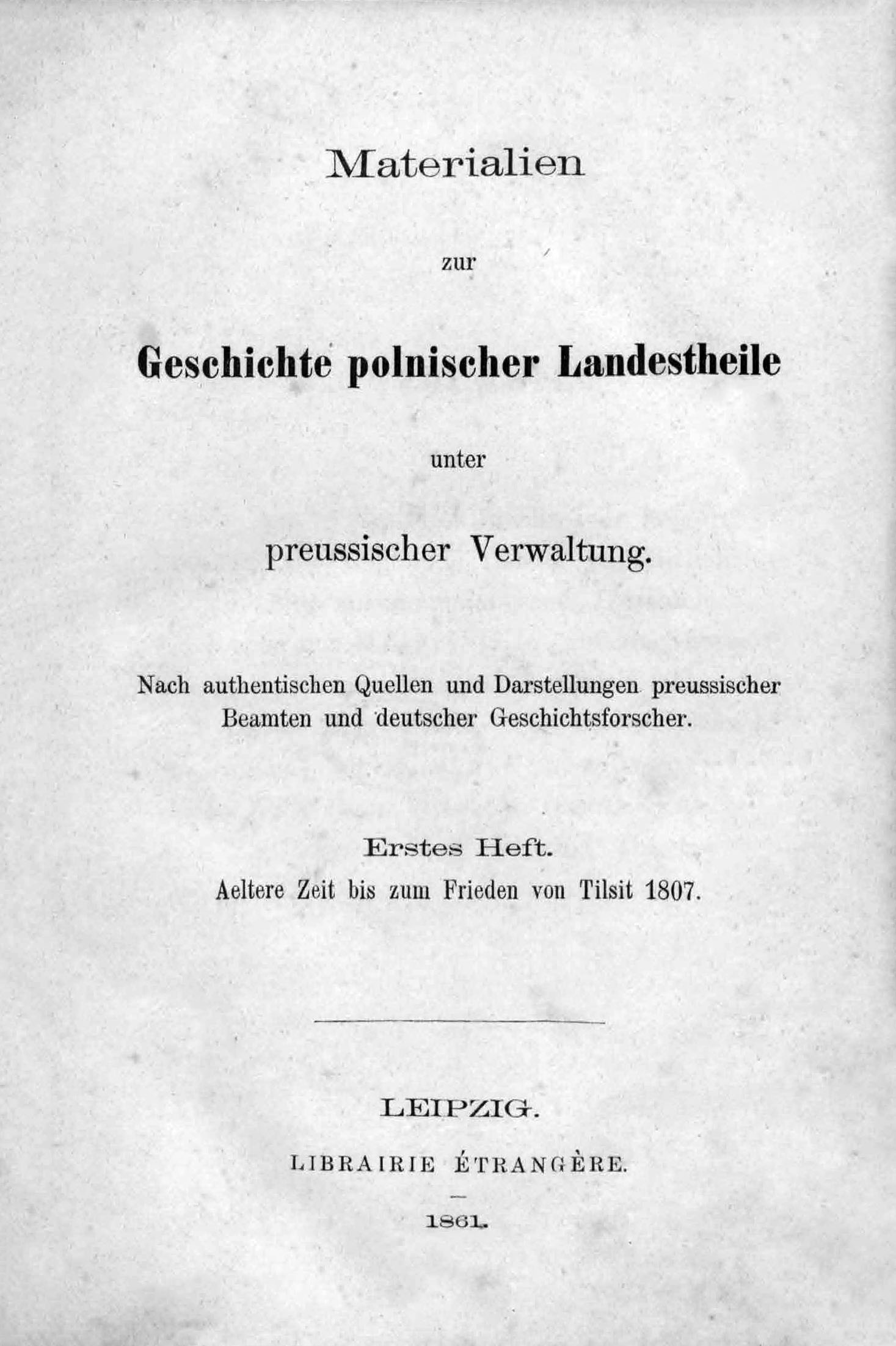
[Title page]
Materialien zur Geschichte polnischer Landestheile unter preussischer Verwaltung.
Nach authentischen Quellen und Darstellungen preussischer Beamten und deutscher Geschichtsforscher.
Erstes Heft.
Aeltere Zeit bis zum Frieden von Tilsit 1807.
LEIPZIG. LIBRAIRIE ÉTRANGÈRE. 1861.
[Vorwort]
Vorwort.
Der vorstehende Titel macht jede längere Vorrede für die folgenden Blätter entbehrlich. Sie bieten keine zusammenhängende Geschichte, sondern eben nur Materialien, einzelne, äusserlich meist unzusammenhängende historische Thatsachen für spätere Bearbeitung. Sie haben indess auch als solche, als disjecta membra, selbst in dieser Form ihren Werth; — facta loquuntur.
Ein zweites Heft ist zum Drucke vorbereitet.
[Contents]
Inhalt.
| Seite | |
|---|---|
| Die deutschen Kolonisationen im Grossherzogthum Posen von der ältesten Zeit bis zur ersten Theilung Polens 1772 | 1 |
| Vorgänge bis zur ersten Theilung Polens 1772 | 16 |
| Friedrichs des Grossen landesväterliche Gesinnung gegen die Polen | 43 |
| Friedrich Wilhelms II. Friedens- und Freundschafts-Versicherungen | 56 |
| Die deutschen Kolonisationen im Grossherzogthum Posen von 1772—1806 | 103 |
| — Kolonisationen des Adels und der grossen Grundbesitzer, oder das schwarze Register | 105 |
| — Kolonisationen der Bauern und Handwerker | 178 |
| — Kolonisationen der Beamten und Notare | 201 |
| Nachträge | 232 |
Druckfehler: S. 14, Z. 7 v. o. lese: in das französische Kaiserreich, statt: in die französische Republik.
— 1 —
Die deutschen Kolonisationen im Grossherzogthume Posen
von der ältesten Zeit bis zur ersten Theilung Polens 1772.
Das Mahnwort „bleib im Lande und nähre dich redlich” scheint nicht von Deutschen ersonnen. Unsre Auswandrungen zeigen, dass wir uns zu allen Zeiten in fremden Ländern zu nähren suchten. Wer die deutschen Niederlassungen in Holland und Ungarn, im europäischen und asiatischen Russland, in Amerika und am Cap, in Neuholland und an der Moskitoküste, kurz in den verschiedensten Regionen des Erdballs in Erwägung zieht, der wird es zugestehen müssen, dass der Deutsche eine besondere Lust, einen Drang in sich trägt, ja dass er es als seinen Beruf, als seine Mission erachtet, sich überall, unter den fremdartigsten Verhältnissen heimisch zu machen. Der Deutsche vorzugsweise singt ubi bene, ibi patria!
Der alte Sebastian Frank leitet den Namen Germania von germino ab und sagt: „Es ist nichts denn Kind über Kind in Deutschland, sonderlich in Schwaben. Schwäbinnen kommen zweimal in einem Jahre nieder; daher das Sprichwort: Schwaben und böss Geld führt der Teufel in alle Welt.”
Kein Wunder daher, dass wir deutsche Niederlassungen schon in ältesten Zeiten auch in den ehemals polnischen Landestheilen finden. Deutschland war von jeher das Brutnest der Bevölkerung für alle Welt. Es zog, wie in der neuesten Zeit, auch schon in früheren Jahrhunderten selbst Prinzen und Prinzessinnen für fremde Throne. So heiratheten deutsche Prinzessinnen polnische Herzöge aus dem Stamme der Piasten, und deutsche Kolonisten gingen schon früh nach Niederschlesien, deutsche Cisterzienser nach Paradies, Blesen, Obra u. s. w.; deutsche Familien zogen in polnische Städte und erhielten das sächsische oder magdeburgische Recht. Dies war die Zeit der ersten deutschen Ansiedelungen in Polen.
— 2 —
Diese, so wie die auch während der folgenden Periode der Jagellonen eingewanderten Deutschen gingen indess so unbeschwert und unbemerkt in die polnische Nationalität auf, dass die deutschen Familien der damaligen Zeit, z. B. Schepel, Wilde, Struth, Raschke, Winkler, Unger, Pestel, Bedermann, Hape, Treter, Halt, Spor u. v. a. durch und durch Polen wurden.
Die dritte Periode der deutschen Einwanderungen in Grosspolen oder in das jetzige Grossherzogthum Posen fiel während der Zeit der Reformation. Schaarenweise wanderten die wegen ihrer religiösen Ansichten verfolgten Deutschen aus Schlesien, Böhmen und Mähren in Grosspolen ein und fanden hier gastliche Aufnahme. Polen hatte damals und bereits früher die civilisirtesten Staaten Europa’s in Glaubensduldung weit überflügelt. Während in Frankreich Molai, Johanna d’Arc auf dem Scheiterhaufen starben, während die Bartholomäusnacht und die Religionskriege Hunderttausende dem Tode weihten, — während in Spanien der Glaubensterrorismus Philipps, — in den Niederlanden die fanatischen Henkerknechte Albas, — in England die blutige Regierung der katholischen Maria unzählige Menschenopfer schlachteten, — während Deutschland seinen Huss und selbst die Gebeine des 1384 verstorbenen Wiclef noch hundert Jahre später verbrannte, — während es sich noch Jahrhunderte später in den blutigsten Religionskriegen zerfleischte, — hatte in Polen Kazimir der Grosse bereits 1356 das Toleranzstatut für jeden Glauben gegeben und Polen als ein Asyl eröffnet, wohin Alles sich flüchtete, was in der ganzen damals civilisirten Welt der Verfolgung und dem Tode preis gegeben war.
— 3 —
„Der vornehme Pole”, sagt selbst der deutsche Biograph Friedrichs d. Gr.,[1] „ist kein unduldsamer Katholik; ja, es muss eben hier mit ehrenhafter Auszeichnung hervorgehoben werden, dass im Reformations-Jahrhunderte, wo in andern katholischen Ländern die Inquisition mordete, wo auf Calvins Betrieb der spanische Arzt Michael Servede 1553 in Genf verbrannt wurde, in Bern 1556 der Neapolitaner Valentin Gentilis unter dem Henkerbeil fiel, wo Melanchton, Beza u. a. Evangelische für die Todesstrafe der Ketzer stimmten und überall die Freiheit der spanischen, italienischen und andrer Freidenker gefährdet war, — in Polen allein die Freistätte für Socinianer und Evangelische zu finden war. Ja, der unvergessliche Edelsinn ging so weit, dass man den Dissidenten, d. h. Nichtrömisch-Katholischen 1573 auf dem Reichstage in Wilna gleiche Rechte mit den übrigen Einwohnern gewährte. Kein Volk in der Welt konnte sich damals, und lange nachher einer solchen christlichen Hochherzigkeit rühmen.” Erst seit den schwedischen Kriegen machten die Jesuiten die kirchlichen Dissidenten zu einer politischen Partei, und schürten die Funken zu lodernden Flammen.
So entstand und vermehrte sich die deutsche Bevölkerung in den Städten Schmiegel, Posen, Meseritz, Fraustadt u. a. m. a. O.
Freilich erhob sich Herr Marine-Rath Jordan in der Paulskirche zu Frankfurt „auf den nothwendigen welthistorischen Standpunkt, auf dem die Posner Angelegenheit zu untersuchen ist” — und perorirte „mit der gewünschten historischen Kritik”:
— 4 —
„die Westkreise Birnbaum, Meseritz, Bomst, Fraustadt sind seit undenklicher Zeit, wie Sie schon aus dem Namen dieser Städte entnehmen können, in der überwiegenden Mehrheit ihrer Bewohner deutsch gewesen; [2] —
Aber er übersieht eben wegen der „gewünschten historischen Kritik,” unter dem Beifalljauchzen des Blödsinns, dass die alten Kreise Międzychód, Międzyrzecz, Babimost, Wschowa, doch auch seit undenklicher Zeit — „wie Sie schon aus dem Namen dieser Städte entnehmen können,” — in überwiegender Mehrheit ihrer Bewohner polnisch waren. Herr Jordan und Consorten übersehen, dass die alte polnische Stadt Międzychód keine andere ist, als diejenige, welche später zu deutsch Birnbaum benannt ward, dass die polnische Stadt Międzyrzecz keine andere ist, als das später deutsche Meseritz, Babimost keine andere als das später deutsche Bomst, Wschowa keine andere als das später deutsche Fraustadt! —
Und doch hat Herr Wilhelm Jordan auf seinem „nothwendigen Standpunkt,” und „mit der gewünschten Kritik,” — „den Muth, diejenigen der Unwissenheit oder der Fälschung der Geschichte zu zeihen, welche die Theilung Polens in einem so fürchterlich schwarzen Lichte erblicken!” —
Welches Argument hätte analoger Weise er und die Frankfurter Reunionskammer schon in dem blossen Wortlaut, dem Namensklange gegen Kopenhagen haben müssen, wenn sie sich vor dem ruhmreichen Waffenstillstand zu Malmö auf jenen „nothwendigen” Standpunkt und zu jener „gewünschten” Kritik erhoben hätten, da diese Stadt, „wie
— 5 —
man schon aus dem Namen entnehmen kann,” seit undenklicher Zeit deutsch ist. —
Aber Wehe der frankfurter historischen Kritik, wenn einst Franzosen und Russen sich auf Herrn Jordan’s welthistorischen Standpunkt stellen sollten, wenn einst die Franzosen Aix la Chapelle, Mayence, französisch Buchholz, wenn die Reichskommissarien der Central-Gewalt in Tobolsk Nowawes, Alexandrowka,[3] ja ganz Potsdam reklamiren, da diese Orte, „wie Sie schon aus dem Namen entnehmen können” seit undenklicher Zeit in der überwiegenden Mehrzahl ihrer Bewohner Franzosen, respektive Russen waren.
Die dritte Periode der deutschen Einwanderung war die des dreissigjährigen Krieges. Zu Tausenden suchten die deutschen Protestanten vor dem verheerenden Schwerte Tilly’s, Wallenstein’s Schutz und Zuflucht in Grosspolen, und bevölkerten entweder ganz neue Städte, wie z. B. Zaborowo bei Lissa, und das von Prszyjemski eigends für sie gegründete Rawicz, oder setzten sich in alten polnischen Städten fest, wie in Lissa, Reisen, Bojanowo, Jutroschin, Zduny, Kobylin, Schocken, Wollstein, Birnbaum, Karge. Der Adel von Grosspolen, wie die Leszcynski’s, Bojanowski’s, Sieniuts, Rey’s, Pawadowski’s, Prszyjemski’s, nahmen die Flüchtlinge gastfreundlich und hochherzig auf, nicht nur in den Städten, sondern sie gaben ihnen auch gegen geringe Entschädigung grosse Länderstrecken und ermunterten ihren Fleiss durch Verleihung von Freiheiten, welche selbst ihre eigenen Landsleute nicht hatten.
Wie hochherzig die Deutschen von den Polen selbst in späterer Zeit aufgenommen wurden, bekundet u. A. auch folgendes K. K. Hofdekret an den Grafen Andreas Zamoyski:[4]
— 6 —
„Nachdem der Zamoscer Herr Ordinat von Zamoyski durch die auf seinem Ordinatsdominium ganz freiwillig übernommene Dotirung von 80 deutschen Ansiedlerfamilien seinen patriotischen Eifer in Befolgung der Allerhöchsten Gesinnungen zu Sr. Majestät vollkommensten Zufriedenheit an den Tag gelegt hat, so ist auf Sr. Majestät Befehl dieses patriotische Benehmen des Herrn Grafen Zamoyski durch ein gedrucktes Kreisschreiben bekannt zu machen und anzurühmen.“
Insbesondere nahmen die Eigenthümer weit ausgedehnter Herrschaften, so wie die Nutzniesser starosteilicher und geistlicher Güter, wie z. B. die Szoldrski’s, Opalinski’s, Potulicki’s, Kozminski’s etc. deutsche Kolonisten bereitwillig auf, und überwiesen ihnen ihre unermesslichen Waldungen zum Ausroden, zum Aushauen. So entstanden die sogenannten Hauländer in den Gütern um Kurnik, Grätz. Die ersten Niederlassungen dieser Art erfolgten vor mehr als zwei Jahrhunderten. Der grösste Zuzug war unter der Regierung des sächsischen Königshauses, unheilvollen Angedenkens, und es ist mit diesen Kolonisationen noch bis weit in die zweite Hälfte des vorigen Jahrhunderts fortgefahren worden.
Diese Hauländer wurden irrthümlich wegen der Aehnlichkeit des Namensklanges auch Holländer genannt. Sie waren aber weder Holländer, noch haben sie Holländereien im eigentlichen Sinne gegründet. Selbst später konnte die derartige Liebhaberei Friedrichs des Grossen nicht erfüllt werden, Berlin und Warschau mit Butter aus hiesigen sogenannten Holländereien zu versehen [5]. Auf dem ausgehauenen Waldboden gründeten sie vorzugsweise Ackerwirthschaften. Ihre Lage gehörte mit zu der besseren der Landbewohner. Sie hatten kleine Höfe, meist in grösserer Anzahl nebeneinander, Gebäude und Inventarium waren ihr eigen, theilweise auch der Grund und Boden; theilweise sassen sie auf Pacht und gehörten zur Kategorie der Emphiteuten. Ihre Wirthschaft war indess nicht immer die musterhafteste, namentlich fällt ihnen die Verwüstung der Wälder durch Brand und das sogenannte Abringeln der Bäume zum Vorwurf, eine Verwüstung gegen die alle damaligen Reisende und Schriftsteller sich übereinstimmend aussprachen [6]
— 7 —
Es ist indess irrig und gehässig, die deutschen Kolonisten mit den Negern zu vergleichen, die noch im zehnten Geschlecht ihre schwarze Haut bewahren. Im Gegentheil die Haut der Deutschen ist politisch und national elastischer, und nimmt fast allemal und überall leicht jede Farbe an. Die meisten Kolonisten auch dieser Periode waren daher wahre Polen geworden, obwol Polen deutschen Ursprunges. Die eingewanderten Deutschen Morsztyn, Bonar, Kromer, Hosius, Plater, Unrug (Unruh), Kalkstein, Biberstein, Wolszlegier, Götzendorf, (Grabowski), Waldorf (Wolicki), Pac, Szauman, Szuman, Wierusz, Szulz u. v. a. stehen denen der polnischen Autochtonen mit Erinnerungen aller patriotischen Tugenden und national-polnischen Volksthümlichkeiten ebenbürtig zur Seite.
Wie sehr die Deutschen sich selbst polonisirt und wie lebhaft sie sich auch an dem Insurrectionskriege 1792 betheiligt haben, beweist unter vielen anderen die Thatsache, dass ein deutscher Magnat für die Insurrectionsarmee auf eigne Kosten, freiwillig 12 Kanonen ausrüstete. Es war dies der deutsche Magnat — v. Manteuffel.[7]
— 8 —
Unter den in Warschau im Jahre 1831 hingerichteten Insurgenten war die Mehrzahl derselben solche Polen deutscher Abkunft.
Alle so bis 1772 nach Polen gekommenen deutschen Kolonisten, sei es, dass sie als Flüchtlinge kamen, oder dass sie in das Land gerufen wurden, sie kamen zu einer Zeit, als das Land noch unter einer polnischen Regierung stand, um unter einer polnischen Regierung, unter Polen zu leben. Dass ihnen auch deutsche Anordnungen, deutsches Recht, als ausdrückliche Bedingung oder aus eigenem Antriebe von den Polen gewährleistet worden waren, zeugt nur für den Geist polnischer Humanität und Loyalität.
Wenn daher ein deutscher, sonst anerkannter Geschichtsforscher[8] in der Frankfurter Verhandlung über die Polenfrage i. J. 1848 berichtet:
„Ob alle diese Deutschen seit Jahrhunderten hier gesessen, oder seit mehreren oder weniger Jahren sich ansässig gemacht haben, ist wesentlich gleich. Sie sind nicht minder Deutsche als Andere, und sind hierher gekommen, in der sichern Zuversicht unter einer deutschen Regierung als Deutsche zu leben,“
so muss eine so dreiste Fälschung der offenkundigen Geschichte, welche schon vor 1772 „eine deutsche Regierung“ in Polen behauptet, nur eben als Beweis gelten, mit welchen Leidenschaften in Frankfurt über die Polenfrage von einer gewissen Partei verhandelt wurde und wessen man sich von solchen politischen Taschenspielern, solchen gelehrten Eskamoteurs historischer Thatsachen und Falschmünzern der Wahrheit zu versehen hatte.
Betrachten wir indess die Verhältnisse genauer, in
— 9 —
denen die deutschen Einwanderer bisher unter den Polen, unter polnischer Regierung gelebt haben.
Die Deutschen hatten aus Noth, in der Hoffnung, sich ein besseres Schicksal zu bereiten in blutiger Verfolgung, ihr Vaterland verlassen, und sich freiwillig zu polnischen Unterthanen gemacht, in ähnlicher Art, wie die holländischen und französischen Kolonisten unter dem Grossen Kurfürsten und König Friedrich II., wie die Zillerthaler unter Friedrich Wilhelm III. sich zu preussischen Unterthanen gemacht hatten. Die Deutschen haben freiwillig und unwiderruflich ihr Geschick mit dem der Polen verbunden, als sie bei ihnen Schutz und Unterkommen suchten und annahmen. Sie wurden Polen deutscher Abkunft, wie jene Kolonisten Preussen holländischer, französischer, östreichischer Abkunft geworden sind.
Es war den Polen aber nicht eingefallen, die deutschen Einwohner in ihrer Nationalität, Sprache, Religion zu beschränken. Die Polen haben vielmehr den Deutschen in voller Anerkennung ihrer nationalen Eigenschaften, ihrer Geschicklichkeit und ihres Fleisses in Landbau und Gewerben Privilegien und Vorrechte gewährt. Die Erhaltung der plattdeutschen Sprache in vielen Gegenden beweist, dass die Polen es für eine Schmach gehalten haben, deutschen Unterthanen ihre deutsche Sprache zu nehmen, sie zum Erlernen des Polnischen zu zwingen, sie zu polonisiren. Deutsche Schulen, deutsche Kirchen, deutscher Gottesdienst wurden nicht blos geduldet, sondern noch durch besondere Privilegien gefördert. Der Bauplatz zur deutschen evangelischen Kreuzkirche in Posen ist der deutschen Gemeinde vom polnischen Staate geschenkt worden. Deutsches Recht galt in vielen polnischen Städten.
In der Stadt Posen werden i. J. 1284 Bürgermeister deutscher Abkunft genannt. In Rawicz wurde ein sächsisches
— 10 —
und ein magdeburgisches Recht angeschafft, damit die verschiedenen Einwohner die Gesetze ihrer Herkunft haben. In Barczyn bestand der Rath zur Hälfte aus Polen, zur Hälfte aus Deutschen. Im Stadtarchiv zu Posen sind noch Kriminal-Acten aus dem 16. Jahrhundert vorhanden, die in deutscher Sprache geführt wurden.
Bedarf es mehr, um den Geist der Toleranz und Humanität zu karakterisiren, mit dem die Polen fremde Einwanderer in ihr Land aufnahmen, so erinnere man sich der Juden. — Bei der Rolle, welche die Posener Juden als deutsche Bruderbündler mit den deutschen Beamten im Grossherzogthum Posen spielten und noch spielen, ist hier ein Rückblick auf die früheren Verhältnisse der Juden in Deutschland und ein Vergleich mit denen derjenigen, die in Polen ein Asyl gefunden, an passender Stelle.
Die Geschichte der Juden in Deutschland ist wie die in Spanien, Frankreich, England, voll beweinenswerther Blätter. Die Feder ermüdet und das Herz strömt über vor schmerzlicher Regung bei der Erinnerung an die zahllosen Gräuel, die an Tausende von Unschuldigen an allen Orten, zu allen Zeiten, unter allen möglichen Vorwänden verübt worden sind. Um hier nur von Deutschland zu reden; wie überreich sind hier nicht die Beispiele, wo Habsucht, irgend ein Verlangen des ersten besten Raufboldes, oder der Ortsbehörden schon genügte, die entsetzlichsten Blutbäder unter ihnen anzurichten. Deutsche waren es, die im Jahre des Heils 1096 zu Mainz 14000 Juden unschuldig gemordet; — Deutsche waren es, die im Jahre 1285 in der frommen Stadt München 180 Juden auf dem Scheiterhaufen verbrannten — Deutsche waren es, die i. J. 1331 die ganze jüdische Bevölkerung in Ueberlingen auf das qualvollste zu Tode gemartert, — Deutsche waren es, die 1340 in Frankfurt 1156 jüdische Familien zu Tode gefoltert, — Deutsche, die 1349 in Strassburg 2000 Juden verbrannten.
Wem, der nur einigermaassen die Leidensgeschichte
— 11 —
der Juden kennt, wären die Greuel unbekannt geblieben, die wiederholentlich in Prag an ihnen verübt wurden! Als den Peter von Amiens, den Walter von Habenichts und später den heiligen Bernhard der fanatische Einfall überkam, die Feinde Christi vor allererst in der Heimath auszurotten, war es nicht ganz Deutschland, Bayern, Franken, Schwaben, Sachsen, Böhmen, Oestreich, das in frommer Bestialität die Länder vom Rhein bis zur Oder mit einem Blutmeer erschlagener Juden überschwemmte? — Wo mehr als in Deutschland gaben angeblich entweihte Hostien, Kinderraub, Epidemien Vorwand zu den grausamsten Judenverfolgungen? Wo mehr als in Deutschland gab es jene verrotteten Judengassen? — Und nicht genug die Lebenden zu bedrücken, bedrückte man auch noch die Leichen der Juden. Kam eine Judenleiche in der Mark Brandenburg auf dem Wege zum Grabe an einer Zollstätte vorbei, so musste sie verzollt werden, und „der Zoll einer Judenleiche war hoch.“[9] — Deutschland war es, wo noch in unsern Jahren das „Hephep“ die Blutparole gegen die Juden war. Ja, in einem deutschen Landestheile, in der Grafschaft Wittgenstein, in dem preussischen Regierungsbezirk Arnsberg, waren die Juden bis zu den denkwürdigen Märztagen des Jahres 1848 noch gesetzlich — — vogelfrei! —[10]
So war die Lage der Juden in Deutschland. Anders in Polen.[11] Während in Deutschland keine Klage eines Juden angenommen wurde, wenn sie ihn nicht selber
— 12 —
betraf, konnte in Polen dagegen ein Jude nicht anders, als auf ausdrückliches Verlangen eines Klägers vor Gericht gestellt werden. Und nur der König oder der Wojewode konnte über ihn Recht sprechen, keinen anderen Richter brauchte er anzuerkennen, während er in Deutschland vor dem Stadtrichter gestellt wurde. In Polen konnte er sich von der gegen ihn erhobenen Anschuldigung durch einen Eid reinigen, in Deutschland konnte dies zwar der Christ, nicht aber der Jude. Den Mord eines Juden richtete in Polen allein der König, in Deutschland richtete der Voigt darüber. Wurde ein Jude eines Verbrechens beschuldigt, so musste es durch das Zeugniss dreier Christen und dreier Juden bewiesen werden, in Deutschland brauchte der Christ dazu nur einen Christen und einen Juden. Die Zolleinnehmer durften einen Juden, der über die Grenze reisete, nicht visitiren, wenn er den Leichnam eines verstorbenen Glaubensgenossen mit sich führte, um ihn zu beerdigen; in Deutschland mussten die Leichen versteuert werden. Die Entweihung eines jüdischen Kirchhofs oder einer Synagoge wurde als Kirchenraub bestraft. — Das Gesetz verbot, die Juden zu verläumden, oder den Argwohn zu verbreiten, dass sie Christenblut zu abergläubischen Ceremonien gebrauchen. In Deutschland hatten die Juden eben wegen dieses Wahns viel zu leiden, und es macht den polnischen Fürsten Ehre, dass sie in diesem Punkte viel heller sahen, als die deutschen.[12]
— 13 —
So haben die Polen selbst in den finstersten Zeiten der rohen Gewalt, in den verrufensten Jahren der Republik gegen Fremdlinge, die sie aufgenommen, gedacht und gehandelt, obwol sie das Recht gehabt hätten, zu fordern, dass sie sich den Sitten und Gesetzen, der Sprache des Landes zu fügen hätten. Die Deutschen waren bei den Polen gleich vor dem Gesetz, hatten unbeschränktes Besitzrecht, freien Gebrauch ihrer Sprache in Schule und Kirche, und Schutz ihrer Nationalität. Das Recht des Eroberers hatten und wollten sie nicht, am allerwenigsten hatten und wollten sie das Recht, die Eingebornen zu verdrängen. Um so weniger dürfen daher ihre Nachkommen im dritten, vierten und noch späteren Geschlechte ein solches Recht für sich in Anspruch nehmen, ohne die undankbarste, unbegründetste Anmassung darzuthun, ohne auf die rohe Gewalt der Bajonette, auf den willfährigen Beistand eines Beamtenthums zu pochen,
— 14 —
das von nationaler Parteisucht geleitet, nur sein eigenstes Partei-Interesse wahrnimmt. Die Deutschen, deren Väter vor 1772 nach Polen kamen, sind Polen deutscher Abkunft.
Was würden wir sagen, wenn die französische Kolonie in Berlin, deren Vätern Friedrich ein Asyl gewährt hat, heute fordern würde, in die französische Republik aufgenommen zu werden? — was, wenn die Zillerthaler heute zu Oestreich gehören wollten? Und die Zillerthaler wohnen wenigstens unvermischt neben einander, in einem Dorfe, während die Deutschen im Grossherzogthume Posen zerstreut unter den Polen wohnen.
Ueber das numerische Verhältniss der vor 1772 in Polen eingewanderten Deutschen lässt sich nichts Bestimmtes angeben. Es finden sich hierüber keine besondern Data, und dies kann als Beweis dafür dienen, dass man damals in Polen gar keine Veranlassung hatte, die Landesbewohner nach ihrer polnischen oder deutschen Nationalität zu sondern.
Ganz anders aber wird nach Zahl und Rechtsanspruch das Verhältniss derjenigen Deutschen in den ehemals polnischen Landestheilen, die seit 1772 hierher kamen. Mit der ersten Theilung Polens beginnt die neuere Zeit der deutschen Kolonisationen — die der Germanisirung.
Es sei indess gestattet, schon hier aus dieser späteren, neueren Zeit einige Data zur Statistik der Nationalitäten beizubringen, weil sie grade an dieser Stelle am geeignetsten scheinen, den Leser zu strengerem Nachdenken zu veranlassen.
In Leonhardi’s „Erdbeschreibung der preussischen Monarchie“ Th. 1. Halle 1791 findet man hie und da die Zahl der Bevölkerung in einzelnen Städten nach ihrer Nationalität angegeben. Wir stellen hier die wichtigsten der zerstreuten Angaben übersichtlich zusammen. Es waren
— 15 —
Spalten “Deutsche” und “Juden” stehen unter der gemeinsamen Überschrift “darunter”.
| In | die Gesammt-Bevölkerung | Deutsche | Juden |
|---|---|---|---|
| Barczyn | 397 S. | 136 S. | 71 S. |
| Bromberg (im J. 1772) | 2562 S. | 2 Fam. [13] | 27 S. |
| Budzyn | 766 S. | 158 S. | |
| Chodziesen | 1816 S. | 651 - | 365 S. |
| Exin | 703 S. | 31 S. | 174 S. |
| Flatow | 1597 S. | 600 S. | 714 S. |
| Gembic | 315 S. | einige Fam. | 57 S. |
| Gollancz | 639 S. | 124 S. | 153 S. |
| Jastrow | 2009 S. | 99 S. | 169 S. |
| Inowraclaw | 1700 S. [14] | 543 S. | |
| Kamin (poln. Krone) | 521 S. | 44 S. | 60 S. |
| Koronowo | 756 S. | 8 Fam. | |
| Krojanke | 848 S. | 400 S. | 205 S. |
| Labiszyn | 712 S. | 211 S. | |
| Meseritz | 2502 S. | 1177 S. | 700 S. |
| Miasteczko | 327 S. | 199 S. | |
| Mroczyn | 526 S. | 160 S. | 45 S. |
| Nakel | 683 S. | 236 S. | 149 S. |
| Schneidemühl | 1509 S. | 510 S. | 241 S. |
| Schönlanke | 2016 S. | 1362 S. | 289 S. |
| Szubin | 1170 S. | 154 S. | 8 S. |
| Strzelno | 735 S. | 30 Fam. | |
| Uscz | 580 S. | 65 S. | 19 S. |
| Wirsitz | 207 S. | 96 S. | 58 S. |
| Wissek | 266 S. | 87 S. | |
| Zamoczyn | 652 S. | 433 S. | 18 S. |
| Zempelburg | 1628 S. | 651 S. | 581 S. |
— 16 —
Vorgänge bis zur ersten Theilung Polens 1772.
Friedrich als Beschützer der republikanischen Freiheit und des Liberum Veto.
Polen war eben im Begriff den Weg zu betreten, auf welchem die versäumte Gesammtbildung nachgeholt und der Unfug des Wahlreichs in die Ordnung einer Erbmonarchie umgewandelt werden sollte. Aber eine solche Erhebung aus der Ohnmacht schien der Moskowiterin Katharina und dem Könige von Preussen wider Gesetz und Recht; der Kaiserin, weil sie hier mit richtigem Instinct für ihre Raubsucht die reichste Befriedigung sah, — dem Könige, weil er die Nothwendigkeit des Besitzes des untern Weichselgebietes als Verbindungsglied seiner Provinzen erkannte.
Daher enthielt auch schon das gleich nach dem Ende des siebenjährigen Krieges zwischen Friedrich und Katharina geschlossene Bündniss vom 11. April/31. März 1764 die geheimen Artikel:[15]
„In Erwägung, dass es im gemeinschaftlichen Interesse Ihrer Majestäten des Königs von Preussen und der Selbstherrscherin aller Reussen ist, dass die Wahl der polnischen Krone frei bleibe, und dass keine Familie des erblichen Thrones dieses Landes sich bemächtige, verpflichten sich besagte Majestäten gegenseitig auf die feierlichste Weise durch diesen geheimen Artikel, nie zuzugestehen, dass man die Republik ihres freien Wahlrechts beraube. Sie verpflichten sich ebenfalls, durch alle ihnen zu Gebote stehenden Mittel, den Entwurf der Begründung eines erblichen Thrones in diesem Lande zu bekämpfen, mit Gewalt jedes Unternehmen dieser Art zurückzustossen und übereinstimmend zu handeln, um die Verfassung und die Grundgesetze der polnischen Republik zu erhalten.”
— 17 —
In diesem Sinne informirte auch Friedrich seinen Gesandten an einem fremden Hofe am 22. November 1766:[16]
„Die Pohlnischen Sachen anbetreffend, da muss Ich Euch hierdurch zu Eurer Information und Direction davon bekannt machen, wie der bisherige Reichstag zu Warschau sich zu Ende ziehet, und bisher auf demselben noch wenig ausgerichtet worden, dabei sich aber hervorgethan hat, dass der Pohlnische Hof das Dessein gehabt, von der Gelegenheit dieser Confederations Diete, bei dergleichen nur die Schlüsse nach denen mehresten Stimmen abgefasset werden, zu profitiren, und die Republique überraschen wollen, um das sogenannte Liberum veto auf denen Reichstagen gänzlich zu aboliren, auch statt der unanimité derer Stimmen, die pluralité von solchen einzuführen, mithin die bisherige Gouvernementsform der Republique zu verändern, und dasjenige, so zu allen Zeiten der Grund der Pohlnischen Freiheit ausgemacht, zu verändern. Sowohl die Russische Kaiserin, als auch Ich haben also vermöge der uns obliegenden Garantie der Pohlnischen Reichsverfassung, dahin sehen müssen, dergleichen schädliches Dessein zu unterbrechen, als deshalb wir durch unsere Ministres zu Warschau die erforderlichen Declarationes an die versammelte Diete
— 18 —
solenniter thun lassen, auf dass die Republique, bei ihren Constitutionen und dem Liberum veto gelassen werden müssen. Um aber auch solchen Declarationen den mehrern Nachdruck zu geben, hat der Russischen Kaiserin Majestät vor gut und nöthig gefunden, einige von ihren Truppen (30,000 Mann) annoch in Pohlen einrücken zu lassen, bloss in der Absicht, die gegen die Freiheit der Republique übelgesinnten Pohlen dadurch in Ordnung zu halten, die wohl intentionirten aber nöthigenfalls zu secondiren, und nicht unterdrücken zu lassen.” etc. etc.
Das sogenannte Lynar’sche Project zur Theilung Polens.
Inzwischen hatte der Einfluss Katharina’s in der Türkei und Polen die Schalen des europäischen Gleichgewichts bedrohlich in’s Schwanken gebracht, und Friedrich erinnerte sich jetzt der Worte, die sein Gesandter, v. Solms, in Petersburg in einer Unterredung mit Panin am 29. December 1763 von demselben vernommen.
„Il ajouta encore, berichtete damals Solms, que Votre Majesté n’aurait pas raison de regretter d’avoir pris des engagemens avec sa cour, parceque, si contre toute attente, les choses devaient venir à une grande extrémité, il me répondait que V. M. aurait Sa peine payée aussi bien que la Russie et qu’on n’aurait pas travaillé pour rien. C’est une affaire, disait-il, que j’ai arrangée d’avanée, mais
— 19 —
que je ne peux expliquer que quand les choses seront plus avancées.“ [17]
Diese Ideen hatte Friedrich damals mit allem Nachdruck zurückgewiesen. Jetzt aber, Anfangs d. J. 1769, waren Verhältnisse eingetreten, welche die Sache anders erscheinen liessen. Eine Gebietserweiterung Preussens nach Osten erschien jetzt nicht allein wünschenswerth, sondern sogar nothwendig. Nur unter dieser Bedingung glaubte er der drohenden territorialen Ausdehnung Russlands ruhig zusehen zu können.
Hierzu kam noch, was vor fünf Jahren nicht in Betracht gezogen ward. — Es unterlag nämlich keinem Zweifel, dass sowohl eine Machterweiterung Preussens als auch eine Gebietsvergrösserung Russlands die ganze Eifersucht des Wiener Hofes rege machen würde; mit Bestimmtheit hatte der König sogar in Erfahrung gebracht, dass Oestreich ein starkes Armee-Corps an den Dniestr schicken wolle, um gemeinschaftlich mit den Türken dem Vordringen Russlands entgegenzutreten. Es musste daher ein Mittel gefunden werden, um Oestreich von einer jeden Feindseligkeit gegen Preussen oder Russland fern zu halten. Dies konnte aber nur dadurch erreicht werden, dass man dem Wiener Cabinette ebenfalls die Aussicht auf den Besitz eines Theiles von Polen eröffnete, und diese verschiedenen Gesichtspunkte zusammenfassend, richtete der König am 2. Februar 1769 folgendes Schreiben an von Solms, seinem Gesandten in Petersburg:
„Le comte de Lynar est venu à Berlin pour marier sa fille au fils du comte de Kameke. C’est le même qui a conclu la paix de Kloster-Zeven. Il est grand politique et gouverne encore l’Europe du fond du village où il s’est retiré. Le comte de Lynar a eu une idée assez singulière
— 20 —
pour réunir tous les intérêts de princes en faveur de la Russie et pour donner tout d’un coup une face différente aux affaires de l’Europe. Il veut que la Russie offre à la cour de Vienne pour son assistance contre les Turcs la ville de Léopold et ses environs, qu’elle nous donne la Prusse Polonaise avec la Warmie et droit de protection sur Danzig et que la Russie pour se dédommager des frais de guerre accroche telle partie de la Pologne qui lui conviendrait et qu’alors n’y ayant aucune jalousie entre l’Autriche et la Prusse ils secourraient la Russie à l’envie les uns des autres contre les Turcs. Ce plan a quelque éclat; il paraît séduisant. J’ai cru devoir vous le communiquer. Vous qui connaissez la façon de penser du comte de Panin, ou vous supprimerez tout ceci, ou vous en ferez l’usage que vous jugerez à-propos, quoiqu’il me semble qu’il s’y trouve plus de brillant que de solide.“
Wenn der König im Eingange dieses Schreibens den ganzen Plan als ein Werk des Grafen Lynar hinstellt, so ist das nur ein Vorwand, dessen er sich bediente, um dem russischen Cabinette gegenüber nicht selbst als der Urheber eines Projectes dazustehen, welches doch möglichenfalls in Petersburg verworfen werden konnte. In seinen Denkwürdigkeiten über diese Zeit ist Friedrich offenherziger : er nennt dort das Project geradezu „le soi-disant mémoire du comte Lynar“ und deutet zugleich an, dass er den Namen des Letzteren nur vorgeschoben habe.
Die societas leonina schien geschlossen. Als aber Solms die Frage aufwarf, wie denn Russland selbst sich bei dieser Ländertheilung schadlos zu halten gedenke, war Panin naiv genug zu antworten: „que la Russie ne devait point prétendre au partage, vu qu’elle possédait déjà beaucoup plus de pays qu’elle n’était en état de gouverner, ainsi, exceptées quelques places fortifiées sur les frontières éloignées, elle ne devait plus songer à acquérir des provinces.“ [18]
— 21 —
Mit dieser Antwort war nichts oder mehr als Alles gesagt. In einem Augenblicke, wo fast ganz Polen von russischen Truppen besetzt war und wo die Kaiserin sogar am Bosphorus festen Fuss fassen wollte, — in einem solchen Augenblicke jede Eroberungspolitik zu verleugnen heisst soviel, als sich über seine Absichten nicht aussprechen wollen, weil man auch ohne fremden Rath und Beistand seine Zwecke werde erreichen können.
Prinz Heinrich in Petersburg.
Friedrich wurde bedenklich und zurückhaltend, Russland immer mächtiger und dreister, als während des Aufenthalts des Prinzen Heinrich am Petersburger Hofe (October 1770 — Januar 1771) hier die Nachricht eintraf, dass Oestreich die Zipser Starosteien besetzt haben.
„Mais pourquoi tout le monde ne prendrait-il pas aussi?“ — „Il semble que dans cette Pologne, il n’yait qu’a se baisser pour en prendre,“ — waren die bekannten flüchtigen Aeusserungen der Kaiserin an den Prinzen, die dieser dem Könige mit dem Bemerken meldete: „Quoique cela n’était qu’un discours de plaisanterie, il est certain que çela n’était pas pour rien, et je ne doute pas qu’il sera trés-possible que V. M. profitiez de cette occasion.“[19]
— 22 —
Auch Solms erstattete ausführlichen Bericht, und in schneller Folge antwortete der König bereits im Januar 1771: „Ce qu’on nous fait voir vu perspective, l’Ermeland, ne vaut pas la peine de dépenser dix sous pour l’acquérir.“ — Ferner: Quant à l’article de prise de possession du douché de Varmie, je m’en suis abstenu, parce que le jeu n’en vaut pas la chandelle. Cette portion est si mince, qu’elle ne récompenserait pas les clameurs qu’elle exciterait; mais la Prusse polonaise en vaudrait la peine, quand même Danzig n’y serait pas compris, car nous aurions la Vistule et la communication libre avec le royaume, ce qui ferait un article important. S’il s’agissait de dépenser de l’argent, cela en vaudrait la peine, et d’en donner même largement. Mais quand on prend des bagatelles avec empressement, cela donne un caractère d’avidité et d’insatiabilité que je ne voudrais pas qu’on m’attribuât plus qu’on ne le fait déjà en Europe.“
— 23 —
Es gehört daher sicher zu den patriotischen, fables convenues, die auch Raumer[20] wiederholt hat, „dass Friedrich sehr erschrak, als ihm sein Bruder Heinrich zuerst jenen Gedanken einer Theilung Polens überbrachte, denn er fühlte richtig, wie viel an Recht, Treu und Glauben auf dem Spiele stand,” — zu denselben Fabeln, die auch Maria Theresien rührend sentimentale Aeusserungen in den Mund legen, als ihr der Vorschlag zur Theilung Polens gemacht wurde.
Dass Friedrich schon sehr früh und sehr ernstlich an eine Theilung Polens gedacht, geht noch klarer aus Folgendem hervor.
Friedrichs geheime Vorbereitungen zur Besitznahme Westpreussens und des Netzdistrikts.
Kab.-Ordre an den geschäftskundigen Kammer-Präsidenten v. Domhardt[21] d. d. Potsdam den 22. October 1769.[22]
„Besonders Lieber Getreuer. Ich habe die mit Eurem Bericht vom 16. d. Mir übersandte Nachrichten von dem Bisthum Ermeland und dem Marienburgschen Gebiet erhalten und ohnerachtet Ich davon zur Zeit
— 24 —
keinen Gebrauch machen kann, Euch gleichwohl vor Eure Mir dadurch bewiesene Attention hierdurch danken wollen“ etc. etc.
Potsdam den 19. Februar 1771. [23]
„Besonders Lieber Getreuer. Unter der Auflage der äussersten Verschwiegenheit habe Ich Mich hierdurch bei Euch erkundigen wollen, auf wie hoch sich der ganze Ertrag vom Ermelande belaufen kann. Ohnerachtet Ihr, wie Ich wohl einsehe, Mir solches mit völliger Gewissheit zu sagen, nicht im Stande sein werdet, so wird Euch gleichwohl sothanes Ermeland hinreichend genug bekannt sein, um mir eine ungefährliche Anzeige davon thun zu können. Ich wiederhole Euch übrigens, wie Ihr mit Pflicht und Ehre Mir vor der Geheimhaltung dieser Anzeige repondirt, und bin“ etc. etc.
Nachdem in gleicher Weise auch Ertrag und Seelenzahl von dem Marienburgischen und Kulmischen Gebiete von Pommerellen und Danzig ermittelt worden, erliess der König am 6. October 1771 an dem Kammer-Präsidenten von Domhardt folgende, eigenhändig geschriebenen
„Grund-Sätze wohrnach die Neue inrichtung im Königreich preussen Sol gemacht werden. [24]
Die adliche güther werden auf den Selbigen fuss gesetzet wie die in das Stück was ich jetzo besitze die Contribution. Eben des gleichens, was Starosteien und das Bischthum angehet, So nehme ich die güther und werde Sie auf den fus von Domainen verpachten, und Mus man sich alssdann auf eine gewisse Summe verstehen die dem Bischoff und denen Canonicis Mohnahtlich oder quartaliter
— 25 —
darauf getzahlet werden, wegen den Starosteien, wird es so gehalten, dass Man sich mit die Starosten auf eine gewisse Sume verstehet, die Man ihnen gibt bis Sie andere Starosteien Empfangen, gedoch müssen Sie Solche im lande vetzehren bei verlust wegen der Hauptarangemens So mus Ermelandt zum Königsbergischen Kammer geschlagen werden und dahr ein par Krigraht agumentiret werden, den Mus eine Deputacion in Marienwerder oder Dirschau oder Culm Etabliret werden von Directer und Einigen Räthen, umb das neue Stück zu Respiciren aber diese Kamern alle müssen mit der Königsbergischen Combiniret werden, landt Räthe müssen gleichwohl errichtet werden, wegen der justitz mus in Marienwerder oder in Marienburg ein justitz Collegium Errichtet werden, was die Stähte angehet mus die Accise Introdiciret werden, aber mit aller Behutsamkeit umb das Commerce nicht zu hindern gedoch mit aller Sorgfalt den Debit der Manufacturen zu befördern.
wegen das Militarium, So müssen vohr 4 Regimenter Infanterie grosse Cantone jedes zu 24,000 Cantonisten getheilt werden, den über die 4 Regimenter Comen noch 4 garnissons batalions Recruten davon das Machet in Rei und glieder 4 Regimenter Infanterie 3200 Mann und 4 Garnisson Battl. 1500 Mann So eingestellet Seindt, über diesen Mus Noch Ein Canton vohr Artillerie errichtet werden auf 30000 Cantonisten davon werden 1000 Mann Eingestellet, und Muss in Kriegstzeiten 6000 artillerie Knechte fournire überdehm müssen die Cantons von Pomeiske und Apenburg dergestalt von den aquihirten provincen verstarket werden dass sie zu noch ein Husaren Regiment fourniren kann.
also würde im allen aus der provintz ausgehoben zu
4 Regimenter Infanterie 3200 Mann 4 Garnisson Battl. 1600 Mann Husaren Regiment 800 Mann vohr die artillerie 1000 Mann = 6600 Mann |
— 26 —
und wen es Krieg ist 6000 artillerie Knechte nunmehr rechne ich auf das Stück preussen mit Danzich 500,000 sollen also 250,000 Manbahre So Macht was Soldatte wirdt 3 procent in Friedens Zeiten, welches nicht zu vihl ist.
Domhardt wirdt auss diessen Meinen Idéen engro ersehen, und wirdt es den ankomen das Man die Aemter anschlage Macht und Solche baldt mit prenumeration verpachtet.
Die Costen derer Regimenter wird sich belaufen
4 Reg. Infanterie 304000 Thlr. 4 Garnison Battl. 92000 Thlr. 4 Husaren Reg. pr. propt. 100000 Thlr. die Artillerie 84000 Thlr. = 580000 Thlr.
und wen das Landt guht administriret wirdt mus es wohl 1200000 Rthlr. einbringen.
Diesses mit aller behuthsamkeit zu Cachiren bis wir im possesion Seindt was baldt gescheen wirdt, aber alsdann hurtig zu arbeiten, absonderlich baldt beamte an zu Schafen, den wihr Müssen geldt haben.
Friedrich.”
Der König eigenhändig unter einer Kabinets-Ordre vom 7. October 1771. [25]
„wen diesses alles im voraus gearbeitet wirdt, So guht wie man kan, so wirdt es hernach die Exsecution in vihlen Stücken erleichtern weillen man Schon ein Schema hat vornach man Sich richtet.“
Potsdam, den 3. Februar 1772. [26]
„Vester Lieber Getreuer. Ich kann Euch im Vertrauen nunmehr schon sagen, dass es mit der Euch bekannten acquisition von dem bisherigen polnisch Preussen (excl. der Stadt Danzig und derselben Territorium auch Thorn) und von dem Stück an der Netze seine völlige Richtigkeit dergestalt bereits gewonnen hat, dass Ich darauf mit Sicherheit rechnen kann. Um bei der Besitznehmung einigermaassen von dem Ertrage, und wie hoch solcher sich belaufen derffe gesichert zu sein, wollet Ihr Euch, jedoch mit Vermeidung alles eclats, von denen Revenües dieser Acquisition, wenn solche auf dem in Meinen Provinzen üblichen Fus behandelt wird, so viel möglich au fait zu setzen, Euch bestens angelegen sein lassen” etc. etc.
— 27 —
Potsdam, den 20. Februar 1772.[27]
„Vester Lieber Getreuer. . . . . . . . . . wobei Ich Euch dann in Ansehung derer Starosteien und der beträglichen Besitzungen der Geistlichkeit zu Eurer Direction schon sagen kann, wie Meine Intention dahin gehet, es mit selbigen auf eben den Fus, wie es mit der Geistlichkeit in Russland[28] geschehen, zu halten, denen Starosten und Pfaffen ihr mässiges Auskommen an Gelde zu geben, ihre Possessiones aber, und um zu wissen, was selbige wirklich tragen können, das erste Jahr administriren, sodann aber auf Preuss. Fus verpachten zu lassen, da dann solche ungleich höher, als solches dermalen gewiss nicht geschiehet, zu nutzen sein dürfen.“ etc. etc.
— 28 —
Potsdam, den 2. Martii 1772.[29]
. . . . . . . Die Geistliche Güter lasse Ich gleich in Administration nehmen, und die jetzige Inhaber in Gelde bezahlen, damit sie sich in weltliche Sachen gar nicht zu meliren haben.
Alle Starosteien werden administrirt, um den eigentlichen Ertrag davon zu wissen, und solche von Trinitatis 1773 an ordentlich verpachten zu lassen. Die Unterthanen werden vor freie declariret, und die Leibeigenschaft aufgehoben. [30]
— 29 —
Potsdam, den 19. April 1772.[31]
……. „Den ganzen Landes-Ertrag, sobald die völlige Einrichtung dieser Provinz auf Preussischen Fuss zu Stande gebracht ist, rechne Ich wenigstens auf 1,600,000 Thlr. und Ihr werdet sehen, dass Ich Mich am Ende nicht werde betrogen haben.“
Inzwischen waren auch die diplomatischen Verhandlungen immer weiter vorgeschritten. Schon am 20. Februar 1771 schrieb der König an Solms:[32]
„J’ai jugé à propos de vous communiquer les particularités qui me sont parvenues au sujet de la prise de possession que les Autrichiens ont faite le long des frontières de la Hongrie et qui me paraissent assez intéressantes pour mériter l’attention des puissances voisines. Je viens en effet d’apprendre qu’outre la starostie de Zips, celles de Novitak, de Szotin et une autre contrée non moins considérable ont été enclavées dans le cordon Autrichien; que ce territoire ainsi occupé doit avoir une étendue d’environ vingt milles de long depuis le comitat de Sarosch en Hongrie jusqu’à la frontière de la Silésie Autrichienne; que le tout ensemble renferme plusieurs villes et jusqu’à nonante sept villages; que la cour de Vienne y a déjà exercé plusieurs actes de souveraineté; que sur les plaintes que la République de Pologne en a fait porter, le prince de Kaunitz doit avoir répondu d’une manière vague, mais qui indique cependant clairement le dessein de faire valoir d’anciens droits, et qu’on doit déjà travailler à Vienne, à faire une déduction pour justifier et soutenir ces différentes possessions. Je ne doute pas qu’on ne soit déjà informé de la plupart de ces circonstances à St. Petersbourg.
— 30 —
Je me rappelle même que la première nouvelle qu’on eut de cette prise de possession, fit naître à plusieurs personnes de la cour de Russie l’idée d’un aggrandissement égal pour tous les voisins de la Pologne et quoique j’aie vu par un de vos rapports que cette idée n’a pas généralement pris et que je sens fort bien les raisons qu’on peut alléguer pour la combattre, j’ai cependant cru devoir vous en écrire puisque ces raisons supposent toujours que la cour de Vienne doive se désister de son entreprise, tandis qu’il paraît clairement par tout ce que je viens de vous en marquer qu’elle est dans la ferme résolution de la soutenir.
En posant ainsi le véritable état de la question, il ne s’agit plus de conserver la Pologne en son entier, puisque les Autrichiens en veulent démembrer une partie, mais il s’agit d’empêcher que ce démembrement ne donne atteinte à cette balance entre la puissance de la maison d’Autriche et la mienne, dont le maintien est si important pour moi et si intéressant pour la cour de Russie elle-même.
Je ne vois d’autre moyen pour en assurer la conservation que d’imiter l’exemple que la cour de Vienne me donne, de faire valoir comme elle d’anciens droits que mes archives me fournissent du reste et de me mettre en possession de quelque petite province de la Pologne, pour la rendre, si les Autrichiens se désistent de leur entreprise, ou pour la garder, s’ils veulent faire valoir les prétendus titres qu’ils allèguent.“
Noch bestimmter am 25. März: „Il faut que je vous dise pour votre information particulière que de toutes les acquisitions que je pourrais obtenir, celles qui confinent à mes états de Prusse, de la Nouvelle-Marche, de Silésie ou de Poméranie me seraient les plus convenables. Elles contribueraient à arrondir d’avantage mes états et seraient par conséquent le plus de ma convénience.“ Zugleich fügte
— 31 —
er eine von Herzberg verfasste Denkschrift bei,[33] über seine Rechtsansprüche auf Pomerellen, Ermeland, auf den zwischen Weichsel und Netze gelegenen Theil von Grosspolen, sowie auf die Palatinate von Culm und Marienburg, mit der Ermässigung:
„Supposé que la Russie trouvât trop de difficultés d’y coopérer, je me contenterai alors du Palatinat de Culm, ou à son défaut de celui de Marienbourg et de l’évêché de Varmie.“
Die Forderung fand indess volle Billigung, die erste Theilung war vollbracht, und im Sommer 1772 geschah die Besitznahme.
Friedrich befiehlt die Polen seines eignen Landestheiles heimlich aufzuwiegeln und zur Widersetzlichkeit zu verleiten, um einen Rechtsgrund zu haben, sie zu bestrafen.
In der Instruktion an den General-Lieutenant von Stutterheim und den Kammer-Präsidenten von Domhardt zur Besitznehmung von Polnisch-Preussen d. d. 6. Juni 1772 und unterzeichnet Friedrich heisst es buchstäblich:[34]
„An dem in vorgedachtem Patente festgesetzten Huldigungstage, als an welchem die Stände in dieser Absicht nach Marienburg berufen sind, lässt der G.-L. v. Stutterheim sich in meinem Namen huldigen und werde ich
— 32 —
„dem Etats-Ministre v. Rhod zugleich dahin bescheiden, der die in dergl. Fälle übliche Rede an die Stände halten wird.
„Der Kammer-Präsident v. Domhardt wird zuvor die Woywoden und Starosten aufreden lassen(!), dass sie unter dem Vorwande, wie die Republic in die Landesabtretung nicht gewilligt habe, entweder sich von selbst gleich absentiren oder doch sich zu submittiren und den Huldigungseid zu leisten Schwierigkeiten machen, da denn deren Woywodschaften und Starosteien gleich in Beschlag genommen und mit Administratores besetzt werden. Hierbei wird der Graf von Keyserlingk[35] die besten Dienste leisten können, wenn Er der erste ist, der sich zu submittiren und den Huldigungseid zu leisten weigert. Ich werde mir demohngeachtet schon mit Ihm verstehen, so dass Er dabei nichts verlieren wird.“
Hiermit stehen folgende Kabinets-Ordres in einem Zusammenhange, der weiter nicht erklärt zu werden braucht.
Kab.-Ordre d. d. Potsdam den 7. October 1772: [36]
„Die Starosteien sind unstreitig der Krone zustehende Domainen-Güter, worin Ich, ausser dass viele Starosten sich zur Huldigung nicht gestellet, und sich dahero ihrer Starosteien schon von selbst verlustig gemacht haben, die jetzigen Besitzer zu bestätigen so wenig verbunden, als gemeinet bin.“
Kab.-Ordre d. d. Potsdam den 11. Novembris 1772 [37]
in einem allerhöchst eigenhändigen P. S. :
„Zugleich mache Euch hierdurch bekannt, dass Ihr an
— 33 —
„den Grafen von Keyserlingk aus denen Marienwerder’schen Revenues monatlich 500 Thlr. vorläufig und bis Ich hierunter anders disponiren kann, sollet auszahlen lassen.“
Kab.-Ordre d. d. Potsdam den 12. Novembris 1772: [38]
„Die vermöge Meiner gestrigen Ordre vorläufig dem Grafen v. Keyserlingk angesetzte monatl. Pension der 500 Thlr. soll vom 1. Novembris c. anheben.“
Auch dem Sohne gedachte Friedrich noch der „besten Dienste“ des Vaters. Als Friedrich 1784 den jungen Grafen v. Keyserling aus einem Kavallerieregimente herausnahm und zum Kammerherrn ernannte, schrieb er ihm: [39]
Quoique dans mes états un Lieutenant vaut plus qu’un Chambellan, Je veux vous investir de ce titre pour frayer la route vers l’établissement que je vous destine et vous assigner une pension de 1200 écus jusqu’à l’epoque de votre emplacement. —
Auf seinen Dank erwiderte der König:
Vous mettez trop de prix au Caractère de Chambellan. Je vous crois trop sage pour apprécier un titre chimérique. Vous n’y devez apercevoir qu’un echélon pour la place que Ma bienveillance vous destine, appartenant à une famille dont le zèle m’est connu.“
Der Kammerherr ist später Hofmarschall geworden und wurde auch mit einem Geschenke mehrerer Güter in Südpreussen bedacht. (Siehe „das schwarze Register“.)
— 34 —
Die Contributions-Vertheilung.
Schon den 11. Mai 1772 liess der König den Präsidenten der Mindenschen Kammer Rode nach Sanssouci kommen und gab ihm im Geheim den Auftrag in polnisch Preussen und in einigen Stücken an der Netze, welche er nächstens in Besitz nehmen werde, die Kontribution auf ostpreussischen Fuss einzurichten und durch eine Classifikation festzusetzen.
„Aus allen Kammern habe Ich die auserlesensten und besten Kriegsräthe notiren lassen, die gebe Ich Euch mit und eine gute Anzahl Ingenieurs, die die Vermessung verrichten sollen. 40 sind schon notiret, es kommen noch mehrere; Ihr müsst eine Instruction für die Classifications-Commission und Ingenieurs machen, die Ihr Mir in Marienwerder, wo Ihr den 1. Junii eintreffen müsset, zur Vollziehung vortragen könnet.“ Demnächst diktirte der König ihm folgende Punkte, so mit in die Instruktion zu fassen: [40]
- Mit dem Bisthum Ermeland soll der Anfang gemachet und zuerst vorgenommen werden, demnächst das Marienburg. und Culmsche; dann die Stücke an der Netze und zuletzt Pommerellen.
- Die Commission soll sich jedesmal in der Mitte der Provinz versammeln.
- Sowie eine Provinz fertig ist, soll darin sofort die Contribution introducirt werden.
- Die Vermessungskarten können von den Edelleuten gefordert und allenfalls rectificirt werden.
- Die Ackerstädte sollen mit zur Contribution gezogen werden gleich den Dörfern und sollen keine Accise geben.
- Die Klöster sollen wie in Schlesien 50 p. C. geben.
- Die Handwerker auf dem platten Lande sollen in die Städte ziehen.“
— 35 —
„Alles was sonst noch ist, muss Er der Instruktion hinzufügen. Er soll in Berlin nicht sagen, wo Er hingehet.“
Die Commission vollendete nach 7 Monaten, im April 1773 die Classifikation und das Kataster. Die Besitzer mussten ihre Original-Dokumente dem Kommissarius vorlegen und beglaubigte Abschriften bei den Akten zurücklassen. Rode hatte ferner sämmtlichen Besitzern durch ein gedrucktes Avertissement bekannt machen lassen, dass dasjenige, was sie verschwiegen, konfiscirt werden sollte, und diese Verwarnung wurde bei der Vernehmung wiederholt.
Nachdem die Aufnahme geschehen und der Oekonomiebeamte sein Gutachten über Aussaat und Ackerertrag abgegeben, wurde dem Kommissarius ein ökonomischer Anschlag vorgelegt, was das Gut ertragen könne. Die darauf haftenden Ausgaben als Zins, Dienste, Degen etc. wurden von dem Ertrage abgezogen und von dem bleibenden Quantum die Kontribution bei den Bauern mit 33 1/3 p. C. bei den Edelleuten mit 25 p. C. bei den geistlichen Gütern 50 p. C. festgestellt. [41]
Hierzu ist zu bemerken, Rode selbst sagt:
„den evangelischen Edelleuten habe Se. K. M. 5 p. C. an der Kontribution erlassen, mithin sind selbe nur zu 20 p. C. angesetzet.“
Preuss, der diese Stelle im 4. Theile der Lebensgeschichte S. 68 u. 421 anführt, fügt derselben in der Anmerkung S. 68 offenbar in der Absicht einer Entschuldigung hinzu:
„dagegen befahl die K. O. vom 7. Juni 1772 der Kammer in Marienwerder den gemeinen Mann katholischen und evangelischen Glaubens ohne Unterschied zu behandeln.“
— 36 —
In der an den v. Domhardt am 1. November 1772 erlassenen Resolution[42] erklärte zwar der König, dass er die 50 p. C. Contribution von den geistlichen Besitzungen und liegenden Gründen so verstanden wissen wolle, dass den Grundherrschaften von dem reinen Ertrage, nach Abzug aller Bau-, Vergütigungs- u. a. Nebenunkosten 50 p. C. bezahlt werden sollen. Dagegen befahl ein „höchsteigenhändiges“ P. S.:
„ich habe die Sache noch nachgedacht. Wir wollen auf die geistlichen Güter den Cataster nach jetzigem Ertrag reguliren, und was durch die Verpachtung mehr herauskommt, fliesset zu meinen Kassen.“
Ferner, d. d. Potsdam, den 2. November 1772 an denselben:
„Die eigenhändige Nachschrift, welche Ich in einer Euch gestern ertheilten Antwort beigefügt habe, will Ich dahin verstanden wissen, dass bei Bestimmung der denen Geistlichen von Ihren Besitzungen bewilligten 50 p. C. der jetzigen Klassifikations-Kommission ausgemittelte Ertrag jederzeit zu Grunde genommen, davon zuvörderst die Bau- u. a. Kosten abgezogen, und der reine Ueberschuss sodann erst getheilt, das aus denen ex post gemachten Verbesserungen aufgenommene Surplus aber Meiner Hälfte allezeit zuwachsen solle. Denen Geistlichen wird bei Abnahme Ihrer Güter und liegende Gründe zur Ursach angegeben, dass solches in der Absicht geschehe, damit sie durch deren Bewirthschaftung nicht distrahirt und an Ihren geistlichen Verrichtungen um so weniger behindert werden möchten.“
— 37 —
Aus dem Besitznahme-Patent vom 13. September 1772 an die Stände, Einwohner etc. etc. der neuen Provinz. [43]
Wir Friedrich von Gottes Gnaden König von Preussen etc. etc. etc. entbieten hiemit denen sämmtlichen Ständen, Bischöfen, Aebten . . . . . . . . und allen übrigen, sowohl Geistlichen als Weltlichen Einsassen und Einwohnern der Lande Preussen und Pommern, welche die Krone Polen bishero besessen, wie auch der bishero zu Gross-Polen gerechneten Distrikte diesseits der Netze, Unsern geneigten Willen, Königliche Gnade und alles Gutes und geben denenselben hierdurch folgendes gnädigst zu vernehmen. Es ist einem jeden der Geschichtskundigen zur Genüge bekannt, . . . . . . . [44]
Wir haben dahero gut gefunden, sowohl die Distrikte von Gross-Polen, diesseits der Netze, als auch die gesammten Lande von Preussen und Pommern dies- und jenseits der Weichsel, welche die Krone Polen bishero unter dem Namen von Polnisch-Preussen besessen (ausser denen Städten Thorn und Danzig) in Unsern Besitz zu nehmen und durch Unsre Truppen besetzen zu lassen. . . . . .
Wir haben diesen Unseren fest und reiflich gefassten Entschluss allen obgedachten Ständen und Einwohnern der Lande, welche die Krone Polen bishero besessen, durch diesen offenen Brief feierlich bekannt machen, an sie gesinnen, sie ermahnen, und ihnen so gnädig, als ernstlich anbefehlen wollen, dass sie sich solcher Unserer Besitznehmung etc. nicht widersetzen, sondern vielmehr sich Unserer Regierung willig unterwerfen etc. etc.
„Dagegen Wir auch geneigt und fest entschlossen sind, auch hiermit versichern, sie (die Stände und Einwohner der Lande Preussen und Pommern, welche die Krone Polen bishero besessen, wie auch der zu Gross-Polen gerechneten Distrikte diesseits der Netze), sammt und sonders, bei ihren Besitzungen und Rechten, in Geist- und Weltlichen, besonders die der Römisch-Catholischen Religion zugethane, bey dem freien Gebrauch ihrer Religion zu lassen, zu schützen und zu handhaben, [45] und überhaupt das ganze Land dergestalt zu regieren, dass die vernünftige und wohldenkende Einwohner glücklich und zufrieden sein können, und keine Ursach haben werden, die Veränderung zu bereuen.“
— 38 —
Wir hoffen, dass einjeder sich hiernach gehorsamlich achten wird, falls aber jemand der Einsassen der obgedachten Lande, wider besseres Vermuthen, dem Inhalte dieses Unseres offenen Briefes nicht gehorsamen, Uns den Eid der Treue nicht leisten, oder sich gar Unsrer Herrschaft nicht unterwerfen, noch Uns für seinen Landesherrn erkennen, oder auch Unseren Befehlshabern und Truppen Widerstand zu thun sich unterfangen, oder sich einiger Untreuen und Ungehorsams schuldig oder verdächtig machen sollte, der oder diejenigen haben sich ohnausbleiblich zu gewärtigen, dass wir mit denen in dergleichen Fällen üblichen Strafen wider sie, ohne Ansehung der Person verfahren lassen werden[46] etc. etc. etc.
Berlin, 13. September 1772.
Friedrich.
Finkenstein. C. F. von Herzberg.
— 39 —
Aus dem Vertrage zu Warschau vom 18. September 1773 zwischen dem Könige von Preussen und der Republik Polen.[47]
Art. 1.
Es soll von nun an, und zu ewigen Zeiten, ein unverbrüchlicher Friede, ein aufrichtiges Bündniss und eine vollkommene Freundschaft zwischen Sr. Majestät dem König von Preussen, ihren Erben, Nachfolgern und allen ihren Ländern von einer Seite, und Sr. Majestät dem König von Polen, Grossherzog von Lithauen und ihren Nachfolgern sowohl, als dem Königreich Polen und Grossherzogthum Lithauen von der andern Seite herrschen, dergestalt, dass in Zukunft die beiden hohen vergleichenden Theile weder selbst unmittelbar noch mittelbar die geringste Feindseligkeit eine gegen die andere vornehmen, noch zulassen solle, dass solche durch die Ihrigen geschehe, dass sie auch keine Schritte weder selbst thun, noch thun lassen sollen, welche diesem Vergleich zuwider sein möchten, sondern dass sie selbigen vielmehr aufs Heiligste in jedem Stück halten, beständig unter sich ein vollkommenes gutes Verständniss beobachten und sich bemühen sollen, die Ehre, den Nutzen und die gemeinschaftliche Sicherheit zu erhalten, sowie allen Schaden und Nachtheil, welcher dem einen oder andern Theil zuwachsen könnte, abzuwenden.
Art. VI.
Dagegen entsagen auch Se. Majestät der König von Preussen, durch diesen Tractat sowohl für sich als für ihre Erben und Nachfolger beiderlei Geschlechts auf die bündigste und förmlichste Art allen Ansprüchen, unter welchem Vorwand es sein möchte, so sie an das
— 40 —
Königreich Polen u. Grossherzogthum Lithauen gehabt, oder noch haben könnten. Se. Majestät übernehmen auch die Versicherung und Gewähr derjenigen Provinzen, welche der Republik Polen nach dem Schluss dieses Tractats verbleiben, und sie werden jederzeit alles mögliche abwenden, um sie ihr zu erhalten; die Kriege jedoch ausgenommen, welche zwischen der Republik Polen und der Ottomanschen Pforte entstehen können.
Art. VIII.
Die Römisch-Katholischen sollen in den durch diesen Tractat abgetretenen Provinzen, sowie in dem Königreich Preussen und den Districten Lauenburg, Bütow und Draheim, alle ihre Besitzungen und Eigenthum, sowohl in bürgerlichen als Glaubenssachen, behalten und zu geniessen haben, sie sollen völlig in statu quo erhalten werden, das heisst, in der nämlichen freien Ausübung ihres Gottesdienstes und ihrer Kirchengebräuche, mit allen den Kirchen- und geistlichen Gütern, welche sie zur Zeit, wie sie im Monat September 1772 unter Sr. Königl. Majestät von Preussen Oberherrschaft kamen, besassen, und Se. Majestät und ihre Nachfolger sollen sich ihres Hoheitsrechts nicht zum Nachtheil des status quo, was die Katholische Religion in den erwähnten Ländern betrifft, bedienen.
Dreimalige Erweiterung der Grenzen.[48]
Im September 1772 erfolgte die Besitznahme des Netzdistricts durch Brenkenhof. Er sollte die Netze mit beiden Ufern bis Rynarzewo eingrenzen, ging aber noch 2 Meilen weiter hinaus bis Szulic, nahm auch die Luboczyner und Baroczyner Güter der Gräfin Skórzewska mit fast
— 41 —
2000 Familien,[49] „und erhielt den Beifall des Königs.“ —
Die Acquisition begriff 28 Städte, 520 Dörfer, mit 89,105 Seelen. An Brod- und Kopfgeldern wurden von October 1772 bis Trinitatis 1773 erhoben 71,166 Thlr. 17 Grosch. 4 Pf. Die Domainen- und Contributionsgefälle, excl. der Salz-, Zoll-, Stempel- und Forsteinkünfte 105,817 Thlr. 21 Grosch. 3 Pf.
„Im Februar 1773 befahl Se. Königl. Majestät Brenkenhofen schriftlich und mündlich, die Grenzen ganz unvermerkt noch etwas erweitern zu lassen, so, dass im Falle, wenn grosse Irrungen daraus entständen, Niemand eine Rechte Schuld beizumessen sei. — — Und es wurden wieder einbegrenzt 15 Städte, 516 Dörfer, mit 46,812 Seelen. Die Revenüen von diesem Strich Landes betragen jährlich, ohne die Salz-, Zoll-, Stempel- und Forstgefällen, 53,316 Thlr. 3 Gr. 7³/4 Pf.“
„Im Jahre 1774 fand es sich, dass die Netze oberhalb Sompolno ihren Ursprung nehme, und da hiess es, die Grenze müsse auch gleich vom Ursprung der Netze ihren Anfang nehmen; und Brenkenhof erhielt zum dritten Mal Befehl, die Grenze nach diesem Maassstabe zu erweitern, wodurch abermals 13 Städte, 350 Dörfer und 18,179 Seelen einbezirkt wurden, die jährlich, ausschliesslich der vorerwähnten Gefällen, 26,569 Thlr. eintrugen. Auch kam hierdurch die Powicerter Haide an Preussen, die unter allen neu erlangten Waldungen an Kaufholz die angesehenste ist.“
Friedrich selbst erklärte, dass er durch diese Zulagen nur wieder Gleichheit in das von Oestreich gestörte Verhältniss bringen wolle,[50] — und sein Gesandter deducirte in Warschau: dem Könige gehört die Netze, also auch wenn sie austritt, folglich auch das von ihr überschwemmt
— 42 —
gewesene Land, wenn sie wieder in ihr Bett zurücktritt; wobei er freilich annahm, dass die Netze bei der Ueberschwemmung an einer Stelle 12 Meilen weit austreten könne!
Das Besitznahme-Patent an die Stände in diesem Theile des Netzdistrictes ist d. d. Berlin, 22. April 1775,[51] und verheisst in den gewöhnlichen allergnädigsten Formen „landesväterliche Gnade, Vorsorge und Schutz.“ Die Huldigung nahm Brenkenhof ab zu Inowraclaw am 22. Mai 1775.
— 43 —
Friedrichs des Grossen landesväterliche Gesinnung gegen die Polen.
Ein Königl. Gnadenakt bei der Huldigung.
In der bereits angeführten Instruktion zur Huldigung vom 6. Juni 1772[52] heisst es:
„Wird dem G.-L. von Stutterheim eine auf dieser Huldigungs-Solennität geprägte Medaille und ein paar tausend Thaler an Preuss. Münz-Sorten zugeschicket werden; erstere lässet derselbe an die Stände, die den Huldigungs-Eid geleistet haben, austheilen, die Münzen aber unter das Volk auswerfen.“
Dagegen lautet die Kab.-Ordre an den Kammer-Präsidenten von Domhardt in Marienwerder d. d. Potsdam den 14. Septembris 1772[53]:
„Der G.-L. v. Stutterheim ist ausser der ihm zugesandten, nach der Huldigung an die Stände auszutheilenden Medaille, noch 2000 Thlr. an verschiedenen Preuss. Münzsorten unter das Volk auswerfen zu lassen angewiesen. Diese 2000 Thlr. könnet Ihr demnach aus Meinem Dispositionsfond des Kammer-Extraordinarii nur so lange vorschiessen und an gedachten G.-L. v. Stutterheim auszahlen lassen, bis Ihr soche aus denen Revenues der neuen Provinz zu ersetzen, und wieder einzuziehen im Stande sein werdet.“ Und doch glauben hyperpatriotische Historiker[54] dieses Possenspiel einer fürstlichen Gnade besonders rühmen zu dürfen.
— 44 —
Friedrich als Solon und Lycurg unter den polnischen Barbaren und Irokesen.
In einem Briefe an D’Alembert vom 19. Juni 1775 schreibt der König[55]:
…… „ils (nämlich die Herren Montmorency und Gallerande) ont été avec moi dans ce pays que j’appelle notre Canada, dans la Pomérellie. …… J’établies à present 180 écoles tant protestantes que catholiques, et je me regarde comme le Licurgue ou le Solon de ces barbares. …… Ce ne sera qu’avec bien du temps et une meilleure éducation de la jeunesse qu’on parviendra à civiliser ce Iroquois.“
Nach Obigem wären also zur Civilisation dieser Barbaren, Kanadier und Irokesen schon im Juni 1775 180 Schulen gegründet gewesen. Dagegen lautet eine Kab.-Ordre noch vom 20. Januar 1776[56]:
„Se. Königl. Majestät von Preussen etc. lassen Dero Westpr. Kammer auf deren Bericht vom 14. d. hierdurch bekannt machen, dass da die zu Verbesserungen der Schul-Anstalten bestimmte 200000 Thlr. vor der Hand und damit die Sache nur den Anfang nehmen kann, bis sich eine convenable Gelegenheit zum Güterankauf findet,
— 45 —
bei der Ostfriesischen Landschaft gegen 5 pro Cent Zinsen untergebracht werden sollen, Selbige dieser Sache, und der Uebermachung der davon fallenden Zinsen wegen sich auch Dero Etats-Ministre Freiherrn von der Schulenburg addressiren und das nöthige abmachen muss. Sr. Königl. Majestät Allerhöchste Intention gehet indessen zugleich dahin, dass für diese 10000 Thlr. Zinsen sofort soviele Schulmeister, sowohl Evangelische als Katholische, als davon salariret werden können, welches ohngefähr 170 sein werden, an den nothwendigsten Orten angesetzet werden sollen. Die Kammer hat also davon ein namentliches Verzeichniss mit Benennung der Sprache und der Religion anderweit anzufertigen und nachhero einzusenden. Se. Königl. Majestät wollen sodann zusehen, die Evangelisch-Deutsche aus der Berlinschen Real- und andern Schulen, die Katholisch-Deutsche aber aus Schlesien zu bekommen, und worüber die Kammer demnächst mit Dero Etats-Ministre Freih. v. Zedlitz und von Hoym weiter correspondiren soll. — Was aber die Katholisch-Polnische Schulmeister betrifft, desshalb muss sich die Kammer sodann an den Bischof von Ermeland wenden, der wird solche schon anzuschaffen wissen, und sie allenfalls unter den Jesuiten aussuchen und erhalten können.“
Die Kab.-Ordre vom 24. Januar 1776[57]:
„Se. Königl. Majestät von Preussen etc. lassen Dero Westpreuss. etc. Kammer hierdurch bekannt machen, wie wegen zinsbarer Unterbringung des zu Salarirung der Schulmeister in der dortigen Provinz angesetzten Capitals der 200000 Thlr. bei der Ostfriesischen Landschaft das nöthige nunmehr bereits dergestalt arrangiret worden, dass die Zinsen vom 1. Juni c. angerechnet davon mit 5 p. C. erfolgen werden. Wonach denn die Kammer
— 46 —
sich gehörig zu achten und in Ansehung der anzusetzenden Schulmeister, der Ordre vom 20. d. gemäss, das Nöthige überall zu besorgen hat.”
Ueber die Vertheilung dieser 170 Schulmeister für das nationale Bedürfniss disponirte die Kab.-Ordre v. 7. Februar 1776[58]; und aus einer andern Stelle bei Preuss[59] ergiebt sich, dass unter ihnen nur 83 katholisch-polnische, aber 104 evangelisch- und katholisch-deutsche Schulmeister waren; — 60 evangelisch-deutsche Schulmeister besorgten die Professoren Semler und Schultze in Halle, 43 katholisch-deutsche Minister Hoym aus Schlesien.
Später wurden auf Brenkenhoffs Vorschlag auch invalide Soldaten und Unteroffiziere als Schulmeister angestellt.
Die überwiegende Zahl deutscher Schullehrer möchte auffallen, zumal der König selbst sagte[60]: „Uebrigens glaube Ich, dass die Einwohner, besonders in Pommerellen, meist polnischer Nation sein”, wenn nicht der König seine Intention hinsichtlich der Germanisirung des Landes schon früher mehrfach ausgesprochen hätte.
So in der Kabinets-Ordre d. d. Potsdam den 1. April 1772[61]:
„ . . . . Das sicherste Mittel um diesen slavischen Leutchen bessere Begriffe und Sitten beyzubringen, wird immer seyn, solche mit der Zeit mit Teutsche zu meliren und wenn es auch nur anfänglich mit 2 oder 3 in jedem Dorffe geschehen kann.”
Ferner in der Instruktion d. d. Marienwerder den 6. Juni 1772[62]:
— 47 —
„ . . . . . Beyläufig gebe dem Kammer-Präsidenten v. Domhardt auch auf, dass . . . . derselbe demnächst dahin sehen und Bedacht sein soll, dass sowie ehedem im Cottbusschen und in Oberschlesien geschehen, Teutsche Schulmeisters in denen Kleinen Städten und auf denen Dörfern mit angesetzet, und die Einwohner mehr und mehr mit Teutschen melirt werden.“
Wie wenig die damaligen Soldaten und Unteroffiziere zu Schulmeistern und Volkslehrern in dieser neuen Provinz geeignet gewesen, lässt sich selbst aus einer Stelle in Preuss Leben Friedrichs d. Gr.[63] entnehmen. Sie lautet:
„Nach dem damaligen Zeitgeist war der Kriegsdienst für den gemeinen Mann keine Ehrensache. Fremdlinge, der Auswurf vom Inlande und die armen Klassen vorzugsweise werden zum Waffenhandwerke unter Führung der adligen Offiziere herangezogen. Der für die sittliche Achtung des Soldatenstandes karakteristische Volksspruch: „Wer nicht will Vater und Mutter folgen, der muss dem Kalbfell folgen“ hatte seinen guten Grund. Schon 1693, als im Brandeburgischen die Rekruten, deren die Regimenter bedurften, auf die Provinzen vertheilt wurden, und es diesen überlassen blieb, die Mannschaft selbst anzuwerben, gestattete man den Behörden, „„das unnütze Gesinde““ vornehmlich der Militz anzuweisen[64] und so ist es gewesen unter Friedrich und bis auf die letzten Kantonsausnahmen vor 1806, durch welche die Bernsteindreherzunft vom Kriegsdienste befreit wurde „„mit Ausnahme der Liederlichen dieses Gewerbes,““ welche zur Ergänzung der Vaterlandsvertheidiger abgegeben wurden.“
— 48 —
In einer Kab. Ord. d. d. Breslau 6. November 1778 an den General v. Tauentzien heisst es[65]:
„Sodann ist es Meine Idée, dass man solche Arrestanten, die darum sitzen, dass sie sich vor Scharfrichter-Knechte und Schinders, und sich selbst vor infam ausgeben, immer unter das in Brieg noch zu errichtende Freibataillon gegeben werden können.“ etc. etc.
Aber nichts desto weniger wurde auf die Germanisirung der Polen, durch wen und wie sie auch immer geschehen mochte, selbst durch solche physisch, intellectuell und moralisch invalide Subjekte, die grösste Anstrengung verwendet. In dem von der Breslauer Kriegs- und Domainen-Kammer den 8. August 1795 publicirten Prämien-Plan heisst es[66]:
§. 21. „Demjenigen Schulmeister in Oberschlesien, an einem ganz polnischen Orte, welcher jährlich 12 Kinder anzeigen kann, welche fertig deutsch sprechen und lesen können, das 1. Jahr 10 Thlr. das 2. Jahr 20 Thlr. das 3. Jahr 30 Thlr.
Wo die Kinder alle deutsch können, soll der Geistliche, welcher darauf hält und es zu Stande bringt, erhalten 50 Thlr.
auch bei sonstiger Fähigkeit zu einer bessern Stelle promovirt werden.“
In der Kab.-Ordre vom 8. Juni 1773 an den Präsidenten v. Domhardt[67]:
„ . . . . Vor 1774/75 wollet Ihr indessen auf folgende Punkte im voraus Bedacht zu nehmen nicht unterlassen, dass Ihr nemlich: . . . . Auf Anlegung von Landschulen sowohl in denen protestantischen als katholischen Dörfern
— 49 —
und deren Besetzung durch teutsche Schulmeisters denken, und was dergleichen anzusetzen kosten dürfte, Mir anzeigen.“ ….
Es ist hier nicht der Ort, die Verwendung des durch alte Dotationen und neuere Confiskationen überaus reichen Schulfonds, das Schulwesen der Provinz Posen im Allgemeinen oder auch nur in seinen germanisirenden Tendenzen näher zu erörtern. Doch scheint es gerechtfertigt, hier wenigstens ein einziges Fragment aus der neuern pädagogischen Statistik dieser Provinz mitzutheilen.
Im Jahre 1832 gab es im Regierungsbezirk Posen noch 278 Schulen, deren Lehrerstellen nicht über 30 Thaler baares Einkommen hatten. Der Merkwürdigkeit wegen mögen hier einige Besoldungen von Elementarlehrern aus diesem Jahre angeführt werden. Es hatte der Lehrer
| Ort | Thl. | Sgr. | Pf. | Schfl. Rog. |
|---|---|---|---|---|
| in Uciechów, Kr. Adelnau, ein jährliches Einkommen von | 10 | — | — | 19 |
| „ Bukowce, Kr. Birnbaum | 12 | — | — | 10 |
| „ Eichberg, Kr. Birnbaum | 7 | 25 | — | 6 |
| „ Raszkow, Stadt | 12 | — | — | — |
| „ Hammer, Kr. Meseritz | 7 | — | — | — |
| „ Goldgräberhauland, Kreis Obornik | 4 | 15 | — | 4 |
| „ Schwarzhauland, Kr. Obornik | 3 | 15 | — | 3 |
| „ Perkowo, Kr. Samter | 5 | — | — | — |
| „ Dąmbrowo, Kr. Szroda | 4 | 20 | — | 2 |
| „ Bunscherhauland, Kr. Samter | 1 | 25 | — | 22 |
| „ Neula, Kr. Szroda | 4 | — | — | 15 Mg.Ld. |
Provinz.-Bl. f. d. Grossh. Posen 1846. Heft III. S. 140.
— 50 —
In der Kabinets-Ordre d. d. Potsdam den 31. Januar 1773[68] heisst es:
„Die Propositiones des Fürsten Jablonowsky finden gar nicht meinen Beifall, am wenigsten aber von der Starostei Schwetz, und werdet Ihr wohl thun, alle dergleichen Anträge von polnischen Fürsten, Woywoden, Starosten etc., die ich immer lieber zu entfernen als anzuziehen geneigt sein werde, nur schlechterdings von der Hand zu weisen.“
In der Instruction an den Director der Bromberger Kammer von Domhardt d. d. Berlin den 4. Jan. 1782[69] heisst es:
„Hiernächst muss er auch ein Auge haben auf die Pächter der adlichen Güter, solcher Besitzer die in Polen wohnen, dass sie den Edelleuten die Revenües nicht avanciren, denn diese sind gewöhnt ihre Pachte gleich auf einige Jahre im Voraus zu nehmen, und solche in Polen zu verzehren, dadurch wird das Land immer ärmer, das muss also durchaus nicht gestattet werden, weshalben auch die Westpreussische Regierung bereits Ordre hat solches zu verhüten und müssen dergleichen adliche Pächter die Revenües nicht anders als quartaliter bezahlen. Dies ist eine Ursache mit, weshalben Seine Königliche Majestät gerne sehen werden, wenn gute Leute bürgerlichen Standes auszumitteln, die diesen polnischen Edelleuten ihre Güter abkaufen. Denn obwol es in andern Provinzen wider die Gesetze läuft, dass Leute bürgerlichen Standes adliche Güter acquiriren, so wollen Seine Königliche Majestät, doch in Westpreussen solches accordiren, um nur die Polen loss zu werden, weil Ihnen dorten Ein guter Bürger lieber ist, wie alles das polnische Volk.”
— 51 —
In gleichem Sinne lautet auch die Kab.-Ordre d. d. Potsdam den 16. Juni 1786 an den Minister v. Gaudi[70]
…… mit dem ausdrücklichen Motive, dass die polnischen Edelleute, „die ihren Aufenthalt in Polen haben, sich um die Meliorationen ihrer Güter nicht bekümmern und dazu leicht 80,000 Thaler im Ganzen betragende Revenües aus dem Lande schleppen, welches zumal für eine so schlecht beschaffene Provinz von nachtheiligern Folgen ist, als wenn aus einem eingerichteten Lande wie Sachsen 500,000 Thlr. jährlich auswärts gehen.”
Hierzu ist zu bemerken, dass, da die Güter der polnischen Edelleute in Folge der Theilung in Länder verschiedener Herren kamen, dergleichen Anordnungen der Landesherren einer halben Confiscation gleichkamen. Durch die spätere Petersburger Convention ward auch wirklich festgestellt, dass keiner in mehrerer Herren Länder Güter besitzen und sich binnen 5 Jahren erklären soll, ob er in römisch- oder russisch kaiserlichen, oder königlich preussischen Staaten wohnen und wessen Unterthan er sein wolle. Diese Sujets Mixtes sollen sich bei Strafe der Confiscation binnen 5 Jahren von ihren Besitzungen losmachen, von den Abfahrtsgeldern während dieser Zeit befreit sein, aber von — baarem Gelde und Effecten 10 Procent zurücklassen.[71]
Es frägt sich ferner, welchen Nutzen hatte die „so schlecht beschaffene Provinz” davon, dass aus ihren Revenuen Prinz Heinrich jährlich 12,000 Thaler Gold erhielt? — und zwar lediglich dafür, weil er in dem berüchtigten
— 52 —
Worte der Moskowitischen Kathrine: Il semble, qu’en Pologne il n’y a qu’à se bessair[sic] et en prendre Friedrichs Lieblingswunsch nach Ruhe und Preussen abzurunden erkannte.[72] — Welchen Nutzen hatte die „so schlecht beschaffene Provinz” davon, dass Brenkenhof in Driesen „den neuen Markt anlegen und eine grosse Anzahl Häuser grössten Theils aus der Netzverwaltungskasse erbauen lassen?”[73] — — Welchen Nutzen hatte die „so schlecht beschaffene Provinz” davon, dass Graf v. Keyserlingk aus ihren Revenues den Sündenlohn von jährl. 6000 Thaler für meuterische und verführerische Dienste zog? —
In Folge eines Duells, das zwischen dem General-Major von Lossow und dem Fürsten Sulkowski statt finden sollte, schrieb Friedrich d. d. Potsdam den 19ten November 1773:[74]
„Meine Generals würden viel zu schaffen haben, „wenn sie sich mit jedem dergleichen polnischen Narren „und Windbeutel wollen zu thun machen und herum „schiessen.”
Ferner am 2. Dezember 1773 an denselben eigenhändig:
„es Solte mihr leidt Sein, umb Solchene „Polnische Canaille halber einen brawen General zu Riskiren.”
In der Instruktion an den Direktor Domhardt d. d. Berlin den 4. Januar 1782 heisst es:[75]
— 53 —
„So muss er auch mit denen Polen keine Complimente machen, denn dadurch werden sie nur noch mehr verdorben, sondern er muss scharf darauf halten, dass sie denen Ordres gehörig nachleben, ihre praestanda zur gesetzlichen Zeit richtig und prompt abführen und ihnen nicht die geringste Nachsicht gestatten, sonsten wenn er nicht mit der Execution gleich dahinter ist, hilft alles nichts.“
Friedrich in Briefen an D’Alembert.
Den 3. November 1771. [76]
„Kaum war ich meine grossen Schmerzen los, so machte ich mich über die polnischen Conföderirten lustig. Ich suchte sie nach dem Leben zu malen und schicke Ihnen hier ein paar Gesänge von diesem Gedichte.“
Den 26. Januar 1772. [77]
„Ich sehe aus ihrer Antwort, dass es viele Dinge giebt, die durch die Ferne gewinnen. Darunter möchte auch wohl die polnische Conföderation gehören. Wir, die Nachbarn dieser rohen Nation kennen die Einzelnen und die Häupter der Parthei, und halten sie höchstens der Verspottung werth. Diese Conföderation verdankt ihren Ursprung dem Fanatismus. Von ihren Anführern hat jeder seine eignen Absichten und Pläne; unbesonnen im Handeln, feig im Kampfe, sind sie nur gemeiner Verbrechen fähig.“
„Ich bedaure die Philosophen, die sich für dieses in jeder Hinsicht verächtliche Volk interessiren. Polen
— 54 —
hat keine Gesetze, es geniesst nicht, was man Freiheit nennt, sondern die Regierung ist in eine Art von frecher Anarchie ausgeartet. Der Adel übt die schrecklichste Tyrannei über seine Sklaven; kurz, von allen europäischen Regierungen (die türkische allenfalls ausgenommen) ist die polnische die schlechteste.“ [78]
„Ich lege diesem Briefe noch zwei Gesänge von dem Gedichte bei. Sie werden immer nicht ohne alles Verdienst sein, wenn sie etwas dazu beitragen, den Lesern die Grillen zu vertreiben.[79]
„Die Polen, sagt König Friedrich,[80] sind eitel, stolz im Glück, kriechend im Unglück, zu Allem fähig um des Geldes willen, das sie nachher wegwerfen, frivol, ohne Urtheil, stets bereit ohne Gründe eine Partei zu ergreifen oder zu verlassen, und sich durch die Folgewidrigkeit ihres Betragens in die übelsten Lagen zu stürzen. Die Weiber leiten die Intriguen und schalten über Alles, während die Männer sich betrinken.“
Einer der Bände aus dem die vorstehenden Urkunden
— 55 —
entnommen sind, hat auf dem Titelblatt aus Ramlers berühmter Ode die Verse:
„Eilt, Ihn in Erz den Enkeln aufzustellen, „Eilt, einen Tempel Ihm zu weihn!“
Aber wahrlich müsste sich auch das gesammte deutsche Volk mit sammt seinen Fürsten als Fussgestell zu dem Denkmal vor Friedrichs Fürstengrösse beugen, den Polen darf man’s nicht verargen, wenn sie sich zu dieser Huldigung nicht allzusehr beeilen. Ein Volk, dem das geboten wird, bleibt tief verletzt, es räche oder dulde die Behandlung.
— 56 —
Friedrich Wilhelms II. Friedens- und Freundschafts-Versicherungen. [81]
Aus der Erklärung des preussischen ausserordentlichen Gesandten v. Buchholz vom 12. October 1788. [82]
„Si l’alliance projettée entre la Russie & la Pologne doit avoir pour premier but, la conservation de l’intégrité de la Pologne, le Roi n’en voit aucune utilité ni nécessité, cette intégrité se trouvant déjà suffisemment garantie par les derniers traités.
On ne sauroit supposer, que Leurs Majestés l’Impératrice de Russie, ni Son Allié l’Empereur des Romains, veuillent enfreindre les Leurs.
— 57 —
Il faudroit donc supposer au Roi un pareil dessein, & diriger en conséquence contre Lui cette alliance.
Sa Majesté n’ignore pas, qu’on a pris à tâche depuis quelque tems, d’imprimer une opinion sur Ses vues rélativement à l’intégrité des états de la République, aussi peu convenable à Sa droiture, qu’à la dignité de sa politique.
Le Roi peut plutôt provoquer au témoignage de la partie saine & éclairée de la nation Polonoise, s’il n’a pas pris tous les soins possibles, pendant la durée de son règne, pour maintenir une bonne amitié & le meilleur voisinage avec Elle, & s’il est arrivé la moindre chose, qui puisse faire juger ou soupçonner le contraire.
Le Roi ne sauroit donc être indifférent au projet d’une Alliance aussi extraordinaire, qui menaceroit non seulement la République de Pologne, mais aussi Ses propres Etats aussi voisins de la Pologne, du plus grand danger, & ne manqueroit pas d’étendre le feu de la guerre, & de causer un embrasement plus général.
Le Roi ne trouve pas à dire, que la République de Pologne augmente son armée, & mette ses forces militaires dans un Etat plus respectable; mais il donne à considérer aux bons Citoyens de la Pologne, si l’on ne pourroit pas dans les circonstances présentes abuser d’une augmentation quelconque de l’armée Polonoise, pour entraîner la République contre son gré, dans une guerre qui Lui est absolument étrangère, & par conséquent amener des suites désagréables.
Le Roi se flatte, que Sa Majesté le Roi de Pologne, & les Etats de la Sérénissime République assemblés dans la présente diette, voudront prendre en mûre considération tout ce que Sa Majesté vient de Leur faire représenter, dans les vues & par les principes de la plus sincère amitié, & pour le véritable bien & intérêt commun des deux Etats
— 58 —
si étroitement liés par des liens indissolubles d’alliance permanente & éternelle.
Sa Majesté croit pouvoir Lui garantir son intégrité aussi bien que toute autre Puissance, & Elle fera tout ce qui dépendra d’Elle, pour préserver l’Illustre Nation Polonoise de toute oppression étrangère, & particulièrement d’une attaque hostile de la Porte ottomane, si elle veut suivre son Conseil.
Dans ce cas non espéré, Sa Majesté invite les véritables Patriotes & les bons citoyens de la Pologne, de se joindre à Elle, pour detourner par des mesures sages & communes, les grandes calamités dont Leur Patrie est menacée.
Ils peuvent s’attendre fermement, que Sa Majesté Leur accordera tout l’appui nécessaire & l’assistance la plus efficace, pour maintenir l’indépendance, la liberté, & la sureté de la Pologne.
Faite à Varsovie, le 12. Octobre 1788.
Signé Louis de Buchholtz, Envoyé Extraordinaire de Sa Majesté Prussienne.“
Aus der Note des etc. v. Buchholtz vom 19. November 1788. [83]
„Le soussigné se trouve expressément chargé de témoigner aux illustres Etats de la Diette de Pologne, la vive satisfaction dont Sa Majesté a été pénétrée en apprenant par la Réponse (du 20. d’Octbr. sur la declaration du 12. de ce mois) qu’ils ont rendu justice à Ses sentiments d’amitié pour la République & qu’ils ont bien voulu assurer, que le projet d’alliance entre la Russie & la Pologne, que Sa Majesté le Roi de Pologne & Ses Ministres ont proposée à la Cour de Russie, selon l’assurence de cette Cour, ne fait point l’objet de l’Acte d’Union de la Diette présente, qui ne s’occupoit que de l’augmentation des impôts & du militaire de la République.
— 59 —
Le Roi trouvant dans cette Réponse, une preuve aussi agréable que convaincante de la sagesse qui dirige les deliberations des Etats de la présente Diette, a appris avec le même plaisir, que les illustres Etats, fidèles à leurs justes principes, ont reglé dans la séance du trois de Novembre par une sanction publique révetue de toutes les formalités constitutionelles, le commandement de leurs forces militaires d’une manière, qui en assurant l’indépendance de la République, en écarte la possibilité d’abus despotiques & d’influence étrangère, dont tout autre arrangement auroit été susceptible.
Sa Majesté croit pouvoir attendre de la prudence & de la fermeté éprouvée des Etats de la Diette, qu’ils ne se laisseront pas detourner d’un arrangement, qui fait tant d’honneur à leur sage prévoyance, par l’allégation ou la représentation de quelque garantie particulière des constitutions précédentes, qui ne peut pas empêcher la République, de ne plus jamais améliorer la forme de son Gouvernement, surtout après les abus fraichement éprouvés, & qui n’est pas même conforme aux stipulations primitives des Traités de 1773 sur lesquels les garanties sont fondées, n’ayant été signées dans la Diette de 1775, que par la seule Puissance, qui la reclame à présent.
Le Roi n’en est pas moins prêt & disposé à remplir envers la Sérénissime République ses engagemens d’alliance & de garantie générale, sur-tout pour Lui assurer son indépendance, sans vouloir d’ailleurs s’immiscer dans ses affaires intérieures, ni gêner la liberté de ses délibérations
— 60 —
& de ses résolutions, laquelle il garantira plutôt de son mieux.
Sa Majesté se flatte, que les illustres Etats de la présente Diette se tiendront fermement persuadés de la sincérité & de la pureté de ses assurances & de ses intentions amicales pour la République, sans se laisser prévenir, par des insinuations sinistres dictées par un esprit de partialité quoique couvert par le voile du patriotisme, ni par des déclamations odieuses de quelques particuliers, qui ne respectent ni la vérité, ni les égards dus aux morts & aux vivans, & qui n’ont pour but, que de détacher la République de la Cour de Prusse, son plus ancien allié, qui Lui a quelquefois été utile, & qui du moins ne Lui est pas à charge.“[84].
Aus der Antwort des Ministers v. Herzberg auf eine am 28. Februar 1789 vom Fürsten Czartoryski überreichte Note.[85]
„Sa Majesté nous a chargés de faire connoitre à M. l’envoyé extraordinaire, en réponse à son Mémoire susdit,
— 61 —
qu’elle est aussi touchée que flattée des sentimens de reconnaissance que la sérénissime république lui a voulu témoigner. Le roi, mettant le plus grand prix à l’amitié de l’illustre nation Polonoise, et connoissant toute l’importance des liaisons qui ont subsisté, depuis plusieurs siècles, entre ses prédécesseurs et la sérénissime république de Pologne, emploiera toujours un des premiers soins de son règne, pour perpétuer et pour resserrer de plus en plus des liaisons aussi utiles que réciproquement nécessaires pour les deux Etats, et fondées, sur les intérêts communs les plus essentiels. Dans ces dispositions, et sous ce points-de-vue, Sa Majesté se fera un plaisir des plus empressés de renouveler avec la sérénissime république de Pologne les traités d’alliance et de garantie, qui subsistent déjà entre les deux États, aussitôt que les circonstances et les occasions rendront un pareil renouvellement convenable ; et elle s’emploiera aussi volontiers à engager ses co-alliés à accéder aux susdites garanties. Comme les traités subsistans déjà entre les deux puissances les obligent à s’assister mutuellement contre toute attaque hostile et injuste, Sa Majesté ne manquera pas, de son côté, dans les occasions, et elle fera aussi ce qui dépendra d’elle, pour que la sérénissime république de Pologne puisse envoyer au futur congrès de paix, s’il en existe un, son représentant, et y faire reconnoitre et constater son indépendance.“
Aus dem Alliance-Vertrage vom 29. März 1790.[86]
Article I.
„Il y aura une amitié et union sincère et constante entre Sa Majesté le Roi de Prusse, ses Héritiers et Successeurs, et Sa Majesté le Roi de Pologne et ses Successeurs, ainsi que la Sérénissime République de Pologne, de sorte que les Hautes Parties contractantes apporteront la plus grande attention, à maintenir entre Elles et Leurs Etats et sujets la plus parfaite amitié et correspondance réciproque, et s’engagent à contribuer autant qu’il sera en leur pouvoir à se défendre et à se conserver mutuellement en paix et en tranquillité.
— 62 —
Article II.
En conséquence de l’engagement contracté par l’article précédent, les deux Hautes Parties contractantes, feront tout leur possible, pour se garantir et se conserver réciproquement la possession tranquille des Etats, Provinces et Villes, et de tout le territoire, qu’Elles possèdent dans le tems de la conclusion du présent Traité d’alliance. Cette garantie des possessions actuelles, n’empêchera cependant pas l’arrangement amiable de quelques controverses, qui ont existé avant la conclusion de ce traité, rélativement à des limites particulières, et qui n’ont pas encore été applanies.
Article III.
Si le cas arrivoit, que l’une des Hautes Parties contractantes, seroit menacée d’une attaque hostile, par qui que ce soit, l’autre emploiroit sans délai, ses bons offices les plus efficaces, pour prévenir les hostilités, pour procurer satisfaction à la partie lésée, et pour ramener les choses dans la voye de la conciliation; mais si ces bons offices n’avaient pas l’effet désiré, dans l’espace de deux mois, et que l’une des deux Hautes Parties contractantes fût en attendant hostilement attaquée, molestée ou inquiétée dans quelques uns de ses Etats, droits, possessions, ou intérêts ou de quelque manière que ce soit, l’autre Partie contractante, s’engage de secourir Son Allié sans délai, pour se maintenir mutuellement dans la possession de tous les Etats,
— 63 —
Territoires, Villes et Places, qui leur ont appartenu avant le commencement de ces hostilités, pour lequel effet, si le Royaume de Pologne venoit à être attaqué, Sa Majesté le Roi de Prusse fournira à Sa Majesté le Roi et la Sérénissime République de Pologne un secours de Quatorze Mille hommes d’Infanterie et de Quatre Mille hommes de Cavallerie, accompagné d’un train d’Artillerie proportionné au nombre des Troupes, et si Sa Majesté Prussienne venait à être attaquée, Sa Majesté le Roi et la République de Pologne, lui fourniront un secours de Huit Mille hommes de Cavallerie et de Quatre Mille hommes d’Infanterie, accompagné d’un train d’Artillerie proportionné au nombre des Troupes, lequel secours respectiv sera fourni dans l’espace de deux mois, à dater du jour que la réquisition sera remise de la part de la partie requérante et demeurera à sa disposition, pendant toute la durée de sa guerre dans laquelle Elle se trouvera engagée. &. &.
Article IV.
Dans le cas où ce secours stipulé ne seroit pas suffisant pour la défense de la Puissance requérante, la Puissance requise l’augmentera suivant la nécessité du cas. &. &:
Article VI.
Si quelque Puissance étrangère que se soit, vouloit à titre d’Actes et stipulations précédentes quelconques, ou de leur interprétation, s’attribuer le droit de se mêler des affaires internes de la République de Pologne ou de ses dépendances, en tel tems ou de quelque manière que ce soit, Sa Majesté le Roi de Prusse s’emploira d’abord par ses bons offices les plus efficaces, pour prévenir les hostilités par rapport à une pareille prétension. Mais si ces bons offices n’avoient pas leur effet, et que des hostilités resulteroient à cette occasion contre la Pologne, Sa Majesté le Roi de Prusse, en reconnoissant ce cas comme celui d’alliance, assistera alors la République selon la teneur de l’Article IV. du présent Traité.
— 64 —
Aus dem Briefe des Königs an den stellvertretenden Gesandten Grafen von der Goltz, vom 23. März 1791.[87]
„Ich kann Ihnen meine Verwunderung nicht genug darüber zu erkennen geben, dass ein solches Gerücht hat nach Polen kommen können, und noch mehr, dass es, da es mir Absichten von der Art zuschreibt, dort auch nur den geringsten Glauben hat finden können. Mein Wille ist, dass Sie die Falschheit und Trüglichkeit dieser Nachrichten in meinen Namen unverzüglich verbürgen und allenthalben und bei jeder schicklichen Gelegenheit auf das feierlichste und nachdrücklichste erklären, dass dieses Gerücht boshafter Weise ersonnen sei, um mich mit dem Reichstage zu entzweien und bei der Nation Misstrauen gegen mich zu erwecken. Ich behaupte dreist, dass Niemand im Stande sein werde, auch nur den geringsten Beweis vorzubringen, dass zwischen mir und dem Wiener Hofe irgend etwas vorgegangen sei, das einen solchen Verdacht rechtfertigen könne, etc. . . . . . . . . Ihro Majestät der König von Polen und die Republik können versichert sein, und mein Verfahren muss sie davon überzeugen, dass es niemals meine Absicht war, von ihnen die geringste Aufopferung zu begehren. Ich hoffe diese Erklärung werde die Gemüther beruhigen und das Gerücht unterdrücken, welches meinen persönlichen Karakter kränkt, und eben so sehr meinen Grundsätzen als meiner Zuneigung zur polnischen Nation widerstreitet.“
— 65 —
Aus dem Briefe Friedrich Wilhelms II. an den König von Polen vom 11. April 1790.[88]
Je suis flatté de la confiance, dont V. M. m’honore, et je n’omettrai surement rien de mon côté pour la justifier . . . . . . . J’ai ordonné à mon Ministre le Marquis de Lucchesini, d’en faire abstraction et de se borner à la conclusion d’un simple traité d’alliance. Je suis redevable à V. M. d’avoir recommandé à Sa Nation la conclusion de cette alliance. J’y mets un très grand prix et je tiens à honneur d’être le principal allié d’une Nation aussi noble et aussi brave. Je ne doute pas, qu’elle saura également apprécier mon alliance, et qu’elle reconnoîtra ce que j’ai fait et ce que j’aurai encore à faire pour la rendre utile et convenable aux deux parties.
Friedrich Wilhelm gratulirt zur Constitution vom 3. Mai 1791.[89]
Am 16. Mai 1791 erklärte v. d. Goltz, der zeitige Vertreter des preussischen Gesandten in Warschau der Deputation für die auswärtigen Angelegenheiten:
— 66 —
er habe von S. M. dem Könige von Preussen den Befehl, der Deputation zu versichern, dass S. M. mit der grössten Genugthuung die Nachricht von der glücklichen Veränderung vernommen habe, welche endlich Polen eine weise und geordnete Constitution gegeben habe, und verlas folgende
Depesche Friedrich Wilhelms:
„Ich habe Ihre Depesche vom 3. Mai und zugleich auch die Beilage erhalten, durch welche ich die wichtige Nachricht erfahre, dass der polnische Reichstag den Kurfürsten von Sachsen zum eventuellen Nachfolger auf den polnischen Thron erwähle und erkläre, und auch diese Nachfolge seinem männlichen Nachkommen, und in Ermangelung desselben seiner Prinzessin Tochter und ihrem künftigen von den Ständen gemeinschaftlich mit dem Kurfürsten von Sachsen zu wählenden Gemahle sichere.“
„Zufolge der herzlichen Zuneigung, mit der ich der Wohlfahrt der Republik und der Gründung ihrer neuen Constitution stets zugethan war, der Zuneigung sage ich, von der ich nie unterlassen habe, bei allen Gelegenheiten, die nur von mir abhingen, Beweise zu geben, genehmige und preise ich den mächtigen Schritt, den sich die Nation zu thun vorgenommen hat und den ich als wesentlich zur Gründung ihres Glückes betrachte. Die mir davon ertheilte Nachricht musste mir um so angenehmer sein, da ich mit dem tugendhaften Fürsten, der jetzt ausersehen ist, Polen zu beglücken, durch das Band der Freundschaft verknüpft bin, und da zwischen seinem Hause und dem meinigen Verbindungen der Nachbarschaft und glücklichsten Eintracht obwalten. Ich bin daher überzeugt, dass die getroffene Wahl der Republik die Harmonie und das genaueste Einverständniss derselben mit mir gründen werde.“
— 67 —
„Ihnen gebe ich nun den Auftrag, dem Könige, den Reichstagsmarschällen, und allen, die bei diesem so grossen Werke mitgewirkt haben, meinen aufrichtigsten Glückwunsch auf die nachdrücklichste Weise abzustatten.“
Friedrich Wilhelm an Stanislaus August
den 23. Mai 1791.[90]
„Monsieur mon frère, j’ai reçu presque en même temps les deux lettres par lesquelles V. M. a bien volu me faire part de la résolution importante que la diète confédérée vient de prendre, en fixant la succession héréditaire de son trône, en faveur de la maison Saxe. L’empressement que j’ai mis à faire connoître ma façon de panser à cet égard, a dû la convaincre, ainsi que toute la nation Polonoise, de l’intérêt que j’y prends. Je me félicite d’avoir pu contribuer au maintien de sa liberté et de son indépendance, et un de mes soins le plus agréables sera celui d’entretenir et d’affermir les liens qui nous unissent. Je n’ai pu qu’applaudir, en particulier, au choix qu’elle a fait d’un prince que ses vertus rendent digne du trône qui l’attend. Je souhaite cependant que ce moment soit encore éloigné, et que V. M. puisse faire, pendant une longue suite d’années, le bonheur de ses peuples.“
— 68 —
Aus der preussischen Note vom 21. Juni 1791.[91]
…… „Indessen hält es der König von Preussen für eine angenehme Pflicht, von Neuem wieder zu versichern, dass er, treu seinen Verbindlichkeiten, immerfort darauf achten werde, die zu erfüllen, die er im vorigen Jahre mit Ihrer Maj. dem Könige von Polen eingegangen ist, indem er nach nichts so sehr trachtete, als über genügende Beweise von seiner unveränderlichen Anhängigkeit an diejenige Art von Gesinnungen zu geben, welche die Verbindungen zwischen beiden Höfen stärken und ihre ewige Dauer fördern könnten.“
Aus den Erklärungen des preussischen Gesandten Lucchesini.
Am 14. April 1792.[92]
„Es ist nicht glaubwürdig, dass die Russen in die Länder der Republik einfallen sollten, vielleicht werden sie sich als Freunde und Beschützer der Missvergnügten blos den Gränzen näheren. Uebrigens liegt es den Polen ob, selbst an ihr Schicksal zu denken und so die übrigen Mächte wirksam für sich zu gewinnen. Denn die Mittel, die Polen ergreifen werde, würden auch die fremde Unterstützung derselben leiten.“
Am 4. Mai 1792.[93]
„Sr. Majestät der König von Preussen können von
— 69 —
den Anordnungen keine Notiz nehmen, mit denen sich der Reichstag beschäftige, da ihnen die Gegenstände, die man dabei verhandelt, durchaus fremd seien.“
Aus der Antwort des preussischen Gesandten auf eine Note vom 25. Mai 1792.[94]
Am 28. Mai 1792.
„Ich erwarte in Betreff der in der letzten Note enthaltenen Punkte noch die Befehle meines Hofes, halte es indess für meine Pflicht, dem Minister der auswärtigen Angelegenheiten an dem Inhalt meiner am 4. Mai überreichten Note und an die mündlichen Erklärungen zu erinnern, die ich dem Kanzler, dem Reichstagsmarschall, den Mitgliedern des Staatsraths und des jetzt tagenden Reichstages an dem nämlichen Tage wieder erneuert habe. Diese Erklärungen, welche mit allen meinen officiellen Aeusserungen übereinstimmen, die man seit meiner Rückkehr nach Warschau und seit dem Vorgange der Revolution vom 3. Mai 1791 von mir gehört hat, sind ein neuer Beweis von der bekannten Redlichkeit des Königs von Preussen; denn er wollte nicht, dass die polnische Nation über ihre Maassregeln und Besorgnisse in der heutigen kritischen Lage in Unwissenheit bleiben sollte.“
Aus der Antwort des Königs von Preussen an den König von Polen.
Am 8. Juni 1792.[95]
„Ew. M. werden selbst einsehen, dass, da der Zustand der Sachen seit der Allianz gänzlich verändert worden, die ich mit der Republik geschlossen habe, und da die gegenwärtigen durch die Constitution vom 3. Mai 1791 veranlassten Umstände auf die Verbindlichkeiten, welche in der vorher geschlossenen Allianz stipulirt worden, nicht angewandt werden können, es nicht von mir abhängt, den Erwartungen Ew. Maj. zu entsprechen, wenn die patriotische Parthei fortdauernd dieselben Absichten hat und ihr Werk behaupten will.“[96]
— 70 —
Aus der Deklaration des Königs in Betreff des Einmarsches seiner Truppen in Polen, vom 6. Januar 1793.[97]
„Es ist in ganz Europa bekannt, dass die Staatsveränderung, welche am 3. Mai 1791 ohne Vorwissen und Theilnahme der freundschaftlichen und benachbarten Mächte in Polen stattgehabt hat, bald das Missfallen und den Widerspruch eines grossen Theils der Nation erregte, und dass diejenigen, die der alten Regierungsform ergeben blieben, den Beistand der erhabenen Souveraine anriefen, welche die Garantie davon übernommen hat. Ihre Russische Kais. Maj. gaben dem Ansuchen Gehör und eilten mit einem ansehnlichen Truppenkorps zu Hilfe, um die eingeführten
— 71 —
Neuerungen ab- und die alte Grundverfassung wieder herzustellen.
Preussen musste an diesen Hergängen Antheil nehmen. Der König hoffte indess noch immer, dass die Unruhen bald ein gütliches Ende nehmen würden. Seine Hoffnung wurde getäuscht. Namentlich erheischet die Ausbreitung des französischen Demokratismus [98] seine Aufmerksamkeit. Grosspolen ist vorzüglich von diesem gefährlichen Gifte angesteckt. — — S. M. haben daher ein zureichendes Truppenkorps in das Gebiet der Republik einrücken lassen, um die preussischen Gränzländer zu decken, die Aufwiegler und Ruhestörer zu unterdrücken, Ordnung und Ruhe herzustellen und die wohlgesinnten Einwohner zu schützen.
„Der König hat gern die Hoffnung, dass er bei so friedlicher Gesinnung auf den guten Willen einer Nation wird rechnen können, deren Wohlfahrt Ihm nicht gleichgültig sein kann, und der Er thätige Beweise Seiner Zuneigung und Seines Wohlwollens zu geben wünscht.
Aus dem Besitznahme-Patent vom 25. März 1793 an die sämmtlichen Stände und Einwohner in Südpreussen und den Städten Danzig und Thorn. [99]
Wir Friedrich Wilhelm, von Gottes Gnaden etc. entbieten hiermit den sämmtlichen Ständen, Bischöfen,
— 72 —
Aebten etc. etc. der Woywodschaften Posen, Gnesen, Kalisch etc. etc. nach Massgabe des Gränzzuges, in gleichem der Städte Danzig und Thorn, welche die Krone Polen bishero besessen, Unseren geneigten Willen, Königliche Gnade und alles Gutes, und geben denselben hierdurch folgendes gnädigst zu vernehmen:
Es ist allgemein bekannt, dass die polnische Nation nie aufgehört hat, den benachbarten Mächten und insbesondere dem preussischen Staate, häufige Veranlassung zu gerechten Missvergnügen zu geben. . . . . . . . . . . . . . . . . . . . . . . . . . . . . . . . . . . . . . . . . . . . . . . . . . . . . . . . . . . . . . . . . . . . . . . . . . . . . . . .
Wir haben daher im Einverständniss mit Ihrer Russisch-Kaiserl. Majestät beschlossen, die eingangsbenannten Districte von Polen, nebst den Städten Danzig und Thorn in Besitz zu nehmen und sie Unserem Staate einzuverleiben. Wir kündigen diesen Unseren festen und unerschütterlichen Entschluss hiermit öffentlich an, und erwarten von der polnischen Nation, dass sie sich auf das baldigste auf den Reichstag versammeln und zweckmässige Massregeln ergreifen werden, damit alles über diesen Gegenstand Erforderliche freundschaftlich abgethan und dadurch der heilsame Endzweck erreicht werde, der Republik Polen einen ungestörten Frieden zu verschaffen, und ihre Einwohner vor den schrecklichen Folgen der Anarchie zu bewahren. Zugleich ermahnen wir die Stände und Einwohner derjenigen Districte und Städte, welche Wir vorgedachtermaassen in Besitz nehmen lassen, so gnädig als ernstlich, sich solcher Unsrer Besitznehmung und den zu solchem Ende von Uns abgeordneten Befehlshabern und Kriegesvölkern nicht zu widersetzen, sondern vielmehr sich Unsrer Regierung willig zu unterwerfen, Uns von nun an für ihren rechtmässigen König und Landesherrn anzusehen und zu erkennen, sich als Unsre getreuen und gehorsamen
— 73 —
Unterthanen zu erweisen und sich aller Gemeinschaft mit der Krone Polen zu entziehen.
Wir sind dagegen fest entschlossen und versichern hiermit feierlich: vorgedachte Stände und Einwohner sammt und sonders bei ihren Besitzungen und Rechten im Geist- und Weltlichen, besonders die römisch-katholischen Glaubensgenossen bei dem freien Gebrauch ihrer Religion zu lassen, zu schützen und zu handhaben, und überhaupt das ganze Land dergestalt zu regieren, dass der vernünftige und wohldenkende Theil der Einwohner glücklich und zufrieden sein kann, und keine Ursache haben soll, die Veränderung in der Landesherrschaft zu bereuen [100] etc. etc.
Berlin, 25. März 1793.
Friedrich Wilhelm.
Finkenstein. Alvensleben.
Aus dem Friedensvertrage zu Grodno vom 25. September 1793 zwischen Sr. Majestät dem Könige von Preussen und der polnischen Republik.[101]
Art. I.
Il y aura une amitié et une union sincère et constante entre Sa Majesté le Roi de Prusse, Ses heritiers et Successeurs, et touts Ses Etats d’une part, et Sa Majesté le
— 74 —
Roi de Pologne, Grand-Duc de Lithuanie etc. et Ses Successeurs aussi bien que le Royaume de Pologne et le Grand-Duché de Lithuanie de l’autre; de manière que les deux hautes Parties contractantes apporteront la plus grande attention à maintenir entre Elles une bonne intelligence et correspondance réciproques, en évitant tout ce qui pourrait altérer la tranquillité et la prospérité de Leurs Etats.
Art. III.
. . . . Sa Majesté le Roi de Prusse renonce très expressément pour Elle et pour Ses héritiers et Successeurs de l’un et de lautre sexe, à toutes les prétentions, qu’ Elle peut à présent ou qu’ Elle pourra à l’avenir former, soi directement ou indirectement, et sous quels titres, denominations, prétexte ou stipulations de circonstances ou d’ évenements que cela puisse être, sur aucune province, ou la moindre partie du territoire, que comprend actuellement la Pologne. Sa Majesté le Roi de Prusse renonce également à la possession et aux droits sur les terres de Serreie et de Tauroggi et leurs dépendances, situées dans la Lithuanie, s’engageant en outre à maintenir la Pologne dans l’état de possession actuel et de Lui garantir, comme elle Lui garantit en effet par le présent article, de la manière la plus expresse et la plus obligatoire, l’intégrité et la souveraineté de dites possessions actuelles, avec tous les droits qui en dérivent.
Art. V.
Les Catholiques Romains, à linstar de ceux de leur religion, qui ont passé précedement dans la domination Prussienne, jouiront dans les provinces cédées par le présent Traité, de tous leurs droits et propriété, quant au civil; et par rapport à la religion, ils conserveront le même libre exercice de culte et de discipline dans l’état actuel, avec toutes les églises et tous les biens ecclesiastiques, dont ils étoient en possession ci-devant. Sa Majesté Prussienne
— 75 —
déclarant pour Elle et pour Ses Successeurs de ne vouloir jamais exercer les droits de souverainité, au préjudice de l’état actuel de la religion Catholique dans les pays passés sous Sa domination par le présent Traité.
Quand aux églises et fondations pieuses, qui situées dans un état, auroient une partie de leurs biens fonds enclavés dans l’autre, les hautes parties contractantes en se les cédant réciproquement, avec tous les droits, soit spirituels, soit temporels, s’en reservent la disposition libre; bien entendu que les dits biens-fonds conserveront leur nature, et ne pourront être employés qu’à l’indemnisation réciproque des églises et communautés qui perdroient à ces arrangements etc. etc. …..
Aus dem Patent über die Bewirthschaftung der Starosteien in Südpreussen, d. d. Berlin, 26. Februar 1794.[102]
Wir Friedrich Wilhelm, von Gottes Gnaden König von Preussen etc. etc.
Schon bei der Besitznahme von Südpreussen haben Wir den rechtmässigen Besitzern Unserer in Südpreussen belegenen Kron- oder sogenannten starosteilichen Güter den ungestörten Niessbrauch derselben, je nachdem er ihnen auf Lebenszeit oder auf gewisse, diese Zeit nicht überschreitende Jahre, emphyteutisch verliehen ist, zugesichert.
Wir wiederholen diese Unsere Königliche Versicherung hierdurch und wollen zur Sicherheit seines Besitzes, dass ein solcher Besitzer auf den Grund seines von der Krone und der Republik Polen erhaltenen Rechts und dieses Unseres allerhöchsten Patents als Nutzinhaber solcher Uns zuständigen starosteilichen oder Kron- und Lehngüter, Tenuten, Vibranzen und Lahnen, Freischulzereien, oder wie sie sonst Namen haben, Gerechtsamen und Einkünfte, von Unserm General-Directorio von neuem beliehen werden soll.
— 76 —
Wir wiederholen (?) und bestimmen aber ausdrücklich, dass Wir als Besitzer starosteilicher und ähnlicher Güter, bloss diejenigen, welche zur Zeit Unserer Occupation von Südpreussen im rechtmässigen Besitz derselben waren, anerkennen: dass Wir bloss für ihre Person, und nur auf ihre Lebenszeit, oder auf die Zeit der Verleihung, insofern diese vor ihrem Tode ablaufen sollte, ihren Besitz fortdauern lassen, alsdann aber mit ihrem Ableben, oder bei einer jeden früheren Erledigung, die Güter Unseren Domainen zufallen sollen.
Um die gegenseitigen Verhältnisse, Rechte und Verbindlichkeiten zwischen den Starosteibesitzern, den Besitzern starosteilicher und ähnlicher Güter und Zubehörungen, näher zu bestimmen, haben Wir Folgendes zu verordnen, für nöthig gefunden.
§. 1—8.
Alle Besitzer von starosteilichen etc. etc. Gütern, Gerechtsamen und Einkünften, mit denen sie unter polnischer Administration beliehen sind, werden aufgefordert, dieselben der Kriegs- und Domainenkammer ihres Departements anzuzeigen und die ursprünglichen zugehörigen Inventarien an Staat, Vieh, Acker- und Wirthschaftsgeräthen, bei Strafe sofortigen Verlustes für wissentliche Verheimlichung, anzuzeigen, das Besitzrecht nachzuweisen, und prüfen zu lassen, um von Neuem mit denselben belehnt werden zu können.
§. 9—12.
Verbindlichkeit zur Conservirung der Güter und der Unterthanen und zur Entrichtung der Lasten.
— 77 —
§. 12—15.
Afterverleihungen sind ohne Genehmigung der Regierung nicht statthaft; — desgleichen neue Verpachtungen oder Erneuerung alter Pachtverträge und die Vorauszahlung der Pacht auf ein halbes Jahr und darüber. Die Pachtkontrakte müssen der Kammer abschriftlich eingereicht und ihr Ablauf ein Jahr früher angezeigt werden. — Auch die Pächter haften mit ihrem Vermögen für die Erfüllung aller Vorschriften dieses Patents.
§. 15.
Im Falle der Selbstverwaltung müssen die Wirthschafter der Kammer zur Approbation vorgestellt werden und die Pflichten der Starosteibesitzer übernehmen.
§. 16.
Enthält die Anordnung vorschriftsmässiger Wirthschaftsbücher, die auf Verlangen produzirt und beeidet werden müssen.
§. 17—22.
Specielle Pflichten zur Conservation der Gebäude.
§. 22—24.
Meliorationen und neue Nützungen, die von Sachverständigen für gut befunden und vom Generaldirectorio beschlossen wurden, darf kein Starosteibesitzer hindern.
§. 24—26.
Abgaben müssen von der Nutzung entrichtet werden, die Starosteibesitzer sind daher schuldig, alle auf den Starosteigütern haftenden Abgaben und Lasten bis zur Einführung des neuen Steuersystems, sowie sie bisher waren, von Publikation des neuen Systems an aber nach Vorschrift desselben, auch alle sonstigen öffentlichen Auflagen zu berichtigen und dabei die Termine der Zahlung gehörig zu beobachten, widrigen Falls soll gegen die Säumigen zuvörderst mit Execution, und ist diese fruchtlos, sofort mit der Sequestration verfahren werden.
— 78 —
§. 27—44.
§. 27—31 bestimmt die Verhältnisse zu den Unterthanen; §. 31—34 zur Polizei; §. 34—39 zur Justizverwaltung; §. 40—43 zu den Vorgesetzten der Kammer. Die Kammerräthe sind die beständigen Kommissarien in allen wirthschaftlichen und polizeilichen Angelegenheiten auch ohne besondern Auftrag. Auf ihr Verlangen sind ihnen jeder Zeit und alle in ihr Geschäft einschlagenden Nachrichten zu suppeditiren und jede Auskunft zu geben.
§. 44—57.
Verbindlichkeiten beim Rückfall der Güter: Mit dem Tode des lebenslänglich Beliehenen hört sofort der Niessbrauch auf, und die Erben müssen bei fiskalischer Ahndung der Kammer schleunige Anzeige machen. Vor der Liquidation darf nichts herausgenommen werden. „Jedoch werden Wir Uns dabei auf keine bei der Beleihung und Acquisition gezahlten Kauf- und andere Gelder, und eingegangene lästige Bedingungen einlassen.“ — „Vorhandene Pächter noch beizubehalten, oder ihnen wegen irgend einer mit dem vorigen Besitzer getroffenen Verabredung Gewähr zu leisten, sind wir nicht verbunden.“ — „Für absichtliche Deteriorationen (Seitens der Starosteibesitzer) und für den Missbrauch der ihm verliehenen Güter sind Wir ihn, seine Erben etc. in Anspruch zu nehmen, berechtigt,“ etc. etc.
Berlin, 26. Februar 1794.
Friedrich Wilhelm.
v. Voss.
— 79 —
Aus dem Patent wegen der Bewirthschaftung der starosteilichen Forsten in Südpreussen, d. d. Berlin, 25. März 1794.[103]
Wir Friedrich Wilhelm, von Gottes Gnaden etc. etc. verordnen und befehlen ……
§. 2.
Alle starosteilichen und sonstige zu Unseren Königlichen Gütern gehörigen Forsten in Südpreussen, sofort nach Erscheinung dieses Patents in Selbst-Administration zu nehmen.
§. 3.
Die südpreussischen Kammern sollen daher sofort keinen Holzhieb der Starosteien oder sonstigen Königl. Gutsbesitzer ferner gestatten. Das von ihnen bereits gefällte Holz aber auf- und in Beschlag nehmen lassen.
§. 4.
Von diesem schon gefällten Holze soll ihnen zuvörderst der wirthschaftliche Bedarf Eines Jahres verabfolgt, das übrige aber durch Unsere Forstbedienten mit höherer Genehmigung verkauft, und insofern die Starosteien und königl. Gutsbesitzer ihren Holzhieb durch giltige Concessionen rechtfertigen, ihnen die Hälfte des reinen Gewinnes aus dem Verkauf ausgezahlt werden. Wenn sie aber zu dem Holzhieb selbst nach der bisherigen Verfassung nicht berechtigt sind, so haben sie auf einen Antheil der Verkaufsgelder keinen Anspruch, vielmehr behalten Wir Uns vor, sie deshalb fiskalisch belangen zu lassen.
§. 7.
Mit dieser Selbstverwaltung fällt alle Concurrenz der Starostei- und anderer königlichen Gutsbesitzer und ihrer Forstbedienten, ihr Einfluss und ihre Autorität in den Forsten weg.
— 80 —
§. 8—10.
Den Starostei- und anderen königl. Gutsbesitzern soll, insofern damit Forsten verbunden sind (nach einem Etat von 6 zu 6 Jahren) jährlich ihr wirthschaftlicher Holzbedarf darin angewiesen und darauf frei verabfolgt werden, so dass sie nur das Anweisegeld und Holzhauerlohn dafür vergüten. Der Ort der Ablieferung ist die Forst selbst, und die Empfänger müssen es sogleich abholen lassen.
§. 11.
Der Bauholzbedarf zur Erhaltung der starosteilichen und anderer königl. Gebäude soll nicht anders als nach jedesmaligen Anschlägen eines königl. Baubedienten, und mit der Einschränkung gereicht werden, dass sie den wirklichen Verbrauch nach Vollendung der Bauten und Reparaturen sofort oder alljährlich nachweisen müssen.
Berlin, 24. März 1794.
Friedrich Wilhelm. Arnim. v. Voss.
Aus dem Notifications-Patent, betreffend die Einrichtung des geistlichen und weltlichen Justizwesens in Südpreussen, d. d. 8. Mai 1793.[104]
Wir Friedrich Wilhelm, von Gottes Gnaden etc. etc., thuen kund und fügen hierdurch jedermänniglich zu wissen:
Nachdem wir Uns durch Unser Patent vom 25. März c.
— 81 —
und durch die eingenommene Erbhuldigung der Treue und des Gehorsams Unserer nunmehrigen Unterthanen bereits versichert haben; so ist nunmehro billig Unsere erste und Hauptsorgfalt dahin gerichtet, die Ruhe und Glückseligkeit dieser Unserer neuen acquirirten Provinzen und Unterthanen zu befördern und zu sichern. . . . . .
Zu dem Ende heben Wir hierdurch die ganze bisherige Einrichtung der verschiedenen Gerichte, wie sie auch Namen gehabt haben mögen, völlig auf. Wir wollen vielmehr, dass diese von Uns nunmehr acquirirten Länder (denen wir hierdurch den Namen Südpreussen beilegen) gänzlich nach der in Unserm Königreich Preussen und übrigen Unsern Staaten eingeführten Rechts- und Regierungsform behandelt werden sollen.
In Ansehung Unserer nunmehrigen Unterthanen, Römisch-Katholischen Religionen wollen Wir ihnen zwar ihre bisherige gehabte geistliche Gerichtsbarkeit noch ferner, jedoch dergestalt belassen, dass sie lediglich und alle über causas mere ecclesiasticas zu cognosciren befugt sein sollen: von allen causis civilibus aber, wenn sie auch geistliche Personen angehen, selbst wenn über Patronal-Recht, Zehnden u. dgl. gestritten wird, nicht weniger von aller Ausübung einer Criminal-Jurisdiction müssen sie sich schlechterdings enthalten. Was die Ehesachen anbetrifft, so bleiben solche nur in dem Fall, wenn beide Ehegatten der Römisch-katholischen Religion zugethan sind, den geistlichen Gerichten ihrer Confession überlassen. Sobald aber der eine Theil der protestantischen Religion zugethan ist, gehören solche vor die Regierung.
Wir wollen ferner, dass sowohl bei Unserer Regierung, als auch bei allen subordinirten Gerichten, überhaupt in allen Geschäften, von nun an, alles in deutscher Sprache traktirt werde, und muss derjenige, welcher etwa dieser Sprache nicht kundig ist, sowohl zu allem denjenigen, was er bei Gerichten einzureichen hat, als um Befehle und
— 82 —
Verordnungen, welche er erhält, zu verstehen, sich eines Dolmetschers bedienen etc. etc.
Gegeben in unserm Hauptquartier.
Günthersblum, 8. Mai 1793.
Friedrich Wilhelm. Freiherr von Dankelmann.
Aus dem Besitznahme-Patent vom 26. Dezember 1795 an die Stände und Einwohner der bisherigen polnischen Woywodschaften etc.[105]
Wir Friedrich Wilhelm, von Gottes Gnaden König von Preussen etc. etc.
Entbieten Unsern geneigten Willen und Königl. Gnade allen Ständen und Einwohnern in den polnischen Woywodschaften, Landschaften, Distrikten, Städten und Ortschaften innerhalb der Grenzlinie, welche anhebt . . . . .
Nachdem Wir die innerhalb obgedachter Grenzlinie gelegenen Länder Unserm Reiche dergestalt einverleibet haben, dass sie auf ewige Zeiten zu dem preussischen Scepter gehören, und zu dem Ende in Unserm Namen feierlich in Besitz genommen werden sollen; so ermahnen Wir die Bewohner dieser Länder hiermit so gnädig als ernstlich, sich dieser Besitznehmung und den zu solchem Ende von Uns abgeordneten Befehlshabern, Kriegsvölkern und Commissarien nicht zu widersetzen, sondern vielmehr sich Unserer Regierung willig zu unterwerfen; Uns von nun an als ihren rechtmässigen König und Landesherrn anzusehen und zu erkennen; Uns den Eid der Treue und der Unterthänigkeit zu leisten; sich als Unsere getreuen und gehorsamen Vasalen und Unterthanen zu erweisen und sich dadurch Unsres Königl. Schutzes, Gnade und Wohlwollens, welche Wir ihnen gleich Unsern übrigen Vasallen und Unterthanen hiermit zusichern, werth und theilhaftig zu machen etc. etc.
— 83 —
Declaration
wegen Einziehung und künftiger Verwaltung der geistlichen Güter, ingleichen der Starosteien und anderer königl. Güter in Südpreussen und der von der ehemaligen Republik Polen neuerlich acquirirten Provinzen.[106]
Es ist bekannt, dass die Güter und Grundstücke, welche die römisch-katholische Geistlichkeit bisher inne
— 84 —
gehabt hat, einen sehr beträchtlichen Theil des ganzen Landeigenthums in denjenigen Districten ausmachen, die Se. Königl. Majestät von Preussen, Unserm allergnädigsten Herrn, sowohl im Jahre 1793 als bei der neuesten Grenz-Regulirung von der ehemaligen Republik Polen anheim gefallen sind.
Höchstgedachte Se. Majestät sind zwar anfänglich Willens gewesen, den Besitz und die eigene Verwaltung dieser Güter besagter Geistlichkeit fernerhin zu belassen, in der gewissen und ausdrücklich erklärten (?) Hoffnung, dass dieselbe sich bestreben werde, diese wichtigen Besitzthümer in solchen Stand zu setzen und so zu benutzen, damit dadurch zugleich das allgemeine Wohl, und die dafür so wichtige Verbesserung des Ackerbaues, der Landwirthschaft, besonders aber des Zustandes ihrer zahlreichen Unterthanen befördert werde.
Allein der Erfolg ist in Südpreussen dieser Erwartung nicht gemäss ausgefallen, und es hat vielmehr die Erfahrung durchgängig bestätigt, dass Personen, die von Jugend auf nur zu wissenschaftlichen Kenntnissen und religiösen Beschäftigungen gebildet und angeführt werden, und die, wenn sie ihren Pflichten gehörig nachkommen wollen, fast ihre ganze Zeit der Seelsorge, der Abwartung des Gottesdienstes und andern geistlichen Uebungen widmen müssen, weder Fähigkeit noch Musse genug haben, sich des Betriebes der Landwirthschaft im Grossen mit irgend einigem Erfolge zu befleissigen, und dass selbst Lust und Neigung zu soliden Verbesserungen die gemeiniglich beträchtlichen Vortheile für einen grösseren aber entfernteren Gewinn erfordern, von denjenigen nicht zu erwarten sei, deren Genuss mit ihrem Leben oder weiterer Beförderung sich endigt, und die alsdann die Früchte ihres Fleisses und ihrer Aufopferungen an Fremde überlassen müssen, mit welchen sie weder durch Verwandtschaft noch andere nähere Bande verknüpft sind.
— 85 —
Da Se. Königl. Majestät nicht gestatten können, dass ein so beträchtlicher Theil des Landes noch länger in dem bisherigen vernachlässigten Zustande bleibe, und die wichtigen Vortheile aus einer verbesserten Kultur desselben für den Staat und das gesammte Publikum ungenutzt verloren gehen; so haben Allerhöchstdieselben resolvirt:
Besagte, von der römisch-katholischen Geistlichkeit, sowohl in dem jetzigen Süd-Preussen als den neu acquirirten Districten bisher inne gehabten Güter und Grundstücke, sie gehören nun zu den Bisthümern, Kapiteln, Stiften, Klöstern, Probsteien und andern geistlichen Corporationen und Stiftungen, als ein wahres Staats-Eigenthum, wofür sie nach richtigem Begriff unstreitig zu achten sind, einzuziehen und in Besitz zu nehmen auch in allen Stücken und auf eben die Art, wie mit Allerhöchst deren Domainen in den übrigen Provinzen geschiehet, behandeln und administriren zu lassen.
Da aber auch Se. Königl. Majestät keineswegs gesonnen sind, durch diese, des gemeinen Bestens wegen, getroffene Verfügung, dem Zweck der ehemaligen Zuwendung dieser Güter, wodurch dieselben zu den Kosten des Gottesdienstes und zu dem Unterhalte der demselben zugeordneten Personen, nach Verhältniss ihres Ranges und Amtes bestimmt gewesen, aufzuheben, oder der Geistlichkeit den Genuss sothaner Zuwendungen, wozu dieser Zweck sie berechtigt, zu entziehen; so setzen Allerhöchstdieselben fest:
dass von allen diesen Gütern, nach ihrem gegenwärtigen Zustande, richtige Anschläge, insofern es nicht schon geschehen ist, fördersamst aufgenommen und derjenige Theil des bisherigen reinen Ertrages, welcher nach Abzug der Administrations-Kosten der auf gewisse Procente bestimmten Steuern und der andern öffentlichen und gemeinen Lasten noch übrig bleibt; der Geistlichkeit als eine fixirte Competenz zu ihrem Unterhalt, zur Besorgung des Gottesdienstes und zur Erfüllung anderer nützlicher Zwecke, wozu etwa dergleichen Güter von ihren ehemaligen Besitzern der Geistlichkeit zugewendet worden, ausgezahlt werden sollen.
— 86 —
Aus völlig gleichen Gründen und da eine allgemeine regelmässige Organisation der Provinz täglich dringlicher wird, diese aber unmöglich eingeführt werden kann, so lange ein so grosser Theil der Königl. Domainen sich in den Händen von Privatbesitzern befindet, die dieselben nach eigener Willkühr verwalten, haben Se. Königl. Majestät ferner resolvirt:
dass zwar den gegenwärtigen Besitzern der Starosteien und anderer königl. Güter in den neu acquirirten Districten, welche ihr Recht dazu auch gehörig nachweisen, der Genuss derselben, so wie in Südpreussen geschehen ist, auf ihre Lebenszeit insofern der in der Verleihung und Privilegiis bestimmter Termin nicht früher abläuft, ferner zu belassen, dass aber der Besitz und die Verwaltung dieser Domainenstücke sowohl in Südpreussen, als in der neuen Acquisition von den Kammern sofort übernommen und den Besitzern das bisherige reine Nutzungsquantum, so wie selbiges nach den in gleicher Art, als bei den geistlichen Gütern, aufzunehmenden Anschlägen wird ausgemittelt werden, als ein Fixum aus der Domainenkasse baar entrichtet werden soll.
Se. Königl. Majestät können zuversichtlich erwarten, dass ein jeder und selbst diejenigen, die es zunächt angeht, höchst Dero landesväterliche Absichten und Gesinnungen in einer Verfügung nicht verkennen werden, wodurch auf der einen Seite das gemeine Wohl bei Verbesserung der Landescultur und die davon so sehr abhängende
— 87 —
Verstärkung der innern Staatskräfte befördert wird, auf der andern Seite aber auch die bisherigen Besitzer dieser geistlichen und königl. Güter in unverkürztem Genusse der eigentlichen Vortheile verbleiben, die sie aus den Nutzungen derselben bisher wirklich gezogen haben und zu ziehen berechtigt gewesen sind.
Allerhöchst Dieselben befehlen also hierdurch jedermänniglich, besonders aber den Inhabern mehr besagter königlicher und geistlicher Güter, so wie höchst Dero Landes-Collegiis und andern Landesbehörden sich nach dem Inhalte der gegenwärtigen Declaration auf das Genaueste zu richten und behalten sich übrigens vor, wegen Vollziehung derselben die competenten Finanz-Departements mit der erforderlichen näheren Instruction zu versehen.
So geschehen und gegeben:
Berlin, 28. Juli 1796.
Friedrich Wilhelm.
Instruction für die Kriegs- und Domainenkammern und für die constituirten Domainen-Einrichtungskommissionen wegen Einziehung und Verwaltung der Königl. und Geistlichen Güter.
Vom 10. Septbr. 1796.[107]
Nachdem nunmehr wegen Publizirung der Allerhöchsten Declaration vom 28. Juli c. in Absicht der einzuziehenden Königl. und Geistlichen Güter, sowohl in Südpreussen als der neuen Acquisition das Nöthige eingeleitet und in Gang gesetzt worden, so haben Sr. Königl. Maj. von Preussen etc. Unser Allergnädigster Herr nöthig gefunden, Höchstdero Südpreussischen Kriegs- und Domainen-Kammern und die aus ihrer Mitte constituirten Domainen-Einrichtungs-Commissionen, denen die Ausführung dieses Geschäfts in ihren resp. Departements übertragen worden, in Verfolg derjenigen Verhandlungen, welche zwischen unserem General-Commissario, dem Geh. Finanzrath Schultz und den Südpreussischen Kammerpräsidiis gepflogen und von unserem Südpreussischen General-Finanz-Departement mittelst Rescript vom 24. August 1796 und dem besonders vollzogenen Operationsplan genehmigt worden, darüber mit nachstehender näherer Instruction zu versehen.
— 88 —
1. Gegenstand der Einziehung.
Die Einziehung ist allgemein, und erstreckt sich über alle Arten der Königl. und Geistlichen Güter, die nach den letzten Lustrationen und Steuer-Tarifs der ehemaligen polnischen Schatz-Commission als solche angesehen werden können, und deren Qualität also dadurch ausser Zweifel
— 89 —
gesetzt ist. Weder die Benennung, noch sonstige Eigenschaft eines solchen Guts, noch der Titul, aus welchen dasselbe von seinem gegenwärtigen Inhaber besessen wird, machen dabei einen Unterschied. Auch solche Güter, welche nach der Constitution des letzten Warschauer Reichstages von gewissen Personen oder Familien auf eine bestimmte Reihe von Jahren im emphiteutischen Besitz übernommen worden, sind deswegen von der Einziehung nicht befreit.
Nur in dem einzelnen Falle, wenn jemand behauptet, dass er ein ursprünglich Königliches Gut als sein wahres, volles Eigenthum besitze, und wenn er diese Angabe durch unverdächtige Urkunden sofort bescheiniget, kann mit der Einziehung nicht verfahren, sondern die Sache muss nach den Grundsätzen der gemeinen und polnischen Rechte von Veräusserung der Domainen- und Staats-Güter, näher untersucht und der Besitzer allenfalls rechtlich darüber gehört werden, worüber das weitere unten vorkommen wird.
2. Art der Verwaltung und Benutzung der eingezogenen Güter.
Daraus, dass die Einziehung selbst allgemein ist, folgt jedoch noch nicht, dass auch die Art und Weise, die eingezogenen Güter zu verwalten und zu benutzen, durchgehend dieselbe sein müsse; vielmehr muss in jedem einzelnen Fall derjenige Modus gewählt werden, welcher dem wahren Interesse des Staats am zuträglichsten ist. In dieser Rücksicht ist, um eines Theils die von Sr. Königl. Maj. beabsichtigte Menagementes, gegen die Interessenten beobachten zu können, anderntheils aber um jeder Verwirrung, und allen daraus, sowohl für die Administrations-Einrichtung, als für das Allerhöchste Kassen-Interesse, unvermeidlich entstehenden Folgen vorzubeugen, der Unterschied nicht aus den Augen zu lassen, der zwischen der allgemeinen Einziehung, oder der eigentlichen Besitznahme welche unmittelbar durch die Publikation der Königlichen Allerhöchsten Declaration vom 28. Juli c. vollzogen wird, und zwischen der Wirthschafts-Uebernahme, oder der Administration für Sr. Königliche Majestät Rechnung statt findet.
— 90 —
Durch die declarirte Einziehung gewinnt Fiscus das unstreitige Recht, sich in völligen Besitz der Güter zu setzen, und die Bewirthschaftung derselben seinem Interesse gemäss sofort zu verfügen. Da aber Sr. Königl. Majestät die bisherigen Besitzer, die ausserdem keine Ressourcen haben, und Höchstderenselben treu und ergeben sind möglichst schonen und nicht auf der Stelle depossediren, vielmehr selbigen dazu geräumige Termine bestimmen, und sie bis dahin im Besitz der Güter unter der erforderlichen Aufsicht und unter der Bedingung pachtweise belassen wollen, dass sie die Abgaben davon, nach den anzufertigenden neuen Anschlägen, die zur Bestimmung der künftigen Competenz dienen werden, bezahlen, und sonst ordentlich und gehörig wirthschaften, auch die Gebäude im baulichen Stande erhalten; so ist die eigentliche Uebernahme vorerst nur in Absicht solcher Güter zu veranlassen, bei welcher obige Consideration nicht statt findet. Es muss daher
a. gleich jetzt, sobald die nöthigen Vorbereitungen dazu eingeleitet sind, und durchaus noch in dem laufenden Jahre, mit der Uebernahme derjenigen Güter, deren Dominia und Usufructuarii sich ausserhalb Landes aufhalten, der Anfang gemacht, mit den übrigen aber nach Zeit und Umständen kontinuirt werden, und versteht es sich von selbst, dass alle diejenigen, welchen in dem laufenden Etatsjahre die Güter noch nicht abgenommen werden können oder mögen, zu obigen Bedingungen schriftlich citirt werden müssen,
— 91 —
wozu die Kammern sich der Land- und Steuerräthe, ebenfalls auch der Kreisjustizräthe bedienen können. Dagegen bleiben Sr. Majestät Allerhöchsten Absicht gemäss,
b. kleine Grundstücke, auf welchen arbeitsame und industrieuse Familien als Kolonisten, Hauländer etc. angesetzt sind, von der Einziehung ganz ausgeschlossen und müssen denselben auf die bisherigen Kontrollen und Bedingungen gelassen werden.
c. Einzelne Pfarr- und Kirchenäcker, die blos zum Unterhalte des Pfarrers oder zur Bestreitung der nothwendigen Ausgaben des Kirchen-Aerarii dienen und keine besondere Domainen-Administration ertragen, bleiben der Regel nach ebenfalls in ihrer bisherigen Verfassung und
d. solche unbedeutende Königliche und Geistliche Güter, die einzeln und zerstreut liegen, dergestalt, dass sie nicht füglich und mit Vortheil in ein Domainenamt zusammengezogen werden können, sollen in Erbzins oder Erbpacht ausgethan werden. Dabei ist den bisherigen Besitzern, besonders wenn sie zum Bauernstände oder zum kleinen Adel gehören, ordentliche und ruhige Leute und gute Wirthe sind, in der Regel der Vorzug zu geben, doch muss die Behandlung der Erbpacht vor der Hand und so lange ausgesetzt bleiben, bis dieserhalb ein allgemeiner Maassstab bestimmt und den Kammern vorgeschrieben werden wird.
f. Was die Administration der eingezogenen Güter an und für sich anbetrifft, so soll in der Regel, vor der Hand noch keine Generalverpachtung statt finden, weil es theils zur Zeit noch nicht möglich ist, den wahren Ertrag der Güter und Pertinenzien auszumitteln, theils auch das Interesse des Generalpächters, mit dem Interesse der seiner Pflege anvertrauten Unterthanen, hier nur zu oft in Kollision gerathen, und
— 92 —
die Wohlfahrt und Emporbringung der letzteren, dadurch leicht aus den Augen gesetzt werden würde, vorzüglich aber in der Rücksicht, um den unbemittelten Adel, und andere unangesessene Oeconomen, die sonst von Pachtungen und Administrationen subsistirt haben, Gelegenheit zu geben in den eingezogenen Gütern ihre Subsistenz zu suchen. Es soll daher ein jeder Intendant, insofern er sich zur Pachtung qualifizirt nur ein Vorwerk zu seiner Sustentation für sich in Pacht erhalten, alle übrigen Güter aber, so viel möglich einzeln, gesammt den dazu gehörigen Gefällen und Diensten, oder allenfalls so, wie sie bisher in sogenannten Schlüsseln getheilt sind, schlüsselweise verpachtet, oder durch die Intendanten ganz für Königl. Rechnung administrirt werden.
Die Verpachtung geschieht per Modum licitationis von künftigen Trinitatis ab, vor der Hand auf drei Jahre insofern nicht dieserhalb noch ein anderes angeordnet werden wird, bis dahin aber bleiben die jetzt vorhandenen Pächter auf ihre bisherigen Kontrakte sitzen, oder, wo eine eigene Administration besteht, da wird solche für Königliche Rechnung bis dahin fortgesetzt.
Die Pachtungen in Bier- und Branntweinbrennereien bleiben da, wo sie jetzt bestehen, ebenfalls noch bis Trinitatis künftigen Jahres ungestört. Von Trinitatis ab aber sollen solche durchgängig für Königl. Rechnung von den Intendanten in Administration gesetzt, und von dieser Regel keine Ausnahme ohne besondere Spezialapprobation gestattet werden.
Was bei den Verpachtungen generaliter zu beobachten ist, und welchen Bedingungen die Pachtlustigen sich im Allgemeinen unterwerfen müssen, darüber wird in einem besondern Reglement, welches wegen resp. zeitemphitheutischer- und Erbverpachtung der
— 93 —
Königlichen Domainen nächstens emaniren wird, das Weitere bestimmt werden.
So wie nun aus diesem Allen hervorgeht, dass das Amt und die Pflichten eines Intendanten, schon in Rücksicht unseres Allerhöchsten Kasseninteresses, wichtig werden, so folgt daraus auch von selbst, dass g. Bei der Auswahl der Subjekte zu diesem Posten mit der äussersten Vorsichtigkeit zu Werke gegangen werden müsse, zumal derselbe ausser dem zunächst und unmittelbar auf das Wohl und Wehe der Amtsunterthanen einwirkt, die Verbesserung der Landwirthschaft vorzüglich von seinen Dispositionen abhängt, und überhaupt auf Fleiss, droiture und auf das Betragen und Benehmen des Intendanten, der Zweck der Einziehung vorzüglich beruhet. Die Kammern werden daher mit allen, was ihnen heilig ist, dafür sorgen, dass keine anderen als solche Subjekte dazu in Vorschlag gebracht werden, welche sowohl durch ihre Kenntnisse als Moralität völlig dazu qualifizirt sind, und damit sie für deren Qualifikation verantwortlich werden können, so sollen keine anderen, als solche, die von ihnen geprüft und für tüchtig erklärt sind, bestellt und angenommen, und zu dem Ende auch alle diejenigen, die sich bei dem Departement melden, an sie gewiesen werden. Es wird ihnen keine Empfehlung hierbei zur Ausflucht dienen, doch versteht es sich von selbst, dass diejenigen Kandidaten, welche im Königl. Dienste einen Anspruch auf Versorgung gewonnen haben, vor anderen den Vorzug behalten müssen. Und damit die Kammern desto mehr Gelegenheit gewinnen, von der Qualifikation der Kandidaten, sich zu überzeugen, so wird durchschnittlich festgesetzt, dass Selbige zu den ersten Einrichtungen der Intendanturen als Kommissarii gebrauchet, und ihnen unter Aufsicht und Leitung der Kammerräthe, neben der gewöhnlichen Administration der Polizei und was dazu gehört, die Aufnahme kompletter Inventarien und Beschreibungen von allen und jeden zu der ihnen ad interim anvertrauten Intendanz gehörenden Grundstücken, Pertinenzien, Gebäuden, Nutzungen etc. die Auferlegung eines kompletten Ertrages nach den angenommenen Prinzipiis und eines Lagerbuchs von allen und jeden Verschreibungen und Privilegien der Unterthanen kommitiret, keinem einzigen aber (die Kammerräthe nicht ausgenommen) so lange bis das ganze Domainenwesen in völlige Ordnung gebracht ist, ein Anspruch weder auf diesen Posten noch weniger auf diejenige Intendantur, in welcher der Kandidat zuerst angesetzet ist, gegeben werden.
— 94 —
Nur nach völlig beendigter Einrichtung des ganzen Domainenwesens sollen die Intendanten ihre Bestallungen auf eine bestimmte Intendantur erhalten, und wird bei den desfällgen Vorschlägen einzig und allein auf die mehrere oder mindere Qualification der Kandidaten Rücksicht genommen werden. Und da natürlich die Intendanturen, je nachdem viele oder wenige bedeutende oder unbedeutende Güter in einem Bezirke belegen sind, auch mehr oder minder wichtig werden müssen, so müssen auch die Gehälter und Emolumente der Intendanten danach eingerichtet werden, so wie dann das Hülfspersonale der Intendantur danach regulirt werden muss, zumal in der Regel jedem Intendanten nur ein Actuarius, der zugleich Kassenkontrolleur und Protocollführer der Justizbeamten sein soll, und ein Land-Reuter mit einem bestimmten Königlichen Gehalt zur Seite gesetzt werden soll, und werden übrigens zu seiner Zeit sowohl für die Intendanten, als für die übrigen Intendantur-Offizianten besondere Instructionen erfolgen.
— 95 —
3. Herbeibringung der abgekommenen Grundstücke.
Da während der vorigen schwachen und unrichtigen Staatsadministration viele wichtige Pertinenzstücke, Realitäten und Gerechtigkeiten von den Gütern abgekommen und verdunkelt worden sind, so müssen dergleichen Rechte sorgfältig aufgeführt, und wieder herbeigeschafft werden. Dieses erfordert inzwischen nähere Recherchen und ist daher mit der gegenwärtigen Operation nicht zu vermengen, sondern so lange auszusetzen bis die Domainen-Aemter regulirt und in Ordnung gebracht sein werden. Die Intendanten müssen indessen schon bei der Einrichtung der Intendanturen alle ihnen darüber zu Ohren kommenden Nachrichten, sorgfältig sammeln und solche der Kriegs- und Domainen-Kammer einsenden, welche zu seiner Zeit das Weitere dieserhalb in den vorgeschriebenen Wegen einzuleiten haben.
4. Ausmittelung des Ertrages der eingezogenen Güter.
Der Ertrag der eingezogenen Güter muss nach dem gegenwärtigen Zustande derselben ausgemittelt werden. Dies geschieht in der Regel, besonders bei den geistlichen Gütern durch ökonomische Anschläge nach moderalen, billigen und wahrhaft zuverlässigen Sätzen, und zwar nach den Principiis der Detaxations-Kommission, daher denn auch diejenigen Anschläge, welche gedachte Kommission gefertigt hat, und die sich auf die an Eides-Statt geschehene Nutzungs-Angabe der geistlichen Dominiorum gründen, folglich von selbigem als richtig anerkannt werden müssen, bei Festsetzung der Kompetenz für die Geistlichen zur Basis angenommen werden können und sollen, zu diesem Ende auch den Kammern zu seiner Zeit werden ausgehändigt werden. Bei Starosteien und Kauf-Gütern, wo die Kompetenz nicht immerwährend ist, sondern mit dem Leben des jetzigen Besitzers aufhört, müssen zwar ebenfalls öconomische Nutzungsanschläge gefertigt und zur Bestimmung der Kompetenz zu Grunde gelegt werden, insofern solche von den öconomischen Anschlägen nicht gar zu stark differiren, daher denn jedesmal das Anschlagsquantum mit den bisherigen Nutzungsverträgen balancirt und diese Balance mit einem Raisonnement von Plus und Minus begleitet werden muss.
— 96 —
Damit indessen die Kompetenz-Berechtigten in Absicht der aus den eingezogenen Gütern ihnen zustehenden Kompetenz nicht im Blossen gelassen werden, so können vorläufig die Lustrationen und Tarifs der ehemaligen Schatzkommission zum Ausmitteln der Revenüen dienen und versteht es sich von selbst, dass die Mehreinkünfte, welche durch die nachherige Nutzungsanschläge werden ausgemittelt werden, diesen Kompetenz-Berechtigten dereinst pro rata noch zu Gute kommen müssen, als weshalb nach vollendeter Veranschlagung und erfolgter Bestimmung der wahren Kompetenz mit jedem Dominio welches vor der Hand blos nach den Lustrationsverträgen abgefunden wird, richtige Berechnung zugelegt werden soll.
Eben diese Berechnung soll und muss nach obigen Festsetzungen gegenseitig zum Besten der Königl. Kasse statt finden, wenn nämlich die zeitigen Besitzer noch ferner in dem Besitz der Güter belassen werden und sich nach den vorhergehenden §. 2 erklärt haben, während ihres Besitzes den neuen Anschlag zu erfüllen, bis dahin aber blos die jetzigen Abgaben entrichten.
5. Abzüge und Bestimmung der Kompetenz.
Von dem ausgemittelten Ertrage werden in Abzug gebracht.
a. Die Kontribution und andere öffentliche Abgaben. Diese werden bei den Geistlichen nach dem Geistlichen — bei den Königlichen aber nach dem adligen Divisor angenommen, wovon das Publicandum für Südpreussen v. 24. April 1795 und das resp. der neuen Acquisition emanirte Patent v. 12. Juni 1796 das Nähere und Eigentliche bestimmen.
— 97 —
b. Die allgemeinen Administrations-Kosten, wozu mit Inbegriff der Kosten zur Unterhaltung der Güter, zu Remissionen, Ausfällen, Uebertragung der Unglücksfälle etc. vorläufig 10% der Brutto-Einnahme bestimmt sind.
c. Die zu 5% berechneten Zinsen der Vorschüsse, welche zum Retablissement der Gebäude und zur Anschaffung des Inventarii verwendet werden müssen und endlich
d. Noch 5% des Netto Ertrages wegen der extraordinairen Abgaben und Lasten, welche den Dominiis ohne Unterschied ihrer Qualität obliegen, als Fourage-Lieferung, Einquartirung, Vorspann-Gestellung etc. Hierbei versteht es sich von selbst, dass ad c. die Kosten zum Retablissement der Gebäude durch förmliche Bauanschläge nach billigen Grundsätzen, und die zur Komplettirung des fehlenden Inventarii erforderlichen Kosten nach öconomischen Ueberschlägen von jedem Gute besonders ausgemittelt werden müssen und so wie
ad a. die Contribution bei den Steuer-Kassen und die Administrations- und Unterhaltungskosten bei den Domainen-Kassen zu einem besondern Administrationsfonds fliessen und besonders berechnet werden sollen, so müssen auch ad c. die Retablissement- und Inventarien-Fonds ebenfalls bei den Domainenkassen separatim administrirt und verrechnet werden.
6. Wie die Kompetenz zu entrichten sei.
Diese Kompetenz wird der Regel nach in haaren Gelde gegeben, es kann jedoch bei solchen Geistlichen und Stiftungsgütern, deren Einkünfte unmittelbar zur täglichen Lebensnothdurft gewissen Personen oder zur Verpflegung von Armen und Kranken und zu andern dergleichen wohlthätigen Anstalten gewidmet sind, ein Theil der Kompetenz auch in Naturalien zum Exempel in Getreide nach dem Anschlagspreise ausgesetzt werden, insofern die Unterthanen oder Pächter ihrer Güter zu Natural-Lieferungen verpflichtet sind, oder ohne Nachtheil ihrer Wirthschaft dazu verpflichtet werden können, doch wird diese Naturallieferung bei denjenigen geistlichen Dominiis gänzlich wegfallen können, welche gegen ein bestimmtes Anschlagsquantum ein Vorwerk zur eigenen Benutzung zu behalten wünschen, und denen solches mit Allerhöchsten Königl. Approbation gegen 25% Contribution akkordirt wird.
— 98 —
7. Unveränderlichkeit der Kompetenz.
Die Kompetenz ist unveränderlich. Nur wenn wegen des steigenden Preises der Dinge die Aufschlags-Preise in den Kammertaxe künftig einmal erhöht werden sollten, so soll auch eine verhältnissmässige Erhöhung der Kompetenz stattfinden.
Ueber die zu dieser Erhöhung anzuwendenden Grundsätze wird aber noch zu seiner Zeit nähere Bestimmung erfolgen. Daraus, dass die Kompetenz an sich unveränderlich ist, folgt schon von selbst, mit wie vieler Vorsichtigkeit die Anschläge, nach welchen solche bestimmt werden soll, gefertigt werden müssen, daher es denn auch nöthig bleibt, dem fisco das Recht zu reserviren, diejenigen Dominia in besondern Anspruch nehmen zu können, welche bei der Veranschlagung dolose übertriebene Nutzungen angegeben oder sonst zum Nachtheil der Königl. Interesse die Veranschlagungskommission induzirt haben. Die Kammern müssen daher bei Bekanntmachung der künftigen Kompetenz nicht aus der Acht lassen diese Clausel mit zu publiziren.
— 99 —
8. Wer die Kompetenz erhalte.
Die Kompetenz wird demjenigen angewiesen, der sich jetzt wirklich im Besitze und Genüsse der Güter befindet, ohne Unterschied ob er dieselben unmittelbar vom Staate oder durch Cession oder After-Verleihung von einem Dritten erhalten hat. Wenn sich jedoch findet, dass der gegenwärtige Inhaber widerrechtlicher Weise zum Besitze und Genüsse gelangt sei, entweder zum Praejudicio des fisci oder zum Praejudicio eines Dritten; so wird im ersten Falle die Kompetenz wieder eingezogen, und im letzteren demjenigen beigelegt, der sein besseres Recht gegen den jetzigen Besitzer gerichtlich nachweisen kann. Die p. Kammern werden daher am sichersten gehen, wenn sie die Kompetenz in allen solchen streitigen Fällen bis zu ausgemachter Sache ad Depositum ziehen.
9. Dauer der Kompetenz.
Die Dauer der Kompetenz ist bei den Geistlichen immerwährend, doch ist solches nur in Absicht der Klöster und anderer Korporationen und Stiftungen zu verstehen, bei den geistlichen Individuis aber nicht, und muss bei deren Ableben davon berichtet und wegen der ferneren Auszahlung der Kompetenz Anfrage gemacht werden. Bei Königl. Gütern hört sie ebenfalls mit dem Tode des jetzigen Besitzers auf und seine Erben erhalten nur noch das Sterbequartal es sei denn, dass
ein Gut mehreren zugleich nach dem sogenannten jure communicativo verliehen worden, in welchem Falle die Zahlung der Kompetenz erst alsdann aufhört, wenn der letzte von ihnen stirbt, und
wenn ein Starosteibesitzer auf den Grund der Warschauer Reichstags Constitution ein solches königl. Gut in emphiteutischen Besitz auf eine bestimmte Reihe von Jahren übernommen und ein gewisses Eintritts oder Einkaufsgeld erlegt hat und er vor dem Ablauf dieser Jahre verstirbt, so muss seinen Erben
— 100 —
entweder die Kompetenz für den Ueberrest der Zeit gelassen, oder ihnen das Einkaufsgeld pro rata der noch rückständigen Jahre zurückgezahlt werden.
Von allen diesen resp. jure communicativo verliehenen und zu emphiteutischen Rechten ausgegebenen Besitzungen müssen die Kammern so schleunig als möglich und ohnfehlbar noch vor Ablauf November c. ganz vollständige und zuverlässige, mit vidimirten Abschriften der Besitz- und Berechtigungsdokumente, justifizirte Nachweisungen dem General-Finanzdepartement einsenden, damit besonders in Absicht der emphiteutischen Güter ganz eigentlich bestimmt werden könne, wie es mit der Kompetenz nach Ableben des jetzigen Besitzers gehalten werden soll.
10. Verfahren bei Ausführung der Operation.
Wegen des Verfahrens bei der Einziehung sind die Kammern und die Domainen Einrichtungskommissionen durch die dieserhalb mit dem Kammer Präsidio gepflogenen Verhandlungen bereits hinlänglich instruirt. Es kommt dabei alles auf eine vorsichtige Auswahl derjenigen Mittel an, welche nach Verschiedenheit der Lokalität dem Zwecke am sichersten entsprechen. Das vorzüglichste dabei ist, dass
a. bei Publizirung der Deklaration v. 28. Juli c. nach Sr. Majestät Allerhöchsten Intention dahin gesehen werde, dass die Gemüther gegen alle Besorgnisse schneller und nachtheilige Revolutionen in den Glücks- und Vermögensumständen der Privatpersonen und Familien beruhigt werden mögen, indem Se. Königl. Majestät keinesweges gesonnen sind, ruhige und fleissige Landeseinwohner und Familien, die etwa auf Starosteilichen oder Geistlichen Gründen gegen Erbzins oder Erbpacht als Kolonisten oder in irgend einer andern Art etablirt worden, in ihren Besitzthümern und Gerechtsamen stören oder beeinträchtigen zu lassen, so wie durch die der Geistlichkeit und anderen piis corporibus auszumessende Kompetenz nach solchen Grundsätzen bestimmt werden wird, damit auch in der Folgezeit bei fortschreitenden Bedürfnissen so viel möglich in einem billigen Verhältniss bleibe, besonders aber wird jederzeit auf die Konservation der niedern Geistlichkeit, der Kirchen und Schulen und selbst auf die Verbesserung des Zustandes derselben, die möglichste Rücksicht genommen werden, daher denn in Fällen, wo sich finden möchte, dass die fernere eigene Verwaltung solcher Güter den Interessenten, so wie dem Staate selbst wirklich zuträglicher sei, als die Uebernahme zu Domainen Administration, es bei jener eigenen Verwaltung auch noch ferner sein Bewenden haben soll.
— 101 —
b. Die Uebernahme der Güter geschieht mit dem 1. Juli d. J. Dieses ist eigentlich von der allgemeinen Einziehung und von der Bewegung, welche von Trinitatis zu Trinitatis läuft zu verstehen, daher denn auch die Kompetenz Berechnungen von hier ab zu datiren sind.
c. Zu Uebernahme-Kommissarien müssen solide, vernünftige Männer gewählt werden, welche mit dergleichen Geschäften bereits bekannt sind. Ihre Instruktionen müssen darauf gerichtet sein, dass von einer Seite zwar dem Allerhöchsten Königl. Interesse nichts vergeben, von der andern aber auch alles sorgfältig vermieden werde, so eine unangenehme Sensation erwecken oder gar als Chikane angesehen werden könnte. In diesem Betracht kann und soll auch
d. auf die Konservation der gegenwärtigen Zeitpächter so viel möglich Bedacht genommen werden. Doch muss, wenn sie Vorausbezahlung der Post behaupten, dieses Vorgeben genau geprüft und nicht sogleich auf blosse Quittungen der Verpächter, welche leicht zurück datirt sein können, für bekannt angenommen werden.
— 102 —
Und da es mit Gewissheit vorauszusehen ist, dass nach §.1, 3 und 8 manche streitige Ansprüche vorkommen können, so ist das General-Finanzdepartement mit dem Justizdepartement bereits in Korrespondenz getreten, wie und auf was für Art und Weise die vorkommenden Rechtsfälle eingeleitet und durchgeführt werden sollen, daher dieserhalb auch nähere Instruktion zu erwarten ist.
Breslau, 10. September 1796.
Auf S. M. Allergnädigsten Spezialbefehl
v. Hoym.
— 103 —
Die deutschen Kolonisationen im Grossherzogthume Posen
von der ersten Theilung Polens bis zur Napoleonischen Zeit, 1772—1806.
Seit dem „schmachvollen Unrecht der Theilung Polens,“[108] seit 1772, kamen die Deutschen fortan nicht mehr als Flüchtlinge, nicht um Schutz und Aufnahme flehend in das Land. Sie drangen als Eroberer ein, hatten das Recht der Eroberung für sich, und übten es im vollsten Sinne des Worts. Beispiellos in der Geschichte civilisirter Staatsverwaltung war das Land preisgegeben dem Lug und Trug, dem Wortbruch, der absichtlichen, officiellen Verführung und Depravation.
Beispiellos war namentlich die Provinz Südpreussen preisgegeben einem Beamtenthume, das sie alsbald zu einem Kloak umgestaltete, in dem die nichtswürdigsten Subjecte zusammenflossen, welche alle materiellen und geistigen Güter der Polen von Grund aus verdarben. Beispiellos war grade Südpreussen einer Minister-Verwaltung preisgegeben, die in der kurzen Frist weniger Jahre die werthvollsten Güter dieser damals grössten Provinz des preussischen Staats verschwendet und ihren polnischen Bewohnern
— 104 —
den Krebsschaden eingeimpft hat, unheilbar für alle Zeiten. — Nicht ein Füllhorn segensreicher Saaten, eine Pandorabüchse jeglichen Verderbens schüttete man über das unglückselige Land. Und ärger als der Raub materieller Güter, vernichtender als die rohe Gewalt, war das sittliche geistige Verderbniss, mit dem man ein bei manchen beklagenswerthen Eigenschaften, dennoch anerkannt geistig hochbegabtes Volk in seinem innersten Gemüths- und Geistesleben verpestete.
Es ist hier nicht die Aufgabe, die Fäden des diplomatischen Truggewebes auseinander zu legen, mit dem Länderraub und Völkermord Polen umgarnte. Auch soll hier keine vollständige Darstellung irgend eines Theils der preussischen Administration gegeben, sondern nur einzelne Beiträge, einzelne Dokumente und Fingerzeige sollen gesammelt werden. Nur die Lügen- und Heuchlermaske soll denen gelüftet werden, welche mit deutscher Ehrlichkeit, mit deutschen Segnungen, mit deutscher Cultur und Intelligenz, mit deutscher Thatkraft und deutschem Kapital sich brüsten, die die Deutschen nach den jetzt preussischen, ehemals polnischen Landestheilen gebracht haben sollen. Nur der frevelhaften Scheinheiligkeit einer gewissen Partei zur Vertretung angeblich deutscher Interessen soll die Tugendschminke von dem schamlosen Antlitz gestreift werden.
Die deutschen Kolonisationen seit 1772 gruppiren sich am sachgemässesten in folgende drei Kategorien:
- Kolonisationen des Adels und der grossen Grundbesitzer, oder: „Das schwarze Register“.
- Kolonisation der Bauern und Handwerker.
- Kolonisation der Beamten und Notare.
— 105 —
Kolonisationen des Adels und der grossen Grundbesitzer.
Das schwarze Register
oder
GENERAL-TABLEAU
der in Südpreussen während der Minister von Hoym diese Provinz verwaltet hat, in den Jahren 1794 bis 1798, als Gratialgüter verschenkten, ehemaligen polnischen Kron- und geistlichen Güter,
angefertigt
im Gefängniss No. 6 der Hausvoigtei in Berlin, im Juni 1801.
von
v. Held.
Einleitung des Herausgebers.
„Das schwarze Register“ ist eine büreaukratische Mysterie aus der Zeit des absoluten Königsthums Friedrich Wilhelms II. Je weniger dieses Dokument bekannt wurde, um so fabelhafter waren und sind zum grössten Theile noch jetzt die Gerüchte und Urtheile über dasselbe. Für die Geschichte des Grossherzogthums Posen, der deutschen Kolonisationen in diesem ehemals polnischen Landestheile ist es indess unter allen Umständen von höchster Bedeutung.
Es erscheint daher gerechtfertigt, wenn hier die Schicksale des „schwarzen Registers“; das häufig mit dem sogenannten „schwarzen Buche“ desselben Verfassers verwechselt wird, ausführlich mitgetheilt werden.
— 106 —
„Die Preussen,“ sagt Varnhagen,[109] „fanden zur Zeit der neuen Erwerbungen in Polen i. J. 1793 ein verwahrlostes Land, aufgelöste Verhältnisse, Missbräuche aller Art, unendlichen Stoff zum Bilden, aber leider auch zum Ausbeuten. Zahllose Beamte, oft nur durch Gunst und Zufall ausgewählt, unter ihnen die schlechtesten Leute, die man anderwärts anzustellen nicht wagen durfte, ergossen sich in die neue Provinz, und statt der Ordnung, welche sie bringen sollten, brachten sie nur ihre Selbstsucht und Unredlichkeit.“ —
Die Edlen und Ehrlichen unter diesen Beamten hatten daher die zwiefache Anstrengung, den vorgefundenen Uebeln abzuhelfen und die neu eindringenden zu bekämpfen. Hans von Held, seit 1794 Ober-Accise- und Zollrath in Posen, Joseph Zerboni, anfangs Kriegsrath in Glogau, seit 1793 Kriegs- und Domainenrath bei dem südpreussischen Kammerdepartement in Petrikau, sind die am meisten vorragenden Karaktere in der geringen Zahl jener Edlen und Ehrlichen, die gleiche Begeisterung für Recht, Freiheit und Menschenwohl, gleicher Hass gegen Falschheit und Lug auf das innigste verbanden.
Um diese Zeit, im September 1794, hatte Minister Hoym, der seit 1769 Schlesien unabhängig von dem Generaldirektorio nach der launenhaftesten Willkür und Gunst verwaltete, auch die unabhängige Verwaltung von Südpreussen übernommen. „Hoym, so karakterisirt ihn Varnhagen a. a. O., war ein schöner Mann, der in seiner aus Freundlichkeit und Stolz gemischten Vornehmheit, bei freiem, offenem Wesen und feiner, verbindlicher Unterhaltung, auf den ersten Blick Ansehen und Zuneigung gewann. Er hatte wirklich Herzensgüte und grosse Liebenswürdigkeit. Doch ohne sittliche Kraft entbehrten diese Eigenschaften alles ernsten Haltes, und dienten nur der Eitelkeit und Selbstsucht. Seine persönliche Gunst verfügte Anstellungen und Ehren, vergab nach Belieben Geld und Gut. Von Schmeichlern und Ansuchern umgeben, seiner Stützen am Hofe sicher, überliess er sich bald allen Schwächen eines eitlen und mächtigen Mannes, der die Welt vorhanden glaubt, um seinesgleichen zu tragen und zu verehren; denn Geburt und Stand galten ihm über alles, und der traurige Wahn, dass vornehmes Befehlen und gewandtes Weltwesen zum Staatsmanne genüge, hatte sich tief in ihm festgesetzt.“
— 107 —
Die Unzufriedenheit in Schlesien war mittlerweile immer höher gestiegen und der Hass gegen Hoym zeigte sich immer offener und drohender. Die neue Provinz Südpreussen sollte nun das Arsenal werden zur Unterdrückung jenes Hasses und jener Unzufriedenheit, die Schatzkammer zur Befriedigung seiner Leidenschaften, zur Bestechung ihm gefährlicher Personen, zur Belohnung seiner Helfershelfer.
Hoym erschlich daher die Königl. Genehmigung einen Theil der ehemals polnischen Kron- und geistlichen Güter an sogenannte „verdiente Männer“ zu verschenken. Hiermit gelang es ihm die elendesten Helfershelfer zu gewinnen und die einflussreichsten Personen bei Hofe sich zu verpflichten, um vor jeder Anklage sicher zu sein. Er führte nunmehr auch in Südpreussen dasselbe Willkür- und Satrapenregiment wie in Schlesien. Es war ihm daher um so verdriesslicher und unbequemer, als ihm Zerboni mit dem pflichtgetreuen Bericht seiner Entdeckung entgegen trat, dass nämlich der Staat von einigen Beamten um eine Million Thaler betrogen worden. Der ehrliche Zerboni wurde vorerst für seinen „unberufenen Fürwitz“
— 108 —
zur Ruhe verwiesen und bald darauf mit zweien Untersuchungen belastet, die ihn in die Kasematten von Spandau und Magdeburg entfernten.
Wie verhasst aber auch Hoyms Verwaltung in Schlesien und Südpreussen war, wie offenkundig es auch gerügt wurde, dass die verwerflichsten Subjekte mit den reichsten Gütern in Südpreussen beschenkt würden, und wie lebhaft Held seinem Freunde Zerboni beistehen mochte, der Minister blieb allgewaltig, und auch Held wurde alsbald von Posen nach Brandenburg versetzt und dadurch, wie man glaubte, beseitigt.
Es war diese ihm am 21. November 1797 angekündigte Versetzung eine schon von Friedrich Wilhelm III. bestätigte Strafe für ein Gedicht, welches Held zum 25. September 1797, dem Geburtstage Friedrich Wilhelm II., der inzwischen gestorben war, hatte drucken lassen. Wohl hatte die Strophe:
„Allen Buben ihren Lohn, Die den Staat betrügen, Und aus Raubsucht um den Thron Sich wie Schlangen schmiegen. Später Rachegeister Tag Dräut aus fernen Wettern, Sie mit einem grossen Schlag In den Staub zu schmettern!“
nur die Hoffnung auf den künftigen König Friedrich Wilhelm III. angedeutet, der als Kronprinz in schweigendem Unwillen den herrschenden Günstlingen als ein drohendes Schreckbild erschien. Aber die Verse
„Lass den goldumstrahlten Thron Diener nur umgeben, Die nach innerem Tugendlohn, Nicht nach Gütern streben.“
„Nur Verdienst giebt ächten Werth, Nicht Geburt, nicht Güter; Sklav’ ist, wer die Laune ehrt Frecher Volksgebieter.“
— 109 —
liessen keinen Zweifel übrig, welches Wort die beissendste Anspielung hervorrief, und wem sie galt. —
„Aber das rächende Schicksal — sagt Held in seiner uns in Manuscript vorliegenden Selbstvertheidigung seines späteren grösseren Prozesses — scheint Zerboni und mir, ohne dass wir es anfänglich ahnten, den Beruf auferlegt zu haben, Hoym’s Geisseln zu sein. Wir fühlten uns, besonders ich, nicht eher mit dieser Rolle belastet, als bis das Gefühl unserer Rechtschaffenheit uns verboten, von dem Theater abzutreten, auf das Hoym selbst uns vorwärts gestossen hatte.“ —
Held behauptete daher nach wie vor seine und seines Freundes Sache als eine ehrliche und löbliche. Und in gleichem Sinne unbeugsam schrieb ihm Zerboni am 16. Aug. 1798 aus dem Gefängniss der Citadelle zu Magdeburg:
„Es ist, mein redlicher Held, die Frage: ob die lichtscheue Kabale wirklich einen entschiedenen Sieg über Recht Gesetz und Ehrbarkeit davon tragen; ob ein Komplot Betrüger, im Angesicht eines gebildeten Publikums, eine Regierung, die sich durch Weisheit, Gerechtigkeit und Mässigung auszeichnet, auf die unerhörteste, schamloseste Weise, zum Verderben redlicher Männer missbrauchen soll, welche die Entschlossenheit hatten, seinen verderblichen Machinationen entgegen zu wirken. Was Du hier thust, thust Du nicht für Einzelne; Du thust es für das Ganze. Das Komplot ist gross, wähnt für seine Existenz zu kämpfen und hat für seine Beutel gesorgt.“
„Siegt das Diebesgesindel, und sehen wir uns nicht wieder, so überhöre meine Bitte nicht, soweit Du es vermagst, der Freund meines bedauernswürdigen Weibes zu bleiben, meinen ehrlichen Namen vor dem Publiko zu retten und zuweilen an einen Mann zu denken, der auf eine beispiellose, unverschämte Art vor den sichtlichen Augen der Gerechtigkeit und einer ganzen gebildeten Nation mit seinen Freunden das Opfer eines Bösewichts wurde, der allgemein
— 110 —
ein Schurke genannt werden würde, trüge er nicht Stern und Band und hätte er nicht von jeher die Maxime befolgt, seinen Raub mit seltener Grossmuth zu theilen.“
Während Zerboni’s Prozess in zweiter Instanz schwebte, hatte es Held unternommen, die Betrügereien des Feldkriegskommissariats in Südpreussen auf’s Neue öffentlich zur Sprache zu bringen.[110] In Balde war ein ganzes mit Rechnungsbelägen versehenes Werk vollendet, und im Dezember 1798 auf dem Wege in die Druckerei nach Zerbst. Der Postdirektor Pauli in Magdeburg hatte aber einen so feinen officiellen Spürsinn, dass er das Manuscript witterte, confiscirte und durch die hochgräflichen Hände des Ministers von Schulenburg in das Kabinet des Königs leitete, wo man indess die unter der vorigen Regierung begangenen Missethaten nicht aufrühren mochte.
Glücklicher waren Zerboni’s Manuscripte, obschon sie aus dem Gefängnisse kamen. Im Anfange des Jahres 1800 erschienen bei Fromann in Jena „Einige Gedanken
— 111 —
über das Bildungsgeschäft in Südpreussen“, eine Schrift, in der er im edelsten Sinne die Aufgabe des Staates in Betreff dieser Provinz, und die Mittel, dem Lande und Volke aufzuhelfen, mit hellem Geiste untersuchte. War schon dies seinen Gegnern verdriesslich, so steigerte sich ihr Verdruss noch mehr, als noch in demselben Jahre ohne Angabe des Druckorts ein Band: „Aktenstücke zur Beurtheilung der Staatsverbrechen des südpreussischen Kriegs- und Domainenraths Zerboni und seiner Freunde“ erschien, mit Zerboni’s Namen als Herausgebers unter der Vorrede.
Diese „Aktenstücke“, weil ohne höhere Erlaubniss herausgegeben, wurden bald das corpus delicti einer neuen Untersuchung. Da beschloss Held das Verderben, welches seinem Freunde drohte, auf dessen Feinde zurückzuschleudern. Er reist nach Posen, erlangt hier die Akten des Prozesses des Amtmann Früson wider die Seehandlungs-Societät zu Berlin, wegen seiner durch Triebenfeld und Hoym betriebenen Exmission aus der Pacht der Krotoszyner Güter, und stellt die Hauptdokumente dieser skandalösen Nichtswürdigkeit der Minister Hoym und Goldbeck in eine Schrift zusammen unter dem Titel:
„Die wahren Jakobiner im preussischen Staate, oder aktenmässige Darstellung der bösen Ränke und betrügerischen Dienstführung zweier preussischen Staatsminister — Ueberall und Nirgends. 1801.“
Buchhändler Fröhlich in Berlin druckte diese Schrift unter dem Siegel der Verschwiegenheit, die wegen des eigenthümlichen Einbands der von Held versendeten Exemplare (Umschlag und Schnitt waren schwarz und auf dem Rücken stand in Silberschrift „Hoym und Goldbeck“) nur unter dem mysteriösen Namen:
— 112 —
„Das schwarze Buch“
berühmt, berüchtigt und gesucht wurde. Dieser Name wurde allgemein und die Schrift unter diesem Titel vergebens gesucht, natürlich — weil ein Buch unter diesem Titel gar nicht existirte. Selbst Varnhagen sagt in seinem meisterhaften Karakterbilde Hans v. Held (S. 107): „Wir gestehen, so viel und oft wir auch seit mehr als vierzig Jahren von dem schwarzen Buche, seinem gewichtigen Inhalte und seiner beispiellosen Freimüthigkeit reden gehört, nie haben wir es zu Gesicht bekommen, noch jemanden gefunden, der es mit eignen Augen gesehen!“ —
Zufall oder Missgeschick verriethen indess alsbald den Verfasser des schwarzen Buches und Held sass in aller Geschwindigkeit als Staatsgefangener in der Hausvoigtei. Vergebens erhob er den Einwand der Wahrheit. Er wurde des Amtes entsetzt und mit 1½ Jahr Festungsstrafe belegt. Held ergriff das Rechtsmittel der weiteren Vertheidigung und vertrat seine Sache allein, ohne den Beistand eines Rechtskundigen.
Er hatte seine Vertheidigungsschrift am 2. Juli 1801 geschlossen. Dieselbe ist noch nirgends vollständig veröffentlicht worden, liegt uns aber in authentischer Abschrift, in 57 vollen Foliobogen, vor. Zu diesem Schriftstück gehörte ausserdem noch ein „General-Tableau der in Südpreussen von Hoym verschenkten Güter“ oder
das schwarze Register
als ein aktenmässiges Dokument für die Wahrheit seiner incriminirten Behauptungen. — Wir können uns indess die Mittheilung auch einiger allgemeinen Raisonnements aus der Vertheidigungsschrift nicht versagen, da dieselben die Lauterkeit unserer Quelle und die Personen und Zustände der damaligen Zeit beleuchten.
Die Vertheidigung beginnt mit folgender Einleitung:
„Indem ich mich entschliesse vor der zweiten und
— 113 —
letzten Instanz, die im eigentlichen Sinne über das Schicksal und die Wendung meines übrigen Lebens entscheiden wird, mich wegen der That selbst zu vertheidigen, deren Folgen mich jetzt äusserlich unglücklich machen, bin ich zweifelhaft, ob ich besser thue, lediglich mein Buch zu rechtfertigen, oder lediglich die Sentenz erster Instanz zu widerlegen, — zur Sophistik der gesetzlichen Formen oder zu dem Wesen des Gegenstandes meine Zuflucht zu nehmen, — noch Einmal auf die Güte der menschlichen Natur zu bauen, oder diese Hoffnung und mit ihr fast alles, was diesem Dasein einigen Werth giebt, gänzlich fahren zu lassen?“
„Der blosse Jurist, das fühle ich, kann mich nicht länger vertreten. Was die Gesetze in Bezug auf den vorliegenden Fall pro et contra enthalten, ist in der ersten Instanz sattsam verhandelt. Ich kann die Quellen, die Wärme, die Uebermacht meiner Ueberzeugungen Niemandem lebendig genug mittheilen, dessen kalter Beitritt Worte wägt, und ängstlich zwischen Zuviel und Zuwenig wankend, mich mit der ihm fremden Besorgniss quält, den Kern in der Schale verworfen zu sehen. Was jetzt noch zu sagen ist, muss ich selbst sagen. Ich bin von einem souverainen, schaudernden Ekel gegen den Verlass auf Formen überfallen, seitdem ich handgreiflich belehrt bin, dass unter ihrem Schutze jede Schandthat leicht gelingt, und der beste Trieb, die einfachste Wahrheit verstossen werden, wenn sie es vernachlässigen, mit jenem Behang sich zu kleiden. Mir genügt kein Gehilfe. Sie Alle, die ich gerufen habe, wollen nur mich aus der Noth künstlich herausmanövriren; ich hingegen will die Sache retten; der ich Glück, Ruhe und Freiheit aufgeopfert habe; und das begreift keiner. Die Sache liegt mir am Herzen, und gilt mir Alles, mein eignes Selbst ist mir minder werth. Für die Sache habe ich diesen heissen Kampf unternommen, nicht für mich; ihr will ich getreu, und mir selbst konsequent
— 114 —
bleiben, es entstehe auch daraus, was da wolle! — — Tugend ist ihr eigner Lohn, wie ihr eignes Gesetz, und unterscheidet von dem zusammenhangslosen Lebenstumulte der Bösewichter hauptsächlich sich dadurch, dass das über jede ihrer Handlungen herrschende Princip der beständige, recht lebhafte Gedanken einer engverbundenen Konsequenz der jetzigen und der künftigen Welt ist. Der Tugendhafte berechnet seine Existenz astronomisch, der Schuft nach den vier Spezies. Mitten in der Anfluth der auf mich einströmenden Ideen, von einer beständigen Ohnmacht sie ordnen zu können, von der Bangigkeit des Misslingens, von allen nur erdenklichen Schmerzen geschwächt, weiss ich daher nichts Besseres zu thun, als die letzten Reste meines Muthes aufzubieten, und den gradesten und kürzesten Weg querdurch einzuschlagen, zu bestreiten, was mir entgegensteht, mir anzueignen, was mich unterstützt, regellos, je nachdem beides sich mir naht.“
Nachdem er seine neuen Richter beschworen, nicht nach dem dürren Buchstaben, der hölzernen Elle der Gesetze, sondern nach gewissenhafter Prüfung der Thatsachen, nach ihrer innern sittlichen Ueberzeugung und ihrem Gewissen zu urtheilen, fährt er also fort:
„Geübte, weise und rechtliche Männer mit pathetischen Redekünsten, oder gar mit weinerlichen Rührungen bestechen zu wollen, fällt mir wahrlich nicht ein. Ich weiss nicht nur, dass eine so triviale List mir nicht gelingen würde, sondern ich selbst bin, wie niedergebeugt ich auch sein mag, für solchen Behelf zu stolz, und halte meine Sache für zu gut, als dass ich sie mit so matter Schminke entstellen möchte. Unbegrenzte Aufrichtigkeit, die offenherzigste Erklärung, die reinste Wahrheitsliebe, werden hier aus mir sprechen. Als der unbefangenste Sohn der Natur will ich mich hingeben, ohne alle Ziererei, grade so wie ich fühle, denke und urtheile. Ich kenne, so romantisch es auch klingen mag, nächst dem Sammeln von Einsichten für den Geist, nächst der Freundschaft für das Herz, kein weiteres Interesse am Leben, als gut und wahrhaft und für beides feurig wirksam zu sein. Leicht möglich ist es, dass das, was ich zu sagen habe, übelgeordnet, und in juristischem Sinne verworren geräth. Aber ich bin nicht im Stande es anders zu sagen. Mein Stoicismus ist nicht stark genug, um nicht dem vielen Leid zu unterliegen, das mich jetzt fast erdrückt. Die Natur vindicirt ihre Rechte. Im Gefängnisse wohnt nur der Schmerz, und dieser weiss nichts von künstlicher, am allerwenigsten von juristischer Logik. Meine Absicht ist, meinen neuen Richtern neue Data und Ansichten zu einem neuen Urtheil über die Sache, und durch die Sache auch über mich zu liefern. Ihre Pflicht ist es, das, was ich zerstreut vorbringe, unter dem Brennpunkte Ihres Scharfsinns zu vereinigen.“ —
— 115 —
Im ersten Theile seiner Selbstvertheidigungsschrift beleuchtet Held das bisherige Verfahren gegen ihn und sagt unter andern: „Wollte das Kabinet im Namen des Staates die von mir angegriffene Dienstehre und Moralität der beiden Minister Hoym und Goldbeck vertheidigen, so musste dasselbe bei der hohen Wichtigkeit des Angriffs und bei der schon vor Erscheinung meines Buches sehr grossen Notorität der von mir aufgestellten Thatsachen nicht nur jedes Mittel mir verstatten, womit ich meinen Angriff rein durchführen konnte, sondern es müsste sogar selbst ein jedes solches Mittel hervorsuchen und mir überliefern, um recht deutlich zu zeigen, dass das Publikum im Irrthum und ich ein Kalumniant oder verrückter Don Quixote sei. Schützt ein Kabinet den schlechten Ruf und die zweideutigen Thaten eminenter Staatsdiener, wenn dieser Ruf bereits weit verbreitet ist, und der grösste Theil der Nation ihn und die Thaten glaubt, so muss es, zumal bei
— 116 —
einem öffentlichen Angriff, solche Staatsdiener auch rechtfertigen. Nimmt es Notiz von ehrenrügigen Anschuldigungen gegen solche Leute, so muss es sie gründlich und mit Würde widerlegen. Kurz, wenn ich zur Verantwortung gezogen wurde, müssten auch von Hoym und Goldbeck ihre Rechtfertigungen eingefordert, meine Behauptungen müssten untersucht werden. Das ist nicht geschehen. Gewaltstreiche aber können das, was wahr ist, nicht unwahr machen, und besiegen nicht die öffentliche Meinung, sondern erhitzen und stärken sie viel mehr.“
„Wollte hingegen das Kabinet den beiden Ministern keine Rechtfertigung abnöthigen, so musste es auch mich aus dem Spiele lassen, und den Angegriffenen anheim stellen, ob sie gegen das angebliche Pasquill die gewöhnlichen, rechtlichen Wege privatim eingeschlagen würden oder nicht. Mein Buch ist jedoch kein Pasquill, weil es durchgängig ernsthafte Wahrheiten, im derbsten Stil, ohne Witzelei und Neckerei enthält, und ich bin kein Kalumniant, sondern höchstens ein Injuriant, der die Richtigkeit der ausgestossenen Beschimpfungen bewiesen haben würde, wenn es mir jemals gelungen wäre, mit jedem einzelnen der Angegriffenen wegen dieser Unthaten in regulaire Injurienprozesse zu kommen. Jetzt hat man die Sache nur von einer Seite gefasst und solcher Gestalt eine wirkliche Ungerechtigkeit begangen.“
In einer andern Stelle klagt er: „Ich höre hier in der Hausvoigtei täglich die Worte: Schurke, Spitzbube, Kanaille u. s. w. gegen allerlei Verbrecher ausstossen und Niemand hat dagegen etwas einzuwenden. Aber die Schande nimmt ab mit der Grösse des Frevels und verwandelt sich sogar in Sicherheit, Muth und Trotz. Die Diebe, die mich umgeben, sitzen offenbar blos darum in der Hausvoigtei, weil sie gar zu wenig, und dasselbe nicht in der gehörig schützenden Form gestohlen haben. — Nie hätte ich mein Buch herausgegeben, wenn ich nicht geglaubt hätte, dem Könige, dem Staate und dem ehrwürdigen Areopag des Staatsraths einen grossen Dienst damit zu erweisen. Die Prinzipien der Staatsverwaltung und ihrer Aufrechthaltung sind ja höher als die Personen. Nie liess ich mir träumen, dass persönliche Verhältnisse und Rücksichten so übermächtig wirken könnten, als ich jetzt leider sehe.“ ……
— 117 —
„Jeder weise und in die Zukunft blickende Monarch unserer Tage muss nicht um seiner Familie willen, denn das wäre doch gar zu kleinlich, sondern um etlichen Millionen Menschen, einen grossen Kreis von Unordnung, Auflösung und Elend zu ersparen, mit der öffentlichen Meinung sich alliiren. Sie ist als Freundin sein wohlthätigster Genius für Wollen und Vollbringen, als Gegnerin eine Furie, die ihm alles verdirbt. Die Zeit ist sichtbar da, wo überall mehr als sonst diese beiden Kräfte, die thätigen Gewalten und die öffentliche Meinung, so lange sich mit einander messen, bis beide in dasjenige gegenseitige Gleichgewicht treten, welches allein das richtige ist, und das bisher grösstentheils feindselige Verhältniss zwischen Befehlenden und Gehorchenden in einen zutrauensvollen, glücklichen Zusammenhang umschaffen wird. Obwol nun morgen oder übermorgen bei uns noch kein Aufruhr zu befürchten ist, so scheint doch jene Wahrheit dem Könige unseres Landes, und denen, auf die seine Gewalt zunächst vertheilt ist, noch nicht genug einzuleuchten.“
„Da ich keine Schonung hoffen darf, so kann ich auch keine beobachten. Die unerbittliche Nothwendigkeit treibt mich, den Schild der Wahrheit zu ergreifen und zu versuchen, ob, von ihm gedeckt, ich es vermag, mich durchzuarbeiten. Ich will neue Specialia anführen. Die ersten die besten. Von vielen nur wenige, wie mein Gedächtniss sie mir darbietet, da mir alle helfenden Akten-Materialien und Belege hier im Gefängnisse fehlen. Aber auch das Wenige wird schon hinreichen, ein Bild von
— 118 —
Hoym darzustellen, das die gesunde Vernunft, die Klugheit, die Rechtschaffenheit, die Regierungskunst und jedes Gefühl für Tugend empört. Es ist verdienstlich, wenn gelegentlich unter den jetzigen zahllosen und grössten Theils schlechten Civilbedienten ein Einzelner Enthusiast ist und die Resignation hat, den Anfang zu machen und auf alle Gefahr im Guten vorauszugehen, wenn es in der innern Staatsverwaltung besser werden und sie von vielen personellen und formellen Mängeln gereinigt werden soll, die immer ärger darin überhand nehmen. Mein Muth kann nicht anders, und er muss mit der Grösse der Gefahr anwachsen.“ ……
„Doch für mich ist es Hauptsache, neue Beiträge neben der Krotoszyner Geschichte jetzt nachzuliefern, um es zu erklären, warum ich in meinem Buche so arg geschimpft habe, und mein Anfall so kühn war. Was ich hier anführe, gehört freilich nicht unmittelbar zu dem Inhalte des schwarzen Buches, aber es gehört zu der Karakteristik des Hoym. Es reicht völlig hin zu beweisen, dass Hoym ein verabscheuungswerther Minister ist, der, sowie ich es gethan habe, behandelt zu werden verdient. Und ich bin der Meinung, dass ich, wenn ich die Abscheulichkeit, und Verworfenheit des Hoym beweise, keine Strafe für mein schwarzes Buch verdiene.“
„Die verworrene Natur der Hoymschen Angelegenheiten macht es mir indess unmöglich in meinen Beispielen einen gewissen Zusammenhang zu beobachten, überdies kann ich in meiner jetzigen Lage nichts als einzelne Fragmente beibringen.“
Das 23. Fragment enthält nun das Nähere über die Güterschenkungen in Süd-Preussen. Es ist für den Zweck unsrer Schrift von höchster Bedeutung und lautet:
„Nichts aber übertrifft an Schändlichkeit die von v. Hoym veranlasste, bis diese Stunde noch lange nicht genug bekannte und beleuchtete Verschenkung einer Menge geistlicher, starosteilicher, confiscirter Güter in Süd-Preussen. Statt Domainen daraus zu machen, und etwa gegen eine Anfangs leichte Pacht, auf diese auserlesene Funda[sic] unternehmende Pächter und Landwirthe aus dem Magdeburgischen und Halberstädtischen, aus der Mark und Schlesien zu setzen, die binnen wenig Jahren, einen sehr vortheilhaften Schwung in die Agrikultur dieser weitschichtigen Provinz, voll schlummernder Kräfte, gebracht haben würden, verleitete Hoym den vorigen König, sie an grösstentheils ganz verdienstlose Privatpersonen zu verschenken, die entweder nicht dort lebten, die Güter verpachteten, den Pachtertrag weit von Süd-Preussen verzehrten und dies ohnehin geldarme Land noch mehr aussaugten, oder, die sie an wagende Spekulanten und Stümper verkauft haben, welche mit wenigem Vermögen und schuldig gebliebenen grossen Kapitalien die schlafende Naturkräfte ihrer ungeheuren Unternehmungen nicht mobil machen konnten.“
— 119 —
„So hat die Staatsverwaltung nicht nur ein grosses Einkommen beim Domainen-Fonds, sondern noch mehr hat der Staat im Ganzen und im Allgemeinen dadurch verloren, dass durch die Donationen, die Entwicklung und Ausbildung Süd-Preussens unendlich retardirt worden ist.“
„Das Kunststück, mit dessen Hilfe Hoym das Manöver ausführte, bestand darin, dass er, wenn er einen solchen Donations-Antrag beim vorigen Könige einreichte, die Güter, immer täuschend, nur zu dem 4ten oder 6ten Theil ihres wahren Werthes, und manchmal noch viel niedriger, detaxirte; so dass der vorige König wirklich nicht wusste, was er eigentlich verschenkte, da sonst höchst wahrscheinlich ist, dass er, der auf seinen Minister und die Richtigkeit der Angaben desselben sich verlassen musste, denn doch bei manchen Anträgen dieser Art sich eines anderen
— 120 —
besonnen haben würde, wenn er die Wahrheit erfahren hätte. Die Ursache aber, warum Hoym auf dies sonst unbegreifliche Donations-System verfiel, war, dass er sich dankbare Freunde, die ihn einst schützen sollten, um den Thronfolger, jetzigen König, her erwerben wollte, zu dessen damals immer düsterer Stirn und immer schweigendem Munde er, der seit langer Zeit in Unthaten befangene Minister, dereinst nichts Gutes sich versah. Er fühlte tief, dass er Vorsprache bedürfe, wenn er einmal, wie er gegen das Ende der vorigen Regierung fürchtete, wegen seiner Verwaltung Süd-Preussens und Schlesiens, während der Regierung des vorigen Königs, vom jetzigen Könige zur Verantwortung gezogen werden sollte. Diesen Zweck hat er erreicht. Mit glücklich errathendem Blicke griff er damals, die beim jetzigen Monarchen geltenden Personen heraus, und so war es Dankbarkeit (aber welch’ eine Dankbarkeit!) was ihn auf seinem hohen Posten erhielt.“
„Die Rede ist hier, von dem eigentlichen Süd-Preussen, welches im Jahre 1793 acquirirt wurde, ein Jahr lang unter der Verwaltung des Ministers v. Voss, beim General-Direktorium in Berlin stand, im Jahre 1794 nach gedämpfter Insurrection dem Minister v. Hoym in Breslau, obgleich er schon das grosse Schlesien administrirte, noch nebenher untergeben wurde und 4 Jahr lang unter ihm blieb, bis der jetzige König bald nach seiner Thronbesteigung dasselbe mittelst Kabinets-Ordre vom 26. April 1798 dem v. Hoym wiederum abnahm und an dessen Spitze neuerdings den Minister v. Voss, also Süd-Preussen wieder unter das General-Direktorium stellte.“
„Die Donationen selbst fallen in die Zeit jener vierjährigen Administration des Hoym und fingen ungefähr mit dem Jahre 1795, nach der letzten gänzlichen Theilung Polens an, in der noch Neu-Ost-Preussen acquirirt und dem Minister v. Schrötter untergeben ward.“
— 121 —
„Verschenkt wurden
im Posenschen Kammer-Bezirk in 22 in dem der Kalischer, vormals Petrikauer Kammer in 19 in der Warschauer Kammer in 11 zusammen in 52
theils grösseren, theils kleineren Portionen, 241 Güter nach einer Taxe von ungefähr 3½ Million Thaler; ihr wahrer Kapitalwerth betrug jedoch wenigstens 20 Millionen Thaler.“
„Bloss im Kalischer Kammer-Bezirk betragen die verschenkten Güter, nach dem Flächen-Inhalt über ein Drittheil sämmtlicher königlicher und geistlicher Besitzungen und die nach den höchst elenden Verschenkungs-Anschlägen im Februar 1799 ausgemittelten Revenüen dieser im Departement von Kalisch verschenkten Güter betragen jährlich 247000 Thaler.“
„Vergebens sucht man, sogar in der Wahl der beschenkten Personen, nach einem leitenden Princip, vielmehr ist man gezwungen an den höchsten Grad der Verworrenheit und des schamlosesten Lügensystems unter der vorigen Regierung zu glauben, weil kein anderes Mittel zur Erklärung einer so beispiellosen und überall unnützen Verschwendung der Staatskräfte übrig bleibt!“
„Viel zu spät hat man aus den alten Provinzen nach diesen höchst wichtigen Dilapidationen in jener terra incognita geblickt und sich aus der langen Gleichgültigkeit gegen sie ermannt. Die alles enthüllende Zeit fängt jedoch an, auch hierüber zu entscheiden. Wenn Friedrich der Grosse das Domainenamt Quilitz[111] dem General Prittwitz schenkte, so hatte Prittwitz doch ehemals auch etwas gethan, was der Rede werth war, und namentlich seinem
— 122 —
Könige bei Kunersdorf das Leben wirklich gerettet, wofür ihm jeder denkende Mann und Verehrer des grossen und guten Königs herzlich dankte und gern gedankt sah. Eben so machte Friedrich der Grosse den General Fouquet, zum Domprobst von Brandenburg und Jedermann hielt damals letzteren für reichlich belohnt.“
„Aber was haben denn alle die Leute Nützliches gethan, welche in Süd-Preussen zum Theil ganz übermässige Donationen bekamen? Es ist kein einziger darunter, der auch nur so viel werth wäre als Prittwitz und Fouquet.“
„Struensee in Dänemark, der wahrhaft edle, und nur zu sehr sich übereilende Struensee, wurde unter andern, hauptsächlich auch deshalb straffällig befunden und hingerichtet, weil er in kurzer Zeit ein Vermögen von 60000 Thalern sich erworben hätte. Gälte bei uns das dänische Kriminal-Recht, so müsste die Hälfte der südpreussischen Donatarien wenigstens geschunden, in siedendem Oel abgekocht oder mit 4 Pferden zerrissen werden.“
„Die grosse Republik Frankreich gab der Wittwe Roberjot, deren Mann im Dienste der Republik ermordet ward, ein Nationalgut von 3000 Franks Einkünften, gab Sieyes ein Nationalgut von 6000 Franks Einkünften. Was haben denn die südpreussischen Donatarien geleistet? Welche Kontraste!“
„Von allen in Süd-Preussen eingezogenen geistlichen, starosteilichen und confiscirten Gütern wurden gerade die besten und einträglichsten ausgewählt und verschenkt, die schlechtesten hingegen, die Niemand geschenkt verlangte, sind zu Domainen übrig geblieben. Jeder Reisende wird dieses gewahr und kann es bezeugen.“
„Der Galanteriehändler v. Treskow bekam Owinsk[112] mit dessen herrlichen Waldungen, und dicht daneben liegt die ehemalige Starostei, jetzige Domaine Szrim, die keinen Baum hat und so schlecht ist, dass sie kein Mensch haben möchte. Der Beamte in Szrim muss alles Holz, dass er zum Bauen, Brennen und Brauen braucht, nun aus den Treskow’schen Forsten kaufen und der Staat muss diesem Beamten in Szrim baar vergüten, was aus eigenem Zuwachs bestritten werden könnte, wenn Owinsk ebenfalls zum Domainen-Fonds geschlagen und nicht verschenkt worden wäre.“
— 123 —
„Hätte man nicht diese 241 Güter verschenkt, sondern sie zu Domainen gemacht, wie viel würde nicht für die Kultur der in Süd-Preussen in so vieler Hinsicht noch schlecht organisirten Landwirthschaft, Viehzucht, Gärtnerei, ingleichem für die Strassen-Polizei und Wegeverbesserung mit systematischerem Nachdruck geleistet und beschafft worden sein!“
„Das dispersirende Verschenken hat bisher zur Kultivirung Süd-Preussens noch nichts geholfen, und die wenigsten der 52 Donatarien sind mit reellen Verbesserungen ernsthaft zu Werke gegangen. Sie lauern meistens auf die Wendung der Zeiten und der Kredit fehlt für Süd-Preussen.“
„Wäre der Staat als Eigenthümer dieser weitläuftigen Besitzungen geblieben, so hätte Süd-Preussen schon dadurch gewonnen, dass die diesfalligen Einkünfte nicht baar herausgezogen, sondern wieder in die Provinz, z. B. für den Bau einer oder zweier Grenz-Festungen verwendet worden wären. Die 160 deutsche Meilen lange Ostgrenze des preussischen Staats, von Memel bis Czenstochau ist gänzlich offen, die Oestreicher und Russen können auf allen Holzwegen ungehindert hinein kommen und im Innern auch umher marschiren, ohne einen haltbaren Ort, eine Schanze, oder nur ein Blockhaus gegen sich zu finden. Die schlesischen Oder-Festungen und Graudenz an der Weichsel, liegen jetzt mitten im Continente des preussischen Staates und kein Waffenplatz deckt das ihnen rechts gelegene grosse und lange Land.“
— 124 —
„Süd-Preussen schmachtet jetzt unter einem alle Thätigkeit lähmenden Geldmangel und die sparsamen Garnisonen reichen nicht hin, eine merkliche Circulation zu befördern.“
„Von allen Seiten und nach allen Einflüssen und Folgen betrachtet, hat mithin Süd-Preussen und der Staat im Ganzen durch dieses Verschenkungs-System verloren, und verliert auf ewige Zeiten eine jährliche Revenüe von wenigstens 500,000 Thalern, die zu irgend einem gemeinnützigen Zwecke in der Provinz verwendet werden könnten, dadurch, dass die Donatarien von diesen Gütern, die nach dem System des Ministers v. Voss vorher 50, 60 und 75 Prozent Abgaben trugen, und auch sehr bequem tragen konnten, jetzt nach adeligen Rechten nur 24 Prozent Steuern entrichten. Für die Gewährung dieser Wohlthat nach adligen Rechten hat Hoym in allen Schenkungs-Urkunden väterlich gesorgt. Das Domainen-Aerarium verlor solcher Gestalt nicht nur die Funda an sich, sondern auch an dem von Voss anfangs schon organisirten Steuer-Etat 26 und mehr Prozent. In der Schenkungs-Urkunde für den Geheimen-Rath v. Goldbeck[113], Sohn des Grosskanzlers, sind sogar die Steuern noch weit unter 25 Prozent und zwar für immer fixirt, so dass die wenigen endlich übrig gebliebenen Abgaben von Russow, Dykallow, und Klokinie niemals, und unter keinen Umständen, von den künftigen preussischen Königen erhöht werden sollen.“
„Nur Neu-Ost-Preussen hat, seitdem es im Jahre 1795 acquirirt ward, ununterbrochen unter dem Minister v. Schrötter in Berlin, mithin immer unter dem General-Direktorio gestanden, und sowohl er, als der jetzige wahrhaft verdienstvolle Geheime Finanzrath v. Knoblauch in Berlin, ehemaliger Präsident der Kammer Bjalystock, haben ungemein viel Gutes in dieser so rohen, vom ehemaligen Littauen und Masowien abgerissenen Provinz mit rastloser Mühe und seltenem Eifer, ohne den mindesten Eigennutz, in kurzer Zeit zu Stande gebracht. Dort ist die Organisation auch viel reeller gerathen und in gutem Gange, da im Gegentheil Voss in Süd-Preussen jetzt noch immer an den Hoym’schen Verderbnissen flicken und nachhelfen muss. Auf das Güter-Verschenken hat Schrötter sich fast gar nicht eingelassen, und als er durch unhintertreibliche Umstände dazu gezwungen ward, gab er nur einige der schlechtesten Grundstücke weg, und liess sie vorher richtig vermessen und abschätzen. Die wenigen Dörfer, die z. B. Oberst v. Hund bekam, hier zu nennen, ist der Mühe nicht werth!“
— 125 —
„Warum handelte Hoym nun nicht eben so brav wie Schrötter? Zum Verstehen dieser Darstellung ist eine geographische Ansicht der Karte, und die genaue Unterscheidung Süd-Preussens von Neu-Ost-Preussen schlechterdings nothwendig, denn ich rede lediglich von Süd-Preussen, weil nur dieses mit seinen drei Kammern in Posen, Kalisch und Warschau der Hoymschen Obhut anvertraut, und weil nur Süd-Preussen der Schauplatz jener skandalösen Donationen war.“
„Zur Beglaubigung füge ich ein
„General-Tableau“
der in Süd-Preussen von dem Hoym verschenkten
Güter
bei. Dies mag meinen Richtern das bunte Gemisch dieser aus Kabinets-Räthen, Ministern, Prinzen, Prinzessinnen, Galanteriehändlern, Generalen, Stabsoffizieren, Geheimräthen, Kriegs- und Legationsräthen, Hofmarschällen, Kammerherrn, Stallmeistern, Fürsten, Grafen, Stadt-Präsidenten und Lieutenants bestehenden Donatarien zeigen.“
„Der würdigen sind überall nur sehr wenige, der Unwürdigen desto mehr. Manche sind ganz unbekannte Leute; die wenigen würdigen haben gerade die schlechtesten Portionen bekommen, und nebenher sind einige elende Brocken, bloss um Unparteilichkeit zu affektiren, etlichen eingeborenen Polakken zugeworfen worden.”
— 126 —
„Im Ganzen ist es aber doch nicht fein, dass man den Kindern das Brod nahm und warf es vor die Hunde!”
„Mehrere Nachrichten, als diejenigen, die die letzte Kolonne[114] zum Beweise der begangenen tiefen Infamie enthält, konnte ich in meinem Gefängnisse jetzt nicht herbeischaffen. Wo ich nichts Gewisses wusste, habe ich diese Kolonne lieber offen gelassen, weil ich nicht lügen, sondern die strengste Wahrheit sagen wollte.”
„Mögen Andere, die nicht gefangen sitzen, wie ich, einst diese Tabelle ausfüllen und berechnen. Das was ich indess beibringe, reicht bereits völlig hin zu einer allgemeinen Uebersicht und zu analogen Schlüssen.”
„Es ist höchst wahrscheinlich, dass eine nach den südpreussischen Gütern strebende Kabale unter dem vorigen Könige, die den Minister v. Voss für sich nicht willfährig fand, daran Schuld war, dass Süd-Preussen im Jahre 1794 dem Hoym in die Hände gespielt wurde. Er, der keinem Menschen sonst Wort hielt, hat ihr denn freilich, um sein Selbst willen, endlich Wort gehalten. Hoym sah voraus, dass des damaligen Königs Gesundheit allmälig dem Grabe zuwanke, und entwarf daher bei guter Zeit den Plan, für die Zukunft sich Freunde mit dem ungerechten Mammon zu machen, und das drohende Ungewitter von sich abzuleiten, indem er dankbare Vertheidiger seiner Dienstführung um den künftigen Monarchen stellte und Umstände
— 127 —
und Mittel, die schlechte Menschen ihm darboten, benutzte, und auch die Besseren sich zu verpflichten bestrebte.”
„Er beschenkte in Potsdam alle diejenigen, von denen zu vermuthen war, dass sie einst geltend sein werden; und wenn es kleine Kreaturen und Handlanger betraf, so musste ein gewisser Graf Lüttichau[115] seinen Namen dazu hergeben, und dann ein oder das andere Dorf verabredetermassen durch einen Scheinverkauf an Hoym’sche Günstlinge und Helfershelfer überlassen. Dies war z. B. der Fall mit den Posen’schen Regierungsrath v. Grevenitz in Ansehung des zwei Meilen von Posen gelegenen Dorfes Tarnowo, siehe Nummer 14. meines Tableaus — die Anmerkung.”
„Mein Tableau erklärt hinlänglich, wie es möglich geworden ist, dass Hoym auch unter diesem Könige, trotz zahlloser gegen ihn im neuen Kabinet eingelaufener Anklagen und gegen alles Erwarten des Publikums auf seiner seit Friedrich des Grossen Tode beständig gemissbrauchten, ganz unabhängigen und mit dem General-Direktorio in Berlin nur entfernt zusammenhangenden Minister-Stelle in Schlesien sich erhalten konnte. Ich zweifle, dass der jetzige König, je ein so vollständiges Tableau, als das meinige, gesehen hat. Die Soldaten, die ihn umgehen, wollen nicht undankbar sein, ihre Begriffe von Civil-Ehre sind ohnehin nicht sehr zart, und sie meinen, es sei ihre Pflicht, den Mann der sie reich machte, nicht sinken zu lassen, obgleich auch sie ihn übrigens tief verachten und er ihnen, wie der ganzen Monarchie, ein Gegenstand des Ekels, Abscheues und Gelächters ist, wie sie ihm häufig genug, in groben Privatbriefen zu erkennen gegeben haben. Sie fürchteten sich unedel zu handeln, wenn sie Hoym’s Entsetzung fordern, und dieser schonende, aber verkehrte Edelmuth allein hat ihn gerettet.”
— 128 —
„Welche scheussliche Unordnung und Willkür in jenen Dilapidationen damals herrschte, geht unwidersprechlich daraus hervor, dass Hoym, als damaliger südpreussischer Departements-Chef, mehrere Güter, sogar ganz ohne Genehmigung des regierenden Königs verschenkt hat, und dass diese allerhöchsten Orts unbewilligt verschenkten Güter, jetzt unter der Voss’schen Verwaltung Süd-Preussens de facto vom Fiscus wieder eingezogen werden, wie dies, indem ich es schreibe, namentlich mit verschiedenen Lüttichaui’schen Gütern der Fall ist. Mein Tableau ist übrigens aktenmässig[116] und in sofern zuverlässig genau, als in demselben noch einige Donationen fehlen[117], über die ich in der Geschwindigkeit keine soliden Nachrichten habe bekommen können. Es bedarf daher noch allerdings
— 129 —
einiger Ergänzungen, die jedoch nicht gegen meine Behauptungen, sondern noch stärker für sie sprechen[118].“
„Natürlicherweise kann ich die grosse Menge von Akten nicht adhibiren, die nöthig sein würde, um mein Tableau in allem haarklein zu beweisen und zu belegen; das scheint mir aber auch von meiner Seite ganz überflüssig. Da die Sache so hoch bedeutend ist, so muss man höhern Orts ihrer wahren Beschaffenheit ex officio näher nachspüren und Nachfrage anstellen. Mir wird keine Registratur Akten herschicken, meinetwegen werden keine Zeugen herreisen. Unterdess kann ich aber doch eine so grosse Zahl von Materialien mir schwerlich ersinnen, und eine Donations-Tabelle wie die meinige aus der Luft greifen. Das wäre ein nicht nur ganz absurdes, sondern auch ganz unmögliches Geschäft.“
„Ich behaupte, dass ich die Wahrheit sage, so lange, bis man mich des Lügens überführt. Die Bestätigung dieser Wahrheit wird man höhern Orts zum Theil schon beim hiesigen Lehns-Departement sehr leicht erfahren können, wenn man nur wirklich danach fragen will und die Antwort nicht scheut. Mittlerweile verlange ich schlechterdings, dass man mir glaube. Wer ist unter meinen Richtern, der mir eine Lüge beweisen kann? Wenn ich aber die Wahrheit sage, warum glaubt man mir nicht und thut nicht danach. Glaubt man mir, so verlange ich Bescheid, ob solche Infamie und Abgeschmacktheiten, als ich hier von dem Hoym vorgebracht habe, nicht hinlänglich alle meine wegen der Früson’schen Sache, im schwarzen Buche gegen ihn ausgestossenen Schimpfworte belegen und rechtfertigen? Sind die Schimpfworte ihrem Gegenstande
— 130 —
anpassend, so frage ich endlich, warum ich gestraft werden soll, und ob ich zu gleicher Zeit gegen den nämlichen Mann, Recht und Unrecht haben soll. Der gemeine Menschenverstand entscheidet, dass es für einen so verworrenen und unmoralischen Minister, wie Hoym ist, keinen freundlichen Namen und kein ehrliches Beiwort in allen Sprachen giebt. Existirt ein Recht, Schandthaten unbestraft zu begehen, so muss auch ein Recht existiren, sie ungestraft in Büchern erzählen und nach Verdienst benennen zu dürfen. Der ganze Staat, in dem solche Dinge vorgehen ist entehrt, und es ist ein Beweis, dass in der ganzen Nation alle Vaterlandsliebe und Diensttreue, alles Gefühl für Ordnung und Scham erloschen sein muss, weil bis jetzt kein einziger Mann aufgetreten ist, der sie zur Sprache gebracht hätte.“ — —
Um nicht den Schein einseitiger, parteiischer Darstellung auf uns zu ziehen, wollen wir Held’s Mittheilungen hier abbrechen, und auch die Ansichten seines erbitterten Gegners des Kriegsraths v. Cölln über die Güterverschenkungen in Südpreussen vernehmen.
„Ungeachtet aller Versprechungen der Huldigungskommissarien 1793, schreibt Cölln[119] dass die geistlichen Güter und Starosteien ihren Besitzern bleiben sollten, wenn sie respective 50, 75 und 81 Prozent Abgaben zahlen würden, so wie die Lustration den Maassstab bestimmt, hat man diese Güter jetzt sämmtlich eingezogen, den Besitzern eine magere Competenz ausgeworfen, und den schönsten Theil derselben den Günstlingen des Königs geschenkt. Das war Bischofswerders Plan bei der Occupation von Südpreussen. — Mit den geistlichen Gütern möchte es hingehen, dass man aber den Starosten ihre Besitzungen
— 131 —
nimmt, die sie erkauft haben, das scheint mir ungerecht zu sein, besonders, wenn man sehen muss, dass diese Einziehung nicht zum Vortheil des Staats, sondern der Privatpersonen geschieht, die den Thron umlagern.“
„Du wirst wol schon gehört haben, dass der König an der Brustwassersucht kränkelt, dass seine Tage gezählt sind, und man seiner Auflösung entgegensieht; man will also noch die letzte Lebenszeit dieses Gutmüthigen benutzen, um auf Kosten des Staats sich zu bereichern.“
„Der König thut gar nichts mehr im Politischen und im Innern des Staats ohne Einfluss. Er ist in dem vorigen und in diesem Jahre so schwach geworden, dass es kaum glaublich ist. Er wohnt im Marmorpalais, wo die Tänzerin Schultzky seine letzten Tage ihm erträglich zu machen sucht.“
„Der Graf Hoym, dem zuerst vom Kabinet ein Gutachten abgefordert wurde, unter welchen Modalitäten die geistlichen und starosteilichen Güter eingezogen werden könnten? setzte sich mit Macht dagegen, und zeigte an: dass der König bei der Huldigung den Besitzern ihre Rechte garantirt hätte, dass demnach diese Güter abgeschätzt, die geistlichen auf 50, die starosteilichen noch höher in der Contribution angesetzt wären; dass der König nicht sehr viel durch die Einziehung, besonders in der ersten Zeit, profitiren werde, da eine Menge Geld zur Unterhaltung des Gottesdienstes, zu milden Stiftungen, und zur Alimentation der Geistlichkeit vom Ertrage abgezogen werden müsse; dass die Gebäude und das Viehinventarium in schlechtem Zustande auf diesen Gütern sich befände, und man besser für das königliche Interesse sorgen würde, wenn man nach und nach die Abgaben erhöhen wolle. Der üble Eindruck, den dieser Gewaltstreich auf die Nation und auf das gemeine Volk machen würde, welches der Geistlichkeit anhinge, sei endlich in seinen Folgen gar nicht zu berechnen. Das half aber Alles nichts; Bischofswerder,
— 132 —
oder vielmehr seine Frau, wollte sich bereichern, desshalb musste Friedrich Wilhelm II. wortbrüchig werden.“[120]
„Sobald die geistlichen Güter eingezogen waren, zog Bischofswerder den Herrn v. Triebenfeld nach Berlin, der sich in dem goldnen Adler einquartirte, und brauchte ihn, die Vorschläge wegen der zu verschenkenden Güter zu machen, da er sehr viele Lokalkenntnisse besass. Im Kabinet fertigte man jedesmal das Koncept der Schenkungsurkunde aus, schickte es an den Herrn v. Triebenfeld, der die Namen einrückte, welches der Donatarius erhalten sollte. Dem schon beinahe abgestorbenen Könige legte man das Mundum vor, sagte ihm: es wären unbedeutende Vorwerke, und er dankte Gott, wenn er die Urkunde unterschrieben hatte[121].“
— 133 —
„Bischofswerdern war nichts daran gelegen, Güter in Südpreussen zu besitzen; kaum waren sie ihm tradirt, so wollte er sie auch verkaufen. Dazu fand sich denn auch ein Gimpel aus Kopenhagen, ein während des Reichs-Interimistikums neugebackener Reichsgraf v. Lüttichau u. s. w.“ Das Nähere über ihn findet sich weiter unten Seite 147 und 148.
„Auf die allersonderbarste Weise erhielten zwei Personen Güter geschenkt, die nicht im entferntesten Ansprüche hatten. Der erste war der Postdirektor Goldbeck in Warschau[122], der andere Herr von Hünerbein[123], ehemaliger Adjutant des Prinzen Louis.“
Das Nähere ist weiter unten als Anmerkung angeführt. Ferner heisst es;
„Ich könnte noch viele Fälle von ähnlichen Schenkungen anführen. Es mag aber an jenen genug sein, um zu zeigen, wie der Hof unter der vorigen Regierung beschaffen war, und wie dergleichen Begünstigungen verdienstloser Kreaturen unter den Hofleuten auf die Polen wirken musste, statt dass der König Gelegenheit gehabt hätte, die polnische Nation wieder mit sich auszusöhnen, wenn er den unglücklich gewordenen polnischen Offizieren und Offizianten Vorwerke geschenkt hätte.“
So viel genüge zur Würdigung des wenig bekannten und beachteten Dokuments, des schwarzen Registers, sowie des in Südpreussen von der Regierung beliebten Verfahrens.
Was nun Held persönlich betrifft, so behauptete er, gestützt auf die Thatsachen, die er anführte, er müsse nicht nur frei gesprochen, sondern seine Gegner müssten ihrer Aemter entsetzt und bestraft werden. „Hoym verdient viel eher hier im sogenannten Ochsenkopf, als ich verdiene in der Hausvoigtei zu sitzen.“ — Dass auch Minister
— 134 —
Schurken sein könnten, bewiesen die Beispiele: Friedrich habe den Minister v. Görne[124] als einen überführten Betrüger auf die Festung geschickt, der regierende König habe den Minister v. Wöllner als einen schlechten Menschen aus dem Dienste gestossen.
Die Vertheidigung führte jedoch zu keinem glücklichen Ziele. Das erste Erkenntniss wurde bestätigt, und die Strafe insofern noch verschärft, da sie Held, statt in Spandau, in Kolberg verbüssen musste, und so von allem literarischen Verkehr abgeschnitten wurde.
Wie Held selbst später über das schwarze Register dachte, sehen wir aus seinem eignen Briefe an den Kriegsrath v. Cölln,[125] als er diesem das mit vertraulicher Zudringlichkeit erbetene schwarze Buch und schwarze Register mittheilte.
„Die Sache — schrieb Held an Cölln — ist vorbei, sie liegt weit hinter mir, vergessen wie ein abscheulicher Traum. Ich will nicht, wenigstens so lange ich lebe, ihr fernerer Verbreiter sein. Daher mache ich es Ihnen zur ausdrücklichen Bedingung, beide Piecen nicht zu verleihen, und sie überhaupt keinem Menschen zu zeigen. — Schmerz und Ekel und Aerger haben so sonderbar auf mein Gehirn gewirkt, dass ich im Ernste den ganzen Inhalt des schwarzen Buchs rein vergessen habe, gerade so als wenn ich es nie gefertigt hätte, und seit vier Jahren habe ich mich
— 135 —
nicht mehr entschliessen können, eine Zeile darin zu lesen. Nur durch die neuliche Unterhaltung mit Ihnen ist es mir wieder einigermassen interessant geworden. Wenn Sie daher mir die Seiten andeuten wollen, wo Sie Fehler finden, so will ich das Ding abermals durchstudiren. Es ist mir an einer gründlichen Kritik nicht weniger gelegen, als an Ihrer eigentlichen Meinung“ u. s. w.
Cölln war aber nicht der Mann, der dieses Vertrauen verdient hatte. — Zu spät erkannte Held die Umtriebe dieses alsbald so berüchtigt gewordenen südpreussischen Kriegsraths, und aus Besorgniss vor Missbrauch seiner ihm mitgetheilten Schriften publicirte Held seinen Verkehr mit ihm.
Cölln sammelte nunmehr in seinen „Neuen Feuerbränden“ feurige Kohlen auf das Haupt unseres Held. Rein aus Gefallen an Aergerniss und unbefugt hierzu, druckte er unter der Maske eines ihm unbekannten dritten Einsenders im 2ten Hefte der „Neuen Feuerbrände“ Amsterdam und Köln 1807, das schwarze Register ab, und überschüttete im 3ten Hefte „den schwarzen Registrator“ mit Schmähungen und Verdächtigungen gemeinster Art. Trotz dem werden im Ganzen nur sechs angebliche Unrichtigkeiten des schwarzen Register im 3ten Hefte der Feuerbrände gerügt. Mehr war selbst ein Cölln, der leidenschaftliche Lobredner Hoyms, und erbitterte Gegner Helds nachzuweisen nicht im Stande. Die Berichtigungen beziehen sich auf die Angaben sub Nr. 7, 10, 14, 18, 20 und 28, und sind weiter unten an Ort und Stelle der Vollständigkeit wegen, trotz ihrer auffälligen Geringfügigkeit, als Anmerkungen mit abgedruckt worden. Auch der sub Nr. 14. erwähnte Grevenitz hat im 5ten Hefte der Feuerbrände S. 59—113 sich noch besonders durch den Abdruck der Gurowski’schen Prozessakten ausführlicher zu rechtfertigen gesucht.
Held sah sich hierdurch abermals in Händel verflochten. Er verantwortete sich mehrfach. Hier nur einige Stellen eines Briefes, den er an den südpreussischen Regierungsrath v. Grevenitz am 28. Oktober 1807 geschrieben.[126]
— 136 —
„Ob ich, da ich dem Könige das schwarze Buch schickte, moralisch recht oder unrecht und als Phantast oder richtiger Seher gehandelt habe, bedarf keiner weiteren Dispüte, nachdem, wie unbedeutend ich auch immer sein mag, das Weltgeschick selbst mich handgreiflich und augenscheinlich gerechtfertigt hat. Das Ganze meiner damaligen That lässt sich in wenigen Worten zusammenfassen. Ich wollte damit nichts anderes, als dem Könige die Unzuverlässigkeit der büreaukratischen Formen in Hinsicht des Wesens der Staatsverwaltung beweisen und rief ihm zu: werde strenger, zeige mehr Energie gegen deine Nächsten, meist unfähigen und demoralisirten Verwaltungs-Organe, oder du stürzest durch deine Apathie dich sammt dem Staate ins Unglück![127] — Mir ist nun genau dasselbe widerfahren, was
— 137 —
mutatis mutandis ein Sultan thut, der einen Boten deshalb spiessen lässt, weil er ihm von ferner Gegend her eine fatale Nachricht bringt.“ — —
„Genug ich fühlte es tief und es leuchtete mir so klar wie der helle Sonnenschein ins Gemüth, dass bei den jetzigen Weltbewegungen der preussische Staat nächstens schlechterdings würde übergerannt werden, dafern die Regierung nicht andere, dem drängenden Zeitgeiste mehr angemessene politische und Verwaltungsmassregeln ergreife. Aber diese Regierung war, was ich nicht gehörig bedacht hatte, eine juristische; sie beschaute sich selbst und Europa mit der Brille des Landrechts. Inzwischen habe ich, wie Figura leider zeigt, dennoch recht gehabt.“ —
„Dass ich gehasst werde, weiss ich und begreife auch, warum. Immer wird der gehasst, der das Schlimme vorhersagt und hinterher wird er wieder gehasst, wenn das Schlimme eintrifft, denn nach beiden Richtungen hat er die Eigenliebe derer beleidigt, so die Lage der Dinge hätten besser einsehen sollen. Im Grunde ist dieser Hass absurd. Die Sturmmöve macht ja nicht den Sturm, ihr Geschrei kündigt ja nur dessen Herannahen an, weil sie nicht anders kann und ihr Instinkt sie dazu treibt. Schiesst auch der Hass eines unvernünftigen Steuermanns sie aus der Luft herab, so ändert das in der Sache selbst nichts. Der Sturm kömmt darum doch.“
„Gewiss glauben Sie selbst, dass ich keinen Theil an der Publikation des schwarzen Registers habe. Jede Art von Unmuth überfiel mich, als es plötzlich im zweiten Hefte der Feuerbrände erschien, um so mehr, als ich dasselbe und obenein noch meine Person im dritten Hefte von
— 138 —
Cölln, dem ekelhaften Schmierer, geschändet sah.[128] Endlich kamen auch Sie hervor, ohne zu bedenken, dass, wenn Akten, die ursprünglich nur für die Augen des Königs und der Richter bestimmt waren, gedruckt werden, lediglich der Anstifter des Druckes der Injuriant ist. In Ihrer Stelle hätte ich, statt mit Akten anzumarschiren, mich auf eine ganz entgegengesetzte Art benommen und dem schwarzen Registrator ganz anders gedient. Ein freimüthiges Geständniss hätte Ihnen die grösste Ehre gemacht, versanken auch Andere darüber in Schande. Dreist konnten Sie sagen: Ich — bin noch einer der Besten in Südpreussen gewesen. Ist es nun mit mir so hergegangen, waren meine Verhältnisse dieser Art, so lässt sich schliessen, wie vollends erst die Wirthschaft jener Herren angethan war! Ich — that weiter nichts, als dass ich mir von der allgemeinen Beute da einen Knochen zueignete, wo Andere pêle-mêle die Braten an sich rissen!“
Erst seit dieser Zeit, seit 1807, wurde das schwarze Register ein viel gesuchtes literarisches Curiosum, um so mehr, da bekanntlich die Feuerbrände durch die Censur verpönt waren.
Das schwarze Register ist daher ein wichtiges Dokument, sowohl für jene nichtswürdige Minister-Wirthschaft, die einst in Preussen florirte, wie ganz besonders für die Geschichte der deutschen Kolonisationen in
— 139 —
dem preussischen, ehemals polnischem Landestheile des Grossherzogthums Posen, namentlich des Adels und der grossen Grundbesitzer.
Der Werth dieses Dokumentes, die Lauterkeit und Zuverlässigkeit seines Ursprungs wird jetzt um so weniger zweifelhaft erscheinen, wenn wir noch daran erinnern, dass bei der Erkenntniss, welche später die preussische Regierung gewann, Zerboni i. J. 1815 zum Oberpräsidenten des neu gestifteten Grossherzogthums Posen ernannt wurde, dass Held in ehrenvollster Anerkennung seines schwer erprobten Rechtsinnes bis zu seinem i. J. 1840 erfolgten Tode sich der allgemeinsten Verehrung erfreut hat und als ein Musterbild eines wahrhaft deutschen Karakters aufgestellt wird.
Und so schliessen wir denn mit einigen Urtheilen über jenes Document:
„Gegen unbedeutende Irrungen in den Angaben des schwarzen Registers ist später Einspruch geschehen, gegen die Richtigkeit im Ganzen niemals.“ Varnhagen a. a. O. S. 131.
„Wie viel Unwahres auch das berüchtigte schwarze Register enthalten mag, immer ist des Wahren für eine gute Regierung zu viel und das Ganze ein trauriges Denkmal hintergangener Gutmüthigkeit und schamlosen Eigennutzes. Berliner Gastwirthe, bei denen angesehene Staatsbeamte gewohnt haben, schrieben kleine Rechnungen für ihre Gäste, weil sie als Wiedervergeltung ein Gut zu erhalten hofften, und sandten grössere nach, weil sie sich in ihrer Erwartung betrogen sahen.“ Manso, Gesch. Preussens v. 1763 bis 1797, Th. I. 371.
— 140 —
Das schwarze Register
oder
GENERAL-TABLEAU
der 1794 bis 1798 verschenkten, ehemaligen polnischen Kron- und geistlichen Güter.
I. Im Departement der Kammer zu Posen[129]
1. Geheime Kabinetsrath von Beyer.
Jetzt pensionirt und lebt in Berlin.
1) Lubin 2) Wymislaw 3) Brzyna 4) Ossowo 5) Stenczyce 6) Wielichowo 7) Zelazno 8) Woyniec 9) Gniewowo 10) Monschin 11) Schwezkau
} (1–6) Kreis Kosten } (8–11) Fraustadt } (1–11) 70225 Thlr.
— 141 —
Die jährlichen Einkünfte dieser eilf Güter betragen jetzt zum allerwenigsten 8000 Thaler. Ihren wahren Werth kann man daher ohnstreitig auf 160,000 Thaler annehmen. Die Donations-Urkunde ist d. d. Berlin den 14ten Januar 1797 und von Hoym und Reck unterzeichnet. Sie lautet: Zum Beweise Unsrer gnädigsten Zufriedenheit mit dem Uns und Unserm Königlichen Hause geleisteten langjährigen treuen und rechtschaffenen Dienste etc. Und so lauten sie fast alle.
2. General-Lieutenant von Bischofswerder.
Jetzt pensionirt und lebt auf seinem schönen Gute Marquard, eine Meile von Potsdam, welches der vorige König ihm ebenfalls geschenkt hat.
1) Bieganowo 2) Przewierzyn 3) Byton 4) Struzewo
} (1–2) Kreis Radziejewo } (3–4) Brzesc } (1–4) 18000 Thlr.
Die Infamie dieser so geringen Werth-Angabe ist notorisch; denn der Bischofswerder hat diese vier Güter an
— 142 —
den Grafen v. Lüttichau für 25,000 Stück Friedrichsd’or verkauft.
„Obschon der Plan der Güterverschenkung nach Cölln von Bischofswerder und seiner Frau ausging, so war ihm doch nichts daran gelegen, Güter in Südpreussen zu besitzen. „Kaum waren sie ihm tradirt — so wollte er sie auch verkaufen. Dazu fand sich denn auch ein Gimpel aus Kopenhagen, ein während des Reichsinterimistikums neugebackener Reichsgraf v. Lüttichau, der ein grosses Vermögen besass. Bischofswerder machte ihn zum Gesandten am niedersächsischen Kreise und schlug dem Könige vor, diesen Millionair dadurch ins Land zu ziehen, dass man ihm Güter in Südpreussen schenkte. Dies geschah (s. No. 14 im Posner und No. 10 im Kalischer Departement). Und zur schuldigen Dankbarkeit kaufte er Bischofswerder seine Donationen für 50,000 Stück Friedrichsd’or ab.”
Vertraute Briefe I. S. 81.
3. Generalmajor von Blücher.
- Duninow
- Tobenczna
- Szadow
- Nowa Wies
- Krzement
} (1–4) Kreis Kowal } (1–4) 28000 Thlr.
Da die jährlichen Einkünfte gewiss 6000 Thaler betragen, so kann man den wahren Werth dieser fünf Güter unbedenklich zu 120,000 Thaler rechnen.
4. Obrister vom Böhmcken.
Jetzt in Ruppin bei dem Regiment Ferdinand; ehemals Flügel-Adjutant in Potsdam beim Könige.
Sokolowo Brzesc 21925 Thlr.
Wahrer Werth zwischen 40- und 50000 Thaler. Donations-Urkunde d. d. Berlin den 25. Januar 1797.
5. Geheime Finanzrath Boumann.
- Lubrzec } (1–2) Szroda
- Chrustowo }
- Otrowice Powidz
} (1–3) 15000 Thlr.
— 143 —
Der jährliche Pachtertrag beläuft sich jetzt auf 4000 Thlr. Bloss für Lubrzec, welches herrliche Wiesen und Holzungen hat, bot unlängst der Graf Kwilecki auf Dobrojewo dem bei der Posenschen Kammer als Assessor angestellten Sohne des Boumann 12000 Thlr.
6. Major von Brodowski.
In der Suite zu Potsdam.
Lagiewniki Posen 2650 Thlr.
Im Juni 1801 verkauft für 25000 Thlr.
7. Stadt-Präsident Eisenberg in Berlin.
- Pietrzykowo
- Jadomirz
- Wronbryn
- Wronbryner Hauländerei } Kreis Peisern 23350 Thlr.
Jetzt an einen von Jaworowitz für 2000 Thaler jährlich verpachtet. Wahrer Werth 40000 Thlr. Nach dem Aufruhr in Breslau, in dem 72 Menschen umkamen, musste Eisenberg nach Breslau reisen und die Sache untersuchen. Bei der Gelegenheit fiel Hoym vor Eisenberg auf die Knie und bat ihn um Gotteswillen, ihn nicht unglücklich zu machen. Daher späterhin diese Schenkung. Donations-Urkunde d. d. Berlin den 25. Januar 1797.
„Die Unwahrheit dieser Schmähung geht aus sich selbst hervor. Wer den Graf Hoym kennt, der begreift es sogleich, dass es ihm physisch und moralisch unmöglich ist, auf die Kniee zu fallen. Wie hätte der lahme[130] Mann das möglich machen sollen? Unter allen Umständen hatte die Klugheit Hoym’s Ressourcen genug, sich einer solchen erniedrigenden Handlung gegen einen Eisenberg zu überheben. Die Schuld, den Aufruhr veranlasst zu haben, fiel auf Werner, den Stadt-Präsidenten in Breslau, einen unmittelbaren Günstling Friedrich Wilhelm II., dem er als Kronprinz Gelder negociirt hatte.“
— 144 —
Neue Feuerbrände III. S. 131.
8. Major von Grawert.
In der Suite zu Potsdam, General-Adjutant der Kavallerie beim Könige.
- Grabowo
- Krzywagóra } Peisern 15450 Thlr.
An einen Amtmann Nehring für 1500 Thlr. jährlich verpachtet. Wahrer Werth unter Brüdern 30000 Thlr. Donations-Urkunde d. d. Berlin den 25. Januar 1797.
9. Major von Hünerbein (Georg Heinrich Baron.)
In der Suite zu Potsdam.
(Adjutant des Prinzen Louis.)
- Obra
- Jaziniec, Dorf
- Zodyn
- Kielpin
- Nieborze
- Krulla
- Winica
- Chorzomin
- Jaziniec, Vorw.
- Sämmtliche zu diesen Gütern gehörige deutsche Hauländereien. } Kreis Bomst 100000 Thlr.
Der jährliche Ertrag aller dieser Güter ist schon jetzt nahe an 10000 Thlr.
„Herr von Hünerbein war der Geliebte der schönen Knobelsdorfen, Hofdame der Prinzess Louis; diese hielt sich mit dem Könige in Pyrmont auf. Einst war der König des Morgens bei der Prinzess zum Frühstück, wie die Knobelsdorfen durch das
— 145 —
Zimmer ging. Es entfuhren ihm die Worte: Hübsch Mädchen, Prinzess! — O ja! (antwortete diese) sie ist auch schon Braut! — Mit wem? fragte der König. Mit dem Herrn von Hünerbein erwiderte sie; es ist aber eine Verbindung der wahren Liebe, denn sie haben beide nichts. — Heirathen, Güter schenken! war die Antwort des Königs.“
„Man fertigte sogleich eine Estafette an den Herrn v. Hünerbein nach Karge ab, wo er in Garnison stand, mit der Notiz: er solle der Prinzess eine Bittschrift an den König übersenden, worin er ein Gut in Vorschlag brächte Herr v. Hünerbein wählte das benachbarte Kloster Obra, 200,000 Thaler an Werth. Die Supplik ging ab, und bald darauf war er im Besitz des Guts und seiner schönen Braut.“
(Cölln) Vertraute Briefe über die inneren Verhältnisse am preussischen Hofe etc. Bd. I. S. 100.
v. Hünerbein heirathete 1798, und starb 1818 als kommandirender General in Schlesien. Sein Schwiegersohn war der Commandeur der Garde du Corps Graf Franz Waldersee.
10. General-Lieutenant Fürst von Hohenlohe-Ingelfingen.
In Breslau. S. No. 8. im Departement von Kalisch.
- Stadt Betsche
- Swiegoszyn
- Stoki
- Löwin
- Gloszewo
- Dormowo
- Winiec } (1–6) Kreis Meseritz } (7) Brzesc } (3–7) 77250 Thlr.
Diese und die sub No. 8. im Departement von Kalisch designirten Güter sind zusammen circa 800,000 Thlr. werth und bringen jährlich 50,000 Thlr. Revenüen, mithin sind diese Güter besser als das verschuldete Fürstenthum Ingelfingen. Der Fürst wollte vor einigen Jahren diese zerstreuten Güter gern gegen die schon von so vielen Spekulanten angetastete Königliche Domaine Krotoszyn vertauschen, aber der Kabinetsrath Beyme verhinderte die
— 146 —
Ausführung dieses Projektes mit Recht. Bei dieser Veranlassung gab der Fürst selbst oben genannten jährlichen Ertrag à 50,000 Thlr. im Kabinette des jetzigen Königs auf so hoch an. Der verstorbene König willigte eigentlich nur in eine Schenkung ein, die dem Fürsten jährlich 6000 Thlr. einbringen sollte.
„Der Tausch, den Hohenlohe zwischen dem Amte Krotoszyn und seinen Domainen vorschlug, wäre nicht ungerecht gewesen, wenn er nach den Anschlägen geschah, welche von beiden Tausch-Objekten gemacht wurden. Der Staatsminister v. Voss vereitelte dies Projekt, vielleicht aus guter Absicht. Dem Könige dienten aber die Hohenloheschen Besitzungen mehr wie Krotoszyn, denn sie arrondirten so viele der südpreussischen Aemter, von denen sie unklugerweise abgerissen waren.“
Neue Feuerbrände III. S. 132.
11. Hofmarschall Graf von Keyserlingk.
1) Stadt Priment 2) Alt Kloster 3) Lupice 4) Muchowo 5) Friedendorff } Kreis Fraustadt, 59000 Thlr.
Wahr ist’s, dass der Keyserlingk 40000 Thlr. Einkaufsgeld gegeben hat, dafür zieht er aber jetzt aus diesen Gütern jährlich 6000 Thlr. Einkünfte.
Durch welche Verdienste dieser Graf v. Keyserlingk die Schenkung erworben, wissen wir nicht. Er scheint der Sohn des Starosten von Engelsburg zu sein, der Friedrich dem Grossen bei der Huldigung der polnischen Starosten und Wojewoden nach der Occupation Westpreussens 1772 „die besten Dienste“ geleistet hat, und von dem bereits S. 32 die Rede war, worauf wir verweisen.
12. Der von Krackwitz.
Er war Reisestallmeister beim vorigen Könige und hiess damals Leberenz. Jetzt lebt er in Berlin.
- Koslowo
- Siemowo } Kreis Kröben, 30150 Thlr.
— 147 —
Der wahre Werth ist circa 100,000 Thlr. und der jährliche Ertrag zwischen 4 und 5000 Thlr. Beides würde höher sein, wenn für eine ordentliche Bewirthschaftung gesorgt würde. Die Gunst der Kabinetsräthin Beyer war wohl der Hauptkanal, aus dem dies Geschenk floss. Ihr Mann, der bereits sub No. 1 mit eilf Gütern designirt ist, befand sich einst mit dem Krackwitz in Posen und erzählte sehr gutmüthig an der Tafel des Kammer-Präsidenten v. Harlein, dass diese Schenkung eine Belohnung dafür sei, dass Krackwitz dem verstorbenen Könige in der Campagne zweimal das Leben gerettet habe. Andere Leute wollen jedoch hiervon nichts wissen. Krackwitz hat diese Güter an den Landrath von Potworowski im Kostenschen Kreise für 60,000 Thaler verkauft.
13. Generalmajor von Larisch.
- Lekarzewice
- Woytostwo Zukowice } Brzesc, 9000 Thlr.
14. Der dänische, von dort emigrirte Graf v. Lüttichau.
Siehe No. 10 im Departement von Kalisch.
- Stadt Kowal — Kowal
- Stadt Szadek
- Kruszyn
- Swiednik
- Popowice } (2–5) Brzesc
- Polszewo — Radziejewo
- Tarnowo — Posen
- Konojad — Kosten
- Stadt und Starostei Kopnitz
- Groitzig } (9–10) Bomst
- Lagiewnik — Brzesc
- Kalinowice
- Diabelek } (12–13) Radziejewo } (1–13) 84000 Thlr.
— 148 —
Die Güter, zusammen mit denen No. 10 im Departement von Kalisch, sind 800,000 Thlr. werth. Die Bewandtniss, die es mit diesem Lüttichau hat, ist sehr verworren und räthselhaft und zweideutig. Eigentlich ist er ein Vicariats-Graf und war noch vor 15 Jahren erster Commis der dänisch-ostindischen Handelsgesellschaft in Kopenhagen, auf welcher Stelle er sich dermassen bereicherte, dass er eine Menge Güter in Holstein kaufen konnte, die er aber bald darauf, von seinen Unterthanen gehasst, mit anderen Gütern im Braunschweigischen vertauschte. Im Jahre 1795 wollte Hoym die Herrschaften Krotoszyn und Połajewo auf 36 Jahre jährlich für 50,000 Thlr. an ihn verpachten und diese Angelegenheit führte ihn in Südpreussen ein. Hier gab er zuweilen seinen Namen zu Schenkungen her, welche eigentlich andere bekamen, die nicht genannt werden sollten. Dies war z. B. der Fall mit dem 2 Meilen von Posen belegenen Gute Tarnowo, No. 7, welches der Regierungsrath v. Grevenitz in Posen zum Lohn dafür bekam, weil er in dem Ehescheidungsprozesse des einfältigen Grafen Gurowski mit seiner Frau, einer Bischofswerderschen Tochter, die ihm aufgehalset worden war, zu Gunsten dieser Person so entschied, dass ihr 72,000 Thlr. von ihrem Manne herausgezahlt werden mussten. Grevenitz gab dem Lüttichau für Tarnowo 3000 Thlr. und verkaufte es nachher für 65000 Thlr. Eben so musste Lüttichau das Gut Konojad, No. 8, an den Justizrath Reinhard zu Posen, zufolge einer mit Hoym heimlich geschlossenen Konvention abtreten, zur Belohnung dafür, dass der Reinhard, der das südpreussische Hypothekenwesen organisiren half, mithin von den vakant werdenden Gütern und ihrem Werthe sehr wohl unterrichtet war, die zu verschenkenden Güter aussuchte. Die Donations-Urkunde ist v. 25. Jan. 1797 u. lautet: Um ihm ein Merkmal Unsrer Königlichen Huld, Gnade und Wohlwollen zu geben, haben wir resolvirt etc. Die Kab.-Ordre an den Min. v. Hoym fängt an: Eurem Antrage gemäss etc.
— 149 —
Cölln präsentirte in der bereits Seite 133 angeführten Stelle den Lüttichau als einen „Gimpel aus Kopenhagen,“ als „einen während des Reichsintermisticums neugebackenen Reichsgrafen.“ „Dieser Lüttichau — heisst es übereinstimmend mit vorstehender Behauptung in jener Stelle weiter — erhielt nun eine Menge Güter, und da man dem Könige nicht zu viele verschiedene Namen nennen wollte, so wurden die Güter, die man andern Creaturen schenken wollte, auf des Grafen Namen gesetzt, der darüber einen Scheinkaufscontract sogleich mit dem wahren Donatario eingehen musste.“ Ferner heisst es:
„Der Reichsgraf v. Lüttichau sollte aber auch Domainenpächter werden. Die Herrschaften Krotoszyn und Polajewo gehörten ehemals dem Minister Goerne. Nach seiner Abdankung (Kassation und Einsperrung’) wurden sie eingezogen und für Rechnung der Seehandlung auf Abschlag der Goerneschen Defecte von 90,000 Thlr. administrirt. Herr v. Struensee übergab aber solche 1795 der Posenschen Kammer als Domainen, jedoch musste dieselbe, nach dem vom Könige approbirten Amortisationsplan, 36 Jahre lang der Seehandlung 50,000 Thlr. auf jenes Kapital und Zinsen zahlen. — Der Reichsgraf Lüttichau extrahirte eine Kab.-Ordre, wonach ihm die Pacht dieser Güter auf 36 Jahre gegen das Quantum von 50,000 Thlr. jährlich überlassen worden, und wobei es ihm freistehen sollte, für Königl. Rechnung zu bauen und zu melioriren. Die Aemter tragen aber 64,000 Thlr. ein, mithin hätte der Reichsgraf Lüttichau jährlich 14,000 Thlr. profitirt, also: in 36 Jahren 504,000 Thlr., ohne den Vortheil einer so weit ausgedehnten Pacht zu berechnen. Die Posensche Kammer setzte sich indess gegen die Ausführung eines so schändlichen Projekts, und der König starb zu früh, ehe es durchgesetzt werden konnte.“
Ein in russisch Polen ansässiger Graf Lüttichau, Schwager des H. v. Treskow auf Grocholin bei Exin hat sich im Jahre 1848 in der Blüthenzeit der nationalen Reorganisation und Pacification des Grossherzogsthums Posen als Chef einer sogenannten deutschen Freischaar besonders hervorgethan.
Ueber das Verhältniss des gräflich Gurowski’schen Ehepaares berichtet Cölln a. a. O. S. 80.
Ein fataler Streich begegnete diesem königlichen Günstling (Bischofswerder) kurz vor der Insurrection mit seiner Tochter. Der Besitzer der Starostei Kolo, der Graf Gurowsky, wollte sich den Besitz seiner Starostei zusichern, Bischofswerder nahm ihn gnädig auf, zog ihn in seinen Familienzirkel und es entstand dadurch ein Liebesverständniss zwischen Gurowsky und dem Fräulein Bischofswerder. Der Vater gab seinen Segen und die Hochzeit wurde in Fraustadt begangen. Fünf Tage nachher waren aber die jungen Leute mit einem
— 150 —
Uebel befallen, welches die gerechteste Ursache zur Scheidung enthielt. Gurowski wollte von seiner Frau angesteckt worden sein. In Folge der Scheidungsklage bei der Posenschen Regierung wurde ein Interimistikum regulirt, und ein Gut des Grafen, Murowana Goślin, in Sequestration genommen, um daraus der Ehefrau standesmässigen Unterhalt anzuweisen. Der junge Gurowsky, voll Verzweiflung, trat der Insurrektion bei, und später gedrängt und geängstigt von den Vermittlern Grevenitz und Triebenfeld, gab er das reiche Murowana Goslin der Bischofswerderschen Tochter.
Ueber Grewenitz bemerkt Cölln in den neuen Feuerbränden Heft III. S. 132.:
„Dem Regierungsrath v. Grevenitz geschieht hier zu viel; er wird hier geradezu der Bestechung beschuldigt. Grevenitz war ja gar nicht Richter in der Sache, sondern nur der officielle Beistand der Gräfin Gurowska. Auch ist der Rechtsstreit der Gurowskischen Eheleute quo ad bona gar nicht abgeurtheilt, sondern verglichen worden. (Man sieht, wie schlecht der Verfasser unterrichtet war.) Alle hier angegebenen Summen sind falsch.“
Auf Grewenitz’s eignen Nachweis im 5. Hefte der Feuerbrände, dass er nicht Richter, sondern nur Vermittler in der Sache gewesen, antwortete Held in dem bereits S. 136 angeführten Briefe: „Mein Unrecht, dass ich Sie als Richter, habe ich ohne Rückhalt eingestanden und die betreffenden Stellen abgeändert. Sie sind kein Betrüger, aber als man Sie suchte, benutzten Sie Ihr Verhältniss zu den damaligen Güterverschenkungsquellen, und nur in sofern liegt in Ihrer Erwerbung des Gutes ein inneres Unrecht. Laut den von Ihnen selbst publicirten Akten haben Sie das Gut für 3000 Thaler gekauft, und, nachdem sie es nur 1½ Jahr besessen, in dem Handel zu 65000 Thaler taxirt. Wie ist es möglich, wäre auch sogar Thaer Ihr Verwalter gewesen, ein Gut in so kurzer Zeit, bei allen ordentlichen Meliorationen, so ungeheuer zu erhöhen? Silbergruben haben Sie doch wahrlich nicht gefunden!“
15. Minister Marquis v. Lucchesini in Potsdam.
Jetzt Gesandter in Paris.
- Starostei Meseritz
- Ein grosses Vorwerk dabei
- Eine grosse Mühle
- Ein Kupferhammer
- Eine Schneidemühle
- Kainscht (Kęszyca)
- Nipter (Nietoperek)
- Solben (Solwina)
- Dürlettel (Suchy Lutolek)
- Rogsen (Rogoziniec)
- Die Zinsen der aus alten Zeiten zur Starostei Meseritz zinspflichtigen, in der Neumark belegenen Dörfer Sären, Tempel Burschau, Langenpfuhl und Morke } (5–8) Meseritz } (9–11) Bomst } (5–11) 151500 Thlr.
— 151 —
Diese Schenkung ist wegen ihrer trefflichen arrondirten Lage und Durchströmung der Obra eine der ansehnlichsten, wichtigsten und schönsten. Jetzt ist sie gerichtlich auf 500,000 Thlr. taxirt und dies vollkommen werth. Der feine Italiener hat mit pfäffischem Scharfblick richtig den besten Fleck erspäht und ihn sich zuzueignen gewusst. Seine ehemalige gesandtschaftliche Mühwaltung in Warschau ist hiermit reichlich belohnt. Es war billig, dass er von der Theilung Polens, die er einleitete, ein Stück abbekam. Diese Starostei Meseritz gehörte ehemals dem Fürsten Jablonowski. Die Donations-Urkunde d. d. Berlin den 14. Januar 1797 lautet: Zum Beweise Unserer gnädigsten Zufriedenheit mit den Uns und Unserem Königlichen Hause geleisteten, treuen, ausgezeichneten und erspriesslichen Diensten etc.
Girolamo Lucchesini war bis an Friedrichs Ende einer seiner intimsten Freunde, geboren 1752 in einer Patricierfamilie in Lucca, wurde er am 9. Mai 1780 preussischer Kammerherr, und nach Friedrich’s Tode im Gesandtschaftsfache erst in Warschau, dann 1802 bis 1806 am französischen Hofe gebraucht. Er starb den 19. September 1825 in Florenz. Preuss, Friedrich d. Gr. IV. 211.
Ueber Lucchesini’s Karakter und öffentliche Thätigkeit s. militair. Geschichte des Prinzen Friedrich August von Braunschweig-Lüneburg. Oels 1797. S. 313. Manso, Geschichte des preussischen Staats. I. 308.
— 152 —
16. Baron von Schilden.
Ehemals Kammerherr der Prinzessin Ferdinand, jetzt in derselben Würde bei der Königin angestellt. Weitere Verdienste sind von ihm nicht bekannt.
- Gorazdowo
- Kurza Góra
- Boniszewo } Kosten 21800 Thlr.
Vor kurzem verkauft für 30000 Thlr.
17. Major von Schwichow.
Von der Leibgarde in Potsdam.
- Laskow
- Miedzichow
- Osnow } Gnesen 11425 Thlr.
Friedrich der Grosse soll ihm ehemals, in Betreff verschiedener Ansprüche auf ein Lehen in Pommern, Unrecht gethan haben, daher diese Entschädigung. Der Grund lässt sich allenfalls hören. In den vorliegenden Beispielen ist er wenigstens einer der besten. Jetzt hat Schwichow diese drei Güter an den Regierungsrath Fromm in Posen für 40000 Thlr. verkauft. Donations-Urkunde d. d. Berlin den 25. Januar 1797.
18. Der Galanteriehändler v. Treskow in Berlin.
Er ist unter der vorigen Regierung geadelt und ein Schwiegersohn des reichen Branntweinbrenners George in Berlin. Da keine sonderlichen Verdienste um den Staat von dem Treskow bekannt sind, so muss man mit Recht über diese ungeheueren Donations erschrecken.
Siehe ferner No. 10. im Warschauer Departement.
- Das schöne und reiche Kloster Owinsk, eine Meile von Posen.
- Miękowo
- Dembogóra
- Radziawi
- Wierzonka
- Barcinek
- Skorzencin
- Radojewo
- Truskolowo
- Czerwonaniwa
- Chludowo
- Biedrusko
- Bolechowko } Posen 73325 Thlr.
— 153 —
Owinsk hat treffliche Waldungen und die nahe daran grenzende, eine königliche Domaine gewordene ehemalige Starostei Szrim hat keinen Baum, so dass der Beamte in Szrim nicht nur sein Bau-, sondern sogar sein Brennholz von dem Treskow kaufen und dieser Ankauf ihm auf dem Domainen-Etat von Szrim zu gut gerechnet werden muss. Nahe an Owinsk und Szrim liegt die Herrschaft Murowano Goślin; diese gewann die Bischofswerdersche Tochter (siehe No. 14) von ihrem Manne, statt der baaren 72000 Thlr., die Grevenitz ihr zubilligte. Hoym kaufte hierauf dieser Dame ihr Murowano Goślin für 72000 Thlr. ab und verkaufte es wieder an Treskow für 120,000 Thlr. Welch ein Trafik! Der Treskow ist jedoch der nützlichste von allen Donatarien, wegen des rastlosen, verständigen, ja verschwenderischen Eifers, mit dem er seine Güter in Stand setzt und seine Bauern fleissig macht. Diese Güter zusammen mit denen, die sub No. 10. im Warschauer Departement verzeichnet sind, haben einen Werth von ungefähr 350000 Thlr.
In der Schenkungs-Urkunde d. d. Berlin den 24. Januar 1787 ist als Grund der Schenkung nichts weiter angegeben, als: Aus Königlicher ihm zutragenden Huld und gnädigstem Wohlwollen etc.
„Hoym hat Murowano Goślin für 120,000 Thlr. gekauft und um eben den Preis verkauft. Wenn der Kauf von ihm aus Gefälligkeit gegen Bischofswerder geschehen wäre, wie würde er so unklug gewesen
— 154 —
sein, sogleich an 40 Prozent (?) daran zu verdienen? Man sieht, wie sehr den Verfasser die Wuth zu schmähen hingerissen, und wie inkonsequent er dabei verfahren hat.“
Neue Feuerbrände III. 132.
19. Graf von Unruh.
Besitzer der Stadt Karge in Südpreussen, ohnweit Züllichow. Derselbe, der in Warschau während der Revolutionszeit schon unter den Galgen gestellt worden war.
- Woynowo
- Chwalin
- Alt Kramzig
- Neu Kramzig } Bomst 21150 Thlr.
Er gehörte ehemals zu der preussischen Partei in Warschau und ist ein unerträglicher Mensch, ohne allen Verstand, dabei aber doch ein überaus arroganter Schwätzer. Diese Güter wurden ihm nur gegeben, um ihm das Maul zu stopfen. Ihr Pachtertrag ist jährlich 4000 Thlr.
20. Ritterschaftsrath von Unruh.
Besitzer von Heinersdorf bei Züllichow in der Neumark. Ein Schwager des Obersten von Köckeritz.
- Gross Posemukel
- Klein Posemukel Oder eigentlicher die Starostei Bomst ohne die Stadt, denn jenes sind nur Stadt-Vorwerke. } Bomst } Der Schenkungs-Anschlag ist unbekannt geblieben. Doch ist diese Schenkung ohnlängst für 80,000 Thlr. verkauft worden.
Diese Güter sind eigentlich dem Obersten v. Köckeritz, General-Adjutanten des Königs, geschenkt, und nur, weil er und sein Schwager auf den Grund einer zwischen beiden bestehenden Erbverbrüderung, ihr beiderseitiges Vermögen als eins betrachten und behandeln, auf den Namen dieses
— 155 —
Schwagers geschenkt und geschrieben. Zur Ehre dieses Köckeritz wird hier bemerkt, dass Hoym diese Donation ihm viermal anbieten und zuletzt aufdringen musste, bevor er sich entschliessen konnte, sie anzunehmen. Endlich nahm er sie auch nur an, nachdem er dem Kronprinzen (jetzigen König) davon Anzeige gemacht hatte. Man ersieht übrigens aus dieser Demarche des Hoym, wie dringend er bemüht war, sich bei Zeiten bei den nächsten Freunden des Thronfolgers einzuschmeicheln und sie für sich möglichst zu gewinnen. Donations-Urkunde d. d. Berlin den 25. Januar 1797. Sie lautet: Um dem Unruh ein Merkmal Unserer Königlichen Huld und Gnade zu geben, haben Wir resolvirt.
„Der Ritterschaftsrath von Unruh ist ein so rechtschaffener Mann, Wie der General von Köckeritz, und es ist nicht wahr, dass die benannten Güter dem Letzteren geschenkt wären, sondern sie sind dem von Unruh in Erbzins gegen ein Erbstandsgeld und Abfindung des vorigen Besitzers, Grafen Lukas v. Bninski, verliehen worden. Diese Abfindung hat Herr v. Unruh theuer bezahlen, und überdies das auf den Gütern aufgefundene Inventarium mit Gelde aufwiegen müssen. Er hat die Gebäude, die verwahrlost waren, in Stand gesetzt, und manche Melioration gemacht, ehe er sie verkaufte.“
Neue Feuerbrände III. 133.
21. General-Lieutenat von Wendessen in Warschau.
Siehe No. 11. im Warschauer Departement.
Czermno Brzesc 19375 Thlr.
Vermuthlich ist Wendessen während der Zeit vor der Acquisition Südpreussens, als er in Breslau in Garnison stand, mit Hoym in sehr freundschaftliche Verhältnisse gerathen. Donations-Urkunde d. d. Berlin den 25. Januar 1797.
— 156 —
22. Generalmajor von Zastrow in Posen.
Ehemaliger General-Adjutant des Königs.
- Gurka
- Tworzykowo
- Gura
- Schimanowo } Szrim
- Wielichowo Kosten
- Deutsch Presse Fraustadt
- Widziszewo Kosten
- Slupia Kröben } 87650 Thlr.
Diese in der fruchtbarsten Gegend der Woywodschaft Posen belegenen Güter sind zum Theil Konfiskate und gehörten vorher erblich dem in Polens Revolutionsgeschichte bekannten Grafen Wybycki, der jetzt bei Kosciusko in Paris lebt. Zastrow hat diese Güter wohlweislich bis jetzt nicht taxiren lassen. Indess sind sie zum Mindesten jetzt 200,000 Thlr. werth. Sie liegen nur 3 bis 4 Meilen von Posen entfernt.
II. Im Departement der Kammer zu Kalisch.
1/23. Fürst Czetwertinski.
Starostei Tusczyn Peterkau Unbekannt
Wahrscheinlich unerheblich, und nur um Unparteilichkeit zu affektiren einem geborenen Polen gegeben.
2/24. General von Favrat in Glatz.
Willamowo Szadeck 5500 Thlr.
Die Kabinetsordre vom 20. April 1797 fängt, wie die mehrsten ähnlichen an Hoym, an: Nach Eurem Vorschlage etc. Der wahre Werth ist 36,000 Thlr., nachdem Favrat bereits für 20,000 Thlr. Holz hat schlagen lassen.
— 157 —
3/25. Geheime Rath von Goldbeck.
Sohn des Grosskanzlers, der’ klüglich die Schenkung auf den Namen des Sohnes schreiben liess.
- Russow
- Tykallow
- Klokinie } Kalisch, 28600 Thlr.
In der Schenkungs-Urkunde hat der vorige König auf ewige Zeiten einen beträchtlichen und sonderbaren Erlass der Abgaben von diesen Gütern, noch unter den fixirten Steuern der Edelleute, festgesetzt. Mit diesem Vorzüge verbessert hat Goldbeck jun. sie an einen Baron von Seld für 62,000 Thlr. verkauft. Jedoch sehr zu seinem Schaden. Denn nach der gerichtlichen Taxe, die Seld hat aufnehmen lassen, ist
Russow 64374 Thlr. 8 Sgr. — Pf. Tykallow 56551 Thlr. 10 Sgr. 10 Pf. = 120925 Thlr. 18 Sgr. 10 Pf.
geschätzt; und überdies ist Klokinie noch gar nicht taxirt. Nebenher entsteht die Frage: wie ein gerechter Grosskanzler, den angeführten Abgabenerlass, als eine sehr anstössige Exemtion von allgemeinen Lasten, ‘annehmen oder gar wollen konnte?
„Und warum geschah das Alles? — weil Goldbeck seiner Seits den Hoym aus dem stinkenden Handel ziehen sollte (durch Niederschlagung des Prozesses Früson contra die Seehandlungs-Societät zu Berlin) sorgte Hoym dafür, dass dem Sohne des Goldbeck, einem elenden, läppischen, völlig verdienstlosen Bengel die herrlichen, eine Meile von Kalisch gelegene Güter Russow, Tykallow und Klokinie geschenkt wurden.“
„Die wahren Jakobiner“ S. 255.
„Goldbeck hat aus den dem Hoym in dem Zerbony-Früson-schen Prozesse erwiesenen Gefälligkeiten Gelegenheit hergenommen
— 158 —
für seinen Sohn südpreussische Güter zu acquiriren, und zugleich eine entehrende Herabsetzung der Steuer von diesen Gütern gegen die aller übrigen Landsassen vom vorigen Könige erschlichen, die kein reeller Staatsdiener, und am allerwenigsten ein Grosskanzler verlangen und annehmen sollte.“
Held im Ms. seiner Vertheidigungsschrift.“
4/26. Oberst-Lieutenant von Hagen.
Vom Regiment Grevenitz in Glogau, jetzt Kommandeur beim Regiment Treuenfels in Breslau.
Bogumilow Siradz 15000 Thlr.
Es ist der einzige, der bei diesem Schenkungswesen betrogen worden ist; denn er hat Bogumilow für 12000 Thaler verkauft. Dafür ist er aber auch ein sehr rechtschaffener Mann. Der Käufer war Hoym selbst, der doch die Taxe der Schenkung gemacht hatte. Den Namen zum Kauf musste ein Baron von Stössel hergeben und dem Hoym leihen.
5/27. Minister Graf von Haugwitz.
Besitzer der grossen Herrschaft Krappitz in Oberschlesien.
- Starostei Kłobucko
- Kroszyce } (1) Czenstochau } (2) Antheil von Krakau } (1–2) 135000 Thlr.
Wie es heisst, soll dieser Mann aus Patriotismus kein Gehalt als Minister nehmen, sondern dient umsonst. Indess ist es sehr gewiss, dass er doch diese Güter genommen und sie bereits für 200000 Thlr. verkauft hat.
6/28. Prinzessin von Hessen-Philipps-Thal.
Scholtisey Sieradz Sieradz 3400 Thlr.
7/29. General von Hirschfeld.
Kommandeur der Leibgarde in Potsdam.
Marianowo Kuźnica Czenstochau 9700 Thlr.
— 159 —
8/30. General-Lieutenant Fürst von Hohenlohe-Ingelfingen in Breslau.
Siehe No. 10. im Posenschen Departement.
- Trombczyn
- Nowa-Wies
- Oswiery
- Lazy
- Szetlewek } Konin 12000 Thlr.
9/31. Graf Luba, ein geborner Pole.
Starostei Stawiczyn ohne die Stadt } Konin Unbekannt.
Nicht erblich ertheilt, sondern nur Bestätigung der Verleihung zu polnischer Zeit auf 44 Jahr. Luba hat dieses Benutzungsrecht für 11000 Dukaten an die jetzige Frau von Biernacka verkauft. Diese Frau ist dieselbe Bischofswerdersche Tochter, die i. J. 1793 den Grafen Gurowsky heirathete und deren bei No. 14. gedacht ist.
10/32. Der dänische emigrirte Graf von Lüttichau.
Siehe No. 14. im Posenschen Departement.
- Bliszanowo
- Zborrow
- Grodziskow
- Cekow
- Prasuki
- Stare
- Kuchary
- Podlesie } (1–6) Kalisch } (7–8) Adelnau } (1–8) 26000 Thlr.
Die unverschämte Betrügerei bei nebenstehender Werthangabe ist erwiesen; denn das Gut Kuchary No. 7. ist allein auf 90000 Thlr. gerichtlich taxirt
— 160 —
11/33. Legations-Rath Neumann.
- Marchracz
- Klinek
- Michalowo
- Der Iwanowicer Priestergrund } Kalisch, Unbekannt.
12/34. Kammerherr Chevalier Saint Patern.
Dobron { In der Intendantur Fabiance. } Unbekannt
Ist seit Kurzem für 17000 Thlr. verkauft.
13/35. Major von Plötz vom Regiment von Grevenitz.
Wonglzew Warta 10000 Thlr.
Verkauft für 20000 Thlr. Die Kabinetsordre ist vom 20. April 1797.
14/36. Major von Pontanus von der Artillerie.
Dirigirte die Belagerung von Warschau.
- Dzigorzew
- Jakubice
- Baszkow
- Starostei Sieradz } Sieradz, Unbekannt.
Die gerichtliche Taxe der Regierung in Kalisch lautet auf 200000 Thlr. Pontanus konnte diesen Preis erhalten, wollte aber doch nicht verkaufen.
15/37. General-Lieutenant von Rüchel in Potsdam.
- Herrschaft oder Starostey Ostrzeszow
- Boreck
- Sidlikow
- Zajonczki
- Parana
- Niedzwic
- Bukownice
- Das geistliche Gut Kaliszkowice } Ostrzeszow, 30000 Thlr.
— 161 —
Rüchel bekam die Herrschaft Ostrzeszów oder die 7 ersten Nummern, laut der Donations-Urkunde, unter dem Titel eines Gratialgütchens und nach einer Taxe von 20000 Thaler geschenkt. Gleich nach der Schenkung fuhr eine Windsbraut durch die grossen Waldungen dieses Gratialgütchens und warf wirklich einige Tannen nieder. Darüber erhob Rüchel ein gewaltiges Geschrei und stellte sich, als wollte er dieses angeblich ruinirte Gratialgütchen gar nicht einmal behalten. Hoym liess den Windbruch hierauf zu 40000 Thaler taxiren und machte, dass Rüchel zur Entschädigung noch Kaliszkowice, nach einer Taxe von 10000 Thaler, geschenkt bekam. Nun dauerte es nicht lange, so verkaufte Rüchel alle 8 Güter, ohne dass er sie je besucht oder gesehen hätte, an den Regierungsrath von Reibnitz in Kalisch für 130000 Thaler. Nach dem Kauf liess Reibnitz sie gerichtlich taxiren und da fand sich, dass die Herrschaft Ostrzeszów oder die 7 ersten Güter 341000 Thaler und das geistliche Gut Kaliszkowice 39000 Thaler, alle zusammen also 380000 Thaler werth sind. Nun wollte Rüchel gegen Reibnitz klagen, dass er über die Hälfte verletzt sei und den Verkauf zurücknehmen, es gelang ihm aber nicht. Reibnitz hat bereits 12000 Thlr. Einkünfte aus diesen Gütern, ist jedoch dem Rüchel noch 90000 Thaler à 5 pro Cent schuldig.
Euclides lehrt, dass der Theil kleiner sei, als das Ganze und Gott selbst kann das nicht ändern. Nichtsdestoweniger vermochte dies Hoym. Denn wie konnte er sonst auf einem Gütchen, das er 20000 Thlr. taxirt, und wo Rüchel nicht einen Zaunpfahl reparirt und noch weniger andere Meliorationen vorgenommen hatte, wenig Monate nach der Schenkung, einen Waldschaden à 40000 Thlr.
— 162 —
angeben, da der Wald doch nur ein Theil eines Gutes ist? Und überhaupt, welch ein Gütchen, wo ein so grosser Waldschaden vorkommen kann und dennoch der Wald stehen bleibt! Man sieht offenbar, entweder die Taxe von Ostrzeszow à 20000 Thlr. oder die Taxe des Waldschadens à 40000 Thlr. musste falsch gewesen sein.
| **16 | 38. Kriegs- und Forst-Rath von Triebenfeld in Breslau.** |
Liebling des Ministers von Hoym.
- Piotrow
- Koscielna Wies
- Glogowa
- Krzywo Sondowo
- Lasky
- Pawlowo
- Nowa Wies
- Szmardzece
} (1) Kalisch } (2–4) Adelnau } (5–8) Ostrzeszow
} (1–4) Die ersten 4 Nummern sind bei der Schenkung 31000 Thlr. taxirt worden. } (5–8) Für die letzten 4 Nummern oder die Herrschaft Lasky hat er ein Erbstands-Quantum von 20000 Thlr. gegeben.
Im Frühjahr 1797 sind diese überaus trefflichen Güter, von der Regierung in Kalisch nach Abzug aller darauf haftenden Steuern und Competenzen an reinem Werth über 700000 Thaler taxirt worden. Unter andern folgende Güter, folgender Gestalt:
Piotrow und Pawlowo 19044 Thlr. 1 Gr. 8 Pf. Koscielna Wies 195415 Thlr. 22 Gr. 6 Pf. Glogowa 151087 Thlr. 10 Gr. — Krzywo Sondowa 47888 Thlr. 3 Gr. 4 Pf. Lasky 271061 Thlr. 4 Gr. 2 Pf. = 684496 Thlr. 17 Gr. 8 Pf.
Hierbei fehlt aber noch die Taxe von Nowa Wies und Szmardzice. Auf diesen Gütern sind beträchtliche Kapitalien für Bischofswerder eingetragen. Triebenfeld hat sie alle miteinander ohnlängst an den Prinzen George von
— 163 —
Hessen-Darmstadt für 400000 Thlr. verkauft, und dieser hat sie wieder an den sächsischen Ober-Forstmeister und Kammerjunker v. Schirnding, laut Kontrakt, d. d. Berlin in der goldnen Sonne, den 9. März 1801 für 750000 Thlr. verkauft.
„Unter der Taxe der Triebenfeldschen Güter und ihrem Verkaufspreise stecken seine ihm eigenthümlich gehörigen Güter.
Neue Feuerbrände III. 133.
Und wer war der Kriegs- und Forstrath v. Triebenfeld denn so eigentlich von Hause aus? — Hierauf antwortet das sogenannte „schwarze Buch“, Seite 11 ff.
Von Hause aus ist er ein Jägerbursche und ohne alle eigentliche Kultur, roh, grob und keck. Er ist der Hauptfavorit des Ministers v. Hoym und durch dessen Vorschub vom König Friedrich Wilhelm II. nicht nur geadelt, sondern auch mit einer grossen Menge südpreussischer Güter beschenkt worden. Sein erstes Auftreten beginnt nach dem Falle des Ministers v. Görne, der 1782 auf Kabinetsbefehl Friedrichs arretirt und nach Spandau gebracht wurde, während man sein Vermögen confiscirte, um die Kassen-Defecte zu ersetzen. Bei dieser Gelegenheit wurde die Herrschaft Krotoszyn Eigenthum der Seehandlung in Berlin, welche dieselbe durch die Kammer in Breslau 9 Jahre von Triebenfeld verwalten liess.
Die Breslauer Kammer, unter dem Minister Hoym, berechnete der Seehandlung die Krotoszyner Einkünfte auf etwa 17 bis 18000 Thaler jährlich, bis endlich im Jahre 1791 der Geheime Finanzrath v. Struensee die Verpachtung der Herrschaft Krotoszyn an den Amtmann Früson durchsetzte, welcher 30100 Thaler jährliche Pacht zu zahlen sich verpflichtete.
Hoym und Triebenfeld wurden indess bald einig, die Pacht wiederum in die frühere Administration zu verwandeln, und dem Früson auf alle mögliche Art das Leben in Krotoszyn sauer zu machen. Hoym versprach den Rücken frei zu halten, Triebenfeld übernahm die Ausführung. Letztere war um so leichter, da Triebenfeld als Oberaufseher der weitläufigen Forsten, die dem Früson nicht mit verpachtet waren, im Schlosse zu Krotoszyn wohnen blieb.
So gelang es denn auch wirklich, den Amtmann Früson aus Krotoszyn zu vertreiben, und in diesen und ähnlichen Dienstleistungen war das alleinige Verdienst des Triebenfeld zu suchen, welches mit der vorstehenden Güterschenkung belohnt wurde.
— 164 —
„Man sieht, sagt der Verfasser des schwarzen Buches, mit Schrecken, wie leicht ein gewissenloser Minister den Schaden eines Privatmannes decretirt, wenn es darauf ankommt, einem andern Minister gefällig zu sein, oder ihn aus Verlegenheit zu ziehen; wie wenig Ueberwindung und List Männern dieses Gepräges und Ranges ein sonnenklarer Betrug kostet und wie sie sans façon nicht nur mit Staatseinkünften und Privatwohl umspringen, sondern sogar dem Landesherrn ins Angesicht lügen, wenn Angst und ausbrechende Schande sie antreiben, ihre alten Niederträchtigkeiten mit neuen zu bedecken.“
In einem neueren Werke[131] giebt Triebenfeld selbst folgende Mittheilungen aus seinem Leben.
„Ich war Jäger bei einem Starosten, welcher zur Commission gehörte, die zur Aufhebung der Jesuiten niedergesetzt war. Die Commissarien hatten an Geschenken von den Jesuiten Kelche und andere Gold- und Silbergeschirre, mit Edelsteinen besetzt, erhalten, welche aber zusammengeworfen wurden, um nachher getheilt zu werden. Eines Tages ist beim Starosten die ganze löbliche Commission beisammen; ich stehe hinter dem Stuhle meines Herrn. Das Gespräch kommt auf die Theilung der Geschenke, und man ist verlegen, wie solche zu bewerkstelligen sein wird. Man kann sich nicht einigen, die Augen der Herren funkeln und furchtbarer Streit, Mord und Todtschlag scheint im Anzuge. Da nahm ich das Wort und versichere Rath zu wissen. Man befiehlt, ich solle reden, worauf ich denn folgenden Vorschlag machte: die Edelsteine aus den Gefässen brechen und dann diese einschmelzen zu lassen, und zwar in Stangen von 12 Loth. Der Vorschlag wird herrlich befunden und ich zum Vollstrecker dieser Schmelzerei gesetzt. Als Belohnung sollte ich stets die 21. Stange erhalten. Ich richte alles ein, und nehme einen in der Chemie bewanderten pfiffigen Juden zum Gehilfen. Den ersten Tag unserer gemeinschaftlichen Arbeit sagte mir der Jude: „„Der Herr könnte sein Glück jetzt machen, und ein reicher Mann werden, wenn ich 4000 Thlr. erhalte, so will ich meinen Rath sagen.““ — Ich verspreche das Geld, wenn das Geschäft wirklich soviel einbringen sollte, als die Zusicherung ist. — „„Herr! — hebt der Jude nun an, — ich verstehe den chemischen Scheidungsprozess, wir wollen das Gold vom Silber trennen, und dann giesse der Herr die 21. Stange für sich aus purem Golde mit einem leichten Silberüberguss.““ Der Rath war vortrefflich, und wurde befolgt. — Gegen Ende des Geschäfts brachte der Jude ein Säckchen böhmischer Steine mit, welche ich an Stelle der ächten
— 165 —
den dummen Polen ausliefern sollte. — Der Jude erhielt seine 4000 Thaler und ich zog mit einem Vermögen von 30—35000 Thaler nach Schlesien und begann meine Laufbahn als Forstkandidat.“
Und einem Menschen, der selbst solche Handlungen von sich nacherzählt, mochte Fürst Hardenberg im Jahre 1813 als dem Vertreter preussischer, deutscher Gesinnung im Herzogthume Warschau noch den Auftrag anvertrauen, im Verein mit Dorow Geld, Pferde u. dgl. freiwillige Beiträge als patriotische Liebesopfer in Empfang zu nehmen, welche „Gutgesinnte“ in Polen für das preussische Heer angeblich hätten hergeben wollen![132] — Das Commissorium blieb natürlich auch ohne Erfolg.
| **17 | 39. General Graf von Wartensleben in Liegnitz.** |
Tyczyn Sieradz 3500 Thlr.
| **18 | 40. Hauptmann von Stromberg.** |
Kamsko Konin
} Der Schenkungsanschlag ist unbekannt geblieben.
Wahrer Werth 50000 Thlr. Stromberg verkauft jetzt Jahr aus Jahr ein für einige tausend Thaler Erlenholz. Sein Bruder, ehemals russischer Major, dann süpreussischer Landrath und jetziger Beamter in Dolzig, war es, der die Madame Schreiber in Breslau, ehemalige Maitresse des Ministers Hoym, als letzterer ihrer satt war, heirathen sollte. Dies wäre auch geschehen, wenn die Schreiber nicht plötzlich gestorben wäre.
| **19 | 41. Prinz Louis von Würtemberg.** |
Preussischer General der Kavallerie. Jetzt in Russland.
- Zarembice
- Przyrow
- Kobukowice
- Kuchary
- Gross Makusche
- Bruszice
- Zawade
- Konin
- Wanskow
- Jaszkow
- Luslawice
- Rudniky } (6–12) Czenstochau
- Baby
- Okolowice
- Wielgomlin
- Przegoszyce
- Laborszyce
- Lubnik } (13–18) Radomsk
- Dzierskowice
- Jesiersko } (19–20) Otrzeszow } (6–20) Diese 20 Güter sind dem Prinzen gegen ein Einkaufsgeld von 20000 Thlr. und gegen Entrichtung eines bei der Schenkung ausgemittelten Kanons à 13398 Thlr. verliehen worden.
— 166 —
In den berlinischen Intelligenzblättern vom Juni 1801 sind allein die beiden ersten Güter, Zarembice und Przyrow nach einer gerichtlichen Taxe von 82300 Thlr. 14 Sgr. 6 Pf. zum Verkauf ausgeboten.
III. Im Departement der Kammer zu Warschau.
| **1 | 42. General-Lieutenant Graf von Brühl.** |
- Kaski
- Buszyce
- Baranow
- Gocin
- Grzybek
- Jaktorow
- Mühle Ogidel
- Kolonie Ogidel
- Michalow
- Grody
- Gogolinow
- Wizutki
- Strumiary
- Stare
- Osiarow } (7–14) Sochaczew 32500 Thaler
— 167 —
Die Donations-Urkunde d. d. Berlin den 14. Jan. 1797 lautet: Zum Beweise Unsrer gnädigsten Zufriedenheit mit Uns und Unserm Königlichen Hause geleisteten treuen, ausgezeichneten (?) und erspriesslichen (?) Diensten etc.
| **2 | 43. General von Chlebowsky in Warschau.** |
Ehemals in der Suite zu Potsdam. Er machte den Dislocations-Plan der Garnisonen für Südpreussen in den Jahren 1794 und 1795.
- Nowidwór
- Alt-Rawa
- Alt-Regno
- Podskarbice
- Komorow } Rawa 33000 Thaler.
Die Donations-Urkunde ist d. d. Berlin den 17. Juni 1796. Die jährliche Pacht beträgt 6000 Thlr. Blos Komorow bringt jährlich 1500 Thlr. ein. Dies Dorf hat er seiner jetzigen, vorher schon von zwei Männern und zuletzt von dem Kriegsrathe Buchholz in Posen geschiedenen Frau, als sie noch seine Geliebte war, geschenkt, weil er befürchtete, dass sie seine Geheimnisse, um die sie wusste, gegen ihn selbst anwenden möchte. Bei der Huldigung in Warschau, welche Hoym einnahm, soll der Chlebowsky diesen Hoym nicht anders, als: Ew. Königl. Majestät genannt haben.
— 168 —
| **3 | 44. Michael von Dzierbicky.** |
Ein einheimischer Edelmann.
Starostei Blonie Blonie Unbedeutend.
Ist demselben auf 12 Jahre zum emphiteutischen Besitz überlassen, also eigentlich nicht verschenkt.
| **4 | 45. General-Lieutenant von Dolffs von der Kavallerie in Breslau.** |
- Strzelice
- Luwin
- Mislownia
- Lychota
- Wyrobky } Gostinin 20000 Thlr.
Die Donations-Urkunde ist d. d. Berlin den 9. Aug. 1796.
| **5 | 46. Ober-Postdirektor Goldbeck in Warschau.** |
Xiondzewic Blonie 11000 Thlr.
Hat dieses Gut blos aus einem Versehen bekommen. Der Grosskanzler von Goldbeck wollte es eigentlich für seinen Sohn haben. Ein Fehler aber, der in der Kabinets-Expedition vielleicht muthwillig begangen wurde, war daran schuld, dass es das Eigenthum dieses Postdirektors wurde. Als er es nun einmal hatte, konnte man nicht füglich es ihm wieder nehmen. Für den Sohn des Grosskanzlers wurden hierauf andere und zwar bessere Güter aufgesucht, die er mithin später als sein Namensvetter erhielt. Vid. No. 3. im Departement von Kalisch. Die Donations-Urkunde d. d. Berlin, den 9. August 1796.
Auch Cölln bestätigt diesen Umstand „Die Güter, welche Herr v. Goldbeck erhielt, sollte ein Namensvetter von ihm bekommen, in der Schenkungsurkunde hatte aber die Kanzlei eine Verwechslung gemacht. Dem Könige diesen Verstoss anzuzeigen, wagte man nicht, und so blieb jener in Besitz.“
Vertraute Briefe etc. Bd. I. S. 82.
— 169 —
| **6 | 47. Artillerie-Lieutenant von Holtzendorff.** |
- Gluskow
- Grocholle
- Malawies } Blonie 8400 Thaler.
Der wahre Werth ist wenigstens 24000 Thlr. Die Donations-Urkunde ist d. d. Berlin, den 9. Aug. 1796.
| **7 | 48. Minister Graf von Hoym in Breslau.** |
Chef der gesammten Finanz-Domainen- und Kammeral-Verwaltung des Herzogthums Schlesien.
- Gurka
- Czerwonka Nowa
- Stara Wiskitti
- Stadt Wiskitti
- Koslowice
- Skule
- Wola Wieniewska
- Mühle Zyska
- Czidy Cziegonowska
- Bednarky
- Grody
- Ruda
- Sredzgory } Sochaczew 69500 Thlr.
Er beschenkte sich eigentlich selbst mit diesen Gütern und vertauschte sie nachher an die Familie Lubinski. Diese gab ihm dafür ausser einem nicht bekannt gewordenen Geldquantum die zwei Meilen von Kalisch belegene Herrschaft Szydnik, die jährlich 10000 Thlr. einbrachte. Diese verkaufte er endlich an den Justizrath Rönneberg aus Mecklenburg für 198000 Thlr.
Bei der Chargenkasse gab er den Werth nebenstehender Schenkung nur zu 60000 Thlr. an. Er betrog demnach den Monarchen nicht nur in Ansehung des Werths an sich, sondern auch in Ansehung der Chargenkasse.
— 170 —
Eine üble Erscheinung an einem Minister, der auf Wahrheit und Ordnung und über die Intraden der Staatskassen selbst wachen soll. In der, in diesem Falle blos vom Grosskanzler Goldbeck kontrasignirten Schenkungs-Urkunde d. d. Berlin, den 14. September 1796 ist als Grund der Schenkung gesagt: Um Unserm etc. Hoym ein besonderes Merkmal Unserer gnädigsten Zufriedenheit und allerhöchsten Wohlwollens, wie auch Unserer Erkenntlichkeit für die von demselben Uns und Unserm Königlichen Hause seit geraumen Jahren mit dem ruhmwürdigsten Eifer geleisteten, treuen und erspriesslichen Dienste zu geben etc.!!
8/49. General-Lieutenant von Köhler.
Von der Kavallerie.
Die Herrschaft und Stadt Osmolin } Gostinin 14000 Thlr.
Diese Schenkungs-Urkunde ist d. d. Berlin, den 3. Mai 1797.
9/50. Fürst Radziwill.
Schwiegersohn des Prinzen Ferdinand, Gross-Onkel des Königs
- Stadt Bomilow
- Dorf Bomilow
- Wola Bomislowska
- Chamin
- Wola Chydlowiecka
- Budy Bolinowska } Sochaczew 32500 Thlr.
— 171 —
10/51. Galanteriehändler von Treskow.
Siehe No. 18. im Departement von Posen.
- Dlugolenka
- Niedrzakow
- Budy
- Zabinka
- Skowroda
- Scholtisei Dlugolenka
- Muchnowo
- Kolonie Muchnowo
- Skarzew } Gostinin 12500 Thlr.
11/52. General-Lieut. von Wendessen in Warschau.
Siehe No. 21. im Departement von Posen.
Osermno Gostinin 14200 Thlr.
— 172 —
Einige Rescripte und Erlasse
betreffend den Verkauf und die Verpachtung dieser verschenkten Güter an eingeborene Polen.
Rescript
an die Kriegs- und Domainenkammer zu Warschau, wonach die in Süd-Preussen verschenkten Güter an keinen Landeseingebornen des ehemaligen Polens verkauft werden sollen.[133]
Wir haben Allerhöchst selbst zu befehlen geruht, dass die in Südpreussen verschenkten Güter, wenn der, dem Wir sie gegeben haben, sie zu verkaufen gesonnen ist, an keinen Landeseingebornen des ehemaligen Polens, sondern durchaus an einen Besitzfähigen aus Unseren alten Provinzen oder an einen sich dazu qualificirenden Fremden verkauft werden sollen, da Wir dies zur Beschleunigung einer besseren Landeskultur für nöthig halten. Ihr habt dies daher sämmtlichen Besitzern der von Uns verschenkten Güter bekannt zu machen, auch der dortigen Regierung davon Nachricht zu geben.
Auf S. Kgl. Maj. Allergnädigsten Spezialbefehl
v. Hoym.
Breslau, 19. Dezember 1796.
— 173 —
Circularrescript
an alle südpreussische Regierungen, wodurch die Verordnung wegen untersagter Veräusserung der von dem verstorbenen Könige verschenkten Güter an Landeseingeborne deklarirt wird[134]
Es ist Euch bekannt, dass des Höchstseligen Königs Majestät bereits im Jahre 1796 festzusetzen geruhet haben, dass die von Allerhöchstdenenselben verschenkten, in Südpreussen belegnen Güter nicht an Landeseingeborne verkauft werden sollen. Neuere Vorfälle machen es nothwendig, diese allerhöchste Bestimmung dahin zu deklariren.
dass ein solcher Verkauf an einen Landeseingebornen auch dem zweiten oder den folgenden Besitzern nicht freistehen soll;
es wäre denn, dass der erste oder einer der folgenden Besitzer den Konsens zur Veräusserung an Landeseingeborne erhalten hätte, welchenfalls eine unbedingte Veräusserungsbefugniss an Besitzfähige für die Folge Platz greift. Hiernach habt Ihr Euch auf das genaueste zu achten, und in jedem hier eintretenden Falle diese Einschränkung des Eigenthums bei dessen Eintragung in die Hypothekenbücher gehörig zu vermerken.
Berlin, 24. Februar 1800.
Voss. Goldbeck. Alvensleben.
— 174 —
Erlass
der Kriegs- und Domainenkammer zu Posen an die Regierung daselbst, die nicht stattfindende Erbverpachtung der von dem verstorbenen Könige verschenkten Güter in Südpreussen an Landeseingeborene betreffend. [135]
Es ist die Frage aufgeworfen worden:
ob die verschenkten südpreussischen Güter, deren Veräusserung an eingeborne Südpreussen unstatthaft ist, an diese in Erbpacht gegeben werden können?
Da es nun dem Effekt nach völlig einerlei ist, ob dergleichen Güter unter dem Titel eines Verkaufs oder einer Erbverpachtung in die Hände eines Eingebornen des ehemaligen Polens übergehen; so ist festgesetzt worden:
dass eine solche Vererbpachtung ebenfalls unerlaubt sein soll;
etc. etc.
Posen, 27. Januar 1801.
K. S. P. Kriegs- und Domainenkammer.
Pieverling.
Die Cab. Ord. vom 13. März 1833 gehört selbstverständlich in die spätere Zeit des Herrn Oberpräsidenten Flottwell.
— 175 —
Held’s Urtheil über die Polen.
Es ist Held der Vorwurf gemacht worden, er habe „das schwarze Buch“ und „das schwarze Register“ aus Zuneigung für die Polen lediglich in ihrem Interesse geschrieben. Dem ist aber nicht so. Er war vielmehr einer ihrer schonungslosesten Gegner. Zum Beweise hierfür entnehmen wir nur einige Stellen aus seinem hinterlassenen, bisher ungedruckten Manuscripte, in dem er sich gegen einen solchen Vorwurf vertheidigt.
…. „Es ist eine, sagt er, von meinem Gegner rein selbst erfundene und mir untergeschobene Idee: als hätte ich das schwarze Buch lediglich zu Gunsten der südpreussischen Polakken und wider die Hoym’sche Verwaltung Südpreussens geschrieben. Daran habe ich nicht gedacht. Auch hatte, da dies Buch erschien (1801), Hoym Südpreussen ja seit der Thronbesteigung Friedrich Wilhelms III., also seit drey Jahren, wiederum an den Minister Voss abgetreten. Dass die verpachtete Staats-Domaine und Herrschaft Krotoszyn, von deren Schicksahlen das Buch meistentheils handelt, im ehemaligen Südpreussen liegt, ist hiebey bloss zufällig und an dem Beyfalle der südpreussischen Polakken ist mir nie gelegen gewesen, ich habe nie darum gebuhlt.“….
…. „Lässt sich etwas Einfältigeres denken als, einen Polakken zum Richter aufzustellen, wenn von den Nazionalfehlern der Polakken die Rede ist? Natürlicherweise muss
— 176 —
dieser dagegen blind und mit solchen Rügen sehr unzufrieden seyn. Ein Hurone und Kamtschadale würden in dem nehmlichen Falle das Nehmliche thun. Wenn ich im schwarzen Buche so nebenher die Polakken im Durchschnitte: läppisch, versoffen, eigennützig und für Wein, Brandtwein und etwas Geld feil nannte, wenn ich einen Popanz wie den preussischen Ex-Minister Görne, für sie zum Könige gut genug erklärte, so habe ich nichts als die reine Wahrheit gesagt, die ich hiemit wiederhohle, voll des Vertrauens: sie werde Jedem einleuchten, der kein landsmännisches Interesse vertheidigen zu müssen glaubt und nicht selbst zu den Polakken gehört, sie aber in ihrem eigenen Lande hinlänglich kennen gelernt hat. Auf die Dauer ist der Umgang mit ihnen äusserst fade und keine fortgesetzte Unterhaltung über würdige Gegenstände des Verstandes oder Gemüths mit ihnen möglich.“ …
…. „Sie saufen weit ärger als die Teutschen. Ihr Ehrgefühl ist weit weniger zart als das teutsche, das beweisen schon, ihre Sprache voll kriechender Wendungen, ihre unterwürfigen Gebehrden und ihr gelegentlich höchstinsolenter Stolz, der den Augenblick in die niedrigste Nachgiebigkeit übergeht, wenn ihm getrumpft wird.“….
…. „Ihre Freundschaft, ihre Liebe, ihre Meinung, ihr Herz, ihre Ehre waren, so lange es noch ein Polen unter polnischen Königen gab, für geringe physische Genüsse, Schmausereien und Geschenke spottwohlfeil und wenn damals der angebliche Patriotismus ihrer sogenannten Magnaten mit hundert Dukaten in Kollision gerieth, so behielten Letztere gewiss und allemal die Oberhand. Stanislaus Poniatowsky war um nichts besser und kräftiger als Görne.“….
…. „In meinen Augen sind, die Lappländer etwa ausgenommen, die Polakken das schlechteste Volk in ganz Europa, nicht einmal eine Nation, sondern ein blosser ordnungsloser Menschenhaufen, waren sie nie ein Staat, sondern nur eine
— 177 —
sedentair gewordene Tartarenhorde, die eben durch das Sedentairwerden sklavisch und viel schlechter geworden, als der freie nomadische asiatische Tartar, dem nicht aller Edelsinn abgesprochen werden kann. Die Polakken eine edle Nation nennen, ist ein Frevel gegen Natur, Geschichte, Wahrheit und Sprachrichtigkeit. Nie waren sie im Stande, sich durch sich selbst zur Kultur, Civilisation und Humanität (hier Humanität im Sinne fortschreitender Ausbildung und Veredelung, genommen) empor zu heben; nie befand sich in ihrer Regierung Intelligenz genug, um einen Staat mit wohlgeordneten Social-Verhältnissen, Finanzen, Industrie, Armee, Festungen und Justiz zu organisiren; immer mussten Fremde kommen und zu ihnen sagen: so müsst ihr es machen! immer dienten sie fremden Nationen zum Spielball der Politik, zum Theater des Haders; immer wurden sie wie Narren behandelt, denen Alles ungestraft geboten werden durfte; immer durchzogen fremde Heere ihr Land und schrieben ihnen vor, wie sie sich regieren sollten, und so hat dies bis heutigen Tag fortgedauert. Ihre lange achthundertjährige und langweilige Geschichte ist von allen die thatenleerste und bietet in ihren Fürsten nur eine Reihe von Pagoden dar, an denen nichts Merkwürdiges zu entdecken ist. Nur einige wenige derselben, z. B. Jagello, Kasimir der Grosse und Sobiesky ragen einigermaassen hervor, allein auch die, was haben sie denn Wesentliches und Bleibendes ausgerichtet? und beweiset nicht selbst die kleine Zahl dieser Personagen, die Armuth und Seltenheit des Nationalgenies?” ….
— 178 —
II. Kolonisationen der Bauern und Handwerker.
Seit Friedrich dem Grossen, seit 1772, wurden Kolonisationen deutscher Bauern und Handwerker in den ehemals polnischen Landestheilen eifrige Angelegenheit der Regierung. Die Vorliebe des Grossen Königs für das „Meliren” der neuen Provinz mit süddeutschen Kolonisten ist schon früher in einzelnen seiner Aeusserungen erwähnt worden. Es wurde auch alsbald ein wahres Werbesystem für süddeutsche Kolonisten geläufig, bei dem nach den spätem officiellen Geständnissen die verderblichsten prinzipiellen Fehler und Uebereilungen begangen wurden.
Bei der nähern Untersuchung dieser Kategorie deutscher Kolonisation tritt aber vorweg der Uebelstand entgegen, dass die deutsche Verwaltung in den ehemals polnischen Landestheilen eben nicht allzu geordnet und musterhaft gewesen. Selbst die officiellen Schriftsteller der damaligen Zeit [136] beklagen sich insgesammt über den Mangel zuverlässiger und vollständiger Quellen.
— 179 —
Unsere Aufgabe mag sich daher nur auf einen Theil von Westpreussen, das alte Bromberger Kammerdepartement oder den Netzdistrikt und das alte Posener Kammerdepartement der Provinz Süd-Preussen beschränken.
Im Allgemeinen theilte man die Kolonisten in zwei Klassen.
- In solche, welche durch heimische Verhältnisse veranlasst wurden, ihr Vaterland zu verlassen und die sich in der Fremde niederliessen, um ihr Schicksal zu verbessern. Diese Leute kamen in das Land mit dem redlichen Vorsatze treue und gute Einwohner desselben zu werden; sie gewannen ihre neue Heimath desto lieber, weil sie nicht durch Versprechungen und Vorspiegelungen hieher gelockt wurden, sondern weil der Ruf einer guten und milden Landesregierung und die Hoffnung, hier die Rechte und Befugnisse zu geniessen, die ihnen ihr Vaterland verweigert hatte, sie zur Wahl der neuen Heimath vermochte. Derart waren die französischen Kolonisten welche der grosse Kurfürst in sein Land aufnahm, derart waren die Pfälzer, Böhmen und Salzburger, welchen seine Nachfolger die Niederlassung in ihr Reich gewährten. Vorzüglich wichtig und vortheilhaft war namentlich die Aufnahme der französischen Kolonisten, denen das Land einen starken Zuwachs an Menschen, vielen nützlichen Gewerben und wahrer Verfeinerung der Sitte seiner Einwohner zu verdanken hat. Es waren tugendhafte geschickte Arbeiter und zum Theil nicht ganz arme Leute, die gleich nach ihrer Ankunft im Lande ihr aufrichtiges Vorhaben sich in demselben ehrlich und fleissig zu ernähren, auszuführen suchten, und durch ihre Aufführung und Arbeitsamkeit den Landeseingeborenen ein musterhaftes Vorbild wurden. Durch solche Kolonisten gewinnt jeder Staat, und sie sind die fruchtbarsten Mittel zur Vermehrung und Veredlung der Bevölkerung.
— 180 —
Sehr verschieden dagegen von dieser nützlichen Klasse der Kolonisten sind:
- Diejenigen, welche bloss um der Vortheile und Wohlthaten willen, durch deren Anerbieten ein Staat Ausländer anlockt, ihr Vaterland verlassen und in die neue Heimath einwandern. Auf gute und ordentliche Einwohner eines Landes wirken solche öffentlich bekannt gemachte Verheissungen wenig, desto mehr aber auf arme, liederliche, träge und unruhige Leute, und das ist dann auch gewöhnlich die Art der Menschen, die dem Lande eher schädlich als nützlich ist.
Die Bettler eilen, wenn ihnen das Handwerk in ihrer Heimath gelegt wird, nach dem Lande, welches Kolonisten sucht und ihnen Grundstücke, Häuser, Unterstützungen an Gelde und mancherlei Befreiung von den gewöhnlichen Steuern und bürgerlichen Lasten seiner alten Einwohner anbietet. — Träge Menschen finden sich eben so gern ein, denn sie hoffen auf ein bequemes Leben, sie glauben wenigstens, dass sie in den ersten Zeiten ihrer Niederlassung nicht viel arbeiten dürfen, und sie hoffen endlich, dass ihnen die Landesregierung, die sich die Anwerbung der Kolonisten sehr angelegen sein lässt, die bei Mangel an eigenem Fleisse zu ihrer Erhaltung nöthige Unterstützung angedeihen lassen werde. — Liederlichen Leuten ist viel damit gedient, wenn sie Aussicht erhalten, aus der traurigen Lage, in die sie durch ihr Verschulden gerathen sind, in eine bessere zu kommen. Sie benutzen daher insgesammt die Kolonistenwerbung mit Freuden, und erhalten dadurch auf’s Neue Gelegenheit, Geld und Gut zu verprassen, dessen Erwerb ihnen keine Mühe kostete. — Unruhige Leute kommen ihnen in der Eilfertigkeit, mit der sie sich zu den ausgebotenen Kolonisten-Beneficien drängen, völlig gleich. Stets unzufrieden mit ihrem Schicksale und dem Lande, worin sie wohnen, trachten sie nach einem anderen Unterkommen und Wohnort, und versuchen eine
— 181 —
Zeit lang, ob ihnen etwa eine neue Heimath bequemer und ergiebiger sein möchte, als die bisherige.
„Durch solche Kolonisten erhält ein Land schlechte und unsichere Unterthanen, welche durch ihre üble Gesinnungen und Meinungen die guten Sitten der alten eingebornen Unterthanen verderben, und die, wenn sie nicht die goldenen Berge finden, die sie suchen, wenn sie sich der Arbeit widmen sollen, die sie scheuen, wenn sie die erhaltenen Gnadengeschenke durchgebracht haben, wenn sie durch unverschämte Forderungen, keine weiteren Vortheile erlangen können, durch ihre Zudringlichkeit die Obrigkeit ermüdet, und sich bei einem Jeden, der mit ihnen zu thun gehabt hat, verhasst gemacht haben, ihre Etablissements verlassen, alles, was sie daraus fortschaffen können, wegschleppen, und wieder aus dem Lande laufen, oder in einer andern Provinz desselben anderweitig Gnadengeschenke zu erschleichen suchen. — So sind viele Kolonisten; die während der Regierung Friedrichs des Grossen in der Kurmark angesetzt worden sind, nachdem sie liederlich gewirthschaftet, die königlichen Gnadengeschenke durchgebracht, bei Nacht und Nebel entlaufen, mit allem Mobilien, was nur irgend transportabel war. Es ist auch aktenkundig, dass sie, wenn ihre Beneficia aufhörten, in eine andere Provinz zogen, und unter der Vorspiegelung, dass sie als Ausländer erst kämen, auch dort die Beneficia abermals erschlichen haben.“
„Die Anzahl der Bettler, die dadurch in’s Land gezogen wurden, war gross. Sie brachten nichts mit, als viele Kinder, und die landesherrliche Unterstützung konnte sie wegen der Stärke ihrer Familie, und weil nur wenige von ihnen arbeitsam, dagegen die meisten faul, ungeschickt und unfähig zu den Geschäften waren, die sie betreiben sollten, nicht vor dem Hunger schützen. Den Fehler, dass manche Kolonisten ihrer Bestimmung kein Genüge leisten konnten, hätte mehrentheils, trotz ihrer lügenhaften Angaben, durch
— 182 —
eine vorsichtige Auswahl, derselben vorgebeugt werden können; dann wären keine Perückenmacher als Ackersleute, keine Pastetenbäcker als Arbeiter in Kalksteinbrüchen, keine Büchsenmacher, Schlosser, Schlächter oder andere auf dem platten Lande nicht anwendbare Handwerker in den zu denselben gehörenden Kolonien angesetzt worden.“
„Aber bei Weiten mehr nachtheilige Folgen haben die Trägheit und Ungeschicklichkeit der Kolonisten, die gleichsam ihr eigenthümliches Wesen ausmachten, nach sich gezogen, zumal wenn es eigensinnige Leute waren, die schlechterdings müssig bleiben und nicht arbeiten wollten. Kolonisten, die auf der Kurmärkischen Kammer in Absicht ihrer unstatthaften Forderungen abschläglich beschieden und zu Fleiss und Arbeitsamkeit ermahnt wurden, antworteten mit der ausverschämtesten Frechheit:
„wir haben nicht nöthig zu arbeiten, dazu hat uns der Allergnädigste König nicht in sein Land kommen lassen, sondern nur, dass wir darin Kinder zeugen sollen.“[137]
Die Kolonisten glaubten, wie sie selbst gestanden, nicht zur Arbeit, sondern blos zur Vermehrung der Volksmenge berufen worden zu sein, und wunderten sich nicht wenig, als ihnen die Anmuthung geschah, die ihnen zugemessenen Felder und Wiesen nun auch zu bearbeiten, und in erforderlichem Zustande zu erhalten. „Diejenigen Kolonisten, denen das Dorf Neu-Ulm angewiesen ward, und die schon etwas tief im Jahre ankamen, fanden nicht blos ihre Häuser gebaut, ihre Ställe mit dem nothwendigsten Vieh versorgt, und ihr Wirthschaftsgeräthe angeschafft, sondern selbst ihre Aecker besorgt und bestellt. Doch selbst dies Alles schien ihnen noch nicht hinlänglich, denn wenige Wochen darauf erschien fast das ganze Dorf beim Kriegs- und
— 183 —
Domainenrath Schartow, meldete ihm, dass das Korn reife, fragte ihn, wer es nun abschneiden solle? — und wunderten sich nicht wenig, dass man dies ihnen selbst überliesse.“[138]
„Die Poeplirung zu fördern“, war die Hauptbestrebung der Regierungsweisheit jener Zeit. Friedrich der Grosse verfügte auch daher:
dass man mit der Trennung der Ehe nicht gar zu difficil sein muss, sonst hindert das die Population. Denn sobald zwei Eheleute durchaus wider einander so weit aufgebracht und erzürnt sind, dass gar keine Vereinigung mehr zu hoffen steht, und die Gemüther in einer beständigen Verbitterung gegen einander verbleiben, so werden sie auch keine Kinder mit einander erzeugen, und das ist der Population zum Nachtheil. Dagegen wird das Paar geschieden, und das Weib heirathet dann einen anderen Kerl, so kommen doch noch eher Kinder davon. Ihr müsst daher immer auf die Umstände sehen u. s. w. [139]
Kolonisten, wie die eben charakterisirten, sind nicht geeignet den Wohlstand des Landes zu fördern. Sie theilen den Eingeborenen nur den Hang zum Müssiggang mit, der die Quelle aller Laster ist, und ihr unruhiges Wesen pflanzt sich als ein natürlicher Hang von Vater auf Sohn fort. Wenn sie die verheissenen Beneficia erhalten und aufgezehrt hatten, wollten sie neue haben, und bestürmten die Kammer mit Bittschriften. Konnten sie nichts erschleichen, so trieben sie Unfug oder liefen aus dem Lande. In manchen, auf dem platten Lande schon lange angelegten Kolonien, sind sie von ihrer Ansetzung an
— 184 —
stets unruhig gewesen und werden es auch wohl bleiben, so lange noch das böse Blut in ihren Adern rinnt.
Niemand, als derjenige, welcher mit solchen unruhigen Menschen viel zu thun gehabt hat, konnte wissen, wie schwer es war, sie in Ordnung zu halten und zur Ruhe zu bringen, ja, dass es fast unmöglich gewesen ist, sie zu bedeuten. Die unwilligen Forderungen veranlassten viele Neckereien, Zänkereien und Rechtsstreitigkeiten, und daraus ist an manchen Orten ein eingewurzelter Hass zwischen den alten Unterthanen und den Kolonisten entstanden.
Die Besetzung Kurmärkischer Domainen mit Kolonisten, berichtet der Kriegs- und Domainenrath von Lamotte an die Kurmärkische Kammer unterm 13. December 1777 gehöre zu den nachtheiligsten Kammeral-Operationen für den Staat und er zieht daraus die Lehre:
„dass die Methode, ein Land durch Kolonisten zu bevölkern, welche nur durch die den Ausländern verheissenen Beneficia angelockt werden, oder die sich blos in Betracht der ihnen geschehenen und sich darauf beziehenden Versprechungen anwerben lassen, zu denen gehört, die nur alsdann zu wählen ist, wenn es an schicklichen Bevölkerungsmitteln fehlt.“
Gleiche Grundsätze finden sich auch ausgesprochen in dem Bericht, den das Kurmärkische Kammer-Präsidium dem General-Direktorio unter dem 13. Juli 1771 und unterm 4. November 1772 abgestattet hat.
Gestützt auf dergleichen aktenmässige Beweise von dem geringen Werth, die Bevölkerung eines Landes durch Fremdlinge zu vermehren, die blos durch verheissene Belohnungen und Unterstützungen zur Uebersiedelung verlockt werden, wiederholte von Lamotte die Behauptung, dass wir in unserem Lande vorzüglich die Vermehrung der eingeborenen Landeskinder befördern müssen,
— 185 —
da selbige bessere, ruhigere und weit sichere Unterthanen sind, als die mit eigennützigen oder andern unlautern Absichten einwandernde Kolonisten. — „Oft, sehr oft, war ein Stück Bauholz mehr werth, als der Kolonist, für den es gefällt wurde, und die Forsten empfanden es zur Genüge, dass auch die Zahl der Holzdiebe zugenommen hat.“ —
So urtheilten deutsche Beamte, sachverständige Männer nach vieljähriger Amtserfahrung über die Kolonisation aus süddeutschen Landen in stammverwandten norddeutschen Provinzen. Um wie viel schlimmer mussten vollends die Folgen hervortreten, wo man süddeutschen Kolonisten in slavische, polnische Landestheile mit rücksichtslosem Eifer verpflanzte.
Die Gründung deutscher Kolonisten-Etablissements in den eroberten polnischen Landestheilen wurde für das wirksamste Mittel erachtet, hier Wohlstand, deutsche Kultur und Civilisation einzuführen und zu befördern. Die Gründung solcher Kolonien gehörte, wie schon bemerkt, zu den ersten und unablässigsten Anordnungen Friedrichs des Grossen, die auch von seinen Nachfolgern eifrigst fortgesetzt wurde. — Wir beschränken uns im Folgenden zunächst auf die Mittheilung numerischer Details in einzelnen Landestheilen.
Im Netzdistrikt
sagt Holsche, [140] hat die Regierung vorzüglich ihr Augenmerk hierauf gerichtet. Es sind hier seit der preussischen Besitznehmung in den Königlichen Domainenämtern angesetzt:
— 186 —
506 Bürgerfamilien in den Städten mit 1478 Seelen 151 Bauerfamilien und Kossäten mit 563 Seelen 561 Familien an Reichskolonisten mit 2588 Seelen ferner 91 Familien mit 368 Seelen
Die ersten 1218 Familien mit 4629 Seelen sollen (und das ist das Einzige mal, dass eine solche Angabe sich vorfindet) 67,285 Thlr., 432 Pferde, 964 Stück Rindvieh, 3311 Schaafe und 610 Schweine in’s Land mitgebracht haben. Er fügt aber hinzu: — „Ob es mit dem Eingebrachten so ganz richtig sei, lässt der Verfasser dahin gestellt sein. Zuverlässig aber ist es, dass die Ansetzung diese Kolonisten dem Könige [141] über 180,000 Thlr. gekostet hat.“ — Diese Kolonisten, aus allen Gegenden Deutschlands herbeigeholt, haben Reisegelder erhalten, es sind ihnen Häuser gebaut, Inventarienstücke geschenkt, Freijahre accordirt und ihre Abgaben geringer bestimmt worden. „Da sie aber aus entfernten Gegenden, grösstentheils vom Rhein und Ober-Deutschland gekommen, wo ein anderes Klima und andere Landes-Kultur herrscht, haben sich viele davon wieder verlaufen.“
Zu den musterhaften Beförderern der Kultur können wir also diese Kolonisten nicht zählen.
In einem spätern Werke berichtet derselbe Verfasser[142], dem sicher die besten Quellen zur Hand waren:
Im Bromberger Departement
betrug die Zahl der ersteren i. J. 1798 schon 4378 Seelen und die Verwendungskosten beliefen sich auf 183,975 Thlr., mithin kostete jeder Mensch, worunter auch die Kinder mitbegriffen waren, 42 Thlr.“ — Da diese Angabe aus einer späteren Zeit herrührt, als die vorher angeführte[143], und bestimmter als jene von einer bestimmten Zeit, ausdrücklich bis zum Jahre 1798, spricht, so folgt aus der Vergleichung dieser Zahlenangaben, dass in den fünf Jahren von 1793—1798 trotz der neuen Zuzüge sich dennoch die Zahl der Kolonisten um 251 verringert habe, was durch ihre Unzuverlässigkeit und Neigung zum Vagabundiren erklärlich ist. — „König Friedrich II.“, sagt Holsche ferner, „hatte eine entschiedene Vorliebe für ausländische Kolonisten, besonders aus dem südlichen Deutschlande, der Schweiz und Frankreich, und verwendete darauf in allen preussischen Provinzen ungeheure Summen. Die ersten Kolonisten, welche aus entfernten südlichen Provinzen Deutschlands, aus dem Würtembergischen, der Pfalz und den Rheingegenden kamen, waren grösstentheils schlechte und verarmte Wirthe, welche ihr weniges Vermögen zu Gelde gemacht und unterweges verzehrt hatten. Sie kannten das nördliche Klima und die Landeskultur nicht, scheuten schwere Arbeit und trieben Gartenbau, wovon sie mit den Ihrigen nicht leben konnten, wurden Bettler und fielen theils dem Publikum zur Last, theils liefen sie wieder davon.“
— 187 —
In Südpreussen, namentlich im Posner Departement
sagt derselbe Verfasser [144], „waren bis zu Ende des Jahres 1800 überhaupt 13 Kolonisten-Etablissements, die für sich bestehen, zu Stande gekommen, und darin 109 grosse Ackerwirthe mit 1½ bis 2 Hufen magdeburgische Länderei, und 32 Tagelöhnerfamilien angesetzt worden, welches, 5 Personen auf eine Familie gerechnet, über 700 Köpfe beträgt.
— 188 —
Diese 13 Kolonisten-Etablissements sind folgende:
| Nr. | Kolonie | Familien |
|---|---|---|
| 1. | Hellefeld | 30 |
| 2. | Rosenfeld | 38 |
| 3. | Hennrichsfeld | 9 |
| 4. | Hungfeld | 7 |
| 5. | Ludwigsburg | 14 |
| 6. | Rotenfelde | 9 |
| 7. | Brunefeld | 8 |
| 8. | Oborka | 8 |
| 9. | Moschardsberg | 2 |
| 10. | Ulrichsdal | 2 |
| 11. | Lautersbrun bei Powidz | 2 |
| 12. | Lautersbrun bei Dasznik | 2 |
| 13. | Sturmhof | 3 |
Der gröste Theil auch dieser Kolonisten besteht aus Würtembergern, „welche jedoch nicht zu den besten Bewohnern dieses glücklichen Landes gehört haben müssen, weil sie durchaus keine gute Wirthe sind, und denen gleichen, welche sich im Jahre 1780 und in den folgenden Jahren in Westpreussen niederliessen.“ — Gleichwohl waren ihnen folgende Unterstützungen bewilligt worden:
- Die Meilengelder mit 2 Groschen für die Person und Meile.“
- Die Radungsgelder nach den Kostenanschlägen mit 2 — 6 Thlr. für den Morgen.“
- Die freien Wohn- und Wirthschaftsgebäude.“
- Eine 3 — 6 jährige Befreiung von allen öffentlichen Lasten und dem Kanon von ihren Ländereien, welcher später 8 — 12 Groschen für den Morgen betragen wird.“
- Die Befreiung von der Kantonpflichtigkeit für sich und ihre in’s Land mitgebrachten Söhne.“
- Das erforderliche Feld- Vieh- und Wirthschaftsinventarium zur Hälfte.“
- Den erblichen Besitz von ihren Grundstücken.“
- Täglich 2 Groschen Zehrgelder für den Kopf, wenn sie geschäftslos sind.“
— 189 —
Die Etablissementskosten für diese 41 Familien betragen:
a) an Zehr- und Meilengelder 18,311 Thlr. 22 Gr. 6 Pf. b) an Radungsgelder etc. 37,406 Thlr. 17 Gr. 2 Pf. c) an Baukosten nach den Anschlägen 86,549 Thlr. 6 Gr. 11 Pf.
überhaupt 142,267 Thlr. 22 Gr. 7 Pf.
Den jährlichen Kanon für die zugehörigen 5241 Morgen Land von 2177 Thlr. nicht mitgerechnet.
„Sonach kostete im Posner Kammerdepartement Eine deutsche Kolonisten-Familie mehr als 1000 Thlr. (1136 Thlr.) und die Familie zu 5 Personen gerechnet, darunter natürlich auch Kinder, die Person mehr als 200 Thlr. (227 Thlr.)!“ —
Erwägt man nun auch, dass selbst später unter Friedrich Wilhelm III. für dergleichen Kolonisten jährlich etatsmässig aus den Revenüen der Provinz 16,500 Thlr., und ausserdem in dem nur neunjährigen Zeitraume von 1798 bis 1807 ausserordentlich 2,040,083 Thlr. verwendet worden sind, so muss man gestehen, die preussische Regierung hat die Ahnen der lärmenden Vertreter für die deutschen Interessen im Grossherzogthum Posen über und über bezahlt, und zwar mit polnischem Gelde, mit den Revenüen aus polnischen Landestheilen. [145]
— 190 —
Hierbei muss indess noch ausdrücklich bemerkt werden, dass unter obiger Summe die Ausgaben für Schiffbarmachungen und Stromausräumungen 98286 Thlr. für Entwässerungen und Urbarmachungen 97396 „ nicht mitbegriffen sind, die ebenfalls nur aus den Einkünften der Provinz bestritten wurden.
Leider musste selbst dieser hohe Staatsmann seine Darstellung nur auf die ersten Regierungsjahre Friedrich Wilhelm’s III. beschränken, „weil aus der vorigen so vollständige Uebersichten nicht vorhanden waren“[146] und selbst hier fehlen die Angaben über Familien- und Seelenzahl der neuen deutschen Ansiedler.
In der Provinz Westpreussen
sollten zwar nach der Instruction Friedrichs d. d. Berlin, den 4. Januar 1782 an den Director v. Domhardt[147] 14,000 solche neue Familien angesiedelt werden. Mangel an nöthigen Geldern haben ihn indess daran gehindert und Holsche bemerkt ausdrücklich, dass er über die Zahl der Kolonisten und die Verwendungskosten für dieselben in dem Departement Marienwerder nichts habe ermitteln können.
In der Provinz Neu-Ostpreussen
lässt sich im Grossen und Ganzen noch weniger ermitteln.
Ueber die Zahl und Kategorie der Handwerker unter diesen Kolonisten lässt sich für keinen Landestheil etwas Zuverlässiges feststellen.
Wir schliessen diese Angaben mit einigen Betrachtungen über die Resultate dieser deutschen Kolonisationen
— 191 —
in den polnischen Landestheilen, eben derselben Schriftsteller die als Fachbeamte ihre Urtheile nach dienstlichen Erfahrungen ausgesprochen haben.
„Es bleibt immer eine sehr kostbare und unzuverlässige Art, sagt Holsche, [148] eine Provinz, und vorzüglich das platte Land durch Ausländer zu bevölkern, welche bei den Einländern keine Unterstützung finden, vielmehr von ihnen gehasst werden, selbst dürftig sind und sich sehr langsam an das Klima und die Landeskultur gewöhnen.
„Ganz anders ist es mit Handwerkern, Manufakturisten und Fabrikanten, welche aus fremden Ländern kommen und sich in den Städten niederlassen, bei ihnen sind die Unterstützungen weit besser angewendet, wie die Erfahrung bei den französischen Kolonien uns belehrt hat. In den polnischen Städten, wo noch wenig Industrie herrscht, würden dergleichen Kolonisten von grossem Nutzen sein.
„Die Vermehrung der Landbevölkerung hingegen dürfte weit eher erreicht werden durch Ansiedlung von Inländern und Menschen aus den benachbarten Ländern, wenn man sie unterstüzen und ihre Ehen befördern möchte… Wenn dieser Klasse von Menschen eben die Unterstüzung gegeben würde, welche man den auswärtigen Kolonisten bewilligt, so würden sich viele Familien etabliren, die jetzt für den Staat verloren gehen und keine derselben dürfte ihm halb so viel kosten, als eine fremde Kolonisten-Familie, unter denen nicht einmal eine Auswahl stattfinden kann. Auf die bisherige Weise aber kostet eine jede Familie dem Staate einige hundert Thaler und dennoch bleiben die wenigsten da, wo sie angewiesen worden sind.“
— 192 —
Und an einer andern Stelle, [149] wo er über die Verwaltung der südpreussischen Domainen spricht: „Meiner Meinung nach könnten die grossen Kosten, welche das Aemter-Retablissement erfordert, ganz erspart werden, wenn alle Aemter und, wenigstens vor der Hand, die kleinen abgelegenen Domainenstücke, und diejenigen Aemter, deren Ausbau einen allzugrossen Kostenaufwand erfordert, in Erbpacht ausgethan würden. In den alten Provinzen, wo auf den Aemterausbau so beträchtliche Summen verwendet werden, mag es bedenklich scheinen, auf einmal ein anderes System anzunehmen, weil jene grosse Summen umsonst ausgelegt sein würden. In den neuacquirirten polnischen Provinzen fallen alle jene Bedenklichkeiten weg. Man kann ein System wählen, welches man will, und das beste ist unstreitig dasjenige, wodurch Kosten erspart werden und an Staatseinnahmen nichts verloren geht, die Landeskultur aber befördert wird, und viele Familien in Thätigkeit gesetzt werden, die sonst verarmen oder sonst aus dem Lande ziehen müssen, weil sie sich blos dem Landbau gewidmet und von Industrie und Handel zu leben nicht gelernt haben, dies auch ihrem Stande nicht angemessen finden.“
„Zugegeben, dass dies Vorurtheil sei, so würde es der Landes-Administration doch nicht allein schwer fallen, sondern auch unmöglich sein, den vielen brodlos gewordenen Familien einen anständigen Erwerb anzuweisen. Die Auswanderung ins russische Gebiet ist unvermeidlich, und eine jede auswandernde Familie für den preussischen Staat ein grosser Verlust, da eine armselige Kolonistenfamilie, von der man noch nicht einmal überzeugt ist, ob sie bleiben und sich fortpflanzen wird, demselben über 1000 Thlr. kostet.“
Und wie richtig beurtheilt er die beklagenswerthe Zurücksetzung der Eingeborenen, die weder vor der Politik noch dem Gewissen der Gewaltigen gerechtfertigt erscheint, und die nur allein dazu geeignet war unendliches, sich fort und fort pflanzendes Unglück über viele Tausende von Familien zu verbreiten.
— 193 —
„Die Eingeborenen können an der Landesadministration nicht Theil nehmen, weil sie die Geschäfte und Sprache nicht kennen. Sie können keine Militairdienste nehmen, weil sie zu alt sind. Der geistliche Stand wird von Zeit zu Zeit mehr eingeschränkt, und die wenigsten sind dazu qualificirt. Vom Handel können in einem Lande, wo derselbe wenig getrieben wird, auch nur wenige leben, und überdies wird dazu Vermögen erfordert. Handwerke haben diese Menschen nicht erlernt und sind jetzt zu alt dazu, wenn sie es auch wollten. Landwirthschaft allein ist ihr Fach, und in diesem können sie nicht ankommen! Was sollten sie also thun? Sie müssen auswandern.
„Und diese Masse von Einwohnern ist nicht gering. Die grossen begüterten Edelleute hatten gewöhnlich Starosteien und wohnten entweder auf diesen oder auf ihren Erbgütern. Sie verpachteten dieselben, thaten sie in einen antichretischen Pfandbesitz oder liessen sie administriren. Von einem grossen Edelmanne nährten sich viele kleinern, als Pächter, Gubernatoren, Kommissarien, Oekonomen etc. Jetzt haben sie die Starosteien verloren; diese sind königliche Aemter geworden und werden grösstentheils Deutschen gegeben. Die Edelleute ziehen Kompetenzen aus königlichen Kassen, wohnen auf ihren Erbgütern, schränken sich ein, entlassen daher grösstentheils ihre Pächter, Gubernatoren, Kommissarien etc. und behelfen sich so gut sie können. Jene Leute aber werden brodlos. — Mit den geistlichen Gütern hat es dieselbe Bewandtniss. Die Zahl der Wirthschafter, Oekonomen etc. auf denselben war bedeutend, viele Tausende fanden hier Arbeit und Brod. Jetzt aber sind die geistlichen Güter eingezogen, die Geistlichen
— 194 —
selbst ziehen ihre Kompetenzen aus königlichen Kassen. Die eingezogenen Güter sind in Domainen verwandelt und in Händen deutscher Beamten und deutscher Pächter. Die zahlreichen früheren Officianten der Geistlichkeit aber sind ohne Brod.“
„Es ist einleuchtend, dass hierdurch eine beträchtliche Anzahl von Menschen unglücklich geworden ist. Dass hieraus Missmuth entstehen muss, ist leicht zu erachten. Dieser konnte aber bald gehoben werden, und diese Menschen würden zufrieden sein und die Regierung segnen, wenn ihnen Gelegenheit verschafft würde, mit ihrem erworbenen Gelde (denn die meisten haben etwas vor sich gebracht) kleine Staatsgüter zu acquiriren und in Erbpacht zu nehmen. Sie haben so viel Geld, dass sie ein verhältnissmässiges Erbstandsquantum erlegen und sich einrichten können. Sie verstehen die Landwirthschaft, kennen die Landessitte und finden weit eher Unterstützung, als die fremden Kolonisten.
„Die Generalpächter und Beamten suchen sich nur in den königlichen Gütern zu bereichern, und wenn sie sich so viel erworben haben, dass sie sich eigene Güter kaufen können, so ist es ihnen gleichviel, wo sie ihr Geld anlegen, und gehen ausser Landes. Nichts bindet sie an die Provinz, in der sie ihr Vermögen erworben haben. Der Erbpächter hingegen, zumal der eingeborene, wenn er noch einiges Vermögen hat, bedarf keiner Unterstützung. Er ist in gutem, edlem Sinne des Worts an die Scholle gebunden, er wird der Provinz und somit dem Staate treu sein und nicht aus dem Lande gehen.“
Vergebens klagt derselbe Mann auch in einem andern Werke[150] über die Zurücksetzung der Eingeborenen, der Polen. „Ein paar Morgen Aecker und Wiesen, sagt er,
— 195 —
eine Hütte, ein Bett und eine Kuh gründen das Glück einer ganzen Familie. Der ganze Aufwand besteht in 80 bis 100 Thlr., denn in einem Lande, welches so wenig bevölkert ist, wie der Netzdistrikt, sind einige Morgen Acker ein unbedeutender Gegenstand und bei der Güte des Bodens gewähren sie doch einer ganzen Familie den Unterhalt. Man theile also jährlich eine bestimmte Morgenzahl wüster Gründe unter dergleichen junge eingeborene Polen, baue ihnen ein Haus oder eine Hütte, gebe ihnen ein Bett, eine Kuh, ein Schwein, einiges Federvieh und die nöthigen Geräthschaften, und verwende so für jede Familie etwa 100 Thlr. so ist sie fundirt und wird sich gewiss erhalten. Dies muss von weit besserem Effect sein, als aus entfernten Gegenden mit schweren Kosten Kolonisten in die Provinz zu ziehen, die ganz fremd sind, und sich weder an das Klima, noch an die hiesige Landwirthschaft gewöhnen können. Der Reichs- und Rheinländer redet beständig vom Weinbau, welcher hier nicht getrieben werden kann. Ein jährlicher Fond von 10000 Thlr. würde hinreichend sein, jährlich 100 Familien ansässig zu machen.“
Es würde uns zu weit führen, wollten wir dem einsichtsvollen Mann weiter folgen in seiner Darstellung der Vortheile, welche der Staat von der Parzellirung und Vererbpachtung der Domainen in Vergleich zu denen aus den grossen Zeitpachten zu erwarten hat. Wir wollten nur den Uebelstand anführen, wie ihn schon damals ein ehrlicher deutscher Mann erkannt hatte, dass nämlich die deutschen Kolonisten eben nicht die besten Musterwirthe waren, dass in diesen Fremdlingen nur ein hungerleidendes Bettelvolk für polnisches Geld erkauft wurde zum Ruin von vielen Tausenden der Eingeborenen.
Und so mögen denn nur noch einige Urtheile preussischer deutscher Beamten unserer Tage hier eine Stelle finden:
— 196 —
„Wie unvortheilhaft sich das Bild einer polnischen Bauernwirthschaft auch darstellen mag, sagt Herr v. Lengerke, so muss doch dabei beruhigend bemerkt werden, dass dasselbe sich bezüglich auf dasjenige Eigenthum, welches unter übrigens nicht allzu ungünstigen Verhältnissen nun aus der Regulirung hervorgegangen ist, allmälig günstiger gestaltet.
„Die frei gewordenen Bauern wenden mehr Sorgfalt auf die Gebäude, auf Vieh und Geräthe, auf die bessere und sorgfältigere Bestellung der Aecker, auf die Cultivirung der Wiesen an, als sie und ihre Vorfahren dies früher zu thun gewohnt und im Stande waren.
„Schon von älteren Zeiten her unterscheidet sich von der so eben beschriebenen Wirthschaftsart auf vortheilhafte Weise diejenige der polnischen Freibauern. Ihre Gebäude, ihre Vieh-, Feld- und Wirthschaftsinventarien-Stücke sind besser gehalten, als die der Lastbauern. Auch auf den Ackerbau selbst haben sie von jeher mehr Fleiss verwendet, weil sie mehr Zeit dazu hatten. Das Detail derselben ist im Uebrigen ziemlich dasselbe. Ihre Lebensweise ist nüchterner und geregelter, wiewohl immer noch weniger, als es die der deutschen Freibauern ist. In ihren Häusern, auf ihren Höfen, in ihren Ställen, in Schiff und Geschirr herrscht Ordnung. Doch sind sie noch immer für die Vortheile nicht sehr empfänglich, welche der Anbau von Futterkräutern und eine bessere Viehhaltung dem Ertrage ihrer Wirthschaften zuwenden würde. In geschlossenen Dörfern, unter näherer Aufsicht ihrer Communalvorsteher lebend, sind sie in ihrem Wesen weniger rauh und den Fortschritten der Intelligenz weniger unzugänglich als die Hauländer.
v. Lengerke, Königl. Preuss. Landes-Oekonomie-Rath, ord. Mitglied und Gen.-Secr. des Kgl. Landes-Oekonomie-Colleg. Entwurf einer Agrikultur-Statistik des Preuss. Staats nach den Zuständen in den Jahren 1842 u. 1843. S. 51.
— 197 —
„Zunächst war es schon misslich, dass man die Kolonisten nicht aus den benachbarten deutschen Provinzen, sondern aus sehr entfernten Gegenden (aus dem sogenannten Reiche) verschrieb, deren Klima, Boden, Wirthschafts- und Lebensweise zu sehr von dem hiesigen abwichen. Nicht nur, dass durch die weite Entfernung die Kosten bedeutend vermehrt wurden, so hatte es auch den doppelten Uebelstand zur Folge, dass man genöthigt war, die Ansiedler durch Bewilligung übermässiger Vortheile zu locken und dass sie sich in die so sehr verschiedenartigen Verhältnisse nicht zu finden wussten, und sich fremd und unbehaglich fühlten.“
„Es war eine Art von Werbesystem etablirt und die Geworbenen erhielten ausser den Reisekosten nicht nur vollständig eingerichtete Wirthschaften mit Inventarium und Gebäuden, die dem Staat, da sie auf Entrepriese meist von den Domainenpächtern ausgeführt wurden, sehr viel kosteten, sondern auch baare Vorschüsse und einige Freijahre. Auch wurde bei der Auswahl der Ansiedler nicht mit der nöthigen Kenntniss und Vorsicht zu Werke gegangen und es mit dem vorgeschriebenen Nachweise eines gewissen Vermögens häufig zu leicht genommen. Die Meisten kamen eben deshalb mit überspannten Erwartungen in das ihnen gänzlich fremde Land, in welchem sie ohne sonderliche Anstrengung wohlhabend zu werden hofften, und fanden sich bald enttäuscht und dadurch missmuthig gemacht.“
„Hierzu kam, dass man die Kolonisten-Grundstücke, welche übrigens meist ohne Einkaufsgeld zu Erbzins oder Erbpachtsrechten blos gegen einen jährlichen Zins ausgethan wurden, in der Regel den Domainenpächtern überliess, welche natürlich nicht den besten Boden abgeben mochten. Es wurden daher die Kolonien nicht selten auf sterilem Sandboden ohne die unentbehrliche Zugabe von Wiesen, oder auf ausgerodetem Waldboden etablirt, dessen überschätzte Bodenkraft in Ermangelung nachhaltiger Düngungsmittel nach einigen Jahren versiegte.“
— 198 —
„So geschah es, dass von den bis zum Jahre 1806 in die Provinz gekommenen Kolonistenfamilien, deren Zahl sich allein im Departement der Posener Kammer auf 381 mit ungefähr 1700 Köpfen belief, ein grosser Theil zu Grunde ging, oder das Land wieder verliess, und nur wenige dieser mit unverhältnissmässigen Opfern Seitens des Staats angelegten Kolonien sind zu einigem Wohlstande gelangt. Die meisten derselben führen bis auf den heutigen Tag nur eine kümmerliche Existenz.“
Klebs: Die Landeskultur-Gesetzgebung, deren Ausführung u. Erfolge im Grossherzogthum Posen. Berlin 1860. S. 65.
Also urtheilt noch heute der Präsident der General-Kommission für die Provinz Posen.
Zu den deutschen Kolonisten gehören noch eine grosse Anzahl der Müller und Schäfer.
„Die meisten Mühlen, sagt Holsche, [151] sind auf eine der Grundherrschaft lästige Art in Erbpacht ausgethan, aller Vortheil ist auf Seiten der Müller, und aller Schaden auf Seiten der Grundherrschaft. Sie geben einen gewissen Mühlenzins, gewöhnlich an Getreide, und mahlen das herrschaftliche Getreide frei. Diese Abgabe kann nicht erhöht werden, wenngleich die Mahlgäste, bei der allgemein zunehmenden Volksmenge, sich von Zeit zu Zeit vermehren. Die Grundherrschaft muss ihnen gewöhnlich das Holz zur Unterhaltung der Mühle unentgeltlich verabfolgen lassen, dies ist jetzt im Werth ungemein gestiegen, und die Mühlen kosten wegen des stärkern Gebrauchs jetzt ungleich mehr zu unterhalten als ehedem, der Canon aber bleibt sich gleich. Ausserdem haben die Müller gewöhnlich noch andere stattliche Privilegien, welche der Herrschaft lästig fallen, und ihr Wohlstand hat diese eifersüchtig gemacht, daher auch mit den Müllern viel kostbare Processe entstehen. Die Müller haben eine besondere Innung, formiren eine Caste, und verheirathen sich gewöhnlich unter einander, sind auch grösstentheils deutschen Ursprungs.”
— 199 —
„Mit den Schäfern hat es beinahe eine gleiche Bewandtniss. Sie haben unter sich besondere Gesetze und Gewohnheiten, wovon sie nicht abweichen, und welche den Grundherrschaften oft äusserst schädlich sind. Die Schäfer-Ordnungen haben die eingeschlichenen Missbräuche nicht völlig abgestellt, sie halten ihre eigenen Heerden, und bezahlen der Herrschaft für jedes Schaf was gewisses, ausser diesem hat die Grundherrschaft den Dünger und der Schäfer den ganzen Nutzen der Heerde. Die Herrschaft muss dem Schäfer freie Wohnung, Deputat, Feuerung und die Winter-Fütterung geben, und wenn man alles zu Gelde berechnet, haben die Grundherrschaften von den Schäfereien beinahe gar nichts. Wollte ein Grundherr sich eine eigene Heerde auf seine Gefahr halten und einen Schäfer gegen Lohn und Deputat annehmen, so würde er nicht damit durchkommen, denn es dient kein Schäfer für Lohn und Deputat, die Herrschaft läuft Gefahr die ganze Heerde zu verlieren, eine solche Verbindung herrscht unter den Schäfern. Wenn einer ja eigene Schafe halten will, muss er sein Interesse mit dem Interesse des Schäfers zu verbinden suchen, und diesem erlauben, dass er seine eigene Heerde dabei halte. Hierbei aber tritt die gewöhnliche Schäfer-Betrügerei ein, dass die Schäfer immer die besten Schafe haben, und wenn was stirbt, solches gewöhnlich die Herrschaft trifft. Das beste Mittel, dieser Betrügerei Einhalt zu thun, ist dieses, wenn der Schäfer keine bestimmten Schafe hat, sondern ihm ein gewisser intellectueller Antheil der Heerde zugehört, mithin die Herrschaft und der Schäfer den Schaden nach dem Verhältniss des daran habenden Antheils tragen, den Gewinnst
— 200 —
der Wolle und der zu verkaufenden Schafe aber verhältnissmässig theilen. Allein hierauf wollen sich die Schäfer nicht einlassen, und es hält schwer eine andere Ordnung einzuführen. Die Schäfereien sind hier beträchtlich, und die Wolle kommt hin und wieder beinahe der Schlesischen gleich, ist aber sehr verschieden. Die Schäfer sind zum Theil wohlhabend, und auch grösstentheils deutschen Ursprungs.“
— 201 —
III. Kolonisationen der deutschen Beamten und Notare.
Das Beamtenthum.
Als Preussen die einzelnen Theile von Polen an sich riss, war seine Landesregierung in einzelne Departements getheilt, die trotz dem General-Directorio in Berlin die einzelnen Provinzen nach den verschiedensten Grundsätzen verwalteten. Nur die Rechtspflege, die obere Leitung der Staatskassen, das Post-Departement und die Lotterie-Verwaltung waren in allen Provinzen allgemein gleich. Die einzelnen Theile dieses durch Erbschaften, Verträge, Eroberungen zusammengebrachten Länderconglomerats waren durch eigene Zoll-Barrieren von einander so getrennt wie vom Auslande. In den meisten[sic] Verschiedenheit von Münze, Maass, Gewicht, Steuern, Gewerbe und Polizei, in der Verwaltung der Finanzen und Staatsgüter.
Unter dem Namen von West-, Süd-, Neuostpreussen und Neuschlesien kamen zu dieser bunten territorialen und administrativen Staatsmosaik nun noch die Antheile von Polen nach und nach hinzu, und wurden von den einzelnen Departements und deren Kammern nach ganz verschiedenen Systemen organisirt und nach ganz verschiedenen Grundsätzen verwaltet. Zu den Fehlern der Verwaltung im Allgemeinen traten noch die Missgriffe in
— 202 —
den einzelnen Departements hinzu, denen eine allgemeine obere Leitung fehlte, und die sich daher nie verstanden, nie vereinigten. Dass die neue Provinz, die zwar den gemeinsamen Namen Südpreussen führte, gleichzeitig durch das Ostpreussische, das Märkische und das Schlesische Provinzial-Departement unter den an Karakter und Verwaltungsprinzipien so verschiedenen Ministern v. Schroetter, v. Voss und v. Hoym verwaltet wurde, steigerte die Verwirrung noch mehr.
Nur in einem Grundsätze, in einer Bestrebung kamen alle Departements- und Provinzial-Chefs überein, in dem Glauben an die Unmöglichkeit, die Geschäfte in einer andern Sprache zu betreiben, in einer andern Sprache dekretiren, referiren und liquidiren zu können, als in der deutschen. Diese einzige Uebereinstimmung war der Urquell der administrativen Sündfluth, die das Land mit unersättlich habgierigen, corrumpirten und corruptibeln Beamten deutscher Nationalität überschwemmte. „Die fehlerhafte Meinung, dass die Ausrottung der polnischen Sprache möglich und dem preussischen Staate nützlich sei, der Hang vieler Staatsdiener zur Bequemlichkeit und die Sucht, den Staat ganz in detail zu regieren, jede Kleinigkeit zu regeln, wirkte auf den Entschluss, die deutsche Sprache zur Geschäftssprache für die neue Provinz zu erklären.
Der Fehler lag auf der Hand. Die Polen verstanden nicht deutsch, die Deutschen verstanden nicht polnisch. Wo nun die Sprachkundigen, die sogenannten Utraquisten, Bilinguisten hernehmen, die als Beamte dienen könnten, oder auch nur als fähige Dolmetscher, um das Volk mit jenen zu verständigen.
Zwar wurden in einigen Departements die Gesetze auf gespaltenen Kolumnen deutsch und polnisch abgedruckt. Einige liessen die Dekrete unter officieller Aufsicht in beiden Sprachen abfassen, während Andere private Dolmetscher hiezu hielten. Die richterlichen Erkenntnisse aber, so wie
— 203 —
sehr viele andere wichtige Verfügungen der verschiedenen Behörden wurden nur in deutscher Sprache erlassen.
Der Grundsatz ferner, dass dem, der in deutscher Sprache seine Bitte einreichte, auch nur deutsch geantwortet wurde, nöthigte diejenigen, die sich an deutsche Sachwalter gewendet hatten und auf deren deutsche Eingaben deutsche Resolutionen erhielten, sich dieselben oft von Menschen übersetzen zu lassen, die in beiden Sprachen unwissend waren; wodurch die nachtheiligsten Missverständnisse entstanden. Westpreussen, Ostpreussen mit Lithauen und Oberschlesien, lieferten noch die meisten sprachfähigen Beamten. Aber der polnische Dialect, den sie sprachen, war von der polnischen Geschäftssprache und der Mundart der Gebildeten so verschieden, wie irgend eins der vielen Patois in Frankreich von der Sprache der Pariser.
Diejenigen, die diese Candidaten wählten, verstanden die Landessprache nicht und übersahen sehr oft wegen ihrer so geringen Kenntniss derselben, dass die unentbehrlichste Eigenschaft diesen Beamten fehlte.
Die Schwierigkeit und Unbequemlichkeit im Alter eine schwere Sprache zu erlernen, der abschreckende Anblick so vieler Consonanten in den polnischen Worten machte die älteren Beamten der alten Provinzen fast durchgehends abgeneigt, in der neuen Provinz ein Amt anzunehmen. Der allgemeine Verruf, nach dem Polen für ein zweites Sibirien galt, wo kein Strahl der Aufklärung in die undurchdringlichen Wälder und die Steppen an der Weichsel drang, die nicht ungegründete Furcht vor dem revolutionairen und rächenden Geist des Volkes, die Angst des bösen Gewissens vor der Unsicherheit des Besitzes erregten bei den bewährtesten, geschicktesten ältern Beamten in den alten Provinzen eine fast allgemeine Abneigung gegen die Annahme von Aemtern in der neuen Provinz. Selbst eine Kabinetsordre, dass alle alten Staatsdiener der
— 204 —
alten Provinzen jedes Amt in der neuen annehmen sollten, bei Verlust ihrer jetzigen Stelle, wirkte wenig.
Vergebens suchten alle Departements durch Beförderungen, Titel und baare Entschädigungen zu locken. Man gab Gratificationen von 1/6 des etatsmässigen Gehalts als Beihülfe zu Einrichtungen, man gab Reise- und Transportkosten, aber alle diese Mittel fruchteten wenig die nöthigen tüchtigen Beamten zu recrutiren.
Aber noch verderblicher als dieser Mangel an tüchtigen, war die über alle Maassen grosse Zahl an absolut nichtswürdigen Beamten.
— 205 —
Pohlen unter Friedrich II. und Friedrich Wilhelm II.
Skizze, wie Pohlen von Preussen benutzt werden, und wie Preussen wenigstens seine Interessen für die dahin geliehenen siebenundzwanzig Millionen Thaler (?) erhalten kann,
vom
Kriegsrath v. T. [152]
„Will ein Volk nicht lieber nach seiner Art von den Seinigen regiert werden, als von fremden Beamten, die erst im Lande sich wieder Besitzthümer auf Unkosten aller zu erwerben suchen, die einen fremden Massstab mitbringen u. unfreundlich u. ohne Theilnehmung herrschen?“ Goethe.
„Die der Volksfreiheit gefährlichste Klasse von Menschen sind weder die Tyrannen, noch der eigenthumslose Pöbel, sondern jene um Aemter und Stellen bettelnden vermögenslosen Subjekte, die nicht arbeiten wollen, sondern lieber eine Stelle suchen. Sie sind die willigen Vollzieher aller Widerrechtlichkeiten, ja sie haben gar nicht unrecht, wenn sie glauben und fühlen lassen, dass ihnen auch ein Urtheil an der Gewalt zustehe.“ Vollgräff, Moderne Politik, S. 652.
Pohlen war wie bekannt durch Jahrhunderte nie mit das[sic] Haus Brandenburg verbunden. — Es herrschte vielmehr zwischen diesen Ländern oder Unterthanen ein immerwährender Nationalhass. Es ward daher in früheren Zeiten mit dieser rauhen Nation eine Art Handel, wie mit halbnomadischen Völkern, getrieben, wobei jedoch der Deutsche sein Conto fand. (—)
— 206 —
Erst Friedrich der Grosse fing an, diese rauhe Nation ins Auge zu fassen, und zog die bedeutendsten Vortheile aus diesem Lande; durch die mehrmalige Theilung fiel endlich ein bedeutender Theil dieses Reichs an das Haus Preussen. Friedrich der Grosse und Weise verwandte sofort grosse Summen an die ihm zugefallenen Bezirke und bildete durch rastlose Thätigkeit der dahin gesandten Personen, ein glückliches Ländchen. Ein gleiches Loos aber wurde denen in der zweiten und dritten Theilung Pohlens unter Friedrich Wilhelm II. zufallenden Pohlen nicht zu Theil. Dieser herzensgute Monarch wollte zwar das Beste seiner neuen und alten Unterthanen bewirken, durch das allzu grosse Zutrauen aber, welches der biederste Monarch in seine Minister setzte, blieb sein wohlmeinender Wille unerfüllt. Durch das rabulistische Verfahren der Justizbeamten wurde Alles verworren, und die Pohlen selbst mit zur Meuterei und zum Unsinn verleitet.
Das traurigste Ereigniss, was die Provinz traf, war, dass der Minister v. Voss Administrator derselben wurde. — Dieser ordnete sofort unter Aufsicht des Geheimen Finanzraths Schulz die Klassifikation der Güter oder aller Gründe an. Zweckdienlich war dieses und muss es nothwendig vor einer wahren Organisation vorhergehen. Wann aber, wie es hier der Fall war, eigennützige Oberen das Ruder führten und sich den Abschaum der Menschheit zu ihren Gehülfen wählten, so ging nicht nur der gute Zweck verloren, sondern es ward dadurch der Grundstein zur bald darauf folgenden Insurrektion gelegt. Vordem hatte der Pohle die höchste Idee von allen preussischen Verfassungen, und glaubte nie, dass sich ein preussischer Officiant erkaufen liess; als aber die Klassifikationskommissarien sich nicht nur bestechen liessen, sondern dabei dem Laster des Trunkes und aller Völlerei sich ergaben, da belegte der
— 207 —
Pohle nicht nur diese, sondern die ganze neue Regierung mit dem höchsten Dedain und schwur ihr im Herzen Rache. Das Gebahren dieser Menschen war aber auch zu auffallend; denn ehedem gaben die Pohlen von ihrer Habe 10 Procent; nach der Voss- oder Schulzischen Klassifikationskommission würden die Abgaben vieler Güter, wo zum Beispiel so ein Kriegsrath v. Reisewitz und Andere seines Gleichen klassificirt hatten, kaum 5 Procent gegen den alten Satz betragen haben. (?—) Um indess dem guten Monarchen ein Blendwerk vorzumachen, so ward auf den geheimen Vorschlag des Kriegsraths Noldichen mit Verschönerung der Städte der Anfang gemacht. Der gute König gab Bau- und andere Hülfsgelder dazu her, diese aber eigneten sich nur die Justiz und Finanzbedienten zu, der Pohle erhielt wenig oder nichts davon und sahe mit blutendem Herzen zu, dass Prachtgebäude für seine Antagonisten, die nun vampirartig an ihm hingen, auf den Plätzchen aufgeführt wurden, wo er und seine Ureltern gehauset hatten.
War inzwischen der Eigennutz der Klassifikationskommissarien und der Kameralisten schon gross, so ging die Handlungsweise der Justizbeamten weit über alle Gränzen hinaus. Es waren nicht Richter oder Vertheidiger der Gerechtigkeit, welche den Unschuldigen berathen, Wittwen und Waisen ihr Eigenthum erhalten und gegen gewinn- und prozesssüchtige Wesen beschützen sollten — nein, es war ein Heer schamloser Kreaturen und Buben, welche die Menschen aufhetzten, ihre Sachen fürchterlich verwickelten und sich hernach in den Rest der Habe, selbst armer Wittwen und Waisen, theilten. —[153]
— 208 —
Arm, nackend und bloss zogen diejenigen, welche der Herr v. Goldbeck nach Pohlen oder eigentlich in der Provinz Warschau anstellte, hier ein. Ein Heer Justizkommissarien, zerlumpt und abgerissen, folgte ihnen, Officianten mit hohlen Augen und ausgedörrten Leibern schlichen hinterher, die Herolde der Gerechtigkeit, die nun einem Jeden zu Theil werden sollte, waren eigentlich diese zerlumpten Advokaten; vor Hunger schmachtend, borgten sie von dem Juden, der sein Geld alle Wege zu wagen pflegt — der Jude, der ehedem in Pohlen nur Halbmensch war und nie, so wie der Bauer und Unterthan, Klage gegen einen Edelmann anbringen durfte, horchte hoch auf, als diese Lumpen im marktschreierischen Tone ihnen Wunder verhiessen, besonders dass sie, die Juden, eben das sein sollten, was der Edelmann wäre. Gleich erhoben die Juden und deutschen Bauern Hunderte von Prozessen gegen
| Im Jahre 1790 | haben geschwebt | sind entschieden | verblieben |
|---|---|---|---|
| beim Kammergericht . . . . . . . . | 2032 | 1254 | 778 |
| vor dem Altmärkischen Hofgericht . . . . | 350 | 255 | 95 |
| vor der Neumärkischen Regierung . . . . | 477 | 328 | 149 |
| vor der Pommerschen Reg. . . . . . . | 566 | 345 | 221 |
| vor dem Hinterpommerschen Hofgericht . . | 234 | 173 | 61 |
| vor dem Bromberger Hofger. . . . . . | 1343 | 886 | 517 |
| vor der Westpreussischen Reg. . . . . | 1479 | 912 | 567 |
| vor der Ostpreussischen Reg. . . . . . | 878 | 574 | 304 |
| vor dem Ostpreussischen Hofger. zu Insterburg | 631 | 371 | 260 |
| vor der Magdeburgischen Reg. . . . . . | 725 | 490 | 235 |
| vor der Halberstädtischen Reg. . . . . | 444 | 362 | 82 |
| vor der Mindner-Ravensberger Reg. . . . | 339 | 237 | 102 |
| vor der Tecklenburg-Lingenschen Reg. . . | 368 | 283 | 85 |
| vor der Reg. zu Moers . . . . . . . | 179 | 136 | 43 |
| vor dem Justiz-Collegio zu Geldern . . . | 119 | 83 | 36 |
| vor der Ostfriesischen Reg. . . . . . | 347 | 190 | 157 |
| vor der Clevischen Reg. . . . . . . | 1074 | 613 | 461 |
| vor der Breslauer Oberamtsreg. . . . . | 838 | 534 | 304 |
| vor der Glogauischen Oberamtsreg. . . . | 332 | 241 | 91 |
| vor der Oberschlesischen Oberamtsreg. zu Brieg | 544 | 329 | 215. |
— 209 —
ihre Herrschaften, die Advokaten füllten ihre Säckel, eilten zu den Edelleuten, verriethen diesen die Meinung der Juden und Bauern und verschworen sich, den Edelmann bei seinen Gerechtsamen zu erhalten. Der Edelmann, entrüstet über diese Grausamkeit, flehete Himmel und Hölle um Rache an, gab aber endlich dem Rabulisten sein Gold, seine Equipagen und was ihm das Liebste war — der Advokat theilte mit seinen Freunden und schrieb endlich zu Gunsten dessen, der das Meiste geopfert hatte, das Urtheil. Das Resultat war, dass die Advokaten und deren Anhang im ersten Vierteljahre die Möbels und die Equipagen hatten, vom schönsten Porzellan oder Silber speisten und in immerwährender Schwelgerei lebten. Um indess auch gewiss zu sein, dass ihnen der Raub nicht wieder entrissen werden möchte, verschafften sie sich auch ihren Anhang im Tribunal zu Berlin. Ein gewisser Kütz hatte in Berlin den Tribunalsrath v. L. und v. J.; und so ein Jeder seine Parthie, so dass zum Schrecken der Menschheit von dort aus Sentenzen und Urtheile hervorgingen, wofür dem Menschen Grausen und Entsetzen anwandelte. Nur dem gelang Alles, der Geld hatte, der Advokat reiste mit seinem Klienten nach Berlin, empfahl denselben, dessen Dukaten und Bijouterien, und sein Prozess war auf ewig entschieden und gewonnen. Jetzt war dieser Rotte der Weg gebahnt, und nur zu bald gingen sowohl der Eine als der Andere von der Filouterie zur wirklichen Friponnerie über, das Geld der verführten Edelleute, Juden und Unterthanen floss fortwährend in den Säckel dieser Bösewichter.
Damit aber nun nicht mehr zufrieden, strebten sie nach das Vermögen der Gutsbesitzer, auch dies gelang ihnen, denn zu bald war vom Ersten bis zum Letzten Niemand in den Gerichtsbüreaux, der nicht grosse Güter, doch wenigstens Häuser, Gärten oder dergleichen bedeutende Besitzungen gehabt hätte — die noch jetzt vorhandenen Hypothekenbücher sind hiervon die redendsten Beweise.
— 210 —
Selbst sprechen diese von denen, die statt Güter baares Geld hatten und damit handelten, so war z. B. ein gewisser Regierungs-, jetzt Kammergerichtsrath Sch —, der an 36,000 Thlr. zusammengebracht hatte, welches er an einen gewissen B — i auf Sulislawice borgte, woher er aber wohl nie etwas zurückerhalten wird. Für den ehrliebenden Patrioten und biedern Mann war es mehr als empörend, wenn man auf den sogenannten Johannis-Transactionen selbst Räthe auf dem Markt in ihren Paradeuniformen Geldhandel treiben sah. Auf einer Seite hing solch einem, von diesen Menschen aufs Korn genommenen, schon halb geplünderten pohlnischen Edelmann vampirartig ein Beamter und auf der andern Seite ein Jude, um die Beute festzuhalten, und nie verfehlten diese Geier ihr Ziel.
Inzwischen war, was auch hier zu bemerken ist, nach kaum 1½jähriger preussischer Regierung, als die Pohlen die Schwäche der preussischen Offizianten und deren Habsucht entdeckt und gefühlt hatten, die Insurrektion ausgebrochen. Man bewaffnete eilig von Seiten Preussens und Russlands ein Korps gegen diese Insurgenten und brachte sie zum Schweigen, wogegen man aber ganz Pohlen theilte.
Die Pohlen klagten nun laut über die härtesten Bedrückungen, welche ihnen der Minister v. Voss angethan haben sollte; das Resultat war, dass man Voss das Departement abnahm und dem Minister Grafen Hoym gab. Man strafte die Pohlen um einige hunderttausend Thaler und gab ihnen eine allgemeine Amnestie.
Die Geldstrafe war nun freilich nicht dazu geeignet, dass die Pohlen zu treueren Gesinnungen hätten umgestimmt werden sollen, und Hoym war in Sorgen, auf welche Art er Geld schaffen, die Provinz organisiren und dennoch die Pohlen bei guter Laune erhalten sollte.
Durch die Klassifikation des Herrn Schulz und all der eigennützigen Klassifikationskommissarien war nicht die
— 211 —
Hälfte herausgebracht, als die Pohlen ehedem den vierten Groschen nach gegeben hatten.
Ein biederer Mann (Kriegsrath v. Triebenfeld) half Hoym aus dieser Noth. Er forderte die Pohlen, wovon ein grosser Theil noch in Breslau sass, auf, einer neuen Klassifikation vorzubeugen und sich schnell zu erklären, wie viel sie zu den 10 Procent zulegen wollten. Der Patriot führte ihnen zu Gemüthe, dass die Schlesier 28 Procent gäben und dabei glücklich wären. Die Pohlen erklärten daher freiwillig 14 Procent mehr und folglich 24 Procent zu geben, auch eiserne Magazine zu unterhalten, wodurch alle Truppen genährt werden konnten, und ohne dafür einen Groschen zu verlangen.
Graf Hoym hatte nur noch 5 Procent gewünscht und war sehr überrascht, als ihm der treue Mann den Beschluss der Pohlen hinterbrachte; ja, er war so gerührt, dass er vor der Hand von der Naturalabgabe nichts erwähnt wissen wollte. Der Gewinn für den Monarchen war bedeutend; denn nicht nur alle Kosten der neuen Klassifikation, die mehrere hunderttausend Thaler betragen haben würde, wurden erspart, die 24 Procent waren verhältnissmässig viel höher als die 28 in Schlesien, — denn Schlesien ward 1742 und Pohlen 1794 klassificirt, — sondern die Einsassen waren zufrieden und näherten sich schon mit Vertrauen dem Throne. Hoym erhielt dafür die höchsten Belobungsdekrete, der treue Patriot (Kriegsrath v. Triebenfeld) aber für seine Bemühung und Kostenaufwand weiter nichts (Siehe S. 128) als die Erlaubniss, sich im Stillen zu freuen und im Staube anzubeten.
Inmittelst waren im Laufe der Zeit alle Starosteien und geistlichen Güter eingezogen, ja selbst einige wenige Güter von Rebellen, welche durchaus nicht zurückkehren wollten, confiscirt worden. Der Monarch, ganz geschaffen, um nur Menschen zu beglücken, verlieh an viele würdige, auch oft an unverdiente Männer einen Theil dieser Güter.
— 212 —
(S. das schwarze Register.) Dies gab in der Folge den Feinden des Hoym, an deren Spitze Minister Schulenburg, Voss und Struensee standen, Stoff, Hoym vor der Welt und besonders bei dem künftigen Regenten in ein böses Licht zu stellen und ein Bein zu schlagen. Inzwischen war Hoym hieran völlig schuldlos; der beste gute König hatte nur den Hang, wohlzuthun, und er befahl, wer durfte hier widersprechen? Dennoch sind durch den damaligen Departementsrath, der dies Fach bearbeitete (Kriegsrath v. Triebenfeld), mehrere Kabinetsordres in den letzten Zeiten zurückgelegt. So sollte zum Beispiel der General Graf Wartensleben das grosse Amt Krewe haben, der Graf Schmettau die Starostei Klunero, der Geheimerath Graf Carmer die Starostei Moschin u. a. d. m. Schon dies war gewagt, und alle diese Menschen, welche nichts erhalten, sprüheten hernach Feuer und Flamme.
Der herzensgute König starb 1797. Hoym wollte nicht ungerufen nach Berlin gehen, Schulenburg gewann dadurch Zeit, er drängte sich bei des jetzigen Königs Majestät ein, sein erstes Ziel war, Hoym zu stürzen. Er liess mit Struensee durch Held Pasquille auf Hoym, Goldbeck und Triebenfeld verfertigen. Es war dies der pöbelhafteste Unsinn und nichts als plumpe Verläumdung. Indess ward das Pasquill allewege gelesen. Der Monarch aber, beseelt von eben der erhabenen Herzensgüte wie sein höchstseliger König Vater, lieh dem Neid nicht ganz das Ohr, und Hoym blieb dennoch Minister; Schulenburg nahm daher seine Zuflucht zur List — er schrieb Hoym, dass der König mit seiner südpreussischen Administration unzufrieden sei, dass der Monarch es gern sehen würde, wann er das südpreussische Departement von selbst abgeben möchte. Hoym, den auch manche Schwäche drückte, ging in die Falle und bat den König, ihm das Departement quaest. abzunehmen. Nun war Schulenburg Sieger, er verfolgte diesen Sieg arg,
— 213 —
Hoyms Todfeind, der Minister v. Voss, erhielt sofort das südpreussische Departement wieder, begleitet mit dem rothen Adlerorden und mit einem Kabinetsschreiben, welches öffentlich in den Zeitungen bekannt gemacht wurde, wodurch man Voss bis in den Himmel erhob und Hoym bis zu den Antipoden warf. Zu spät sah Hoym seinen Irrthum ein und ärgerte sich darüber, dass Schulenburg ihm Meister in der List geworden war. Hoym ermannte sich indess bald und drehete durch einen gewissen Gentz die Sache so, dass er nach Berlin berufen wurde. Er opferte Summen und erhielt am Ende den Auftrag für alle Minister und eigentlich für alle Departements eine gründliche Organisation zu entwerfen. Hätte Hoym dies Zutrauen des Königs benutzt, so hätte er den grössten Wirkungskreis haben und das Land glücklich machen können. Von diesem glücklichen Zufall aber berauscht, ward Hoym faul und übertrug alles seinem vermeinten Busenfreund dem etc. Gentz, mit dem Geheimen Finanzrath v. Prittwitz. Schulenburg, der dies schnell entdeckte, suchte alsbald diese beiden Helden dadurch zu gewinnen, dass er, dem einen — nehmlich Gentz — Geld vollauf gab, dem andern aber auf das heiligste versicherte, dass, wenn Hoym gestürzt sei, er ihm gewiss zum dirigirenden schlesischen Minister machen würde. Jetzt entwarf Gentz mit Prittwitz dies und jenes, sie trugen es Schulenburg vor, und was dem nicht gefiel ward gestrichen und dafür Unsinn hingesetzt, der nur zum Schaden des Landes abzweckte — der Erfolg war, dass die ganze Sache trotz der mehreren Monita, so Hoym erhielt, gänzlich ins stocken gerieth.— Schulenburg und Voss frohlockten und thaten nur, was ihnen allein nützlich war und gut dünkte.
Nicht nur Südpreussens Bewohner murrten laut, sondern das ganze Land fühlte den Druck dieser beiden Männer. Hoym hatte den Pohlen in jener Periode, als sie sich so
— 214 —
bereitwillig zu den höhern Abgaben verstanden, ein Kreditsystem zu bewirken, auf das heiligste versichert, die Pohlen baten nun den Voss stürmisch darum. Des Ministers Meinung aber war es nie, die Pohlen eine Landschaft unter sich organisiren zu lassen, weil er befürchtete, sein Privat-Holz- und besonders Getraide-Handel würde hinfort für ihn nicht so ergiebig ausfallen, — um so mehr als er für die grossen Ueberschüsse, welche ihm der Holzhandel gewährte, Güter in Südpreussen kaufen wollte. Das Geschrei der Pohlen über die fortwährende stiefmütterliche Behandlung nahm indess zu, so dass man sich genöthiget sah, den Pohlen endlich einigen Kredit zu gewähren.
In der Bank- in den Wittwen-, Invaliden-, Seehandlungs- und Pupillenkassen lagen einige Gelder und besonders viele Papiere, die 2 — 3 und höchstens 4 Procent Zinsen brachten. Dem König ward nun vorgeschlagen, dass man diese Gelder zum allgemeinen Nutzen in Südpreussen vortheilhafter und zu höhern Procenten unterbringen könne. Der Monarch, in der Meinung, seinen Südpreussen zu helfen, willigte gerne ein und approbirte des Ministers Vorschlag. Dies war kaum den Pohlen bekannt, als diese auch schon Schaarenweise kamen und um Darlehen baten. Jedem Kreditsuchenden wurden nun die Konditionen bekannt gemacht, unter welchen sie Geld erhalten konnten. Es wurde erfordert, dass die Hypothekenscheine und Taxen der Güter, auf welche Geld geliehen werden sollte, zur Prüfung eingereicht werden mussten. Die Pohlen, bald durch Juden und Juristen belehrt, produzirten schnell Taxen, die den Werth der Güter 4 bis 4 Mal[sic] überstiegen. So war es zum Beispiel bei den Gütern, welche der Prinz Karl George von Hessen (war der auch ein Pole?—) in Südpreussen gekauft hatte. Er kaufte für circa 230,000 Thlr., und die Taxe, die ein gewisser Wildeganns leitete, und die dem Prinzen etwa 3500 Thaler kostete, fiel auf 800,000 Thlr. aus. Die Taxatoren waren ein gewisser
— 215 —
Kammerrath Korn und Justizrath Schröter. Der Prinz eilte mit dieser Taxe zur Wittwenkasse und zu dem Pupillenkollegium. Ein gewisser Michaelis war der Justiziarius der Wittwenkasse. Er prüfte für 100 Dukaten die Taxen, und sie waren billig und sehr gut. Der Prinz glaubte schon etliche 100,000 Thlr. im Sacke zu haben, als es hiess, dass der Hofagent Heymann Ephraim alle vorräthige Gelder bei der Wittwenkasse in Beschlag genommen und davon 5 Procent zahle, man rieth ihm, sich nur an diesen zu werden. Der Prinz that dies ungesäumt, indem er den Heymann Ephraim zu sich bitten liess. Dieser Jude aber hatte die edle Dreistigkeit, dem Prinzen (der im Grunde dem Königl. Hause verwandt war) das Geld um deswillen abzuschlagen, weil ihm das Geld viel koste. Dem Prinzen lag es am Herzen, Geld zu erhalten. Er liess sich daher herab, den Juden zu bitten. Der Jude ward von der Humanität des Prinzen gerührt und sagte endlich das Geld auf 6 Jahre (es waren 200,000 Thlr.) unter der Kondition zu, dass Seine Durchlaucht ein für allemal 30,000 Thlr. proxeneticum von die 200,000 Thlr. sich gleich bei Zahlung der Summe abzuziehen geruhen lassen müssten, denn er müsse sowohl an den Herrn Minister Graf von der Schulenburg, als auch an alle andere Herren abgeben. Wann Seine Durchlaucht dies genehmigten, so stände das Kapital à 5 Procent jährlich zu Diensten — der Prinz, der die Zinsen niedrig fand, schlug ein. Indess schalt der Minister Schulenburg den Juden einen dummen Teufel, verboth das Geld an den Prinzen zu zahlen, weil man sich nicht dürfte von einem Manne, der mit dem Königlichen Hause so nahe verwandt sei, in die Charte kukken lassen.
— 216 —
Als Dorow im November 1816 diese Schrift dem Fürsten v. Hardenberg mittheilte, äusserte dieser:
„Trotz vieler Härten, feindseligen und unwahren Angaben ist der Aufsatz des Kriegsraths v. T. doch ein glorreiches Beispiel von unsrer jetzigen Verwaltung und von den Grundsätzen, nach welchen jetzt die Regierung handelt, und deshalb verdiente er, als ein zurechtweisendes Beispiel für die stets unzufriedenen Schreier über Alles, was bei uns geschieht, nicht verloren zu gehen.“
Verschiedene Stimmen über die südpreussischen Beamten.
Hören wir zunächst die Kabinets-Ordre des milden, rechtliebenden Fürsten, des Königs Friedrich Wilhelm III.:
„Meine lieben Etats-Minister von Voss und Freiherr v. Schrötter.“
„Auf der jetzt zurückgelegten Reise [154] durch die Provinzen Neu-, Ost- und Süd-Preussen habe ich die Erfahrung gemacht, dass die untersten Klassen meiner dortigen Unterthanen auf einer weit niedrigeren Stufe der Ausbildung stehen, als worauf dieselben Klassen sich in den älteren Provinzen befinden. Jene zeichnen sich besonders durch Unreinlichheit im Anzuge und in der Wohnung, und durch ein übertrieben kriechendes Wesen sehr nachtheilig aus.“
„Die erste Ursache davon liegt unstreitig in der vormaligen Gesetzlosigkeit und in der dadurch begünstigten willkührlichen Unterdrückung, welche besonders die Bewohner des platten Landes und der kleinen Städte von ihren Grundherren erdulden mussten. Diese Gesetzlosigkeit und diese Willkühr sind aufgehoben, und es ist an deren Stelle die der preussischen Verfassung eigenthümliche Gleichheit vor dem Gesetze eingetreten; der geringste Unterthan hat vor Mir und vor dem Gesetze den Werth der Menschheit; er hat die Pflicht der Treue und des Gehorsams gegen seinen Landesherrn und gegen seine Obrigkeit, und wenn er diese beobachtet, so hat er gleich dem Vornehmsten ein heiliges Recht auf Schutz und Sicherheit seiner Person und seines Eigenthums.“
— 217 —
„Aber noch kennen Meine neuen Unterthanen diesen ihren Werth, den sie dem preussischen Scepter verdanken; nicht, weil ein grosser Theil der angestellten Unterbedienten[155] ihren Beruf verkennen und ihr Amt, statt es zum Schutz der Unterdrückten auszuüben, zu Gewaltthätigkeiten missbrauchen. Es ist unter ihnen fast zum Sprüchwort geworden, dass der vormalige Pole nur mit der Peitsche gehandhabt werden könne, und Ich habe vielfache Klagen über thätliche Misshandlungen der Unterthanen, besonders beim Vorspanne, gehört, ungeachtet Ich selbst Mich überzeugt habe, dass die Süd- und Neu-Ostpreussen ein gutmüthiges und biegsames Volk ausmachen, das eine solche Behandlung nicht verdient. Eben so sehr hat man sich überhaupt in diesen Provinzen über ein ungesittetes, unanständiges und abschreckendes Benehmen der Unterbedienten gegen diejenigen, mit denen sie, bei Ausübung ihres Amtes, in Berührung kommen, beschwert. Alle diese vielfachen Beschwerden gereichen Mir um so mehr zum höchsten Missfallen, als nur durch ein entgegengesetztes pflichtmässiges Betragen der Officianten der uncultivirte Theil der Nation civilisirt, für das Gute in der preussischen Verfassung empfänglich gemacht und dem Staate mit Liebe, Anhänglichkeit und Treue verwandt werden kann, dessen Oberhaupt alle seine Schritte nur auf Wohlfahrt des Ganzen berechnet und diese durch die Glückseligkeit aller und jedes Unterthanen zu erreichen bemüht ist.“
— 218 —
„Durch Erwägung alles dessen werde ich veranlasst, Euch aufzutragen, Euch die Abstellung dieses Missbrauches, welchen die Unterbedienten von der ihnen anvertrauten Gewalt machen, so lieb Euch Meine Gnade ist, ernstlich angelegen sein zu lassen, auf das Benehmen der Unterbedienten genau Acht zu haben, diejenigen, welche sich durch gute Begegnung der Unterthanen auszeichnen, nach dem Maasse ihrer Fähigkeiten zur weiteren Beförderung vorzuschlagen, gegen Andere, welche hierin ihren Beruf verkennen, ohne Ansehen der Person, mit der gesetzlichen Strenge zu verfahren, und endlich diejenigen, welche durchaus nicht zu bessern sind, Mir zur Dienstentlassung anzuzeigen, überhaupt aber, bei allen Euren Einrichtungen nie aus dem Gesichte zu verlieren, dass solche nur mit der Civilisirung der Nation und ihrer Ueberzeugung von der Güte der dabei zum Grunde liegenden, Absichten gedeihen können.“
— 219 —
„Je eher und je vollständiger Ihr hierunter Meine Absicht erreichen werdet, desto mehr werden sich Eure Ansprüche auf Meine Gnade rechtfertigen, womit Ich bin Euer wohl affectionirter König.“
Charlottenburg, den 10. Juli 1798.
(gez.) Friedrich Wilhelm.
An die Etats-Ministers von Voss und Freih. v. Schrötter.[156]
„Wie die Möllendorfsche Armee ohne Schwertschlag ein Land occupirte, dem Preussen kurz vorher seinen Schutz zugesichert hatte, da begab ich mich nach Posen, um in der Nähe zu beobachten . . . . . “
„Bald darauf hörte ich das Wehklagen aller der polnischen Officianten, denen man ihre Stellen genommen hatte, und sie mit Deutschen besetzte. Ich sah die Begierde so vieler hungriger Preussen, die in ihrer Anstellung das Mittel gefunden zu haben glaubten, ihre Taschen zu füllen. Ich konnte weder diese ganze Occupation gerecht, noch dem Staatsinteresse Preussens angemessen finden, noch weniger schien mir die Einrichtungsmethode, welche der Minister v. Voss anzunehmen für gut fand, der Klugheit gemäss. Denke Dir ein Land, worin die katholische Religion auf den grossen Haufen noch ihren Einfluss behauptete, wo man eine eigene Sprache redete, eine Nationaltracht besass, und wo ein allgemeiner Karakter sich zeigte, der durchaus mit dem Deutschen in Disharmonie war. In diesem Lande wagte es der Minister Voss, die in dem streng gehaltenen militairischen Preussen übliche Polizei- und Finanzordnung einführen zu wollen. Er war so kühn, sogleich eine Detaxationskommission des sämmtlichen Grund und Bodens anzusetzen, ohne das zu repartirende Quantum in Folle[sic] zu bestimmen, er drang den Polen die deutsche Sprache auf, die sie nicht verstanden, und gab sich nicht die Mühe, seine neuen Gesetze (wenigstens verständlich) ins Polnische übersetzen zu lassen, sondern es wurden Ignoranten als Translateurs gegen einen kargen Lohn angesetzt. Ausser dem erst nach geschehener Detaxirung zu bestimmenden Steuerquanto wurde noch das Stempelwesen erhöht, die Musik der Dudelsäcke verpachtet, die Zölle und Consumtionsabgaben erhöht, und mit grösster Strenge eingetrieben.”
— 220 —
„Die Officianten, welche man fand, jagte man fort, und setzte dagegen in der Regel den Ausschuss aus diesem Stande an, der sich in den alten Provinzen befand.”
„Es schien als wolle man ein Botanibay aus Südpreussen für alle solche Officianten machen, welche längst hätten kassirt oder aufgehenkt sein sollen.”
„Dabei war der Herr von Voss gegen die ans Splendide gewöhnten Polen nicht blos kalt und zurückstossend, sondern auch ganz eigentlich ökonomisch; seine Tafel war sehr frugal servirt, sein Aeusseres so simpel als möglich, seine Sprache diktatorisch; Widerspruch litt er nicht; seine Geschöpfe waren sämmtlich im Aktenstaub gebildete Finanzisten, die aus polnischem Koth gar zu gern gleich harte Thaler gemacht hätten. Der G. R. Schultz, ein auf den ostpreussischen Aemtern erzogener ehemaliger Aktuarius, demnächst Kalkulator, zuletzt Kriegs- und endlich Geheimer Finanz-Rath, hatte ganz den verschlossenen, in sich gekehrten Provinzialkarakter, der diesem Volke eigen ist. Er dirigirte das Klassifikations- und Domainewesen, liess Berge von Akten, und Zahlen auf Zahlen häufen, woran kein wahres Wort war; denn seine Oekonomie-Kommissarien verstanden zwar, sich per nefas den Beutel zu spicken, aber nicht die Aecker abzuschätzen. Er selbst hatte nur
— 221 —
mechanisch die ost- und westpreussischen Domainen veranschlagt, und Klassifikationsgrundsätze im Kopfe, die er auf Südpreussen anwendete. Es war aber nicht die geringste Genialität, aber desto mehr Eigensinn in ihm, nach diesem abgenutzten Leisten in Polen verfahren zu wollen, woraus nur verkehrte Resultate entstehen mussten.“
„Herr von Göcking, der Dichter und G. R. hat zwar etwas gefälliges in seinen Manieren, ist aber sehr weitläuftig in seinen Erzählungen, und kann vor vieler Arbeit nie — zu den Geschäften kommen.“
„Ich schildere Dir nicht erst die Kollegien, sie waren aus lauter Grossvätern, die das Präsidium, und aus ungezogenen Knaben, die die Räthe ausmachten, zusammengesetzt.“[157]
Cölln, Vertraute Briefe, I. S. 71.
— 222 —
„In Polen geht es lustig her; Wunder ist’s, dass die Nation ruhig ist.“
„Der Ausschuss von Officianten, den man hier versorgt hat, und der mancher vornehmen Hure einen Mann gab, fängt an, sich in seiner ganzen Blösse zu zeigen. Ein Landrath, Baron von Narath, im Peyssernschen Kreise ist der Brandstiftung und des Strassenraubes; — der Landrath Wargarsky, Kalischen Kreises, ist des Todschlags beschuldigt, da man den Abt Lizsky bei ihm ermordet gefunden hat. — Der Präsident von Appeln in Peterkau hat sich erschossen, weil seine Betrügereien entdeckt worden. — Der Kriegsrath Denso ist kassirt, da er unrechtmässige Sporteln eingezogen hat. Der Kammerfiscal Schnakenburg und Jagdfiskal Hayne sind ebenfalls wegen ähnlicher Verbrechen kassirt.“
Die einzigste Anekdote in ihrer Art ist folgende:
„Ein gewisser Gottwald aus Glogau wurde Inquisitor publicus in Posen. Er war so geschickt als gewissenlos und liederlich; er liess alle Criminalprozesse liegen, die Listen darüber fertigte er fälschlich an. Mancher Criminalgefangene harrte Jahre lang auf seine erste Vernehmung. Einer seiner Mandanten, Herr Kiez, ertrank aus Vorsatz, und hinterliess ein Testament, welches ein Pasquil auf den Grosskanzler war. Herr Gottwald fand für gut, diesem eine Abschrift zu schicken. Er erregte dadurch Aufmerksamkeit auf sich und man untersuchte die Aechtheit seiner Prozesslisten. Hier kam man hinter seine Verfälschungen, sperrte ihn zu den Gefangenen in der Frohnfeste ein, und versicherte ihm, dass er nicht eher frei sein solle, bis er sämmtliche Akten instruirt hätte. Er entledigte sich dieses Auftrags schnell genug, und da er sein Schicksal (Cassation) voraussah, führte er mit einem gleichgesinnten Freunde, folgendes Bubenstück aus: …. (Betrug und Diebstahl).“
— 223 —
„Alle Festungen im Lande sind mit südpreussischen Offizianten überladen, und es ist ein Schimpf geworden als Civilist in dieser Provinz zu dienen.“
Cölln, vertraute Briefe I. S. 167.
„Die Offizianten, heisst es in einer Schrift, waren in Rücksicht auf die künftig durch Kultur eintretende Theurung zur Zeit reichlich besoldet, auch grösstentheils verheirathet. Sie erhielten die ersten drei Jahre Einrichtungsgratificationen; welche für’s erste Jahr die Hälfte und für die beiden folgenden ein Drittel des jährlichen Gehalts betrugen. Kein Wunder, dass sie sich unermesslich reich glaubten, und der Wohlgeschmack des damals wohlfeilen und noch guten Ungarweins zu häufigen lauten Bacchanalien verführte.
„Eben so gefährlich waren die Gewölber der Juden für das weibliche Geschlecht. Hier fanden sich englische und französische, auch indische, türkische und chinesische Waaren, welche man in den älteren Provinzen nur verstohlen ansehen durfte, öffentlich zur Auswahl und zu verhältnissmässig wohlfeilen Preisen.
„Doch ging anfänglich die Befriedigung der Prachtliebe noch in gemessenem Schritt; die meisten der ersten Offizianten waren Pflänzlinge aus Schlesien, wo nicht so viel für Augenblendung geschieht und besonders der Adlige in seinem wohlthätigen Von, und der Apostrophe, Gnädiger Herr, die Grösse seiner Persönlichkeit findet. Raschere Schritte machte schon der Luxus in Posen, wo mehr Märker, Magdeburger und Westpreussen angestellt waren. Bald aber sollten auch die einfachen Petrikauer in den Strudel der Thorheit hineingezogen werden, als Hoym statt Voss Departementschef und Kalisz für Petrikau zum Sitz des Landescollegiums ernannt wurde.
— 224 —
„In Kalisz befand sich schon seit einigen Jahren eine Accisedirection. Man hatte die ersten Jahre die Landeseingeborenen mit der Hyder[sic] der Accise nicht erschrecken wollen. Die Einfuhr der übrigens verbotenen Waaren blieb noch auf die erste Zeit in Südpreussen frei. Unterdess ward der Handel der Juden doch durch mehrere harte Gesetze beschränkt. Die Acciseoffizianten lösten aber diese Knoten durch vergoldete Hände; und so waren denn die Familien der Direction in einen Wohlstand gerathen, der bei grösstentheils aus Nichts emporgekommenen Leuten in übermüthige Pracht ausarten musste. Sie säumten nicht, vor den einfachern Abkömmlingen das Uebergewicht mit ihren seidenen und Linonkleidern, ihren Shawls, ihren Trimeaux, ihren Kronleuchtern, endlich ihren Equipagen und ihrem vollen Keller zu behaupten und sie ihr Uebergewicht fühlen zu lassen.
„Nun seufzten die Achsen der Fuhrleute unter der Last der Herrlichkeiten, welche Berlin und Breslau liefern mussten. Den fürchterlichsten Stoss aber erhielt Wirthlichkeit und kluge Haushaltung durch die sich nun im Wohlstande fühlenden Justiz-Comissarien. Die meisten waren unglücklicherweise aus Westpreussen, wo unbegrenzter Luxus schon seit 1772 Wurzel gefasst hatte. Diese Menschen, welche jährlich sechs, sieben bis achttausend Thaler spielend verdienten, kannten keine Grenzen in ihrem Aufwande.
„Die Prozesssucht der Polen, der endlich durch Juden in Berlin eröffnete Kanal, Geld auf Güterhypotheken erhalten zu können; die Umschläge, welche dabei zu machen waren; die daraus erwachsene Leichtigkeit, mit Nichts Grundherr einer Herrschaft zu werden, hatte auch auf die übrigen Justizbedienten einen lohnenden Einfluss, und mithin auch hier reissende Verschwendung zur Folge.
„Zu den genannten Plagen Pharaonis kam noch das Unglück, dass die meistentheils jung und unverheirathet in Südpreussen angestellten Offizianten, wie vom Tarantelstich in Wuth gesetzt, Heirath auf Heirath schlossen. Alte Schulliebschaften, Dienstmägde und Huren wurden mit gleich rascher Entschliessung zu Ehegattinnen erkiest. Hier glaubte man in diesem fremden Lande, entfernt von Verwandten, sonstigen Verhältnissen und Freunden werde das Unschickliche mit dem Schicklichen sich leicht vertragen, manche Jugendthorheit verwischen. Hier, wo der arme Adlige beim Reichen diene, könne das Küchenmädchen sich leicht zur gnädigen Frau stempeln lassen.
— 225 —
„Das gab denn auch ein loses und lustiges Leben. Ehescheidungen folgten der Trauung, und jener eine neue Verlobung, oder eine Hochzeit, die schon in früherer Ehe besprochen war. Die unglücklichen Früchte solch ungezügelter Lüste konnten oft nicht früh genug ans Licht der Welt kommen, um entschieden darzuthun, wen sie Vater rufen durften.
„Dass nun auch solch zum Theil zusammengerafftes Gesindel es an ungemessenen Ansprüchen und ungezogenen Anmassungen aller Art nicht fehlen liess, dass der Stolz der gesitteten Polen dadurch beleidigt ward, dass sie ihre Männer, Söhne und Töchter ungern in so verführerischen Umgebungen sahen, bedarf wohl keiner Beweisführung. Dass der Ton solcher gemischten Gesellschaften nichts taugen konnte, springt in die Augen. Dass die fadeste Unsittlichkeit dort zu Hause war, ganz entblösst von dem Schleier französischen Witzes, und der Miene der Züchtigkeit der Leute vom guten Ton und selbst der Ausgelassenheit der Berliner feinen Welt, welche doch noch wenigstens die Maske der Unschuld und Tugend vornimmt, wird man leicht glauben. Gefallen konnte diese geistesarme Bildergallerie nur im stummen Tanz; und hier konnten diese grösstentheils wohlgewachsenen Gestalten mit mehrentheils jugendlichen und manchen sogar schönen Gesichtern auf den Fremden Eindruck machen.
— 226 —
„Ob nun bei einem solchen Leben, welches blos auf Genuss berechnet war, so lange das Gehalt vorhielt, so lange Juden noch borgen wollten, nicht bei Vielen der Grundsatz ihrer Rechtlichkeit in die Klemme kommen musste, bedarf wohl keiner Untersuchung.“
Beitrag zur nähern Kenntniss des Schicksals der in Polen entsetzten preussisch. Officianten. Voss, Die Zeiten. Halle 1808. Bd.XIV. S. 117—137, 333—366.
„So unverdient aber immer die Erbitterung gegen Preussen in mancherlei Hinsicht sein mochte, so gerecht war sie gewiss in anderer. Selten haben Eroberer mit überwundenen Völkern eigenmächtiger verfahren, als Friedrich Wilhelm mit den Polen, die er eigentlich nicht besiegt hatte. Menschenalter waren erforderlich, um der Ueppigkeit der Grossen eine bessere Richtung zu geben und dem trägen Volk einen thätigern Geist einzuflössen, und beides sollte in Jahrzehenden erzwungen werden. Das Gefühl der höchsten Treulosigkeit, die Staaten gegen Staaten begehen können, herrschte noch lebendig in jeder Brust, und man gab sich nicht einmal die Mühe, es zu beruhigen. Die Eigenthümlichkeit der Unterworfenen wollte Schonung, und die Strebung, die man verfolgte, ging einzig auf schnelle Verähnlichung der genommenen Länder mit den alten. Für die Sprache, das unveräusserliche Kleinod der Völkerschaften, hätte man Achtung tragen und die Rohheit sklavischer Halbwilden zähmen sollen, und man begann das Polnische durch das Deutsche zurückzudrängen und liess die meisten Ursachen des sittlichen Verderbens bestehen.
„Eben so bedeutend war eine andere Veranlassung zur Unzufriedenheit, obgleich verzeihlicher, weil die Furcht
— 227 —
sie erzeugte. Die Fürsten haben sichs nie verborgen, dass die Herrschaft über ein fremdes Volk, sei sie errungen durch Gewalt, oder erschlichen durch List, ihnen so lange ungewiss ist, bis die Zeit und die Menge empfangener Wohlthaten (und öfters vermögen beide nichts) die Besiegten versöhnt. Immer war davon die Folge, dass sie die Eingeborenen ungern an der Verwaltung Theil nehmen liessen und Aemter und Würden am liebsten an ihre längst gekannten und geprüften Diener vergeben. So handelte nach Gewinnung Schlesiens und Westpreussens Friedrich II., so sein Nachfolger. Schaaren von Deutschen zogen zu einträglichen Stellen immerfort aus den alten Ländern in die neuen, und überall wichen ihnen die Polen, wenn nicht der Sprache Unentbehrlichkeit sie beizubehalten rieth oder zwang. Bald fiel Wichtiges und Unwichtiges in die Hände der Ausländer, und mit dem Gedanken an ihre höhere Brauchbarkeit wuchs die Aufgeblasenheit, die beleidigt. Zugleich ging dieser, bei vielen der Angestellten, eine Unwürdigkeit ohne Gleichen zur Seite: denn da weder die alten Länder einen Ueberfluss an trefflichen Geschäftsmännern hatten, noch die trefflichen unter Leuten wohnen mochten, die als ungebildet von ihnen verachtet oder gefürchtet wurden, so blieben meist nur solche übrig, die, schlecht und gehaltlos, ihr eigenes, nicht fremdes Glück machen wollten. Sie waren es, die durch feile Bestechlichkeit sich erniedrigten, durch auffälligen Prunk ärgerten, und als geringe Emporkömmlinge von den Polen, wie ihre eiteln Weiber von den mitbuhlenden Polinnen gehasst wurden.”
Manso, Geschichte d. preuss. Staates. I. 367. f.
Ausser den eigentlichen Staatsbeamten traten aber auch bald eine Menge sogenannter Geschäftsmänner
— 228 —
in der Provinz auf, die man allgemein für Staatsbeamte hielt, obwohl sie es im gesetzlichen Sinne nicht waren. Es sind dies die Justizkommissarien, Notare, und Rechtsconsulenten unter den verschiedensten Namen. Sie waren mit die unersättlichsten Wampyre, welche bei den vielfachen Verwirrungen, die durch die letzten Hergänge herbeigeführt waren, die Kräfte des Volkes aussaugten.
Die mangelhafte Abgrenzung des territorialen Eigenthums, die Grenzstreitigkeiten vermehrten und verewigten eine Menge Prozesse ins Unendliche. Die Mängel einer förmlichen Einrichtung des Hypothekenwesens hatte die Sicherheit der auf Grundstücke geliehenen Kapitalien sehr gefährdet, die polnischen Gesetze kannten keine Proscription, und es erwachten daher mit Einführung der neuen Gerichtshöfe, der neuen Gesetze, und einer neuen Gerichtsordnung eine Menge sogenannter „schlafender“ Prozesse. Die polnisch und deutsch sprechenden Sachwalter fanden daher bald in der Menge der Prozesse und in der Sucht sie noch zu vermehren die reichlichste Nahrung für ihr Geschäft, sie sammelten Reichthümer, und gewannen Ansehen und Güter. Der Ruf dieses schnell gemachten Glücks erscholl in den alten Provinzen. Der Ruf von dem reichen Erfolge dieser zwitterhaften, amtlichen und privaten Geschäftsthätigkeit lockte eine grosse Anzahl junger, unreifer Rechtsgelehrten zur Wahl dieses Berufs, um in der neuen Provinz bald recht reich und angesehen zu werden. Diese Geschäftsmänner mit Titeln, die von wirklichen Staatsämtern hergenommen waren, versehen, gewannen bald in den Augen der Nation und so lange sie nicht mit der Verfassung bekannt war, eben das Ansehn und die Achtung, die die eigentlichen Staatsbeamten genossen. Man sah jene nicht nur im täglichen Umgange mit denselben, sondern im innern Geschäftszimmer unablässig beschäftigt, man hielt den glücklichen Erfolg ihrer Vorstellungen für die Folge eines geheimen Einflusses
— 229 —
auf die Behörden, man überschüttete sie mit Gold, mit Weihrauch und Ehrenbezeugungen, Weiber und Männer vereinigten sich, getrieben von Eigennutz, um die Moralität und die Sitten dieser Geschäftsmänner zu verderben.
Bei der allgemeinen Missstimmung gegen ein solches Beamtenthum war es natürlich, dass nach dem Einmarsch der Franzosen in Südpreussen die Mehrzahl derselben aus dem Amte gewiesen wurde. Ihre Zahl betrug:
Aus dem Ressort der Kammern . . . . . . . . 3520 Aus dem Ressort der Accise und des Zolls . . . . . . 1626 Aus dem Ressort der Salzdebits-Direction . . . . . . 204 Aus dem Ressort der Bergwerksverwaltung . . . . . . . 2 Aus dem Ressort der Postverwaltung . . . . . . . . . 324 Aus dem Ressort der Proviantverwaltung . . . . . . . 45 Aus dem Ressort der Regierung . . . . . . . . . . . 1548
Darunter protest. Geistliche u. Schulbediente. im Kam.-Depart. Posen . . . . . . . . . 2 im Kam.-Depart. Kalisch . . . . . . . . - im Kam.-Depart. Warschau . . . . . . . . - im Kam.-Depart. Plock . . . . . . . . . 3 im Kam.-Depart. Neu-Schlesien . . . . . . 2 im Kam.-Depart. Bialystock . . . . . . . 36 im Kam.-Depart. Westpreussen . . . . . . 24 im Kam.-Depart. Netzdistrict . . . . . . 2 Summa 69
Pensionaire . . . . . . . . . . . . 350 Summa 7629
Nach den einzelnen Kammer-Departements vertheilt sich diese Zahl wie folgt:
Im Kammer-Departement Posen . . . . . . . . 1848 Im Kammer-Departement Kalisch . . . . . . 1290 Im Kammer-Departement Warschau . . . . . . 1395 Im Kammer-Departement Plock . . . . . . . 772 Im Kammer-Departement Neu-Schlesien . . . . 64 Im Kammer-Departement Bialystok . . . . . . 1381 Im Kammer-Departement Westpreussen . . . . 453 Im Kammer-Departement Netzdistrikt . . . . 426
— 230 —
7629
Doch soll diese Zahl nach einer andern bestimmten Angabe bis auf 7949 aufgestiegen sein. [158]
Hierzu muss indess noch bemerkt werden:
-
Dass die Justizcommissarien, Notare, Rechtsconsulenten, Kommissionaire u. dgl. zu den Beamten nicht gezählt wurden, dass ihre Anzahl eine sehr beträchtliche war, hier aber nicht mit inbegriffen ist.
-
Dass viele Beamte im Dienste des neuen Herzogthums Warschau verblieben. Denn „wenn die Polen im Einzelnen Erbitterung und Abneigung gegen die preussische Verfassung gezeigt haben, wenn diese in Handlungen übergegangen sind, die auf den Ausgang des Krieges einen wichtigen Einfluss gehabt haben, so sind sie nie durch den Geist und die Grundsätze derselben, sondern vielmehr durch diejenigen erregt worden, denen die Anwendung und Ausübung derselben übertragen war. Davon haben sie den grössten Beweis aufgestellt, indem sie von den ehemaligen Officianten, die der Sprache mächtig sind, die bewährtesten, und von der Verfassung, beinahe bis auf die ausserwesentlichsten Formen, jede Einrichtung beibehalten haben. Dies geschah vorzüglich, als von der Regierungs-Kommission die sogenannten Administrations-Stuben angeordnet wurden. Den Namen ausgenommen, fand zwischen ihnen und den Kammern durchaus kein
— 231 —
Unterschied statt; die collegialische Bearbeitung der Geschäfte war ganz die nämliche, und wo die Zeitumstände nicht neue Vorschriften nothwendig gemacht hatten, wurden die alten noch in ihrem ganzen Umfange befolgt.“ [159]
- Dass obige Zahl nur die Personen der Beamten, nicht aber die ihrer Familienglieder ausdrückt. Die südpreussischen Beamten hatten aber aus dem offiziellen Pflichtgefühl „die Poeplirung zu fördern“ meist sehr zahlreiche Familien. Bejammert doch die Königl. Preuss. Frau Kreis-Steuer-Einnehmerin Gottliebe, verw. Broeker den Tod ihres 76 Jahre und 6 Tage alt gewordenen Gatten mit nicht weniger als 8 noch unversorgten Kindern und 12 Enkeln.[160] —
Endlich führt die Betrachtung der geringen Zahl der aus dem Amte entlassenen Geistlichen und Schulbediente (i. Posner Kam.-Dpt. und im Netzdistrict zusammen nur 4!) darauf, dass entweder die Zahl der Schulbedienten d. i. der Schullehrer nicht so gross gewesen sein muss, wie gemeinhin gerühmt wird, oder dass die Polen keine solche Barbaren, Irokesen, Kanadier, und Kamtschadalen gewesen sein mussten, da sie, empfänglich für Lehre und Unterricht, diese Leute im Amte belassen haben.
— 232 —
Nachträge.
I.
zu S. 9.
Aus den stenograph. Verhandl. des Hauses der Abgeordneten, 55. Sitzung am 23. Mai 1861.
Abgeordneter v. Bonin (Genthin):[161] „…….. Die Germanisirungstendenz in der Provinz Posen datirt nicht aus neuerer Zeit, sie stand hier schon seit dem dreizehnten Jahrhundert in vollster Blüthe. Ich verweise in dieser Beziehung, um alle anderen Fälle nicht hervorzuheben, auf das Privilegium, welches von einem polnischen Könige der Stadt Posen ertheilt worden ist, — ich weiss nicht ganz genau die Jahreszahl anzugeben, es wird aber im Jahre 1200 und einige 50 gewesen sein. — In diesem Privilegium wird das Terrain, auf welchem die Stadt Posen steht, mit städtischen Rechten deutschen Kolonisten übergeben, und es wird der Stadt zu gleicher Zeit Magdeburgisches Recht verliehen. (Hört!) Ich glaube annehmen zu dürfen, dass darin ein bedeutender Versuch der Germanisirung lag. Diese Germanisirung ist auch fortgesetzt in früherer Zeit und bis auf die allerletzte Zeit herab unter der polnischen Verwaltung und während des Bestehens des Königreichs Polens befolgt worden, nicht nur dadurch, dass neue Städte gegründet wurden, die man vorzugsweise mit deutschen Handwerkern zu bevölkern sich bemühte, sondern wie schon der oberflächliche Anblick dieses Landes dies zeigt, auch dadurch, dass durch die Heranziehung deutscher Kolonisten
— 233 —
die Wälder urbar gemacht, ganz neue Gemeinden gebildet worden sind, die noch heute unter dem Namen der sogenannten Hauländereien bestehen, die aus deutschen Kolonisten bestehen, welche grossentheils, wie ich wiederholt hervorhebe, unter Polnischem Regiment in das Land hineingezogen worden sind…….“
Abgeordneter Dr. v. Niegolewski: „….Wenn der Herr Abgeordnete für Genthin zurückgegangen ist bis in’s dreizehnte Jahrhundert, um daraus ein Recht zu deduziren für die Germanisirung des Grossherzogthums Posen, so ist dieser aus der edlen Gesinnung unserer Vorfahren entnommene Grund zu unserer Germanisirung mir unbegreiflich. Ich werde meinen Vorfahren jedoch desshalb nicht zürnen, dass sie edel gehandelt haben, ich werde ihnen desshalb nicht zürnen, dass sie fremden Nationalitäten ihre Sprache nicht aufgedrungen haben, ich verarge ihnen nicht, dass sie den Deutschen ihre Gesetze und ihre Sprache gelassen haben. Wenigstens hätte man aber im neunzehnten Jahrhundert erwarten können, dass man aus dem Edelsinn der Väter nicht Grund herleiten werde zur Verfolgung der Söhne, und dieselben förmlich strafe für edle Handlungen ihrer Väter; um sie zu Krüppeln zu machen, um sie zu entwürdigen. Denn, m. H., entwürdigt ist jeder Mensch, der seine Nationalität aufgiebt. Wie begründet müssen unsere Ansprüche und Rechte sein, wenn Sie zu solchen Argumenten ihre Zuflucht nehmen müssen, und diese ihre Verfolgung unserer Nationalität nennen Sie Eroberung der Kultur. Möge fern von uns bleiben deutsche Kultur, wenn Sie uns sogar deshalb germanisiren wollen, weil jemals unsere Väter edel gehandelt haben; wir, m. H., haben niemals unsere Nationalität Anderen aufgedrungen, dafür sprechen unsere sämmtlichen Statute, unsere sämmtlichen Beschlüsse unserer Reichstage. Wir haben keiner Nation jemals etwas zu Leide gethan, wir haben niemals andere Völker erobert, allen Völkern Treue und Glauben bewahrt
— 234 —
— und wenn sich andere Völker mit unserem Vaterlande verbunden haben, so haben sie dieses wirklich nur im Namen der Civilisation gethan, die wir in Ehren gehalten, — der Civilisation, die Sie jetzt uns gegenüber verhöhnen, (Widerspruch) ja, Sie verhöhnen unsere Kultur, die getragen wurde von einer Nation, deren Königen deutsche Kaiser durch ihre Gesandten zu Füssen gelegen und um Schutz angefleht haben.” —
II.
zu S. 175.
„Nicht derjenige Theil des Adels der älteren Provinzen, der bei einem mässigen Vermögen es der Mühe werth gefunden hat, sich landwirthschaftliche Kenntnisse zu erwerben, die Aufsicht über die Oekonomie seiner Güter selbst zu führen, und aus moralischen Triebfedern und der Ueberzeugung seines eigenen dabei obwaltenden Vortheils an der sittlichen Bildung seiner Unterthanen und der Erweckung ihrer Industrie zu arbeiten, wird sich in Südpreussen niederlassen. Diese respectable Klasse unserer Mitbürger findet sich in einer civilisirten Gegend, in dem Zirkel ihrer Familien, Verwandten und ihrer dankbaren Untergehörigen, in ihrer Wohlhabenheit zu glücklich, weiss den Werth des Lebens nach zu richtigen Grundsätzen zu würdigen, und ist zu genügsam, um alle diese Verhältnisse einer Speculation zu opfern.
„Es wird derjenige Theil des Adels sein, der um das Unterkommen seiner Kapitalien verlegen zu werden anfängt, und der mit einem Theile seines Ueberflusses ganze Herrschaften zusammen kaufen wird, die er vielleicht nie, oder nur die Neugierde zu befriedigen, zuweilen sieht,
— 235 —
während er dieselben durch andere besoldete Personen verwalten lässt.
„Wie sehr sich aber Bewirthschaftung des Eigenthümers von der Administration durch besoldete Offizianten unterscheidet, wie productiv die erstere, wie unfruchtbar die letztere sei? hat der Staat bereits selbst in Rücksicht seiner Domainen anerkannt, und erfährt es täglich bei jeder anderen auf seine Rechnung betriebenen Entreprise. Hierzu kömmt noch, dass bei einem öffentlichen Beamten die Beweggründe der Ehre, der Beförderung in einem hohern Grade wirksam sind, als sie es bei dem Beamten einer Privatperson sein können, der bei der letztern oft nicht einmal die Fähigkeit zu einer Controlle besorgen darf, und mithin fast allein seinem guten Willen überlassen bleibt.
„Diese, in den Residenzen und andern volkreichen Städten, dem höheren Luxus lebenden Personen, oder Aventürieurs werden es sein, welche sich unter den dermaligen Umständen in Südpreussen ankaufen dürften. Aventürieurs aus einer angrenzenden Provinz, wo sie, zum nicht geringen Uebelstande der Landwirthschaft, durch das etablirte Credit-System begünstigt, mit mehr oder weniger Glück, ihre Wuchergeschäfte getrieben, und die Landgüter zu einem Handels-Artikel gemacht haben, der, ohne alle Rücksicht auf seine Substanz, nur Appretur, Glanz und eines farbichten Umschlages bedarf, um einen unkundigen Käufer zu täuschen. Diese Menschen kaufen nicht, um zu besitzen, neue erzeugende Kräfte in ihr Grundstück zu legen, die Industrie ihrer Untergehörigen zu beleben, ihnen die Hand zu ihrem Wohlstande zu reichen, und auf diesem Wege — indem sie auf eine solide rechtliche Art ihr eigenes Glück befördern — ihren Beitrag zum allgemeinen Wohle zu liefern. — — Es sind Spekulanten, denen die Lösung des Problemes geglückt ist: auf eine standesmässige Art, auf fremde Kosten Vermögen zu erwerben. Die reelle Kultur ihrer Besitzungen kümmert sie nicht; völlig
— 236 —
gleichgültig ist ihnen die Wohlfahrt ihrer Unterthanen. Ein ungeheurer Viehstand, für den sie im Geheim das Futter im ganzen Kreise aufkaufen, eine Anzahl Vorrathsgebäude, die drei Erndten nicht füllen würden, einige Jagdzüge erlesener Pferde, und eine Allee italienischer Pappeln, die von der Grenze des Gutes in grader Linie durch einen englischen Garten, nach der Terrasse eines eleganten niedlich möblirten Schlosses führt — werden hinreichend sein, sie in den Stand zu setzen, die Summe zu bestimmen, welche ihnen der nächste majoren werdende Erbe für das Etablissement zu zahlen hat.“
Zerboni. Einige Gedanken über das Bildungsgeschäft in Südpreussen. S. 65 ff.
Druck von I. Blumenthal in Berlin, Adlerstr. 9.
Anmerkungen
-
Preuss Friedrich d. Gr. Bd. IV. S. 7.
-
Stenographischer Bericht über die Verhandlungen der deutschen constituirenden National - Versammlung in Frankfurt, Sitzung vom 24. Juli. S. 1143. Und weil die Stadt deutsch wäre, soll auch der ganze Kreis von resp. 17, 19, 22, 25 Qm. deutsch sein!
-
Kolonieen bei Potsdam.
-
Jekel Polens Staatsveränderungen. III. 136. Pillers Gesetzsammlung 1785. S. 9. Koefil I. 375.
-
Instruction für den Direktor der Bromberger Kammer v. Domhardt d. d. 4. Januar 1782 bei Preuss Friedrich d. Gr. IV. S. 378. — Kab. Ord. an den Minister v. Gaudi l. c. 383.
-
Friedr. Herzberg, Süd-Preussen und Neu-Ost-Preussen. Berlin 1798. S. 31. — Mursinna mediz. chirurg. Beob. Berlin 1796. S. 350. — Reise eines Liefländers von Riga über Warschau durch Süd-Preussen. Berlin 1795. S. 64.
-
Polit. Journal, Jahrgang 1792. S. 620.
-
Geheime-Rath Professor Stenzel: Bericht des völkerrechtlichen Ausschusses die Einverleibung eines Theils des Grossherzogthums Posen in den deutschen Bund etc. betreffend, in den stenograph. Berichten etc. S. 1127.
-
Kloeden, über die Stellung des Kaufmanns während des Mittelalters (Programm der Gewerbeschule), Berlin 1841. S. 71. Buchholz, Gesch. d. Churm. V. Anh. 121.
-
Hnr. Simon, die früheren und gegenwärtigen Verhältnisse der Juden in den sämmtlichen Landestheilen des preussischen Staates. Breslau 1843. S. XI. 360. Die hier angeführten Gesetze, namentlich Kap. XIII. der Wittgensteinschen Polizei-Ordnung vom 1. Mai 1573, blieben bis zum März 1848 in voller Rechtsgiltigkeit.
-
Jekel, Polens Staatsveränderungen II. 11–42.
-
Herr Heinrich Wuttke leitet freilich in seiner Schrift „Polen und Deutsche” aus alledem nur das Recht der Deutschen gegen die Polen und den Hass der Polen gegen die Juden her. Er schreibt volle Seiten von der Duldung deutscher Sitte, deutschen Rechts und Brauchs in Polen und fragt endlich S. 21 in naiver Impertinenz: „Spricht dies Alles nicht deutlich genug?” — nämlich für das Recht der Deutschen gegen die Polen! — Herr Wuttke behauptet ferner, leidenschaftlicher Hass scheide die Juden und Polen und schreibt mit seinem Gewährsmann Anton Mauritius: „Es herrscht namentlich von Seiten der polnischen Bevölkerung gegen die jüdische ein tiefer Hass und es ist, soviel uns bekannt, auf dem letzten Posener Landtage für die Judenemancipation nur eine Stimme laut geworden. Am allgemeinsten scheint der Wunsch, die Provinz mehr von den Juden gereinigt (!—) zu sehen.” — Die rührende Ignoranz! Er lese die letzten Landtagsverhandlungen, er wird finden, dass gerade ein Pole, Regierungs-Rath Szuman es war, der die Juden, was Sittlichkeit und Bildung betrifft, im Allgemeinen den christlichen Bevölkerungen gleichgestellt, der ihre Stammtugenden, Nüchternheit, Sparsamkeit, Mitleid für Arme und Kranke als nachahmungswerth hervorgehoben, der die Vorwürfe, welche sie treffen, auf Rechnung ihres zeitherigen Druckes geschrieben und der im Einverständniss mit allen seinen polnischen Collegen für die Emancipation der Juden im weitesten Sinne gesprochen hat.
Herr Wuttke behauptet ferner, „die Juden in Polen, Schlesien, Ost- und Westpreussen haben nie (!) Polnisch gesprochen oder geschrieben, sondern Deutsch oder auch Hebräisch. Die Volksgedichte, ihre religiösen Bücher an den Sabbath- und Festtagen für die häusliche Andacht, die Vorträge der Rabbinen waren deutsch” etc. Bis jetzt hat aber die deutsche Muttersprache den Wechselbalg jenes Jargons noch nicht als Tochterdialect adoptirt. Auch Firmenich hat jenes Kauderwelsch noch nicht unter die deutschen Mundarten seines Sprachwerks Germaniens Völkerstimmen aufgenommen, so wenig als König Ludwig einen Posener Rabbinen in die teutsche Walhalla.
-
Prof. Künast sagt freilich S. 148 seiner „historische Nachrichten über die Stadt Bromberg“: „Da übrigens im Jahre 1699 deutsch in Bromberg gepredigt wurde, scheint die Bevölkerung der Stadt fortwährend aus Deutschen bestanden zu haben.“
-
Mit dem ausdrücklichen Bemerken: „worunter nur die Königl. Officianten und einige Kolonisten protestantische Deutsche sind.“
-
Martens Recueil etc. Th. I. S. 89. Preuss, Friedrich d. Gr. Bd. IV. S. 11.
-
Preuss, Friedrich d. Gr., eine Lebensgeschichte, Bd. IV. S. 364.
-
Kurd v. Schloezer, Friedrich d. Gr. u. Katharina. Berlin Wilh. Herz 1859. S. 160.
-
Schloezer. a. a. O. S. 210—214.
-
Die weiteren Verhandlungen des Prinzen in Petersburg müssen übrigens nicht so ganz flüchtig gewesen sein, denn im April 1772 schreibt er an Solms: „Dans toute cette affaire (de l’arrangement en Pologne) je n’ai point pensé à mon propre avantage, ni à mon établissement. Lorsqu’il s’agit du bonheur des états, il ne faut pas y mêler les intérêts particuliers. Je suis glorieux d’avoir servi une grande Impératrice, et d’avoir été utile au Roi et à ma patrie, et cela me flatte davantage que si j’avais stipulé quelque Domaine pour moi, ce qui peut-être aurait été possible d’obtenir, si je l’avais entrepris. Il est vrai que je puis me dire, que mon séjour à Petersbourg a été marqué par le commencement des négociations pour la plus grande réunion entre le Roi et la Russie. Je puis aussi me flatter, sans prévention, et j’en ai là-dessus l’aveu du Roi dans plus de vingt lettres de sa main, d’avoir mis sur le tapis l’affaire qui a donné lieu à la Convention. Mais je ne demande pour cela point de récompense, je n’ambitionne que la gloire, et je vous avoue, que je me trouverais heureux de la tenir de Sa Majesté l’Impératrice de Russie. Ce qui pourrait se faire, si Elle daignât à l’occasion de la prise de possession, m’honorer d’une lettre ostensible pour me témoigner sa satisfaction, qui pût me servir de preuve, d’avoir contribué à ce grand ouvrage. Je vous le répète avec franchise, que je regarderai une telle lettre de Sa part comme le plus grand monument de ma gloire.“ Frédéric II, Catherine, et le partage de la Pologne par Fréd. de Smitt. Berlin 1861. p. 114.
-
Polens Untergang, S. 52.
-
Joh. Friedr. v. Domhardt, im Braunschweigischen geboren, kam 1724 nach Preussen, wo sein Vater eine Meierei und er selbst 1732 das Domainenamt Ragnit pachtete; 1740 wurde er Kriegsrath bei der Königsberger Kammer, 1763 Ober-Präsident bei den in der Provinz Preussen befindlichen Kammern, 1771 wurde er geadelt und 1772 Ober-Präsident bei der Kammer zu Marienwerder.
-
Preuss, Urkundenbuch Th. V. S. 183.
-
a. a. O.
-
a. a. O. S. 186. vergl. Besitznahme-Patent vom 13. Septbr. 72.
-
a. a. O. S. 188.
-
a. a. O. S. 189.
-
a. a. O. vergl. das Besitznahme-Patent.
-
In der Kab.-Ordre vom 27. März 1772 ist indess diese Intention dahin modificirt: „wie Ich selbige auf eben den Fuss, wie die Geistlichkeit in Schlesien, die von ihren Besitzungen und liegenden Gründen 50 pro Cent contribuiret, und überdem bei entstehenden Vacanzen von Abteien, Praelaturen etc. sich zu dem Lande nützlichen Etablissements, Ansetzung von Colonisten, Pensions-Abgaben und dergleichen Bedingungen mehr verstehen muss, gesetzet wissen will” etc. a. a. O. S. 193.
-
a. a. O. S. 190 vergl. das Besitznahme-Patent.
-
Und dennoch blieb das merkwürdige Prügelmandat von 1738 gegen „das barbarische Wesen, die Unterthanen gottloser Weise mit Prügeln oder Peitschen, wie das Vieh anzutreiben“ für Ostpreussen ohne Anwendung, „weil das Volk daselbst sehr gottlos, faul und ungehorsam ist; — dennoch blieb die Leibeigenschaft in Pommern nach der Demminer Adelserklärung vom 29. Juli 1763; — dennoch wurde der Mohr des Herrn v. Arnim auf Friedensfelde mit seinem Gesuche: „dass er vom Joche der Leibeigenschaft befreiet und dem v. Arnim seine vorhabende anderweitige Veräusserung untersagt würde“, von dem Grosskanzler v. Carmer am 12. Juli 1780 abgewiesen; — dennoch sagte der König: „Wollte man jene abscheuliche Einrichtung auf Einmal abschaffen, so würde man die Landwirthschaft ruiniren und den Adel entschädigen müssen,“ — den Adel, der nach seinem bekannten Ausspruche nur allein wahre Ehre hat und das Privilegium besass für alle höheren Stellen in Civil und Militair. —
Die Deklaration war nur eitel Phrase, weil die Leibeigenschaft noch in ganz Deutschland heimisch war, weil ein Pommerscher Krautjunker noch kurz zuvor eine ganze Bauernfamilie gegen eine Koppel Jagdhunde vertauschen durfte, und der Kurfürst von Hessen, fluchwürdigen Angedenkens, auf den Schlachtbänken der nordamerikanischen Wahlstätten noch seine Unterthanen gliedweise verkaufte!
-
a. a. O. S. 196.
-
Schloezer Friedr. d. Gr. und Katharina II. p. 257.
-
v. Herzberg, Recueil des déductions, manifestes etc. pour la cour de Prusse.
-
J. D. E. Preuss, Urkundenbuch zur Lebensgeschichte Friedrichs d. Gr. Th. V. S. 201.
-
War Starost von Engelsburg.
-
Preuss, a. a. O. Th. V. S. 212.
-
Preuss, a. a. O. Th. V. S. 219.
-
Preuss, a. a. O. Th. V. S. 220.
-
Preuss, Urkundenbuch IV. S. 302.
-
Preuss, Friedrich d. Gr. Th. IV. 58. 368.
-
a. a. O. S. 421.
-
Preuss a. a. O. S. 373.
-
Mylius Novus Corp. Const. etc. Jahrg. 1772. No. 46. col. 387.
-
Hier folgen die bekannten historischen sogenannten Rechtsgründe für die Occupation.
-
Man vergleiche mit diesen Versicherungen die S. 27 angeführten „Grund-Sätze“, die K.-O. vom 20. Februar und 2. März 1772. S. 23 u. 24.
-
Vergl. die Instruction vom 6. Juni 1772, S. 31.
-
Martens Recueil und Schoell hist. abrg. de traites de Paix T. XIV. p. 64. Holsche Netzdistrikt S. 35.
-
Meissners Leben v. Brenkenhofs. Leipzig 1782. S. 110 ff.
-
v. Raumer „Polens Untergang“ S. 68 giebt irrig 2000 Einwohner an, s. Brenkenhof a. a. O.
-
Oeuvr. posth. V. 116—117.
-
Mylius, N. C. C. M. Tom. V. e. No. 21, col. 129.
-
Preuss a. a. O. Th. V. S. 202.
-
Preuss a. a. O. Th. V. S. 208.
-
Roscius, Westpreussen von 1772—1827. S. 4.
-
Preuss, Friedrich d. Gr., IV. 65. und Friedrich Oeuvres posth. V. 159. u. XI. 216.
-
Preuss, Urkundenbuch, Th. VI. S. 173.
-
a. a. O. S. 176.
-
a. a. O. S. 175.
-
Friedrich d. Gr., I. S. 65, 66.
-
Preuss, Urkundenbuch Th. IV. S. 4; Kabinets-Ordre vom 4. April 1772.
-
a. a. O.
-
a. a. O. u. Th. V. S. 202.
-
Thl. IV. S. 321.
-
Mylius C. C. M. Thl. 3. Abthl. 1. Nr. 70.
-
Preuss, Urkundenbuch Thl. IV. S. 226.
-
(Kornsche), Neue Sammlung von Verordnungen, Edikten etc. Tom. V. No. 109. pg. 221.
-
a. a. O. Th. IV. S. 46.
-
Preuss, Urkundenbuch etc. Th. V. S. 227.
-
Preuss, Friedrich d. Gr. Th. IV. S. 380.
-
Preuss a. a. O. S. 383.
-
Holsche Geographie u. Statistik etc. Th. I. S. 375.
-
Preuss, Friedrich d. Gr. Bd. IV. S. 33.
-
Leben Franz Balthasar Schönberg von Brenkenhof etc. Lpzg. 1782. S. 66.
-
Preuss, Friedrich d. Gr. Bd. IV. S. 386.
-
a. a. O. S. 381.
-
Oeuvr. posth. T. XI. 129. Souppl. aux Oeuvr. posth. I. 185.
-
Oeuvr. posth. T. XI. 135.
-
Und dennoch „verpflichteten sich J. J. M. M. der König von Preussen und die Selbstherrscherin aller Reussen durch alle ihnen zu Gebote stehenden Mittel, den Entwurf zur Begründung eines erblichen Thrones in diesem Lande zu bekämpfen, mit Gewalt jedes Unternehmen dieser Art zurückzustossen und übereinstimmend zu handeln, um die Verfassung und die Grundgesetze der polnischen Republik zu erhalten.“ S. 17. 18.
-
Es erweckt eine bittere Wehmuth, dass ein so grosser Geist, wie der gekrönte Philosoph von Sanssouci in dem tragischen Todeskampfe eines verrathenen und misshandelten Volkes nichts höheres und ergreifenderes sah, als den possirlichen Stoff zu einem unwürdigen und frivolen Poëm, um den Lesern die Grillen zu vertreiben und dessen Verse nach Allerhöchsteigenem Geständniss nur gewöhnliche Gassenhauer sind („quant aux vers, ils ne s’élèvent plus haut que le ton du vaudeville“). —
-
Hist. de mon temps. I. 70.
-
Katharina suchte die Fortdauer der alten Gebrechen in Polen und den russischen Einfluss auf dieselben zu erhalten, wie sie Oestreich, so wollte sie auch Polen durch ein Bündniss in den neuen Türkenkrieg mit hineinziehen und aus Selbstsucht und ängstlichem Neide den Argwohn gegen Preussens Habsucht erwecken. An Ländern überreich, heuchelte sie keine neue Erwerbungen zu bezwecken und nur Polen stärken und vergrössern zu wollen. An die zu diesem Zwecke im August 1788 von dem russischen Gesandten Grafen v. Stackelberg dem polnischen Reichstage mitgetheilte Note, an die Verhandlungen wegen Danzig und wegen des Handelsvertrages knüpfen sich die Friedens- und Freundschaftsversicherungen Friedrich Wilhelms II.
-
Herzberg Recueil de deductions, memoires etc. II. 476—482.
-
Herzberg Recueil II. 483—485.
-
Ferner liess Friedrich Wilhelm am 8. Dezember 1789 dem Reichstage durch seinen Gesandten erklären: „er wolle sich dauernd mit der Republik verbinden, wenn sie ihr Heer auf 60,000 Mann erhöhen und sich eine neue Verfassung geben würden. Se. Maj. nehme in der Errichtung einer vollkommenen inneren Regierungsverfassung Polens mehr politischen Nutzen wahr, als selbst in einem Heere von 300,000 Mann. — — „Sollte es indess zu der Alliance mit Polen nicht kommen, so kann doch die Republik darauf rechnen, dass ich sie nicht verlassen werde. Sie kann sich auf meinen Karakter, auf meine Denkart und endlich auch darauf verlassen, dass ich weiss, worin mein eigentliches und wesentliches Interesse bestehe.“
Schoell Hist. abrg. des trait. de Paix XIV. 117. Ferrand Hist. des trois démembrements II. 348. Vom Entstehen und Untergange der poln. Const. I. 51.
-
Ferrand II. 465.
-
Herzberg Recueil III. 1—8. Ferrand III. 73—77.
-
Vom Entstehen und Untergange der polnischen Constitution I. 61. Dieser Brief wurde dem Reichstage mitgetheilt, in Folge des Gerüchts, dass Preussen und Oesterreich sich in der Reichenbacher Convention über die Besitznahme einzelner Theile von Polen verständigt hätten.
-
Herzberg Recueil III. 13—18.
-
Ferrand III. 121. Oginski I, 138. Vom Entstehen und Untergange der poln. Const. I. 68.
-
Ferrand III. 123.
-
Vom Entstehen und Unterg. I. 74.
-
Vom Entstehen und Untergange I. 75.
-
Als der König von Preussen in Folge der von Russland drohenden Gefahren nach dem Vertrage vom 29. März 1790 um Beistand ersucht worden war. Politisches Journal Jahrg. 1792. S. 618.
-
Vom Entstehen u. Unterg. I. 76.
-
Polit. Journal Jahrgang 1792. Seite 855. Ferrand III. 198. Oginski I. 177.
-
Am 12. Juli schrieb die Kaiserin von Russland an ihren Minister Baron von Bühler: „Die preussische Erklärung kann die Parthei von der Nichtigkeit ihrer Hoffnungen überzeugen, dass sie von dem preussischen Hofe würde unterstützt werden. Bald wird man noch deutlichere Beweise erhalten, dass dieser Hof sowohl über die Grundsätze, als über die Absichten, die er in Rücksicht der polnischen Angelegenheiten zu erkennen gegeben habe, mit mir einverstanden ist. — Das Concert zwischen den Höfen war bestimmt.“ Polit. Journ. Jahrg. 1792. S. 856.
— Ihre Schuld würde an Umfang, nicht an Gewissheit gewinnen, und ihre Handlungsweise klarer, aber nicht milder erscheinen.“ Manso Gesch. des preuss. Staats I. 319.
-
Polit. Journ. Jahrg. 1793. S. 76.
-
In Frankreich stürzte, in Polen erhob man das Königthum. —
-
Mylius, Nov. Cod. Const. March. 1793. Nr. 21. col. 1471. (Der Name „Süd-Preussen” wurde dem grossen Landestheile zuerst beigelegt in dem Notifications-Patent, betreffend die Einführung der geistlichen und weltlichen Justiz v. 8. Mai 1793, in welchem die geistliche Justiz auf die „causas mere ecclesiasticas” beschränkt wurde, — ibid. Nr. 35. col. 1565.)
-
Fast wörtlich wie die Versicherung Friedrichs d. Gr. vom 13. September 1772.
-
Mylius, Nov. Cod. Const. v. 1793. No. 71. S. 1665.
-
Mylius, N. C. C. M. de 1794. No. 14. col. 1913.
-
Mylius, N. C. C. M. de 1794. N. 31. col. 2085.
-
Mylius, N. C. C. M. de 1793. N. 35. col. 1561.
-
Mylius, N. C. C. M. de 1796. N. 4. col. 881.
-
Häberlin, Staatsarchiv Bd. II. S. 273. Häberlin bemerkt hierzu: „So wenig es an und für sich einem Zweifel ausgesetzt ist, dass durch diese allerhöchste Verfügung die Cultur der der Geistlichkeit zugehörigen Ländereien im Ganzen sehr gewinnen wird, und so wohlthätig sie daher in dieser Hinsicht allerdings für das gemeine Beste ist, so hat es doch keinen Zweifel, dass die Geistlichkeit dadurch in der Zukunft verliert, indem nur der bisherige reine Ertrag, nach Abzug der Administrations- und anderer Kosten, künftig in baarem Gelde gezogen werden soll.“ —
In Folge dieser Deklaration wurde erlassen: Publikandum wegen der zur unmittelbaren Administration eingezogenen geistlichen Güter d. d. Königsberg, 10. Sept. 1796 bei Myl. de 1796 No. 94; Circulare an die gesammte Geistlichkeit und an die Inhaber der geistlichen Güter etc. etc. ingleichen an sämmtliche Besitzer starosteilicher Gratial- und anderer königl. Güter etc. von der südpreussischen Kriegs- und Domainen-Kammer zu Posen 28. September 1796. Bei Häberlin Staatsarchiv II. 280 und die Instruction über das Verfahren bei der Einziehung etc. etc. d. d. Berlin, 10. September 1796. — Die meisten dieser Güter wurden unter Hoym verschleudert.
- Wir haben dieses Dokument nirgends gedruckt gefunden. Es ist indess Originalacten entnommen, welche die Aechtheit desselben verbürgen —
Der Woywode, Palatinus, führte im Kriege den Adel seiner Woywodschaft, im Frieden leitete er die Adelsversammlungen, die Gerichtsbarkeit und inspizirte die Landespolizei. Der Starost hatte die administrativen Functionen des Landraths und Renntmeisters im Bezirke seiner Starostei, und dafür den Niessbrauch einzelner Krongüter gegen Erstattung des vierten Theils oder Quarte, also 25 pCt. vom Ertrage auf Lebenszeit. Missbräuchlich und gegen die Reklamationen des Reichstages besassen einzelne Starosten solche Krongüter oder Starosteien auch mit dem Rechte der ehelichen Uebertragung, der Anwartschaft für ihre Söhne, ja selbst mit Lehnsrecht. — Gratial-Güter sind solche, welche die Könige ohne besondere Verbindlichkeit zu Gegenleistungen auf Lebenszeit verliehen. Dergleichen waren nur in Westpreussen und im Netzdistrict. —
-
Erklärung des deutschen Vorparlaments vom 31. Mai 1848.
-
Hans v. Held, ein preussisches Karakterbild v. K. A. Varnhagen v. Ense. Leipzig 1845. S. 26.
-
In den Annalen der leidenden Menschheit, Heft 9. S. 165–172, findet sich ein Fragment eines ähnlichen Dokuments. Es betrifft die von H . . . B . . . aus Berlin in dem südpreussischen Insurrektionskriege übernommenen Naturalien-Lieferungen, worin nachgewiesen wird, wie der Königlichen Kasse 381,105 Thlr. 12 gGr. 7 Pf. hätten „erspart“ werden können. — „Der merkwürdige, mit vieler Lokal- und Sachkenntniss geschriebene Aufsatz (sagt der Einsender des Fragments) ist, sichern Nachrichten zufolge, von einem bei der Sache unmittelbar innigst interessirten Decernenten, im Collegio vorgetragen, und, ohne Berichterstattung an Se Majestät, purissime ad acta geschrieben worden!“ Auch „das gepriesene Preussen“, ohne Ort und Jahr des Druckes, erwähnt S. 125 dieses Falles. — Die Möglichkeit eines ähnlichen „Ersparnisses“ wird in (Cölln’s) „vertrauten Briefen über die inneren Verhältnisse am preussischen Hofe“ I. 66. auch einem andern Ahnherrn der jetzigen Berliner Nobili nachgewiesen. — Ein Gleiches in Dorow „Erlebtes“ II. 23. — — So gewöhnlich waren damals Betrug und Unterschlagung selbst in dem höheren Beamtenkreise.
-
Im Lebuser Kreise am Rande des Oderbruchs, kam später durch Tausch wieder an den Staat und wurde 1816 vom König Friedrich Wilhelm III. dem Staatskanzler Fürsten Hardenberg geschenkt. Seitdem heisst der Ort Neu-Hardenberg.
-
s. weiter unten Nr. 18. im Posner Kammer Departm.
-
s. weiter unten Nr. 3/25 des Kalischer Kammer-Departem.
-
Das Original ist tabellarisch bearbeitet, so dass in der 1. Kolonne Name und Verhältnisse des Donatarius stehen, in der 2. Kolonne die Namen der Güter, in der 3. Kolonne die des Kreises, in der 4. Kolonne die des Werthes und in der 5., letzte Kolonne, die bezüglichen persönlichen und sächlichen Bemerkungen.
-
Siehe weiter unten No. 14. des Posner und No. 10 des Kalischer Kammer-Departements.
-
„Die sehr verworrenen Materialien wurden ihm nur nach und nach unter Struensee’s Adresse zugesandt und in das Gefängniss abgeliefert.“ Varnhagen a. a. O. S. 130.
-
Der berüchtigte Kriegsrath Triebenfeld sagt in seinem weiter unten mitgetheilten Mémoire Polen unter Friedrich II. und Friedrich Wilhelm II.: „der Monarch, ganz geschaffen, um nur Menschen zu beglücken, verlieh an viele würdige, auch oft an unverdiente Männer einen Theil dieser (eingezogenen) Güter. Dies gab in der Folge den Feinden des Hoym, an deren Spitze Minister Schulenburg, Voss und Struensee standen, Stoss, Hoym vor der Welt und besonders bei dem künftigen Regenten in ein böses Licht zu stellen und ein Bein zu schlagen. Inzwischen war Hoym hieran völlig schuldlos. Der beste, gute König (Friedrich Wilhelm II.) hatte nur den Hang wohlzuthun, und Er befahl, wer durfte hier widersprechen? — Dennoch sind durch den damaligen Departementsrath, der dies Fach bearbeitete (d. i. Triebenfeld selbst) mehrere Kabinetsordres in den letzten Zeiten zurückgelegt. So sollte z. B. der General Graf Wartensleben das grosse Amt Krewe haben, der Graf Schmettau die Starostei Klunewo, der Geh.-Rath Graf Cramer die Starostei Moschin u. a. d. m. Schon dies war gewagt und alle die Menschen, welche nichts erhalten, sprühten hernach Feuer und Flammen.“
-
So sagt Held, Bischofswerder habe die ihm im Werth von nur 18,000 Thlr. geschenkten Güter für 25,000 Stück Friedrichsd’or verkauft, während Cölln diese Summe sogar auf 50,000 Stück Friedrichsd’or erhöht. — Siehe weiter unten sub Nr. 2. im Posner Kammer-Departement.
-
Vertraute Briefe über die innern Verhältnisse am preussischen Hofe seit dem Tode Friedrichs II. Amsterdam und Cöln. 1807. Thl. I. Seite 94 ff.
-
„Ganz gemein war Bischofswerder nicht, so dass er sich der Bestechung hingegeben hätte; desto mehr aber seine Frau. Die in Südpreussen veranstalteten Güterverschleuderungen waren auch ihr Werk, indem sie ihren Mann dazu verführte, wenn sie ihm stets sagte: „„Sie werden wie ein Bettler sterben, wenn sie nicht jetzt noch die letzten Tage des Königs benutzen, um für Ihre Familie etwas zu thun.““ u. s. w.“ Vertraute Briefe I. 108.
-
Wenn der König mit seinem Vergnügen innigst beschäftigt war und aufgefordert wurde, ein wichtiges Staatsgeschäft zu entscheiden, so wurde Bischofswerder gerufen, und es hiess dann: machen Sie die Sache ab, wie Sie glauben, dass es am besten ist. Bischofswerder entschuldigte sich dann wol, es half aber nichts, und wenn alles expedirt war, unterschrieb der König die Reinschrift, ohne sie zu lesen. Unbedeutende Gegenstände überliess Bischofswerder dem Kab. Rath Beyer, ja selbst Rietzen (dem Kammerdiener und nominellen Ehemann der Kgl. Maitresse, späteren Gräfin Lichtenau), der durch den Kabinetssekretair, seinen Bruder, Kabinetsordres fabriziren liess. — Bischofswerder befolgte diese Methode bis ans Ende seiner politischen Laufbahn und selbst die Güterschenkungen in Südpreussen wurden auf eben diesem Wege verhandelt. Der Donatarius kam desshalb bittend ein, die Bittschrift wurde dem Grafen Hoym zum Gutachten mitgetheilt, worauf dann die Schenkungsurkunde erfolgte. Vorher war aber alles durch Privatbriefe eingeleitet.“ Vertraute Briefe I. 107.
-
s. Nr. 5/46. des Warschauer Kammer Depart.
-
s. Nr. 9. des Posner Kammer Depart.
-
Görne war Minister und Chef der See- und Salzhandlungssocietät. Er litt an der Manie grosse Güter in Polen für sich anzukaufen, hatte unter andern auch die weitläuftigen Krotoszyner Güter gekauft und hierzu beträchtliche Summen aus den ihm anvertrauten königlichen Kassen entwendet. Im Jahre 1782 wurden die Defraudationen entdeckt, die Güter konfiscirt und Se. Exc. nach Spandau gebracht, bis ihm Friedrich Wilhelm II. die Freiheit gab. — Wöllner’s Verdienste sind in den letzten frommen Jahren anderweitig ins Gedächtniss gerufen worden.
-
Bei Varnhagen a. a. O. S. 171.
-
Varnhagen a. a. O. S. 181. Grevenitz ist hier nur aus schonender Rücksicht, weil er 1845 noch in Berlin lebte, von Varnhagen nicht ausdrücklich genannt worden.
-
Die Gründe, welche Held bei Abfassung des schwarzen Buches gehabt, gehen auch schon aus der dem Buche voranstehenden, fast rührenden und offenbar treu gemeinten Bitte an den König sattsam hervor. „Mein Schicksal, sagt er ferner in seiner Vertheidigungsschrift, sehe ich voraus, doch beruhigt mich der Gedanke, dass, sei es auch erst, wenn ich längst aufgerieben bin, der König ganz gewiss einst einsehen wird, wie nützlich manchmal dergleichen enthusiastische Excesse sind, um die kleineren Grossen daran zu erkennen, dass sie beobachtet werden. Der König ist Herr meiner Freiheit, meines geringen Einkommens, und wenn er will meines Lebens. Ich überlasse ihm, selbst wenn er sich in der Richtung seines Zorns irrt, das alles recht gern, und wünsche nur, dass irgend ein reeller Nutzen für ihn, die Gesetze und den Staat aus dieser meiner Resignation entstehen möge.“ — Edle, einfache Worte, wie Treue gegen den König und Vaterlandsliebe vereint sie nicht schöner aussprechen können. Aber „das ist ja eben das Unglück der Könige, dass sie die Wahrheit nicht hören wollen!“
-
Cölln hatte ohne Held’s Willen und Wissen das schwarze Register i. J. 1807 in den Feuerbränden abdrucken lassen. Daher Held’s Entrüstung. Es ist indess auffallend, dass in dem Streite hierüber nie des Abdrucks erwähnt wird, den schon 1801 die „Annalen der leidenden Menschheit“ Heft IX. S. 154 ff. gebracht hatten, und zwar mit einer Schlussanmerkung, die einige Stellen aus Held’s oben angeführter Vertheidigungsschrift wörtlich genau enthält, und mit derselben abscheulichen Corruption der Namen, wie in dem Abdrucke in den Feuerbränden. — Unser Abdruck ist nach einem in Held’s Nachlass gefundenen Manuscripte veranstaltet, und die bessere Orthographie der Ortsnamen restituirt worden.
-
Südpreussen wurde seit 1796 in drei Kammer-Departements getheilt, in das Kamm.-Dep. Posen, Kalisch und Warschau.
Das ehemalige Posner Kammer-Departement bildet wesentlich das jetzige Grossherzogthum Posen. Denn ausser dem Netzdistrikt im Norden kommt zu dem Ganzen nur noch der kleine südöstliche Theil von Schildberg-Adelnau hinzu, während im N. nur die Kreise Radziejewo, Brzesc, Kowal und ein Theil von Powidz, Peysern und Kalisch davon abgehen. Der Verlust, den das Posner Kammer-Departement durch die folgenden Güterschenkungen erfahren, trifft daher in den nachhaltigen Folgen so recht eigentlich das heutige Grossherzogthum Posen. Der Werth der im Posner Kamm.-Depart. verschenkten Güter betrug selbst nach den geringen Angaben 1,020,225 Thlr., richtiger wol über 5,000,000 Thlr. Aber der Kanon, der (nach Holsche Geographie und Statistik von West-, Süd- und Neuostpreussen Bd. II. S. 483.) jährlich von denselben in die königliche Kassen fliessen sollte, nur 15,816 Thlr. — Was Wunder, dass die polnischen Provinzen die königlichen Kassen nicht in dem Grade füllten, als sie sie hätten füllen können? —
-
„Der lahme Fuss predigt schrecklich die Geschichte sybaritischer Lüste und Ausschweifungen.“ Held in seiner uns in Manuscript vorliegenden Vertheidigung in der zweiten Instanz.
-
Dorow, Erlebtes aus den Jahren 1813—1820. I. Thl. Leipzig 1843.
-
Dorow, a. a. O.
-
** Stengel, Beiträge zur Kenntniss der Justizverfassung etc. in den preuss. Staaten. X. 175.**
-
** Stengel Beiträge etc. XV. 183.**
-
Stengel, Beiträge XV. 186.
-
Wir benutzen hier fast ausschliesslich nur solche, und zwar die Werke von A. C. v. Holsche, Königl. Preuss. Geh. Justizrath und Regierungs-Direktor zu Bialystok, — Franz Balthasar v. Brenkenhof, Königl. Preuss. Geh. Ober-Finanz-Kriegs- und Domainen-Rath, — W. A. v. Klewitz, Geh. Staats-Rath; — Lamotte, Königl. Preuss. Kriegs- und Domainen-Rath. u. a. dergl.
-
Lamotte, i. d. Abhandl. über Kolonisten. Berlin 1793. S. 166.
-
Leben des Kgl. Preuss. Geh. Ober-Finanz-, Kriegs- und Domainenraths Franz Balthasar Schönberg v. Brenkenhof. S. 93.
-
Preuss, Friedr. d. Gr. a. a. O.
-
Holsche, der Netzdistrict, ein Beitrag zur Länder- und Völkerkunde. Königsberg 1793. S. 224.
-
D. h. aber doch speciell der betreffenden Provinz selbst, denn aus ihren Erträgen wurden diese Summen bestritten. —
-
Holsche, Geographie und Statistik von West-, Süd- und Neuostpreussen Berlin etc. 1807. Thl. III. S. 179
-
„Der Netzdistrikt“ aus dem die ältere angegebene Zahl entnommen worden, war schon 1793 erschienen.
-
Holsche, Geographie und Statistik Thl. II. S. 499.
-
Geheimer Staatsrath v. Klewitz. Ueber die preussische Verwaltung in dem ehemaligen Süd- und Neuostpreussen, Berlin, 1812 S. 39—41.
-
v. Klewitz, a. a. O. S. 29.
-
Preuss, Friedrich d. Gr. Bd. IV. S. 380.
-
Geographie u. Statistik von West-, Süd- und Neu-Ostpreussen. III. S. â80[?], ff.
-
a. a. O. II. S. 501.
-
Holsche, der Netzdistrikt. S. 226.
-
Der Netzdistrikt. S. 227.
-
v. Triebenfeld, der S. 128 geschilderte Kriegsrath. Er hatte dies Memoire im J. 1813 dem Geheim-Sekretair des Fürsten v. Hardenberg, dem Hofrath Dorow, eingereicht. Wir geben es hier wieder nach der Mittheilung des letzteren in „Erlebtes“ II. S. 13 ff. nur im Auszuge, hie und da mit einem Fingerzeig in ( ).
-
Die übergrosse Menge der schon in den nur allein durch die erste Theilung an Preussen gekommenen polnischen Landestheilen verhandelten Prozesse ergiebt folgende General-Civil-Prozess-Tabelle vom Jahre 1790 (Holsche, der Netzdistrikt etc. S. 267):
-
Es war die erste Bereisung der Provinzen des Königs nach der Thronbesteigung.
-
„Von 1772 — 1806 hatte man in den acquirirten polnischen Landestheilen alle Stellen der Unterbeamten und auch den grössten Theil der oberen und höheren Beamten leider! aus zu grosser Güte! — nur mit Polen besetzt! — “
So lautet buchstäblich die Anmerkung zu dieser Stelle, in einem Abdruck der C. O. in der vor wenigen Wochen erschienenen Schrift: „Das Grossherzogthum Posen und die Polen gegenüber dem Nationalitätsprincip und dessen neuesten Regungen von einem früheren Abgeordneten der Provinz Posen, Berlin 1861 Druck und Verlag v. E. S. Mittler und Sohn“ S. 71. — Diese Anmerkung und der typographisch-significirte Abdruck der ganzen C. O. mag als Beweis dienen für die Scham- und Gewissenlosigkeit, mit der die Worte und Absichten des edlen und milden Fürsten gefälscht, und ihr schlichtes, richtiges Verständniss in dem vermeinten Dienste deutscher Interessen rabulistisch verdreht, bübisch corrumpirt wurden.
-
Jahrbücher der preussischen Monarchie. Jahrg. 1799. I. Thl. S. 53—55.
-
In der Schrift: „Die Polen, ein Beitrag zur Karakteristik dieses Volkes aus den Erinnerungen eines alten Justiz-Beamten (Krim. Dir. Ed. Hitzig), Berlin Vereinsbuchh. 1848“ erzählt der durch und durch preussisch-deutsche Verf.: „Ich hätte in das damalige Hofgericht zu Bromberg als Rath eintreten können. Indessen war ich erst 23 Jahr 4 Monat alt, lehnte daher den ehrenvollen Antrag meiner Jugend wegen ab und zog es vor, bei der neu-ostpreussischen Regierung zu ….. als Assessor mich anstellen zu lassen. Der Rath konnte mir ohnehin nicht entgehen und ich erhielt auch mein Raths-Patent im April 1799. —
Auch ist es jetzt kaum glaublich, mit welcher Masse von Titeln und Würden die deutschen Regierungen ihre polnischen Landestheile gesegnet hatten. So gab es in Westgalizien eine Behörde, welche von den Juden die Steuer von dem kauscheren Fleische und den zur Sabbathfeier brennenden Lichten betrieb unter dem Titel: „Kaiserlich Königliche West-Galizische Allerhöchstverordnete Kauscherfleisch-Besichtigungs- und Sabbathlichter-Anzündigungs-Kommission.“ —
Auch ein Segen K. K. österreichisch-deutscher Kultur und Civilisation, die Polen erleuchtet hat!
-
Die ehemaligen Beamten des abgetrennten preuss. Antheils von Polen, ihre Zahl, Geschichte, Lage und Rechte geschildert von einem Unglücksgefährten. 4to. Gleiwitz 1809. S. 2.
-
Ueber die Verwaltung d. Herzogth. Warschau in Archenholz Minerva. 1808. Bd. I. Jan. S. 145.
-
Voss. Zeitung 1809. Nr. 6. 10. Jan.
-
Zur Zeit Ober-Präsident in Posen.
Materials for the History of Polish Territories under Prussian Administration.
From authentic sources and accounts by Prussian officials and German historians.
First Part.
The earlier period down to the Peace of Tilsit 1807.
LEIPZIG. LIBRAIRIE ÉTRANGÈRE. 1861.
Translator’s Note
This is a complete English translation of Materialien zur Geschichte polnischer Landestheile unter preussischer Verwaltung (“Materials for the History of Polish Territories under Prussian Administration”), First Part, published anonymously at Leipzig in 1861. The translation follows a page-faithful transcription of the original printing; the numbers set between dashes (— 1 —, — 2 — …) mark the page breaks of the 1861 edition, and all internal cross-references (“see p. 128”) refer to those original page numbers. The footnotes, which in the original restart on every page, are here numbered consecutively [1]–[161] and gathered at the end.
A few standing conventions, stated once here so that the text itself can remain free of translator’s interventions:
- Fidelity. This is a polemical historical document of 1861, quoting official papers of the eighteenth century. Its judgments, its rhetoric — including harsh invective against Poles, Jews, Germans, and individual officials — and its errors of fact are all reproduced faithfully. Nothing has been softened, omitted, or corrected.
- French and Latin. The book quotes French diplomatic correspondence and treaties at length; all such passages (kept in italics) have been translated into English. Short Latin tags current in scholarly usage are left in Latin.
- Royal autographs. Frederick II’s autograph memoranda and marginalia are quoted in the original in his idiosyncratic phonetic German; this cannot be reproduced in translation, and they are rendered in plain English.
- Names. Provinces and major towns are given in the forms customary in English historiography of Prussian Poland (South Prussia, New East Prussia, the Netze District, Warsaw, Posen, Breslau, Cracow). The village and estate names in the donation lists are copied exactly as printed in 1861, with all their inconsistencies of spelling.
- Money and measures are left in the original units: thalers (Thlr.), groschen (Gr.), silver groschen (sgr.), pfennigs (Pf.), ducats, friedrichs d’or; morgen, Hufen, Scheffel (bushels), German miles.
- Emphasis. Italics reproduce the letter-spaced or italic emphasis of the original printing; the author’s parenthetical interjections — (!), (?), (!—) — are his own.
Glossary of terms left untranslated
- Starosty / starosta — a Polish crown estate held for life (occasionally longer) by its holder, the starosta, in return for a quarter of its revenue.
- Hauländer, Hauländereien — forest-clearing colonists (from aushauen, to hew out) settled on Polish estates from the seventeenth century, and their settlements; erroneously connected with “Holländer” (Hollanders).
- Tenuten, Vibranzen, Lahnen — minor categories of Polish crown-land tenure (leaseholds, elective tenures, fief-like holdings), listed in the Prussian patents and left, as there, without closer definition.
- Scholtisei — the hereditary village-mayor’s farm attached to the office of village mayor (Schulze); a Freischulzerei is such a holding free of dues.
- Vorwerk (abbreviated Vorw.) — an outlying manor farm.
- Amtmann — the lessee-administrator of a state domain.
- Landrat — the royal administrative officer of a rural district (Kreis).
- Regierung — where it denotes a court, this is the provincial college of justice of old Prussia, not the “government” in the modern sense; it is left as Regierung in the court tables.
- The Seehandlung — the Prussian state overseas-trading corporation.
- Kompetenz — rendered “allowance”: the fixed annual payment assigned to the former holders of confiscated church and crown estates.
- The fisc (Fiskus) — the treasury as a party at law.
Preface
The foregoing title makes any longer preface to the following pages unnecessary. They offer no connected history, but merely materials — single historical facts, for the most part outwardly unconnected — for later treatment. Yet even as such, as disjecta membra, they have their value even in this form; — facta loquuntur.
A second part is prepared for the press.
Contents
| Page | |
|---|---|
| The German Colonizations in the Grand Duchy of Posen from the Earliest Times to the First Partition of Poland 1772 | 1 |
| Events down to the First Partition of Poland 1772 | 16 |
| Frederick the Great’s Paternal Sentiments toward the Poles | 43 |
| Frederick William II’s Assurances of Peace and Friendship | 56 |
| The German Colonizations in the Grand Duchy of Posen from 1772—1806 | 103 |
| — Colonizations of the Nobility and the Great Landowners, or the Black Register | 105 |
| — Colonizations of the Peasants and Artisans | 178 |
| — Colonizations of the Officials and Notaries | 201 |
| Addenda | 232 |
Erratum: p. 14, l. 7 from the top, read: into the French Empire, instead of: into the French Republic.
— 1 —
The German Colonizations in the Grand Duchy of Posen from the earliest times to the first partition of Poland 1772
The admonition “stay in the land and support yourself honestly” seems not to have been devised by Germans. Our emigrations show that at all times we have sought to support ourselves in foreign lands. Whoever takes into consideration the German settlements in Holland and Hungary, in European and Asiatic Russia, in America and at the Cape, in New Holland and on the Mosquito Coast — in short, in the most diverse regions of the globe — must concede that the German bears within himself a particular desire, an urge, nay that he regards it as his calling, as his mission, to make himself at home everywhere, under the most alien circumstances. It is the German above all who sings ubi bene, ibi patria!
Old Sebastian Frank derives the name Germania from germino and says: “There is nothing but child upon child in Germany, especially in Swabia. Swabian women are brought to bed twice in one year; hence the proverb: Swabians and bad money the Devil carries into all the world.”
No wonder, then, that we find German settlements even in the oldest times in the formerly Polish territories as well. Germany has ever been the breeding-nest of population for all the world. It reared, as in the most recent times, so already in earlier centuries, even princes and princesses for foreign thrones. Thus German princesses married Polish dukes of the house of the Piasts, and German colonists went early to Lower Silesia, German Cistercians to Paradies, Blesen, Obra etc.; German families moved into Polish towns and received Saxon or Magdeburg law. This was the time of the first German settlements in Poland.
— 2 —
These Germans, however, like those who also immigrated during the following period of the Jagiellons, merged so effortlessly and unnoticed into the Polish nationality that the German families of that time, e.g. Schepel, Wilde, Struth, Raschke, Winkler, Unger, Pestel, Bedermann, Hape, Treter, Halt, Spor and very many others, became Poles through and through.
The third period of German immigrations into Great Poland, or into the present Grand Duchy of Posen, fell in the time of the Reformation. In troops the Germans, persecuted for their religious views, immigrated from Silesia, Bohemia, and Moravia into Great Poland and found hospitable reception here. Poland had then, and even earlier, far outstripped the most civilized states of Europe in religious toleration. While in France Molai and Joan of Arc died at the stake, while St Bartholomew’s Night and the wars of religion consigned hundreds of thousands to death, — while in Spain the religious terrorism of Philip, — in the Netherlands the fanatical hangman’s-men of Alba, — in England the bloody reign of the Catholic Mary slaughtered countless human victims, — while Germany burned its Huss, and even, a hundred years afterward, the bones of Wiclef, who had died in 1384, — while centuries later still it tore itself to pieces in the bloodiest wars of religion, — in Poland Casimir the Great had already in 1356 given the Statute of Toleration for every faith, and had opened Poland as an asylum to which everything fled that in all the then civilized world was given over to persecution and death.
— 3 —
“The Pole of rank,” says even the German biographer of Frederick the Great,1 “is no intolerant Catholic; nay, it must here be emphasized with honourable distinction that in the century of the Reformation, when in other Catholic countries the Inquisition was murdering, when at Calvin’s instigation the Spanish physician Michael Servede was burned at Geneva in 1553, when at Berne in 1556 the Neapolitan Valentin Gentilis fell under the headsman’s axe, when Melanchton, Beza and other Protestants voted for the death penalty for heretics, and everywhere the liberty of the Spanish, Italian, and other freethinkers was imperilled, — in Poland alone was the place of refuge to be found for Socinians and Protestants. Nay, this unforgettable nobility of mind went so far that in 1573, at the Diet in Wilna, the Dissidents, i.e. the non-Roman-Catholics, were granted equal rights with the other inhabitants. No people in the world could boast, then or long afterward, of such Christian magnanimity.” Only from the Swedish wars onward did the Jesuits make the ecclesiastical Dissidents into a political party, and fanned the sparks into blazing flames.
Thus arose and multiplied the German population in the towns of Schmiegel, Posen, Meseritz, Fraustadt and at many other places.
True, Herr Naval Councillor Jordan rose, in the Paulskirche at Frankfurt, “to the necessary world-historical standpoint from which the Posen affair is to be examined” — and perorated “with the desired historical criticism”:
— 4 —
“the western districts of Birnbaum, Meseritz, Bomst, Fraustadt have since time immemorial, as you may gather from the very names of these towns, been German in the preponderant majority of their inhabitants; 2 —
But precisely because of the “desired historical criticism,” amid the applauding whoops of imbecility, he overlooks that the old districts of Międzychód, Międzyrzecz, Babimost, Wschowa were, after all, also since time immemorial — “as you may gather from the very names of these towns,” — Polish in the preponderant majority of their inhabitants. Herr Jordan and his confederates overlook that the old Polish town of Międzychód is no other than that which was later named in German Birnbaum, that the Polish town of Międzyrzecz is no other than the later German Meseritz, Babimost no other than the later German Bomst, Wschowa no other than the later German Fraustadt! —
And yet Herr Wilhelm Jordan, from his “necessary standpoint,” and “with the desired criticism,” — has “the courage to charge with ignorance or with falsification of history those who behold the partition of Poland in so frightfully black a light!” —
What an argument, by analogy, must he and the Frankfurt Chamber of Reunion have had against Copenhagen in the mere wording, the very sound of the name, had they risen, before the glorious armistice of Malmö, to that “necessary” standpoint and to that “desired” criticism, since this city, “as
— 5 —
may be gathered from the name alone,” has been German since time immemorial. —
But woe to the Frankfurt historical criticism if one day French and Russians should take their stand on Herr Jordan’s world-historical standpoint; if one day the French should reclaim Aix la Chapelle, Mayence, French Buchholz, and the Imperial Commissioners of the Central Power in Tobolsk should reclaim Nowawes, Alexandrowka,3 nay all of Potsdam, since these places, “as you may gather from the very names,” have since time immemorial been French, or Russian respectively, in the preponderant majority of their inhabitants.
The third period of German immigration was that of the Thirty Years’ War. In thousands the German Protestants sought protection and refuge in Great Poland from Tilly’s, Wallenstein’s devastating sword, and peopled either entirely new towns, such e.g. as Zaborowo near Lissa, and Rawicz, founded expressly for them by Prszyjemski, or settled in old Polish towns, as in Lissa, Reisen, Bojanowo, Jutroschin, Zduny, Kobylin, Schocken, Wollstein, Birnbaum, Karge. The nobility of Great Poland, such as the Leszcynski’s, Bojanowski’s, Sieniuts, Rey’s, Pawadowski’s, Prszyjemski’s, received the fugitives hospitably and magnanimously, not only in the towns, but they also gave them, against small consideration, great stretches of land, and encouraged their industry by the grant of liberties which even their own countrymen did not possess.
How magnanimously the Germans were received by the Poles even in later times is attested, among other things, by the following Imperial-Royal Court Decree to Count Andreas Zamoyski:4
— 6 —
“Whereas the Herr Ordynat von Zamoyski of Zamosc, holder of the entail, has, by the endowment of 80 German settler families, undertaken entirely voluntarily upon his entailed estate (ordynacja), displayed his patriotic zeal in compliance with the Most High sentiments, to His Majesty’s most complete satisfaction, it is, by His Majesty’s command, ordered that this patriotic conduct of Count Zamoyski be made known and commended by a printed circular.”
In particular the owners of far-extended lordships, as well as the usufructuary holders of starosty and ecclesiastical estates, such e.g. as the Szoldrski’s, Opalinski’s, Potulicki’s, Kozminski’s etc., willingly received German colonists, and made over to them their immeasurable forests for clearing, for hewing out. Thus arose the so-called Hauländer on the estates around Kurnik, Grätz. The first settlements of this kind took place more than two centuries ago. The greatest influx was under the rule of the Saxon royal house, of baleful memory, and these colonizations were continued far into the second half of the last century.
These Hauländer were, from the similarity of the sound of the name, erroneously also called Holländer. But they were neither Hollanders, nor did they found Holländereien in the proper sense. Even later, Frederick the Great’s fancy of this kind could not be fulfilled — to supply Berlin and Warsaw with butter from the so-called Holländereien here 5. On the cleared forest soil they founded chiefly arable farms. Their condition belonged among the better of the rural inhabitants. They had small farmsteads, mostly in considerable numbers side by side; buildings and stock were their own, in part also the ground and soil; in part they sat on lease and belonged to the category of the emphyteutic tenants. Their husbandry, however, was not always the most exemplary; in particular the devastation of the forests by fire, and the so-called girdling of the trees, is laid to their charge — a devastation against which all the travellers and writers of that day unanimously declared themselves 6
— 7 —
It is, however, erroneous and spiteful to compare the German colonists with the Negroes, who preserve their black skin even in the tenth generation. On the contrary, the skin of the Germans is politically and nationally more elastic, and almost always and everywhere readily takes on any colour. Most of the colonists of this period too had therefore become true Poles, though Poles of German origin. The immigrant Germans Morsztyn, Bonar, Kromer, Hosius, Plater, Unrug (Unruh), Kalkstein, Biberstein, Wolszlegier, Götzendorf, (Grabowski), Waldorf (Wolicki), Pac, Szauman, Szuman, Wierusz, Szulz and very many others stand on equal footing beside those of the Polish autochthons, with memories of all patriotic virtues and national-Polish popular traditions.
How thoroughly the Germans Polonized themselves, and how actively they also took part in the insurrectionary war of 1792, is proved, among many other things, by the fact that a German magnate, at his own cost, voluntarily fitted out 12 cannon for the insurrectionary army. This was the German magnate — v. Manteuffel.7
— 8 —
Among the insurgents executed in Warsaw in the year 1831, the majority were such Poles of German descent.
All the German colonists who thus came to Poland down to 1772 — whether they came as fugitives or were called into the land — came at a time when the land still stood under a Polish government, in order to live under a Polish government, among Poles. That German ordinances, German law, were also guaranteed them by the Poles, whether as an express condition or of the Poles’ own accord, testifies only to the spirit of Polish humanity and loyalty.
If, therefore, a German and otherwise recognized historian8 reports, in the Frankfurt debate on the Polish question in the year 1848:
“Whether all these Germans have been settled here for centuries, or have established themselves more or fewer years ago, is essentially the same. They are no less Germans than others, and have come here in the confident assurance of living as Germans under a German government,”
then so brazen a falsification of manifest history, which asserts “a German government” in Poland even before 1772, can only serve as proof of the passions with which the Polish question was debated in Frankfurt by a certain party, and of what was to be expected from such political tricksters, such learned escamoteurs of historical facts and counterfeiters of truth.
Let us, however, consider more closely the conditions in
— 9 —
which the German immigrants have hitherto lived among the Poles, under Polish government.
The Germans had left their fatherland out of need, in the hope of preparing for themselves a better lot amid bloody persecution, and had voluntarily made themselves Polish subjects, in like manner as the Dutch and French colonists under the Great Elector and King Frederick II, as the Zillerthalers under Frederick William III, had made themselves Prussian subjects. The Germans voluntarily and irrevocably bound their destiny to that of the Poles when they sought and accepted protection and shelter among them. They became Poles of German descent, as those colonists have become Prussians of Dutch, French, Austrian descent.
But it had not occurred to the Poles to restrict the German inhabitants in their nationality, language, religion. The Poles, rather, in full recognition of their national qualities, their skill and their industry in agriculture and the trades, granted the Germans privileges and prerogatives. The preservation of the Low German tongue in many districts proves that the Poles held it a disgrace to take from German subjects their German language, to compel them to learn Polish, to Polonize them. German schools, German churches, German divine service were not merely tolerated, but were furthered by special privileges besides. The building site for the German Protestant Church of the Cross in Posen was presented to the German congregation by the Polish state. German law prevailed in many Polish towns.
In the town of Posen, burgomasters of German descent are mentioned in the year 1284. In Rawicz a Saxon
— 10 —
and a Magdeburg law-code were procured, so that the various inhabitants might have the laws of their origin. In Barczyn the council consisted half of Poles, half of Germans. In the town archive at Posen there are still criminal records from the 16th century which were kept in the German language.
If more be needed to characterize the spirit of tolerance and humanity with which the Poles received foreign immigrants into their land, let one remember the Jews. — In view of the role which the Posen Jews played, and still play, as German brothers-in-league with the German officials in the Grand Duchy of Posen, a retrospect of the earlier condition of the Jews in Germany, and a comparison with that of those who found an asylum in Poland, is here in its fitting place.
The history of the Jews in Germany is, like that in Spain, France, England, full of lamentable pages. The pen grows weary and the heart overflows with painful emotion at the remembrance of the countless atrocities that have been perpetrated upon thousands of innocents in all places, at all times, under every possible pretext. To speak here of Germany only: how over-abundant are the examples here, where greed, or some whim of the first bully at hand, or of the local authorities, already sufficed to set on foot the most appalling bloodbaths among them. Germans it was who in the year of grace 1096 murdered 14000 innocent Jews at Mainz; — Germans it was who in the year 1285 burned 180 Jews at the stake in the pious city of Munich — Germans it was who in the year 1331 martyred to death, in the most agonizing manner, the whole Jewish population of Ueberlingen, — Germans it was who in 1340 in Frankfurt tortured to death 1156 Jewish families, — Germans, who in 1349 burned 2000 Jews in Strassburg.
To whom, knowing even in some measure the history of the sufferings
— 11 —
of the Jews, could the horrors have remained unknown that were repeatedly perpetrated upon them in Prague! When Peter of Amiens, Walter the Penniless, and later the holy Bernard were seized by the fanatical notion of exterminating the enemies of Christ first of all at home, was it not all Germany, Bavaria, Franconia, Swabia, Saxony, Bohemia, Austria, that in pious bestiality flooded the lands from the Rhine to the Oder with a sea of blood of slain Jews? — Where more than in Germany did allegedly desecrated Hosts, child-stealing, epidemics give pretext for the cruellest persecutions of the Jews? Where more than in Germany were there those rotten Jews’ lanes? — And not content with oppressing the living, men oppressed the corpses of the Jews as well. If a Jew’s corpse in the Mark Brandenburg passed a toll-station on its way to the grave, toll had to be paid upon it, and “the toll on a Jew’s corpse was high.”9 — Germany it was where, still within our own years, the “Hep! Hep!” cry was the blood-watchword against the Jews. Nay, in one German territory, in the county of Wittgenstein, in the Prussian government district of Arnsberg, the Jews were, down to the memorable March days of the year 1848, still by law — — outlaws! —10
Such was the position of the Jews in Germany. Otherwise in Poland.11 While in Germany no complaint of a Jew was accepted if it did not concern him
— 12 —
personally, in Poland, on the contrary, a Jew could not be brought before a court otherwise than upon the express demand of a plaintiff. And only the King or the voivode could pronounce judgment over him; no other judge needed he to acknowledge, whereas in Germany he was brought before the town judge. In Poland he could clear himself of an accusation raised against him by an oath; in Germany the Christian indeed could do this, but not the Jew. The murder of a Jew was judged in Poland by the King alone; in Germany the bailiff judged it. If a Jew was accused of a crime, it had to be proved by the testimony of three Christians and three Jews; in Germany the Christian needed for this only one Christian and one Jew. The toll-collectors were not permitted to search a Jew travelling across the frontier if he carried with him the corpse of a deceased fellow-believer in order to bury it; in Germany the corpses had to pay duty. The desecration of a Jewish churchyard or of a synagogue was punished as church-robbery. — The law forbade slandering the Jews, or spreading the suspicion that they use Christian blood for superstitious ceremonies. In Germany the Jews had much to suffer precisely on account of this delusion, and it does honour to the Polish princes that on this point they saw much more clearly than the German.12
— 13 —
Thus did the Poles, even in the darkest times of brute force, in the most ill-famed years of the Republic, think and act toward the strangers whom they had received, although they would have had the right to demand that these conform themselves to the customs and laws, to the language of the land. The Germans were equal before the law among the Poles, had unrestricted right of possession, free use of their language in school and church, and protection of their nationality. The right of the conqueror they neither had nor wanted; least of all had they, or wanted they, the right to displace the natives. So much the less, therefore, may their descendants in the third, fourth, and still later generations claim such a right for themselves, without displaying the most ungrateful, most groundless presumption, without relying upon the brute force of bayonets, upon the compliant assistance of an officialdom
— 14 —
which, guided by national partisanship, looks only to its very own party interest. The Germans whose fathers came to Poland before 1772 are Poles of German descent.
What should we say if the French colony in Berlin, to whose fathers Frederick granted an asylum, were today to demand to be received into the French Republic? — what, if the Zillerthalers today wished to belong to Austria? And the Zillerthalers at least dwell unmixed side by side, in one village, while the Germans in the Grand Duchy of Posen dwell scattered among the Poles.
Concerning the numerical proportion of the Germans who immigrated into Poland before 1772, nothing definite can be stated. No particular data on this are to be found, and this may serve as proof that in Poland at that time there was no occasion whatever to sort the inhabitants of the land according to their Polish or German nationality.
Quite different, however, in number and in legal claim, becomes the position of those Germans in the formerly Polish territories who came here since 1772. With the first partition of Poland begins the more recent period of the German colonizations — that of Germanization.
Let it be permitted, however, to adduce already here, from this later, more recent period, some data on the statistics of the nationalities, because precisely at this place they seem best suited to prompt the reader to sterner reflection.
In Leonhardi’s “Erdbeschreibung der preussischen Monarchie,” pt. 1, Halle 1791, one finds here and there the number of the population in individual towns stated according to nationality. We here bring together in one view the most important of the scattered statements. There were
— 15 —
The columns “Germans” and “Jews” stand under the common heading “of which”.
| In | the total population | Germans | Jews |
|---|---|---|---|
| Barczyn | 397 S. | 136 S. | 71 S. |
| Bromberg (in 1772) | 2562 S. | 2 Fam. 13 | 27 S. |
| Budzyn | 766 S. | 158 S. | |
| Chodziesen | 1816 S. | 651 - | 365 S. |
| Exin | 703 S. | 31 S. | 174 S. |
| Flatow | 1597 S. | 600 S. | 714 S. |
| Gembic | 315 S. | a few Fam. | 57 S. |
| Gollancz | 639 S. | 124 S. | 153 S. |
| Jastrow | 2009 S. | 99 S. | 169 S. |
| Inowraclaw | 1700 S. 14 | 543 S. | |
| Kamin (Polish Crown) | 521 S. | 44 S. | 60 S. |
| Koronowo | 756 S. | 8 Fam. | |
| Krojanke | 848 S. | 400 S. | 205 S. |
| Labiszyn | 712 S. | 211 S. | |
| Meseritz | 2502 S. | 1177 S. | 700 S. |
| Miasteczko | 327 S. | 199 S. | |
| Mroczyn | 526 S. | 160 S. | 45 S. |
| Nakel | 683 S. | 236 S. | 149 S. |
| Schneidemühl | 1509 S. | 510 S. | 241 S. |
| Schönlanke | 2016 S. | 1362 S. | 289 S. |
| Szubin | 1170 S. | 154 S. | 8 S. |
| Strzelno | 735 S. | 30 Fam. | |
| Uscz | 580 S. | 65 S. | 19 S. |
| Wirsitz | 207 S. | 96 S. | 58 S. |
| Wissek | 266 S. | 87 S. | |
| Zamoczyn | 652 S. | 433 S. | 18 S. |
| Zempelburg | 1628 S. | 651 S. | 581 S. |
— 16 —
Events down to the First Partition of Poland 1772.
Frederick as Protector of Republican Liberty and of the Liberum Veto.
Poland was just about to enter upon the path by which the neglected general development was to be made good, and the mischief of the elective kingdom transformed into the order of a hereditary monarchy. But such a rising out of impotence seemed to the Muscovite Catherine and to the King of Prussia contrary to law and right; to the Empress, because here, with a true instinct for her rapacity, she saw the richest satisfaction, — to the King, because he recognized the necessity of possessing the lower Vistula region as the connecting link of his provinces.
Hence the alliance concluded between Frederick and Catherine immediately after the end of the Seven Years’ War, of 11 April / 31 March 1764, already contained the secret articles:15
“In consideration that it is in the common interest of Their Majesties the King of Prussia and the Autocrat of All the Russias that the election to the Polish crown remain free, and that no family possess itself of the hereditary throne of this country, the said Majesties mutually bind themselves, in the most solemn manner, by this secret article, never to permit that the Republic be robbed of its free right of election. They likewise bind themselves to combat, by all the means at their command, the design of establishing a hereditary throne in this country, to repel by force every undertaking of this kind, and to act in concert in order to preserve the constitution and the fundamental laws of the Polish Republic.”
— 17 —
In this sense Frederick also informed his envoy at a foreign court on 22 November 1766:16
“As concerns Polish affairs, I must hereby make known to you, for your information and direction, that the present Diet at Warsaw is drawing to its close, and that little has as yet been accomplished at it; but that it has therein come to light that the Polish court had the design of profiting by the opportunity of this Confederation Diet — at which kind the resolutions are framed according to the majority of votes — and would surprise the Republic, in order wholly to abolish the so-called Liberum veto at the Diets, and to introduce, in place of the unanimity of the votes, the plurality of them, and thus to alter the hitherto existing form of government of the Republic, and to change that which at all times has constituted the foundation of Polish liberty. Both the Russian Empress and I have therefore, by virtue of the guarantee of the Polish constitution incumbent upon us, had to see to it that so injurious a design be interrupted; wherefore we have caused the requisite declarations to be made through our ministers at Warsaw to the assembled Diet
— 18 —
solemnly, to the end that the Republic must be left in possession of its constitutions and the Liberum veto. But in order to give such declarations the greater emphasis, Her Majesty the Russian Empress has found it good and needful to let some of her troops (30,000 men) march yet into Poland, solely with the intent thereby to keep in order those Poles who are ill-disposed toward the liberty of the Republic, but if need be to second the well-intentioned, and not to let them be oppressed.” etc. etc.
The So-called Lynar Project for the Partition of Poland.
Meanwhile Catherine’s influence in Turkey and Poland had set the scales of the European balance swaying alarmingly, and Frederick now remembered the words which his envoy, v. Solms, had heard from Panin in Petersburg in a conversation on 29 December 1763.
“He added further, reported Solms at the time, that Your Majesty would have no cause to regret having entered into engagements with his court, because, if against all expectation things should come to a great extremity, he vouched to me that Y. M. would have Your pains repaid as well as Russia, and that one would not have laboured for nothing. It is an affair, said he, which I have arranged in advance, but
— 19 —
which I cannot explain until things are further advanced.” 17
These ideas Frederick had at that time rejected with all emphasis. Now, however, at the beginning of the year 1769, circumstances had arisen which made the matter appear otherwise. An extension of Prussia’s territory eastward now appeared not merely desirable, but even necessary. Only on this condition did he believe he could look on calmly at the threatening territorial expansion of Russia.
To this was added what five years before had not been taken into consideration. — For it was beyond doubt that an increase of Prussia’s power, as well as an enlargement of Russia’s territory, would rouse all the jealousy of the court of Vienna; the King had even learned with certainty that Austria intended to send a strong army corps to the Dniester, in order jointly with the Turks to oppose the advance of Russia. A means therefore had to be found to keep Austria far from any hostility against Prussia or Russia. But this could be attained only by opening to the cabinet of Vienna likewise the prospect of the possession of a part of Poland; and, gathering these various points of view together, the King on 2 February 1769 addressed the following letter to von Solms, his envoy in Petersburg:
“Count Lynar has come to Berlin to marry his daughter to the son of Count Kameke. He is the same who concluded the peace of Kloster-Zeven. He is a great politician and still governs Europe from the depths of the village to which he has retired. Count Lynar has had a rather singular idea
— 20 —
for uniting all the interests of the princes in favour of Russia, and for giving at one stroke a different face to the affairs of Europe. He would have Russia offer to the court of Vienna, for its assistance against the Turks, the city of Léopold and its environs; that she give us Polish Prussia with Warmia and the right of protection over Danzig; and that Russia, to indemnify herself for the costs of the war, should hook to herself whatever part of Poland might suit her; and that then, there being no jealousy between Austria and Prussia, they would succour Russia, vying with one another, against the Turks. This plan has a certain brilliance; it appears seductive. I have thought it my duty to communicate it to you. You, who know Count Panin’s way of thinking, will either suppress all this, or make of it such use as you judge fitting, though it seems to me that there is in it more of the brilliant than of the solid.”
When the King, at the opening of this letter, represents the whole plan as a work of Count Lynar’s, that is only a pretext of which he availed himself in order not to stand before the Russian cabinet as himself the author of a project which might possibly be rejected in Petersburg. In his memoirs of this period Frederick is more candid: there he calls the project outright “the so-called memoir of Count Lynar” and intimates at the same time that he had merely put the latter’s name forward.
The societas leonina (“a lion’s partnership”) seemed concluded. But when Solms raised the question how Russia herself intended to hold herself harmless in this division of lands, Panin was naive enough to answer: “that Russia ought not to claim any share in the partition, seeing that she already possessed far more country than she was in a condition to govern; thus, excepting a few fortified places on the distant frontiers, she ought no longer to think of acquiring provinces.” 18
— 21 —
With this answer nothing, or more than everything, was said. At a moment when almost all Poland was occupied by Russian troops, and when the Empress wished even to gain a firm footing on the Bosphorus, — at such a moment to disavow every policy of conquest means as much as to refuse to declare one’s intentions, because one will be able to attain one’s ends even without foreign counsel and assistance.
Prince Henry in Petersburg.
Frederick grew doubtful and reserved, Russia ever mightier and bolder, when, during the stay of Prince Henry at the Petersburg court (October 1770 — January 1771), the news arrived here that Austria had occupied the Zips starosties.
“But why should not everyone take too?” — “In Poland, it seems, one has only to stoop and take,” — were the well-known passing utterances of the Empress to the Prince, which the latter reported to the King with the remark: “Though this was but talk in jest, it is certain that it was not for nothing, and I do not doubt that it will be very possible for Y. M. to profit by this occasion.”19
— 22 —
Solms too rendered a detailed report, and in quick succession the King answered as early as January 1771: “What is shown us in prospect, the Ermland, is not worth the pains of spending ten sous to acquire it.” — Further: As to the article of the taking possession of the duchy of Warmia, I have abstained from it, because the game is not worth the candle. This portion is so slender that it would not repay the clamours it would excite; but Polish Prussia would be worth the pains, even if Danzig were not included in it, for we should have the Vistula and free communication with the kingdom, which would make an important article. If it were a question of spending money, it would be worth the pains, and even of giving it largely. But when one seizes trifles with eagerness, that gives a character of greed and of insatiability which I should not wish to have attributed to me more than is already done in Europe.”
— 23 —
It belongs therefore assuredly among the patriotic, agreed-upon fables (fables convenues), which Raumer20 too has repeated, “that Frederick was greatly startled when his brother Henry first brought him that thought of a partition of Poland, for he rightly felt how much of law, faith, and honour was at stake,” — among the same fables which also put touchingly sentimental utterances into the mouth of Maria Theresa when the proposal for the partition of Poland was made to her.
That Frederick thought of a partition of Poland very early and very much in earnest emerges still more clearly from what follows.
Frederick’s Secret Preparations for Taking Possession of West Prussia and the Netze District.
Cabinet order to the well-versed Chamber President v. Domhardt21, dated Potsdam, 22 October 1769.22
“Especially trusty and well-beloved. I have received the intelligence on the Bishopric of Ermland and the Marienburg territory that you sent Me with your report of the 16th of this month, and although I can make no use of it at present
— 24 —
I nonetheless wished hereby to thank you for the attention you have thereby shown Me.” etc. etc.
Potsdam, 19 February 1771.23
“Especially trusty and well-beloved. Under the strictest injunction of secrecy I have wished hereby to inquire of you how high the entire revenue of Ermland may amount to. Although you will, as I well realize, not be in a position to tell Me this with full certainty, this Ermland will nonetheless be sufficiently known to you to enable you to give Me an approximate account of it. I remind you, moreover, that you are answerable to Me, on your duty and honour, for the secrecy of this account, and remain” etc. etc.
After the revenue and population of the Marienburg and Culm territories, of Pomerelia, and of Danzig had likewise been ascertained, the King issued to the Chamber President v. Domhardt on 6 October 1771 the following, written in his own hand:
“Principles according to which the new arrangement in the Kingdom of Prussia shall be made.24
The noble estates will be put on the same footing as the contribution in the part I presently possess. Likewise, as regards the starosties and the bishopric, I shall take the estates and shall lease them on the footing of domains, and one must then agree upon a certain sum to be paid to the bishop and the canons monthly or quarterly
— 25 —
thereon. As regards the starosties, it shall be so managed that one comes to an agreement with the starostas on a certain sum, which is given to them until they receive other starosties; they must, however, consume it within the country, on pain of forfeiture. As to the main arrangements, Ermland must be joined to the Königsberg Chamber, and there a couple of War Councillors must be added; then a deputation must be established in Marienwerder or Dirschau or Culm, consisting of a director and several councillors, to oversee the new territory; but all these chambers must be combined with the Königsberg one. Landrats must nevertheless be appointed. As for justice, a judicial college must be established in Marienwerder or in Marienburg. As for the towns, the excise must be introduced, but with all caution so as not to hinder commerce, yet with all care to promote the sale of manufactures.
As for the military, large cantons must be divided for the 4 infantry regiments, each of 24,000 cantonists; for besides the 4 regiments there come another 4 garrison battalion recruits, which makes, in rank and file, 4 infantry regiments of 3200 men and 4 garrison battalions of 1500 men as thus enrolled. Beyond this, a further canton for artillery must be established at 30000 cantonists, of which 1000 men are enrolled, and in wartime it must furnish 6000 artillery men. Moreover, the cantons of Pomeiske and Apenburg must be so reinforced from the acquired provinces that they can furnish yet another hussar regiment.
Thus in all there would be raised from the province:
4 infantry regiments 3200 men
4 garrison battalions 1600 men
hussar regiment 800 men
for the artillery 1000 men
= 6600 men |
— 26 —
and when there is war, 6000 artillery men. Now I reckon the piece of Prussia, with Danzig, at 500,000; there should thus be 250,000 able-bodied men. This makes what becomes soldiers 3 per cent in peacetime, which is not too much.
Domhardt will gather from these, My general ideas, and it will then be a matter of drawing up valuations for the domain offices and leasing them promptly, with advance payment.
The costs of the regiments will amount to
4 infantry regiments 304000 Thlr.
4 garrison battalions 92000 Thlr.
4 hussar regiments, pro rata 100000 Thlr.
the artillery 84000 Thlr.
= 580000 Thlr.
and when the country is well administered it must yield fully 1200000 reichsthalers.
This is to be concealed with all caution until we are in possession, which will happen soon; but then to work briskly, especially to appoint officials soon, for we must have money.
Frederick.”
The King, in his own hand, beneath a cabinet order of 7 October 1771.25
“if all this is worked out in advance, as well as one can, it will afterwards ease the execution in many respects, since one already has a scheme to go by.”
Potsdam, 3 February 1772.26
“Trusty and well-beloved. I can now tell you in confidence that the acquisition, already known to you, of what has hitherto been Polish Prussia (excluding the city of Danzig and its territory, and also Thorn) and of the tract on the Netze, has already reached such complete certainty that I can count on it with confidence. In order to be reasonably assured, upon taking possession, of the revenue and how high it may amount to, you are — however avoiding all éclat — to take the greatest pains to inform yourself as fully as possible, au fait, of the revenues of this acquisition, if it is administered on the footing customary in My provinces” etc. etc.
— 27 —
Potsdam, 20 February 1772.27
“Trusty and well-beloved. . . . . . . . . . whereby I can now tell you, for your guidance, with regard to the starosties and the considerable possessions of the clergy, that My intention is to treat them on the same footing as was done with the clergy in Russia28: to give the starostas and priests their modest livelihood in money, but to administer their possessions for the first year, in order to learn what they can really yield, and thereafter to have them leased on the Prussian footing, whereby they may be turned to far greater profit than is certainly now the case.” etc. etc.
— 28 —
Potsdam, 2 March 1772.29
. . . . . . I am having the ecclesiastical estates taken at once into administration, and the present holders paid in money, so that they need not meddle at all in worldly affairs.
All the starosties are being administered, in order to ascertain their actual revenue, and to have them properly leased out from Trinity 1773. The subjects are being declared free, and serfdom abolished.30
— 29 —
Potsdam, 19 April 1772.31
……. “The whole revenue of the country, once the complete organization of this province on the Prussian footing has been accomplished, I reckon at 1,600,000 Thlr. at the least, and you will see that in the end I shall not have been mistaken.”
Meanwhile the diplomatic negotiations too had steadily progressed. As early as 20 February 1771 the King wrote to Solms:32
“I have thought it proper to communicate to you the particulars that have reached me concerning the taking of possession that the Austrians have carried out along the frontiers of Hungary, and which appear to me interesting enough to merit the attention of the neighbouring powers. I have indeed just learned that, besides the starosty of Zips, those of Novitak, of Szotin, and another no less considerable district have been enclosed within the Austrian cordon; that this territory thus occupied must have an extent of about twenty (German) miles in length, from the comitat of Sarosch in Hungary to the frontier of Austrian Silesia; that the whole together comprises several towns and as many as ninety-seven villages; that the Court of Vienna has already exercised several acts of sovereignty there; that upon the complaints which the Republic of Poland has had lodged concerning it, Prince Kaunitz is said to have replied in a vague manner, which nevertheless clearly indicates the design of asserting ancient rights, and that a deduction is already being drawn up at Vienna to justify and support these several possessions. I do not doubt that most of these circumstances are already known at St. Petersburg.
— 30 —
I even recall that the first news received of this taking of possession gave rise, in the minds of several persons at the Russian Court, to the idea of an equal aggrandizement for all the neighbours of Poland; and although I have seen from one of your reports that this idea has not generally taken hold, and although I am well aware of the reasons that may be alleged against it, I have nevertheless thought it my duty to write to you about it, since these reasons always presuppose that the Court of Vienna must desist from its undertaking, whereas it appears clearly from everything I have just related to you that it is firmly resolved to maintain it.
In thus stating the true state of the question, it is no longer a matter of preserving Poland whole, since the Austrians intend to dismember a part of it, but rather a matter of preventing this dismemberment from impairing that balance between the power of the House of Austria and my own, the maintenance of which is so important to me and of such interest to the Court of Russia itself.
I see no other means of assuring its preservation than to imitate the example the Court of Vienna sets me: to assert, as it does, ancient rights that my archives moreover furnish me, and to put myself in possession of some small province of Poland, in order to restore it, should the Austrians desist from their undertaking, or to keep it, should they persist in asserting the pretended titles they allege.”
Still more definitely, on 25 March: “I must tell you, for your particular information, that of all the acquisitions I might obtain, those bordering on my states of Prussia, of the Neumark, of Silesia, or of Pomerania would be the most suitable for me. They would contribute further to rounding out my states and would consequently be the most to my convenience.” At the same time he enclosed
— 31 —
a memorandum drawn up by Herzberg,33 concerning his claims of right to Pomerelia, Ermland, to the part of Great Poland lying between the Vistula and the Netze, as well as to the palatinates of Culm and Marienburg, with the qualification:
“Supposing Russia were to find too many difficulties in cooperating in this, I would then content myself with the Palatinate of Culm, or, failing that, with that of Marienburg and the bishopric of Varmia.”
The demand, however, met with full approval; the first partition was accomplished, and in the summer of 1772 the taking of possession took place.
Frederick Orders that the Poles of His Own Portion of the Land Be Secretly Incited to Rebellion and Led into Insubordination, So As to Have Legal Grounds to Punish Them.
In the instruction to Lieutenant-General von Stutterheim and the Chamber President von Domhardt for the taking of possession of Polish Prussia, dated 6 June 1772 and signed Frederick, it says verbatim:34
“On the day of homage fixed in the aforesaid patent, on which the Estates are summoned to Marienburg for this purpose, Lieutenant-General v. Stutterheim shall have homage rendered to him in my name, and I shall
— 32 —
“at the same time direct the Minister of State v. Rhod to be present there, who will deliver the address customary to the Estates on such occasions.
“The Chamber President v. Domhardt shall beforehand have the voivodes and starostas talked into it (!), that they should, under the pretext that the Republic has not consented to the cession of the land, either absent themselves at once of their own accord, or else make difficulties about submitting and taking the oath of homage; whereupon their voivodeships and starosties shall be immediately seized and manned with administrators. In this Count von Keyserlingk35 will be able to render the best service, if he is the first to refuse to submit and to take the oath of homage. I shall nonetheless come to an understanding with him, so that he shall lose nothing by it.”
Connected with this are the following cabinet orders, in a context that needs no further explanation.
Cabinet order, dated Potsdam, 7 October 1772:36
“The starosties are indisputably domain estates belonging to the Crown, in respect of which — quite apart from the fact that many starostas failed to present themselves for the homage and have thereby already of themselves forfeited their starosties — I am as little bound as I am inclined to confirm the present possessors.”
Cabinet order, dated Potsdam, 11 November 177237
in a postscript in the King’s own most exalted hand:
“I hereby likewise inform you that you are to
— 33 —
“have paid out to Count von Keyserlingk, from the Marienwerder revenues, 500 Thlr. monthly, provisionally and until I can dispose otherwise in this matter.”
Cabinet order, dated Potsdam, 12 November 1772:38
“The monthly pension of 500 Thlr. provisionally assigned, by virtue of My order of yesterday, to Count v. Keyserlingk, shall commence from 1 November of this year.”
Frederick remembered the father’s “best services” toward the son as well. When in 1784 Frederick took the young Count v. Keyserling out of a cavalry regiment and appointed him chamberlain, he wrote to him:39
“Although in my states a Lieutenant is worth more than a Chamberlain, I wish to invest you with this title in order to open the way toward the position I intend for you, and to assign you a pension of 1200 écus until the time of your appointment.” —
To his thanks the King replied:
“You set too much store by the rank of Chamberlain. I believe you too wise to value a chimerical title. You must see in it nothing but a rung toward the position that My benevolence intends for you, belonging as you do to a family whose zeal is known to me.”
The Chamberlain later became Court Marshal and was also favoured with a gift of several estates in South Prussia. (See “the Black Register”.)
— 34 —
The Distribution of the Contribution.
As early as 11 May 1772 the King had Rode, President of the Minden Chamber, come to Sanssouci and secretly gave him the commission to organize the contribution in Polish Prussia and in certain tracts on the Netze, which he was shortly to take possession of, on the East Prussian footing, and to fix it by means of a classification.
“From all the Chambers I have had the most select and best War Councillors noted down; these I give you, along with a good number of engineers, who are to carry out the survey. 40 have already been noted; more are still to come. You must draw up an instruction for the Classification Commission and the engineers, which you may lay before Me for execution at Marienwerder, where you must arrive by 1 June.” The King next dictated to him the following points, to be likewise incorporated into the instruction:40
- A beginning shall be made with the Bishopric of Ermland, and it shall be taken in hand first; next the Marienburg and Culm territories; then the tracts on the Netze, and lastly Pomerelia.
- The Commission shall each time assemble in the middle of the province.
- As soon as a province is finished, the contribution shall at once be introduced there.
- The survey maps may be demanded from the nobles and, where necessary, corrected.
- The agricultural towns shall be drawn into the contribution together with the villages and shall pay no excise.
- The monasteries shall pay 50 p. C., as in Silesia.
- The craftsmen in the open country shall move into the towns.”
— 35 —
“Everything else there may be, he must add to the instruction. He is not to say in Berlin where he is going.”
The Commission completed the classification and the cadastre after 7 months, in April 1773. The possessors had to submit their original documents to the commissioner and leave certified copies with the files. Rode had, moreover, made known to all possessors by a printed notice that whatever they concealed would be confiscated, and this warning was repeated at the examination.
After the survey had taken place and the economic official had given his opinion on sowing and land yield, an economic valuation was laid before the commissioner, showing what the estate could yield. The charges resting upon it, such as rents, services, sword-money, etc., were deducted from the yield, and from the remaining amount the contribution was fixed at 33 1/3 p. C. for the peasants, 25 p. C. for the nobles, and 50 p. C. for the ecclesiastical estates.41
On this it should be noted that Rode himself says:
“His Royal Majesty remitted 5 p. C. of the contribution to the Protestant nobles, so that they are assessed at only 20 p. C.”
Preuss, who cites this passage in the 4th part of the life history, pp. 68 and 421, adds to it in the note on p. 68, evidently with the intention of an excuse:
“on the other hand, the cabinet order of 7 June 1772 commanded the Chamber at Marienwerder to treat the common man, whether of the Catholic or Protestant faith, without distinction.”
— 36 —
In the resolution issued to v. Domhardt on 1 November 177242, the King did indeed declare that he wished the 50 p. C. contribution from the ecclesiastical possessions and landed estates to be understood in the sense that the manorial lordships should be paid 50 p. C. of the net yield, after deduction of all building, compensation, and other incidental costs. Against this, however, a “most exalted own-hand” postscript ordered:
“I have thought the matter over further. We will regulate the cadastre on the ecclesiastical estates according to the present yield, and whatever comes out more through the leasing shall flow into my coffers.”
Further, dated Potsdam, 2 November 1772, to the same:
“The postscript in my own hand, which I appended to an answer given to you yesterday, I wish to be understood as meaning that, in determining the 50 p. C. granted to the clergy from their possessions, the yield ascertained by the present Classification Commission shall always be taken as the basis; from this the building and other costs are first to be deducted, and the net surplus only then divided; the surplus arising from improvements made ex post, however, shall always accrue to My half. The clergy are to be given, as the reason for the taking away of their estates and landed properties, that this is done with the intention that they may not be distracted by managing them, and may thereby be the less hindered in their spiritual duties.”
— 37 —
From the Patent of Possession of 13 September 1772 to the Estates, Inhabitants, etc. etc. of the New Province.43
We Frederick, by the Grace of God King of Prussia, etc. etc. etc., hereby extend to all the Estates, Bishops, Abbots . . . . . . . . and all others, both ecclesiastical and secular residents and inhabitants of the lands of Prussia and Pomerania hitherto possessed by the Crown of Poland, as well as of the districts hitherto reckoned to Great Poland this side of the Netze, Our gracious will, Royal favour, and all good things, and hereby give them most graciously to understand the following. It is sufficiently known to every student of history, . . . . . . . 44
We have therefore found it good to take into Our possession, and to have occupied by Our troops, both the districts of Great Poland this side of the Netze, and also the entire lands of Prussia and Pomerania on this and the other side of the Vistula, which the Crown of Poland has hitherto possessed under the name of Polish Prussia (excepting the cities of Thorn and Danzig). . . . . .
We have wished, by this open letter, to make known solemnly this Our firm and maturely formed resolve to all the aforesaid Estates and inhabitants of the lands hitherto possessed by the Crown of Poland, to require it of them, to exhort them, and to command them, as graciously as earnestly, that they shall not oppose this Our taking of possession, etc., but rather willingly submit to Our government, etc. etc.
“In return, We are also inclined and firmly resolved, and hereby likewise assure, that We will, as regards them (the Estates and inhabitants of the lands of Prussia and Pomerania hitherto possessed by the Crown of Poland, as well as of the districts reckoned to Great Poland this side of the Netze), one and all, in their possessions and rights, both ecclesiastical and secular, — especially those adhering to the Roman Catholic religion — in the free exercise of their religion leave, protect, and maintain, 45 and in general to govern the whole land in such wise that the reasonable and right-thinking inhabitants may be happy and content, and shall have no cause to regret the change.”
— 38 —
We hope that everyone will conduct himself obediently accordingly; but should any of the residents of the aforesaid lands, contrary to better expectation, fail to obey the contents of this Our open letter, refuse to render Us the oath of fidelity, or even refuse to submit to Our rule, or fail to acknowledge Us as their sovereign, or should venture to offer resistance to Our commanders and troops, or should render themselves guilty or suspected of any disloyalty or disobedience, that person or those persons must inevitably expect that We shall have proceeded against them, without respect of person, with the punishments customary in such cases46 etc. etc. etc.
Berlin, 13 September 1772.
Frederick.
Finkenstein. C. F. von Herzberg.
— 39 —
From the Treaty of Warsaw of 18 September 1773 between the King of Prussia and the Republic of Poland.47
Art. 1.
Henceforth, and for all time, there shall reign an inviolable peace, a sincere alliance, and a perfect friendship between His Majesty the King of Prussia, his heirs, successors, and all his lands, on the one side, and His Majesty the King of Poland, Grand Duke of Lithuania, and his successors, as well as the Kingdom of Poland and the Grand Duchy of Lithuania, on the other side; in such wise that in future the two High Contracting Parties shall neither directly nor indirectly undertake the least hostility, the one against the other, nor permit such to be committed by their subjects; that they shall likewise neither themselves take, nor allow to be taken, any steps that might be contrary to this agreement, but shall rather observe it most sacredly in every particular, maintain between themselves at all times a perfect good understanding, and endeavour to preserve their honour, their advantage, and their common security, as well as to avert all harm and prejudice that might accrue to the one or the other party.
Art. VI.
In return, His Majesty the King of Prussia likewise renounces, by this Treaty, both for himself and for his heirs and successors of both sexes, in the most binding and most formal manner, all claims, under whatever pretext they might be, that he has had or might still have to the
— 40 —
Kingdom of Poland and Grand Duchy of Lithuania. His Majesty also undertakes the assurance and guarantee of those provinces which remain to the Republic of Poland after the conclusion of this Treaty, and he will at all times avert everything possible in order to preserve them to it; excepting, however, the wars that may arise between the Republic of Poland and the Ottoman Porte.
Art. VIII.
The Roman Catholics shall, in the provinces ceded by this Treaty, as well as in the Kingdom of Prussia and the districts of Lauenburg, Bütow, and Draheim, retain and enjoy all their possessions and property, both in civil and religious matters; they shall be maintained wholly in statu quo, that is to say, in the same free exercise of their worship and their church usages, with all the church and ecclesiastical estates which they possessed at the time when, in the month of September 1772, they came under the supreme authority of His Royal Majesty of Prussia, and His Majesty and his successors shall not make use of their sovereign right to the prejudice of the status quo as regards the Catholic religion in the aforesaid lands.
Threefold Extension of the Borders.
In September 1772 the taking of possession of the Netze District took place through Brenkenhof. He was to bound the Netze, with both banks, as far as Rynarzewo, but went a further 2 (German) miles beyond, as far as Szulic, and also took the Luboczyn and Baroczyn estates of Countess Skórzewska, with almost
— 41 —
2000 families,49 “and received the King’s approval.” —
The acquisition comprised 28 towns, 520 villages, with 89,105 souls. In bread- and poll-money there were levied, from October 1772 to Trinity 1773, 71,166 Thlr. 17 Grosch. 4 Pf. The domain and contribution dues, excluding the salt, customs, stamp, and forest revenues, 105,817 Thlr. 21 Grosch. 3 Pf.
“In February 1773 His Royal Majesty commanded Brenkenhof, in writing and by word of mouth, to have the borders extended somewhat further, quite imperceptibly, so that, should great disputes arise from it, no one could rightly be charged with the blame. — — And there were again enclosed 15 towns, 516 villages, with 46,812 souls. The revenues of this stretch of land amount annually, without the salt, customs, stamp, and forest dues, to 53,316 Thlr. 3 Gr. 7³/4 Pf.”
“In 1774 it was found that the Netze rises above Sompolno, and thereupon it was said that the border must likewise begin from the source of the Netze; and Brenkenhof received, for the third time, an order to extend the border according to this measure, whereby a further 13 towns, 350 villages, and 18,179 souls were enclosed, which yielded annually, exclusive of the aforementioned dues, 26,569 Thlr. Through this the Powicert Heath also came to Prussia, which, of all the newly acquired forests, is the most notable for its merchantable timber.”
Frederick himself declared that through these additions he merely wished to restore the equality in the relationship disturbed by Austria,50 — and his envoy argued at Warsaw: the Netze belongs to the King, therefore also when it overflows, consequently also the land that had been
— 42 —
flooded by it, once it recedes again into its bed; wherein, to be sure, he assumed that the Netze, in flooding, could overflow at one point to a width of 12 (German) miles!
The patent of possession to the Estates in this part of the Netze District is dated Berlin, 22 April 177551, and promises, in the usual most gracious forms, “paternal grace, provision, and protection.” Brenkenhof received the homage at Inowraclaw on 22 May 1775.
— 43 —
Frederick the Great’s Paternal Sentiments toward the Poles.
A Royal Act of Grace at the Homage.
In the instruction for the homage of 6 June 1772, already cited above,52 it says:
“Lieutenant-General von Stutterheim shall be sent a medal struck for this solemn act of homage, and a couple of thousand thalers in Prussian coin; the former he shall have distributed among the Estates who have taken the oath of homage, but the coins are to be thrown among the people.”
By contrast, the cabinet order to the Chamber President von Domhardt in Marienwerder, dated Potsdam, 14 September 177253, reads:
“Lt.-Gen. v. Stutterheim has been instructed, apart from the medal sent to him, to be distributed to the estates after the homage, to have a further 2000 thalers in various Prussian coin denominations thrown out among the people. You may accordingly only for so long advance these 2000 thalers out of My discretionary fund of the Kammer-Extraordinarium and have them paid out to the said Lt.-Gen. v. Stutterheim, until you shall be in a position to reimburse the same out of the revenues of the new province and to recover them again.” And yet hyperpatriotic historians54 believe they may particularly extol this farce of princely grace.
— 44 —
Frederick as Solon and Lycurgus among the Polish Barbarians and Iroquois.
In a letter to D’Alembert of 19 June 1775 the King writes55:
…… “they (namely Messrs. Montmorency and Gallerande) have been with me in this country which I call our Canada, in Pomerelia. …… I am now establishing 180 schools, both Protestant and Catholic, and I regard myself as the Lycurgus or Solon of these barbarians. …… It will only be with a great deal of time and a better education of the youth that one will succeed in civilizing this Iroquois people.”
According to the above, then, 180 schools would already have been founded by June 1775 for the civilizing of these barbarians, Canadians, and Iroquois. Yet a cabinet order of as late as 20 January 177656 reads:
“His Royal Majesty of Prussia etc. hereby causes His West Prussian Chamber, upon their report of the 14th inst., to be informed that, since the 200,000 thalers appointed for the improvement of the school institutions, for the time being, and so that the matter may only make a beginning until a suitable opportunity is found for the purchase of estates,
— 45 —
are to be placed with the East Frisian Estates at 5 per cent interest, the Chamber must, regarding this matter and the remittance of the interest accruing from it, also apply to His Minister of State Baron von der Schulenburg and settle what is necessary. His Royal Majesty’s most gracious intention, however, is at the same time that for these 10,000 thalers of interest as many schoolmasters, both Evangelical and Catholic, as can be salaried from it — which will be about 170 — shall be appointed at once at the most necessary places. The Chamber is accordingly to prepare, and thereafter forward, a nominal list of these, naming the language and the religion of each. His Royal Majesty will then see to obtaining the Evangelical-German ones from the Berlin Realschule and other schools, but the Catholic-German ones from Silesia, concerning which the Chamber is shortly to correspond further with His Ministers of State Baron v. Zedlitz and von Hoym. — But as regards the Catholic-Polish schoolmasters, the Chamber must in that case apply to the Bishop of Ermland, who will know well how to procure such men, and may if need be seek and obtain them from among the Jesuits.”
The cabinet order of 24 January 177657:
“His Royal Majesty of Prussia etc. hereby causes His West Prussian etc. Chamber to be informed that, as regards the interest-bearing placement with the East Frisian Estates of the capital of 200,000 thalers appointed for the salarying of the schoolmasters in that province, the necessary arrangements have now already been made in such a way that the interest, reckoned from 1 June of this year, will accrue thereon at 5 per cent. Whereupon the Chamber
— 46 —
is accordingly to govern itself, and, with regard to the schoolmasters to be appointed, to attend to everything necessary throughout, in accordance with the order of the 20th inst.”
The cabinet order of 7 February 177658 disposed of the distribution of these 170 schoolmasters for the national need; and from another passage in Preuss59 it emerges that among them there were only 83 Catholic-Polish, but 104 Evangelical- and Catholic-German schoolmasters; — 60 Evangelical-German schoolmasters were procured by Professors Semler and Schultze in Halle, 43 Catholic-German ones by Minister Hoym from Silesia.
Later, on Brenkenhoff’s proposal, disabled soldiers and non-commissioned officers were also appointed as schoolmasters.
The preponderant number of German schoolteachers might well strike one as remarkable, especially as the King himself said60: “For the rest I believe that the inhabitants, particularly in Pomerelia, are for the most part of the Polish nation” — were it not that the King had already repeatedly expressed his intention regarding the Germanization of the country at an earlier date.
Thus in the cabinet order dated Potsdam, 1 April 177261:
”. . . . The surest means of instilling better notions and manners into these little Slavic folk will always be to intermix them with Germans over time, even if this can only be done at first with 2 or 3 in each village.”
Further, in the instruction dated Marienwerder, 6 June 177262:
— 47 —
”. . . . . Incidentally, I also charge the Chamber President v. Domhardt that . . . . he shall henceforth see to it and take care that, as was formerly done in the Cottbus district and in Upper Silesia, German schoolmasters be likewise appointed in the small towns and in the villages, and that the inhabitants be more and more intermixed with Germans.”
How little suited the soldiers and non-commissioned officers of that time were to be schoolmasters and teachers of the people in this new province may be gathered even from a passage in Preuss’s Life of Frederick the Great63. It reads:
“According to the spirit of the age at that time, military service was no matter of honour for the common man. Foreigners, the dregs of the native population, and the poorer classes especially were drawn into the profession of arms under the leadership of noble officers. The popular saying, characteristic of the moral esteem accorded to the soldier’s estate, ‘He who will not follow father and mother must follow the drum,’ had its good grounds. As early as 1693, when in Brandenburg the recruits needed by the regiments were apportioned among the provinces, and it was left to these to levy the men themselves, the authorities were permitted to assign ‘the useless rabble’64 chiefly to the militia, and so it remained under Frederick and down to the last canton exemptions before 1806, by which the amber-turners’ guild was freed from military service, ‘with the exception of the dissolute of this trade,’ who were given up to complete the ranks of the defenders of the fatherland.”
— 48 —
In a cabinet order dated Breslau, 6 November 1778, to General v. Tauentzien, it states65:
“It is furthermore My idea that such prisoners as are held for having passed themselves off as executioner’s assistants and knackers, and have declared themselves infamous, may always be given over to the Free Battalion still to be established at Brieg.” etc. etc.
Nevertheless, the greatest effort was expended on the Germanization of the Poles, by whomsoever and however it might come about, even through such physically, intellectually, and morally disabled subjects. In the bonus schedule published by the Breslau War and Domains Chamber on 8 August 1795, it states66:
§. 21. “To that schoolmaster in Upper Silesia, in a wholly Polish locality, who can show 12 children yearly who can speak and read German fluently, the 1st year 10 Thlr. the 2nd year 20 Thlr. the 3rd year 30 Thlr.
Where all the children can speak German, the clergyman who insists upon this and brings it about shall receive 50 Thlr.,
and, given otherwise suitable ability, shall also be promoted to a better position.”
In the cabinet order of 8 June 1773 to President v. Domhardt67:
”. . . . Before 1774/75, however, you shall not fail to give advance consideration to the following points, namely that you: . . . . give thought to the establishment of village schools in both the Protestant and Catholic villages
— 49 —
and to their staffing with German schoolmasters, and shall report to Me what the appointment of such may be expected to cost.” ….
This is not the place to discuss in greater detail the use of the school fund — made exceedingly rich by old endowments and more recent confiscations — nor the school system of the Province of Posen in general, nor even merely its Germanizing tendencies. Yet it seems justified to communicate here at least a single fragment from the more recent pedagogical statistics of this province.
In the year 1832 there were still 278 schools in the Regierungsbezirk of Posen whose teaching posts had no more than 30 thalers in cash income. For the sake of the curiosity, a few salaries of elementary teachers from this year may be cited here. The teacher had
| Place | Thl. | Sgr. | Pf. | bu. rye |
|---|---|---|---|---|
| in Uciechów, Kr. Adelnau, an annual income of | 10 | — | — | 19 |
| „ Bukowce, Kr. Birnbaum | 12 | — | — | 10 |
| „ Eichberg, Kr. Birnbaum | 7 | 25 | — | 6 |
| „ Raszkow, Stadt | 12 | — | — | — |
| „ Hammer, Kr. Meseritz | 7 | — | — | — |
| „ Goldgräberhauland, Kreis Obornik | 4 | 15 | — | 4 |
| „ Schwarzhauland, Kr. Obornik | 3 | 15 | — | 3 |
| „ Perkowo, Kr. Samter | 5 | — | — | — |
| „ Dąmbrowo, Kr. Szroda | 4 | 20 | — | 2 |
| „ Bunscherhauland, Kr. Samter | 1 | 25 | — | 22 |
| „ Neula, Kr. Szroda | 4 | — | — | 15 Mg.Ld. |
Provinz.-Bl. f. d. Grossh. Posen 1846. Heft III. p. 140.
— 50 —
In the cabinet order dated Potsdam, 31 January 177368, it states:
“The propositions of Prince Jablonowsky meet with no approval of mine at all, least of all that touching the starosty of Schwetz, and you will do well, as I shall always be more inclined to keep such men at a distance than to draw them near, merely, to reject all such applications from Polish princes, voivodes, starostas, etc. flatly out of hand.”
In the instruction to the Director of the Bromberg Chamber, v. Domhardt, dated Berlin, 4 January 178269, it states:
“Next he must also keep an eye on the leaseholders of the noble estates, such owners as reside in Poland, so that they do not advance the revenues to the nobles, for these are accustomed to take their leases at once for several years in advance and to consume them in Poland, whereby the country grows ever poorer; this must accordingly on no account be permitted, wherefore the West Prussian Regierung already has orders to prevent it, and such noble leaseholders must pay the revenues in no other way than quarterly. This is one reason among others why His Royal Majesty would be glad to see good people of burgher standing sought out to buy these Polish nobles’ estates from them. For although it runs counter to the laws in other provinces for people of burgher standing to acquire noble estates, His Royal Majesty is nevertheless willing to grant this in West Prussia, merely in order to be rid of the Poles, since to him one good burgher there is dearer than the whole Polish people.”
— 51 —
In the same spirit reads also the cabinet order dated Potsdam, 16 June 1786, to Minister v. Gaudi70
…… with the express motive that the Polish nobles, “who have their residence in Poland, do not concern themselves with the improvement of their estates and readily drag out of the country revenues amounting in all to 80,000 thalers, which, especially for so ill-conditioned a province, has more injurious consequences than if 500,000 thalers went abroad annually out of a well-ordered country like Saxony.”
It should be noted here that, since the estates of the Polish nobles came, as a result of the Partition, into the territories of different rulers, arrangements of this kind by the territorial lords amounted to a kind of half-confiscation. By the later Convention of St Petersburg it was indeed established that no one should possess estates in the territories of more than one ruler, and that within 5 years he must declare in which of the Imperial-Roman, Russian-Imperial, or Royal Prussian states he wished to reside, and of which he wished to be a subject. These Sujets Mixtes were, on pain of confiscation, to divest themselves of their possessions within 5 years, to be exempt during this time from the emigration dues, but to leave behind — 10 per cent of their ready money and effects.71
It may further be asked what benefit the “so ill-conditioned province” derived from the fact that Prince Henry received 12,000 thalers in gold annually from its revenues? — and that solely because he recognized in the notorious
— 52 —
words of the Muscovite Catherine, In Poland, it seems, one has only to stoop and take, Frederick’s favourite wish for peace and for the rounding-off of Prussia.72 — What benefit did the “so ill-conditioned province” derive from the fact that Brenkenhof at Driesen was allowed “to lay out the new market and to have a great number of houses built, for the most part out of the Netze Administration treasury”?73 — — What benefit did the “so ill-conditioned province” derive from the fact that Count v. Keyserlingk drew from its revenues the wages of sin of 6000 thalers annually for mutinous and seductive services? —
In consequence of a duel that was to take place between Major-General von Lossow and Prince Sulkowski, Frederick wrote, dated Potsdam, 19 November 1773:74
“My generals would have far too much to do, if they wished to concern themselves with every such Polish fool and windbag, and go about shooting.”
Further, on 2 December 1773, to the same, in his own hand:
“It would grieve me, for the sake of such Polish rabble, to risk a gallant general.”
In the instruction to Director Domhardt, dated Berlin, 4 January 1782, it states:75
— 53 —
“So too he must pay the Poles no compliments, for by this they are only further spoiled; rather, he must keep a strict watch that they duly comply with the orders, render their praestanda correctly and promptly at the legally appointed time, and allow them not the slightest indulgence, for otherwise, if he is not immediately behind them with execution, nothing at all will help.”
Frederick in Letters to D’Alembert.
3 November 1771.76
“Scarcely was I rid of my great pains than I set about making fun of the Polish confederates. I sought to portray them from life, and I am sending you here a couple of cantos from this poem.”
26 January 1772.77
“I see from your reply that there are many things that gain by distance. Among them, I daresay, the Polish confederation may well belong. We, the neighbours of this uncouth nation, know the individuals and the heads of the party, and hold them at best worthy of ridicule. This confederation owes its origin to fanaticism. Of its leaders, each has his own designs and plans; reckless in action, cowardly in battle, they are capable only of common crimes.”
“I pity the philosophers who take an interest in this people contemptible in every respect. Poland
— 54 —
has no laws; it does not enjoy what is called liberty, but its government has degenerated into a kind of insolent anarchy. The nobility exercises the most frightful tyranny over its slaves; in short, of all the governments of Europe (the Turkish alone perhaps excepted), the Polish is the worst.” 78
“I enclose with this letter two more cantos of the poem. They will not be altogether without merit, if they contribute something toward driving away the readers’ megrims.79
“The Poles, says King Frederick,80 are vain, proud in fortune, cringing in misfortune, capable of anything for the sake of money, which they afterwards throw away, frivolous, without judgment, always ready to take up or abandon a party without reason, and to plunge themselves, through the inconsistency of their conduct, into the worst situations. The women conduct the intrigues and rule over everything, while the men drink themselves senseless.”
One of the volumes from which the foregoing documents are
— 55 —
taken bears on its title page the verses from Ramler’s famous ode:
“Hasten to raise Him in bronze for our grandchildren,
Hasten to dedicate a temple to Him!”
But in truth the entire German people, together with its princes, would have to bow down as a pedestal to the monument before Frederick’s princely greatness; one cannot hold it against the Poles if they do not hasten too eagerly to render this homage. A people to whom this is done remains deeply wounded, whether it avenges or endures the treatment.
— 56 —
Frederick William II’s Assurances of Peace and Friendship.81
From the Declaration of the Prussian Envoy Extraordinary v. Buchholz of 12 October 1788. 82
“If the alliance projected between Russia and Poland is to have as its first object the preservation of the integrity of Poland, the King sees in it neither utility nor necessity, this integrity being already sufficiently guaranteed by the recent treaties.
One cannot suppose that Her Majesty the Empress of Russia, nor her Ally the Emperor of the Romans, would wish to infringe their own.
— 57 —
It would therefore be necessary to suppose in the King a similar design, and to direct this alliance against Him accordingly.
His Majesty is not unaware that for some time past it has been made a business to impress an opinion of His views with regard to the integrity of the states of the Republic, as little befitting His uprightness as the dignity of his policy.
The King may rather appeal to the testimony of the sound and enlightened part of the Polish nation, whether he has not taken every possible care, during the course of his reign, to maintain good friendship and the best neighbourly relations with it, and whether the slightest thing has occurred that could lead one to judge or suspect the contrary.
The King cannot therefore be indifferent to the project of so extraordinary an alliance, which would threaten not only the Republic of Poland but also His own States, likewise neighbouring on Poland, with the greatest danger, and would not fail to spread the fire of war and to cause a more general conflagration.
The King finds nothing to object to in the Republic of Poland’s increasing its army and putting its military forces into a more respectable state; but he submits for the consideration of the good citizens of Poland whether, under present circumstances, any increase whatsoever of the Polish army might not be abused, so as to draw the Republic, against its will, into a war entirely foreign to it, and consequently bring about unpleasant consequences.
The King flatters himself that His Majesty the King of Poland, and the Estates of the Most Serene Republic assembled in the present Diet, will be pleased to take into mature consideration all that His Majesty has just represented to them, with the views and upon the principles of the most sincere friendship, and for the true good and common interest of the two States
— 58 —
so closely bound together by the indissoluble ties of a permanent and eternal alliance.
His Majesty believes He can guarantee its integrity as well as any other Power, and He will do everything that lies within His power to preserve the Illustrious Polish Nation from all foreign oppression, and particularly from a hostile attack by the Ottoman Porte, if it will follow His counsel.
In this unhoped-for case, His Majesty invites the true Patriots and good citizens of Poland to join with Him in averting, by wise and joint measures, the great calamities with which their Fatherland is threatened.
They may firmly expect that His Majesty will grant them all necessary support and the most effective assistance, to maintain the independence, the liberty, and the security of Poland.
Done at Warsaw, 12 October 1788.
Signed, Louis de Buchholtz, Envoy Extraordinary of His Prussian Majesty.”
From the Note of v. Buchholtz, etc., of 19 November 1788.83
“The undersigned finds himself expressly charged to testify to the illustrious Estates of the Diet of Poland the lively satisfaction with which His Majesty was filled on learning, from the Reply (of the 20th of October, to the declaration of the 12th of this month), that they have done justice to His sentiments of friendship for the Republic, and that they have been pleased to assure that the project of alliance between Russia and Poland, which His Majesty the King of Poland and His Ministers proposed to the Court of Russia, does not, according to the assurance of that Court, form the object of the Act of Union of the present Diet, which was concerned only with the increase of the taxes and of the military forces of the Republic.
— 59 —
The King, finding in this Reply a proof as agreeable as it is convincing of the wisdom that guides the deliberations of the Estates of the present Diet, has learned with equal pleasure that the illustrious Estates, faithful to their just principles, have regulated, in the session of the third of November, by a public sanction clothed with all constitutional formalities, the command of their military forces in a manner which, while assuring the independence of the Republic, removes the possibility of despotic abuses and foreign influence, to which any other arrangement would have been liable.
His Majesty believes He may expect from the prudence and the tried firmness of the Estates of the Diet that they will not allow themselves to be turned aside from an arrangement that does such honour to their wise foresight, by the allegation or representation of some particular guarantee of the earlier constitutions, which cannot prevent the Republic from ever again improving the form of its Government, especially after the abuses so recently experienced, and which is not even in conformity with the original stipulations of the Treaties of 1773 on which the guarantees are founded, these having been signed in the Diet of 1775 only by the single Power that now claims it.
The King is nonetheless ready and disposed to fulfil toward the Most Serene Republic His engagements of alliance and general guarantee, above all to assure it its independence, without otherwise wishing to interfere in its internal affairs, nor to hamper the freedom of its deliberations
— 60 —
and of its resolutions, which He will rather guarantee to the best of His ability.
His Majesty flatters himself that the illustrious Estates of the present Diet will remain firmly persuaded of the sincerity and purity of His assurances and of His friendly intentions for the Republic, without allowing themselves to be prejudiced by sinister insinuations dictated by a spirit of partiality, though cloaked under the veil of patriotism, nor by the odious declamations of certain individuals who respect neither the truth nor the regard due to the dead and the living, and whose sole aim is to detach the Republic from the Court of Prussia, its oldest ally, which has sometimes been useful to it, and which is at least no burden to it.”84.
From the Reply of Minister v. Herzberg to a Note Presented by Prince Czartoryski on 28 February 1789.85
“His Majesty has charged us to make known to Monsieur the Envoy Extraordinary, in reply to his aforesaid Memorandum,
— 61 —
that He is as much touched as flattered by the sentiments of gratitude which the Most Serene Republic has been pleased to express to Him. The King, setting the highest value on the friendship of the illustrious Polish nation, and knowing the full importance of the ties that have subsisted for several centuries between His predecessors and the Most Serene Republic of Poland, will always make it one of the foremost cares of his reign to perpetuate and increasingly to strengthen ties as useful as they are mutually necessary to the two States, and founded on the most essential common interests. In this disposition, and from this point of view, His Majesty will take the most eager pleasure in renewing with the Most Serene Republic of Poland the treaties of alliance and guarantee that already subsist between the two States, as soon as circumstances and occasions render such a renewal convenient; and He will also willingly employ Himself to engage His co-allies to accede to the aforesaid guarantees. As the treaties already subsisting between the two Powers oblige them to assist one another mutually against every hostile and unjust attack, His Majesty will not fail, for His part, on occasion, to do also what shall be in His power, so that the Most Serene Republic of Poland may be able to send to the future congress of peace, should one take place, its representative, and there have its independence recognized and established.”
From the Treaty of Alliance of 29 March 1790.86
Article I.
“There shall be a sincere and constant friendship and union between His Majesty the King of Prussia, his Heirs and Successors, and His Majesty the King of Poland and his Successors, as well as the Most Serene Republic of Poland, such that the High Contracting Parties shall pay the greatest attention to maintaining between Themselves and Their States and subjects the most perfect friendship and mutual correspondence, and engage to contribute, as far as shall be in their power, to defend and mutually preserve one another in peace and tranquility.
— 62 —
Article II.
In consequence of the engagement contracted by the preceding article, the two High Contracting Parties shall do everything in their power to guarantee and mutually preserve to one another the peaceful possession of the States, Provinces, and Towns, and of all the territory that They possess at the time of the conclusion of the present Treaty of alliance. This guarantee of present possessions shall not, however, prevent the amicable settlement of certain controversies which existed before the conclusion of this treaty, relating to particular boundaries, and which have not yet been smoothed over.
Article III.
Should the case arise that one of the High Contracting Parties be threatened with a hostile attack by whomsoever it may be, the other shall employ without delay its most effective good offices to prevent hostilities, to procure satisfaction for the injured party, and to bring matters back onto the path of conciliation; but if these good offices should not have the desired effect within the space of two months, and one of the two High Contracting Parties should meanwhile be hostilely attacked, molested, or disturbed in any of its States, rights, possessions, or interests, or in any manner whatsoever, the other Contracting Party engages to succour its Ally without delay, in order mutually to maintain possession of all the States,
— 63 —
Territories, Towns and Places, which belonged to them before the commencement of such hostilities; to which effect, should the Kingdom of Poland come to be attacked, His Majesty the King of Prussia shall furnish to His Majesty the King and the Most Serene Republic of Poland a relief force of Fourteen Thousand men of Infantry and Four Thousand men of Cavalry, accompanied by a train of Artillery proportioned to the number of Troops, and should His Prussian Majesty come to be attacked, His Majesty the King and the Republic of Poland shall furnish him a relief force of Eight Thousand men of Cavalry and Four Thousand men of Infantry, accompanied by a train of Artillery proportioned to the number of Troops, which respective relief shall be furnished within the space of two months, reckoned from the day on which the requisition shall be delivered on the part of the requesting party, and shall remain at its disposal for the entire duration of the war in which it shall find itself engaged. &c. &c.
Article IV.
In the case where this stipulated relief should not be sufficient for the defence of the requesting Power, the requested Power shall increase it according to the necessity of the case. &c. &c.
Article VI.
Should any foreign Power whatsoever wish, by virtue of any previous Acts and stipulations whatsoever, or of their interpretation, to arrogate to itself the right to meddle in the internal affairs of the Republic of Poland or of its dependencies, at any time or in any manner whatsoever, His Majesty the King of Prussia shall first employ his most effective good offices to prevent hostilities arising from such a pretension. But if these good offices should not have their effect, and hostilities should result on this occasion against Poland, His Majesty the King of Prussia, recognizing this case as one of alliance, shall then assist the Republic according to the tenor of Article IV of the present Treaty.
— 64 —
From the Letter of the King to the Deputy Envoy Count von der Goltz, of 23 March 1791.87
“I cannot sufficiently express to you my astonishment that such a rumor could have found its way to Poland, and still more, that it could have found even the slightest credence there, since it ascribes to me intentions of that kind. My will is that you vouch without delay, in my name, for the falsity and deceitfulness of these reports, and declare everywhere, and at every fitting opportunity, in the most solemn and emphatic manner, that this rumor was maliciously invented in order to set me at odds with the Diet and to arouse the nation’s distrust of me. I boldly maintain that no one will be able to produce even the slightest proof that anything has passed between me and the Vienna court that could justify such a suspicion, etc. . . . . . . . . His Majesty the King of Poland and the Republic may rest assured, and my conduct must convince them, that it was never my intention to demand of them the slightest sacrifice. I hope this declaration will calm minds and suppress the rumor, which injures my personal character and runs counter equally to my principles and to my affection for the Polish nation.”
— 65 —
From the Letter of Frederick William II to the King of Poland, of 11 April 1790.88
I am flattered by the confidence with which Your Majesty honors me, and I shall assuredly omit nothing on my part to justify it . . . . . . . I have ordered my Minister the Marquis de Lucchesini to refrain from that matter and to confine himself to the conclusion of a simple treaty of alliance. I am indebted to Your Majesty for having recommended to Your Nation the conclusion of this alliance. I set very great store by it, and I hold it an honor to be the principal ally of a Nation as noble and as brave. I have no doubt that it will likewise know how to appreciate my alliance, and that it will recognize what I have done and what I shall yet do to render it useful and fitting to both parties.
Frederick William Congratulates on the Constitution of 3 May 1791.89
On 16 May 1791, v. d. Goltz, the acting representative of the Prussian envoy in Warsaw, declared to the Deputation for Foreign Affairs:
— 66 —
that he had received from His Majesty the King of Prussia the order to assure the Deputation that His Majesty had learned with the greatest satisfaction the news of the fortunate change which had at last given Poland a wise and orderly Constitution, and he read out the following
Dispatch of Frederick William:
“I have received your dispatch of 3 May, together with its enclosure, from which I learn the important news that the Polish Diet has elected and declared the Elector of Saxony to be the eventual successor to the Polish throne, and secures this succession likewise to his male descendants, and, failing these, to his daughter the Princess and to her future consort, to be chosen jointly by the Estates together with the Elector of Saxony.”
“In accordance with the heartfelt affection with which I have ever been devoted to the welfare of the Republic and to the founding of its new Constitution — the affection, I say, of which I have never failed to give proof on every occasion that depended on me alone — I approve and commend the momentous step which the nation has resolved to take, and which I regard as essential to the founding of its happiness. The news thus conveyed to me could only be the more welcome to me, since I am bound by ties of friendship to the virtuous Prince now chosen to bring happiness to Poland, and since between his House and mine there subsist bonds of neighborly relation and the happiest concord. I am therefore convinced that the choice made by the Republic will establish harmony and the closest understanding between it and myself.”
— 67 —
“I now charge you to convey to the King, to the Marshals of the Diet, and to all who have taken part in this so great a work, my most sincere congratulations in the most emphatic manner.”
Frederick William to Stanislaus August 23 May 1791.90
“Monsieur my Brother, I have received almost at the same time the two letters by which Your Majesty was pleased to inform me of the important resolution which the confederated Diet has just taken, in fixing the hereditary succession to its throne in favor of the House of Saxony. The eagerness with which I have made known my way of thinking in this regard must have convinced Your Majesty, as well as the whole Polish nation, of the interest I take in it. I congratulate myself on having been able to contribute to the maintenance of its liberty and its independence, and one of my most agreeable cares will be to maintain and strengthen the bonds that unite us. I could but applaud, in particular, the choice it has made of a prince whom his virtues render worthy of the throne that awaits him. I wish, however, that this moment may still be distant, and that Your Majesty may, for a long succession of years, make the happiness of his peoples.”
— 68 —
From the Prussian Note of 21 June 1791.91
…… “Meanwhile the King of Prussia holds it an agreeable duty to assure once again that he, faithful to his obligations, will constantly take care to fulfill those which he entered into last year with His Majesty the King of Poland, seeking nothing so much as to give sufficient proof of his unalterable attachment to that kind of sentiment which could strengthen the ties between the two Courts and promote their eternal duration.”
From the Declarations of the Prussian Envoy Lucchesini.
On 14 April 1792.92
“It is not credible that the Russians should invade the lands of the Republic; perhaps they will, as friends and protectors of the discontented, merely draw nearer to the frontiers. For the rest, it is incumbent upon the Poles themselves to think of their own fate, and thereby effectively to win the other Powers to their side. For the means which Poland shall employ will also guide the foreign support given to her.”
On 4 May 1792.93
“His Majesty the King of Prussia can take no notice of
— 69 —
the measures with which the Diet is occupied, since the matters negotiated therein are wholly foreign to him.”
From the Reply of the Prussian Envoy to a Note of 25 May 1792.94
On 28 May 1792.
“I still await, with regard to the points contained in the last Note, the orders of my Court; I nevertheless hold it my duty to remind the Minister of Foreign Affairs of the content of my Note presented on 4 May, and of the verbal declarations which I renewed on the same day to the Chancellor, the Marshal of the Diet, the members of the Council of State, and the Diet now sitting. These declarations, which agree with all my official statements heard from me since my return to Warsaw and since the occurrence of the Revolution of 3 May 1791, are a fresh proof of the well-known integrity of the King of Prussia; for he did not wish the Polish nation to remain in ignorance of his measures and concerns in the present critical situation.”
From the Reply of the King of Prussia to the King of Poland.
On 8 June 1792.95
“Your Majesty will readily perceive that, since the state of affairs has been entirely altered since the Alliance which I concluded with the Republic, and since the present circumstances occasioned by the Constitution of 3 May 1791 cannot be applied to the obligations stipulated in the previously concluded Alliance, it does not depend on me to meet Your Majesty’s expectations, if the patriotic Party continues to hold the same intentions and wishes to maintain its work.”96
— 70 —
From the Declaration of the King Concerning the Entry of His Troops into Poland, of 6 January 1793.97
“It is known throughout Europe that the change of government which took place in Poland on 3 May 1791, without the foreknowledge or participation of the friendly and neighboring Powers, soon aroused the displeasure and opposition of a great part of the nation, and that those who remained attached to the old form of government invoked the assistance of the exalted Sovereign who had undertaken the guarantee thereof. Her Imperial Russian Majesty gave ear to the request and hastened to their aid with a considerable body of troops, in order to abolish the introduced
— 71 —
innovations and restore the old fundamental constitution.
Prussia was obliged to take part in these events. The King, however, still hoped that the disturbances would soon come to an amicable end. His hope was disappointed. In particular the spread of French democratism 98 demands his attention. Great Poland is especially infected by this dangerous poison. — — His Majesty has therefore caused a sufficient body of troops to march into the territory of the Republic, in order to cover the Prussian border lands, to suppress the agitators and disturbers of the peace, to restore order and tranquility, and to protect the well-disposed inhabitants.
“The King gladly entertains the hope that, with sentiments so peaceable, he may reckon upon the good will of a nation whose welfare cannot be a matter of indifference to Him, and to whom He desires to give active proofs of His affection and His goodwill.
From the Patent of Possession of 25 March 1793 to All the Estates and Inhabitants of South Prussia and the Cities of Danzig and Thorn.99
We, Frederick William, by the Grace of God, etc., hereby extend to all the Estates, Bishops,
— 72 —
Abbots, etc. etc. of the voivodeships of Posen, Gnesen, Kalisch, etc. etc., according to the line of the frontier, likewise of the cities of Danzig and Thorn, which the Crown of Poland has hitherto possessed, Our gracious Will, Royal favour and all good things, and hereby give them most graciously to understand as follows:
It is generally known that the Polish nation has never ceased to give the neighboring Powers, and in particular the Prussian State, frequent occasion for just displeasure. . . . . . . . . . . . . . . . . . . . . . . . . . . . . . . . . . . . . . . . . . . . . . . . . . . . . . . . . . . . . . . . . . . . . . . . . . . . . . . .
We have therefore resolved, in agreement with Her Imperial Russian Majesty, to take possession of the districts of Poland named at the outset, together with the cities of Danzig and Thorn, and to incorporate them into Our State. We hereby publicly announce this Our firm and unshakable resolve, and expect of the Polish nation that it will assemble on the Diet as soon as possible and adopt suitable measures, so that everything requisite in this matter may be amicably settled, and thereby the salutary end attained of procuring for the Republic of Poland an undisturbed peace, and preserving its inhabitants from the dreadful consequences of anarchy. At the same time we exhort the Estates and inhabitants of those districts and cities which We have caused to be taken into possession as aforesaid, as graciously as earnestly, not to oppose Our said taking of possession, nor the commanders and troops appointed by Us for that purpose, but rather willingly to submit to Our government, henceforth to regard and acknowledge Us as their lawful King and Sovereign, to show themselves Our faithful and obedient
— 73 —
subjects, and to withdraw themselves from all connection with the Crown of Poland.
We are, on the other hand, firmly resolved, and hereby solemnly assure: to leave, protect, and maintain the aforesaid Estates and inhabitants, one and all, in their possessions and rights both ecclesiastical and secular, and in particular to leave the Roman Catholic co-religionists in the free exercise of their religion, and in general to govern the whole land in such a manner that the reasonable and well-disposed part of the inhabitants may be happy and content, and shall have no cause to regret the change in the sovereignty of the land 100 etc. etc.
Berlin, 25 March 1793.
Frederick William.
Finkenstein. Alvensleben.
From the Treaty of Peace at Grodno of 25 September 1793 between His Majesty the King of Prussia and the Polish Republic.101
Art. I.
There shall be a sincere and constant friendship and union between His Majesty the King of Prussia, His heirs and Successors, and all His States, on the one part, and His Majesty the
— 74 —
King of Poland, Grand Duke of Lithuania, etc., and His Successors, as well as the Kingdom of Poland and the Grand Duchy of Lithuania, on the other part; in such manner that the two High Contracting Parties shall give the greatest attention to maintaining between Them a good understanding and mutual correspondence, avoiding everything that might disturb the tranquility and prosperity of Their States.
Art. III.
. . . . His Majesty the King of Prussia renounces most expressly, for Himself and for His heirs and Successors of either sex, all pretensions which He may now, or may hereafter, form, whether directly or indirectly, and under whatever titles, denominations, pretext, or stipulations arising from circumstances or events these may be, upon any province, or the smallest part of the territory, which Poland at present comprises. His Majesty the King of Prussia likewise renounces the possession of, and the rights to, the lands of Serreie and Tauroggi and their dependencies, situated in Lithuania, engaging moreover to maintain Poland in her present state of possession and to guarantee to her, as He does in fact guarantee to her by the present article, in the most express and most binding manner, the integrity and sovereignty of the said present possessions, together with all rights deriving therefrom.
Art. V.
The Roman Catholics, following the example of those of their religion who have previously passed under Prussian dominion, shall enjoy, in the provinces ceded by the present Treaty, all their rights and property as regards civil matters; and as regards religion, they shall retain the same free exercise of worship and discipline in their present state, together with all the churches and all the ecclesiastical property of which they were formerly in possession. His Prussian Majesty
— 75 —
declaring, for Himself and for His Successors, that He will never wish to exercise the rights of sovereignty to the prejudice of the present state of the Catholic religion in the countries passing under His dominion by the present Treaty.
As for churches and pious foundations which, situated in one State, might have part of their landed property enclaved within the other, the High Contracting Parties, in mutually ceding these to each other, together with all rights, whether spiritual or temporal, reserve to themselves the free disposition thereof; it being understood that the said landed properties shall retain their nature, and may be employed only for the mutual indemnification of the churches and communities that might lose thereby through these arrangements, etc. etc. …..
From the Patent Concerning the Administration of the Starosties in South Prussia, dated Berlin, 26 February 1794.102
We, Frederick William, by the Grace of God King of Prussia, etc. etc.
Already at the taking of possession of South Prussia We assured the lawful possessors of Our Crown or so-called starosty estates situated in South Prussia the undisturbed usufruct thereof, according as it has been granted to them on emphyteutic tenure, whether for life or for a certain term of years not exceeding that period.
We hereby repeat this Our Royal assurance, and will, for the security of his possession, that such a possessor, on the strength of his right received from the Crown and the Republic of Poland and of this Our most high Patent, shall be newly enfeoffed by Our General Directory as usufructuary holder of such starosty or Crown and feudal estates, Tenuten, Vibranzen and Lahnen, Freischulzereien, or by whatever other names they may be called, rights and revenues, as belong to Us.
— 76 —
We repeat (?), but expressly determine, that We recognize as possessors of starosty and similar estates only those who were in lawful possession thereof at the time of Our Occupation of South Prussia: that We shall let their possession continue only for their own person, and only for their lifetime, or for the term of the grant, insofar as this should expire before their death, but that thereafter, upon their decease, or upon any earlier vacancy, the estates shall revert to Our Domains.
In order to determine more precisely the mutual relations, rights, and obligations between the starosty-holders, the possessors of starosty and similar estates and appurtenances, We have found it necessary to ordain the following.
§. 1—8.
All possessors of starosty etc. etc. estates, rights, and revenues with which they were enfeoffed under Polish administration are called upon to report the same to the War and Domains Chamber of their Department, and to declare the original inventories pertaining thereto of livestock, cattle, and agricultural and husbandry implements — under penalty of immediate forfeiture for wilful concealment — to prove their right of possession, and to have it examined, in order to be newly enfeoffed with the same.
§. 9—12.
Obligation to preserve the estates and the subjects, and to discharge the burdens.
— 77 —
§. 12—15.
Sub-enfeoffments are not permissible without the approval of the government; — likewise new leases, or the renewal of old lease contracts, and the advance payment of rent for half a year or more. The lease contracts must be submitted to the Chamber in copy, and their expiry announced one year in advance. — The lessees are also liable with their property for the fulfillment of all the provisions of this Patent.
§. 15.
In the case of self-administration, the managers must be presented to the Chamber for approbation, and must assume the duties of the starosty-holders.
§. 16.
Contains the requirement of proper account-books, which must be produced and sworn to upon demand.
§. 17—22.
Special duties for the preservation of the buildings.
§. 22—24.
No starosty-holder may hinder improvements and new uses which have been found good by experts and resolved upon by the General Directory.
§. 24—26.
Dues must be paid from the usufruct; the starosty-holders are therefore obliged to discharge all dues and burdens resting upon the starosty estates, until the introduction of the new tax system, as they have hitherto stood, but from the publication of the new system according to its provisions, as well as all other public imposts, and duly to observe the terms of payment; otherwise proceedings shall first be taken against defaulters by execution, and, should this prove fruitless, immediately by sequestration.
— 78 —
§. 27—44.
§. 27—31 determines the relations to the subjects; §. 31—34 relates to the police; §. 34—39 to the administration of justice; §. 40—43 to the superiors of the Chamber. The Chamber Councillors are the permanent commissioners in all economic and police matters, even without special commission. At their request, all information and news pertaining to their business must at all times be furnished to them, and every disclosure given.
§. 44—57.
Obligations upon reversion of the estates: with the death of the life-tenant enfeoffee, the usufruct ceases at once, and the heirs must give prompt notice to the Chamber, under fiscal penalty. Nothing may be removed before the liquidation. “We shall not, however, thereby enter into any purchase money or other moneys paid at the enfeoffment and acquisition, nor into any onerous conditions entered upon.” — “We are not bound to retain existing lessees, or to give them any warranty on account of any agreement made with the previous possessor.” — “For wilful deteriorations (on the part of the starosty-holder) and for the misuse of the estates granted to him, We are entitled to hold him, his heirs, etc., liable,” etc. etc.
Berlin, 26 February 1794.
Frederick William.
v. Voss.
— 79 —
From the Patent Concerning the Administration of the Starosty Forests in South Prussia, dated Berlin, 25 March 1794.103
We, Frederick William, by the Grace of God, etc. etc., ordain and command ……
§. 2.
To take into self-administration, immediately upon the publication of this Patent, all starosty and other forests in South Prussia belonging to Our Royal estates.
§. 3.
The South Prussian Chambers shall therefore forthwith no longer permit any felling of timber by the starosties or other Royal estate possessors. The timber already felled by them, however, shall be seized and placed under sequestration.
§. 4.
Of this timber already felled, they shall first be furnished with the husbandry requirement for one year, but the remainder shall be sold by Our forest officials with higher approval, and insofar as the starosties and Royal estate possessors justify their felling of timber by valid concessions, half of the net proceeds of the sale shall be paid out to them. But if they are not entitled to the felling of timber itself under the previous constitution, they shall have no claim to any share of the proceeds of sale; rather We reserve to Ourselves the right to have them prosecuted fiscally on that account.
§. 7.
With this self-administration, all participation of the starosty and other Royal estate possessors and their forest officials, and their influence and authority in the forests, lapses.
— 80 —
§. 8—10.
To the starosty and other Royal estate possessors, insofar as forests are connected therewith (according to a schedule renewed every six years), their husbandry requirement of timber shall be assigned annually therein and freely furnished thereupon, so that they need only pay the assignment fee and the woodcutter’s wage for it. The place of delivery is the forest itself, and the recipients must have it fetched at once.
§. 11.
The requirement of building timber for the maintenance of starosty and other Royal buildings shall be furnished only according to estimates drawn up on each occasion by a Royal building official, and with the restriction that they must prove the actual consumption immediately, or annually, upon completion of the buildings and repairs.
Berlin, 24 March 1794.
Frederick William. Arnim. v. Voss.
From the Patent of Notification Concerning the Establishment of the Ecclesiastical and Secular Judicial System in South Prussia, dated 8 May 1793.104
We, Frederick William, by the Grace of God, etc. etc., do make known and hereby give every one to understand:
After We have, by Our Patent of 25 March of this year,
— 81 —
and by the hereditary homage rendered, already assured Ourselves of the fidelity and obedience of Our now subjects; it is therefore now fitting that Our first and chief care be directed to promoting and securing the tranquility and happiness of these Our newly acquired Provinces and subjects. . . . . .
To this end We hereby entirely abolish the whole previous organization of the various courts, by whatever names they may have been called. We rather will that these lands now acquired by Us (to which We hereby give the name South Prussia) shall be treated wholly according to the legal and governmental form introduced in Our Kingdom of Prussia and Our other States.
With regard to Our now subjects of the Roman Catholic religion, We will indeed leave them their hitherto possessed ecclesiastical jurisdiction still further, but in such manner that they shall be competent to take cognizance solely and only of causas mere ecclesiasticas: but from all causis civilibus, even where these concern ecclesiastical persons, even where the dispute is over patronage right, tithes, and the like, no less than from all exercise of criminal jurisdiction, they must absolutely abstain. As for matrimonial matters, these shall remain reserved to the ecclesiastical courts of their confession only in the case where both spouses are of the Roman Catholic religion. But as soon as one party is of the Protestant religion, such matters belong before the Regierung (provincial court of justice).
We further will that, both at Our Regierung and at all subordinate courts, in all business generally, everything shall henceforth be transacted in the German language, and whoever is not conversant with this language must, both for everything he has to submit to the courts, and in order to understand the orders and
— 82 —
decrees which he receives, make use of an interpreter, etc. etc.
Given at Our headquarters.
Günthersblum, 8 May 1793.
Frederick William. Baron von Dankelmann.
From the Patent of Possession of 26 December 1795 to the Estates and Inhabitants of the former Polish Voivodeships, etc.105
We, Frederick William, by the Grace of God King of Prussia, etc. etc.
Tender Our gracious will and Royal favour to all Estates and Inhabitants in the Polish voivodeships, provinces, districts, towns, and localities within the boundary line, which begins . . . . .
After We have incorporated the lands lying within the aforesaid boundary line into Our Realm in such a manner that they shall belong to the Prussian sceptre for all time, and to that end shall be solemnly taken into possession in Our name; We hereby exhort the inhabitants of these lands, as graciously as earnestly, not to oppose this taking of possession, nor the commanders, troops, and commissioners deputed by Us to that end, but rather willingly to submit to Our government; henceforth to regard and acknowledge Us as their lawful King and Sovereign; to render Us the oath of fidelity and submission; to show themselves Our faithful and obedient vassals and subjects, and thereby to render themselves worthy and partaking of Our Royal protection, favour, and goodwill, which We hereby assure to them equally with Our other vassals and subjects, etc. etc.
— 83 —
Declaration
concerning the confiscation and future administration of the ecclesiastical estates, likewise of the starosties and other royal estates in South Prussia and in the provinces recently acquired from the former Republic of Poland.106
It is well known that the estates and landed properties which the Roman Catholic clergy have hitherto held
— 84 —
constitute a very considerable part of the entire landed property in those districts which fell to His Royal Majesty of Prussia, Our most gracious Lord, both in the year 1793 and at the most recent boundary regulation, from the former Republic of Poland.
His said Majesty was indeed at first minded to leave the possession and the administration of these estates in the hands of the said clergy, in the certain and expressly declared (?) hope that they would endeavour to put these important properties into such a condition, and to use them in such a manner, that thereby the general welfare, and the improvement — so important thereto — of agriculture and husbandry, but above all the condition of their numerous subjects, might be promoted.
However, in South Prussia the outcome did not answer to this expectation; rather, experience has throughout confirmed that persons who from youth up are trained and guided only in scholarly knowledge and religious pursuits, and who, if they wish duly to discharge their duties, must devote almost their entire time to the cure of souls, the conduct of divine service, and other spiritual exercises, have neither the capacity nor the leisure to apply themselves with any success to the conduct of husbandry on a large scale; and that even the desire and inclination for sound improvements — which commonly require the sacrifice of considerable present advantage for a greater but more distant gain — are not to be expected from those whose enjoyment of it ends with their life or with their further advancement, and who must then leave the fruits of their industry and their sacrifices to strangers with whom they are connected by neither kinship nor any other close tie.
— 85 —
Since His Royal Majesty cannot permit so considerable a part of the land to remain any longer in its former neglected condition, nor allow the important advantages arising from an improved cultivation thereof to be lost unused to the State and the public at large; His Majesty has resolved:
The said estates and landed properties hitherto held by the Roman Catholic clergy, both in what is now South Prussia and in the newly acquired districts — whether belonging to bishoprics, chapters, foundations, monasteries, provostries, or other ecclesiastical corporations and endowments — are, on a right understanding, indisputably to be regarded as true property of the State, and are to be confiscated and taken into possession, and to be treated and administered in every particular in the same manner as is done with His Majesty’s Domains in the other provinces.
Since, however, His Royal Majesty is by no means minded, by this measure taken for the common good, to abolish the purpose of the former endowment of these estates — whereby they were designated for the costs of divine service and for the maintenance of the persons assigned thereto, in proportion to their rank and office — or to deprive the clergy of the enjoyment of such endowments, to which this purpose entitles them; His Majesty therefore establishes:
that of all these estates, according to their present condition, proper valuations shall, insofar as this has not already been done, be taken up with all speed, and that that portion of the former net revenue which remains after deduction of the administration costs, of the taxes fixed at certain percentages, and of the other public and common charges, shall be paid out to the clergy as a fixed allowance (Kompetenz) for their maintenance, for the conduct of divine service, and for the fulfilment of other useful purposes to which such estates may have been assigned by their former possessors to the clergy.
— 86 —
For entirely the same reasons, and since a general, orderly organisation of the province becomes daily more urgent, but cannot possibly be introduced so long as so great a part of the Royal Domains remains in the hands of private possessors who administer them at their own discretion, His Royal Majesty has further resolved:
that indeed the present possessors of the starosties and other royal estates in the newly acquired districts, who duly prove their right thereto, shall — as has been done in South Prussia — be left in the enjoyment thereof for their lifetime, insofar as the term fixed in the grant and privileges does not expire earlier; but that the possession and administration of these Domain properties, both in South Prussia and in the new acquisition, shall be taken over forthwith by the Chambers, and that the former net amount of use enjoyed by the possessors, as it shall be ascertained by valuations to be taken up in the same manner as with the ecclesiastical estates, shall be paid to them in cash as a fixed sum out of the Domains treasury.
His Royal Majesty may confidently expect that everyone, and even those most directly concerned, will not fail to recognise His Majesty’s paternal intentions and sentiments in a measure whereby, on the one hand, the common good is promoted through the improvement of the cultivation of the land, and the
— 87 —
strengthening of the internal powers of the State so greatly dependent thereon, while, on the other hand, the former possessors of these ecclesiastical and royal estates also remain in undiminished enjoyment of the actual advantages which they have heretofore in fact drawn from the use thereof, and have been entitled to draw.
His Majesty accordingly hereby commands everyone, but especially the holders of the aforesaid royal and ecclesiastical estates, as well as His Majesty’s Provincial Colleges and other provincial authorities, to conform most exactly to the contents of the present Declaration, and further reserves to Himself the right to furnish the competent Finance Departments with the requisite further instruction as to its execution.
So done and given:
Berlin, 28 July 1796.
Frederick William.
Instruction for the War and Domains Chambers and for the constituted Domains Organisation Commissions concerning the Confiscation and Administration of the Royal and Ecclesiastical Estates.
Of 10 September 1796.107
Now that the necessary steps for the publication of the Most High Declaration of 28 July of this year, respecting the Royal and Ecclesiastical estates to be confiscated both in South Prussia and in the new Acquisition, have been initiated and set in motion, His Royal Majesty of Prussia, etc., Our Most Gracious Lord, has found it necessary to furnish His South Prussian War and Domains Chambers, and the Domains Organisation Commissions constituted from their number, to whom the execution of this business in their respective Departments has been entrusted, with the following more detailed Instruction, in pursuance of the negotiations conducted between our General Commissary, the Privy Finance Councillor Schultz, and the South Prussian Chamber Presidiums, and approved by our South Prussian General Finance Department by means of the rescript of 24 August 1796 and the specially executed operations plan.
— 88 —
1. Object of the Confiscation.
The confiscation is general, and extends to all kinds of Royal and Ecclesiastical estates which, according to the latest lustrations and tax tariffs of the former Polish Treasury Commission, can be regarded as such, and whose character is thereby placed beyond doubt.
— 89 —
Neither the name nor any other characteristic of such an estate, nor the title under which it is held by its present possessor, makes any difference in this respect. Even those estates which, under the Constitution of the last Warsaw Diet, have been taken over by certain persons or families in emphyteutic possession for a fixed number of years, are not on that account exempt from confiscation.
Only in the individual case where someone asserts that he possesses an originally Royal estate as his true, full property, and where he at once substantiates this statement by unimpeachable documents, is confiscation not to proceed; rather, the matter must be more closely examined according to the principles of common and Polish law governing the alienation of Domain and State estates, and the possessor, if need be, given a legal hearing on the matter, further particulars of which will follow below.
2. Manner of Administering and Using the Confiscated Estates.
From the fact that the confiscation itself is general, it does not, however, follow that the manner of administering and using the confiscated estates must throughout be the same; rather, in every individual case that mode must be chosen which is most conducive to the true interest of the State. In this regard, in order on the one hand to be able to observe the forbearance intended by His Royal Majesty toward the parties concerned, and on the other hand to forestall all confusion and all the consequences inevitably arising therefrom, both for the administrative arrangement and for the Most High Treasury’s interest, the distinction must not be lost sight of between the general confiscation, or the actual taking of possession, which is accomplished directly through the publication of the Royal Most High Declaration of 28 July of this year, and the taking-over of management, or the administration, which takes place on His Royal Majesty’s account.
— 90 —
Through the declared confiscation, the Fisc acquires the indisputable right to put itself into full possession of the estates, and to dispose forthwith of their management according to its own interest. Since, however, His Royal Majesty wishes to spare, as far as possible, the former possessors — who otherwise have no resources, and who are faithful and devoted to His Majesty — and not to dispossess them on the spot, but rather to fix them ample terms for that purpose, and to leave them in possession of the estates until then, as leaseholders, under the requisite supervision and on condition that they pay the dues thereon, according to the new valuations to be prepared, which will serve to determine the future allowance, and otherwise manage properly and duly, and also keep the buildings in good repair; the actual take-over is accordingly to be undertaken for the present only in respect of such estates where the above consideration does not apply. It must therefore
a. immediately, as soon as the necessary preparations for it have been made, and in any case still within the current year, a beginning shall be made with the take-over of those estates whose dominia and usufructuaries reside outside the country, while for the rest it shall be continued according to time and circumstances; and it is self-evident that all those from whom the estates cannot or should not yet be taken in the current fiscal year must be cited in writing on the above conditions,
— 91 —
for which purpose the Chambers may make use of the Land and Tax Councillors, and likewise of the district justice councillors. On the other hand, in accordance with His Majesty’s Most High intention, there remain
b. small landed properties on which industrious and diligent families have been settled as colonists, Hauländer, etc., entirely excluded from the confiscation, and these must be left to them on the previous controls and conditions.
c. Individual parish and church fields which serve merely for the maintenance of the parson or for defraying the necessary expenses of the church treasury and which cannot bear a separate Domains administration, likewise remain, as a rule, in their previous condition; and
d. such insignificant Royal and Ecclesiastical estates as lie singly and scattered, in such a manner that they cannot suitably and advantageously be combined into a domain office, shall be let out in hereditary quit-rent or hereditary lease. In this, preference is as a rule to be given to the former possessors, especially where they belong to the peasant class or the lesser nobility and are orderly, quiet people and good husbandmen; but the handling of hereditary leasing must for the present, and until then, remain suspended, until a general standard has been established in this regard and prescribed to the Chambers.
f. As regards the administration of the confiscated estates in and of itself, as a rule no general leasing shall for the present take place, partly because it is not yet possible at this time to ascertain the true yield of the estates and their appurtenances, and partly because the interest of the general lessee only too often comes into collision here with the interest of the subjects entrusted to his care, and
— 92 —
the welfare and advancement of the latter would thereby easily be lost from view; but above all with a view to giving the impoverished nobility, and other landless economists who have hitherto subsisted on leaseholds and administrations, an opportunity to seek their subsistence in the confiscated estates. Every intendant, therefore, insofar as he qualifies for a lease, shall receive for himself only one Vorwerk on lease for his sustenance; all the other estates, however, shall as far as possible be leased singly, together with the dues and services belonging thereto, or, where applicable, as they have hitherto been divided into so-called keys (Schlüssel, Polish klucz), leased key by key, or else administered entirely on Royal account by the intendants.
The leasing shall take place per Modum licitationis from the coming Trinity onward, for the present for three years, unless something else is ordered in this regard; but until then the present lessees remain on their previous contracts, or, where a separate administration exists, it shall be continued on Royal account until then.
The leases of beer- and brandy-distilleries shall likewise remain undisturbed, where they now exist, until Trinity of the coming year. From Trinity onward, however, they shall throughout be placed under administration by the intendants on Royal account, and no exception to this rule shall be permitted without special approval.
As to what is to be observed generally in the leasings, and to what conditions those desirous of leasing must in general submit, further provision on this will be made in a special Regulation, which will shortly be issued concerning the respective temporary-emphyteutic and hereditary leasing of the
— 93 —
Royal Domains.
Now, as it follows from all this that the office and duties of an intendant become important, if only in view of Our Most High Treasury interest, it likewise follows of itself that
g. In selecting the subjects for this post, the utmost caution must be exercised, especially since the intendant affects most directly and immediately the weal and woe of the office’s subjects, since the improvement of husbandry depends chiefly on his dispositions, and since the purpose of the confiscation rests, above all, on the diligence, integrity, and general conduct and bearing of the intendant. The Chambers will therefore, by all that is sacred to them, take care that no persons be proposed for this office other than such as are fully qualified, both by their knowledge and their morality; and, so that they may be held responsible for such qualification, none shall be appointed and accepted other than those whom they have examined and declared competent, and to that end all those who apply at the Department shall likewise be referred to them. No recommendation shall serve them as an evasion in this matter; it is, however, self-evident that those candidates who have already earned a claim to provision in the Royal service must retain preference over others. And in order that the Chambers may gain greater opportunity to satisfy themselves of the candidates’ qualification, it is generally established that these shall be employed as commissioners in the first organisation of the intendancies, and shall, under the supervision and direction of the Chamber councillors, besides the ordinary administration of the police and what belongs to it, be charged with taking up complete inventories and descriptions of each and every landed property, appurtenance, building, and use, etc., belonging to the intendancy entrusted to them ad interim; with the assessment of a complete yield according to the accepted principles; and with a terrier of each and every deed and privilege of the subjects — but no one (not even the Chamber councillors excepted) shall, until the whole Domains system has been brought into complete order, be given any claim either to this post or, still less, to that particular intendancy in which the candidate was first placed.
— 94 —
Only after the entire organisation of the Domains system has been fully completed shall the intendants receive their commissions to a particular intendancy, and in the proposals made for this purpose regard shall be had solely and exclusively to the greater or lesser qualification of the candidates. And since, naturally, the intendancies must become more or less important according as many or few, significant or insignificant, estates are situated in a district, the salaries and emoluments of the intendants must likewise be arranged accordingly, just as the auxiliary personnel of the intendancy must be regulated accordingly; especially as, as a rule, every intendant is to have at his side only one actuary, who is at the same time to be treasury controller and minute-keeper for the justice officials, and one mounted rural constable with a fixed Royal salary; and special instructions will, moreover, be issued in due course both for the intendants and for the other intendancy officials.
— 95 —
3. Recovery of Lost Landed Properties.
Since, during the former weak and irregular administration of the State, many important appurtenances, realities, and rights have become detached from the estates and been obscured, such rights must be carefully listed and recovered. This, however, requires closer investigation, and is therefore not to be confounded with the present operation, but must be deferred until the Domain offices have been regulated and put in order. In the meantime, however, the intendants must, already during the organisation of the intendancies, carefully collect all information that comes to their ears in this respect, and forward it to the War and Domains Chamber, which shall in due course take the further necessary steps in the prescribed manner.
4. Ascertainment of the Yield of the Confiscated Estates.
The yield of the confiscated estates must be ascertained according to their present condition. This is done, as a rule, especially with the ecclesiastical estates, by economic valuations at moderate, fair, and truly reliable rates, that is, according to the principles of the Detaxation Commission; accordingly those valuations which the said Commission has prepared, and which are founded on the sworn statement of use made by the ecclesiastical dominia, and which must consequently be recognised by it as correct, can and shall be taken as the basis for fixing the allowance for the clergy, and shall to that end be handed to the Chambers in due course. For starosties and purchased estates, where the allowance is not perpetual but ceases with the life of the present possessor, economic use-valuations must likewise be prepared and made the basis for determining the allowance, insofar as these do not differ too greatly from the economic valuations; accordingly the valuation amount must in every instance be balanced against the previous use-contracts, and this balance must be accompanied by a reasoning of plus and minus.
— 96 —
In order, however, that those entitled to an allowance may not, in the meantime, be left destitute with respect to the allowance due to them from the confiscated estates, the lustrations and tariffs of the former Treasury Commission may provisionally serve to ascertain the revenues; and it is self-evident that the additional income which will be ascertained by the subsequent use-valuations must eventually accrue pro rata to those entitled to the allowance; wherefore, once the valuation has been completed and the true allowance determined, a proper reckoning shall be added for every dominium which is for the present merely settled according to the lustration contracts.
This same reckoning shall and must likewise take place, according to the above provisions, reciprocally for the benefit of the Royal treasury, namely where the present possessors are left further in possession of the estates and have, in accordance with §2 above, declared themselves willing to meet the new valuation during their possession, but until then merely to pay the present dues.
5. Deductions and Determination of the Allowance.
From the ascertained yield the following are deducted.
a. The contribution and other public dues. In the case of ecclesiastical estates these are assessed according to the ecclesiastical, but in the case of Royal estates according to the noble divisor, of which the Publicandum for South Prussia of 24 April 1795, and the respective Patent issued for the new Acquisition of 12 June 1796, determine the particulars.
— 97 —
b. The general administration costs, for which, including the costs of maintaining the estates, for remissions, deficits, the carrying-over of losses, etc., 10% of the gross income is for the present fixed.
c. The interest, calculated at 5%, on the advances which must be used for the re-establishment of the buildings and for the procurement of the inventory, and finally
d. A further 5% of the net yield on account of the extraordinary dues and burdens which fall upon the dominia without distinction as to their character, such as forage deliveries, billeting, the furnishing of relay-teams, etc. In this connection it is self-evident that, as to c., the costs for the re-establishment of the buildings must be separately ascertained for each estate by formal building estimates on fair principles, and the costs required for completing the missing inventory by economic estimates, and that, similarly,
as to a., the contribution shall flow into the tax treasuries, and the administration and maintenance costs into the Domains treasuries, forming a special administration fund and being reckoned separately; so, too, as to c., the re-establishment and inventory funds must likewise be administered and accounted for separately at the Domains treasuries.
6. How the Allowance is to be Paid.
This allowance is as a rule given in ready money; however, in the case of such ecclesiastical and foundation estates whose incomes are devoted directly to the daily necessities of life of certain persons, or to the care of the poor and sick, or to other such charitable institutions, a part of the allowance may also be assigned in kind, for example in grain at the assessed price, insofar as the subjects or lessees of their estates are obliged to deliveries in kind, or can be so obliged without detriment to their husbandry; this delivery in kind may, however, be entirely dispensed with in the case of those ecclesiastical dominia which wish to retain a Vorwerk for their own use against a fixed valuation amount, and to whom this is granted, with Most High Royal approval, against a 25% contribution.
— 98 —
7. Immutability of the Allowance.
The allowance is immutable. Only if, owing to the rising price of goods, the mark-up prices in the Chamber tariff should at some future time be raised, shall a proportionate increase of the allowance likewise take place.
As to the principles to be applied to this increase, however, more detailed provision will be made in due course. From the fact that the allowance is in itself immutable, it already follows of itself with what great caution the valuations, according to which it is to be determined, must be prepared; wherefore it also remains necessary to reserve to the fisc the right to be able to take special recourse against those dominia which, in the valuation, fraudulently stated exaggerated uses, or otherwise induced the valuation commission to the detriment of the Royal interest. The Chambers must therefore not fail, when announcing the future allowance, to publish this clause along with it.
— 99 —
8. Who is to Receive the Allowance.
The allowance is assigned to whoever is now actually in possession and enjoyment of the estates, without distinction as to whether he obtained them directly from the State or by cession or sub-enfeoffment from a third party. Should it be found, however, that the present holder has come into possession and enjoyment unlawfully, either to the prejudice of the fisc or to the prejudice of a third party, then in the first case the allowance shall be confiscated again, and in the latter case awarded to whoever can legally prove his better right against the present possessor. The aforesaid Chambers will therefore proceed most safely if, in all such contested cases, they place the allowance ad Depositum until the matter is settled.
9. Duration of the Allowance.
The duration of the allowance is, in the case of the clergy, perpetual; this, however, is to be understood only with respect to monasteries and other corporations and foundations, but not in the case of ecclesiastical individuals, and on their decease report must be made thereof, and inquiry made concerning the further payment of the allowance. In the case of Royal estates it likewise ceases with the death of the present possessor, and his heirs receive only the quarter’s allowance due at death, unless
an estate has been granted to several persons jointly under the so-called jure communicativo, in which case the payment of the allowance ceases only when the last of them dies; and
if a starosty-holder, on the strength of the Warsaw Diet Constitution, has taken over such a royal estate in emphyteutic possession for a fixed number of years and has paid a certain entry or purchase money, and dies before the expiry of these years, then his heirs must
— 100 —
either be left the allowance for the remainder of the time, or be repaid the purchase money pro rata for the years still outstanding.
Of all these estates, granted respectively under jure communicativo or issued under emphyteutic rights, the Chambers must, as speedily as possible and without fail before the end of November of this year, send to the General Finance Department wholly complete and reliable statements, justified by certified copies of the possession and entitlement documents, so that, especially with regard to the emphyteutic estates, it may be quite precisely determined how the allowance is to be handled after the death of the present possessor.
10. Procedure in Carrying Out the Operation.
As regards the procedure in the confiscation, the Chambers and the Domains Organisation Commissions have already been sufficiently instructed by the negotiations conducted in this regard with the Chamber Presidium. Everything here depends on a careful selection of those means which, according to the variety of local circumstances, most surely answer the purpose. The most important point in this is that
a. at the publication of the Declaration of 28 July of this year, care be taken, in accordance with His Majesty’s Most High intention, that minds be calmed against all fears of sudden and detrimental revolutions in the fortunes and property circumstances of private persons and families, since His Royal Majesty is by no means minded to allow quiet and industrious inhabitants and families of the land — who may have been established as colonists, or in some other manner, on starosty or ecclesiastical lands against hereditary quit-rent or hereditary lease — to be disturbed or prejudiced in their possessions and rights; likewise, the allowance to be measured out to the clergy and other pious bodies will be determined on such principles that, in the future also, as needs progress, it may as far as possible remain in a fair proportion; but above all, at all times the fullest possible regard will be paid to the preservation of the lower clergy, of the churches and schools, and even to the improvement of their condition; wherefore, in cases where it might be found that the further independent administration of such estates is actually more advantageous to those concerned, as well as to the State itself, than the take-over into Domains administration, such independent administration shall likewise continue to be maintained.
— 101 —
b. The take-over of the estates takes place as of 1 July of this year. This is properly to be understood of the general confiscation and of the movement which runs from Trinity to Trinity, wherefore the allowance calculations are also to be dated from this point.
c. As take-over commissioners, solid, sensible men must be chosen who are already familiar with such business. Their instructions must be directed to ensuring that, on the one hand, nothing be conceded to the detriment of the Most High Royal interest, but that, on the other hand, everything also be carefully avoided that might arouse unpleasant feeling or even be regarded as chicanery. In this respect, moreover,
d. regard shall as far as possible be had to the preservation of the present temporary lessees. Yet, where they claim to have paid in advance, this assertion must be carefully examined, and not at once accepted as established on the mere receipts of the lessors, which could easily be backdated.
— 102 —
And since it may be foreseen with certainty that, under §§1, 3, and 8, various contested claims may arise, the General Finance Department has already entered into correspondence with the Department of Justice as to how and in what manner the legal cases that arise are to be initiated and carried through, wherefore more detailed instruction is also to be expected in this regard.
Breslau, 10 September 1796.
By His Majesty’s most gracious special command
v. Hoym.
— 103 —
The German Colonisations in the Grand Duchy of Posen
from the first Partition of Poland to the Napoleonic era, 1772—1806.
Since the “shameful wrong of the Partition of Poland,”108 since 1772, the Germans no longer came into the country as fugitives, no longer beseeching protection and admission. They pressed in as conquerors, had the right of conquest on their side, and exercised it in the fullest sense of the word. Without precedent in the history of civilised state administration, the land was abandoned to lying and deceit, to breach of faith, to deliberate, official seduction and depravation.
Without precedent, in particular, was the province of South Prussia abandoned to a bureaucracy which soon transformed it into a cesspool, into which the most worthless subjects flowed together, and who ruined, root and branch, all the material and spiritual goods of the Poles. Without precedent was South Prussia, of all provinces, abandoned to a ministerial administration which, within the short space of a few years, squandered the most valuable estates of this, then the largest province of the Prussian state, and inoculated its Polish inhabitants
— 104 —
with a canker, incurable for all time. — Not a cornucopia of blessed seed, but a Pandora’s box of every corruption was poured out over the hapless land. And worse than the plunder of material goods, more destructive than raw violence, was the moral and spiritual corruption with which a people — despite certain lamentable traits, nevertheless acknowledged to be highly gifted in mind — was poisoned to the very core of its emotional and intellectual life.
It is not the task here to unravel the threads of the diplomatic web of deceit with which the plunder of lands and the destruction of nations ensnared Poland. Nor shall a complete account of any part of the Prussian administration be given here; rather, only individual contributions, individual documents and pointers shall be gathered. Only the mask of lies and hypocrisy shall be lifted from those who pride themselves on German honesty, on German blessings, on German culture and intelligence, on German energy and German capital, which the Germans are supposed to have brought to the now-Prussian, formerly Polish territories. Only from the wanton sanctimoniousness of a certain party claiming to represent supposedly German interests shall the paint of virtue be wiped from its shameless face.
The German colonisations since 1772 are most appropriately grouped into the following three categories:
- Colonisations of the nobility and the great landowners, or: “The Black Register”.
- Colonisation of peasants and craftsmen.
- Colonisation of officials and notaries.
— 105 —
Colonisations of the Nobility and the Great Landowners.
The Black Register
or
GENERAL-TABLEAU
of the former Polish crown and ecclesiastical estates given away as grace-and-favour estates in South Prussia during the years 1794 to 1798, while Minister von Hoym administered this province,
prepared
in Cell No. 6 of the Hausvogtei, the Berlin state prison, in June 1801.
by
v. Held.
Editor’s Introduction.
“The Black Register” is a bureaucratic mystery from the era of the absolute kingship of Frederick William II. The less this document became known, the more fabulous were, and for the most part still are, the rumours and judgments concerning it. For the history of the Grand Duchy of Posen, and of the German colonisations in this formerly Polish territory, it is, however, of the highest importance in every respect.
It therefore appears justified that the vicissitudes of the “Black Register” — which is frequently confused with the so-called “Black Book” by the same author — should be communicated here in full detail.
— 106 —
“The Prussians,” says Varnhagen,109 “found, at the time of the new acquisitions in Poland in the year 1793, a neglected country, dissolved conditions, abuses of every kind, boundless material for improvement, but unfortunately also for exploitation. Countless officials, often chosen only by favour and chance, among them the worst men whom one dared not appoint elsewhere, poured into the new province, and instead of the order which they were supposed to bring, they brought only their selfishness and dishonesty.” —
The noble and honest among these officials therefore faced the twofold effort of remedying the evils already found in place and of combating the new ones that were forcing their way in. Hans von Held, Senior Excise and Customs Councillor in Posen since 1794, and Joseph Zerboni, at first War Councillor in Glogau, and War and Domains Councillor with the South Prussian Chamber Department in Petrikau since 1793, are the most prominent characters among the small number of those noble and honest men who were most intimately united by an equal enthusiasm for right, freedom, and the welfare of mankind, and an equal hatred of falsehood and lies.
About this time, in September 1794, Minister Hoym, who since 1769 had governed Silesia independently of the General Directory according to the most capricious arbitrariness and favouritism, also took over the independent administration of South Prussia. “Hoym, so characterizes him Varnhagen loc. cit., was a handsome man who, in his distinction — a mixture of amiability and pride — combined with an open, unconstrained manner and refined, ingratiating conversation, won regard and affection at first sight. He truly possessed goodness of heart and great amiability. Yet lacking moral strength, these qualities were devoid of all serious substance, and served only vanity and self-interest. His personal favour disposed of appointments and honours, and dispensed money and property at will. Surrounded by flatterers and petitioners, secure in his support at court, he soon gave himself over to all the weaknesses of a vain and powerful man who believes the world exists in order to bear and to venerate his like; for birth and rank counted with him above all else, and the sorry delusion that distinguished command and polished worldliness sufficed to make a statesman had settled deep within him.”
— 107 —
Meanwhile discontent in Silesia had risen ever higher, and hatred of Hoym showed itself ever more openly and threateningly. The new province of South Prussia was now to become the arsenal for suppressing that hatred and that discontent, the treasury for satisfying his passions, for bribing persons dangerous to him, for rewarding his accomplices.
Hoym therefore surreptitiously obtained royal approval to donate a portion of the formerly Polish crown and ecclesiastical estates to so-called “deserving men.” By this means he succeeded in winning over the most wretched accomplices and in obligating the most influential persons at court, so as to be safe from every accusation. He now conducted in South Prussia the same regime of arbitrariness and satrapy as in Silesia. It was therefore all the more vexing and inconvenient to him when Zerboni confronted him with the dutiful report of his discovery — namely, that the state had been defrauded of a million thalers by certain officials. The honest Zerboni was for the time being, for his “uncalled-for officiousness,”
— 108 —
told to keep quiet, and shortly afterward burdened with two investigations that removed him to the casemates of Spandau and Magdeburg.
However hated Hoym’s administration in Silesia and South Prussia might be, however openly it was censured that the most reprehensible subjects were being presented with the richest estates in South Prussia, and however zealously Held might stand by his friend Zerboni, the minister remained all-powerful, and Held too was soon transferred from Posen to Brandenburg and thereby, as was believed, disposed of.
This transfer, announced to him on 21 November 1797, was a punishment already confirmed by Frederick William III for a poem which Held had had printed for 25 September 1797, the birthday of Frederick William II, who had meanwhile died. To be sure, the stanza:
“To all knaves their due reward,
Who defraud the state,
And from rapacity round the throne
Coil themselves like serpents.
A later day of avenging spirits
Threatens from distant storms,
To dash them with one great blow
Into the dust!”
had only hinted at the hope placed in the future king Frederick William III, who as Crown Prince, in silent displeasure, appeared to the ruling favourites as a threatening spectre. But the verses
“Let the throne, gold-encircled,
be surrounded only by servants
who strive after inward virtue’s reward,
not after estates.”“Merit alone gives true worth,
not birth, not estates;
a slave is he who honours the whim
of an insolent ruler of the people.”
— 109 —
left no doubt as to which word evoked the most biting allusion, and to whom it applied. —
“But avenging fate” — says Held in the self-defence of his later, greater trial, which lies before us in manuscript — “seems, without our at first suspecting it, to have laid upon Zerboni and me the calling of being Hoym’s scourges. We did not feel ourselves burdened with this role, I especially, until our sense of rectitude forbade us to step down from the stage onto which Hoym himself had pushed us forward.” —
Held therefore continued to maintain his and his friend’s cause as an honest and laudable one. And in the same unbending spirit Zerboni wrote to him on 16 August 1798 from the prison of the Citadel at Magdeburg:
“The question is, my honest Held: whether the light-shunning cabal will truly carry off a decisive victory over right, law, and honour; whether a conspiracy of swindlers, in the sight of an educated public, is to abuse in the most unheard-of, shameless manner a government distinguished by wisdom, justice, and moderation, to the ruin of honest men who had the resolve to work against its pernicious machinations. What you do here, you do not for individuals; you do it for the whole. The conspiracy is great, imagines itself fighting for its existence, and has taken care of its purses.”
“If the thieving rabble triumphs, and we do not see each other again, then do not fail to hear my plea: so far as you are able, remain the friend of my pitiable wife, save my honest name before the public, and think now and then of a man who, in an unprecedented, shameless manner, before the visible eyes of justice and of an entire educated nation, became together with his friends the victim of a villain who would generally
— 110 —
be called a scoundrel, did he not wear the star and ribbon, and had he not always followed the maxim of sharing his plunder with rare generosity.”
While Zerboni’s case was pending in the second instance, Held had undertaken to bring the frauds of the Field War Commissariat in South Prussia once more publicly to notice.110 Before long an entire work, furnished with accounting vouchers, was complete, and in December 1798 it was on its way to the printer at Zerbst. The postal director Pauli in Magdeburg, however, possessed so keen an official scent that he sniffed out the manuscript, confiscated it, and forwarded it, through the exalted comital hands of Minister von Schulenburg, to the King’s cabinet, where, however, one had no wish to stir up the misdeeds committed under the previous government.
Zerboni’s manuscripts fared better, although they came out of prison. At the beginning of the year 1800 there appeared with Fromann in Jena “Einige Gedanken
— 111 —
über das Bildungsgeschäft in Südpreussen” [Some Thoughts on the Work of Improvement in South Prussia], a work in which, in the noblest spirit, he examined with clear intelligence the state’s task with regard to this province, and the means of aiding the land and its people. If this already vexed his opponents, their vexation increased still further when, in the same year, without indication of place of printing, a volume appeared: “Aktenstücke zur Beurtheilung der Staatsverbrechen des südpreussischen Kriegs- und Domainenraths Zerboni und seiner Freunde” [Documents for Assessing the State Crimes of the South Prussian War and Domains Councillor Zerboni and His Friends], with Zerboni’s name as editor beneath the preface.
These “Aktenstücke,” because published without higher permission, soon became the corpus delicti of a new investigation. Then Held resolved to hurl back upon his friend’s enemies the ruin that threatened him. He travelled to Posen, obtained there the files of the case of the Amtmann Früson against the Seehandlung at Berlin, concerning his eviction — brought about by Triebenfeld and Hoym — from the lease of the Krotoszyn estates, and compiled the principal documents of this scandalous infamy of Ministers Hoym and Goldbeck into a work under the title:
“Die wahren Jakobiner im preussischen Staate, [The True Jacobins in the Prussian State] or a documented account of the wicked intrigues and fraudulent conduct of office of two Prussian ministers of state — Everywhere and Nowhere. 1801.”
The bookseller Fröhlich in Berlin printed this work under the seal of secrecy; and because of the peculiar binding of the copies sent out by Held (the cover and edges were black, and on the spine, in silver lettering, stood “Hoym und Goldbeck”), it was only under the mysterious name:
— 112 —
“The Black Book”
that it became famous, notorious, and sought after. This name became current, and the work was sought in vain under this title — naturally, because a book under this title did not exist at all. Even Varnhagen, in his masterly character-sketch Hans v. Held (p. 107), says: “We confess that, however much and however often we have heard, for more than forty years, talk of the black book, its weighty contents, and its unexampled candour, we have never set eyes upon it, nor found anyone who had seen it with his own eyes!” —
Chance or misfortune, however, soon betrayed the author of the black book, and Held found himself, with all speed, a state prisoner in the Hausvogtei. In vain he raised the plea of truth. He was dismissed from office and sentenced to 1½ years’ confinement in a fortress. Held availed himself of the remedy of a further defence and conducted his case alone, without the assistance of any legal counsel.
He had completed his written defence on 2 July 1801. It has nowhere yet been published in full, but lies before us in an authentic copy, in 57 full folio sheets. To this document there belonged, besides, a “General-Tableau of the Estates Donated by Hoym in South Prussia,” or
the Black Register
as a documented record of the truth of his incriminated assertions. — We cannot, however, deny ourselves the communication of some general reasonings from the written defence as well, since they illuminate the integrity of our source and the persons and conditions of that time.
The defence begins with the following introduction:
“As I resolve, before the second and
— 113 —
last instance, which in the proper sense will decide the fate and turn of the rest of my life, to defend myself concerning the act itself — whose consequences now make me outwardly unhappy — I am in doubt whether I do better simply to justify my book, or simply to refute the sentence of the first instance — to take refuge in the sophistry of legal forms or in the essence of the matter — to build once more upon the goodness of human nature, or to abandon that hope entirely, and with it almost everything that gives this existence any value?”
“The mere jurist, I feel, can no longer represent me. What the laws contain with regard to the present case, pro et contra, has been sufficiently argued in the first instance. I can convey the sources, the warmth, the overwhelming force of my convictions vividly enough to no one whose cold assent weighs words, and who, anxiously wavering between too much and too little, torments himself with the — to him foreign — worry of seeing the kernel discarded along with the shell. What still remains to be said, I must say myself. I have been overcome by a sovereign, shuddering disgust at reliance upon forms, ever since I learned by palpable experience that under their protection every infamy is easily accomplished, and the best impulse, the simplest truth, is cast out if it neglects to clothe itself in that trapping. No helper suffices me. All those whom I have called upon wish only to manoeuvre me artificially out of my distress; I, on the other hand, wish to save the cause; I who have sacrificed fortune, peace, and freedom for it — and that no one understands. The cause lies close to my heart and means everything to me; my own self is worth less to me. For the cause I have undertaken this heated struggle, not for myself; to it I will remain faithful, and to myself consistent,
— 114 —
remain, whatever may come of it! — — Virtue is its own reward, as it is its own law, and differs from the disjointed tumult of the wicked man’s life chiefly in this: that the principle governing every one of its actions is the constant, quite vivid thought of a closely bound consequence linking the present world and the future one. The virtuous man computes his existence astronomically; the scoundrel, by the four rules of arithmetic. In the midst of the flood of ideas streaming in upon me, weakened by a constant inability to order them, by the anxiety of failure, by every conceivable pain, I know nothing better to do than to summon up the last remnants of my courage, and to take the straightest and shortest path across, to contest what stands against me, to appropriate what supports me — without rule, according as either draws near me.”
Having adjured his new judges to judge not by the dry letter, the wooden yardstick of the laws, but by a conscientious examination of the facts, according to their inner moral conviction and their conscience, he continues thus:
“It truly does not occur to me to wish to bribe practised, wise, and upright men with pathetic arts of rhetoric, or even with tearful sentimentality. I know not only that so trivial an artifice would not succeed with me, but I myself, however bowed down I may be, am too proud for such a resort, and hold my cause too good to wish to disfigure it with such feeble paint. Unbounded sincerity, the most open-hearted declaration, the purest love of truth, will here speak out of me. As the most unaffected son of Nature I wish to give myself over, without any affectation, exactly as I feel, think, and judge. I know, romantic as it may sound, next to the gathering of insights for the mind, next to friendship for the heart, no further interest in life than to be good and true, and to be ardently effective for both. It is quite possible that what I have to say will turn out badly ordered, and in the legal sense confused. But I am not able to say it otherwise. My stoicism is not strong enough to keep from succumbing to the great suffering that now almost crushes me. Nature vindicates her rights. In prison only pain dwells, and this knows nothing of artificial, least of all of legal, logic. My intention is to supply my new judges with new data and views for a new judgment on the matter, and, through the matter, also on myself. It is their duty to unite, under the focal point of their acumen, what I put forward in scattered fashion.” —
— 115 —
In the first part of his written self-defence Held sheds light on the proceedings hitherto conducted against him, and says among other things: “Had the cabinet wished, in the name of the state, to defend the official honour and morality of the two ministers Hoym and Goldbeck which I attacked, then it would have had, given the high importance of the attack and given the notoriety, already very great before the appearance of my book, of the facts I set forth, not only to grant me every means by which I could carry my attack through cleanly, but would even have had to seek out itself every such means and hand it over to me, in order to show quite plainly that the public was in error and that I was a calumniator or a mad Don Quixote. If a cabinet protects the bad reputation and the equivocal deeds of eminent servants of the state, when that reputation is already widely spread and the greater part of the nation believes it and those deeds, then it must, especially in the case of
— 116 —
a public attack, also justify such servants of the state. If it takes notice of accusations impugning the honour of such persons, it must refute them thoroughly and with dignity. In short, if I was called to account, the justifications of Hoym and Goldbeck too ought to have been demanded, and my assertions ought to have been investigated. That did not happen. But strokes of violence cannot make what is true untrue, and do not defeat public opinion, but rather heat and strengthen it all the more.”
“If, on the other hand, the cabinet did not wish to compel the two ministers to any justification, then it ought also to have left me out of the game, and left it to those attacked to decide for themselves, privately, whether they would take the ordinary, legal paths against the alleged lampoon or not. My book, however, is no lampoon, because it contains throughout serious truths, in the bluntest style, without wit or mockery, and I am no calumniator, but at most an injuriant, who would have proved the correctness of the insults uttered, had I ever succeeded in bringing regular actions for defamation against each individual of those attacked on account of these misdeeds. As it is, the matter has been grasped only from one side, and a real injustice has thereby been committed.”
In another passage he complains: “I hear here in the Hausvogtei daily the words scoundrel, knave, rabble, etc. hurled at all sorts of criminals, and no one has anything to object to it. But shame decreases with the magnitude of the crime, and even turns into security, courage, and defiance. The thieves who surround me evidently sit in the Hausvogtei for no other reason than that they stole far too little, and did not steal it in the properly protecting form. — Never would I have published my book had I not believed I was thereby rendering a great service to the King, to the state, and to the venerable areopagus of the Council of State. The principles of state administration and of upholding it are, after all, higher than persons. Never did I dream that personal relations and considerations could operate so overpoweringly as I now, alas, see.” ……
— 117 —
“Every wise monarch of our day, looking to the future, must ally himself with public opinion — not for his family’s sake, for that would be far too petty, but in order to spare several millions of people a great circle of disorder, dissolution, and misery. As a friend she is his most beneficent genius for willing and accomplishing; as an opponent, a fury who spoils everything for him. The time is visibly at hand when, everywhere more than before, these two powers — the active authorities and public opinion — will measure themselves against one another until both attain that mutual equilibrium which alone is right, and which will transform the hitherto largely hostile relation between those who command and those who obey into a trusting, happy connection. Although tomorrow or the day after no revolt is yet to be feared among us, that truth still seems not to have sufficiently dawned upon the King of our country, and upon those among whom his power is immediately distributed.”
“Since I may hope for no mercy, I can practise none either. Inexorable necessity drives me to seize the shield of truth and to attempt whether, covered by it, I am able to work my way through. I will cite new particulars. The first that come, the best. Of many, only a few, as my memory offers them to me, since here in prison I lack all helpful documentary materials and evidence. But even the little will suffice to present a picture of
— 118 —
Hoym that outrages sound reason, prudence, rectitude, statecraft, and every feeling for virtue. It is meritorious when, occasionally, among the present countless and for the most part bad civil servants, a single one is an enthusiast, and has the resignation to make the beginning and, at every risk, to go ahead in the path of good, if the internal administration of the state is to improve and be cleansed of the many personal and formal defects that are ever more gaining the upper hand within it. My courage cannot do otherwise; it must grow with the magnitude of the danger.” ……
“But for me the main thing now is to supply new contributions besides the Krotoszyn affair, in order to explain why I railed so harshly in my book, and why my assault was so bold. What I adduce here does not, indeed, belong directly to the content of the black book, but it belongs to the characterization of Hoym. It suffices completely to prove that Hoym is a detestable minister who deserves to be treated as I have treated him. And I am of the opinion that, if I prove the abomination and depravity of Hoym, I deserve no punishment for my black book.”
“The confused nature of Hoym’s affairs makes it impossible for me, however, to observe any fixed connection in my examples; moreover, in my present situation I can produce nothing but isolated fragments.”
The 23rd fragment now contains the particulars concerning the donations of estates in South Prussia. It is of the highest importance for the purpose of our work, and runs:
“But nothing surpasses in infamy the — to this hour still far from adequately known and exposed — donation of a great many ecclesiastical, starosty, confiscated estates in South Prussia, brought about by v. Hoym. Instead of turning them into domains, and settling upon these choice estates, at first for a light rent, enterprising lessees and farmers from the Magdeburg and Halberstadt regions, from the Mark and from Silesia — men who within a few years would have given a highly advantageous impetus to the agriculture of this far-flung province, full of dormant powers — Hoym induced the late King to donate them, for the most part, to entirely undeserving private persons, who either did not live there, but leased out the estates and consumed the rental proceeds far from South Prussia, thereby draining this land, already poor in money, even further; or who sold them to venturesome speculators and bunglers, who, with little capital of their own and large sums of capital left owing, were unable to set in motion the dormant natural resources of their enormous undertakings.”
— 119 —
“Thus the state administration has lost not only a great income to the domain fund, but the state as a whole and in general has lost still more, in that, through these donations, the development and improvement of South Prussia has been infinitely retarded.”
“The trick by whose aid Hoym carried out the manoeuvre consisted in this: that whenever he submitted such a donation proposal to the late King, he always deceptively undervalued the estates at only a fourth or a sixth of their true worth, and sometimes far lower still; so that the late King really did not know what he was actually giving away — since it is otherwise highly probable that he, who had to rely on his minister and on the correctness of the latter’s statements, would nevertheless, in the case of many proposals of this kind, have thought
— 120 —
better of it, had he learned the truth. The reason, however, why Hoym fell upon this otherwise incomprehensible system of donations was that he wished to acquire, around the heir to the throne — the present King — grateful friends who would one day protect him; for from that prince’s then ever more clouded brow and ever more silent mouth, the minister, long since entangled in misdeeds, foresaw nothing good for himself. He felt deeply that he would need intercessors, should he one day — as he feared, toward the end of the previous reign — be called to account by the present King for his administration of South Prussia and Silesia during the previous King’s reign. This purpose he achieved. With a happily divining eye, he singled out at that time the persons who counted with the present monarch, and thus it was gratitude (but what a gratitude!) that maintained him in his high office.”
“What is spoken of here is actual South Prussia, which was acquired in the year 1793, stood for a year under the administration of Minister v. Voss at the General Directory in Berlin, was in 1794, after the suppressed insurrection, subordinated additionally to Minister v. Hoym in Breslau — although he was already administering Silesia proper — and remained under him for four years, until the present King, soon after his accession to the throne, by cabinet order of 26 April 1798, once more took it away from v. Hoym and placed at its head once more Minister v. Voss, thus putting South Prussia again under the General Directory.”
“The donations themselves fall within the period of that four years’ administration by Hoym, and began about the year 1795, after the last complete partition of Poland, in which New East Prussia was additionally acquired and placed under Minister v. Schrötter.”
— 121 —
“Donated were in the Posen Chamber district, in 22
in that of the Kalisch, formerly Petrikau, Chamber, in 19
in the Warsaw Chamber, in 11
together in 52
partly larger, partly smaller portions, 241 estates at a valuation of about 3½ million thalers; their true capital value, however, amounted to at least 20 million thalers.”
“In the Kalisch Chamber district alone, the donated estates amount, by area, to over a third of all the royal and ecclesiastical possessions, and the revenues of these estates donated in the Department of Kalisch, as ascertained in February 1799 from the most wretched donation valuations, amount annually to 247,000 thalers.”
“One seeks in vain, even in the choice of the persons donated to, for any guiding principle; one is rather compelled to believe in the highest degree of confusion and the most shameless system of lying under the previous government, because no other means remains of explaining so unexampled and everywhere useless a squandering of the powers of the state!”
“Far too late has one looked from the old provinces toward these highly important dilapidations in that terra incognita, and roused oneself out of the long indifference toward them. Time, however, which reveals all things, is beginning to pass judgment on this too. When Frederick the Great gave the domain office of Quilitz111 to General Prittwitz, Prittwitz had, after all, at some time done something worth mentioning, and had in particular actually saved his
— 122 —
king’s life at Kunersdorf, for which every thinking man and admirer of the great and good King thanked him heartily and was glad to see him thanked. Likewise Frederick the Great made General Fouquet provost of the cathedral chapter of Brandenburg, and everyone at the time considered the latter amply rewarded.”
“But what useful thing, then, have all those people done who in South Prussia received, in part, quite excessive donations? There is not a single one among them who is worth even as much as Prittwitz and Fouquet.”
“Struensee in Denmark — the truly noble, and only too impetuous, Struensee — was found guilty and executed, among other reasons, chiefly also because he was said to have acquired, in a short time, a fortune of 60,000 thalers. Were Danish criminal law to hold among us, at least half of the South Prussian donataries would have to be flayed alive, boiled in seething oil, or torn apart by four horses.”
“The great Republic of France gave the widow Roberjot, whose husband was murdered in the service of the Republic, a national estate yielding 3000 francs of income, and gave Sieyes a national estate yielding 6000 francs of income. What, then, have the South Prussian donataries accomplished? What contrasts!”
“Of all the ecclesiastical, starosty, and confiscated estates seized in South Prussia, precisely the best and most profitable were selected and given away; the worst, on the other hand, which no one wanted as a gift, remained behind as domains. Every traveller becomes aware of this, and can bear witness to it.”
“The fancy-goods dealer v. Treskow got Owinsk112 with its splendid forests, and close beside it lies the former starosty, now the domain, of Szrim, which has not a single tree and is so poor that no one would want it. The official at Szrim must now buy all the timber he needs for building, firing, and brewing out of the Treskow forests, and the state must reimburse this official at Szrim in cash for what could be supplied from its own natural growth, if Owinsk too had been added to the domain fund and not given away.”
— 123 —
“Had these 241 estates not been given away, but made into domains instead, how much might have been accomplished and provided, with more systematic vigour, for the cultivation of agriculture, animal husbandry, and horticulture — still so poorly organized in South Prussia in so many respects — and likewise for road policing and the improvement of roads!”
“This scattering donation has thus far done nothing to help the cultivation of South Prussia, and only the fewest of the 52 donataries have seriously set to work on real improvements. Most of them are merely lying in wait for a turn of the times, and credit is lacking for South Prussia.”
“Had the state remained the owner of these extensive possessions, South Prussia would have gained by this alone: that the income in question would not have been drawn off in cash, but reinvested in the province — for instance, for the building of one or two frontier fortresses. The 160 German miles long eastern frontier of the Prussian state, from Memel to Czenstochau, lies wholly open; the Austrians and Russians can come in unhindered by every forest track, and can also march about within the interior, without finding a single defensible position, an entrenchment, or even a blockhouse opposed to them. The Silesian Oder fortresses and Graudenz on the Vistula now lie in the middle of the continental mass of the Prussian state, and no place of arms covers the great and long tract of land lying to their right.”
— 124 —
“South Prussia now languishes under a lack of money that paralyzes all activity, and the sparse garrisons do not suffice to promote any appreciable circulation.”
“Considered from every side and with regard to every influence and consequence, South Prussia and the state as a whole have thus lost, through this system of donation, and lose for all time an annual revenue of at least 500,000 thalers — which could be applied to some purpose of public utility in the province — through this: that the donataries of these estates, which under Minister v. Voss’s system had previously borne dues of 50, 60, and 75 per cent, and could very comfortably bear them, now pay, under noble rights, only 24 per cent in taxes. For the granting of this benefaction under noble rights, Hoym took paternal care in all the deeds of donation. The domain treasury thereby lost not only the funds themselves, but also 26 and more per cent of the tax assessment already organized at first by Voss. In the deed of donation for Privy Councillor v. Goldbeck113, son of the Grand Chancellor, the taxes are even fixed forever at far below 25 per cent, so that the few dues finally remaining, from Russow, Dykallow, and Klokinie, shall never, under any circumstances, be increased by future Prussian kings.”
“Only New East Prussia has, ever since it was acquired in the year 1795, stood uninterruptedly under Minister v. Schrötter in Berlin, and thus always under the General Directory; and both he and the presently truly meritorious Privy Finance Councillor v. Knoblauch in Berlin, former President of the Chamber of Bjalystock, have, with untiring effort and rare zeal, without the slightest self-interest, accomplished an extraordinary amount of good in a short time in this so raw a province, torn from the former Lithuania and Masovia. There the organization has also turned out far more solid and is proceeding well, whereas, on the contrary, Voss in South Prussia must even now still patch up and remedy the corruptions left by Hoym. Schrötter hardly involved himself at all in the donation of estates, and when unavoidable circumstances forced him to it, he gave away only a few of the worst plots, and had them correctly surveyed and valued beforehand. The few villages that, for instance, Colonel v. Hund received are not worth naming here!”
— 125 —
“Why, then, did Hoym not act just as honourably as Schrötter? To understand this account, a geographical view of the map, and an exact distinction between South Prussia and New East Prussia, are absolutely necessary; for I speak solely of South Prussia, because only this, with its three Chambers at Posen, Kalisch, and Warsaw, was entrusted to Hoym’s charge, and because only South Prussia was the scene of those scandalous donations.”
“In verification I append a
“GENERAL-TABLEAU”
of the estates donated in South Prussia
by Hoym
This may show my judges the motley mixture of these donataries, consisting of cabinet councillors, ministers, princes, princesses, fancy-goods dealers, generals, staff officers, privy councillors, war and legation councillors, court marshals, chamberlains, equerries, princes, counts, city presidents, and lieutenants.”
“Of the worthy there are everywhere only very few, of the unworthy so much the more. Some are quite unknown people; the few worthy ones got precisely the worst portions, and, besides, a few wretched scraps have been thrown to some native-born Polacks, merely to affect impartiality.”
— 126 —
“On the whole, though, it is not fine to take the bread from the children and throw it to the dogs!”
“More information than that which the last column114 contains, as proof of the deep infamy committed, I was unable to procure here in my prison. Where I knew nothing certain, I preferred to leave this column open, because I did not wish to lie, but to tell the strictest truth.”
“Let others, who do not sit imprisoned as I do, someday fill in and calculate this table. What I nevertheless provide already suffices completely for a general overview and for analogous conclusions.”
“It is highly probable that a cabal under the previous King, striving after the South Prussian estates, which did not find Minister v. Voss compliant to its purposes, was to blame for South Prussia being played into Hoym’s hands in the year 1794. He, who kept his word to no one else, did after all, for his own sake, finally keep his word to it. Hoym foresaw that the health of the King of that time was gradually tottering toward the grave, and therefore devised in good time the plan of making friends for the future with the unrighteous mammon, and of averting the threatening storm from himself, by placing grateful defenders of his conduct of office around the future monarch, and by making use of circumstances
— 127 —
and means that bad men offered him, while also striving to obligate the better sort to himself.”
“He bestowed gifts in Potsdam on all those of whom it was to be supposed that they would one day carry weight; and where it concerned small creatures and hangers-on, a certain Count Lüttichau115 had to lend his name to it, and then one or another village would be, as arranged in advance, made over by a sham sale to Hoym’s favourites and accomplices. This was the case, for instance, with the Posen Government Councillor v. Grevenitz, in respect of the village of Tarnowo, lying two miles from Posen — see Number 14 of my Tableau, the note.”
“My Tableau explains sufficiently how it has become possible that Hoym, even under this King, in spite of countless accusations lodged against him in the new cabinet, and against all the public’s expectation, was able to maintain himself in his ministerial post in Silesia — a post continually abused since the death of Frederick the Great, wholly independent, and only remotely connected with the General Directory in Berlin. I doubt that the present King has ever seen so complete a Tableau as mine. The soldiers about him do not wish to be ungrateful; their notions of civil honour are in any case not very delicate, and they think it their duty not to let the man who made them rich go under, although they otherwise despise him deeply too, and he is, to them as to the whole monarchy, an object of disgust, abhorrence, and derision, as they have often enough let him know in coarse private letters. They were afraid of acting ignobly if they demanded Hoym’s dismissal, and this considerate but misguided magnanimity alone has saved him.”
— 128 —
“What hideous disorder and arbitrariness reigned at that time in those dilapidations is shown incontrovertibly by the fact that Hoym, as then head of the South Prussian department, gave away several estates entirely without the approval of the reigning King, and that these estates, given away without highest sanction, are now, under Voss’s administration of South Prussia, being de facto taken back by the fisc — as, at the very time I am writing this, is namely the case with various Lüttichau estates. My Tableau is, moreover, documented116, and reliably exact in so far as some donations are still missing from it117, concerning which, in my haste, I have not been able to obtain solid information. It still needs, therefore, indeed
— 129 —
some additions, which, however, speak not against my assertions, but even more strongly for them118.”
“Naturally I cannot adduce the great mass of files that would be necessary to prove and document my Tableau to the last detail; but that seems to me, for my part, quite superfluous besides. Since the matter is of such high importance, the higher authorities must, ex officio, inquire more closely into its true nature and institute inquiries. No registry will send me files; on my account no witnesses will travel here. Meanwhile, however, I could hardly invent so great a number of materials, nor conjure a table of donations like mine out of thin air. That would be not only a wholly absurd, but also a wholly impossible undertaking.”
“I maintain that I am speaking the truth, so long as no one convicts me of lying. Confirmation of this truth can be learned, in part, very easily by the higher authorities right here at the local Feudal Department, if only one truly wishes to inquire after it and does not shrink from the answer. Meanwhile I simply demand that I be believed. Who among my judges can prove a lie against me? But if I speak the truth, why does one not believe me and act accordingly? If I am believed, then I demand to be told whether such infamies and absurdities as I have here brought forward concerning Hoym do not sufficiently document and justify all the abusive terms I hurled against him, on account of the Früson affair, in the black book. If the abusive terms are appropriate to their object,
— 130 —
then I ask finally why I should be punished, and whether I am, at one and the same time, to be both right and wrong regarding the very same man. Common human understanding decides that for so confused and immoral a minister as Hoym is, there exists, in all languages, no friendly name and no honest epithet. If a right exists to commit infamies unpunished, then a right must also exist to relate them unpunished in books and to name them according to their deserts. The whole state in which such things occur is dishonoured, and it is proof that in the entire nation all love of fatherland and fidelity to duty, all feeling for order and shame, must be extinguished, since up to now not a single man has come forward who has brought them to public notice.” — —
In order not to draw upon ourselves the appearance of a one-sided, partisan presentation, we shall break off Held’s communications here, and also hear the views of his embittered opponent, War Councillor v. Cölln, on the donation of estates in South Prussia.
“Notwithstanding all the promises of the homage commissioners in 1793,” writes Cölln119, “that the ecclesiastical estates and starosties should remain with their possessors, provided they paid, respectively, 50, 75, and 81 per cent in dues, according to the standard fixed by the lustration, all these estates have now been seized entirely, a meagre allowance has been assigned to their possessors, and the finest portion of them has been given away to the King’s favourites. That was Bischofswerder’s plan at the occupation of South Prussia. — With the ecclesiastical estates it might pass; but that one takes from the starostas their possessions
— 131 —
which they had purchased seems to me to be unjust, especially when one must see that this seizure occurs not to the advantage of the state, but of private persons who besiege the throne.”
“You will surely already have heard that the King is ailing with dropsy of the chest, that his days are numbered, and that his dissolution is awaited; people therefore wish to use this good-natured man’s last span of life to enrich themselves at the expense of the state.”
“The King does nothing at all any more in political matters or in the internal affairs of the state without outside influence. He has grown, in the previous year and in this one, so weak that it is scarcely credible. He lives in the Marble Palace, where the dancer Schultzky seeks to make his last days bearable for him.”
“Count Hoym, from whom the cabinet first demanded an opinion as to under what conditions the ecclesiastical and starosty estates might be seized, set himself forcefully against it, and represented that the King had, at the homage, guaranteed the possessors their rights; that these estates had accordingly been assessed, the ecclesiastical ones at 50, the starosty ones even higher, in the contribution; that the King would not profit very much from the seizure, especially at first, since a great deal of money had to be deducted from the proceeds for the maintenance of divine worship, for charitable foundations, and for the support of the clergy; that the buildings and the livestock on these estates were in poor condition, and that the royal interest would be better served if the dues were raised gradually instead. The bad impression that this stroke of violence would make on the nation, and on the common people, who were attached to the clergy, was, finally, in its consequences quite incalculable. But none of this helped at all; Bischofswerder,
— 132 —
or rather his wife, wished to enrich herself; and for that reason Frederick William II had to break his word.”120
“As soon as the ecclesiastical estates had been seized, Bischofswerder drew Herr v. Triebenfeld to Berlin, who took lodging at the Golden Eagle, and made use of him to draw up the proposals concerning the estates to be given away, since he possessed a great deal of local knowledge. In the cabinet, the draft of the deed of donation was prepared each time, and sent to Herr v. Triebenfeld, who inserted the names of whoever was to receive the donation. The fair copy was laid before the King, who was already nearly moribund; he was told that they were insignificant Vorwerks, and he thanked God once he had signed the deed121.”
— 133 —
“Bischofswerder cared nothing for possessing estates in South Prussia; scarcely had they been transferred to him than he wished to sell them again. For this purpose a simpleton from Copenhagen was found as well — a freshly made Imperial Count v. Lüttichau, created during the imperial interregnum (Vicariate), etc.” Further particulars about him are found below, on pages 147 and 148.
“In the most peculiar manner two persons received estates as gifts who had not the remotest claim to them. The first was the postal director Goldbeck in Warsaw122, the other Herr von Hünerbein123, former adjutant of Prince Louis.”
The particulars are given further below, as a note. Furthermore it states:
“I could cite many more cases of similar donations. But let those already given suffice to show what the court was like under the previous government, and what effect such favouring of undeserving creatures among the courtiers must have had upon the Poles, instead of the King having had the opportunity to reconcile the Polish nation with himself again, had he made a gift of Vorwerke to the Polish officers and officials who had become unfortunate.”
So much may suffice for an appraisal of this little-known and little-regarded document, the Black Register, as well as of the procedure favoured by the government in South Prussia.
As for Held personally, he maintained, on the strength of the facts he had cited, that he must not only be acquitted, but that his opponents must be removed from their offices and punished. “Hoym deserves far more to sit here in the so-called Ochsenkopf than I deserve to sit in the Hausvoigtei.” — That ministers too
— 134 —
could be scoundrels was proved by examples: Frederick had sent the minister v. Görne124 to the fortress as a convicted swindler; the reigning King had dismissed the minister v. Wöllner from service as a bad man.
The defence, however, led to no happy outcome. The original judgment was confirmed, and the punishment was even sharpened, insofar as Held had to serve it in Kolberg instead of Spandau, and was thus cut off from all literary intercourse.
How Held himself later thought about the Black Register we see from his own letter to the War Councillor v. Cölln,125 when he communicated to him the Black Book and the Black Register that had been requested with confidential importunity.
“The matter” — Held wrote to Cölln — “is over, it lies far behind me, forgotten like an abominable dream. I do not wish, at least as long as I live, to be its further disseminator. I therefore make it an express condition with you that you lend out neither piece, and show them to no one at all whatsoever. — Pain and disgust and vexation have worked so strangely upon my brain that I have in earnest quite forgotten the entire content of the Black Book, exactly as if I had never composed it, and for four years I have
— 135 —
not been able to bring myself to read a single line of it. Only through our recent conversation has it become somewhat interesting to me again. If you would therefore indicate to me the pages where you find errors, I will study the thing through once more. A thorough critique matters to me no less than your actual opinion” etc.
Cölln, however, was not the man who deserved this trust. — Too late did Held recognize the intrigues of this South Prussian War Councillor, who soon became so notorious, and out of concern about the misuse of the writings he had communicated to him, Held published his correspondence with him.
Cölln now heaped, in his “Neue Feuerbrände” [New Firebrands], burning coals upon the head of our Held. Purely for the pleasure of giving offence, and without authorization to do so, he printed the Black Register, under the mask of a third contributor unknown to him, in the 2nd part of the “Neue Feuerbrände”, Amsterdam and Cologne, 1807, and in the 3rd part heaped “the black registrar” with abuse and insinuations of the basest kind. In spite of this, only six alleged inaccuracies of the Black Register are censured in all, in the 3rd part of the Feuerbrände. More than that not even a Cölln, the passionate eulogist of Hoym and embittered opponent of Held, was able to demonstrate. The corrections relate to the entries sub No. 7, 10, 14, 18, 20 and 28, and, for the sake of completeness, have been reprinted below in their proper place as notes, despite their conspicuous triviality. The Grevenitz mentioned sub No. 14 also sought, in the 5th part of the Feuerbrände, pp. 59–113, to justify himself at greater length by printing the Gurowski trial records.
Held found himself thereby once again embroiled in disputes. He defended himself repeatedly. Here only a few passages of a letter that he wrote to the South Prussian Government Councillor v. Grevenitz on 28 October 1807.126
— 136 —
“Whether I, in sending the King the Black Book, acted rightly or wrongly in a moral sense, and whether as a visionary or as a truer seer, needs no further dispute, since — however insignificant I myself may always be — the fate of the world itself has palpably and manifestly justified me. The whole of my deed at that time may be summed up in a few words. I wished thereby to prove nothing else to the King than the unreliability of bureaucratic forms with regard to the true nature of state administration, and I called out to him: become stricter, show more energy against your subordinate — mostly incapable and demoralized — organs of administration, or through your apathy you will plunge yourself, together with the state, into misfortune!127 — Now precisely the same thing has befallen me that
— 137 —
mutatis mutandis a Sultan does, who has a messenger impaled because he brings him, from a distant region, fatal news.” — —
“Enough — I felt it deeply, and it shone into my mind as clearly as bright sunshine, that given the present movements of the world, the Prussian state would shortly and simply be overrun, unless the government adopted other political and administrative measures more suited to the pressing spirit of the age. But this government was, as I had not duly considered, a juridical one; it viewed itself and Europe through the spectacles of the Landrecht. Meanwhile, as the outcome has unfortunately shown, I have nevertheless been right.” —
“That I am hated, I know, and I understand why. He who foretells misfortune is always hated, and afterward he is hated again when the misfortune arrives, for in both directions he has offended the self-love of those who should have understood the state of things better. At bottom this hatred is absurd. The storm-gull does not make the storm; its cry only announces its approach, because it cannot do otherwise and its instinct drives it to it. Even if the hatred of an unreasoning helmsman shoots it down out of the air, that changes nothing in the matter itself. The storm comes all the same.”
“Surely you yourself believe that I had no part in the publication of the Black Register. Every kind of vexation overcame me when it suddenly appeared in the second part of the Feuerbrände, all the more so since I saw it, and moreover my own person, disgraced in the third part by
— 138 —
Cölln, that disgusting scribbler.128 At last you too came forward, without considering that when documents originally intended only for the eyes of the King and of the judges are printed, it is solely the instigator of the printing who is the injuriant. In your place I would, instead of marching up with documents, have conducted myself in an entirely opposite manner and served the black registrar quite differently. A candid confession would have done you the greatest honour, even if others sank into shame over it. You could boldly have said: I — have still been one of the best men in South Prussia. If it went thus with me, if my circumstances were of this kind, one may conclude how the doings of those gentlemen were managed after all! I — did nothing more than appropriate to myself, from the general plunder, a bone, where others seized the roasts for themselves pêle-mêle!”
Only from this time on, since 1807, did the Black Register become a much sought-after literary curiosity, all the more so since, as is well known, the Feuerbrände were proscribed by the censorship.
The Black Register is therefore an important document, both for that worthless ministerial regime which once flourished in Prussia, and quite especially for the history of the German colonisations in
— 139 —
the Prussian, formerly Polish, portion of the land of the Grand Duchy of Posen, namely of the nobility and the great landowners.
The value of this document, the purity and reliability of its origin, will now appear the less doubtful when we further recall that, in the recognition which the Prussian government later attained, Zerboni was appointed in the year 1815 Oberpräsident of the newly founded Grand Duchy of Posen; that Held, in most honourable recognition of his sorely tested sense of justice, enjoyed the most general veneration up to his death in the year 1840, and is held up as a model of a truly German character.
And so we close with a few judgments concerning that document:
“Objection has since been raised against insignificant errors in the entries of the Black Register, but never against its correctness as a whole.” Varnhagen loc. cit. p. 131.
“However much untruth the notorious Black Register may contain, there is still too much truth in it for a good government, and the whole is a sad monument to abused good nature and shameless self-interest. Berlin innkeepers, with whom eminent state officials had lodged, wrote small bills for their guests because they hoped to receive an estate in recompense, and sent larger ones afterward because they saw themselves deceived in their expectation.” Manso, Gesch. Preussens v. 1763 bis 1797, vol. I. 371.
— 140 —
The Black Register
or
GENERAL-TABLEAU
of the former Polish crown and ecclesiastical estates donated between 1794 and 1798.
I. In the Department of the Chamber at Posen129
1. Privy Cabinet Councillor von Beyer.
Now retired and living in Berlin.
1) Lubin
2) Wymislaw
3) Brzyna
4) Ossowo
5) Stenczyce
6) Wielichowo
7) Zelazno
8) Woyniec
9) Gniewowo
10) Monschin
11) Schwezkau
} (1–6) Kosten
} (8–11) Fraustadt
} (1–11) 70225 Thlr.
— 141 —
The annual income of these eleven estates now amounts to at the very least 8000 thalers. Their true value may therefore unquestionably be reckoned at 160,000 thalers. The deed of donation is dated Berlin, 14 January 1797, and signed by Hoym and Reck. It reads: In token of Our most gracious satisfaction with the long, loyal, and upright services rendered to Us and Our Royal House, etc. And thus read almost all of them.
2. Lieutenant-General von Bischofswerder.
Now retired and living on his fine estate of Marquard, one mile from Potsdam, which the previous King likewise gave him as a gift.
1) Bieganowo
2) Przewierzyn
3) Byton
4) Struzewo
} (1–2) Radziejewo
} (3–4) Brzesc
} (1–4) 18000 Thlr.
The infamy of this so understated valuation is notorious; for Bischofswerder sold these four estates to
— 142 —
Count v. Lüttichau for 25,000 friedrichs d’or.
“Although the plan for the donation of the estates — according to Cölln — originated with Bischofswerder and his wife, he himself cared nothing for possessing estates in South Prussia. “Scarcely had they been made over to him than he wished to sell them too. For that purpose a simpleton from Copenhagen was found, a Imperial Count v. Lüttichau, newly created during the imperial interregnum, who possessed a great fortune. Bischofswerder made him envoy to the Lower Saxon Circle and proposed to the King that this millionaire be drawn into the country by giving him estates in South Prussia as a gift. This was done (see No. 14 in the Posen and No. 10 in the Kalisch Department). And in due gratitude he bought Bischofswerder’s donations from him for 50,000 friedrichs d’or.”
Vertraute Briefe [Confidential Letters] I. p. 81.
3. Major-General von Blücher.
- Duninow
- Tobenczna
- Szadow
- Nowa Wies
- Krzement
} (1–4) Kowal
} (1–4) 28000 Thlr.
Since the annual income certainly amounts to 6000 thalers, the true value of these five estates may unhesitatingly be reckoned at 120,000 thalers.
4. Colonel vom Böhmcken.
Now in Ruppin with the Regiment Ferdinand; formerly aide-de-camp in Potsdam to the King.
- Sokolowo
} Brzesc
} 21925 Thlr.
True value between 40,000 and 50,000 thalers. Deed of donation dated Berlin, 25 January 1797.
5. Privy Finance Councillor Boumann.
- Lubrzec
- Chrustowo
- Otrowice
} (1–2) Szroda
} (3) Powidz
} (1–3) 15000 Thlr.
— 143 —
The annual rental income now amounts to 4000 thalers. For Lubrzec alone, which has splendid meadows and woodlands, Count Kwilecki of Dobrojewo recently offered 12,000 thalers to Boumann’s son, who is employed as an assessor at the Posen Chamber.
6. Major von Brodowski.
In the suite at Potsdam.
- Lagiewniki
} Posen
} 2650 Thlr.
Sold in June 1801 for 25,000 thalers.
7. City President Eisenberg in Berlin.
- Pietrzykowo
- Jadomirz
- Wronbryn
- Wronbryner Hauländerei
} Peisern
} 23350 Thlr.
Now leased to a certain von Jaworowitz for 2000 thalers annually. True value 40,000 thalers. After the riot in Breslau, in which 72 people perished, Eisenberg had to travel to Breslau and investigate the matter. On that occasion Hoym fell on his knees before Eisenberg and begged him, for God’s sake, not to ruin him. Hence this donation later on. Deed of donation dated Berlin, 25 January 1797.
“The untruth of this calumny is self-evident. Whoever knows Count Hoym understands at once that it was physically and morally impossible for him to fall on his knees. How could the lame130 man have managed that? Under all circumstances, Hoym’s prudence had resources enough to spare him from such a degrading act toward an Eisenberg. The blame for having caused the riot fell upon Werner, the City President in Breslau, an immediate favourite of Frederick William II, for whom he had negotiated funds while the latter was still Crown Prince.”
— 144 —
Neue Feuerbrände III. p. 131.
8. Major von Grawert.
In the suite at Potsdam, adjutant-general of the cavalry to the King.
- Grabowo
- Krzywagóra
} Peisern
} 15450 Thlr.
Leased to Amtmann Nehring for 1500 thalers annually. True value between friends 30,000 thalers. Deed of donation dated Berlin, 25 January 1797.
9. Major von Hünerbein (Georg Heinrich, Baron.)
In the suite at Potsdam.
(Adjutant to Prince Louis.)
- Obra
- Jaziniec, village
- Zodyn
- Kielpin
- Nieborze
- Krulla
- Winica
- Chorzomin
- Jaziniec, Vorwerk
- All the German Hauländereien belonging to these estates.
} Bomst
} 100000 Thlr.
The annual yield of all these estates is already now close to 10000 Thlr.
“Herr von Hünerbein was the lover of the beautiful Fräulein von Knobelsdorf, lady-in-waiting to Princess Louis; she was staying with the King at Pyrmont. Once the King was at breakfast with the Princess in the morning, when the Knobelsdorf lady passed through the
— 145 —
room. The words escaped him: A pretty girl, Princess! — Oh yes! (she replied) she is already a bride, too! — To whom? asked the King. To Herr von Hünerbein, she replied; but it is a match of true love, for they have nothing, both of them. — Let them marry, give them estates! was the King’s reply.”
“A courier was at once dispatched to Herr v. Hünerbein at Karge, where he was stationed in garrison, with the note that he should send the Princess a petition to the King in which he should propose an estate. Herr v. Hünerbein chose the neighbouring monastery of Obra, worth 200,000 thalers. The petition was sent off, and soon afterward he was in possession of the estate and of his fair bride.”
(Cölln) Vertraute Briefe über die inneren Verhältnisse am preussischen Hofe etc. vol. I. p. 100.
v. Hünerbein married in 1798, and died in 1818 as commanding general in Silesia. His son-in-law was the commander of the Garde du Corps, Count Franz Waldersee.
10. Lieutenant-General Prince von Hohenlohe-Ingelfingen.
In Breslau. See No. 8 in the Department of Kalisch.
- Stadt Betsche
- Swiegoszyn
- Stoki
- Löwin
- Gloszewo
- Dormowo
- Winiec
} (1–6) Meseritz
} (7) Brzesc
} (3–7) 77250 Thlr.
These and the estates designated sub No. 8 in the Department of Kalisch are together worth about 800,000 thalers and yield 50,000 thalers in revenue annually; these estates are accordingly better than the indebted Principality of Ingelfingen. A few years ago the Prince wished to exchange these scattered estates for the Royal Domain of Krotoszyn, already coveted by so many speculators, but the Cabinet Councillor Beyme prevented the
— 146 —
execution of this project, and rightly so. On this occasion the Prince himself, in the cabinet of the present King, stated the above-named annual yield at as much as 50,000 thalers. The late King had actually consented only to a donation intended to bring the Prince 6000 thalers annually.
“The exchange which Hohenlohe proposed between the domain office of Krotoszyn and his own domains would not have been unjust, had it taken place according to the valuations made of both objects of exchange. The Minister of State v. Voss thwarted this project, perhaps with good intentions. But the Hohenlohe possessions served the King better than Krotoszyn, for they rounded out so many of the South Prussian domain offices from which they had unwisely been torn.”
Neue Feuerbrände III. p. 132.
11. Court Marshal Count von Keyserlingk.
1) Stadt Priment
2) Alt Kloster
3) Lupice
4) Muchowo
5) Friedendorff
} Fraustadt
} 59000 Thlr.
It is true that Keyserlingk paid 40,000 thalers in purchase money; but for that he now draws 6000 thalers annual income from these estates.
By what merits this Count v. Keyserlingk obtained the donation, we do not know. He appears to be the son of the starosta of Engelsburg, who rendered Frederick the Great “the best of services” at the homage of the Polish starostas and voivodes after the occupation of West Prussia in 1772, and of whom mention was already made on p. 32, to which we refer.
12. The von Krackwitz.
He was travelling equerry to the previous King and was then called Leberenz. He now lives in Berlin.
- Koslowo
- Siemowo
} Kröben
} 30150 Thlr.
— 147 —
The true value is approximately 100,000 thalers, and the annual yield between 4,000 and 5,000 thalers. Both would be higher if proper management were provided. The favour of the Privy Cabinet Councillor’s lady, Beyer, was probably the main channel from which this gift flowed. Her husband, who is already listed sub No. 1 with eleven estates, was once together with Krackwitz in Posen and related very good-naturedly at the table of the Chamber President v. Harlein that this donation was a reward for Krackwitz having twice saved the life of the late King during the campaign. Other people, however, will have nothing to do with this account. Krackwitz sold these estates to the Landrat von Potworowski in the Kosten district for 60,000 thalers.
13. Major-General von Larisch.
- Lekarzewice
- Woytostwo Zukowice
} Brzesc
} 9000 Thlr.
14. The Danish Count v. Lüttichau, who emigrated from there.
See No. 10 in the Department of Kalisch.
- Town of Kowal — Kowal
- Town of Szadek
- Kruszyn
- Swiednik
- Popowice
- Polszewo — Radziejewo
- Tarnowo — Posen
- Konojad — Kosten
- Town and starosty of Kopnitz
- Groitzig
- Lagiewnik — Brzesc
- Kalinowice
- Diabelek
} (2–5) Brzesc
} (9–10) Bomst
} (12–13) Radziejewo
} (1–13) 84000 Thlr.
— 148 —
The estates, together with those under No. 10 in the Department of Kalisch, are worth 800,000 thalers. The circumstances surrounding this Lüttichau are very confused, mysterious, and equivocal. He is in fact an Imperial Count, and as recently as fifteen years ago was chief clerk of the Danish East India Trading Company in Copenhagen, a position in which he enriched himself so greatly that he was able to buy a great many estates in Holstein — which, however, hated by his subjects, he soon afterward exchanged for other estates in Brunswick. In 1795 Hoym wished to lease him the lordships of Krotoszyn and Połajewo for 36 years at 50,000 thalers annually, and this matter introduced him into South Prussia. Here he sometimes lent his name to donations that were actually received by others who were not to be named. This was the case, for example, with the estate of Tarnowo, No. 7, situated two [German] miles from Posen, which the Government Councillor v. Grevenitz in Posen received as a reward for having, in the divorce suit of the simple-minded Count Gurowski against his wife — a Bischofswerder daughter who had been foisted upon him — ruled in favour of this person in such a way that 72,000 thalers had to be paid out to her by her husband. Grevenitz gave Lüttichau 3,000 thalers for Tarnowo and afterward sold it for 65,000 thalers. Likewise Lüttichau had to cede the estate of Konojad, No. 8, to the Justice Councillor Reinhard at Posen, pursuant to a convention secretly concluded with Hoym, as a reward for the fact that Reinhard — who had helped organize the South Prussian mortgage system and was thus very well informed about the estates becoming vacant and their value — selected the estates to be given away. The deed of donation is dated 25 January 1797 and reads: To give him a token of Our Royal favour, grace, and goodwill, We have resolved etc. The cabinet order to the Minister v. Hoym begins: In accordance with your motion etc.
— 149 —
Cölln, in the passage already cited on p. 133, presented Lüttichau as “a simpleton from Copenhagen,” as “a newly-minted count of the Empire from the time of the imperial interregnum (Vicariate).” “This Lüttichau,” the passage continues, consistent with the assertion above, “now received a great many estates, and since one did not wish to name too many different persons to the King, the estates that were intended as gifts for other creatures were entered under the Count’s name, on which he then had immediately to conclude a sham purchase contract with the true donatary.” It further states:
“The Imperial Count v. Lüttichau was also to become a domain lessee. The lordships of Krotoszyn and Polajewo formerly belonged to the Minister Goerne. After his dismissal (cashiering and imprisonment) they were confiscated and administered for the account of the Seehandlung toward payment of Goerne’s defalcations of 90,000 thalers. Herr v. Struensee, however, transferred them in 1795 to the Posen Chamber as domains, though the latter, under the amortization plan approved by the King, had to pay the Seehandlung 50,000 thalers annually for 36 years toward that capital and interest. — The Imperial Count Lüttichau obtained a cabinet order under which the lease of these estates was granted to him for 36 years at the sum of 50,000 thalers annually, with the further stipulation that he should be free to build and make improvements at the King’s expense. The domain offices, however, yield 64,000 thalers, so that the Imperial Count Lüttichau would have profited 14,000 thalers annually — that is, 504,000 thalers over 36 years, without reckoning the advantage of so extended a lease. The Posen Chamber, however, set itself against the execution of so shameful a project, and the King died too soon for it to be carried through.”
A Count Lüttichau residing in Russian Poland, brother-in-law of H. v. Treskow at Grocholin near Exin, distinguished himself in the year 1848, in the flowering season of the national reorganization and pacification of the Grand Duchy of Posen, as chief of a so-called German free corps.
On the situation of the comital Gurowski couple, Cölln reports loc. cit. p. 80.
A fateful mishap befell this royal favourite (Bischofswerder) shortly before the insurrection, in connection with his daughter. The holder of the starosty of Koło, Count Gurowsky, wished to secure possession of his starosty; Bischofswerder received him graciously, drew him into his family circle, and thereby an attachment of love arose between Gurowsky and Fräulein Bischofswerder. The father gave his blessing, and the wedding was celebrated at Fraustadt. Five days later, however, the young couple were afflicted with an
— 150 —
affliction that furnished the most just cause for divorce. Gurowski claimed to have been infected by his wife. As a result of the divorce suit before the Posen Regierung, an interim arrangement was regulated, and one of the Count’s estates, Murowana Goślin, was placed under sequestration in order to provide the wife with maintenance suited to her rank from it. The young Gurowsky, full of despair, joined the insurrection, and later, pressed and intimidated by the mediators Grevenitz and Triebenfeld, gave up the rich Murowana Goślin to the Bischofswerder daughter.
On Grewenitz, Cölln remarks in the Neue Feuerbrände, Part III, p. 132:
“The Government Councillor v. Grevenitz is here done too great an injustice; he is here flatly accused of bribery. Grevenitz was not in fact the judge in the matter at all, but only the official assistant of Countess Gurowska. Nor was the legal dispute of the Gurowski couple quo ad bona adjudicated at all, but settled by agreement. (One sees how poorly informed the author was.) All the sums given here are false.”
In answer to Grewenitz’s own demonstration, in the fifth part of the Feuerbrände, that he had not been judge but only mediator in the matter, Held replied in the letter already cited on p. 136: “My wrong, in that I represented you as judge, I have acknowledged without reservation and have altered the passages concerned. You are no swindler, but when they were looking for someone, you made use of your connection to the sources of estate-donation then current, and only to that extent does an inner wrong lie in your acquisition of the estate. According to the records you yourself published, you bought the estate for 3,000 thalers, and, after possessing it only 1½ years, had it valued in the sale at 65,000 thalers. How is it possible — even had Thaer himself been your steward — to raise an estate’s value so enormously in so short a time, with all due improvements? You surely did not discover silver mines!”
15. Minister Marquis v. Lucchesini at Potsdam.
Now envoy at Paris.
- Starosty of Meseritz
- A great Vorwerk attached to it
- A great mill
- A copper-hammer works
- A sawmill
- Kainscht (Kęszyca)
- Nipter (Nietoperek)
- Solben (Solwina)
- Dürlettel (Suchy Lutolek)
- Rogsen (Rogoziniec)
- The rents payable from ancient times to the starosty of Meseritz by the villages Sären, Tempel Burschau, Langenpfuhl, and Morke, situated in the Neumark and subject to this rent
} (5–8) Meseritz
} (9–11) Bomst
} (5–11) 151500 Thlr.
— 151 —
This donation, on account of its excellent compact situation and the Obra flowing through it, is one of the most considerable, important, and beautiful. It is now judicially valued at 500,000 thalers, and is fully worth this. The astute Italian, with priest-like sharp-sightedness, correctly spied out the best spot and knew how to appropriate it to himself. His former diplomatic exertions at Warsaw are hereby richly rewarded. It was only fair that he should get a piece of the partition of Poland which he himself helped to bring about. This starosty of Meseritz formerly belonged to Prince Jablonowski. The deed of donation, dated Berlin, 14 January 1797, reads: In token of Our most gracious satisfaction with the loyal, distinguished, and profitable services rendered to Us and Our Royal House, etc.
Girolamo Lucchesini was, up to Frederick’s death, one of his most intimate friends; born in 1752 into a patrician family in Lucca, he became Prussian chamberlain on 9 May 1780, and after Frederick’s death was employed in the diplomatic service, first at Warsaw, then from 1802 to 1806 at the French court. He died on 19 September 1825 in Florence. Preuss, Friedrich d. Gr. IV. 211.
On Lucchesini’s character and public activity see the Militärische Geschichte des Prinzen Friedrich August von Braunschweig-Lüneburg. Oels 1797. p. 313. Manso, Geschichte des preussischen Staats. I. 308.
— 152 —
16. Baron von Schilden.
Formerly chamberlain to Princess Ferdinand, now employed in the same dignity with the Queen. No further merits are known of him.
- Gorazdowo
- Kurza Góra
- Boniszewo
} Kosten
} 21800 Thlr.
Recently sold for 30,000 thalers.
17. Major von Schwichow.
Of the Life Guards at Potsdam.
- Laskow
- Miedzichow
- Osnow
} Gnesen
} 11425 Thlr.
Frederick the Great is said once to have done him a wrong, in respect of various claims to a fief in Pomerania, and hence this compensation. The reason can at any rate be entertained. Among the present examples, it is at least one of the better ones. Schwichow has now sold these three estates to the Government Councillor Fromm in Posen for 40,000 thalers. Deed of donation dated Berlin, 25 January 1797.
18. The fancy-goods dealer v. Treskow in Berlin.
He was ennobled under the previous reign and is a son-in-law of the rich brandy-distiller George in Berlin. Since no particular merits toward the state are known of Treskow, one must rightly be alarmed at these enormous donations.
See further No. 10 in the Warsaw Department.
- The fine and rich monastery of Owinsk, one [German] mile from Posen.
- Miękowo
- Dembogóra
- Radziawi
- Wierzonka
- Barcinek
- Skorzencin
- Radojewo
- Truskolowo
- Czerwonaniwa
- Chludowo
- Biedrusko
- Bolechowko
} Posen
} 73325 Thlr.
— 153 —
Owinsk has excellent woodlands, while the neighbouring former starosty of Szrim, which has become a royal domain, has not a single tree, so that the official at Szrim must buy not only his building timber but even his firewood from Treskow, and this purchase must be credited to him on the domain budget of Szrim. Near Owinsk and Szrim lies the lordship of Murowano Goślin; this the Bischofswerder daughter (see No. 14) obtained from her husband, in place of the 72,000 thalers in cash that Grevenitz had awarded her. Hoym thereupon bought this lady’s Murowano Goślin from her for 72,000 thalers, and sold it again to Treskow for 120,000 thalers. What a traffic! Treskow, however, is the most useful of all the donataries, on account of the tireless, sensible, indeed lavish zeal with which he puts his estates in order and makes his peasants industrious. These estates, together with those recorded under No. 10 in the Warsaw Department, have a value of approximately 350,000 thalers.
In the deed of gift, dated Berlin, 24 January 1787, no further reason for the donation is given than: Out of the Royal favour shown to him and most gracious goodwill etc.
“Hoym bought Murowano Goślin for 120,000 thalers and sold it again for exactly the same price. If the purchase had been made by him as a favour to Bischofswerder, how unwise would he have been
— 154 —
to profit immediately by as much as 40 percent (?) on it? One sees how greatly the fury to revile carried the author away, and how inconsistently he proceeded therein.”
Neue Feuerbrände III. 132.
19. Count von Unruh.
Owner of the town of Karge in South Prussia, not far from Züllichow. The same man who, in Warsaw during the time of the revolution, had already been placed under the gallows.
- Woynowo
- Chwalin
- Alt Kramzig
- Neu Kramzig
} Bomst
} 21150 Thlr.
He formerly belonged to the Prussian party in Warsaw and is an insufferable person, devoid of all sense, yet withal an exceedingly arrogant chatterbox. These estates were given to him only to stop his mouth. Their annual lease yield is 4,000 thalers.
20. Councillor of the Nobility von Unruh.
Owner of Heinersdorf near Züllichow in the Neumark. A brother-in-law of Colonel von Köckeritz.
- Gross Posemukel
- Klein Posemukel
Or more properly the starosty of Bomst without the town, for these are merely the town’s Vorwerke.
} Bomst
} The valuation at donation has remained unknown. This donation, however, has recently been sold for 80,000 thalers.
These estates were actually given to Colonel v. Köckeritz, adjutant-general to the King, and only because he and his brother-in-law, on the basis of a mutual pact of inheritance existing between them, regard and treat their respective fortunes as one, were they given and made out in the name of this
— 155 —
brother-in-law. To this Köckeritz’s credit, it is noted here that Hoym had to offer him this donation four times, and finally press it upon him, before he could bring himself to accept it. In the end he accepted it only after he had given notice of it to the Crown Prince (the present King). One perceives, moreover, from this move of Hoym’s how urgently he was concerned to ingratiate himself in good time with the closest friends of the heir to the throne, and to win them over to himself as far as possible. Deed of donation dated Berlin, 25 January 1797. It reads: To give Unruh a token of Our Royal favour and grace, We have resolved.
“The Councillor of the Nobility von Unruh is just as upright a man as General von Köckeritz, and it is not true that the estates named were given to the latter; rather, they were granted in hereditary quit-rent to von Unruh against a hereditary-tenure sum and compensation to the previous owner, Count Lukas v. Bninski. This compensation Herr v. Unruh had to pay dearly, and moreover had to make good in money the value of the inventory found upon the estates. He put the buildings, which had been neglected, into good order, and made a number of improvements before he sold them.”
Neue Feuerbrände III. 133.
21. Lieutenant-General von Wendessen in Warsaw.
See No. 11 in the Warsaw Department.
- Czermno
} Brzesc
} 19375 Thlr.
Presumably Wendessen, during the period before the acquisition of South Prussia, while he was in garrison at Breslau, entered into very friendly relations with Hoym. Deed of donation dated Berlin, 25 January 1797.
— 156 —
22. Major-General von Zastrow in Posen.
Former adjutant-general to the King.
- Gurka
- Tworzykowo
- Gura
- Schimanowo
- Wielichowo (Kosten)
- Deutsch Presse (Fraustadt)
- Widziszewo (Kosten)
- Slupia Kröben
} (1-4) Szrim
} 87650 Thlr.
These estates, situated in the most fertile region of the voivodeship of Posen, are in part confiscations and formerly belonged hereditarily to Count Wybycki, well known in the revolutionary history of Poland, who now lives with Kosciuszko in Paris. Zastrow has, very prudently, not yet had these estates valued. They are, however, worth at least 200,000 thalers now. They lie only three to four [German] miles from Posen.
II. In the Department of the Chamber at Kalisch.
1/23. Prince Czetwertinski.
- Starosty Tusczyn
} Peterkau
} Unknown
Probably insignificant, and given to a native-born Pole only to affect impartiality.
2/24. General von Favrat in Glatz.
- Willamowo
} Szadeck
} 5500 Thlr.
The cabinet order of 20 April 1797 begins, like most similar ones to Hoym, with: In accordance with your proposal etc. The true value is 36,000 thalers, after Favrat had already had 20,000 thalers’ worth of timber felled.
— 157 —
3/25. Privy Councillor von Goldbeck.
Son of the Grand Chancellor, who cleverly had the donation made out in his son’s name.
- Russow
- Tykallow
- Klokinie
} Kalisch
} 28600 Thlr.
In the deed of gift, the late King fixed for all time a considerable and singular remission of the dues on these estates, below even the fixed taxes of the nobility. Improved by this privilege, Goldbeck junior sold them to a Baron von Seld for 62,000 thalers — much to his own detriment, however. For, according to the judicial valuation that Seld had drawn up, they are
Russow 64374 Thlr. 8 Sgr. — Pf.
Tykallow 56551 Thlr. 10 Sgr. 10 Pf.
= 120925 Thlr. 18 Sgr. 10 Pf.
valued at; and besides, Klokinie has not even been valued yet. Incidentally, the question arises: how could a just Grand Chancellor accept, or indeed even wish for, the aforementioned remission of dues, being so offensive an exemption from general burdens?
“And why did all this happen? — Because Goldbeck, for his part, was to extricate Hoym from the stinking affair (by the quashing of the suit Früson versus the Seehandlung at Berlin), Hoym saw to it that the son of Goldbeck, a wretched, silly, wholly undeserving lout, was given the splendid estates of Russow, Tykallow, and Klokinie, situated one [German] mile from Kalisch.”
Die wahren Jakobiner, p. 255.
“Goldbeck took the opportunity, from the favours shown to Hoym in the Zerbony-Früson lawsuit,
— 158 —
to acquire South Prussian estates for his son, and at the same time surreptitiously obtained from the late King a dishonouring reduction of the tax on these estates as against that of all other landholders — a thing that no genuine servant of the state, and least of all a Grand Chancellor, ought to demand or accept.”
Held, in the manuscript of his Defence.
4/26. Lieutenant-Colonel von Hagen.
Of the Grevenitz Regiment at Glogau, now commander of the Treuenfels Regiment at Breslau.
- Bogumilow
} Siradz
} 15000 Thlr.
He is the only one who has been cheated in this system of donations; for he sold Bogumilow for 12,000 thalers. In return, however, he is also a very upright man. The buyer was Hoym himself, who had after all made the valuation of the donation. A Baron von Stössel had to lend his name to the purchase and give it to Hoym.
5/27. Minister Count von Haugwitz.
Owner of the great lordship of Krappitz in Upper Silesia.
- Starosty of Kłobucko
- Kroszyce
} (1) Czenstochau
} (2) Cracow portion
} (1–2) 135000 Thlr.
As is said, this man, out of patriotism, is supposed to take no salary as minister, but serves for nothing. It is, however, very certain that he nevertheless took these estates and has already sold them for 200,000 thalers.
6/28. Princess of Hessen-Philipps-Thal.
- Scholtisey Sieradz
} Sieradz } 3400 Thlr.
7/29. General von Hirschfeld.
Commander of the Life Guard at Potsdam.
- Marianowo Kuźnica
} Czenstochau } 9700 Thlr.
— 159 —
8/30. Lieutenant-General Prince von Hohenlohe-Ingelfingen at Breslau.
See No. 10 in the Department of Posen.
- Trombczyn
- Nowa-Wies
- Oswiery
- Lazy
- Szetlewek
} Konin } 12000 Thlr.
9/31. Count Luba, a Pole by birth.
Sieradz Starosty (without the town)
} Konin
} Unknown.
Not granted hereditarily, but only a confirmation of the grant made in Polish times for 44 years. Luba sold this right of use for 11,000 ducats to the present Frau von Biernacka. This lady is the same Bischofswerder daughter who in 1793 married Count Gurowsky, and of whom mention is made at No. 14.
10/32. The Danish émigré Count von Lüttichau.
See No. 14 in the Department of Posen.
- Bliszanowo
- Zborrow
- Grodziskow
- Cekow
- Prasuki
- Stare
- Kuchary
- Podlesie
} (1–6) Kalisch
} (7–8) Adelnau
} (1–8) 26000 Thlr.
The shameless fraud in the accompanying valuation is proven; for the estate Kuchary, No. 7, alone has been judicially assessed at 90,000 thalers.
— 160 —
11/33. Legation Councillor Neumann.
- Marchracz
- Klinek
- Michalowo
- The Iwanowice priest’s glebe [Priestergrund]
} Kalisch } Unknown.
12/34. Chamberlain Chevalier Saint Patern.
- Dobron
} In the intendancy of Fabiance.
} Unknown
Has recently been sold for 17,000 thalers.
13/35. Major von Plötz of the Regiment von Grevenitz.
- Wonglzew
} Warta
} 10000 Thlr.
Sold for 20,000 thalers. The cabinet order is dated 20 April 1797.
14/36. Major von Pontanus of the Artillery.
Directed the siege of Warsaw.
- Dzigorzew
- Jakubice
- Baszkow
- Sieradz Starosty
} Sieradz } Unknown.
The judicial valuation by the Regierung at Kalisch stands at 200,000 thalers. Pontanus could have obtained this price, but did not wish to sell after all.
15/37. Lieutenant-General von Rüchel at Potsdam.
- Lordship or starosty of Ostrzeszow
- Boreck
- Sidlikow
- Zajonczki
- Parana
- Niedzwic
- Bukownice
- The ecclesiastical estate of Kaliszkowice
} Ostrzeszow } 30000 Thlr.
— 161 —
Rüchel received the lordship of Ostrzeszów, or the first 7 numbers, according to the deed of donation, under the title of a little grace-and-favour estate and, at a valuation of 20,000 thalers, as a gift. Immediately after the donation, a whirlwind swept through the great woodlands of this little grace-and-favour estate and actually blew down some fir trees. Over this Rüchel raised a mighty outcry and pretended that he did not even wish to keep this supposedly ruined little grace-and-favour estate at all. Hoym thereupon had the windfall timber valued at 40,000 thalers, and arranged that Rüchel, by way of compensation, was given Kaliszkowice as well, at a valuation of 10,000 thalers. It was not long before Rüchel sold all 8 estates, without ever having visited or seen them, to the Government Councillor von Reibnitz at Kalisch for 130,000 thalers. After the purchase, Reibnitz had them judicially valued, and it was found that the lordship of Ostrzeszów, or the first 7 estates, was worth 341,000 thalers, and the ecclesiastical estate of Kaliszkowice 39,000 thalers — altogether, then, 380,000 thalers. Rüchel then wanted to sue Reibnitz on the ground that he had suffered lesion beyond moiety, and to have the sale rescinded, but he did not succeed. Reibnitz already draws 12,000 thalers in income from these estates, but still owes Rüchel 90,000 thalers at 5 per cent.
Euclid teaches that the part is smaller than the whole, and God Himself cannot alter that. Nonetheless Hoym managed it. For how else, a few months after the donation, could he, on a little estate that he had valued at 20,000 thalers and on which Rüchel had not repaired so much as a single fence-post, far less undertaken any other improvements, have put down forest damage of 40,000 thalers
— 162 —
, since the forest, after all, is only a part of an estate? And in general, what a little estate, where such great forest damage can occur and yet the forest still remains standing! One sees plainly that either the valuation of Ostrzeszow at 20,000 thalers or the valuation of the forest damage at 40,000 thalers must have been false.
| **16 | 38. War and Forest Councillor von Triebenfeld at Breslau.** |
Favourite of Minister von Hoym.
- Piotrow
- Koscielna Wies
- Glogowa
- Krzywo Sondowo
- Lasky
- Pawlowo
- Nowa Wies
- Szmardzece
} (1) Kalisch
} (2–4) Adelnau
} (5–8) Ostrzeszow
} (1–4) The first 4 numbers were valued at 31,000 thalers at the time of the donation.
} (5–8) For the last 4 numbers, or the lordship of Lasky, he paid a hereditary-tenure sum of 20,000 thalers.
In the spring of 1797 these exceedingly excellent estates were valued by the Regierung at Kalisch, after deduction of all taxes and allowances charged upon them, at a net worth of over 700,000 thalers. Among others, the following estates, in the following manner:
Piotrow und Pawlowo 19044 Thlr. 1 Gr. 8 Pf.
Koscielna Wies 195415 Thlr. 22 Gr. 6 Pf.
Glogowa 151087 Thlr. 10 Gr. —
Krzywo Sondowa 47888 Thlr. 3 Gr. 4 Pf.
Lasky 271061 Thlr. 4 Gr. 2 Pf.
= 684496 Thlr. 17 Gr. 8 Pf.
Still missing here, however, is the valuation of Nowa Wies and Szmardzice. On these estates considerable sums of capital are entered in favour of Bischofswerder. Triebenfeld has recently sold them all together to Prince George of
— 163 —
Hesse-Darmstadt for 400,000 thalers, and the latter has sold them again to the Saxon Chief Forest Master and Junior Chamberlain v. Schirnding, according to a contract dated Berlin, at the Golden Sun, 9 March 1801, for 750,000 thalers.
“Hidden within the valuation of the Triebenfeld estates and their sale price are estates that belong to him personally.
Neue Feuerbrände III. 133.
And who, then, was the War and Forest Councillor v. Triebenfeld actually, by origin? — To this the so-called “Black Book” answers, page 11 ff.
By origin he is a huntsman’s lad, and altogether without proper culture — rough, coarse, and impudent. He is the chief favourite of Minister v. Hoym and, through the latter’s patronage, was not only ennobled by King Frederick William II but also presented with a great many South Prussian estates. His first appearance dates from after the fall of Minister v. Görne, who in 1782 was arrested by Frederick’s cabinet order and taken to Spandau, while his fortune was confiscated to make good the deficits in the treasury. On this occasion the lordship of Krotoszyn became the property of the Seehandlung in Berlin, which had it administered for 9 years by Triebenfeld through the Chamber at Breslau.
The Breslau Chamber, under Minister Hoym, reckoned the Krotoszyn revenues to the Seehandlung at about 17 to 18,000 thalers annually, until at last, in the year 1791, the Privy Finance Councillor v. Struensee pushed through the leasing of the lordship of Krotoszyn to the Amtmann Früson, who bound himself to pay an annual rent of 30,100 thalers.
Hoym and Triebenfeld, however, soon agreed to turn the lease back into the earlier administration, and to make life in Krotoszyn as sour as possible for Früson in every way they could. Hoym promised to keep his back covered; Triebenfeld undertook the execution. The latter was all the easier, since Triebenfeld, as chief overseer of the extensive forests, which had not been leased along with the rest to Früson, continued to reside in the castle at Krotoszyn.
And so it indeed succeeded in driving the Amtmann Früson out of Krotoszyn, and it was in these and similar services that the sole merit of Triebenfeld was to be found — merit which was rewarded with the aforementioned donation of estates.
— 164 —
“One sees,” says the author of the Black Book, “with horror, how easily an unscrupulous minister decrees harm to a private person, when it is a matter of obliging another minister, or of extricating him from embarrassment; how little effort and cunning a broad-daylight fraud costs men of this stamp and rank, and how they, sans façon, not only play fast and loose with state revenues and private welfare, but even lie to their sovereign’s face, when fear and impending shame drive them to cover their old base deeds with new ones.”
In a more recent work131 Triebenfeld himself gives the following account from his life.
“I was a huntsman in the service of a starosta who belonged to the commission set up for the suppression of the Jesuits. The commissioners had received as gifts from the Jesuits chalices and other gold and silver vessels set with precious stones, which, however, were thrown together to be divided up afterward. One day the whole worthy commission was assembled at the starosta’s; I stood behind my master’s chair. The conversation turned to the division of the gifts, and everyone was at a loss how it was to be managed. They could not agree; the gentlemen’s eyes flashed, and a fearful quarrel, murder and manslaughter, seemed in the offing. Then I spoke up and assured them I knew a remedy. I was ordered to speak, whereupon I made the following proposal: to break the precious stones out of the vessels and then have the metal melted down, into bars of 12 loth each. The proposal was found excellent, and I was appointed to carry out this melting. As a reward, I was always to receive the 21st bar. I arranged everything, and took as my assistant a cunning Jew well versed in chemistry. On the first day of our joint work, the Jew said to me: ‘The gentleman could make his fortune now and become a rich man, if I am given 4,000 thalers, I will tell my advice.’ — I promised the money, if the business should really bring in as much as was assured. — ‘Sir!’ — the Jew then began — ‘I understand the chemical process of separation; let us separate the gold from the silver, and then let the gentleman cast the 21st bar for himself out of pure gold with a thin coating of silver.’ The advice was excellent, and was followed. — Toward the end of the business the Jew brought along a little bag of Bohemian stones, which I was to deliver in place of the genuine ones
— 165 —
to the stupid Poles. — The Jew received his 4,000 thalers, and I moved to Silesia with a fortune of 30 to 35,000 thalers and began my career as a forestry candidate.”
And to a man who himself recounts such deeds of his own, Prince Hardenberg could still, in the year 1813, entrust the task — as the representative of Prussian, German sentiment in the Duchy of Warsaw — of receiving, in association with Dorow, money, horses, and the like, voluntary contributions as patriotic love-offerings which “well-disposed persons” in Poland were supposedly willing to give for the Prussian army!132 — The commission naturally also remained without success.
| **17 | 39. General Count von Wartensleben at Liegnitz.** |
- Tyczyn
} Sieradz
} 3500 Thlr.
| **18 | 40. Captain von Stromberg.** |
- Kamsko
} Konin
} The valuation at donation has remained unknown.
True value 50,000 thalers. Stromberg now sells, year in year out, a few thousand thalers’ worth of alder-wood. His brother, formerly a Russian major, then a South Prussian Landrat, and now an official at Dolzig, was the one who was to marry Madame Schreiber at Breslau, formerly Minister Hoym’s mistress, once the latter had had his fill of her. This would indeed have taken place, had not Schreiber died suddenly.
| **19 | 41. Prince Louis of Würtemberg.** |
Prussian General of Cavalry. Now in Russia.
- Zarembice
- Przyrow
- Kobukowice
- Kuchary
- Gross Makusche
- Bruszice
- Zawade
- Konin
- Wanskow
- Jaszkow
- Luslawice
- Rudniky
- Baby
- Okolowice
- Wielgomlin
- Przegoszyce
- Laborszyce
- Lubnik
- Dzierskowice
- Jesiersko
} (6–12) Czenstochau
} (13–18) Radomsk
} (19–20) Otrzeszow
} (6–20) These 20 estates were granted to the Prince against a purchase money of 20,000 thalers, and against payment of a canon, fixed at the time of the donation, of 13,398 thalers.
— 166 —
In the Berlin Intelligenzblätter of June 1801, the first two estates alone, Zarembice and Przyrow, are advertised for sale at a judicial valuation of 82,300 thalers 14 Sgr. 6 Pf.
III. In the Department of the Chamber at Warsaw.
| **1 | 42. Lieutenant-General Count von Brühl.** |
- Kaski
- Buszyce
- Baranow
- Gocin
- Grzybek
- Jaktorow
- Ogidel Mill
- Ogidel Colony
- Michalow
- Grody
- Gogolinow
- Wizutki
- Strumiary
- Stare
- Osiarow
} (7–14) Sochaczew } 32500 Thaler
— 167 —
The deed of donation, dated Berlin, 14 Jan. 1797, reads: In token of Our most gracious satisfaction with the loyal, distinguished (?), and profitable (?) services rendered to Us and Our Royal House, etc.
| **2 | 43. General von Chlebowsky at Warsaw.** |
Formerly in the suite at Potsdam. He drew up the deployment plan for the garrisons of South Prussia in the years 1794 and 1795.
- Nowidwór
- Alt-Rawa
- Alt-Regno
- Podskarbice
- Komorow
} Rawa } 33000 Thaler.
The deed of donation is dated Berlin, 17 June 1796. The annual rent amounts to 6,000 thalers. Komorow alone brings in 1,500 thalers annually. This village he gave to his present wife — previously divorced already from two husbands, and lastly from the War Councillor Buchholz at Posen — while she was still his mistress, because he feared that she might use against him the secrets of his that she knew. At the homage ceremony in Warsaw, which Hoym received, Chlebowsky is said to have addressed this Hoym as nothing other than: Your Royal Majesty.
— 168 —
| **3 | 44. Michael von Dzierbicky.** |
A native nobleman.
- Blonie Starosty
} Blonie
} Insignificant.
It has been left to him for 12 years in emphyteutic possession, so that, properly speaking, it has not been given away.
| **4 | 45. Lieutenant-General von Dolffs of the Cavalry at Breslau.** |
- Strzelice
- Luwin
- Mislownia
- Lychota
- Wyrobky
} Gostinin
} 20000 Thlr.
The deed of donation is dated Berlin, 9 August 1796.
| **5 | 46. Senior Post Director Goldbeck in Warsaw.** |
- Xiondzewic
} Blonie } 11000 Thlr.
He received this estate merely through an oversight. The Grand Chancellor von Goldbeck actually wanted it for his son. But an error — perhaps committed wilfully in the Cabinet Chancery — was to blame for its becoming the property of this Post Director. Once he had it, it could not properly be taken from him again. Other, and indeed better, estates were thereupon sought out for the Grand Chancellor’s son, which he accordingly received later than his namesake. See No. 3 in the Department of Kalisch. The deed of donation is dated Berlin, 9 August 1796.
Cölln likewise confirms this circumstance: “The estates which Mr v. Goldbeck received were meant to go to a namesake of his; but in the deed of gift the chancery had made a mix-up. No one dared report this error to the King, and so the former remained in possession.”
Vertraute Briefe etc. Vol. I, p. 82.
— 169 —
| **6 | 47. Artillery Lieutenant von Holtzendorff.** |
- Gluskow
- Grocholle
- Malawies
} Blonie
} 8400 thalers.
The true value is at least 24000 Thlr. The deed of donation is dated Berlin, 9 August 1796.
| **7 | 48. Minister Count von Hoym in Breslau.** |
Chief of the entire Finance, Domains, and Chamber Administration of the Duchy of Silesia.
- Gurka
- Czerwonka Nowa
- Stara Wiskitti
- Town Wiskitti
- Koslowice
- Skule
- Wola Wieniewska
- Mill Zyska
- Czidy Cziegonowska
- Bednarky
- Grody
- Ruda
- Sredzgory
} Sochaczew
} 69500 Thlr.
He essentially made himself a gift of these estates, and afterward exchanged them with the Lubinski family. In return they gave him, besides an unknown sum of money, the lordship of Szydnik, situated two (German) miles from Kalisch, which yielded 10000 Thlr. annually. This he finally sold to Justice Councillor Rönneberg of Mecklenburg for 198000 Thlr.
At the Chargenkasse he declared the value of the adjoining donation at only 60000 Thlr. He thus defrauded the Monarch not only as to the value itself, but also as to the Chargenkasse.
— 170 —
An ill omen in a Minister who is himself supposed to watch over truth and order and over the revenues of the state coffers. In the deed of gift — in this instance countersigned only by the Grand Chancellor Goldbeck — dated Berlin, 14 September 1796, the ground of the donation is stated as: To give Our etc. Hoym a particular token of Our most gracious satisfaction and most exalted goodwill, as well as Our gratitude for the loyal and profitable services rendered by him to Us and to Our Royal House for a considerable number of years with the most praiseworthy zeal, etc.!!
8/49. Lieutenant-General von Köhler.
Of the Cavalry.
- The lordship and town of Osmolin
} Gostinin } 14000 Thlr.
This deed of gift is dated Berlin, 3 May 1797.
9/50. Prince Radziwill.
Son-in-law of Prince Ferdinand, Great-Uncle of the King
- Town Bomilow
- Village Bomilow
- Wola Bomislowska
- Chamin
- Wola Chydlowiecka
- Budy Bolinowska
} Sochaczew } 32500 Thlr.
— 171 —
10/51. Fancy-goods dealer von Treskow.
See No. 18 in the Department of Posen.
- Dlugolenka
- Niedrzakow
- Budy
- Zabinka
- Skowroda
- Scholtisei Dlugolenka
- Muchnowo
- Colony Muchnowo
- Skarzew
} Gostinin
} 12500 Thlr.
11/52. Lt.-Gen. von Wendessen in Warsaw.
See No. 21 in the Department of Posen.
- Osermno
} Gostinin
} 14200 Thlr.
— 172 —
Some Rescripts and Decrees concerning the sale and leasing of these donated estates to native-born Poles.
Rescript
to the War and Domains Chamber at Warsaw, whereby the estates donated in South Prussia are not to be sold to any native of former Poland.133
We have most graciously been pleased to command Ourself that the estates donated in South Prussia, should he to whom We have given them be minded to sell them, shall be sold to no native of former Poland, but exclusively to a person qualified to possess from Our old provinces, or to a foreigner qualifying himself for this, since We consider this necessary for hastening a better cultivation of the land. You are accordingly to make this known to all possessors of the estates donated by Us, and also to inform the local government thereof.
By His Royal Majesty’s most gracious special command
v. Hoym.
Breslau, 19 December 1796.
— 173 —
Circular Rescript
to all South Prussian Regierungen, whereby the ordinance concerning the prohibited alienation to natives of the estates donated by the late King is declared134
It is known to you that His late Majesty (of most blessed memory) was pleased already in the year 1796 to determine that the estates situated in South Prussia and donated by His Most August Self should not be sold to natives. More recent occurrences make it necessary to declare this most exalted determination as follows:
that such a sale to a native shall likewise not be permitted to the second or subsequent possessors;
unless the first or one of the subsequent possessors should have obtained consent for alienation to natives, in which case an unconditional power of alienation to persons qualified to possess takes effect for the future. You are accordingly to attend to this most exactly, and in every case here arising to note this restriction on the property duly upon its entry in the mortgage books.
Berlin, 24 February 1800.
Voss. Goldbeck. Alvensleben.
— 174 —
Decree
of the War and Domains Chamber at Posen to the Regierung there, concerning the inadmissibility of hereditary leasing to natives of the estates donated in South Prussia by the late King. 135
The question has been raised:
whether the donated South Prussian estates, the alienation of which to natives of South Prussia is inadmissible, may be given to them in hereditary lease?
Since it is, as to effect, wholly immaterial whether estates of this kind pass into the hands of a native of former Poland under the title of a sale or of a hereditary lease, it has accordingly been determined:
that such a hereditary leasing shall likewise be impermissible;
etc. etc.
Posen, 27 January 1801.
Royal South Prussian War and Domains Chamber.
Pieverling.
The cabinet order of 13 March 1833 belongs, of course, to the later period of Oberpräsident Flottwell.
— 175 —
Held’s Judgment on the Poles.
Held has been reproached with having written “the Black Book” and “the Black Register” out of affection for the Poles, solely in their interest. But this is not so. He was, rather, one of their most unsparing opponents. As proof of this we cite only a few passages from his posthumous, hitherto unprinted manuscript, in which he defends himself against just such a reproach.
…. “It is,” he says, “an idea purely invented by my opponent himself and foisted upon me: as though I had written the Black Book solely in favour of the South Prussian Polacks and against Hoym’s administration of South Prussia. I never thought of any such thing. Moreover, since this book appeared (1801), Hoym had already, since the accession of Frederick William III — that is, for three years — again ceded South Prussia to Minister Voss. That the leased state domain and lordship of Krotoszyn, whose fortunes the book chiefly treats, lies in former South Prussia is here purely accidental, and I have never cared for the approval of the South Prussian Polacks — I have never courted it.” ….
…. “Can anything more foolish be conceived than setting up a Polack as judge when the national faults of the Polacks are under discussion? Naturally
— 176 —
he must needs be blind to it and greatly displeased with such censures. A Huron or a Kamchadal would do the very same in the same case. If, in passing, in the Black Book, I called the Polacks on average: foolish, drunken, selfish, and venal for wine, brandy, and a little money — if I declared a scarecrow like the former Prussian Minister Görne good enough to be king for them, then I have said nothing but the plain truth, which I hereby repeat, full of confidence that it will be clear to anyone who does not believe he must defend a compatriot’s interest and who does not himself belong to the Polacks, but who has come to know them sufficiently in their own country. In the long run, association with them is extremely tedious, and no sustained conversation on subjects worthy of the mind or heart is possible with them.” …
…. “They drink far worse than the Germans. Their sense of honour is far less delicate than the German, as is already proved by their language, full of servile turns of phrase, their submissive gestures, and their occasionally most insolent pride, which passes in an instant into the lowest submissiveness the moment it is trumped.” ….
…. “Their friendship, their love, their opinion, their heart, their honour, so long as there was still a Poland under Polish kings, were going dirt cheap for petty physical pleasures, feastings, and presents, and whenever the professed patriotism of their so-called magnates then collided with a hundred ducats, the latter surely and invariably gained the upper hand. Stanislaus Poniatowsky was in no way better or stronger than Görne.” ….
…. “In my eyes, the Lapps perhaps excepted, the Polacks are the worst people in all Europe, not even a nation but a mere disorderly rabble of humanity; they were never a state, but only a
— 177 —
Tartar horde turned sedentary, which through this very sedentariness became servile and far worse than the free nomadic Asiatic Tartar, to whom all nobility of mind cannot be denied. To call the Polacks a noble nation is an outrage against nature, history, truth, and correctness of language. Never were they able to raise themselves by their own strength to culture, civilization, and humanity (humanity here taken in the sense of progressive cultivation and refinement); never was there sufficient intelligence in their government to organize a state with well-ordered social relations, finances, industry, army, fortresses, and justice; foreigners always had to come and tell them: this is how you must do it! They always served foreign nations as the plaything of politics, as the theatre of discord; they were always treated like fools, upon whom anything could be imposed with impunity; foreign armies always marched through their land and prescribed to them how they should govern themselves, and so it has continued to this day. Their long, eight-hundred-year, and tedious history is, of all histories, the emptiest of deeds, and offers in its princes only a series of nodding pagods, in whom nothing remarkable is to be discovered. Only a very few of them, e.g. Jagiello, Casimir the Great, and Sobieski, stand out to some degree — but even these, what essential and lasting thing did they accomplish? And does not the very smallness of the number of these personages itself prove the poverty and rarity of national genius?” ….
— 178 —
II. Colonizations of Peasants and Craftsmen.
Since Frederick the Great, since 1772, the colonization of German peasants and craftsmen in the formerly Polish parts of the country became a matter of eager concern to the government. The great King’s fondness for “mixing” the new province with South German colonists has already been mentioned earlier in some of his own statements. A veritable system of recruitment for South German colonists likewise soon became current, in the course of which, according to later official admissions, the most pernicious fundamental errors and precipitancies were committed.
On closer examination of this category of German colonization, however, the drawback presents itself at the outset that the German administration in the formerly Polish parts of the country was, indeed, not overly well-ordered and exemplary. Even the official writers of that time136 all complain of the lack of reliable and complete sources.
— 179 —
Our task may accordingly confine itself only to a part of West Prussia, the old Bromberg Chamber Department, or the Netze District, and the old Posen Chamber Department of the Province of South Prussia.
In general the colonists were divided into two classes.
- Those who were induced by conditions at home to leave their fatherland and who settled abroad in order to better their lot. These people came into the country with the honest intention of becoming loyal and good inhabitants of it; they took to their new homeland all the more readily because they were not lured here by promises and false pretences, but because the reputation of a good and mild territorial government, and the hope of enjoying here the rights and privileges which their fatherland had denied them, moved them to choose their new home. Such were the French colonists whom the Great Elector admitted into his country; such were the Palatines, Bohemians, and Salzburgers to whom his successors granted settlement in their realm. The reception of the French colonists in particular was especially important and advantageous, since the country owes to them a strong increase in population, many useful trades, and a true refinement of the manners of its inhabitants. They were virtuous, skilled workers, and some of them by no means poor people, who, immediately upon their arrival in the country, sought to carry out their sincere intention of supporting themselves honestly and diligently in it, and who, through their conduct and industry, became an exemplary model to the native-born inhabitants. Every state gains by such colonists, and they are the most fruitful means of increasing and improving the population.
— 180 —
Very different, on the other hand, from this useful class of colonists are:
- Those who leave their fatherland and immigrate into the new homeland solely for the sake of the advantages and benefits by whose offer a state lures foreigners. Such publicly announced promises have little effect upon the good and orderly inhabitants of a country, but all the more upon poor, dissolute, idle, and restless people, and this is then usually also the sort of person who is more harmful than useful to the country.
The beggars hasten, whenever their trade is laid low in their homeland, to the country which seeks colonists and offers them land, houses, support in money, and manifold exemption from the ordinary taxes and civic burdens of its old inhabitants. — Idle people present themselves just as readily, for they hope for a comfortable life; they believe, at least, that in the first period of their settlement they need not work much, and they hope, finally, that the territorial government, which takes the recruitment of colonists very much to heart, will grant them, in the absence of their own industry, the support necessary for their maintenance. — Dissolute people are greatly served by it if they are given the prospect of passing from the sorry condition into which they have fallen through their own fault into a better one. They therefore all gladly avail themselves of the colonist-recruitment, and thereby obtain fresh occasion to squander money and goods, the acquisition of which cost them no effort. — Restless people are their exact equals in the haste with which they crowd toward the offered colonist benefices. Ever discontented with their lot and with the country in which they dwell, they strive after another situation and place of residence, and try for a
— 181 —
while whether some new homeland might perhaps be more comfortable and more profitable to them than the one they had.
“Through such colonists a country obtains bad and untrustworthy subjects, who through their ill dispositions and opinions corrupt the good morals of the old native subjects, and who, when they do not find the mountains of gold they seek, when they are supposed to devote themselves to the work they shrink from, when they have squandered the grace-gifts they received, when through shameless demands they can obtain no further advantages, when by their importunity they have wearied the authorities and have made themselves hateful to everyone who has had dealings with them, abandon their establishments, drag off everything they can carry away from them, and run out of the country again, or seek elsewhere in another province of the same to wheedle further grace-gifts. — So it is with many colonists who were settled in the Kurmark during the reign of Frederick the Great, after they had managed their affairs dissolutely, squandered the royal grace-gifts, and absconded under cover of night with all the movable goods that were in any way transportable. It is also a matter of record that, when their benefices ceased, they moved to another province, and under the pretence of just now arriving as foreigners, wheedled the benefices there afresh as well.”
“The number of beggars who were thereby drawn into the country was large. They brought nothing with them but many children, and the sovereign’s support could not protect them from hunger, on account of the size of their families, and because only a few of them were industrious, while most were lazy, unskilled, and incapable of the occupations they were supposed to pursue. The fault, that some colonists could not fulfil their purpose, could for the most part, despite their mendacious statements, have been forestalled through
— 182 —
a careful selection of them; then no wig-makers would have been settled as farmers, no pastry-cooks as workers in limestone quarries, no gunsmiths, locksmiths, butchers, or other craftsmen not applicable to the open country, in the colonies belonging to them.”
“But by far more disadvantageous consequences resulted from the indolence and clumsiness of the colonists, which formed, as it were, their peculiar nature, especially where they were headstrong people who simply wished to remain idle and not work. Colonists who were refused by the Kurmark Chamber in respect of their inadmissible demands, and admonished to diligence and industry, answered with the most shameless impudence:
“we have no need to work; it was not for that that the Most Gracious King let us come into his country, but only that we should beget children in it.”137
The colonists believed, as they themselves admitted, that they had been called not to work but merely to increase the number of the population, and were not a little astonished when the demand was made upon them to cultivate the fields and meadows allotted to them and to keep them in the required condition. “Those colonists to whom the village of Neu-Ulm was assigned, and who arrived rather late in the year, found not only their houses built, their stables stocked with the most necessary livestock, and their farm implements procured, but even their fields tended and sown. Yet even all this seemed to them still insufficient, for a few weeks later almost the entire village appeared before the War and
— 183 —
Domains Councillor Schartow, reported to him that the grain was ripening, and asked him who was now to cut it — and were not a little astonished that this was left to themselves.”138
“To promote the peopling” was the chief endeavour of the wisdom of government in that age. Frederick the Great accordingly also ordained:
that one must not be too difficult about the dissolution of marriage, for otherwise that hinders the population. For as soon as two spouses are so thoroughly enraged and embittered against one another that no reconciliation is any longer to be hoped for, and their tempers remain in a constant bitterness toward one another, they will also beget no children together, and that is to the detriment of the population. Whereas if the pair is divorced, and the wife then marries another fellow, children are more likely to come of it after all. You must therefore always have regard to the circumstances, etc.139
Colonists such as those just characterized are not fitted to promote the prosperity of the country. They impart to the natives only the inclination to idleness, which is the source of all vices, and their restless nature propagates itself as a natural inclination from father to son. When they had received and consumed the promised benefices, they wanted new ones, and besieged the Chamber with petitions. If they could wheedle nothing, they caused mischief or ran out of the country. In many colonies long established in the open country, they have been, from their settlement onward,
— 184 —
constantly restless, and will probably remain so as long as the bad blood still runs in their veins.
No one but he who has had much to do with such restless people could know how difficult it was to keep them in order and bring them to rest, indeed how nearly impossible it was to make them see reason. The reluctant demands occasioned many taunts, quarrels, and lawsuits, and from this there arose in many places a deep-rooted hatred between the old subjects and the colonists.
The settlement of Kurmark domains with colonists, War and Domains Councillor von Lamotte reported to the Kurmark Chamber under date of 13 December 1777, belongs to the most disadvantageous Chamber operations for the state, and he draws from this the lesson:
“that the method of peopling a country with colonists who are lured only by the benefices promised to foreigners, or who allow themselves to be recruited merely in consideration of the promises made to them and relating thereto, belongs among those which are to be chosen only when suitable means of population are lacking.”
The same principles are likewise expressed in the report which the Kurmark Chamber Presidium submitted to the General Directory under date of 13 July 1771 and 4 November 1772.
Relying on documented proofs of this kind of the slight value of increasing a country’s population through strangers who are lured to resettle merely by promised rewards and support, von Lamotte repeated the assertion that we must, above all, promote in our country the increase of native-born children of the land,
— 185 —
since these are better, quieter, and far more reliable subjects than colonists immigrating with self-interested or other impure intentions. — “Often, very often, a piece of timber was worth more than the colonist for whom it was felled, and the forests felt to their cost that the number of wood-thieves had also increased.” —
Thus judged German officials, men expert through many years of official experience, concerning colonization from South German lands into kindred North German provinces. How much worse, then, had to be the consequences where South German colonists were transplanted, with reckless zeal, into Slavic, Polish parts of the country.
The founding of German colonist establishments in the conquered Polish parts of the country was regarded as the most effective means of introducing and promoting prosperity, German culture, and civilization there. The founding of such colonies belonged, as already noted, among the earliest and most unremitting measures of Frederick the Great, which was also most zealously continued by his successors. — In what follows we confine ourselves, to begin with, to the communication of numerical details in individual parts of the country.
In the Netze District
says Holsche,140 the government has directed its attention to this above all. There have been settled here, since the Prussian taking of possession, in the Royal domain offices:
— 186 —
506 burgher families in the towns with 1478 souls
151 peasant families and cottagers with 563 souls
561 families of Reich colonists with 2588 souls
further 91 families with 368 souls
The first 1218 families, with 4629 souls, are said (and this is the only time such a figure is to be found) to have brought into the country 67,285 Thlr., 432 horses, 964 head of cattle, 3311 sheep, and 610 swine. But he adds: — “Whether it is entirely accurate as to what was brought in, the author leaves an open question. What is certain, however, is that the settlement of these colonists cost the King141 over 180,000 Thlr.” — These colonists, brought in from every part of Germany, received travel money; houses were built for them, stock and implements were given to them as gifts, years of exemption were granted, and their dues were fixed lower. “But since they came from distant regions, for the most part from the Rhine and Upper Germany, where a different climate and a different agricultural practice prevail, many of them ran away again.”
We cannot, then, count these colonists among the exemplary promoters of cultivation.
In a later work the same author142, who certainly had the best sources at hand, reports:
In the Bromberg Department
the number of the former already amounted, in 1798, to 4378 souls, and the costs of maintenance came to 183,975 thalers; each person, the children being included among them, thus cost 42 thalers.” — Since this figure derives from a later time than the one cited before143, and speaks more definitely than that one of a fixed time, expressly up to the year 1798, it follows from the comparison of these figures that in the five years from 1793—1798, despite the new influxes, the number of colonists nevertheless decreased by 251, which is explicable by their unreliability and inclination to vagabondage. — “King Frederick II,” says Holsche further, “had a decided preference for foreign colonists, especially from southern Germany, Switzerland, and France, and expended enormous sums on this in all the Prussian provinces. The first colonists, who came from distant southern provinces of Germany, from Württemberg, the Palatinate, and the Rhine regions, were for the most part poor and impoverished farmers, who had turned their small means into money and consumed it along the way. They knew neither the northern climate nor the cultivation of the land, shunned heavy labour, and took up gardening, from which they could not support themselves and their families; they became beggars and fell partly as a burden upon the public, partly ran off again.”
— 187 —
In South Prussia, namely in the Posen Department
says the same author 144, “there had come into being, by the end of the year 1800, 13 colonist establishments in all, subsisting independently, and in them 109 large farmers with 1½ to 2 Hufen of Magdeburg land, and 32 day-labourer families had been settled, which, reckoning 5 persons to a family, amounts to over 700 individuals.
— 188 —
These 13 colonist establishments are the following:
| Nr. | Colony | Families |
|---|---|---|
| 1. | Hellefeld | 30 |
| 2. | Rosenfeld | 38 |
| 3. | Hennrichsfeld | 9 |
| 4. | Hungfeld | 7 |
| 5. | Ludwigsburg | 14 |
| 6. | Rotenfelde | 9 |
| 7. | Brunefeld | 8 |
| 8. | Oborka | 8 |
| 9. | Moschardsberg | 2 |
| 10. | Ulrichsdal | 2 |
| 11. | Lautersbrun bei Powidz | 2 |
| 12. | Lautersbrun bei Dasznik | 2 |
| 13. | Sturmhof | 3 |
The greatest part of these colonists too consists of Württembergers, “who, however, cannot have been among the best inhabitants of this fortunate land, since they are by no means good farmers, and resemble those who settled in the year 1780 and the following years in West Prussia.”” — Nevertheless, the following assistance had been granted to them:
- The mile-money at 2 groschen per person and mile.”
- The clearing-money according to the cost estimates at 2 — 6 Thlr. per morgen.”
- Free housing and farm buildings.”
- A 3 — 6 year exemption from all public burdens and from the canon on their lands, which will later amount to 8 — 12 groschen per morgen.”
- Exemption from canton obligation, for themselves and the sons they brought into the country.”
- Half of the necessary field, livestock, and farm inventory.”
- Hereditary possession of their plots of land.”
- Daily 2 groschen subsistence money per head, when they are without occupation.”
— 189 —
The establishment costs for these 41 families amount to:
a) for subsistence- and mile-money 18,311 Thlr. 22 Gr. 6 Pf.
b) for clearing-money etc. 37,406 Thlr. 17 Gr. 2 Pf.
c) for building costs according to the estimates 86,549 Thlr. 6 Gr. 11 Pf.
in all 142,267 Thlr. 22 Gr. 7 Pf.
Not counting the annual canon of 2177 thalers for the appurtenant 5241 morgen of land.
“Accordingly, in the Posen Chamber Department, a single German colonist family cost more than 1000 thalers (1136 thalers), and the family reckoned at 5 persons, children of course included, each person cost more than 200 thalers (227 thalers)!” —
If one further considers that even later, under Frederick William III, 16,500 thalers were expended annually as a matter of budget from the revenues of the province for colonists of this kind, and that beyond this, in the mere nine-year span from 1798 to 1807, 2,040,083 thalers were expended extraordinarily, then one must confess that the Prussian government paid the forebears of the clamorous champions of German interests in the Grand Duchy of Posen over and over again — and that with Polish money, with the revenues from Polish territories. 145
— 190 —
It must, however, expressly be noted here that the above sum does not include the expenditures for making rivers navigable and clearing watercourses 98286 Thlr. for drainage and land reclamation 97396 “ which were likewise defrayed solely from the revenues of the province.
Unfortunately even this high-ranking statesman had to confine his account to the first years of the reign of Frederick William III, “because from the earlier period no such complete surveys were available”146, and even here the figures on the number of families and souls of the new German settlers are missing.
In the Province of West Prussia
14,000 such new families were indeed supposed, according to Frederick’s instruction dated Berlin, 4 January 1782, to Director v. Domhardt147, to be settled there. A lack of the necessary funds, however, prevented this, and Holsche expressly notes that he was unable to ascertain anything regarding the number of colonists and the costs expended on them in the Marienwerder Department.
In the Province of New East Prussia
even less can, on the whole, be ascertained.
As to the number and category of craftsmen among these colonists, nothing reliable can be established for any part of the territory.
We close these figures with a few reflections on the results of these German colonizations
— 191 —
in the Polish territories — reflections of these very same writers, who, as expert officials, have pronounced their judgments on the basis of official experience.
“It always remains a very costly and unreliable manner, says Holsche, 148 to populate a province, and especially the open countryside, with foreigners, who find no support among the natives, but rather are hated by them, are themselves in want, and accustom themselves very slowly to the climate and the cultivation of the land.
“Wholly different is it with craftsmen, manufacturers, and factory-owners, who come from foreign countries and settle in the towns; with them the assistance is far better applied, as experience with the French colonies has taught us. In the Polish towns, where as yet little industry prevails, colonists of this kind would be of great benefit.
“The increase of the rural population, on the other hand, could be achieved far more readily through the settlement of natives and people from the neighbouring countries, if one were willing to support them and promote their marriages… If this class of people were given precisely the support that is granted to foreign colonists, many families would establish themselves who are now lost to the state, and none of them would cost it half as much as a foreign colonist family, among whom not even a selection can be made. In the manner hitherto followed, however, each family costs the state several hundred thalers, and yet the fewest of them remain where they have been assigned.”
— 192 —
And in another passage, 149 where he speaks of the administration of the South Prussian domains: “In my opinion the great costs which the re-establishment of the domain offices requires could be entirely saved, if all the offices — and at least for the time being the small, outlying pieces of domain — and those offices whose development requires too great an expenditure of costs, were let out in hereditary lease. In the old provinces, where such considerable sums are expended on the development of the offices, it may seem risky to adopt at once a different system, because those large sums would have been laid out for nothing. In the newly acquired Polish provinces all such misgivings fall away. One may choose whatever system one likes, and the best is unquestionably that by which costs are saved and nothing is lost to the state revenues, while the cultivation of the land is nevertheless promoted, and many families are set to work who would otherwise fall into poverty or have to leave the country, because they have devoted themselves solely to agriculture and have not learned to live by industry and trade, and moreover find this unbefitting their station.”
“Granted that this is a prejudice, it would nevertheless be not merely difficult but even impossible for the provincial administration to assign a decent livelihood to the many families that have become bread-less. Emigration into Russian territory is unavoidable, and every emigrating family is a great loss to the Prussian state, since a wretched colonist family — of which one is not even certain whether it will remain and propagate itself — costs it over 1000 thalers.”
And how rightly does he judge the lamentable neglect of the natives, which appears justified neither before policy nor before the conscience of the powerful, and which was fit only to spread endless, ever self-propagating misfortune over many thousands of families.
— 193 —
“The natives can take no part in the provincial administration, because they know neither the business nor the language. They can undertake no military service, because they are too old. The clerical estate is more and more restricted from time to time, and very few are qualified for it. Of trade, in a country where it is little practised, only a few can live, and moreover it requires capital. These people have not learned trades and are now too old for it, even if they wanted to. Agriculture alone is their trade, and in this they cannot get ahead! What, then, are they to do? They must emigrate.
“And this mass of inhabitants is not small. The great, wealthy nobles usually held starosties and lived either on these or on their hereditary estates. They leased them out, placed them in antichretic pledge-possession, or had them administered. From one great nobleman many lesser men found their living, as tenants, governors, commissioners, stewards, etc. Now they have lost the starosties; these have become royal offices and are for the most part given to Germans. The nobles draw allowances from the royal treasuries, live on their hereditary estates, retrench themselves, and thus for the most part dismiss their tenants, governors, commissioners, etc., and make shift as best they can. But those people become bread-less. — It is the same case with the ecclesiastical estates. The number of managers, stewards, etc. on them was considerable; many thousands found work and bread there. Now, however, the ecclesiastical estates have been confiscated, the clergy
— 194 —
themselves draw their allowances from the royal treasuries. The confiscated estates have been converted into domains and are in the hands of German officials and German tenants. But the numerous former officials of the clergy are without bread.”
“It is evident that through this a considerable number of people have become unfortunate. That discontent must arise from this is easy to conceive. This, however, could soon be remedied, and these people would be content and would bless the government, if opportunity were given them to acquire small state estates with their earned money (for most of them have laid something by) and to take them in hereditary lease. They have enough money to pay a proportionate hereditary-tenure sum and to set themselves up. They understand agriculture, know the customs of the country, and would find support far more readily than the foreign colonists.
“The general tenants and officials seek only to enrich themselves in the royal estates, and once they have acquired enough to buy estates of their own, it is all one to them where they invest their money, and they leave the country. Nothing binds them to the province in which they have acquired their fortune. The hereditary leaseholder, on the other hand, especially the native-born one, if he still has some means, needs no support. He is bound to the soil in the good, noble sense of the word; he will be loyal to the province and thus to the state, and will not leave the country.”
In vain does the same man also complain, in another work150, of the neglect of the natives, the Poles. “A few morgen of fields and meadows,” says he,
— 195 —
“a hut, a bed, and a cow found the happiness of an entire family. The whole outlay amounts to 80 to 100 thalers, for in a country as sparsely populated as the Netze District, a few morgen of field are an insignificant matter, and given the goodness of the soil they nevertheless afford an entire family its sustenance. Let a certain number of morgen of waste ground be allotted yearly to such young native-born Poles, let a house or hut be built for them, let them be given a bed, a cow, a pig, some poultry, and the necessary implements, and let about 100 thalers be expended thus for each family — then it is established and will certainly maintain itself. This must be of far better effect than to draw colonists into the province at heavy cost from distant regions, colonists who are wholly foreign and can accustom themselves neither to the climate nor to the local agriculture. The man from the Reich and the Rhineland speaks constantly of viticulture, which cannot be practised here. An annual fund of 10000 thalers would suffice to settle 100 families every year.”
It would carry us too far were we to follow the perceptive man further in his account of the advantages which the state may expect from the parcelling-out and hereditary leasing of the domains, as compared with those from the great term-leases. We wished only to point out the ill, as an honest German had already recognized it at that time — namely, that the German colonists were by no means the best model farmers, and that in these strangers only a starving, beggarly people was purchased with Polish money, to the ruin of many thousands of the natives.
And so let a few judgments of Prussian German officials of our own day find a place here:
— 196 —
“However unfavourably the picture of a Polish peasant holding may present itself,” says Mr. v. Lengerke, “it must nevertheless be noted, reassuringly, that this picture, with respect to that property which has now emerged from the Regulation under, moreover, not too unfavourable conditions, is gradually shaping itself more favourably.
“The peasants who have become free devote more care to the buildings, to livestock and implements, to the better and more careful tillage of the fields, and to the cultivation of the meadows, than they and their forefathers were formerly accustomed and able to do.
“Already from earlier times, the manner of husbandry of the Polish free peasants has distinguished itself advantageously from the kind just described. Their buildings, and their livestock, field, and farm inventory, are better kept than those of the servile peasants. In tillage itself, too, they have always applied more diligence, because they had more time for it. In other respects the detail of it is much the same. Their manner of life is more sober and more orderly, though still less so than that of the German free peasants. In their houses, in their farmyards, in their stables, in all their tools and gear, order prevails. Yet they are still not very receptive to the advantages which the cultivation of fodder-herbs and better livestock-keeping would bring to the yield of their holdings. Living in closed villages, under the closer supervision of their communal overseers, they are, in their nature, less rough and less inaccessible to the advance of intelligence than the Hauländer.
v. Lengerke, Royal Prussian Land-Economy Councillor, ordinary member and Secretary-General of the Royal Land-Economy College. Entwurf einer Agrikultur-Statistik des Preuss. Staats nach den Zuständen in den Jahren 1842 u. 1843. p. 51.
— 197 —
“To begin with, it was already unfortunate that the colonists were procured not from the neighbouring German provinces, but from very distant regions (from the so-called Reich), whose climate, soil, and manner of husbandry and life differed too greatly from those here. Not only were the costs considerably increased by the great distance, but this also had the twofold ill effect that one was compelled to entice the settlers by granting them excessive advantages, and that they did not know how to accustom themselves to conditions so very different, and felt themselves foreign and ill at ease.”
“A kind of recruitment system was established, and the recruited settlers received, besides their travel costs, not only fully equipped farms with inventory and buildings — which cost the state a very great deal, since they were mostly carried out on contract by the domain tenants — but also cash advances and a few years’ exemption. Nor was the necessary knowledge and caution applied in the selection of settlers, and the prescribed proof of a certain fortune was frequently taken too lightly. Most of them therefore came with overstrained expectations into a land wholly foreign to them, in which they hoped to grow prosperous without particular exertion, and soon found themselves disappointed and thereby made discontented.”
“To this was added that the colonist plots — which, incidentally, were mostly let out without purchase money, on hereditary quit-rent or hereditary-lease rights, merely against an annual rent — were as a rule left to the domain tenants, who naturally were not inclined to give up the best soil. The colonies were therefore not infrequently established on sterile sandy soil without the indispensable addition of meadows, or on cleared woodland whose overestimated fertility, for want of lasting manure, gave out after a few years.”
— 198 —
“So it came about that of the colonist families who had come into the province up to the year 1806 — whose number, in the Posen Chamber Department alone, amounted to 381 with about 1700 souls — a great part perished or left the country again, and only a few of these colonies, established with disproportionate sacrifices on the part of the state, attained to any prosperity. Most of them lead, to this very day, only a wretched existence.”
Klebs: Die Landeskultur-Gesetzgebung, deren Ausführung u. Erfolge im Grossherzogthum Posen. Berlin 1860. p. 65.
Thus even today judges the President of the General Commission for the Province of Posen.
To the German colonists belong also a great number of millers and shepherds.
“Most of the mills,” says Holsche, 151 “are let out in hereditary lease in a manner burdensome to the lordship; all the advantage is on the side of the millers, and all the loss on the side of the lordship. They pay a certain mill-rent, usually in grain, and grind the lordship’s grain free of charge. This due cannot be raised, even though the customers, with the generally increasing population, increase from time to time. The lordship must usually supply them the wood for the upkeep of the mill free of charge; this has now risen enormously in value, and because of the heavier use the mills now cost far more to maintain than formerly, while the canon remains unchanged. Besides this, the millers usually have other handsome privileges which are burdensome to the lordship, and their prosperity has made it envious, so that many costly lawsuits also arise with the millers. The millers have a special guild, form a caste, and usually marry among themselves; they are also for the most part of German origin.”
— 199 —
“With the shepherds it is almost the same case. They have among themselves special laws and customs from which they do not depart, and which are often extremely detrimental to the lordships. The shepherd-ordinances have not entirely abolished the abuses that have crept in; they keep their own flocks, and pay the lordship a certain fixed sum for each sheep — apart from this the lordship has the dung and the shepherd the entire profit of the flock. The lordship must give the shepherd free housing, allowance in kind, firewood, and the winter feeding, and when everything is reckoned in money, the lordships get almost nothing at all from the sheep-farms. Should a lord wish to keep a flock of his own at his own risk and hire a shepherd for wages and allowance, he would not succeed in it, for no shepherd will serve for wages and allowance; the lordship runs the risk of losing the whole flock, so close is the combination that prevails among the shepherds. If one does wish to keep sheep of his own, he must try to unite his interest with that of the shepherd, and allow him to keep his own flock along with it. But here the usual shepherd-fraud comes into play, that the shepherds always have the best sheep, and when anything dies, it is usually the lordship that suffers the loss. The best means of putting a stop to this fraud is this: that the shepherd should have no specific sheep of his own, but rather a certain notional share of the flock should belong to him, so that the lordship and the shepherd bear the loss in proportion to their respective shares, and divide the profit
— 200 —
of the wool and of the sheep to be sold, proportionately. But to this the shepherds will not agree, and it is hard to introduce any other order. The sheep-farms here are considerable, and the wool now and then comes almost up to the Silesian, but is very variable. The shepherds are in part prosperous, and also for the most part of German origin.”
— 201 —
III. Colonizations of the German Officials and Notaries.
The Officialdom.
When Prussia tore the individual parts of Poland to itself, its provincial government was divided into separate departments, which, despite the General Directory in Berlin, administered the individual provinces according to the most varied principles. Only the administration of justice, the higher direction of the state treasuries, the Post Department, and the lottery administration were, in general, uniform in all the provinces. The individual parts of this conglomerate of lands, brought together by inheritances, treaties, and conquests, were as much separated from one another by their own customs barriers as from foreign countries. In most [sic — clause defective in the original] diversity of coinage, measure, weight, taxes, trades, and police, in the administration of the finances and of the state estates.
Under the names of West, South, New East Prussia, and New Silesia, the shares of Poland were now added, one after another, to this variegated territorial and administrative state mosaic, and were organized by the individual departments and their Chambers according to wholly different systems, and administered according to wholly different principles. To the errors of the administration in general were added, moreover, the blunders in
— 202 —
the individual departments, which lacked any general higher direction and therefore never understood one another, never united. That the new province, which indeed bore the common name of South Prussia, was at the same time administered by the East Prussian, the Mark, and the Silesian Provincial Departments, under Ministers v. Schroetter, v. Voss, and v. Hoym, so different in character and principles of administration, increased the confusion still further.
Only on one principle, in one endeavour, did all the heads of departments and provinces agree — in the belief in the impossibility of conducting business, of decreeing, reporting, and liquidating in any other language than German. This sole agreement was the primal source of the administrative deluge that flooded the country with insatiably greedy, corrupted, and corruptible officials of German nationality. “The erroneous opinion that the extirpation of the Polish language was possible and useful to the Prussian state, the inclination of many state servants to convenience, and the mania for governing the state entirely in detail, for regulating every trifle, worked upon the decision to declare the German language the language of business for the new province.
The error lay at hand. The Poles did not understand German, the Germans did not understand Polish. Where, then, were the language-skilled, the so-called Utraquists, bilinguists, to be found, who could serve as officials, or even merely as capable interpreters, to bring the people to an understanding with them?
It is true that in some departments the laws were printed in split columns, in German and Polish. Some had the decrees drawn up under official supervision in both languages, while others kept private interpreters for this purpose. The judicial rulings, however, as well as
— 203 —
very many other important decrees of the various authorities were issued only in the German language.
The further principle, that whoever submitted his petition in German was also answered only in German, compelled those who had turned to German attorneys and, upon their German submissions, received German resolutions, to have these often translated by people ignorant of both languages, whereby the most damaging misunderstandings arose. West Prussia, East Prussia with Lithuania, and Upper Silesia still supplied the most officials capable in the language. But the Polish dialect they spoke differed from the Polish business language and the dialect of the educated as much as any of the many patois of France differs from the language of the Parisians.
Those who chose these candidates did not understand the language of the country, and, because of their so slight knowledge of it, very often overlooked that these officials lacked the most indispensable qualification.
The difficulty and inconvenience, at an advanced age, of learning a difficult language, and the forbidding sight of so many consonants in Polish words, made the older officials of the old provinces almost universally averse to accepting an office in the new province. The general ill repute, according to which Poland passed for a second Siberia, where no ray of enlightenment penetrated into the impenetrable forests and the steppes along the Vistula, the not unfounded fear of the revolutionary and avenging spirit of the people, and the anxiety of a bad conscience before the insecurity of possession, aroused among the most proven, most capable older officials in the old provinces an almost universal aversion to accepting offices in the new province. Even a cabinet order, that all the old servants of the state of the
— 204 —
old provinces should accept any office in the new one, on pain of losing their present position, had little effect.
In vain did all the departments seek to entice by promotions, titles, and cash compensations. Gratuities of 1/6 of the regular salary were given as an aid toward setting up house, travel and transport costs were given, but all these means bore little fruit in recruiting the necessary capable officials.
But still more pernicious than this lack of capable men was the beyond-all-measure great number of absolutely worthless officials.
— 205 —
Poland under Frederick II and Frederick William II
Sketch, how Poland is being used by Prussia, and how Prussia can at least safeguard its interests for the twenty-seven million thalers (?) lent thereto,
by
War Councillor v. T. 152
“Would not a people rather be governed after its own manner by its own people, than by foreign officials, who seek to acquire possessions in the country anew at the expense of all, who bring a foreign standard with them, and rule unfriendly and without sympathy?”
Goethe.
“The class of persons most dangerous to the freedom of a people are neither the tyrants, nor the propertyless rabble, but rather those propertyless subjects begging for offices and positions, who do not wish to work but would rather seek a post. They are the willing executors of every lawlessness; indeed, they are not at all wrong when they believe, and let it be felt, that a share in power is also due to them.”
Vollgräff, Moderne Politik, p. 652.
Poland was, as is well known, through centuries never connected with the House of Brandenburg. — Rather, a perpetual national hatred prevailed between these countries or subjects. In earlier times, therefore, a kind of trade was carried on with this rough nation, as with half-nomadic peoples, whereby, however, the German found his account in it. (—)
— 206 —
Only Frederick the Great began to take this rough nation into consideration, and drew the most considerable advantages from this country; through the repeated partitions a considerable part of this realm finally fell to the House of Prussia. Frederick the Great and Wise at once devoted great sums to the districts that had fallen to him, and, through the tireless activity of the persons sent there, formed a happy little land. But an equal lot did not fall to the Poles who came under Prussian rule in the second and third partitions of Poland under Frederick William II. This good-hearted monarch indeed wished to bring about the best for his new and old subjects, but through the excessive confidence which this most upright of monarchs placed in his ministers, his well-meaning will remained unfulfilled. Through the pettifogging proceedings of the justice officials everything was thrown into confusion, and the Poles themselves were led astray into mutiny and folly.
The saddest event that befell the province was that the minister v. Voss became its administrator. — He at once ordered, under the supervision of the Privy Finance Councillor Schulz, the classification of the estates, or of all lands. This was expedient, and must necessarily precede any true organization. But when, as was the case here, self-interested superiors held the helm and chose the scum of humanity as their assistants, not only was the good purpose lost, but the foundation-stone was thereby laid for the insurrection that soon followed. Formerly the Pole had the highest idea of all Prussian institutions, and never believed that a Prussian official could be bought; but when the classification commissioners not only let themselves be bribed, but moreover gave themselves over to the vice of drink and all manner of gluttony, then the
— 207 —
Pole regarded not only these, but the whole new government, with the utmost disdain, and swore vengeance against it in his heart. But the conduct of these people was also too conspicuous; for formerly the Poles gave 10 per cent of their possessions; after the Voss or Schulz classification commission, the dues of many estates — where, for example, such men as War Councillor v. Reisewitz and others of his kind had classified — would scarcely have amounted to 5 per cent against the old rate. (?—) Meanwhile, in order to throw dust in the eyes of the good monarch, a beginning was made, on the secret proposal of War Councillor Noldichen, with the beautification of the towns. The good King gave building- and other aid-moneys for this purpose, but these were appropriated only by the justice and finance servants; the Pole received little or nothing of it, and looked on with a bleeding heart as splendid buildings were erected for his antagonists — who now clung to him like vampires — on the very spots where he and his forefathers had dwelt.
If, meanwhile, the self-interest of the classification commissioners and the cameralists was already great, the conduct of the justice officials went far beyond all bounds. These were not judges or defenders of justice, whose office it was to counsel the innocent, to preserve the property of widows and orphans, and to protect them against grasping and litigious creatures — no, it was an army of shameless creatures and knaves, who set people against one another, dreadfully entangled their affairs, and afterwards divided among themselves the remainder of their substance, even that of poor widows and orphans. —153
— 208 —
Poor, naked, and bare, those whom Mr. v. Goldbeck appointed to Poland, or rather to the Province of Warsaw, made their entry here. An army of justice commissioners, ragged and threadbare, followed them; officials with hollow eyes and parched bodies crept along behind — the heralds of justice, which was now supposed to fall to everyone’s share, were properly speaking these ragged advocates; languishing with hunger, they borrowed from the Jew, who is accustomed to venture his money in every direction — the Jew, who formerly in Poland was but a half-human and, like the peasant and the subject, was never allowed to bring a complaint against a nobleman, pricked up his ears when these ragamuffins, in a huckster’s tone, promised them wonders, above all that they, the Jews, should be exactly what the nobleman had been. At once the Jews and the German peasants raised hundreds of lawsuits against
| In the year 1790 | were pending | were decided | remained |
|---|---|---|---|
| at the Kammergericht . . . . . . . . | 2032 | 1254 | 778 |
| before the Altmark Hofgericht . . . . | 350 | 255 | 95 |
| before the Neumark Regierung . . . . | 477 | 328 | 149 |
| before the Pomeranian Reg. . . . . . . | 566 | 345 | 221 |
| before the Farther Pomeranian Hofgericht . . | 234 | 173 | 61 |
| before the Bromberg Hofger. . . . . . | 1343 | 886 | 517 |
| before the West Prussian Reg. . . . . | 1479 | 912 | 567 |
| before the East Prussian Reg. . . . . . | 878 | 574 | 304 |
| before the East Prussian Hofger. at Insterburg | 631 | 371 | 260 |
| before the Magdeburg Reg. . . . . . | 725 | 490 | 235 |
| before the Halberstadt Reg. . . . . | 444 | 362 | 82 |
| before the Minden-Ravensberg Reg. . . . | 339 | 237 | 102 |
| before the Tecklenburg-Lingen Reg. . . | 368 | 283 | 85 |
| before the Reg. at Moers . . . . . . . | 179 | 136 | 43 |
| before the Justice College at Geldern . . . | 119 | 83 | 36 |
| before the East Frisian Reg. . . . . . | 347 | 190 | 157 |
| before the Cleves Reg. . . . . . . | 1074 | 613 | 461 |
| before the Breslau Oberamtsreg. . . . . | 838 | 534 | 304 |
| before the Glogau Oberamtsreg. . . . | 332 | 241 | 91 |
| before the Upper Silesian Oberamtsreg. at Brieg | 544 | 329 | 215. |
— 209 —
their lordships; the advocates filled their pockets, hastened to the noblemen, betrayed to them the opinion of the Jews and peasants, and conspired together to preserve the nobleman in his rights. The nobleman, outraged by this cruelty, implored heaven and hell for vengeance, but in the end gave the pettifogger his gold, his carriages, and whatever was dearest to him — the advocate shared with his friends and finally wrote the verdict in favour of whoever had sacrificed the most. The result was that the advocates and their following had, within the first quarter-year, the furniture and the carriages, dined off the finest porcelain or silver, and lived in perpetual revelry. Meanwhile, in order to make sure that the plunder could not be wrested from them again, they also procured themselves a following in the Tribunal at Berlin. A certain Kütz had, in Berlin, the Tribunal Councillor v. L. and v. J.; and so each had his party, so that, to the horror of mankind, sentences and judgments issued from there at which men were seized with dread and horror. Only he to whom money belonged succeeded in everything; the advocate travelled with his client to Berlin, recommended him, his ducats and jewellery, and his lawsuit was decided and won forever. Now the path was cleared for this pack, and only too soon did one and all pass from petty swindling to downright roguery; the money of the seduced noblemen, Jews, and subjects flowed continually into the pockets of these villains.
Not content with this any longer, they strove after the fortunes of the estate-owners; this too succeeded for them, for all too soon there was, from the first to the last, no one in the court offices who did not possess great estates, or at least houses, gardens, or similar considerable properties — the mortgage-books still extant today are the most eloquent proof of this.
— 210 —
These themselves speak of those who, instead of estates, had ready cash and traded with it; there was, for instance, a certain Regierungs-, now Kammergericht-Councillor Sch —, who had amassed some 36,000 thalers, which he lent to a certain B — i on Sulislawice, from whom, however, he will presumably never recover anything. It was more than outrageous to the honour-loving patriot and upright man to see, at the so-called St John’s-tide settlements (the traditional Polish contract days), even councillors trading in money in the marketplace in their dress uniforms. On one side an official clung vampire-like to such a Polish nobleman — already marked out by these people and half-plundered — and on the other side a Jew, to hold fast the prey, and these vultures never missed their mark.
Meanwhile — as should be remarked here too — after scarcely a year and a half of Prussian rule, once the Poles had discovered and felt the weakness of the Prussian officials and their greed, the insurrection broke out. Prussia and Russia hastily armed a corps against these insurgents and reduced them to silence, in return for which, however, the whole of Poland was partitioned.
The Poles now loudly complained of the harshest oppressions that Minister v. Voss was said to have inflicted upon them; the result was that Voss was relieved of the department, which was given to Minister Count Hoym. The Poles were fined some hundred thousand thalers and granted a general amnesty.
The fine was, to be sure, hardly calculated to convert the Poles to more loyal sentiments, and Hoym was troubled as to how he might raise money, organize the province, and yet keep the Poles in good humor.
Through the classification carried out by Herr Schulz and all the self-seeking classification commissioners, not even the
— 211 —
half was brought in of what the Poles had formerly willingly paid as the fourth groschen.
An honest man (War Councillor v. Triebenfeld) helped Hoym out of this difficulty. He called upon the Poles, a great part of whom were still in Breslau, to forestall a new classification and to declare quickly how much they wished to add to the 10 per cent. The patriot impressed upon them that the Silesians paid 28 per cent and were content to do so. The Poles therefore voluntarily declared that they would give 14 per cent more, and thus 24 per cent, and would moreover maintain iron magazines from which all the troops could be provisioned, without asking a single groschen for it.
Count Hoym had wished for only 5 per cent more and was greatly surprised when the faithful man brought him the Poles’ resolution; indeed, he was so moved that for the time being he wished nothing said of the payment in kind. The gain for the monarch was considerable; for not only were all the costs of the new classification, which would have amounted to several hundred thousand thalers, saved, and the 24 per cent proportionally much higher than the 28 in Silesia — for Silesia was classified in 1742 and Poland in 1794 — but the inhabitants were content, and were already approaching the throne with confidence. Hoym received for this the highest commendatory decrees; the faithful patriot (War Councillor v. Triebenfeld), however, received for his effort and expense nothing further (see p. 128) than permission to rejoice quietly and worship in the dust.
Meanwhile, in the course of time, all starosties and ecclesiastical estates had been resumed, indeed even a few estates of rebels who absolutely refused to return had been confiscated. The monarch, wholly made only to make men happy, bestowed a part of these estates upon many worthy men, and often also upon undeserving ones.
— 212 —
(See the Black Register.) This subsequently gave the enemies of Hoym — at whose head stood Ministers Schulenburg, Voss, and Struensee — material with which to place Hoym in an ill light before the world, and especially with the future ruler, and to trip him up. Meanwhile Hoym was entirely blameless in this; the best of good kings had only the inclination to do good, and he commanded — who might contradict here? Nevertheless, through the departmental councillor who at the time handled this matter (War Councillor v. Triebenfeld), several cabinet orders were, in recent times, set aside. Thus, for example, General Count Wartensleben was to have the great domain office of Krewe, Count Schmettau the Klunero starosty, Privy Councillor Count Carmer the Moschin starosty, and others besides. This alone was a bold stroke, and all these men who received nothing afterward breathed fire and flame.
The good-hearted king died in 1797. Hoym did not wish to go to Berlin uncalled; Schulenburg thereby gained time — he pressed himself into the favor of His present Majesty the King; his first aim was to bring down Hoym. Together with Struensee, he had Held compose lampoons on Hoym, Goldbeck, and Triebenfeld. This was the most vulgar nonsense and nothing but crude slander. Nevertheless the lampoon was read on every side. The monarch, however, animated by the same exalted goodness of heart as his late King Father, of most blessed memory, did not lend envy his full ear, and Hoym remained minister nonetheless; Schulenburg therefore took refuge in cunning — he wrote to Hoym that the King was dissatisfied with his South Prussian administration, and that the monarch would be glad to see him give up the South Prussian department of his own accord. Hoym, who was also burdened by more than one weakness, fell into the trap and asked the King to relieve him of the department in question. Now Schulenburg was victorious, and he pursued this victory harshly,
— 213 —
Hoym’s mortal enemy, Minister v. Voss, at once received the South Prussian department back again, accompanied by the Order of the Red Eagle and by a cabinet letter which was made known publicly in the newspapers, whereby Voss was exalted to the skies and Hoym cast down to the antipodes. Too late did Hoym recognize his error, and was vexed that Schulenburg had proved his master in cunning. Hoym, however, soon took heart again and, through a certain Gentz, so managed matters that he was recalled to Berlin. He sacrificed considerable sums and at last received the commission to draft a thorough organization for all the ministers, and indeed for all the departments. Had Hoym made use of this trust of the King’s, he could have had the greatest sphere of activity and made the country happy. But intoxicated by this fortunate turn, Hoym grew idle and turned everything over to his supposed bosom friend, the said Gentz, together with Privy Finance Councillor v. Prittwitz. Schulenburg, who quickly discovered this, at once sought to win over these two heroes: the one — namely Gentz — he supplied with money in plenty, while assuring the other most solemnly that, once Hoym had fallen, he would certainly make him the directing Silesian minister. Gentz now drafted, together with Prittwitz, this and that; they laid it before Schulenburg, and whatever did not please him was struck out and nonsense put in its place, aimed only at harming the country — the result was that the whole matter, despite the many admonitions Hoym received, came to a complete standstill. Schulenburg and Voss rejoiced, and did only what was useful and seemed good to themselves alone.
Not only did the inhabitants of South Prussia grumble loudly, but the whole country felt the oppression of these two men. Hoym had, in that period when they had so
— 214 —
readily agreed to the higher taxes, most solemnly assured the Poles that he would bring about a credit system; the Poles now urgently entreated Voss for it. But it was never the minister’s intention to let the Poles organize a landed credit association (Landschaft) among themselves, because he feared that his private timber trade, and especially his grain trade, would henceforth turn out less profitably for him — all the more since he wished, with the great surpluses that the timber trade afforded him, to buy estates in South Prussia. The outcry of the Poles over the continuing stepmotherly treatment nevertheless increased, so that one felt compelled at last to grant the Poles some credit.
In the bank, and in the widows’, invalids’, Seehandlung, and wards’ funds, there lay some monies, and in particular many bonds, which yielded 2 to 3, and at most 4, per cent interest. The King was now advised that these monies could be invested more advantageously and at higher interest in South Prussia, to the general benefit. The monarch, believing that he was helping his South Prussians, gladly consented and approved the minister’s proposal. No sooner was this known to the Poles than they came in droves and asked for loans. Every seeker of credit was now informed of the conditions on which he could obtain money. It was required that the mortgage certificates and valuations of the estates on which money was to be lent be submitted for examination. The Poles, soon instructed by Jews and lawyers, quickly produced valuations that exceeded the value of the estates by four to four times [sic — figure defective in the original]. So it was, for example, with the estates that Prince Karl George von Hessen (was he a Pole too? —) had purchased in South Prussia. He bought for about 230,000 thalers, and the valuation, which a certain Wildeganns conducted, and which cost the prince about 3,500 thalers, came out at 800,000 thalers. The valuers were a certain
— 215 —
Chamber Councillor Korn and Justice Councillor Schröter. The prince hastened with this valuation to the Widows’ Fund and to the Wards’ College. A certain Michaelis was the legal officer (Justiziarius) of the Widows’ Fund. He examined the valuations for 100 ducats, and they were found fair and very good. The prince already believed he had some hundred thousand thalers in his pocket, when it was said that the court agent Heymann Ephraim had seized all the funds available at the Widows’ Fund and was paying 5 per cent on them; he was advised to apply to this man alone. The prince did so without delay, having Heymann Ephraim summoned to him. But this Jew had the noble effrontery to refuse the prince (who was, at bottom, related to the Royal House) the money, on the ground that the money cost him a great deal. The prince had his heart set on obtaining the money. He therefore condescended to entreat the Jew. The Jew was moved by the prince’s humanity and at last agreed to the money for 6 years (it was 200,000 thalers), on condition that His Serene Highness would deign to have 30,000 thalers deducted once and for all as brokerage (proxeneticum) from the 200,000 thalers, immediately upon payment of the sum, since he had to give a share both to Minister Count von der Schulenburg and to all the other gentlemen. If His Serene Highness agreed to this, the capital stood at his service at 5 per cent annually — the prince, who found the interest low, agreed. Meanwhile Minister Schulenburg called the Jew a stupid devil and forbade the payment of the money to the prince, because one must not let a man so closely related to the Royal House see into his cards.
— 216 —
When Dorow communicated this document to Prince v. Hardenberg in November 1816, the latter remarked:
“Despite many harshnesses, hostile and untrue statements, the essay of War Councillor v. T. is nevertheless a glorious example of our present administration, and of the principles by which the government now acts, and it therefore deserved not to be lost, as a corrective example for the ever-discontented complainers about everything that happens among us.”
Various voices concerning the South Prussian officials.
Let us first hear the cabinet order of the mild, justice-loving Prince, King Frederick William III:
“My dear Ministers of State von Voss and Baron v. Schrötter.”
“On the journey just completed 154 through the provinces of New, East, and South Prussia, I have found by experience that the lowest classes of My subjects there stand at a far lower level of cultivation than the same classes occupy in the older provinces. They distinguish themselves very disadvantageously, in particular, by uncleanliness in dress and dwelling, and by an excessively servile character.”
“The first cause of this lies unquestionably in the former lawlessness and in the arbitrary oppression thereby fostered, which especially the inhabitants of the open country and of the small towns had to endure from their landlords. This lawlessness and this arbitrariness have been abolished, and in their place has come the equality before the law peculiar to the Prussian constitution; the lowliest subject has, before Me and before the law, the worth of a human being; he has the duty of fidelity and obedience toward his sovereign and toward his authorities, and if he observes these, he has, equally with the most eminent, a sacred right to the protection and security of his person and his property.”
— 217 —
“But My new subjects do not yet know this worth of theirs, which they owe to the Prussian sceptre; not because a great part of the appointed subordinate officials155 mistake their calling and, instead of exercising their office for the protection of the oppressed, misuse it for acts of violence. It has become almost a proverb among them that the former Pole can be handled only with the whip, and I have heard manifold complaints of physical maltreatment of subjects, especially in connection with the furnishing of relay horses, notwithstanding that I have Myself convinced Myself that the South and New East Prussians form a good-natured and pliable people, who do not deserve such treatment. Equally, complaints have been made in general in these provinces of unmannerly, indecent, and repellent conduct on the part of the subordinate officials toward those with whom they come into contact in the exercise of their office. All these manifold complaints are the more highly displeasing to Me, since only through an opposite, dutiful conduct on the part of the officials can the uncultivated part of the nation be civilized, made receptive to what is good in the Prussian constitution, and attached to the state with love, devotion, and fidelity — a state whose head calculates all his steps solely for the welfare of the whole, and strives to attain this through the happiness of all and of every subject.”
— 218 —
“In consideration of all this I am led to charge you, as My favor is dear to you, to make it your earnest concern to put a stop to this abuse which the subordinate officials make of the power entrusted to them; to keep close watch upon the conduct of the subordinate officials; to propose for further promotion, according to the measure of their abilities, those who distinguish themselves by good treatment of the subjects; to proceed with legal severity, without respect of persons, against others who in this regard mistake their calling; and finally to report to Me for dismissal from service those who are altogether beyond improvement; but above all, in all your arrangements, never to lose sight of the fact that these can prosper only together with the civilization of the nation and its conviction of the goodness of the intentions underlying them.”
— 219 —
“The sooner and the more completely you attain My intention in this, the more will your claims upon My favor be justified, wherewith I am your well-affectioned King.”
Charlottenburg, 10 July 1798.
(signed) Frederick William.
To the Ministers of State von Voss
and Baron v. Schrötter.156
“As the Möllendorf army, without a sword-stroke, occupied a country to which Prussia had shortly before pledged its protection, I betook myself to Posen, in order to observe matters at close hand . . . . .”
“Soon thereafter I heard the lamentation of all the Polish officials whose places had been taken from them and filled with Germans. I saw the eagerness of so many hungry Prussians who believed they had found in their appointments the means of filling their pockets. I could find neither the whole of this occupation just, nor suited to the interests of the Prussian state; still less did the method of organization which Minister v. Voss saw fit to adopt seem to me in accordance with prudence. Imagine a country in which the Catholic religion still held its sway over the great mass, where a distinct language was spoken, a national dress was worn, and where a general character showed itself that was wholly at variance with the German. In this country Minister Voss dared to attempt to introduce the police and financial order customary in strictly-run military Prussia. He was so bold as to set up forthwith a commission for the devaluation of the whole of the landed property, without first determining the total amount to be apportioned in the lump, he forced upon the Poles the German language, which they did not understand, and did not take the trouble to have his new laws translated (at least intelligibly) into Polish, but instead had ignoramuses engaged as translators for a paltry wage. Besides the tax quota, which was not to be fixed until after the devaluation had taken place, the stamp duties were also raised, the playing of bagpipes was farmed out, the tolls and consumption duties were raised, and collected with the utmost severity.”
— 220 —
“The officials whom they found, they drove out, and in their place installed, as a rule, the refuse of that class that was to be found in the old provinces.”
“It seemed as though they wished to make a Botany Bay out of South Prussia for all such officials as ought long since to have been cashiered or hanged.”
“In doing so, Herr von Voss was toward the Poles, accustomed as they were to splendor, not merely cold and repellent, but also quite literally economical; his table was very frugally served, his outward appearance as simple as possible, his speech dictatorial; he brooked no contradiction; his creatures were, one and all, financiers bred amid the dust of files, who would only too gladly have made hard thalers out of Polish muck straightaway. Privy Councillor Schultz, a former actuary raised in the East Prussian domain offices, next a calculator, then War Councillor, and at last Privy Finance Councillor, possessed entirely the closed, self-absorbed provincial character peculiar to this people. He directed the classification and domain business, had mountains of files and figures upon figures piled up, in which there was not a true word; for his economy commissioners knew well how to line their own pockets unlawfully (per nefas), but not how to assess the fields. He himself had only
— 221 —
mechanically estimated the East and West Prussian domains, and carried in his head classification principles which he then applied to South Prussia. There was not the slightest genius in him, but all the more obstinacy, in wishing to proceed in Poland according to this worn-out last, from which only perverse results could arise.”
“Herr von Göcking, the poet and Privy Councillor, has indeed something pleasing in his manners, but is very long-winded in his narratives, and for sheer business can never — get down to work.”
“I need not first describe to you the collegial boards; they were composed entirely of grandfathers, who made up the presidency, and unruly boys, who made up the councillors.”157
Cölln, Vertraute Briefe, I. p. 71.
— 222 —
“In Poland things go merrily; it is a wonder that the nation is quiet.”
“The refuse of officials that has been provided for here, and which gave many a grand whore a husband, is beginning to show itself in its full nakedness. A Landrat, Baron von Narath, in the Peyssern district, is guilty of arson and highway robbery; — the Landrat Wargarsky, of the Kalisch district, is accused of manslaughter, since the Abbot Lizsky was found murdered at his house. — The President von Appeln at Peterkau has shot himself, because his frauds were discovered. — War Councillor Denso has been cashiered, for having collected unlawful fees. Chamber Fiscal Schnakenburg and Game Fiscal Hayne have likewise been cashiered for similar crimes.”
The one and only anecdote of its kind is the following:
“A certain Gottwald from Glogau became Inquisitor publicus in Posen. He was as skilful as he was unscrupulous and dissolute; he let all criminal proceedings lie, and drew up the lists concerning them falsely. Many a criminal prisoner waited for years for his first examination. One of his defendants, Herr Kiez, deliberately drowned himself, and left behind a will which was a lampoon on the Grand Chancellor. Herr Gottwald thought it fit to send him a copy of it. He thereby drew attention to himself, and the authenticity of his case-lists was investigated. Here they discovered his falsifications, locked him up together with the prisoners in the gaol, and assured him that he should not be free until he had processed all the files. He discharged himself of this task quickly enough, and, since he foresaw his fate (cashiering), carried out, together with a like-minded friend, the following knavish trick: . . . . (fraud and theft).”
— 223 —
“All the fortresses in the country are overloaded with South Prussian officials, and it has become a disgrace to serve as a civilian in this province.”
Cölln, vertraute Briefe I. p. 167.
“The officials, it is said in a certain document, were at the time amply salaried, in view of the future rise in the cost of living that was to come with cultivation, and were also for the most part married. They received, for the first three years, settling-in gratuities, which amounted, for the first year, to half, and for the following two years, to a third, of the annual salary. No wonder that they believed themselves immeasurably rich, and that the delicious taste of the then-cheap and still-good Hungarian wine seduced them into frequent, loud bacchanals.
“Equally dangerous to the female sex were the vaults of the Jews. Here were found English and French, and also Indian, Turkish, and Chinese wares, which in the older provinces one might only view furtively, here openly on display and at comparatively cheap prices.
“Yet at first the satisfaction of the love of splendor still proceeded at a measured pace; most of the first officials were transplants from Silesia, where not so much is done for dazzling the eye, and where the nobleman especially finds the greatness of his person in his benevolent “Von” and in the address, “Gracious Sir.” Luxury made bolder strides already in Posen, where more men from the Mark, from Magdeburg, and from West Prussia were appointed. But soon the simple folk of Petrikau too were to be drawn into the whirlpool of folly, when Hoym, instead of Voss, was appointed head of the department, and Kalisz, instead of Petrikau, was named the seat of the provincial college.
— 224 —
“In Kalisz there had already for some years been an excise directorate. In the first years they had not wished to frighten the natives with the Hydra of the excise. The import of otherwise forbidden goods remained free for the first period in South Prussia. Meanwhile, the trade of the Jews was nonetheless restricted by several harsh laws. The excise officials, however, untied these knots with gilded hands; and so the families of the directorate came into a prosperity which, in people mostly risen out of nothing, was bound to degenerate into insolent splendor. They did not fail to assert their superiority before the simpler descendants, with their silk and lawn dresses, their shawls, their pier-glasses, their chandeliers, and finally their carriages and their well-stocked cellars, and to make them feel that superiority.
“Now the axles of the carters groaned under the weight of the splendors that Berlin and Breslau had to supply. But the most fearful blow to hospitality and prudent housekeeping was dealt by the Justice Commissioners, who now felt themselves in prosperity. Most of them were unfortunately from West Prussia, where unbounded luxury had already taken root since 1772. These people, who earned six, seven, up to eight thousand thalers a year with ease, knew no bounds in their expenditure.
“The litigiousness of the Poles, and the channel finally opened by Jews in Berlin for obtaining money on estate mortgages; the maneuvers that had to be made in this connection; the resulting ease of becoming the landed lord of a lordship with nothing — all this had a lucrative effect on the rest of the legal officials as well, and thus here too resulted in headlong extravagance.
“To the aforementioned plagues of Pharaoh was added the further misfortune that the officials appointed in South Prussia, mostly young and unmarried, as if driven to fury by a tarantula’s sting, contracted marriage upon marriage. Old school sweethearts, maidservants, and whores were chosen as wives with equally hasty resolve. Here, in this foreign land, far from relatives, former connections, and friends, it was believed that the unseemly would easily accommodate itself to the seemly, and that many a youthful folly would be effaced. Here, where the poor nobleman served the rich, the kitchen-maid could easily have herself stamped a Gracious Lady.
— 225 —
“This gave rise, too, to a loose and merry life. Divorces followed weddings, and this man to a new engagement, that man to a marriage that had already been discussed during an earlier one. The unhappy fruits of such unbridled lust often could not come to the light of the world soon enough to determine decisively whom they were entitled to call father.
“That such a partly ragtag rabble did not lack immoderate pretensions and unmannerly presumption of every kind, that the pride of the civilized Poles was thereby offended, that they were loath to see their husbands, sons, and daughters in such seductive surroundings, requires, surely, no proof. That the tone of such mixed society could be worth nothing leaps to the eye. That the most insipid immorality was at home there, wholly stripped of the veil of French wit, of the semblance of decorum found in people of good breeding, and even of the exuberance of Berlin high society — which after all still assumes at least the mask of innocence and virtue — will readily be believed. This mindless picture-gallery could please only in the dumb show of the dance; and here these mostly well-formed figures, with faces mostly youthful and some even handsome, could make an impression on the stranger.
— 226 —
“Whether, in the course of such a life, calculated solely for enjoyment for as long as the salary held out, and for as long as the Jews were still willing to lend, the principle of honesty was not bound, in many, to be brought into difficulty, surely requires no investigation.”
Contribution to a closer knowledge of the fate of the Prussian officials removed from office in Poland. Voss, Die Zeiten. Halle 1808. Vol. XIV. p. 117—137, 333—366.
“However undeserved the bitterness against Prussia may often have been in many respects, it was certainly just in others. Rarely have conquerors dealt more highhandedly with vanquished peoples than Frederick William did with the Poles, whom he had not actually defeated. Generations would have been needed to give a better direction to the extravagance of the great, and to instill a more active spirit in the indolent people, and both were to be forced through within decades. The sense of the deepest faithlessness that states can commit against states still lived vividly in every breast, and no one even took the trouble to calm it. The peculiarity of the subjugated people called for consideration, and the effort that was pursued aimed solely at the swift assimilation of the newly acquired lands to the old. For language, the inalienable jewel of peoples, respect should have been shown, and the crudeness of enslaved half-savages should have been tamed; instead they began to force back Polish by German, and let most of the causes of moral corruption persist.
“Equally significant was another occasion of discontent, though more excusable, because it was fear
— 227 —
that produced it. Princes have never concealed from themselves that dominion over a foreign people, whether won by force or obtained by cunning, remains uncertain to them until time, and the mass of benefits received (and often neither avails), reconciles the vanquished. The consequence of this was always that they were reluctant to let the natives take part in administration, and preferred to bestow offices and dignities upon their long-known and tested servants. So acted Frederick II after the acquisition of Silesia and West Prussia, so his successor. Swarms of Germans moved continually from the old lands into the new, to lucrative posts, and everywhere the Poles gave way before them, unless the indispensability of the language advised or compelled their retention. Soon important and unimportant matters alike fell into the hands of foreigners, and with the thought of their own superior usefulness grew the arrogance that gave offense. At the same time, alongside this, went, in many of those appointed, an unworthiness without equal: for since neither did the old lands have an abundance of excellent men of business, nor did the excellent care to dwell among people whom they despised or feared as uncultivated, there remained for the most part only such men as, being poor and worthless, sought to make their own fortune, not that of others. It was they who debased themselves through venal corruptibility, gave offense through conspicuous ostentation, and, as base upstarts, were hated by the Poles, just as their vain wives were hated by the rival Polish women.”
Manso, Geschichte d. preuss. Staates. I. 367. f.
Besides the actual state officials, however, a host of so-called men of business also soon appeared
— 228 —
in the province, whom people generally took for state officials, although in the legal sense they were not. These are the justice commissioners, notaries, and legal consultants under the most varied names. They were among the most insatiable vampires, who, amid the manifold confusions brought about by the recent events, sucked out the strength of the people.
The defective demarcation of territorial property, the boundary disputes, multiplied and perpetuated a host of lawsuits without end. The deficiencies of a proper organization of the mortgage system had greatly endangered the security of capital lent on landed property; the Polish laws knew no prescription (limitation of actions), and so, with the introduction of the new courts, the new laws, and a new judicial order, a host of so-called “dormant” lawsuits awoke. The Polish- and German-speaking advocates therefore soon found, in the multitude of lawsuits and in the eagerness to multiply them still further, the richest nourishment for their business; they gathered riches, and gained reputation and estates. The report of this quickly-made fortune resounded in the old provinces. The report of the rich success of this hybrid, half-official and half-private business activity lured a great number of young, immature jurists into choosing this calling, in order to become quickly rich and respected in the new province. These men of business, furnished with titles borrowed from actual state offices, soon acquired, in the eyes of the nation — for as long as it was unacquainted with the constitution — precisely the standing and respect that the actual state officials enjoyed. People saw them not only in daily intercourse with the officials, but ceaselessly occupied within the inner business-chamber; the fortunate outcome of their representations was taken to be the result of a secret influence
— 229 —
upon the authorities; they were showered with gold, with incense, and with tokens of honor; women and men alike, driven by self-interest, united to corrupt the morality and manners of these men of business.
Given the general ill-humor against such an officialdom, it was natural that, after the entry of the French into South Prussia, the majority of them were dismissed from office. Their number amounted to:
From the department of the Chambers . . . . . . . . 3520
From the department of Excise and Customs . . . . . . 1626
From the department of the Salt-Sale Directorate . . . . . . 204
From the department of Mine Administration . . . . . . . 2
From the department of Postal Administration . . . . . . . . . 324
From the department of Provisions Administration . . . . . . . 45
From the department of the Regierung . . . . . . . . . . . 1548
Among them, Protestant clergy and school employees:
in the Cham.-Dept. Posen . . . . . . . . . 2
in the Cham.-Dept. Kalisch . . . . . . . . -
in the Cham.-Dept. Warschau . . . . . . . . -
in the Cham.-Dept. Plock . . . . . . . . . 3
in the Cham.-Dept. Neu-Schlesien . . . . . . 2
in the Cham.-Dept. Bialystock . . . . . . . 36
in the Cham.-Dept. Westpreussen . . . . . . 24
in the Cham.-Dept. Netzdistrict . . . . . . 2
Total 69
Pensioners . . . . . . . . . . . . 350
Total 7629
Distributed among the individual Chamber Departments, this number breaks down as follows:
In the Chamber Department of Posen . . . . . . . . 1848
In the Chamber Department of Kalisch . . . . . . 1290
In the Chamber Department of Warschau . . . . . . 1395
In the Chamber Department of Plock . . . . . . . 772
In the Chamber Department of Neu-Schlesien . . . . 64
In the Chamber Department of Bialystok . . . . . . 1381
In the Chamber Department of Westpreussen . . . . 453
In the Chamber Department of Netzdistrikt . . . . 426
— 230 —
7629
Yet, according to another definite statement, this number is said to have risen to 7949. 158
It must, however, still be noted in this connection:
-
That the justice commissioners, notaries, legal consultants, commission agents, and the like were not counted among the officials; that their number was very considerable, but is not included here.
-
That many officials remained in the service of the new Duchy of Warsaw. For “if the Poles have in individual instances shown bitterness and aversion toward the Prussian constitution, if these have passed over into actions that have had an important influence on the outcome of the war, they were never provoked by the spirit and the principles of that constitution, but rather by those persons to whom its application and exercise had been entrusted. Of this they furnished the greatest proof, in that, of the former officials, they retained the most proven among those conversant with the language, and, of the constitution, retained every institution almost down to its most inessential forms. This occurred above all when the so-called Administration Chambers were set up by the Government Commission. Except for the name, there was absolutely no
— 231 —
difference between them and the Chambers; the collegial handling of business was entirely the same, and where the circumstances of the time had not made new regulations necessary, the old ones were still followed in their full extent.” 159
- That the above number denotes only the persons of the officials themselves, not those of their family members. The South Prussian officials, however, out of the official sense of duty “to promote the peopling,” mostly had very numerous families. Thus the Royal Prussian District Tax-Receiver’s lady, Gottliebe, widow Broeker, mourns the death of her husband, who reached the age of 76 years and 6 days, leaving no fewer than 8 still unprovided-for children and 12 grandchildren.160 —
Finally, consideration of the small number of clergy and school employees dismissed from office (in the Posen Cham.-Dept. and in the Netze District together only 4!) leads to the conclusion either that the number of school employees, that is, of schoolteachers, cannot have been as great as is commonly boasted, or that the Poles cannot have been such barbarians, Iroquois, Canadians, and Kamchadals, since, being receptive to teaching and instruction, they left these people in office.
— 232 —
Supplements.
I.
to p. 9.
From the stenographic proceedings of the House of Deputies, 55th sitting, 23 May 1861.
Deputy v. Bonin (Genthin):161 “. . . . . . . . The tendency toward Germanization in the Province of Posen does not date from more recent times; it already stood here in fullest bloom as early as the thirteenth century. In this connection, without dwelling on all the other instances, I refer to the privilege granted to the city of Posen by a Polish king — I cannot state the exact year, but it will have been in the year 1200 and some 50. — In this privilege, the ground on which the city of Posen stands is handed over to German colonists together with municipal rights, and at the same time Magdeburg Law is granted to the city. (Hear!) I believe I may assume that this constituted a significant attempt at Germanization. This Germanization was also continued in earlier times, and followed down to the very latest period, under Polish administration and during the existence of the Kingdom of Poland — not only through the founding of new towns, which efforts were made chiefly to people with German craftsmen, but, as even a superficial glance at this country shows, also through the fact that, through the drawing-in of German colonists,
— 233 —
the forests were cleared and entirely new communities were formed, which still exist today under the name of the so-called Hauländereien, and which consist of German colonists who were, for the most part — as I repeatedly emphasize — drawn into the country under Polish rule. . . . . . .”
Deputy Dr. v. Niegolewski: “. . . . If the honorable Deputy for Genthin has gone back as far as the thirteenth century in order to deduce from it a right to the Germanization of the Grand Duchy of Posen, then this ground for our Germanization, drawn from the noble disposition of our forefathers, is incomprehensible to me. I shall not, however, be angry with my forefathers for having acted nobly; I shall not be angry with them for not having forced their language upon foreign nationalities; I do not hold it against them that they left the Germans their laws and their language. At least, however, one might have expected, in the nineteenth century, that one would not derive from the noble-mindedness of the fathers a ground for the persecution of the sons, and formally punish them for the noble deeds of their fathers — in order to cripple them, in order to degrade them. For, gentlemen, every man who gives up his nationality is degraded. How well-founded must our claims and rights be, if you must take refuge in such arguments, and call this your persecution of our nationality a conquest of culture. Far be German culture from us, if you wish to Germanize us even on the ground that our fathers once acted nobly; we, gentlemen, have never forced our nationality upon others — for this speak all our statutes, all the resolutions of our Diets. We have never done harm to any nation, we have never conquered other peoples, we have kept faith and loyalty to all peoples
— 234 —
— and if other peoples have united themselves with our fatherland, they truly did so only in the name of civilization, which we held in honor — the civilization which you now mock in our regard, (Dissent) yes, you mock our culture, which was borne by a nation to whose kings German emperors, through their envoys, have lain at their feet and implored protection.” —
II.
to p. 175.
“It will not be that part of the nobility of the older provinces which, possessing a modest fortune, has found it worth the trouble to acquire agricultural knowledge, to conduct the management of its estates itself, and, from moral motives and the conviction of its own advantage bound up with it, to work for the moral education of its subjects and the awakening of their industry, that will settle in South Prussia. This respectable class of our fellow citizens finds itself, in a civilized region, in the circle of its family, relatives, and grateful dependents, too happy in its prosperity, knows how to appraise the value of life by correct principles, and is too content to sacrifice all these relations to a speculation.
“It will be that part of the nobility which begins to be at a loss for the placement of its capital, and which, with a part of its surplus, will buy up entire lordships, which it will perhaps never see, or see only occasionally, to satisfy curiosity,
— 235 —
while having them administered by other salaried persons.
“How greatly, however, the management of the owner differs from administration by salaried officials, how productive the former, how unfruitful the latter — this the state has already itself acknowledged in respect of its own domains, and experiences daily in every other enterprise conducted on its own account. To this must be added that, with a public official, the motives of honor and of promotion operate to a higher degree than they can with the official of a private person, who, with the latter, is often not even permitted the capacity for oversight, and thus remains almost entirely dependent upon his own good will.
“These persons, living in the capitals and other populous cities amid the higher luxury, or adventurers, will be the ones who, under present circumstances, may be expected to buy in South Prussia. Adventurers from a neighboring province, where, to the no small detriment of agriculture, favored by the established credit system, they have with more or less success carried on their usury business and made landed estates into an article of trade which, without any regard to its substance, needs only finish, gloss, and a colored wrapper to deceive an ignorant buyer. These people do not buy in order to possess, to put new productive forces into their land, to enliven the industry of their dependents, to lend them a hand toward their prosperity, and in this way — while promoting their own fortune in a sound and lawful manner — to make their contribution to the common good. — — They are speculators who have succeeded in solving the problem of how to acquire a fortune, in a manner befitting their rank, at another’s expense. The real cultivation of their possessions does not concern them; entirely
— 236 —
indifferent to them is the welfare of their subjects. An immense stock of livestock, for which they secretly buy up fodder throughout the whole district, a number of storage buildings which three harvests would not fill, a few teams of choice hunting horses, and an avenue of Italian poplars leading in a straight line from the boundary of the estate, through an English garden, to the terrace of an elegant, daintily furnished mansion — will be sufficient to enable them to fix the sum which the next heir to come of age will have to pay them for the establishment.”
Zerboni. Einige Gedanken über das Bildungsgeschäft in Südpreussen. p. 65 ff.
Printed by I. Blumenthal in Berlin, Adlerstr. 9.
Notes
Vertraute Briefe I. 108.
Vertraute Briefe I. 107.
Held, in his defense in the second instance, which lies before us in manuscript.
-
Preuss, Friedrich d. Gr., vol. IV, p. 7. ↩
-
Stenographischer Bericht über die Verhandlungen der deutschen constituirenden National - Versammlung in Frankfurt, Sitzung vom 24. Juli, p. 1143. And because the town is said to be German, the whole district — of 17, 19, 22, and 25 square miles respectively — is supposed to be German as well! ↩
-
Colonies near Potsdam. ↩
-
Jekel, Polens Staatsveränderungen, III, 136. Pillers, Gesetzsammlung, 1785, p. 9. Koefil, I, 375. ↩
-
Instruction for the Director of the Bromberg Chamber, v. Domhardt, dated 4 January 1782, in Preuss, Friedrich d. Gr., IV, p. 378. — Cabinet order to Minister v. Gaudi, l. c., 383. ↩
-
Friedr. Herzberg, Süd-Preussen und Neu-Ost-Preussen, Berlin 1798, p. 31. — Mursinna, mediz. chirurg. Beob., Berlin 1796, p. 350. — Reise eines Liefländers von Riga über Warschau durch Süd-Preussen, Berlin 1795, p. 64. ↩
-
Polit. Journal, year 1792, p. 620. ↩
-
Privy Councillor Professor Stenzel: Report of the Committee on International Law Concerning the Incorporation of Part of the Grand Duchy of Posen into the German Confederation etc., in the stenographic reports etc., p. 1127. ↩
-
Kloeden, über die Stellung des Kaufmanns während des Mittelalters (Programm der Gewerbeschule), Berlin 1841, p. 71. Buchholz, Gesch. d. Churm., V, app. 121. ↩
-
Mr. Simon, die früheren und gegenwärtigen Verhältnisse der Juden in den sämmtlichen Landestheilen des preussischen Staates, Breslau 1843, p. XI, 360. The laws cited here, namely Chapter XIII of the Wittgenstein Police Ordinance of 1 May 1573, remained in full legal force until March 1848. ↩
-
Jekel, Polens Staatsveränderungen, II, 11–42. ↩
-
Mr. Heinrich Wuttke, to be sure, derives from all this, in his work “Polen und Deutsche” [Poles and Germans], only the right of the Germans against the Poles and the hatred of the Poles against the Jews. He fills whole pages with the toleration of German custom, German law, and German usage in Poland, and finally asks, on p. 21, with naive impertinence: “Does not all this speak clearly enough?” — namely, for the right of the Germans against the Poles! — Mr. Wuttke further asserts that passionate hatred divides the Jews and the Poles, and writes, with his authority Anton Mauritius: “There prevails, particularly on the part of the Polish population against the Jewish, a deep hatred, and, so far as is known to us, at the last Posen Provincial Diet only one voice was raised for the emancipation of the Jews. The wish seems most general to see the province cleansed (!—) of more of the Jews.” — What touching ignorance! Let him read the most recent proceedings of the Provincial Diet; he will find that it was precisely a Pole, Government Councillor Szuman, who placed the Jews, so far as morality and education are concerned, generally on an equal footing with the Christian population, who held up their characteristic virtues — sobriety, thrift, compassion for the poor and the sick — as worthy of imitation, who ascribed the reproaches made against them to the account of the oppression they had hitherto suffered, and who, in agreement with all his Polish colleagues, spoke for the emancipation of the Jews in the widest sense.
Mr. Wuttke further asserts: “the Jews in Poland, Silesia, East and West Prussia have never (!) spoken or written Polish, but German or else Hebrew. The folk poems, their religious books for domestic devotion on the Sabbath and feast days, the sermons of the rabbis, were in German,” etc. Up to now, however, the German mother tongue has not yet adopted the changeling of that jargon as a daughter dialect. Nor has Firmenich yet admitted that gibberish among the German dialects of his linguistic work Germaniens Völkerstimmen, any more than King Ludwig admitted a Posen rabbi into the German Valhalla. ↩
-
Prof. Künast, to be sure, says on p. 148 of his “historische Nachrichten über die Stadt Bromberg”: “Since, moreover, German was preached in Bromberg in the year 1699, the population of the town appears to have continued to consist of Germans.” ↩
-
With the express remark: “among whom only the Royal officials and some colonists are Protestant Germans.” ↩
-
Martens, Recueil etc., pt. I, p. 89. Preuss, Friedrich d. Gr., vol. IV, p. 11. ↩
-
Preuss, Friedrich d. Gr., eine Lebensgeschichte, vol. IV, p. 364. ↩
-
Kurd v. Schloezer, Friedrich d. Gr. u. Katharina, Berlin, Wilh. Herz, 1859, p. 160. ↩
-
Schloezer, loc. cit., pp. 210–214. ↩
-
The Prince’s further negotiations in Petersburg cannot, however, have been quite so cursory, for in April 1772 he writes to Solms: “In this whole affair (of the settlement in Poland) I have not thought at all of my own advantage, nor of my own establishment. When the happiness of states is at stake, one must not mix private interests into it. I am proud to have served a great Empress, and to have been useful to the King and to my country, and this flatters me more than if I had stipulated some domain for myself, which perhaps might have been possible to obtain, had I undertaken it. It is true that I may say my stay in Petersburg was marked by the beginning of the negotiations for the closer union between the King and Russia. I may also flatter myself, without prejudice — and I have on this point the King’s own admission in more than twenty letters in his hand — with having set on the table the matter that gave rise to the Convention. But I ask no reward for this; I aspire only to glory, and I confess to you that I should count myself happy to hold it from Her Majesty the Empress of Russia. This might come about were She to deign, on the occasion of the taking of possession, to honour me with an open letter expressing her satisfaction, which might serve me as proof of having contributed to this great work. I repeat to you frankly that I should regard such a letter from Her as the greatest monument to my glory.” Frédéric II, Catherine, et le partage de la Pologne, par Fréd. de Smitt, Berlin 1861, p. 114. ↩
-
Polens Untergang, p. 52. ↩
-
Joh. Friedr. v. Domhardt, born in Brunswick territory, came to Prussia in 1724, where his father leased a dairy farm and he himself, in 1732, leased the Ragnit domain office; in 1740 he became War Councillor at the Königsberg Chamber, in 1763 Oberpräsident of the Chambers situated in the Province of Prussia, in 1771 he was ennobled, and in 1772 Oberpräsident of the Chamber at Marienwerder. ↩
-
Preuss, Urkundenbuch, pt. V, p. 183. ↩
-
loc. cit. ↩
-
loc. cit., p. 186. Cf. the patent of possession of 13 September 72. ↩
-
loc. cit., p. 188. ↩
-
loc. cit., p. 189. ↩
-
loc. cit. Cf. the patent of possession. ↩
-
In the cabinet order of 27 March 1772, however, this intention is modified to the effect: “that I wish the same to be placed on exactly the same footing as the clergy in Silesia — who contribute 50 per cent from their possessions and landed estates, and who, moreover, upon the vacancy of abbeys, prelacies, etc., must further agree to establishments useful to the country, the settling of colonists, pension levies, and the like conditions” etc. loc. cit., p. 193. ↩
-
loc. cit., p. 190. Cf. the patent of possession. ↩
-
And yet the remarkable flogging mandate of 1738 against “the barbarous practice of driving the subjects, in godless fashion, with cudgels or whips, like cattle,” remained without application in East Prussia, “because the people there are very godless, lazy, and disobedient”; — and yet serfdom remained in Pomerania after the Demmin Nobility Declaration of 29 July 1763; — and yet the petition of Mr. v. Arnim’s Moor, at Friedensfelde, “that he be freed from the yoke of serfdom and that v. Arnim be forbidden his intended sale of him elsewhere,” was rejected by the Grand Chancellor v. Carmer on 12 July 1780; — and yet the King said: “Were one to abolish that abominable institution all at once, one would ruin agriculture and have to compensate the nobility” — the nobility, which, according to his well-known dictum, alone possesses true honour, and which held the privilege of all the higher posts in the civil and military service. —
The Declaration was mere empty phrase-making, for serfdom was still at home throughout all Germany; for a Pomeranian cabbage-junker, only shortly before, had been permitted to exchange an entire peasant family for a leash of hounds; and the Elector of Hesse, of accursed memory, was still selling his subjects by the file on the slaughter-benches of the North American battlefields! ↩
-
loc. cit., p. 196. ↩
-
Schloezer, Friedr. d. Gr. und Katharina II, p. 257. ↩
-
v. Herzberg, Recueil des déductions, manifestes etc. pour la cour de Prusse. ↩
-
J. D. E. Preuss, Urkundenbuch zur Lebensgeschichte Friedrichs d. Gr., pt. V, p. 201. ↩
-
Was starosta of Engelsburg. ↩
-
Preuss, loc. cit., pt. V, p. 212. ↩
-
Preuss, loc. cit., pt. V, p. 219. ↩
-
Preuss, loc. cit., pt. V, p. 220. ↩
-
Preuss, Urkundenbuch, IV, p. 302. ↩
-
Preuss, Friedrich d. Gr., pt. IV, 58, 368. ↩
-
loc. cit., p. 421. ↩
-
Preuss, loc. cit., p. 373. ↩
-
Mylius, Novus Corp. Const. etc., year 1772, No. 46, col. 387. ↩
-
Here follow the well-known so-called historical legal grounds for the occupation. ↩
-
Compare with these assurances the “principles” cited on p. 27 — the cabinet orders of 20 February and 2 March 1772, p. 23 and 24. ↩
-
Cf. the instruction of 6 June 1772, p. 31. ↩
-
Martens, Recueil, and Schoell, hist. abrg. de traites de Paix, T. XIV, p. 64. Holsche, Netzdistrikt, p. 35. ↩
-
Meissners Leben v. Brenkenhofs, Leipzig 1782, p. 110 ff. ↩
-
v. Raumer, “Polens Untergang,” p. 68, erroneously gives 2000 inhabitants; see Brenkenhof, loc. cit. ↩
-
Oeuvr. posth., V, 116—117. ↩
-
Mylius, N. C. C. M., Tom. V, e. No. 21, col. 129. ↩
-
Preuss, loc. cit., pt. V, p. 202. ↩
-
Preuss, loc. cit., pt. V, p. 208. ↩
-
Roscius, Westpreussen von 1772—1827, p. 4. ↩
-
Preuss, Friedrich d. Gr., IV, 65, and Friedrich, Oeuvres posth., V, 159, and XI, 216. ↩
-
Preuss, Urkundenbuch, pt. VI, p. 173. ↩
-
loc. cit., p. 176. ↩
-
loc. cit., p. 175. ↩
-
Friedrich d. Gr., I, p. 65, 66. ↩
-
Preuss, Urkundenbuch, pt. IV, p. 4; cabinet order of 4 April 1772. ↩
-
loc. cit. ↩
-
loc. cit. and pt. V, p. 202. ↩
-
pt. IV, p. 321. ↩
-
Mylius, C. C. M., pt. 3, div. 1, Nr. 70. ↩
-
Preuss, Urkundenbuch, pt. IV, p. 226. ↩
-
(Kornsche), Neue Sammlung von Verordnungen, Edikten etc., Tom. V, No. 109, p. 221. ↩
-
loc. cit., pt. IV, p. 46. ↩
-
Preuss, Urkundenbuch etc., pt. V, p. 227. ↩
-
Preuss, Friedrich d. Gr., pt. IV, p. 380. ↩
-
Preuss, loc. cit., p. 383. ↩
-
Holsche, Geographie u. Statistik etc., pt. I, p. 375. ↩
-
Preuss, Friedrich d. Gr., vol. IV, p. 33. ↩
-
Leben Franz Balthasar Schönberg von Brenkenhof etc., Lpzg. 1782, p. 66. ↩
-
Preuss, Friedrich d. Gr., vol. IV, p. 386. ↩
-
loc. cit., p. 381. ↩
-
Oeuvr. posth., T. XI, 129. Souppl. aux Oeuvr. posth., I, 185. ↩
-
Oeuvr. posth., T. XI, 135. ↩
-
And yet “Their Majesties the King of Prussia and the Autocrat of All the Russias bound themselves, by every means at their disposal, to combat the design of establishing a hereditary throne in this country, to repel by force every undertaking of this kind, and to act in concert in order to preserve the constitution and the fundamental laws of the Polish Republic.” p. 17, 18. ↩
-
It awakens a bitter sadness that so great a mind as the crowned philosopher of Sanssouci saw, in the tragic death-struggle of a betrayed and maltreated people, nothing higher or more moving than droll material for an unworthy and frivolous poem, meant to drive away his readers’ megrims, and whose verses, by his own most exalted confession, are mere common street ballads (“as for the verses, they rise no higher than the tone of the vaudeville”). — ↩
-
Hist. de mon temps, I, 70. ↩
-
Catherine sought to preserve the continuance of the old ills in Poland and Russian influence over them, just as she did in Austria; she likewise wished to draw Poland, by means of an alliance, into the new Turkish war, and, out of self-interest and anxious envy, to arouse suspicion against Prussia’s rapacity. Overabundant in lands, she feigned to intend no new acquisitions and to wish only to strengthen and enlarge Poland. To the note communicated for this purpose in August 1788 by the Russian envoy, Count v. Stackelberg, to the Polish Diet, and to the negotiations concerning Danzig and the commercial treaty, are attached the assurances of peace and friendship of Frederick William II. ↩
-
Herzberg, Recueil de deductions, memoires etc., II, 476—482. ↩
-
Herzberg Recueil II. 483—485. ↩
-
Further, on 8 December 1789 Frederick William had his envoy declare to the Diet: “he wished to bind himself permanently to the Republic, if it would raise its army to 60,000 men and give itself a new constitution. His Majesty perceived more political benefit in the establishment of a complete internal constitution of government for Poland than even in an army of 300,000 men. — — “Should the alliance with Poland nevertheless not come about, the Republic may still count on this, that I will not abandon it. It may rely on my character, on my way of thinking, and finally also on the fact that I know wherein my true and essential interest lies.”
Schoell Hist. abrg. des trait. de Paix XIV. 117. Ferrand Hist. des trois démembrements II. 348. Vom Entstehen und Untergange der poln. Const. I. 51. ↩
-
Ferrand II. 465. ↩
-
Herzberg Recueil III. 1—8. Ferrand III. 73—77. ↩
-
Vom Entstehen und Untergange der polnischen Constitution I. 61. This letter was communicated to the Diet in consequence of the rumor that Prussia and Austria had come to an understanding, in the Convention of Reichenbach, concerning the taking possession of certain parts of Poland. ↩
-
Herzberg Recueil III. 13—18. ↩
-
Ferrand III. 121. Oginski I, 138. Vom Entstehen und Untergange der poln. Const. I. 68. ↩
-
Ferrand III. 123. ↩
-
Vom Entstehen und Unterg. I. 74. ↩
-
Vom Entstehen und Untergange I. 75. ↩
-
When the King of Prussia, in consequence of the dangers threatened by Russia, had been asked for assistance under the treaty of 29 March 1790. Politisches Journal, year 1792, p. 618. ↩
-
Vom Entstehen u. Unterg. I. 76. ↩
-
Polit. Journal, year 1792, p. 855. Ferrand III. 198. Oginski I. 177. ↩
-
On 12 July the Empress of Russia wrote to her minister Baron von Bühler: “The Prussian declaration may convince the party of the futility of their hopes that they would be supported by the Prussian court. Soon one will receive still clearer proofs that this court agrees with me both as to the principles and as to the intentions which it has given to understand in regard to Polish affairs. — The concert between the courts was settled.” Polit. Journ., year 1792, p. 856.
— Their guilt would gain in extent, not in certainty, and their conduct would appear clearer, but not milder.” Manso, Gesch. des preuss. Staats I. 319. ↩
-
Polit. Journ., year 1793, p. 76. ↩
-
In France the monarchy was overthrown; in Poland it was raised up. — ↩
-
Mylius, Nov. Cod. Const. March. 1793. No. 21. col. 1471. (The name “South Prussia” was first applied to the large tract of land in the patent of notification concerning the introduction of ecclesiastical and secular justice of 8 May 1793, in which ecclesiastical justice was restricted to the “causas mere ecclesiasticas” — ibid. No. 35, col. 1565.) ↩
-
Almost word for word like the assurance given by Frederick the Great on 13 September 1772. ↩
-
Mylius, Nov. Cod. Const. v. 1793. No. 71. p. 1665. ↩
-
Mylius, N. C. C. M. de 1794. No. 14. col. 1913. ↩
-
Mylius, N. C. C. M. de 1794. N. 31. col. 2085. ↩
-
Mylius, N. C. C. M. de 1793. N. 35. col. 1561. ↩
-
Mylius, N. C. C. M. de 1796. N. 4. col. 881. ↩
-
Häberlin, Staatsarchiv vol. II, p. 273. Häberlin remarks on this: “As little as it can in itself be doubted that, through this most exalted decree, the cultivation of the lands belonging to the clergy will, on the whole, gain greatly, and however beneficial it therefore admittedly is in this respect for the common good, there is nonetheless no doubt that the clergy will thereby lose in the future, in that henceforth only the hitherto net proceeds, after deduction of the costs of administration and other costs, are to be drawn in ready money.” —
In consequence of this declaration there was issued: a public notice (Publicandum) concerning the ecclesiastical estates taken over for direct administration, dated Königsberg, 10 September 1796, in Myl. de 1796, No. 94; a circular to the entire clergy and to the holders of the ecclesiastical estates, etc., etc., likewise to all holders of starosty-related grace-and-favour and other royal estates, etc., issued by the South Prussian War and Domains Chamber at Posen, 28 September 1796, in Häberlin, Staatsarchiv II, 280; and the Instruction concerning the procedure to be followed in the taking-over, etc., etc., dated Berlin, 10 September 1796. — Most of these estates were squandered away under Hoym. ↩
-
We have nowhere found this document printed. It is, however, taken from original records that vouch for its authenticity —
The Woywode, Palatinus, led the nobility of his voivodeship in war; in peacetime he presided over the assemblies of the nobility and the administration of justice, and inspected the police of the country. The Starost had the administrative functions of the Landrat and Rentmeister within the district of his starosty, and in return the usufruct of certain crown estates, against reimbursement of the fourth part, or Quarte — that is, 25 per cent of the proceeds — for life. Abusively, and against the protests of the Diet, individual starostas held such crown estates or starosties also with the right of conjugal transfer, of expectancy for their sons, indeed even with feudal right. — Grace-and-favour estates are those which the kings granted for life without special obligation to any consideration in return. Such existed only in West Prussia and in the Netze District. — ↩
-
Declaration of the German Pre-Parliament of 31 May 1848. ↩
-
Hans v. Held, ein preussisches Karakterbild v. K. A. Varnhagen v. Ense. Leipzig 1845. p. 26. ↩
-
In the Annalen der leidenden Menschheit [Annals of Suffering Humanity], Part 9, pp. 165–172, there is found a fragment of a similar document. It concerns the deliveries in kind undertaken by H . . . B . . . of Berlin during the South Prussian war of insurrection, in which it is shown how 381,105 thalers 12 good groschen 7 pfennigs could have been “saved” for the Royal treasury. — “The remarkable essay, written with a great deal of local and factual knowledge (says the sender of the fragment), was, according to reliable reports, presented in committee by a reporting official directly and most intimately interested in the matter, and, without any report to His Majesty, written purissime ad acta!” “das gepriesene Preussen”, too, without place or year of printing, mentions this case on p. 125. — The possibility of a similar “saving” is demonstrated, in (Cölln’s) “Vertraute Briefe über die inneren Verhältnisse am preussischen Hofe” I. 66, in the case of another forefather of today’s Berlin nobility as well. — The same in Dorow, “Erlebtes” II. 23. — — So common were fraud and embezzlement in those days, even in the higher circles of officialdom. ↩
-
In the Lebus district, on the edge of the Oderbruch; it later came back to the state by exchange, and in 1816 was given by King Frederick William III to the State Chancellor, Prince Hardenberg. Since then the place has been called Neu-Hardenberg. ↩
-
See further below No. 18 in the Posen Chamber Department. ↩
-
See further below No. 3/25 of the Kalisch Chamber Department. ↩
-
The original is arranged in tabular form, such that the 1st column gives the name and circumstances of the donatary, the 2nd column the names of the estates, the 3rd column those of the district, the 4th column those of the value, and the 5th and last column the relevant personal and material remarks. ↩
-
See further below No. 14 of the Posen and No. 10 of the Kalisch Chamber Department. ↩
-
“The very confused materials were sent to him only little by little, under Struensee’s address, and delivered into the prison.” Varnhagen, loc. cit., p. 130. ↩
-
The notorious War Councillor Triebenfeld says, in his memoir Polen unter Friedrich II. und Friedrich Wilhelm II., communicated further below: “the monarch, wholly made to bring happiness to men alone, bestowed on many deserving, and often also on undeserving men, a portion of these (confiscated) estates. This subsequently gave the enemies of Hoym, at whose head stood the ministers Schulenburg, Voss, and Struensee, occasion to put Hoym in a bad light before the world, and especially with the future ruler, and to trip him up. Meanwhile Hoym was wholly innocent in this matter. The best, good King (Frederick William II) had only the inclination to do good, and He commanded — who was to contradict here? — Nevertheless, several cabinet orders were, in the last period, set aside by the then Departmental Councillor who handled this branch (that is, Triebenfeld himself). Thus, for example, General Count Wartensleben was to have had the great domain office of Krewe, Count Schmettau the Klunewo Starosty, the Privy Councillor Count Cramer the Moschin Starosty, and so forth. This alone was a bold stroke, and all those persons who received nothing afterward breathed fire and flame.” ↩
-
Thus Held says that Bischofswerder sold the estates given to him, of a value of only 18,000 thalers, for 25,000 friedrichs d’or, whereas Cölln raises this sum even to 50,000 friedrichs d’or. — See further below, sub No. 2, in the Posen Chamber Department. ↩
-
Vertraute Briefe über die innern Verhältnisse am preussischen Hofe seit dem Tode Friedrichs II. Amsterdam und Cöln. 1807. Pt. I, p. 94 ff. ↩
-
“Bischofswerder was not wholly base, so that he would have given himself over to bribery; but his wife was, all the more so. The squandering of estates arranged in South Prussia was her doing as well, in that she led her husband into it, telling him again and again: ‘You will die like a beggar if you do not now, in these last days of the King, make use of the time to do something for your family.’ etc.” ↩
-
When the King was most intimately occupied with his pleasure and was called upon to decide some important matter of state, Bischofswerder would be summoned, and the word would then be: settle the matter as you believe best. Bischofswerder would then perhaps excuse himself, but it was of no avail, and once everything had been dispatched, the King signed the fair copy without reading it. Insignificant matters Bischofswerder left to the Cabinet Councillor Beyer, indeed even to Rietz (the valet and nominal husband of the Royal mistress, later Countess Lichtenau), who had cabinet orders fabricated through the cabinet secretary, his brother. — Bischofswerder followed this method to the end of his political career, and even the donations of estates in South Prussia were negotiated in just this way. The donatary would accordingly come in with his petition; the petition was communicated to Count Hoym for his opinion, whereupon the deed of donation followed. But everything beforehand was set in motion through private letters.” ↩
-
See No. 5/46 of the Warsaw Chamber Department. ↩
-
See No. 9 of the Posen Chamber Department. ↩
-
Görne was Minister and Head of the Sea- and Salt-Trading Company. He suffered from a mania for buying up large estates in Poland for himself; among other things he had also purchased the extensive Krotoszyn estates, and to this end had embezzled considerable sums from the royal treasuries entrusted to him. In the year 1782 the defalcations were discovered, the estates were confiscated, and His Excellency was taken to Spandau, until Frederick William II gave him his freedom. — Wöllner’s merits have been recalled elsewhere in the last pious years. ↩
-
In Varnhagen, loc. cit., p. 171. ↩
-
Varnhagen, loc. cit., p. 181. Grevenitz is here not expressly named by Varnhagen only out of considerate regard, because he was still living in Berlin in 1845. ↩
-
The reasons Held had for compiling the Black Book emerge sufficiently already from the almost touching, and evidently sincerely meant, plea to the King that stands at the head of the book. “My fate,” he says further in his written defense, “I foresee; yet the thought calms me that, even if only after I have long since been ground down, the King will surely one day come to see how useful such enthusiastic excesses sometimes are, in order that the lesser great men may learn that they are being watched. The King is master of my freedom, of my meager income, and, if he wishes, of my life. I leave all that to him quite willingly, even if he errs in the direction of his wrath, and I wish only that some real benefit for him, the laws, and the state may arise from this resignation of mine.” — Noble, simple words; loyalty to the King and love of fatherland combined could not be more beautifully expressed. But “that is indeed the misfortune of kings, that they will not hear the truth!” ↩
-
Cölln had had the Black Register printed, without Held’s will or knowledge, in the year 1807 in the Feuerbrände. Hence Held’s indignation. It is striking, however, that in the dispute over this, no mention is ever made of the printing that the Annalen der leidenden Menschheit had already brought out in 1801, Part IX, pp. 154 ff., namely with a closing note that contains several passages from Held’s above-cited written defense verbatim, exactly, and with the same abominable corruption of the names as in the printing in the Feuerbrände. — Our printing has been prepared from a manuscript found among Held’s papers, and the better orthography of the place names has been restored. ↩
-
South Prussia was, from 1796, divided into three Chamber Departments: the Chamber Department of Posen, Kalisch, and Warsaw.
The former Posen Chamber Department essentially constitutes the present Grand Duchy of Posen. For, apart from the Netze District in the north, only the small south-eastern portion of Schildberg-Adelnau is added to the whole, while in the north only the districts of Radziejewo, Brzesc, Kowal, and part of Powidz, Peysern, and Kalisch fall away from it. The loss which the Posen Chamber Department suffered through the following donations of estates therefore, in its lasting consequences, really quite properly affects the present-day Grand Duchy of Posen. The value of the estates given away in the Posen Chamber Department amounted, even by the low figures, to 1,020,225 thalers, more accurately probably over 5,000,000 thalers. But the canon which (according to Holsche, Geographie und Statistik von West-, Süd- und Neuostpreussen, vol. II, p. 483) was to flow annually from these into the royal treasuries came to only 15,816 thalers. — Small wonder that the Polish provinces did not fill the royal treasuries to the degree that they could have filled them! — ↩
-
“The lame foot preaches terribly the history of sybaritic lusts and excesses.” ↩
-
Dorow, Erlebtes aus den Jahren 1813—1820. Pt. I. Leipzig 1843. ↩
-
Dorow, loc. cit. ↩
-
Stengel, Beiträge zur Kenntniss der Justizverfassung etc. in den preuss. Staaten. X. 175. ↩
-
Stengel Beiträge etc. XV. 183. ↩
-
Stengel, Beiträge XV. 186. ↩
-
We make use here almost exclusively only of such works, namely those of A. C. v. Holsche, Royal Prussian Privy Justice Councillor and Government Director at Bialystok, — Franz Balthasar v. Brenkenhof, Royal Prussian Privy Senior Finance, War, and Domains Councillor, — W. A. v. Klewitz, Privy State Councillor; — Lamotte, Royal Prussian War and Domains Councillor, and others of like kind. ↩
-
Lamotte, in the treatise on colonists. Berlin 1793. p. 166. ↩
-
Leben des Kgl. Preuss. Geh. Ober-Finanz-, Kriegs- und Domainenraths Franz Balthasar Schönberg v. Brenkenhof. p. 93. ↩
-
Preuss, Friedr. d. Gr., loc. cit. ↩
-
Holsche, der Netzdistrict, ein Beitrag zur Länder- und Völkerkunde. Königsberg 1793. p. 224. ↩
-
That is to say, however, specifically of the province in question itself, for it was from its own revenues that these sums were defrayed. — ↩
-
Holsche, Geographie und Statistik von West-, Süd- und Neuostpreussen. Berlin etc. 1807. Pt. III, p. 179. ↩
-
“Der Netzdistrikt”, from which the earlier-cited figure was taken, had already appeared in 1793. ↩
-
Holsche, Geographie und Statistik. Pt. II, p. 499. ↩
-
Privy State Councillor v. Klewitz. Ueber die preussische Verwaltung in dem ehemaligen Süd- und Neuostpreussen, Berlin, 1812, pp. 39—41. ↩
-
v. Klewitz, loc. cit., p. 29. ↩
-
Preuss, Friedrich d. Gr. Vol. IV, p. 380. ↩
-
Geographie u. Statistik von West-, Süd- und Neu-Ostpreussen. III. p. â80 [?] ff. ↩
-
loc. cit. II, p. 501. ↩
-
Holsche, der Netzdistrikt. p. 226. ↩
-
Der Netzdistrikt. p. 227. ↩
-
v. Triebenfeld, the War Councillor described on p. 128. He had submitted this memoir in the year 1813 to the Privy Secretary of Prince v. Hardenberg, the Court Councillor Dorow. We reproduce it here, following the latter’s communication in “Erlebtes” II, pp. 13 ff., only in extract, here and there with a pointer in ( ). ↩
-
The excessive number of lawsuits already conducted in the Polish territories that had come to Prussia solely through the first partition is shown by the following General Table of Civil Suits for the year 1790 (Holsche, der Netzdistrikt etc., p. 267): ↩
-
It was the King’s first tour of the provinces after his accession to the throne. ↩
-
“From 1772 to 1806, all the posts of the subordinate officials, and also the greater part of the higher and higher-ranking officials, had — alas! out of excessive kindness! — been filled only with Poles! — “
That is the literal wording of the note to this passage, in a reprint of the cabinet order in the pamphlet that appeared a few weeks ago: “Das Grossherzogthum Posen und die Polen gegenüber dem Nationalitätsprincip und dessen neuesten Regungen, von einem früheren Abgeordneten der Provinz Posen, Berlin 1861, Druck und Verlag v. E. S. Mittler und Sohn”, p. 71. — This note, and the typographically emphasized reprint of the entire cabinet order, may serve as proof of the shamelessness and unscrupulousness with which the words and intentions of the noble and gentle Prince were falsified, and their plain, correct meaning, in the supposed service of German interests, sophistically twisted and knavishly corrupted. ↩
-
Jahrbücher der preussischen Monarchie. Year 1799. Pt. I. pp. 53—55. ↩
-
In the work: “Die Polen, ein Beitrag zur Karakteristik dieses Volkes aus den Erinnerungen eines alten Justiz-Beamten (Krim. Dir. Ed. Hitzig), Berlin Vereinsbuchh. 1848”, the thoroughly Prussian-German author relates: “I could have entered the then Hofgericht at Bromberg as a councillor. However, I was as yet only 23 years 4 months old, and therefore declined the honorable offer on account of my youth, and preferred to have myself appointed Assessor at the New East Prussian Regierung in ….. The councillorship could not escape me in any case, and I did receive my councillor’s patent in April 1799. —
It is also now scarcely credible with what a mass of titles and dignities the German governments had blessed their Polish territories. Thus there existed in West Galicia an authority which collected from the Jews the tax on kosher meat and on the candles burned for the celebration of the Sabbath, under the title: “Imperial-Royal West-Galician Most-Highly-Ordained Kosher-Meat-Inspection and Sabbath-Candle-Lighting Commission.” —
Yet another blessing of Imperial-Royal Austro-German culture and civilization, which has enlightened the Poles! ↩
-
Die ehemaligen Beamten des abgetrennten preuss. Antheils von Polen, ihre Zahl, Geschichte, Lage und Rechte geschildert von einem Unglücksgefährten. 4to. Gleiwitz 1809. p. 2. ↩
-
Ueber die Verwaltung d. Herzogth. Warschau, in Archenholz’s Minerva. 1808. Vol. I. Jan. p. 145. ↩
-
Voss. Zeitung 1809. No. 6. 10 Jan. ↩
-
At that time Oberpräsident in Posen. ↩