Signes gravés sur les églises de l'Eure et du Calvados
Signes gravés sur les églises de l’Eure et du Calvados
»Jusqu’à maintenant, les positions des problèmes philosophiques n’ont jamais été dans l’Histoire aussi éloignées, aussi complètement indifférentes les unes des autres, ainsi qu’aujourd’ hui entre la philosophie dans le monde Anglo-Saxon, la Scandinavie inclue et la philosophie du continent.«
Cette observation de K. E. Løgstrup se voit accentuée sur des plans multiples depuis la prise de vue des photographies qui composent ce livre, et le projet des textes qui s’y rapportent.
Ainsi Asger Jorn s’est senti dans l’obligation de modifier son étude. Il a ajouté son schéma TRIOLECTIQUE, qui démontre le mécanisme de cette COMPLEMENTARITE DE PENSEE, en ésperant une possibilité de conciliation par cette nouvelle méthode.
Les textes de P. V. Glob et G. Gjes- sing représentent l’étude nordique dans le domaine des grafittis, sans aucun rapport avec le problem ici exposé.
ÉDITIONS BORGEN
INSTITUT SCANDINAVE DE VANDALISME COMPARÉ
SOUS LA DIRECTION D’ASGER JORN
Cet ouvrage constitue le deuxième volume de la Bibliothèque d’Alexandrie, édité par l’Institut Scandinave de Vandalisme Comparé. Le premier volume de la Bibliothèque d’Alexandrie est le recueil des cinq monographies de cette collection consacrée, entre 1959 et 1964, à Constant ( urbanisme unitaire situationniste), Pinot- Gallizio (peinture industrielle), Jorn et Wemaëre (tapisserie spontanée), Guy Debord (réalisations cinématographiques), et aux Origines de l’Internationale situationniste .
Secrétariat de l’Institut Scandinave de Vandalisme Comparé: Hans Kjaerholm, Banegaardspladsen, 4, Aarhus, Danemark.
BIBLIOTHÈQUE D’ALEXANDRIE — VOL. 2
SIGNES GRAVÉS SUR LES ÉGLISES DE L’EURE ET DU CALVADOS
ÉDITIONS BORGEN
LES PHOTOGRAPHIES DE CET OUVRAGE ONT ÉTÉ RÉALISÉES PAR GÉRARD FRANCESCHI
TEXTES:
INTRODUCTION, par Asger Jorn.
RELEVÉ DES SITES DU CALVADOS ET DE L’EURE.
SIGNES DU CULTE DE LA FÉCONDITÉ, par P.-V. Glob, Archiviste National du Danemark, Directeur du Nationalmuseet de Copenhague.
NORD ET NORMANDIE, par Gutorm Gjessing, Professeur d’Ethnologie à l’Université d’Oslo.
UNE LETTRE, de Michel de Bouard, Doyen de la Faculté des Lettres et Sciences Humaines de l’Université de Caen.
LE VANDALISME IMBÉCILE: LA GRAFFITOMANIE, par Louis Réau, extrait de « L’Histoire du Vandalisme » ( « Les Monuments détruits de l’Art français», 1959).
SAUVAGERIE, BARBARIE ET CIVILISATION, par Asger Jorn, traduction de Jean-Jacques Rock.
« On a tout volé au peuple. » Jacques Prévert.
« … Et même sa possibilité créatrice. » Asger Jorn.
INTRODUCTION
Lors d’une visite que je fis à l’église de Damville, en Normandie, en 1946, et pendant mon séjour chez le peintre Pierre Wemaëre, à Pinson, mon attention fut attirée par les grattages et graffitis dont le porche de cette église était abon~ damment recouvert.
Remarquant plus tard de semblables grattages au Danemark, en Suède et en Norvège, sur les cathédrales de Ribe, de Lund et de Trondhjem, je décidai d’étudier ce phénomène de plus près.
Les moyens nécessaires à cette entreprise me furent donnés au printemps 61. Je partis alors pour l’aventure normande accompagné du photographe Gérard Franceschi.
Nous trouvâmes dans les départements de l’Eure et du Calvados un nombre de graffitis important. En d’autres zones on ne trouve rien. Partout où les églises ont été restaurées, les traces de graffitti ont disparues. Quelquefois, comme l’exemple n° 178, une partie se dévoile quand un morceau de stuc superposé est tombé.
De nombreuses inscriptions, tant en latin qu’en français, présentent un grand intérêt historique, nous les avons cependant ignorées.
Nous n’avons trouvé aucune image, ni d’accouplement, ni de coeurs percés d’une flèche. Les reproductions présentent avec fidélité tous les sujets trouvés. Il n’y a ainsi pas. de possibilité d’un choix de sujets adaptés à une interprétation, préétablie. L’unique grafflto qui a été retracé fut l’empreinte des pieds n° 73.
Au commencement, les recherches se faisaient un peu par hasard, ce qui explique le manque d’indication d’origine de quelques-uns. Mais toutes les églises visitées sont dans le registre et un surcroît de précision exigerait un second parcours pour lequel je n’ai pas le temps nécessaire.
A aucun moment, je n’avais supposé que nous pourrions véritablement faire une très riche récolte d’images. Et non plus que les signes, seraient admirablement conservés. Ce fut pourtant le cas.
Les ouvrages et études sur des thèmes semblables m’ayant paru être d’une grande pauvreté, je fus tenté de réunir les magnifiques photos de Franceschi et les textes de quelques-uns des meilleurs spécialistes en ce domaine.
Je m’empresse de dire que ces derniers qui manifestèrent pour mon projet un intérêt dont je les remercie vivement, ont confondu, par la gentillesse et la chaleur de leur accueil, l’amateur que je suis.
ASGER JORN.
SIGNES DU CULTE DE LA FÉCONDITÉ
P. V. GLOB,
Archéologue
Tout un univers d’images d’un caractère particulier a traversé tranquillement le temps, sur les murs des églises de Normandie. Et pourtant il était soumis à un développement et un enrichissement perpétuels. Il a été évoqué par un artiste au regard alerte, qui nous le communique maintenant. Ces étranges signes et images, exécutés et connus par la population locale seulement, sont ainsi dans ces pages exposés à l’attention d’un public plus vaste, dans d’autres pays.
Une abondance de signes et de symboles s’étale sur ces surfaces de pierre, et justement parce que ces dessins ne sont pas dûs à une seule main d’une époque précise, mais représentent l’activité d’une multitude, depuis des époques reculées jusqu’à nos jours, chaque surface se fond dans une unité très vivante, à laquelle participe aussi la nature par ses jeux de couleurs avec le gris-brun-jaune des fleurs du lichen.
Il est impossible de dater les premières images. Même en datant, avec une relative précision, les nombreuses églises, les châteaux et les fermes, où l’on peut trouver les pierres imagées, il n’en reste pas moins que pour certaines d’entre elles, la place qu’elles occupent actuellement peut ne constituer que leur deuxième usage, leur origine se trouvant dans des lieux cultuels vieux de plusieurs millénaires. De telles pratiques sont bien connues. Ceci concerne principalement les pierres comportant des creux en forme de coupe, tels qu’ils sont disposés sur les premières pages: librement semés, ou bien en lignes droites, cercles, rectangles et autres formes géométriques qui peuvent figurer des hommes aussi bien que des animaux. Ce symbole est connu du monde entier, dans sa plus haute antiquité. On peut le suivre jusqu’à cinq mille ans dans le passé, dans cette même matière et ce même caractère que nous retrouvons ici. Ces trous creusés dans la roche sont aujourd’hui encore l’objet de pratiques culturelles au pied de l’Himalaya, où les femmes y apportent leur offrande de calices de fleurs jaunes pour s’assurer, au moyen de ce symbole du sexe féminin, la fertilité et le bonheur.
Les creux cupuliformes semblent suivre l’ancienne voie de communication culturelle qui se continue depuis le Moyen-Orient, à travers la Méditerranée et le long des côtes de l’ouest européen, jusqu’aux pays nordiques attachés à un culte de fertilité particulier. Ce culte avait réussi à se soumettre ce domaine immense, à partir du troisième millénaire avant notre ère, et jusqu’à la fin du premier millénaire de celle-ci.
Dans l’ouest de la France, ce signe est attaché, entre autres, aux magnifiques tombes de pierres du golfe du Morbihan en Bretagne, qui sont du deuxième millénaire. On le trouve aussi sur la pierre des menhirs formant d’immenses chemins de procession, tels par exemple les alignements de Kermario Plusieurs de pierres ici reproduites pourraient être prises dans des lieux semblables; de même que 1 on trouve souvent au Danemark d’anciennes pierres — avec les creux cupuliformes — réemployées dans le bâti des seuils, ou comme socles (voir le numéro 6).
Nous ne savons pas jusqu’à quelle époque ce signe a gardé sa puissance magique, mais on le retrouve aussi, reproduit en grand nombre d’exemplaires, sur les pierres des perrons du fameux temple d’Athéna, sur l’acropole d’Athènes, tracé longtemps après que le temple fût achevé. De nos jours, on le voit servir à des jeux, tout autour du Golfe Persique, et aussi en d’autres endroits. Ceci n’empêche pas qu’il ait pu contenir pour les gens de ces régions d’autres significations plus anciennes; mais implique au contraire un problème du rôle rituel que les anciens jeux ont pu tenir, en matière de divination.
Les creux en forme de coupe sont, dans l’ensemble de la zone méditerranéenne, ouest-européenne et nord-européenne, rattachés au vieux culte de la Terre-mère. Une longue série de signes: cercles autour de trous, une roue avec croix, creux et cercles prolongés de rayonnements, etc. (numéros de 16 à 30), se trouve cependant axée sur les forces du ciel, culte qui pénètre avec des peuples à cheval qui envahirent le Nord et l’Europe Centrale, il y a environ 4.000 ans. A partir de cette époque, et dans les quelques millénaires qui suivent, ces deux religions, celle du ciel et celle de la terre, se rencontrent et se réfractent dans l’art des images, et lui donnent son contenu. Nous trouvons cet art sur les monuments mégalithiques, tant dans le golfe du Morbihan qu’en Irlande de l’Est, où nous pouvons rencontrer tous les creux, les cercles et les autres signes qui sont dans ce livre. Quand bien même le signe circulaire, dans ses nombreuses variantes, apparaît lié à la puissance solaire, il n’en est pas moins probable qu’il convient de le considérer, dans certains cas, comme l’œil qui veille sur la déesse-mère.
Le même rapport avec un culte de la fertilité qui s’est maintenu jusqu’à nos jours se reflète aussi dans beaucoup d’autres images de ce livre. C’est le cas de nombreuses empreintes de pieds, simples ou doubles, qui se combinent souvent, dans l’ouest et le nord de l’Europe, avec les creux en coupe. Ce signe, en même temps que celui du soleil, peut être suivi à travers tout l’âge de fer, jusque dans la période chrétienne (numéros 68 et 74). Les nombreuses empreintes de pieds sacrés sur les roches et les pierres de l’Inde sont attribués à Bouddha ou à Vishnu, mais dans beaucoup de lieux existent de vieilles traditions qui attribuent à l’empreinte du pied humain une puissance bénéfique, fertilisante, productive. Il s’agit du même cas avec le soulier, connu ainsi dans la culture grecque, entre autres. Cette tradition se survit jusqu’à notre époque, dans l’habitude d’attacher un soulier à la voiture des mariés. On voit ainsi des empreintes de soulier avec indication du talon (numéro 73) et le soulier lui-même (numéro 75). Le type de ce soulier appartient aux XVIe-XVIIe siècles, ce qui indique la date de son exécution. En général, le pied en tant que symbole de puissance aussi bien que la main (numéros 78 à 82), protège contre les forces maléfiques et acquiert, à travers des rites magiques, une puissance divine qui se répand à l’endroit où il a été dessiné.
Le cheval, cet animal merveilleux, appartient aux puissances du ciel. Il arrive des steppes de l’Asie à la fin du troisième millénaire avant J.-C., comme bête de trait, comme monture, et comme animal laitier. Son image est puissante, et provoque la fertilité (numéros 107 à 112). Il tire le soleil derrière lui à travers le ciel, il est lié au feu. Ainsi était attaché au dieu de la fertilité, dans le paganisme nordique, un trait qui se manifeste jusqu’à nous avec la corvette en forme de cheval, dans les environs de Lille. Aussi bien l’image du cerf (numéros 95 à 102) et celle de l’oiseau (numéros 61 à 66) se placent-elles dans cette même catégorie.
Il y a une série de bateaux toutes voiles dehors, dont quelques-uns pourraient être faits par nos grands-parents (numéros 40 à 48), et d’autres plus anciens. Tous rappellent la nef de l’église et le bateau du carnaval. Le bateau lui-même appartenait, il y a trois mille ans, au dieu de la fertilité dans le Moyen-Orient, en Grèce (le bateau de Dyonysos), et dans le Nord où les rites de fertilité étaient inséparables de défilés populaires avec des bateaux. Ce transport de bateaux est encore connu actuellement, notamment dans les défilés de carnaval, même si son but original est oublié. En Normandie, il semble pourtant que des souvenirs de l’antiquité aient été gardés au fond des esprits.
Plusieurs sujets confirment la coexistence de ces images avec la culture chrétienne officielle. Les cathédrales superbes et les modestes lieux de prière (numéros 158, 62), les cloches des églises (numéro 176), la pierre tombale (numéro 137), les clés de Saint-Pierre (numéro 83) et l’échelle du ciel (numéro 116). La clé était, à l’époque viking, il y a mille ans, le signe porté au cou, en argent ou en bronze, comme témoignage d’attachement à la croyance chrétienne; cependant que d’autres portaient le signe du marteau pour manifester leur fidélité envers les anciennes puissances du ciel (il est difficile de savoir s’il faut interpréter ainsi les numéros 194-196). Même si le christianisme régnait apparemment à la surface du pays, il s’avère que des croyances bien plus anciennes dominent le monde d’images ici relevé. Ceci n’est pas un cas unique, et tous ceux qui visitent le charmant Frascati, à Monti Albani, au sud de Rome, peuvent encore aujourd’hui croquer d’une dent affectueuse les figurines des femmes à trois seins qui sont vendues dans les petites boutiques des boulangers, témoignage présent de l’ancienne déesse de la fertilité: Astarté, Aphrodite ou Ava, ou quelque autre nom qui s’est donné à la Magna Mater, la mère des origines.
NORD ET NORMANDIE
Gutorm GJESSING,
Professeur d’Ethnologie à l’Université d’Oslo.
Les images de ce livre sont choisies entre des milliers de signes gravés ou dessinés sur les murs des églises, en Normandie. Il y a parmi eux des représentations d’églises et de clochers, mais avant tout une abondance de croix, généralement posées sur des bases de différentes formes. On rencontre même le coq qui représente la vaillance (numéros 64 et 67) ou des cœurs, parfois des cœurs entrelacés. La fleur de lys s’y trouve en quelques endroits, ou bien des motifs plus lugubres, comme la potence où pend le malfaiteur. En plus de cela, un grand nombre de sujets, apparemment sans intérêt particulier, appartiennent à la vie de tous les jours: des chevaux, souvent avec un cavalier, des cerfs, des oiseaux, des serpents, des empreintes de pieds, des mains, et une quantité incroyable de petits trous ronds en forme de coupe. Ces sujets ne sont pas, et de loin, aussi insignifiants qu’ils en ont l’air. Ils sont même plus intéressants que le reste.
Quelques-unes de ces figures sont datées. Un cerf est daté de 1753. Un peu plus haut, sur le même mur, on trouve le chiffre de 1780 — et quelque chose, le dernier chiffre étant effacé (numéro 99). A un autre endroit, il y a le chiffre 164; peut-être 1640. On trouve encore d’autres dates: 1602 (?), 1620, 1740, 180 (?), sans que ces dates correspondent directement avec les dessins. Une indication assez précise se trouve dans les différents styles, et surtout dans les différents types de bateaux. Cela nous prouve que les origines de ces dessins sont très diverses, à partir du Moyen Age et jusqu’à la fin du siècle dernier. Le bateau du numéro 59 semble être gravé aux environs de 1110, alors que des trois-mâts, des bateaux gréés en frégates, des goélettes, des bricks portant toute leur toile, quelquefois des sloops et même un caboteur avec un gréement en fourchette peuvent difficilement être antérieurs à l’époque qui entoure 1800. Un bateau à roue (l’apparition de la vapeur) confirme ceci. Et l’animal qui retourne la tête pour se mordre la queue appartient en revanche aux sujets classiques de l’art roman (numéro 114).
La superposition de plusieurs couches de figuration montre aussi, par le relevé chronologique de la facture des images qui devient ainsi possible, que de longues époques sont passées sur cette entreprise. Même avec des photographies d’une qualité remarquable, comme elles se présentent ici, il serait vain de tenter l’analyse des différentes couches chronologiques à partir de la reproduction photographique de l’ensemble. Il est d’autre part très improbable que l’établissement d’un tel relevé puisse nous apprendre quelque chose dont l’importance puisse être mise en balance avec l’immense somme de travail, et la longue durée, qui seraient impliquées par une recherche sur les monuments eux-mêmes.
Il ne s’agit pas ici d’un art professionnel, de quelque espèce que ce soit. C’est l’homme simple, plus ou moins pieux, qui passe son temps là en attendant le commencement de la messe; ou plus vraisemblablement, après avoir apporté ses offrandes, au Sauveur, à la Sainte-Vierge et aux autres saints. Les images ne sont guère réalisées en tant qu’œuvres d’art, au sens que nous donnons actuellement à ce terme, sauf dans quelques rares tentatives où l’on sent un désir esthétique conscient. Ceci se manifeste le plus clairement dans la rosette (numéro 173) où la tension entre le carré et les courbes de la rose à huit feuilles, jointe à la technique décidée, montre qu’il s’agit d’un artiste « populaire » ayant du métier et du nerf. D’autres figurations montrent le sentiment de la forme et la sûreté de la main, et atteignent à des résultats frappants. C’est le cas de plusieurs bateaux, tels le sloop numéro 46, le caboteur (yacht ?) numéro 48, ou le brick numéro 58. Souvent les cercles ont été exécutés avec des compas de diverses sortes. Ceci est surtout visible avec ceux où s’inscrivent des rosettes à six feuilles.
On peut pourtant constater, comme règle dominante, que la préoccupation essentielle est l’image, le symbole, ou plutôt la métaphore elle-même. C’est ainsi que cela participe de ce qu’on appelle Vart populaire, dans sa forme la plus authentique. Les gens les plus ordinaires ont ressenti le besoin de s’exprimer en images, d’y traduire des choses élémentaires et centrales dans la vie de leurs intérêts et de leurs sentiments; et avec cela, d’y mettre à jour des images associatives, qui ont surgi par un hasard apparent des profondeurs fermées de leur inconscient, et c’est justement cette dernière partie qui offre tant d’intérêt.
Parce que l’inconscient ne crée pas des associations dans le vide. Elles se réalisent sur la base des expériences prétendûment « oubliées », et ce qui constitue les traditions, ce sont précisément de telles expériences effacées. Pour être réellement capable de valoriser la signification de ces images, nous sommes obligés de faire une mise au point préalable, sur ce qui constitue la tradition dans son fondement ultime; et ensuite de préciser quelques données de l’ancienne histoire de Normandie, pour pouvoir situer les traditions présentées ici.
La tradition engloble tout ce qui se passe de génération en génération comme croyances, habitudes, idées et images. Elle n’est pas subjective dans le sens d’individuel, d’appartenance à des hommes particuliers. Elle est au contraire une accumulation englobante des expériences vécues dans la société entière, représentant ainsi une subjectivité commune à tous. Ceci ne caractérise pas seulement la petite société locale, mais aussi des unités ethniques plus vastes, le peuple ou la nation. Elle joue même dans ce que l’on peut appeler la grande cohésion de la culture sociale: ce qui est ordinairement nommé « notre civilisation occidentale », et ce qui est caractérisé par l’Américain Robert Redfiel du nom de « the great tradition ».
La tradition accumule les éléments de partout, et couvre des générations innombrables. Mais la tradition est loin d’être statique; elle est sans arrêt engagée dans un processus de transformation. De nouvelles expériences s’ajoutent sans cesse, alors que d’autres disparaissent.
L’intelligence consciente est toujours individuelle et analytique, parce que l’attention envers les choses est nécessairement auto-centrée. La conscience est comme un phare, qui peut envoyer partout son rayon d’éclairement, et ainsi couvrir l’horizon tout entier, mais seulement par petits secteurs, successivement. La tradition est au contraire synthétique, englobe tout, et prend par ce fait un caractère apparemment objectif, parce que tous les apports de l’expérience « oubliée » sont fondus dans une grande unité plastique, dont la cohérence est parfaite dans le temps aussi bien que dans l’espace.
Tout le processus de traditionalisation qui s’est fait depuis le commencement se poursuit aujourd’hui, et continue vers le futur. Ce qui est oublié ne disparaît pas. Cela s’enfonce seulement jusqu’aux niveaux du subconscient et de l’inconscient; et les événements d’hier sont déjà en route vers la masse traditionnelle. Ce processus s’est prolongé à travers un million d’années ou même plus, puisque la tradition semble être aussi un facteur partiellement constitutif du comportement animal.
La véritable tradition est inconsciente, parce que nous vivons dedans et sommes sans arrêt formés par elle. Une fois rendue consciente, elle change entièrement d’aspect, elle se transforme en traditionalisme, phénomène qui joue un rôle considérable, et très largement dangereux, dans le monde dynamique moderne, qui donne si peu de libre jeu aux vraies traditions, ni du même coup à l’imagination. Combiné avec le dynamisme expansif de notre époque, le traditionalisme moderne développe un désir de puissance nationale qui est étranger aux traditions authentiques.
Ce qui est le plus difficile à définir, ce sont les éléments traditionnels qui proviennent de cohésions d’une grande amplitude, ou qui se sont liés à une pareille cohésion, parce que dans leur cas tous les éléments de détail de ce grand ensemble sont à un point tel en interaction qu’ils changent de caractère au fur et à mesure; de la sorte, ils deviennent très difficiles à localiser dans le jeu de l’ensemble. Des traditions locales, au contraire, sont souvent assez faciles à montrer. Comme exemples de telles traditions purement locales, nous allons mentionner quelques cas dont l’incroyable antiquité a pu être établie par les archéologues. Ces exemples sont limités au seul domaine Scandinave, mais on pourrait sûrement en trouver de semblables dans beaucoup d’autres pays.
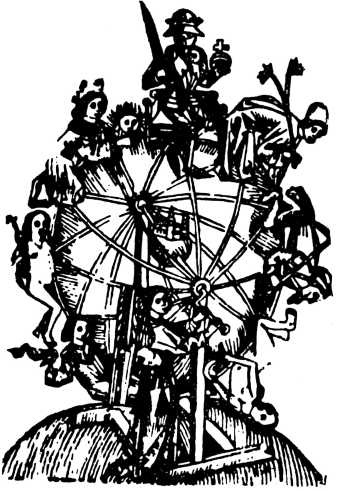
Ange féminin tournant la roue des corps célestes, à l’exté-térieur de la cathédrale de St. Vit. Hradcin, à Prague. Wenceslas de Budovica, 1490. D’après R. Eisler.
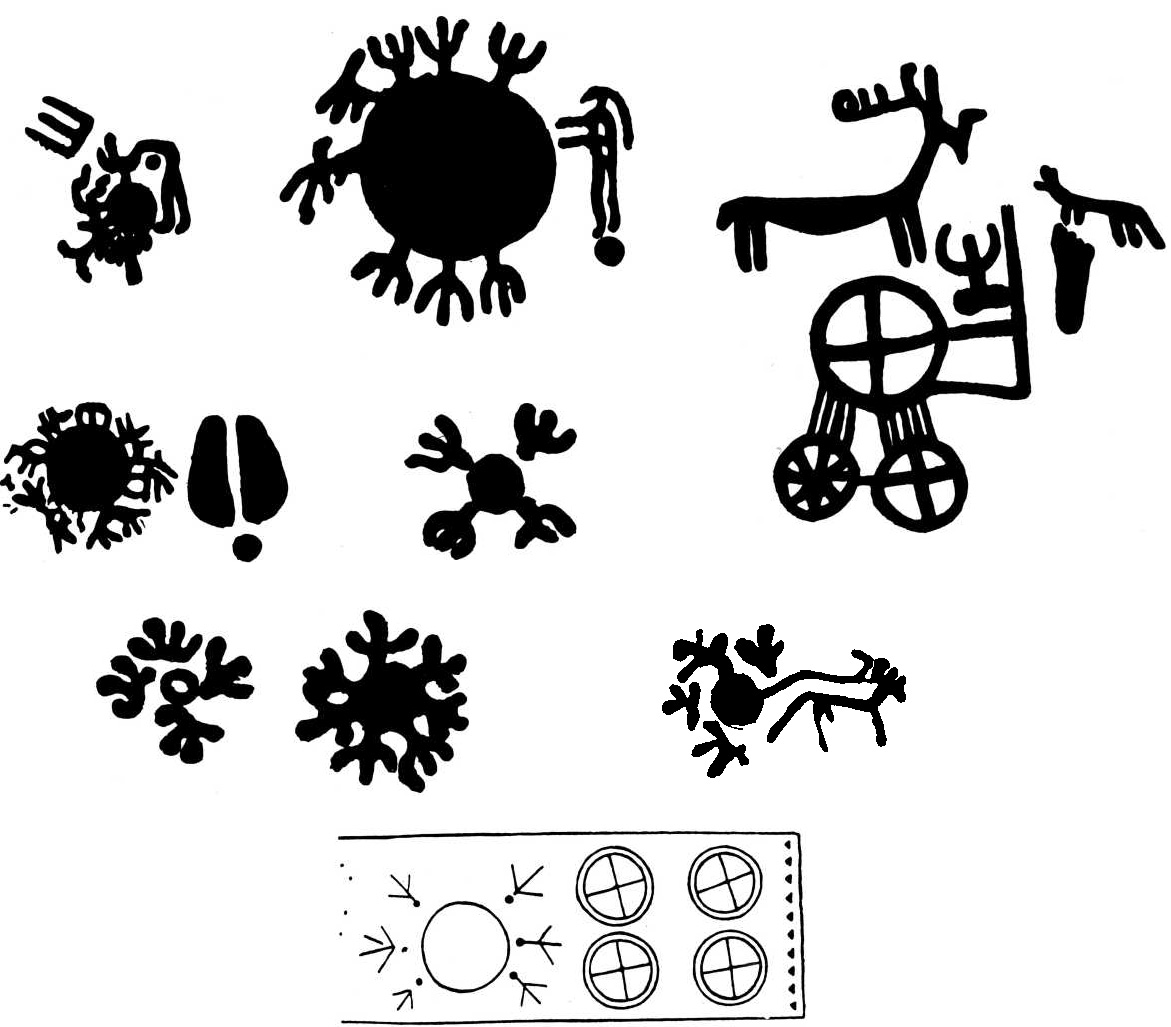
Gravures rupestres de l’âge de bronze (Suède) montrant le même sujet. Ici les empreintes des pieds et le creux cupuli~ forme signifient la déesse maternelle de la terre. Elle affronte le cerf céleste en bas. Ici l’on voit que la roue, dans l’antiquité, était le signe du zodiaque plus qu’une roue solaire.
L’archéologue Karl Rygh rapportait, de son temps, ceci: «En 1876 on m’avait expliqué, dans le pays de Strinda aux environs de Trondheim, qu’il y avait une légende selon laquelle un chevalier en armure et son cheval se trouvaient sous un grand rocher. Il y aurait été surpris par une chute de pierres alors qu’il passait dans la vallée, et écrasé. Je pris la peine de creuser sous le rocher aussi loin qu’il m’était possible, et je trouvai effectivement les ossements d’un cheval et d’un homme, et en plus un acier de briquet et deux pointes de lance datant manifestement de l’époque viking.. La présence d’une tombe était exclue ». Il faut avouer que le pauvre cavalier, après son enterrement précipité, avait été équipé d’un harnachement et d’une dignité de chevalier également imaginaires. L’exactitude de la tradition n’en est pas moins frappante, si l’on songe qu elle s’est communiquée à travers une période de mille années, et fixée à un bloc de rocher précis, entre tant d’autres.
Encore plus longue est la durée de la tradition concernant un grand tertre « Ottarshögen » dans la commune de Vendel à Uppsala en Suède. Le tertre mesure quarante mètres de diamètre, et était mentionné comme « Uttershögen » en 1670. Dans les années 1914-16, le tertre a été fouillé par un spécialiste, le Professeur Sune Lindquist, un des plus remarquables archéologues suédois. Au milieu du tertre, il découvrit une tombe dans laquelle avait été déposés une coupe de bois avec des garnitures en bronze doré, des ossements calcifiés, des pièces de jeu et les morceaux d’un peigne en os. La trouvaille est assez bien fixée dans la chronologie par une pièce d’or de la monnaie de l’empire romain oriental frappée sous l’empereur Basiliscus (476-77). La pièce ayant été utilisée comme pendentif, et assez usée, cela nous mène à proposer pour la construction de la tombe une date placée dans les premières décennies du VIe siècle. Cette époque correspond justement à celle où le roi de la famille des Ynglinge, Ottar Vendelkraka, est mort, en suivant la ligne généalogique donnée par le « Ynglingatal ». Le Professeur Lindqvist possède ainsi de bonnes raisons d’avancer que le tertre de Utter à Vendel a été la tombe d’Ottar Vendelkraka. Sous une forme plus pâle, nous voyons ici la tradition se maintenir vivante pendant 1.400 ans.
Au nord d’Oslo est situé le plus grand tumulus de l’Europe du Nord; Raknehaugen à Ullensaker. Il mesure quatre-vingt-quinze mètres de diamètre et quinze mètres de hauteur. La tradition selon laquelle un roi a été enterré là n’est pourtant pas clairement prouvée par les fouilles. L’archéologue norvégien Anders Lorange avait appris, pendant sa jeunesse d’étudiant, qu’un roi y avait été enterré entre ses deux chevaux, et ensuite recouvert de plusieurs couches de charpenterie. Avec un enthousiasme juvénile, il se mit à creuser, en descendant dans un puits étayé par des charpentes de bois, et il avait atteint une profondeur de seize pieds quand toute sa construction s’effondra. Cela advint, heureusement pour lui, à l’heure du dîner. Après cette aventure périlleuse, il commença une attaque par le côté et fut très heureux quand, du côté est, il trouva le squelette d’un cheval à soixante pieds du bord. Rien n’empêche pourtant que ne soit juste l’hypothèse alors émise, selon laquelle ce squelette proviendrait d’un cheval crevé: comme on ne mange pas les chevaux crevés, on a pu se débarrasser de lui en l’enterrant dans le tertre. Toujours est-il que le Docteur Sigurd Grieg, qui fouilla systématiquement le tertre pendant les années 1939-40, ne trouva aucune tombe. Il y avait pourtant un fait remarquable. Trois couches de charpentes se superposaient à l’intérieur, et les calculs permettraient d’envisager qu’elles avaient dû être composées d’environ trente mille morceaux de bois. L’analyse radiologique laisse supposer que le tertre doit être fait autour de la même époque que celui d’Ottar, ou peut-être quelque temps après. Mais la tradition des charpentes a été en tout cas confirmée par la réalité.
Au Danemark, on trouve des traditions encore plus anciennes, et apparemment véridiques. Jadis, les gens du canton de Bolling racontaient qu’un char plein d’or était enfoui dans le marais du presbytère de Dejbjerg. Cela paraissait incroyable. Mais quand les gens commencèrent à bêcher dans le marais en 1881 et 1883 ils ne trouvèrent pas un seul char, mais bien deux. Quoiqu’ils ne fussent pas chargés d’or leur valeur est inestimable. Ce sont des chars cultuels de l’époque pré-romaine. Des chars de cérémonie exécutés en chêne et frêne, garnis de bronze dans le style celtique. Les voitures ont été volontairement détruites et déposées dans le marais comme offrande. Dans ce cas nous avons affaire à une tradition vieille de deux mille ans.
Un souvenir norvégien enfin, qui vaut la peine d’être mentionné parce qu’il révèle une tradition purement locale qui nous ramène dans le temps jusqu’à cinq ou six mille ans en arrière. A Bömlo, au sud de Bergen, il y a un petit îlot: Hespriholmen. On trouve là une curieuse grande carrière qui date de l’époque entre mésolithique et néolithique, d’où l’on a tiré des pierres d’une qualité très fine, dense et de couleur verte. Des haches de cette carrière se trouvent répandues dans de grandes zones de l’ouest de la Norvège. Les haches étant, dans les traditions populaires, appelées des « foudres», il semble que le nom de l’îlot doive être rattaché à la période viking, et déchiffré comme « le lieu où on cherche les foudres ».
Nous constatons ainsi que l’élément traditionnel peut se maintenir vivant, attaché à un lieu précis, pendant des milliers d’années. Personne ne doit s’étonner du fait que ces éléments se trouvent embellis par l’imagination, parce que c’est justement dans la grande masse informe des traditions que l’imagination cherche ses matières premières, et les données qu elle y ramasse peuvent être combinées des manières les plus diverses. Il s’agit, dans les exemples ici mentionnés, uniquement des traditions fondées sur des unités sociales localisées, sans appui dans la cohésion traditionnelle générale. Il est évident que cette dernière est bien plus stable, beaucoup plus résistante à toute attaque, justement parce qu’il s’agit de groupements portant sur des étendues plus vastes.
Un exemple caractéristique et important de ce genre se démontre par la situation puissante qui est dévolue à l’ours dans les croyances et la médecine populaires du Nord. L’ours possède « la force de dix hommes et l’intelligence de douze hommes. » Voilà sa renommée. Jusqu’au milieu du siècle dernier, une patte d’ours était utilisée, en médecine populaire, pour faciliter l’accouchement; et même dans notre siècle il a été possible d’obtenir des témoignages écrits au sujet de l’affinité entre l’ours et la femme enceinte, et sur ses capacités de sage-femme.
Les données archéologiques nous montrent elles aussi la position dominante que l’ours a occupé dans le Nord, comme force surnaturelle et puissance fertilisante, à partir de l’époque mésolithique au moins. Son importance dans ce domaine dès l’époque paléolithique sur le continent européen a été confirmée par les témoignages de la caverne de Montespan, en Haute-Garonne, où l’on a trouvé un ours sculpté dans l’argile, mais sans tête, avec un crâne d’ours posé devant lui entre ses pattes. Le corps d’argile portait en outre de nombreuses marques de flèches et de piques, ou d’armes semblables. Ici nous pouvons probablement poursuivre une tradition jusqu’à vingt mille ans en arrière.
Mais dans un cas pareil, il s’agit aussi d’une cohérence traditionnelle d’une énorme étendue. A partir de la presqu’île Scandinave, où la tradition a poursuivi sa vie culturelle intense et forte au moins jusqu’aux deux ou trois derniers siècles, un culte de l’ours dans des formes approchantes peut être suivi à travers toute la ceinture des forêts russes et asiatiques, à travers le détroit de Behring jusqu’en Amérique du Nord. Là on peut relever son extension vers le sud jusqu’en Californie du Sud, au Nouveau-Mexique et en Arizona. Alors que l’ours Scandinave avait une préférence pour les femmes enceintes, nous apprenons chez les Indiens du nord-ouest, qu’il existe nombre d’expériences concernant la tendance des femmes à se laisser séduire par un ours, et donc à accoucher d’un de leurs enfants.
Un autre courant de la grande cohésion traditionnelle, dans le Nord, est l’objet de l’influence indo-européenne à la fin du néolithique: l’ours y a été remplacé par le cheval comme puissance suprême de la fécondation, pour la classe supérieure des Indo-européens. Cette position a été tenue par le cheval jusqu’à la rencontre avec le christianisme, vers l’an 1000. L’effort violent par lequel la nouvelle église érigeait un tabou contre l’habitude de manger de la viande de cheval a donc été bien justifié, même s’il n’a pas connu un éclatant succès. On retrouve même aujourd’hui de nombreux fers de chevaux au-dessus des entrées d’églises, partout dans le Nord. Cette victoire du culte du cheval comme puissance de fécondité par excellence, parmi les maîtres indo-européens, n’empêchait nullement l’ours de continuer de survivre tout à son aise dans les couches non indo-européanisées de la population, ni même de s’imposer jusque dans la tradition indo-européenne. Les dents d’ours ont été d’un usage courant dans le nord de la Norvège au moins jusqu’au XIVe siècle.
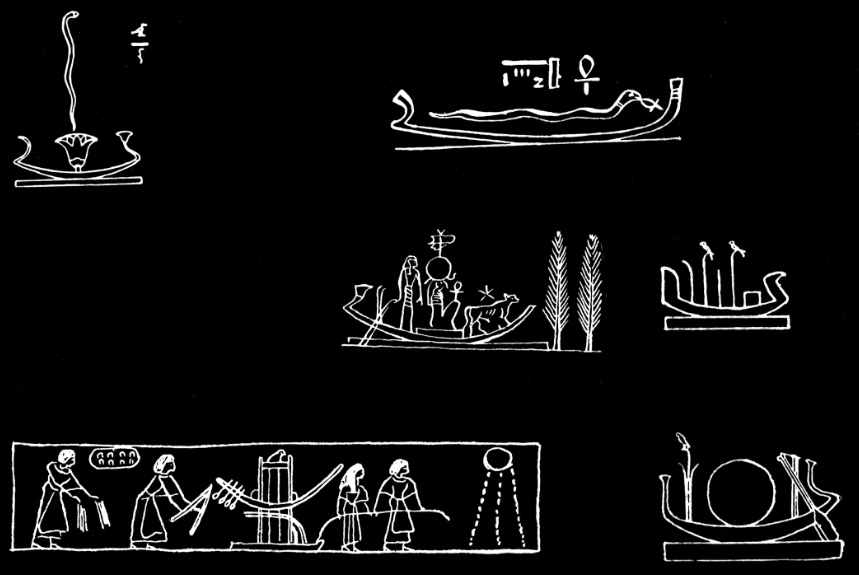
Bateau sacré égyptien, initiant la terre avant les semailles. Il est étonnant de constater le peu de cas que les savants font d un rayonnement de la vieille culture égyptienne sur l’Europe néolithique, vue l’importance exagérée que l’on donne à l’art copte pour le Moyen Age.
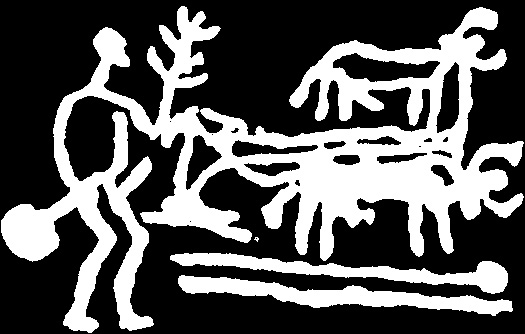
Homme à la charrue, tenant un arbre et le sac de semailles. D’après P. V. Glob. Litsleby-arden.
Il est bon d’indiquer, du reste, que cette tradition — mis à part les souvenirs paléolithiques du culte de l’ours à Montespan — ne lie aucunement le Nord avec le continent du côté de l’Europe de l’Ouest ou de l’Europe Centrale; mais le rattache à l’Europe de l’Est et au nord de l’Asie. Il a existé de nombreuses influences asiatiques dans le paléolithique ouest-européen.
La tradition de l’ours est ainsi placée dans une position qui la différencie des traditions vitales, et plus présentes, que sont pour la civilisation moderne européenne-américaine les traditions classiques et celles qui manifestent l’influence de l’ouest asiatique: les traditions religieuses et éthiques du christianisme, qui pour leur part ont été formées en grande partie par des traditions perses. Dans l’art et la pensée s’infiltrent ainsi, en plus des traditions gréco-romaines, celles des Arabes et celles de l’Inde, mélange qui apparaît encore de nos jours. Une trace assez curieuse peut être suivie dans cette ligne, entre autres dans le domaine de la terminologie des monnaies. De la pièce d’or romaine, solidus aureus, solidus survit dans le solde italien et le sou français, cependant qu’aureus a été laissé aux Scandinaves qui le gardent sous forme de öre. Le signe de la livre anglaise correspond à la libra romaine, et celui du dollar est de nouveau celui du solidus. En outre l’ancienne pièce d’argent Scandinave ort était le denarius argentus romain du temps de la république. Au Moyen Age, il s’est formé une variante intermédiaire, le ertog ou örtug.
Même si les archéologues et les historiens sont, pour la plupart, au courant de cette étrange ténacité de la vie des traditions, on a l’impression que presque tous la regardent comme une curiosité sans portée plutôt que comme une réalité fondamentale pour le plus important de la formation culturelle. Le moment semble venu où il nous faut commencer à rendre à ce phénomène sa juste valeur.
On peut légitimement considérer la cohérence traditionnelle comme une unité globale sans frontières précises, aux éléments d’une durée et d’une importance très variables. Il y a des éléments qui semblent vite disparus, à peine mentionnés. Au moment de l’événement même, celui-ci est déjà en marche vers l’unité inconsciente. De sorte que la tradition s’identifie plus ou moins avec ce qu’Emile Durkheim a appelé, à son époque, la conscience collective, dans une acception profondément révisée bien sûr. Ce que Durkheim ignorait, c’était la puissance inconsciente et subconsciente de la tradition. Pour lui, la conscience sociale était plutôt une sorte d’âme sociale de caractère individuel. C’est ce qui pense, sent et veut, même si volonté, sentiment et pensée n’agissent qu’à travers des consciences uniques, écrivait-il dans «Sociologie et Philosophie» (1925). On peut en même temps voir dans le concept de tradition une reformulation grandement modifiée de l’ancienne Völkergedanke ou pensée populaire d’Adolf Bastian, cependant que ses Elementargedanken, ou pensées élémentaires se retrouveraient, dans une formule moderne, en rapprochement avec les archétypes de Jung. Les pensées élémentaires étaient pour Bastian des idées universelles communes à l’humanité entière, idées qui à toute époque et chez tous les peuples auraient le même caractère, alors que pour lui les « pensées populaires » étaient des formes particulières, que le système des pensées élémentaires devait avoir, sous les influences diversifiantes des milieux naturels. Les « pensées populaires » représenteraient ainsi une couche de forces créatives et formantes, au-dessous des différentes formes de culture. Personne probablement n’accepterait aujourd’hui les idées de Bastian, parce qu’elles sont trop naïves et simplistes. Il est à noter que la critique de Durkheim était justement une argumentation contre les attitudes soutenues par Bastian et Wilhelm Wundt avec sa Völker**psychologie.
En laissant pour un moment de côté les questions de tradition, nous allons indiquer quelques traits de l’ancienne histoire de Normandie. Il est assez connu que le nom de la Normandie est dû aux Vikings danois et norvégiens qui ont pillé cette région vers l’an 800, et ensuite se sont fixés dans le pays. En 911, leur chef Rollo (Gange Rolv) recevait le pays en fief de Charles le Simple, et l’Etat normand s’établissait. Il y a eu des querelles entre historiens danois et norvégiens au sujet de l’importance réciproque des deux peuples dans cette entreprise; et surtout, évidemment, quant à l’origine probable de Rollo. Cette dispute est apparemment aussi futile que celle au sujet de la barbe du pape. Tout ce que l’on a pu prouver, c’est la participation de deux peuples; et le fait, indiqué par des documents, que les Vikings de Vestfold, au sud-ouest d’Oslo, ont attaqué à plusieurs reprises la France (les Westfaldingi).
On est davantage informé au sujet du développement de ce nouvel Etat normand. On connaît l’influence profonde que cette nouvelle souveraineté a eu sur la structure sociale et culturelle du pays; e t du reste, pour le développement politique et culturel de toute l’Europe de l’Ouest. Le moins important n’étant pas la saisie de l’Angleterre par Guillaume le Conquérant en 1066, ainsi que les possessions vikings dans le sud de l’Italie et en Sicile, et leur participation aux croisades. Leurs fiefs normands furent conquis par Philippe-Auguste en 1204 et soumis à la Couronne française en 1364. Ceci n’a pas empêché la Normandie de jouir à travers le Moyen Age d’une autonomie qui a donné à sa culture locale une forte particularité; ce qui s’est manifesté entre autres par l’efficacité sans pareille de son administration.
De tous ces faits, la mémoire nordique a surtout retenu les formes particulières que l’architecture romane a reçue du « style normand », lequel allait dominer l’Angleterre, et qui a propagé profondément son influence dans les pays Scandinaves.
Ce nouveau ressort n’enlève rien au fait que la tradition en Normandie a gardé de multiples éléments de ses origines nordiques, aussi bien dans le langage que dans les coutumes. Des noms de lieu comme Turville rappellent encore le dieu Tur ou Tor en qui, d’après les anciens documents de Normandie, les vikings avaient foi.
Une légende, qui trouve sa forme poétique dans un ancien poème français, conte qu’Arletta, la mère de Guillaume le Conquérant, au moment où elle l’eut mis au monde, rêva: « Il poussait un arbre de mon corps. Il se levait vers le ciel. Il jetait son ombre sur toute la Normandie ». Ceci est la copie de la légende de « L’arbre de la reine Ragnhild », l’arbre qui apparaissait dans le rêve de la femme d’un petit roi local de Norvège, Halvdan Svarte, au moment où venait de naître son fils Harald Haarfager qui devait réunir la Norvège sous son autorité. Elle rêvait qu’elle était dans son jardin, et qu’elle enlevait une épine de sa robe. Au moment où elle la tenait en main, cette épine commença à pousser, à devenir un grand arbre. L’arbre touchait terre, y prenait racine et s’élevait très haut dans le ciel. En bas l’arbre était rouge comme du sang, plus haut le tronc était d’un vert brillant, et les branches étaient blanches comme neige. Il avait beaucoup de fortes branches, certaines hautes et certaines basses. Les rameaux de l’arbre s’étendaient si loin qu’ils couvraient la Norvège entière.
Les poèmes héroïques des chants de l’Edda ont trouvé une renaissance en Normandie, et ont apporté leur contribution aux compositions de la poésie héroïque du Moyen Age français, mais en abandonnant la langue nordique, qui a été remplacée très vite par le français. Déjà le fils de Rollo, Wilhelm Langsvärd était obligé d’envoyer ses fils à Bayeux pour y étudier la langue nordique, qui avait commencé à dégénérer à Rouen. Bien plus importantes pour la tradition furent les survivances du paganisme qui, indépendamment du christianisme officiel, continait comme culte souterrain et illégal. Il troublait et apeurait beaucoup les pieuses âmes ecclésiastiques.
La mention de ces quelques survivances de l’influence nordique en Normandie est faite sans autre but que de montrer comment les traditions peuvent retenir des idées, ou du moins leurs formes symboliques, à travers des époques incalculables; et d’esquisser un peu le caractère des traces dont les Normands ont pu marquer le nouveau pays où ils s’installèrent. L’historien de la Normandie André Manguy touchait au vif quand il achevait son livre « Au temps des Vikings… les navires et la Marine Nordique d’après les vieux textes », paru en 1944 sous l’occupation allemande, par ces phrases qui semblait en vérité lancer un appel à ses « frères Scandinaves »: « apprendre à un monde renaissant tout ce que nos ancêtres entendaient par le mot aere, qui a une signification proche du mot honneur — la véritable base de la vie sociale et morale dans l’ancien peuple nordique ».
Probablement le temps est-il venu de retourner à tous ces signes, si discrets, quasi-insignifiants, gravés ou taillés aux murs des églises normandes. Mais, vu à la lumière de la tradition, il faut d’abord reconnaître le caractère synthétique, presque amorphe, de cette unité de cohérence en lent mouvement, afin de pouvoir situer les signes sur cette unité de fond dans notre essai de valorisation.
La première impression qui m’a frappé quand j’ai vu ces images était ceci: « Tudieu ! Voici toute la galerie des sujets des gravures rupestres de l’âge de bronze Scandinave ». Il est évidemment tentant d’essayer d’établir la possibilité d’une telle cohérence traditionnelle. L’idée même paraîtra peut-être à la plupart des gens relever d’un dilettantisme plus que baroque, puisque la méthode normale consiste à analyser chaque sujet pris à part, dans son isolement, et de cette facon il est naturellement facile d’expliquer que « des cercles ont été faits toujours et partout », ou des navires, ou des personnages, ou des cœurs, ou…, etc. On a bien sûr raison en ce sens qu’une telle hypothèse ne peut d’aucune façon être prouvée en suivant la démonstration classique des méthodes des probabilités. Néanmoins nous avons assez abondamment montré comme la tradition est capable d’une vitalité incroyablement tenace, et il faut retenir encore une autre condition fondamentale: quand une tradition est transplantée dans un milieu nouveau, elle est souvent marquée d’une tendance à se scléroser, à se durcir et à se refermer sur elle-même en une forme immuable. Nous en avons un exemple dans le conservatisme étonnant du langage nordique en Islande et aux Iles Foeroé. On y ressent la rupture du contact avec le lieu d’origine. L’écriture norvégienne n’a jamais été si parfaitement danoise qu’après la dissolution de l’union en 1814. Ce fut seulement après 1907 qu’elle a commencé lentement à reprendre son caractère original.
Il est incontestable qu’en feuilletant ces images on retrouve pour ainsi dire tout le répertoire des sujets des gravures rupestres de l’âge de bronze, évidemment dans une forme un peu atténuée. Ce qui caractérise avant tout les gravures rupestres Scandinaves, ce sont des sujets comme le bateau, les signes solaires, les creux en forme de coupe interprétés comme des coupes d’offrande, des chevaux, des scènes de labours, des cerfs, des serpents, des hommes dans des attitudes et situations diverses et des cavaliers, des empreintes de pieds et de mains. Tout ce monde est présent sur les murs des églises de Normandie. Il manque évidemment divers sujets des gravures rupestres, notamment le sapin — l’arbre éternellement vert — comme symbole de fertilité dont l’importance est bien entendu secondaire dans un pays aux forêts d’arbres à feuillage caduc (si l’on ne peut interpréter en tant que sapins les numéros 62, 127, 128, 131 et 178). Il manque également le char, si répandu dans les gravures rupestres. Le plus frappant dans ces relations normandes-scandinaves, c’est la ressemblance qu’il peut y avoir dans les formes mêmes de chaque signe. Ce que nous allons étudier dans nos commentaires aux images particulières.
Aucun doute n’est plus permis sur le fait que les gravures rupestres nordiques à l’âge de bronze représentent un culte de fertilité lié à l’agriculture. Le soleil prend ici une place dominante. Le soleil qui traverse pendant la nuit le ciel dans son bateau, mais qui, le jour, roule avec le cheval solaire, comme c’est exprimé de la manière la plus adéquate par le fameux char solaire de Trundholm, datant du premier âge de bronze danois.
La tradition du bateau solaire s’est visiblement maintenue dans le Nord jusqu’à une époque incroyablement tardive. Dans ma propre jeunesse, avant et pendant la première guerre mondiale, il était étrangement important pour nous, dans le village de l’ouest de la Norvège où je passais mes jeunes années, de dénicher un vieux bateau pour le placer au sommet du bûcher de la Saint-Jean. Je pense qu’il n’y a aucune objection à l’idée de considérer le feu de la nuit du solstice d’été comme une fête dont l’origine réside dans le culte solaire. Personne parmi nous ne savait pourquoi, ni ne se mettait à réfléchir pour trouver en quoi il était indispensable d’avoir ce bateau. Il devait être là, c’est tout. Il y avait certaines années où c’était une rude épreuve avant que nous arrivions à mendier assez pour avoir une vieille barque à rames pour notre cérémonie. Plus tard j’ai appris que le même jeu se déroulait dans d’autres endroits du pays.
A ce propos, il y a une étude à faire sur la question de la présence de bateaux dans les églises. L’ancienne hypothèse, qui a encore cours, selon laquelle ils représentent des ex-voto de marins oui ont survécu à des naufrages n’est pas suffisante.
Il convient de remarquer que les bûchers rituels du solstice d’été relèvent d’une tradition ancienne et générale dans le Nord. En procède celui qui se fait à l’île de Runöe dans l’ancienne Esthonie, et on prétend qu’il remonte aux vieilles influences suédoises. De telles traditions sont pour moi inconnues en Normandie, je dois l’avouer. James G. Frazer mentionne cependant dans son fameux ouvrage « The golden Bough » une étrange coutume de Saint-Lô, où une effigie humaine incendiée est jetée dans le fleuve, où elle s’en va en flottant pendant qu’elle est dévorée par le feu. Cette tradition a été interprétée (par Oscar Almgren) comme un mélange de la coutume de brûler le dieu de la fertilité sur le bûcher de l’année, et sa disparition sur la mer dans un bateau.
Grâce à son rôle important dans la marche du soleil à travers le ciel, il arrive que le cheval lui aussi prenne place entre les signes solaires, mais le cheval reste avant tout l’image de la force procréatrice. Ceci est un phénomène commun à tous les Indo-européens, bien connu dans les anciens rites hindous où ce symbolisme se présente avec une évidence extraordinaire. Le Rigveda signifie le soleil comme un disque ou une roue tirée à travers le ciel par le cheval Etaca (le leste) attelé directement au disque. Le fer à cheval qui se trouve sur deux des images dans ce livre (numéros 76 et 77) a ainsi la fonction de signifier le cheval.
Le rapport entre le cheval et le bateau se manifeste avec évidence. Ce n’est pas par hasard que dans l’ancienne Edda, dans la poésie nordique, le bateau est continuellement appelé cheval: « cheval de la mer », « cheval des ondes », etc. C’est une idée qui trouve ses origines au moins à l’âge de bronze. Une gravure rupestre à Ostfold en Norvège montre un bateau sur lequel se superposent plusieurs signes solaires. La proue est formée sans aucune doute comme une tête de cheval, avec une longue crinière flottante, tandis que l’arrière du bateau est une queue de cheval.
Le cerf aussi se présente en tant que signe solaire. Le sólarhjortr des Eddas, le signe du dieu céleste Ty. Sur une gravure rupestre de Bohuslen, en Suède, deux cerfs sont reliés par une bande, ou quelque chose de semblable, et l’un porte sur ses cornes une roue solaire. Et même cette image est parmi celles qui ont une très grande étendue.
Le signe solaire, en lui-même, est souvent une roue à quatre rayons. Des cercles concentriques aussi sont courants (cf. numéros 24 et 27). Parfois on rencontre deux cercles concentriques, avec entre eux des rayons rapprochés l’un de l’autre (cf. numéro 91). Parfois le cercle même est composé d’un rassemblement serré de creux cupuliformes (numéro 92). Il arrive qu’un personnage soit représenté avec une roue solaire en guise de tête (numéro 92). On est ici en présence du dieu solaire anthropomorphisé en personne sur l’arène des gravures rupestres. On voit souvent une ou plusieurs roues solaires passer directement au-dessus d’un bateau (cf. numéro 39), ou être tirées par le cheval solaire.
En Norvège au moins, il est frappant de rencontrer si souvent les gravures rupestres en des endroits qui s’appellent Solberg, la montagne solaire. Tout porte à croire que de tels noms sont tellement anciens qu’ils ont été attachés aux montagnes sacrées où l’on a vénéré le soleil. Les gravures se trouvent aussi en des lieux dits Helgaberg et Helgastein, la montagne et la pierre sacrées.
Les liens du culte solaire et de la fertilité de la terre sont faciles à détecter, en considérant comme les gravures sont soigneusement placées sur des rochers entourés de terres cultivables, ou sur des falaises tournées vers des morceaux de terre possédant ce caractère. Il est donc naturel que l’on retrouve souvent des scènes de labour parmi les gravures. Qu’il s’agisse de rites agraires religieux, cela est clairement dévoilé sur une gravure de Bohuslen, où le cultivateur tient dans sa main pendant son travail un petit sapin. Sa verdure éternelle était le signe de la fertilité de la terre dans de grandes régions de l’Europe. Nous trouvons souvent le sapin comme image autonome sur les gravures rupestres. Il semble même avoir survécu à sa rencontre avec le christianisme en Allemagne, où il était connu pendant toute la durée du Moyen Age, et d’où il a trouvé ensuite une renaissance étendue à l’Europe aussi bien qu’à l’Amérique du Nord, en tant qu’arbre de Noël. Même ce laboureur, nous le retrouvons ici (numéro 94). Il travaille avec une charrue à roues, utilisée de longue date à travers l’Europe. Elle a été apportée en Angleterre par les Angles et les Saxons.
Les empreintes de pieds constituent un sujet extrêmement commun dans les gravures rupestres. Les mains s’y retrouvent aussi, mais plus rarement. Nous sommes ici devant une représentation pour ainsi dire universelle, parce que les empreintes de pieds d’hommes et d’animaux se trouvent quasiment partout sur la terre, et les empreintes des mains sont au moins aussi répandues. En Europe cette représentation remonte à l’art paléolithique le plus ancien. Sans faire de commentaires aux discussions sur les interprétations qui ont été avancées pour ces signes, normalement fondées sur des conjectures, il faut quand même mentionner le fait qu’ils font tous les deux partie de l’ensemble fixé dans les sujets des gravures rupestres aussi bien que de celui des églises de Normandie (numéros 68-76, 78-83).
On rencontre de temps en temps, sur les gravures rupestres, un personnage qui a des mains énormes. On l’a nommé « le dieu aux grandes mains ». Le Docteur Just Bing considérait qu’il représentait un des deux grands dieux indo- européens, qui était « le dieu du feu » et « le dieu du ciel » (le « dieu aux grandes mains » correspondant au premier mentionné). Mais ses arguments étaient, une fois de plus, tellement fondés sur ses désirs qu’il n’y a guère de raison de les retenir. Il y a, contrairement à cela, toutes raisons d’attirer l’attention sur les étranges personnages à grandes mains, numéros 84 et 85. Le 84 présente un intérêt spécial, étant équipé en supplément d’une grande « forme solaire » en spirale sur le ventre.
Le sujet le plus répandu des gravures rupestres du Nord reste le trou en forme de coupe, interprété en tant que coupe d’offrande. Dans l’art des rochers, c est un sujet aussi répandu par le monde que les empreintes de pieds et de mains. Les trous se trouvent réunis par milliers, et souvent placés en rapport dans une composition précise. Ils peuvent former des images solaires. Il y a sur une gravure de Bohuslen une grande roue où les intervalles intérieurs sont garnis de trous serrés. Est-ce la roue céleste avec les étoiles ? Un zodiaque primitif ?
Qui sait ? Sur une gravure norvégienne d’Ostfold nous voyons une voie étroite et longue, composée de trous, qui monte le long de la montagne pour entourer un signe solaire. Est-ce la Voie Lactée ? Il ne semble pas qu’une dépendance absolue soit logiquement nécessaire entre les trous et le culte solaire proprement dit, et à tout le moins, pas directement entre eux et le culte agraire de la terre, puisque l’on trouve ces trous parmi les gravures rupestres loins en haute montagne, en Norvège, là où toute possibilité de culture est exclue ou bien, dans le meilleur des cas, aurait rencontré des conditions extrêmement défavorables, même dans le climat chaud de l’époque néolithique et de l’âge de bronze.
Un autre sujet encore, cher aux gravures rupestres, c’est le serpent. Il se trouve posé sur le bateau aussi bien que devant des hommes en posture d’adoration. Lui aussi participe du culte général du soleil et de la fécondité. Sur les calendriers de travail (les bâtons runiques) en Suède, le jour de l’équinoxe de printemps — le 21 mars — est quelquefois représenté par un serpent (Östergötland et Kalmarfief), et quelquefois par une charrue (Uppland). Cette liaison établie n’est pas dépourvue d’intérêt puisqu’une gravure rupeste de Bohuslen montre une combinaison étroite entre un serpent et une charrue. La fertilité et la mort ne sont que deux côtés d’une même chose, et dans ce rapport le serpent joue un rôle considérable dans les croyances nordiques, aussi bien que dans celles de Russie. Mais puisque le serpent fait partie du groupe des grands signes universels, son interprétation particulière sur une étendue limitée est très difficile à établir. Le rapport avec ce monde se voit sur les numéros 10, 30-31, 33-35.
Ainsi avons-nous fait l’examen des rapports étroits entre les principaux sujets des gravures rupestres nordiques et ceux des murs des églises de Normandie, ceci n’implique naturellement pas du tout qu’un rapport direct entre les deux aît été prouvé. Vu sur le fond de tout ce qui vient d’être expliqué au sujet des traditions et de leur comportement en général, il semble pourtant que nous puissions constater que tout ceci révèle pour le moins un problème dont la solution présenterait un intérêt assez considérable.
Au cas où un tel rapport direct serait soupçonné, il y a en tout cas une réserve importante à formuler. Il est absolument exclu que la philosophie religieuse de l’âge de bronze ait pu être une force spirituelle consciente dans la Normandie des XVIIe, XVIIIe et XIXe siècles. Quel peut avoir été, à ce moment-là, l’interprétation consciente de ces signes ? Est-ce que par exemple le rapport entre le soleil et l’image de l’église peut être envisagé dans un but paysagiste (numéros 160-161) ? Contre cette éventualité parle le fait que le signe solaire se trouve dans des combinaisons où de telles interprétations ont très peu de base naturelle. Son rapport avec les croix indique d’autres voies d’interprétation.
Analytiquement, l’étude que je présente ici comporte deux bases d’égale importance: le principe de complémentarité mis en lumière précédemment et le concept de champ. Ce dernier a été élaboré par le psychologue américain Kurt Lewin, « Topological psychology ». Ayant pris conscience qu’aucun système socioculturel n’est un système fermé et isolé, je crois avoir suffisamment souligné la valeur dynamique de ce concept de champ. Il n’existe pas de champ clos. Il v a toujours superposition, juxtapositions, « overlappings » entre systèmes. La permanence d’un champ de tension implique l’existence de possibilités réelles de transformation et de renouvellement. La thèse que j’ai développée dans « Socioculture » (1956) nous semble être dans une optique proche de « situlogie » de M. Jorn, situlogie conçue comme une topologie dynamique ou expérimentale.
L’examen non traditionnel de la nature de la conscience intellectuelle fait apparaître l’importance du principe de complémentarité. Reprenons l’image classique de la conscience. Un phare dont l’étroit pinceau lumineux balaie successivement l’horizon entier. D’un secteur quelconque de cet horizon, et si considérable y soit la lumière projetée par l’attention, il nous serait impossible en avoir aucune image si ne demeurait simultanément présent comme à la lueur d’une veilleuse le reste de l’horizon. Complémentarité essentielle qui est inscrite dans la simultanéité même de ces deux différents niveaux de conscience, l’un précis, l’autre diffus.
UNE LETTRE…
Durant mon séjour dans le Midi, j’ai lu attentivement les deux préfaces écrites, pour le recueil de photos de graffiti, par MM. Glob et Gjessing. Or je me trouve très embarrassé pour écrire à mon tour quelque chose sur ces documents, car je ne suis pas absolument d’accord avec MM. Glob et Gjessing sur le sens qu’il convient de donner à ces documents. Il faudrait, en premier lieu, étudier leur provenance. Ont-ils été gravés sur des pierres qui ont ensuite servi à la construction de l’église ? Ou bien ont-ils été gravés alors que la pierre était déjà placée dans un mur ? Il me paraît certain que les maçons, jadis, dessinaient volontiers à la pointe sur les pierres qu’ils allaient employer, ou qu’ils venaient d’employer. Ils le font encore aujourd’hui, mais avec leur crayon de chantier. D’autre part, des gens oisifs (soldats faisant le guet, promeneurs) ont certainement aussi tracé de tels graffiti. Pour ma part, j’exclus complètement l’hypothèse d’une signification ésotérique, attestant la survivance, consciente ou inconsciente, de croyances préhistoriques ou protohistoriques. Tout au plus, dans certains cas, peut-on penser à des ex-voto frustes; il faudrait alors voir si le dessin est en rapport avec le saint patron de l’église et avec les vertus ou le pouvoir guérisseur qu’on lui prêtait.
L’hypothèse de survivances du paganisme des Vikings, alléguée par M. Gjessing, est contraire à tout ce que nous apprennent les sources historiques.
Michel de BOUARD.
Doyen
FACULTÉ DES LETTRES ET SCIENCES HUMAINES
UNIVERSITÉ DE CAEN
Le 15 Octobre 1963
LE VANDALISME IMBÉCILE: LA GRAFFITOMANIE
Louis REAU.
Extrait de l’Histoire du vandalisme.
Librairie Hachette, 1959.
La bêtise joue un rôle dominant dans l’éclosion d’une variété puérile, assez bénigne en apparence, mais particulièrement irritante de vandalisme, qui s’appelle la graffitomanie. André Hallays l’appelle aussi la graphomanie pariétale. Mais la graffitomanie ne s’exerce pas seulement sur les murs.
« Il existe », écrivait avec colère André Hallays, qui fut un des défenseurs les plus ardents de nos monuments en péril, « une race de vandales plus odieuse et plus bête que les révolutionnaires: ce sont les monomanes du graffito. » lnnom~ brables en effet sont les niais qui, armés d’un bâton de craie ou d’un canif, aspirent à éterniser leur sottise en inscrivant leurs noms obscurs sur les portails des églises, les faces des gisants ou les glaces des palais nationaux.
Cette déplorable manie ne date pas d’hier. Les cendres du Vésuve ont conservé à Pompéi et à Herculanum des graffitis de toute sorte: électoraux ou obscènes qui datent du Ier siècle de notre ère. Leur antiquité ne peut servir d’excuse aux graffitomanes modernes.
Que les couples d’amoureux s’appliquent à graver leurs initiales ou des coeurs percés de flèches sur l’écorce des arbres, passe encore. Mais cette menue monnaie du vandalisme n’est pas le monopole des enfants, des promeneurs sentimentaux et des touristes. Il y a le vandalisme publicitaire des colleurs d’affiches qui déshonorent par d’obsédantes réclames les sites et les monuments, la graffitomanie politique des barbouilleurs nocturnes de murs et de trottoirs: fascistes mussoliniens ou communistes staliniens qui souillent de leurs slogans indélébiles au goudron et au minium les façades des édifices publics. Une législation trop indulgente pour ce genre de dégradations encourage des abus quelle devrait sévèrement réprimer.
Ainsi tous les bas instincts qui sommeillent dans les profondeurs troubles du subconscient, mais qui n’attendent que l’occasion de remonter à la surface et de se déchaîner comme les « locustes » venimeuses de l’Apocalypse sortant du puits de l’abîme, tous les mauvais génies de la destruction, du pillage, du lucre, de l’envie, de la superstition et de la vengeance se partagent à tour de rôle la responsabilité des ravages du vandalisme.
SAUVAGERIE, BARBARIE ET CIVILISATION
ASGER JORN
LES NORDIQUES
Toutes les possibilités ignominieuses des comportements et des conduites humaines s’incarnent et se concrétisent en un petit nombre de situations et en quelques actes simples. Les mots qui nomment ces actes et situations élémentaires ne sont ni savants, ni nombreux. VANDALE, BARBARE, quelques autres encore, et la liste est vite close: la conscience claire ne veut rien en connaître.
Faits et mots horribles et monstrueux — tabous — la conscience les fuit, refuse à l’intelligence le droit à un libre examen, et entretient méthodiquement à leur égard une longue et persistante incuriosité. A preuve de cette dernière, un seul exemple: une fois l’inceste dénoncé et raconté, 2.000 ans se sont écoulés avant qu’on ait osé chercher et dire comment il s’enracine au cœur de l’homme.
Le seul mot de VANDALE comporte de telles implications émotives et suscite de telles oppositions horrifiées — oppositions toutes affectives — qu’il y a lieu de penser que s’en trouve épaissi le mystère même de la conduite qu’il prétend désigner. Ce mot-là est moins porteur de clarté que d’obscurité.
Aussi me paraît-il essentiel de situer enfin le vandalisme dans sa vraie lumière. Et de rendre compte, le plus exactement possible, de ce qui est tenu pour l’une de ses plus spectaculaires manifestations: le graffiti.
Orgueil d’une solidarité peut-être trop violemment ressentie ? J’ose tout de suite dire que je n’ai pas songé sans émotion, devant ces églises de la Nörmandie, aux mains patientes et laborieuses qui ont creusé, gravé, la pierre. Furtives et tremblantes également — ces mains — puisqu’il s’agissait là d’un interdit. Se plaire à imaginer qu’elles aient pu être animées par la passion la plus aveugle — celle de détruire — révèle, à mon avis, une aberration profonde. Et point seulement d’esprit mais aussi de coeur. Celle-là même prétendument ainsi dénoncée.
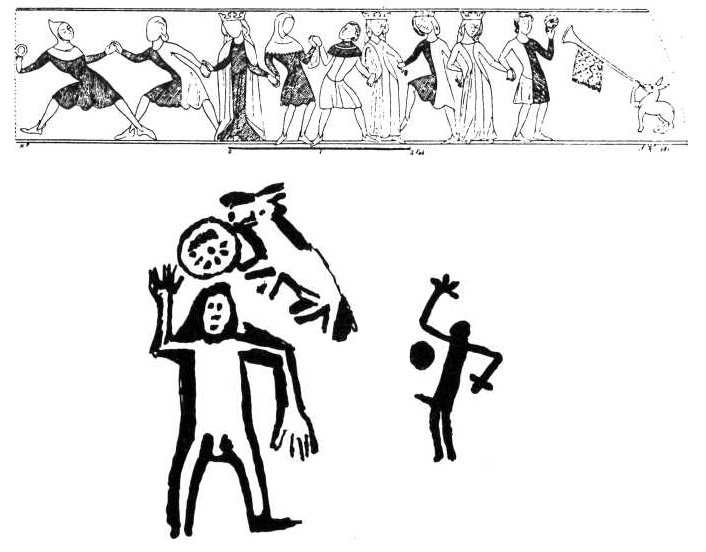
LA DANSE DE PALNA-TOKE, LE SPINN.
Il n’y a pas d’« archétypes » traditionnels qui ne reflètent des lois générales de la manière. Le danseur, avec un bras levé et l autre baissé ou posé sur la hanche, présente la pose classique des derviches-tourneurs. Les sculptures bogomil en Yougoslavie relient la danse à la légende de Tell, avec le flls, la pomme et l’archer.
Danseur d’Isere. La roue au-dessus de sa tête indique la rotation.
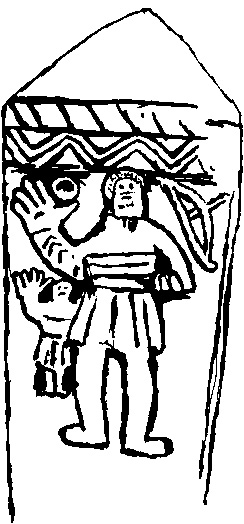
Sarcophagie Bogomil
Mais ces pierres possèdent aussi une puissance miraculeuse! Un monument des environs de Ladjevica possède la propriété de guérir. Une femme stérile qui avale un peu de poudre grattée de cette pierre deviendra féconde. Et la légende devient une croyance: Les entailles plus ou moins grandes que porte le monument, témoignent nettement des tentatives faites pour en gratter des particules. Qui sait combien de femmes ont essayé de se guérir ainsi de leur stérilité! Un monument de Donja Stupa. portant de profondes entailles, est presque enfoncé dans la terre. C’est un objet sacré dans toute la région. Ce vieux monument préserve le village de toutes les intempéries, spécialement de la grêle.
D’après Benac.
L’acte de détruire ne nous semble jamais si pur — je veux dire si absolu — que lorsqu’il met en jeu la pierre. Il nous faut bien songer qu’après avoir fait date aux âges de la préhistoire humaine, la pierre a également occupé les temps historiques, et cela sous un usage essentiellement double: construction, destruction. De l’importance de ces deux fonctions antinomiques témoignent toutes les religions: la chrétienne — pierre à bâtir et lapidation — l’islamique et d’autres, en un symbolisme moins explicité mais aussi fort. Cette dualité de son emploi est notre ambivalence même, laquelle s’est inscrite, au cours des millénaires d’abord, des siècles ensuite, dans la seule matière solide que l’homme ait connu pendant longtemps.
La présence de la pierre est chose trop fondamentale pour que nous ne soyons pas sensibilisés à sa négation, de manière extrême. Qu’elle soit ignorée — utilisée simplement comme support par les graffitomanes — ou mise bas par les vandales — voilà ce que nous ne supportons pas, ce qui nous scandalise. Et, du même coup, nous interdit de comprendre et de connaître la démarche et les mobiles de ces auteurs de signes et images gravés et dessinés; nous condamne à ne rien savoir de cette pulsion qui pousse certains hommes plus que d’autres à détruire.
Déjà d’excellents esprits se sont attachés à cesser de déposséder la conscience claire de ses moyens, à ne plus préférer stigmatiser allègrement la conduite de ce peuple du Nord — les Vandales — mais à étudier la nature d’une énergie et la signification d’un besoin — le vandalisme.
Leurs efforts ont permis la naissance de la vandalismologie.
Savoir exactement comment ont vécu les Vandales et qui ils ont été, quelles furent les épreuves, buts et difficultés de ce peuple, voilà ce qui est devenue partie du problème. Et, de manière plus centrale encore, l’étude de cette même force, rage et but: détruire, aveuglément détruire.
On a fait du mot BARBARE un mot censé désigner ceux qui, obstinément, se refusent à toute rhétorique. Pas de justification à ce fait, sinon qu’en politique, les méthodes des parlementaires nordiques s’opposent aux discours latins.
En France, au sens populaire « la barbe » est une expression qui exprime une situation ennuyeuse et désagréable. En Scandinavie, elle désigne une situation amusante et drôle.
Il est devenu possible, aujourd’hui, d’apercevoir que le potentiel affectif contenu dans le mot VANDALE est un don malheureux de la mémoire collective héréditaire. Cette mémoire même, dont la psychologie contemporaine a abondamment souligné les prouesses, s’est révélée, sur ce point précis, faillible elle aussi. En fait, la synonimie des mots VANDALE et DESTRUCTEUR masque plus la conduite qu’elle prétend désigner qu’elle ne sert ou facilite sa représentation claire. Et puis, cette mémoire ne nous aurait-elle rien transmis d’erroné que je n’hésiterais pas plus à faire la remarque suivante: tant en biologie qu’en psychologie, la faculté d’oubli et le renouvellement sont indispensables à la vie, sinon à la survie.
Science en formation, la vandalismologie a déjà ses méthodes propres et aussi son histoire.
C’est à un Français, Louis Réau, que revient le mérite de s’être efforcé de répertorier et classer les diverses variétés de vandalisme. Le définissant comme la destruction de monuments à signification historique ou à caractère artistique, il a pu opérer, à partir de ses effets, la classification suivante:
AVEC MOBILES INAVOUES:
Vandalisme sadique: L’instinct brutal de destruction;
Vandalisme cupide: Avidité aveugle de pillards;
Vandalisme envieux: Effacement de la trace des prédécesseurs;
Vandalisme intolérant: Fanatisme religieux et révolutionnaire;
Vandalisme imbécile: La graffitomanie.
AUX MOTIFS AVOUABLES:
Vandalisme religieux;
Vandalisme pudibond;
Vandalisme sentimental ou expiatoire;
Vandalisme esthétique du goût;
Vandalisme elginiste et collectionneur;
A cette classification bien diversifiée, les Anglais ont souhaité adjoindre — sous l’impulsion de Martin S. Briggs — une catégorie supplémentaire: le manque d’entretien, qui serait considéré comme un vandalisme de négligence.
Opposition vigoureuse des Français qui, personnalisant justement le débat, refusent cette ouverture possible à l’anonymat. En effet, pour pouvoir vraiment dénoncer le vandalisme, il paraît essentiel de pouvoir indiquer non seulement un acte, mais encore un agent responsable. A supposer ce dernier point non nécessaire, nous aboutirions, en pays panthéiste (ou seulement à tendance), devant le spectacle de la dégradation naturelle des choses, à une hérésie du genre: Dieu est Vandale.
Toute hérésie de ce genre engendrerait vite la tentation de se considérer soi-même comme divin. La mentalité traditionnelle de la province danoise du Vendsyssel atteste cette possibilité.
L’intransigeance des positions anglaises et la docilité traditionnelle des hommes politiques et des savants danois envers celles-ci nous font craindre que l’essor remarquable de la vandalismologie dans les années d’après-guerre ne joue, en définitive, à l’encontre même de ses buts.
L’histoire du sens du mot VANDALE est longue. Cependant c’est seulement aux temps modernes que le sens de ce mot va s’enfermer définitivement dans les clichés traditionnels que nous connaissons aujourd’hui.
En 1739, en plein siècle des Lumières, Voltaire signale la colonnade du Louvre « masquée et déshonorée par des bâtiments de Goths et de Vandales ».
Quarante-cinq ans plus tard, en août 1794, un ancien député du clergé lorrain, devenu évêque constitutionnel — l’Abbé Grégoire — l’emploie dans un rapport présenté à la Convention (14 Fructidor An III).
« Pourquoi celui-ci a-t-il choisi de clouer au pilori les Vandales plutôt que les Goths, les Huns, les Philistins ou les Béotiens ? » demande Louis Réau, qui explique:
« Les Philistins n’étaient des barbares qu’aux yeux de leurs ennemis, les Israélites; et les Béotiens ne passaient pour lourdauds que par rapport aux Athéniens. La réputation de sauvagerie des hordes germaniques était par contre bien établie dans l’Europe Occidentale, victime des grandes invasions. Les Romains gardaient le souvenir de la Vandalica Rabies, un des premiers accès de furor teutonicus dont Rome avait été victime en 445. Les Vandales avaient, quinze jours durant, saccagé la ville éternelle. »
Au cours du Moyen Age, la popularité des images de l’activité de Samson (destruction et déplacement de monuments) ne met pas en cause les Philistins eux-mêmes: Samson n’est pas devenu l’un des symboles de la lutte contre le vandalisme.
Quelles hypothèses faire sur des crimes dont aucun monument ne nous perpétue la réalité ? Pas de forfanterie vandale. A l’opposé des Romains. On connaît le monument que Titus fit dresser pour commémorer le pillage de Jérusalem — ville sacrée — et montrer l’importance du butin. Il nous serait bien difficile si les Gaulois, à leur tour, avaient détruit les monuments romains qui symbolisaient leur défaite, de nous prononcer sur leur vandalisme.
Les conquêtes et destructions napoléoniennes étaient illustrées par de courtes scènes, sur la colonne Vendôme. Mais, sous la Commune, la mise à bas de l’ennuyeuse colonne ayant engagé la responsabilité du peintre Courbet, les Français eux-mêmes ne savent pas, aujourd’hui, où est le vandale.
Qu’une nation veuille commémorer les hauts faits de son histoire par des ensembles architecturaux, c’est là un fait essentiellement, politique. Sans rapport aucun avec la réalité esthétique architecturale. Et qui n’en garantit donc en rien la valeur.
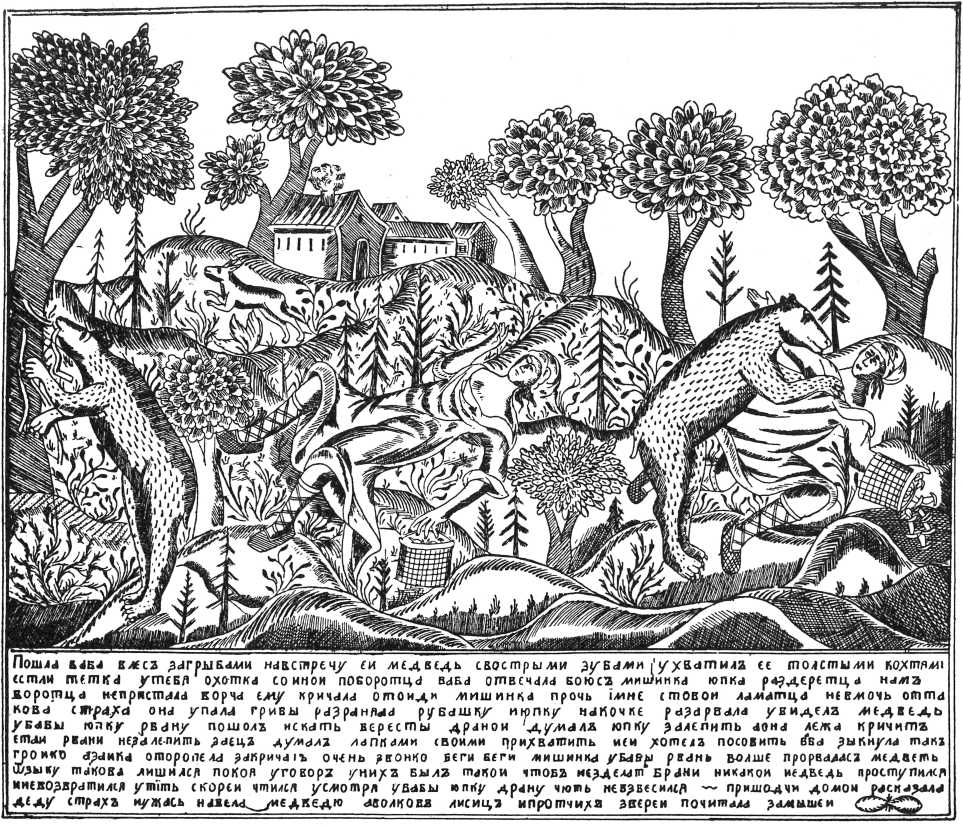
L’IMAGERIE POPULAIRE RUSSE
Fig. 144. L’OURS ET LA FEMME. Gravure sur cuivre exécutée entre 1820 et 1840. Dim. 285 X 330 m/m.
« Une femme est allée chercher des champignons dans le bois — un ours aux dents aiguës vient à sa rencontre, il la saisit avec ses grosses griffes. « Veux-tu, petite mère, lutter avec moi? » La femme répond: « J’ai peur, petit ours, de déchirer ma jupe. Il ne nous convient pas de lutter ensemble». Elle lui cria: «Retire-toi, ours, je n’ai pas la force de résister.» Elle succombe de peur, elle est décoiffée, elle déchire sa chemise et sa jupe contre une grosse motte de terre. Quand l’ours vit la jupe de la femme déchirée il alla chercher de la ficelle — il pensait boucher le trou de la jupe avec une lanière d’écorce, mais la femme couchée à terre crie: « Tu ne pourras pas reboucher cette déchirure. » Le lièvre avait l’intention de lui venir en aide et de fermer la déchirure avec ses pattes, mais la femme poussa un cri si aigu que le lièvre eût peur et cria très fort: « Cours, cours petit ours, la déchirure de la femme est devenue plus grande.» En raison de ces cris, l’ours n’eut plus de repos. Il était convenu entre eux, pour qu’il n’y eut pas de dispute, que l’ours tâcherait de partir au plus vite et ne reviendrait plus. Quand il vit la jupe de la femme déchirée il devint presque enragé. En rentrant, la femme raconta au grand-père la peur qu’elle inspira à l’ours. Les loups, les renards et les autres bêtes n’étaient plus à ses yeux que des souris.» Ce texte assonancé comporte bien des obscurités. Les intentions érotiques que l’on devine font penser à l’histoire racontée, elle, d’une façon fort claire par Rabelais.
On ne compte plus le nombre de héros dont la mémoire est desservie par la statuaire qui veut les honorer, et l’on sait des villes entières dont l’architecture et la statuaire sont de monumentales erreurs, sinon horreurs.
Par ailleurs, l’instinct grégaire n’engendre pas obligatoirement goût et sens esthétique. Le rôle civilisateur des villes n’est ni évident, ni absolu. Il s’ensuit que la destruction partielle ou totale d’un ensemble urbain ne constitue pas nécessairement un acte de vandalisme.
Mon enfance au pays d’origine des Vandales et des Teutons m’a laissé des souvenirs clairs. Je me rappelle qu’y était réputée satanique l’activité noire des grandes cités industrielles. Et je n ai pas oublié les histoires qui nous étaient contées — Sodome et Gomorrhe; et encore: la Tour de Babel. Toutes histoires en lesquelles Dieu était présent; et au travers desquelles s’exprime un état d esprit et aussi bien une position morale, dont il me semble en tant qu’artiste essentiel de retrouver les raisons et le bien-fondé plus que de s’y opposer de façon aveugle et catégorique.
Louis Réau rend un hommage sans réserve aux Romains pour leur colonisation de la Gaule — « une œuvre de civilisation, dans le sens le plus noble de ce mot » mais il change ensuite radicalement de position envers les envahisseurs nordiques, particulièrement envers les normands. Et quand alors il s’interroge sur ce qui peut être porté à l’actif de ceux-ci, il ne découvre qu’une seule chose: « la naissance de l’architecture romane que les Anglais préfèrent appeler, non sans raison, le style normand ». Rappelons en passant que ce style normand parut aux humanistes de la Renaissance italienne, d’une laideur indescriptible — un phénomène barbare, « gothique ».
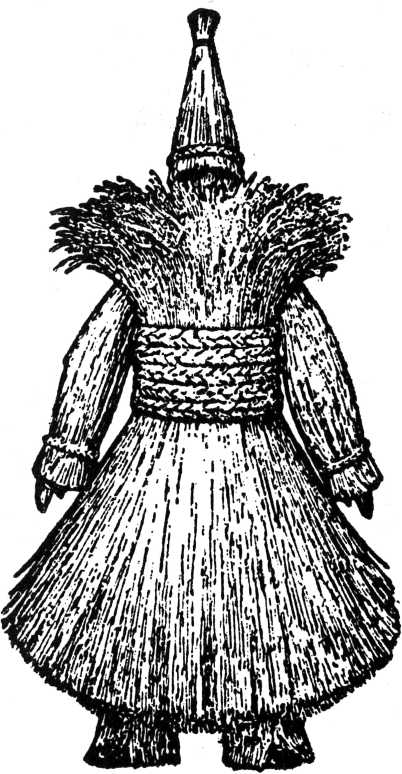
« Les chrétiens mangent Dieu par amour pour la divinité, ils communient en théophagie. Les humanisphériens poussent l’amour de l’humanité jusqu’à l’anthropophagie: ils mangent l’homme après sa mort, mais sous une forme qui n’a rien de répugnant, sous forme d’hostie, c’est-à-dire sous forme de pain et de vin, de viande et de fruits, sous forme d’aliment », explique l’anarchiste Joseph Dejacque. Témoignage de l’esprit cyclique qui domine l’anarchisme, et correspond étrangement à l’esprit agraire du néolithique. Là se trouve l’origine des rituels de l’hostie, dans les cultes de la dernière gerbe, sujet de plusieurs menhirs, supposée contenir la puissance entière de fécondité du champ. L’homme travesti en dernière gerbe était offert, considéré comme dieu, et assurait la fonction du bouc émissaire chez les bergers. »
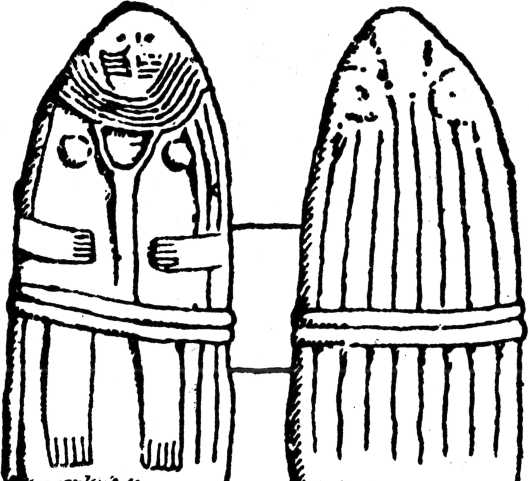
Homme revêtu d’une gerbe de blé à l’occasion de la Fête des moissons (Suède).
Face et dos d’un menhir représentant le même sujet: Rodez, Musée Fenaille.
LE VANDALISME EGLISOPHAGE
Il y eut, à Byzance, un très important vandalisme religieux — vandalisme que Louis Réau n’est parvenu qu’imparfaitement à distinguer et à isoler. Certains prêtres grattaient les icônes, en détachaient des parcelles qu’ils recueillaient dans un calice, à dessein de faire communier les fidèles. Ces icônes — sommets de l’art religieux de l’époque — furent ainsi véritablement livrées à la consommation.
Ce fétichisme de l’absorption fut cause que le sens et la signification de l’art s’en trouvèrent changés et obscurcis.
Pour arrêter ce vandalisme de la nutrition devenu rituel, l’Empereur décréta l’iconoclasme; tous ceux qui possédaient, de manière privée, des icônes, étaient invités à venir les apporter à Constantinople où, en place publique, elles étaient brûlées. C’était évidemment palier à un vandalisme par un autre: celui du sacrifice, du potlatch.
Cependant ce vandalisme gouvernemental ne peut être comparé au premier — populaire.
Dans le premier cas, il s’agit d’une fête. Cette consommation — si naïve fut-elle — comportait d’authentiques éléments d’amour et de foi: c’était le vandalisme heureux.
P.V. Glob nous rapporte, entre autres cas, celui d’images-gâteaux dont l’absorption parfaite impliquait destruction d’êtres humains, donc un certain cannibalisme. L’anthropophagie relève plus précisément du teutonisme dont elle dévoile, aberrante, la volonté de pureté et d’esthétisme. Et ce sont les aberrations de cette volonté qui se retrouvent dans le domaine vandalique — domaine où les données historiques nous obligent à établir de semblables catégories.
Emile Male dans son ouvrage « La fin du paganisme en Gaule », nous informe de la célébrité — dans la France médiévale et nordique — de la tombe de l’évêque mérovingien Saint-Drausin. Cette tombe, aujourd’hui conservée au Musée du Louvre, était originairement en l’église Notre-Dame à Soissons. Séjournaient près d’elle les chevaliers qui allaient combattre en champ clos et saint Thomas de Canterbury, sur le point de retourner en Angleterre où il savait devoir affronter Henri II, y fit veillée d armes. Venant en pèlerinage, les fidèles avaient coutume d’emporter quelques parcelles du couvercle, qu’ils diluaient dans l’eau et faisaient boire aux malades. Cette coutume, qui s’est poursuivie pendant des siècles, a fait disparaître presque complètement le couvercle. Celui que l’on voit actuellement au Louvre n’est pas l’original, mais un autre qui est Wisigoth et provient de l’église de Saint-Germain- des-Prés.
En Espagne également, les tombes des rois Wisigoths montrent les traces d’une même activité.
Nous sommes obligés de constater n’être plus simplement ici dans la notion de sacrifice inhérente à tout art, mais bien plutôt en face d’une sarcophagie avouée. Nous devons penser que ce furent les peuples germaniques qui répandirent cette coutume d’absorption des sarcophages par voie buccale.
Les destructions semblables des tombes des pharaons égyptiens auraient plutôt été l’œuvre de vandales nord-africains. Par ailleurs, l’étendue même de ces destructions nous porte à supposer hautement organisée l’exportation vers l’Europe Germanique de cette substance si grandement appréciée par la pharmacopée du Moyen Age.
Les déformations des murs des églises normandes — à Damville surtout — semblent témoigner de cette variété surprenante de vandalisme. Et je ne crois pas me hasarder beaucoup en avançant que les Normands, débarquant en Gaule, y introduisirent l’ancienne coutume germanique d’ingestion de matières symboliquement sacrées. Matières qui comprenaient également les murs des édifices religieux.
Désormais le mystère de la relation entre les Templiers et les graffitis normands (spécialement ceux de Gisors: empreinte de pieds nus) se trouve éclairci. Il n’est plus possible de retenir à la charge de ceux-là une accusation — même implicite — de volonté de dissimulation et de secret: simplement, les Templiers furent sarcophages.
LES PEAUX D’OURS - LES JOMVIKINGS - LES TEMPLIERS
Les jeux d échecs les plus anciens en Europe sont d origine Scandinave.
L un d eux — qui figure maintenant au British Museum —a été trouvé dans 1 Ile de Man, et représente un guerrier dévorant un bouclier.
Ce type particulier de mangeur est bien connu des chroniques vikings. Il appartenait à un corps guerrier — les Jomvikings ou « guerriers-célibataires » dont le chef mythique était Palna-Thoke, apparenté à la fois à Guillaume Tell et à Till Eulenspiegel le fou. Les Jomvikings étaient également connus sous le nom de Ber saerk - « les peaux d’ours ». On disait qu’ils tiraient leur fureur délirante de l’ab sorption d’une drogue extraite d’un champignon.
Nous savons que cette organisation guerrière, soustraite à 1 autorité des rois, a joué un rôle central et secret dans la conquête viking de la Normandie et de l’Angleterre. Il me paraît possible d’avancer que l’organisation des Templiers a été, en fait, une réorganisation des Jomsvikings.
Mélange habile de journalisme peu scrupuleux et de faits nouveaux en eux- mêmes remarquables — l’ouvrage de Gérard de Sède est tout entier imprégné d’un mysticisme et d’un ésotérisme que d’aucuns qualifieront de douteux et de déplaisant. Cependant les spécialistes réputés avertis ont tôt fait de critiquer le manque de sérieux des positions qu’institue obligatoirement la méthode utilisée par de Sède (également par la revue Planète). Et ces spécialistes de se retirer avec dignité.
On ne peut pourtant pas identifier à « la presse à sensation » — nul lecteur ne s’y est jamais trompé — des ouvrages qui apportent quelque chose de nouveau, de vrai, d’étonnant. Là où selon certains esprits suspicieux il y a procédé, nous devons voir un processus de purification indispensable au progrès.
La faute en incombe peut-être au goût exclusif de l’explication littérale qu’ont les Scandinaves, mais je me sens bien incapable de me pencher sur le destin des Templiers avec le sérieux qu’y apportent les Français.
Les Templiers furent les défenseurs d’une théocratie vouée d’avance à l’échec, parce que basée sur une religion qui n’est pas de ce monde.
LA PIERRE DE TOUCHE
Ni l’érosion d’une part, ni la volonté d’ingestion des Normands par ailleurs, ne suffisent à expliquer que la pierre des édifices normands ait été à ce point mordue et rongée.
Attaché à l’acte d’aiguiser — et pendant des siècles — un important symbolisme sexuel nous donne à penser que la pierre des murs d’église y a été utilisée comme pierre à aiguiser. La tradition orale confirme cet usage — tant pour les armes que pour les outils agricoles servant à la moisson.
L’acte d’aiguiser était un acte sacré.
A ma connaissance, il y a peu d’études sur ce sujet. Cependant, le professeur Michel de Bouard confirme que la pierre à aiguiser était un objet souvent présent dans la tombe des guerriers mérovingiens.
La plus spectaculaire est celle en forme de sceptre à plusieurs têtes, trouvé à Sutton Hoo. En tant que symbole de sexualité mâle, elle est de grand intérêt et directement en rapport avec les mythes concernant Odin. Spécialement avec le mythe selon lequel Odin se serait emparé de la boisson Kvasir contenue en trois vases cachés par le géant Suttung et surveillés par la fille de ce dernier — Gunlod. C’est après avoir aiguisé les faucilles de neuf hommes (qui par la suite s’entretuèrent) que Odin vrilla, transformé en serpent, un trou dans la montagne, et se glissa jusqu’à la fille et jusqu’au trésor.
La pierre que les paysans normands portent, pendant la moisson, en une corne attachée à la ceinture, nous paraît recouper la version nordique du signe du Graal. Ces mêmes paysans tiennent à préciser qu’ils tiennent la pierre humide en urinant dans la corne. Représentation imagée par le graffiti numéro 91. Interprétation païenne du signe du Graal.
PIERRE A AIGUISER - CŒUR RUNIQUE MIMIR - BAPHOMET
Miction et pierre à aiguiser se retrouvent dans les mythes nordiques de Thor et de Hrungnir.
Les récits Skâldskaparmâl mentionnés par Georges Dumézil nous en donnent le détail. Il s’agit du combat de Thor et de Hrungnir. Ce dernier a cœur, tête et bouclier en pierre et possède de plus — comme arme offensive — une pierre à aiguiser (remarquons que son cœur est d’une forme qui est devenue plus tard celle du signe d’Odin). Flanqué d’un mannequin en argile sensé le représenter, il se rend au lieu de rendez-vous fixé pour le combat et y attend Thor.
Lorsque ce dernier arrive, l’homme d’argile est si effrayé, dit-on, « qu’il pisse en voyant Thor ». Thor brise avec son marteau la pierre à aiguiser de Hrungnir (un éclat viendra s’en fixer dans sa tête), puis lui fracasse le crâne; mais entraîné dans la chute de Hrungnir, il tombe également et se trouve le cou pris sous l’un des pieds de celui-ci. Pour délivrer Thor ainsi retenu prisonnier, il faudra faire appel à son fils — un bambin âgé de trois nuits — qui réussira sans peine. Thor donnera en récompense le cheval de Hrungnir à son fils et, pour avoir ainsi fait, recevra un blâme d’Odin.
Georges Dumézil estime possible que le caractère tricornu — précision singulière — du cœur de Hrungnir soit à ranger parmi les triplicités diverses des adversaires opposés au héros guerrier, ou au Dieu. Ces triplicités sont typiques, ajoute-t-il, de nombreuses légendes indo-européennes: le tricéphale adversaire de l’indien Indra; de l’iranien Ferridûn; les trois Curiaces vaincus par le jeune Horace; Geyron, adversaire d’Héraclès; les trois Meic Nechtain, adversaires de Cûchulainn; Meche au cœur triple tué par Mac Cecht.
Pour nous, le symbolisme du trois est celui d’un nombre agissant, sacré et dangereux. Il nous semble signifier le temps passé, présent, futur. Un peu comme le neuf qui apparaît dans les très anciennes chansons germaniques comme signifiant vie et mouvement, mais, en plus, le sceau de la fatalité.
Nous avons déjà dit que la pierre à aiguiser nous paraissait être — par extension à partir de la signification de l’arme blanche — un symbole de sexualité mâle. La présence du pied en graffiti nous confirme encore dans cette opinion.
La principale accusation portée contre les Templiers était, selon John Charpentier, qu’en toutes provinces ils avaient des idoles. Lesquelles consistaient en têtes, quelques-unes à trois faces et d’autres à crâne humain.
John Charpentier ne croit pas déraisonnable de penser que les images bapho- métiques du Temple se présentaient sous l’aspect d’une sorte de Janus. Du même baphomet s’occupèrent les bâtisseurs de cathédrales. Au Jutland, on a trouvé des pierres de l’époque viking représentant des têtes triples — l’une d’elles portant un troisième œil au front, on pense qu’il s’agit là de la représentation de Mimir, lequel avait reçu l’œil d’Odin (pour la sagesse). (Voir ill. 219.)
Par tous ces faits et indices divers, nous sommes amenés à supposer que, dans tous les cas, il s’agit de cette fameuse pierre à aiguiser logée dans le front du dieu.
Une étude sur l’histoire des Jomvikings et sur leurs rapports avec les ordres chevaliers médiévaux comblerait une grande lacune. Manque également une étude sur le culte de la pierre à aiguiser.
Le silence sur ces deux points ne permet pas la découverte de rapports autres que superficiels entre les Templiers et les graffitis normands.
Il faut lever ce mystère, facteur de troubles du jugement, et dénoncer, à propos de ce cas particulier, le mépris que traditionnellement les positions officielles affectent à l’égard de tout ce qui dépasse le cadre général d’une époque.
Nous n’avons pas l’impression que le récit de ce combat — de cet affrontement — soit effectué par un témoin neutre et impersonnel, mais plutôt que le récitant lui-même a été engagé dans l’aventure qui nous est narrée. Qui est-il ? A notre avis: un adversaire d’Odin, donc Thor. L’hypothèse selon laquelle Thor serait le narrateur s’accorde assez bien avec les compte-rendus sur l’époque où la paix régnait entre Thor et Odin. Elle explique également le blâme d’Odin comme correspondant aux traces, dans sa mémoire, de leur longue hostilité antérieure. Revenons aux idées qui nous sont chères: dans tout conflit, il y a toujours trois éléments et l’un seulement d entre eux joue — sur le plan psychologique — le rôle de victime. Je pense ici au décapité par l’éclat de pierre dans le front. Appelons-le Mimir, la sagesse qui possédait l’œil d’Odin. Qu’aurait-il pu nous dire ?
Essayons d’identifier son histoire avec celle de Baldr, tué par l’aveugle Hoder qu assista Loke. Remarquons au passage que ce mythe comporte d’étranges rapports avec celui de Palna-Toke — fondateur de l’organisation des Jomsvikings — et de Guillaume Tell, tous deux tirant à l’arc sur une pomme placée sur la tête de leur fils. L’utilisation par Hoder du gui comme flèche fait apparaître certains liens possibles avec le monde celtique. Cependant, nombre d’autres éléments indiquent que ce culte est pré-celtique; lié à la culture néolithique ibéro-ligure. En celle- ci, on retrouve le nom de Baldr sous la forme de Bellin. Curieusement une statue phallique portant ce nom a été découverte dans le sud de la France par un archéologue du nom de Bellin. Le récit de celui-ci est fort amusant, car M. Bellin ignore complètement l’usage populaire qu’il est fait, en Ligurie, de ce mot à signification phallique.
Il est d’un irrésistible intérêt pour un artiste de découvrir la relation qui unit Bellin au concept de belleza: la beauté liée à l’agressivité belliqueuse — ce qui rappelle fort l’idée de Shiva. L’origine de ce mot n’est pas latine. Pas de traces non plus en langues germaniques, sinon le mot shön dont l’équivalent en langue scandinave kön signifie à la fois sexe et beauté.
Que le Scandinave comporte encore un troisième mot pour exprimer la beauté — le mot smuk — ne me paraît pas être dû au hasard. Aux Indes, la très ancienne Harivamska appelle la divité pré-aryenne Vayupurana « Smukha Trishira », c’est-à- dire « la belle aux trois têtes ». C’est aux Indes également que l’on retrouve le phallus aux trois têtes sous forme de symbole Linga — signe de Shiva. Une autre de ces statuettes à trois têtes a été trouvée en Dalmatie, à Zdrapanj, non loin d’une montagne appelée « Svante-vit » — qui veut dire: « tout voir ». Or, « Svante- vit » est le nom d’une statue trouvée à Rügen qui fut un centre Jomsviking. Nous en connaissons une autre, qui vient de Husiatyn, en Pologne. Sur le plan des formes, nous constatons de nombreuses ressemblances entre le personnage aux trois têtes de la culture pré-aryenne de Moyenjo- daro — personnage qui est assis en position yoga — avec « les dieux celtiques ».
Quoique l’envie ne nous en manque pas, nous ne nous attarderons pas à élaborer une esthétique à partir des formes fondamentales de cette statuette, car l’histoire de cette image nous attend. Et elle nous réserve des surprises d’une actualité brûlante.
LE TROIS ET SON IMAGE DANS LA SÉCULARITÉ
Dans son ouvrage « Die dreiköpfige Gottheit », Willibald Kirfel avance que l’origine de cette image du dieu à triple tête remonte à l’époque pré-celtique, mégalithique (ou néolithique) et qu’elle a sa place dans le monde culturel méditerranéen. Chez les africains Jorubas, elle s’appelle Schango — le dieu du tonnerre — et est liée aux organisations secrètes. On la retrouve un peu partout dans le monde.
Frobenius assure qu’à travers le nombre trois s’exprime le sentiment et l’idée du Temps: passé, présent, futur, et que le nombre quatre est une projection dans l’espace des directions de la surface plane. La proposition de Frobenius semble être corroborée par l’existence de représentations espagnoles imagées du mois de janvier: triples têtes qui, par leur symbolisme évident, nous renvoient à la sécularité. L’oppo- sition de l’église catholique à la représentation de la Trinité par une image à trois visages trouve là son explication. Le concept chrétien de dualité est probablement issu de la notion des contraires tels le noir et le blanc et le double visage de Janus (Janvier).
La Bibliothèque Nationale française détient un dessin de Botticelli qui illustre une des scènes de « La Divine Comédie » de Dante. Botticelli a représenté Dante au côté d’un diable à triple tête. Dante écrit: « Oh comme il me parut grand sujet d’émerveillement quand je vis que sa tête avait trois faces. L’une devant, et celle-ci était rouge. Celle de droite paraissait entre blanc et jaune. Celle de gauche était d’un aspect pareil aux faces des gens venus d où le Nil descend (c’est-à-dire entre bleu et noir). »
Souvenons-nous que le livre pour lequel Abélard a été condamné concernait la Trinité, et que l’oratoire qu’il a fait construire, à Nogent-sur-Seine, était consacré également à la Trinité.
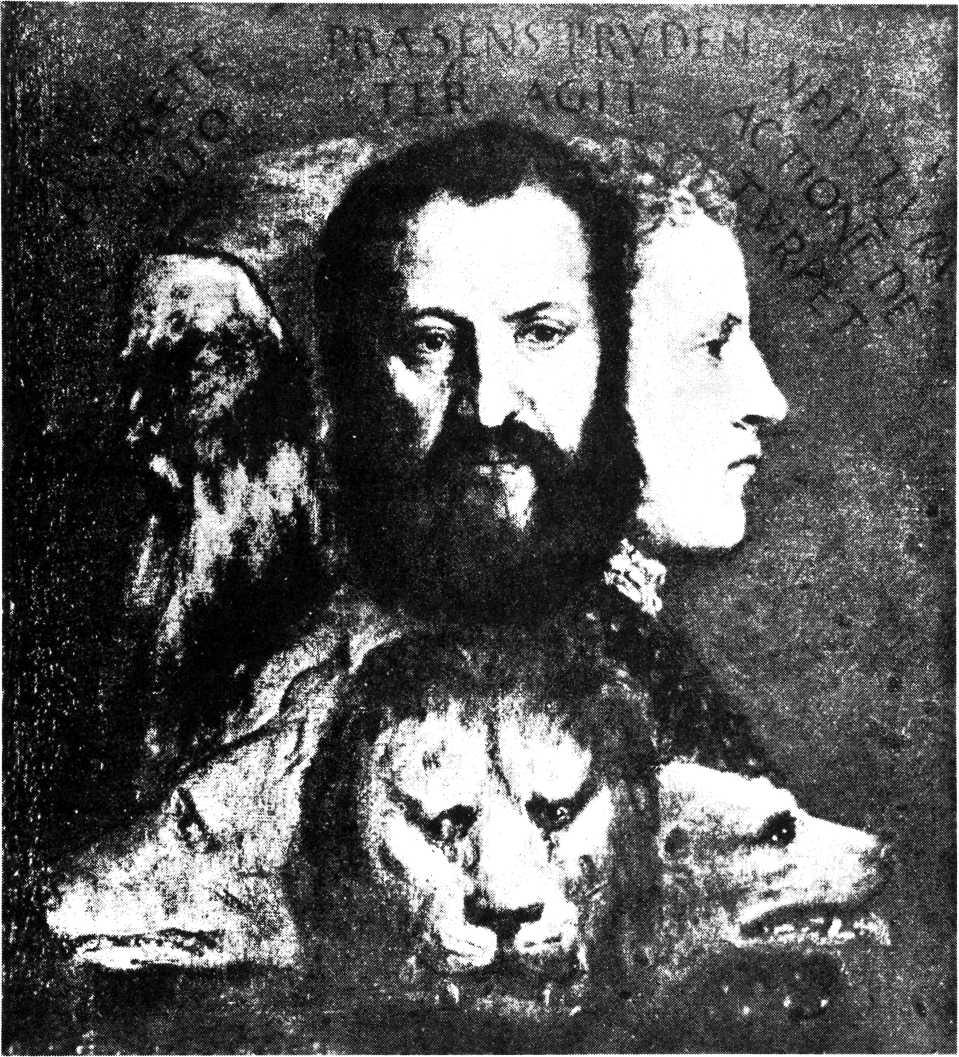
Titien: EX PRAETERITO PRAESENS PRUDENTER AGIT NI FUTURA ACTIONE DETURPET!
PRUDENCE ET SAGESSE
Il est intéressant de comparer la triple tête diabolique de Botticelli à l’allégorie de la Prudence par le Titien: un vieillard (lui-même), son fils et son neveu; soit encore le Passé de l’âge, le Présent de la maturité et le Futur de la jeunesse — texte qui suggère que le Présent peut à la fois bénéficier des expériences passées et ne pas compromettre les actions futures. En cette image du Titien, Erwin Panofsky voit une prière fait, par celui-là à son fils de laisser à son neveu toute chance d’épanouissement. Panofsky rapporte la pénétrante analyse de Giordano Bruno sur les trois faces du Temps. Toutes les analyses de cette image du Titien — très simple en apparence — font apparaître des conflits d’interprétation conflits passionnés d’où, paradoxalement, la Prudence est bannie. La totalité des langues occidentales font apparaître, dans la syntaxe, un Temps divisé en Passé, Présent et Futur , formes auxquelles tout esprit doit obligatoirement s’accoutumer et qui, dans la pratique, sont devenues courantes pour tous. Le langage qui décompose pour nous, sur le plan formel, le Temps en trois aspects différents, en trois images de différents moments, ce langage est pour l’esprit un moule dont l’importance considérable nous a échappée jusqu’à ces dernières années. Prisonniers du langage — il nous a été longtemps impossible de nous soustraire au Temps que la syntaxe nous représente. Celle-ci décompose en une triplicité apparemment harmonieuse de la Durée pure; c’est-à-dire qu’en fait elle exige de nous une importante opération mentale: celle qui consiste à saisir intuitivement qu’un seul des aspects — qu’une seule des formes du Temps est toujours opposable aux deux autres assemblées. Le concept de triplicité qui fait jouer le même rôle à trois éléments nous dissimule et nous masque le principe d’antagonisme: un quelconque élément est toujours opposable à l’ensemble des deux autres. Stéphane Lupasco a étudié la structure d’un antagonisme particulier — celui du statique et du dynamique: «Afin que n’importe quel événement ait lieu, à un moment et à un endroit quelconque de l’Univers, il faut qu’une énergie, qu’un dynamisme puisse passer d’un certain état de potentialisation vers un certain état d’actualisation, sans quoi, rigoureusement actuel ou actualisé, on ne pourrait même pas parler d’énergie, de dynamisme, tout serait statique, étale, depuis toujours et à jamais. »
La triple polarisation du Temps, telle qu’elle apparaît dans le langage, est bien l’image de cette statique éternelle dont parle Lupasco, qui poursuit: «Ainsi toute énergie — tout mouvement énergétique — sous n’importe quelle forme — implique un événement antagoniste et tel que l’actualisation de l’un entraîne la potentialisation (la virtualisation) de l’autre. » C’est la réunion de deux quelconques des aspects sous lesquels le Temps nous apparaît qui a le pouvoir de l’actualiser et encore, d’autre part, de virtualiser ou de potentialiser son troisième aspect. Conséquence capitale, il s’ensuit que la notion de Temps recèle trois différentes sortes d’antagonismes, lesquels se particularisent selon la nature de celui-là des aspects du Temps que l’on choisira d’opposer aux deux autres. Nous aurons la réunion du passé-présent s’opposant à son contraire virtualisé: le futur; puis le passé-futur opposé au présent; et enfin le présent-futur opposé au passé.
Lupasco déclare: « Un couple antagoniste d’événements et d’anti-événements énergétiques constitue — et lui seul peut le constituer — un système, c’est-à-dire cet ensemble d’événements liés et commandés par des forces ou relations dynamiques intrinsèques, inhérent, à ces événements eux-mêmes. C’est ce que j’ai formalisé dans une Logique des systèmes ou Systèmologie. Nombreuses sont certes les combinaisons possibles de ces systèmes de systèmes, nombreuses leurs chaînes en expansion arborescentes ou systèmogenèses; il s’en forme cependant toujours trois. »
En examinant la structure de la culture latine, il m’a semblé — et cela avant même que j’aie pris connaissance des théories de Lupasco (lequel n’aborde d’ailleurs pas le problème du Temps et de son triple aspect) — il m’a semblé donc que ce système des structures latines comportait une actualisation du passé-futur, et une virtualisation du présent; qu’au contraire les structures byzantines et russes comportaient un présent-futur opposable au passé, et enfin que les structures nordiques étaient essentiellement actualisation passé-présent et virtualisation du futur.
Sur le plan théologique, le symbolisme de la Trinité nous offre une bonne occasion de cerner avec précision l’opposition de l’aryanisme des peuples germaniques à la romanité des Latins: entre Père et Fils, distinction d’essences à laquelle les derniers s’opposent de manière absolue. Opposition qui, libérée de toute terminologie théologique, réapparaît aujourd’hui en Europe sur les plans scientifique, philosophique et artistique. Le célèbre savant et théoricien Werner Heisenberg met en relief dans « Physique et Philosophie » le fait qu’ « en théorie classique, nous supposons que le futur et le passé sont séparés par un intervalle de temps infiniment court que nous pouvons appeler présent. En théorie de la relativité, nous avons appris qu’il en est autrement: le futur et le passé sont séparés par un intervalle de temps qui existe et dont la durée dépend de la distance entre le phénomène observé et l’observateur. » On ne peut mieux souligner le fait qu’en théorie classique le présent est sans dimension, c’est-à-dire sans face et donc qu’alors le temps se présente réduit à deux seules dimensions: une tête de Janus. La relativité qui donne au présent une dimension fait de lui un lieu électif de rencontre possible entre ces deux pôles que représentent pour nous le passé et le futur. Est institué ainsi un temps du dialogue: celui du nécessaire délai entre question et réponse —
Locke qui définit la connaissance comme étant « la perception de l’accord ou du désaccord de deux idées », nous laisse dans l’embarras de décider par quel antagonisme s’effectue la prise de connaissance de l’idée du présent relativiste: est-ce par l’idée du passé ou par celle du futur ? Assurément aucune de ces deux idées ne peut jouer seule un rôle, alors que leur réunion en un concept unique de passé-futur a force d’opposition — d’antagonisme — par rapport au présent: « les propriétés de symétrie constituent toujours les caractéristiques les plus essentielles d’une théorie ». Entre le réel — forme ultime du présent — et le possible — union du passé et du futur — s’explicitent des rapports demeurés longtemps mystérieux.
Cependant cette fusion en un concept unique du passé et du futur, ainsi que la notion d’antagonisme viennent d’être vigoureusement critiquées par un jeune savant russe, M. N.A. Kozyrev, lequel a déclaré qu’« il n’y a pas de symétrie entre action et réaction, que le temps ne peut passer que dans une direction: du passé au futur; et que le futur est d’essence complètement différente du passé. »
HISTORIQUE ET PROBLÈME DES COULEURS COMPLÉMENTAIRES
J’ai pensé que l’approche du problème ne me serait pas plus facilitée par les théories de Kozyrev sur le temps orienté, que par celles de Lupasco sur les antagonismes, toutes ces théories ne m’étant pas suffisamment familières et qu’en conséquence, le meilleur abord serait, pour moi, la théorie des couleurs. Aussi ai-je tenté de trouver, de ce côté-là, une solution nouvelle. Le premier obstacle rencontré en ce domaine fut l’évidence d’un conflit entre la théorie des complémentaires de Niels Bohr et la dialectique hégélienne et marxiste.
La notion de « complémentarité » des couleurs avait été parfaitement définie longtemps avant que Bohr n’entreprit ses études. On désignait par le mot « complémentaire » des couleurs contrastées disposées aux deux extrémités opposées d’un diamètre quelconque du cercle spectral. Couleurs qui, mélangées, se neutralisent et donnent toujours un gris semblable, quel que soit le diamètre choisi.
Cette polarisation de couleurs soi-disant « complémentaires » mais que nous jugeons préférable d’appeler contrastées, semblait obéir à merveille aux principes de la dialectique hégelienne — thèse, anti-thèse, synthèse. Utilisant la terminologie de Lupasco, nous nommerons couleurs potentielles ou virtuelles, le bleu, le jaune et le rouge qui sont sur le cercle spectral trois secteurs irréductibles. Ces couleurs s’opposent comme les angles d’un triangle, et non en un double antagonisme polarisé. Le rouge a pour contraire un mélange de j aune et de bleu — soit le vert; le bleu, un mélange de rouge et de jaune — soit l’orange; le jaune, un mélange de rouge et de bleu — soit le violet. Ces constatations m’ont permis d’établir que tout mélange se caractérise comme pôle actualisé. Variabilité ou jeu sont les éléments que fait apparaître (en tout cas) le mélange. De cette définition, de cette place faite au jeu par tout mélange, Lupasco n a su — ou pas voulu — tenir compte dans son système. Il s’est rendu prisonnier d un antagonisme borné à l’opposition de l’homogène et de l’hétérogène. L Antiquité connaissait déjà le modèle triangulaire des trois constantes invariables. Il apparaît par trois triangles superposés, formant étoile, dans le sceau de Salomon dit « sceau du Bien et du Mal ». Tracer les diagonales qui les relient entre eux, c’est sur le plan de la communication, opérer une réconciliation entre Kant et Hegel.
La simultanéité des prises de conscience chez Lupasco, chez Koryzev et moi-même me paraît être historiquement significative, si l’on tient compte du fait qu’elles s’effectuèrent de manière absolument indépendante; Lupasco n’ayant eu pour souci qu’un certain besoin de clarté dans le domaine logico-philosophique; Koryzev, le désir de répondre à certaines exigences astro-scientifiques; et enfin, moi- même, un intérêt purement artistique pour le problème des couleurs — après Goethe et le peintre Runge, le désir de les mieux comprendre.
Lupasco souligne que lumière et « mort » sont synonymes. Or dans une perspective newtonienne, les différentes couleurs composent la lumière: il s’ensuit que le monde des couleurs s’étale au-delà de cette limite que constitue la « mort » Goethe récuse sur ce point particulier tout intérêt à la théorie newtonienne en affirmant que la division de la lumière en couleurs est un procédé inverse — de matérialisation une tendance vers la « vie ». Il m’a paru que l’ignorance et le mépris dans lequel les savants tenaient les assertions pourtant impressionnantes de Goethe nécessitaient et rendaient possible l’élaboration d’une troisième théorie de la lumière, et qui soit complémentaire aux deux autres.
Le schéma que j’ai cru devoir proposer ici — la Triolectique — est né de cet examen critique de l’interprétation de Copenhague, que j’avais intitulé « l’interprétation de Silkeborg ». La situlogie dont ce schéma n’est qu’une partie, reprend le concept d’analysis situs (Poincaré) mais évite de donner trop d’importance à la notion de limite positionnelle telle que celle-ci est formulée dans la topologie. Nous jugeons en effet, avec Gaston Bachelard, que, dans le concept de la situation, l’événement et le temps doivent être impliqués.
SCHEMAS TRIOLECTIQUES
QUELQUES EXEMPLES DE COMPLEMENTARITE TRIOLECTIQUE.
Nous présentons ici Quelques modèles d’équilibres triolectiques appliqués à différents domaines conceptuels. Soulignons qu’il s’agit là de simples bases de travail, nullement dogmatiques, qui peuvent être modifiées et élargies. Il est dans leur nature d’être ouvertes, à commencer, par exemple, sur un chiffre supérieur à trois relations, cette méthode n’étant évidemment liée à aucune mystique des nombres. Elle a pour but de libérer les mouvements dialectiques figés ou bien dans le déterminisme sous-marxiste ou bien dans les antagonismes non choisis où Lupasco s’est enlisé.
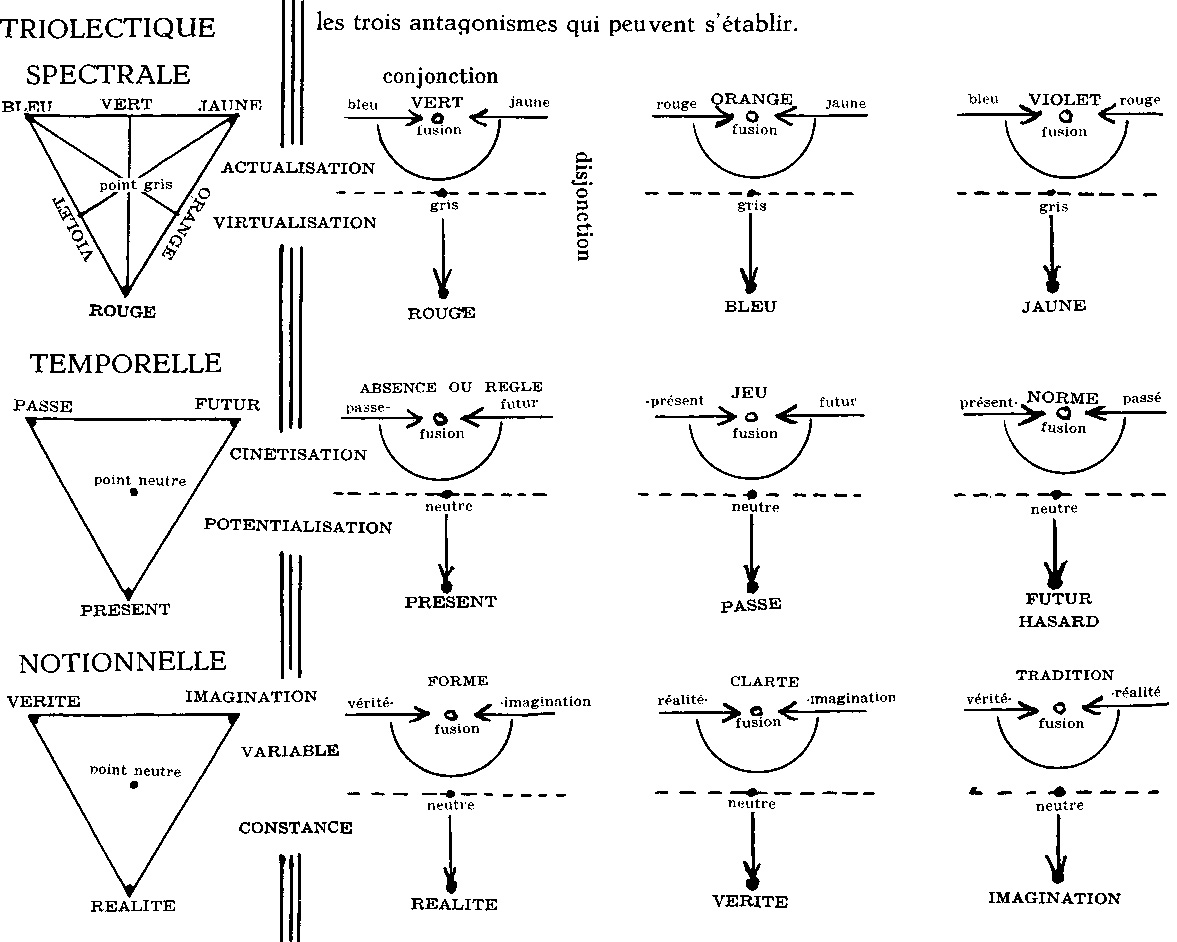
LES SCHÉMAS TRIOLECTIQUES
Le futur étant le but, et le présent l’instrument ou le moyen, le passé représente le résultat.
La triple possibilité de fusion qu’impose l’établissement des trois antagonismes se présente ainsi:
Téléologisme. Le but justifie les moyens (fusion présent-futur);
Expérimentalisme. Ce n’est ni avant, ni pendant l’acte qu’une justification peut s’effectuer, mais au moment seulement où le résultat est là.
le résultat justifie les moyens employés (fusion) passé-présent).
Moralisme. Le but se confond avec le résultat et la justification s’oppose à l un et à l’autre; la justification se justifie d’elle-même car elle est moyen instrumental (fusion passé-futur).
Il faut pouvoir choisir entre ces trois dialectiques. On ne peut les confondre. Chacune possède sa logique propre.
Les concepts formés à partir de trois éléments en ordre statique risquent de demeurer entachés de mystère et de n’être pas suffisamment clairs pour l’esprit; ils nécessitent une étude plus approfondie des conditions mêmes de leur formation.
A cette formation correspondent toujours deux sur trois des éléments donnés — lesquels mettent en opposition les concepts antagonistes. Pour être bien compris, et bien exécutée, cette opération mentale impose que l’on se rende tout à fait compte que l’ensemble de nos concepts est affecté par un dynamisme propre à la vie.
C’est pourquoi une ébauche (même rudimentaire) des données les plus élémentaires de cette formation de concepts nous est apparue nécessaire. Nous avons entrepris ici ce travail sur les conclusions duquel nous nous faisons toutefois un devoir de formuler les plus expresses réserves. Nous avons donc réuni par groupe de trois des mots qui nous semblent être les éléments basiques de cette formation de concepts triples. La liste que nous donnons ci-dessous ne prétend pas être exhaustive; cependant, à la faveur de cette classification en système, il devient peut-être possible pour chacun de prendre conscience des antagonismes en lesquels nous inscrivons de manière élective et symbolique notre conduite. Evidemment, nous sommes tant accoutumés à entendre et à comprendre ces mots dans nombre d’acceptions autres que celles qui relèvent du seul dynamisme de la vie, qu’il sera certainement déconcertant de les retrouver ici en leur idéale pureté statique. Nous les avons classés en trois groupes qui correspondent préférentiellement aux formes latines d’activités de structuration germaniques et byzantines.
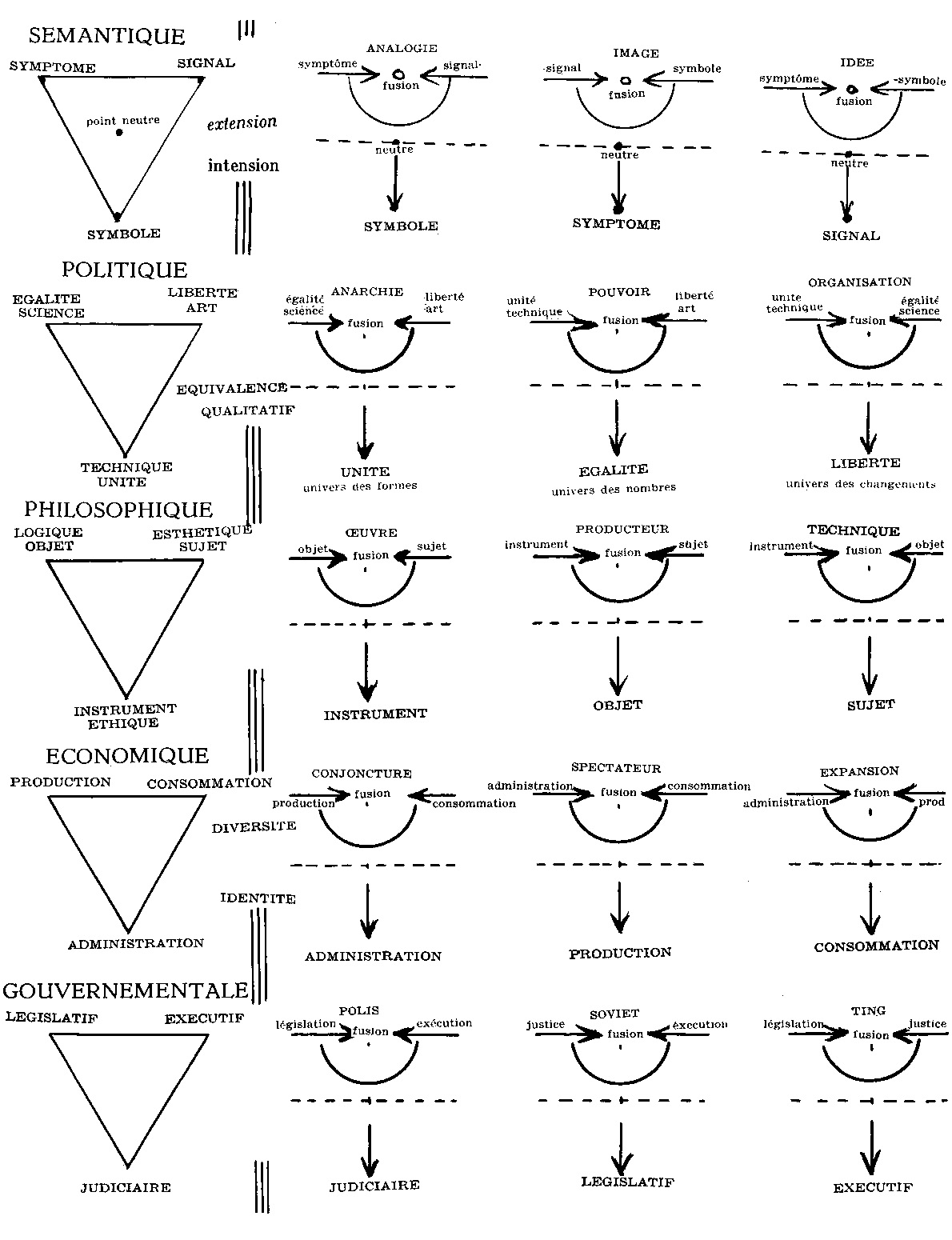
Un savant suédois a montré qu’en optique le phénomène de la transformation des couleurs triples contrastées était lié au tissu Gila et que leur juxtaposition se fait dans ce tissu. L’étude du phénomène est malaisée du fait que manquent de suffisantes informations psycho-physiologiques. De plus grandes connaissances permettront une meilleure approche des maladies mentales. La théorie de Lupasco a le très grand mérite d’avoir mis en valeur l’identité existant entre le concept physique de potentialité et le concept éthique de virtualité.
Le sacré et le tabou sont des mots-concepts en lesquels apparaissent particulièrement fortes l’ambivalence de l’éthique et de la théologie d’une part et la puissance du Mana épanouissant d’autre part.
Entre le sacré (virtualisé) et le divin (actualisé) nous avons établi l’existence d’un certain antagonisme — antagonisme qui restitue le mot Divin à son contenu originel: jeu — variation.
L’histoire de toute la chrétienté n’est, après tout, que celle de sa division en antagonismes complémentaires, que celle des schismes successifs de l’église. Lesquels ont finalement fait apparaître trois domaines distincts, soit: l’église gréco-byzantine: jeu présent-futur; l’église catholique-romaine: passé-futur; le protestantisme nordique: passé-présent. Nous avons là trois concepts complémentaires du sacré: premièrement, le concept du passé — que j’appellerai « de la production », car dans la société industrielle s’équivalent production et reproduction; deuxièmement, le concept du présent qui est « administration »; en enfin, troisièmement, « la consommation » qui correspond au futur sacré des protestants. Quoi qu’il nous en coûte et quelque malaise qu’il nous en vienne, nous devons garder présents à l’esprit ces types de concepts si redoutablement contradictoires, puisque nés de processus mentaux radicalement différents. Nous ne devons pas nous laisser aller à la dangereuse facilité de croire possible — avec Raymond Aron — d’harmoniser un système de hiérarchie des valeurs (tel le sien) avec le monde du libre jeu de Max Weber. Refusons-nous à ce qui serait une fallacieuse illusion. Et ne nous cachons pas qu’il y a là une obligation de choix pour qui souhaite éviter que ne vole en éclats, un jour, une cohésion bâtie sur des malentendus et des fausses ententes. Spectacle dont j’espère ardemment ne pas être le témoin attristé…
Pour prendre toute la dimension du drame qui se joue actuellement dans les consciences, il n’est que d’entendre Stéphane Lupasco affirmer sans hésitations: « Toute la psychiatrie doit être révisée ». Déclaration en regard de laquelle nous inscrivons aussitôt - avec optimisme notre système triolectique éminemment susceptible, selon nous, d’apporter quelque éclaircissement sur le fonctionnement du psychisme profond, et de rendre compte rationnellement de la nature des grandes maladies mentales jusqu’à présent incurables.
Ce n’est pas notre avis (a l’opposé de Lupasco qui semble cultiver la schizophrénie) que le développement doive se faire du concret vers l’abstrait. Actuellement tournés de manière presque exclusive vers 1’ art populaire, les arts plastiques manifestent au moins par cet élan même une santé qu’il serait vain de leur dénier.
Entre autres antagonismes dont se préoccupe Lupasco, il en est un duquel sa pensée se rend particulièrement prisonnière, nous semble-t-il: celui de l’espace et du temps. « La simultanéité de certains événements cérébraux engendre la notion d’espace », nous assure Lupasco. Or, nous savons depuis longtemps — disons depuis Heisenberg — que les notions d’espace et de temps ne sont pas étrangères entre elles mais qu’au contraire ce sont des notions identiques, le présent étant lui aussi simultanéité. Entre question et réponse s’inscrit un délai, une durée qui est le présent même, le réel étant espace. Que s’allonge le délai entre question et réponse et le présent croîtra d’autant plus — cela aux dépens du passé et du futur. A la limite, nous trouverions un présent absolu, intégral, éternel: « En attendant Godot ».
La fausse et illusoire possibilité d’introduire quelque équilibre en l’antagonisme temps et espace a été dénoncé, avec subtile efficacité, par Kozyref qui nous a montré quelles sont les différences d’essence entre les composants (le passé, le futur) de la notion de temps.
Le sens du sacré évolue et la notion de divin subit, elle aussi, des métamorphoses. La diversité de ces transformations pourrait faire croire à un progrès en Art, tant nos dispositions affectives ou mentales, en sont quelquefois changées. Soudain nous ne nous reconnaissons plus en telle ou telle parenté spirituelle, en telle ou telle famille intellectuelle. Oui, nous sommes instables: tour à tour également tournés vers les arts anciens ou vers les arts nouveaux. Il n’empêche que c’est l’homme complexe qui cherche ainsi — en nous-mêmes — son chemin vers la vie.
Aurai-je quelque peu réussi, sur l’exemple de l’une de ces transformations, à faire apercevoir l’immuabilité de son mécanisme (immuable comme la gamme des couleurs) que ma tentative n’aura pas été tout à fait vaine.
On rapporte facilement et communément au progrès — au progrès industriel — la transformation des conditions matérielles de la vie de l’Homme. Il y a peut-être là une insouciante légèreté que les générations futures — sinon nous-mêmes risquent de payer fort cher. Car ce « progrès » là est étrangement, redoutablement envahissant. Si l’on veut éviter que s’accroisse sans limite son efficacité monstrueusement inhumaine, et que s’étende à l’infini son pouvoir et que l’ homme ne devienne la ‘victime apeurée d’un holocauste démentiel, il nous faut demeurer les maîtres des mille circonstances matérielles qui font la trame de notre vie quotidienne. Les maintenir à notre service. Et non passer au leur. Impérieuse alternative où la vie de chacun tantôt s’enlise, tantôt s’épanouit, et de laquelle seul — disons-le — s’affranchit véritablement l’artiste à l’esprit créateur.
En effet, après Blake et Turner qui ont vu dans le rêve le gage et la garantie de toute existence humaine réellement accomplie et l’ont courageusement chargé du poids de leur propre vie; les artistes vraiment créateurs se sont engagés sur ce chemin où l’invention est reine et la vérité mandatrice. Il n’est au pouvoir d’aucune puissance religieuse ou idéologique, spirituelle ou matérielle, de soumettre à sa loi la vitalité d’esprits créateurs. Car de tels esprits témoignent avant tout de leur liberté. Leur force n’est pas de nature instrumentale. Le deviendrait-elle qu’ils cesseraient — en tant qu’esprits — d’exister.
LE PRINCIPE TRIOLECTIQUE DE LA COMPLÉMENTARITÉ
Lupasco déclare:
« En tant que tels — que dynamiques —• les éléments antithétiques possèdent la propriété constitutive de la notion même de dynamisme… La logique du contradictoire est une tridialectique, elle engendre trois dialectiques qui se commandent. »
La disjonction: elle est le rouage même de la dialectique: Pas de dialectique sans disjonction, et pas de disjonction sans dialectique.
NOTRE THESE TRIOLECTIQUE SE PRESENTE AXIOMATIQUEMENT DE LA MANIERE SUIVANTE:
Nous avons démontré précédemment comment et pourquoi ces trois dialectiques sont inévitables. En mettant en regard du dynamisme tridialectique son correspondant de statique complémentaire et triolect ique, nous avons fait apparaître les subtils mécanismes qui les régissent.
Chaque disjonction est suivie d’une conjonction et, de même, chaque conjonction est suivie d’une disjonction
La fusion crée une fission (l’actualisation est le nom donné par Lupasco à cette conjonction ou fusion).
Chaque compromis isole et virtualise l’attitude opposée
Nous avons choisie d’appeler mise en situation la formation d’un antagonisme ou d’une contradiction.
Les éléments basiques nécessaires à la naissance d’une quelconque situation peuvent s’ordonner de manière à former deux situations également différentes et complémentaires de la première.
BARBARIE NORDIQUE
L’antagonisme de la culture et de la civilisation n’est pas l’une des moins importantes sources de conflit du monde actuel; c’est pourquoi il me paraît nécessaire d’élucider au maximum les mystères enfermés en ces notions.
On peut considérer la culture comme l’actualisation d’un passé-présent (ce qu on appelle encore « tradition » ou « vane ») et la civilisation comme l’actualisation d un passé-futur (ce qu’on nomme «historicité» ou «chronologie»). Ces deux systèmes liés par les antagonismes qui leur sont propres et qui ont pour potentiel soit un présent, soit un futur, nous paraissent manifester par leur opposition la diversité même du Nord et du Sud européen.
Louis Réau voit dans le vandalisme l’une des modalités d’un phénomène général beaucoup plus important: la barbarie.
En celle-ci, il distingue trois grands groupes: le teutonisme, le gothisme ou gothicisme et le vandalisme.
Le premier groupe correspond à la destruction sans scrupule des peuples vaincus; le second à la production d’une laideur anti ou contre-classique; enfin le dernier, comme nous l avons déjà vu, à la destruction de tous objets de civilisation.
A quelques rares exceptions près, les spécialistes français se sont tenus — avec un soin académique — à cette triple classification. Elle a fait autorité dans le monde entier et, avec elle, la terminologie utilisée. Il s’ensuit que derrière les structures artificielles de l’horrible, on retrouve tous les peuples Scandinaves.
Soupçonne-t-on bien que cette terminologie — apparemment simple constatation des faits — favorise autre chose qu’un besoin de clarté ? Elle permet de maintenir vivante la vieille obsession du Goth, du Vandale et du Teuton…
Il nous semble que la pureté originelle de la Gaule (cette France d’avant les invasions germaniques) soit demeurée aujourd’hui encore, en France même, un objet de nostalgie.
En Scandinavie, un certain reniement partiel de notre passé et notre opposition aux idées pan-germanistes ont également contribué à la diffusion sournoise du regrettable état d’esprit dénoncé plus haut.
Cesserions-nous — nous autres Scandinaves — d’être publiquement mis en cause par la terminologie de cette classification, cesserions-nous d’être ainsi mis en accusation et cités comme source originelle de la barbarie, que nous consentirions sans doute à nous taire . Mais puisqu’il me semble que ceci ne doit pas cesser il nous faut choisir de parler et de nous faire entendre.
Il nous faut répéter que dénoncer de manière permanente la criminalité d’un criminel, c est sensibiliser dangereusement celui-ci à celle-là. Et, vu notre sujet, c’est risquer de donner l’éveil à de terribles forces dont le contrôle deviendrait vite hypothétique, sinon impossible.
L’Histoire nous apprend qu’en fait nombre de ceux qui ont stigmatisé les Barbares et les ont cloué au pilori ont pratiqué eux-mêmes teutonisme et vandalisme. Plus encore, ils en ont tiré gloire, et leur art ou leurs chroniques en attestent surabondamment.
Il est clair que le faible niveau de conscience que cette forfanterie là manifeste, caractérise justement la barbarie. En effet, l’importance du degré de conscience est devenue le critère, le plus communément adopté, par lequel on différencie le barbare du civilisé.
Quoique imparfaitement intelligibles, les valeurs du monde civilisé apparaissent prestigieuses aux moins civilisés. Elles sont susceptibles de provoquer leur admiration et d’exercer une influence éminente.
Des hommes — à faible degré de civilisation — se trouvent ainsi engagés dans un effort réflexif sur eux-mêmes. Ce faisant ils découvriront la valeur intellectuelle et morale de cet acte de réflexion; et ils l’estimeront fondamental. En juger ainsi, c’est précisément accéder à une plus haute conscience. C’est bientôt jouir d’une faculté critique susceptible de s exercer aux dépens mêmes des maîtres qui l’enseignèrent. Pouvoir, de ceux-ci, dénoncer les limites et, l’ivresse de la découverte aidant, adopter à leur encontre d’intransigeants principes d’action . Enfin, au nom de ces derniers, vouloir et entreprendre des actions purificatrices telles que « le renouvellement du sang ». On a vu cela…
VRAIE ET FAUSSE COMPLÉMENTARITÉ DE LA CULTURE ET DE LA CIVILISATION
Par ailleurs la mise en avant de la conscience comme instance civilisatrice ne va pas sans problème: dire qu’un homme se transforme de barbare en civilisé par la conscience, c’est reconnaître implicitement que sont de nature barbare l’inconscient et le subconscient. Or ceux-ci sont le substrat et le noyau de toute vie humaine. A elle et à eux: est intimement liée cette instinctive mise en valeur de l’homme par lui-même: la culture — non pas somme de connaissances abstraites mais culture vraie, spontanée et dynamique en un mot , vivante.
On voit donc que grouper Civilisation et Conscience obscurcit le rapport Civilisation-Culture, et enténèbre la dernière nommée de manière diffamante.
Comment l’Humanisme, entre Civilisation et Culture, affronte-t-il les obstacles que la barbarie dispose sur son chemin ?Et comment prend-t-il appui sur la civilisation et sur la culture ? C’est ce que nous devons maintenant nous demander.
Alexandre Mongait nous fait connaitre la position officielle russe (L’Arché ologie en U.R.S.S.): culture et civilisation sont synonymes. Position semblable chez les Américains (The science of culture, Leslie A. White). Et on rencontre la même identification en France et en Italie.
Définissons la civilisation comme un cadre et une structure de caractères utilitaires.
En pays Scandinaves, le Christianisme, la Renaissance et le Développement moderne — facteurs civilisateurs — ont tous également joué leur rôle. Etapes et paliers de civilisation, ils y ont été profondément assimilés. Mais actuellement ils ont cessé d’y occuper le rôle d’agents civilisants. Ils sont devenus éléments de culture.
Disons-le encore: les mêmes éléments qui ont longtemps tiré leur signification de la civilisation sont devenus désormais signes de culture.
« Le sacré et le profane », de Mircea Eliade, décrit l’axis mundi ou universalis columna si richement répandue dans les graffiti de Normandie; signe de l’égocentrisme religieux, sous forme de l’image de l’espace en trois dimensions, normalement représenté par la colonne avec la roue ou la couronne. (Voir ill. n^(o) 126.) Un des rares exemplaires en Europe conservé dans son état primitif est celui d’Alcubilla del Marques en Espagne. (Voir p. .)
La croix chrétienne établit l’antagonisme entre deux contraires, signe des deux dimensions planes de la surface.
Au départ — complexe de décisions plus ou moins heureuses mais toujours conscientes, la civilisation apparaît désormais, dans mon pays natal, le Danemark, comme naturelle: une évidence hors du champ de conscience. La civilisation s’est transformée en culture.
Que signifie cette mutation de sens ? Perd-t-on en civilisation, plus que l’on ne gagne en culture ? Y a-t-il là dégradation et destruction d’un acquis ? Sommes- nous enfin devant un phénomène que l’on doit qualifier de barbare ?
Tout comme on regarde l’existence de l’agriculture antérieure à celle de l’industrie, et l’existence de la campagne à celle de la ville, d’aucuns aiment à considérer l’antériorité existentielle de la culture sur la civilisation: ce sont les Humanistes.
Pour nous, il nous suffit d’avoir observé en pays Scandinave le processus de transformation décrit plus haut, pour affirmer, au contraire, que la civilisation est antérieure à la culture. Ne pas voir ainsi, c’est, croyons-nous, substituer sournoisement à l’idée d’une barbarie qui serait en deçà de la culture, l’idée d’une autre qui serait au-delà. L’une primaire, l’autre décadente.
L acquisition de toute nouvelle technique exige une apprentissage — et ce qu’on appelle civilisation (à la limite, culture) en est un.
Apprentissage au cours duquel se révèlent nécessaires des facultés d’attention et de concentration. Impossible d’être alors distrait ou inattentif.
Il en va de même et pour la culture et pour la civilisation. Avec cette seule différence entre elles deux que la Société met l’accent sur la seconde. La Société en effet nous impose de suivre de manière permanente la transformation des valeurs du monde civilisé — sous peine de paraître asocial ou d’être mis en accusation d’incivisme. Elle se refuse à situer la civilisation et la culture à différents niveaux de la réalité humaine. Ou alors, si elle y consent, elle veut croire possible de les occuper en même temps: c’est l’illusion bourgeoise.
Georges Dumézil souligne et explicite le caractère tripartite de la théologie indo-européenne: Souveraineté-Force-Fécondité.
Il a compulsé tous les documents — récits et légendes — qui retracent la vie originelle des peuples nordiques, les Ases et les Vanes. Il a étudié comment, à travers guerres et paix, s’est opérée l’union entre ces deux peuples, et cela en regard des trois principes dits précédemment.
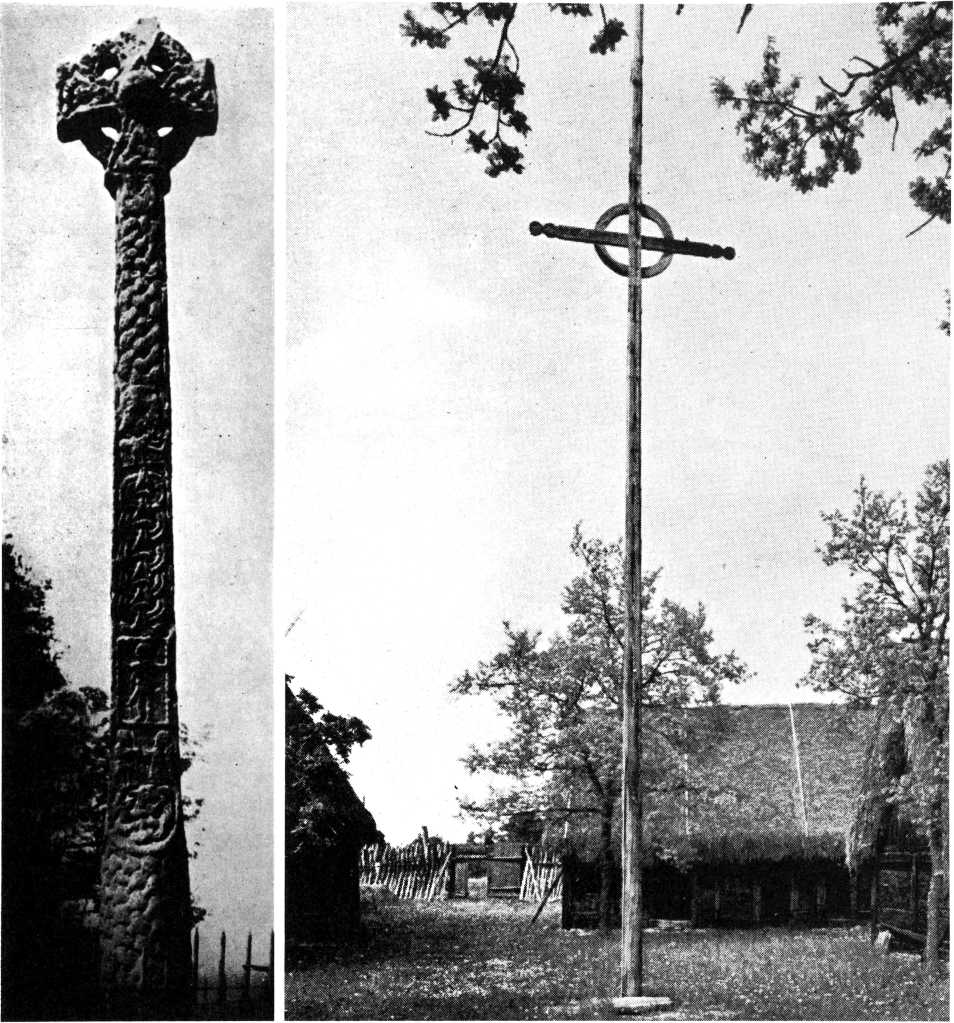
Croix de pierre sculptée anglaise, avec son modèle en bois, île de Gotland d’après Lawrence Stone « Sculpture in Britain. The middle Ages » Et Gustaf Näström « Forna Dagars Sverige. »
Steingaden, Allgau. 1200.
L’ARBRE SACRE — LA PIERRE SACREE.
Il y a une résistance aveugle de la part de quantité de savants contre le fait d’admettre que certaines formes de l’architecture médiévale trouvent leur origine dans les constructions en bois. Cette vaine discussion ne s’arrêtera pas avant que l’on établisse qu’il existe deux tendances concurrentes, dont l’une part de l’idée de l’arbre sacré et central; et l’autre de la pierre sacrée, sur laquelle on bâtit tout. (« Tu es Pierre, et sur cette pierre…») L’un prend la vie organique et l’autre la matière inorganique comme origine. Il suffit de comparer les différentes images de la genèse universelle.
Mais Georges Dumézil — victime sans doute de sa latinité — commet, à notre avis, une erreur d’appréciation.
Plaçant, en effet, dans un même et unique groupe, les notions de force et de fécondité, il individualise à l’excès la notion de souveraineté. Il perd de vue que la dynamique dialectique propre à l’action a pour base l’union de deux quelconques de ces principes et, pour effet, l’opposition du groupe ainsi formé au troisième principe.
Dans le cas présent, l’union qui s’est opérée, entre les Ases — virils et guerriers, mais aussi — et beaucoup plus fondamentalement — prêtres (soit: communauté spirituelle, principe supérieur de transcendance) et les Vanes (agriculteurs, principe de fécondité) est l’union de la Souveraineté et de la Fécondité — union qui s’est opposée à la Force. Il n y a pas — comme tend à le croire Dumézil — Force et Souveraineté d’un côté et Fécondité de l’autre. Il n’y a pas de hiérarchie: les trois sont sur le même plan.
On retrouve la même erreur de jugement dans la culture est-européenne qui oppose une Souveraineté abstraite, claustrale et isolée, à la Fertilité et à la Force.
Notons que chez les Germains, Souveraineté et Fécondité sont groupées en un ensemble qui laisse à part, seule, disponible et liée à rien, la Force.
Que la diversité des cultures européennes (diversité qui s’est développée surtout à partir de différences de représentations conceptuelles) soit à déplorer, c’est possible. Cependant, il y a lieu de n’exclure aucun élément — et non plus les Germains — de cette variété qui compose l’Europe. Ce qu’a fait Dumézil, lorsqu’au lieu de considérer sur le même plan la Force, la Fécondité et la Souveraineté, il a introduit — à fin de hiérarchie — son échelle de valeurs.
Posons la Force comme une énergie destructrice.
Selon qu’on en lie les manifestations à la Souveraineté ou à la Fécondité, elle change de nature. Elle trouvera une disculpation en Morale, un mobile en Sociologie.
C’est le Vandalisme qui, tant dans sa réalité philosophique que dans son existence concrète, demeure le cœur du problème.
Il nous paraît possible d’envisager tout développement culturel comme étant une assimilation progressive d’usages. Donc initialement, surtout scolaire: expérimentation et adaptation. Notons, en passant, qu’à partir du premier Moyen Age, toute l’orientation scolastique est d’inspiration nordique.
L’épanouissement, que tend à faire naître le développement susdit ne sera complet que si l’on s’abstient de renier la valeur d un héritage capital: celui des habitudes, âges, us et coutumes.
Acte de fausse liberté — tout reniement, négation, de ces dernières a fatalement de désastreuses conséquences. Les cultures latines, aujourd’hui détachées de la vie, nous en sont le redoutable avertissement.
L’éthique nordique — et tout également, les principes juridiques qui en sont, sur le plan social, la traduction et l’équivalence — est fondée à la fois, sur la liberté d’essais, épreuves et expérimentations et sur la faculté de jugement. De l’ensemble de ces tentatives et conduites pragmatiques sont tirées conclusions et jugements. Ceux-ci, soumis à la discussion ouverte et à des critères statistiques, permettent de définir un élément de norme.
C’est là un parlementarisme qui recoupe les principes du Ting.
Choisir un élément de norme déterminé autrement qu’il est dit précédemment, c’est substituer mathématiquement la variable à la norme. C’est créer le chaos, opter pour une profusion confuse; et c’est encore introduire le pathologique en physiologie.
Mais n’en va-t-il pas ainsi avec l’Art Expérimental ?
Art Expérimental, Art Moderne ? Peut-on vraiment douter qu’il y ait là deux réalités différentes, opposables l’une à l’autre ? c’est absolument sûr !
Pour chacun d’eux, la fécondité est règle d’or. Elle fait loi. Tout comme si elle en était devenue une garantie absolue de valeur, et la caution de leur réalité.
D’où multiplicité et prodigalité d’inventions; lesquelles — hors d’atteinte des critères habituels — échappent à tout jugement de valeur.
Il en résulte chez les spécialistes d’esthétique moderne, aux U.S.A., des maux de tête névrosants et durables.
Cependant la volonté d’accorder la primauté absolue aux méthodes normalisantes — cette option de la mentalité nordique — comporte, elle aussi, des faiblesses. Cette mentalité nordique se rend — en quelque manière — prisonnière de sa volonté.
Elle se met dans l’impossibilité de valoriser l’inattendu, le nouveau, l’extraordinaire. En ceux-ci, elle est obligée de voir une atteinte directe à sa souveraineté. Car chez elle, rappelons-le, la souveraineté est liée, rigoureusement, au passé, à la fidélité au passé. Aussi est-elle incapable de décider quand « le jamais-vu » est de nature désastreuse, et quand de nature salutaire. Toute nouveauté lui paraît pathologique. En souffrent évidemment tous les artistes dont l’activité propre dépasse les règles.
Georges Dumézil a fait remarquer justement qu’il n’est guère de thèmes des mythologies Scandinaves qui n’aient été repris et poursuivis par le Moyen Age chrétien.
LE MALIN DUPÉ
Entre autres exemples, il cite le thème du « Malin Dupé »: l’entremise du Diable à la construction d’églises et la ruse dont celui-ci, son travail accompli, est victime. Ainsi le récit de Gylfaginning: sous les apparences d’un maître-artisan, un géant proposa aux Ases et entreprit la construction d’un château — étant entendu que celle-ci s’effectuerait dans le temps d’un hiver, avec l’aide de son seul cheval, et que le salaire de son travail serait, outre le soleil et la lune, la belle Déesse Freyja — ordinaire objet de convoitise des géants.
Le cheval du géant ayant infatigablement apporté, chaque nuit, les pierres nécessaires à cette construction, les Ases décidèrent — trois jours avant l’été — de frustrer l’artisan de son salaire; ils déléguèrent à cette fin leur dieu Loki qui prit, par subterfuge, la forme d’une jument et détourna le cheval de son labeur.
De dépit, le maître-artisan laissa éclater sa colère — une colère de géant. Les Ases se considérèrent, de ce fait, délivrés de leur engagement, appelèrent leur dieu Thor qui, de son marteau Mjöllnir, brisa le crâne du géant et ainsi l’expédia dans le « Niflhel », « l’enfer des brumes ».
ART ET COUTUMES
Dumézil reproche aux archéologues nordiques de classer les mythes suivant une méthode et un ordre exagérément chronologique, mais sa classification — à partir de jugements de valeur hiérarchisants — ne me paraît pas beaucoup plus avantageuse. Car, en pays Scandinaves, les différents mythes se surimpressionnent, en différentes couleurs certes, mais en un ensemble où les thèmes centraux réapparaissent de façon permanente.
Il faut savoir que l’assimilation des peuples conquérants Streitaxvölker, « hache de guerre », est à l’origine du conflit entre Ases et Vanes, et, comme conséquence seconde, l’arrêt, en Scandinavie, de toute la construction en pierre — cela, jusqu’à l’époque Romane, au XI^(e) siècle.
En créant une centralisation de l’épargne, la localisation matérielle des richesses dans les centres urbains et spécialement dans les églises a brisé, selon nous, la puissance originelle des agriculteurs.
Produits d’art et de civilisation, les objets enfermés dans les églises et dans les tombes furent soustraits au circuit coutumier de consommation. Il s’est posé un problème, en quelque sorte agraire, de la remise en jeu de ces valeurs. Les graffiti sont l’exemple d’une tentative de résolution. Ils manifestent et expriment une opposition à cette épargne systématisée qui fut, de fait, arrêt de la production et de la consommation et entrave à la civilisation.
Où et quand doit-on protéger l’œuvre d’art, et contre qui ?
L’activité civilisatrice, sociale et politique — sous forme de création d’Etats, d’élaboration de lois, de constructions de cités, fut considérée avec horreur par les paysans-guerriers Scandinaves, comme un travail de géant — de jaete. Cette affectivité les empêcha d’élaborer une civilisation où la cité aurait joué son rôle.
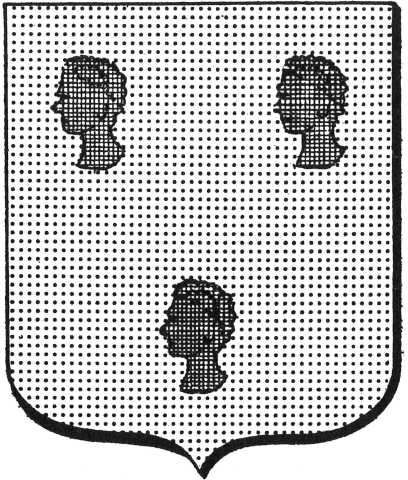
Armoiries d’Hugues de Payen
fondateur de l’Ordre du Temple.
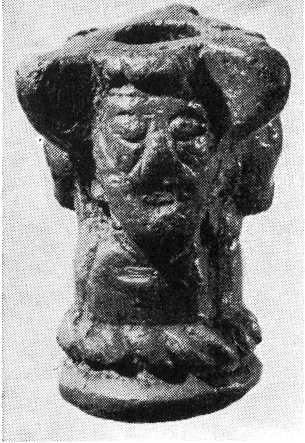
Triple tête en bronze. V^(e) siècle. Bornholm.
Väinämöinen s’écria: « Je me souviens maintenant de l’origine du fer! » et il commença le récit suivant: l’Air est le premier parmi les mères. L’Eau est l’aînée des frères, le Feu est le second et le Fer est le plus jeune des trois. Ukko, le grand Créateur, sépara la Terre et l’Eau et fit apparaître le sol dans les régions marines, mais le fer n’était pas encore né. Alors il frotta ses paumes sur son genou gauche. Ainsi naquirent les trois fées qui devinrent les mères du fer
Kalevala
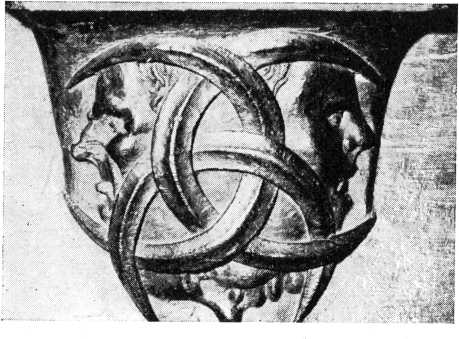
Paris. Eglise Saint-Gervais: stalles du chœur. Les « trois têtes ».
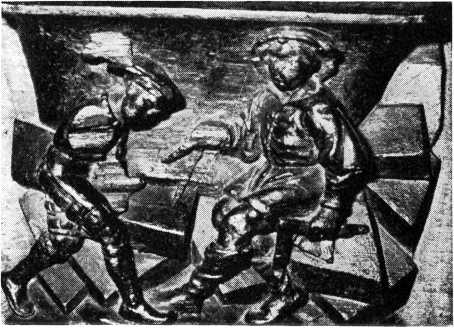
Le maçon initié (genou gauche découvert).
Ces jaetes furent mal récompensés: devenus chrétiens et catholiques, ils érigèrent une Eglise de bâtisseurs dont le pouvoir fut si grand qu elle put longtemps interdire quand bon lui semblait — l’entrée de Copenhague au roi même du Danemark. Mais ces jaetes furent enfin complètement exclus de la vie sociale nordique.
Il faut connaître l’importance néfaste de l’esprit d’opposition à l’union des Ases et des Vanes et savoir que leurs difficultés furent suscitées surtout par l’esprit de cité et de civilité.
Le mot « Vane » exprime tout à la fois l’habitude et l’habitation, le culte et le foyer (all.: gewohnheit-wohnung). Il désigne donc un élément de stabilité sous deux formes différentes dans le Temps par la tradition et dans l’Espace par le lieu. Tout ce que ce mot manifeste de volonté de permanence, de conservation et de maintien s’oppose catégoriquement au « jeu », au changement de coutumes, à la mode. Cette volonté de permanence et ce souci du stable — forgés au long des siècles dans le plus profond de l’âme nordique — ne peuvent être changés.
Critiquant l’art nordique, Benedetto Croce assure (par pastiche facile de la célèbre sentence de Buffon: « Le style, c’est l’homme») assure que, 1e style, ce n’est pas la femme ». Fausse subtilité d’un esprit typiquement et farouchement latin, dont nous ne voyons pas du tout qu elle mette vraiment en question l’art nordique. Laissons de côté Socrate cité par P.M. Möller (« Les garçons seulement s’intéressent au style, l’homme adulte ne s’y intéresse plus») et retenons seulement que l’affirmation de Croce tend à établir que l’expressionnisme nordique est féminin parce que sa spontanéité est négation de style. Féminité et spontanéité: nous sommes bien là avec Cro ce en pleine latinité ! La mode, c’est bien la femme, ce n’est pas l’homme.
Insoucieux de style, les artistes nordiques ont créé un Art Expérimental que la formule de Cobra illustre assez bien. A cet art non moins libre que libéré s’oppose l’Art Moderne. Antagonisme capital. Aussi le titre de l’étude inscrite au programme de Palazzo Grassi, à Venise, par Paolo Marinotti nous paraît indiquer — et de manière centrale — où se situe aujourd’hui, dans l’Art, le cœur du problème.
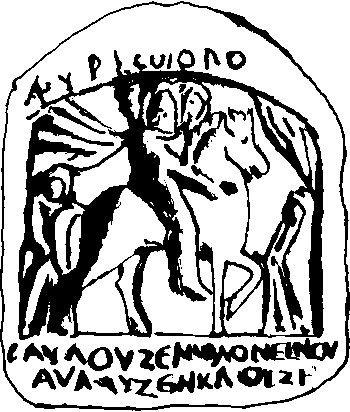
Chevalier à trois têtes.
Stèle de Izvor. ( 2^(e) siècle.) Musée de Plovdin (Bulgarie).
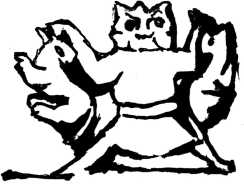
Personnage à triple tête tenant deux animaux; Eglise de Steingaden, Allgau. 1200.
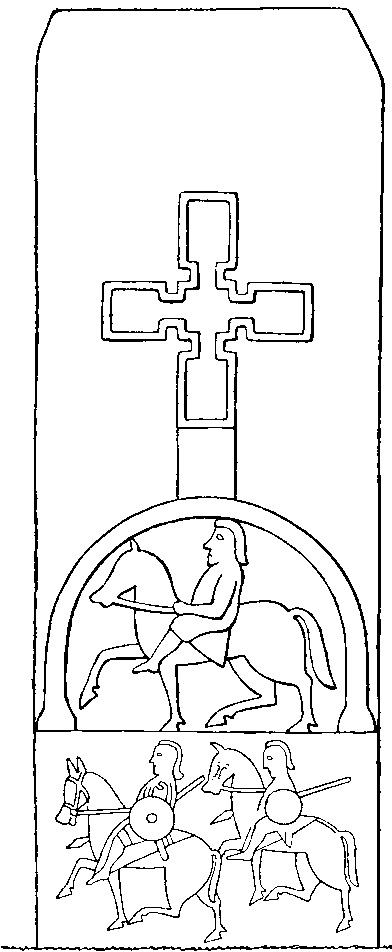
Croix sculptée avec chevaliers, Edderton (Ecosse).
D’après Early Christian Monuments of Scotland.
Si le manoir de Woodstock, comme le prétend Gérard de Séde, était un château rond, construit par les Danois, au IX^(e) siècle, résidence du roi Athelstan, et sous Henri II Plantagenet la résidence du Maître du Temple en Angleterre, on pourrait supposer gue les Templiers auraient des droits traditionnels à la possession de ce château rond. Si l’on imagine en outre que c’était, à l’origine, fait, non par les Danois, mais par les Jomsvikings, nous avons la possibilité d’envisager la solution de deux énigmes: quelle est l’origine des étranges châteaux ronds, servant en même temps d’églises sur l’île de Bornholm, l’ancienne Burgundarholm, centre des Jomsvikings, et ultérieurement propriété de la cathédrale de Lund, violemment revendiquée par le roi de Danemark ? Ensuite, l’étrange château rond, le prétendu « Moulin de Newport » aux U.S.A. s’expliquerait par la même activité, hypothèse facile à faire contrôler par des spécialistes. A l’époque de la conquête de l’Angleterre, les Jomsvikings s’étaient déjà convertis au christianisme; leur protecteur était saint Michel, ou saint Georges.
LES GRAFFITIS NORMANDS
Comment décider de la place qu’occupent dans la chronologie du développement européen les graffiti normands ? Les méthodes analytiques dues à la formation latine nous paraissent pouvoir très bien y aider. Cependant, le problème demeure entier puisqu’il s’agit avant tout de rendre compte du pouvoir signifiant de ces graffiti et de lexpliquer. La difficulté subsiste de comprendre comment et pourquoi ils nous apparaissent hautement significatifs d’une réalité qui nous concerne tout intimement.
S’attacher à vouloir dater ces graffiti avec une grande précision, c’est, croyons-nous, disperser nos forces, et surtout distraire notre attention de leur haute valeur de signification. Laquelle échappe évidemment à toute temporalité. Ne doutons pas qu’une mise en valeur de ces graffiti, qui serait réellement fonction de leur véritable importance, ne soit critique — et de manière probante — de la structuration traditionnelle de l’Histoire de l’Art. Faire entrer ces graffiti dans l’Histoire de l’Art, peut-être est-ce ajouter à la confusion déjà grande où celle-ci se débat actuellement. Le risque est grand mais nous devons le prendre: il est la chance d’un renouvellement.
La valeur d’une Culture et ses possibilités de progrès dépendent essentiellement de la capacité d’absorption de nouvelles données et d’intégration de ces éléments en séries de structures systématisantes. A la fois obstacles à sa capacité d’absorption et d’intégration, limite de celles-ci, ces éléments tendent à éliminer la structure systématisante elle-même. D’où l’importance des réactions spontanées et des tendances surradicalisées engendrées par ces éléments nouveaux. En ce sens, la volonté « d’ultra-modernité » de certains réactionnaires va au-delà des possibilités réelles de l’évolution. Non moins dangereux nous apparaît l’optimisme utopique de certains progressistes aux yeux de qui nulle frontière n’a d’existence. Et c’est souvent en toute bonne foi que nombre de ceux-ci, engagés dans une zone de culture antagoniste et contraire, apportent avec le soutien de leur progressisme une caution morale à l’adversaire lui-même.
Les éditions E. Einaudi — progressistes entre toutes éditions italiennes — viennent de publier un remarquable ouvrage déjà considéré comme classique, de Gabriel Pepe: « Il Medio Evo Barbarico d’Italia ».
Avec une partialité naïve, l’auteur y expose que les cultures germaniques et latines sont respectivement issues de concepts: négatifs pour les premières, positifs et idéaux pour les secondes. Devrions-nous prendre au sérieux cette spécification élémentaire (à laquelle participe également un critique d’art comme Pierre Restany) et nous formaliser de sa désinvolture, qu’il ne nous resterait guère — à nous autres Scandinaves — qu’à détruire tout ce qui chez nous témoigne d’un libre progrès ou bien encore, à décider qu’aucun mea culpa ne nous incombe et, dans un tout autre état d’esprit, partir délibérément en guerre. Détermination et initiative auxquelles les Scandinaves se sont jusqu’à présent refusés, parce qu’ils considèrent du devoir de toute culture, société, homme ou nation de garder pour soi ses propres antagonismes et d’éviter d’en projeter les distorsions troublantes sur quiconque. Si les Latins faisaient l’effort d’arriver à une conscience plus précise des limites ou pouvoir de leurs principes et de celles de leurs vérités, tous en seraient avantagés, et personnellement nous aurions la joie secrète d’y avoir quelque peu contribué: une immense fierté… et sans doute davantage à cœur à approfondir fructueusement la vertu réelle de ces principes et vérités.
Le livre et la Littérature, véhicule et moyen de communication, transportent et transmettent tout autant la bêtise que l’intelligence, l’ignominie que la grandeur morale, le mensonge que la vérité. En dehors de toute idée de valeur, ils sont l’usage même de la liberté humaine.
Examinées dans une perspective critique soucieuse d’englober et de s’assimiler les phénomènes bouleversants de notre époque (le fondamental problème des antagonismes soulevés par Lupasco), les positions prises par Pepe dans « L’Histoire des Barbares en Italie », ou encore par Christopher Dawson et par Edouard Salin, nous semblent non seulement inopérantes, naïves et douteuses, mais encore et surtout dépassées et d’une désuétude qui n’appartient même pas au folklore de l’esprit ou au catalogue de ses trouvailles amusantes.
Sans doute, la probabilité que des esprits de bords différents nourrissent un besoin de compréhension réciproque est-elle mince. Plus infime encore, la probabilité qu’un tel courant de compréhension s’épanouisse entre eux avant que ne les gagnent, les uns vis-à-vis des autres, une hostilité aveugle et une intransigeance impitoyable. Ces probabilités qu’un examen rationnel et scrupuleux révèlent légères, sont cependant sans prix pour notre cœur, elles sont l’un des points où notre irréductible espoir veut faire échec à la fatalité.
Encore que je ne pense pas que les méthodes Scandinaves soient susceptibles d’éveiller l’intérêt en France et d’y rencontrer une grande audience, j’ai cependant choisi et décidé de leur permettre de faire valoir leur tentative d’interprétation des graffiti normands.
M.K.E. Lögstrup, professeur de philosophie à l’Université d Aarhus, écrit dans « Kunst og Etik »: « Jusqu’à maintenant, les positions des problèmes philosophiques n’ont jamais été dans l’Histoire aussi éloignées, aussi complètement indifférentes les unes des autres, ainsi qu’aujourd’hui entre la philosophie dans le monde anglo-saxon (la Scandinavie inclue) et la philosophie du continent ».
Ce navrant état de chose décrit par le professeur Lögstrup m’a causé une profonde inquiétude qui est allée croissante depuis la fin de la guerre, et m’a tant désespéré que c’est avec un vrai soulagement et une réelle joie que j’ai vu enfin la France refuser de s’engager dans une Europe unie et sauvegarder ainsi, pour le bien de tous, les valeurs propres au « continent ». Il est évident que la grande diversité d’opinions entre les esprits nordiques et les esprits latins — spécialement français — est obligée de superbement se manifester et apparaître dans un problème aussi singulier que celui des graffiti normands. Ces positions françaises sur ce problème sont représentées de manière moins importante que je ne l’ai souhaité. Cependant, je crois que l’attitude M. de Bouard, de l’Université de Caen, étant donnée la grande clarté de son exposé, permettra au lecteur de se faire une idée des différences d’optique que présentent entre elles les interprétations françaises et nordiques. Ces pensées complémentaires pourraient s’entraider sur maintes questions, car une certaine ivresse narcissique et orgueilleuse de la pensée philosophique nordique équilibre à merveille certains égarements tristement cartésiens de la pensée philosophique française. C’est là un exemple supplémentaire des services que peut rendre l’idée d’une complémentarité voulue et acceptée.
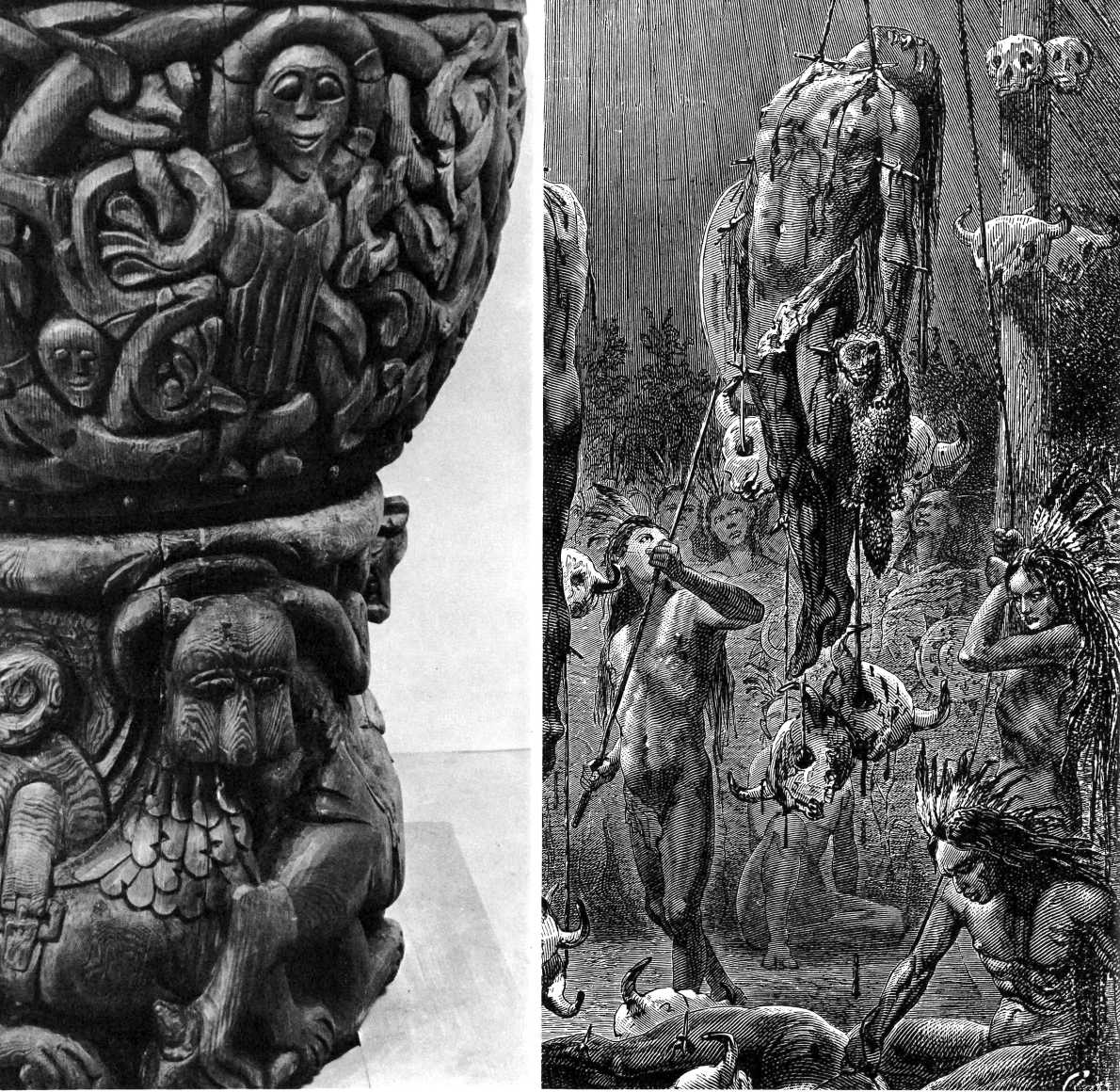
Font de Baptême suédois figurant le « Crist aux Liens. »
Le grande épreuve à la fête des indiens Mandanes.
INITIATION PAR PENDAISON
Je sais que je pendis à l’arbre empli de vent par la lance navré et livre a Odin, moi-même à moi-même remis, à ce haut tronc dont tous ignorent de quelle souche il surgit.
l Edda.
on montre encore à Gisors la « Maison des Hommes Pendus ». Mais si les Templiers furent pendus, ce ne put être qu’en effigie, car on sait par des documents certains qu’ils partirent pour la Terre Sainte où on les retrouve à Hattin aux côtés de Guy de Lusignan.
Gérard de Sède.
Le mépris des Templiers pour le crucifié pourrait s’expliquer par deux façons de présenter le même sujet sacré, le sacrifié cloué sur sa croix ou pendu par la corde. En gardant l’esprit guerrier ils préparaient eux mêmes leur propre sacrifice.
Dans « L’Avant-garde Culturelle Parisienne depuis 1945 » (Editions Guy Le Prat), Robert Estival doute de l’intérêt de cette notion de complémentarité en des propos bien formulés et apparemment logiques: « Le sentiment de sincérité, d’amour du vrai, en art comme en sciences, s’introduit dans le dualisme général de la conscience humaine, sujet-objet, et s’applique à l’un ou à l’autre de ces éléments. Car il semble qu’il y ait exclusivité à un moment donné. C’est ou la sincérité vis-à- vis du Moi ou vis-à-vis de l’Objet, de l’Œuvre. Tout paraît même se passer comme si la sincérité pour l’un entraînait une artificialisation totale ou partielle, selon le cas, de 1’ autre. »
Au lieu de tenter de prendre réellement parti à l’intérieur même du dualisme que les propos ci-dessus font ressortir, nous croyons devoir préférer une autre liberté: celle du choix en fonction de l’opportunité offerte par l’une ou l’autre de ces deux positions. L’événement auquel nous avons à faire face ayant seul pour nous force de loi, nous nous refusons à être le prisonnier d’aucun antagonisme.
Il serait exagéré de prétendre que nous sommes arrivés excessivement loin dans l’interprétation des signes reproduits dans cet ouvrage. Une chose est cependant certaine: à l’encontré de ce que pense Glob, ces signes ne sont pas antérieurs à l’érection des pierres d’églises sur lesquelles ils ont été gravés, les pierres ayant été taillées en fonction de leur place.
De même, dans la plupart des cas, il est exclu que ces graffiti soient des notes ou croquis de tâcherons ou de constructeurs, car ils datent de différentes époques et ont été à plusieurs reprises redessinés.
Notre intention est de faire paraître dans un prochain volume les nombreux dessins laissés par les constructeurs des églises norvégiennes en bois (la collection de ces dessins a été réunie par le docteur Blindheim au Musée de l’Université d’Oslo). Ces signes de constructeurs gravés sur bois sont très différents de ceux laissés par la population indigène normande. Seuls les signes norvégiens gravés par la population indigène, tels ceux de Nidaras à Trondhjem, présentent des ressemblances avec leurs homologues normands.
Toujours en ce qui concerne l’origine des signes normands, nous ne croyons pas devoir retenir l’hypothèse selon laquelle ils auraient été exécutés par des gens de passage, des Tziganes ou des soldats.
En définitive, nous retenons seulement l’hypothèse selon laquelle les indigènes en sont les seuls auteurs. On peut s’interroger sur le dessein que poursuivirent leurs auteurs. L’étude des liens que ces signes présentent avec les saints locaux n’en donne que partiellement idée. Les écrits de P. Saintyves constituent bien une pièce fondamentale du dossier. Par ailleurs, la théorie de l’ex-voto s’avère une très insuffisante réponse au problème. Tous examens achevés, nous avons une propension à penser que les mobiles de ces graveurs sont de deux sortes . en effet ces signes nous paraissent avoir deux ordres de signification différents: premièrement, ce sont des éléments de conjuration, d’invocation, d’appel, etc., qui se rapportent à des événements exceptionnels qui ne concernent pas la vie quotidienne (fléaux naturels, par exemple); deuxièmement, ils racontent la trame des jours quotidiens et ils sont destinés à la protéger et l’enrichir et ils ne concernent qu’un développement régulier et cyclique. Il est incontestable que cette dernière sorte de magie renvoie de manière caractéristique à la vie agraire.
Après Olus Magnus, j’ai essayé d’attirer l’attention sur l’importance qu’a eue l’expression de la vie agraire dans mon livre: « Les cornes d’or et la Roue de la Fortune » (plus particulièrement dans le chapitre « Le bâton de Rune et le calendrier de travail»), Il y a dans les pays latins, un certain manque d’intérêt pour la révolution agraire « la plus profonde qui ait jamais affectée l’humanité (Les civilisations néolithiques de la France» de G. Bailloud et Migue de Boofzheim) et pour les concepts relevant de l’art, absence d’intérêt qui nous paraît peu compatible avec cette certaine notion de l’idéalité de la civilisation qui y est professée. De tous les problèmes que soulèvent les graffiti normands, le plus important peut se formuler en cette interrogation: ces graffiti ont-ils, entant qu’œuvre s-objets, plus d’importance que les actes qui leur donnèrent naissance ? Et si oui, leur valeur est- elle l’œuvre d’art en soi ou bien le symbole ? Il semble que la superposition des images trouvées permette d’exclure qu elles aient été accomplies avec le souci de faire un objet d’art dans le sens classique de cette notion.
Etant donné le goût qu’ont les esprits nordiques pour les interprétations polyvalentes, nous préférons nous abstenir de tout essai ou tentative de recherche d’un symbolisme plus complexe, entreprise qui risquerait fort d’être vaine et hasardeuse. Des images connues, comme celles en forme de « husdrapa », donnent lieu à d’innombrables interprétations aussi poétiques que fantaisistes. Sous forme de « titoli », elles déchaînent en Italie une avalanche de commentaires.
Reste donc à expliciter, en ce qui concerne ces graffiti, comment ils s’apparentent par les mobiles de leurs auteurs à ce que les Américains ont prétendu réaliser par leur « action painting »: l’importance étant donnée au geste et à l’exécution.
Cette création de graffiti, souvent due à une répétition régulière de gestes identiques, indique qu’il s’agit bien là d’un rituel.
Au contraire de ce qui se passe en Scandinavie et en Angleterre où ce rituel est de nature religieuse (comme l’attestent nombre d’images sur les murs des édifices religieux, et particulièrement l’une d’entre elles représentant un Evêque en train de graver un tel signe), la tradition des signes normands s’est perpétuée dans le secret et elle est païenne.
Il s’en faut de beaucoup que les études du Dr Blindheim et les nôtres dissipent totalement le mystère des signes normands.
L’étude plus approfondie de ces rapports nécessiterait des recherches tant en Europe qu’en Afrique du Nord, aussi invitons-nous ceux-là qui sont intéressés par ces questions à nous communiquer toutes les informations en leur possession et aussi bien à participer à notre recherche.
Les interprétations de Glob et de Giessling ont suscité chez les Latins une opposition dont il est malheureusement difficile de penser qu elle pourra être réduite. Je me félicite cependant d’avoir présenté les textes du Glob et de Giessling — l’irréductible espoir qui nous porte à nier et à tenir pour nuls des pronostics trop savamment et trop rationnellement établis ayant souvent raison. Aussi ai-je un peu cette même bonne conscience qu’avait Heine s’adressant aux Français: « Je n’ai que de bonnes intentions pour vous, aussi vous dirais-je d’amères vérités. Vous avez plus à craindre d’une Allemagne délivrée que de toute la Sainte Alliance, y compris les Croates et les Cosaques. D’abord, on ne vous aime pas en Allemagne, ce qui est presque incompréhensible, car vous êtes bien aimables… Ce qu’on vous reproche au juste, je n’ai jamais pu le savoir. Un jour, dans une taverne, à Göttingue, un jeune teutomane déclara qu’il fallait venger dans le sang des Français le supplice de Konradin de Hofenstaufen, que vous avez décapité à Naples en 1268. Vous avez certainement oublié cela depuis longtemps; mais nous, nous n’oublions rien. Vous voyez que lorsque nous aurons envie d’en découdre avec vous, nous ne manquerons pas de bonnes raisons. »
Les Scandinaves, au contraire des Allemands, n’ont pas de compte à régler avec la réalité française; aussi se pose-t-elle à eux d’autre manière. Précisément, notre amour de la France et des Français se nourrit, s’enrichit, s’épanouit de qualités profondément différentes des nôtres, et vos défauts, différant également, vous sont comptés pour rien. En sorte que pour un Scandinave, être à Paris, c’est vivre avec un certain sentiment de libération, c’est ne plus sentir le poids de nos traditionnelles chaînes. A ceux qui rêvent d’une Europe nouvelle bâtie à l’image du Saint Empire Romain, nous devons rappeler une autre version européenne dont l’Histoire a entériné l’importance: l’Europe médiévale.
Il est certain que l’avenir de l’Europe est inscrit dans une plus grande communication des esprits, et que la seule conquête matérielle de ces moyens est insuffisante. L’ignorance réciproque n’est même plus un crime: seulement une erreur. La fausse personnalisation des responsabilités engage en définitive la responsabilité de chacun de nous pour raison d’anonymat.
La critique française atteint vite ses limites; elle est constamment renvoyée à sa faiblesse par son incapacité de déborder le cadre exigu du présent — critique quasiment instantanée et sans mémoire. Au contraire, l’esprit nordique ne procède jamais à aucun examen critique sans remonter très loin dans le passé pour y chercher des éléments d’information; aussi la critique est-elle, dans le Nord, très lourde de conséquences: une véritable mise en accusation.
La critique française trouve toujours volontairement ses bornes, la critique nordique jamais. Nous pensons aujourd’hui qu’il y aurait grand avantage à accorder entre elles ces diverses méthodes critiques et à s’accoutumer à leur utilisation simultanée.
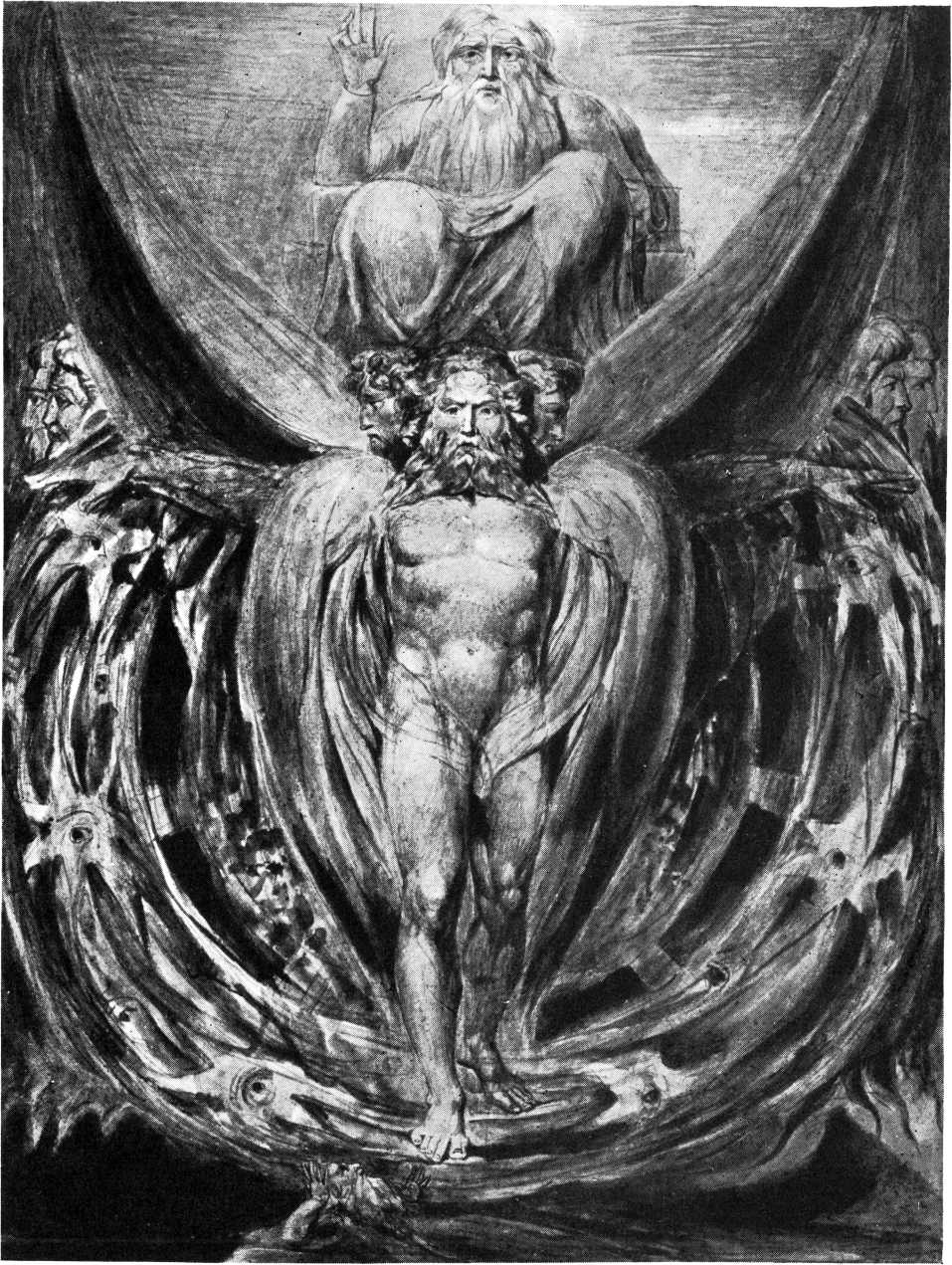
Représentation visionnaire d’une triple tête par William Blake.
Museum of Fine Arts: Boston, Mass.
PRODUCTION, CONSOMMATION, ADMINISTRATION
Consommer, c’est se produire.
Le plus important d’entre les antagonismes propres aux structures économiques semble apparaître à propos du problème de la causalité dans les rapports de la production et de la consommation: Crée-t-on pour consommer ou consomme-t-on pour créer ? Laquelle de ces deux activités est fonction de l’autre ? et ce mystère éclairci, connaîtra-t-on davantage l’instance qui se cache derrière le pouvoir administratif, et encore de qui relève celle-ci?
Nous avons déjà indiqué que les événements de la réalité économique s’ordonnaient en séries très différentes selon les zones de culture européenne (au nombre de trois) où ces événements surviennent.
Pour les esprits nordiques, l’importance même du lien qu’ils établissent entre le passé et le présent les distrait de tout événement ou manifestation qui soit pure actualité. Voudraient-ils, par exception, concentrer leur attention sur un tel événement qu’ils ne pourraient s’empêcher de tirer vers cet événement tout ce qui leur paraît en participer dans le passé — étant entendu que le passé le plus lointain sera lui aussi sommé de fournir des informations.
Par tradition on voit la destruction et la mort, la fin, comme passage vers le passé. La difficulté contenue dans cette attitude, c’est que l’on ne peut affirmer que chaque processus complet, en quelque matière que ce soit, se présente toujours comme une destruction des conditions données. De plus, il peut y avoir destruction sans profit pour la créativité supérieure. Le droit de destruction est ainsi le signe de supériorité. En refusant aux peuples de la grande migration la justification de leurs destructions, on reste attaché à l’ancienne structure de hiérarchie de l’empire romain, un système déjà en pleine faillite.
DESTRUCTION - CONSOMMATION
Vue de l’extérieur, chaque consommation se présente sous l’aspect d’une destruction.
Dans l’économie contemporaine, l’instabilité de l’équilibre production-consommation est seulement apparente. C’est là une notion fausse qui à la fois masque l’importance et le volume de la production et de la consommation.
En réalité, l’augmentation considérable des moyens de la première d’une part, et des besoins de la seconde d’autre part, tend à créer, entre elles deux, une correspondance et une équivalence absolues.
On s’achemine vers le parfait.
Parmi les données à partir desquelles la production « pense ses produits » se trouve la conviction que la consommation est essentiellement de nature destructive. Nulle création d’objets ne s’entreprend sans adjonction d’éléments qui en précipiteront la consommation. Facteurs de destruction, ils en accélèrent la disparition.
Désormais la vie du produit fabriqué est d’emblée, volontairement, raccourcie. Celui-ci n’est plus durable mais éphémère. Sa consommation n’est plus différée mais immédiate. Le solide et le stable ont cessé d’être souhaités et les Américains ont même créé une expression qui désigne ces produits garantis sans durée
En regard de cette situation, il nous semble que le vandalisme soit simplement une consommation comme une autre.
Parallèlement, certains économistes considèrent la guerre et l’économie de guerre comme une consommation gigantesque. Des essayistes et des philosophes assurent que la production fait naître nécessairement, à plus ou moins long terme, une économie de guerre.
APPLICATION SITUGRAPHIQUE EN EUROPE.
Seule l’analyse triolectique peut dissiper la confusion créée par des effets ignorés jusqu’à maintenant. D’où l’importance des moyens de dépistage des complémentarités fondamentales. Comment les détecter ? Nous tiendrons comme une preuve irréfutable de l’existence de la complémentarité de deux cultures le fait qu’en l’une d’elle la Réaction utilise — à dessein de freiner le progrès — les idées progressives de l’autre. D’une telle situation nous sommes aujourd’hui, en Europe, les témoins. Il n’est que de regarder au nord, au sud, à l’est.
Géographiquement, l’implantation géométrique des capitales des pays latins reflète une composition médiane, symétrique et centrale. Tous les chemins mènent à Rome. Ou à Paris. Ou à Brasilia.
Stockholm, Oslo, Copenhague, Londres, New York: autant de villes-frontières réellement tournées vers l’inconnu, et ouvertes à l’étranger.
Comme la Vienne d’avant-guerre, Berlin portait les traces du caractère du vieil Empire romano-chrétien qu’inventa Charlemagne. Cela a été une constante de la politique américaine d’après-guerre que d’exploiter en Berlin son caractère de ville-frontière. L’entente avec la Russie va évidemment déplacer ce jeu vers Jérusalem — ville-frontière de la « nation chrétienne ». Le conflit entre Abélard et Bernard est de nouveau d’actualité, mais cette fois, les réponses sont connues d’avance. La fascination n’y est plus, sauf pour les imbéciles.
A la base de tout système, ou organisation sociale, on trouve toujours trois éléments complémentaires: production, administration et consommation. Les systèmes latin, germanique et russo-byzantin se différencient par leurs modalités d’application de ces éléments. Le système latin nous semble caractérisé: primo, par la virtualisation de l’administration et secundo, par l’actualisation de l’unité variable production-consommation; Le germanique par la virtualisation de la consommation d’une part, et d’autre part, par l’actualisation d’une fusion entre production et administration . Enfin le système russo-byzantin basé sur une virtualisation de la production et la fusion actualisée administration-consommation.
Nous avons constaté précédemment l’existence d’un parallélisme qui apparente la consommation à une destruction. Chez les Germains — et chez eux uniquement — la volonté de pureté imprègne et anime l’acte de consommer à un tel point qu elle fait de leur système de consommation un système unique. Par contre, les principes latins de la consommation permettent, autorisent et favorisent une liberté de jeu, et cela sans plus restreindre dans la production cette même liberté de jeu. Mais dans le cadre latin, la liberté de consommation — ou de destruction — ne devient jamais totale et demeure toujours en deçà du « point barbare » des Nordiques.
Ces différents systèmes qui sont responsables de « mises en situation » différentes ont amené le mouvement situationniste à reconnaître et à admettre la diversité de ces méthodes. C’est parce que ce mouvement a consenti à examiner de façon critique les natures différentes de ces méthodes qu’il a pu maintenir son homogénéité. Dans les premières années d’après-guerre, l’opposition au concept classique d’art s’est manifesté de deux façons: certains se sont déclarés favorables à la création d’une nouvelle sorte d’art qui eut représenté une dimension opposée à l’art classique; d’autres décidèrent plus radicalement encore de nier dans tout domaine la valeur de l’art par une attitude anti-artistique. Dans la culture latine, l’opposition à l’art et sa mise à l’écart n’a certes jamais été totale — cette opposition étant avant tout rhétorique. Mais il faut souligner que cette opposition à base de rhétorique, et qui écarte donc toute attitude personnellement vécue et toute sincérité, est de nature terriblement plus radicale que ne le sont toutes les autres oppositions. Ainsi on a pu voir, à Paris, la tendance moderne amener une situation qui tend au vide complet — ceci dans le dessein avoué de retirer toute liberté et tout épanouissement possibles à Fart, et dans le projet secret de transformer ce dernier en moyen, en instrument. Cette crise de l’art que nous vivons aujourd’hui trouve sa plus extrême illustration dans le conflit de l’I.S. Ce mouvement, profondément représentatif de l’attitude existentielle nordique sur le plan artistique, gagnerait en originalité et en autorité si étaient mieux connues les pensées des différents esprits qui, à titre divers — philosophes, poètes ou penseurs — relèvent de l’existentialisme, et si le public savait mieux comment ces différentes pensées s’articulent entre elles. Ainsi, derrière Kierkegaard se cache un Poul Martin Möller, un peu comme on trouve le génie de Socrate derrière le système de Platon. Disons en passant qu’il n’y a pas lieu de croire que Socrate — à l’origine sculpteur — aurait consenti à cette exclusion des arts libres professée ensuite par Platon. Sartre a commis l’erreur grossière de considérer le système scolastique de Kierkegaard comme étant un humanisme. Peu avant sa mort, Poul Martin Möller écrivit un poème intitulé « L’artiste entre les révoltés ». Ce poème raconte comment, en 1830, à Paris, un groupe de révoltés s’introduisit dans l’atelier d’un artiste dans le but de détruire son travail et comment l’artiste attaqué réagit vigoureusement par une violente contre-attaque. Je dois avoir été profondément impressionné par ce poème qui fit classer son auteur comme « politiquement réactionnaire ». Poème remarquable par sa grande beauté, il l’est également par son caractère politique: un demi-siècle après l’affrontement imaginaire qui en est le sujet, un conflit semblable, mais réel cette fois, éclate au sein de la Commune de Paris. Prophétiquement encore, ce poème semble avoir mis en évidence des contradictions qui aujourd’hui sont devenues celles, internes, de FI.S. du fait de la mise en question de l’unité de ce mouvement par Debord, et tous ses partisans. L’anecdote des incendiaires venus pour détruire Notre-Dame, aux derniers jours de la Commune et s’y heurtant à un bataillon d’artistes armés,«constitue un bon exemple de démocratie directe»et nous permet de bien saisir, sur un point précis, l’ambivalence de toute protection a priori conservatrice: contre ces hommes qui voulaient accéder à l’expression en traduisant par une manifestation destructive leur défi total à une société d’oppresseurs, l’ensemble unanime des artistes avait-il raison de défendre Notre-Dame au nom de valeurs esthétiques permanentes ? Et finalement, au nom de l’esprit des Musées ?
Politiquement partisans de la Commune, « ces artistes agissant en spécialistes se sont trouvés en conflit avec une manifestation extrémiste de la lutte contre l’aliénation. » (Debord,). Aux poubelles de l’histoire.
Que se passe-t-il lorsqu’à l’issue d’un combat disparaît l’un des protagonistes ? et particulièrement lorsque se trouve anéanti celui-là des trois éléments qui faisait seul face à un groupe de deux autres ? Entre les deux parties dont l’union contre l’adversaire commun formait précédemment un antagonisme actualisé, se produit aussitôt un schisme. La dépolarisation polarise les anciens alliés. Une lutte s’engage pour la possession des biens désormais disponibles du disparu. L’appropriation de ces biens déclenchera chez leur futur possesseu r un processus d’identification avec l’ancien adversaire; soit donc une union nouvelle qui représente une possibilité d’actualisation. Toute guerre et tout état de combat visent à anéantir un adversaire au fond moins réel que virtualisé; en sorte que la disparition de celui-ci actualise en quelque sorte sa réalité, au point qu’au terme d’un combat, on a quelquefois l’impression paradoxale que c’est le perdant qui est le vainqueur. Il est évidemment clair que sans la volonté de chacun des deux protagonistes survivants de se rendre propriétaire des biens du disparu, nul combat n’aurait lieu entre eux.
Il est certain que Debord dévoile sa mentalité et sa formation politico-latine en considérant les artistes comme de purs spécialistes et finalement, comme de simples moyens instrumentaux.* L’Histoire montre que les artistes ont constamment lutté contre l’apriorisme de cette identification; leur participation à tous les grands courants révolutionnaires en fait foi, et cette attitude utilitaire envers l’art a toujours été
*Il est vrai qu’il est contre cette spécialisation. Mais n’en fait-il pas trop vite, justement, une carac- téristique obligée de tout art, pour liquider ainsi totalement le problème de l’art ?
considérée par eux comme une forme d’oppression et une atteinte à leur liberté. Cette oppression fut adoptée, officialisée et légalisée en 787 par le Concile de Nicée
En approuvant l’action des incendiaires contre les artistes armés (1), Debord a glissé dans la trappe qu’avait préparée Estivals. Depuis des années, celui-ci ne se lasse pas de répéter que l’affinité qui nous lie, Debord et moi, est « un pur truc pratique sans fondement d’idées communes ». Malheureusement, Debord, par l’assentiment qu’il donne au vandalisme incendiaire, en ce cas précis où s’opposent un socialisme et une barbarie, se trouve bien du côté des barbares. Car — deman- dons-le nous — par quels moyens ces artistes-là envisageaient-ils de détruire les incendiaires ? Tout simplement par le recours à des actes teutoniques…
Vouloir juger, dans une société ou la réalité militaire est toute-puissante, du plus ou du moins de barbarie des conduites et des comportements, est un projet vain et voué à l’échec. L’acceptation du vandalisme entraîne, ipso facto, le consentement au teutonisme. Que Debord — engagé comme il l’est maintenant — puisse revenir aux positions conventionnelles et convenues qui sont, en fait, celles de l’avant-garde parisienne, ne nous paraît ni souhaitable ni possible.
Le concept de situation — ce concept à tout faire de la pensée existentialiste, ce faux sésame d’une philosophie dépassée et bâtarde — n’a pas mené J.-P. Sartre bien loin. La vitalité du situationnisme nous fait paraître moribond cet existentialisme franco-allemand qui s’appuie confortablement sur un ensemble de propositions anciennes — précisément sur l’existentialisme danois du siècle dernier. Insoucieux donc de dépassement, ce surgeon français de l’existentialisme n’a pas emprisonné Debord. Cependant l’on devient les témoins amusés de ce paradoxal spectacle: d’un côté Sartre, qui s’est d’abord soucié d écrire pour les générations à venir, a été acculé peu à peu au contemporain et noyé dans une actualité surabondante; d’un autre côté Debord, intéressé seulement par l’actualité, se trouve condamné à édifier un lointain futur, et ceci en regard d’une gloire posthume qui, en fait, l’indiffère…
L’esprit et le caractère latin s’accommodent aisément — naturellement — du « vivre le présent » existentialiste. L’instant pur est pour eux une banalité évidente, une réalité immédiate alors que pour la pensée et le tempérament nordiques — disons pour Kierkegaard — le pur instant est un rêve fou et un espoir vain.
La crainte que l’activité de Cobra ne débouchât sur un nordisme unilatéral m’a fait rechercher la collaboration d’un homme dont je pensais qu’il pouvait être le successeur idéal d’André Breton en tant que fertile promoteur d’idées nouvelles. J’ai nommé Debord, et rien depuis ne m’a fait changer d’avis à son sujet.
ETAT — FAMILLE — NATION
Dans son étude sur l’origine de la famille, Friedrich Engels approfondit la pensée marxiste sur les facteurs de progrès humain. Ce « progrès » lui paraît passer par trois phases: le stade sauvage — qui est celui de la consommation pure et correspond à la non-productivité des chasseurs; le stade barbare — caractérisé par une production tournée vers la consommation; le stade civilisé — lequel produisant pour produire, en dehors de toute consommation, est lié à l’apparition de l’esclavage. L’esclave était un producteur auquel tout droit à la consommation était refusé. Sous des formes sournoises et larvées, la société occidentale a créé un assujet is- sement et un asservissement qui ne sont point étrangers à l’ancien esclavage.
Tous les faux jugements, erreurs et idées chimériques qui concernent la notion de progrès sont impitoyablement mises en lumière par le système triolecti- que. On ne peut pas créer une opposition valable à la barbarie, sans voir en la sauvagerie et en l’esclavage une seule et même chose — qui est, au fond, la civilisation. La civilisation, c’est la sauvagerie que justifie l’obligation morale d’entretenir l’esclavage. Conséquence matérielle et réalité sociale: une production qui ne donne lieu à aucune consommation. Isoler le producteur, libérer l’esclave: voilà qui est réellement faire face à la Barbarie, à la Sauvagerie. C’est là le programme et les buts du Socialisme — tendance qui manifeste le dessein de « faire la paix » avec le Sauvage, afin de récupérer pour elle la force qui l’anime — lui — sous forme de puissance destructive. Le socialisme revient ainsi, sans gloire, à la vieille opposition entre civilisation et barbarie. Il s’efforce de rapprocher production et administration et refuse de voir que cette alliance n’est rien de plus qu’un nouvel antagonisme. Inexorable processus qui fait l’enfer pour chacun, et duquel se trouve seule dégagée 1 Internationale Situationniste.
Nous savons maintenant — qu expression de volonté de progrès social — toute révolution engendre une vie sociale supérieure mais introduit en cette même vie une plus grande uniformité, sous couleur de stabilité, et restreint impitoyablement la liberté de chacun. La tendance situationniste se doit de viser à reconquérir les droits au libre jeu humain, jeu que tend sans cesse à réduire l’ « Entfremdung ».
Les graffiti — qu’ils soient normands, parisiens ou autres — sont des témoignages de cette volonté de présence, et d’une opposition à la sacro-sainte technique. Une tendance telle que le mouvement situationniste risque de paraître contre-révolutionnaire. En réalité, une telle tendance permet de bien voir l’erreur commise par l’ingénieur Sorel, qui a étudié les mouvements révolutionnaires de notre siècle en fonction de son système de la table rase. Au commencement du siècle dernier, Poul Martin Möller avait déjà pressenti la possibilité d’erreur qu’entraîne l’apophtegme suivant: un mouvement révolutionnaire n’a de valeur qu’au stade précédant sa réalisation pratique. Formulation qui peut s’effectuer autrement, et donner lieu à des images qui empruntent à une réalité mécaniste. Ainsi, l’on peut entendre que c’est exclusivement pendant une chute que des énergies sont libérées, à la fois nouvelles et disponibles; qu’après la chute succède un nouveau stade dans lequel les énergies deviennent plus bloquées quelles ne l’étaient antérieurement. Ainsi même le système trio- lectique est à la fois tremplin et frein: il libère des énergies, puis les bloque. Poul Martin Möller en a rendu compte à l’avance: « Une nouvelle idée n’a de valeur que pendant sa pénétration dans la masse. Une fois admise généralement, elle se dévalorise. » Il est donc évident que du jour où disparaîtront de l’Europe les oppositions symboliques qui géographiquement la scinde en Nord et en Sud, disparaîtront également du même coup les sources exceptionnelles d’une énergie admirable.
Ce n’est pas seulement un devoir, c’est un droit d’exiger que ne soit pas gaspillée en vains combats cette énergie-là, mais qu’elle serve au contraire à un enrichissement général.
Entre toutes les Histoires des Germains, celle de Friedrich Engels me paraît être la plus intelligente et la plus impartiale.
A la question: « Quel était donc le mystérieux sortilège grâce auquel les Germains insufflèrent à l’Europe agonisante une nouvelle force vitale ? », il donne une excellente réponse, sans toutefois expliquer complètement pourquoi la simple apparition d’une barbarie dans une civilisation a suffit à créer de nouvelles bases sociologiques — supérieures et à jamais irréductibles.
Engels nous dit que: « Les Germains étaient barbares, en ce qu’ils ne réussirent pas à instaurer un esclavage total comme le furent l’esclavage de travail de l’Antiquité et l’esclavage domestique de l’Orient. » Dans les profondeurs de la psyché ne se différencient pas les uns des autres les droits et les devoirs. N’y est donc plus valable la notion de propriété, « fruit du travail personnel » dont il est question ici.
Engels poursuit: « La civilisation engendre une classe qui ne s’occupe plus de production (ni de consommation), mais seulement de l’échange des produits: les marchands. » Engels ne semble pas apercevoir qu’une fois libérée de la classe des marchands où elle prit naissance, cette activité forgea les structures de l’Etat. C’est donc avec légèreté qu’Engels affirme: « L’organisation gentilice cessa d’exister et fut remplacée par l’Etat » et « l’Etat tombe inévitablement avec la division de la société en classes, relégué au musée des antiquités, à côté du rouet et de la hache de bronze ». Il est à penser que le rouet et la hache demeureront dans ce cas toujours des instruments indispensables.
« L’union conjugale est la forme-cellule de la société civilisée. Elle marque un grand progrès historique; cependant avec elle débute une époque où chaque progrès est aussi — dans le même temps — un relatif pas en arrière. » Engels nous parle là d’une époque où les physiciens découvrirent la loi de la constance de l’énergie. Loi qui est sans poids dans le monde socialiste car aux yeux des marxistes — et de Lassalle —: « La force unie est plus grande que la somme des forces réunies. » Nous sommes dans le miraculeux…
Engels s’est demandé comment il avait pu se faire que la famille romaine, d’organisation plus primitive que celle de la gens (peuple-famille), ait marqué un progrès par rapport à celle-ci. Et de même la gens barbare des Germains par rapport à la famille romaine. Il semble que les raisons profondes de ce dynamisme évolutif aient échappé à Engels.
La gens barbare n’était nullement effacée. Elle l’était même si peu que sa vigueur originale est devenue peu à peu, au long des siècles, véritable puissance; en sorte que de nos jours elle seule se révèle opposable au concept d’Etat. Elle ne s’appelle plus la gens mais la nation.
L’identification du passé au présent, de l’origine à la réalité, de la naissance à la contemporanéité, donne vie à la notion réputée noble de nation. Si, considérant avec raison l’important apport germanique à l’édification de l’Europe médiévale, on lui dénie cependant tout rôle dans la culture moderne, on s’exposera à ne rien comprendre du tout au devenir européen. Ce devenir restera ténébreux.
C’est par l’église arianiste que l’Europe de la gens est devenue l’Europe des nations. Le rôle considérable joué par cette église dans l’évolution européenne nous apparaîtrait plus essentiel encore s’il nous était donné de posséder toutes les informations qu’un long obscurantisme volontaire nous soustrait. La transformation de la gens en nation a été grandement facilitée — sinon même entièrement réalisée — par les théologiens qui ont introduit dans la cérémonie du baptême un rituel dont le haut pouvoir de signification fut un choc salutaire pour les. consciences. La cérémonie du baptême chrétien détermina symboliquement une époque nouvelle: l’aube d’une renaissance.
On comprend l’importance qu’eût en Scandinavie cette cérémonie: et cela avant même l’avènement du christianisme, et on comprend aussi pourquoi, aujourd’hui encore, les Scandinaves manifestent un intérêt maniaque pour les fonts baptismaux médiévaux. On ne s’expliquerait pas aisément la participation des Nordiques aux croisades si on leur refusait tout sentiment d’appartenance religieuse à la nation chrétienne.
La France fut le seul pays européen à n’être pas dupe du caractère national de l’expansion chrétienne. Dans « La naissance du Moyen-Age », L.B. Moss en donne les raisons: « En Gaule, Clovis mit le sceau à son œuvre en organisant une église nationale qui permit de réunir les avantages politiques de l’arianisme et ceux du catholicisme. » La symétrie des rôles joués par l’Etat et la Nation devait, plus tard, pousser les Français à se faire les porte-drapeaux de l’idée de nationalisme puis, — sans achopper outre mesure sur le chauvinisme — à enrichir le monde d’une notion dont les effets n’ont pas encore fini de se faire sentir: la notion d’internationalisme.
C’est ainsi que, sans défense contre « l’église-état » catholique, le nationalisme chrétien des peuples germaniques s’est trouvé subir une pression thêocratique exercée sur lui par cette redoutable « église-état » incapable par ailleurs d’assumer les responsabilités séculières d’une théocratie. Cette pression théocratique jeta au feu les derniers espoirs nordiques, qui disparurent dans la fumée des bûchers où périrent les Templiers. C’est à la France qu’en revint la piteuse gloire mais l’état-nation était créé. En ce nouvel Etat, place à la famille et à son chef-majordomus que nous allions malheureusement connaître sous le nom de chancelier.
La femme qui, dans le Nord, s’occupait de la maison et en avait la direction, allait voir par cette expansion de la famille son importance s’accroître énormément. Nous en savons les effets par l’histoire du Moyen-âge: jouant l’église contre les hommes elle en devint plus tard, elle-même, la prisonnière. Les choses se passèrent autrement à Byzance et ce fut l’Etat qui l’emporta. Les Républiques soviétiques sont nationales et réunies en un Etat tout-puissant. C’est du moins la Russie de Staline, celle de son livre sur les nationalités.
Il est plus qu’intéressant — il est impressionnant — de comparer à la création de l’union des républiques socialistes soviétiques la genèse d’une nation telle •que les Etats-Unis, où l’idée nationale revêt une forme expansive, supra-étatique.
Il est nécessaire de se faire une idée de la nature de la complémentarité existant entre l’internationalisme français, le nationalisme américain et l’étatisme russe, si l’on veut ne pas devenir la victime de chimères et d’illusions quant aux possibilités d’entente générale.
TING — POLIS — SOVIET
L’Etat moderne a différencié les pouvoirs sous trois formes: pouvoir législatif, juridique et exécutif. C’est par l’union de deux de ces pouvoirs — le principe des antagonismes nous le dit — que l’Etat moderne acquiert vitalité et dynamisme.
Chez les Latins, la virtualisation est celle du jugement tandis qu elle est celle de l’exécution chez les Nordiques. Je crois nécessaire d’y insister: chez les premiers, la fusion se fait entre législation et jugement, tandis qu elle se fait entre législation et exécution chez les seconds. Comme il est entendu que l’activité législative est politique, le dynamisme du Polis se trouve ici concrétisé. Dans le Ting nordique, l’exécution est inconditionnelle et c’est le jugement qui prend un caractère politique. On voit donc que le principe du Ting, loin d’être comme on le prétend souvent (et spécialement en Allemagne) une « Polis rudimentaire », possède un dynamisme propre, et qui est complémentaire de celui de la Polis.
Des meilleures assises juridiques du pouvoir politique ont apporté à l’application du principe Ting aux U.S.A. une pureté qu elle n’a pas en Scandinavie. L’exécution de l’homme présumé meurtrier du président Kennedy fait apparaître des manœuvres politiques occultes qui sont une atteinte au système même de gouvernement que se sont donnés les Etats-Unis une fois la guerre civile terminée. La gravité de cet acte trouvera-t-elle jamais sanction ?
Les hésitations de ceux qui sont les descendants des anciens Nordistes à se saisir juridiquement de cette affaire nous prouve l’existence d’un complexe passionnel de tendances. Cette situation-là nous semble présenter une étrange et significative similarité avec l’un des épisodes de la lutte des Germains contre les Romains — celui-là que rapporte Engels —: la manœuvre dont usa Arminius pour battre Varus et mettre ainsi un terme définitif aux projets romains de colonisation des pays germaniques. C’est en se trouvant confrontés avec des actes, des principes et des méthodes qui leur étaient radicalement étrangers, que les Romains prirent conscience de leur impuissance et renoncèrent à leur entreprise. Dans les deux cas, par la violence et la brutalité, c’est la même mise en échec des valeurs civilisées.
Pendant la guerre il y eut, en Hollande, un homme qui fut si écœuré par l’intensité de la curiosité danoise et norvégienne pour les envahisseurs, qu’il préféra se suicider. Cet homme d’honneur aurait-il connu l’histoire d’Arminius qu’il se serait peut-être moins choqué que personne n’ait tourné le dos à l’envahisseur et qu’il eut sans doute pressenti que cette attitude allait faire de la résistance Scandinave la plus efficace des organisations européennes.
Arminius demeura au côté de Varus tout comme s’il eût été son ami, cependant que dans le même temps il organisa et mit sur pied l’énorme entreprise qui allait écraser l’armée romaine. L’aurait-il voulu qu’il aurait même pu chasser les Romains de Gaulle, mais ce n’était pas un conquérant. Ce fut Guillaume le Bâtard qui révéla cette possibilité.
De ce temps-là date la tenace et irréductible défiance des Romains envers les Germaniques.
Il semble, en ces circonstances, que les Germaniques s’en soient tenus au précepte: « Il ne faut être honnête qu’avec les gens honnêtes », règle du Ting. A propos de la manière dont les Romains jugèrent cet événement, Engels nous dit « qu’on croit lire des écrivains français de la meilleure époque chauviniste, qui vident la coupe de leur colère sur le parjure d’York et la trahison des Saxons à Leipzig. Les Germains avaient suffisamment appris ce qu’étaient la fidélité aux traités et la loyauté des Romains, lorsque César attaqua par surprise les Usipètes et les Tenctères pendant les négociations et en plein armistice; ils avaient appris ce qu elles étaient lorsque Auguste fit emprisonner les légats des Sicambres, avant l’arrivée desquels il refusait toute négociation avec les tribus germaniques. Tous les peuples conquérants ont ceci de commun qu’ils dupent leur adversaire de toutes les façons possibles et trouvent cela tout à fait régulier; mais dès que les adversaires se permettent la même chose, ils crient au parjure et à la trahison. Or les moyens que l’on emploie pour réduire en sujétion doivent être aussi licites pour rejeter le joug. »
Cette dernière considération d’Engels est d’une indubitable justesse. Nous devons cependant remarquer que les peuples germaniques se sont employés à affiner et à rendre remarquablement opérantes deux techniques qui leur sont propres: celles de la désorganisation de l’action et celle de l’organisation de l’action protestataire. En cette dernière ils ont acquis un tel degré d’efficacité qu’on les a appelés — non sans raison — les protestants.
Il faut savoir l’importance qu’a pris le principe Ting dans la vie américaine et combien il imprègne l’esprit des lois de ce pays. Une obligation telle que celle qui est faite à tout citoyen comparaissant devant des juges de dire « la vérité, rien que la vérité, toute la vérité » est significative à cet égard. Nous voyons paraître l’homme honnête du Ting. Est au contraire déshonoré et exclu celui qui refuse les informations et les dissimule. Que celles-ci revêtent ou non un caractère d’intimité ne dispense pas de l’obligation de sincérité absolue.
Cette pratique est difficilement conciliable avec l’idéal du Polis. Idéal dont, au contraire, la rhétorique impose de « tout dire sauf la vérité » et qu’illustre, entre autres histoires, celle du jeune Spartiate qui, les intestins déchirés par un renard, préfère mourir plutôt qu’avouer être l’auteur d’un vol. Les deux méthodes ont chacune leurs avantages. Mais la volonté américaine de les utiliser conjointement conduit à de désastreuses impasses.
En Europe du Nord, c’est toujours par des aveux vagues et imprécis que se pratiquait la reconnaissance des faits. Si ceux-ci étaient très circonstanciés, le récit devenait ambigu, obscur et nébuleux au point que personne n’y comprenait plus rien. Ce fut là le début d’une antirhétorique qui, plus tard, imprégna une certaine littérature. Littérature exaspérante pour un puriste à l’esprit éminemment critique comme Anatole France, qui voyait en elle un défi à cette fameuse clarté que les Français prisent tant.
L’esprit germanique parut donc porté à la dissimulation, à l’hypocrisie et au mensonge. Strabon donne les Germains comme « roués, un peuple fait pour mentir », et le romain Velleius parle ainsi des Celtiques: « Simples et sans méchanceté, ils se précipitent au combat sous les yeux de tous et sans prudence, de sorte que leurs adversaires ont la victoire facile. »
Mais le sens critique, le goût de la précision et le souci d exactitude amènent souvent les Français à un besoin de vérité et à une ivresse qui, à la limite, a pour nom: cynisme. La franchise — étymologiquement « les Francs » — présente aussi d’odieuses certitud.es.
La France est néanmoins le digne successeur de cette Gaul a ardente. Elle a pour elle un goût de la justice politique qui en fait la meilleure garante dans le monde de l égalité et de la vérité.
Des différents apports des provinces à la vitalité française, le facteur normand n’a pas été l’un des moindres.
Et sur le plan de l’art, les graffiti normands ne contribuent pas peu à éclairer la signification de l’image, du signe et de l’écriture.
L’apparition des Soviets, ou conseils populaires, n’était pas prévue dans la révolution russe, et c’en fut pourtant le moteur. Lénine ne voyait pas ici la vieille tradition de la culture slave ressurgir. Il les croyait un miracle créatif du peuple. Polis, Ting et Soviet, voici trois structurations complémentaires, irréductibles et fondamentales dans le développement européen. Comme Aron, le psychologue C. G. Jung se fonde sur la structuration spirituelle du Polis pour expliquer l’inconscience; Adler choisit celui du Ting, et Freud celui du Soviet, sans que ces structurations soient d ordre « politique ». L’illusion d’une synthèse ici sur la base classique même modernisée est exclue. Une nouvelle méthode s’impose. Est-ce que la triolectique peut être cette méthode ? On va voir.
Les illustrations qui accompagnent le texte, quand il ne s’agit pas des photographies effectuées par notre Institut sont extraites des ouvrages suivants:
Oscar Almgren: Nordische Felszeichnungen als religiöse Urkunde, 1934.
Carl-Axel Althin: Studien zu den bronzezeitlichen Felszeichnungen von Skane, 1945.
L. Baltzer, Hallristningar: Glyphes des Rochers du Bohuslän. Suède, 1881.
Alojz Benac: Les anciens marbres de Bosnie. Revue Yougoslavie, 1953.
Theodor Bohner: Philip Otto Runge, 1937.
P.V. Glob: Ard og Plov, 1951.
Asger Jorn: Les cornes d’or et la Roue de la Fortune, 1950.
Willibald Kirfeld: Die dreiköpfige Gottheit, 1948.
Eric Graf Oxenstierna: Die goldhörner von Gallehus, 1956.
Erwin Panofsky: Meaning in the visual arts, 1955.
Proceedings of the Society of Antiquaries of Scotland, 1896-97.
Cahiers Ligures de Préhistoire et d’Archéologie, Bordighera.
Symbolon: Jahrbuch für Symbol forchung. Basel-Stuttgart.
Marthe et Saint-Just Pequart et Zacharie Le Rouzic: Corpus des signes gravés des monuments mégalithiques du Morbihan, 1927.
Mauduit: 40.000 ans d’art moderne.
Emmanuel Anati: La civilisation du Val Camonica, 1959.
Jules Boucher: La symbolique maçonnique, 1953.
Roland Villeneuve: Le diable dans l’art, 1957.
Alfred Weitnauer: Keltische Erbe. 1961.
BILLEDANALYSE AF GUTORM GJESSING
Fig. 1
Her er bare skåret inn noen kors, foruten en hel del skålgroper. Figurene överst på bildet framstiller også kors på et triangulært fotstykke. De er alle enkle latinske kors.
Fig. 2
Også her later det til bare å være framstilt kors og groper. Nederst på postamentet under de forvitrete innskæringer er et kardinalkors og visstnok et pavekors (h.h.v. med to og tre armer), foruten et latinsk kors. Överst oppe i bildekanten er kors med to skråstreker opp mot tverrarmen, mulig ei sterk skjematisering av den korsfestete.
Fig. 3
Överst tilvenstre noen gotiske minuskler. Ellers er muren oversådd med store og små skålformete groper, kors osv. Av interesse er noen av gropene i övre del av bildet, fordi de danner sentrum i en strålekrans, og er åpenbart tenkt som soler eller stjerner. Figurene kan ikke tidsfestes, bortsett fra minusklene som tör skrive seg fra 1200- eller 1300-åra.
Fig. 4
Överst tilhögre er et latinsk kors, ellers er her helt hoved- sakelig groper, dels plasert i rette linjer, dels tilsynelarende tilfeldig. Men överst på bildet, noe til venstre, er de plasert i en sirkel med ei grop som centrum, slik det er omtalt i innledningen. Det ser forresten ut til at det har været skårt inn figurer tidligere enn den tid gropene blei laget. Disse figurene kan nå ikke identifiseres.
Fig. 5
Störst interesse samler seg her om de fem skålgropene litt nedafor midten av bildet. De er stilt i korsform. Et par andre skålformete groper sees og. Överst på bildet ser en et kors hvor korsarmene er avsluttet med korte tverrstreker.
Fig. 6
Her er de skålformete gropene plasert på horisontalt plan og kunne derfor i og for sig vel tenkes å være skåler hvor et eller anna har blitt ofret, slik de skålformete gropene på helleristingene fra yngre steinalder og bronsealderen har vært tolket av somme granskere.
Fig. 7
Her er igjen bare skålgroper. Överst er en mengde av dem stilt sammen i en nærmest sirkelrund figur som for såvidt man sammenliknes med, det kjente solbildet fra Båhuslen, hvor mellomrommene mellom eikene er tett fyllt av skålgroper (Almgren fig. 140). Nedafor er to kors på fundament framstilt av skålformete groper, noe som kan styrke ei tolking av den överste figuren som solbilde.
Fig. 8
Også her er bare skålformete groper framstilt. Det vil si at ved sida av gropene er det överst i högre hjörne et par nesten parallelle linjer som nå ikke kan identifiseres.
Fig. 9
Hovedmotivet er fortsatt skålformete groper, stilt delvis i mer eller mindre horisontale rækker, bl. a. to lange parallelle rekker. Större interesse har ei grop som danner sentrum i en större solfigur bestående av to konsentriske sirkler med tettstilte radiære stråler fra sentrum og ut til den ydre dobbeltsirkel.
Fig. 10
Framstiller en eiendommelig ormfigur umiddelbart under et menneske-ansikt hvor öyner nese og munn er framstilt av skålgroper. Det er muligt at hodet i virkeligheten er hodet på ormen. Noen andre skålformete groper fins også. Ormen har spilt en viktig rolle i nordisk folketru. Den er såvel dödssymbol som fruktbarhetsymbol. I innledningen er nevnt at den kan bli sidestilt med plogen som vårsymbol; ifölge Ole Worm (1643) fordi den om våren pleidde å forlate bolet og komme ut i solskinnet. Men ormens sam- menheng med fruktbarhetsforestillinger later og til å skyldes dens likhet med det mannlige kjönnslem. Ved Arretopho- riefesten i Aten som var vigd til Demeter og Kore, blei bakverk i form av ormer og phalloi kastet i ei klöft, og orm og phallos blei brukt avvekslende som symbol for skytsånder.
Fig. 11
En mengde löst innrissete linjer og hele figurer, deriblant et par, nærmest kvadratiske med radiære linjer (diagonaler og prependikulærer på sidene). Mer eller mindre tilsvarende figurer er ikke uvanlige på disse kirkeristningene (fig. 140-149, I55-I57, 165), men har öyensynlig ikke noen direkte sam- menheng med kirkelig symbolikk. En del av dem representerer uten tvil spillebrett. Det er ingen tvivl om at en figur som fig. 148 framstiller et »möllebrett«. Det samme gjelder trulig andre, f. eks. fig. 155-156. Möllespillet er da også åpenbart gammelt i Europa. I Norden har det i hvert fall vært kjent seinest vikingtida. Jeg har sjöl i si tid rekonstru- ert i tegning et nydelig möllebrett fra funnene i Gokstad- skipet. Et par steder er möllebrett plasert i nær sammen- heng med ei kirke (fig. 155-156).
Fig. 12
Hovedfiguren her syns å være en sterkt skjematisert kvinne- figur. Av ansiktet er muligens nesa, kanhende og öynene markert, dessuten er brystene visstnok antydet. Figuren er laget med dobbelt kontur, en indre djup, og en ytre som bare er löst risset inn. Tilvenstre for den er en hel del skålformete groper, plasert tilsynelatende uten noe system. Desuten en stor, latinsk F. Over hodet på kvinnefiguren er en nå uleselig innskrift i kursiverte kapiteler foruten en vinkel med toppunktet opp og et kors inni, også löst risset inn.
Fig. 13
Groper arrangert som tre sirkelformete figurer med en loddrett linje nedover, som blir krysset av en horisontallinje på hver. Skjematiserte solsymbol eller menneskeskikkelser ?
Fig. 14
Her sees bare skålformete groper.
Fig. 15
Her er også bare framstilt skålforemte groper, men stilt i en runding med ei grop i sentrum. En kan her sammen- likne med helleristninger, hvor gropene ofte har direkte sammenheng med solsymbol, slik det er nevnt i innledningen.
Fig. 16
Det mest framtredende draget ved dette bildet er jo de eiendommelige, djupt innhogde sirklene med skålformete groper i sentrum (sml. fig. 22). Den ene er omgitt av en djupere hogd firkant. Ellers ser en kors med groper som avslutning av korsarmene, et drag som har värt vanlig, i det minste i nordisk mellomalder, hvor bl. a. steinhogger- merker ofte har sterkt punkterte avslutninger av linjene. Et av korsene (överst i midten) har vært hogd over eldre figurer, uten at disse nå kan identifiseres. Ellers er også her en del skålformete groper, foruten en figur som ikke kan tolkes. Den består av et horisontalt rektangel med en lang linje nedover fra den ene kortsida.
Fig. 17
Solhjul formet som et kors omskrevet av en sirkel, full- stendig av samme type som den vanligste forma for solhjul på helleristningene.
Fig. 18
Fire solfigurer som alle er skåret inn tilsynelatende på samme tid. Det er ikke brukt passer, men alle har ei etter måten djup grop i sentrum, og radiene er uregelmessig plasert. Til högre for solfiguren lengst til högre, er skåret et årstall hvorav bare de förste sifrene 180 er kommet med på bildet. Tallene er skåret djupere enn sirklen, men den tilnærmet rektangulære innramminga er skåret med linjer som har helt samme karakter som solfigurene. Det er derfor trulig at alle fire solfigurer er laget i begynnelsen av 1800-åra. Umiddelbart over årstallet er en innskrift på fire-fem bokstaver, men den kan ikke tydes ut fra fotografiet.
Fig. 19
Tre solfigurer, en stor i midten med en mindre på hver side. Etter at den store solfiguren har vært hogd, har det vært hogd inn en ny sirkel, men radiene i den store har forvirret steinhoggeren slik at han ikke har fått greie på »sine egne« radier. Den mindre solfiguren til venstre er derimot helt klar. De vertikale radiene - som i likhet med radiene i det hele har vært hogd seinere enn sirklene - forlenges nedover til noe som mulig er et slags fundament. Men her er også et par eldre linjer som ikke kan tydes. Heller ikke her er det brukt passer.
Fig. 20
Hele figuren består av et stort solhjul, utfört på frihand, bestående av to konsentriske sirkler med ei skålgrop i sentrum og med radier som gør sammenhængende fra sentrum til den ytre sirkelen. Av gjennomskjæringerne av linjene kan en se at radiene er skåret inn sist. Til sammenlikning kan nevnes en helleristning fra Stora Backa, Brastad socken, Båhuslen, hvor der er flere solbilder avbildet i åpenbart rituelle situasjoner, og hvor de består av hjul med en ytre og en indre sirkel (Almgren fig. 1). Det samme gjelder en helleristning fra det nærliggende Backa (Almgren fig. 103), hvor solbildet er plasert på et högt stativ. Samme utformning er også kjent fra andre steder, som Skåne (Bing fig. 34) eller Östfold (Gjessing pl. IX:3) osv.
Fig. 21
Figuren består av et stort solsymbol, formet som et enkelt hjul med 12 eiker og sentrum markert ved i djup grop, sterkt markert. Solhjulet er utfört på frihand.
Fig. 22
Bildet framstiller ti uvanlig djubt innskårne sirkler hver med ei stor, djup skålformet grop i centrum. Figurene er skåret så djupt at de står frem i bas-relief. Den nærmeste parallellen jeg kjenner til disse, er en Stein fra Marienborger Park, Kr. Haldensleben, Sachsen, »der mit einer grossen Zahl von kunstlichen, z. T. mit Ringen umgebenen Grubehen bedeckt ist« (Schultz Ø 1939).
Fig. 23
En mengde figurer, vesentlig punktsirkler, utfört med passer, minst åtte. De aller fleste har helt samme radius, og må derfor være samtidige. Disse later til å være hogd (skåret ?) inn over andre figurer som nå stort sett ikke kan tolkes. Sirkelen överst tilhögre er såleis laget over en figur hvor enkelte av linjene er brukt, slik at sirkelen er blitt et solkors med forlengete armer. Den loddrette armen skjærer såleis gjennom sirkelen nedafor. Disse linjene henger igjen åpenbart sammen med en buet linje omtrent parallell med en del av sirkelen. Den nedre blokken tilvenstre har en punktsirkel og like ved sida av den er en grovt innskåret korsfigur, foruten noen tilsynelatende helt tilfeldige linjer. Tilhögre for sirkelen er fem skålformete groper stilt i ei gruppe. Den nederste blokken har i det mindste én uregelmessig firkant med minst ti skålgroper.
Fig. 24
Her er to solfigurer bestående av h.h.v. to og tre konsentriske sirkler visstnok utfört uten passer. Over figuren til venstre sees det nederste av et kors av den typen som er vanligst på disse kirkeveggene. Begge solfigurene er godt og regelmessig utfört. Solfigurer som består av konsentriske sirkler med eller uten markert sentrum er overlag vanlige på helleristningerne fra bronsealderen.
Fig. 25
Hovedfiguren er en större sirkel med et innskrevet, dobbelt Andreas-kors. Sirkelen later til å være utfört med passer. Inne i cirkelfiguren ser en tre små og fire store skålformete groper. Den ene av de sistnevnte utgjör sentrum i sirkelen. Til högre for denne sirkelen skimtes én eller kanhende to mindre sirkler. Den ene av dem er også åpenbart utfört med passer. Sentrum utgjöres av ei skålformet grop som er en del av ei gruppe på fem. Enda litt lengre til högre er to vertikale rekker av små groper, ti i alt. Ellers viser bildet også noen flere skålformete groper, av dem er to av samme störrelse som de fire inne i den störste sirkelen.
Fig. 26
Solfigur bestående av en cirkel med en innskrevet seks- bladet rosett dannet ved at en har slått sirkelbuer med hovedsirkelens radius. Spissene i denne rosetten er igjen bundet sammen med konkave sirkelbuer. Hvorvidt disse har vært slått med passer, lar seg vanskelig konstatere.
Fig. 27
Dobbelt, koncentrisk sirkel, kraftig hogd og med ei etter måten stor, djup skålformet grop i sentrum. Fra venstre side av den ytterste sirkelen går det ut en svungen linje, åpenbart skåret samtidig med sirkelen. Om denne har noen symbolsk mening, kan ikke afgjöres; men uten å trekke noen slutninger av det, kan det nevnes at nærskyldte figurer fins på helleristninger fra bronsealderen. En bestående av en spiral, forlenget ut til sida ved en svungen linje, er såleis publisert fra Östfold (Gjessing pl. XV:2), en nærstående er også publisert fra Skåne (Althin Taf. 59).
Fig. 28
En stor solfigur av samme type som fig. 26. Gropa i sentrum er djup og klar. Det er her helt tydeligt at de konkave sirkel- buene er hogd på frihand, noe som visstnok jamvel er tilfelle med den innskrevne rosetten, mens sirkelen nok er slått med passer. Midt gjennom de to loddrette bladene i rosetten er hogd en linje på langs.
Fig. 29
Överst tilhögre er skåret inn en del linjer som ikke latter til å ha noen betydning i det hele tatt, dessuten to uregel- messige ringer, den ene (minste) med markert sentrum; den andre er et enkelt hjulkors. I midten tilvenstre er to figurer som ikke kan tolkes med noen sikkerhet. En figur noenlunde tilsvarende til den överste av disse sees forresten på fig. 33. Nederst tilhögre er derimot et klart solsymbol, slarvet og uregelmessig risset inn. Sentrum er klart markert ved et lite, men relativt djupt hull.
Fig. 30
Mest iøynefallende er fire punktsirkler utfört med passer og med helt samme radius, slik at de må være laget samtidig. Dette må være skjedd för 1646, ettersom dette årstallet er hogd djupt inn noe lengre nede på bildet, og den överste spissen av 6-tallet såvidt når inn over en av sirklene. For- uten sirklene ser en en del korsfigurer, visstnok laget til ulike tider. Gjennom den överste sirkelen til högre er et kors risset löst inn etter at sirkelen ble laget. Det er av den vanliga typen blant disse bildene, med to skråttstillte stötter ved korsfoten. Toppen og begge armene ser ut til å være avsluttet med korte tverrstreker, noe som også ellers forekommer på kors på disse bildene. Like tilhögre for denne sirkelen er et kors som opphavlig ser ut til å ha vært av samme form, men som later til å ha vært etterhogd seinere. Det har da fått djupe skålformete groper som afslutning av korsarmene, desuden tre langsmed stammen. Dette later til å ha skjedd samtidig med at de andre korsene ble laget. Nederst på bildet er et virvar av linjer som ikke nå kan tolkes. Over disse er hogd en siksaklinje og en halvrund figur, mulig en orm.
Fig. 31
Hovedfiguren her er en stor orm med kroppen formet som et siksak-bånd. Hodet som er överst, har åpent gap. Öyet er markert. Ormen er hogd inn over eldre linjer som nå ikke kan tolkes. Til venstre for ormen er minst tre korsfigurer, hvorav den ene er ganske løst risset inn. Over denne er hogd djupt inn et kors med groper som afslutning av korsarmene. Dette er hogd inn seinere enn et stort kors, også med groper som avslutning av korsarmene.
Fig. 32
Bildet viser en hel del ulike figurer. Mest framtredende er en svastika-liknende figur överst. Regelmessig og vakkert utfört, formelig konstruert med passer. En ser sentrum markert både i endene av de fire armene og mellom disse. Hver arm er konstruert ved tre sirkelbuer, hvorav de to med samme radius. Umiddelbart under denne er årstallet 1754 åpen- bart laget samtidig. Tilhögre for denne figuren er en korsfigur, nærmest et malteserkors, også konstrueret med passer. Her er også en del andre, delvis eldre, figurer, bl. a. kors av den vanlige typen, en stor buelinje som åpenbart er en del av en större figur som nå ikke kan tolkes, osv. Lengre nede på veggen er vesentlig korsfigurer, öyensynlig av ulik alder. Her er også en større halvelliptisk figur, visstnok av samme slag som på fig. 29.
Fig. 33
Hovedfiguren her er en större orm dannet av et uregelmessig siksak-bånd. Tilvenstre for den en stigeliknende figur og til högre for den en figur dannet av to uregelmessige halv- sirkler. Dessuten fire ganger bokstaven R.
Fig. 34
Orm (?) dannet av de to ytterste vinningene av en spiral. Svært utydelig så det kan ikke afgjöres om den har spesielt utformet hode. Til venstre for ormen er skåret inn noen linjer som ikke kan tolkes.
Fig. 35
Stor, nokså uregelmessig spiral hvor linjen ytterst er forlenget ut til sida, en figur som er kjent fra bronsealderens helleristninger (f. eks. Gjessing pl. XV:2).
Fig. 36
Orm (?) dannet av et trappeformet bånd. Överst ser det ut til at den har et hode en face.
Fig. 37
Stor, utydelig figur. Ser nærmest ut som et opprutet rektangel, men det er ting som kan tyde på at det er en del av en större figur. Det er linjer på begge sider og i underkant av figuren som kan höre med.
Fig. 38
Hovedfiguren her er en stor spiral med 9 vinninger. Den er blitt overhogd av en hel del loddrette linjer, foruten en innskrift BLOM. Rett under B’en er en P risset inn. Yngre enn de lodrette strekene er et stort kors med tredelt fot og ei skålgrop som avslutning av övre korsarm. I fortsetting av de horisontale korsarmene er hogd en lang horisontal linje som böyes avrundet nedover og tilbake, slik at det blir to parallelle linjer med en tredje midt mellom dem. Överst tilvenstre ser en slutten av en innskrift: ON, og nederst leser en: MIL og duoAL.
Fig. 39
Överst tilhögre et fartöy med ei mast og vimpel, men uten segl. Derimot har det baugspryd for antakelig både klyver og jager. Fartöyet er en hekkebåt og snautt eldre enn 1800- åra. Det har antakelig vært etterrisset, idet vimpelen ser ut til bare å være hogd inn, mens det har været skåret i linjene både i mast og krog. Lengre nede er ei seksbladets rose innskrevet i en sirkel. Fotografiet ser ut til å være tatt noe på skrå, så sirkelen nå er noe langaktig, men det er hull for passerspidsen bade i sentrum og i alle bladspissene.
Fig. 40
Her er bare en figur, en klodsel tegnet tremastret hjuldamper med ett skværsegl midt på stormasta. Skriver sig fra förste halvpart av 18 åra. Den første propeldrevne damper ble sjösatt i 1841.
Fig. 41
Hovedfiguren her er to tremastrete seglskib, begge fra 1700- åra å dømme etter skrog og rigg. I den nedre del af bildet rett over skipet er risset inn M, litt lengre tilhögre en A og like ovenfor den MP. Överst tilvenstre på bildet er en figur som nå ikke kan tolkes. Den ser nærmest ut som ei firhjult vogn av et eller annet slag, men dette er högst usikkert.
Fig. 42
Består av en eiendommelig figur som nærmest må oppfattes som et stærkt stilisert fartöy med ei mast og et stort råsegl. I så fald må det være et mellomaldersk fartöy etter formen å dömme. En linje som går skrått ut fra akterstevnen kan tyde på at båten har hatt akterhengt ror som i tilfelle må datere den til ikke mye tidligere enn 1200.
Fig. 43
Lite fartöy med ei mast, vimpel og et lite skværsegl högt oppe på masta. Båten ser ut til å ha hatt to stag (fokke- og klyverstag) og baugspryd som imidlertid nå ikke er synlig. Fartöjet er åpenbart en hekkbåt (slupp, kutter) og bör kunne tidfestes til tidlig i 1800-åra.
Fig. 44
Fartöy med to master og råsegl med topsegl på stormasta, dessuten et lite skværsegl i baugen. I atterenden er en hög, skråtstilt oppbygning. Antakelig en av de tidlige slupper fra begynnelsen av 1700-åra eller noe ældre.
Fig. 45
To seglskip, derav det ene en tremastret fullrigger, etter riggen å dömme fra 1700-åra. Det har både mers- og bra- salinger, mulig også röilsaling. Det andre fartöyet er enklere. Av rigginga ser en formast med stag og barduner. Dessuten er ei eller to master til antydet.
Fig. 46
Galeas skåret djubt og kraftig inn i steinen. Den har to master med gaffelsegl på begge, dessuten et lille råsegl i toppen av stormasta. Fokke- og klyverstag, men ingen stagsegl. Galeasen som skriver sig fra 1800-åra er skåret inn over en mengde eldre linjer som nå vanskelig kan tolkes. Årstallet 1620 kan i det mindste læses, foran det muligens ANO og under/det/en stor A.
Fig. 47
Tremastet seglskip med merssalinger på alle tre master, foruten barduner, men uten segl. Klosset og ubehjælpelig utfört, men har mulighedens væet teknt som et krigsskib. 1700-åra.
Fig. 48
Hovedfiguren er en elegant formet jakt med gaffelsegl og topsegl, foruten fokk, klyver og jager, og solide barduner. Skansekledningen er kryds-skravert. Baugsprydet reiser seg skrått oppover og er godt og solid staget i underkant. 1800-åra. Like foran baugsprydet er et ganske lite, klosset tegnet fartyg med ei mast, visstnok gaffelsegl og klyver.
Fig. 49
Svært enkelt og klosset utfört fartöy. Typen kan en ikke fastslå, men etter antallet ventiler (»koöyner«) å dømme, må det være tenkt som et större fartöy. Bare ei mast midt- skips er synlig.
Fig. 50
Fore-and-aft-skonnert med gaffel- og toppsegl på begge master. Stagseglene er ikke markert. Over fartöyet er det hogd inn en del linjer som nå ikke gir noen mening, og rett under skonnerten er et par horisontale, nærmest parallelle linjer som mulig er rester etter et eldre fartöy uten at det nå kan avgjöres sikkert.
Fig. 51
Tremastret, fullrigget fartöy, mulig fra 1700-åra. I tilfelle må det trulig skrive seg fra slutten av hundreåret. Det har skværsegl på stormast og aktermast, mulig også på formasta; derimot har det ikke stagsegl og åpenbart heller ikke snesegl på mesanmasta. Sjölve skroget er ubehjelpelig og klosset tegnet. Også her er det hogt inn linjer som ikke har noen direkte sammenheng med fartöyet og som nå ikke lar seg tolke.
Fig. 52
Riggen og noe av skroget av uvanlig klosset utfört tremastret fullrigger, vendt mot venstre hvor en ser en del av toppstag og mersstag.
Fig. 53
To små fartöyer. Det överste er en tremastret bark, nokså klosset utfört. I toppen av stormast og mesanmast er flagg som likevel ikke kan bestemmes nærmere. Under denne barken er en liten slupp (kutter) med gaffelrig og påfallende stor seglföring og med stag for fokk, klyver og jager, mulig og for stormjager. I mastetoppen ser det ut til å være et
flagg e.l. Begge fartöyer later til å være laget samtidig, og de kan i det höve vanskelig være eldre enn 1800-åra, mens tremasteren etter formen og mesanriggen å dömme snarest burde være fra siste halvpart av 1700-åra.
Fig. 54
Mulig et sterkt stilisert, tremastret fartöy, men stiliseringa er fört så vidt at det vanskelig lar seg nærmere bestemme. Her er også hogd inn en hel del andre linjer - mest mer eller mindre vertikale - som ikke har noe direkte med fartöyet ( ?) å gjöre. Disse kan stort sett ikke bestemmes, bort sett fra et kors som överst ender i en sirkelformet figur og med tredelt fot. Figuren er svært utydelig, og kunne kanhende tolkes som en mannsfigur, men samsvaret med andre korsfigurer (Fig. 1, 3, 30-32, 81, 115, 118-126) gjör tolkningen kors sannsynlig.
Fig. 55
Klosset utfört jakt med gaffelrig og to små råsegl i mastetoppen. Stagseglene er fokk og klyver. Antakelig fra 1800- åra.
Fig. 56
Fisk, stilt vertikalt og med to ryggfinner. Tilhögre for fisken er et anker, hogd djupere inn i steinen.
Fig. 57
Klosset tegnet jakt med gaffelrigg, fokk- og klyverstag. Minner i formen ikke lite om fig. 55.
Fig. 58
Vakkert formet brigg med gaffelsegl på aktermasta, flagg og standard i mastetoppene. Fartöyet er framstilt med god vind i seglene, både skværseglene og stagseglene (fokk, klyver og jager), men ser likevel ut til å være framstilt liggende for anker. To parallelle linjer går som i svak bue fra baugen nedover, må etter all sannsynlighet representere ankerkjettingen. Umiddelbart nedadfor briggen er en del linjer som konvergerer nedover og som muligens skal representere speglinga i sjöen. Dessuten er her en stor A. Såvel storparten av briggen som disse sistnevnte linjene har åpenbart vært frisket opp ved at det er ripet i linjene. 1800-åra.
Fig. 59
Sterkt stilisert skip eller fuglefigur. Figuren er hogd tvers over et hjörne av steinblokken, slik at storparten av den på fotografiet faller i skygge, noe som vanskeliggjör bestemmelsen. Dersom tolkningen som skip er riktig, må det være et fartöy fra tidlig mellomalder med sterkt utsvinget stevntopp i baugen (dyrehodeformet?). Over fartöyet er en del linjer som kunne tolkes som to eller tre master, den förste med to skværsegl over hverandre, noe som igjen vanskelig ville kunne stemme med formen på skroget. Midt på figuren i underkant ser det imidlertid ut til at en kan skimte en lodrett linje som ender i en fugleformet figur. Dersom figuren må tolkes som fugl, kan noen av de vertikale linjene over den være vingene. Begge tolkninger er svært uvisse. Nær forstavnen (halsen) er en mengde små groper, visstnok et solkors på en lang stamme. Figuren er likevel svært utydelig.
Fig. 60
Sterkt skjematisert fartöy med ei mast med flagg. Nær akterenden går to parallelle skrålinjer nedover, trulig ei styreåre. I så fall skriver fartöyet seg fra tidlig mellomalder. Tilhögre for fartöyet skimter en en S-formet ormfigur. Her er og noen andre linjer som ikke lar seg tolke.
Fig. 61
Skips- eller fuglefigur nær i slekt med fig. 59, men mer fugleliknende. To parallelle, vertikale linjer som löper opp fra midten av figuren, kunne likevel tenkes å representere ei mast. Sjölve figuren er uvanlig djupt skåret inn, noe som trulig kommer av at den har vært fornyet flere ganger. En del andre linjer sees og.
Fig. 62
En sterkt skjematisert fuglefigur vendt mot högre. Vingen er formet som et loddrett »fiskebein«-mønster. Umiddelbart foran halsen er et solbilde. Ellers er det her en mengde linjer som ikke kan tolkes.
Fig. 63
Tydelig og klar högrevendt fugl. Under fuglen er en bölge- formet, horisontal linje (orm?). En del andre linjer lar seg vanskelig bestemme.
Fig. 64
Hane, årvåkenhetens symbol. Den er sterkt forenklet, men bestemmelsen er helt sikker. Den bærer tydelig preg av at linjene har vært frisket opp mange ganger.
Fig. 65
Sterkt skjematisert fugl, vendt mot högre.
Fig. 66
Klar og tydelig fugl, vendt mot venstre. Vingen er formet av en mengde tettstillte, mer eller mindre parallelle, vertikale linjer, som löper opp fra ryggsida. På samme vis er halen formet av en mengde tettstilte linjer som löper ut fra bakre ende. Fuglen er plasert like ved et hjörne av stein- blokken. På blokken under er en hel del figurer som ikke lar seg klare ut. Påfugl?
Fig. 67
Hovedfiguren er Årvåkenhetens hane, sterkt skjematisert, men kammen og den karakteristiske halen gjör at det over- hodet ikke er tvil om bestemmelsen. Hanen er plasert umiddelbart over et kors som igjen står på en nærmest halvrund oppbygning, mulig tenkt som et alter eller et kapell e. 1. Den nedre del av dette er formet som to firkanter fyllt med diagonaler og perpendikulærer fra sidene, med andre ord samme mönster som finner en på en hel del av de firkantede figurene (sml. fig. 11, og teksten til den). Den övre, buete delen er horisontalt og vertikalt skravert, mulig ment som tak på en bygning. En hel del andre, svakere linjer lar seg ikke forklare.
Fig. 68
Hovedfiguren er en fotsåle (skosåle) antakelig fra romansk tid. Skoen har hatt en svært butt tående og kryss-skravert helparti. Forenden er imidlertid ikke så butt som den skotypen (»komuler«) som kom i bruk i Frankrike under Ludvig XI’s regjering (1423-83). Tilvenstre for denne er en naken fotsåle og til högre for den store skosålen er en hel del, mest vertikale linjer. Her sees også et kors hvor den överste armen er formet som en uregelmæssig glorie (?) med et lite kors og 10 små groper inni.
Fig. 69
Tre fotsåler (skosåler) av gotisk type, snarest fra sidste halvpart av 1200-åra.
Fig. 70
Fotsåle (skosåle), spiss-snutet, relativt brei under fotbladet og sterkt innknepet i partiet foran. Siste halvpart av 1200-åra.
Fig. 71
Fotsåle (skosåle) (?), svært forenklet, men ganske tydelig.
Fig. 72
Fotsåle (skosåle) av samme type som fig. 70, men dårligere formet. Siste halvpart av 1200-åra.
Fig. 73
To fotsåler (skosåler), antakelig fra mellomalderen. Den ene er etter måten spiss-snutet. Den minner i det hele ikke lite om fig. 72, men helpartiet er grovere. Den andre ser ut til å være mer avrundet foran. Linjene i de to har helt samme karakter, de gir i det hele inntrykk av å være skåret inn samtidig. Antakelig siste halvpart av 1200-åra.
Fig. 74
Profilframstilling av en legg med sko. Skoen er nokså klumpet, mulig en tresko. Den skriver seg trulig fra renessansetid eller seinere.
Fig. 75
Tre höghelte sko framstilt profils med barokkens karakteristiske höge hel. 1600-åra. Musketérsko?
Fig. 76
Överst er en hestesko, visstnok av mellomaldersk type med brei böyle. Nederst er to fotsåler (skosåler) men i motset- ning til dem som er avbildet tidligere, vender sidse helen opp. Begge ser ut til å være av den spiss-snutete typen fra siste halvpart av 1200-åra. Like over den ene er et like hjerte og et par kors, de siste hogd med mye svakere linjer, og lengre ned er en del groper. Av dem er fem stilt i korsform med ei grop i sentrum. En ser også rester av andre figurer som nå ikke kan tolkes. Det samme gjelder feltet til venstre for den andre skosålen.
Fig. 77
Stor hestesko av mellomaldersk type med brei böyle og saumhullene nær ytre kontur.
Fig. 78
Handfigur, hogd djupt og tydelig inn. Nederst ved håndleddet er et felt med 14 groper avdelt med en horisontal linje. Det er tydelig at det har vært risset sekundært i linjene. Her er også en del svakt inrissete linjer. Til venstre for håndleddet er f. eks. tre vertikale linjer som på midten blir krysset av tre horisontale.
Fig. 79
Hand med en del av armen. Også dette er et vel kjent trekk fra bronsealderens helleristninger.
Fig. 80
Hovedfiguren er en sterkt böydd arm med handa, men her er en hel del andre figurer og. Nederst til högre ser en såleis en hest med hodet vendt mot högre, ellers er det en del kors av den vanlige typen med tredelt fot. Det ene er plasert i direkte tilknytning til en teltliknende figur, slik at det hele kunne se ut som et enkelt, lite kirkebygg, men om sammen- hengen er tilsiktet, kan en ikke avgjöre. Disse korsfigurene har interesse ved at de er praktisk talt identiske med figurer som er vanlige på spanske helleristninger fra bronsealderen, og der tolket som stiliserte menneskefigurer. Likheten er så stor at den kunne friste til å pröve dateringsgrunnlaget for disse ristningene på nytt. Men om denne likheten har noen betydning for den symbolske tolkningen av korsene på de normanniske kirkeveggene, tör være vanskelig å avgjöre (se f. eks. Kuhn: Die Felsbilder Europas, Stuttgart 1952, taf. 75).
Fig. 81
To korsstilte hender, men begge med tommelfingrene vendt mot venstre. Nederst tilvenstre på bildet skimter en en del kryssende skrålinjer.
Fig. 82
Stor handfigur med ei grop midt på tommelfingeren, og ei annen midt på handflata.
Fig. 82 A
Hovedfiguren er en arm med hand, og umiddelbart under den er et hjerte, gjennomskåret av en vertikal linje. På begge sider av handa er det, åpenbart sekundært, blitt risset inn ei hand. Den ene til venstre for armen er overlag skjematisk framstilt.
Fig. 83
Her ser en omtrent midt på bildet, noe tilhögre, ei sterkt skjematisert hand; desuten et par kors, det ene skjærer inn over handa og er åpenbart kommet til seinere enn denne. Foruten disse og noen få mer eller mindre sammenhengende linjer, ser en fem »nökkel«-liknende figurer som jeg ikke kan forklare.
Fig. 84
Menneskefigur med kollossale hender. Over midtpartiet av kroppen er hogd en spiral. Figuren er muligens tenkt som den korsfestete Kristus, men de svære hendene leder usökt tanken tilbake på en skikkelse som ofte fins på helleristningene fra bronsealderen, »Guden med de store hender«.
Fig. 85
Igjen en menneskeskikkelse med påfallende store hender, sterkt skjematisert, og utfört i en helt annen stil enn fig. 84. Sml. »Guden med de store hender«.
Fig. 86
Menneskefigur, muligens tenkt som gravid kvinneskikkelse, ennskjönt noen kvinnedrakt ikke er antydet. På begge sider av figuren skimter en en del linjer som nå ikke kan tolkes.
Fig. 87
Hovedfigurene er to menneskeskikkelser, den ene hodelös. Begge figurene syns å være hogd inn samtidig etter stilpreget å dömma. Figuren til venstre er hogd inn over en korsfigur av den vanlige typen med tredelt fot, som også danner beina på menneskefiguren. Antakelig i analogi til denne har så også den andre figuren fått samme tredelte underkropp, noe som jamvel kan ha aksentuert at det dreier seg om mannsfigurer. Litt högre opp og til venstre for den hodelöse figuren er hogd en semi-sirkel av helt samme preg som ho- det på mannen til venstre. Også ellers er her hogd inn en del, nå utydelige linjer. Korset og mannen til venstre er hogd inn over en hög, rektangulær figur. Ellers skimter en svakt et par korsfigurer av vanlig type, foruten en del linjer som nå ikke lar seg tolke.
Fig. 88
Klosset tegnet mannsfigur med sirkelformet, stort hode og tjukk, nærmest pæreformet kropp fyllt med skrå kryss- skravering. Armene er strakt rett ut til sida som om figuren skulle forestille den korsfestede Kristus.
Fig. 89
Hand med litt av underarmen, skåret inn i veggen.
Fig. 90
Igjen en mannsfigur med påfallende store hender (sml. fig. 84-85). Også denne er hogd inn over andre linjer som nå ikke lar seg forklare.
Fig. 91
Menneskefigur hogd påfallende djupt inn i veggen. Den holder handa foran kjönnsorganet. Figuren er hogd inn etter en hel del andre figurer som nå bare delvis kan tolkes. Fotpartiet er hogd inn over et solsymbol av en ikke uvanlig helleristningstype. Det har et solkors i midten og utenom det er en tett krans av radiære stråler. Det kan vises til et solbilde fra Östfold, Norge (Gjessing 1939, pl. IX:3), hvor sjölve sola likevel dannes av konsentriske sirkler. Ellers er her en stigeliknende figur nederst til högre (sml. fig. 33), og helt tilvenstre på bildet skimter en en korsfigur av vanlig type.
Fig. 92
To menneskefigurer, den ene med et hjulkors som hode. Dette eiendommelige trekket finner en igjen på en helleristning fra Östfold, Norge (Gjessing, 1939, pl. X:2, XI:2), hvor solguden hår både hode og kropp (skjold?) formet som et solhjul. Han er dessuten utstyret med öks og sverd. Ellers består ristningen av et solhjul överst og dessuten en hel del skipsfigurer som åpenbart er kommet til successivt. Det er unektelig vanskelig å se motivet for en slik figur her, dersom det ikke var en tradisjon fra förkristen tid.
Fig. 93
Rytterscene (?). Hesten er godt og sikkert karakterisert, men nokså ubehjelpelig i tegningen. Plaseringa av mannsfiguren kan skape tvil om det dreier seg om en rytter eller om det er et tilfelle av crimen bestialitatis.
Fig. 94
Plöyescene: en mann som plöyer med hjulplog. Hesten er bare risset löst inn, det samme gjelder deler av plogen, mens mannen er skåret kraftigere inn (mulig frisket opp seinere). Rett nedafor hesten er en annen hest som trekker en tohjult kjöredoning. Her er en större avskalling i steinen som gjör at en ikke nå kan avgjöre om det er ei kjerre eller et jordbruksredskap. Hesten er skåret inn over en korsfigur. Her er forresten også et par andre kors med skålgroper som avslutning av korsarmene. Mellom de to hestene er sju kraftige skålgroper arrangert som en sirkel med sentrum markert. Rituelle plöyescener er heller vanlige på helleristningene fra bronsealderen. Det rituelle preget går tydelig fram av en båhuslensk ristning hvor plöyeren holder et grantre (»det eviggrönne treet«) som fruktbarhetsymbol i handa (Almgren, 1926-27 fig. 71). Hester som trekker toeller firhjulte vogner er svært vanlige.
Fig. 95
Hjort. Hjorten er et gammelt og vel kjent nordisk solsymbol svært vanlig på helleristningene, men den lever i religiös tradisjon i Norden ned i vikingetid og seinere, som en ser av Edda-diktningens solarhjortr.
Fig. 96
Hovedfiguren her er også en hjort. Sammenhengen med den religiöse hjortetradisjonen blir her ytterligere sann- synliggjort av et solsymbol (en relativ stor sirkel med sentrum markert) noe högre opp på veggen. Ellers er her en hel del skålgroper som enn ytterligere knytter den inn i en gammel bronsealdertradisjon.
Fig. 97
Hovedfiguren er atter en hjort, åpenbart av de aller yngste figurene på bildet. Horna skjærer inn over en rektangulær ramme om en alterliknende oppbygning. Tilhögre for denne er en stor fugl som nå i det vesentlige bare kan skimtes, den later til å være ei due eller en påfugl. Forövrig er det vanskelig å få greie i alle de svake linjene som skimtes.
Fig. 98
Atter en hjort. Fotografiet er ikke særlig tydelig, men det ser ikke ut til å være andre figurer på dette hildet.
Fig. 99
Hjort, djupt og kraftig skåret inn i steinen. Umiddelbart foran brystpartiet er årstallet 1753, åpenbart samtidig med hjorten. Högre opp er en innskrift som vanskelig lar seg lese, samt et årstall fra 1780- åra (siste siffer kan ikke leses).
Fig. 100
Visstnok atter en hjort, men hodet er ikke kommet med på fotografiet. Særlig bakkroppen er mer naturalistisk formet enn figurene ellers i denne boka. Mellom linjeparene er et triangulært ansikt skåret etter måten löst inn, og midt på kroppen er seinere laget et monogram IK eller HK. Högt oppe til högre på bildet er igjen et triangulært ansikt. Forövrig er her en hel del linjer som ikke lar seg binde sammen til tolkbare figurer.
Fig. 101
Hjort.
Fig. 102
Uvanlig klosset formet firbeint dyr, antakelig enten hest eller hjort. Föttene ender i skålformete groper. Dyret er hogd inn over en hel del svake og utydelige linjer som for en stor del ikke lar seg tolke. Rett over ryggen på dyret skimter en trulig et kirketårn og til venstre for det, over hodet på dyret, et solbilde formet som, et mange-eiket hjul. Trulig har vi da med samme motiv å gjöre som i fig. 160-161.
Fig. 103
I det överste feltet er et firbeint dyr, åpenbart en hjort, foruten en del andre linjer som nå ikke lar seg tolke. Hovedfiguren i det nedre feltet er også en hjort, framstilt på en helt egenartet måte for såvidt som linjene er dannet av tette rekker av korte skrålinjer. Her later også til å være en hel del korsfigurer skåret inn i steinen. Lengst til högre er et stort, kraftig innskåret kors med glorie rundt övre korsarm. Nederst, nokså langt til venstre på bildet, et adskillig mindre kors på en nærmest sirkelformet basis. Dessuten er skåret inn en stor R.
Fig. 104
Kraftig innskåret dyrefigur, trulig igjen en hjort. Både kroppen og den lange, smekre halsen har vært fyllt med tverrstreker. Her er også en del amdre linjer.
Fig. 105
Litet, firbeint dyr. Karakteristikken er såvidt svak at arten ikke kan bestemmes. Det kan være en hjort, men det kan også være en kalv eller et lam (Kristus-symbol?). Högre opp, helt til högre på bildet, er antakelig en rektangulær eller kvadratisk figur av noenlunde samme slag som en vanlig type på disse ristningene, fig. 140-149, 155-157, 163. Dessuten et par små kors.
Fig. 106
Vanskelig identifiserbar figur.
Fig. 107
Sikkert identifiserbar her er bare en hestefigur, foruten en del större skålgroper. Hesten er åpenbart hogd inn etter en större, portlikenende figur bestående av to vertikale dobbeltlinjer med en horisontal tverrlinje som binder dem sammen. Denne er igjen hogd inn seinere enn en ikke- identifiserbar dyrefigur til högre, nokså langt opp på bildet. Det kan være en hjort, idet den ser ut til å ha gevir. På venstre side skjærer den portliknende figuren over linjene på en
standart-liknende figur. En liggende dråpeformet figur midt på bildet kan heller ikke forklafes.
Fig. 108
Stor hestefigur. To par loddrette linjer som går opp fra hesteryggen kan tenkes å ha representert en rytter. De er nå så svake at de bare kan skimtes, og tolkningen av rytter er svært uviss. Det er også andre linjer her som ikke kan tolkes. Lengre ned på bildet ser det ut yil å være en mindre, sterkt skjematisert rytter.
Fig. 109
Her er et reint virvar av figurer og streker på fire blokker i muren. Fem hester er etter måten sikre. De skriver seg åpenbart til dels fra ulik tid. En, på blokken nederst til venstre, har den kraftige manen som er karakteristisk for en del 1700-talls framstillinger. På samme blokk er rester etter en innskrift. På tre av blokkene er dessuten en del skålgroper.
Fig. 110
Her er også en mengde, delvis ganske svakt innrissete, linjer, men også en del figurer som er skarpere markert. En hjort med stort gevir er helt klar. Mulig er det en til. Likeens er to hestefigurer sikre nok. Her er også en del små, men klart markerte skålgroper.
Fig. 111
Högrevendt hest. Högrevendte dyr er relativt sjeldne på disse kirkeristningene. Nederst til högre er sju skålgroper stilt i korsform.
Fig. 112
Svært utydlige hestefigur. Den har vært hogd kraftig inn, men steinen later til å være sterkt forvitret. En del linjer som ikke kan tolkes ser en og, synes være en fugl på hestens ryg.
Fig. 113
Et virvar av figurer, bokstaver, og ikke-identifiserbare linjer. En högrevendt, löpende hest, trulig med rytter, er sikker nok, likeens et kors på en oppbygning omtrent som en avstumpet pyramide. Av innskriftene er den eneste som kan leses med noen grad av sikkerhet: FRANC, nederst til högre. En del skålgroper, derav et par store og djupe.
Fig. 114
Et stort firbeint dyr (med bakovervendt hode) som biter seg sjöl i halen. Stilformen må nærmest bli karakterisert som »bonde-romansk«. Dyret ser ut til å stå på et lavt postament. En del skålgroper i en nærmest horisontal rekke over ryggen på dyret, er åpenbart av yngre dato, idet den ene er hogd inn over halskonturen på dyret.
Fig. 115
Korsfigur, stort sett av vanlig type, men stammen er mye tjukkere enn korsarmene og ender i ei stor skålformet grop, noe som kan före tanken hen på at det dreier seg om en mannsframstilling, enten den korsfestede Kristus eller noe i likhet med de iberiske helleristningsfigurene som er nevnt tidligere (Sml. fig. 80). Innover denne er i relativt ny tid risset tallet 19, mulig to cifre av et årstall. Til venstre for korset er en figur som nærmest ser ut til å være en påbegynt dyrefigur. Beina mangler.
Fig. 116
Her er fem, om ikke seks hester, og nedafor dem er en hjort med et mange-eiket solhjul umiddelbart over. Etter stilpreget å dömme er alle disse figurene noenlunde samtidige og da også samtidige med en dyrefigur noe til högre for midten på nederste blokk til högre på fig. 109. Ellers er her en stor stige-figur, om ikke to, og en hel del ikke-identifi- serbare figurer og linjer, foruten ei stor og djup, skålformet grop med radiære »stråler«.
Fig. 117
Den sentrale figuren er en liggende oval på en lang stake som står på en fot bestående av tre skrålinjer til hver side av midtstammen. Både foten og ovalen kjennes på andre framstillinger i boka her, da alltid på kors i ymse utformin- ger. Ovalen kan stilles sammen med fig. 135 og fig. 133 hvor den ikke er en oval, men et kvadrat. En kunne også nevne fig. 126 med en sirkel (glorie?). På fig. 117 ser det imidlertid ut til å være et lite menneskeansikt innni ovalen. Hele figuren er plasert på en horisontal, åpenbart lang linje. Her er også en del andre figurer. Ovafor hovedfiguren er en sterkt skjematisert framstilling av et menneske, snarest Kristus på korset, en type som er svært vanlig på disse kirke- ristningene, se f. eks. fig. 119, 121, 122. Nedafor den lange basislinjen er en del ikke-identifiserbare figurer.
Fig. 118
Stort kors av vanlig type. Ender överst i ei skålgrop. Av disse fins det flere.
Fig. 119
Överst til venstre, den tredelte foten av et kors, antakelig av vanlig type. Nedafor den en bölgelinje (orm?). Ellers er her en del sirkler, delvis punktsirkler, delvis gjennomskåret med en lang, loddret linje. Her er også et par djupt innskårne kors med skrålinjer fra armene inn mot midtstolpen, mulig korsfestelsesscener. En del skålgroper fins og. En loddrett stilt bölgelinje nesten överst til venstre på bildet forestiller kanhende en orm.
Fig. 120
En mengde kors av ulike, men vanlige typer. Dessuten masser av skålgroper, for en stor del i direkte samband med korsene. Dels som avslutning av korsarmene, dels på andre måter. Et kors överst til venstre har et tresidig topp- felt fyllt med groper.
Fig. 121
De mest bemerkelsesverdige figurene her er en del skålgroper som åpenbart er solsymbol, idet det går en mengde radiære stråler ut fra dem. Ellers er her vesentlig kors, de fleste av typen med skrålinjer fra korsarmene inn mot midtstolpen, om det også finns andre former.
Fig. 122
Stor korsfigur med skålgroper i endene av korsarmene og skrålinjer innover mot midtstolpen.
Fig. 123
Mindre korsfigur av samme type som fig. 122, foruten noen flere skålgroper.
Fig. 124
En mengde kors av ulike typer, dessuten et »solhjul« med 12 eiker, en punktsirkel, noen skålgroper foruten linjer som nå ikke kan tolkes.
Fig. 125
Punktsirkel omgitt av to store, konsentriske sirkler. På hver side av disse er en sterkt utvisket vertikal linje. Seinere er det hogd inn et kors med tresidig fot og tverrstreker for enden av korsarmene.
Fig. 126
Består av en figur, - en sirkel gjenomskåret av en vertikal linje som ender i en tresidig fot. Maitræ?
Fig. 127
Her er en mengde figurer, deriblant en hel del mindre kors av noe varierende former, ett av dem plasert i ei kvadratisk ramme. Det fins og noen skålgroper og en mengde, vesentlig vertikale linjer som nå vanskelig lar seg tolke. Hovedfiguren er likevel to eiendommelige figurer bestående av en loddrett linje med en mengde skrålinjer nedover fra midtlinjen. Begge ender överst i et kors. Noen sikker tolkning av disse kan en vel ikke gi. Det er vel en mulighet - om enn noe fjern - at de representerer grantrær - det »eviggrönne treet« som allerede på bronsealdersristningene representerer fruktbarheten av jorda.
Fig. 128
Hovedfiguren er en liten korsfigur på et overlag stort, tresidig postament bestående av en mengde skrålinjer ned fra midtstolpen. Ovafor denne figuren er en annen, noe liknende bestående av fem vertikale linjer på et noe tilsvarende postament. Överst er linjene overskåret av skråttstilte linjer slik at det dannes et rutenett.
Fig. 129
I ei rundbuet innramming ser en i midten et »russisk kors« på et tresidig fundament, og på hver side av det et kors med bare en tverrbjelke og en skråbjelke. Det »russiske korset« må trulig gå tilbake på byzantiske innflytelser. Skråbjelken symboliserer som kjent oppstandelsen. Det kan tenkes at hele figuren symboliserer et gravminne, da det skal forekomme »russiske kors« på gravsteiner også innafor den romersk katolske kirke.
Fig. 130
I ei noenlunde tilsvarende innramming som fig. 129 er et kors med en tverrbjelke og skråbjelke. Korsarmene ender i skålgroper og rundt toppgropa såvel som på sidene av hovedstolpen er en del groper. Symboliserer derfor også mujlig et gravminne.
Fig. 131
Tre korsfigurer, derav ett uten og ett med et enkelt triangulært fundament. Det tredje har en mengde skråstreker nedover begge sider av hovedstammen (sml. fig. 127-128).
Fig. 132
To kors, begge med triangulært avsluttete korsarmer, det ene på et rektangulært, rutet, det andre på vanlig tresidig fundament. Her er også en del bokstaver, deriblant en inn- skrift som nå ikke kan leses på fotografiet.
Fig. 133
En del kraftig innskårne korsfigurer av ulike typer, de fleste med triangulær basis. Ett av dem har et kvadrat med et inn- skrevet kors midt på hovedstammen. Et annet kors like ved sida av har tverrbjelken formet som en smal ellipse. Överst til högre en stigeformet figur (Jacobstigen?). Under disse kraftig innskårne figurene er et lag av figurer som er risset inn ganske löst. Helt til venstre er en tilsvarende stige som den ovafor nevnte, men större. Dessuten skjelnes en lang horisontal linje som ender i en spiral. Et kors, en sirkelfigur og innskriften OSL later til å være ripet inn i ny tid.
Fig. 134
Hele bildeflata er oversådd med figurer, mest av kors av ulike typer og skålgroper, dessuten et seks-eiket hjul osv., bl. a. bokstavene RJBE.
Fig. 135
Stor og djupt innskåren korsfigur på en rektangulær, rutet basis. Korsarmene ender i skålgroper og midtstammen fortsetter oppover, hvor den her en nærmest halvrund figur tvers over stammen. Til högre for denne bokstavene NP, til venstre IN. Til högre for fundamentet et annet kors som ender nederst i en sirkelfigur. Her er også en del andre linjer som ikke lar seg tolke ut fra fotografiet alene.
Fig. 136
Stort kors på triangulært fundament. I krysset en rombisk figur. Her er også noen tilsynelatende tilfeldig anbrakte groper og en liten brilleformet figur.
Fig. 137
Kors på triangulært postament med fem parallelle, horisontale linjer. Korset er meir forseggjort enn vanlig. Stamme og bjelke er breie og består av tre parallelle linjer. Avslutningen av korsarmene ser ut til å ha hatt nærmest vifteform.
Fig. 138
Kors på trappeformet postament med ei skålgrop i alle linjekryss og vinkler. Korset er hogd inn over en mengde utydelige linjer som nå ikke lar seg kombinere til tolkbare figurer.
Fig. 139
Et mindre og et större kors dannet bare av skålgroper.
Fig. 140
Nærmest kvadratisk figur med uregelmessige diagonallinjer og en lodrett midtlinjersom fortsetter utafor figuren både på over- og underside. Diagonalene fortsetter også utafor på undersida. Fra högra sidekant skyter det ut en halvsirkelbue, og inne i den er fire groper. Her er også en del andre linjer som nå ikke lar seg forklare, dessuten bokstavene JIS satt på hodet.
Fig. 141
Nærmest rektangulær figur med innskrevet dobbeltkors og groper i alle linjekryss. Her er også flere andre groper og linjer.
Fig. 142
Tre kvadratiske figurer med innskrevne dobbeltkors, de to nokså ubetydelige. Nederst er årstallet 1749 hogd uvanlig kraftig inn og åpenbart seinere enn det ene kvadratet.
Fig. 143
Stor kvadratisk figur med innskrevet dobbeltkors og ei skålgrop i sentrum.
Fig. 144
To kvadratiske figurer. Den ene består av tre firkanter inni hverandre og med innskrevet dobbeltkors. Figuren får dermed samtidig karakteren av »mølle«-brett. Den andre har ei skålgrop i sentrum og 16 radiære linjer. Her er også en del andre tilsynelatende tilfeldig anbrakte skålgroper og bunn- feltet er kryss-skravert. I den förste figuren er også en punktsirkel, åpenbart laget för kvadratet.
Fig. 145
To oppstående, rektangulære figurer med et kors inni og skrålinjer som danner et nærmest stjerneformet mönster. Begge er helt like.
Fig. 146
En mengde linjer og groper. De siste er hovedsakelig plasert i linjer i ulike retninger. Videre kan skjelnes et kvadrat
med dobbeltkors og et skråstilt rektangel fyllt med tverr- streker og med en langsgående linje gjennom midten.
Fig. 147
Kvadrat med dobbeltkors og ei stor skålgrop i midten.
Fig. 148
»Mölle«-brett. Her er også noen andre linjer som nå ikke kan bli kombinert til tolkbare figurer.
Fig. 149
Tre kvadrater inni hverandre med en horisontal gjennom- gående midtlinje. Om det også har vært en vertikal midtlinje kan nå ikke konstateres.
Fig. 150
Figurene her er vanskelige å få tak i på grunn av den sterke lavbevoksning. Tre parallelle linjer som nederst ender i et liggende rektangel fyllt med et eller annet geometrisk mönster på högre side og et stående tredobbelt rektangel på venstre, er klare nok. Til högre for de vertikale linjene visstnok et årstall.
Fig. 151
Hjulkors med ei skålgrop i sentrum. Inne i sirkelen et tilnærmet kvadratisk rutemönster.
Fig. 152
Trapezoid figur med buesegment langs oversida og begge sidekanter. Trapezen sjöl er tredelt, slik at det kommer fram et smalere trapez i midten, fyllt med diagonaler og en loddrett linje fra skjæringspunktet til underkanten. Side- feltene er fyllt med en siksaklinje.
Fig. 153
Et virvar av hovedsakelig horisontale og vertikale linjer som nå ikke lar seg kombinere til meningsfyllte figurer, sjöl om en skimter et par firkanter og en trekant.
Fig. 154
Överst er en nærmest rektangulær figur med et mindre trapez delt med diagonaler på toppen (kirke?). Nedafor er to kors. Det ene stående på et slags bord e. 1. Alle linje- avslutninger er formet som skålgroper. Det andre har tredelte korsarmer. Ved den ene korsarmen er dessuten en vertikal strek som igjen ender tredelt.
Fig. 155
Överst tre firkanter inni hverandre og delt ved midtlinjer, slik at det blir et »mölle«-brett. Under dette ei kirke sett fra vest, slik at den består bare av et rektangel med en trekant som ender i et kors over. Her er også en del skalgroper.
Fig. 156
Överst tre firkanter inni hverandre og nedafor den ei kirke med tårn, skip og apsis. Den er skåret inn over noen sterkt forvitrete linjer som nå ikke kan tokees. Til högre for kirka en dråpeformet figur skåret inn i djupt bas-relieff. Nedafor kirka er en stein som er fullstendig oversåsd med små groper. Lengre til högre noen vertikale linjer. Også andre av steinblokkene i de nedre rekkene ser ut til å ha vært oversådd med groper.
Fig. 157
Överst er to firkanter inni hverandre med ei skålgrop i sentrum og loddrett midtlinje. Her er også noen tilsynelatende tilfeldige linjer. Lengre ned sees et sterkt skjematisert menneskehode profil med en loddrett linje nedover (en del av kroppen?). Her er også muligens ei kirke (sml. fig. 155- 156 med firkanter over kirker), og en del andre streker.
Fig. 158
Klosset og skjematisk formet kirke med tårn sett fra den ene langveggen.
Fig. 159
Ganske detaljert kirke med tårn og en mindre takrytter. Ovafor kirka er en innskrift, visstnok: IACQUE, og nedafor de förste bokstavene en nærmest trapezoedrisk figur bestående av to triangler med en horisontal linje mellom topp- vinklene. Nedafor denne igjen et lite, skrått felt med kryss- skravering.
Fig. 160
Solsymbol bestående av en sirkel med tettstilte radier og ei skålgrop i midten. Til venstre for denne ei kirke med högt tårn og visstnok tverrskip, sett fra öst.
Fig. 161
To nokså ensdannete kirker med tårn, sett fra söndre langside. Til högre for disse et solsymbol, formet som en sirkel med tettstilte radier og med ei skålgrop i sentrum.
Fig. 162
Hovedfiguren er ei kirke med högt tårn med korsformet spir. Apenbart av eldre dato er en hel del, mest vertikale, men også horisontale og svungne linjer som nå ikke kan tolkes.
Fig. 163
Her er flere ganger innskriften LVMEN, dels fullfört, dels bare påbegynr: LV. De syns å være av ulik alder. Tvers over et par-tre av disse innskriftene er hogd en nærmest rektangulær, stående figur med buet overkant. Den er delt i to felt ved en horisontal linje. Det överste feltet er delt med diagonaler, det nederste har seks parallelle, vertikale linjer. Nederst sees det överste av et djupt innskåret kors. Ellers er her linjer som nå ikke kan tydes.
Fig. 164
To mellomalderske skjold av den vesle, flate typen som var i bruk mellom 1250 og ut i förste halvpart av 1300-åra. Det ene er delt med et kors, det andre med en vertikal midtlinje og to horisontale linjer.
Fig. 165
Hovedfiguren (til högre på bildet) er visstnok ei sterkt skjematisert kirke med fronten dekket av parallelle, vertikale linjer. Den er hogd inn over (og seinere enn) et kors av vanlig type med tresidig fot. Her er også en hel del andre linjer som nå vanselig lar seg tolke. Et sted (til venstre på bildet) er muligens et lite kors av vanlig type inne i ei kvadratisk innramming, tydeligvis også fra et eldre sjikt. Der- imot er trulig bokstaven P (hogd inn i venstre side av bildet) av yngre dato.
Fig. 166
Her er også flere lag av figurer, men de eldste er vanskelige å få tak i. Överst tilhögre er to loddrette parallelle linjer. Litt til venstre for disse tallet 65, trulig rester av et årstall, men tallet har igjen vært hogd inn over eldre figurer. Överst ser en innskriften PIERRE L. Langs hele bildet, til venstre, ei loddrett rekke korte, horisontale streker. Her er og en del kraftig innskårne skråstreker. Forövrig en del tilsynelatende tilfeldig anbrakte groper, to kraftig innskårne kors av vanlig type med skålgroper i alle linjeavslutninger, og et firbeint dyr, sterkt skjematisert, med lang, tverrstreket hals, antake- lig en hjort.
Fig. 167
Hovedfiguren er en stor hane (Arvåkenheten) med kam og
stor, vaiende stjert. Over stjerten, og seinere enn denne, er skåret inn en brei stigeliknende figur. Her er også en del skålformete groper, og et lag av linjer eldre enn hanen, men disse lar seg nå ikke kombinere til meningsfyllte figurer.
Fig. 168
Överst tilhögre på bildet er en korsfigur av vanlig type med triangulært fotparti. Like ved sida av den en »stige«. Forövrig er her en del linjer som ikke lar seg tolke, bl. a. et kryss-skravert triangel med noe svungne linjer. Her ert innhogd også en del groper, og midt på bildet en djup halvsirkelformet figur.
Fig. 169
To höge, smale ovaler fyllt med tverrstreker. Til högre for disse to lodrette, nærmest parallelle linjer.
Fig. 170
Noen nærmest geometriske figurer, vesentlig tilnærmet triangulære og skravert med linjer parallelle med to av sidene.
Fig. 171
To sammenslyngete hjerter laget med en sammenhengende linje.
Fig. 172
Et enkelt hjerte.
Fig. 173
Regelmessig, godt utfört figur bestående av ei »åtteblads- rose« med et innflettet kvadrat. Figuren er laget med breie band. Nedafor denne er det seinere blitt risset skjödeslöst inn en innskrift BRIICOLE (?), foruten noen andre linjer.
Fig. 174
Et pentagram og et heksagram. Dessuten innskriften ALORI.
Fig. 175
Fem set av dobbelthjerter, alle med et lite kors överst. De er alle mer uregelmessig formet enn fig. 171. Nedafor disse figurene innskriften PIERRELERO.
Fig. 176
To klokker, antakelig kirkeklokker, skåret inn over et lag av eldre figurer som nå ikke kan tolkes.
Fig. 177
Överst en kraftig markert brilleformet figur. Nederst et kors med skålgroper i alle korsarmene og ei stor skålgrop i linjekrysset. Fra dette går det radiære »stråler« nedover til begge sider. Her er også en del tilsynelatende tilfeldige linjer. Et solur?
Fig. 178
Et virvar av linjer som bare delvis lar seg analysere. Litt til högre, midt på bildet, en figur som kanhende bör tolkes som et grantre. Grantreet, »det eviggrönne treet«, er livets tre, symbol på fruktbarhet i jord, planter, dyr og mennesker, og, som för nevnt, et vanlig motiv på bronsealdersristnin- gene. Tolkningen er likevel langt fra sikker. Ellers er her noen bokstaver: G, Q, og mulig C.
Fig. 179
Stor fransk lilje, fleur, visstnok fra mellomalderen. Den er djupt og kraftig skåret inn i steinen over eldre, nå ikke identifiserbare linjer. Högre opp på bildet er en del linjer som nå ikke kan tolkes.
Fig. 180
Tre franske liljer av svært nærskyldte former, men den ene åpenbart eldre enn de to andre. Trulig mellomalderske. Her er også noen andre linjer som ikke lar seg tolke.
Fig. 181
Sterkt forvitret og skjematisert fransk lilje, foruten noen få skålgroper.
Fig. 182
Stor galge med ei skjematisert fransk lilje hengende. Denne merkelige figuren kunne jo stötte opp under opplysningen fra Asger Jorn om at det er en sammenheng mellom den heraldiske lilja og alrunen. Det er her å merke seg at alrunen ikke hörte inn i den folkelige, men den lærde magi.
Fig. 183
Et virvar av streker, deriblant minst to galger og et dusin skålgroper. Det lar seg ikke avgjöre om det henger noen i galgene.
Fig. 184
Hovedfiguren er en galge med et menneske hengende. Til venstre for galgen er noen horisontalt stilte siksaklinjer, og lengst til venstre en enkel ormfigur. Til högre er visstnok bokstaven P foruten noen andre linjer.
Fig. 185
Midt på bildet en stor galge med hengende menneske. Like til venstre for den visstnok en sterkt skjematiseret rytter. Her er også en del linjer som ikke lar seg kombinere til tolkbare figurer.
Fig. 186
Stor, overlag sterkt skjematisert rytter med sylindrisk hode- plagg.
Fig. 187
Stor, klosset utfört, men visstnok naturalistisk tenkt rytter. Hesten har ståman og tilmed håra på kroppen er markert. Den står med de noe krokete forbeina oppå en liten kubisk blokk. Rytteren har sverd ved sida, og et plagg på overkroppen som snarest tyder på ei datering til 1100-1200-åra. Hodet og halsen er så forvitret at de nesten ikke kan konstateres. Högre opp på bildet later det til å være en innskrift som nå ikke kan leses.
Fig. 188
Ganske uvanlig sterkt skjematisert rytter med stort hode. Kroppen, armer og bein bare markert med enkle linjer. I den ene handa holder han et våpen, trulig sverd. Högre/opp er en kraftig innskåret innskrift, men på grunn av tilskjæringa av bildet er den nå så ukomplett at den ikke kan leses. En ser visstnok NLLE.
Fig. 189
Rytter. Figuren lar seg vanskelig tidfeste. Hesten er konturtegnet med tjukke, klosset formete bein og en kort hale som ser ut tilå være tett surret med et band e. 1., slik at den står ut horisontalt.
Fig. 190
Rytter, overlag sterkt skjematisert og klosset i formen. Dessuten er den såvidt forvitret at detaljer ikke kan skjelnes.
Fig. 191
Visstnok en rytter. Hesten er formet nærmest som et skeivt smalt triangel hvor hode og bak utgjör de spisse vinklene, og bogen er butt. Sterkt forvitret. Her er også noen andre, sterkt forvitrete linjer og dessuten en del skålformete groper, hvorav tre (fire?) utgjör hestehovene.
Fig. 192
En hel del mer eller mindre uforståelige linjer, hvoriblant deler av en nå uleselig innskrift og en sterkt skjematisert hestefigur.
Fig. 193
Til högre på bildet er en eiendommelig langstrakt figur som består av et kvadrat med dobbeltkontur og med innskrevet dobbeltkors, sml. fig. 141-144, 147. I underkant av kvadratet er en siksaklinje, og i overkant er figuren trukket langt ut, og delvis fyllt av linjer som nå ikke kan identifiseres i detaljer. Til venstre for denne figuren er et enkelt, djupt innskåret kors og over det hele en stor W og visstnok en bokstav til, mulig E.
Fig. 194
Spissoval figur, mulig med ei skålgrop i midten. Til venstre for denne skimter en og restene av en annen figur.
Fig. 195
Figur, nærmest som en smal trekant med toppvinkelen ned og lett buete sidekanter. Kan tenkes å framstille en dolk e. 1. Her er også noen andre linjer.
Fig. 196
T-formet figur, påfallende djupt skåret inn.
Fig. 197
Stor nökkel (?) med ringormetf hode og firsidig skjær som består av tre horisontale, parallelle linjer. Stammen skjærer over den ene armen på et kors (og er hogd seinere enn dette) med skålgroper i korsarmene.
Fig. 198
To, mulig tre, noenlunde tilsvarende nökler (?). Den en har ei stor skålgrop som hode, den andre har ikke markert hode, den tredje (?) har bare en kort stubb av stammen.
Fig. 200
Bildet er delt i to ved klöfta mellom to bygningsteiner. På den övre halvdelen er hovedfiguren en overmåte skjematisert menneskefigur bestående av to lett divergerende linjer som utgjör kropp og bein og to vinklete linjer (armene). Til venstre for denne er en loddrett linje og helt ute i bilde- kanten årstallet (1712). Den nedre halvdelen har også en tilsvarende menneskefigur foruten minst 15 skålformete groper og et par vertikale, svake linjer.
Fig. 201 (Dette foto er vendt på hovedet).
Mest markert her er to loddrette, parallelle linjer, kraftig og djupt skåret inn. Umiddelbart til högre for nederenden av dem er et nærmest likesidet triangel. Lengre til venstre ved sida av to kortere, loddrette parallell-linjer som ser ut til å være en del av en större figur, er to nye triangler, det ene med groper i alle hjörner, det andre nærmest som et hjerte med spissen opp. Överst på bildet ser en minst tre par svungme linjer som også ser ut til å være deler av större figur(er). Her er også, særlig tilhögre på bildet, en del andre linjer som vanskelig lar seg tolke, foruten skålgroper. Seks av dem er stilt i en skrå linje.
Fig. 202
Til venstre en overlag sterkt skjematisert menneskefigur som minner påfallende om visse forhistoriske franske menhirs (sml. også fig. 204). Ellers er her noen linjer, bl. a. en siksaklinje, muligens bokstaven M.
Fig. 203
Sterkt skjematisert menneskefigur med högmellomalderens lange kjortel. Hodet er nærmest sirkelformet med öyner, nese og munn markert med punkt og streker. Kroppen markert ved to parallelle linjer, som nederst hvor kjortelen blir videre, er markert ved en skrålinje på hver side.
Fig. 204
Stor menneskefigur. Minner mye om fig. 202, men denne har både armer og bein markert.
Fig. 205
Fire steinblokker fra en kirkevegg fotografert samlet. Tre av dem har utvilsomt menneskefigurer framstilt, og to av disse er avbildet særskilt, fig. 92, 207, hvor de er nærmere beskrevet. Den nederste blokken har en menneskefigur i samme stil som den högste og smaleste figuren på övre blokk tilvenstre. Dessuten er her ett, mulig to kors med skålgroper i avslutningen av korsarmene. Blokken överst til högre har en hel del, tilsynelatende tilfeldige streker, deriblant en runding som kan tenkes å være hodet på en overlag skjema- tisert menneskefigur.
Fig. 206
Flere menneskefigurer, deriblant en mannsfigur med högt tresidig skjold fra 1200-åra. Til venstre for denne et annet, tilsvarende skjold. Mannen har visstnok lang, fotsid kjortel. Lengst til högre på bildet er en sterkt skjematisert menneskefigur. Midt på bildet er et stort menneskehode. Ellers er her en hel del linjer som ikke lar seg kombinere til identifi- serbare figurer.
Fig. 207
To sterkt skjematiserte menneskefigurer, avbildet også fig. 205, överst til venstre. Figuren til högre ser ut til å ha et halssmykke. Like over hodet på denne er et svært utydelig solhjul. Begge figurene er hogd inn over eldre linjer av samm preg som solhjulet. Foruten disse linjene er her også, tilvenstre på bildet, to eller tre rundinger.
Fig. 208
Fem menneskefigurer, antakelig fra 1500-1600-åra. Tre av dem er avbildet i detalj, fig. 209-210. De later til å være to par med ei kvinne i midten. Mannsfiguren lengst til venstre har kort renessanse-vams.
Fig. 209
Paret lengst til venstre på fig. 208. Kjönskilnaden er tydelig markert både gjennom drakt og hårfrisyre.
Fig. 210
Kvinnefiguren lengst til högre på fig. 208.
Fig. 211
Menneskehode, visstnok av mann, sett profil. Ansiktet mangler på grunn av beskjæring av fotografiet. Midt over halsen er det hogd inn et kors av vanlig type med, tredelt fot og skålgroper i korsarmene. Her er også en del andre linjer.
Fig. 212
Sterkt skjematisert menneskefigur, antakelig en mann med halvlang kjortel. Tvers over brystpartiet er en buet linje som kanhende antyder at mannen har hette med skulderslag (kaprun). I så fall skriver figuren seg fran mellomalderen
Fig. 213
Mannshode profil. Öyet dannes av ei skålgrop og fra nese- tippen går fem groper i en rett skrålinje.
Fig. 214
Mannshode profil med skjegg.
Fig. 215
Et virvar av linjer og figurer. Den mest framtredende figuren er et profil mannshode med brynjehette slik at bare nesa og öyenpartiet er udekt. Denne figuren sees överst til högre. Nederst til venstre er en liten hestefigur. Ellers kan skjelnes et kors på en segmentformet basis överst til venstre og like til högre for det, en sirkel slått med passer. Her er også tre djupe skålgroper.
Fig. 216
Eiendommelig, sterkt skjematisert menneskefigur. Hodet består av en tilnærmet rombisk figur med et innskrevet kors og dobbelt kontur (sml. fig. 92). Den ytre konturen går nederst over i en oval som omgir kroppen. Også her er det dobbelt kontur. Kroppen dannes av en loddrett linje som nederst deler seg i to buete bein. Armene er buet noe opp- over. Figuren kan kanhende representere en Kristus i man- dorla, men det er högst uvisst. Rundt nedre del av menneskefiguren er fem skålgroper.
Fig. 217
Stor figur som dekker nesten hele bildefeltet. Steinen er så forvitret at figuren snautt kan tolkes sikkert, men den må snarest oppfattes som en menneskefigur.
Fig. 218
Til venstre på hildet er et menneskehode en face, mulig er hele figuren avbildet, men steinen er så bevokset med lav at det ikke kan sies sikkert. I tilfelle har den rette, utstrakte armer framstilt i konturhogging og en kropp som består av tre vertikale linjer. Det går også en skrålinje fra »kroppen« nedover til högre. Överst til högre på bildet er en sirkel, mulig med skålgroper som kan representere öyner. Ellers er her et par kortere buelinjer og en siksaklinje.
Fig. 219
Ansikt en face markert ved djupe groper.
IL A ÉTÉ TIRÉ DES SIGNES GRAVÉS SUR LES ÉGLISES DE L’EURE ET DU CALVADOS 1000 EXEMPLAIRES CONSTITUANT L’ÉDITION ORIGINALE SUR PAPIER FINLANDAIS GRIFFIN.
LE LIVRE A ÉTÉ CONÇU PAR ASGER JORN QUI EN A RÉALISÉ LA MAQUETTE AINSI QUE LES PLANS ET LES DESSINS.
LA DOCOMENTATION PHOTOGRAPHIQUE EST DE FRANCESCHI GÉRARD SUR APPAREILS HASSELBLAD.
LA COMPOSITION TYPOGRAPHIQUE A ÉTÉ RÉALISÉE DANS LES ATELIERS DE GIL, IMPRIMEUR A PARIS VI°
LES TRAVAUX TECHNIQUES DE PHOTOGRAPHIE ONT ÉTÉ EXÉCUTÉS PAR
PERMILD & ROSENGREEN DE COPENHAGUE.
LA RELIURE EST DES ETABLISSEMENTS SÉLANDIA A COPENHAGUE.
LE LIVRE A ÉTÉ RÉALISÉ ET PUBLIÉ PAR LES ÉDITIONS BORGEN
124 GAMMEL KONGEVEJ A COPENHAGUE ET DISTRIBUÉ PAR LE DÉPOSITAIRE
EN FRANCE: - LIBRAIRIE « LE MINOTAURE » 2 RUE DES BEAUX ARTS - PARIS 6°
ACHEVÉ D’IMPRIMER SUR LES PRESSES DE L’IMPRIMERIE PERMILD & ROSENGREEN A COPENHAGUE, POUR LES ILLUSTRATIONS ET POUR LE TEXTE
LE 30 JUIN MCMLXIV
Signs Engraved on the Churches of l’Eure and Calvados
»Until now, the positions of philosophical problems have never in History been so distant, so completely indifferent to one another, as they are today between philosophy in the Anglo-Saxon world, Scandinavia included, and the philosophy of the continent.«
This observation by K. E. Løgstrup has been accentuated on multiple levels since the photographs that compose this book were taken, and the texts relating to them were planned.
Thus Asger Jorn felt obliged to modify his study. He has added his TRIOLECTIC schema, which demonstrates the mechanism of this COMPLEMENTARITY OF THOUGHT, in the hope of a possibility of conciliation through this new method.
The texts by P. V. Glob and G. Gjessing represent the Nordic study in the field of graffiti, without any connection to the problem presented here.
ÉDITIONS BORGEN
SCANDINAVIAN INSTITUTE OF COMPARATIVE VANDALISM
UNDER THE DIRECTION OF ASGER JORN
This work constitutes the second volume of the Library of Alexandria, published by the Scandinavian Institute of Comparative Vandalism. The first volume of the Library of Alexandria is the collection of the five monographs of this series devoted, between 1959 and 1964, to Constant (Situationist unitary urbanism), Pinot-Gallizio (industrial painting), Jorn and Wemaëre (spontaneous tapestry), Guy Debord (cinematographic works), and to the Origins of the Situationist International.
Secretariat of the Scandinavian Institute of Comparative Vandalism: Hans Kjaerholm, Banegaardspladsen, 4, Aarhus, Denmark.
LIBRARY OF ALEXANDRIA — VOL. 2
SIGNS ENGRAVED ON THE CHURCHES OF L’EURE AND CALVADOS
ÉDITIONS BORGEN
THE PHOTOGRAPHS IN THIS WORK WERE TAKEN BY GÉRARD FRANCESCHI
TEXTS:
INTRODUCTION, by Asger Jorn.
SURVEY OF THE SITES OF CALVADOS AND L’EURE.
SIGNS OF THE FERTILITY CULT, by P.-V. Glob, National Archivist of Denmark, Director of the Nationalmuseet in Copenhagen.
NORTH AND NORMANDY, by Gutorm Gjessing, Professor of Ethnology at the University of Oslo.
A LETTER, from Michel de Bouard, Dean of the Faculty of Letters and Human Sciences at the University of Caen.
MORONIC VANDALISM: GRAFFITI MANIA, by Louis Réau, excerpt from “The History of Vandalism” (“The Destroyed Monuments of French Art”, 1959).
SAVAGERY, BARBARISM AND CIVILISATION, by Asger Jorn, translated by Jean-Jacques Rock.
“Everything has been stolen from the people.” Jacques Prévert.
“… And even their creative potential.” Asger Jorn.
INTRODUCTION
During a visit I made to the church of Damville, in Normandy, in 1946, and during my stay with the painter Pierre Wemaëre, at Pinson, my attention was drawn to the scratchings and graffiti with which the porch of this church was abundantly covered.
Noticing similar scratchings later in Denmark, Sweden and Norway, on the cathedrals of Ribe, Lund and Trondhjem, I decided to study this phenomenon more closely.
The necessary means for this undertaking were given to me in the spring of ‘61. I then set off on the Norman adventure accompanied by the photographer Gérard Franceschi.
We found in the departments of l’Eure and Calvados a significant number of graffiti. In other areas, nothing was found. Wherever the churches had been restored, traces of graffiti had disappeared. Sometimes, as in example no. 178, a portion is revealed when a piece of superimposed stucco has fallen away.
Many inscriptions, in both Latin and French, are of great historical interest; we have however disregarded them.
We found no images of copulation, nor of hearts pierced by an arrow. The reproductions faithfully present all the subjects found. There is thus no possibility of a selection of subjects adapted to a preconceived interpretation. The only graffito that was retraced was the footprint no. 73.
At the beginning, the research was conducted somewhat by chance, which explains the lack of indication of origin for some of them. But all the churches visited are in the register, and greater precision would require a second survey for which I do not have the necessary time.
At no point had I supposed that we could truly make a very rich harvest of images. Nor that the signs would be admirably preserved. Yet this was the case.
The works and studies on similar themes having seemed to me to be of great poverty, I was tempted to bring together the magnificent photos by Franceschi and the texts of some of the best specialists in this field.
I hasten to say that these latter, who showed in my project an interest for which I thank them warmly, have overwhelmed, by the kindness and warmth of their welcome, the amateur that I am.
ASGER JORN.
SIGNS OF THE FERTILITY CULT
P. V. GLOB,
Archaeologist
An entire universe of images of a particular character has quietly traversed time, on the walls of the churches of Normandy. And yet it was subject to perpetual development and enrichment. It has been evoked by an artist with an alert eye, who now communicates it to us. These strange signs and images, executed and known by the local population only, are thus in these pages exposed to the attention of a wider public, in other countries.
An abundance of signs and symbols spreads across these stone surfaces, and precisely because these drawings are not due to a single hand from a particular era, but represent the activity of a multitude, from remote periods up to our own days, each surface merges into a very living unity, in which nature also participates through its play of colours with the grey-brown-yellow of the lichen flowers.
It is impossible to date the earliest images. Even by dating, with relative precision, the numerous churches, castles and farms where the carved stones can be found, it remains the case that for some of them, the place they currently occupy may constitute only their second use, their origin being in places of worship several millennia old. Such practices are well known. This concerns primarily the stones bearing cup-shaped hollows, as they are arranged on the first pages: freely scattered, or in straight lines, circles, rectangles and other geometric forms which may represent men as well as animals. This symbol is known throughout the entire world, in its most remote antiquity. It can be traced back five thousand years in the past, in this same material and this same character that we find here. These holes carved in the rock are still today the object of cultural practices at the foot of the Himalayas, where women bring their offerings of yellow flower cups to ensure, by means of this symbol of the female sex, fertility and happiness.
The cup-shaped hollows seem to follow the ancient route of cultural communication that continues from the Middle East, through the Mediterranean and along the coasts of Western Europe, to the Nordic countries attached to a particular fertility cult. This cult had succeeded in subjecting this immense domain, from the third millennium before our era, and until the end of the first millennium of it.
In western France, this sign is attached, among other things, to the magnificent stone tombs of the Gulf of Morbihan in Brittany, which are from the second millennium. It is also found on the stones of the menhirs forming immense processional paths, such as for example the alignments of Kermario. Several of the stones reproduced here could be taken from similar places; just as in Denmark one often finds old stones — with the cup-shaped hollows — reused in the construction of thresholds, or as bases (see number 6).
We do not know until what era this sign retained its magical power, but it is also found, reproduced in great numbers, on the stones of the steps of the famous temple of Athena, on the Acropolis of Athens, traced long after the temple was completed. In our day, it is seen serving for games, all around the Persian Gulf, and also in other places. This does not prevent it from having contained for the people of these regions other, more ancient meanings; but rather implies a problem of the ritual role that ancient games may have played, in matters of divination.
The cup-shaped hollows are, throughout the Mediterranean, Western European and Northern European zones, linked to the ancient cult of the Earth Mother. A long series of signs: circles around holes, a wheel with a cross, hollows and circles extended with radiations, etc. (numbers 16 to 30), are however centred on the forces of the sky, a cult that penetrated with horse-riding peoples who invaded the North and Central Europe, approximately 4,000 years ago. From this period on, and in the few millennia that follow, these two religions, that of the sky and that of the earth, meet and refract in the art of images, and give it its content. We find this art on the megalithic monuments, both in the Gulf of Morbihan and in eastern Ireland, where we can encounter all the hollows, circles and other signs that are in this book. Even though the circular sign, in its numerous variants, appears linked to solar power, it is nonetheless likely that it should be considered, in certain cases, as the eye that watches over the mother-goddess.
The same connection with a fertility cult that has maintained itself to this day is also reflected in many other images in this book. This is the case with numerous footprints, single or double, which are often combined, in the west and north of Europe, with the cup-shaped hollows. This sign, together with that of the sun, can be traced through the entire Iron Age, into the Christian period (numbers 68 and 74). The numerous sacred footprints on the rocks and stones of India are attributed to Buddha or Vishnu, but in many places there exist old traditions that attribute to the imprint of the human foot a beneficent, fertilising, productive power. The same is the case with the shoe, known as such in Greek culture, among others. This tradition survives into our era, in the custom of tying a shoe to the newlyweds’ car. One thus sees shoe prints with an indication of the heel (number 73) and the shoe itself (number 75). The type of this shoe belongs to the 16th–17th centuries, which indicates the date of its execution. In general, the foot as a symbol of power as well as the hand (numbers 78 to 82), protects against maleficent forces and acquires, through magical rites, a divine power that spreads to the place where it has been drawn.
The horse, that marvellous animal, belongs to the powers of the sky. It arrives from the steppes of Asia at the end of the third millennium BC, as a draught animal, as a mount, and as a dairy animal. Its image is powerful, and provokes fertility (numbers 107 to 112). It pulls the sun behind it across the sky, it is linked to fire. Thus was attached to the god of fertility, in Nordic paganism, a trait that manifests itself down to us with the horse-shaped corvette, in the environs of Lille. Likewise the image of the stag (numbers 95 to 102) and that of the bird (numbers 61 to 66) belong to this same category.
There is a series of boats under full sail, some of which could have been made by our grandparents (numbers 40 to 48), and others more ancient. All recall the nave of the church and the carnival boat. The boat itself belonged, three thousand years ago, to the god of fertility in the Middle East, in Greece (the boat of Dionysus), and in the North where fertility rites were inseparable from popular processions with boats. This transport of boats is still known today, notably in carnival processions, even if its original purpose has been forgotten. In Normandy, it seems however that memories of antiquity have been kept deep in people’s minds.
Several subjects confirm the coexistence of these images with official Christian culture. The superb cathedrals and the modest places of prayer (numbers 158, 62), the church bells (number 176), the tombstone (number 137), the keys of Saint Peter (number 83) and the ladder to heaven (number 116). The key was, in the Viking era, a thousand years ago, the sign worn around the neck, in silver or bronze, as a token of attachment to the Christian faith; while others wore the sign of the hammer to manifest their faithfulness to the ancient powers of the sky (it is difficult to know whether to interpret numbers 194–196 in this way). Even if Christianity apparently reigned on the surface of the land, it turns out that far more ancient beliefs dominate the world of images surveyed here. This is not a unique case, and all those who visit the charming Frascati, at Monti Albani, south of Rome, can still today bite with an affectionate tooth the figurines of three-breasted women sold in the small bakers’ shops, present testimony of the ancient goddess of fertility: Astarte, Aphrodite or Ava, or whatever other name was given to the Magna Mater, the mother of origins.
NORTH AND NORMANDY
Gutorm GJESSING,
Professor of Ethnology at the University of Oslo.
The images in this book are chosen from thousands of signs engraved or drawn on the walls of churches, in Normandy. Among them are representations of churches and bell towers, but above all an abundance of crosses, generally placed on bases of different shapes. One even encounters the rooster that represents valour (numbers 64 and 67) or hearts, sometimes intertwined hearts. The fleur-de-lys is found in a few places, or else more lugubrious motifs, such as the gallows from which the wrongdoer hangs. In addition to this, a great number of subjects, apparently without particular interest, belong to everyday life: horses, often with a rider, stags, birds, snakes, footprints, hands, and an incredible quantity of small round cup-shaped holes. These subjects are not, by far, as insignificant as they appear. They are even more interesting than the rest.
Some of these figures are dated. A stag is dated 1753. A little higher, on the same wall, one finds the number 1780 — and something, the last digit being effaced (number 99). In another place, there is the number 164; perhaps 1640. One finds still other dates: 1602 (?), 1620, 1740, 180 (?), without these dates corresponding directly to the drawings. A fairly precise indication is found in the different styles, and especially in the different types of boats. This proves to us that the origins of these drawings are very diverse, from the Middle Ages up to the end of the last century. The boat in number 59 seems to have been engraved around 1110, while three-masters, frigate-rigged vessels, schooners, brigs carrying all their canvas, sometimes sloops and even a coaster with a gaff rig can hardly be earlier than the period around 1800. A paddle-wheel boat (the advent of steam) confirms this. And the animal that turns its head to bite its own tail belongs, on the other hand, to the classical subjects of Romanesque art (number 114).
The superposition of several layers of figuration also shows, through the chronological survey of the execution of the images that thus becomes possible, that long periods have passed over this enterprise. Even with photographs of a remarkable quality, as they are presented here, it would be futile to attempt the analysis of the different chronological layers from the photographic reproduction of the whole. It is moreover very unlikely that establishing such a survey could teach us something whose importance could be weighed against the immense sum of work, and the long duration, that would be involved in research on the monuments themselves.
What we are dealing with here is not a professional art, of whatever kind. It is the simple man, more or less pious, who spends his time there while waiting for mass to begin; or more likely, after having brought his offerings to the Saviour, the Holy Virgin and the other saints. The images are hardly produced as works of art, in the sense we currently give to this term, except in a few rare attempts where one senses a conscious aesthetic desire. This manifests itself most clearly in the rosette (number 173) where the tension between the square and the curves of the eight-petalled rose, combined with the decisive technique, shows that we are dealing with a “popular” artist with skill and vigour. Other figurations show the feeling for form and the sureness of hand, and achieve striking results. This is the case with several boats, such as the sloop number 46, the coaster (yacht?) number 48, or the brig number 58. Often the circles were executed with compasses of various kinds. This is especially visible with those in which six-petalled rosettes are inscribed.
One can however observe, as a dominant rule, that the essential preoccupation is the image, the symbol, or rather the metaphor itself. It is thus that this participates in what is called popular art, in its most authentic form. The most ordinary people felt the need to express themselves in images, to translate in them things that were elementary and central in the life of their interests and feelings; and along with this, to bring to light associative images, which arose through an apparent chance from the closed depths of their unconscious, and it is precisely this last part that is of such great interest.
Because the unconscious does not create associations in a void. They are realised on the basis of supposedly “forgotten” experiences, and what constitutes traditions are precisely such effaced experiences. To be truly capable of assessing the significance of these images, we are obliged to make a preliminary clarification of what constitutes tradition in its ultimate foundation; and then to specify some data from the ancient history of Normandy, in order to be able to situate the traditions presented here.
Tradition encompasses everything that passes from generation to generation as beliefs, habits, ideas and images. It is not subjective in the sense of individual, of belonging to particular men. It is on the contrary an all-encompassing accumulation of the experiences lived in the whole of society, thus representing a subjectivity common to all. This characterises not only the small local society, but also larger ethnic units, the people or the nation. It even plays a role in what can be called the great cohesion of social culture: what is ordinarily called “our Western civilisation”, and what is characterised by the American Robert Redfield by the name of “the great tradition”.
Tradition accumulates elements from everywhere, and covers innumerable generations. But tradition is far from being static; it is ceaselessly engaged in a process of transformation. New experiences are constantly added, while others disappear.
Conscious intelligence is always individual and analytical, because attention to things is necessarily self-centred. Consciousness is like a lighthouse, which can send its beam of light everywhere, and thus cover the entire horizon, but only in small sectors, successively. Tradition is on the contrary synthetic, encompasses everything, and thereby takes on an apparently objective character, because all the contributions of “forgotten” experience are melted into a great plastic unity, whose coherence is perfect in time as well as in space.
The entire process of traditionalisation that has been going on since the beginning continues today, and goes on into the future. What is forgotten does not disappear. It merely sinks down to the levels of the subconscious and the unconscious; and yesterday’s events are already en route towards the traditional mass. This process has continued through a million years or even more, since tradition also seems to be a partially constitutive factor of animal behaviour.
True tradition is unconscious, because we live within it and are ceaselessly shaped by it. Once made conscious, it changes its aspect entirely, it transforms into traditionalism, a phenomenon that plays a considerable, and very largely dangerous, role in the dynamic modern world, which gives so little free play to true traditions, nor thereby to the imagination. Combined with the expansive dynamism of our era, modern traditionalism develops a desire for national power that is foreign to authentic traditions.
What is most difficult to define are the traditional elements that originate from cohesions of great amplitude, or that have become linked to such a cohesion, because in their case all the detailed elements of this great ensemble are to such a degree in interaction that they change character in the process; as a result, they become very difficult to locate in the interplay of the whole. Local traditions, on the contrary, are often fairly easy to demonstrate. As examples of such purely local traditions, we shall mention a few cases whose incredible antiquity has been established by archaeologists. These examples are limited to the Scandinavian domain alone, but similar ones could certainly be found in many other countries.
Female angel turning the wheel of celestial bodies, outside the Cathedral of St. Vitus Hradčín, Prague. Wenceslas de Budovica, 1490. After R. Eisler.
Bronze Age rock carvings (Sweden) depicting the same subject. Here, the footprints and cup-shaped depressions signify the earth goddess. She confronts the celestial stag below. Here, we see that the wheel, in antiquity, was more of a zodiac sign than a solar wheel.
The archaeologist Karl Rygh reported, in his day, the following: “In 1876 I had been told, in the district of Strinda in the environs of Trondheim, that there was a legend according to which a knight in armour and his horse lay beneath a great boulder. He was supposedly surprised by a rockfall as he was passing through the valley, and crushed. I took the trouble to dig under the boulder as far as I was able, and I did indeed find the bones of a horse and a man, and in addition a fire-steel and two lance-points manifestly dating from the Viking era. The presence of a tomb was ruled out.” It must be admitted that the poor horseman, after his hasty burial, had been equipped with an equally imaginary harness and dignity of a knight. The accuracy of the tradition is no less striking, when one considers that it was communicated across a period of a thousand years, and fixed to a precise block of rock, among so many others.
Even longer is the duration of the tradition concerning a great mound, “Ottarshögen”, in the commune of Vendel at Uppsala in Sweden. The mound measures forty metres in diameter, and was mentioned as “Uttershögen” in 1670. In the years 1914–16, the mound was excavated by a specialist, Professor Sune Lindquist, one of the most remarkable Swedish archaeologists. In the middle of the mound, he discovered a tomb in which had been deposited a wooden cup with gilded bronze fittings, calcified bones, game pieces and the fragments of a bone comb. The find is fairly well placed in the chronology by a gold coin from the currency of the Eastern Roman Empire struck under Emperor Basiliscus (476–77). The coin having been used as a pendant, and being rather worn, this leads us to propose for the construction of the tomb a date placed in the first decades of the 6th century. This period corresponds precisely to the time when the king of the Ynglinge family, Ottar Vendelkraka, died, following the genealogical line given by the “Ynglingatal”. Professor Lindqvist thus has good reason to advance that the mound of Utter at Vendel was the tomb of Ottar Vendelkraka. In a paler form, we see here tradition maintaining itself alive for 1,400 years.
In the north of Oslo is situated the largest tumulus in Northern Europe; Raknehaugen at Ullensaker. It measures ninety-five metres in diameter and fifteen metres in height. The tradition according to which a king was buried there is however not clearly proven by the excavations. The Norwegian archaeologist Anders Lorange had learned, during his student years, that a king had been buried there between his two horses, and then covered with several layers of carpentry. With youthful enthusiasm, he set about digging, descending into a shaft supported by timber frames, and he had reached a depth of sixteen feet when his entire construction collapsed. This happened, fortunately for him, at dinnertime. After this perilous adventure, he began an attack from the side and was very happy when, on the east side, he found the skeleton of a horse sixty feet from the edge. Nothing prevents, however, the hypothesis then put forward being correct, according to which this skeleton came from a horse that had dropped dead: since one does not eat dead horses, they could have disposed of it by burying it in the mound. Be that as it may, Doctor Sigurd Grieg, who systematically excavated the mound during the years 1939–40, found no tomb. There was however one remarkable fact. Three layers of carpentry were superimposed within, and calculations would allow one to envisage that they must have been composed of approximately thirty thousand pieces of wood. Radiological analysis suggests that the mound must have been made around the same period as that of Ottar, or perhaps some time after. But the tradition of the carpentry was in any case confirmed by reality.
In Denmark, one finds traditions that are even more ancient, and apparently truthful. In the old days, the people of the canton of Bolling recounted that a chariot full of gold was buried in the marsh of the presbytery of Dejbjerg. This seemed incredible. But when people began to dig in the marsh in 1881 and 1883 they found not one chariot, but two. Although they were not laden with gold, their value is inestimable. They are cult chariots from the pre-Roman era. Ceremonial chariots made of oak and ash, adorned with bronze in the Celtic style. The vehicles had been deliberately destroyed and deposited in the marsh as an offering. In this case we are dealing with a tradition two thousand years old.
One final Norwegian memory, which is worth mentioning because it reveals a purely local tradition that takes us back in time to five or six thousand years ago. At Bømlo, south of Bergen, there is a small islet: Hespriholmen. There one finds a curious large quarry dating from the period between the Mesolithic and the Neolithic, from which stones of a very fine quality, dense and green in colour, were extracted. Axes from this quarry are found spread throughout large areas of western Norway. The axes being, in popular traditions, called “thunderbolts”, it seems that the name of the islet should be linked to the Viking period, and deciphered as “the place where one seeks the thunderbolts”.
We thus observe that the traditional element can maintain itself alive, attached to a precise place, for thousands of years. No one should be surprised by the fact that these elements are embellished by the imagination, because it is precisely in the great formless mass of traditions that the imagination seeks its raw materials, and the data it gathers there can be combined in the most diverse ways. In the examples mentioned here, we are dealing solely with traditions based on localised social units, without support in the general traditional cohesion. It is obvious that the latter is much more stable, much more resistant to any attack, precisely because it involves groupings covering wider expanses.
A characteristic and important example of this kind is demonstrated by the powerful position that is bestowed upon the bear in the beliefs and folk medicine of the North. The bear possesses “the strength of ten men and the intelligence of twelve men.” Such is its renown. Until the middle of the last century, a bear’s paw was used, in folk medicine, to facilitate childbirth; and even in our century it has been possible to obtain written testimonies concerning the affinity between the bear and the pregnant woman, and about its capacities as a midwife.
The archaeological data also show us the dominant position that the bear has occupied in the North, as a supernatural force and fertilising power, from at least the Mesolithic era. Its importance in this domain from the Palaeolithic era on the European continent has been confirmed by the evidence from the cave of Montespan, in Haute-Garonne, where a bear sculpted in clay was found, but without a head, with a bear’s skull placed before it between its paws. The clay body also bore numerous marks of arrows and pikes, or similar weapons. Here we can probably trace a tradition back to twenty thousand years ago.
But in such a case, we are also dealing with a traditional coherence of enormous extent. Starting from the Scandinavian peninsula, where the tradition pursued its intense and strong cultural life at least until the last two or three centuries, a cult of the bear in similar forms can be traced across the entire belt of the Russian and Asian forests, across the Bering Strait to North America. There one can note its extension southward to Southern California, New Mexico and Arizona. While the Scandinavian bear had a preference for pregnant women, we learn from the Indians of the Northwest that there exist numerous accounts concerning the tendency of women to let themselves be seduced by a bear, and therefore to give birth to one of their children.
Another current of the great traditional cohesion, in the North, is the subject of the Indo-European influence at the end of the Neolithic: the bear was replaced by the horse as the supreme power of fecundation, for the upper class of the Indo-Europeans. This position was held by the horse until the encounter with Christianity, around the year 1000. The violent effort by which the new church erected a taboo against the habit of eating horse meat was thus well justified, even if it did not achieve a resounding success. One still finds today numerous horseshoes above church entrances, everywhere in the North. This victory of the cult of the horse as the supreme power of fecundity, among the Indo-European masters, by no means prevented the bear from continuing to survive quite comfortably in the non-Indo-Europeanised layers of the population, nor even from imposing itself into the Indo-European tradition. Bear teeth were in common use in northern Norway at least until the 14th century.
Sacred Egyptian boat, initiating the land before sowing. It is astonishing to note the little attention that scholars pay to the influence of ancient Egyptian culture on Neolithic Europe, given the exaggerated importance attributed to Coptic art for the Middle Ages.
Man with a plow, holding a tree and a sack of seeds. From P. V. Glob. Litsleby-arden.
It is good to point out, moreover, that this tradition — apart from the Palaeolithic memories of the bear cult at Montespan — does not in any way link the North with the continent on the side of Western Europe or Central Europe; but rather connects it to Eastern Europe and northern Asia. There were numerous Asian influences in the Western European Palaeolithic.
The bear tradition is thus placed in a position that differentiates it from the vital, and more present, traditions that are for modern European-American civilisation the classical traditions and those that manifest the influence of western Asia: the religious and ethical traditions of Christianity, which for their part were largely shaped by Persian traditions. In art and thought, there thus infiltrate, in addition to the Graeco-Roman traditions, those of the Arabs and those of India, a mixture that is still apparent in our day. A rather curious trace can be followed in this line, among other things in the field of coinage terminology. From the Roman gold piece, solidus aureus, solidus survives in the Italian solde and the French sou, while aureus was left to the Scandinavians who keep it in the form of öre. The sign of the English pound corresponds to the Roman libra, and that of the dollar is once again that of the solidus. Moreover the ancient Scandinavian silver coin ort was the Roman denarius argentus of the time of the republic. In the Middle Ages, an intermediary variant was formed, the ertog or örtug.
Even if archaeologists and historians are, for the most part, aware of this strange tenacity of the life of traditions, one has the impression that almost all of them regard it as a curiosity without significance rather than as a fundamental reality for the most important aspects of cultural formation. The moment seems to have come when we must begin to restore to this phenomenon its proper value.
One can legitimately consider traditional coherence as a global unity without precise boundaries, with elements of very variable duration and importance. There are elements that seem quickly vanished, barely mentioned. At the very moment of the event itself, it is already on its way towards the unconscious unity. So that tradition identifies itself more or less with what Emile Durkheim called, in his day, the collective consciousness, in a profoundly revised sense of course. What Durkheim did not know was the unconscious and subconscious power of tradition. For him, social consciousness was rather a kind of social soul of an individual character. It is what thinks, feels and wills, even though will, feeling and thought act only through individual consciousnesses, he wrote in “Sociologie et Philosophie” (1925). One can at the same time see in the concept of tradition a greatly modified reformulation of the old Völkergedanke or popular thought of Adolf Bastian, while his Elementargedanken, or elementary thoughts, would be found, in a modern formula, in a rapprochement with the archetypes of Jung. The elementary thoughts were for Bastian universal ideas common to all humanity, ideas that at all times and among all peoples would have the same character, whereas for him the “popular thoughts” were particular forms that the system of elementary thoughts must have, under the diversifying influences of natural environments. The “popular thoughts” would thus represent a layer of creative and formative forces, beneath the different forms of culture. Probably no one would accept Bastian’s ideas today, because they are too naive and simplistic. It is worth noting that Durkheim’s critique was precisely an argument against the positions held by Bastian and Wilhelm Wundt with his Völkerpsychologie.
Leaving aside for the moment questions of tradition, we shall indicate a few features of the ancient history of Normandy. It is well enough known that the name of Normandy is due to the Danish and Norwegian Vikings who pillaged this region around the year 800, and subsequently settled in the country. In 911, their leader Rollo (Gange Rolv) received the country as a fief from Charles the Simple, and the Norman state was established. There have been quarrels between Danish and Norwegian historians over the respective importance of the two peoples in this enterprise; and especially, of course, as to the probable origin of Rollo. This dispute is apparently as futile as the one about the Pope’s beard. All that has been proven is the participation of two peoples; and the fact, indicated by documents, that the Vikings of Vestfold, southwest of Oslo, attacked France on several occasions (the Westfaldingi).
One is better informed about the development of this new Norman state. One knows the profound influence that this new sovereignty had on the social and cultural structure of the country; and moreover, on the political and cultural development of all of Western Europe. Not the least of which being the seizure of England by William the Conqueror in 1066, as well as the Viking possessions in southern Italy and Sicily, and their participation in the Crusades. Their Norman fiefs were conquered by Philip Augustus in 1204 and subjected to the French Crown in 1364. This did not prevent Normandy from enjoying throughout the Middle Ages an autonomy that gave its local culture a strong distinctiveness; which manifested itself among other things through the unparalleled efficiency of its administration.
Of all these facts, the Nordic memory has above all retained the particular forms that Romanesque architecture received from the “Norman style”, which was to dominate England, and which deeply propagated its influence in the Scandinavian countries.
This new impetus takes nothing away from the fact that tradition in Normandy has retained multiple elements of its Nordic origins, both in language and in customs. Place names like Turville still recall the god Tur or Tor in whom, according to the ancient documents of Normandy, the Vikings had faith.
A legend, which finds its poetic form in an ancient French poem, tells that Arletta, the mother of William the Conqueror, at the moment she gave birth to him, dreamed: “A tree grew from my body. It rose towards the sky. It cast its shadow over all of Normandy.” This is a copy of the legend of “The tree of Queen Ragnhild”, the tree that appeared in the dream of the wife of a small local king of Norway, Halvdan Svarte, at the moment when his son Harald Haarfager was born, who was to unite Norway under his authority. She dreamed that she was in her garden, and that she was removing a thorn from her dress. At the moment when she held it in her hand, this thorn began to grow, to become a great tree. The tree touched the ground, took root there and rose very high into the sky. At the bottom, the tree was red as blood, higher up the trunk was a brilliant green, and the branches were white as snow. It had many strong branches, some high and some low. The boughs of the tree extended so far that they covered all of Norway.
The heroic poems of the songs of the Edda found a renaissance in Normandy, and made their contribution to the compositions of the heroic poetry of the French Middle Ages, but by abandoning the Nordic language, which was replaced very quickly by French. Already the son of Rollo, Wilhelm Langsvärd, was obliged to send his sons to Bayeux to study the Nordic language, which had begun to deteriorate in Rouen. Far more important for tradition were the survivals of paganism which, independently of official Christianity, continued as an underground and illegal cult. It troubled and frightened the pious ecclesiastical souls greatly.
The mention of these few survivals of Nordic influence in Normandy is made with no other purpose than to show how traditions can retain ideas, or at least their symbolic forms, across incalculable periods; and to sketch a little the character of the traces that the Normans may have left on the new country where they settled. The historian of Normandy André Manguy was touching on the quick when he ended his book “Au temps des Vikings… les navires et la Marine Nordique d’après les vieux textes”, published in 1944 under the German occupation, with these phrases that seemed in truth to launch an appeal to his “Scandinavian brothers”: “to teach a reborn world everything that our ancestors meant by the word aere, which has a meaning close to the word honour — the true basis of social and moral life among the ancient Nordic people”.
Probably the time has come to return to all these signs, so discreet, quasi-insignificant, engraved or carved on the walls of Norman churches. But, seen in the light of tradition, one must first recognise the synthetic, almost amorphous character of this unity of coherence in slow movement, in order to be able to situate the signs within this underlying unity in our attempt at evaluation.
The first impression that struck me when I saw these images was this: “Good heavens! Here is the entire gallery of subjects of the Scandinavian Bronze Age rock carvings.” It is obviously tempting to try to establish the possibility of such a traditional coherence. The very idea may perhaps seem to most people to belong to a more than baroque dilettantism, since the normal method consists of analysing each subject taken separately, in isolation, and in this way it is naturally easy to explain that “circles have been made always and everywhere”, or boats, or figures, or hearts, or… etc. One is certainly right in the sense that such a hypothesis can in no way be proved by following the classical demonstration of probability methods. Nevertheless, we have shown abundantly enough how tradition is capable of an incredibly tenacious vitality, and one more fundamental condition must be kept in mind: when a tradition is transplanted into a new environment, it is often marked by a tendency to ossify, to harden and to close in upon itself in an immutable form. We have an example of this in the astonishing conservatism of the Nordic language in Iceland and in the Faroe Islands. One senses the rupture of contact with the place of origin. Norwegian writing was never so perfectly Danish as after the dissolution of the union in 1814. It was only after 1907 that it slowly began to recover its original character.
It is undeniable that in leafing through these images one finds, so to speak, the entire repertoire of subjects of the Bronze Age rock carvings, obviously in a somewhat attenuated form. What characterises the Scandinavian rock carvings above all are subjects such as the boat, solar signs, cup-shaped hollows interpreted as offering cups, horses, ploughing scenes, stags, snakes, men in various attitudes and situations and horsemen, footprints and handprints. This entire world is present on the walls of the churches of Normandy. Various subjects of the rock carvings are obviously missing, notably the fir tree — the eternally green tree — as a symbol of fertility whose importance is naturally secondary in a country of deciduous forests (unless numbers 62, 127, 128, 131 and 178 can be interpreted as fir trees). The chariot, so widespread in the rock carvings, is also missing. The most striking thing in these Norman-Scandinavian connections is the resemblance that may exist in the very forms of each sign. This is what we shall study in our commentaries on the individual images.
No doubt is any longer permitted regarding the fact that the Nordic rock carvings of the Bronze Age represent a fertility cult linked to agriculture. The sun takes a dominant place here. The sun that traverses the sky during the night in its boat, but which, by day, rolls with the solar horse, as is expressed in the most fitting manner by the famous solar chariot of Trundholm, dating from the first Danish Bronze Age.
The tradition of the solar boat has evidently been maintained in the North until an incredibly late period. In my own youth, before and during the First World War, it was strangely important for us, in the village in western Norway where I spent my young years, to find an old boat to place at the top of the Midsummer bonfire. I think there is no objection to the idea of considering the fire of the summer solstice night as a festival whose origin lies in the solar cult. No one among us knew why, nor paused to think about what made it indispensable to have this boat. It had to be there, that is all. There were certain years when it was a hard ordeal before we managed to beg enough to obtain an old rowing boat for our ceremony. Later I learned that the same ritual took place in other parts of the country.
On this subject, there is a study to be made on the question of the presence of boats in churches. The old hypothesis, which still holds, according to which they represent ex-voto offerings from sailors who survived shipwrecks, is not sufficient.
It should be noted that the ritual bonfires of the summer solstice belong to an ancient and general tradition in the North. From it derives the one that takes place on the island of Runöe in old Estonia, and it is claimed that it goes back to old Swedish influences. Such traditions are unknown to me in Normandy, I must confess. James G. Frazer however mentions in his famous work “The Golden Bough” a strange custom in Saint-Lô, where a burning human effigy is thrown into the river, where it floats away while being devoured by fire. This tradition has been interpreted (by Oscar Almgren) as a mixture of the custom of burning the god of fertility on the bonfire of the year, and his disappearance on the sea in a boat.
Thanks to its important role in the sun’s journey across the sky, the horse also sometimes takes its place among the solar signs, but the horse remains above all the image of procreative force. This is a phenomenon common to all the Indo-Europeans, well known in the ancient Hindu rites where this symbolism presents itself with extraordinary evidence. The Rigveda signifies the sun as a disc or a wheel pulled across the sky by the horse Etaca (the swift) harnessed directly to the disc. The horseshoe that is found on two of the images in this book (numbers 76 and 77) thus has the function of signifying the horse.
The connection between the horse and the boat is manifested with evidence. It is not by chance that in the ancient Edda, in Nordic poetry, the boat is continually called a horse: “horse of the sea”, “horse of the waves”, etc. It is an idea that finds its origins at least in the Bronze Age. A rock carving at Østfold in Norway shows a boat upon which several solar signs are superimposed. The prow is formed unmistakably as a horse’s head, with a long flowing mane, while the stern of the boat is a horse’s tail.
The stag also presents itself as a solar sign. The sólarhjortr of the Eddas, the sign of the celestial god Ty. On a rock carving from Bohuslän, in Sweden, two stags are linked by a band, or something similar, and one bears a solar wheel on its antlers. And even this image is among those that have a very great extent.
The solar sign, in itself, is often a wheel with four spokes. Concentric circles are also common (cf. numbers 24 and 27). Sometimes one encounters two concentric circles, with closely spaced rays between them (cf. number 91). Sometimes the circle itself is composed of a dense gathering of cup-shaped hollows (number 92). It happens that a figure is represented with a solar wheel in place of a head (number 92). One is here in the presence of the anthropomorphised solar god in person on the arena of the rock carvings. One often sees one or more solar wheels passing directly above a boat (cf. number 39), or being pulled by the solar horse.
In Norway at least, it is striking how often one encounters rock carvings in places called Solberg, the solar mountain. Everything leads one to believe that such names are so ancient that they were attached to the sacred mountains where the sun was venerated. The carvings are also found in places called Helgaberg and Helgastein, the sacred mountain and the sacred stone.
The links between the solar cult and the fertility of the earth are easy to detect, considering how the carvings are carefully placed on rocks surrounded by cultivable land, or on cliffs facing pieces of land possessing this character. It is therefore natural that one often finds ploughing scenes among the carvings. That these involve religious agrarian rites is clearly revealed on a carving from Bohuslän, where the cultivator holds in his hand while working a small fir tree. Its eternal greenness was the sign of the fertility of the earth across large regions of Europe. We often find the fir tree as an autonomous image on the rock carvings. It even seems to have survived its encounter with Christianity in Germany, where it was known throughout the Middle Ages, and from where it subsequently found a renewed spread across Europe as well as North America, as a Christmas tree. Even this ploughman, we find him here (number 94). He works with a wheeled plough, used for a long time throughout Europe. It was brought to England by the Angles and the Saxons.
Footprints constitute an extremely common subject in rock carvings. Handprints are also found there, but more rarely. We are here before a representation that is virtually universal, because the footprints of men and animals are found almost everywhere on earth, and handprints are at least as widespread. In Europe this representation goes back to the most ancient Palaeolithic art. Without commenting on the discussions about the interpretations that have been advanced for these signs, normally based on conjectures, one must nonetheless mention the fact that they both form part of the ensemble established in the subjects of the rock carvings as well as of the churches of Normandy (numbers 68–76, 78–83).
One encounters from time to time, on the rock carvings, a figure who has enormous hands. He has been named “the god with the great hands”. Doctor Just Bing considered that he represented one of the two great Indo-European gods, who was “the god of fire” and “the god of the sky” (the “god with the great hands” corresponding to the first mentioned). But his arguments were, once again, so founded on his desires that there is hardly any reason to retain them. There are, on the contrary, every reason to draw attention to the strange figures with large hands, numbers 84 and 85. Number 84 presents a special interest, being additionally equipped with a large spiral “solar form” on its belly.
The most widespread subject of the rock carvings of the North remains the cup-shaped hole, interpreted as an offering cup. In rock art, it is a subject as widespread throughout the world as footprints and handprints. The holes are found gathered by the thousands, and often placed in a precise compositional relationship. They can form solar images. On a carving from Bohuslän there is a large wheel where the interior intervals are lined with densely packed holes. Is it the celestial wheel with the stars? A primitive zodiac?
Who knows? On a Norwegian carving from Østfold we see a narrow and long path, composed of holes, that climbs along the mountain to surround a solar sign. Is it the Milky Way? It does not seem that an absolute dependence is logically necessary between the holes and the solar cult proper, and at the very least, not directly between them and the agrarian cult of the earth, since one finds these holes among the rock carvings far up in the high mountains, in Norway, where any possibility of cultivation is excluded or, at best, would have met with extremely unfavourable conditions, even in the warm climate of the Neolithic era and the Bronze Age.
Yet another subject, dear to the rock carvings, is the snake. It is found placed on the boat as well as before men in postures of adoration. It too participates in the general cult of the sun and of fertility. On the work calendars (the runic sticks) in Sweden, the day of the spring equinox — 21 March — is sometimes represented by a snake (Östergötland and Kalmarfief), and sometimes by a plough (Uppland). This established connection is not without interest since a rock carving from Bohuslän shows a close combination between a snake and a plough. Fertility and death are but two sides of the same thing, and in this relationship the snake plays a considerable role in Nordic beliefs, as well as in those of Russia. But since the snake forms part of the group of the great universal signs, its particular interpretation over a limited area is very difficult to establish. The connection with this world is seen in numbers 10, 30–31, 33–35.
Thus we have examined the close connections between the principal subjects of the Nordic rock carvings and those of the walls of the churches of Normandy; this naturally does not at all imply that a direct connection between the two has been proved. Seen against the background of all that has just been explained on the subject of traditions and their behaviour in general, it seems however that we may observe that all of this reveals at least a problem whose solution would be of quite considerable interest.
In the event that such a direct connection were suspected, there is in any case one important reservation to formulate. It is absolutely out of the question that the religious philosophy of the Bronze Age could have been a conscious spiritual force in the Normandy of the 17th, 18th and 19th centuries. What could have been, at that time, the conscious interpretation of these signs? Is it possible, for example, that the connection between the sun and the image of the church could be envisaged for a landscape purpose (numbers 160–161)? Against this possibility speaks the fact that the solar sign is found in combinations where such interpretations have very little natural basis. Its connection with crosses indicates other avenues of interpretation.
Analytically, the study that I present here has two bases of equal importance: the principle of complementarity highlighted previously and the concept of field. The latter was developed by the American psychologist Kurt Lewin, “Topological psychology”. Having become aware that no sociocultural system is a closed and isolated system, I believe I have sufficiently emphasised the dynamic value of this concept of field. There is no closed field. There is always superposition, juxtaposition, “overlappings” between systems. The permanence of a field of tension implies the existence of real possibilities of transformation and renewal. The thesis that I developed in “Socioculture” (1956) seems to us to be in a perspective close to the “situlogy” of Mr. Jorn, a situlogy conceived as a dynamic or experimental topology.
The non-traditional examination of the nature of intellectual consciousness reveals the importance of the principle of complementarity. Let us take up again the classical image of consciousness. A lighthouse whose narrow beam of light successively sweeps the entire horizon. From any sector of this horizon, and however considerable the light projected by attention may be, it would be impossible for us to have any image of it if the rest of the horizon did not simultaneously remain present as if by the glow of a nightlight. An essential complementarity that is inscribed in the very simultaneity of these two different levels of consciousness, one precise, the other diffuse.
A LETTER…
During my stay in the South of France, I carefully read the two prefaces written, for the collection of graffiti photographs, by Messrs. Glob and Gjessing. Now I find myself very embarrassed about writing something in my turn on these documents, for I am not entirely in agreement with Messrs. Glob and Gjessing on the meaning that should be given to these documents. One would need, first of all, to study their provenance. Were they engraved on stones that were subsequently used in the construction of the church? Or were they engraved when the stone was already placed in a wall? It seems certain to me that masons, in former times, willingly drew with a point on the stones they were about to use, or that they had just used. They still do so today, but with their site pencil. On the other hand, idle people (soldiers standing guard, passers-by) certainly also traced such graffiti. For my part, I completely exclude the hypothesis of an esoteric significance, attesting to the survival, conscious or unconscious, of prehistoric or protohistoric beliefs. At most, in certain cases, one can think of crude ex-votos; one would then need to see whether the drawing is related to the patron saint of the church and to the virtues or healing power attributed to him.
The hypothesis of survivals from the paganism of the Vikings, alleged by Mr. Gjessing, is contrary to everything that the historical sources teach us.
Michel de BOUARD.
Dean
FACULTY OF LETTERS AND HUMAN SCIENCES
UNIVERSITY OF CAEN
15 October 1963
MORONIC VANDALISM: GRAFFITI MANIA
Louis REAU.
Excerpt from The History of Vandalism.
Librairie Hachette, 1959.
Stupidity plays a dominant role in the emergence of a childish variety of vandalism, fairly benign in appearance but particularly irritating, which is called graffiti mania. André Hallays also calls it parietal graphomania. But graffiti mania is not exercised only on walls.
“There exists,” wrote André Hallays with anger, who was one of the most ardent defenders of our monuments in peril, “a race of vandals more odious and more stupid than the revolutionaries: they are the monomaniacs of the graffito.” Innumerable indeed are the fools who, armed with a stick of chalk or a penknife, aspire to immortalise their stupidity by inscribing their obscure names on the portals of churches, the faces of recumbent effigies or the mirrors of national palaces.
This deplorable mania does not date from yesterday. The ashes of Vesuvius have preserved at Pompeii and Herculaneum graffiti of all kinds: electoral or obscene, dating from the 1st century of our era. Their antiquity cannot serve as an excuse for modern graffiti maniacs.
That amorous couples devote themselves to carving their initials or hearts pierced by arrows on the bark of trees is tolerable enough. But this small change of vandalism is not the monopoly of children, sentimental strollers and tourists. There is the advertising vandalism of poster-pasters who dishonour sites and monuments with their obsessive advertisements, the political graffiti mania of nocturnal defacers of walls and pavements: Mussolinian fascists or Stalinist communists who soil the facades of public buildings with their indelible slogans in tar and red lead. Legislation that is too lenient towards this type of degradation encourages abuses that it should severely repress.
Thus all the base instincts that slumber in the murky depths of the subconscious, but which only await the opportunity to rise to the surface and be unleashed like the venomous “locusts” of the Apocalypse emerging from the pit of the abyss, all the evil spirits of destruction, pillage, lucre, envy, superstition and vengeance share in turn the responsibility for the ravages of vandalism.
SAVAGERY, BARBARISM AND CIVILISATION
ASGER JORN
THE NORDICS
All the ignominious possibilities of human behaviours and conduct are incarnated and made concrete in a small number of situations and in a few simple acts. The words that name these acts and elementary situations are neither scholarly nor numerous. VANDAL, BARBARIAN, a few others still, and the list is quickly closed: clear consciousness wishes to know nothing of them.
Horrible and monstrous facts and words — taboos — consciousness flees them, refuses intelligence the right to free examination, and methodically maintains towards them a long and persistent incuriosity. As proof of the latter, a single example: once incest was denounced and recounted, 2,000 years elapsed before anyone dared to seek out and say how it takes root in the heart of man.
The word VANDAL alone carries such emotional implications and arouses such horrified opposition — opposition that is entirely affective — that there is reason to think that the very mystery of the conduct it claims to designate is thereby thickened. This word is less a bearer of clarity than of obscurity.
It thus seems to me essential to finally place vandalism in its true light. And to account, as exactly as possible, for what is regarded as one of its most spectacular manifestations: the graffito.
Pride in a solidarity perhaps too violently felt? I dare say right away that I did not think without emotion, before these churches of Normandy, of the patient and laborious hands that carved, engraved, the stone. Furtive and trembling also — these hands — since it was a matter of something forbidden. To take pleasure in imagining that they might have been driven by the blindest passion — that of destroying — reveals, in my opinion, a profound aberration. And not only of mind but also of heart. The very one supposedly thus denounced.
THE DANCE OF PALNA-TOKE, THE SPINN.
There are no traditional “archetypes” that do not reflect general laws of matter. The dancer, with one arm raised and the other lowered or placed on the hip, presents the classical pose of the whirling dervishes. The Bogomil sculptures in Yugoslavia link the dance to the legend of Tell, with the son, the apple and the archer.
Dancer from Isère. The wheel above his head indicates rotation.
Bogomil Sarcophagy
But these stones also possess a miraculous power! A monument in the environs of Ladjevica possesses the property of healing. A sterile woman who swallows a little powder scraped from this stone will become fertile. And the legend becomes a belief: the more or less large notches that the monument bears clearly testify to the attempts made to scrape particles from it. Who knows how many women have tried to cure their sterility in this way! A monument at Donja Stupa, bearing deep notches, is almost sunk into the earth. It is a sacred object throughout the region. This old monument preserves the village from all inclement weather, especially from hail.
After Benac.
The act of destroying never seems to us so pure — by which I mean so absolute — as when it involves stone. We must bear in mind that after having marked the ages of human prehistory, stone also occupied historical times, and this under an essentially dual usage: construction, destruction. All religions bear witness to the importance of these two antithetical functions: the Christian — building stone and stoning — the Islamic and others, in a symbolism less explicit but equally strong. This duality of its use is our very own ambivalence, which has been inscribed, over the course of millennia first, then centuries, in the only solid material that man knew for a long time.
The presence of stone is too fundamental a thing for us not to be sensitised to its negation, in an extreme manner. That it be ignored — simply used as a support by graffiti maniacs — or brought down by vandals — that is what we cannot bear, what scandalises us. And, at the same time, prevents us from understanding and knowing the approach and the motives of these authors of engraved and drawn signs and images; condemns us to know nothing of this impulse that drives certain men more than others to destroy.
Already excellent minds have applied themselves to ceasing to deprive clear consciousness of its means, to no longer preferring to blithely stigmatise the conduct of this people of the North — the Vandals — but to study the nature of an energy and the significance of a need — vandalism.
Their efforts have enabled the birth of vandalismology.
Knowing exactly how the Vandals lived and who they were, what were the trials, aims and difficulties of this people, this is what has become part of the problem. And, in an even more central way, the study of this same force, rage and aim: to destroy, to blindly destroy.
The word BARBARIAN has been made into a word supposedly designating those who obstinately refuse all rhetoric. There is no justification for this fact, except that in politics, the methods of Nordic parliamentarians are opposed to Latin speeches.
In France, in the popular sense, “la barbe” is an expression that conveys a boring and unpleasant situation. In Scandinavia, it designates an amusing and funny situation.
It has become possible, today, to perceive that the affective potential contained in the word VANDAL is an unfortunate gift of hereditary collective memory. This very memory, whose feats contemporary psychology has abundantly highlighted, has proven, on this precise point, fallible too. In fact, the synonymy of the words VANDAL and DESTROYER masks the conduct it claims to designate more than it serves or facilitates its clear representation. And then, even if this memory had transmitted nothing erroneous to us, I would not hesitate any more to make the following remark: in both biology and psychology, the faculty of forgetting and renewal are indispensable to life, if not to survival.
A science in formation, vandalismology already has its own methods and also its own history.
It is to a Frenchman, Louis Réau, that the credit goes for having endeavoured to catalogue and classify the various varieties of vandalism. Defining it as the destruction of monuments of historical significance or artistic character, he was able, based on its effects, to produce the following classification:
WITH UNAVOWED MOTIVES:
Sadistic vandalism: The brutal instinct of destruction;
Greedy vandalism: Blind avarice of pillagers;
Envious vandalism: Erasure of predecessors’ traces;
Intolerant vandalism: Religious and revolutionary fanaticism;
Moronic vandalism: Graffiti mania.
WITH AVOWABLE MOTIVES:
Religious vandalism;
Prudish vandalism;
Sentimental or expiatory vandalism;
Aesthetic vandalism of taste;
Elginist and collector vandalism;
To this well-diversified classification, the English wished to add — under the impetus of Martin S. Briggs — an additional category: lack of maintenance, which would be considered a vandalism of negligence.
Vigorous opposition from the French who, rightly personalising the debate, refuse this possible opening to anonymity. Indeed, to be truly able to denounce vandalism, it seems essential to be able to indicate not only an act, but also a responsible agent. Assuming the latter point to be unnecessary, we would arrive, in a pantheistic country (or merely one with such tendencies), at the sight of the natural degradation of things, at a heresy of the sort: God is a Vandal.
Any heresy of this kind would quickly engender the temptation to consider oneself divine. The traditional mentality of the Danish province of Vendsyssel attests to this possibility.
The intransigence of the English positions and the traditional docility of Danish politicians and scholars towards these make us fear that the remarkable rise of vandalismology in the post-war years may, in the end, work against its very aims.
The history of the meaning of the word VANDAL is long. However, it is only in modern times that the meaning of this word will definitively become enclosed in the traditional clichés that we know today.
In 1739, in the heart of the Enlightenment, Voltaire noted the colonnade of the Louvre “masked and dishonoured by buildings of Goths and Vandals”.
Forty-five years later, in August 1794, a former deputy of the Lorraine clergy, who had become a constitutional bishop — the Abbé Grégoire — used it in a report presented to the Convention (14 Fructidor Year III).
“Why did he choose to pillory the Vandals rather than the Goths, the Huns, the Philistines or the Boeotians?” asks Louis Réau, who explains:
“The Philistines were barbarians only in the eyes of their enemies, the Israelites; and the Boeotians were considered dull-witted only in comparison with the Athenians. The reputation for savagery of the Germanic hordes was on the other hand well established in Western Europe, victim of the great invasions. The Romans retained the memory of the Vandalica Rabies, one of the first bouts of furor teutonicus of which Rome had been a victim in 445. The Vandals had, for fifteen days, sacked the Eternal City.”
During the Middle Ages, the popularity of the images of Samson’s activity (destruction and displacement of monuments) does not call the Philistines themselves into question: Samson has not become one of the symbols of the fight against vandalism.
What hypotheses can be made about crimes of which no monument perpetuates the reality for us? No Vandal boastfulness. Unlike the Romans. One knows the monument that Titus had erected to commemorate the pillage of Jerusalem — a sacred city — and to show the importance of the booty. It would be very difficult for us if the Gauls, in their turn, had destroyed the Roman monuments that symbolised their defeat, to pronounce upon their vandalism.
The Napoleonic conquests and destructions were illustrated by short scenes, on the Vendôme column. But, under the Commune, the toppling of the tiresome column having engaged the responsibility of the painter Courbet, the French themselves do not know, today, where the vandal is.
That a nation should wish to commemorate the great deeds of its history through architectural ensembles is an essentially political fact. Without any connection to the architectural aesthetic reality. And which therefore in no way guarantees its value.
RUSSIAN POPULAR IMAGERY
Fig. 144. THE BEAR AND THE WOMAN. Copper engraving executed between 1820 and 1840. Dimensions 285 × 330 mm.
“A woman went to gather mushrooms in the wood — a bear with sharp teeth comes to meet her, he seizes her with his big claws. ‘Will you, little mother, wrestle with me?’ The woman replies: ‘I am afraid, little bear, of tearing my skirt. It is not fitting for us to wrestle together.’ She cried out to him: ‘Stand back, bear, I have not the strength to resist.’ She succumbs from fear, she is dishevelled, she tears her blouse and her skirt against a big clod of earth. When the bear saw the woman’s skirt torn he went to look for string — he thought to patch the hole in the skirt with a strip of bark, but the woman lying on the ground cries: ‘You will not be able to mend this tear.’ The hare intended to come to her aid and to close the tear with its paws, but the woman let out such a sharp cry that the hare took fright and shouted very loudly: ‘Run, run little bear, the woman’s tear has become bigger.’ On account of these cries, the bear had no more peace. It was agreed between them, so that there should be no quarrel, that the bear would try to leave as quickly as possible and would not come back. When he saw the woman’s skirt torn he became almost crazed. On returning home, the woman told the grandfather of the fright she inspired in the bear. The wolves, the foxes and the other beasts were from then on in her eyes nothing but mice.” This assonant text contains many obscurities. The erotic intentions that one perceives are reminiscent of the story told, in a very clear manner, by Rabelais.
One can no longer count the number of heroes whose memory is ill-served by the statuary that seeks to honor them, and there are entire cities whose architecture and statuary are monumental errors, if not horrors.
Furthermore, the herd instinct does not necessarily engender taste and aesthetic sense. The civilizing role of cities is neither evident nor absolute. It follows that the partial or total destruction of an urban ensemble does not necessarily constitute an act of vandalism.
My childhood in the land of origin of the Vandals and the Teutons left me with clear memories. I recall that the dark activity of the great industrial cities was considered satanic there. And I have not forgotten the stories that were told to us—Sodom and Gomorrah; and also: the Tower of Babel. All stories in which God was present; and through which is expressed a state of mind and equally a moral position, whose reasons and validity it seems to me, as an artist, essential to rediscover rather than to oppose in a blind and categorical manner.
Louis Réau pays unreserved homage to the Romans for their colonization of Gaul—”a work of civilization, in the noblest sense of that word”—but he then radically changes his position toward the Nordic invaders, particularly toward the Normans. And when he then asks himself what can be credited to them, he discovers only one thing: “the birth of Romanesque architecture, which the English prefer to call, not without reason, the Norman style.” Let us recall in passing that this Norman style appeared to the humanists of the Italian Renaissance to be of indescribable ugliness—a barbaric, “Gothic” phenomenon.
“Christians eat God out of love for the divine; they commune in theophagy. The humanispherians push the love of humanity to the point of anthropophagy: they eat man after his death, but in a form that has nothing repugnant about it, in the form of a host, that is to say in the form of bread and wine, of meat and fruits, in the form of food,” explains the anarchist Joseph Dejacque. Testimony to the cyclical spirit that dominates anarchism, and which corresponds strangely to the agrarian spirit of the Neolithic. There lies the origin of the rituals of the host, in the cults of the last sheaf, the subject of several menhirs, supposed to contain the entire power of fertility of the field. The man disguised as the last sheaf was offered up, considered as a god, and fulfilled the function of the scapegoat among shepherds.”
Man clad in a sheaf of wheat on the occasion of the Harvest Festival (Sweden).
Front and back of a menhir representing the same subject: Rodez, Fenaille Museum.
CHURCH-EATING VANDALISM
There was, in Byzantium, a very important religious vandalism — vandalism that Louis Réau only imperfectly succeeded in distinguishing and isolating. Certain priests scraped the icons, detached particles from them which they collected in a chalice, for the purpose of giving communion to the faithful. These icons — summits of the religious art of the era — were thus truly delivered to consumption.
This fetishism of absorption was the cause of the meaning and significance of art being changed and obscured.
To halt this vandalism of nutrition that had become ritual, the Emperor decreed iconoclasm; all those who possessed, privately, icons, were invited to come and bring them to Constantinople where, in the public square, they were burned. This was obviously remedying one form of vandalism with another: that of sacrifice, of potlatch.
However, this governmental vandalism cannot be compared to the first — popular — one.
In the first case, it is a matter of a festival. This consumption — however naive it may have been — contained authentic elements of love and faith: it was happy vandalism.
P. V. Glob reports to us, among other cases, that of cake-images whose perfect absorption implied the destruction of human beings, hence a certain cannibalism. Anthropophagy belongs more precisely to Teutonism, of which it reveals, aberrantly, the will towards purity and aestheticism. And it is the aberrations of this will that are found again in the Vandalic domain — a domain where the historical data oblige us to establish similar categories.
Emile Mâle in his work “La fin du paganisme en Gaule”, informs us of the celebrity — in medieval and Nordic France — of the tomb of the Merovingian bishop Saint-Drausin. This tomb, today preserved in the Musée du Louvre, was originally in the church of Notre-Dame in Soissons. Knights who were to fight in single combat stayed near it, and Saint Thomas of Canterbury, on the point of returning to England where he knew he would have to confront Henry II, kept vigil of arms there. Coming on pilgrimage, the faithful had the custom of taking away some particles of the lid, which they diluted in water and gave to the sick to drink. This custom, which continued for centuries, caused the lid to disappear almost completely. The one currently seen at the Louvre is not the original, but another which is Visigothic and comes from the church of Saint-Germain-des-Prés.
In Spain as well, the tombs of the Visigothic kings show traces of the same activity.
We are obliged to observe that we are no longer simply here within the notion of sacrifice inherent in all art, but rather face to face with an avowed sarcophagy. We must think that it was the Germanic peoples who spread this custom of absorption of sarcophagi by oral means.
The similar destructions of the tombs of the Egyptian pharaohs would more likely have been the work of North African vandals. Moreover, the very extent of these destructions leads us to suppose that the export to Germanic Europe of this substance so greatly prized by the pharmacopoeia of the Middle Ages was highly organised.
The deformations of the walls of Norman churches — especially at Damville — seem to bear witness to this surprising variety of vandalism. And I do not believe I am venturing much in advancing that the Normans, landing in Gaul, introduced there the ancient Germanic custom of ingesting symbolically sacred materials. Materials which also included the walls of religious buildings.
Henceforth, the mystery of the relationship between the Templars and the Norman graffiti (especially those of Gisors: imprint of bare feet) is clarified. It is no longer possible to retain an accusation against them — even an implicit one — of a desire for concealment and secrecy: simply, the Templars were sarcophagous.
THE BEARSKINS - THE JOMSVIKINGS - THE TEMPLARS
The oldest chess sets in Europe are of Scandinavian origin.
One of them — which now resides in the British Museum — was found on the Isle of Man, and represents a warrior devouring a shield.
This particular type of eater is well known from the Viking chronicles. He belonged to a warrior corps — the Jomsvikings or “bachelor warriors” whose mythical chief was Palna-Toke, related to both William Tell and Till Eulenspiegel the fool. The Jomsvikings were also known under the name of Bersærk — “the bearskins”. It was said that they drew their delirious fury from the consumption of a drug extracted from a mushroom.
We know that this warrior organisation, removed from the authority of kings, played a central and secret role in the Viking conquest of Normandy and England. It seems possible to me to advance that the organisation of the Templars was, in fact, a reorganisation of the Jomsvikings.
A skilful mixture of unscrupulous journalism and facts that are in themselves remarkable — the work of Gérard de Sède is entirely steeped in a mysticism and an esotericism that some will describe as dubious and unpleasant. However, the reputedly informed specialists are quick to criticise the lack of seriousness of the positions that the method used by de Sède necessarily establishes (also by the review Planète). And these specialists withdraw with dignity.
One cannot, however, identify as “sensationalist press” — no reader has ever been mistaken about this — works that bring something new, true, astonishing. Where according to certain suspicious minds there is trickery, we must see a process of purification indispensable to progress.
The fault perhaps lies with the exclusive taste for literal explanation that the Scandinavians have, but I feel quite incapable of contemplating the fate of the Templars with the seriousness that the French bring to it.
The Templars were the defenders of a theocracy doomed in advance to failure, because based on a religion that is not of this world.
THE TOUCHSTONE
Neither erosion on the one hand, nor the Normans’ will for ingestion on the other, are sufficient to explain why the stone of Norman buildings was gnawed and worn to such an extent.
Attached to the act of sharpening — and for centuries — an important sexual symbolism leads us to think that the stone of the church walls was used there as a whetstone. Oral tradition confirms this usage — both for weapons and for agricultural tools used for the harvest.
The act of sharpening was a sacred act.
To my knowledge, there are few studies on this subject. However, Professor Michel de Bouard confirms that the whetstone was an object often present in the tombs of Merovingian warriors.
The most spectacular is the one in the shape of a sceptre with several heads, found at Sutton Hoo. As a symbol of male sexuality, it is of great interest and directly related to the myths concerning Odin. Especially with the myth according to which Odin seized the drink Kvasir contained in three vessels hidden by the giant Suttung and guarded by the latter’s daughter — Gunlod. It was after sharpening the scythes of nine men (who subsequently killed one another) that Odin, transformed into a serpent, drilled a hole through the mountain, and slithered to the girl and to the treasure.
The stone that Norman peasants carry, during the harvest, in a horn attached to their belt, seems to us to correspond to the Nordic version of the sign of the Grail. These same peasants are keen to specify that they keep the stone moist by urinating in the horn. An imaged representation by graffito number 91. A pagan interpretation of the sign of the Grail.
WHETSTONE - RUNIC HEART MIMIR - BAPHOMET
Urination and whetstone are found again in the Nordic myths of Thor and Hrungnir.
The Skáldskaparmál accounts mentioned by Georges Dumézil give us the details. It concerns the combat between Thor and Hrungnir. The latter has a heart, head and shield of stone and possesses in addition — as an offensive weapon — a whetstone (let us note that his heart is of a form that later became that of the sign of Odin). Flanked by a clay mannequin supposed to represent him, he goes to the appointed place for the combat and awaits Thor there.
When the latter arrives, the clay man is so frightened, it is said, “that he pisses at the sight of Thor”. Thor smashes Hrungnir’s whetstone with his hammer (a fragment of which will lodge itself in his head), then shatters his skull; but carried along in Hrungnir’s fall, he also falls and finds his neck trapped beneath one of Hrungnir’s feet. To free Thor thus held prisoner, it will be necessary to call upon his son — a child aged three nights — who will succeed without difficulty. Thor will give Hrungnir’s horse to his son as a reward and, for having done so, will receive a reprimand from Odin.
Georges Dumézil considers it possible that the tricornate character — a singular detail — of Hrungnir’s heart should be ranked among the various triplicities of the adversaries opposed to the warrior hero, or to the God. These triplicities are typical, he adds, of numerous Indo-European legends: the three-headed adversary of the Indian Indra; of the Iranian Ferridûn; the three Curiatii defeated by the young Horatius; Geryon, adversary of Heracles; the three Meic Nechtain, adversaries of Cúchulainn; Meche with the triple heart killed by Mac Cecht.
For us, the symbolism of three is that of an active, sacred and dangerous number. It seems to us to signify time past, present, future. Somewhat like nine, which appears in the very ancient Germanic songs as signifying life and movement, but, in addition, the seal of fate.
We have already said that the whetstone seemed to us to be — by extension from the meaning of the bladed weapon — a symbol of male sexuality. The presence of the foot in graffiti further confirms us in this opinion.
The principal accusation brought against the Templars was, according to John Charpentier, that in all provinces they had idols. Which consisted of heads, some with three faces and others with a human skull.
John Charpentier does not think it unreasonable to believe that the Baphometic images of the Temple appeared in the guise of a kind of Janus. The cathedral builders also concerned themselves with this same Baphomet. In Jutland, stones from the Viking era have been found representing triple heads — one of them bearing a third eye on its forehead; it is thought that this is a representation of Mimir, who had received the eye of Odin (for wisdom). (See ill. 219.)
Through all these various facts and clues, we are led to suppose that, in every case, it is a matter of this famous whetstone lodged in the god’s forehead.
A study of the history of the Jomsvikings and their connections with the medieval knightly orders would fill a great gap. A study of the cult of the whetstone is also lacking.
Silence on these two points does not permit the discovery of connections other than superficial ones between the Templars and the Norman graffiti.
This mystery must be lifted, a factor of troubled judgement, and we must denounce, with regard to this particular case, the contempt that official positions traditionally affect towards everything that exceeds the general framework of an era.
We do not have the impression that the account of this combat — of this confrontation — was made by a neutral and impersonal witness, but rather that the narrator himself was engaged in the adventure that is told to us. Who is he? In our opinion: an adversary of Odin, therefore Thor. The hypothesis according to which Thor would be the narrator accords fairly well with the accounts of the era when peace reigned between Thor and Odin. It also explains Odin’s reprimand as corresponding to the traces, in his memory, of their long previous hostility. Let us return to the ideas dear to us: in every conflict, there are always three elements and only one of them plays — on the psychological level — the role of victim. I am thinking here of the one decapitated by the stone fragment in the forehead. Let us call him Mimir, the wisdom that possessed the eye of Odin. What could he have told us?
Let us try to identify his story with that of Baldr, killed by the blind Hoder whom Loki assisted. Let us note in passing that this myth has strange connections with that of Palna-Toke — founder of the organisation of the Jomsvikings — and of William Tell, both shooting an arrow at an apple placed on the head of their son. Hoder’s use of mistletoe as an arrow reveals certain possible links with the Celtic world. However, many other elements indicate that this cult is pre-Celtic; linked to the Ibero-Ligurian Neolithic culture. In this, one finds the name of Baldr in the form of Bellin. Curiously, a phallic statue bearing this name was discovered in the south of France by an archaeologist named Bellin. His account is most amusing, for Mr. Bellin is completely unaware of the popular use made, in Liguria, of this word with phallic meaning.
It is of irresistible interest for an artist to discover the relationship that unites Bellin with the concept of belleza: beauty linked to bellicose aggressiveness — which is strongly reminiscent of the idea of Shiva. The origin of this word is not Latin. There are no traces in the Germanic languages either, except the word schön whose equivalent in the Scandinavian language kön means both sex and beauty.
That Scandinavian also has a third word to express beauty — the word smuk — does not seem to me to be due to chance. In India, the very ancient Harivamsha calls the pre-Aryan deity Vayupurana “Smukha Trishira”, that is to say “the beautiful one with three heads”. It is also in India that one finds the phallus with three heads in the form of the Linga symbol — the sign of Shiva. Another of these three-headed statuettes was found in Dalmatia, at Zdrapanj, not far from a mountain called “Svante-vit” — which means: “to see all”. Now, “Svante-vit” is the name of a statue found at Rügen which was a Jomsviking centre. We know of another, which comes from Husiatyn, in Poland. In terms of forms, we observe numerous resemblances between the three-headed figure of the pre-Aryan culture of Mohenjo-daro — a figure seated in the yoga position — and “the Celtic gods”.
Although the desire is not lacking, we shall not linger to elaborate an aesthetics from the fundamental forms of this statuette, for the history of this image awaits us. And it holds in store for us surprises of burning actuality.
THE THREE AND ITS IMAGE IN SECULARITY
In his work “Die dreiköpfige Gottheit”, Willibald Kirfel advances that the origin of this image of the triple-headed god goes back to the pre-Celtic, megalithic (or Neolithic) era and that it has its place in the Mediterranean cultural world. Among the African Yoruba people, it is called Shango — the god of thunder — and is linked to secret organisations. It is found almost everywhere in the world.
Frobenius asserts that through the number three is expressed the feeling and the idea of Time: past, present, future, and that the number four is a projection into space of the directions of the flat surface. Frobenius’s proposition seems to be corroborated by the existence of Spanish pictorial representations of the month of January: triple heads which, through their evident symbolism, refer us to secularity. The opposition of the Catholic church to the representation of the Trinity by a three-faced image finds its explanation there. The Christian concept of duality probably originates from the notion of contraries such as black and white and the double face of Janus (January).
The French Bibliothèque Nationale holds a drawing by Botticelli which illustrates one of the scenes from Dante’s “Divine Comedy”. Botticelli has depicted Dante beside a triple-headed devil. Dante writes: “Oh what a great subject of wonder it seemed to me when I saw that his head had three faces. One in front, and this one was red. The one on the right appeared between white and yellow. The one on the left was of an aspect similar to the faces of people come from where the Nile descends (that is to say between blue and black).”
Let us remember that the book for which Abelard was condemned concerned the Trinity, and that the oratory he had built, at Nogent-sur-Seine, was also consecrated to the Trinity.
Titien: FROM THE PAST, THE PRESENT ACTS PRUDENTLY LEST IT MAR FUTURE ACTION!
[Translator’s note: This Latin inscription appears on Titian’s famous painting Allegory of Prudence (c. 1550–1565), which depicts three human heads representing the three ages of man (youth, maturity, old age) above three animal heads (dog, lion, wolf). The maxim encapsulates the classical concept of Prudence: learning from past experience to act wisely in the present so as not to spoil the future.]
PRUDENCE AND WISDOM
It is interesting to compare Botticelli’s diabolical triple head with Titian’s allegory of Prudence: an old man (himself), his son and his nephew; that is to say the Past of age, the Present of maturity and the Future of youth — a text which suggests that the Present can at once benefit from past experiences and not compromise future actions. In this image by Titian, Erwin Panofsky sees a prayer made by the painter to his son to leave his nephew every chance of fulfilment. Panofsky reports Giordano Bruno’s penetrating analysis of the three faces of Time. All the analyses of this image by Titian — very simple in appearance — reveal conflicts of interpretation, passionate conflicts from which, paradoxically, Prudence is banished. All Western languages display, in their syntax, a Time divided into Past, Present and Future, forms to which every mind must necessarily grow accustomed and which, in practice, have become commonplace for all. Language, which decomposes for us, on the formal plane, Time into three different aspects, into three images of different moments, this language is for the mind a mould whose considerable importance has escaped us until recent years. Prisoners of language — it was long impossible for us to escape the Time that syntax represents to us. It decomposes into an apparently harmonious triplicity of pure Duration; that is to say that in fact it requires of us an important mental operation: that which consists in intuitively grasping that only one of the aspects — only one of the forms of Time is always opposable to the other two assembled. The concept of triplicity that assigns the same role to three elements conceals from us and masks the principle of antagonism: any given element is always opposable to the ensemble of the other two. Stéphane Lupasco has studied the structure of a particular antagonism — that of the static and the dynamic: “In order for any event whatsoever to take place, at any moment and at any place whatsoever in the Universe, it is necessary that an energy, a dynamism be able to pass from a certain state of potentialisation towards a certain state of actualisation, without which, rigorously actual or actualised, one could not even speak of energy, of dynamism, everything would be static, flat, from all eternity and for ever.”
The triple polarisation of Time, as it appears in language, is indeed the image of this eternal stasis of which Lupasco speaks, who continues: “Thus all energy — every energetic movement — in whatever form — implies an antagonistic event and such that the actualisation of the one entails the potentialisation (the virtualisation) of the other.” It is the union of any two of the aspects under which Time appears to us that has the power to actualise it and moreover, on the other hand, to virtualise or potentialise its third aspect. A capital consequence follows: the notion of Time conceals three different kinds of antagonisms, which are particularised according to the nature of whichever aspect of Time one chooses to oppose to the other two. We shall have the union of past-present opposed to its virtualised contrary: the future; then past-future opposed to the present; and finally present-future opposed to the past.
Lupasco declares: “An antagonistic couple of energetic events and anti-events constitutes — and it alone can constitute — a system, that is to say this ensemble of events linked and commanded by dynamic forces or relations intrinsic, inherent, to these events themselves. This is what I have formalised in a Logic of systems or Systemology. Numerous indeed are the possible combinations of these systems of systems, numerous their chains in arborescent expansion or systemogeneses; however, three are always formed.”
In examining the structure of Latin culture, it seemed to me — and this before I had even become acquainted with the theories of Lupasco (who, moreover, does not address the problem of Time and its triple aspect) — it seemed to me then that this system of Latin structures involved an actualisation of the past-future, and a virtualisation of the present; that on the contrary Byzantine and Russian structures involved a present-future opposable to the past, and finally that Nordic structures were essentially the actualisation of the past-present and virtualisation of the future.
On the theological plane, the symbolism of the Trinity offers us a good opportunity to pinpoint with precision the opposition of the Aryanism of the Germanic peoples to the Romanity of the Latins: between Father and Son, a distinction of essences to which the latter are absolutely opposed. An opposition which, freed from all theological terminology, reappears today in Europe on the scientific, philosophical and artistic planes. The celebrated scientist and theorist Werner Heisenberg highlights in “Physics and Philosophy” the fact that “in classical theory, we assume that the future and the past are separated by an infinitely short interval of time that we can call the present. In the theory of relativity, we have learned that it is otherwise: the future and the past are separated by an interval of time that exists and whose duration depends on the distance between the observed phenomenon and the observer.” One cannot better underline the fact that in classical theory the present has no dimension, that is to say no face, and therefore that time is then reduced to only two dimensions: a head of Janus. Relativity, which gives the present a dimension, makes of it an elective place of possible encounter between these two poles that the past and the future represent for us. Thus is established a time of dialogue: that of the necessary delay between question and answer —
Locke, who defines knowledge as being “the perception of the agreement or disagreement of two ideas”, leaves us in the difficulty of deciding by which antagonism the apprehension of the idea of the relativist present is effected: is it by the idea of the past or by that of the future? Assuredly neither of these two ideas can play a role alone, whereas their union in a single concept of past-future has the force of opposition — of antagonism — in relation to the present: “the properties of symmetry always constitute the most essential characteristics of a theory”. Between the real — ultimate form of the present — and the possible — union of the past and the future — relations long mysterious are made explicit.
However, this fusion into a single concept of the past and the future, as well as the notion of antagonism, have just been vigorously criticised by a young Russian scientist, Mr. N. A. Kozyrev, who has declared that “there is no symmetry between action and reaction, that time can only pass in one direction: from past to future; and that the future is of a completely different essence from the past.”
HISTORY AND PROBLEM OF COMPLEMENTARY COLOURS
I thought that the approach to the problem would not be made any easier for me by Kozyrev’s theories on oriented time, than by those of Lupasco on antagonisms, all these theories not being sufficiently familiar to me, and that consequently, the best approach would be, for me, the theory of colours. So I tried to find, in that direction, a new solution. The first obstacle encountered in this domain was the evidence of a conflict between Niels Bohr’s theory of complementarities and the Hegelian and Marxist dialectic.
The notion of “complementarity” of colours had been perfectly defined long before Bohr undertook his studies. The word “complementary” designated contrasting colours placed at the two opposite ends of any diameter of the spectral circle. Colours which, mixed together, neutralise each other and always produce a similar grey, whatever the chosen diameter.
This polarisation of so-called “complementary” colours, which we judge preferable to call contrasting, seemed to obey marvellously the principles of the Hegelian dialectic — thesis, antithesis, synthesis. Using Lupasco’s terminology, we shall name potential or virtual colours blue, yellow and red, which are on the spectral circle three irreducible sectors. These colours are opposed like the angles of a triangle, and not in a dual polarised antagonism. Red has as its contrary a mixture of yellow and blue — that is, green; blue, a mixture of red and yellow — that is, orange; yellow, a mixture of red and blue — that is, violet. These observations have allowed me to establish that every mixture is characterised as an actualised pole. Variability or play are the elements that the mixture reveals (in every case). Lupasco was unable — or unwilling — to take account of this definition, of this place given to play by every mixture, in his system. He made himself the prisoner of an antagonism limited to the opposition of the homogeneous and the heterogeneous. Antiquity already knew the triangular model of the three invariable constants. It appears through three superimposed triangles, forming a star, in the seal of Solomon called “the seal of Good and Evil”. To trace the diagonals that connect them to one another is, on the plane of communication, to effect a reconciliation between Kant and Hegel.
The simultaneity of the awakenings of awareness in Lupasco, in Kozyrev and in myself seems to me to be historically significant, if one takes into account the fact that they occurred in an absolutely independent manner; Lupasco having had as his only concern a certain need for clarity in the logico-philosophical domain; Kozyrev, the desire to respond to certain astro-scientific requirements; and finally, myself, a purely artistic interest in the problem of colours — after Goethe and the painter Runge, the desire to better understand them.
Lupasco emphasises that light and “death” are synonymous. Now, in a Newtonian perspective, the different colours compose light: it follows that the world of colours extends beyond this limit constituted by “death”. Goethe dismisses on this particular point all interest in the Newtonian theory by affirming that the division of light into colours is an inverse process — of materialisation, a tendency towards “life”. It seemed to me that the ignorance and contempt in which scientists held Goethe’s nonetheless impressive assertions necessitated and made possible the elaboration of a third theory of light, one that would be complementary to the other two.
The schema that I believed I should propose here — the Triolectic — was born from this critical examination of the Copenhagen interpretation, which I had entitled “the Silkeborg interpretation”. The situlogy of which this schema is only a part, takes up the concept of analysis situs (Poincaré) but avoids giving too much importance to the notion of positional limit as it is formulated in topology. We judge indeed, with Gaston Bachelard, that in the concept of the situation, the event and time must be implied.
TRIOLECTIC SCHEMAS
A FEW EXAMPLES OF TRIOLECTIC COMPLEMENTARITY.
We present here a few models of triolectic equilibria applied to different conceptual domains. Let us emphasise that these are simple working bases, in no way dogmatic, which can be modified and expanded. It is in their nature to be open, beginning, for example, with a number greater than three relations, this method being obviously tied to no mystique of numbers. Its purpose is to liberate dialectical movements frozen either in sub-Marxist determinism or in the unchosen antagonisms in which Lupasco has become mired.
THE TRIOLECTIC SCHEMAS
The future being the goal, and the present the instrument or the means, the past represents the result.
The triple possibility of fusion that the establishment of the three antagonisms imposes is presented thus:
Teleologism. The end justifies the means (fusion present-future);
Experimentalism. It is neither before, nor during the act that a justification can be effected, but only at the moment when the result is there.
The result justifies the means employed (fusion past-present).
Moralism. The goal merges with the result and the justification is opposed to both; the justification justifies itself because it is an instrumental means (fusion past-future).
One must be able to choose between these three dialectics. They cannot be conflated. Each possesses its own logic.
The concepts formed from three elements in a static order risk remaining tainted with mystery and not being sufficiently clear for the mind; they require a more thorough study of the very conditions of their formation.
Two out of three of the given elements always correspond to this formation — which bring the antagonistic concepts into opposition. To be properly understood and properly executed, this mental operation requires that one fully realise that the totality of our concepts is affected by a dynamism proper to life.
This is why a sketch (even a rudimentary one) of the most elementary data of this concept formation appeared necessary to us. We have undertaken this work here, on the conclusions of which we nevertheless feel duty-bound to express the most explicit reservations. We have thus grouped in threes words that seem to us to be the basic elements of this formation of triple concepts. The list we give below does not claim to be exhaustive; however, thanks to this classification into a system, it perhaps becomes possible for each person to become aware of the antagonisms in which we inscribe, in an elective and symbolic manner, our conduct. Obviously, we are so accustomed to hearing and understanding these words in many senses other than those which relate solely to the dynamism of life, that it will certainly be disconcerting to find them here in their ideal static purity. We have classified them into three groups that preferentially correspond to the Latin, Germanic and Byzantine forms of structuring activities.
A Swedish scientist has shown that in optics the phenomenon of the transformation of triple contrasting colours is linked to the Gila tissue and that their juxtaposition takes place in this tissue. The study of the phenomenon is difficult because there is insufficient psycho-physiological information. Greater knowledge will allow a better approach to mental illnesses. Lupasco’s theory has the very great merit of having highlighted the identity existing between the physical concept of potentiality and the ethical concept of virtuality.
The sacred and the taboo are word-concepts in which the ambivalence of ethics and theology on the one hand and the power of the blossoming Mana on the other appear particularly strong.
Between the sacred (virtualised) and the divine (actualised) we have established the existence of a certain antagonism — an antagonism which restores the word Divine to its original content: play — variation.
The history of all Christendom is, after all, nothing but the history of its division into complementary antagonisms, the history of the successive schisms of the church. Which have finally revealed three distinct domains, namely: the Greco-Byzantine church: present-future play; the Roman Catholic church: past-future; Nordic Protestantism: past-present. We have here three complementary concepts of the sacred: firstly, the concept of the past — which I shall call “of production”, for in industrial society production and reproduction are equivalent; secondly, the concept of the present which is “administration”; and finally, thirdly, “consumption” which corresponds to the sacred future of the Protestants. Whatever it may cost us and whatever unease it may cause us, we must keep present in our minds these types of concepts, so formidably contradictory, since born of radically different mental processes. We must not let ourselves fall into the dangerous ease of believing it possible — with Raymond Aron — to harmonise a system of hierarchy of values (such as his) with the world of the free play of Max Weber. Let us refuse what would be a fallacious illusion. And let us not hide from ourselves that there is here an obligation of choice for anyone who wishes to prevent a cohesion built on misunderstandings and false agreements from shattering one day. A spectacle of which I ardently hope not to be the saddened witness…
To take the full measure of the drama currently being played out in people’s consciences, one need only hear Stéphane Lupasco affirm without hesitation: “The whole of psychiatry must be revised”. A declaration alongside which we immediately inscribe — with optimism — our triolectic system, eminently capable, in our view, of shedding some light on the functioning of the deep psyche, and of rationally accounting for the nature of the great mental illnesses hitherto incurable.
It is not our view (unlike Lupasco who seems to cultivate schizophrenia) that development should proceed from the concrete towards the abstract. Currently turned in an almost exclusive manner towards popular art, the plastic arts manifest at least by this very impulse a health that it would be futile to deny them.
Among other antagonisms with which Lupasco is preoccupied, there is one by which his thought seems to become particularly imprisoned, it seems to us: that of space and time. “The simultaneity of certain cerebral events engenders the notion of space”, Lupasco assures us. Now, we have known for a long time — let us say since Heisenberg — that the notions of space and time are not foreign to each other but that on the contrary they are identical notions, the present being itself also simultaneity. Between question and answer there is inscribed a delay, a duration that is the present itself, the real being space. Should the delay between question and answer lengthen, the present will grow all the more — this at the expense of the past and the future. At the limit, we would find an absolute, integral, eternal present: “Waiting for Godot”.
The false and illusory possibility of introducing some equilibrium into the antagonism of time and space has been denounced, with subtle efficacy, by Kozyrev who has shown us what the differences of essence are between the components (the past, the future) of the notion of time.
The sense of the sacred evolves and the notion of the divine also undergoes metamorphoses. The diversity of these transformations could lead one to believe in progress in Art, so much are our affective or mental dispositions sometimes changed by them. Suddenly we no longer recognise ourselves in this or that spiritual kinship, in this or that intellectual family. Yes, we are unstable: in turn equally drawn towards the ancient arts or towards the new arts. This does not prevent the complex man from thus seeking — within ourselves — his path towards life.
Should I have somewhat succeeded, on the example of one of these transformations, in making visible the immutability of its mechanism (immutable like the scale of colours), then my attempt will not have been entirely in vain.
One readily and commonly attributes to progress — to industrial progress — the transformation of the material conditions of Man’s life. There is perhaps in this a heedless levity that future generations — if not ourselves — risk paying dearly for. For this “progress” is strangely, formidably invasive. If one wishes to prevent its monstrously inhuman effectiveness from growing without limit, and its power from extending to infinity, and man from becoming the frightened victim of a demented holocaust, we must remain the masters of the thousand material circumstances that form the weft of our daily life. Maintain them at our service. And not pass into theirs. An imperious alternative where the life of each person sometimes becomes mired, sometimes flourishes, and from which alone — let us say it — the artist with the creative spirit truly frees himself.
Indeed, after Blake and Turner who saw in the dream the pledge and guarantee of all truly accomplished human existence and courageously charged it with the weight of their own lives; truly creative artists have taken this path where invention is queen and truth the mandator. It is in the power of no religious or ideological, spiritual or material force to subject to its law the vitality of creative spirits. For such spirits bear witness above all to their freedom. Their strength is not of an instrumental nature. Were it to become so, they would cease — as spirits — to exist.
THE TRIOLECTIC PRINCIPLE OF COMPLEMENTARITY
Lupasco declares:
“As such — as dynamic — the antithetical elements possess the constitutive property of the very notion of dynamism… The logic of the contradictory is a tridialectic, it engenders three dialectics that command one another.”
Disjunction: it is the very mechanism of the dialectic: No dialectic without disjunction, and no disjunction without dialectic.
OUR TRIOLECTIC THESIS PRESENTS ITSELF AXIOMATICALLY AS FOLLOWS:
We have previously demonstrated how and why these three dialectics are inevitable. By placing alongside tridialectical dynamism its corresponding complementary and triolectic statics, we have revealed the subtle mechanisms that govern them.
Each disjunction is followed by a conjunction and, likewise, each conjunction is followed by a disjunction.
Fusion creates fission (actualisation is the name given by Lupasco to this conjunction or fusion).
Each compromise isolates and virtualises the opposite attitude.
We have chosen to call the creation of a situation (mise en situation) the formation of an antagonism or a contradiction.
The basic elements necessary for the birth of any given situation can be arranged so as to form two situations equally different from and complementary to the first.
NORDIC BARBARISM
The antagonism between culture and civilisation is not one of the least important sources of conflict in the modern world; this is why it seems to me necessary to elucidate as much as possible the mysteries enclosed in these notions.
One can consider culture as the actualisation of a past-present (what is also called “tradition” or “custom”) and civilisation as the actualisation of a past-future (what is called “historicity” or “chronology”). These two systems, linked by the antagonisms proper to them and which have as their potential either a present or a future, seem to us to manifest by their opposition the very diversity of the European North and South.
Louis Réau sees in vandalism one of the modalities of a much more important general phenomenon: barbarism.
In this, he distinguishes three great groups: Teutonism, Gothicism and Vandalism.
The first group corresponds to the unscrupulous destruction of conquered peoples; the second to the production of an anti- or counter-classical ugliness; finally the last, as we have already seen, to the destruction of all objects of civilisation.
With a few rare exceptions, French specialists have adhered — with academic care — to this triple classification. It has been authoritative throughout the entire world and, with it, the terminology used. It follows that behind the artificial structures of the horrible, one finds all the Scandinavian peoples.
Does one fully suspect that this terminology — apparently a simple statement of facts — promotes something other than a need for clarity? It permits the maintenance of the old obsession with the Goth, the Vandal and the Teuton…
It seems to us that the original purity of Gaul (that France before the Germanic invasions) has remained to this day, in France itself, an object of nostalgia.
In Scandinavia, a certain partial renunciation of our past and our opposition to pan-Germanist ideas have also contributed to the insidious spread of the regrettable state of mind denounced above.
Were we — we Scandinavians — to cease being publicly called into question by the terminology of this classification, were we to cease being thus accused and cited as the original source of barbarism, we would no doubt consent to remain silent. But since it seems to me that this should not cease, we must choose to speak and to make ourselves heard.
We must repeat that permanently denouncing the criminality of a criminal is to dangerously sensitise him to it. And, given our subject, it is to risk awakening terrible forces whose control would quickly become hypothetical, if not impossible.
History teaches us that in fact many of those who stigmatised the Barbarians and pilloried them practised Teutonism and Vandalism themselves. Moreover, they drew glory from it, and their art or their chronicles abundantly attest to this.
It is clear that the low level of consciousness that this boastfulness manifests precisely characterises barbarism. Indeed, the importance of the degree of consciousness has become the most commonly adopted criterion by which one differentiates the barbarian from the civilised.
Although imperfectly intelligible, the values of the civilised world appear prestigious to the less civilised. They are capable of provoking their admiration and of exerting an eminent influence.
Men — with a low degree of civilisation — thus find themselves engaged in a reflexive effort upon themselves. In doing so they will discover the intellectual and moral value of this act of reflection; and they will consider it fundamental. To judge thus is precisely to accede to a higher consciousness. It is soon to enjoy a critical faculty capable of being exercised at the expense of the very masters who taught it. To be able to denounce the limits of these masters and, the intoxication of discovery helping, to adopt intransigent principles of action against them. Finally, in the name of these principles, to desire and undertake purifying actions such as “the renewal of blood”. This has been seen…
TRUE AND FALSE COMPLEMENTARITY OF CULTURE AND CIVILISATION
Moreover, putting forward consciousness as a civilising authority is not without problems: to say that a man is transformed from barbarian into civilised by consciousness is to implicitly recognise that the unconscious and the subconscious are of a barbarous nature. Yet these are the substratum and the core of all human life. To it and to them is intimately linked this instinctive valorisation of man by himself: culture — not a sum of abstract knowledge but true culture, spontaneous and dynamic, in a word, living.
One sees therefore that grouping Civilisation and Consciousness obscures the relationship between Civilisation and Culture, and defamatorily darkens the latter.
How does Humanism, between Civilisation and Culture, confront the obstacles that barbarism places in its path? And how does it draw support from civilisation and from culture? This is what we must now ask ourselves.
Alexandre Mongait acquaints us with the official Russian position (Archaeology in the U.S.S.R.): culture and civilisation are synonymous. A similar position among the Americans (The Science of Culture, Leslie A. White). And one encounters the same identification in France and in Italy.
Let us define civilisation as a framework and a structure of utilitarian characters.
In Scandinavian countries, Christianity, the Renaissance and Modern Development — civilising factors — have all equally played their role. Stages and levels of civilisation, they have been profoundly assimilated there. But currently they have ceased to occupy the role of civilising agents. They have become elements of culture.
Let us say it again: the same elements that long drew their significance from civilisation have henceforth become signs of culture.
“The Sacred and the Profane”, by Mircea Eliade, describes the axis mundi or universalis columna so richly spread throughout the graffiti of Normandy; sign of religious egocentrism, in the form of the image of space in three dimensions, normally represented by the column with the wheel or the crown. (See ill. no. 126.) One of the rare examples in Europe preserved in its primitive state is that of Alcubilla del Marqués in Spain. (See p. .)
The Christian cross establishes the antagonism between two contraries, a sign of the two flat dimensions of the surface.
At the outset — a complex of more or less fortunate but always conscious decisions, civilisation now appears, in my native country, Denmark, as natural: a self-evident fact outside the field of consciousness. Civilisation has been transformed into culture.
What does this change of meaning signify? Does one lose in civilisation more than one gains in culture? Is there here degradation and destruction of an acquisition? Are we at last before a phenomenon that should be described as barbarous?
Just as one regards the existence of agriculture as prior to that of industry, and the existence of the countryside as prior to that of the city, some like to consider the existential priority of culture over civilisation: they are the Humanists.
For us, it suffices to have observed in Scandinavian countries the process of transformation described above, to affirm, on the contrary, that civilisation is prior to culture. Not to see it thus is, we believe, to surreptitiously substitute for the idea of a barbarism that would be on this side of culture, the idea of another that would be beyond it. One primary, the other decadent.
The acquisition of every new technique requires an apprenticeship — and what is called civilisation (at the limit, culture) is one.
An apprenticeship in the course of which faculties of attention and concentration prove necessary. It is impossible to be distracted or inattentive then.
The same is true for both culture and civilisation. With the sole difference between the two that Society places the emphasis on the latter. Society indeed imposes on us the permanent following of the transformation of the values of the civilised world — on pain of appearing asocial or of being accused of incivism. It refuses to situate civilisation and culture at different levels of human reality. Or else, if it consents to this, it wishes to believe it possible to occupy them at the same time: this is the bourgeois illusion.
Georges Dumézil underlines and makes explicit the tripartite character of Indo-European theology: Sovereignty-Force-Fecundity.
He has consulted all the documents — accounts and legends — that retrace the original life of the Nordic peoples, the Æsir and the Vanir. He has studied how, through wars and peace, the union between these two peoples was effected, and this in relation to the three principles mentioned above.
English sculpted stone cross, with its wooden model, Isle of Gotland, after Lawrence Stone “Sculpture in Britain. The Middle Ages” and Gustaf Näström “Forna Dagars Sverige.”
Steingaden, Allgäu. 1200.
THE SACRED TREE — THE SACRED STONE.
There is a blind resistance on the part of a great many scholars against admitting that certain forms of medieval architecture find their origin in wooden constructions. This vain discussion will not end until it is established that there exist two competing tendencies, one of which starts from the idea of the sacred and central tree; and the other from the sacred stone, upon which everything is built. (“You are Peter, and upon this rock…”) One takes organic life and the other inorganic matter as origin. It suffices to compare the different images of universal genesis.
But Georges Dumézil — no doubt a victim of his Latinity — commits, in our opinion, an error of judgement.
Placing, indeed, in one and the same group, the notions of force and fecundity, he individualises to excess the notion of sovereignty. He loses sight of the fact that the dialectical dynamic proper to action is based on the union of any two of these principles and, as its effect, the opposition of the group thus formed to the third principle.
In the present case, the union that was effected, between the Æsir — virile and warlike, but also — and much more fundamentally — priests (that is: spiritual community, superior principle of transcendence) and the Vanir (farmers, principle of fecundity) is the union of Sovereignty and Fecundity — a union that opposed itself to Force. There is not — as Dumézil tends to believe — Force and Sovereignty on one side and Fecundity on the other. There is no hierarchy: the three are on the same plane.
One finds the same error of judgement in Eastern European culture which opposes an abstract, cloistered and isolated Sovereignty to Fertility and Force.
Let us note that among the Germanic peoples, Sovereignty and Fecundity are grouped in an ensemble that leaves apart, alone, available and tied to nothing, Force.
That the diversity of European cultures (a diversity that developed above all from differences in conceptual representations) is to be deplored is possible. However, there is reason to exclude no element — and neither the Germanic peoples — from this variety that composes Europe. This is what Dumézil did, when instead of considering Force, Fecundity and Sovereignty on the same plane, he introduced — for the purpose of hierarchy — his scale of values.
Let us posit Force as a destructive energy.
According to whether one links its manifestations to Sovereignty or to Fecundity, it changes its nature. It will find an exoneration in Morality, a motive in Sociology.
It is Vandalism which, both in its philosophical reality and in its concrete existence, remains the heart of the problem.
It seems possible to us to envisage all cultural development as a progressive assimilation of usages. Thus initially, above all scholastic: experimentation and adaptation. Let us note, in passing, that from the early Middle Ages, the entire scholastic orientation is of Nordic inspiration.
The flourishing that the aforementioned development tends to bring about will only be complete if one refrains from denying the value of a capital inheritance: that of habits, ages, customs and traditions.
An act of false freedom — any denial, negation, of the latter inevitably has disastrous consequences. The Latin cultures, today detached from life, are the formidable warning of this.
Nordic ethics — and equally, the juridical principles that are, on the social plane, the translation and equivalent thereof — are founded at once on the freedom of trials, tests and experimentations and on the faculty of judgement. From the totality of these attempts and pragmatic conducts, conclusions and judgements are drawn. These, submitted to open discussion and to statistical criteria, make it possible to define an element of norm.
This is a parliamentarism that corresponds to the principles of the Thing.
To choose a particular element of norm in a way other than that stated above is to mathematically substitute the variable for the norm. It is to create chaos, to opt for a confused profusion; and it is furthermore to introduce the pathological into physiology.
But is this not what happens with Experimental Art?
Experimental Art, Modern Art? Can one truly doubt that there are here two different realities, opposable to each other? It is absolutely certain!
For each of them, fecundity is the golden rule. It is the law. As if it had become an absolute guarantee of value, and the surety of their reality.
Whence a multiplicity and prodigality of inventions; which — beyond the reach of the usual criteria — escape all judgement of value.
The result among the specialists of modern aesthetics, in the U.S.A., is neurosis-inducing and lasting headaches.
However, the will to grant absolute primacy to normalising methods — this option of the Nordic mentality — also has its weaknesses. This Nordic mentality makes itself — in a certain way — prisoner of its own will.
It renders itself incapable of valorising the unexpected, the new, the extraordinary. In these, it is obliged to see a direct attack on its sovereignty. For in it, let us recall, sovereignty is rigorously linked to the past, to fidelity to the past. Thus it is incapable of deciding when “the never-before-seen” is of a disastrous nature, and when of a salutary nature. All novelty appears pathological to it. Obviously, all artists whose own activity exceeds the rules suffer from this.
Georges Dumézil has justly remarked that there is hardly a theme of Scandinavian mythologies that was not taken up and continued by the Christian Middle Ages.
THE DEVIL OUTWITTED
Among other examples, he cites the theme of “The Devil Outwitted”: the Devil’s intervention in the construction of churches and the trick of which he, his work accomplished, is the victim. Thus the account of Gylfaginning: under the guise of a master craftsman, a giant proposed to the Æsir and undertook the construction of a castle — it being understood that this would be carried out in the span of one winter, with the help of his horse alone, and that the payment for his work would be, in addition to the sun and the moon, the beautiful Goddess Freyja — the ordinary object of the giants’ covetousness.
The giant’s horse having tirelessly brought, each night, the stones necessary for this construction, the Æsir decided — three days before summer — to deprive the craftsman of his payment; to this end they delegated their god Loki who took, by subterfuge, the form of a mare and diverted the horse from its labour.
In spite, the master craftsman let his anger burst forth — a giant’s anger. The Æsir considered themselves, by this fact, freed from their engagement, called upon their god Thor who, with his hammer Mjöllnir, smashed the giant’s skull and thus dispatched him to “Niflhel”, “the mist-hell”.
ART AND CUSTOMS
Dumézil reproaches the Nordic archaeologists for classifying myths according to an excessively chronological method and order, but his classification — based on hierarchising value judgements — does not seem to me much more advantageous. For, in Scandinavian countries, the different myths are superimposed, in different colours certainly, but in an ensemble where the central themes reappear permanently.
One must know that the assimilation of the conquering Streitaxvölker peoples, “battle axe”, is at the origin of the conflict between the Æsir and the Vanir, and, as a secondary consequence, the cessation, in Scandinavia, of all stone construction — this, until the Romanesque era, in the 11th century.
By creating a centralisation of savings, the material localisation of wealth in urban centres and especially in churches has broken, in our view, the original power of the farmers.
Products of art and civilisation, the objects enclosed in churches and in tombs were removed from the customary circuit of consumption. A problem was posed, agrarian in a certain sense, of the return to play of these values. The graffiti are the example of an attempt at resolution. They manifest and express an opposition to this systematised saving which was, in fact, a halt to production and consumption and an obstacle to civilisation.
Where and when should one protect the work of art, and against whom?
Civilising, social and political activity — in the form of the creation of States, the elaboration of laws, the construction of cities, was regarded with horror by the Scandinavian peasant-warriors, as the work of a giant — of a jætte. This affectivity prevented them from elaborating a civilisation in which the city would have played its role.
Coat of arms of Hugues de Payens
founder of the Order of the Temple.
Triple head in bronze. 5th century. Bornholm.
Väinämöinen cried out: “I remember now the origin of iron!” and he began the following account: Air is the first among mothers. Water is the eldest of brothers, Fire is the second and Iron is the youngest of the three. Ukko, the great Creator, separated Earth and Water and made the ground appear in the marine regions, but iron was not yet born. Then he rubbed his palms on his left knee. Thus were born the three fairies who became the mothers of iron.
Kalevala
Paris. Church of Saint-Gervais: choir stalls. The “three heads”.
The initiated mason (left knee uncovered).
These jætter were poorly rewarded: having become Christians and Catholics, they erected a Church of builders whose power was so great that it could long forbid, whenever it saw fit, the entrance to Copenhagen to the very king of Denmark. But these jætter were finally completely excluded from Nordic social life.
One must know the harmful importance of the spirit of opposition to the union of the Æsir and the Vanir and know that their difficulties were caused above all by the spirit of the city and of civility.
The word “Vane” expresses all at once habit and habitation, cult and hearth (Ger.: Gewohnheit-Wohnung). It therefore designates an element of stability in two different forms: in Time through tradition and in Space through place. Everything that this word manifests of a will for permanence, conservation and maintenance is categorically opposed to “play”, to the changing of customs, to fashion. This will for permanence and this concern for the stable — forged over centuries in the deepest recesses of the Nordic soul — cannot be changed.
Criticising Nordic art, Benedetto Croce assures (by an easy pastiche of Buffon’s famous sentence: “The style is the man”) that “the style is not the woman”. False subtlety of a typically and fiercely Latin mind, which we do not see at all as truly calling Nordic art into question. Let us leave aside Socrates cited by P. M. Møller (“Only boys are interested in style, the adult man is no longer interested in it”) and let us retain only that Croce’s assertion tends to establish that Nordic expressionism is feminine because its spontaneity is a negation of style. Femininity and spontaneity: with Croce we are indeed in full Latinity! Fashion is indeed the woman, not the man.
Unconcerned with style, Nordic artists have created an Experimental Art that the Cobra formula illustrates quite well. To this art no less free than liberated is opposed Modern Art. A capital antagonism. Thus the title of the study inscribed in the programme of Palazzo Grassi, in Venice, by Paolo Marinotti seems to us to indicate — and in a central manner — where the heart of the problem in Art is situated today.
Three-headed knight.
Stele of Izvor. (2nd century.) Museum of Plovdiv (Bulgaria).
Triple-headed figure holding two animals; Church of Steingaden, Allgäu. 1200.
Sculpted cross with knights, Edderton (Scotland).
After Early Christian Monuments of Scotland,
If the manor of Woodstock, as Gérard de Sède claims, was a round castle, built by the Danes, in the 9th century, residence of King Athelstan, and under Henry II Plantagenet the residence of the Master of the Temple in England, one could suppose that the Templars would have traditional rights to the possession of this round castle. If one imagines furthermore that it was, originally, made not by the Danes, but by the Jomsvikings, we have the possibility of envisaging the solution to two enigmas: what is the origin of the strange round castles, serving at the same time as churches on the island of Bornholm, the former Burgundarholm, centre of the Jomsvikings, and subsequently the property of the cathedral of Lund, violently claimed by the king of Denmark? Then, the strange round castle, the so-called “Newport Mill” in the U.S.A. would be explained by the same activity, a hypothesis easy to have verified by specialists. At the time of the conquest of England, the Jomsvikings had already converted to Christianity; their protector was Saint Michael, or Saint George.
THE NORMAN GRAFFITI
How is one to decide the place occupied in the chronology of European development by the Norman graffiti? The analytical methods owed to Latin training seem to us to be of very good help in this regard. However, the problem remains whole since it is above all a matter of accounting for the signifying power of these graffiti and of explaining it. The difficulty persists of understanding how and why they appear to us as highly significant of a reality that concerns us most intimately.
To devote oneself to wanting to date these graffiti with great precision is, we believe, to disperse our forces, and above all to distract our attention from their high value of signification. Which obviously escapes all temporality. Let us not doubt that a valorisation of these graffiti, which would truly reflect their real importance, would be a critique — and in a compelling manner — of the traditional structuring of Art History. To bring these graffiti into Art History may perhaps be to add to the already great confusion in which it currently struggles. The risk is great but we must take it: it is the chance of a renewal.
The value of a Culture and its possibilities for progress depend essentially on the capacity to absorb new data and to integrate these elements into series of systematising structures. At once obstacles to its capacity for absorption and integration, and the limit of these, these elements tend to eliminate the systematising structure itself. Whence the importance of spontaneous reactions and over-radicalised tendencies engendered by these new elements. In this sense, the will for “ultra-modernity” of certain reactionaries goes beyond the real possibilities of evolution. No less dangerous appears to us the utopian optimism of certain progressives in whose eyes no frontier has any existence. And it is often in complete good faith that many of these, engaged in an antagonistic and contrary zone of culture, bring with the support of their progressivism a moral endorsement to the adversary himself.
Editions E. Einaudi — the most progressive among Italian publishers — have just published a remarkable work already considered a classic, by Gabriel Pepe: “Il Medio Evo Barbarico d’Italia”.
With a naive partiality, the author expounds that Germanic and Latin cultures respectively originate from concepts: negative for the former, positive and ideal for the latter. Should we take seriously this elementary specification (in which an art critic like Pierre Restany also participates) and take offence at its casualness, there would hardly remain for us — we Scandinavians — anything but to destroy everything that among us bears witness to a free progress, or else to decide that no mea culpa falls upon us and, in a quite different state of mind, to deliberately go to war. A determination and initiative which the Scandinavians have until now refused, because they consider it the duty of every culture, society, man or nation to keep to itself its own antagonisms and to avoid projecting their troubling distortions upon anyone. If the Latins made the effort to arrive at a more precise consciousness of the limits or power of their principles and of their truths, all would benefit, and personally we would have the secret joy of having somewhat contributed to it: an immense pride… and no doubt more desire at heart to fruitfully deepen the real virtue of these principles and truths.
The book and Literature, vehicle and means of communication, transport and transmit stupidity as much as intelligence, ignominy as much as moral grandeur, falsehood as much as truth. Apart from any idea of value, they are the very use of human freedom.
Examined in a critical perspective concerned with encompassing and assimilating the overwhelming phenomena of our era (the fundamental problem of antagonisms raised by Lupasco), the positions taken by Pepe in “The History of the Barbarians in Italy”, or again by Christopher Dawson and by Edouard Salin, seem to us not only inoperative, naive and doubtful, but moreover and above all outdated and of an obsolescence that does not even belong to the folklore of the mind or to the catalogue of its amusing finds.
No doubt, the probability that minds of different persuasions harbour a need for reciprocal understanding is slim. Slimmer still, the probability that such a current of understanding flourishes between them before they are overcome, towards one another, by blind hostility and pitiless intransigence. These probabilities that a rational and scrupulous examination reveals to be slight are however priceless for our hearts, they are one of the points where our irreducible hope wishes to defeat fate.
Although I do not think that Scandinavian methods are likely to arouse interest in France and to find a wide audience there, I have however chosen and decided to allow them to put forward their attempt at interpretation of the Norman graffiti.
Mr. K. E. Løgstrup, professor of philosophy at the University of Aarhus, writes in “Kunst og Etik”: “Until now, the positions of philosophical problems have never in History been so distant, so completely indifferent to one another, as they are today between philosophy in the Anglo-Saxon world (Scandinavia included) and the philosophy of the continent.”
This distressing state of affairs described by Professor Løgstrup has caused me a deep anxiety that has grown since the end of the war, and has so much distressed me that it was with true relief and real joy that I at last saw France refuse to commit itself to a united Europe and thus safeguard, for the good of all, the values proper to the “continent”. It is evident that the great diversity of opinions between Nordic minds and Latin minds — especially French — is bound to superbly manifest itself and appear in a problem as singular as that of the Norman graffiti. These French positions on this problem are represented less substantially than I had wished. However, I believe that the attitude of Mr. de Bouard, of the University of Caen, given the great clarity of his exposition, will allow the reader to form an idea of the differences in perspective that the French and Nordic interpretations present between them. These complementary thoughts could assist each other on many questions, for a certain narcissistic and proud intoxication of Nordic philosophical thought balances marvellously certain sadly Cartesian wanderings of French philosophical thought. This is an additional example of the services that the idea of a willed and accepted complementarity can render.
Swedish baptismal font depicting the “Christ in Chains.”
The great ordeal at the Mandan Indian festival.
INITIATION BY HANGING
I know that I hung on the wind-swept tree, wounded by the spear and given to Odin, myself to myself given, on that high trunk of which none know from what root it springs, the Edda.
One still shows at Gisors the “House of the Hanged Men”. But if the Templars were hanged, it could only have been in effigy, for it is known from certain documents that they departed for the Holy Land where they are found again at Hattin alongside Guy de Lusignan.
Gérard de Sède.
The Templars’ contempt for the crucified one could be explained by two ways of presenting the same sacred subject, the sacrificed one nailed to his cross or hanged by a rope. In keeping the warrior spirit they were preparing their own sacrifice.
In “L’Avant-garde Culturelle Parisienne depuis 1945” (Editions Guy Le Prat), Robert Estival doubts the interest of this notion of complementarity in well-formulated and apparently logical terms: “The feeling of sincerity, of love of the true, in art as in sciences, is introduced into the general dualism of human consciousness, subject-object, and applies itself to one or the other of these elements. For it seems that there is exclusivity at any given moment. It is either sincerity towards the Self or towards the Object, the Work. Everything even seems to happen as if sincerity for the one entailed a total or partial artificialisation, as the case may be, of the other.”
Instead of trying to truly take sides within the very dualism that the above remarks bring out, we believe we should prefer another freedom: that of choice according to the opportunity offered by one or the other of these two positions. The event that we have to face being alone for us the force of law, we refuse to be the prisoner of any antagonism.
It would be exaggerated to claim that we have arrived excessively far in the interpretation of the signs reproduced in this work. One thing however is certain: contrary to what Glob thinks, these signs are not prior to the erection of the church stones on which they were engraved, the stones having been cut to fit their place.
Likewise, in most cases, it is out of the question that these graffiti are notes or sketches by labourers or builders, for they date from different periods and have been redrawn several times.
Our intention is to publish in a forthcoming volume the numerous drawings left by the builders of Norwegian wooden churches (the collection of these drawings has been assembled by Doctor Blindheim at the University Museum of Oslo). These builders’ signs engraved on wood are very different from those left by the native Norman population. Only the Norwegian signs engraved by the native population, such as those of Nidaros at Trondhjem, present resemblances with their Norman counterparts.
Still regarding the origin of the Norman signs, we do not believe that the hypothesis according to which they were executed by people passing through, by Roma or by soldiers, should be retained.
In the end, we retain only the hypothesis according to which the natives are their sole authors. One may wonder about the purpose that their authors pursued. The study of the links that these signs present with local saints provides only a partial idea of this. The writings of P. Saintyves certainly constitute a fundamental piece of the dossier. Moreover, the ex-voto theory proves a very insufficient response to the problem. All examinations completed, we have a tendency to think that the motives of these engravers are of two kinds; indeed these signs seem to us to have two different orders of meaning: firstly, they are elements of conjuration, invocation, appeal, etc., which relate to exceptional events that do not concern daily life (natural scourges, for example); secondly, they recount the fabric of daily life and are intended to protect and enrich it and they concern only a regular and cyclical development. It is undeniable that this latter sort of magic refers characteristically to agrarian life.
After Olaus Magnus, I have tried to draw attention to the importance that the expression of agrarian life has had in my book: “The Golden Horns and the Wheel of Fortune” (more particularly in the chapter “The Rune Stick and the Work Calendar”). There is in the Latin countries a certain lack of interest in the agrarian revolution “the most profound that has ever affected humanity” (“Les civilisations néolithiques de la France” by G. Bailloud and Mieg de Boofzheim) and for concepts relating to art, a lack of interest that seems to us hardly compatible with a certain notion of the ideality of civilisation that is professed there. Of all the problems that the Norman graffiti raise, the most important can be formulated in this question: do these graffiti, as works-objects, have more importance than the acts that gave them birth? And if so, is their value the work of art in itself or the symbol? It seems that the superimposition of the images found allows one to exclude that they were made with the concern of making an art object in the classical sense of this notion.
Given the taste that Nordic minds have for polyvalent interpretations, we prefer to abstain from any attempt or endeavour to search for a more complex symbolism, an enterprise that would very likely be vain and hazardous. Well-known images, such as those in the form of “húsdrápa”, give rise to innumerable interpretations as poetic as they are fanciful. In the form of “titoli”, they unleash in Italy an avalanche of commentaries.
It remains therefore to explain, with regard to these graffiti, how they are related by the motives of their authors to what the Americans claimed to achieve with their “action painting”: importance being given to the gesture and the execution.
This creation of graffiti, often due to a regular repetition of identical gestures, indicates that this is indeed a ritual.
Contrary to what happens in Scandinavia and in England where this ritual is of a religious nature (as attested by many images on the walls of religious buildings, and particularly one of them representing a Bishop in the act of engraving such a sign), the tradition of the Norman signs has been perpetuated in secrecy and it is pagan.
It is far from the case that the studies of Dr Blindheim and our own completely dispel the mystery of the Norman signs.
A more thorough study of these connections would require research both in Europe and in North Africa, and so we invite those who are interested in these questions to communicate to us all the information in their possession and equally to participate in our research.
The interpretations of Glob and Gjessing have aroused among the Latins an opposition which it is unfortunately difficult to think can be reduced. I am however pleased to have presented the texts of Glob and Gjessing — the irreducible hope that leads us to deny and to regard as null prognostications too learnedly and too rationally established often being right. So I have somewhat that same good conscience that Heine had when addressing the French: “I have only good intentions for you, and so I shall tell you bitter truths. You have more to fear from a liberated Germany than from the entire Holy Alliance, including the Croats and the Cossacks. First of all, they do not love you in Germany, which is almost incomprehensible, for you are very lovable… What exactly they reproach you for, I have never been able to discover. One day, in a tavern in Göttingen, a young Teutomaniac declared that the blood of the French must avenge the execution of Konradin von Hohenstaufen, whom you beheaded in Naples in 1268. You have certainly forgotten all this long since; but we forget nothing. You see that when we feel like settling scores with you, we shall not lack good reasons.”
The Scandinavians, unlike the Germans, have no scores to settle with French reality; so it presents itself to them in another way. Precisely, our love of France and of the French feeds, enriches and blossoms on qualities profoundly different from our own, and your faults, also differing, are counted as nothing against you. So that for a Scandinavian, to be in Paris is to live with a certain feeling of liberation, it is to no longer feel the weight of our traditional chains. To those who dream of a new Europe built in the image of the Holy Roman Empire, we must recall another European version whose importance History has confirmed: medieval Europe.
It is certain that the future of Europe is inscribed in a greater communication of minds, and that the mere material conquest of these means is insufficient. Mutual ignorance is no longer even a crime: merely an error. The false personalisation of responsibilities ultimately engages the responsibility of each of us on grounds of anonymity.
French criticism quickly reaches its limits; it is constantly thrown back to its weakness by its incapacity to exceed the narrow frame of the present — an almost instantaneous criticism, without memory. On the contrary, the Nordic spirit never proceeds to any critical examination without going very far back into the past to seek elements of information there; and so criticism is, in the North, very heavy with consequences: a veritable indictment.
French criticism always voluntarily finds its limits, Nordic criticism never. We think today that there would be great advantage in harmonising these various critical methods with one another and in growing accustomed to their simultaneous use.
A visionary depiction of a triple head by William Blake.
Museum of Fine Arts: Boston, Mass.
PRODUCTION, CONSUMPTION, ADMINISTRATION
To consume is to produce oneself.
The most important among the antagonisms proper to economic structures seems to appear with regard to the problem of causality in the relations between production and consumption: Does one create in order to consume or does one consume in order to create? Which of these two activities is a function of the other? And once this mystery is clarified, will one know any better the authority that hides behind administrative power, and furthermore to whom it is answerable?
We have already indicated that the events of economic reality are ordered in very different series according to the zones of European culture (three in number) in which these events occur.
For Nordic minds, the very importance of the link they establish between past and present distracts them from any event or manifestation that is pure actuality. Were they, by exception, to concentrate their attention on such an event, they could not help but draw towards this event everything that seems to them to participate in it from the past — it being understood that the most distant past will also be summoned to furnish information.
By tradition one sees destruction and death, the end, as a passage towards the past. The difficulty contained in this attitude is that one cannot affirm that every complete process, in whatever domain, always presents itself as a destruction of given conditions. Moreover, there can be destruction without profit for higher creativity. The right to destruction is thus the sign of superiority. In refusing the peoples of the great migration the justification for their destructions, one remains attached to the old hierarchical structure of the Roman empire, a system already in full collapse.
DESTRUCTION - CONSUMPTION
Seen from the outside, every consumption presents itself under the aspect of a destruction.
In the contemporary economy, the instability of the production-consumption equilibrium is only apparent. This is a false notion that at once masks the importance and volume of production and consumption.
In reality, the considerable increase in the means of the former on the one hand, and in the needs of the latter on the other, tends to create, between the two, an absolute correspondence and equivalence.
We are heading towards the perfect.
Among the data from which production “thinks its products” is found the conviction that consumption is essentially of a destructive nature. No creation of objects is undertaken without the addition of elements that will hasten their consumption. Factors of destruction, they accelerate their disappearance.
Henceforth the life of the manufactured product is from the outset, deliberately, shortened. It is no longer durable but ephemeral. Its consumption is no longer deferred but immediate. The solid and the stable have ceased to be desired and the Americans have even created an expression that designates these products guaranteed without durability.
In view of this situation, it seems to us that vandalism is simply a consumption like any other.
In parallel, certain economists consider war and the war economy as a gigantic consumption. Essayists and philosophers assure us that production necessarily gives rise, sooner or later, to a war economy.
SITUGRAPHIC APPLICATION IN EUROPE.
Only triolectic analysis can dispel the confusion created by effects ignored until now. Hence the importance of the means for detecting fundamental complementarities. How to detect them? We shall consider as irrefutable proof of the existence of the complementarity of two cultures the fact that in one of them the Reaction uses — with the intention of hindering progress — the progressive ideas of the other. Of such a situation we are today, in Europe, the witnesses. One need only look north, south, east.
Geographically, the geometric location of the capitals of the Latin countries reflects a median, symmetrical and central composition. All roads lead to Rome. Or to Paris. Or to Brasilia.
Stockholm, Oslo, Copenhagen, London, New York: so many frontier-cities genuinely turned towards the unknown, and open to the foreign.
Like pre-war Vienna, Berlin bore the traces of the character of the old Romano-Christian Empire invented by Charlemagne. It has been a constant of post-war American policy to exploit in Berlin its character as a frontier-city. The understanding with Russia will obviously shift this game towards Jerusalem — frontier-city of the “Christian nation”. The conflict between Abelard and Bernard is once more topical, but this time, the answers are known in advance. The fascination is gone, except for fools.
At the base of every system, or social organisation, one always finds three complementary elements: production, administration and consumption. The Latin, Germanic and Russo-Byzantine systems are differentiated by their modes of application of these elements. The Latin system seems to us characterised: firstly, by the virtualisation of administration and secondly, by the actualisation of the variable production-consumption unity; the Germanic by the virtualisation of consumption on the one hand, and on the other, by the actualisation of a fusion between production and administration. Finally the Russo-Byzantine system based on a virtualisation of production and the actualised fusion of administration-consumption.
We have previously noted the existence of a parallelism that links consumption to destruction. Among the Germanic peoples — and among them alone — the will for purity permeates and animates the act of consuming to such a degree that it makes their system of consumption a unique system. On the other hand, the Latin principles of consumption permit, authorise and favour a freedom of play, and this without further restricting in production this same freedom of play. But in the Latin framework, the freedom of consumption — or of destruction — never becomes total and always remains on this side of the “barbaric point” of the Nordics.
These different systems which are responsible for different “creations of situations” have led the Situationist movement to recognise and admit the diversity of these methods. It is because this movement consented to critically examine the different natures of these methods that it was able to maintain its homogeneity. In the first years after the war, opposition to the classical concept of art manifested itself in two ways: some declared themselves in favour of the creation of a new kind of art that would have represented a dimension opposed to classical art; others decided still more radically to deny in every domain the value of art through an anti-artistic attitude. In Latin culture, the opposition to art and its sidelining has certainly never been total — this opposition being above all rhetorical. But it must be emphasised that this opposition based on rhetoric, and which therefore excludes all personally lived attitude and all sincerity, is of a terribly more radical nature than all other oppositions. Thus in Paris, the modern tendency could be seen bringing about a situation that tends towards a complete void — this with the avowed intention of removing all possible freedom and fulfilment from Art, and with the secret project of transforming the latter into a means, into an instrument. This crisis of art that we are living through today finds its most extreme illustration in the conflict of the S.I. This movement, profoundly representative of the Nordic existential attitude on the artistic plane, would gain in originality and authority if the thoughts of the different minds who, in various capacities — philosophers, poets or thinkers — belong to existentialism were better known, and if the public better understood how these different thoughts are articulated between them. Thus, behind Kierkegaard there hides a Poul Martin Møller, somewhat as one finds the genius of Socrates behind the system of Plato. Let us say in passing that there is no reason to believe that Socrates — originally a sculptor — would have consented to this exclusion of the liberal arts subsequently professed by Plato. Sartre committed the gross error of considering Kierkegaard’s scholastic system as a humanism. Shortly before his death, Poul Martin Møller wrote a poem entitled “The Artist among the Rebels”. This poem tells how, in 1830, in Paris, a group of rebels broke into an artist’s studio with the aim of destroying his work and how the attacked artist reacted vigorously with a violent counter-attack. I must have been profoundly impressed by this poem which caused its author to be classified as “politically reactionary”. A poem remarkable for its great beauty, it is equally remarkable for its political character: half a century after the imaginary confrontation that is its subject, a similar conflict, but real this time, broke out within the Paris Commune. Prophetically again, this poem seems to have brought to light contradictions that today have become the internal contradictions of the S.I. due to the questioning of the unity of this movement by Debord, and all his partisans. The anecdote of the arsonists who came to destroy Notre-Dame, in the last days of the Commune and who encountered there a battalion of armed artists, “constitutes a good example of direct democracy” and allows us to clearly grasp, on a precise point, the ambivalence of all a priori conservative protection: against these men who wanted to accede to expression by translating through a destructive demonstration their total defiance of a society of oppressors, was the unanimous body of artists right to defend Notre-Dame in the name of permanent aesthetic values? And finally, in the name of the spirit of Museums?
Politically partisans of the Commune, “these artists acting as specialists found themselves in conflict with an extremist manifestation of the struggle against alienation.” (Debord). Into the dustbin of history.
What happens when at the conclusion of a combat one of the protagonists disappears? And particularly when there is annihilated that one of the three elements which alone faced a group of two others? Between the two parties whose union against the common adversary previously formed an actualised antagonism, a schism immediately occurs. Depolarisation polarises the former allies. A struggle begins for the possession of the now available goods of the vanished party. The appropriation of these goods will trigger in their future possessor a process of identification with the former adversary; that is, a new union which represents a possibility of actualisation. Every war and every state of combat aims to annihilate an adversary who is at bottom less real than virtualised; so that the disappearance of this adversary actualises in a way his reality, to the point that at the end of a combat, one sometimes has the paradoxical impression that it is the loser who is the victor. It is obviously clear that without the will of each of the two surviving protagonists to become the proprietor of the goods of the vanished party, no combat would take place between them.
It is certain that Debord reveals his mentality and his politico-Latin formation by considering artists as pure specialists and finally, as simple instrumental means.* History shows that artists have constantly struggled against the apriorism of this identification; their participation in all the great revolutionary currents bears witness to this, and this utilitarian attitude towards art has always been
*It is true that he is against this specialisation. But does he not too quickly make it, precisely, an obligatory characteristic of all art, in order to thus totally liquidate the problem of art?
considered by them as a form of oppression and an attack on their freedom. This oppression was adopted, officialised and legalised in 787 by the Council of Nicaea.
In approving the action of the arsonists against the armed artists (1), Debord has slipped into the trap that Estivals had prepared. For years, the latter has not tired of repeating that the affinity that binds us, Debord and me, is “a pure practical trick without a foundation of common ideas”. Unfortunately, Debord, through the assent he gives to incendiary vandalism, in this precise case where a socialism and a barbarism are opposed, finds himself indeed on the side of the barbarians. For — let us ask ourselves — by what means did those artists envisage destroying the arsonists? Quite simply by recourse to Teutonic acts…
To want to judge, in a society where military reality is all-powerful, the greater or lesser degree of barbarism of conducts and behaviours, is a vain project doomed to failure. The acceptance of vandalism entails, ipso facto, consent to Teutonism. That Debord — committed as he now is — could return to the conventional and agreed-upon positions which are, in fact, those of the Parisian avant-garde, does not seem to us either desirable or possible.
The concept of situation — this all-purpose concept of existentialist thought, this false sesame of a surpassed and bastard philosophy — has not led J.-P. Sartre very far. The vitality of Situationism makes this Franco-German existentialism, which rests comfortably on a set of old propositions — precisely on the Danish existentialism of the last century — appear moribund. Unconcerned therefore with surpassing, this French offshoot of existentialism has not imprisoned Debord. However, one becomes the amused witnesses of this paradoxical spectacle: on one side Sartre, who first concerned himself with writing for generations to come, has been gradually driven to the contemporary and drowned in an overabundant actuality; on the other side Debord, interested only in actuality, finds himself condemned to building a distant future, and this in view of a posthumous glory that, in fact, leaves him indifferent…
The Latin spirit and character accommodate themselves easily — naturally — to the existentialist “living the present”. The pure instant is for them an evident banality, an immediate reality, whereas for Nordic thought and temperament — let us say for Kierkegaard — the pure instant is a mad dream and a vain hope.
The fear that Cobra’s activity might lead to a unilateral Nordicism made me seek the collaboration of a man whom I thought could be the ideal successor to André Breton as a fertile promoter of new ideas. I have named Debord, and nothing since has made me change my mind about him.
STATE — FAMILY — NATION
In his study on the origin of the family, Friedrich Engels deepens Marxist thought on the factors of human progress. This “progress” appears to him to pass through three phases: the savage stage — which is that of pure consumption and corresponds to the non-productivity of hunters; the barbaric stage — characterised by a production turned towards consumption; the civilised stage — which, producing in order to produce, outside of all consumption, is linked to the appearance of slavery. The slave was a producer to whom all right to consumption was refused. In insidious and latent forms, Western society has created a subjection and an enslavement that are not foreign to the ancient slavery.
All the false judgements, errors and chimerical ideas that concern the notion of progress are mercilessly brought to light by the triolectic system. One cannot create a valid opposition to barbarism without seeing in savagery and in slavery one and the same thing — which is, at bottom, civilisation. Civilisation is the savagery that the moral obligation to maintain slavery justifies. Material consequence and social reality: a production that gives rise to no consumption. To isolate the producer, to free the slave: this is what it is to truly face Barbarism, Savagery. This is the programme and the goals of Socialism — a tendency that manifests the design of “making peace” with the Savage, in order to recover for itself the force that animates him — in the form of destructive power. Socialism thus returns, without glory, to the old opposition between civilisation and barbarism. It strives to bring production and administration closer together and refuses to see that this alliance is nothing more than a new antagonism. An inexorable process that creates hell for everyone, and from which only the Situationist International finds itself disengaged.
We now know that — as an expression of the will for social progress — every revolution engenders a higher social life but introduces into this same life a greater uniformity, under the colour of stability, and mercilessly restricts the freedom of each. The Situationist tendency must aim to reconquer the rights to free human play, a play that “Entfremdung” (alienation) ceaselessly tends to reduce.
The graffiti — whether Norman, Parisian or other — are testimonies to this will for presence, and to an opposition to sacrosanct technique. A tendency such as the Situationist movement risks appearing counter-revolutionary. In reality, such a tendency makes it possible to clearly see the error committed by the engineer Sorel, who studied the revolutionary movements of our century as a function of his system of the clean slate. At the beginning of the last century, Poul Martin Møller had already foreseen the possibility of error entailed by the following apophthegm: a revolutionary movement has value only at the stage preceding its practical realisation. A formulation that can be made otherwise, and give rise to images that borrow from a mechanistic reality. Thus, one may understand that it is exclusively during a fall that energies are released, at once new and available; that after the fall there follows a new stage in which the energies become more blocked than they were previously. Thus even the triolectic system is at once a springboard and a brake: it releases energies, then blocks them. Poul Martin Møller gave an account of this in advance: “A new idea has value only during its penetration into the mass. Once generally accepted, it loses its value.” It is therefore evident that from the day when the symbolic oppositions that geographically divide Europe into North and South disappear, the exceptional sources of an admirable energy will also disappear at the same time.
It is not only a duty, it is a right to demand that this energy not be wasted in vain combats, but that it serve on the contrary for a general enrichment.
Among all the Histories of the Germanic peoples, that of Friedrich Engels seems to me to be the most intelligent and the most impartial.
To the question: “What then was the mysterious spell by which the Germanic peoples breathed a new vital force into dying Europe?”, he gives an excellent answer, without however completely explaining why the simple appearance of a barbarism within a civilisation sufficed to create new sociological bases — superior and forever irreducible.
Engels tells us that: “The Germanic peoples were barbarians, in that they did not succeed in establishing a total slavery like the labour slavery of Antiquity and the domestic slavery of the Orient.” In the depths of the psyche, rights and duties are not differentiated from one another. The notion of property, “fruit of personal labour” in question here, is therefore no longer valid there.
Engels continues: “Civilisation engenders a class that no longer occupies itself with production (nor with consumption), but only with the exchange of products: the merchants.” Engels does not seem to perceive that once freed from the merchant class in which it was born, this activity forged the structures of the State. It is therefore with levity that Engels affirms: “The gentile organisation ceased to exist and was replaced by the State” and “the State falls inevitably with the division of society into classes, relegated to the museum of antiquities, alongside the spinning wheel and the bronze axe”. It is to be thought that the spinning wheel and the axe will in that case always remain indispensable instruments.
“The conjugal union is the cell-form of civilised society. It marks a great historical progress; however with it begins an epoch in which every progress is also — at the same time — a relative step backward.” Engels is speaking to us there of an epoch in which physicists discovered the law of the constancy of energy. A law that carries no weight in the socialist world for in the eyes of the Marxists — and of Lassalle —: “United force is greater than the sum of forces united.” We are in the realm of the miraculous…
Engels wondered how it could have come about that the Roman family, of a more primitive organisation than that of the gens (people-family), had marked a progress in relation to the latter. And likewise the barbaric gens of the Germanic peoples in relation to the Roman family. It seems that the profound reasons for this evolutionary dynamism escaped Engels.
The barbaric gens was by no means effaced. It was even so little effaced that its original vigour gradually became, over the centuries, a veritable power; so that in our days it alone proves itself opposable to the concept of State. It is no longer called the gens but the nation.
The identification of the past with the present, of origin with reality, of birth with contemporaneity, gives life to the reputedly noble notion of nation. If, while rightly considering the important Germanic contribution to the building of medieval Europe, one nevertheless denies it any role in modern culture, one will expose oneself to understanding nothing at all of the European becoming. This becoming will remain obscure.
It is through the Arian church that the Europe of the gens became the Europe of nations. The considerable role played by this church in European evolution would appear to us even more essential if we were given to possess all the information that a long voluntary obscurantism withholds from us. The transformation of the gens into a nation was greatly facilitated — if not entirely achieved — by the theologians who introduced into the ceremony of baptism a ritual whose high signifying power was a salutary shock for consciences. The ceremony of Christian baptism symbolically determined a new epoch: the dawn of a rebirth.
One understands the importance that this ceremony had in Scandinavia: and this even before the advent of Christianity, and one also understands why, even today, Scandinavians manifest a manic interest in medieval baptismal fonts. One would not easily explain the participation of the Nordic peoples in the Crusades if one refused them all feeling of religious belonging to the Christian nation.
France was the only European country not to be duped by the national character of Christian expansion. In “The Birth of the Middle Ages”, L. B. Moss gives the reasons: “In Gaul, Clovis set the seal on his work by organising a national church that made it possible to combine the political advantages of Arianism and those of Catholicism.” The symmetry of the roles played by the State and the Nation was, later, to push the French to become the standard-bearers of the idea of nationalism and then, — without stumbling unduly over chauvinism — to enrich the world with a notion whose effects have not yet ceased to be felt: the notion of internationalism.
It is thus that, defenceless against the Catholic “church-state”, the Christian nationalism of the Germanic peoples found itself subjected to a theocratic pressure exerted upon it by this formidable “church-state” incapable moreover of assuming the secular responsibilities of a theocracy. This theocratic pressure threw into the fire the last Nordic hopes, which disappeared in the smoke of the pyres where the Templars perished. It is to France that the pitiful glory fell but the nation-state was created. In this new State, room for the family and its chief-majordomus whom we would unfortunately come to know under the name of chancellor.
The woman who, in the North, looked after the house and had the management of it, would see her importance increase enormously through this expansion of the family. We know the effects of this through the history of the Middle Ages: playing the church against the men, she later became its prisoner herself. Things happened differently in Byzantium and it was the State that prevailed. The Soviet Republics are national and united in an all-powerful State. At least this is the Russia of Stalin, that of his book on nationalities.
It is more than interesting — it is impressive — to compare with the creation of the Union of Soviet Socialist Republics the genesis of a nation such as the United States, where the national idea takes an expansive, supra-state form.
It is necessary to form an idea of the nature of the complementarity existing between French internationalism, American nationalism and Russian statism, if one does not wish to become the victim of chimeras and illusions as to the possibilities of a general understanding.
THING — POLIS — SOVIET
The modern State has differentiated powers under three forms: legislative, juridical and executive power. It is through the union of two of these powers — the principle of antagonisms tells us — that the modern State acquires vitality and dynamism.
Among the Latins, the virtualisation is that of judgement while it is that of execution among the Nordics. I believe it necessary to insist on this: among the former, the fusion takes place between legislation and judgement, while it takes place between legislation and execution among the latter. As it is understood that legislative activity is political, the dynamism of the Polis is here concretised. In the Nordic Thing, execution is unconditional and it is judgement that takes on a political character. One sees therefore that the principle of the Thing, far from being as is often claimed (and especially in Germany) a “rudimentary Polis”, possesses its own dynamism, one that is complementary to that of the Polis.
Better juridical foundations for political power have brought to the application of the Thing principle in the U.S.A. a purity that it does not have in Scandinavia. The execution of the man presumed to be the murderer of President Kennedy reveals occult political manoeuvres that are an attack on the very system of government that the United States gave itself once the civil war was over. Will the gravity of this act ever find its sanction?
The hesitations of those who are the descendants of the former Northerners to juridically seize this affair proves to us the existence of a passionate complex of tendencies. This situation seems to us to present a strange and significant similarity with one of the episodes of the struggle of the Germanic peoples against the Romans — the one that Engels reports —: the manoeuvre used by Arminius to defeat Varus and thus put a definitive end to Roman projects of colonising the Germanic countries. It was by finding themselves confronted with acts, principles and methods that were radically foreign to them that the Romans became aware of their impotence and renounced their enterprise. In both cases, through violence and brutality, it is the same defeat of civilised values.
During the war there was, in Holland, a man who was so disgusted by the intensity of Danish and Norwegian curiosity about the invaders that he preferred to commit suicide. Had this man of honour known the story of Arminius, he would perhaps have been less shocked that no one turned his back on the invader and he would no doubt have foreseen that this attitude would make the Scandinavian resistance the most effective of European organisations.
Arminius remained at the side of Varus as if he were his friend, while at the same time he organised and set up the enormous enterprise that was to crush the Roman army. Had he wished, he could even have driven the Romans from Gaul, but he was not a conqueror. It was William the Bastard who revealed this possibility.
From that time dates the tenacious and irreducible distrust of the Romans towards the Germanic peoples.
It seems, in these circumstances, that the Germanic peoples adhered to the precept: “One need only be honest with honest people”, the rule of the Thing. Regarding the manner in which the Romans judged this event, Engels tells us “that one thinks one is reading French writers of the best chauvinist period, who pour out the cup of their anger over the perjury of York and the treachery of the Saxons at Leipzig. The Germanic peoples had sufficiently learned what fidelity to treaties and the loyalty of the Romans were, when Caesar attacked the Usipetes and the Tencteri by surprise during the negotiations and in full armistice; they had learned what they were when Augustus had the legates of the Sicambri imprisoned, before whose arrival he refused all negotiation with the Germanic tribes. All conquering peoples have this in common that they dupe their adversary in every possible way and find this entirely proper; but as soon as the adversaries allow themselves the same thing, they cry perjury and treachery. Now the means used to reduce to subjection must be equally licit for throwing off the yoke.”
This last consideration of Engels is of indubitable correctness. We must however remark that the Germanic peoples applied themselves to refining and making remarkably operative two techniques proper to them: those of the disorganisation of action and that of the organisation of protest action. In the latter they have acquired such a degree of efficiency that they have been called — not without reason — the Protestants.
One must know the importance that the Thing principle has taken on in American life and how much it permeates the spirit of the laws of this country. An obligation such as that imposed on every citizen appearing before judges to tell “the truth, nothing but the truth, the whole truth” is significant in this regard. We see the honest man of the Thing appear. On the contrary, dishonoured and excluded is he who refuses information and conceals it. Whether or not this information has a character of intimacy does not exempt one from the obligation of absolute sincerity.
This practice is difficult to reconcile with the ideal of the Polis. An ideal whose rhetoric on the contrary imposes “to say everything except the truth” and which is illustrated, among other stories, by that of the young Spartan who, his intestines torn by a fox, prefers to die rather than confess to being the author of a theft. Both methods each have their advantages. But the American will to use them jointly leads to disastrous impasses.
In Northern Europe, it was always through vague and imprecise confessions that the recognition of facts was practised. If these were very detailed, the account became ambiguous, obscure and nebulous to the point that no one understood anything anymore. This was the beginning of an anti-rhetoric which, later, permeated a certain literature. A literature exasperating for a purist with an eminently critical mind like Anatole France, who saw in it a defiance of that famous clarity that the French prize so highly.
The Germanic spirit therefore appeared prone to dissimulation, hypocrisy and lying. Strabo describes the Germanic peoples as “shrewd, a people made for lying”, and the Roman Velleius speaks thus of the Celts: “Simple and without malice, they rush into combat before the eyes of all and without prudence, so that their adversaries have an easy victory.”
But the critical sense, the taste for precision and the concern for exactitude often bring the French to a need for truth and to an intoxication that, at the limit, has the name: cynicism. Frankness — etymologically “the Franks” — also presents odious certainties.
France is nevertheless the worthy successor of that ardent Gaul. It has in its favour a taste for political justice that makes it the best guarantor in the world of equality and truth.
Of the different contributions of the provinces to French vitality, the Norman factor has not been one of the least.
And on the plane of art, the Norman graffiti contribute not a little to illuminating the meaning of the image, the sign and writing.
The appearance of the Soviets, or popular councils, was not foreseen in the Russian revolution, and yet it was its driving force. Lenin did not see here the old tradition of Slavic culture resurging. He believed them to be a creative miracle of the people. Polis, Thing and Soviet, here are three complementary, irreducible and fundamental structurations in European development. Like Aron, the psychologist C. G. Jung bases himself on the spiritual structuration of the Polis to explain the unconscious; Adler chooses that of the Thing, and Freud that of the Soviet, without these structurations being of a “political” order. The illusion of a synthesis here on the classical basis, even modernised, is excluded. A new method is needed. Can the triolectic be this method? We shall see.
The illustrations accompanying the text, when they are not photographs taken by our Institute, are extracted from the following works:
Oscar Almgren: Nordische Felszeichnungen als religiöse Urkunde, 1934.
Carl-Axel Althin: Studien zu den bronzezeitlichen Felszeichnungen von Skåne, 1945.
L. Baltzer, Hallristningar: Glyphes des Rochers du Bohuslän. Sweden, 1881.
Alojz Benac: Les anciens marbres de Bosnie. Revue Yougoslavie, 1953.
Theodor Bohner: Philip Otto Runge, 1937.
P.V. Glob: Ard og Plov, 1951.
Asger Jorn: Les cornes d’or et la Roue de la Fortune, 1950.
Willibald Kirfel: Die dreiköpfige Gottheit, 1948.
Eric Graf Oxenstierna: Die goldhörner von Gallehus, 1956.
Erwin Panofsky: Meaning in the Visual Arts, 1955.
Proceedings of the Society of Antiquaries of Scotland, 1896-97.
Cahiers Ligures de Préhistoire et d’Archéologie, Bordighera.
Symbolon: Jahrbuch für Symbolforschung. Basel-Stuttgart.
Marthe and Saint-Just Péquart and Zacharie Le Rouzic: Corpus des signes gravés des monuments mégalithiques du Morbihan, 1927.
Mauduit: 40,000 ans d’art moderne.
Emmanuel Anati: La civilisation du Val Camonica, 1959.
Jules Boucher: La symbolique maçonnique, 1953.
Roland Villeneuve: Le diable dans l’art, 1957.
Alfred Weitnauer: Keltische Erbe. 1961.
IMAGE ANALYSIS BY GUTORM GJESSING
Fig. 1
Here only some crosses are carved in, in addition to a good number of cup-marks. The figures at the top of the image also depict crosses on a triangular base. They are all simple Latin crosses.
Fig. 2
Here too there seem to be only crosses and cup-marks depicted. At the bottom of the pedestal beneath the weathered carvings is a cardinal cross and apparently a papal cross (with two and three arms respectively), in addition to a Latin cross. At the very top of the image there is a cross with two oblique strokes up towards the crossbar, possibly a strong schematisation of the crucified figure.
Fig. 3
At the top left, some Gothic minuscules. Otherwise the wall is strewn with large and small cup-shaped hollows, crosses, etc. Of interest are some of the hollows in the upper part of the image, because they form the centre of a radiant crown, and are obviously intended as suns or stars. The figures cannot be dated, apart from the minuscules which are probably from the 1200s or 1300s.
Fig. 4
At the top right is a Latin cross, otherwise here there are mainly hollows, partly placed in straight lines, partly apparently at random. But at the top of the image, somewhat to the left, they are placed in a circle with a hollow as the centre, as discussed in the introduction. It also appears that figures were carved in earlier than the time the hollows were made. These figures can no longer be identified.
Fig. 5
The greatest interest here centres on the five cup-marks just below the centre of the image. They are arranged in the form of a cross. A couple of other cup-shaped hollows can also be seen. At the top of the image one sees a cross where the arms are terminated with short cross-strokes.
Fig. 6
Here the cup-shaped hollows are placed on a horizontal plane and could therefore in themselves be conceived as bowls in which something has been offered, as the cup-shaped hollows on the rock carvings from the late Stone Age and the Bronze Age have been interpreted by some researchers.
Fig. 7
Here again there are only cup-marks. At the top a quantity of them are arranged in an approximately circular figure which can, as it were, be compared with the well-known sun image from Bohuslän, where the spaces between the spokes are densely filled with cup-marks (Almgren fig. 140). Below are two crosses on a base formed by cup-shaped hollows, which may strengthen an interpretation of the upper figure as a sun image.
Fig. 8
Here too only cup-shaped hollows are depicted. That is to say, beside the hollows there are, at the top in the right corner, a couple of nearly parallel lines that cannot now be identified.
Fig. 9
The main motif is still cup-shaped hollows, placed partly in more or less horizontal rows, among others two long parallel rows. Of greater interest is a hollow that forms the centre of a larger sun figure consisting of two concentric circles with closely placed radial rays from the centre out to the outer double circle.
Fig. 10
Depicts a peculiar serpent figure immediately beneath a human face where eyes, nose and mouth are formed by cup-marks. It is possible that the head is in reality the head of the serpent. Some other cup-shaped hollows are also present. The serpent has played an important role in Nordic folk belief. It is both a death symbol and a fertility symbol. In the introduction it is mentioned that it can be equated with the plough as a spring symbol; according to Ole Worm (1643) because in spring it used to leave the den and come out into the sunshine. But the serpent’s connection with fertility concepts also seems to be due to its resemblance to the male sexual organ. At the Arrephoria festival in Athens which was dedicated to Demeter and Kore, pastries in the form of serpents and phalloi were thrown into a cleft, and serpent and phallus were used alternately as a symbol for guardian spirits.
Fig. 11
A quantity of loosely scratched lines and complete figures, among them a couple, roughly square with radial lines (diagonals and perpendiculars from the sides). More or less corresponding figures are not uncommon in these church carvings (fig. 140-149, 155-157, 165), but obviously have no direct connection with ecclesiastical symbolism. A number of them undoubtedly represent game boards. There is no doubt that a figure like fig. 148 depicts a “mill board” (nine men’s morris). The same is probably true of others, e.g. fig. 155-156. The mill game is evidently ancient in Europe. In the North it has been known at the latest since the Viking Age. I myself once reconstructed in drawing a beautiful mill board from the finds in the Gokstad ship. In a couple of places mill boards are placed in close connection with a church (fig. 155-156).
Fig. 12
The main figure here appears to be a strongly schematised female figure. Of the face, the nose is possibly marked, perhaps also the eyes, and the breasts are apparently suggested. The figure is made with a double contour, an inner deep one, and an outer one that is only loosely scratched in. To the left of it are a good number of cup-shaped hollows, placed apparently without any system. In addition a large Latin F. Above the head of the female figure is a now illegible inscription in cursive capitals as well as an angle with its apex pointing up and a cross inside, also loosely scratched in.
Fig. 13
Hollows arranged as three circular figures with a vertical line downwards, which is crossed by a horizontal line on each. Schematised sun symbols or human figures?
Fig. 14
Here only cup-shaped hollows can be seen.
Fig. 15
Here too only cup-shaped hollows are depicted, but arranged in a circle with a hollow at the centre. One can here compare with rock carvings, where the hollows often have a direct connection with sun symbols, as mentioned in the introduction.
Fig. 16
The most prominent feature of this image is the peculiar, deeply carved circles with cup-shaped hollows at the centre (cf. fig. 22). One of them is surrounded by a more deeply carved square. Otherwise one sees crosses with hollows as the termination of the cross-arms, a feature that has been common, at least in the Nordic Middle Ages, where among other things stonemason’s marks often have strongly punctuated line endings. One of the crosses (top centre) has been carved over older figures, but these can no longer be identified. Otherwise here too are some cup-shaped hollows, as well as a figure that cannot be interpreted. It consists of a horizontal rectangle with a long line downwards from one of the short sides.
Fig. 17
Sun wheel formed as a cross inscribed in a circle, completely of the same type as the most common form of sun wheel in the rock carvings.
Fig. 18
Four sun figures all apparently carved at the same time. A compass was not used, but all have a fairly deep hollow at the centre, and the radii are irregularly placed. To the right of the sun figure furthest to the right, a date has been carved of which only the first digits 180 are included in the image. The numbers are carved deeper than the circle, but the approximately rectangular framing is carved with lines that have exactly the same character as the sun figures. It is therefore probable that all four sun figures were made at the beginning of the 1800s. Immediately above the date is an inscription of four to five letters, but it cannot be deciphered from the photograph.
Fig. 19
Three sun figures, a large one in the middle with a smaller one on each side. After the large sun figure was carved, a new circle was carved in, but the radii of the large one confused the stone carver so that he could not manage “his own” radii. The smaller sun figure to the left is, on the other hand, quite clear. The vertical radii — which, like the radii in general, were carved later than the circles — are extended downwards to what may be a kind of base. But here too are a couple of older lines that cannot be deciphered. Here too no compass was used.
Fig. 20
The entire figure consists of a large sun wheel, executed freehand, consisting of two concentric circles with a cup-mark at the centre and with radii that run continuously from the centre to the outer circle. From the intersections of the lines one can see that the radii were carved in last. For comparison, a rock carving from Stora Backa, Brastad parish, Bohuslän, may be mentioned, where there are several sun images depicted in apparently ritual situations, and where they consist of wheels with an outer and an inner circle (Almgren fig. 1). The same applies to a rock carving from the nearby Backa (Almgren fig. 103), where the sun image is placed on a high stand. The same design is also known from other places, such as Skåne (Bing fig. 34) or Østfold (Gjessing pl. IX:3) etc.
Fig. 21
The figure consists of a large sun symbol, formed as a simple wheel with 12 spokes and the centre marked by a deep, strongly marked hollow. The sun wheel is executed freehand.
Fig. 22
The image depicts ten unusually deeply carved circles each with a large, deep cup-shaped hollow at the centre. The figures are carved so deeply that they stand out in bas-relief. The nearest parallel I know to these is a stone from Marienborg Park, Kr. Haldensleben, Saxony, “which is covered with a great number of artificial cup-marks, some of them surrounded by rings” (Schultz Ø 1939).
Fig. 23
A quantity of figures, mainly dot-circles, executed with a compass, at least eight. The vast majority have exactly the same radius, and must therefore be contemporary. These appear to have been carved (cut?) over other figures that now for the most part cannot be interpreted. The circle at the top right is thus made over a figure where some of the lines have been reused, so that the circle has become a sun cross with extended arms. The vertical arm thus cuts through the circle below. These lines are in turn obviously connected to a curved line roughly parallel to part of the circle. The lower block to the left has a dot-circle and right beside it is a coarsely carved cross figure, as well as some apparently quite random lines. To the right of the circle are five cup-shaped hollows arranged in a group. The bottom block has at least one irregular square with at least ten cup-marks.
Fig. 24
Here are two sun figures consisting of respectively two and three concentric circles, apparently executed without a compass. Above the figure to the left can be seen the bottom of a cross of the type most common on these church walls. Both sun figures are well and regularly executed. Sun figures consisting of concentric circles with or without a marked centre are exceedingly common in the rock carvings from the Bronze Age.
Fig. 25
The main figure is a larger circle with an inscribed double St Andrew’s cross. The circle appears to have been executed with a compass. Inside the circle figure one can see three small and four large cup-shaped hollows. One of the latter constitutes the centre of the circle. To the right of this circle one can glimpse one or perhaps two smaller circles. One of them is also obviously executed with a compass. The centre is formed by a cup-shaped hollow that is part of a group of five. A little further to the right are two vertical rows of small hollows, ten in all. Otherwise the image also shows some more cup-shaped hollows, of which two are of the same size as the four inside the largest circle.
Fig. 26
Sun figure consisting of a circle with an inscribed six-petalled rosette formed by striking circular arcs with the radius of the main circle. The points of this rosette are in turn connected by concave circular arcs. Whether these were struck with a compass is difficult to ascertain.
Fig. 27
Double concentric circle, powerfully carved and with a fairly large, deep cup-shaped hollow at the centre. From the left side of the outermost circle extends a curved line, obviously carved at the same time as the circle. Whether this has any symbolic meaning cannot be determined; but without drawing any conclusions from it, it may be mentioned that closely related figures are found in rock carvings from the Bronze Age. One consisting of a spiral, extended to the side by a curved line, has thus been published from Østfold (Gjessing pl. XV:2), a closely related one has also been published from Skåne (Althin Taf. 59).
Fig. 28
A large sun figure of the same type as fig. 26. The hollow at the centre is deep and clear. It is quite obvious here that the concave circular arcs are carved freehand, which is apparently also the case with the inscribed rosette, while the circle was probably struck with a compass. Through the middle of the two vertical petals of the rosette a line has been carved lengthwise.
Fig. 29
At the top right some lines have been carved in that do not appear to have any significance at all, in addition to two irregular rings, one (the smallest) with a marked centre; the other is a simple wheel cross. In the middle to the left are two figures that cannot be interpreted with any certainty. A figure roughly corresponding to the upper of these can be seen in fig. 33. At the bottom right, on the other hand, is a clear sun symbol, sloppily and irregularly scratched in. The centre is clearly marked by a small but relatively deep hole.
Fig. 30
Most striking are four dot-circles executed with a compass and with exactly the same radius, so that they must have been made at the same time. This must have happened before 1646, since this date is carved deeply in somewhat further down in the image, and the top of the digit 6 just barely extends over one of the circles. In addition to the circles one can see a number of cross figures, apparently made at different times. Through the upper circle to the right a cross has been loosely scratched in after the circle was made. It is of the usual type among these images, with two obliquely placed supports at the foot of the cross. The top and both arms appear to be terminated with short cross-strokes, something that also occurs elsewhere on crosses in these images. Just to the right of this circle is a cross that originally appears to have been of the same form, but which seems to have been re-carved later. It has then acquired deep cup-shaped hollows as the termination of the cross-arms, in addition to three along the stem. This appears to have happened at the same time as the other crosses were made. At the bottom of the image is a tangle of lines that cannot now be interpreted. Over these have been carved a zigzag line and a semicircular figure, possibly a serpent.
Fig. 31
The main figure here is a large serpent with the body formed as a zigzag band. The head, which is at the top, has an open mouth. The eye is marked. The serpent is carved over older lines that cannot now be interpreted. To the left of the serpent are at least three cross figures, of which one is quite loosely scratched in. Above this, a cross with hollows as the termination of the cross-arms has been deeply carved in. This was carved in later than a large cross, also with hollows as the termination of the cross-arms.
Fig. 32
The image shows a good number of different figures. Most prominent is a swastika-like figure at the top. Regular and beautifully executed, positively constructed with a compass. One sees the centre marked both at the ends of the four arms and between them. Each arm is constructed by three circular arcs, of which two have the same radius. Immediately beneath this is the date 1754, obviously made at the same time. To the right of this figure is a cross figure, closest to a Maltese cross, also constructed with a compass. Here too are a number of other, partly older, figures, among them crosses of the usual type, a large curved line that is obviously part of a larger figure that cannot now be interpreted, etc. Further down on the wall there are mainly cross figures, obviously of different ages. Here too is a larger semi-elliptical figure, apparently of the same kind as in fig. 29.
Fig. 33
The main figure here is a larger serpent formed by an irregular zigzag band. To the left of it a ladder-like figure and to the right of it a figure formed by two irregular semicircles. In addition the letter R four times.
Fig. 34
Serpent (?) formed by the two outermost windings of a spiral. Very indistinct so it cannot be determined whether it has a specially formed head. To the left of the serpent some lines have been carved in that cannot be interpreted.
Fig. 35
Large, rather irregular spiral where the outermost line is extended to the side, a figure known from Bronze Age rock carvings (e.g. Gjessing pl. XV:2).
Fig. 36
Serpent (?) formed by a stepped band. At the top it appears to have a head en face.
Fig. 37
Large, indistinct figure. Looks most like a squared rectangle, but there are features that may suggest it is part of a larger figure. There are lines on both sides and at the bottom of the figure that may belong to it.
Fig. 38
The main figure here is a large spiral with 9 windings. It has been overcarved by a number of vertical lines, as well as an inscription BLOM. Right under the B a P has been scratched in. Later than the vertical strokes is a large cross with a three-part foot and a cup-mark as the termination of the upper cross-arm. In continuation of the horizontal cross-arms a long horizontal line has been carved which curves roundly downward and back, so that there are two parallel lines with a third in between them. At the top left one can see the end of an inscription: ON, and at the bottom one reads: MIL and duoAL.
Fig. 39
At the top right a vessel with one mast and pennant, but without sails. However it has a bowsprit for presumably both jib and flying jib. The vessel is a sloop with a transom stern and scarcely older than the 1800s. It has probably been re-scratched, since the pennant appears only to have been carved in, while the lines of both mast and hook have been cut into. Further down is a six-petalled rose inscribed in a circle. The photograph appears to have been taken somewhat at an angle, so the circle is now somewhat elongated, but there is a hole for the compass point both at the centre and at all the petal tips.
Fig. 40
Here there is only one figure, a clumsily drawn three-masted paddle steamer with one square sail in the middle of the mainmast. It dates from the first half of the 1800s. The first propeller-driven steamer was launched in 1841.
Fig. 41
The main figure here is two three-masted sailing ships, both from the 1700s judging by hull and rigging. In the lower part of the image directly above the ship, M has been scratched in, a little further to the right an A and just above it MP. At the top left of the image is a figure that cannot now be interpreted. It looks most like a four-wheeled vehicle of some sort, but this is highly uncertain.
Fig. 42
Consists of a peculiar figure that must most likely be understood as a strongly stylised vessel with one mast and a large square sail. In that case it must be a medieval vessel judging by the form. A line running obliquely out from the sternpost may suggest that the boat had a stern-hung rudder, which in that case would date it to not much earlier than 1200.
Fig. 43
Small vessel with one mast, pennant and a small square sail high up on the mast. The boat appears to have had two stays (fore and jib stays) and bowsprit which however are now not visible. The vessel is obviously a sloop (cutter) and should be datable to the early 1800s.
Fig. 44
Vessel with two masts and square sails with topsails on the mainmast, in addition to a small square sail at the bow. At the stern is a high, obliquely set structure. Probably one of the early sloops from the beginning of the 1700s or somewhat older.
Fig. 45
Two sailing ships, one of them a three-masted full-rigged ship, judging from the rigging from the 1700s. It has both tops and crosstrees, possibly also a topgallant mast. The other vessel is simpler. Of the rigging one sees the foremast with stays and shrouds. In addition one or two more masts are suggested.
Fig. 46
A ketch carved deeply and powerfully into the stone. It has two masts with gaff sails on both, in addition to a small square sail at the top of the mainmast. Fore and jib stays, but no staysails. The ketch, which dates from the 1800s, is carved over a quantity of older lines that are now difficult to interpret. The date 1620 can at least be read, before it possibly ANO and below it a large A.
Fig. 47
Three-masted sailing ship with crosstrees on all three masts, as well as shrouds, but without sails. Clumsily and awkwardly executed, but may have been intended as a warship. 1700s.
Fig. 48
The main figure is an elegantly formed yacht with gaff sail and topsail, as well as foresail, jib and flying jib, and solid shrouds. The bulwark is cross-hatched. The bowsprit rises obliquely upward and is well and solidly stayed on the underside. 1800s. Just in front of the bowsprit is a quite small, clumsily drawn vessel with one mast, apparently gaff sail and jib.
Fig. 49
Very simply and clumsily executed vessel. The type cannot be determined, but judging by the number of portholes (“bull’s-eyes”), it must have been intended as a larger vessel. Only one mast amidships is visible.
Fig. 50
Fore-and-aft schooner with gaff and topsails on both masts. The staysails are not marked. Above the vessel a number of lines have been carved in that now give no meaning, and right beneath the schooner are a couple of horizontal, nearly parallel lines that may be remains of an older vessel, but this cannot now be determined with certainty.
Fig. 51
Three-masted, full-rigged vessel, possibly from the 1700s. In that case it probably dates from the end of the century. It has square sails on the mainmast and mizzenmast, possibly also on the foremast; on the other hand it has no staysails and apparently no spanker on the mizzenmast either. The hull itself is clumsily and awkwardly drawn. Here too lines have been carved in that have no direct connection with the vessel and that cannot now be interpreted.
Fig. 52
The rigging and some of the hull of an unusually clumsily executed three-masted full-rigged ship, facing left where one sees part of the topstay and crosstrees stay.
Fig. 53
Two small vessels. The upper one is a three-masted barque, rather clumsily executed. At the top of the mainmast and mizzenmast are flags that nevertheless cannot be more closely determined. Beneath this barque is a small sloop (cutter) with gaff rig and strikingly large sail area, and with stays for foresail, jib and flying jib, possibly also for outer jib. At the masthead there appears to be a
flag or similar. Both vessels appear to have been made at the same time, and in that case can hardly be older than the 1800s, while the three-master, judging by the form and mizzen rig, should rather be from the second half of the 1700s.
Fig. 54
Possibly a strongly stylised three-masted vessel, but the stylisation is carried so far that it can hardly be more closely determined. Here too a number of other lines have been carved in — mostly more or less vertical — that have nothing directly to do with the vessel (?). These for the most part cannot be determined, apart from a cross that at the top ends in a circular figure and with a three-part foot. The figure is very indistinct, and could perhaps be interpreted as a male figure, but the correspondence with other cross figures (fig. 1, 3, 30-32, 81, 115, 118-126) makes the interpretation as a cross probable.
Fig. 55
Clumsily executed yacht with gaff rig and two small square sails at the masthead. The staysails are foresail and jib. Probably from the 1800s.
Fig. 56
Fish, placed vertically and with two dorsal fins. To the right of the fish is an anchor, carved more deeply into the stone.
Fig. 57
Clumsily drawn yacht with gaff rig, fore and jib stays. Not unlike fig. 55 in form.
Fig. 58
Beautifully formed brig with gaff sail on the mizzenmast, flag and standard at the mastheads. The vessel is depicted with a good wind in the sails, both the square sails and the staysails (foresail, jib and flying jib), but nevertheless appears to be depicted lying at anchor. Two parallel lines run in a slight curve from the bow downward, and in all probability represent the anchor chain. Immediately below the brig are some lines that converge downward and that may represent the reflection in the sea. In addition there is a large A. Both the greater part of the brig and these last-mentioned lines have obviously been refreshed by scratching in the lines. 1800s.
Fig. 59
Strongly stylised ship or bird figure. The figure is carved across a corner of the stone block, so that the greater part of it in the photograph falls in shadow, which makes determination difficult. If the interpretation as a ship is correct, it must be a vessel from the early Middle Ages with a strongly curved stemhead at the bow (animal-head shaped?). Above the vessel are some lines that could be interpreted as two or three masts, the first with two square sails one above the other, which again would be difficult to reconcile with the form of the hull. In the middle of the figure at the bottom it appears however that one can glimpse a vertical line ending in a bird-shaped figure. If the figure must be interpreted as a bird, some of the vertical lines above it may be the wings. Both interpretations are very uncertain. Near the stempost (the neck) is a quantity of small hollows, apparently a sun cross on a long stem. The figure is nevertheless very indistinct.
Fig. 60
Strongly schematised vessel with one mast with a flag. Near the stern two parallel oblique lines run downward, probably a steering oar. In that case the vessel dates from the early Middle Ages. To the right of the vessel one can glimpse an S-shaped serpent figure. There are also some other lines that cannot be interpreted.
Fig. 61
Ship or bird figure closely related to fig. 59, but more bird-like. Two parallel vertical lines running up from the middle of the figure could nevertheless be thought to represent a mast. The figure itself is unusually deeply carved in, which is probably because it has been renewed several times. A number of other lines can also be seen.
Fig. 62
A strongly schematised bird figure facing right. The wing is formed as a vertical “herringbone” pattern. Immediately in front of the neck is a sun image. Otherwise there is here a quantity of lines that cannot be interpreted.
Fig. 63
A distinct and clear right-facing bird. Beneath the bird is a wave-shaped horizontal line (serpent?). A number of other lines are difficult to determine.
Fig. 64
Rooster, the symbol of vigilance. It is strongly simplified, but the determination is entirely certain. It clearly shows signs that the lines have been refreshed many times.
Fig. 65
Strongly schematised bird, facing right.
Fig. 66
Clear and distinct bird, facing left. The wing is formed by a quantity of closely set, more or less parallel, vertical lines running up from the back. In the same way the tail is formed by a quantity of closely set lines running out from the rear end. The bird is placed right at a corner of the stone block. On the block below is a good number of figures that cannot be made out. Peacock?
Fig. 67
The main figure is the Rooster of Vigilance, strongly schematised, but the comb and the characteristic tail leave absolutely no doubt about the identification. The rooster is placed immediately above a cross which in turn stands on a roughly semicircular structure, possibly intended as an altar or a chapel. 1. The lower part of this is formed as two squares filled with diagonals and perpendiculars from the sides, in other words the same pattern found in a good number of the square figures (cf. fig. 11, and the text to it). The upper, curved part is horizontally and vertically hatched, possibly meant as the roof of a building. A good number of other, fainter lines cannot be explained.
Fig. 68
The main figure is a footprint (shoe sole) probably from the Romanesque period. The shoe has had a very blunt toe and a cross-hatched heel section. The front end is however not as blunt as the shoe type (“poulaines”) that came into use in France under the reign of Louis XI (1423-83). To the left of this is a bare footprint and to the right of the large shoe sole are a good number of mostly vertical lines. Here one also sees a cross where the upper arm is formed as an irregular halo (?) with a small cross and 10 small hollows inside.
Fig. 69
Three footprints (shoe soles) of Gothic type, most likely from the last half of the 1200s.
Fig. 70
Footprint (shoe sole), pointed-toe, relatively broad under the ball of the foot and strongly pinched in the front section. Last half of the 1200s.
Fig. 71
Footprint (shoe sole) (?), very simplified, but quite distinct.
Fig. 72
Footprint (shoe sole) of the same type as fig. 70, but more poorly formed. Last half of the 1200s.
Fig. 73
Two footprints (shoe soles), probably from the Middle Ages. One is fairly pointed-toe. It is on the whole not unlike fig. 72, but the heel section is coarser. The other appears to be more rounded in front. The lines in the two have exactly the same character, giving overall the impression of having been carved at the same time. Probably last half of the 1200s.
Fig. 74
Profile depiction of a leg with shoe. The shoe is rather clumpy, possibly a wooden shoe. It probably dates from the Renaissance period or later.
Fig. 75
Three high-heeled shoes depicted in profile with the Baroque era’s characteristic high heel. 1600s. Musketeer shoes?
Fig. 76
At the top is a horseshoe, apparently of medieval type with a broad bow. At the bottom are two footprints (shoe soles) but unlike those depicted earlier, these have the heel pointing up. Both appear to be of the pointed-toe type from the last half of the 1200s. Just above one of them is a small heart and a couple of crosses, the latter carved with much fainter lines, and further down are some hollows. Of these, five are arranged in cross form with a hollow at the centre. One also sees remains of other figures that cannot now be interpreted. The same applies to the area to the left of the other shoe sole.
Fig. 77
Large horseshoe of medieval type with a broad bow and the nail holes near the outer contour.
Fig. 78
Hand figure, carved deeply and distinctly. At the bottom by the wrist is a field with 14 hollows divided by a horizontal line. It is clear that the lines have been secondarily scratched. Here too are some faintly scratched lines. To the left of the wrist are, for example, three vertical lines crossed in the middle by three horizontal ones.
Fig. 79
Hand with part of the arm. This too is a well-known feature from the Bronze Age rock carvings.
Fig. 80
The main figure is a strongly bent arm with the hand, but here are a good number of other figures as well. At the bottom right one sees a horse with its head turned to the right, otherwise there are a number of crosses of the usual type with three-part foot. One of them is placed in direct connection with a tent-like figure, so that the whole could look like a simple, small church building, but whether the connection is intentional cannot be determined. These cross figures are of interest in that they are practically identical to figures that are common in Spanish rock carvings from the Bronze Age, and there interpreted as stylised human figures. The resemblance is so great that it could tempt one to re-examine the dating basis for these carvings. But whether this resemblance has any significance for the symbolic interpretation of the crosses on the Norman church walls is probably difficult to determine (see e.g. Kuhn: Die Felsbilder Europas, Stuttgart 1952, taf. 75).
Fig. 81
Two cross-positioned hands, but both with the thumbs turned to the left. At the bottom left of the image one can glimpse a number of crossing oblique lines.
Fig. 82
Large hand figure with a hollow in the middle of the thumb, and another in the middle of the palm.
Fig. 82 A
The main figure is an arm with hand, and immediately beneath it is a heart, cut through by a vertical line. On both sides of the hand, obviously secondarily, a hand has been scratched in. The one to the left of the arm is exceedingly schematically depicted.
Fig. 83
Here one sees roughly in the middle of the image, somewhat to the right, a strongly schematised hand; in addition a couple of crosses, one of which cuts in over the hand and has obviously been added later than it. Besides these and a few more or less connected lines, one sees five “key”-like figures that I cannot explain.
Fig. 84
Human figure with colossal hands. Over the middle section of the body a spiral has been carved. The figure is possibly intended as the crucified Christ, but the enormous hands lead the mind unbidden back to a figure often found in the rock carvings from the Bronze Age, “the God with the great hands”.
Fig. 85
Again a human figure with strikingly large hands, strongly schematised, and executed in an entirely different style from fig. 84. Cf. “the God with the great hands”.
Fig. 86
Human figure, possibly intended as a pregnant female figure, although no female garment is suggested. On both sides of the figure one can glimpse a number of lines that cannot now be interpreted.
Fig. 87
The main figures are two human figures, one headless. Both figures appear to have been carved in at the same time judging by the style. The figure to the left is carved over a cross figure of the usual type with three-part foot, which also forms the legs of the human figure. Presumably by analogy with this, the other figure has also been given the same three-part lower body, something which may even have accentuated that these are male figures. A little higher up and to the left of the headless figure, a semicircle of exactly the same character as the head of the man to the left has been carved. Otherwise here too a number of now indistinct lines have been carved in. The cross and the man to the left are carved over a tall, rectangular figure. Otherwise one can faintly glimpse a couple of cross figures of the usual type, as well as a number of lines that cannot now be interpreted.
Fig. 88
Clumsily drawn male figure with a circular, large head and thick, almost pear-shaped body filled with oblique cross-hatching. The arms are stretched straight out to the sides as if the figure were meant to depict the crucified Christ.
Fig. 89
Hand with a little of the forearm, carved into the wall.
Fig. 90
Again a male figure with strikingly large hands (cf. fig. 84-85). This one too is carved over other lines that cannot now be explained.
Fig. 91
Human figure carved strikingly deeply into the wall. It holds its hand in front of the sexual organ. The figure is carved in after a good number of other figures that can now only partially be interpreted. The foot section is carved over a sun symbol of a not uncommon rock carving type. It has a sun cross in the middle and around it a dense wreath of radial rays. Reference may be made to a sun image from Østfold, Norway (Gjessing 1939, pl. IX:3), where the sun itself is nevertheless formed by concentric circles. Otherwise here is a ladder-like figure at the bottom right (cf. fig. 33), and at the far left of the image one can glimpse a cross figure of the usual type.
Fig. 92
Two human figures, one with a wheel cross as a head. This peculiar feature is found again in a rock carving from Østfold, Norway (Gjessing, 1939, pl. X:2, XI:2), where the sun god has both head and body (shield?) formed as a sun wheel. He is moreover equipped with axe and sword. Otherwise the carving consists of a sun wheel at the top and in addition a good number of ship figures that have obviously been added successively. It is undeniably difficult to see the motive for such a figure here, unless there was a tradition from pre-Christian times.
Fig. 93
Rider scene (?). The horse is well and confidently characterised, but rather awkward in the drawing. The placement of the male figure may create doubt as to whether it is a rider or a case of crimen bestialitatis.
Fig. 94
Ploughing scene: a man ploughing with a wheeled plough. The horse is only loosely scratched in, the same applies to parts of the plough, while the man is more strongly carved in (possibly refreshed later). Right below the horse is another horse pulling a two-wheeled vehicle. There is a large flake in the stone that makes it impossible now to determine whether it is a cart or an agricultural implement. The horse is carved over a cross figure. Here there are also a couple of other crosses with cup-marks as the termination of the cross-arms. Between the two horses are seven powerful cup-marks arranged in a circle with the centre marked. Ritual ploughing scenes are rather common in the rock carvings from the Bronze Age. The ritual character is clearly evident from a Bohuslän carving where the ploughman holds a spruce tree (“the evergreen tree”) as a fertility symbol in his hand (Almgren, 1926-27 fig. 71). Horses pulling two- or four-wheeled carts are very common.
Fig. 95
Stag. The stag is an old and well-known Nordic sun symbol, very common in the rock carvings, but it lives on in religious tradition in the North down into the Viking Age and later, as one sees from the Edda poetry’s solarhjörtr.
Fig. 96
The main figure here is also a stag. The connection with the religious stag tradition is here further substantiated by a sun symbol (a relatively large circle with the centre marked) somewhat higher up on the wall. Otherwise there are a good number of cup-marks that further tie it into an old Bronze Age tradition.
Fig. 97
The main figure is again a stag, obviously one of the very youngest figures in the image. The antlers cut in over a rectangular frame around an altar-like structure. To the right of this is a large bird that can now essentially only be glimpsed, it appears to be a dove or a peacock. Otherwise it is difficult to make sense of all the faint lines that can be glimpsed.
Fig. 98
Again a stag. The photograph is not particularly clear, but there do not appear to be any other figures in this image.
Fig. 99
Stag, deeply and powerfully carved into the stone. Immediately in front of the chest is the date 1753, obviously contemporary with the stag. Higher up is an inscription that is difficult to read, as well as a date from the 1780s (the last digit cannot be read).
Fig. 100
Apparently again a stag, but the head has not been included in the photograph. The hindquarters in particular are more naturalistically formed than the figures otherwise in this book. Between the pairs of lines a triangular face is carved fairly loosely in, and in the middle of the body a monogram IK or HK was later made. High up to the right in the image is again a triangular face. Otherwise there are a good number of lines that cannot be combined into interpretable figures.
Fig. 101
Stag.
Fig. 102
Unusually clumsily formed four-legged animal, probably either a horse or a stag. The feet end in cup-shaped hollows. The animal is carved over a good number of faint and indistinct lines that for the most part cannot be interpreted. Right above the back of the animal one can probably glimpse a church tower and to the left of it, above the head of the animal, a sun image formed as a many-spoked wheel. We are probably dealing with the same motif as in fig. 160-161.
Fig. 103
In the upper field is a four-legged animal, obviously a stag, in addition to a number of other lines that cannot now be interpreted. The main figure in the lower field is also a stag, depicted in an entirely distinctive manner in that the lines are formed by dense rows of short oblique lines. There also appear to be a good number of cross figures carved into the stone. Furthest to the right is a large, powerfully carved cross with a halo around the upper cross-arm. At the bottom, fairly far to the left of the image, a considerably smaller cross on an almost circular base. In addition a large R is carved in.
Fig. 104
Powerfully carved animal figure, probably again a stag. Both the body and the long, slender neck have been filled with cross-strokes. There are also some other lines here.
Fig. 105
Small four-legged animal. The characterisation is so weak that the species cannot be determined. It may be a stag, but it could also be a calf or a lamb (Christ symbol?). Higher up, at the far right of the image, is probably a rectangular or square figure of roughly the same kind as a common type in these carvings, fig. 140-149, 155-157, 163. In addition a couple of small crosses.
Fig. 106
Difficult to identify figure.
Fig. 107
The only thing that can be identified with certainty here is a horse figure, in addition to some larger cup-marks. The horse has obviously been carved in after a larger, gate-like figure consisting of two vertical double lines with a horizontal cross-line binding them together. This in turn has been carved in later than an unidentifiable animal figure to the right, fairly high up in the image. It may be a stag, as it appears to have antlers. On the left side the gate-like figure cuts over the lines of a
standard-like figure. A horizontal drop-shaped figure in the middle of the image also cannot be explained.
Fig. 108
Large horse figure. Two pairs of vertical lines running up from the horse’s back may be thought to have represented a rider. They are now so faint that they can only be glimpsed, and the interpretation of a rider is very uncertain. There are also other lines here that cannot be interpreted. Further down in the image there appears to be a smaller, strongly schematised rider.
Fig. 109
Here is a veritable jumble of figures and lines on four blocks in the wall. Five horses are fairly certain. They obviously date partly from different periods. One, on the block at the bottom left, has the powerful mane that is characteristic of some 1700s depictions. On the same block are remains of an inscription. On three of the blocks there are also some cup-marks.
Fig. 110
Here too are a quantity of lines, partly quite faintly scratched in, but also some figures that are more sharply marked. A stag with large antlers is entirely clear. There may be another one. Likewise two horse figures are certain enough. There are also some small but clearly marked cup-marks.
Fig. 111
Right-facing horse. Right-facing animals are relatively rare in these church carvings. At the bottom right are seven cup-marks arranged in cross form.
Fig. 112
Very indistinct horse figure. It has been powerfully carved in, but the stone appears to be strongly weathered. Some lines that cannot be interpreted can also be seen, and there appears to be a bird on the horse’s back.
Fig. 113
A jumble of figures, letters, and unidentifiable lines. A right-facing, running horse, probably with a rider, is certain enough, likewise a cross on a structure roughly like a truncated pyramid. Of the inscriptions, the only one that can be read with any degree of certainty is: FRANC, at the bottom right. Some cup-marks, of which a couple are large and deep.
Fig. 114
A large four-legged animal (with its head turned backward) biting itself in the tail. The style must most closely be characterised as “peasant-Romanesque”. The animal appears to stand on a low pedestal. Some cup-marks in an almost horizontal row above the back of the animal are obviously of a more recent date, as one of them is carved over the neck contour of the animal.
Fig. 115
Cross figure, largely of the usual type, but the stem is much thicker than the cross-arms and ends in a large cup-shaped hollow, which may suggest that it is a male representation, either the crucified Christ or something similar to the Iberian rock carving figures mentioned earlier (cf. fig. 80). Over this, in relatively recent times, the number 19 has been scratched in, possibly two digits of a date. To the left of the cross is a figure that looks most like an unfinished animal figure. The legs are missing.
Fig. 116
Here are five, if not six horses, and below them is a stag with a many-spoked sun wheel immediately above. Judging by the style, all these figures are roughly contemporary and then also contemporary with an animal figure somewhat to the right of centre on the bottom block to the right in fig. 109. Otherwise here is a large ladder figure, if not two, and a good number of unidentifiable figures and lines, as well as a large and deep cup-shaped hollow with radial “rays”.
Fig. 117
The central figure is a horizontal oval on a long stake that stands on a foot consisting of three oblique lines on each side of the central stem. Both the foot and the oval are recognised from other depictions in this book, then always on crosses in various designs. The oval can be placed alongside fig. 135 and fig. 133 where it is not an oval but a square. One could also mention fig. 126 with a circle (halo?). In fig. 117, however, there appears to be a small human face inside the oval. The entire figure is placed on a horizontal, obviously long line. There are also some other figures here. Above the main figure is a strongly schematised depiction of a human being, most likely Christ on the cross, a type that is very common in these church carvings, see e.g. fig. 119, 121, 122. Below the long baseline are some unidentifiable figures.
Fig. 118
Large cross of the usual type. Ends at the top in a cup-mark. Of these there are several.
Fig. 119
At the top left, the three-part foot of a cross, probably of the usual type. Below it a wavy line (serpent?). Otherwise here are some circles, partly dot-circles, partly cut through with a long vertical line. There are also a couple of deeply carved crosses with oblique lines from the arms towards the central stem, possibly crucifixion scenes. Some cup-marks are also present. A vertically placed wavy line almost at the top left of the image possibly represents a serpent.
Fig. 120
A quantity of crosses of different but common types. In addition masses of cup-marks, for the most part in direct connection with the crosses. Partly as the termination of the cross-arms, partly in other ways. A cross at the top left has a triangular top field filled with hollows.
Fig. 121
The most noteworthy figures here are some cup-marks that are obviously sun symbols, as a quantity of radial rays extend out from them. Otherwise here are mainly crosses, most of the type with oblique lines from the cross-arms towards the central stem, although there are also other forms.
Fig. 122
Large cross figure with cup-marks at the ends of the cross-arms and oblique lines inward towards the central stem.
Fig. 123
Smaller cross figure of the same type as fig. 122, in addition to some more cup-marks.
Fig. 124
A quantity of crosses of different types, in addition a “sun wheel” with 12 spokes, a dot-circle, some cup-marks as well as lines that cannot now be interpreted.
Fig. 125
Dot-circle surrounded by two large concentric circles. On each side of these is a strongly effaced vertical line. Later a cross with a triangular foot and cross-strokes at the ends of the cross-arms has been carved in.
Fig. 126
Consists of a figure — a circle cut through by a vertical line that ends in a triangular foot. Maypole?
Fig. 127
Here is a quantity of figures, among them a good number of smaller crosses of somewhat varying forms, one of them placed in a square frame. There are also some cup-marks and a quantity of mainly vertical lines that are now difficult to interpret. The main figure is nevertheless two peculiar figures consisting of a vertical line with a quantity of oblique lines downward from the central line. Both end at the top in a cross. No certain interpretation of these can be given. There is perhaps a possibility — if somewhat remote — that they represent spruce trees — the “evergreen tree” which already in the Bronze Age carvings represents the fertility of the earth.
Fig. 128
The main figure is a small cross figure on an exceedingly large, triangular pedestal consisting of a quantity of oblique lines down from the central stem. Above this figure is another, somewhat similar one consisting of five vertical lines on a somewhat similar pedestal. At the top the lines are cut across by oblique lines so that a grid pattern is formed.
Fig. 129
In a round-arched frame one sees in the middle a “Russian cross” on a triangular base, and on each side of it a cross with only one crossbeam and one oblique beam. The “Russian cross” must probably go back to Byzantine influences. The oblique beam symbolises, as is well known, the Resurrection. It is conceivable that the entire figure symbolises a grave memorial, as “Russian crosses” are said to occur on gravestones also within the Roman Catholic Church.
Fig. 130
In a roughly similar frame to fig. 129 is a cross with one crossbeam and oblique beam. The cross-arms end in cup-marks and around the top hollow as well as on the sides of the main stem are some hollows. Therefore possibly also symbolising a grave memorial.
Fig. 131
Three cross figures, of which one without and one with a simple triangular base. The third has a quantity of oblique strokes downward on both sides of the main stem (cf. fig. 127-128).
Fig. 132
Two crosses, both with triangularly terminated cross-arms, one on a rectangular, chequered base, the other on a normal triangular base. There are also some letters here, among them an inscription that cannot now be read on the photograph.
Fig. 133
A number of powerfully carved cross figures of different types, most with a triangular base. One of them has a square with an inscribed cross in the middle of the main stem. Another cross right beside it has the crossbeam formed as a narrow ellipse. At the top right a ladder-shaped figure (Jacob’s Ladder?). Under these powerfully carved figures is a layer of figures that are scratched in quite loosely. At the far left is a similar ladder to the one mentioned above, but larger. In addition one can discern a long horizontal line ending in a spiral. A cross, a circle figure and the inscription OSL appear to have been scratched in in recent times.
Fig. 134
The entire image surface is strewn with figures, mostly crosses of different types and cup-marks, in addition a six-spoked wheel etc., among other things the letters RJBE.
Fig. 135
Large and deeply carved cross figure on a rectangular, chequered base. The cross-arms end in cup-marks and the central stem continues upward, where it has an almost semicircular figure across the stem. To the right of this the letters NP, to the left IN. To the right of the base another cross that ends at the bottom in a circle figure. There are also some other lines that cannot be interpreted from the photograph alone.
Fig. 136
Large cross on a triangular base. At the crossing a rhombic figure. There are also some apparently randomly placed hollows and a small spectacle-shaped figure.
Fig. 137
Cross on a triangular pedestal with five parallel horizontal lines. The cross is more elaborate than usual. Stem and beam are broad and consist of three parallel lines. The termination of the cross-arms appears to have had an almost fan shape.
Fig. 138
Cross on a stepped pedestal with a cup-mark at all line crossings and angles. The cross is carved over a quantity of indistinct lines that cannot now be combined into interpretable figures.
Fig. 139
A smaller and a larger cross formed only by cup-marks.
Fig. 140
Almost square figure with irregular diagonal lines and a vertical centre line that continues outside the figure on both top and bottom. The diagonals also continue outside on the underside. From the right side edge a semicircular arc extends, and inside it are four hollows. There are also some other lines that cannot now be explained, in addition the letters JIS upside down.
Fig. 141
Almost rectangular figure with an inscribed double cross and hollows at all line crossings. There are also several other hollows and lines here.
Fig. 142
Three square figures with inscribed double crosses, two of them rather insignificant. At the bottom the date 1749 is carved unusually powerfully and obviously later than one of the squares.
Fig. 143
Large square figure with an inscribed double cross and a cup-mark at the centre.
Fig. 144
Two square figures. One consists of three squares inside one another and with an inscribed double cross. The figure thereby simultaneously takes on the character of a “mill” board. The other has a cup-mark at the centre and 16 radial lines. There are also some other apparently randomly placed cup-marks and the bottom field is cross-hatched. In the first figure there is also a dot-circle, obviously made before the square.
Fig. 145
Two upright, rectangular figures with a cross inside and oblique lines forming an almost star-shaped pattern. Both are completely alike.
Fig. 146
A quantity of lines and hollows. The latter are mainly placed in lines in different directions. Furthermore one can discern a square
with a double cross and an obliquely placed rectangle filled with cross-strokes and with a longitudinal line through the middle.
Fig. 147
Square with a double cross and a large cup-mark in the middle.
Fig. 148
“Mill” board (nine men’s morris). There are also some other lines here that cannot now be combined into interpretable figures.
Fig. 149
Three squares inside one another with a horizontal line running through the middle. Whether there was also a vertical centre line cannot now be ascertained.
Fig. 150
The figures here are difficult to make out because of the heavy lichen growth. Three parallel lines that at the bottom end in a horizontal rectangle filled with some kind of geometric pattern on the right side and a standing triple rectangle on the left, are clear enough. To the right of the vertical lines apparently a date.
Fig. 151
Wheel cross with a cup-mark at the centre. Inside the circle an approximately square chequered pattern.
Fig. 152
Trapezoidal figure with arc segments along the top and both side edges. The trapezoid itself is divided into three, so that a narrower trapezoid emerges in the middle, filled with diagonals and a vertical line from the point of intersection to the bottom edge. The side fields are filled with a zigzag line.
Fig. 153
A jumble of mainly horizontal and vertical lines that cannot now be combined into meaningful figures, even though one can glimpse a couple of squares and a triangle.
Fig. 154
At the top is an almost rectangular figure with a smaller trapezoid divided by diagonals on the top (church?). Below are two crosses. One standing on a kind of table or similar. All line terminations are formed as cup-marks. The other has three-part cross-arms. At one cross-arm there is also a vertical stroke that again ends in a three-part form.
Fig. 155
At the top three squares inside one another and divided by centre lines, so that it becomes a “mill” board. Below this a church seen from the west, so that it consists only of a rectangle with a triangle ending in a cross above. There are also some cup-marks here.
Fig. 156
At the top three squares inside one another and below it a church with tower, nave and apse. It is carved over some strongly weathered lines that cannot now be interpreted. To the right of the church a drop-shaped figure carved in deep bas-relief. Below the church is a stone that is completely strewn with small hollows. Further to the right some vertical lines. Other stone blocks in the lower rows also appear to have been strewn with hollows.
Fig. 157
At the top are two squares inside one another with a cup-mark at the centre and a vertical centre line. There are also some apparently random lines here. Further down one sees a strongly schematised human head in profile with a vertical line downward (part of the body?). There is also possibly a church here (cf. fig. 155-156 with squares above churches), and some other lines.
Fig. 158
Clumsily and schematically formed church with tower seen from one of the long walls.
Fig. 159
Quite detailed church with tower and a smaller roof turret. Above the church is an inscription, apparently: IACQUE, and below the first letters an almost trapezoidal figure consisting of two triangles with a horizontal line between the apex angles. Below this again a small, oblique field with cross-hatching.
Fig. 160
Sun symbol consisting of a circle with closely set radii and a cup-mark in the middle. To the left of this a church with a tall tower and apparently a transept, seen from the east.
Fig. 161
Two rather similarly shaped churches with towers, seen from the south long side. To the right of these a sun symbol, formed as a circle with closely set radii and with a cup-mark at the centre.
Fig. 162
The main figure is a church with a tall tower with a cross-shaped spire. Obviously of older date is a good number of mostly vertical, but also horizontal and curved lines that cannot now be interpreted.
Fig. 163
Here the inscription LVMEN appears several times, partly completed, partly only begun: LV. They appear to be of different ages. Across a couple of these inscriptions a roughly rectangular, upright figure with a curved top has been carved. It is divided into two fields by a horizontal line. The upper field is divided by diagonals, the lower has six parallel vertical lines. At the bottom one sees the top of a deeply carved cross. Otherwise here are lines that cannot now be deciphered.
Fig. 164
Two medieval shields of the small, flat type that was in use between 1250 and into the first half of the 1300s. One is divided by a cross, the other by a vertical centre line and two horizontal lines.
Fig. 165
The main figure (to the right of the image) is apparently a strongly schematised church with the front covered by parallel vertical lines. It is carved over (and later than) a cross of the usual type with a triangular foot. There are also a good number of other lines here that are now difficult to interpret. In one place (to the left of the image) there is possibly a small cross of the usual type inside a square frame, evidently also from an older layer. On the other hand, the letter P (carved on the left side of the image) is probably of a more recent date.
Fig. 166
Here too are several layers of figures, but the oldest are difficult to make out. At the top right are two vertical parallel lines. A little to the left of these the number 65, probably remains of a date, but the number has in turn been carved over older figures. At the top one sees the inscription PIERRE L. Along the entire image, to the left, a vertical row of short horizontal strokes. There are also some powerfully carved oblique strokes. In addition some apparently randomly placed hollows, two powerfully carved crosses of the usual type with cup-marks at all line terminations, and a four-legged animal, strongly schematised, with a long, cross-stroked neck, probably a stag.
Fig. 167
The main figure is a large rooster (Vigilance) with comb and
large, waving tail. Above the tail, and later than it, a broad ladder-like figure has been carved in. There are also some cup-shaped hollows, and a layer of lines older than the rooster, but these cannot now be combined into meaningful figures.
Fig. 168
At the top right of the image is a cross figure of the usual type with a triangular foot section. Right beside it a “ladder”. Otherwise there are some lines here that cannot be interpreted, among them a cross-hatched triangle with somewhat curved lines. Some hollows have also been carved in here, and in the middle of the image a deep semicircular figure.
Fig. 169
Two tall, narrow ovals filled with cross-strokes. To the right of these two vertical, nearly parallel lines.
Fig. 170
Some nearly geometric figures, mainly approximately triangular and hatched with lines parallel to two of the sides.
Fig. 171
Two intertwined hearts made with a continuous line.
Fig. 172
A single heart.
Fig. 173
Regular, well-executed figure consisting of an “eight-petalled rose” with an interlaced square. The figure is made with broad bands. Below this, an inscription BRIICOLE (?) has later been carelessly scratched in, in addition to some other lines.
Fig. 174
A pentagram and a hexagram. In addition the inscription ALORI.
Fig. 175
Five sets of double hearts, all with a small cross at the top. They are all more irregularly formed than fig. 171. Below these figures the inscription PIERRELERO.
Fig. 176
Two bells, probably church bells, carved over a layer of older figures that cannot now be interpreted.
Fig. 177
At the top a powerfully marked spectacle-shaped figure. At the bottom a cross with cup-marks in all cross-arms and a large cup-mark at the line crossing. From this, radial “rays” extend downward to both sides. There are also some apparently random lines. A sundial?
Fig. 178
A jumble of lines that can only partially be analysed. A little to the right, in the middle of the image, a figure that should perhaps be interpreted as a spruce tree. The spruce tree, “the evergreen tree”, is the tree of life, a symbol of fertility in earth, plants, animals and humans, and, as previously mentioned, a common motif in the Bronze Age carvings. The interpretation is nevertheless far from certain. Otherwise there are some letters here: G, Q, and possibly C.
Fig. 179
Large French lily, fleur, probably from the Middle Ages. It is deeply and powerfully carved into the stone over older, now unidentifiable lines. Higher up in the image are some lines that cannot now be interpreted.
Fig. 180
Three French lilies of very closely related forms, but one obviously older than the other two. Probably medieval. There are also some other lines that cannot be interpreted.
Fig. 181
Strongly weathered and schematised French lily, in addition to a few cup-marks.
Fig. 182
Large gallows with a schematised French lily hanging. This remarkable figure could indeed support Asger Jorn’s information that there is a connection between the heraldic lily and the mandrake. It is to be noted here that the mandrake did not belong to popular but to learned magic.
Fig. 183
A jumble of lines, among them at least two gallows and a dozen cup-marks. It cannot be determined whether anyone is hanging from the gallows.
Fig. 184
The main figure is a gallows with a person hanging. To the left of the gallows are some horizontally placed zigzag lines, and furthest to the left a simple serpent figure. To the right is apparently the letter P in addition to some other lines.
Fig. 185
In the middle of the image a large gallows with a person hanging. Just to the left of it apparently a strongly schematised rider. There are also some lines that cannot be combined into interpretable figures.
Fig. 186
Large, exceedingly strongly schematised rider with a cylindrical headgear.
Fig. 187
Large, clumsily executed, but apparently naturalistically intended rider. The horse has a standing mane and even the hairs on the body are marked. It stands with its somewhat crooked forelegs upon a small cubic block. The rider has a sword at his side, and a garment on the upper body that most likely suggests a dating to the 1100s-1200s. The head and neck are so weathered that they can barely be ascertained. Higher up in the image there appears to be an inscription that cannot now be read.
Fig. 188
Quite unusually strongly schematised rider with a large head. The body, arms and legs are only marked with simple lines. In one hand he holds a weapon, probably a sword. Higher up is a powerfully carved inscription, but due to the cropping of the image it is now so incomplete that it cannot be read. One can apparently see NLLE.
Fig. 189
Rider. The figure is difficult to date. The horse is contour-drawn with thick, clumsily formed legs and a short tail that appears to be tightly wound with a band or similar, so that it stands out horizontally.
Fig. 190
Rider, exceedingly strongly schematised and clumsy in form. Moreover it is so weathered that details cannot be discerned.
Fig. 191
Apparently a rider. The horse is formed almost as a crooked narrow triangle where the head and rear form the pointed angles, and the back is blunt. Strongly weathered. There are also some other, strongly weathered lines and in addition some cup-shaped hollows, of which three (four?) form the horse’s hooves.
Fig. 192
A good number of more or less incomprehensible lines, among them parts of a now illegible inscription and a strongly schematised horse figure.
Fig. 193
To the right of the image is a peculiar elongated figure consisting of a square with double contour and with an inscribed double cross, cf. fig. 141-144, 147. At the bottom edge of the square is a zigzag line, and at the top edge the figure is drawn far out, and partly filled with lines that cannot now be identified in detail. To the left of this figure is a simple, deeply carved cross and above the whole a large W and apparently another letter, possibly E.
Fig. 194
Pointed-oval figure, possibly with a cup-mark in the middle. To the left of this one can also glimpse the remains of another figure.
Fig. 195
Figure, most like a narrow triangle with the apex pointing down and slightly curved sides. Could be thought to depict a dagger or similar. There are also some other lines here.
Fig. 196
T-shaped figure, strikingly deeply carved in.
Fig. 197
Large key (?) with a ring-shaped head and a four-sided bit consisting of three horizontal parallel lines. The stem cuts over one arm of a cross (and is carved later than it) with cup-marks in the cross-arms.
Fig. 198
Two, possibly three, roughly similar keys (?). One has a large cup-mark as a head, the other has no marked head, the third (?) has only a short stub of the stem.
Fig. 200
The image is divided in two by the crack between two building stones. On the upper half the main figure is an exceedingly schematised human figure consisting of two slightly diverging lines forming the body and legs and two angled lines (the arms). To the left of this is a vertical line and at the very edge of the image the date (1712). The lower half also has a similar human figure in addition to at least 15 cup-shaped hollows and a couple of vertical, faint lines.
Fig. 201 (This photograph is upside down).
Most marked here are two vertical parallel lines, powerfully and deeply carved in. Immediately to the right of the lower end of them is an almost equilateral triangle. Further to the left beside two shorter, vertical parallel lines that appear to be part of a larger figure, are two new triangles, one with hollows in all corners, the other most like a heart with the point upward. At the top of the image one sees at least three pairs of curved lines that also appear to be parts of larger figure(s). There are also, particularly to the right of the image, some other lines that are difficult to interpret, as well as cup-marks. Six of them are placed in an oblique line.
Fig. 202
To the left an exceedingly strongly schematised human figure that is strikingly reminiscent of certain prehistoric French menhirs (cf. also fig. 204). Otherwise there are some lines here, among them a zigzag line, possibly the letter M.
Fig. 203
Strongly schematised human figure with the High Middle Ages’ long tunic. The head is roughly circular with eyes, nose and mouth marked with dots and lines. The body is marked by two parallel lines, which at the bottom where the tunic becomes wider, are marked by an oblique line on each side.
Fig. 204
Large human figure. Very reminiscent of fig. 202, but this one has both arms and legs marked.
Fig. 205
Four stone blocks from a church wall photographed together. Three of them undoubtedly have human figures depicted, and two of these are reproduced separately, fig. 92, 207, where they are described in more detail. The bottom block has a human figure in the same style as the tallest and narrowest figure on the upper block to the left. In addition there is one, possibly two crosses with cup-marks at the termination of the cross-arms. The block at the top right has a good number of apparently random lines, among them a rounding that could be thought to be the head of an exceedingly schematised human figure.
Fig. 206
Several human figures, among them a male figure with a tall triangular shield from the 1200s. To the left of this another, similar shield. The man apparently has a long, floor-length tunic. At the far right of the image is a strongly schematised human figure. In the middle of the image is a large human head. Otherwise there are a good number of lines that cannot be combined into identifiable figures.
Fig. 207
Two strongly schematised human figures, also depicted in fig. 205, top left. The figure to the right appears to have a necklace. Just above the head of this one is a very indistinct sun wheel. Both figures are carved over older lines of the same character as the sun wheel. In addition to these lines there are also, to the left of the image, two or three roundings.
Fig. 208
Five human figures, probably from the 1500s-1600s. Three of them are depicted in detail, fig. 209-210. They appear to be two couples with a woman in the middle. The male figure furthest to the left has a short Renaissance doublet.
Fig. 209
The couple furthest to the left in fig. 208. The gender difference is clearly marked both through dress and hairstyle.
Fig. 210
The female figure furthest to the right in fig. 208.
Fig. 211
Human head, apparently of a man, seen in profile. The face is missing due to the cropping of the photograph. In the middle above the neck a cross of the usual type has been carved in, with three-part foot and cup-marks in the cross-arms. There are also some other lines here.
Fig. 212
Strongly schematised human figure, probably a man with a half-length tunic. Across the chest section is a curved line that may suggest that the man has a hood with a shoulder cape (capuchon). In that case the figure dates from the Middle Ages.
Fig. 213
Male head in profile. The eye is formed by a cup-mark and from the tip of the nose five hollows run in a straight oblique line.
Fig. 214
Male head in profile with beard.
Fig. 215
A jumble of lines and figures. The most prominent figure is a male head in profile with a mail coif so that only the nose and the eye area are uncovered. This figure is seen at the top right. At the bottom left is a small horse figure. Otherwise one can discern a cross on a segment-shaped base at the top left and just to the right of it, a circle struck with a compass. There are also three deep cup-marks.
Fig. 216
Peculiar, strongly schematised human figure. The head consists of an approximately rhombic figure with an inscribed cross and double contour (cf. fig. 92). The outer contour continues at the bottom into an oval that surrounds the body. Here too there is a double contour. The body is formed by a vertical line that at the bottom divides into two curved legs. The arms are curved somewhat upward. The figure may perhaps represent a Christ in mandorla, but this is highly uncertain. Around the lower part of the human figure are five cup-marks.
Fig. 217
Large figure that covers almost the entire image field. The stone is so weathered that the figure can scarcely be interpreted with certainty, but it must most likely be understood as a human figure.
Fig. 218
To the left of the image is a human head en face, possibly the entire figure is depicted, but the stone is so overgrown with lichen that this cannot be said with certainty. In that case it has straight, outstretched arms depicted in contour carving and a body consisting of three vertical lines. An oblique line also runs from the “body” downward to the right. At the top right of the image is a circle, possibly with cup-marks that may represent eyes. Otherwise there are a couple of shorter curved lines and a zigzag line.
Fig. 219
Face en face marked by deep hollows.
1000 COPIES HAVE BEEN PRINTED OF SIGNES GRAVÉS SUR LES ÉGLISES DE L’EURE ET DU CALVADOS CONSTITUTING THE ORIGINAL EDITION ON FINNISH GRIFFIN PAPER.
THE BOOK WAS CONCEIVED BY ASGER JORN WHO CREATED THE LAYOUT AS WELL AS THE PLANS AND DRAWINGS.
THE PHOTOGRAPHIC DOCUMENTATION IS BY GÉRARD FRANCESCHI USING HASSELBLAD CAMERAS.
THE TYPOGRAPHIC COMPOSITION WAS CARRIED OUT IN THE WORKSHOPS OF GIL, PRINTER IN PARIS VI°
THE TECHNICAL PHOTOGRAPHIC WORK WAS EXECUTED BY
PERMILD & ROSENGREEN OF COPENHAGEN.
THE BINDING IS BY THE SÉLANDIA ESTABLISHMENTS IN COPENHAGEN.
THE BOOK WAS PRODUCED AND PUBLISHED BY ÉDITIONS BORGEN
124 GAMMEL KONGEVEJ IN COPENHAGEN AND DISTRIBUTED BY THE DEPOSITARY
IN FRANCE: - LIBRAIRIE « LE MINOTAURE » 2 RUE DES BEAUX ARTS - PARIS 6°
PRINTING COMPLETED ON THE PRESSES OF THE PERMILD & ROSENGREEN PRINTING HOUSE IN COPENHAGEN, FOR THE ILLUSTRATIONS AND FOR THE TEXT
ON 30 JUNE MCMLXIV